Article

Load Frequency Control in Multi-Area Power Systems Using Incremental Proportional–Integral–Derivative and Model-Free Adaptive Control

1
School of Electrical and Electronic Engineering, Chongqing University of Technology (CQUT), Chongqing 400054, China
2
School of Safety Science and Engineering, China University of Mining and Technology (CUMT), Xuzhou 221116, China
*
Author to whom correspondence should be addressed.
Appl. Syst. Innov. 2026, 9(3), 59; https://doi.org/10.3390/asi9030059
Submission received: 19 January 2026 / Revised: 28 February 2026 / Accepted: 9 March 2026 / Published: 16 March 2026

Abstract

Maintaining frequency stability in modern multi-area interconnected power systems has become increasingly challenging due to the stochastic nature of wind power and reduced effective system inertia. Under these dynamic conditions, traditional fixed-gain PID controllers frequently fail to provide robust regulation. To address this limitation, this study proposes and evaluates a practical model-free secondary control strategy for multi-area Load Frequency Control (LFC). The proposed hybrid MFAC–PID framework integrates an incremental model-free adaptive control (MFAC) law with a low-gain incremental PID damping term. This combination leverages real-time input–output data to determine primary control actions without relying on an explicit plant model, while the PID component supplies supplementary damping based on recent control errors. Furthermore, the controller utilizes online pseudo-gradient estimation to dynamically adapt to stochastic wind fluctuations and ± 5 % parametric uncertainty. Simulation results demonstrate that the hybrid design substantially enhances Area Control Error (ACE) regulation. Under wind-disturbed conditions, it reduces the aggregated Integral Absolute Error ( I A E t o t a l ) from 92.76 to 41.10, representing an improvement of over 50% compared with the fixed-gain PID baseline. Additionally, the controller maintains a low computational overhead of 0.306 milliseconds per control cycle. These findings indicate that the hybrid MFAC–PID structure provides a robust, computationally efficient solution for real-time Automatic Generation Control (AGC) in renewable-integrated multi-area power grids.

1. Introduction

Maintaining the system frequency close to its nominal value is essential for the secure and cost-effective operation of large, interconnected power systems. Although the term Load Frequency Control (LFC) is traditionally used, maintaining system frequency is a primary concern for all grid-connected nodes and devices. Frequency deviations reflect the system-wide active power imbalance and, if sufficiently large, can jeopardize synchronous generator stability, increase mechanical stress, and affect the operation of frequency-sensitive equipment across the entire network [1,2]. In traditional power systems with predominantly synchronous generators, high system-wide inertia and regular dispatch schedules helped contain frequency deviations caused by load or generation disturbances. Previously, linear classical Automatic Generation Control (AGC) with fixed-parameter Proportional–Integral–Derivative (PID) controllers and tuning could achieve acceptable worst frequency deviation ( m a x Δ f ), overshoot and settling times when operated near a linearized operating point. Following standard AGC practice, the area control error (ACE) for area i is defined as A C E i =   β i Δ f i +   Δ P t i e , i . However, the rapid integration of renewable energy sources (RESs) (especially wind) and the increasing electrification demand have altered the disturbance environment so quickly that the adequacy of fixed-gain LFC control solutions is now in question [3,4,5,6]. Wind plants introduce variability on second-to-minute timescales (due to turbulence and forecast error) [7,8]. Meanwhile, fast demand-side ramps and distributed flexibility (e.g., controllable loads and storage) can further increase disturbance variability, while the available regulation resources remain limited or uncertain [9]. The compounded effect is reduced effective inertia, higher uncertainties and more frequent operating-point changes, all of which lead to deteriorated performance and robustness in traditional LFC.
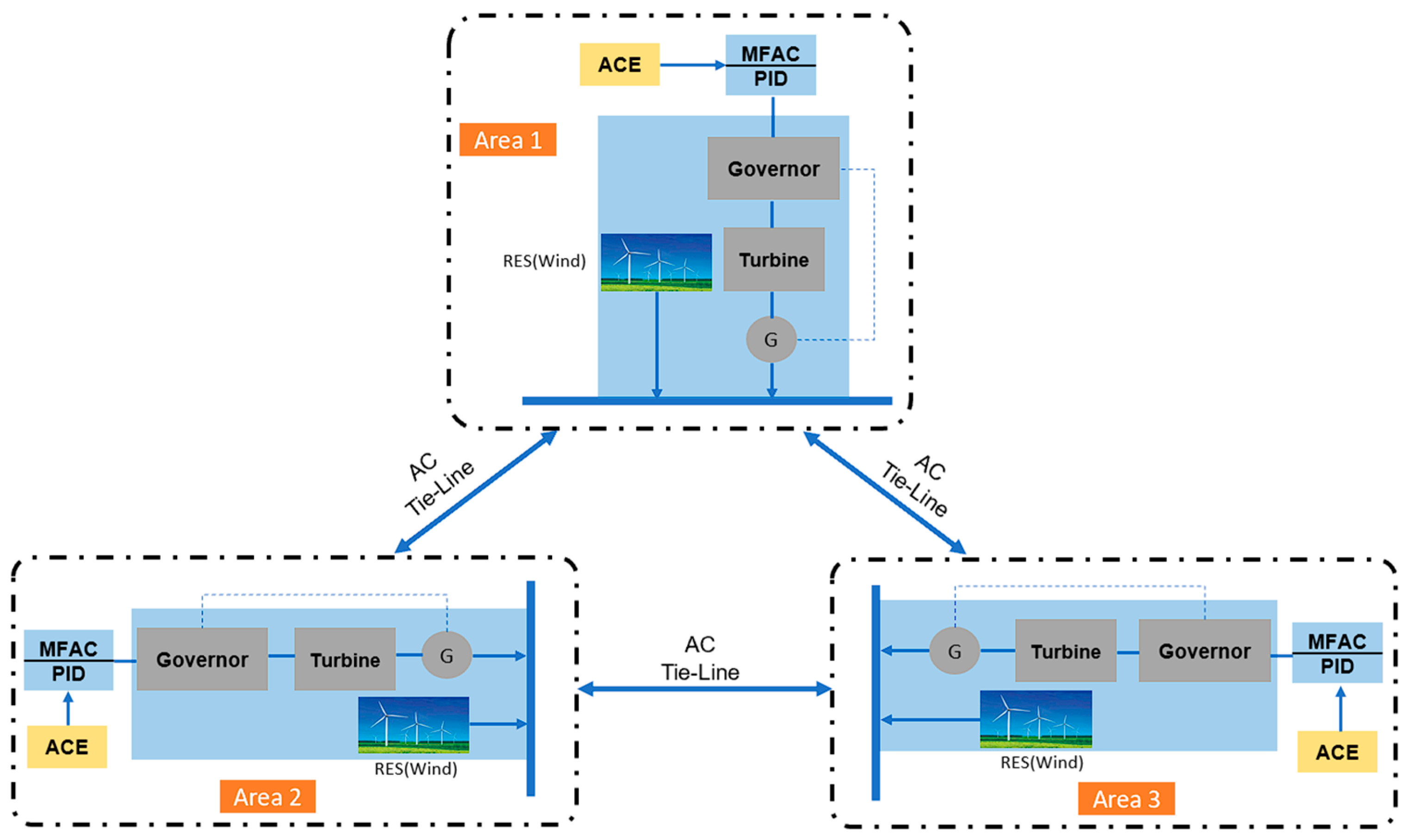
From a control perspective, frequency regulation must now address three interconnected phenomena. First, the disturbance spectrum is evolving: stochastic wind and solar power injections introduce active-power fluctuations with colored characteristics (i.e., temporally correlated variations) and ramp events that can excite inter-area modes. Second, the plant is no longer quasi-stationary: unit commitment, RES forecast errors and dynamic demand cause frequent parameter drift in governor and turbine models, as well as in overall load damping. Third, the sensing and actuation system is evolving: wide-area measurement systems and distributed resources enable faster response but also introduce practical implementation considerations [10,11]. These conditions call for LFC designs that are adaptable to changing operating conditions and robust against modeling uncertainty. In this study, we evaluate the dynamic performance under the same disturbance realizations and parametric uncertainty scenarios, specifically ± 5 % variations in the inertia and damping coefficients. Communication constraints are not explicitly modeled. The system investigates a realistic interconnected architecture, where interconnected areas exchange power via AC tie-lines under renewable variability, as illustrated in Figure 1.
Despite this progress, comparative assessments under realistic multi-area conditions remain limited. Many studies rely on simplified disturbance profiles, evaluate fixed-gain incremental PID mainly in single-area settings, or report only a narrow set of performance measures. In addition, controller complexity and computational burden—important for real-time deployment in AGC layers—are not always discussed alongside regulation performance [4,5,6,12]. However, a unified, reproducible multi-area benchmark that compares fixed-gain incremental PID, MFAC, and a hybrid MFAC–PID controller across identical stochastic wind realizations, actuator limits, and sampling settings remains limited in the literature. Practical constraints, such as telemetry/update rates and market dispatch intervals, can also limit achievable regulation quality, particularly when distributed resource aggregators and wind plants participate in secondary control markets [9,13,14].
This work addresses the aforementioned challenges by implementing and evaluating established PID-based and MFAC-based secondary LFC strategies within a unified three-area benchmark. We compare an incremental discrete-time PID ACE regulator with practical implementation considerations, an MFAC-based ACE regulator based on a data-driven adaptive mechanism, and a parallel MFAC–PID variant that adds a conventional PID term to the adaptive MFAC increment. In contrast to emerging machine learning (ML) or deep reinforcement learning (DRL) strategies that often impose heavy computational burdens and require extensive offline training [5,14], this proposed hybrid architecture is selected to prioritize real-time feasibility and industrial reliability, while ensuring robust online adaptation. All methods are evaluated under the same disturbance realizations, sampling settings, and actuator limits and are assessed using a common panel of metrics, including max Δ f , settling behavior, tie-line deviations, and integral indices, specifically Integral Absolute Error (IAE), Integral Squared Error (ISE), Integral Time-Weighted Absolute Error (ITAE), and Integral Time-Weighted Squared Error (ITSE) [15]. Robustness is examined under ± 5 % parametric uncertainty in selected system parameters (e.g., inertia and damping).
Paper organization: Section 2 reviews related work and identifies research gaps. Section 3 presents the system modeling and controller design. Section 4 reports comparative results for the two evaluation cases, and Section 5 concludes the paper with practical implications and future research directions.

2. Literature Review

This section presents the historical and technical evolution of Load Frequency Control (LFC), tracing progress from classical PID-based Automatic Generation Control (AGC) to contemporary adaptive and data-driven approaches. The review examines multi-area operation in the context of renewable energy source (RES) penetration and broader demand/operating-point variability, which have motivated extensions beyond fixed-parameter tuning. Emphasis is placed on ACE-based secondary control principles and operator criteria, practical enhancements to PID controllers documented in the literature, and model-free or adaptive strategies that utilize input–output measurements. The section concludes with a summary of persistent benchmarking challenges identified in recent research.

2.1. ACE-Based Foundations and Classical PID Control

In conventional AGC, secondary frequency regulation is designed around the Area Control Error (ACE), which combines local frequency deviation and interchange (tie-line) power error to restore nominal frequency and scheduled power exchanges [16,17,18,19,20]. Contemporary practice evaluates performance using integral indices such as ISE, IAE, and ITAE, alongside transient metrics including overshoot, undershoot, settling time, steady-state error, and tie-line power deviation [21]. These criteria provide complementary views of regulation quality and inter-area damping.
Despite ongoing research, fixed-gain Proportional–Integral–Derivative (PID) regulators remain widely deployed in AGC due to their simplicity, ease of commissioning, and compatibility with existing Supervisory Control and Data Acquisition (SCADA) infrastructures [1,17,18,22]. However, investigations reveal deteriorated fixed-gain PID performance due to parameter drift ( M i , D i , R i ) , frequent operating-point shifts, and inter-area oscillations driven by variable tie-line exchanges in RES-rich grids [3,4,5,6,23]. To address these effects while maintaining the established AGC architecture, the literature frequently reports practical enhancements. These include the following: (i) off-line gain optimization, often employing metaheuristics, to enhance robustness across a broader operating range [1,3,5]; (ii) adaptive or gain-scheduled PID variants that adjust gains based on measurable operating indicators [3,5,23]; and (iii) implementation-focused augmentations, such as anti-windup and projection mechanisms, to manage saturation and improve transient performance under varying conditions [1,23]. Robust/Model Predictive Control (MPC)/sliding mode designs enhance guarantees in the presence of structured uncertainty; however, they increase modeling challenges, telemetry requirements, and computational demands [4,24,25,26].

2.2. RES Integration and the Case for Adaptation

High penetration of inverter-based renewable energy sources (RESs) reduces effective inertia and increases system sensitivity to disturbances, resulting in faster frequency excursions and more stringent secondary control requirements [3,4,5,12,27,28,29]. Furthermore, wind and solar generation introduce stochastic, temporally correlated fluctuations, including ramp-like events on seconds-to-minutes time scales, which can continuously excite inter-area modes and challenge controllers designed for a single operating condition [11,30]. As a result, numerous studies advocate for adaptive or data-driven Load Frequency Control (LFC) strategies that address model mismatch, non-stationarity, and uncertainty in aggregate dynamics without the frequent re-identification required by full-order models [3,4,5,12]. Similarly, intelligent strategies such as multi-degree-of-freedom fuzzy controllers have demonstrated effectiveness in maximizing power extraction from photovoltaic systems, highlighting the value of adaptive logic in renewable integration [31]. Recent multi-area benchmarks, typically based on modified Kundur-type systems with stochastic wind injections, further highlight that realistic disturbance modeling and operating-point variability are critical for credible controller comparisons [11,30].

2.3. Model-Free Adaptive Control for Multi-Area LFC and Benchmarking Gaps

The literature has broadly followed two directions to improve LFC under renewable-driven variability. One stream retains the PID-based AGC structure and enhances it via gain scheduling, adaptive rules, or optimization-based tuning to maintain performance as operating conditions change [3,5,6]. The other stream explores robust/model-predictive designs and data-driven approaches, such as model-free adaptive control (MFAC), which updates control actions based on input–output measurements and can reduce reliance on detailed aggregated dynamic models [13,15,32,33].
MFAC avoids matching to a plant model by estimating a local pseudo-gradient from input–output increments (compact-form dynamic linearization), ensuring stability under standard Lipschitz/excitation conditions and allowing for the forgetting/regularization of time variation [14,15]. For multi-area LFC, MFAC-based data-driven regulation has been reported to achieve effective ACE tracking and damping performance under RES variability using input–output measurements [13,34,35].
Although progress has been made, the recent literature identifies three persistent benchmarking gaps. First, direct comparisons between fixed-gain incremental PID and model-free designs on identical multi-area plants under matched disturbance realizations are relatively uncommon [4,17,23,32]. Second, disturbance realism is often limited, as stylized step disturbances are often used instead of stochastic wind spectra or aggregated flexibility profiles that account for availability constraints [3,4,5,12,13,14]. Third, reporting on deployment-oriented metrics, including computation per cycle, workload tuning, and sensitivity to sampling/noise, remains limited, despite their significance for practical AGC adoption [21,36,37].

3. Materials and Methods

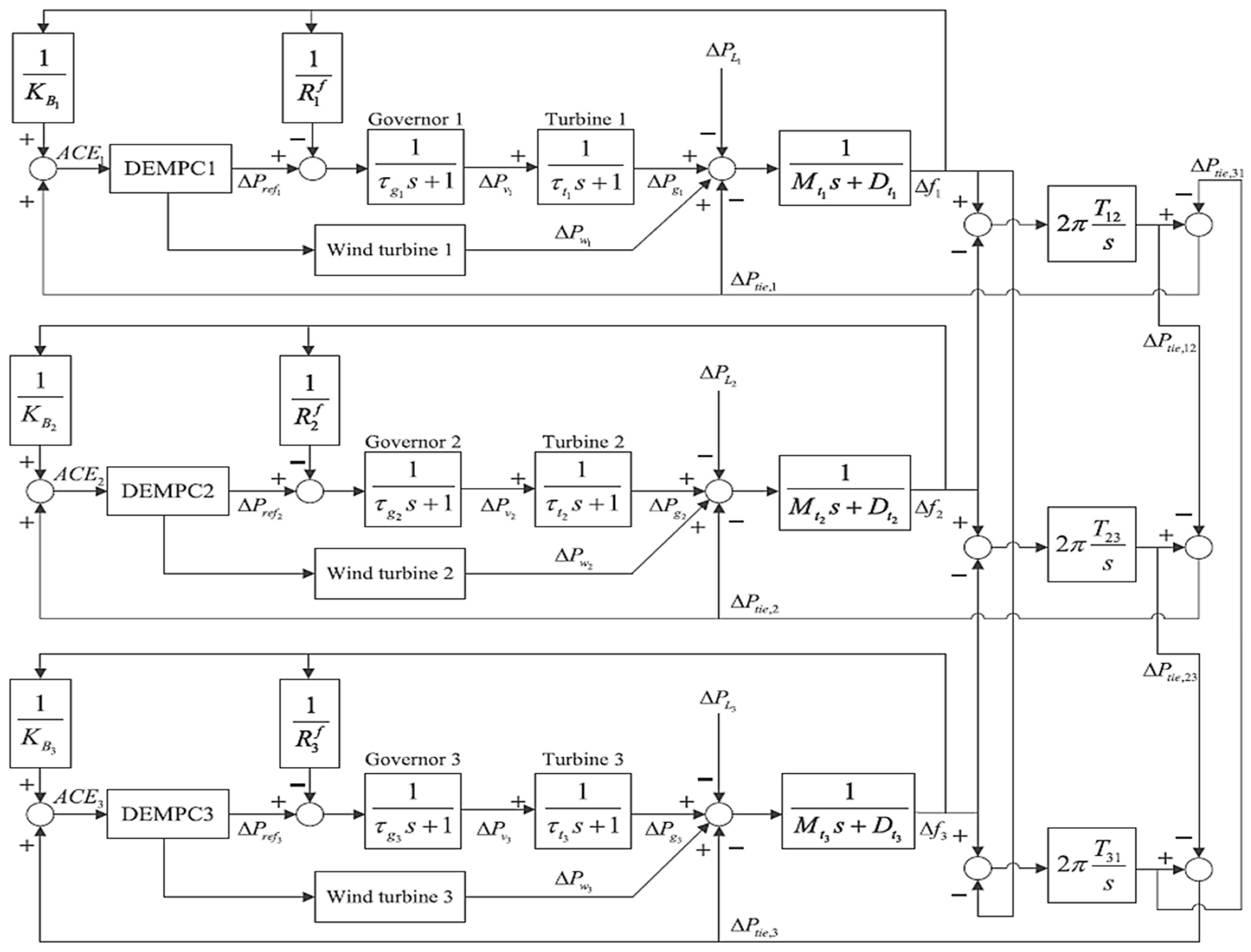
This section details the modeling framework and the implementation of the control strategy. The investigated three-area interconnected power system is shown in Figure 2. The symbols and variables used in the area model are summarized in Table 1. Although the overall interconnection contains multiple feedback paths, the control architecture remains structurally modular across all areas. However, to closely reflect practical AGC/LFC scenarios, the physical parameters of the interconnected areas, as detailed in Table 2, are intentionally heterogeneous and asymmetrical.
For a representative area i , the signal flow proceeds as follows: The Area Control Error (ACE), A C E i =   β i Δ f i +   Δ P t i e , i , is computed from the local frequency deviation and the net tie-line power deviation, which then drives the secondary controller. The secondary control input is applied at the governor summing junction, in parallel with the primary droop feedback 1 R i Δ f i . The resulting command passes through the governor and turbine blocks and acts on the generator–load dynamics 1   M s +   D to produce the frequency deviation Δ f i . Inter-area coupling is captured by the tie-line channels, where frequency differences are integrated (via the 2 π T s blocks) to form the tie-line power deviations and summed to obtain the net Δ P t i e , i . External disturbances—including step load changes and stochastic wind injection—enter as power-imbalance terms at the generator–load summing point, thereby testing controller robustness under renewable-driven variability.

3.1. Modeling Approaches for Multi-Area Power Systems

The conceptual framework of the investigated system is depicted in Figure 1, which illustrates the three-area AC-interconnected architecture integrated with stochastic wind power generation. This architectural scenario is further detailed in Figure 2 and Figure 3, which respectively provide physics-faithful blocks and control-oriented state–space representations. As shown in the setup, wind turbines are modeled with specific rated power and rotor radius parameters, R 40   m (approximately), rated = 1.5   M W and Robustness ( R 1 :   ± 5 % ), to reflect realistic operating conditions [7,8,17,38,39]. Robustness is examined under ± 5 % parametric uncertainty in selected system parameters, such as inertia and damping coefficients, alongside gust wind and load noise. We assume a three-area interconnected thermal power system. The area i i = 1 , 2 , 3 , consists of a speed governor, a steam turbine, a generator/load subsystem, and tie-lines to the other areas. A small-signal model, in terms of an operating point, is utilized. In the swing (generator–load) equation the time evolution of the frequency for area i is given by:
d Δ f i t d t = D i M i Δ f i t 1 M i Δ P t i e i t + 1 M i Δ P m i t   Δ P L , i t .
The net tie-line power deviation for the area i is the sum over all interconnected regions.
Δ P t i e i t = j = 1 , j i 3 P i j t ,
with individual AC tie-line deviation between areas i and j modeled as:
d P i j t d t = 2 π T i j f i t f j t ,
where T i j is the synchronizing coefficient (p.u./Hz). Turbine dynamics are shown in the block diagrams, where the turbine time constant is denoted by the Greek letter τ t i . The turbine dynamics are written as
d Δ P m , i t d t = 1 τ t i Δ P m , i , t + 1 τ t i Δ P g , i t ,
where τ t i > 0 is the turbine time constant and Δ P g , i t is the governor valve–position deviation. Similarly, using the symbol τ g i for the governor time constant, the governor dynamics are governed by:
d Δ P g , i t d t = 1 R i τ g i Δ f i t 1 τ g i Δ P g , i t + 1 τ g i Δ P c , i t ,
where Δ P c , i t is the secondary control (LFC) command (p.u.). Following standard AGC practice, the Area Control Error (ACE) for area i is defined as
A C E i t = β i Δ f i t + Δ P t i e , i t ,
with the frequency-bias factor β i = D i + 1 R i . The LFC objective is to drive A C E i t 0 in all areas, which corresponds to restoring nominal frequency and scheduled tie-line power exchange. The three-area system is described by including governors 1 τ g i s   + 1 , turbines 1 τ t i s   + 1 , generators 1 M i s + D i , tie-lines 2 T i j s , and wind-turbine injection blocks [16,17,20].

3.2. Three-Area Simulation Parameters

A benchmark three-area interconnected thermal power system is used to assess the developed hybrid MFAC–PID load-frequency controller. Each control area corresponds to an aggregated generation and load bus of similar capacity and inertia, linked by three lossless tie-lines. To facilitate reproducible and sufficiently challenging controller comparisons, the three-area Load Frequency Control (LFC) testbed incorporates heterogeneous area parameters and non-identical tie-line couplings, as well as stochastic wind-power injection based on a nonlinear aerodynamic model and noisy load variations. Practical implementation considerations are addressed through actuator saturation limits, discrete-time sampling, and verification of real-time computational feasibility, such as an execution time of approximately 0.306   m s . Robustness is further evaluated by applying ± 5 % parameter perturbations. Collectively, these features establish a benchmark testbed that reflects key sources of variability, uncertainty, and operational characteristics present in modern renewable–integrated power systems. All quantities are expressed in per unit on a common base.
The tie-line synchronizing coefficients are T 12 = 0.10 , T 13 = 0.15 , and   T 23 = 0.12   ( p . u . / H z ). In all simulations, the nominal system frequency is denoted by f 0 ( 50   H z   o r   60   H z ) , depending on the target grid, and all frequency deviations Δ f i are measured with respect to the f 0 simulation configuration: sampling period, T S = 0.01   s , and number of steps, N = 15,000 .
PID tuning policy: Two fixed-gain PID parameter (Table 3) sets are considered: a baseline PID gain set used in the original simulations and a tuned set utilized for a standardized and fair comparison among controllers (Table 4). Unless otherwise stated, the results reported in Table 4 use the tuned PID gains, while other illustrative plots may use the baseline gains.
Desired ACE: y d k = 0 for all areas and control limits: u m i n = 0.5   p . u .   a n d   u m a x = 0.5   p . u . For robustness analysis, a generic plant parameter x is perturbed as x ~ = x 1 + δ x , δ x 0.05 , 0.05 , representing ± 5 % uncertainty around the nominal values.
Discrete-Time State–Space Representation for digital realization and MFAC design: The continuous-time model is discretized using a sampling period ( T s ), with the forward-Euler approximation. Let us define the state, input, and disturbance vectors for each area i and represent them in the form, as well as prove in outline basis that also corresponds to a continuous-time state-space model
x i k = f i k P tie , i k Δ P m , i k Δ P g , i k , u i k = Δ P c , i k ,
θ i k = Δ P L , i k j i T i j , Δ f j k .
Now, the continuous-time state–space model is
x i ˙ t = A i x i t + B i u i t + F i θ i t ,
y i t = C i x i t ,
where y i t = A C E i t and
A i = D i / M i 1 / M i 1 / M i 0 2 π j i T i j 0 0 0 0 0 1 / τ t i 1 / τ t i 1 / R i τ g i 0 0 1 / τ g i ,
B i = 0 0 0 1 / τ g i ,   F i = 1 / M i 0 0 2 π 0 0 0 0 ,
C i = β i 1 0 0 .
The continuous-time model is discretized using the forward-Euler approximation to enable digital implementation [25]. This approach is chosen due to its low computational requirements, which support real-time operation in embedded automatic generation control (AGC) controllers. Although explicit methods are only conditionally stable, numerical stability in this study is achieved by selecting a sampling period ( T s = 0.01   s ) that is much shorter than the system’s fastest time constants, such as the governor time constants ( τ g , i 0.06 0.08   s ). This choice maintains stability in the discrete-time dynamics and ensures accurate tracking of the continuous system’s behavior. The resulting discrete-time model is as follows:
x i k + 1 = I 4 + A i T s , x i k + B i T s , u i k + F i T s , θ i k ,
y i k = C i x i k .
In addition, stability was checked by confirming that the discrete-time eigenvalues of I 4 +   A i T s remain within the unit circle for the operating conditions considered.
In all controller comparisons (PID/MFAC/Hybrid), the same Disturbance-Estimation Model Predictive Control (DEMPC) setting and disturbance realization are used to ensure a fair and rigorous comparison under identical conditions [24].
Δ P r e f , i k   s a t Δ P r e f , i k ,   Δ P r e f , i m i n ,   Δ P r e f , i m a x
where s a t denotes the saturation operator with bounds Δ P r e f , i m i n and Δ P r e f , i m a x .
Δ P r e f , i k = g i y i , 0 k + 1 k g i 2 + γ i
defining g i =   C i B d , i and
y i , 0 k + 1 k = C i A d , i x i k + B d , i u c , i k + F d , i i k ,
the closed-form DEMPC update is
y i k + 1 k = C i A d , i x i k + B d , i u c , i k + P r e f , i k + F d , i i k ,
with the one-step prediction subject to
Δ P r e f , i m i n ,   Δ P r e f , i k   Δ P r e f , i m a x and   min Δ P ref , i k y i 2 k + 1 k + γ i Δ P r e f , i 2 k .
Using the discrete-time area model x i k + 1 =   A d , i x i k +   B d , i ,   u i k +   F d , i   θ i k , where
A d , i = I 4 + A i T s ,   B d , i = B i T s ,   a n d   F d , i = F i T s ,
a one-step quadratic optimization is solved at each sample [24]. To remain consistent with the benchmark architecture in Figure 2, we include a lightweight DEMPC layer as a supervisory reference generator [24]. The DEMPC computes a per-area reference correction Δ P r e f , i k , which is added as a feedforward term to the secondary control command.

3.3. MFAC Design via Compact-Form Dynamic Linearization

Each area is treated as a nonlinear Single-Input Single-Output (SISO) system with unknown internal model but measurable input u i k and output y i k . The input–output behaviour is written as:
y i k + 1 = f i y i k , u i k + ω i k
where ω i k is a bounded disturbance. In this context, u i k = Δ P c i k represents the secondary control signal/LFC command. It has one measured output and another case y i k = A C E i k (the Area Control Error for area i ). So we ignore the internal states and tie-line details and each area is conceptualized as a black box:
u i k   ( power   system   area )     y i k
defines the increments
Δ y i k + 1 = y i k + 1 y i k ,
and
Δ u i k = u i k u i k 1 .
Under mild smoothness and Lipschitz assumptions, there exists a scalar pseudo-partial derivative (PPD) ϕ i k such that
Δ y i k + 1 = ϕ i k , Δ u i k + Δ ω i k ,
where Δ ω i k = ω i k ω i k 1 . Equation (21) is the compact-form dynamic linearization (CFDL) model. Because ϕ i k is unknown, an estimate ϕ i ^ k is updated online from measured data. Consider the cost
J i ϕ = Δ y i k ϕ , Δ u i k 1 2 + μ i ϕ ϕ i ^ k 1 2 ,
with μ i > 0 . Minimization of Equation (22) yields the recursive update
ϕ i ^ k = ϕ i ^ k 1 + η i Δ u i k 1 μ i + Δ u i 2 k 1 Δ y i k ϕ i ^ k 1 Δ u i k 1 ,
where 0 < η i 1 is a learning rate [15]. To preserve control direction and avoid numerical issues, a lower bound is enforced, ϕ i ^ k = max ϕ i ^ k , ϕ m i n , ϕ m i n > 0 . At each step the MFAC chooses the control increment Δ u i k to minimize
J i u i k = ( y d k + 1 y i k + 1 ) 2 + λ i ( u i k u i k 1 ) 2 ,
with λ i > 0 a weight on control effort. Approximating y i k + 1 y i k + ϕ i ^ k , Δ u i k and differentiating Equation (24) gives the MFAC increment
Δ u i , MFAC k = ρ i ϕ i ^ k λ i + ϕ i 2 ^ k ( y d k + 1 y i k ε i k ) ,
where 0 < ρ i 1 is a step size and ε i k represents residual modelling error. The MFAC contribution is therefore u i k = u i k 1 + u i , MFAC k .

3.4. Incremental Discrete PID Control

In the proposed hybrid scheme, each control area employs a classical PID controller that acts on the Area Control Error (ACE) in conjunction with the data-driven MFAC law. Adaptive behavior arises because the MFAC part updates its internal model online, while the PID part shapes the dynamic response and enforces zero steady-state ACE. ACE definition and discrete error are represented by
A C E i k = β i , Δ f i k + Δ P tie , i k
and
e i k = y d k A C E i k .
It combines local frequency deviation and net tie-line power deviation using the frequency-bias factor β i . When A C E i k is zero, both frequency and scheduled tie-line exchange are restored for area i , and the reference y d k is zero in this work, so e i k is simply the negative of A C E i k . A non-zero error means the area is not in balance. Continuous-time PID law is represented by
u PID , i t = K p , i , e i t + K i , i 0 t e i τ d τ + K d , i d e i t d t
The proportional term reacts to the current error, the integral term accumulates past error to remove steady-state ACE, and the derivative term anticipates future trends and improves damping. The integral and derivative terms are approximated in discrete time using the sampling period T s . Discrete approximations of the integral and derivative are
0 k T s e i τ d τ T s j = 0 k e i j d e i t d t | t = k T s e i k e i k 1 T s .
These approximations convert the continuous PID into a form suitable for implementation on a digital controller [22].
The incremental discrete PID update defines the incremental PID output, i.e., how much the PID command changes between successive sampling instants, following the standard digital implementation described in references [1,22].
Δ u PID , i k = u PID , i k u PID , i k 1
Δ u P I D , i k = K p , i     e i k e i k 1 + K i , i   T s e i k + K d , i e i k 2 e i k 1 + e i k 2 T s
u PID , i k = u PID , i k 1 + Δ u PID , i k
The key discrete incremental PID formula is actually implemented in the simulation. It uses current and past error Equation (27) values e i k , e i k 1 and e i k 2 to compute the control increment [22]. The first term is the proportional action, the second term is the integral contribution, and the third term approximates the derivative using a second-order difference. The PID output is updated by adding the newly computed increment Equation (32). This recursive form is numerically robust and easy to combine with other incremental controllers. Talking about MFAC increment (from the previous subsection, for completeness), in Equation (25) the MFAC increment is obtained from the model-free adaptive controller. It depends on the estimated pseudo-partial derivative φ ^ i k and on the predicted tracking error. This term provides the controller with adaptive capability and updates the control effort when the plant dynamics or operating conditions change; the total hybrid secondary control signal u i k for area i . It is the sum of the previous control, the MFAC increment and the PID increment. There are three modes: PID-only mode, MFAC-only mode and Hybrid (parallel) mode, represented by
Δ u i M F A C k = 0 u i k = u i k 1 + Δ u i P I D k ,
Δ u i P I D k = 0 u i k = u i k 1 + Δ u i M F A C k ,
and
u i k = u i k 1 + Δ u MFAC , i k + Δ u PID , i k .
In other words, MFAC and PID work in parallel: MFAC adapts and PID shapes the transient. Formal stability of the combined loop is not derived here; boundedness is assessed via actuator saturation and simulation results under the benchmark cases.
u i k = min { m a x u i k , u m i n ) , u m a x
control signal is constrained between u m i n and u m a x (here, 0.5 and 0.5   p . u . ), which avoids unrealistic commands and inherently mitigates integral windup.
K p , i = K i , i = K d , i = 1.0 × 10 4 ,
and
i = 1 , 2 , 3
are the specific PID gain values used in the simulations. They are intentionally small so that the MFAC term provides the main adaptive action, while the PID term primarily improves damping, overshoot, and steady-state performance.

3.5. The Hybrid MFAC–PID Load Frequency Controller

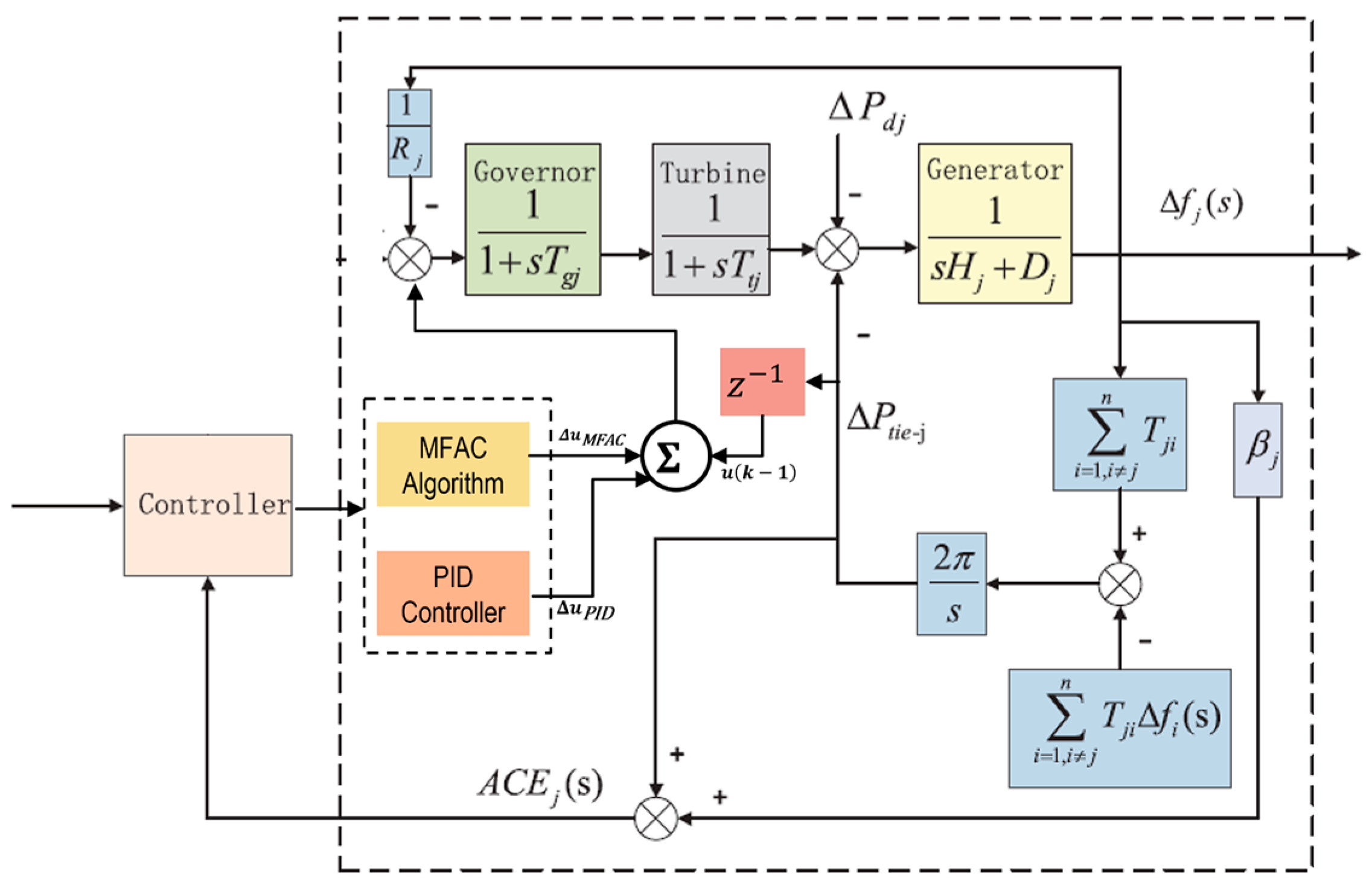
To address the limitations of fixed-gain control while maintaining structural simplicity, our framework retains the PID controller acting on the ACE signal in a parallel configuration, as shown in Figure 2 and Figure 3. This approach remains compatible with traditional AGC architecture, while integrating the adaptive capabilities of MFAC. The control-oriented state–space representation supplies a common ACE-based output ( y i ) for both controllers, ensuring that an identical evaluation is conducted across the entire performance panel.
The proposed hybrid controller for area i combines the MFAC and PID increments. The term Δ u MFAC , i k is the MFAC increment, given in Equation (25); here, ϕ i ^ k is the online estimate of the pseudo-partial derivative between the control input and the ACE output, updated directly from measured input–output data. This quantity represents the current gain of the area dynamics. The factor ϕ i ^ k / λ i + ϕ i 2 ^ k therefore acts as an adaptive control gain: when the effective plant gain changes due to load variations, wind power injection or parameter uncertainty, ϕ ^ i k changes accordingly and the MFAC increment automatically rescales itself. The bracketed term y d k + 1 y i k ε i k is a one-step-ahead tracking error corrected by the MFAC residual ε i k , so Δ u MFAC , i k directly aims to reduce the predicted ACE at the following sample [15,22,23].
u i k = u i k 1 + ρ i ϕ i ^ k λ i + ϕ i 2 ^ k y d k + 1 y i k ε i k M F A C   i n c r e m e n t + K p i ( e i k e i k 1 ) + K i i T s , e i k + K d i ( e i k 2 e i k 1 + e i k 2 ) P I D   i n c r e m e n t
The term Δ u PID , i k is the PID increment, implemented in discrete incremental form as Equation (32), with e i k = y d k y i k . This increment combines proportional, integral and derivative actions on the ACE error, shaping the damping, overshoot and settling time and guaranteeing zero steady-state ACE. By summing Δ u MFAC , i k and Δ u PID , i k on top of u i k 1 , the controller exploits the adaptivity of MFAC while preserving the familiar dynamic behavior of a PID-based LFC. In the hybrid implementation, the CFDL update uses the total applied increment u i k =   Δ u MFAC , i k + Δ u PID , i k , ensuring that pseudo-gradient estimation is consistent with the actual plant input [15,23].
In this parallel structure, the PID and MFAC components are complementary: the PID term provides immediate transient damping to shape the initial response, while the MFAC term adapts to system variations by updating the pseudo-gradient ^ k . Crucially, the total control input is derived from the algebraic summation of these continuous increments. Unlike switching-based strategies, this architecture involves no discontinuous logic, ensuring a smooth control signal and effectively preventing chattering behavior.
Figure 3 illustrates the additive (parallel) MFAC–PID LFC structure corresponding to Equation (35). Figure 3 presents the single-area LFC power system model for area ( j ) and shows how the proposed controller interacts with the physical plant and the ACE signal. Crucially, this control-oriented representation demonstrates the implementation of MFAC and PID on the same measurement channel ( y i ). Utilizing a shared input structure eliminates modeling asymmetry and facilitates a fair comparison between data-driven and classical schemes under identical conditions, as recommended by recent benchmarking studies. Inside the dashed box is the continuous-time power system of area j . The controller sends a secondary control command u j s to the governor loop. This signal is summed with the speed-droop feedback 1 R j Δ f j s , so that an increase in frequency automatically reduces the effective input to the governor, representing primary control action. The resulting signal passes through the governor block 1 1 + s T g j , which models the valve and speed-governing mechanism with time constant T g j . The governor output drives the turbine block 1 1 + s T t j , where T t j is the turbine time constant. The turbine mechanical power is combined with the local load disturbance Δ P d j and then fed into the generator–load block 1 s H j + D j , where H j and D j denote inertia and damping. The output of this block is the area frequency deviation Δ f j s . In parallel, the net tie-line power deviation Δ P tie j is obtained from the sum of all synchronizing coefficients T j i multiplied by the angles (integrated frequency differences) of the interconnected areas. This is implemented by the T j i block, the integrator 2 π s , and the summation of T j i Δ f i s from the neighboring areas. Finally, the Area Control Error for area j is formed at the bottom of the figure as
A C E j s = β j Δ f j s + Δ P tie j s ,
where β j is the frequency-bias factor. This ACE signal is feedback to the controller, which computes the following u j command (implemented in this work by the hybrid MFAC–PID law). Thus, Figure 2 shows the complete loop from the controller output through the governor–turbine–generator–tie-lines back to the ACE and into the controller again.

3.6. Wind-Turbine and Disturbance Modeling

To capture the impact of renewable generation, each area includes a mechanical power injection from a wind turbine [7,8,38]. The instantaneous wind power is
P w k = 1 2 , ρ A C p ( λ k ) , V w 3 k ,
where ρ = 1.225   kg / m 3 is air density, A = π R 2 is rotor swept area with R 40   m , V w k is wind speed, and λ k is the tip-speed ratio
λ k = ω r R V w k ,   ω r 1.1   rad / s .
The power coefficient is approximated as
C p λ = 0.22 ( 116 λ 5 ) exp ( 12.5 λ ) .
Wind speed is modeled as a smooth stochastic
V w k = max ( 12 + 0.3 sin 0.002 k + 0.05 ν k , 3 ) ,
where ν k is zero-mean Gaussian noise. A normalized wind-power disturbance is defined as
P wind , n k = 0.02   t a n h P w k P rated , P rated = 1.5   M W
and the discrete state update Equation (11) is extended to
x i k + 1 = I 4 + A i T s , x i k + B i T s , u i k + F i T s , θ i k + T s P wind , n k 0 0 0 .
Load disturbances are modeled as noisy steps:
Δ P L , i k = 0.02 + 0.0005 2 r k 1 ,
where r k is uniformly distributed in {0,1}. This combination of stochastic wind and load variations produces realistic frequency excursions for controller evaluation. In the simulations, the disturbance inputs (wind injection and noisy load components) are applied after an initial steady-state window, i.e., t     10   s , in order to show the system response before the disturbances are introduced.
To assess robustness, a parametric uncertainty of ± 5 % was applied to key system constants (e.g., M i and D i ). In addition, Case 2 employs severe stochastic wind fluctuations that impose rapid and temporally correlated net-power variations, providing a demanding stress test for the regulation loop. Although disturbance variability is not equivalent to a physical reduction in inertia, the ± 5 % perturbation in M i offers an initial (moderate) indication of sensitivity to inertia changes, while the wind-driven case tests performance under intensified imbalance dynamics. Together, these settings evaluate the controller under both modeling uncertainty and highly variable operating conditions that are relevant to modern renewable-rich systems.


4. Simulation Results and Discussion

This section evaluates the proposed hybrid MFAC–PID load-frequency controller on a three-area interconnected power system under two representative operating scenarios. The controller is tested using the discrete-time implementations in the nominal system without an explicit wind model, and in the wind-integrated system with parameter uncertainty and noisy load. In both cases, the continuous-time dynamics are discretized with sampling period T = 0.01 s and simulated for N = 15,000 time steps, corresponding to a total horizon of 150   s . The controlled variable in each area is the Area Control Error ACE output A C E i k = β i Δ f i k + Δ P tie , i k , and the secondary control input u i k is updated by the hybrid MFAC–PID law. The desired ACE is 0 , so satisfactory performance requires slight overshoot, fast and well-damped transients, and negligible steady-state error in ACE, frequency deviations and tie-line power deviations.
To quantify closed-loop performance, several integral error indices and dynamic metrics are computed directly from the simulation data from two simulation:
  • Area-wise Integral of Absolute Error ( I A E i ) of ACE;
  • Total IAE over all areas I A E total ; ;
  • Maximum frequency deviation in each area;
  • Approximate settling time of frequency;
  • Combined IAE, Integral of Squared Error (ISE), Integral of Time-Weighted Absolute Error (ITAE) and Integral of Time-Weighted Squared Error (ITSE) for the sum of ACE errors.
In addition to classical integral indices such as IAE and ISE, the maximum absolute frequency deviation (worst frequency deviation) in each area is adopted as a key dynamic security metric, since frequency deviations are widely used to characterize frequency stability in low-inertia systems [2,11,17,27]. These results are summarized in Table 4, Table 5, Table 6 and Table 7.

4.1. Performance Indices and Dynamic Metrics

To ensure a standardized evaluation, PID-only, MFAC-only, and the additive MFAC+PID controller are tested under identical benchmark settings (same ACE loop, sampling time, actuator saturation limits, and disturbance schedule). For Table 4, all controllers are evaluated using the same random seed r n g 1 so that the disturbance/noise realizations are identical across the PID, MFAC, and MFAC+PID runs. The PID-only and MFAC-only cases are obtained as special cases of the additive law by disabling the MFAC or PID increment, respectively.
Table 4 summarizes the controller-to-controller comparison using common AGC/LFC performance indices ( I A E t o t a l ) and frequency/tie-line response metrics. In both cases, MFAC-only and MFAC + PID achieve substantially lower I A E t o t a l than PID-only, while the worst frequency deviation remains of similar order across the tested controllers under the chosen benchmark settings. Under identical disturbance settings (same sampling and disturbance profiles), Table 4 summarizes the performance of the PID-only, MFAC-only, and hybrid MFAC–PID controllers. In both Case 1 and Case 2, the hybrid controller yields the lowest total ACE tracking error ( I A E t o t a l ), reducing IAE from 99.99 to 42.78 in Case 1 and from 92.76 to 41.10 in Case 2. The hybrid strategy also achieves the smallest worst frequency deviation ( max Δ f ) in both cases. A slight increase in the peak tie-line state is observed for the hybrid case, indicating a trade-off between improved frequency regulation and tie-line dynamics. Table 5 reports the area-wise IAE and the total IAE of the ACE errors obtained from the two codes. The values are computed as
I A E i = k = 0 N e i k ,
and
I A E total = i = 1 3 I A E i ,
where e i k = A C E i k = y d k y i k .
The total IAE is similar across the two scenarios and is slightly lower in Case 2. This indicates that, despite wind disturbances and parameter uncertainty, the hybrid MFAC–PID controller maintains comparable overall ACE regulation performance.
To characterize the dynamic behavior of the frequency, Table 6 lists the maximum absolute frequency deviation and an approximate global settling time, defined here as the earliest time at which all three frequency deviation trajectories remain within a tiny band around zero.
The maximum absolute frequency deviation remains below 0.08   H z in all areas for both cases. Interestingly, the worst frequency deviations ( m a x Δ f ) in the wind/robustness case are slightly smaller. Still, the settling time is longer because continuous wind and noise keep exciting the system, preventing the frequency from settling to an exactly flat trajectory. Finally, Table 7 provides combined performance indices based on the sum of the ACE errors,
e Σ k = e 1 k + e 2 k + e 3 k ,
including IAE, ISE, ITAE and ITSE: I A E Σ = k e Σ k ,   I S E Σ = k e Σ 2 k , I T A E Σ = k t k e Σ k , and I T S E Σ = k t k e Σ 2 k , where t k = k T is the discrete time stamp.
Compared with Case 1, Case 2 yields a lower I A E Σ , lower I S E Σ , and lower I T S E Σ , meaning that the hybrid controller is more effective at reducing the overall magnitude, energy and high-amplitude components of ACE under wind and uncertainty. The increase in I T A E Σ reflects the longer time horizon with small but persistent oscillations caused by the stochastic wind injection.

4.2. Case 1—Nominal Three-Area System

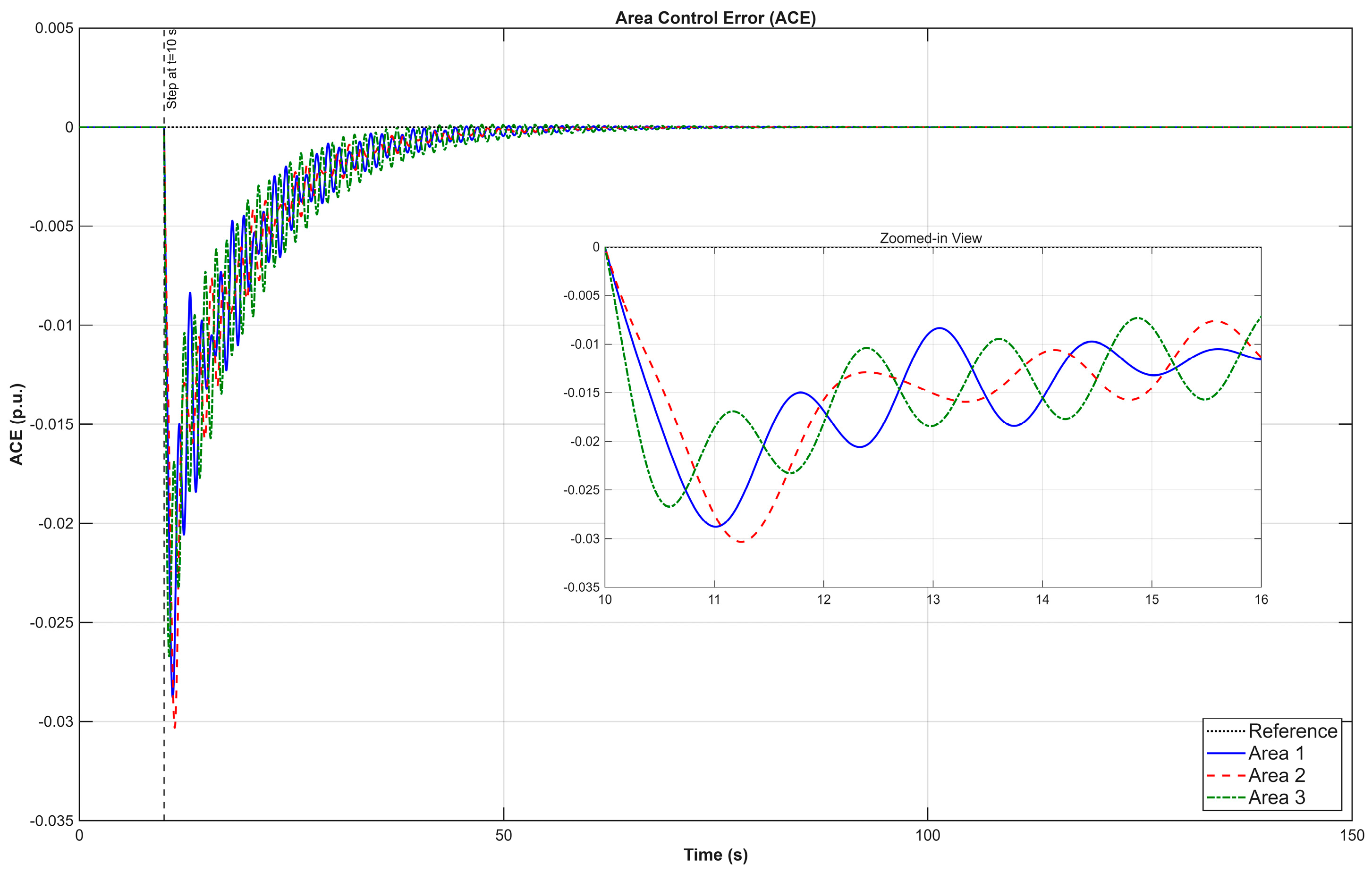
In the first scenario, the three-area thermal system operates with nominal parameters and no explicit wind integration. An A = 0.02   p . u . step increase in load is applied in each area after an initial 10 s steady-state period to demonstrate pre-disturbance stability. The same hybrid MFAC–PID controller is implemented in all areas. ACE output (Figure 4) shows the ACE-like outputs y 1 , y 2 , and y 3 (blue solid, red dashed and green dashed), together with the reference y d = 0 . Right after the load change, all three ACE-like signals drop to around 0.03   p . u . and then return smoothly toward zero. High-frequency oscillations are visible in the initial seconds due to turbine–governor and tie-line dynamics but decay rapidly. After approximately 40 50   s , all three signals are nearly indistinguishable and remain in a narrow band around zero, which is consistent with the low IAE values reported in Table 5.
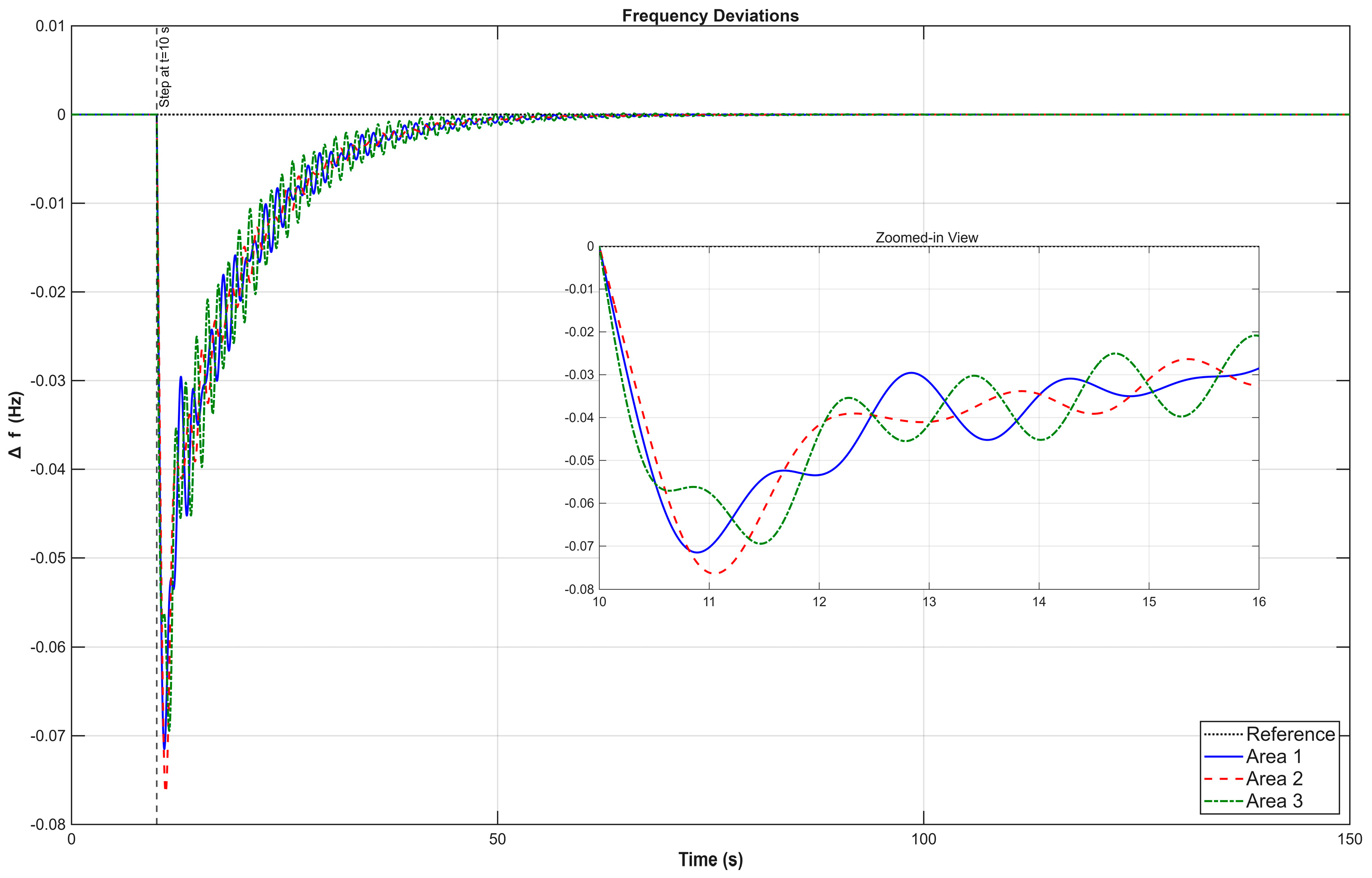
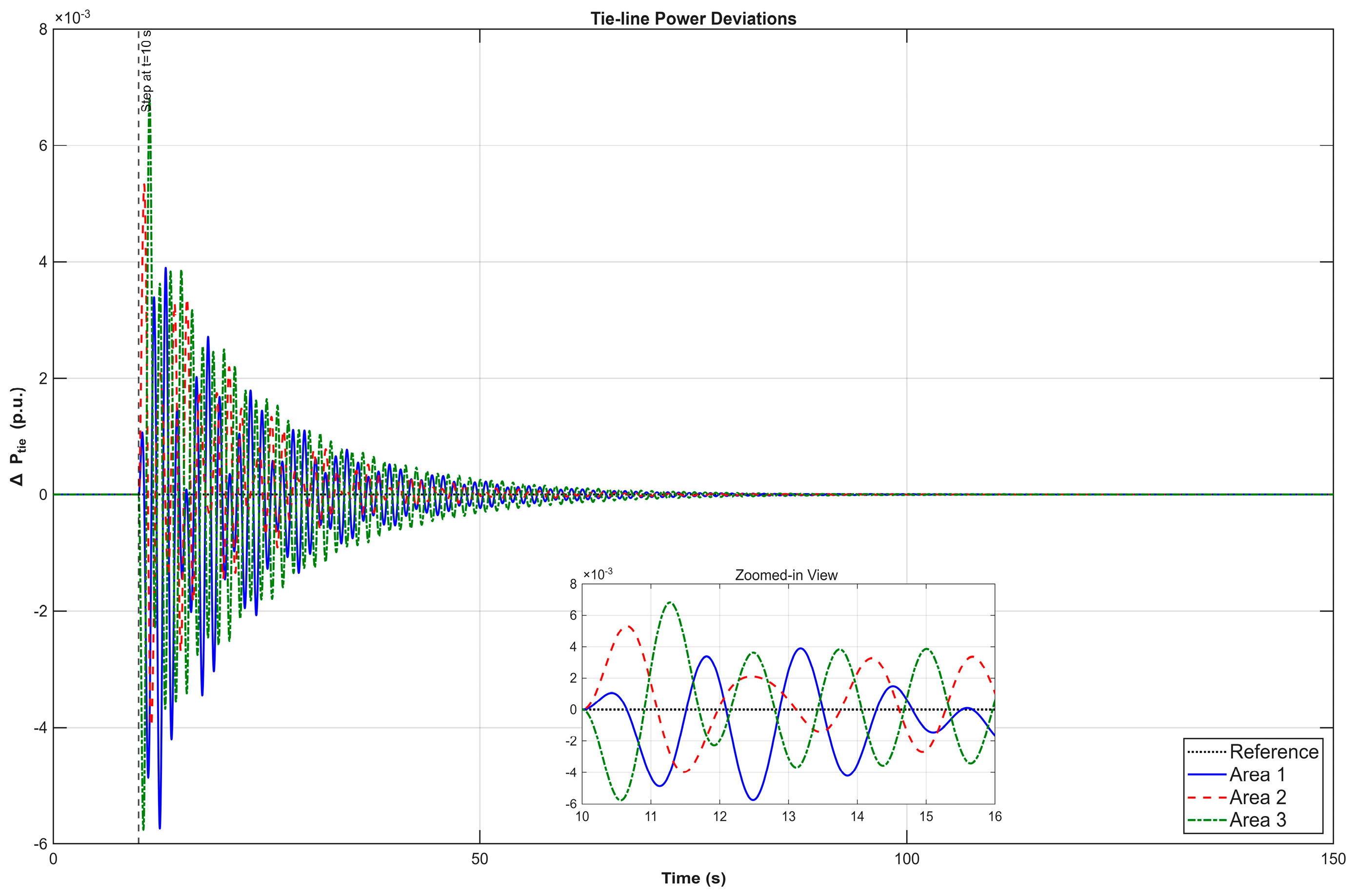
The frequency deviations present the frequency deviation states Δ f 1 , Δ f 2 and Δ f 3 obtained from the first state of each area and the stored Areas 1, 2, and 3 are shown in Figure 5. The three regions experience the maximum absolute frequency deviation between approximately minus 0.07 and minus 0.076   H z , as summarized in Table 6, and then recover toward nominal frequency. The responses are well damped, with no overshoot above zero and no sustained inter-area oscillations. The global settling time is approximately 69.25   s . The tie-line-related state (Figure 6) shows the second state x i 2 of each area, which is directly related to the tie-line power deviation seen from that area. This state exhibits small oscillations with amplitudes of the order of 10 3   p . u . immediately after the disturbance, which decay as the ACE converges to zero. After about 50   s , the trajectories stay very close to zero, indicating that the scheduled inter-area power exchanges are successfully restored. This behaviour is consistent with the good ACE and frequency performance highlighted in Table 5, Table 6 and Table 7.
Overall, Case 1 demonstrates that the hybrid MFAC–PID controller achieves classical LFC objectives in the nominal three-area system: limited maximum absolute frequency deviation max Δ f , fast ACE restoration, and well-damped tie-line oscillations.

4.3. Case 2—Wind Integration and Parameter Uncertainty

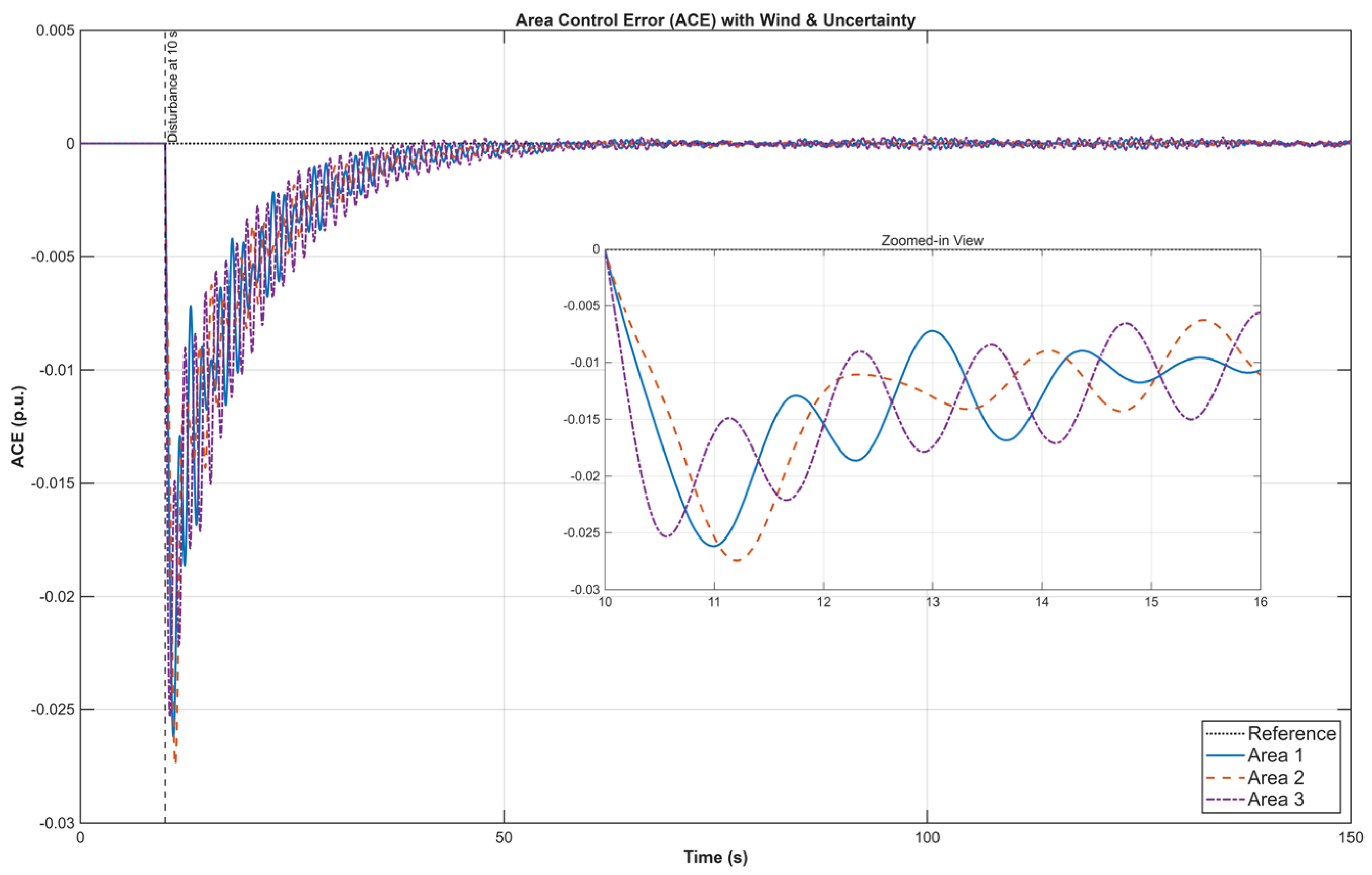
In the second scenario, the same three-area system is subjected to additional complexity: each main parameter (inertia, damping, droop, turbine and governor time constants, and tie-line synchronizing coefficients) is randomly perturbed within ± 5 % of its nominal value, a smooth but stochastic wind power input is injected via P w i n d n o r m , and small random components are added to the loads. To provide a clear pre-disturbance response, the wind-power injection and the noisy load disturbance are activated at t   =   10   s , while t   =   0 10   s is kept as an initial steady-state interval (consistent with Case 1). The hybrid MFAC–PID controller is not retuned; it uses the same gains as in Case 1. ACE responses Figure 7 shows the ACE responses A C E 1 , A C E 2 , and A C E 3 under wind and parameter uncertainty. The overall envelope of the ACE trajectories resembles that of Figure 4: an initial drop followed by convergence toward zero.
However, the signals exhibit more visible ripple and small oscillations over the entire simulation horizon due to wind and random load variations. Despite this, all ACE trajectories remain bounded and eventually concentrate around zero, which is reflected in the slightly reduced I A E total and I A E Σ values of Case 2 in Table 5 and Table 7.
The slightly lower I A E t o t a l observed in Case 2 is consistent with the MFAC component’s online adaptation under wind-induced variability. Although wind injection is stochastic and continuously excites the system, MFAC updates the pseudo-gradient ^ k at each sampling instant using measured input–output increments. This process enables the controller to track time-varying input–ACE sensitivity caused by fluctuating wind power and operating-point drift, and to rescale the incremental control action accordingly. As a result, the accumulated ACE error over the 150   s horizon can be reduced for the same disturbance realization, even though the trajectories exhibit persistent ripple due to ongoing stochastic excitation. This outcome should be interpreted as improved online gain adaptation rather than deterministic noise prediction, since the wind process remains non-repeatable.
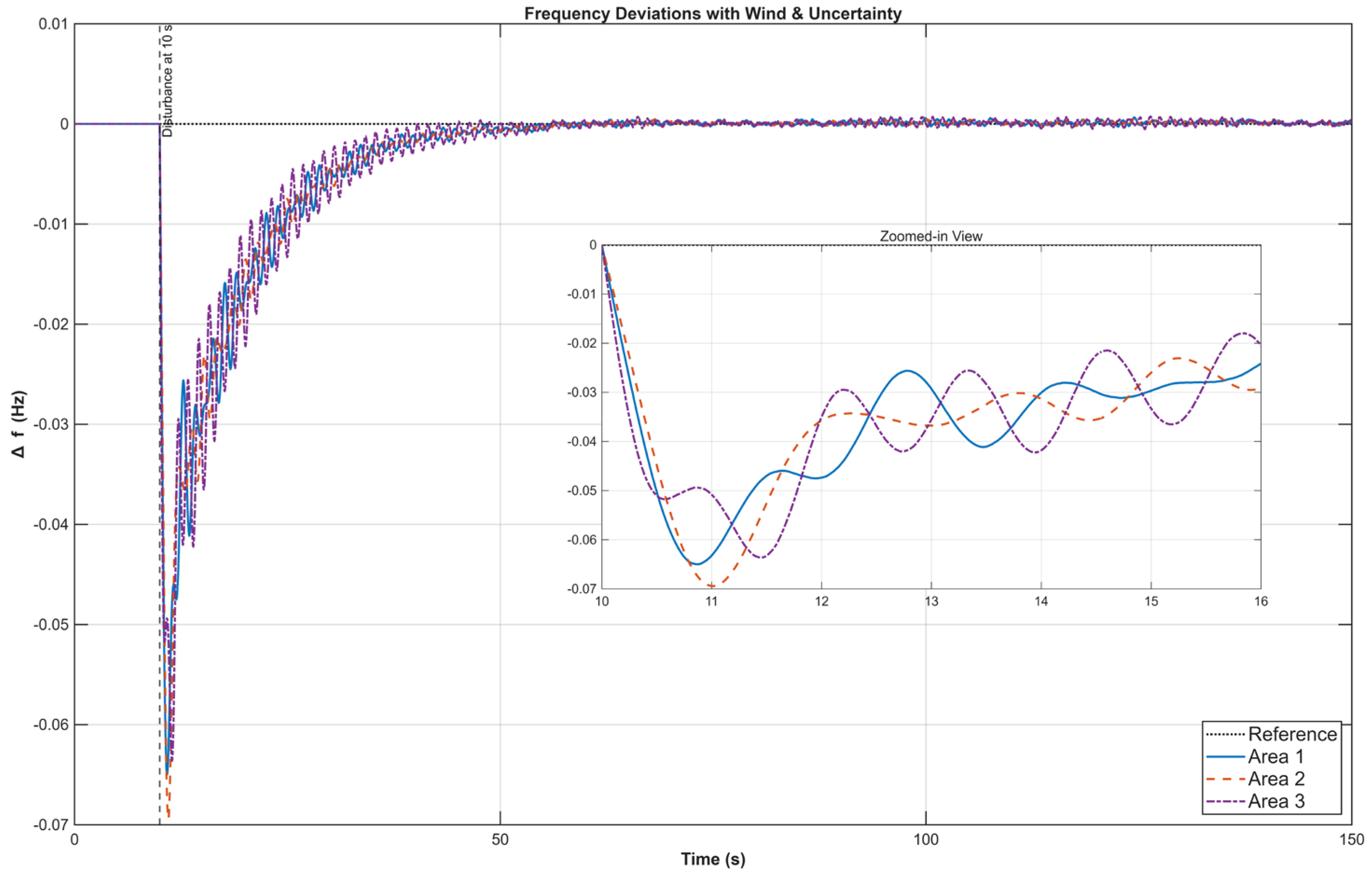
Figure 8 plots the frequency deviations Δ f 1 , Δ f 2 , and Δ f 3 for Case 2. The maximum absolute frequency deviations are slightly lower than in Case 1 (between about (−0.065) and 0.070   H z , see Table 6), but the trajectories show more irregular, noise-like fluctuations. The global settling time of Δ f , in the strict sense, is about 150   s , essentially the full simulation duration, because the wind and noise excite the system continuously. Nevertheless, the frequency deviations remain within acceptable bounds and do not exhibit diverging oscillations or drift, confirming that the hybrid controller is robust to moderate parameter variations and stochastic RES disturbances.
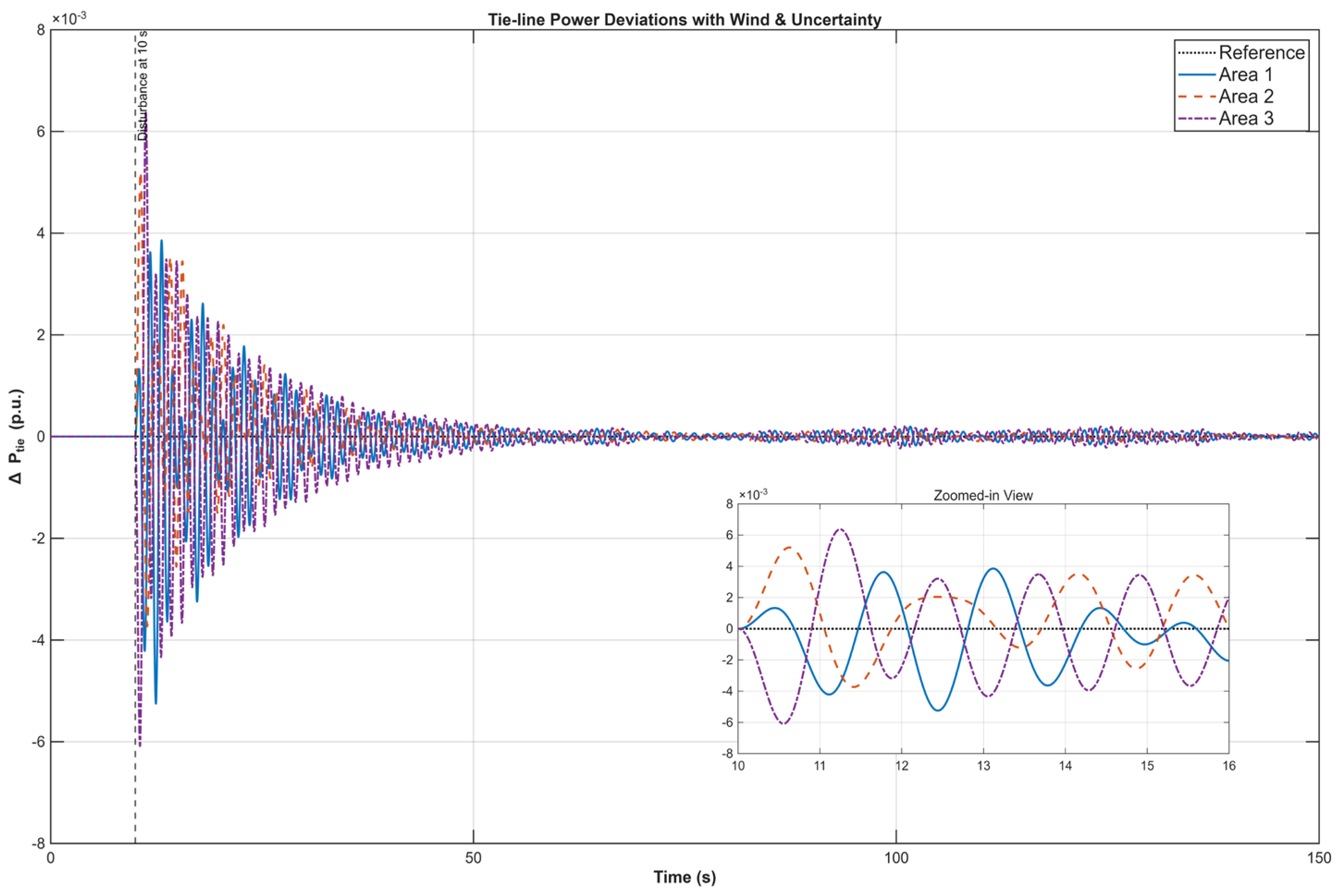
Figure 9 displays the tie-line-power-related states (labelled Area 1, Area 2 and Area 3) in the presence of wind and uncertainty. The amplitudes of the oscillations are somewhat larger and more persistent than in Figure 6, reflecting the continual power redistribution caused by the fluctuating wind injection. However, the excursions remain small (on the order of a few 10 3   p . u . ) and centred around zero. There is no indication of growing oscillations, so the tie-line flows stay within reasonable operational limits.

4.4. Sensitivity Analysis and Practical Model Constraints

A numerical sensitivity study was conducted to justify the selected incremental PID gains ( K p ,   K i ,   K d = 10 4 ). The gains were uniformly varied from 10 4 to 10 2 , while maintaining constant MFAC parameters, sampling time, actuator limits, and disturbance realization. The analysis indicates that increasing the PID gains by two orders of magnitude ( 10 2 ) results in an approximate 8.6 % reduction in total IAE (from 55.11 to 50.33).
However, the lower gain setting ( 10 4 ) is retained to align with the hybrid design objective. The MFAC component is intended to provide the primary adaptive response under conditions of nonlinearity, non-stationarity and parametric uncertainty, while the PID term serves only as a mild auxiliary for transient damping. Substantially increasing the PID gains can cause the fixed linear increment to dominate the composite control input, which may reduce the effective excitation available to the MFAC pseudo-gradient estimator and limit the adaptive contribution of the hybrid scheme. Consequently, small PID gains are preferred to preserve MFAC authority and to maintain a robust, implementation-friendly control structure.
In addition to sensitivity to control gains, the proposed architecture faces several practical constraints and limitations that define its operational boundaries. Although the hybrid MFAC–PID scheme effectively addresses stochastic wind disturbances and a ± 5 % parametric uncertainty range for inertia and damping, its performance under more severe structural changes, such as complete area disconnection or catastrophic grid failures, requires further investigation. The current benchmark also presumes ideal communication channels between the three areas. In real-world industrial AGC applications, factors such as telemetry update rates and variable communication delays may impact real-time pseudo-gradient estimation and the speed of adaptive response. Nevertheless, the reported average execution time of 0.306   m s per cycle and the consistent robustness observed in Case 2 indicate that the proposed model is highly reliable for modern renewable–integrated power systems operating under realistic conditions.

4.5. Overall Discussion

The numerical results from the two simulation scenarios (Table 4, Table 5, Table 6 and Table 7 and Figure 4, Figure 5, Figure 6, Figure 7, Figure 8 and Figure 9) indicate that the proposed hybrid MFAC–PID secondary Load Frequency Control (LFC) provides robust area control error (ACE) regulation under both nominal and renewable–integrated operating conditions. In Case 1, which uses nominal parameters, the controller reduces the ACE signals in all areas rapidly to zero. The system exhibits a well-damped frequency response and minimal tie-line excursions, demonstrating effective restoration of scheduled inter-area exchanges and adequate transient damping.
To avoid any ambiguity in interpreting the figures and the reported indices, we clarify the role of the baseline versus tuned PID settings as follows: For clarity, the conservative baseline PID gains (Table 3) are used in the illustrative time-domain plots to avoid masking the MFAC adaptive contribution within the hybrid structure. This can make the full-scale trajectories appear visually similar; therefore, zoomed-in insets are provided to highlight the transient differences. The primary controller-to-controller benchmark comparison is reported using the tuned PID baseline (Table 4), which shows that the hybrid MFAC–PID reduces the aggregated I A E t o t a l by over 50% (e.g., from 92.76 to 41.10 in Case 2) compared to the tuned PID-only case.
In Case 2, which involves stochastic wind injection with ± 5 % parameter perturbations, the same controller, without retuning, maintains bounded ACE, frequency, and tie-line dynamics despite continuous excitation from wind and random load components. Although the responses display persistent low-amplitude ripple throughout the entire time horizon, as reflected in time-weighted indices such as ITAE, the aggregated tracking error measures (e.g., I A E t o t a l and, where reported, ISE) remain comparable to, and in this study slightly lower than, those observed in the nominal case. This outcome aligns with the MFAC’s online adaptation mechanism: by updating the pseudo-gradient ^ k from measured input–output increments, the MFAC term continuously rescales the effective control gain in response to operating-point drift and wind-driven variability. This process reduces accumulated ACE error without requiring an explicit plant model. The observed improvement should be attributed to enhanced online gain adaptation rather than deterministic prediction of the stochastic wind process.
These results demonstrate the complementary functions of the two increments within the parallel structure. The PID term ensures conventional AGC performance, achieving zero steady-state ACE and rapid transient damping. In contrast, the MFAC term enables adaptation to time-varying effective plant gain and parametric uncertainty. Regarding implementation, the hybrid controller maintains low computational complexity, with an average execution time of approximately 0.306   ms per control cycle in the MATLAB R2025b implementation. This efficiency supports the feasibility of real-time AGC deployment at practical sampling rates.

5. Conclusions

This paper investigated a hybrid MFAC–PID secondary load-frequency control scheme for a three-area interconnected power system. The MFAC component updates the pseudo-gradient online to generate adaptive incremental control actions without requiring an explicit plant model. The incremental PID term maintains AGC compatibility and supports both transient damping and steady-state ACE restoration. The controller was evaluated in two scenarios: a nominal step-load case (Case 1) and a wind-disturbed case with ± 5 % parameter perturbations and noisy load variations (Case 2).
In both scenarios, the hybrid MFAC–PID controller achieved the lowest accumulated ACE regulation error among the compared controllers (PID, MFAC, and hybrid). In Case 1, the total ACE error index ( I A E t o t a l ) decreased from 99.99 (PID) to 42.78 (hybrid). In Case 2, I A E t o t a l decreased from 92.76 (PID) to 41.10 (hybrid), representing an approximately 55.7% reduction under wind disturbance (Table 4). The maximum frequency deviation remained of the same order across all controllers in both cases (Table 4), and the time-domain responses were bounded under stochastic wind injection and ± 5 % parameter perturbations (Figure 7, Figure 8 and Figure 9). These results indicate that the hybrid approach improves overall regulation quality primarily via a substantial reduction in accumulated area control error. The extended settling time observed in Case 2 aligns with persistent excitation from wind and noisy load components (Table 6). The implementation maintains low computational overhead for real-time AGC applications; in the MATLAB implementation, the average execution time per control cycle is approximately 0.306   m s .
Overall, the hybrid MFAC–PID provides a reproducible, data-driven secondary control strategy that reduces accumulated ACE error under both nominal and renewable-disturbed operating conditions within the tested uncertainty range. Future work will extend the evaluation to larger and more heterogeneous multi-area systems and include communication delays and additional system nonlinearities.

Author Contributions

Conceptualization, methodology, software, simulation, and writing—original draft preparation, M.A.S.; supervision and review/editing, C.Z.; validation, formal analysis, and review/editing, S.S. and M.M.H.F. All authors have read and agreed to the published version of the manuscript.

Funding

This research received no external funding.

Data Availability Statement

Data are contained within the article.

Acknowledgments

The authors would like to express sincere gratitude to the School of Electrical and Electronic Engineering, Chongqing University of Technology for providing the necessary research facilities and financial support. Special thanks are due to the Md Asif Shaharear’s supervisor, Chengyu Zhou, for his valuable guidance, encouragement, and support. During the preparation of this manuscript, the authors used ChatGPT-5.4 (OpenAI) and Grammarly (V1.2.239.1849) for English language polishing and editing assistance. The authors reviewed and edited the output and take full responsibility for the final content of this publication.

Conflicts of Interest

The authors declare no conflicts of interest.

Abbreviations

ACEArea Control Error
AGCAutomatic Generation Control
CFDLcompact-form dynamic linearization
DEMPCDisturbance-Estimation Model Predictive Control
IAEIntegral of Absolute Error
ISEIntegral of Squared Error
ITAEIntegral of Time-Weighted Absolute Error
ITSEIntegral of Time-Weighted Squared Error
LFCLoad Frequency Control
MFACModel-Free Adaptive Control
MPCModel Predictive Control
PIDProportional–Integral–Derivative
PPDpseudo-partial derivative
RESrenewable energy source
SCADASupervisory Control and Data Acquisition
SISOSingle-Input Single-Output

References

  1. Somefun, O.A.; Akingbade, K.; Dahunsi, F. The dilemma of PID tuning. Annu. Rev. Control 2021, 52, 65–74. [Google Scholar] [CrossRef]
  2. Son, Y.; Ha, Y.; Jang, G. Frequency nadir estimation using the linear characteristics of frequency control in power systems. Energies 2024, 17, 1061. [Google Scholar] [CrossRef]
  3. Asghar, R.; Fulginei, F.R.; Wadood, H.; Saeed, S. A Review of Load Frequency Control Schemes Deployed for Wind-Integrated Power Systems. Sustainability 2023, 15, 8380. [Google Scholar] [CrossRef]
  4. Masikana, S.B.; Sharma, G.; Sharma, S. Renewable energy sources integrated load frequency control of power system: A review. E-Prime-Adv. Electr. Eng. Electron. Energy 2024, 8, 100605. [Google Scholar] [CrossRef]
  5. Saxena, D.; Ali, M.; Ahmed, F.; Gulzar, M.K.M.M. Load frequency control progress: A comprehensive review on recent development and challenges of modern power systems. Energy Strategy Rev. 2025, 57, 101604. [Google Scholar] [CrossRef]
  6. Hu, Z.; Zhang, K.; Su, R.; Wang, R. Robust Cooperative Load Frequency Control for Enhancing Wind Energy Integration in Multi-Area Power Systems. IEEE Trans. Autom. Sci. Eng. 2025, 22, 1508–1518. [Google Scholar] [CrossRef]
  7. Wen, Z.; Yao, L.; Cheng, F.; Xu, J.; Mao, B.; Chen, R. A comprehensive review of wind power based power system frequency regulation. Front. Energy 2023, 17, 611–634. [Google Scholar] [CrossRef]
  8. Chamorro, H.R.; Ghandhari, M.; Eriksson, R. Wind Turbine Generation Impact on Power System Frequency Response. In Proceedings of the 2013 North American Power Symposium (NAPS), Manhattan, KS, USA, 22–24 September 2013; pp. 1–6. [Google Scholar] [CrossRef]
  9. Wadi, J.F.; Shobole, A.; Elmasry, W.; Kucuk, I. Load frequency control in smart grids: A review of recent developments. Renew. Sustain. Energy Rev. 2024, 189, 114013. [Google Scholar] [CrossRef]
  10. Yusuf, S.S.; Kunya, A.B.; Abubakar, A.S.; Salisu, S. Review of load frequency control in modern power systems: A state-of-the-art review and future trends. Electr. Eng. 2025, 107, 5823–5848. [Google Scholar] [CrossRef]
  11. Zhang, M.; Dong, S.; Shi, P.; Chen, G.; Guan, X. Distributed Observer-Based Event-Triggered Load Frequency Control of Multiarea Power Systems Under Cyber Attacks. IEEE Trans. Autom. Sci. Eng. 2023, 20, 2435–2444. [Google Scholar] [CrossRef]
  12. Saxena, A.; Shankar, R.; El-Saadany, E.F.; Kumar, M.; Al Zaabi, O.; Al Hosani, K.; Muduli, U.R. Intelligent Load Forecasting and Renewable Energy Integration for Enhanced Grid Reliability. IEEE Trans. Ind. Appl. 2024, 60, 8403–8417. [Google Scholar] [CrossRef]
  13. Bu, X.; Dai, X. Event-triggered model-free adaptive predictive control for multi-area power systems under deception attacks. Energy Rep. 2023, 9, 4934–4947. [Google Scholar] [CrossRef]
  14. Ye, F.; Hu, Z. Robust Load Frequency Control of Interconnected Power Systems with Back Propagation Neural Network-Proportional-Integral-Derivative-Controlled Wind Power Integration. Sustainability 2024, 16, 8062. [Google Scholar] [CrossRef]
  15. Hou, Z.; Jin, S. Model Free Adaptive Control: Theory and Applications, 1st ed.; CRC Press: Boca Raton, FL, USA, 2013. [Google Scholar] [CrossRef]
  16. Kundur, P.S. Power System Stability. In Power System Stability and Control, 3rd ed.; Grigsby, L.L., Ed.; CRC Press: Boca Raton, FL, USA, 2012. [Google Scholar]
  17. Bevrani, H. Robust Power System Frequency Control; Springer: Boston, MA, USA, 2009. [Google Scholar] [CrossRef]
  18. Alhelou, H.H.; Hamedani-Golshan, M.-E.; Zamani, R.; Heydarian-Forushani, E.; Siano, P. Challenges and Opportunities of Load Frequency Control in Conventional, Modern and Future Smart Power Systems: A Comprehensive Review. Energies 2018, 11, 2497. [Google Scholar] [CrossRef]
  19. Machowski, J.; Lubosny, Z.; Bialek, J.W.; Bumby, J.R. Power System Dynamics: Stability and Control, 3rd ed.; John Wiley & Sons: Hoboken, NJ, USA, 2020. [Google Scholar]
  20. Jaleeli, N.; VanSlyck, L.S.; Ewart, D.N.; Fink, L.H.; Hoffmann, A.G. Understanding automatic generation control. IEEE Trans. Power Syst. 1992, 7, 1106–1116. [Google Scholar] [CrossRef]
  21. Pappachen, A.P.F.A. NERC’s control performance standards based load frequency controller for a multi area deregulated power system with ANFIS approach. Ain Shams Eng. J. 2018, 9, 2399–2414. [Google Scholar] [CrossRef]
  22. Franklin, G.; Powell, J.D.; Emami-Naeini, A. Feedback Control of Dynamic Systems, 7th ed.; Pearson: Hoboken, NJ, USA, 2015. [Google Scholar]
  23. Hou, Z.; Xiong, S. On Model-Free Adaptive Control and Its Stability Analysis. IEEE Trans. Autom. Control 2019, 64, 4555–4569. [Google Scholar] [CrossRef]
  24. Charles, K.; Urasaki, N.; Senjyu, T.; Elsayed Lotfy, M.; Liu, L. Robust Load Frequency Control Schemes in Power System Using Optimized PID and Model Predictive Controllers. Energies 2018, 11, 3070. [Google Scholar] [CrossRef]
  25. Mi, Y.; Fu, Y.; Li, D.; Wang, C.; Loh, P.C.; Wang, P. The sliding mode load frequency control for hybrid power system based on disturbance observer. IEEE Trans. Smart Grid 2016, 74, 446–452. [Google Scholar] [CrossRef]
  26. Roy, T.K.; Saha, S.; Oo, A.M.T. An optimised adaptive integral sliding mode control approach for multi-area power systems: Enhancing LFC robustness and stability with RES integration and time-delay mitigation. IET Energy Syst. Integr. 2025, 7, e70006. [Google Scholar] [CrossRef]
  27. Ulbig, A.; Borsche, T.S.; Andersson, G. Impact of Low Rotational Inertia on Power System Stability and Operation. IFAC Proc. Vol. 2014, 47, 7290–7297. [Google Scholar] [CrossRef]
  28. He, C.; Geng, H.; Rajashekara, K.; Chandra, A. Analysis and control of frequency stability in low-inertia power systems: A review. IEEE/CAA J. Autom. Sin. 2024, 11, 2363–2383. [Google Scholar] [CrossRef]
  29. Gu, Y.; Green, T.C. Power System Stability with a High Penetration of Inverter-Based Resources. Proc. IEEE 2023, 111, 832–853. [Google Scholar] [CrossRef]
  30. Jiang, L.; Yao, W.; Wu, Q.H.; Wen, J.Y.; Cheng, S.J. Delay-Dependent Stability for Load Frequency Control with Constant and Time-Varying Delays. IEEE Trans. Power Syst. 2012, 27, 932–941. [Google Scholar] [CrossRef]
  31. El-Khatib, M.F.; Sabry, M.-N.; Abu El-Sebah, M.I.; Maged, S.A. Experimental Modeling of a New Multi-Degree-of-Freedom Fuzzy Controller Based Maximum Power Point Tracking from a Photovoltaic System. Appl. Syst. Innov. 2022, 5, 114. [Google Scholar] [CrossRef]
  32. Bu, X.; Yu, W.; Cui, L.; Hou, Z.; Chen, Z. Event-Triggered Data-Driven Load Frequency Control for Multiarea Power Systems. IEEE Trans. Ind. Inform. 2022, 18, 5982–5991. [Google Scholar] [CrossRef]
  33. Hou, Z.; Jin, S. Data-driven model-free adaptive control for a class of MIMO nonlinear discrete-time systems. IEEE Trans. Neural Netw. 2017, 28, 1079–1090. [Google Scholar] [CrossRef]
  34. Saxena, S.; Fridman, E. Event-triggered load frequency control via switching approach. IEEE Trans. Power Syst. 2020, 35, 4484–4494. [Google Scholar] [CrossRef]
  35. Zhi, Y.-L.; Nie, Z.; He, S. Event-Triggered H∞ Load Frequency Control for Renewable Energy Power Systems Under Communication Delays. Int. J. Robust Nonlinear Control 2025, 1–11. [Google Scholar] [CrossRef]
  36. Terzija, V.; Valverde, G.; Cai, D.; Regulski, P.; Madani, V.; Fitch, J.; Skok, S.; Begovic, M.M.; Phadke, A. Wide-Area Monitoring, Protection, and Control of Future Electric Power Networks. Proc. IEEE 2011, 99, 80–93. [Google Scholar] [CrossRef]
  37. Bhui, P. Passivity based distributed event-triggered load frequency control. In Proceedings of the 2017 6th International Conference on Computer Applications in Electrical Engineering-Recent Advances (CERA), Roorkee, India, 5–7 October 2017. [Google Scholar] [CrossRef]
  38. Prakash, V.; Kushwaha, P.; Sharma, K.C.; Bhakar, R. Frequency response support assessment from uncertain wind generation. Int. J. Electr. Power Energy Syst. 2022, 134, 107465. [Google Scholar] [CrossRef]
  39. Mendoza, I.; Hur, J.; Thao, S.; Curtis, A. Power Performance Test Report for the U.S. Department of Energy 1.5-Megawatt Wind Turbine; NREL/TP-5000-63684; National Renewable Energy Laboratory (NREL): Golden, CO, USA, 2015. [Google Scholar] [CrossRef]
Figure 1. Comprehensive architecture of the investigated three-area interconnected power system comprising conventional generating units (governor–turbine–generator), stochastic wind (RES) integration and the proposed hybrid MFAC-PID control structure.
Asi 09 00059 g001
Figure 2. Three-area interconnected LFC and AGC benchmark with renewable wind disturbance injection. Each area includes a governor, turbine, generator, and load dynamics, and is interconnected via alternating current (AC) tie-lines. The secondary controller operates based on the area control error (ACE) signal, while droop control delivers the primary frequency response.
Asi 09 00059 g002
Figure 3. Structure of the proposed hybrid MFAC–PID load frequency controller applied to each control area.
Asi 09 00059 g003
Figure 4. Outputs (ACE) of the three areas under nominal conditions.
Asi 09 00059 g004
Figure 5. Frequency deviation states ( Δ f i ) in the three areas for nominal conditions.
Asi 09 00059 g005
Figure 6. Second state (tie-line-related) in the three areas under nominal conditions.
Asi 09 00059 g006
Figure 7. ACE responses of the three areas with wind power and parameter uncertainty.
Asi 09 00059 g007
Figure 8. Frequency deviations Δ f i in the three areas with wind power and parameter uncertainty.
Asi 09 00059 g008
Figure 9. Tie-line power responses of the three areas with wind power and parameter uncertainty.
Asi 09 00059 g009
Table 1. Parameters and signals of the i 1 , 2 , 3 th area system.
SymbolQuantity
M i inertia of generator (p.u.·s)
D i generator–load damping coefficient (p.u./Hz)
β i frequency bias factor (p.u./Hz)
R i speed droop (Hz/p.u.)
τ g i governor time constant (s)
τ t i turbine time constant (s)
T i j synchronizing coefficient of tie-line between areas i and j (p.u./Hz)
A C E i area control error (p.u.)
f i frequency deviation (Hz)
P r e f i reference power setpoint change from DEMPC (p.u.)
P g i governor valve position deviation (p.u.)
Δ P s t , i turbine (shaft) power deviation (p.u.)
Δ P w , i wind-turbine power deviation (p.u.)
P m . i total mechanical power deviation ( Δ P s t , i + Δ P w , i ) (p.u.)
P L , i load disturbance (p.u.)
Δ P t i e , i j tie-line power deviation from area i to j (p.u.)
P t i e , j i tie-line power deviation from area j to i (p.u.) ( Δ P t i e , i j )
Table 2. Three-area simulation parameters.
ParameterUnitsArea 1Area 2Area 3
M i p.u.·s0.16670.20170.1247
D i p.u./Hz0.0150.0160.015
R i Hz/p.u.3.002.732.82
τ g , i s0.080.060.07
τ t , i s0.400.440.30
β i p.u./Hz0.34830.38270.3692
Table 3. Fixed-gain incremental PID parameter sets used in simulations.
PID Gain Set( K p )( K i )( K d )
Baseline PID gains0.00010.00010.0001
Tuned PID gains (Table 4)0.040.060.005
Table 4. Performance comparison of PID, MFAC, and hybrid MFAC–PID for Case 1 (step-load) and Case 2 (wind-disturbed) using the tuned PID gains (Table 3): I A E t o t a l A C E ,   max Δ f , and peak tie-line deviation.
CaseController I A E t o t a l (ACE) max Δ f (Worst Frequency Deviation)Peak Tie-Line-Related State x i 2
Case 1 (Step)PID99.9861260.0749800.006530
Case 1 (Step)MFAC55.1920160.0764410.006804
Case 1 (Step)MFAC + PID (Hybrid)42.7759440.0738610.007154
Case 2 (Wind)PID92.7617410.0683570.006094
Case 2 (Wind)MFAC53.6484290.0696800.006363
Case 2 (Wind)MFAC + PID (Hybrid)41.1033560.0674250.006719
Table 5. Area-wise IAE of ACE under the conservative baseline PID gains for Case 1 and Case 2.
CaseIAE1IAE2IAE3 I A E t o t a l
Case 1, No Wind18.260018.200718.733855.1945
Case 2, Wind ±5%17.633617.092818.987453.7139
Table 6. Frequency deviation metrics under the conservative baseline PID gains.
Case M a x Δ f 1 H z M a x Δ f 2 H z M a x Δ f 3 H z Δ f s
Case 1, No wind0.07150.07640.069569.25
Case 2, Wind ±5%0.06480.07040.0647150.00
Table 7. Combined ACE performance indices under the conservative baseline PID gains for Case 1 and Case 2.
Case I A E Σ I S E Σ I T A E Σ I T S E Σ
Case 1, No wind54.93431.8114480.16677.7510
Case 2, Wind ±5%50.47691.4870516.21886.3651
Disclaimer/Publisher’s Note: The statements, opinions and data contained in all publications are solely those of the individual author(s) and contributor(s) and not of MDPI and/or the editor(s). MDPI and/or the editor(s) disclaim responsibility for any injury to people or property resulting from any ideas, methods, instructions or products referred to in the content.