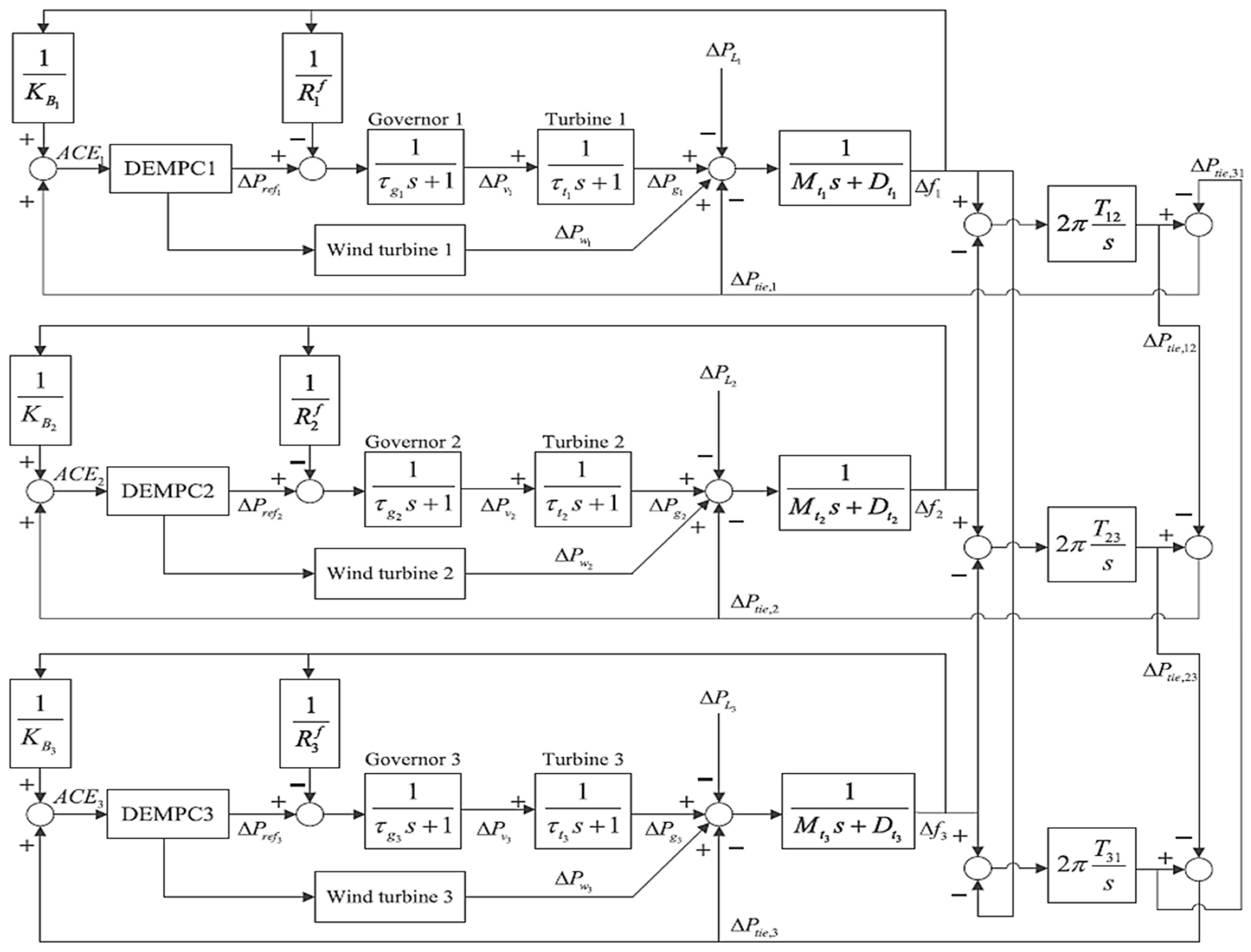
This section details the modeling framework and the implementation of the control strategy. The investigated three-area interconnected power system is shown in
Figure 2. The symbols and variables used in the area model are summarized in
Table 1. Although the overall interconnection contains multiple feedback paths, the control architecture remains structurally modular across all areas. However, to closely reflect practical AGC/LFC scenarios, the physical parameters of the interconnected areas, as detailed in
Table 2, are intentionally heterogeneous and asymmetrical.
3.1. Modeling Approaches for Multi-Area Power Systems
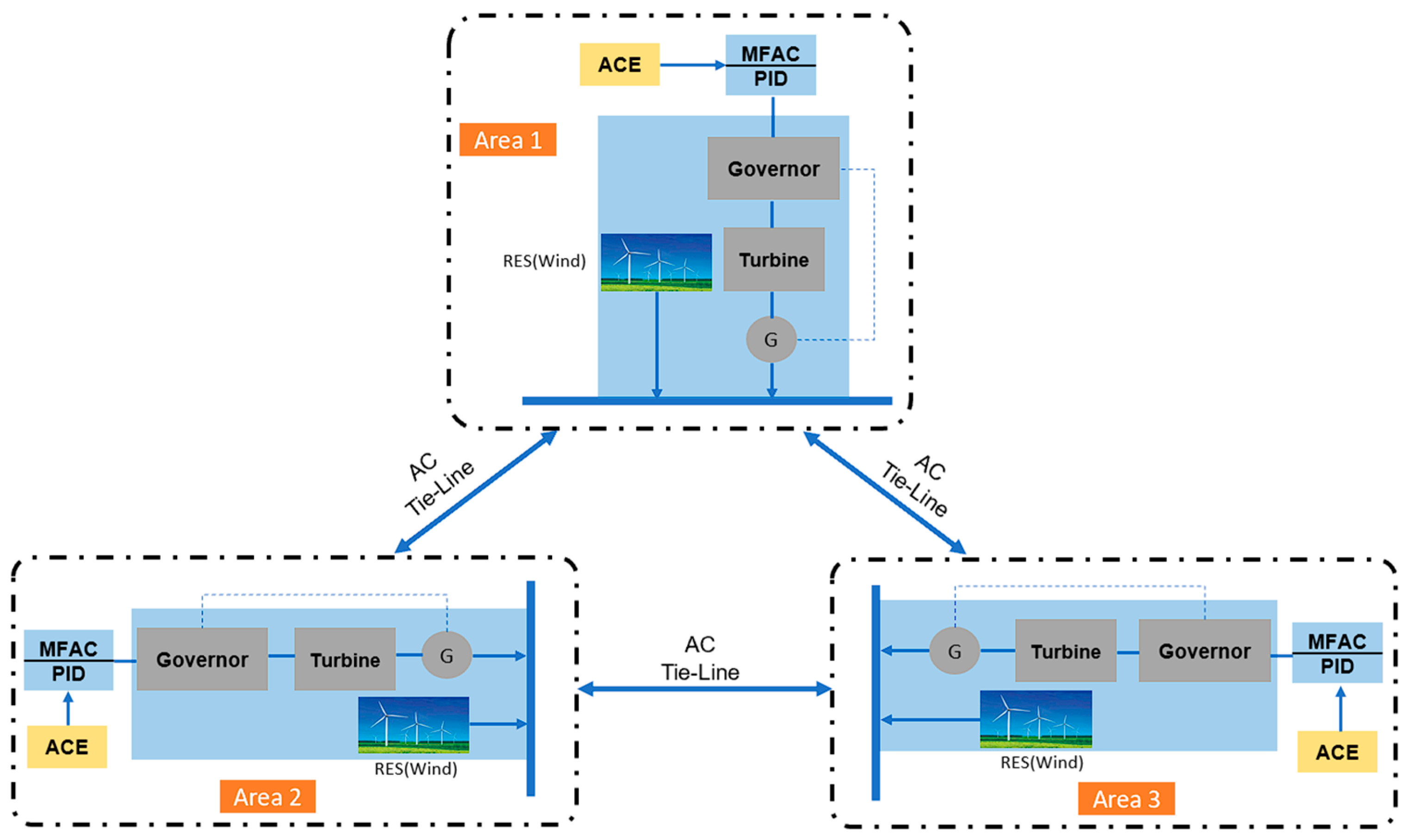
The conceptual framework of the investigated system is depicted in
Figure 1, which illustrates the three-area AC-interconnected architecture integrated with stochastic wind power generation. This architectural scenario is further detailed in
Figure 2 and
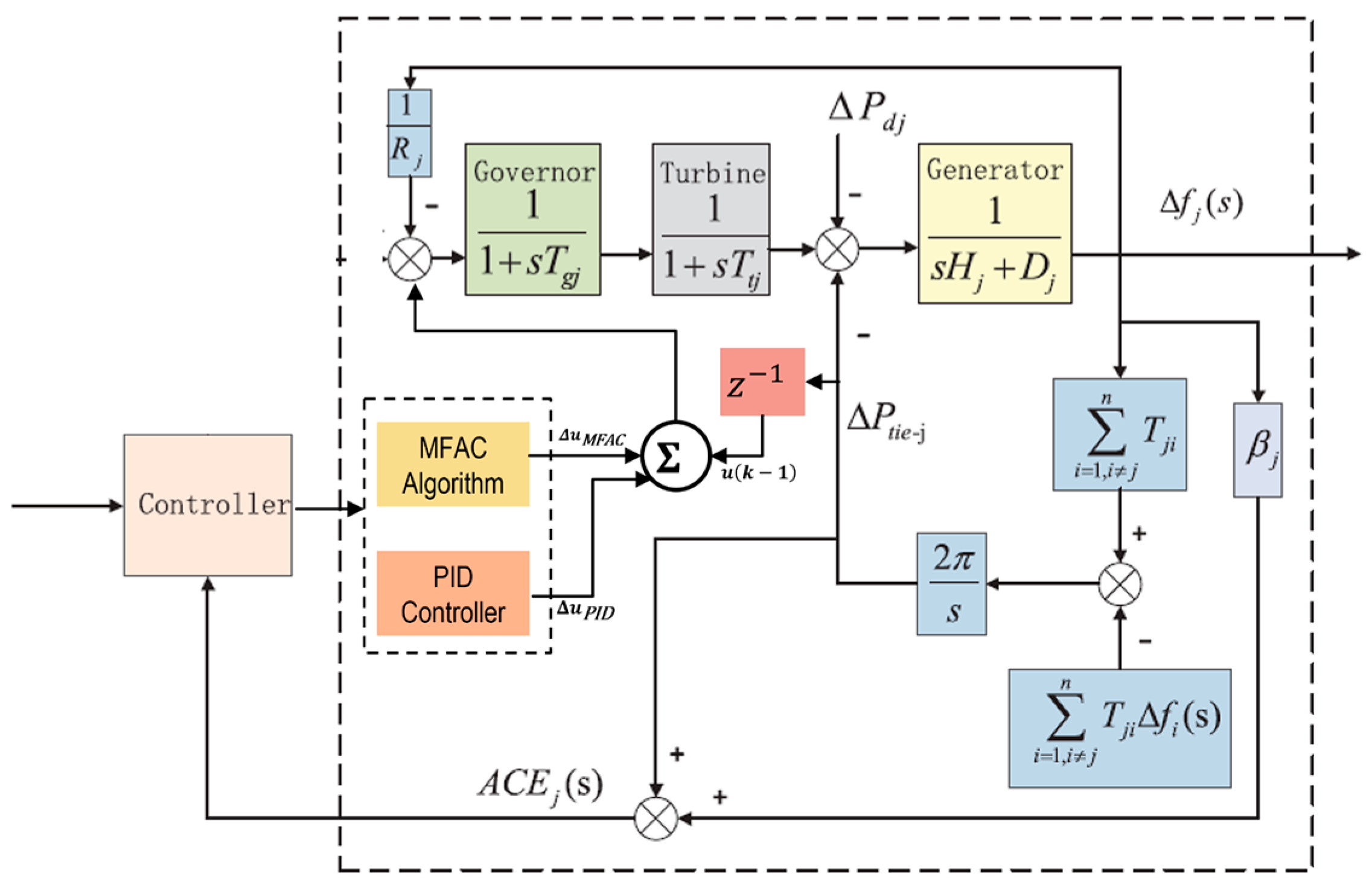
Figure 3, which respectively provide physics-faithful blocks and control-oriented state–space representations. As shown in the setup, wind turbines are modeled with specific rated power and rotor radius parameters,
(approximately), rated =
and Robustness (
), to reflect realistic operating conditions [
7,
8,
17,
38,
39]. Robustness is examined under
parametric uncertainty in selected system parameters, such as inertia and damping coefficients, alongside gust wind and load noise. We assume a three-area interconnected thermal power system. The area
, consists of a speed governor, a steam turbine, a generator/load subsystem, and tie-lines to the other areas. A small-signal model, in terms of an operating point, is utilized. In the swing (generator–load) equation the time evolution of the frequency for area
is given by:
The net tie-line power deviation for the area
is the sum over all interconnected regions.
with individual AC tie-line deviation between areas
and
modeled as:
where
is the synchronizing coefficient (p.u./Hz). Turbine dynamics are shown in the block diagrams, where the turbine time constant is denoted by the Greek letter
. The turbine dynamics are written as
where
is the turbine time constant and
is the governor valve–position deviation. Similarly, using the symbol
for the governor time constant, the governor dynamics are governed by:
where
is the secondary control (LFC) command (p.u.). Following standard AGC practice, the Area Control Error (ACE) for area
is defined as
with the frequency-bias factor
The LFC objective is to drive
in all areas, which corresponds to restoring nominal frequency and scheduled tie-line power exchange. The three-area system is described by including governors
turbines
, generators
, tie-lines
, and wind-turbine injection blocks [
16,
17,
20].
3.2. Three-Area Simulation Parameters
A benchmark three-area interconnected thermal power system is used to assess the developed hybrid MFAC–PID load-frequency controller. Each control area corresponds to an aggregated generation and load bus of similar capacity and inertia, linked by three lossless tie-lines. To facilitate reproducible and sufficiently challenging controller comparisons, the three-area Load Frequency Control (LFC) testbed incorporates heterogeneous area parameters and non-identical tie-line couplings, as well as stochastic wind-power injection based on a nonlinear aerodynamic model and noisy load variations. Practical implementation considerations are addressed through actuator saturation limits, discrete-time sampling, and verification of real-time computational feasibility, such as an execution time of approximately . Robustness is further evaluated by applying parameter perturbations. Collectively, these features establish a benchmark testbed that reflects key sources of variability, uncertainty, and operational characteristics present in modern renewable–integrated power systems. All quantities are expressed in per unit on a common base.
The tie-line synchronizing coefficients are ). In all simulations, the nominal system frequency is denoted by (, depending on the target grid, and all frequency deviations Δ are measured with respect to the simulation configuration: sampling period, , and number of steps,
PID tuning policy: Two fixed-gain PID parameter (
Table 3) sets are considered: a baseline PID gain set used in the original simulations and a tuned set utilized for a standardized and fair comparison among controllers (
Table 4). Unless otherwise stated, the results reported in
Table 4 use the tuned PID gains, while other illustrative plots may use the baseline gains.
Desired ACE: = 0 for all areas and control limits: For robustness analysis, a generic plant parameter is perturbed as representing uncertainty around the nominal values.
Discrete-Time State–Space Representation for digital realization and MFAC design: The continuous-time model is discretized using a sampling period (
), with the forward-Euler approximation. Let us define the state, input, and disturbance vectors for each area
and represent them in the form, as well as prove in outline basis that also corresponds to a continuous-time state-space model
Now, the continuous-time state–space model is
where
and
The continuous-time model is discretized using the forward-Euler approximation to enable digital implementation [
25]. This approach is chosen due to its low computational requirements, which support real-time operation in embedded automatic generation control (AGC) controllers. Although explicit methods are only conditionally stable, numerical stability in this study is achieved by selecting a sampling period (
) that is much shorter than the system’s fastest time constants, such as the governor time constants (
). This choice maintains stability in the discrete-time dynamics and ensures accurate tracking of the continuous system’s behavior. The resulting discrete-time model is as follows:
In addition, stability was checked by confirming that the discrete-time eigenvalues of remain within the unit circle for the operating conditions considered.
In all controller comparisons (PID/MFAC/Hybrid), the same Disturbance-Estimation Model Predictive Control (DEMPC) setting and disturbance realization are used to ensure a fair and rigorous comparison under identical conditions [
24].
where
denotes the saturation operator with bounds
and
.
defining
and
the closed-form DEMPC update is
with the one-step prediction subject to
Using the discrete-time area model
, where
a one-step quadratic optimization is solved at each sample [
24]. To remain consistent with the benchmark architecture in
Figure 2, we include a lightweight DEMPC layer as a supervisory reference generator [
24]. The DEMPC computes a per-area reference correction
which is added as a feedforward term to the secondary control command.
3.3. MFAC Design via Compact-Form Dynamic Linearization
Each area is treated as a nonlinear Single-Input Single-Output (SISO) system with unknown internal model but measurable input
and output
. The input–output behaviour is written as:
where
is a bounded disturbance. In this context,
represents the secondary control signal/LFC command. It has one measured output and another case
(the Area Control Error for area
). So we ignore the internal states and tie-line details and each area is conceptualized as a black box:
defines the increments
and
Under mild smoothness and Lipschitz assumptions, there exists a scalar pseudo-partial derivative (PPD)
such that
where
Equation (21) is the compact-form dynamic linearization (CFDL) model. Because
is unknown, an estimate
is updated online from measured data. Consider the cost
with
. Minimization of Equation (22) yields the recursive update
where
is a learning rate [
15]. To preserve control direction and avoid numerical issues, a lower bound is enforced,
At each step the MFAC chooses the control increment
to minimize
with
a weight on control effort. Approximating
and differentiating Equation (24) gives the MFAC increment
where
is a step size and
represents residual modelling error. The MFAC contribution is therefore
3.4. Incremental Discrete PID Control
In the proposed hybrid scheme, each control area employs a classical PID controller that acts on the Area Control Error (ACE) in conjunction with the data-driven MFAC law. Adaptive behavior arises because the MFAC part updates its internal model online, while the PID part shapes the dynamic response and enforces zero steady-state ACE. ACE definition and discrete error are represented by
and
It combines local frequency deviation and net tie-line power deviation using the frequency-bias factor
. When
is zero, both frequency and scheduled tie-line exchange are restored for area
, and the reference
is zero in this work, so
is simply the negative of
A non-zero error means the area is not in balance. Continuous-time PID law is represented by
The proportional term reacts to the current error, the integral term accumulates past error to remove steady-state ACE, and the derivative term anticipates future trends and improves damping. The integral and derivative terms are approximated in discrete time using the sampling period
. Discrete approximations of the integral and derivative are
These approximations convert the continuous PID into a form suitable for implementation on a digital controller [
22].
The incremental discrete PID update defines the incremental PID output, i.e., how much the PID command changes between successive sampling instants, following the standard digital implementation described in references [
1,
22].
The key discrete incremental PID formula is actually implemented in the simulation. It uses current and past error Equation (27) values
,
and
to compute the control increment [
22]. The first term is the proportional action, the second term is the integral contribution, and the third term approximates the derivative using a second-order difference. The PID output is updated by adding the newly computed increment Equation (32). This recursive form is numerically robust and easy to combine with other incremental controllers. Talking about MFAC increment (from the previous subsection, for completeness), in Equation (25) the MFAC increment is obtained from the model-free adaptive controller. It depends on the estimated pseudo-partial derivative
and on the predicted tracking error. This term provides the controller with adaptive capability and updates the control effort when the plant dynamics or operating conditions change; the total hybrid secondary control signal
for area
. It is the sum of the previous control, the MFAC increment and the PID increment. There are three modes: PID-only mode, MFAC-only mode and Hybrid (parallel) mode, represented by
and
In other words, MFAC and PID work in parallel: MFAC adapts and PID shapes the transient. Formal stability of the combined loop is not derived here; boundedness is assessed via actuator saturation and simulation results under the benchmark cases.
control signal is constrained between
and
(here,
and
), which avoids unrealistic commands and inherently mitigates integral windup.
and
are the specific PID gain values used in the simulations. They are intentionally small so that the MFAC term provides the main adaptive action, while the PID term primarily improves damping, overshoot, and steady-state performance.
3.5. The Hybrid MFAC–PID Load Frequency Controller
To address the limitations of fixed-gain control while maintaining structural simplicity, our framework retains the PID controller acting on the ACE signal in a parallel configuration, as shown in
Figure 2 and
Figure 3. This approach remains compatible with traditional AGC architecture, while integrating the adaptive capabilities of MFAC. The control-oriented state–space representation supplies a common ACE-based output (
) for both controllers, ensuring that an identical evaluation is conducted across the entire performance panel.
The proposed hybrid controller for area
combines the MFAC and PID increments. The term
is the MFAC increment, given in Equation (25); here,
is the online estimate of the pseudo-partial derivative between the control input and the ACE output, updated directly from measured input–output data. This quantity represents the current gain of the area dynamics. The factor
therefore acts as an adaptive control gain: when the effective plant gain changes due to load variations, wind power injection or parameter uncertainty,
changes accordingly and the MFAC increment automatically rescales itself. The bracketed term
is a one-step-ahead tracking error corrected by the MFAC residual
, so
directly aims to reduce the predicted ACE at the following sample [
15,
22,
23].
The term
is the PID increment, implemented in discrete incremental form as Equation (32), with
. This increment combines proportional, integral and derivative actions on the ACE error, shaping the damping, overshoot and settling time and guaranteeing zero steady-state ACE. By summing
and
on top of
, the controller exploits the adaptivity of MFAC while preserving the familiar dynamic behavior of a PID-based LFC. In the hybrid implementation, the CFDL update uses the total applied increment
, ensuring that pseudo-gradient estimation is consistent with the actual plant input [
15,
23].
In this parallel structure, the PID and MFAC components are complementary: the PID term provides immediate transient damping to shape the initial response, while the MFAC term adapts to system variations by updating the pseudo-gradient . Crucially, the total control input is derived from the algebraic summation of these continuous increments. Unlike switching-based strategies, this architecture involves no discontinuous logic, ensuring a smooth control signal and effectively preventing chattering behavior.
Figure 3 illustrates the additive (parallel) MFAC–PID LFC structure corresponding to Equation (35).
Figure 3 presents the single-area LFC power system model for area (
) and shows how the proposed controller interacts with the physical plant and the ACE signal. Crucially, this control-oriented representation demonstrates the implementation of MFAC and PID on the same measurement channel (
). Utilizing a shared input structure eliminates modeling asymmetry and facilitates a fair comparison between data-driven and classical schemes under identical conditions, as recommended by recent benchmarking studies. Inside the dashed box is the continuous-time power system of area
. The controller sends a secondary control command
to the governor loop. This signal is summed with the speed-droop feedback
, so that an increase in frequency automatically reduces the effective input to the governor, representing primary control action. The resulting signal passes through the governor block
, which models the valve and speed-governing mechanism with time constant
The governor output drives the turbine block
, where
is the turbine time constant. The turbine mechanical power is combined with the local load disturbance
and then fed into the generator–load block
, where
and
denote inertia and damping. The output of this block is the area frequency deviation
. In parallel, the net tie-line power deviation
is obtained from the sum of all synchronizing coefficients
multiplied by the angles (integrated frequency differences) of the interconnected areas. This is implemented by the
block, the integrator
and the summation of
from the neighboring areas. Finally, the Area Control Error for area
is formed at the bottom of the figure as
where
is the frequency-bias factor. This ACE signal is feedback to the controller, which computes the following
command (implemented in this work by the hybrid MFAC–PID law). Thus,
Figure 2 shows the complete loop from the controller output through the governor–turbine–generator–tie-lines back to the ACE and into the controller again.
3.6. Wind-Turbine and Disturbance Modeling
To capture the impact of renewable generation, each area includes a mechanical power injection from a wind turbine [
7,
8,
38]. The instantaneous wind power is
where
is air density,
is rotor swept area with
,
is wind speed, and
is the tip-speed ratio
The power coefficient is approximated as
Wind speed is modeled as a smooth stochastic
where
is zero-mean Gaussian noise. A normalized wind-power disturbance is defined as
and the discrete state update Equation (11) is extended to
Load disturbances are modeled as noisy steps:
where
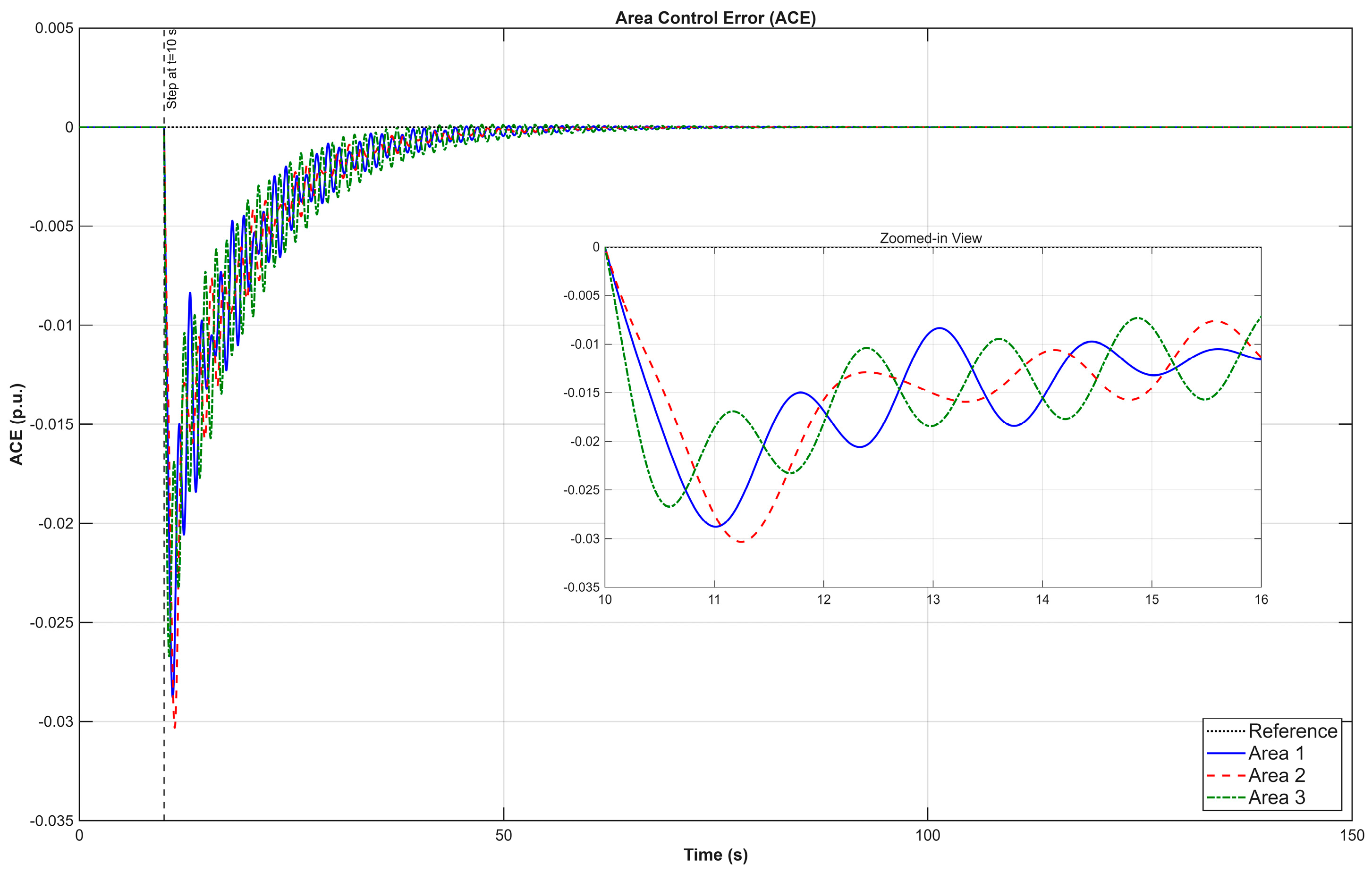
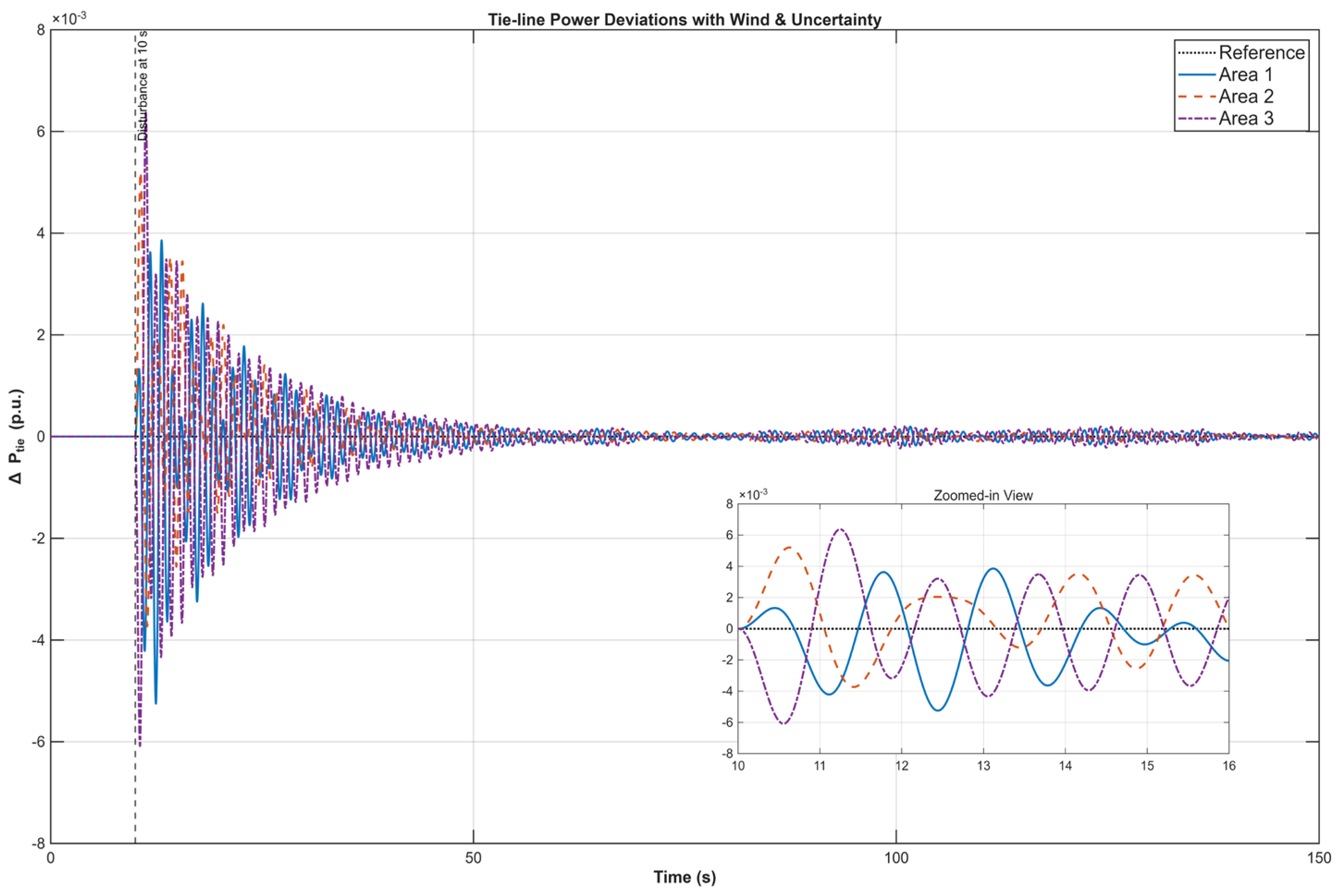
is uniformly distributed in {0,1}. This combination of stochastic wind and load variations produces realistic frequency excursions for controller evaluation. In the simulations, the disturbance inputs (wind injection and noisy load components) are applied after an initial steady-state window, i.e.,
, in order to show the system response before the disturbances are introduced.
To assess robustness, a parametric uncertainty of was applied to key system constants (e.g., and ). In addition, Case 2 employs severe stochastic wind fluctuations that impose rapid and temporally correlated net-power variations, providing a demanding stress test for the regulation loop. Although disturbance variability is not equivalent to a physical reduction in inertia, the perturbation in offers an initial (moderate) indication of sensitivity to inertia changes, while the wind-driven case tests performance under intensified imbalance dynamics. Together, these settings evaluate the controller under both modeling uncertainty and highly variable operating conditions that are relevant to modern renewable-rich systems.