
Article

Palaeobiodiversity and Palaeoecology of the Last Interglacial (MIS 5e) Marine Fauna and Flora from San Juanito (Punta del Hidalgo, Tenerife Island) in the Canary Islands

by
Sérgio P. Ávila
1,2,3,4,5,*,
Alfred Uchman
6,
Sandra C. Marques
1,2,3,
José Madeira
7,8,
Markes E. Johnson
9,
Patrícia Madeira
1,2,3,
Ana Hipólito
1,3,
Mohamed Amine Doukani
1,3,10,
Gonçalo Castela Ávila
1,3,11,
Mafalda R. Marques
1,3,
Pablo J. González
12,
Thomas Boulesteix
12,
Andreas Kroh
13,
Daniela Basso
14 and
Esther Martín-González
15
1
CIBIO—Centro de Investigação em Biodiversidade e Recursos Genéticos, InBIO Laboratório Associado, Pólo dos Açores, 9501-801 Ponta Delgada, Portugal
2
Departamento de Biologia, Faculdade de Ciências e Tecnologia, University of the Azores, 9501-801 Ponta Delgada, Portugal
3
MPB—Marine Palaeontology and Biogeography Laboratory, University of the Azores, Rua da Mãe de Deus, 9501-801 Ponta Delgada, Portugal
4
BIOPOLIS—Biodiversity and Genetic Resources Research Center, Universidade do Porto, Campus de Vairão, Rua do Crasto, n° 765, 4485-684 Vairão, Portugal
5
UNESCO Chair–Land Within Sea: Biodiversity & Sustainability in Atlantic Islands, University of the Azores, Rua da Mãe de Deus, 9500-321 Ponta Delgada, Portugal
6
Institute of Geological Sciences, Faculty of Geography and Geology, Jagiellonian University, Gronostajowa 3a, 30-387 Kraków, Poland
7
IDL—Instituto Dom Luiz, Faculdade de Ciências, Universidade de Lisboa, 1749-016 Lisbon, Portugal
8
Departamento de Ciências da Terra e Energia, Faculdade de Ciências, Universidade de Lisboa, 1749-016 Lisbon, Portugal
9
Department of Geosciences, Williams College, Williamstown, MA 01267, USA
10
Laboratoire de Paléontologie Stratigraphique et Paléoenvironnement, Faculty of Earth and Universe Sciences (FSTU), University of Oran 2 Mohamed Ben Ahmed, B.P. 1524, El M’Naouer, Oran 31000, Algeria
11
Faculdade de Ciências e Tecnologia, Universidade NOVA de Lisboa, 2829-516 Caparica, Portugal
12
Volcanology Research Group (Estación Volcanológica de Canarias), Department of Life and Earth Sciences, Instituto de Productos Naturales y Agrobiología, Consejo Superior de Investigaciones Científicas (IPNA-CSIC), 38206 La Laguna, Spain
13
Natural History Museum Vienna, Burgring 7, 1010 Wien, Austria
14
CoNISMa Local Research Unit, Department of Earth and Environmental Sciences, University of Milano-Bicocca, Piazza della Scienza 4, 20126 Milano, Italy
15
Museo de Ciencias Naturales de Tenerife, calle Fuente Morales, 1, 38003 Santa Cruz de Tenerife, Spain
*
Author to whom correspondence should be addressed.
Quaternary 2026, 9(4), 50; https://doi.org/10.3390/quat9040050
Submission received: 17 May 2026 / Revised: 18 June 2026 / Accepted: 1 July 2026 / Published: 6 July 2026

Abstract

The Macaronesian archipelagos host exceptionally well-preserved coastal sedimentary deposits formed during the warmest period of the Last Interglacial episode, the Marine Isotope Substage 5e (MIS 5e). Numerous MIS 5e fossiliferous outcrops occur, scattered across several islands of the Canary Archipelago. Among these is San Juanito, a small outcrop located in the eastern sector of Punta del Hidalgo (northeast Tenerife Island), where MIS 5e sediments are distributed over an area of approximately 480 m2. A multidisciplinary study was conducted, aiming to: (i) determine the age of the fossiliferous sediments; (ii) define the stratigraphic relationships between the sedimentary deposit and the underlying/overlying volcanic sequences; (iii) assess the taxonomic richness and the functional palaeobiodiversity of this palaeosite; and (iv) provide a comprehensive palaeoecological reconstruction of the MIS 5e environment. Based on two key ecostratigraphic indicator species for the Canarian MIS 5e, the San Juanito sequence is here assigned to the Last Interglacial. Qualitative sampling yielded forty mollusc taxa, including three gastropods that represent new records—Alvania johannae Moolenbeek & Hoenselaar, 1998, Krachia tiara (Monterosato, 1874), and Barleeia unifasciata (Montagu, 1803)—bringing the current MIS 5e checklist for the Canary Islands to 202 gastropods and 80 bivalves. The highly cemented matrix of the San Juanito deposits prevented the collection of standardized 1 kg bulk sediment samples. Nevertheless, we strongly recommend adopting this quantitative approach in future studies of suitable MIS 5e outcrops across the archipelago. The faunal assemblage indicates that the San Juanito region was dominated by rocky shores during the MIS 5e, much like today. This paleoenvironmental reconstruction is based on the high frequency of species associated with hard substrates—including echinoids, vermetids, fissurellids, and patellids—and the overwhelming dominance (95%) of epifaunal gastropods.

1. Introduction

The warmest period of the Last Interglacial, corresponding to Marine Isotope Substage 5e (MIS 5e), represents one of the most relevant natural analogues for current global warming. Global thermal conditions during that interval were comparable to or slightly warmer than those foreseen in the future. Dated to approximately 129–116 ka [1,2,3], the MIS 5e interval is characterized by a eustatic sea-level highstand that has been globally estimated at +2 to +9 m relative to present mean sea level, with locally higher peaks depending on the model and proxy record considered [4].
In the northeastern Atlantic, and particularly within the Macaronesian geographic region, which encompasses five archipelagos (i.e., the Azores, Madeira, Selvagens, Canaries, and Cabo Verde), exceptionally well-preserved coastal sedimentary deposits formed during the MIS 5e. The interaction between tectonics, volcanism, coastal dynamics (erosion and sedimentation), and eustatic fluctuations [5] resulted in emergent marine sequences of high palaeoecological [6,7,8,9,10,11] and palaeobiogeographic significance [12,13,14,15,16]. This is especially true in the context of sea-level dynamics and associated climatic changes during the Quaternary.
Within the Canary Islands, Lanzarote and Fuerteventura host the most extensive MIS 5e coastal deposits, owing to their ancient geological age, relative tectonic stability during the late Pleistocene, and prevalence of coastal platforms suitable for marine sedimentation [17]. These deposits have long been recognized as raised beaches of the Upper Pleistocene or Last Interglacial, traditionally identified by the presence of the thermophilic gastropod Thetystrombus latus (Gmelin, 1791), previously referred to as Strombus bubonius or S. latus [18,19]. Meco & Petit-Maire [20] grouped these deposits under the term “Jandiense”, defining a characteristic stratigraphy consisting of a basal level of strongly cemented, light-yellow calcarenites with scarce fauna, overlain by fossil-rich conglomerates. Their exposures may reach elevations of 5–6 m above present sea level (a.s.l.). U/Th dating carried out by Meco and colleagues on MIS 5e deposits from the Matas Blancas palaeosite (southeastern Fuerteventura) [8] suggested a single sea-level highstand during the Last Interglacial. In contrast, Zazo and colleagues proposed the occurrence of multiple sea-level and climatic oscillations during MIS 5e in Fuerteventura, Lanzarote, and Tenerife, based on U/Th ages and sedimentary facies analyses [21]. More recently, Martín-González and colleagues reviewed the coastal outcrops of Fuerteventura, significantly expanding the number of exposures attributed to MIS 5e and documenting their fossil content in greater detail [22].
In contrast with Lanzarote and Fuerteventura, Tenerife—the oldest of the western Canary Islands, with an estimated age of approximately 12 Ma [23]—exhibits a comparatively limited marine fossil record [24]. This is likely due to the island’s proximity to its volcanic constructional maximum during the Quaternary [25], which probably hindered the formation of stable sedimentary platforms. Studies on local Quaternary coastal deposits are scarce. Zeuner was the first to identify three marine erosion surfaces based on altimetric criteria [26], assigning them broadly to the Quaternary. Subsequent palaeontological analyses focused on selected deposits, notably Las Teresitas and Tachero [24,27,28]. More recently, other authors [29,30] provided detailed stratigraphic descriptions and chronological data for several of these coastal outcrops, and Johnson and colleagues [31] discussed the encrustations dominated by crustose coralline red algae on coastal boulders from the Last Interglacial epoch at Tachero.
Approximately half of the coastal deposits in Tenerife occur on the slopes of the Anaga Peninsula in the northeast and the remainder along the southwestern coast, enabling a comparison of their faunal composition. This spatial framework enables palaeoenvironmental reconstructions and interpretations of such deposits and the assessment of marine malacological palaeobiodiversity on opposite island flanks [32]. Additionally, these data facilitate biostratigraphic correlations with coeval deposits across other Macaronesian archipelagos. Two comprehensive field campaigns were designed to sample Last Interglacial deposits across the Canary Islands in October 2023 and September 2025. The San Juanito locality in Tenerife was explored by a joint multidisciplinary team with the specific aim to: (i) constrain the age of the fossiliferous strata; (ii) resolve the stratigraphic architecture between the sedimentary unit and the adjacent volcanic sequences; (iii) evaluate taxonomic richness and functional palaeobiodiversity; and (iv) reconstruct the local MIS 5e palaeoenvironment.

Geographical and Geological Setting

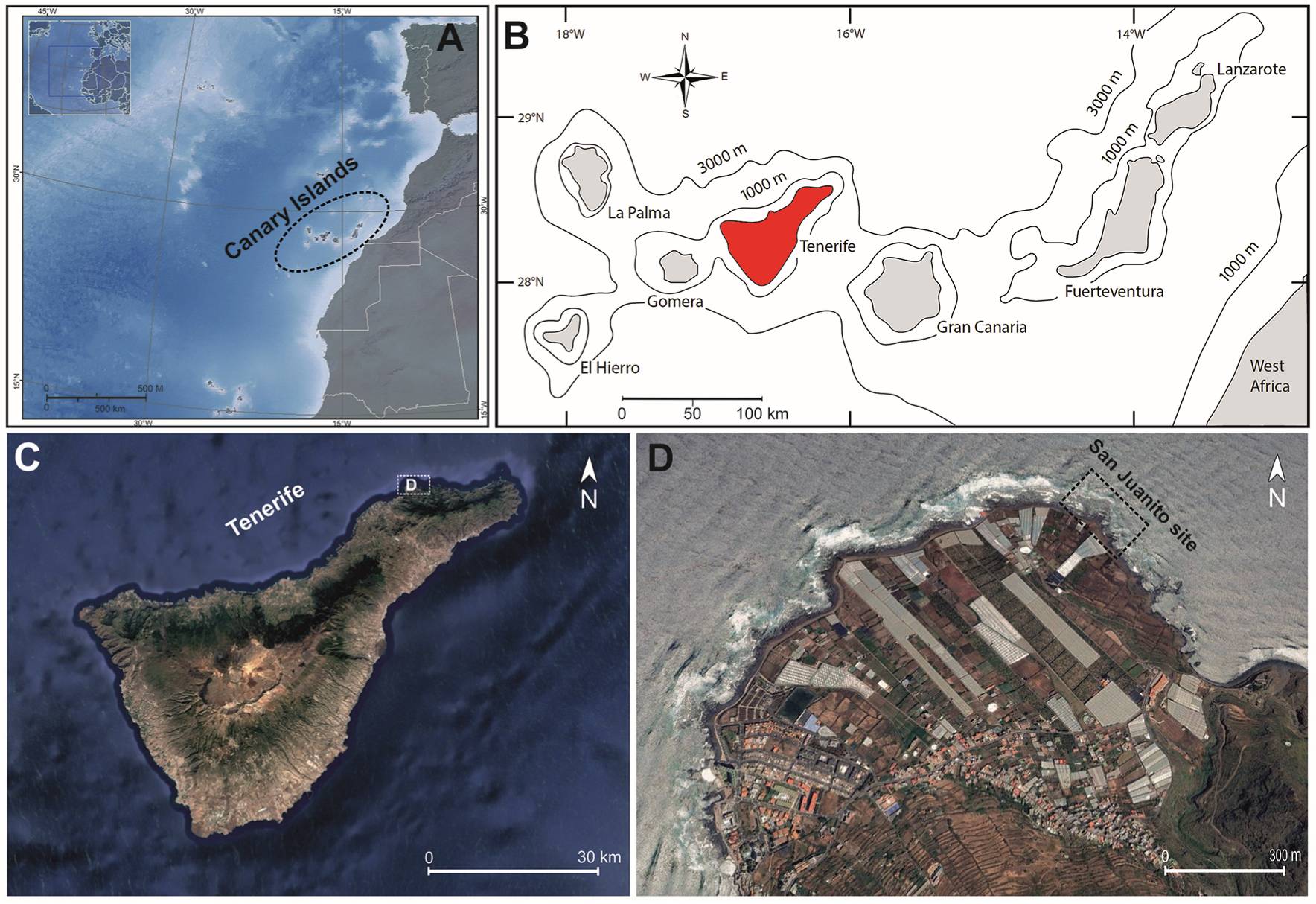
Tenerife is the largest island of the Canary Archipelago, located about 300 km off the northwest coast of Africa (Figure 1A). With an area of 2034 km2, the island has a roughly triangular outline dominated by Mount Teide, which rises to 3715 m a.s.l. at its centre (Figure 1B). The relief is strongly asymmetric, characterized by steep coastal cliffs, large volcanic edifices, and a dense network of ravines radiating mainly from the central volcanic complex. Within this framework, the Anaga massif, located in the northeastern part of Tenerife, represents one of the oldest volcanic domains of the island (4.9–3.9 Ma [23]). It covers an area of approximately 140 km2 and is characterized by a highly dissected relief, with sharp ridges and deep, narrow ravines radiating toward the coast. Elevations reach up to 1024 m a.s.l. at Cruz de Taborno, and the massif displays steep coastal cliffs and an irregular coastline shaped by long-term erosion and structural control [33].
The volcanic platform of Punta del Hidalgo (Figure 1C,D) and the cinder cone of Las Rosas were formed during a phase of Quaternary volcanic reactivation within the older volcanic Anaga massif. Detrital formations occur along hillsides and valley floors (talwegs), and most of the present-day shoreline is mainly composed of cliffs, pebble beaches and wave-cut platforms. The Punta del Hidalgo coastal platform was formed by lava flows emitted from the Las Rosas volcano, a small monogenetic Pleistocene edifice within the Anaga massif, whose lavas reached the shoreline and built a volcanic delta [34]. The area includes the San Juanito palaeosite, located near the hermitage of San Juanito, within the Punta del Hidalgo eastern coastal sector (Figure 1D).

2. Materials and Methods

The San Juanito outcrop (Figure 2A,B) was studied during the “PaleoMACA” 2023 workshop held in Tenerife (22–25 October 2023), and subsequently, during the 2nd and the 3rd International Workshops “Palaeontology in Canary Islands”, in October 2023 and September 2025. Research focused on reconstructing the overall structure, geometry, and field relationships between the sedimentary deposit and the underlying volcanic sequences. Attention was paid to documenting observed sedimentary structures, the lateral and vertical continuity of facies, and the stratigraphic position and taphonomic features of the fossil assemblages. Rock slabs were collected from the different sedimentary facies for thin-section analysis, and representative sedimentary structures were documented through field photography.
The uppermost elevation of the MIS 5e fossiliferous deposits was measured with GNSS (Global Navigation Satellite System), using a Topcon HIPER_SR receiver mounted on a 1.8 m fixed-height survey pole stabilized by a tripod. The raw data were processed using the Canadian Spatial Reference System Precise Point Positioning (CSRS-PPP) online service, provided by Natural Resources Canada (NRCan). Data were reduced in static mode using IGS final orbit and clock products, with coordinates referenced to the ITRF2020 (IGS20) frame. Ellipsoidal heights (PPP GNSS solutions) were referred to present-day sea-level heights (orthometric heights) using a global satellite geoid model (EIGEN-6C3stat model).
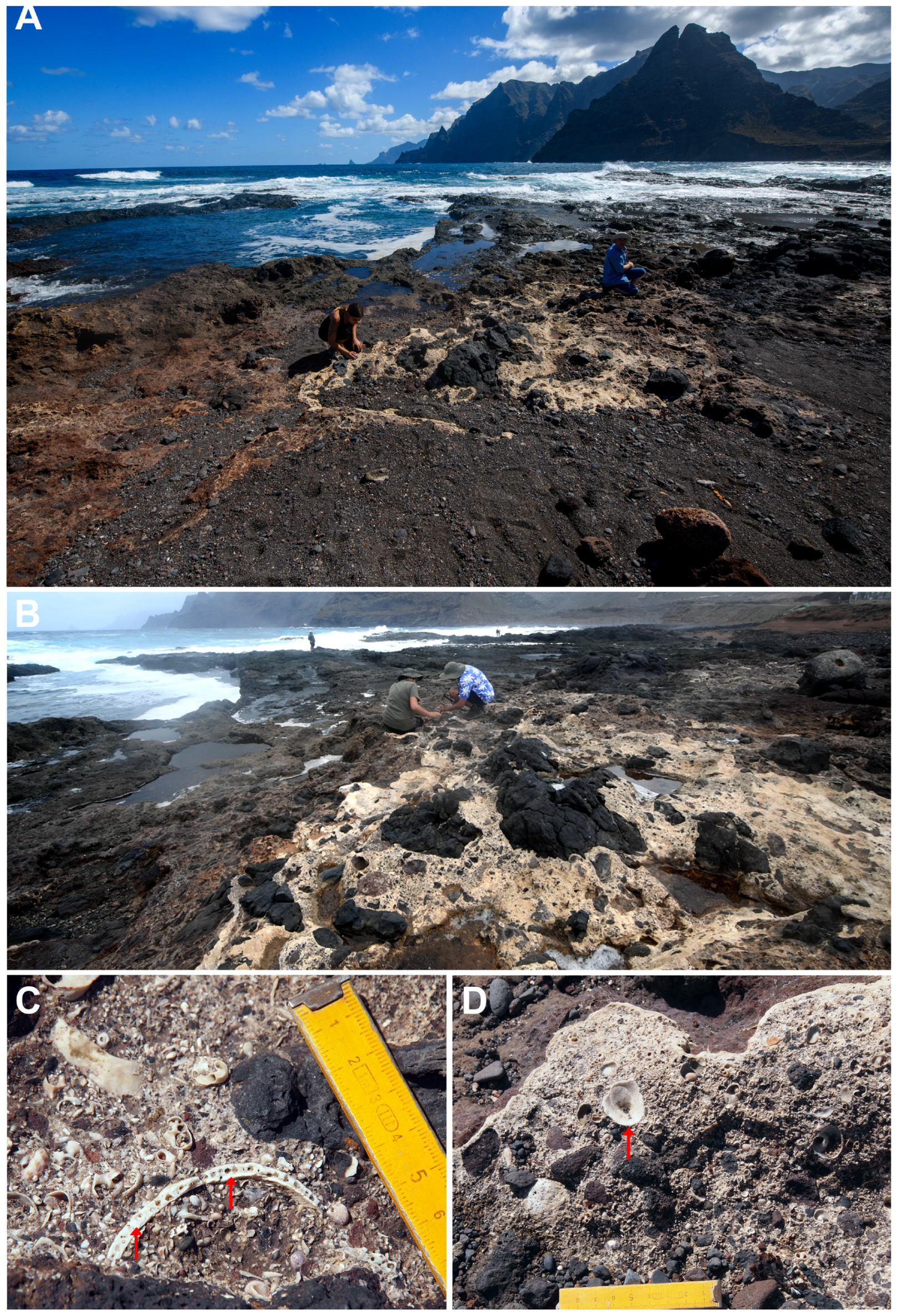
Macrofossils were photographed in situ, prior to extraction, during qualitative sampling across the outcrop. Due to the high degree of cementation of fossil-bearing deposits (Figure 2C,D), standardized 1 kg bulk samples could not be obtained for quantitative analysis. Instead, qualitative samples were examined for fossils in the laboratory, with all collected mollusc specimens identified to the lowest possible taxonomic level. These data were compiled into a checklist and supplemented with records from the literature, from the Macaronesian Palaeobiodiversity Database (MPDb, https://macpaleo.uac.pt/) and a survey of the fossil collection at the Museo de Ciencias Naturales de Tenerife (MCNT). The best-preserved specimens were photographed, including the new MIS 5e records from Tenerife.
Functional traits of molluscs were compiled from two master databases curated by the first author. Currently, these datasets comprise information on 1943 recent shallow-water gastropods spanning depths of 0–50 m [16] and 1829 recent shallow-water bivalves from depths of 0–100 m [35]. For gastropods, traits included larval development mode (planktotrophic vs. non-planktotrophic), shell composition (aragonite vs. low-Mg calcite), locomotion (actively mobile, slow-moving, facultatively mobile, or stationary), life habit (epifaunal vs. semi-infaunal), diet (carnivore, herbivore/grazer, or suspension feeder), and substrate preference (hardground (including rocks, shells, corals, gorgonians, coralline algae, rhodoliths, etc.), gravel/pebbles, coarse sand, fine sand, sandy-mud to muddy-sand, algae, and macrophyte meadows). For bivalves, traits included shell composition (aragonite vs. low-Mg calcite), locomotion (facultatively mobile or stationary), life habit (epifaunal, boring, or infaunal), diet (suspension feeder or omnivore), and substrate (hardground, gravel/pebbles, coarse sand, fine sand, sandy-mud to muddy-sand, and macrophyte meadows).
Mollusc nomenclature follows MolluscaBase (https://www.molluscabase.org/), and the World Register of Marine Species (WoRMS) database (http://www.marinespecies.org/) was used for the remaining invertebrate species. Algal nomenclature follows AlgaeBase [36]. All material is deposited in the fossil collections of the Department of Biology, University of the Azores (Ponta Delgada, São Miguel Island), under reference number DBUA-F 1709.

3. Results

3.1. Field Observations, Lithology, Microfacies and Stratigraphy

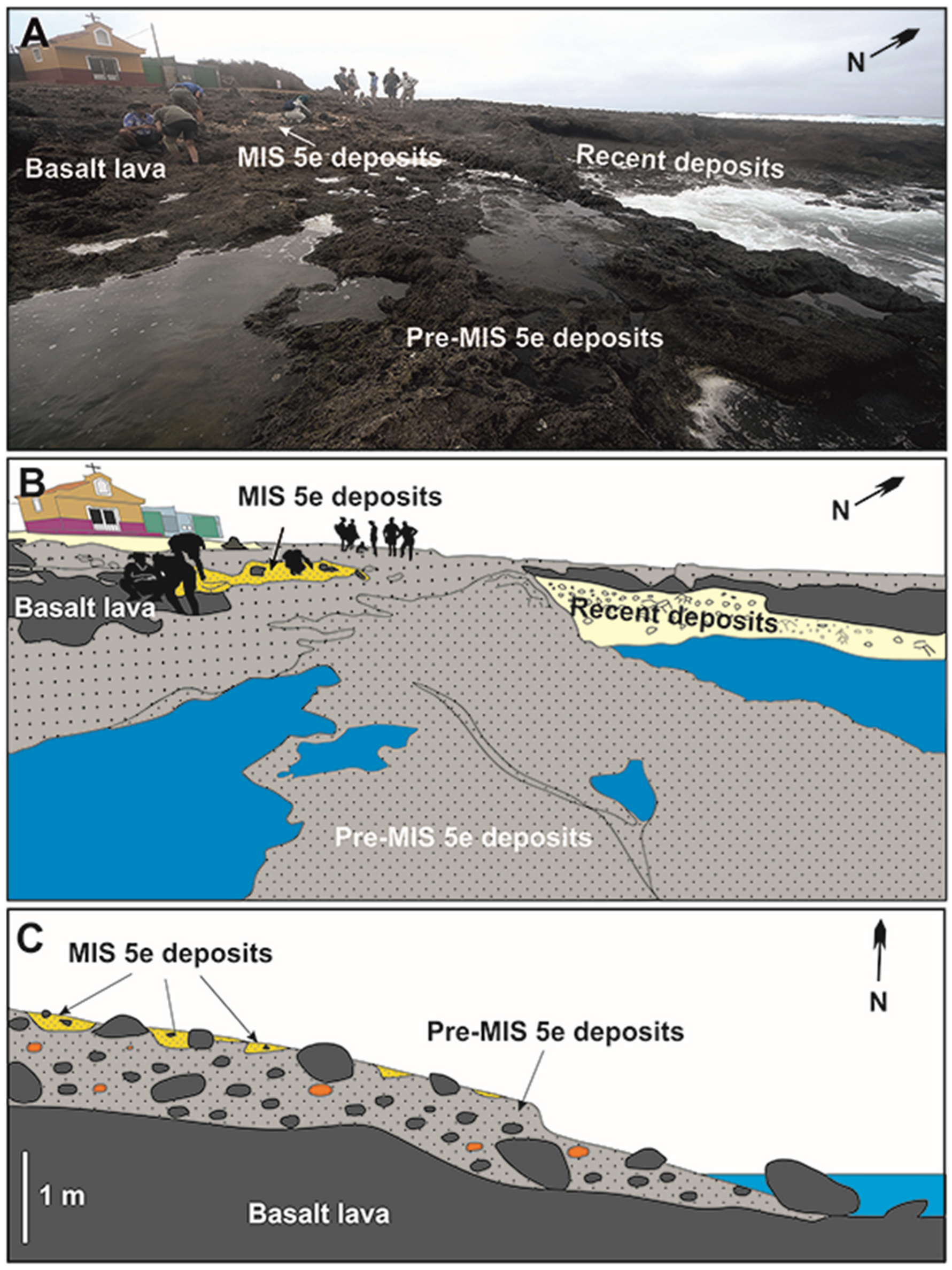
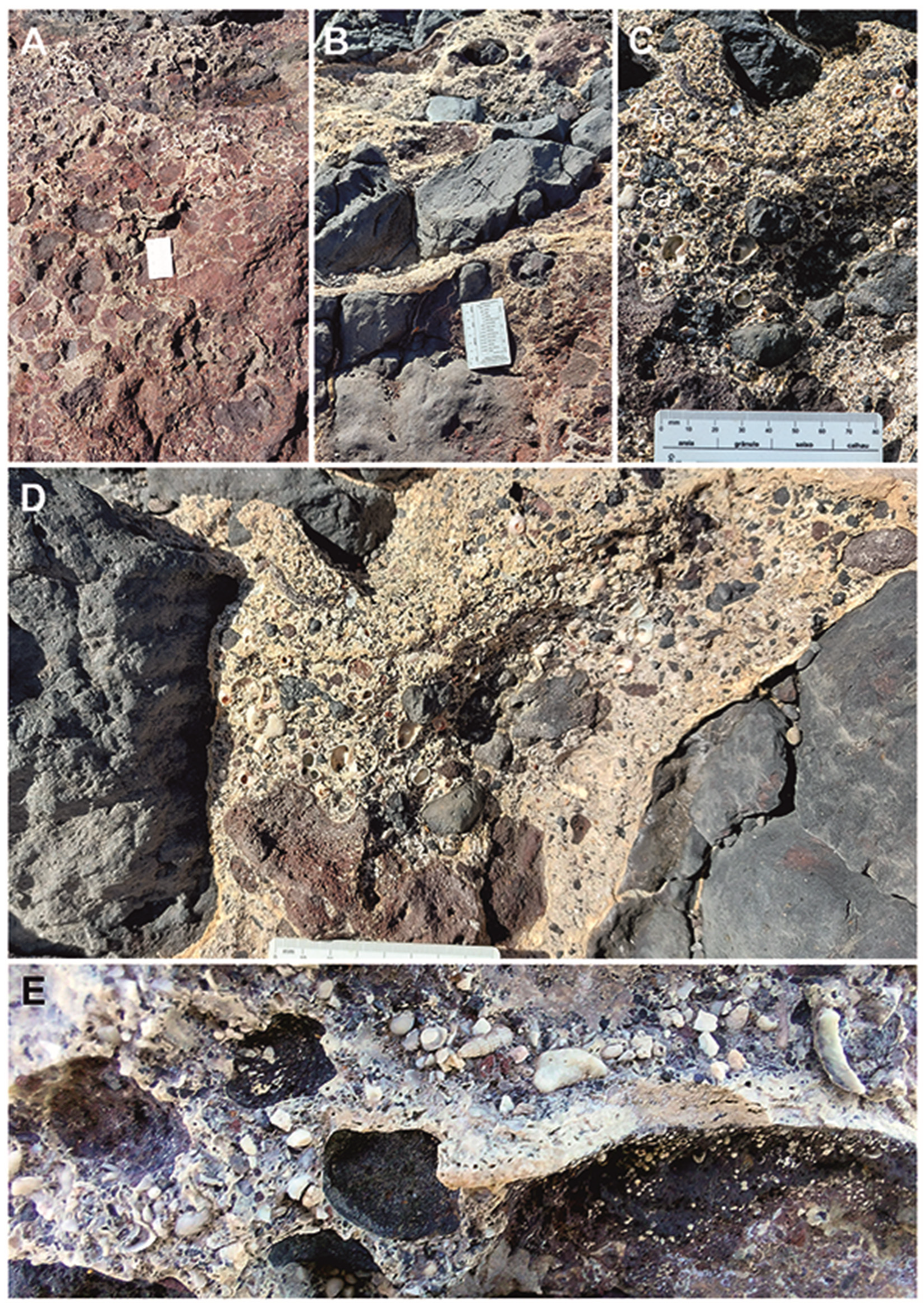
The San Juanito site is located on the north coast of Tenerife (28.577487° N, 16.318705° W). The MIS 5e deposits are exposed at a maximum elevation of 2.55 ± 0.12 m above present mean sea level, have a lateral extension of about 70 m, and extend approximately 20 m seaward of the San Juanito hermitage (Figure 2B and Figure 3A). The sedimentary succession is discontinuously exposed over an area of approximately 480 m2. The MIS 5e deposits rest on an uneven basaltic substrate associated with the Las Rosas volcano lava delta, generally inclined toward the sea (Figure 3A–C), and are partially covered by unconsolidated sandy–pebbly recent sediments. In the lower part of the succession, the deposits consist of brownish calcarenites with dispersed reddish scoria (Figure 4A), boulders (Figure 4B), and smaller basalt clasts, as well as bioclasts (Figure 4C–E). Locally, coarse volcanic material is more abundant and forms a conglomerate supported by a calcarenitic matrix. These deposits attain a maximum thickness of about 1 m and are here referred to as the pre-MIS 5e deposits.
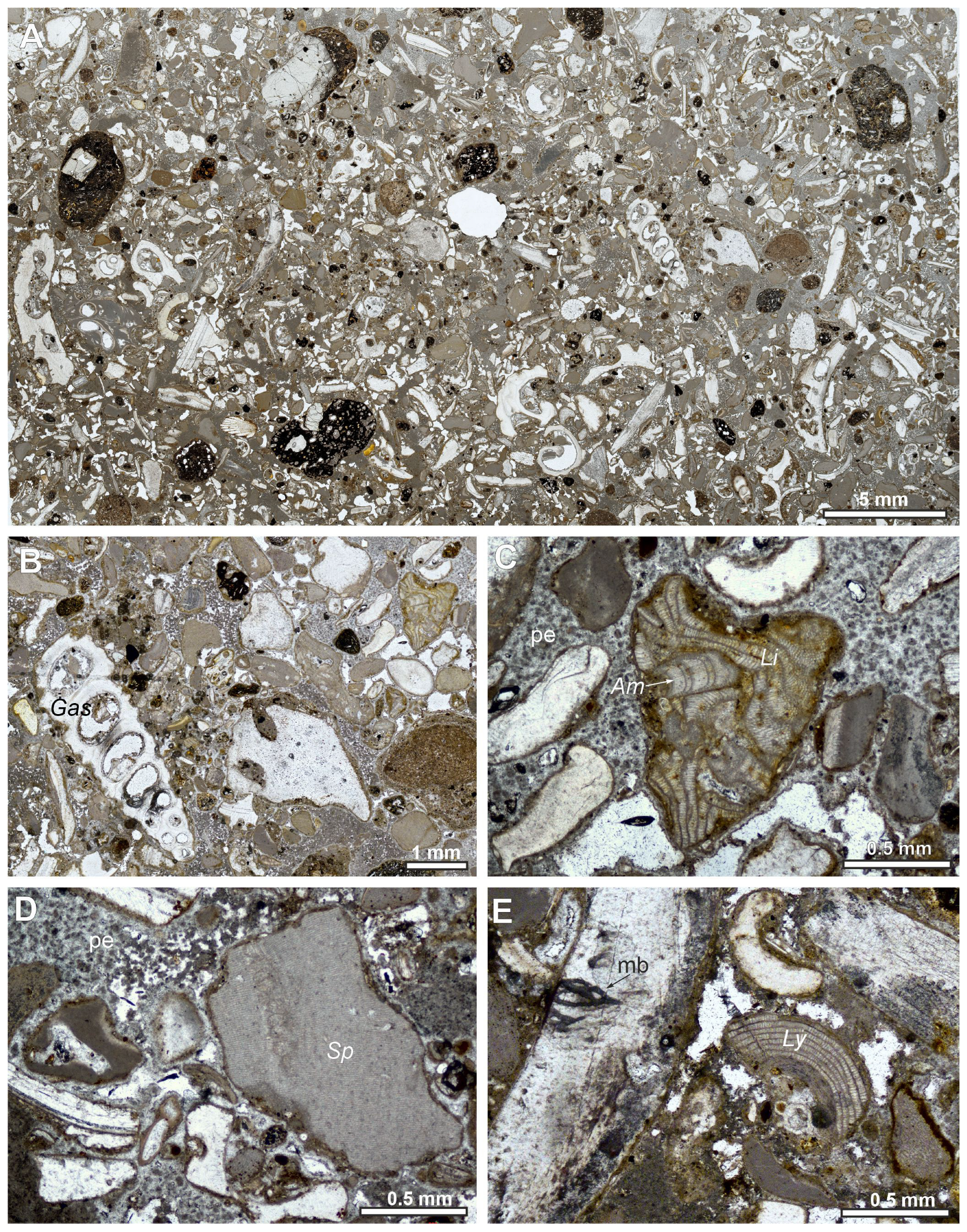
In thin section (Figure 5), the pre-MIS 5e calcarenites are bioclastic–peloidal packstones according to the classification by [37], containing a minor admixture (up to a few percent) of millimetre- to submillimetre-sized rounded to subrounded basalt, brownish scoria clasts, and other volcanoclastic (tuffitic) grains (Figure 5A–E). The bioclast assemblage is dominated by coralline algae and bivalve shell debris. Less common components include echinoid spines (Arbacia sp.), echinoderm plates, small gastropod shells (Figure 5B), serpulid polychaete tubes, bryozoans, and tests of benthic calcareous foraminifers. Bioclasts are typically fragmented and abraded, and commonly show recrystallization, micritization envelopes (Figure 5E), and occasional microborings (Figure 5B). The matrix is composed mostly of micritic, irregular peloids, which are up to a few tens of microns in size (Figure 5C,D). Among the coralline algae, Sporolithon sp. (Figure 5D), Amphiroa sp. (locally overgrown by Lithoporella sp.; Figure 5C), and Lithophyllum sp. [probably Lithophyllum prototypum (Foslie) Foslie, 1905; cf. Figure 5E] have been identified. At the outcrop scale, some gastropod shells display clionaid sponge borings (Entobia isp.). Rarely, some boulders exhibit patches of coralline algal crusts.
The whitish MIS 5e calcarenites occur on top of the pre-MIS 5e deposits. They form pockets in the underlying pre-MIS 5e deposits containing dispersed basaltic pebbles and boulders. The pockets fill shallow depressions and do not exceed 30 cm in thickness. The vertical range of MIS 5e pockets is approximately 110 cm (Figure 3C). Basal parts of the pockets tend to show coralline algal encrustations.
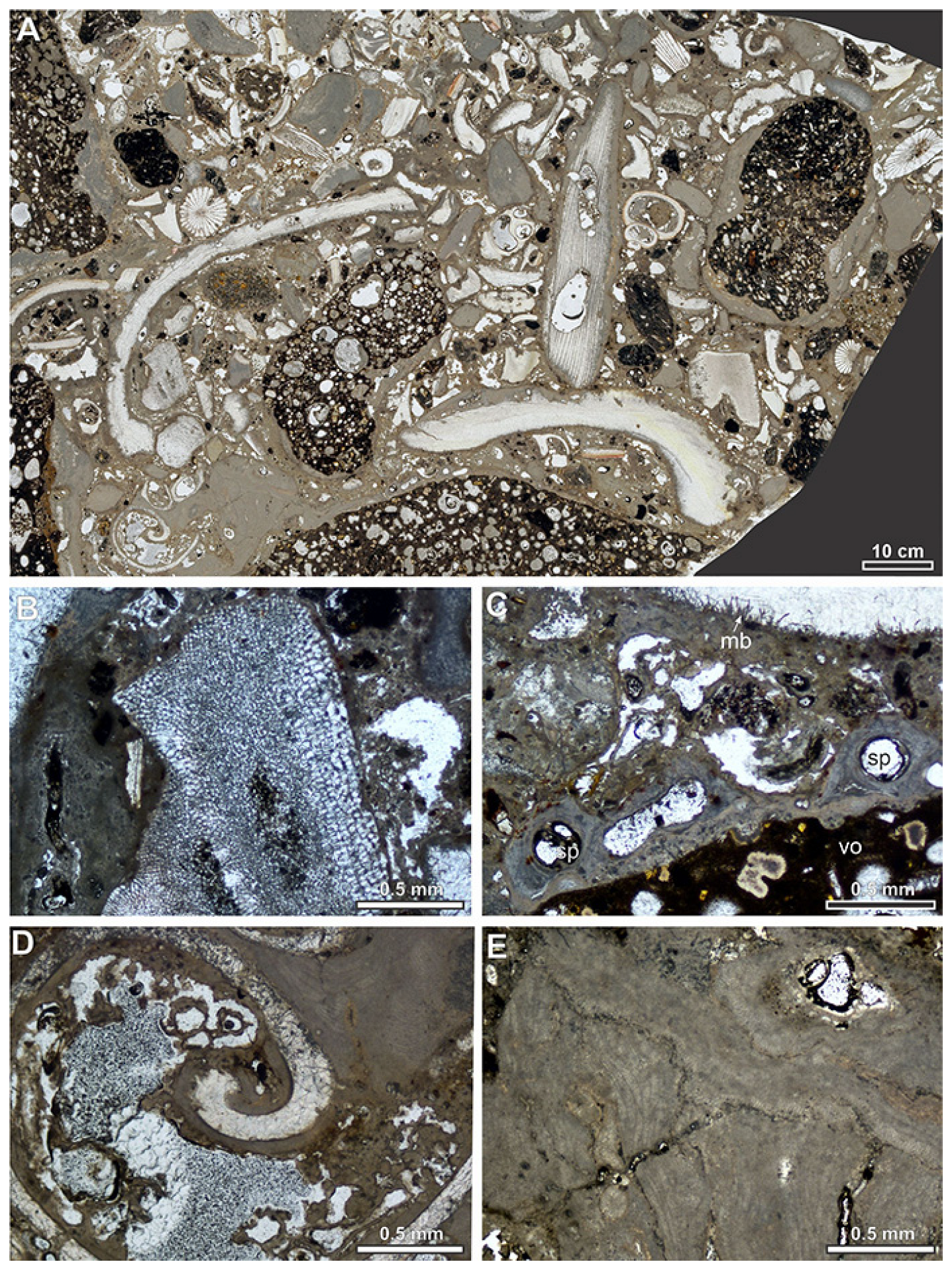
In thin section (Figure 6), the MIS 5e calcarenites are bioclastic packstones, locally bindstones, and contain a small proportion of volcanic and volcanoclastic grains of variable size (Figure 6A–E). The bioclasts are dominated by fragmented coralline algae and gastropod shells, with bivalves being less abundant and hardly cemented to the substrate (Figure 4C–E). Coralline algae are generally poorly preserved but include possible Mesophyllum sp. (Figure 6E) and representatives of the subfamily Mastophoroideae. Echinoid spines represented by the shallow-water species Paracentrotus lividus (Lamarck, 1816) and Arbacia lixula (Linnaeus, 1758) are common, whereas benthic calcareous foraminifers and serpulid polychaete tubes (Figure 6C) are rare. Most bioclasts are abraded, with micritized envelopes, and some have microborings (Figure 6C). Most mollusc shells are recrystallized. Some mollusc shells and echinoid spines are sufficiently well preserved to allow identification. Several volcanic pebbles and bioclasts are partially to fully encrusted by coralline algae (Figure 6C,D). In places, algal crusts coat adjacent bioclasts, forming bindstones sensu [38]. The matrix consists of micrite and, in places, micritic peloids. Several gastropod and bivalve shells observed in the exposure contain Entobia isp. produced by clionaid sponges (Figure 2C).

3.2. Palaeobiodiversity of the MIS 5e Marine Molluscs

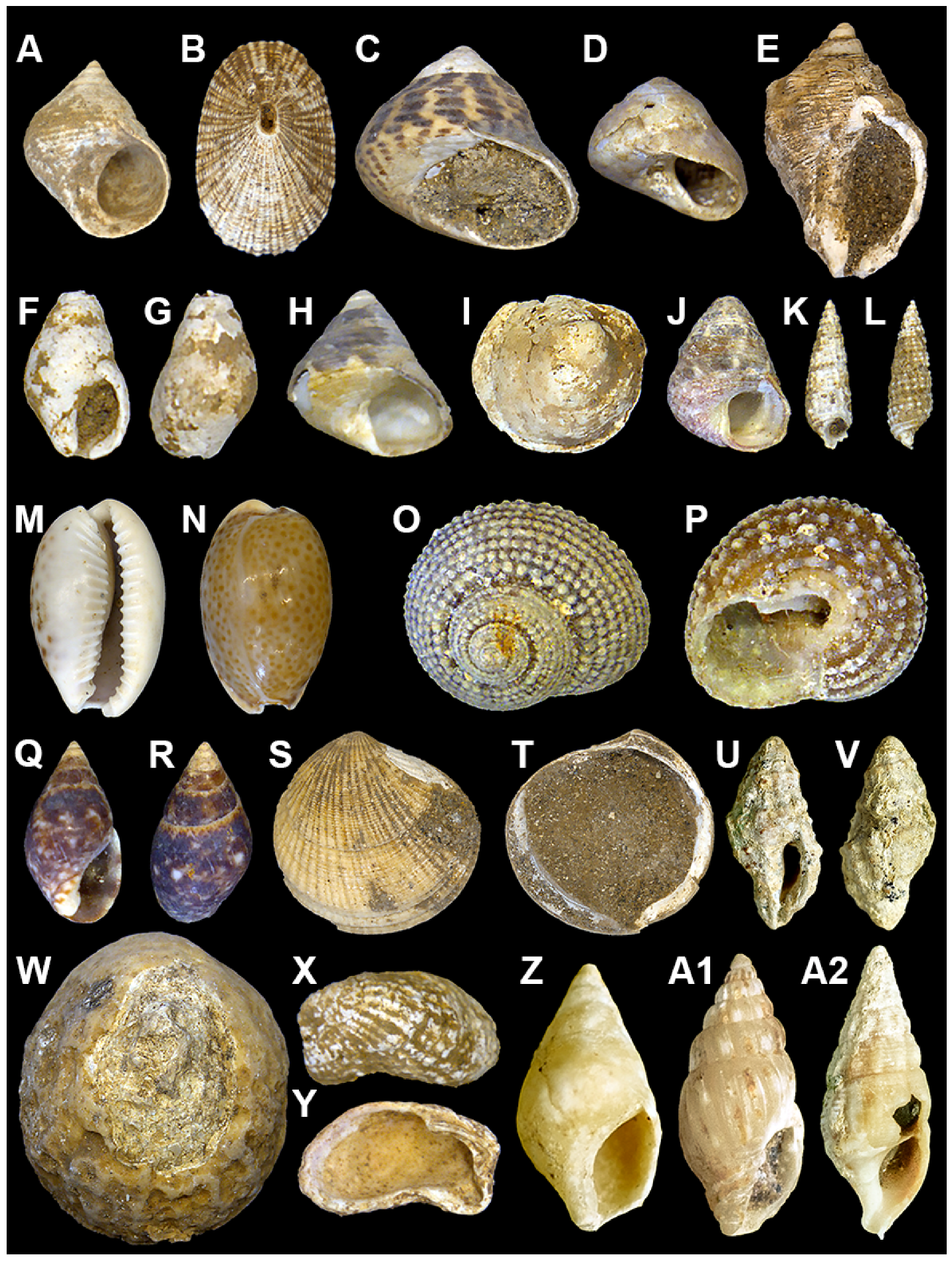
In total, 40 taxa of molluscs are reported, comprising 38 species of gastropods and two bivalve species (Figure 7 and Figure 8). The two bivalve species, Cardita calyculata (Linnaeus, 1758) (Figure 7X,Y) and Ctena decussata (O.G. Costa, 1829) (Figure 7S,T), have extensive chronostratigraphic ranges, spanning from the Miocene to Recent times. Among the gastropods, only one species (2.6%)—Diodora graeca (Linnaeus, 1758)—exhibits a broader range, extending from the Eocene to the Recent [16]. In contrast, four gastropods (10.6%) display ranges comparable to those of the bivalves (Miocene to the Recent), while the majority (33 species; 86.8%) are recorded from the Pleistocene to present times.
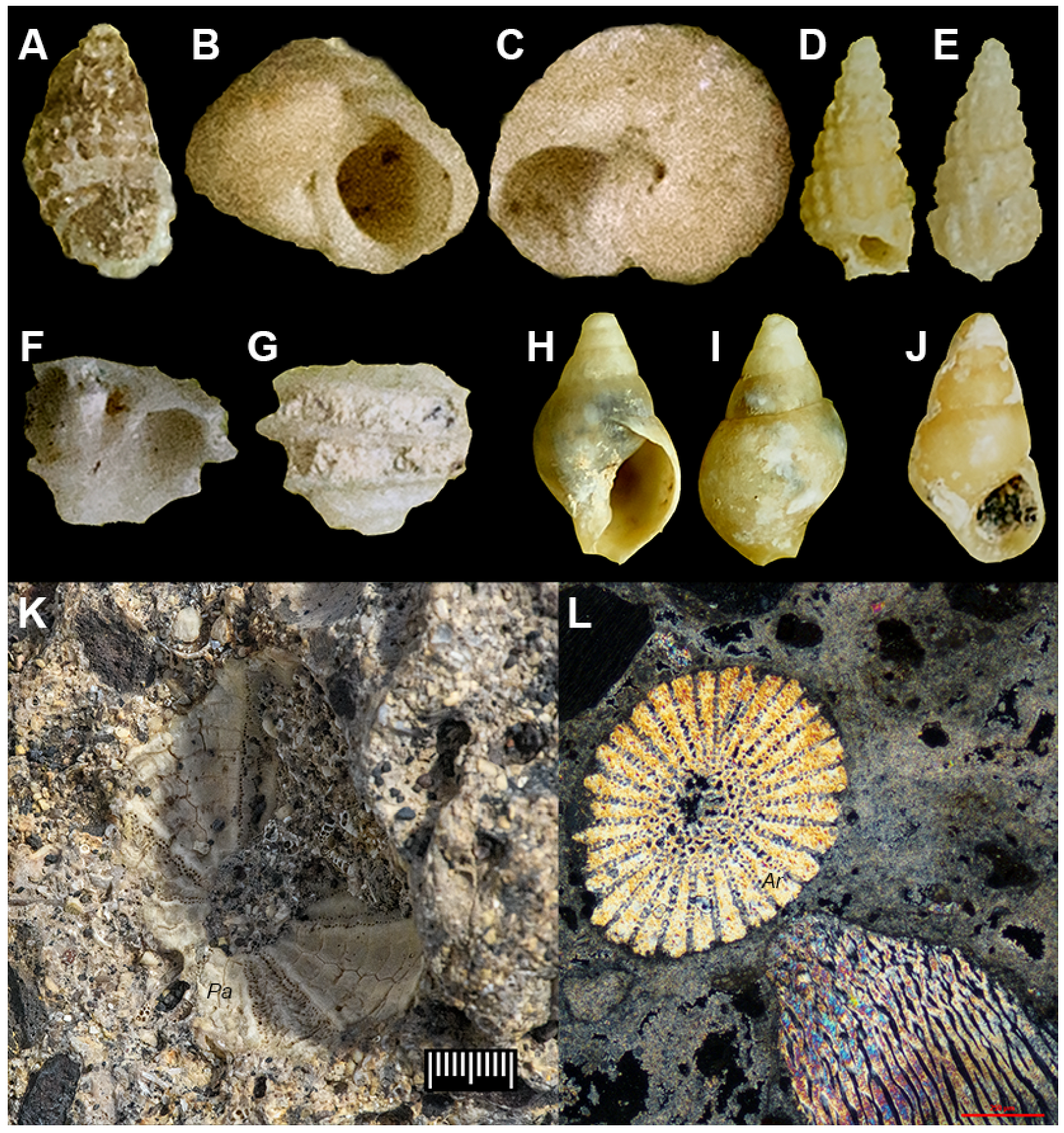
In the most recent account of MIS 5e shallow-water marine molluscs from the Canary Islands, Ref. [39] reported 194 gastropods and 80 bivalve species. Importantly, the present study adds three new records to the MIS 5e gastropod checklist for the archipelago: Alvania johannae Moolenbeek & Hoenselaar, 1998 (Figure 8A), Krachia tiara (Monterosato, 1874) (Figure 8D,E), and Barleeia unifasciata (Montagu, 1803) (Figure 8J). When combined with data from the literature, this brings the total number to 202 gastropod species and 80 bivalve species currently reported from the MIS 5e of the Canary Islands (Table 1) [40]. Furthermore, the present study contributes six additional gastropod records to the checklist for the San Juanito outcrop, all previously reported from the Canary Islands: Claremontiella nodulosa (C. B. Adams, 1845) (Figure 7U,V), Columbella adansoni Menke, 1853, Fossarus ambiguus (Linnaeus, 1758) (Figure 8F,G), Mitrella broderipii (G. B. Sowerby I, 1844) (Figure 7Z), Thetystrombus latus (Figure 5B), and Trimusculus mammillaris (Linnaeus, 1758) (Figure 7I).

3.3. Functional Traits

Functional trait analysis indicates that the MIS 5e gastropod assemblage from the San Juanito outcrop is evenly divided in terms of larval development: 19 taxa exhibit planktotrophic development, and 19 are non-planktotrophic. Furthermore, all 40 mollusc species possess shells entirely composed of aragonite. Regarding locomotion, most gastropod species are actively mobile (73.7%), followed by facultatively mobile (18.4%). Slow-moving (5.3%) and stationary gastropod species (2.6%) represent a smaller proportion of the MIS 5e assemblage. In terms of life habit, most gastropods are epifaunal (94.7%), with only two species (5.3%) classified as semi-infaunal; in contrast, the two bivalve species at San Juanito are infaunal. Regarding their diet, twenty out of the thirty-eight gastropod species are herbivores/grazers, whereas twelve species are carnivores, followed by five omnivores (i.e., species that can act as carnivores and as herbivores/grazers), with suspension feeders represented by a single species (Vermetus sp.). Of the two bivalve species reported, one is a suspension feeder, whereas the other is chemosymbiotic (Table 2).

4. Discussion

4.1. Depositional Environment

The location and facies characteristics of the sedimentary rocks indicate shallow, open-marine conditions, likely above or near the fair-weather wave base. The dominance of crushed and abraded bioclastic components in the pre-MIS 5e calcarenites suggests persistent wave action (Figure 5). However, the common occurrence of micritization points to a moderate- to low-energy photic zone, warm waters, relatively low sedimentation rates, and supersaturation with calcium carbonate [41,42]. This interpretation is further supported by the presence of peloids, which may originate from micritization or abrasion of small carbonate mud aggregates [43]. It is therefore likely that abraded bioclasts were produced in higher-energy settings and subsequently transported and deposited in slightly deeper, calmer waters, where they underwent microboring and micritization.
The overlying MIS 5e calcarenites were deposited on an eroded and already cemented pre-MIS 5e substrate. This is evidenced by their occurrence in pockets, some of which display algal crusts at their base. This indicates that erosion preceded deposition, and no lithoclasts of pre-MIS 5e calcarenites were observed within the MIS 5e deposits. Fragmentation, abrasion, and micritization (Figure 6), similar to those observed in the underlying deposits, suggest that bioclasts originated in zones affected by persistent wave action and were subsequently redeposited in a calmer, moderate- to low-energy environment. The more pronounced development of algal encrustations, locally binding the sediment, as well as the presence of better-preserved mollusc shells—some encrusted by coralline algae—supports this interpretation. In addition, the presence of a concave-up patellid shell (Figure 2D) suggests settling of the transported shell through the water column with rapid burial that prevented subsequent reorientation.
The duration and nature of the hiatus between the pre-MIS 5e and MIS 5e deposits remain unclear. The presence of reddish scoria in the former suggests derivation from a different volcanic source than that of the MIS 5e deposits. It is also possible that the brownish colour of the pre-MIS 5e deposits reflects subaerial weathering following a phase of emersion. Overall, the apparent decrease in depositional energy from the pre-MIS 5e to MIS 5e environments may be related to transgression during the Last Interglacial associated with rising sea level.

4.2. Age Assignment of the San Juanito Outcrop

The application of archipelago-specific ecobiostratigraphic indicator species within Macaronesia is a well-established, accurate, and cost-effective method to constrain the age of the studied palaeosites [14,15,16,39]. The presence of the warm-water gastropods Thetystrombus latus and Claremontiella nodulosa, both species widely regarded as ecostratigraphic indicator species for MIS 5e deposits in the Canary Islands (sensu [39]), supports previous assignments of a Last Interglacial age for this deposit [24,44]. Acanthina dontelei García-Talavera & Sánchez-Pinto, 2002 is an extinct gastropod species reported from the MIS 5e sedimentary deposits of the Selvagens and the Canary archipelagos [39,45]. San Juanito also hosts other thermophilic species commonly associated elsewhere with Macaronesian MIS 5e deposits, despite their lack of formal MIS 5e ecostratigraphic indicator status for the Canaries, including Gemophos viverratus (Kiener, 1834) and Hinea lineata (da Costa, 1778).

4.3. Palaeobiodiversity of the MIS 5e Marine Fauna and Flora

Research on Last Interglacial faunas has a long-standing tradition in the Mediterranean (see [46] for a recent review) and along the West African Atlantic coast [47]. More recently, scientific interest has expanded toward the North Atlantic [48] and the Macaronesian archipelagos (especially the Azores and Canary archipelagos). While reviews in these regions have primarily focused on marine molluscs, they also encompass a wide range of other taxa, including vertebrates (e.g., whales [49], fishes [50], birds [51,52,53,54,55]), and invertebrates (e.g., echinoderms [56,57], crustaceans [58], brachiopods [6]), as well as algae [59,60]. Furthermore, recent studies have emerged regarding MIS 5e deposits from the Western Atlantic, spanning French Guiana [61] to South America, including Uruguay [62] and Argentina [63,64].
MIS 5e mollusc diversity is considerably higher in the Canaries (282 taxa) and the Azores (153) than in Madeira or Cabo Verde (83 each; Table 1). The Azorean data are particularly remarkable given that Santa Maria is the only island in the archipelago that has a marine fossil record, while the Canaries benefit from numerous Last Interglacial fossiliferous deposits across several islands, including La Gomera, Fuerteventura, Lanzarote, Gran Canaria, and Tenerife [22,24,65,66]. In contrast, when analysing MIS 5e palaeobiodiversity by outcrop rather than by archipelago (Table 3), the Azores host the two most diverse sites: Prainha, with 120 reported species, and Ponta do Cedro, with 91. These are followed by Penedo in Porto Santo Island (Madeira Archipelago, 84 taxa) [67] and Tachero in Tenerife Island (Canary Archipelago, 78 taxa).
The San Juanito locality is a small, restricted MIS 5e exposure. This site has been surveyed multiple times by the local TFMC team, as well as during two dedicated MIS 5e expeditions to the Canary Islands conducted by the joint TFMC and MPB teams, involving more than 10 experienced researchers. In our experience, palaeosites characterized by cemented substrates typically yield lower palaeobiodiversity compared to those with friable sediments, which permit standardized 1 kg bulk sampling. Therefore, the lower species richness recorded at San Juanito is a true ecological or taphonomical characteristic of the site, rather than a methodological artifact. Among the 18 Macaronesian MIS 5e palaeosites studied, San Juanito ranks 11th, with only 40 recorded mollusc species. Despite this relatively low diversity, we classify it as a site of moderate palaeobiodiversity. It is remarkable that 7.5% of the reported taxa represent new additions to the MIS 5e fossil record of the Canary Islands. This highlights that the MIS 5e record of the Canary Islands is far from exhaustive and suggests that a detailed analysis of the micro-molluscan fraction will probably produce novelties for regional biodiversity inventories.
Antoine and colleagues [61] recently described a hyperdiverse MIS 5e assemblage from Kourou on the continental shores of French Guiana, comprising 181 species. This total includes twelve foraminiferans, two cnidarians, nineteen bryozoans, eighty-seven molluscs (two scaphopods, thirty-five bivalves, and fifty gastropods), eleven arthropods, four echinoderms, and a significant vertebrate component of eleven elasmobranchs and thirty-five actinopterygians. In Macaronesia, the only comparable palaeosite is Prainha, on Santa Maria Island (Azores). Although less diverse, with 135 reported MIS 5e species, Prainha shows a similar taxonomic breadth, including four algae, one whale, two bony fishes, four arthropods, four echinoderms, and one hundred and twenty molluscs (twenty bivalves and one hundred gastropods). Thus, even though Prainha has a smaller vertebrate record, its malacological diversity is even higher than that of the French Guiana site, with 120 mollusc species compared to the 87 found in the continental assemblage. Furthermore, it is worth noting the disparity in sampling effort: While the Prainha dataset comes from 8 kg of processed sediment [9], the Kourou study analysed more than 775 kg [61].
Regarding coralline algae, four taxa were identified in pre-MIS 5e sediments (Figure 5), whereas only one (Mesophyllum sp., Figure 6E) was found in the MIS 5e deposits. Currently, three species of this genus are present in the Canary Islands: Mesophyllum ectocarpon (Foslie) W.H.Adey, 1970; M. erubescens (Foslie) Me.Lemoine, 1928; and M. lichenoides (J.Ellis) Me.Lemoine, 1928. These species also occur today in the Cabo Verde Archipelago. Unfortunately, the scarcity of the coralline fossil record at San Juanito precludes a more detailed analysis.

4.4. Palaeoecological Reconstruction and Functional Traits

As is the case today, rocky shores were prevalent in the San Juanito region during the Last Interglacial. This interpretation is supported by the high proportion of species associated with hard substrates, gravel, or pebble bottoms, accounting for all of the echinoderms, twenty-two of the thirty-eight gastropods and one of the two bivalves recorded. Moreover, the dominance of epifaunal gastropods (95%), the occurrence of vermetids, and the presence of two Fissurellidae and three Patellidae species further reinforce this interpretation. The latter are specialized grazers that forage on sponges [75] and rocky-shore algal carpets, respectively [76]. In certain areas, algae-covered rocky substrates supported various omnivorous gastropods (e.g., Columbella adansoni) alongside herbivore/grazer gastropods such as Barleea unifasciata, Alvania johannae, and Manzonia sp. Additionally, pockets of sand accumulated in natural depressions across the predominantly rocky seafloor provided habitats for species associated with mobile sediments, including the gastropods Hinea lineata, Naria spurca (Linnaeus, 1758), Thericium lividulum (Risso, 1826), Thericium vulgatum (Bruguière, 1792), and Thetystrombus latus, as well as the infaunal chemosymbiotic bivalve Ctena decussata. Finally, we suggest that macrophyte meadows were possibly present at San Juanito during the Last Interglacial. This is evidenced by the occurrence of the gastropod Mitrella broderipii, a species frequently associated with these ecologically relevant environments.

5. Conclusions

The Canary Islands boast over 300 inventoried sites of geological interest, many of which preserve significant fossil remains and ichnological records (trace fossils). This palaeontological wealth constitutes an essential archive for understanding island palaeoclimatology and palaeobiogeography. As Martín-González and colleagues highlight [77,78], such palaeosites offer a detailed record of past biological colorizations, providing a window into how species evolve and go extinct/extirpated in response to shifting climates. These records further provide a baseline for understanding how human intervention has reshaped island biodiversity over time. Consequently, a detailed grasp of the geological, taphonomical, and biological processes contributing to the formation of Last Interglacial fossiliferous deposits in the Canary Islands is essential. Such knowledge serves as a critical tool for evaluating the preservation status of these sites and ensuring their long-term, sustainable management [44,79].
Tenerife hosts 47 sites of geological interest [80]. Eleven are classified as palaeosites, seven of which represent the Last Interglacial period [32]. This study offers the first comprehensive description of the MIS 5e deposits at San Juanito, in Punta del Hidalgo, providing new insights into the palaeoecological conditions and depositional processes of these fossiliferous sediments. The uppermost elevation of this palaeosite reaches 2.55 ± 0.12 m a.s.l., and, despite a relatively low palaeobiodiversity—with only 40 mollusc taxa identified—meticulous sorting of qualitative samples yielded three new records for the MIS 5e Canary Islands checklist. Consequently, the total MIS 5e palaeobiodiversity for the archipelago now stands at 202 gastropods and 80 bivalves.
Palaeontological research in the Canary Islands has yet to adopt standardized 1 kg sampling protocols, a gap that currently limits the implementation of in-depth palaeoecological studies and prevents the application of functional diversity-based approaches (see [11] for a review) and the use of more robust statistical analyses. Future work in the archipelago will prioritize the application of these methods in outcrops with unconsolidated sediments, overcoming the sampling challenges posed by highly cemented deposits like those at San Juanito.

Author Contributions

S.P.Á. and E.M.-G. conceived the ideas. Funding acquisition: E.M.-G., P.M. and S.P.Á. Fieldwork: E.M.-G., S.P.Á., A.U., J.M., M.E.J., P.M., A.H., G.C.Á., M.R.M., P.J.G., T.B., E.M.-G., S.C.M. and S.P.Á. sorted the samples for molluscs. E.M.-G. examined the TFMCFO collection. E.M.-G., S.C.M., M.R.M. and S.P.Á. identified the molluscs. A.U. did all thin sections. P.M. and A.K. identified the echinoderms. D.B. identified the coralline algae. The writing was led by S.P.Á., E.M.-G. and A.U. All co-authors contributed equally to the final version of the manuscript. Figures were prepared by S.P.Á., A.U., S.C.M. and M.A.D. All authors have read and agreed to the published version of the manuscript.

Funding

Fieldwork at San Juanito (Tenerife Island) occurred in October 2023 and September 2025, with partial funding through the PaleoMACA International Seminar organized by the Museum of Natural Science of Tenerife (Autonomous Organization of Museums and Centers). S.P.A. acknowledges his research contract with BIOPOLIS: https://doi.org/10.54499/2023.07418.CEECIND/CP2845/CT0001. S.M. acknowledges her PhD grant FCT 2025.04385.BD, titled “The impact of interglacial-glacial cycles on the Pleistocene marine biota of the Cabo Verde Archipelago: The past as a window to understand current climate change effects on the marine ecosystems”. S.P.A., P.M., A.H., M.A.D., M.R.M., G.C.A., and S.C.M. acknowledge the support of the project “Upgrading the Azorean Biodiversity Portal Infrastructure (AZORES BIOPORTAL-PORBIOTA) to Boost Biodiversity Research, Management, and Education–PORBIOTA” (DRCID, ACORES2030-FEDER-03420600). A.U. received additional support from the Faculty of Geography and Geology under the Strategic Programme Excellence Initiative at Jagiellonian University. This work also benefitted from FEDER funds, through the Operational Program for Competitiveness Factors—COMPETE, and from National Funds, through FCT (UIDB/50027/2020, POCI-01–0145-FEDER-006821, UIDB/00153/2020, LA/P/0048/2020), as well as through the Regional Government of the Azores (M1.1.a/005/Funcionamento-C-/2016, CIBIO-A; M1.1.A/INFRAEST CIENT/A/001/2021; M3.3.B/ORG.R.C./005/2021, M3.3.B/ORG.R.C./008/2022/EDIÇÃO 1, and M3.3.G/EXPEDIÇÕES CIENTÍFICAS/004/2022). J.M. acknowledges FCT, I.P./MCTES through national funds (PIDDAC) to IDL: LA/P/0068/2020 (https://doi.org/10.54499/LA/P/0068/2020), UID/50019/2025 (https://doi.org/10.54499/UID/50019/2025), UID/PRR/50019/2025 (https://doi.org/10.54499/UID/PRR/50019/2025), and UID/PRR2/50019/2025 (https://doi.org/10.54499/UID/PRR2/50019/2025). Finally, this work was also supported by FEDER funds (85%) and by funds from the Regional Government of the Azores (15%) through the Azores 2020 Operational Program under the project M1.1.A/INFRAEST CIENT/A/001/2021—Base de Dados da PaleoBiodiversidade da Macaronésia.

Data Availability Statement

Datasets are available on request from the authors.

Acknowledgments

We thank Titus Brustur (Cluj-Napoca, Romania) for the preliminary identification of the coralline algae.

Conflicts of Interest

The authors declare no conflicts of interest. The funders had no role in the design of the study; in the collection, analyses, or interpretation of data; in the writing of the manuscript; or in the decision to publish the results.

Abbreviations

The following abbreviations are used in this manuscript:
DBUA-FMollusc fossil collection of the Department of Biology, University of the Azores, São Miguel Island, Azores, Portugal.
TFMCFOFossil collection of the Museo de Ciencias Naturales de Tenerife, Canary Islands, Spain.

References

  1. Kopp, R.E.; Simons, F.J.; Mitrovica, J.X.; Maloof, A.C.; Oppenheimer, M. Probabilistic assessment of sea level during the last interglacial stage. Nature 2009, 462, 863–867. [Google Scholar] [CrossRef] [PubMed]
  2. Dutton, A.; Lambeck, K. Ice volume and sea level during the Last Interglacial. Science 2012, 337, 216–219. [Google Scholar] [CrossRef] [PubMed]
  3. Chutcharavan, P.M.; Dutton, A. A global compilation of U-series-dated fossil coral sea-level indicators for the Last Interglacial period (Marine Isotope Stage 5e). Earth Syst. Sci. Data 2021, 13, 3155–3178. [Google Scholar]
  4. Rovere, A.; Raymo, M.E.; Vacchi, M.; Lorscheid, T.; Stocchi, P.; Gómez-Pujol, L.; Harris, D.L.; Casella, E.; O’Leary, M.J.; Hearty, P.J. The analysis of Last Interglacial (MIS 5e) relative sea-level indicators: Reconstructing sea-level in a warmer world. Earth-Sci. Rev. 2016, 159, 404–427. [Google Scholar]
  5. Ramalho, R.; Quartau, R.; Trenhaile, A.S.; Mitchell, N.C.; Woodroffe, C.D.; Ávila, S.P. Coastal evolution on volcanic oceanic islands: A complex interplay between volcanism, erosion, sedimentation and biogenic production. Earth-Sci. Rev. 2013, 127, 140–170. [Google Scholar] [CrossRef]
  6. Lecointre, G.; Tinkler, K.J.; Richards, H.G. The marine Quaternary of the Canary Islands. Proc. Acad. Nat. Sci. Phila. 1967, 119, 325–344. [Google Scholar]
  7. Meco, J. Los Strombus Neógenos y Cuaternarios del Atlántico Euroafricano, Taxonomía, Biostratigrafia y Paleoecologia. Ph.D. Thesis, Universidad Complutense de Madrid, Madrid, Spain, 1976; 207p. [Google Scholar]
  8. Meco, J.; Guillou, H.; Carracedo, J.C.; Lomoschitz, A.; Ramos, A.J.G.; Rodríguez Yanes, J.J. The maximum warmings of the Pleistocene world climate recorded in the Canary Islands. Palaeogeogr. Palaeoclimatol. Palaeoecol. 2002, 185, 197–210. [Google Scholar] [CrossRef]
  9. Ávila, S.P.; Melo, C.; Silva, L.; Ramalho, R.S.; Quartau, R.; Hipólito, A.; Cordeiro, R.; Rebelo, A.C.; Madeira, P.; Rovere, A.; et al. A review of the MIS 5e highstand deposits from Santa Maria Island (Azores, NE Atlantic): Palaeodiversity, palaeocology and palaeobiogeography. Quat. Sci. Rev. 2015, 114, 126–148. [Google Scholar]
  10. Ávila, S.P.; Landau, B.; Ávila, G.C.; Hipólito, A.; Uchman, A.; Johnson, M.E.; Madeira, P. A call to address the taxonomic gap in the Pleistocene of Santa Maria Island (Azores Archipelago). Acta Geol. Pol. 2025, 75, e40. [Google Scholar]
  11. Ávila, S.P.; Arruda, S.; Silva, L.; Martins, G.M.; Hipólito, A.; Quartau, R.; Ramalho, R.S.; Madeira, P.; Baptista, L.; Rebelo, A.C.; et al. Comparing the Last Interglacial (MIS 5e) with the present interglacial period (MIS 1) using a multidimensional functional diversity analysis: The marine molluscs from Santa Maria Island (Azores Archipelago, central Atlantic) as a case-study. J. Quat. Sci. 2026, 41, 333–360. [Google Scholar]
  12. Meco, J. Los niveles com Strombus de Jandia (Fuerteventura, Islas Canarias). Anu. Estud. Atl. 1975, 21, 643–660. [Google Scholar]
  13. Zazo, C.; Hillaire-Marcel, C.; Hoyos, M.; Ghaleb, B.; Goy, J.L.; Dabrio, C.J. The Canary Islands, a stop in the migratory way of Strombus bubonius towards the Mediterranean around 200 ka. Mediterr. Black Sea Shorel. Newsl. 1993, 15, 7–11. [Google Scholar]
  14. Melo, C.S.; Martín-González, E.; da Silva, C.M.; Galindo, I.; González-Rodríguez, A.; Baptista, L.; Rebelo, A.C.; Madeira, P.; Voelker, A.H.L.; Johnson, M.E.; et al. Range expansion of tropical shallow-water marine molluscs in the NE Atlantic during the last interglacial (MIS 5e): Causes, consequences and utility of ecostratigraphic indicators for the Macaronesian archipelagos. Quat. Sci. Rev. 2022, 278, 107377. [Google Scholar] [CrossRef]
  15. Melo, C.S.; da Silva, C.M.; Scarponi, D.; Martín-González, E.; Rolán, E.; Rojas, A.; Martinez, S.; Silva, L.; Johnson, M.E.; Rebelo, A.C.; et al. Palaeobiogeography of NE Atlantic archipelagos during the Last Interglacial (MIS 5e): A molluscan approach to the conundrum of Macaronesia as a marine biogeographic unit. Quat. Sci. Rev. 2023, 319, 108313. [Google Scholar] [CrossRef]
  16. Ávila, S.P. Atlantic and Mediterranean Gastropoda: Geographical Distribution and Functional Traits Database, Version 1.1. 2025. Available online: https://www.researchgate.net/publication/385907293_Atlantic_and_Mediterranean_Gastropoda_geographical_distribution_and_functional_traits_database_Version_11 (accessed on 8 April 2026).
  17. Martín-González, E.; Cruzado-Caballero, P.; Cadavid-Melero, E.; del Cristo Velasco Flores, M.; Aponte, M.; Tagua, V.G.; Castilho, C. Fósiles conservados en islas de lava: Estado actual del conocimiento del registro fósil de las Islas Canarias. Mem. Real Soc. Esp. Hist. Nat. 2025, 18, 81–104. [Google Scholar]
  18. Crofts, R. Raised beaches and chronology in north west Fuerteventura. Canary Islands. Cuaternaria 1967, 9, 247–260. [Google Scholar]
  19. Klug, H. Morphologische Studien auf den Kanarischen Inseln. Beiträge zur Küstenentwicklung und Talbildung auf Einem Vulkanischen Archipel. Schriften Geogr. Inst. Der Univ. Kiel 1968, 24, 3. [Google Scholar] [CrossRef]
  20. Meco, J.; Petit-Maire, N. Climates of the Past; International Union of Geological Sciences; UNESCO: Paris, France; Universidad de Las Palmas de Gran Canaria: Las Palmas de Gran Canaria, Spain, 1986; 210p. [Google Scholar]
  21. Zazo, C.; Goy, J.L.; Hillaire-Marcel, C.; Gillot, P.Y.; Soler, V.; González, J.A.; Dabrio, C.J.; Ghaleb, B. Raised marine sequences of Lanzarote and Fuerteventura revisited—A reappraisal of relative sea-level changes and vertical movements in the eastern Canary Islands during the Quaternary. Quat. Sci. Rev. 2002, 21, 2019–2046. [Google Scholar]
  22. Martín-González, E.; González-Rodríguez, A.; Galindo, I.; Mangas, J.; Romero, C.; Sánchez, N.; Coello, J.J.; Márquez, A.; Vegas, J.; de Vera, A.; et al. Review of the MIS 5e coastal outcrops from Fuerteventura (Canary Islands). Vieraea 2019, 46, 667–688. [Google Scholar]
  23. Guillou, H.; Carracedo, J.C.; Paris, R.; Perez-Torrado, F.J. Implications for the early shield-stage evolution of Tenerife from K/Ar ages and magnetic stratigraphy. Earth Planet. Sci. Lett. 2004, 222, 599–614. [Google Scholar]
  24. García-Talavera, F.; Paredes, R.; Martín, M. Catálogo-Inventario: Yacimientos Paleontológicos Provincia de Santa Cruz de Tenerife; Instituto de Estudios Canarios: La Laguna, Spain, 1989; 76p. [Google Scholar]
  25. Carracedo, J.C.; Perez Torrado, J.; Ancochea, E.; Meco, J.; Hernán, F.; Cubas, C.R.; Casillas, R.; Rodriguez, E.; Ahijado, A. Cenozoic volcanism II: The Canary of Spain. In The Geology of Spain; Gibbons, W., Moreno, T., Eds.; Geological Society of London: London, UK, 2002; pp. 439–472. [Google Scholar]
  26. Zeuner, F.E. Líneas costeras del Pleistoceno en las Islas Canarias. Anu. Estud. Atl. 1958, 4, 9–16. [Google Scholar]
  27. García-Talavera, F. Sobre la presencia de Strombus latus Gmel. (Mollusca, Mesogastropoda) en el Cuaternario marino de Tenerife. In Homenaje al Profesor Dr. Telesforo Bravo; Universidad de La Laguna: La Laguna, Spain, 1990; Volume 1, pp. 375–382. [Google Scholar]
  28. García-Talavera, F.; Kardas, S.J.; Richards, H.G. Quaternary marine mollusks from Tenerife, Canary Islands. Nautilus 1978, 92, 97–102. [Google Scholar]
  29. Zazo, C.; Goy, J.L.; Hillaire-Marcel, C.; González-Delgado, J.A.; Soler, V.; Ghaleb, B.; Dabrio, C.J. Registro de los cambios de nivel del mar durante el Cuaternario en las Islas Canarias occidentales (Tenerife y La Palma). Estud. Geol. 2003, 59, 133–144. [Google Scholar] [CrossRef]
  30. Kröchert, J.; Maurer, H.; Buchner, E. Fossil beaches as evidence for significant uplift of Tenerife, Canary Islands. J. Afr. Earth Sci. 2008, 51, 220–234. [Google Scholar] [CrossRef]
  31. Johnson, M.E.; Martín-González, E.; Sansón, M.; Uchman, A.; Ramalho, R.S.; Baarli, B.G.; Madeira, J.; Madeira, P.; Stolarski, J.; Ávila, G.C.; et al. Encrustations dominated by crustose coralline red algae on coastal boulders from the Last Interglacial epoch at Tachero on Tenerife (Canary Islands). Facies, 2026; in press.
  32. Martín-González, E.; Galindo, E.; Mangas, J.; Romero, C.; Sánchez, N.; González-Rodríguez, A.; Coello, J.J.; Márquez, A.; de Vera, A.; Vegas, J.; et al. Revisión de los depósitos costeros del estadio isotópico marino 5e (MIS 5e) de Fuerteventura (Islas Canarias). Vieraea 2016, 46, 667–688. [Google Scholar]
  33. Carracedo, J.C. Geología de Canarias. I, Origen, Evolución, Edad y Volcanismo; Rueda: Madrid, Spain, 2011; 398p. [Google Scholar]
  34. Marrero, N. Evolución Geomorfológica de la Costa de Punta del Hidalgo (Tenerife). In XXII Coloquio de Historia Canario-Americana (2016); Cabildo de Gran Canaria: Las Palmas de Gran Canaria, Spain, 2017; 153p. [Google Scholar]
  35. Ávila, S.P. Atlantic and Mediterranean Bivalvia: Geographical Distribution and Functional Traits Database, Version 1.0. 2024. Available online: https://www.researchgate.net/publication/387085775_Atlantic_and_Mediterranean_Bivalvia_geographical_distribution_and_functional_traits_database_Version_10 (accessed on 10 May 2026).
  36. Guiry, M.D.; Guiry, G.M. AlgaeBase; World-Wide Electronic Publication, University of Galway. 2026. Available online: https://www.algaebase.org (accessed on 10 May 2026).
  37. Dunham, R.J. Classification of Carbonate Rocks According to Depositional Texture. Am. Assoc. Pet. Geol. Mem. 1962, 1, 108–121. [Google Scholar]
  38. Embry, A.F.; Klovan, J.E. A Late Devonian reef tract on northeastern Banks Island, N.W.T. Bull. Can. Pet. Geol. 1971, 19, 730–781. [Google Scholar]
  39. Ávila, S.P. Distributional range shifts caused by glacial-interglacial cycles: A review on timing, main processes, and patterns of late Pleistocene marine dispersal by invertebrates in the NE Atlantic. J. Mar. Sci. Eng. 2025, 13, 2024. [Google Scholar]
  40. Ávila, S.P. Geographical Distribution and Functional Traits Database of the Last Interglacial (MIS 5e) Atlantic and Mediterranean Mollusca, Version 1.0. 2026. Available online: https://www.researchgate.net/publication/404206498_Geographical_distribution_and_functional_traits_database_of_the_Last_Interglacial_MIS_5e_Atlantic_and_Mediterranean_Mollusca_Version_10. (accessed on 12 April 2026).
  41. Bathurst, R.G.C. Boring algae, micrite envelopes and lithification of molluscan shell fragments. Geol. J. 1966, 5, 15–32. [Google Scholar]
  42. Flügel, E.; Munnecke, A. Microfacies of Carbonate Rocks: Analysis, Interpretation and Application; Springer: Berlin/Heidelberg, Germany, 2010; 976p. [Google Scholar]
  43. Bathurst, R.G.C. Carbonate Sediments and Their Diagenesis, 2nd ed.; Developments in Sedimentology; Elsevier: Amsterdam, The Netherlands, 1975; Volume 12, 658p. [Google Scholar]
  44. Jiménez-Gomis, C.; Frank, A.G.; Chiesa, G.S.; Castillo Ruiz, C. Conservation Status of the Listed Marine Fossil Sites in the Macizo de Anaga Biosphere Reserve (Tenerife, Canary Islands, Spain). Geoheritage 2019, 11, 1757–1769. [Google Scholar] [CrossRef]
  45. García-Talavera, F.; Sánchez-Pinto, L. Moluscos marinos fósiles de Selvagem Pequenha e Ilheu de Fora (Islas Salvajes). Descripción de una nueva especie de neogasterópodo. Vieraea 2001, 13, 9–21. [Google Scholar]
  46. Psarras, C.; Thivaiou; Quillévéré, F.; Cornée, J.-J.; Moissette, P.; Philippon, M.; Fietzke, J.; Bosch, D.; Condomines, M.; Bruguier, O.; et al. Integrating Aegean Last Interglacial faunas into the Mediterranean palaeobiogeographic framework: New evidence from Karpathos (Greece). J. Quat. Sci. 2026, 41, 80–98. [Google Scholar] [CrossRef]
  47. Lecointre, G. Recherches sur le Neogène et le Quaternaire marin de la côte atlantique du Maroc. Notes Mém. Serv. Géol. Maroc 1952, 99, 173–198. [Google Scholar]
  48. Bauch, H.; Erlenkeuser, H. A “critical” climatic evaluation of last interglacial (MIS 5e) records from the Norwegian Sea. Polar Res. 2008, 27, 135–151. [Google Scholar] [CrossRef]
  49. Ávila, S.P.; Cordeiro, R.; Rodrigues, A.R.; Rebelo, A.C.; Melo, C.; Madeira, P.; Pyenson, N.D. Fossil Mysticeti from the Pleistocene of Santa Maria Island, Azores (NE Atlantic Ocean), and the prevalence of fossil cetaceans on oceanic islands. Palaeontol. Electron. 2015, 18, 18.2.27A. [Google Scholar]
  50. Ávila, S.P.; Azevedo, J.M.N.; Madeira, P.; Cordeiro, R.; Melo, C.S.; Baptista, L.; Torres, P.; Johnson, M.E.; Vullo, R. Pliocene and Late-Pleistocene actinopterygian fishes from Santa Maria Island (Azores: NE Atlantic Ocean): Systematics, palaeoecology and palaeobiogeography. Geol. Mag. 2020, 157, 1526–1542. [Google Scholar]
  51. Walker, C.A.; Wragg, G.M.; Harrison, C.J.O. A new shearwater from the Pleistocene of the Canary Islands and its bearing on the evolution of certain Puffinus shearwaters. Hist. Biol. 1990, 3, 203–224. [Google Scholar] [CrossRef]
  52. Ramirez, O.; Illera, J.C.; Rando, J.C.; Gonzalez-Solis, J.; Alcover, J.A.; Lalueza-Fox, C. Ancient DNA of the extinct lava shearwater (Puffinus olsoni) from the Canary Islands reveals incipient differentiation within the P. puffinus complex. PLoS ONE 2010, 5, e16072. [Google Scholar] [CrossRef] [PubMed]
  53. Rando, J.C.; Alcover, J.A. On the extinction of dune shearwater (Puffinus holeae) from the Canary Islands. J. Ornithol. 2010, 151, 365–369. [Google Scholar]
  54. Illera, J.C.; Rando, J.C.; Richardson, D.S.; Emerson, B.C. Age, origins and extinctions of the avifauna of Macaronesia: A synthesis of phylogenetic and fossil information. Quat. Sci. Rev. 2012, 50, 14–22. [Google Scholar] [CrossRef]
  55. Rando, J.C.; Pieper, H.; Pereira, F.; Torres-Roig, E.; Alcover, J.A. Petrel extinction in Macaronesia (North-East Atlantic Ocean): The case of the genus Pterodroma (Aves: Procellariiformes: Procellariidae). Zool. J. Linn. Soc. 2024, 202, zlae123. [Google Scholar] [CrossRef]
  56. Madeira, P.; Kroh, A.; Cordeiro, R.; Meireles, R.; Ávila, S.P. The fossil echinoids of Santa Maria Island, Azores (Northern Atlantic Ocean). Acta Geol. Pol. 2011, 61, 243–264. [Google Scholar]
  57. Uchman, A. Trace fossils on oceanic volcanic islands of Macaronesia: Current state of knowledge. J. Mar. Sci. Eng. 2025, 13, 1967. [Google Scholar] [CrossRef]
  58. Hyžný, M.; Melo, C.S.; Ramalho, R.S.; Cordeiro, R.; Madeira, P.; Baptista, L.; Rebelo, A.C.; Gomez, C.; Torres, P.; Uchman, A.; et al. Pliocene and Late Pleistocene (MIS 5e) decapod crustacean crabs from Santa Maria Island (Azores Archipelago: NE Atlantic): Systematics, palaeoecology and palaeobiogeography. J. Quat. Sci. 2021, 36, 91–109. [Google Scholar]
  59. Amen, R.G.; Neto, A.I.; Azevedo, J.M.N. Coralline-algal framework in the Quaternary of Prainha (Santa Maria Island, Azores). Rev. Esp. Micropaleontol. 2005, 37, 63–70. [Google Scholar]
  60. Rebelo, A.C.; Rasser, M.W.; Ramalho, R.S.; Johnson, M.E.; Melo, C.S.; Uchman, A.; Quartau, R.; Berning, B.; Neto, A.I.; Mendes, A.R.; et al. Pleistocene coralline algal build-ups on a mid-ocean rocky shore—Insights into the MIS 5e record of the Azores. Palaeogeogr. Palaeoclimatol. Palaeoecol. 2021, 579, 110598. [Google Scholar]
  61. Antoine, P.-O.; Wieringa, L.N.; Adnet, S.; Aguilera, O.; Bodin, S.C.; Cairns, S.; Conejeros-Vargas, C.A.; Cornée, J.-J.; Ežerinskis, Ž.; Fietzke, J.; et al. A Late Pleistocene coastal ecosystem in French Guiana was hyper-diverse relative to today. Proc. Natl. Acad. Sci. USA 2024, 121, e2311597121. [Google Scholar] [PubMed]
  62. Rojas, A.; Zaffaroni, J.C.; Martínez, S. New molluscan records and palaeoecology of the Late Pleistocene marine assemblage from La Coronilla (Rocha, Uruguay). J. Sediment. Environ. 2018, 3, 220–233. [Google Scholar] [CrossRef]
  63. Martínez, S.; Ubilla, M.; Verde, M.; Perea, D.; Rojas, A.; Guérèquiz, R.; Piñeiro, G. Paleoecology and geochronology of Uruguayan coastal marine Pleistocene deposits. Quat. Res. 2001, 55, 246–254. [Google Scholar] [CrossRef]
  64. Charó, M.P. Quaternary marine mollusk associations of the last interglacials in North Patagonia (Argentina): Paleoecology and paleoclimates. In Update on Malacology; Ray, S., Mukherjee, S., Eds.; IntechOpen: London, UK, 2021. [Google Scholar] [CrossRef]
  65. Cabero, A. Registro Costero de los Cambios Eustáticos y Climáticos Durante los Interglaciares Recientes Cuaternarios: Sur y Sureste Peninsular, Islas Baleares, Canarias y Cabo Verde. Ph.D Thesis, Universidad de Salamanca, Salamanca, Spain, 2009; 451p. [Google Scholar]
  66. Martín-González, E.; Rodríguez, A.; Vera-Peláez, J.L.; Lozano-Francisco, M.C.; Castillo, C. Malacological associations of Upper Pleistocene littoral deposits from Tenerife (Canary Islands). Vieraea 2016, 44, 87–106. [Google Scholar]
  67. Gerber, J.; Hemmen, J.; Groh, K. Eine pleistozäne marine Molluskenfauna von Porto Santo (Madeira-Archipel). Mitt. Dtsch. Malakozool. Ges. 1989, 44–45, 19–30. [Google Scholar]
  68. Moreno, S.; Doukani, M.A.; Hipólito, A.; Madeira, P.; Pérez, S.P.; Ávila, G.C.; Silva, L.; Martins, G.M.; Ávila, S.P. Paleobiodiversity and paleoecology insights from a new MIS 5e highstand deposit on Santa Maria Island (Azores Archipelago, Portugal). Quaternary 2025, 8, 53. [Google Scholar] [CrossRef]
  69. García-Talavera, F. Fauna tropical en el Neotirreniense de Santa Maria (I. Azores). Lav. Soc. Ital. Malacol. 1990, 23, 439–443. [Google Scholar]
  70. Ávila, S.P.; Amen, R.; Azevedo, J.M.N.; Cachão, M.; García-Talavera, F. Checklist of the Pleistocene marine molluscs of Prainha and Lagoinhas (Santa Maria Island, Azores). Açoreana 2002, 9, 343–370. [Google Scholar]
  71. Ávila, S.P.; Amen, R.; Azevedo, J.M.N.; Cachão, M.; García-Talavera, F. Os Fósseis de Santa Maria (Açores). 1. A Jazida da Prainha; OVGA—Observatório Vulcanológico e Geotérmico dos Açores: Lagoa, Portugal, 2010; 103p. [Google Scholar]
  72. Callapez, P.; Soares, A.F. Late Quaternary marine mollusks from Santa Maria (Azores); paleoecologic and paleobiogeographic considerations. Ciênc. Terra (UNL) 2000, 14, 313–322. [Google Scholar]
  73. Ávila, S.P.; Madeira, P.; Zazo, C.; Kroh, A.; Kirby, M.; da Silva, C.M.; Cachão, M.; Martins, A.M.F. Palaeoecology of the Pleistocene (MIS 5.5) outcrops of Santa Maria Island (Azores) in a complex oceanic tectonic setting. Palaeogeogr. Palaeoclimatol. Palaeoecol. 2009, 274, 18–31. [Google Scholar] [CrossRef]
  74. MPDb. Macaronesian Palaeobiodiversity Database. Available online: https://macpaleo.uac.pt/ (accessed on 14 April 2026).
  75. Gofas, S.; Moreno, D.; Salas, C. Moluscos Marinos de Andalucía; Servicio de Publicaciones e Intercambio Científico: Malaga, Spain; Universidad de Málaga: Malaga, Spain, 2011; Volume 1, 342p. [Google Scholar]
  76. Morton, B.; Britton, J.C.; Martins, A.M.F. Ecologia Costeira dos Açores; Sociedade Afonso Chaves: Ponta Delgada, Portugal, 1998; 249p. [Google Scholar]
  77. Martín-González, E.; Coello, J.J.; Castillo, C.; Gonzalez-Rodriguez, A.; Galindo, I.; Vegas, J. Revisión del patrimonio paleontológico del Geoparque Mundial de la Unesco de El Hierro. Geogaceta 2019, 65, 11–17. [Google Scholar]
  78. Martín-González, E.; Galindo, I.; Romero, C.; Sánchez, N.; Vegas, J. Evaluation of geoconservation in geosites of palaeontological interest from Lanzarote and Chinijo Islands UNESCO Global Geopark. In Lanzarote and Chinijo Islands Geopark: From Earth to Space, Geoheritage, Geoparks and Geotourism; Mateo, E., Martinez-Frias, J., Vegas, J., Eds.; Springer: Cham, Switzerland, 2019; pp. 75–83. [Google Scholar]
  79. Vegas, J.; Galindo, I.; Romero, C.; Sanchez, N.; Diaz, G.A.; Martín-González, E.; Mateo, E. Geoconservation and geotourism in the Lanzarote and Chinijo Islands UNESCO Global Geopark. In Lanzarote and Chinijo Islands Geopark: From Earth to Space, Geoheritage, Geoparks and Geotourism; Mateo, E., Martinez-Frias, J., Vegas, J., Eds.; Springer: Cham, Switzerland, 2019; pp. 99–108. [Google Scholar]
  80. Vegas, J.; Sánchez, N.; Romero, C.; Martín-González, E.; Lozano, G.; Galindo, I. El patrimonio geológico de las Islas Canarias. In Geoparques de Canarias. La Geodiversidad al Servicio del Desarrollo Sostenible; Gobierno de Canarias: Santa Cruz de Tenerife, Spain; Las Palmas de Gran Canaria, Spain, 2025; pp. 75–87. [Google Scholar]
Figure 1. Location maps of the Canary Islands in the Atlantic. (A): The Canary Islands, in the East Atlantic. (B): The Canary Archipelago showing the location of Tenerife Island (highlighted in red). (C): Detailed map of Tenerife showing topography and indicating the location of the study site at San Juanito, Punta del Hidalgo. (D): Close-up view of the study locality at San Juanito, on the north coast of Tenerife.
Quaternary 09 00050 g001
Figure 2. Features of the exposures at San Juanito. (A): General view of the MIS 5e outcrop, with the Roque Dos Hermanos hill (344 m) in Punta del Frontón visible in the foreground, and the Picacho Magín hill (253 m) in the background. (B): Detail of the best exposed MIS 5e sector at San Juanito. (C,D): Photographs illustrating the high degree of cementation of this Last Interglacial deposit. In (C), a bivalve shell bioeroded with clionaid sponge boring Entobia isp. (see red arrows). In (D), a concave-up patellid gastropod shell (red arrow) suggesting settling through the water column.
Quaternary 09 00050 g002
Figure 3. Spatial relationships between the pre-MIS 5e and the MIS 5e deposits. (A): The MIS 5e deposits at San Juanito rest on an irregular basaltic substrate that generally slopes seaward. Much of this basal substrate is overlain by coarse volcanic material, forming a conglomerate supported by a calcarenitic matrix (pre-MIS 5e deposits). (B,C): Idealized sections showing the spatial distribution of the basaltic platform, the pre-MIS 5e conglomerate, and the subsequent MIS 5e and recent successions.
Quaternary 09 00050 g003
Figure 4. Pre-MIS 5e (A,B) and MIS 5e sediments (CE) at San Juanito. (A): Brownish calcarenites with dispersed reddish scoria. (B): Basaltic boulders and smaller clasts. (CE): Abundant, highly cemented calcarenite, containing abundant mollusc gastropods and fewer disarticulated bivalve valves. Note the presence of the supralittoral gastropod Tectarius triatus (Te) and the bivalve Cardita calyculata (Ca). (AD) White scale card: 80 mm.
Quaternary 09 00050 g004
Figure 5. Microfacies of the pre-MIS 5e calcarenites. (A): The bioclastic–peloidal packstone with dispersed volcanic and volcanoclastic grains. (B): Gastropod (Gas) shell and abraded bioclasts. Echinoid plate in the middle with borings. Most bioclasts belong to coralline algae. (C): The coralline algae Amphiroa sp. (Am) overgrown by Lithoporella (Li) and peloids (pe) in the matrix. Note the regularly alternating tiers of long cells and short cells characteristic of the genus Amphiroa, and the large and vertically elongated cells, resembling a palisade fence, which are diagnostic for Lithoporella. (D): The coralline alga Sporolithon sp. (Sp) and peloids (pe) in the matrix. Note the characteristic line of large stalk cells. (E): Bioclasts of diverse origin with distinct micritization envelopes. The coralline alga, possibly Lythophyllum prototypum (Ly), and microborings (mb) in recrystallized mollusc shell.
Quaternary 09 00050 g005
Figure 6. (A): Microfacies of the MIS 5e calcarenites. (B): An echinoid coronal plate in a micritic matrix. (C): Algal–micritic matrix between a volcanic grain (vo) and recrystallized mollusc shell with microborings (mb). Cross-sections of two serpulid tubes (sp) coated by algal encrustations embedded in an algal crust of the volcanic grain. (D): Algal encrustation of a recrystallized gastropod shell with microborings. Peloids filling part of the shell interior. (E): The coralline alga, possibly Mesophyllum sp.
Quaternary 09 00050 g006
Figure 7. Last Interglacial marine molluscs from San Juanito. (A): Tectarius striatus (12.5 mm), TFMCFO-2261. (B): Diodora gibberula (16.9 mm), TFMCFO-1361. (C): Phorcus sauciatus (16.8 mm), TFMCFO-2114. (D): Gibbula candei (13.3 mm), TFMCFO-2262. (E): Stramonita haemastoma (25.0 mm), TFMCFO-2117. (F,G): Hinia lineata (7.0 mm), TFMCFO-2266. (H): Phorcus atratus (9.0 mm in diameter), TFMCFO-2265. (I): Trimusculus mammillaris (9.7 mm), TFMCFO-2262a. (J): Jujubinus gravinae (6.2 mm), TFMCFO-2416. (K,L): Bittium incile (7.2 mm), TFMCFO-2418. (M,N): Naria spurca (20.5 mm), TFMCFO-2419. (O,P): Clanculus berthelotii (8.3 mm), TFMCFO-2421. (Q,R): Tritia pfeifferi (11.2 mm), TFMCFO-2422. (S,T): Ctena decussata (21.4 mm), TFMCFO-2120. (U,V): Claremontiella nodulosa (16.9 mm), DBUA-F 1709. (W): Patella piperata (42.9 mm), TFMCFO-1723. (X,Y): Cardita calyculata (17.3 mm), TFMCFO-2260. (Z): Mitrella broderipii (7.0 mm), DBUA-F 1709. (A1): Ebenomitra ebenus (7.9 mm), DBUA-F1709. (A2): Thericium lividulum (16.8 mm), DBUA-F 1709.
Quaternary 09 00050 g007
Figure 8. Last Interglacial marine molluscs and echinoderms from San Juanito. (A): Alvania johannae (2.5 mm), DBUA-F 1709. (B,C): Gibbula aurantia (3.0 mm), DBUA-F 1709. (D,E): Krachia tiara (2.5 mm), DBUA-F 1709. (F,G): Fossarus ambiguus (2.0 mm), DBUA-F 1709. (H,I): Tritia conspersa (5.0 mm), DBUA-F 1709. (J): Barleeia unifasciata (Montagu, 1803) (3.5 mm), DBUA-F 1709. (K): Inner side of the test of the echinoid Paracentrotus lividus (Lamarck, 1816) (Pa) (scale = 1 cm). (L): Spine of the echinoid Arbacia lixula (Linnaeus, 1758) (Ar) (scale = 250 μm), in cross-section.
Quaternary 09 00050 g008
Table 1. Palaeobiodiversity of the MIS 5e malacofauna in the Macaronesian archipelagos. Data retrieved from Ávila database [40] on the Last Interglacial (MIS 5e) Atlantic and Mediterranean Molluscs.
ArchipelagoGastropod SpeciesBivalve SpeciesTotal
Azores12528153
Madeira542983
Canaries20280282
Cabo Verde533083
Table 2. Checklist and functional trait information of fossil molluscs reported from the Pleistocene (MIS 5e) deposit at San Juanito on Tenerife Island (Canary Archipelago). GAS: Gastropoda; BIV: Bivalvia; n.a.: Not applicable. The number “1” denotes the presence of a character state. Trait data retrieved from [35] for bivalves and [16] for gastropods.
ClassSpeciesFamilyGenusLarval DevelopmentShell CompositionLocomotionLife HabitDiet
PlanktotrophicNon-Planktotrophic (Lecithotrophic + Direct Development)AragoniteLow-Mg CalciteActively MobileSlow-MovingFacultatively MobileStationaryEpifaunalSemi-InfaunalInfaunalCarnivoreHerbivore/GrazerSuspension FeederChemosymbioticOmnivore
GASAcanthina dontelei García-Talavera & Sánchez-Pinto, 2002MuricidaeAcanthina 11 1 1 1
GASAlvania johannae Moolenbeek & Hoenselaar, 1998RissoidaeAlvania 11 1 1 1
GASBarleeia unifasciata (Montagu, 1803)AnabathridaePisinna 11 1 1 1
GASBittium incile R.B. Watson, 1897CerithiidaeBittium 11 1 1 1
GASClanculus berthelotii (A. d’Orbigny, 1840)TrochidaeClanculus 11 1 1 1
GASClaremontiella nodulosa (C. B. Adams, 1845)MuricidaeClaremontiella1 1 1 1 1
GASColumbella adansoni Menke, 1853ColumbellidaeColumbella1 1 1 1 1
GASConus sp.ConidaeConus 11 1 1 1
GASDiodora gibberula (Lamarck, 1822)FissurellidaeDiodora 11 1 1 1
GASDiodora graeca (Linnaeus, 1758)FissurellidaeDiodora 11 1 1 1
GASFossarus ambiguus (Linnaeus, 1758)PlanaxidaeFossarus1 1 1 1 1
GASGemophos viverratus (Kiener, 1834)PisaniidaeGemophos1 1 1 1 1
GASGibbula candei (A. d’Orbigny, 1840)TrochidaeGibbula 11 1 1 1
GASHaliotis tuberculata Linnaeus, 1758HaliotidaeHaliotis 1111 1 1
GASHinea lineata (da Costa, 1778) = Angiola lineata (da Costa, 1778)PlanaxidaeHinea1 1 1 1 1
GASIsara cornea (Lamarck, 1811) = Mitra cornea Lamarck, 1811MitridaeIsara1 1 1 1 1
GASJujubinus gravinae (Dautzenberg, 1881)TrochidaeJujubinus 11 1 1 1
GASKrachia tiara (Monterosato, 1874)CerithiopsidaeKrachia1 1 1 1 1
GASManzonia sp.RissoidaeManzonia 11 1 1 1
GASMitrella broderipii (G. B. Sowerby I, 1844)ColumbellidaeMitrella 11 1 1 1
GASNaria spurca (Linnaeus, 1758) = Erosaria spurca (Linnaeus, 1758)CypraeidaeNaria1 1 1 1 1
GASPatella aspera Röding, 1798PatellidaePatella1 11 1 1 1
GASPatella ordinaria Mabille, 1888 = Patella crenata Gmelin, 1791 sensu d’Orbigny, 1840PatellidaePatella1 11 1 1 1
GASPatella piperata Gould, 1846PatellidaePatella1 11 1 1 1
GASPhorcus atratus (Wood, 1828)TrochidaePhorcus 11 1 1 1
GASPhorcus sauciatus (L. Koch, 1845)TrochidaePhorcus 11 1 1 1
GASEbenomitra ebenus (Lamarck, 1811)CostellariidaeEbenomitra 11 1 1 1
GASPusia zebrina (A. d’Orbigny, 1840) = Vexillum zebrinum (A. d’Orbigny, 1840)CostellariidaePusia 11 1 1 1
GASStramonita haemastoma (Linnaeus, 1767)MuricidaeStramonita1 1 1 1 1
GASTalisman scrobilator (Linnaeus, 1758)BursidaeTalisman1 1 1 1 1
GASTectarius striatus (P. P. King, 1832)LittorinidaeTectarius1 1 1 1 1
GASThericium lividulum (Risso, 1826) = Cerithium lividulum Risso, 1826CerithiidaeCerithium 11 1 1 1
GASThericium vulgatum (Bruguière, 1792) = CerIthium vulgatum Bruguière, 1792CerithiidaeCerithium1 1 1 1 1
GASThetystrombus latus (Gmelin, 1791)StrombidaeThetystrombus1 1 1 1 1
GASTrimusculus mammillaris (Linnaeus, 1758)TrimusculidaeTrimusculus1 1 1 1 1
GASTritia conspersa (Philippi, 1849)NassariidaeTritia1 1 1 1 1
GASTritia pfeifferi (R. A. Philippi, 1844)NassariidaeTritia 11 1 1 1
GASVermetus sp.VermetidaeVermetus 11 11 1
BIVCardita calyculata (Linnaeus, 1758)CarditidaeCarditan.a.n.a.1 1 1 1
BIVCtena decussata (O.G. Costa, 1829)LucinidaeCtenan.a.n.a.1 1 1 1
Table 3. Comparison of the palaeobiodiversity across the most representative MIS 5e outcrops in the Macaronesian archipelagos. # GAS: Number of gastropod species; # BIV: Number of bivalve species.
ArchipelagoIslandPalaeosite# GAS# BIVTotalReferences
AzoresSanta MariaPonta do Cedro761591[11]
AzoresSanta MariaPedra-que-pica47653[68]
AzoresSanta MariaPrainha10020120[69,70,71]
AzoresSanta MariaLagoinhas48351[70,72,73]
AzoresSanta MariaVinha Velha62870[9]
MadeiraPorto SantoPenedo (nearby the marina)612384[67]
MadeiraPorto SantoPorto dos Frades4711[74]
CanariesGran CanariaLas Palmas16420[8]
CanariesTenerifeEl Médano23427[66]
CanariesTenerifeLas Teresitas628[24,66]
CanariesTenerifePunta Negra381856[24,66]
CanariesTenerifeSan Juanito (Punta del Hidalgo)38240This work
CanariesTenerifeTachero591978[24,31]
CanariesFuerteventuraBarranco de Río Cabras (Aeroporto)35742[22,65]
CanariesFuerteventuraMatas Blancas17522[22]
CanariesFuerteventuraPunta del Tigre22325[22]
CanariesFuerteventuraPunta la Hondura-La Guirra41849[22]
CanariesFuerteventuraSaladar de Morro Jable28735[22,65]
Disclaimer/Publisher’s Note: The statements, opinions and data contained in all publications are solely those of the individual author(s) and contributor(s) and not of MDPI and/or the editor(s). MDPI and/or the editor(s) disclaim responsibility for any injury to people or property resulting from any ideas, methods, instructions or products referred to in the content.