The figures in the original publication are adaptations of rock art motifs, and the sources of the original photographs were cited in the description of each figure [
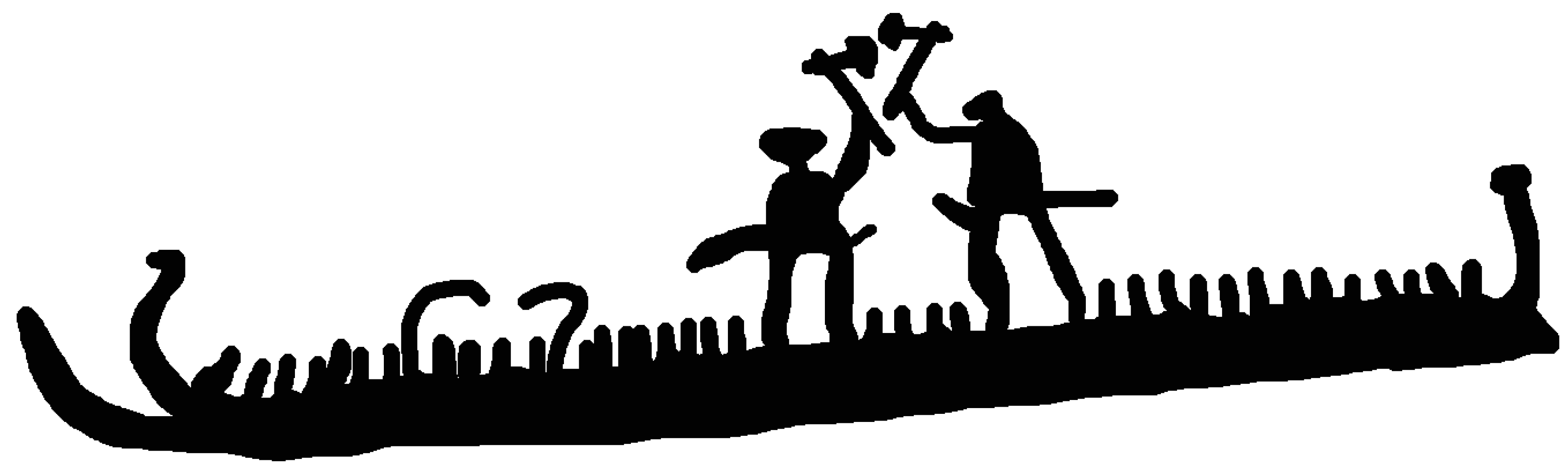
1]. We have since understood that additional permission is required for the adaptation of a photograph. The required permissions have now been obtained. However, we have replaced Figures 3, 5–8 and 10 with either a different adaptation, or with the original photograph, at the request of the copyright holder. We have changed the image description of Figure 11 in order to reflect the granted permissions, as requested by the copyright holder. Figure 8 has been replaced with a depiction of an armed conflict on a boat from Scandinavian rock art, specifically from Tanum in Sweden. Scandinavian Bronze Age rock art is known to contain depictions of technology, such as weapons and boats, as well as scenes that refer to warriors and armed conflict [
2]. The corrected figures appear below, including a new description. The revision of the image descriptions led to corresponding changes in the references cited in the text.
Lastly, there was an error in reference [49] in the original publication. The correct citation is: Taçon, P.S.C.; Wilson, M.; Chippindale, C. Birth of the Rainbow Serpent in Arnhem Land rock art and oral history. Archaeol. Ocean. 1996, 31, 103–124.
The authors state that the scientific conclusions are unaffected. This correction was approved by the Academic Editor. The original publication has also been updated.
Figure 3.
A timeline of the earliest occurrences of geometric and animal motifs in rock art on each continent. The X-axis is based on a logarithmic scale (base 10).
Figure 3.
A timeline of the earliest occurrences of geometric and animal motifs in rock art on each continent. The X-axis is based on a logarithmic scale (base 10).
Figure 5.
A depiction of an unknown quadruped from a slab of stone at Apollo 11 Cave, Namibia. The oldest rock art depiction of an animal in Africa. Reproduced with permission from the Rock Art Research Institute and the African Rock Art Digital Archive. South Africa:
https://rari.wits.ac.za/.
Figure 5.
A depiction of an unknown quadruped from a slab of stone at Apollo 11 Cave, Namibia. The oldest rock art depiction of an animal in Africa. Reproduced with permission from the Rock Art Research Institute and the African Rock Art Digital Archive. South Africa:
https://rari.wits.ac.za/.
Figure 6.
An eland antelope depiction from the East Cape Province, South Africa. Reproduced with permission from the Rock Art Research Institute and the African Rock Art Digital Archive. South Africa:
https://rari.wits.ac.za/.
Figure 6.
An eland antelope depiction from the East Cape Province, South Africa. Reproduced with permission from the Rock Art Research Institute and the African Rock Art Digital Archive. South Africa:
https://rari.wits.ac.za/.
Figure 7.
A trace of a depiction of two adjacent rainbow serpents in Australian rock art. Traced by M. Korpershoek from the original photograph by P.S.C. Taçon in Taçon, P.S.C.; Wilson, M.; Chippindale, C. [49].
Figure 7.
A trace of a depiction of two adjacent rainbow serpents in Australian rock art. Traced by M. Korpershoek from the original photograph by P.S.C. Taçon in Taçon, P.S.C.; Wilson, M.; Chippindale, C. [49].
Figure 8.
A trace of a scene from Swedish Bronze Age rock art, depicting an armed conflict on a boat. Traced by M. Korpershoek from the original photograph Tanum 1975 01 by Rainer Knäpper, via Wikimedia Commons. Free Art Licence 1.3.
Figure 8.
A trace of a scene from Swedish Bronze Age rock art, depicting an armed conflict on a boat. Traced by M. Korpershoek from the original photograph Tanum 1975 01 by Rainer Knäpper, via Wikimedia Commons. Free Art Licence 1.3.
Figure 10.
A depiction of a therianthrope in San rock art, possibly mid-transformation. Reproduced with permission from the Rock Art Research Institute and the African Rock Art Digital Archive, South Africa:
https://rari.wits.ac.za/.
Figure 10.
A depiction of a therianthrope in San rock art, possibly mid-transformation. Reproduced with permission from the Rock Art Research Institute and the African Rock Art Digital Archive, South Africa:
https://rari.wits.ac.za/.
Figure 11.
A trace of a depiction of European colonists wearing hats and smoking pipes in Australian rock art. Traced by M. Korpershoek from the original photograph by Sally K. May, in Frieman, C.; May, S.K. [104]. Reproduced with permission from Springer Nature Customer Service Centre GmbH. This content is not included under the governing Open Access Licence.
Figure 11.
A trace of a depiction of European colonists wearing hats and smoking pipes in Australian rock art. Traced by M. Korpershoek from the original photograph by Sally K. May, in Frieman, C.; May, S.K. [104]. Reproduced with permission from Springer Nature Customer Service Centre GmbH. This content is not included under the governing Open Access Licence.