

Article

Evaluating Paleoclimate Evolution of Alluvial Plain Using Sediment Grain Size Analysis: A Case Study of the Pleistocene Western Songnen Plain in China

1
College of Earth Sciences, Jilin University, Changchun 130061, China
2
Key Laboratory for Mineral Resources Evaluation in Northeast Asia, Ministry of Natural Resources, Changchun 130026, China
3
Key Lab for Oil Shale and Paragenetic Minerals of Jilin Province, Changchun 130061, China
4
Mudanjiang Natural Resources Comprehensive Survey Center, China Geological Survey, Changchun 130102, China
*
Authors to whom correspondence should be addressed.
Quaternary 2026, 9(2), 26; https://doi.org/10.3390/quat9020026
Submission received: 17 January 2026 / Revised: 1 March 2026 / Accepted: 17 March 2026 / Published: 19 March 2026

Abstract

Alluvial plains in the marginal zone of the monsoon system are sensitive to the climate–hydrology interaction. However, long term, high-resolution sedimentary records remain scarce in the Songnen Plain of Northeast China. This limited our understanding of the paleoclimate–paleohydrology coupling evolution over glacial–interglacial cycles. A 50.6 m continuous core was retrieved from the western Songnen Plain. The age–depth model and wavelet transform spectrum showed sedimentary continuity from ~885 ka B.P. (the late Early Pleistocene) to ~6 ka B.P. (the early Holocene), with no major hiatuses exceeding orbital resolution. Grain size analyses revealed 18 microfacies, which were synthesized into two major evolutionary cycles: a fan-delta front cycle (dominated by subaqueous mouth bars and distributary channels) and a fan-delta plain cycle (characterized by intertributary bays, floodplain lakes/swamps, and crevasse splays). The absence of pro-delta facies and the sediment succession record the oscillatory shrinkage of the Songnen paleolake. The pulsed enhancements of hydrodynamic energy, marked by grain size coarsening, coincide with major glacial–interglacial transitions (MIS 20/19, 18/17, 16/15, 14/13, 8/7, 6/5, 4/3, and 2/1), whereas fining grain sizes dominate warm interglacial periods (MIS 11, 9, 7, 5, 3, 1). These patterns are sensitive response of the alluvial plain to orbital-scale climate change. Cold–arid glacial background promoted vegetation loss and hydrological instability, and warm–humid interglacial background favored low-energy hydrological condition. This study demonstrates that the regional alluvial evolution was primarily controlled by global ice-volume fluctuations through variability of the East Asian summer monsoon. This study provides a reference for the muti-scale climate–hydrology coupling mechanism study in the northern marginal zone of EASM and highlights the importance of alluvial sediment succession in paleo-research.

1. Introduction

Alluvial plains are products of dynamic equilibrium among accommodation space, sediment supply, and hydrodynamic conditions within river systems [1]. Within a defined accommodation space, alluvial plains are fundamentally controlled by the flood process [2], with sedimentary sequences often containing coarse-grained layers, gravel lenses, or alternating coarse–fine particle layers [3,4,5]. These sedimentary characteristics are influenced by climate changes [6,7], which makes alluvial plain sequences valuable archives for paleoclimate reconstructions in major alluvial plains worldwide [7,8,9,10,11,12].
Alluvial sediment sequences can capture climate signals at different spatiotemporal scales [11,12]. For example, the sediment sequences of the Yellow River have recorded a close relationship between hydrological systems and climate fluctuations since the Last Deglaciation [13], and flood products corresponding to the Holocene “4.2 ka event” [14]. Alluvial records in the Yangtze River [15,16,17], Indus River [18], Nile River [19,20] and Danube River [21,22] have preserved regional tectonic–climate interactions, wind forces, and soil formation processes. These results demonstrate that alluvial plain systems can record climate changes at various timescales, from orbital-scale monsoon variability to millennial-scale pulsed fluvial intensification events and decadal-scale hydrological changes.
Sediment grain size is the most fundamental physical property that directly reflects depositional dynamics and transport processes, serving as a crucial indicator of alluvial plain environment research [10,23,24]. Numerous studies have demonstrated the effectiveness of grain size analysis in alluvial plain evolution research. In the Upper Mississippi River Valley, grain size variations were generally consistent with paleoclimate changing patterns inferred from pollen records [25]. Similar achievements have been obtained in the United Kingdom, Poland, Spain [26], the Yellow River [27,28], Yangtze River [9,29], Poyang Lake [30], Weihe Basin [31], and Jianghan Plain [32]; grain size parameters have successfully identified pulsed fluvial intensification events with high accuracy. However, most existing discoveries focus on historical or Holocene records.
The Songnen Plain is located in Northeast China at the northern margin of the East Asian summer monsoon [33,34,35]. This region experiences strong spring winds and droughts, with nearby sandy land serving as sources of aeolian sediments [36], while summer monsoon intensification or northward typhoons can trigger flood disasters [37]. This climate variability results in a fragile ecological environment [38], impacting agricultural and pastoral production and constraining regional economic development. Reconstruction of alluvial plain evolution through sediment sequences can help us excavate paleo-flood records and their correspondence to paleoclimate processes over extended timescales [23], providing essential data for hydraulic engineering and risk assessment. However, long-term research on alluvial plain evolution in this area remains scarce. This limits our understanding of alluvial plain evolution and its response to climate forcing factors, hindering our ability to accurately assess the flood risk.
In this study, a 50.6 m drilled core was obtained using an automotive drilling machine in August of 2024. Based on high-resolution grain size analysis, constrained by AMS14C, OSL, and ESR chronological methods, we aim to reconstruct the evolution of the alluvial plain from the late Early Pleistocene to the early Holocene, identify pulsed fluvial intensification events and their relationship to paleoclimate processes, and clarify the characteristics of alluvial plain sediments caused by regional flood disasters. This study not only provides data for regional disaster prevention and water resource management, but also contributes to a deeper understanding of the East Asian summer monsoon on the Songnen Plain in Northeast China [39]. Furthermore, it provides an important scientific reference for understanding paleoclimate processes in the summer monsoon marginal area and their role in global climate change.

2. Regional Background

The Songnen Plain is located to the west of Songliao Basin (Figure 1), and its western boundary is structurally defined by a fault zone separating the Songnen Plain from the Greater Khingan Mountain (the average altitude of the middle section is 900–1200 m [40,41]). During the Middle Pleistocene, along with relative subsidence, the central and western of the Songnen Plain contained a set of lacustrine sediments dominated by silty clay, with sandy layers interbedded at the margins, which constitute the Daqinggou Formation (Qp1–2lpd) [42]. During the Late Pleistocene (128–11.0 ka), as lacustrine accumulation declined, the stable fine silt layer was covered by fine sand layers of loess-like sandy loam, forming the Guxiangtun Formation (Qp3fpg) [43]. During the beginning of the Holocene, the melting of ice and snow enhanced fluvial systems and caused alluvial sediments, together with aeolian deposits caused by strong northern and northwestern winds under the influence of the Mongolian high pressure, to jointly form the Baitushan Formation (Qh1edhd). Located at the boundary of the paleo Songnen lake, these strata have retained key evidence of the transformation between lacustrine, fluvial and aeolian sedimentary facies. It is a key area for studying ancient lake contraction, Asian inland drought, and Quaternary paleoclimate evolution.

3. Samples and Methods

3.1. Sample Description

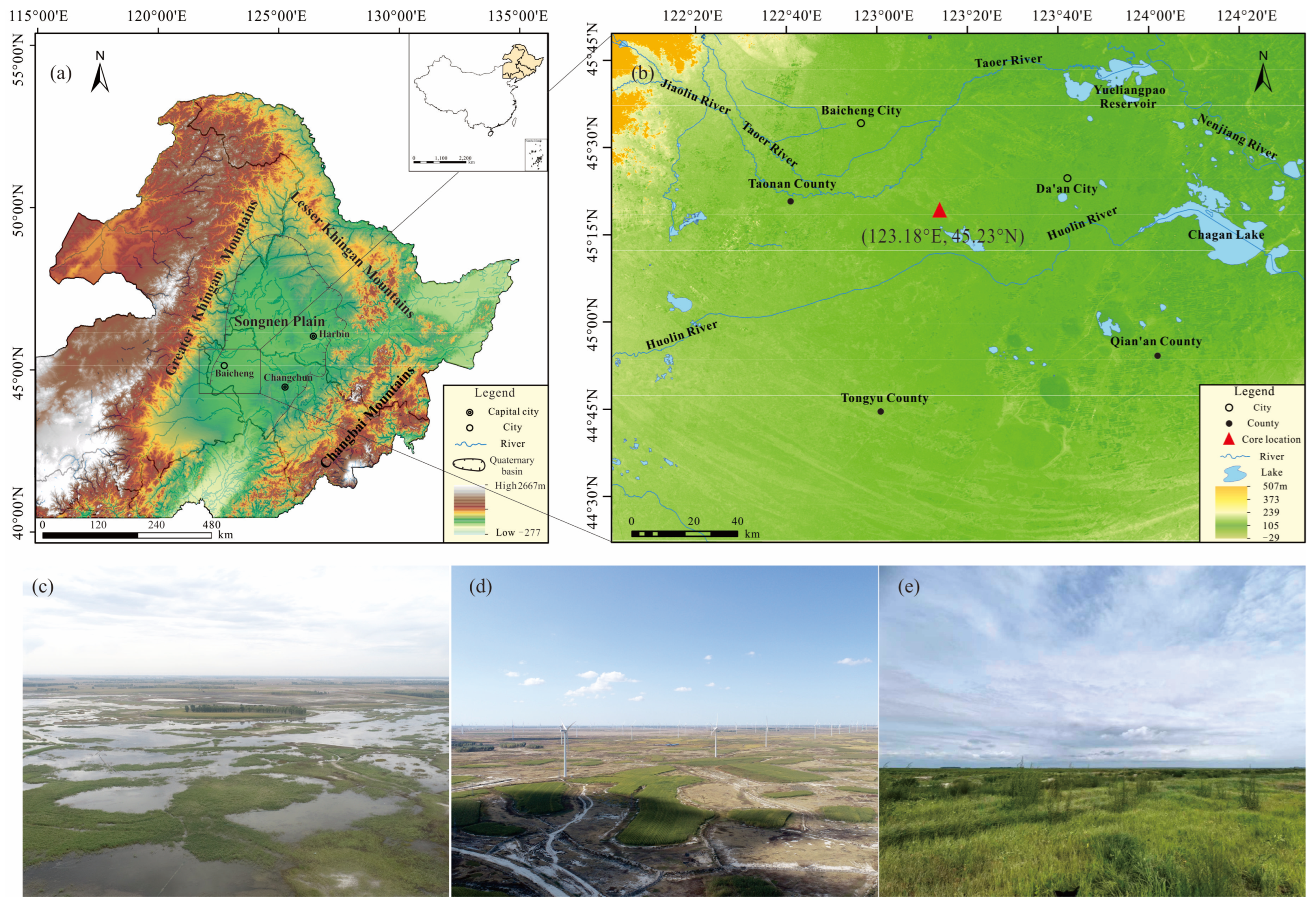
The core (123.18° E, 45.23° N, 150.6 m a.s.l.) was drilled from western catchment of the Songnen Plain [44,45,46]. The Tao’er River exhibits a meandering course that was progressively shifted northward to its present position. Meanwhile, the Huolin River is widespread on alluvial plains, which are influenced by climate change [47]. This river–lake ecosystem forms an ideal natural site for studying the paleoclimate evolution of alluvial plains.
The lithological characteristics were described based on the Munsell 10YR Soil Chart (Table 1): the interval from 50.6 to 45.5 m was greenish-gray sandy soil and loam, with indistinct bedding, and calcium carbonate powder developed at the bottom [48]. From 45.5 to 30.8 m, it was dark gray loam, sand, and silt, with horizontal bedding, and calcium carbonate powder or nodules were observed. From 30.8 to 4.8 m, grayish-green loam interbedded with silt, fine sand, and peat layers were observed. The upper 4.8 m consisted of grayish-brown and light yellowish-brown loam and silt with rusty spots.

3.2. Analytical Methods

3.2.1. Age–Depth Model

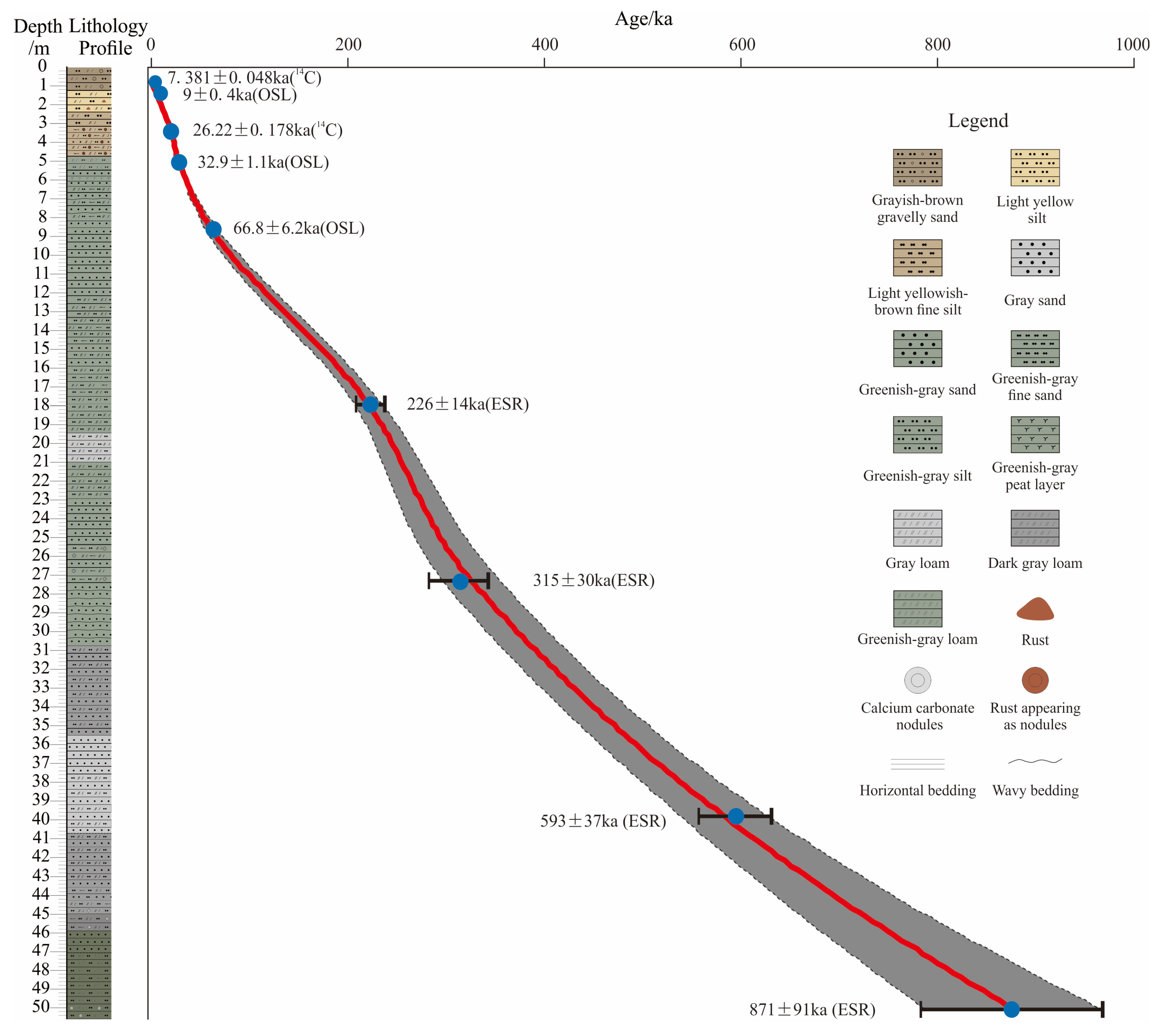
Two AMS14C charcoal samples, three OSL quartz samples, and four ESR samples were collected using stainless steel and sealed in black plastic bags [48]. AMS14C datings were performed at Peking University using a 1.5SDH-1 tandem accelerator mass spectrometry radiocarbon measurement system (National Electrostatics Corp., Middleton, WI, USA) (Table 2), OSL dating was performed at Jilin University (Table 3) using the RisoDA-20 (Technical University of Denmark, Kongens Lyngby, Denmark), and ESR dating was performed by the China Earthquake Administration (Table 4) using a Bruker EMX-6 X-band ESR spectrometer (Bruker, Karlsruhe, Germany). The age–depth model was constructed by applying linear regression with natural spline basis functions in the R software environment (4.4.3 version) [49,50,51].

3.2.2. Grain Size Analysis

A dry sample (1.0 g) was treated with Na4P2O7 via ultrasonic agitation overnight, then organic matter was removed using 30 mL of 10% H2O2, and the carbonates were removed using 10% HCl. Distilled water was used to achieve neutrality. The processed samples were measured using a BT-9300Z laser particle size analyzer manufactured by Dandong Bettersize Instruments Ltd. in Dandong City, China. The measurement range was 0.01–3500 μm. After three measurements, the data were considered valid if the error between any single measurement was less than 3% [52]. Probability cumulation curves and C-M diagrams were created using the test results [53,54].

3.2.3. Grain Size Parameter Analysis

The mean grain size MZ (μm) was calculated using the particle size parameter formula of Folk and Ward [53,54]. The standard deviation σ1, skewness SK, and kurtosis KG were computed using Krumbein’s φ-grain size calculation standard [55]. The mean grain size MZ represents the central tendency of the grain size distribution, the standard deviation σ1 indicates the sorting degree of the sediment, skewness SK reflects the asymmetry of the grain size distribution, and kurtosis KG represents the ratio between the spread of the central portion and the tail-ends.

3.2.4. Grain Size Endmember Analysis

Weltje and Prins posited that sediments comprise mixed components derived from distinct material sources and transport mechanisms [56]. The Generalized Weibull distribution function was employed for grain size endmember decomposition following Paterson’s grain size endmember model algorithm (EMMA) [57,58]. This was implemented using the AnalySize program in MATLAB R2023a.

3.2.5. Wavelet Analysis

Morlet Wavelet transform analysis was performed on the obtained mean grain size series to identify the dominant periodicities and sedimentary evolution patterns [59]. The Morlet wavelet (with a non-dimensional frequency ω0 = 6) provides a good balance between time and frequency localization, with its real and imaginary components being orthogonal (90° phase shift), thereby enabling the extraction of the signal envelope, instantaneous frequency, and phase information [60]. Significance testing against a red-noise background (AR1 process) was conducted using the chi-square distribution, with statistical confidence levels exceeding 95% (p < 0.05) computed using MATLAB R2023a.

4. Results

4.1. Chronological Framework

Based on the calculated age–depth model, a chronological framework for the core was established. Figure 2 indicates that this core contains the Datushan Formation (Qh1ed) (0–2.3 m), Guxiangtun Formation (Qp3lfg) (2.3–12.3 m), Daqinggou Formation ((Qp2lpd) (12.3–47.0 m), and the upper part of the Baitushan Formation (Qp1lpb) (47.0–50.6 m) [42,43,61], without penetrating the Quaternary strata.
The age–depth model in Figure 2 shows a general linear trend without gaps or hiatuses. This means the deposition is continuous from the late Early Pleistocene (~885 ka B.P.) to the early Holocene (~6.0 ka B.P.) (Figure 2 and Table 2, Table 3 and Table 4).

4.2. Spectral Zoning of Mean Grain Size

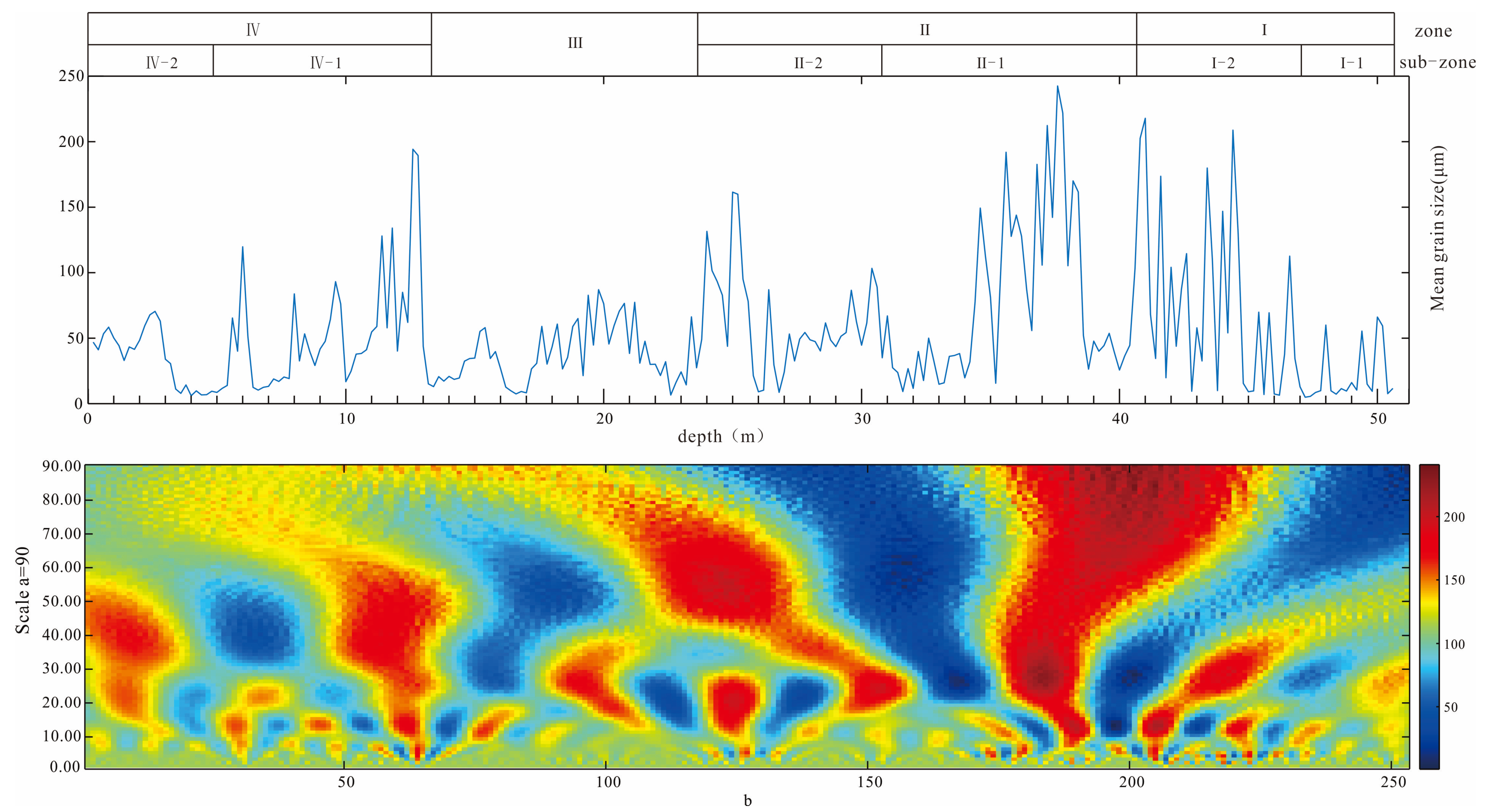
The time-frequency spectrum of the mean grain size in Figure 3 does not express horizontal bands of zero energy or abrupt truncations of dominant periodicities that indicate significant hiatuses or erosion on the wavelet power spectrum. This indicates the continuous evolution of periodic signals throughout the core from a depth of 50.6 m to the surface. This is consistent with the linear trend of the age–depth model shown in Figure 2.
The time-frequency spectrum can be divided into seven zones at a scale of a = 90 (Figure 3), with corresponding depths of 50.0–47.0 m, 47.0–40.8 m, 40.8–30.8 m, 30.8–23.4 m, 23.4–13.4 m, 13.4–4.8 m, and 4.8–0 m, respectively. Considering the fluctuation characteristics of the grain size curve, these seven zones can be further grouped into four major bands, with corresponding depths of 50.6–40.8 m, 40.8–23.4 m, 23.4–13.4 m, and 13.4–0 m, respectively.

4.3. Grain Size Variation

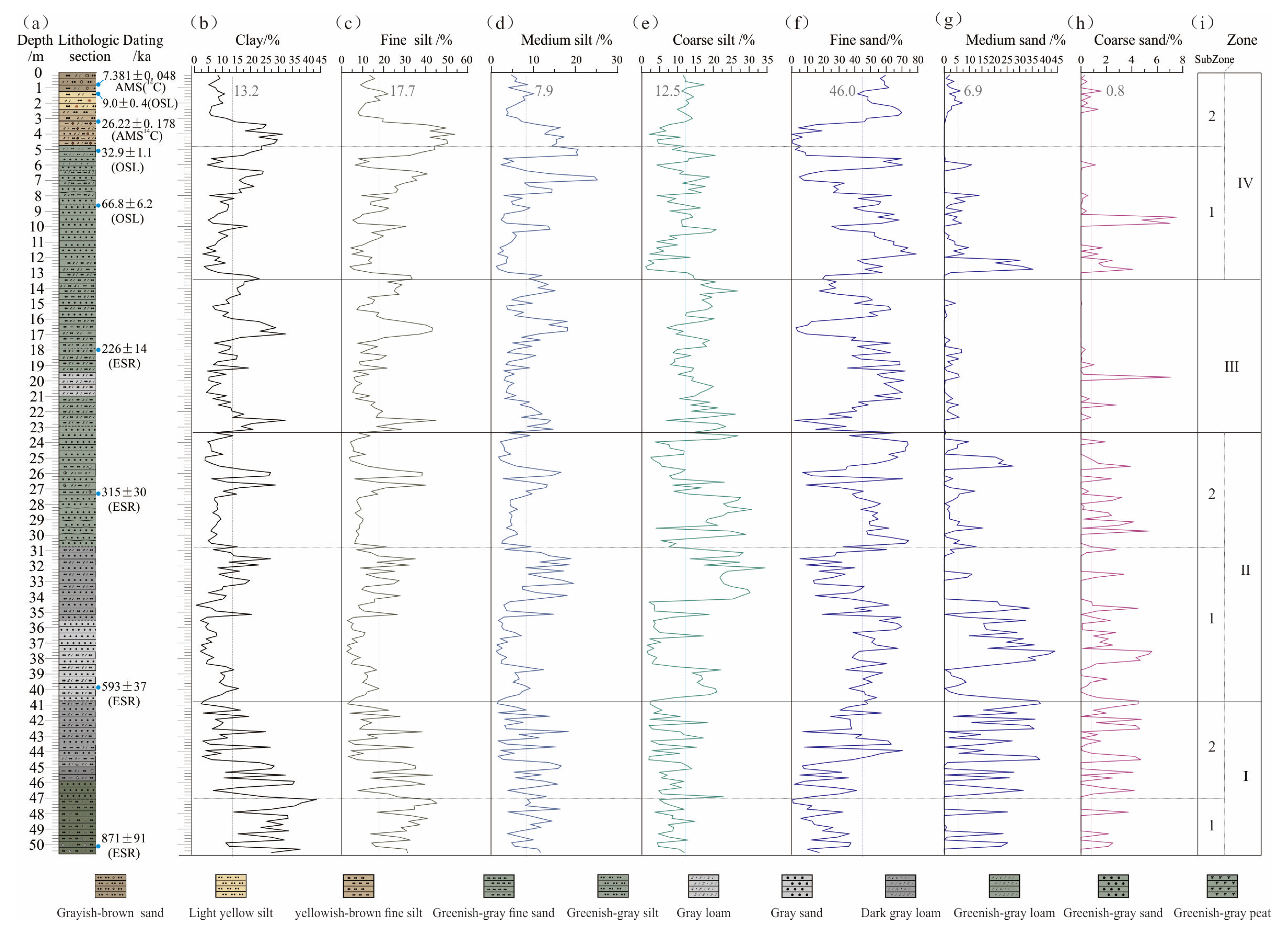
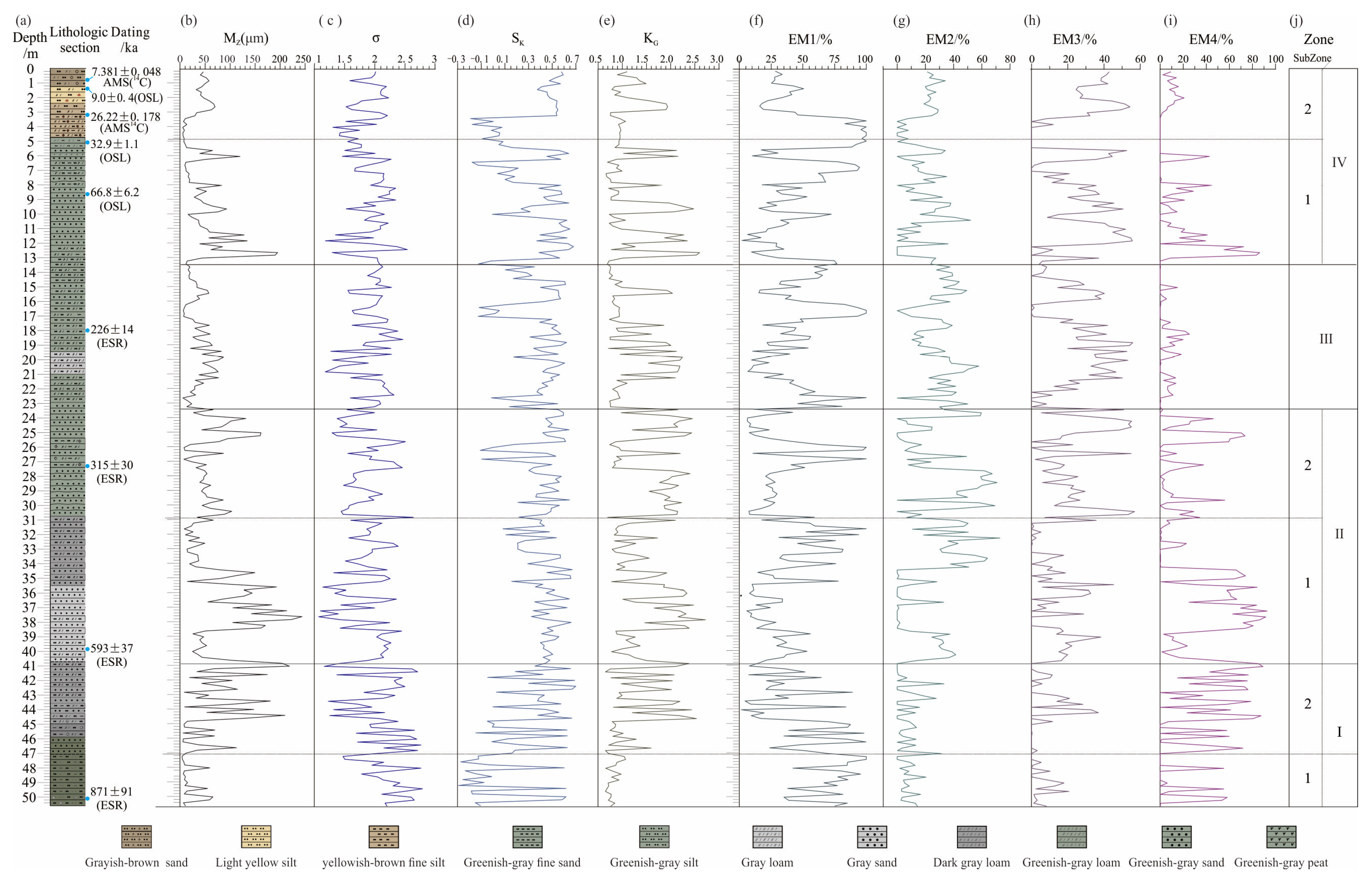
The grain size fractions exhibited synchronous fluctuations throughout the core (Figure 4). Sand (62.5–1 000 μm) content dominated the sequence, ranging from 0.02 to 92.68% (average 48.67%), with fine sand (62.5–250 μm) being the most abundant (0.19–80.45%, average 46.04%). Silt (3.9–62.5 μm) content ranged from 5.08 to 76.9% (average 38.09%), and clay (<3.9 μm) varied between 0.67% and 43.56% (average 13.24%).
The grain size parameters on Figure 5 show that the mean grain size (MZ) varied between 4.9 μm and 244.5 μm (average 54.9 μm); the standard deviation σ1 (φ units) varied between 1.1 and 2.8 (average 1.9); the skewness SK (φ units) varied between −0.3 and 0.7 (average 0.4); and the kurtosis KG (φ units) varied between 0.7 and 2.7 (average of 1.3).
Four endmembers were obtained with determination coefficients greater than 0.9 and θ values less than 5°, which effectively represented the overall sediment characteristics. No systematic residual structures were obtained [56,57,58]. EM 1, with a peak at 6.2 μm, is fine-grained aeolian dust or a distal source component, representing low-energy atmospheric transport. EM 2, with a peak of 69.0 μm, represents glacial or periglacial flour, representing cryogenic weathering and meltwater transport. EM 3, with a peak of 125 μm, coarse aeolian saltation, or near-source suspension, indicates stronger wind dynamics or proximal dust sources. EM 4, with a peak of 250 μm, fluvial alluvial traction load, suggests high-energy river transport and pulsed fluvial intensification events [48].
Based on the grain size composition (Figure 4), parameter characteristics, and endmember scores (Figure 5), combined with the age–depth model (Figure 2) and wavelet spectra (Figure 3), four distinct lithostratigraphic zones were discovered as follows:
Zone I (50.6–40.8 m, ~885.0–617.7 ka B.P.): Fine grains (<31 μm) decreased obviously, while sand of 62.5–250 μm increased, and the mean grain size (MZ) fluctuated between 4.9 and 217.9 μm, the standard deviation (σ1) varied between 1.2 and 2.8. Combined with the gradually decreased EM1, and rapidly increased EM4, a transition from fine-grained lacustrine to coarser fluvial input was observed.
Subzone I-1 (50.6–47.0 m, ~885.0–787.6 ka B.P.): The mean grain size (MZ) was the finest in the core (average 21.0 μm), dominated by clay and fine silt (>55% combined) and high EM1 content (average 73.9%). This indicates low-energy conditions.
Subzone I-2 (47.0–40.8 m, ~787.6–617.7 ka. B.P.): The sand content increased to 53%, and EM3 increased, while EM1 decreased. The mean grain size (MZ) averaged 70.8 μm, reflecting enhanced hydrodynamic energy.
Zone II (40.8–23.4 m, ~617.7–276.8 ka B.P.): The contents of coarse silt and sand fluctuated significantly, as did those of EM1 and EM3. The mean grain size (MZ) averages 71.9 μm, and the skewness (SK) ranged from −0.11 to 0.67, indicating high-energy events.
Subzone II-1 (40.8–30.8 m, ~617.7–391.2 ka B.P.): The sand was about 55.9%, with increasing EM1 and EM2, decreasing EM3 and EM4. The mean grain size (MZ) was 79.8 μm and standard deviation (σ1) averages 1.87, indicating poor sorting.
Subzone II-2 (30.8–23.4 m, ~391.2–276.8 ka B.P.): EM3 was high, EM1, EM2 and EM4 were at trough values. The mean grain size (MZ) was 61.27 μm, although the sand was high at approximately 57%.
Zone III (23.4–13.4 m, ~276.8–147.2 ka B.P.): The sand content decreased to 43%, EM4 was low, but fine silt and clay increased, and EM3 reached a high value. The mean grain size (MZ) averages 30.4 μm, suggesting a shift to moderate-energy conditions with sustained aeolian input.
Zone IV (13.4–0 m, ~147.2–0.6 ka B.P.): The clay, fine to medium silt, and sand fractions fluctuated significantly, except for coarse silt. EM1 gradually increased, while EM4 decreased. The mean grain size averaged 46 μm.
Subzone IV-1 (13.4–4.8 m, ~147.2–30.6 ka B.P.): Sand is the most abundant component (~50%), EM1 increased, while EM2 and EM4 decreased. The mean grain size ranged from 8 to 194 μm, with an average of 51 μm.
Subzone IV-2 (4.8–0 m, ~30.6–0.6 ka B.P.): Sand content was approximately 43%, while clay and silt proportions increased. The mean grain size averaged 37 μm. EM1 decreased sharply, whereas EM3 increased, indicating a return to lower-energy deposition conditions [48,62].

4.4. Character of Probability Cumulation Curve and C-M Diagram

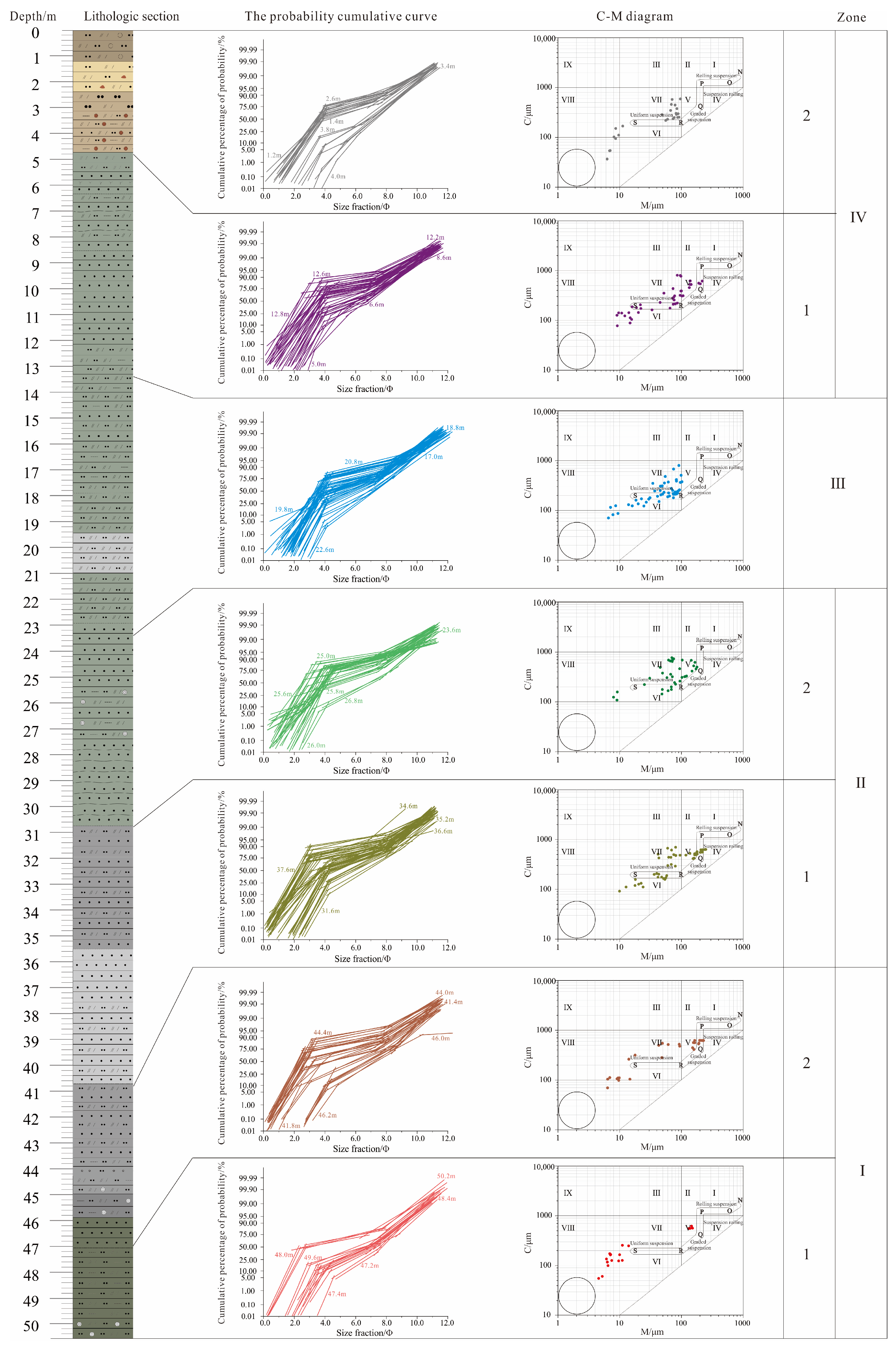
The probability cumulation curves primarily exhibit a two-segment pattern dominated by saltation and suspension components, with minor contribution from traction (<10%) and uniform suspension components [63]. The breakpoints SS between saltation and suspension range from 2.6 to 4.6 φ (41–165 μm), while the breakpoints SU between suspension and uniform suspension range from 5.6 to 10.3 φ (0.8–21 μm). On C-M diagram, samples mainly plot within fields V, VI, and VII (Figure 6), reflecting lake–swamp–floodplain deposition without high-energy river channels [64].
Zone I was divided into two subzones:
Subzone I-1 (50.6–47.0 m, ~885.0–787.6 ka B.P.): The probability cumulative curves exhibit stair-step morphologies with poor sorting. C-M plots cluster in field VIII reflecting low energy suspension, occasionally interrupted by traction events (such as overbank flooding.)
Subzone I-2 (47.0–40.8 m, ~787.6–617.7 ka. B.P.): Contains more saltation components with improved sorting (Figure 6). C-M plots shift to fields V, VII, and VIII fields, reflecting moderate hydrodynamic energy with intermittent bedload transport.
Zone II shows a slightly coarser grain size. Four segment patterns appear at ~25.8 m, indicating complex multi-process transport (Figure 6). C-M values increase and points concentrate in the field IV–VII, indicating stronger, sustained fluvial or lakeshore dynamics. This zone is divided into two subzones:
Subzone II-1 (40.8–30.8 m, ~617.7–391.2 ka B.P.): Probability cumulative curves exhibited “S” shape and moderate sorting (Figure 6). C-M plots were primarily located in the fields IV, V, VI, and VII, indicating stable fluvial channel or an energetic lake shore.
Subzone II-2 (30.8–23.4 m, ~391.2–276.8 ka B.P.): Probability cumulative curves showed gentle “S” shapes indicating poor sorting and increased silt (Figure 6). C-M plots in the field IV–VII, reflecting a return to low energy condition.
Zone III, probability cumulative curves showed mainly “S” shapes with moderate sorting (Figure 6). The C-M plots fell within the fields of VI–VII, indicating a transition between deep and shallow lake environment in a low-energy setting (Figure 6).
Zone IV (13.4–0 m, ~147.2 ka—present), probability cumulative curves exhibit three-segment pattern with an ”S” shape and no coarse tails. The break points are stable. C-M plots cluster tightly within the fields of V, VI, VII and VIII (Figure 6), indicating stable low-energy suspension.
Subzone IV-1 (13.4–4.8 m, ~147.2–30.6 ka B.P.): Probability cumulative curves exhibit distinct “S” shapes with good sorting. The C-M plots in fields V, VI, and VII, indicate occasional minor fluctuations within generally stable floodplain or lake environment (Figure 6).
Subzone IV-2 (4.8–0 m, ~30.6–0.6 ka B.P.): Tight “S” shapes, no coarse tail, excellent sorting. C-M plots in fields V, VI, and VII reflect stable suspension in a low-energy environment, corresponding to the modern swamp floodplain (Figure 6).
Overall, the probability curves and C-M diagrams document a long-term transition of the sediment from the late Early Pleistocene to Early Holocene. A gradual stabilization of the alluvial–lacustrine system is clearly from various transport of Zone I–II to highly uniform suspension of Zone III–IV.

5. Discussion

5.1. Sedimentary Facies

Based on lithology, grain size assemblages, and endmember contribution, the microfacies and subfacies were identified as follows:
Zone I: (50.6–40.8 m, ~885.0–617.7 ka B.P.),
Fan-delta front sheet sand (~885.0–787.6 ka B.P.), gray to gray-green silt, and clay (Figure 4), characterized by poor sorting, low skewness, and kurtosis. The three-segment probability cumulative curve and a high content (73.91%) of EM1 with pulsating EM4 indicate a distal sheet sand environment with occasional sandbars in an upper delta plain/alluvial plain setting [65].
The subaqueous distributary mouth bar (~787.6–732.0 ka B.P.), fine sand characterized by positive skewness, low kurtosis, and two-segment cumulative curve. The suspension-rolling transport mode, along with the abrupt decrease in EM1 and increase in EM4, indicates sandbar deposition.
Subaqueous distributary channel (~732.0–689.0 ka B.P.) was dominated by fine to medium sand, characterized by poorer sorting, increased skewness, kurtosis, and EM4 values, indicating subaqueous distributary channel microfacies.
Subaqueous natural levee (~789.0–617.7 ka B.P.) is characterized by an increase in fine particles (<31 μm), decrease in sand-size grains (62.5 to 250 μm), and poorer sorting, indicating waning flow and overbank deposition.
Therefore, Zone I records, a fan-delta front system at the lacustrine margin from the late Early Pleistocene to the early Middle Pleistocene, transitions from distal sheet sands to channel–levee complexes.
Zone II: 40.8–23.4 m (~617.7–276.8 ka B.P.),
This zone records a cyclic transition within the fan-delta plain subfacies, comprising seven alternating microfacies:
Intertributary bay (~617.7–547.5 ka B.P.) consists of moderately to poorly sorted coarse silt, bounded by well-sorted fine to medium sand layers indicative of distributary channels [66].
Distributary channel (~547.5–500.0 ka B.P.), light-gray, normally graded medium to coarse sand, better sorting, positive skewness, and decreasing kurtosis, indicating high-energy channel flow.
Floodplain lake (~500.0–412.0 ka B.P.), high content of clay and silt (50%), poorer sorting, and elevated EM1 suspension and EM2 glaciofluvial components [67].
The distributary channel (~412–391.2 ka B.P.) shows increased sand deposits, indicating a brief return to distributary channel conditions.
Floodplain swamp (~391.2–315.0 ka B.P.), grayish-green, normally graded coarse silt and fine sand. These sediments exhibit poor sorting, positive skewness, high kurtosis, and three-segment probability cumulative curves.
A deep floodplain lake (~315.0–300.0 ka B.P.), sharp increase in grayish-green clay, poor sorting, negative skewness, and low kurtosis, indicating maximum depth and a standing water condition.
Subaqueous distributary channel (~300.0 to 276.8 ka B.P.), abrupt increase in fine sand and silt, with improved sorting, accompanied by peaks in aeolian EM3 and alluvial EM4, indicating renewed channel activity.
Therefore, Zone II represents a dynamic fan-delta plain environment during the mid-Middle Pleistocene (~617.7–276.8 ka B.P.), characterized by frequent shifts between channel activation, floodplain lake stagnation, and swamp development.
Zone III: 23.4 to 13.4 m (~276.8–147.2 ka B.P.),
This zone is a fan-delta front subfacies characterized by three evolving microfacies:
The distributary mouth bar (~276.8–240.3 ka B.P.) shows a transition from greenish-gray silt and fine sand upward into grayish-white fine sand. This transition is accompanied by an increase in mean grain size, kurtosis, sorting, and skewness, as well as three-segment probability cumulative curves [68].
Intertributary bay (~240.3–219.2 ka B.P.), increased clay content with normal grading, poorer sorting, elevated suspended EM1 concentrations, and two-segment probability cumulative curves.
The distributary channel (~219.2–147.2 ka B.P.), exhibits complex grading patterns, including reverse grading ~219.2–188.5 ka B.P. and normal grading ~188.5 to 147.2 ka B.P., three-segment probability cumulative pattern, and high-energy transport modes around 188.5 ka B.P. [69,70].
During the late Middle Pleistocene, a dynamic delta front environment evolved, characterized by moth bar to bay infilling, and subsequent channel activation.
Zone IV, 13.4 to 0 m (~147.2–0.6 ka B.P.),
This zone marks the transition to fan-delta subfacies, characterized by four microfacies:
Crevasse splay (~147.2–93.2 ka B.P.), abrupt contact with the underlying layer, characterized by a sudden increase in sand (>62.5 μm) and EM4, high mean grain size. Finer deposits with horizontal bedding and the jump suspension curves indicate rapid deposition from branch channels (Figure 5).
Floodplain swamp with channel interbeds (~93.2–46.3 ka B.P.), greenish-gray, upward-fining sediments featuring horizontal or low-angle cross-bedding, poor sorting, and peat layers. Increased EM1 suspension and EM4 alluvial values indicate floodplain swamp stagnation and minor channel activity [71].
Floodplain lake influenced by aeolian processes (~46.3–30.6 ka B.P.), characterized by upward fining fine sand and silt, poor sorting, and decreasing EM4. The presence of rust-colored iron oxide nodules and spots indicates intermittent aeolian loess input into the shallow lake environment.
Aeolian-influenced floodplain swamp deposits (~30.6-present.) exhibit “S”-shaped cumulative probability curves and better sorting without a coarse tail. Gray-brown fine silt and sand increased, accompanied by nodular rust spots. C-M plots fall within fields of VII–VIII, indicating a stable floodplain swamp environment interspersed with eolian deposition.
It can be inferred that four microfacies developed during the late Pleistocene to early Holocene, approximately 6000 years before present: crevasse splay, floodplain swamp, floodplain lake, and floodplain swamp within the fan-delta plain.
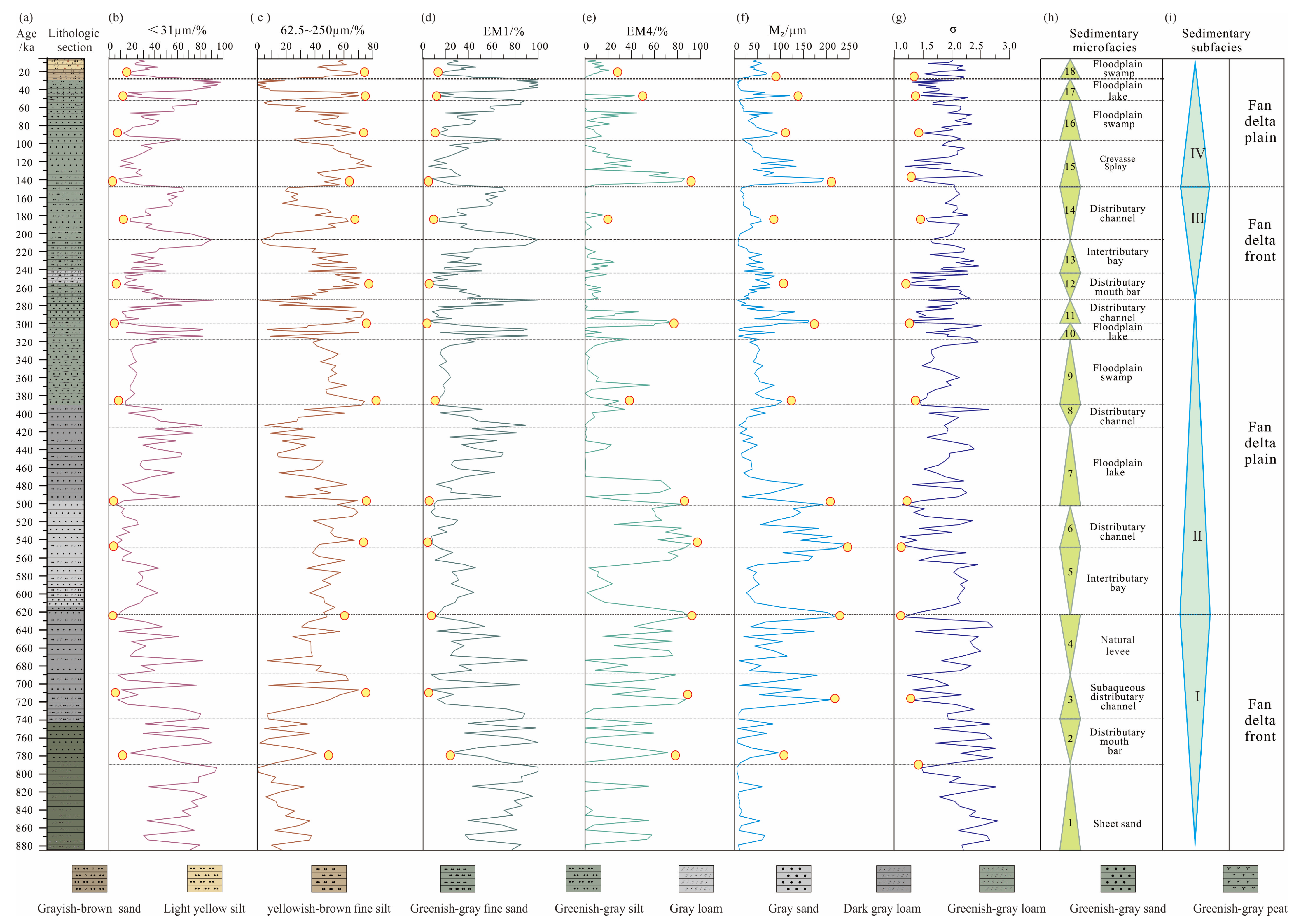
In summary, the entire core contains 18 distinct microfacies organized into two major fan-delta cycles: The fan-delta front cycle (Zone I and Zone III), characterized by subaqueous mouth bars, distributary channels, and sheet sands formed during lacustrine phases. The fan-delta plain cycles (Zone II and Zone IV), dominated by intertributary bays, floodplain lakes/swamps, and crevasse splays, with aeolian deposition influencing the environment during lake regressive phases. This vertical succession reflects the long-term shrinkage of the Songnen paleolake and the progradation of the fan-delta system from the Early Pleistocene to the Holocene.

5.2. Sedimentary Evolution

The core (~50.6 m a.s.l.) is located in the subsiding depocenter of the western Songnen Plain [45,72] (Figure 1). The linear age-depth model in Figure 2 indicates continuous sedimentation from the late Early Pleistocene (~885 ka B.P.) to the early Holocene (~6.0 ka B.P.), without significant hiatuses (Figure 2 and Table 2, Table 3 and Table 4). This persistently subsiding area provided long-term accommodation for the Baitushan, and Daqinggou, Guxiangtun, Datushan formations, maintaining a flat, low-lying alluvial-lacustrine plain for approximately 880 ka [73].
This setting facilitated the development of well-formed floodplain lakes, swamps/wetlands, river channels, point bars, natural levees, crevasse splays, and aeolian dunes. Grain size assemblages and microfacies analysis divided the sedimentary environmental evolution into four stages, and seven substages (Table 5):
Stage I, ~885.0–617.7 ka B.P. (50.6–40.8 m)
Initially (~885.0–787.6 ka B.P.) in substage of I-1, the sheet sand microfacies (silt-dominated) indicate a low-energy, standing water lacustrine setting punctuated occasionally by fluvial pulses (EM4) [65]. In substage I-2, the upper distributary mouth bar (~787.6–732.0 ka B.P.) represents a transition upward to higher-energy distributary mouth bars and subaqueous distributary channel (~732.0–617.7 ka B.P.) characterized by pulsating hydrodynamics. Together with the natural levee, this assemblage records a prograding, shallowing delta front at the paleolake margin (Figure 7), consistent with regional patterns in the Songliao Basin [74].
Stage II, ~617.7–276.8 ka B.P. (40.8–23.4 m)
This stage records dynamic changes within a fan-delta plain environment:
Substage II-1 (~617.7–391.2 ka B.P.), the sequence of intertributary bay, distributary channel, floodplain lake and distributary channel deposits, reflecting a stagnant fluvial input to a shallow lake margin. A high content of 62.5–250 μm and EM4 (~617.7–547.5 ka B.P.) indicate subaerial exposure and delta plain formation. The subsequent shift to floodplain lakes (~500.0–412 ka B.P.) reflects a waning energy, followed by distal glaciofluvial still-water environment during ~412–391.2 ka B.P. [67,75].
Substage II-2 (~391.2–276.8 ka B.P.) exhibits alternating floodplain swamp, lake, and distributary channel environments characterized by moderate to high energy fluctuations. The return to distributary channels (~391.2 to 315.0 ka B.P.) was followed by the development of deep standing water forming swamps (~315–300 ka B.P.), before the fluvial processes resumed, creating distributary channels (~300.0–276.8 ka B.P.). This sequence highlights the repeated transitions between channel activation and floodplain stagnation.
Stage III, ~276.8–147.2 ka B.P. (23.4–13.4 m)
A high content of EM1 and fine silt (<31.5 μm) indicates the deepest water at the Stage II-III transition. Subsequently, fluvial transportation by intertributary channels (~276.8–240.3 ka B.P.) shifted to the delta front. A brief deepening phase (~240.3–219.2 ka B.P.) is recorded by the interdistributary bay microfacies. Finally, the distributary channel sediments (~219.2–147.2 ka B.P.) [69,70] reflect the fluctuating hydrodynamic energy, establishing a lake-margin environment.
Stage IV, ~147.2–0.6 ka B.P. (13.4–0 m)
During the early substage IV-1 (~147.2–93.2 ka B.P.), crevasse splay deposits formed, analogous to the meandering river systems in the Bohai Bay [76] and Poyang Lake Basin [77], with sorting and were dominated by suspended components (>25%). Subsequently, the environment transitioned into floodplain swamps under waning hydrodynamic conditions [71]. Significant aeolian loess deposition and pedogenesis occurred (~46.3 to 31.0 ka B.P.) [78], followed by increased contribution of sandy aeolian sediments from ~20.6 ka B.P. to the present (substage IV-2) [79], indicating a shift toward an arid, wind-influenced alluvial plain.
In summary, from the late Early Pleistocene to the early Holocene, the study area experienced cyclic transitions between the fan-delta front and fan-delta plain, reflecting a long-term, oscillatory shrinkage of the Songnen paleolake (Figure 7):
From the late Early to the early Middle Pleistocene (~885–617.7 ka B.P.), progradation occurred from the distal fan-delta front to the main fan-delta front body.
During the mid-Middle Pleistocene (~617.7–276.8 ka B.P.), dominated by a fan-delta plain.
During the Late Middle Pleistocene (~276.8–147.2 ka B.P.), temporary re-establishment of a fan-delta front environment.
From the Late Pleistocene to the early Holocene (~147.2–0.6 ka B.P.), regression to a fan-delta plain environment, increasingly influenced by aeolian processes.

5.3. Paleoclimate Context of the Evolution

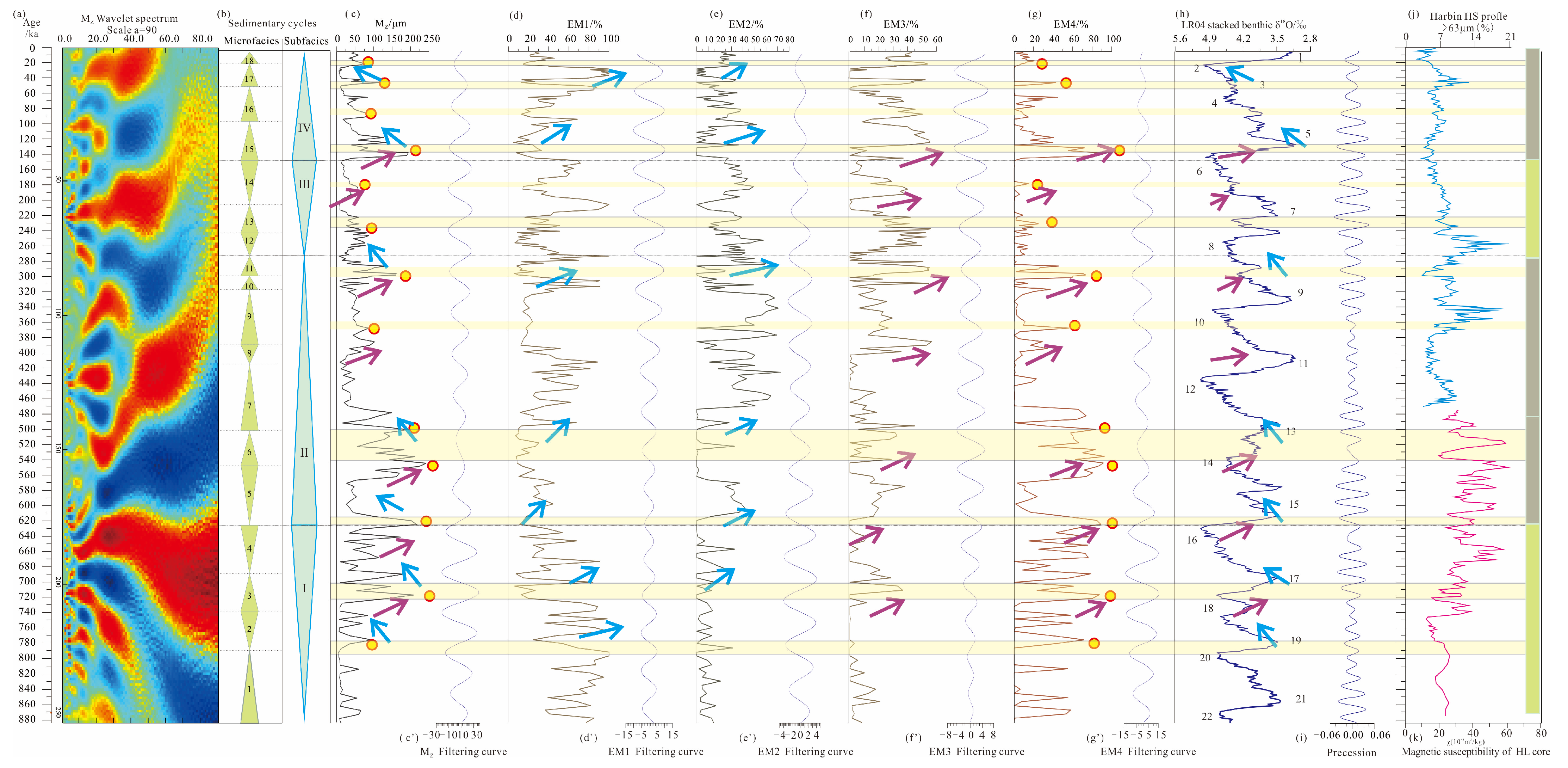
Grain size records reveal pulsed coursing events at ~785 ka B.P., ~720 ka B.P., ~620 ka B.P., ~550 ka B.P., ~500 ka B.P., ~385 ka B.P., ~300 ka B.P., ~250 ka B.P., ~190 ka B.P., ~140 ka B.P., ~90 ka B.P., ~50 ka B.P., and ~15 ka B.P. (Figure 7), interpreted as paleo-flood episodes [12]. These events indicate the shrinkage of the Songnen paleolake, which expanded to approximately 50,000 km2 during the Early to Middle Pleistocene [38,45,62], and subsequently contracted during the Late Pleistocene [80]. The ESR age 871 ± 91 ka B.P. (at 50.1 m) (Figure 2) confirms sediment deposition since the late Early Pleistocene.
The first significant grain size coarsening at ~785 ka B.P. coincides with the Mid-Pleistocene Climate Transition (MPT) [81,82]. Regional pollen records from the nearby Lingzi borehole indicate a distinct shift from cold, dry steppe (environment dominated by Artemisia and Chenopodium) to a semi-humid climate characterized by the appearance of Pinus and Ulmus [83]. The magnetic susceptibility of the adjacent HL core reveals paleolake shrinkage around 900 ka, attributed to weakened East Asian summer monsoon precipitation [45,72,84], while the expansion of the Arctic ice sheet intensified aridification in the Asian interior [85].
The coarsening trend coupled with the increased magnetic susceptibility (Figure 8), indicates an enhanced supply of fluvial sediments driven by lake regression during the MPT. This transition broadly coincides with the MIS 20/19 boundary (Figure 8), reflecting a shift toward warmer conditions within an overall cold and dry background [86,87,88].
The marked increase in MZ, SK, and KG around 720 ka B.P., coupled with the rising of magnetic susceptibility (Figure 8), indicates enhanced transport energy and sediment supply, coinciding with the MIS 18/17 transition [89]. This high-energy phase persisted until 620 ka B.P., aligning with the MIS 16/15 boundary (Figure 8).
Figure 8. Paleoclimatic context and regional correlation over the past ~885 ka, demonstrating the orbital-scale forming on alluvial plain evolution. (a) Wavelet Power Spectrum: Continuous wavelet transform of the mean grain size (MZ) series. Red/yellow colors indicate high power, while blue indicates low power. (b) Sedimentary cycles (green shaded bands) and microfacies/subfacies evolution (Zones I–IV). Yellow horizontal bars highlight intervals of coarsened grain size, which generally coincide with glacial stages or glacial–interglacial transitions. (c) Mean grain size (MZ), bulk indicator of hydrodynamic energy; orange dots mark significant coarsening events. (c′) Precession-band filtered MZ signal; peaks correspond to coarser sediment. (dg), EM1 (aeolian dust), EM2 (glaciofluvial/proximal suspension), EM3 (aeolian saltation), and EM4 (fluvial traction/floods) succession in the core. Purple arrows indicate trends; cyan arrows indicate decreasing trends. Filtering curves (d′g′) show the precession-band (23 kyr) filtered signals. (h) The LR04 stacked benthic δ18O record [86], high values indicate glacial stages, while low values indicate warm interglacials. (i) The orbital precession curve [90,91]. (j) Harbin Huangshan (HS) Loess Profile (>63 μm fraction, 0–480 ka), increased coarse content reflects stronger winter monsoon winds and arid conditions [92]. (k) Dumeng HL core magnetic susceptibility (450–900 ka) [84], low values correlate with our coarse-grained intervals, confirming reduced summer monsoon precipitation.
Quaternary 09 00026 g008
Fluctuations in the distributary channel at ~550 ka B.P. (MIS 14/13) and followed significant coarsening around ~500 ka B.P. (MIS 13/12), and a shift to floodplain swamps during MIS12, reflects glaciofluvial input from the periglacial margin [93]. Pollen records indicate a transition from cold steppe to sparse woodland–meadow steppe under a mild, semi-humid climate during this period. This was interpreted as inverse grading as response to progressive lake shrinkage within the cold steppe environment from ~785 to 500 ka B.P.
Small-scale distributary channels reappeared at ~385 ka B.P. (MIS11/10), overlain by floodplain and swamp deposits indicative of a warming phase. The inverse grading observed between ~500–320 ka B.P. (Figure 7), supported by high Pine (40%) and Picea (36.8%) pollen counts from the Qian’an Lingzi borehole [83], indicates cool, humid conditions.
Hydrodynamic energy intensified again at ~300 ka B.P., re-establishing distributary channels before reverting to floodplain swamp conditions. This pattern corresponds with the weakened summer monsoon recorded in the Harbin loess-paleosol profile—evidenced by reduced chemical weathering and total organic carbon (TOC) values—during ~360–340 ka and ~280–250 ka [35], which coincides with the MIS 9/8 boundary (Figure 4, Figure 5 and Figure 8). Subsequent grain size coarsening at ~250 ka B.P. (MIS 8/7) and ~190 ka B.P (MIS 7/6) corresponds to warming transitions indicated by pollen evidence, including Pinus, Betula, Salix, and Grasses [83]. These fluctuations occurred within a long-term cooling trend characterized by a generally weak East Asian Summer Monsoon.
At ~140 ka B.P. (MIS 6/5), an abrupt coarsening of grain size indicated increased transport energy and the development of crevasse splays, followed by a transition to a floodplain swamp. Pollen assemblages dominated by Artemisia, Chenopodiaceae, and Pinus, suggest a temperate, relatively humid climate [83]. A subsequent coarsening event at ~50 ka B.P. (MIS 4/3) marks a shift from swamp to shallow floodplain under an arid condition, as evidenced by drought- and cold-tolerant vegetation [83]. Finally, further sediment coarsening at ~15 ka B.P. (MIS2/1) records the re-establishment of active floodplain dynamics during the last deglaciation.
This analysis reveals that most pulsed intensifications predominantly coincide with glacial–interglacial transition (e.g., MIS 20/19, 18/17, 16/15, 14/13, 8/7, 6/5, 4/3, and 2/1). The alluvial plain deposits significantly coarser sediments during cold stages (MIS 18, 16, 14, 10, 8, 6, Figure 8 purple arrows), and finer sediments during warm interglacials (MIS 19, 17, 15, 13, 5, 3, Figure 8 blue arrows). Furthermore, the mean grain size (MZ) and EM4 both strongly modulated by orbital precession [91], while EM1, EM2 and EM3 show synchronous variability.
Located at the edge of a paleolake, the sediment grain size in the core records the lake-level fluctuations [45,80] driven by the East Asian Summer Monsoon (EASM) [94]. During MIS19, 17, 15, 13, 5, and 3, enhanced EASM precipitation raised the paleolake level, causing finer-grained sediment deposition. Conversely, during glacials (MIS18, 16, 14, 10, 8, and 6), the weakened EASM led to aridification, lake shrinkage, and the deposition of coarse fluvial sands and aeolian fine sediments. These findings demonstrate that the evolution of the alluvial plain was significantly governed by global ice volume changes [39,95,96], which were mediated by the East Asian Summer Monsoon variability.
Following the Fluvial Archives Group Framework https://www.geo.vu.nl/~balr/FLAG/web_data/ (accessed on 25 February 2026), we recognize that major climate transitions are often associated with hydrological instability and erosional episodes in fluvial systems. In this study, such phases at ~785 ka B.P. and ~140 ka B.P. However, we cannot definitely confirm these short-term erosions events due to the limitations in the resolution and the OSL/ESR chronological methods.

6. Conclusions

  • From the late Early Pleistocene to the early Holocene, the study area developed 18 distinct microfacies organized into two major fan-delta cycles: the fan-delta front cycle, dominated by subaqueous mouth bars, channels, and sheet sands; the fan-delta plain cycle, characterized by intertributary bays, floodplain lakes/swamps, and crevasse splays. This succession documents the oscillatory regression of the Songnen paleolake and the progradation of the fan-delta system.
  • The regression of the Songnen paleolake was marked by at least 13 pulsed fluvial intensification events (~785, 720, 620, 550, 500, 385, 300, 250, 190, 140, 90, 50, and 15 ka B.P.). These episodes were generally characterized by increased sand content, coarser grain size, and improved sorting, reflecting high-energy pulsed fluvial intensification events within the long-term regressive trend.
  • Sediment coarsening predominantly coincides with the glacial–interglacial transitions (MIS 20/19, 18/17, 16/15, 14/13, 8/7, 6/5, 4/3, and 2/1) and cold glacial stages (MIS 18, 16, 14, 10, 8, and 6), while fine-grained sediments dominate the warm interglacial stages (MIS 19, 17, 15, 13, 5, and 3). The strong modulation of grain size by the Earth’s orbital precession indicates that the regional alluvial plain evolution was driven by global ice volume changes mediated through EASM variability.
These findings provide a crucial reference for correlating Quaternary paleoclimate evolution across various monsoon systems. They enhance our understanding of alluvial plain responses to orbital-scale climate forcing, offering valuable insights for flood risk assessment and sustainable development in monsoon marginal zones.

Author Contributions

Conceptualization, X.Z.; methodology, X.Z.; software, Y.G., C.A. and X.Z.; validation, X.Z.; formal analysis, Y.G. and X.Z.; investigation, X.Z.; resources, F.K. and J.Z.; data curation, Y.G., X.Z., J.Z., C.A. and J.H.; writing—original draft preparation, X.Z.; writing—review and editing, X.Z. and Y.G.; visualization, X.Z., Y.G. and C.A.; supervision, X.Z., Y.P. and J.H.; project administration, F.K.; funding acquisition, Y.P. All authors have read and agreed to the published version of the manuscript.

Funding

This research was funded by the project of 1:250,000 ground substrate survey of the western Songnen Plain, (grant number DD20242038), and the National Natural Science Foundation of China (grant number 40702027).

Data Availability Statement

The datasets generated and analyzed during the current study are available from the corresponding author on reasonable request.

Acknowledgments

We sincerely thank the colleagues for their help in the field and lab.

Conflicts of Interest

The authors declare that they have no known competing financial interests or personal relationships that could have appeared to influence the work reported in this paper.

References

  1. Bridge, J.S. Rivers and Floodplains: Forms, Processes, and Sedimentary Record; Wiley-Blackwell: Hoboken, NJ, USA, 2003; 512p. [Google Scholar]
  2. Aalto, R.; Maurice-Bourgoin, L.; Dunne, T.; Montgomery, D.R.; Nittrouer, C.A.; Guyot, J. Episodic sediment accumulation on Amazonian flood plains influenced by El Niño/Southern Oscillation. Nature 2003, 425, 493–497. [Google Scholar] [CrossRef]
  3. Zhang, L.H.; Zhang, Z.K. Research progress of river overbank deposits and implications for environment. Mar. Geol. Quat. Geol. 2015, 35, 153–163. [Google Scholar] [CrossRef]
  4. Baker, V.R. Paleoflood hydrology: Origin, progress, prospects. Geomorphology 2008, 101, 1–13. [Google Scholar] [CrossRef]
  5. Shi, F.; Yi, Y.; Han, M. Investigation and verification of extraordinarily large floods on the Yellow River. J. Hydrol. 1987, 96, 69–78. [Google Scholar] [CrossRef]
  6. Lewin, J.; Macklin, M.G. Alluvial responses to the changing Earth system. Earth Surf. Process. Landf. 2008, 33, 1374–1395. [Google Scholar] [CrossRef]
  7. Knox, J.C. Sensitivity of modern and Holocene floods to climate change. Quat. Sci. Rev. 2000, 19, 439–457. [Google Scholar] [CrossRef]
  8. Baker, V.R. Paleoflood hydrology and extraordinary flood events. J. Hydrol. 1987, 96, 79–99. [Google Scholar] [CrossRef]
  9. Zhang, L.H.; Zhang, Z.K.; Fu, Y.X.; Chen, Y.Y.; Jiang, D.L.; Zhang, Z.R.; Jiang, S.L. Grain-size Characteristics of Overbank Sediments in the Lower Reaches of the Changjiang River and Its Environmental Implication. Sci. Geogr. Sin. 2015, 35, 1183–1190. [Google Scholar] [CrossRef]
  10. Liang, J.H.; Lu, T.L.; Yu, H.; Xiong, Y.; Pang, B.X.; Wang, Y.N. Sedimentary Particle Size Characteristics and Geological Significance of Caidian Segment of Hanjiang. Adv. Geosci. 2021, 11, 842–853. [Google Scholar] [CrossRef]
  11. Shi, X.M. Progress of Research on Palaeofloods. J. China Hydrol. 2007, 27, 24–28. [Google Scholar]
  12. Xie, Y.B.; Wang, W.H.; Wang, P. Characteristics of Grain Size for Palaeoflood Slackwater Deposits. J. China Hydrol. 2000, 20, 18–20. [Google Scholar]
  13. Jia, Y.; Zhang, Y.Z.; Huang, C.C.; Wang, N.L.; Qiu, H.J.; Wang, H.Y.; Xiao, Q.L.; Chen, D.; Lin, X.; Zhu, Y.; et al. Late Pleistocene-Holocene aeolian loess-paleosol sections in the Yellow River source area on the northeast Tibetan Plateau: Chronostratigraphy, sediment provenance, and implications for paleoclimate reconstruction. Catena 2022, 208, 105777. [Google Scholar] [CrossRef]
  14. Yang, J.S.; Liu, Z.; Yin, J.H.; Tang, L.; Zhao, H.; Song, L.; Zhang, P. Paleoflood Reconstruction in the Lower Yellow River Floodplain (China) Based on Sediment Grain Size and Chemical Composition. Water 2023, 15, 4268. [Google Scholar] [CrossRef]
  15. Zhu, C.; Zheng, C.G.; Ma, C.M.; Sun, Z.B.; Zhu, G.Y.; Wang, H.L.; Gao, H.Z.; Wang, P.L.; Huang, R. Identifying paleoflood deposits archived in Zhongba Site, the Three Gorges reservoir region of the Yangtze River, China. Chin. Sci. Bull. 2005, 50, 2493–2504. [Google Scholar] [CrossRef]
  16. Guo, L.; Hsieh, M.; Gorodetskaya, O.; Fan, Z.; Chiu, S. Jianghan plain, the locale of China’s Great Flood four thousand years ago. Terr. Atmos. Ocean. Sci. 2023, 34, 14. [Google Scholar] [CrossRef]
  17. Zhang, Q.; Jiang, T.; Gemmer, M.; Becker, S. Precipitation, temperature and runoff analysis from 1950 to 2002 in the Yangtze basin, China. Hydrol. Sci. J. 2005, 50, 65–80. [Google Scholar] [CrossRef]
  18. Syvitski, J.P.M.; Kettner, A.J.; Overeem, I.; Giosan, L.; Brakenridge, G.R.; Hannon, M.; Bilham, R. Anthropocene metamorphosis of the Indus Delta and lower floodplain. Anthropocene 2013, 3, 24–35. [Google Scholar] [CrossRef]
  19. Krom, M.D.; Stanley, J.D.; Cliff, R.A.; Woodward, J.C. Nile River sediment fluctuations over the past 7000 yr and their key role in sapropel development. Geology 2002, 30, 71–74. [Google Scholar] [CrossRef]
  20. Marriner, N.; Flaux, C.; Morhange, C.; Kaniewski, D. Nile Delta’s sinking past: Quantifiable links with Holocene compaction and climate-driven changes in sediment supply? Geology 2012, 40, 1083–1086. [Google Scholar] [CrossRef]
  21. Gábris, G.; Nádor, A. Long-term fluvial archives in Hungary: Response of the Danube and Tisza rivers to tectonic movements and climatic changes during the Quaternary: A review and new synthesis. Quat. Sci. Rev. 2007, 26, 2758–2782. [Google Scholar] [CrossRef]
  22. Kasse, C.; Vandenberghe, J.; Van Huissteden, J.; Bohncke, S.J.P.; Bos, J.A.A. Sensitivity of Weichselian fluvial systems to climate change (Nochten mine, eastern Germany). Quat. Sci. Rev. 2003, 22, 2141–2156. [Google Scholar] [CrossRef]
  23. Ward, P.J.; Renssen, H.; Aerts, J.C.J.H.; Verburg, P.H. Sensitivity of discharge and flood frequency to twenty-first century and late Holocene changes in climate and land use (River Meuse, northwest Europe). Clim. Change 2011, 106, 179–202. [Google Scholar] [CrossRef]
  24. Li, Y.; Li, H.Y.; Zhao, Y.Q. Grain size characteristics of Haohe river sediments and its environmental implications. J. Jilin Univ. (Earth Sci. Ed.) 2015, 45, 918–925. [Google Scholar] [CrossRef]
  25. Knox, J.C. Responses of floods to Holocene climatic change in the upper Mississippi Valley. Quat. Res. 1985, 23, 287–300. [Google Scholar] [CrossRef]
  26. Macklin, M.G.; Benito, G.; Gregory, K.J.; Johnstone, E.; Lewin, J.; Michczyńska, D.J.; Soja, R.; Starkel, L.; Thorndycraft, V.R. Past hydrological events reflected in the Holocene fluvial record of Europe. Catena 2006, 66, 145–154. [Google Scholar] [CrossRef]
  27. Zhao, X.R.; Huang, C.C.; Pang, J.L.; Zha, X.C.; Guo, Y.Q.; Hu, G.M. Sediment Characteristics of the Palaeoflood Slackwater Deposits at Jingyuan-Jinping Site in the Upper Reaches of the Yellow River. Mt. Res. 2016, 34, 173–180. [Google Scholar] [CrossRef]
  28. Huang, C.C.; Pang, J.L.; Zha, X.C.; Zhou, Y.L.; Su, H.X.; Wan, H.L.; Ge, B.W. Sedimentary records of extraordinary floods at the ending of the mid-Holocene climatic optimum along the Upper Weihe River, China. Holocene 2012, 22, 675–686. [Google Scholar] [CrossRef]
  29. Zhang, T.W.; Wang, J.L.; Qiang, Y.; Xu, X.N.; Xiang, X.J.; Han, X.L. Grain Size Characteristics of Flood Sediments of Small Alluvial Plains in Northwestern Chongqing and Their Environmental Significance. J. Southwest Univ. (Nat. Sci. Ed.) 2010, 32, 111–117. [Google Scholar] [CrossRef]
  30. Lian, L.C.; Ling, C.H.; Li, X.F.; Cao, X.M.; Mao, D.Q.; Wan, Z.W.; Jia, Y.L.; Niu, W.Y. Indicator of Flood Events Based on Floodplain Sediments:A case study of Xiu River. Acta Sedimentol. Sin. 2019, 37, 135–142. [Google Scholar] [CrossRef]
  31. Shi, X.M.; Wan, Z.Y.; Shi, J. Grain-Size Characteristics of Recent Flood Sediment of Weihe River in Xianyang Section. Bull. Soil Water Conserv. 2008, 28, 71–76. [Google Scholar] [CrossRef]
  32. Li, C.A.; Zhang, Y.F.; Yuan, S.Y.; Yang, Y. Grain Size Characteristics and Environmental Significance of HanJang 2005 Flood Sediments. Quat. Sci. 2009, 29, 276–281. [Google Scholar] [CrossRef]
  33. An, Z.S. The history and variability of the East Asian paleomonsoon climate. Quat. Sci. Rev. 2000, 19, 171–187. [Google Scholar] [CrossRef]
  34. Zhou, Y.; Sun, L.; Xie, Y.Y.; Kang, C.G.; Wei, C.Y.; Wang, Y.H.; Wei, Z.Y.; Wu, P.; Liu, H.J. Evolution of the East Asian Summer Monsoon in the Songnen Plain, NE China since 195 ka recorded by the Harbin loess succession. Catena 2025, 259, 109343. [Google Scholar] [CrossRef]
  35. Liu, S.; Chi, Y.P.; Hao, D.M.; Xie, Y.Y.; Kang, C.G.; Wu, P. Evolution of summer monsoon in Songnen Plain since Middle Pleistocene: Magnetic susceptibility, geochemistry and total organic carbon records from Harbin loess. Chin. J. Geol. 2021, 56, 1279–1298. [Google Scholar] [CrossRef]
  36. Qiu, S.W.; Zhang, B.; Wang, Z.C. Analyses on Current Situation, Causes of Formation, and Way of Management of Desertification in Western Northeast Plain of China. Quat. Sci. 2005, 25, 63–73. [Google Scholar]
  37. Meng, X.M.; Cui, B.S.; Deng, W.; Lv, X.G. An examination of the catastrophic flood in Songnen drainage basin: Recognition of wetland functions. J. Nat. Resour. 1999, 14, 14–21. [Google Scholar] [CrossRef]
  38. Lin, N.F.; Tang, J. Study on the environment evolution and the analysis of causes to land salinization and desertification in Songnen Plain. Quat. Sci. 2005, 25, 474–483. [Google Scholar]
  39. Ding, Z.L.; Liu, T.S.; Rutter, N.W.; Yu, Z.W.; Guo, Z.T.; Zhu, R.X. Ice-Volume Forcing of East Asian Winter Monsoon Variations in the Past 800,000 Years. Quat. Res. 1995, 44, 149–159. [Google Scholar] [CrossRef]
  40. Wei, Z.; Jin, H.J.; Zhang, J.M.; Yu, S.P.; Han, X.J.; Ji, Y.J.; He, R.X.; Chang, X.L. Prediction of permafrost changes in Northeastern China under a changing climate. Sci. China Earth Sci. 2011, 41, 74–84. [Google Scholar] [CrossRef]
  41. Sun, G.Y.; Peng, Y.S.; Wang, H.X. Causes, South Borderline and Subareas of Permafrost in Da Hinggan Mountains and Xiao Hinggan Mountains. Geogr. Sci. 2007, 27, 68–76. [Google Scholar] [CrossRef]
  42. Zhang, D.F.; Lin, N.F. A Preliminary Study on the Neotectonism and Climate Cycle Mechanism of Environment Evolvement in the Songnen Plain Since the Quarternary. Glob. Geol. 2000, 19, 73–77. [Google Scholar]
  43. Lin, N.F.; Bounlom, V.; Tang, J.; Bian, J.M. Study on the relation between the formation of saline-alkali soil and the Neotectonic Movement. Glob. Geol. 2005, 24, 282–289. [Google Scholar]
  44. Lü, J.F.; Xiao, R.H.; Li, Z.M.; Leng, X.T.; Jie, D.M. The regional difference of type combination of lakes in Songnen plain. J. Northeast Norm. Univ. (Nat. Sci. Ed.) 2000, 32, 99–105. [Google Scholar] [CrossRef]
  45. Qiu, S.W.; Wang, X.K.; Zhang, S.Q.; Lian, Y.; Zhang, Z.Q.; Zhu, J.H. The evolution of the large paleolake in Songliao Plain and its formation. Quat. Sci. 2012, 32, 1011–1021. [Google Scholar]
  46. Sun, J.M.; Ding, Z.L.; Liu, T.S. Desert distributions during the glacial maximum and climatic optimum: Example of China. Episodes 1998, 21, 28–31. [Google Scholar] [CrossRef]
  47. Yang, B.G.; Sun, Z.C.; Lü, J.F. The changes of Songhua-liao river system. Geogr. Res. 1983, 2, 48–56. [Google Scholar]
  48. Zhang, X.R.; Ai, C.L.; Kong, F.P.; Zhao, J.; Gong, Y.; Pei, Y.D.; He, J.B. Sediment Transport into the Saline Western Songnen Basin of NE China from the Late Early Pleistocene to the Early Holocene. Land 2025, 14, 2263. [Google Scholar] [CrossRef]
  49. Wood, S.N. Generalized Additive Models: An Introduction with R, 2nd ed.; Chapman and Hall (CRC Press): New York, NY, USA, 2017; 496p. [Google Scholar]
  50. Knezevic, S.Z.; Streibig, J.C.; Ritz, C. Utilizing R Software Package for Dose-Response Studies: The Concept and Data Analysis. Weed Technol. 2007, 21, 840–848. [Google Scholar] [CrossRef]
  51. Bronk Ramsey, C. Dealing with Outliers and Offsets in Radiocarbon Dating. Radiocarbon 2009, 51, 1023–1045. [Google Scholar] [CrossRef]
  52. Straż, G.; Szostek, M. The Use of a Laser Diffractometer to Analyze the Particle Size Distribution of Selected Organic Soils. Appl. Sci. 2024, 14, 8104. [Google Scholar] [CrossRef]
  53. Chen, Q.; Tang, W.W.; Xue, C.F.; Yang, Y.; Gao, W.H.; Yang, J.Y.; Jia, J.J. The Φ Value Expresses Granularity and the Unit Problem of the Sorting Coefficient. Acta Sedimentol. Sin. 2025, 43, 39–49. [Google Scholar] [CrossRef]
  54. Folk, R.L.; Ward, W.C. Brazos River bar [Texas]; a study in the significance of grain size parameters. J. Sediment. Res. 1957, 27, 3–26. [Google Scholar] [CrossRef]
  55. Krumbein, W.C. Size frequency distributions of sediments. J. Sediment. Res. 1934, 4, 65–77. [Google Scholar] [CrossRef]
  56. Weltje, G.J. End-member modeling of compositional data: Numerical-statistical algorithms for solving the explicit mixing problem. Math. Geol. 1997, 29, 503–549. [Google Scholar] [CrossRef]
  57. Sun, D.H.; An, Z.S.; Su, R.X.; Wu, X.H.; Wang, S.M.; Sun, Q.L.; David, R.; Jan, B. Mathematical methods for separation of sediment grain-size components in paleoenvironment and their applications. Prog. Nat. Sci. 2001, 11, 269–276. [Google Scholar]
  58. Paterson, G.A.; Heslop, D. New methods for unmixing sediment grain size data. Geochem. Geophys. Geosyst. 2015, 16, 4494–4506. [Google Scholar] [CrossRef]
  59. Daubechies, I. The wavelet transform, time-frequency localization and signal analysis. IEEE Trans. Inf. Theory 1990, 36, 961–1005. [Google Scholar] [CrossRef]
  60. Lei, K.H.; Zhu, G.S.; Mao, N.B.; Duan, J.K. Study of Sedimentary Cycles in the Time–Frequency Domain Based on Wavelet Transform. Oil Geophys. Prospect. 1998, 33, 72–78. [Google Scholar] [CrossRef]
  61. Sun, J.Z.; Wang, Y.Z.; Zhang, Q.Y. Quaternary Stratigraphic Division of the Songliao Plain: Application of Several Geochronological Methods. J. Chang. Univ. (Earth Sci. Ed.) 1982, 2, 79–91. [Google Scholar] [CrossRef]
  62. Li, Q.S.; Den, W.; Qian, Z.G. Study on the Formation and Changes of Saline-Alkaline Mire in Songnen Plain. Sci. Geogr. Sin. 2000, 20, 362–367. [Google Scholar] [CrossRef]
  63. Friedman, G.M. Distinction between dune, beach, and river sands from their textural characteristics. J. Sediment. Res. 1961, 31, 514–529. [Google Scholar] [CrossRef]
  64. Passega, R. Grain size representation by CM patterns as a geologic tool. J. Sediment. Res. 1964, 34, 830–847. [Google Scholar] [CrossRef]
  65. Jiang, Z.X. Sedimentology; Petroleum Industry Press: Beijing, China, 2003; 540p. [Google Scholar]
  66. Wang, L.X.; Wu, C.D.; Mo, W.L.; Zhang, S. Sedimentary characteristics and identification of muddy deltaic in Nenjiang Formation of Songliao Basin. Acta Sci. Nat. Univ. Pekin. 2014, 50, 497–506. [Google Scholar] [CrossRef]
  67. Dong, W.G.; Yang, Z.J.; Bi, Z.W.; Xu, W.J.; Ning, K.; Zhao, Y.Y. Grain-size variation and sedimentary environment of HS1 borehole sediments in Jizhong Depression. Geol. Bull. China 2023, 42, 317–331. [Google Scholar] [CrossRef]
  68. Lü, Q.R.; Cao, M.; Zhu, S.Z. Sedimentary characteristics and evolution of Holocene river-mouth Bars in the Changjiang Estuary. Quat. Sci. 1990, 10, 326–333. [Google Scholar]
  69. Zhang, D.Z.; Chu, L.L.; Wang, X.L. Using FMI Data to Analysis the Sedimentary Characteristics of Glutenite:A case study from the lower Cretaceous Shahezi Formation in the Anda area, Xujiaweizi fault depression, NE China. Acta Sedimentol. Sin. 2018, 36, 584–595. [Google Scholar] [CrossRef]
  70. Wang, E.Z.; Liu, G.Y.; Pang, X.Q.; Li, C.R.; Wu, Z.Y. Diagenetic evolution and formation mechanisms of middle to deep clastic reservoirs in the Nanpu sag, Bohai Bay Basin, East China. Pet. Explor. Dev. 2020, 47, 343–356. [Google Scholar] [CrossRef]
  71. Li, J.P.; Liu, Z.Y.; Chen, Y.; Han, Y.K. Basic characteristics, formation conditions and depositional models of shallow water deltas: A case study of Neogene in Bohai Sea. Chin. J. Geol. 2023, 58, 1340–1353. [Google Scholar] [CrossRef]
  72. Qiu, S.W.; Wang, X.K.; Makhinov, A.N.; Yan, B.X.; Lian, Y.; Zhu, J.H.; Zhang, F.L.; Zhang, Z.Q. Summary of the paleodrainage pattern changes in the Northeast China Plain and its neighboring areas. Acta Geographica. Sin. 2014, 69, 1604–1614. [Google Scholar] [CrossRef]
  73. Zhao, F.Y. A Study of the Regularity of Quaternary Geological History Evolution in Songliao Plain Based on Geological Remote Sensing Survey. Remote Sens. Land Resour. 2010, 22, 152–158. [Google Scholar]
  74. Lu, X.G.; Li, C.S.; Cai, X.Y.; Li, B.H.; Zhao, H.Q. Depositional Characteristics and Front Facies Reservoir Framework Model in SongLiao Shallow Lacustrine Delta. Acta Sedimentol. Sin. 1999, 17, 572–577. [Google Scholar]
  75. Lepp, A.P.; Miller, L.E.; Anderson, J.B.; O’Regan, M.; Winsborrow, M.C.M.; Smith, J.A.; Hillenbrand, C.D.; Wellner, J.S.; Prothro, L.O.; Podolskiy, E.A. Insights into glacial processes from micromorphology of silt-sized sediment. Cryosphere 2024, 18, 2297–2319. [Google Scholar] [CrossRef]
  76. Chen, X.K.; Chen, C.; Wang, H. Sedimentary Characteristics and Distinguishing Criteria of Crevasse Splay Reservoir in QHD 32-X Oilfield, Bohai Bay Basin. Spec. Oil Gas. Reserv. 2020, 27, 22–29. [Google Scholar] [CrossRef]
  77. Wang, J.S. Study of the Anastomosing Fluvial System on the Delta Plain of the Ganjiang River. Sci. Geogr. Sin. 2002, 22, 202–207. [Google Scholar]
  78. Sun, H.; Guo, L.C.; Xiong, S.F.; Cui, J.Y.; Zhu, L.D.; Zhang, Q.W.; Ye, W. Climatic and elemental thresholds of the formation of soil Fe-Mn nodules in the warm and humid region of China. Quat. Sci. 2024, 44, 1450–1467. [Google Scholar] [CrossRef]
  79. Yin, Z.Q.; Qin, X.G.; Wu, J.S.; Ning, B. The Multimodal Grain-Size Distribution Characteristics of Loess, Desert, Lake and River Sediments in Some Areas of Northern China. Acta Sedimentol. Sin. 2009, 27, 343–351. [Google Scholar]
  80. Zhan, T.; Zeng, F.M.; Yang, Y.; Ge, J.Y.; Ma, Y.F.; Zhang, J.; Jiang, X.; Huang, R.F.; Liang, Y.X.; Li, E.; et al. Decreasing summer monsoon precipitation during glacial at ca.900 ka: Evidence from grain size variation of lacustrine deposits from the Northeast Plain of China. Quat. Sci. 2020, 40, 1431–1440. [Google Scholar] [CrossRef]
  81. Wang, T.; Sun, Y.B.; Liu, X.X. Mid-Pleistocene climate transition: Characteristic, mechanism and perspective. Chin. Sci. Bull. 2017, 62, 3861–3872. [Google Scholar] [CrossRef]
  82. Liu, T.S.; Shi, Y.F.; Wang, R.J.; Zhao, Q.H.; Jian, Z.M.; Cheng, X.R.; Wang, P.X.; Wang, S.M.; Yuan, B.Y.; Wu, X.Z.; et al. Correlation Chart of Quaternary Stratigraphy in China with Climate Change as the Marker. Quat. Sci. 2000, 20, 108–128. [Google Scholar]
  83. Xia, Y.M.; Wang, P.F. The paleobotany and paleoclimate in the Songnen Plain: A study on the Late Tertiary-Pleistocene spore pollen assemblages. Acta Geogr. Sin. 1987, 42, 165–178. [Google Scholar] [CrossRef]
  84. Zhan, T.; Yang, Y.; Ziang, Y.X.; Ge, J.Y.; Ma, Y.F.; Kong, X.H.; Zhang, L.; Jiang, X.; Huang, R.F.; Wang, X.; et al. Magnetostratigraphy and magnetic susceptibility of the Dumeng borehole sequence from Northeast China Plain and implications for sedimentary evolution of the Songnen paleo-lake. Chin. J. Geophys. 2023, 66, 673–684. [Google Scholar] [CrossRef]
  85. Yang, S.X.; Pei, S.W.; Deng, C.L. Human evolution of the Early and Middle Pleistocene in China and its relationship with climatic conditions. Acta Anthropol. Sin. 2021, 40, 436–453. [Google Scholar] [CrossRef]
  86. Lisiecki, L.E.; Raymo, M.E. A Pliocene-Pleistocene stack of 57 globally distributed benthic δ18O records. Paleoceanography 2005, 20, PA1003. [Google Scholar] [CrossRef]
  87. Sun, L.; Xie, Y.Y.; Kang, C.G.; Chi, Y.P.; Wu, P.; Wei, Z.Y.; Li, S.Q.; Zhao, Q.; Liu, S. Provenance evidence for the early-to-middle Pleistocene drainage reorganization of the Songhua River, NE China. Catena 2023, 224, 107004. [Google Scholar] [CrossRef]
  88. Tian, Q.C. Climate Change Since the Middle Pleistocene Recorded by Lacustrine Sediments in the Hinterland of the Tibetan Plateau. Ph.D. Thesis, Lanzhou University, Lanzhou, China, 2012. [Google Scholar]
  89. Liu, T.S.; Zheng, M.P.; Guo, Z.T. Initiation and Evolution of the Asian Monsoon System: Timely Coupled with The Ice-Sheet Growth and the Tectonics movements in Asia. Quat. Sci. 1998, 18, 194–204. [Google Scholar]
  90. Cheng, H.; Edwards, R.L.; Sinha, A.; Spötl, C.; Yi, L.; Chen, S.T.; Kelly, M.; Kathayat, G.; Wang, X.F.; Li, X.L.; et al. The Asian monsoon over the past 640,000 years and ice age terminations. Nature 2016, 534, 640–646. [Google Scholar] [CrossRef]
  91. Berger, A.L. Long-Term Variations of Caloric Insolation Resulting from the Earth’s Orbital Elements. Quat. Res. 1978, 9, 139–167. [Google Scholar] [CrossRef]
  92. Zhao, Q. The Process of Climatic Aridification Since the Middle Pleistocene in the Songnen Plain: Indications from the Harbin Loess Records. Master’s Thesis, Harbin Normal University, Harbin, China, 2022. [Google Scholar]
  93. Wang, P.X.; Tian, J.; Cheng, X.R. Transition of Quaternary glacial cyclicity in deep-sea records at Nansha, the South China Sea. Sci. China Ser. D Earth Sci. 2001, 44, 926–933. [Google Scholar] [CrossRef][Green Version]
  94. Wu, D.; Zhou, A.F.; Zhang, J.W.; Chen, J.H.; Cheng, B.; Chen, J.; Wei, H.T. Abrupt decreasing of Holocene Asian summer monsoon recorded by lake sediments from monsoon margin. Quat. Sci. 2019, 39, 665–677. [Google Scholar] [CrossRef]
  95. Svendsen, J.I.; Alexanderson, H.; Astakhov, V.I.; Demidov, I.; Dowdeswell, J.A.; Funder, S.; Gataullin, V.; Henriksen, M.; Hjort, C.; Houmark-Nielsen, M.; et al. Late Quaternary ice sheet history of northern Eurasia. Quat. Sci. Rev. 2004, 23, 1229–1271. [Google Scholar] [CrossRef]
  96. Mudelsee, M.; Schulz, M. The Mid-Pleistocene climate transition: Onset of 100 ka cycle lags ice volume build-up by 280 ka. Earth Planet. Sci. Lett. 1997, 151, 117–123. [Google Scholar] [CrossRef]
Figure 1. Study area location and landscape features. (a) Regional map of the Songnen Plain and core location. (b) Digital elevation map of the western Songnen Plain. (c) Modern alluvial plain landscape around the core, showing flat topography and agricultural land. (d) Exposed riverbank landscape around the studied core, showing typical fluvial sedimentary structures. (e) Vegetation cover around the studied core, indicating the current climatic conditions.
Quaternary 09 00026 g001
Figure 2. The lithology profile and age–depth curve of the drilled core were referenced from [48]. The blue dots denote the dating results, the red line is the fitted curve, the gray shading indicates the confidence range, and the black lines are the error ranges.
Quaternary 09 00026 g002
Figure 3. Spectral zoning of the mean sediment grain size on the drilled core. Based on the spectrum characteristics, the mean grain size changes were divided into four major zones of I, II, III and IV; seven subzones: I–1 subzone: 50.0–47.0 m, I–2 subzone 47.0–40.8 m; II–1 subzone: 40.8–30.8 m, II–2 subzone: 30.8–23.4 m; III zone: 23.4–13.4 m; IV–1 subzone: 13.4–4.8 m, IV–2 subzone: 4.8–0 m. The horizontal axis b represents the translation parameter.
Quaternary 09 00026 g003
Figure 4. Lithostratigraphy, chronology, and grain size distribution of the core. (a) Lithologic column displays sediment color and texture variations, including grayish-brown sand, light yellow silt, greenish-gray clay/silt, and peat layers (see legend at bottom). Blue dots indicate dating control points with ages and methods (ESR, OSL, AMS14C). (bh) Volume percentage vertical profiles for seven distinct grain size classes: Clay (<3.9 μm) and Fine Silt (3.9–15.6 μm): low-energy suspension loads in lacustrine or floodplain swamp settings. Medium (15.6–31 μm) and Coarse Silt (31–62.5 μm): moderate hydrodynamic conditions associated with distal delta front or levee deposition. Fine (62.5–250 μm), Medium (250–500 μm), and Coarse Sand (500–1000 μm), high-energy traction loads, proxies for intense fluvial activity, flood events, or braided channel dynamics. (i) Four major evolutionary zones were divided based on lithological and grain size changes: Zone I (~885.0–617.7 ka B.P.) fan delta front subfacies containing two subzones 1 and 2. Zone II (~617.7–276.8 ka B.P.) fan-delta plain subfacies containing two sub-zones 1 and 2. Zone III (~276.8–147.2 ka B.P.) fan-delta front subfacies. Zone IV (~147.2 ka B.P.–Present) fan-delta plain subfacies, containing two sub-zones: 1 and 2. The vertical accession from Zone I to IV documents the long-term oscillatory shrinkage of the Songnen Paleolake and the progradation of the alluvial system.
Quaternary 09 00026 g004
Figure 5. Vertical profiles of grain size parameters and endmember (EM) contributions illustrate hydrodynamic variations and changes in sediment source. (a) Stratigraphic column showing lithological units and dating control points (blue dots; ESR, OSL, AMS14C dating methods). (be) Grain Size Parameters: MZ (Mean Grain Size), a proxy for overall hydrodynamic energy—coarser values indicate higher flow velocity; σ (Sorting Coefficient), indicating uniformity of sediment transport with, higher values representing poor sorting due to mixed processes or rapid deposition (e.g., floods); SK (Skewness) and KG (Kurtosis), describing the symmetry and peakedness of grain size distributions, which distinguish between traction loads (positive skewness) and suspension settling (near-symmetric). (fi) Endmember (EM) Contributions: EM1 (~6.2 μm) represents fine-grained suspension load, such as aeolian dust or distal lacustrine settling; EM2 (~69.0 μm) corresponds to medium silt, indicating glaciofluvial input or proximal lake suspension; EM3 (~125 μm) denotes coarse silt/fine sand, associated with aeolian saltation or near-source suspension; EM4 (~250 μm) reflects coarse sand traction load, characteristic of high-energy fluvial floods and active channel migration. (j) Four major evolutionary stages reflect the shrinkage of the Songnen Paleolake and progradation of the alluvial system: Zone I, fan-delta front; Zone II, fan-delta plain; Zone III, fan-delta front reaction; Zone IV, fan-delta plain. Zones I, II, and IV contain two substages.
Quaternary 09 00026 g005
Figure 6. Probability cumulative curves and C-M diagrams for the sediment grain size in each sub-zone on the drilled core. The sections I, II, III, and IX correspond to C > 1000 μm, while sections IV, V, VI, VII, and VIII correspond to C < 1000 μm.
Quaternary 09 00026 g006
Figure 7. Sedimentary environment evolution over the past 885 ka. (a) Stratigraphic column showing sediment color and textures. (b) Fine grain size fractions (<31 μm) dominated by clay and fine silt, proxy for low-energy suspension in lacustrine or floodplain swamp environments. (c) Coarse grain size fraction (62.5–250 μm), primarily fine sand, indicator of high-energy traction loads associated with active fluvial channels, flood events, or braided river systems. The orange dots represent coarsening events. (d) EM1, fine-grained suspension load (~6 μm), proxy for low-energy condition. (e) EM4, coarse-grained load (~250 μm), proxy for high-energy condition. (f) MZ (mean grain size, μm), indicator of overall hydrodynamic energy, higher values, stronger transport capacity. (g) σ (sorting coefficient) reflects the uniformity of sediment transport, the higher values suggest rapid deposition. (h) Sedimentary microfacies succession in the core. (i) Sedimentary subfacies and evolutionary stages, zone I and III are fan delta fronts, Zone II and IV are fan delta plains, this succession indicates the long-term shrinkage of the Songnen paleolake.
Quaternary 09 00026 g007
Table 1. Lithological characteristics of the drilled core.
Sample Depth/mNumber of SamplesLithology Description
0–4.824Grayish-brown, light yellowish-brown loam and silt with rusty spots
4.8–30.8130Grayish-green loam interbedded with silt and fine sand, with peat layers present
30.8–45.574Dark gray loam, sand, and silt, characterized by horizontal bedding, with calcium carbonate powder or nodules
45.5–50.625Greenish-gray sandy soil and loam, with indistinct bedding, and calcium carbonate powder developed in the bottom
Table 2. AMS14C dating information of the drilled core [48].
Lab CodeSample NumberSampling Depth (m)Sample MaterialPresent Year
(a BP)
Tree-Ring Correction (Cal BP)
Intervalμ ± σ
CG-2024-2084TNZK06-14C10.80Charcoal6485 ± 457481 (93.4%) 7305
7300 (2.1%) 7280
7381 ± 48
CG-2024-2084TNZK06-14C23.40Charcoal22,000 ± 14026,747 (1.5%) 26,679
26,490 (93.9%) 25,914
26,224 ± 178
Table 3. OSL dating information of the drilled core [48].
Sample NumberSampling Depth (m)U (ppm)K (%)Th (ppm)Water Content (%)Dose Rate (Gy/ka)Equivalent Dose (Gy)Age (ka)
TNZK06-G11.403.8092.0411.2925.292.7224.6 ± 1.19.0 ± 0.4
TNZK06-G25.103.4162.3613.5531.632.7289.6 ± 2.932.9 ± 1.1
TNZK06-G38.653.5492.379.82324.092.74183.0 ± 17.166.8 ± 6.2
Table 4. ESR dating information of the drilled core [48].
Sample NumberSampling Depth (m)U (ug/g)K (%)Th (ug/g)Water Content (%)Dose Rate (Gy/ka)Equivalent Dose (Gy)Age (ka)
TNZK06-D1181.86 ± 0.072.35 ± 0.0910.10 ± 0.2017 ± 52.77 ± 0.14626 ± 40226 ± 14
TNZK06-D227.332.57 ± 0.102.85 ± 0.1110.90 ± 0.2215 ± 53.44 ± 0.171084 ± 104315 ± 30
TNZK06-D339.852.81 ± 0.112.48 ± 0.1010.10 ± 0.2019 ± 52.97 ± 0.151764 ± 111593 ± 37
TNZK06-D450.122.50 ± 0.902.18 ± 0.0911.50 ± 0.2319 ± 52.77 ± 0.142412 ± 253871 ± 91
Table 5. Sedimentary environment induced from grain size analysis and reliability.
Depth (m)Ages
(cal ka B.P.)
Dating, No. and
Reliability
Dominant
Grain Size
Hydrodynamic EnergyMicrofaciesEnvironmentSubstagesStages
0–4.8~6.0–30.6AMS14C, 2; OSL,1
High
Clay + fine siltVery lowFloodplain swampSwamp/
wetland
IV-2IV
4.8–13.4~30.6–147.2OSL,2
High
Silt–clayLowFloodplain lakeLakeIV-1
13.4–23.4~147.2–276.8ESR, 1
Medium
SiltLow–moderateSandbar + bay + channelLake marginIII
23.4–30.8~276.8–391.2ESR, 1
Medium
Silt + clayLowSwamp + lake + channelLakeII-2II
30.8–40.8~391.2–617.7ESR, 1
Medium
Silt + fine sandModerate–highBay + channel + lake + channelFluvial channelII-1
40.8–47.0~617.7–787.6Interpolated
Low
Silt (±sand)ModerateSandbar + channel + leveeChannel marginI-2I
47.0–50.6~787.6–885.0ESR, 1
Medium
Silt + fine sandLowSheet sandLake marginI-1
Notes: Reliability levels reflect dating density. High: more than 2 dating numbers per zone. Medium: more than 1 dating number per zone. Low: interpolated ages based on the age–depth model of Figure 2.
Disclaimer/Publisher’s Note: The statements, opinions and data contained in all publications are solely those of the individual author(s) and contributor(s) and not of MDPI and/or the editor(s). MDPI and/or the editor(s) disclaim responsibility for any injury to people or property resulting from any ideas, methods, instructions or products referred to in the content.