
Article

Modern Pollen Rain and Present-Day Vegetation Along an Altitudinal Transect in the Rarău Massif (Eastern Carpathians, Romania)


by
Mihaela Danu
1,
Diana Istrate
2,
Marcel Mîndrescu
2,*,
Florentina Șchiopu
1,
Alina Georgiana Cîșlariu
3 and
Ciprian Claudiu Mânzu
1
1
Faculty of Biology, Alexandru Ioan Cuza University of Iași, 700505 Iași, Romania
2
Department of Geography, Ştefan cel Mare University of Suceava, 720229 Suceava, Romania
3
Department of Botany and Microbiology, Faculty of Biology, University of Bucharest, 060101 Bucharest, Romania
*
Author to whom correspondence should be addressed.
Quaternary 2026, 9(2), 28; https://doi.org/10.3390/quat9020028
Submission received: 13 January 2026 / Revised: 24 February 2026 / Accepted: 30 March 2026 / Published: 2 April 2026

Abstract

Modern pollen rain studies provide essential calibration for interpreting fossil pollen records, particularly in montane environments. This study explores pollen–vegetation relationships along an altitudinal transect in the Rarău Massif (Eastern Carpathians, Romania). Eight moss cushion samples collected between 1215 and 1619 m a.s.l. were analysed palynologically and compared with eight paired vegetation surveys. Multivariate analyses, including hierarchical clustering, Mantel tests, NMDS, and Procrustes analysis, were applied to evaluate floristic and palynological similarity in relation to altitude. Pollen spectra are dominated by Picea, reflecting the prevalence of spruce forests characteristic of the montane belt, while Abies and Pinus occur in lower proportions, indicating a secondary role. Broad-leaved taxa such as Fagus, Betula, and Alnus complement the arboreal pollen signal, whereas thermophilous taxa Quercus and Tilia represent extra-local pollen input from lower altitudes. Herbaceous and shrub taxa are generally underrepresented in the pollen record relative to field observations. Pollen taxa associated with anthropogenic disturbance (Plantago, Rumex, Artemisia and Urtica) show a constant presence, which may suggest localized human influence likely linked to grazing and tourism. Statistical results show weak and non-significant correlations between pollen composition, vegetation structure, and altitude. Overall, modern pollen rain reflects the dominant vegetation structure of the studied montane belt but shows limited fidelity at the local floristic scale.

1. Introduction

Palynological research is a fundamental tool in palaeoecological and palaeoenvironmental studies, providing key insights into long-term vegetation dynamics, climate variability, and human–environment interactions. The analysis of pollen and spores preserved in natural archives enables the reconstruction of past vegetation and environmental conditions, offering valuable perspectives on ecosystem evolution and long-term ecological trends [1,2,3,4]. Fossil pollen records have been extensively used to document vegetation dynamics throughout the Holocene and earlier Quaternary periods, contributing to the understanding of both climate-driven and anthropogenic landscape changes.
The reliability of pollen-based reconstructions depends on a clear understanding of the relationship between pollen assemblages and the vegetation that produces them. Modern pollen rain studies provide essential calibration data by comparing contemporary pollen deposition with present-day vegetation. Such studies allow the assessment of biases related to pollen productivity, dispersal mechanisms, and preservation, as well as the distinction between local and regional pollen sources [2,5,6,7]. Consequently, modern pollen–vegetation relationships form the foundation for the accurate interpretation of fossil pollen records.
Beyond their role in palaeoecological reconstruction, pollen studies are increasingly applied to the investigation of present-day vegetation dynamics and human–environment interactions. Monitoring pollen rain provides information on plant reproductive strategies, ecosystem productivity, and responses to land-use change, including deforestation, grazing, and tourism [8,9,10]. Anthropogenic indicators preserved in pollen spectra therefore represent valuable evidence of recent human impact on mountain landscapes.
Mountain regions are particularly suitable for pollen–vegetation calibration studies because they encompass strong ecological gradients over short spatial distances. Altitudinal changes in climate, soil, and vegetation structure generate complex pollen signals that are highly relevant for palaeoecological research. Previous studies conducted along altitudinal transects have shown that pollen assemblages generally reflect dominant vegetation belts, while highly productive, wind-pollinated taxa tend to be overrepresented, and understorey shrubs and insect-pollinated herbs are commonly underrepresented [1,5,11,12].
In Romania, palynological research has mainly focused on reconstructing Holocene vegetation history and palaeoenvironmental evolution [13,14,15,16,17]. In contrast, studies addressing modern pollen rain and its relationship with current vegetation remain limited, with only a few investigations published to date [18]. This lack of modern calibration datasets restricts the interpretation of fossil pollen records from the Carpathians, particularly in montane environments where vegetation patterns are highly heterogeneous.
Moss cushions represent effective natural pollen traps, integrating pollen deposition over decadal timescales and providing a reliable representation of local vegetation. Previous studies have demonstrated that moss-derived pollen assemblages yield more accurate records of surrounding plant communities than soil samples [19,20]. When combined with detailed vegetation surveys, moss-based pollen data enable a comprehensive evaluation of pollen–vegetation relationships and the mechanisms controlling pollen dispersal and accumulation.
In this study, we analyse modern pollen assemblages extracted from moss cushions and compare them with vegetation surveys collected along an altitudinal transect in the Rarău Massif (Eastern Carpathians of Romania). By integrating palynological and vegetation data using multivariate statistical analyses, we aim to assess the extent to which modern pollen rain reflects current vegetation composition. Specifically, we address the following questions: (i) does modern pollen rain provide an accurate representation of present-day vegetation; (ii) does altitude influence pollen deposition and vegetation patterns? Our research provides a local-scale exploratory assessment of pollen–vegetation relationships within a spruce-dominated montane belt of the Eastern Carpathians and contributes to understanding the modern pollen signals in relatively homogeneous mountain environments.

2. Study Area

The Rarău Massif, with a maximum altitude of 1651 m (Rarău Peak), represents a relatively low mountain range located in the central–northern part of the Eastern Carpathians (Suceava County, Romania) (Figure 1).
The climate is typically mountainous, with some Baltic influences [21]. The area pertains to the Alpine biogeographical region (according to the EEA, 2019) [22] and is also part of the Euro-Siberian phytogeographical region, Carpathian subregion, Dacian–Carpathian province, and Eastern Carpathians sub-province, respectively [23,24].
The primary vegetation of the Rarău Massif is dominated by forests, while meadows are mainly of secondary origin. Local topo-climatic and ecological conditions have also favoured the development of azonal vegetation types, occurring on rocky outcrops, along streams, and in swampy areas. This vegetation diversity is influenced by both natural factors and human activities, such as deforestation, tourism, and grazing.
Forest vegetation covers approximately 65–70% of the area and is dominated by Norway spruce forests (Ass. Hieracio transsilvanicae–Piceetum Pawłowski et Br.-Bl. 1939) and fir forests (Ass. Hieracio transsilvanico–Abietetum (Borhidi 1971) Coldea 1991), which occur between 600–650 m and 1600 m a.s.l. Mixed forests composed of coniferous and broad-leaved species (Ass. Pulmonario rubrae–Fagetum (Soó 1964) Taüber 1987), as well as beech forests (Ass. Symphyto cordati–Fagetum Vida 1963), are distributed up to 1200 m, locally reaching 1400 m a.s.l. Small patches of phytocoenoses belonging to the Leucobryo–Pinetum Matuszkiewicz 1962 betuletosum pendulae (Burduja et Ştefan 1982) Coldea 1991 sub-association occur on limestone substrates.
Meadows are largely of secondary origin, with communities of the Festuco rubrae–Agrostietum capillaris Horvát 1951 association being dominant. On limestone rocks, vegetation is mainly represented by the phytocoenoses of the Campanulo divergentiformis–Festucetum pallentis Zolyomi 1966, Diantho tenuifolii–Festucetum amethystinae Coldea 1984, and Festucetum saxatilis Domin 1933 associations.
Shrub and subshrub formations are primarily represented by communities of the Calamagrostio villosae–Pinetum mugi Popescu et Sanda 2002, Campanulo abietinae–Juniperetum Simon 1966, and Vaccinietum uliginosi Beldie 1967 associations, which constitute the main bush-like vegetation types of the Rarău Massif [24,25,26].

3. Materials and Methods

3.1. Fieldwork

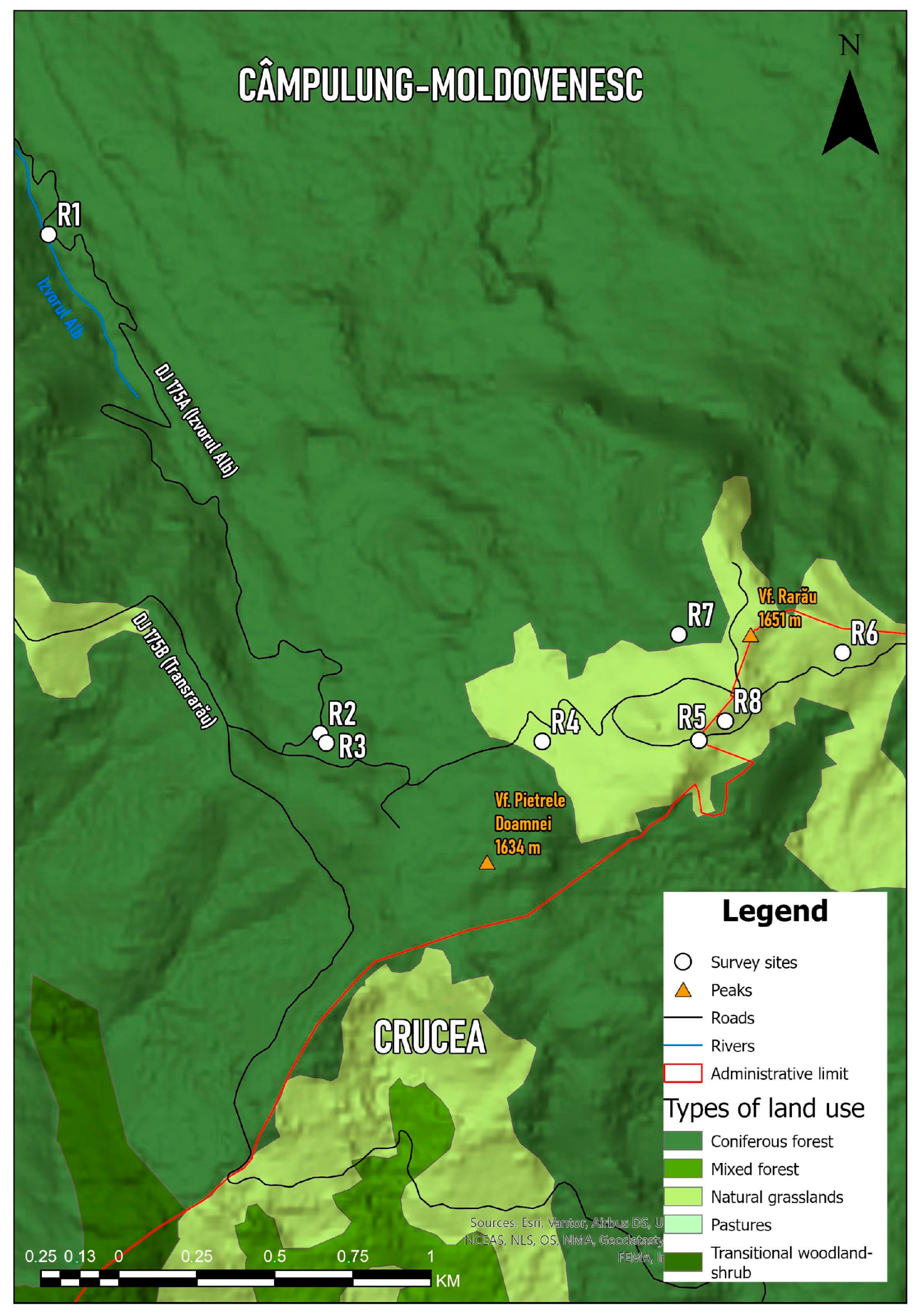
The field study was conducted in September 2014 in the northwestern part of the Rarău Massif, along a 5 km long transect at altitudes ranging from 1215 to 1619 m a.s.l. The transect followed the course of the Izvorul Alb stream and the Rarău Plateau, between 47.46500° N, 25.54388° E and 47.45277° N, 25.57750° E. Eight vegetation surveys (R1–R8) were carried out to assess the current vegetation, while eight moss cushions (S1–S8) from the corresponding survey areas were collected for palynological analysis. Geographic coordinates and altitude were recorded at each sampling point (Figure 2).
The vegetation surveys (to identify existing plant communities) were conducted using the Braun-Blanquet phytosociological method, adapted to Romanian conditions [27]. This approach included the delineation of standardized sampling plots to ensure representativeness (100 m2 for grasslands and 400 m2 for the forest vegetation), the recording of all plant species present, and the assignment of cover-abundance values to each species. In case of the azonal vegetation (wetlands and rocky substrate), plot area varied from 5 to 25 m2, depending on their intrinsic surface. Plant identification was carried out primarily using the flora of [23], while phytocoenological classification followed [28].
The sampling design aimed to ensure a paired pollen–vegetation approach along a constrained altitudinal transect. Moss cushions act as natural pollen traps integrating pollen deposition over several years [19,29]. Consequently, their pollen assemblages are characterised by a restricted pollen source area, which leads to a stronger representation of local and extra-local vegetation and a comparatively weaker regional pollen signal [30]. At each sampling site, five small portions of moss were collected from different points within the vegetation relevé and combined into a single composite sample to ensure a more representative integration of local pollen deposition.

3.2. Laboratory Stage—Processing of Palynological Samples

Moss cushions, each weighing approximately 10 g, were processed using a standard chemical protocol for pollen analysis [31]. The samples were treated sequentially to remove organic and mineral matter, starting with hydrochloric acid (HCl; 35%, followed by 10%). Potassium hydroxide (KOH; 10%) was then applied to eliminate remaining organic compounds. After each treatment, the samples were rinsed with distilled water and sieved through a 200 μm mesh to remove coarse particles. Hydrofluoric acid (HF; 40%) was used to dissolve siliceous material, followed by acetolysis using a mixture of acetic anhydride and concentrated sulfuric acid in a 9:1 ratio. Pollen grains were subsequently concentrated using zinc chloride (ZnCl2) with a density of 1.98 g cm−3. At each processing stage, samples were centrifuged at 2500–3000 rpm, depending on the procedure. The final residues were stored in glycerin prior to mounting and analysis.
Microscope slides were prepared by placing a drop of the processed material between a slide and a coverslip. Pollen grains were identified and counted under a light microscope using a 40× objective, with a minimum count of 400 pollen grains per sample.
Pollen identification was based on standard palynological atlases and identification keys [32,33,34]. The pollen diagram was constructed using Tilia Graph software (version 2.0.b.4) [35].

3.3. Statistical Analyses

Statistical analyses were performed to evaluate patterns of vegetation and palynological similarity and their relationship with environmental factors (altitude). Species mean cover-abundance values and pollen percentage data were square-root transformed prior to analysis to reduce the influence of dominant taxa. Hierarchical clustering was conducted using these transformed quantitative values. Floristic similarity among vegetation relevés was assessed using Bray–Curtis dissimilarity and hierarchical clustering with Ward’s minimum variance method (Ward.D2). These analyses were applied to both species-level datasets and taxonomically aggregated datasets (at the genus and family levels) to evaluate the consistency of vegetation groupings across different taxonomic resolutions, as well as to the palynological relevés to examine compositional patterns within the pollen assemblages. These exploratory clustering analyses were used to identify major compositional patterns and to facilitate comparison between vegetation and pollen datasets, particularly where taxonomic resolution differed between vegetation surveys and palynological identifications.
Multivariate ordination and comparison methods commonly used in community ecology were applied to summarize patterns in species composition and to evaluate the correspondence between vegetation and pollen assemblages [36,37]. The relationship between vegetation compositional dissimilarity and the environmental gradient (altitude) was tested using a Mantel test, which evaluates the association between dissimilarity matrices (Pearson’s correlation coefficient, 9999 permutations). To assess the degree of correspondence between vegetation composition and pollen spectra, a Procrustes analysis was performed by comparing non-metric multidimensional scaling (NMDS) ordination configurations based on Bray–Curtis dissimilarity of square-root transformed data for grouped vegetation relevés and their corresponding pollen rain samples. Statistical significance of the Procrustes fit was assessed using a permutation test (PROTEST). These analyses were selected to address two main objectives: (1) testing whether compositional variation was related to the altitudinal gradient, and (2) evaluating the correspondence between vegetation composition and pollen assemblages.
The relatively small number of sampling sites (n = 8) may limit statistical power and increase sensitivity to site-specific variation. In studies with few independent observations, statistical inference becomes more sensitive to underlying assumptions, and permutation-based approaches are commonly used because they remain valid under small sample sizes [38]. Moreover, ordination methods are primarily exploratory tools aimed at summarizing multivariate patterns rather than producing broad inferential generalizations [39]. Therefore, results are interpreted as describing relative patterns of compositional correspondence within the studied altitudinal transect rather than as broad-scale generalizations. All statistical analyses were performed in R (version 4.3.0).

4. Results

4.1. Phytosociological Results

Based on the vegetation surveys (Table 1), the plant communities identified at the sampling sites belong to the following associations: Hieracio transsilvanicae–Piceetum Pawłowski et Br.-Bl. 1939, Festuco rubrae–Agrostietum capillaris Horvát 1951, Carici remotae–Calthaetum laetae Coldea (1972) 1978, and Festucetum saxatilis Domin 1933. While Hieracio transsilvanicae–Piceetum and Festuco rubrae–Agrostietum capillaris represent the main forest and grassland vegetation types of the Rarău Massif, respectively, plant communities such as Carici remotae–Calthaetum laetae and Festucetum saxatilis represent examples of azonal vegetation. These communities are primarily related to specific ecological conditions, such as water excess in the case of Carici remotae–Calthaetum laetae and rocky substrates in the case of Festucetum saxatilis [24,40].

4.2. Palynological Results

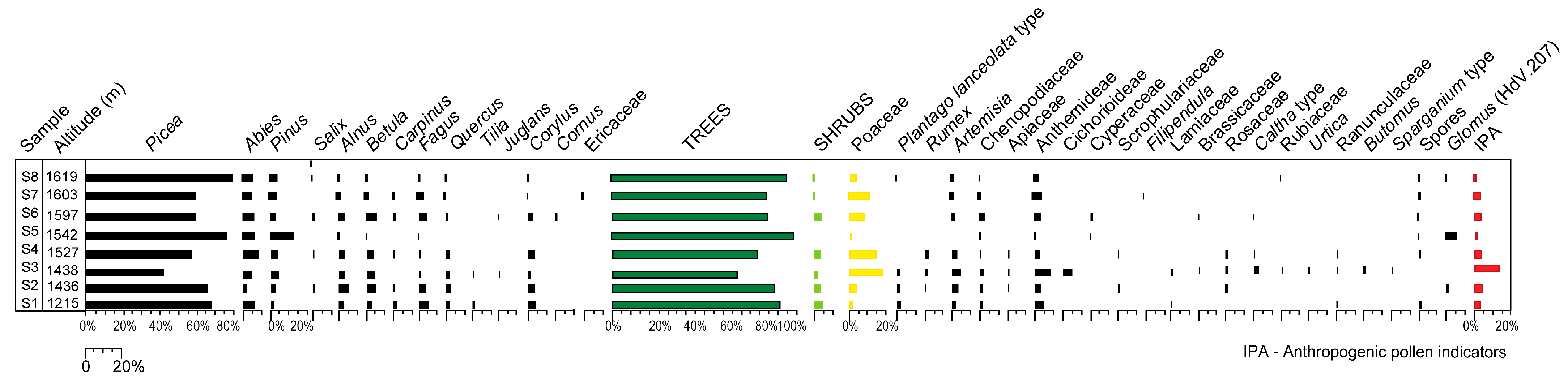
The pollen diagram (Figure 3) reflects a forested environment characteristic of the montane belt, highlighting the dominance of coniferous forests, with spruce (Picea) pollen predominating and accounting for between 40% and nearly 80% of the assemblages, regardless of altitude or the local vegetation type at the sampling sites. In addition to this dominant taxon, other conifers such as fir (Abies) and pine (Pinus) are consistently present, although in lower proportions.
Alongside conifers, the pollen diagram indicates the presence of broad-leaved taxa, including beech (Fagus), birch (Betula), alder (Alnus) and oak (Quercus). Willow (Salix) and lime (Tilia) occur only sporadically and at low percentages.
The shrub layer, including subshrubs, is poorly represented in all palynological samples. Within this layer, hazel (Corylus) is the most prominent taxon, while dogwood (Cornus) and taxa belonging to the Ericaceae family also contribute to the shrub component.
Palynological analysis of the eight samples indicates that the herbaceous layer is weakly developed or nearly absent, with herb pollen reaching a maximum of 30% of the total assemblage. Within this group, taxa of the Poaceae family are dominant, albeit their pollen percentages do not exceed 20%. The herbaceous pollen spectrum is complemented by taxa pertaining to families such as Lamiaceae, Ranunculaceae, Brassicaceae, Asteraceae, and Scrophulariaceae.
Pollen taxa commonly associated with anthropogenic disturbance, such as Plantago, Rumex, Artemisia, and Urtica (typically associated with nitrate-rich soils) [41], are present in all analysed samples, with an average contribution of approximately 5%. In one sample collected at 1438 m a.s.l., anthropogenic pollen indicators reach nearly 15%. Compared to the other pollen spectra, this increase is accompanied by higher Poaceae percentages and a decrease in arboreal pollen. Nevertheless, arboreal pollen remains dominant, accounting for more than 60% of the assemblage. A similar pattern is observed in the sample collected at 1527 m a.s.l., 1597 m a.s.l., and 1603 m a.s.l., where anthropogenic pollen indicators represent approximately 10%, again associated with increased Poaceae pollen while arboreal taxa continue to dominate.

5. Discussion

5.1. Pollen–Vegetation Relationships Along the Altitudinal Transect

First, we tested the similarity of the floristic composition of the vegetation relevés and examined its relationship with the altitudinal gradient.
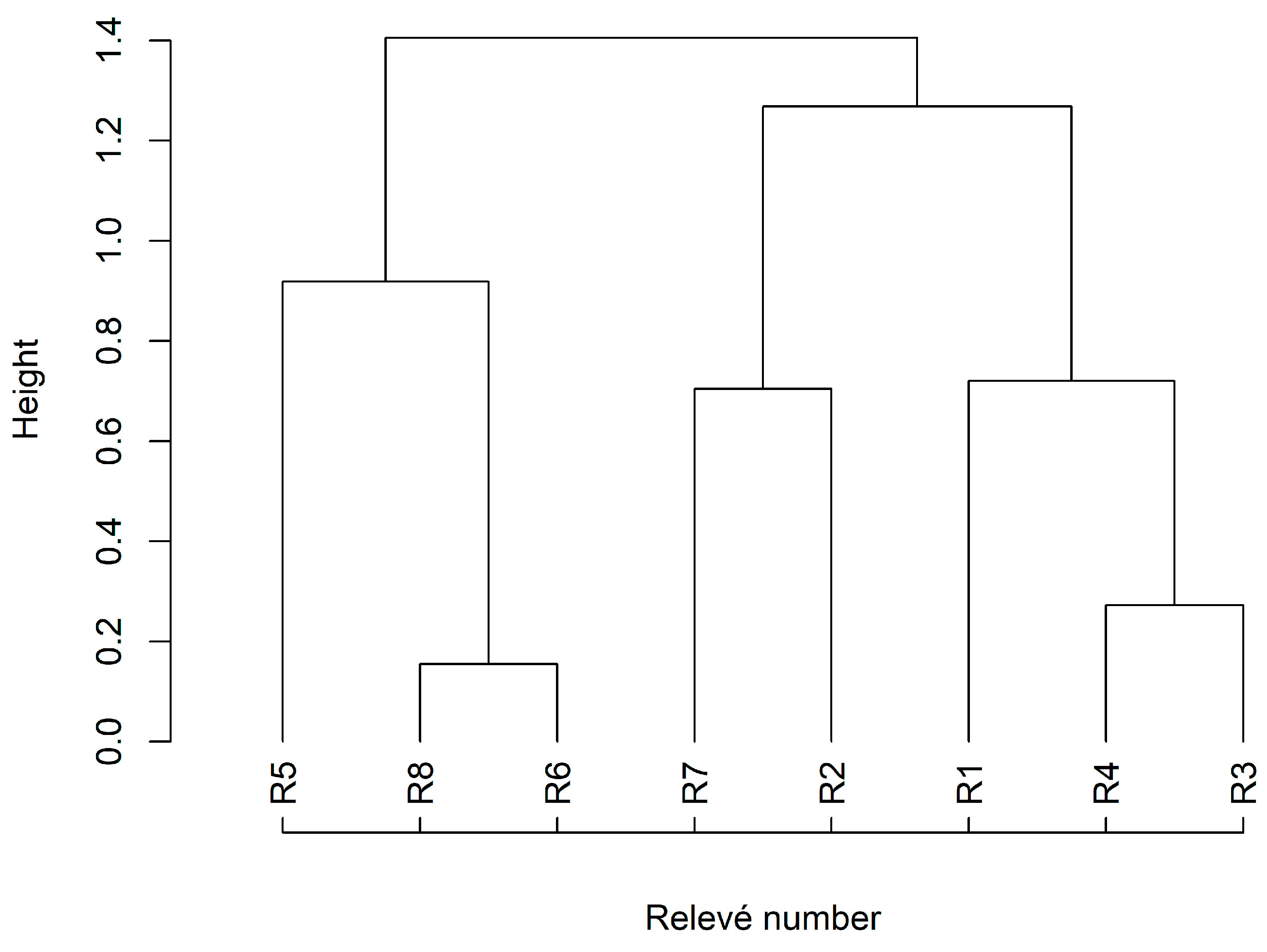
Hierarchical cluster analysis revealed three main groups of relevés (Figure 4).
The pair R6–R8 exhibited the highest floristic similarity, followed by the pair R3–R4, which also showed strong internal resemblance. Relevés R5, R6, and R8 clustered together to form a distinct assemblage that separated early from the remaining relevés, suggesting a floristically differentiated vegetation type, potentially influenced by specific local environmental conditions. The other relevés (R2, R7, R1, R3, and R4) formed a broader, cohesive group, indicating moderate floristic homogeneity among these sites. Within this larger group, the pair R2–R7 showed the greatest internal similarity, while R1 was associated at a slightly higher linkage distance. Overall, the clustering pattern highlights both localized differentiation (notably among R5–R6–R8) and general compositional continuity across the remaining sites.
The Mantel test revealed a very weak and non-significant correlation between floristic dissimilarity and altitude (r = 0.0028, p = 0.49), suggesting that no clear relationship between altitude and vegetation composition was detectable within the studied transect. According to [28], the transect area, with altitudes ranging from 1215 to 1619 m a.s.l., corresponds to the “pure spruce forest” belt. Similarly, an altitudinal transect (1150–1750 m a.s.l.) from the Western Carpathians (Slovakia) [42] determined no distinct relationship of floristic diversity to altitude, which may be explained by the relatively homogenous composition of the herbaceous layer in spruce-dominated forests. Diversity only shifts significantly where the canopy opens (R5, R6, R8—meadows and herbaceous vegetation on rocky substrates) or due to local ecological factors (water excess in the case of R1, R3, R4).
Pollen spectra do not always allow identification at the species level; therefore, the floristic data from the vegetation relevés were aggregated to taxonomic levels comparable to those of the pollen data (i.e., genera and families). Floristic similarity among the relevés was subsequently reevaluated using these broader taxonomic categories.
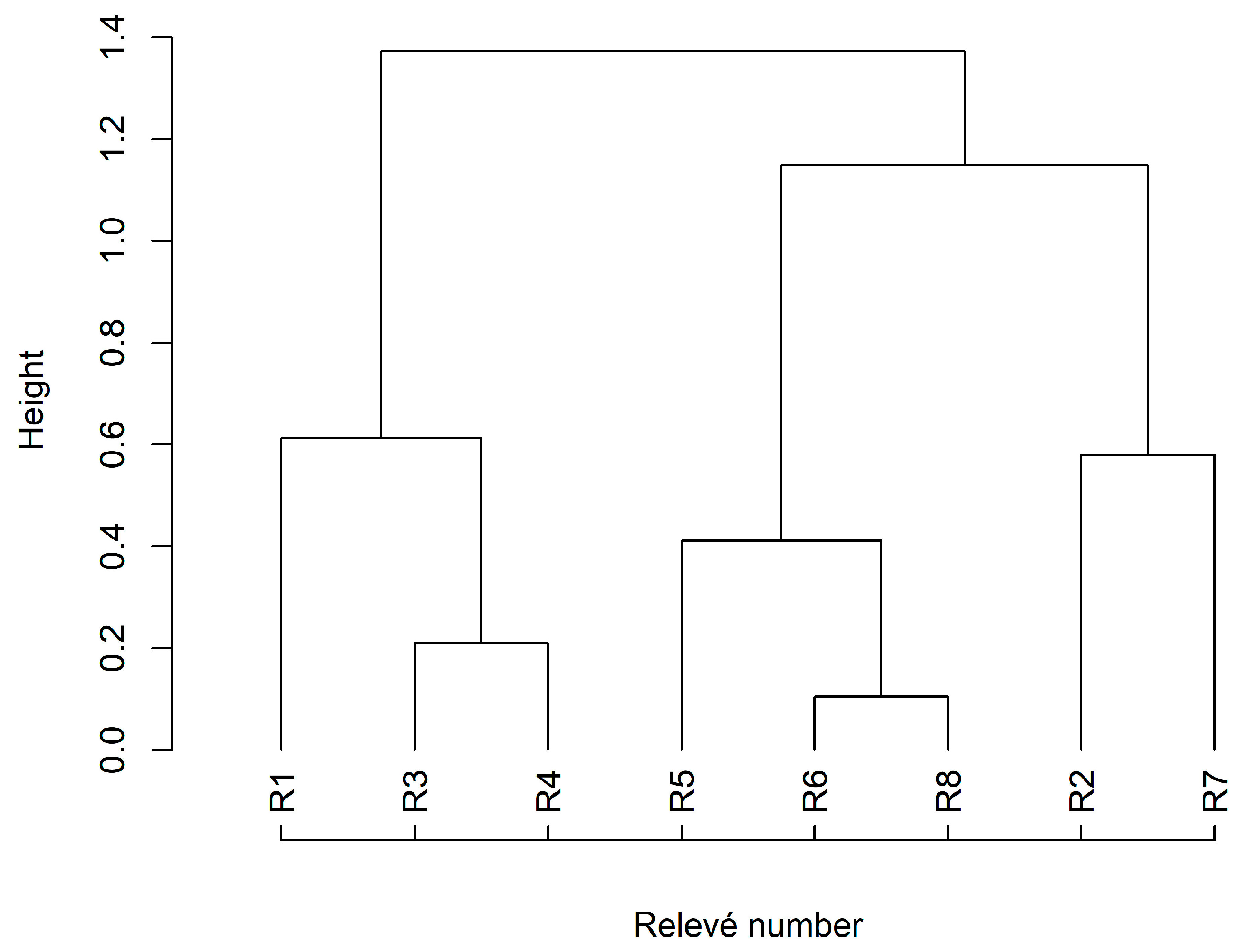
When the analysis was performed using aggregated taxonomic levels, the overall clustering pattern among relevés remained largely consistent with that obtained from species-level data (Figure 5).
The main assemblages were still recognizable, although some reorganization occurred within clusters. In this aggregated dataset, relevés R2 and R7, which were previously associated with the R1–R3–R4 group, clustered together with R5, R6, and R8, reflecting reduced dissimilarity at higher taxonomic resolution. This shift suggests that part of the fine-scale variation observed at the species level resulted from differences among closely related species within the same genera or families, which become less distinct when species identities are grouped into broader taxonomic categories. Overall, the general vegetation structure remains stable due to the dominance of the spruce forest along the studied altitudinal gradient, while taxonomic aggregation smooths minor compositional differences.
The next step was to assess variability among the pollen spectra and to determine whether this variability was related to the altitude of the sampling sites.
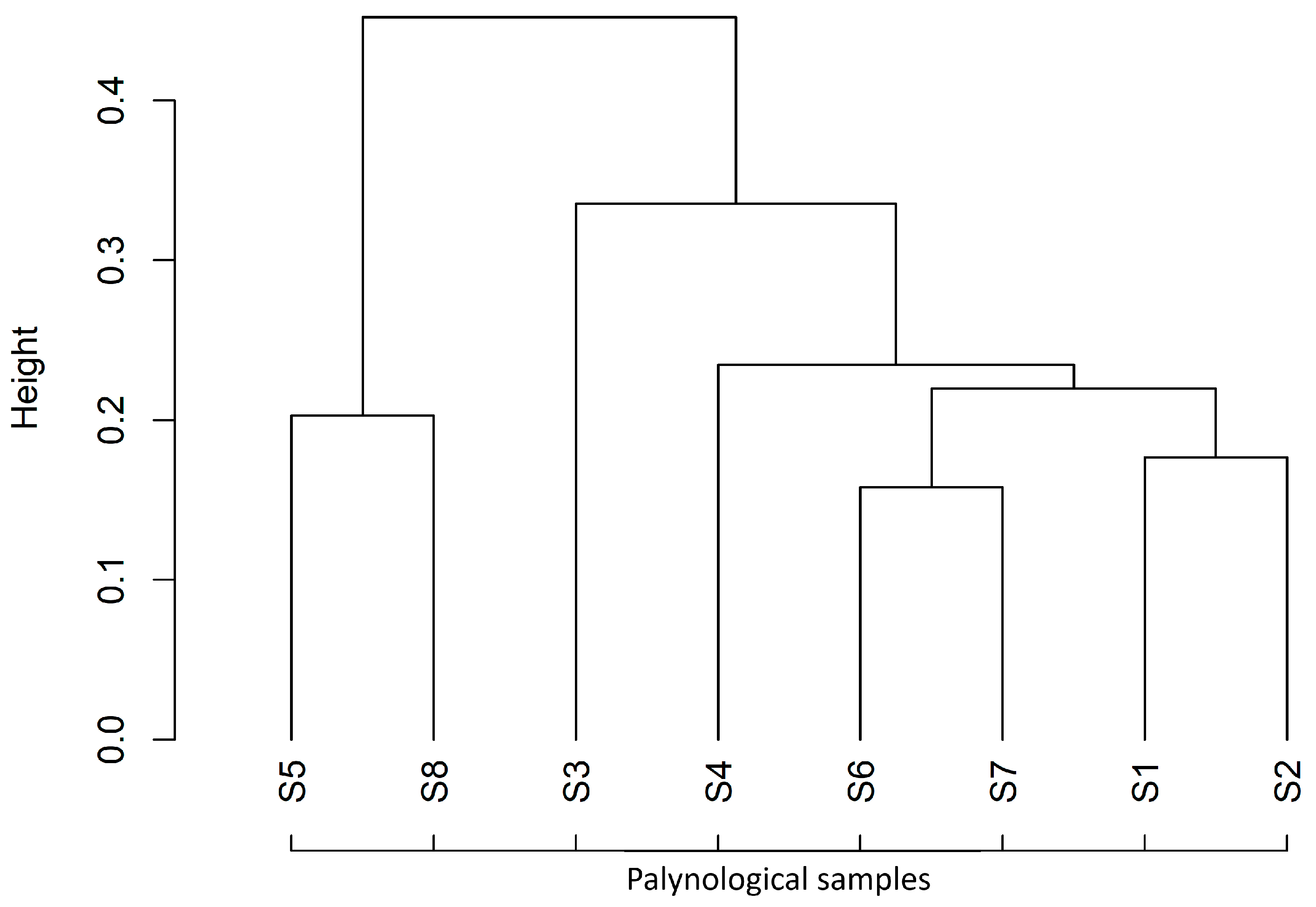
Hierarchical cluster analysis revealed two main pollen assemblages (Figure 6).
The strongest similarity was observed between samples S6 and S7, indicating closely related pollen spectra, followed by pair S1–S2. These two pairs merged first, with S4 joining at a slightly higher linkage distance to form a major cluster. Samples S5 and S8 clustered together as a distinct pair. Overall, the clustering pattern highlights a dominant assemblage comprising samples S6, S7, S1, S2, and S4, and a smaller, more differentiated assemblage represented by the S5–S8 pair.
The Mantel test revealed a weak and non-significant correlation between pollen compositional dissimilarity and altitude (r = 0.1552, p = 0.5942), suggesting that no clear altitude-related pattern in pollen assemblage composition was detectable within the studied transect.
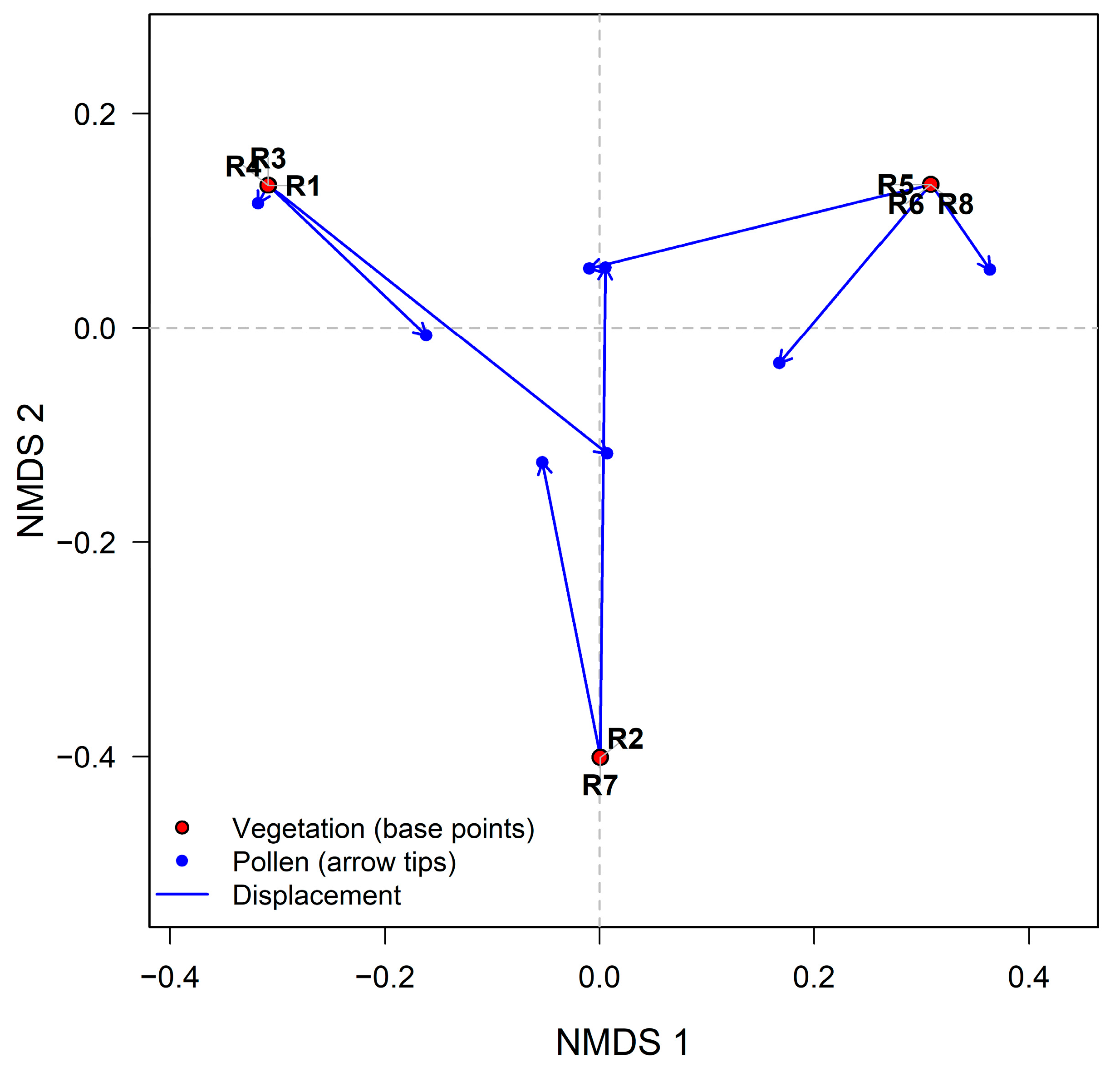
Finally, we address the main question of this study: does modern pollen rain provide an accurate representation of present-day vegetation in the Rarău Massif? Procrustes analysis comparing ordination configurations of grouped vegetation relevés and their corresponding pollen rain assemblages revealed a weak overall correspondence between vegetation and pollen composition (Figure 7).
Shorter vectors for relevés R4, R3, and R8 indicate a closer correspondence between local floristic and palynological assemblages, whereas longer vectors for R1, R2, and R5 reflect greater divergence. This divergence is likely driven by regional pollen transport and the dominance of high pollen producers such as Picea and Poaceae. Similar patterns, in which pollen assemblages capture broader vegetation structures rather than fine-scale floristic composition, have been reported in modern calibration studies emphasizing functional and phylogenetic signals over taxonomic fidelity [43]. In mountainous environments, additional factors such as mountain–valley wind circulation and surface run-off may further influence pollen transport and deposition patterns [44,45]. Although these processes were not directly quantified in the present study, they may partly contribute to site-specific differences in pollen assemblages and to the observed divergence between vegetation and pollen composition at certain sampling sites.
The Protest test supports this interpretation, revealing a moderate and statistically non-significant correlation between vegetation and pollen dissimilarity matrices (r = 0.5865, p = 0.1154). These results indicate that, although pollen rain broadly reflects the main vegetation structure, its fidelity to local plant composition varies among sites and is partially influenced by differences in pollen dispersal and productivity. Although the limited number of samples constrains statistical power, the dominant pollen signal appears relatively homogeneous, and each moss cushion integrates pollen deposition over extended timescales, allowing the identification of general compositional patterns within the studied transect. In addition, the narrow altitudinal range and the restriction to a single vegetation belt further limit the detection of strong compositional gradients or statistically robust pollen–vegetation correlations. Consequently, the weak and non-significant relationships observed here should be interpreted within this exploratory and spatially constrained framework rather than as evidence of ecological independence between pollen assemblages and vegetation structure.
Furthermore, as pollination strategy may influence pollen–vegetation correspondence, taxa were classified according to their pollination mode (wind- versus insect-pollinated) [46], and separate PROTEST analyses were performed for each group. The results showed a strong and significant correspondence for insect-pollinated taxa (r = 0.7628, p = 0.0084), whereas wind-pollinated taxa exhibited a moderate but non-significant correspondence (r = 0.5669, p = 0.1533). These contrasting results should be interpreted considering differences in the number of taxa included in each subset, with insect-pollinated taxa (n = 49) outnumbering wind-pollinated taxa (n = 20). The larger number of taxa may provide a more detailed representation of compositional variation among sites, potentially contributing to the stronger vegetation–pollen correspondence observed for insect-pollinated taxa. Ecologically, this pattern may also be consistent with insect-pollinated taxa potentially capturing relatively more local vegetation signals. However, this interpretation remains tentative and would require further testing with larger datasets.

5.2. Representation of Vegetation Components and Anthropogenic Signals

Analysis of the pollen rain reveals vegetation characteristics typical of the montane belt. The marked dominance of spruce (Picea) pollen, ranging from 40% to nearly 80%, reflects the prevalence of coniferous forests that define the local landscape. These spruce-dominated forests, characteristic of the montane zone, are also confirmed by the vegetation surveys, which document associations such as Hieracio transsilvanicae–Piceetum. Fir (Abies) and pine (Pinus) occur only in low percentages, as secondary species in the structure of these ecosystems. Although Abies and Pinus were not identified in the floristic surveys, their presence in the pollen spectra likely reflects the occurrence of Hieracio transsilvanico–Abietetum and Leucobryo–Pinetum plant communities in the surrounding area. These structural patterns are consistent with the multivariate statistical results. The moderate but statistically non-significant Procrustes correlation between vegetation and pollen assemblages (r = 0.5865, p = 0.1154) suggests that pollen spectra capture the general vegetation structure, particularly the dominance of spruce forests, while only partially reflecting fine-scale local floristic composition. Likewise, the absence of a significant relationship between compositional dissimilarity and altitude (Mantel test) supports the interpretation that the dominant pollen signal reflects the relative homogeneity of the upper montane spruce belt rather than a clearly structured altitudinal gradient. Together, these results indicate that modern pollen rain in the Rarău Massif primarily records the dominant structural features of the montane vegetation belt, whereas fine-scale local compositional differences may be partly obscured by pollen productivity and dispersal processes.
In addition to conifers, the palynological data indicate the presence of broad-leaved taxa such as beech (Fagus), birch (Betula), and alder (Alnus), which complement and diversify the montane spruce forests. In contrast, pollen of oak (Quercus) and lime (Tilia) does not originate from local vegetation but rather from adjacent areas at lower altitudes [24,25,26,35].
The shrub layer is poorly represented in both the pollen record and the current vegetation. Corylus pollen is consistently present but does not exceed 3–4%, with additional contributions from taxa of the Ericaceae family. Vegetation surveys confirm the occurrence of Corylus and Ericaceae taxa, in agreement with the palynological data. Within the family Ericaceae, Vaccinium species were identified in only one relevé (R7), although these species are characteristic components of the subshrub layer in montane coniferous forests. The concordance between palynological and phytosociological evidence highlights a structurally complex forest ecosystem in which the dominant tree layer is complemented by a discreet yet ecologically important shrub component.
Regarding the herbaceous layer, palynological analysis indicates that it is relatively poorly developed, with herb pollen accounting for no more than 30% of the total assemblage, and Poaceae pollen remaining below 20%. These results are consistent with field observations, as herbaceous species are present at all sampling sites but generally display low cover values within forest communities. Species such as Agrostis capillaris, Festuca rubra, Sesleria bielzii, and Trisetum alpestre were recorded mainly in open grassland communities located at higher altitudes. The pollen spectrum is further complemented by other herbaceous families (e.g., Lamiaceae, Ranunculaceae, Brassicaceae, Asteraceae, and Scrophulariaceae), all of which are confirmed by the vegetation surveys (Table 1).
A noteworthy feature of the pollen spectra is the constant presence of pollen taxa commonly associated with anthropogenic disturbance, including Plantago, Rumex, Artemisia, and Urtica. According to Behre [41], these taxa are not exclusively anthropogenic indicators but are frequently linked to grazing activity, ruderal habitats, and nitrogen-enriched soils, particularly when occurring together. These taxa, typically associated with nitrate-rich soils, occur in most analysed samples with an average contribution of approximately 5%, but in some cases their values increase markedly, reaching up to 10–15%. Such increases are accompanied by a decline in arboreal pollen and a concomitant rise in Poaceae, indicating the development of ruderalised grasslands and reflecting the influence of local human activities, particularly tourism and grazing. Nevertheless, arboreal pollen remains dominant, exceeding 60% of the assemblages, thus confirming that the present-day landscape is still primarily defined by coniferous forests.
Overall, the pollen spectra reflect the current montane vegetation, which is dominated by spruce forests, while also capturing regional pollen input from surrounding areas and signals of human impact through the presence of grassland and ruderal taxa.

6. Conclusions

The comparative analysis of modern pollen rain and present-day vegetation along an altitudinal transect in the Rarău Massif provides insight into pollen–vegetation relationships within a spruce-dominated montane belt. The pollen spectra are clearly dominated by Picea, reflecting the structural prevalence of spruce forests that define the upper montane zone. Abies and Pinus occur in lower proportions, consistent with their secondary role in the regional forest composition, while broad-leaved taxa such as Fagus, Betula, and Alnus complement the arboreal signal and partly reflect vegetation from adjacent elevations.
Statistical analyses indicate weak and non-significant relationships between pollen composition, vegetation structure, and altitude. The relatively narrow altitudinal range, the restriction to a single vegetation belt, and the limited number of sampling sites reduce the likelihood of detecting strong compositional gradients. Procrustes analysis revealed a moderate but statistically non-significant correspondence between vegetation and pollen assemblages, suggesting that pollen rain reflects the dominant vegetation framework rather than fine-scale local floristic variation.
Shrub and herbaceous components are less distinctly represented in the pollen spectra, consistent with differences in pollen productivity and dispersal. The recurrent presence of Plantago, Rumex, Artemisia, and Urtica may indicate localized human influence, most likely related to grazing and tourism activities, although arboreal pollen remains dominant across all samples.
Overall, modern pollen rain in the Rarău Massif records the principal structural features of the montane vegetation while only partially representing local compositional differences. The results provide a local reference framework for interpreting fossil pollen assemblages from spruce-dominated mountain environments.

Author Contributions

Conceptualization, M.D. and C.C.M.; methodology, M.D. and C.C.M.; software, M.D., D.I., A.G.C. and C.C.M.; validation, M.D., M.M., D.I., A.G.C. and C.C.M.; formal analysis, M.D., M.M., F.Ș. and C.C.M.; investigation, M.D., D.I., M.M., F.Ș., A.G.C. and C.C.M.; resources, M.D., C.C.M. and M.M.; data curation, M.D. and C.C.M.; writing—original draft preparation, M.D., M.M., F.Ș., A.G.C., D.I. and C.C.M.; writing—review and editing, M.D., M.M. and C.C.M.; visualization, M.D., M.M. and C.C.M.; supervision, M.D., A.G.C., D.I., M.M. and C.C.M. All authors have read and agreed to the published version of the manuscript.

Funding

This research received no external funding.

Data Availability Statement

The original contributions presented in this study are included in the article. Further inquiries can be directed to the corresponding authors.

Conflicts of Interest

The authors declare no conflicts of interest. The funders had no role in the design of the study; in the collection, analyses, or interpretation of data; in the writing of the manuscript; or in the decision to publish the results.

References

  1. Djamali, M.; de Beaulieu, J.-L.; Campagne, P.; Andrieu-Ponel, V.; Ponel, P.; Leroy, S.A.G.; Akhani, H. Modern pollen rain–vegetation relationships along a forest–steppe transect in the Golestan National Park, NE Iran. Rev. Palaeobot. Palynol. 2009, 153, 272–281. [Google Scholar] [CrossRef]
  2. Schüler, L.; Hemp, A.; Behling, H. Relationship between vegetation and modern pollen rain along an elevational gradient on Kilimanjaro, Tanzania. Holocene 2014, 24, 702–713. [Google Scholar] [CrossRef]
  3. Gosling, W.D.; Julier, A.C.M.; Adu-Bredu, S.; Djagbletey, G.D.; Fraser, W.T.; Jardine, P.E.; Lomax, B.H.; Malhi, Y.; Manu, E.A.; Mayle, F.E.; et al. Pollen–vegetation richness and diversity relationships in the tropics. Veg. Hist. Archaeobotany 2018, 27, 411–418. [Google Scholar] [CrossRef]
  4. Lukanina, E.; Shumilovskikh, L. Modern pollen spectra from the east European forest steppe reflect land use patterns rather than a climatic gradient. Veg. Hist. Archaeobotany 2025, 34, 799–812. [Google Scholar] [CrossRef]
  5. Cañellas-Boltà, N.; Rull, V.; Vigo, J.; Mercadé, A. Modern pollen–vegetation relationships along an altitudinal transect in the central Pyrenees (southwestern Europe). Holocene 2009, 19, 1185–1200. [Google Scholar] [CrossRef]
  6. Shen, C.; Liu, K.-B.; Tang, L.; Overpeck, J.T. Modern pollen rain in the Tibetan Plateau. Front. Earth Sci. 2021, 9, 732441. [Google Scholar] [CrossRef]
  7. Sánchez-Morales, M.; Pérez-Obiol, R.; Carracedo, V.; Pèlachs, A. Modern vegetation and its pollen spectra in the Cantabrian Mountains, northern Iberian Peninsula, compared with fossil pollen records. Veg. Hist. Archaeobotany 2025, 34, 53–70. [Google Scholar] [CrossRef]
  8. Onoriode Obigba, S. Understanding past and present vegetation dynamics using the palynological approach: An introductory discourse. In Vegetation Index and Dynamics; IntechOpen: London, UK, 2022. [Google Scholar] [CrossRef]
  9. Fyfe, R.M.; Edwards, K.J.; Scoble, L.L. Palynology, landscape and land use: Retrospect, prospect and research agendas. J. Archaeol. Sci. 2025, 179, 106233. [Google Scholar] [CrossRef]
  10. Mercuri, A.M.; Florenzano, A.; Clò, E.; Servera-Vives, G. Palynology for sustainability: A classical and versatile tool for new challenges—Recent progress. Quaternary 2025, 8, 18. [Google Scholar] [CrossRef]
  11. Matthias, I.; Semmler, M.S.S.; Giesecke, T. Pollen diversity captures landscape structure and diversity. J. Ecol. 2015, 103, 880–890. [Google Scholar] [CrossRef]
  12. Boutahar, A.; Gonzalez, P.C.; Picone, R.M.; Crisafulli, A.; Mesa, J.M.; Redouan, F.Z.; Merzouki, A. The relationships between modern pollen rain assemblages and vegetation from Sougna Mountain (Rif Mountains, northern Morocco). Palynology 2024, 48, 2358016. [Google Scholar] [CrossRef]
  13. Diaconeasa, B.; Șuteu, Ș. Analiza palinologică a fânațelor turboase de pe raza comunei Deda (jud. Mureș). Contrib. Bot. 1980, 57–61. [Google Scholar]
  14. Diaconeasa, B. Analiza palinologică a profilului turbos de la Pădureni-Țop, jud. Cluj. Contrib. Bot. 1985, 71–76. [Google Scholar]
  15. Bodnariuc, A.; Bouchette, A.; Dedoubat, J.J.; Otto, T.; Fontugne, M.; Jalut, G. Holocene vegetational history of the Apuseni Mountains, central Romania. Quat. Sci. Rev. 2002, 21, 1465–1488. [Google Scholar] [CrossRef]
  16. Tanțău, I.; Fărcaș, S. Cercetări palinologice preliminare efectuate în mlaștina de la Dracășviz (Podișul Hârtibaciului), jud. Mureș. Marisia 1997, 25, 59–68. [Google Scholar]
  17. Tanțău, I.; Fărcaș, S. Recherches pollenanalytiques sur l’histoire de la végétation collinaire de la zone de Cluj. Acta Paleontol. Rom. 2001, 3, 419–426. [Google Scholar]
  18. Fărcaș, S.; Miclăuș, M.; Tanțău, I. Correlations between the actual hilly and plain vegetation from Transylvania and recent–sub-recent palynological spectra. Stud. Cercet. Biol. 2004, 9, 99–111. [Google Scholar]
  19. Heim, J. Les relations entre les spectres polliniques récents et la végétation actuelle en Europe occidentale. Ph.D. Thesis, Université de Louvain, Louvain, Belgium, 1970; p. 181. [Google Scholar]
  20. Fang, Y.; Bunting, M.J.; Ma, C.; Yang, X. Are modern pollen assemblages from soils and mosses the same? A comparison of natural pollen traps from subtropical China. Catena 2022, 209, 105790. [Google Scholar] [CrossRef]
  21. Rusu, C. Masivul Rarău. Studiu de Geografie Fizică; Editura Academiei Române: București, Romania, 2002. [Google Scholar]
  22. European Environment Agency (EEA). Biogeographical Regions. 2019. Available online: https://www.eea.europa.eu/data-and-maps/data/biogeographical-regions-europe-3 (accessed on 30 November 2025).
  23. Ciocârlan, V. Flora Ilustrată a României. Pteridophyta et Spermatophyta; Editura Ceres: București, Romania, 2009. [Google Scholar]
  24. Oprea, A.; Sîrbu, C. The vascular flora of Rarău Massif (Eastern Carpathians, Romania). Note I. Mem. Sci. Sect. Rom. Acad. 2012, 35, 55–84. [Google Scholar]
  25. Mititelu, O.; Dăscălescu, O.; Ștefan, N.; Vițalariu, G.; Barabaș, N.; Davidescu, G.; Lupașcu, G.; Toderiță, M. Cercetări sinecologice în rezervația “Codru secular Slătioara”, jud. Suceava. Stud. Comunic. Muz. Șt. Nat. Bacău 1982, 13, 135–182. [Google Scholar]
  26. Mititelu, O.; Chifu, T.; Pascal, P. Flora şi vegetaţia judeţului Suceava. Anu. Muz. Județ. Suceava, Științ. nat. 1989, 10, 93–120. [Google Scholar]
  27. Cristea, V.; Gafta, D.; Pedrotti, F. Fitosociologie; Editura Presa Universitară Clujeană: Cluj-Napoca, Romania, 2004; 394p. [Google Scholar]
  28. Chifu, T.; Mânzu, C.; Zamfirescu, O. Flora şi Vegetaţia Moldovei (Romania). Vol. 2: Vegetaţia; Editura Universităţii “Al. I. Cuza”: Iaşi, Romania, 2006. [Google Scholar]
  29. Lisitsyna, O.V.; Hicks, S.; Huusko, A. Do moss samples, pollen traps and modern lake sediments all collect pollen in the same way? A comparison from the forest limit area of northernmost Europe. Veg. Hist. Archaeobotany 2012, 21, 187–199. [Google Scholar] [CrossRef]
  30. Jacobson, G.L., Jr.; Bradshaw, R.H.W. The selection of sites for paleovegetational studies. Rev. Palaeobot. Palynol. 1981, 32, 127–152. [Google Scholar] [CrossRef]
  31. Fægri, K.; Iversen, J. Textbook of Pollen Analysis; Wiley: Chichester, UK, 1989; 328p. [Google Scholar]
  32. Beug, H.-J. Leitfaden der Pollenbestimmung für Mitteleuropa und Angrenzende Gebiete; Pfeil: München, Germany, 2004; 542p. [Google Scholar]
  33. Reille, M. Pollen et Spores d’Europe et d’Afrique du Nord; Laboratoire de Botanique Historique et Palynologie: Marseille, France, 1992. [Google Scholar]
  34. Moore, P.D.; Webb, J.S.; Collinson, M.E. Pollen Analysis; Blackwell Scientific Publications: London, UK, 1991; 216p. [Google Scholar]
  35. Grimm, E.C. Tilia Graph; Illinois State Museum, Research and Collection Center: Springfield, IL, USA, 1991. [Google Scholar]
  36. McCune, B.; Grace, J.B. Analysis of Ecological Communities; MjM Software Design: Gleneden Beach, OR, USA, 2002. [Google Scholar]
  37. Peres-Neto, P.R.; Jackson, D.A. How well do multivariate data sets match? The advantages of a Procrustean superimposition approach over the Mantel test. Oecologia 2001, 129, 169–178. [Google Scholar] [CrossRef] [PubMed]
  38. Holt, C.A.; Sullivan, S.P. Permutation tests for experimental data. Exp. Econ. 2023, 26, 775–812. [Google Scholar] [CrossRef]
  39. Bialik, O.M.; Jarochowska, E.; Grossowicz, M. Ordination analysis in sedimentology, geochemistry and palaeoenvironment—Background, current trends and recommendations. Depos. Rec. 2021, 7, 541–563. [Google Scholar] [CrossRef]
  40. Raclaru, P. Evoluția și succesiunea vegetației din Munții Rarău. Stud. Comunic. Muz. Șt. Nat. Bacău 1972, 205–211. [Google Scholar]
  41. Behre, K.-E. The interpretation of anthropogenic indicators in pollen diagrams. Pollen Spores 1981, 23, 225–245. [Google Scholar]
  42. Doležal, J.; Šrůtek, M. Altitudinal changes in composition and structure of mountain-temperate vegetation: A case study from the Western Carpathians. Plant Ecol. 2002, 158, 201–221. [Google Scholar] [CrossRef]
  43. Blaus, A.; Reitalu, T.; Gerhold, P.; Hiiesalu, I.; Massante, J.C.; Veski, S. Modern pollen–plant diversity relationships inform palaeoecological reconstructions of functional and phylogenetic diversity in calcareous fens. Front. Ecol. Evol. 2020, 8, 207. [Google Scholar] [CrossRef]
  44. Carinanos, P.; Ruiz-Peñuela, S.; Casans, A.; Cazorla, A.; Rejano, F.; Ontiveros, A.; Ortiz-Amezcua, P.; Guerrero-Rascado, J.L.; Olmo, F.J.; Alados-Arboledas, L.; et al. Assessment of potential sources of airborne pollen in a high-mountain Mediterranean natural environment. Atmos. Environ. 2025, 340, 120917. [Google Scholar] [CrossRef]
  45. Ren, W.; Liu, M.; Qin, F.; Li, Q.; Yi, G.; Chen, W.; Li, S.; Liu, Z.; Peng, Q.; Liang, C.; et al. The pollen representation of vegetation and climate along an altitudinal gradient on the eastern Tibetan Plateau. Land 2024, 13, 1866. [Google Scholar] [CrossRef]
  46. Reitalu, T.; Bjune, A.E.; Blaus, A.; Giesecke, T.; Helm, A.; Matthias, I.; Peglar, S.M.; Salonen, J.S.; Seppä, H.; Väli, V.; et al. Patterns of modern pollen and plant richness across northern Europe. J. Ecol. 2019, 107, 1662–1677. [Google Scholar] [CrossRef]
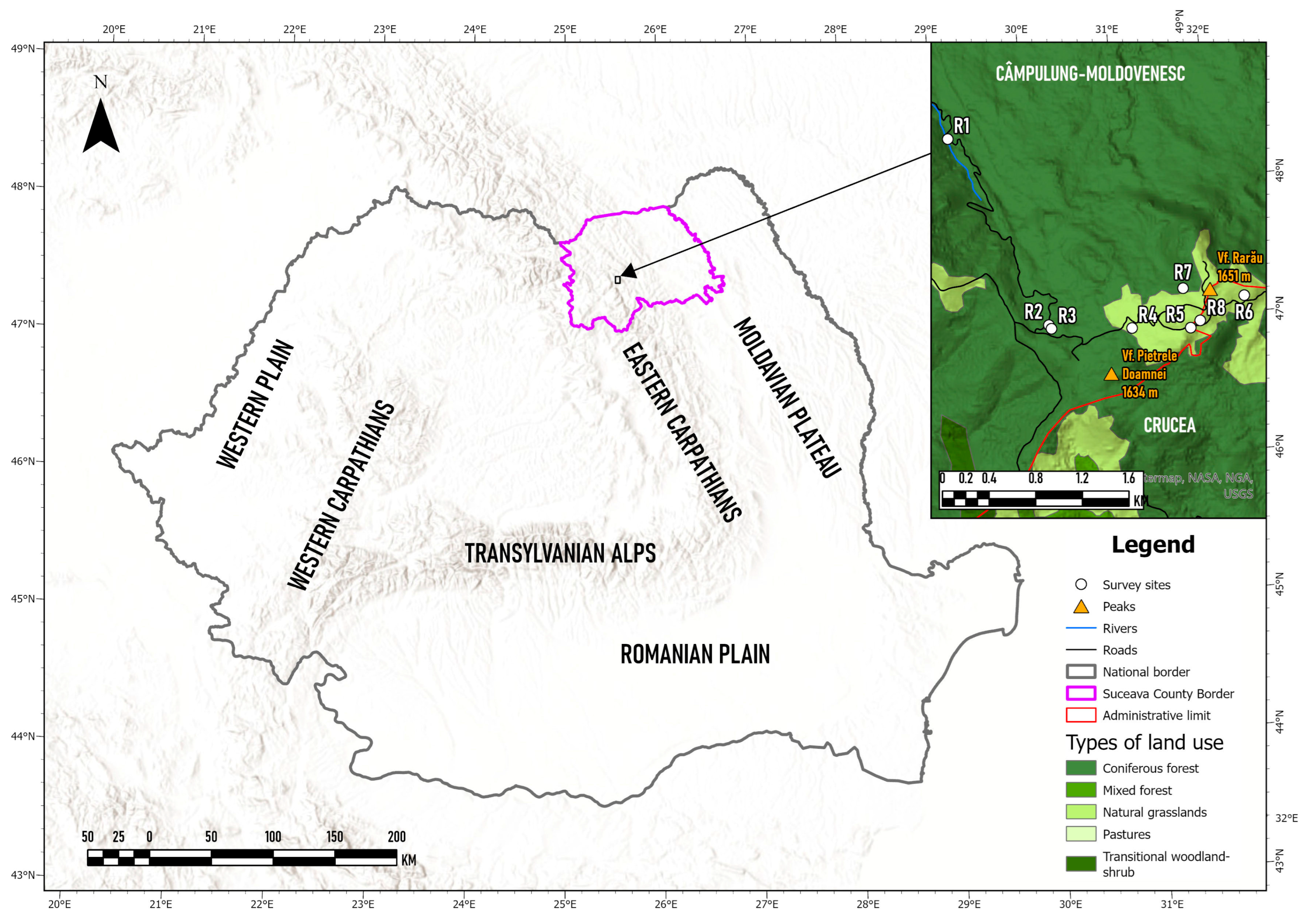
Figure 1. Geographical setting of the study area in Rarău Massif.
Quaternary 09 00028 g001
Figure 2. Sampling sites, with main vegetation categories.
Quaternary 09 00028 g002
Figure 3. Modern pollen diagram along the Rarău Massif altitudinal transect.
Quaternary 09 00028 g003
Figure 4. Hierarchical clustering of the relevés based on floristic similarity, using sqrt-transformed Bray–Curtis dissimilarity and Ward’s minimum variance (Ward.D2) linkage method.
Quaternary 09 00028 g004
Figure 5. Hierarchical clustering of the relevés based on broader floristic categories (genera and families), using sqrt-transformed Bray–Curtis dissimilarity and Ward’s minimum variance (Ward.D2) linkage method.
Quaternary 09 00028 g005
Figure 6. Hierarchical clustering of the palynological samples using sqrt-transformed Bray–Curtis dissimilarity and Ward’s minimum variance (Ward.D2) linkage method.
Quaternary 09 00028 g006
Figure 7. Procrustes analysis comparing vegetation and pollen assemblages. Each pair of points (R1–R8) represents the same sampling site, with red circles indicating vegetation and blue points indicating the pollen spectra. Blue arrows show the displacement between vegetation and pollen configurations in the NMDS ordination space. Vegetation sites plot very close to one another in ordination space, reflecting high compositional similarity, with several overlapping visually as a result.
Quaternary 09 00028 g007
Table 1. Plant communities identified in survey sites.
Survey No.R1R2R3R4R5R6R7R8
Altitude (m.s.m.)12151436143815271542159716031619
Sample surface (m2)540025155100400100
Tree layer coverage (%) 85 80
Shrubs layer coverage (%) 2 70
Herbaceous layer coverage (%)802080806010010100
No. of species2134131025291121
Acer pseudoplatanus +
Achillea millefolium ++ +
Agrostis capillaris+ +4 5
Ajuga reptans +
Alchemilla vulgaris+ ++
Antennaria dioica ++ +
Anthoxanthum odoratum + +
Athyrium filix-femina +
Bellis perennis +
Briza media + +
Calamagrostis varia 1
Calamagrostis villosa +
Caltha palustris3 44
Campanula patula + +
Campanula serrata ++ +
Carex pendula +
Carex remota+
Carex sylvatica +
Carlina acaulis ++ +
Centaurea phrygia + +
Cerastium arvense +
Circaea alpina +
Circaea lutetiana++
Corylus avellana +
Cruciata glabra+
Cynosurus cristatus + +
Dentaria glandulosa +
Deschampsia flexuosa +
Dianthus tenuifolius +
Dryopteris carthusiana +
Dryopteris filix-mas +
Epilobium palustre+
Equisetum arvense ++
Euphorbia amygdaloides++
Fagus sylvatica +
Fagus sylvatica (juv.) +
Festuca rubra +1 1
Festuca rupicola ssp. saxatilis 4
Filipendula ulmaria +
Fragaria viridis +
Galium odoratum +
Galium schultesii +
Geranium pratense+
Geranium robertianum +
Glechoma hirsuta +
Glyceria notata +
Hieracium aurantiacum + +
Hieracium lactucella +
Hieracium transsylvanicum +
Holcus lanatus + +
Hypericum maculatum + +
Hypochoeris radicata +
Hypochoeris uniflora +
Juncus effusus1 ++
Juncus inflexus +
Lapsana communis + +
Leontodon hispidus + +
Leucanthemum vulgare+ +
Leucanthemum waldsteinii +
Lotus corniculatus +
Luzula luzuloides1+ +++
Luzula sylvatica ++
Lysimachia nummularia +
Maianthemum bifolium +
Melica uniflora+
Mentha longifolia +
Mercurialis perennis +
Minuartia verna +
Mycelis muralis +
Myosotis scorpioides+ +
Nardus stricta 1 +
Oxalis acetosella+1
Phleum pratense +
Phyteuma orbiculare +
Picea abies 4 5
Picea abies (juv.) + 3
Plantago lanceolata + +
Poa palustris ++
Polygala amara +
Potentilla ternata +
Prunella vulgaris++ +
Pteridium aquilinum +
Pulmonaria officinalis +
Ranunculus repens 11 +
Rhinanthus minor +
Rubus idaeus +
Salvia glutinosa +
Scirpus sylvaticus +
Scorzonera rosea +
Sedum hispanicum +
Sesleria bielzii +
Sesleria heuflerana +
Sorbus aucuparia (juv.) +
Thymus pulcherrimus +
Thymus pulegioides ++ +
Trifolium alpestre +
Trifolium hybridum +
Trifolium pratense+ + +
Trifolium repens + + +
Trisetum alpestre +
Tussilago farfara1
Urtica dioica++
Vaccinium myrtillus 3
Vaccinium vitis-idaea +
Valeriana officinalis +
Veronica beccabunga+
Veronica urticifolia +
Viola declinata +
Viola tricolor + +
R1, R3, R4—Carici remotae–Calthaetum laetae; R2, R7—Hieracio transsilvanicae–Piceetum; R5—Festucetum saxatilis; R6, R8—Festuco rubrae–Agrostietum capillaris. + (0.1%), 1 (5%), 2 (17.5%), 3 (37.5%), 4 (62.5%), 5 (87.5%) represent classes of cover-abundance (with their mean value), according to Braun-Blanquet methodology [27].
Disclaimer/Publisher’s Note: The statements, opinions and data contained in all publications are solely those of the individual author(s) and contributor(s) and not of MDPI and/or the editor(s). MDPI and/or the editor(s) disclaim responsibility for any injury to people or property resulting from any ideas, methods, instructions or products referred to in the content.