1. Introduction
Monitoring volcanic activity has always required constant improvements in technical ability, from designing new, powerful instruments to obtaining signals with sufficient precision and a high enough sampling frequency to enable effective, reliable correlation with volcanic activity evolution. The correlation between different types of monitoring signals, especially when they come from parameters that carry complementary information, has proven to be very effective for their mutual interpretation and thus for the development of a more accurate and realistic model that explains the behavior of an active volcano.
Mt. Etna volcano (Sicily, Italy) is an excellent natural laboratory for the development of new and/or improved volcano monitoring techniques, due to its high dynamics in terms of the high number of eruptions per year, strong volcano-tectonic activity, and significant release of volcanic gases. Since the early 2000s, the Istituto Nazionale di Geofisica e Vulcanologia-Sezione Osservatorio Etneo (henceforth indicated as INGV-OE), located at the SE foot of Mt. Etna, has deployed an ever-increasing number of monitoring stations to measure a wide range of seismic, geophysical and geochemical parameters. This has led to a remarkable ability to predict volcanic eruptions, especially major summit eruptions defined as paroxysms [
1], which release large amounts of volcanic ash into the atmosphere. In more recent years, a great effort has been made to combine seismic parameters such as the rate of earthquake occurrence or the volcanic tremor amplitude (Root-Mean-Square; RMS), whose strong increase is generally related to shallow and fast magma dynamics within the main conduits of the volcano that often precede eruptions [
2,
3], with geochemical parameters acquired with a high frequency, such as soil gas radon emissions from faults along the flanks of the volcano [
4,
5,
6,
7,
8]. The temporal changes in soil radon signals at Mt. Etna showed both short-term and mid-term anomalies that have been associated with changes in the level of volcanic activity, either directly or indirectly [
4,
5,
6,
7,
8,
9]. Soil radon emissions at active volcanoes are strongly influenced by processes associated with magma ascent and degassing. Increased magmatic gas flux, stress-induced microfracturing, and transient changes in the permeability of the shallow volcanic edifice can enhance the advective transport of radon-rich carrier gases toward the surface. These mechanisms have been well-documented at Mt. Etna and other volcanoes [
5,
6,
7,
8,
10,
11]. Radon anomalies often reflect shallow rock fracturing, increased pore pressure, or enhanced gas circulation. These phenomena have been linked to magma movement within the volcano, which could result in eruptive activity [
5,
7,
8,
12].
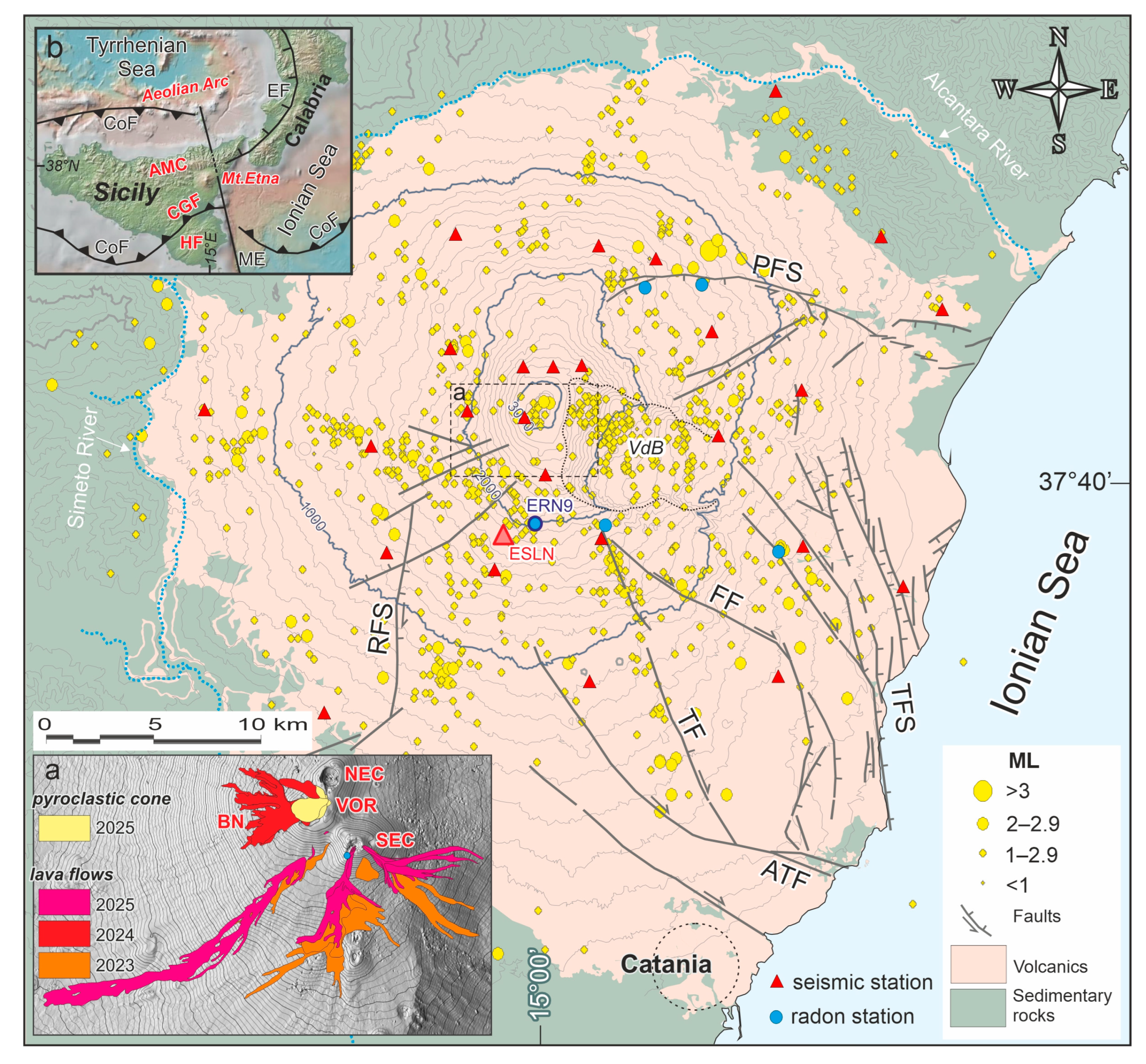
In this work, we present findings from the integrated monitoring of soil radon and seismic activity—including both volcanic tremor and strain release—at Mt. Etna. The monitoring period extended from 15 August 2023 to 15 May 2025. These data were analyzed in relation to Mt. Etna’s volcanic activity during the same period, and their interpretation provided a more comprehensive understanding of the mechanisms governing magma migration and release within the volcano (
Figure 1).
2. Materials and Methods
2.1. Radon Monitoring
Soil gas radon measurements were performed using a permanent
222Rn monitoring station that is part of the geochemical monitoring network of the INGV-OE and it is located on the upper south side of Mt. Etna at an elevation of about 2000 m above sea level (a.s.l.), near a mountain resort called Rifugio Sapienza (site ERN9 in
Figure 1). The station is provided with a radon probe (model Barasol BMC2, AlGaDe, Bessines-sur-Gartempe, France) that consists of a cylindrical chamber (l = 570 mm; ∅ = 60 mm) equipped with an implanted silicon junction specifically designed for alpha particle detection. A built-in microprocessor integrates and stores the radon data into a data logger, with an integration time of 15 min. The station also measures bottom hole air temperature and barometric pressure every 15 min. Differently from the other stations of the radon monitoring network of Mt. Etna, whose setup follows that described in [
5,
6,
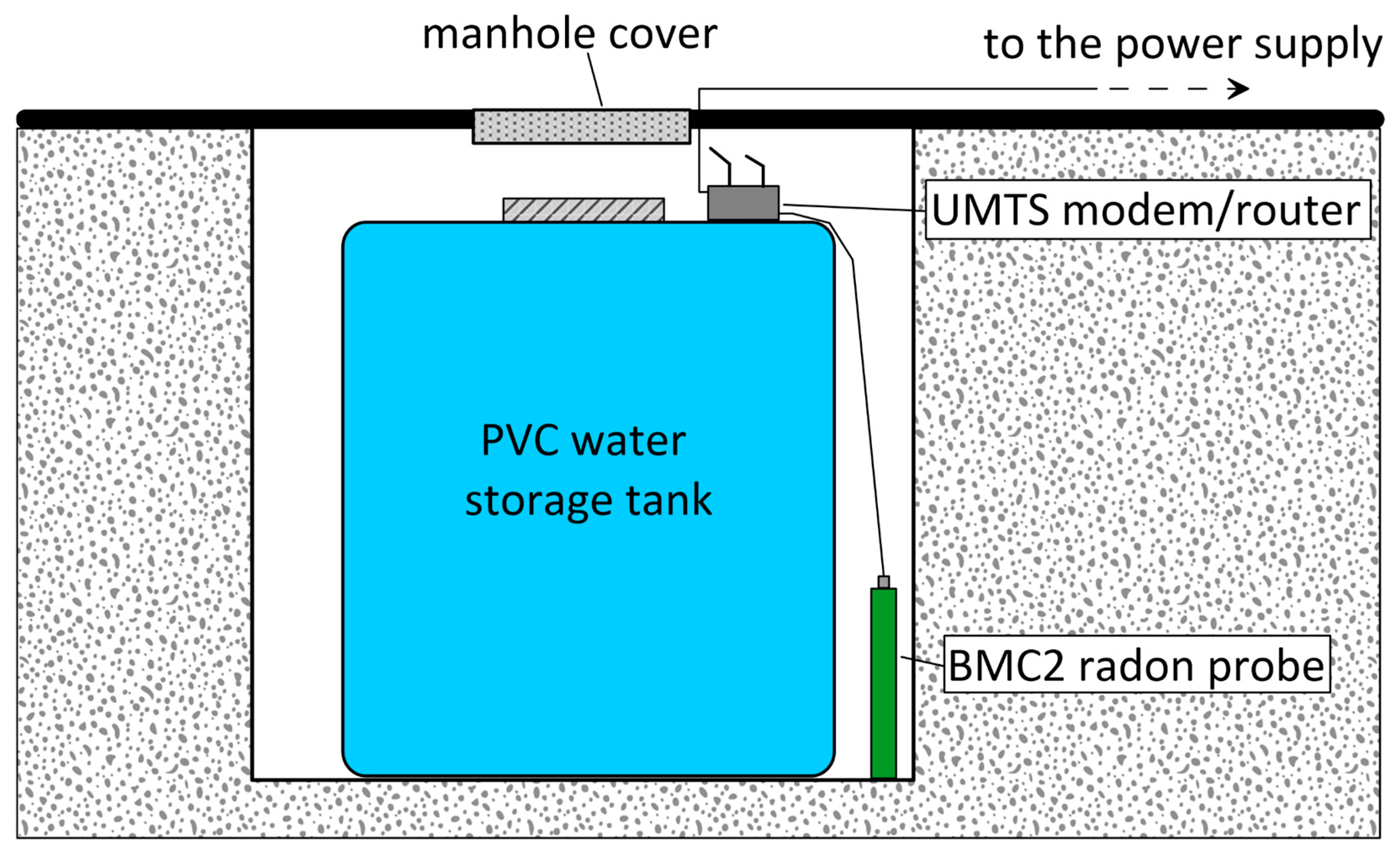
14] with the sensor placed at the bottom of a drill hole at a depth of about 1.5 m in a PVC tube closed with PVC stoppers on the top, the radon probe of ERN9 site is placed about 2 m below ground level at the bottom of a relatively open interspace between a large underground water tank and the concrete walls that surround it (
Figure 2). The acquisition period was initially configured at 15 min but adjusted to one hour to conserve power and eliminate minor high-frequency radon fluctuations caused solely by background noise. During the first year of acquisition, radon data was downloaded locally to a laptop through a direct serial port connection with the radon probe. Later on, the data were transmitted to the INGV-OE headquarters in Catania every 12 h using a UMTS modem/router equipped with a SIM card. Data transmission from the station to the receiver occurs via an omnidirectional antenna.
Although data from a single radon station may not be representative of soil degassing across the entire volcanic edifice, ERN9 was the only station selected for this study because of its strategic location on the upper southern flank of Mt. Etna. This location makes ERN9 particularly suitable for detecting short-term variations associated with volcanic unrest. ERN9 is closest to the summit craters and main feeder conduits, where rapid changes in magmatic degassing and stress conditions typically occur. Additionally, ERN9 is the only site with a sensor setup that facilitates the detection of radon emission anomalies due to its high signal-to-noise ratio.
2.2. Seismic Monitoring
Mt. Etna seismicity is monitored by the INGV-OE permanent seismic network, which currently consists of about 30 stations deployed around the volcano equipped with broadband three-component Trillium 40s seismometers (Nanometrics™, Kanata, ON, Canada) and recording at a sampling rate of 100 Hz (
Figure 1). Seismic signals are transmitted in real-time to the INGV-OE headquarters in Catania, where they are visualized, analyzed and stored in a database.
3. Eruptive Activity
During the study period, Mt. Etna’s volcanic activity was characterized exclusively by summit eruptions from three out of four of its summit craters, namely Voragine (VOR) and Bocca Nuova (BN)—altogether indicated as Central Crater or CC—and Southeast (SEC) and Northeast (NEC) craters (indicated in box a in Figure 1; [
15] and references therein).
Table 1 shows the list of eruptions during the study period. The intensity of the eruptions ranged from mild Strombolian activity to strong sub-Plinian events (also known as “paroxysms”). Paroxysms are normally short-lived and, in the case of Etna, generally persist for only a few hours [
1,
16,
17]. Lava flows were frequently emitted during eruptive episodes from active craters, either by overflowing the crater rims or via fissures that opened in nearby areas [
18]. However, these flows did not impact populated or cultivated zones, owing to the considerable spatial separation between the summit eruptive centers and the inhabited portions of the volcanic edifices.
In detail, the first eruptive activity during the study period was a Strombolian eruption that started on 9 October 2023 at the SEC. It culminated in a paroxysm on 12 November 2023, after which no activity occurred for a week. Strombolian activity resumed at the SEC on 19 November 2023, accompanied by intermittent and weak effusions of lava. As for the previous eruptive episode, this too culminated in a paroxysm on the following 1st December. No significant activity was observed until 10 June 2024, when a Strombolian eruption started at the VOR, after almost three years of total quiescence of this crater. The intensity of this eruption increased progressively with the days, and on 4 July it intensified dramatically until a new paroxysm started, with an impressive lava fountain that lasted about 9 h. After this episode, five more paroxysms occurred at the VOR (6–7, 15, 22–23 July; 4 and 14–15 August). All of those paroxysms at the VOR lasted several hours and were violent. They were all preceded by Strombolian activity that lasted many hours, and they were also characterized by emission of lava flows that, after invading and filling the nearby Bocca Nuova (BN) crater (
Figure 1a), overflowed towards the W and the WSW. The accumulation of explosive products during those paroxysms completed the burying of the BN and in part filled the NEC. It also contributed to the formation of a large and tall cone around the VOR crater, whose highest peak became the highest point of Mt. Etna, reaching an altitude of 3403 m asl, a record never reached in at least 2000 years of the volcano’s documented history [
19].
Simultaneous to the VOR’s explosive events, the Northeast Crater reactivated on July 14, initiating a series of isolated explosions. This was followed by sporadic Strombolian activity continuing through October, with a major interruption between mid-August and the latter half of September. Furthermore, during August, two isolated explosions occurred at the BN. These events effectively re-established the crater’s outgassing pathways, as they cleared part of the lava cover on this crater produced from the VOR eruptions.
The last relevant activity in 2024 is represented by an isolated paroxysm at the VOR-BN (the eruptive vent was actually located in between the two craters) on the morning of 10 November 2024. Following this eruptive episode, no new activity was reported on Etna until 6 February 2025, when Strombolian activity resumed at the SEC. The intensity of this activity increased over the following two days. On 8 February, a series of fractures opened at the southern foot of the BN cone, resulting in a well-fed lava flow being emitted over the southwestern slopes of the volcano. The combined effusive and Strombolian activity continued, though with some short pauses, until 2 March. After the conclusion of this eruption, a sequence of short-lived Strombolian eruptions started on 15 March at the SEC, often with the emission of small lava flows.
The total volume of lava and tephra erupted during the whole period was about 13.3 × 10
6 m
3 [
19,
20,
21,
22,
23,
24,
25,
26,
27,
28,
29,
30,
31,
32,
33,
34,
35,
36,
37,
38,
39,
40,
41,
42,
43,
44,
45,
46].
4. Data Analysis
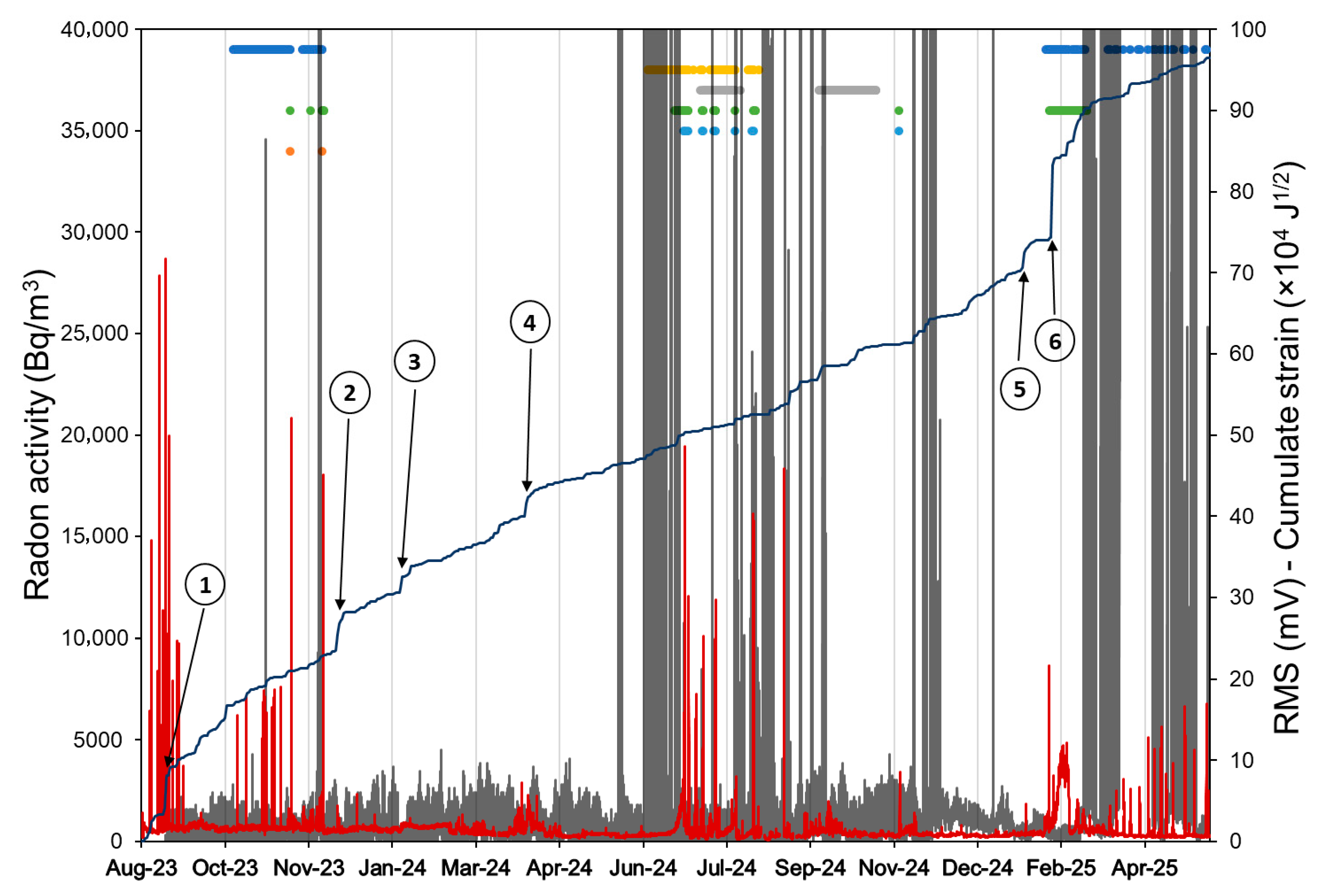
The overview of all the acquired signals over time during the considered period, along with a graphical summary of the concurrent eruptive events that occurred at Mt. Etna, is shown in
Figure 3.
4.1. Radon Activity
Soil radon activity data was acquired with consistent continuity during the studied period (
Figure 3).
Table 2 shows some basic descriptive statistics for the radon data. Radon activity values showed considerable variability, with a range from 0 Bq m
−3 (which in reality corresponds to the detection limit of the sensor: 100 Bq m
−3) to an impressive 2.4 × 10
9 Bq m
−3, a large standard deviation and an even larger sample variance. Although the highest values may seem unrealistic, they are compatible with the upper limit of the values declared by the manufacturer of the sensor (up to >1 × 10
9 Bq m
−3). In addition, similar very high radon levels were measured and reported on Mt. Etna during previous monitoring of low-temperature fumarole emissions near the volcano’s summit [
5]. The very high positive value of skewness, together with the much higher mean value compared to the median and mode, clearly indicates that the radon data follow a strong log-normal probability distribution.
Soil radon signals in general are known to be strongly affected by many environmental parameters, such as air temperature, barometric pressure, rainfall, tidal waves produced from lunar and solar attraction, etc. [
47,
48,
49,
50,
51]. However, these influences usually impact background levels of radon emissions, particularly in active geodynamic regions. Conversely, high radon values representing anomalous emissions are not significantly affected by environmental factors; rather, they are correlated with volcanic or tectonic parameters [
6,
51].
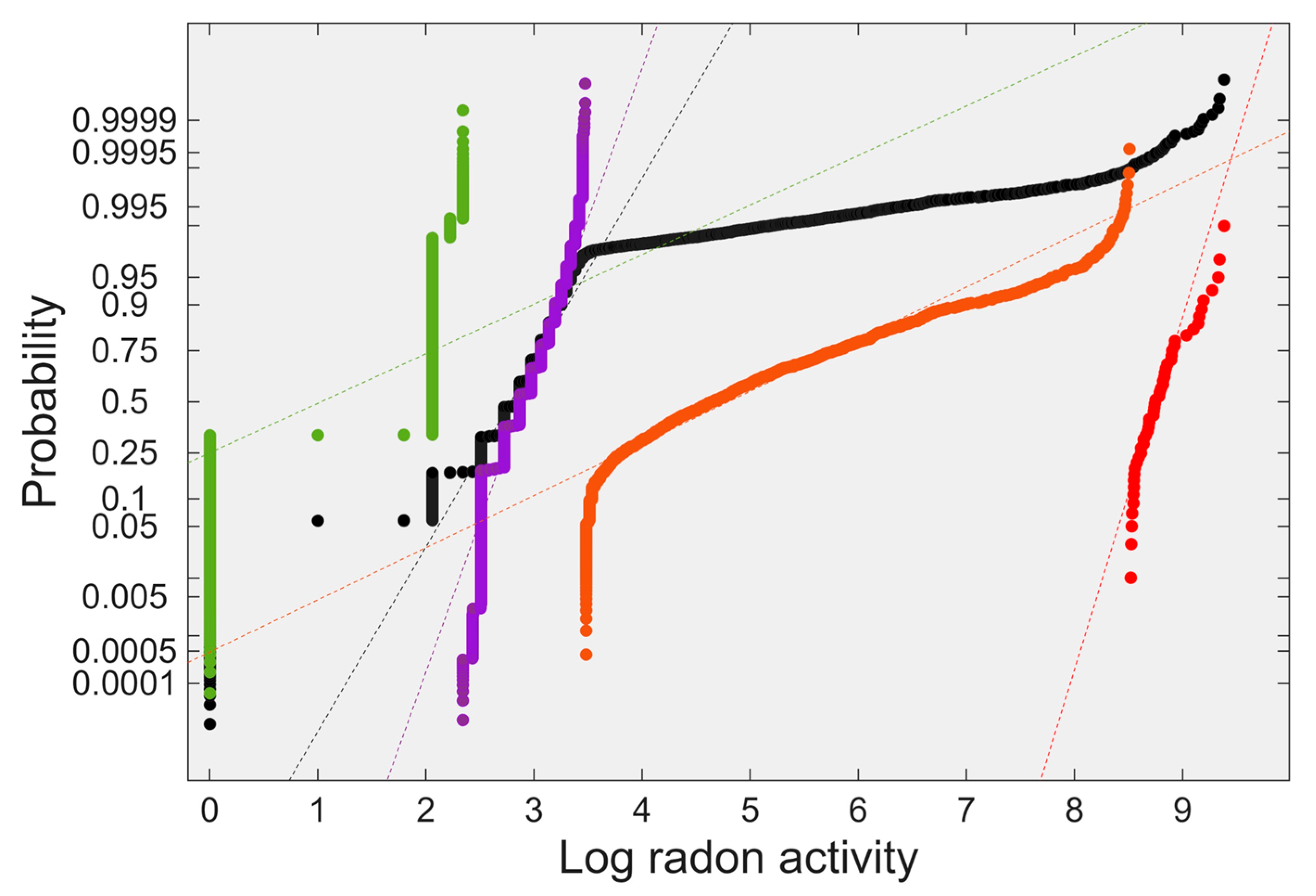
In order to determine the anomaly threshold for soil radon activity measured at the ERN9 site, we applied a log probability plot [
52] to all 47,434 radon values measured during the monitoring period (
Figure 4). The plot shows an evident inflection point at the 97
th percentile and two minor ones, at percentiles 17.7 and 99.8, respectively, thus indicating four distinct populations of data. The mean values of radon activity for the four populations are, respectively, 78.5, 911.3, 1.05 × 10
7 and 7.5 × 10
8 Bq m
−3. The marked inflection point at the 97
th percentile, corresponding to a radon value of 2986 Bq m
−3, defines an important change in the behavior of radon emissions and can, therefore, be interpreted as the transition between background and anomalous soil
222Rn emissions at the monitoring site. The two populations with the highest radon values, i.e., those exceeding the threshold set at 2986 Bq m
−3, are therefore considered to represent anomalous soil radon values.
4.2. Seismic Data
In order to provide a complete picture of the seismic activity, we analyzed the temporal evolution of both volcanic tremor and volcano-tectonic (VT) earthquakes during the period from 15 August 2023 to 15 May 2025.
To follow volcanic tremor amplitude changes, we calculate the Root-Mean-Square (RMS) of the seismic signal recorded by the vertical component of the Serra La Nave seismic station (ESLN), located on the upper southern flank of the volcano at 1778 m a.s.l. (
Figure 1). The RMS time series is calculated on 15 min-long time windows of seismic signal filtered in the frequency band 0.5–5.5 Hz [
53], which includes most of the volcanic tremor energy (e.g., [
3]). This frequency band maximizes the signal-to-noise ratio for detecting changes in tremor amplitude related to shallow magma dynamics, which is the parameter we aim to correlate with radon anomalies and eruptive activity. The temporal evolution of volcanic tremor amplitude is strongly correlated with the intensity of explosive activity [
1]. In fact, the volcanic tremor amplitude gradually increases during the activity ramp-up that leads to Strombolian and/or paroxysmal eruptions. In the latter case in particular, volcanic tremor peaks during the climax of the eruption and then decreases rapidly, returning to normal levels at the end of paroxysmal eruptive episodes ([
2,
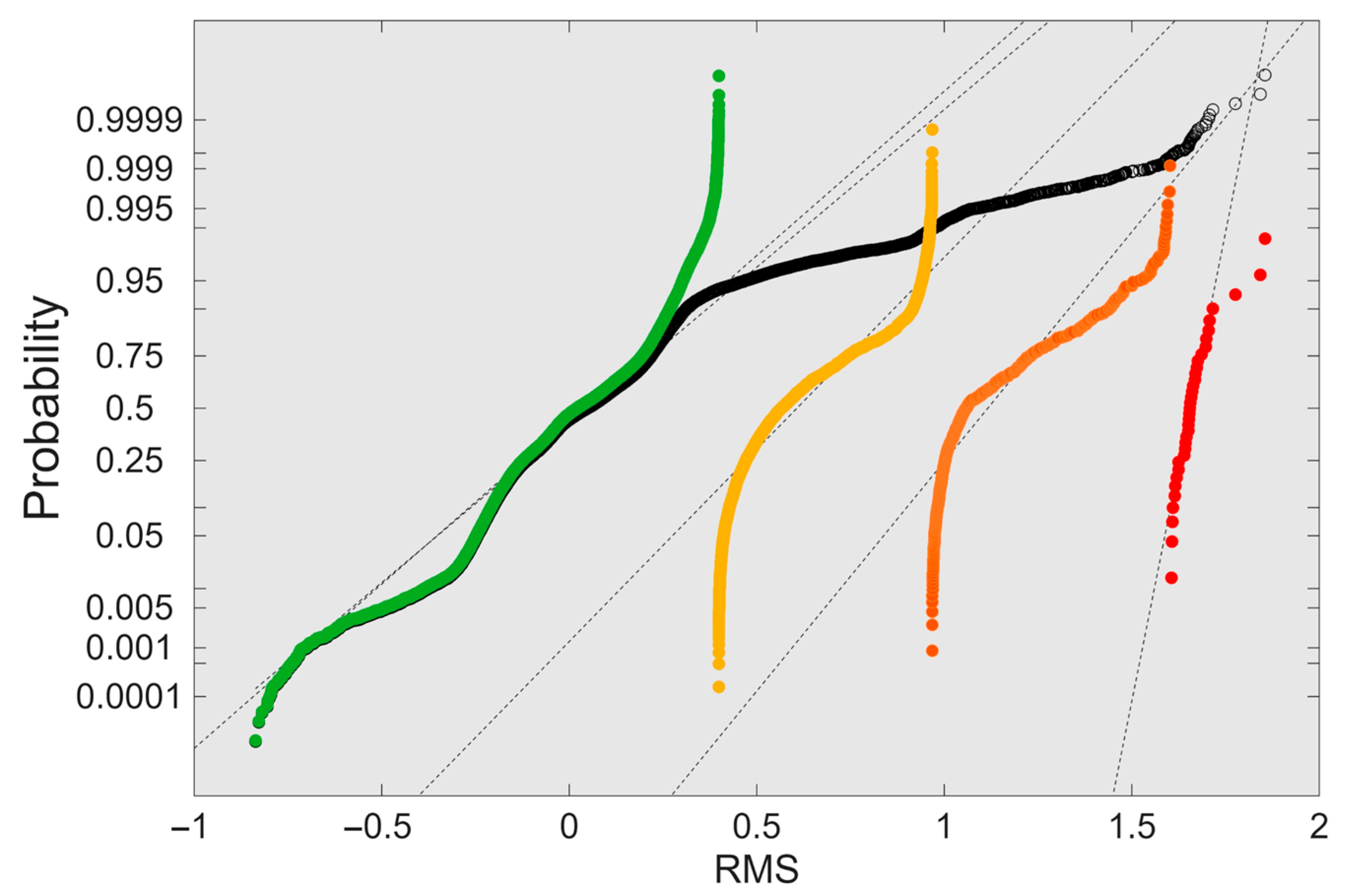
3]; Figure 3). As in the case of radon values, we applied a log probability plot [
52] to all RMS values measured during the monitoring period (
Figure 5). The plot highlights three inflection points that identify four separate statistical populations of data. The most marked inflection point occurs at the 93
rd percentile, which corresponds to an RMS log
10 value of about 0.398, equivalent to 2.5 mV. Therefore, all RMS values below this threshold can be reasonably assumed to be representative of normal background levels of tremor amplitude.
The daily rate of VT and their associated seismic strain release are shown in
Figure 3. Earthquakes were located using the Hypoellipse algorithm [
54] and the 1D crustal velocity model proposed for the Etna area by [
55], later modified by [
56]. The seismic energy (E) in joules (J) is computed using the relationship logE = 9.9 +1.9M − 0.024M
2 [
57]. The epicentral map of the 992 VT earthquakes with ML ≥ 1.0 ERH = ERZ ≤ 6.0 km (error of the epicentral and vertical coordinates in km, respectively), Nl ≥ 7 (number of P-S readings) is shown in
Figure 1 [
58].
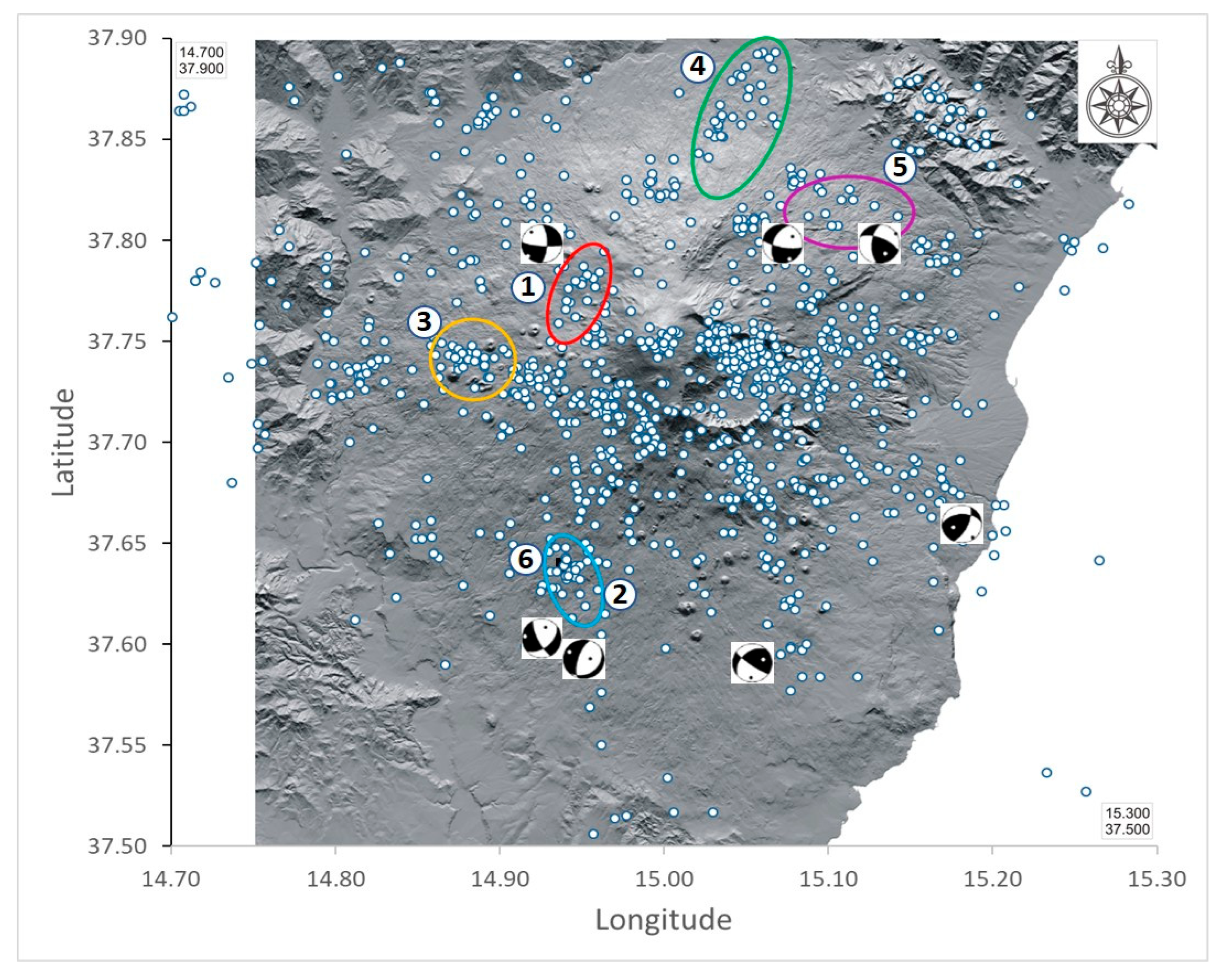
Seismicity in the Mt. Etna area during this period (
Figure 6) was quite modest and mainly concentrated on the eastern and southern flanks of the volcano. The most energetic event (ML = 3.7) occurred along the Pernicana Fault System in February 2025. The pattern of cumulative strain release during the study period is shown in
Figure 3, where some steps are evident due to small seismic swarms located in the northern and western sectors of the volcano and characterized by moderate magnitude. In
Table 3 we reported the main information about the seismic swarms shown in
Figure 6. We also show the focal mechanisms of the earthquakes with ML ≥ 2.7, characterized by left strike-slip focal mechanisms along the Pernicana Fault System, while the western and eastern sectors show dip-slip and strike-slip solutions (Figure 6; [
59]).
Figure 3 provides a visual representation of the potential temporal correlations between the parameters examined in this study and volcanic activity. However, the next chapter will address the statistical and mathematical treatment of the data, which was carried out to achieve a more robust cross-correlation between the parameters and a meaningful probabilistic analysis of anomaly occurrences.
5. Discussion
The data presented in this paper provide a comprehensive overview of Mt. Etna’s volcanic activity, radon signals in the soil, and seismic parameters, enabling an integrated analysis to better understand the mechanisms of volcanic unrest. However, given the single-station configuration and the shallow sensitivity of soil radon, it is not possible to statistically resolve the contribution of individual faults or fault depths to the observed radon anomalies. Radon variations at ERN9 should therefore be interpreted as the integrated response, over a large volume of rock, of the shallow ground permeability field to changes in magmatic degassing and stress conditions. A previous study on radon monitoring at Mt. Etna [
6] determined that the maximum possible depth for radon sources is in the range of 1200 to 1400 m below the surface, based on typical gas velocities and radon emanation in the local rocks. The correlation analysis between radon anomalies and seismic parameters revealed distinct patterns. Specifically, the anomalous values of soil radon activity, that is, all those higher than 2986 Bq m
−3 as defined from the Normal Probability Plot of
Figure 4 (totaling 1040), were temporally correlated to the anomalous values of RMS (i.e., >2.5 mV, as defined from the Normal Probability Plot of
Figure 5) and to the occurrence of any of the eruptive types listed in
Table 1. We calculated the probability that each radon anomaly could be followed by either an anomaly in RMS or an eruptive event of any type in the following 24 h, 48 h and 72 h, using the following:
where P
(1, 2, 3) is the probability of occurrence of an RMS anomaly or an eruptive event within one, two or three days following any radon anomaly.
The results show that radon anomalies precede RMS anomalies with increasing probability over longer time intervals. Specifically,
Table 4 indicates that 30.1% of radon anomalies precede RMS anomalies within 1 day, rising to 38.1% within 2 days and 46.4% within 3 days. This trend suggests a predictive relationship between changes in radon emissions and the intensification of volcanic tremor, a key indicator of shallow magmatic activity. The nature of this correlation, with a time lag, is consistent with the interpretation that increased magmatic degassing and rock microfracturing, which affect radon emissions, may precede the actual ascent of magma responsible for generating tremor. Similarly, radon anomalies show a correlation with eruptive events, although with probabilities that vary depending on the type of activity.
For Strombolian activity, which often precedes paroxysmal episodes, radon anomalies show a significant correlation. For example, radon anomalies precede Strombolian activity at the Central Crater (CC) in 23.8% of cases within 1 day, increasing to 31.4% within 3 days. Similar behavior is observed for Strombolian activity at the Southeast Crater (SEC) and Northeast Crater (NEC), although with slightly lower probabilities. This reinforces the idea that radon may serve as a precursor to the onset or intensification of eruptive activity, reflecting changes in the conditions of the magmatic system prior to visible eruption.
However, the correlation between radon anomalies and paroxysmal events is less pronounced over short time intervals but becomes more evident, though still one order of magnitude lower than for Strombolian activity, as the time window lengthens. For example, radon anomalies preceding CC paroxysms are only 1.5% within 1–2 days but rise to 4.5% within 3 days. For SEC paroxysms, no correlation is observed within 1 day, but it rises to 7.8% within 2 days and 10.8% within 3 days. This difference could indicate that paroxysms, being more rapid and intense events, are preceded by a more complex period of instability that is reflected less directly and immediately in radon emissions than in other parameters. It is possible that the initial stages of preparation for a paroxysm are more subtle and require correlation analysis over longer time scales and/or with the inclusion of other geophysical and geochemical parameters to be fully captured. In addition, paroxysms at Mt. Etna seem to be triggered by a gas-rich magma stored in shallow reservoirs. According to [
17], paroxysms occurring at the SEC during a long-standing sequence of episodes from 2020 to 2022 were fed by magma that was stored at depths ranging from 1.8 km above sea level to −1 km below sea level. This range of depth corresponds to the altitude of the ERN9 site. Therefore, given the mechanisms of radon transport and release through Mt. Etna’s volcanic edifice as explained above, radon emissions caused by volcanic factors associated with the preparatory phases of an impending paroxysm are likely to be better observed in areas at higher altitudes than that of our radon station. Contrary to the correlations observed with RMS and volcanic activity, the data do not show a clear correlation between VT seismicity (in terms of cumulative strain release) and radon anomalies. This behavior can be attributed to the difference in the time windows of these parameters: the radon anomaly period is measured in hours, while strain release is calculated on a daily basis. This mismatch in timescales could mask finer correlations that might emerge with a more consistent temporal resolution between the two datasets. However, from previous studies we noticed that radon variations can have rapid changes that would be lost if integrated on a daily scale.
Furthermore, the dataset considered covers a limited time interval and the entire volcanic edifice; this type of correlation might be more effective when applied to specific sectors of the volcano and with a much longer dataset. Another factor to consider is the position of the radon probe relative to the distribution of seismicity. The station’s elevation (approximately 1800 m above sea level) and its distance from the main areas of epicenters and hypocenters of the recorded earthquakes may attenuate, or even entirely suppress, its ability to detect anomalies associated with co-seismic shaking and fracturing. This is particularly the case for seismic events located more than 10–15 km away from the radon station.
The findings of this study align with and expand on previous research on Mt. Etna. Studies such as those of [
4,
5,
6,
7,
8,
51,
60,
61,
62,
63] have already highlighted radon anomalies linked to rock microfracturing and fluctuations in soil gas pressure due to stronger magmatic degassing. The present work adds a level of robustness to these observations by quantitatively assessing the probabilities of temporal correlation with other monitoring parameters.
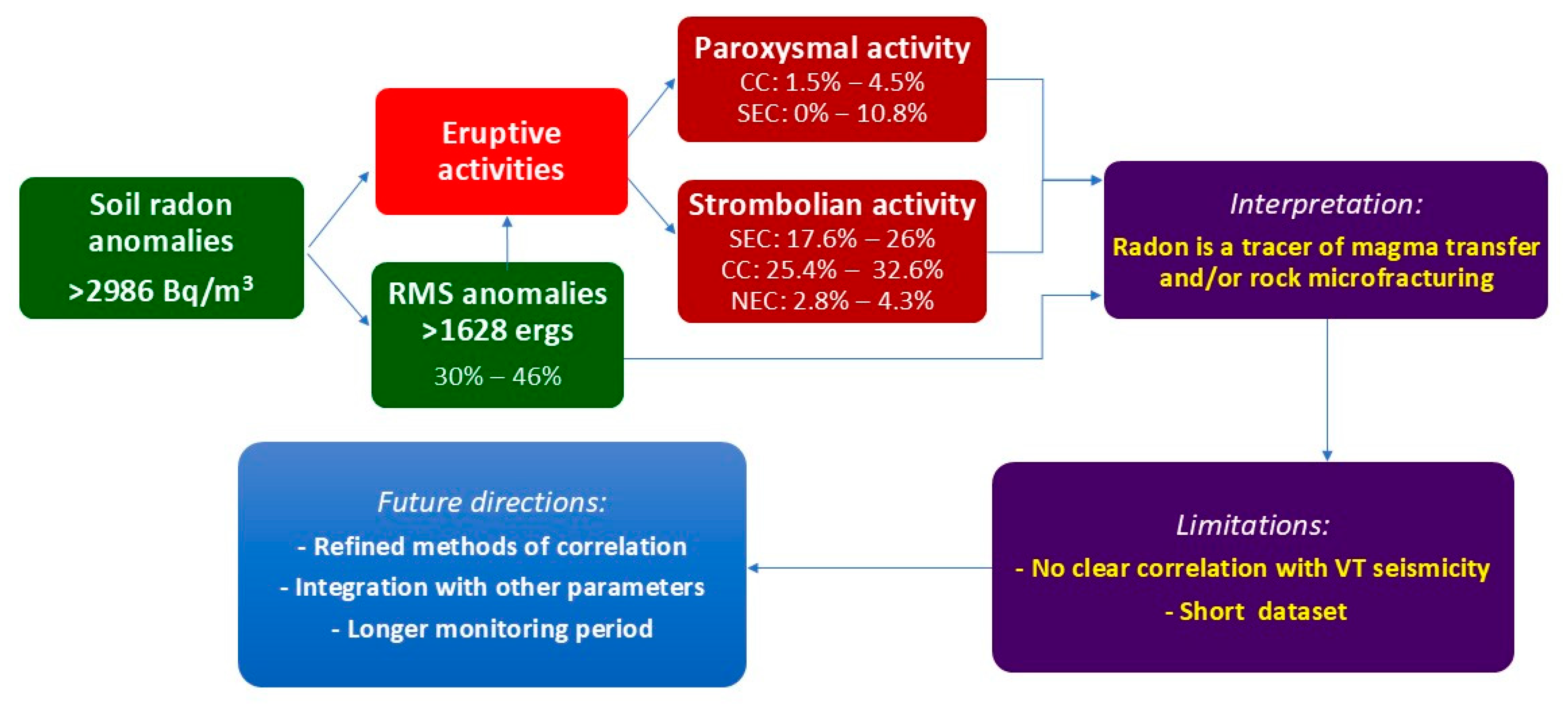
Figure 7 summarizes and illustrates the main results of this study.
Looking ahead, the refinement of correlation methodologies, especially for seismicity and radon, could include the application of advanced analytical techniques that account for different time scales and possible nonlinear relationships. The integration of these datasets with other geophysical and geochemical parameters, along with the expansion of the monitoring period, could further enhance the predictive capacity and deepen our understanding of Etna’s underlying volcanic processes.
6. Conclusions
This study presents an integrated analysis of soil radon emissions, seismic parameters, and eruptive activity at Mt. Etna, offering new insights into the temporal dynamics of volcanic unrest. By correlating radon anomalies with RMS values and eruptive events, the research highlights the potential of radon as a short-term precursor for shallow magmatic processes.
Radon anomalies—defined as values exceeding 2986 Bq m−3—show a statistically significant temporal correlation with RMS anomalies above 2.5 mV. The probability of this correlation increases with time: 30.1% within 24 h, 38.1% within 48 h, and 46.4% within 72 h. This trend supports the hypothesis that radon emissions, influenced by magmatic degassing and rock microfracturing, may precede the ascent of magma and the onset of volcanic tremor.
The analysis also reveals meaningful correlations between radon anomalies and Strombolian activity, particularly at the Central Crater (CC), with probabilities rising from 23.8% within 1 day to 31.4% within 3 days. Similar patterns are observed at the Southeast (SEC) and Northeast (NEC) craters, albeit with slightly lower values. These findings reinforce the role of radon as a geochemical precursor to eruptive behavior, especially for activity involving sustained gas release.
In contrast, correlations with paroxysmal events are less immediate but become more evident over longer time windows. For example, radon anomalies precede SEC paroxysms in 10.8% of cases within 3 days. This suggests that paroxysms may be preceded by more complex and subtle preparatory phases, requiring longer observation periods and the integration of additional geophysical and geochemical parameters to be fully understood.
No clear correlation was found between radon anomalies and seismicity, in terms of cumulative strain release, likely due to mismatched temporal resolutions—hourly for radon, daily for strain—and the broad spatial scale of the dataset. Future studies focusing on specific sectors and longer time series may help clarify these relationships.
Overall, the findings align with previous research and add quantitative support for earlier observations. Previous research at Mt. Etna has shown that soil radon anomalies often precede volcanic tremor variations, shallow magma migration, and changes in eruptive behavior. This highlights the importance of integrating geochemical and geophysical parameters in eruption forecasting studies.
Refining correlation methodologies by incorporating nonlinear models and expanding the monitoring network will be essential for improving our forecasting capabilities and for deepening our understanding of Etna’s magmatic system.
Author Contributions
Conceptualization, S.G., M.N., A.U. and V.M.; methodology, S.G., A.U., S.R.M., F.M. and P.P.; validation, S.G., M.N., V.M. and A.U.; investigation, S.G., V.M., A.U., M.N. and L.F.; resources, S.G. and M.N.; data curation, S.G., V.M., A.U., L.F. and P.P.; writing—original draft preparation, S.G., M.N., V.M., A.U. and L.F.; writing—review and editing, S.G., M.N., V.M., A.U. and L.F.; visualization, S.G., M.N., V.M. and A.U.; supervision, S.G.; funding acquisition, M.N., S.G. All authors have read and agreed to the published version of the manuscript.
Funding
This research was partly funded by the European Union-European Social Fund, project European Plate Observing System-Geoscience Research INfracstructure of Italy, grant number PIR01_00013.
Data Availability Statement
The raw data supporting the conclusions of this article will be made available by the authors on request.
Acknowledgments
We thank A. Bruno, owner of the chalet where we installed the radon sensor used for this study, for giving us the permission to work there and for his logistic support. We are also indebted to the technicians of the INGV-OE seismic network staff for enabling the acquisition of seismic data. Lastly, we thank three anonymous reviewers for their useful comments and suggestions that helped improve the manuscript.
Conflicts of Interest
The authors declare no conflicts of interest. The funders had no role in the design of the study; in the collection, analyses, or interpretation of data; in the writing of the manuscript; or in the decision to publish the results.
Abbreviations
The following abbreviations are used in this manuscript:
| INGV-OE | Istituto Nazionale di Geofisica e Vulcanologia-Sezione Osservatorio Etneo |
| RMS | Root-Mean-Square |
| VT | Volcano-tectonic |
| VOR | Voragine Crater |
| BN | Bocca Nuova Crater |
| CC | Central Crater (VOR + BN) |
| NEC | North East Crater |
| SEC | South East Crater |
References
- Andronico, D.; Cannata, A.; Di Grazia, G.; Ferrari, F. The 1986–2021 paroxysmal episodes at the summit craters of Mt. Etna: Insights into volcano dynamics and hazard. Earth Sci. Rev. 2021, 220, 103686. [Google Scholar] [CrossRef]
- Alparone, S.; Andronico, D.; Lodato, L.; Sgroi, T. Relationship between tremor and volcanic activity during the Southeast Crater eruption on Mount Etna in early 2000. J. Geophys. Res. Solid Earth 2003, 108, 2241–2253. [Google Scholar] [CrossRef]
- Cannata, A.; Catania, A.; Alparone, S.; Gresta, S. Volcanic tremor at Mt. Etna: Inferences on magma dynamics during effusive and explosive activity. J. Volcanol. Geotherm. Res. 2008, 178, 19–31. [Google Scholar] [CrossRef]
- Alparone, S.; Behncke, B.; Giammanco, S.; Neri, M.; Privitera, E. Paroxysmal summit activity at Mt. Etna (Italy) monitored through continuous soil radon measurements. Geophys. Res. Lett. 2005, 32, L16307. [Google Scholar] [CrossRef]
- Neri, M.; Behncke, B.; Burton, M.; Galli, G.; Giammanco, S.; Pecora, E.; Privitera, E.; Reitano, D. Continuous soil radon monitoring during the July 2006 Etna eruption. Geophys. Res. Lett. 2006, 33, L24316. [Google Scholar] [CrossRef]
- Neri, M.; Ferrera, E.; Giammanco, S.; Currenti, G.; Cirrincione, R.; Patanè, G.; Zanon, V. Soil radon measurements as a potential tracer of tectonic and volcanic activity. Sci. Rep. 2016, 6, 24581. [Google Scholar] [CrossRef]
- Falsaperla, S.; Behncke, B.; Langer, H.; Neri, M.; Salerno, G.G.; Giammanco, S.; Pecora, E.; Biale, E. “Failed” eruptions revealed by pattern classification analysis of gas emission and volcanic tremor data at Mt. Etna, Italy. Int. J. Earth Sci. 2014, 103, 297–313. [Google Scholar] [CrossRef][Green Version]
- Falsaperla, S.; Neri, M.; Di Grazia, G.; Langer, H.; Spampinato, S. What happens to in-soil radon activity during a long-lasting eruption? Insights from Etna by multidisciplinary data analysis. Geochem. Geophys. Geosystems 2017, 18, 2162–2176. [Google Scholar] [CrossRef]
- Giammanco, S.; Bonfanti, P.; Neri, M. Radon on Mt. Etna (Italy): A useful tracer of geodynamic processes and a potential health hazard to populations. Front. Earth Sci. 2023, 11, 1176051. [Google Scholar] [CrossRef]
- Cigolini, C.; Laiolo, M.; Coppola, D.; Trovato, C.; Borgogno, G. Radon surveys and monitoring at active volcanoes: Learning from Vesuvius, Stromboli, La Soufrière and Villarrica. In Radon, Health and Natural Hazards; Gillmore, G.K., Perrier, F.E., Crockett, R.G.M., Eds.; Geological Society of London: London, UK, 2018; Volume 451, pp. 183–208. [Google Scholar] [CrossRef]
- Morales-Simfors, N.; Wyss, R.A.; Bundschuh, J. Recent progress in radon-based monitoring as seismic and volcanic precursor: A critical review. Crit. Rev. Env. Sci. Tech. 2019, 50, 1–34. [Google Scholar] [CrossRef]
- Woith, H. Radon earthquake precursor: A short review. Eur. Phys. J. Spec. Top. 2015, 224, 611–627. [Google Scholar] [CrossRef]
- Ganci, G.; Cappello, A.; Neri, M. Data Fusion for Satellite-Derived Earth Surface: The 2021 Topographic Map of Etna Volcano. Remote Sens. 2023, 15, 198. [Google Scholar] [CrossRef]
- Morelli, D.; Immè, G.; Altamore, I.; Cammisa, S.; Giammanco, S.; La Delfa, S.; Mangano, G.; Neri, M.; Patanè, G. Radionuclide measurements, via different methodologies, as tool for geophysical studies on Mt. Etna. Nucl. Instrum. Methods Phys. Res. Sect. A Accel. Spectrom. Detect. Assoc. Equip. 2011, 652, 911–914. [Google Scholar] [CrossRef]
- Neri, M.; De Maio, M.; Crepaldi, S.; Suozzi, E.; Lavy, M.; Marchionatti, F.; Calvari, S.; Buongiorno, F. Topographic Maps of Mount Etna’s Summit Craters, updated to December 2015. J. Maps 2017, 13, 674–683. [Google Scholar] [CrossRef]
- De Beni, E.; Behncke, B.; Branca, S.; Nicolosi, I.; Carluccio, R.; Caracciolo, F.A.; Chiappini, M. The continuing story of Etna’s New Southeast Crater (2012–2014): Evolution and volume calculations based on field surveys and aerophotogrammetry. J. Volcanol. Geotherm. Res. 2015, 303, 175–186. [Google Scholar] [CrossRef]
- Corsaro, R.A.; Miraglia, L.; Arienzo, I.; Di Renzo, V. The 2020–2022 paroxysmal episodes of the South-East Crater (Mt. Etna): Insights into high-frequency eruptive activity from petrological monitoring. Bull. Volcanol. 2024, 86, 85. [Google Scholar] [CrossRef]
- Branca, S.; Coltelli, M.; Groppelli, G. Geological evolution of a complex basaltic stratovolcano: Mount Etna, Italy. Ital. J. Geosci. 2011, 130, 306–317. [Google Scholar] [CrossRef]
- Calvari, S.; Nunnari, G. Reawakening of Voragine, the Oldest of Etna’s Summit Craters: Insights from a Recurrent Episodic Eruptive Behavior. Remote Sens. 2024, 16, 4278. [Google Scholar] [CrossRef]
- INGV. Etna: Bollettino Mensile. INGV-OE 2023a Rep. N. M10/2023 ETNA. Available online: https://www.ct.ingv.it/index.php/monitoraggio-e-sorveglianza/prodotti-del-monitoraggio/bollettini-settimanali-multidisciplinari/846-bollettino-Mensile-sul-monitoraggio-vulcanico-geochimico-e-sismico-del-vulcano-Etna-del-2023-10-31/file (accessed on 11 November 2025).
- INGV. Etna: Bollettino Settimanale. INGV-OE 2023b, Rep. N. 47/2023 ETNA. Available online: https://www.ct.ingv.it/index.php/monitoraggio-e-sorveglianza/prodotti-del-monitoraggio/bollettini-settimanali-multidisciplinari/854-bollettino-Settimanale-sul-monitoraggio-vulcanico-geochimico-e-sismico-del-vulcano-Etna-del-2023-11-21/file (accessed on 10 November 2025).
- INGV. Etna: Bollettino Settimanale. INGV-OE 2023c, Rep. N. 48/2023 ETNA. Available online: https://www.ct.ingv.it/index.php/monitoraggio-e-sorveglianza/prodotti-del-monitoraggio/bollettini-settimanali-multidisciplinari/856-bollettino-Settimanale-sul-monitoraggio-vulcanico-geochimico-e-sismico-del-vulcano-Etna-del-2023-11-28/file (accessed on 11 November 2025).
- INGV. Etna: Bollettino Settimanale. INGV-OE 2023d, Rep. N. 49/2023 ETNA. Available online: https://www.ct.ingv.it/index.php/monitoraggio-e-sorveglianza/prodotti-del-monitoraggio/bollettini-settimanali-multidisciplinari/859-bollettino-Settimanale-sul-monitoraggio-vulcanico-geochimico-e-sismico-del-vulcano-Etna-del-2023-12-05/file (accessed on 10 November 2025).
- INGV. Etna: Bollettino Mensile. INGV-OE 2024a, Rep. N. M6/2024 ETNA. Available online: https://www.ct.ingv.it/index.php/monitoraggio-e-sorveglianza/prodotti-del-monitoraggio/bollettini-settimanali-multidisciplinari/916-bollettino-Mensile-sul-monitoraggio-vulcanico-geochimico-e-sismico-del-vulcano-Etna-del-2024-07-02/file (accessed on 10 November 2025).
- INGV. Etna: Bollettino Settimanale. INGV-OE 2024b, Rep. N. 28/2024 ETNA. Available online: https://www.ct.ingv.it/index.php/monitoraggio-e-sorveglianza/prodotti-del-monitoraggio/bollettini-settimanali-multidisciplinari/919-bollettino-Settimanale-sul-monitoraggio-vulcanico-geochimico-e-sismico-del-vulcano-Etna-del-2024-07-09/file (accessed on 10 November 2025).
- INGV. Etna: Bollettino Settimanale. INGV-OE 2024c, Rep. N. 29/2024 ETNA. Available online: https://www.ct.ingv.it/index.php/monitoraggio-e-sorveglianza/prodotti-del-monitoraggio/bollettini-settimanali-multidisciplinari/922-bollettino-Settimanale-sul-monitoraggio-vulcanico-geochimico-e-sismico-del-vulcano-Etna-del-2024-07-16/file (accessed on 10 November 2025).
- INGV. Etna: Bollettino Settimanale. INGV-OE 2024d, Rep. N. 30/2024 ETNA. Available online: https://www.ct.ingv.it/index.php/monitoraggio-e-sorveglianza/prodotti-del-monitoraggio/bollettini-settimanali-multidisciplinari/923-bollettino-Settimanale-sul-monitoraggio-vulcanico-geochimico-e-sismico-del-vulcano-Etna-del-2024-07-23/file (accessed on 10 November 2025).
- INGV. Etna: Bollettino Settimanale. INGV-OE 2024e, Rep. N. 31/2024 ETNA. Available online: https://www.ct.ingv.it/index.php/monitoraggio-e-sorveglianza/prodotti-del-monitoraggio/bollettini-settimanali-multidisciplinari/925-bollettino-Settimanale-sul-monitoraggio-vulcanico-geochimico-e-sismico-del-vulcano-Etna-del-2024-07-30/file (accessed on 10 November 2025).
- INGV. Etna: Bollettino Settimanale. INGV-OE 2024f, Rep. N. 32/2024 ETNA. Available online: https://www.ct.ingv.it/index.php/monitoraggio-e-sorveglianza/prodotti-del-monitoraggio/bollettini-settimanali-multidisciplinari/929-bollettino-Settimanale-sul-monitoraggio-vulcanico-geochimico-e-sismico-del-vulcano-Etna-del-2024-08-06/file (accessed on 10 November 2025).
- INGV. Etna: Bollettino Settimanale. INGV-OE 2024g, Rep. N. 34/2024 ETNA. Available online: https://www.ct.ingv.it/index.php/monitoraggio-e-sorveglianza/prodotti-del-monitoraggio/bollettini-settimanali-multidisciplinari/934-bollettino-Settimanale-sul-monitoraggio-vulcanico-geochimico-e-sismico-del-vulcano-Etna-del-2024-08-20/file (accessed on 10 November 2025).
- INGV. Etna: Bollettino Settimanale. INGV-OE 2025a, Rep. N. 07/2025 ETNA. Available online: https://www.ct.ingv.it/index.php/monitoraggio-e-sorveglianza/prodotti-del-monitoraggio/bollettini-settimanali-multidisciplinari/986-bollettino-Settimanale-sul-monitoraggio-vulcanico-geochimico-e-sismico-del-vulcano-Etna-del-2025-02-11/file (accessed on 10 November 2025).
- INGV. Etna: Bollettino Settimanale. INGV-OE 2025b, Rep. N. 08/2025 ETNA. Available online: https://www.ct.ingv.it/index.php/monitoraggio-e-sorveglianza/prodotti-del-monitoraggio/bollettini-settimanali-multidisciplinari/987-bollettino-Settimanale-sul-monitoraggio-vulcanico-geochimico-e-sismico-del-vulcano-Etna-del-2025-02-18/file (accessed on 10 November 2025).
- INGV. Etna: Bollettino Settimanale. INGV-OE 2025c, Rep. N. 09/2025 ETNA. Available online: https://www.ct.ingv.it/index.php/monitoraggio-e-sorveglianza/prodotti-del-monitoraggio/bollettini-settimanali-multidisciplinari/990-bollettino-Settimanale-sul-monitoraggio-vulcanico-geochimico-e-sismico-del-vulcano-Etna-del-2025-02-25/file (accessed on 10 November 2025).
- INGV. Etna: Bollettino Settimanale. INGV-OE 2025d, Rep. N. 10/2025 ETNA. Available online: https://www.ct.ingv.it/index.php/monitoraggio-e-sorveglianza/prodotti-del-monitoraggio/bollettini-settimanali-multidisciplinari/991-bollettino-Settimanale-sul-monitoraggio-vulcanico-geochimico-e-sismico-del-vulcano-Etna-del-2025-03-04/file (accessed on 10 November 2025).
- INGV. Etna: Bollettino Settimanale. INGV-OE 2025e, Rep. N. 11/2025 ETNA. Available online: https://www.ct.ingv.it/index.php/monitoraggio-e-sorveglianza/prodotti-del-monitoraggio/bollettini-settimanali-multidisciplinari/994-bollettino-Settimanale-sul-monitoraggio-vulcanico-geochimico-e-sismico-del-vulcano-Etna-del-2025-03-11/file (accessed on 10 November 2025).
- INGV. Etna: Bollettino Settimanale. INGV-OE 2025f, Rep. N. 12/2025 ETNA. Available online: https://www.ct.ingv.it/index.php/monitoraggio-e-sorveglianza/prodotti-del-monitoraggio/bollettini-settimanali-multidisciplinari/997-bollettino-Settimanale-sul-monitoraggio-vulcanico-geochimico-e-sismico-del-vulcano-Etna-del-2025-03-18/file (accessed on 10 November 2025).
- INGV. Etna: Bollettino Settimanale. INGV-OE 2025g, Rep. N. 13/2025 ETNA. Available online: https://www.ct.ingv.it/index.php/monitoraggio-e-sorveglianza/prodotti-del-monitoraggio/bollettini-settimanali-multidisciplinari/998-bollettino-Settimanale-sul-monitoraggio-vulcanico-geochimico-e-sismico-del-vulcano-Etna-del-2025-03-25/file (accessed on 10 November 2025).
- INGV. Etna: Bollettino Settimanale. INGV-OE 2025h, Rep. N. 14/2025 ETNA. Available online: https://www.ct.ingv.it/index.php/monitoraggio-e-sorveglianza/prodotti-del-monitoraggio/bollettini-settimanali-multidisciplinari/1000-bollettino-Settimanale-sul-monitoraggio-vulcanico-geochimico-e-sismico-del-vulcano-Etna-del-2025-04-01/file (accessed on 10 November 2025).
- INGV. Etna: Bollettino Settimanale. INGV-OE 2025i, Rep. N. 15/2025 ETNA. Available online: https://www.ct.ingv.it/index.php/monitoraggio-e-sorveglianza/prodotti-del-monitoraggio/bollettini-settimanali-multidisciplinari/1003-bollettino-Settimanale-sul-monitoraggio-vulcanico-geochimico-e-sismico-del-vulcano-Etna-del-2025-04-08/file (accessed on 10 November 2025).
- INGV. Etna: Bollettino Settimanale. INGV-OE 2025j, Rep. N. 16/2025 ETNA. Available online: https://www.ct.ingv.it/index.php/monitoraggio-e-sorveglianza/prodotti-del-monitoraggio/bollettini-settimanali-multidisciplinari/1007-bollettino-Settimanale-sul-monitoraggio-vulcanico-geochimico-e-sismico-del-vulcano-Etna-del-2025-04-15/file (accessed on 10 November 2025).
- INGV. Etna: Bollettino Settimanale. INGV-OE 2025k, Rep. N. 17/2025 ETNA. Available online: https://www.ct.ingv.it/index.php/monitoraggio-e-sorveglianza/prodotti-del-monitoraggio/bollettini-settimanali-multidisciplinari/1009-bollettino-Settimanale-sul-monitoraggio-vulcanico-geochimico-e-sismico-del-vulcano-Etna-del-2025-04-22/file (accessed on 10 November 2025).
- INGV. Etna: Bollettino Settimanale. INGV-OE 2025l, Rep. N. 18/2025 ETNA. Available online: https://www.ct.ingv.it/index.php/monitoraggio-e-sorveglianza/prodotti-del-monitoraggio/bollettini-settimanali-multidisciplinari/1011-bollettino-Settimanale-sul-monitoraggio-vulcanico-geochimico-e-sismico-del-vulcano-Etna-del-2025-04-29/file (accessed on 10 November 2025).
- INGV. Etna: Bollettino Settimanale. INGV-OE 2025m, Rep. N. 19/2025 ETNA. Available online: https://www.ct.ingv.it/index.php/monitoraggio-e-sorveglianza/prodotti-del-monitoraggio/bollettini-settimanali-multidisciplinari/1012-bollettino-Settimanale-sul-monitoraggio-vulcanico-geochimico-e-sismico-del-vulcano-Etna-del-2025-05-06/file (accessed on 10 November 2025).
- INGV. Etna: Bollettino Settimanale. INGV-OE 2025n, Rep. N. 20/2025 ETNA. Available online: https://www.ct.ingv.it/index.php/monitoraggio-e-sorveglianza/prodotti-del-monitoraggio/bollettini-settimanali-multidisciplinari/1018-bollettino-Settimanale-sul-monitoraggio-vulcanico-geochimico-e-sismico-del-vulcano-Etna-del-2025-05-13/file (accessed on 10 November 2025).
- INGV. Etna: Bollettino Settimanale. INGV-OE 2025o, Rep. N. 21/2025 ETNA. Available online: https://www.ct.ingv.it/index.php/monitoraggio-e-sorveglianza/prodotti-del-monitoraggio/bollettini-settimanali-multidisciplinari/1022-bollettino-Settimanale-sul-monitoraggio-vulcanico-geochimico-e-sismico-del-vulcano-Etna-del-2025-05-20/file (accessed on 10 November 2025).
- Ganci, G.; Billotta, G.; Dozzo, M.; Spina, G.; Zuccarello, F.; Cristofaro, R.; Guardo, R.; Spina, M.; Cappello, A. Multi-platform satellite-derived products during the 2025 Etna eruption. Sci. Data 2025, 12, 1353. [Google Scholar] [CrossRef] [PubMed]
- Hinkle, M.E. Factors affecting concentrations of helium and carbon dioxide in soil gases. In Geochemistry of Gaseous Elements and Compounds; Durance, E.M., Ed.; Theophrastus Publications SA: Athens, Greece, 1990; pp. 421–447. [Google Scholar]
- Klusman, R.W.; Jaacks, J.A. Environmental influences upon mercury radon helium concentrations in soil gases at a site near Denver Colorado. J. Geochem. Explor. 1987, 27, 259–280. [Google Scholar] [CrossRef]
- Pinault, J.L.; Baubron, J.C. Signal processing of soil gas radon, atmospheric pressure, moisture and soil temperature data: A new approach for radon concentration modelling. J. Geophys. Res. 1996, 101, 3157–3171. [Google Scholar] [CrossRef]
- Toutain, J.P.; Baubron, J.C. Gas geochemistry and seismotectonics: A review. Tectonophys 1999, 304, 1–27. [Google Scholar] [CrossRef]
- Ichedef, M.; Giammanco, S.; Neri, M.; Catalano, R.; Immé, G.; Morelli, D.; Muré, F.; Giudice, N. In soil radon anomalies and volcanic activity on Mt. Etna (Italy). J. Environ. Radioact. 2020, 218, 106267. [Google Scholar] [CrossRef] [PubMed]
- Sinclair, A.J. A fundamental approach to threshold estimation in exploration geochemistry: Probability plots revisited. J. Geochem. Explor. 1991, 41, 1–22. [Google Scholar] [CrossRef]
- Cassisi, C.; Montalto, P.; Aliotta, M.A.; Cannata, A.; Prestifilippo, M. TSDSystem: Un database multidisciplinare per la gestione di serie temporali. Rapp. Tec. INGV 2015, 304, 1–34. [Google Scholar] [CrossRef]
- Lahr, J.C. HYPOELLIPSE/Version2.0: A Computer Program for Determining Local Earthquakes Hypocentral Parameters Magnitude First Motion Pattern; U.S. Geological Survey: Reston, VA, USA, 1989; Volume 89–116, pp. 1–81. [CrossRef]
- Hirn, A.; Nercessian, A.; Sapin, M.; Ferrucci, F.; Wittlinger, G. Seismic heterogeneity of Mt Etna: Structure activity. Geophys. J. Int. 1991, 105, 139–153. [Google Scholar] [CrossRef]
- Patanè, D.; Privitera, E.; Ferrucci, F.; Gresta, S. Seismic activity leading to the 1991–1993 eruption of Mt Etna and its tectonic implications. Acta Vulcanol. 1994, 4, 47–55. [Google Scholar]
- Richter, C.F. Elementary Seismology; W.H. Freeman: San Francisco, CA, USA, 1958; pp. 1–768. [Google Scholar]
- Barberi, G.; Di Grazia, G.; Ferrari, F.; Firetto Carlino, M.; Giampiccolo, E.; Maiolino, V.; Mostaccio, A.; Musumeci, C.; Scaltrito, A.; Sciotto, M.; et al. Mt. Etna Revised Seismic Catalog from 2020 (EtnaRSC2020) (Version 1); Istituto Nazionale di Geofisica e Vulcanologia (INGV): Rome, Italy, 2020. [CrossRef]
- Scarfì, L.; Cassisi, C.; Messina, A.A. Sicily and Southern Calabria Focal Mechanisms Catalog (SCFocMeC) (Version; Istituto Nazionale di Geofisica e Vulcanologia (INGV)—Osservatorio Etneo (OE): Rome, Italy, 2013. [CrossRef]
- Neri, M.; Giammanco, S.; Leonardi, A. Preliminary Indoor Radon Measurements Near Faults Crossing Urban Areas of Mt. Etna Volcano (Italy). Front. Public Health 2019, 7, 105. [Google Scholar] [CrossRef] [PubMed]
- Giammanco, S.; Sims, K.W.W.; Neri, M. Measurements of 220Rn and 222Rn and CO2 emissions in soil and fumarole gases on Mt. Etna volcano (Italy): Implications for gas transport and shallow ground fracture. Geochem. Geophys. Geosystems 2007, 8, Q10001. [Google Scholar] [CrossRef]
- Giammanco, S.; Immè, G.; Mangano, G.; Morelli, D.; Neri, M. Comparison between different methodologies for detecting Radon in soil along an active fault: The case of the Pernicana fault system, Mt. Etna. Appl. Radiat. Isot. 2009, 67, 178–185. [Google Scholar] [CrossRef]
- Voltattorni, N.; Giammanco, S.; Galli, G.; Gasparini, A.; Neri, M. Indoor Radon Monitoring and Associated Diffuse Radon Emissions in the Flanks of Mt. Etna (Italy). Atmosphere 2024, 15, 1359. [Google Scholar] [CrossRef]
| Disclaimer/Publisher’s Note: The statements, opinions and data contained in all publications are solely those of the individual author(s) and contributor(s) and not of MDPI and/or the editor(s). MDPI and/or the editor(s) disclaim responsibility for any injury to people or property resulting from any ideas, methods, instructions or products referred to in the content. |




 ,
,