Article

Human Occupation of the Central Balkans During the Last Glacial Maximum: Evidence from Serbia

1
School of Anthropology, University of Arizona, Tucson, AZ 85721-0030, USA
2
Faculty of Philosophy, University of Belgrade, Čika-Ljubina 18-20, 11000 Beograd, Serbia
3
Division of Geochronology and Environmental Isotopes, Institute of Physics, Centre for Science and Education, Silesian University of Technology, 44-100 Gliwice, Poland
4
Institute of Geography, Trg Dositeja Obradovića 3, 21000 Novi Sad, Serbia
5
Department of Geology, Lund University, Sölvegatan 12, 223 62 Lund, Sweden
6
Department of Anthropology, University of Winnipeg, 515 Portage Avenue, Winnipeg, MB R3B 2E9, Canada
*
Author to whom correspondence should be addressed.
Quaternary 2026, 9(1), 17; https://doi.org/10.3390/quat9010017
Submission received: 10 October 2025 / Revised: 26 January 2026 / Accepted: 2 February 2026 / Published: 11 February 2026

Abstract

This paper presents archeological data and chronometric dates documenting human presence in Serbia, central Balkans, during MIS 2. We describe findings from excavations at three cave sites and dating results from two additional localities. The evidence suggests that people were present in the area during the second half of the glacial peak between 25 and 19ka calBp. The chronological placement of these sites is complementary to what is known from adjoining regions, indicating that people may have occupied this part of the Balkans when they were not present elsewhere. All three excavated sites appear to represent short-term occupations, with relatively narrow ranges of activities, raising the question of whether they are fully representative of the land use system of foragers during MIS 2.

1. Introduction

Marine Isotope Stage 2, or the Last Glacial Maximum (LGM), had profound consequences for the sizes and distributions of human populations across the globe [1,2]. At the peak of the LGM (ca. 26 ka to 21 ka), large parts of the Northern Hemisphere were covered by glaciers or cold deserts and were effectively depopulated. In the Southern Hemisphere, desertification had similar effects, making it impossible for human populations to remain established in many places. During the coldest, driest periods, populations of humans, other animals, and plants were confined to a series of refugia, where conditions were more favorable. In Europe, the northern Mediterranean and southern Atlantic coasts, along with parts of the large Mediterranean peninsulas, are well known as LGM refugia for humans and other species. In some smaller areas, termed “cryptic refugia,” conditions remained favorable for maintaining diverse biotic communities, enabling different species to persist through cold glacial periods [3]. While the Balkans are sometimes considered a reservoir for repopulation of both Western and Eastern Europe after glaciations, the exact role the region played as an LGM glacial refugium remains unclear. The complex topography supports a high level of biotic diversity today, and some animal and plant taxa survived there, even through the peak glacial periods [4,5,6,7,8,9]; consequently, the Balkans have also been identified as a possible Late Pleistocene glacial refugium for a range of species, including humans [10,11,12,13]. On the other hand, although numerous sites from periods before the LGM have been identified in the central Balkans [14,15], it has been difficult to find evidence of human presence in the interior of the peninsula dating to the peak of MIS 2 [16,17]. Recent fieldwork, dating efforts, and syntheses of results [16,17,18] have filled in some of the chronological gaps in the archeological record, demonstrating that humans were present in at least some parts of the Balkans during at least some parts of MIS 2.
This paper presents findings pertaining to human presence in the central Balkans, in and around the Morava River basin, within the modern nation of Serbia, during MIS 2. We describe archeological and dating results from excavations at three cave sites, along with dates from two additional localities. The evidence suggests that people were present in the region during the second half of the glacial peak. The chronological placement of these sites is complementary to what is known from adjoining regions, including the eastern Adriatic basin [17] as well as Poland, Moravia, and Austria [18], suggesting that people were present the central Balkans when they were not present in these other places. The archeological evidence from the three sites provides a fragmented picture of land use and lithic technology. All three sites appear to represent short-term occupations, and two show very narrow ranges of activities. The question of whether they are fully representative of LGM land use strategies remains open.

Environmental Background

Despite the lack of reliable local paleoenvironmental records, it can be inferred that, during the Last Glacial period, the environments along the Adriatic Sea coast and the Central Balkan Peninsula exhibited notable differences. While both regions were shaped by global glacial conditions, the Adriatic Sea coast and the Central Balkan Peninsula likely exhibited distinct trajectories of climatic and environmental change. The Adriatic coast, influenced by the Mediterranean Sea, experienced a relatively milder climate, with less extreme temperatures and a more stable environment. These conditions allowed for certain plant and animal species to persist even during the Last Glacial Maximum [19,20]. In contrast, the Central Balkan Peninsula, located further inland, experienced harsher continental conditions, such as colder temperatures, more extreme seasonality, and the expansion of glacial ice sheets [21]. This led to a more challenging environment, marked by the reduction or retreat of many species and the dominance of cold-adapted flora and fauna.
As the glacial period came to an end, the Adriatic coast saw a more gradual warming and a slower transition to post-glacial environments, including the recovery of Mediterranean vegetation and the re-establishment of forest ecosystems [22]. Meanwhile, the Central Balkans experienced more rapid environmental shifts, characterized by the retreat of glaciers and the spread of temperate forest ecosystems, although the region’s harsher climate delayed certain aspects of ecological recovery [9]. As a consequence of these divergent trajectories, we can expect the coexistence of diverse climatic conditions and biotic environments at a subregional scale. This situation is well illustrated by a long dry phase between approximately 22 and 12 ka, recognized in the speleothem record from Poleva Cave [23]. The conditions that favored spatial and temporal diversity in biotic landscapes would, in turn, have had a pronounced effect on the location and land-use strategies of Paleolithic human populations [2,24]. The relatively stable conditions along the Adriatic coast supported more continuous human occupation and cultural development [25,26,27], while the harsher and more variable environments of the Central Balkans posed greater challenges to human resilience.

2. Materials and Methods

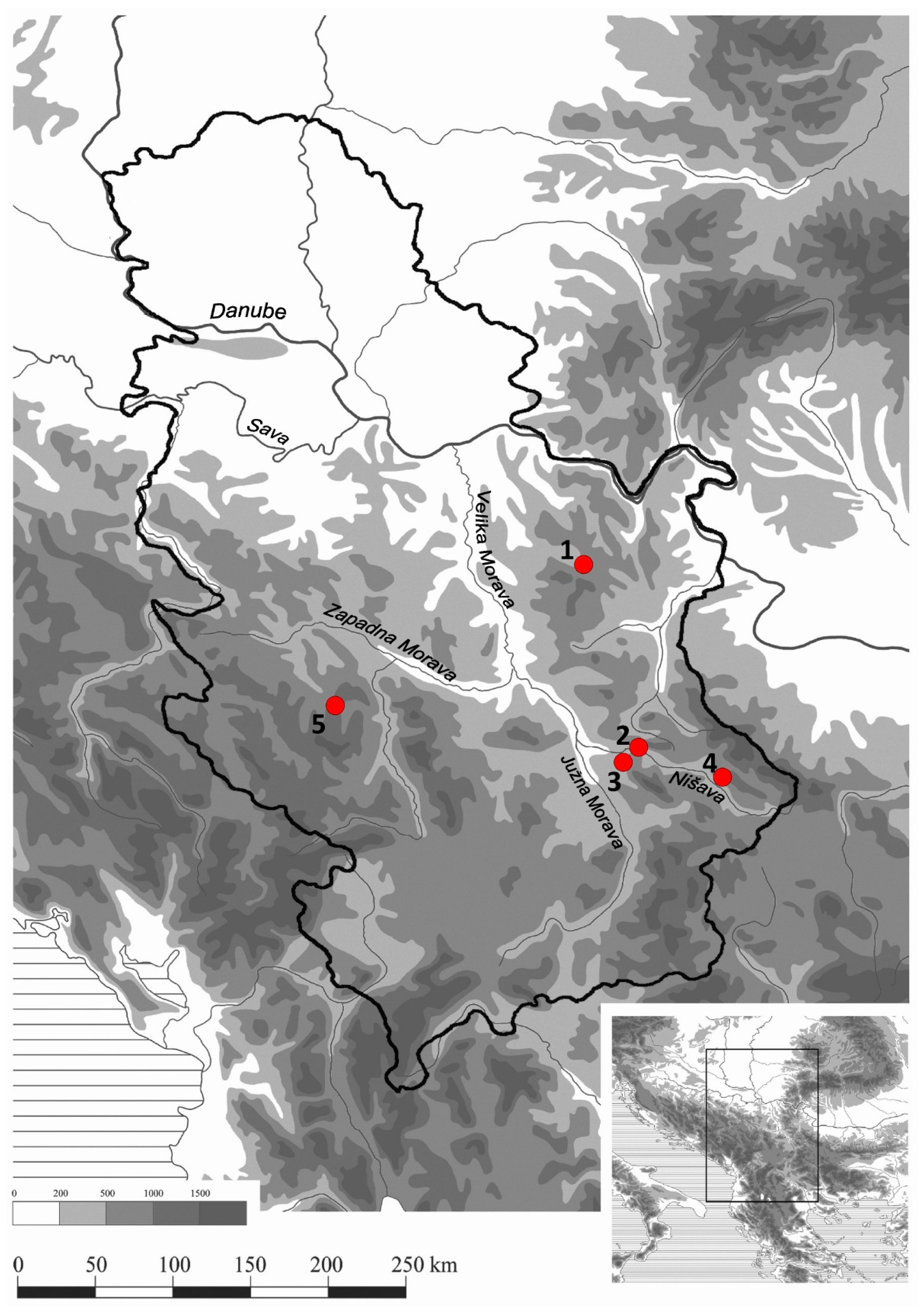
The archeological data presented here mainly come from three recently excavated cave sites: Velika Pećina, Velika Vranovica, and Pećina kod Stene (Figure 1). The sites, their geology, and the archeological samples are described briefly below.

2.1. Velika Pećina

Velika Pećina (VP) is situated in a rugged karst landscape to the east of the Morava river basin. The cave is located within the narrow canyon of the Crna Reka (Black river), a tributary of the Tisnica river, 5–6 km southeast of the town of Žagubica. The cave mouth opens near the bottom (446 masl) of the winding canyon, roughly mid-way between the basin downstream to the west (ca. 320 masl) and higher plateau lands upstream (700–800 masl). The cave is a medium-sized but complex karstic cavity exposed near the base of a near-vertical limestone cliff on the north bank of the river. The central chamber, where the main excavation took place, is a high-ceilinged cavity roughly 7 m wide and 8 m deep. The entrance faces southeast, and the floor at the entrance lies about 10 m above the modern riverbed. Two narrow, tubular passages emanate from the northwest and northeast sides of the main chamber.
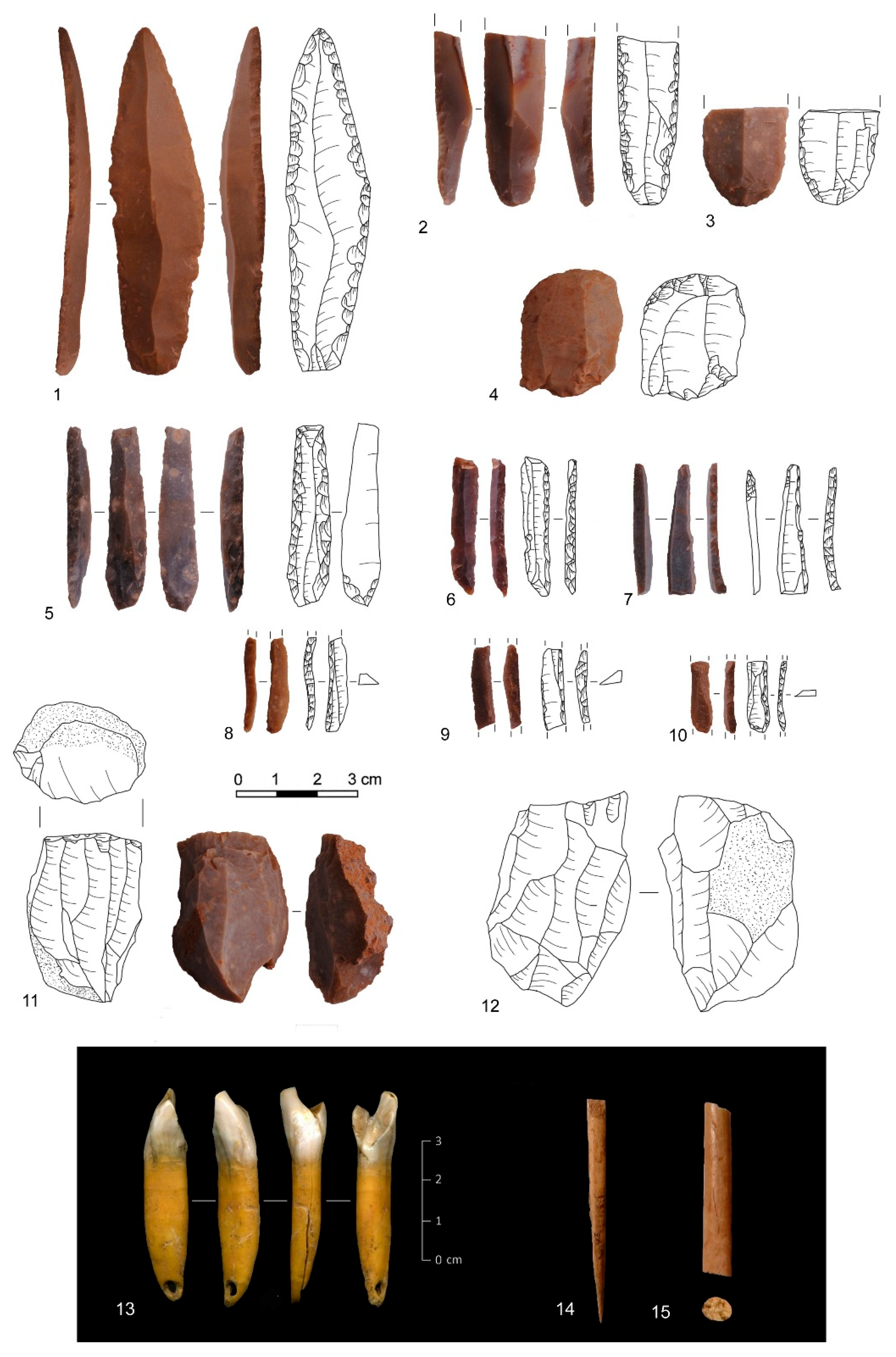
The stratigraphic sequence at VP has been detailed in a prior publication [28]. The intact sedimentary infilling of Velika Pećina varies between 1.2 and 1.75 m in thickness, depending on location within the cave. The stratigraphic sequence consisted of four main units or layers, each of which was subdivided based on variations in color, induration, sediment composition, and anthropogenic content. Upper Paleolithic artifacts, fauna, and other materials were recovered from all four layers, but it appeared that they were in primary context only in Layers 2 and 3. Layer 2 is defined by reddish clayey sediments with variable amounts of angular limestone debris. The sediments of Layer 3 are also rich in clay, but include larger amounts of sand and fine gravel than Layer 2. Layer 3 yielded the largest samples of bones and lithics, mostly from sub-units 3b and 3c (pp. 2–3, [28]). VP provided the largest samples of non-stone artifacts and fauna of the three sites discussed here. A small but diverse collection of bone artifacts includes two fine awls or needles, both missing the bases, and well as fragments of worked bone, antler, and ivory [28]. Figure 2 shows characteristic stone and osseous artifacts from Velika Pećina.
In all, 160 macro-vertebrate remains (NISP) were collected from Layer 2 and 1221 from Layer 3 [28] at VP. The species represented include a range of large herbivores, including equids, bovids and cervids, small carnivores, and birds; the birds are especially diverse taxonomically. Table 1 presents the taxonomic composition of the VP faunas.

2.2. Velika Vranovica

Velika Vranovica (VV), also referred to as Donja Pećina in a previous publication [29], is a large cave situated on the north side of the steep, deeply incised Sićevo gorge of the Nišava river, at ca. 276 m above sea level, about 20 km east of the city of Niš. One of the first prehistoric archeological excavations in Serbia was carried out at Velika Vranovica in the 19th century. Early investigators found only archeological remains from the early and middle Holocene in the cave [30,31].
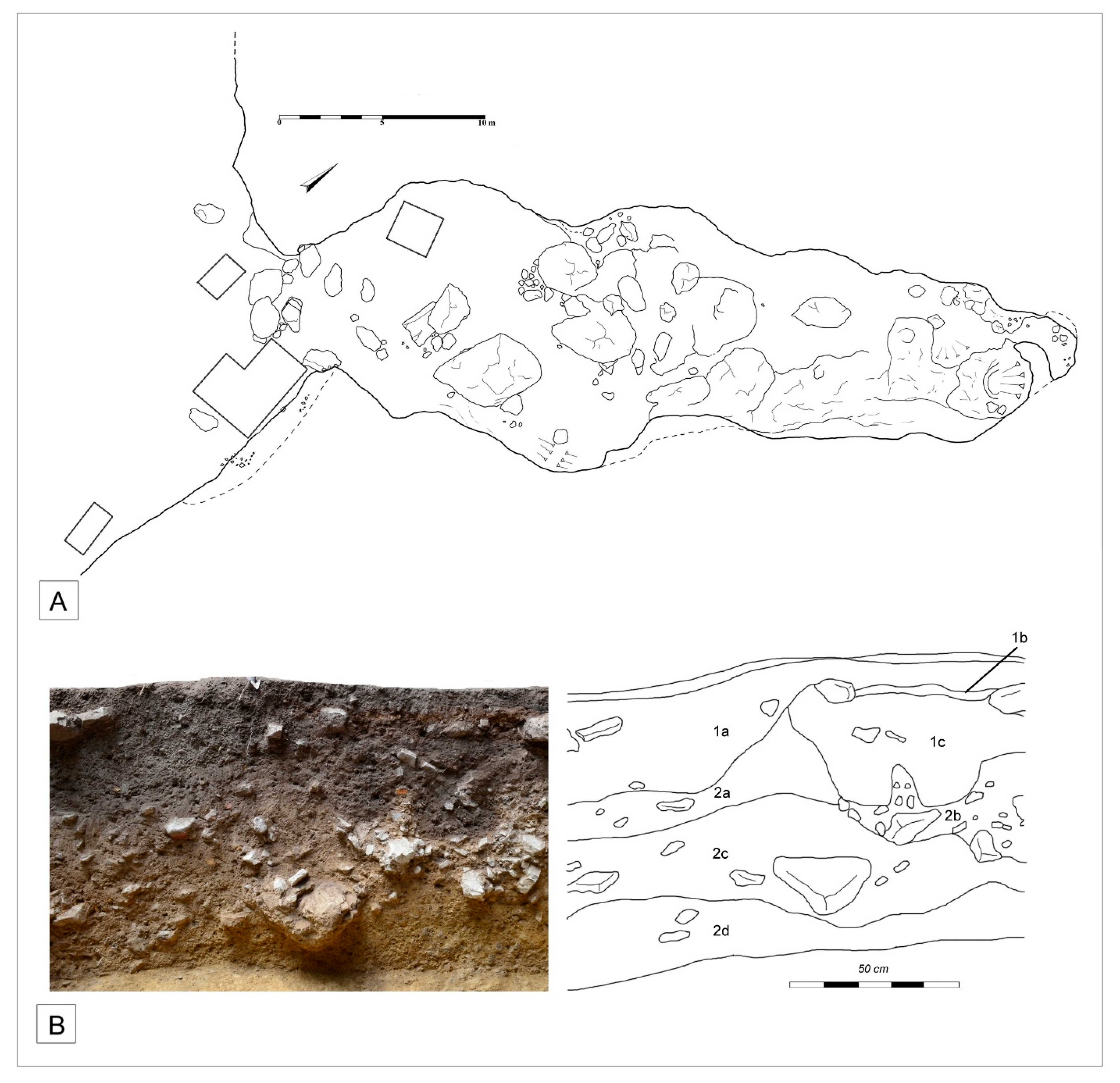
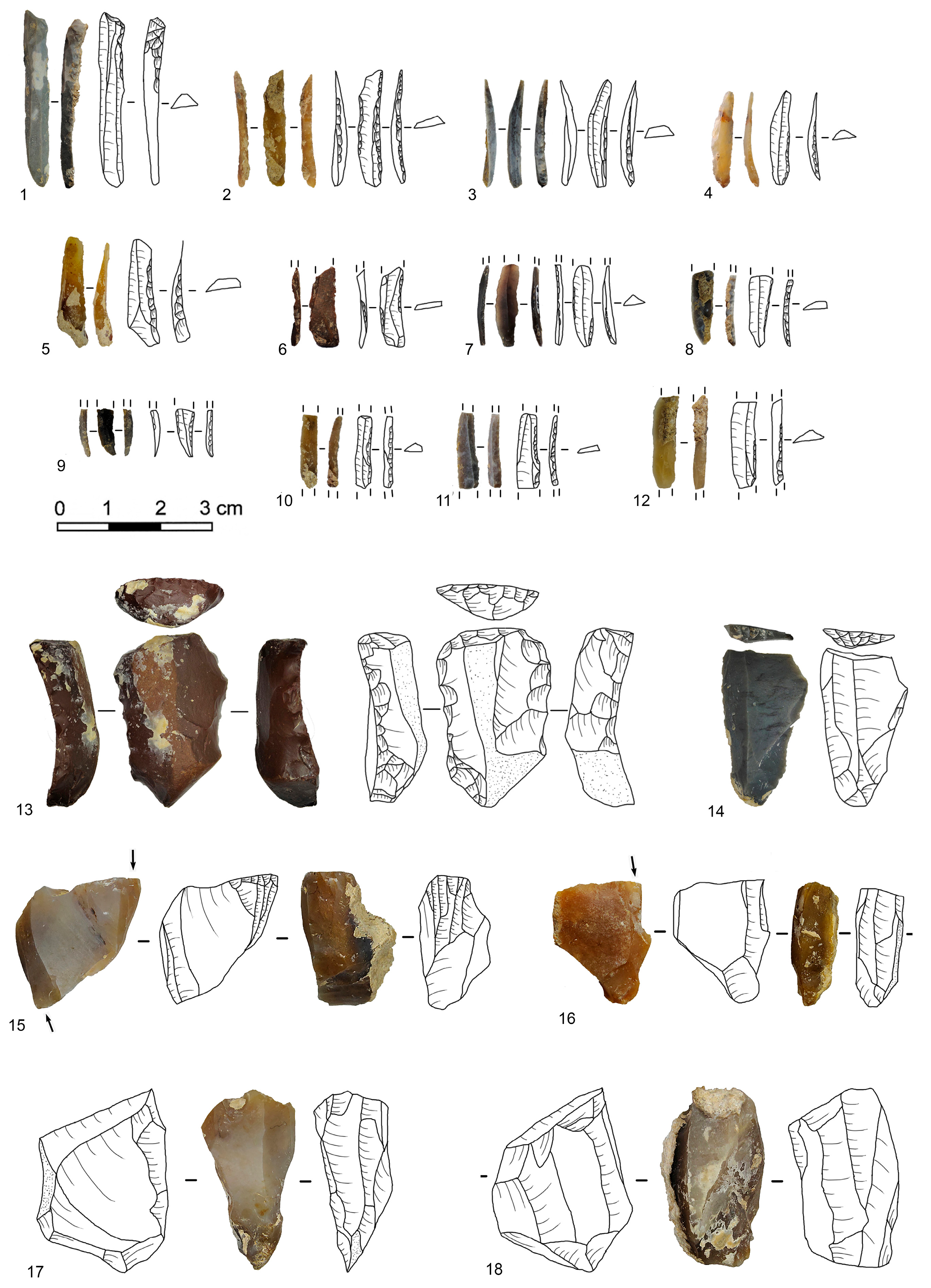
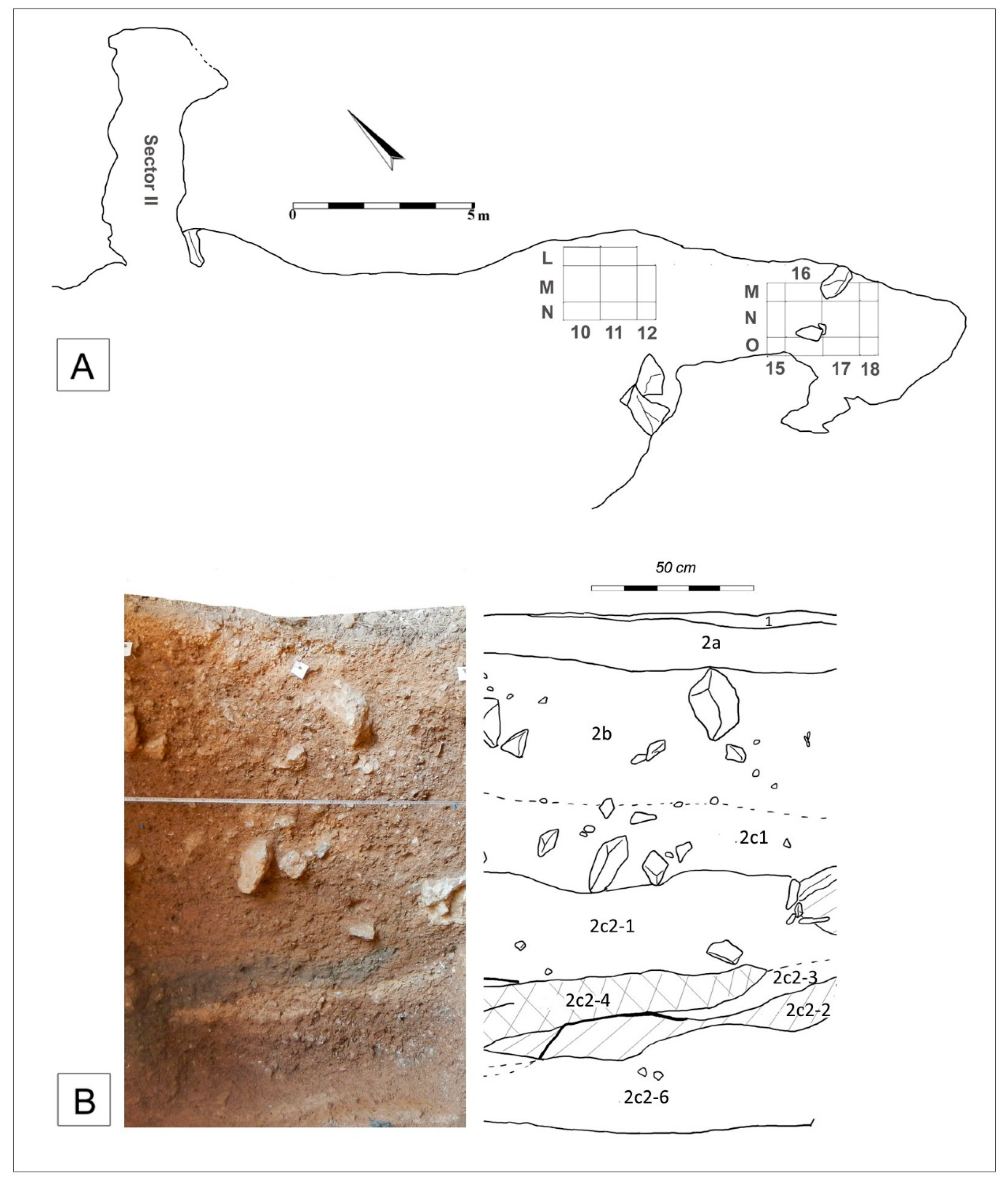
Today, VV consists of a large, single-chambered cave roughly 40 m deep, with a floor that slopes upward to the north. A series of shallow rockshelters runs along the cliff east of the cave mouth (Figure 3A). The entrance to a second cave, opening higher on the cliff above, can be reached only with climbing equipment. The archeological material, consisting mainly of chipped stone artifacts (Figure 4), was derived from an excavation trench in front of the sheltered area to the east of the cave mouth. A test trench opened within the cave did not expose any Pleistocene deposits.
The stratigraphic sequence at VV consists of two main layers, which have been divided into sub-units (Figure 3B). The uppermost layer in the main excavation trench at VV consists of dark loamy sediment rich in organics, and contains both recent artifacts and prehistoric pottery. The underlying layer 2 is yellowish silty clay with varying amounts of rock and gravel. It becomes increasingly gray with depth. Small numbers of artifacts (Figure 3) were collected through most of layer 2, but the densest concentration of material was in layer 2b. Although no fire features were encountered, dispersed charcoal fragments were observed within layer 2b. Faunal remains are comparatively scarce and poorly preserved. The large mammal remains (nisp = 150) are highly fragmented. Identifiable specimens represent large herbivores such as Bos/Bison, Bison priscus, and Capra ibex, as well as carnivores, including Canis lupus, Lynx lynx, and Ursus sp. The presence of the carnivore bones suggests that they may have used the cave as a den at times. A few bones of birds and micro-mammals were also collected [32].

2.3. Pećina Kod Stene

Pećina kod Stene (PKS) is situated in a narrow, twisting canyon formed by the Studena river, a tributary of the Nišava river, not far from the village of Jelašnica. The site consists of a small, narrow karstic chamber and an adjacent shallow rockshelter (Figure 5A). The entrance to the cave is 8.5 m wide, 3.5 m high, and faces west. The cave is 8 m deep. A narrow passage at the back of the first chamber leads to a chamber about 3.5 m in diameter. The cave is filled with silty brown sediment with gravel. Three pits excavated by clandestine treasure hunters were present in the first chamber. Human remains exposed in one of these pits yielded a radiocarbon date of 4387.40 +/− 24.18 uncalibrated BP. Two trenches were excavated at PKS: one inside the front of the cave, the other in the shallow rockshelter a few meters away (Figure 5A). Both encountered similar sedimentary sequences and archeological materials (Figure 5B) [33].
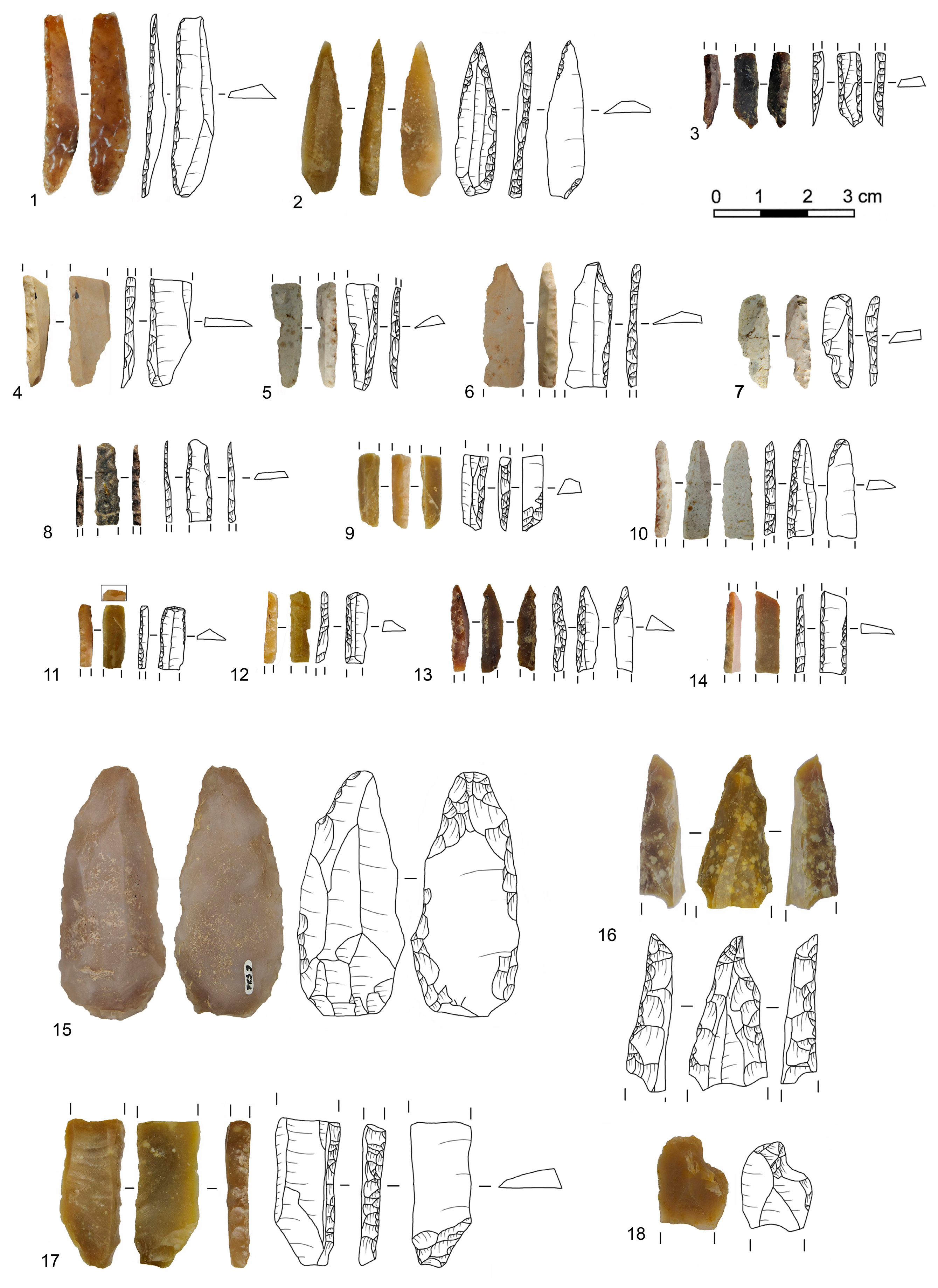
The surface layer (1) contained fragments of prehistoric ceramics. Layers 2a–2c consist of reddish, brown, and gray silt with angular limestone debris. A small number of finds were found in all layers, but most artifacts were found in layer 2c, from which about 60 lithic artifacts were collected (Figure 6). Deposits below layer 2c, extending to a depth of 1.40–1.60 m, did not contain evidence of human presence.
The faunal assemblage from PKS (nisp = 868) includes a range of herbivore and carnivore species (Table 2). All layers are dominated by the remains of ibex (Capra ibex). Remains of red deer (Cervus elaphus), Bos/Bison, chamois (Rupicapra rupicapra), and hare (Lepus europaeus) were also present in smaller numbers. Carnivore bones collected from cultural layers include wolf (Canis lupus) (layers 2b, 2c2), fox (Vulpes vulpes) (layer 2), and bear (Ursus sp., layers 2, 2c2). Cave bear remains (Ursus spaelaeus) are limited to archeologically sterile layer 3. Highly fragmented bird bones were recovered from the boundary between layers 2 and 2b, and in layers 2c1 and 2c2 [32,33]. A detailed taphonomic, zooarchaeological, and taxonomic study of the faunal remains is ongoing.

3. Archeological Findings

We avoid using specific cultural and temporal designations, such as late Gravettian and early Epigravettian, in this discussion. There are two reasons for this. First, the material from these three sites seems to belong to a group of Upper Paleolithic assemblages from central Europe that is comparatively “generic.” Blank production technologies focused on the production of blades and especially bladelets. Shaped tool inventories are dominated by backed bladelets, but typologically and chronologically diagnostic artifact forms, such as shouldered or backed points, are scarce, absent, or atypical in form. Second, there are no widely applicable and accepted definitions of the chronological subdivisions of the Gravettian and Epigravettian [16]. Because the distinction between late Gravettian and early Epigravettian material culture in central Europe is unclear [34], some studies seem to rely exclusively on chronological distinctions. However, we do discuss potential cultural affiliations at the end of the paper, especially concerning the material from VV.
The assemblages of chipped stone artifacts from the three sites are relatively small, with totals of 115/313 artifacts (VP, layers 2 and 3), 744 artifacts (VV), and 92 artifacts (PKS), including small chips and debris (Table 3). Although the limited sample sizes are in part a function of relatively small excavation surfaces, especially in the case of PKS, they also reflect the generally low densities of archeological finds.
As would be expected for the period, all four assemblages contain large numbers of bladelets. At PKS and VV, bladelets and bladelet fragments account for 37% and 44% of all lithic finds, including chips and chunks (Table 4). At VP, the proportion of bladelet blanks is smaller, reflecting both a greater range of production modalities, including manufacture of blades as well as flakes, as well as more in situ production, producing larger numbers of waste flakes. Roughly half of all retouched pieces from all three sites are microlithic, including backed bladelets, points, and similar forms.
The amount and nature of in situ lithic production varies significantly among assemblages. VP contains a range of core forms, including specialized bladelet and blade cores, as well as informal flake cores and tested pieces. Core trimming elements and cortical flakes/blades (with >50% dorsal cortex) are also represented. There is some association between the particular methods of core reduction and specific lithic materials at VP [28]. While we do not know the origins of the rocks, the fact that different spectra of raw materials were chosen for flake, blade, and bladelet manufacture suggests that these were independent methods. At VV, all elements of the reduction process are also present. However, except for two flake cores and a tested piece, all of the cores at VV produced bladelets. PKS presents a different profile. There are no cortical pieces in the collection. Moreover, the three recovered cores are made of quartz, a raw material not represented among the retouched pieces, and all three only produced flakes. Apparently, the small amount of lithic production that took place at PKS was not related directly to the retouched implements discarded there.
Systems of bladelet production also differ among the assemblages. As far as can be determined from the limited samples, bladelets were produced from prismatic cores at VP and PKS. Most bladelet cores have a single platform, although a minority have two opposed platforms. At VV, the dominant system of production involved carenated cores and cores resembling burins busqué (Table 5). Carenated cores and busked burins tend to produce bladelets that are laterally twisted. Not surprisingly, 42% of bladelets from VV are twisted in profile, while only between 2% and 13% of bladelets from the other sites are twisted (Table 6).
Arguably, the most profound difference among assemblages pertains to the proportion of modified artifacts (Table 3). VV has the lowest frequency (6%). The proportion of retouched blanks in both assemblages from VP is nearly twice as high (11%). PKS is an extreme case, as nearly half (47%) of recovered lithics are retouched. These differences speak to important contrasts in the ways the three localities were used by Pleistocene groups.
The retouched tool assemblages from the three sites contain relatively few temporally diagnostic artifact forms such as standardized points. The most common artifacts are simple fragments of backed bladelets, some with truncations (Table 7). Several pointed backed pieces are present, as well as a single microgravette and a backed point, both from PKS, which also yielded several bilaterally retouched/backed bladelets. Microlithic elements from VV are limited to simple retouched bladelets. Small endscrapers are considered diagnostic of the Epigravettian in central and southern Europe [16,18], but scrapers and burins are scarce in all three sites, and several of the specimens collected are irregular and unstandardized.
The microlithic component from VV is distinctive not only for the high frequency of twisted pieces and the limited shaping, but also for the kind of edge modification (Table 8). The majority (57.5%) of retouched bladelet edges from the site show very fine, marginal retouches. The great majority of modified bladelets from the other sites exhibit abrupt (classic backing) or semi-abrupt retouch. In the PKS assemblage, a fine marginal retouch is typically only present on the second edge of the specimen, opposite an abruptly backed edge.
To summarize, the lithic assemblages from the three sites discussed here all contain numerous bladelets, retouched or not. Roughly half of shaped tools from all three sites are microlithic elements, mainly different forms of backed or retouched bladelets. Endscrapers and burins are scarce in all three cases.
While they are broadly similar, the contents and structures of the three assemblages vary in important ways. Of the three, VP contains the broadest range of lithic products and byproducts and the widest variety of core forms. It is also the site with the most substantial faunal assemblage, as well as the only one to yield bone/ivory tools and ornaments. PKS is very different. The proportion of modified pieces is very high: almost half of all artifacts recovered are retouched, and most of these are microlithic. There is little evidence of in situ lithic production. Instead, it appears that the dominant activity was retooling composite tools with microlithic insets, possibly with pieces produced elsewhere.
VV differs in production technology and assemblage structure. The site yields evidence for local production of bladelets, but using a distinctive modality of bladelet manufacture (involving carenated cores/burins) and modification (mainly fine, marginal retouch). Again, it appears as though the repair or maintenance of composite tools was an important activity producing lithic debris, but at VV, it also involved on-site manufacture of bladelets.
The artifact assemblages from VP and PKS fit within the broad definition of Epigravettian, dominated numerically by backed bladelets. Formalized point forms are rare. The assemblage from VV is rather different. Beyond any possible functional differences, tool makers at VV appear to have used different a chaîne opératoire in the production of bladelets, involving small cores resembling busked burins. There are no obvious analogs for this sort of technology in the central Balkans dating to MIS 2. Looking more broadly, the presence of twisted bladelets and carenated cores at VV could suggest a relationship to the so-called Epi-Aurignacian [35,36] or Kašovian [37,38] of central and Eastern Europe. On the other hand, VV lacks the carenated scrapers and standardized microlithic forms characteristic of these industries. Alternatively, the bladelet technology at VV could simply be considered part of the diversity of the Epigravettian, one result of the instability and movement of human populations in Europe during MIS 2, or even the reflection of seasonal variation in activities [39].

Chronology

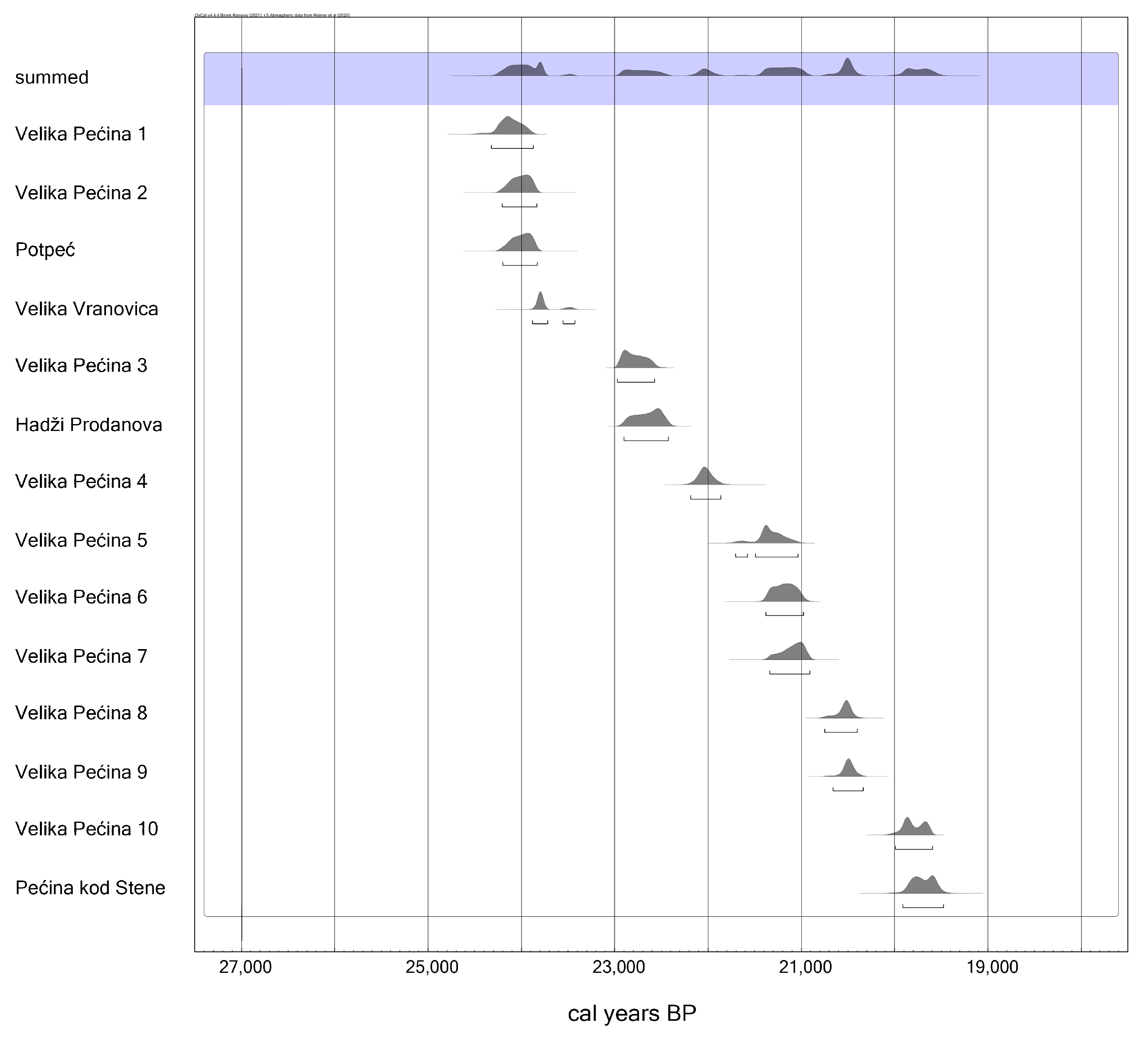
Figure 7 and Table 9 present radiocarbon determinations from the three sites. Figure 5 shows individual dates in chronological order. The materials dated include animal bone and charcoal (Pinus sp.), depending on what was available at each site.
Most of the dates come from VP. The other two sites only yielded a single radiocarbon determination each. Charcoal and bone were scarce and poorly preserved at both VV and PKS. The figure also includes single dates from two other sites in the southwestern Morava Basin, Potpeć and Hadži Prodanova, which have also yielded ages corresponding with MIS 2, in association with bladelet-based lithic assemblages. As of this writing, this is the complete sample of well-contextualized LGM-aged dates from Serbia.
The calibrated dates for VP, VV, PKS, and the other two sites all fall within a period between roughly 24,000 and 19,000 years BP, corresponding with the end of the peak of glacial expansion and the beginnings of glacial retreat. The earliest dates from VP and Potpeč correspond roughly with the Heinrich 2 cold event. The table and figure also highlight the absence (to date) of late Epigravettian occupations in the region post-dating 19,000 BP, something noted previously [14].
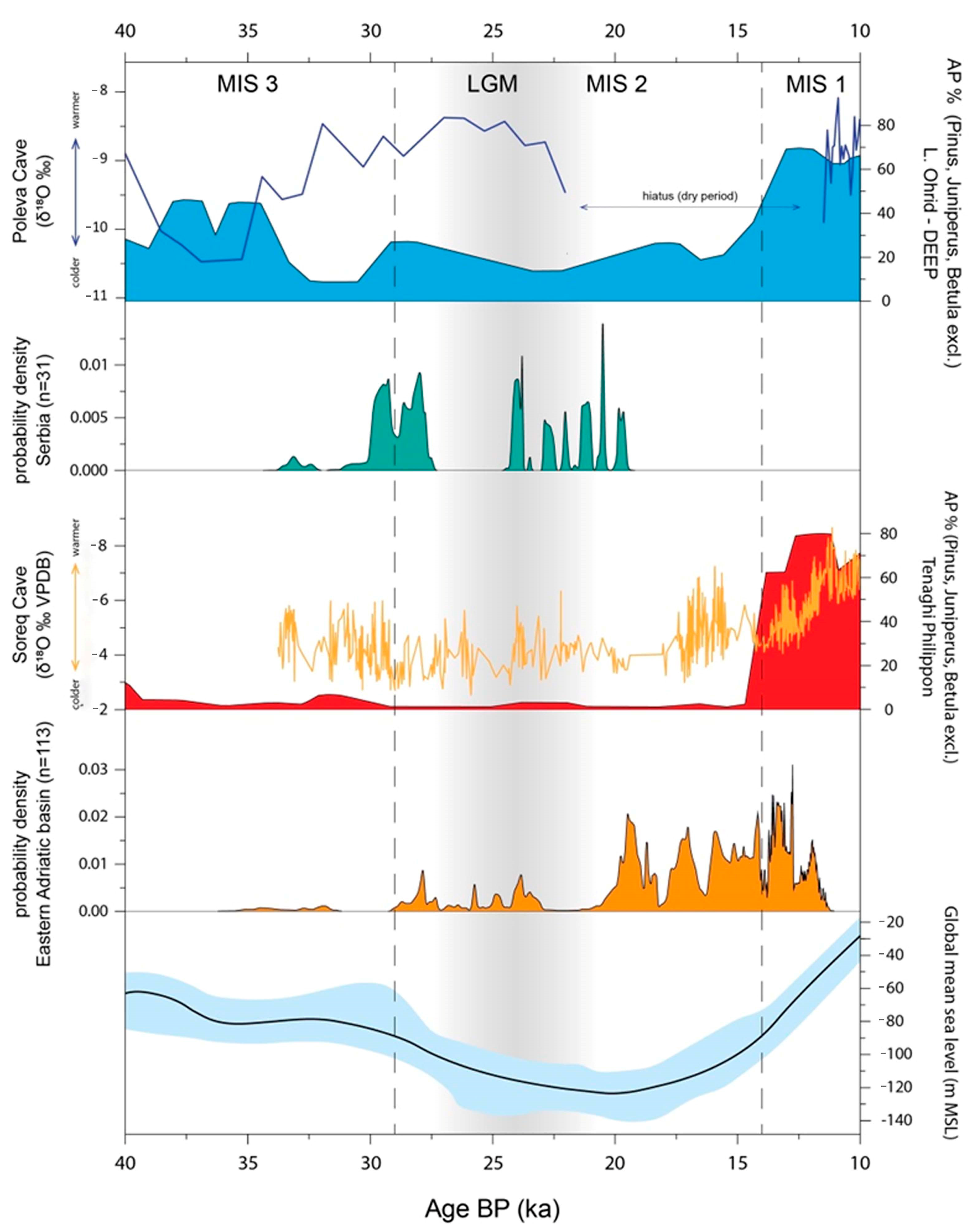
A comparison of the dates in Table 7 with corpora of radiocarbon ages from neighboring regions reveals an interesting pattern. Figure 8 presents the summed radiocarbon probabilities for Serbian sites with those from the eastern Adriatic basin (from [17]), along with local and global environmental information [23,40,41,42,43,44,45]. Summed probabilities are presented simply as a convenient way of representing spans of time, represented in dated assemblages. A larger sample of dates and sites is presented here, encompassing the entire span of the Gravettian and Epigravettian. The additional Gravettian dates from Serbia come from published papers [14,15,46].
There appears to be a gap of at least 3500 years in the Serbian sequence, from ca 27,500 BP to 24,000 BP. This period would correspond with the beginning of the peak glacial period of MIS 2. There is also notable complementarity between the summed radiocarbon probability distributions in Serbia and in the Adriatic basin. The summed dating results from Serbian sites shows two “concentrations”, one between 30,000 and 27,000 BP, corresponding with the Gravettian, and one between 24,000 and 19,000, corresponding with the sites discussed here. In the eastern Adriatic, the entire interval between 32,000 and 19,000 BP is very sparsely represented, although there are a few dates from the first half of MIS 2, a period not represented in the central Balkans. The Adriatic basin sees a conspicuous increase in sites dating from ca. 19,000 BP to the end of the Pleistocene, corresponding with the late Epigravettian (see also [16]). Most of this latter interval is missing from the record in Serbia [14].
The recent synthesis by Lengyel et al. [18] for eastern Central Europe shows similar complementarity. Data presented in that paper show a gap in dates from around 22,000–18,000 BP in the Morava Basin (Czech Republic), Poland, and lower Austria. Only in the Carpathian Basin of Hungary do the ages of the dated sites span the entirety of MIS 2 (see also [47]).

4. Discussion and Conclusions

The sample of dates and dated assemblages dating to the LGM presented here is small. The results will certainly change as more data are produced. Nonetheless, the extant data merit preliminary conclusions.
The 14C dates presented here show that humans did occupy the mountainous central Balkans during part of MIS 2, a period for which there are few if any dated sites in surrounding regions. This makes it plausible that at least some parts of the Balkan peninsula could have been a refugium for human populations during different phases of MIS 2. Whether these populations helped recolonize the rest of Europe after the glaciers retreated is a separate question. The complementarity of chronological evidence from the Adriatic region and the central Balkans is striking. The distribution of dated sites in the Adriatic basin was certainly influenced by changing sea levels. The apparent absence of sites dating to the LGM around the Adriatic is very likely to reflect movements of human populations into low-lying areas exposed by depressed LGM sea levels. These areas are now flooded, and largely inaccessible to archeologists. However, the record for more continental regions, including Serbia and eastern Central Europe [18], was not directly affected by changes in coastlines. It is reasonable to accept, provisionally, that gaps in dates from inland areas correspond to substantially lower densities of human populations, if not the complete abandonment of a region.
At the broadest level, these results highlight the dynamism of human populations during the LGM. We believe that, as local environments responded to changing global climates, the conditions that would support substantial human populations shifted across the European landmass. The qualities that made an environment capable of supporting a substantial human population were not related to temperature or latitude in a simple way. In a region such as the central Balkans, characterized by great topographic and hydrographic diversity, global changes in climate would have been expressed more patchily. At face value, the Serbian evidence currently available suggests that human populations avoided the area during extreme cold at the beginning of the LGM. Nonetheless, they were present through the second part of the glacial peak. We hypothesize that the scarcity of sites in inland Serbia dating to the late glacial, when conditions were becoming warmer and moister, may express a response to the expansion of dense forests into the region. Pollen and fungal spore records suggest that deciduous hardwood forest had expanded into the southern Pannonian Basin in Hungary by around 17,700 BP. This was followed by a marked decline in large herbivore activity after 16,700 BP [48]. The spread of dense forest, but especially the disappearance or shrinking of herds of large game, would have made the area much less attractive to late Paleolithic foragers. Obviously, fine-grained paleoenvironmental data from multiple proxies will be needed to test these propositions.
The three LGM-aged sites described here, VP, VV, and PKS, are all small-to-medium-sized caves, situated in narrow, protected canyons formed by tributaries to the larger rivers. This pattern of MIS2-dated sites being situated in sheltered areas has been observed in other parts of Central and Eastern Europe [49,50]. Densities of archeological material are fairly low in all three sites, and artifact assemblages are small. Inventories of artifacts are also narrow. Most retouched pieces are either casually modified tools or microlithic artifacts made on bladelets. The high proportion of bladelets suggests the presence and maintenance of armatures with microlithic inserts. It is common to assume that such composite tools were mainly hunting weapons, but in fact a much broader range of functions is possible [51,52,53,54]. On the other hand, tool forms, such as endscrapers and burins, are uncommon. To the extent that backed bladelets, endscrapers and burins were used for different purposes, the retouched artifact inventories from VP, VV, and PKS suggest that the ranges of activities conducted with stone artifacts were comparatively narrow.
Although their settings are similar, the three sites appear to have been used in different ways, and each site seems to represent a small segment of a land-use system. A previous publication [28] employed a range of evidence to argue that Velika Pećina was a repeatedly occupied short-term seasonal residential camp where a variety of activities took place. We emphasize that VP is the only site where artifacts other than stone tools were found and where a complete faunal study has been conducted. What we know about the other sites comes almost entirely from stone tools. Based on the stone artifacts, we propose that both VV and PKS hosted a more restricted range of activities. The large number of bladelet blanks and cores at VV suggests that activities involving lithics were oriented towards production of bladelets for fabricating or repairing composite tools. PKS shows little evidence of local production, but an extremely high proportion of modified microlithic implements—many fragmentary. Here again, the activities represented by lithics centered on repairing or maintaining implements with microlithic components, although these components do not seem to have been produced in the excavated part of the site.
While the evidence presented here demonstrates that people occupied the Morava river basin and surrounding areas during the second half of MIS 2, the small number of sites and the low density of deposits may suggest that the human populations were sparsely distributed on the landscape. On one hand, this would not be very surprising, given environmental conditions across central and southern Europe during the LGM. However, an important question, endemic to archeological research, is whether the available sites are a representative sample of occupations between 24 KA and 18.5 KA, or whether they provide an incomplete picture of land use. One important consideration is the fact nearly all excavated Upper Paleolithic sites in Serbia are situated within caves and rockshelters. Experience from other areas suggests that open-air sites may provide a different view of human settlements than do sites in natural shelters [55,56,57]. For example, Gravettian/Pavlovian occupations in the Middle Danube basin dating to late MIS 3 and early MIS 2 include some very large, dense sites with constructed shelters and diverse material culture inventories: well-known examples include Dolní Vestonice I and Pavlov I [58,59,60]. These large, rich sites are not situated in natural shelters, but rather in open, low-elevation areas along major rivers. To date, potential open-air Pleistocene contexts in the central Balkans have not been investigated nearly as intensively as caves and rockshelters. Further exploration of the open-air record is an important priority for Paleolithic research in Serbia and will be crucial to assessing the completeness of the record. Other evidence from studies of macro- and micro-fauna, botanical and anthracological remains, lithic raw material sourcing, as well as studies of local paleoenvironmental records, will be needed to reach a better understanding of human responses to the Last Glacial Maximum in the central Balkans.

Author Contributions

Conceptualization, S.K. and D.M.; data collection and analysis, S.K., D.M., S.D. and M.S.; Writing—original draft, S.K.; Writing—revision and editing, S.K., D.M., S.M., Z.M.P., S.D. and M.R.; Figure preparation, D.M., S.M., Z.M.P. and S.D.; Funding acquisition, S.K., D.M. and M.R. All authors have read and agreed to the published version of the manuscript.

Funding

This research has been supported by the NEEMO project of the Science Fund of the Republic of Serbia (7746827), Natural Science and Engineering Research Council of Canada NSERC (RGPIN-2019-04113), MIRA project funded by the Social Sciences and Humanities Research Council of Canada SSHRC (895-2024-1005), and the Ministry of Science, Technological Development and Innovation of the Republic of Serbia (Contract No: 451-03-66/2024-03/200163).

Data Availability Statement

Data reported in this paper can be accessed by request from the two senior authors.

Conflicts of Interest

The authors declare no conflicts of interest.

References

  1. Tallavaara, M.; Luoto, M.; Korhonen, N.; Järvinen, H.; Seppä, H. Human population dynamics in Europe over the Last Glacial Maximum. Proc. Natl. Acad. Sci. USA 2015, 112, 8232–8237. [Google Scholar] [CrossRef] [PubMed]
  2. Posth, C.; Yu, H.; Ghalichi, A.; Rougier, H.; Crevecoeur, I.; Huang, Y.; Ringbauer, H.; Rohrlach, A.B.; Nägele, K.; Villalba-Mouco, V.; et al. Palaeogenomics of Upper Palaeolithic to Neolithic European hunter-gatherers. Nature 2023, 615, 117–126. [Google Scholar] [CrossRef] [PubMed]
  3. Stewart, J.R.; Lister, A.M.; Barnes, I.; Love, D. Refugia revisited: Individualistic responses of species in space and time. Proc. R. Soc. B Biol. Sci. 2010, 277, 661–671. [Google Scholar] [CrossRef] [PubMed]
  4. Bennett, K.D.; Tzedakis, P.C.; Willis, K.J. Quaternary refugia of north European trees. J. Biogeogr. 1991, 18, 103–115. [Google Scholar] [CrossRef]
  5. Gömöry, D.; Zhelev, P.; Brus, R. The Balkans: A genetic hotspot but not a universal colonization source for trees. Plant Syst. Evol. 2020, 306, 5. [Google Scholar] [CrossRef]
  6. Miracle, P.T.; Lenardić, J.M.; Brajković, D. Last glacial climates, “refugia”, and faunal change in Southeastern Europe: Mammalian assemblages from Veternica, Velika Pećina, and Vindija Caves (Croatia). Quat. Int. 2010, 212, 137–148. [Google Scholar] [CrossRef]
  7. Schmitt, T.; Varga, Z. Extra-Mediterranean refugia: The rule and not the exception? Front. Zool. 2012, 9, 22. [Google Scholar] [CrossRef]
  8. Sommer, R.F. Late Pleistocene and Holocene History of Mammals in Europe. In Mammals of Europe—Past, Present, and Future; Hackländer, K., Zachos, F.E., Eds.; Springer Nature: Berlin/Heidelberg, Germany, 2020; pp. 83–98. [Google Scholar]
  9. Willis, K.J. The vegetational history of the Balkans. Quat. Sci. Rev. 1994, 13, 769–788. [Google Scholar] [CrossRef]
  10. Bailey, D.W. Balkan Prehistory: Exclusion, Incorporation and Identity; Routledge: London, UK, 2000. [Google Scholar]
  11. Dogandžić, T.; McPherron, S.; Mihailović, D. Middle and Upper Paleolithic in the Balkans: Continuities and discontinuities of human occupations. In Palaeolithic and Mesolithic Research in the Central Balkans; Mihailović, D., Ed.; Serbian Archaeological Society: Belgrade, Serbia, 2014; pp. 83–96. [Google Scholar]
  12. Kozlowski, J.K. Gravettian/Epigravettian sequences in the Balkans: Environment, technologies, hunting strategies and raw material procurement. In The Paleolithic Archaeology of Greece and Adjacent Areas. Proceedings of the ICoPAG Conference, Ioannina, September 1994; Baily, G.N., Adam, E., Panagopulou, E., Preles, C., Eds.; Btitish School at Athens: London, UK, 1999; pp. 319–329. [Google Scholar]
  13. Mihailović, D. Social and cultural integration in the late Upper Paleolithic of the Western Balkans. In Late Paleolithic Environments and Cultural Relations Around the Adriatic; Whallon, R., Ed.; BAR International Series 1716; Archaeopress: Oxford, UK, 2007; pp. 53–59. [Google Scholar]
  14. Mihailović, D.; Mihailović, B.R. Chronology and succession of Palaeolithic technocomplexes in Serbia. Zb. Nar. Muzeja-Arheol. 2023, 26, 11–37. [Google Scholar] [CrossRef]
  15. Mihailović, D.; Marković, S.; Kuhn, S.L.; Dragosavac, S.; Mihailović, B.; Roksandic, M. Middle and Upper Paleolithic of the southern Pannonian Basin: Lithic assemblages from Petrovaradin Fortress (Novi Sad, Serbia). Quat. Int. 2025, 746, 109950. [Google Scholar] [CrossRef]
  16. Ruiz-Redondo, A.; Vukosavljević, N.; Tomasso, A.; Peresani, M.; Davies, W.; Linden, M.V. Mid and Late Upper Palaeolithic in the Adriatic Basin: Chronology, transitions and human adaptations to a changing landscape. Quat. Sci. Rev. 2022, 276, 107319. [Google Scholar] [CrossRef]
  17. Vukosavljević, N. Epigravettian in the eastern Adriatic and its hinterland. In The Prehistoric Hunter-Gatherers of South-Eastern Europe; Ruiz-Redondo, A., Davies, W., Eds.; Proceedings of the British Academy, 258; Oxford University Press: Oxford, UK, 2023; pp. 252–287. [Google Scholar]
  18. Lengyel, G.; Bárány, A.; Béres, S.; Cserpák, F.; Gasparik, M.; Major, I.; Molnár, M.; Nadachowski, A.; Nemergut, A.; Svoboda, J.; et al. The Epigravettian chronology and the human population of eastern Central Europe during MIS2. Quat. Sci. Rev. 2021, 271, 107187. [Google Scholar] [CrossRef]
  19. Pabijan, M.; Zieliński, P.; Dudek, K.; Chloupek, M.; Sotiropoulos, K.; Liana, M.; Babik, W. The dissection of a Pleistocene refugium: Phylogeography of the smooth newt, Lissotriton vulgaris, in the Balkans. J. Biogeogr. 2015, 42, 671–683. [Google Scholar] [CrossRef]
  20. Schmitt, T. Molecular biogeography of Europe: Pleistocene cycles and postglacial trends. Front. Zool. 2007, 4, 11. [Google Scholar] [CrossRef]
  21. Ludwig, P.; Gavrilov, M.B.; Markovic, S.B.; Ujvari, G.; Lehmkuhl, F. Simulated regional dust cycle in the Carpathian Basin and the Adriatic Sea region during the Last Glacial Maximum. Quat. Int. 2021, 581, 114–127. [Google Scholar] [CrossRef]
  22. Wagner, B.; Tauber, P.; Francke, A.; Leicher, N.; Binnie, S.A.; Cvetkoska, A.; Jovanovska, E.; Just, J.; Lacey, J.H.; Levkov, Z.; et al. The geodynamic and limnological evolution of Balkan Lake Ohrid, possibly the oldest extant lake in Europe. Boreas 2023, 52, 1–26. [Google Scholar] [CrossRef]
  23. Constantin, S.; Bojar, A.-V.; Lauritzen, S.-E.; Lundberg, J. Holocene and Late Pleistocene climate in the sub-Mediterranean continental environment: A speleothem record from Poleva Cave (Southern Carpathians, Romania). Palaeogeogr. Palaeoclim. Palaeoecol. 2007, 243, 322–338. [Google Scholar] [CrossRef]
  24. Benito, B.M.; Svenning, J.; Kellberg-Nielsen, T.; Riede, F.; Gil-Romera, G.; Mailund, T.; Kjaergaard, P.C.; Sandel, B.S. The ecological niche and distribution of Neanderthals during the Last Interglacial. J. Biogeogr. 2017, 44, 51–61. [Google Scholar] [CrossRef]
  25. Forenbaher, S.; Miracle, P.T. The spread of farming in the eastern Adriatic. Antiquity 2005, 79, 514–528. [Google Scholar] [CrossRef]
  26. Papagianni, D.; Camps, M.; Szmidt, C. Mediterranean southeastern Europe in the Late Middle and Early Upper Palaeolithic: Modern human route to Europe or Neanderthal refugium? In The Mediterranean from 50,000 to 25,000 BP: Turning Points and New Directions; Szmidt, C., Camps, M., Eds.; Oxbow Books: Oxford, UK, 2009; pp. 115–136. [Google Scholar]
  27. Finlayson, C. The Humans Who Went Extinct: Why Neanderthals Died Out and We Survived; Oxford University Press: Oxford, UK, 2010. [Google Scholar]
  28. Stiner, M.C.; Dimitrijević, V.; Mihailović, D.; Kuhn, S.L. Velika Pećina: Zooarchaeology, taphonomy and technology of a LGM Upper Paleolithic site in the central Balkans (Serbia). J. Archaeol. Sci. Rep. 2022, 41, 103328. [Google Scholar] [CrossRef]
  29. Kuhn, S.L.; Mihailović, D.; Dimitrijević, V. The Southeast Serbia Palaeolithic Project: An interim report. In Palaeolithic and Mesolithic Research in the Central Balkans; Mihailović, D., Ed.; Serbian Archaeological Society: Belgrade, Serbia, 2014; p. 97106. [Google Scholar]
  30. Јoванoвић, Ђ. Сићевачка клисура—Пећине, дупке и пoткoпине. Отаџбина 1891, 10, 3–19. [Google Scholar]
  31. Жујoвић, Ј. Каменo Дoба; Српска књижевна задруга: Belgrade, Serbia, 1893. [Google Scholar]
  32. Dimitrijević, V.; Mihailović, D.; Kuhn, S.; Dogandžić, T. Evidence for subsistence strategies of Gravettian hunter-gatherers in the central Balkans. In Subsistence Strategies in the Stone Age, Direct and Indirect Evidence; Russian Academy of Sciences, Institute for the History of Material Culture: Saint Petersburg, Russia, 2018; pp. 46–47. [Google Scholar]
  33. Mihailović, D.; Dimitrijević, V.; Dragosavac, S. Pećina kod stene: Multy-layered Upper Paleolithic site in the Jelašnica Gorge. Glas. Srp. Arheol. Društva 2017, 33, 7–19. [Google Scholar]
  34. Mihailović, D. Paleolit na Centralnom Balkanu–Kulturne Promene i Populaciona Kretanja; Srpsko Arheološko Društvo: Belgrade, Serbia, 2014; Volume 30, pp. 1–156. [Google Scholar]
  35. Demidenko, Y.E. South of Eastern Europe and Upper Paleolithic diversity around the Last Glacial Maximum. Quat. Int. 2021, 581–582, 290–295. [Google Scholar] [CrossRef]
  36. Demidenko, Y.E.; Škrdla, P.; Rios-Garaizar, J. In between Gravettian and Epigravettian in central and eastern Europe: A peculiar LGM early late Upper Paleolithic industry. Prehl. Vyzk 2019, 60, 11–42. [Google Scholar]
  37. Škrdla, P.; Nejman, L.; Bartík, J.; Rychtaříková, T.; Nikolajev, P.; Eigner, J.; Fišáková, M.N.; Novák, J.; Polanská, M. Mohelno–A terminal Last Glacial Maximum industry with microlithic tools made on carenoidal blanks. Quat. Int. 2016, 406, 184–194. [Google Scholar] [CrossRef]
  38. Svoboda, J. The Aurignacian and after: Chronology, geography and cultural taxonomy in the Middle Danube region. In Towards a Definition of the Aurignacian; Bar-Yosef, O., Zilhão, J., Eds.; Trabalhos de Arqueologia 45: Lisbon, Portugal, 2006; pp. 259–274. [Google Scholar]
  39. Nerudová, Z.; Neruda, P. Moravia between Gravettian and Magdalenian. In Forgotten Times and Spaces: New Perspectives in Paleoanthropological, Paleoetnological and Archeological Studies; Sázelová, S., Novák, M., Mizerová, A., Eds.; Masaryk University: Brno, Czech Republic, 2015; pp. 378–394. [Google Scholar]
  40. Sadori, L.; Koutsodendris, A.; Panagiotopoulos, K.; Masi, A.; Bertini, A.; Combourieu-Nebout, N.; Francke, A.; Kouli, K.; Joannin, S.; Mercuri, A.M.; et al. Pollen-based paleoenvironmental and paleoclimatic change at Lake Ohrid (south-eastern Europe) during the past 500 ka. Biogeosciences 2016, 13, 1423–1437. [Google Scholar] [CrossRef]
  41. Wijmstra, T.A. Palynology of the first 30 metres of a 120 m deep section in northern Greece. Acta Bot. Neerl 1969, 18, 511–527. [Google Scholar] [CrossRef]
  42. Wijmstra, T.A.; Smit, A. Palynology of the middle part (30–78 metres) of the 120 m deep section in northern Greece (Macedonia). Acta Bot. Neerl 1976, 25, 297–312. [Google Scholar] [CrossRef]
  43. Tzedakis, P.; Hooghiemstra, H.; Pälike, H. The last 1.35 million years at Tenaghi Philippon: Revised chronostratigraphy and long-term vegetation trends. Quat. Sci. Rev. 2006, 25, 3416–3430. [Google Scholar] [CrossRef]
  44. Bar-Matthews, M.; Ayalon, A.; Kaufman, A.; Wasserburg, G.J. The Eastern Mediterranean paleoclimate as a reflection of regional events: Soreq cave, Israel. Earth Planet. Sci. Lett. 1999, 166, 85–95. [Google Scholar] [CrossRef]
  45. Waelbroeck, C.; Labeyrie, L.; Michel, E.; Duplessy, J.C.; McManus, J.F.; Lambeck, K.; Balbon, E.; Labracherie, M. Sea-level and deep water temperature changes derived from benthic foraminifera isotopic records. Quat. Sci. Rev. 2002, 21, 295–305. [Google Scholar] [CrossRef]
  46. Alex, B.; Mihailović, D.; Milošević, S.; Boaretto, E. Radiocarbon chronology of Middle and Upper Paleolithic sites in Serbia, central Balkans. J. Archaeol. Sci. Rep. 2019, 25, 266–279. [Google Scholar] [CrossRef]
  47. Svoboda, J. Moravia during the Upper Pleniglacial. In The World at 18 000 BP; Soffer, O., Gamble, C., Eds.; Unwin-Hyman: London, UK, 1990; pp. 193–203. [Google Scholar]
  48. Magyari, E.K.; Pál, I.; Vincze, I.; Veres, D.; Jakab, G.; Braun, M.; Szalai, Z.; Korponai, J. Warm Younger Dryas summers and early late glacial spread of temperate deciduous trees in the Pannonian Basin during the last glacial termination (20-9 kyr cal BP). Quat. Sci. Rev. 2019, 225, 105980. [Google Scholar] [CrossRef]
  49. Nerudová, Z.; Neruda, P.; Hamrozi, P. Statistical and geographical modelling of Moravian (Czech Republic) Late Upper Palaeolithic occupation. Quat. Int. 2021, 581–582, 175–189. [Google Scholar] [CrossRef]
  50. Svoboda, J.; Boriová, S.; Lengyel, G.; Pokorný, P.; Přichystal, A.; Sázelová, S.; Wilczyński, J. Last Glacial Maximum landscape and Epigravettian horse hunting strategy in Central Europe: The case of Stránská Skála IV. Přehled Výzkumů 2020, 61, 59–70. [Google Scholar] [CrossRef]
  51. Beyin, A. Use-wear analysis of obsidian artifacts from Later Stone Age shell midden sites on the Red Sea Coast of Eritrea, with experimental results. J. Archaeol. Sci. 2010, 37, 1543–1556. [Google Scholar] [CrossRef]
  52. Fullagar, R. Uncertain evidence for weapons and craft tools: Functional investigations of Australian microliths. In Multidisciplinary Approaches to the Study of Stone Age Weaponry; Iovita, R., Sano, K., Eds.; Springer: Dordrecht, The Netherlands, 2016; pp. 159–166. [Google Scholar] [CrossRef]
  53. Groman-Yaroslavski, I.; Chen, H.; Liu, C.; Shimelmitz, R.; Yeshurun, R.; Liu, J.; Yang, X.; Nadel, D. Versatile use of microliths as a technological advantage in the miniaturization of Late Pleistocene toolkits: The case study of Neve David, Israel. PLoS ONE 2020, 15, e0233340. [Google Scholar] [CrossRef]
  54. Rios-Garaizar, J.; Škrdla, P.; Demidenko, Y.E. Use-wear analysis of the lithic assemblage from LGM Mohelno-Plevovce site (southern Moravia, Czech Republic). Comptes Rendus Palevol. 2019, 18, 353–366. [Google Scholar] [CrossRef]
  55. Iriarte-Chiapusso, M.-J.; Garcia-Ibaibarriaga, N.; Arrizabalaga, A. The contribution of open-air sites to the environmental reconstruction of the Gravettian at the “Basque Crossroads”(North Iberia). Quat. Int. 2016, 412, 54–65. [Google Scholar] [CrossRef]
  56. Arrizabalaga, A.; Rios-Garaizar, J.; Alvarez-Alonso, D. The past is out there: Open-air Palaeolithic sites and new research strategies in the Cantabrian region (northern Iberia). Quat. Int. 2015, 364, 181–187. [Google Scholar] [CrossRef]
  57. Barton, C.M.; Villaverde, V.; Zilhão, J.; Aura, J.E.; Garcia, O.; Badal, E. In glacial environments beyond glacial terrains: Human eco-dynamics in late Pleistocene Mediterranean Iberia. Quat. Int. 2013, 318, 53–68. [Google Scholar] [CrossRef]
  58. Svoboda, J.A. The Gravettian on the middle Danube. PALEO 2007, 19, 203–220. [Google Scholar] [CrossRef]
  59. Svoboda, J.; Novák, M.; Sázelová, S.; Demek, J. Pavlov I: A large Gravettian site in space and time. Quat. Int. 2016, 406, 95–105. [Google Scholar] [CrossRef]
  60. Svoboda, J.A. Dolní Vestonice–Pavlov: Explaining Paleolithic Settlements in Central Europe; Texas A&M University Press: College Station, TX, USA, 2020. [Google Scholar]
Figure 1. Locations of the sites mentioned in the text. 1, Velika Pećina; 2, Velika Vranovica; 3, Pećina kod stene; 4, Potpeč; 5, Hadži Prodanova.
Quaternary 09 00017 g001
Figure 2. Velika Pećina artifacts: 13, retouched blades; 4, endscraper; 510, backed bladelets; 11, 12, bladelet cores; 13, perforated Alces incisor; 14, 15, segments of bone needles or awls.
Quaternary 09 00017 g002
Figure 3. Plan (A) and stratigraphic profile (B) of Velika Vranovica.
Quaternary 09 00017 g003
Figure 4. Velika Vranovica artifacts: 112, retouched and backed bladelets; 13, endscraper; 14, truncated piece; 1618, bladelet cores.
Quaternary 09 00017 g004
Figure 5. Plan (A) and stratigraphic profile (B) of Pećina kod Stene.
Quaternary 09 00017 g005
Figure 6. Pećina kod Stene artifacts: 1, 4, 6, 7, 9, 10, 12, backed/retouched bladelet fragments; 2, backed point; 3, 5, 8, 14, double-backed/retouched bladelet fragments; 11, backed and truncated bladelet; 13, possible microgravette; 15, point with ventral retouch; 16, fragment of pointed, backed piece; 17, backed blade fragment; 18, endscraper fragment.
Quaternary 09 00017 g006
Figure 7. Probability distributions for dates from LGM-aged sites in Serbia. Calibrated ages calculated using Oxcal Online, version 4.4.
Quaternary 09 00017 g007
Figure 8. Comparison between age distributions of Gravettian/Epigravettian sites and selected paleoclimatic proxies: Lake Ohrid, Northern Macedonia/Albania [40] and Tenaghi Philippon, Northern Greece [41,42]; age model from [43]; δ18O records from Poleva cave, Southeastern Romania [23], and Soreq cave, Israel [44], and probability densities of Paleolithic settlements in Central Balkan region and Adriatic coast zone and global sea level changes [45]. Last Glacial Maximum (LGM) time interval is indicated by gray shading.
Quaternary 09 00017 g008
Table 1. NISP and percent occurrence of taxonomic groups in faunas from Velika Pećina. Percentages reported only for taxonomic groups identifiable at the genus level.
(a) Small Vertebrate Taxa: Layer 2Layer 2Layer 3Layer 3
Taxonomic groupTaxon (English)Taxon (Latin)NISP%NISP%
OSTEICHTHYIESFish (indet.)Osteichthyes14.20-
INSECTIVORAHedgehogErincaeus roumanicus0-32.4
RODENTIALesser blind moleratNannospalax leucodon28.332.4
Romanian hamsterMesocricetus newtoni14.22016.0
Gray dwarf hamsterCricetulus migratorius0-10.8
Bank voleMyodes glareolus0-10.8
European water voleArvicola terrestris14.210.8
Pine voleTerricola subterraneus0-10.8
Common/field voleMicrotus arvalis/agrestis28.33427.2
European snow voleChionomys nivalis28.3118.8
Narrow-headed voleStenocranius gregalis0-1310.4
LAGOMORPHAPikaOchotona pusilla28.397.2
HareLepus europaeus1354.22923.2
Small vertebrate total:24 125
(b) Larger vertebrate taxa: Layer 2Layer 2Layer 3Layer 3
Taxonomic groupTaxon (English)Taxon (Latin)NISP%NISP%
PROBOSCIDEAMammothMammuthus primigenius0-30.6
PERISSODACTYLAHorseEquus ferus0-30.6
Rhinoceros Rhinocerotidae indet.0-20.4
ARTIODACTYLAChamoisRupicapra rupicapra11.330.6
Red deerCervus elaphus0-71.4
European elk/moose *Alces alces0-10.2
Giant deerMegaloceros sp.0-10.2
BisonBison priscus56.76913.8
IbexCapra ibex2432.011222.4
CARNIVORALeopardPanthera pardus0-20.4
LynxLynx lynx0-10.2
WolfCanis lupus1013.3183.6
Red foxVulpes vulpes810.7397.8
Brown bearUrsus arctos11.310.2
Cave bearUrsus spelaeus ingressus(2)(2.7)(65)(13.0)
Pine martinMartes martes22.751.0
BadgerMeles meles11.30-
ErmineMustela erminea0-30.6
AVESFalcon/Hawk (indet.)Falconiformes0-10.2
Common kestrelFalco tinnunculus11.310.2
Land fowlPhasianidae11.3132.6
Grey partridgePerdix perdix0-91.8
European quailCoturnix coturnix0-10.2
Ptarmigan (indet.)Lagopus sp. 56.7163.2
Rock ptarmiganLagopus muta34.0234.6
Willow ptarmiganLagopus lagopus11.381.6
Black grouseTetrao (Lyrurus) tetrix0-81.6
Perching bird, largePasseriform, large0-10.2
Crow familyCorvidae indet.0-234.6
Red-billed choughPyrrhocorax pyrrhocorax34.040.8
Alpine choughPyrrhocorax graculus11.320.4
Chough/MagpiePyrrhocorax/Pica22.761.2
Western jackdawColoeus monedula0-30.6
JayGarrulus glandarius0-40.8
Spotted nutcrackerNucifraga caryocatactes0-20.4
Perching bird, smallPasseriform, small11.3183.6
Thrush (indet.)Turdus sp.0-10.2
Eurasian blackbirdTurdus merula0-30.6
CrakePorzana cf. porzana0-20.4
Water railRallus aquaticus0-20.4
Common cootFulica atra0-10.2
Wading bird, smalln/a0-30.6
Duck (indet.)Anas sp.11.310.2
Eurasian teal Anas crecca0-10.2
Northern pintail duckAnas acuta0-10.2
Goose (indet.)Branta sp.0-10.2
Mallard duckAnas platyrhynchos11.310.2
Garganey duckA. (Spatula) querquedula0-10.2
Owl (indet.)Strigidae indet.11.30-
Eurasian eagle owlBubo bubo0-40.8
Larger vertebrate total:75 500
(c) Size class identifications **: Layer 2Layer 2Layer 3Layer 3
Taxonomic groupNISP%NISP%
Large mammal--69.87712.9
Medium mammal--1219.79215.4
Small mammal--34.9172.9
Small ungulate--34.9193.2
Medium ungulate--1727.918531.0
Large ungulate--11.67813.1
Very large ungulate--711.5406.7
Large carnivore--34.9111.8
Small carnivore--46.6101.7
Small bird--0-111.8
Medium bird--46.6477.9
Large bird--11.681.3
Very large bird--0-10.2
Size class total:61 596
GRAND TOTAL
(a + b + c):
160 1221
Notes: (*) European elk specimen is an ornament made on the first lower incisor and is probably not of local origin. Percentage values represent occurrence rate within designated group. (**) Taxon-specific identification counts do not overlap with body size class identifications. Layer 1 and mixed units (Layer 2/3 and 2/3) are omitted from table. Layer 3/4 and Layer 4 identified during excavation are subsumed into Layer 3. Cave bear counts and percentages are given in parentheses because radiocarbon dates on these remains show that they antedate human occupation [28].
Table 2. NISP and percent occurrence of taxonomic groups in faunas from Pećina kod Stene, all layers. Percentages reported only for taxonomic groups identifiable to genus level. Microfauna (<1.0 kg) are still under study and are not included.
Taxonomic GroupTaxon (English)Taxon (Latin)NISP%
RODENTIABeaverCastor fiber20.71%
LAGOMORPHAHareLepus europaeus289.89%
PERISSODACTYLAHorseEquus ferus41.41%
ARTIODACTYLARed deerCervus elaphus186.36%
Giant deerMegaloceros giganteus51.77%
CervidCervidae indet
IbexCapra ibex10135.69%
ChamoisRupicapra rupicapra51.77%
CaprineCaprinae indet.9
Bovid Bovidae indet.2
Ruminantia (medium) 7
Ruminantia (large) 8
Ruminantia (indet) 3
CARNIVORAWolfCanis lupus248.48%
Red foxVulpes vulpes134.59%
Canidae indet. 2
Cave bearUrsus spelaeus ingressus5017.67%
Ursid indet.Ursus sp.82.83%
Cave hyenaCrocuta spelea93.18%
Cave lionPanthera spaelea10.35%
LynxLynx lynx72.47%
Wild catFelis sylvestris10.35%
European polecatMustella putorius10.35%
Mustellid Mustella sp.10.35%
MartenMartes sp.20.72%
Carnivora (small) 3
Carnivora (medium) 5
Carnivora (large) 6
Mammalia (small) 3
Mammalia (small/med. 2
Mammalia (medium) 67
Mammalia (med./large) 39
Mammalia (large) 17
Mammalia (size indet) 171
AVESAves indet. 38
Table 3. Basic lithic categories by site and layer.
VelikaVelikaPećina
PećinaVranovicaKod Stene
2 All3 All2 All2 All
flakes, blades, bladelets8019560536
chips + chunks22839211
Cores818154
retouched pieces13354745
Total12333175996
proportion retouched0.110.110.060.47
Table 4. Blank categories by site and layer.
VelikaVelikaPećina
PećinaVranovicaKod Stene
2 All3 All2 All2 All
cortical1117190
flake276011413
blade27323918
bladelet155124928
cte814455
chip14478310
chunk33691
burin spall0151
sum det.10525856376
indeterminate105518116
total11531374492
proportion bld + bldt0.370.320.510.61
proportion bladelet0.130.200.440.37
Table 5. Core forms by site and layer.
VelikaVelikaPećina
PećinaVranovicaKod Stene
2 All3 All2 All2 All
carenated bld/bldt0130
prismatic bld/bldt3320
carenated burin0060
uni/bi-dir flake1520
centripetal1000
bipolar0001
amorphous0302
tested2610
indeterminate frag.0100
percussor0011
total818154
Table 6. Bladelet profiles by site and layer.
VelikaVelikaPećina
PećinaVranovicaKod Stene
2 All3 All2 All2 All
straight18368926
curved18248610
twisted5101261
indeterminate11009
total428030146
proportion twisted0.120.130.420.02
Table 7. Shaped tool classes by site and layer.
VelikaVelikaPećina
PećinaVranovicaKod Stene
2 All3 all2 All2 All
backed blade0203
backed/retouched bladelet517247
pointed backed bladelet0100
bilaterally ret’d bladelet0007
truncated backed bladelet1104
backed point0103
microgravette0001
truncation1031
burin3230
endscraper1032
pointed blade0200
raclette2010
perçoir0203
retouched flake0112
retouched blade0423
sidescraper0011
notch0022
denticulate0002
multiple tool0041
total determinate13334341
fragment0233
total13354745
proportion microlithic0.460.450.510.49
Table 8. Types of retouch on bladelets by site and layer. Tabulated by individual edge.
VelikaVelikaPećina
PećinaVranovicaKod Stene
2 All3 All2 All2 All
fine marginal04199
semi-abrupt11126
bipolar abrupt1274
abrupt511519
total7283338
proportion fine marginal0.000.140.570.24
Table 9. Radiocarbon dates for the sites discussed in the text.
Site/LayerMaterialLab14C yr BP+/−Cal BP (95.4% Range)
Hadži ProdanovaboneRTD18,7008020,952–20,474
Peć. kod steneboneUOC16,3609017,961–17,526
PotpečboneUOC19,9863722,250–21,878
Velika Pećina/3bboneBRAMS20,1177022,373–21,922
Velika Pećina/3bboneBRAMS19,9976822,254–21,885
Velika Pećina/3bCharcoal
(Pinus)
RTD18,8655021,019–20,632
Velika Pećina/3bboneBRAMS18,0745720,236–19,911
Velika Pećina/3bcharcoal
(Pinus)
RTD17,6505019,752–19,086
Velika Pećina/2charcoal
(Pinus)
RTD17,5405019,432–19,027
Velika Pećina/2boneBRAMS17,4755419,388–18,961
Velika Pećina/3bboneBRAMS16,9995218,799–18,452
Velika Pećina/3aboneBRAMS16,9665118,708–18,385
Velika Pećina/2boneBRAMS16,4334918,044–17,644
Velika Vranovicacharcoal
(Pinus)
AA19,7406021,935–21,477
Disclaimer/Publisher’s Note: The statements, opinions and data contained in all publications are solely those of the individual author(s) and contributor(s) and not of MDPI and/or the editor(s). MDPI and/or the editor(s) disclaim responsibility for any injury to people or property resulting from any ideas, methods, instructions or products referred to in the content.