
Article

Urology Training Across Borders: An International Survey of Residents’ Experiences, Perceptions, and Expectations

by
Andrea Alberti
1,2,*,
Rossella Nicoletti
1,3,4,5,
Anna Luisa Heinrichs
6,
Julian Peter Struck
6,
Petros Sountoulides
7,
Francesco Curto
2,
Sergio Serni
1,3,
Georgios Chasiotis
8,
Olumide Farinre
9,
Harshit Garg
10,
Clément Klein
11,
Gaelle Margue
11,
Amanda A. Myers
12,
Nikolaos Pyrgidis
13,
Roberto Contieri
14,
Ioana Fugaru
15,
Lazaros Tzelves
16,
Alessandro Uleri
17,
Wilbert Fana Mutomba
7,
Dimitrios Diamantidis
18,
Jean de la Rosette
19,20,
Maria Pilar Laguna
20,
Jack M. Zuckerman
21,
Philippe E. Spiess
22,
Henry H. Woo
23,24,
Stavros Gravas
25 and
Mauro Gacci
1,3
add Show full author list remove Hide full author list
1
Unit of Urological Robotic Surgery and Renal Transplantation, University of Florence, Careggi Hospital, 50134 Florence, Italy
2
Department of Urology, Istituto Fondazione G. Giglio, 90015 Cefalù, Italy
3
Department of Experimental and Clinical Biomedical Science, University of Florence, 50134 Florence, Italy
4
Department of Surgery, SH Ho Urology Centre, The Chinese University of Hong Kong, Hong Kong
5
Department of Precision Medicine in the Medical, Surgical and Critical Care Area (Me.Pre.C.C.), University of Palermo, 90141 Palermo, Italy
6
Department of Urology, University Hospital Brandenburg an der Havel, Brandenburg Medical School, 14770 Brandenburg an der Havel, Germany
7
Department of Urology, Faculty of Health Sciences, Aristotle University of Thessaloniki, 54124 Thessaloniki, Greece
8
Department of Urology, Faculty of Medicine, School of Health Sciences, University of Thessaly, University Hospital of Larissa, 41110 Larissa, Greece
9
Department of Surgery, University College Hospital, Ibadan 200285, Nigeria
10
Department of Urology, Oncology and Robotic Surgery, Max Institute of Cancer Care, Vaishali, Delhi 201012, India
11
Department of Urology, Bordeaux Pellegrin University Hospital, 33076 Bordeaux, France
12
Department of Urology, The University of Texas MD Anderson Cancer Center, Houston, TX 77030, USA
13
Department of Urology, University Hospital, Ludwig-Maximilians-University of Munich, 80336 Munich, Germany
14
Department of Urology, Istituto Nazionale Tumori di Napoli IRCCS, Fondazione G. Pascale, 80131 Naples, Italy
15
Division of Urology, Department of Surgery, McGill University, Montreal, QC H4A 3J1, Canada
16
Department of Urology, National and Kapodistrian University of Athens, Sismanogleio Hospital, 15126 Athens, Greece
17
Department of Biomedical Sciences, Humanitas University, 20090 Milan, Italy
18
Department of Urology, Democritus University of Thrace, 68100 Alexandroupolis, Greece
19
Bashkir State Medical University, 450008 Ufa, Russia
20
International School of Medicine, Istanbul Medipol University, 34810 Istanbul, Turkey
21
Department of Urology, Eastern Virginia Medical School, Norfolk, VA 23507, USA
22
Department of Genitourinary Oncology, Moffitt Cancer Center, Tampa, FL 33612, USA
23
Department of Urology, Blacktown and Mount Druitt Hospitals, Sydney, NSW 2148, Australia
24
Department of Uro-Oncology, Chris O’Brien Lifehouse, Sydney, NSW 2050, Australia
25
Department of Urology, Medical School, University of Cyprus, 20537 Nicosia, Cyprus
*
Author to whom correspondence should be addressed.
Soc. Int. Urol. J. 2026, 7(2), 24; https://doi.org/10.3390/siuj7020024
Submission received: 22 December 2025 / Revised: 1 March 2026 / Accepted: 13 March 2026 / Published: 17 April 2026

Abstract

Background/Objectives: Urology residency training widely varies across countries, and evidence comparing residents’ experiences at an international level is limited. This study reports the results of an international survey of urology residents from different countries worldwide, aiming to characterize training environments, educational exposure, and trainee expectations across diverse healthcare systems. Methods: A 39-item online survey was administered to urology residents during the Société Internationale d’Urologie (SIU) Regional Meeting (Florence, November 2024), assessing demographics, training exposure, educational resources, workload, satisfaction, and career perspectives. The results were compared between trainees at different postgraduate years (PGYs) to explore associations for key outcomes. Results: Overall, 208 urology residents from 21 countries completed the survey. Most residents were actively involved in research (76.4%), although confidence in independent scientific production was moderate (significantly lower among junior trainees). Surgical exposure increased with PGY, with good experience in endoscopy but limited hands-on exposure and expected autonomy in laparoscopic, robotic, and major open surgery. Despite high overall satisfaction with urology, residents described heavy workloads, inconsistent access to structured teaching and international fellowships, and a long-term shift in career expectations toward private practice. Conclusions: Urology residents worldwide report high engagement in research, strong satisfaction with their specialty choice, and interest in international mobility. Nonetheless, persistent disparities in surgical exposure, research confidence, workload, and gender representation highlight the need for competency-based curricula, structured mentorship, and improved training organization to promote equitable and high-quality urology education globally.

1. Introduction

Urology residency training is undergoing rapid evolution globally as advances in surgical technology, expanding sub-specialization, and increasing expectations for procedural competence reshape the demands placed on trainees [1,2,3]. Significant differences still persist across countries in the structure and delivery of urological education, including operative exposure, simulation resources, academic requirements, and systems of competency assessment [4]. These disparities carry important implications for resident preparedness and for the quality and consistency of urological care worldwide. Global efforts to modernize and harmonize training are ongoing, yet reliable comparative data on how urology residents experience their training in different regions remain scarce [5,6,7,8,9].
Understanding trainee perspectives, including perceived preparedness, learning preferences, training satisfaction, and career expectations, is essential for informing future reforms and for aligning educational strategies with the realities of contemporary practice [2,10].
To address this lack of cross-national trainee-level data, we conducted an international online survey submitted to urology residents from 21 different countries, on the occasion of a major urological congress held in Florence in November 2024 by the Société Internationale d’Urologie (SIU) (SIU Regional Meeting: Residents). The survey systematically examined program characteristics, clinical and surgical training exposure, self-reported abilities, educational preferences, and resident perceptions of the adequacy of their training. By capturing perspectives from trainees across diverse health systems and cultural contexts, this study provides an updated and comprehensive overview of global urology residency training. The findings aim to inform ongoing efforts to improve training quality, promote greater equity in educational opportunities, and support the development of harmonized international standards for urological education.

2. Materials and Methods

2.1. Survey and Target Population

A voluntary invitation to an online survey (using Google Form) consisting of 39 questions was submitted to all urology residents on the occasion of a major urological congress held in Florence in November 2024 (SIU Regional Meeting: Residents).
Questions selected by the authors covered the main aspects of urology residency. Two Italian urology opinion leaders reviewed the quality of the survey (M.G and S.S.), and the survey was tested before its administration to assess usability and functionality.
The survey was conducted according to the checklist for reporting results of internet e-surveys (CHERRIES) [11].
The questionnaire was divided into 5 sections: (1) general information and respondents’ demographics; (2) scientific activity; (3) clinical and surgical activity; (4) residency training program, workload, and international fellowship; (5) satisfaction and future perspectives.
The survey was formulated using multiple-choice, open-ended, or Likert-scale questions, as appropriate. The complete list of questions in the survey is available in Supplementary Figure S1.

2.2. Ethics Statement

This study was conducted as an anonymous, voluntary, international online survey among urology residents. No patients were involved, and no clinical, genetic, or sensitive personal data were collected. Participation was voluntary, and informed consent was obtained electronically from all participants prior to completing the survey.
According to the regulations of the local ethics committee (Comitato Etico Regione Toscana-Area Vasta Centro—CEAVC), as the present study did not involve patients, clinical data, or recruitment through healthcare institutions within this jurisdiction, it does not fall within the scope of studies requiring ethics committee review. Therefore, formal ethics committee approval was not required for this study.
This study was conducted in accordance with the principles of the Declaration of Helsinki.

2.3. Statistical Analysis

Statistical analyses were performed using Statistical Package for the Social Sciences (SPSS) software version V28.0.1.0 (IBM Corp., Armonk, NY, USA). Descriptive analysis used frequencies and percentages for categorical variables. Medians and interquartile range (IQR) were reported for continuous variables.
Comparisons between trainees at different postgraduate years (PGYs) were performed using the χ2 test or Fisher’s exact test for categorical variables. For continuous variables, Student’s t-test or the Mann–Whitney U test was used. Likert-scale items assessing attitudes, preferences, and perceived abilities were treated as ordinal variables. Between-group differences in Likert responses were evaluated using nonparametric tests (Mann–Whitney U or Kruskal–Wallis).
To explore associations between demographic or program characteristics and key outcomes, univariable and multivariable logistic regression models were constructed. Statistically significant covariates at the univariable level were further tested in the multivariable models.
All tests were two-tailed, and a p value <0.05 was considered statistically significant.

3. Results

3.1. Descriptive Baseline Characteristics of the Study Cohort

Overall, 415 urology residents from 32 different countries across Europe, Asia, Africa, and North America attended the congress (SIU Regional Meeting: Residents) on 22 and 23 November 2025. Of these, 208 (50%) participants from 21 different countries completed the online survey. Supplementary Figure S2 depicts the geographic distribution of participating urology residents by country of origin.
Respondents’ countries were classified according to World Bank income groups [12] (Supplementary Table S1) to highlight the economic diversity of the survey population: high income (n = 10), upper-middle income (n = 3), lower-middle income (n = 7), and low income (n = 1).
The majority of residents who attended the congress and completed the survey were males (n = 147—70.7%), while females were less represented (n = 61—29.3%). The median age was 29 years (IQR: 28–31). Of these, 4.8% (10/208), 15.4% (32/208), 20.7% (43/208), 39.4% (82/208), 18.3% (38/208), and 1.4% (3/208) were PGY-1, -2, -3, -4, -5, and -6, respectively. Table 1 reports descriptive data of the urology residents who completed the survey.

3.2. Scientific Activity and Research

When questioned about their involvement in research and scientific activity, most of the residents reported being actively engaged (159/208, 76.4%), while only a minority were not involved because not interested (11/208, 5.3%) or due to lack of research activity in their center, despite their willingness to actively participate (38/208, 18.3%).
Most of the trainees interviewed had already presented scientific papers/abstracts at national (70/208, 33.7%), international (5/208, 2.4%), or both (59/208, 28.4%) congresses, while 35.6% (74/208) did not have any experience in such fields.
When they were asked “How confident would you feel in independently writing an abstract (on a scale 1–10)?”, 63 (30.3%) trainees replied with a rate of <6 (median 7, IQR 5–8). Stratifying these scores by PGY, a significant association was found between PGY and residents’ perceived confidence in independently writing an abstract (p = 0.008). Post hoc pairwise comparisons showed statistically significant differences between PGY-5 and PGY < 3 residents (p < 0.05), with younger trainees reporting substantially lower levels of confidence. Similarly, most of the participants who replied to the question “How confident would you feel in independently writing a scientific manuscript (e.g., original article, systematic review, etc.) (on a scale 1–10)?” had a median score of 6 (IQR: 4–7). Of the 208 residents included, 139 replied with a rate of < 6, highlighting a non-negligible level of insecurity in scientific production and research.
We then investigated how many articles were published in indexed journals (as first author or co-author): 22.1% (46/208) reported that they never participated in a publication, while 97 (46.6%), 35 (16.8%), 20 (9.6%), and 10 (4.8%) residents published 1–5, 5–10, 10–20, or >20 papers, respectively. Stratifying by PGY, a statistically significant association (p = 0.0004) between year of residency and the number of scientific publications emerged. The distribution of publications varied across training levels, with early-year residents predominantly reporting “no publications” or “1–5 publications”, whereas senior residents (PGY-4/5) were more active in scientific production (5–10, 10–20, and >20 papers).
Table 2 reports data on the involvement in research and scholarly work of the urology residents.

3.3. Urological Fields of Interest

We asked the trainees the following: “Which surgical technique/approach do you find most attracting?” The order of preferences among the 208 participants in the survey was robotic surgery (98/208, 47.1%), endoscopy (73/208, 35.1%), open surgery (21/208, 10.1%), and laparoscopy (16/208, 7.7%). No significant difference was assessed stratifying residents according to PGY.
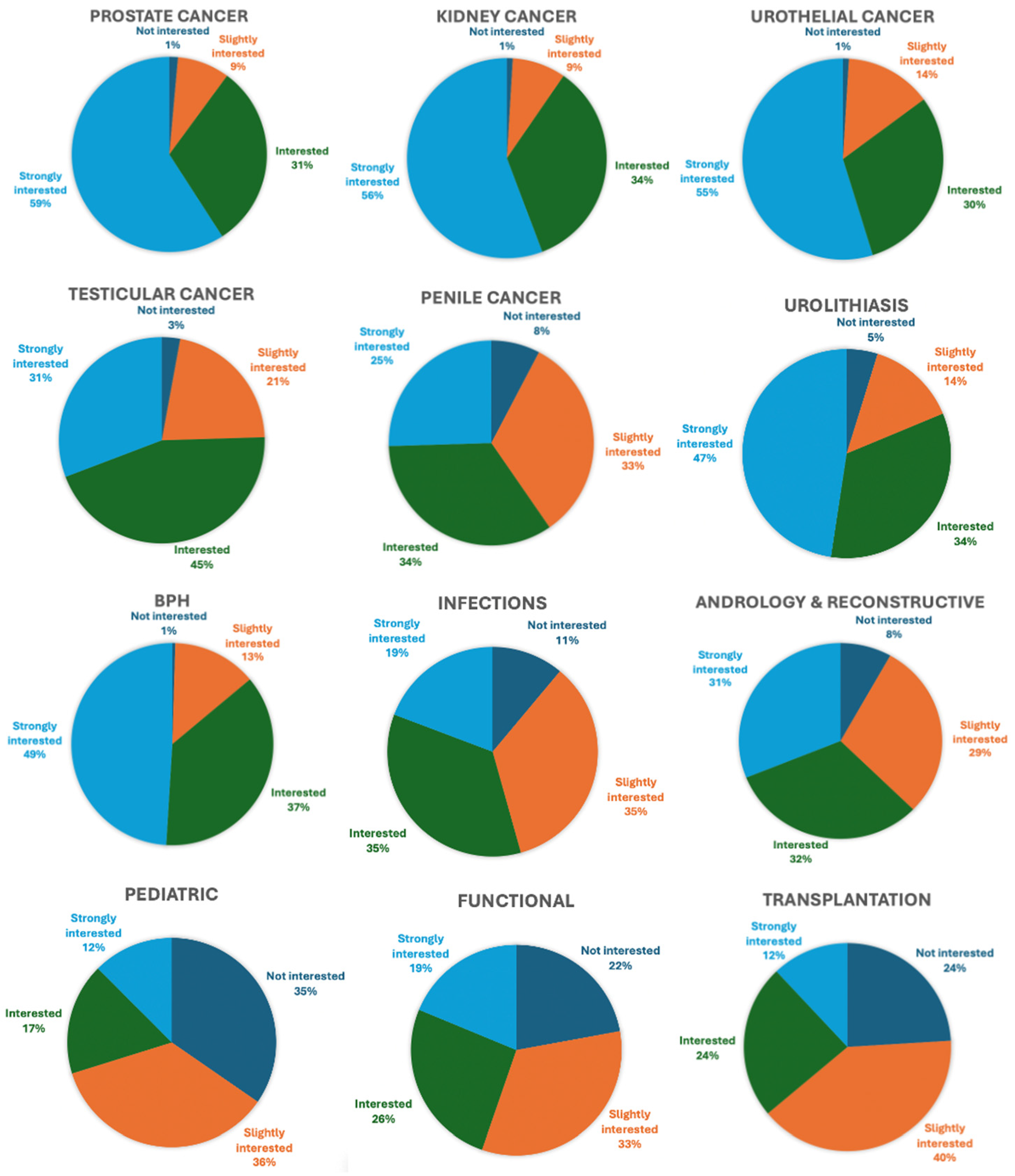
Data on the level of interest in specific urologic topics were collected using a 4-item Likert scale (not interested/slightly interested/interested/strongly interested). The most attracting topics were prostate, kidney and urothelial cancers (>55% of residents declared being “strongly interested”, while only 1% was “not interested” in these fields), followed by benign prostatic hyperplasia (BPH) (49% “strongly interested” and only 1% “not interested”), and urolithiasis (47% “strongly interested”, 5% “not interested”). According to the results of the survey, pediatric, transplantation, and functional urology were the least appealing subspecialties (<50% of responders being at least “Interested”). Overall data on the main urological fields and the level of interest reported by residents are depicted in Figure 1.
Stratifying the interest ratings according to PGY, no statistically significant differences emerged between the various groups of residents and the individual urological topics (p > 0.05 for all).

3.4. Surgical Experience

A dedicated section of the survey explored the surgical experience of residents, both in terms of the number of procedures performed (considering minor surgery, endoscopic, laparoscopic, and robotic interventions) and their expectation of autonomy in performing such interventions once they complete their postgraduate training program.
Table 3 depicts data on surgical experience in endoscopic, laparoscopic, and robotic surgery (both as first surgeon/at least leading the main part of the procedure and as assistant), as reported by the residents interviewed. As expected, significant differences in surgical exposure across residency years were observed, especially for endoscopic and laparoscopic procedures (both as first surgeon and assistant, all p < 0.01), whereas robotic surgery showed no significant differences across PGY levels (reflecting the uniformly limited exposure to console time across all training years). Post hoc pairwise comparisons revealed that PGY-1/2 residents consistently performed fewer endoscopic and laparoscopic procedures compared to PGY-4/5 residents, with PGY-3 trainees showing intermediate levels of exposure.
Operative exposure among trainees demonstrated substantial variability across urological procedures, revealing a clear stratification between high-volume interventions and more complex surgical domains. Cystoscopy represented the most consistently performed procedure, with 75.5% of residents reporting >50 cases, followed by prostate biopsy (42.3%). Transurethral Resection of Bladder Tumor (TURBT) and Transurethral Resection of the Prostate (TURP) showed intermediate exposure, with 22.1% and 15.4% of trainees, respectively, performing >50 procedures. In contrast, experience with advanced interventions remained markedly limited: nearly half of residents (47.1%) had never performed a percutaneous nephrostomy, while 57.2% and 56.7% reported no exposure as first operator to Retrograde Intrarenal Surgery (RIRS) and major open surgery, respectively.
Expectations regarding procedural autonomy after completing the postgraduate training program mirrored these disparities. Residents anticipated the highest degree of independence for prostate biopsy and cystoscopy, and intermediate autonomy for TURBT and TURP. Conversely, procedures requiring more advanced technical proficiency (such as RIRS, percutaneous nephrostomy, and major open surgery) were associated with substantially lower expected autonomy (median of 6, 5, and 2, respectively).
Complete data on surgical experience and expected autonomy in different urological procedures, as reported by the population interviewed, are depicted in Table 4.

3.5. Clinical Workload and Educational Support

Structured theoretical teaching was inconsistently integrated across training programs. While the majority of residents (128/208, 61.5%) reported having scheduled theoretical lessons with professors or tutors, a substantial proportion (78/208, 37.5%) indicated that such sessions were not offered despite expressing interest in receiving them. Only a negligible minority (2/208, 1.0%) reported a lack of both formal lessons and interest in attending them.
Weekly clinical workload of trainees was assessed by asking “How many hours per week do you usually work (scientific activity not considered)?” Only a small proportion of residents reported working fewer than 30 or 30–40 h/week (both 16/208, 7.7%), while a larger group reported a workload of 40–50 h/week (52/208, 25%). Notably, the majority of residents (124/208, 59.6%) indicated working more than 50 h per week, underscoring a substantial clinical burden across training programs.

3.6. Fellowship and Surgical Rotation Between Departments

Overall, 120 (57.7%) residents reported that surgical rotation between departments is planned in their training school. Of the remaining, 65 (31.3%) answered that they had not participated in training networks, but they would like to be exposed to a different environment for a period of time, while a smaller percentage (11%) reported not being interested in such an experience.
When considering international fellowships, only 38 (18.3%) residents had already experienced a period outside the main school of urology. Of these, two (5.3%), three (7.9%), 14 (36.8%), 11 (28.9%), seven (18.4%), and one (2.6%) were PGY-1, -2, -3, -4, -5, and -6, respectively. Focusing on the main topic of their experience, in 14 (36.8%) cases, the main purpose was research, 23 (60.5) were mostly interested in surgical activity, and one (2.6%) in purely clinical activity. Among those who had not yet been exposed to international fellowships, 90.6% (154/170) said they would be interested in such an experience in the future, mostly (132/154, 85.7%) with the aim of improving surgical experience.

3.7. Overall Satisfaction and Future Perspectives

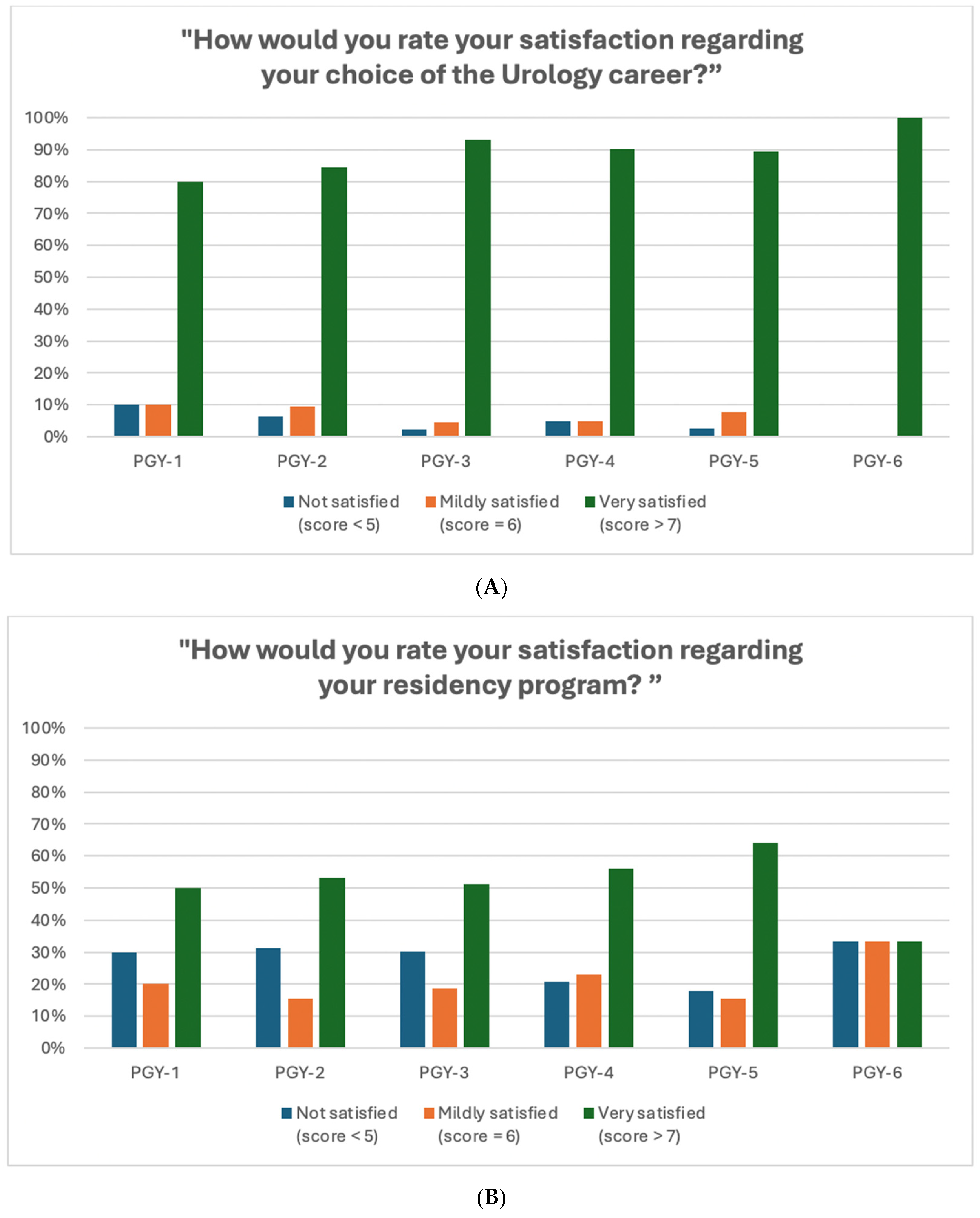
Satisfaction with the choice of urology as a specialty was consistently high across all training years, with no evidence of significant variation between PGY levels (p > 0.4). Overall, only a minority (9/208—4.3% and 13/208—6.3%, respectively) of residents reported being “not satisfied” (score 4–5 on a scale 0 to 10) or “mildly satisfied” (score = 6), whereas the vast majority (186/208, 89.4%) described themselves as “very satisfied” (score > 7). When specifically questioned about satisfaction rate regarding their residency program and urology school, 116 (55.8%) still reported being pleased with their urological training course (score > 7), 41 (19.7%) were “mildly satisfied” (score = 6), and 51 (24.5%) were “unconvinced” (score 1–5) by their urology school. Stratifying by PGY, the distribution of residents reporting low, mild, or high satisfaction did not vary significantly between PGY groups (p = 0.889). Figure 2 depicts the overall satisfaction level among residents (stratified by PGY).
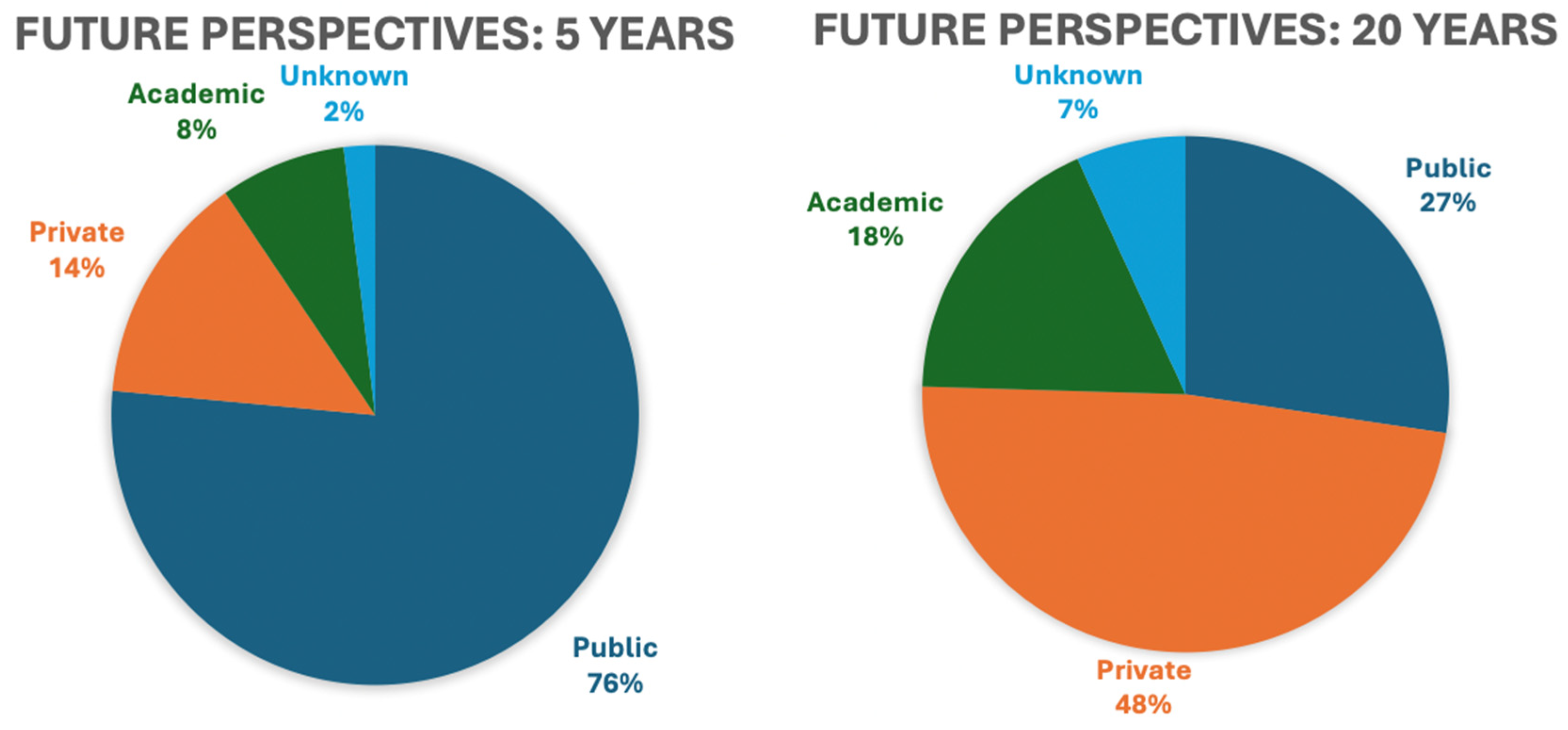
To explore residents’ professional trajectories and future perspectives, we assessed their preferred employment setting at 5 and 20 years post-training (public, private, or academic). In the short term, the majority anticipated working in a public hospital (159/208, 76.4%), whereas substantially fewer envisioned a career in the private sector (29/208, 13.9%) or within an academic institution (16/208, 7.7%). In contrast, 20-year projections revealed a substantial shift toward the private sector, which became the most frequently selected option (100/208, 48.1%), followed by public hospitals (57/208, 27.4%) and academic institutions (37/208, 17.8%), while 14 residents (6.7%) were uncertain about their long-term career setting. Figure 3 visualizes the evolution of residents’ career expectations across 5- and 20-year horizons.

4. Discussion

This international survey involving urology residents from 32 different countries all across the world provides compelling insight into the current landscape of urology training and career aspirations. Previous surveys investigated these topics among urology trainees [4,6,7,8,9]. However, most of these studies were limited to a single country or within European centers, while no previous studies, to the best of our knowledge, evaluated residents’ experiences and perspectives from so many different nations and continents. Several critical themes emerge from our data, some encouraging and others highlighting persistent gaps, that merit reflection and may inform future educational strategies.
First of all, despite a great increase in recent years, female representation in urology remains quite low, highlighting a persistent gender gap also among residents. Considering the participants at the congress, and more specifically those who completed the survey, only about 30% were women. This data confirms previous findings from similar studies [4,8,9,13] and is consistent with the results provided by Halpern et al. [14]. In their study, they report that although urology demonstrated the greatest increase over time in the proportion of women among all specialties, female representation still remains a minority among urology residents (less than 25%). This contrasts with other surgical specialties, historically considered “more feminine”, such as gynecology, which reach peaks of up to 80% [14]. Recent studies showed how women encounter significant barriers along their surgical training, including a lack of support, lower surgical training, fewer opportunities to assume leading roles and academic positions, and impaired work–life balance and pay equity [15,16,17,18,19]. All these factors negatively impact their academic and professional development, leading female students to be less likely to pursue surgical specialties [20]. Being aware of this, efforts should be made to focus on equal education of future surgeons to improve disparities.
Second, when investigating residents’ involvement in research and scientific activity, most of them reported being actively engaged (76.4%) and already having played the role of speaker at urological congresses (64.4%). However, when questioned “How confident would you feel in independently writing a scientific manuscript?”, 67% reported a non-negligible level of insecurity.
As defined by Prof. Heidenreich, educational research should be “the motivated guidance of residents to be involved and to conduct structured research” [21]. A structured curriculum, including conference participation, literature analysis, mentorship, and scientific production, should be integrated into residency programs not only to promote academic careers but also to enhance individual competence in urology. Consistently, Lee et al. [22] and Yang et al. [23] reported that dedicated research time during training is associated with greater future academic success. Building on this, residency programs should further foster scientific development by providing protected research time, high-quality mentorship for all trainees, and opportunities for international mobility in centers of excellence. Such measures cultivate critical thinking, evidence-based practice, and professional growth, ultimately strengthening both the academic and clinical capabilities of future surgeons.
We then investigated residents’ surgical experience, revealing significant differences in surgical exposure across residency years. Despite the great interest shown in robotic surgery, a very limited exposure to console time across all training years was reported. Similarly, while simple interventions (such as cystoscopy and prostate biopsy) are ubiquitous, with a majority of residents reporting high case volumes, access to more advanced surgical procedures (e.g., percutaneous nephrostomy, RIRS, major open surgery) remains limited for many, revealing pronounced inequality in procedural exposure across the urology curriculum. Corresponding to procedural exposure, residents’ expected autonomy mirrors this discrepancy: highest for low-risk endoscopic tasks, markedly lower for complex surgeries.
In fact, urologic training has undergone significant change over time due to different factors (rise of new minimally invasive/robotic procedures, increasing numbers of residents, changes in teaching philosophy, etc.), with residents’ reported role as “surgeon” and their autonomy significantly decreasing [6,24,25,26,27]. As surgical independence is a key milestone in competency-based education, structured curricula, eLearning, and hands-on simulation platforms should be considered to bridge these gaps. Various programs, such as the EuropeaN Training in uRologY (ENTRY) project [5], the European Urology Residents Education Programme (EUREP) [4,28], and the European Association of Urology Robotic Training Curriculum [29,30,31], as well as other structured educational models [13,32,33,34,35], emerged in recent years, providing surgical training and education. In this context, Hanelin et al. [1] proposed creating “procedure-specific autonomy maps” to visually depict expected levels of independence for key steps of common urologic operations, providing a standardized framework for skill progression over the course of residency and promoting a more structured and equitable model of surgical education in urology. Although there is still no certainty as to which strategy will give the best results, increased focus and awareness on resident education and surgical autonomy are vital for training the next generation of surgeons.
Trainees’ experiences likely differ markedly between resource-limited and high-income settings. In low-income (LIC) and lower-middle-income (LMIC) countries, residents are probably exposed more extensively to open surgery but have limited access to robotic or endoscopic procedures, whereas trainees from upper-middle-income (UMIC) and high-income countries (HIC) may rely heavily on technology, potentially at the expense of fundamental surgical skills. Workload, burnout, research confidence, and career trajectories are also plausibly shaped by systemic and socioeconomic factors, with LMIC trainees more prone to understaffing pressures, funding constraints, and shifts toward private practice. Nonetheless, these patterns remain largely speculative as <6% of respondents came from LMICs and LICs versus over 94% from UMICs and HICs, precluding objective comparisons across these settings.
Resident workload is substantial: Nearly 60% of respondents report working over 50 h per week, although specialization contracts generally set a maximum limit of working hours per week (e.g., 38 h/week in Italy and up to 48 h/week for other EU and non-EU countries), in accordance with the European Working Time Directive (Directive 2003/88/EC) [36]. Despite this intensity, structured educational support remains uneven: Although more than 60% of residents have formal theoretical sessions with tutors, more than one-third lack such teaching. This data suggests that educational curricula may not be fully aligned with trainee needs, particularly in systems where resource constraints or clinical demands limit protected teaching time.
As reported in previous studies [19,37,38,39], excessive workload, causing an imbalanced work–life equilibrium (prolonged work hours, frequent transitions from day to night shifts, irregular patterns of eating, sleeping, and exercise), and unsatisfactory working conditions are among the main causes of burnout in doctors and trainees. Professional burnout, beyond having an impact on the lives of workers themselves (higher rates of depression, physicians switching careers or leaving the medical profession), also has repercussions on patient care, increasing medical errors [40]. Prevalence of burnout presents high variability amongst the various countries and residents’ groups, up to almost 70% in some studies, probably due to the different organization of training programs and health systems, workloads, and availability of mental health services and psychological support [37,38]. As reported by Degraeve et al. [41], “when residents work less, they feel better”. In this regard, interventions providing basic needs and encouraging healthy lifestyle habits (facilitating physical wellness and social engagement among residents) might result in sustained reductions in burnout [42]. Moreover, structured mentorship programs, coaching interventions, and mental health and psychological support showed promising results in reducing burnout symptoms [42,43,44].
Despite these problems, overall satisfaction with the choice of urology as a specialty remains high: nearly 90% of respondents are “very satisfied” with their choice, suggesting that urology remains an attractive and fulfilling specialty for trainees globally. When looking at projected career trajectories, the majority of residents foresee early employment in the public sector. However, 20-year projections reveal a pronounced shift toward the private sector. This trend may reflect broader socio-economic dynamics, perceived financial incentives, or limited academic career pipelines. Strategic planning by academic institutions and national societies may be needed to sustain interest in academic careers, especially as many residents envision private practice as their long-term setting.
The strengths and limitations of our survey should be interpreted considering established guidelines for the design and reporting of web-based questionnaires. The CHERRIES framework [11] emphasizes the importance of transparency, prevention of sampling bias, and completeness of reporting. Many prior surveys on urology training have been hindered by low response rates or non-representative samples, underscoring the importance of rigorous methodology to ensure reliability and reproducibility. Moreover, our survey was not limited by single-country data, but we tried to summarize global perceptions, including a large, multinational sample of trainees from 32 different countries.
However, several limitations should be acknowledged. A key limitation of this study is that the sample was exclusively drawn from residents who attended a single international congress and completed the questionnaire, introducing a selection bias, as these participants are likely more academically engaged, professionally motivated, and supported by relatively well-resourced institutions, thereby limiting the generalizability of the findings to the broader trainee population. Moreover, our results only reflect responders’ judgements and perceptions rather than being an objective assessment. Second, our cross-sectional design captures perceptions at a single time point and may not reflect evolving attitudes over time. Third, although this great heterogeneity in the population interviewed represents the main strength of our study, as training environments vary greatly across regions (different infrastructural resources, case volumes, faculty supervision, training programs, national health systems, etc.), our findings may not be generalizable to all urology residency programs.

5. Conclusions

This multi-national survey highlights that urology residents across the globe are deeply engaged in research, largely satisfied with their career choice, and highly motivated toward future mobility. However, significant inequities in procedural exposure and confidence in scientific production, as well as the persistence of a gender gap and excessive workload, suggest opportunities for curriculum development, structured mentorship programs, and changes in training organization. Addressing these areas through thoughtful, competency-based initiatives could strengthen the training pipeline and ensure that all residents achieve their full potential.

Supplementary Materials

The following supporting information can be downloaded at https://www.mdpi.com/article/10.3390/siuj7020024/s1. Figure S1: List of question of the online survey; Figure S2: Countries represented by participants at the SIU congress; Table S1: Distribution of survey respondents by country according to World Bank income groups.

Author Contributions

Conceptualization, A.A. and R.N.; methodology, A.L.H., J.P.S. and P.S.; validation and review of the quality of the survey, M.G., F.C. and S.S.; formal analysis, R.C., L.T. and A.U.; resources, G.M., D.D., A.A.M. and N.P.; writing—original draft, A.A. and R.N.; data curation, G.C., O.F., I.F., W.F.M., H.G. and C.K.; writing—review and editing, S.G., H.H.W., P.E.S. and J.M.Z.; supervision, M.P.L., J.d.l.R. and M.G. All authors have read and agreed to the published version of the manuscript.

Funding

This research received no external funding.

Institutional Review Board Statement

According to the regulations of the local ethics committee (Comitato Etico Regione Toscana-Area Vasta Centro—CEAVC), as the present study did not involve patients, clinical data, or recruitment through healthcare institutions within this jurisdiction, it does not fall within the scope of studies requiring ethics committee review. Therefore, formal ethics committee approval was not required for this study. This study was conducted in accordance with the principles of the Declaration of Helsinki.

Informed Consent Statement

This study was conducted as an anonymous, voluntary, international online survey among urology residents. No patients were involved, and no clinical, genetic, or sensitive personal data were collected. Participation was voluntary, and informed consent was obtained electronically from all participants prior to completing the survey.

Data Availability Statement

The dataset is available upon request.

Acknowledgments

All participants.

Conflicts of Interest

The authors declare no conflicts of interest.

References

  1. Hanelin, D.G.; Tripp, J.; Sankin, A.; Abraham, N. Urology Autonomy Maps: Evaluation of Attending Surgeon Expectations for Resident Competencies in Common Urology Procedures. Urology 2025, 207, 329–334. [Google Scholar] [CrossRef] [PubMed]
  2. Yong, C. Educating the Educator: Understanding Essential Components of Contemporary Urology Residency Training. Curr. Urol. Rep. 2025, 26, 33. [Google Scholar] [CrossRef] [PubMed]
  3. Cruz, A.P.; Skolarus, T.A.; Ambani, S.N.; Hafez, K.; Kraft, K.H. Aligning Urology Residency Training With Real-World Workforce Needs. J. Surg. Educ. 2021, 78, 820–827. [Google Scholar] [CrossRef] [PubMed]
  4. Carrion, D.M.; Rodriguez-Socarrás, M.E.; Mantica, G.; Esperto, F.; Cebulla, A.; Duijvesz, D.; Patruno, G.; Vásquez, J.L.; Veneziano, D.; Díez-Sebastian, J.; et al. Current status of urology surgical training in Europe: An ESRU–ESU–ESUT collaborative study. World J. Urol. 2020, 38, 239–246. [Google Scholar] [CrossRef]
  5. Buffi, N.; Paciotti, M.; Gallagher, A.G.; Diana, P.; De Groote, R.; Lughezzani, G.; Gallioli, A.; Casale, P.; Palou, J.; Mottrie, A.; et al. European training in urology (ENTRY): Quality-assured training for European urology residents. BJU Int. 2023, 131, 177–178. [Google Scholar] [CrossRef]
  6. Borgmann, H.; Arnold, H.K.; Meyer, C.P.; Bründl, J.; König, J.; Nestler, T.; Ruf, C.; Struck, J.; Salem, J. Training, Research, and Working Conditions for Urology Residents in Germany: A Contemporary Survey. Eur. Urol. Focus 2018, 4, 455–460. [Google Scholar] [CrossRef]
  7. Tzelves, L.; Glykas, I.; Lazarou, L.; Zabaftis, C.; Fragkoulis, C.; Leventi, A.; Moulavasilis, N.; Tzavellas, D.; Tsirkas, K.; Ntoumas, K.; et al. Urology residency training in Greece. Results from the first national resident survey. Actas Urol. Esp. 2021, 45, 537–544. [Google Scholar] [CrossRef]
  8. Cocci, A.; Patruno, G.; Gandaglia, G.; Rizzo, M.; Esperto, F.; Parnanzini, D.; Pietropaolo, A.; Principi, E.; Talso, M.; Baldesi, R.; et al. Urology Residency Training in Italy: Results of the First National Survey. Eur. Urol. Focus 2018, 4, 280–287. [Google Scholar] [CrossRef]
  9. Napolitano, L.; Maggi, M.; Sampogna, G.; Bianco, M.; Campetella, M.; Carilli, M.; Lucci Chiarissi, M.; Civitella, A.; De Vita, F.; Di Maida, F.; et al. A survey on preferences, attitudes, and perspectives of Italian urology trainees: Implications of the novel national residency matching program. Minerva Urol. Nephrol. 2023, 75, 718–728. [Google Scholar] [PubMed]
  10. Kate, V.; Kalayarasan, R. Advancing Surgical Education Globally: Training NextGen Surgeons. Int. J. Adv. Med. Health Res. 2024, 11, 1–3. [Google Scholar] [CrossRef]
  11. Eysenbach, G. Improving the Quality of Web Surveys: The Checklist for Reporting Results of Internet E-Surveys (CHERRIES). J. Med. Internet Res. 2004, 6, e34. [Google Scholar] [CrossRef] [PubMed]
  12. Metreau, E.; Young, K.E.; Eapen, S.G. Understanding Country Income: World Bank Group Income Classifications for FY26 (July 1, 2025–June, 2026). Available online: https://blogs.worldbank.org/en/opendata/understanding-country-income--world-bank-group-income-classifica (accessed on 1 March 2026).
  13. Somani, B.; Gomez-Rivas, J.; de Oliveira, T.R.; Veneziano, D.; Brouwers, T.; Herrmann, C.; Sedelaar-Maaskant, J.; N’Dow, J.; Palou, J.; Li, N.; et al. Trends of European School of Urology (ESU) training and resident education: An overview of 2 decades of EAU education programme. World J. Urol. 2024, 42, 564. [Google Scholar] [CrossRef] [PubMed]
  14. Halpern, J.A.; Lee, U.J.; Wolff, E.M.; Mittal, S.; Shoag, J.E.; Lightner, D.J.; Soo, K.; Hu, J.C.; Chughtai, B.; Lee, R.K. Women in Urology Residency, 1978-2013: A Critical Look at Gender Representation in Our Specialty. Urology 2016, 92, 20–25. [Google Scholar] [CrossRef] [PubMed]
  15. Stephens, E.H.; Heisler, C.A.; Temkin, S.M.; Miller, P. The Current Status of Women in Surgery. JAMA Surg. 2020, 155, 876–885. [Google Scholar] [CrossRef]
  16. Yang, G.; Villalta, J.D.; Weiss, D.A.; Carroll, P.R.; Breyer, B.N. Gender Differences in Academic Productivity and Academic Career Choice Among Urology Residents. J. Urol. 2012, 188, 1286–1290. [Google Scholar] [CrossRef]
  17. Olivencia, M.N.; Lam, N.B.; Stewart, S.; Miller-Hammond, K.; Johnson, S.; Nembhard, C.E.; Tee, M.C. Disparities in Diversity, Equity, and Inclusion in Surgical Residency Education: A Systematic Review. Am. Surg. 2025, 91, 1405–1418. [Google Scholar] [CrossRef]
  18. Marchetti, K.A.; Ferreri, C.A.; Bethel, E.C.; Lesser-Lee, B.; Daignault-Newton, S.; Merrill, S.; Badalato, G.M.; Brown, E.T.; Guzzo, T.; Houston Thompson, R.; et al. Gender-based Disparity Exists in the Surgical Experience of Female and Male Urology Residents. Urology 2024, 185, 17–23. [Google Scholar] [CrossRef]
  19. Minore, A.; Cacciatore, L.; Cindolo, L.; Gravas, S.; de la Rosette, J.; Laguna, M.P.; Wu, Z.; Gianduzzo, T.; Gonzalez Alfano, C.; O’Connell, H.; et al. Work–Life Integration, Professional Stress, and Gender Disparities in the Urological Workforce: Findings from a Worldwide Cross-Sectional Study. Soc. Int. Urol. J. 2025, 6, 74. [Google Scholar] [CrossRef]
  20. Bennett, C.L.; Baker, O.; Rangel, E.L.; Marsh, R.H. The Gender Gap in Surgical Residencies. JAMA Surg. 2020, 155, 893–894. [Google Scholar] [CrossRef]
  21. Heidenreich, A. Educational research in urology: Innovations for improving training. Urologe 2019, 58, 114–125. [Google Scholar] [CrossRef]
  22. Lee, A.; Namiri, N.; Rios, N.; Enriquez, A.; Hampson, L.A.; Pruthi, R.S.; Breyer, B.N. Dedicated Residency Research Time and Its Relationship to Urologic Career Academic Success. Urology 2021, 148, 64–69. [Google Scholar] [CrossRef]
  23. Yang, G.; Zaid, U.B.; Erickson, B.A.; Blaschko, S.D.; Carroll, P.R.; Breyer, B.N. Urology Resident Publication Output and Its Relationship to Future Academic Achievement. J. Urol. 2011, 185, 642–646. [Google Scholar] [CrossRef]
  24. Nguyen, A.T.; Oliver, J.B.; Jain, K.; Hingu, J.; Kunac, A.; Sadeghi-Nejad, H.; Anjaria, D. Urology Resident Autonomy in the Veterans Affairs Healthcare System. J. Surg. Educ. 2025, 82, 103370. [Google Scholar] [CrossRef]
  25. Neuzil, K.; Wallen, E.; Potts, J.R., III; DeWitt-Foy, M.E. See more, do less?—Resident-reported training trends in reconstructive Urology. Transl. Androl. Urol. 2025, 14, 2358–2364. [Google Scholar] [CrossRef]
  26. Nguyen, A.T.; Anjaria, D.J.; Sadeghi-Nejad, H. Advancing Urology Resident Surgical Autonomy. Curr. Urol. Rep. 2023, 24, 253–260. [Google Scholar] [CrossRef]
  27. Rodríguez-Socarrás, M.E.; Gómez Rivas, J.; García-Sanz, M.; Pesquera, L.; Tortolero-Blanco, L.; Ciappara, M.; Melnick, A.; Colombo, J.; Patruno, G.; Serrano-Pascual, Á.; et al. Medical-surgical activity and the current state of training of urology residents in Spain: Results of a national survey. Actas Urol. Esp. 2017, 41, 391–399. [Google Scholar] [CrossRef] [PubMed]
  28. Somani, B.K.; Van Cleynenbreugel, B.; Gozen, A.; Palou, J.; Barmoshe, S.; Biyani, S.; Gaya, J.M.; Hellawell, G.; Pini, G.; Oscar, F.R.; et al. The European Urology Residents Education Programme Hands-on Training Format: 4 Years of Hands-on Training Improvements from the European School of Urology. Eur. Urol. Focus 2019, 5, 1152–1156. [Google Scholar] [CrossRef] [PubMed]
  29. Volpe, A.; Ahmed, K.; Dasgupta, P.; Ficarra, V.; Novara, G.; van der Poel, H.; Mottrie, A. Pilot Validation Study of the European Association of Urology Robotic Training Curriculum. Eur. Urol. 2015, 68, 292–299. [Google Scholar] [CrossRef] [PubMed]
  30. Ahmed, K.; Khan, R.; Mottrie, A.; Lovegrove, C.; Abaza, R.; Ahlawat, R.; Ahlering, T.; Ahlgren, G.; Artibani, W.; Barret, E.; et al. Development of a standardised training curriculum for robotic surgery: A consensus statement from an international multidisciplinary group of experts. BJU Int. 2015, 116, 93–101. [Google Scholar] [CrossRef]
  31. Mottrie, A.; Novara, G.; van der Poel, H.; Dasgupta, P.; Montorsi, F.; Gandaglia, G. The European Association of Urology Robotic Training Curriculum: An Update. Eur. Urol. Focus 2016, 2, 105–108. [Google Scholar] [CrossRef]
  32. Chow, A.K.; Sherer, B.A.; Yura, E.; Kielb, S.; Kocjancic, E.; Eggener, S.; Turk, T.; Park, S.; Pstutka, S.; Abern, M.; et al. Urology Residents’ Experience and Attitude Toward Surgical Simulation: Presenting our 4-Year Experience With a Multi-institutional, Multi-modality Simulation Model. Urology 2017, 109, 32–37. [Google Scholar] [CrossRef] [PubMed]
  33. Fukuta, K.; Fukawa, T.; Kobayashi, S.; Shiozaki, K.; Sasaki, Y.; Seto, K.; Nakanishi, R.; Izaki, H.; Takahashi, M.; Kanda, K.; et al. Efficacy of educational stepwise robot-assisted radical prostatectomy procedure for urology residents. Asian J. Endosc. Surg. 2024, 17, e13334. [Google Scholar] [CrossRef] [PubMed]
  34. Pinto, L.O.A.D.; Silva, R.C.; Santos Junior, H.C.F.D.; Bentes, L.G.B.; Otake, M.I.T.; Bacelar, H.P.H.; Kietzer, K.S. Simulators in urology resident’s training in retrograde intrarenal surgery. Acta Cir. Bras. 2024, 39, e394724. [Google Scholar] [CrossRef] [PubMed]
  35. Bouvette, M.J.; Lee, B.; Bradley, N. Robotic simulation in urology training: Implementation, curricula, and barriers across U.S. residency programs. J. Robot. Surg. 2025, 19, 406. [Google Scholar] [CrossRef]
  36. European Doctors Working Conditions-A FEMS White Book. Available online: https://www.fems.net/images/Fems_documents/Documents/2024/FEMS__Digital_1.pdf (accessed on 20 January 2025).
  37. Marchalik, D.; Goldman, C.C.; Carvalho, F.F.L.; Talso, M.; Lynch, J.H.; Esperto, F.; Pradere, B.; Van Besien, J.; Krasnow, R.E. Resident burnout in USA and European urology residents: An international concern. BJU Int. 2019, 124, 349–356. [Google Scholar] [CrossRef]
  38. Hanna, K.F.; Koo, K. Professional Burnout and Career Choice Regret in Urology Residents. Curr. Urol. Rep. 2024, 25, 325–330. [Google Scholar] [CrossRef]
  39. Koo, K.; Javier-DesLoges, J.F.; Fang, R.; North, A.C.; Cone, E.B. Professional Burnout, Career Choice Regret, and Unmet Needs for Well-Being Among Urology Residents. Urology 2021, 157, 57–63. [Google Scholar] [CrossRef]
  40. Tawfik, D.S.; Profit, J.; Morgenthaler, T.I.; Satele, D.V.; Sinsky, C.A.; Dyrbye, L.N.; Tutty, M.A.; West, C.P.; Shanafelt, T.D. Physician Burnout, Well-being, and Work Unit Safety Grades in Relationship to Reported Medical Errors. Mayo Clin. Proc. 2018, 93, 1571–1580. [Google Scholar] [CrossRef]
  41. Degraeve, A.; Lejeune, S.; Muilwijk, T.; Poelaert, F.; Piraprez, M.; Svistakov, I.; Roumeguère, T.; European Society of Residents in Urology Belgium (ESRU-B). When residents work less, they feel better: Lessons learned from an unprecedent context of lockdown. Prog. Urol. 2020, 30, 1060–1066. [Google Scholar] [CrossRef]
  42. Anaissie, J.; Popat, S.; Mayer, W.A.; Taylor, J.M. Innovative Approaches to Battling Resident Burnout in a Urology Residency Program. Urol. Pract. 2021, 8, 387–392. [Google Scholar] [CrossRef]
  43. Glick, H.; Ganesh Kumar, N.; Olinger, T.A.; Vercler, C.J.; Kraft, K.H. Resident Mental Health and Burnout: Current Practices and Perspectives of Urology Program Directors. Urology 2022, 160, 40–45. [Google Scholar] [CrossRef]
  44. Fainstad, T.; Mann, A.; Suresh, K.; Shah, P.; Dieujuste, N.; Thurmon, K.; Jones, C.D. Effect of a Novel Online Group-Coaching Program to Reduce Burnout in Female Resident Physicians: A Randomized Clinical Trial. JAMA Netw. Open 2022, 5, e2210752. [Google Scholar] [CrossRef]
Figure 1. Overall levels of interest in urological subspecialties among residents. Legend: BPH = benign prostatic hyperplasia.
Siuj 07 00024 g001
Figure 2. Overall satisfaction level among residents stratified by postgraduate year (PGY). (A) Satisfaction regarding the choice of the urology career. (B). Satisfaction regarding the residency program and the urology school.
Siuj 07 00024 g002
Figure 3. Future career perspectives at 5 and 20 years.
Siuj 07 00024 g003
Table 1. General information and respondents’ demographics.
Responders, n (%)208 (100)
Age, median (IQR)29 (28–31)
Gender, n (%)
Male147 (70.7)
Female61 (29.3)
Marital status, n (%)
Married29 (13.9)
Not married179 (86.1)
Family status, n (%)
No children 184 (88.5)
Childbirth before residency8 (3.8)
Childbirth during residency12 (5.8)
Prefer not to say4 (1.9)
Postgraduate year (PGY), n (%)
PGY-110 (4.8)
PGY-232 (15.4)
PGY-343 (20.7)
PGY-482 (39.4)
PGY-538 (18.3)
PGY-63 (1.4)
Urology as first choice of interest, n (%)
Yes189 (90.9)
No13 (6.2)
Prefer not to say6 (2.9)
Main field of interest, n (%)
Surgical activity182 (87.5)
Clinical and outpatient activity11 (5.3)
Research 15 (7.2)
Legend: IQR = interquartile range.
Table 2. Resident involvement in research and scientific activities.
“Are you actively involved in research?”, n (%)
Yes
No, lack of research activity in my center
No, not interested in research

159 (76.4)
38 (18.3)
11 (5.3)
“How confident would you feel in independently writing an abstract
(on a scale 1–10)?”, median (IQR)
7 (5–8)
“How confident would you feel in independently writing a scientific manuscript (e.g., original article, systematic review, etc.)
(on a scale 1–10)?”, median (IQR)
6 (4–7)
“Have you ever presented an abstract at a national/international urological congress?”, n (%)
Yes, only national congress
Yes, only international congress
Yes, both national and international congresses
No

70 (33.7)
5 (2.4)
59 (28.4)
74 (35.6)
“How many papers did you publish on indexed journals
(as first author or co-author)?”, n (%)
None
1–5 papers
5–10 papers
10–20 papers
>20 papers


46 (22.1)
97 (46.6)
35 (16.8)
20 (9.6)
10 (4.8)
Legend: IQR = interquartile range.
Table 3. Surgical experience stratified by postgraduate year (PGY).
OverallPGY-1PGY-2PGY-3PGY-4PGY-5
208 (100)10 (4.8)32 (15.4) 43 (20.7)82 (39.4)38 (18.3)
Endoscopy (1st surgeon), n (%)
None12 (5.8)4 (40)5 (15.6)1 (2.3)2 (2.4)0 (0)
1–1042 (20.2)2 (20)9 (28.1)16 (37.2)12 (14.6)3 (7.9)
10–5075 (36)2 (20)13 (40.6)18 (41.9)27 (32.9)14 (36.8)
50–10053 (25.5)2 (20)2 (6.3)7 (16.3)30 (36.6)10 (26.3)
>10026 (12.5)0 (0)3 (9.4)1 (2.3)11 (13.4)11 (28.9)
Endoscopy (assistant), n (%)
None6 (2.9)4 (40)2 (6.3)0 (0)0 (0)0 (0)
1–1015 (7.2)1 (10)7 (21.9)4 (9.3)2 (2.4)1 (2.6)
10–5064 (30.8)2 (20)17 (53.1)15 (34.9)21 (25.6)10 (26.3)
50–10059 (28.4)3 (30)4 (12.5)16 (37.2)26 (31.7)9 (23.7)
>10063 (30.3)0 (0)2 (6.3)8 (18.6)33 (40.2)18 (47.4)
Laparoscopy (1st surgeon), n (%)
None140 (67.3)8 (80)25 (78.1)32 (74.4)52 (63.4)23 (60.5)
1–1040 (19.2)2 (20)4 (12.5)8 (18.6)23 (28)3 (7.9)
10–5019 (9.1)0 (0)2 (6.3)1 (2.3)6 (7.3)9 (23.7)
50–1008 (3.8)0 (0)1 (3.1)2 (4.7)1 (1.2)3 (7.9)
>1000 (0)0 (0)0 (0)0 (0)0 (0)0 (0)
Laparoscopy (assistant), n (%)
None57 (27.4)4 (40)13 (40.6)10 (23.3)21 (25.6)11 (28.9)
1–1067 (32.2)4 (40)10 (31.3)13 (30.2)29 (35.4)10 (26.3)
10–5047 (22.6)2 (20)4 (12.5)15 (34.9)19 (23.2)6 (15.8)
50–10027 (13)0 (0)5 (15.6)4 (9.3)11 (13.4)8 (21.1)
>1008 (3.8)0 (0)0 (0)1 2.3)2 (2.4)3 (7.9)
Robotic (1st surgeon), n (%)
None186 (89.4)8 (80)29 (90.6)42 (97.7)70 (85.4)32 (84.2)
1–1018 (8.7)2 (20)3 (9.4)1 (2.3)9 (11)3 (7.9)
10–506 (2.9)0 (0)0 (0)0 (0)3 (3.7)3 (7.9)
50–1000 (0)0 (0)0 (0)0 (0)0 (0)0 (0)
>1000 (0)0 (0)0 (0)0 (0)0 (0)0 (0)
Robotic (assistant), n (%)
None64 (30.8)4 (40)17 (53.1)13 (30.2)13 (15.9)13 (34.2)
1–1052 (25)4 (40)7 (21.9)17 (39.5)14 (17.1)9 (23.7)
10–5042 (20.2)2 (20)4 (12.5)9 (20.9)23 (28)4 (10.5)
50–10030 (14.4)0 (0)4 (12.5)2 (4.7)20 (24.4)6 (15.8)
>10020 (9.6)0 (0)0 (0)2 (4.7)12 (14.6)6 (15.8)
Table 4. Overall experience and expected autonomy (at the end of the residency) in performing various urological procedures.
ProceduresNone
n (%)
1–20
n (%)
20–50
n (%)
>50
n (%)
Expected Autonomy
(Scale 1–10)
Median (IQR)
Prostate biopsy14 (6.7)56 (26.9)50 (24)88 (42.3)9 (6–10)
Cystoscopy2 (1)11 (5.3)38 (18.3)157 (75.5)10 (9–10)
Urodynamic test47 (22.6)80 (38.5)36 (17.3)45 (21.6)6 (3–9)
Suprapubic cystostomy58 (27.9)108 (51.9)29 (13.9)13 (6.3)7 (3–9.5)
Percutaneous nephrostomy98 (47.1)69 (33.2)30 (14.4)11 (5.3)5 (1.5–8)
Ureteral stent16 (7.7)63 (30.3)54 (26)75 (36.1)9 (7–10)
TURBT15 (7.2)86 (41.3)61 (29.3)46 (22.1)8 (6–10)
TURP43 (20.7)95 (45.7)38 (18.3)32 (15.4)7 (5–9)
Ureterolithotripsy41 (19.7)91 (43.8)41 (19.7)35 (16.8)7 (5–9)
RIRS66 (31.7)81 (38.9)37 (17.8)24 (11.5)6 (4–8)
Minor open surgery (circumcision, varicocele, etc.)11 (5.3)74 (35.6)51 (24.5)72 (34.6)8 (7–10)
Major open surgery118 (56.7)65 (31.3)16 (7.7)9 (4.3)2 (0–6)
Legend: IQR = interquartile range; TURBT = Transurethral Resection of Bladder Tumor; TURP = Transurethral Resection of the Prostate; RIRS = Retrograde Intrarenal Surgery.
Disclaimer/Publisher’s Note: The statements, opinions and data contained in all publications are solely those of the individual author(s) and contributor(s) and not of MDPI and/or the editor(s). MDPI and/or the editor(s) disclaim responsibility for any injury to people or property resulting from any ideas, methods, instructions or products referred to in the content.