


A 26-year-old male presented to the emergency department following acute onset pain and swelling in the perineum. His abdominal and genital examination was benign without evidence of penile swelling, ecchymosis, or deformity. Perineal examination revealed swelling and tenderness along the right perineum. The patient denied any external trauma but acknowledged performing forceful self-penile detumescence to relieve his erection. He denied difficulty with urination or hematuria.
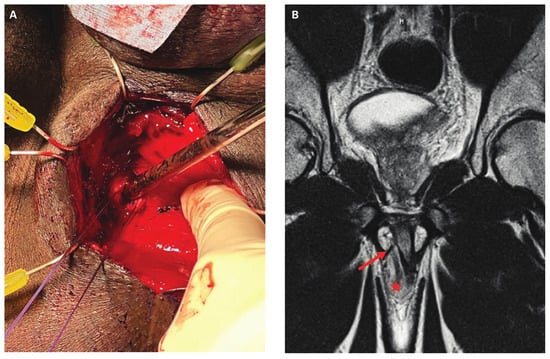
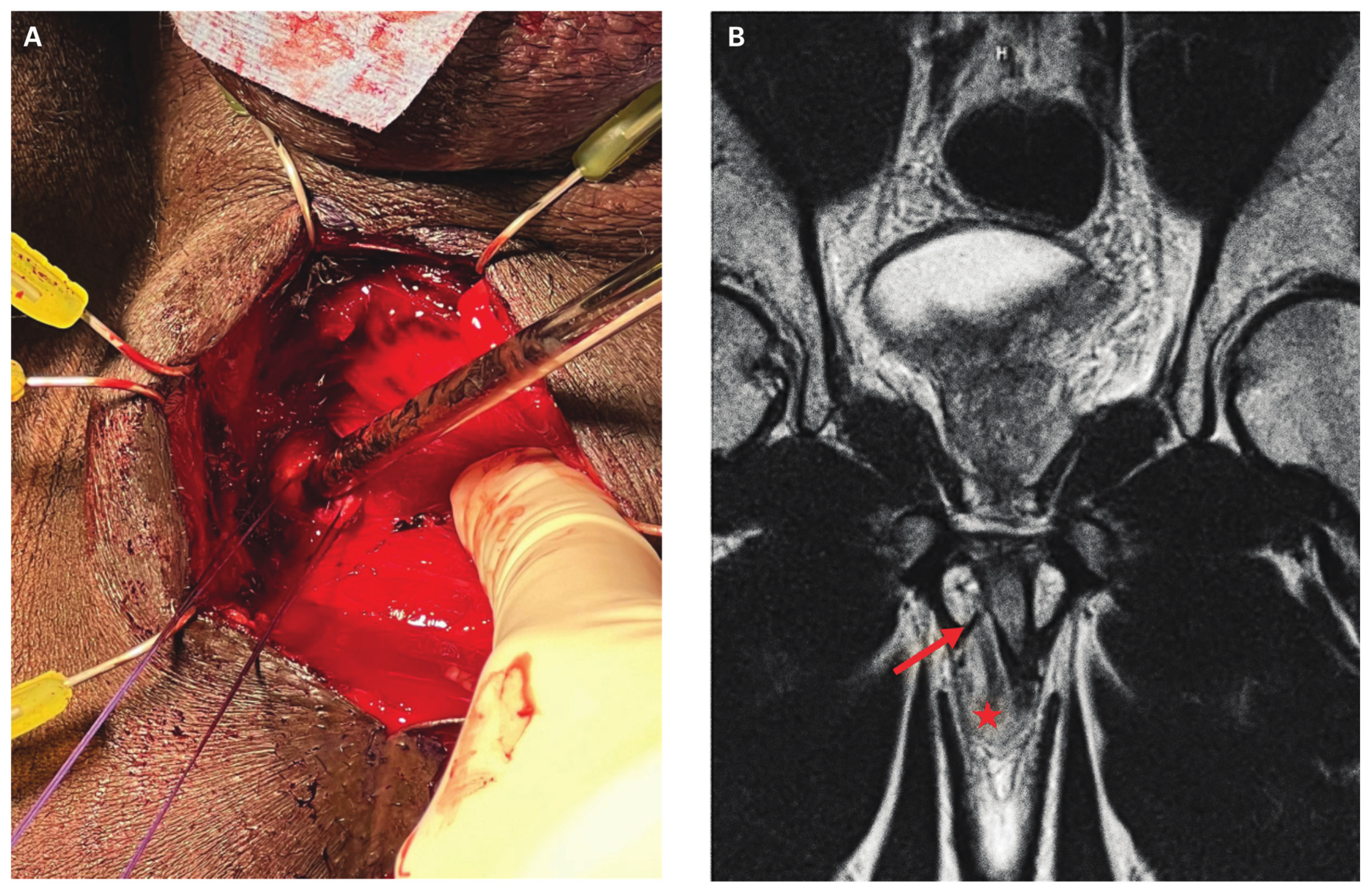
Magnetic resonance imaging (MRI) of the penis demonstrated rupture of the proximal right-sided corpora cavernosum along the right crus penis. The patient underwent urgent transperineal exploration, evacuation of the perineal hematoma, and repair of an approximately 1.5 cm corporal tear (Figure 1A,B). Mobilization of the right side of the bulbar urethra was required to sufficiently identify and expose the corporal injury for repair. The tear was noted ventromedially and in close proximity to the distal bulbar urethra. Cystoscopy was performed, which was negative for urethral injury. Repair was performed using interrupted 2–0 polydioxanone suture. At 6 weeks postoperatively, the patient was experiencing normal erectile function.
Figure 1.
(A) ldentification of the size and location of the right-sided corporal injury. Note medial retraction of the bulbarirethra with gloved hand. (B) Coronal MRl image of the right corporal injury at the ventromedial location (arrow)associated with extravasation and hematoma formation (star).
Taqaandan is a practice that has been observed in young males (age 20 to 40) from Middle Eastern and North African countries [1]. The practice itself involves forceful bending the distal erect penis while the proximal shaft is kept stationary in order to achieve rapid detumescence. In an Iranian study evaluating penile fracture, taqaandan was the reported etiology in 269/352 patients (76%) [2]. As in penile fracture sustained during traumatic sexual intercourse, most injuries involve the penile shaft with the expected clinical findings of penile swelling, ecchymosis, and penile deformity. However, taqaandan as a cause for fracture for the crus penis has not been reported previously. Repair of crus penis fractures can be approached using a standard transperineal dissection [3].
Conflicts of Interest
None declared.
References
- Ekeke, O.N.; Eke, N. Fracture of The penis in the Niger Delta region of Nigeria. J. West Afr. Coll. Surg. 2014, 4, 1–19. [Google Scholar]
- Zargooshi, J. Sexual function and tunica albuginea wound healing following penile fracture: an 18-year follow-up study of 352 patients from Kermanshah, Iran. J. Sex. Med. 2009, 6, 1141–1150. [Google Scholar] [CrossRef] [Scilit] [PubMed]
- Harada, J.; Shida, Y.; Gono, S.; Masato, M.; Yuno, T.; Hakariya, T.; et al. Rare case of penile fracture caused by an injury to the crus penis: delayed repair using the transperineal approach. IJU Case Rep. 2020, 4, 36–38. [Google Scholar] [CrossRef] [Scilit] [PubMed]
This is an open access article under the terms of a license that permits non-commercial use, provided the original work is properly cited. © 2023 The Authors. Société Internationale d'Urologie Journal, published by the Société Internationale d'Urologie, Canada.