Next Article in Journal
The rhythms of language: an overview of linguistic processes and neural oscillations
Previous Article in Journal
Adenoid Cystic Carcinoma of the Bartholin Gland. A Morphological and Immunohistochemical study of a rare case
 
 
Journal of Interdisciplinary Research Applied to Medicine is published by MDPI from Volume 6 Issue 1 (2026). Previous articles were published by another publisher in Open Access under a CC-BY (or CC-BY-NC-ND) licence, and they are hosted by MDPI on mdpi.com as a courtesy and upon agreement with University of Salento.
Article

How is suspected transthyretin-related cardiac amyloidosis diagnosed? Role 99mTc-HDMP scintigraphy: a substitute for biopsy?

Nuclear Medicine Unit, Interdisciplinary Department of Medicine. Lecce, Italy
*
Author to whom correspondence should be addressed.
J. Interdiscip. Res. Appl. Med. 2021, 5(1), 33-36; https://doi.org/10.1285/i25327518v5i1p33
Published: 30 June 2021

Abstract

Cardiac amyloidosis (CA) is characterized by extracellular deposition of protein-derived fibrils and lead to heart failure. Gold standard for its etiological diagnosis is endomyocardial biopsy and laboratory tests, both high-cost and invasive procedures. Technetium- 99m hydroxymethylene diphosphonate (99mTc-HMDP) scintigraphy is important tool for defining CA, specifically transthyretin subtype (ATTR). From July 2020 to February 2021, we retrospectively analyzed 18 pts [14 males, 4 females; aged 32-86y] with suspected ATTR, underwent to scintigraphy 150 min after iv administration of 740 MBq 99mTc-HMDP.Myocardial uptake was assessed optically based on Perugini Score (0- 3). Biopsy confirmed diagnosis. Intense (Score 3) and moderate (Score 2) myocardial uptake verified in 8 patients by 99mTc-HDMP scintigraphy, was consistent with ATTR suspect. In 10 patient’s cardiac radiotracer uptake was absent (Score 0) avoiding biopsy. Our data indicate a 99mTc-HDMP scintigraphy key role in the early diagnosis but even more in the exclusion of patients with ATTR subtype, optimizing the management of pts who do not require high costs and invasive procedures.

1. Introduction

Systemic amyloidosis is heterogeneous disease characterized by extracellular deposition of protein-derived fibrils, namely amyloid, in different tissue and organs, including the heart.
Although considered a rare disease, recent data suggest that cardiac amyloidosis is underappreciated as a cause of common cardiac diseases or syndromes (Maleszewski 2015).
While more than 30 proteins are known to be capable of aggregating as amyloid in vivo, only nine amyloidogenic proteins accumulate in the myocardium to cause significant cardiac disease, like heart failure, conduction disorders, atrial fibrillation and ventricular arrhythmias.
Two types of amyloid commonly infiltrate the heart: immunoglobulin light-chain (AL) amyloid and transthyretin (ATTR) amyloid, either in its hereditary (ATTRv) or acquired (ATTRwt) form.
Cardiac amyloidosis is diagnosed when amyloid fibrils are found within cardiac tissue. (Benson et al. 2018).
Both invasive and non-invasive diagnostic criteria have been proposed.
Imaging with cardiac US/MRI provides nonspecific findings.
Gold standard for etiological diagnosis of cardiac amyloidosis is endomyocardial biopsy combined with immunohistochemical parameters/mass spectroscopy, both high-cost and invasive procedures.
Technetium- 99m hydroxymethylene diphosphonate (99mTc-HMDP) scintigraphy is a important tool for defining CA, specifically transthyretin subtype (ATTR). (Ruberg et al. 2019) Our work underlines the role of nuclear medicine in CA diagnosis and patient’s management.

2. Subjects and methods

2.1. Patients’ population

We retrospectively analyzed eighteen patients [14 males, 4 females; aged 32-86y] who were admitted to our Unit from July 2020 to February 2021 with suspected CA.
The following variables were recorded for each patient: age, gender, hospitalization department, risk factors, symptoms, and previous clinical and instrumental evaluation.
CA suspicion was based on presence clinical cardiac and extracardiac sign and symptoms, like hypotension, macroglossia, skin bruises, carpal tunnel syndrome, polyneuropathy and dysautonomia, altered ECG results and laboratory tests, pathological instrumental imaging results (Echocardiogram and/ or cardiac magnetic resonance) For each patient, an individual informed consensus was obtained allowing us to use all data for research purposes.

2.2. Diagnostic exams

Myocardial scintigraphy was acquired using gamma OPTIMA NM/CT 670 (GE Medical System, West Milwaukee, WI, USA) 150 minutes after iv administration of 740 MBq 99mTc- labelled hydroxymethylene diphosphonate (HMDP).
Whole -body planar images were acquired 3 hours after injection. Images were acquired with low-energy and high-resolution collimators and a scan speed of 10 cm/min.
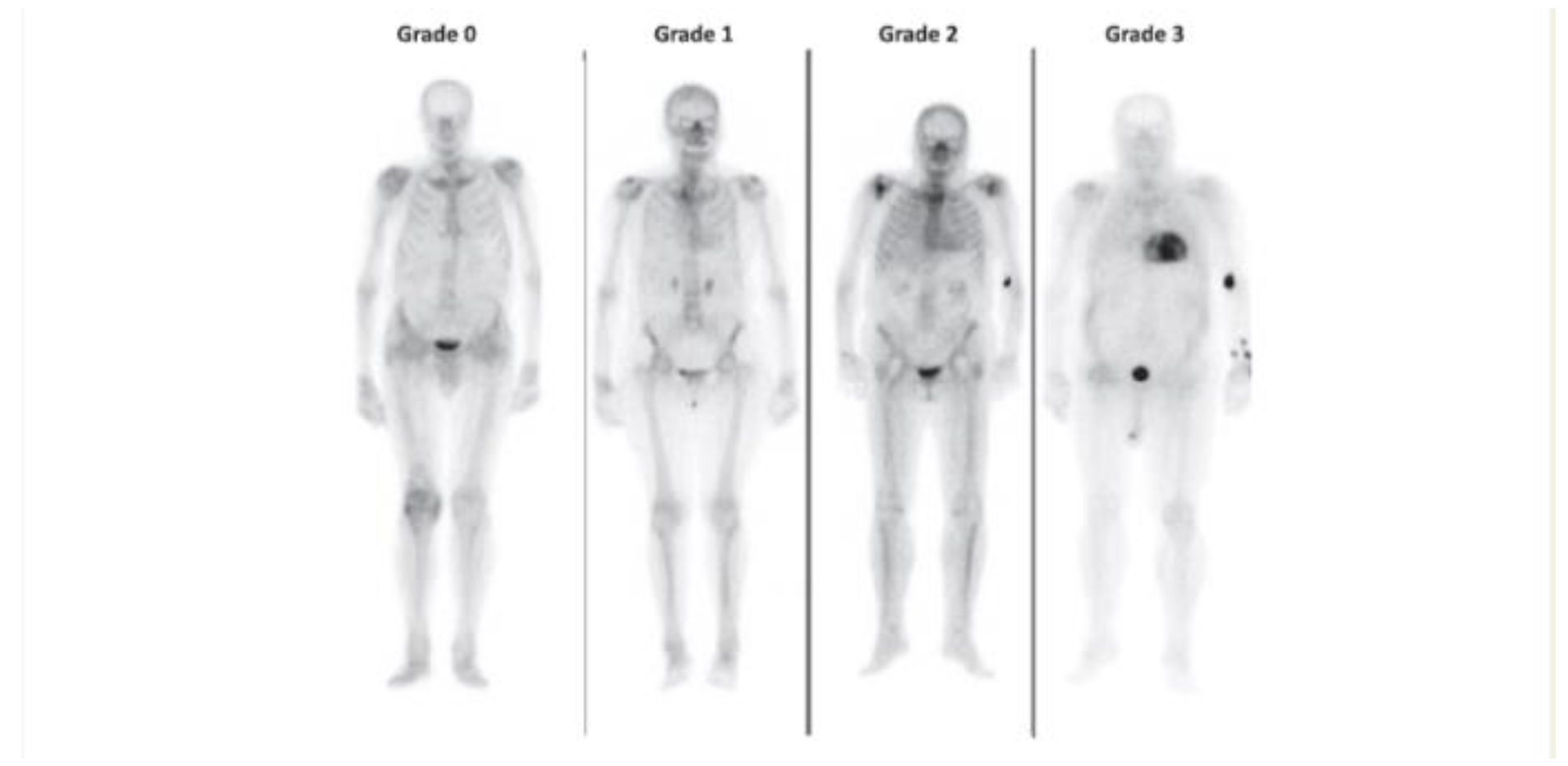
Myocardial radiotracer uptake was assessed optically based on Perugini Score (Perugini et al. 2005):
0: absent of tracer myocardial uptake and normal bone uptake.
1: mild cardiac uptake, inferior to bon uptake.
2: moderate cardiac uptake with attenuated bone.
3: high cardiac uptake with decreased or absent bone uptake. (Figure 1) ECG test showed low/decreased QRS voltage to degree of LV thickness and/or atrio-ventricular conduction disease.
Persistent troponin elevation, disproportionally elevated NT-proBNP to degree of heart failure and proteinuria (even mild) in laboratory tests were also signs that could evoke CA.
All patients were performed Echocardiogram, characterized by presence of granular sparkling of myocardium, increased right ventricular wall/ valve thickness and pericardial effusion.
8/18 patients underwent cardiac magnetic resonance that showed subendocardial late gadolinium enhancement, elevated native T1 values, Increased extracellular volume and Abnormal gadolinium kinetics.

3. Results

Diffuse intense myocardial uptake (score 3) verified in 5 patients by 99mTc-HDMP scintigraphy. This result, associated with positive hematologic tests (serum free light chains and serum and urine immunofixation), was consistent with ATTR diagnosis, without biopsy.
In 3 patients whole-body scintigraphy showed a moderate cardiac uptake (Score 2), biopsy was necessary to confirm.
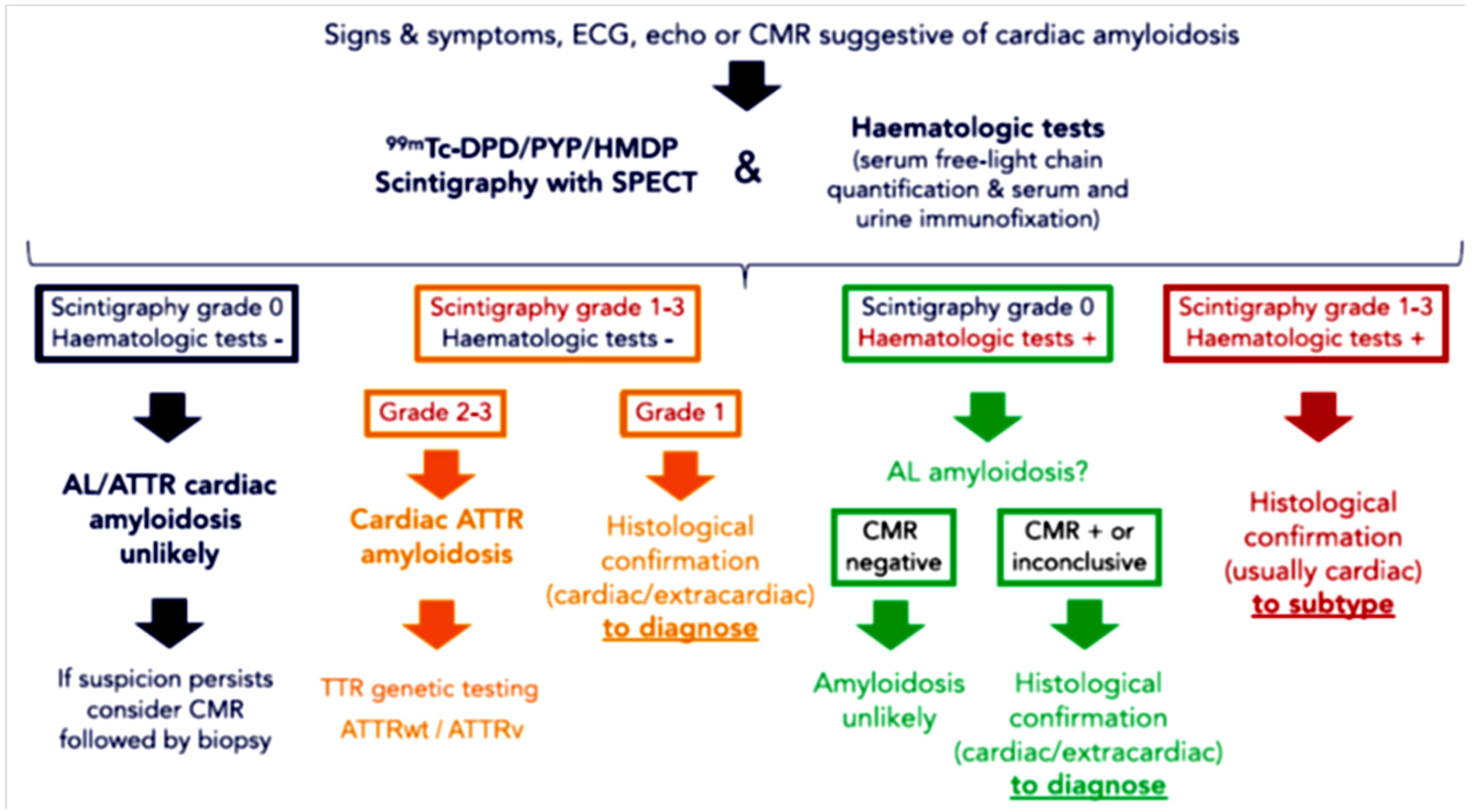
In ten patient’s cardiac radiotracer uptake was absent (Score 0) and hematologic tests were negative, so biopsy invasive procedure was avoiding, according to diagnostic algorithm. (Figure 2)

4. Discussion

Cardiac amyloidosis is confirmed when an endomyocardial biopsy demonstrates amyloid deposits after Congo red staining irrespective of the degree of left ventricular (LV) wall thickness. Identification of amyloid should be followed by classification of the amyloid fibril protein (Gonzalez-Lopez et al. 2015).
Although the gold standard for defining the type of amyloid remains mass spectrometry, immunohistochemistry, or immunoelectron microscopy are routinely employed for amyloid typing in specialized centers (Maleszewski 2015) Diagnosis is also confirmed if amyloid deposits within an extracardiac biopsy are accompanied either by characteristic features of cardiac amyloidosis by echocardiography, in the absence of an alternative cause for increased LV wall thickness, or by characteristic features on cardiac magnetic resonance (CMR).
99mTc-HDMP scintigraphy important role in diagnostic algorithm for cardiac amyloidosis: it's a simple, non-invasive, low-cost and widely available modality. It does not require preparation and has no side effect so it can be performed in all types of patients including hemodynamically complicated patients (Bokhari er al. 2013). The availability of modern SPET/CT technology, as in our center, allows to obtain acquisition of tomographic images associated with morphology, thus increasing diagnostic accuracy of CA.
Detection of ATTR in our study population by 99mTc-HDMP scintigraphy was accomplished with 100% sensitivity and specificity (Castano et al. 2016).
A diagnostic algorithm based initially on the use of bone scintigraphy coupled to assessment for monoclonal proteins allows appropriate diagnosis in patients with suggestive signs/symptoms. Early CA diagnosis, especially in ATTR, is necessary to establish correct therapy.
Infact, management of cardiac amyloidosis involves treatment and prevention of complications, and halting or delaying amyloid deposition by specific treatments, including stabilizing molecules (tafamidis) and genetic silencers (patisiran and inotersen) for ATTR amyloidosis. (Rapezzi et al. 2021).

5. Conclusions

Our data indicate that 99mTc-HDMP scintigraphy has a key role in CA early diagnosis but even more in the exclusion of patients with the ATTR subtype.
99mTc-HDMP scintigraphy confirms to be a simple, non-invasive, low-cost and widely available modality. It does not require preparation and has no side effect so it can be performed in all types of patients including hemodynamically complicated patients.
This examination, optimizing the management of pts who do not require admission to procedures with high costs and more invasive, is useful for earlier diagnosis and screening of CA.

References

  1. Maleszewski. 2015. Cardiac amyloidosis: pathology, nomenclature, and typing. Cardiovasc Pathol 24: 343–350. [Google Scholar] [CrossRef] [PubMed]
  2. Benson, Buxbaum, Eisenberg, Merlini, Saraiva, Sekijima, Sipe, and Westermark. 2018. Amyloid nomenclature 2018: recommendations by the International Society of Amyloidosis (ISA) nomenclature committee. Amyloid 25: 215–219. [Google Scholar] [CrossRef] [PubMed]
  3. Ruberg, Grogan, Hanna, Kelly, and Maurer. 2019. Transthyretin amyloid cardiomyopathy: JACC state-of-the-art review. J Am Coll Cardiol. 73: 2872–2891. [Google Scholar] [CrossRef] [PubMed]
  4. Perugini, Guidalotti, Salvi, Cooke, Pettinato, Riva, Leone, Farsad, Ciliberti, Bacchi-Reggiani, Fallani, Branzi, and Rapezzi. 2005. Noninvasive etiological diagnosis of cardiac amiloidosis using 99mTc-3,3-diphosphono-1,-propanodicarboxylic acid scintigraphy. J Am Coll Cardiol. 46, 6: 1076–1084. [Google Scholar] [CrossRef] [PubMed]
  5. Gonzalez-Lopez, Gallego-Delgado, Guzzo-Merello, De Haro-Del Moral, Cobo-MArcos, Robles, Bornsterin, Salas, Lara-pezzi, Alfonso-Pulpon, and Garcia-Pavia. 2015. Wild-type transthyretin amyloidosis as a cause of heart failure with preserved ejection fraction. European Hear Journal. 36: 2585–94. [Google Scholar] [CrossRef] [PubMed]
  6. Bokhari, Castaño, Pozniakoff, Pozniakoff, Deslisle, Latif, and Maurer. 2013. 99mTc-pyrophosphate scintigraphy for differentiating light chain cardiac amyloidosis from the transthyretin-related familial and senile cardiac amyloidoses. Circ Cardiovasc Imaging 6, 2: 195–201. [Google Scholar] [CrossRef] [PubMed]
  7. Castano, Haq, Narotsky, Goldsmith, Weinberg, Morgenstern, Pozniakoff, Ruberg, Miller, Berk, Dispenzieri, Grogan, Johnson, Bokhari, and Maurer. 2016. Multicenter experience of planar technetium pyrophosphate cardiac imaging: Does preferential cardiac uptake predict survival in patients with ATTR cardiac amyloidosis? JAMA Cardiol. 1, 8: 880–889. [Google Scholar] [CrossRef] [PubMed]
  8. Rapezzi, Elliott, Damy, Nativi-Nicolau, Berk, Velazquez, Boman, Gundapaneni, Patterson, Schwartz, Sultan, and Maurer. 2021. Efficacy of tafamidis in patients with hereditary and wild-type transthyretin amyloid cardiomyopathy: further analyses from ATTR-ACT. JACC Heart Fail. 9, 2: 115–123. [Google Scholar] [CrossRef] [PubMed]
Figure 1. Cardiac uptake grading in bisphosphonate scintigraphy.
Jdream 05 00033 g001
Figure 2. Diagnostic algorithm for cardiac amyloidosis. AL, light-chain amyloidosis;ATTR, transthyretin amyloidosis; ATTRv, hereditary transthyretin amyloidosis; ATTRwt, wild-type transthyretin amyloidosis; CMR, cardiac magnetic resonance; ECG, electrocardiogram; SPECT, single photon emission computed tomography; TTR, transthyretin.
Jdream 05 00033 g002