Developing Evidence-Based Program Recommendations for Children and Youth Impacted by ADHD: A Systematic Review of the Literature

 ,
,  ,
,
Abstract
1. Introduction
- What current models of interventions exist for children and youth with ADHD, and what gaps exist for these children and youth?
- How can these model strengths and gaps be addressed to better serve clients with ADHD?
- What does a program require to be effective for clients at various ages based on models?
2. Materials and Methods
3. Results
3.1. Interventions
3.1.1. Skill-Building Interventions
3.1.2. Academic/School-Based Interventions
3.1.3. Family/Attachment-Based Interventions
3.1.4. Technology-Based Interventions
3.1.5. Medical Interventions
3.1.6. Guided Assessment-Based Interventions
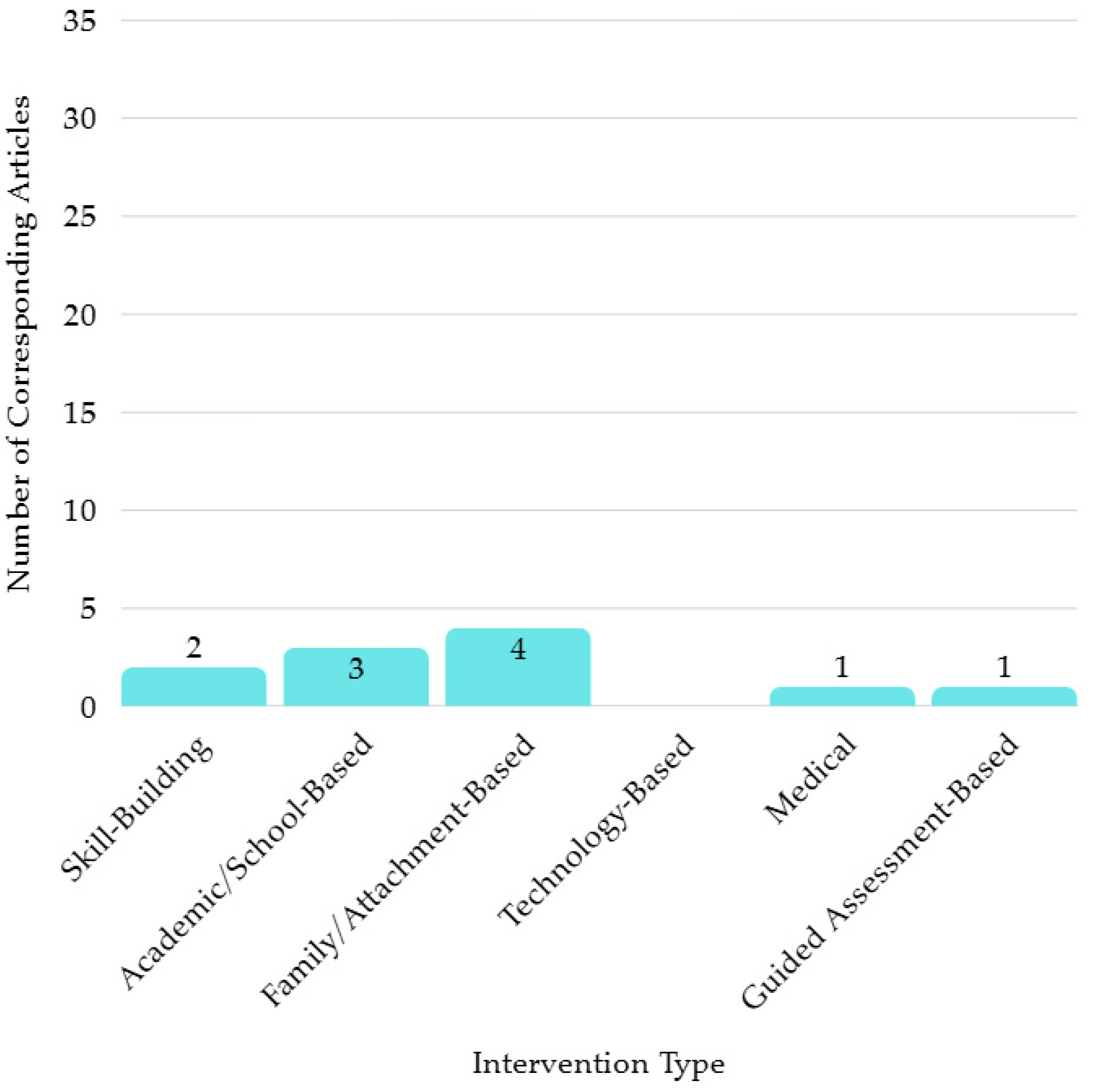
3.1.7. Synthesis of Interventions
3.2. Gaps
3.2.1. Skill-Building Intervention Gaps
3.2.2. Academic/School-Based Intervention Gaps
3.2.3. Family/Attachment-Based Intervention Gaps
3.2.4. Technology-Based Intervention Gaps
3.2.5. Medical Intervention Gaps
3.2.6. Guided Assessment-Based Intervention Gaps
3.2.7. Synthesis of Gaps
3.3. Strengths
3.3.1. Skill-Building Intervention Strengths
3.3.2. Academic/School-Based Intervention Strengths
3.3.3. Family/Attachment-Based Intervention Strengths
3.3.4. Technology-Based Intervention Strengths
3.3.5. Medical Intervention Strengths
3.3.6. Guided Assessment-Based Intervention Strengths
3.3.7. Synthesis of Strengths
3.4. Program Recommendations
3.4.1. Skill Building-Based Intervention Recommendations
3.4.2. Academic/School-Based Intervention Recommendations
3.4.3. Family/Attachment-Based Intervention Recommendations
3.4.4. Technology-Based Intervention Recommendations
3.4.5. Medical Intervention Recommendations
3.4.6. Guided Assessment-Based Intervention Recommendations
3.4.7. Synthesis Program Recommendations
Child-Focused Interventions
Caregiver Focused Interventions
System-Focused Interventions and School Collaboration
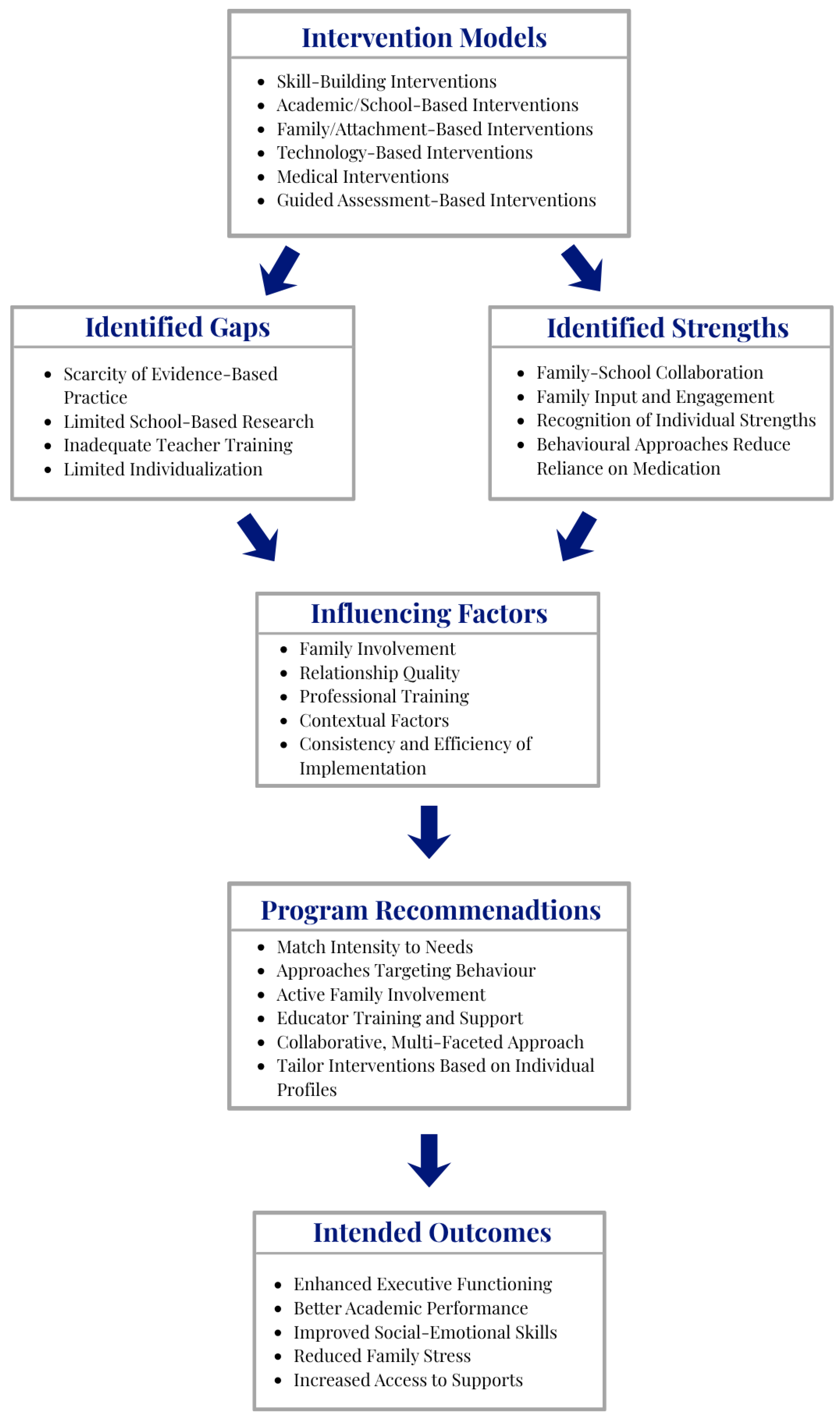
3.5. Conceptual Model
4. Discussion
4.1. Limitations
- The use of Google Scholar as the sole search engine used in this systematic review limits the reproducibility of this systematic review, limits the comprehensiveness of this systematic review, and allows for more potential bias within the reviewed articles.
- The absence of a comprehensive, evidence-informed program that addresses the full spectrum of ADHD presentation and developmental needs across all domains of functioning.
- Current individualized interventions are typically matched only to the broad category of ADHD, without considering the heterogeneous subtypes, co-occurring conditions, or unique symptoms each child presents with.
- Insufficient evidence-based practices tailored to educational settings and persistent gaps in pre-service and in-service teacher training (both general and special education) regarding ADHD identification, evidence-based strategies, and classroom management.
- Deficits in knowledge and skills, resulting in inconsistent implementation of interventions.
- Lack of longitudinal studies tracking outcomes into adolescence and young adulthood, which restricts the understanding of developmental impacts, family resilience factors, and quality-of-life indicators for individuals with ADHD.
- Lack of emphasis on preventive approaches, early identification, and early interventions before symptoms become apparent.
- Limited exploration of family, ecological, and system protective factors that promote resilience in students with ADHD.
- Variability in risk of bias across the included studies may impact the strength and generalizability of the findings.
4.2. Future Research
- Utilizing a multi-database search strategy to maximize reproducibility and comprehensiveness as well as reduce the risk of bias.
- Development and evaluation of evidence-based interventions that can be individualized across settings.
- Large-scale longitudinal studies following children with ADHD from early childhood through young adulthood to better understand resilience processes, protective factors, and long-term functional outcomes.
- Emphasize prevention science, including universal screening, early identification protocols, and early intervention models in pre-school and early elementary school to reduce ADHD symptom severity.
- In-depth investigations of family-level and broader ecological factors that buffer risk and foster resilience in children with ADHD.
- Include more rigorous study designs, including larger and more representative samples, improved reporting practices, and more consistent evaluation of intervention outcomes to strengthen the evidence base.
4.3. Evidence-Informed Recommendations for Practice and Policy
- Intervention Approach
- 1.1.
- Prioritize behavioral and skill-based interventions before medication where appropriate: The findings support an intervention-first approach, indicating that early behavioral and skill-building supports can reduce reliance on medication while promoting longer-term developmental outcomes.
- 1.2.
- Adopt a multi-faceted approach to intervention: ADHD support should integrate behavioral, academic, family-based, and where appropriate, medical interventions, reflecting the complexity of ADHD and the need for comprehensive, coordinated care.
- Individualization of Supports
- 2.1.
- Tailor interventions to the child’s ADHD presentation and executive-function profile: Given the variability in ADHD subtypes and functional challenges, interventions should be individualized rather than standardized, ensuring alignment with the child’s strengths and needs.
- 2.2.
- Match intervention intensity and type to developmental stage and level of need: Effective programming requires flexibility, with intervention intensity adjusted based on the child’s responsiveness, environmental demands, and evolving developmental needs.
- Family Involvement and Capacity
- 3.1.
- Embed meaningful and ongoing family involvement across all aspects of intervention: The findings highlight family engagement as a critical component of effective ADHD support, emphasizing collaboration between caregivers, educators, and service providers.
- 3.2.
- Strengthen caregiver competence through education and skill development: Supporting caregivers in understanding ADHD (specifically their own child’s presentation), particularly through an executive-function lens, and equipping them with practical, evidence-informed strategies enhances consistency across environments and improves outcomes.
- Professional Training and Practice
- 4.1.
- Enhance professional training and capacity in ADHD-informed practice: Identified gaps in educator and practitioner knowledge highlight the need for structured, ongoing training focused on evidence-based interventions, executive functioning, and practical implementation strategies.
- 4.2.
- Shift from reactive behavior management to proactive skill-building approaches: Interventions should focus on anticipating challenges, supporting executive-function development, and promoting emotional regulation, rather than relying solely on reactive responses to behavior.
- Intervention Delivery
- 5.1.
- Deliver interventions in naturalistic, real-world settings with immediate feedback: The findings emphasize that skill development is most effective when practiced in everyday environments such as home and school, allowing for greater generalizability and long-term sustainability.
- 5.2.
- Integrate supports across systems (home, school, and community): Effective ADHD services require coordinated, multi-faceted approaches that reduce fragmentation and promote consistency across environments.
- Systemic Considerations
- 6.1.
- Improve access to coordinated and equitable ADHD services: Identified gaps in service availability, accessibility, and coordination highlight the need for system-level approaches that ensure all children and families can access the supports they need.
- 6.2.
- Strengthen the translation of research into practice: The review identified a disconnect between evidence and real-world implementation, indicating the need for systems that support knowledge mobilization, implementation reliability, and ongoing evaluation of interventions.
5. Conclusions
Supplementary Materials
Author Contributions
Funding
Institutional Review Board Statement
Informed Consent Statement
Conflicts of Interest
References
- MedCentral. ADHD: DSM-5 Criteria, Prevalence, Types, and Treatment. MedCentral. 2022. Available online: https://www.medcentral.com/behavioral-mental/adhd/assessment-diagnosis-adherence-adhd (accessed on 24 November 2024).
- Barkley, R.A. The important role of executive functioning and self-regulation in ADHD. J. Child Neuropsy 2011, 113, 41–56. Available online: https://russellbarkley.org/factsheets/ADHD_EF_and_SR.pdf (accessed on 11 June 2024).
- Cowley, B.; Holmström, É.; Juurmaa, K.; Kovarskis, L.; Krause, C.M. Computer enabled neuroplasticity treatment: A clinical trial of a novel design for neurofeedback therapy in adult ADHD. Front. Hum. Neurosci. 2016, 10, 205. [Google Scholar] [CrossRef] [PubMed]
- Frey, A.J.; Pas, E.T.; Herman, K.C.; Small, J.R. Optimizing implementation of school-based programing by leveraging motivational interviewing. In Handbook of School Mental Health; Evans, S.W., Owens, J.S., Bradshaw, C.P., Weist, M.D., Eds.; Springer International Publishing: Cham, Switzerland, 2023; pp. 451–465. [Google Scholar] [CrossRef]
- Noyes, A. Pre-Service Teachers’ Perceptions of the Acceptability of Interventions for ADHD and Knowledge of Evidence-Based Practice. Master’s Thesis, Mount Saint Vincent University, Halifax, NS, Canada, 2017. Available online: https://ec.msvu.ca/server/api/core/bitstreams/09813bbf-c867-4a24-9f03-b9db11c743fa/content (accessed on 18 March 2025).
- Poznanski, B. Examining Positive Behavioral Supports for Children with Challenging Behaviors Across Culturally and Linguistically Diverse Head Start Settings. Doctoral Dissertation, Florida International University, Miami, FL, USA, 2021. [Google Scholar] [CrossRef]
- Garbacz, S.A.; Minch, D.R.; Lawlor, K.L.; Flack, C. Advancing research to improve family–school collaboration in school mental health. In Handbook of School Mental Health; Evans, S.W., Owens, J.S., Bradshaw, C.P., Weist, M.D., Eds.; Springer International Publishing: Cham, Switzerland, 2023; pp. 153–167. [Google Scholar] [CrossRef]
- Foley-Nicpon, M.; Kim, J.Y.C. Identifying and providing evidence-based services for twice-exceptional students. In Handbook of Giftedness in Children; Pfeiffer, S.I., Ed.; Springer International Publishing: Cham, Switzerland, 2018; pp. 349–362. [Google Scholar] [CrossRef]
- O’Dell, S.M. Understanding the Contributions of Family Processes to Educational Outcomes for Children with ADHD: A Longitudinal Analysis. Doctoral Dissertation, Lehigh University, Bethlehem, PA, USA, 2013. Available online: https://www.proquest.com/openview/a42437d99661512e1fa608f93e6bfe6d/1 (accessed on 15 July 2024).
- Alvarez, A. Teaching Mindfulness Skills Using Bibliotherapy to Address ADHD Symptoms in Children. Doctoral Dissertation, Azusa Pacific University, Azusa, CA, USA, 2023. Available online: https://www.proquest.com/openview/fe3387c55284f3e8901d167d2a3d6e66/1 (accessed on 3 December 2024).
- Pfiffner, L.J.; Hinshaw, S.P.; Owens, E.; Zalecki, C.; Kaiser, N.M.; Villodas, M.; McBurnett, K. A two-site randomized clinical trial of integrated psychosocial treatment for ADHD-inattentive type. J. Consult. Clin. Psychol. 2014, 82, 1115–1127. [Google Scholar] [CrossRef] [PubMed]
- Moore, D.A.; Richardson, M.; Gwernan-Jones, R.; Thompson-Coon, J.; Stein, K.; Rogers, M.; Garside, R.; Logan, S.; Ford, T.J. Non-pharmacological interventions for ADHD in school settings: An overarching synthesis of systematic reviews. J. Atten. Disord. 2019, 23, 220–233. [Google Scholar] [CrossRef] [PubMed]
- Mendez, L.R.; Ogg, J.; Loker, T.; Fefer, S. Including parents in the continuum of school-based mental health services: A review of intervention program research from 1995 to 2010. J. Appl. Sch. Psychol. 2013, 29, 1–36. [Google Scholar] [CrossRef]
- McMenemy, T.C. Families Journeying Together: Exploring Resilience in Families with ADHD. Doctoral Dissertation, University of Calgary, Calgary, AB, Canada, 2019. Available online: https://prism.ucalgary.ca/server/api/core/bitstreams/4713500c-e4b8-4de3-900c-19c3938e1dc2/content (accessed on 18 December 2024).
- Neprily, K. Summer Camp for Adolescents with Attention-Deficit/Hyperactivity Disorder: A Naturalistic Context for Enhancing Social Competence. Master’s Thesis, University of Calgary, Calgary, AB, Canada, 2020. Available online: https://prism.ucalgary.ca/server/api/core/bitstreams/cf8bfa2a-e4af-46ca-a3ea-172d1b42c577/content (accessed on 10 December 2024).
- Leise, A.A. Special Educators’ Perceptions on Effective Preparation and Practice for Student Success. Doctoral Dissertation, Walden University, Minneapolis, MN, USA, 2018. Available online: https://www.proquest.com/openview/b2322054ac2007058e9bc8e6bf2bf959/1 (accessed on 5 February 2025).
- Castillo, K. School-Based Mental Health Supports for Students with Special Needs. Master’s Thesis, St. Cloud State University, St. Cloud, MN, USA, 2023. Available online: https://repository.stcloudstate.edu/sped_etds/150 (accessed on 10 May 2025).
- Uttamsingh, J. Teachers’ Knowledge of, Satisfaction with, and Familiarity with Supporting Students with Attention-Deficit/Hyperactivity Disorder. Doctoral Dissertation, Brock University, St. Catharines, ON, Canada, 2017. [Google Scholar]
- Arnstein, K. How Parents, Teachers, Psychologists, and Educational Environments Influence Developmental Transitions of Preadolescent Twice-Exceptional Students. Doctoral Dissertation, University of Denver, Denver, CO, USA, 2020. Available online: https://www.proquest.com/openview/ac428de931e91f13fcbc68323889d381/1 (accessed on 3 December 2024).
- Poling, D.V.; Van Loan, C.L.; Garwood, J.D.; Zhang, S.; Riddle, D. Enhancing teacher-student relationship quality: A narrative review of school-based interventions. Educ. Res. Rev. 2022, 37, 100459. [Google Scholar] [CrossRef]
- LeMoine, K.A. Childhood Attention Problems and the Development of Comorbid Symptoms at the Transition to High School: The Mediating Role of Parent and Peer Relationships. Doctoral Dissertation, University of Maryland, College Park, MD, USA, 2015. [Google Scholar]
- Thomas, E. Evidence-Based Family Strengthening Training in Maine: A Resource Assessment and Proposal to Reduce Barriers and Increase Facilitators. Doctoral Dissertation, University of Maine, Orono, ME, USA, 2023. [Google Scholar]
- Rubia, K. Cognitive neuroscience of attention deficit hyperactivity disorder (ADHD) and its clinical translation. Front. Hum. Neurosci. 2018, 12, 100. [Google Scholar] [CrossRef] [PubMed]
- Foley-Nicpon, M.; Teriba, A. Policy considerations for twice-exceptional students. Gift. Child Today 2022, 45, 212–219. [Google Scholar] [CrossRef]
- Hadjstylianos, E. Exploration of Effective Strategies for Children with Emotional Disorders as Identified by Helping Professionals in Schools. Doctoral Dissertation, Walden University, Minneapolis, MN, USA, 2013. Available online: https://www.proquest.com/openview/c56a12e429f6cdc02881d657bf671501/1 (accessed on 3 December 2024).
- Gall, V.N.; Buchhalter, J.; Antonelli, R.C.; Richard, C.B.; Yohemas, M.M.; Lachuk, G.M.; Ben Gibbard, W.M. Improving care for families and children with neurodevelopmental disorders and co-occurring chronic health conditions using a care coordination intervention. J. Dev. Behav. Pediatr. 2022, 43, 444–453. [Google Scholar] [CrossRef] [PubMed]
- Brown, R. Impact of School-Based Mentorship Programs for Students with Disabilities. Doctoral Dissertation, National Louis University, Chicago, IL, USA, 2022. Available online: https://digitalcommons.nl.edu/diss/684 (accessed on 18 February 2025).
- Chase, R.L. Accessibility and Reliability of Early Childhood Mental Health Services. Master’s Thesis, St. Catherine University, St. Paul, MN, USA, 2016. Available online: https://sophia.stkate.edu/cgi/viewcontent.cgi?article=1568&context=msw_papers (accessed on 11 October 2024).
- Bachmann, K.; Lam, A.P.; Philipsen, A. Mindfulness-based cognitive therapy and the adult ADHD brain: A neuropsychotherapeutic perspective. Front. Psychiatry 2016, 7, 117. [Google Scholar] [CrossRef] [PubMed]
- Sexton, K.A. Stakeholders’ Knowledge Impacting the Academic and Social-Emotional Needs of Twice-Exceptional Students in Kentucky. Doctoral Dissertation, Eastern Kentucky University, Richmond, KY, USA, 2016. Available online: https://www.proquest.com/openview/c8277a04014c40b2b2bc8b898dae9c9b/1 (accessed on 21 March 2025).
- Rispoli, K.M.; Hawley, L.R.; Clinton, M.C. Family background and parent–school interactions in parent involvement for at-risk preschool children with disabilities. J. Spec. Educ. 2018, 52, 39–49. [Google Scholar] [CrossRef]
- Ronksley-Pavia, M. The Lived Experiences of Twice Exceptional Children: Narrative Perceptions of Disability and Giftedness. Doctoral Dissertation, Griffith University, Brisbane, QLD, Australia, 2016. Available online: https://research-repository.griffith.edu.au/bitstream/handle/10072/367172/Ronksley-Pavia_2016_01Thesis.pdf (accessed on 3 December 2024).
- Orban, S.A.; Rapport, M.D.; Friedman, L.M.; Kofler, M.J. Executive function/cognitive training for children with ADHD: Do results warrant the hype and cost? ADHD Rep. 2014, 22, 8–14. [Google Scholar] [CrossRef]
- Piers, L. Fostering Resilience with Students with Learning Disabilities: An Ecological Approach. Master’s Thesis, University of Ottawa, Ottawa, ON, USA, 2015. Available online: https://ruor.uottawa.ca/server/api/core/bitstreams/dcc6a050-6aa2-469e-9966-b21315ccf883/content (accessed on 15 March 2025).
- Blatz, E. Multiple Perspectives on Parent Involvement for Middle School Students Receiving Special Education Services. Doctoral Dissertation, University of Miami, Coral Gables, FL, USA, 2014. Available online: https://www.proquest.com/openview/a7157a53cf20aef46da993750e1934c5/1 (accessed on 14 April 2025).
- Monterusso, K. Lived Experiences of Twice-Exceptional Students and Their Families: The Effects of Toxic Stress in Learning Environments. Doctoral Dissertation, Bridges Academy, Studio City, CA, USA, 2022. [Google Scholar]
- Benzing, V.; Schmidt, M. The effect of exergaming on executive functions in children with ADHD: A randomized clinical trial. Scand. J. Med. Sci. Sports 2019, 29, 1243–1253. [Google Scholar] [CrossRef] [PubMed]
- Barkley, R.A. Classroom accommodations for children with ADHD. ADHD Rep. 2008, 16, 7–10. [Google Scholar] [CrossRef]
- Page, M.J.; McKenzie, J.E.; Bossuyt, P.M.; Boutron, I.; Hoffmann, T.C.; Mulrow, C.D.; Shamseer, L.; Tetzlaff, J.M.; Akl, E.A.; Brennan, S.E.; et al. The PRISMA 2020 statement: An updated guideline for reporting systematic reviews. BMJ 2021, 372, n71. [Google Scholar] [CrossRef] [PubMed]





| Inclusion Criteria | Description | Justification |
|---|---|---|
| Publication Date | Articles must have been published between 2013 and 2023. | Ensures recency as well as depth. |
| Relevance to Keywords | Articles must be indexed under or include the keywords “ADHD” AND “parenting” AND “children” AND “youth” AND “programming” AND “models” AND “interventions” AND “education” AND “gaps” AND “strengths” in a combined Google Scholar search | Aligns with RQs, targeting literature on ADHD interventions (i.e., models, programming) for youth (i.e., children, youth), contextual factors that relate to the effectiveness of interventions (i.e., parenting, education), and critical evaluation of current ADHD interventions (i.e., gaps, strengths) |
| Relevance to Research Questions | Articles must address at least one RQ | Ensures relevance to the aim of this review |
| Study Type and Content | Articles must be scholarly (i.e., peer-reviewed journals, theses, dissertations, book chapters) with empirical, theoretical, or review-based evidence on ADHD interventions, their gaps, their strengths, or their requirements | Ensures high-quality, credible evidence for a comprehensive synthesis |
| Population Focus | Studies must focus on children and youth with ADHD, including all subtypes and contextual factors (parenting, education) | Ensures relevance to the aim of this review |
| Language | Studies must be in English | Ensures accessibility for the research team |
| Title | Design and Sample | Key Findings |
|---|---|---|
| Computer Enabled Neuroplasticity Treatment: A Clinical Trial of a Novel Design for Neurofeedback Therapy in Adult ADHD |
|
|
| Identifying and Providing Evidence-Based Services for Twice-Exceptional Students |
|
|
| Advancing Research to Improve Family–School Collaboration in School Mental Health |
|
|
| Enhancing Teacher–Student Relationship Quality: A Narrative Review of School-Based Interventions |
|
|
| Teachers’ Knowledge of, Satisfaction with, and Familiarity with Supporting Students with ADHD |
|
|
| Optimizing Implementation of School-based Programming by Leveraging Motivational Interviewing |
|
|
| Pre-Service Teachers’ Perceptions of the Acceptability of Interventions for ADHD and Knowledge of Evidence-Based Practice |
|
|
| Examining Positive Behavioural Supports for Children with Challenging Behaviours Across Culturally and Linguistically Diverse Head Start Settings |
|
|
| Understanding the Contributions of Family Processes to Educational Outcomes for Children with ADHD: A Longitudinal Analysis |
|
|
| Mindfulness-Based Interventions for Adults with ADHD: A Systematic Review and Meta-Analysis |
|
|
| Childhood Attention Problems and the Development of Comorbid Symptoms at the Transition to High School: The Mediating Role of Parent and Peer Relationships |
|
|
| Including Parents in the Continuum of School-Based Mental Health Services: A Review of Intervention Program Research from 1995 to 2010 |
|
|
| A Two-Site Randomized Clinical Trial of Integrated Psychosocial Treatment for ADHD-Inattentive Type |
|
|
| The Lived Experiences of Twice Exceptional Children: Narrative Perceptions of Disability and Giftedness |
|
|
| How Parents, Teachers, Psychologists, and Educational Environments Influence Developmental Transitions of Preadolescent Twice-Exceptional Students |
|
|
| Policy Considerations for Twice-Exceptional Students |
|
|
| Exploration of Effective Strategies for Children with Emotional Disorders as Identified by Helping Professionals in Schools |
|
|
| Non-Pharmacological Interventions for ADHD in School Settings: An Overarching Synthesis of Systematic Reviews |
|
|
| Families Journeying Together: Exploring Resilience in Families with Adolescents with ADHD |
|
|
| Cognitive Neuroscience of Attention Deficit Hyperactivity Disorder (ADHD) and Its Clinical Translation |
|
|
| Evidence-Based Family Strengthening Training in Maine: A Resource Assessment and Proposal to Reduce Barriers |
|
|
| Improving Care for Families and Children with Neurodevelopmental Disorders and Co-occurring Chronic Health Conditions Using a Care Coordination Intervention |
|
|
| Summer Camp for Adolescents with Attention-Deficit/Hyperactivity Disorder: A Naturalistic Context for Enhancing Social Competence |
|
|
| Special Educators’ Perceptions on Effective Preparation and Practice for Student Success |
|
|
| School-Based Mental Health Supports for Students with Special Needs |
|
|
| Impact of School-Based Mentorship Programs for Students with Disabilities |
|
|
| Accessibility and Reliability of Early Childhood Mental Health Services |
|
|
| Family Background and Parent-School Interactions in Parent Involvement for At-Risk Preschool Children with Disabilities |
|
|
| Stakeholders’ Knowledge Impacting the Academic and Social-Emotional Needs of Twice-Exceptional Students in Kentucky |
|
|
| Mindfulness-Based Cognitive Therapy and the Adults ADHD Brain: A Neuropsychotherapeutic Perspective |
|
|
| Fostering Resilience with Students with Learning Disabilities: An Ecological Approach |
|
|
| Multiple Perspectives on Parent Involvement for Middle School Students Receiving Special Education Services |
|
|
| The Effect of exergaming on Executive Functions in Children with ADHD: A Randomized Clinical Trial |
|
|
| The Important Role of Executive Functioning and Self-Regulation in ADHD |
|
|
| Classroom Accommodations for Children with ADHD |
|
|
| Executive Function/Cognitive Training for Children with ADHD: Do Results Warrant the Hype and Cost? |
|
|
| Lived Experiences of Twice-Exceptional Students and Their Families: The Effects of Toxic Stress in Learning Environments |
|
|
| Category | Intervention | Strength of Evidence | Reference |
|---|---|---|---|
| Skill Building | Cognitive or Behavioral Therapy | Stronger | [8,9] |
| Direct Skill Training/Building | Stronger | [9,10,11,12] | |
| Video Self-Modeling | Moderate | [8] | |
| The Incredible Years Training for Children with Developmental Delays | Stronger | [13] | |
| CLAS | Moderate | [11] | |
| Motivational Interviewing | Moderate | [4] | |
| Occupational Interventions | Moderate | [14] | |
| PATHS Program | Limited | [6] | |
| Tools of the Mind–Play Curriculum | Limited | [6] | |
| Individualized Incentive Program | Limited | [6] | |
| STP | Moderate | [15] | |
| Self-Determination | Moderate | [16] | |
| IY | Moderate | [17] | |
| Self-Management | Moderate | [18] | |
| Psychosocial Interventions | Moderate | [9] | |
| Mindfulness Skills | Moderate | [10] | |
| Ameliorating Skill and Performance Deficits | Moderate | [9] | |
| Swimming | Limited | [19] | |
| Academic/School Based | DRC | Stronger | [5,10] |
| School-Based Programming | Stronger | [5,9,10,20] | |
| Competency Drivers | Limited | [4] | |
| IYTTP | Moderate | [6] | |
| PBIS | Moderate | [17] | |
| Classroom Lottery | Limited | [5] | |
| Response Cost Technique | Moderate | [5] | |
| FSS | Moderate | [9] | |
| Homework Success | Moderate | [9] | |
| BCM | Stronger | [5] | |
| Family/Attachment Based | Family–School and PI | Stronger | [8,9,13,21] |
| Family Check Up | Moderate | [4,13] | |
| CARE | Moderate | [9] | |
| Circle of Security | Limited | [22] | |
| Trust-Based Relational Intervention | Limited | [22] | |
| Parent-Focused Interventions | Moderate | [9,13,21] | |
| Technology Based | Neurofeedback | Moderate | [3,12] |
| Transcranial Neuromodulation | Limited | [23] | |
| Medical | Medication | Stronger | [5,11,19] |
| Guided Assessment Based | Response to Intervention | Moderate | [24,25] |
| DSM-Based Evidence-Informed Interventions | Moderate | [5,8] | |
| Creating GIEPs in Conjunction with IEPs | Moderate | [19,24] | |
| Care Coordination | Moderate | [26] | |
| Positive Role Models | Limited | [19] |
| Category | Gaps | Reference |
|---|---|---|
| Skill Building | Lack of evidence-based practices | [6,28] |
| Insufficient resources and training | [6,28] | |
| Limited staff understanding of practices for persistent behavioral challenges | [6,28] | |
| Poor real-world implementation of interventions | [4,5] | |
| Limited translation of research into school-based practice | [4,5] | |
| Limited behavioral principle knowledge leading to negative practices | [6] | |
| Limited exploration of resilience factors and underlying neuronal mechanisms | [14,29] | |
| Academic/School Based | Insufficient teacher training (general and special education) | [5,28] |
| Limited ADHD-specific training in teacher education programs | [5,28] | |
| Inconsistent staff perceptions and implementation practices | [6,15] | |
| Masking effects limiting identification and intervention | [19] | |
| Disruptions during developmental transitions | [19] | |
| Disparities between subgroups | [15,19,30] | |
| Lack of mandated interventions reduces implementation | [4] | |
| Family/Attachment Based | Limited family and youth involvement in school decision-making | [7] |
| Weak friendship and parent–child relationship quality | [21] | |
| Indirect links between attention problems and depressive symptoms via relationship quality | [21] | |
| Limited parent engagement due to access barriers | [28,31] | |
| Gaps between prevention and intervention services | [22] | |
| Separation between state-led and community-led initiatives | [22] | |
| Limited focus on resilience factors and services in adolescence | [14] | |
| Technology Based | Limited understanding of underlying neuronal mechanisms to inform intervention development | [29] |
| Medical | Limited exploration of resilience factors in medication use | [14] |
| Limited integration of family and ecological factors | [14] | |
| Medication-focused approaches reinforce deficit-based perspectives | [32] | |
| Service gaps lead to increased reliance on medication | [14] | |
| Guided Assessment Based | Challenges in accurate behavioral and emotional needs identification | [8] |
| Overgeneralization reduces the effectiveness of evidence-based practices | [16] | |
| Masking and unmet needs in twice-exceptional students | [19] |
| Category | Strengths | Reference |
|---|---|---|
| Skill Building | Understanding individual strengths and limitations | [8] |
| Dedication to child and family well-being | [6] | |
| Teamwork and staff collaboration | [6] | |
| Academic/School Based | Development of student profiles | [18] |
| Improved home–school communication | [5] | |
| Behavioral-first approaches reduce medication reliance | [5] | |
| Teacher training and professional development | [6] | |
| Transition planning across developmental stages | [6] | |
| Family/Attachment Based | Family–school conferences | [7] |
| Family members’ input and involvement | [7,13] | |
| Building child and caregiver problem-solving capacity | [7] | |
| Emphasizing family agency | [7] | |
| Strengths-based approaches | [7] | |
| Strong community networks and relationships | [22] | |
| Dedication to the child | [6] | |
| Connection to services | [6] | |
| Technology Based | N/A | N/A |
| Medical | Behavior-first approaches reduce reliance on medication | [5] |
| Guided Assessment Based | Coordinated service delivery across systems | [26] |
| Category | Recommendation | References |
|---|---|---|
| Skill Building | Regular family check-ins for follow-up and monitoring | [6,26] |
| Holistic understanding of each student’s strengths and needs | [19,33] | |
| School-based interventions increase accessibility and reduce costs | [11] | |
| Focus on developing skill and performance deficits | [9] | |
| Intervention targeting Central Executive working memory | [33] | |
| Targeted approaches for persistent behavior challenges | [6] | |
| Identification of psychosocial interventions for social competence | [15] | |
| Examination of social skills interventions | [15] | |
| Practice of learned skills in naturalistic environments with immediate feedback | [15] | |
| Interventions that reflect real-world contexts | [15] | |
| Emphasis on structure and consistency | [16] | |
| Effective and early screening | [13] | |
| Academic/School Based | Professional training in special education identification | [5,18] |
| Academic/School Based | Parent training and workshops at school or district level | [34,35] |
| Holistic understanding of each student’s strengths and needs | [19,36] | |
| Frequent, sustained, and personalized teacher–student interactions | [20] | |
| Interventions targeting academic and behavioral outcomes | [9] | |
| Ongoing reciprocal communication between and school | [34] | |
| Adaption of the physical learning environment | [19] | |
| Increased frequency of counseling for students with emotional needs | [25] | |
| Individualized approaches | [9] | |
| Teacher support (reducing class size for twice-exceptional students) | [19] | |
| Participation of school-based interventionists in training workshops | [4] | |
| Balanced use of proactive and reactive strategies in intervention planning | [18] | |
| Ongoing professional development (Min. 15 h) | [6,17] | |
| Continued development and evaluation of intervention research | [14] | |
| Family/Attachment Based | Involvement of families across all stages of program services | [7,13,24,28] |
| Regular family check-ins | [6,26] | |
| Individualized feedback and ongoing support | [4,36] | |
| Alignment of family involvement with school partnership approaches | [7] | |
| Interventions targeting skill and performance development | [9] | |
| Focus on prevention, early identification, and early intervention | [28] | |
| Awareness of programs and services across agencies | [22] | |
| Provide appropriate referrals | [22] | |
| Targeted approaches for persistent behavior challenges | [6] | |
| Technology Based | Physical and cognitive training through “Exergaming” | [37] |
| Consideration of individual, classroom, and socio-political contexts in interventions use | [12,36] | |
| Medical | Application of structured principles for program planning and management | [38] |
| Guided Assessment Based | Involvement of families across all stages of program services | [7,13,24,28] |
| Guided Assessment Based | Matching the intensity of an intervention to the needs of the student and family | [4,13,24] |
| Holistic perspective of each student’s strengths and weaknesses | [19,36] | |
| Integration of clinical expertise within evidence-based practice | [5] | |
| Coordinated care and collaboration with community support agencies | [26] |
Disclaimer/Publisher’s Note: The statements, opinions and data contained in all publications are solely those of the individual author(s) and contributor(s) and not of MDPI and/or the editor(s). MDPI and/or the editor(s) disclaim responsibility for any injury to people or property resulting from any ideas, methods, instructions or products referred to in the content. |
© 2026 by the authors. Published by MDPI on behalf of the Swiss Federation of Clinical Neuro-Societies. Licensee MDPI, Basel, Switzerland. This article is an open access article distributed under the terms and conditions of the Creative Commons Attribution (CC BY) license.
Share and Cite
Taun, J.; Costanza, E.; Hamilton, D.; Kharazmi, O.A.; Larouche, P.; Nevrencan, T.; Collins, K. Developing Evidence-Based Program Recommendations for Children and Youth Impacted by ADHD: A Systematic Review of the Literature. Clin. Transl. Neurosci. 2026, 10, 11. https://doi.org/10.3390/ctn10020011
Taun J, Costanza E, Hamilton D, Kharazmi OA, Larouche P, Nevrencan T, Collins K. Developing Evidence-Based Program Recommendations for Children and Youth Impacted by ADHD: A Systematic Review of the Literature. Clinical and Translational Neuroscience. 2026; 10(2):11. https://doi.org/10.3390/ctn10020011
Chicago/Turabian StyleTaun, Jennifer, Elisa Costanza, Dakota Hamilton, Omid Ali Kharazmi, Pam Larouche, Terra Nevrencan, and Kya Collins. 2026. "Developing Evidence-Based Program Recommendations for Children and Youth Impacted by ADHD: A Systematic Review of the Literature" Clinical and Translational Neuroscience 10, no. 2: 11. https://doi.org/10.3390/ctn10020011
APA StyleTaun, J., Costanza, E., Hamilton, D., Kharazmi, O. A., Larouche, P., Nevrencan, T., & Collins, K. (2026). Developing Evidence-Based Program Recommendations for Children and Youth Impacted by ADHD: A Systematic Review of the Literature. Clinical and Translational Neuroscience, 10(2), 11. https://doi.org/10.3390/ctn10020011