
Article

Atomically Dispersed Pt–Sn Nanocluster Catalysts for Enhanced Toluene Hydrogenation in LOHC Systems


1
National Institute of Guangdong Advanced Energy Storage Co., Ltd., Guangzhou 510080, China
2
Zhongshan Power Supply Bureau, Guangdong Power Grid Co., Ltd., Zhongshan 528405, China
3
Key Laboratory of Bioinorganic and Synthetic Chemistry of Ministry of Education, Fine Chemical Industry Research Institute, School of Chemistry, Institute of Green Chemistry and Molecular Engineering, Sun Yat-sen University, Guangzhou 510275, China
*
Authors to whom correspondence should be addressed.
Colloids Interfaces 2025, 9(6), 85; https://doi.org/10.3390/colloids9060085 (registering DOI)
Submission received: 31 October 2025 / Revised: 6 December 2025 / Accepted: 8 December 2025 / Published: 10 December 2025
(This article belongs to the Special Issue State of the Art of Colloid and Interface Science in Asia)

Abstract

Liquid organic hydrogen carriers (LOHCs) are promising materials for safe, reversible, and high-density hydrogen storage. Atomically dispersed bimetallic Pt–Sn nanocluster catalysts supported on TiO2 (Pt–Sn/TiO2) were developed to enhance the hydrogenation step in the toluene-methylcyclohexane cycle, a model LOHC system. Compared with monometallic Pt/TiO2 and Sn/TiO2, Pt–Sn/TiO2 exhibited superior hydrogenation performance. Mechanistic studies, including X-ray photoelectron spectroscopy, kinetic analysis, and H2-D2 exchange experiments, revealed that Sn incorporation modulates the electronic structure of Pt, enhancing H2 activation and spillover. These findings provide insights into the rational design of atomically dispersed bimetallic nanocluster catalysts for efficient and durable hydrogen storage in LOHC-based systems.

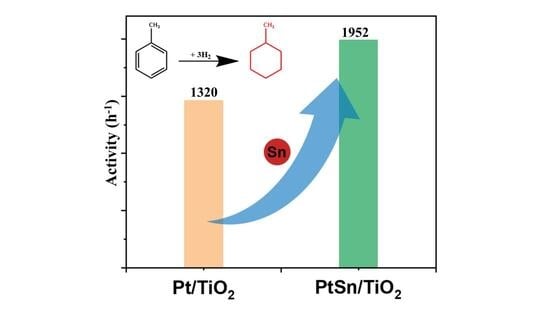
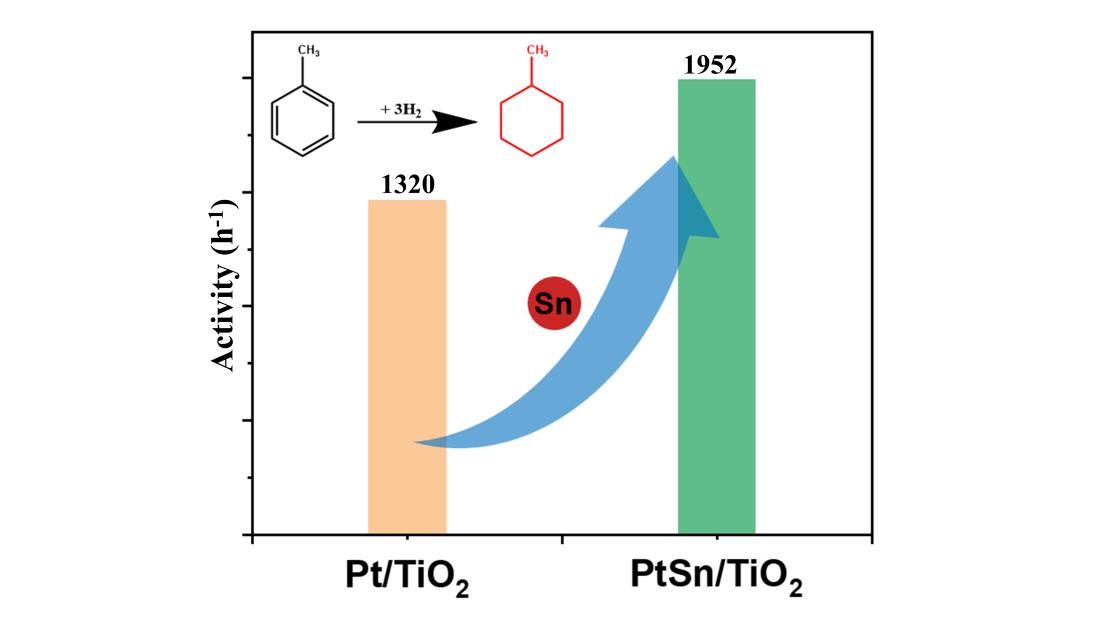
Graphical Abstract

1. Introduction

Hydrogen energy has been recognized as one of the cleanest and most sustainable energy carriers due to its high gravimetric energy density, abundance, and environmentally benign combustion products [1,2,3]. The only by-product of hydrogen utilization is water, without the emission of greenhouse gases or pollutants, making hydrogen an ideal alternative to fossil fuels for achieving carbon neutrality [4,5]. In addition to its potential as a clean energy vector, hydrogen also serves as a critical feedstock in chemical, petrochemical, and metallurgical industries [6].
A complete hydrogen energy system generally consists of three essential components: hydrogen production, storage and transportation, and utilization [7]. Among these, hydrogen storage and transportation technologies remain key challenges for the large-scale deployment of hydrogen energy. Conventional storage methods, such as high-pressure gaseous storage and cryogenic liquid storage, are technologically mature but face issues including low volumetric density, high energy consumption, and potential safety risks such as leakage and material embrittlement [8,9]. These limitations highlight the urgent need for safer, more efficient, and more compact hydrogen storage technologies.
Liquid organic hydrogen carrier (LOHC) systems have emerged as a promising alternative, relying on the reversible hydrogenation and dehydrogenation of unsaturated organic molecules such as aromatics or olefins [10,11,12,13,14]. On 30 July 2021, Chiyoda Corporation and Mitsubishi Corporation jointly initiated a commercial-scale hydrogen import project based on LOHC technology, while companies in the Netherlands and Japan have also explored the use of LOHC systems for hydrogen transport. Compared with high-pressure or cryogenic storage, LOHC technology offers several advantages, including higher storage density, fully reversible hydrogenation/dehydrogenation cycles, simpler handling and transport, and improved safety [15,16,17]. Newson et al. evaluated various liquid organic hydrogen carriers and identified aromatic hydrocarbons as the most promising candidates, owing to their high storage capacity, favorable thermodynamics, and excellent reversibility during hydrogenation-dehydrogenation cycles [18]. Among these, the toluene-methylcyclohexane-hydrogen (MTH) cycle has been extensively investigated as a model LOHC system [19]. The hydrogenation of toluene to methylcyclohexane represents the hydrogen storage step in this reversible cycle and plays a crucial role in determining the overall system efficiency. Due to the inherent thermodynamic and kinetic stability of the aromatic ring, practical toluene hydrogenation often requires relatively high temperatures and elevated hydrogen pressures to reach desirable conversion levels [20]. Therefore, developing efficient and durable catalysts for toluene hydrogenation is essential for advancing LOHC-based hydrogen storage technologies.
Noble metal catalysts (e.g., Pt, Pd, Ru) have demonstrated excellent hydrogen activation capability and high catalytic activity in toluene hydrogenation [21,22]. Nevertheless, their high cost and limited natural abundance hinder large-scale application. To address these challenges, atomically dispersed metal catalysts have attracted growing attention due to their nearly 100% atomic utilization efficiency and tunable electronic properties [23,24,25]. Such catalysts—ranging from single-atom to dual-atom configurations—enable precise control of active sites and reaction pathways [26]. The introduction of a secondary metal can further modulate the electronic structure of the active center, enhance hydrogen adsorption and dissociation, and suppress undesired side reactions.
In this study, Pt–Sn/TiO2 atomically dispersed nanocluster catalysts were synthesized via an impregnation method and comprehensively characterized to establish the correlation between structure and catalytic performance. The catalysts were evaluated in toluene hydrogenation, the key hydrogen storage step in the MTH cycle, to assess their potential for LOHC applications.

2. Materials and Methods

2.1. Chemicals

All reagents were used as received without further purification. Chloroplatinic acid hexahydrate (H2PtCl6·6H2O, 99.9%), nano-TiO2 (P25, 99%), tin(IV) chloride pentahydrate (SnCl4·5H2O, ≥99.9%), methanol (99.8%) and tridecane (>99%) were purchased from Shanghai Macklin Biochemical Co., Ltd. (Shanghai, China). Toluene (99.8%) was purchased from Shanghai Anpu Experimental Technology Co., Ltd. (Shanghai, China). Methylcyclohexane (99%), anhydrous ethanol (≥99%), cyclohexane (chromatographic grade), and isopropanol (98%) were purchased from Shanghai Aladdin Biochemical Co., Ltd. (Shanghai, China). Hydrogen (99%) was purchased from Guangzhou Guangqi Gas Co., Ltd. (Shanghai, China).

2.2. Apparatus

Catalyst synthesis and characterization were conducted using standard laboratory equipment, including a muffle furnace (KSL-1750X, Hefei Kejing Material Technology Co., Ltd., Hefei, China), a magnetic stirrer bath (HWCL-1, Zhengzhou Great Wall Science & Trade Co., Ltd., Zhengzhou, China), a low-speed peristaltic pump (LHZW006, United Zhongwei Technology Co., Ltd., Zhengzhou, China), an analytical balance (ML204, Mettler-Toledo, Columbus, OH, USA), and a high-speed centrifuge (TG16-WT, Shenzhen Vector Scientific Instruments Co., Ltd., Shenzhen, China).
Structural and surface characterizations were performed using X-ray powder diffraction (XRD, D-MAX 2200 VPC, Rigaku Corporation, Tokyo, Japan), X-ray photoelectron spectroscopy (XPS, Escalab 250XPS, Thermo Fisher Scientific, Waltham, MA, USA), inductively coupled plasma optical emission spectroscopy (ICP-OES, PerkinElmer Optima 8000, PerkinElmer Inc., Waltham, MA, USA), BET surface area analysis (ASAP2460, Micromeritics, Norcross, GA, USA), transmission electron microscopy (TEM, FEI Tecnai G2 F30, FEI, Hillsboro, OR, USA), and aberration-corrected high-angle annular dark-field scanning TEM (AC HAADF-STEM, JEM-ARM200P, JEOL Ltd., Tokyo, Japan).
Product analysis was performed with gas chromatography (GC2010 plus, Shimadzu, Kyoto, Japan) and GC-MS (GCMS-QP2010-Ultra, Shimadzu, Kyoto, Japan). The H2-D2 exchange reaction was conducted in a continuous-flow fixed-bed quartz reactor with an internal diameter of 7 mm under ambient temperature and atmospheric pressure. About 100 mg of the catalyst sample was loaded into the reactor and held in place with quartz cotton plugs. A mixture of 5% H2 in N2 was used as the carrier gas at a flow rate of 20 mL/min, while D2 was introduced as a pulse gas flowing at 10 mL/min. The signal of HD (m/z = 3) was monitored in real time using a mass spectrometer (Hiden Analytical HPR-20 QIC benchtop gas analysis system, Warrington, UK).

2.3. Catalyst Preparation

2.3.1. Pt/TiO2 Atomically Dispersed Nanocluster Catalyst

Chloroplatinic acid hexahydrate (H2PtCl6·6H2O, 0.63 g) was accurately weighed and dissolved in 5 mL of deionized water to prepare a 0.1 g/mL H2PtCl6·solution. An aliquot of 210 μL of this solution was diluted with 100 mL of deionized water. Separately, nano-TiO2 (P25, 1 g) was dispersed in 150 mL of deionized water and stirred at 800 rpm for 300 min. During stirring, the diluted H2PtCl6 solution was added dropwise to the TiO2 suspension at a rate of 1.42 mL/min using a low-speed peristaltic pump. The resulting mixture was centrifuged, and the collected solid was dried overnight at 60 °C, followed by calcination in air at 400 °C for 2 h with a heating rate of 5 °C/min to obtain the Pt/TiO2 catalyst.

2.3.2. Sn/TiO2 Atomically Dispersed Nanocluster Catalyst

Tin(IV) chloride pentahydrate (SnCl4·5H2O, 29.5 mg) was dissolved in 100 mL of deionized water. Meanwhile, nano-TiO2 (P25, 1 g) was dispersed in 150 mL deionized water and stirred at 800 rpm for 300 min. During stirring, the SnCl4 solution was added dropwise to the TiO2 suspension at a rate of 1.42 mL/min using a low-speed peristaltic pump. Subsequent centrifugation, drying, and calcination steps were identical to those described for Pt/TiO2.

2.3.3. Pt–Sn/TiO2 Atomically Dispersed Nanocluster Catalyst

Chloroplatinic acid hexahydrate (H2PtCl6·6H2O, 0.63 g) was accurately weighed and dissolved in 5 mL of deionized water to prepare a 0.1 g/mL H2PtCl6 solution. An aliquot of 210 μL of this solution and tin(IV) chloride pentahydrate (SnCl4·5H2O, 3.7 mg) were added to 100 mL of deionized water. Nano-TiO2 (P25, 1 g) was dispersed in 150 mL of deionized water and stirred at 800 rpm for 300 min. During stirring, the mixed metal precursor solution was added dropwise to the TiO2 suspension at a rate of 1.42 mL/min using a low-speed peristaltic pump. The subsequent procedures were identical to those described above for the other catalysts.

2.4. Catalyst Performance Analysis Methods

2.4.1. Toluene Hydrogenation

The catalytic hydrogenation of toluene was conducted in a 10 mL stainless-steel autoclave. In a typical experiment, 20 mg of catalyst, 0.5 mmol of toluene, and 0.12 mmol of tridecane (internal standard) were dissolved in 2 mL of cyclohexane. The reactor was purged with H2 five times before being pressurized to 1 MPa H2. The reaction was carried out at 100 °C under magnetic stirring. After completion, the reaction mixture was filtered, and the liquid products were analyzed by GC and GC-MS.

2.4.2. Catalyst Stability

The used Pt–Sn/TiO2 catalyst was recovered by filtration, washed with ethanol and deionized water, dried at 60 °C for 10 h, and re-calcined at 400 °C for 2 h. The regenerated catalyst was reused under identical reaction conditions for stability tests.

2.4.3. Data Analysis

Toluene conversion and product selectivity were calculated using the following equations:
C o n v e r s i o n ( % ) = C 0 C 1 C 0
S e l e c t i v i t y ( % ) = C 2 C 0 C 1
where C0 is the initial molar amount of toluene, C1 is the molar amount of unreacted toluene, and C2 is the molar amount of the product.
The activity of catalyst was calculated as:
A c t i v i t y   h 1 = m o l s   o f   s u b s t r a t e   c o n s u m e d m o l s   o f   a c t i v e   m e t a l   ( m m o l )   ×   r e a c t i o n   t i m e

3. Results and Discussion

3.1. Catalyst Characterization

Efficient hydrogenation catalysts are critical not only for fundamental studies of reaction mechanisms, but also for applications in organic liquid hydrogen carriers (LOHCs) for reversible hydrogen storage. In this work, Pt–Sn/TiO2 catalysts were synthesized by impregnating TiO2 with chloroplatinic acid and tin(IV) chloride pentahydrate, followed by calcination at 400 °C for 2 h (Figure S1). Pt/TiO2 and Sn/TiO2 catalysts were prepared under identical conditions for comparison. The catalysts were characterized to evaluate their structural and morphological features. Metal loadings were determined by inductively coupled plasma optical emission spectroscopy (ICP-OES), as summarized in Table S1. Pt–Sn/TiO2 contained 0.68 wt% Pt and 0.089 wt% Sn, whereas Pt/TiO2 and Sn/TiO2 contained 0.72 wt% Pt and 0.83 wt% Sn, respectively. The observed loadings were in good agreement with the theoretical values, indicating that the impregnation method is an effective approach for preparing supported catalysts.
The crystalline structures of the catalysts and the TiO2 support were analyzed by X-ray diffraction (XRD), as shown in Figure 1a. All samples exhibited diffraction patterns consistent with the anatase phase of TiO2, indicating that metal loading did not alter the crystal structure. No characteristic peaks of metallic Pt (PDF#04-0802) or Sn (PDF#18-1380) were detected in Pt/TiO2, Sn/TiO2, or Pt–Sn/TiO2, implying that both Pt and Sn species are highly dispersed on the TiO2 surface. The absence of metal peaks may also result from the low metal contents, which are below the detection limit of the instrument.
The textural properties were further investigated by N2 physisorption (Figure 2b). All catalysts exhibited Type IV isotherms, characteristic of mesoporous materials. The BET surface areas of Pt/TiO2, Pt–Sn/TiO2, and Sn/TiO2 were 38.5, 38.9, and 39.2 m2·g−1, respectively (Table S2), exhibiting minor differences. The comparable pore volumes and average pore sizes across the series confirm that the mesoporous structure of the TiO2 support was well-preserved after metal loading. The BET results, showing preserved mesoporosity, are consistent with the XRD analysis, indicating that metal loading did not significantly affect the TiO2 framework.
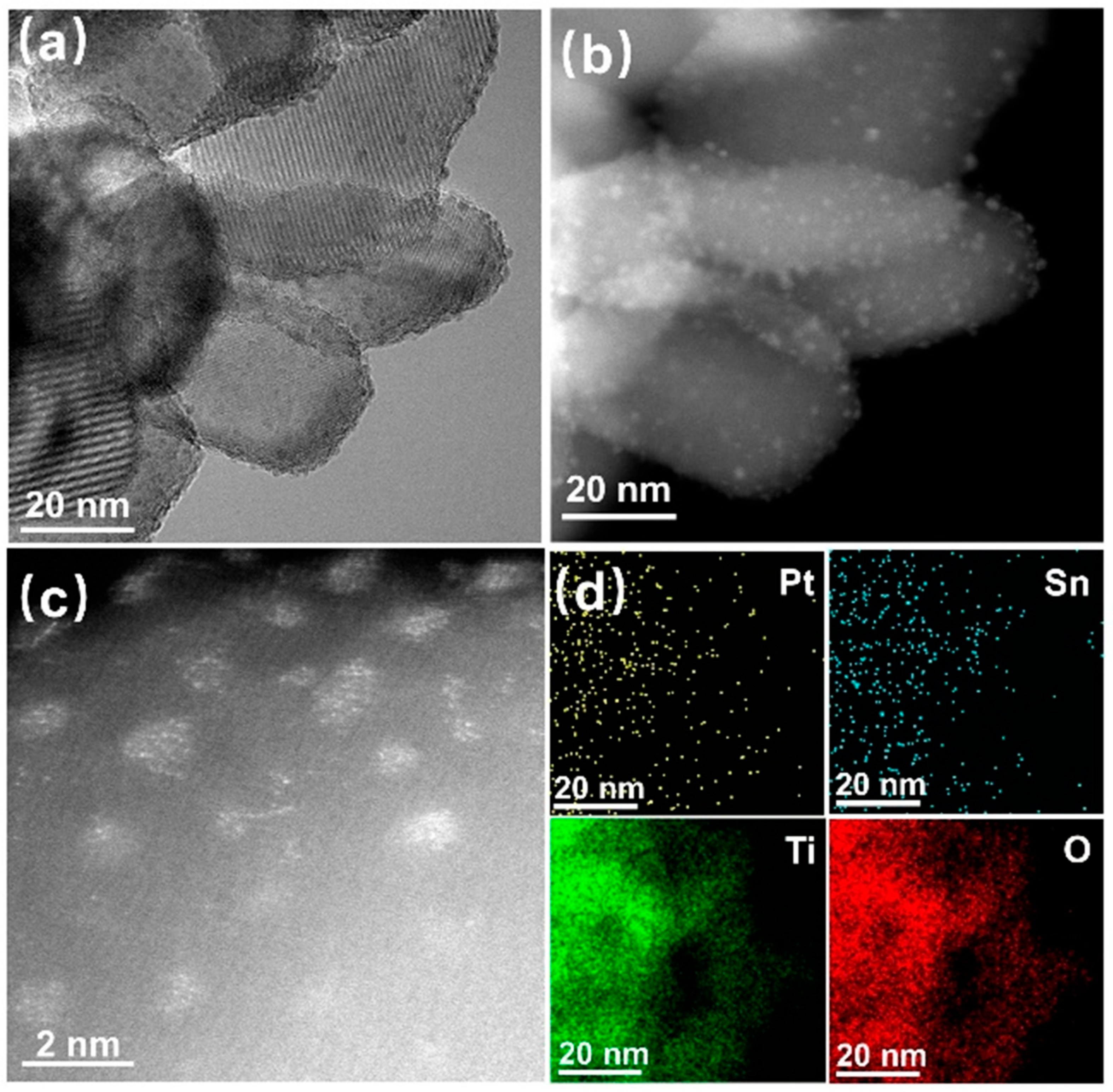
To further investigate the spatial distribution of metal species, transmission electron microscopy (TEM) and aberration-corrected scanning transmission electron microscopy (AC-STEM) were performed. Representative TEM, STEM, AC-STEM, and energy-dispersive X-ray spectroscopy (EDS) mapping images of Pt–Sn/TiO2, Pt/TiO2, and Sn/TiO2 are presented in Figure 2, Figures S2 and S3. The dark-field STEM images (Figure 2b, Figures S2b and S3b) display uniformly distributed bright spots at a 20 nm scale, indicating a homogeneous dispersion of metallic species. High-resolution AC-STEM images (Figure 2c, Figures S2c and S3c) further reveal that the metals are present as uniformly dispersed nanoclusters on the TiO2 surface. The corresponding EDS mapping (Figure 2d, Figures S2d and S3d) further supports these observations, showing that Pt and Sn are distributed over the support. These results demonstrate the successful formation of Pt–Sn/TiO2, Pt/TiO2, and Sn/TiO2 catalysts with atomically dispersed nanoclusters via the impregnation method.
X-ray photoelectron spectroscopy (XPS) was employed to investigate the oxidation states of Pt and Sn in Pt/TiO2 and Pt–Sn/TiO2 catalysts. The Pt 4f spectra of Pt/TiO2 and Pt–Sn/TiO2 (Figure 1c) exhibits two peaks at 71.5 eV and 72.4 eV, assigned to Pt0 4f7/2 and Pt2+ 4f7/2 in Pt/TiO2, indicating the coexistence of metallic and oxidized Pt species. After introducing Sn, the Pt 4f peaks in Pt–Sn/TiO2 shift slightly to lower binding energies (71.2 eV and 72.3 eV) without changing the valence states. This shift is attributed to electron transfer from Sn to the more electronegative Pt, which increases the electron density on Pt and generates an electron-rich state. The Sn 3d spectrum of Pt–Sn/TiO2 (Figure 1d) exhibits four peaks: 483.6 eV and 489.1 eV for Sn0, and 486.3 eV and 494.7 eV for oxidized Sn species (Sn2+ and Sn4+) [27,28]. These findings indicate the coexistence of metallic and oxidized Pt and Sn, and demonstrate electronic interactions between the two metals in the bimetallic catalyst.

3.2. Catalytic Performance Evaluation

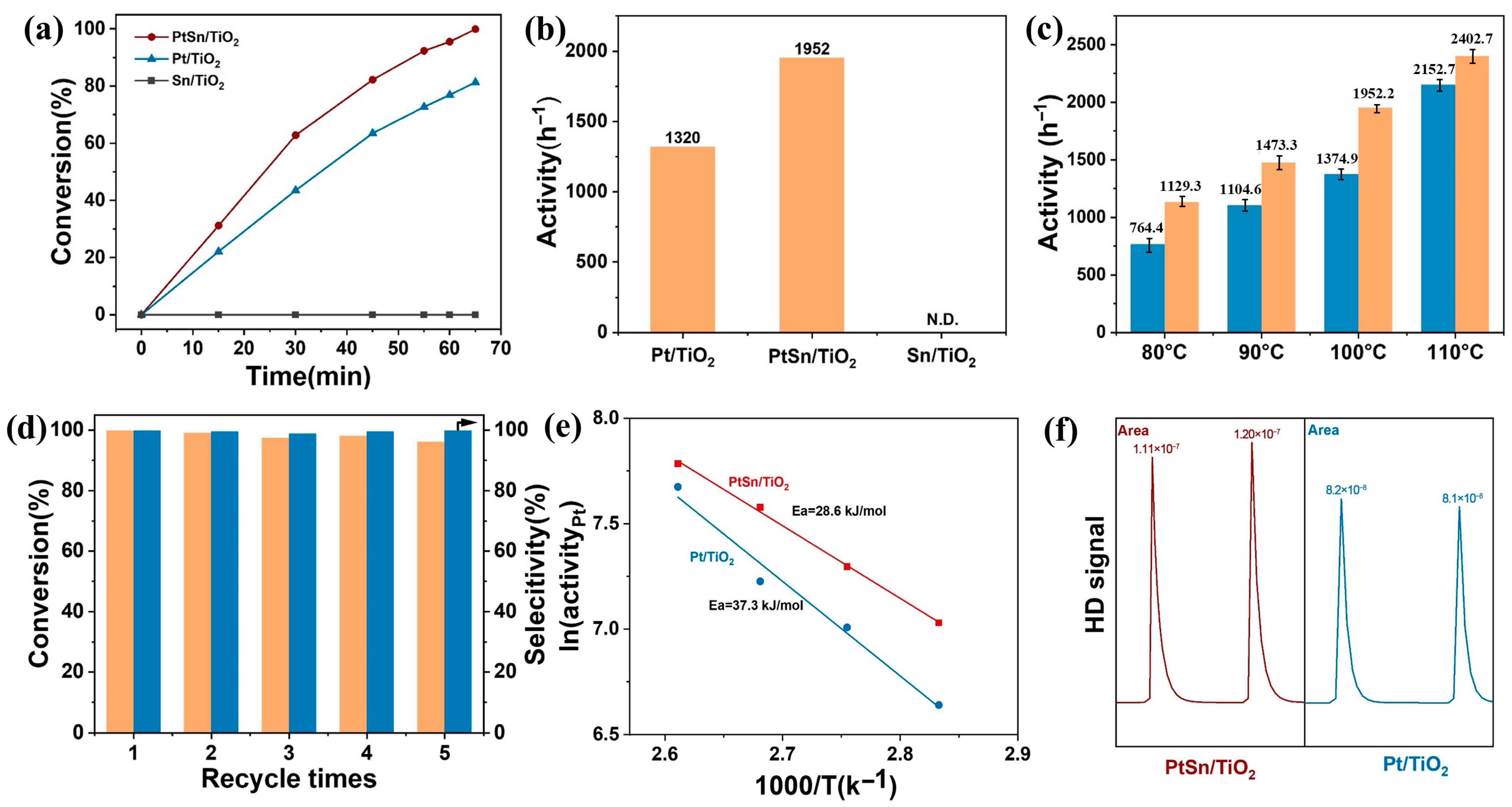
Toluene hydrogenation, representing the hydrogen storage step in the toluene-methylcyclohexane (MTH) cycle for LOHC systems, was employed to evaluate the catalytic performance of Pt–Sn/TiO2 and Pt/TiO2. The effect of solvent was tested at 100 °C and 1 MPa H2 for 55 min in cyclohexane, ethanol, and isopropanol (IPA). Pt–Sn/TiO2 showed the highest toluene conversion in cyclohexane (92.1%), significantly higher than in ethanol (42.1%) and IPA (55.2%) (Figure S4). Cyclohexane was thus selected as the reaction solvent for all subsequent experiments. Toluene conversion over Pt–Sn/TiO2 and Pt/TiO2 increased with reaction time, reaching >99.9% and 81.3% after 65 min, respectively, while Sn/TiO2 was almost inactive (<1%) (Figure 3a). These results indicate that metallic Pt acts as the active center for toluene hydrogenation, and the incorporation of Sn promotes the reaction. At conversions below 30% and 100 °C, the activity of Pt–Sn/TiO2 was 1992.1 h−1, 1.4 times higher than Pt/TiO2 (1462.7 h−1) (Figure 3b). Temperature-dependent tests under 1 MPa H2 from 80 to 110 °C showed that Pt–Sn/TiO2 consistently outperformed Pt/TiO2 (Figure 3c). Pt–Sn/TiO2 also showed excellent recyclability, maintaining >99.9% toluene conversion and 97.4% methylcyclohexane selectivity over five cycles (Figure 3d). STEM images before and after reaction (Figure S5a,b) revealed that Pt remained as well-dispersed nanoclusters with only minor aggregation (average size increased from 1.15 nm to 1.5 ± 0.5 nm), indicating good structural stability under reaction conditions. Such durability is crucial for LOHC systems, which require catalysts capable of enduring repeated hydrogenation–dehydrogenation cycles. The high activity and stability of Pt–Sn/TiO2 suggest its potential as an efficient catalyst for LOHC hydrogen storage, laying the groundwork for further investigation under solvent-free and extended cycling conditions.
The enhanced hydrogenation performance of Pt–Sn/TiO2 highlights its potential for efficient hydrogen storage in LOHC systems, where rapid and reversible H2 uptake is critical. To investigate the origin of the performance difference between Pt–Sn/TiO2 and Pt/TiO2 in toluene hydrogenation, the apparent activation energies were determined from Arrhenius plots (Figure 3e). Pt–Sn/TiO2 exhibited a lower activation energy (28.6 kJ/mol) than Pt/TiO2 (37.3 kJ/mol), indicating that Sn incorporation enhances the catalytic efficiency, consistent with the activity results shown in Figure 3b. The H2 dissociation abilities of the two catalysts were further evaluated by H-D exchange experiments. The two peaks observed for each catalyst in Figure 3f correspond to sequential hydrogen activation events on different types of active sites, reflecting the catalyst’s ability to dissociate molecular hydrogen. The HD peak area of Pt–Sn/TiO2 was 1.5 times larger than that of Pt/TiO2, demonstrating that the bimetallic Pt–Sn catalyst has significantly improved H2 activation. These results confirm that Sn doping enhances the hydrogenation performance of Pt for toluene. Overall, Pt–Sn/TiO2 shows higher activity in toluene hydrogenation than most catalysts reported in the literature [21,22,29,30,31,32,33]. This superior activity can be attributed to the highly dispersed architecture of the catalyst and the consequent Pt–Sn synergy, which collectively enhance the hydrogen dissociation capability.

4. Conclusions

In summary, Pt–Sn/TiO2 atomically dispersed nanocluster catalysts were successfully synthesized via an impregnation method and thoroughly characterized. Structural analyses (XRD, XPS, TEM, and AC-STEM) confirmed uniform dispersion of Pt and Sn nanoclusters with evident electronic interactions. Pt–Sn/TiO2 exhibited superior activity in toluene hydrogenation (activity = 1992.1 h−1) compared with Pt/TiO2 (1462.7 h−1), along with excellent recyclability. Kinetic analysis revealed a lower apparent activation energy, while H-D exchange experiments demonstrated enhanced H2 dissociation, accounting for its improved catalytic performance. The high activity, stability, and electronic synergy of Pt–Sn/TiO2 highlight its potential as an efficient hydrogenation catalyst for organic liquid hydrogen carriers (LOHCs). These findings provide valuable insights for designing robust, interface-engineered catalysts to enable efficient hydrogen storage and release in sustainable energy systems.

Supplementary Materials

The following supporting information can be downloaded at: https://www.mdpi.com/article/10.3390/colloids9060085/s1, Figure S1. Schematic diagram of the preparation process for Pt/TiO2, Sn/TiO2 and Pt–Sn/TiO2 atomically dispersed nanocluster catalysts; Table S1. Pt and Sn loading of Pt–Sn/TiO2, Pt/TiO2 and Sn/TiO2; Table S2. The BET surface area, pore volume and pore size of different catalysts; Figure S2. (a) TEM image, (b) STEM image, (c) AC HADDF-STEM image and (d) EDS mapping image of Pt/TiO2; Figure S3. (a) TEM image, (b) STEM image, (c) AC HADDF-STEM image and (d) EDS mapping image of Sn/TiO2; Figure S4. Effect of different solvents on reaction properties (20 mg of Pt–Sn/TiO2, 0.5 mmol of toluene, T = 100 °C, 1MPa H2, time = 55 min); Figure S5. (a) STEM image and particle size distribution of Pt–Sn/TiO2, (b) STEM image and particle size distribution of used Pt–Sn/TiO2; Table S3. Comparison of the catalytic performance of Pt–Sn/TiO2 with other catalysts.

Author Contributions

Conceptualization, J.W. and X.H.; methodology, J.W. and H.L.; validation, H.L. and Q.C.; formal analysis, J.W.; investigation, J.W. and H.L.; resources, Y.Z. and X.H.; data curation, J.W.; writing—original draft preparation, J.W. and X.H.; writing—review and editing, Y.Z. and X.H.; visualization, J.W.; supervision, Y.Z. and X.H.; project administration, Y.Z. and X.H.; funding acquisition, Y.Z. and X.H. All authors have read and agreed to the published version of the manuscript.

Funding

This work was supported by the National Natural Science Foundation of China (22422815, U22A20428), Guangdong Natural Science Funds for Distinguished Young Scholar (2022B1515020035), the special fund for Science and Technology Innovation Teams of Shanxi Province (202304051001007). The authors thank the Guangdong Basic Research Center of Excellence for Functional Molecular Engineering, and the Chemistry and Chemical Engineering Guangdong Laboratory (Grant No. 1922010).

Data Availability Statement

The raw data supporting the conclusions of this article will be made available by the authors on request.

Acknowledgments

We are indebted to our colleagues at the Guangdong Basic Research Center of Excellence for Functional Molecular Engineering for their valuable discussions and to the Chemistry and Chemical Engineering Guangdong Laboratory for providing access to characterization facilities. Additionally, we acknowledge the support from the National Institute of Guangdong Advanced Energy Storage Co., Ltd. and Zhongshan Power Supply Bureau.

Conflicts of Interest

Author Jun Wang, Hao Lin and Yaohong Zhao were employed by the company Guangdong Advanced Energy Storage Co., Ltd. Author Qizhong Chan was employed by the company Guangdong Power Grid Co., Ltd. The remaining authors declare that the research was conducted in the absence of any commercial or financial relationships that could be construed as a potential conflict of interest. All authors have read and agreed to the published version of the manuscript.

References

  1. Brandon, N.P.; Kurban, Z. Clean Energy and the Hydrogen Economy. Philos. Trans. R. Soc. A 2017, 375, 20160400. [Google Scholar] [CrossRef]
  2. Tarhan, C.; Çil, M.A. A Study on Hydrogen, the Clean Energy of the Future: Hydrogen Storage Methods. J. Energy Storage 2021, 40, 102676. [Google Scholar] [CrossRef]
  3. Dong, Z.Y.; Yang, J.; Yu, L.; Daiyan, R.; Amal, R. A Green Hydrogen Credit Framework for International Green Hydrogen Trading Towards a Carbon Neutral Future. Int. J. Hydrogen Energy 2022, 47, 728–734. [Google Scholar] [CrossRef]
  4. Lee, H.; Ahn, J.; Choi, D.G.; Park, S.Y. Analysis of the Role of Hydrogen Energy in Achieving Carbon Neutrality by 2050: A Case Study of the Republic of Korea. Energy 2024, 304, 132023. [Google Scholar] [CrossRef]
  5. Shafiee, R.T.; Schrag, D.P. Carbon Abatement Costs of Green Hydrogen across End-Use Sectors. Joule 2024, 8, 3281–3289. [Google Scholar] [CrossRef]
  6. Zhu, Y.; Keoleian, G.A.; Cooper, D.R. The Role of Hydrogen in Decarbonizing U.S. Industry: A Review. Renew. Sustain. Energy Rev. 2025, 214, 115392. [Google Scholar] [CrossRef]
  7. Rampai, M.M.; Mtshali, C.B.; Seroka, N.S.; Khotseng, L. Hydrogen Production, Storage, and Transportation: Recent Advances. RSC Adv. 2024, 14, 6699–6718. [Google Scholar] [CrossRef]
  8. Sarmah, M.K.; Singh, T.P.; Kalita, P.; Dewan, A. Sustainable Hydrogen Generation and Storage—A Review. RSC Adv. 2023, 13, 25253–25275. [Google Scholar] [CrossRef]
  9. Zhang, T.; Uratani, J.; Huang, Y.; Xu, L.; Griffiths, S.; Ding, Y. Hydrogen Liquefaction and Storage: Recent Progress and Perspectives. Renew. Sustain. Energy Rev. 2023, 176, 113204. [Google Scholar] [CrossRef]
  10. Tang, C.; Tang, S.; Sha, F.; Han, Z.; Feng, Z.; Wang, J.; Li, C. Insights into the Selectivity Determinant and Rate-Determining Step of CO2 Hydrogenation to Methanol. J. Phys. Chem. C 2022, 126, 10399–10407. [Google Scholar] [CrossRef]
  11. Peters, W.; Seidel, A.; Herzog, S.; Bösmann, A.; Schwieger, W.; Wasserscheid, P. Macrokinetic Effects in Perhydro-N-Ethylcarbazole Dehydrogenation and H2 productivity Optimization by Using Egg-Shell Catalysts. Energy Environ. Sci. 2015, 8, 3013–3021. [Google Scholar] [CrossRef]
  12. Modisha, P.M.; Ouma, C.N.M.; Garidzirai, R.; Wasserscheid, P.; Bessarabov, D. The Prospect of Hydrogen Storage Using Liquid Organic Hydrogen Carriers. Energy Fuels 2019, 33, 2778–2796. [Google Scholar] [CrossRef]
  13. Le, T.-H.; Tran, N.; Lee, H.-J. Development of Liquid Organic Hydrogen Carriers for Hydrogen Storage and Transport. Int. J. Mol. Sci. 2024, 25, 1359. [Google Scholar] [CrossRef] [PubMed]
  14. Snider, J.L.; Su, J.; Verma, P.; El Gabaly, F.; Sugar, J.D.; Chen, L.; Chames, J.M.; Talin, A.A.; Dun, C.; Urban, J.J.; et al. Stabilized Open Metal Sites in Bimetallic Metal-Organic Framework Catalysts for Hydrogen Production from Alcohols. J. Mater. Chem. A 2021, 9, 10869–10881. [Google Scholar] [CrossRef]
  15. Modisha, P.; Bessarabov, D. Aromatic Liquid Organic Hydrogen Carriers for Hydrogen Storage and Release. Curr. Opin. Green Sustain. Chem. 2023, 42, 100820. [Google Scholar] [CrossRef]
  16. Meda, U.S.; Raikar, O.M.; Acharya, A.; Kashyap S G, A.; Mahesh, R.; Shetty, T. Nuances in Liquid Organic Hydrogen Carriers. Renew. Sustain. Energy Rev. 2026, 226, 116237. [Google Scholar] [CrossRef]
  17. Wu, Y.; Guo, Y.; Yu, H.; Jiang, X.; Zhang, Y.; Qi, Y.; Fu, K.; Xie, L.; Li, G.; Zheng, J.; et al. Nonstoichiometric Yttrium Hydride–Promoted Reversible Hydrogen Storage in a Liquid Organic Hydrogen Carrier. CCS Chem. 2021, 3, 974–984. [Google Scholar] [CrossRef]
  18. Scherer, G. Economic Analysis of the Seasonal Storage of Electricity with Liquid Organic Hydrides. Int. J. Hydrogen Energy 1999, 24, 1157–1169. [Google Scholar] [CrossRef]
  19. Kwak, Y.; Kirk, J.; Moon, S.; Ohm, T.; Lee, Y.-J.; Jang, M.; Park, L.-H.; Ahn, C.-I.; Jeong, H.; Sohn, H.; et al. Hydrogen Production from Homocyclic Liquid Organic Hydrogen Carriers (LOHCs): Benchmarking Studies and Energy-Economic Analyses. Energy Convers. Manag. 2021, 239, 114124. [Google Scholar] [CrossRef]
  20. Li, J.; Zhang, Q.; Zhang, J.; Gao, R.; Zhang, X.; Zou, J.-J.; Pan, L. Intrinsic Kinetics of Dibenzyltoluene Hydrogenation over a Supported Ni Catalyst for Green Hydrogen Storage. Ind. Eng. Chem. Res. 2023, 63, 220–232. [Google Scholar] [CrossRef]
  21. Yang, Y.; Lin, X.; Tang, J.; Zhang, J.; Liu, C.; Huang, J. Supported Mesoporous Pt Catalysts with Excellent Performance for Toluene Hydrogenation under Low Reaction Pressure. Mol. Catal. 2022, 524, 112341. [Google Scholar] [CrossRef]
  22. Suppino, R.S.; Landers, R.; Cobo, A.J.G. Influence of Noble Metals (Pd, Pt) on the Performance of Ru/Al2O3 Based Catalysts for Toluene Hydrogenation in Liquid Phase. Appl. Catal. A 2016, 525, 41–49. [Google Scholar] [CrossRef]
  23. He, X.; Zhang, H.; Zhang, X.; Zhang, Y.; He, Q.; Chen, H.; Cheng, Y.; Peng, M.; Qin, X.; Ji, H.; et al. Building up Libraries and Production Line for Single Atom Catalysts with Precursor-Atomization Strategy. Nat. Commun. 2022, 13, 5721. [Google Scholar] [CrossRef]
  24. Cui, X.; Li, W.; Ryabchuk, P.; Junge, K.; Beller, M. Bridging Homogeneous and Heterogeneous Catalysis by Heterogeneous Single-Metal-Site Catalysts. Nat. Catal. 2018, 1, 385–397. [Google Scholar] [CrossRef]
  25. Qiao, B.; Wang, A.; Yang, X.; Allard, L.F.; Jiang, Z.; Cui, Y.; Liu, J.; Li, J.; Zhang, T. Single-Atom Catalysis of Co Oxidation Using Pt1/FeOx. Nat. Chem. 2011, 3, 634–641. [Google Scholar] [CrossRef]
  26. Liu, H.; Liu, L.; Qin, Q.; Li, J.; Li, B.; He, X.; Ji, H. Comparative Study of Ptm (M=Cu, Zn, Ga, Mn, Fe, in, Ce) Bimetals on Zincosilicate for Propane Dehydrogenation Reaction. Chemistry 2024, 30, e202402764. [Google Scholar] [CrossRef]
  27. Liu, H.; Li, B.; Liu, Z.; Liang, Z.; Chuai, H.; Wang, H.; Lou, S.N.; Su, Y.; Zhang, S.; Ma, X. Ceria-Mediated Dynamic Sn0/Snδ+ Redox Cycle for CO2 Electroreduction. ACS Catal. 2023, 13, 5033–5042. [Google Scholar] [CrossRef]
  28. Xing, Y.; Kang, L.; Ma, J.; Jiang, Q.; Su, Y.; Zhang, S.; Xu, X.; Li, L.; Wang, A.; Liu, Z.-P.; et al. Sn1pt Single-Atom Alloy Evolved Stable PtSn/Nano-Al2O3 Catalyst for Propane Dehydrogenation. Chin. J. Catal. 2023, 48, 164–174. [Google Scholar] [CrossRef]
  29. Champness, N.R. The Future of Metal-Organic Frameworks. Dalton Trans. 2011, 40, 10311–10315. [Google Scholar] [CrossRef] [PubMed]
  30. Chen, L.; Verma, P.; Hou, K.; Qi, Z.; Zhang, S.; Liu, Y.S.; Guo, J.; Stavila, V.; Allendorf, M.D.; Zheng, L.; et al. Reversible Dehydrogenation and Rehydrogenation of Cyclohexane and Methylcyclohexane by Single-Site Platinum Catalyst. Nat. Commun. 2022, 13, 1092. [Google Scholar] [CrossRef] [PubMed]
  31. Park, K.H.; Jang, K.; Kim, H.J.; Son, S.U. Near-Monodisperse Tetrahedral Rhodium Nanoparticles on Charcoal: The Shape-Dependent Catalytic Hydrogenation of Arenes. Angew. Chem. Int. Ed. Engl. 2007, 46, 1152–1155. [Google Scholar] [CrossRef] [PubMed]
  32. Stanley, J.N.G.; Heinroth, F.; Weber, C.C.; Masters, A.F.; Maschmeyer, T. Robust Bimetallic Pt–Ru Catalysts for the Rapid Hydrogenation of Toluene and Tetralin at Ambient Temperature and Pressure. Appl. Catal. A 2013, 454, 46–52. [Google Scholar] [CrossRef]
  33. Song, L.; Li, X.; Wang, H.; Wu, H.; Wu, P. Ru Nanoparticles Entrapped in Mesopolymers for Efficient Liquid-Phase Hydrogenation of Unsaturated Compounds. Catal. Lett. 2009, 133, 63–69. [Google Scholar] [CrossRef]
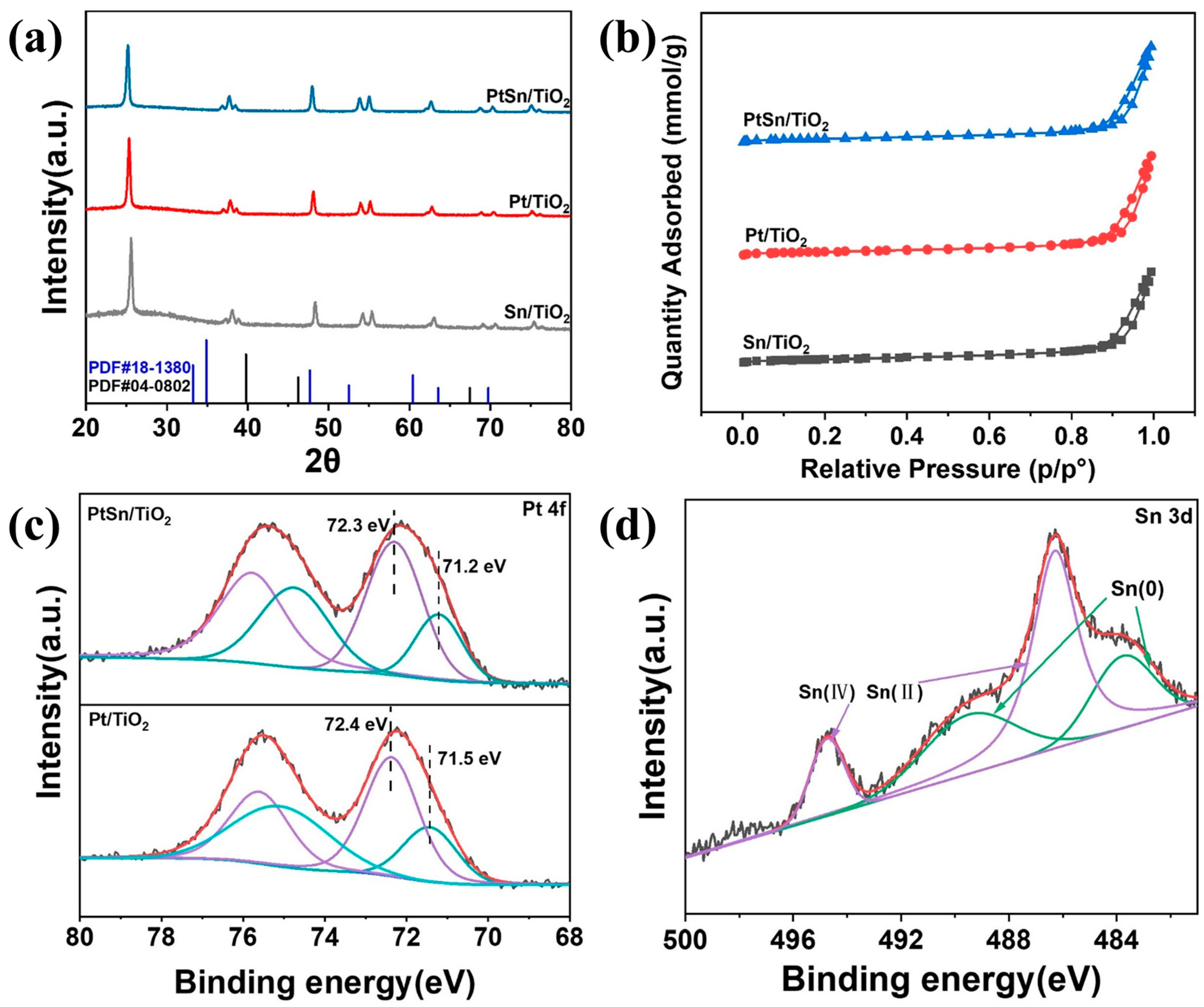
Figure 1. (a) XRD image, (b) N2 adsorption/desorption isotherm of TiO2, Sn/TiO2, Pt/TiO2 and Pt–Sn/TiO2, (c) XPS of Pt 4f of Pt–Sn/TiO2 and Pt/TiO2, (d) XPS of Sn 3d of Pt–Sn/TiO2.
Colloids 09 00085 g001
Figure 2. (a) TEM image, (b) STEM image, (c) AC HADDF-STEM image and (d) EDS mapping image of Pt–Sn/TiO2.
Colloids 09 00085 g002
Figure 3. (a) Effect of reaction time on the catalytic performance for Pt–Sn/TiO2, Pt/TiO2 and Sn/TiO2 (20 mg of catalyst, 0.5 mmol of toluene, T = 100 °C, 1 MPa H2), (b) Reaction activity of Pt–Sn/TiO2, Pt/TiO2 and Sn/TiO2 (Conversion below 30%), (c) Effect of temperature on the activity of Pt–Sn/TiO2 and Pt/TiO2 (20 mg of catalyst, 0.5 mmol of toluene, 1 MPa H2), (d) Recycle performance of Pt–Sn/TiO2 (Reaction conditions: 20 mg of Pt–Sn/TiO2, 0.5 mmol of toluene, 2 mL of cyclohexane, T = 100 °C, 1 MPa H2, time = 65 min), (e) Arrhenius plots and (f) H2-D2 exchange of Pt–Sn/TiO2 and Pt/TiO2.
Colloids 09 00085 g003
Disclaimer/Publisher’s Note: The statements, opinions and data contained in all publications are solely those of the individual author(s) and contributor(s) and not of MDPI and/or the editor(s). MDPI and/or the editor(s) disclaim responsibility for any injury to people or property resulting from any ideas, methods, instructions or products referred to in the content.