Article

Laminarin-Loaded Solid-in-Oil Nanodispersion for Enhanced Non-Invasive Transdermal Immunization

by
Md. Shahin Sarker
1,2,
Yoshirou Kawaguchi
1,*,
Rie Wakabayashi
1,
Noriho Kamiya
1,3,
Muhammad Moniruzzaman
4 and
Masahiro Goto
1,3,*
1
Department of Applied Chemistry, Graduate School of Engineering, Kyushu University, 744 Motooka, Nishi-ku, Fukuoka 819-0395, Japan
2
Department of Pharmacy, Jashore University of Science and Technology, Jashore 7408, Bangladesh
3
Center for Future Chemistry, Kyushu University, 744 Motooka, Nishi-ku, Fukuoka 819-0395, Japan
4
Mechanical Engineering Technology, New York City College of Technology, The City University of New York (CUNY), 186 Jay Street, New York, NY 11201, USA
*
Authors to whom correspondence should be addressed.
Colloids Interfaces 2026, 10(4), 49; https://doi.org/10.3390/colloids10040049 (registering DOI)
Submission received: 6 May 2026 / Revised: 5 June 2026 / Accepted: 22 June 2026 / Published: 25 June 2026
(This article belongs to the Section Application of Colloids and Interfacial Aspects)

Abstract

Simple and non-invasive transdermal vaccination is an attractive alternative to conventional injection-based immunization. However, the effectiveness of transdermal vaccines is often constrained by the stratum corneum barrier. Although the use of solid-in-oil (S/O) nanodispersion technology has successfully facilitated skin permeation to induce an immunological response, the antibody titers remain suboptimal. Herein, a dectin-1 selective ligand, laminarin, was used as an immunostimulatory adjuvant to enhance the immune response. S/O nanodispersions loaded with laminarin and ovalbumin (OVA) were systematically developed and characterized in terms of particle size, in vitro OVA release behavior, and skin permeation performance using excised mouse skin. In vivo immunization via transcutaneous administration was performed to evaluate biocompatibility and antigen-specific immunoglobulin-G (IgG) responses. Laminarin-loaded S/O nanodispersions demonstrated long-term stability and efficient ex vivo skin permeability. All the prepared laminarin-loaded S/O nanodispersions showed increased OVA-specific IgG responses compared with the laminarin-free S/O formulation. Among the formulations, the S/O nanodispersion containing OVA and laminarin at a 1:4 weight ratio induced 20-fold higher OVA-specific IgG responses than PBS and 7-fold higher responses than laminarin-free S/O formulations. This study clearly demonstrates the potential of laminarin-loaded S/O nanodispersions as a non-invasive vaccine delivery platform for enhancing antigen-specific antibody responses.

1. Introduction

Vaccination induces a durable antigen specific immune response and is the most reliable preventive strategy against infectious diseases [1]. Recently, the targeted delivery of tumor antigens to antigen-presenting cells (APCs) has emerged as a highly promising modality for cancer immunotherapy [2]. Injection remains the predominate route for immunization; however, injection is associated with several safety concerns and poor patient compliance. Transdermal vaccine administration is a promising alternative to needle-based approaches because transdermal administration is simple, non-invasive, self-administrable, and targets skin-resident APCs [3]. Nevertheless, the highly organized structure of the stratum corneum of the skin limits transdermal vaccine delivery [4]. To mitigate this limitation, several physical and chemical strategies have been developed to facilitate skin permeability for transcutaneous vaccine delivery [3,5].
To overcome the challenges imposed by the skin barrier, a solid-in-oil (S/O) nanodispersion system in which drug molecules are encapsulated by surfactants and dispersed within an oil phase has been developed in our laboratory [6,7,8]. This system has achieved high encapsulation efficiency for various therapeutics, including small molecules, proteins, and oligonucleotides [7,8,9,10]. The enhancement of in vivo antibody production has also been demonstrated through the co-encapsulation of polyarginine [11] or CpG oligodeoxynucleotides [12] in S/O nanodispersions. The use of S/O nanodispersions is highly advantageous in transcutaneous vaccine formulations, as the nanodispersions enable the co-loading of various adjuvants alongside hydrophilic antigens.
A key challenge in the development of S/O formulations loading vaccines without an immunostimulatory adjuvant is the activation of dendritic cells (DCs), the generation of antigen-specific cytotoxic T lymphocytes (CTLs) and the induction of robust antibody responses [13,14]. Cancer antigens alone do not effectively trigger antigen-specific CTL activation or antibody generation because DCs and macrophages have low efficiency for antigen presentation and reduced expression of co-stimulatory molecules [15,16]. Therefore, adjuvant components that can strongly promote DC maturation are required in combination with cancer antigens to achieve effective tumor immunity [17,18,19,20].
Natural polysaccharides, which have diverse biological activity, low toxicity, and excellent biocompatibility, have emerged as promising candidates for use as vaccine adjuvants [21,22]. These biomolecules, which consist of multiple monosaccharide units connected by glycosidic bonds, can stimulate macrophages as well as T and B lymphocytes, thereby enhancing cytokine and antibody production [23,24]. Laminarin, a (1 → 3)-β-D-glucan derived from brown seaweed, is a natural ligand of the DC-associated C-type lectin receptor dectin-1 [25] and exhibits notable immunomodulatory and antitumor activities [26,27]. Dectin-1-stimulated DCs have been reported to prime Th17 and CD8+ T cell responses [28], convert regulatory T (Treg) cells into interleukin-17 (IL-17)-producing cells [29], and induce robust cytotoxic T lymphocyte responses [30]. Previous studies have demonstrated that a physical mixture of laminarin and ovalbumin (OVA) administered intravenously significantly suppressed tumor growth [26], and a physical mixture of laminarin nanoparticles and OVA administered subcutaneously enhanced OVA-specific IgG responses [31]. Furthermore, a recent study has indicated that laminarin-coated peptide dendrimers can enhance the precise targeting of the decitin-1 receptor and improve oral gene delivery [32].
The present study aimed to develop a nanocarrier platform for the transcutaneous delivery of an antigenic protein in combination with laminarin, a dectin-1-specific natural ligand. Laminarin/OVA-loaded S/O nanodispersions were prepared and characterized in terms of particle size distribution, polydispersity index (PDI), morphology, stability, and biocompatibility. The protein release profiles of S/O nanodispersions formulated with varying OVA-to-laminarin weight ratios were evaluated in phosphate-buffered saline (PBS), and ex vivo skin permeation was investigated using excised mouse skin. Finally, the immunoenhancing potential of the S/O nanodispersions for transcutaneous immunization was evaluated by measuring antibody production in mice.

2. Materials and Methods

2.1. Materials

Laminarin derived from Laminaria digitata was purchased from InvivoGen (San Diego, CA, USA). OVA was procured from Sigma-Aldrich (St. Louis, MO, USA). Sucrose laurate (L-195) and sucrose erucate (ER-290) were purchased from Mitsubishi-Kagaku Foods Corporation (Tokyo, Japan). Isopropyl myristate (IPM) was purchased from FUJIFILM Wako Pure Chemical Corporation (Osaka, Japan). The horseradish peroxidase-labeled anti-mouse IgG polyclonal antibody and bicinchoninic acid (BCA) protein assay kit were purchased from Thermo Fisher Scientific (Waltham, MA, USA). A cell counting kit (CCK-8) containing 2-(2-methoxy-4-nitrophenyl)-3-(4-nitrophenyl)-5-(2,4-disulfophenyl)-2H-tetrazolium monosodium salt was purchased from Dojindo Molecular Technologies, Inc. (Kumamoto, Japan). Mouse skin (Hos: HR-1) was sourced from Hoshino Laboratory Animals, Inc. (Ibaraki, Japan) and stored at −80 °C.

2.2. Animals

Female C57BL/6N mice (5 weeks of age) were purchased from Kyudo Co. (Saga, Japan) and acclimatized under natural conditions for 1 week before the experiment. All animal experiments were conducted with the approval of the Kyushu University Animal Experiment Ethics Committee (Approval ID: A25-241-1) and in accordance with the Guidelines for the Care and Use of Laboratory Animals established by the Science Council of Japan.

2.3. Preparation of the Laminarin/OVA-Loaded S/O Nanodispersions

The S/O nanodispersions were prepared according to a previously reported method with slight modifications [12]. Briefly, 2 mL of an aqueous solution of OVA (1 mg) containing laminarin (1, 2, 3, 4, or 5 mg) was mixed with 4 mL of a cyclohexane solution of ER-290 (12.5 mg/mL) in a glass vial (aqueous: organic phase ratio 1:2, v/v). The mixtures were then homogenized at 26,000 rpm for 2 min using a homogenizer (Polytron® PT 3100 D, Kinematica AG, Luzern, Switzerland) to obtain water-in-oil (W/O) emulsions. The resulting emulsions were rapidly frozen in liquid nitrogen for 30 min and subsequently lyophilized for 18 h using a freeze-dryer (FD5N; EYELA, Tokyo, Japan) to obtain protein–surfactant complexes. Finally, each complex was dispersed in 1 mL of IPM, followed by vortexing at room temperature and stirring at 500 rpm to produce a S/O nanodispersion. For the selection of the optimal formulation, S/O nanodispersions were prepared using L-195 (50, 75, and 100 mg in 4 mL of cyclohexane) (Table S1) and ER-290 (75 and 100 mg in 4 mL of cyclohexane) following the same procedure as described above (Table S2).

2.4. Physical Characterization of the S/O Nanodispersions

The particle size distribution and PDI values of the S/O nanodispersions were investigated at 25 ± 0.1 °C using dynamic light scattering (DLS) on a Zetasizer Nano ZS instrument (Malvern, Worcestershire, UK) equipped with a 1 cm quartz cuvette at a 173° scattering angle. Prior to measurement, the S/O formulations were diluted 100-fold with IPM, and the average values of ten replicates were recorded as the representative particle sizes. The refractive indexes used for the measurements were 1.43, 1.44, and 1.46 for IPM, ER-290 S/O, and L-195 S/O, respectively, as determined experimentally using a refractometer (RA-500, KEM, Kyoto, Japan). The physical stability of the laminarin-loaded S/O nanodispersions was inspected visually, and the particle size and PDI values were monitored using DLS for 3 months at room temperature (25 ± 0.5 °C).
Transmission electron microscopy (TEM) analysis was performed to assess the morphology of the prepared S/O nanodispersions using a JEM-2010 electron microscope (JEOL Ltd., Akishima, Tokyo, Japan). First, 2 μL of each sample was spread on carbon film-coated copper grids, air-dried for 2 min, and excess liquid was removed by blotting, followed by immediate washing with 5 μL of Milli-Q water. Samples were negatively stained for 5 min using 2% (w/v) uranyl acetate solution. Finally, the grids were vacuum-dried in a desiccator, and TEM images were taken at an accelerating voltage of 120 kV.

2.5. Protein Release Efficiency Study of the S/O Nanodispersions

The release of protein (OVA) from S/O nanodispersions containing OVA and laminarin at different weight ratios was evaluated in PBS as previously described [11,12]. Briefly, an aliquot of S/O nanodispersion (150 μL) was added to 600 μL of PBS and stirred at 37 °C for 24 h. Samples (25 μL) were withdrawn at 0, 1, 3, 6, and 24 h, and the OVA concentration in each sample was measured by BCA assay using a BCA protein assay kit (Thermo Fisher Scientific) according to the manufacturer’s instructions.

2.6. Ex Vivo Skin Permeability Study Using Excised Mouse Skin

Fluorescein isothiocyanate (FITC)-labeled OVA was prepared to assess the skin permeability of OVA using fluorescence microscopy according to a previously reported method [33], and S/O nanodispersions loaded with laminarin and FITC-OVA were prepared (Table S3). The ex vivo skin permeations of FITC-OVA-loaded formulations (1 mg/mL) were evaluated using excised Hos:HR-1 mouse skin mounted on a Franz diffusion cell (FDC), following a previously reported method [12]. In brief, frozen (−80 °C) mouse skins were cut into an appropriate size (2 × 2 cm2) and immediately mounted on an FDC with a diffusion area of 0.785 cm2; the skin stratum corneum layer was facing the donor compartment and the dermis layer was facing the receptor compartment, which was filled with 5 mL of PBS (pH 7.4). The donor compartment was filled under light-protected conditions with 200 μL of S/O formulation or PBS solution containing 1 mg/mL of FITC-OVA. The skin permeability study for transdermal delivery was conducted for 6 h at 32.5 °C under continuous stirring at 500 rpm. To evaluate the topical delivery of FITC-OVA using S/O nanodispersions, the mounted skin was carefully detached from the FDC, and the treated skin sections were washed with 20% ethanol several times. The skin was then cut into small pieces and subjected to extraction by immersing the skin pieces in 1 mL of extraction buffer (PBS: acetonitrile: methanol = 2:1:1, v/v/v) at room temperature for 18 h with continuous shaking. The amounts of FITC-OVA delivered transdermally (across the skin) and topically (into the skin) were quantified by measuring the fluorescence intensity of the receiver-phase and skin-extraction samples at 485–535 nm using a Varioskan LUX multimode microplate reader (Thermo Fisher Scientific).

2.7. In Vitro Cytotoxicity Assay

Cytotoxicity assays of the prepared S/O formulations were conducted using the murine DC line DC2.4. DC2.4 cells were cultured in Roswell Park Memorial Institute 1640 (RPMI-1640) medium (Nacalai Tesque, Kyoto, Japan) supplemented with 1% 2-mercaptoethanol (Sigma-Aldrich, Burlington, MA, USA), 10% fetal bovine serum (Gibco, Thermo Fisher Scientific), 1% antibiotic–antimycotic (anti–anti; Thermo Fisher Scientific), 1% 4-(2-hydroxyethyl)-1-piperazineethanesulfonic acid (HEPES) (1 mM; Nacalai Tesque), and 1% non-essential amino acids (Nacalai Tesque).
Cell viability was assessed according to the manufacturer’s guidelines using CCK-8 (Dojindo, Kumamoto, Japan). In brief, cells were seeded into 96-well plates at a density of 1 × 10⁴ cells per well and incubated for 24 h. Then, the culture medium of the cells was replaced with fresh culture medium containing different concentrations of free OVA or laminarin–OVA-loaded S/O nanodispersions (OVA concentrations: 50, 25, and 12.5 μg/mL) and the cells were incubated for an additional 24 h. Finally, 10 μL of CCK-8 reagent was added to each well and the cells were incubated for 4 h to allow color development. Untreated cells were used as a control. All experiments were performed in triplicate. The absorbance was measured using a Varioskan LUX multimode microplate reader (Thermo Fisher Scientific) at 450 nm. Cell viability was calculated using the following formula:
C e l l   V i a b i l i t y   ( % ) = ( A b s o r b a n c e   o f   t e s t   s a m p l e A b s o r b a n c e   o f   b l a n k ) ( A b s o r b a n c e   o f   n e g a t i v e   c o n t r o l A b s o r b a n c e   o f   b l a n k ) × 100

2.8. In Vivo Skin Irritation Study

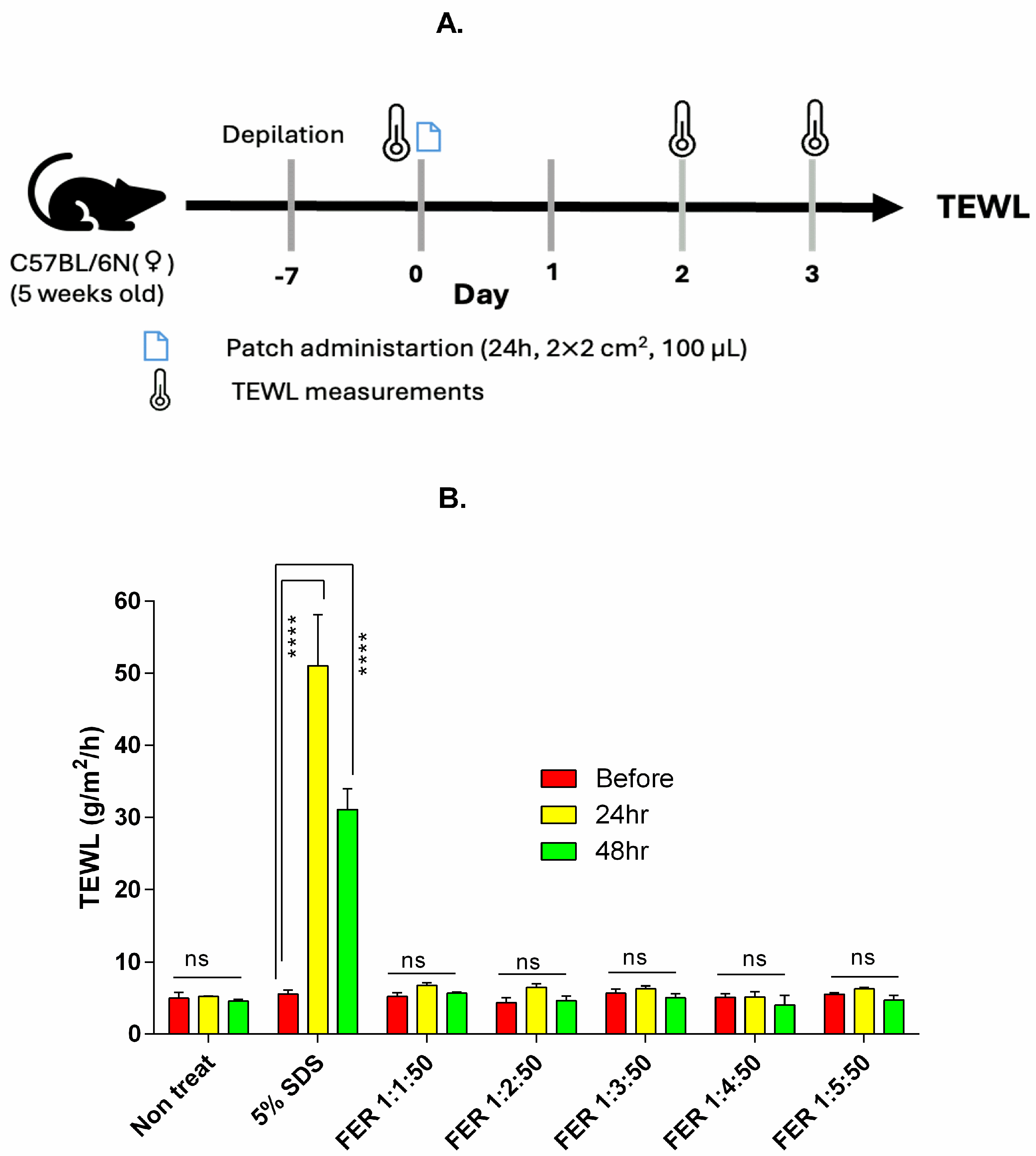
Skin irritation induced by the S/O nanodispersions was evaluated by measuring transepidermal water loss (TEWL). TEWL was expressed as the amount of water lost per unit area per unit time, reported as g/m2/h. C57BL/6N mice were anesthetized for 10 min before patch administration and during TEWL measurements to ensure adequate sedation. Baseline TEWL values of dehaired mouse skin were measured before application of all formulations administered using a patch (n = 3) using a VAPO SCAN device (Asch Japan Co., Ltd., Tokyo, Japan). TEWL was subsequently recorded at 24 and 48 h after patch removal in mice treated with the formulations. As a control, TEWL values in the 5% sodium dodecyl sulfate (SDS) in PBS and non-treated groups were also measured at the corresponding time points.

2.9. Transcutaneous Immunization and Measurement of Anti-OVA Antibody Titers

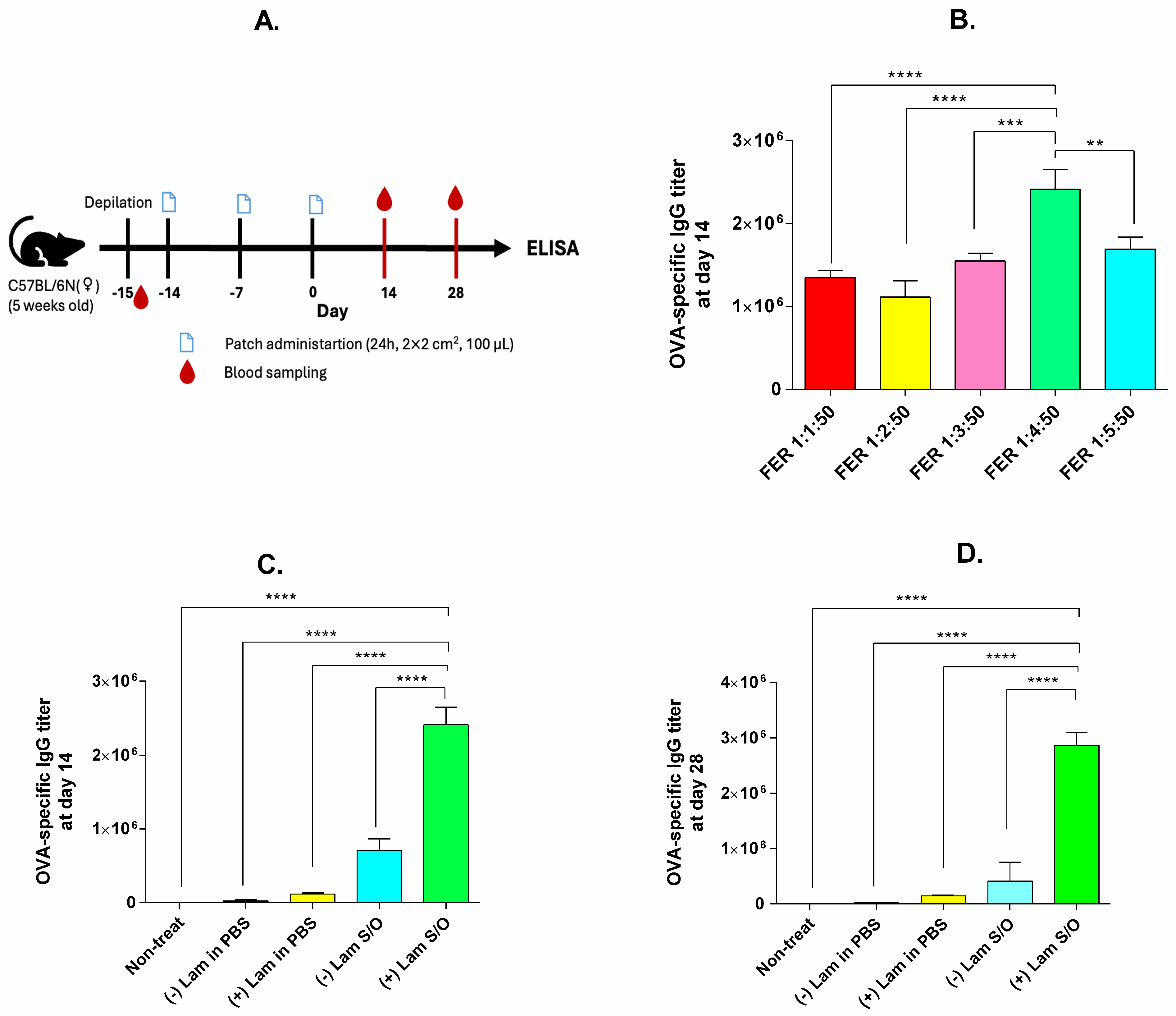
The dorsal skin of C57BL/6N mice was dehaired after 7 days of acclimatization under natural conditions and then vaccination was conducted using a homemade patch composed of two layers of gauze (approximately 2 × 2 cm2; Hakujuji Co., Ltd., Tokyo, Japan) secured with medical adhesive tape. The gauze was impregnated with 100 μL of each laminarin/OVA-loaded S/O nanodispersion formulation containing varying amounts of laminarin. As controls, PBS solutions of OVA with or without laminarin and OVA S/O nanodispersions without laminarin, containing equivalent amounts of OVA, were also applied. Transcutaneous immunization at a dose of 100 μg of antigen per mouse by applying a patch to dorsal skin for 24 h was performed three times with 7-day intervals between each application. Blood was collected from the tail vein of each mouse prior to the first immunization and 14 and 28 days after the third immunization. Serum was obtained by centrifugation at 5000 rpm for 10 min and used to quantify OVA-specific IgG antibody titers by enzyme-linked immunosorbent assay (ELISA), as previously described [12].

2.10. Statistical Analysis

GraphPad Prism software (version 6.05) was used to perform statistical analysis. Statistical significance of the data was determined by one-way ANOVA with Sidak’s and Tukey’s multiple comparison tests. Statistical significance values are indicated by * p < 0.05, ** p < 0.01, *** p < 0.001, and **** p < 0.0001. All values are shown as mean (standard deviation) [mean (SD)].

3. Results

3.1. Preparation, Characterization, and Stability Evaluation of the S/O Nanodispersions

In the present study, laminarin, a dectin-1-specific natural ligand for DCs, was used as an adjuvant, and ER-290 and L-195 were employed as surfactants (Tables S1 and S2) in the preparation of S/O nanodispersions. To facilitate the skin permeability of the prepared formulations, IPM was used as an oil vehicle. These S/O formulations can be regarded as safe for transcutaneous vaccine applications because IPM and fatty acid esters of sucrose are extensively employed in the manufacturing of cosmetic and pharmaceutical products.
We first examined the effect of laminarin and the surfactants on the particle size in laminarin/OVA-loaded S/O nanodispersions. Because the skin is inherently hydrophobic, the permeation of hydrophilic antigens with molecular weights greater than 500 Da in aqueous systems is restricted [4]. DLS analysis revealed that 12 of 15 formulations prepared using L-195 as the surfactant exhibited particle sizes greater than 500 nm in diameter after 7 days (Table S4). The particle sizes of FL 1:2:75, FL 1:3:75, and FL 1:5:75 were less than 500 nm on day 7; they increased to more than 500 nm by day 14 (Table S4). In contrast, formulations prepared with ER-290 as the surfactant showed particle sizes of less than 300 nm in diameter (Table S5).
As shown in Tables S4 and S5, ER-290-based S/O nanodispersions exhibited smaller particle sizes compared to the corresponding L-195-based formulations. Consequently, ER-290 was selected for further study because it produced nanodispersions with particle sizes favorable for transcutaneous delivery [8,34]. Although all the ER-290-based S/O formulations exhibited particle sizes less than 300 nm, the formulation containing 50 mg of ER-290 was selected for further study because it provided the optimal particle size and acceptable stability while using lowest surfactant concentration [35]. This formulation was also favored to minimize potential adverse effects associated with higher surfactant loadings. Moreover, higher ER-290 loadings have been reported to reduce drug release and attenuate antigen-specific immune responses [35]. Collectively, these considerations support the selection of the 50 mg ER-290 formulation as the optimal formulation. In the present study, five laminarin/OVA-loaded S/O nanodispersion formulations were selected from a total of 30 formulations and designated as FER-1:1:50, FER-1:2:50, FER-1:3:50, FER-1:4:50, and FER-1:5:50 according to the OVA: laminarin: ER-290 weight ratios (Table 1).
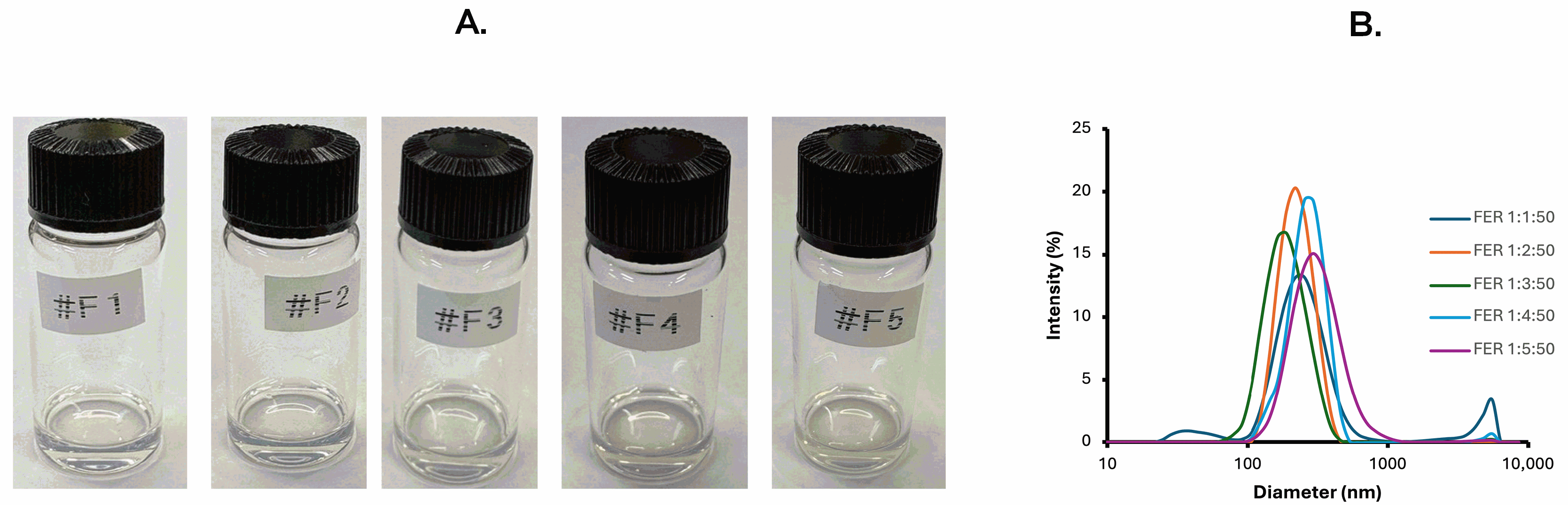
Visual inspection revealed that the incorporation of the laminarin–OVA complex into the S/O particles, followed by dispersion in IPM, resulted in transparent liquid S/O formulations (Figure 1A). The formation of nanosized particles in the S/O formulation was demonstrated by particle size distribution analysis using DLS and morphological evaluation using TEM (Figure 1B and Figure S1).
Stability is a critical attribute of any pharmaceutical formulation, as good stability ensures consistent physicochemical properties, drug release, and therapeutic efficacy over time. The physical stability of the laminarin/OVA-loaded S/O nanodispersions at room temperature was investigated during the 90-day period. Although minor fluctuations in particle size were observed during storage time (Table S6; Figure S2), no consistent upward trend indicative of particle aggregation was detected. Importantly, all formulations exhibited particle sizes below 300 nm and PDI values below 0.5 throughout the study period, indicating that the nanodispersions retained their nanoscale dimensions and acceptable physical stability during storage period.
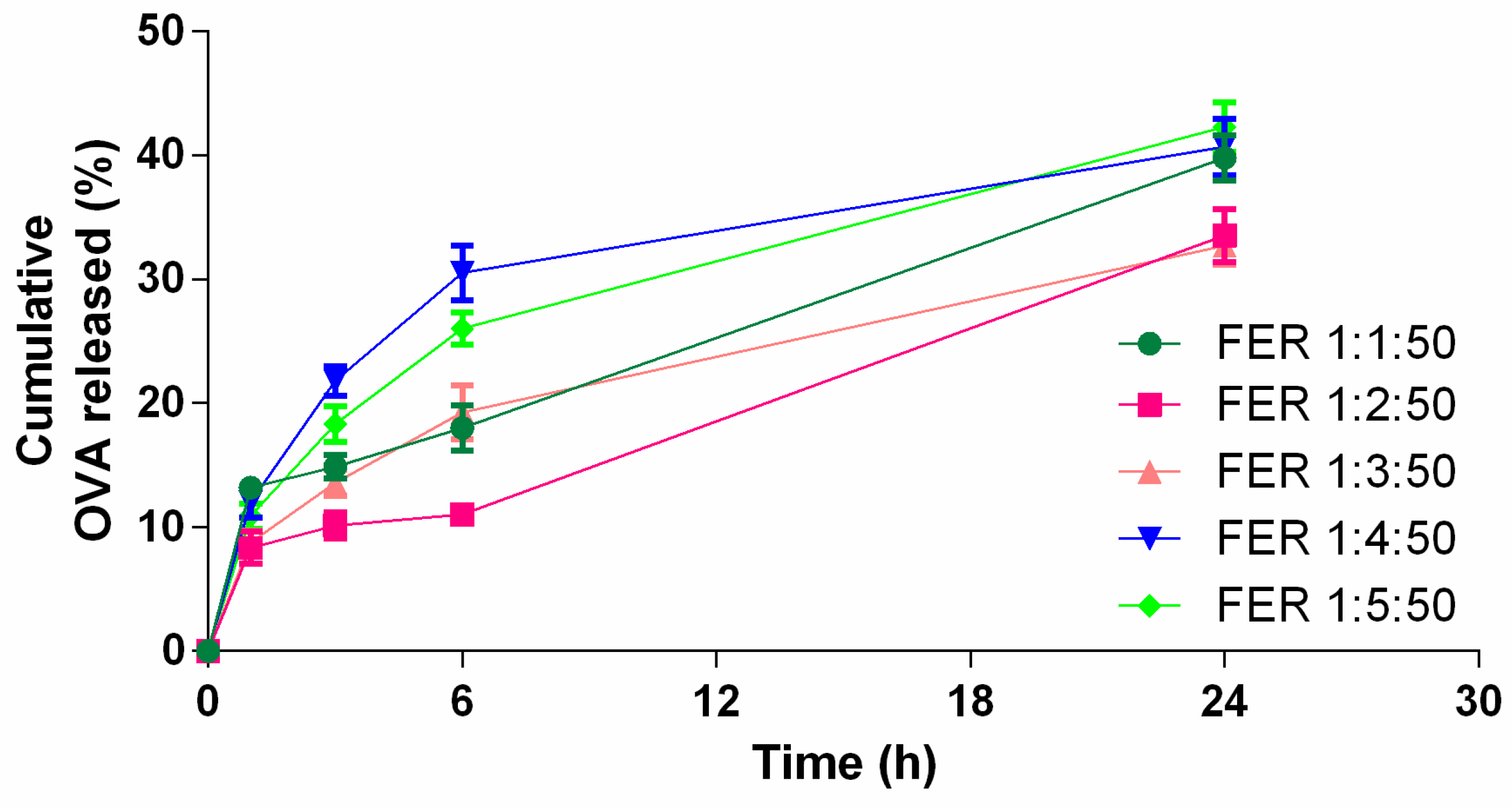
Next, the OVA release efficiency from the S/O nanodispersions was evaluated in PBS at 37 °C. OVA release from the S/O nanodispersions increased progressively over 24 h study period (Figure 2). A relatively initial rapid release was observed within the first 6 h, followed a sustained release phase that continued up to 24 h without reaching a complete plateau. The cumulative release at 24 h ranged from approximately 30–45% depending on the formulation. This release profile is consistent with those previously reported for S/O nanodispersion systems [11,12].

3.2. Evaluation of Ex Vivo Skin Permeability

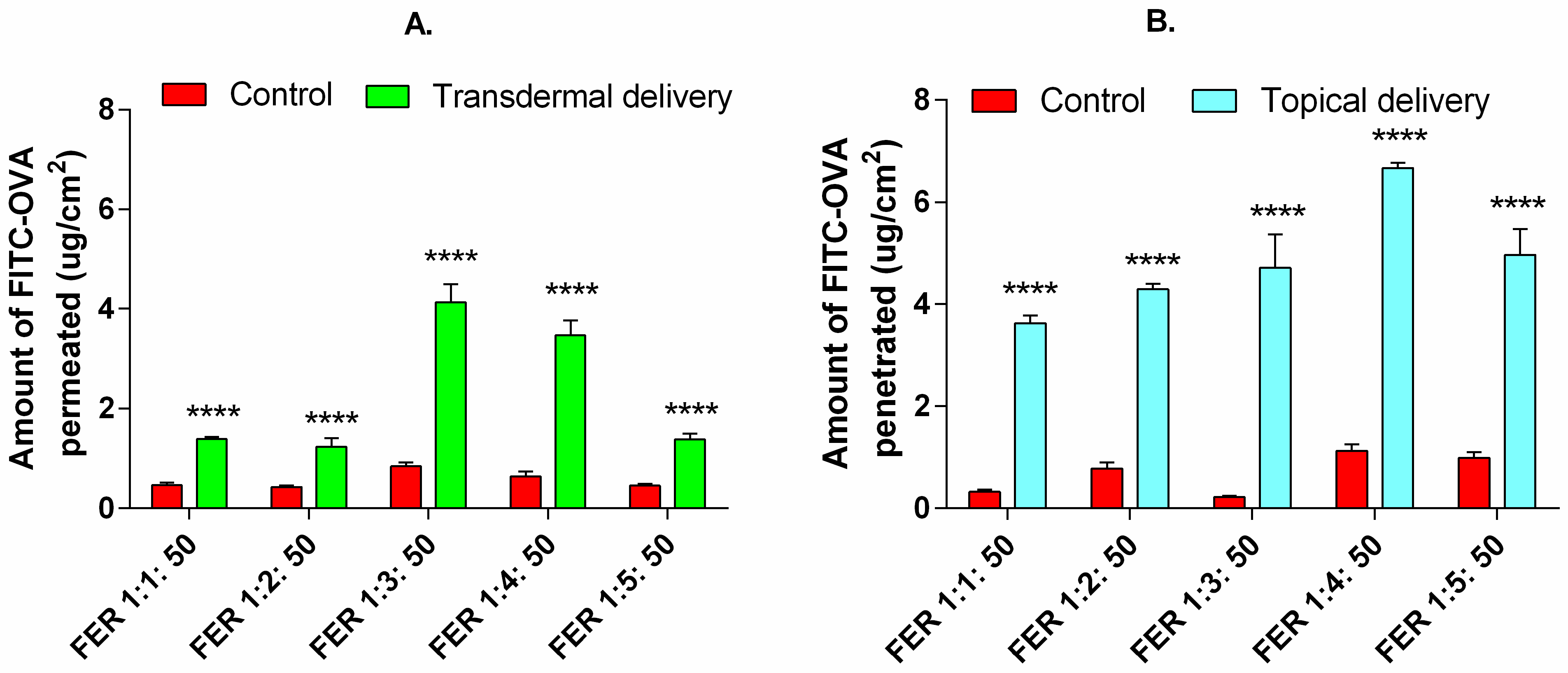
The ex vivo skin permeability of the FITC-OVA-loaded S/O nanodispersions was quantified using the FDC system. The laminarin/FITC-OVA-loaded S/O dispersions resulted in the significantly enhanced topical (penetration into the skin) and transdermal (permeation through the skin) delivery of OVA, compared with the PBS control (containing the same weight ratio of OVA and laminarin), indicating the effective performance of the formulation (Figure 3). Topical and transdermal delivery was enhanced by up to 15- and 5.5-fold, respectively, compared with the PBS control. The control formulations without surfactants exhibited instability and resulted in poor drug delivery compared with the S/O dispersions, highlighting the critical role of surfactants in maintaining stability and enhancing drug delivery performance.

3.3. In Vitro Biocompatibility of the S/O Nanodispersions

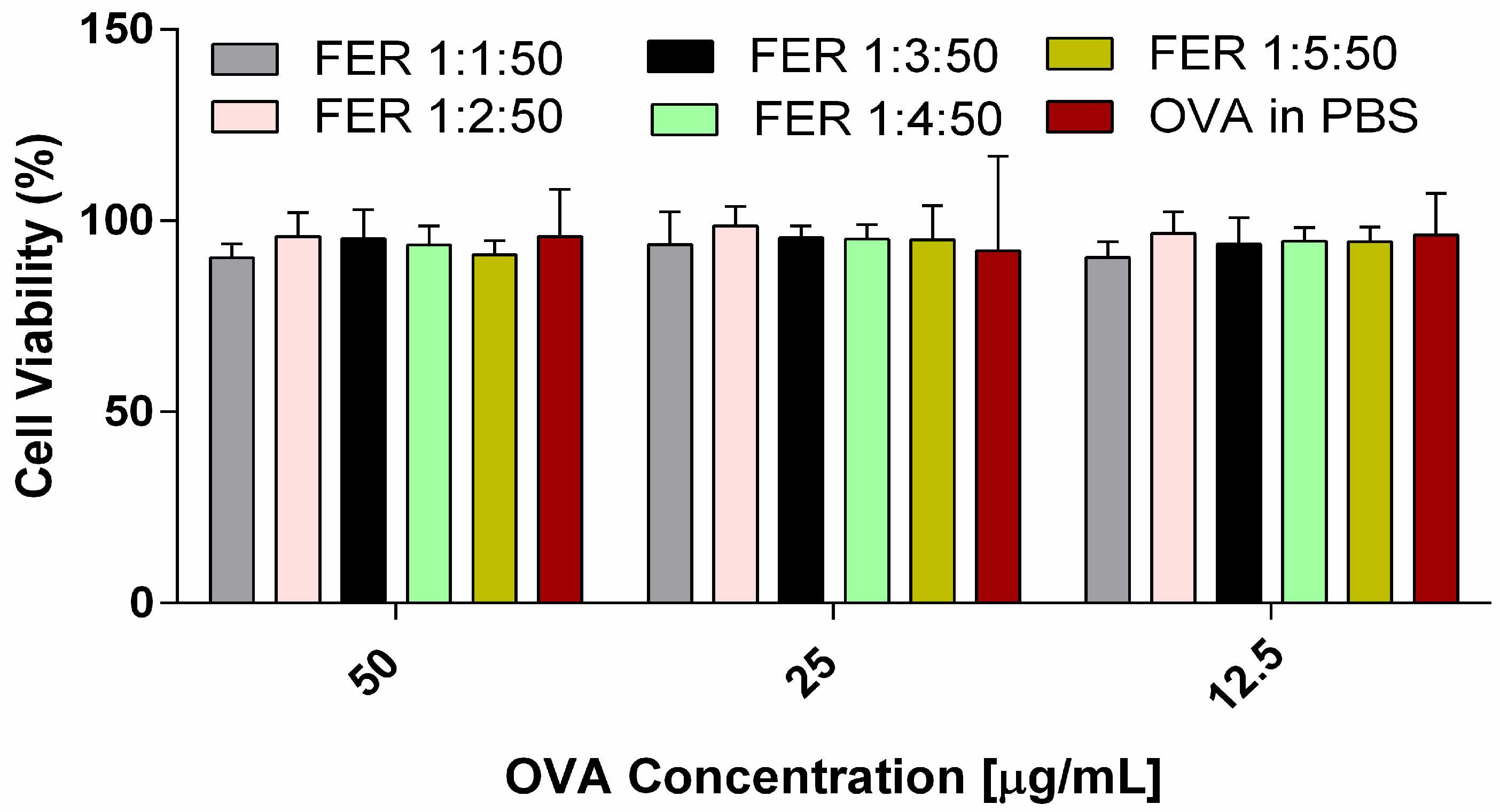
To evaluate the relative safety of the newly developed laminarin/OVA-loaded S/O nanodispersions, cell viability was assessed in DC2.4 cells using the CCK-8 assay. DCs are professional APCs that play a central role in initiating cellular immune responses by capturing, processing, and presenting antigens to T cells; therefore, maintaining DC viability is essential following antigen uptake. The cytotoxicity of various S/O nanodispersions containing OVA was examined by exposing DC2.4 cells to various concentrations of OVA (50, 25, and 12.5 μg/mL). As shown in Figure 4, the mean cell viability of DC2.4 cells treated with laminarin/OVA-loaded S/O nanodispersions, and free OVA remained above 90%. These results indicated there was minimal cytotoxicity and demonstrated the good biocompatibility of laminarin/OVA-loaded S/O nanodispersions as antigen delivery systems.

3.4. In Vivo Skin Irritation Evaluation

The TEWL value was determined to assess the potential for skin irritation of the laminarin/OVA-loaded S/O nanodispersions. The TEWL value is considered to be a reliable indicator of the skin barrier integrity and is commonly used for the detection of skin barrier dysfunction [36]. TEWL was measured at three time points: before the application of the patch and 24 and 48 h after patch removal (i.e., 48 and 72 h after initial application) (Figure 5A).
Baseline TEWL values were recorded for all mouse groups prior to formulation application. TEWL was also remeasured 24 h after patch removal to assess water loss following treatment. A modest elevation in the TEWL value was observed after 24 h of patch removal, but this difference was not statistically significant (Figure 5B). At 48 h after patch removal, TEWL values returned to baseline levels, indicating the complete recovery of the skin barrier function after formulation application (Figure 5B). In contrast, skin treated with 5% SDS in PBS exhibited significantly elevated TEWL values, exceeding 30 g/m2/h even 48 h after patch removal. Overall, these results demonstrated that laminarin-loaded S/O formulations have an acceptable skin safety profile.

3.5. Evaluation of OVA-Specific Antibody Responses Following Transdermal Immunization

To assess the immunogenicity of the laminarin-loaded S/O nanodispersions as transdermal vaccines in a murine model, serum antibody titers from C57BL/6N mice after immunization were measured using ELISA (Figure 6A). After three consecutive administrations of laminarin-containing S/O formulations, the highest level of OVA-specific IgG response was induced by the S/O nanodispersion formulated with OVA and laminarin at a 1:4 weight ratio (w/w) (Figure 6B). S/O formulations containing OVA and laminarin at weight ratios of 1:1, 1:2, and 1:3 exhibited less OVA release in PBS compared with the 1:4 weight ratio nanodispersion, suggesting that the OVA-to-laminarin ratio influenced the release behavior of OVA from S/O nanodispersions. However, excessive amounts of laminarin in the S/O formulations may have attenuated the release of OVA–laminarin complexes from nanoparticles within the epidermis as lower OVA-specific IgG responses were induced when the OVA-to-laminarin weight ratio was increased to 1:5.
The anti-OVA response was enhanced by the addition of laminarin in both aqueous solutions and S/O nanodispersions (Figure 6C,D). The mean OVA-specific IgG titer in mice treated with the S/O nanodispersion with an OVA-to-laminarin weight ratio of 1:4 was approximately 20-fold higher than that in mice treated with PBS solution. In addition, laminarin-loaded S/O nanodispersions induced 3.4-fold higher anti-OVA IgG responses at day 14 and 7-fold higher responses at day 28 compared with S/O nanodispersions without laminarin (Figure 6C,D).

4. Discussion

Targeting antigens to APCs is a well-established approach for enhancing vaccine efficacy. This is typically achieved by forming complexes between antigenic protein and antibodies that recognize surface molecules on APCs. In this study, we explored an alternative strategy using laminarin, a β-1,3-glucan that functions as a dectin-1-targeting ligand, to facilitate antigen delivery to APCs via transdermal delivery. Transdermal vaccination requires efficient antigen transport across the skin barrier while preserving skin integrity and APC viability [37]. In the present study, laminarin-loaded S/O nanodispersions were developed to enhance antigen delivery to skin-resident DCs through nanoscale formulation and β-glucan receptor-mediated targeting. It has been reported that the use of laminarin in peptide dendrimer-based formulations can enhance drug delivery performance and facilitate DC targeting [32].
Stable nanosized S/O nanodispersions (<300 nm) were achieved using ER-290 as the surfactant (Tables S5 and S6), whereas formulations prepared with L-195 exhibited particle growth, indicating reduced physical stability (Table S4). ER-290 is a nonionic surfactant characterized by a long alkyl chain (C22:1) and a low hydrophilic–lipophilic balance (HLB) value (HLB = 2). This surfactant can form W/O emulsions with a small droplet size [34] that facilitate the penetration of high-molecular-weight proteins across the stratum corneum, indicating the suitability of the emulsions for transdermal drug delivery [38]. The sustained physical stability of S/O formulations containing ER-290 (Figure S2) was observed over a period of 90 days. Moreover, morphological analysis using TEM indicated that the prepared S/O nanodispersions were nanosized (Figure S1). The use of IPM as the oil vehicle further ensured the skin compatibility of the formulations [39]. Figure 2 shows that the in vitro release of OVA from the S/O nanodispersions was comparable to that observed in a previous study [11,12]. Importantly, release studies indicated that the antigen-release profile changed with changing the OVA-to-laminarin weight ratio, highlighting the influence of laminarin on antigen–nanoparticle interactions. Laminarin-loaded S/O nanodispersions markedly enhanced ex vivo skin permeability, resulting in increases in the topical and transdermal delivery of FITC-OVA of up to 15- and 5.5-fold, respectively, compared with the PBS control solutions containing equal weight ratios of OVA: laminarin (Figure 3). The PBS solutions of FITC-OVA and laminarin showed poor delivery efficiency compared with the S/O formulations, emphasizing the necessity of nanodispersion integrity for effective skin permeation of the antigen.
Biocompatibility evaluation is one of most important prerequisites for newly developed formulations. A cytotoxicity evaluation demonstrated that laminarin/OVA-loaded S/O nanodispersions were well tolerated at a cellular level. DC2.4 cell viability remained above 90% following exposure to the formulations (Figure 4) at all tested antigen concentrations, indicating minimal cytotoxicity and preservation of DC function. In vivo skin irritation measurements revealed only a modest and transient increase in TEWL after patch removal, which was recovered within 48 h (Figure 5B). In contrast, the sustained elevation of TEWL was observed following treatment with 5% SDS. These results support the suitability of the prepared S/O nanodispersion for repeated transdermal applications and indicate acceptable tolerability for in vivo experiments [36].
Immunization studies demonstrated that antibody responses were markedly dependent on the OVA: laminarin ratio in the S/O formulations (Figure 6B). The S/O nanodispersion containing OVA and laminarin at a 1:4 weight ratio elicited the strongest OVA-specific IgG response among all the tested formulations, indicating an optimal balance between antigen release and DC targeting. Lower laminarin ratios were associated with reduced antigen release, whereas excessive laminarin attenuated the release of OVA–laminarin complexes, resulting in diminished antibody responses. Notably, OVA-specific IgG titers were enhanced approximately 20-fold by the S/O nanodispersion formulated with an OVA-to-laminarin weight ratio of 1:4 compared with the PBS control (Figure 6C,D). Although laminarin alone augmented immune responses in aqueous solution, the incorporation of laminarin into S/O nanodispersions resulted in a 7-fold higher immunostimulatory effect compared with laminarin-free S/O formulations (Figure 6D). This enhancement suggests there is a synergistic effect between nanocarrier-based transcutaneous delivery and the dectin-1-mediated immune activation by laminarin [26]. Importantly, the substantial induction of antigen-specific IgG responses observed in the present study is highly relevant in the context of cancer immunotherapy, as the expression of cancer-derived IgG has been closely associated with tumor progression and metastatic behavior across a wide range of malignancies, including lung, breast, colon, renal, thyroid, parathyroid, salivary gland, gastric, and pancreatic cancers [40]. The tumor-specific expression of cancer-derived IgG has gained attention as a diagnostic and prognostic biomarker and preclinical studies have shown that antibodies directed against cancer-derived IgG can elicit promising therapeutic anticancer effects, indicating the potential of cancer-derived IgG as a therapeutic target [41]. Overall, the findings of the present study indicate the potential of laminarin based APCs targeting via S/O nanodispersions provides a safe and effective platform for enhancing transdermal immunization.

5. Conclusions

We have developed laminarin-loaded S/O nanodispersions using ER-290 as a surfactant to enhance non-invasive transdermal immunization. The optimized nanodispersions were stable at room temperature and demonstrated efficient antigen release, enhanced skin permeability compared with PBS control, minimal cytotoxicity, and acceptable skin safety. These properties collectively led to enhanced OVA-specific antibody responses following transcutaneous immunization. The OVA-to-laminarin ratio (w/w) was the key determinant of the immune response, underscoring the need for precise formulation to maximize immunogenicity. Further studies are required to fully characterize cellular immune responses and cytokine profiles. However, based on these findings, laminarin-loaded S/O nanodispersions using biocompatible ER-290 as the surfactant provide a simple, non-invasive transdermal vaccination strategy capable of inducing enhanced immune responses in murine models.

Supplementary Materials

The following supporting information can be downloaded at https://www.mdpi.com/article/10.3390/colloids10040049/s1, Table S1: Composition of laminarin/OVA-loaded S/O nanodispersions formulated with L-195; Table S2: Composition of laminarin/OVA-loaded S/O nanodispersions formulated with ER-290; Table S3: Composition and particle size of laminarin/FITC-OVA-loaded S/O nanodispersions; Table S4: Particle size and PDI of laminarin/OVA-loaded S/O nanodispersions formulated with L-195; Table S5: Particle size and PDI of laminarin/OVA-loaded S/O nanodispersions formulated with ER-290; Table S6: Physical stability study of evaluation of S/O nanodispersions for 90 days; Figure S1: TEM images laminarin–OVA-loaded S/O nanodispersions; Figure S2: Particle size of laminarin–OVA-loaded S/O nanodispersions monitored by DLS over 90 days.

Author Contributions

Conceptualization, M.S.S. and Y.K.; methodology, M.S.S.; software, M.S.S.; validation, M.S.S., Y.K. and M.G.; formal analysis, M.S.S.; investigation, M.S.S.; resources, R.W. and M.M.; data curation, M.S.S.; writing—original draft preparation, M.S.S.; writing—review and editing, Y.K., R.W., N.K. and M.M.; visualization, Y.K. and M.M.; supervision, M.G.; project administration, M.G.; and funding acquisition, M.G. All authors have read and agreed to the published version of the manuscript.

Funding

This study was funded by the Japan Society for the Promotion of Science (KAKENHI numbers JP25K21700 and JP24H00397).

Institutional Review Board Statement

The animal experiment protocol was approved by the ethical committee of Kyushu University, Japan. The approval number is A25-241-1. The experiment was carried out according to the guidelines for experimental animal use of the Science Council of Japan.

Data Availability Statement

All data curated or analyzed during this study are presented in the article.

Acknowledgments

During the preparation of this manuscript, the authors also used artificial intelligence-based language assistance (ChatGPT 5.5, OpenAI) for language refinement and to improve readability. All scientific content, the interpretation of the results, and conclusions were reviewed and verified by the authors. The authors reviewed and edited the output and take full responsibility for the content of this publication. Author M.S.S. also thanks MEXT, Japan, for providing a scholarship.

Conflicts of Interest

The authors declare that there are no conflicts of interest regarding the publication of this paper. The funders had no role in study design, data collection, analysis, decision to publish, or preparation of the manuscript.

References

  1. Laupèze, B.; Del Giudice, G.; Doherty, M.T.; Van der Most, R. Vaccination as a Preventative Measure Contributing to Immune Fitness. npj Vaccines 2021, 6, 93. [Google Scholar] [CrossRef] [PubMed]
  2. Zhang, M.; Liu, C.; Tu, J.; Tang, M.; Ashrafizadeh, M.; Nabavi, N.; Sethi, G.; Zhao, P.; Liu, S. Advances in Cancer Immunotherapy: Historical Perspectives, Current Developments, and Future Directions. Mol. Cancer 2025, 24, 136. [Google Scholar] [CrossRef] [PubMed]
  3. Karthikeyan, E.; Sivaneswari, S. Advancements in Transdermal Drug Delivery Systems: Enhancing Medicine with Pain-Free and Controlled Drug Release. Intell. Pharm. 2025, 3, 277–295. [Google Scholar] [CrossRef]
  4. Bos, J.D.; Meinardi, M.M.H.M. The 500 Dalton Rule for the Skin Penetration of Chemical Compounds and Drugs. Exp. Dermatol. 2000, 9, 165–169. [Google Scholar] [CrossRef] [PubMed]
  5. Vaseem, R.S.; D’Cruz, A.; Shetty, S.; Hafsa; Vardhan, A.; Shenoy, S.R.; Marques, S.M.; Kumar, L.; Verma, R. Transdermal Drug Delivery Systems: A Focused Review of the Physical Methods of Permeation Enhancement. Adv. Pharm. Bull. 2023, 14, 67. [Google Scholar] [CrossRef] [PubMed]
  6. Tahara, Y.; Honda, S.; Kamiya, N.; Piao, H.; Hirata, A.; Hayakawa, E.; Fujii, T.; Goto, M. A Solid-in-Oil Nanodispersion for Transcutaneous Protein Delivery. J. Control. Release 2008, 131, 14–18. [Google Scholar] [CrossRef] [PubMed]
  7. Sallam, M.A.; Prakash, S.; Kumbhojkar, N.; Shields, C.W.; Mitragotri, S. Formulation-Based Approaches for Dermal Delivery of Vaccines and Therapeutic Nucleic Acids: Recent Advances and Future Perspectives. Bioeng. Transl. Med. 2021, 6, e10215. [Google Scholar] [CrossRef] [PubMed]
  8. Zhang, Y.; Pan, W.; Wang, D.; Wang, H.; Hou, Y.; Zou, M.; Piao, H. Solid-in-Oil Nanodispersion as a Novel Topical Transdermal Delivery to Enhance Stability and Skin Permeation and Retention of Hydrophilic Drugs l-Ascorbic Acid. Eur. J. Pharm. Biopharm. 2023, 185, 82–93. [Google Scholar] [CrossRef] [PubMed]
  9. Kitaoka, M.; Wakabayashi, R.; Kamiya, N.; Goto, M. Solid-in-Oil Nanodispersions for Transdermal Drug Delivery Systems. Biotechnol. J. 2016, 11, 1375–1385. [Google Scholar] [CrossRef] [PubMed]
  10. Martins, M.; Loureiro, A.; Azoia, N.G.; Silva, C.; Cavaco-Paulo, A. Protein Formulations for Emulsions and Solid-in-Oil Dispersions. Trends Biotechnol. 2016, 34, 496–505. [Google Scholar] [CrossRef] [PubMed]
  11. Kitaoka, M.; Imamura, K.; Hirakawa, Y.; Tahara, Y.; Kamiya, N.; Goto, M. Needle-Free Immunization Using a Solid-in-Oil Nanodispersion Enhanced by a Skin-Permeable Oligoarginine Peptide. Int. J. Pharm. 2013, 458, 334–339. [Google Scholar] [CrossRef] [PubMed]
  12. Kitaoka, M.; Naritomi, A.; Hirakawa, Y.; Kamiya, N.; Goto, M. Transdermal Immunization Using Solid-in-Oil Nanodispersion with CpG Oligodeoxynucleotide Adjuvants. Pharm. Res. 2015, 32, 1486–1492. [Google Scholar] [PubMed]
  13. Cohn, L.; Delamarre, L. Dendritic Cell-Targeted Vaccines. Front. Immunol. 2014, 5, 255. [Google Scholar] [CrossRef] [PubMed]
  14. Sheykhhasan, M.; Ahmadieh-Yazdi, A.; Heidari, R.; Chamanara, M.; Akbari, M.; Poondla, N.; Yang, P.; Malih, S.; Manoochehri, H.; Tanzadehpanah, H.; et al. Revolutionizing Cancer Treatment: The Power of Dendritic Cell-Based Vaccines in Immunotherapy. Biomed. Pharmacother. 2025, 184, 117858. [Google Scholar] [CrossRef] [PubMed]
  15. Xie, Z.; Fang, Y.; Zhang, X.; Fang, Y.; Li, R.; Guo, Y.; Yang, Y.; Yang, S.; Song, L. The Emerging Role of Dendritic Cells in the Tumor Microenvironment: From Antigen Presentation to Targeted Immunotherapy. Cell Death Dis. 2025, 16, 900. [Google Scholar] [CrossRef] [PubMed]
  16. Pastor, Y.; Ghazzaui, N.; Hammoudi, A.; Centlivre, M.; Cardinaud, S.; Levy, Y. Refining the DC-Targeting Vaccination for Preventing Emerging Infectious Diseases. Front. Immunol. 2022, 13, 949779. [Google Scholar] [CrossRef] [PubMed]
  17. Ho, N.I.; Huis in ’t Veld, L.G.M.; Raaijmakers, T.K.; Adema, G.J. Adjuvants Enhancing Cross-Presentation by Dendritic Cells: The Key to More Effective Vaccines? Front. Immunol. 2018, 9, 2874. [Google Scholar] [CrossRef] [PubMed]
  18. Hashemi Goradel, N.; Nemati, M.; Bakhshandeh, A.; Arashkia, A.; Negahdari, B. Nanovaccines for Cancer Immunotherapy: Focusing on Complex Formation between Adjuvant and Antigen. Int. Immunopharmacol. 2023, 117, 109887. [Google Scholar] [CrossRef] [PubMed]
  19. Guo, Q.; Xu, X.; Lai, X.; Duan, J.; Yan, D.; Wang, D. Antigen/Adjuvant-Free Liposome Induces Adjuvant Effects for Enhancing Cancer Immunotherapy. Exploration 2025, 5, 20230115. [Google Scholar] [PubMed]
  20. Huang, W.; Cao, G.; Tan, M.; Jia, F.; Zhang, J.; Su, W.; Yin, Y.; Wang, H. Personalized Cancer Immunotherapy Boosted by CGAS-STING-Targeted Nanovaccines in Combination With Nutrient Modulation. Exploration 2025, 5, 20240183. [Google Scholar] [CrossRef] [PubMed]
  21. Liang, X.; Zhou, J.; Wang, M.; Wang, J.; Song, H.; Xu, Y.; Li, Y. Progress and Prospect of Polysaccharides as Adjuvants in Vaccine Development. Virulence 2024, 15, 2435373. [Google Scholar] [CrossRef] [PubMed]
  22. Feng, L.; Zhang, J.; Ma, C.; Li, K.; Zhai, J.; Cai, S.; Yin, J. Application Prospect of Polysaccharide in the Development of Vaccine Adjuvants. Int. J. Biol. Macromol. 2025, 297, 139845. [Google Scholar] [CrossRef] [PubMed]
  23. Zhang, Y.; Wang, D.; Tan, D.; Zou, A.; Wang, Z.; Gong, H.; Yang, Y.; Sun, L.; Lin, X.; Liang, M.; et al. Immune-Enhancing Activity of Compound Polysaccharide on the Inactivated Influenza Vaccine. Carbohydr. Polym. 2024, 336, 122080. [Google Scholar] [CrossRef] [PubMed]
  24. Murphy, E.J.; Fehrenbach, G.W.; Abidin, I.Z.; Buckley, C.; Montgomery, T.; Pogue, R.; Murray, P.; Major, I.; Rezoagli, E. Polysaccharides—Naturally Occurring Immune Modulators. Polymers 2023, 15, 2373. [Google Scholar] [CrossRef] [PubMed]
  25. Tsoni, S.V.; Brown, G.D. β-Glucans and Dectin-1. Ann. N. Y. Acad. Sci. 2008, 1143, 45–60. [Google Scholar] [CrossRef] [PubMed]
  26. Song, K.; Xu, L.; Zhang, W.; Cai, Y.; Jang, B.; Oh, J.; Jin, J.O. Laminarin Promotes Anti-Cancer Immunity by the Maturation of Dendritic Cells. Oncotarget 2017, 8, 38554–38567. [Google Scholar] [CrossRef] [PubMed]
  27. Zhu, X.; Zhu, R.; Jian, Z.; Yu, H. Laminarin Enhances the Activity of Natural Killer Cells in Immunosuppressed Mice. Cent. Eur. J. Immunol. 2019, 44, 357–363. [Google Scholar] [CrossRef] [PubMed]
  28. Agrawal, S.; Gupta, S.; Agrawal, A. Human Dendritic Cells Activated via Dectin-1 Are Efficient at Priming Th17, Cytotoxic CD8 T and B Cell Responses. PLoS ONE 2010, 5, e13418. [Google Scholar] [CrossRef] [PubMed]
  29. Osorio, F.; LeibundGut-Landmann, S.; Lochner, M.; Lahl, K.; Sparwaser, T.; Eberl, G.; Reis e Sousa, C. DC Activated via Dectin-1 Convert Treg into IL-17 Producers. Eur. J. Immunol. 2008, 38, 3274–3281. [Google Scholar] [CrossRef] [PubMed]
  30. LeibundGut-Landmann, S.; Osorio, F.; Brown, G.D.; Sousa, C.R.E. Stimulation of Dendritic Cells via the Dectin-1/Syk Pathway Allows Priming of Cytotoxic T-Cell Responses. Blood 2008, 112, 4971–4980. [Google Scholar] [PubMed]
  31. Yu, R.; Song, Z.; Jin, L.; Jiao, L.; Liu, H.; Zhang, S.; Hu, Y.; Sun, Y.; Li, E.; Zhao, G.; et al. Polyethyleneimine-Modified Laminarin Nanoparticles as a Novel Vaccine Adjuvant for Ovalbumin to Enhance the Immune Responses. Int. J. Biol. Macromol. 2025, 292, 139157. [Google Scholar] [CrossRef] [PubMed]
  32. Yang, R.; Xu, K.; Li, H.; Feng, Y.; Xiang, G.; Zhou, X.; Zhang, C. Laminarin-Mediated Oral Delivery of MiRNA-223 for Targeted Macrophage Polarization in Inflammatory Bowel Disease. Int. J. Biol. Macromol. 2025, 311, 143052. [Google Scholar] [CrossRef] [PubMed]
  33. Könnings, S.; Copland, M.J.; Davies, N.M.; Rades, T. A Method for the Incorporation of Ovalbumin into Immune Stimulating Complexes Prepared by the Hydration Method. Int. J. Pharm. 2002, 241, 385–389. [Google Scholar] [CrossRef] [PubMed]
  34. Yoshiura, H.; Hashida, M.; Kamiya, N.; Goto, M. Factors Affecting Protein Release Behavior from Surfactant–Protein Complexes under Physiological Conditions. Int. J. Pharm. 2007, 338, 174–179. [Google Scholar] [CrossRef] [PubMed]
  35. Kitaoka, M.; Imamura, K.; Hirakawa, Y.; Tahara, Y.; Kamiya, N.; Goto, M. Sucrose Laurate-Enhanced Transcutaneous Immunization with a Solid-in-Oil Nanodispersion. Medchemcomm 2013, 5, 20–24. [Google Scholar]
  36. Koseki, K.; Kawasaki, H.; Atsugi, T.; Nakanishi, M.; Mizuno, M.; Naru, E.; Ebihara, T.; Amagai, M.; Kawakami, E. Assessment of Skin Barrier Function Using Skin Images with Topological Data Analysis. npj Syst. Biol. Appl. 2020, 6, 40. [Google Scholar] [CrossRef] [PubMed]
  37. Zhu, W.; Wei, T.; Xu, Y.; Jin, Q.; Chao, Y.; Lu, J.; Xu, J.; Zhu, J.; Yan, X.; Chen, M.; et al. Non-Invasive Transdermal Delivery of Biomacromolecules with Fluorocarbon-Modified Chitosan for Melanoma Immunotherapy and Viral Vaccines. Nat. Commun. 2024, 15, 820. [Google Scholar] [PubMed]
  38. Hardiningtyas, S.D.; Wakabayashi, R.; Kitaoka, M.; Tahara, Y.; Minamihata, K.; Goto, M.; Kamiya, N. Mechanistic Investigation of Transcutaneous Protein Delivery Using Solid-in-Oil Nanodispersion: A Case Study with Phycocyanin. Eur. J. Pharm. Biopharm. 2018, 127, 44–50. [Google Scholar] [CrossRef] [PubMed]
  39. Zhao, C.; Quan, P.; Liu, C.; Li, Q.; Fang, L. Effect of Isopropyl Myristate on the Viscoelasticity and Drug Release of a Drug-in-Adhesive Transdermal Patch Containing Blonanserin. Acta Pharm. Sin. B 2016, 6, 623–628. [Google Scholar] [PubMed]
  40. Cui, M.; Huang, J.; Zhang, S.; Liu, Q.; Liao, Q.; Qiu, X. Immunoglobulin Expression in Cancer Cells and Its Critical Roles in Tumorigenesis. Front. Immunol. 2021, 12, 613530. [Google Scholar] [CrossRef] [PubMed]
  41. Wang, Z.; Geng, Z.; Shao, W.; Liu, E.; Zhang, J.; Tang, J.; Wang, P.; Sun, X.; Xiao, L.; Xu, W.; et al. Cancer-Derived Sialylated IgG Promotes Tumor Immune Escape by Binding to Siglecs on Effector T Cells. Cell. Mol. Immunol. 2020, 17, 1148–1162. [Google Scholar] [CrossRef] [PubMed]
Figure 1. (A) Physical appearance of the laminarin/OVA-loaded S/O formulations (#F1, #F2, #F3, #F4, and #F5 indicate FER 1:1:50, FER 1:2:50, FER 1:3:50, FER 1:4:5, and FER 1:5:50 formulations, respectively). (B) DLS measurement of the particle size of laminarin/OVA-loaded S/O nanodispersions. Data are presented as mean (SD) from five measurements.
Colloids 10 00049 g001
Figure 2. Time course of the OVA release efficiency of the S/O nanodispersions into PBS. The cumulative amount of protein released from laminarin/OVA-loaded S/O nanodispersions containing varying amounts of laminarin was measured. Data are shown as mean (SD) (n = 3).
Colloids 10 00049 g002
Figure 3. Ex vivo delivery of FITC-OVA across mouse skin: (A) transdermal and (B) topical delivery of various laminarin/OVA-loaded S/O nanodispersions. Data are presented as mean (SD) (n = 3). Statistical significance was assessed using Sidak’s multiple comparison test; **** p < 0.0001 compared with the physical mixture in PBS (control).
Colloids 10 00049 g003
Figure 4. Cell viability after treatment with various concentrations of different formulations of OVA (laminarin/OVA-loaded S/O and free OVA); mean (SD) (n = 3).
Colloids 10 00049 g004
Figure 5. In vivo skin irritation test. (A) Animal experimental schedule, depilation (day−7), vaccine administration (day 0), and TEWL measurements [before application of patch, and at 24 h (day 2) and 48 h (day 3) after patch removal]. (B) TEWL values before and after the application of formulation in patch to mouse. Data are presented as mean (SD) (n = 3, averaged from three measurements per mouse); ns, not significant; and **** p < 0.0001 (compared with the TEWL value before application of formulation) using Tukey’s multiple comparison test.
Colloids 10 00049 g005
Figure 6. In vivo immunization of C57BL/6 N mice. (A) Immunization schedule, depilation (day −15), vaccine administration (days −14, −7, 0), and blood sampling (days −15, 14, 28). (B) OVA-specific IgG responses in mice on day 14 after the third immunization following transdermal application of S/O nanodispersions containing OVA and laminarin at different weight ratios. (C, D) Comparison of OVA-specific IgG responses between the different administered formulations (non-treated, PBS solution, and S/O nanodispersions) on days 14 (C) and 28 (D) after the third immunization. (−) Lam denotes OVA alone, whereas (+) Lam indicates OVA combined with laminarin at a weight ratio of 1:4. Data are presented as mean (SD) (n = 3); **** p < 0.0001, *** p < 0.001, and ** p < 0.01 using Tukey’s multiple comparison test.
Colloids 10 00049 g006
Table 1. Composition and particle size of laminarin/OVA-loaded S/O nanodispersions.
Name of the
S/O Dispersion
Formulation CompositionParticle Size and PDI
OVA (mg)Laminarin (mg)ER-290
(mg)
Z-Average *
(nm)
PDI *
FER 1:1:501150233 (21)0.254 (0.084)
FER 1:2:501250205 (12)0.101 (0.073)
FER 1:3:501350170 (21)0.218 (0.054)
FER 1:4:501450255 (34)0.211 (0.142)
FER 1:5:501550272 (14)0.238 (0.046)
* Data are presented as the mean (SD) of five measurements.
Disclaimer/Publisher’s Note: The statements, opinions and data contained in all publications are solely those of the individual author(s) and contributor(s) and not of MDPI and/or the editor(s). MDPI and/or the editor(s) disclaim responsibility for any injury to people or property resulting from any ideas, methods, instructions or products referred to in the content.