Article

Computational Insights into Carbon Nanocones as Sorption Materials for Nerve Agent

1
Department of Pharmacy and Food Sciences, University for Business and Technology, 10000 Prishtina, Kosovo
2
Department of Chemistry, Faculty of Natural Science and Mathematics, University of Prishtina “Hasan Prishtina”, 10000 Prishtina, Kosovo
3
Faculty of Health Sciences, University of Ljubljana, 1000 Ljubljana, Slovenia
*
Authors to whom correspondence should be addressed.
Colloids Interfaces 2026, 10(2), 26; https://doi.org/10.3390/colloids10020026
Submission received: 18 December 2025 / Revised: 28 February 2026 / Accepted: 4 March 2026 / Published: 9 March 2026
(This article belongs to the Special Issue Ten Years Without Nikola Kallay: 2nd Edition)

Abstract

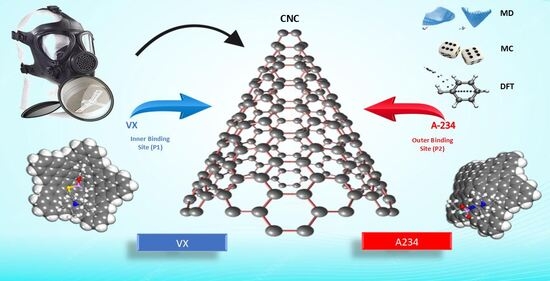
The dangerous potential of chemical warfare requires immediate development of new materials capable of detecting and efficiently adsorbing the toxic nerve agents VX and Novichok (A-234). The current adsorbents fail to achieve sufficient detection efficiency and specific binding capabilities. Our research, conducted through advanced computational modeling, predicts that carbon nanocones (CNCs) could function as effective molecular traps for these toxic substances. The research combines density functional theory (DFT) with molecular dynamics (MD) and Monte Carlo (MC) simulations to explain the basic principles of molecular trapping by these agents. The nanocone shape produces two distinct and selective binding areas. MC shows preferential trapping VX molecules within the internal concave surface (P1), while A-234 molecules are strongly adsorbed on the external convex surface (P2). Docking results complement this by showing that A-234 exhibits stronger single-molecule binding on the more open surface, consistent with its preference for P2. The nanocone captures molecules through van der Waals forces, which produce measurable electronic changes that modify its electronic signature. The research demonstrates that carbon nanocones represent a promising candidate material for the future development of chemical defense systems, potentially including sensitive detection systems and advanced filtration technologies.

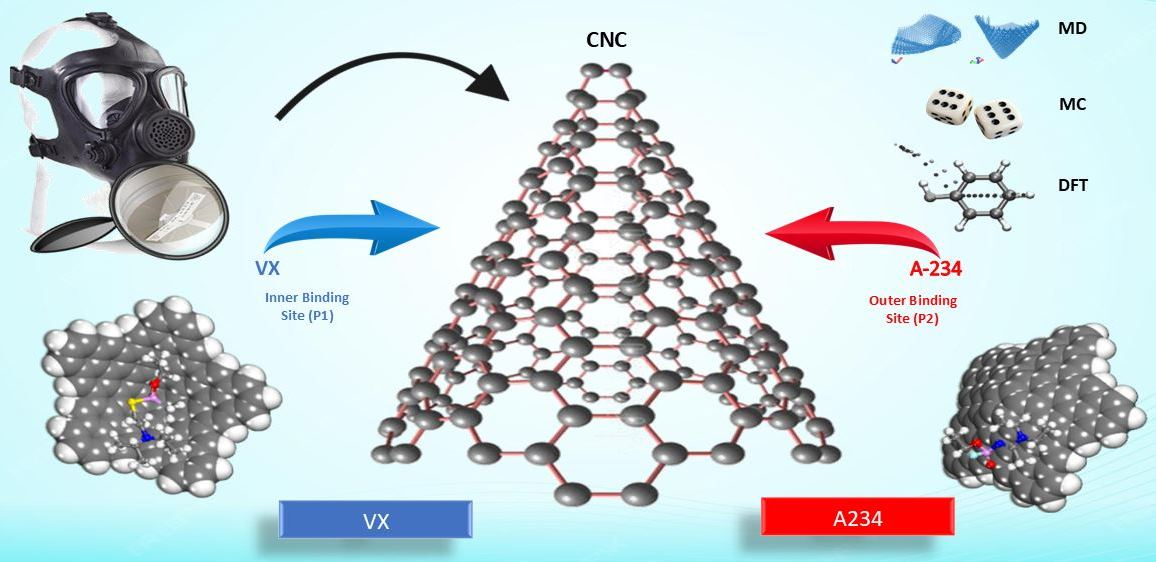
Graphical Abstract

1. Introduction

The organophosphorus class of nerve agents is known as the most toxic chemical warfare agents (CWAs), and most of them represent the irreversible acetylcholinesterase inhibition mechanism with a continuous acetylcholine accumulation at the synapses resulting in the rapid destruction of neuromuscular transmission [1,2,3,4]. VX (O-ethyl S-[2-(diisopropylamino)ethyl] methylphosphonothioate) is an extremely toxic, low-volatile and environmentally stable chemical agent that significantly persists on solid surfaces. A-series agents—“Novichok” substances—especially A-234 (N-[ethoxy(fluoro)phosphoryl]-N,N-diethyl-ethanimidamide) have extraordinarily high toxicity, increased chemical stability and hydrolytic resistance [1,4,5]. These properties turn the detection, adsorption and decontamination into a complicated task and make the emergence of new incidents alarming for the global community.
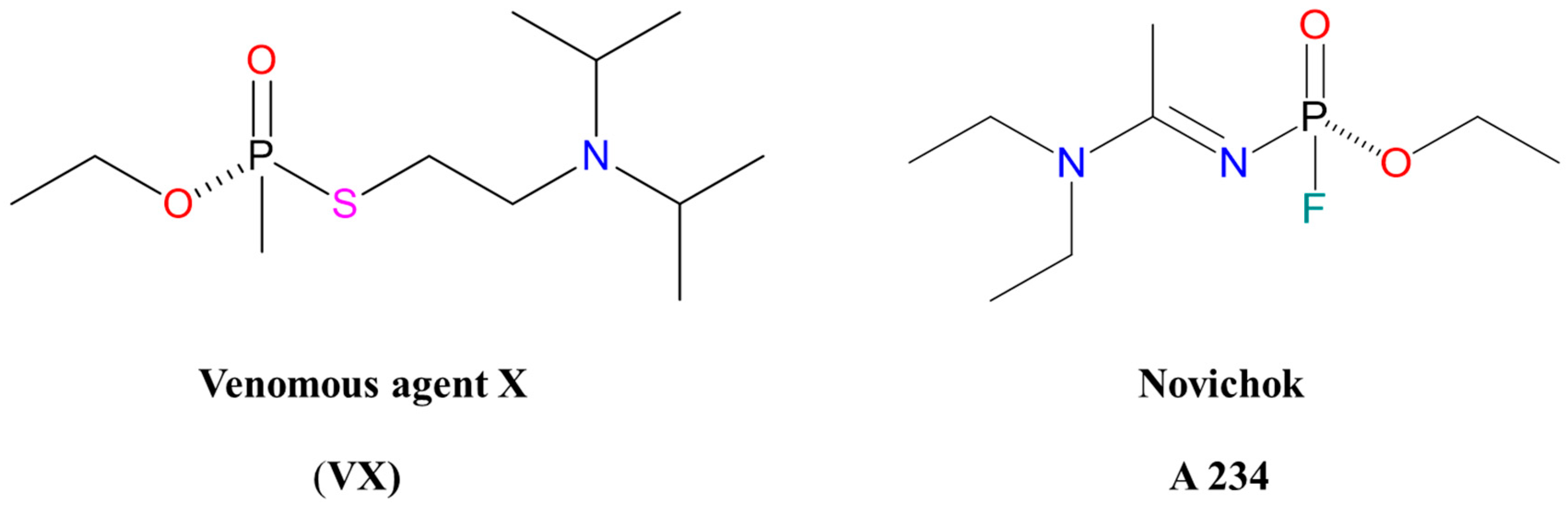
Figure 1 illustrates the chemical structures of VX and A-234 and highlights major differences in their physicochemical properties. VX is a large, very hydrophobic compound with soft Lewis-basic sulfur and tertiary amine substituents, whose interaction and adsorption in electronically localized environments occur in the dispersion-dominated regime. A-234 is smaller, more polar, and contains a P–F bond and imidamide functionality that increase the binding strength and the Lewis acidity of the phosphorus center. The latter greatly enhances the environmental stability of A-234 and reduces its susceptibility to hydrolysis [1,5]. Recent studies and forensic reports have confirmed A-234’s high persistence. Jung et al. found A-234 to be extremely stable in sand [5], and Rozsypal reported that A-234 persists for prolonged periods on indoor surfaces (half-lives up to ~478 days) [6]. Such intrinsic peculiarities are expected to strongly define the solid-state behavior of the two compounds and underline efforts to search for selective-adsorption materials.
Nerve agents and their simulants’ removal/adsorption have been extensively studied both experimentally and theoretically with the application of known and new materials. The field of research included a variety of carbon materials, such as activated carbons, graphene, fullerenes and other nanostructures; their stability and adjustable surface chemistry proved them as a promising sorbent material. Theoretical studies demonstrated that the interaction of organophosphorus agents with graphene and carbon-related materials is primarily driven by dispersion and electrostatic forces, with calculated adsorption energies typically falling within a wide range of −20 kcal mol−1 to −50 kcal mol−1 [7,8,9]. Subsequent studies confirmed that, while carbon materials are chemically stable and reusable, their relatively uniform electronic landscape limits adsorption strength and selectivity [10,11].
At the same time, highly porous materials like metal-organic frameworks (MOFs), metal oxides, and hybrid nanostructures were put forward to capture and further degrade nerve agents. For instance, the Zr-based MOF-808 framework has been shown to catalytically hydrolyze Novichok nerve agents under basic conditions [12]. These materials usually rely on Lewis-acidic metal nodes or nucleophilic sites available on their surface to facilitate the binding or trigger the hydrolysis of organophosphorus compounds [13,14]. Very strong adsorption or even chemisorption can be achieved in these materials, but their potential moisture sensitivity, pore blocking effect, and reduced efficiency under realistic conditions, especially for highly persistent agents like VX or A-234, must be considered.
In recent years, computational modeling has played a crucial role in rationalizing these results. Commonly used methods to study the adsorption energetics, preferred binding sites and adsorption kinetics of CWAs on solid substrates include density functional theory (DFT), molecular dynamics (MD), and Monte Carlo (MC) methods [15,16,17]. Recent thematic and perspective studies proposed in this context underline the influence of surface curvature and electronic asymmetry on the pronounced adsorption of CWAs due to localized charge realignment and confinement effects, which are absent in linear materials, but significant in non-planar carbon nanostructures [18,19].
Carbon nanocones (CNCs) are a novel type of carbon nanomaterial that possesses unique features of built-in curvature gradients, distinct concave and convex sites, and electronic asymmetry due to the presence of topological defects at the apex of the cone. Furthermore, previous theoretical studies have demonstrated that CNCs and functionalized CNCs have superior adsorption and noticeable electronic sensitivity to gas molecules than the flat carbon surfaces [20,21]. Despite these favorable results, however, the applicability of CNCs as a sorption medium for real-life chemicals, particularly the most persistent A-series nerve agents, has not been thoroughly examined.
In this work, we describe a thorough multiscale computational study of VX and A-234 adsorption on carbon nanocones (CNCs), using DFT, MD and MC simulations. The molecular features of VX and A-234 are correlated with the special concave and convex adsorption sites of CNCs at an atomic level, and the tightening mechanism on adsorption strength and site preferences due to curvature-dependent electronic effects is discussed. The results are discussed based on currently known data for carbonaceous and porous material adsorbents, yet it is highlighted that CNCs have a unique origin of selective capture of nerve agents due to their geometry. Such special sites provide rapid access to molecules located on the surface or upper layers. Overall, the present study can lead to the perception that carbon nanocones might create a selected CWA capture mechanism required for next-generation chemical defense technologies, selective sensors, or sophisticated filtration or immobilization applications.

2. Computational Methodology

2.1. Conformer Generation and Molecular Docking

For searching the lowest energy conformers, we employed the Boltzmann jump method [22]. We made 50 changes for each jump at 500 K, resulting in 1000 conformers generated using the COMPASSIII force field. The conformers were then further optimized by the Smart algorithm with strict convergence tolerances (energy < 2 × 10⁻⁵ kcal/mol, forces < 0.001 kcal/mol/Å, displacements < 1 × 10⁻⁵ Å) [23]. We selected the lowest-energy structures (#518 for VX and #607 for A-234) from this conformer library to further obtain the DFT results (Supplementary Materials Figure S1).
Next, we performed docking calculations using the ORCA 6.0 [24] quantum-chemistry software package. The GFN2-xTB semi-empirical method [25] was employed to calculate the potential energy surface and to optimize the binding mode. The DOCKER module in ORCA 6.0 was used for systematic surface docking. The geometry of the docked complexes was obtained by the mutant particle-swarm optimization method on 525 individuals in different grid sizes between 29.5 and 40.5 Å. The geometry was refined using redundant internal coordinates with a root-mean-square deviation of <0.25 Å and an energy difference > 0.1 kcal/mol. The representative docked structures of the complexes are provided in Supplementary Materials Figure S2.

2.2. Density Functional Theory (DFT) Calculations

We performed DFT calculations using Biovia’s Dmol3 software (BIOVIA Materials Studio 2020) [26]. DFT allows us to ascertain important electronic properties and adsorption energies associated with toxin binding. It can be used to examine energy barriers and study charge distribution to recognize the most active sites. As the DFT calculations were performed using DMol3, which employs numerical atomic orbital basis sets rather than Gaussian functions, the associated basis set superposition error (BSSE) is intrinsically very small; therefore, the reported adsorption energies do not include BSSE correction [27].
Non-covalent interactions (NCIs) were analyzed to characterize the intermolecular forces, including van der Waals interactions, hydrogen bonding, and electrostatics. NCI implemented state-of-the-art computational software available in VMD, which was used to visualize the calculated NCI. The electrostatic potential (ESP) was also analyzed to graphically signify the electrophilic and nucleophilic character of the molecules.

2.3. Molecular Dynamics (MD) and Monte Carlo (MC) Simulations

We used statistical mechanics-based Monte Carlo (MC) simulations to account for the adsorption characteristics. The MC method examines thermodynamic features through random sampling and can explore a larger configurational space, which is critical for finding potential adsorption sites and the most stable orientations (Supplementary Materials Figure S3).
Molecular dynamics (MD) simulations were also employed to analyze the temporal evolution of the structure and mechanisms of adsorption and desorption on an atomic scale. MD simulates molecular dynamics at different times, thereby enabling temperature and pressure effects to be tuned.
The adsorption energy (Eads) was calculated to evaluate the stability of the nerve agents on the CNC surface for two distinct scenarios [28]. In the first scenario (1:1 ratio), the adsorption energy is defined as follows:
Eads = EA-234 or VX||CNCS − (EA-234 or VX + ECNC)
In the second scenario (2:10 ratio), representing the interaction of two nerve agent molecules with a larger CNC cluster, the adsorption energy is calculated as follows:
Eads = E2(A-234 or VX)||10(CNCS) − (2EA-234 or VX + 10ECNC)
where EA-234/VX||CNC and E2(A-234/VX)||10(CNC) represent the total electronic energies of the optimized complexes for the 1:1 and 2:10 systems, respectively. EA-234/VX is the energy of the isolated nerve agent, and ECNC is the energy of the pristine CNC surface. A negative Eads value indicates an exothermic and energetically favorable adsorption process.

2.4. Hierarchy of Validity and Limitations

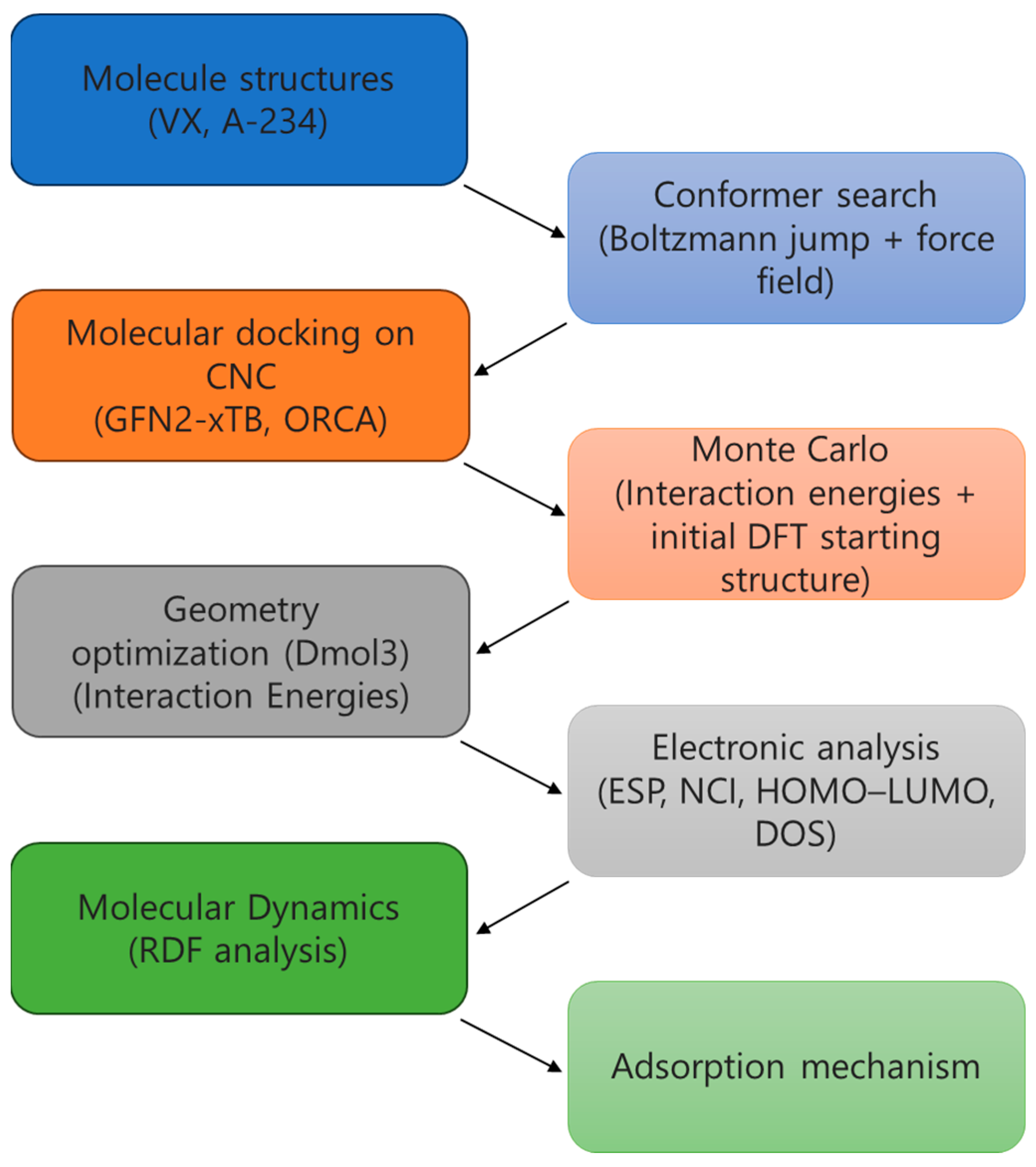
Molecular docking and Monte Carlo (MC) simulations were used as global search engines, relying on classical force fields and semi-empirical calculations (GFN2-xTB) to rapidly explore the nerve agent–nanocone system’s configurational space. This analysis is crucial for preliminary identification of possible local minima and mutual orientations in an energy landscape, without incurring the computational expense of using quantum mechanics’ methods [29]. Energies derived from classical potentials are not exact and only serve a role in the filtering of candidates, instead of evaluating the binding strength’s absolute values. The overall hierarchical computational workflow adopted in this study is illustrated in Scheme 1.
Density functional theory (DFT) geometry optimization was performed on the most stable structures obtained from the screening step. DFT is also the most appropriate method used in the present study to verify the electronic structure, charge transfer, and HOMO–LUMO gaps. This step corrects inaccuracies in force field parameterization, especially regarding charge redistribution upon adsorption, a limitation noted in studies comparing force fields to ab initio methods [30].
Molecular dynamics (MD) simulations were applied to validate the DFT structures to introduce the temporal dimension. While DFT provides a static picture at zero Kelvin, MD assesses the dynamic stability and diffusion kinetics of the adsorbed agents at finite temperatures, ensuring that the favorable binding energies persist under thermal fluctuation [31].
This multi-scale approach, while robust, has limitations. Simulations in the gas phase isolated adsorbate–adsorbent interactions, not considering environmental factors like humidity or competitive adsorption with N2 and O2, affecting sensor performance in real conditions [32]. The non-covalent interaction (NCI) analysis offers qualitative binding insights, but adsorption energies from classical force fields in MD/MC should be seen as trends, not absolute values, with DFT results as benchmarks.

3. Results and Discussion

3.1. Adsorption Energetics and Site Selectivity

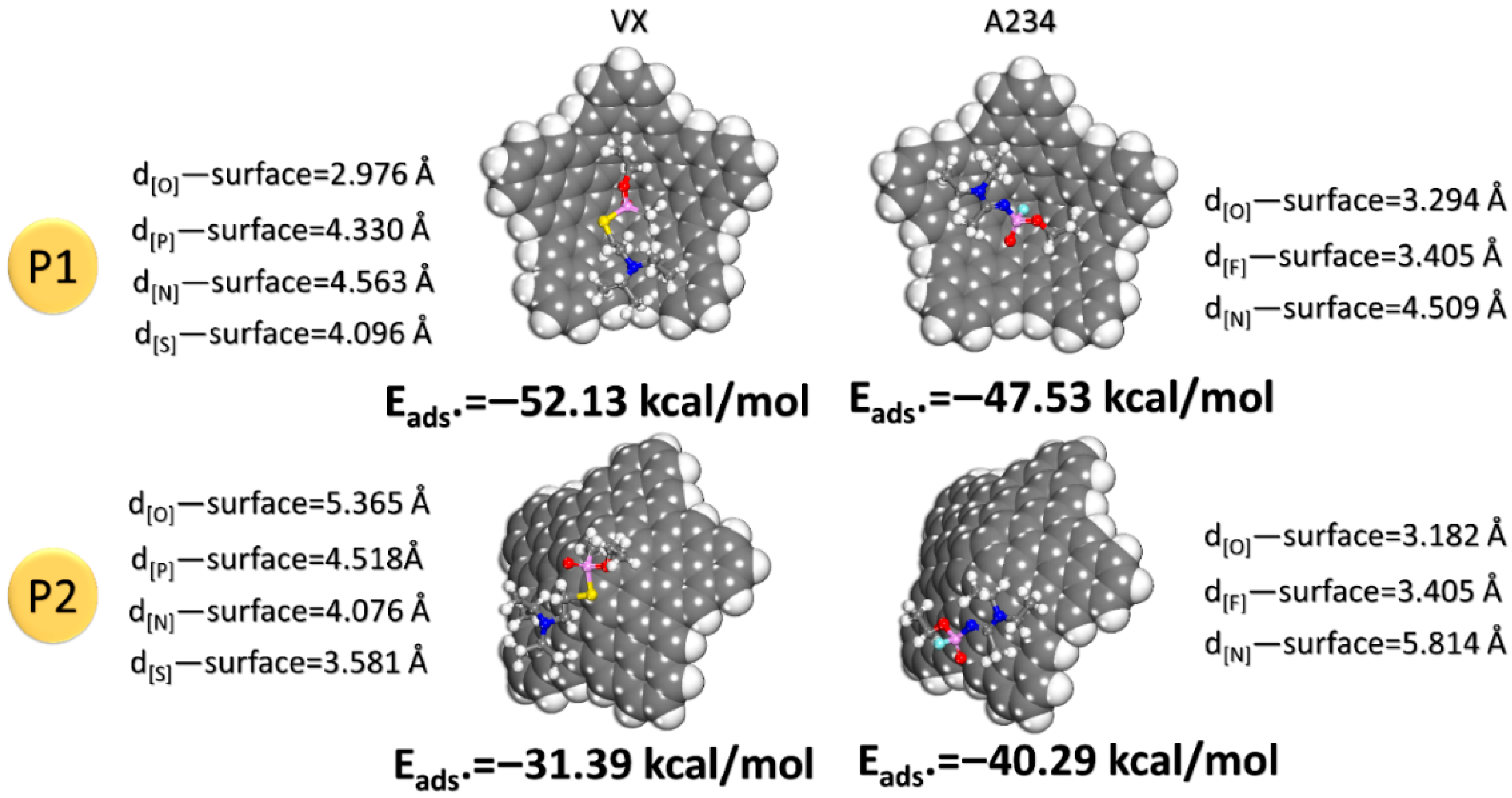
The innovative architecture of the CNCs results in the formation of two distinct adsorption zones: the concave inner surface (binding area P1) and the convex outer surface (binding area P2) (Figure 2). DFT simulation results prove that at each concentration, the binding sites of the CNCs have a direct impact on the adsorption capacity.
The clear selectivity is a derivative of the curvature. The concave geometry (P1) presents preferential positioning for the VX connectivity, attributable to shorter interatomic distances. The reverse behavior is present for the convex geometry (P2) with a strong preference for A-234. This energetic selectivity relates to previously calculated adsorption energy.
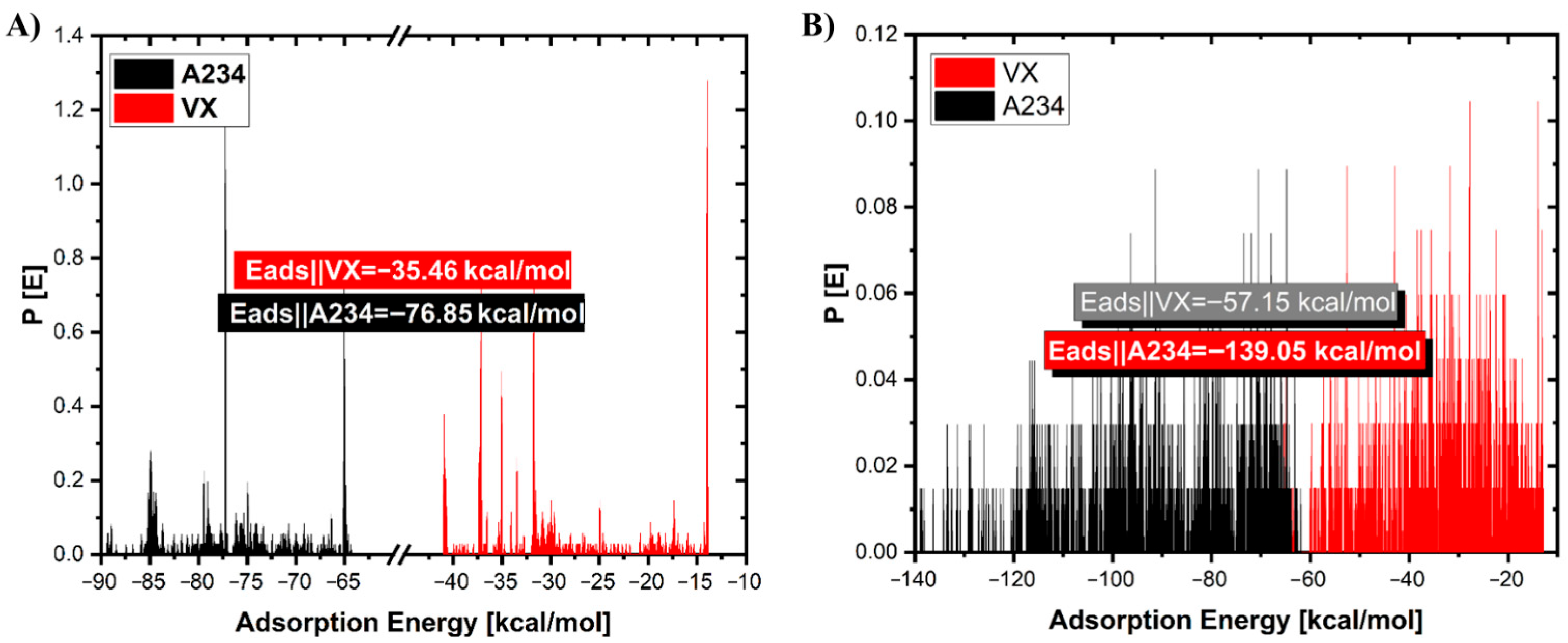
The docking study (molecular docking GFN2-xTB) for the A-234/CNCs system at the concave site presents an adsorption energy of −91.4 kcal/mol. When the binding site at the same concave position is VX, the binding energy is −84.1 kcal/mol. Values presented indicate that the binding energies of CNCs have increased due to curvature. The difference compared with other reported values is also notable; the binding energy of A-234 (−91.4 kcal/mol) is nearly two-times higher than reported for graphene (−42.3 kcal/mol) [33]. For VX, the binding energy (−84.1 kcal/mol) is 32% of that compared with bismuthine nanosheets (−63.5 kcal/mol) [34]. Monte Carlo (MC) simulations also support that the preference is present for selected A-234 binding over that of VX. For the 1:1 (adsorbate/adsorbent) configuration (Figure 3A), A-234 presents an Eads of −76.85 kcal/mol, with VX showing only −35.46 kcal/mol.
In the 2:10 configurations (increasing the ratio of adsorbate to adsorbent (Figure 3B), the adsorption energies are considerable, with A-234 presenting an extremely favorable −139.05 kcal/mol compared with the VX configuration, at −57.15 kcal/mol. In our previous study [35], the ΔEads value for A-234 (−139.05 kcal/mol) was considerably stronger than for any of the other agents evaluated, VX (−57.15 kcal/mol) and the G-series agents (Sarin: −57.15 kcal/mol; Tabun: −45.95 kcal/mol). Defense CNCs can serve as very efficient molecular “traps” for the “capture” of the most dangerous chemical agents according to the following order of preference: A-234 >> VX ≈ Sarin > Tabun. This binding order qualitatively aligns with our previous studies, which found Sarin to bind more strongly than Tabun on CNCs. These interaction energies arise from classical docking and Monte Carlo sampling and should, therefore, be interpreted as relative indicators of adsorption trends rather than quantitative binding free energies.
To address the role of ambient humidity and competitive adsorption effects, additional Monte Carlo simulations were performed, including water molecules as competing adsorbates. The adsorption energy distributions of A-234 and VX in the presence of H2O are presented in Figures S4 and S5. The results clearly show that both nerve agents exhibit significantly stronger adsorption energies compared to water, indicating preferential uptake by the CNC surface. Notably, A-234 remains strongly adsorbed with an average adsorption energy, whereas VX shows a weaker but still favorable interaction. In contrast, water molecules populate only the weakly bound, near-zero energy region. These findings demonstrate that the selective adsorption of nerve agents on CNCs is preserved even under competitive conditions, supporting the relevance of CNCs as potential sorbents under realistic humid environments.

3.2. Nature of the Adsorption Mechanism

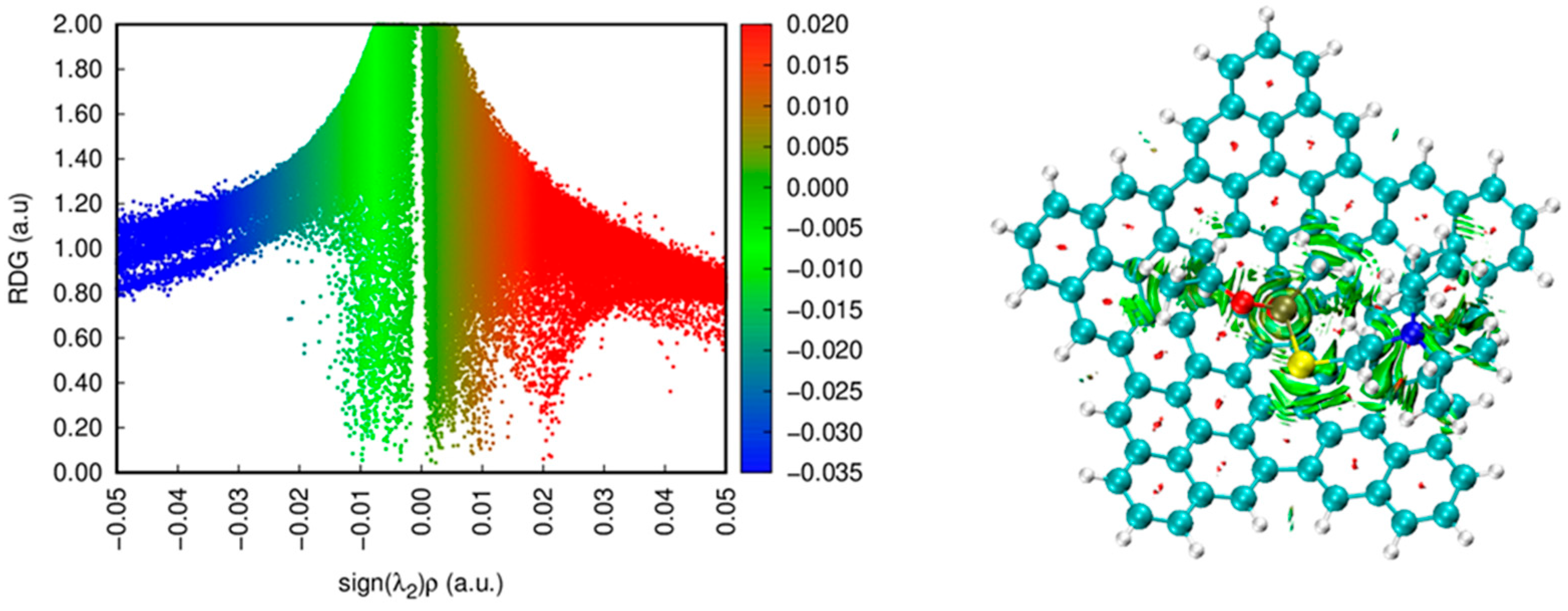
To determine the nature of the high adsorption, an NCI was performed. The RDG graphs (Figure 4) allow a qualitative analysis of the interactions. The 2D NCI graph shows greenish-blue regions for negative peaks along the sign(λ2)ρ axis, ranging from –0.02 to 0 atomic units (a.u.). Negative values belong to the spikes that represent van der Waals (vdW) interactions. The vdW forces are the major interaction. The peak at dominant RDG with −0.01 a.u. displays a vdW stabilization higher than that reported for silicon carbide nanocages (−0.018 a.u.) [36].
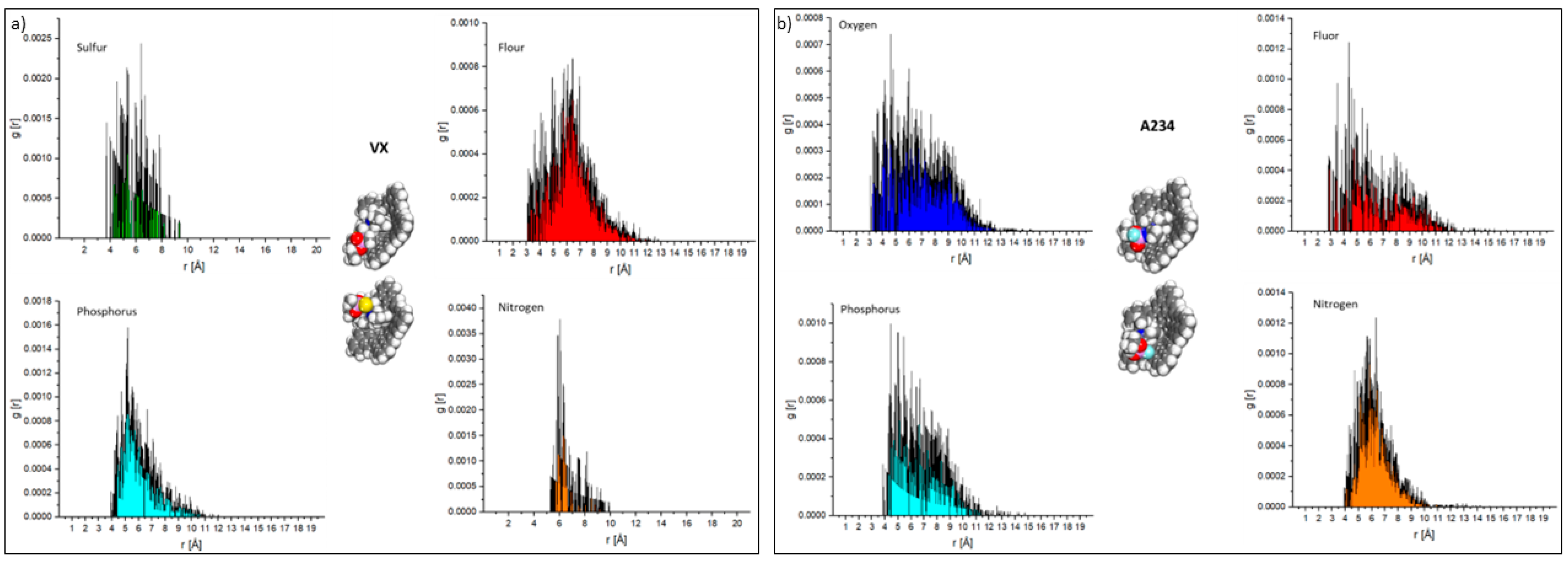
As a complementary approach, the computation of the radial distribution functions (RDFs) derived from the MD simulations (Figure 5) manifests the arrangement of the A-234 and VX molecules with respect to the CNC surface. The observed peaks of the RDFs at 3.5 Å confirm a physi/chemisorption responsible for binding and suggest relevant contact distances between the atoms of the adsorbent and the heteroatoms of the nerve agents (3.1 Å). These contact distances are smaller than the ones assigned to Sarin on graphene (3.3 Å) [37] and are useful to rationalize the stronger adsorption energy in the present system. Notably, the CNC sorption energy for A-234 and VX even surpasses the adsorption energies reported for organophosphorus nerve agents in metal-organic frameworks. For example, zirconium-based MOFs have been shown to interact strongly with V-type and Novichok agents, with interaction and degradation energetics often exceeding tens of kilocalories per mole in density functional theory and experimental studies [12,38]. Compared with previous DFT studies on carbon nanostructures, it is clear that absolute adsorption energies depend strongly on the computational method used. Quantum-mechanical approaches include electronic polarization and charge redistribution, while classical methods mainly describe dispersion and steric interactions. Despite these differences, both approaches consistently support the curvature-dependent selectivity observed here (A-234 > VX). We also acknowledge that the present model does not include explicit solvent, surface defects, or full entropic contributions, and reactive degradation pathways were not considered. Experimental validation and higher-level free-energy simulations under realistic conditions will therefore be necessary to quantify practical capture performance. Nonetheless, the results indicate that the CNCs’ unique topology and electronic confinement produce curvature-dependent adsorption trends worthy of further investigation.

3.3. Electronic Perturbations and Sensor Potential

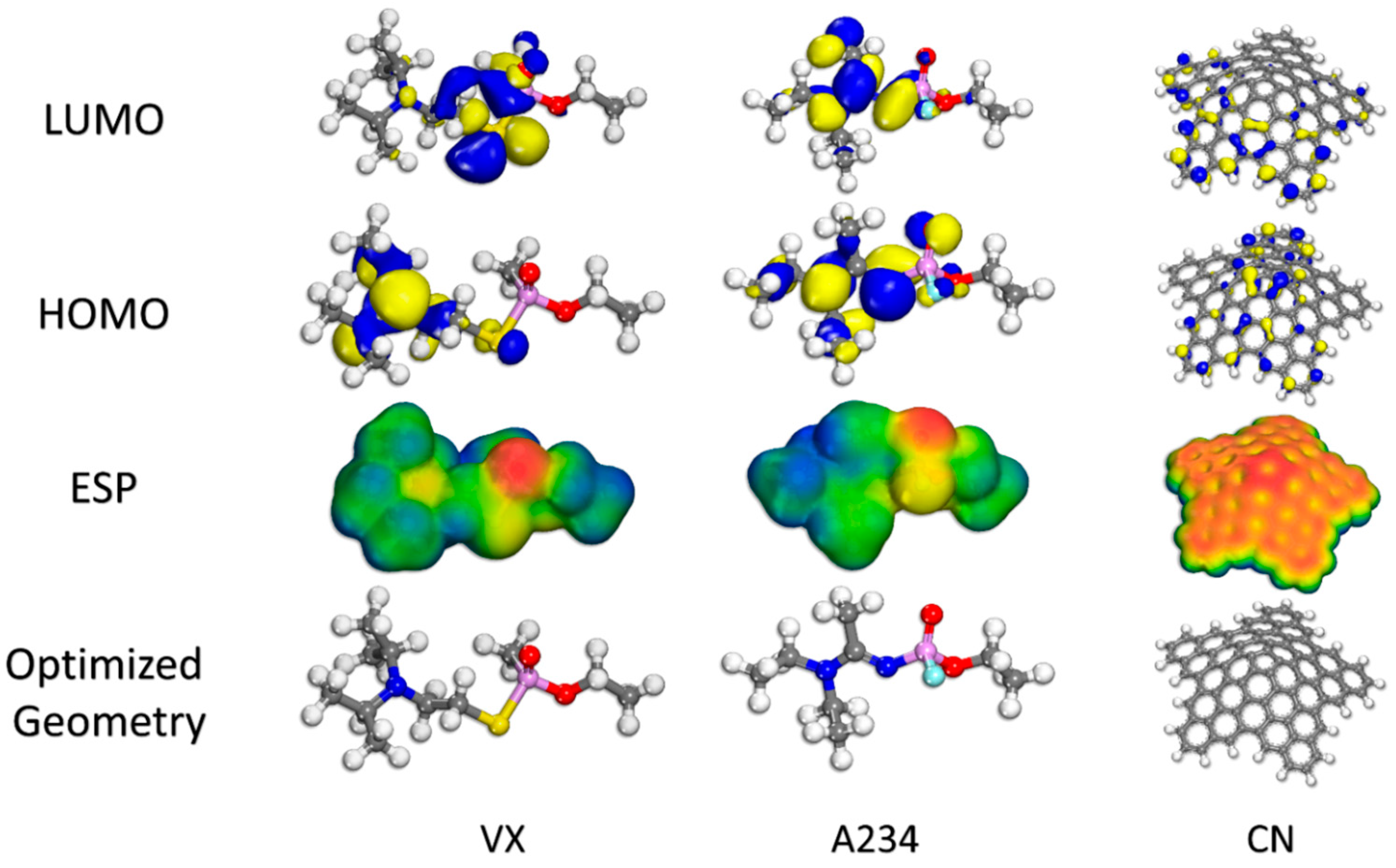
Adsorption leads to an electronic response that can be readily detected in the nanocone. Electronic properties of the building blocks are shown in Figure 6. An electrostatic potential (ESP) analysis reveals electrophilic (positive ESP, blue) and nucleophilic (negative ESP, yellow/red) sites. In the case of CNCs, the tips displayed nucleophilic character, while the edges showed electrophilic character. The nerve agents themselves contain many n-electron-rich heteroatoms (O, P, F, N, S).
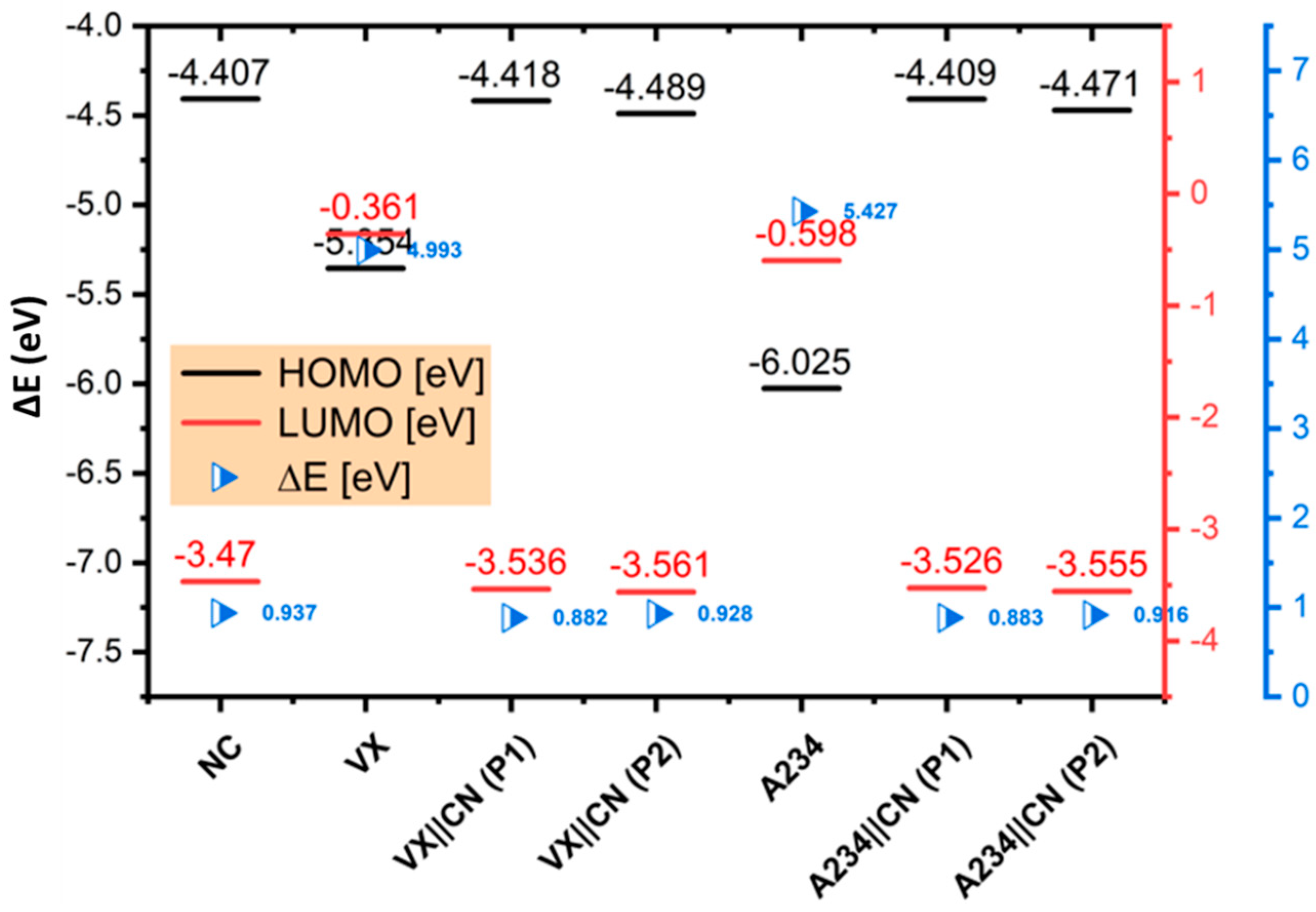
The HOMO and LUMO energy gap (ΔE) provides valuable information regarding the bare and modified materials’ reactivity. Low values of ΔE mean that it takes less energy to promote electrons, which means that the material is more reactive [39]. The pristine CNCs show a ΔE of 0.937 eV. As can be seen in Figure 7, upon adsorption, this value is decreased. The lower HOMO–LUMO gap at the P1 sites (0.882 eV for VX) suggests that the degree of charge transfer is higher than that of fullerene-hydrazine complexes (1.24 eV) [40].
The pronounced differences in HOMO–LUMO energies arise from the strong electronic coupling between the highly polarizable organophosphorus groups of VX and A-234 and the curved CNC surface, particularly at the concave P1 site. This curvature concentrates π-electron density and enhances orbital hybridization, leading to intensified charge transfer and a redistribution of electronic density near the Fermi level. Consequently, the HOMO–LUMO gap decreases far more significantly than in the other studied species.
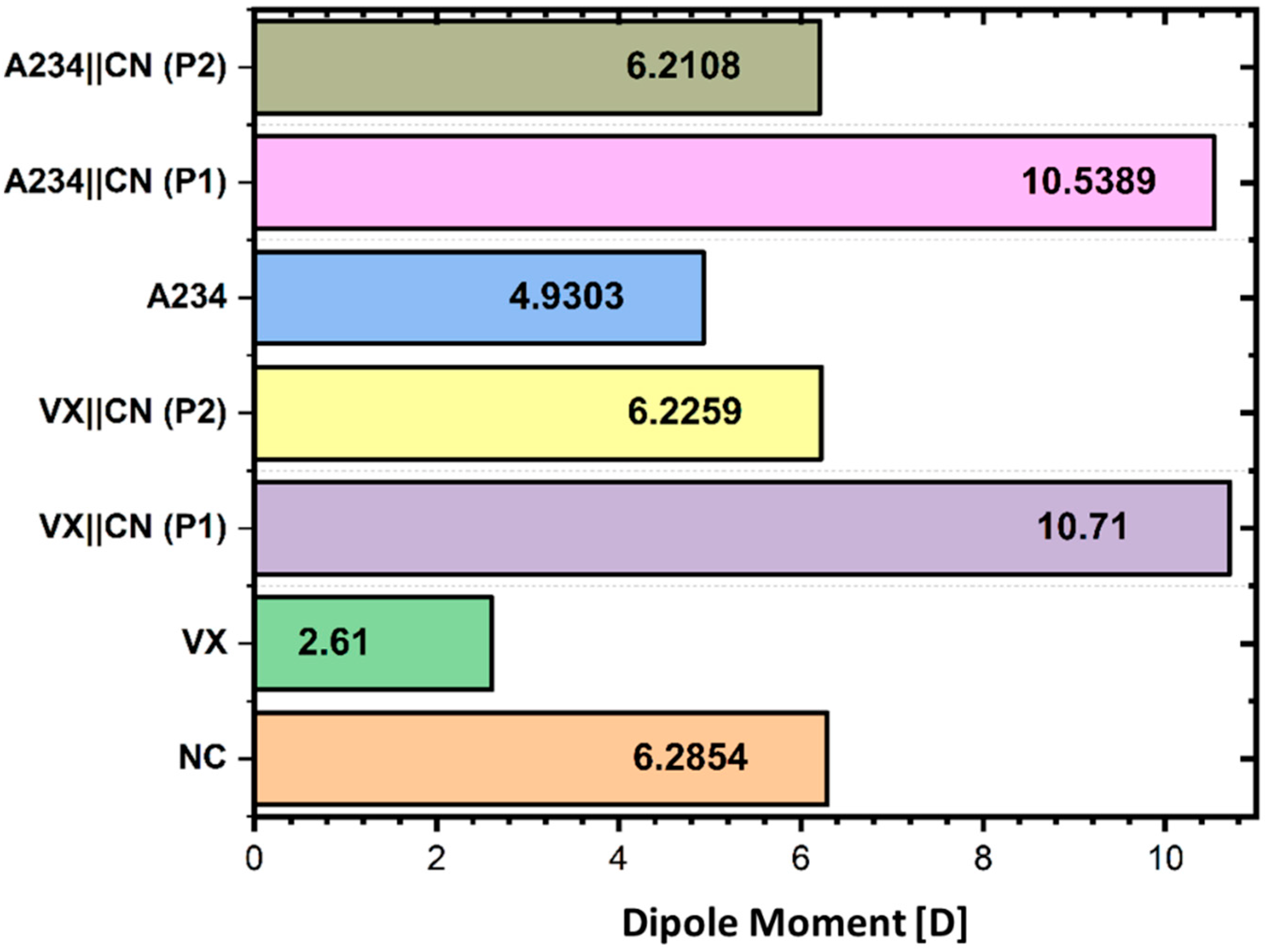
Additionally, the charge transfer is confirmed with respect to the dipole of the system. The bare CNCs have a dipole moment value of 6.2854 D. Figure 8 depicts that this value increases considerably upon adsorption, and it is more pronounced at the P1 (concave) site. The dipole moment of VX||CNCs (P1) complex is 10.71 D as well, and the A-234||CNCs (P1) complex is 10.54 D. This systematically larger dipole moment of the P1 configurations suggests increased polarity and reactivity of the molecules.
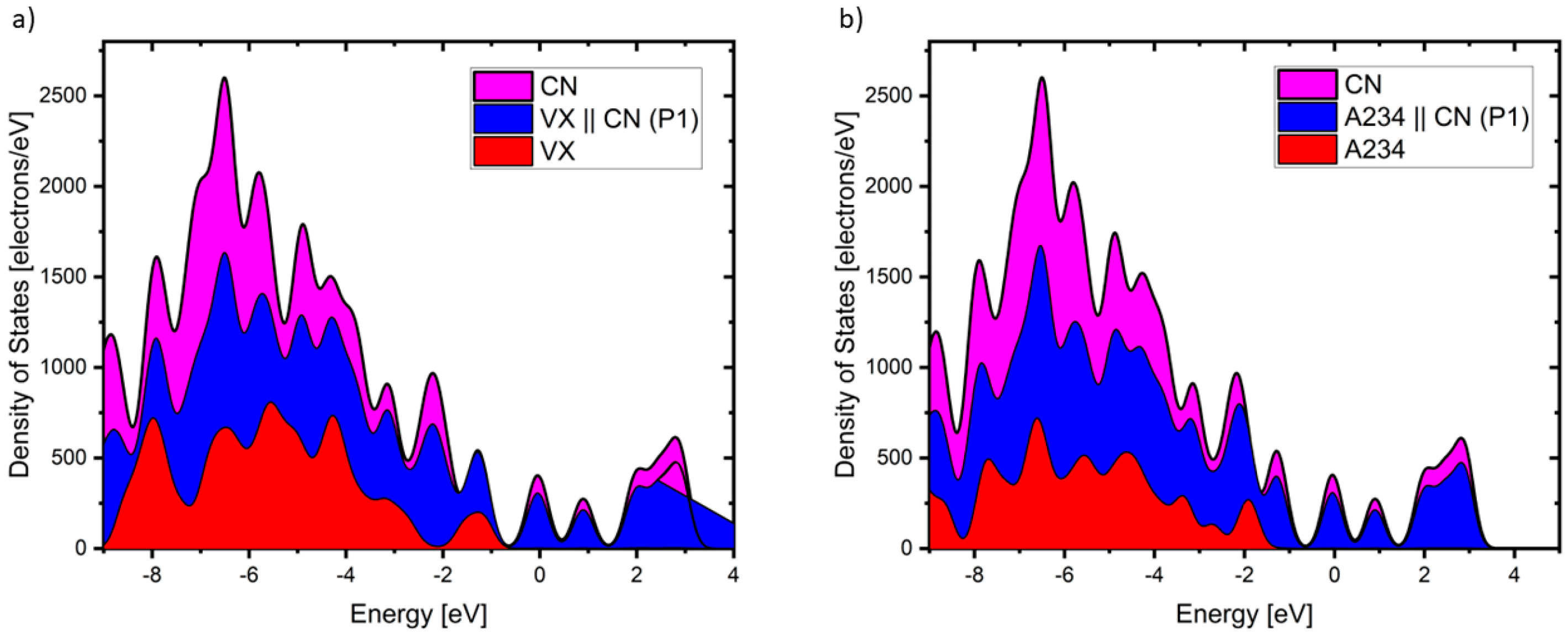
Lastly, partial density of states (PDOSs) analysis (Figure 9) corroborates this electronic rearrangement. We note prominent DOS peak displacements towards the Fermi level during A-234 and VX adsorption. The peak displacements indicate the presence of newly formed electronic states and changes in the electronic structure due to the electron transfer from nerve agents to CNCs [21]. The consequent electronic reconstruction instigated by the adsorption is the so-called ‘electronic fingerprint’ that makes CNCs particularly promising in terms of sensing capabilities [41,42].

3.4. Adsorption Dynamics

MD trajectories were analyzed to calculate the self-diffusion coefficient of the adsorbed nerve agents. A-234 is more mobile (3.63 × 10⁻² Å2/ps) than VX (1.7402 × 10⁻³ Å2/ps), as A-234 also has higher mobility (molecular flexibility) at the surface. It resonates with the obtained diffusion coefficient for Sarin on carbon nanocones (2.91 × 10⁻² Å2/ps) [35]. These diffusion values were obtained for isolated agents on rigid, solvent-free CNC models; in practice, solvent and surface flexibility would likely increase mobility. For comparison, carbon nanotubes typically exhibit weaker physisorption (on the order of tens of kcal/mol), whereas MOFs often feature active sites that enable very strong binding or even catalytic degradation of CWAs. For example, the Zr-MOF-808 framework efficiently catalyzes the hydrolysis of Novichok agents [12]. The marked difference in mobility suggests that A-234 can roam relatively freely on the CNC surface, whereas VX becomes essentially immobilized. In practical terms, this implies that in a CNC-based filter or sensor, A-234 molecules might equilibrate or desorb more readily, while VX remains tightly bound.

4. Conclusions

In this work, we provide exhaustive computational evidence that carbon nanocones (CNCs) function as efficient molecular traps for toxic nerve agents. The unprecedented curvature architecture of CNC is principal to impart molecular capture efficiency. Through DFT, MD, and MC simulations, we unveiled the heightened binding proclivity of CNC towards A-234 compared to VX. Remarkably, the outer, convex surface of the nanocone shows a dominant preference for A-234 binding. This binding is significantly stronger than the interaction observed for VX on the inner, concave areas. Essentially, the shape of the surface dictates which agent is trapped more effectively.
Such curvature-based selectivity, supported by the relative adsorption energies obtained in our simulations, suggests that CNCs may represent a promising alternative platform compared to conventional carbon materials. Our simulations suggest that nanoscale topography may dictate the adsorption mechanism: due to shorter interatomic distances, VX is more strongly adsorbed at concave positions, while A-234 preferentially occupies convex areas. These computational findings indicate that CNCs are a promising theoretical platform for further investigation in chemical defense applications. Our results indicate a consistent trend of stronger interaction between A-234 and CNC surfaces compared to VX, in line with the curvature-dependent electronic effects identified. However, the reported interaction energies are model-dependent and should be interpreted as comparative indicators rather than quantitative binding free energies. Experimental validation and higher-level free-energy calculations are needed to confirm capture efficiency. While this study establishes the high theoretical affinity of CNCs for nerve agents, it is important to acknowledge that real-world environmental factors, such as competing atmospheric gases, may influence these results. Future research should focus on multi-component simulations and experimental validation under ambient conditions to fully address these potential limiting factors. Future work should focus on the experimental validation of these findings and the development of CNC-based filters and sensors.

Supplementary Materials

The following supporting information can be downloaded at: https://www.mdpi.com/article/10.3390/colloids10020026/s1, Figure S1: The conformer possibilities and the minimal energy structure for VX and A-234. Figure S2: Representative docked configurations of A-234 and VX on CNCs generated using ORCA DOCKER. Figure S3: MC and MD simulation geometries of the VX and A-234 molecules. Figure S4: Adsorption energy distributions obtained from Monte Carlo simulations for A-234 and VX on CNCs in the presence of water molecules. Figure S5: Representative Monte Carlo simulation snapshots showing the competitive adsorption of 50 water molecules (H2O) with nerve agents VX and A-234 on the CNC surface.

Author Contributions

Conceptualization, A.B. and V.H.; methodology, V.H. and K.B.; software, A.B.; validation, A.B. and K.B.; formal analysis, V.H.; investigation, V.H.; resources, V.H. and A.B.; data curation, A.B.; writing—original draft preparation, V.H. and A.B.; writing—review and editing, K.B. and A.B.; visualization, A.B.; supervision, A.B. and K.B.; project administration, V.H., A.B. and K.B. All authors have read and agreed to the published version of the manuscript.

Funding

This research received no external funding.

Data Availability Statement

The data presented in this study are available from the corresponding authors upon reasonable request.

Acknowledgments

The authors gratefully acknowledge the Ministry of Education, Science, Technology, and Innovation of the Republic of Kosovo (MESTI) for providing the computational infrastructure. The authors also gratefully acknowledge the support and contribution provided through the project of the Cost Action CIG18234. K.B. thanks the Research Agency through program P3-0388.

Conflicts of Interest

The authors declare no conflicts of interest.

Abbreviations

The following abbreviations are used in this manuscript:
CNCsCarbon NanoCones
A-234Novichok Agent; (N-[ethoxy(fluoro)phosphoryl]-N,N-diethyl-ethanimidamide)
VXO-ethyl S-[2-(diisopropylamino)ethyl] methylphosphonothioate
DFTDensity Functional Theory
MCMonte Carlo
MDMolecular Dynamics

References

  1. Hrabinova, M.; Pejchal, J.; Hepnarova, V.; Muckova, L.; Junova, L.; Opravil, J.; Karasova, J.Z.; Rozsypal, T.; Dlabkova, A.; Rehulkova, H.; et al. A-series agent A-234: Initial in vitro and in vivo characterization. Arch. Toxicol. 2024, 98, 1135–1149. [Google Scholar] [CrossRef] [Scilit] [PubMed]
  2. Aslanli, A.; Lyagin, I.; Efremenko, E. Decarboxylases as hypothetical targets for actions of organophosphates: Molecular modeling for prediction of hidden and unexpected health threats. Food Chem. Toxicol. 2022, 161, 112856. [Google Scholar] [CrossRef] [Scilit] [PubMed]
  3. Noga, M.; Michalska, A.; Jurowski, K. Application of toxicology in silico methods for prediction of acute toxicity (LD50) for Novichoks. Arch. Toxicol. 2023, 97, 1691–1700. [Google Scholar] [CrossRef] [Scilit] [PubMed]
  4. Opravil, J.; Pejchal, J.; Finger, V.; Korabecny, J.; Rozsypal, T.; Hrabinova, M.; Muckova, L.; Hepnarova, V.; Konecny, J.; Soukup, O.; et al. A-agents, misleadingly known as “Novichoks”: A narrative review. Arch. Toxicol. 2023, 97, 2587–2607. [Google Scholar] [CrossRef] [Scilit]
  5. Jung, H.; Heo, J.; Park, N.; Lim, K.C.; Jung, H.; Cao, V.D.; Joung, S. Elimination of A-234 from the environment: Effect of different decontaminants. J. Hazard. Mater. 2023, 451, 131150. [Google Scholar] [CrossRef] [Scilit]
  6. Rozsypal, T. Persistence of A-234 nerve agent on indoor surfaces. Chemosphere 2024, 357, 141968. [Google Scholar] [CrossRef] [Scilit]
  7. Pineda-Urbina, K.; Jayaprakash, G.K.; Mojica-Sánchez, J.P.; Aparicio-Victorino, A.; Gómez-Sandoval, Z.; Flores-Álvarez, J.M.; Reyes-Leaño, U.G. DFT Insights into the Adsorption of Organophosphate Pollutants on Mercaptobenzothiazole Disulfide-Modified Graphene Surfaces. Compounds 2025, 5, 43. [Google Scholar] [CrossRef] [Scilit]
  8. Lazarević-Pašti, T.; Anićijević, V.; Baljozović, M.; Anićijević, D.V.; Gutić, S.; Vasić, V.; Skorodumova, N.V.; Pašti, I.A. The impact of the structure of graphene-based materials on the removal of organophosphorus pesticides from water. Environ. Sci. Nano 2018, 5, 1482–1494. [Google Scholar] [CrossRef] [Scilit]
  9. Claudot, J.; Soubeyrand-Lenoir, E.; Maurin, G. Competitive adsorption of water and chemical warfare agents on transition metal embedded graphene. Appl. Surf. Sci. 2021, 551, 149433. [Google Scholar] [CrossRef] [Scilit]
  10. Anićijević, V.; Mitrović, T.; Terzić, T.; Lazarević-Pašti, T. Graphene Oxide-Based Materials for the Remediation of Neurotoxic Organophosphates. Processes 2025, 13, 4028. [Google Scholar] [CrossRef] [Scilit]
  11. Shivankar, B.R.; Singh, C.P.; Krishnamurty, S. Chemically modified graphene sheets as potential sensors for organophosphate compounds(pesticide): A DFT study. Appl. Surf. Sci. 2023, 619, 156745. [Google Scholar] [CrossRef] [Scilit]
  12. de Koning, M.C.; Vieira Soares, C.; van Grol, M.; Bross, R.P.T.; Maurin, G. Effective degradation of Novichok nerve agents by the zirconium metal–organic framework MOF-808. ACS Appl. Mater. Interfaces 2022, 14, 222–230. [Google Scholar] [CrossRef] [Scilit] [PubMed]
  13. Kalinovskyy, Y.; Wright, A.J.; Hiscock, J.R.; Watts, T.D.; Williams, R.L.; Cooper, N.J.; Main, M.J.; Holder, S.J.; Blight, B.A. Swell and destroy: A metal–organic framework-containing polymer sponge that immobilizes and catalytically degrades nerve agents. ACS Appl. Mater. Interfaces 2020, 12, 8634–8641. [Google Scholar] [CrossRef] [Scilit]
  14. de Koning, M.C.; Dadon, L.; Rozing, L.C.M.; van Grol, M.; Bross, R. High Capacity Adsorption and Degradation of a Nerve Agent Simulant and a Pesticide by a Nickel Pyrazolate Metal–Organic Framework. ACS Appl. Mater. Interfaces 2023, 15, 55877–55884. [Google Scholar] [CrossRef] [Scilit]
  15. Xie, C.; Yan, D.; Chen, W.; Zou, Y.; Chen, R.; Zang, S.; Wang, Y.; Yao, X.; Wang, S. Insight into the design of defect electrocatalysts: From electronic structure to adsorption energy. Mater. Today 2019, 31, 47–68. [Google Scholar] [CrossRef] [Scilit]
  16. Liao, X.; Lu, R.; Xia, L.; Liu, Q.; Wang, H.; Zhao, K.; Wang, Z.; Zhao, Y. Density functional theory for electrocatalysis. Energy Environ. Mater. 2022, 5, 157–185. [Google Scholar] [CrossRef] [Scilit]
  17. Ming, Z.; Zhang, M.; Zhang, S.; Li, X.; Yan, X.; Guan, K.; Li, Y.; Peng, Y.; Li, J.; Li, H.; et al. A Multi-Method Approach to Analyzing MOFs for Chemical Warfare Simulant Capture: Molecular Simulation, Machine Learning, and Molecular Fingerprints. Nanomaterials 2025, 15, 183. [Google Scholar] [CrossRef] [Scilit]
  18. Econdi, S.; Caselli, A.; Marchesi, S.; Carniato, F.; Bisio, C.; Guidotti, M. Catalysis and decontamination: A versatile tool in the safe and sustainable degradation of chemical warfare agents. Eur. Phys. J. Plus 2024, 139, 782. [Google Scholar] [CrossRef] [Scilit]
  19. Fonsaca, J.E.S.; Hostert, L.; Zarbin, A.J.G.; Orth, E.S. Chemical safety using functionalized carbon nanomaterials: Neutralization and detection of organophosphorus compounds. J. Mater. Chem. A 2024, 12, 8124–8148. [Google Scholar] [CrossRef] [Scilit]
  20. Söğütlü, I.; Arshadi, S.; Mahmood, E.A.; Abbasi, V.; Kamalinahad, S.; Vessally, E. In silico investigation of metalophthalocyanine substituted in carbon nanocones (TM-PhCCNC, TM = Sc2+, Cr2+, Fe2+ and Zn2+) as a promising sensor for detecting N2O gas involved in COVID-19. J. Mol. Struct. 2023, 1284, 135263. [Google Scholar] [CrossRef] [Scilit]
  21. Qu, C.; Qiao, L.; Wang, C.; Yu, S.; Jiang, Q.; Zheng, W. Density functional theory study of the electronic and field emission properties of nitrogen- and boron-doped carbon nanocones. Phys. Lett. A 2010, 374, 782–787. [Google Scholar] [CrossRef] [Scilit]
  22. Azad, T.; Schuler, J.D.; Auad, M.L.; Elder, T.; Adamczyk, A.J. Model Lignin Oligomer Pyrolysis: Coupled Conformational and Thermodynamic Analysis of β-O-4′ Bond Cleavage. Energy Fuels 2020, 34, 9709–9724. [Google Scholar] [CrossRef] [Scilit]
  23. Xie, Y.; Zhao, T.; Liu, K. A Study on the Adsorption Mechanism and Compactness of the TFS Coating Interfacial Layer. Coatings 2023, 13, 1290. [Google Scholar] [CrossRef] [Scilit]
  24. Neese, F. Software update: The ORCA program system—Version 5.0. WIREs Comput. Mol. Sci. 2022, 12, e1606. [Google Scholar] [CrossRef] [Scilit]
  25. Bannwarth, C.; Ehlert, S.; Grimme, S. GFN2-xTB—An Accurate and Broadly Parametrized Self-Consistent Tight-Binding Quantum Chemical Method with Multipole Electrostatics and Density-Dependent Dispersion Contributions. J. Chem. Theory Comput. 2019, 15, 1652–1671. [Google Scholar] [CrossRef] [Scilit]
  26. Abozeed, A.A.; Younis, O.; Al-Hossainy, A.F.; El-Mawla, N.A.; Sayed, M.; El-Dean, A.M.K.; Tolba, M.S. Combined experimental and TD-DFT/DMOl3 investigations, optical properties, and photoluminescence behavior of a thiazolopyrimidine derivative. Sci. Rep. 2022, 12, 15674. [Google Scholar] [CrossRef] [Scilit]
  27. Inada, Y.; Orita, H. Efficiency of numerical basis sets for predicting the binding energies of hydrogen bonded complexes: Evidence of small basis set superposition error compared to Gaussian basis sets. J. Comput. Chem. 2008, 29, 225–232. [Google Scholar] [CrossRef] [Scilit]
  28. Haziri, V.; Berisha, A.; Podvorica, F.I. Electrochemical modification of platinum and glassy carbon surfaces with pyridine layers and their use as complexing agents for copper (II) ions. Open Chem. 2019, 17, 722–727. [Google Scholar] [CrossRef] [Scilit]
  29. Weinan, E. Principles of Multiscale Modeling; Cambridge University Press: Cambridge, UK, 2011. [Google Scholar]
  30. Puzzarini, C.; Spada, L.; Alessandrini, S.; Barone, V. The challenge of non-covalent interactions: Theory meets experiment for reconciling accuracy and interpretation. J. Phys. Condens. Matter 2020, 32, 343002. [Google Scholar] [CrossRef] [Scilit] [PubMed]
  31. Frenkel, D.; Smit, B. Understanding Molecular Simulation: From Algorithms to Applications; Elsevier: Amsterdam, The Netherlands, 2023. [Google Scholar]
  32. Srinivasan, P.; Ezhilan, M.; Kulandaisamy, A.J.; Babu, K.J.; Rayappan, J.B.B. Room temperature chemiresistive gas sensors: Challenges and strategies—A mini review. J. Mater. Sci. Mater. Electron. 2019, 30, 15825–15847. [Google Scholar] [CrossRef] [Scilit]
  33. Bhuvaneswari, R.; Chandiramouli, R. First-principles investigation on detection of phosgene gas molecules using phosphorene nanosheet device. Chem. Phys. Lett. 2019, 717, 99–106. [Google Scholar] [CrossRef] [Scilit]
  34. Bhuvaneswari, R.; Nagarajan, V.; Chandiramouli, R. Electronic properties of novel bismuthene nanosheets with adsorption studies of G-series nerve agent molecules—A DFT outlook. Phys. Lett. A 2019, 383, 125975. [Google Scholar] [CrossRef] [Scilit]
  35. Haziri, V.; Berisha, A.; Haliti, M.; Kaya, S.; Thaçi, V.; Seydou, M. Exploring the mechanism of nerve agent (Tabun and Sarin) adsorption on carbon nanocones: Computational insights. J. Mol. Liq. 2024, 407, 125176. [Google Scholar] [CrossRef] [Scilit]
  36. Agwamba, E.C.; Chukwuemeka, K.; Louis, H.; Okon, G.A.; Eni, D.I.; Manicum, A.-L.E. Silicon Carbide and Its Germanium Dopant Nanocluster Derivatives as Sensors for Chloropicrin: Perception from Density Functional Theory and Monte-Carlo MD Simulation. Silicon 2024, 16, 625–646. [Google Scholar] [CrossRef] [Scilit]
  37. Alzate-Carvajal, N.; Park, J.; Pykal, M.; Lazar, P.; Rautela, R.; Scarfe, S.; Scarfe, L.; Ménard, J.-M.; Otyepka, M.; Luican-Mayer, A. Graphene Field Effect Transistors: A Sensitive Platform for Detecting Sarin. ACS Appl. Mater. Interfaces 2021, 13, 61751–61757. [Google Scholar] [CrossRef] [Scilit] [PubMed]
  38. Yang, J.; Gao, M.; Zhang, M.; Zhang, Y.; Gao, M.; Wang, Z.; Xu, L.; Wang, X.; Shen, B. Advances in the adsorption and degradation of chemical warfare agents and simulants by Metal-organic frameworks. Coord. Chem. Rev. 2023, 493, 215289. [Google Scholar] [CrossRef] [Scilit]
  39. Agwamba, E.C.; Eba, M.-B.A.; Alshdoukhi, I.F.; Shawabkeh, A.; Hossain, I.; Ikenyirimba, O.J.; Mathias, G.E.; Unimuke, T.O.; Adeyinka, A.S.; Louis, H. Molecular modeling of Si60 fullerene and Nb-doped Si60 fullerene nanomaterials for SO2, NO2 and CO2 gas sensing. Mater. Sci. Eng. B 2024, 299, 117022. [Google Scholar] [CrossRef] [Scilit]
  40. Yeasmin, S.; Hasan, M.; Oishi, A.A.; Bithe, S.A.; Roy, D.; Rad, A.S. A first principles study of adsorption of hydrazine on C20, C40 and C60 fullerene nanoclusters. Mol. Simul. 2023, 49, 551–564. [Google Scholar] [CrossRef] [Scilit]
  41. Zhang, J.; Zhang, F.-Y.; Su, Z.-M.; Xu, H.-L. Pyramid-Like Au2-CNC under an External Electric Field: Charge Transfer, UV–Vis Absorption Spectra, and Nonlinear Optical Property. J. Phys. Chem. C 2022, 126, 16236–16242. [Google Scholar] [CrossRef] [Scilit]
  42. Zepeda, C.A.T.; Coelho, A.; Versiane, O.; Mondragón, M.A.; Pessoa, R.S.; Soto, C.A.T. Synthesis, structure determination, NBO analysis and vibrational/electronic spectroscopic study of Iron(II) Bis(diethyldithiocarbamate) [Fe(DDTC)2]. J. Mol. Struct. 2023, 1287, 135618. [Google Scholar] [CrossRef] [Scilit]
Figure 1. VX and A 234 structures.
Colloids 10 00026 g001
Scheme 1. Hierarchical computational workflow used in this study.
Colloids 10 00026 sch001
Figure 2. Optimized model parameters showing the adsorption of VX and A-234 over the surface of CNCs. (Atom color scheme: C (gray), H (white), O (red), N (blue), S (yellow), P (light pink), and F (cyan).) While one of the adsorption sites (P1) corresponds to local concave curvature and the other (P2) to convex, their underlying electronic surface properties differ substantially and account for the binding trends. The inward curvature at P1 leads to increased local electron density along with a confined cavity geometry where VX interacts more favorably, while the outward and more electrostatically homogeneous P2 site stabilizes A-234. These geometric–electronic effects can explain the pronounced site-selectivity and strong adsorption energies observed in theory.
Colloids 10 00026 g002
Figure 3. The adsorption energy distributions during MC for the VX and A-234 ions onto CNCs surfaces: (A) VX or A-234: CNCs = 1:1; (B) VX or A-234: CNCs = 2:10.
Colloids 10 00026 g003
Figure 4. (Left) NCI contact interfaces between A-234/VX molecules and the CNCs surface. (Right) Relationship graph of RDG vs. sign(λ2) ρ showing van der Waals interactions. The green/blue regions denote stabilizing van der Waals interactions, while the RDG minima at a negative sign(λ2) ρ confirm the physi/chemisorption mechanism governing adsorption on the CNC surface.
Colloids 10 00026 g004
Figure 5. Radial distribution functions g(r) for key atoms of (a) VX and (b) A-234 adsorbed on the CNCs surface.
Colloids 10 00026 g005
Figure 6. Computed electronic properties of VX, A-234, and CNCs: optimized molecular geometries; electrostatic potential (ESP) surfaces; frontier molecular orbitals (HOMO and LUMO).
Colloids 10 00026 g006
Figure 7. HOMO, LUMO, and band gap of the CNCs, A-234, VX, and after the adsorption process A-234||CNCs (P1 and P2) and VX||CNCs (P1 and P2). (ΔE (blue triangles) represents the energy gap calculated as ΔE = ELUMO − EHOMO).
Colloids 10 00026 g007
Figure 8. Dipole moments for the CNCs and VX or A 234, VX||CNCs (P1 and P2), A-234||CNCs (P1 and P2).
Colloids 10 00026 g008
Figure 9. The density of states (DOSs) of the: (a) VX, CNCs and CNCs||VX, (b) A-234, CNCs and CNCs||A-234 systems.
Colloids 10 00026 g009
Disclaimer/Publisher’s Note: The statements, opinions and data contained in all publications are solely those of the individual author(s) and contributor(s) and not of MDPI and/or the editor(s). MDPI and/or the editor(s) disclaim responsibility for any injury to people or property resulting from any ideas, methods, instructions or products referred to in the content.