Systematic Review

Bridging Knowledge and Learning: A Multi-Axis Analytical Survey for Neurosymbolic Artificial Intelligence


by
Sotiris Zikas
1,
Katerina Gkirtzou
2,†,
Theodor Panagiotakopoulos
3,† and
Yiannis Kiouvrekis
1,4,*
1
Mathematics, Computer Science and Artificial Intelligence Laboratory (MCSAI Lab), Department of Public and One Health, University of Thessaly, 43100 Karditsa, Greece
2
Institute for Language and Speech Processing, Athena Research Center, 15125 Athens, Greece
3
Department of Management Science and Technology, University of Patras, 26334 Patras, Greece
4
Business School, University of Nicosia, Nicosia 2417, Cyprus
*
Author to whom correspondence should be addressed.
These authors contributed equally to this work.
Mach. Learn. Knowl. Extr. 2026, 8(9), 281; https://doi.org/10.3390/make8090281
Submission received: 22 July 2026 / Revised: 6 September 2026 / Accepted: 9 September 2026 / Published: 14 September 2026
(This article belongs to the Special Issue Trustworthy AI: Integrating Knowledge, Retrieval, and Reasoning)

Abstract

Neurosymbolic AI (NeSy AI) seeks to integrate the strengths of symbolic reasoning with computational learning methods, addressing fundamental challenges of each paradigm in isolation. Existing surveys have primarily organized this growing body of research by architecture. The systematic evaluation of NeSy systems against the foundational questions about knowledge–learning interaction raised in the literature has received far less attention. This paper introduces a multi-axis analytical framework that combines the six-type taxonomy proposed by Kautz with four foundational dimensions derived from the open questions raised by van Harmelen: the mode of integration between symbolic and computational learning components, the use of symbolic priors for learning, the enforcement of symbolic constraints for safety and bias prevention, and the production of symbolic knowledge from learning. Complemented by a systematic reasoning categorization (deductive, inductive, abductive), this framework is applied to categorize and analyze 70 NeSy papers. The analysis reveals that while symbolic priors for learning are widely adopted in the surveyed corpus, symbolic constraints for safety and fairness remain significantly underexplored despite being among the most frequently cited motivations for NeSy research. Task-level abductive reasoning is virtually absent, appearing in only three of the 70 systems, all but one from 2026. Fully integrated architectures (Kautz Type 6) remain scarce and largely theoretical, and bidirectional knowledge–learning interaction is rare. Six concrete gaps are identified, providing specific directions for future research in neurosymbolic AI.

1. Introduction

The evolution of Artificial Intelligence (AI) has been largely defined by two distinct paradigms: Symbolic AI, grounded in Mathematical Logic [1], and Computational AI, also referred to as sub-symbolic AI [2], grounded in Computational Learning Theory (CLT) [3] and related fields such as Bayesian learning [4], deep learning [5], and large language models (LLMs) [6]. Throughout this paper we use computational learningas the umbrella term for this second, data-driven family of approaches; the terms above are related but not synonymous, and the terminology adopted in this work is fixed precisely in Section 3. Although both approaches have demonstrated considerable effectiveness in the specific domains and problems they aim to address, they nevertheless exhibit significant challenges when applied in isolation. The fields in which CLT is utilized for problem-solving have expanded significantly [7]. Areas such as computer vision [8,9], speech recognition [10], and natural language processing [6,11] have experienced impressive growth, with the implementation of numerous applications within the framework of computational learning [12,13,14,15]. However, the existence of the so-called “black box” in CLT imposes significant challenges [16] on the interpretability and explainability of problem-solving processes and application implementations [17]. This is often interpreted as a lack of transparency, as it makes it difficult to understand the underlying logic of decisions [18], raising concerns about their reliability and ethical application, particularly in critical sectors such as healthcare, legal and finance [19,20,21]. The “black box” problem is largely absent in Symbolic AI, since problems are modeled within the framework of formal theories, and the solution process, based on logical rules and rules of inference, is in principle transparent and verifiable. This approach is based on knowledge representation, the construction of rules, and logical reasoning mechanisms [22]. In this way, transparent and interpretable models can be produced in which the justification of decisions is clear. This transparency should not, however, be overstated: although symbolic systems are formally traceable, they can still become opaque in practice, through the interaction of large rule bases, the complexity of search and inference procedures, and the knowledge-engineering choices embedded in their construction. However, this transparency comes at a cost: Symbolic AI struggles with the function-prediction and pattern-recognition problems that dominate domains such as perception and natural language, where the relevant knowledge is difficult to specify as explicit rules and where computational and probabilistic approaches excel. The complementary nature of these challenges has led several researchers to highlight the need to integrate symbolic logic with computational learning into a unified framework [23,24,25]. In this way, knowledge representation and reasoning methods and computational learning methods can collaborate to address each other’s challenges, such as explainability and interpretability in machine learning, as well as the discovery of new knowledge through the use of computational learning techniques. The emergence of Neurosymbolic AI (NeSy AI), often described as the “third wave” of AI [24], responds to this need. NeSy AI represents a pivotal advancement in the field of AI, aiming to integrate the strengths of computational learning methods with those of symbolic AI architectures. This synthesis seeks to create more robust, reliable, and cognitively sophisticated AI systems capable of advanced reasoning, learning, and comprehensive cognitive modeling. The development of NeSy AI is driven by the recognition that neither purely computational learning nor purely symbolic approaches alone can fully address the complexities required for human-like intelligence. However, despite the growing body of research in NeSy AI, the field lacks a systematic analytical framework that addresses foundational questions about the nature of neurosymbolic integration, such as how symbolic knowledge and computational learning should interact, whether symbolic reasoning can serve as a prior for computational learning, and whether computational learning can produce new symbolic knowledge [25]. Furthermore, the reasoning approaches employed by NeSy systems, whether deductive, inductive, or abductive, remain largely unexamined as a systematic classification axis in the existing literature. Building on the challenges identified above, this survey provides a comprehensive assessment of whether, and how, the NeSy literature addresses the foundational questions of knowledge–learning integration, and of where the field consequently remains underdeveloped. To achieve this, we developed a multi-axis analytical framework that combines van Harmelen’s open questions, the Kautz taxonomy, and the classical reasoning modes into a single lens. Applying it to the literature yields a comprehensive view of how integration approaches, foundational dimensions, and reasoning modes are distributed across current NeSy systems, and exposes the gaps that this distribution reveals. In this context, the present work makes the following contributions:
1.
It introduces four foundational dimensions derived from the open questions raised by van Harmelen [25] in the compendium edited by Hitzler et al. [26], which serve as analytical axes for evaluating existing NeSy approaches.
2.
It presents a systematic multi-axis categorization of NeSy AI papers across these dimensions, the Kautz taxonomy, and reasoning approaches (deductive, inductive, abductive), producing a comprehensive map of the field’s current state.
3.
It identifies concrete gaps in the NeSy literature through this analytical framework, providing specific directions for future research.
The remainder of this paper is organized as follows. Section 2 positions this work within the existing survey literature. Section 3 establishes the terminology and four foundational dimensions used throughout the analysis. Section 4 presents the six Kautz types with representative systems and critical evaluation. Section 5 introduces the reasoning categorization (deductive, inductive, abductive) used as the third analytical axis. Section 6 provides the multi-axis categorization, Section 7 presents an analysis of the findings together with the identified gaps and future directions, and Section 8 concludes.

2. Review Framework and Related Surveys

Neurosymbolic AI has produced a substantial body of survey literature, yet these surveys vary widely in what they set out to organize and explain. Some catalog architectures, others map application domains, and others assess trustworthiness, but they are rarely evaluated against a common standard for what a survey of NeSy integration should establish. Our position is that a survey of this field should do more than inventory systems: it should ask whether the literature confronts the foundational questions about how symbolic knowledge and computational learning interact, and it should surface, through that lens, where the field remains underdeveloped. We therefore organize our review around a framework of four analytical axes, summarized in Table 1, that together capture what we consider the requirements for a foundationally grounded survey: whether it adopts a systematic architectural taxonomy, whether Kautz’s or an alternative (Architectural Taxonomy); whether it is organized around the foundational questions about NeSy integration derived by van Harmelen [25] (Foundational Dimensions), namely, how symbolic knowledge and computational learning should interact, whether reasoning can serve as a prior for learning, whether symbolic constraints can enforce safety, and whether learning can produce symbolic knowledge; whether it classifies systems by mode of inference (Reasoning Categorization); and whether it identifies gaps through its own analytical framework rather than informal observation (Gap Identification). We note that these four axes are derived from the framework proposed in this paper; Table 1 should therefore be read as positioning our contribution relative to existing work, not as an assessment of the quality or value of prior surveys, each of which pursues its own aims. The framework-first design of this survey is itself a deliberate methodological choice. Bottom-up review designs, in which categories emerge from the analysis of the collected literature, are well suited to charting what a field contains, an approach exemplified by the systematic review of Ciatto et al. [27] discussed below. Our aim is different: to test the literature against foundational questions that were posed independently of it, by van Harmelen [25] and Kautz [28], which requires fixing the analytical lens before the analysis so that the absence of an answer is itself a finding. The two designs are complementary, and the gaps reported in Section 7, which concern precisely what the literature does not do, are only visible under the framework-first reading. Applying this framework to the existing survey literature serves two purposes: it positions our work within the landscape, and it tests the framework on surveys before applying it, in more detail, to individual NeSy systems in Section 6. To position the present work within this landscape, we reviewed a broad set of surveys and review papers published between 2020 and 2025, spanning general NeSy surveys, domain-specific reviews, and perspective papers. Our goal was not to assess the quality of these surveys, as each makes valuable contributions to the field, but rather to identify whether existing work systematically addresses the foundational questions that motivate this paper. We record the primary Domain each survey targets and group the surveys into seven thematic clusters: General, Language, Visual Reasoning, Applied Domains, Systems & Decision-Making, Assurance, and Compositional Generalization. This clustering separates general NeSy surveys, which analyze integration approaches across the field, from domain- and topic-specific reviews that apply or assess NeSy within a narrower setting, and it organizes the discussion that follows. The General cluster collects surveys that analyze NeSy integration across the field rather than within a single application area, and it contains the work closest in spirit to ours. Wang et al. [29] propose a four-dimension taxonomy building on [30] structural framework and systematically apply Kautz’s six types, making it the most comprehensive existing survey in terms of our analytical axes; however, while the deduction–induction dichotomy is discussed in depth as a foundational tension, abductive reasoning is mentioned only in passing, and no reasoning-based classification of systems is attempted. Feldstein et al. [31] offer a detailed architectural map distinguishing composite from monolithic frameworks, with formal treatments of deduction and a particularly thorough account of abductive reasoning, on which their indirect-supervision family of frameworks is built; inductive rule learning, by contrast, is explicitly placed outside their scope. Notably, Feldstein et al. themselves observe that the underlying types of logical reasoning are “often glossed over and left implicit” in the literature, underscoring the need for the systematic reasoning axis we introduce here. Garcez and Lamb [24] provide an influential analysis of Kautz’s taxonomy enriched with insights about distributed versus localist representations and the tension between tight and loose coupling. Bougzime et al. [32] extend Kautz’s taxonomy from six to eight architecture types and contribute an evaluation framework assessing each type against seven performance criteria. Van Bekkum et al. [33] propose a set of modular design patterns for hybrid systems, focusing on how symbolic and computational learning components can be composed into larger architectures. Marra et al. [34] identify seven shared dimensions between statistical relational AI and NeSy AI, providing a detailed analysis of the underlying logical and probabilistic principles; although their framework is not based on Kautz’s taxonomy, it represents one of the most principled analytical efforts in the field. Closely related in scope, Ciatto et al. [27] conduct a systematic literature review of symbolic knowledge extraction (SKE) and symbolic knowledge injection (SKI) methods for sub-symbolic predictors, cataloguing over two hundred methods under taxonomies that emerge bottom-up from the surveyed methods themselves; the correspondence between their injection/extraction perspective and our foundational dimensions is discussed in Section 3. The remaining surveys in this cluster offer broader overviews: Bhuyan et al. [35] provide a broad survey of the field organized around knowledge representation, learning, reasoning, and decision-making, adopting Kautz’s taxonomy to classify architectures and evaluating frameworks against four general research questions on integration, symbolic-structure extraction, common-sense reasoning, and abstract knowledge, together with application domains and open challenges; Nawaz et al. [36] provide a general NeSy review with a comparative analysis of model strengths and limitations; Jayasingha et al. [37] conduct a systematic mapping study proposing sequential, multi-integration, and hybrid structures; Bouneffouf and Aggarwal [38] provide a broad catalog of NeSy applications across multiple domains; Zhang and Sheng [39] survey 191 NeSy studies and propose an original classification based on representation spaces; and Colelough and Regli [40] conduct a PRISMA-based systematic review of 167 papers and identify meta-cognition as a significant gap in current NeSy research. The Language and Visual Reasoning clusters cover surveys centered on a single modality. Hamilton et al. [41] conduct a structured review of NeSy in natural language processing, systematically classifying studies using Kautz’s taxonomy and examining whether NeSy systems deliver on their promises of reasoning, generalization, and interpretability. Keber et al. [42] review NeSy improvements to natural language processing more broadly. In the visual setting, Khan et al. [43] focus on visual reasoning with scene graphs and common sense knowledge. The Applied Domains cluster gathers surveys that apply NeSy within a specific field. Gomaa et al. [44] review NeSy approaches for robotic surgical systems with a focus on human-in-the-loop learning, Acharya et al. [45] survey NeSy applications in advanced air mobility, Chen et al. [46] explore NeSy in geoscience and mineral prediction, and Hossain and Chen [47] examine NeSy from a healthcare perspective. While these surveys demonstrate the breadth of NeSy applications, they treat NeSy as a tool for a particular field rather than analyzing the integration approaches themselves. The Systems & Decision-Making cluster covers surveys oriented toward computational infrastructure and decision processes. Hakim et al. [48] introduce a mathematically formalized Grounding-Instructibility-Alignment framework for evaluating NeSy systems in cybersecurity. DeLong et al. [49] propose a novel taxonomy for NeSy reasoning over knowledge graphs, distinguishing between logically informed embeddings, embeddings with logical constraints, and rule-learning approaches. Wan et al. [50] combine an algorithmic review with hardware profiling of NeSy workloads, using a five-type Kautz-inspired classification. Acharya et al. [51] survey NeSy reinforcement learning and planning, presenting and comparing multiple classification systems including Kautz. The Assurance cluster collects surveys concerned with the reliability and trustworthiness of NeSy systems. Renkhoff et al. [52] systematically apply Kautz’s taxonomy to analyze the applicability of verification and validation methods to NeSy systems, while Michel-Delétie and Sarker [53] provide a systematic review of NeSy methods for trustworthiness, categorizing contributions along interpretability, safety, fairness, and privacy. Finally, the Compositional Generalization cluster contains the work of Nassim et al. [54], who examine the intersection of NeSy and compositional generalization. Despite the breadth and depth of these contributions, a consistent pattern emerges from Table 1. While architectural taxonomies, most often Kautz’s, have been widely adopted as an organizational tool, none of the surveys reviewed here systematically derives its analytical framework from the foundational questions about knowledge–learning interaction raised by van Harmelen [25]. Reasoning categorization (deductive, inductive, abductive) is not employed as a systematic classification axis in any of the surveyed works. Systematic gap identification, driven by an analytical framework rather than informal observation, is provided by only three surveys. As Table 1 makes clear, none of the surveys compared there satisfies all four criteria: existing work typically adopts an architectural taxonomy but stops short of deriving its analysis from foundational questions, rarely classifies systems by reasoning mode, and seldom identifies gaps through a systematic framework. Among the surveys reviewed, ours is distinctive in combining all four axes, and it is this combination that enables the gap analysis in Section 6, where the same lens is applied at finer granularity to individual NeSy systems rather than to surveys.

3. Foundational Dimensions & Research Questions

As highlighted in [23], a variety of terms have been used in the literature to describe both symbolic and computational learning approaches. Symbolic methods are often referred to as cognitive models, logic models, computational logic systems, or cognitive computational systems. Computational learning approaches, on the other hand, are commonly described as connectionist systems, data learning systems, neural systems, or sub-symbolic approaches. For clarity and consistency throughout this work, we will adopt the terminology of symbolic and computational learning when referring to these two paradigms. A central concept in this work is that of reasoning. We adopt the definition of reasoning as the ability to draw conclusions and make decisions based on available knowledge [55]. Of particular relevance to NeSy AI is formal reasoning, which involves the explicit, rule-based manipulation of symbols grounded in logic and mathematics [55]. This is precisely the type of reasoning that symbolic components aim to provide in NeSy systems, and the type of reasoning that computational learning methods, despite their impressive performance on many tasks, have been shown to struggle with [55]. Understanding how to effectively integrate these two paradigms remains an open challenge, and several fundamental questions have been raised to guide the field of NeSy integration, most notably by van Harmelen [25] in the compendium edited by Hitzler et al. [26]. Our work draws directly on these questions and organizes them into four fundamental dimensions in order to frame the analytical work that follows.

3.1. Dimension 1: Mode of Integration

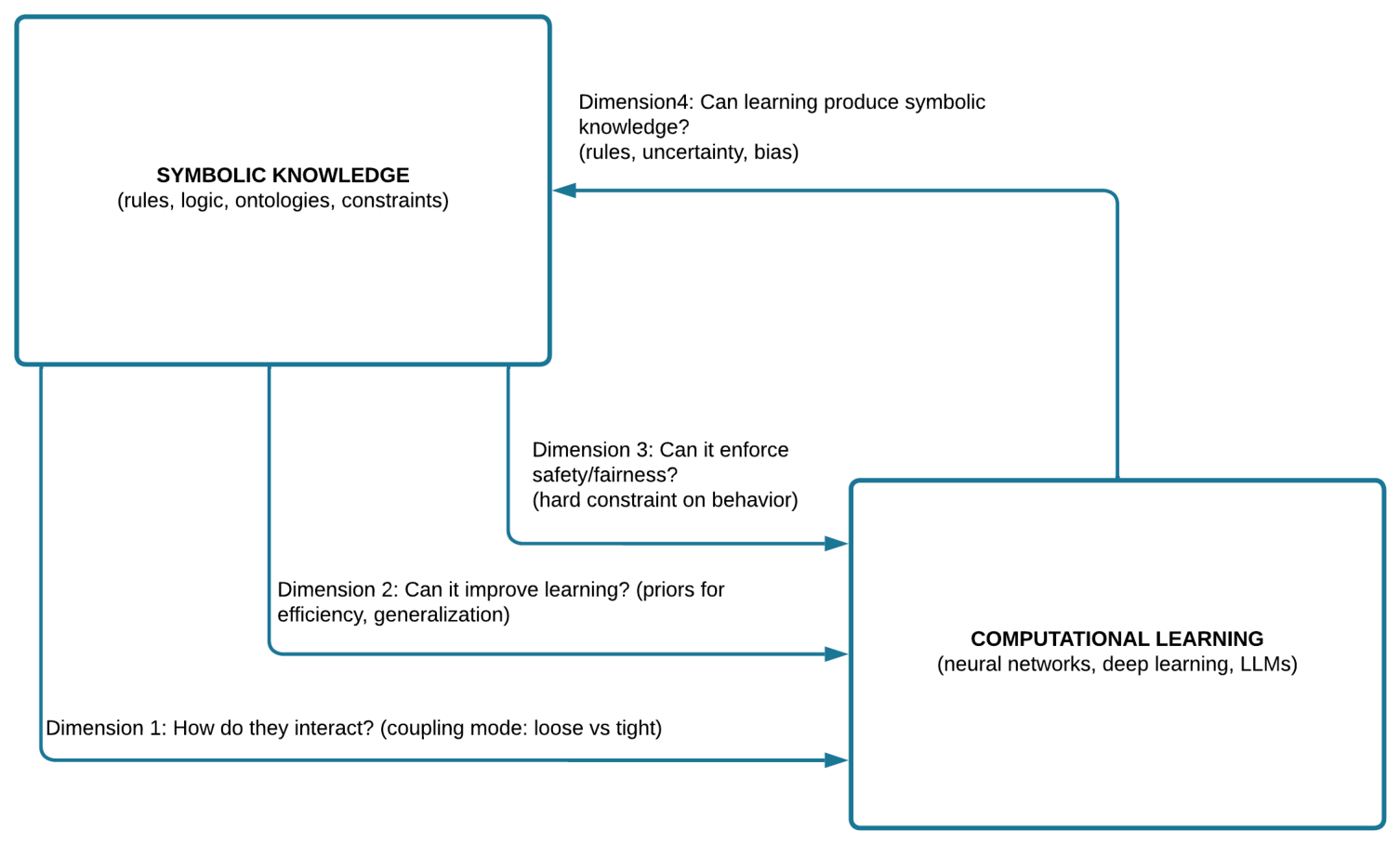
The first dimension concerns the possible integrations between knowledge and learning. At its core, this dimension asks: how should the symbolic component and the computational learning component relate to each other? More specifically, at what point does symbolic knowledge enter the computational learning process? Does it happen in the architecture, in the loss function, in the training data, or after the model’s outputs? At one end of the spectrum, symbolic knowledge can act as an external guide, operating alongside the computational learning system without altering its internal mechanics. For example, a knowledge graph might be used to enrich or filter the training data before it is fed into a neural network, or a set of logical rules might be applied after training to verify or correct the model’s outputs. In such cases, the learning process itself remains unchanged; knowledge plays a supplementary role. At the other end, symbolic knowledge can be embedded within the learning process, dynamically shaping how the model learns. For instance, logical constraints can be encoded directly into the loss function of a neural network, so that during training the model is penalized not only for incorrect predictions but also for violating known symbolic rules [56,57]. In this case, knowledge is not supplementary but foundational, actively influencing the optimization process and the representations the model learns. A more extreme form of embedding is when symbolic rules are compiled directly into the neural network’s architecture, as in Knowledge-Based Artificial Neural Networks [58], where logical rules become neurons and the symbolic and computational components are inseparable. This distinction corresponds to what is often discussed in the literature as loosely coupled versus tightly coupled NeSy architectures [25]. In loosely coupled systems, the symbolic and computational components operate as separate modules that exchange information at defined interfaces. In tightly coupled systems, the two are integrated within a single architecture, making it difficult to modify one without affecting the other. As discussed in [34], this choice involves a fundamental tradeoff: tightly coupled systems offer greater control and interpretability, while loosely coupled systems tend to be more scalable, a balance that remains an open research question in the NeSy community. This spectrum also aligns closely with the three symbolic knowledge injection (SKI) strategies systematized by Ciatto et al. [27]: their knowledge embedding strategy, in which symbolic knowledge is converted into numeric form and supplied as ordinary input data, corresponds to the external-guide end described above; their guided learning strategy, in which knowledge steers training through the loss function, corresponds to embedding in the learning process; and their predictor structuring strategy, in which the predictor’s internal structure is built to mirror the knowledge, corresponds to the deepest, architectural form of embedding.

3.2. Dimension 2: Symbolic Priors for Learning

The second dimension asks whether reasoning can be used as a symbolic prior for learning. A symbolic prior is a piece of formally represented knowledge, such as a logical rule, a constraint, or a known relationship, that is provided to the computational learning system before training begins in order to restrict or guide the space of hypotheses the model considers. For example, in a classification task over images of animals, a symbolic prior encoding the rule that an animal cannot be both a cat and a dog at the same time could constrain the classifier’s output space, ensuring mutual exclusivity among classes. This reduces the number of training examples needed to reach reliable performance, a property known as sample efficiency [59]. Such priors can also improve interpretability, since the model’s behavior is partially governed by human-readable rules [34], and generalization, since logically grounded constraints may hold beyond the specific distribution of the training data [60]. This raises a further question: should such priors be domain-specific, tailored to a particular field such as medicine or law, or should they embody very general principles, such as the structure of time, space, or causality, that extend across domains? Domain-specific priors can yield high performance in narrow settings but may not transfer. For instance, in [61], symbol frequency distributions extracted from physics literature differ significantly from those in biology, suggesting that priors tailored to one domain may not generalize to another. General priors offer broader adaptability but may be too abstract to provide meaningful guidance in any single task. An integration model must balance these two extremes, and the extent to which current NeSy systems address this balance is examined in Section 6.

3.3. Dimension 3: Symbolic Constraints for Safety and Bias

The third dimension highlights the role of symbolic constraints: can they be enforced on computational learning models to make them safer or less biased? While the second dimension considers symbolic knowledge as a prior that improves learning performance, this dimension focuses on a different goal: ensuring that computational learning models do not violate critical logical, ethical, or domain-specific rules, even when the training data might encourage them to do so. For example, in a loan approval system, a symbolic constraint could encode the rule that the applicant’s gender must not influence the decision [62]. Without such a constraint, a model trained on historically biased data might learn to rely on gender as a predictive feature. Enforcing the constraint symbolically ensures that this cannot happen, regardless of what patterns exist in the data. More broadly, neurosymbolic methods have been used to enforce counterfactual fairness, ensuring that predictions would remain the same even if a protected attribute were different [63]. Similarly, in a safety-critical domain such as autonomous driving, symbolic constraints could encode traffic rules that the system must never violate, even if its learned policy would otherwise suggest doing so [64]. Such constraints can be enforced, for instance, by filtering the model’s actions through a symbolic verification layer before they are executed. The challenge lies in enforcing such constraints while still retaining the model’s ability to learn flexible representations from data. Hard symbolic constraints may overly restrict the hypothesis space, potentially reducing the model’s capacity to generalize. Balancing constraint enforcement with learning flexibility remains an open problem, particularly in domains where safety and adaptability are both essential.

3.4. Dimension 4: Symbolic Knowledge from Learning

Finally, the fourth dimension looks in the opposite direction: can learning be used to yield symbolic knowledge? While the previous three dimensions consider how symbolic knowledge can support or constrain the learning process, this dimension asks whether computational learning can itself produce new symbolic representations, such as logical rules, ontological structures, or causal relationships, extracted from data. For example, given a set of family relationships, a NeSy system might learn the rule that X is a grandparent of Z if X is a parent of Y and Y is a parent of Z, effectively discovering a symbolic rule that was not explicitly provided [34]. More broadly, the task of inducing symbolic programs or logical rules from data is an active area of NeSy research, often referred to as knowledge induction [34]. This direction corresponds to what Ciatto et al. [27] term symbolic knowledge extraction (SKE), for which a substantial body of methods exists; the operational criteria specifying which forms of extraction qualify as D4 in our classification are given in Section 6. However, this direction raises several challenges. First, how should the uncertainty inherent in learned knowledge be managed? A rule extracted from data carries statistical confidence, not logical certainty, and treating it as a hard symbolic fact may lead to errors. Second, how can bias from the training data be prevented from seeping into the symbolic layer? If a model learns rules from historically biased data, those rules may encode and perpetuate the same biases in a form that appears objective and trustworthy. Third, can such learned knowledge ever capture abstract principles, such as the structure of time, space, or causality, or will it remain limited to domain-specific patterns arising from a particular dataset? These questions define the scope of what NeSy systems can ultimately achieve: whether they remain tools for solving specific problems or evolve towards broader forms of reasoning. As noted in [25], NeSy AI currently lacks a unifying theory that addresses these questions. Much of the existing literature focuses on proposing new architectures or algorithms without clarifying which of these foundational issues they aim to solve. To systematically evaluate the extent to which existing NeSy approaches address these four dimensions, we first require a structural framework for categorizing how symbolic and computational learning components are integrated. The taxonomy proposed by Kautz [28], presented in the following section, provides this structural backbone. Figure 1 illustrates the aforementioned four dimensions, highlighting the directional flow of interaction between symbolic knowledge and computational learning.

4. Neurosymbolic Integration Architectures

To systematically categorize the diverse ways in which symbolic and computational learning components can be integrated, Henry Kautz proposed a taxonomy of NeSy architectures based on how these components interact [28]. Drawing on Kahneman’s dual-process theory of human cognition [65], which distinguishes between fast intuitive thinking and slow deliberate reasoning, Kautz argues that neither symbolic nor computational learning methods alone can achieve human-like intelligence, motivating the need for their integration. His taxonomy outlines six distinct types of NeSy integration, each representing a different strategy for combining symbolic reasoning with computational learning methods. These six types vary in the depth and directionality of interaction between the two paradigms, ranging from loosely coupled systems that use symbolic methods for post-hoc interpretation, to deeply integrated architectures where symbolic structures guide the learning process or are themselves learned by computational methods. In the following subsections, we present each type with its defining characteristics and an analysis of its strengths and limitations. Before presenting the six types, a terminological clarification is necessary. Throughout this paper, the term symbolic is used in two related but distinct senses, and Kautz’s taxonomy spans both. In the stricter sense, established in Section 3, symbolic refers to formal reasoning: the explicit, rule-based manipulation of expressions in a logical or mathematical system, governed by inference rules and grounded in formal semantics. In a weaker sense, symbolic refers to discrete, human-interpretable units, such as words, tokens, or category labels, which carry no inherent logical semantics and are not themselves subject to formal inference. This distinction is important in interpreting the taxonomy. Type 1 relies on the weaker sense: its symbolic components are the input and output formats of a computational learning model, with no formal reasoning involved. Types 2 through 6, by contrast, increasingly engage symbolic reasoning in the stricter sense, ranging from external logical controllers (Type 2) to fully internalized inference within the computational learning model (Type 6). This is one reason Type 1 sits at the boundary of what constitutes meaningful neurosymbolic integration, as discussed later and reflected in its absence from some recent taxonomies. Where the distinction is relevant in the following subsections, we make the intended sense explicit.

4.1. Type 1: Symbolic Neuro Symbolic

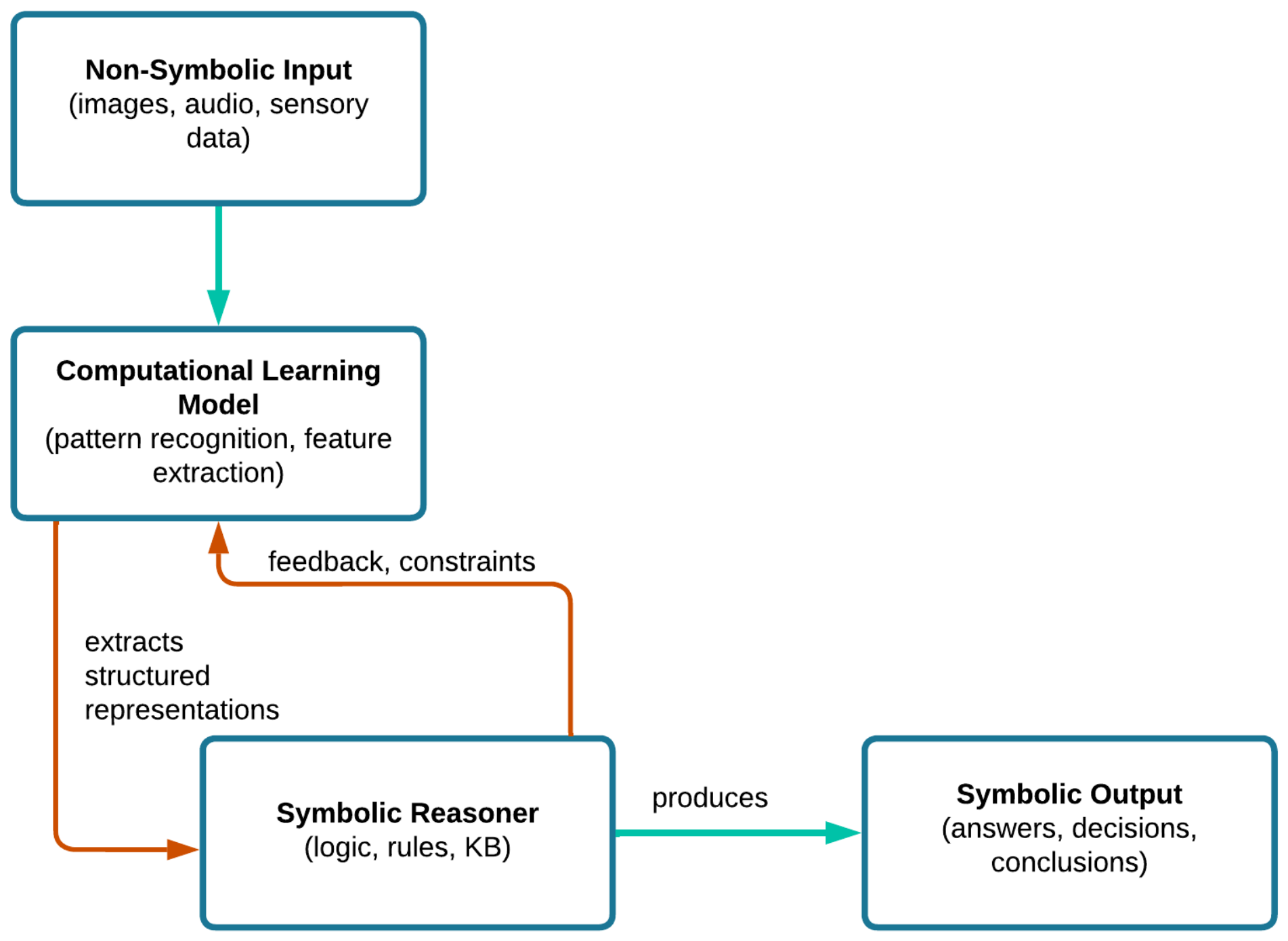
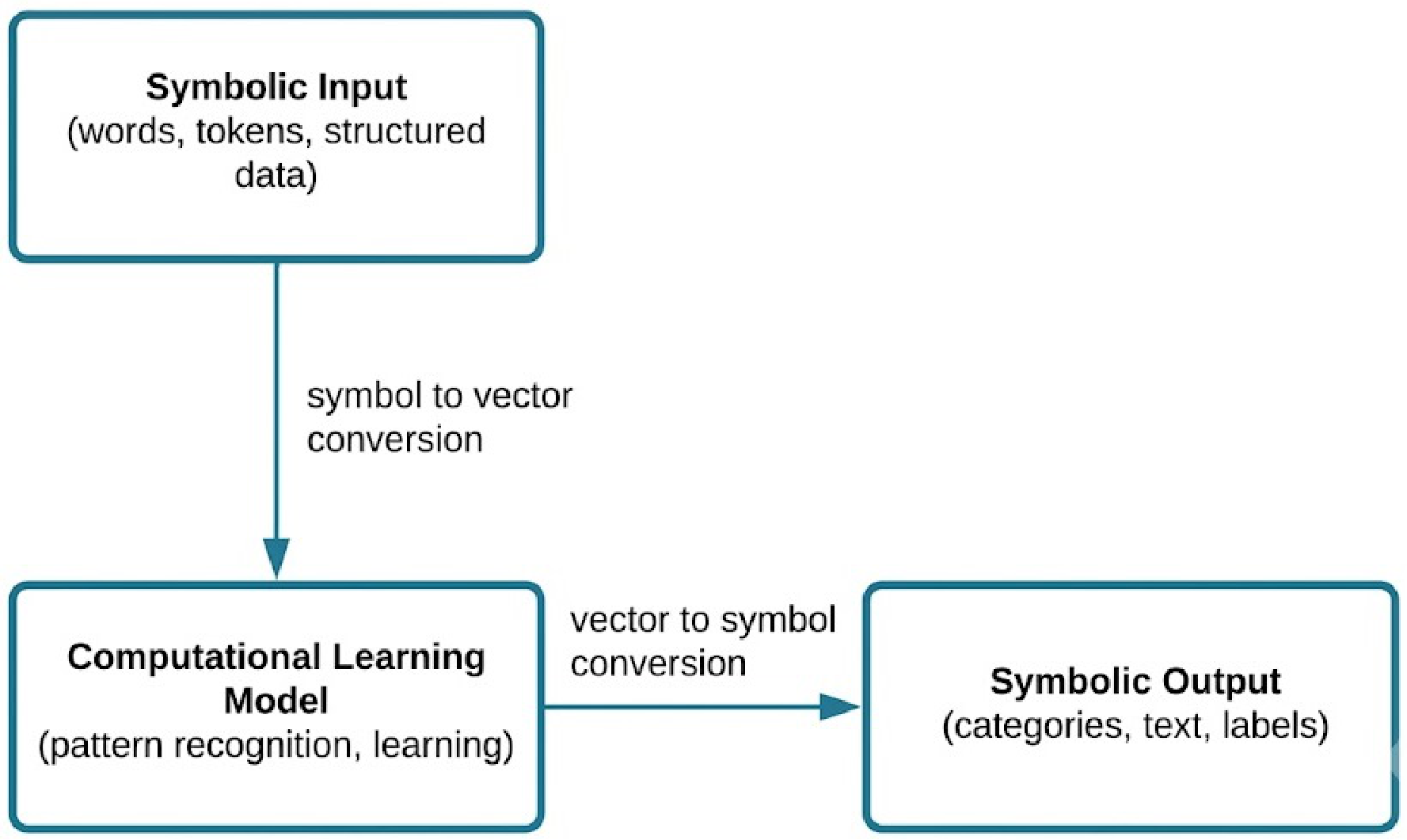
Kautz’s Type 1, termed Symbolic Neuro Symbolic, describes systems that receive symbolic input, process it through a neural network, and produce symbolic output. In this context, symbolic refers to discrete, human-interpretable elements such as words, tokens, or structured expressions. These symbolic inputs are converted into continuous vector representations, processed by the network, and converted back into symbolic form, typically through a softmax operation or a decoding step, a pattern that is standard practice in computational learning, particularly in Natural Language Processing (NLP) [66]. A representative instance is the abstractive summarization framework of Kouris et al. [67], which combines a sequence-to-sequence neural model with knowledge-based methods through a symbolic pre-processing stage, a neural learning stage, and a symbolic post-processing stage. More broadly, widely used language models such as RoBERTa [68] and BERT [69] can also be seen as instances of Type 1, reinforcing the point that it reflects standard computational learning practice rather than a distinctively neurosymbolic approach. Figure 2 illustrates this architecture. It is important to note that Type 1 does not involve symbolic reasoning in the formal sense established in Section 3: there is no logical inference, no rule application, and no knowledge representation in the computation itself. For this reason, Type 1 is best understood as a baseline architecture rather than a genuine form of neurosymbolic integration, a view supported by the observation that in some recent surveys [49] Type 1 does not appear as a distinct category. Its coupling under Dimension 1 is accordingly loose in the most minimal sense, with symbolic elements confined to the input and output interfaces.

Strengths and Limitations

The primary strength of Type 1 systems lies in their simplicity and wide applicability: they process symbolic data through powerful computational learning models while keeping inputs and outputs in human-interpretable form, and are directly compatible with existing pipelines. The corresponding limitations are those of purely computational learning systems: no formal reasoning, no explanation of decisions in terms of logical rules, and sensitivity to adversarial inputs and lack of transparency. Additionally, errors introduced during the symbolic input stage, for instance incorrect tokenization or flawed named entity recognition, propagate through the entire pipeline without any mechanism for symbolic correction.

4.2. Type 2: Symbolic[Neuro]

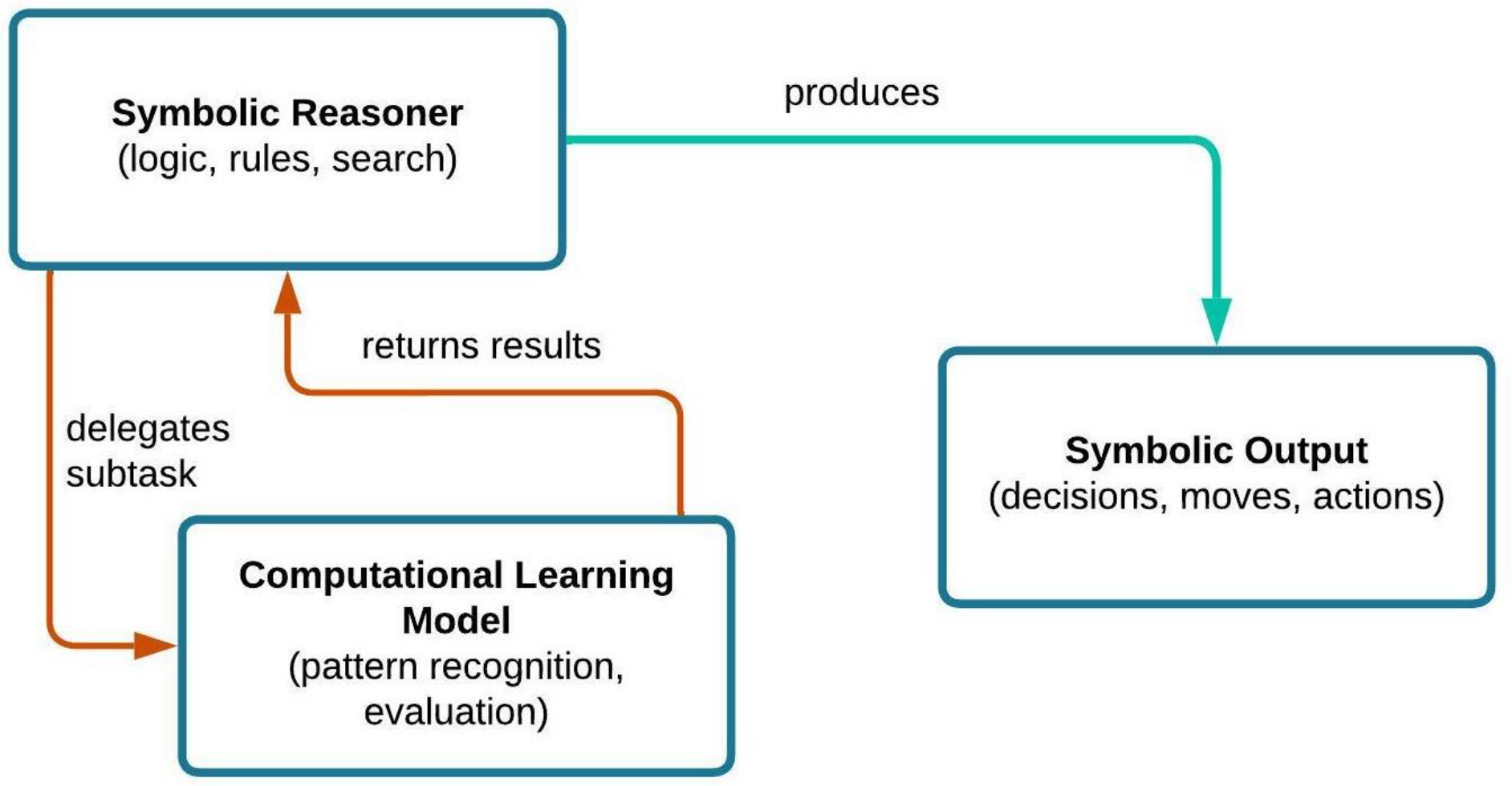
Kautz’s Type 2, termed Symbolic[Neuro], describes systems where a symbolic reasoner serves as the primary controller, defining the problem space, establishing goals, and dictating high-level strategies. When the controller encounters a subtask where computational learning methods excel, such as processing raw sensory data, recognizing patterns, or estimating probabilities, it delegates that subtask to an integrated computational learning component and incorporates the returned results into its reasoning process. A recognized example is DeepMind’s AlphaGo [70], where Monte Carlo Tree Search acts as the symbolic controller and delegates move evaluation to a policy network and a value network. Similar patterns appear in the Neural-Symbolic Solver (NS-Solver) [71] for Math Word Problems, where a symbolic executor controls the problem-solving flow while neural components handle language understanding and program generation, and in the autonomous-driving system of Sharifi et al. [64], where a symbolic reasoner encodes traffic laws as first-order logic rules and queries neural components for structured representations of the environment. The pattern has recently been instantiated with large language models in the delegated role: in LINC [72] an LLM acts purely as a semantic parser translating natural language into first-order logic that the Prover9 theorem prover executes; SatLM [73] has an LLM parse problems into declarative specifications solved by the Z3 solver; LLM+P [74] translates planning problems into PDDL for a sound and complete classical planner; and SPIRES [75] embeds a frozen LLM as the extraction subroutine of a schema-driven knowledge base population procedure whose outputs are grounded and validated against formal ontologies. In each case the symbolic side performs the genuine inference while the LLM handles a delegated translation or extraction subtask. The key distinction from Type 1 is that the symbolic component is in control: it performs genuine reasoning, applies logical rules, and invokes the computational learning component only for delegated subtasks, as shown in Figure 3. Under Dimension 1, Type 2 is therefore loosely coupled, but unlike Type 1 the interface connects two genuinely active components rather than confining the symbolic side to formatting.

Strengths and Limitations

The primary strength of Type 2 systems is that the symbolic controller provides a transparent, interpretable structure for decision-making: the high-level logic behind the system’s decisions can be inspected and understood, which makes these architectures particularly suitable for domains where explainability is essential, such as healthcare, law, or safety-critical applications. The clearly defined roles and interfaces also yield modularity: the computational learning component can be updated or replaced without restructuring the system, and the symbolic rules can be modified independently to reflect new domain knowledge. However, effectiveness depends heavily on the quality and completeness of the symbolic rules: in situations not covered by the rules, such as edge cases or ambiguous real-world conditions, the controller may fail to delegate appropriately or produce incorrect decisions. The symbolic component must also be designed and maintained by domain experts, which is costly and difficult to scale to complex or rapidly evolving domains. Finally, the separation between controller and learning component means the system cannot learn to improve its own reasoning rules from experience, limiting its adaptability over time.

4.3. Type 3: Neuro|Symbolic

Kautz’s Type 3, termed Neuro|Symbolic, describes a cooperative architecture in which a computational learning component and a symbolic reasoning module interact iteratively to solve complex tasks. The computational learning component processes raw, unstructured data, such as images, audio, or other sensory inputs, and converts it into intermediate symbolic structures, such as object graphs or logical expressions, which the symbolic reasoning system manipulates. Unlike the controller-subroutine pattern of Type 2, Type 3 treats both components as equal partners: the symbolic system may generate feedback signals or constraints that refine the computational learning component during training or inference, while the computational learning component continuously updates the symbolic representations based on new data, producing a dynamic loop that combines pattern recognition with structured, human-interpretable reasoning. This pattern is especially prevalent in tasks that require robust visual perception combined with explicit logical reasoning, such as visual question answering, scene understanding, and compositional reasoning over images and language. Representative instances include the GENOME framework [76], which uses a large language model to generate and orchestrate reusable modular visual reasoning programs in an iterative loop with perception modules; NeSyCoCo [77], which translates natural language queries into symbolic programs executed by a differentiable reasoner whose predicates are grounded in neural perception modules; and the Scene Graph Conditioning framework for synthetic image generation [78], which conditions a generative model on scene graphs to enforce explicit relational constraints during image synthesis. Recent LLM-based systems also realize the cooperative Type 3 loop: in Logic-LM [79], an LLM translates problems into formal representations executed by external solvers, and a self-refinement module feeds the solver’s error messages back to the LLM to revise the formulation iteratively; and in AlphaGeometry [80], a neural language model and a symbolic deduction engine alternate in a proof-search loop, the engine exhaustively deriving consequences and the language model proposing auxiliary constructions whenever the deduction closure is exhausted. Figure 4 illustrates this architecture. Under Dimension 1, Type 3 exhibits the most varied coupling of all types: some systems are loosely coupled, with the neural component producing structured outputs that a separate symbolic reasoner consumes through a pipeline interface, while others are tightly coupled, with joint training, shared loss functions, or bidirectional feedback binding the components together.

Strengths and Limitations

The primary strength of Type 3 systems lies in their cooperative structure, which allows each component to compensate for the other’s weaknesses: the symbolic module provides structured, interpretable constraints that guide the learning component toward more robust and compositional representations, while the learning component provides the perceptual flexibility to handle raw data that symbolic systems cannot process directly. This mutual reinforcement supports strong generalization, particularly for novel combinations of known concepts or out-of-distribution inputs. The modular design adds practical advantages: new learning modules or symbolic rules can be added with minimal retraining, components can be reused across related domains, and the symbolic layer provides a traceable reasoning path that improves interpretability. However, the cooperative loop introduces coordination complexity: interfaces must be engineered so that symbolic constraints do not overly restrict the learning of flexible representations, and an incomplete or inaccurate symbolic layer can introduce brittleness, forcing the computational learning component to compensate for missing knowledge. Moreover, while the symbolic component provides transparency at the reasoning level, the computational learning modules remain opaque internally, so full end-to-end explainability is not guaranteed.

4.4. Type 4: Neuro: Symbolic → Neuro

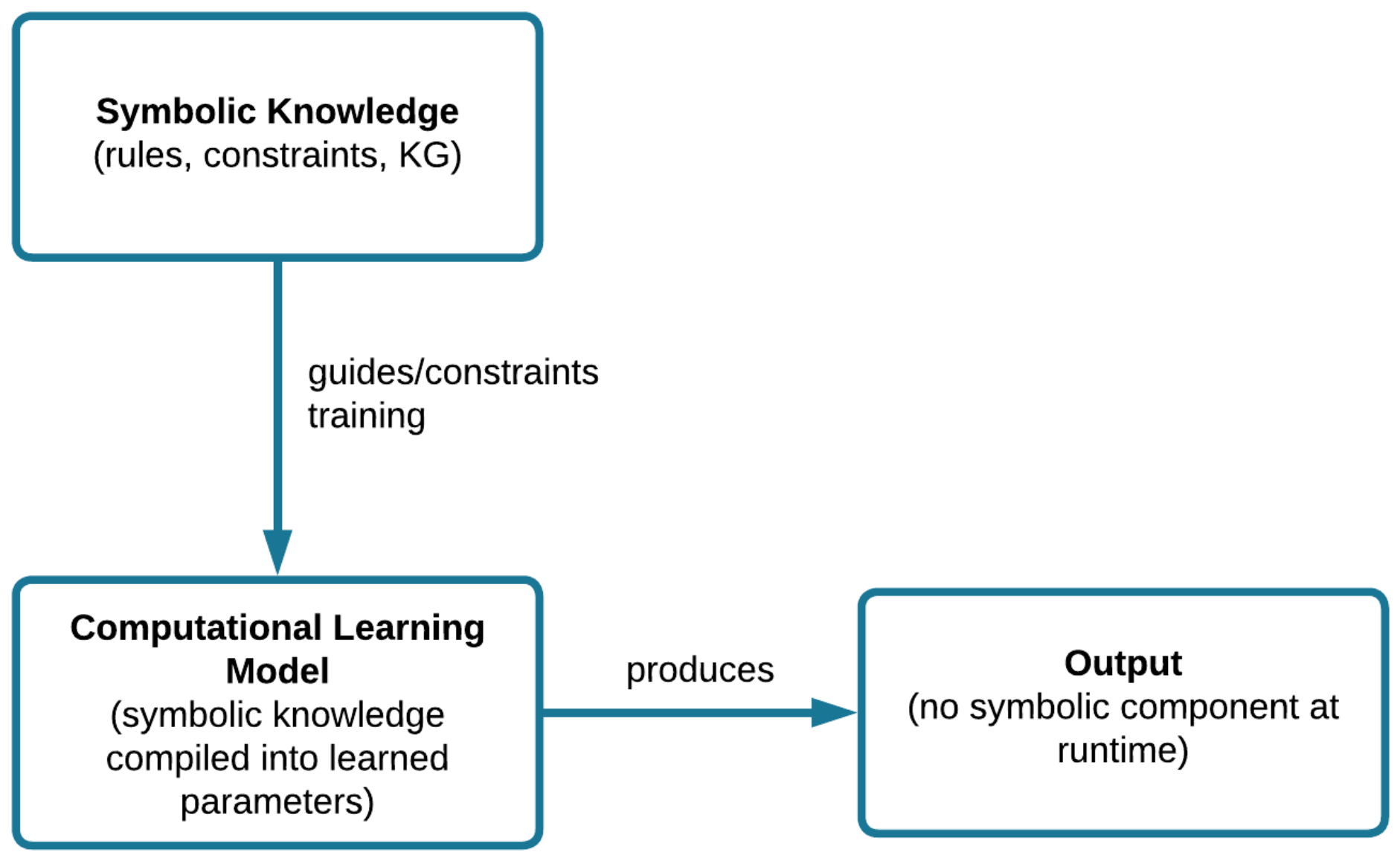
Kautz’s Type 4, termed Neuro: Symbolic → Neuro, describes systems where symbolic knowledge is embedded directly into the training process of a computational learning model, rather than being maintained as a separate reasoning component. Symbolic structures, such as logical rules, knowledge graphs, or domain constraints, are used to generate or annotate training data, shape the loss function, or provide additional input features that guide the model’s learning. After training, the symbolic component is no longer present: the system operates as a standard computational learning model, with the symbolic knowledge effectively compiled into its learned parameters. Representative instances include the travel demand prediction framework of Acharya et al. [81], which extracts symbolic if-then rules from decision trees and encodes them as additional input features for training; the Linguistic Rule-based Explainable AI (LR-XAI) model of Toofani et al. [82], which fuzzifies inputs into linguistic variables and extracts symbolic IF-THEN rules that shape the model’s learned feature relevance; and the Neuro-Symbolic Verification framework of Xie et al. [83], which uses specification networks to generate symbolic assertions that constrain the model during training and verification. In all three, predictions at inference time are handled entirely by the computational learning model, with no symbolic component involved. Figure 5 illustrates this architecture. This architecture connects directly to Dimensions 1 and 2 of our framework: under Dimension 1, Type 4 is compiled, the two components never being simultaneously active at runtime, and under Dimension 2 the embedded knowledge acts as a symbolic prior that can improve sample efficiency and generalization.

Strengths and Limitations

The primary strength of Type 4 systems is their practical efficiency: because symbolic knowledge is not required at runtime, these systems operate with the same speed and scalability as standard computational learning models, making them well suited for large-scale applications where low-latency prediction is essential. A further advantage is data efficiency: by encoding domain knowledge into the training phase, whether through constraints, rule-based features, or symbolic supervision, these systems can achieve strong performance with less labeled data than purely data-driven approaches, and the symbolic priors can reduce spurious correlations and improve generalization when they align with the structure of the target task. However, the compiled nature of Type 4 introduces important limitations. Once symbolic knowledge is embedded into the model’s parameters, it cannot be inspected, modified, or updated without retraining: if the rules are incomplete, outdated, or incorrectly specified, the resulting biases are difficult to identify and correct, and unlike Types 2 and 3 there is no mechanism for post-training symbolic correction. Interpretability is likewise only partial: while the source of the symbolic constraints may be clear to the designer, the trained model’s internal representations remain opaque, making it difficult to trace specific predictions back to specific symbolic rules.

4.5. Type 5: NeuroSymbolic

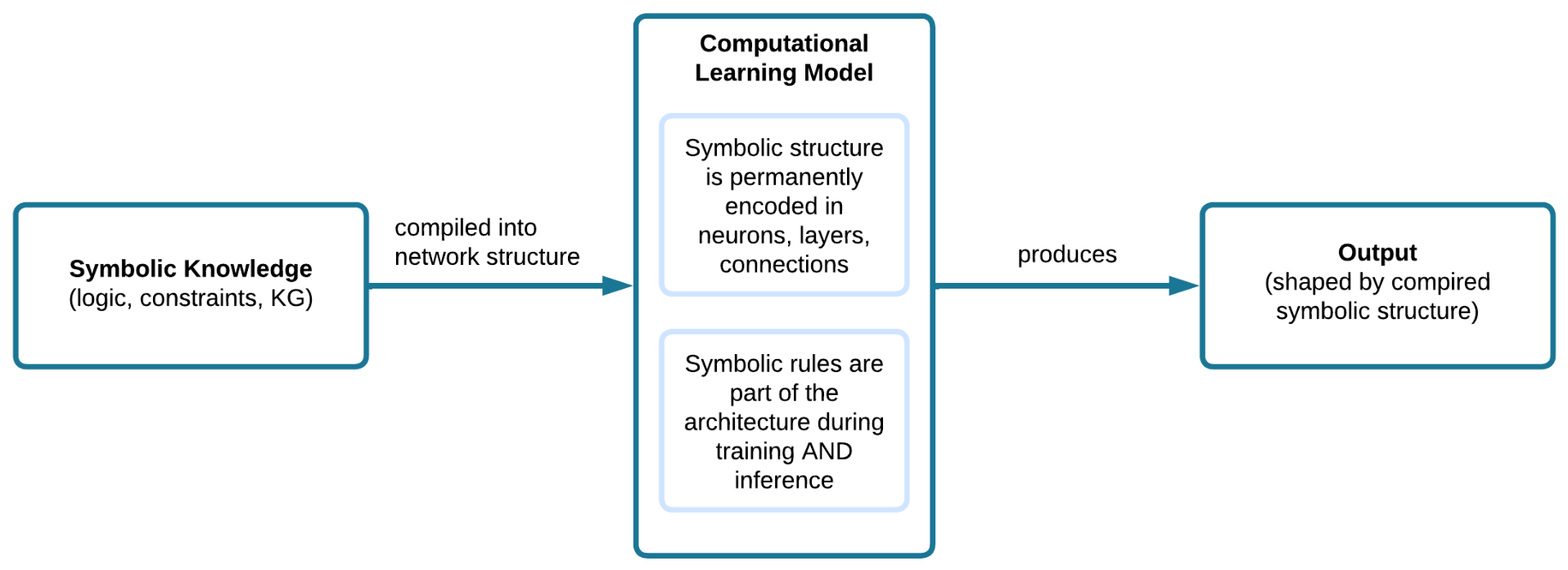
Kautz’s Type 5, termed NeuroSymbolic, describes systems where symbolic rules are directly transformed into structural elements within the computational learning model. Rather than using symbolic knowledge to guide training (as in Type 4) or maintaining a separate symbolic module for runtime reasoning (as in Types 2 and 3), Type 5 compiles symbolic logic into the model’s architecture itself: neurons, layers, connections, and activation functions are designed to mirror symbolic structures such as logical rules, hierarchies, or domain constraints. The key distinction from Type 4 is permanence: the symbolic structure is not dissolved into learned parameters but remains a permanent part of the architecture, shaping how the model processes information at every stage, including inference. Representative instances include the LFIT2 framework of Phua et al. [84], which embeds symbolic constraints such as minimal rule structure and rule-body length directly into a permutation-invariant architecture that outputs interpretable logic programs; the work of Grov et al. [85], which uses Logic Tensor Networks to encode axioms relating network flows to attack types into the model’s structure for cyber security operations; and ViPro of Takenaka et al. [86], which embeds procedural domain knowledge as a module that maps symbolic states to and from the learned latent representation to guide video prediction. Figure 6 illustrates this architecture. Under Dimension 1, Type 5 is tightly coupled, the deepest form of embedding short of full integration: the symbolic structure and the computational learning model are architecturally inseparable. The Knowledge-Based Artificial Neural Networks (KBANN) [58] discussed in Section 3 represent an early instance of this pattern.

Strengths and Limitations

The primary strength of Type 5 systems is that logical constraints and domain rules are enforced during inference as well as training, providing stronger guarantees of logical consistency than Type 4, where symbolic knowledge may degrade or be overridden by learned patterns once compiled into weights. Because the symbolic structure is architecturally encoded, it can often be traced back to its source rules, offering a degree of interpretability that purely data-driven models lack. Moreover, where the encoded rules capture genuine invariances of the task, such as hierarchies, relational structures, or physical laws, the architecture can reduce spurious correlations and generalize beyond the specific patterns in the training data. However, the tight fusion introduces significant inflexibility: modifying or expanding the compiled rules typically requires redesigning and retraining the model, making Type 5 less suitable for domains where knowledge evolves rapidly. Development is also more demanding than for standard computational learning models, since faithfully encoding complex symbolic structures requires specialized expertise and careful validation. Finally, while the symbolic layer improves transparency at the architectural level, the computational learning components operating within it may still behave opaquely at the level of individual predictions, so full end-to-end interpretability depends on the complexity of both.

4.6. Type 6: Neuro[Symbolic]

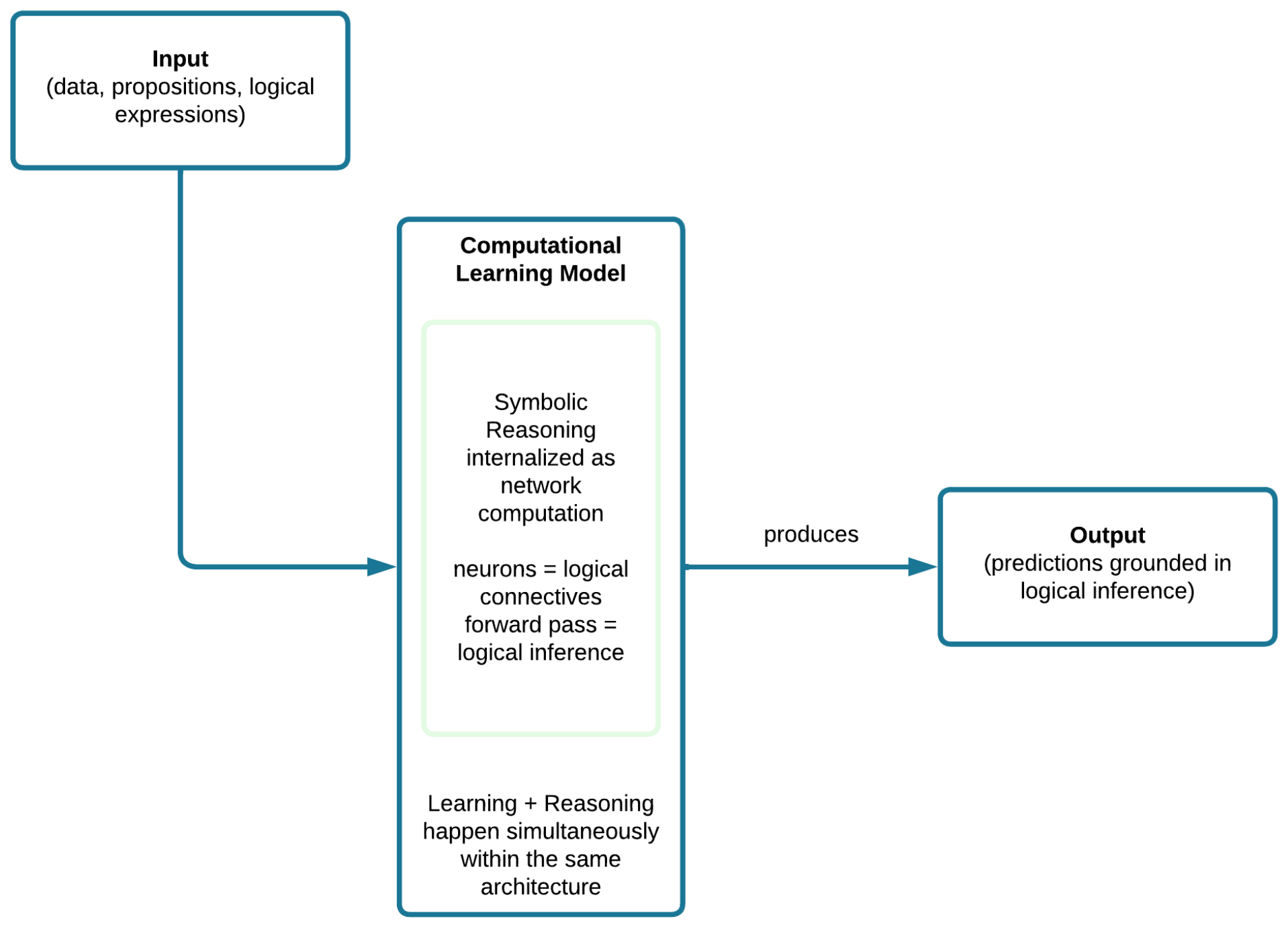
Kautz’s Type 6, termed Neuro[Symbolic], describes the most deeply integrated form of neurosymbolic architecture: systems where symbolic reasoning is embedded directly inside the computational learning model. Unlike Type 5, where symbolic rules are compiled into the model’s structure as fixed architectural templates, Type 6 aims for the computational learning model to internally perform genuine symbolic inference: it learns to execute logical reasoning steps, such as deriving conclusions from premises, chaining inference rules, or verifying logical consistency, as part of its forward computation. A representative realization is the Logical Neural Network (LNN) framework of Riegel et al. [87], in which each neuron corresponds to a logical connective and the forward pass computes inference over propositions represented as real-valued truth degrees, making the model’s internal computation isomorphic to logical reasoning. Other work probes the Type 6 ambition more diagnostically: Pirozelli et al. [88] assess whether encoder-only transformers can internally encode and propagate logical relationships on propositional and first-order logic tasks, and Lin et al. [89] investigate whether large language models can internally decompose linguistic puzzles into logical sub-steps under Chain-of-Thought and Tree-of-Thought prompting. Both reveal significant limitations in current architectures while illustrating the central Type 6 question of whether a computational learning model can internalize symbolic reasoning rather than relying on external components. A constructive counterpart to these probing studies is SymbCoT [90], a fully LLM-based reasoning framework in which translation to first-order logic, step-by-step application of inference rules such as Modus Ponens and Modus Tollens, and verification of each deduction are all performed by the language model itself, with no external reasoner. SymbCoT thus internalizes symbolic reasoning behaviorally, at the level of the model’s prompted computation, whereas Logical Neural Networks internalize it architecturally, with inference provably consistent by construction; the distinction identifies two different senses in which the Type 6 ambition can be pursued, with the behavioral route offering scale and flexibility but no formal guarantees, since the verifier is itself a language model. It is worth noting that Type 6 remains somewhat ambiguous in the literature. Some authors have reinterpreted it as an ensemble or fibring architecture, where a symbolic module coordinates multiple computational learning components [32]. However, in Kautz’s original formulation, the defining characteristic is that symbolic reasoning occurs inside the computational learning model, not alongside or above it. We follow Kautz’s original definition in this survey. Under Dimension 1, Type 6 is fully integrated, the deepest coupling level in our scheme and one step beyond the tight coupling of Type 5: where Type 5 fixes symbolic structure into the architecture, Type 6 has the model itself perform the inference, so that symbolic reasoning and computational learning are no longer distinct components but a single unified computation. As Kautz notes, this type has the greatest potential to combine the strengths of both paradigms, but it also remains the least well understood and the most difficult to realize in practice [28]. Figure 7 illustrates this architecture.

Strengths and Limitations

The potential strength of Type 6 is that it eliminates the interface problem entirely. In all other types, some form of translation or communication is required between symbolic and computational learning components, whether through data formatting (Type 1), delegation (Type 2), iterative exchange (Type 3), training-time compilation (Type 4), or architectural encoding (Type 5). In Type 6, there is no interface because the symbolic reasoning is the computational learning model’s computation. Systems that approach this ideal, such as Logical Neural Networks, demonstrate that a model’s internal operations can be logically interpretable and its inference provably consistent with formal rules, a level of transparency and verifiability that other types cannot match. However, Type 6 remains the most challenging to realize in practice. Fully internalizing symbolic reasoning requires the model to simultaneously learn from data and maintain logical consistency, two objectives that can conflict during optimization, and current approaches such as LNN tend to be limited in scale compared to standard computational learning architectures. Furthermore, it remains an open question whether models trained primarily on data, such as large language models, can ever truly internalize formal reasoning rather than approximating it through statistical patterns, a question that connects directly to ongoing debates about the nature of reasoning in computational learning systems [55]. Type 6 thus represents both the most ambitious vision for neurosymbolic integration and the least mature in practice: it defines the frontier of what the field aims to achieve, while the gap between this ambition and current capabilities highlights the open challenges identified in our four dimensions. Table 2 consolidates the six types along the properties discussed in this section: their integration patterns, when the symbolic component is active, their coupling levels under Dimension 1, and their principal strengths and limitations. With the architectural axis established, Section 5 introduces the third analytical axis, reasoning mode, before Section 6 evaluates the surveyed literature against all axes jointly.

5. Reasoning

The Kautz taxonomy presented in the previous section describes how symbolic and computational learning components are structurally integrated, and the four foundational dimensions describe what knowledge flows between them and in which direction. Neither, however, captures the kind of inference a NeSy system actually performs. Two systems with identical coupling and identical use of symbolic priors may nonetheless reason in fundamentally different ways: one applying fixed rules to derive guaranteed conclusions, another inferring a plausible explanation for an observation. Reasoning mode is therefore a distinct analytical axis, orthogonal to architectural form, and we treat it as such throughout our analysis.

5.1. Modes of Inference

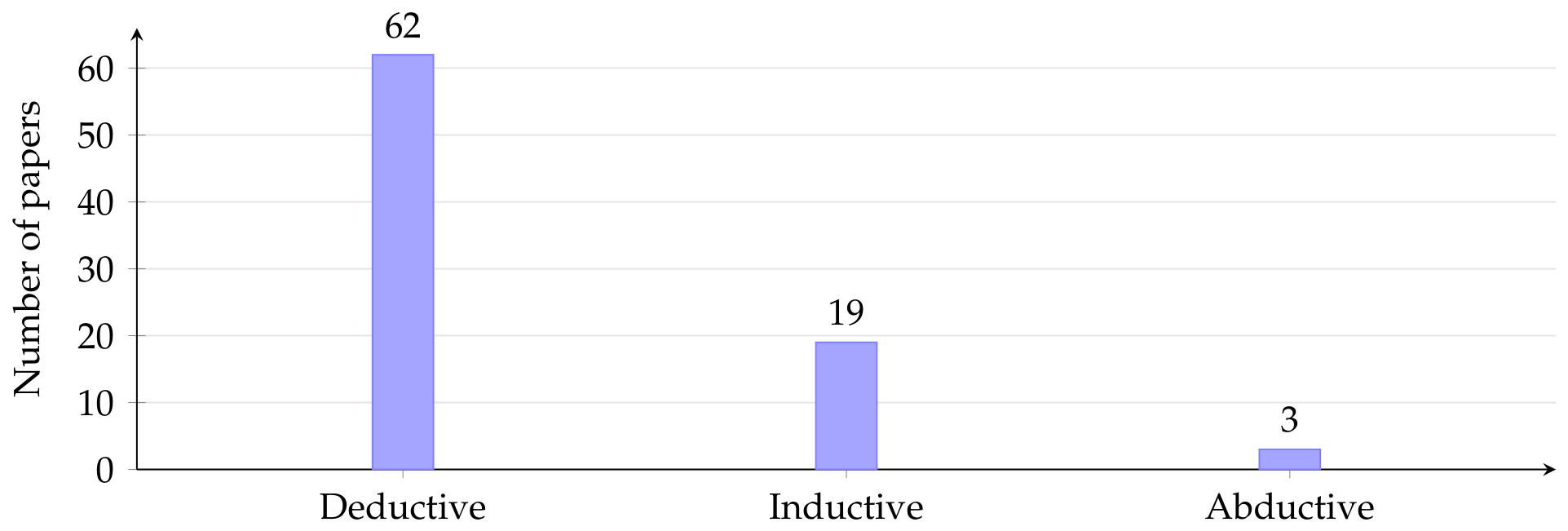
Following the classical trichotomy, originally articulated in the work of Peirce, we distinguish three modes of inference. Deductive reasoning applies known rules to derive conclusions that are guaranteed to hold whenever the premises do; it is truth-preserving and is the characteristic mode of symbolic systems. Inductive reasoning generalizes from specific examples to broader rules or patterns; it is the native mode of computational learning, where models infer regularities from data. Abductive reasoning infers the most likely explanation for an observation, reasoning from effects back to plausible causes; it is the mode underlying tasks such as diagnosis, scientific discovery, and root cause analysis. A single system may exhibit more than one mode if different components reason differently. This distinction is particularly informative for NeSy systems. Deduction and induction map naturally onto the two halves of a neurosymbolic architecture, symbolic inference and computational learning respectively, so a system’s reasoning profile reflects how it actually distributes work between the two paradigms rather than merely how they are wired together. Abduction is the mode that neither paradigm performs well in isolation: it requires generating and ranking candidate explanations against both formal knowledge and observed data, and is thus a natural test of whether a system achieves genuine integration rather than a division of labor. For this reason, the reasoning axis serves not only to classify systems but to probe the depth of their integration.

5.2. Classification Criteria

Assigning reasoning modes to concrete systems requires criteria that go beyond the textbook definitions, because each mode has a degenerate reading under which it would apply to nearly every system in our corpus. We therefore adopted the following operational criteria, applied in the categorization of Section 6. A system is classified as deductive when it derives conclusions by applying a body of formal knowledge that is fixed at inference time, proceeding from general rules to specific cases. Crucially, we classify by the direction and grounding of the inference, not by strict truth preservation: fuzzy and probabilistic relaxations of logical inference, as employed for instance by the Logic Tensor Network-based systems in our corpus [62,85,91], remain deductive in this sense, since they soften truth values while preserving the rule-to-instance direction of reasoning and its grounding in formal semantics. A system is classified as inductive only when generalization from examples plays a first-class role in producing the system’s conclusions or its knowledge, for instance when symbolic rules, program structures, or rule weights are themselves learned from data. The degenerate reading must be resisted here: every NeSy system contains a trained component, and if statistical training as such counted as inductive reasoning, the axis would collapse. A Type 2 system whose neural component performs only delegated perception within a symbolically controlled reasoning process is therefore classified as deductive, not inductive, regardless of how that component was trained. For the same reason, learning only the parameters of a fixed symbolic structure, such as rule weights or truth-value bounds, does not by itself qualify as inductive. The induced content must include the rules or structure themselves. Inductive classification overlaps naturally with Dimension 4, though the two are not identical: knowledge induction (D4) generally implies inductive reasoning, but a system may reason inductively, for example by learning patterns over symbolically structured data, without emitting formal symbolic knowledge. A system is classified as abductive when inferring explanations for observations is its task-level mode of inference, that is, when the system’s output is a candidate explanation ranked against formal knowledge and data. Because abduction appears in the NeSy literature in three distinct roles, we make the criterion explicit by distinguishing them. In task-level abduction, explanation inference is the system’s output task, as in abductive diagnosis or root cause analysis; only this role qualifies a system as abductive on our axis. In internal-mechanism abduction, abduction operates inside the training loop, as in the abductive-learning tradition, where a knowledge base abduces pseudo-labels that supervise a neural component [92]; in such systems abduction serves learning rather than constituting the system’s inference mode, and counting it would conflate the reasoning axis with training methodology. In explanation-generation abduction, formal abductive machinery produces post-hoc explanations of a trained model’s predictions [93]; this characterizes the explanation apparatus attached to a system rather than the system’s own reasoning. We record all three roles but count only the first toward the reasoning axis; the corpus counts under this distinction are reported in Section 7. Applying this axis, together with the Kautz taxonomy and the four dimensions, to the surveyed literature is the subject of the following section.

6. A Multi-Axis Analysis of the NeSy Literature

Paper Selection and Classification Methodology

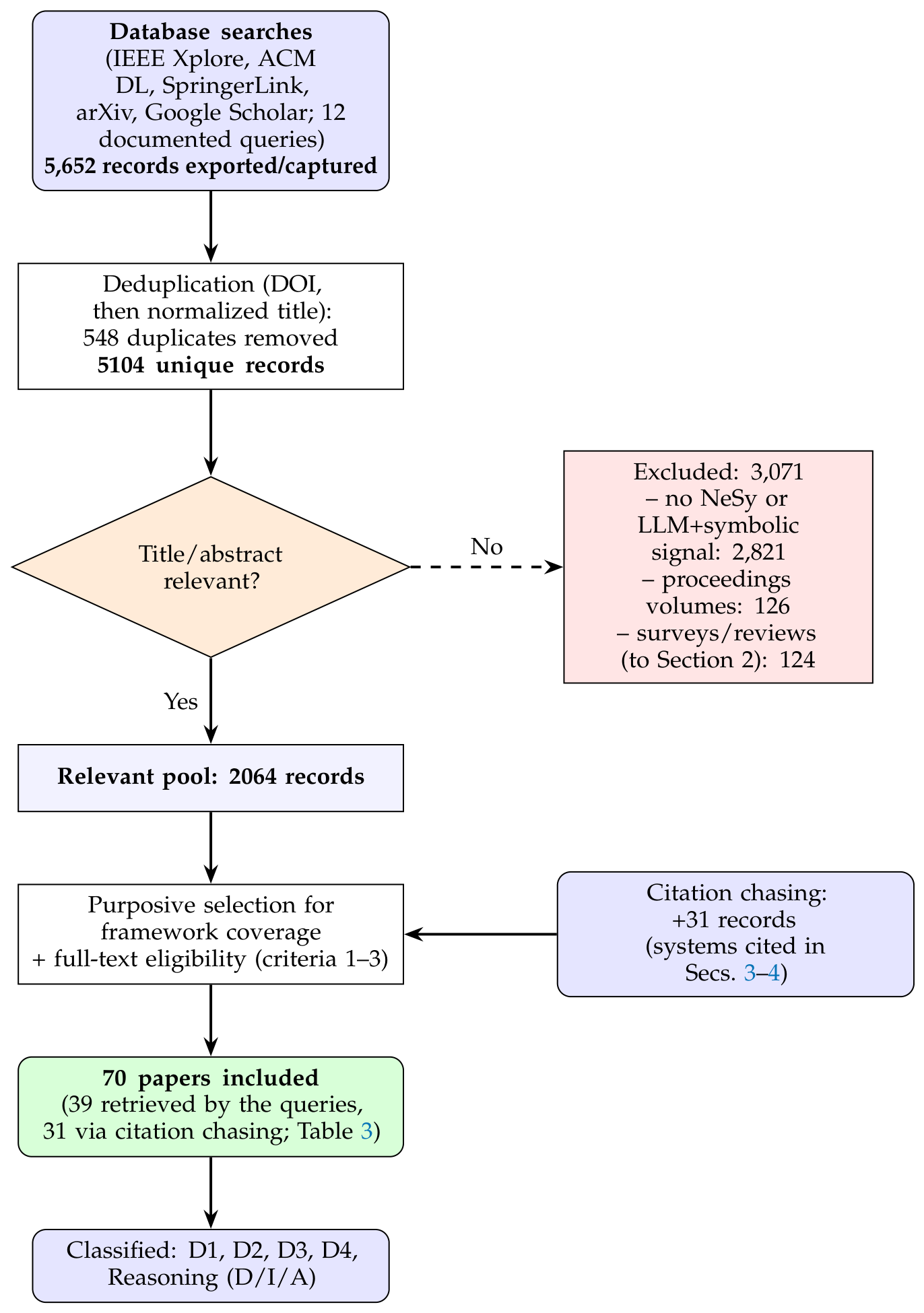
This review was conducted in compliance with the Preferred Reporting Items for Systematic Reviews and Meta-Analyses extension for Scoping Reviews (PRISMA-ScR) guidelines. A completed PRISMA-ScR checklist is provided as Supplementary Material (Table S1), and the corresponding flow diagram documenting the identification, screening, eligibility, and inclusion stages of the literature search is presented in Figure 8. This review was not prospectively registered, as no publicly available registry currently accommodates conceptual or taxonomic scoping reviews of architectural and methodological frameworks, as opposed to reviews of clinical or intervention-based outcomes.
Candidate records were identified through keyword searches of IEEE Xplore, the ACM Digital Library, SpringerLink, arXiv, and Google Scholar, using two query blocks run against each of the five sources: a core block, (“neurosymbolic” OR “neuro-symbolic” OR “neural-symbolic”) OR (“symbolic reasoning” AND (“deep learning” OR “neural network”)); and an extension block, “large language model” AND (“symbolic reasoning” OR “symbolic solver” OR “theorem prover” OR “ontology learning” OR “knowledge graph construction”), covering the rapidly growing LLM-based NeSy subfield.
All searches were restricted to English-language publications from 2017 to 2026. Database-specific conditions were as follows. IEEE Xplore was queried over all metadata (conferences and journals; 864 and 189 hits for the two blocks, all exported). The ACM Digital Library was queried over titles and abstracts (158 and 8 hits, all exported). SpringerLink searches full text by default; the core block returned 2981 hits, of which the 1000 most relevant were exported (the platform’s export limit), and the extension block returned 653 hits, all exported. arXiv was queried through its public metadata interface within the computer science categories; because the full Boolean expressions exceeded the interface’s query complexity limits, each block was decomposed into flat conjunctive sub-queries whose union is logically equivalent to the original expression, with the period and category restrictions applied post-retrieval (1874 and 507 records after filtering). For Google Scholar, which supports neither complex Boolean syntax nor bulk export, four sub-queries were run and the first 100 results of each were inspected, following the stopping convention used by Ciatto et al. [27]. In total, 5652 records were exported or captured. Duplicates were removed by exact DOI match followed by normalized-title match, with manual resolution of arXiv-preprint/published-version pairs, yielding 5104 unique records, 211 of these were retrieved independently by more than one source.
Title/abstract screening of the 5104 unique records combined an automated keyword triage with independent verification of the results by two of the authors; disagreements were resolved through discussion or, where consensus could not be reached, by consulting a third author. This stage excluded 3071 records: 2821 with no indication of neurosymbolic integration or of an LLM combined with a symbolic component, 126 records that were whole proceedings volumes rather than individual publications, and 124 surveys or reviews, which are not primary systems but inform the survey landscape discussed in Section 2. This left a pool of 2064 title/abstract-relevant records. A paper was included in the categorization table if it satisfied three criteria simultaneously:
1.
It contains a computational learning component that learns from data (e.g., a neural network, deep learning model, or differentiable learning system).
2.
It contains a symbolic reasoning component that operates on formal or structured representations (e.g., logical rules, ontologies, knowledge graphs, formal grammars, or domain-specific symbolic formalisms).
3.
There is a meaningful interaction between the two components, whether through shared training, cooperative inference, architectural embedding, or knowledge transfer.
Figure 8 illustrates the complete paper selection and classification pipeline.
Systems that rely exclusively on symbolic methods without a learning component (e.g., ontology-based fuzzy inference systems [94]) were excluded, even when they self-identify as neurosymbolic. Similarly, systems that combine a neural model with a post-hoc interpretability tool (e.g., SHAP or LIME applied after training) without any symbolic reasoning influencing the model’s learning or inference were excluded. Standard image processing or signal processing pipelines that sequentially apply unrelated techniques without meaningful interaction were also excluded [95,96]. We observed that the term “neurosymbolic” is used inconsistently in the literature, with some papers applying it to any combination of interpretable and neural methods [97]. Our inclusion criteria therefore enforce the following operational definition, consistent with the terminology established in Section 3: a system qualifies as neurosymbolic only if its symbolic component causally influences the system’s learning or inference, that is, if removing the symbolic component would change what the system learns or what it outputs, and not merely how its behavior is explained after the fact. Post-hoc interpretability methods, in which symbolic artifacts are derived from a trained model without feeding back into learning or inference, do not satisfy this criterion; we note that such methods constitute the well-studied field of symbolic knowledge extraction surveyed by Ciatto et al. [27], and excluding them here is a scoping decision rather than a judgment of their value. Framework and position papers that propose conceptual architectures without concrete implementation or empirical evaluation [98] were excluded from the categorization table but are cited where relevant in the discussion.
From the title/abstract-relevant pool, the corpus of 70 systems was selected purposively: this survey is a framework-driven scoping review whose aim is to evaluate the field against the analytical axes of Section 3, Section 4 and Section 5, not to enumerate every qualifying system, and the corpus was accordingly composed to satisfy the three eligibility criteria while covering all six Kautz types, all four foundational dimensions, the three reasoning modes, and a diverse range of application domains. Of the 70 systems, 39 were retrieved directly by the documented queries (two of these, identified by the full-export term scan described in Section 7, had initially been mislabeled by the automated keyword triage and their screening records were corrected accordingly); the remaining 31 entered through a systematic citation-chasing step, in which the reference lists of the surveys of Section 2 and of papers cited as representative systems in Section 3 and Section 4 were inspected for qualifying systems. The systems missed by the queries fall where the documented retrieval limits bite: the SpringerLink export cap, the Google Scholar stopping rule, and exact-phrase mismatches between query terms and abstracts. One corpus system, Knowledge-Based Artificial Neural Networks [58], predates the 2017–2026 window and is deliberately retained through the citation-chasing route as the foundational historical exemplar of the Type 5 pattern. The frequency analyses of Section 7 should therefore be read as describing this purposively composed corpus, as discussed in the limitations paragraph of Section 8.
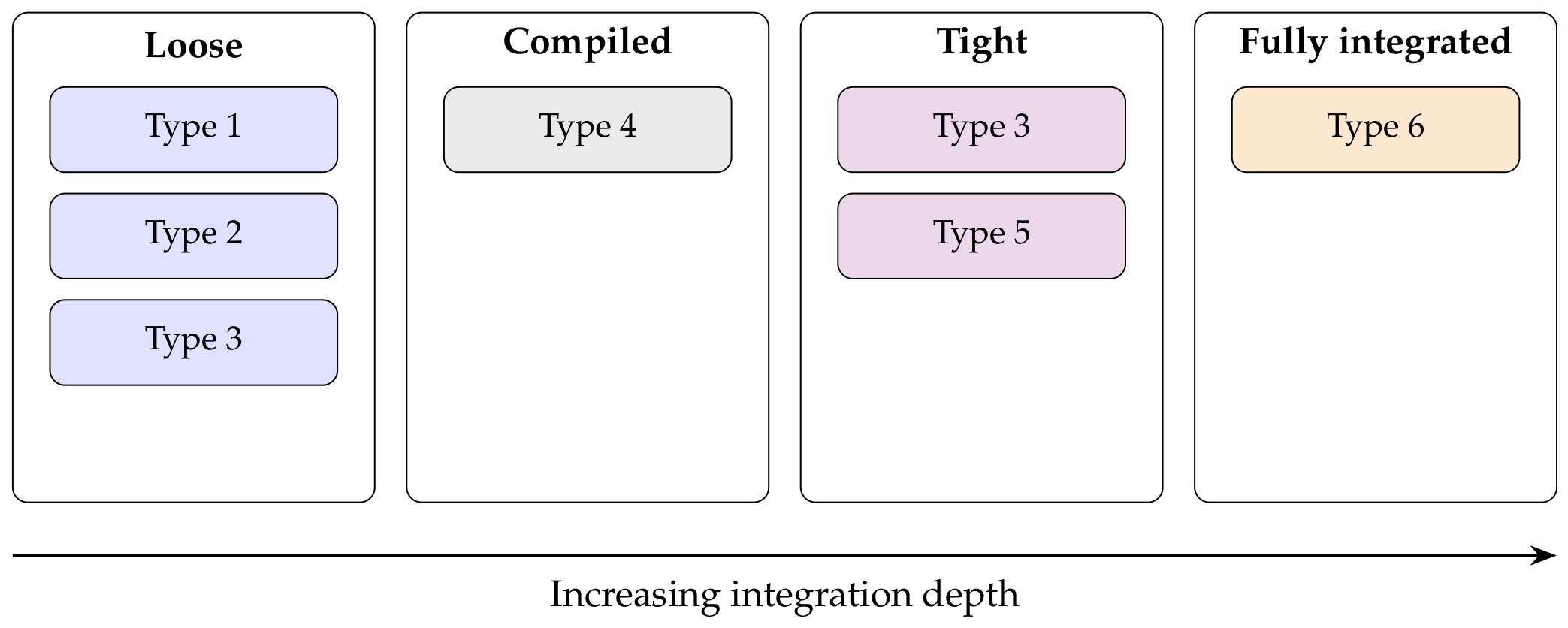
Each included paper was classified along five axes. For D1 (Mode of Integration), we assigned one of four coupling levels: Loose, where the symbolic and computational learning components are separate modules with clear interfaces; Compiled, where symbolic knowledge is embedded into the training process and absent at inference; Tight, where symbolic structure is permanently embedded in the architecture or the components are jointly optimized; and Fully Integrated, where symbolic reasoning is internalized as the computational learning model’s own computation. For D2 (Symbolic Priors for Learning), we recorded whether the system uses formally represented symbolic knowledge to restrict or guide the learning process. We adopted a broad interpretation: both direct constraints on the learning algorithm (e.g., symbolic loss functions) and indirect forms of symbolic guidance (e.g., knowledge-based data preprocessing or domain-informed feature engineering) were included, though the distinction is noted where relevant. For D3 (Symbolic Constraints for Safety/Bias), we recorded whether the symbolic component explicitly enforces safety, fairness, or bias prevention constraints, as distinguished from symbolic priors used purely for performance improvement. For D4 (Symbolic Knowledge from Learning), we recorded whether the system produces formal symbolic knowledge as a result of the learning process, such as logical rules, mathematical expressions, or knowledge graph relations. Post-hoc rule extraction by external interpretability tools and standard decision tree learning on neural features were not considered sufficient for D4; the produced knowledge must be formal and symbolic in the sense established in Section 3. For Reasoning Approach, we classified each system as employing deductive reasoning (applying known rules to derive conclusions), inductive reasoning (learning general rules from specific examples), abductive reasoning (inferring the best explanation for an observation), or a combination of these. A system may exhibit multiple reasoning types if different components employ different reasoning approaches. In total, 70 papers were classified across the six Kautz types and five analytical axes. All classifications were performed by the first author, who read each paper in full and assigned labels according to the operational criteria stated above and the inclusion definition of Section 6; borderline cases were resolved by re-reading the system description against these criteria, and the most instructive of them are reported explicitly as boundary cases in Section 7. To assess the reliability of the classification, a second author independently coded a random 20% subsample of the corpus (14 of the 70 systems, drawn with a fixed random seed) across all coding decisions, using only the written criteria of Section 5.2 and Section 6. Inter-rater agreement, computed on the independent codings before any discussion, was substantial on the architectural axes and on knowledge production (Cohen’s κ was substantial for D1 ( 0.70 ) , almost perfect for D4 ( 0.85 ) , and moderate for Kautz type ( 0.57 ) ) and fair for the inductive-reasoning judgment ( κ = 0.36 ). For D2 and deductive reasoning, raw agreement was high (86% and 79%) but near-uniform label prevalence renders κ uninformative (prevalence-adjusted κ of 0.71 and 0.57 ); the D3 and abductive judgments agreed on all fourteen papers, with κ undefined at zero prevalence in the subsample. Disagreements were resolved through discussion or, where consensus could not be reached, by consulting a third author, consistent with the screening protocol. The resolution upheld the original assignments and prompted one clarification of the inductive criterion, now incorporated in Section 5.2. The resulting categorization is presented in Table 3 and analyzed in the following subsection.

7. Analysis and Findings

The categorization of 70 NeSy papers across six Kautz types and four foundational dimensions reveals several patterns regarding the current state of the field, its strengths, and its gaps. In this section, we analyze the findings along each analytical axis, examine cross-dimensional patterns, and identify areas where the field remains underdeveloped.

7.1. Distribution Across Kautz Types

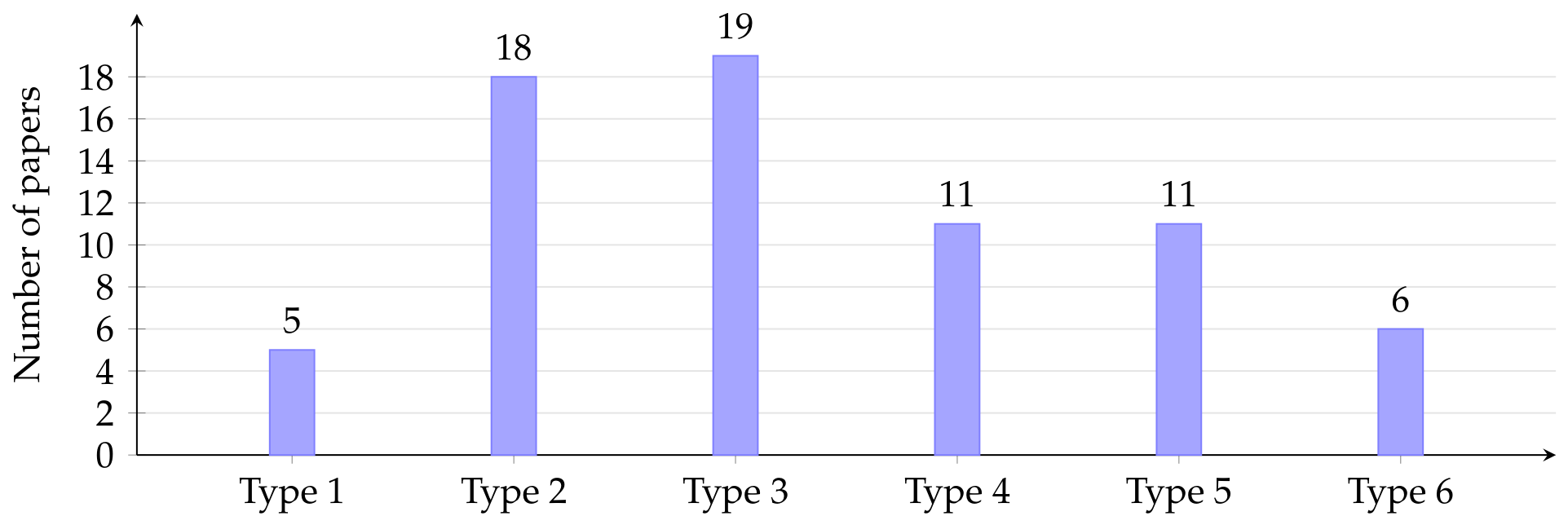
The distribution of papers across Kautz types is uneven, as shown in Figure 9. Types 2 and 3 together account for roughly half of the surveyed systems, while Types 1 and 6 are the least represented. The concentration in Types 2 and 3 reflects the practical appeal of architectures where the symbolic and computational learning components maintain distinct roles with clear interfaces. In Type 2, the symbolic component controls the reasoning process and delegates perceptual subtasks to the computational learning model, a pattern that maps naturally onto many real-world applications where domain knowledge is well-established and the challenge lies in processing raw data. In Type 3, both components cooperate as equal partners, which suits tasks requiring both perception and reasoning over structured representations. The relatively high count for Types 4 and 5 indicates active research into compiling symbolic knowledge into the learning process (Type 4) or directly into the architecture (Type 5). These approaches reflect a growing interest in embedding domain knowledge more deeply into computational learning models, moving beyond the loose coupling of Types 1 and 2. The sparsity of Type 1 is consistent with the observation made in Section 4 that Type 1 represents standard computational learning practice with symbolic input and output formatting rather than genuine NeSy integration. Several papers classified as Type 1 in our table employ only minimal symbolic processing, such as post-hoc cluster labeling [100] or sequential neural-to-symbolic pipelines [99], reinforcing the view that Type 1 sits at the boundary of what constitutes meaningful NeSy integration. The scarcity of Type 6 papers confirms that fully internalizing symbolic reasoning within a computational learning model remains the most challenging and least realized form of NeSy integration. Of the five Type 6 papers in our table, only three present fully implemented systems: Logical Neural Networks [87], the LNN-based diagnosis prediction system [137], and the fully LLM-based SymbCoT [90]. The other two [88,89] are probing studies that test whether existing computational learning models can internalize logical reasoning, rather than systems designed to achieve it. Notably, SymbCoT internalizes symbolic reasoning behaviorally, through the model’s prompted computation, rather than architecturally as in Logical Neural Networks, and therefore offers no formal consistency guarantees; the contrast between these two routes to internalization is discussed in Section 4. This gap between the Type 6 vision and its practical realization highlights the open challenges identified by Kautz [28] and discussed in Section 4. Recent conceptual work [98] advocates for tightly integrated cognitive NeSy architectures, but concrete implementations remain scarce.

7.2. D1: Mode of Integration

The Mode of Integration axis reveals a clear progression across Kautz types, summarized in Figure 10. Type 1 and Type 2 systems are exclusively loosely coupled, with the symbolic and computational learning components operating as separate modules connected through well-defined interfaces. Type 4 systems are compiled, where symbolic knowledge enters the training process but is absent at inference. Type 5 systems are tightly coupled, with symbolic structure permanently embedded in the architecture. Type 6 systems are fully integrated, with symbolic reasoning internalized as the model’s own computation. Type 3 presents the most varied coupling patterns, with systems ranging from loose coupling [119,120,121,122,123], [79,80] to tight coupling [76,77,78,113,114,115,116,117,118]. This variation reflects the flexibility of the cooperative Type 3 pattern: depending on the application, the components can interact through simple sequential interfaces or through deeply interleaved joint optimization. The loosely coupled Type 3 systems tend to follow a pipeline pattern where the neural component produces structured outputs consumed by a symbolic reasoner, while the tightly coupled ones feature joint training, shared loss functions, or bidirectional feedback loops between the components. This progression from loose to fully integrated coupling across the type spectrum aligns with the theoretical expectation that deeper integration requires more sophisticated engineering but offers stronger guarantees of logical consistency, interpretability, and robustness. However, it also introduces greater inflexibility and development complexity, as discussed in the strengths and limitations analysis of each type in Section 4.

7.3. D2: Symbolic Priors for Learning

Dimension 2 is the most widely addressed foundational dimension in the surveyed corpus. Across all six types, the majority of systems employ some form of symbolic prior to guide the learning process. This includes ontologies and knowledge graphs that constrain feature spaces [103,104,107], logical rules encoded in loss functions [56,57,127,129], domain knowledge compiled into training data [81,128,131], expert-designed architectural templates [58,133,136], and formal logical structures embedded in the model’s computation [87,137]. The prevalence of D2 across all types indicates that using symbolic knowledge to improve learning is the most established and widely adopted form of NeSy integration. This is consistent with van Harmelen’s observation [25] that the question of whether symbolic priors can improve sample efficiency, interpretability, and generalization has received the most attention in the field. The D2-positive systems can be differentiated by the form the prior takes. We distinguish formal priors, in which logic rules, axioms, grammars, or formal constraints directly shape the objective, the architecture, or the training process (as in semantic loss functions [56,127], Logic Tensor Network axioms [85,91], or rule-compiled architectures [58,133]); structured knowledge, in which ontologies, knowledge graphs, or taxonomies guide learning without themselves being formal constraints on the objective [104,107,130]; and knowledge-informed feature engineering, in which domain knowledge enters indirectly through engineered features, preprocessing, or knowledge-derived training data [80,128,131,134]. Assigning each D2-positive system to its primary route yields 29 systems with formal priors, 11 with structured knowledge, and 8 with knowledge-informed feature engineering. The clear dominance of formal priors indicates that symbolic knowledge in the surveyed corpus predominantly enters learning as an explicit, formally represented constraint rather than as informal domain guidance, reinforcing the reading of D2 as the most established of the four dimensions in the surveyed corpus. The only type where D2 is notably sparse is Type 1, where only one paper [102] employs a symbolic prior (a clinical taxonomy constraining the feature space). This further supports the characterization of Type 1 as minimal NeSy integration, where symbolic components serve formatting rather than knowledge-guiding purposes.

7.4. D3: Symbolic Constraints for Safety and Bias

Dimension 3 is the most sparsely populated dimension in our analysis, with only a small number of papers across Types 2, 3, and 5 explicitly employing symbolic constraints for safety or bias prevention. This represents a significant gap in the surveyed corpus. In Type 2, Sharifi et al. [64] encode traffic laws as first-order logic rules that the autonomous driving system must not violate, Kalutharage et al. [104] use a cybersecurity knowledge graph to validate whether detected anomalies constitute legitimate attacks, and Anderson et al. [106] employ knowledge-guided reinforcement learning with explicit security constraints. In Type 3, only Badhan et al. [113] incorporate symbolic rules that explicitly enforce security constraints for intrusion detection through weighted fusion with the neural component, and the two most recent Type 3 systems bring policy enforcement to language models: Automated Reasoning checks verifies LLM outputs against policy models autoformalized from natural-language documents [124], and VERAFI compiles accounting and regulatory requirements into formal specifications that constrain agentic generation [125], though as in-context guidance rather than a hard post-hoc check. In Type 5, Grov et al. [85] encode cybersecurity axioms through Logic Tensor Networks, Wagner and d’Avila Garcez [62] embed fairness constraints through LTN to prevent gender-based bias in credit decisions, Theodoropoulos et al. [91] ensure alignment with medical knowledge through human-in-the-loop LTN integration, and Li et al. [133] construct a fully interpretable fault diagnosis system for safety-critical industrial assets. In Type 4, only Xie et al. [83] address safety through neuro-symbolic verification, compiling symbolic correctness guarantees into the training process. These eleven systems can be further differentiated by the kind of constraint they enforce. Four enforce domain consistency, validating the learning component’s behavior against a body of formal domain knowledge [85,91,104,133]. Two provide formal verification, proving properties of the learned component or its exploration [83,106]. Two enforce safety constraints at decision time, encoding rules the system must not violate [64,113], with the rules of Sharifi et al. deriving from traffic regulations. Two enforce policy or regulatory-compliance constraints on language-model outputs, both from 2025–2026 [124,125], populating a subcategory empty in the corpus through 2024. Only one system, that of Wagner and d’Avila Garcez [62], enforces a fairness or anti-bias constraint. The distribution within Dimension 3 thus inverts the motivational emphasis of the literature discussed above: what exists is mostly domain-consistency checking and verification, while fairness and bias prevention, the motivations most often invoked, are represented by a single system. Notably, Types 1 and 6 contain no D3 papers at all. The absence of D3 in Type 1 is unsurprising given its minimal integration. However, the absence in Type 6 is more significant: if fully integrated NeSy systems are to be deployed in safety-critical applications, mechanisms for enforcing symbolic safety constraints within the model’s own computation will be essential. This remains an open challenge. The overall scarcity of D3 is striking given that safety, fairness, and bias prevention are among the most frequently cited motivations for NeSy AI in the literature. Many papers discuss interpretability and explainability as indirect contributions to trustworthiness, but few explicitly encode safety or fairness constraints as symbolic rules that the system must satisfy. This disconnect between the stated motivation for NeSy research and the actual mechanisms implemented represents one of the most important findings of our analysis, directly addressing the third foundational question raised by van Harmelen [25]. In the LLM-based cohort the pattern begins to shift: none of the 2023–2024 systems employs symbolic constraints for safety or bias prevention, but the two 2025–2026 policy-enforcement systems noted above do, suggesting that constraint enforcement is emerging as a role for symbolic components in the LLM era. Fairness and bias prevention nevertheless remain represented by a single system in the corpus.
As with abductive reasoning, we verified this finding against the full title/abstract-relevant pool of the documented search rather than only the corpus. A scan for safety-, fairness-, bias-, and verification-related terms matched 83 of the 2064 records (4%); inspection of titles and abstracts shows that in most of these, safety is the application domain, for instance knowledge graphs about industrial or aviation safety, rather than a symbolically enforced constraint on a learning system in the sense of Dimension 3. A small but clearly emerging cluster of very recent work, concentrated in 2025–2026, does target enforced constraints, including neurosymbolic guardrails for language models, fairness modeling and bias mitigation, and formally verified planning and exploration. This trend suggests the community is beginning to respond to precisely the gap identified here, but enforced-constraint systems remain a small minority of the retrieved records.

7.5. D4: Symbolic Knowledge from Learning

Dimension 4 examines whether learning can produce formal symbolic knowledge, addressing the reverse direction of the knowledge–learning interaction. Our analysis reveals that D4 is present across all six types, but unevenly so: it is nearly absent in Type 4 and remains relatively sparse overall compared to D2. In Type 1, only one paper [101] addresses D4, though as discussed in Section 6, the boundary between genuine symbolic knowledge production and standard interpretable ML outputs requires careful consideration. In Type 2, Custode et al. [109] use grammatical evolution to discover interpretable decision tree rules for patient stratification, and Ahmed et al. [111] learn belief rule parameters through optimization of a belief rule-based expert system. SPIRES [75] adds an LLM-era instance: a frozen language model, interrogated under a schema-driven procedure, populates knowledge bases with instances grounded to formal ontology identifiers and optionally translated into OWL axioms over which description logic reasoning can check consistency; notably, it produces symbolic knowledge without consuming any symbolic prior for learning (D4 without D2), since the model itself is never trained. In Type 3, D4 is more prevalent, with systems learning probabilistic logic programs [118], symbolic aggregation rules [123], logical rules through answer set programming [120], and knowledge graph rule weights [114]. AlphaGeometry [80] contributes a further variant: the formal knowledge it emits, machine-checkable geometry proofs and, in one case, a generalization of a translated IMO theorem, is derived by the symbolic engine, while the learned component supplies the auxiliary constructions that make those derivations reachable, so that learning enables the production of symbolic knowledge without itself emitting it. Type 5 systems produce interpretable logic programs [84], learned temporal logic formulas [136], and fully transparent diagnostic pipelines [133]. In Type 6, the LNN-based diagnosis system [137] learns quantified logical rules with thresholds and operator weights from data. The near-absence of D4 in Type 4 is structurally significant. Type 4 compiles symbolic knowledge into the training process, and the resulting model operates as a standard computational learning system. By design, the symbolic knowledge is dissolved into the model’s parameters and is no longer explicitly accessible. Only Huang et al. [61] achieve D4 in Type 4, by discovering mathematical expressions (a form of symbolic knowledge) through learning guided by symbolic priors. This suggests that Type 4’s compiled approach, while practical for deployment, inherently limits the system’s ability to produce new symbolic knowledge, a trade-off that should be considered when selecting an integration architecture. The strongest D4 results appear in Types 3 and 5, where the symbolic component maintains an active presence during both training and inference. This enables the system to not only consume symbolic knowledge but also refine, extend, or produce it through the learning process. This pattern suggests that maintaining an explicit symbolic component may be important for achieving bidirectional knowledge–learning interaction, one of the key aspirations of NeSy AI identified in our foundational dimensions [26], although we note that this observation rests on a small number of systems within our corpus and should be read as a hypothesis for further investigation rather than an established finding.

7.6. Reasoning Approaches

As Figure 11 shows, deductive reasoning dominates the surveyed literature, appearing in every type and in the vast majority of papers. This reflects the field’s emphasis on encoding predefined symbolic knowledge (D2) and applying it through formal inference. The dominance is reinforced by the most recent systems: the LLM-based papers in the corpus are all classified as deductive-only, since in each the task-level inference is carried out by, or modeled on, formal rule application, whether by an external solver or by the language model itself. Inductive reasoning, though less prevalent, appears across all types and is most frequent in Type 3 and Type 4, where the learning component plays a larger role: in Type 3 it arises when systems learn symbolic rules from data [118,120,123] or learn from experience alongside symbolic reasoning [114,115], and in Type 4 when the model learns patterns from symbolically augmented data [61,81,82]. The most striking finding is the near-complete absence of abductive reasoning through 2024. In the corpus, only MARS [114] employs it before 2025, inferring the most likely mechanistic explanation for an observed drug–biological process relationship. The only other task-level abductive systems are the two most recent corpus members, Graph of States, which infers the most plausible root-cause hypothesis over an explicit causal graph [126], and the argument-reconstruction pipeline of Feng and Hunter, which abduces the implicit premise that explains a known inferential relation [112]. This is a significant gap: abductive reasoning, the inference to the best explanation, is a fundamental form of human reasoning and is central to medical diagnosis, scientific discovery, and root cause analysis. The formal explainability work of Marques-Silva and Ignatiev [93], excluded from the table as a methodological contribution rather than a NeSy system, shows that formal abductive explanations can be computed for neural network classifiers, suggesting the machinery exists but has not been widely adopted in NeSy design. Under the three-role distinction of Section 5.2, the corpus contains three task-level abductive systems (MARS, Graph of States, and Feng and Hunter), two of them from 2026; no system employing abduction as an internal training mechanism; and no system generating its explanations abductively. One further system, NeSTR, uses abductive hypothesis generation as an inference-time self-correction step while its task-level output remains deductive question answering [138], an inference-time analogue of the internal-mechanism role that our criteria likewise do not count as task-level abduction. To verify that this absence is a property of the field rather than an artifact of corpus composition, we scanned all 5104 unique records of the documented search (Section 6) for abduction-related terms. Only 22 records (0.4%) mention abduction at all, and on inspection of titles and abstracts they divide along the same three roles: several belong to the abductive-learning tradition, employing abduction as an internal training signal, while the remainder are candidate task-level abductive systems, largely concentrated in 2024–2026, two of which entered the corpus. The near-absence of task-level abductive reasoning through 2024 thus holds at the level of the retrieved field, not merely within our corpus, and the recency of the emerging cluster, reflected in the corpus by the two 2026 abductive systems, suggests that this gap is only now beginning to attract attention.

7.7. LLM-Based Systems as a Test of the Framework

The corpus’s most recent systems (2023–2026), in which the computational learning component is a large language model, serve as an out-of-sample test of the analytical framework, and their classification both exercises its distinctions and reinforces its findings. Architecturally, they concentrate exactly where the rest of the corpus does: five are Type 2 systems in which a frozen language model performs a delegated translation or extraction subtask while a symbolic engine carries out the inference (LINC [72], SatLM [73], LLM+P [74], SPIRES [75], and the argument-reconstruction pipeline of Feng and Hunter [112]), five are Type 3 systems built around an iterative neural–symbolic loop (Logic-LM [79], AlphaGeometry [80], Automated Reasoning checks [124], VERAFI [125], and Graph of States [126]), and two, SymbCoT [90] and NeSTR [138], pursue the Type 6 ambition of internalizing the reasoning in the model itself. All but SymbCoT and NeSTR are loosely coupled, indicating that the LLM era is, so far, integrating language models through clear module interfaces rather than deep architectural fusion. The agentic systems among them (VERAFI and Graph of States) also exercise the taxonomy in a new way: where Type 2 places a neural subroutine under symbolic control, agentic tool-use inverts the delegation, with the language model invoking symbolic tools inside an iterative loop, which is why these systems land in Type 3 rather than Type 2.
The taxonomy’s discriminative power shows in near-identical systems landing in different types for a precise reason: LINC and Logic-LM share the translate-then-solve architecture, but Logic-LM’s self-refinement module feeds the solver’s error messages back to the language model, creating the bidirectional feedback that characterizes Type 3, whereas LINC discards failed parses without revision and remains Type 2.
Two patterns in these systems bear on the foundational dimensions. First, most of the LLM-based systems use no symbolic prior for learning in the sense of Dimension 2, because no learning occurs: the language model is frozen, and symbolic knowledge enters at inference time, through grammars, schemas, and formal domain files supplied in prompts or interfaces. This inference-time route for symbolic knowledge sits outside the training-time notion of a prior that Dimension 2 formalizes, and suggests a refinement of that dimension for the LLM era. The exception is AlphaGeometry [80], whose language model is trained from scratch on one hundred million synthetic proofs generated by the symbolic engine itself, the training-data route to D2. Second, the reverse direction (D4) appears in two distinct forms: SPIRES populates ontologies and knowledge bases directly from a frozen model, yielding D4 without D2, while AlphaGeometry emits machine-checkable proofs through its symbolic engine, with learning enabling rather than performing the knowledge production.
Finally, the cohort splits chronologically along the gaps identified by our analysis. The 2023–2024 systems reproduce them exactly: none employs symbolic constraints for safety or bias (D3), and all are deductive-only. The 2025–2026 systems, by contrast, cluster precisely in those gaps: Graph of States and the pipeline of Feng and Hunter bring task-level abduction into the LLM era, and Automated Reasoning checks and VERAFI enforce policy and regulatory constraints on language-model outputs, populating a D3 subcategory that was empty through 2024. That the newest wave concentrates exactly where the framework locates the field’s gaps suggests that the analysis identifies pressure points the community is now beginning to address.

7.8. Cross-Dimensional Patterns

Examining the interactions across dimensions reveals several notable patterns. First, D2 and D1 are closely correlated. The form of symbolic prior (D2) is largely determined by the mode of integration (D1): loosely coupled systems tend to use knowledge bases and rule sets as external guides; compiled systems encode priors in loss functions or training data; tightly coupled systems embed priors in architectural templates; and fully integrated systems define priors as the network’s computational structure. This suggests that the choice of integration architecture constrains the types of symbolic priors that can be effectively employed. Second, D3 and D4 are rarely co-present. Only Li et al. [133] simultaneously address both safety constraints (D3) and knowledge production (D4), suggesting that designing systems that both enforce safety and produce new symbolic knowledge remains an open challenge. Most systems either consume symbolic knowledge for safety (D3 without D4) or produce symbolic knowledge from learning (D4 without D3), but rarely both. Third, the reasoning approach is correlated with the direction of knowledge flow. Systems where symbolic knowledge flows into the computational learning model (D2, D3) predominantly employ deductive reasoning, applying predefined rules. Systems where learning produces symbolic knowledge (D4) more frequently combine deductive with inductive reasoning, as the discovery of new rules requires learning from data. The first instance of abductive reasoning in the corpus [114] occurs in a system that addresses both D2 and D4, and the two 2026 abductive systems [112,126] likewise couple explicit symbolic structures to the reasoning loop. This is consistent with the idea that abductive reasoning may emerge in systems designed for rich knowledge–learning interaction, but three instances cannot support a general conclusion, and we present this only as a tentative hypothesis for future investigation. Fourth, several papers reveal that the boundaries between Kautz types are not always sharp. Badhan et al. [113] combine weighted neural-symbolic fusion (Type 3) with knowledge distillation for edge deployment (Type 4 characteristics). The use of Logic Tensor Networks across multiple papers [62,85,91] raises questions about whether LTN-based systems are Type 4 (symbolic knowledge in the loss function) or Type 5 (symbolic structure permanently embedded in the architecture), as LTN maintains a persistent grounding of logical concepts to tensor operations that blurs this distinction. These boundary cases suggest that Kautz’s taxonomy, while useful as an organizational framework, may benefit from refinement to accommodate systems that exhibit characteristics of multiple types.

7.9. Identified Gaps and Future Directions

The above analysis reveals several gaps in the surveyed corpus, summarized in Table 4. Together they define concrete research directions for the NeSy community. We note that these gaps are identified within, and scoped to, the corpus of 70 systems analyzed here; the extent to which they generalize to the NeSy literature as a whole is bounded by the selection process described in Section 6.

8. Conclusions

This paper has presented a multi-axis analytical framework for evaluating NeSy AI systems, combining the taxonomy proposed by Kautz [28] with four foundational dimensions derived from the open questions raised by van Harmelen [25], and a systematic reasoning categorization (deductive, inductive, abductive). The framework was designed not merely to organize the literature but to ask whether the field confronts the foundational questions of knowledge–learning integration and to surface, through that lens, where it remains underdeveloped. Applying it to 70 NeSy papers revealed both the breadth of current research and significant gaps that merit attention from the community. Our findings can also be read against a broader claim made by Belle and Marcus [139]: that neurosymbolic AI represents not merely one of several viable paths forward, but “perhaps the only” approach capable of addressing the fundamental limitations of purely neural or purely symbolic systems. They argue that despite the rapid progress of large-scale neural models, the “scaling is all you need” hypothesis is insufficient, and that combining pattern recognition with explicit symbolic reasoning remains essential for AI systems that are structured, explainable, and trustworthy. This is a strong claim, and a contested one; our analysis does not settle it, but it provides an empirical lens through which it can be examined. By mapping where the NeSy community has concentrated its efforts and where it has not, the framework presented here helps identify whether the field is positioned to deliver on the promises associated with it. The analysis confirms that NeSy AI is a vibrant and expanding field, with active research across all six Kautz types. The most recent, LLM-based cohort in the corpus largely reproduces the patterns established across the rest of the corpus, concentrating in loosely coupled Type 2 and Type 3 architectures and reasoning deductively, while its newest, 2025–2026 members begin to populate precisely the gaps our analysis identifies. Symbolic priors for learning (Dimension 2) are widely adopted across the surveyed systems, reflecting a mature understanding that domain knowledge can improve sample efficiency, interpretability, and generalization [34,59]. Types 2 and 3 are the most populated categories in our corpus, indicating that architectures maintaining distinct symbolic and computational learning components with clear interfaces are, at least among the systems surveyed here, the most frequently implemented forms of NeSy integration. However, the analysis also exposed a pronounced imbalance across the foundational dimensions. The most significant gap identified by our analysis concerns Dimension 3: symbolic constraints for safety and bias. Despite safety, fairness, and trustworthiness being among the most frequently cited motivations for NeSy research, only a small number of the surveyed systems explicitly encode symbolic safety or fairness constraints. This disconnect between stated motivation and actual implementation is concerning, particularly for the applications where NeSy approaches are held to be most needed: those requiring structured knowledge, explainability, and trustworthiness. If NeSy AI is to deliver on these promises, the community must move beyond using symbolic knowledge merely to improve performance and begin systematically deploying it to enforce safety and fairness guarantees. The near-complete absence of abductive reasoning represents another critical gap: only three of the 70 systems perform task-level abduction, and two of those only very recently, despite the importance of abduction for explanation, diagnosis, and scientific discovery. Tsamoura et al. [92] have demonstrated that abduction can serve as the core mechanism for neural-symbolic integration, using symbolic abductive feedback to guide neural module training without requiring differentiable theories. Yet our analysis shows that this approach has not been widely adopted in NeSy system design, suggesting a significant gap between the theoretical foundations available for abductive NeSy reasoning and their practical implementation. The scarcity of Type 6 systems confirms that fully internalizing symbolic reasoning within computational learning models remains the most challenging frontier. The ability of models trained primarily on data to reason about mathematical and symbolic truths remains brittle and unreliable [55,139], suggesting that a logical component distinct from the computational learning machinery may be unavoidable. Our findings support this assessment: the two probing studies in our Type 6 category [88,89] reveal significant limitations in current architectures’ ability to internalize formal reasoning, while the architecturally grounded implemented Type 6 systems [87,137] remain limited in scale compared to standard computational learning architectures; the recent, fully LLM-based route to internalization exemplified by SymbCoT [90] offers scale and flexibility, but at the cost of the formal consistency guarantees that architectural approaches provide. The cross-dimensional analysis revealed that bidirectional knowledge–learning interaction—where a system both consumes symbolic knowledge (Dimensions 2 and 3) and produces new symbolic knowledge (Dimension 4)—is rare within our corpus, indicating that the field has not yet achieved one of the fundamental aims raised by van Harmelen [25]. Our Dimension 4 findings show that while some systems achieve this reverse direction, particularly in Types 3 and 5, it remains the exception rather than the norm. Finally, the analysis revealed that the boundaries between Kautz types are not always sharp in practice, with systems such as Logic Tensor Networks [62,85,91] exhibiting characteristics of both Type 4 and Type 5. This suggests that while Kautz’s taxonomy provides an effective organizational framework, future work may benefit from a more continuous characterization of integration depth rather than discrete categories. The present survey has limitations. The corpus is a purposive selection from a documented pool of 2064 title/abstract-relevant records (Section 6): the search and screening process is fully reproducible, but the composition of the corpus reflects deliberate coverage choices rather than exhaustive inclusion, and the keyword-based searches may not capture all relevant work, particularly systems that implement neurosymbolic principles without using NeSy-related terminology. The classification along the four dimensions and reasoning types involves interpretive judgment, and reasonable researchers may disagree on specific assignments, as illustrated by the boundary cases discussed in Section 7. The scope was limited to English-language publications from 2017 to 2026. Accordingly, the frequency-based observations reported in this section describe our corpus of 70 systems and should not be read as precise estimates for the NeSy literature as a whole. Despite these limitations, the multi-axis framework introduced here provides a structured methodology for identifying where the NeSy field stands and where it needs to go. The gaps identified, particularly the underexploration of safety constraints, the absence of abductive reasoning, and the immaturity of fully integrated architectures, define concrete research directions. As Belle and Marcus [139] conclude, determining the optimal balance between neural and symbolic components, and understanding the formal requirements for their integration, remains a valuable starting point towards AI systems that are more capable, more reliable, more interpretable, and more alignable. The framework presented in this paper offers one step towards that understanding.

Generative AI Disclosure

During the preparation of this manuscript, the author(s) used AI tools for the purposes of language editing and improving readability. After using this tool/service, the authors reviewed and edited the content as needed and take full responsibility for the content of the published article.

Supplementary Materials

The following supporting information can be downloaded at https://www.mdpi.com/article/10.3390/make8090281/s1.

Author Contributions

Conceptualization, S.Z., K.G., T.P. and Y.K.; methodology, S.Z. and Y.K.; investigation, S.Z., K.G. and T.P.; writing—original draft preparation, S.Z.; writing—review and editing, K.G., T.P. and Y.K.; supervision, Y.K. All authors have read and agreed to the published version of the manuscript.

Funding

This research received no external funding.

Institutional Review Board Statement

Not applicable.

Informed Consent Statement

Not applicable.

Data Availability Statement

No new data were created. The classification data analyzed in this study are derived from the cited publications listed in the References section.

Acknowledgments

The research is conducted in the operating framework of the University of Thessaly Innovation, Technology Transfer Unit and Entrepreneurship Center “One Planet Thessaly”, under the “University of Thessaly Grants for Scientific Publication Support” action and is funded by the Special Account of Research Grants of the University of Thessaly.

Conflicts of Interest

The authors declare no conflicts of interest.

Abbreviations

The following abbreviations are used in this manuscript:
AIArtificial Intelligence
NeSyNeurosymbolic
CLTComputational Learning Theory
LLMLarge Language Model
NLPNatural Language Processing
DLDeep Learning
RLReinforcement Learning
XAIExplainable Artificial Intelligence
KBANNKnowledge-Based Artificial Neural Networks
LTNLogic Tensor Network
LNNLogical Neural Network
SKESymbolic Knowledge Extraction
SKISymbolic Knowledge Injection
SHAPSHapley Additive exPlanations
LIMELocal Interpretable Model-agnostic Explanations
PRISMAPreferred Reporting Items for Systematic Reviews and Meta-Analyses

References

  1. Russell, S.J.; Norvig, P. Artificial Intelligence: A Modern Approach, 4th ed.; Pearson: Boston, MA, USA, 2021. [Google Scholar]
  2. Platzer, A. Intersymbolic AI. In Proceedings of the Leveraging Applications of Formal Methods, Verification and Validation; Software Engineering Methodologies; Margaria, T., Steffen, B., Eds.; Springer: Cham, Switzerland, 2025; pp. 162–180. [Google Scholar]
  3. Shalev-Shwartz, S.; Ben-David, S. Understanding Machine Learning: From Theory to Algorithms; Cambridge University Press: Cambridge, UK, 2014. [Google Scholar]
  4. Wilson, A.G.; Izmailov, P. Bayesian Deep Learning and a Probabilistic Perspective of Generalization. In Proceedings of the Advances in Neural Information Processing Systems; Larochelle, H., Ranzato, M., Hadsell, R., Balcan, M., Lin, H., Eds.; Curran Associates, Inc.: Red Hook, NY, USA, 2020; Volume 33, pp. 4697–4708. [Google Scholar]
  5. LeCun, Y.; Bengio, Y.; Hinton, G. Deep learning. Nature 2015, 521, 436–444. [Google Scholar] [CrossRef] [Scilit] [PubMed]
  6. Vaswani, A.; Shazeer, N.; Parmar, N.; Uszkoreit, J.; Jones, L.; Gomez, A.N.; Kaiser, L.U.; Polosukhin, I. Attention is All you Need. In Proceedings of the Advances in Neural Information Processing Systems; Guyon, I., Luxburg, U.V., Bengio, S., Wallach, H., Fergus, R., Vishwanathan, S., Garnett, R., Eds.; Curran Associates, Inc.: Red Hook, NY, USA, 2017; Volume 30. [Google Scholar]
  7. Duede, E.; Dolan, W.; Bauer, A.; Foster, I.; Lakhani, K. Oil& Water? Diffusion of AI Within and Across Scientific Fields. arXiv 2024, arXiv:2405.15828. [Google Scholar]
  8. Voulodimos, A.; Doulamis, N.; Doulamis, A.; Protopapadakis, E. Deep Learning for Computer Vision: A Brief Review. Comput. Intell. Neurosci. 2018, 2018, 7068349. [Google Scholar] [CrossRef] [Scilit] [PubMed]
  9. Guo, M.H.; Xu, T.X.; Liu, J.J.; Liu, Z.N.; Jiang, P.T.; Mu, T.J.; Zhang, S.H.; Martin, R.R.; Cheng, M.M.; Hu, S.M. Attention mechanisms in computer vision: A survey. Comput. Vis. Media 2022, 8, 331–368. [Google Scholar] [CrossRef] [Scilit]
  10. Madanian, S.; Chen, T.; Adeleye, O.; Templeton, J.M.; Poellabauer, C.; Parry, D.; Schneider, S.L. Speech emotion recognition using machine learning—A systematic review. Intell. Syst. Appl. 2023, 20, 200266. [Google Scholar] [CrossRef] [Scilit]
  11. Ouyang, L.; Wu, J.; Jiang, X.; Almeida, D.; Wainwright, C.L.; Mishkin, P.; Zhang, C.; Agarwal, S.; Slama, K.; Ray, A.; et al. Training language models to follow instructions with human feedback. In Proceedings of the NIPS ’22: Proceedings of the 36th International Conference on Neural Information Processing Systems, Red Hook, NY, USA, 28 November–9 December 2022. [Google Scholar]
  12. Dargan, S.; Kumar, M.; Ayyagari, M.R.; Kumar, G. A Survey of Deep Learning and Its Applications: A New Paradigm to Machine Learning. Arch. Comput. Methods Eng. 2020, 27, 1071–1092. [Google Scholar] [CrossRef] [Scilit]
  13. Vamathevan, J.; Clark, D.; Czodrowski, P.; Dunham, I.; Ferran, E.; Lee, G.; Li, B.; Madabhushi, A.; Shah, P.; Spitzer, M.; et al. Applications of machine learning in drug discovery and development. Nat. Rev. Drug Discov. 2019, 18, 463–477. [Google Scholar] [CrossRef] [Scilit] [PubMed]
  14. Schmidt, J.; Marques, M.R.G.; Botti, S.; Marques, M.A.L. Recent advances and applications of machine learning in solid-state materials science. npj Comput. Mater. 2019, 5, 83. [Google Scholar] [CrossRef] [Scilit]
  15. Kourou, K.; Exarchos, T.P.; Exarchos, K.P.; Karamouzis, M.V.; Fotiadis, D.I. Machine learning applications in cancer prognosis and prediction. Comput. Struct. Biotechnol. J. 2015, 13, 8–17. [Google Scholar] [CrossRef] [Scilit] [PubMed]
  16. Nyrup, R. The Limits of Value Transparency in Machine Learning. Philos. Sci. 2022, 89, 1054–1064. [Google Scholar] [CrossRef] [Scilit]
  17. Rudin, C. Stop explaining black box machine learning models for high stakes decisions and use interpretable models instead. Nat. Mach. Intell. 2019, 1, 206–215. [Google Scholar] [CrossRef] [Scilit] [PubMed]
  18. Colin, J.; FEL, T.; Cadene, R.; Serre, T. What I Cannot Predict, I Do Not Understand: A Human-Centered Evaluation Framework for Explainability Methods. In Proceedings of the Advances in Neural Information Processing Systems; Koyejo, S., Mohamed, S., Agarwal, A., Belgrave, D., Cho, K., Oh, A., Eds.; Curran Associates, Inc.: Red Hook, NY, USA, 2022; Volume 35, pp. 2832–2845. [Google Scholar]
  19. Ning, Y.; Teixayavong, S.; Shang, Y.; Savulescu, J.; Nagaraj, V.; Miao, D.; Mertens, M.; Ting, D.S.W.; Ong, J.C.L.; Liu, M.; et al. Generative artificial intelligence and ethical considerations in health care: A scoping review and ethics checklist. Lancet Digit. Health 2024, 6, e848–e856. [Google Scholar] [CrossRef] [Scilit] [PubMed]
  20. Khan, A.A.; Akbar, M.A.; Fahmideh, M.; Liang, P.; Waseem, M.; Ahmad, A.; Niazi, M.; Abrahamsson, P. AI Ethics: An Empirical Study on the Views of Practitioners and Lawmakers. IEEE Trans. Comput. Soc. Syst. 2023, 10, 2971–2984. [Google Scholar] [CrossRef] [Scilit]
  21. Sotiropoulos, D.N.; Koronakos, G.; Solanakis, S.V. Evolving transparent credit risk models: A symbolic regression approach using genetic programming. Electronics 2024, 13, 4324. [Google Scholar] [CrossRef] [Scilit]
  22. Poole, D.; Mackworth, A.K.; Goebel, R. Computational Intelligence—A Logical Approach; Oxford University Press: Oxford, UK, 1998. [Google Scholar]
  23. Besold, T.R.; Bader, S.; Bowman, H.; Domingos, P.; Hitzler, P.; Kühnberger, K.U.; Lamb, L.C.; Lima, P.M.V.; de Penning, L.; Pinkas, G.; et al. Neural-symbolic learning and reasoning: A survey and interpretation 1. In Neuro-Symbolic Artificial Intelligence: The State of the Art; IOS Press: Amsterdam, The Netherlands, 2021; pp. 1–51. [Google Scholar]
  24. Garcez, A.d.; Lamb, L.C. Neurosymbolic ai: The 3 rd wave. Artif. Intell. Rev. 2023, 56, 12387–12406. [Google Scholar] [CrossRef] [Scilit]
  25. Harmelen, F. Preface: The 3rd AI wave is coming, and it needs a theory. In Neuro-Symbolic Artificial Intelligence: The State of the Art; IOS Press BV: Amsterdam, The Netherlands, 2022; pp. V–VII. [Google Scholar]
  26. Hitzler, P.; Sarker, M.K. Neuro-Symbolic Artificial Intelligence: The State of the Art; IOS Press/Sage Publishing: Amsterdam, The Netherlands, 2022. [Google Scholar]
  27. Ciatto, G.; Sabbatini, F.; Agiollo, A.; Magnini, M.; Omicini, A. Symbolic Knowledge Extraction and Injection with Sub-symbolic Predictors: A Systematic Literature Review. ACM Comput. Surv. 2024, 56, 161:1–161:35. [Google Scholar] [CrossRef] [Scilit]
  28. Kautz, H. The third ai summer: Aaai robert s. engelmore memorial lecture. Ai Mag. 2022, 43, 105–125. [Google Scholar] [CrossRef] [Scilit]
  29. Wang, W.; Yang, Y.; Wu, F. Towards data-and knowledge-driven AI: A survey on neuro-symbolic computing. IEEE Trans. Pattern Anal. Mach. Intell. 2024, 47, 878–899. [Google Scholar] [CrossRef] [Scilit] [PubMed]
  30. Bader, S.; Hitzler, P. Dimensions of neural-symbolic integration—A structured survey. arXiv 2005, arXiv:cs/0511042. [Google Scholar] [CrossRef] [Scilit]
  31. Feldstein, J.; Dilkas, P.; Belle, V.; Tsamoura, E. Mapping the neuro-symbolic AI landscape by architectures: A handbook on augmenting deep learning through symbolic reasoning. arXiv 2024, arXiv:2410.22077. [Google Scholar]
  32. Bougzime, O.; Jabbar, S.; Cruz, C.; Demoly, F. Unlocking the Potential of Generative AI through Neuro-Symbolic Architectures: Benefits and Limitations. arXiv 2025, arXiv:2502.11269. [Google Scholar]
  33. van Bekkum, M.; de Boer, M.; van Harmelen, F.; Meyer-Vitali, A.; Teije, A.t. Modular design patterns for hybrid learning and reasoning systems: A taxonomy, patterns and use cases. Appl. Intell. 2021, 51, 6528–6546. [Google Scholar]
  34. Marra, G.; Dumančić, S.; Manhaeve, R.; De Raedt, L. From statistical relational to neurosymbolic artificial intelligence: A survey. Artif. Intell. 2024, 328, 104062. [Google Scholar] [CrossRef] [Scilit]
  35. Bhuyan, B.P.; Ramdane-Cherif, A.; Tomar, R.; Singh, T. Neuro-symbolic artificial intelligence: A survey. Neural Comput. Appl. 2024, 36, 12809–12844. [Google Scholar] [CrossRef] [Scilit]
  36. Nawaz, U.; Anees-ur Rahaman, M.; Saeed, Z. A review of neuro-symbolic AI integrating reasoning and learning for advanced cognitive systems. Intell. Syst. Appl. 2025, 26, 200541. [Google Scholar] [CrossRef] [Scilit]
  37. Jayasingha, P.; Iancu, B.; Lilius, J. Neurosymbolic Approaches in AI Design–An overview. In Proceedings of the 2025 IEEE Symposium on Trustworthy, Explainable and Responsible Computational Intelligence (CITREx Companion); IEEE: Minneapolis, MN, USA, 2025; pp. 1–5. [Google Scholar]
  38. Bouneffouf, D.; Aggarwal, C.C. Survey on applications of neurosymbolic artificial intelligence. arXiv 2022, arXiv:2209.12618. [Google Scholar]
  39. Zhang, X.; Sheng, V.S. Bridging the gap: Representation spaces in neuro-symbolic AI. arXiv 2024, arXiv:2411.04393. [Google Scholar]
  40. Colelough, B.C.; Regli, W. Neuro-symbolic AI in 2024: A systematic review. arXiv 2025, arXiv:2501.05435. [Google Scholar]
  41. Hamilton, K.; Nayak, A.; Božić, B.; Longo, L. Is neuro-symbolic AI meeting its promises in natural language processing? A structured review. Semant. Web 2024, 15, 1265–1306. [Google Scholar] [CrossRef] [Scilit]
  42. Keber, M.; Grubišić, I.; Barešić, A.; Jović, A. A review on neuro-symbolic AI improvements to natural language processing. In Proceedings of the 2024 47th MIPRO ICT and Electronics Convention (MIPRO); IEEE: Minneapolis, MN, USA, 2024; pp. 66–72. [Google Scholar]
  43. Khan, M.J.; Ilievski, F.; Breslin, J.G.; Curry, E. A survey of neurosymbolic visual reasoning with scene graphs and common sense knowledge. Neurosymbolic Artif. Intell. 2025, 1, NAI-240719. [Google Scholar] [CrossRef] [Scilit]
  44. Gomaa, A.; Mahdy, B.; Kleer, N.; Feld, M.; Kirchner, F.; Krüger, A. Teach me how to learn: A perspective review towards user-centered neuro-symbolic learning for robotic surgical systems. arXiv 2023, arXiv:2307.03853. [Google Scholar]
  45. Acharya, K.; Sharifi, I.; Lad, M.; Sun, L.; Song, H. Integrating Neurosymbolic AI in Advanced Air Mobility: A Comprehensive Survey. arXiv 2025, arXiv:2508.07163. [Google Scholar]
  46. Chen, W.; Ma, X.; Wang, Z.; Li, W.; Fan, C.; Zhang, J.; Que, X.; Li, C. Exploring neuro-symbolic AI applications in geoscience: Implications and future directions for mineral prediction. Earth Sci. Inform. 2024, 17, 1819–1835. [Google Scholar] [CrossRef] [Scilit]
  47. Hossain, D.; Chen, J.Y. A Study on Neuro-Symbolic Artificial Intelligence: Healthcare Perspectives. arXiv 2025, arXiv:2503.18213. [Google Scholar]
  48. Hakim, S.B.; Adil, M.; Velasquez, A.; Xu, S.; Song, H.H. Neuro-symbolic ai for cybersecurity: State of the art, challenges, and opportunities. arXiv 2025, arXiv:2509.06921. [Google Scholar]
  49. DeLong, L.N.; Mir, R.F.; Fleuriot, J.D. Neurosymbolic AI for reasoning over knowledge graphs: A survey. IEEE Trans. Neural Netw. Learn. Syst. 2024, 36, 7822–7842. [Google Scholar] [CrossRef] [Scilit] [PubMed]
  50. Wan, Z.; Liu, C.K.; Yang, H.; Li, C.; You, H.; Fu, Y.; Wan, C.; Krishna, T.; Lin, Y.; Raychowdhury, A. Towards cognitive ai systems: A survey and prospective on neuro-symbolic ai. arXiv 2024, arXiv:2401.01040. [Google Scholar]
  51. Acharya, K.; Raza, W.; Dourado, C.; Velasquez, A.; Song, H.H. Neurosymbolic reinforcement learning and planning: A survey. IEEE Trans. Artif. Intell. 2023, 5, 1939–1953. [Google Scholar] [CrossRef] [Scilit]
  52. Renkhoff, J.; Feng, K.; Meier-Doernberg, M.; Velasquez, A.; Song, H.H. A survey on verification and validation, testing and evaluations of neurosymbolic artificial intelligence. IEEE Trans. Artif. Intell. 2024, 5, 3765–3779. [Google Scholar] [CrossRef] [Scilit]
  53. Michel-Delétie, C.; Sarker, M.K. Neuro-symbolic methods for trustworthy AI: A systematic review. Neurosymbolic Artif. Intell. 2024. [Google Scholar] [CrossRef] [Scilit]
  54. Nassim, L.; Sèdes, F.; Bouarab-Dahmani, F. Toward compositional generalization with neuro-symbolic AI: A comprehensive overview. In Proceedings of the 2024 4th International Conference on Embedded & Distributed Systems (EDiS); IEEE: Minneapolis, MN, USA, 2024; pp. 207–212. [Google Scholar]
  55. Song, P.; Han, P.; Goodman, N. Large Language Model Reasoning Failures. arXiv 2026, arXiv:2602.06176. [Google Scholar]
  56. Xu, J.; Zhang, Z.; Friedman, T.; Liang, Y.; Broeck, G. A semantic loss function for deep learning with symbolic knowledge. In Proceedings of the International Conference on Machine Learning. PMLR, Stockholm, Sweden, 10–15 July 2018; pp. 5502–5511. [Google Scholar]
  57. Diligenti, M.; Gori, M.; Sacca, C. Semantic-based regularization for learning and inference. Artif. Intell. 2017, 244, 143–165. [Google Scholar] [CrossRef] [Scilit]
  58. Towell, G.G.; Shavlik, J.W. Knowledge-based artificial neural networks. Artif. Intell. 1994, 70, 119–165. [Google Scholar] [CrossRef] [Scilit]
  59. Veronese, C.; Meli, D.; Farinelli, A. Sample-Efficient Neurosymbolic Deep Reinforcement Learning. arXiv 2026, arXiv:2601.02850. [Google Scholar]
  60. Misino, E.; Marra, G.; Sansone, E. Vael: Bridging variational autoencoders and probabilistic logic programming. Adv. Neural Inf. Process. Syst. 2022, 35, 4667–4679. [Google Scholar] [CrossRef] [Scilit]
  61. Huang, S.; Wen, Y.B.; Adusumilli, T.; Choudhary, K.; Yang, H. Parsing the Language of Expression: Enhancing Symbolic Regression with Domain-Aware Symbolic Priors. arXiv 2025, arXiv:2503.09592. [Google Scholar]
  62. Wagner, B. Neural-symbolic integration for fairness in AI. In Proceedings of the CEUR Workshop Proceedings, Palo Alto, CA, USA, 22–24 March 2021; Volume 2846. [Google Scholar]
  63. Heilmann, X.; Manganini, C.; Cerrato, M.; Belle, V. A neurosymbolic approach to counterfactual fairness. In Proceedings of the 19th International Conference on Neurosymbolic Learning and Reasoning, Santa Cruz, CA, USA, 8–10 September 2025. [Google Scholar]
  64. Sharifi, I.; Yildirim, M.; Fallah, S. Towards safe autonomous driving policies using a neuro-symbolic deep reinforcement learning approach. arXiv 2023, arXiv:2307.01316. [Google Scholar]
  65. Kahneman, D. Thinking, Fast and Slow; Macmillan: New York, NY, USA, 2011. [Google Scholar]
  66. Huang, Z. Introducing Neuro-Symbolic Artificial Intelligence to Humanities and Social Sciences: Why Is It Possible and What Can Be Done? TEM J. 2022, 11, 1863–1870. [Google Scholar] [CrossRef] [Scilit]
  67. Kouris, P.; Alexandridis, G.; Stafylopatis, A. Abstractive text summarization: Enhancing sequence-to-sequence models using word sense disambiguation and semantic content generalization. Comput. Linguist. 2021, 47, 813–859. [Google Scholar] [CrossRef] [Scilit]
  68. Liu, Y.; Ott, M.; Goyal, N.; Du, J.; Joshi, M.; Chen, D.; Levy, O.; Lewis, M.; Zettlemoyer, L.; Stoyanov, V. Roberta: A robustly optimized bert pretraining approach. arXiv 2019, arXiv:1907.11692. [Google Scholar]
  69. Devlin, J.; Chang, M.W.; Lee, K.; Toutanova, K. Bert: Pre-training of deep bidirectional transformers for language understanding. In Proceedings of the 2019 Conference of the North American Chapter of the Association for Computational Linguistics: Human Language Technologies, Volume 1 (Long and Short Papers), Minneapolis, MN, USA, 2–7 June 2019; pp. 4171–4186. [Google Scholar]
  70. Silver, D.; Huang, A.; Maddison, C.J.; Guez, A.; Sifre, L.; Van Den Driessche, G.; Schrittwieser, J.; Antonoglou, I.; Panneershelvam, V.; Lanctot, M.; et al. Mastering the game of Go with deep neural networks and tree search. Nature 2016, 529, 484–489. [Google Scholar] [CrossRef] [Scilit] [PubMed]
  71. Qin, J.; Liang, X.; Hong, Y.; Tang, J.; Lin, L. Neural-symbolic solver for math word problems with auxiliary tasks. arXiv 2021, arXiv:2107.01431. [Google Scholar]
  72. Olausson, T.; Gu, A.; Lipkin, B.; Zhang, C.; Solar-Lezama, A.; Tenenbaum, J.; Levy, R. LINC: A neurosymbolic approach for logical reasoning by combining language models with first-order logic provers. In Proceedings of the 2023 Conference on Empirical Methods in Natural Language Processing, Singapore, 6–10 December 2023; pp. 5153–5176. [Google Scholar]
  73. Ye, X.; Chen, Q.; Dillig, I.; Durrett, G. Satlm: Satisfiability-aided language models using declarative prompting. Adv. Neural Inf. Process. Syst. 2023, 36, 45548–45580. [Google Scholar] [CrossRef] [Scilit]
  74. Liu, B.; Jiang, Y.; Zhang, X.; Liu, Q.; Zhang, S.; Biswas, J.; Stone, P. Llm+ p: Empowering large language models with optimal planning proficiency. arXiv 2023, arXiv:2304.11477. [Google Scholar]
  75. Caufield, J.H.; Hegde, H.; Emonet, V.; Harris, N.L.; Joachimiak, M.P.; Matentzoglu, N.; Kim, H.; Moxon, S.; Reese, J.T.; Haendel, M.A.; et al. Structured prompt interrogation and recursive extraction of semantics (SPIRES): A method for populating knowledge bases using zero-shot learning. Bioinformatics 2024, 40, btae104. [Google Scholar] [CrossRef] [Scilit] [PubMed]
  76. Chen, Z.; Sun, R.; Liu, W.; Hong, Y.; Gan, C. Genome: Generative neuro-symbolic visual reasoning by growing and reusing modules. arXiv 2023, arXiv:2311.04901. [Google Scholar]
  77. Kamali, D.; Barezi, E.J.; Kordjamshidi, P. Nesycoco: A neuro-symbolic concept composer for compositional generalization. In Proceedings of the AAAI Conference on Artificial Intelligence, Philadelphia, PA, USA, 25 February–4 March 2025; Volume 39, pp. 4184–4193. [Google Scholar]
  78. Savazzi, G.; Lomurno, E.; Sbrolli, C.; Chiatti, A.; Matteucci, M. Neuro-Symbolic Scene Graph Conditioning for Synthetic Image Dataset Generation. arXiv 2025, arXiv:2503.17224. [Google Scholar]
  79. Pan, L.; Albalak, A.; Wang, X.; Wang, W. Logic-lm: Empowering large language models with symbolic solvers for faithful logical reasoning. In Proceedings of the Findings of the Association for Computational Linguistics: EMNLP 2023, Singapore, 6–10 December 2023; pp. 3806–3824. [Google Scholar]
  80. Trinh, T.H.; Wu, Y.; Le, Q.V.; He, H.; Luong, T. Solving olympiad geometry without human demonstrations. Nature 2024, 625, 476–482. [Google Scholar] [CrossRef] [Scilit] [PubMed]
  81. Acharya, K.; Lad, M.; Sun, L.; Song, H. Neurosymbolic AI for Travel Demand Prediction: Integrating Decision Tree Rules into Neural Networks. arXiv 2025, arXiv:2502.01680. [Google Scholar]
  82. Toofani, A.; Singh, L.; Paul, S. From interpretation to explanation: An analytical examination of deep neural network with linguistic rule-based model. Comput. Electr. Eng. 2024, 117, 109258. [Google Scholar] [CrossRef] [Scilit]
  83. Xie, X.; Kersting, K.; Neider, D. Neuro-symbolic verification of deep neural networks. arXiv 2022, arXiv:2203.00938. [Google Scholar]
  84. Phua, Y.J.; Inoue, K. Variable Assignment Invariant Neural Networks for Learning Logic Programs. In Proceedings of the International Conference on Neural-Symbolic Learning and Reasoning; Springer: Berlin/Heidelberg, Germany, 2024; pp. 47–61. [Google Scholar]
  85. Grov, G.; Halvorsen, J.; Eckhoff, M.W.; Hansen, B.J.; Eian, M.; Mavroeidis, V. On the use of neurosymbolic AI for defending against cyber attacks. In Proceedings of the International Conference on Neural-Symbolic Learning and Reasoning; Springer: Berlin/Heidelberg, Germany, 2024; pp. 119–140. [Google Scholar]
  86. Takenaka, P.; Maucher, J.; Huber, M.F. ViPro: Enabling and Controlling Video Prediction for Complex Dynamical Scenarios Using Procedural Knowledge. In Proceedings of the International Conference on Neural-Symbolic Learning and Reasoning; Springer: Berlin/Heidelberg, Germany, 2024; pp. 62–83. [Google Scholar]
  87. Riegel, R.; Gray, A.; Luus, F.; Khan, N.; Makondo, N.; Akhalwaya, I.Y.; Qian, H.; Fagin, R.; Barahona, F.; Sharma, U.; et al. Logical neural networks. arXiv 2020, arXiv:2006.13155. [Google Scholar]
  88. Pirozelli, P.; José, M.M.; de Tarso P. Filho, P.; Brandão, A.A.; Cozman, F.G. Assessing Logical Reasoning Capabilities of Encoder-Only Transformer Models. In Proceedings of the International Conference on Neural-Symbolic Learning and Reasoning; Springer: Berlin/Heidelberg, Germany, 2024; pp. 29–46. [Google Scholar]
  89. Lin, Z.L.; Shih, Y.F.; Hsieh, S.K. Probing Large Language Models in Reasoning and Translating Complex Linguistic Puzzles. arXiv 2025, arXiv:2502.00817. [Google Scholar]
  90. Xu, J.; Fei, H.; Pan, L.; Liu, Q.; Lee, M.L.; Hsu, W. Faithful logical reasoning via symbolic chain-of-thought. In Proceedings of the 62nd Annual Meeting of the Association for Computational Linguistics (Volume 1: Long Papers), Bangkok, Thailand, 11–16 August 2024; pp. 13326–13365. [Google Scholar]
  91. Theodoropoulos, S.; Makridis, G.; Pnevmatikakis, A.; Moulos, V.; Kyriazis, D.; Tsanakas, P. A NeuroSymbolic Human-in-the-Loop Approach Towards Fusing Medical Expert Knowledge with ANNs. In Proceedings of the IFIP International Conference on Artificial Intelligence Applications and Innovations; Springer: Berlin/Heidelberg, Germany, 2025; pp. 161–174. [Google Scholar]
  92. Tsamoura, E.; Hospedales, T.; Michael, L. Neural-symbolic integration: A compositional perspective. In Proceedings of the AAAI conference on Artificial Intelligence, Online, 2–9 February 2021; Volume 35, pp. 5051–5060. [Google Scholar]
  93. Marques-Silva, J.; Ignatiev, A. Delivering trustworthy AI through formal XAI. In Proceedings of the AAAI Conference on Artificial Intelligence, Online, 22 February–1 March 2022; Volume 36, pp. 12342–12350. [Google Scholar]
  94. Shoaip, N.; El-Sappagh, S.; Abuhmed, T.; Elmogy, M. A dynamic fuzzy rule-based inference system using fuzzy inference with semantic reasoning. Sci. Rep. 2024, 14, 4275. [Google Scholar] [CrossRef] [Scilit] [PubMed]
  95. Jawdekar, A.; Dixit, M. Deep Learning and Fuzzy Logic Based Intelligent Technique for the Image Enhancement and Edge Detection Framework. Trait. Signal 2023, 40, 351. [Google Scholar] [CrossRef] [Scilit]
  96. Babu, B.S.; Narayana, M.V. Two stage multi-modal medical image fusion with marine predator algorithm-based cascaded optimal DTCWT and NSST with deep learning. Biomed. Signal Process. Control 2023, 85, 104921. [Google Scholar] [CrossRef] [Scilit]
  97. Hernández-Orozco, S.; Uthamacumaran, A.; Hernández-Quiroz, F.; Saeb-Parsy, K.; Zenil, H. A neuro-symbolic ai approach to personal health risk assessment and immune age characterisation using common blood markers. arXiv 2023, arXiv:2303.01444. [Google Scholar]
  98. Zi, Y.; Roy, K.; Sheth, A. Cognitive Neurosymbolic Artificial Intelligence for Complex Decision-Making: Integrating Foundation Models, Cognitive Architectures, and Knowledge. IEEE Intell. Syst. 2025, 40, 16–22. [Google Scholar] [CrossRef] [Scilit]
  99. Almadhor, A.; Alsubai, S.; Hejaili, A.A.; Klai, Z.; Bouallegue, B.; Kovac, U. Designing a neuro-symbolic dual-model architecture for explainable and resilient intrusion detection in IoT networks. Sci. Rep. 2025, 15, 42786. [Google Scholar] [CrossRef] [Scilit] [PubMed]
  100. Mishra, R.R.; Rao, D.C.; Tripathy, A.K.; Kar, S.K.; Mohapatra, A.G.; Sharma, R.; Dutta, A.K.; Gupta, D. An IoT-Enabled Cyber-Physical System for Early Detection of Obsessive-Compulsive Disorder Using Neurosymbolic AI and Hybrid RBF-Competitive Neural Networks. IEEE Trans. Consum. Electron. 2025, 71, 12029–12036. [Google Scholar] [CrossRef] [Scilit]
  101. Mishra, A.; Jatti, V.S. Neurosymbolic artificial intelligence (NSAI) based algorithm for predicting the impact strength of additive manufactured polylactic acid (PLA) specimens. Eng. Res. Express 2023, 5, 035017. [Google Scholar] [CrossRef] [Scilit]
  102. Jang, S.I.; Girard, M.J.; Thiery, A.H. Explainable and interpretable diabetic retinopathy classification based on neural-symbolic learning. arXiv 2022, arXiv:2204.00624. [Google Scholar]
  103. Amlashi, D.M.; Voelz, A.; Karagiannis, D. Artificial intelligence and internet of things: A neuro-symbolic approach for automated platform configuration. Neurosymbolic Artif. Intell. 2025, 1, 29498732251340187. [Google Scholar] [CrossRef] [Scilit]
  104. Kalutharage, C.S.; Liu, X.; Chrysoulas, C. Neurosymbolic learning and domain knowledge-driven explainable ai for enhanced iot network attack detection and response. Comput. Secur. 2025, 151, 104318. [Google Scholar] [CrossRef] [Scilit]
  105. Chandio, Y.; Khan, M.A.; Selialia, K.; Garcia, L.; DeGol, J.; Anwar, F.M. A neurosymbolic approach to adaptive feature extraction in SLAM. In Proceedings of the 2024 IEEE/RSJ International Conference on Intelligent Robots and Systems (IROS); IEEE: Minneapolis, MN, USA, 2024; pp. 4941–4948. [Google Scholar]
  106. Anderson, G.; Verma, A.; Dillig, I.; Chaudhuri, S. Neurosymbolic reinforcement learning with formally verified exploration. Adv. Neural Inf. Process. Syst. 2020, 33, 6172–6183. [Google Scholar]
  107. García-Barragán, Á.; Sakor, A.; Vidal, M.E.; Menasalvas, E.; Gonzalez, J.C.S.; Provencio, M.; Robles, V. NSSC: A neuro-symbolic AI system for enhancing accuracy of named entity recognition and linking from oncologic clinical notes. Med. Biol. Eng. Comput. 2025, 63, 749–772. [Google Scholar] [CrossRef] [Scilit] [PubMed]
  108. Tong, Y.; Udupa, J.K.; Chong, E.; Winchell, N.; Sun, C.; Zou, Y.; Schuster, S.J.; Torigian, D.A. Prediction of lymphoma response to CAR T cells by deep learning-based image analysis. PLoS ONE 2023, 18, e0282573. [Google Scholar] [CrossRef] [Scilit] [PubMed]
  109. Custode, L.L.; Mento, F.; Afrakhteh, S.; Tursi, F.; Smargiassi, A.; Inchingolo, R.; Perrone, T.; Iacca, G.; Demi, L. Neuro-symbolic interpretable AI for automatic COVID-19 patient-stratification based on standardised lung ultrasound data. In Proceedings of the Meetings on Acoustics. Acoustical Society of America, Denver, CO, USA, 23–27 May 2022; Volume 46, p. 020002. [Google Scholar]
  110. Han, C.; Pan, S.; Que, W.; Wang, Z.; Zhai, Y.; Shi, L. Automated localization and severity period prediction of myocardial infarction with clinical interpretability based on deep learning and knowledge graph. Expert Syst. Appl. 2022, 209, 118398. [Google Scholar] [CrossRef] [Scilit]
  111. Ahmed, T.U.; Jamil, M.N.; Hossain, M.S.; Islam, R.U.; Andersson, K. An integrated deep learning and belief rule base intelligent system to predict survival of COVID-19 patient under uncertainty. Cogn. Comput. 2022, 14, 660–676. [Google Scholar] [CrossRef] [Scilit] [PubMed]
  112. Feng, X.; Hunter, A. Identifying Implicit Premises for Logical Reconstruction of Argument Graphs. arXiv 2026, arXiv:2608.18821. [Google Scholar]
  113. Badhan, P.K. Neuro-symbolic machine learning for lightweight and interpretable IoT edge intrusion detection. Discov. Sens. 2026, 2, 15. [Google Scholar] [CrossRef] [Scilit]
  114. DeLong, L.N.; Gadiya, Y.; Galdi, P.; Fleuriot, J.D.; Domingo-Fernández, D. Mars: A neurosymbolic approach for interpretable drug discovery. arXiv 2024, arXiv:2410.05289. [Google Scholar]
  115. Xu, B.; Bikakis, A.; Onah, D.; Vlachidis, A.; Dickens, L. Context Helps: Integrating context information with videos in a graph-based HAR framework. In Proceedings of the International Conference on Neural-Symbolic Learning and Reasoning; Springer: Berlin/Heidelberg, Germany, 2024; pp. 3–28. [Google Scholar]
  116. He, Y.; Wang, Z.; Zhang, Y.; Dan, T.; Chen, T.; Wu, G.; Li, A. NeuroSymAD: A Neuro-Symbolic Framework for Interpretable Alzheimer’s Disease Diagnosis. arXiv 2025, arXiv:2503.00510. [Google Scholar]
  117. Li, X.; Shen, Q. A hybrid framework based on knowledge distillation for explainable disease diagnosis. Expert Syst. Appl. 2024, 238, 121844. [Google Scholar] [CrossRef] [Scilit]
  118. Fadja, A.N.; Fraccaroli, M.; Bizzarri, A.; Mazzuchelli, G.; Lamma, E. Neural-Symbolic Ensemble Learning for early-stage prediction of critical state of Covid-19 patients. Med. Biol. Eng. Comput. 2022, 60, 3461–3474. [Google Scholar] [CrossRef] [Scilit] [PubMed]
  119. Cunnington, D.; Law, M.; Lobo, J.; Russo, A. The role of foundation models in neuro-symbolic learning and reasoning. In Proceedings of the International Conference on Neural-Symbolic Learning and Reasoning; Springer: Berlin/Heidelberg, Germany, 2024; pp. 84–100. [Google Scholar]
  120. Daniele, A.; Campari, T.; Malhotra, S.; Serafini, L. Simple and effective transfer learning for neuro-symbolic integration. In Proceedings of the International Conference on Neural-Symbolic Learning and Reasoning; Springer: Berlin/Heidelberg, Germany, 2024; pp. 166–179. [Google Scholar]
  121. Zambetta, E.; Razakamanana, N.; Robert, A.; Clanché, F.; Rivera, C.; Martin, D.; Hebbache, Z.; Flicoteaux, R.; Coudin, E. Combining deep neural networks, a rule-based expert system and targeted manual coding for ICD-10 coding causes of death of French death certificates from 2018 to 2019. Int. J. Med. Inform. 2024, 188, 105462. [Google Scholar] [CrossRef] [Scilit] [PubMed]
  122. Inigo, B.; Shen, Y.; Killeen, B.D.; Song, M.; Krieger, A.; Bradley, C.; Unberath, M. An intrinsically explainable approach to detecting vertebral compression fractures in CT scans via neurosymbolic modeling. In Proceedings of the Medical Imaging 2025: Image Processing; SPIE: Bellingham, WA, USA, 2025; Volume 13406, pp. 691–696. [Google Scholar]
  123. Casal-Guisande, M.; Cerqueiro-Pequeño, J.; Bouza-Rodríguez, J.B.; Comesaña-Campos, A. Integration of the Wang & Mendel algorithm into the application of fuzzy expert systems to intelligent clinical decision support systems. Mathematics 2023, 11, 2469. [Google Scholar] [CrossRef] [Scilit]
  124. An, C.; Bayless, S.; Buliani, S.; Cassel, D.; Cook, B.; Clough, D.; Delmas, R.; Diallo, N.; Erata, F.; Feng, N.; et al. A neurosymbolic approach to natural language formalization and verification. arXiv 2025, arXiv:2511.09008. [Google Scholar]
  125. Akinfaderin, A.; Subramanian, S. VERAFI: Verified agentic financial intelligence through neurosymbolic policy generation. arXiv 2025, arXiv:2512.14744. [Google Scholar]
  126. Luo, Y.; Gao, R.; Teng, L.; Wen, X.; Jiang, J.; Zhang, Q.; Sun, Y.; Zhang, S.; Feng, J.; Liu, T.; et al. Graph of States: Solving Abductive Tasks with Large Language Models. arXiv 2026, arXiv:2603.21250. [Google Scholar]
  127. Arrotta, L.; Civitarese, G.; Bettini, C. Semantic loss: A new neuro-symbolic approach for context-aware human activity recognition. Proc. ACM Interact. Mob. Wearable Ubiquitous Technol. 2024, 7, 1–29. [Google Scholar]
  128. Mghames, S.; Castri, L.; Hanheide, M.; Bellotto, N. A neuro-symbolic approach for enhanced human motion prediction. In Proceedings of the 2023 International Joint Conference on Neural Networks (IJCNN); IEEE: Minneapolis, MN, USA, 2023; pp. 1–8. [Google Scholar]
  129. Flügel, S.; Glauer, M.; Mossakowski, T.; Neuhaus, F. A fuzzy loss for ontology classification. In Proceedings of the International Conference on Neural-Symbolic Learning and Reasoning; Springer: Berlin/Heidelberg, Germany, 2024; pp. 101–118. [Google Scholar]
  130. Khandelwal, V.; Gaur, M.; Kursuncu, U.; Shalin, V.L.; Sheth, A.P. A domain-agnostic neurosymbolic approach for big social data analysis: Evaluating mental health sentiment on social media during covid-19. In Proceedings of the 2024 IEEE International Conference on Big Data (Bigdata); IEEE: Minneapolis, MN, USA, 2024; pp. 959–968. [Google Scholar]
  131. Zhou, Y.; Zhao, G.; Li, J.; Sun, G.; Qian, X.; Moody, B.; Mark, R.G.; Lehman, L.w.H. A contrastive learning approach for ICU false arrhythmia alarm reduction. Sci. Rep. 2022, 12, 4689. [Google Scholar] [CrossRef] [Scilit] [PubMed]
  132. Kang, T.; Turfah, A.; Kim, J.; Perotte, A.; Weng, C. A neuro-symbolic method for understanding free-text medical evidence. J. Am. Med. Inform. Assoc. 2021, 28, 1703–1711. [Google Scholar] [CrossRef] [Scilit] [PubMed]
  133. Li, Q.; Liu, Y.; Sun, S.; Qin, Z.; Chu, F. Deep expert network: A unified method toward knowledge-informed fault diagnosis via fully interpretable neuro-symbolic AI. J. Manuf. Syst. 2024, 77, 652–661. [Google Scholar] [CrossRef] [Scilit]
  134. Lan, H.; Lynch, K.M.; Custer, R.; Shih, N.C.; Sherlock, P.; Toga, A.W.; Sepehrband, F.; Choupan, J. Weakly supervised perivascular spaces segmentation with salient guidance of Frangi filter. Magn. Reson. Med. 2023, 89, 2419–2431. [Google Scholar] [CrossRef] [Scilit] [PubMed]
  135. Abdullah, I.; Javed, A.; Malik, K.M.; Malik, G. DeepInfusion: A dynamic infusion based-neuro-symbolic AI model for segmentation of intracranial aneurysms. Neurocomputing 2023, 551, 126510. [Google Scholar] [CrossRef] [Scilit]
  136. Yan, R.; Julius, A.A. Interpretable seizure detection with signal temporal logic neural network. Biomed. Signal Process. Control 2022, 78, 103998. [Google Scholar] [CrossRef] [Scilit]
  137. Lu, Q.; Li, R.; Sagheb, E.; Wen, A.; Wang, J.; Wang, L.; Fan, J.W.; Liu, H. Explainable diagnosis prediction through neuro-symbolic integration. AMIA Summits Transl. Sci. Proc. 2025, 2025, 332. [Google Scholar] [PubMed]
  138. Liang, F.; Zeng, W.; Zhao, R.; Zhao, X. Nestr: A neuro-symbolic abductive framework for temporal reasoning in large language models. In Proceedings of the AAAI Conference on Artificial Intelligence, Singapore, 20–27 January 2026; Volume 40, pp. 31907–31915. [Google Scholar]
  139. Belle, V.; Marcus, G. The Future Is Neuro-Symbolic: Where Has It Been, and Where Is It Going? In Proceedings of the AAAI Conference on Artificial Intelligence, Singapore, 20–27 January 2026. [Google Scholar]
Figure 1. The four fundamental dimensions of neurosymbolic integration, derived from the open questions raised by van Harmelen [25].
Make 08 00281 g001
Figure 2. Type 1 Architecture: Symbolic input is converted to embeddings, processed by a computational learning model, and converted back to symbolic output.
Make 08 00281 g002
Figure 3. Type 2 Architecture: A symbolic reasoner acts as the primary controller, delegating specific subtasks to a computational learning component and integrating the results into its reasoning process.
Make 08 00281 g003
Figure 4. Type 3 Architecture: A computational learning component and a symbolic reasoning module cooperate iteratively. The computational learning component extracts structured representations from raw data, and the symbolic reasoner provides feedback that refines both the representations and the final output.
Make 08 00281 g004
Figure 5. Type 4 Architecture: Symbolic knowledge guides the training process of a computational learning model. At inference time, the model operates independently, with the symbolic knowledge compiled into its learned parameters.
Make 08 00281 g005
Figure 6. Type 5 Architecture: Symbolic rules are compiled directly into the structure of the computational learning model. Unlike Type 4, where symbolic knowledge is present only during training, in Type 5 the symbolic structure is permanently embedded in the model’s architecture.
Make 08 00281 g006
Figure 7. Type 6 Architecture: Symbolic reasoning is fully internalized within the computational learning model. The model learns to perform logical inference as part of its forward computation, without relying on an external symbolic component.
Make 08 00281 g007
Figure 8. Paper selection and classification methodology, with the per-stage counts of the documented search: 5652 records were exported or captured across five databases, 5104 remained after deduplication, 2064 survived title/abstract screening, and the corpus of 70 systems was selected purposively from this pool under the eligibility criteria, with 31 corpus systems entering via systematic citation chasing.
Make 08 00281 g008
Figure 9. Distribution of the 70 surveyed papers across the six Kautz integration types.
Make 08 00281 g009
Figure 10. Mode of integration (D1) from Table 3. Each type is grouped under its coupling level. Type 3 appears under both Loose and Tight, since it contains systems of both kinds. Integration depth increases from left to right.
Make 08 00281 g010
Figure 11. Distribution of reasoning approaches across the 70 surveyed papers.
Make 08 00281 g011
Table 1. Comparison with existing surveys on Neurosymbolic AI, grouped by domain. ✓ = addressed; (p) = partially addressed; – = not addressed. Architectural Taxonomy records whether the survey adopts or develops a systematic architectural taxonomy, whether Kautz’s or an alternative. Reasoning Categorization refers to the use of reasoning modes as a systematic classification axis.
SurveyArchitectural
Taxonomy
Foundational
Dimensions
Reasoning
Categorization
Gap
Identification
General
Wang et al. [29]
Feldstein et al. [31](p)
Garcez & Lamb [24]
Bougzime et al. [32]
Van Bekkum et al. [33]
Nawaz et al. [36]
Jayasingha et al. [37](p)
Bouneffouf & Aggarwal [38]
Zhang & Sheng [39](p)
Colelough & Regli [40]
Marra et al. [34] (StarAI)
Bhuyan et al. [35](p)(p)(p)
Ciatto et al. [27] (SKE/SKI)(p)(p)(p)
Language
Hamilton et al. [41]
Keber et al. [42](p)
Visual Reasoning
Khan et al. [43]
Applied Domains
Gomaa et al. [44] (Robotic Surgery)
Acharya et al. [45] (Air Mobility)
Chen et al. [46] (Geoscience)
Hossain & Chen [47] (Healthcare)(p)
Systems & Decision-Making
Hakim et al. [48] (Cybersecurity)
DeLong et al. [49] (Knowledge Graphs)
Wan et al. [50] (Hardware/Systems)
Acharya et al. [51] (RL & Planning)(p)
Assurance
Renkhoff et al. [52] (V&V)
Michel-Delétie & Sarker [53] (Trustworthiness)
Compositional Generalization
Nassim et al. [54]
This work (General)
Table 2. Summary of the six Kautz integration types as characterized in Section 4.1, Section 4.2, Section 4.3, Section 4.4, Section 4.5 and Section 4.6: integration pattern, when the symbolic component is active, coupling level under Dimension 1, and the principal strength and limitation of each type.
TypeIntegration PatternSymbolic Component ActiveD1 CouplingPrimary StrengthPrimary Limitation
Type 1: Symbolic Neuro SymbolicSymbolic input/output around a neural core; no formal reasoningInterfaces onlyLoose (minimal)Simplicity; compatible with standard pipelinesNo reasoning or symbolic correction; baseline rather than genuine NeSy
Type 2: Symbolic[Neuro]Symbolic controller delegates subtasks to neural componentsInference (as controller)LooseTransparent, interpretable control; modularityDepends on rule completeness; cannot learn to improve its own rules
Type 3: Neuro|SymbolicEqual partners in a cooperative, iterative loopTraining and inferenceLoose to tight (varies)Mutual compensation; compositional generalizationCoordination complexity; brittle if symbolic layer is incomplete
Type 4: Neuro: Sym → NeuroSymbolic knowledge compiled into the training processTraining onlyCompiledRuntime efficiency; data efficiencyKnowledge not inspectable or updatable without retraining
Type 5: NeuroSymbolicSymbolic structure embedded in the architectureTraining and inference (structural)TightPersistent constraint enforcement; consistency guaranteesInflexible; rule changes require redesign and retraining
Type 6: Neuro[Symbolic]Symbolic inference internalized as the model’s own computationTraining and inference (internalized)Fully integratedNo interface problem; provably consistent inference possibleLeast mature; limited scale; learning and consistency can conflict
Table 3. Categorization of NeSy approaches by Kautz type, integration dimension, and reasoning approach.
D1:
Mode of
Integration
D2:
Symbolic
Priors
for Learning
D3:
Symbolic
Constraints
for Safety/Bias
D4:
Symbolic
Knowledge
from Learning

Reasoning
Approach
(D/I/A)
Type 1: Symbolic Neuro symbolicLoose [67,99,100,101,102][102][101]Deductive [67,100], Inductive [99,101,102]
Type 2: Symbolic[Neuro]Loose [59,64,70,71,72,73,74,75,103,104,105,106,107,108,109,110,111,112][59,64,103,104,105,106,107,108,109,110,111][64,104,106][75,109,111,112]Deductive [59,64,70,71,72,73,74,75,103,104,105,106,107,108,109,110,111,112], Inductive [109], Abductive [112]
Type 3: Neuro | SymbolicTight [76,77,78,113,114,115,116,117,118], Loose [79,80,119,120,121,122,123,124,125,126][77,78,80,113,114,115,116,117,118,120,121,122,123][113,124,125][80,114,116,117,118,120,122,123,124,125]Deductive [76,77,78,79,80,113,114,115,116,117,118,120,121,122,123,124,125,126], Inductive [114,115,116,117,118,120,121,122,123], Abductive [114,126]
Type 4: Neuro: Sym → NeuroCompiled [56,57,61,81,82,83,127,128,129,130,131][56,57,61,81,82,83,127,128,129,130,131][83][61]Inductive [61,81,82,130,131], Deductive [56,57,83,127,128,129,130,131]
Type 5: NeuroSymbolicTight [58,62,84,85,86,91,132,133,134,135,136][58,84,85,86,91,132,133,134,135,136][62,85,91,133][84,133,136]Inductive [84], Deductive [58,62,85,86,91,132,133,134,135,136]
Type 6: Neuro[Symbolic]Fully Integrated [87,88,89,90,137,138][87,137][137]Deductive [87,88,89,90,137,138]
Table 4. The gaps identified in the surveyed corpus through our multi-axis analysis.
GapDescription and Research Direction
Safety and bias constraints (D3)Symbolic safety, fairness, and bias-prevention constraints remain underexplored across all types, despite trustworthiness being among the most frequently cited motivations for NeSy research. Closing this disconnect, by encoding stated trustworthiness goals as explicit symbolic constraints that systems must satisfy, is the most significant research direction identified by our analysis.
D3 in Type 6Within this gap, fully integrated systems are the extreme case: safety and bias constraints are completely absent from Type 6 in our corpus. Deploying such systems in safety-critical domains requires new mechanisms for enforcing symbolic constraints within the model’s own computation.
Absence of abductive reasoningTask-level abductive inference is virtually absent from the surveyed corpus, with the few instances concentrated in its newest members. Given its importance for explanation, diagnosis, and scientific discovery, and given that formal machinery for it exists [92,93], systems performing genuine task-level abduction represent a major opportunity.
Scarcity of Type 6 systemsFully internalized symbolic reasoning remains scarce and largely theoretical, with practical implementations limited to Logical Neural Networks and their direct applications. Scaling such architectures beyond their current limits appears, on the evidence of our corpus, to define the frontier of NeSy integration.
Bidirectional knowledge–learning interactionThe simultaneous presence of D2/D3 and D4 is rare. Most systems either inject symbolic knowledge into learning or extract it from learning; architectures that achieve both within a single system remain an open design challenge.
Blurred boundaries between Kautz typesReal-world systems frequently exhibit characteristics of multiple types, suggesting the need for a more nuanced classification, for example a continuous characterization of integration depth rather than discrete categories.
Disclaimer/Publisher’s Note: The statements, opinions and data contained in all publications are solely those of the individual author(s) and contributor(s) and not of MDPI and/or the editor(s). MDPI and/or the editor(s) disclaim responsibility for any injury to people or property resulting from any ideas, methods, instructions or products referred to in the content.