
Bridging Knowledge and Learning: A Multi-Axis Analytical Survey for Neurosymbolic Artificial Intelligence

 ,
,  ,
,
Abstract
1. Introduction
- 1.
- 2.
- It presents a systematic multi-axis categorization of NeSy AI papers across these dimensions, the Kautz taxonomy, and reasoning approaches (deductive, inductive, abductive), producing a comprehensive map of the field’s current state.
- 3.
- It identifies concrete gaps in the NeSy literature through this analytical framework, providing specific directions for future research.
2. Review Framework and Related Surveys
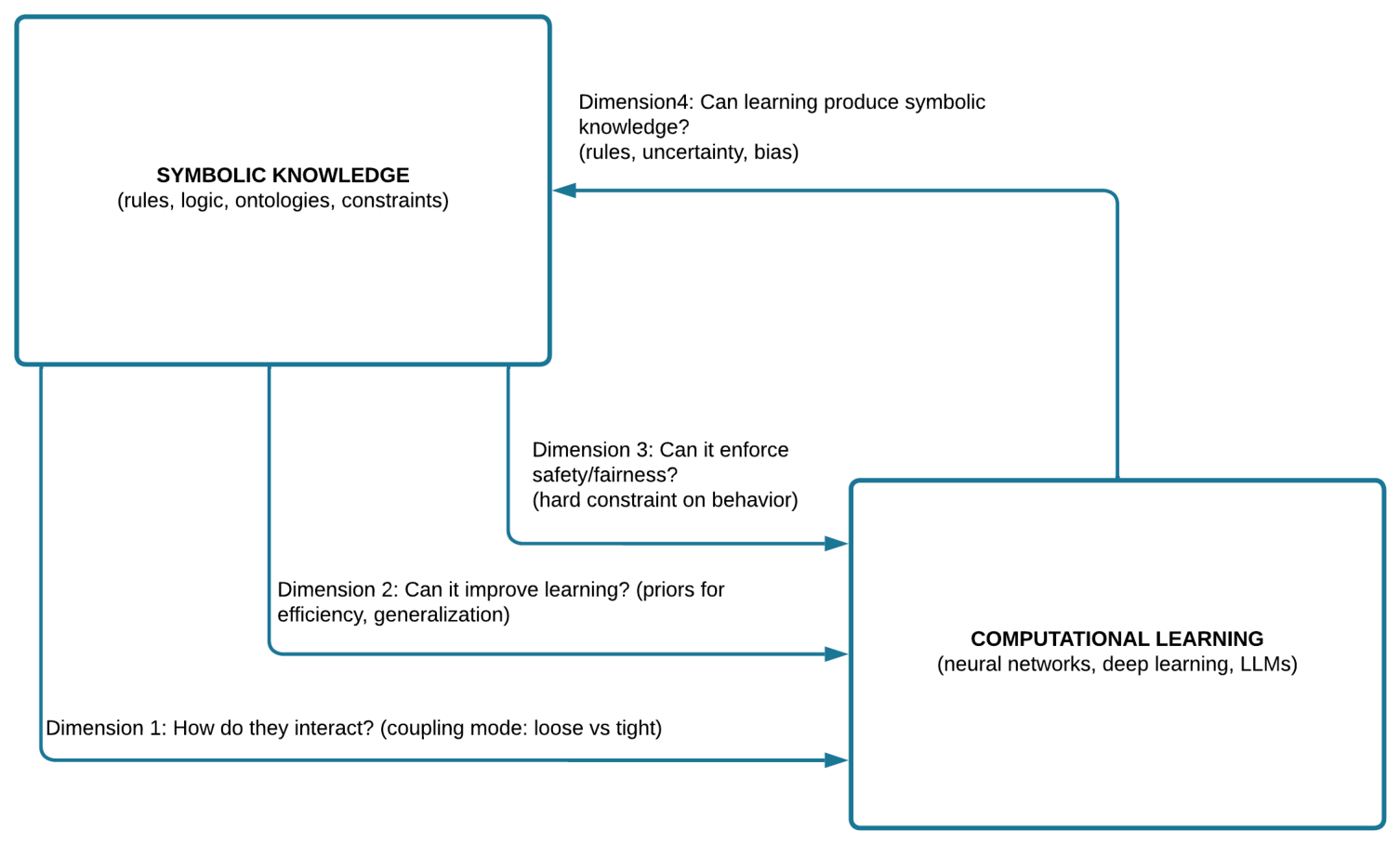
3. Foundational Dimensions & Research Questions
3.1. Dimension 1: Mode of Integration
3.2. Dimension 2: Symbolic Priors for Learning
3.3. Dimension 3: Symbolic Constraints for Safety and Bias
3.4. Dimension 4: Symbolic Knowledge from Learning
4. Neurosymbolic Integration Architectures
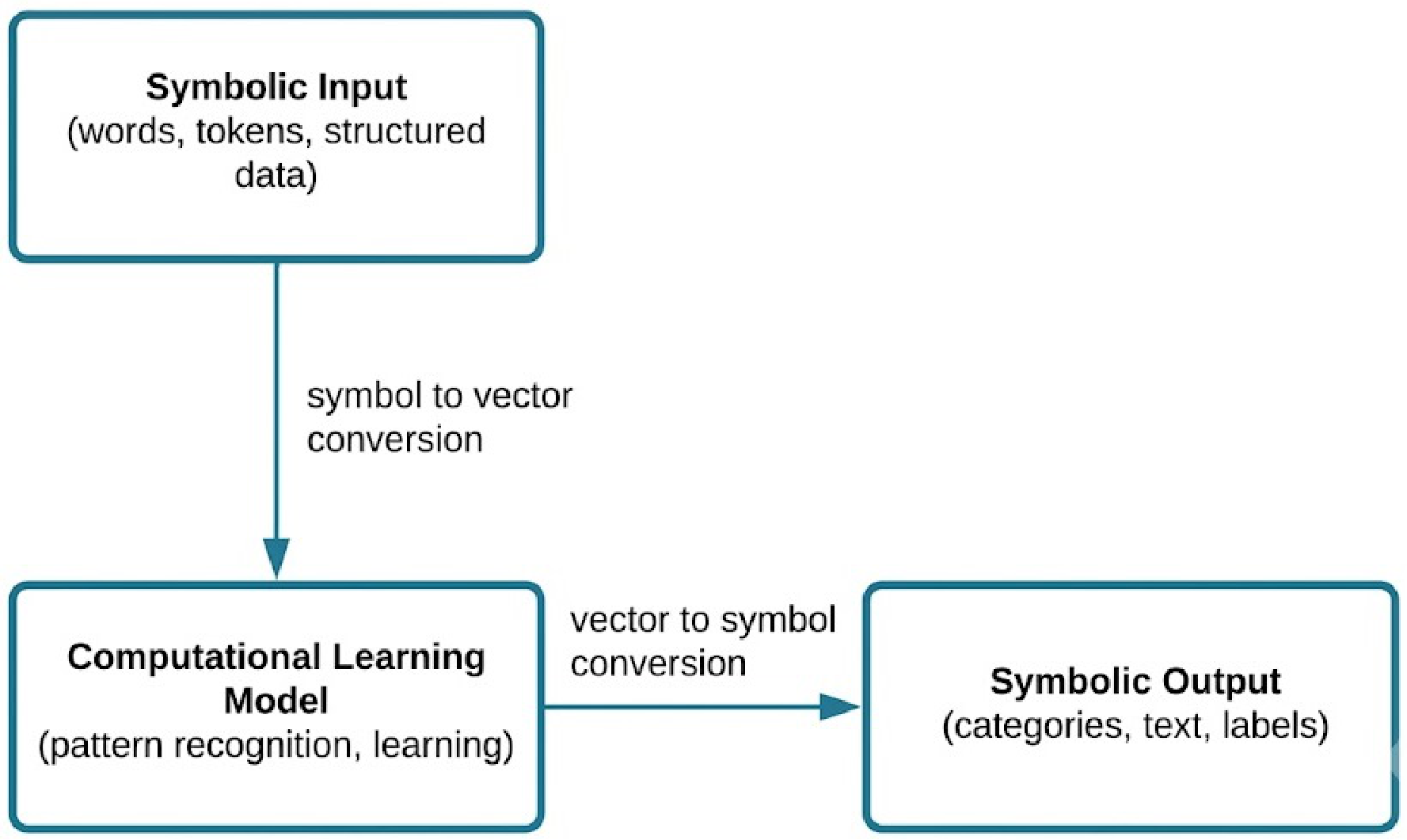
4.1. Type 1: Symbolic Neuro Symbolic
Strengths and Limitations
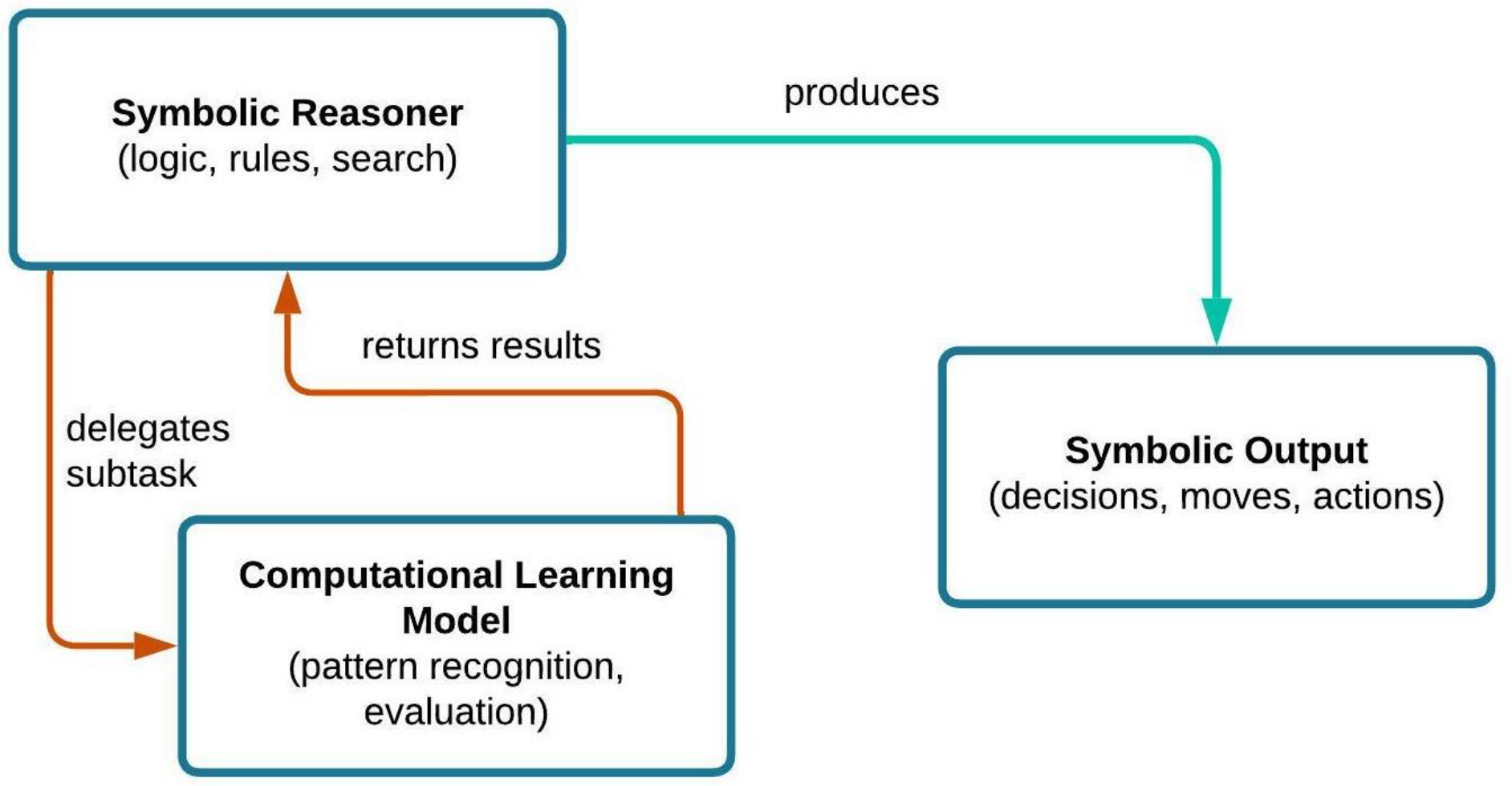
4.2. Type 2: Symbolic[Neuro]
Strengths and Limitations
4.3. Type 3: Neuro|Symbolic
Strengths and Limitations
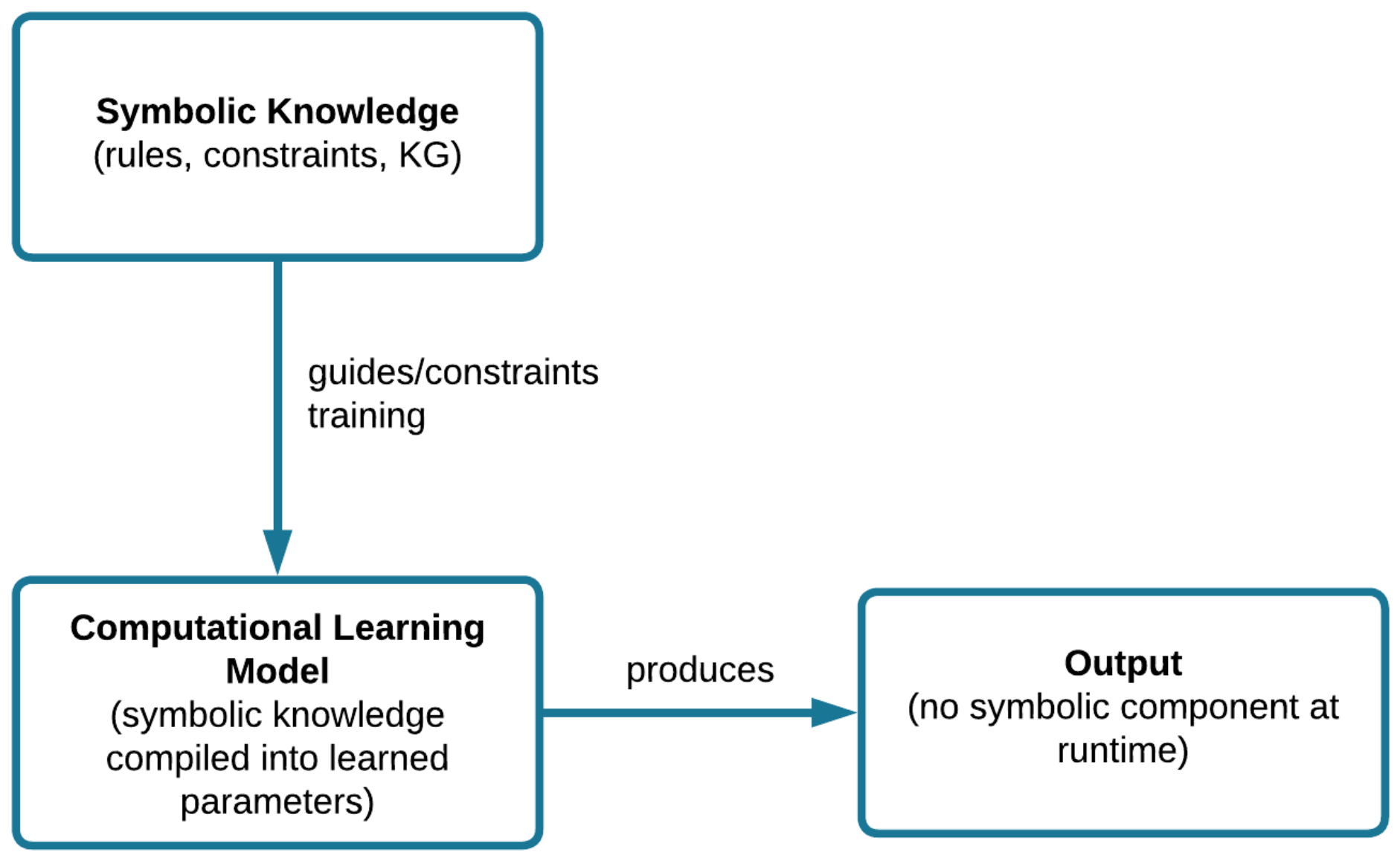
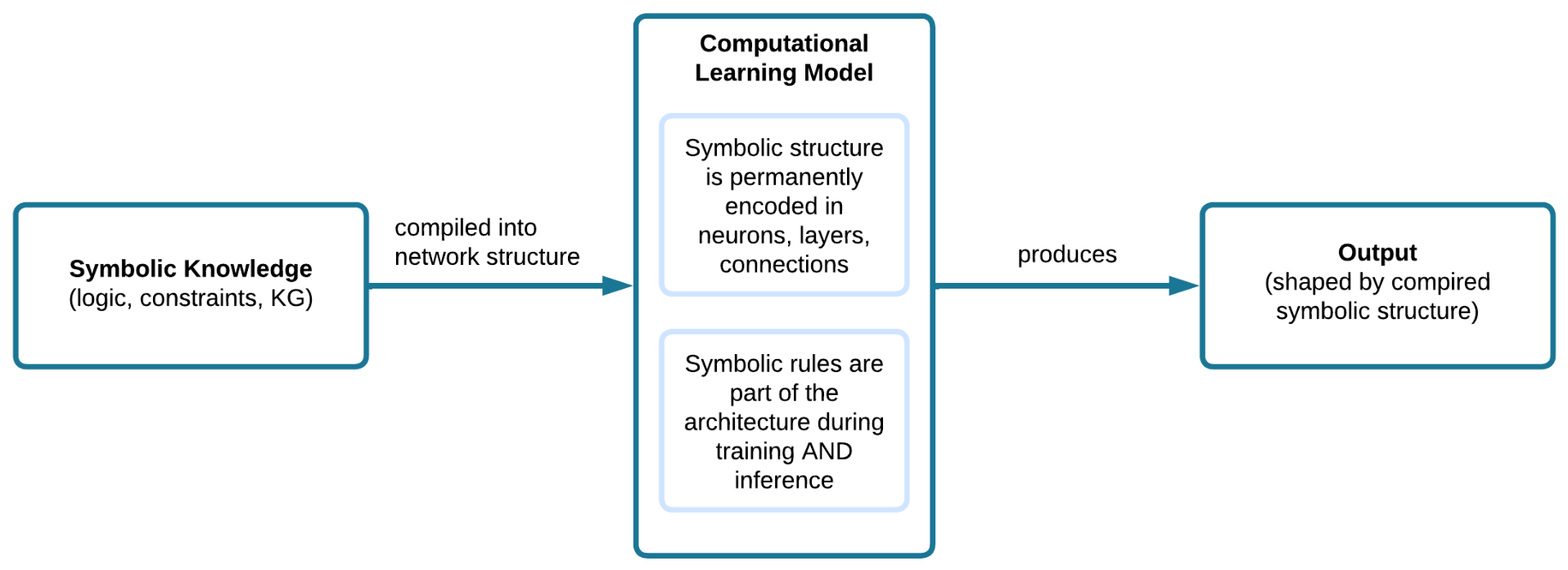
4.4. Type 4: Neuro: Symbolic → Neuro
Strengths and Limitations
4.5. Type 5: NeuroSymbolic
Strengths and Limitations
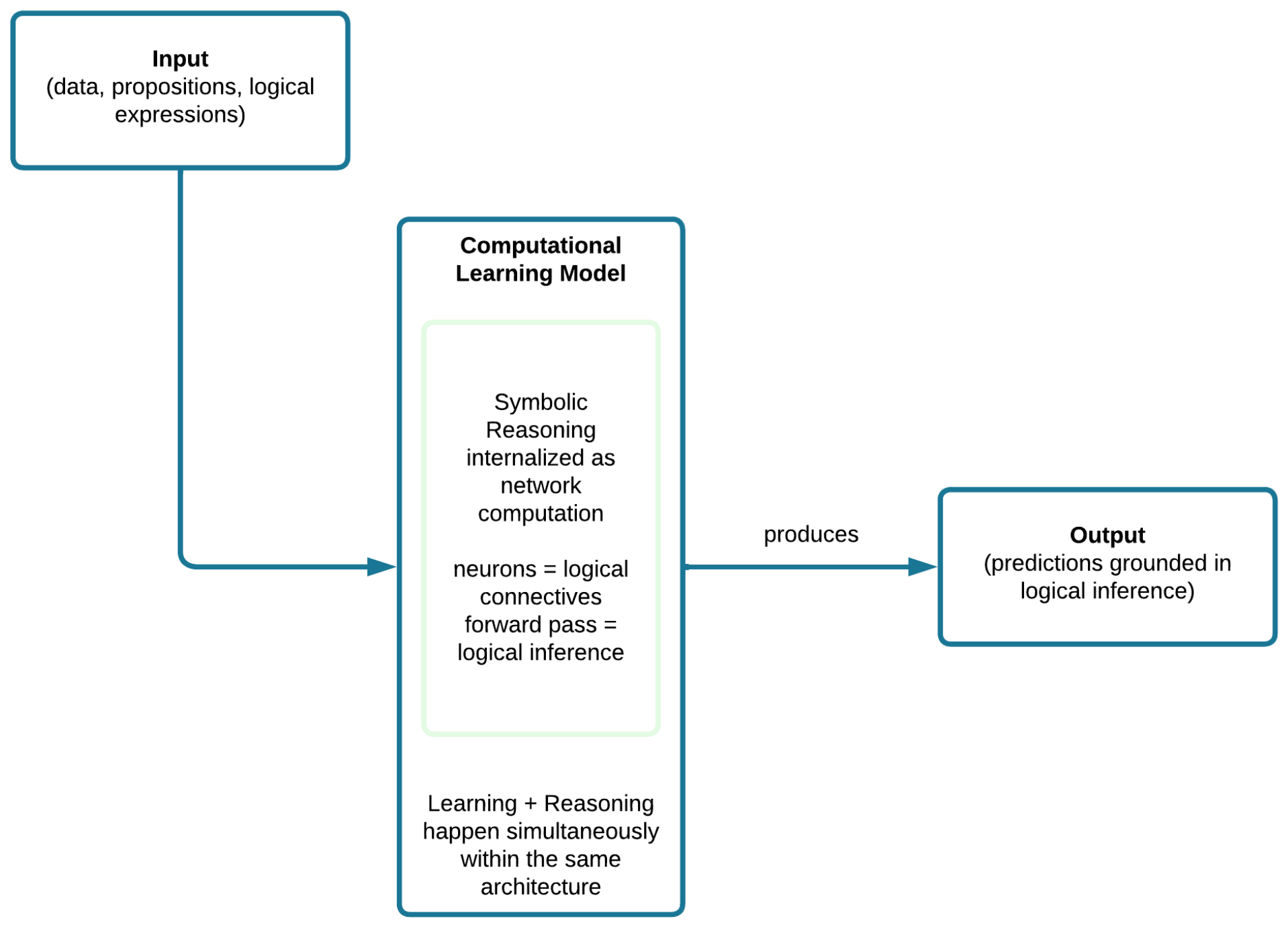
4.6. Type 6: Neuro[Symbolic]
Strengths and Limitations
5. Reasoning
5.1. Modes of Inference
5.2. Classification Criteria
6. A Multi-Axis Analysis of the NeSy Literature
Paper Selection and Classification Methodology
- 1.
- It contains a computational learning component that learns from data (e.g., a neural network, deep learning model, or differentiable learning system).
- 2.
- It contains a symbolic reasoning component that operates on formal or structured representations (e.g., logical rules, ontologies, knowledge graphs, formal grammars, or domain-specific symbolic formalisms).
- 3.
- There is a meaningful interaction between the two components, whether through shared training, cooperative inference, architectural embedding, or knowledge transfer.
7. Analysis and Findings
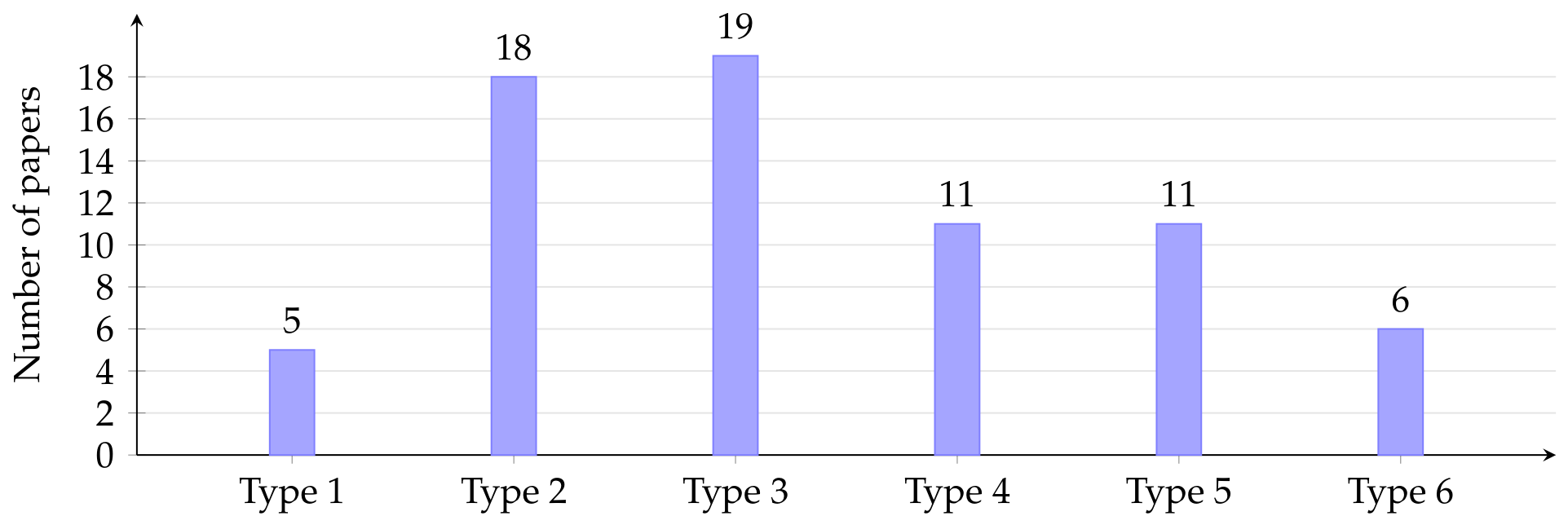
7.1. Distribution Across Kautz Types
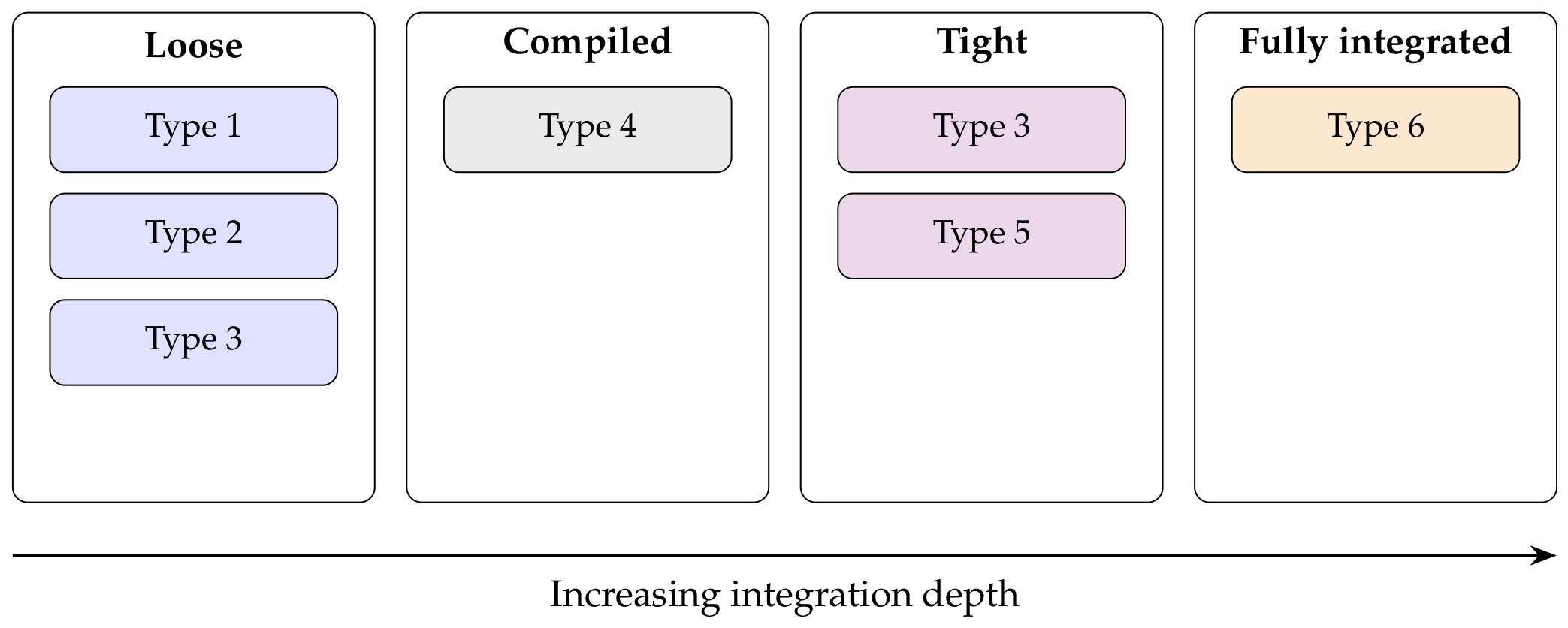
7.2. D1: Mode of Integration
7.3. D2: Symbolic Priors for Learning
7.4. D3: Symbolic Constraints for Safety and Bias
7.5. D4: Symbolic Knowledge from Learning
7.6. Reasoning Approaches
7.7. LLM-Based Systems as a Test of the Framework
7.8. Cross-Dimensional Patterns
7.9. Identified Gaps and Future Directions
8. Conclusions
Generative AI Disclosure
Supplementary Materials
Author Contributions
Funding
Institutional Review Board Statement
Informed Consent Statement
Data Availability Statement
Acknowledgments
Conflicts of Interest
Abbreviations
| AI | Artificial Intelligence |
| NeSy | Neurosymbolic |
| CLT | Computational Learning Theory |
| LLM | Large Language Model |
| NLP | Natural Language Processing |
| DL | Deep Learning |
| RL | Reinforcement Learning |
| XAI | Explainable Artificial Intelligence |
| KBANN | Knowledge-Based Artificial Neural Networks |
| LTN | Logic Tensor Network |
| LNN | Logical Neural Network |
| SKE | Symbolic Knowledge Extraction |
| SKI | Symbolic Knowledge Injection |
| SHAP | SHapley Additive exPlanations |
| LIME | Local Interpretable Model-agnostic Explanations |
| PRISMA | Preferred Reporting Items for Systematic Reviews and Meta-Analyses |
References
- Russell, S.J.; Norvig, P. Artificial Intelligence: A Modern Approach, 4th ed.; Pearson: Boston, MA, USA, 2021. [Google Scholar]
- Platzer, A. Intersymbolic AI. In Proceedings of the Leveraging Applications of Formal Methods, Verification and Validation; Software Engineering Methodologies; Margaria, T., Steffen, B., Eds.; Springer: Cham, Switzerland, 2025; pp. 162–180. [Google Scholar]
- Shalev-Shwartz, S.; Ben-David, S. Understanding Machine Learning: From Theory to Algorithms; Cambridge University Press: Cambridge, UK, 2014. [Google Scholar]
- Wilson, A.G.; Izmailov, P. Bayesian Deep Learning and a Probabilistic Perspective of Generalization. In Proceedings of the Advances in Neural Information Processing Systems; Larochelle, H., Ranzato, M., Hadsell, R., Balcan, M., Lin, H., Eds.; Curran Associates, Inc.: Red Hook, NY, USA, 2020; Volume 33, pp. 4697–4708. [Google Scholar]
- LeCun, Y.; Bengio, Y.; Hinton, G. Deep learning. Nature 2015, 521, 436–444. [Google Scholar] [CrossRef] [Scilit] [PubMed]
- Vaswani, A.; Shazeer, N.; Parmar, N.; Uszkoreit, J.; Jones, L.; Gomez, A.N.; Kaiser, L.U.; Polosukhin, I. Attention is All you Need. In Proceedings of the Advances in Neural Information Processing Systems; Guyon, I., Luxburg, U.V., Bengio, S., Wallach, H., Fergus, R., Vishwanathan, S., Garnett, R., Eds.; Curran Associates, Inc.: Red Hook, NY, USA, 2017; Volume 30. [Google Scholar]
- Duede, E.; Dolan, W.; Bauer, A.; Foster, I.; Lakhani, K. Oil& Water? Diffusion of AI Within and Across Scientific Fields. arXiv 2024, arXiv:2405.15828. [Google Scholar]
- Voulodimos, A.; Doulamis, N.; Doulamis, A.; Protopapadakis, E. Deep Learning for Computer Vision: A Brief Review. Comput. Intell. Neurosci. 2018, 2018, 7068349. [Google Scholar] [CrossRef] [Scilit] [PubMed]
- Guo, M.H.; Xu, T.X.; Liu, J.J.; Liu, Z.N.; Jiang, P.T.; Mu, T.J.; Zhang, S.H.; Martin, R.R.; Cheng, M.M.; Hu, S.M. Attention mechanisms in computer vision: A survey. Comput. Vis. Media 2022, 8, 331–368. [Google Scholar] [CrossRef] [Scilit]
- Madanian, S.; Chen, T.; Adeleye, O.; Templeton, J.M.; Poellabauer, C.; Parry, D.; Schneider, S.L. Speech emotion recognition using machine learning—A systematic review. Intell. Syst. Appl. 2023, 20, 200266. [Google Scholar] [CrossRef] [Scilit]
- Ouyang, L.; Wu, J.; Jiang, X.; Almeida, D.; Wainwright, C.L.; Mishkin, P.; Zhang, C.; Agarwal, S.; Slama, K.; Ray, A.; et al. Training language models to follow instructions with human feedback. In Proceedings of the NIPS ’22: Proceedings of the 36th International Conference on Neural Information Processing Systems, Red Hook, NY, USA, 28 November–9 December 2022. [Google Scholar]
- Dargan, S.; Kumar, M.; Ayyagari, M.R.; Kumar, G. A Survey of Deep Learning and Its Applications: A New Paradigm to Machine Learning. Arch. Comput. Methods Eng. 2020, 27, 1071–1092. [Google Scholar] [CrossRef] [Scilit]
- Vamathevan, J.; Clark, D.; Czodrowski, P.; Dunham, I.; Ferran, E.; Lee, G.; Li, B.; Madabhushi, A.; Shah, P.; Spitzer, M.; et al. Applications of machine learning in drug discovery and development. Nat. Rev. Drug Discov. 2019, 18, 463–477. [Google Scholar] [CrossRef] [Scilit] [PubMed]
- Schmidt, J.; Marques, M.R.G.; Botti, S.; Marques, M.A.L. Recent advances and applications of machine learning in solid-state materials science. npj Comput. Mater. 2019, 5, 83. [Google Scholar] [CrossRef] [Scilit]
- Kourou, K.; Exarchos, T.P.; Exarchos, K.P.; Karamouzis, M.V.; Fotiadis, D.I. Machine learning applications in cancer prognosis and prediction. Comput. Struct. Biotechnol. J. 2015, 13, 8–17. [Google Scholar] [CrossRef] [Scilit] [PubMed]
- Nyrup, R. The Limits of Value Transparency in Machine Learning. Philos. Sci. 2022, 89, 1054–1064. [Google Scholar] [CrossRef] [Scilit]
- Rudin, C. Stop explaining black box machine learning models for high stakes decisions and use interpretable models instead. Nat. Mach. Intell. 2019, 1, 206–215. [Google Scholar] [CrossRef] [Scilit] [PubMed]
- Colin, J.; FEL, T.; Cadene, R.; Serre, T. What I Cannot Predict, I Do Not Understand: A Human-Centered Evaluation Framework for Explainability Methods. In Proceedings of the Advances in Neural Information Processing Systems; Koyejo, S., Mohamed, S., Agarwal, A., Belgrave, D., Cho, K., Oh, A., Eds.; Curran Associates, Inc.: Red Hook, NY, USA, 2022; Volume 35, pp. 2832–2845. [Google Scholar]
- Ning, Y.; Teixayavong, S.; Shang, Y.; Savulescu, J.; Nagaraj, V.; Miao, D.; Mertens, M.; Ting, D.S.W.; Ong, J.C.L.; Liu, M.; et al. Generative artificial intelligence and ethical considerations in health care: A scoping review and ethics checklist. Lancet Digit. Health 2024, 6, e848–e856. [Google Scholar] [CrossRef] [Scilit] [PubMed]
- Khan, A.A.; Akbar, M.A.; Fahmideh, M.; Liang, P.; Waseem, M.; Ahmad, A.; Niazi, M.; Abrahamsson, P. AI Ethics: An Empirical Study on the Views of Practitioners and Lawmakers. IEEE Trans. Comput. Soc. Syst. 2023, 10, 2971–2984. [Google Scholar] [CrossRef] [Scilit]
- Sotiropoulos, D.N.; Koronakos, G.; Solanakis, S.V. Evolving transparent credit risk models: A symbolic regression approach using genetic programming. Electronics 2024, 13, 4324. [Google Scholar] [CrossRef] [Scilit]
- Poole, D.; Mackworth, A.K.; Goebel, R. Computational Intelligence—A Logical Approach; Oxford University Press: Oxford, UK, 1998. [Google Scholar]
- Besold, T.R.; Bader, S.; Bowman, H.; Domingos, P.; Hitzler, P.; Kühnberger, K.U.; Lamb, L.C.; Lima, P.M.V.; de Penning, L.; Pinkas, G.; et al. Neural-symbolic learning and reasoning: A survey and interpretation 1. In Neuro-Symbolic Artificial Intelligence: The State of the Art; IOS Press: Amsterdam, The Netherlands, 2021; pp. 1–51. [Google Scholar]
- Garcez, A.d.; Lamb, L.C. Neurosymbolic ai: The 3 rd wave. Artif. Intell. Rev. 2023, 56, 12387–12406. [Google Scholar] [CrossRef] [Scilit]
- Harmelen, F. Preface: The 3rd AI wave is coming, and it needs a theory. In Neuro-Symbolic Artificial Intelligence: The State of the Art; IOS Press BV: Amsterdam, The Netherlands, 2022; pp. V–VII. [Google Scholar]
- Hitzler, P.; Sarker, M.K. Neuro-Symbolic Artificial Intelligence: The State of the Art; IOS Press/Sage Publishing: Amsterdam, The Netherlands, 2022. [Google Scholar]
- Ciatto, G.; Sabbatini, F.; Agiollo, A.; Magnini, M.; Omicini, A. Symbolic Knowledge Extraction and Injection with Sub-symbolic Predictors: A Systematic Literature Review. ACM Comput. Surv. 2024, 56, 161:1–161:35. [Google Scholar] [CrossRef] [Scilit]
- Kautz, H. The third ai summer: Aaai robert s. engelmore memorial lecture. Ai Mag. 2022, 43, 105–125. [Google Scholar] [CrossRef] [Scilit]
- Wang, W.; Yang, Y.; Wu, F. Towards data-and knowledge-driven AI: A survey on neuro-symbolic computing. IEEE Trans. Pattern Anal. Mach. Intell. 2024, 47, 878–899. [Google Scholar] [CrossRef] [Scilit] [PubMed]
- Bader, S.; Hitzler, P. Dimensions of neural-symbolic integration—A structured survey. arXiv 2005, arXiv:cs/0511042. [Google Scholar] [CrossRef] [Scilit]
- Feldstein, J.; Dilkas, P.; Belle, V.; Tsamoura, E. Mapping the neuro-symbolic AI landscape by architectures: A handbook on augmenting deep learning through symbolic reasoning. arXiv 2024, arXiv:2410.22077. [Google Scholar]
- Bougzime, O.; Jabbar, S.; Cruz, C.; Demoly, F. Unlocking the Potential of Generative AI through Neuro-Symbolic Architectures: Benefits and Limitations. arXiv 2025, arXiv:2502.11269. [Google Scholar]
- van Bekkum, M.; de Boer, M.; van Harmelen, F.; Meyer-Vitali, A.; Teije, A.t. Modular design patterns for hybrid learning and reasoning systems: A taxonomy, patterns and use cases. Appl. Intell. 2021, 51, 6528–6546. [Google Scholar]
- Marra, G.; Dumančić, S.; Manhaeve, R.; De Raedt, L. From statistical relational to neurosymbolic artificial intelligence: A survey. Artif. Intell. 2024, 328, 104062. [Google Scholar] [CrossRef] [Scilit]
- Bhuyan, B.P.; Ramdane-Cherif, A.; Tomar, R.; Singh, T. Neuro-symbolic artificial intelligence: A survey. Neural Comput. Appl. 2024, 36, 12809–12844. [Google Scholar] [CrossRef] [Scilit]
- Nawaz, U.; Anees-ur Rahaman, M.; Saeed, Z. A review of neuro-symbolic AI integrating reasoning and learning for advanced cognitive systems. Intell. Syst. Appl. 2025, 26, 200541. [Google Scholar] [CrossRef] [Scilit]
- Jayasingha, P.; Iancu, B.; Lilius, J. Neurosymbolic Approaches in AI Design–An overview. In Proceedings of the 2025 IEEE Symposium on Trustworthy, Explainable and Responsible Computational Intelligence (CITREx Companion); IEEE: Minneapolis, MN, USA, 2025; pp. 1–5. [Google Scholar]
- Bouneffouf, D.; Aggarwal, C.C. Survey on applications of neurosymbolic artificial intelligence. arXiv 2022, arXiv:2209.12618. [Google Scholar]
- Zhang, X.; Sheng, V.S. Bridging the gap: Representation spaces in neuro-symbolic AI. arXiv 2024, arXiv:2411.04393. [Google Scholar]
- Colelough, B.C.; Regli, W. Neuro-symbolic AI in 2024: A systematic review. arXiv 2025, arXiv:2501.05435. [Google Scholar]
- Hamilton, K.; Nayak, A.; Božić, B.; Longo, L. Is neuro-symbolic AI meeting its promises in natural language processing? A structured review. Semant. Web 2024, 15, 1265–1306. [Google Scholar] [CrossRef] [Scilit]
- Keber, M.; Grubišić, I.; Barešić, A.; Jović, A. A review on neuro-symbolic AI improvements to natural language processing. In Proceedings of the 2024 47th MIPRO ICT and Electronics Convention (MIPRO); IEEE: Minneapolis, MN, USA, 2024; pp. 66–72. [Google Scholar]
- Khan, M.J.; Ilievski, F.; Breslin, J.G.; Curry, E. A survey of neurosymbolic visual reasoning with scene graphs and common sense knowledge. Neurosymbolic Artif. Intell. 2025, 1, NAI-240719. [Google Scholar] [CrossRef] [Scilit]
- Gomaa, A.; Mahdy, B.; Kleer, N.; Feld, M.; Kirchner, F.; Krüger, A. Teach me how to learn: A perspective review towards user-centered neuro-symbolic learning for robotic surgical systems. arXiv 2023, arXiv:2307.03853. [Google Scholar]
- Acharya, K.; Sharifi, I.; Lad, M.; Sun, L.; Song, H. Integrating Neurosymbolic AI in Advanced Air Mobility: A Comprehensive Survey. arXiv 2025, arXiv:2508.07163. [Google Scholar]
- Chen, W.; Ma, X.; Wang, Z.; Li, W.; Fan, C.; Zhang, J.; Que, X.; Li, C. Exploring neuro-symbolic AI applications in geoscience: Implications and future directions for mineral prediction. Earth Sci. Inform. 2024, 17, 1819–1835. [Google Scholar] [CrossRef] [Scilit]
- Hossain, D.; Chen, J.Y. A Study on Neuro-Symbolic Artificial Intelligence: Healthcare Perspectives. arXiv 2025, arXiv:2503.18213. [Google Scholar]
- Hakim, S.B.; Adil, M.; Velasquez, A.; Xu, S.; Song, H.H. Neuro-symbolic ai for cybersecurity: State of the art, challenges, and opportunities. arXiv 2025, arXiv:2509.06921. [Google Scholar]
- DeLong, L.N.; Mir, R.F.; Fleuriot, J.D. Neurosymbolic AI for reasoning over knowledge graphs: A survey. IEEE Trans. Neural Netw. Learn. Syst. 2024, 36, 7822–7842. [Google Scholar] [CrossRef] [Scilit] [PubMed]
- Wan, Z.; Liu, C.K.; Yang, H.; Li, C.; You, H.; Fu, Y.; Wan, C.; Krishna, T.; Lin, Y.; Raychowdhury, A. Towards cognitive ai systems: A survey and prospective on neuro-symbolic ai. arXiv 2024, arXiv:2401.01040. [Google Scholar]
- Acharya, K.; Raza, W.; Dourado, C.; Velasquez, A.; Song, H.H. Neurosymbolic reinforcement learning and planning: A survey. IEEE Trans. Artif. Intell. 2023, 5, 1939–1953. [Google Scholar] [CrossRef] [Scilit]
- Renkhoff, J.; Feng, K.; Meier-Doernberg, M.; Velasquez, A.; Song, H.H. A survey on verification and validation, testing and evaluations of neurosymbolic artificial intelligence. IEEE Trans. Artif. Intell. 2024, 5, 3765–3779. [Google Scholar] [CrossRef] [Scilit]
- Michel-Delétie, C.; Sarker, M.K. Neuro-symbolic methods for trustworthy AI: A systematic review. Neurosymbolic Artif. Intell. 2024. [Google Scholar] [CrossRef] [Scilit]
- Nassim, L.; Sèdes, F.; Bouarab-Dahmani, F. Toward compositional generalization with neuro-symbolic AI: A comprehensive overview. In Proceedings of the 2024 4th International Conference on Embedded & Distributed Systems (EDiS); IEEE: Minneapolis, MN, USA, 2024; pp. 207–212. [Google Scholar]
- Song, P.; Han, P.; Goodman, N. Large Language Model Reasoning Failures. arXiv 2026, arXiv:2602.06176. [Google Scholar]
- Xu, J.; Zhang, Z.; Friedman, T.; Liang, Y.; Broeck, G. A semantic loss function for deep learning with symbolic knowledge. In Proceedings of the International Conference on Machine Learning. PMLR, Stockholm, Sweden, 10–15 July 2018; pp. 5502–5511. [Google Scholar]
- Diligenti, M.; Gori, M.; Sacca, C. Semantic-based regularization for learning and inference. Artif. Intell. 2017, 244, 143–165. [Google Scholar] [CrossRef] [Scilit]
- Towell, G.G.; Shavlik, J.W. Knowledge-based artificial neural networks. Artif. Intell. 1994, 70, 119–165. [Google Scholar] [CrossRef] [Scilit]
- Veronese, C.; Meli, D.; Farinelli, A. Sample-Efficient Neurosymbolic Deep Reinforcement Learning. arXiv 2026, arXiv:2601.02850. [Google Scholar]
- Misino, E.; Marra, G.; Sansone, E. Vael: Bridging variational autoencoders and probabilistic logic programming. Adv. Neural Inf. Process. Syst. 2022, 35, 4667–4679. [Google Scholar] [CrossRef] [Scilit]
- Huang, S.; Wen, Y.B.; Adusumilli, T.; Choudhary, K.; Yang, H. Parsing the Language of Expression: Enhancing Symbolic Regression with Domain-Aware Symbolic Priors. arXiv 2025, arXiv:2503.09592. [Google Scholar]
- Wagner, B. Neural-symbolic integration for fairness in AI. In Proceedings of the CEUR Workshop Proceedings, Palo Alto, CA, USA, 22–24 March 2021; Volume 2846. [Google Scholar]
- Heilmann, X.; Manganini, C.; Cerrato, M.; Belle, V. A neurosymbolic approach to counterfactual fairness. In Proceedings of the 19th International Conference on Neurosymbolic Learning and Reasoning, Santa Cruz, CA, USA, 8–10 September 2025. [Google Scholar]
- Sharifi, I.; Yildirim, M.; Fallah, S. Towards safe autonomous driving policies using a neuro-symbolic deep reinforcement learning approach. arXiv 2023, arXiv:2307.01316. [Google Scholar]
- Kahneman, D. Thinking, Fast and Slow; Macmillan: New York, NY, USA, 2011. [Google Scholar]
- Huang, Z. Introducing Neuro-Symbolic Artificial Intelligence to Humanities and Social Sciences: Why Is It Possible and What Can Be Done? TEM J. 2022, 11, 1863–1870. [Google Scholar] [CrossRef] [Scilit]
- Kouris, P.; Alexandridis, G.; Stafylopatis, A. Abstractive text summarization: Enhancing sequence-to-sequence models using word sense disambiguation and semantic content generalization. Comput. Linguist. 2021, 47, 813–859. [Google Scholar] [CrossRef] [Scilit]
- Liu, Y.; Ott, M.; Goyal, N.; Du, J.; Joshi, M.; Chen, D.; Levy, O.; Lewis, M.; Zettlemoyer, L.; Stoyanov, V. Roberta: A robustly optimized bert pretraining approach. arXiv 2019, arXiv:1907.11692. [Google Scholar]
- Devlin, J.; Chang, M.W.; Lee, K.; Toutanova, K. Bert: Pre-training of deep bidirectional transformers for language understanding. In Proceedings of the 2019 Conference of the North American Chapter of the Association for Computational Linguistics: Human Language Technologies, Volume 1 (Long and Short Papers), Minneapolis, MN, USA, 2–7 June 2019; pp. 4171–4186. [Google Scholar]
- Silver, D.; Huang, A.; Maddison, C.J.; Guez, A.; Sifre, L.; Van Den Driessche, G.; Schrittwieser, J.; Antonoglou, I.; Panneershelvam, V.; Lanctot, M.; et al. Mastering the game of Go with deep neural networks and tree search. Nature 2016, 529, 484–489. [Google Scholar] [CrossRef] [Scilit] [PubMed]
- Qin, J.; Liang, X.; Hong, Y.; Tang, J.; Lin, L. Neural-symbolic solver for math word problems with auxiliary tasks. arXiv 2021, arXiv:2107.01431. [Google Scholar]
- Olausson, T.; Gu, A.; Lipkin, B.; Zhang, C.; Solar-Lezama, A.; Tenenbaum, J.; Levy, R. LINC: A neurosymbolic approach for logical reasoning by combining language models with first-order logic provers. In Proceedings of the 2023 Conference on Empirical Methods in Natural Language Processing, Singapore, 6–10 December 2023; pp. 5153–5176. [Google Scholar]
- Ye, X.; Chen, Q.; Dillig, I.; Durrett, G. Satlm: Satisfiability-aided language models using declarative prompting. Adv. Neural Inf. Process. Syst. 2023, 36, 45548–45580. [Google Scholar] [CrossRef] [Scilit]
- Liu, B.; Jiang, Y.; Zhang, X.; Liu, Q.; Zhang, S.; Biswas, J.; Stone, P. Llm+ p: Empowering large language models with optimal planning proficiency. arXiv 2023, arXiv:2304.11477. [Google Scholar]
- Caufield, J.H.; Hegde, H.; Emonet, V.; Harris, N.L.; Joachimiak, M.P.; Matentzoglu, N.; Kim, H.; Moxon, S.; Reese, J.T.; Haendel, M.A.; et al. Structured prompt interrogation and recursive extraction of semantics (SPIRES): A method for populating knowledge bases using zero-shot learning. Bioinformatics 2024, 40, btae104. [Google Scholar] [CrossRef] [Scilit] [PubMed]
- Chen, Z.; Sun, R.; Liu, W.; Hong, Y.; Gan, C. Genome: Generative neuro-symbolic visual reasoning by growing and reusing modules. arXiv 2023, arXiv:2311.04901. [Google Scholar]
- Kamali, D.; Barezi, E.J.; Kordjamshidi, P. Nesycoco: A neuro-symbolic concept composer for compositional generalization. In Proceedings of the AAAI Conference on Artificial Intelligence, Philadelphia, PA, USA, 25 February–4 March 2025; Volume 39, pp. 4184–4193. [Google Scholar]
- Savazzi, G.; Lomurno, E.; Sbrolli, C.; Chiatti, A.; Matteucci, M. Neuro-Symbolic Scene Graph Conditioning for Synthetic Image Dataset Generation. arXiv 2025, arXiv:2503.17224. [Google Scholar]
- Pan, L.; Albalak, A.; Wang, X.; Wang, W. Logic-lm: Empowering large language models with symbolic solvers for faithful logical reasoning. In Proceedings of the Findings of the Association for Computational Linguistics: EMNLP 2023, Singapore, 6–10 December 2023; pp. 3806–3824. [Google Scholar]
- Trinh, T.H.; Wu, Y.; Le, Q.V.; He, H.; Luong, T. Solving olympiad geometry without human demonstrations. Nature 2024, 625, 476–482. [Google Scholar] [CrossRef] [Scilit] [PubMed]
- Acharya, K.; Lad, M.; Sun, L.; Song, H. Neurosymbolic AI for Travel Demand Prediction: Integrating Decision Tree Rules into Neural Networks. arXiv 2025, arXiv:2502.01680. [Google Scholar]
- Toofani, A.; Singh, L.; Paul, S. From interpretation to explanation: An analytical examination of deep neural network with linguistic rule-based model. Comput. Electr. Eng. 2024, 117, 109258. [Google Scholar] [CrossRef] [Scilit]
- Xie, X.; Kersting, K.; Neider, D. Neuro-symbolic verification of deep neural networks. arXiv 2022, arXiv:2203.00938. [Google Scholar]
- Phua, Y.J.; Inoue, K. Variable Assignment Invariant Neural Networks for Learning Logic Programs. In Proceedings of the International Conference on Neural-Symbolic Learning and Reasoning; Springer: Berlin/Heidelberg, Germany, 2024; pp. 47–61. [Google Scholar]
- Grov, G.; Halvorsen, J.; Eckhoff, M.W.; Hansen, B.J.; Eian, M.; Mavroeidis, V. On the use of neurosymbolic AI for defending against cyber attacks. In Proceedings of the International Conference on Neural-Symbolic Learning and Reasoning; Springer: Berlin/Heidelberg, Germany, 2024; pp. 119–140. [Google Scholar]
- Takenaka, P.; Maucher, J.; Huber, M.F. ViPro: Enabling and Controlling Video Prediction for Complex Dynamical Scenarios Using Procedural Knowledge. In Proceedings of the International Conference on Neural-Symbolic Learning and Reasoning; Springer: Berlin/Heidelberg, Germany, 2024; pp. 62–83. [Google Scholar]
- Riegel, R.; Gray, A.; Luus, F.; Khan, N.; Makondo, N.; Akhalwaya, I.Y.; Qian, H.; Fagin, R.; Barahona, F.; Sharma, U.; et al. Logical neural networks. arXiv 2020, arXiv:2006.13155. [Google Scholar]
- Pirozelli, P.; José, M.M.; de Tarso P. Filho, P.; Brandão, A.A.; Cozman, F.G. Assessing Logical Reasoning Capabilities of Encoder-Only Transformer Models. In Proceedings of the International Conference on Neural-Symbolic Learning and Reasoning; Springer: Berlin/Heidelberg, Germany, 2024; pp. 29–46. [Google Scholar]
- Lin, Z.L.; Shih, Y.F.; Hsieh, S.K. Probing Large Language Models in Reasoning and Translating Complex Linguistic Puzzles. arXiv 2025, arXiv:2502.00817. [Google Scholar]
- Xu, J.; Fei, H.; Pan, L.; Liu, Q.; Lee, M.L.; Hsu, W. Faithful logical reasoning via symbolic chain-of-thought. In Proceedings of the 62nd Annual Meeting of the Association for Computational Linguistics (Volume 1: Long Papers), Bangkok, Thailand, 11–16 August 2024; pp. 13326–13365. [Google Scholar]
- Theodoropoulos, S.; Makridis, G.; Pnevmatikakis, A.; Moulos, V.; Kyriazis, D.; Tsanakas, P. A NeuroSymbolic Human-in-the-Loop Approach Towards Fusing Medical Expert Knowledge with ANNs. In Proceedings of the IFIP International Conference on Artificial Intelligence Applications and Innovations; Springer: Berlin/Heidelberg, Germany, 2025; pp. 161–174. [Google Scholar]
- Tsamoura, E.; Hospedales, T.; Michael, L. Neural-symbolic integration: A compositional perspective. In Proceedings of the AAAI conference on Artificial Intelligence, Online, 2–9 February 2021; Volume 35, pp. 5051–5060. [Google Scholar]
- Marques-Silva, J.; Ignatiev, A. Delivering trustworthy AI through formal XAI. In Proceedings of the AAAI Conference on Artificial Intelligence, Online, 22 February–1 March 2022; Volume 36, pp. 12342–12350. [Google Scholar]
- Shoaip, N.; El-Sappagh, S.; Abuhmed, T.; Elmogy, M. A dynamic fuzzy rule-based inference system using fuzzy inference with semantic reasoning. Sci. Rep. 2024, 14, 4275. [Google Scholar] [CrossRef] [Scilit] [PubMed]
- Jawdekar, A.; Dixit, M. Deep Learning and Fuzzy Logic Based Intelligent Technique for the Image Enhancement and Edge Detection Framework. Trait. Signal 2023, 40, 351. [Google Scholar] [CrossRef] [Scilit]
- Babu, B.S.; Narayana, M.V. Two stage multi-modal medical image fusion with marine predator algorithm-based cascaded optimal DTCWT and NSST with deep learning. Biomed. Signal Process. Control 2023, 85, 104921. [Google Scholar] [CrossRef] [Scilit]
- Hernández-Orozco, S.; Uthamacumaran, A.; Hernández-Quiroz, F.; Saeb-Parsy, K.; Zenil, H. A neuro-symbolic ai approach to personal health risk assessment and immune age characterisation using common blood markers. arXiv 2023, arXiv:2303.01444. [Google Scholar]
- Zi, Y.; Roy, K.; Sheth, A. Cognitive Neurosymbolic Artificial Intelligence for Complex Decision-Making: Integrating Foundation Models, Cognitive Architectures, and Knowledge. IEEE Intell. Syst. 2025, 40, 16–22. [Google Scholar] [CrossRef] [Scilit]
- Almadhor, A.; Alsubai, S.; Hejaili, A.A.; Klai, Z.; Bouallegue, B.; Kovac, U. Designing a neuro-symbolic dual-model architecture for explainable and resilient intrusion detection in IoT networks. Sci. Rep. 2025, 15, 42786. [Google Scholar] [CrossRef] [Scilit] [PubMed]
- Mishra, R.R.; Rao, D.C.; Tripathy, A.K.; Kar, S.K.; Mohapatra, A.G.; Sharma, R.; Dutta, A.K.; Gupta, D. An IoT-Enabled Cyber-Physical System for Early Detection of Obsessive-Compulsive Disorder Using Neurosymbolic AI and Hybrid RBF-Competitive Neural Networks. IEEE Trans. Consum. Electron. 2025, 71, 12029–12036. [Google Scholar] [CrossRef] [Scilit]
- Mishra, A.; Jatti, V.S. Neurosymbolic artificial intelligence (NSAI) based algorithm for predicting the impact strength of additive manufactured polylactic acid (PLA) specimens. Eng. Res. Express 2023, 5, 035017. [Google Scholar] [CrossRef] [Scilit]
- Jang, S.I.; Girard, M.J.; Thiery, A.H. Explainable and interpretable diabetic retinopathy classification based on neural-symbolic learning. arXiv 2022, arXiv:2204.00624. [Google Scholar]
- Amlashi, D.M.; Voelz, A.; Karagiannis, D. Artificial intelligence and internet of things: A neuro-symbolic approach for automated platform configuration. Neurosymbolic Artif. Intell. 2025, 1, 29498732251340187. [Google Scholar] [CrossRef] [Scilit]
- Kalutharage, C.S.; Liu, X.; Chrysoulas, C. Neurosymbolic learning and domain knowledge-driven explainable ai for enhanced iot network attack detection and response. Comput. Secur. 2025, 151, 104318. [Google Scholar] [CrossRef] [Scilit]
- Chandio, Y.; Khan, M.A.; Selialia, K.; Garcia, L.; DeGol, J.; Anwar, F.M. A neurosymbolic approach to adaptive feature extraction in SLAM. In Proceedings of the 2024 IEEE/RSJ International Conference on Intelligent Robots and Systems (IROS); IEEE: Minneapolis, MN, USA, 2024; pp. 4941–4948. [Google Scholar]
- Anderson, G.; Verma, A.; Dillig, I.; Chaudhuri, S. Neurosymbolic reinforcement learning with formally verified exploration. Adv. Neural Inf. Process. Syst. 2020, 33, 6172–6183. [Google Scholar]
- García-Barragán, Á.; Sakor, A.; Vidal, M.E.; Menasalvas, E.; Gonzalez, J.C.S.; Provencio, M.; Robles, V. NSSC: A neuro-symbolic AI system for enhancing accuracy of named entity recognition and linking from oncologic clinical notes. Med. Biol. Eng. Comput. 2025, 63, 749–772. [Google Scholar] [CrossRef] [Scilit] [PubMed]
- Tong, Y.; Udupa, J.K.; Chong, E.; Winchell, N.; Sun, C.; Zou, Y.; Schuster, S.J.; Torigian, D.A. Prediction of lymphoma response to CAR T cells by deep learning-based image analysis. PLoS ONE 2023, 18, e0282573. [Google Scholar] [CrossRef] [Scilit] [PubMed]
- Custode, L.L.; Mento, F.; Afrakhteh, S.; Tursi, F.; Smargiassi, A.; Inchingolo, R.; Perrone, T.; Iacca, G.; Demi, L. Neuro-symbolic interpretable AI for automatic COVID-19 patient-stratification based on standardised lung ultrasound data. In Proceedings of the Meetings on Acoustics. Acoustical Society of America, Denver, CO, USA, 23–27 May 2022; Volume 46, p. 020002. [Google Scholar]
- Han, C.; Pan, S.; Que, W.; Wang, Z.; Zhai, Y.; Shi, L. Automated localization and severity period prediction of myocardial infarction with clinical interpretability based on deep learning and knowledge graph. Expert Syst. Appl. 2022, 209, 118398. [Google Scholar] [CrossRef] [Scilit]
- Ahmed, T.U.; Jamil, M.N.; Hossain, M.S.; Islam, R.U.; Andersson, K. An integrated deep learning and belief rule base intelligent system to predict survival of COVID-19 patient under uncertainty. Cogn. Comput. 2022, 14, 660–676. [Google Scholar] [CrossRef] [Scilit] [PubMed]
- Feng, X.; Hunter, A. Identifying Implicit Premises for Logical Reconstruction of Argument Graphs. arXiv 2026, arXiv:2608.18821. [Google Scholar]
- Badhan, P.K. Neuro-symbolic machine learning for lightweight and interpretable IoT edge intrusion detection. Discov. Sens. 2026, 2, 15. [Google Scholar] [CrossRef] [Scilit]
- DeLong, L.N.; Gadiya, Y.; Galdi, P.; Fleuriot, J.D.; Domingo-Fernández, D. Mars: A neurosymbolic approach for interpretable drug discovery. arXiv 2024, arXiv:2410.05289. [Google Scholar]
- Xu, B.; Bikakis, A.; Onah, D.; Vlachidis, A.; Dickens, L. Context Helps: Integrating context information with videos in a graph-based HAR framework. In Proceedings of the International Conference on Neural-Symbolic Learning and Reasoning; Springer: Berlin/Heidelberg, Germany, 2024; pp. 3–28. [Google Scholar]
- He, Y.; Wang, Z.; Zhang, Y.; Dan, T.; Chen, T.; Wu, G.; Li, A. NeuroSymAD: A Neuro-Symbolic Framework for Interpretable Alzheimer’s Disease Diagnosis. arXiv 2025, arXiv:2503.00510. [Google Scholar]
- Li, X.; Shen, Q. A hybrid framework based on knowledge distillation for explainable disease diagnosis. Expert Syst. Appl. 2024, 238, 121844. [Google Scholar] [CrossRef] [Scilit]
- Fadja, A.N.; Fraccaroli, M.; Bizzarri, A.; Mazzuchelli, G.; Lamma, E. Neural-Symbolic Ensemble Learning for early-stage prediction of critical state of Covid-19 patients. Med. Biol. Eng. Comput. 2022, 60, 3461–3474. [Google Scholar] [CrossRef] [Scilit] [PubMed]
- Cunnington, D.; Law, M.; Lobo, J.; Russo, A. The role of foundation models in neuro-symbolic learning and reasoning. In Proceedings of the International Conference on Neural-Symbolic Learning and Reasoning; Springer: Berlin/Heidelberg, Germany, 2024; pp. 84–100. [Google Scholar]
- Daniele, A.; Campari, T.; Malhotra, S.; Serafini, L. Simple and effective transfer learning for neuro-symbolic integration. In Proceedings of the International Conference on Neural-Symbolic Learning and Reasoning; Springer: Berlin/Heidelberg, Germany, 2024; pp. 166–179. [Google Scholar]
- Zambetta, E.; Razakamanana, N.; Robert, A.; Clanché, F.; Rivera, C.; Martin, D.; Hebbache, Z.; Flicoteaux, R.; Coudin, E. Combining deep neural networks, a rule-based expert system and targeted manual coding for ICD-10 coding causes of death of French death certificates from 2018 to 2019. Int. J. Med. Inform. 2024, 188, 105462. [Google Scholar] [CrossRef] [Scilit] [PubMed]
- Inigo, B.; Shen, Y.; Killeen, B.D.; Song, M.; Krieger, A.; Bradley, C.; Unberath, M. An intrinsically explainable approach to detecting vertebral compression fractures in CT scans via neurosymbolic modeling. In Proceedings of the Medical Imaging 2025: Image Processing; SPIE: Bellingham, WA, USA, 2025; Volume 13406, pp. 691–696. [Google Scholar]
- Casal-Guisande, M.; Cerqueiro-Pequeño, J.; Bouza-Rodríguez, J.B.; Comesaña-Campos, A. Integration of the Wang & Mendel algorithm into the application of fuzzy expert systems to intelligent clinical decision support systems. Mathematics 2023, 11, 2469. [Google Scholar] [CrossRef] [Scilit]
- An, C.; Bayless, S.; Buliani, S.; Cassel, D.; Cook, B.; Clough, D.; Delmas, R.; Diallo, N.; Erata, F.; Feng, N.; et al. A neurosymbolic approach to natural language formalization and verification. arXiv 2025, arXiv:2511.09008. [Google Scholar]
- Akinfaderin, A.; Subramanian, S. VERAFI: Verified agentic financial intelligence through neurosymbolic policy generation. arXiv 2025, arXiv:2512.14744. [Google Scholar]
- Luo, Y.; Gao, R.; Teng, L.; Wen, X.; Jiang, J.; Zhang, Q.; Sun, Y.; Zhang, S.; Feng, J.; Liu, T.; et al. Graph of States: Solving Abductive Tasks with Large Language Models. arXiv 2026, arXiv:2603.21250. [Google Scholar]
- Arrotta, L.; Civitarese, G.; Bettini, C. Semantic loss: A new neuro-symbolic approach for context-aware human activity recognition. Proc. ACM Interact. Mob. Wearable Ubiquitous Technol. 2024, 7, 1–29. [Google Scholar]
- Mghames, S.; Castri, L.; Hanheide, M.; Bellotto, N. A neuro-symbolic approach for enhanced human motion prediction. In Proceedings of the 2023 International Joint Conference on Neural Networks (IJCNN); IEEE: Minneapolis, MN, USA, 2023; pp. 1–8. [Google Scholar]
- Flügel, S.; Glauer, M.; Mossakowski, T.; Neuhaus, F. A fuzzy loss for ontology classification. In Proceedings of the International Conference on Neural-Symbolic Learning and Reasoning; Springer: Berlin/Heidelberg, Germany, 2024; pp. 101–118. [Google Scholar]
- Khandelwal, V.; Gaur, M.; Kursuncu, U.; Shalin, V.L.; Sheth, A.P. A domain-agnostic neurosymbolic approach for big social data analysis: Evaluating mental health sentiment on social media during covid-19. In Proceedings of the 2024 IEEE International Conference on Big Data (Bigdata); IEEE: Minneapolis, MN, USA, 2024; pp. 959–968. [Google Scholar]
- Zhou, Y.; Zhao, G.; Li, J.; Sun, G.; Qian, X.; Moody, B.; Mark, R.G.; Lehman, L.w.H. A contrastive learning approach for ICU false arrhythmia alarm reduction. Sci. Rep. 2022, 12, 4689. [Google Scholar] [CrossRef] [Scilit] [PubMed]
- Kang, T.; Turfah, A.; Kim, J.; Perotte, A.; Weng, C. A neuro-symbolic method for understanding free-text medical evidence. J. Am. Med. Inform. Assoc. 2021, 28, 1703–1711. [Google Scholar] [CrossRef] [Scilit] [PubMed]
- Li, Q.; Liu, Y.; Sun, S.; Qin, Z.; Chu, F. Deep expert network: A unified method toward knowledge-informed fault diagnosis via fully interpretable neuro-symbolic AI. J. Manuf. Syst. 2024, 77, 652–661. [Google Scholar] [CrossRef] [Scilit]
- Lan, H.; Lynch, K.M.; Custer, R.; Shih, N.C.; Sherlock, P.; Toga, A.W.; Sepehrband, F.; Choupan, J. Weakly supervised perivascular spaces segmentation with salient guidance of Frangi filter. Magn. Reson. Med. 2023, 89, 2419–2431. [Google Scholar] [CrossRef] [Scilit] [PubMed]
- Abdullah, I.; Javed, A.; Malik, K.M.; Malik, G. DeepInfusion: A dynamic infusion based-neuro-symbolic AI model for segmentation of intracranial aneurysms. Neurocomputing 2023, 551, 126510. [Google Scholar] [CrossRef] [Scilit]
- Yan, R.; Julius, A.A. Interpretable seizure detection with signal temporal logic neural network. Biomed. Signal Process. Control 2022, 78, 103998. [Google Scholar] [CrossRef] [Scilit]
- Lu, Q.; Li, R.; Sagheb, E.; Wen, A.; Wang, J.; Wang, L.; Fan, J.W.; Liu, H. Explainable diagnosis prediction through neuro-symbolic integration. AMIA Summits Transl. Sci. Proc. 2025, 2025, 332. [Google Scholar] [PubMed]
- Liang, F.; Zeng, W.; Zhao, R.; Zhao, X. Nestr: A neuro-symbolic abductive framework for temporal reasoning in large language models. In Proceedings of the AAAI Conference on Artificial Intelligence, Singapore, 20–27 January 2026; Volume 40, pp. 31907–31915. [Google Scholar]
- Belle, V.; Marcus, G. The Future Is Neuro-Symbolic: Where Has It Been, and Where Is It Going? In Proceedings of the AAAI Conference on Artificial Intelligence, Singapore, 20–27 January 2026. [Google Scholar]


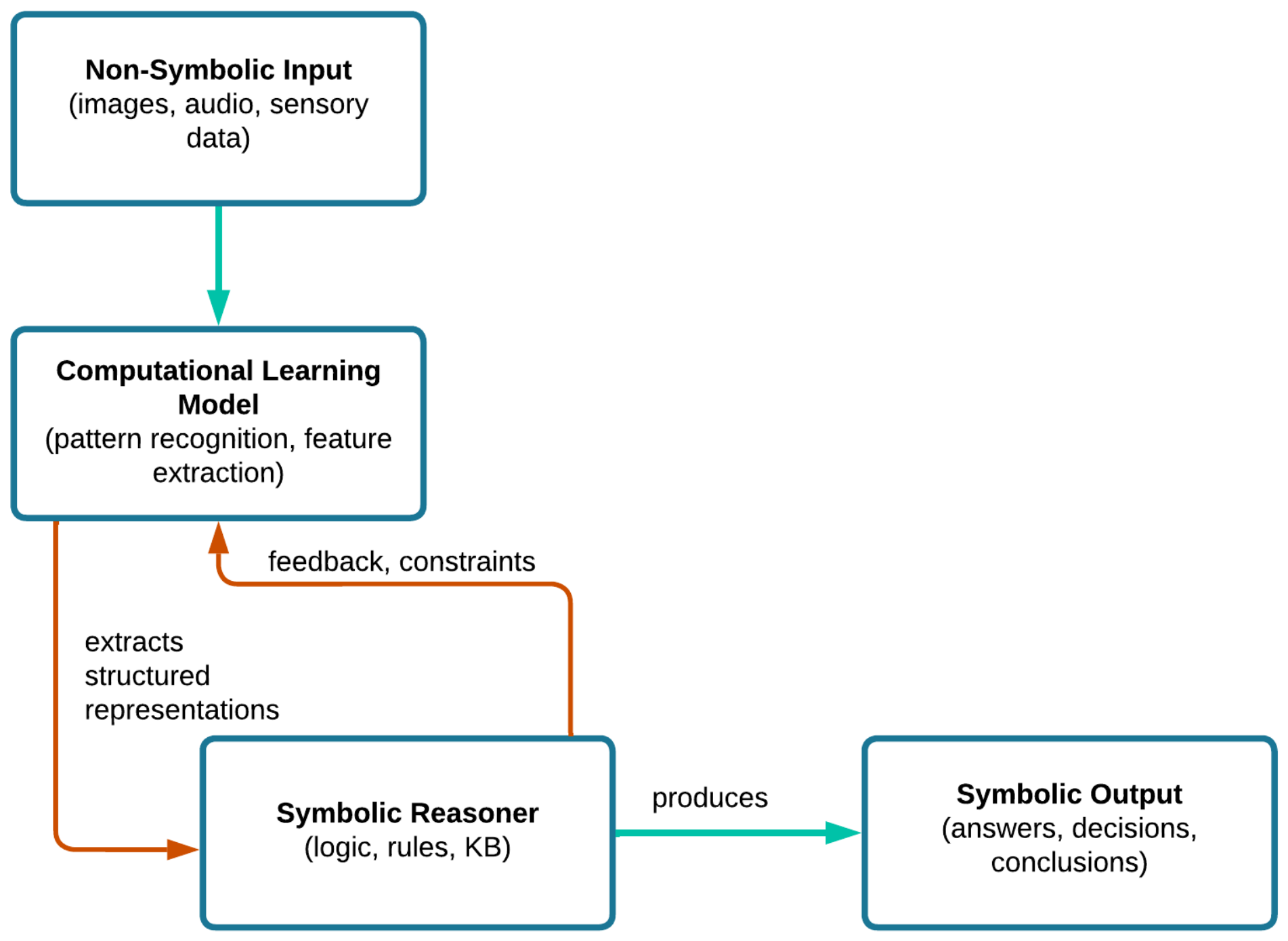


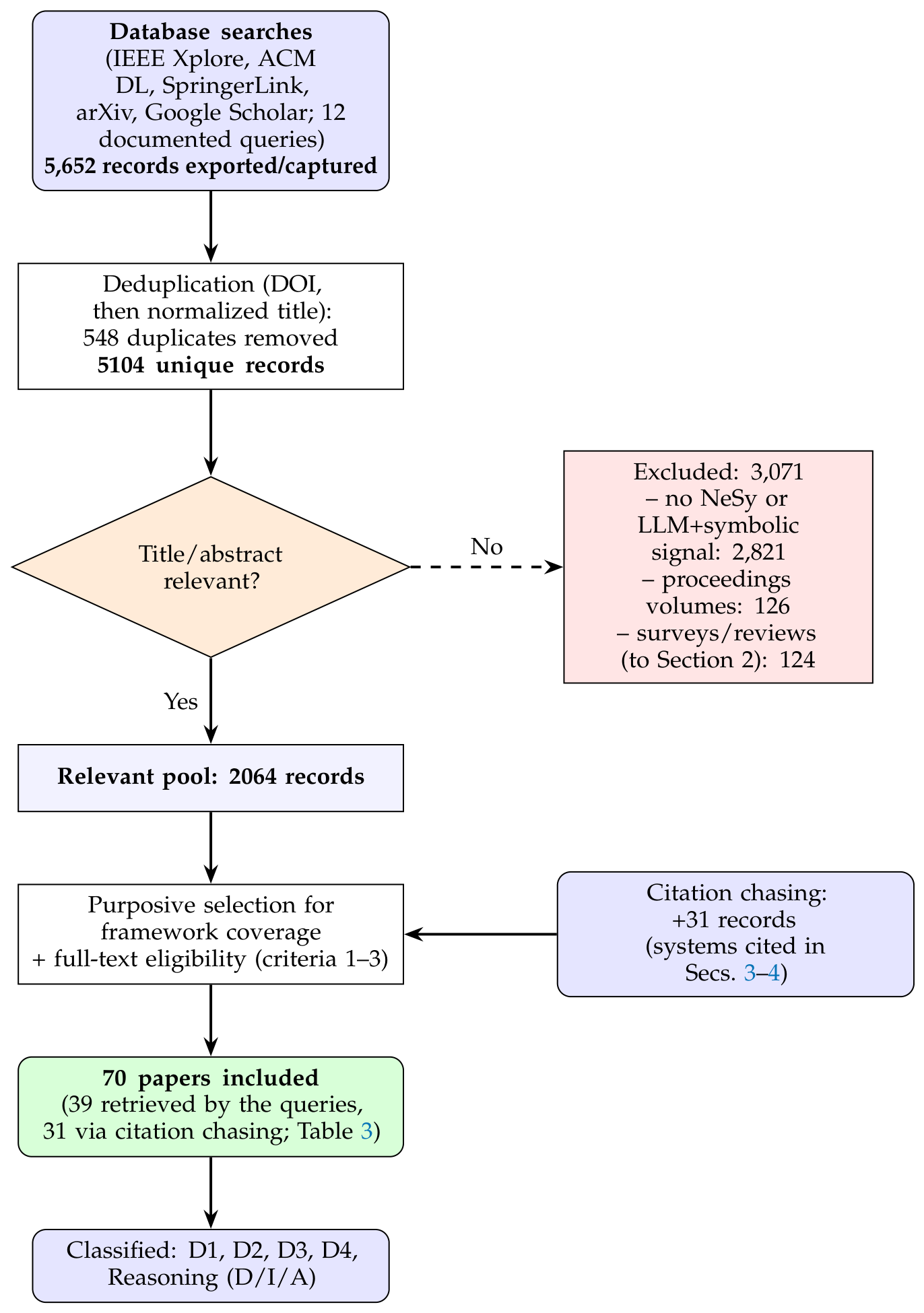


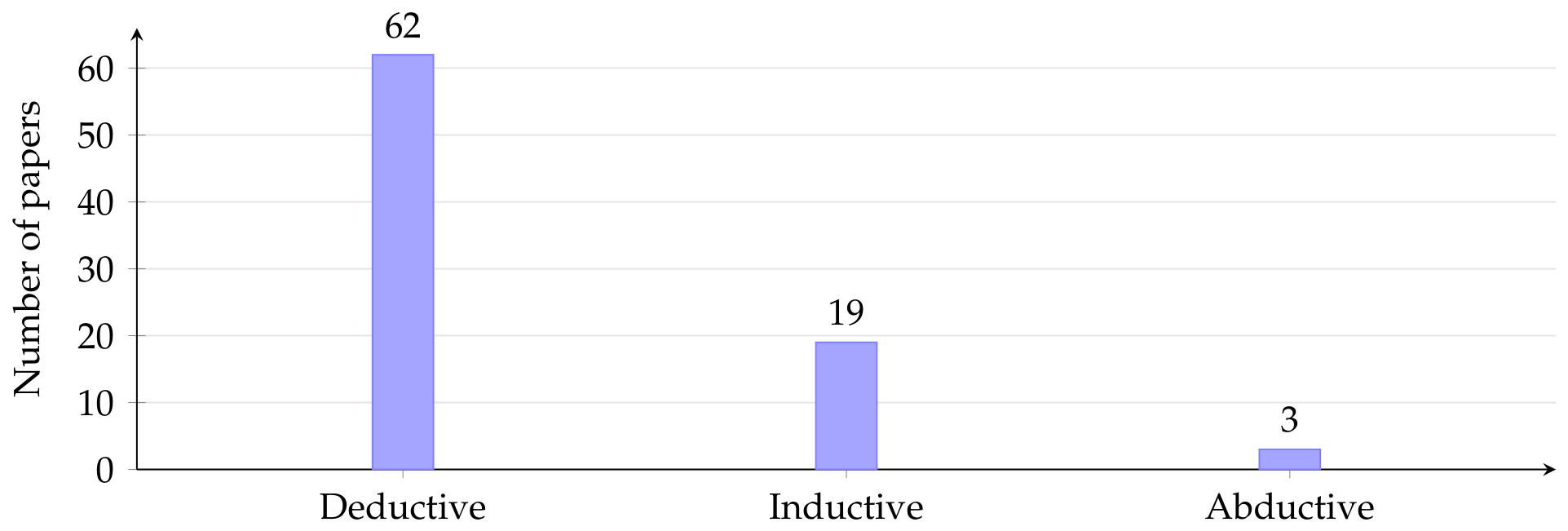

| Survey | Architectural Taxonomy | Foundational Dimensions | Reasoning Categorization | Gap Identification |
|---|---|---|---|---|
| General | ||||
| Wang et al. [29] | ✓ | – | – | – |
| Feldstein et al. [31] | (p) | – | – | – |
| Garcez & Lamb [24] | ✓ | – | – | – |
| Bougzime et al. [32] | ✓ | – | – | – |
| Van Bekkum et al. [33] | ✓ | – | – | – |
| Nawaz et al. [36] | – | – | – | – |
| Jayasingha et al. [37] | (p) | – | – | – |
| Bouneffouf & Aggarwal [38] | – | – | – | – |
| Zhang & Sheng [39] | (p) | – | – | – |
| Colelough & Regli [40] | – | – | – | ✓ |
| Marra et al. [34] (StarAI) | ✓ | – | – | – |
| Bhuyan et al. [35] | ✓ | (p) | (p) | (p) |
| Ciatto et al. [27] (SKE/SKI) | (p) | (p) | – | (p) |
| Language | ||||
| Hamilton et al. [41] | ✓ | – | – | ✓ |
| Keber et al. [42] | (p) | – | – | – |
| Visual Reasoning | ||||
| Khan et al. [43] | – | – | – | – |
| Applied Domains | ||||
| Gomaa et al. [44] (Robotic Surgery) | – | – | – | – |
| Acharya et al. [45] (Air Mobility) | – | – | – | – |
| Chen et al. [46] (Geoscience) | – | – | – | – |
| Hossain & Chen [47] (Healthcare) | (p) | – | – | – |
| Systems & Decision-Making | ||||
| Hakim et al. [48] (Cybersecurity) | – | – | – | – |
| DeLong et al. [49] (Knowledge Graphs) | ✓ | – | – | – |
| Wan et al. [50] (Hardware/Systems) | ✓ | – | – | – |
| Acharya et al. [51] (RL & Planning) | (p) | – | – | – |
| Assurance | ||||
| Renkhoff et al. [52] (V&V) | ✓ | – | – | – |
| Michel-Delétie & Sarker [53] (Trustworthiness) | – | – | – | ✓ |
| Compositional Generalization | ||||
| Nassim et al. [54] | – | – | – | – |
| This work (General) | ✓ | ✓ | ✓ | ✓ |
| Type | Integration Pattern | Symbolic Component Active | D1 Coupling | Primary Strength | Primary Limitation |
|---|---|---|---|---|---|
| Type 1: Symbolic Neuro Symbolic | Symbolic input/output around a neural core; no formal reasoning | Interfaces only | Loose (minimal) | Simplicity; compatible with standard pipelines | No reasoning or symbolic correction; baseline rather than genuine NeSy |
| Type 2: Symbolic[Neuro] | Symbolic controller delegates subtasks to neural components | Inference (as controller) | Loose | Transparent, interpretable control; modularity | Depends on rule completeness; cannot learn to improve its own rules |
| Type 3: Neuro|Symbolic | Equal partners in a cooperative, iterative loop | Training and inference | Loose to tight (varies) | Mutual compensation; compositional generalization | Coordination complexity; brittle if symbolic layer is incomplete |
| Type 4: Neuro: Sym → Neuro | Symbolic knowledge compiled into the training process | Training only | Compiled | Runtime efficiency; data efficiency | Knowledge not inspectable or updatable without retraining |
| Type 5: NeuroSymbolic | Symbolic structure embedded in the architecture | Training and inference (structural) | Tight | Persistent constraint enforcement; consistency guarantees | Inflexible; rule changes require redesign and retraining |
| Type 6: Neuro[Symbolic] | Symbolic inference internalized as the model’s own computation | Training and inference (internalized) | Fully integrated | No interface problem; provably consistent inference possible | Least mature; limited scale; learning and consistency can conflict |
| D1: Mode of Integration | D2: Symbolic Priors for Learning | D3: Symbolic Constraints for Safety/Bias | D4: Symbolic Knowledge from Learning | Reasoning Approach (D/I/A) | |
|---|---|---|---|---|---|
| Type 1: Symbolic Neuro symbolic | Loose [67,99,100,101,102] | [102] | – | [101] | Deductive [67,100], Inductive [99,101,102] |
| Type 2: Symbolic[Neuro] | Loose [59,64,70,71,72,73,74,75,103,104,105,106,107,108,109,110,111,112] | [59,64,103,104,105,106,107,108,109,110,111] | [64,104,106] | [75,109,111,112] | Deductive [59,64,70,71,72,73,74,75,103,104,105,106,107,108,109,110,111,112], Inductive [109], Abductive [112] |
| Type 3: Neuro | Symbolic | Tight [76,77,78,113,114,115,116,117,118], Loose [79,80,119,120,121,122,123,124,125,126] | [77,78,80,113,114,115,116,117,118,120,121,122,123] | [113,124,125] | [80,114,116,117,118,120,122,123,124,125] | Deductive [76,77,78,79,80,113,114,115,116,117,118,120,121,122,123,124,125,126], Inductive [114,115,116,117,118,120,121,122,123], Abductive [114,126] |
| Type 4: Neuro: Sym → Neuro | Compiled [56,57,61,81,82,83,127,128,129,130,131] | [56,57,61,81,82,83,127,128,129,130,131] | [83] | [61] | Inductive [61,81,82,130,131], Deductive [56,57,83,127,128,129,130,131] |
| Type 5: NeuroSymbolic | Tight [58,62,84,85,86,91,132,133,134,135,136] | [58,84,85,86,91,132,133,134,135,136] | [62,85,91,133] | [84,133,136] | Inductive [84], Deductive [58,62,85,86,91,132,133,134,135,136] |
| Type 6: Neuro[Symbolic] | Fully Integrated [87,88,89,90,137,138] | [87,137] | – | [137] | Deductive [87,88,89,90,137,138] |
| Gap | Description and Research Direction |
|---|---|
| Safety and bias constraints (D3) | Symbolic safety, fairness, and bias-prevention constraints remain underexplored across all types, despite trustworthiness being among the most frequently cited motivations for NeSy research. Closing this disconnect, by encoding stated trustworthiness goals as explicit symbolic constraints that systems must satisfy, is the most significant research direction identified by our analysis. |
| D3 in Type 6 | Within this gap, fully integrated systems are the extreme case: safety and bias constraints are completely absent from Type 6 in our corpus. Deploying such systems in safety-critical domains requires new mechanisms for enforcing symbolic constraints within the model’s own computation. |
| Absence of abductive reasoning | Task-level abductive inference is virtually absent from the surveyed corpus, with the few instances concentrated in its newest members. Given its importance for explanation, diagnosis, and scientific discovery, and given that formal machinery for it exists [92,93], systems performing genuine task-level abduction represent a major opportunity. |
| Scarcity of Type 6 systems | Fully internalized symbolic reasoning remains scarce and largely theoretical, with practical implementations limited to Logical Neural Networks and their direct applications. Scaling such architectures beyond their current limits appears, on the evidence of our corpus, to define the frontier of NeSy integration. |
| Bidirectional knowledge–learning interaction | The simultaneous presence of D2/D3 and D4 is rare. Most systems either inject symbolic knowledge into learning or extract it from learning; architectures that achieve both within a single system remain an open design challenge. |
| Blurred boundaries between Kautz types | Real-world systems frequently exhibit characteristics of multiple types, suggesting the need for a more nuanced classification, for example a continuous characterization of integration depth rather than discrete categories. |
Disclaimer/Publisher’s Note: The statements, opinions and data contained in all publications are solely those of the individual author(s) and contributor(s) and not of MDPI and/or the editor(s). MDPI and/or the editor(s) disclaim responsibility for any injury to people or property resulting from any ideas, methods, instructions or products referred to in the content. |
© 2026 by the authors. Licensee MDPI, Basel, Switzerland. This article is an open access article distributed under the terms and conditions of the Creative Commons Attribution (CC BY) license.
Share and Cite
Zikas, S.; Gkirtzou, K.; Panagiotakopoulos, T.; Kiouvrekis, Y. Bridging Knowledge and Learning: A Multi-Axis Analytical Survey for Neurosymbolic Artificial Intelligence. Mach. Learn. Knowl. Extr. 2026, 8, 281. https://doi.org/10.3390/make8090281
Zikas S, Gkirtzou K, Panagiotakopoulos T, Kiouvrekis Y. Bridging Knowledge and Learning: A Multi-Axis Analytical Survey for Neurosymbolic Artificial Intelligence. Machine Learning and Knowledge Extraction. 2026; 8(9):281. https://doi.org/10.3390/make8090281
Chicago/Turabian StyleZikas, Sotiris, Katerina Gkirtzou, Theodor Panagiotakopoulos, and Yiannis Kiouvrekis. 2026. "Bridging Knowledge and Learning: A Multi-Axis Analytical Survey for Neurosymbolic Artificial Intelligence" Machine Learning and Knowledge Extraction 8, no. 9: 281. https://doi.org/10.3390/make8090281
APA StyleZikas, S., Gkirtzou, K., Panagiotakopoulos, T., & Kiouvrekis, Y. (2026). Bridging Knowledge and Learning: A Multi-Axis Analytical Survey for Neurosymbolic Artificial Intelligence. Machine Learning and Knowledge Extraction, 8(9), 281. https://doi.org/10.3390/make8090281