
Article

Queue-Scheduled Multi-Fidelity Bayesian Optimisation with Cross-Fidelity Anomaly Resolution for Laboratory Deployment

by
Kishan Kartha
1 and
Alex James
1,2,*
1
School of Electronic Systems and Automation, Digital University Kerala, Thiruvananthapuram 695317, Kerala, India
2
Maker Village, Indian Institute of Information Technology and Management-Kerala, Thiruvananthapuram 695581, Kerala, India
*
Author to whom correspondence should be addressed.
Mach. Learn. Knowl. Extr. 2026, 8(9), 268; https://doi.org/10.3390/make8090268
Submission received: 17 June 2026 / Revised: 22 July 2026 / Accepted: 23 July 2026 / Published: 3 September 2026

Abstract

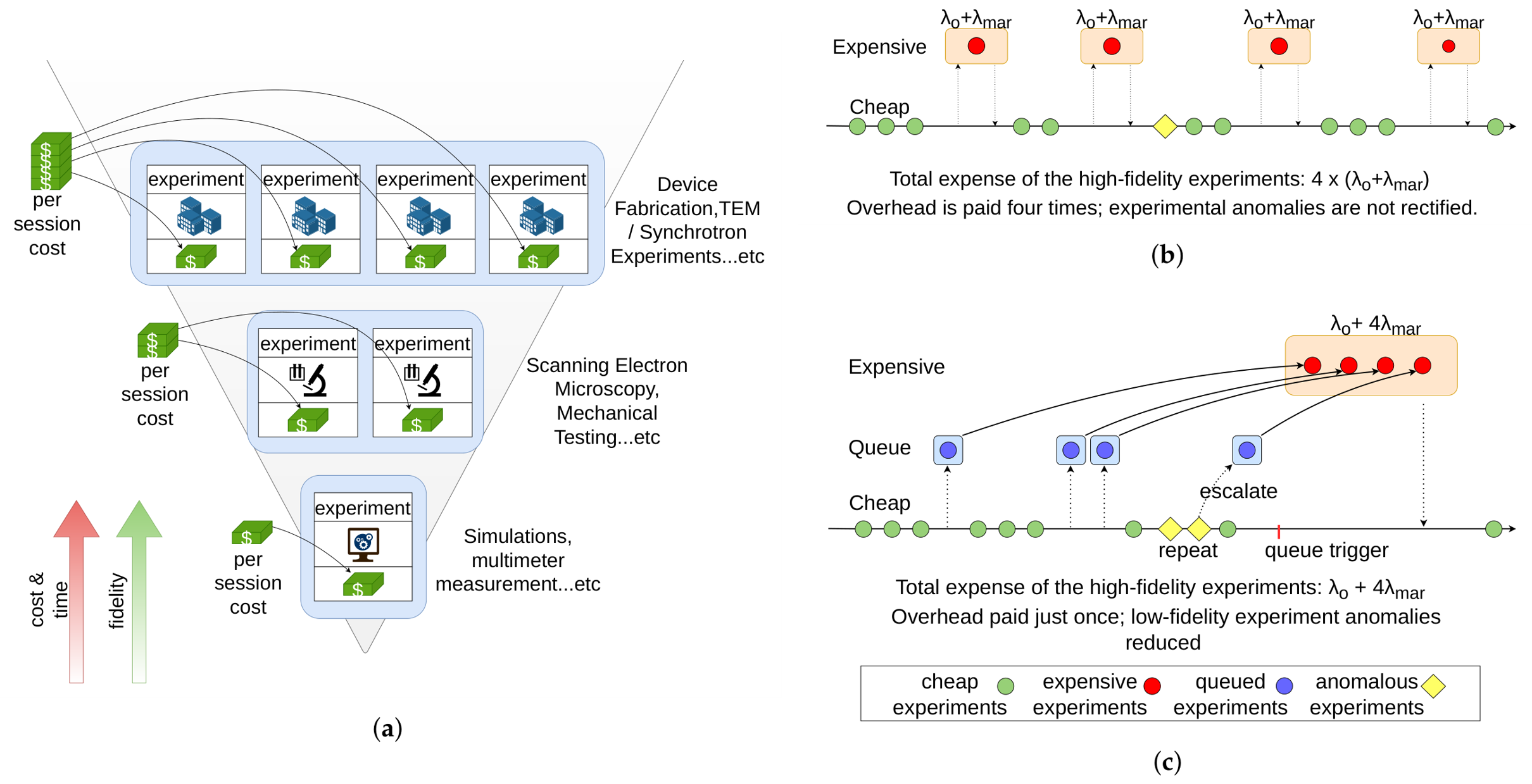
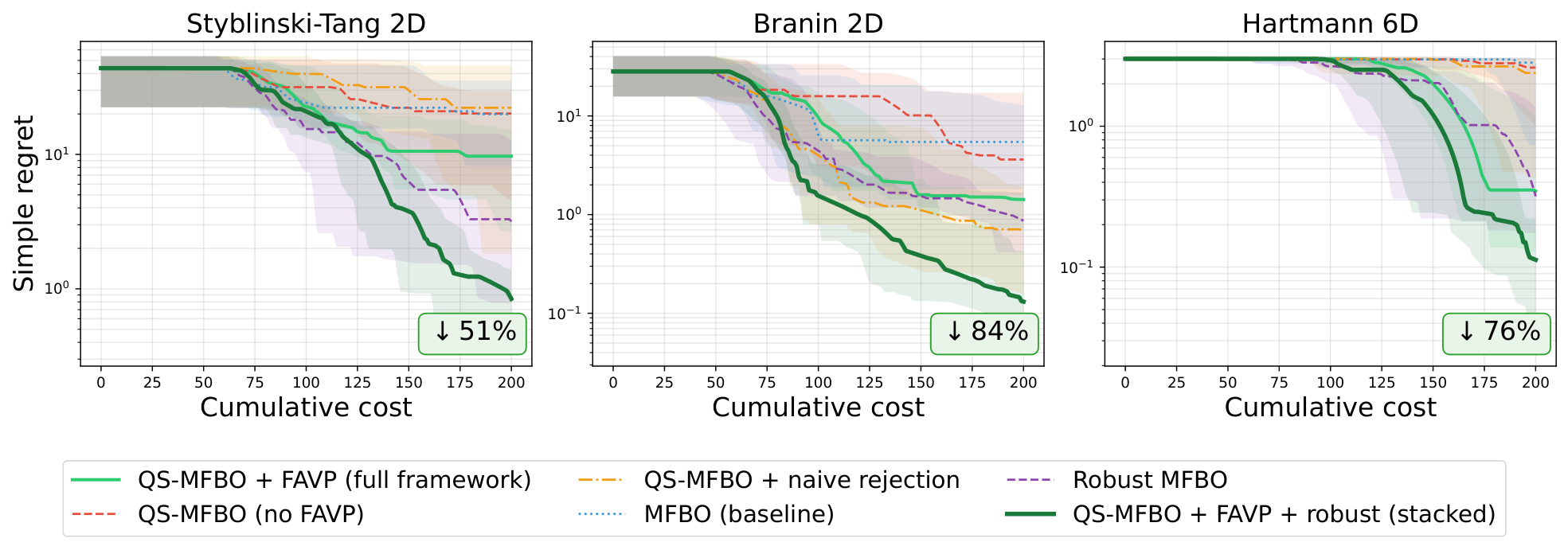
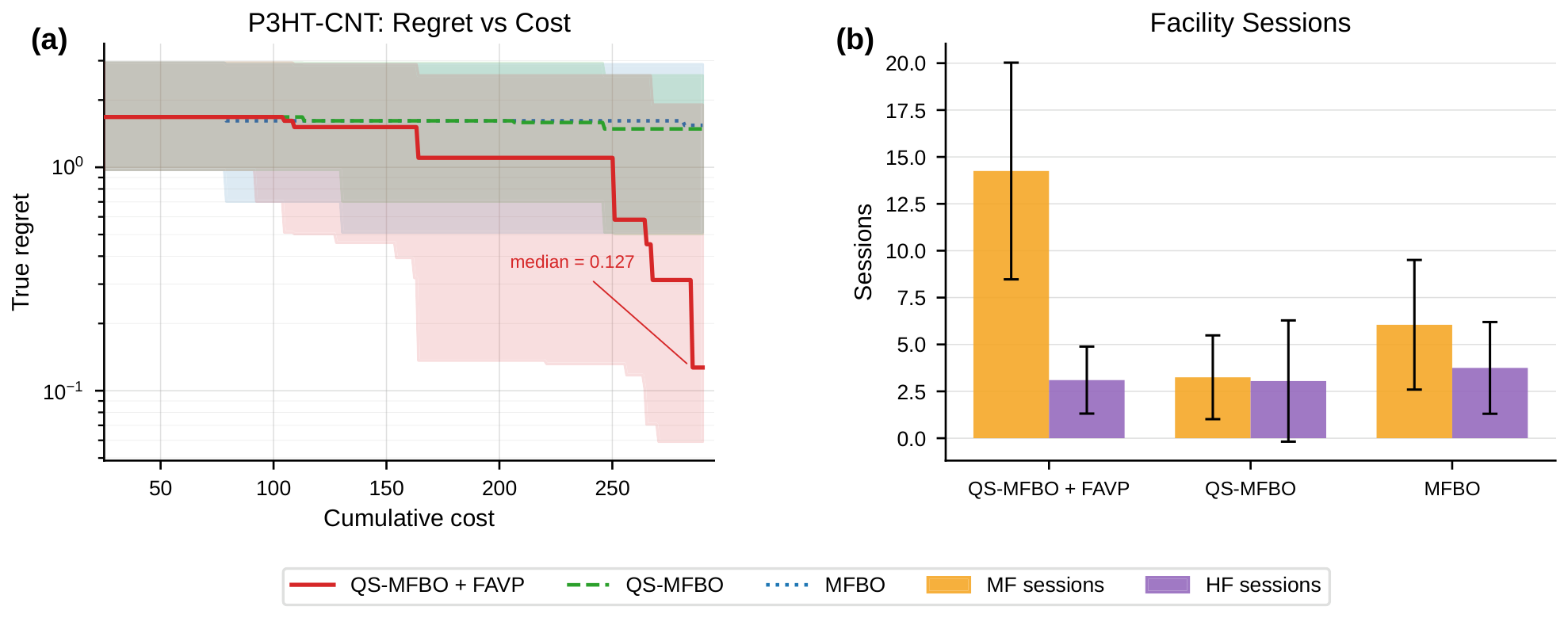
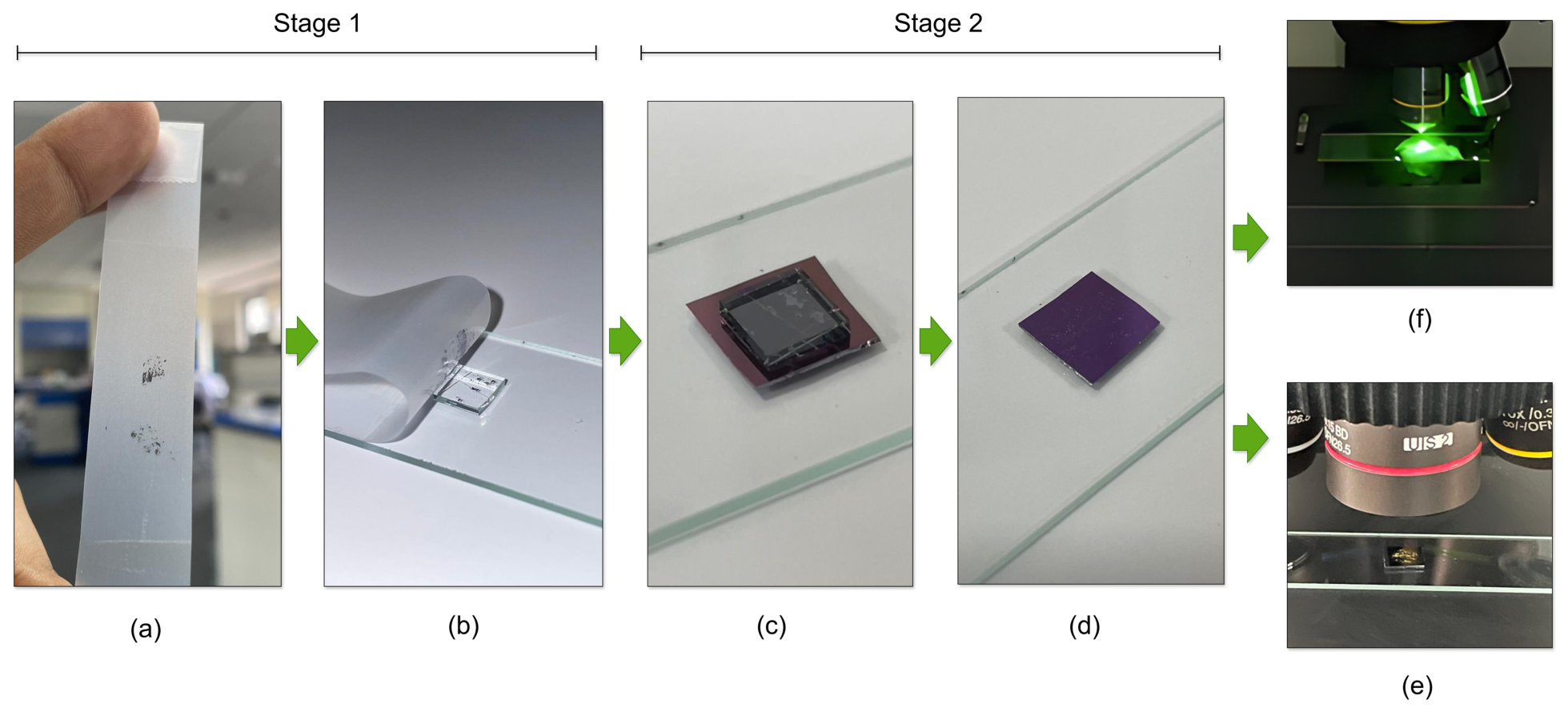
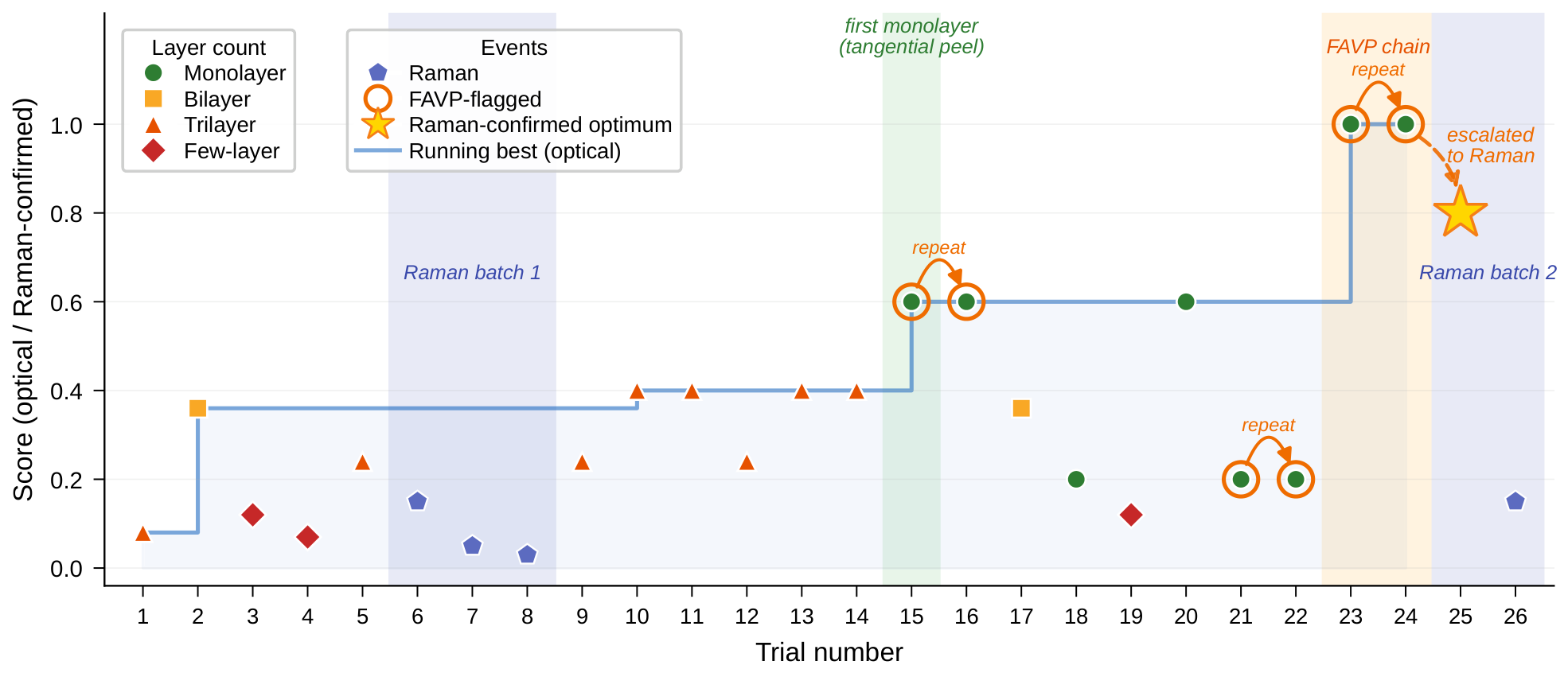
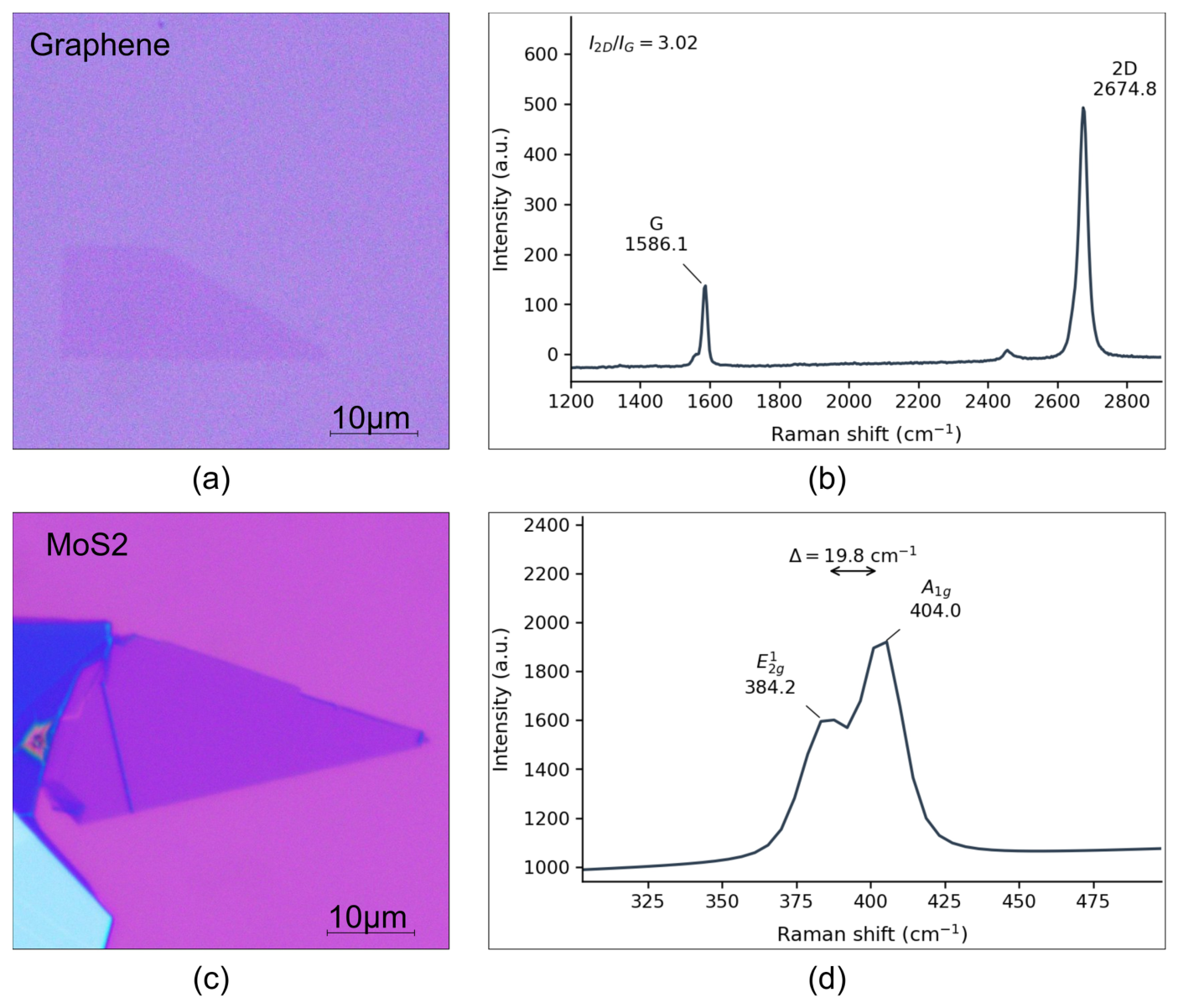
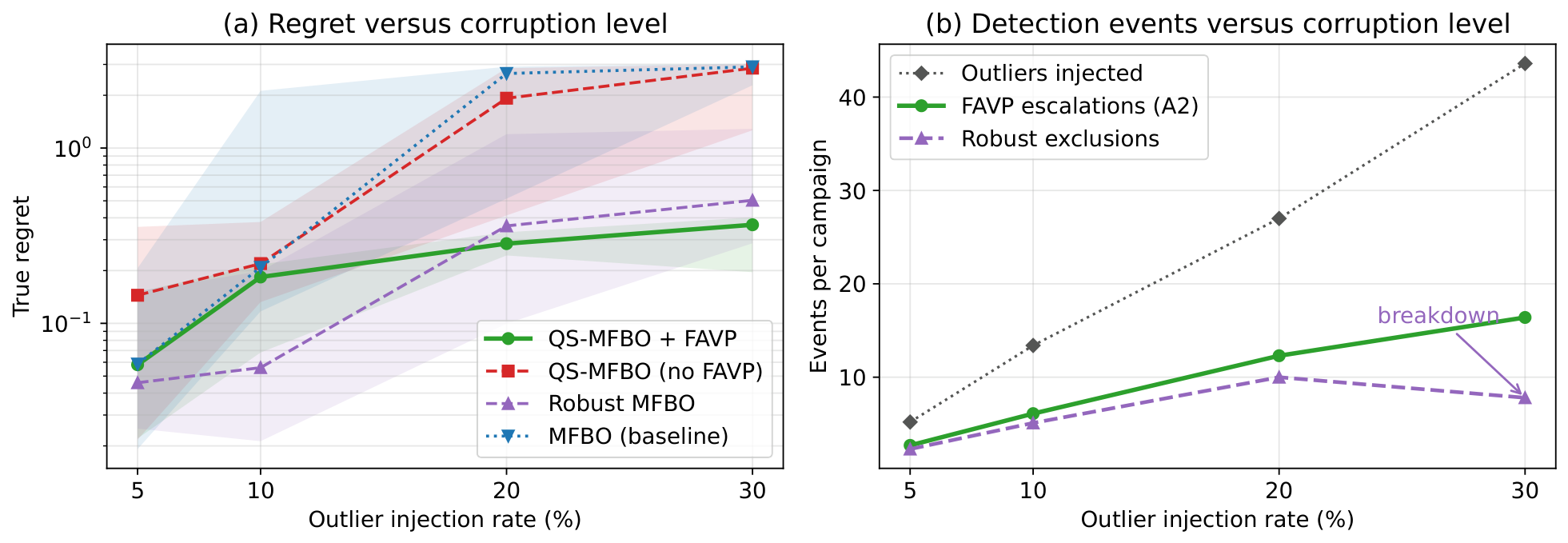
Laboratory experimentation is shaped by practical constraints, so computational frameworks built for offline settings do not transfer cleanly to an online laboratory routine. Two mismatches dominate. First, they assume on-demand access to high-fidelity facilities, whereas characterisation, fabrication, and testing are rarely economical one sample at a time. Second, experiments produce occasional catastrophic, non-Gaussian errors that a fixed noise model handles poorly. Here, we introduce a coupled scheduling-and-verification layer that wraps a multi-fidelity optimiser. A queue scheduler models per-session overheads and batches expensive measurements to amortise them; a Fidelity-Aware Verification Protocol repeats suspect observations and escalates unresolved ones to a higher fidelity. The two share the same cost-amortised queue, so a verification escalation is dispatched as just another queued sample, and anomaly handling reinforces batching rather than competing with it. On synthetic functions, the layer reduces overhead-incurring sessions by 28–43% and, under catastrophic outliers, cuts regret by 51–84%. On a real three-fidelity materials dataset, it improves cost-efficiency and robustness. In a live deployment on polydimethylsiloxane-mediated 2D material transfer, it reached Raman-confirmed monolayer graphene in 26 trials using only two Raman sessions, and those discovered parameters transferred another 2D material, monolayer molybdenum disulphide, on the first attempt.
Keywords: multi-fidelity Bayesian optimisation; experiment scheduling; laboratory automation; self-driving labs; multi-fidelity learning; two-dimensional materials; graphene; molybdenum disulphide; catastrophic noise; graphene transfer; polydimethylsiloxane multi-fidelity Bayesian optimisation; experiment scheduling; laboratory automation; self-driving labs; multi-fidelity learning; two-dimensional materials; graphene; molybdenum disulphide; catastrophic noise; graphene transfer; polydimethylsiloxane