

Cognitive Friction in Clinical Decision Support: A Comparative Study of Judicial and Adjunct Human–AI Interaction Protocols

 ,
,  , , , , , , , , , and
Abstract
1. Introduction
1.1. Limitations of AI-Based Decision Support
1.2. The Role of Interaction Design in Clinical Decision Making
- Adjunct protocols: the AI system acts as a second opinion rather than providing immediate guidance. Users are first required to take time to formulate an independent diagnosis before receiving AI support.
- Judicial protocols: instead of explicitly presenting a prediction, the system provides arguments supporting competing diagnostic hypotheses. AI instruments (e.g., XAI or LLMs) are used to generate juxtaposed evidence for the most plausible hypotheses—typically two alternatives, which represent opposing positions in a judicial debate. The user, acting as a “judge”, is then required to evaluate the evidence and reach their own conclusion. The study and application of these protocols is also referred to as Judicial AI (JAI).
- Analogical protocols: rather than providing direct recommendations, the system presents representative cases similar to the current instance. The most similar examples associated with different candidate hypotheses are retrieved from the dataset and displayed together with their ground-truth labels.
- It is important to note that these protocols were not intended as entirely novel interaction designs. Rather, they represent a conceptual organization of interaction patterns that have previously appeared in the literature under different names and in different application domains. For example, Reingold et al. [34] introduced, outside the healthcare domain, an interaction design based on dissenting explanations, in which users are presented with evidence supporting alternative conclusions. This concept is closely aligned with the notion of juxtaposed evidence employed in judicial protocols.
1.3. Study Rationale and Research Questions
- XAI—an XAI-first protocol (state of the art), in which participants are shown the model prediction and corresponding XAI explanations;
- JAI—a pure judicial protocol, in which participants are shown juxtaposed explanations for the two classes derived from the same XAI method;
- AAI—a pure adjunct protocol, in which participants first provide an unsupported diagnosis and subsequently revise it after being presented with the model prediction and corresponding XAI explanation.
- All groups will be compared also against a baseline, NoAI, obtained from the first decision in AAI group.
- RQ1—Design of clinical decision support from legal and psychological perspectives
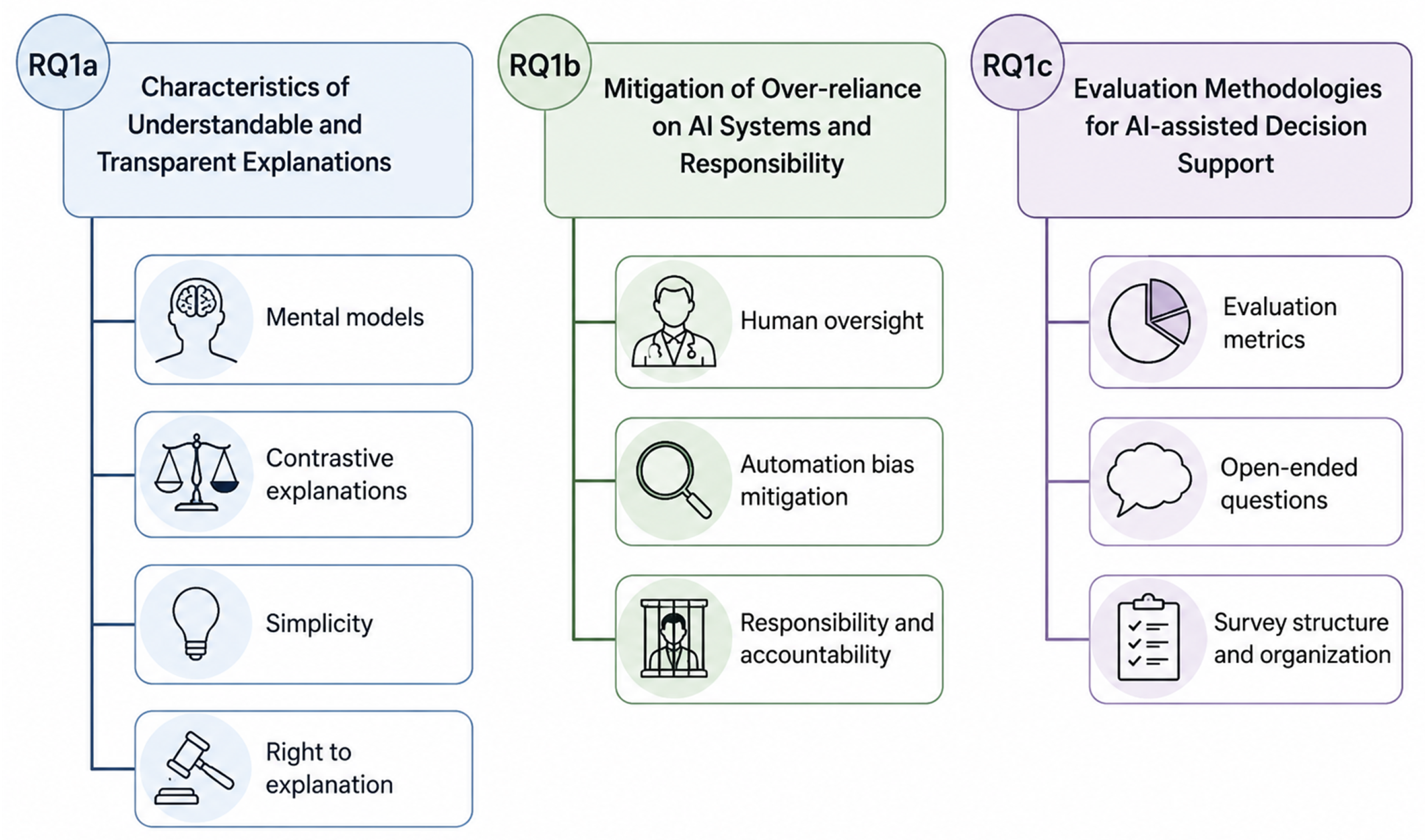
- RQ1a: What are the characteristics of sufficiently transparent and understandable explanations?
- RQ1b: How can over-reliance be reduced, and how is it related to responsibility in human–AI decision making?
- RQ1c: Are user studies an effective tool for assessing decision support quality and demonstrating compliance with legal requirements?
- RQ2—Characterizing Frictional AI Systems
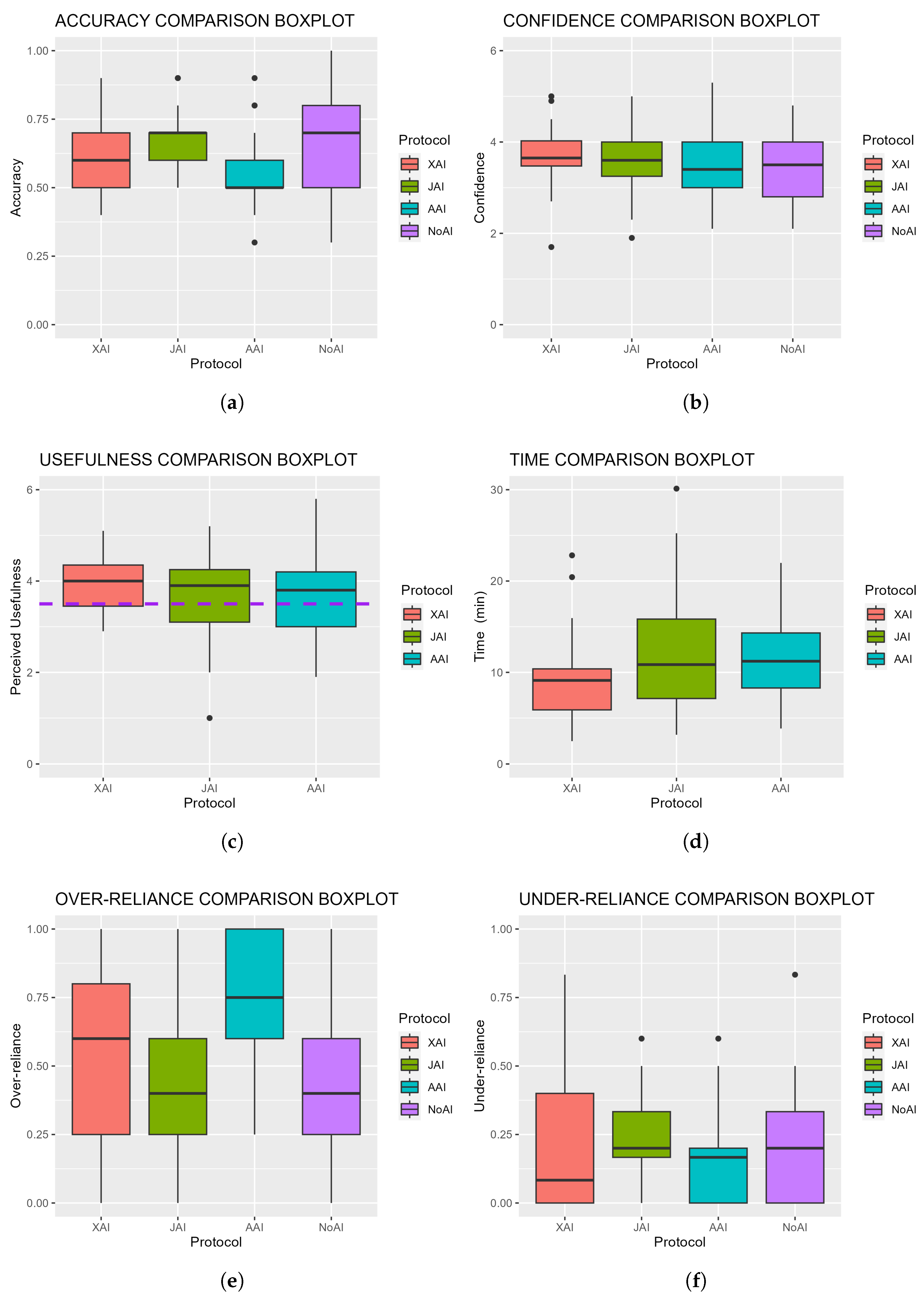
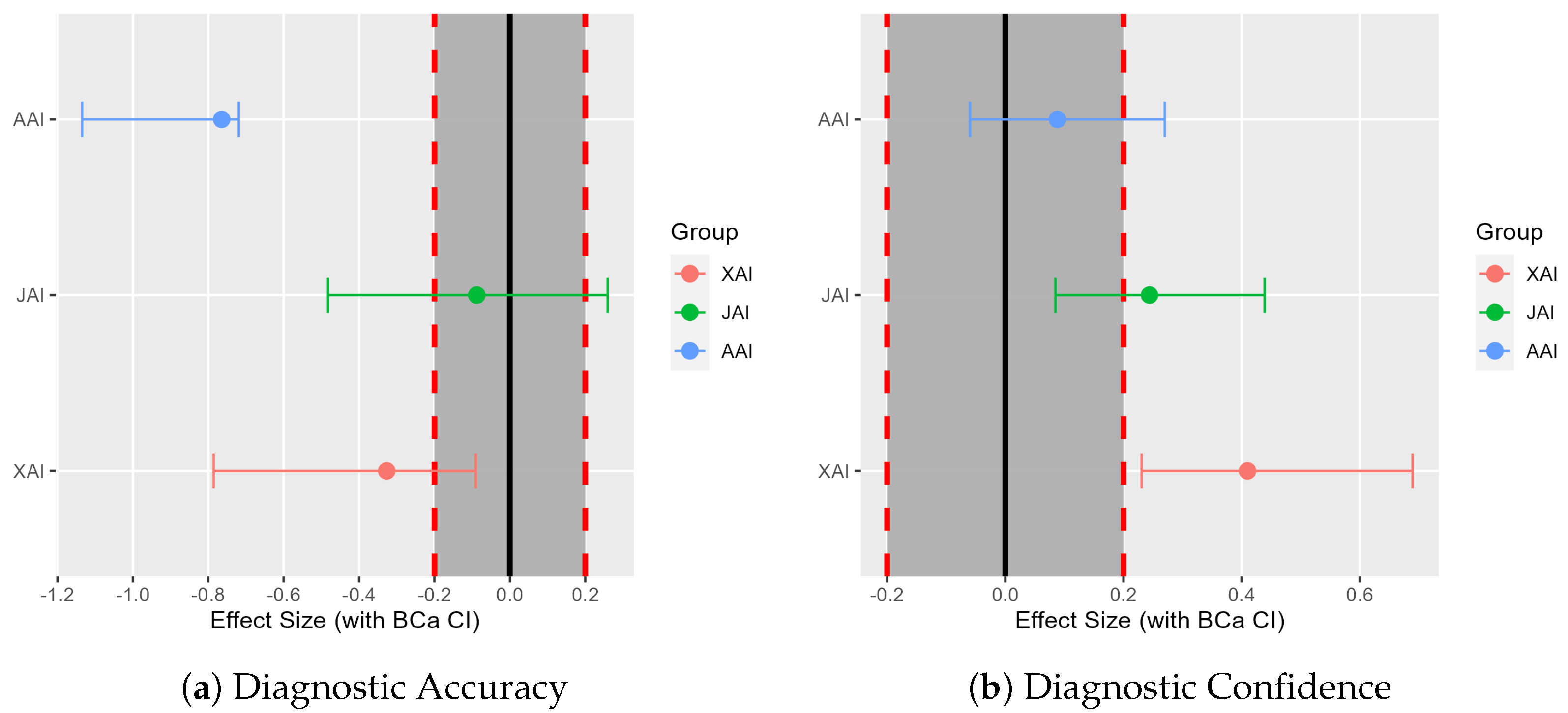
- RQ2a Is the performance associated with FAI-based decision-support systems non-inferior to that achieved with either no support or conventional XAI-first approaches? We address this question by comparing diagnostic accuracy, diagnostic confidence, and perceived usefulness. In addition to statistical significance testing, we evaluate intervention impact through effect size analyses.
- RQ2b: Do FAI-based decision-support systems slow down the decision-making process compared with conventional XAI-first support? We address this question by comparing survey completion times.
- RQ2c: Is the risk of automation bias and algorithm aversion associated with FAI-based decision-support systems lower than that associated with XAI-first support? We address this question by comparing over-reliance (used as a proxy for automation bias [45]) and under-reliance (used here as a proxy for algorithm aversion).
2. Materials and Methods
2.1. Interviews with Domain Experts
2.1.1. Organization of the Interviews
2.1.2. The Thematic Analysis
2.2. Comparison of Human–AI Interaction Protocols
2.2.1. Hospitalization Risk Prediction Task
2.2.2. User Study Design
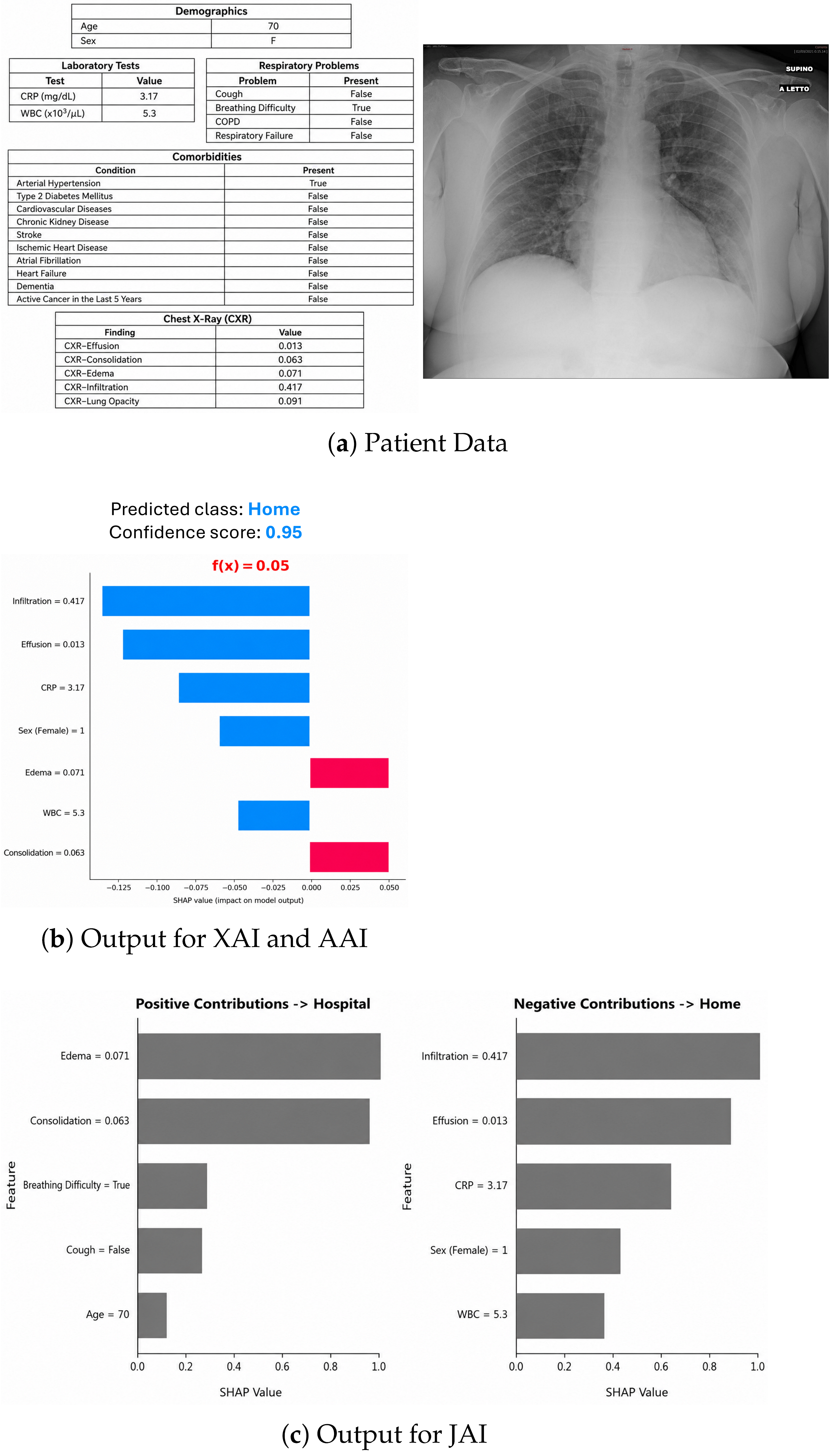
- XAI-first (XAI)—for each case, participants were shown the model suggested prediction, the corresponding confidence score, and the SHAP explanation; this can be considered as the state of the art in clinical decision support.
- Judicial (JAI)—a pure judicial protocol in which participants were shown only the juxtaposed SHAP explanations associated with the two classes.
- Adjunct (AAI)—a pure adjunct protocol in which participants first provided an unsupported diagnosis and subsequently revised it after being presented with the model prediction, confidence score, and SHAP explanation.
2.2.3. Statistical Evaluation
3. Results
3.1. Themes Emerging from Expert Interviews
3.2. User Study Results
3.2.1. Quantitative Results and Statistical Analysis
3.2.2. Evaluation of the Impact
4. Discussion
4.1. The Good Design of Clinical Decision Support
4.2. Friction-Based Systems and User Performance
4.3. The Benefits of Cognitive Friction
4.4. Judicial AI vs. Adjunct Protocols
4.5. Limitations and Future Work
5. Conclusions
Author Contributions
Funding
Institutional Review Board Statement
Informed Consent Statement
Data Availability Statement
Acknowledgments
Conflicts of Interest
Abbreviations
| AI | Artificial Intelligence |
| BCa | Bias-Corrected and accelerated |
| CRP | C-Reactive Protein |
| DSS | Decision-Support System |
| ECG | Electrocardiogram |
| FAI | Frictional AI |
| GDPR | General Data Protection Regulation |
| JAI | Judicial AI |
| LLM | Large Language Model |
| MDR | Medical Device Regulation |
| ML | Machine Learning |
| MRI | Magnetic Resonance Imaging |
| RQ | Research Question |
| SD | Standard Deviation |
| XAI | eXplainable Artificial Intelligence |
| WBC | White Blood Cell |
| XGBoost | Extreme Gradient Boosting |
Appendix A. Interview Materials

| Theme | Questions |
|---|---|
| Preliminary questions | 1. What is your name? |
| 2. What is your age? | |
| 3. What gender were you assigned at birth? | |
| 4. Do you have professional experience with AI or AI-based decision-support systems? | |
| Legal domain—questions for the legal expert | |
| Degree of explainability | 5. To what extent is explainability legally required under regulations such as the MDR [11], GDPR [10], and AI Act [9]? |
| 6. Do current regulations prescribe specific techniques for ensuring AI transparency? If so, which ones, and how effective are they? | |
| 7. Considering Article 13 of the AI Act, how would you assess the clarity and comprehensibility of the explanations presented in the survey? Are they sufficiently understandable, and what changes would you suggest? | |
| 8. Should AI explanations prioritize understandability or faithfulness to the model’s internal workings? Why? Should a global explanation be included? Is Frictional AI [22] problematic? | |
| 9. Do patients have a “right to explanation” in AI-driven healthcare, and should research focus on whether explanations are truly understandable from the patient’s perspective? | |
| Reliance on AI and automation bias | 10. How do current liability frameworks address disagreements between clinicians and AI recommendations, and who is responsible when clinical errors occur? |
| 11. Could AI-based clinical decision-support systems encourage defensive medicine [27] or reduce clinicians’ acceptance of AI due to concerns about liability? | |
| 12. What role can explainable AI techniques play in liability frameworks such as the EU AI Liability Directive [12], and how might they affect accountability in healthcare? | |
| 13. What responsibilities should developers and manufacturers bear in healthcare litigation involving AI, and how should they be held accountable for clinical errors or harm? | |
| Adequacy of surveys | 14. What metrics could demonstrate compliance with legal requirements such as the MDR or AI Act, and what factors should guide their definition? |
| 15. Can a survey-based approach adequately demonstrate regulatory compliance? If not, how should studies assessing transparency requirements be designed? | |
| Psychological domain—questions for the psychology expert | |
| Degree of explainability | 5. What are the key characteristics of a “good explanation”, and how should they guide the design of AI explanations? |
| 6. How could SHAP [50] be made more intuitive and user-friendly for non-technical users? | |
| 7. What criteria should guide feature selection in explanations? Should fewer, more impactful features be prioritized? | |
| 8. How should probabilities and model confidence be presented in AI-driven healthcare applications to maximize user understanding? Do users generally consider such information important? | |
| Reliance on AI and automation bias | 9. What measures could reduce clinicians’ over-reliance on AI and mitigate automation bias [18]? |
| 10. How can simple explanations be balanced with the complexity of high-risk healthcare decisions? Could simplified explanations increase over-reliance, and could model confidence help calibrate trust? | |
| 11. What are your views on Frictional AI, and could it help reduce automation bias in healthcare? | |
| 12. Beyond automation bias, what other cognitive biases might AI explanations trigger, and how could they be mitigated? | |
| Adequacy of surveys | 14. Do the current survey questions accurately measure cognitive constructs such as trust, confidence, and usefulness? How could they be improved? |
| 15. Is the “Clinical Explanation Satisfaction Scale” [66] clear and easy to understand? What improvements would enhance clarity and response quality? | |
Appendix B. User Study Materials
Appendix B.1. Survey Inputs
- Radiomic data—consolidation, infiltration, edema, effusion, and lung opacity;
- Generalities—age and gender;
- Respiratory symptoms—presence of respiratory issues, cough, breathing difficulties, chronic obstructive pulmonary disease, and respiratory failure;
- Laboratory data—white blood cell (WBC) count and C-reactive protein (CRP) test result;
- Comorbidities—hypertension, type 2 diabetes mellitus, cardiovascular disease, chronic renal failure, stroke, ischemic heart disease, atrial fibrillation, heart failure, dementia, and active cancer in the last 5 years;

Appendix B.2. The Profiling Questionnaire
| Question | Possible Answers |
|---|---|
| Demographics and background | |
| E-mail address | Open-ended |
| Sex | Female/Male/Prefer not to answer |
| How many years of experience do you have as a medical specialist? | Open-ended (years) |
| What is your team? | Radiology/Infectious Diseases/Emergency Medicine |
| Familiarity with AI | |
| I have a good knowledge of Artificial Intelligence. | Yes/No |
| I have worked with and/or used Artificial Intelligence systems in my job. | Yes/No |
| Trust in AI | |
| I believe that Artificial Intelligence can help me answer questions more accurately and quickly when I am uncertain about the answer. | Yes/No |
| I believe that using Artificial Intelligence (e.g., a virtual assistant) to support my work or study can increase my productivity. | Yes/No |
| I believe that Artificial Intelligence can improve the effectiveness of my work. | Yes/No |
Appendix B.3. Instructional Videos
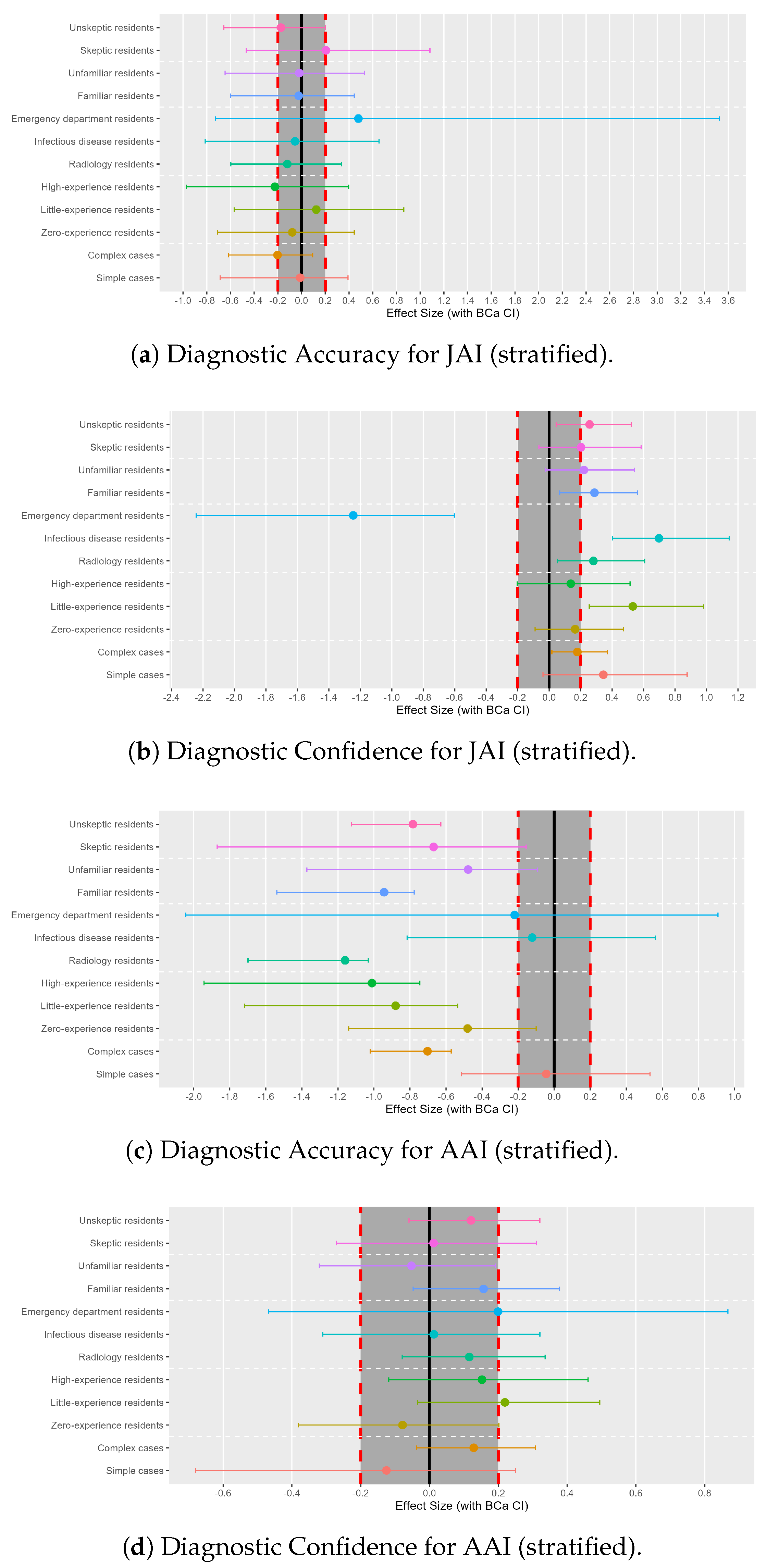
Appendix C. Stratified Effect Size Analysis Details
- Level of clinical experience—zero-experience (no COVID-19 patients treated), little-experience (≤100 patients treated), and high-experience residents (>100 patients treated);
- Medical specialty—radiology, infectious diseases, and emergency medicine residents;
- Familiarity with AI—residents reporting familiarity (at least one positive response) or unfamiliarity with AI technologies;
- Trust in AI—skeptic (at least two negative responses) and unskeptic residents;
- Perceived case complexity—simple (complexity score ) and complex cases (complexity score );
- Perceived usefulness of the decision support—support perceived as not useful (usefulness score ) and useful (usefulness score ).
References
- Tripathy, N.; Nayak, S.K.; Addula, S.R.; Panigrahi, A.; Pati, A.; Rout, A. A Comprehensive Analysis and Prediction of Diabetes Diseases Using Deep Learning Techniques. In Advances in Healthcare using Machine Learning; CRC Press: Boca Raton, FL, USA, 2025. [Google Scholar] [CrossRef] [Scilit]
- Nicora, G.; Pe, S.; Santangelo, G.; Billeci, L.; Aprile, I.G.; Germanotta, M.; Bellazzi, R.; Parimbelli, E.; Quaglini, S. Systematic review of AI/ML applications in multi-domain robotic rehabilitation: Trends, gaps, and future directions. J. NeuroEng. Rehabil. 2025, 22, 79. [Google Scholar] [CrossRef] [Scilit] [PubMed]
- O’Neil, C. Weapons of Math Destruction: How Big Data Increases Inequality and Threatens Democracy; Crown Publishing Group: New York, NY, USA, 2016. [Google Scholar]
- Christian, B. The Alignment Problem: Machine Learning and Human Values; W. W. Norton & Company: New York, NY, USA, 2020. [Google Scholar]
- Cristianini, N. La Scorciatoia: Come le Macchine Sono Diventate Intelligenti Senza Pensare in Modo Umano; Contemporanea, Il Mulino: Bologna, Italy, 2023. [Google Scholar]
- Dietvorst, B.J.; Simmons, J.P.; Massey, C. Algorithm aversion: People erroneously avoid algorithms after seeing them err. J. Exp. Psychol. Gen. 2015, 144, 114–126. [Google Scholar] [CrossRef] [Scilit] [PubMed]
- Guidotti, R.; Monreale, A.; Ruggieri, S.; Turini, F.; Giannotti, F.; Pedreschi, D. A Survey of Methods for Explaining Black Box Models. ACM Comput. Surv. (CSUR) 2018, 51, 1–42. [Google Scholar] [CrossRef] [Scilit]
- Gohel, P.; Singh, P.; Mohanty, M. Explainable AI: Current status and future directions. arXiv 2021, arXiv:2107.07045. [Google Scholar] [CrossRef] [Scilit]
- European Union. Regulation (EU) 2024/1689 of the European Parliament and of the Council of 13 June 2024 Laying Down Harmonised Rules on Artificial Intelligence (Artificial Intelligence Act); European Union: Brussels, Belgium, 2024. [Google Scholar]
- European Parliament; Council of the European Union. Regulation (EU) 2016/679 of the European Parliament and of the Council of 27 April 2016 on the Protection of Natural Persons with Regard to the Processing of Personal Data and on the Free Movement of Such Data, and Repealing Directive 95/46/EC (General Data Protection Regulation); European Union: Brussels, Belgium, 2016. [Google Scholar]
- European Parliament; Council of the European Union. Regulation (EU) 2017/745 of the European Parliament and of the Council of 5 April 2017 on Medical Devices, Amending Directive 2001/83/EC, Regulation (EC) No 178/2002 and Regulation (EC) No 1223/2009 and Repealing Council Directives 90/385/EEC and 93/42/EEC; European Union: Brussels, Belgium, 2017. [Google Scholar]
- European Commission. Proposal for a Directive of the European Parliament and of the Council on Adapting Non-Contractual Civil Liability Rules to Artificial Intelligence (AI Liability Directive); COM(2022) 496 final; European Commission: Brussels, Belgium, 2022. [Google Scholar]
- European Commission; AI HLEG. The Assessment List for Trustworthy Artificial Intelligence (ALTAI) for Self-Assessment; European Commission: Brussels, Belgium, 2020. [Google Scholar]
- National Institute of Standards and Technology. Artificial Intelligence Risk Management Framework (AI RMF 1.0); National Institute of Standards and Technology: Gaithersburg, MD, USA, 2023. [CrossRef] [Scilit]
- Lekadir, K.; Frangi, A.F.; Porras, A.R.; Glocker, B.; Cintas, C.; Langlotz, C.P.; Weicken, E.; Asselbergs, F.W.; Prior, F.; Collins, G.S.; et al. FUTURE-AI: International consensus guideline for trustworthy and deployable artificial intelligence in healthcare. BMJ 2025, 388, e081554. [Google Scholar] [CrossRef] [Scilit] [PubMed]
- IEEE Global Initiative on Ethics of Autonomous and Intelligent Systems. Ethically Aligned Design: A Vision for Prioritizing Human Well-Being with Autonomous and Intelligent Systems; IEEE Standards Association: Piscataway, NJ, USA, 2019. [Google Scholar]
- Cabitza, F.; Campagner, A.; Angius, R.; Natali, C.; Reverberi, C. AI Shall Have No Dominion: On How to Measure Technology Dominance in AI-supported Human decision-making. In Proceedings of the 2023 CHI Conference on Human Factors in Computing Systems; CHI ’23; Association for Computing Machinery: New York, NY, USA, 2023; pp. 1–20. [Google Scholar] [CrossRef] [Scilit]
- Lyell, D.; Coiera, E. Automation bias and verification complexity: A systematic review. J. Am. Med. Inform. Assoc. JAMIA 2017, 24, 423–431. [Google Scholar] [CrossRef] [Scilit] [PubMed]
- Sergeeva, E.; Sergeeva, A.; Tang, H.; Bongard-Blanchy, K.; Szolovits, P. Right, No Matter Why: AI Fact-checking and AI Authority in Health-related Inquiry Settings. arXiv 2023, arXiv:2310.14358. [Google Scholar] [CrossRef] [Scilit]
- Natali, C. Per Aspera ad Astra, or Flourishing via Friction: Stimulating Cognitive Activation by Design through Frictional Decision Support Systems. In CHItaly-DC 2023 CHItaly 2023 Doctoral Consortium CHItaly 2023 Proceedings of the Doctoral Consortium of the 15th Biannual Conference of the Italian SIGCHI Chapter (CHItaly 2023); CEUR-WS: Aachen, Germany, 2023. [Google Scholar]
- Ud Din, S.; Kemna, R.; Ket, J.C.F.; Iqbal, M.; Bohoudi, O.; Hoogendoorn, M.; Beretta, E.; Lisowska, A. Which explainable AI methods in medical imaging are clinically impactful? A systematic literature review addressing the clinician’s perspective. Front. Artif. Intell. 2026, 9, 1819422. [Google Scholar] [CrossRef] [Scilit] [PubMed]
- Cabitza, F.; Natali, C.; Famiglini, L.; Campagner, A.; Caccavella, V.; Gallazzi, E. Never tell me the odds: Investigating pro-hoc explanations in medical decision making. Artif. Intell. Med. 2024, 150, 102819. [Google Scholar] [CrossRef] [Scilit] [PubMed]
- Carr, N. The Glass Cage: Automation and Us; W. W. Norton & Company: New York, NY, USA, 2014. [Google Scholar]
- Moore, J.W. What Is the Sense of Agency and Why Does it Matter? Front. Psychol. 2016, 7, 1272. [Google Scholar] [CrossRef] [Scilit] [PubMed]
- Parasuraman, R.; Manzey, D.H. Complacency and bias in human use of automation: An attentional integration. Hum. Factors 2010, 52, 381–410. [Google Scholar] [CrossRef] [Scilit] [PubMed]
- Sureau, C. Medical deresponsibilization. J. Assist. Reprod. Genet. 1995, 12, 552–558. [Google Scholar] [CrossRef] [Scilit] [PubMed]
- Grote, T.; Berens, P. How competitors become collaborators—Bridging the gap(s) between machine learning algorithms and clinicians. Bioethics 2022, 36, 134–142. [Google Scholar] [CrossRef] [Scilit] [PubMed]
- Aquino, Y.S.J.; Rogers, W.A.; Braunack-Mayer, A.; Frazer, H.; Win, K.T.; Houssami, N.; Degeling, C.; Semsarian, C.; Carter, S.M. Utopia versus dystopia: Professional perspectives on the impact of healthcare artificial intelligence on clinical roles and skills. Int. J. Med. Inform. 2023, 169, 104903. [Google Scholar] [CrossRef] [Scilit] [PubMed]
- Shen, J.H.; Tamkin, A. How AI Impacts Skill Formation. arXiv 2026, arXiv:2601.20245. [Google Scholar] [CrossRef] [Scilit]
- Cooper, A. The Inmates Are Running the Asylum: Why High-Tech Products Drive Us Crazy and How to Restore the Sanity; Sams Publishing: Carmel, IN, USA, 2004. [Google Scholar]
- Norman, D.A. The Design of Everyday Things; Basic Books: New York, NY, USA, 2013. [Google Scholar]
- Norman, D.A. Living with Complexity; MIT Press: Cambridge, MA, USA, 2011. [Google Scholar]
- Kahneman, D. Thinking, Fast and Slow; Farrar, Straus and Giroux: New York, NY, USA, 2011. [Google Scholar]
- Reingold, O.; Shen, J.H.; Talati, A. Dissenting Explanations: Leveraging Disagreement to Reduce Model Overreliance. In Proceedings of the Thirty-Eighth AAAI Conference on Artificial Intelligence and Thirty-Sixth Conference on Innovative Applications of Artificial Intelligence and Fourteenth Symposium on Educational Advances in Artificial Intelligence; AAAI Press: Washington, DC, USA, 2024. [Google Scholar] [CrossRef] [Scilit]
- Cao, S.; Liu, A.; Huang, C.M. Designing for Appropriate Reliance: The Roles of AI Uncertainty Presentation, Initial User Decision, and User Demographics in AI-Assisted Decision-Making. In Proceedings of the ACM on Human–Computer Interaction; Association for Computing Machinery: New York, NY, USA, 2024. [Google Scholar] [CrossRef] [Scilit]
- Bashkirova, A.; Krpan, D. Confirmation bias in AI-assisted decision-making: AI triage recommendations congruent with expert judgments increase psychologist trust and recommendation acceptance. Comput. Hum. Behav. Artif. Hum. 2024, 2, 100066. [Google Scholar] [CrossRef] [Scilit]
- Buçinca, Z.; Swaroop, S.; Paluch, A.E.; Doshi-Velez, F.; Gajos, K.Z. Contrastive explanations that anticipate human misconceptions can improve human decision-making skills. In Proceedings of the 2025 CHI Conference on Human Factors in Computing Systems, Yokohama, Japan, 26 April–1 May 2025; pp. 1–25. [Google Scholar] [CrossRef] [Scilit]
- Cabitza, F.; Famiglini, L.; Fregosi, C.; Pe, S.; Parimbelli, E.; La Maida, G.A.; Gallazzi, E. From Oracular to Judicial: Enhancing Clinical Decision Making through Contrasting Explanations and a Novel Interaction Protocol. In Proceedings of the 30th International Conference on Intelligent User Interfaces, Cagliari, Italy, 24–27 March 2025; pp. 745–754. [Google Scholar] [CrossRef] [Scilit]
- Mollick, E. Everyone Is Above Average. 2023. Available online: https://www.oneusefulthing.org/p/everyone-is-above-average (accessed on 7 June 2026).
- Pe, S.; Famiglini, L.; Gallazzi, E.; Bortolotto, C.; Carone, L.; Cisarri, A.; Salina, A.; Preda, L.; Bellazzi, R.; Cabitza, F.; et al. Alternative Strategies to Generate Class Activation Maps Supporting AI-based Advice in Vertebral Fracture Detection in X-ray Images. Methods Inf. Med. 2024, 63, 122–136. [Google Scholar] [CrossRef] [Scilit]
- Cabitza, F.; Campagner, A.; Ronzio, L.; Cameli, M.; Mandoli, G.E.; Pastore, M.C.; Sconfienza, L.M.; Folgado, D.; Barandas, M.; Gamboa, H. Rams, hounds and white boxes: Investigating human–AI collaboration protocols in medical diagnosis. Artif. Intell. Med. 2023, 138, 102506. [Google Scholar] [CrossRef] [Scilit] [PubMed]
- Jain, B. The key role of differential diagnosis in diagnosis. Diagnosis 2017, 4, 239–240. [Google Scholar] [CrossRef] [Scilit] [PubMed]
- Nicora, G.; Tito, A.L.; Donatelli, A.; Callea, G.; Biasibetti, C.; Galli, M.V.; Comotto, F.; Bortolotto, C.; Perlini, S.; Preda, L.; et al. ALFABETO: Supporting COVID-19 hospital admissions with Bayesian Networks. In Proceedings of the Workshop on Towards Smarter Health Care: Can Artificial Intelligence Help? co-located with 20th International Conference of the Italian Association for Artificial Intelligence (AIxIA2021), Online Event, 29 November 2021; Volume 3060, pp. 79–84. [Google Scholar]
- Catalano, M.; Bortolotto, C.; Nicora, G.; Achilli, M.F.; Consonni, A.; Ruongo, L.; Callea, G.; Lo Tito, A.; Biasibetti, C.; Donatelli, A.; et al. Performance of an AI algorithm during the different phases of the COVID pandemics: What can we learn from the AI and vice versa. Eur. J. Radiol. Open 2023, 11, 100497. [Google Scholar] [CrossRef] [Scilit] [PubMed]
- Vasconcelos, H.; Jörke, M.; Grunde-McLaughlin, M.; Gerstenberg, T.; Bernstein, M.; Krishna, R. Explanations Can Reduce Overreliance on AI Systems During Decision-Making. arXiv 2023, arXiv:2212.06823. [Google Scholar] [CrossRef] [Scilit]
- Malterud, K.; Siersma, V.D.; Guassora, A.D. Sample Size in Qualitative Interview Studies: Guided by Information Power. Qual. Health Res. 2016, 26, 1753–1760. [Google Scholar] [CrossRef] [Scilit] [PubMed]
- Ahmed, S.K.; Mohammed, R.A.; Nashwan, A.J.; Ibrahim, R.H.; Abdalla, A.Q.; M. Ameen, B.M.; Khdhir, R.M. Using thematic analysis in qualitative research. J. Med. Surg. Public Health 2025, 6, 100198. [Google Scholar] [CrossRef] [Scilit]
- NVIVO: Software per l’analisi dei Dati Qualitativi–QSR International. Available online: https://yosigo.ugr.es/it/recurso/nvivo-qualitative-data-analysis-software-qsr-internazionale/ (accessed on 8 June 2026).
- Bergomi, L.; Nicora, G.; Orlowska, M.A.; Podrecca, C.; Bellazzi, R.; Fregosi, C.; Salinaro, F.; Bonzano, M.; Crescenzi, G.; Speciale, F.; et al. Which explanations do clinicians prefer? A comparative evaluation of XAI understandability and actionability in predicting the need for hospitalization. BMC Med. Inf. Decis. Mak. 2025, 25, 269. [Google Scholar] [CrossRef] [Scilit] [PubMed]
- Lundberg, S.; Lee, S.I. A Unified Approach to Interpreting Model Predictions. arXiv 2017, arXiv:1705.07874. [Google Scholar] [CrossRef] [Scilit]
- KoboToolbox. Available online: https://www.kobotoolbox.org/ (accessed on 7 June 2026).
- Erdfelder, E.; Faul, F.; Buchner, A. GPOWER: A general power analysis program. Behav. Res. Methods Instrum. Comput. 1996, 28, 1–11. [Google Scholar] [CrossRef] [Scilit]
- Marfo, P.; Okyere, G.A. The accuracy of effect-size estimates under normals and contaminated normals in meta-analysis. Heliyon 2019, 5, e01838. [Google Scholar] [CrossRef] [Scilit] [PubMed]
- Chen, D.; Fritz, M.S. Comparing Alternative Corrections for Bias in the Bias-Corrected Bootstrap Test of Mediation. Eval. Health Prof. 2021, 44, 416–427. [Google Scholar] [CrossRef] [Scilit] [PubMed]
- Cohen, J. Statistical Power Analysis for the Behavioral Sciences, 2nd ed.; Lawrence Erlbaum Associates: Hillsdale, NJ, USA, 1988. [Google Scholar]
- Nickerson, R.S. Confirmation Bias: A Ubiquitous Phenomenon in Many Guises. Rev. Gen. Psychol. 1998, 2, 175–220. [Google Scholar] [CrossRef]
- Miller, T. Explanation in artificial intelligence: Insights from the social sciences. Artif. Intell. 2019, 267, 1–38. [Google Scholar] [CrossRef] [Scilit]
- Chou, Y.L.; Moreira, C.; Bruza, P.; Ouyang, C.; Jorge, J. Counterfactuals and Causability in Explainable Artificial Intelligence: Theory, Algorithms, and Applications. arXiv 2021, arXiv:2103.04244. [Google Scholar] [CrossRef] [Scilit]
- Guidotti, R. Counterfactual explanations and how to find them: Literature review and benchmarking. Data Min. Knowl. Discov. 2024, 38, 2770–2824. [Google Scholar] [CrossRef] [Scilit]
- Stepin, I.; Alonso, J.M.; Catala, A.; Pereira-Fariña, M. A Survey of Contrastive and Counterfactual Explanation Generation Methods for Explainable Artificial Intelligence. IEEE Access 2021, 9, 11974–12001. [Google Scholar] [CrossRef] [Scilit]
- Prabhushankar, M.; Kwon, G.; Temel, D.; AlRegib, G. Contrastive Explanations In Neural Networks. In Proceedings of the 2020 IEEE International Conference on Image Processing (ICIP), Abu Dhabi, United Arab Emirates, 25–28 October 2020; pp. 3289–3293. [Google Scholar] [CrossRef] [Scilit]
- Jacovi, A.; Swayamdipta, S.; Ravfogel, S.; Elazar, Y.; Choi, Y.; Goldberg, Y. Contrastive Explanations for Model Interpretability. In Proceedings of the 2021 Conference on Empirical Methods in Natural Language Processing; Moens, M.F., Huang, X., Specia, L., Yih, S.W.T., Eds.; Association for Computational Linguistics: Stroudsburg, PA, USA, 2021; pp. 1597–1611. [Google Scholar] [CrossRef] [Scilit]
- AlRegib, G.; Prabhushankar, M. Explanatory paradigms in neural networks: Towards relevant and contextual explanations. IEEE Signal Process. Mag. 2022, 39, 59–72. [Google Scholar] [CrossRef] [Scilit]
- Loncharich, M.F.; Robbins, R.C.; Durning, S.J.; Soh, M.; Merkebu, J. Cognitive biases in internal medicine: A scoping review. Diagnosis 2023, 10, 205–214. [Google Scholar] [CrossRef] [Scilit] [PubMed]
- Pielke, R.A.J. The Honest Broker: Making Sense of Science in Policy and Politics; Cambridge University Press: Cambridge, UK, 2007. [Google Scholar]
- Lesley, U.; Kuratomi Hernández, A. Improving XAI Explanations for Clinical Decision-Making–Physicians’ Perspective on Local Explanations in Healthcare. In Proceedings of the Artificial Intelligence in Medicine: 22nd International Conference, AIME 2024, Salt Lake City, UT, USA, 9–12 July 2024; Proceedings, Part II; Springer: Berlin/Heidelberg, Germany, 2024; pp. 296–312. [Google Scholar] [CrossRef] [Scilit]


| Characteristic | Overall | XAI | JAI | AAI |
|---|---|---|---|---|
| Sex | ||||
| Female | 54 (56.2%) | 11 (45.8%) | 18 (58.1%) | 25 (61.0%) |
| Male | 39 (40.6%) | 13 (54.2%) | 11 (35.5%) | 15 (36.6%) |
| Prefer not to answer | 3 (3.1%) | 0 (0.0%) | 2 (6.5%) | 1 (2.4%) |
| Specialty | ||||
| Radiology | 57 (59.4%) | 15 (62.5%) | 17 (54.8%) | 25 (61.0%) |
| Infectious Diseases | 30 (31.2%) | 7 (29.2%) | 11 (35.5%) | 12 (29.3%) |
| Emergency Medicine | 9 (9.4%) | 2 (8.3%) | 3 (9.7%) | 4 (9.8%) |
| Residency year | ||||
| Year I | 17 (17.7%) | 3 (12.5%) | 6 (19.4%) | 8 (19.5%) |
| Year II | 17 (17.7%) | 5 (20.8%) | 5 (16.1%) | 7 (17.1%) |
| Year III | 29 (30.2%) | 9 (37.5%) | 9 (29.0%) | 11 (26.8%) |
| Year IV | 30 (31.2%) | 5 (20.8%) | 10 (32.3%) | 15 (36.6%) |
| Year V | 3 (3.1%) | 2 (8.3%) | 1 (3.2%) | 0 (0.0%) |
| COVID-19 patients treated | ||||
| 0 patients | 42 (43.8%) | 13 (54.2%) | 13 (41.9%) | 16 (39.0%) |
| ≤100 patients | 28 (29.2%) | 7 (29.2%) | 10 (32.3%) | 11 (26.8%) |
| >100 patients | 26 (27.1%) | 4 (16.7%) | 8 (25.8%) | 14 (34.1%) |
| AI familiarity | ||||
| Familiar with AI | 52 (54.2%) | 11 (45.8%) | 14 (45.2%) | 27 (65.9%) |
| Not familiar with AI | 44 (45.8%) | 13 (54.2%) | 17 (54.8%) | 14 (34.1%) |
| AI skepticism | ||||
| Not skeptical toward AI | 71 (74.0%) | 16 (66.7%) | 24 (77.4%) | 31 (75.6%) |
| Skeptical toward AI | 25 (26.0%) | 8 (33.3%) | 7 (22.6%) | 10 (24.4%) |
| Metric | NoAI | XAI | JAI | AAI |
|---|---|---|---|---|
| Accuracy | ||||
| Diagnostic confidence | ||||
| Perceived usefulness | Not available | |||
| Completion time (min) | Not available | |||
| Over-reliance | ||||
| Under-reliance |
Disclaimer/Publisher’s Note: The statements, opinions and data contained in all publications are solely those of the individual author(s) and contributor(s) and not of MDPI and/or the editor(s). MDPI and/or the editor(s) disclaim responsibility for any injury to people or property resulting from any ideas, methods, instructions or products referred to in the content. |
© 2026 by the authors. Licensee MDPI, Basel, Switzerland. This article is an open access article distributed under the terms and conditions of the Creative Commons Attribution (CC BY) license.
Share and Cite
Pe, S.; Bergomi, L.; Nicora, G.; Simonelli, C.A.; Kour, P.; Diaz, E.; Alendal, G.; Hernáiz Ferrer, A.I.; Corso, V.; Bortolotto, C.; et al. Cognitive Friction in Clinical Decision Support: A Comparative Study of Judicial and Adjunct Human–AI Interaction Protocols. Mach. Learn. Knowl. Extr. 2026, 8, 216. https://doi.org/10.3390/make8070216
Pe S, Bergomi L, Nicora G, Simonelli CA, Kour P, Diaz E, Alendal G, Hernáiz Ferrer AI, Corso V, Bortolotto C, et al. Cognitive Friction in Clinical Decision Support: A Comparative Study of Judicial and Adjunct Human–AI Interaction Protocols. Machine Learning and Knowledge Extraction. 2026; 8(7):216. https://doi.org/10.3390/make8070216
Chicago/Turabian StylePe, Samuele, Laura Bergomi, Giovanna Nicora, Camilla A. Simonelli, Prabhjot Kour, Esperanza Diaz, Guttorm Alendal, Ana I. Hernáiz Ferrer, Valeria Corso, Chandra Bortolotto, and et al. 2026. "Cognitive Friction in Clinical Decision Support: A Comparative Study of Judicial and Adjunct Human–AI Interaction Protocols" Machine Learning and Knowledge Extraction 8, no. 7: 216. https://doi.org/10.3390/make8070216
APA StylePe, S., Bergomi, L., Nicora, G., Simonelli, C. A., Kour, P., Diaz, E., Alendal, G., Hernáiz Ferrer, A. I., Corso, V., Bortolotto, C., Zuccaro, V., Salinaro, F., Preda, L., & Parimbelli, E. (2026). Cognitive Friction in Clinical Decision Support: A Comparative Study of Judicial and Adjunct Human–AI Interaction Protocols. Machine Learning and Knowledge Extraction, 8(7), 216. https://doi.org/10.3390/make8070216