
This is an early access version, the complete PDF, HTML, and XML versions will be available soon.
Article

An Interpretable Stacked Deep Learning Model for Diagnosis of Brain Tumor with Transparent Learning Dynamics
1
Department of Computer Science & Engineering, Vignan’s Institute of Information Technology (A), Visakhapatnam 530049, India
2
Department of Convergent Environmental Science, College of Life Science and Biotechnology, Dongguk University, Seoul 04620, Republic of Korea
3
School of Engineering and Digital Sciences, Department of Computer Science, Nazarbayev University, Astana 010000, Kazakhstan
4
Department of Electrical & Electronics Engineering, Vignan’s Institute of Information Technology (A), Visakhapatnam 530049, India
*
Authors to whom correspondence should be addressed.
Mach. Learn. Knowl. Extr. 2026, 8(7), 189; https://doi.org/10.3390/make8070189
Submission received: 11 May 2026 / Revised: 24 June 2026 / Accepted: 30 June 2026 / Published: 2 July 2026

Abstract

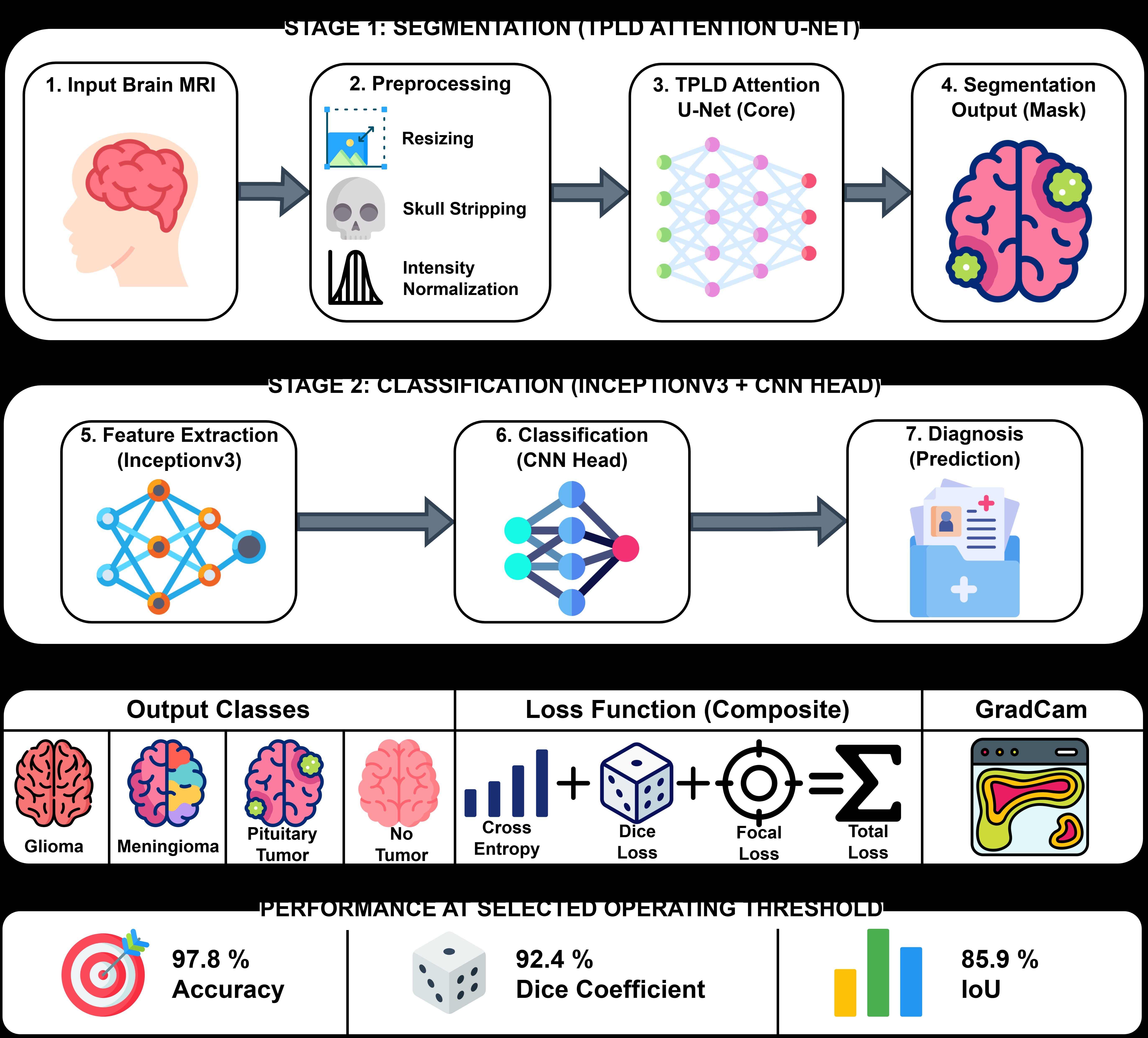
The diagnosis and treatment planning for brain tumors remain a complex task in medical imaging, largely due to the intricate structure of such abnormalities. This study introduces an interpretable stacked deep learning framework consisting of three sequential stages: (i) tumor segmentation, (ii) feature extraction, and (iii) tumor classification. The segmentation stage introduces a three-parameter lambda distribution (TPLD), a symmetric special case of generalized lambda distribution (GLD), used as a statistical intensity prior that is fused into the gating signal of an Attention U-Net for enhancing boundary delineation. The segmented outputs are processed using InceptionV3 for deep feature extraction and followed by a convolutional neural network (CNN) classifier. We evaluated the proposed model on the BRISC 2025 dataset, consisting of T1 weighted brain MRI images with pixel wise segmentation masks, which is validated by medical experts. The dataset consists of 3933 training images and 860 test images with ground truth masks, containing the four classes: meningioma, glioma, no tumor, and pituitary tumor. We utilized a region-of-interest–based training strategy to reduce the computational complexity and minimize overfitting. The data split followed the official image-level partition distributed with BRISC 2025; because patient identifiers are not released with the dataset, patient-level separation could not be independently verified, and this is acknowledged as a limitation. To ensure methodological transparency and clinical robustness, we systematically report the learning dynamics across 20, 60, and 100 training epochs at multiple decision thresholds (0.50, 0.60, 0.70), providing evidence of stable model convergence without overfitting. We also introduce a composite loss function by integrating cross-entropy, focal losses, and Dice to further boost performance. Experimental results demonstrate 97.8% classification accuracy on the test set, 92.4% Dice coefficient, and 85.9% IoU at the optimal threshold of 0.60. An ablation study further confirms the contribution of each loss component, supporting reproducibility and transparency in model evaluation. These findings confirm the practical utility and reliability of the proposed framework in the context of brain tumor segmentation and clinical diagnosis.
Keywords: brain tumor diagnosis; artificial intelligence; learning dynamics; clinical robustness; clinical transparency; interpretable stacked deep learning model; lambda distribution brain tumor diagnosis; artificial intelligence; learning dynamics; clinical robustness; clinical transparency; interpretable stacked deep learning model; lambda distribution
Graphical Abstract