
Review

Innovations in Robots for Weed and Pest Control: A Systematic Review of Cutting-Edge Research

1
Department of Agriculture, Food and Environment, University of Catania, Via S. Sofia 100, 95123 Catania, Italy
2
Department of Agricultural Sciences, University of Sassari, Viale Italia 39/a, 07100 Sassari, Italy
*
Author to whom correspondence should be addressed.
Mach. Learn. Knowl. Extr. 2026, 8(2), 51; https://doi.org/10.3390/make8020051
Submission received: 5 December 2025 / Revised: 11 February 2026 / Accepted: 17 February 2026 / Published: 22 February 2026
(This article belongs to the Section Thematic Reviews)

Abstract

In recent years, agriculture has begun to transform thanks to the arrival of robots and autonomous vehicles capable of performing complex operations such as weeding and spraying in an intelligent and targeted manner. In fact, new-generation agricultural robots use artificial intelligence (AI), cameras, and sensors to recognise weeds, analyse crop conditions, and apply plant protection products only where necessary, thus reducing waste and environmental impact. Some systems combine drones and ground vehicles to achieve even more accurate results. This systematic review synthesises recent advances in agricultural robotics for weed and pest management through a PRISMA-based approach. Literature was collected from major scientific databases (Scopus, Web of Science, IEEE Xplore, Google Scholar) and complementary sources, leading to the inclusion of 83 eligible studies. The selected evidence was structured into four application domains: (i) weed detection and mapping, (ii) robotic and non-chemical weed control (mechanical and laser-based approaches), (iii) selective/variable-rate spraying for pest and disease management, and (iv) integrated weeding–spraying solutions, including cooperative Unmanned Aerial Vehicle–Unmanned Ground Vehicle (UAV–UGV) systems. Overall, the reviewed studies confirm rapid progress in real-time perception (deep learning-based detection), navigation/localization (e.g., GNSS/RTK, LiDAR, sensor fusion) and targeted actuation (spot spraying and precision interventions), while also revealing persistent limitations: heterogeneous evaluation protocols, limited system-level comparisons in terms of work rate, scalability, costs and robustness under variable field conditions, and an often unclear distinction between prototype platforms and solutions close to commercialization. However, the large-scale spread of these technologies is still hampered by high costs, technical complexity, and cultural resistance. The review highlights how the integration of automation, sustainability, and accessibility is key to the agriculture of the future.

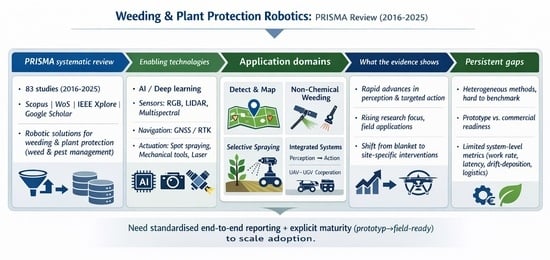
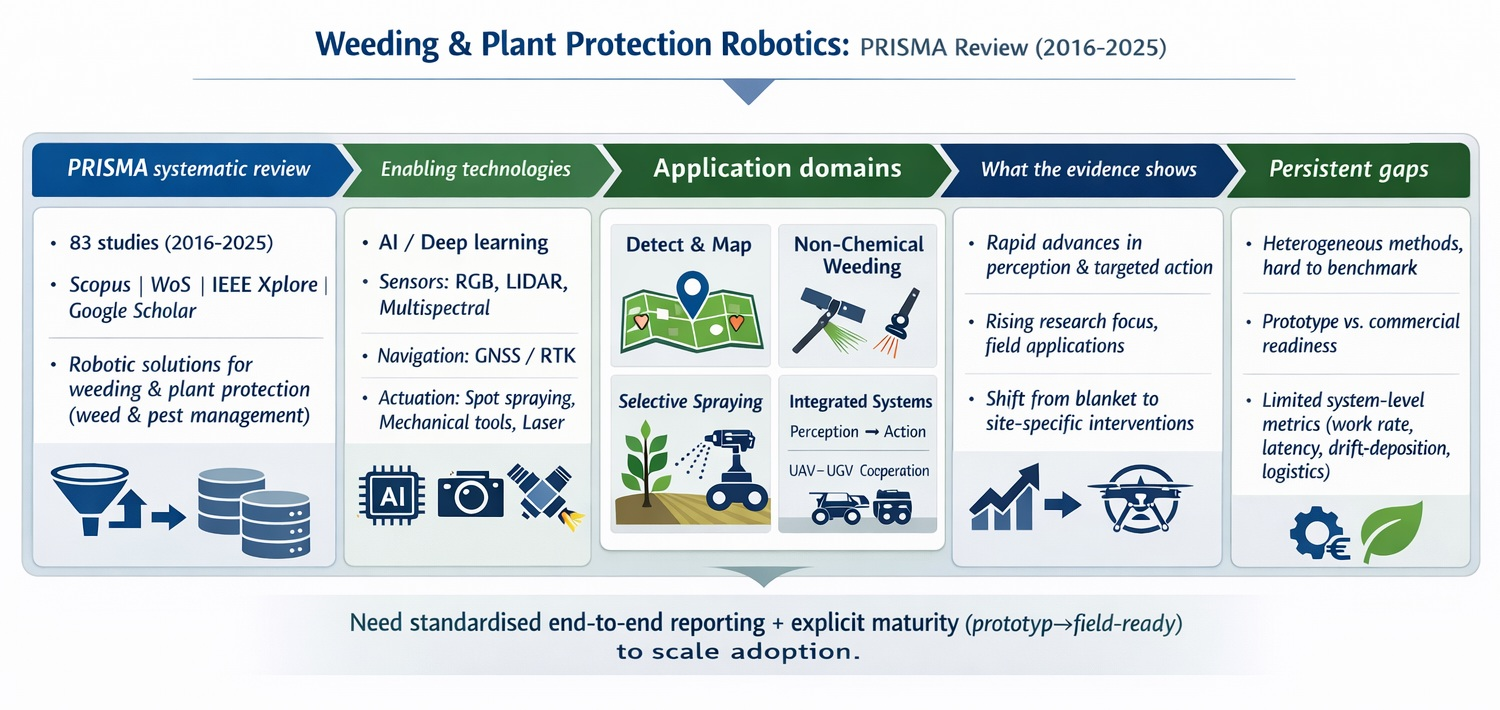
Graphical Abstract

1. Introduction

In recent decades, agriculture has undergone significant evolution thanks to the introduction of advanced technologies such as robotics, automation and network leveraging [1,2,3]. These innovations have proven crucial in addressing global challenges such as increased food demand due to population growth, reduced labour availability, and the impact of climate change on agricultural productivity. Agricultural robotics represents a key opportunity to improve efficiency, reduce production costs and minimise the environmental impact, while optimising crop quality [4,5].
Global use of chemical pesticide continues to grow, as shown by the latest FAOSTAT data available. In 2023, total use was 3.73 million tonnes (Mt) of active ingredients—a 2% decrease with respect to 2022, a 14% increase in a decade, and a doubling since 1990. Comparing the most recent decade with the 1990s, the global application of pesticides increased by 130% for herbicides, 58% for fungicides and bactericides, and 48% for insecticides. In terms of intensity, i.e., use per unit of agricultural area, the increase was 96% compared to 1990 [6].
At the regional level, there was a significant increase in use in Africa (+186% compared to 1990); in America, it increased by 202% between 1990 and 2023 and by 25% in the most recent decade; in Asia, there was a 75% increase since 1990; in Oceania, use increased by 230% in the most recent decade; in Europe, since 1990, the growth rate was −12%, with a reduction of 16% in the most recent decade [6].
These data show a contrasting state: on the one hand, the increase in pesticide use in many countries reflects intensive agricultural practices; on the other hand, some regions show signs of containing and rationalising use, probably in response to stricter regulations and the adoption of more sustainable practices. However, the lack of updated data for the last years limits the ability to assess the impact of recent policies, particularly those introduced in response to the European Green Deal or global strategies to reduce the environmental impact of agriculture. The “From Farm to Fork” strategy aims to reduce dependence on pesticides by 2030, promoting organic farming and transparent labelling for food products.
The introduction of more accessible and flexible robotic solutions, together with government incentives and research projects, could contribute to achieving these goals in the near future.
Mechanical weeding is the main activity performed by agricultural robots today. When performed completely autonomously by robots, which can also work at night thanks to sensors and a GPS module, this activity has positive repercussions on the farm’s operations, such as reduced use of chemical herbicides, greater overall sustainability, and less dependence on skilled labour [7]. In chemical weed management, UGVs (Unmanned Ground Vehicles) apply several technologies—including AI algorithms, imaging sensors, and precision tools such as high-resolution cameras, mechanical actuators, or lasers—to accurately detect and eradicate weeds [8,9]. Recent field evidence also includes directed-energy approaches (e.g., laser-based weeding) and multi-system comparisons that allow performance and implementation trade-offs to be discussed beyond single-prototype demonstrations.
Robotic monitoring systems integrate advanced sensors capable of acquiring continuous and detailed data on soil moisture, temperature, light intensity, CO2 levels and the presence of diseases. Thanks to these technologies, robots can identify early signs of disease or infestation, allowing farmers to take targeted action and reduce the use of plant protection products [10].
Weed detection is crucial for precision agriculture aimed at reducing pesticide use. According to the FAO, weeds cause a 15–30% reduction in cereal yields [11,12]. Specifically, excluding direct costs, the distribution of agricultural chemicals has a significant impact on social costs, as it involves high risks for operators and potential environmental damage.
To address these issues, semi-automatic distribution technologies have been introduced in the past, using fixed structures inside greenhouses. These systems, consisting of mobile rods with nozzles, operate without requiring the physical presence of the operator in the greenhouse. However, their use is not widespread due to the high installation cost and significant structural impact on greenhouses [13].
To support workers during some activities and reduce physical effort, over the years, examples of multifunctional and versatile electric vehicles have also been developed for use in sloping vineyards, where the regular structure of the rows can facilitate the automation [14].
Traditional spraying techniques in orchards have limitations in terms of weeding and spraying operations: large machines cannot access crops due to limited space, and small sprayers do not ensure uniform distribution of droplets within the canopy, especially in trees with very dense canopies [15,16]. Autonomous spraying by UGVs could represent one of the most promising solution in precision agriculture, combining mechanical technologies and AI to optimise the application of phytosanitary products [10,16,17]. Moreover, by reducing the overall volume of pesticides applied, UGVs can help to minimise the environmental effects of pesticide use, including air and water pollution and harm to non-target organisms.
This kind of UGVs are self-driving vehicles with sophisticated sensors—thermal, LiDAR, and multispectral—as well as self-navigating systems and components with nozzles that can be adjusted to precisely manage crops. Furthermore, the concept of temporal and spatial mapping of pest distribution allows for targeted spraying, unlike current “smart sprayers” that simply detect the presence of trees but not the distribution of pests [18].
Although, from an ecological perspective, the use of autonomous robots helps limit soil compaction and preserve biodiversity, promoting more sustainable agricultural practices. Most of the potential robots are still in the prototype stage; major advances have been seen in the detection of leaf diseases of crop plants and automated spraying of pesticides [19].
Despite significant technological advances, the large-scale adoption of robotics and automation in agriculture still faces several challenges. These include high initial costs, a lack of adequate technological infrastructure in some rural areas, and technical difficulties in adapting these solutions to different conditions and crop types. Moreover, achieving complete autonomy for agricultural robots will require advances in localization, computer vision, and energy autonomy, supported by standardised modular platforms [3,20,21,22].
Despite the fact that technological progress is advancing at a rapid pace, the use of robots in agriculture for crop protection activities is still rather limited. A study by Waked et al. [23] analysed the factors influencing farmers’ willingness to adopt these tools by using a theoretical model based on the Technology Acceptance Model (TAM), enriched with new variables: trust, personal innovation, relevance to work, and perceived net benefit. The results showed that personal predisposition to innovation increases the perception of AGV ease of use; ease of use and relevance to work positively influence the perceived usefulness of the technology; perceived usefulness improves attitudes toward use and perceived net benefit; both positive attitudes and perceived net benefit increase the intention to use AGVs. Conversely, neither trust nor factors such as farm size or farmers’ education level had a significant impact on usage intention.
Despite the rapid growth of agricultural robotics, the recent literature is often fragmented across (i) weed detection algorithms, (ii) mechanical weeding mechanisms, and (iii) precision spraying platforms, frequently with limited cross-comparison of performance, operational constraints, and technology readiness. Moreover, many contributions remain at proof-of-concept level, while evidence from repeated field validations or near-commercial deployments is less systematically synthesised. Therefore, this review provides an updated and structured overview (2016–2025) of robotic solutions for weed and pest control, with an explicit focus on comparative synthesis, deployment maturity (prototype vs. near-commercial), and practical constraints affecting scalability.
In this context, this review synthesises recent evidence on robotic solutions for weed and pest control (2016–2025), linking enabling sensing/AI components to actuation strategies and field performance, and explicitly distinguishing prototype systems from near-commercial deployments to support scalable implementation and pesticide input reduction.

2. Materials and Methods

This systematic review was conducted and reported in accordance with the PRISMA 2020 statement [24]. This systematic review was retrospectively registered on the Open Science Framework (OSF) (registration ID: osf.io/cejz4) on 12 February 2026. The bibliographic search was conducted in 2025 using Scopus, Web of Science, and IEEE Xplore. The last search was performed on 31 January 2026. Full search strategies for each database are reported in Supplementary Table S1. In addition, a complementary search was performed using Google Scholar to reduce the risk of missing relevant studies not indexed in the selected databases. For each source, the query was adapted to the database syntax while keeping equivalent keywords. The general formulation of the query was as follows:
TITLE-ABS-KEY ((“field robot*” OR “ground robot*” OR ugv OR “unmanned ground vehicle” OR”autonomous ground vehicle” OR agbot OR agribot) AND (weed* W/3 (control OR management OR remov* OR detect* OR treatment) OR (spray* W/3 (herbicid* OR pesticide* OR “crop protection” OR “plant protection”)) OR (“spot spray*” OR “target* spray*” OR “precision spray*”)) AND (agricultur* OR crop* OR vineyard* OR orchard* OR horticultur*) AND NOT (forestry))
Two reviewers independently screened titles and abstracts. Full-text articles were then assessed independently for eligibility by the same reviewers. Disagreements were resolved through discussion until consensus was reached.
A standardised data extraction form was used. Two reviewers extracted data independently and cross-checked the results. Extracted items included crop/target system, operating environment (field/greenhouse/lab), robot platform and mobility, sensing modalities, task (weed control and/or pest control), control approach (mechanical/chemical/integrated), and main performance metrics reported by the authors. Any discrepancies were resolved by discussion and consensus.
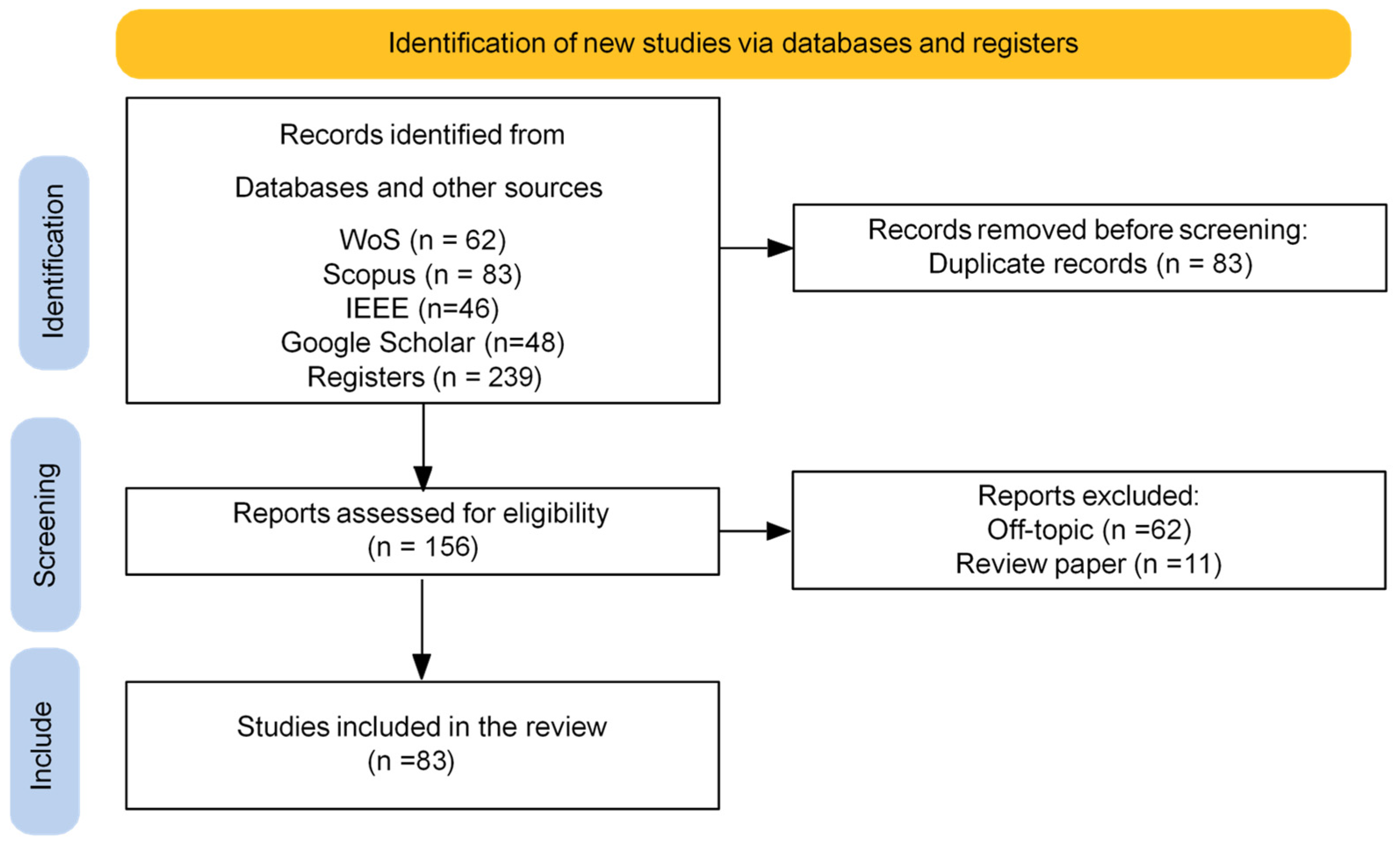
The article selection process was documented using a PRISMA flow diagram (Figure 1). Records were identified from Web of Science (n = 62), Scopus (n = 83), IEEE Xplore (n = 46), and Google Scholar (n = 48) for a total of 239 records. After removing duplicate records (n = 83), 156 reports were assessed for eligibility. Of these, 73 reports were excluded (off-topic, n = 62; review papers, n = 11). Finally, 83 studies were included in the review.
Full-text reports were assessed for eligibility and excluded when off-topic (n = 62), including UAV-only approaches, automation of conventional tractors, remote-controlled platforms, or papers focused on robotic architecture with marginal agricultural application. Review papers were excluded from the primary-study synthesis (n = 11). Generally, literature reviews tend to avoid including other reviews in order to ensure originality, direct critical synthesis of primary data, and methodological transparency, avoiding the overlap of other authors’ interpretations.
The selection covered articles published over a 10-year period, specifically from 2016 to 2025, in order to ensure the topicality and relevance of the content with respect to technological developments in the sector.

3. Results and Discussion

3.1. Overall Statistical Data

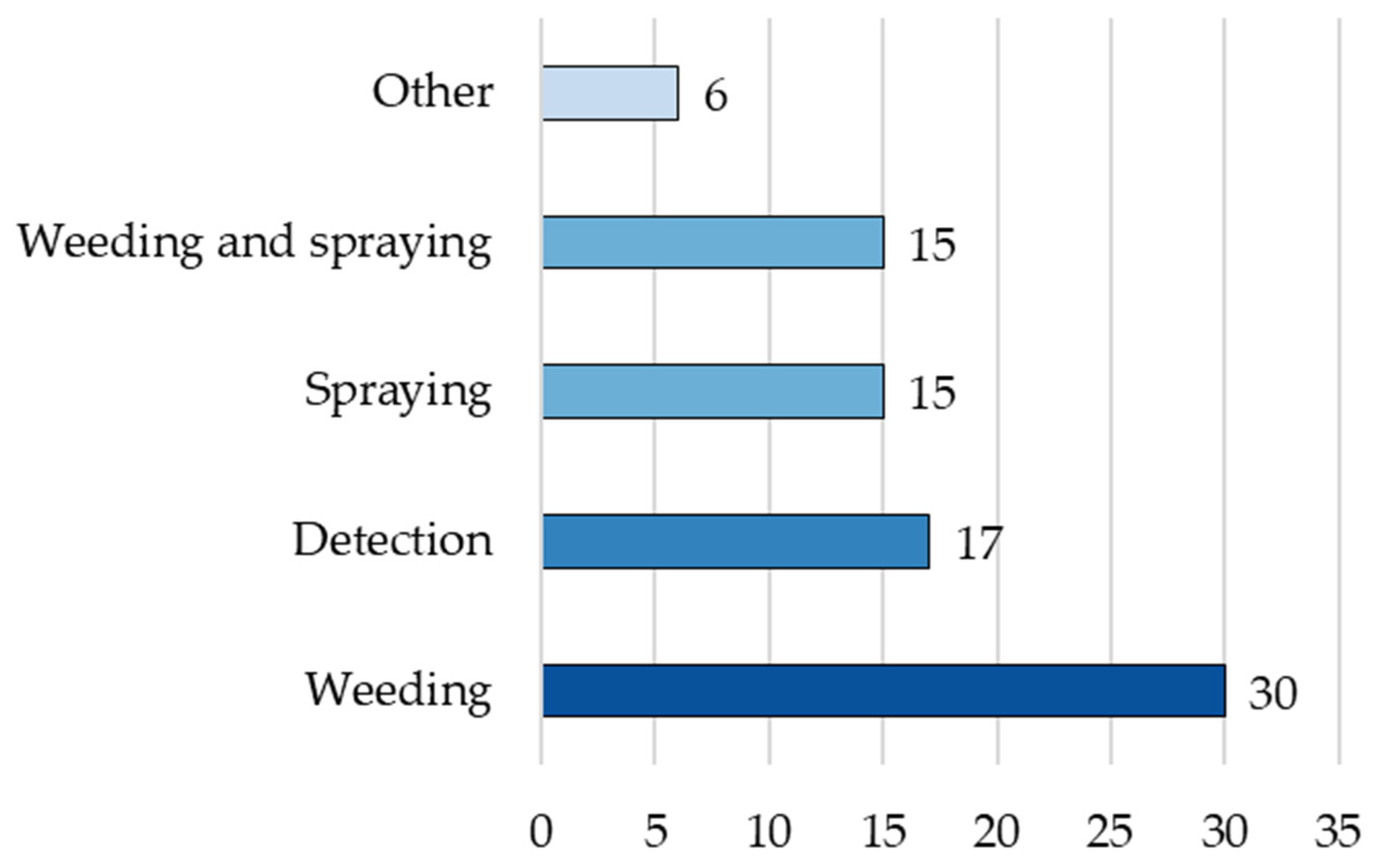
Analysis of the scientific literature reveals a heterogeneous distribution of articles according to the main robotic function addressed (Figure 2). Weeding is the most represented category (n = 30), confirming that mechanical or physical weed removal remains the dominant application of agricultural field robots, likely driven by the need to reduce herbicide reliance and labour requirements. The second group comprises studies focused on detection (n = 17), highlighting the central role of sensing and computer vision as enabling components for precision interventions. Spraying and integrated weeding-and-spraying approaches show comparable representation (n = 15 each). This balance suggests that, alongside conventional plant-protection spraying platforms, research is increasingly considering targeted, site-specific treatments; however, fully integrated pipelines that combine robust perception with real-time actuation still face practical constraints (e.g., timing, safety, operating speed, and reliability) that may limit widespread deployment. Finally, other contributions (n = 6) include cross-cutting or enabling topics that support robotic development but do not directly fall into the core operational tasks.
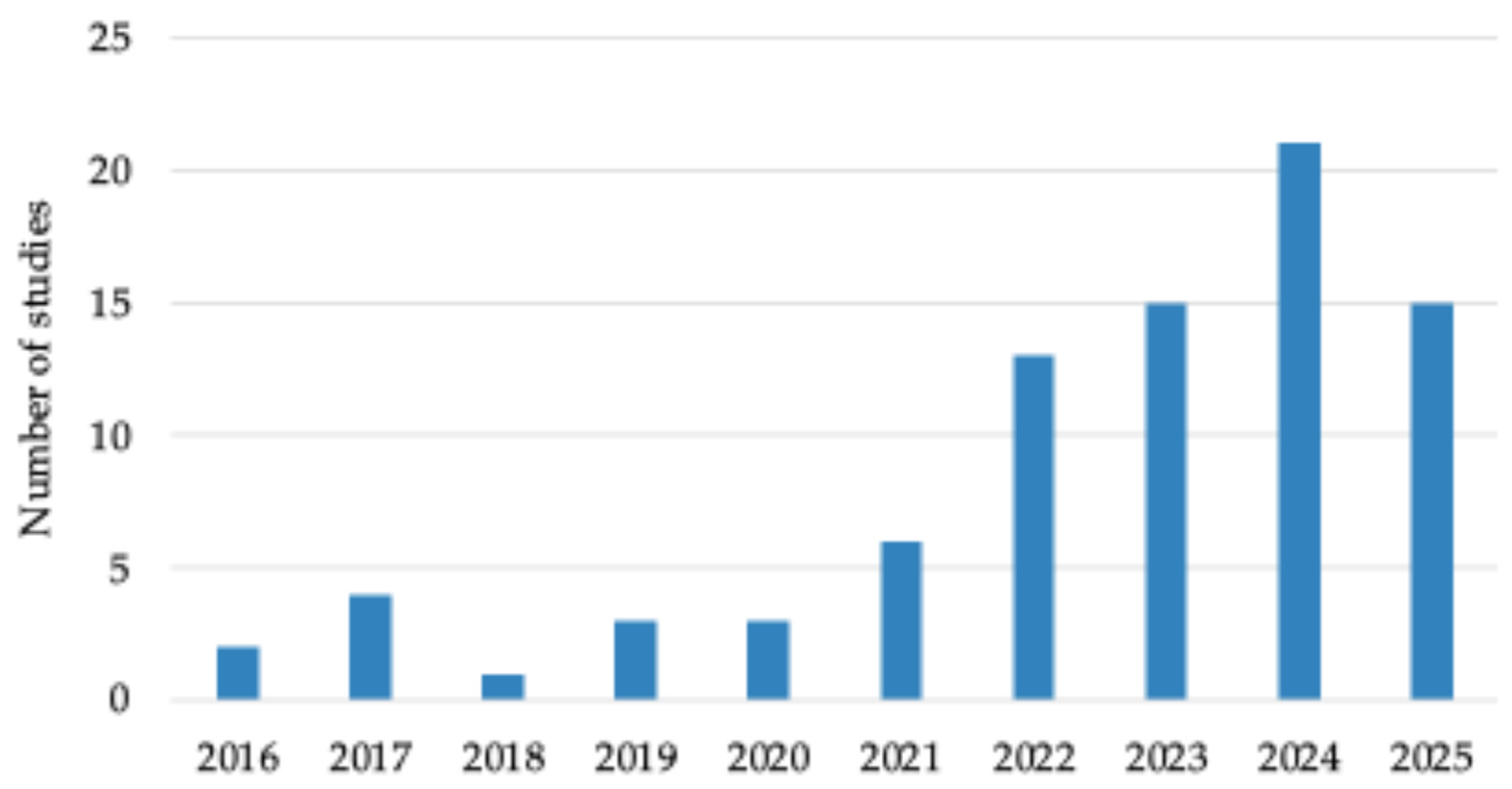
The temporal trend of publications (Figure 3) shows a clear growth from 2022 onwards. After a relatively limited output between 2016 and 2021 (from n = 1 to n = 6 per year), the number of studies increases substantially in 2022 (n = 13) and continues to rise in 2023 (n = 15), reaching a peak in 2024 (n = 21). The output remains high in 2025 (n = 15), indicating that the expansion observed in 2022–2024 has consolidated, with sustained publication activity in the most recent year of the review period.
Overall, the pattern indicates an acceleration of research activity, plausibly driven by recent advances in deep learning, edge computing, low-cost sensors, and increasing policy/market pressure to reduce pesticide inputs and improve sustainability.
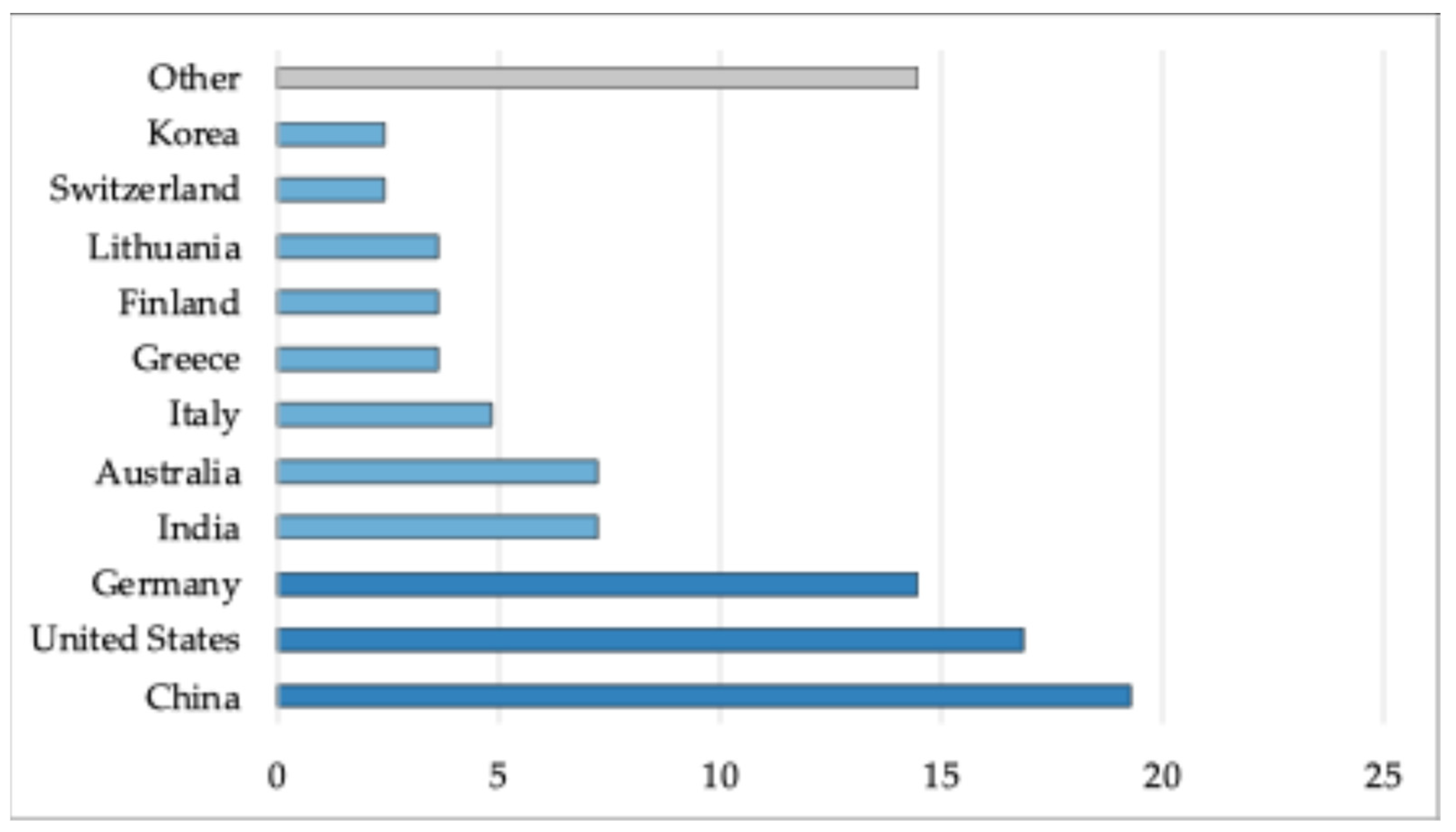
Figure 4 shows the geographical distribution of the publications included in this review, based on the lead affiliation country of the first author. The largest share of studies originates from China (n = 16), followed by the United States (n = 14) and Germany (n = 12), indicating that research activity in robotic solutions for weed and pest management is particularly concentrated in countries with strong agricultural engineering and robotics research ecosystems. A second tier of contributions is represented by Australia (n = 6) and India (n = 6), while Italy (n = 4) shows a moderate but consistent output. Additional contributions are distributed across several European countries (e.g., Greece, Finland and Lithuania: n = 3 each, and Switzerland: n = 2) and a smaller number of single-occurrence countries. The category “Other” aggregates countries represented by a single publication (n = 11), reflecting a broader but less concentrated international interest in the topic.
Overall, the distribution suggests that the field is expanding internationally, yet it remains dominated by a limited number of research-intensive countries, consistent with the current need for specialised expertise and infrastructure for field robotics development and validation.
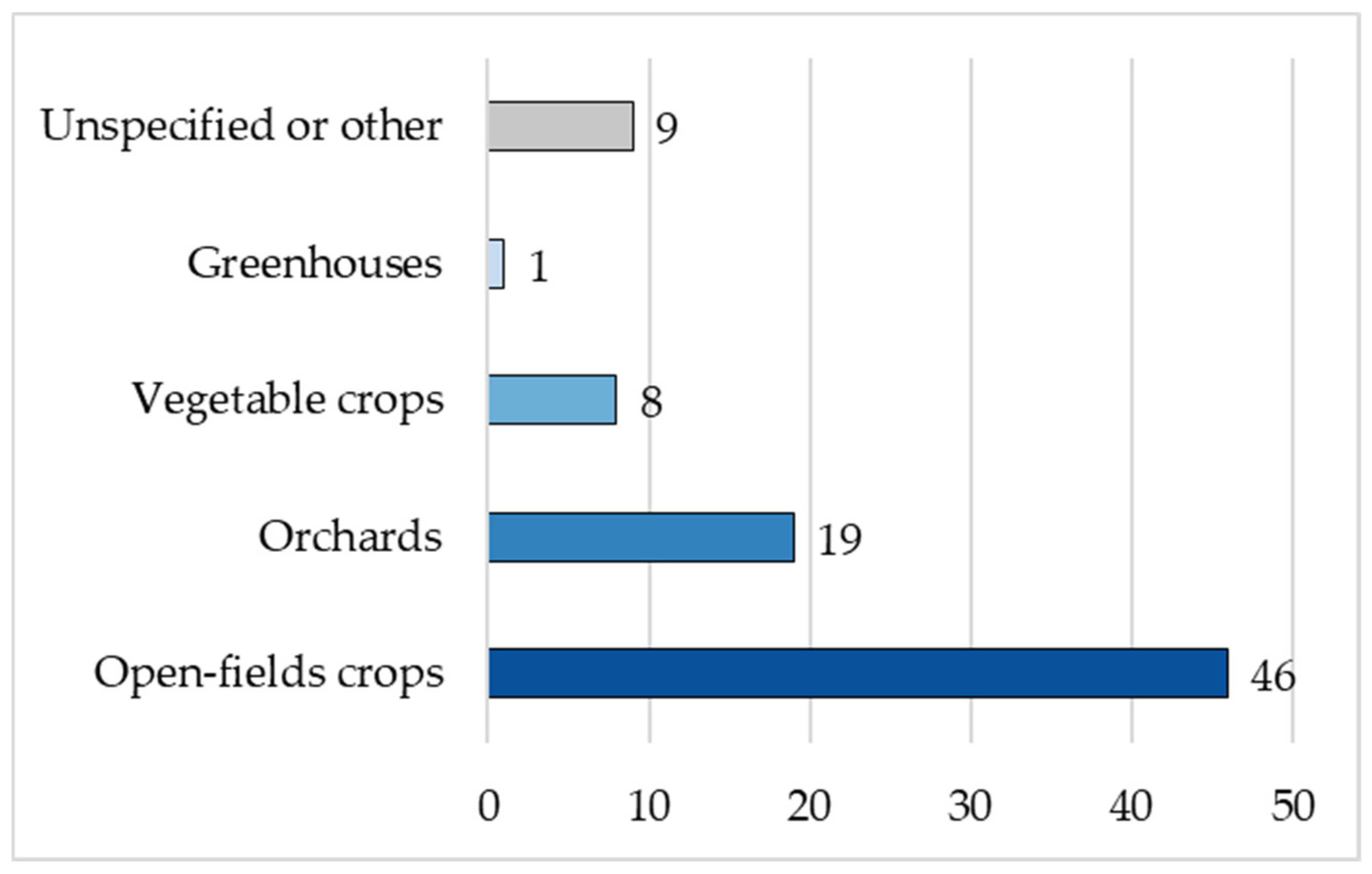
The bar chart (Figure 5) shows the distribution of the included studies by crop system. Most publications address open-field crops (n = 46), followed by orchards (n = 19) and vegetable crops (n = 8), while greenhouse settings are scarcely represented (n = 1). The category “Unspecified or other” (n = 9) includes studies in which the crop system is not explicitly stated or cannot be uniquely assigned to one of the main classes, as well as cross-cutting contributions focused on enabling components (e.g., perception/computer vision modules, navigation/control strategies, or platform-level developments) that are not tied to a specific cultivation context. Overall, the prevalence of open-field applications suggests that current research efforts are primarily directed toward large-scale environments, where operational constraints (e.g., row navigation, variable lighting, terrain irregularities, and the need for high work rates) make automation particularly relevant.

3.2. Weeds Detection

Weeds are one of the main problems in agriculture, as they compete with crops for nutrients and water and attract insects and pests, hindering crop yields [23]. Large-scale environmental interventions, such as weed management in agriculture, present numerous challenges related to the size of the area to be covered and the need to optimise the use of resources. Moreover, autonomous navigation of agricultural robots, especially during delicate operations such as weeding or localised treatments, requires an accurate assessment of the terrain’s passability. As highlighted by Benrabah et al. [16], the risk of crossing can be modelled using probabilistic maps, fuzzy logic or physical measurements, resulting in a crucial element for operational efficiency and safety in complex agricultural contexts. A UGV-based system for autonomous agricultural operations has been designed by Gangurde et al. [18], using advanced sensors such as LiDAR and stereo cameras for navigation and plant identification.
In practical weed detection pipelines for robotics, perception is not a standalone task: it is a chain (image acquisition - pre-processing - detection/segmentation - georeferencing - actuation) where performance depends not only on accuracy but also on latency and on-board compute constraints. Recent contributions explicitly highlight that “real-time” claims should be assessed at the system level (end-to-end processing time and operational speed), not only via model inference speed [25,26,27].
The mobility of agricultural robots was analysed by Sara et al. [28] in various operating scenarios such as weeding and soil tillage. They showed the autonomous guidance system, based on RTK-GNSS, ensured good accuracy even in vineyards with 2-metre row spacing.
Thanks to the European Flexigrobots project, Stefanović et al. [29] proposed a method for processing UAV (Unmanned Aerial Vehicle) images and determining the paths that can be travelled by UGVs. In order to plan routes, fields of blueberry are first mapped using UAV, which has been successfully applied in fields for a crop that is increasingly automated due to high costs and labour shortages.
A few years before, the study by Abrosimov et al. [1] proposed a theoretical approach to the use of smart devices—such as field sensors, agri-robots and drones—in precision agriculture, exploiting the Internet of Things (IoT) paradigm, and presented an application scenario in which these technologies collaborate in the active monitoring of a wheat field with the aim to identify critical issues such as diseases, infestations or weeds, and intervening accordingly. Moreover, the authors introduced the concept that every agricultural object can be represented as a service, with a standard description of its functionality and conditions of use. To this end, they suggested the use of service-oriented architectures (SOAs), which allow devices to interact and exchange information autonomously and interoperably.
The use of deep learning techniques on high-resolution images acquired by UAVs and UGVs enables the automatic recognition of agricultural elements such as fruits, flowers and weeds. However, the main difficulties arise from the similarity between classes and the partial occlusion of objects. Junagade et al. [30] proposed a classification of recognition complexity into three levels: high (occluded or camouflaged objects), medium (indistinctive features) and low (clearly visible and distinguishable features), obtaining interesting results.
A key enabling factor for robust weed detection is the availability of field-grade datasets collected in real agronomic conditions and enriched with localization/mapping information (e.g., RGB/RGB-D/multispectral + LiDAR/GNSS/odometry), which improves replicability and supports comparisons across methods [31,32,33].
In general, drones equipped with multispectral, hyperspectral and RGB cameras capture images of crops during autonomous flights. The images can be processed in real time or in post-processing. The data obtained in this way is useful for identifying diseased plants, estimating yield and supporting coordinated action between UAVs and UGVs, thus reducing operating costs and limiting human exposure to pesticides [34].
Economic sustainability is also at the heart of the study by Edlerman and Linker [35] that presented a low-cost multi-robot system for vineyards and orchards. The architecture is of the “master–slave” type: a drone equipped with GPS and a camera guides simplified UGVs, equipped only with Arduino and basic sensors. The drone flies over the area, identifies the positions of the robots and obstacles (plants) using vision algorithms, calculates the optimal routes with geodesic distance transformations, and transmits the information to the UGVs. In addition, the conversion of images from RGB to HSV improves the distinction of vegetation, which is useful for phytosanitary treatments. Tests in an olive grove have shown that the system can guide the robots with errors of less than one metre, even in end-of-row manoeuvres.
Beyond colour-space transformations, outdoor illumination variability—especially shadows—can severely degrade detection and localization in field robotics. This motivates dedicated real-time shadow handling and other lightweight pre-processing steps designed for resource-constrained robots, which can improve downstream weed detection and mapping reliability [36,37,38,39].
The integration of autonomous intelligent monitoring systems is a fundamental prerequisite for the targeted application of treatments. Menon et al. [40] developed an autonomous agricultural rover capable of performing three main functions: environmental monitoring (temperature, humidity, wind, light), soil monitoring (moisture, pH, NPK nutrients) and area monitoring (fires, insects, intrusions). The system is powered by solar panels with a backup battery and communicates via GSM, sending real-time SMS messages to farmers. It also includes automatic irrigation and spraying systems, activated based on the data collected. Navigation is via pre-programmed GPS coordinates and the rover returns autonomously to the charging station when the tanks are almost empty.
In this context, Zhao et al. [41] have developed a fully autonomous robot for inspecting pests and diseases in greenhouse strawberry crops. The system captures images from multiple angles of the plant canopy and processes them in real time using deep learning algorithms, achieving 92.10% accuracy, surpassing the limitations of fixed-point robots.
Other innovative technologies were applied by Prasad et al. [42], who proposed a robotic system based on Convolutional Neural Network (CNN) and a computer vision model architecture YOLOv8 (You Only Look Once) for detecting tomato ripeness and early diagnosis of leaf diseases. Similar technologies can also be applied to automated weeding, where visual recognition of weeds allows for selective intervention.
Importantly, these examples reinforce a recurring constraint also observed in weed detection: models should be evaluated in their entirety, including robot speed effects and end-to-end processing time, rather than as standalone classifiers/detectors [24,26].

3.3. Weeding for Weed Control

Weed control is one of the agricultural operations in which the application of advanced technologies is particularly advantageous for agricultural, economic and environmental reasons. The integration of AI and machine learning (ML) algorithms allows agricultural robots to effectively distinguish between crops and weeds, ensuring targeted interventions and reducing the use of chemicals [43,44].
However, beyond technical feasibility, recent field evidence stresses the need for comparative assessments across multiple robotic systems and reference herbicide strategies, explicitly reporting agronomic effectiveness, crop losses, operating speed and costs, and clearly distinguishing between prototype solutions and systems close to commercialization [45,46,47,48].
Numerous studies have highlighted the effectiveness of applying AI to weed recognition and localisation. Fan et al. [37] proposed YOLO-WDNet, a lightweight and efficient model based on YOLO, intended for implementation on autonomous mobile robots for precision herbicide distribution. The system, tested on a robot equipped with stereo vision, LIDAR sensors and automatic spraying nozzles, achieved 94.7% accuracy in detecting moving weeds in real agricultural environments.
An intelligent robotic system for intra-row weeding based on deep learning, designed to remove weeds with precision while reducing damage to crops, was presented by Quan et al. [8]. The system uses a mobile platform with weeding units equipped with a YOLOv3 algorithm to identify cultivated plants and weeds in real time, establishing protected areas and target zones for selective weed removal. Three types of knives (blade, wedge and surface-plough) were tested under different field conditions. The results showed 98.5% accuracy in recognising maize and 90.9% for weeds, with a weed removal rate of up to 85.91% and crop damage reduced to 1.17%. The wedge knife proved to be the most effective for raised beds, while the ploughshare knife was more suitable for flat terrain. In addition, the targeted weeding method reduced soil disturbance by up to 49.5% compared to traditional systems. These results demonstrate the system’s potential for more sustainable and efficient agriculture, reducing dependence on chemical herbicides.
These results are consistent with recent field experiments showing that intra-row robotic weeding performance is dominated by operational trade-offs (forward speed, tool geometry and crop injury), reinforcing the need to report crop damage alongside weed control efficacy [49].
The same recognition algorithm, YOLOv3, was used by Patil et al. [50], achieving an accuracy of approximately 95% in distinguishing between crops and weeds.
In horticulture, the YOLO algorithm was integrated into a system consisting of a quadruped robot (Unitree A1) with a robotic arm, an RGB-D camera and a spraying module, coordinated via Wi-Fi mesh and ROS, for selective spraying. Tests were carried out both in real fields and in simulated environments, and the system showed a significant reduction in false positives: up to 89% in sunny conditions and 83% in cloudy conditions for simulated environments and about 60% in real environments [51].
Lippi et al. (2023) [52] proposed a fully autonomous architecture for shoot management through targeted spraying, introducing a pipeline that combines computer vision, 3D reconstruction and robotically controlled spraying on a per-plant basis. Specifically, the architecture uses a YOLOv4 system adapted to RGB-D images for shoot detection, combined with a Kimera-based 3D reconstruction module to estimate the area to be treated. It is an excellent example of vertical integration, as it involves detection, decision-making and implementation, all on board the robot, and is one of the few documented cases in which an RGB-D camera is integrated with YOLO for targeted spraying, avoiding LIDAR (which is more expensive and cumbersome) [52].
With regard to mechanical weeding, Sara et al. [28] used a robot capable of pulling tools for weeding and tilling the soil, removing approximately 40% of weeds and improving soil structure. Although speed decreases as the load increases (up to 230 kg), the robot is capable of operating for two consecutive hours without any drop in performance, with an average speed of between 0.71 and 0.77 m s−1. Energy consumption is around 1.43 kWh per hour, while average operating capacity is 0.29 ha h−1.
Importantly, multi-season field studies indicate that robotic mechanical weeding can also influence topsoil physical attributes, suggesting that evaluation should include not only weed control efficacy but also soil impacts under repeated passes [53,54].
Several authors worked to achieve precise hoeing distance and reduce the impact of external factors such as vibrations and tilting of the robotic platform. This study proposes a crop positioning point correction algorithm based on attitude information fusion: the algorithm uses this information to calculate the mapping relationship between the image position and the actual ground position, thereby correcting the crop positioning point. Experimental results show a 58% and 73% reduction in the average hoeing distance measurement error compared to the uncorrected positioning point. This significantly improves the accuracy of hoeing distance measurement and reduces the risk of damage to seedlings [55,56,57].
Some years before, Cutulle and Maja [58] published results on the use of the Husky A200 autonomous ground vehicle for weed control in special crops, where chemical weed control options are limited and manual weed control is expensive. The experiment, conducted at two agricultural sites between 2018 and 2020, tested the mobility and effectiveness of two weeding modules: a V-shaped weeder and an adjustable harrow disc. The tests measured the robot’s navigation speed on soils with different moisture levels and the effectiveness of the weeding systems. The results showed that the robot maintains a constant speed on wet soil, while on dry soil with the weeding module, the speed is reduced. The effectiveness of weeding was variable: the V-shaped weeder proved ineffective, while the harrow disc achieved 80% control on flat soil, but only 10–15% on uneven terrain. The main critical issues concern the distribution of the robot’s weight, which affects the cultivator’s penetration into the soil, and the need for more efficient actuators, such as electric or thermal weeding systems.
These findings align with life-cycle and sustainability-oriented analyses suggesting that environmental benefits of robotic weeding depend on operational context (terrain, logistics, lifetime, and energy source) and should not be assumed a priori [59,60,61,62].
An example of a precise herbicide application is DoD (Drop-on-Demand), which, when integrated with a robot, is able to adapt to different cultivation methods, the number of rows, and the width and height of the rows. The effectiveness of the DoD method was studied in laboratory experiments with four weed species using 7.6 μg of glyphosate or 0.15 μg of iodosulfuron per plant. In field trials, the robot effectively eliminated all weeds with a tenfold reduction in herbicide use. These trials demonstrate that the DoD system is a viable alternative to conventional spraying methods, with a reduction in herbicide use of over 90%. This approach not only reduces costs and the environmental impact associated with herbicides, but also contributes to soil health by preserving microbial biodiversity and soil quality [63].
A significant example of the application of terrestrial robotics to precision spraying is provided by the study of Dong et al. [64], who proposed a variable weed control system based on an autonomous vehicle (UGV) equipped with AI and adaptive control. The system uses a low-cost RGB camera and image processing algorithms (super green 2G-R-B and iterative segmentation) to detect the distribution of weeds in real time and modulate the volume of herbicide dispensed by each nozzle accordingly, allowing pressure to be kept stable and improving application accuracy, with an average error of less than 2%.
Comparable ultra-precise robotic spot application in vegetables has also been reported in field conditions, reinforcing that “chemical” approaches can still be substantially input-saving when applied at plant scale [65].
In addition, some weed control robots use innovative techniques, such as smart lasers, to destroy weeds without touching crops, offering a particularly useful solution in organic farming. Notably, recent comparative field studies have assessed deep learning-based laser weeding against conventional herbicide programmes across multiple vegetable systems, providing agronomic evidence that strengthens the maturity of directed-energy approaches beyond proof-of-concept demonstrations [66,67].
For example, Sathesh et al. [68] presented a scalable solution based on Raspberry Pi and ultrasonic sensors, capable of autonomous navigation and equipped with mechanical weed control systems. Similarly, Dhinesh et al. [69] proposed a robotic system with integrated CNN that uses Raspberry Pi 3B+ to detect and remove weeds using a mechanical arm. In both experiments, the results appear positive and promising.
The “Flourish” robotic system has been presented, which integrates a UAV for multispectral aerial monitoring of crops and a UGV equipped with modules for selective ground intervention, including targeted spraying. The system allows for autonomous weed detection and subsequent high-precision chemical spraying or mechanical removal, reducing herbicide use and environmental impact. Field results on sugar beet demonstrate the agronomic effectiveness of the approach, with yields comparable to those of traditional practices but with less use of pesticides [70,71].
Sriram et al. [72] explored another collaborative UAV-UGV approach for the automatic classification of weeds in strawberry fields. RGB and multispectral data are processed in real time by a U-Net v2 network, and the coordinates of the weeds are saved for targeted intervention by the UGV.
To overcome the operational limitations of UAVs and UGVs, Kant et al. [73] proposed a hybrid drone–rover vehicle, successfully tested in complex agricultural environments. The prototype demonstrates effective navigation, weed removal and pesticide application capabilities even in difficult conditions.
Overall, multi-platform solutions can increase coverage and targeting accuracy, but evidence maturity varies widely, and comparative “system-level” evaluations (including costs, work rate, and robustness under challenging field conditions) remain essential to position these technologies along the prototype-to-commercial spectrum.

3.4. Spraying for Pest Control

In recent years, robotics applied to precision agriculture has made significant progress, especially in the field of selective spraying and targeted phytosanitary treatment.
In this context, an initial study, conducted in 2015, presented “Tractacus”, an autonomous agricultural robot designed to navigate between crop rows and perform agricultural operations, including targeted phytosanitary treatments. The robot uses ultrasonic sensors to maintain its trajectory between plants and recognise the end of rows, where it performs an automatic manoeuvre to move on to the next row. One of the most significant aspects is the integration of an intelligent spraying system, which activates the treatment only in the presence of plant canopy, avoiding waste and improving the sustainability of the phytosanitary treatment. Field tests (on rows of roses) have shown good operational reliability, with a guidance accuracy of ±70 mm at 1 m/s, confirming the validity of the system for automated applications in crop treatments [74].
A year later, Conesa-Muñoz et al. [75] proposed an innovative multi-robot “sense–act” system, which combines UAVs for aerial inspection and AGVs for targeted intervention, with benefits in terms of efficiency, reduced ecological impact and precision in the application of treatments.
A similar integrated system consisting of a quadcopter UAV and a four-wheeled UGV for monitoring and targeted treatment of agricultural areas infested with pests has been developed by Rane et al. [76]. The UAV is equipped with advanced sensors and cameras that detect areas infested with pests and uses image processing and ML algorithms to identify problems in crops, while the rover is equipped with a mechanism to spray plant protection products in specific areas identified by the drone, as well as a landing platform and a charging station for the UAV. Similar study has been carried out by Chen et al. [77].
Another integrated system, a UAV-UGV cooperative targeted spraying system called UCTSS, also combines the mobility of the UAV with the load-bearing capacity of the ground vehicle. While the UGV transports the pesticides and powers the UAV, the latter performs targeted spraying from top to bottom. The ideal spraying position is detected via RTK GPS and a LiDAR sensor, and the movement is coordinated with high precision thanks to the Robot Operating System (ROS). When the LiDAR detects that the ground vehicle has reached an ideal spraying position, the UGV stops and the UAV precisely positions itself and begins spraying the pesticide from top to bottom, following the lateral profile of the tree. Once spraying is complete, the drone returns to its starting position and the system resumes movement towards the next tree. Tests show excellent tracking accuracy (UAV average error 0.013 m during spraying) and a 96% accuracy in spray point detection. Compared with a commercial drone (DJI-T50), the UCTSS system proved to be effective, precise and particularly suitable for spraying in complex and irregular orchards, offering a new solution for crop protection in modern and challenging agricultural environments [78].
The Stereoscopic Plant-protection System (SPS) represents an advanced system and was proposed by Jiang et al. (2022) [15]. It integrates a T16 UAV for overhead spraying and a ground-based sprayer equipped with a swinging arm for bottom-up application. Through computational fluid dynamics (CFD) simulations and experimental tests, the operating parameters were optimised, achieving a 38.3% improvement in droplet distribution uniformity and a droplet density greater than 25 drops cm−2, with a significant reduction in pesticide loss to the soil compared to traditional methods [16].
Beyond UAV–UGV coordination, several recent contributions show that orchard spraying can also become more “field-ready” through ground-only variable-rate sprayers, where the key step is the closed-loop coupling between canopy sensing (e.g., LiDAR/vision), dose prescription and nozzle-level actuation [79,80,81]. For example, a precision variable-rate spraying robot using a single 3D LiDAR can simultaneously support navigation and canopy volume estimation, enabling variable-rate application that reduces off-target losses (drift/ground losses) while maintaining operational simplicity [82].
Complementary studies further emphasise that maturity depends on reporting outcome-oriented spray metrics (deposition, uniformity, drift, ground loss) rather than only navigation accuracy: field evaluations of intelligent orchard sprayers with flow control provide evidence that adjusting flow to canopy structure can reduce pesticide use while maintaining spray performance [82].
To move from “variable-rate” to truly prescription-driven approaches, other work proposes multidimensional prescription maps based on 3D canopy information (and additional drivers such as wind), explicitly linking the prescription layer to the sprayer mechanics and validating performance experimentally (including controlled evaluations). This is crucial in orchards, where spray demand varies not only across trees (2D) but also within canopy depth and structure [83,84,85].
Finally, it is important to distinguish autonomy levels: some orchard platforms use advanced mechatronic designs (e.g., controllable spraying mechanisms with additional degrees of freedom) to improve targeting and operator safety, yet may still rely on teleoperation or partial autonomy. This distinction directly addresses the reviewer request to separate prototypes from systems closer to commercialization.
In greenhouses and indoor spaces, Chrysoulakis et al. [86] have developed a mobile robot for protected environments, designed for the application of plant protection products and the disinfection of indoor spaces. The system uses magnetic guidance to follow predefined paths, supported by a depth camera and ultrasonic sensors for obstacle detection.
Aybergüler et al. [87] implemented a deep learning model capable of simultaneously identifying both powdery mildew (Sphaerotheca macularis fsp. fragariae) on strawberry leaves and the plant’s developmental stage (flower, green fruit, ripe fruit). This integrated approach represents a significant advancement for the targeted control of powdery mildew and grey mould (Botrytis cinerea), diseases that require specific treatments based on the phenological stage, demonstrating how AI can optimise phytosanitary strategies according to the real needs of the crop.
Another significant example is “dScout,” an autonomous ground vehicle (UGV) that integrates plant disease detection with targeted pesticide application. The system is capable of identifying nine different tomato leaf diseases with 90.51% accuracy, providing farmers with detailed analyses of crop health status through a mobile interface. By selectively spraying only those plants requiring treatment, dScout optimises pesticide use, resulting in reduced operating costs and environmental impact. The developers improved the system’s efficiency by calibrating both image acquisition and processing times, which require just 2.9 s per plant, and the spray angle, set at 63.45° counter clockwise to maximise application effectiveness [88].
More recently, Zhu et al. [89] proposed one of the most advanced systems for precision spraying, intended for potted crops. The system is based on a real-time classification model (SN-YOLOX Nano-ECA), capable of identifying potted plant species with an accuracy greater than 97%. Spraying takes place in dual-face mode, with nozzles adjustable in height and inclination. Decisions on fertiliser delivery are dynamically adapted based on the leaf area and plant height, obtained through segmentation and edge detection techniques. Autonomous navigation, supported by received signal strength indicator (RSSI), guarantees an accuracy of less than 6 cm. Tests recorded an average deviation of only 0.46 mL between predicted and actual volume, confirming the effectiveness of the system.
Overall, these studies highlight a common limitation identified by reviewers: many prototypes report high perception performance, but fewer quantify spray outcomes under realistic constraints (wind, canopy heterogeneity, drift). Therefore, comparative synthesis should prioritise works that report deposition/uniformity and off-target losses, and should explicitly classify the maturity of systems (prototype vs. field-validated vs. near-commercial).

3.5. Weeding and Spraying

Several AGV are being developed for all activities such as weeding, soil analysis and spraying [90,91,92,93]. A significant contribution to the field of robotics applied to plant protection and weed control is represented by the work of Cui et al. [90], which describes the development and testing of a multifunctional autonomous agricultural robot. The system is designed to perform operations such as variable-rate spraying of pesticides, selective mechanical or chemical weeding, and the collection of phenotypic data, adapting to different crop types thanks to an adjustable chassis with four steering modes (Ackermann, double-Ackermann, crab, and zero-radius) and variable track width. The robot integrates a navigation platform based on GNSS RTK, Lidar, IMU, and computer vision, using visual perception algorithms (YOLOv5) for row tracking and autonomous driving. Field tests demonstrate an average tracking accuracy of 4.5 cm, sufficient to ensure effective localised treatments and reduce crop damage.
Among the emerging tools for testing robotic applications in plant protection treatments and weed control, “AgROS” represents a promising emulation platform that allows simulating with high realism operations such as precision spraying in orchards and agricultural fields, optimising trajectories and coverage algorithms [94].
A machine vision-based spraying system was designed and developed for weed identification and precise spray application onto the target weeds. The sprayer platform utilizes a deep learning YOLOv4 model to accurately recognize multiple weed species, facilitating targeted spray application [95].
Beyond these early multifunctional approaches, recent studies increasingly emphasise “end-to-end” integration (detection-decision-actuation) on board the platform, because this is the key step to move from a proof-of-concept toward field-ready systems and to enable real reductions in chemical inputs through selective application. For example, edge-computing sprayer architectures have been developed to run deep learning inference directly on the robot and to control the spraying unit in real time, reducing actuation latency and improving robustness under operational constraints [96].
A second emerging direction is the development of systems explicitly conceived to combine weed detection with targeted spraying at plant scale, often validating performance through field-level experiments rather than only image-level metrics. This includes plant-specific spraying pipelines deployed on autonomous platforms (also supported by high-connectivity solutions such as remote processing when applicable), and robotic spot-spraying systems that integrate modern YOLO-based detectors with an automated actuation mechanism to deliver treatment only where weeds are detected [97].
In parallel, several works propose integrated “mapping + spraying” workflows, where perception and localization are used to keep track of treated vs. untreated areas and to optimise route planning; this line of work is relevant because it connects selective treatment to scalability and operational repeatability [98].
Finally, hybrid solutions that combine complementary platforms (e.g., rover–drone concepts) are being explored to merge ground-level weeding/removal capabilities with the flexibility and coverage speed of aerial vehicles, aiming to extend the applicability of integrated weeding-and-spraying systems to complex terrains and heterogeneous field conditions [71,75,76].
Overall, these studies support the distinction between (i) prototypes demonstrating feasibility of integrated tasks and (ii) systems validated in realistic scenarios with quantitative performance indicators (latency/precision/coverage), which is essential for discussing scalability and proximity to commercialization.

3.6. Comparative Effectiveness, Limitations and Technology Trade-Offs

Although the reviewed literature reports substantial progress in robotic platforms and AI-based perception, the effectiveness of these technologies should be interpreted primarily at the system level, rather than through isolated algorithmic metrics. In particular, “real-time” performance cannot be inferred from inference speed alone: it depends on the complete chain (sensing, computation, actuation and motion) and on operational constraints such as latency, on-board computer, and robustness under realistic field variability. Therefore, performance claims are most informative when accompanied by end-to-end validation under field-like conditions [27,28].
A major limitation for comparing technologies is the heterogeneity of datasets and evaluation protocols. Field-grade datasets that include georeferenced information and support mapping/localization workflows improve replicability and facilitate comparisons across studies, whereas purely image-level benchmarks may overestimate generalizability [31,32,33]. In addition, illumination variability and shadows remain recurrent sources of performance degradation for vision-based pipelines; this motivates either robust acquisition strategies or shadow-aware pre-processing, especially when systems are deployed in unstructured environments [36,37,38,39].
From a technology trade-off perspective, a key distinction is between solutions that are mainly algorithm-centric (high accuracy in constrained setups) and those that are deployment-oriented, i.e., designed around operational constraints and measurable agronomic outcomes. For weed control, directed-energy solutions such as laser weeding are increasingly supported by comparative field evaluations, yet their advantages must be balanced against practical requirements (e.g., safety, energy demand, and integration constraints) that directly affect scalability [67].
For plant protection, the most critical limitation is that many studies still under-report spray outcome metrics that determine real-world effectiveness and environmental impact. In orchard and field contexts, the most informative assessments quantify deposition and distribution quality together with off-target losses (e.g., drift/ground loss) and operational feasibility, rather than focusing solely on targeting or navigation performance. Accordingly, a meaningful comparison across approaches should prioritise studies that report such outcome-oriented metrics and explicitly position technologies along the maturity spectrum (prototype vs. field-validated) [82,83,85]. Finally, integrated UAV–UGV concepts illustrate both the potential for coordinated monitoring-and-intervention pipelines and the current variability in technology readiness; their comparative advantage becomes clearer when targeting performance is linked to measurable treatment outcomes [15,77].
Overall, this synthesis indicates that the relative advantages of competing technologies depend on the targeted agronomic context and on constraints such as robustness, operational speed and outcome metrics, reinforcing the need for standardised end-to-end reporting to enable fair comparisons across studies [27,28].

4. Conclusions

In recent years, there has been growing interest in the use of robots and tele-operated mobile platforms in agriculture, with the aim of reducing or eliminating human intervention in operations such as soil preparation, crop treatment, and harvesting. However, scientific evidence demonstrating the overall benefits of these systems is still limited, while the advantages are definitely more interesting in the case of weeding and spraying operations [99].
In this review, we systematically analysed 83 studies (2016–2025) focusing on robots for weed and pest control, with the objective of moving beyond a purely descriptive overview and providing a clearer comparative synthesis across sensing, decision and actuation components. A key added value with respect to recent reviews is the explicit linkage between reported performance and operational constraints (e.g., robot speed, end-to-end latency, canopy/terrain variability and spray drift), which strongly influence field readiness and scalability.
The variability of agricultural environments—in terms of farm size, soil morphology, and crop type—often requires the use of specific machinery for each crop, which is costly, especially for small farms. To overcome these limitations, multipurpose robotic platforms have been developed. The integration of modularity and re-configurability principles into the design of agricultural robots is proposed as an effective strategy for adapting machines to different tasks and operating conditions. Indeed, the cost of specialised robots for each of these tasks is still too high for most farmers [3,70].
Recent “real farming” evaluations confirm that work rate, autonomy and logistics (refilling, charging, downtime, field accessibility) are decisive adoption drivers and should be reported systematically together with agronomic performance [100,101].
In addition, comparative assessments across multiple robotic systems show that efficacy, crop losses, operating speed and costs often trade off against each other, and these indicators are essential to distinguish prototypes from systems closer to commercialization [46].
Recent advances in agricultural robotics have shown a particular focus on weed control, with approximately 26% of all commercial or prototype robots designed specifically for mechanical or chemical weeding. Autonomous weed control systems integrating computer vision, AI and GPS navigation are emerging as viable alternatives to herbicides and manual labour, especially in large-scale open-field settings, offering significant potential to reduce operator exposure to harmful substances and improve pesticide application precision.
Field-based comparative studies now provide stronger evidence than single-system demonstrations: multiple robotic weeding systems have been benchmarked against reference herbicide strategies under realistic conditions, enabling more robust conclusions on cost-effectiveness and scalability.
Moreover, some studies report that robotic mechanical weeding can influence soil physical attributes under repeated operations, suggesting that assessment should include soil impacts alongside weed control efficacy.
Recent research is increasingly moving toward mechanical and laser-based weed control methods, abandoning the use of chemical herbicides due to increasing regulatory restrictions and environmental concerns. Robots employing non-chemical techniques have proven effective in removing weeds, ensuring high success rates, avoiding the side effects of chemicals, and contributing to the reduction in herbicide-related costs.
At the same time, evidence indicates that chemical input reductions can also be achieved through ultra-precise spot application (plant-scale micro-dosing and smart spot sprayers), when detection/localisation and actuation are sufficiently reliable. Therefore, the transition is not simply “chemical vs. non-chemical”, but rather from blanket treatments to site-specific interventions [54,68].
Directed-energy approaches (e.g., laser weeding) are also moving beyond feasibility studies: recent comparative field evaluations benchmark laser-based control against conventional herbicide programmes across multiple vegetable systems, providing agronomic evidence on effectiveness and crop response [67].
Looking ahead, the combination of UAVs and UGVs could enable autonomous farm management, where the interaction between different machines enables increasingly advanced precision agriculture that can adapt to specific local and temporal conditions.
However, the maturity of integrated UAV–UGV solutions remains heterogeneous, and studies that quantify the full chain (targeting + spray outcomes such as deposition/uniformity and off-target losses) are particularly valuable for positioning these systems along the prototype-to-field-ready spectrum [15,77].
Studies show that intelligent sprayers with AI and ML can reduce pesticide use by 11.6–50%, increasing plant health and yield [61]. This level of technological integration offers a concrete answer to modern agricultural challenges, including increasing food demand, depleting natural resources, and the need for more sustainable practices. The adoption of autonomous vehicles and AI in agriculture is improving precision and efficiency as well as reducing environmental impact but challenges related to costs and technological integration remain to be addressed as showed by several studies.
Finally, sustainability benefits should not be assumed a priori: life-cycle assessments indicate that environmental outcomes depend on system lifetime, energy source and manufacturing impacts, highlighting the need for context-specific evaluation and transparent quality assessment of individual studies [62].
Overall, future research should prioritise standardised reporting of end-to-end performance (detection-decision-actuation), explicit maturity classification (prototype vs. field-validated vs. near-commercial), and comparative benchmarking under realistic field variability to enable reproducible, scalable and economically viable deployment.

Supplementary Materials

The following supporting information can be downloaded at https://www.mdpi.com/article/10.3390/make8020051/s1. Table S1: Full search strategies.

Author Contributions

Conceptualization, G.T., M.C. and S.I.G.F.; methodology, M.S., N.F., G.S. (Giuseppe Sottosanti) and S.I.G.F.; formal analysis, M.S. and N.F.; data curation, M.S., N.F. and S.I.G.F.; writing—original draft preparation, M.S., N.F. and S.I.G.F.; writing—review and editing, G.T., N.F., G.S. (Giuseppe Sottosanti), M.C. and S.I.G.F.; supervision, G.S. (Giampaolo Schillaci); project administration, S.I.G.F.; funding acquisition, G.T. and S.I.G.F. All authors have read and agreed to the published version of the manuscript.

Funding

This study received funding from the European Union—Next-GenerationEU—National Recovery and Resilience Plan (NRRP)—MISSION 4 COMPONENT 2, INVESTMENT N. 1.1, CALL PRIN 2022 PNRR D.D. 1409 14-09-2022 ROVERCROP—Sustainable Implementation of Unmanned Ground Vehicles for On-field Agricultural Activities (prot. n. P2022R8YT9) CUP: E53D23020980001.

Data Availability Statement

No new data were created or analysed in this study. Data sharing is not applicable to this article.

Conflicts of Interest

The authors declare no conflicts of interest. The funders had no role in the design of the study; in the collection, analyses, or interpretation of data; in the writing of the manuscript; or in the decision to publish the results.

References

  1. Abrosimov, V.K.; Godzhaev, Z.A.; Prilukov, A.V. Agricultural robots in the internet of agricultural things. AMA Agric. Mech. Asia Afr. Lat. Am. 2020, 51, 87–92. [Google Scholar]
  2. Schellenberger, C.; Hobelsberger, C.; Kolb-Grunder, B.; Herrmann, F.; Schotten, H.D. Leveraging 5G private networks, UAVs and robots to detect and combat broad-leaved dock (Rumex obtusifolius) in feed production. In Mobile Communication-Technologies and Applications, 27th ITG-Symposium; VDE: Berlin, Germany, 2023; pp. 98–103. [Google Scholar] [CrossRef] [Scilit]
  3. Spagnuolo, M.; Todde, G.; Caria, M.; Furnitto, N.; Schillaci, G.; Failla, S. Agricultural Robotics: A Technical Review Addressing Challenges in Sustainable Crop Production. Robotics 2025, 14, 9. [Google Scholar] [CrossRef] [Scilit]
  4. Shamshiri, R.R.; Weltzien, C.; Hameed, I.A.; Yule, I.J.; Grift, T.E.; Balasundram, S.K.; Pitonakova, L.; Ahmad, D.; Chowdhary, G. Research and development in agricultural robotics: A perspective of digital farming. Int. J. Agric. Biol. Eng. 2018, 11, 1–14. [Google Scholar] [CrossRef]
  5. Zlatov, N.; Hristov, G.; Kinaneva, D.; Yotov, Y.; Zahariev, P. Research of the Present and Emerging Applications of Smart Robots and Unmanned Aerial Vehicles in the Agriculture Domain. Int. J. Mechatron. Appl. Mech. 2021, 10, 87–96. [Google Scholar] [CrossRef] [Scilit]
  6. FAO. Pesticides Use and Trade 1990–2023 FAOSTAT Analytical Brief 109. 2025. Available online: https://openknowledge.fao.org/items/3251bdcf-888c-40ab-8223-b135cebfe91e (accessed on 20 June 2025).
  7. Sara, G.; Caria, M.; Failla, S.I.G.; Sarghini, F.; Schillaci, G.; Todde, G. What Do Farmers Need from Agricultural Robots? In Biosystems Engineering Promoting Resilience to Climate Change—AIIA 2024—Mid-Term Conference; Sartori, L., Tarolli, P., Guerrini, L., Zuecco, G., Pezzuolo, A., Eds.; Lecture Notes in Civil Engineering; Springer Nature: Cham, Switzerland, 2025; pp. 345–353. [Google Scholar] [CrossRef] [Scilit]
  8. Quan, L.; Jiang, W.; Li, H.L.; Li, H.D.; Wang, Q.; Chen, L. Intelligent intra-row robotic weeding system combining deep learning technology with a targeted weeding mode. Biosyst. Eng. 2022, 216, 13–31. [Google Scholar] [CrossRef] [Scilit]
  9. Roberts, J.; Florentine, S. Advancements and developments in the detection and control of invasive weeds: A global review of the current challenges and future opportunities. Weed Sci. 2024, 72, 205–215. [Google Scholar] [CrossRef] [Scilit]
  10. Sujatha, K.; Reddy, T.K.; Bhavani, N.P.G.; Ponmagal, R.S.; Srividhya, V.; Janaki, N. UGVs for Agri Spray with AI Assisted Paddy Crop Disease Identification. Procedia Comput. Sci. 2023, 230, 70–81. [Google Scholar] [CrossRef] [Scilit]
  11. Abuhani, D.A.; Hussain, M.H.; Khan, J.; ElMohandes, M.; Zualkernan, I. Crop and Weed Detection in Sunflower and Sugarbeet fields Using Single Shot Detectors. In Proceedings of the 2023 IEEE International Conference on Omni-Layer Intelligent Systems (COINS), Berlin, Germany, 23–25 July 2023; pp. 1–5. [Google Scholar] [CrossRef] [Scilit]
  12. Sunil, G.C.; Upadhyay, A.; Zhang, Y.; Howatt, K.; Peters, T.; Ostlie, M.; Aderholdt, W.; Sun, X. Field-Based Multispecies Weed and Crop Detection Using Ground Robots and Advanced YOLO Models: A Data and Model-Centric Approach. Smart Agric. Technol. 2024, 9, 100538. [Google Scholar] [CrossRef] [Scilit]
  13. Longo, D.; Pennisi, A.; Bonsignore, R.; Muscato, G.; Schillaci, G. A multifunctional tracked vehicle able to operate in vineyards using GPS and Laser Range-Finder technology. In Proceedings of the International Conference, Work Safety and Risk Prevention in Agro-food and Forestry Systems, Ragusa, Italy, 16–18 September 2010. [Google Scholar]
  14. Kim, J.; Son, H. A Voronoi Diagram-Based Workspace Partition for Weak Cooperation of Multi-Robot System in Orchard. IEEE Access 2020, 8, 20676–20686. [Google Scholar] [CrossRef] [Scilit]
  15. Jiang, S.; Chen, B.; Li, W.; Yang, S.; Zheng, Y.; Liu, X. Stereoscopic plant-protection system integrating UAVs and autonomous ground sprayers for orchards. Front. Plant Sci. 2022, 13, 1040808. [Google Scholar] [CrossRef] [Scilit]
  16. Benrabah, M.; Orou Mousse, C.; Randriamiarintsoa, E.; Chapuis, R.; Aufrère, R. A Review on Traversability Risk Assessments for Autonomous Ground Vehicles: Methods and Metrics. Sensors 2024, 24, 1909. [Google Scholar] [CrossRef] [Scilit] [PubMed]
  17. Niu, H.; Zhao, T.; Chen, Y. Intelligent Bugs Mapping and Wiping (iBMW): An Affordable Robot-Driven Robot for Farmers. In Proceedings of the 2019 IEEE International Conference on Mechatronics and Automation (ICMA), Tianjin, China, 4–7 August 2019; pp. 397–402. [Google Scholar] [CrossRef] [Scilit]
  18. Gangurde, Y.; Narayanan, S.S.; Rajalakshmi, P.; Mannam, N.P.B. Design of Autonomous Unmanned Ground Vehicles (UGVs) in Smart Agriculture. In Predictive Analytics in Smart Agriculture, 1st ed.; CRC Press: London, UK, 2023; pp. 275–298. [Google Scholar]
  19. Bac, C.W.; Van Henten, E.J.; Hemming, J.; Edan, Y. Harvesting Robots for High-value Crops: State-of-the-art Review and Challenges Ahead. J. Field Robot. 2014, 31, 888–911. [Google Scholar] [CrossRef] [Scilit]
  20. Verbiest, R.; Ruysen, K.; Vanwalleghem, T.; Demeester, E.; Kellens, K. Automation and robotics in the cultivation of pome fruit: Where do we stand today? J. Field Robot. 2021, 38, 513–531. [Google Scholar] [CrossRef] [Scilit]
  21. Chahin, R.; Akyol, A.; Gómez, J.M. Weed Detection in Smart Agriculture Application in the 5G Smart Country Project. In Proceedings of the 2024 International Conference on Next Generation Computing Applications (NextComp), Mauritius, 24–26 October 2024; pp. 1–6. [Google Scholar] [CrossRef] [Scilit]
  22. Lytridis, C.; Pachidis, T. Recent Advances in Agricultural Robots for Automated Weeding. AgriEngineering 2024, 6, 3279–3296. [Google Scholar] [CrossRef] [Scilit]
  23. Waked, J.; Sara, G.; Todde, G.; Pinna, D.; Hassoun, G.; Caria, M. Analysis of Factors Affecting Farmers’ Intention to Use Autonomous Ground Vehicles. In Proceedings of the 15th International Congress on Agricultural Mechanization and Energy in Agriculture; Springer Nature: Cham, Switzerland, 2024; pp. 423–440. [Google Scholar] [CrossRef] [Scilit]
  24. Page, M.J.; McKenzie, J.E.; Bossuyt, P.M.; Boutron, I.; Hoffmann, T.C.; Mulrow, C.D.; Shamseer, L.; Tetzlaff, J.M.; Akl, E.A.; Brennan, S.E.; et al. The PRISMA 2020 Statement: An Updated Guideline for Reporting Systematic Reviews. BMJ 2021, 372, n71. [Google Scholar] [CrossRef] [Scilit]
  25. Vijayakumar, V.; Ampatzidis, Y.; Lacerda, C.; Burks, T.; Lee, W.S.; Schueller, J. AI-Driven Real-Time Weed Detection and Robotic Smart Spraying for Optimised Performance and Operational Speed in Vegetable Production. Biosyst. Eng. 2025, 259, 104288. [Google Scholar] [CrossRef] [Scilit]
  26. Wu, X.; Aravecchia, S.; Lottes, P.; Stachniss, C.; Pradalier, C. Robotic Weed Control Using Automated Weed and Crop Classification. J. Field Robot. 2020, 37, 322–340. [Google Scholar] [CrossRef] [Scilit]
  27. Lin, Y.; Xia, S.; Wang, L.; Qiao, B.; Han, H.; Wang, L.; He, X.; Liu, Y. Multi-Task Deep Convolutional Neural Network for Weed Detection and Navigation Path Extraction. Comput. Electron. Agric. 2025, 229, 109776. [Google Scholar] [CrossRef] [Scilit]
  28. Sara, G.; Todde, G.; Pinna, D.; Waked, J.; Caria, M. Implementation and Assessment of an Autonomous Ground Vehicle (AGV) for On-Field Agricultural Operations. In Proceedings of the 15th International Congress on Agricultural Mechanization and Energy in Agriculture; Springer Nature: Cham, Switzerland, 2024; pp. 340–348. [Google Scholar] [CrossRef] [Scilit]
  29. Stefanović, D.; Antic, A.; Otlokan, M.; Ivosevic, B.; Marko, O.; Crnojevic, V.; Panic, M. Blueberry Row Detection Based on UAV Images for Inferring the Allowed UGV Path in the Field. In ROBOT2022: Fifth Iberian Robotics Conference: Advances in Robotics; Tardioli, D., Matellan, V., Heredia, G., Silva, M., Marques, L., Eds.; Springer International Publishing: Cham, Switzerland, 2023; Volume 2, pp. 401–411. [Google Scholar] [CrossRef] [Scilit]
  30. Junagade, S.; Choudhury, S.B.; Patil, R.; Mittal, A.; Sarangi, S.; Rajpoot, N.; Neelakandan, S.; Singh, D.; Pappula, S. Robust Detection of Plant Features with Overhead Imaging in a Range of Crop and Weed Scenarios. In Proceedings of the IEEE Global Humanitarian Technology Conference (GHTC), Radnor, PA, USA, 12–15 October 2023; pp. 318–321. [Google Scholar] [CrossRef] [Scilit]
  31. Chebrolu, N.; Lottes, P.; Schaefer, A.; Winterhalter, W.; Burgard, W.; Stachniss, C. Agricultural Robot Dataset for Plant Classification, Localization and Mapping on Sugar Beet Fields. Int. J. Robot. Res. 2017, 36, 1045–1052. [Google Scholar] [CrossRef] [Scilit]
  32. Olsen, A.; Konovalov, D.A.; Philippa, B.; Ridd, P.; Wood, J.C.; Johns, J.; Banks, W.; Girgenti, B.; Kenny, O.; Whinney, J.; et al. DeepWeeds: A Multiclass Weed Species Image Dataset for Deep Learning. Sci. Rep. 2019, 9, 2058. [Google Scholar] [CrossRef] [Scilit]
  33. Anne, P.; Gasser, S.; Göttl, M.; Tanner, S. The Reduction of Chemical Inputs by Ultra-Precise Smart Spot Sprayer Technology Maximizes Crop Potential by Lowering Phytotoxicity. Front. Environ. Econ. 2024, 3, 1394315. [Google Scholar] [CrossRef] [Scilit]
  34. Bhandari, S.; Raheja, A.; Green, R.; Do, D. Towards Collaboration between Unmanned Aerial and Ground Vehicles for Precision Agriculture. In Autonomous Air and Ground Sensing Systems for Agricultural Optimization and Phenotyping II; SPIE: Anaheim, CA, USA, 2017; Volume 10218. [Google Scholar] [CrossRef] [Scilit]
  35. Edlerman, E.; Linker, R. Autonomous multi-robot system for use in vineyards and orchards. In Proceedings of the 27th Mediterranean Conference on Control and Automation (MED); IEEE: New York, NY, USA, 2019; pp. 274–279. [Google Scholar] [CrossRef] [Scilit]
  36. Saleh, A.; Olsen, A.; Wood, J.; Philippa, B.; Azghadi, M.R. FieldNet: Efficient Real-Time Shadow Removal for Enhanced Vision in Field Robotics. Expert Syst. Appl. 2025, 279, 127442. [Google Scholar] [CrossRef] [Scilit]
  37. Fan, X.; Sun, T.; Chai, X.; Zhou, J. YOLO-WDNet: A Lightweight and Accurate Model for Weeds Detection in Cotton Field. Comput. Electron. Agric. 2024, 225, 109317. [Google Scholar] [CrossRef] [Scilit]
  38. Khan, M.N.; Rahi, A.; Hasan, M.A.; Anwar, S. Decision-Level Multi-Sensor Fusion to Improve Limitations of Single-Camera-Based CNN Classification in Precision Farming: Application in Weed Detection. Computation 2025, 13, 174. [Google Scholar] [CrossRef] [Scilit]
  39. Jiang, B.; Zhang, J.-L.; Su, W.-H.; Hu, R. A SPH-YOLOv5x-Based Automatic System for Intra-Row Weed Control in Lettuce. Agronomy 2023, 13, 2915. [Google Scholar] [CrossRef] [Scilit]
  40. Menon, A.G.; Prabhakar, M. Smart Agriculture Monitoring Rover for Small-Scale Farms in Rural Areas using IoT. In Proceedings of the International Conference on Innovative Computing, Intelligent Communication and Smart Electrical Systems (ICSES), Chennai, India, 24–25 September 2021; pp. 1–10. [Google Scholar] [CrossRef] [Scilit]
  41. Zhao, S.; Lei, X.; Jiang, Y.; Gao, W.; Jin, Y.; Jiang, Y.; Liu, J. Design of Robotic Operation System for Fully Autonomous Inspection of Strawberry Pests and Diseases in Facility Ridged Cultivation. In Proceedings of the IEEE 14th International Conference on CYBER Technology in Automation, Control, and Intelligent Systems (CYBER), Copenhagen, Denmark, 16–19 July 2024; pp. 297–301. [Google Scholar] [CrossRef] [Scilit]
  42. Prasad, S.; Ramesh, G.; Rohit, V.; Reshma, K.; Monika, B.B. Integrated Robotics System for Ripeness Detection, Tomato Harvesting and Leaf Disease Identification using CNN and YOLOv8. In Proceedings of the 15th International Conference on Computing Communication and Networking Technologies (ICCCNT), Kamand, India, 24–28 June 2024; pp. 1–6. [Google Scholar] [CrossRef] [Scilit]
  43. Allmendinger, A.; Spaeth, M.; Saile, M.; Peteinatos, G.G.; Gerhards, R. Agronomic and Technical Evaluation of Herbicide Spot Spraying in Maize Based on High-Resolution Aerial Weed Maps—An On-Farm Trial. Plants 2024, 13, 2164. [Google Scholar] [CrossRef] [Scilit]
  44. Espinoza, M.; Le, C.; Raheja, A.; Bhandari, S. Weed Identification and Removal using Machine Learning Techniques and Unmanned Ground Vehicles. In Autonomous Air and Ground Sensing Systems for Agricultural Optimization and Phenotyping V; Thomasson, J., TorresRua, A., Eds.; SPIE: Bellingham, WA, USA, 2020. [Google Scholar] [CrossRef] [Scilit]
  45. Gerhards, R.; Risser, P.; Spaeth, M.; Saile, M.; Peteinatos, G. A Comparison of Seven Innovative Robotic Weeding Systems and Reference Herbicide Strategies in Sugar Beet (Beta vulgaris subsp. vulgaris L.) and Rapeseed (Brassica napus L.). Weed Res. 2024, 64, 42–53. [Google Scholar] [CrossRef] [Scilit]
  46. Kimmel, S.I.; Schumacher, M.; Spaeth, M.; Sökefeld, M.; Alagbo, O.O.; Allmendinger, A.; Andujar, D.; Berge, T.W.; Braun, R.; Parasca, S.C.; et al. A Comparative Applied Analysis of Six Robotic-Assisted Weeding Systems in Sugar Beets. Plant Soil Environ. 2025, 71, 782–792. [Google Scholar] [CrossRef] [Scilit]
  47. Gerhards, R.; Spaeth, M.; Heyn, A.; Saile, M. Sensor-Guided Mechanical Weed Control in Transplanted Lettuce and Cabbage. J. Crop Health 2025, 77, 67. [Google Scholar] [CrossRef] [Scilit]
  48. Palva, R.; Kaila, E.; García-Pascual, B.; Bloch, V. Assessment of the Performance of a Field Weeding Location-Based Robot Using YOLOv8. Agronomy 2024, 14, 2215. [Google Scholar] [CrossRef] [Scilit]
  49. Hashemi-Beni, L.; Gebrehiwot, A.; Karimoddini, A.; Shahbazi, A.; Dorbu, F. Deep Convolutional Neural Networks for Weeds and Crops Discrimination From UAS Imagery. Front. Remote Sens. 2022, 3, 755939. [Google Scholar] [CrossRef] [Scilit]
  50. Patil, V.H.; Shrivastava, A.; Verma, D.; Rao, A.L.N.; Chaturvedi, P.; Akram, S.V. Smart Agricultural System Based on Machine Learning and IoT Algorithm. In Proceedings of the 2nd International Conference on Technological Advancements in Computational Sciences (ICTACS), Tashkent, Uzbekistan, 10–12 October 2022; pp. 740–746. [Google Scholar] [CrossRef] [Scilit]
  51. Hendra, H.; Liu, Y.; Ishikawa, R.; Oishi, T. Quadruped Robot Platform for Selective Pesticide Spraying. In Proceedings of the 18th International Conference on Machine Vision and Applications (MVA), Hamamatsu, Japan, 23–25 July 2023. [Google Scholar] [CrossRef] [Scilit]
  52. Lippi, M.; Santilli, M.; Carpio, R.; Maiolini, J.; Garone, E.; Cristofori, V.; Gasparri, A. An autonomous spraying robot architecture for sucker management in large-scale hazelnut orchards. J. Field Robot. 2024, 41, 2114–2132. [Google Scholar] [CrossRef] [Scilit]
  53. Ford, J.; Sadgrove, E.; Paul, D. Developing an Extreme Learning Machine Based Approach to Weed Segmentation in Pastures. Smart Agric. Technol. 2023, 5, 100288. [Google Scholar] [CrossRef] [Scilit]
  54. Utstumo, T.; Urdal, F.; Brevik, A.; Dorum, J.; Netland, J.; Overskeid, O.; Berge, T.; Gravdahl, J. Robotic in-row weed control in vegetables. Comput. Electron. Agric. 2018, 154, 36–45. [Google Scholar] [CrossRef] [Scilit]
  55. Wang, T.; Zhou, H.; Zhou, J.; Wang, P.; Huang, F. Accurate Crop Positioning Based on Attitude Correction of Weeding Robot. In Intelligent Robotics and Applications (ICIRA 2022); Liu, H., Yin, Z., Liu, L., Jiang, L., Gu, G., Wu, X., Ren, W., Eds.; Springer International Publishing: Cham, Switzerland, 2022; pp. 491–501. [Google Scholar] [CrossRef] [Scilit]
  56. Kansakoski, N.; Heikkila, T.; Kotaniemi, J. Detection and Localizing of Rumex Seedlings for Robotic Weeding. In Proceedings of the 2022 18th IEEE/ASME International Conference on Mechatronic and Embedded Systems and Applications (MESA), Taipei, Taiwan, 28–30 November 2022; IEEE: New York, NY, USA, 2022; pp. 1–7. [Google Scholar]
  57. Visentin, F.; Cremasco, S.; Sozzi, M.; Signorini, L.; Signorini, M.; Marinello, F.; Muradore, R. A Mixed-Autonomous Robotic Platform for Intra-Row and Inter-Row Weed Removal for Precision Agriculture. Comput. Electron. Agric. 2023, 214, 108270. [Google Scholar] [CrossRef] [Scilit]
  58. Cutulle, M.; Maja, J. Determining the utility of an unmanned ground vehicle for weed control in specialty crop systems. Ital. J. Agron. 2021, 16, 1865. [Google Scholar] [CrossRef] [Scilit]
  59. Bručienė, I.; Buragienė, S.; Šarauskis, E. Weeding Effectiveness and Changes in Soil Physical Properties Using Inter-Row Hoeing and a Robot. Agronomy 2022, 12, 1514. [Google Scholar] [CrossRef] [Scilit]
  60. Bručienė, I.; Šarauskis, E. The effect of field robot parameters on weed control efficiency. In Proceedings of the 8th International Conference on Trends in Agricultural Engineering, Prague, Czech Republic, 20–23 September 2022. [Google Scholar]
  61. Bručienė, I.; Savickas, D.; Šarauskis, E. Comparative Environmental Analysis of Sugar Beet Production Using a Solar-Driven Robot and Conventional Systems from a Sustainability Perspective. Clean. Environ. Syst. 2024, 13, 100186. [Google Scholar] [CrossRef] [Scilit]
  62. Pradel, M.; De Fays, M.; Seguineau, C. Comparative Life Cycle Assessment of Intra-Row and Inter-Row Weeding Practices Using Autonomous Robot Systems in French Vineyards. Sci. Total Environ. 2022, 838, 156441. [Google Scholar] [CrossRef] [Scilit] [PubMed]
  63. Istiak, S.M.; Aftabitalami, M.; Eshkabilov, S. Structural Strain Based Feedback Control for a Site-Specific Mechanical Weeding System. In Proceedings of the 2025 Interdisciplinary Conference on Electrics and Computer (INTCEC), Chicago, IL, USA, 15–16 September 2025; IEEE: New York, NY, USA, 2025; pp. 1–6. [Google Scholar]
  64. Dong, H.; Shen, J.; Yu, Z.; Lu, X.; Liu, F.; Kong, W. Low-Cost Plant-Protection Unmanned Ground Vehicle System for Variable Weeding Using Machine Vision. Sensors 2024, 24, 1287. [Google Scholar] [CrossRef] [Scilit]
  65. Bručienė, I.; Buragienė, S.; Šarauskis, E. Comparative Evaluation of the Effect of Conventional and Robotic Mechanical Weeding on Topsoil Physical Attributes. Soil Tillage Res. 2025, 254, 106739. [Google Scholar] [CrossRef] [Scilit]
  66. Chang, C.-Y.; Chang, C.-Y.; Huang, X.-N.; Huang, T.-C.; Wu, C.-Y.; Chang, T.-W.; Lee, Y.C.; Lu, C.-L.; Hsu, K.Y.; Chen, K.-S.; et al. Smart laser weeding system. In Photonic Fiber and Crystal Devices: Advances in Materials and Innovations in Device Applications XIII; SPIE: Bellingham, WA, USA, 2019; Volume 11123, pp. 129–135. [Google Scholar] [CrossRef] [Scilit]
  67. Sosnoskie, L.M.; Bill, K.; Butler-Jones, A.; Bouchelle, W.M.; Besançon, T.E. Deep Learning-based Laser Weed Control Compared to Conventional Herbicide Application across Three Vegetable Production Systems. Pest Manag. Sci. 2025, 81, 4922–4936. [Google Scholar] [CrossRef] [Scilit]
  68. Sathesh, S.; Maheswaran, S.; Karthi, T.; Nithish Kumar, S.; Rohit Kumar, P.; Sabarishwaran, R. Sensor Based Agribot For Agricultural Field. In Proceedings of the 14th International Conference on Computing Communication and Networking Technologies (ICCCNT), Delhi, India, 6–8 July 2023; pp. 1–6. [Google Scholar] [CrossRef] [Scilit]
  69. Dhinesh, S.K.; Nagarajan, P.; Raghunath, M.; Sundar, S.; Dhanushree, N.; Pugazharasu, S. AI Based Weed Locating and Deweeding using Agri-Bot. In Proceedings of the Third International Conference on Smart Technologies, Communication and Robotics (STCR), Sathyamangalam, India, 9–10 December 2023; pp. 1–6. [Google Scholar] [CrossRef] [Scilit]
  70. Pretto, A.; Aravecchia, S.; Burgard, W.; Chebrolu, N.; Dornhege, C.; Falck, T.; Fleckenstein, F.V.; Fontenla, A.; Imperoli, M.; Khanna, R.; et al. Building an Aerial-Ground Robotics System for Precision Farming: An Adaptable Solution. IEEE Robot. Autom. Mag. 2021, 28, 29–49. [Google Scholar] [CrossRef] [Scilit]
  71. Khadatkar, A.; Sujit, P.B.; Agrawal, R.; Vishwanath, K.; Sawant, C.P.; Magar, A.P.; Chaudhary, V.P. WeeRo: Design, Development and Application of a Remotely Controlled Robotic Weeder for Mechanical Weeding in Row Crops for Sustainable Crop Production. Results Eng. 2025, 26, 105202. [Google Scholar] [CrossRef] [Scilit]
  72. Sriram, V.; Bhandari, S.; Raheja, A. Collaboration between UAVs and UGVs for weed classification and detection. In Autonomous Air and Ground Sensing Systems for Agricultural Optimization and Phenotyping VII; Thomasson, J., Torres-Rua, A., Eds.; IEEE: New York, NY, USA, 2022. [Google Scholar] [CrossRef] [Scilit]
  73. Kant, J.K.; Sripaad, M.; Bharadwaj, A.; Rajashekhar, V.S.; Sundaram, S. An Autonomous Hybrid Drone-Rover Vehicle for Weed Removal and Spraying Applications in Agriculture. In Proceedings of the IEEE International Conference on Agrosystem Engineering, Technology & Applications (AGRETA), Shah Alam, Malaysia, 8–9 September 2023; pp. 92–97. [Google Scholar] [CrossRef] [Scilit]
  74. Celen, I.; Onler, E.; Kilic, E. A Design of an Autonomous Agricultural Robot to Navigate between Rows. In Proceedings of the 2015 International Conference on Electrical, Automation and Mechanical Engineering (EAME 2015); Chan, K., Yeh, J., Eds.; Atlantis Press: Dordrecht, The Netherlands, 2015; pp. 349–352. [Google Scholar]
  75. Conesa-Muñoz, J.; Valente, J.; Del Cerro, J.; Barrientos, A.; Ribeiro, A. A multi-robot sense-act approach to lead to a proper acting in environmental incidents. Sensors 2016, 16, 1269. [Google Scholar] [CrossRef] [Scilit]
  76. Rane, A.; Sattenapalli, S.; Srinivasan, B.; Talekar, P.; Deshpande, S. Automated Crop Health Management with Drone and Rover. In Proceedings of the 4th IEEE Global Conference for Advancement in Technology (GCAT), Bangalore, India, 6–8 October 2023; pp. 1–6. [Google Scholar] [CrossRef] [Scilit]
  77. Chen, Y.; Liu, Z.; Lin, Z.; Xu, Z.; Guan, X.; Zhou, Z.; Zheng, D.; Hewitt, A. UAV-UGV cooperative targeted spraying system for honey pomelo orchard. Int. J. Agric. Biol. Eng. 2024, 17, 22–31. [Google Scholar] [CrossRef] [Scilit]
  78. Liu, L.; Liu, Y.; He, X.; Liu, W. Precision Variable-Rate Spraying Robot by Using Single 3D LIDAR in Orchards. Agronomy 2022, 12, 2509. [Google Scholar] [CrossRef] [Scilit]
  79. Moysiadis, V.; Kateris, D.; Katikaridis, D.; Vasileiadis, G.; Kolorizos, V.; Tagarakis, A.C.; Bochtis, D. A Real-Time Approach System for Vineyards Intra-Row Weed Detection. In Proceedings of the HAICTA, Athens, Greece, 22–25 September 2022. [Google Scholar]
  80. McAllister, W.; Osipychev, D.; Davis, A.; Chowdhary, G. Agbots: Weeding a Field with a Team of Autonomous Robots. Comput. Electron. Agric. 2019, 163, 104827. [Google Scholar] [CrossRef] [Scilit]
  81. McAllister, W.; Whitman, J.; Varghese, J.; Davis, A.; Chowdhary, G. Agbots 3.0: Adaptive Weed Growth Prediction for Mechanical Weeding Agbots. IEEE Trans. Robot. 2022, 38, 556–568. [Google Scholar] [CrossRef] [Scilit]
  82. Seol, J.; Kim, J.; Son, H.I. Field Evaluations of a Deep Learning-Based Intelligent Spraying Robot with Flow Control for Pear Orchards. Precis. Agric. 2022, 23, 712–732. [Google Scholar] [CrossRef] [Scilit]
  83. Hu, C.; Ru, Y.; Fang, S.; Rong, Z.; Zhou, H.; Yan, X.; Liu, M. Orchard Variable Rate Spraying Method and Experimental Study Based on Multidimensional Prescription Maps. Comput. Electron. Agric. 2025, 235, 110379. [Google Scholar] [CrossRef] [Scilit]
  84. Zhao, H.; Yang, S.; Li, W.; Feng, H.; Jiang, S.; Liu, W.; Li, J.; Zheng, Y.; Zhang, S. Orchard Variable-Rate Spraying Method Integrating GNSS and Wind-Excited Audio-Conducted Leaf Area Density. Front. Plant Sci. 2025, 16, 1621080. [Google Scholar] [CrossRef] [Scilit]
  85. Abbas, S.A.; Qureshi, W.S.; Munir, A. Design and Development of an Unmanned Orchard Spraying Robot with Two Degrees of Freedom. In Proceedings of the IECON 2024—50th Annual Conference of the IEEE Industrial Electronics Society, Chicago, IL, USA, 3–6 November 2024; IEEE: New York, NY, USA; pp. 1–7.
  86. Chrysoulakis, C.; Fasoulas, J.; Sfakiotakis, M. Development and Initial Evaluation of a Multi-Purpose Spraying Robot Prototype. In Proceedings of the 20th International Conference on Advanced Robotics (ICAR), Ljubljana, Slovenia, 6–10 December 2021; pp. 384–389. [Google Scholar] [CrossRef] [Scilit]
  87. Aybergüler, A.; Arslan, E.; Kayaarma, S.Y. Deep Learning Based Growth Analysis and Disease Detection in Strawberry Cultivation. In Proceedings of the Innovations in Intelligent Systems and Applications Conference (ASYU), Sivas, Türkiye, 11–13 October 2023; pp. 1–5. [Google Scholar] [CrossRef] [Scilit]
  88. Reddy, B.A.; Krishna, G.S.; Saraswathi, K.P.; Sadhvika, I.; Udutalapally, V.; Das, D. dScout: Unmanned Ground Vehicle for Automatic Disease Detection and Pesticide Atomizer. In Proceedings of the IEEE 7th International Conference for Convergence in Technology (I2CT), Mumbai, India, 7–9 April 2022; pp. 1–6. [Google Scholar] [CrossRef] [Scilit]
  89. Zhu, C.; Hao, S.; Liu, C.; Wang, Y.; Jia, X.; Xu, J.; Guo, S.; Huo, J.; Wang, W. An Efficient Computer Vision-Based Dual-Face Target Precision Variable Spraying Robotic System for Foliar Fertilisers. Agronomy 2024, 14, 2770. [Google Scholar] [CrossRef] [Scilit]
  90. Cui, L.; Le, F.; Xue, X.; Sun, T.; Jiao, Y. Design and Experiment of an Agricultural Field Management Robot and Its Navigation Control System. Agronomy 2024, 14, 654. [Google Scholar] [CrossRef] [Scilit]
  91. Machleb, J.; Peteinatos, G.G.; Sökefeld, M.; Gerhards, R. Sensor-Based Intrarow Mechanical Weed Control in Sugar Beets with Motorized Finger Weeders. Agronomy 2021, 11, 1517. [Google Scholar] [CrossRef] [Scilit]
  92. Kotaniemi, J.; Känsäkoski, N.; Halbach, E.; Heikkilä, T. A Weeding Robot for Seedling Removal. In Proceedings of the 2024 20th IEEE/ASME International Conference on Mechatronic and Embedded Systems and Applications (MESA), Genova, Italy, 2 September 2024; IEEE: New York, NY, USA; pp. 1–8.
  93. Azghadi, M.R.; Olsen, A.; Wood, J.; Saleh, A.; Calvert, B.; Granshaw, T.; Fillols, E.; Philippa, B. Precision Robotic Spot-Spraying: Reducing Herbicide Use and Enhancing Environmental Outcomes in Sugarcane. Comput. Electron. Agric. 2025, 235, 110365. [Google Scholar] [CrossRef] [Scilit]
  94. Tsolakis, N.; Bechtsis, D.; Bochtis, D. Agros: A robot operating system based emulation tool for agricultural robotics. Agronomy 2019, 9, 403. [Google Scholar] [CrossRef] [Scilit]
  95. Upadhyay, A.; Sunil, G.C.; Zhang, Y.; Koparan, C.; Sun, X. Development and Evaluation of a Machine Vision and Deep Learning-Based Smart Sprayer System for Site-Specific Weed Management in Row Crops: An Edge Computing Approach. J. Agric. Food Res. 2024, 18, 101331. [Google Scholar] [CrossRef] [Scilit]
  96. Ruigrok, T.; Van Henten, E.; Booij, J.; Van Boheemen, K.; Kootstra, G. Application-Specific Evaluation of a Weed-Detection Algorithm for Plant-Specific Spraying. Sensors 2020, 20, 7262. [Google Scholar] [CrossRef] [Scilit]
  97. Balabantaray, A.; Behera, S.; Liew, C.; Chamara, N.; Singh, M.; Jhala, A.J.; Pitla, S. Targeted Weed Management of Palmer Amaranth Using Robotics and Deep Learning (YOLOv7). Front. Robot. AI 2024, 11, 1441371. [Google Scholar] [CrossRef] [Scilit]
  98. OrtataŞ, F.N.; UlutaŞ, H.; Şahİn, M.E.; Çİftcİ, F. Autonomous Mapping and Spraying in Precision Agriculture Using Unmanned Ground Vehicles. In Proceedings of the 2023 Innovations in Intelligent Systems and Applications Conference (ASYU), Sivas, Türkiye, 11 October 2023; IEEE: New York, NY, USA; pp. 1–5.
  99. Sara, G.; Todde, G.; Pinna, D.; Caria, M. Evaluating an autonomous electric robot for real farming applications. Smart Agric. Technol. 2024, 9, 100595. [Google Scholar] [CrossRef] [Scilit]
  100. Saeed, R.A.; Tomasi, G.; Carabin, G.; Vidoni, R.; von Ellenrieder, K.D. Conceptualization and Implementation of a Reconfigurable Unmanned Ground Vehicle for Emulated Agricultural Tasks. Machines 2022, 10, 817. [Google Scholar] [CrossRef] [Scilit]
  101. Sathesh, S.; Maheswaran, S.; Rega, P.; Sowmitha, K.; Shivabalan, S.R.; Sukhundhan, V.S. Design of Delta Arm for Multi-Purpose Agribot. In Proceedings of the 10th International Conference on Advanced Computing and Communication Systems (ICACCS), Coimbatore, India, 14–15 March 2024; pp. 370–376. [Google Scholar] [CrossRef] [Scilit]
Figure 1. PRISMA flow diagram of the study selection process.
Make 08 00051 g001
Figure 2. Distribution of research and studies by topics.
Make 08 00051 g002
Figure 3. Research trend by year.
Make 08 00051 g003
Figure 4. Scientific publications by countries.
Make 08 00051 g004
Figure 5. Distribution of the research by crop cultivation type.
Make 08 00051 g005
Disclaimer/Publisher’s Note: The statements, opinions and data contained in all publications are solely those of the individual author(s) and contributor(s) and not of MDPI and/or the editor(s). MDPI and/or the editor(s) disclaim responsibility for any injury to people or property resulting from any ideas, methods, instructions or products referred to in the content.