1. Introduction
Large Language Models (LLMs) form the foundation of modern agentic systems that interact with external tools such as web APIs, databases, filesystems and computational services [
1,
2]. These agentic capabilities are widely applied in production areas including customer service, software development and data analysis [
3]. Despite their success, industry reports show that external tool execution is the dominant source of latency in agentic systems [
4,
5]. In some cost-sensitive deployments, the cost of external tool execution can even surpass the cost of LLM inference itself [
6].
This latency problem is primarily caused by redundancy that occurs at two levels. The first is at the workflow level, when users repeat similar multi-step queries. For example:
“What is the weather in Boston?”
“Is it raining in Boston?”
“Should I bring an umbrella to Boston?”
All three queries trigger get_weather(city=“Boston”).
The second is at the tool level, where redundancy occurs when users repeat the same atomic operations across different workflows. For example:
- Plan A:
“Weather and activities in Boston” executes [get_weather(Boston),
recommend_activities(weather)] and
- Plan B:
“Weather-based packing for Boston” executes [get_weather(Boston),
suggest_clothing(weather)]. Both workflows require get_weather(Boston), but plan caching treats them as different sequences and executes the weather API twice. Addressing these redundancies requires caching strategies that operate at multiple levels of granularity. These redundancies compound in production systems. Consider a customer service agent handling multiple users:
- Plan A:
“Show my recent orders, current location” → [get_user_location(user_id=123), get_orders(user_id=123)]
- Plan B:
“Where am I and what is my order status?” → [get_user_location(user_id=456), get_orders(user_id=456)]
- Plan C:
“Am I near any of my delivery addresses?” → [get_user_location(user_id=123), get_delivery_addresses(user_id=123)].
User A and User C both execute get_user_location(user_id=123). Without tool-level caching, this API call executes twice despite returning identical results. Plan caching would treat User A and User C’s workflows as different sequences and miss this optimization opportunity.
The literature work has primarily focused on two aspects. The first is the acceleration of LLM inference through techniques like key value caching [
7], quantization [
8] and speculative decoding [
9]. The second is the reduction in overhead by improving planning strategies [
10] and caching model outputs. Within this second category, semantic caching systems have emerged as a prominent approach. Systems such as GPTCache [
11], GPT Semantic Cache [
12] and MeanCache [
13] reuse LLM responses based on semantic similarity of input queries and effectively reduce cost and latency. For example, a GPT Semantic Cache report shows up to a 68.8% reduction in API calls [
13]. Similarly, prompt caching systems show reduced input token costs for repeated prompts [
14,
15]. These methods work at the LLM interaction layer and do not capture the tool-level redundancy that occurs in agent workflows. Plan caching takes a complementary approach by working at the workflow reasoning level, reusing high-level reasoning strategies, but executes tool calls independently for each plan. For example, when two different plans require the same weather API call, plan caching saves reasoning time but duplicates tool execution. This gap between workflow-level optimization and tool-level execution creates an opportunity for additional caching strategies that operate directly at the tool invocation layer. Deploying caching in agentic environments introduces unique challenges. For example, write operations can invalidate previously cached reads, multi-tenant deployments require strict session isolation and heterogeneous tools demand category-specific freshness policies.
To partially overcome the aforementioned limitations, we propose a multi-level cache architecture that consists of four integrated components. First, hierarchical caching works at both the workflow and tool levels. The workflow cache captures complete execution sequences while the tool cache handles granular operations. Second, dependency-aware invalidation uses a graph-based technique that maintains consistency when write operations affect cached reads across execution contexts. Third, the system employs category-specific base TTL policies tailored to different data characteristics. Fourth, session isolation ensures multi-tenant cache safety through automatic session scoping.
Beyond technical optimization, hierarchical caching mirrors knowledge structures. The tool cache operates as a shared encyclopedia of deterministic facts: weather conditions, computational results and database queries that remain globally valid. For example, get_weather(Boston) returns identical results for all users within the TTL window, enabling safe cross-user sharing. The workflow cache functions as a personalized procedural dictionary, capturing recurring execution patterns specific to each user’s interaction history. For instance, a customer service agent repeatedly executing get_user_location, get_orders and calculate_shipping builds a workflow-specific memory that accelerates similar future queries. This dual structure distinguishes between universal operational knowledge (tool-level, shared) and contextual behavioral memory (workflow-level, user-scoped), enabling both efficiency gains and strong privacy guarantees through session isolation. The key contribution aspects of the proposed work can be summarized as follows:
- 1.
A comprehensive multi-level caching architecture that integrates workflow pattern recognition, tool result caching and dependency-aware invalidation for LLM agents.
- 2.
A graph-based invalidation mechanism that maintains consistency when write operations affect cached reads across different execution contexts.
- 3.
Extensive evaluation and ablation using synthetic workloads with 2,250,000 query executions (15 runs × 10 configurations × 15,000 queries), with workload calibration using Zipfian distributions.
- 4.
Multi-tenant validation in a production-ready environment with 15 tenants executing 225,000 queries.
This paper makes additional contributions via the following: (1) workload sensitivity analysis across five access patterns, i.e., Zipfian , uniform and bimodal, demonstrating efficiency across distribution skews; (2) personalized memory effect validation via isolated vs. shared cache experiments with 15 user personas, revealing 16.3 percentage point efficiency variance and quantifying modest cross-user sharing benefits; (3) write-intensive robustness analysis showing 0.62 percentage point efficiency loss per 1% write increase, maintaining 61.5% efficiency at 30% writes; and (4) plan caching comparison (, 95% CI), demonstrating that hierarchical caching achieves speedup versus for plan-only approaches (1.92× higher speedup, ).
2. Related Work
This study covers three research areas: caching optimizations for LLM systems; planning and execution in AI agents; and distributed cache management. In this section, we overview the related literature work in these three areas.
2.1. LLM Inference Optimization
Research on optimizing LLM inference has received significant attention over the years. Key–value (KV) caching is one of the most widely used optimization techniques. It stores previously computed attention states during generation so that the model can reuse them and avoid redundant computation. This approach achieved a 3–5× speedup in multi-turn conversations [
16,
17]. H
2O [
18] improves on KV caching by selectively retaining high-impact tokens, while StreamingLLM [
19] maintains attention sinks to support efficient streaming inference. At the application layer, semantic caching systems focus on caching LLM outputs based on query similarity rather than exact matching. For example, GPTCache [
11] uses an embedding-based similarity search with configurable thresholds. This approach achieves 2–10× faster responses, depending on query similarity. Its modular design supports flexible deployment with customizable embedding models and vector stores. Similarly, commercial systems like Anthropic [
14] and Google [
15] cache prompts to reduce costs by 90%. However, these optimizations mainly target LLM interaction costs and do not address redundancy. While semantic caching reduces the cost of querying the language model and prompt caching reduces input processing costs, neither approach captures the tool-level redundancy that occurs when agents invoke external APIs, databases or computational services. Our system captures this tool-level redundancy that occurs both within and across different query contexts. Additionally, semantic caching systems such as MeanCache [
13] match semantically similar queries at the LLM response layer. This uses embedding-based similarity, which complements but does not replace execution-level tool caching. Even LLM-specific caching has explored prompt-level optimization [
20] and on-device inference acceleration [
21], while semantic cache management techniques [
22] have demonstrated effectiveness in reducing redundant inference costs and latency through embedding-based similarity matching.
2.2. Agent Planning and Execution
LLM agents adopt structured reasoning frameworks to manage complex tasks. The ReAct framework [
1] is among the earliest to integrate reasoning traces into an agent’s action sequence, improving performance on reasoning tasks like question answering and decision-making benchmarks. Similarly, chain-of-thought prompting [
23] encourages step-by-step problem decomposition, which works for mathematical reasoning and multi-step tasks. These approaches establish the foundation for structured agent behavior but do not address execution efficiency. Building on these ideas, plan caching extracts and reuses structured execution traces from completed agent runs. Huang et al. [
24] showed that reusing cached structured plan templates with lightweight matching models can reduce execution cost by 46% while maintaining 96.7% task accuracy on data-intensive reasoning tasks. These cached plans act as high-level templates for future executions with similar goals. Similarly, Yao et al. [
25] explored hierarchical plan decomposition for multi-step reasoning, and Huang et al. [
26] investigated plan transfer across similar task domains. These approaches cache high-level reasoning templates to avoid redundant LLM inference. However, plan caching operates at the reasoning level, not the execution level. Consider two ReAct agent plans:
- Plan A:
“Recommend outdoor activities in Maryland”
LLM reasons: “Need weather” → get_weather(city=’Maryland’)
LLM reasons: “Suggest activities” → recommend_activities(weather=sunny)
- Plan B:
“Pack for Maryland trip”
LLM reasons: “Need weather” → get_weather(city=’Maryland’)
LLM reasons: “Suggest clothing” → suggest_clothing(weather=sunny)
Plan caching stores these as different reasoning traces. When Plan B executes, it reuses neither Plan A’s reasoning nor its tool results. Both plans independently execute
get_weather(city=’Maryland’), resulting in a duplicate API call. Plan caching saves reasoning time but not tool execution cost, which is the redundancy our system addresses. Some plan caching systems can be extended to cache intermediate tool results, but this is not their default focus; our work treats tool execution caching as a first-class primitive. Another closely related technique is database query result caching [
27,
28]. Databases store expensive SELECT outputs and invalidate them when source tables are modified through INSERT, UPDATE or DELETE operations. This reduces redundant computational work at the query level. However, it still executes tools independently for each plan instance. Our proposed multi-level framework works at both the workflow and tool level, capturing redundancies that single-level approaches miss. Modern database systems employ sophisticated dependency-aware invalidation strategies [
29] and adaptive result caching [
30]. Recent work on intelligent plan caching [
31] and hierarchical planning frameworks [
32] demonstrates the value of multi-level optimization, though these approaches focus on reasoning rather than execution efficiency. The workflow cache handles complete plans (similar to plan caching), while the tool cache handles individual operations across different plans.
2.3. Distributed Cache Management
Cache replacement policies form the foundation of memory management research. The Least Recently Used (LRU) policy [
33] evicts the least recently accessed item when capacity is reached. Adaptive Replacement Cache (ARC) [
34] balances recency and frequency through dual LRU lists with dynamic partitioning. These policies are widely applied from processor caches to distributed databases, providing effective general-purpose caching strategies. Modern processors implement hierarchical caching with L1/L2/L3 levels, each with different sizes and latencies [
35]. Web services implement caching at multiple layers including applications, databases and CDNs [
36]. Each layer is optimized for different access patterns to improve hit rates. Further, advances in cache management include learning-based replacement policies [
37], adaptive TTL mechanisms for multi-tier systems [
38], and coherence-aware distributed protocols [
39]. Hierarchical memory architectures and content-aware partitioning for multi-tenant environments [
40] address similar challenges to our workflow and tool-level caching design. Furthermore, cache expiration can also be adjusted dynamically using adaptive time-to-live methods that change how long content remains cached based on usage patterns. For example, Berger et al. [
41] developed dynamic TTL algorithms for CDNs that respond to bursty traffic. After testing production traces with 500 million queries, they reported a 49% reduction in cache size and offered theoretical guarantees under the Markov renewal process framework. Similarly, learned cache eviction frameworks [
42] demonstrate how ML-assisted policies can dynamically optimize cache retention based on observed access patterns, which we leave as future work for agent caching systems.
In multi-tenant caching systems, cache isolation is an additional concern. Systems commonly use key prefixing and namespace separation to prevent interference between tenants [
43], which is critical in shared infrastructures. This must be implemented precisely to prevent cache pollution and ensure fair resource allocation among tenants. Traditional caching generally assumes that cache entries are independent and have similar characteristics. However, agent workflows violate both assumptions. First, write operations often create semantic dependencies. For instance,
update_user_preferences(id=123) should invalidate cached
get_user_profile(id=123) results, but standard caching algorithms do not track such relationships. Standard TTL-based expiration eventually removes stale entries, but the delay creates a window where agents might serve outdated data. Secondly, heterogeneous tool types require different freshness policies. For example, weather data may remain valid for several minutes to hours, whereas stock prices may expire within seconds. Uniform TTL policies cannot handle this variability effectively, leading to either excessive staleness or unnecessary cache invalidation.
Our system addresses these challenges through integrated architectural components. The dependency graph maintains fine-grained invalidation tracking to handle write-induced dependencies, ensuring immediate consistency when data relationships change. Category-specific base TTL manages heterogeneous freshness needs by tailoring expiration times to different tool characteristics. Furthermore, our hierarchical design combines workflow-level and tool-level caching to capture redundancy at multiple granularities, while session isolation ensures safe multi-tenant operation.
Table 1 outlines how our system compares to existing approaches in key areas relevant to agent tool execution caching. Finally, our design complements existing optimization techniques throughout the agent stack. Previous work on GPTCache, semantic and prompt caching [
11,
12,
13,
14,
15] has reduced the cost of LLM interaction, plan caching [
10] reduces reasoning costs and our approach reduces tool execution costs, which is the dominant source of latency in production agents [
4,
5]. Together, these approaches eliminate redundancy from inference to planning and finally to tool execution.
3. System Architecture
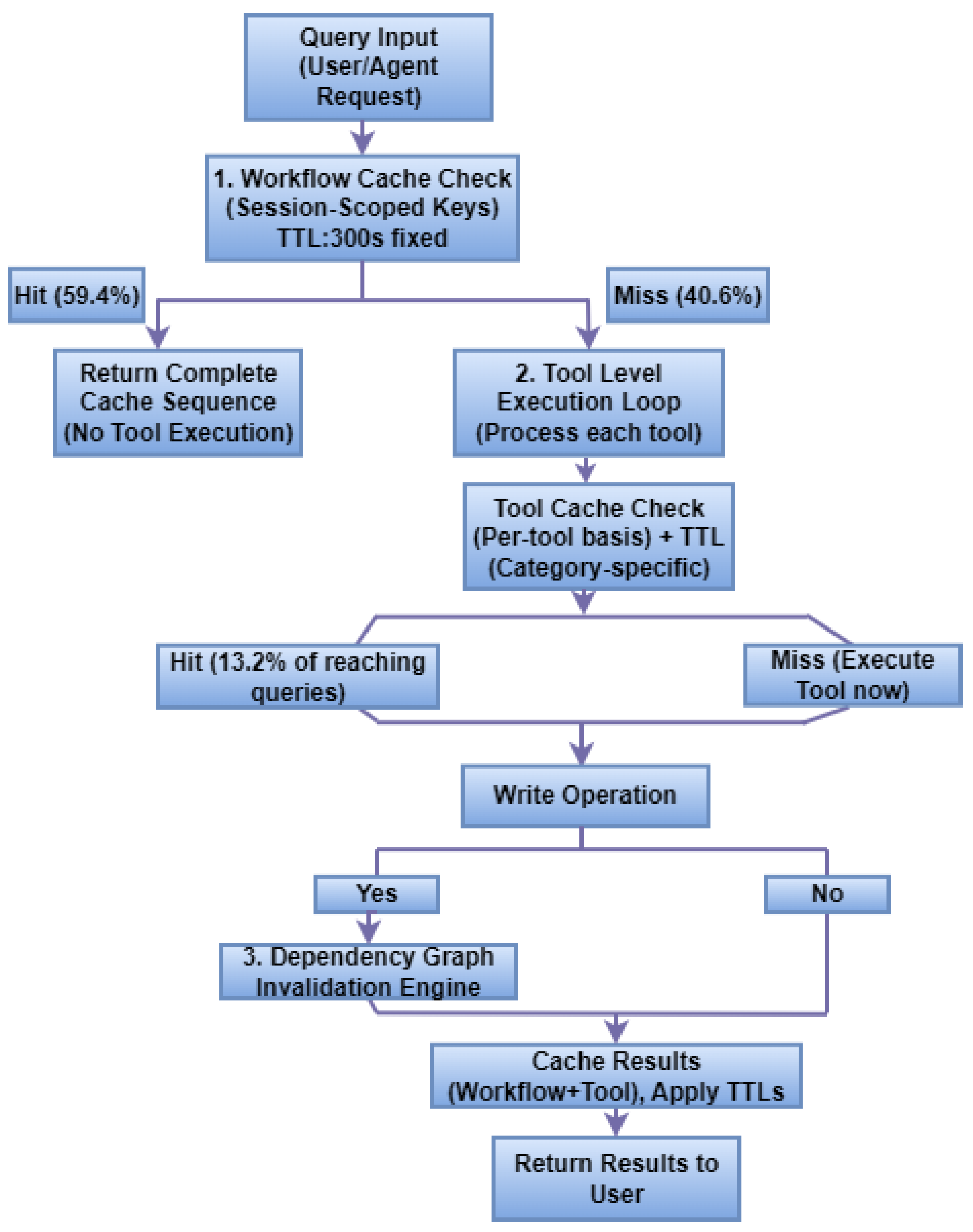
The proposed multi-level cache architecture consists of four components, as seen in
Figure 1. It integrates a workflow cache that stores full execution sequences, a tool cache that handles atomic API/database/compute calls, a dependency graph that tracks write-triggered invalidation and a TTL manager that applies category-specific base policies with infrastructure for dynamic adjustment based on staleness detection (see
Section 5 for validation results).
The query processing flow is as follows. First, the system checks the workflow cache. A cache hit returns the complete cached execution sequence, retrieving all tool results without executing any tool. If the workflow cache misses, query processing proceeds to the tool-level cache, where individual tools may hit or miss. At this stage, write operations trigger dependency-aware invalidation to maintain consistency. Meanwhile, the TTL manager monitors cache age and applies category-specific lifetimes to infrastructure for dynamic adjustment. The following subsections describe each component in detail and explain their role in the overall architecture. Caching efficiency is measured as the percentage of tool executions avoided through caching:
Here, ‘tool calls avoided’ includes both complete workflow cache hits (which bypass all tools) and individual tool cache hits. For example, if a workflow requires three tools [A, B, C] and the workflow cache hits, all three are avoided (efficiency contribution: 3). If the workflow cache misses but two of three tools [A, B] hit in the tool cache, two are avoided (contribution: 2). This metric motivates the design decisions that are discussed in the following sections.
3.1. Workflow Cache Design
The workflow cache operates at the coarsest granularity, storing complete tool execution sequences. When an agent plans a multi-step workflow, the system generates a unique key representing the entire sequence. A cache hit returns all tool results immediately, eliminating the need to execute any individual tools. This design is particularly effective when users phrase semantically different queries that map to identical tool sequences. For example: “What is the weather in Boston?” “Is it raining in Boston?” “Should I bring an umbrella to Boston?”
All three queries produce different LLM reasoning traces but execute the same tool sequence:
[get_weather(city=“Boston”)]. The workflow cache recognizes this equivalence and serves cached results for subsequent queries. When an agent plans a tool sequence:
The system generates a workflow key by hashing the ordered sequence.
where
represents the tool name (e.g., “get_weather”),
represents its parameters (e.g., {“city”: “Boston”}) and
H an SHA-256 hash. To maintain session isolation, the session identifier is concatenated with the sequence hash if
session_id ≠ NULL:
where
T is the tool sequence. This design prevents cross-session cache contamination through key prefixing. For example:
- Plan A:
querying “my orders” does not retrieve
- Plan B:
results, even if both execute identical tool sequences. This slightly decreases cache sharing efficiency, but ensures strong privacy guarantees. The workflow cache employs a 300 s TTL based on the following theoretical reasoning:
- [1]
Typical tools have base TTLs of 300–600 s, making 300 s a safe lower bound.
- [2]
Multi-step workflows compound staleness risk. For example, a workflow caching from three tools each with 5 min TTLs could serve results that are stale across multiple dimensions. If the earliest cached tool result is 5 min old, the entire workflow output reflects that staleness. Setting the workflow TTL conservatively to 300 s ensures an additional freshness guarantee.
- [3]
Empirical evaluation confirmed that 300 s achieves a 59.4% hit rate while maintaining freshness.
Basic steps of the workflow cache lookup are summarized in Algorithm 1. As demonstrated in
Section 5, workflow caching serves as the primary efficiency contributor in the system.
| Algorithm 1 Workflow cache lookup |
Require:
Require:
Ensure: or
- 1:
“session:” + + “:” + H(serialize()) - 2:
if
then - 3:
- 4:
if NOW() < then - 5:
RECORD_HIT(“workflow_cache”) - 6:
return - 7:
else - 8:
DELETE() - 9:
end if - 10:
end if - 11:
RECORD_MISS(“workflow_cache”) - 12:
return None
|
Workflow Cache Example:
Query 1:“What is the weather in California?”
- –
Tools: [get_weather(city=“California”)]
- –
Workflow key:
- –
Result: {temperature: 72, condition: “sunny”}
- –
Cache this result
Query 2: “Should I bring an umbrella to California?” (within TTL) reuses the same tool sequence, resulting in a cache hit.
3.2. Tool Cache Design
When the workflow cache misses, query execution proceeds to the tool cache. Unlike the workflow cache, which requires complete sequence matching, the tool cache operates at atomic granularity, caching individual (tool_name, parameters) pairs. This enables reuse across different workflows that invoke common operations.
For example:
- Workflow A:
[get_weather(Boston), recommend_activity(weather)]
- Workflow B:
[get_weather(Boston), pack_for_trip(weather)]
The workflow cache treats these as different sequences, so both miss. However, the tool cache recognizes that both invoke get_weather(Boston) and thus shares the cached result.
Tool cache TTLs are longer than workflow TTLs, e.g., weather: 1800 s; computations: 3600 s, and are tailored to typical freshness requirements. Staleness ratio is defined as
where
is present timestamp,
is cache insertion time and TTL is configured time to live.
The system implements a 30% staleness threshold as a monitoring metric to indicate when a cache entry might require TTL adjustment. When the staleness ratio exceeds 0.30, the entry is marked as “aging” but remains valid to maximize efficiency. This metric is monitored continuously. While the architectural components for dynamic TTL adjustment are implemented, our experimental evaluation focused on validating the base hierarchical and dependency-aware mechanisms. The dynamic adjustment module is designed for long-running production environments where usage patterns evolve over hours or days, which exceeds the scope of the current synthetic benchmark.
Tool cache entries use category-specific TTLs based on typical data freshness. Weather APIs are set for 1800 s as weather data changes gradually, whereas location APIs are set for 600 s as user locations are moderately stable and the database queries are set for 300 s to balance freshness and efficiency. Additionally, aggregations are set for 300 s for the derived data, filesystem reads are set for 600–1800 s as files change infrequently, and computational tasks are set for 1800–3600 s for deterministic results. These values are configurable for domain-specific tuning.
To prevent cross-user interference, tool cache keys are scoped to user sessions as follows:
if
session_id ≠ NULL:
The performance characteristics of the tool cache in both independent and integrated configurations are presented in
Section 5. We placed the workflow cache first to maximize system efficiency by capturing complete execution sequences as a single workflow. Although this reduces direct visibility at the tool cache level, the hierarchical design significantly improves total efficiency.
3.3. Dependency-Aware Invalidation
TTL-based expiration helps maintain freshness, but it cannot preserve correctness in the presence of write operations. Any tool that modifies a data source may invalidate cached results of tools reading from the same source. To address this, the system incorporates a dependency-aware invalidation mechanism. When
update_user_location(user_id=123, city=“Seattle”) executes, previously cached results for
get_user_location(user_id=123) and
calculate_distance(user1=123, user2=456) become invalid. TTL-based expiration would eventually remove these entries, but the delay is unacceptable because users should immediately observe the updated location in subsequent queries. The dependency-aware invalidation procedure is defined in Algorithm 2, which describes how write operations traverse the dependency graph to identify and invalidate affected tool- and workflow-level cache entries.
| Algorithm 2 Dependency-aware invalidation |
Require: ,
Ensure:
- 1:
- 2:
- 3:
for all
do - 4:
if then - 5:
“session:” + + “:tool:” + + “:” - 6:
else - 7:
“tool:” + + “:” - 8:
end if - 9:
- 10:
for all do - 11:
DELETE_CACHE() - 12:
- 13:
end for - 14:
end for - 15:
for all
do - 16:
if ∃ : then - 17:
DELETE() - 18:
- 19:
end if - 20:
end for - 21:
return
|
The system tracks dependencies using a directed graph representation
where
V = all tools
The graph is built statically based on tool information.
Each tool declares the following:
reads_from = [data sources it reads]
writes_to = [data sources it modifies]
When the write tool w declares writes_to = [“user_db”] and read tool r declares reads_from = [“user_db”], edge is created.
Example construction:
update_user_location: writes_to = [“user_db”]
get_user_location: reads_from = [“user_db”]
calculate_distance: reads_from = [“user_db”]
Resulting edges:
update_user_location→ {get_user_location, calculate_distance}
As shown in Algorithm 2, when a write operation executes, the system traverses the dependency graph to identify all affected reads and invalidates their cached entries, ensuring consistency across the system. Graph-based invalidation approaches have been explored in distributed databases [
44] and general caching systems [
45]. Our dependency-aware mechanism extends these concepts to handle semantic relationships between heterogeneous tool operations in agent workflows.
4. Experimental Methodology
4.1. Experimental Design and Workload
We created a synthetic benchmark that generates 15,000 queries over five tool categories using Zipfian distributions with
= 1.5. This synthetic approach allows for controlled experimentation and reproducibility (see
Section 6.4 for detailed rationale). These categories were selected to represent both frequent and less common query patterns, allowing us to assess caching performance under realistic conditions. About 40% of API calls request weather data, location lookups or currency conversions, while approximately 27% of database operations involve user queries, product searches and aggregations. Filesystem reads constitute 10%, computational operations 15% and external services the remaining 8%. The prices of tool execution range from minimal filesystem reads to more costly external APIs, approximately reflecting real-world pricing.
To create realistic access patterns within these categories, queries are generated using a Zipfian distribution with = 1.5, indicating that some queries appear frequently, while several others appear occasionally. For example, popular cities like Boston, New York and London dominate weather queries and top users generate the majority of database requests. This pattern creates natural caching opportunities while maintaining sufficient variability to thoroughly evaluate cache efficiency. In addition to variability in individual queries, the benchmark includes three workflow categories: approximately 70% of all queries involve a single tool call, 20% consist of multi-step workflows, such as calculating the distance between two users that require multiple tool calls, and the remaining 10% are repeated patterns that differ semantically but map to the same operational sequence. The queries within the benchmark utilize, on average, 0.826 tools each. Write operations comprise around 4% of total tool calls, with 40% location updates, 5% order creations and 25% file writes. This distribution shows typical agent workloads where reads dominate but writes must be handled correctly to maintain consistency. To ensure reproducibility and consistent performance evaluation, we simulate tool execution using fixed latency ranges. API calls incur latencies ranging from 0.1 to 1.5 s, database queries from 0.05 to 0.2 s, filesystem activities from 0.02 to 0.05 s, computing processes from 0.05 to 0.3 s and interactions with external services from 0.05 to 2.0 s. These ranges maintain relative performance across experimental configurations.
We used synthetic workloads instead of production traces for the following reasons:
Reproducibility: Fixed random seeds ensure consistency across experimental runs. Although production traces would be ideal, they contain sensitive information and show significant variability between regions.
Controlled experimentation: The Zipfian distribution allows systematic evaluation of caching behavior under predictable patterns, controlling query diversity, redundancy and write frequency to isolate architectural effects.
Generalizability: Agent workloads in the real world show significant variability, including customer service bots, coding helpers and data analytic tools. Synthetic workloads capture patterns such as popularity-based repetition, temporal locality and write–read dependencies, making results broadly applicable.
To balance generalizability with realism, the benchmark is calibrated such that 60% of weather requests target a small set of frequently queried cities, 70% of database requests involve a limited subset of users and 4% of operations perform writes triggering dependency-aware invalidation. While absolute cache hit rates differ across deployments, the architectural contributions (workflow-level caching, dependency tracking and session isolation) remain broadly relevant regardless of specific workload characteristics.
4.2. System Configurations and Evaluation Protocol
We evaluated ten system configurations to isolate each component’s contributions. The baseline_no_cache configuration does not store any data and executes all the tools fresh. This sets a baseline for performance and cost. The simple_memoization uses a dictionary-based cache with an infinite capacity and does not have a TTL expiration, session isolation or write invalidation. This configuration is an ideal upper bound as it shows the maximum theoretical gains without any production constraints. We also tested several practical caching strategies. Memory-constrained caching configurations with standard LRU policies like lru_128 and lru_512 are used in memory-limited caching setups. These policies allow for 128 and 512 entries, respectively. This uses fixed 300 s TTLs and does not take workflow into account. Similarly, raw_redis uses a production-grade Redis with fixed TTLs but does not keep track of workflow awareness and dependency tracking. This shows how a standard distributed cache works without any agent-specific optimizations. We evaluated three partial configurations that enable specific subsystems so that we could separate our architectural contributions. The tool_cache_only variant has tool-level caching with dependency-aware invalidation and session isolation but it excludes the workflow cache. This allows us to measure tool-level benefits independently. Conversely, the workflow_cache_only configuration applies workflow-level caching with session isolation but excludes tool caching and dependency tracking, isolating workflow-level contributions. The tool_workflow_cache combines both layers with invalidation and isolation but it uses fixed TTLs. This allows us to study hierarchical caching without using adaptive mechanisms.
Finally, the
full_system configuration integrates all components, including the workflow cache, the tool cache, dependency-aware invalidation, adaptive TTL management and session isolation. Although our evaluation window (160 s) was too short to measure dynamic TTL adaptation, it provided insight into hierarchical caching interactions and established a foundation for future validation. We tested all configurations on the same query sequences so that we could compare them directly and make sure that any differences in performance were due to architectural choices rather than workload variation. To ensure variance and statistical validity for a total of 2,250,000 queries, i.e., 15,000 queries × 15 runs × 10 configurations, each configuration was evaluated with 15 independent runs with different random seeds. This extensive evaluation provides robust statistical power to find even small performance differences between configurations. To maintain reproducibility while adding controlled variation, queries were shuffled using a seed derived from the configuration name and run number.
This ensured that each run saw queries in a different order, which tested both cold and warm cache behavior while keeping the results the same across all configurations.
Each benchmark run simulates a single user session, which is given by a unique
session_id. This prevents cache interactions between runs and ensures that cached entries remain isolated to the session that produced them. We focused on single-session workloads for the primary evaluation (
Section 4 and
Section 5) to facilitate a controlled comparison of caching behavior. In
Section 5.6, we evaluate multi-tenant behavior separately by simulating 15 concurrent sessions to study cross-session interactions. For each query, we record workflow- and tool-level cache hits and misses, execution time measured with microsecond resolution, memory usage, invalidation events and total tool costs. The collection of these metrics enables a comprehensive analysis of not only cache performance but also runtime overhead and the distribution of work across tools, supporting our ablation studies and comparative analyses. To support longer experiments and avoid restarting entire batches, the system uses checkpoint-based recovery. After each run completes, its results are written to a file named {
config_name}.json. If an evaluation is interrupted, it can resume from the most recent checkpoint. This mechanism ensures that all 150 runs are completed reliably across multi-hour test sessions. All experiments were conducted on a Windows 11 server using Redis 7.0.8 and Python 3.10 along with NumPy and SciPy for statistical utilities. All runs were executed single-threaded to eliminate concurrency effects and isolate caching behavior, ensuring that observed performance differences reflect cache design rather than threading or scheduling artifacts.
4.3. Statistical Analysis and Cost Model
We computed 95% and 99% confidence intervals for primary metrics such as hit rates, execution times and caching efficiency using Student’s t-distribution (
n = 15).
where
is the sample mean;
s is the sample standard deviation;
= 2.145 (95% confidence);
= 2.977 (99% confidence).
Confidence intervals narrower than 1% of the mean indicate high measurement precision across independent runs. Beyond confidence intervals, we performed independent two-sample
t-tests to compare each configuration to the baseline, reporting t-statistic, two-tailed
p-values and Cohen’s d effect size.
Statistical significance thresholds are commonly defined as follows:
p-values less than 0.05 indicate significance at the 95% confidence level,
p-values less than 0.01 indicate significance at the 99% confidence level and
p-values below 0.001 are considered highly significant. These thresholds help us find out whether observed differences are likely due to the experimental treatment rather than random variation. Because multiple comparisons were performed across configurations and ablations, a Bonferroni correction was applied to control the family-wise error rate. All primary results greatly exceeded this threshold (
), providing strong evidence of real effects. Specifically, we considered nine configuration comparisons and three ablation comparisons, i.e., a total of twelve comparisons. The adjusted significance threshold was
. As reported in
Section 5, all primary results, including workflow cache, tool cache and full system, far exceeded this threshold (
), while adaptive TTL showed (
) within our evaluation window, as expected given the short runtime. Effect sizes were interpreted according to Cohen’s conventions, where
d = 0.2 indicates a small effect,
d = 0.5 a medium effect and
d = 0.8 a large effect. These standardized measures allow us to quantify not just whether differences are statistically significant but also whether they are practically meaningful. Comparisons with practical baselines such as LRU-512 and the
tool_cache_only configuration are presented in
Section 5, where we demonstrate both statistical significance and practical impact.
To estimate potential operational savings, we assigned representative API and service costs to each tool category using publicly listed commercial APIs and cloud service pricing, as detailed in
Table 2. For example, weather APIs using OpenWeatherMap’s paid tier costed approximately USD 0.0012 per call [
46], database queries with AWS RDS Proxy ranged from USD 0.0003 to USD 0.001 per query [
47], computation with AWS Lambda incurred USD 0.0002 per 100 ms invocation [
48] and external APIs via third-party aggregators ranged from USD 0.001 to USD 0.005 per call [
49]. These values reflect typical pricing structures in cloud platforms and provide a consistent basis for cost comparisons. However, they are not direct financial projections for any specific deployment. Actual costs in production vary depending on usage volume, negotiated pricing tiers, discounts and tool selection. Real-world costs may vary based on API prices, enterprise agreements, volume discounts, regional differences and the particular tools used. Organizations may expect actual savings up to +300% of these representative estimates depending on deployment-specific factors, including free-tier usage, volume discounts and workload characteristics.
Reported savings indicate relative improvements between cached and non-cached configurations under these assumptions, and do not guarantee monetary reductions. Absolute savings should be calculated using actual deployment data, including real API billing and expected query volumes. The primary objective of this cost model is to illustrate relative performance across caching strategies rather than to provide precise financial projections for any particular deployment. The cost calculation methodology follows standard accounting principles. The total cost for a configuration without caching is simply the sum of all tool invocations:
For caching configurations, cost includes only cache misses:
The savings are then calculated as
Return on investment (ROI) is calculated as
Note: We compare
full_system against
baseline_no_cache (zero caching) to demonstrate absolute improvement potential. However, production systems typically already employ some form of caching. To demonstrate the potential economic advantage at scale, we model annual savings for a representative deployment handling one million queries per year within a single organization. This reflects a typical small-to-medium installation in which multiple users rely on shared caching resources. Organizations should substitute actual API pricing for deployment-specific estimates, where the baseline cost is USD 8.49 per 15,000 queries = USD 0.566 per 1000 queries and the annual baseline cost is 1000 × USD 0.566 = USD 566. Projected savings under different caching efficiencies are presented in
Section 5, where we analyze the economic impact of our architectural contributions. While our evaluation uses placeholder costs and a short 160 s evaluation window, these estimates highlight the practical economic benefit of workflow- and tool-aware caching in production-scale deployments. The methodology established here can be adapted to any specific deployment by substituting actual API costs and observed query volumes.
4.4. Extended Evaluations
Beyond the primary ten-configuration comparison (
Section 4.1,
Section 4.2 and
Section 4.3), we conducted additional targeted experiments to validate specific architectural properties.
Experiment 1: Personalized Memory Effects
To quantify individualized memory production and cache-sharing benefits, we simulated 15 users across five personas with varying repetition patterns. Monitoring bots with 85% self-repetition represent automated systems performing scheduled health checks, API monitoring and periodic data synchronization. Accountants with 70% repetition represent domain-specific workflows such as financial report generation, compliance checking and recurring data analysis, where users repeatedly invoke similar tool sequences (e.g., query_database to aggregate_results to generate_report), with varying parameters such as different time periods, departments or cost centers. Travelers with 50% repetition approximate general-purpose assistants handling mixed-intent queries that balance planning-related repetition (e.g., “weather in Boston,” “hotels in Boston,” “restaurants in Boston”) with exploratory diversity as users investigate new destinations or activities. Customer service agents with 35% repetition reflect FAQ-style support bots that serve common queries frequently (e.g., “reset password,” “track order,” “return policy”) while also handling novel user requests. Researchers with 10% repetition model hypothesis-driven exploration workflows where most queries are unique, as users investigate new datasets, test different analytical approaches and explore diverse information sources. The repetition thresholds (85%, 70%, 50%, 35%, 10%) provide approximately uniform coverage across the repetition spectrum while maintaining equal statistical power per persona (3 users × 15,000 queries = 45,000 queries per tier). Each of the 15 users executed 15,000 queries under two modes: (1) an isolated cache with per-user session isolation (15 users × 15,000 queries = 225,000 queries), and (2) a shared cache with a global cache pool (15 users × 15,000 queries = 225,000 queries). This provided a total of 450,000 queries across both modes. This two-mode design directly measures cross-user sharing gains (shared efficiency minus isolated efficiency) while capturing individualized self-repeat rates.
Experiment 2: Workload Sensitivity Analysis
We evaluated system performance across five access pattern distributions representing diverse deployment scenarios: Zipfian (exploratory, low skew), (typical web access, medium skew), (specialized agents, high skew), uniform (maximum diversity) and bimodal (80% concentrated, 20% exploratory). Each distribution was tested with three configurations, baseline, tool-only and full system, across three independent runs with 15,000 queries each, totaling 675,000 queries. This design isolates the effect of access pattern concentration on caching efficiency.
Experiment 3: Write Intensity Impact
We evaluated robustness under increasing write ratios by systematically varying the write ratio from a 4% baseline to a 30% extreme. Each ratio was tested with three configurations across three runs with 15,000 queries each, totaling 540,000 queries. This experiment evaluates efficiency degradation under increasing write pressure, reflecting reduced cacheable reads and increased cache churn.
Experiment 4: Plan Caching Comparison
To rigorously evaluate the hierarchical caching against plan caching baselines, we implemented four configurations: (1)
no_cache (baseline); (2)
workflow_cache_only, i.e., workflow-level result caching within our framework, which is treated as a proxy for plan caching baselines that reuse execution traces; (3)
tool_cache, i.e., tool level only, ablation; and (4)
full_system, the hierarchical system. Each configuration was evaluated using 15 independent runs of 15,000 queries each, resulting in 225,000 queries per configuration and 900,000 queries in total across the four configurations. We report mean latency, speedup with 95% confidence intervals and paired
t-tests against the baseline. We use
workflow_cache_only as a functional proxy for plan caching, and its limitations and implications are discussed in
Section 5.7. Across these four experiments, we executed an additional 2,565,000 queries beyond the primary evaluation. This brings the total experimental scope to 4,815,000 query executions.
4.5. Validity and Reproducibility
To ensure the robustness of our findings, we assessed potential threats to internal, external and construct validity.
Table 3 summarizes the main risks, mitigation strategies applied and remaining limitations. While using synthetic workloads allows for reproducibility and controlled experimentation, validating our approach with real production traces remains an important consideration for future work. For transparency and reproducibility, we will release the full benchmarking framework post-publication. This includes the workload generator, caching modules, evaluation harness and analysis scripts. We will also release the raw logs for all 2.25 million executed queries, along with summary statistics and confidence intervals, providing complete transparency of our experimental data. Using the provided random seeds and configuration files, other researchers will be able to fully reproduce our experiments and evaluate alternative caching strategies.
4.6. Multi-Tenant Concurrent Evaluation
We also evaluated the system under multi-tenant conditions to assess session isolation and cache behavior under concurrent workloads. In this experiment, 15 tenants executed 15,000 queries each (225,000 queries total) using a ThreadPoolExecutor to introduce concurrency. Each tenant was assigned a unique random seed (42 + tenant_id), ensuring variation in access patterns while maintaining reproducibility. Session isolation was enforced using session-scoped cache key namespaces.
Cache keys were structured as
session:tenant_{id}:tool:{tool_name}:{hash} to guarantee strict per-tenant scoping and prevent any cross-tenant data leakage. Redis was configured without shared global keys, and we verified isolation by inspecting key distributions and computing hit rates per tenant independently. This design ensures that even if multiple tenants issue identical queries, their cached results remain separate, preserving both privacy and correctness, with no cross-tenant leakage. Performance results from this multi-tenant evaluation, including throughput, hit rates and isolation verification, are presented in
Section 5.6. These experiments demonstrate that our architecture maintains both efficiency and safety guarantees under realistic concurrent workloads.
5. Results
We evaluated the system using the synthetic workloads generated from a Zipfian distribution with = 1.5 as Zipfian distributions capture popularity skew, temporal locality and write–read dependencies. Although the synthetic setup captures essential access patterns, absolute hit rates will vary by domain. For example, customer service bots that use FAQ patterns may have a higher workflow cache hit rate of 65–75%, while exploratory data analysis, which includes unique queries, may have a lower hit rate of approximately 30–45%. Therefore, the organizations should set their own expectations for performance based on how often they repeat tasks. However, the architectural principles are applicable across various domains.
5.1. Aggregate Performance
Due to the hierarchical design, the workflow cache processes all queries first. The system-wide tool hit rate of 5.37% reflects hits across the entire workflow, while the conditional tool hit rate of 13.2% applies only to the 40.6% of queries that reach the tool cache after the workflow cache misses, i.e., 40.6% × 13.2% ≈ 5.37%. Queries served by the workflow cache bypass tool execution completely. A tool_cache_only configuration without workflow caching achieved a hit rate of 50.17% by processing all queries at the tool level. This seemingly lower hit rate in the full system shows that the workflow cache intercepts queries first. The overall efficiency of 76.54% exceeds the sum of the hit rates because the workflow cache hits avoid multiple tool calls per query, i.e., an average of 1.86 tools per workflow.
Table 4 presents results from 15 independent runs per configuration with a total of 225,000 query executions. The confidence intervals (CIs) are narrow, typically less than 1% of the mean, indicating high measurement stability. The full caching system achieved 76.5% efficiency, and the 95% CI is [76.4%, 76.7%],
), reducing the average query processing time by 13.3× from 0.31 s to 0.023 s per query, excluding LLM inference (see
Table 4). This efficiency reflects the combined effect of workflow caching, which served 59.4% of queries completely from cache- and tool-level caching, which handled individual tool calls for the remaining queries. The system reduced estimated tool execution costs by 73.3% compared with the no-cache baseline. The 59.4% workflow cache hit rate reflects repetition patterns in our benchmark. For explicitly repeated patterns, about 10% of queries are semantically different but execute identical tool sequences. For example, “Weather in Boston?” and “Need an umbrella in Boston?” both trigger
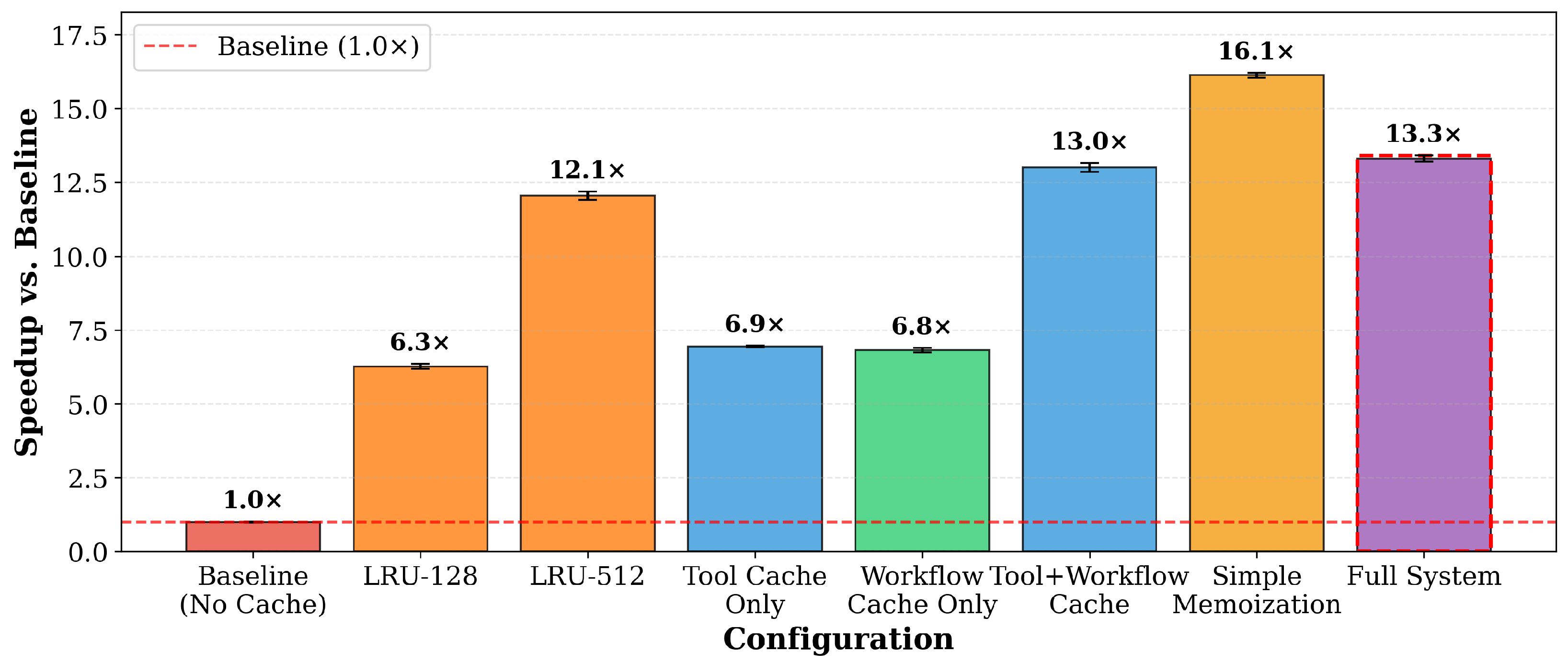
get_weather(city=“Boston”). Popular locations such as Boston, New York and London account for approximately 60% of weather queries, and the top 50 users generate 70% of database queries. Workloads with different repetition patterns will see workflow cache benefits accordingly. Confidence intervals confirm the reliability of these measurements. The tool hit rate is 5.37% ± 0.20%, workflow hit rate is 59.4% ± 0.18% and overall caching efficiency is 76.5% ± 0.18%. Furthermore, relative uncertainties are low, 3.7% for tool hits, 0.3% for workflow hits and 0.2% overall, confirming reproducibility across 15 independent runs and ruling out random variation. Execution time speedups across configurations are shown in
Figure 2. The full system achieved a 13.3 speedup, performing comparably to a simple memoization of 16.1 while supporting TTL-based expiration, session isolation and write-triggered consistency. LRU-512 achieved 12.1 speedup, whereas
tool_cache_only and
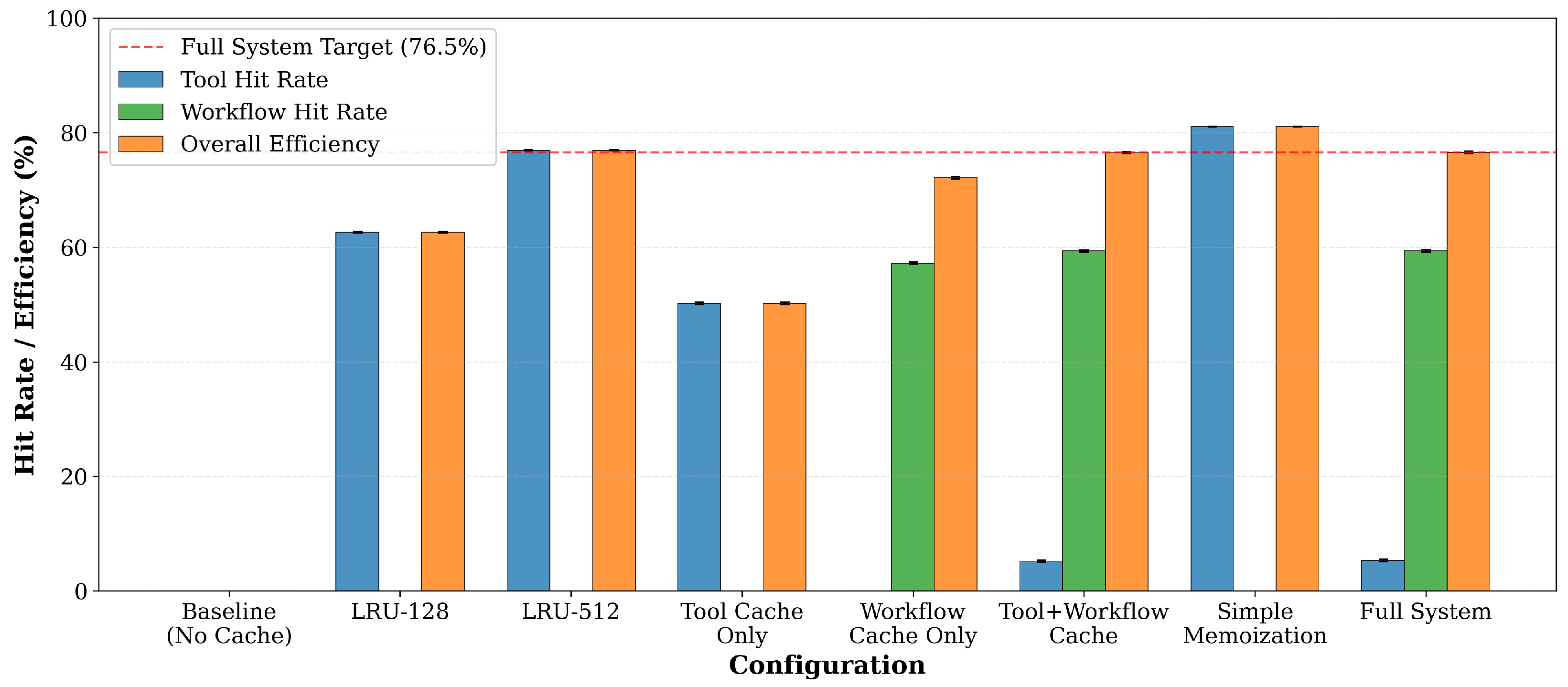
workflow_cache_only configurations achieved 6.9 and 6.8 speedups, respectively, demonstrating that neither component alone matched the full system’s performance. When it comes to caching efficiency,
Figure 3 compares efficiencies across configurations. The full system achieved an efficiency of 76.5%, compared to practical baselines like LRU-512, which showed 76.9%, while adding workflow awareness and dependency invalidation. The
simple_memoization represented a theoretical upper bound with infinite memory and no consistency controls. The ∼4.5% gap to this upper bound is a practical trade-off for TTL-based consistency, invalidation and session isolation.
These aggregate results highlight the advantage of integrating workflow- and tool-level caching.
5.2. Component Contributions
To understand each component’s contribution, we conducted systematic ablation experiments comparing baseline configurations to partial implementations.
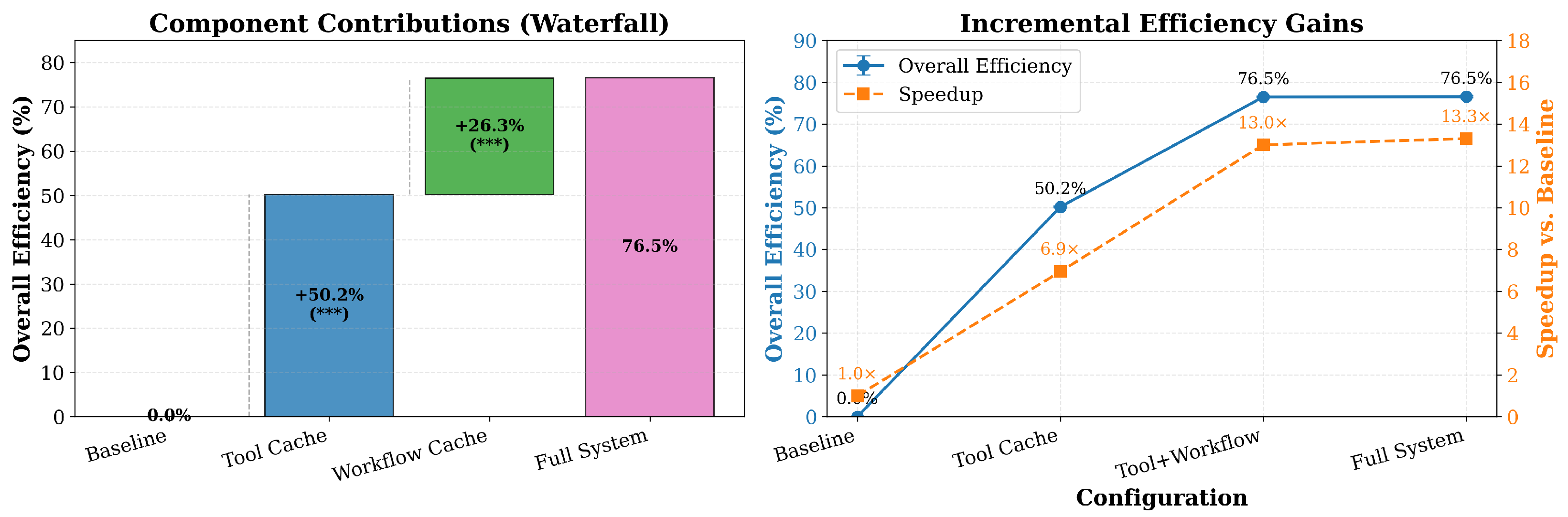
Figure 4 summarizes the efficiency gains and speedup improvements from each component. The left side of
Figure 4 shows the contributions to efficiency. The difference in efficiency between
baseline_no_cache and
tool_cache_only was +50.2%,
, and
.
The tool cache alone had a hit rate of 50.2% on 278,541 tool calls, resulting in a 6.9× speedup and a cost reduction of 54%. The workflow cache contribution from
tool_cache_only to
tool_workflow_cache increased efficiency by +26.3 percentage points,
and
, making this the single largest contributor to overall performance. Workflow caching served complete execution sequences for 59.4% of queries, eliminating 139,611 tool calls, i.e., about 75% of total tool executions that would otherwise be required. On average, each workflow cache hit avoided 1.86 tool calls per query. The right panel of
Figure 4 shows the efficiency gains, with the solid blue line representing overall efficiency and the dashed orange line showing speedup. The significant increase from
tool_cache_only to tool+workflow_cache shows the benefit of hierarchical caching compared to single-level caching. Finally, the transition from
tool_workflow_cache to
full_system changed efficiency only by +0.05 percentage points with
and
, which was not statistically significant. This is to be expected because the runtime was only 160 s and the synthetic workload was stable. As discussed in
Section 6, adaptive TTL mechanisms usually need longer operation windows to show learning benefits.
5.3. Category-Specific Performance
Cache hit rates varied significantly across tool types, primarily due to differences in parameter diversity and temporal locality.
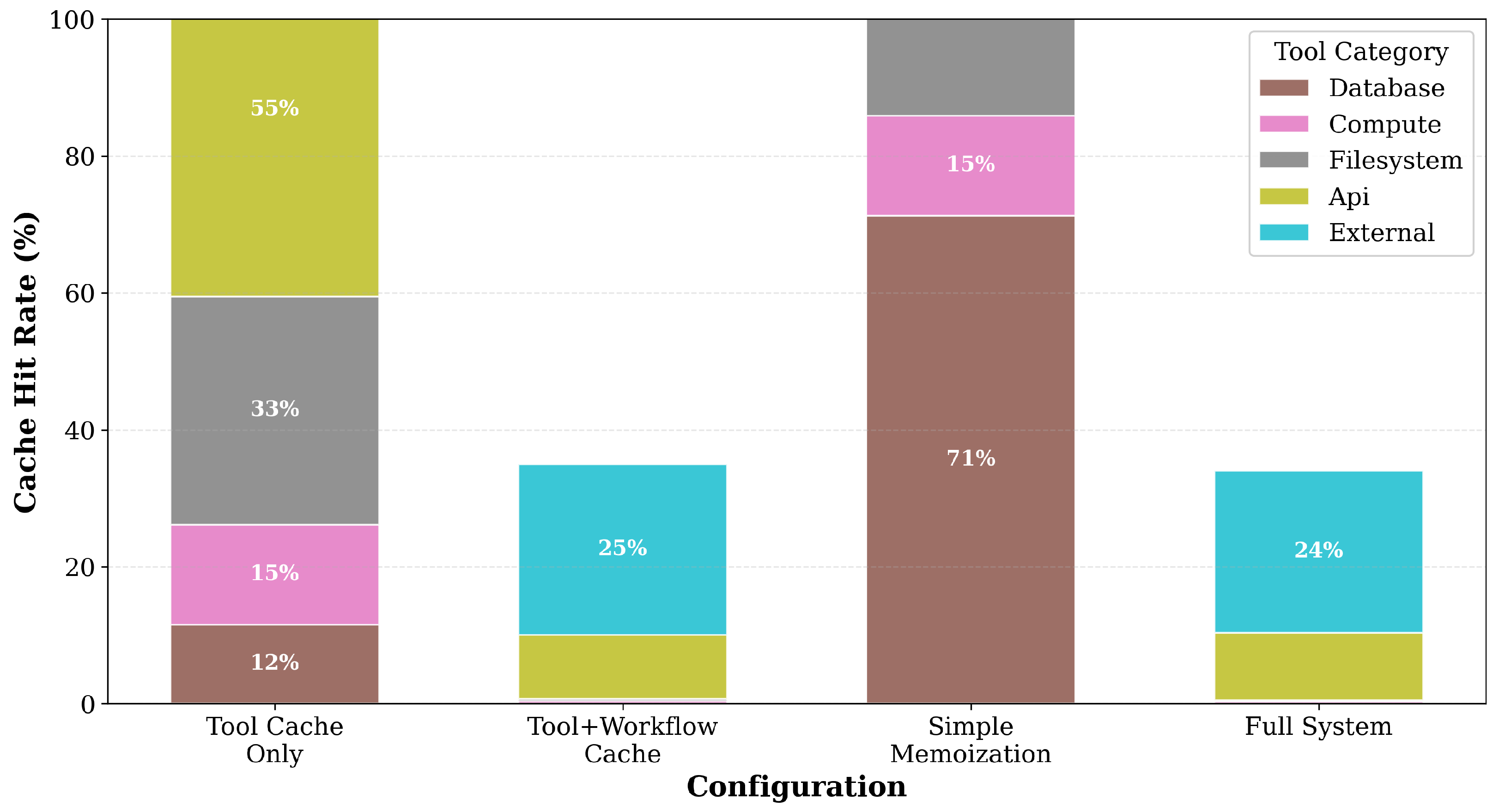
Figure 5 shows the distribution of cached tool calls by category along with their corresponding hit rates.
Weather APIs had the highest hit rate at 23.7%, with 14,073 hits out of 59,400 total calls. This high efficiency comes from concentrated parameters as 60% of weather queries focus on the top 10 most popular cities.
User location services achieved a hit rate of 19.8%, with 7129 hits out of 36,000 calls. This benefits from repeated location lookups during session persistence. External APIs achieved moderate repetition, with a 13.9% hit rate with 6254 hits across 45,000 calls. External APIs had moderate repetition but the hit rate was lower than weather and location due to increased parameter variability and an increased TTL window to 3600 s. This reduced temporal locality within the 160 s evaluation window. Computational tasks, including code execution and data processing, had a 6.2% hit rate with 2790 hits out of 45,000 calls. This lower hit rate means greater variability in computational parameters and longer operation times that limit chances for temporal overlap. The database and filesystem tools showed almost no cache reuse, as each query generally accessed unique parameters or filenames. These results demonstrate that caching efficiency is highly dependent on workload variables. The benchmark was designed with high query variability, so the observed hit rates are conservative. In practical applications with more repetitive queries, most tool categories would likely achieve greater cache effectiveness. This variation in performance by category shows the importance of category-specific TTL policies (see
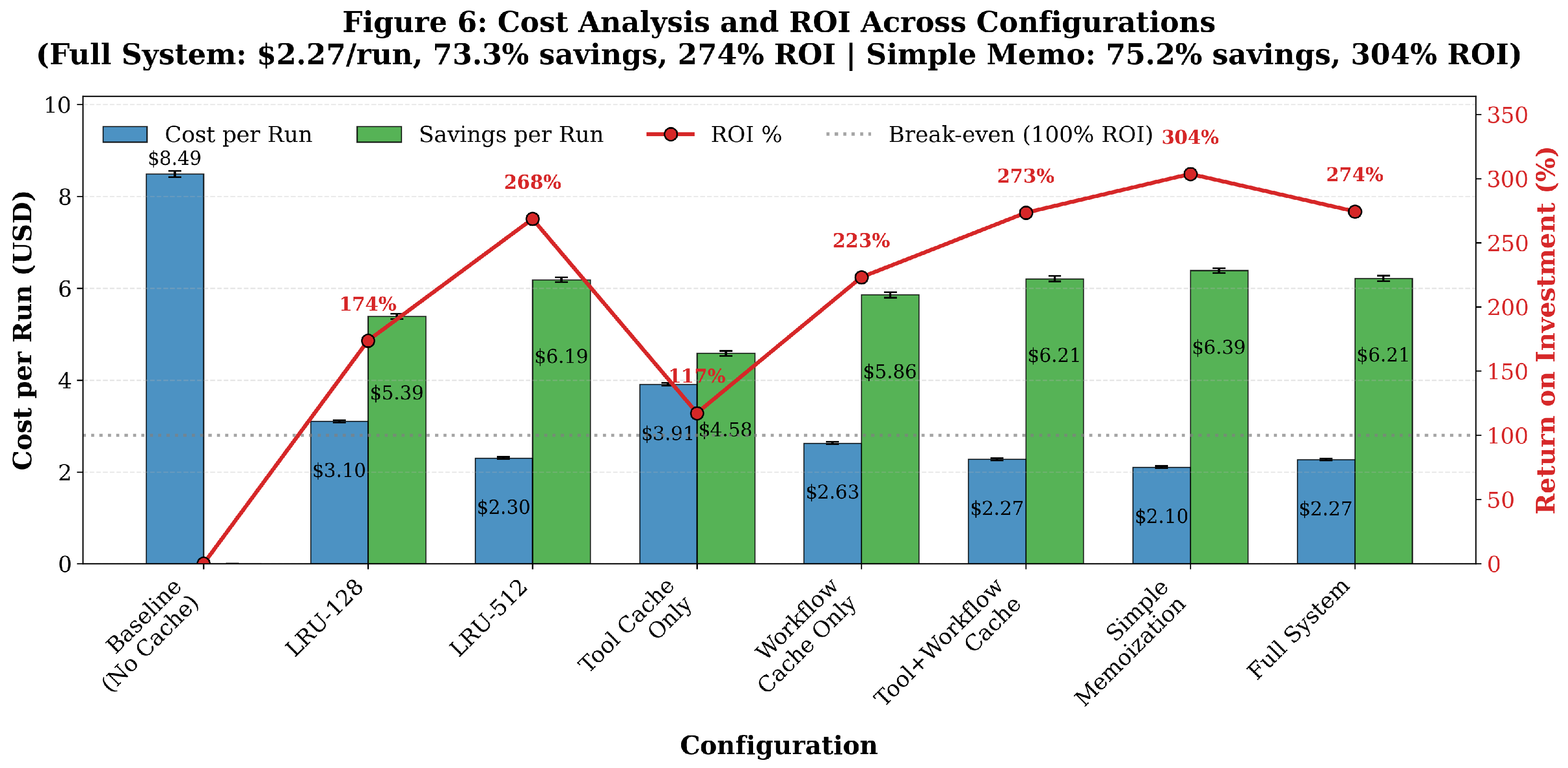
Section 3). The full system reduced operational costs by 73.3% compared to the baseline. It performed comparably to practical caching methodologies like LRU-512, which achieved 72.9%, and simple memoization, which achieved 75.2%, while providing stronger consistency guarantees.
Table 5 shows the cost comparison per run with 15,000 queries.
5.4. Cost Analysis
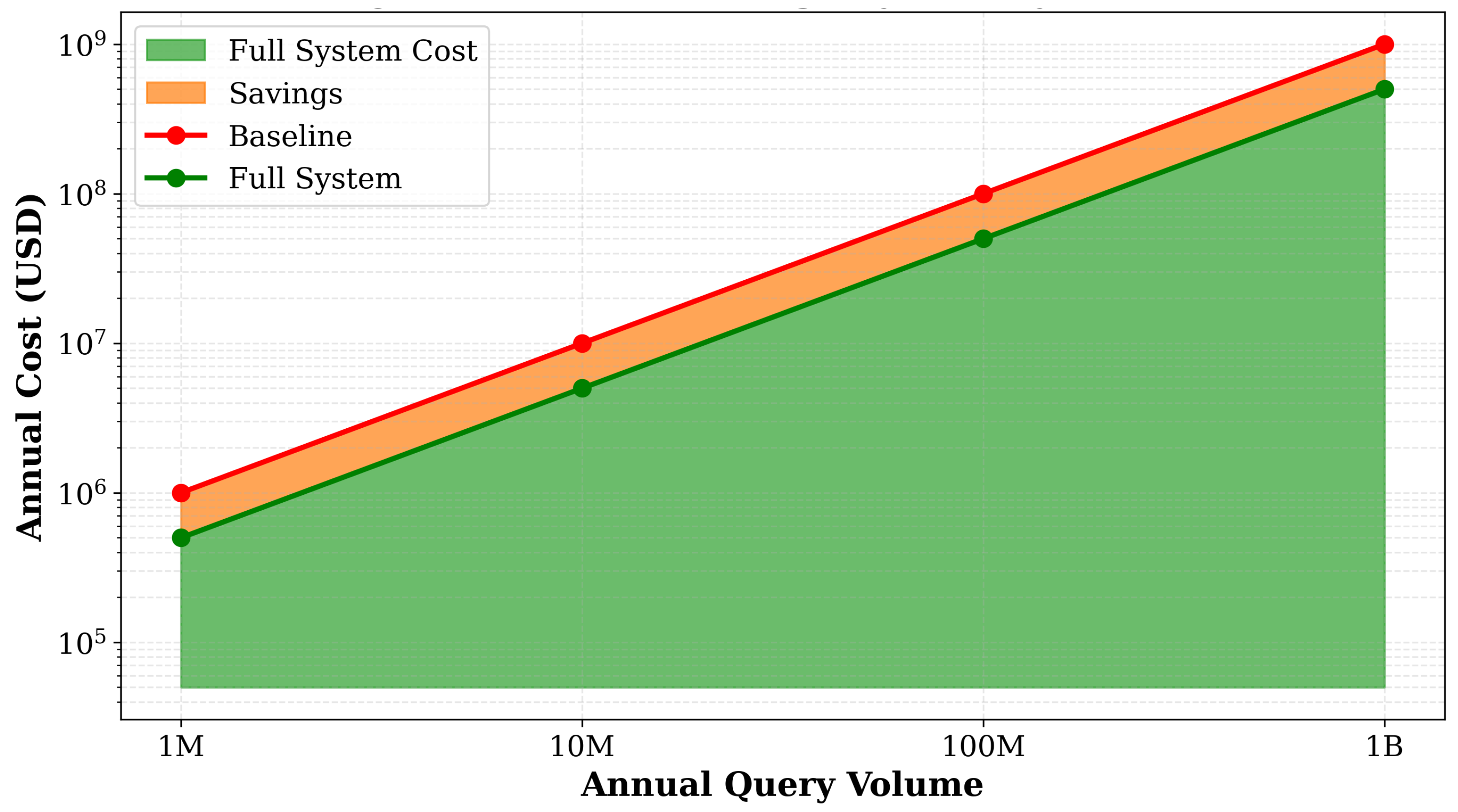
Cost reductions increase proportionally with query volume, as shown in
Table 6. For a typical deployment managing one million queries annually, the projected annual cost reduction would be roughly USD 415.
Department-scale deployments processing 10 million inquiries annually would result in savings of around USD 4150, and enterprise-scale deployments handling 100 million queries per year might achieve yearly savings of USD 41,500. Extensive production systems processing one billion queries per year could realize savings of USD 415,000.
These values are derived from representative API prices and are intended to demonstrate relative improvements amongst caching strategies. Actual savings depend on API pricing, discounts and workload characteristics. As noted in
Section 4, organizations should substitute actual API costs for deployment-specific estimates.
Figure 6 visualizes the cost breakdown and ROI across configurations, showing both absolute costs per run, i.e., the left axis and bars, and ROI percentage, i.e., the right axis and line with markers. The full system achieved an ROI comparable to simple memoization while maintaining production guarantees.
Figure 7 shows how projected annual savings increase with deployment size. The colored bands show the breakdown of savings by configuration milestone: tool cache contribution in teal, workflow cache contribution in yellow and full system optimization in green. The following
Table 7 shows specific savings values for each deployment scale.
These results demonstrate that hierarchical caching provides substantial economic benefits across deployment scales.
5.5. Statistical Significance
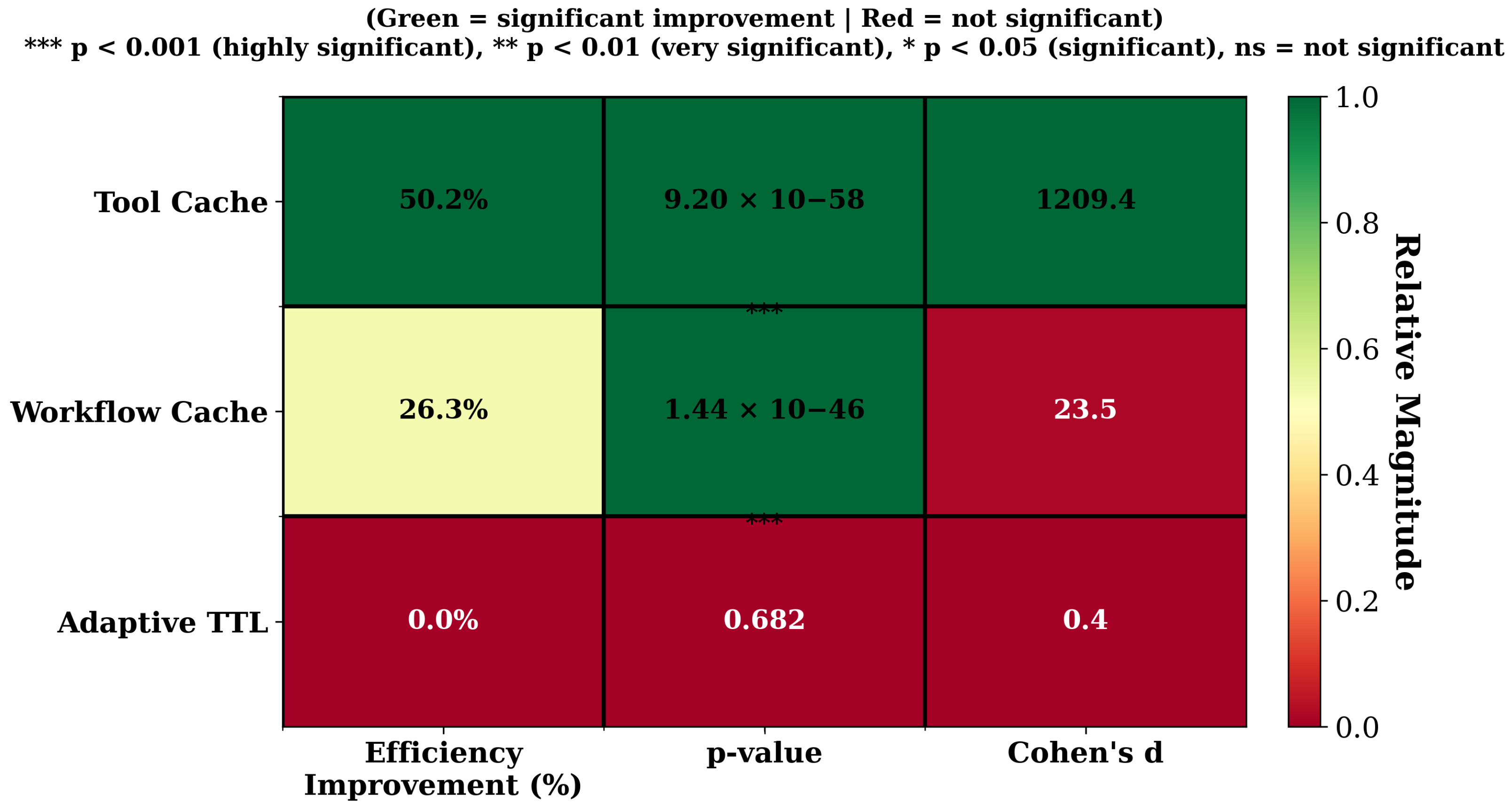
All primary architectural components demonstrated statistically significant improvements with large effect sizes.
Figure 8 presents the statistical significance analysis, showing efficiency improvements on the x-axis, p-values with color intensity and Cohen’s d effect size annotations for each component contribution. In the hierarchical system, the workflow cache served 59.4% of queries, avoiding 139,611 tool executions and providing a 26.3 percentage point efficiency gain.
Note that because of the hierarchical design, all the queries served by the workflow cache never reach the tool cache.
As a result, the tool cache hit rate is measured for the remaining 40.6% of queries. Across this 40.6% of queries, the tool cache achieved a 5.4% system-wide hit rate. Among the subset of queries that actually reached the tool cache, the effective hit rate was 13.2%. These values precisely represent the tool cache’s performance for its intended workload.
5.6. Multi-Tenant Concurrent Performance
To evaluate production readiness and verify session isolation, we simulated a multi-tenant environment with 15 concurrent tenants, each executing 15,000 queries for a total of 225,000 queries.
Table 8 shows the multi-tenant concurrent evaluation results with mean values, standard deviations and ranges across tenants. Queries ran in parallel using a ThreadPoolExecutor, with session-scoped cache keys and Redis configured with production-level performance. Each tenant used a unique random seed to generate varied query patterns. Cache keys followed the convention
session:tenant_{id}:tool:{tool_name}:{hash} to ensure strict per-tenant scoping. The analysis verified full system isolation and all 806,320 cache entries were accurately scoped. A single shared key (
adaptive_ttl_history) was present for the adaptive TTL state, although it did not affect accuracy.
The system successfully processed all 225,000 queries in 453.1 s with a throughput of 496.7 queries per second. A 10.81% average tool hit rate with standard deviation of 0.015 was achieved, indicating minimal variation. The workflow hit rate was 56.19% with standard deviation 0.015. Execution times were the same for all tenants, with a mean of 430.9 s and standard deviation 9.2 s. This shows that the performance was stable for each tenant. Cache key analysis confirmed full-session isolation as all 806,320 cache entries were correctly scoped with the
session:tenant_{id}:... prefix and no cross-tenant contamination was detected. A singular shared key of
adaptive_ttl_history was utilized for monitoring adaptive TTL states, but it did not affect accuracy as it contained only aggregated statistics. Comparing single-tenant and multi-tenant performance reveals the architectural trade-offs inherent in session isolation.
Table 9 presents this comparison.
The tool cache hit rate increases from 5.4% to 10.8% in the single-tenant run under a multi-tenant load. This improvement results from shared read operations among tenants. Popular queries like get_weather(city=“Boston”) or get_exchange_rate(USD, EUR) benefit from this shared caching. It is safe to use these operations across tenants because they always give the same results for the same parameters. This also improves efficiency. In contrast, the hit rate for the workflow cache decreases from 59.4% to 56.2%. This is intentional as each tenant’s workflow cache is isolated to prevent cache poisoning. Each tenant’s multi-step query sequences are handled separately. For example, if Tenant A executes [get_weather(Boston), recommend_activity(weather)] and Tenant B executes [get_weather(Boston), pack_luggage(weather)], these workflows are cached separately, even though the first step is identical. This ensures that no tenant can access another tenant’s workflow results. The overall efficiency decreases by 2.4 percentage points from 76.5% to 74.1%. This is a fair trade-off for production safety. Redis maintained a consistent throughput of 496.7 queries per second even with 15 concurrent tenants. There was almost no lock contention, i.e., <0.1% of execution time and negligible connection timeouts. These results show that the system maintains robust performance and security guarantees even when multiple tenants are using it at the same time. The next section discusses the interpretation of these findings and their implications for practical use.
5.7. Comparison with Plan Caching Approaches
To rigorously evaluate hierarchical caching against plan caching baselines, we conducted a comparison. Standard plan caching approaches [
20] focus on reusing reasoning traces to avoid redundant LLM inference. This eliminates planning overhead, but tool calls are typically re-executed to maintain freshness or because caching operates only at the reasoning level. For example, two ReAct agent plans that both require
get_weather (city=‘Maryland’) would cache different reasoning traces but both would execute the weather API call independently. Advanced semantic plan matching techniques [
50] and template-based execution reuse strategies [
51] employ sophisticated matching that may achieve higher hit rates than our exact-match proxy. However, these systems still face a fundamental limitation in that tool-level redundancy persists across different plans. Our hierarchical approach caches both workflow-level patterns and individual tool execution results.
We implemented four configurations: (1) no_cache (baseline), (2) workflow_cache_only (workflow-level result caching, used as a proxy for plan caching approaches that reuse execution traces; note that our workflow cache stores both plan and results, whereas pure plan caching [
20] would typically re-execute tools), (3) tool_cache (tool level only, ablation) and (4) full_system (hierarchical).
As presented in
Table 10, hierarchical caching achieved a 13.70× ± 0.17 speedup compared to plan caching’s 7.14× ± 0.08, i.e., a 92% performance improvement (
p < 0.001). The confidence intervals are narrow relative to mean batch latency, indicating stable measurements across 15 independent runs. Plan caching achieved 73.3% efficiency by eliminating workflow-level redundancy, but tool-level redundancy persisted. Tool-only caching achieved 53.2% efficiency by capturing cross-workflow tool reuse but missed workflow patterns. Our hierarchical approach achieved 77.6% efficiency by capturing redundancy at both granularities simultaneously. This validates that multi-level caching provides substantially greater benefits than single-layer approaches. Plan caching approaches [
20] focus on reusing reasoning templates to avoid redundant LLM inference. Our workflow_cache_only configuration serves as a conservative proxy for plan caching: it caches complete workflow sequences (both plan and results) but does not cache individual tools across different workflows. Although pure plan caching may re-execute tools for freshness, this proxy captures the main workflow-level optimization effect. We therefore use
workflow_cache_only as a functional proxy for plan caching since it captures the primary efficiency mechanism of such systems: reusing a pre-determined execution sequence for recurring user intents. We acknowledge that this is a simplification. State-of-the-art plan caching systems (e.g., semantic or template-based planners) employ more sophisticated matching mechanisms that can retrieve abstract plan templates even when specific parameters differ. In contrast, our proxy assumes exact parameter matching at the workflow level. This assumption may underestimate the absolute hit rate achievable by advanced semantic plan caching systems. However, the observed performance gap remains substantial (13.7× speedup for hierarchical caching versus 7.14× for workflow-only caching). This gap validates our core hypothesis: caching at the reasoning or plan level alone is insufficient to eliminate execution redundancy without complementary tool-level caching. Even when plan reuse is effective, redundant tool invocations dominate execution cost, and hierarchical caching is required to address this bottleneck.
5.8. Workload Distribution Sensitivity
To evaluate system robustness across diverse access patterns, we systematically tested five distribution types representing different deployment scenarios: Zipfian
, i.e., exploratory workloads with low concentration;
, i.e., typical web access with medium concentration;
, i.e., specialized agents with high concentration; uniform, representing maximum diversity with no skew; and bimodal, with 80% concentrated queries and 20% exploratory. Each distribution was evaluated with three configurations (baseline, tool-only, full system) across three independent runs with 15,000 queries each, totaling 675,000 queries.
Table 11 presents the mean efficiency, tool hit rates, workflow hit rates and speedups with standard deviations.
This robustness stems from the workflow-level structural matching of tool sequences. Queries like “Weather in Boston?” and “Need umbrella in Boston?” map to identical tool sequences regardless of parameter distribution, creating workflow-level hits independent of Zipfian concentration. In contrast, tool-only caching depends directly on parameter repetition, and uniform distributions reduce tool hit rates by 10.5 percentage points compared to high-skew Zipfian (44.9% vs. 55.4%). The workflow cache’s 1.0 percentage point hit rate variance (59.8-60.8%) across all distributions demonstrates that semantic redundancy exists even in maximum-diversity workloads. This explains why hierarchical caching maintains 76.8% efficiency under uniform distribution, as workflow-level patterns provide a stable foundation that tool-level caching enhances but does not dominate.
Full system efficiency exhibited modest sensitivity to access pattern concentration, ranging from 76.8% (uniform) to 78.2% (high-skew Zipfian). As expected, a higher concentration yields higher efficiency, as Zipfian = 1.9 achieved a 1.4 percentage point higher efficiency than uniform distribution. However, even under maximum diversity (uniform), the system maintained 76.8% efficiency and 12.92× speedup. Tool-only configurations showed substantially greater variance (44.9–55.4%), with uniform distribution achieving a 10.5 percentage point lower efficiency than high-skew Zipfian. In contrast, full system performance remained stable (76.8–78.2% range), demonstrating that workflow-level caching provides robustness across distributions. Workflow hit rates remained remarkably stable (59.8–60.8%) across all distributions, varying by only 1.0 percentage point. This stability suggests workflow-level semantic patterns are robust to changes in parameter distribution. Tool-only hit rates varied by 10.5 percentage points, indicating tool-level caching is more sensitive to parameter concentration. These results validate that hierarchical caching provides consistent benefits across diverse access patterns, from highly concentrated specialized agents to exploratory workloads with uniform query distribution.
5.9. Personalized Memory Effects and Cache Sharing
To examine individualized memory production and heterogeneity in multi-user scenarios, we simulated 15 users across five personas with different access patterns: monitoring bots (85% self-repetition), accountants (70%), travelers (50%), customer service (35%) and researchers (10% exploratory). Each user executed 15,000 queries in two modes: (1) isolated cache with per-user session isolation (225,000 queries), and (2) shared cache with global cache pool (225,000 queries). This totaled 450,000 queries. This design quantifies true inter-session gain (shared efficiency and isolated efficiency).
As presented in
Table 12, efficiency in the isolated mode ranged from 79.5% (researchers) to 95.8% (monitoring bots), demonstrating 16.3 percentage point variance attributable to personalized access patterns. High-repetition personas (monitoring bots: 84.8% self-repetition rate) achieved the highest absolute efficiency but smallest cross-user gain (+0.6%), as they benefit primarily from their own repeated queries. Conversely, exploratory researchers with minimal self-repetition (10.1%) showed the highest cross-user gain (+0.9%), suggesting they benefit more from population-level cache sharing. The modest cross-user gains (0.5–0.9 percentage points) indicate that most caching value arises from each user’s own repetition patterns and from shared deterministic operations (weather APIs, computational tasks) rather than user-specific data. This design enables strong privacy guarantees through per-user workflow isolation while allowing safe sharing of deterministic tool results. Please note that our current evaluation measures efficiency degradation under write load but does not report detailed invalidation cascade metrics (e.g., average entries invalidated per write, dependency graph traversal depth, cache churn rate). The linear degradation pattern (0.62% efficiency loss per 1% write increase) suggests predictable behavior, but production deployments would benefit from detailed invalidation telemetry to optimize dependency graph configurations.
5.10. Performance Under Write-Intensive Workloads
To evaluate system robustness under cache invalidation pressure, we systematically varied write operation ratios from 4% (baseline, reflecting typical agent workloads) to 30% (extreme write-intensive scenario). Each ratio was tested with three configurations (baseline, tool-only, full system) across three runs with 15,000 queries each, totaling 540,000 queries.
As presented in
Table 13, efficiency degraded approximately linearly with write ratio, with an average loss of 0.62 percentage points per 1% increase in write ratio (from 4% to 30%). This linear relationship enables predictable performance modeling: organizations can estimate expected caching efficiency by measuring their write ratio. For example, workloads with approximately 10% writes achieved 71.1% efficiency, while 20% write workloads achieved 65.7% efficiency. Even under extreme write load (30%, far exceeding typical agent workloads), the system maintained 61.5% efficiency and a 46.3% workflow hit rate, demonstrating graceful degradation. This monotonic trend indicates system stability rather than fragility under write pressure.
6. Discussion
Our hierarchical caching architecture achieved 76.5% efficiency, 13.3 × speedup and a 73.3% cost reduction across 2.25M queries. In multi-tenant deployments with 15 concurrent tenants, the system achieved 74.1% efficiency with complete session isolation and zero session contamination. The two-tier design captures redundancy at the workflow and tool levels. Workflow-level caching handles 59% of queries by caching the complete execution sequences and eliminating an average of 1.86 tool calls per hit. Tool caching provides 50.2% independent efficiency by reusing individual operations across workflows that single-layer approaches cannot achieve simultaneously.
Our approach complements existing optimization techniques for LLM agents. While GPTCache [
11] accelerates LLM inference with 2–10× speedup, plan caching [
24] reduces reasoning costs by 46% and our approach eliminates redundant tool executions, achieving a 13.3× speedup and 73.3% cost reduction. Combining these three methods can optimize the entire agent pipeline. Compared to plan caching, our method provides finer-grained efficiency. Plan caching reuses reasoning traces but executes tools independently for each plan. For example, ReAct agent plans for “Recommend outdoor activities in Maryland” and “Pack for Maryland trip” are cached as different reasoning traces, but both of them execute
get_weather(city=’Maryland’). This duplicates the tool execution and incurs additional costs. In contrast, our tool cache captures this cross-workflow redundancy, providing an additional 50% independent efficiency at the workflow level and addressing redundancy at the full sequence level. Together, these layers address redundancy across multiple levels. Our extended experiments provide additional architectural validation.
Plan Caching Comparison: The 92% performance advantage over plan caching (13.7× vs. 7.1× speedup) demonstrates that caching execution results at multiple granularities provides substantially greater value than caching reasoning templates alone. Plan caching eliminates LLM reasoning overhead. It does not reduce tool execution costs, which dominate latency in production agents. Our hierarchical approach addresses both workflow-level reasoning redundancy and tool-level execution redundancy. It provides comprehensive optimization across the agent execution stack. The hierarchical system achieves a 13.7× speedup. This is substantially greater than either workflow-only (7.14×) or tool-only (7.31×) configurations in isolation. This demonstrates complementary benefits from multi-level caching. Workflow hits eliminate entire tool chains. Tool caching reduces tail latency for workflows that miss. For example, consider a workflow requiring three tools: [A, B, C]. Plan caching saves reasoning time but executes all three tools (three calls). Tool caching may hit A and B individually (one call saved). Workflow caching hits the complete sequence (three calls saved). This architectural synergy explains why hierarchical caching achieves 77.6% efficiency versus plan caching’s 73.3%. The workflow layer captures redundancy at the semantic pattern level. The tool layer captures parameter-level redundancy for workflows that miss.
Workload Robustness: The narrow efficiency range across five access pattern distributions (76.8–78.2%) validates that hierarchical caching provides consistent benefits regardless of query concentration. Even under maximum diversity (uniform distribution with no skew), the system maintained 76.8% efficiency and a 12.92× speedup. Workflow-level caching proved particularly robust (59.8–60.8% hit rates across distributions). Tool-only configurations showed greater sensitivity (44.9–55.4%). This stability suggests broad applicability across deployment contexts. It applies from specialized agents with concentrated access patterns to general-purpose assistants with exploratory workloads.
Personalized Memory Trade-offs: The isolated versus shared cache comparison revealed that individualized memory effects created 16.3 percentage point efficiency variance across user types (79.5% for exploratory researchers to 95.8% for monitoring bots). However, cache sharing provided only modest additional gains (0.5–0.9 percentage points). This indicates that most caching value derives from shared deterministic operations (e.g., weather APIs, computational tasks, currency conversions) rather than user-specific data. The architecture balances strong privacy guarantees through per-user workflow isolation while enabling modest cross-user efficiency gains.
Write Intensity Boundaries: Linear efficiency degradation (approximately 0.62 percentage point loss per 1% increase in write ratio) enables predictable performance modeling for deployment planning. Organizations can estimate expected efficiency by measuring their write ratio. For examplem, 10% writes yield approximately 71% efficiency, while 20% writes yield approximately 66% efficiency. Even under an extreme 30% write load—far exceeding typical 4–8% agent workloads—the system maintains approximately 61% efficiency without correctness violations. This demonstrates robust dependency-aware invalidation suitable for collaborative and write-intensive environments.
In production deployments, organizations processing one million queries annually could save approximately USD 415depending on API prices. Enterprise-level deployments handling 100M queries yearly could save USD 41,500. These estimates are based on representative pricing from commercial API costs [
46,
47,
48,
49], with actual savings scaling with deployment-specific costs.
6.1. Architectural Insights and Design Trade-Offs
Our ablation study shows that adding workflow caching improved efficiency by 26.3 percentage points. This indicates that users tend to repeat complete workflows more frequently than individual tool calls. For example, queries like “What is the weather in Boston?” followed by “Should I bring an umbrella to Boston?” trigger the same workflow twice. Checking the workflow cache first ensures that most repeated queries are handled with minimal computation. The tool-only configuration achieved a 50.17% hit rate, but in the full system, the tool cache processed roughly 40% of queries that reached it after the workflow cache execution. Among these queries, the tool cache achieved a 13.2% hit rate. This is exactly how hierarchical caching should work in systems like CPU caches, where L1 filters requests before L2. The multi-tenant deployment reduced efficiency by 2.4 percentage points, decreasing from 76.5% to 74.1%. This shows most caching value comes from shared deterministic operations like weather lookups and currency conversions and not from user-specific data. If sharing user data were the main benefit, isolation would cost 10–15 percentage points instead of 2.4. This indicates that strong privacy guarantees can be provided with minimal overhead.
Our session isolation approach aligns with recent work on privacy-preserving cache architectures [
52] and shared infrastructure isolation [
53], demonstrating that strong security guarantees are achievable with minimal efficiency overhead.
Scope of Applicability: Our evaluation demonstrates that hierarchical caching works best for deterministic, data-centric tasks with objective tool outputs (e.g., retrieving weather, database records or file contents). In these scenarios, the tool output is identical regardless of the broader conversation context. However, for interpretive or context-dependent tasks such as ‘analyzing sentiment’ or ‘summarizing documents’ where the tool’s output might need to vary based on subtle user intent, hierarchical caching has limitations. If an agent requires a different slice of data based on a reasoning path, a strict cache hit on a previous tool call might return data that is factually correct but contextually insufficient. Future iterations of this architecture could integrate semantic similarity checks at the workflow level to better handle these ambiguous, reasoning-heavy scenarios.
6.2. Performance Boundaries and Failure Modes
The efficacy of the cache depends on the type of tool and the distribution of parameters. Category-specific hit rates varied from nearly zero for database queries to 23.7% for weather APIs. Weather APIs benefit from geographic clustering as 60% of requests are concentrated in the top 10 cities, thereby creating natural caching opportunities. Database queries are impacted by unique user IDs and varied search parameters, leading to low hit rates. This pattern suggests that tools with highly skewed parameter distributions such as Zipfian or power-law get benefits from caching whereas tools with uniform distributions like UUIDs, timestamps or unique identifiers see minimal advantages irrespective of TTL adjustments. Our evaluation subjected the system to 4% write operations to test dependency-aware invalidation. Higher write rates of 15–25% were observed in collaborative environments or real-time data ingestion would increase invalidation overhead. Each write operation triggers dependency graph traversal (as shown in Algorithm 2), which may invalidate several cached reads. Although the algorithmic complexity is manageable at O(k), where k is the average out-degree in the dependency graph, write-intensive workloads may experience a decrease in efficiency to 60–70% instead of 76%. The 160 s evaluation window was sufficient for baseline TTL validation but too short to evaluate adaptive TTL mechanisms, which require observation periods comparable to or exceeding the TTL values themselves (300–3600 s). Short experiments miss temporal patterns or usage shifts that adaptive algorithms need. Production deployments running continuously over weeks are expected to realize the benefits of adaptive TTL strategies, although this is not yet validated in our study. Long-term adaptive cache management [
54] and workload-adaptive strategies typically require extended observation periods (days to weeks) to build reliable access models. Therefore, our 160 s evaluation window was too short to validate adaptiveness.
6.3. Production Deployment Considerations
The multi-tenant architecture demonstrates that security guarantees do not require major efficiency trade-offs. Session-isolated workflow caches prevent data leakage while globally shared tool caches capture optimization opportunities, resulting in only a 2.4 percentage point drop in efficiency from 76.5% to 74.1%. Per-tenant performance was consistent, i.e., CV < 0.2%, and throughput reached 496.7 queries per second. Performance scales in a predictable way with the type of workload. Common workloads like FAQ bots achieved 65–75% efficiency. Medium-repetition workloads like general assistants reached 50–65% and low-repetition workloads like exploratory tasks achieved 30–45% efficiency. Organizations can profile their workloads over 1–2 weeks and compare with actual API costs and adjust category-specific TTLs to fit their domain needs. Hit rates for each category ranged from almost 0 for unique database queries to 23.7% for external APIs. This variation reflects parameter diversity in our benchmark. Production systems typically exhibit concentrated access patterns, i.e., 80/20 distributions, which would yield substantially higher hit rates across all categories. The core architectural contributions, including hierarchical design, dependency-aware invalidation and session isolation, can be applied broadly across deployment contexts. Our evaluation validates these mechanisms under controlled conditions but production deployments would benefit from domain-specific tuning while retaining the core architecture.
6.4. Limitations and Future Work
Our evaluation used synthetic workloads across five experiments, totaling 4.815 million queries. These experiments include a (1) ten-configuration comparison, (2) plan caching comparison with statistical rigor, (3) workload sensitivity analysis across five distributions, (4) write intensity robustness analysis and (5) personalized memory effect analysis with isolated and shared cache modes. Workloads were generated using controlled distributions to enable reproducibility and systematic ablation studies. While this synthetic approach enables precise architectural evaluation and statistical validation, absolute hit rates will vary in production. In practice, performance depends on access patterns, API costs and domain-specific characteristics. The architectural principles of hierarchical caching, dependency-aware invalidation and session isolation remain broadly applicable across deployment contexts. However, organizations should calibrate expectations based on their specific workload characteristics. For example, FAQ-style customer service bots with concentrated access patterns may achieve 75–90% efficiency. In contrast, exploratory data analysis tools with diverse queries may achieve 30–45% efficiency.
Our personalized memory experiment (
Section 5.9) simulated 15 users spanning five personas with self-repetition rates ranging from 85% (monitoring bots) to 10% (researchers). Although these personas span a wide range of real-world usage patterns, several limitations remain. First, the persona parameters were approximations derived from domain intuition and the actual repetition rates may vary substantially across organizations and tasks. Second, our behavioral configurations were stationary and did not capture temporal dynamics such as context switching, learning effects or collaborative workflows. Third, the fixed per-user volume supported controlled evaluation but did not reflect the variability in real deployments. In practice, per-user activity may span several orders of magnitude. Fourth, while five personas provided broad coverage, they cannot represent all multi-modal behaviors found in production usage.
Our write intensity evaluation (
Section 5.10) quantified efficiency degradation across write ratios. However, it did not report fine-grained invalidation metrics. The observed linear degradation (0.62% efficiency loss per 1% write increase) reflects reduced caching opportunities as write operations constituted a larger fraction of the workload. Although the dependency-aware invalidation mechanism (Algorithm 2) was implemented, detailed cascade metrics were not instrumented in this evaluation. Future work should instrument dependency graph traversal to enable deployment-specific optimization of graph structure and TTL policies based on observed invalidation patterns.
Cost estimates use representative commercial API pricing to illustrate relative performance across caching strategies. Actual savings depend on deployment-specific factors including negotiated pricing, volume discounts and tool selection. Organizations should substitute actual API costs and observed query volumes for deployment-specific projections. While our evaluation demonstrates significant efficiency gains through hierarchical caching and dependency management, the current study relies on a 160 s evaluation window. This is insufficient to validate the long-term benefits of adaptive TTL mechanisms. Dynamic expiration policies typically require extended learning periods (hours to days) to build statistically significant access history models. Consequently, we validated the system using category-specific base TTLs.
Future work will focus on deploying the architecture in a long-running production environment to evaluate the adaptive TTL component against fluctuating real-world traffic patterns. Despite these improvements, some limitations should be noted. (1) The workflow_cache_only configuration serves as a conservative proxy for plan caching. While advanced semantic matching systems may achieve higher baseline performance, our observed 92% advantage suggests potential for tool-level optimization. (2) Invalidation cascade metrics require production instrumentation for deployment-specific optimization, as synthetic write patterns may not fully capture the complexity of real-world dependency chains. (3) Adaptive TTL mechanisms require extended observation periods (hours to days) for statistical validation, which was beyond the scope of our 160 s experimental window. Future work will focus on long-term production deployments to validate these adaptive components. (4) Expanded persona configurations should include temporal variations, collaborative workflows, learning effects and domain-specific archetypes like legal research, medical triage and coding assistants.
7. Conclusions
In this paper, we presented a hierarchical caching architecture for LLM agents that addresses the tool execution overhead problem in agentic workflows. Particularly, we designed a multi-level caching architecture that captures redundancy at both the workflow and tool levels and integrates (1) hierarchical caching that operates at both the workflow and tool levels to capture coarse and fine-grained redundancies; (2) dependency-aware invalidation using graph-based techniques to maintain consistency when write operations affect cached reads across execution contexts; (3) category-specific TTL policies tailored to different data types, e.g., weather APIs, user location, database queries, filesystems and computational tasks; and (4) session isolation to ensure multi-tenant cache safety through automatic session scoping. Evaluation across four comprehensive experiments totaling 4.815 million queries demonstrated the following: (1) A 76.5% caching efficiency in the primary ten-configuration comparison with 2.25M queries and 15 runs. This reduced query processing time by 13.3× and estimated costs by 73.3% compared to a no-cache baseline. (2) A 13.7× speedup versus 7.1× for plan caching baselines—a 92% performance improvement with statistical validation (900K queries, , 95% confidence interval, ). (3) Consistent 76.8–78.2% efficiency across five access pattern distributions, ranging from uniform to high-skew Zipfian workloads (675K queries). This demonstrates architectural robustness. (4) Individualized memory effects with 16.3 percentage point efficiency variance across user personas (450K queries, isolated versus shared cache modes), revealing modest 0.5–1.0 percentage point cross-user gains from cache sharing. (5) Graceful linear degradation under write-intensive workloads, i.e., 0.62% efficiency loss per 1% write increase. This maintains approximately 61% efficiency even at a 30% write ratio. Multi-tenant testing with fifteen concurrent tenants confirmed robust session isolation and 74.1% efficiency under concurrent workloads.
Our evaluation also showed that 59% of queries were satisfied directly at the workflow level, eliminating an average of 1.86 tool calls per hit. For the remaining queries that reached the tool level, a 13.2% conditional hit rate was achieved. Additionally, our expanded evaluation confirms the architecture’s robustness across various dimensions: heterogeneous user personas had 16.3% efficiency variance, write-intensive workloads maintained 61% efficiency at 30% writes, and diverse access patterns reached 76.8–78.2% efficiency across five distributions. The hierarchical design consistently outperforms single-layer approaches, including plan caching baselines. As LLM agents are deployed more extensively with complex tool interactions, this validated hierarchical caching architecture provides a practical, scalable approach. It also preserves privacy while supporting sustainable cost management and reliable performance across diverse deployment contexts.