


ZnO–Bi2O3 Composites for Enhanced Shielding Performance in Radiation-Protective Skin Modeling Packs


Abstract
1. Introduction
2. Materials and Methods
2.1. Materials
2.2. Evaluation of Shielding Performance
3. Results
4. Discussion
5. Conclusions
Funding
Data Availability Statement
Conflicts of Interest
Abbreviations
| UV | Ultraviolet |
| SEM | Scanning electron microscopy |
| FE-SEM | Field emission scanning electron microscopy |
| PVA | Polyvinyl alcohol |
| HVC | Half-value layer |
References
- Rodrigues, B.V.; Lopes, P.C.; Mello-Moura, A.C.; Flores-Fraile, J.; Veiga, N. Literacy in the scope of radiation protection for healthcare professionals exposed to ionizing radiation: A systematic review. Healthcare 2024, 12, 2033. [Google Scholar] [CrossRef]
- Adelodun, M.; Anyanwu, E. Comprehensive risk management and safety strategies in radiation use in medical imaging. Int. J. Front. Med. Surg. Res. 2024, 6, 47–63. [Google Scholar] [CrossRef]
- Verma, S.; Sarma, B.; Chaturvedi, K.; Malvi, D.; Srivastava, A.K. Emerging graphene and carbon nanotube-based carbon composites as radiations shielding materials for X-rays and gamma rays: A review. Compos. Interfaces 2023, 30, 223–251. [Google Scholar] [CrossRef]
- Şahin, M.C.; Çubukçu, N.Ü.; Oner, E. The disadvantages of lead aprons and the need for innovative protective clothing: A survey study on healthcare workers’ opinions and experiences. Usak Univ. J. Eng. Sci. 2024, 7, 106–116. [Google Scholar] [CrossRef]
- Silva, D.; Rocha, R.; Silva, C.J.; Barroso, H.; Botelho, J.; Machado, V.; Mendes, J.J.; Oliveria, J.; Loureiro, M.V.; Marques, A.C. Gamma radiation for sterilization of textile based materials for personal protective equipment. Polym. Degrad. Stab. 2021, 194, 109750. [Google Scholar] [CrossRef]
- Singh, A.B.; Khandelwal, C.; Dangayach, G.S. Advancements in healthcare materials: Unraveling the impact of processing techniques on biocompatibility and performance. Polym. Technol. Mater. 2024, 63, 1608–1644. [Google Scholar] [CrossRef]
- Singh, A.B.; Khandelwal, C.; Dangayach, G.S. Revolutionizing healthcare materials: Innovations in processing, advancements, and challenges for enhanced medical device integration and performance. J. Micromanuf. 2024, 25165984241256234. [Google Scholar] [CrossRef]
- Ahmad, D.; Almatari, M.; Tumayhi, M.; Alanazi, W.; Shrefan, M.; Agealy, W.; Alabdan, N.; Tumayhi, B.; Alanazi, I.; Ajeebi, T. Occupational exposure of scatter radiation and proper protective methods. J. Healthc. Sci. 2022, 2, 443–448. [Google Scholar] [CrossRef]
- Nagamoto, K.; Moritake, T.; Kowatari, M.; Morota, K.; Nakagami, K.; Matsuzaki, S.; Nihei, S.; Kamochi, M.; Kunugita, N. Occupational radiation dose on the hand of assisting medical staff in diagnostic CT scans. Radiat. Prot. Dosim. 2023, 199, 1774–1778. [Google Scholar] [CrossRef]
- Azmoonfar, R.; Moslehi, M.; Khoshghadam, A.; Khodaveisi, T. Occupational radiation exposure of surgical teams: A mini-review on radiation protection in the operating room. Avicenna J. Care Health Oper. Room 2024, 2, 43–46. [Google Scholar] [CrossRef]
- Othman, S.A.; Rosli, N.N.F.; Farizah, N.H. The effectiveness of radiation protection in medical field-A short review. Malays. J. Appl. Sci. 2023, 8, 65–73. [Google Scholar] [CrossRef]
- Cornelis, F.H.; Razakamanantsoa, L.; Ben Ammar, M.; Lehrer, R.; Haffaf, I.; El-Mouhadi, S.; Gardavaud, F.; Najdawi, M.; Barral, M. Ergonomics in interventional radiology: Awareness is mandatory. Medicina 2021, 57, 500. Available online: https://www.mdpi.com/journal/medicina (accessed on 16 October 2025). [CrossRef] [PubMed]
- Kulawik-Pióro, A.; Miastkowska, M.; Bialik-Wąs, K.; Zelga, P.; Piotrowska, A. Physicochemical properties and composition of peristomal skin care products: A narrative review. Cosmetics 2025, 12, 74. [Google Scholar] [CrossRef]
- Asal, S.; Erenturk, S.A.; Haciyakupoglu, S. Bentonite based ceramic materials from a perspective of gamma-ray shielding: Preparation, characterization and performance evaluation. Nucl. Eng. Technol. 2021, 53, 1634–1641. [Google Scholar] [CrossRef]
- Hanfi, M.Y.; El-Soad, A.A.; Alresheedi, N.M.; Alsufyani, S.J.; Mahmoud, K.A. The impact of pressure rate on the physical, structural and gamma-ray shielding capabilities of novel light-weight clay bricks. Nucl. Eng. Technol. 2024, 56, 4938–4945. [Google Scholar] [CrossRef]
- Singh, A.K.; Singh, R.K.; Sharma, B.; Tyagi, A.K. Characterization and biocompatibility studies of lead free X-ray shielding polymer composite for healthcare application. Radiat. Phys. Chem. 2017, 138, 9–15. [Google Scholar] [CrossRef]
- Wang, M.; Wang, C.; Chen, M.; Xi, Y.; Cheng, W.; Mao, C.; Xu, T.; Zhang, X.; Lin, C.; Gao, W.; et al. Efficient angiogenesis-based diabetic wound healing/skin reconstruction through bioactive antibacterial adhesive ultraviolet shielding nanodressing with exosome release. ACS Nano 2019, 13, 10279–10293. [Google Scholar] [CrossRef]
- Li, Z.; Zhou, W.; Zhang, X.; Gao, Y.; Guo, S. High-efficiency, flexibility and lead-free X-ray shielding multilayered polymer composites: Layered structure design and shielding mechanism. Sci. Rep. 2021, 11, 4384. [Google Scholar] [CrossRef] [PubMed]
- Sobczak, J.; Cioch, K.; Żyła, G. Paraffin-based composites containing high density particles: Lead and bismuth and its’ oxides as γ-ray shielding materials: An experimental study. Discov. Nano 2025, 20, 33. [Google Scholar] [CrossRef]
- Alsafi, K.; El-Nahal, M.A.; Al-Saleh, W.M.; Almutairi, H.M.; Abdel-Gawad, E.H.; Elsafi, M. Utilization of waste marble and Bi2O3-NPs as a sustainable replacement for lead materials for radiation shielding applications. Ceramics 2024, 7, 639–651. [Google Scholar] [CrossRef]
- Al-Buriahi, M.S.; Alomayrah, N.; Kırkbınar, M.; Çalışkan, F.; Mansour, H. Recycling of borosilicate waste glasses through doping with bismuth (III) oxide (Bi2O3): Enhancing the structure and radiation shielding properties. Ceram. Int. 2025, 51, 6715–6723. [Google Scholar] [CrossRef]
- Kim, K.B.; Kim, Y.W.; Lim, S.K.; Roh, T.H.; Bang, D.Y.; Choi, S.M.; Lim, D.S.; Kim, Y.J.; Baek, S.H.; Kim, M.K. Risk assessment of zinc oxide, a cosmetic ingredient used as a UV filter of sunscreens. J. Toxicol. Environ. Health B 2017, 20, 155–182. [Google Scholar] [CrossRef]
- Rehman, H.; Ali, W.; Khan, N.Z.; Aasim, M.; Khan, T.; Khan, A.A. Delphinium uncinatum mediated biosynthesis of zinc oxide nanoparticles and in-vitro evaluation of their antioxidant, cytotoxic, antimicrobial, anti-diabetic, anti-inflammatory, and anti-aging activities. Saudi J. Biol. Sci. 2023, 30, 103485. [Google Scholar] [CrossRef] [PubMed]
- Okonkwo, U.C.; Idumah, C.I.; Okafor, C.E.; Ezeani, E.O. Construction of radiation attenuating polymeric nanocomposites and multifaceted applications: A review. Polym. Technol. Mater. 2023, 62, 1639–1661. [Google Scholar] [CrossRef]
- Li, Z.; Pearce, A.K.; Dove, A.P.; O’Reilly, R.K. Precise tuning of polymeric fiber dimensions to enhance the mechanical properties of alginate hydrogel matrices. Polymers 2021, 13, 2202. [Google Scholar] [CrossRef]
- Ho, M.H.; van Hilst, Q.; Cui, X.; Ramaswamy, Y.; Woodfield, T.; Rnjak-Kovacina, J.; Wise, S.G.; Lim, K.S. From Adhesion to Detachment: Strategies to Design Tissue-Adhesive Hydrogels. Adv. NanoBiomed Res. 2024, 4, 2300090. [Google Scholar] [CrossRef]
- Alaghari, S.; Velagala, S.; Alla, R.K.; Av, R. Advances in alginate impression materials: A review. Int. J. Dent. Mater. 2019, 1, 55–59. [Google Scholar] [CrossRef]
- Draget, K.I.; Skjåk-Bræk, G.; Stokke, B.T. Similarities and differences between alginic acid gels and ionically crosslinked alginate gels. Food Hydrocoll. 2006, 20, 170–175. [Google Scholar] [CrossRef]
- Pan, N.C.; Bersaneti, G.T.; Mali, S.; Celligoi, M.A.P.C. Films based on blends of polyvinyl alcohol and microbial hyaluronic acid. Braz. Arc. Biol. Technol. 2020, 63, e20190386. [Google Scholar] [CrossRef]
- Sousa, P.; Moreira, A.; Lopes, B.; Sousa, A.C.; Coelho, A.; Rêma, A.; Balca, M.; Atayde, L.; Mendonca, C.; da Silva, L.P.; et al. Honey, Gellan Gum, and Hyaluronic Acid as Therapeutic Approaches for Skin Regeneration. Biomedicines 2025, 13, 508. [Google Scholar] [CrossRef]
- Winingrum, L.A.; Zai, K. Optimization of peel-off gel mask formula containing Binahong (Anredera cordifolia) leaf extract based PVA CMC-alginate combination. J. Res. Pharm. 2024, 28, 1953–1962. [Google Scholar] [CrossRef]
- Abdullah, W.; Ramli, R.M.; Khazaalah, T.H.; Azman, N.Z.N.; Nawafleh, T.M.; Salem, F. Enhancing X-ray radiation protection with novel liquid silicone rubber composites: A promising alternative to lead aprons. Nucl. Eng. Technol. 2024, 56, 3608–3615. [Google Scholar] [CrossRef]
- Rizik, D.G.; Gosselin, K.P.; Burke, R.F.; Goldstein, J.A. Comprehensive radiation shield minimizes operator radiation exposure in coronary and structural heart procedures. Cardiovasc. Revasc. Med. 2024, 64, 70–75. [Google Scholar] [CrossRef]
- Elmahroug, Y.; Tellili, B.; Souga, C. Determination of total mass attenuation coefficients, effective atomic numbers and electron densities for different shielding materials. Ann. Nucl. Energy 2015, 75, 268–274. [Google Scholar] [CrossRef]
- Daneshvar, H.; Milan, K.G.; Sadr, A.; Sedighy, S.H.; Malekie, S.; Mosayebi, A. Multilayer radiation shield for satellite electronic components protection. Sci. Rep. 2021, 11, 20657. [Google Scholar] [CrossRef] [PubMed]
- Duan, X.; Zhao, J.; Song, S.; Zhou, N.; Fan, J.; Tian, B.; Du, Y. Layered structural engineering of Bi2O3/PP and WO3/PP composites for γ-ray shielding in high energy range: Anisotropic attenuation mechanisms via Monte Carlo simulation and experiments. J. Mater. Res. Technol. 2025, 36, 10324–10336. [Google Scholar] [CrossRef]
- Cassemiro, A.; Motta, L.J.; Fiadeiro, P.; Fonseca, E. Predictive Model of the Effects of Skin Phototype and Body Mass Index on Photobiomodulation Therapy for Orofacial Disorders. Photonics 2024, 11, 1038. [Google Scholar] [CrossRef]
- Abdullah, M.A.H.; Rashid, R.S.M.; Amran, M.; Hejazii, F.; Azreen, N.M.; Fediuk, R.; Voo, Y.L.; Vatin, N.I.; Idris, M.I. Recent trends in advanced radiation shielding concrete for construction of facilities: Materials and properties. Polymers 2022, 14, 2830. [Google Scholar] [CrossRef]
- Cacciari, M. Nomes de lugar: Confim. Rev. Let. 2005, 45, 13–22. Available online: https://www.jstor.org/stable/26459823 (accessed on 16 October 2025).
- Qiu, J.; Khalloufi, S.; Martynenko, A.; Van Dalen, G.; Schutyser, M.; Almeida-Rivera, C. Porosity, bulk density, and volume reduction during drying: Review of measurement methods and coefficient determinations. Dry. Technol. 2015, 33, 1681–1699.34491. [Google Scholar] [CrossRef]
- Nodagala, R.; Ponnada, T.R. Influence of Bi2O3 Concentration on Optical and Gamma Ray Shielding Properties of BaTiO3 Ceramics. Appl. Res. 2025, 4, e70001. [Google Scholar] [CrossRef]
- Behnke, B.; Hupe, O. Can half value layer measurements be used together with the effective energy to obtain conversion coefficients for X-ray spectra? Radiat. Prot. Dosim. 2017, 173, 277–285. [Google Scholar] [CrossRef]
- Ali, A.M.; Osman, A.M. Evaluation of radiation shielding effectiveness of some metallic alloys used in the nuclear facilities. J. Nucl. Eng. Radiat. Sci. 2025, 11, 031001. [Google Scholar] [CrossRef]
- Ikhmayies, S.J. Advanced Composites, Advances in Material Research and Technology; Springer: Cham, Switzerland, 2024; ISBN 978-031-42730-5. [Google Scholar]
- Mohamed, R.T.; Mohammed, H.A.; Zead, M.M.A. Operating room nurses’ knowledge and practice regarding radiation Protection from C-arm fluoroscopy machine. Egypt. Nurs. J. 2025, 22, 185–198. [Google Scholar] [CrossRef]
- Zasadziński, K.; Spałek, M.J.; Rutkowski, P. Modern dressings in prevention and therapy of acute and chronic radiation dermatitis—A literature review. Pharmaceutics 2022, 14, 1204. [Google Scholar] [CrossRef]
- Bennardo, L.; Passante, M.; Cameli, N.; Cristaudo, A.; Patruno, C.; Nisticò, S.P.; Silvestri, M. Skin manifestations after ionizing radiation exposure: A systematic review. Bioengineering 2021, 8, 153. [Google Scholar] [CrossRef]
- Jenkins, N.W.; Parrish, J.M.; Sheha, E.D.; Singh, K. Intraoperative risks of radiation exposure for the surgeon and patient. Ann. Transl. Med. 2021, 9, 84. [Google Scholar] [CrossRef]
- Singh, S.; Chunglok, W.; Nwabor, O.F.; Ushir, Y.V.; Singh, S.; Panpipat, W. Hydrophilic biopolymer matrix antibacterial peel-off facial mask functionalized with biogenic nanostructured material for cosmeceutical applications. J. Pol. Environ. 2022, 30, 938–953. [Google Scholar] [CrossRef]
- Kim, S.C.; Son, J.S. Manufacturing and performance evaluation of medical radiation shielding fiber with plasma thermal spray coating technology. Sci. Rep. 2021, 11, 22418. [Google Scholar] [CrossRef]
- Shah, K.A.; Razzaq, A.; Dormocara, A.; You, B.; Elbehairi, S.E.I.; Shati, A.A.; Alfaifi, M.Y.; Iqbal, H.; Cui, J.H. Current trends in inhaled pharmaceuticals: Challenges and opportunities in respiratory infections treatment. J. Pharm. Investig. 2025, 55, 191–225. [Google Scholar] [CrossRef]



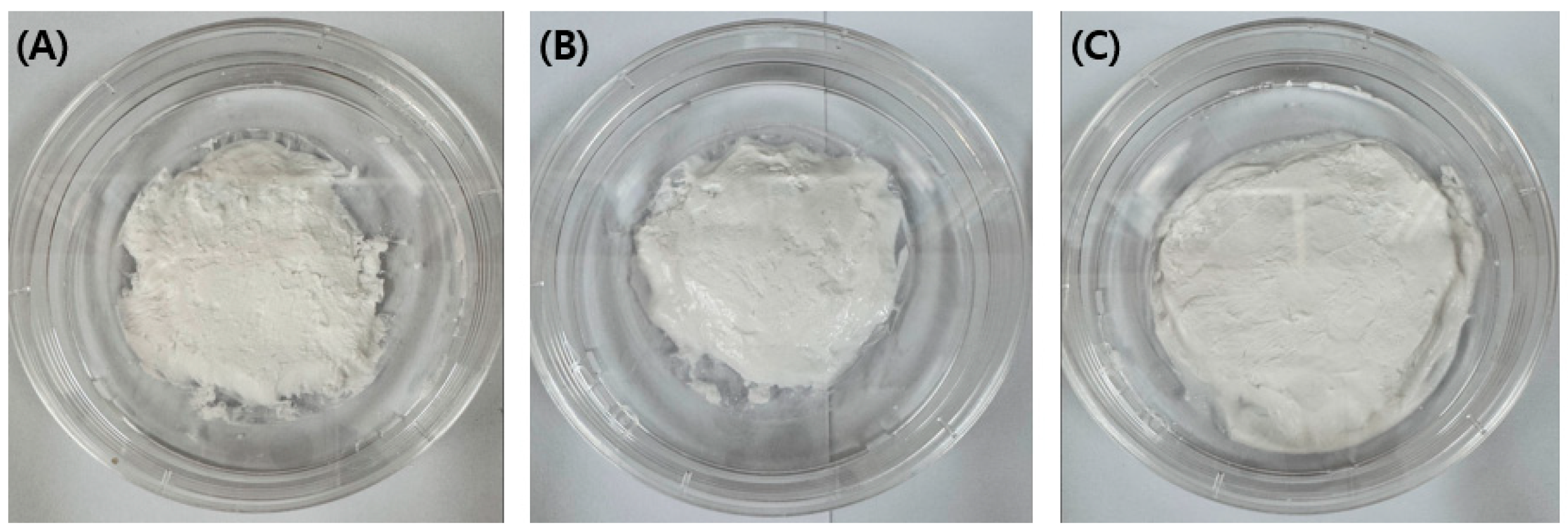
| Thickness of the Modeling Pack (1.0 mm) | Sample A | Sample B | Sample C |
|---|---|---|---|
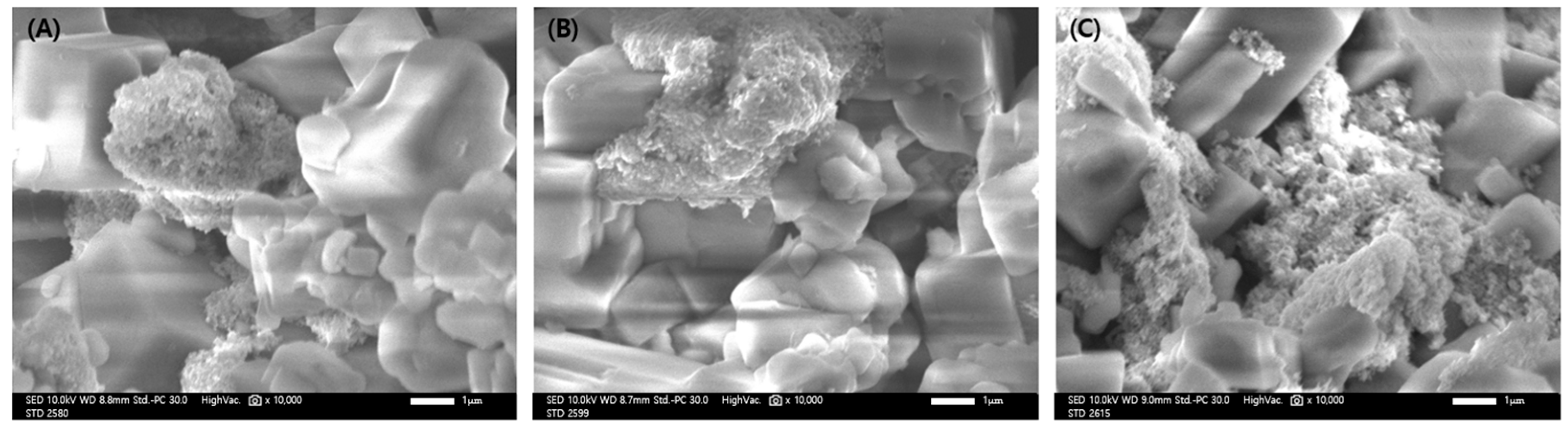
| Porosity (%) | 22 | 20 | 19 |
| Bismuth oxide content (%) | 50 | 40 | 30 |
| Zinc oxide content (%) | 10 | 20 | 30 |
| Alginate content (%) | 40 | ||
| Material | Effective Energy | 27.5 keV | 35.2 keV | 50.4 keV | 62.8 keV | ||||
|---|---|---|---|---|---|---|---|---|---|
| Without Shield | Shield | Without Shield | Shield | Without Shield | Shield | Without Shield | Shield | ||
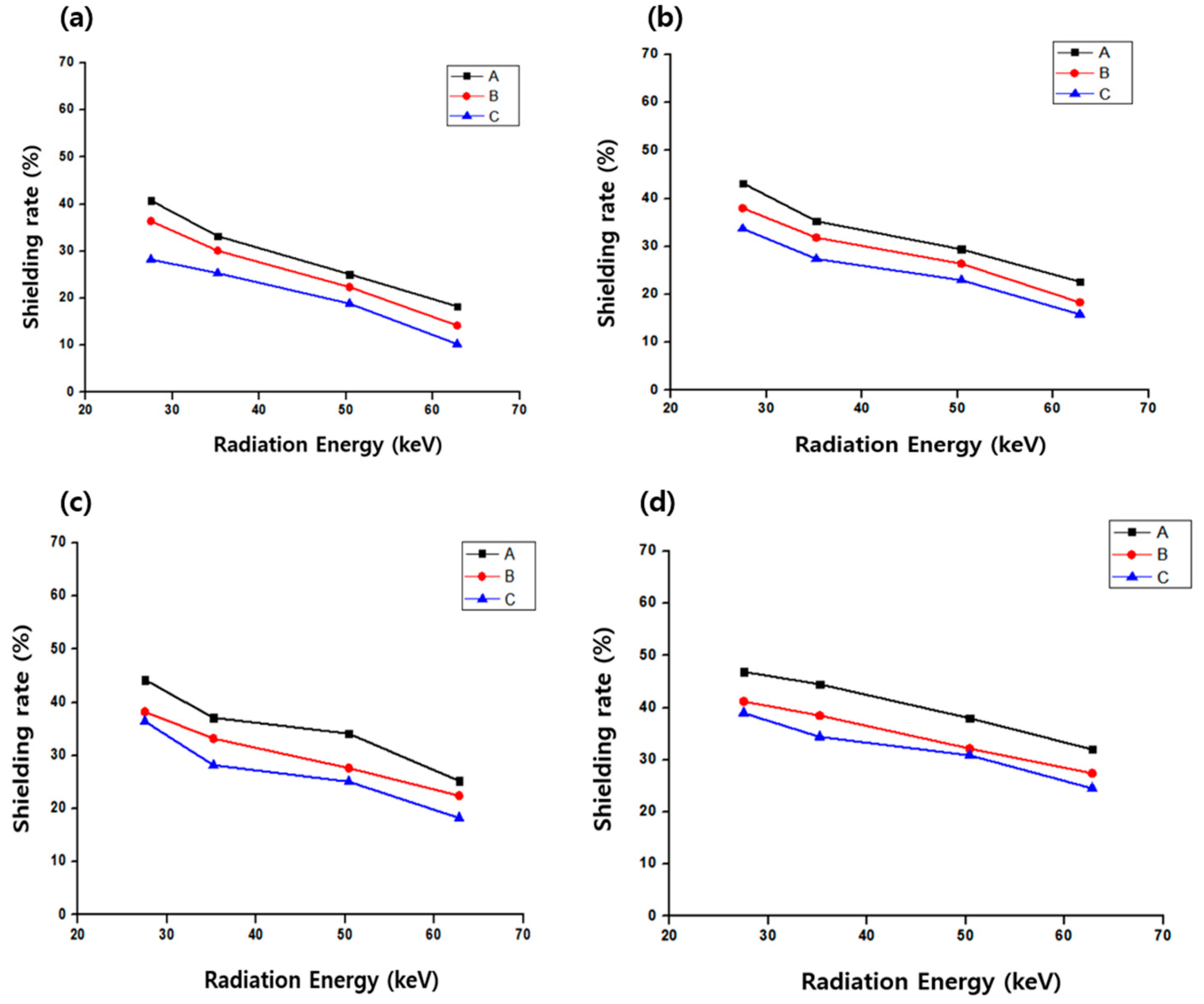
| A | Absorbed Dose (mR) | 21.24 | 12.58 | 46.80 | 31.26 | 80.12 | 59.99 | 110.78 | 90.51 |
| Shielding rate (%) | 40.78 | 33.20 | 25.12 | 18.30 | |||||
| B | Absorbed Dose (mR) | 21.24 | 13.51 | 46.80 | 32.70 | 80.12 | 62.17 | 110.78 | 95.04 |
| Shielding rate (%) | 36.41 | 30.12 | 22.40 | 14.21 | |||||
| C | Absorbed Dose (mR) | 21.24 | 7.86 | 46.80 | 19.81 | 80.12 | 38.25 | 110.78 | 59.51 |
| Shielding rate (%) | 28.24 | 25.35 | 18.87 | 10.29 | |||||
| Material | Effective Energy | 27.5 keV | 35.2 keV | 50.4 keV | 62.8 keV | ||||
|---|---|---|---|---|---|---|---|---|---|
| Without Shield | Shield | Without Shield | Shield | Without Shield | Shield | Without Shield | Shield | ||
| A | Absorbed Dose (mR) | 21.24 | 12.06 | 46.80 | 30.28 | 80.12 | 56.55 | 110.78 | 95.04 |
| Shielding rate (%) | 43.20 | 35.29 | 29.42 | 22.65 | |||||
| B | Absorbed Dose (mR) | 21.24 | 13.17 | 46.80 | 31.89 | 80.12 | 58.95 | 110.78 | 90.45 |
| Shielding rate (%) | 38.01 | 31.85 | 26.42 | 18.35 | |||||
| C | Absorbed Dose (mR) | 21.24 | 14.08 | 46.80 | 33.97 | 80.12 | 61.71 | 110.78 | 93.22 |
| Shielding rate (%) | 33.71 | 27.41 | 22.98 | 15.85 | |||||
| Material | Effective Energy | 27.5 keV | 35.2 keV | 50.4 keV | 62.8 keV | ||||
|---|---|---|---|---|---|---|---|---|---|
| Without Shield | Shield | Without Shield | Shield | Without Shield | Shield | Without Shield | Shield | ||
| A | Absorbed Dose (mR) | 21.24 | 11.83 | 46.80 | 29.43 | 80.12 | 52.78 | 110.78 | 82.82 |
| Shielding rate (%) | 44.28 | 37.12 | 34.12 | 25.24 | |||||
| B | Absorbed Dose (mR) | 21.24 | 13.12 | 46.80 | 31.26 | 80.12 | 57.96 | 110.78 | 85.91 |
| Shielding rate (%) | 38.25 | 33.20 | 27.66 | 22.45 | |||||
| C | Absorbed Dose (mR) | 21.24 | 13.50 | 46.80 | 33.60 | 80.12 | 60.01 | 110.78 | 90.56 |
| Shielding rate (%) | 36.44 | 28.21 | 25.10 | 18.25 | |||||
| Material | Effective Energy | 27.5 keV | 35.2 keV | 50.4 keV | 62.8 keV | ||||
|---|---|---|---|---|---|---|---|---|---|
| Without Shield | Shield | Without Shield | Shield | Without Shield | Shield | Without Shield | Shield | ||
| A | Absorbed Dose (mR) | 21.24 | 11.28 | 46.80 | 25.97 | 80.12 | 49.53 | 110.78 | 75.31 |
| Shielding rate (%) | 46.89 | 44.51 | 38.01 | 32.02 | |||||
| B | Absorbed Dose (mR) | 21.24 | 12.49 | 46.80 | 28.77 | 80.12 | 54.34 | 110.78 | 80.38 |
| Shielding rate (%) | 41.21 | 38.52 | 32.18 | 27.44 | |||||
| C | Absorbed Dose (mR) | 21.24 | 12.96 | 46.80 | 30.70 | 80.12 | 55.39 | 110.78 | 83.58 |
| Shielding rate (%) | 38.98 | 34.41 | 30.87 | 24.55 | |||||
Disclaimer/Publisher’s Note: The statements, opinions and data contained in all publications are solely those of the individual author(s) and contributor(s) and not of MDPI and/or the editor(s). MDPI and/or the editor(s) disclaim responsibility for any injury to people or property resulting from any ideas, methods, instructions or products referred to in the content. |
© 2025 by the author. Licensee MDPI, Basel, Switzerland. This article is an open access article distributed under the terms and conditions of the Creative Commons Attribution (CC BY) license (https://creativecommons.org/licenses/by/4.0/).
Share and Cite
Kim, S.-C. ZnO–Bi2O3 Composites for Enhanced Shielding Performance in Radiation-Protective Skin Modeling Packs. J. Compos. Sci. 2025, 9, 684. https://doi.org/10.3390/jcs9120684
Kim S-C. ZnO–Bi2O3 Composites for Enhanced Shielding Performance in Radiation-Protective Skin Modeling Packs. Journal of Composites Science. 2025; 9(12):684. https://doi.org/10.3390/jcs9120684
Chicago/Turabian StyleKim, Seon-Chil. 2025. "ZnO–Bi2O3 Composites for Enhanced Shielding Performance in Radiation-Protective Skin Modeling Packs" Journal of Composites Science 9, no. 12: 684. https://doi.org/10.3390/jcs9120684
APA StyleKim, S.-C. (2025). ZnO–Bi2O3 Composites for Enhanced Shielding Performance in Radiation-Protective Skin Modeling Packs. Journal of Composites Science, 9(12), 684. https://doi.org/10.3390/jcs9120684