Article

Rheological and Thermo-Mechanical Characterisation of Sustainable Polypropylene Composites Reinforced with Micronised Rice Husk

by
Inês Santos
1,
Tatiana Zhiltsova
1,2,*,
José Martinho Oliveira
3,4,5,
Sara P. Magalhães da Silva
3,4,5 and
Mónica S. A. Oliveira
1,2
1
TEMA—Centre for Mechanical Technology and Automation, Department of Mechanical Engineering, University of Aveiro, 3810-193 Aveiro, Portugal
2
LASI—Intelligent Systems Associate Laboratory, 4800-058 Guimarães, Portugal
3
EMaRT Group—Emerging: Materials, Research, Technology, University of Aveiro, Estrada do Cercal, 449, Santiago de Riba-Ul, 3720-511 Oliveira de Azeméis, Portugal
4
School of Design, Management and Production Technologies Northern Aveiro (ESAN), University of Aveiro, Estrada do Cercal, 449, Santiago de Riba-Ul, 3720-511 Oliveira de Azeméis, Portugal
5
Aveiro Institute of Materials (CICECO), University of Aveiro, 3810-193 Aveiro, Portugal
*
Author to whom correspondence should be addressed.
J. Compos. Sci. 2025, 9(12), 662; https://doi.org/10.3390/jcs9120662 (registering DOI)
Submission received: 1 September 2025 / Revised: 3 November 2025 / Accepted: 10 November 2025 / Published: 2 December 2025
(This article belongs to the Special Issue Mechanical Properties of Composite Materials and Joints)

Abstract

The growing demand for sustainable materials in construction and sanitation has increased interest in natural fibre-reinforced polymer composites. Rice husk, an abundant agricultural by-product, offers a promising alternative as a reinforcing filler in polypropylene (PP) composites. This study aims to assess the suitability of PP composites reinforced with micronised rice husk particles for application in sanitary components. Two formulations containing 20% and 30% rice husk were developed and characterised. Comprehensive analysis included morphological, thermal, rheological, mechanical, hygroscopic, and tribological testing. Results showed that particles incorporation enhanced thermal stability and crystallinity due to a nucleating effect, with the 30% composite showing higher crystallinity. Thermogravimetric analysis showed that although the T5% decreased from 374.1 °C for neat PP to 309.2 °C and 296.2 °C for the 20% and 30% composites, respectively, the DTG peak temperatures increased by 15.9 °C and 17.6 °C, indicating a delayed main decomposition stage of PP matrix and enhanced overall thermal stability. Rheological behaviour revealed increased viscosity and pseudoplasticity at higher particle content Mechanical characterisation showed an increase in Young’s modulus from 1021 MPa for neat PP to 1065 MPa (+4%) and 1125 MPa (+10%) for PP_Rice_20% and PP_Rice_30%, respectively. In contrast, the nominal strain at break dropped sharply from 238% (PP) to 30% (PP_Rice_20%) and 16% (PP_Rice_30%). Shrinkage decreased from 1.31% (PP) to approximately 1.05% in both composites, indicating improved dimensional stability. However, water absorption rose from 0.015% (PP) to 0.111% (PP_Rice_20%) and 0.144% (PP_Rice_30%), accompanied by an increase in surface roughness (Sa from 0.34 µm to 0.78 µm and 1.06 µm, respectively). The composite with 20% rice husk demonstrated better filler dispersion, reduced water uptake, and smoother surfaces, making it more suitable for injection-moulded components intended for use in humid environments. Overall, the study supports the use of agricultural residues in high-performance biocomposites, contributing to circular economy strategies and the development of more sustainable polymer-based materials for technical applications.

1. Introduction

The growing demand for sustainable solutions in the polymer processing industry has driven the development of biocomposites, hybrid materials that combine polymer matrices with natural-origin reinforcements [1]. Biocomposites have gained prominence for their ability to deliver functional performance while reducing environmental impact. Polypropylene (PP), due to its low cost, good processability, and balanced mechanical and thermal properties, is widely used as a matrix in polymer composites [2,3]. However, its non-polar nature hinders interaction with hydrophilic reinforcements such as plant-based fibres, potentially compromising interfacial adhesion and, consequently, the performance of the final material [4,5].
Among agricultural residues with potential for reinforcement applications, rice husk stands out. The incorporation of rice husk in composites not only adds value to an agro-industrial by-product but also reduces dependence on conventional mineral fibres such as talc and glass fibres. Furthermore, this material may enhance composite performance, as its composition includes cellulose, hemicellulose, lignin, and oxides (e.g., SiO2), conferring superior thermal stability compared to most other lignocellulosic fibres. As such, it can withstand relatively high processing temperatures, ranging from 200 to 250 °C. Nonetheless, the compatibility between the polar rice husk fibres and the non-polar polymer matrix must be addressed to ensure satisfactory material performance [4,6]. From an economic perspective, rice husk represents an attractive alternative to traditional fibres due to its low acquisition cost, being an abundant agricultural by-product with minimal raw material expense. Although additional processing, such as drying, milling, and micronisation, is required to ensure consistent particle size and performance, the overall production costs remain competitive, particularly when scaled [7]. In contrast, conventional fibres like talc and glass fibres involve higher raw material and energy inputs, as well as environmental costs associated with extraction and processing [8]. Therefore, the use of micronised rice husk not only aligns with sustainability goals but also offers potential cost advantages in large-scale composite manufacturing.
The characterisation of composite materials, such as polypropylene reinforced with rice husk fibres, is critical for their development and implementation in demanding industrial applications. A comprehensive understanding of their thermal, mechanical, morphological, and hygroscopic properties enables not only the optimisation of performance but also ensures long-term reliability and suitability for diverse operational environments.
Thermal analysis has revealed significant improvements resulting from fibre reinforcement. Studies by Rosa et al. [6] and Hidalgo-Salazar and Salinas [9] demonstrate that the inclusion of rice husk fibres acts as a nucleating agent, leading to increased crystallisation temperatures and enhanced thermal stability (key attributes for materials subjected to thermal stress). Similarly, Zhiltsova et al. [4] reported that while the melting enthalpy decreases due to a reduced matrix fraction, the overall degree of crystallinity increases with increasing fibre content, indicating effective structural reinforcement.
Regarding mechanical properties, characterisation is essential to identify both benefits and limitations. Hidalgo-Salazar and Salinas [9] reported a decrease in tensile strength due to weak interfacial adhesion. They observed improvements in flexural strength and modulus. In contrast, Aridi et al. [10], Erdogan and Huner [11], and Zhiltsova et al. [4] also noted reduced tensile strength but, unlike the former, found a decline in flexural strength, which was well attributed to poor compatibility between the matrix and the fibres. Conversely, Nourbakhsh et al. [12] recorded enhancements in both tensile and flexural strength with increasing rice husk content. Regarding Young’s modulus, some studies [4,10] observed an initial increase with fibre addition, peaking at around 20% content, after which the performance began to decline.
Morphological examination through scanning electron microscopy (SEM) provides valuable insight into the fibre–matrix interface. The observation of voids, fibre pull-out, and agglomerations reflects poor adhesion and can compromise the structural integrity of the composite [4,9,10]. Such findings underscore the importance of morphological characterisation in diagnosing material deficiencies and guiding improvements in composite formulation and processing.
Water absorption behaviour is another critical factor, especially for applications in humid or moisture-prone environments. Zhiltsova et al. [13] reported significantly higher water uptake in PP composites containing 30% rice husk due to greater porosity and hemicellulose content. It can lead to dimensional instability, reduced thermal resistance, and surface degradation. However, the incorporation of compatibilizers such as maleic anhydride-grafted polypropylene (MAPP) or the application of repeated recycling processes has been shown to effectively reduce water absorption and improve interfacial bonding, thereby enhancing the composite’s overall performance [14].
Although numerous studies have explored the incorporation of natural fibres derived from agro-industrial residues in polypropylene composites, only few [15,16]) have systematically investigated the effects of micronised particles on a broad range of functional properties. Rice husk micronisation is expected to improve particle dispersion, reduce void formation, and enhance interfacial bonding with the polymer matrix. These improvements could help overcome common issues in natural fibre composites, such as weak fibre–matrix adhesion, excessive water absorption, and increased surface roughness, which are particularly relevant for components used in humid environments.
In light of the above, this study aims to evaluate the morphological, thermal, mechanical, rheological, hygroscopic, and tribological behaviour of polypropylene composites reinforced with micronised rice husk at two different loadings (20% and 30%) in order to assess their suitability as a sustainable alternative to synthetic polymers in the production of injection-moulded toilet cistern lids. This research supports the objectives of the “OLIpush—Redesign for Greater Circularity and Lower Environmental Footprint” project, contributing to circular economy goals by incorporating agricultural waste into high-performance composite materials.

2. Materials and Methods

2.1. Materials

The polymer matrix used in this study is a random co-polymer polypropylene (PP 205—CA40), supplied by INEOS Olefins & Polymers Europe (London, UK). This material has a melt flow index (MFI) of 40 g/10 min (230 °C, 2.16 kg). The composites reinforced with micronised rice husk fibres used in this study were compounded on demand by Bio4plas—Biopolímeros, Lda (Cantanhede, Portugal) for research purposes. The composites’ preparation was identical to described in detail elsewhere [4]. The only difference between the composites investigated in the previously mentioned study and those in the present study is the granulometry of the rice husk fibres, 0.5 mm in the former and micronised in the latter. The fibre content remained the same in both studies, containing 20% and 30% rice husk fibres by weight. Moreover, in this study, the same experimental conditions were applied allowing for a direct comparison with the results of Zhiltsova et al. [4,13]. However, it is important to note that rheological and tribological analyses of PP 205–CA40 had not been performed in those earlier studies and are therefore addressed in the present work.

2.2. Methods

2.2.1. Thermal Analysis

Differential Scanning Calorimetry (DSC) was performed using a DSC Discovery 250 instrument (TA Instruments, New Castle, DE, USA), following ISO 11357-3 [17]. To ensure statistical relevance, three measurements were performed for each material. The thermal analysis had two heating–cooling cycles. The first cycle aimed to eliminate thermal history. It began by holding the sample at 20 °C for 5 min to achieve thermal equilibrium, followed by heating to 230 °C at 10 C/min. This temperature was held for an additional 5 min to ensure uniformity, then the sample was cooled to 20 °C at 10 °C/min and held again for 5 min. The second cycle, identical to the first, was used to determine the melting temperature ( T m ), crystallisation temperature ( T c ), melting enthalpy ( H m ), crystallisation enthalpy ( H c ), and degree of crystallinity ( χ ). The degree of crystallinity ( χ ) for each sample was calculated using Equation (1).
χ % = H m H m 0 f p p
The melting enthalpy ( H m (J/g)) was used to calculate the degree of crystallinity (χ). For this purpose, the enthalpy of fusion for 100% crystalline polypropylene ( H m 0 ) was assumed to be 207 J/g [4]. The variable f p p represents the mass fraction of PP in the composite, which is 80% for the samples with 20% rice husk content and 70% for those with 30% particle loading. The data are analysed using the software TRIOS V5.7 proprietary of TA Instruments (New Castle, DE, USA). It should be noted that the enthalpy and melting temperature were obtained by analysing the temperature range of 80 to 180 °C, whereas the crystallisation properties were obtained by analysing the temperature range of 80 to 135 °C.
Thermogravimetric analysis (TGA) was performed to assess the thermal stability of the composites. The measurements were conducted using a Netzsch Jupiter STA 449 F3 thermobalance (NEDGEX GmbH, Selb, Germany), following ASTM E1131-08 [18]. Samples of approximately 10 mg were placed in alumina crucibles and subjected to heating from 30 °C to 600 °C at a constant rate of 10 K/min under a nitrogen atmosphere (50 mL/min). The mass loss as a function of temperature was recorded to evaluate the decomposition behaviour and thermal stability.

2.2.2. Preparation of Specimens for Mechanical Testing and Shrinkage Assessment

To perform the mechanical tests, tensile (ISO 527-1) [19] and flexural (ISO 178) [20] specimens were injection-moulded using a Euroinj D-065 Lien Yu Machinery Co., Ltd. (Tainan City, Taiwan) hydraulic injection moulding machine with a clamping force of 65 tons. Additionally, bar specimens of Type A were obtained to determine dimensional stability ASTM D955 [21]. Approximately 30 specimens were produced for each of the three materials under investigation. Before moulding, the composites were dried for 6 h at 85 ◦C in a hopper dryer connected to the injection moulding machine. The injection moulding parameters were mainly identical for all materials: mould temperature of 40 °C, injection speed of 20% (relative to the maximum capacity of the machine), injection pressure of 55 bar, packing pressure of 35 bar, packing time of 40 s, and cooling time of 35 s. The only parameter that differed was the injection temperature. It was set to 230 °C for virgin PP and 190 °C for the composites. These are the typical injection temperatures for virgin PP and rice husk fibre composites referred by other researchers [4]. Virgin PP was moulded at 230 °C which is middle value in the injection temperature range. In contrast, the composites were processed at 190 °C to avoid thermal degradation of rice husk particles and promote better fibre–matrix adhesion. This temperature helps prevent thermal degradation of the lignocellulosic filler and moisture release while maintaining sufficient flow under the applied injection and packing pressures. Moreover, the presence of rice husk particles acts as a nucleating agent, enabling effective crystallisation at lower processing temperatures. This difference in processing conditions directly influences viscosity, crystallinity, and the final properties of the materials [22].
To ensure the purity of the material during batch changeovers, the first 15 parts produced after each material transition were discarded.

2.2.3. Mechanical Analysis

Tensile tests were conducted following ISO 527-1 using an X-10kN universal testing machine (Shimadzu Scientific Instruments, Columbia, MD, USA). For each material, ten tests were performed on type I specimens. In the first phase, Young’s modulus (E) was calculated using a test speed of 1 mm/min, corresponding to the slope of the initial linear portion of the stress–strain curve. In the second phase, the speed was increased to 50 mm/min to determine yield stress and strain, as well as ultimate tensile strength and elongation at break.
Using the same equipment, three-point bending tests were carried out to determine the flexural modulus and flexural strength of the materials. These tests were conducted at a crosshead speed of 5 mm/min, following ISO 178. The specimens, with dimensions of 127 × 12.7 × 6.35 mm, were tested using a support span of 101.6 mm to meet the 20 ± 1 span-to-depth ratio requirement. To ensure statistical relevance, ten tensile and flexural tests were conducted on specimens randomly selected from a pool of 60 available samples. All mechanical property data were subjected to one-way ANOVA followed by Tukey’s post hoc test, using a significance level of 0.05, to determine statistical differences in the mean values of tensile strength, yield strength, flexural strength, and flexural modulus between the PP-based composites and the virgin PP.

2.2.4. Shrinkage and Dimensional Stability Analysis

To determine the dimensional stability of the materials under analysis, ASTM D955 standard was followed. The parallel to flow shrinkage of a specimen with dimensions of 12.83 × 128.83 × 3.0 mm was calculated. The length, thickness, and width of the mould cavity, as well as the final dimensions of the specimens, were measured using a Mitutoyo digital calliper (Kawasaki, Japan) (precision ± 0.1 mm). The average dimensions of ten specimens were considered for shrinkage calculations, using the following Equation (2):
S I = L m L s 100 L m
where S I (%) is the shrinkage parallel to the flow, L m is the mould dimension parallel to the flow, and L s is the specimen’s dimension parallel to the flow.

2.2.5. Morphological and Chemical Analysis

Morphological characterisation was carried out by analysing the fracture surfaces of specimens obtained from tensile testing. Scanning electron microscopy (SEM) analyses were conducted using a HITACHI TM4000Plus microscope (Hitachi HighTech Corporation, Tokyo, Japan) to observe fibre size and distribution under accelerating voltage of 15 kV. Additionally, energy-dispersive X-ray spectroscopy (EDS) analyses were performed using the same equipment and the same accelerating voltage to determine the elemental composition of the samples.

2.2.6. Rheological Analysis

Rheological testing was conducted using a dual capillary rheometer (LCR 7002 Capillary Rheometer, Dynisco, Franklin, MA, USA) equipped with two dies of identical diameter (1 mm) but differing lengths, corresponding to L/D ratios of 5 and 30. Tests were carried out at three different temperatures (190, 200, and 210 °C), selected in accordance with the thermal degradation thresholds of the materials. For statistical relevance, at least three replicates were performed at each temperature. The rheometer operated in constant speed/shear rate mode over a shear rate range of 10 to 6000 s−1. The melt viscosity data and the Rabinowitsch–Weissenberg and Ryder–Bagley corrections were computed using LAB KARS software (version 3), Alpha Technologies.
To determine the viscosity of the composites as a function of shear rate, three rheological models, namely Cross–WLF, Carreau–Yasuda, and Carreau–Yasuda–WLF, were evaluated and compared. The Cross–WLF and Carreau–Yasuda models were chosen based on their strong performance in the literature in terms of fit quality. The Carreau–Yasuda–WLF model was included to account for temperature dependency. The Cross–WLF model (Equation (3)) is widely applied in injection-moulding simulations, as it provides a good approximation of real processing conditions during the filling and packing stages [21]. It accurately describes flow behaviour over a broad shear rate range:
η   = η 0 1 + ( η 0 γ τ ) ( 1 n )
where η 0 (Pa.s) is the zero-shear viscosity, τ is a model constant representing the shear stress at the transition between Newtonian and non-Newtonian behaviour, n is the power law index, and γ   (s−1) is the wall shear rate.
The η 0 in Equation (4) is determined using the Williams–Landel–Ferry equation in Equation (7), which enables temperature dependence to be incorporated into the model [22,23]:
η 0 = D 1 e C 1 T T ~ C 2 + T T ¯  
with the following:
C 2 = A 2 ~ + C 3 p  
T ~ = C 2 + C 3 p  
where T ~ (K) is the pressure-dependent transition temperature, C 2 (K) is a model constant related to transition temperature and atmospheric pressure, C 3 (K/Pa) is a model constant related to the temperature variation as a function of pressure, D 1 (Pa/s) is the model constant for zero-shear viscosity at the transition temperature under atmospheric pressure, C 1 is the temperature dependence constant, and A 2 ~ (K) is a WLF parameter material dependent.
log a T = C 1 T T ~   C 2 + T T ~
where a T is a temperature shift factor.
The Carreau–Yasuda model (Equation (8)) is suitable for both high and low shear rates and is highly reliable, especially for complex materials with significant rheological variation. Unlike the previous model, it includes an additional exponent (a) to describe the viscosity transition between the zero-shear and pseudoplastic regions [23,24].
η = η 0 1 + λ γ a n 1 a
where λ is the relaxation time and a is an additional fitting parameter.
Lastly, the Carreau–Yasuda–WLF model (Equation (9)) incorporates temperature dependence via the WLF equation:
η =   η 0 a T 1 + λ γ a t a n 1 a
The coefficients for the various models were obtained using the Solver tool in Microsoft Excel, by minimising an objective function (Equation (10)) based on the sum of chi-square errors between observed and predicted viscosities at different temperatures and shear rates:
O = min i j ( η i , j O b s η i , j P r e η i , j P r e ) 2
where η i , j O b s is the observed viscosity at temperature Tᵢ and shear rate and η i , j P r e is the predicted viscosity at the same conditions.
For the Cross–WLF model, the parameters τ , n , C 1 , and D 1 were allowed to vary, whereas A 2 ~ and D3 were fixed at 51.6 K and 0, respectively. C 3 was set to zero as pressure dependence of viscosity was not assessed [25]. For the Carreau–Yasuda model, η 0 , λ, a, and n were fitted.
In the Carreau–Yasuda–WLF model, η 0 ,   λ , a , n , and C 1 were variable, with A 2 ~ fixed at 51.6 K. The transition temperature T ~ was set as the glass transition temperature of PP.
Once the most suitable model was identified, the time–temperature superposition principle (TTSP) was applied to construct a master curve using a temperature shift factor ( a T ). Viscosity curves were shifted to a reference temperature ( T r e f ) which was defined as 200 °C. This adjustment followed Equation (11), whereby a T was first calculated and subsequently applied by multiplying the shear rate and dividing the viscosity by a T   for T = 190 °C and T = 210 °C [26,27].
a T T = η 0 ( T ) η 0 ( T e f )
where η 0 ( T r e f ) is the zero-shear rate viscosity at the reference temperature and η 0 ( T ) is the zero-shear rate viscosity at the tested temperature.

2.2.7. Moisture Absorption Analysis

The short-term water absorption test was performed according to ASTM D570-98 standard [28]. To ensure reproducibility, five bar-shaped specimens with dimensions of 12.83 × 128.83 × 3.20 mm for each material were first dried in a ventilated oven at 50 ± 3 °C for 24 h. The specimens were then placed in a desiccator (HC 200 Humidity Control Cabinet, Guangdong SIRUI Optical Co., Ltd., Zhongshan City, Guangdong, China) to cool down to ambient temperature (23 ± 1 °C). Subsequently, the specimens’ dry weight ( M 0 ) was determined using a high-precision analytical balance with a 0.0001 g resolution (A&D GH-252, A&D Company Limited, Tokyo, Japan). The samples were then fully immersed in distilled water at 23 ± 1 °C for 24 h, as specified by the standard procedure. The specimens were placed vertically during immersion, and stainless-steel barriers were used to prevent them from floating. After 24 h of immersion, the specimens were removed, cleaned with a dry cloth to remove any excess surface water, and immediately weighed to determine the wet weight ( M t ).
The water absorption ( M % ) was calculated using the following Equation (12):
M % = M t M 0 M 0 100
Additionally, the swelling S % in the thickness direction after the 24 h test was calculated using Equation (13). For this purpose, the thickness of the specimens before and after immersion in water was measured using a high-precision Mitutoyo digital calliper (precision of ±0.01 mm).
S % = h s h i h i 100
where h i and h s are the initial and saturated thicknesses, respectively.

2.2.8. Tribological Analysis

The surface roughness of the composites was analysed using the Olympus OLS5100 optical microscope (OLS5100 Laser Confocal Microscope, Olympus Corporation, Tokyo, Japan), which employs laser confocal interferometry technology, by ISO 25178 [29]. Following this standard, the parameters were analysed in a three-dimensional scale, enabling a detailed description of the roughness, including values such as S a (arithmetic mean surface roughness), R z (maximum roughness depth), R a (arithmetic mean roughness relative to a mean line), R s k (profile skewness), R K u (profile kurtosis), among others [30]. Measurements were performed on bar-shaped specimens with dimensions of 12.83 × 128.83 × 3.20 mm. A magnification of 50was used for data acquisition. The analysed area of each specimen was a square region of 2.25 mm2, located 39 mm from the start of the specimen. The data obtained were processed using the microscope’s software LEXT-Olympus OLS5100 V2.2, ensuring accurate analysis in compliance with the normative guidelines.

3. Results and Discussion

3.1. Thermal Characterisation

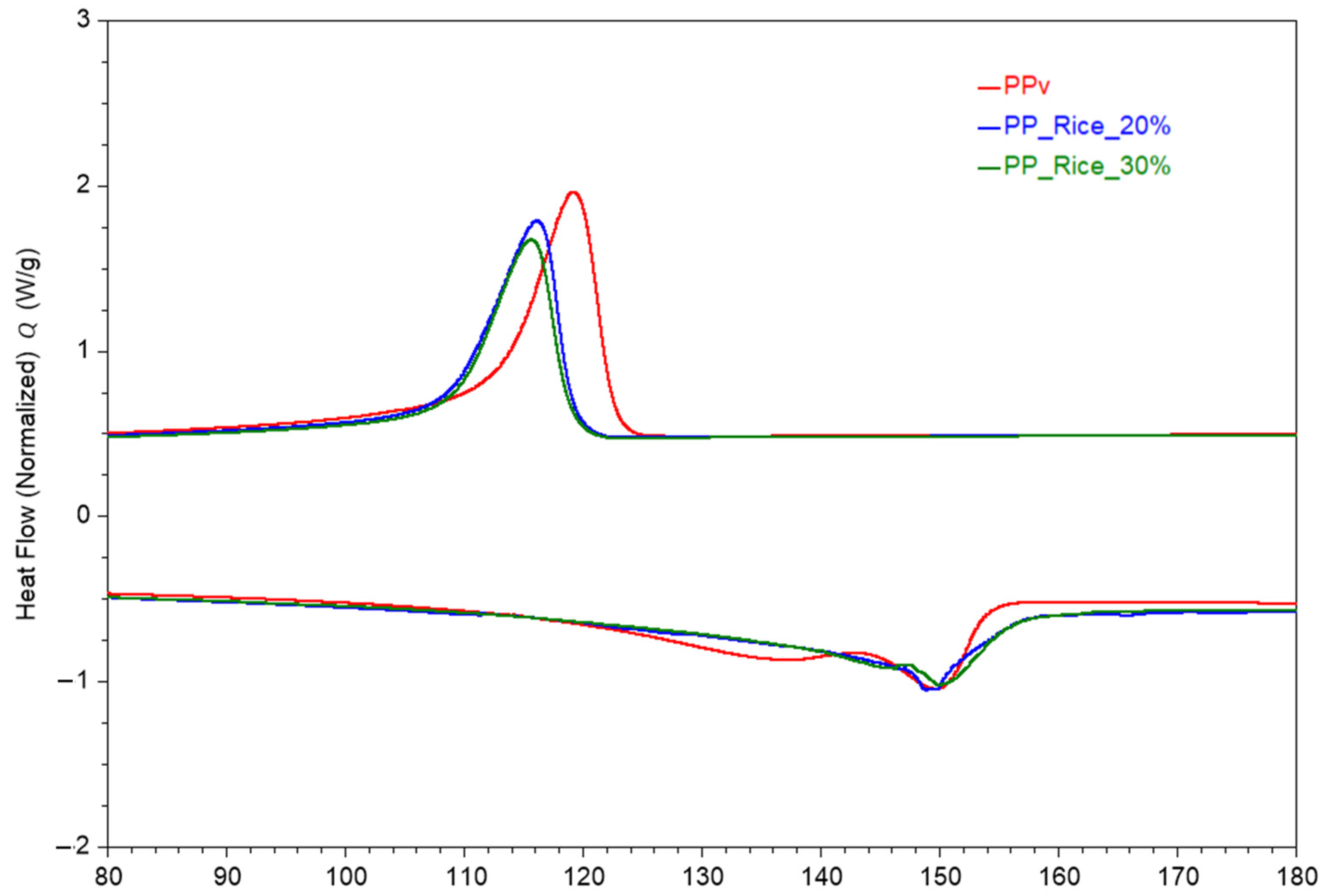
The DSC thermograms (Figure 1) show that the melting temperature exhibited minimal variation with increasing filler content. The numerical results are presented in Table 1, while Table 2 shows the relative variation in thermal properties compared with virgin PP. Similar trends have been reported in the literature by Rosa et al. [6], Zhiltsova et al. [4], and Hidalgo-Salazar and Salinas [9]. As shown in Figure 1 and Table 1 and Table 2, the crystallisation temperature decreased with the incorporation of rice husk compared to virgin PP, a trend also reported by Zhiltsova et al. [4] and Hidalgo-Salazar and Salinas [9]. However, Rosa et al. [6] noted a slight increase in T c in the composite with 30% rice husk content. Regarding the enthalpies of melting and crystallisation, both decreased with increasing rice husk content, as documented in the works of Zhiltsova et al. [4] and Hidalgo-Salazar and Salinas [9]. Despite these changes, the degree of crystallinity significantly increased with the introduction of particles as shown in Table 1 and Table 2. This increase confirms that the micronised rice husk particles act as nucleating agents, promoting PP crystallisation around the particles, as previously demonstrated by Zhiltsova et al. [4] and Hidalgo-Salazar and Salinas [9]. Furthermore, the increase in crystalline is also related to a greater rigidity of the material [4,29], suggesting that all the tested composites had a higher modulus of elasticity and lower ductility.
A comparison of the melting and crystallisation enthalpies between the composites containing micronised rice husk and those with 0.5 mm particle size [4], as shown in Table 1, indicates that both exhibit similar thermal behaviour, particularly at 20% fibre content. Likewise, the melting ( T m ) and crystallisation ( T c ) temperatures showed no significant differences, with only a slight decrease observed in the composites with micronised rice husk. These results suggest that particle size distribution significantly impacts the composites’ thermal properties.
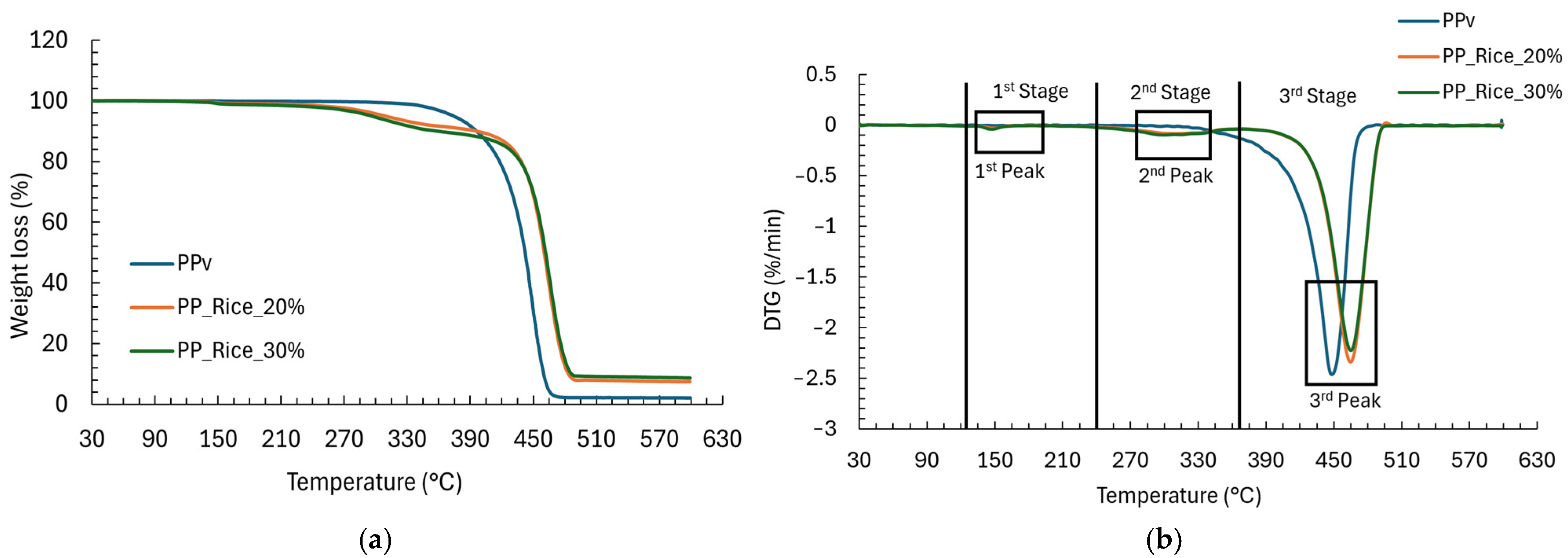
The thermogravimetric analysis of PP composites with micronised rice husk particles (Figure 2a) revealed three main stages of mass loss, which were further clarified by the derivative thermogravimetric (DTG) curve (Figure 2b). The first stage, occurring between 30 °C and approximately 230 °C, shows a slight mass loss, initially attributed to water evaporation. However, a distinct DTG peak around 148–149 °C (Figure 2b) suggests the volatilisation of organic extractives from the rice husk, a process likely enhanced by its micronised nature. The second stage, between 230 °C and 370 °C, presents a more pronounced mass loss associated with the thermal degradation of hemicellulose and cellulose, as well as the early stages of lignin decomposition. The DTG peak temperatures observed around 303–310 °C (Figure 2b) further confirm the occurrence of these degradation processes in both composites. Moreover, these initial signs of the composites’ thermal degradation were further confirmed by comparing the temperatures at 5% mass loss, a widely accepted and quantifiable indicator of the onset of thermal degradation. As shown in Table 3, the 20% and 30% composites exhibited temperatures of 309.2 °C and 296.2 °C, respectively, whereas neat PP showed 5% mass loss at a much higher temperature (374.1 °C), indicating greater thermal stability at the onset of thermal degradation.
The third stage, from 370 °C to 495 °C, corresponds to the main degradation of the PP matrix, characterised by a sharp mass loss and a DTG peak (Figure 2b) that is between 464 and 466 °C, typical of rapid polymer decomposition. Beyond 500 °C, the TGA curve (Figure 2a) stabilises, indicating the presence of a residual mass around 7.3% for the PP_Rice_20% and 8.7% for the PP_Rice_30% that is mainly attributed to inorganic ash, such as silica, and partially resistant lignin. The virgin PP co-polymer exhibited a single thermal degradation event. Decomposition began at 313.7 °C with only one peak observed in the derivative thermogravimetric (DTG) curve (Figure 2b) at 448.2 °C, referred to in Table 3 as third stage DTG peak, which was subtantially lower than the homologe values of 464.1 °C for PP_Rice_20% and 465.8 °C for PP_Rice_30%. Above 500 °C, the ash content showed only a minor change, indicating that the PPv had nearly fully volatilized by 600 °C, leaving just 0.8% residue [13].
Overall, the TGA and DTG analyses show that most of the mass loss in the composites occurs between 400 °C and 500 °C, and the addition of rice husk appears to enhance the resistance to thermal degradation of the PP matrix, in agreement with previous studies [6,9,13]. The silica present in rice husk forms a thermally stable layer that restricts heat transfer and volatile diffusion during polymer degradation [31]. The earlier onset of thermal degradation observed in the micronised rice husk composites, compared with neat PP, can be attributed to the decomposition of the lignocellulosic components of the filler, namely hemicellulose, cellulose, and lignin, which degrade at lower temperatures than the PP matrix. Nevertheless, during the main degradation stage of the polymer, the thermally stable silica phase enhances thermal resistance by forming a protective barrier that limits heat and mass transfer. This behaviour is evidenced by the shift in the third-stage DTG peaks to higher temperatures, reduced mass loss, and increased residual ash content, confirming the effective barrier and reinforcement roles of the rice husk filler in enhancing the overall thermal stability of the PP matrix.
The comparison between the present results and those from the study by Zhiltsova et al. [13] (Table 3) shows that polypropylene composites with micronised rice husk exhibit slightly different thermal behaviour compared to 0.5 mm rice husk fibres. In both cases, it is observed that increasing the rice husk content leads to greater mass loss during the second stage of thermal degradation, which is associated with the breakdown of biomass components such as hemicellulose, cellulose, and lignin, and to lower mass loss during the third stage, corresponding to the degradation of the PP matrix. This occurs because composites with higher rice husk content contain less polymer matrix. However, micronised rice husk particles, due their better dispersion in the PP matrix and larger surface contact area, promotes more efficient interfacial adhesion, which restricts polymer chain mobility and consequently delays the thermal degradation of PP, particularly at higher temperatures. As a result, composites containing micronised rice husk particles show reduced mass loss in the final stage.
Although the PP composite with 20% non-micronised rice husk presents a slightly higher onset temperature in the second stage, it exhibits greater mass loss during this phase and a lower degradation peak in the third stage. Therefore, the composite containing 20% micronised rice husk demonstrates better overall thermal stability, as evidenced by lower mass loss, a higher degradation peak in the third stage, and a greater percentage of residual ash. These findings confirm the protective role of silica and the barrier effect of the micronised particles, which hinder heat and mass transfer during degradation and thereby delay the thermal decomposition of the polymer matrix.

3.2. Mechanical Characterisation

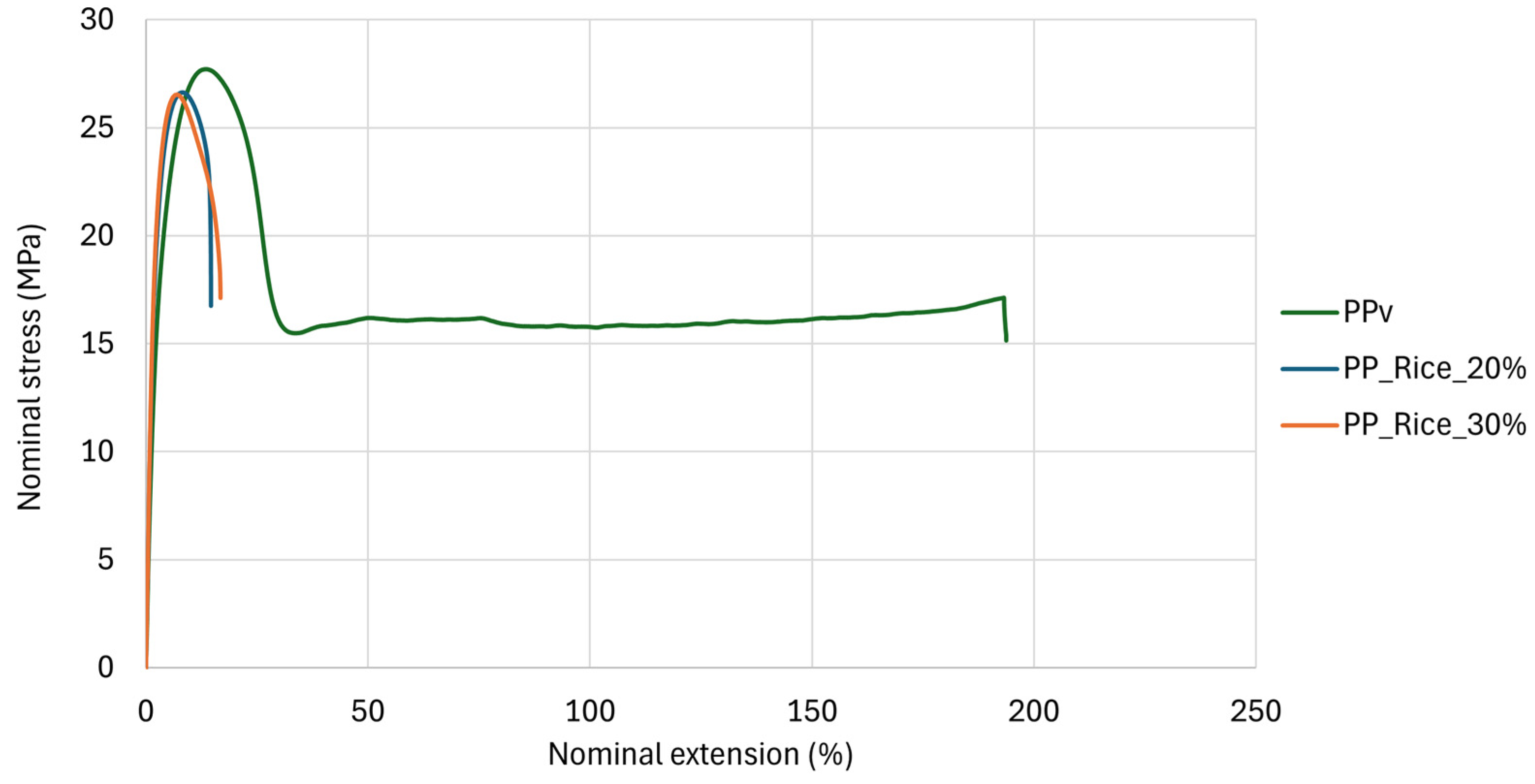
Regarding mechanical properties, as illustrated in Figure 3 and summarised in Table 4, the Young’s modulus (E) increased about 4% for PP_Rice_20% and 10% for PP_Rice_30% (Table 5), in line with the results of Zhiltsova et al. [4], Hidalgo-Salazar and Salinas [9] and Erdogan and Huner [11]. The increase in viscosity observed in the discussed further rheological tests and the increase in the degree of crystallinity suggests an enhancement in the stiffness of the polymer matrix, which naturally results in a higher Young’s modulus [32].
This stiffening effect was statistically validated through one-way ANOVA (the results are shown in Table 6), which revealed a highly significant difference between the three groups (PPv, PP_Rice_20%, and PP_Rice_30%) with a p-value < 0.0001 and an F-value of 31.73. The coefficient of determination (R2 = 0.75) indicated that a large proportion of the variability in Young’s modulus was explained by the filler content. Post hoc analysis using Tukey’s HSD test confirmed that all pairwise comparisons between groups were statistically significant (α = 0.05), showing a clear and progressive increase in stiffness with increasing filler content.
As shown in Figure 3 and Table 5, both composites exhibited a slight decrease in yield stress ( σ y ) when compared to PPv. This trend has been reported by several authors [4,9,11] and is attributed to the poor adhesion between the hydrophobic matrix and the hydrophilic fibres. Statistical analysis ANOVA (Table 6) confirmed that this decrease is significant (F(2, 21) = 37.19, p < 0.0001), with all groups showing statistically different means according to Tukey’s test. In this notation, 2 and 21 represent the degrees of freedom between and within groups, respectively. The R2 value of 0.78 indicates that filler content explains a substantial proportion of the variance in yield stress, reinforcing the conclusion that the reduction is systematic and not due to random error. This result indicates that the addition of rice husk particles consistently reduces the yield stress, likely due to stress concentration points and weak interfacial bonding. As for the stress at break ( σ b ), a slight increase (15%) was observed, particularly in the composite containing a higher filler content, as evidenced by Zhiltsova et al. [4] and Nourbakhsh et al. [12]. The ANOVA results presented in Table 6 support this observation (F(2, 15) = 6.21, p = 0.011), with a statistically significant difference only between the virgin PP and the PP_Rice_30% (p = 0.008). No significant difference was found between the 20% composite and the other groups. The coefficient of determination for this property was R2 = 0.45, suggesting that filler content explains less than half of the variability in the stress at break. This suggests that only at higher fibre content is the interfacial reinforcement sufficient to improve the material’s tensile performance at fracture.
Finally, the yield strain ( ε y ) and the nominal strain at break ( ε b ) decreased with the addition of rice husk particles, revealing a more brittle behaviour in the composites, especially in those with 30% of rice husk, which was also noted by Zhiltsova et al. [4]. The yield strain was reduced by 38% in PP_Rice_20% and by 49% in PP_Rice_30%. An even more substantial reduction was observed in the strain at break, which decreased by 87% and 93%, respectively. These substantial losses in ductility reflect significant molecular-level changes, likely associated with restricted polymer chain mobility and limited capacity for plastic deformation due to the presence of rigid lignocellulosic fillers.
To assess the influence of fibres’ granulometry on the mechanical properties of the composites, a comparison was made with the results reported by Zhiltsova et al. [4] included in Table 4. Regarding Young’s modulus, a decrease was observed with reduced particle size, contrary to what other authors reported [15,16]. This discrepancy may be attributed to the distinct morphology and interface characteristics of micronised particles, which, despite offering better dispersion, are not aligned and oriented to provide effective tensile reinforcement [33]. Xu et al. [34] concluded that very fine, powder-like fibres lead to lower stiffness due to reduced structural continuity. In contrast, yield strength increased with decreasing particle size. This may be explained by the improved dispersion and stress transfer provided by micronised particles, which promote better fibre–matrix interaction. Larger particles, on the other hand, tend to agglomerate and introduce micro voids during processing, acting as stress concentrators and weakening the composite [15,16,34]. Stress at break was only slightly influenced by particle size, showing a small decrease in the composites with micronised filler. When rice husk filler are micronised, their reduced size improves dispersion in the matrix but also reduces their aspect ratio and structural reinforcement capacity. As a result, although dispersion is increased, the smaller fibres are less effective in resisting fracture under tensile stress. This leads to a slight decrease in the breaking stress. Finally, composites with 0.5 mm fibres exhibited lower nominal strain at break, indicating a more brittle behaviour compared to the more ductile fracture of composites with micronised rice husk particles.
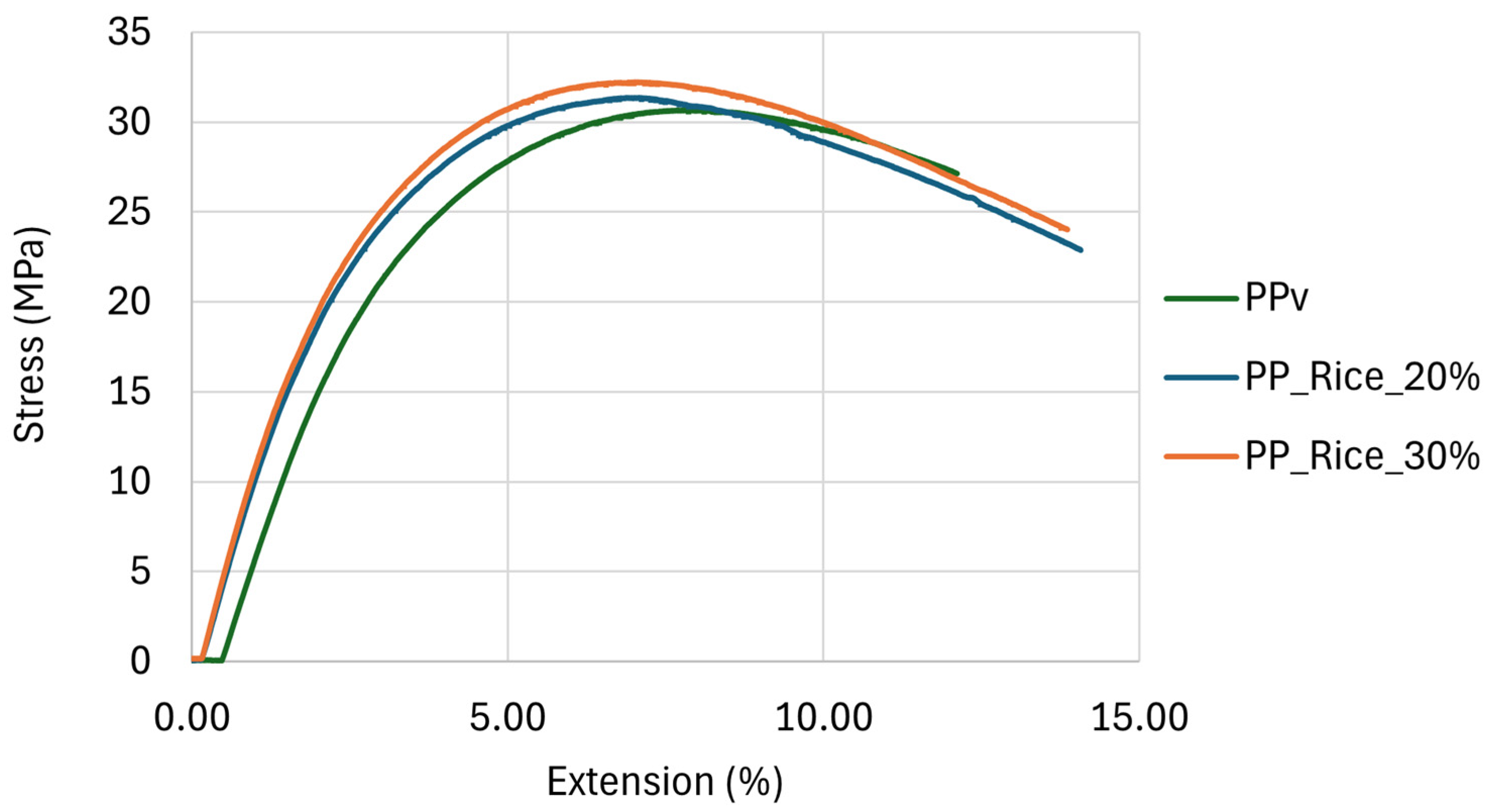
According to the data presented in Figure 4 and Table 7, the incorporation of micronised rice husk particles led to a slight enhancement of the flexural properties. The flexural modulus (Ef) increased by approximately 11% in the composite PP_Rice_30%, a result that is consistent with the studies of Zhiltsova et al. [4], Nourbakhsh et al. [12], Hidalgo-Salazar and Salinas [9], and Erdogan and Huner [11], who attributed this Flexural stress–strain curves of virgin PP (PPv) and PP/rice fibre composites (20 and 30 wt%) strain curve shown in Figure 4, where a steeper initial slope is observed in the samples with higher filler content, indicating a stiffer behaviour.
The results of statistical analysis using one-way ANOVA (significance level: α = 0.05) presented in Table 8 confirmed that this increase in flexural modulus is significant (F(2, 27) = 32.40, p < 0.0001), indicating that the addition of rice husk particles effectively enhances the stiffness of the PP matrix. In this test, the values in parentheses represent the degrees of freedom: 2 for the number of groups minus one (between-group variation), and 27 for the total number of observations minus the number of groups (within-group variation). Post hoc Tukey tests further revealed that both 20% and 30% filler content composites were significantly different from the neat PP, although no significant difference was found between the 20% and 30% groups. Moreover, the coefficient of determination (R2 = 0.71) indicates that 71% of the variance in flexural modulus can be explained by the filler content, suggesting a strong relationship between the independent variable (filler percentage) and the mechanical response.
Similarly, the flexural strength (σf) also showed a slight increase, as reported by Nourbakhsh et al. [12] and Hidalgo-Salazar and Salinas [9]. However, ANOVA results (Table 8) indicated that these differences were not statistically significant (F(2, 27) = 2.34, p = 0.115), suggesting that the observed variation in flexural strength may be due to experimental variation rather than a consistent effect of particle reinforcement. This interpretation is supported by the low R2 value (0.15), which indicates that only 15% of the variability in flexural strength is explained by filler content. Some studies, such as those by Zhiltsova et al. [4], Erdogan and Huner [11], and Aridi et al. [10], reported a decrease in this property, which was explained by the formation of agglomerates, moisture absorption, and poor adhesion between the fibres and the matrix.
A comparison between the composites with micronised rice husk particles and those with 0.5 mm particles from Zhiltsova et al. [4] (Table 7) shows that the flexural modulus is lower for the micronised composites, while their flexural strength is higher. Flexural strength, which indicates a material’s ability to resist stress before fracture, is improved in composites with micronised particles due to better load dispersion and, hence, better stress transfer, confirmed by SEM micrographs (Figure 5) discussed further. In contrast, larger particles tend to agglomerate, leading to defects and stress concentrations that reduce strength [35,36,37,38]. On the other hand, flexural modulus reflects material stiffness. Larger particles increase rigidity by acting as mechanical barriers, whereas smaller particles reduce stiffness due to their limited reinforcement effect and reduced structural continuity [34].

3.3. Shrinkage and Dimensional Stability

Measuring the material’s shrinkage is essential to ensure that the part, in this case, a toilet cistern lid, maintains the tight dimensional tolerances. When plastic cools after moulding, it shrinks, affecting the part dimensions and its performance. As shown in Table 9, the addition of micronised rice husk particles reduces the shrinkage of polypropylene, promoting greater dimensional stability. Shrinkage decreases from 1.203% in the matrix material to approximately 1.05% for both composites with micronised particles. This effect is attributed to the restriction of molecular rearrangement caused by the particles during cooling. A more pronounced reduction in shrinkage was reported for PP20%rh and for PP30%rh with values of 0.850% and 0.670%, respectively [4]. These findings suggest that particle size plays a significant role in limiting polymer chain mobility and, consequently, in reducing moulding shrinkage. These results are consistent with the study by Hidalgo-Salazar and Salinas [9], who also observed improved dimensional stability and a lower incidence of processing defects such as shrinkage with the addition of fibres.

3.4. Morphological and Chemical Characterisation

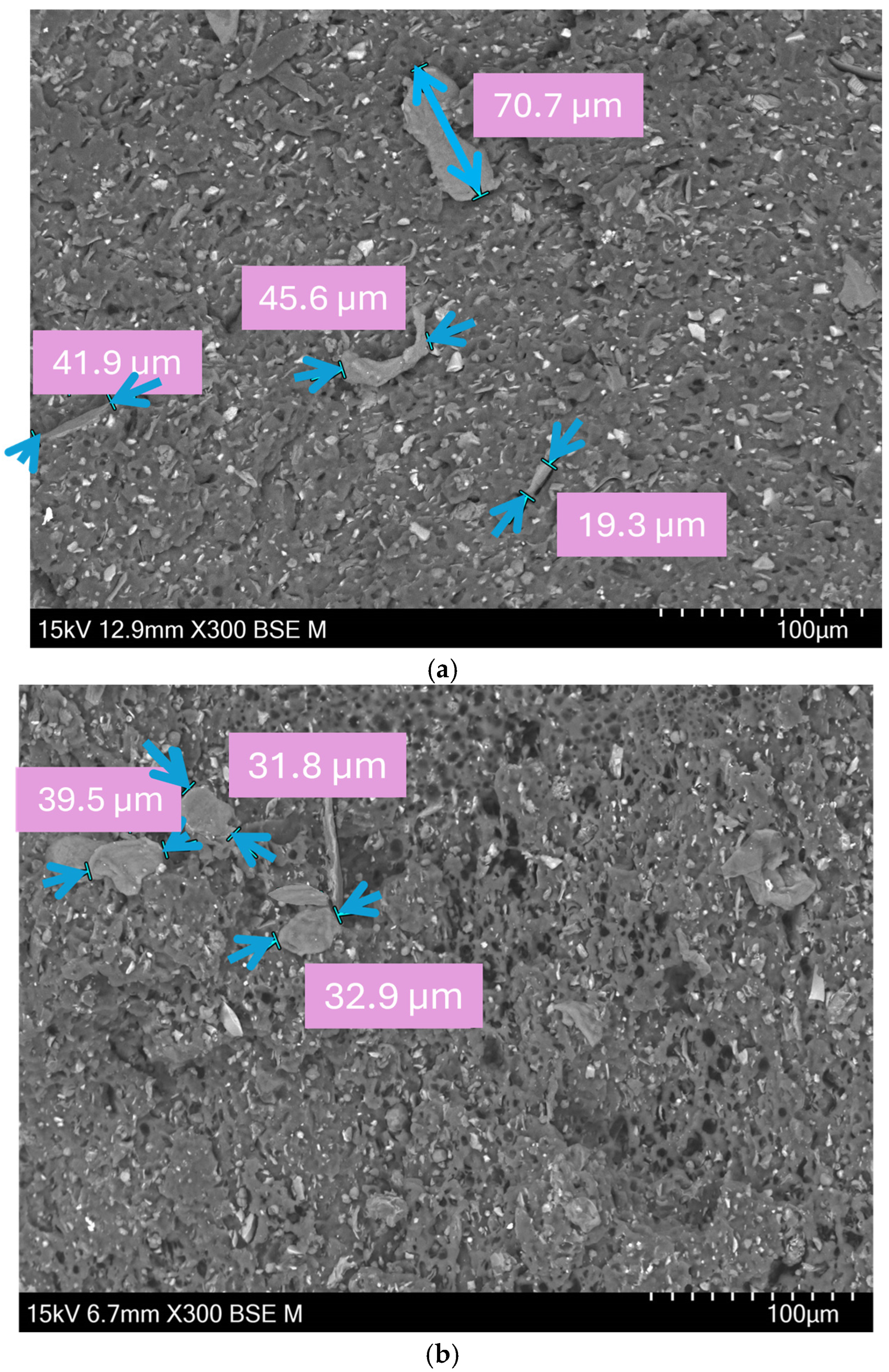
As for the morphological characterisation, Figure 5 shows the SEM images obtained during the analysis of the fracture surface of the tensile specimens of the biocomposites under study. The images reveal that the particles in the PP composites with micronised rice husk are randomly dispersed and exhibit varying sizes. Comparing the composites with 20% and 30% rice husk particles reveals better particles dispersion in the 20% composite.
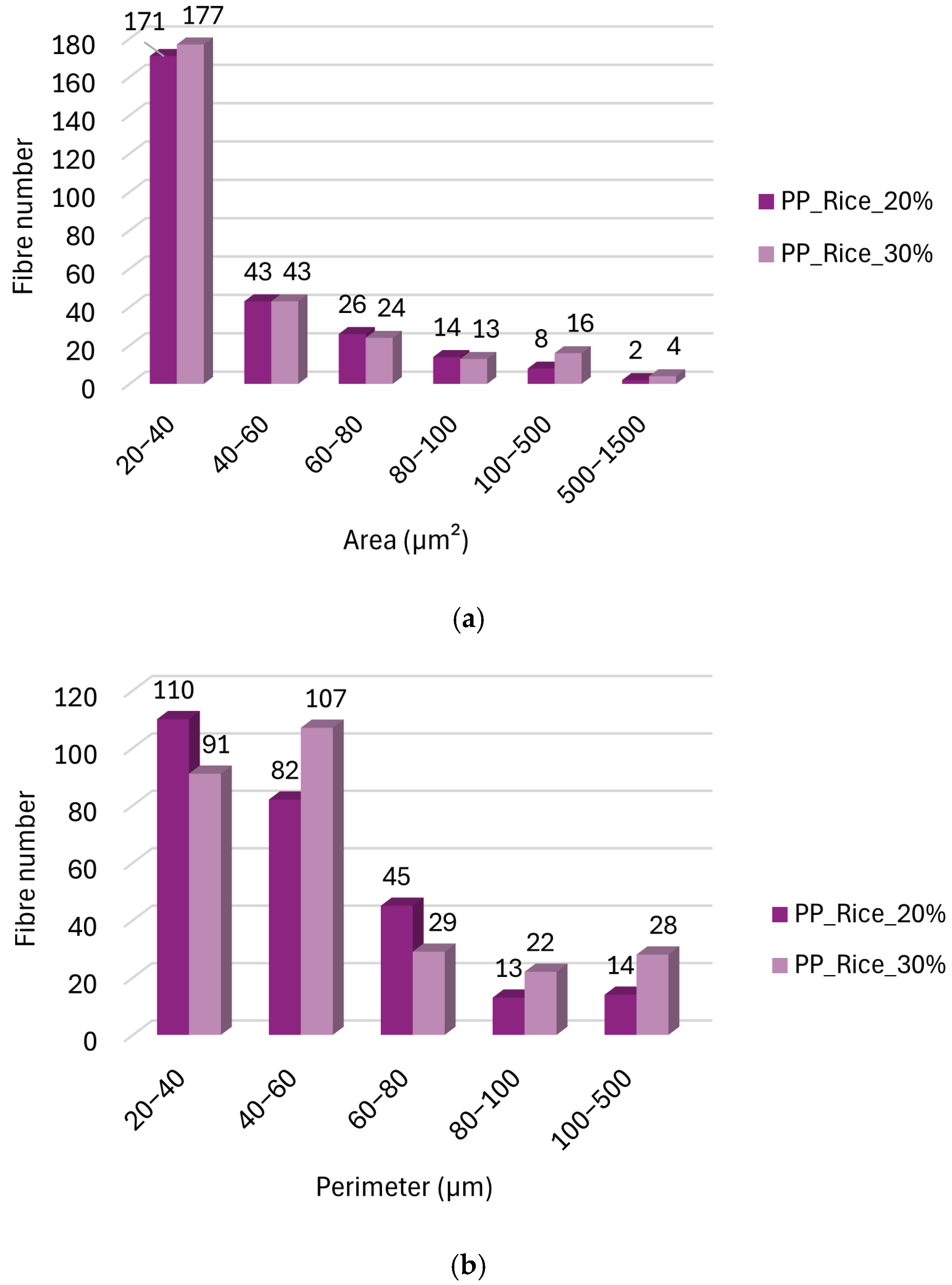
Using ImageJ software (version 1.54g), the number of particles in the SEM images was quantified, and the perimeter and area of each detected particle were also measured. The analysis focused on a sample area of 0.1007 mm2. The particle size distribution analysis (Figure 6a,b) indicates that the PP_Rice_30% composite exhibits a slightly broader granulometric range than the PP_Rice_20% composite. As shown in Figure 6a, although both composites have most particles concentrated in the 20–40 µm2 range, a greater number of particles in PP_Rice_30% fall within the larger size areas (100–500 µm2 and 500–1500 µm2) (Figure 6a) and above 80 µm in perimeter (Figure 6b). These results suggest a broader and more heterogeneous particle size distribution in the PP_Rice_30% composite, due to the increased presence of larger particles compared to the PP_Rice_20% composite. Additionally, the broader particle size distribution observed in the PP_Rice_30% composite, as revealed by SEM analysis (Figure 6a,b), is consistent with its significantly reduced strain at break and yield strain (Table 4), suggesting that the presence of larger particles may have introduced local stress concentrations. In contrast, the more uniform particle distribution in the PP_Rice_20% composite appears to promote more homogeneous stress transfer within the matrix, which correlates with its comparatively higher ductility.
In the PP_Rice_30%, particles agglomeration and higher presence of voids and porosity are observed (Figure 5b), suggesting poor adhesion between the matrix and the fibres, which may compromise the mechanical properties of the material. These results are consistent with previous studies [9,10], which indicated that increasing the fibre content leads to more voids and fibre detachment, impairing the mechanical performance of the composites. These conclusions can be corroborated by the works of Zhiltsova et al. [4], Hidalgo-Salazar and Salinas [9], and Aridi et al. [10], which correlated the fibre content increase with higher number of voids and fibres detachment. Furthermore, Zhiltsova et al. [4] and Hidalgo-Salazar and Salinas [9] concluded that the presence of gaps indicates weak adhesion between the PP matrix and the rice husk fibres, which may be related to the poor performance of these composites during tensile tests, particularly in terms of fracture strain and yield stress. As shown in Table 4, the nominal strain at break of the composites was significantly lower than that of virgin PP. Although the poor adhesion between the PP matrix and rice husk particles is a common drawback in natural-fibre-reinforced composites, several approaches have been proposed in the literature to mitigate this issue. Surface treatments of fibres (e.g., alkali treatment, silane coupling agents, or compatibilisers such as maleic anhydride-grafted polypropylene) have been shown to improve interfacial bonding, reduce void formation, and enhance the overall mechanical performance of the composites. Alternatively, adhesive or coating techniques have also been investigated as effective strategies to promote better stress transfer across the fibre–matrix interface [39].
A comparison between the micrographs of the micronised composites and those reported by Zhiltsova et al. [4], who studied PP composites with 20% and 30% rice husk fibres with the nominal 0.5 mm fibres’ size, reveals that the micronised composites exhibit fewer agglomerations. Additionally, composites with larger particle size exhibit more porous regions with larger voids, indicating inferior fibre–matrix adhesion. These findings are consistent with the studies of Zafar et al. [40] and Onuoha et al. [41], which investigated the influence of particle size on the properties of polystyrene composites with natural fibres and PP composites with maize fibres, respectively.
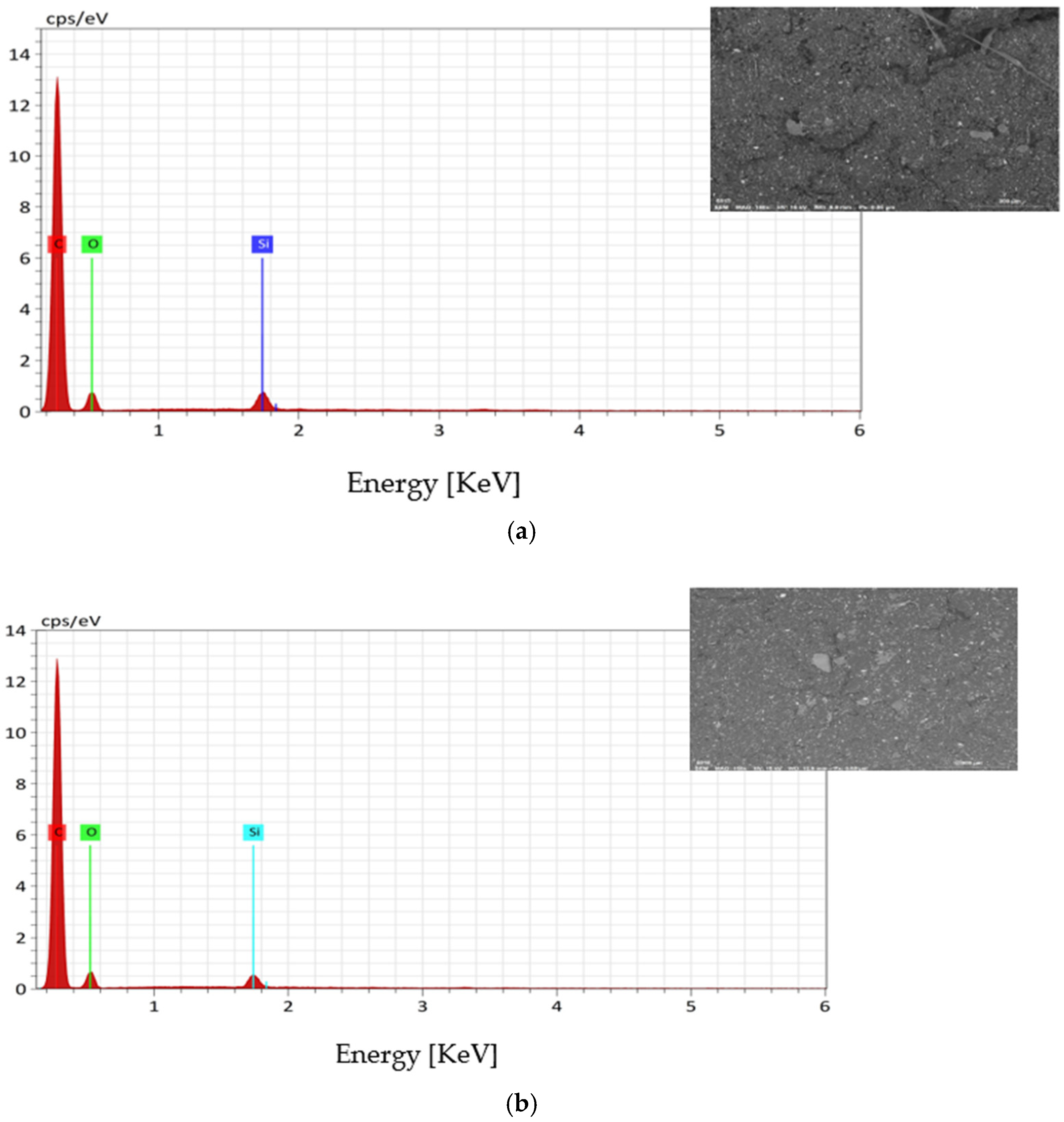
Additionally, the energy-dispersive X-ray spectroscopy (EDS) analysis revealed that the composites are primarily composed of carbon (C), oxygen (O), and silicon (Si) as illustrated in the EDS spectra presented in Figure 7.
The presence of carbon is related to the PP matrix, while the presence of O and Si comes from the incorporation of rice husk. It is also noteworthy that, as expected, since the particle content is higher, the amount of Si and O in the PP_Rice_30% is greater than in the PP_Rice_20%, as show in Table 10. These findings align with those reported in the previously mentioned work by Zhiltsova et al. [4] and Erdogan and Huner [11], who analysed PP composites with rice husk fibres using infrared spectroscopy and detected all the elements mentioned. It should be noted, however, that the EDS analysis was carried out on the fracture surfaces of the composites, and therefore the spectra reflect the combined contribution of both the polymer matrix and the rice husk. Analysis of pure rice husk particles was not conducted, as it was beyond the scope of this study.

3.5. Rheological Characterisation

Three rheological models, the Cross–WLF, Carreau–Yasuda, and Carreau–Yasuda–WLF, were selected to describe the viscosity behaviour of the PP rice husk composites. By comparing the results of the models presented in Table 11, it was observed that the parameter η 0 exhibited significant variations. As expected, η 0 decreased with increasing temperature and increased with higher filler content for the same temperature, a typical behaviour of polymer composites. The increase with filler loading reflects the added resistance to flow caused by the presence of rigid particles, which restrict the movement of the polymer chains. In the Cross–WLF model, η 0 values ranged between 400 and 1600 Pa·s, indicating sensitivity to both temperature and particle content. In contrast, the Carreau–Yasuda model yielded higher values, often exceeding 2500 Pa·s for composites with a higher percentage of rice husk. This is attributed to the fact that the Carreau–Yasuda model adjusts η 0 individually for each temperature and composition, capturing the increasing resistance to flow at higher filler contents more clearly. The Carreau–Yasuda–WLF model showed intermediate values with less variation, since the temperature dependence is incorporated through the WLF shift factor, and a single value of η 0 is fitted for all temperatures. Regarding the n , also presented in Table 11, which characterises the degree of pseudoplasticity, the Cross–WLF model indicated moderate pseudoplastic behaviour ( n ranging from 0.22 to 0.27). The Carreau–Yasuda model suggested higher pseudoplasticity ( n between 0.14 and 0.19), whereas the Carreau–Yasuda–WLF model exhibited very low values ( n between 0.013 and 0.015), suggesting an almost Newtonian behaviour, which is inconsistent with fibre-reinforced lignocellulosic materials [42]. The quality of the fittings was also assessed using the coefficient of determination (R2). The Carreau–Yasuda model achieved the best results (R2 > 0.998), followed by the Cross–WLF model (R2 > 0.999). Although the Carreau–Yasuda–WLF model accounts for the influence of temperature, it yielded the lowest R2 values (ranging from 0.934 to 0.977).
Although the Carreau–Yasuda model achieved the highest R2, this result is mainly due to its ability to adjust η 0 individually at each temperature and composition, which improves statistical fitting but reduces physical consistency. In contrast, the Cross–WLF model couples viscosity and temperature through the WLF shift factor, providing a physically meaningful description of the temperature dependence with a single set of parameters. This feature makes the Cross–WLF model more robust and suitable for processing simulations, where temperature effects must be consistently represented. For this reason, despite the slightly lower R2, Cross–WLF was considered the most adequate model.
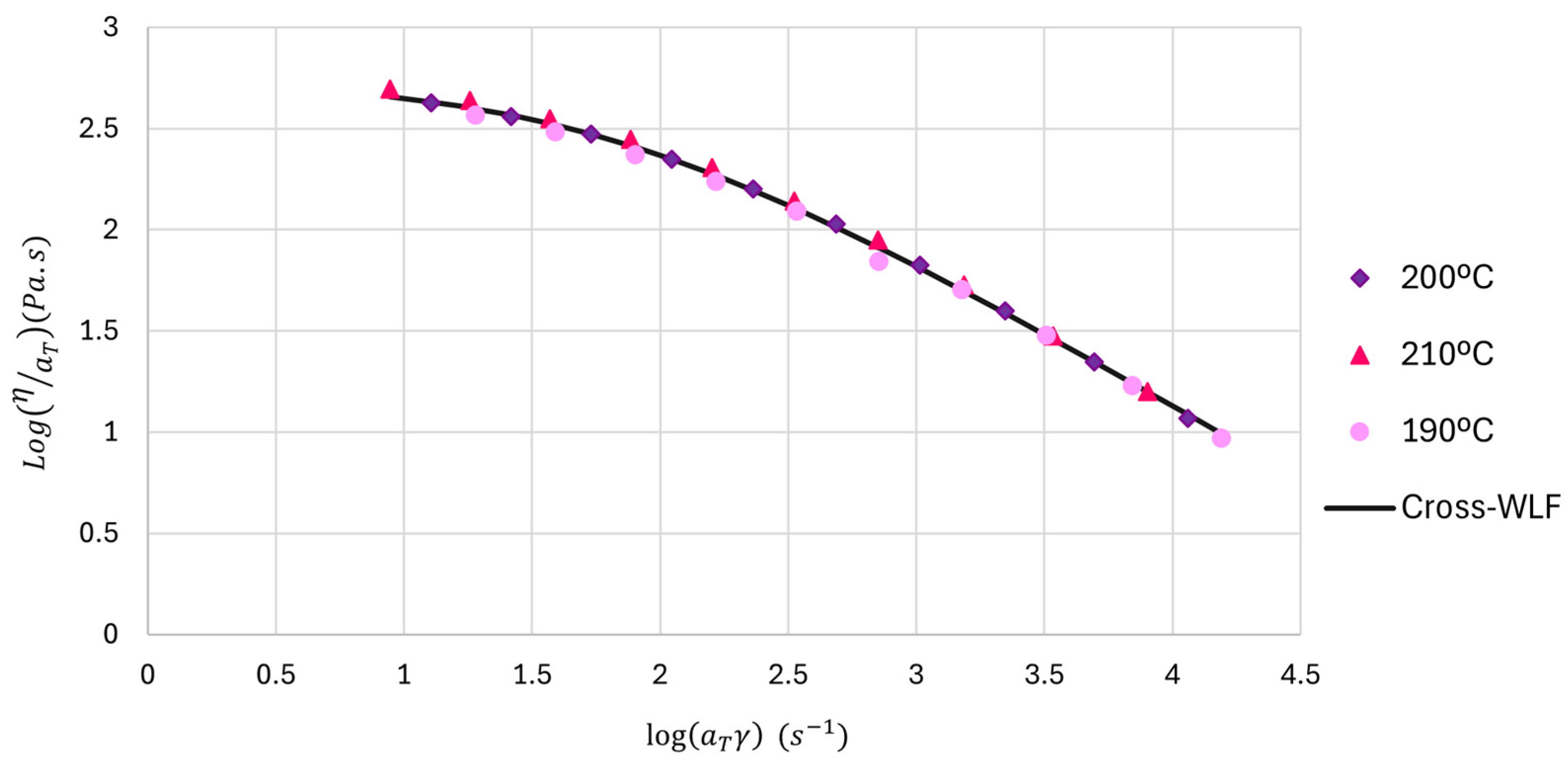
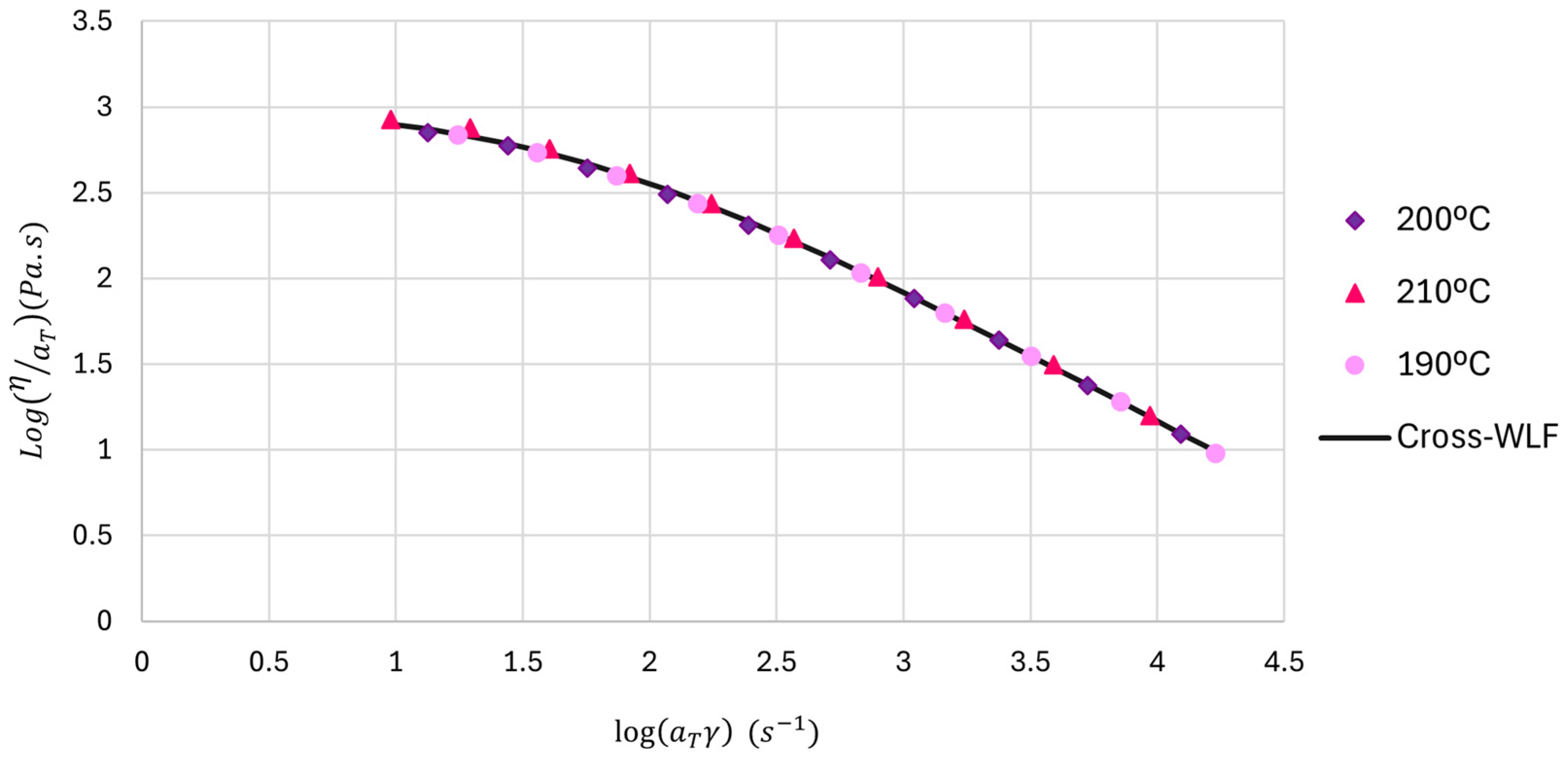
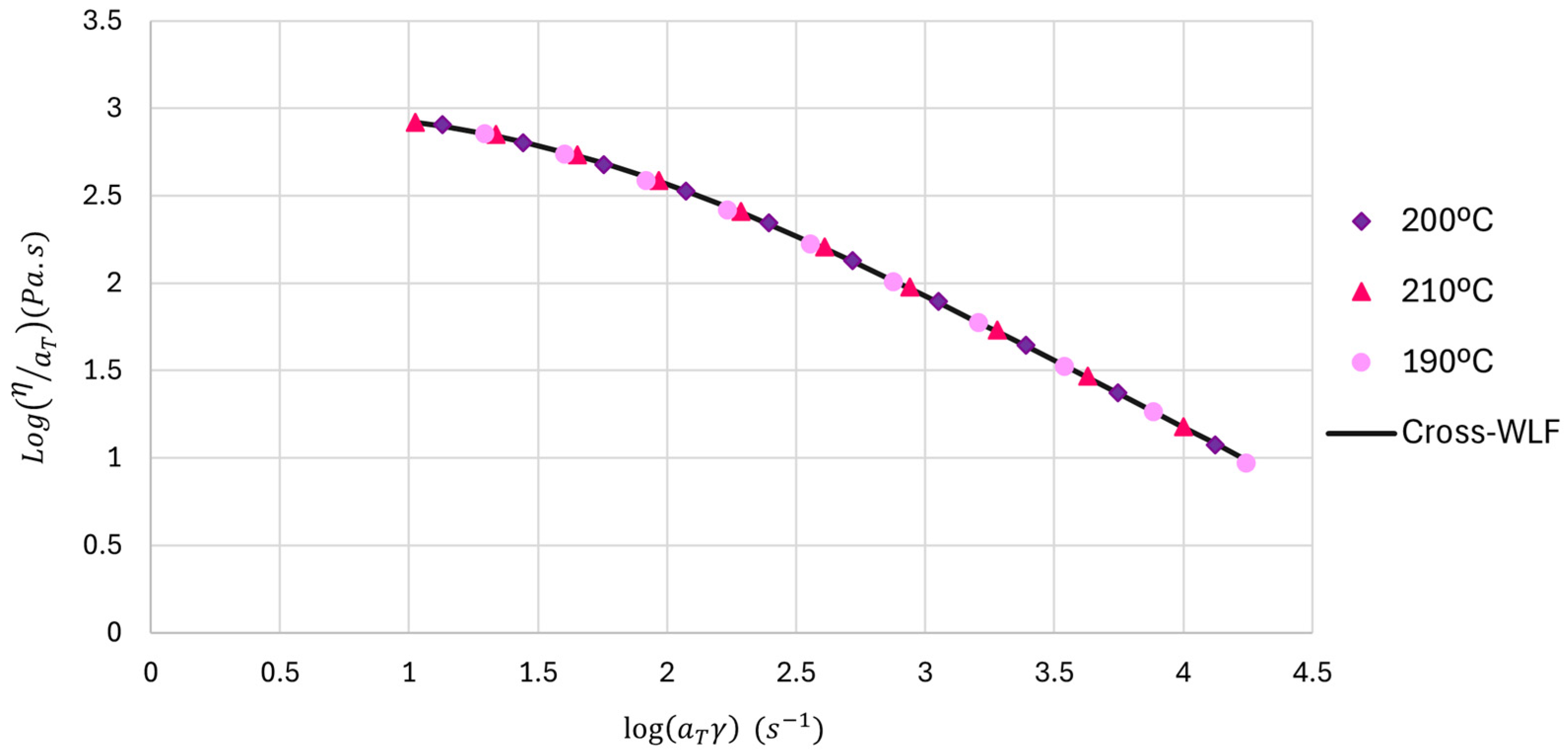
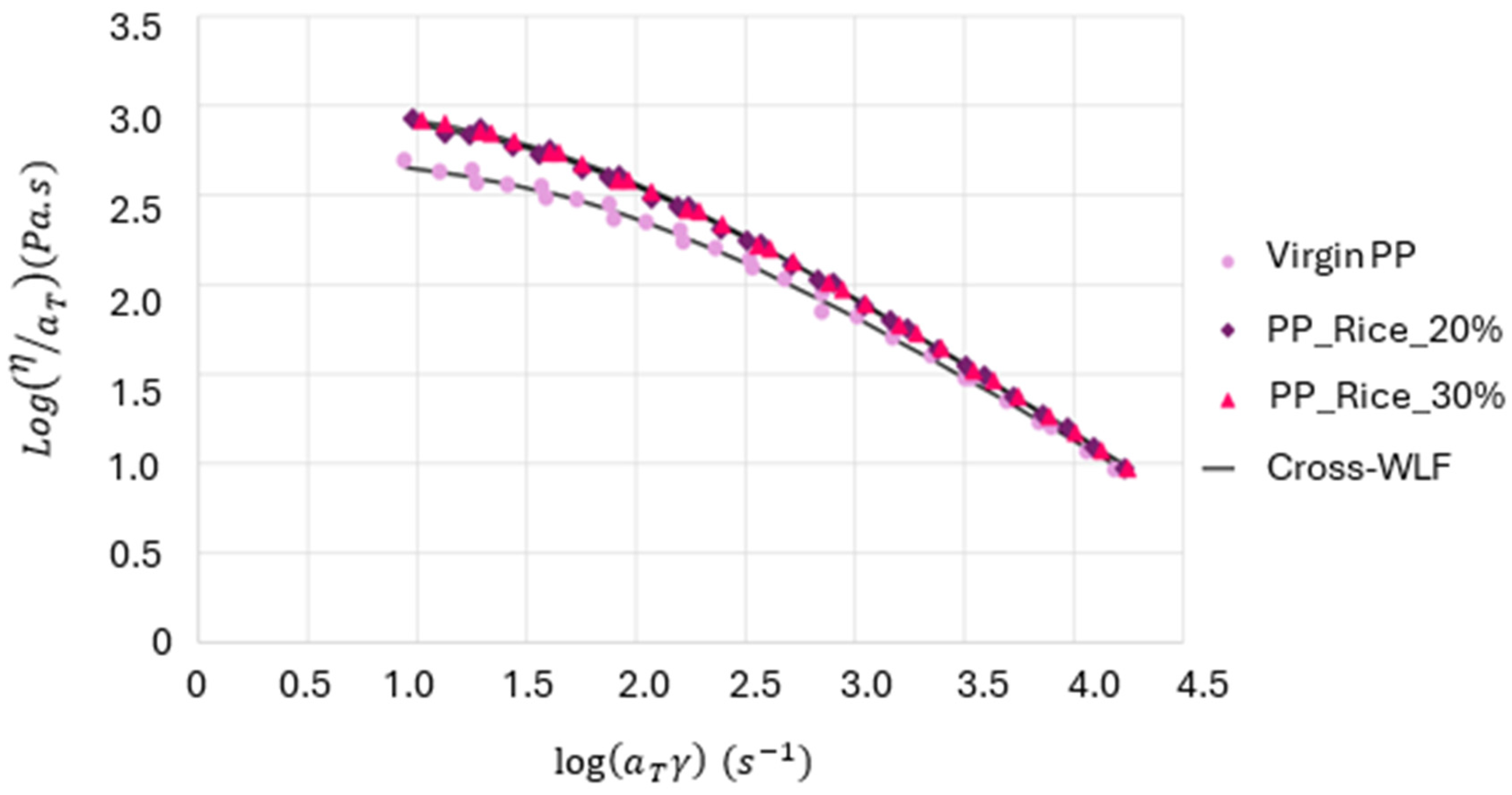
The validity of the time–temperature superposition principle was verified by shifting the experimental viscosity curves obtained at different temperatures. As shown in Figure 8, Figure 9 and Figure 10, the raw data and the shifted data exhibited a good superposition, confirming that the Cross–WLF model adequately describes the temperature dependence of the composites. This validates the construction of the master curve presented in Figure 11.
Table 12 presents the coefficients of the master curve obtained using the Cross–WLF model from the fitting procedure.
The analysis of the master curve (Figure 11) and Table 12 revealed that the addition of micronised rice husk particles did not alter the pseudoplastic behaviour of the composites ( n < 1). This finding is consistent with studies by Magalhães da Silva et al. [43] and Frącz and Janowski [44], who also reported similar n values (ranging from 0.2 to 0.3) for PP-based composites reinforced with cork and wood, respectively. It was also observed that η 0 increased significantly with particle addition, particularly at low shear rates. This trend, attributed to matrix–fibre interactions, was similarly reported by Lewandowski et al. [45] and Magalhães da Silva et al. [43]. The presence of the fibres also led to an extension of the Newtonian plateau, as reflected by an increase in the parameter τ. Finally, as noted by Magalhães da Silva et al. [43] and Lima et al. [46], all materials exhibited a decrease in viscosity with increasing temperature, as shown in Table 12. This behaviour is attributed to the increase in free volume between molecules, which reduces intermolecular forces and facilitates flow.

3.6. Moisture Absorption

Moisture absorption characterisation is important, as the product is intended to be used in humid environment, such as sanitary facilities. Given that it is a composite of polypropylene with rice husk filler, this test becomes even more relevant, as lignocellulosic materials are prone to moisture absorption, which can lead to swelling, cracking, and loss of mechanical properties [47]. For these reasons the 24 h immersion test was adopted as a preliminary characterisation, with the primary aim of comparing the influence of filler content and particle size on water absorption behaviour. Although this test provides a useful first indication of the composites’ hygroscopicity, it does not reproduce long-term service conditions. For applications in humid environments, extended immersion and cyclic ageing tests will be necessary to fully validate the composites’ durability.
Based on Table 13 it was observed that the composite with 30% rice husk absorbed more moisture (0.144%) than the one with 20% (0.111%). These results agree with the SEM analysis that indicated greater porosity and poor matrix–fibre adhesion in the composite with higher filler content, facilitating water absorption. These results are consistent with the studies of Zafar et al. [40] and Hardinnawirda et al. [48], who also associated higher water absorption with a higher percentage of natural fibres. Regarding swelling (S(%)), the composites with micronised particles exhibit similarly low swelling values, suggesting that the composite structure remains stable under short-term water exposure.
Comparing composites with micronised particles (PP_Rice_20% and PP_Rice_30%) to those with 0.5 mm fibre size (PP20%rh and PP30%rh) reveals lower water absorption in the former. This indicates that particle size distribution affects the composites’ hygroscopicity, with finer particles promoting more homogeneous dispersion and fewer voids or channels for water migration, as supported by morphological analysis. Larger particles tend to retain their original porous structures more effectively, resulting in higher moisture absorption.

3.7. Tribological Characterisation

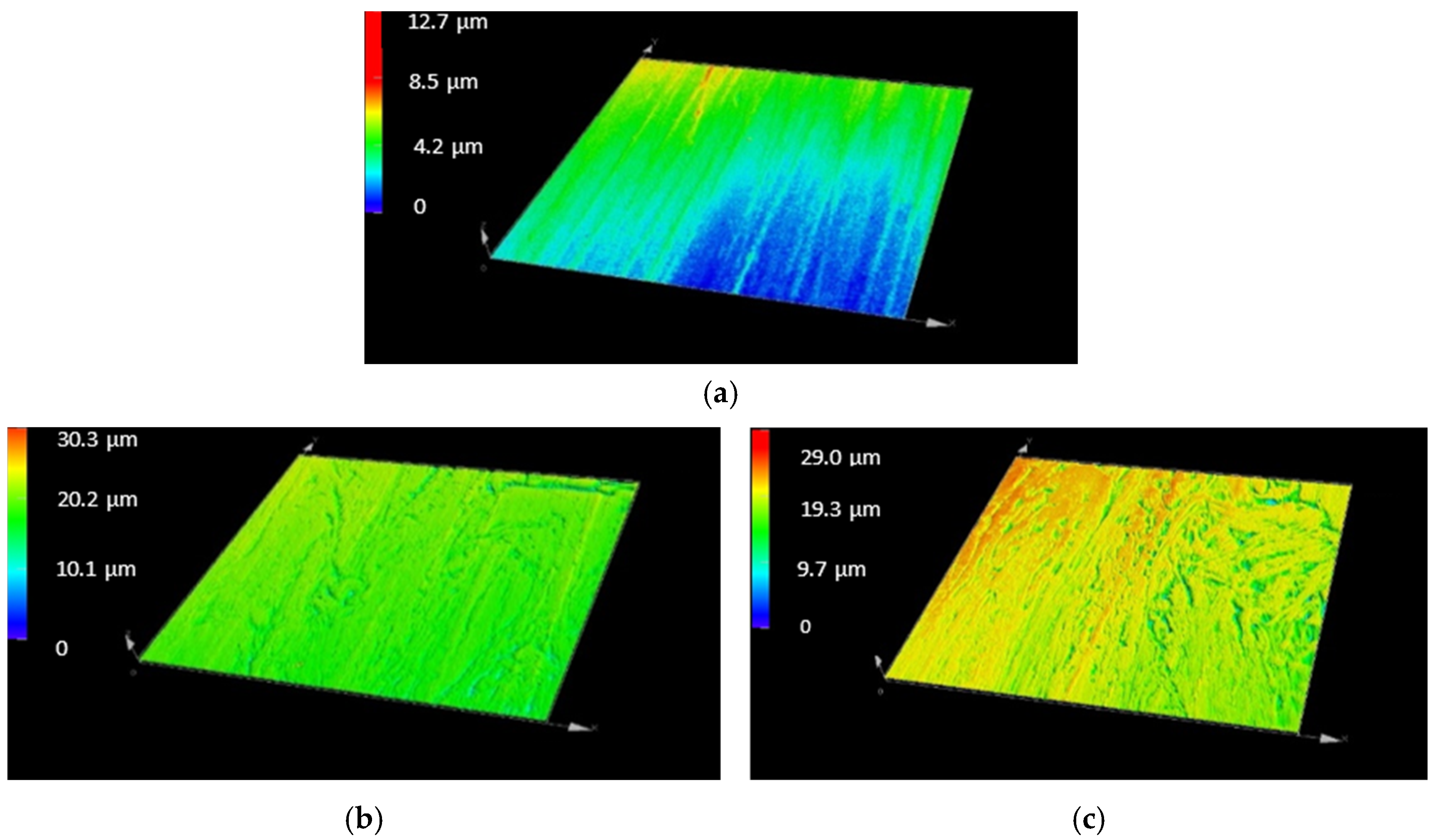
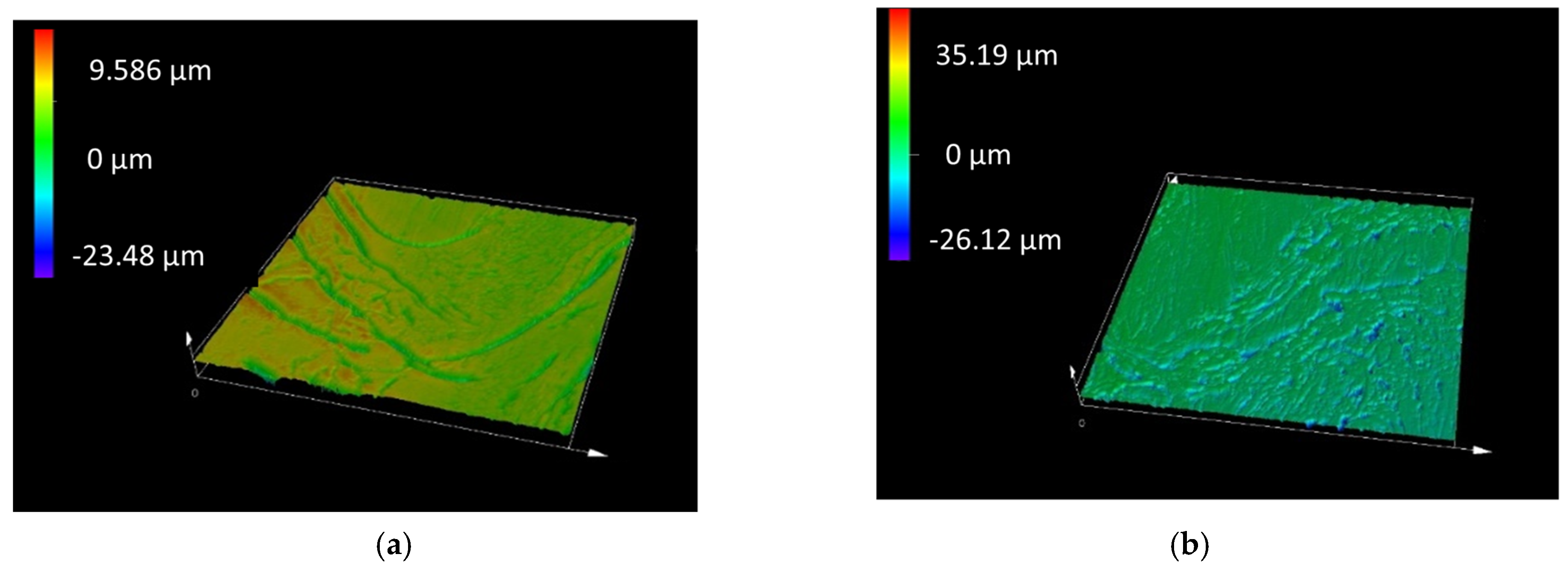
Surface roughness analysis is essential in manufacturing technical components, as it affects the appearance, friction, wear, and assembly. Parameters such as Sa, Ra, and Rz assess roughness, while Rsk and Rku analyse the symmetry and distribution of peaks and valleys, influencing adhesion and precision. This characterisation helps establish manufacturing limits to ensure reproducibility. Figure 12 shows the analysed areas, highlighting variations in roughness.
The data presented in Table 14 reveals that the addition and increased concentration of micronised rice husk particles increase the surface roughness of the composites, in line with the results of Kaymakci et al. [49] and Haq et al. [50]. The incorporation of fibres increases the viscosity of the material during injection-moulding, leading to less homogeneous flow patterns and more irregular surfaces [51]. Rigid particles, such as rice husk fibres/particles, contribute to higher surface roughness compared to neat polypropylene [49]. This effect is further intensified at higher fibre contents, due to the greater exposure of particles on the surface.
The Rsk values presented in (Table 14), which reflect surface profile asymmetry, indicate that all composites exhibit negative Rsk values, unlike neat PP, which shows a positive value. A positive Rsk in neat PP suggests the presence of dominant peaks and less uniform roughness distribution, despite its overall low roughness. In contrast, negative Rsk values in the composites imply surfaces with more valleys than peaks and a more evenly distributed roughness. This is associated with improved dimensional stability and reduced polymer shrinkage due to particle addition, which prevents the formation of prominent peaks. These observations are supported by Figure 12, where neat PP (Figure 12a) shows colour variation (indicating uneven roughness), while the composites Figure 12b,c) present a uniform green profile, confirming a more homogeneous surface. The Rku parameter increased with the introduction of particles, reflecting more pronounced peaks and valleys, but decreased with increasing concentration, suggesting a more uniform profile, possibly due to surface saturation.
The roughness of a material is also related to its tendency to absorb water. Exposure of composite materials to water generally increases surface roughness, which is caused by the uneven swelling of the fibres and the leaching of water-soluble components. This phenomenon can lead to microcracks on the surface or even localised delamination between the polymer matrix and the fibres [51,52]. These changes can compromise the aesthetic quality, dimensional stability, and long-term mechanical performance of the part. Therefore, to assess the influence of moisture on the surface morphology, the composites’ roughness was also assessed after the short-term water immersion test.
After 24 h water immersion, the composites surface morphology became more deteriorated (Figure 13a,b), reflected as an increase in the values of Sa, Ra, and Rz (Table 15). PP_Rice_30%, showed greater susceptibility to surface degradation and moisture absorption. This behaviour is consistent with the results obtained in the hygroscopicity analysis, where this material showed higher water absorption, and with the observations from the SEM analysis, which revealed a higher presence of voids and particles agglomeration. On the other hand, the PP_Rice_20% showed smaller changes in roughness parameters, suggesting a more even surface aligned with higher resistance to water absorption. The decrease in the absolute values of Rsk and Rku in both cases indicate surface smoothing and reduced asymmetry, possibly caused by localised swelling induced by the hydrophilic particles within the composite structure.


4. Conclusions

The analysed biocomposites demonstrated promising performance to meet the functional, processability, and aesthetic requirements of the intended application. Morphologically, the particles were generally well dispersed, though minor agglomerations and adhesion issues were observed, especially at higher filler contents. The rice husk acted as a nucleating agent, enhancing both crystallinity and thermal stability. Although the incorporation of micronised rice husk caused a noticeable reduction in the onset temperature (T5%) from 374.1 °C to 309.2 for PP_Rice_20% and for 296.2 for PP_Rice_30%, due to the early decomposition of lignocellulosic components, it increased the main DTG peak by up to 17.6 °C, indicating delayed degradation of the PP matrix and a more thermally stable composite structure. Additionally, the composites exhibited rheological behaviour suitable for injection moulding. Mechanically, performance remained adequate, although toughness decreased with increasing filler content. Water absorption was more pronounced at 30% particle content, potentially affecting dimensional stability in humid environments. Surface roughness increased with filler addition but remained within acceptable limits.
Overall, the PP-based composite with 20% rice husk particles was identified as the most suitable option for producing the toilet cistern lid, offering the best balance between processability, aesthetics, mechanical strength, and dimensional stability. The study also highlighted the beneficial effect of micronisation, which improved dispersion and flexural performance, despite a slight reduction in stiffness. Future work should explore long-term moisture behaviour and incorporate moulding simulations to optimise part design and manufacturing performance.

Author Contributions

Conceptualization, T.Z. and M.S.A.O.; methodology, T.Z., S.P.M.d.S., and M.S.A.O.; validation, T.Z., J.M.O., S.P.M.d.S., and M.S.A.O.; formal analysis, I.S.; investigation, I.S.; resources, J.M.O. and M.S.A.O.; data curation, I.S.; writing—original draft preparation, I.S.; writing—review and editing, I.S., T.Z., S.P.M.d.S., and M.S.A.O.; visualisation, S.P.M.d.S.; supervision, T.Z. and M.S.A.O.; project administration, J.M.O.; funding acquisition, M.S.A.O. All authors have read and agreed to the published version of the manuscript.

Funding

This research was funded by PRR—Plano de Recuperação e Resiliência, under the Next Generation EU from the European Union, through the Project “Agenda ILLIANCE” (C644919832-00000035|Project nº 46), and by national funds through FCT—Fundação para a Ciência e a Tecnologia, I.P., under the project UID 00481/2025—Centre for Mechanical Technology and Automation, https://doi.org/10.54499/UID/00481/2025. This work was also supported by CICECO—Aveiro Institute of Materials (UIDB/50011/2020, DOI: 10.54499/UIDB/50011/2020; UIDP/50011/2020, DOI: 10.54499/UIDP/50011/2020; LA/P/0006/2020, DOI: 10.54499/LA/P/0006/2020) and by LAQV-REQUIMTE (UIDB/50006/2020; UIDP/50006/2020), financed by national funds through FCT/MCTES (PIDDAC).

Data Availability Statement

All data generated or analysed during this study are included in this article.

Conflicts of Interest

The authors declare no conflicts of interest.

References

  1. Ngo, T.-D. Introduction to Composite Materials. In Composite and Nanocomposite Materials—From Knowledge to Industrial Applications; IntechOpen: London, UK, 2020. [Google Scholar] [CrossRef]
  2. Polipropileno—Preços|2013–2025 Dados|2026–2027 Previsão. Available online: https://pt.tradingeconomics.com/commodity/polypropylene (accessed on 23 April 2025).
  3. Hossain, M.T.; Shahid, A.; Mahmud, N.; Habib, A.; Rana, M.; Khan, S.A.; Hossain, D. Research and application of polypropylene: A review. Discov. Nano 2024, 19, 2. [Google Scholar] [CrossRef] [PubMed]
  4. Zhiltsova, T.; Campos, J.; Costa, A.; Oliveira, M.S.A. Sustainable Polypropylene-Based Composites with Agro-Waste Fillers: Thermal, Morphological, Mechanical Properties and Dimensional Stability. Materials 2024, 17, 696. [Google Scholar] [CrossRef]
  5. Ichim, M.; Stelea, L.; Filip, I.; Lisa, G.; Muresan, E.I. Thermal and Mechanical Characterization of Coir Fibre–Reinforced Polypropylene Biocomposites. Crystals 2022, 12, 1249. [Google Scholar] [CrossRef]
  6. Rosa, S.M.L.; Nachtigall, S.M.B.; Ferreira, C.A. Thermal and Dynamic-Mechanical Characterization of Rice-Husk Filled Polypropylene Composites. Macromol. Res. 2009, 17, 8–13. [Google Scholar] [CrossRef]
  7. Monga, S.; Kadian, M.; Nagoria, S.; Kumar, S.; Verma, M. A Review on Mechanical Improvements and Environmental Benefits of Rice Husk Reinforced Polymer Composites. Curr. World Environ. 2025, 19, 1077–1100. [Google Scholar] [CrossRef]
  8. Premalal, H.G.B.; Ismail, H.; Baharin, A. Comparison of the mechanical properties of rice husk powder filled polypropylene composites with talc filled polypropylene composites. Polym. Test. 2002, 21, 833–839. [Google Scholar] [CrossRef]
  9. Hidalgo-Salazar, M.A.; Salinas, E. Mechanical, thermal, viscoelastic performance and product application of PP-rice husk Colombian biocomposites. Compos. B Eng. 2019, 176, 107135. [Google Scholar] [CrossRef]
  10. Aridi, N.A.M.; Sapuan, S.M.; Zainudin, E.S.; AL-Oqla, F.M. Mechanical and morphological properties of injection-molded rice husk polypropylene composites. Int. J. Polym. Anal. Charact. 2016, 21, 305–313. [Google Scholar] [CrossRef]
  11. Erdogan, S.; Huner, U. Physical and Mechanical Properties of PP Composites based on Different Types of Lignocellulosic Fillers. J. Wuhan Univ. Technol. Mater. Sci. Ed. 2018, 33, 1298–1307. [Google Scholar] [CrossRef]
  12. Nourbakhsh, A.; Ashori, A.; Tabrizi, A.K. Characterization and biodegradability of polypropylene composites using agricultural residues and waste fish. Compos. B Eng. 2014, 56, 279–283. [Google Scholar] [CrossRef]
  13. Zhiltsova, T.; Costa, A.; Oliveira, M.S.A. Assessment of Long-Term Water Absorption on Thermal, Morphological, and Mechanical Properties of Polypropylene-Based Composites with Agro-Waste Fillers. J. Compos. Sci. 2024, 8, 288. [Google Scholar] [CrossRef]
  14. Tajvidi, M.; Takemura, A. Recycled Natural Fiber Polypropylene Composites: Water Absorption/Desorption Kinetics and Dimensional Stability. J. Polym. Environ. 2010, 18, 500–509. [Google Scholar] [CrossRef]
  15. Alaei, M.H.; Mahajan, P.; Brieu, M.; Kondo, D.; Rizvi, S.J.A.; Kumar, S.; Bhatnagar, N. Effect of particle size on thermomechanical properties of particulate polymer composite. Iran. Polym. J. (Engl. Ed.) 2013, 22, 853–863. [Google Scholar] [CrossRef]
  16. Essabir, H.; Hilali, E.; Elgharad, A.; El Minor, H.; Imad, A.; Elamraoui, A.; Al Gaoudi, O. Mechanical and thermal properties of bio-composites based on polypropylene reinforced with Nut-shells of Argan particles. Mater. Des. 2013, 49, 442–448. [Google Scholar] [CrossRef]
  17. ISO 11357-3:2018; Plastics—Differential Scanning Calorimetry (DSC)—Part 3: Determination of Temperature and Enthalpy of Melting and Crystallization. ISO—International Organization for Standardization: Geneva, Switzerland, 2018.
  18. ASTM E1131-08; Standard Test Method for Compositional Analysis by Thermogravimetry. ASTM International: West Conshohocken, PA, USA, 2008.
  19. ISO 527-1; Plastics—Determination of Tensile Properties—Part 1: General Principles. ISO—International Organization for Standardization: Geneva, Switzerland, 2012.
  20. ISO 178: 2001; Plastics Determination of Flexural Properties. Beuth Verlag GmbH: Berlin, Germany, 2003.
  21. D955-08; Standard Test Method of Measuring Shrinkage from Mold Dimensions of Thermoplastics (Reapproved 2014). ASTM International: West Conshohocken, PA, USA, 2014.
  22. Neto, J.S.S.; de Queiroz, H.F.M.; Aguiar, R.A.A.; Banea, M.D. A review on the thermal characterisation of natural and hybrid fiber composites. Polymers 2021, 13, 4425. [Google Scholar] [CrossRef] [PubMed]
  23. Baum, M.; Anders, D.; Reinicke, T. Approaches for Numerical Modeling and Simulation of the Filling Phase in Injection Molding: A Review. Polymers 2023, 15, 4220. [Google Scholar] [CrossRef] [PubMed]
  24. Rudolph, N.M.; Agudelo, A.C.; Granada, J.C.; Park, H.E.; Osswald, T.A. WLF model for the pressure dependence of zero shear viscosity of polycarbonate. Rheol. Acta 2016, 55, 673–681. [Google Scholar] [CrossRef]
  25. Zare, Y.; Park, S.P.; Rhee, K.Y. Analysis of complex viscosity and shear thinning behavior in poly (lactic acid)/poly (ethylene oxide)/carbon nanotubes biosensor based on Carreau–Yasuda model. Results Phys. 2019, 13, 102245. [Google Scholar] [CrossRef]
  26. Williams, M.L.; Landel, R.F.; Ferry, J.D. Temperature Dependence of Relaxation Mechanisms The Temperature Dependence of Relaxation Mechanisms in Amorphous Polymers and Other Glass-forming Liquids1. J. Am. Chem. Soc. 1955, 77, 3701–3707. [Google Scholar] [CrossRef]
  27. Dealy, J.; Plazek, D. Time-temperature superposition-a users guide. Rheol. Bull. 2009, 78, 16–31. Available online: https://www.researchgate.net/publication/284663363 (accessed on 1 March 2024).
  28. ASTM D570-98; Standard Test Method for Water Absorption of Plastics. ASTM International: West Conshohocken, PA, USA, 2010. [CrossRef]
  29. ISO 25178-2; Geometrical Product Specifications (GPS)—Surface Texture: Areal—Part 2. ISO—International Organization for Standardization: Geneva, Switzerland, 2021. Available online: www.iso.org (accessed on 30 March 2025).
  30. Gadelmawla, E.S.; Koura, M.M.; Maksoud, T.M.A.; Elewa, I.M.; Soliman, H.H. Roughness parameters. J. Mater. Process. Technol. 2002, 123, 133–145. [Google Scholar] [CrossRef]
  31. Fuad, M.Y.A.; Mustafah, J.; Mansor, M.S.; Ishak, Z.A.M.; Omar, A.K.M. Thermal properties of polypropylene/rice husk ash composites. Polym. Int. 1995, 38, 33–43. [Google Scholar] [CrossRef]
  32. Yang, L.; Yang, L.; Lowe, R.L. A viscoelasticity model for polymers: Time, temperature, and hydrostatic pressure dependent Young’s modulus and Poisson’s ratio across transition temperatures and pressures. Mech. Mater. 2021, 157, 103839. [Google Scholar] [CrossRef]
  33. Williams, J.G.; Blackman, B.R.K.; Steininger, H.; Zuo, K. Toughening by plastic cavitation around cylindrical particles and fibres. Compos. Sci. Technol. 2014, 103, 119–126. [Google Scholar] [CrossRef]
  34. Xu, H.; Yang, Y.; Li, L.; Liu, B.; Fu, X.; Yang, X.; Cao, Y. Mechanical Properties Variation in Wood—Plastic Composites with a Mixed Wood Fiber Size. Materials 2023, 16, 5801. [Google Scholar] [CrossRef]
  35. Ashori, A.; Nourbakhsh, A. Reinforced polypropylene composites: Effects of chemical compositions and particle size. Bioresour. Technol. 2010, 101, 2515–2519. [Google Scholar] [CrossRef] [PubMed]
  36. Ratanawilai, T.; Nakawirot, K.; Deachsrijan, A.; Homkhiew, C. Influence of wood species and particle size on mechanical and thermal properties of wood polypropylene composites. Fibers Polym. 2014, 15, 2160–2168. [Google Scholar] [CrossRef]
  37. Sheikh, T.Z.; Mozumdar, F.A.; Karim, M.R.; Ahsan, Q. Investigation of mechanical, morphological and thermal properties of waste glass powder and wood flour reinforced polypropylene composite. Heliyon 2025, 11, e41352. [Google Scholar] [CrossRef] [PubMed]
  38. Fu, S.Y.; Feng, X.Q.; Lauke, B.; Mai, Y.W. Effects of particle size, particle/matrix interface adhesion and particle loading on mechanical properties of particulate-polymer composites. Compos. B Eng. 2008, 39, 933–961. [Google Scholar] [CrossRef]
  39. Fnides, M.; Amroune, S.; Belaadi, A.; Saada, K.; Chai, B.X.; Abdullah, M.M.S.; Alshaikh, I.M.H.; Ghernaout, D.; Al-Khawlani, A. Modeling and Optimizing the Alkaline Treatment Process to Enhance the Date Palm Fibers’ Tensile Mechanical Properties Using RSM. J. Nat. Fibers 2024, 21, 2384663. [Google Scholar] [CrossRef]
  40. Zafar, F.M.; Siddiqui, A.M. Effect of filler loading and size on the mechanical and morphological behaviour of natural fibre-reinforced polystyrene. Adv. Mater. Process. Technol. 2020, 7, 647–659. [Google Scholar] [CrossRef]
  41. Onuoha, C.; Onyemaobi, O.O.; Anyakwo, C.N.; Onuegbu, G.C. Effect of Filler Content and Particle Size on the Mechanical Properties of Corn Cob Powder Filled Recycled Polypropylene Composites. Int. J. Sci. Eng. Appl. Sci. (IJSEAS) 2017, 3, 145–151. [Google Scholar]
  42. Iglesias, M.C.; Hamade, F.; Burak, A.; Jiang, Z.; Davis, V.A.; Peresin, M.S. Correlations between Rheological Behavior and Intrinsic Properties of Nanofibrillated Cellulose from Wood and Soybean Hulls with Varying Lignin Content. BioResources 2021, 16, 4831–4835. [Google Scholar] [CrossRef]
  43. Da Silva, S.P.M.; Lima, P.S.; Oliveira, J.M. Rheological behaviour of cork-polymer composites for injection moulding. Compos. B Eng. 2016, 90, 172–178. [Google Scholar] [CrossRef]
  44. Frącz, W.; Janowski, G. Determination of viscosity curve and PVT properties for wood-polymer composite. Wood Res. 2018, 63, 321–334. [Google Scholar]
  45. Lewandowski, K.; Piszczek, K.; Skórczewska, K.; Mirowski, J.; Zajchowski, S.; Wilczewski, S. Rheological properties of wood polymer composites at high shear rates—Evaluation of additional pressure losses as a result of inlet effects. Compos. Part A Appl. Sci. Manuf. 2022, 154, 106804. [Google Scholar] [CrossRef]
  46. Lima, P.; Da Silva, S.P.M.; Oliveira, J.; Costa, V. Rheological properties of ground tyre rubber based thermoplastic elastomeric blends. Polym. Test. 2015, 45, 58–67. [Google Scholar] [CrossRef]
  47. Bachchan, A.A.; Das, P.P.; Chaudhary, V. Effect of moisture absorption on the properties of natural fiber reinforced polymer composites: A review. In Materials Today: Proceedings; Elsevier Ltd.: Amsterdam, The Netherlands, 2020; pp. 3403–3408. [Google Scholar] [CrossRef]
  48. Hardinnawirda, K.; Aisha, I.S. Effect of Rice Husks as Filler in Polymer Matrix Composites. J. Mech. Eng. Sci. 2012, 2, 181–186. [Google Scholar] [CrossRef]
  49. Kaymakci, A.; Ayrilmis, N.; Gulec, T. Surface Properties and Hardness of Polypropylene Composites Filled with Sunflower Stalk Flour. Bioresources 2013, 8, 592–602. [Google Scholar] [CrossRef]
  50. Haq, S.; Srivastava, R. Measuring the influence of materials composition on nano scale roughness for wood plastic composites by AFM. Measurement 2016, 91, 541–547. [Google Scholar] [CrossRef]
  51. Kim, S.-H.; Choi, K.; Choi, H.R.; Kim, T.; Suhr, J.; Kim, K.J.; Choi, H.J.; Nam, J.-D. Non-Einstein Viscosity Phenomenon of Acrylonitrile-Butadiene-Styrene Composites Containing Lignin-Polycaprolactone Particulates Highly Dispersed by High-Shear Stress. ACS Omega 2019, 4, 10036–10043. [Google Scholar] [CrossRef] [PubMed]
  52. Santos, C.M.; Santos, T.F.; Rao, H.J.; Silva, F.H.V.; Rangappa, S.M.; Boonyasopon, P.; Siengchin, S.; Souza, D.; Nascimento, J. A bibliometric review on applications of lignocellulosic fibers in polymeric and hybrid composites: Trends and perspectives. Heliyon 2024, 10, e38264. [Google Scholar] [CrossRef]
Figure 1. DSC thermogram of the composites (red: PPv, blue: PP_Rice_20%, green: PP_Rice_30%).
Jcs 09 00662 g001
Figure 2. TGA (a) and DTG (b) thermograms of virgin PP (PPv) and PP/rice fibre composites (20 and 30 wt%), showing the three main degradation stages.
Jcs 09 00662 g002
Figure 3. Tensile stress–strain curves of virgin PP (PPv) and PP/rice fibre composites (20 and 30 wt%).
Jcs 09 00662 g003
Figure 4. Flexural stress–strain curves of virgin PP (PPv) and PP/rice fibre composites (20 and 30 wt%).
Jcs 09 00662 g004
Figure 5. SEM images with magnification of 300× for the biocomposites: (a) PP_Rice_20%; (b) PP_Rice_30%.
Jcs 09 00662 g005
Figure 6. PP_Rice_20% and PP_Rice_30% composites: (a) particle area distribution; (b) particle perimeter distribution.
Jcs 09 00662 g006
Figure 7. Chemical composition of (a) PP_Rice_20%; (b) PP_Rice_30%.
Jcs 09 00662 g007
Figure 8. Overlay of experimental viscosity data at different temperatures and Cross–WLF model fit (solid line) for PP virgin.
Jcs 09 00662 g008
Figure 9. Overlay of experimental viscosity data at different temperatures and Cross–WLF model fit (solid line) for PP_Rice_20%.
Jcs 09 00662 g009
Figure 10. Overlay of experimental viscosity data at different temperatures and Cross–WLF model fit (solid line) for PP_Rice_30%.
Jcs 09 00662 g010
Figure 11. Master curve of virgin polypropylene and rice husk composites.
Jcs 09 00662 g011
Figure 12. Analysed area of (a) virgin PP, (b) PP_Rice_Husk_20%, (c) PP_Rice_Husk_30%.
Jcs 09 00662 g012
Figure 13. Analysed area after hygroscopicity test: (a) PP_Rice_Husk_20%; (b) PP_Rice_Husk_30%.
Jcs 09 00662 g013
Table 1. Thermal properties of the composites determined by DSC.
Material T c (°C) H c ( J / g ) T m (°C) H m ( J / g ) χ %
PPv [1]118.61 ± [2] 1.2276.40 ± 2.23149.28 ± 0.4086.61 ± 2.4639.91 ± 1.19
PP_Rice_20%116.35 ± 0.2358.91 ± 3.14148.17 ± 0.2864.00 ± 4.7248.31 ± 3.56
PP_Rice_30%115.94 ± 0.2255.67 ± 0.87148.12 ± 0.1358.62 ± 1.4257.79 ± 1.40
PP20%rh [1]118.77 ± 0.2159.68 ± 3.05149.26 ± 0.1764.77 ± 3.7548.89 ± 2.83
PP30%rh [1]118.25 ± 0.2252.80 ± 1.87149.29 ± 0.1657.10 ± 2.0156.29 ± 1.98
[1] Values taken from [4] referring to DSC results for the virgin PP and composites. [2] ±Standard deviation.
Table 2. Variation in thermal properties (%) of composites relative to virgin PP.
Material Δ  [1]  T c (%) H c (%) T m (%) H m (%) χ (%)
PP_Rice_20%[2] ↓ 1.91↓ 22.89↓ 0.74↑ 26.11↑ 21.05
PP_Rice_30%↓ 2.25↓ 27.13↓ 0.78↑ 32.32↑ 44.80
PP20%rh [1][3] ↑ 0.13↓ 21.88↓ 0.01↑ 25.22↑ 22.50
PP30%rh [1]↓ 0.30↓ 30.89↑ 0.01↑ 34.07↑ 41.04
[1] ∆ variation. [2] ↓ reduction. [3] ↑ increase.
Table 3. TGA and DTG results.
Material T 5 %
(°C)
1st Stage2nd Stage3rd StageAsh
Residues (%)
Temperature Range (°C)DTG Peak (°C)Mass Loss (%)Temperature Range (°C)DTG Peak (°C)Mass Loss (%)Temperature Range (°C)DTG Peak (°C)Mass Loss (%)
PPv [1]374.1------313.7–486.3448.299.20.8
PP_Rice_20%309.2133.8–229.9148.61.4229.9–371.4309.27.4371.4–495.4464.183.97.3
PP_Rice_30%296.2137.8–229.9147.51.9229.9–371.2303.98.3371.2–493.3465.881.08.7
PP20%rh [1]----233.7–372.1-9.8372.1–494.1455.192.26.9
PP30%rh [1]----219.2–373.9348.914.4373.9–498.0457.189.110.2
[1] Information taken from [13], referring to the TGA results for the virgin PP and composites.
Table 4. Mechanical properties obtained from tensile tests.
MaterialE (MPA) σ y (MPa) ε y (%) σ b (MPa) ε b , (%)
PPv [1]1020.90 ± [2] 67.0027.58 ± 0.2914.22 ±0.4116.28 ± 0.74238.21 ±136.30
PP_Rice_20%1064.90 ± 67.0027.03 ± 0.278.77 ± 0.2516.64 ± 1.3630.27 ± 13.02
PP_Rice_30%1125.33 ± 17.9126.45 ± 0.127.29 ± 0.1618.71 ± 2.0715.58 ± 2.12
PP20%rh [1]1377.02 ± 198.2020.82 ± 0.206.80± 0.3319.65 ± 0.448.55 ± 1.19
PP30%rh [1]1322.58 ± 170.6320.60 ± 0.236.54 ± 0.6919.64 ± 0.638.33 ± 1.40
[1] Values taken from [4] referring to tensile results for the virgin PP and composites. [2] ±Standard deviation.
Table 5. Variation in tensile properties (%) of composites relative to virgin PP.
Material[1] E (%) σ y (%) ε y (%) σ b ( % ) ε b (%)
PP_Rice_20%[3] ↑ 4.31[2] ↓ 2.03↓ 38.29↑ 2.19↓ 87.29
PP_Rice_30%↑ 10.23↓ 4.12↓ 48.71↑ 14.92↓ 93.45
PP20%rh [1]↑ 34.88↓ 24.46↓ 52.18↑ 20.68↓ 96.41
PP30%rh [1]↑ 29.55↓ 25.26↓ 53.99↑ 20.62↓ 96.50
[1] ∆ variation. [2] ↓ reduction. [3] ↑ increase.
Table 6. ANOVA results for the mechanical properties of virgin PP and PP composites.
PropertyFp-ValueR2
Young’s modulus31.73 (2; 21)<0.00010.75
Yield stress37.19 (2; 21)<0.00010.78
Stress at break6.21 (2; 15)0.0110.45
Table 7. Mechanical properties obtained from flexural tests.
MaterialEf MPa (%)[3] Ef (%)σf MPa (%)σf (%)
PPv [1]1045.30 ± [2] 42.84-30.94 ± 0.94-
PP_Rice_20%1150.98 ± 17.13[5] ↑ 10.1231.77 ± 0.14↑ 2.68
PP_Rice_30%1162.81 ± 13.71↑ 11.2531.81 ± 0.22↑ 2.81
PP20%rh [1]1263.42 ± 77.10↑ 20.8830.29 ± 0.83[4] ↓ 2.10
PP30%rh [1]1572.39 ± 66.97↑ 50.3831.44 ± 0.88↑ 1.62
[1] Values taken from [4] referring to flexural results for the virgin PP and composites. [2] ±Standard deviation. [3] ∆ variation. [4] ↓ reduction. [5] ↑ increase.
Table 8. ANOVA results for the flexural properties of virgin PP and PP composites.
PropertyFp-ValueR2
Flexural modulus32.40 (2; 27)<0.00010.71
Flexural strength2.34 (2; 27)0.1150.15
Table 9. Shrinkage values.
PropertyShrinkage (%)
PPv [1]1.310 ± [2] 0.04
PP_Rice_20%1.045 ± 0.03
PP_Rice_30%1.047 ± 0.04
PP20%rh [1]0.850 ± 0.01
PP30%rh [1]0.670 ± 0.01
[1] Values taken from [4] referring to shrinkage results for the virgin PP and composites. [2] ±Standard deviation.
Table 10. Chemical composition of composites.
MaterialCarbon (C) (%)Oxygen (O) (%)Silicon (Si) (%)
PP_Rice_20%84.1514.631.22
PP_Rice_30%83.3115.201.50
Table 11. Results of the adjustment using different rheological models.
ModelMaterialTemperature (°C) n η 0 (Pa·s)R2
Cross–WLFVirgin PP1900.262 ± [1] 0.015684 ± 570.998
2000.249 ± 0.003515 ± 160.999
2100.259 ± 0.000400 ± 310.998
PP_Rice_20%1900.228 ± 0.0091328 ± 1490.999
2000.223 ± 0.0121027 ± 460.998
2100.234 ± 0.015833 ± 1070.998
PP_Rice_30%1900.232 ± 0.0041601 ± 1050.998
2000.227 ± 0.0061256 ± 1270.997
2100.223 ± 0.007895 ± 410.999
Carreau–YasudaVirgin PP1900.139 ± 0.109955 ± 1490.999
2000.155 ± 0.019635 ± 320.999
2100.145 ± 0.041507 ± 400.999
PP_Rice_20%1900.166 ± 0.0151861 ± 3550.999
2000.185 ± 0.0171447 ± 3200.999
2100.167 ± 0.0571189 ± 4530.999
PP_Rice_30%1900.172 ± 0.0282523 ± 7930.999
2000.145 ± 0.0352077 ± 7100.999
2100.182 ± 0.0291122 ± 1890.999
Carreau–Yasuda–WLFVirgin PP1900.015 ± 0.000629 ± 100.955
2000.015 ± 0.000549 ± 90.940
2100.015 ± 0.000459 ± 50.934
PP_Rice_20%1900.013 ± 0.000960 ± 250.967
2000.014 ± 0.000828 ± 390.962
2100.014 ± 0.000737 ± 170.953
PP_Rice_30%1900.013 ± 0.000975 ± 160.977
2000.013 ± 0.000874 ± 180.962
2100.014 ± 0.000778 ± 200.952
[1] ±Standard deviation.
Table 12. Coefficients obtained from the Cross–WLF model.
Material η 0 (Pa.s)τ (Pa) n
Virgin PP561 ± [1] 3335,494 ± 21880.269 ± 0.009
PP_Rice_20%1037 ± 2245,252 ± 31800.220 ± 0.009
PP_Rice_30%1129 ± 14644,178 ± 20120.223 ± 0.005
[1] ±Standard deviation.
Table 13. Hygroscopicity test results (24 h duration).
Material M % S %
PPv [1]0.015 ± [2] 0.010-
PP_Rice_20%0.111 ± 0.0370.721± 0.538
PP_Rice_30%0.143± 0.0780.778 ± 0.673
PP20%rh [1]0.173 ± 0.030-
PP30%rh [1]0.270 ± 0.010-
[1] Values taken from [4] referring to hygroscopic results for the virgin PP and composites. [2] ±Standard deviation.
Table 14. Roughness parameters of the different materials under analysis.
MaterialSa [μm]Rz [μm]Ra [μm]Rsk [μm]Rku [μm]
Virgin PP0.342.380.300.573.65
PP_Rice_20%0.7810.370.71−2.5215.19
PP_Rice_30%1.0612.161.05−2.2211.37
Table 15. Roughness parameters of the different materials after hygroscopicity tests.
MaterialSa [μm]Rz [μm]Ra [μm]Rsk [μm]Rku [μm]
PP_Rice_20%1.3815.591.25−2.2511.80
PP_Rice_30%1.9721.402.04−1.948.85
Disclaimer/Publisher’s Note: The statements, opinions and data contained in all publications are solely those of the individual author(s) and contributor(s) and not of MDPI and/or the editor(s). MDPI and/or the editor(s) disclaim responsibility for any injury to people or property resulting from any ideas, methods, instructions or products referred to in the content.