Article

Early Hydration Behaviours and Kinetics of Portland Cement Composites Incorporating Low-Calcium Circulating Fluidized Bed Fly Ash


1
School of Civil Engineering and Transportation, Guangzhou University, Guangzhou 510006, China
2
Guangdong Provincial Key Laboratory of Durability for Marine Civil Engineering, Shenzhen University, Shenzhen 518060, China
3
Department of Civil, Architectural and Environmental Engineering, Missouri University of Science and Technology, Rolla, MO 65401, USA
4
Guangzhou Municipal Construction Group Co., Ltd., Guangzhou 510030, China
*
Author to whom correspondence should be addressed.
J. Compos. Sci. 2025, 9(12), 671; https://doi.org/10.3390/jcs9120671
Submission received: 16 October 2025 / Revised: 21 November 2025 / Accepted: 28 November 2025 / Published: 4 December 2025
(This article belongs to the Special Issue High-Performance Composite Materials in Construction)

Abstract

Low-calcium circulating fluidized bed fly ash (LCFA) exhibits obvious potential as a supplementary cementitious material (SCM) due to its minimal impact on concrete volume stability. However, its early hydration behavior remains unclear. This study investigates the hydration characteristics of cementitious composites incorporating varying LCFA dosages. Setting time, hydration heat, pore solution ion concentrations (Ca2+ and SO42−), and XRD analysis were employed. Hydration kinetics were described using the Krstulovic–Dabic model, with corresponding kinetic parameters calculated. The results demonstrate that LCFA inhibits the formation of calcium hydroxide (CH) and C-S-H precipitation while delaying sulfate depletion. Consequently, LCFA incorporation significantly extends both initial and final setting times. Hydration kinetics were effectively described by the Krstulovic–Dabic model, identifying three distinct stages of nucleation and crystal growth (NG), interactions at phase boundaries (I), and diffusion (D). Increasing the LCFA dosage reduced the rate constant for the NG process (KNG′) but increased the rate constants processes of I (KI′) and D (KD′). Furthermore, LCFA increased transition points of NG → I (α1) and I → D (α2).

1. Introduction

Circulating fluidized bed fly ash (CFA), a solid waste generated from coal-fired circulating fluidized bed boilers, presents significant disposal challenges in China [1,2]. Annual production exceeds 100 million tons and continues to rise [3]. Currently, most CFA is landfilled rather than utilized safely. This practice causes severe environmental pollution through two primary pathways: the contamination of water and soil by CFA leachate and the pollution of air by its fine particles [3]. Crucially, CFA possesses distinct physicochemical properties compared to ordinary fly ash (OFA), stemming from their different formation temperatures (OFA: 1200–1400 °C; CFA: 850–900 °C) [4,5]. Consequently, decades of research on OFA offer limited insights for CFA, making its effective disposal and reuse a major challenge.
Utilizing CFA as a supplementary cementitious material (SCM) represents a promising large-scale disposal route [6,7], offering dual benefits of mitigating environmental impact and reducing the carbon footprint of cement-based products. Despite its differing properties, CFA exhibits comparable or even superior pozzolanic activity to OFA [2]. According to Li et al., CFA exhibits 28-day pozzolanic reactivity indices > 80%, satisfying and exceeding GB/T 1596-2005’s 70% specification [8]. This reactivity allows CFA to form cementitious compounds through reaction with Ca(OH)2, enhancing the performance of cementitious systems [1].
However, a key constraint limiting CFA’s application as an SCM is its typically high free CaO content [7]. This results from the addition of calcium-based sorbents during combustion to capture SO2, where improper sorbent utilization leads to excess free CaO. In concrete, the prolonged hydration of free CaO post-hardening generates expansive Ca(OH)2 crystals, jeopardizing long-term volume stability and increasing cracking risk [9,10]. Chen et al. demonstrated that concrete expansion rates increase with CFA dosage, rising from 0.19% to 0.8% when CFA content reached 20 wt.% [8]. Therefore, pre-treatment to mitigate free CaO is often essential for high-calcium CFA used as SCM. In contrast, LCFA, produced under optimized sorbent conditions, circumvents this limitation and demonstrates superior feasibility as an SCM without compromising volume stability.
The findings from Zhang et al. confirm the feasibility of utilizing LCFA as SCM in cement-based materials [11,12]. Through microstructural characterization techniques such as XRD, TG, and SEM, those studies systematically examined the microstructure of cement–LCFA composites and elucidated the influence of LCFA on mechanical properties, drying shrinkage, and resistance to chloride ion penetration. It is noteworthy that the results indicated no noticeable volume expansion in cement-based materials due to the incorporation of LCFA. This observation is consistent with previous work by our group, in which concrete incorporating 20 wt.% LCFA exhibited no significant expansion but demonstrated a 7.8% increase in drying shrinkage [13]. Furthermore, Zhang et al. observed that the use of LCFA led to a delay in the setting time of cement. Isothermal calorimetry data suggested that this retardation is primarily attributed to the extended time required for key ions in the pore solution, such as [SiO4]4−, [AlO4]5−, Ca2+, and Mg2+, to reach critical concentrations. However, the underlying mechanism remains inadequately supported by direct evidence. To mitigate this delayed early-age hydration, the authors proposed the addition of water glass as a potential accelerating agent.
Building on this understanding and as a continuation of our earlier research on LCFA as an SCM, the present study aims to address the existing knowledge gap concerning its impact on early-age cement hydration. Therefore, this study investigates the early hydration behaviors of cementitious composites incorporating LCFA that range from 0% to 30 wt.%. The hydration behaviors of cementitious composites were characterized using setting time measurements, isothermal calorimetry, pore solution ion analysis (Ca2+ and SO42−), and XRD; their hydration kinetics were modeled using the Krstulovic–Dabic approach, with calculation of the relevant kinetic parameters.
The novelty of this research is underscored by a comprehensive approach combining pore solution analysis, XRD, and calorimetry to fully reveal the influence of LCFA on early-age hydration of cement. Based on the observed hydration behavior, a kinetic model was established, and key parameters were derived, providing a theoretical basis for performance prediction of cementitious materials. This work offers essential technical support for the use of LCFA as SCM and contributes to waste valorization and the reduction in the cement industry’s carbon footprint.

2. Materials and Methods

2.1. Materials

Type I Portland cement with a grade of 52.5 was used in this study. LCFA obtained from Jilin Power Plant (Jilin, China) was dried in an oven at 105 °C for 24 h, cooled to room temperature, and removed for this experiment. The chemical composites of cement and LCFA were determined by X-ray fluorescence (XRF; S4 Explorer, Bruker, Germany), and are summarized in Table 1. The CaO content in LCFA was found to be only 2.81%, which is significantly lower than that of other reported high-calcium CFA [7,8,9,10]. Furthermore, the Loss on Ignition (LOI) of LCFA was 4.4%, a value higher than that of cement. This elevated LOI is attributable to the presence of unburned carbon.
In addition, the data of particle size distribution, micro-morphologies, and mineral compositions of LCFA can be found in the previously published literature of [1]. According to the data, the D(50) and D(90) of LCFA are 13.86 µm and 49.25 µm, respectively. Its mineral composition is primarily quartz, hematite, anhydrite, and mullite, with amorphous/unidentified phases accounting for 74.9%.

2.2. Methods

2.2.1. Setting Time

The setting time, including initial and final setting time, of composite pastes (incorporating varying LCFA dosage) was tested using Vicat’s apparatus (ISO, JYHC Co., Ltd., Shanghai, China), and the procedures were performed according to the Chinese standard of GB/T 1346-2011 [14]. The initial setting time was defined as the time when the Vicat needle penetrated to a point 4 ± 1 mm from the base, while the final setting time was determined as the time when the circular attachment left an impression on the paste surface without the needle itself creating a visible mark. It should be noted that since LCFA exhibits significantly higher water demand than cement, the water dosage should be adjusted to maintain a consistent paste consistency across composite pastes with varying LCFA dosage [15]. Table 2 shows the proportions of composite pastes for setting time tests.

2.2.2. Isothermal Calorimetry

An 8-channel isothermal calorimeter monitored the hydration heat evolution of composites. In order to ensure sufficient fluidity for handling, a constant water-to-binder ratio of 1.0 was maintained. Pastes were prepared with LCFA replacement levels of 0 (control), 10, 20, and 30 wt.% of cement. The binder materials (cement and LCFA) were first dry-mixed in a container. Pre-weighed distilled water was then added, and the mixture was manually stirred for 5 min to achieve homogeneity. Immediately after mixing, approximately 10 g of paste was transferred into a calorimeter ampoule. Measurements commenced after temperature equilibration at 20.0 ± 0.1 °C, with heat flow data recorded continuously for 72 h.

2.2.3. Pore Solution Analysis

To further investigate the early hydration process of the cementitious composites, the ionic concentrations (Ca2+ and SO42−) in the pore solution were monitored using inductively coupled plasma optical emission spectrometry (ICP-OES, 7000DV, Perkin Elmer, Shelton, CT, USA) [16]. The testing procedure was as follows. Pre-weighed cement and LCFA were placed into centrifuge tubes and dry-mixed for 5 min using a rotary mixer. Subsequently, the pre-weighed liquid was added to the tubes, followed by another 3 min of mixing. The tubes were then left to stand until specific predetermined time points. Upon reaching these times, the tubes were centrifuged at 4000 rpm for 2 min. The resulting supernatant was filtered through a 0.22-μm membrane to obtain the pore solution for analysis. Prior to ICP-OES testing, the pore solution samples were diluted and digested with a 2 wt.% nitric acid solution.
The experimental design included three test groups and two control groups. The test groups were LF-10, LF-20, and LF-30. The control groups consisted of LF-0, a plain cement paste without LCFA, and an LCFA group, which was a pure LCFA paste without any cement. It is noteworthy that a saturated calcium hydroxide (Ca(OH)2) solution was used as the liquid for the LCFA control group, whereas deionized water was used for all other groups. This setup allowed for the assessment of ion release and precipitation from LCFA itself during the early hydration period. A constant liquid-to-solid ratio of 1.5 was maintained for all mixtures. The predetermined sampling time points were set as follows: every 0.5 h for the first 18 h after mixing, and then every 1.0 h from 18 to 24 h. This sampling schedule resulted in a total of 26 extractions for each group over the testing period.

2.2.4. X-Ray Diffraction

The remaining solid residues (Section 2.2.3) of the cementitious composites, after pore solution extraction, were subjected to XRD analysis. Prior to testing, the samples underwent hydration, drying, and grinding procedures. The specific steps were as follows: the samples were immersed in a container with absolute ethanol (with a solid-to-ethanol mass ratio not exceeding 1:10) for 48 h to terminate hydration. The drying process involved placing the samples in a vacuum drying oven at 60 °C for 72 h, followed by cooling to room temperature. The dried samples were then manually ground in an agate mortar into powders with a particle size below 75 μm for subsequent XRD testing. During the XRD analysis, the scanning angle (2θ) range was set from 5° to 25°, with a scanning speed of 0.5 s/step and a step size of 0.02°.

2.2.5. Hydration Kinetics Modelling

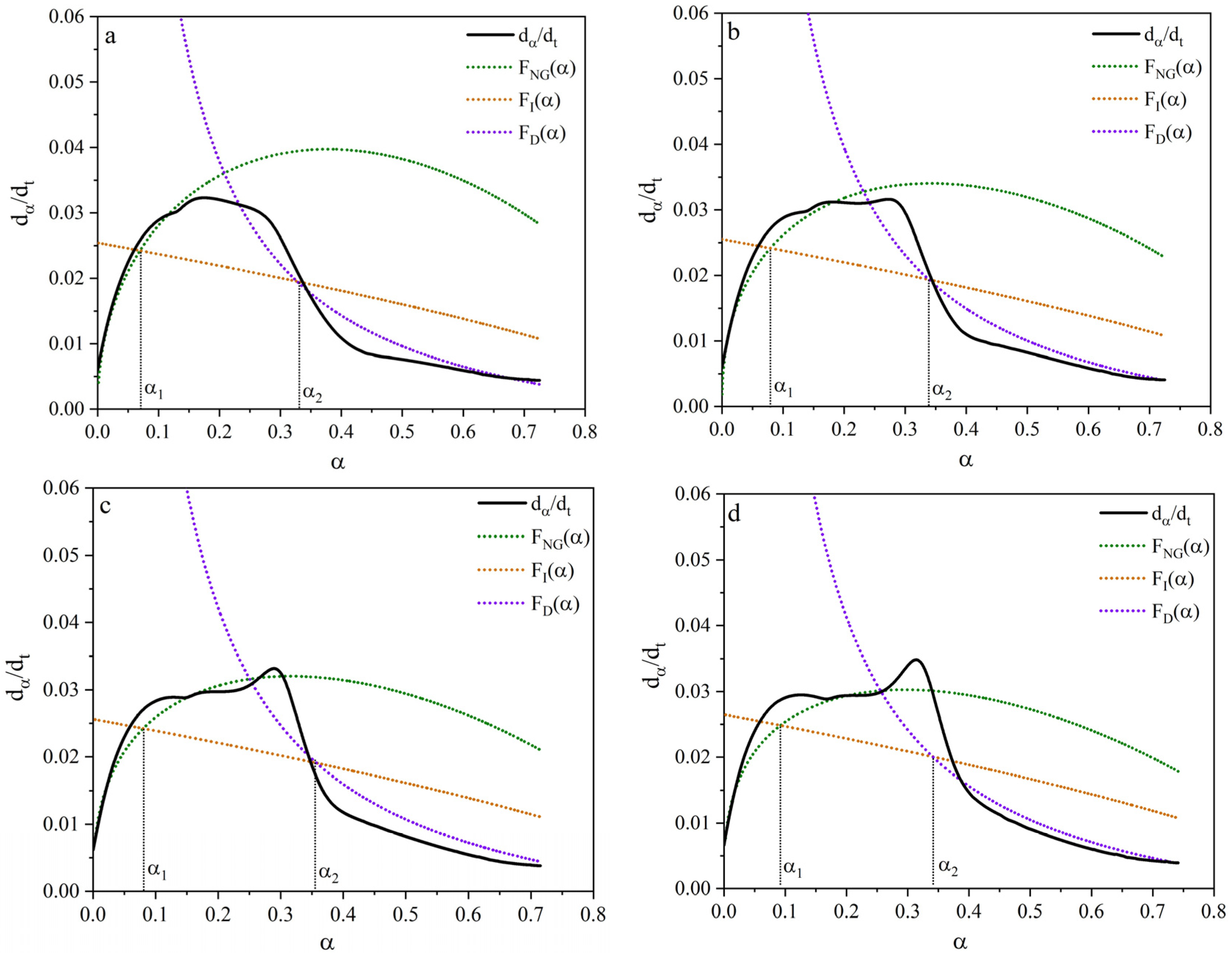
Hydration kinetics were analyzed using the Krstulović–Dabić model based on isothermal calorimetry data [17,18]. The cumulative heat release was first converted to the degree of hydration (α) and the hydration rate (dα/dt) by applying the Knudsen equation to determine the maximum heat release and the reaction half-life [19]. The model describes the hydration process through three consecutive, rate-limiting stages: nucleation and crystal growth (NG), interactions at phase boundaries (I), and diffusion (D), with the overall rate governed by the slowest stage. Kinetic parameters for each process (rate constants KNG′, KI′, KD′, reaction orders, and transition points α1 (NG → I) and α2 (I → D)) were derived by fitting the model to the experimental data. Detailed calculations and derivations follow established procedures referenced in [17,19,20].

3. Results and Discussion

3.1. Setting Time

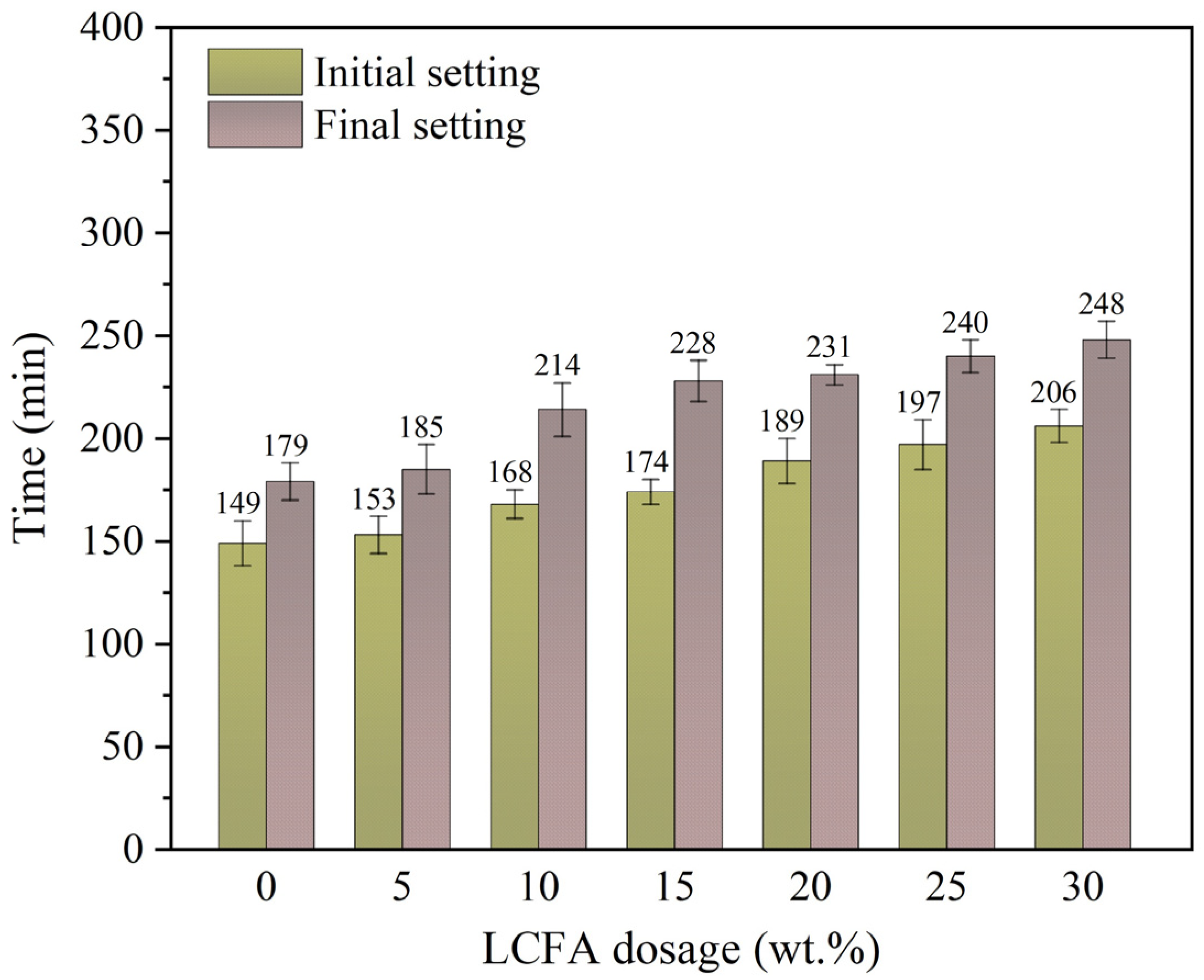
The development trends of the initial and final setting times of the composite paste with an increase in the LCFA dosage are shown in Figure 1. It can be observed that with the increase in LCFA dosage, the setting time (including initial and final setting time) of composite pastes delays significantly. Compared to the control paste, with LCFA dosage increase to 5, 10, 15, 20, 25 and 30 wt.%, the initial setting time increased by 2.7, 12.8, 16.8, 26.8, 32.2 and 38.3%, respectively; the final setting time increased by 3.4, 19.6, 27.4, 29.1, 34.1 and 38.5%, respectively. These results are consistent with the findings reported by Zhang et al., confirming that the incorporation of LCFA leads to a delay in both initial and final setting times, with the extent of retardation being more pronounced at higher LCFA contents [11].
This retardation in setting time can be partly attributed to the dilution effect resulting from the increased water demand in pastes with higher LCFA dosage [20]. During the preparation of composite paste for testing of setting time, increasing LCFA dosage leads to water dosage increase, thereby diluting the effective cementitious for setting. Consequently, the dilution contributes to the prolonged setting time of the composite paste. Furthermore, although LCFA can provide nucleation sites for cement hydration, this effect does not appear to accelerate the setting process [21,22].
A comparative analysis further highlights the retardation effect of LCFA. At a 20 wt.% LCFA dosage, the initial setting time is delayed by 40 min relative to the control paste. In contrast, Benta et al. reported only a 12 min delay with 20 wt.% limestone powder and an 18 min delay with 20 wt.% silica fume [23]. Similarly, a 20 wt.% natural pozzolan was found to delay initial setting by 20 min [24]. These comparisons suggest that the retardation induced by LCFA exceeds what can be explained by dilution alone, implying the involvement of at least one additional unidentified factor influencing the setting behaviour.

3.2. Hydration Heat

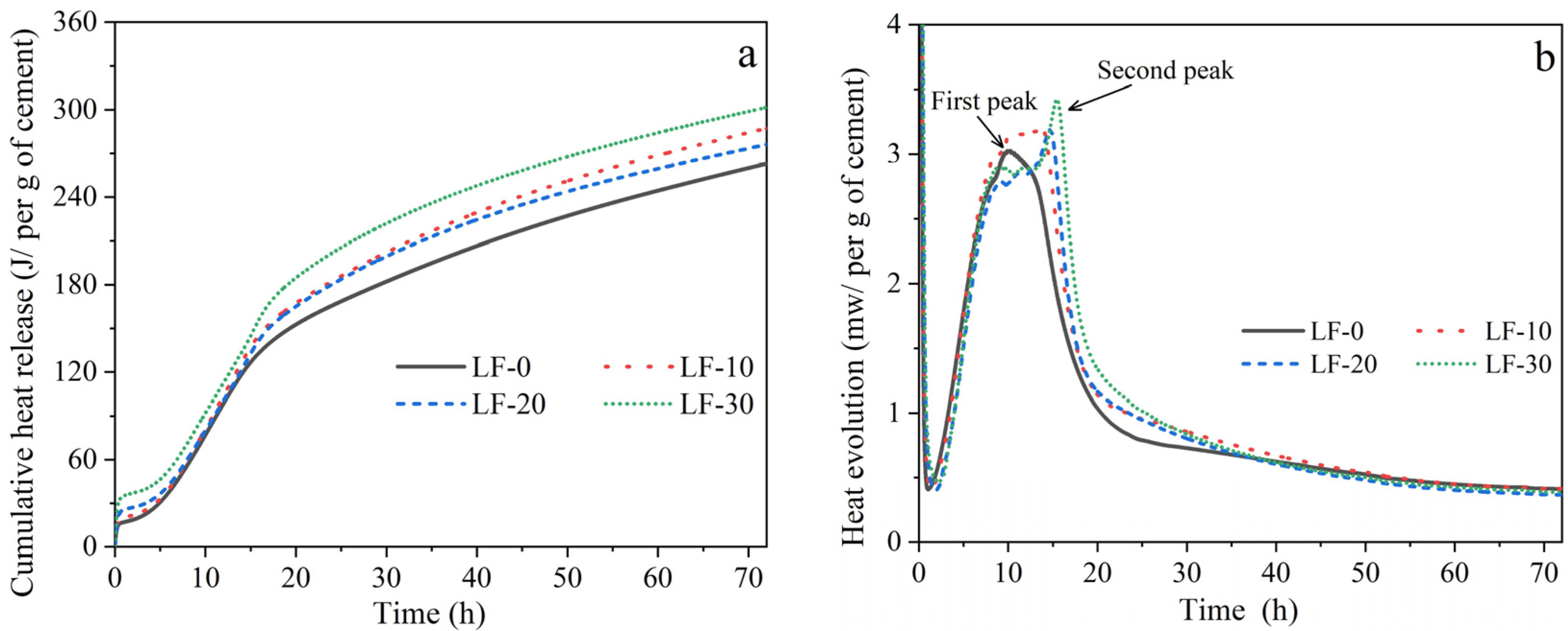
Figure 2a shows the cumulative heat release curves (normalised to the cement dosage) of composite pastes that contain varying LCFA dosage. It can be found that although the cumulative heat release within the first 72 h of the composites is higher than that of LF-0, the cumulative heat release of composite pastes does not exhibit a linear increase trend with higher LCFA dosage. The cumulative heat release for LCFA-0, LCFA-10, LCFA-20 and LCFA-30 is 262.9, 287.1, 276.0 and 301.3 J/g, respectively. Additionally, it is noteworthy that compared to LF-10, LF-20 shows an unexpected decrease in cumulative heat release during the first 72 h. This demonstrates that LCFA exhibits a retardation effect on the hydration of cement.
Figure 2b presents the heat release rate curves of composite pastes with varying LCFA dosages. A distinct exothermic peak (referred to as the first peak) is observed around 10 h in all mixtures, which is commonly attributed to the precipitation of CH (calcium hydroxide) and C–S–H (calcium silicate hydrate) [15]. However, the intensity of this first peak does not increase linearly with LCFA dosage; instead, it decreases significantly in LF-20 and LF-30 compared to LF-0. This indicates that LCFA not only acts as a nucleation site promoting cement hydration and accelerating the precipitation of CH and C-S-H.
Furthermore, while no discernible exothermic peak is observed near 15 h in the LF-0 curve, a clear second exothermic peak emerges in all LCFA-containing pastes. This peak is widely identified in the literature as the “sulfate depletion peak” and is primarily associated with the dissolution of C3A and the precipitation of ettringite [25,26,27]. It should be noted that silicate hydration also contributes substantially to this stage of heat release. For instance, under conditions of 23 °C and a water-to-cement ratio of 0.5, the heat released from silicate hydration at around 15 h (2.0 mW/g) still accounts for more than 50% of the total heat release (3.8 mW/g) [25].
Further analysis of the second peak reveals that both its appearance time and intensity are noticeably affected by LCFA dosage. As the LCFA dosage increases from 10 wt.% to 30 wt.%, the time of the second peak shifts from 13.75 h to 15.67 h, while its intensity rises from 3.19 mW/g to 3.42 mW/g. These results demonstrate that LCFA delays the time of sulfate depletion in the composites and intensifies the hydration reaction that consumes sulfate.
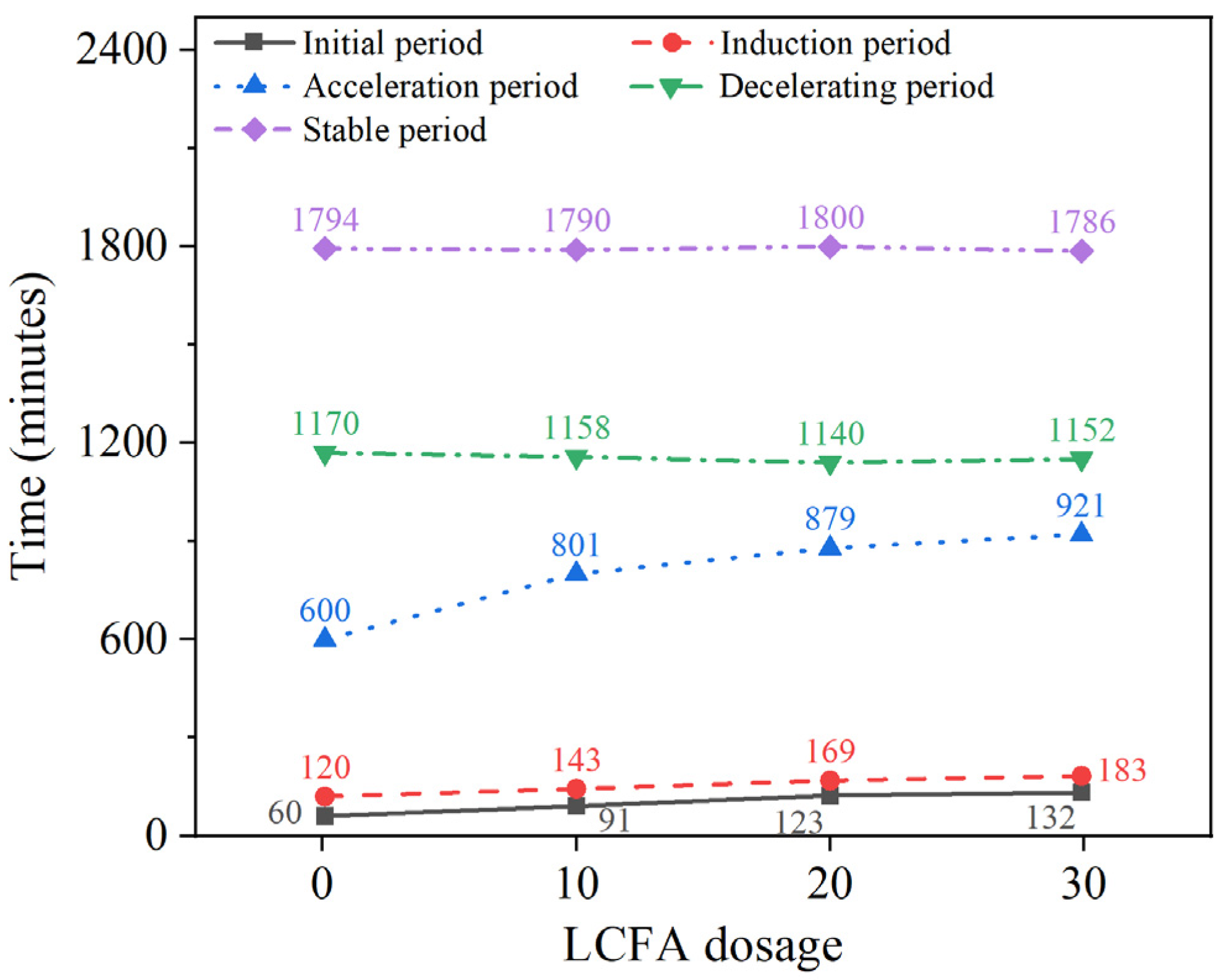
The early hydration process of composites was divided into five periods: (I) initial, (II) induction, (III) acceleration, (IV) deceleration, and (V) stable, and shown in Figure 3 [28,29]. The initial period of LF-0 was 60 min, and it was extended to 91, 123, and 132 min when the LCFA dosage increased to 10, 20, and 30 wt.%, respectively. This indicates that the use of LCFA prolonged the initial period of composites. Correspondingly, the induction period of composites incorporating 0, 10, 20 and 30 wt.% LCFA was postponed to 120, 143, 169, and 183 min. These results align with the findings of Zhang et al., indicating that the retarding effect of LCFA on early-age hydration is primarily attributed to its role in prolonging the time required for key ions in the pore solution to reach critical concentrations [12]. Meanwhile, these results are consistent with previous research demonstrating a linear correlation between the setting time and the induction period, thereby confirming that LCFA contributes to a delay in the setting time of the composites [30,31]. Additionally, the duration of the induction period of the composites with varying LCFA dosages did not exhibit significant differences. The duration of the induction period of LF-0, LF-10, LF-20, and LF-30 was 60, 52, 46, and 49 min, respectively. However, the acceleration period of the composite paste was prolonged as the LCFA increased. This is caused primarily by the appearance of the second heat release peak. Although the duration of the initial and acceleration periods was prolonged owing to the addition of LCFA, the time for the composite paste with varying LCFA dosages to enter the stable period was similar.
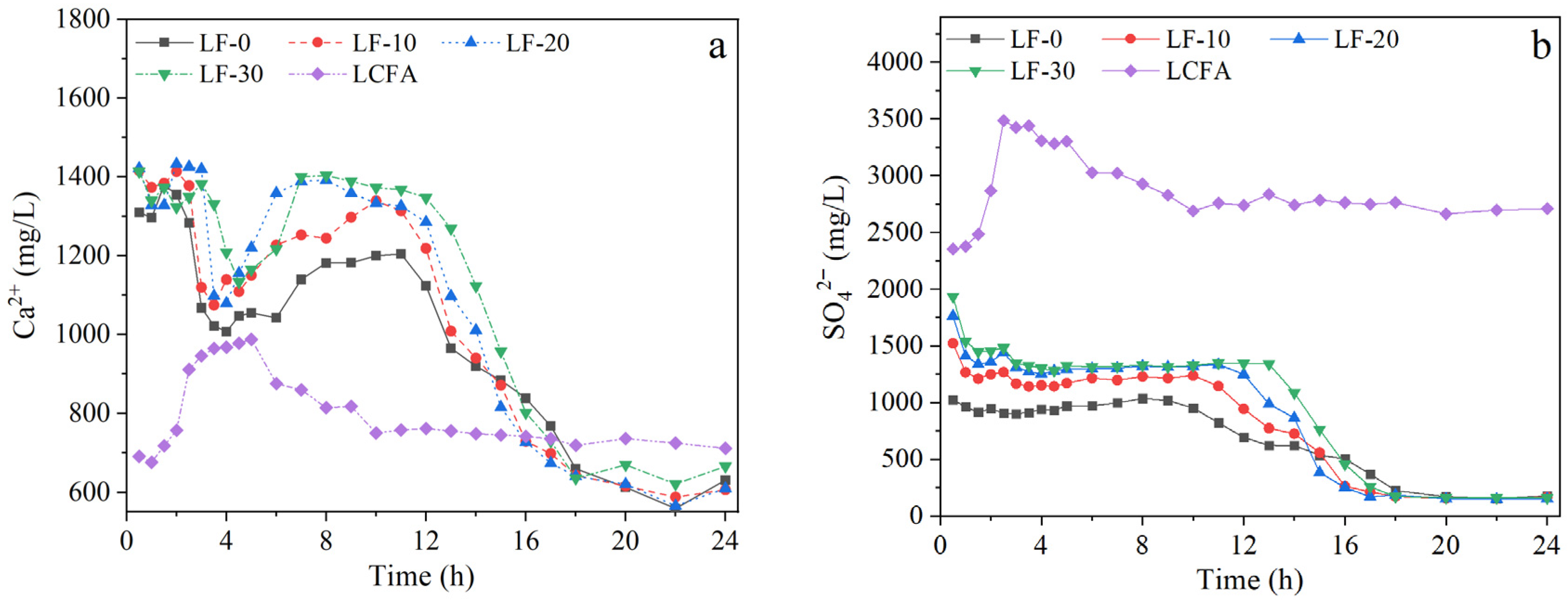
The Ca2+ and SO42− concentrations in the pore solution of composite paste, and in the saturated calcium hydroxide solution containing LCFA, are shown in Figure 4. It can be found from the LCFA curve that the Ca2+ and SO42− concentrations (saturated calcium hydroxide solution containing LCFA) first increased (from 0 to approximately 4 h), then decreased (from around 4 to 10 h), and finally remained stable (after 10 h). This was related to the dissolution and precipitation of anhydrite in LCFA, and indicated that the Ca2+ and SO42− in LCFA would dissolve into the pore solution to participate in the cement hydration during the early hydration stage [31]. After 10 h, no significant differences in Ca2+ and SO42− concentrations were observed from the LCFA curve, thus suggesting that the pozzolanic activity of LCFA remained dormant during the first 24 h. In Figure 4a, all the Ca2+ concentration curves of the pore solution of composites significantly decreased (no clear change in the SO42− concentration curve during the same period). This was due to the precipitation process of CH and C-S-H, which corresponds to the first peak in Figure 2b. After approximately 10 h, those Ca2+ and SO42− concentrations significantly decreased simultaneously, and up to approximately 18 h, both reached steady states. Additionally, the start time of the Ca2+ and SO42− concentration curve drop was significantly delayed as the LCFA dosage increased. Combined with other references, during this period, the decrease in Ca2+ and SO42− concentrations corresponded to the second peak in Figure 2b [31,32].
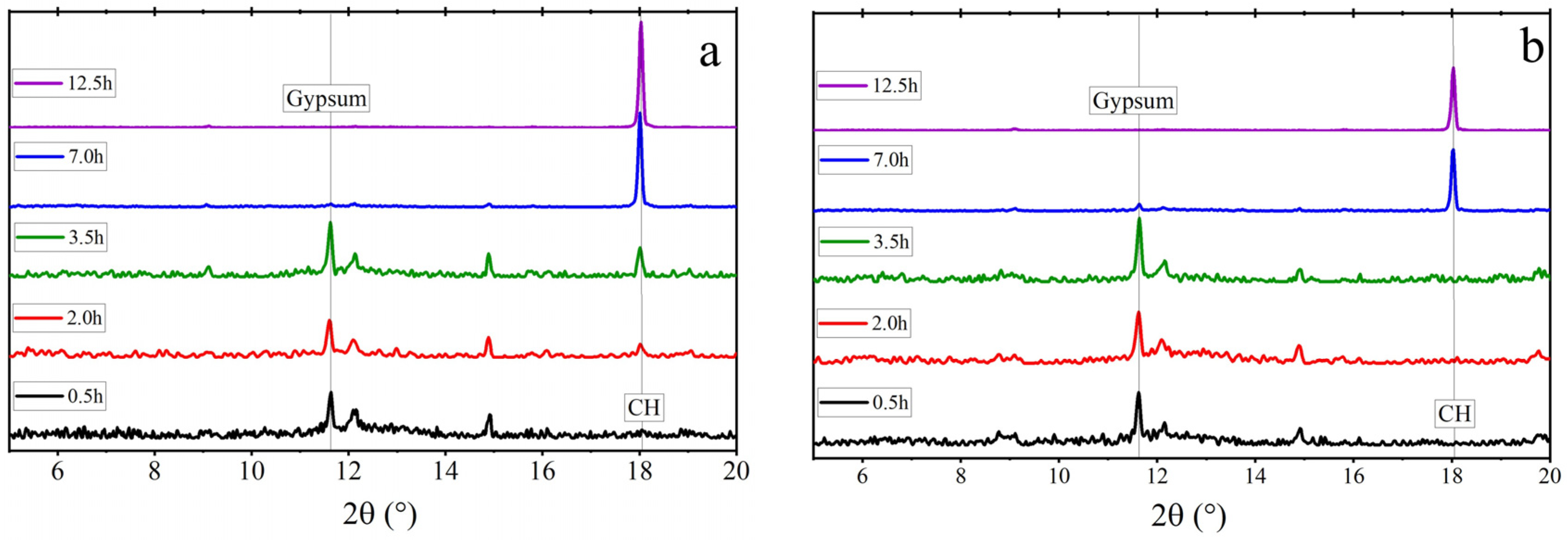
Figure 5 presents XRD results of LF-0 and LF-30 after pore solution extraction. As observed in Figure 5a, no CH peaks were detected in LF-0 at 0.5 h, whereas distinct CH peaks emerged at 2.0 h, with their intensity progressively increasing with hydration time. This indicates that CH precipitation occurs between 0.5 h and 2.0 h in pure cement paste. Conversely, for LF-30 (Figure 5b), CH precipitation appears between 3.5 h and 7.0 h. These findings demonstrate that LCFA incorporation suppresses CH precipitation, significantly delaying its onset. The suppression of CH precipitation in the early hydration stage would influence the calcium-to-silica ratio of hydration products and the progression of the pozzolanic reaction of LCFA, thereby impacting the development of macroscopic properties of the composites [1,25]. Furthermore, this result validates the above conclusion that ‘the decrease in Ca2+ concentration around 3 h in LF-10, LF-20, and LF-30 curves is due to the formation of CH and C-S-H precipitates (Figure 4a). At hydration times of 0.5 h, 2.0 h, and 3.5 h, distinct gypsum peaks are visible in sample LF-0 (Figure 5a). However, by 7.0 h, these gypsum peaks disappear, indicating complete dissolution of gypsum in LF-0 between 3.5 h and 7.0 h. Simultaneously, the hydration time range for complete gypsum dissolution in LF-30 is observed to be between 7.0 h and 12.5 h. This indicates that the conversion of the hydration product from AFt to AFm is slightly delayed, which is beneficial for pore structure refinement and enhanced performance stability of the composites [1,11].

3.3. Hydration Kinetics

Table 3 shows the values of Qmax (maximum heat released until the hydration stops) and t50 (the time at which 50% of Qmax is released) that were obtained based on the Knudsen equation. It can be found that the composites with LCFA present higher Qmax than LF-0, as the LCFA dosage increased to 10, 20 and 30 wt.%, the Qmax increased by 8.4%, 3.0%, and 5.0%, respectively. This was primarily due to the SO42− in LCFA participating in cement hydration, which generates additional exothermic heat. Meanwhile, compared to LF-10, the Qmax of LF-20 decreases by 5.0%, due to the inhibition of LCFA on the hydration of cement.
The hydration kinetic parameters of n, KNG′, KI′, and KD′ were obtained using the Krstulovic–Dabic model and listed in Table 4. It can be found that the increase in LCFA increases the value of n, clearly indicating that the crystal growth was affected by LCFA [33]. Meanwhile, the value of KNG′ presents a decrease with the increased LCFA, indicating that LCFA affects the process of NG, and leads to nucleation and growth rate of hydration products decrease. During this process, although LCFA’s nucleation effect and reduced relative cement content accelerate the nucleation and growth rate of cement hydration products, the use of LCFA may simultaneously lower pore solution pH and adsorb calcium ions [34,35]. Both factors inhibit hydration product nucleation and growth, collectively reducing the KNG′ value [36]. This is consistent with the above result that LCFA has a delaying effect on cement hydration. The value of KI′ increases with the increase in LCFA dosage. This primarily results from sulfate ions participating in the cement hydration reaction, generating additional heat. Additionally, the increase in KD′ value was mainly due to the increase in LCFA dosage increases the porosity of composites and further transports internal moisture to the unhydrated cement particle surface [37]. However, although the LCFA dosage in LF-30 was higher than that in LF-20, its KD′ value decreased instead. This is primarily because the higher LCFA dosage led to more significant hydration reactions, as evidenced by the substantially higher cumulative heat release of LF-30 compared to LF-20 in the hydration heat data. The generation of abundant hydration products resulted in a denser microstructure of the paste, thereby increasing the resistance to moisture transport and ultimately leading to a reduction in the diffusion rate constant KD′.
Utilizing the Krstulovic–Dabic model and the derived kinetic parameters, hydration kinetics curves of composites that contain varying LCFA dosage were drawn and shown in Figure 6. The value of α1 and α2, respectively, corresponding to the changing boundaries of NG to I and I to D, was obtained. The α1 values of LF-0, LF-10, LF-20 and LF-30 were 0.070, 0.079, 0.080 and 0.092, respectively; the α2 values of LF-0, LF-10, LF-20 and LF-30 were 0.328, 0.338, 0.357 and 0.340, respectively. It can be found that with an increase in LCFA dosage, the hydration degree of composites transforms from NG to I was higher. This was caused by the delayed effects of LCFA on cement hydration [35,38]. Meanwhile, the α2 values of composites containing LCFA were significantly higher than those of LF-0, meaning that LCFA leads to a higher hydration degree of composites that transforms from NG to I. However, it should be noted that the α2 values of LF-30 were smaller than those of LF-20, and this may be due to the influence of sulfate ion differences on cement hydration [39].

4. Conclusions

This study investigated the early hydration behaviors and kinetics of composites incorporating LCFA. The early hydration behaviors were analyzed based on the hydration heat, pore solution ion concentrations (ICP), and XRD results, and the hydration kinetics were described by the Krstulovic–Dabic model. The key findings are summarized as follows:
(1) Early hydration behaviors. The incorporation of LCFA led to a significant delay in both the initial and final setting time of the composites. This retardation can be attributed to the combined effects of the dilution effect caused by the reduction in cement and the inhibition of CH and C-S-H precipitation by LCFA, coupled with a delayed depletion of sulfate ions.
(2) Hydration kinetics. The hydration process of the composites conformed to the Krstulovic–Dabic model, progressing through three stages: nucleation and crystal growth (NG), interactions at phase boundaries (I), and diffusion (D). An increase in LCFA dosage enhanced the reaction rate constants of all three stages (KNG′, KI′, and KD′). The increase in KNG′ primarily stemmed from the nucleation effect provided by LCFA, which promoted cement hydration. The rise in KI′ was attributed not only to this nucleation effect but also to the additional heat release facilitated by sulfate ions derived from LCFA. The increase in KD′ was mainly due to the lack of pozzolanic reaction of LCFA at early ages; higher LCFA dosage led to reduced internal diffusion resistance, thereby accelerating the reaction rate. The higher porosity and lower ionic transport resistance in composites with increased LCFA dosage also resulted in an elevation of the critical hydration degrees required for the transitions from NG to I and from I to D.

Author Contributions

Conceptualization, S.-C.K.; methodology, C.-R.W.; validation, C.-R.W.; formal analysis, C.-R.W.; data curation, C.-R.W.; writing—original draft preparation, C.-R.W.; writing—review and editing, C.-R.W. and Z.-P.X.; visualization, C.-R.W.; supervision, J.-J.W.; project administration, M.-X.T. and S.-C.K.; funding acquisition, S.-C.K. All authors have read and agreed to the published version of the manuscript.

Funding

This research was funded by the National Natural Science Foundation of China (No. 52341801), Shenzhen Science and Technology Plan Project (KCXST20221021111205012), Postdoctoral Fellowship Program of CPSF (No. GZC20230594), and Science and Technology Project of Guangzhou Construction Group Co., Ltd. (No. [2024]-KJ0001).

Data Availability Statement

The original contributions presented in this study are included in the article. Further inquiries can be directed to the corresponding authors.

Conflicts of Interest

The authors declare no conflicts of interest.

References

  1. Wu, C.R.; Zhan, B.J.; Hong, Z.Q.; Cui, S.C.; Cui, P.; Kou, S.C. Hydration behavior of circulating fluidized bed fly ash (CFBFA) as a cementitious binder. Constr. Build. Mater. 2022, 314, 125625. [Google Scholar] [CrossRef]
  2. He, P.; Zhang, X.; Chen, H.; Zhang, Y. Waste-to-resource strategies for the use of circulating fluidized bed fly ash in construction materials: A mini review. Powder Technol. 2021, 393, 773–785. [Google Scholar] [CrossRef]
  3. Li, D.; Wang, D.; Ren, C.; Rui, Y. Investigation of rheological properties of fresh cement paste containing ultrafine circulating fluidized bed fly ash. Constr. Build. Mater. 2018, 188, 1007–1013. [Google Scholar] [CrossRef]
  4. Zheng, D.; Wang, D.; Cui, H.; Chen, X. Hydration characteristics of cement with high volume circulating fluidized bed fly ash. Constr. Build. Mater. 2023, 380, 131310. [Google Scholar] [CrossRef]
  5. Yue, G.; Cai, R.; Lu, J.; Zhang, H. From a CFB reactor to a CFB boiler—The review of R&D progress of CFB coal combustion technology in China. Powder Technol. 2017, 316, 18–28. [Google Scholar] [CrossRef]
  6. Chi, M.; Huang, R. Effect of circulating fluidized bed combustion ash on the properties of roller compacted concrete. Cem. Concr. Compos. 2014, 45, 148–156. [Google Scholar] [CrossRef]
  7. Liu, W.; Liu, X.; Zhang, L.; Wan, Y.; Li, H.; Jiao, X. Rheology, mechanics, microstructure and durability of low-carbon cementitious materials based on circulating fluidized bed fly ash: A comprehensive review. Constr. Build. Mater. 2024, 411, 134688. [Google Scholar] [CrossRef]
  8. Chen, X.; Gao, J.; Yan, Y.; Liu, Y. Investigation of expansion properties of cement paste with circulating fluidized bed fly ash. Constr. Build. Mater. 2017, 157, 1154–1162. [Google Scholar] [CrossRef]
  9. Zhang, W.; Liu, X.; Zhang, Z. Mechanical, expansion and rheological properties of circulating fluidized bed fly ash based ecological cement: A critical review. Int. J. Miner. Metall. Mater. 2022, 29, 1670–1682. [Google Scholar] [CrossRef]
  10. Lee, H.K.; Jeon, S.M.; Lee, B.Y.; Kim, H.K. Use of circulating fluidized bed combustion bottom ash as a secondary activator in high-volume slag cement. Constr. Build. Mater. 2020, 234, 117240. [Google Scholar] [CrossRef]
  11. Zhang, W.Y.; Wang, S.; Duan, X.H.; Jin, Y.Z.; Feng, C.H.; Zhu, J.P.; Su, F.Q. Mechanical properties, durability and microstructure of cementitious materials with low-calcium circulating fluidized bed fly ash. Constr. Build. Mater. 2023, 369, 130394. [Google Scholar] [CrossRef]
  12. Zhang, W.Y.; Wang, S.; Zhao, L.Y.; Ran, J.S.; Kang, W.J.; Feng, C.H.; Zhu, J.P. Investigation of Low-Calcium Circulating Fluidized Bed Fly Ash on the Mechanical Strength and Microstructure of Cement-Based Material. Crystals 2022, 12, 400. [Google Scholar] [CrossRef]
  13. Wu, C.R.; Tang, W.; Luo, F.M.; Kou, S.-C.; Xing, F. Comparative performance of ordinary and recycled aggregate concrete incorporating CFA as SCM. Low-Carbon Mater. Green Constr. 2025, 3, 19. [Google Scholar] [CrossRef]
  14. GB/T 1346-2011; Test Methods for Water Requirement of Standard Consistency, Setting Time Andsoundness of the Portland Cement. Standards Press of China: Beijing, China, 2011.
  15. Wu, C.R.; Tang, W.; Huo, Y.L.; Zhan, B.J.; Kou, S.C. Investigation of Fresh Properties of Self-Leveling Cement-Based Pastes with CFB Fly Ash as an SCM. Buildings 2025, 15, 966. [Google Scholar] [CrossRef]
  16. Zhuang, S.; Wang, Q. Inhibition mechanisms of steel slag on the early-age hydration of cement. Cem. Concr. Res. 2021, 140, 106283. [Google Scholar] [CrossRef]
  17. Krstulović, R.; Dabić, P. A conceptual model of the cement hydration process. Cem. Concr. Res. 2000, 30, 693–698. [Google Scholar] [CrossRef]
  18. Han, F.H. Study on Hydration Characteristics and Kinetics of Composite Binder; China University of Mining and Technology: Beijing, China, 2015. [Google Scholar]
  19. Qin, C.; Gong, J.; Xie, G. Modeling Hydration Kinetics of the Portland-Cement-Based Cementitious Systems with Mortar Blends by Non-Assumptive Projection Pursuit Regression. Thermochim. Acta 2021, 705, 179035. [Google Scholar] [CrossRef]
  20. Wei, X.X.; Zhu, J.H.; Pei, C. Tailored water-based graphene nanofluid additives for high-performance, low-carbon, and cost-effective nanoengineered concrete. Constr. Build. Mater. 2025, 483, 141788. [Google Scholar] [CrossRef]
  21. Ezziane, K.; Kadri, E.H.; Hallal, A.; Duval, R. Effect of mineral additives on the setting of blended cement by the maturity method. Mater. Struct. 2010, 43, 393–401. [Google Scholar] [CrossRef]
  22. Berodier, E.; Scrivener, K. Understanding the Filler Effect on the Nucleation and Growth of C-S-H. J. Am. Ceram. Soc. 2014, 97, 3764–3773. [Google Scholar] [CrossRef]
  23. Bentz, D.P.; Ferraris, C.F.; Jones, S.Z.; Lootens, D.; Zunino, F. Limestone and silica powder replacements for cement: Early-age performance. Cem. Concr. Compos. 2017, 78, 43–56. [Google Scholar] [CrossRef]
  24. Malhotra, V.M.; Mehta, P.K. Pozzolanic and Cementitious Materials, 1st ed.; CRC Press: Boca Raton, FL, USA, 2004. [Google Scholar]
  25. Jansen, D.; Goetz-Neunhoeffer, F.; Lothenbach, B.; Neubauer, J. The early hydration of Ordinary Portland Cement (OPC): An approach comparing measured heat flow with calculated heat flow from QXRD. Cem. Concr. Res. 2012, 42, 134–138. [Google Scholar] [CrossRef]
  26. Sandberg, P.; Roberts, L. Cement-Admixture Interactions Related to Aluminate Control. J. ASTM Int. 2005, 2, 1–14. [Google Scholar] [CrossRef]
  27. Hesse, C.; Goetz-Neunhoeffer, F.; Neubauer, J. A new approach in quantitative in-situ XRD of cement pastes: Correlation of heat flow curves with early hydration reactions. Cem. Concr. Res. 2011, 41, 123–128. [Google Scholar] [CrossRef]
  28. Bai, S.; Guan, X.; Li, G. Early-age hydration heat evolution and kinetics of Portland cement containing nano-silica at different temperatures. Constr. Build. Mater. 2022, 334, 127363. [Google Scholar] [CrossRef]
  29. Wu, X.Q. Kinetic Study on Hydration of Blast Furnace Slag Cement. J. Chin. Ceram. Soc. 1988, 5, 423–429. [Google Scholar] [CrossRef]
  30. Zhou, M.; Chen, P.; Chen, X.; Ge, X.; Wang, Y. Study on hydration characteristics of circulating fluidized bed combustion fly ash (CFBCA). Constr. Build. Mater. 2020, 251, 118993. [Google Scholar] [CrossRef]
  31. Lin, Z. Cementitious Materials, 1st ed.; Wuhan University of Technology Press: Wuhan, China, 2014. [Google Scholar]
  32. Scrivener, K.; Snellings, R.; Lothenbach, B. A Practical Guide to Microstructural Analysis of Cementitious Materials, 1st ed.; Taylor and Francis Group: Boca Raton, FL, USA, 2016. [Google Scholar]
  33. Zhou, L.; Gou, M.; Guan, X. Hydration kinetics of cement-calcined activated bauxite tailings composite binder. Constr. Build. Mater. 2021, 301, 124296. [Google Scholar] [CrossRef]
  34. Lothenbach, B.; Scrivener, K.; Hooton, R.D. Supplementary cementitious materials. Cem. Concr. Res. 2011, 41, 1244–1256. [Google Scholar] [CrossRef]
  35. Han, F.; Zhang, Z.; Wang, D.; Yan, P. Hydration kinetics of composite binder containing slag at different temperatures. J. Therm. Anal. Calorim. 2015, 121, 815–827. [Google Scholar] [CrossRef]
  36. Fang, K.; Wang, D.; Gu, Y. Utilization of Gasification Coarse Slag Powder as Cement Partial Replacement: Hydration Kinetics Characteristics, Microstructure and Hardening Properties. Materials 2023, 16, 1922. [Google Scholar] [CrossRef] [PubMed]
  37. Xin, J.; Liu, L.; Jiang, Q.; Yang, P.; Qu, H.; Xie, G. Early-age hydration characteristics of modified coal gasification slag-cement-aeolian sand paste backfill. Constr. Build. Mater. 2022, 322, 125936. [Google Scholar] [CrossRef]
  38. Zhang, N.; Li, H.X.; Liu, X.M. Hydration kinetics of cementitious materials composed of red mud and coal gangue. Int. J. Miner. Metall. Mater. 2016, 23, 1215–1224. [Google Scholar] [CrossRef]
  39. Taylor, H.F.W. Cement Chemistry, 2nd ed.; Thomas Telford Publishing: London, UK, 1997. [Google Scholar]
Figure 1. Setting time of composite paste incorporating varying LCFA dosage.
Jcs 09 00671 g001
Figure 2. Cumulative heat release (a) and heat evolution (b) of composite paste with varying LCFA dosage.
Jcs 09 00671 g002
Figure 3. Five periods of early hydration of a composite paste that contains varying LCFA dosage.
Jcs 09 00671 g003
Figure 4. Ca2+ (a) and SO42− (b) concentration change in the pore solution of composite pastes.
Jcs 09 00671 g004
Figure 5. XRD patterns of LF-0 (a) and LF-30 (b).
Jcs 09 00671 g005
Figure 6. Hydration kinetics curves of LF-0 (a), LF-10 (b), LF-20 (c) and LF-30 (d).
Jcs 09 00671 g006
Table 1. Composite of raw materials (wt.%).
SO3CaOAl2O3MgOFe2O3SiO2K2ONa2OOthersLOI
Cement1.8763.404.782.703.6419.520.920.321.241.62
LCFA2.472.8122.861.758.0353.651.571.321.154.40
Table 2. Proportions of composites for setting time tests (g).
CementLCFAWater
LF-06000167
LF-557030176
LF-1054060187
LF-1551090200
LF-20480120213
LF-25450150221
LF-30420180230
Table 3. Knudsen equation for the determination of Qmax and t50.
Qmax (J)t50 (h)Knudsen Equation
LF-0336.729.31/Qt = 0.00297 + 0.0869 × 1/(T − T0)
LF-10365.028.21/Qt = 0.00274 + 0.0772 × 1/(T − T0)
LF-20346.726.41/Qt = 0.00288 + 0.07828 × 1/(T − T0)
LF-30353.425.21/Qt = 0.00283 + 0.07129 × 1/(T − T0)
Table 4. Kinetic parameters of the hydration process.
nKNGKIKD
LF-01.907080.0477390.008480.00210
LF-101.717560.0433340.008510.00219
LF-201.613130.0419390.008540.00234
LF-301.540470.0403040.008830.00229
Disclaimer/Publisher’s Note: The statements, opinions and data contained in all publications are solely those of the individual author(s) and contributor(s) and not of MDPI and/or the editor(s). MDPI and/or the editor(s) disclaim responsibility for any injury to people or property resulting from any ideas, methods, instructions or products referred to in the content.