Article

Comparison of Compressive Properties of 3D-Printed Triply Periodic Minimal Surfaces and Honeycomb Lattice Structures

School of Aerospace and Mechanical Engineering, The University of Oklahoma, 865 Asp Ave., Felgar Hall, Norman, OK 73019, USA
*
Author to whom correspondence should be addressed.
J. Compos. Sci. 2025, 9(11), 586; https://doi.org/10.3390/jcs9110586
Submission received: 26 September 2025 / Revised: 19 October 2025 / Accepted: 27 October 2025 / Published: 1 November 2025
(This article belongs to the Special Issue Additive Manufacturing of Composites and Nanocomposites, 2nd Edition)

Abstract

Additive manufacturing has enabled the fabrication of complex, bioinspired lattice structures, such as Triply Periodic Minimal Surfaces (TPMSs), for use in lightweight structural applications. To assess their engineering viability, this study benchmarks the compressive properties of isotropic Gyroid and Primitive TPMS lattices against those of the conventional, anisotropic Honeycomb structure, which is widely used in the aerospace industry. We employed a combined computational and experimental approach, using Finite Element Analysis (FEA) for initial evaluation followed by mechanical compression testing of stereolithography (SLA)-printed polymer samples. Full-field strain was measured using Digital Image Correlation (DIC) to validate the simulations. The results show that the Gyroid has a strength-to-density of 5.692, the Primitive has a ratio of 5.182, the Honeycomb in the axial direction has a ratio of 26.144, and the Honeycomb in the transverse direction has a ratio of 1.008, all in units of N · k g 1 m 3 . These results clearly indicate that the Honeycomb is best when uniaxially loaded. For other applications where the load paths will vary in multiple directions, the Gyroid is the better option.

1. Introduction

Lattice structures offer exceptional mechanical properties, such as high strength-to-weight ratios, enhanced stiffness, and superior energy absorption [1,2,3]. These cellular lattice structures are characterized by a network of repeating unit cells, which can be either strut-based or surface-based. The development of additive manufacturing (AM) has revolutionized the fabrication of lattice structures by enabling the production of highly complex and optimized lattice geometries that were previously unmanufacturable [4,5,6,7,8,9]. This technological advancement has spurred significant research into novel lattice designs for a wide range of applications, from aerospace components to biomedical implants, where performance and weight reduction are critical.
A common example of these structures is the honeycomb sandwich composite, which is used for light-weighting, generally seen between composite laminates to increase rigidity and strength. These structures are easy to manufacture and increase the strength of the laminate without adding much weight [10,11,12]. Honeycomb sandwich structures are used for aerospace applications, including aircraft control surfaces, engine nacelles, engine doors, and landing gear [13,14]. For spacecraft, honeycomb can be used for pyroshock isolation in booster separation or payload fairing on the launch vehicle. Still, it is not as widely used due to the loading conditions and temperature gradient present during takeoff [15,16]. The load path on the control surfaces on an aircraft leads to compressive forces on the honeycomb core. Despite the light-weighting ability of the Honeycomb core, there are also many disadvantages. First, Honeycomb is anisotropic, meaning it has different properties in different directions. Honeycomb is only strong in one direction, noted as Honeycomb Axial. The weak loading direction is notated as Honeycomb Transverse. This anisotropic property limits honeycomb applications to load paths in a single direction. Moreover, many industries insert additional material into the honeycomb filler material to enhance the strength of the honeycomb [17]. This adds weight to a structure that was made for the purpose of weight reduction. Due to this disadvantage of the honeycomb’s anisotropic behavior, there is a need for an investigation of isotropic structures that may reduce weight without the need for filler material.
Triply Periodic Minimal Surfaces (TPMSs) were chosen as an isotropic comparison to honeycomb for many reasons [18,19,20]. One advantage of TPMSs is that they are a phenomenon seen in many different places in nature on a microscopic level. The most common TPMS seen in nature are the Primitive, Diamond, and Gyroid surfaces [19,21]. The development of butterfly wings uses a process of degradation that ends with the most optimized structure as a Gyroid, and a beetle skeleton uses the Diamond structure for its reflective properties [22]. These structures provide the baseline for nature’s own lightweighting lattices for enhanced strength-to-weight ratio. Another advantage of TPMSs is that they allow for a stress-effective geometry due to the lack of corners and intersections that cause stress concentrations in other structures. However, due to the self-intersecting design, TPMS can only be manufactured using AM. Despite this disadvantage, the TPMS were chosen as the optimal isotropic candidate for comparison to honeycomb. The compressive strength of the Gyroid, Primitive, and Diamond TPMS will be compared in compression with Honeycomb in both the Axial and Transverse directions.
AM is necessary for the fabrication of TPMS samples. There are three main types of AM to be considered. First, continuous stereolithography (SLA) printing uses ultraviolet light to cure liquid resin that is held in a vat one layer at a time to build a shape from the bottom up [23,24]. Next, Fused Deposition Modeling (FDM) prints by extruding filament through a heated nozzle [25]. Finally, Powder Bed Fusion (PBF) prints by fusing powder together using an energy source, typically a laser or electron beam [26,27,28,29]. SLA printers have an advantage because they can print at a higher resolution than other types of printers since the resin is cured by light, causing a detailed and smooth finish [23]. However, the process of using an SLA printer can be expensive and time-consuming. FDM printers are inexpensive and easy to use, but have a disadvantage in the anisotropic properties of the final product caused by the large voids between each layer [30]. PBF can 3D print with metal, but it is expensive and can have a rough surface finish due to the energy introduced by the beam [23,31]. PBF can also be hard to simulate due to the unique properties caused by the fusion of the powder during the manufacturing process [32]. Considering all the advantages and disadvantages of the different types of printers, the SLA printer was chosen for printing the testing samples because of its high-resolution capability for small prints.
This paper presents a comprehensive comparison of additively manufactured TPMS lattices and traditional Honeycomb, using an integrated approach of parametric design, FEA simulation, and experimental testing. The primary contribution is the use of Digital Image Correlation (DIC) to provide full-field strain validation of the computational models, offering more profound insight into failure mechanics than standard testing. By directly benchmarking these advanced isotropic lattices against an industry-standard anisotropic material, this work provides critical data for designing lightweight structures for complex, multi-axial loading applications.

2. Materials and Methods

2.1. Sample Sizing Process

The TPMS samples were sized to ensure that they are comparable to the ordering specifications of Honeycomb manufacturing companies. The following table outlines the possible cell sizes and thicknesses of honeycomb that can be ordered from various companies. This was used as the basis to decide the cell size and height of the TPMS for testing. The cell size is the size of one repeating shape, and height is how tall the sample is compared to its cell size.
Multiple companies offer Honeycomb in a variety of different materials: Nomex, aluminum, aramid, and thermoplastics. Aluminum is typically used for aerospace applications, and the thickness of the sheets is a small 0.05 mm. This means that the TPMS would benefit from a comparison with a thin material. Based on the ordering specifications from the companies listed in Table 1, samples with cell sizes and heights of 3.175–12.7 mm and a thickness of 0.05 mm would be comparable to industry. The resolution of the printer ultimately determined the final sample sizes.

2.2. Design Process

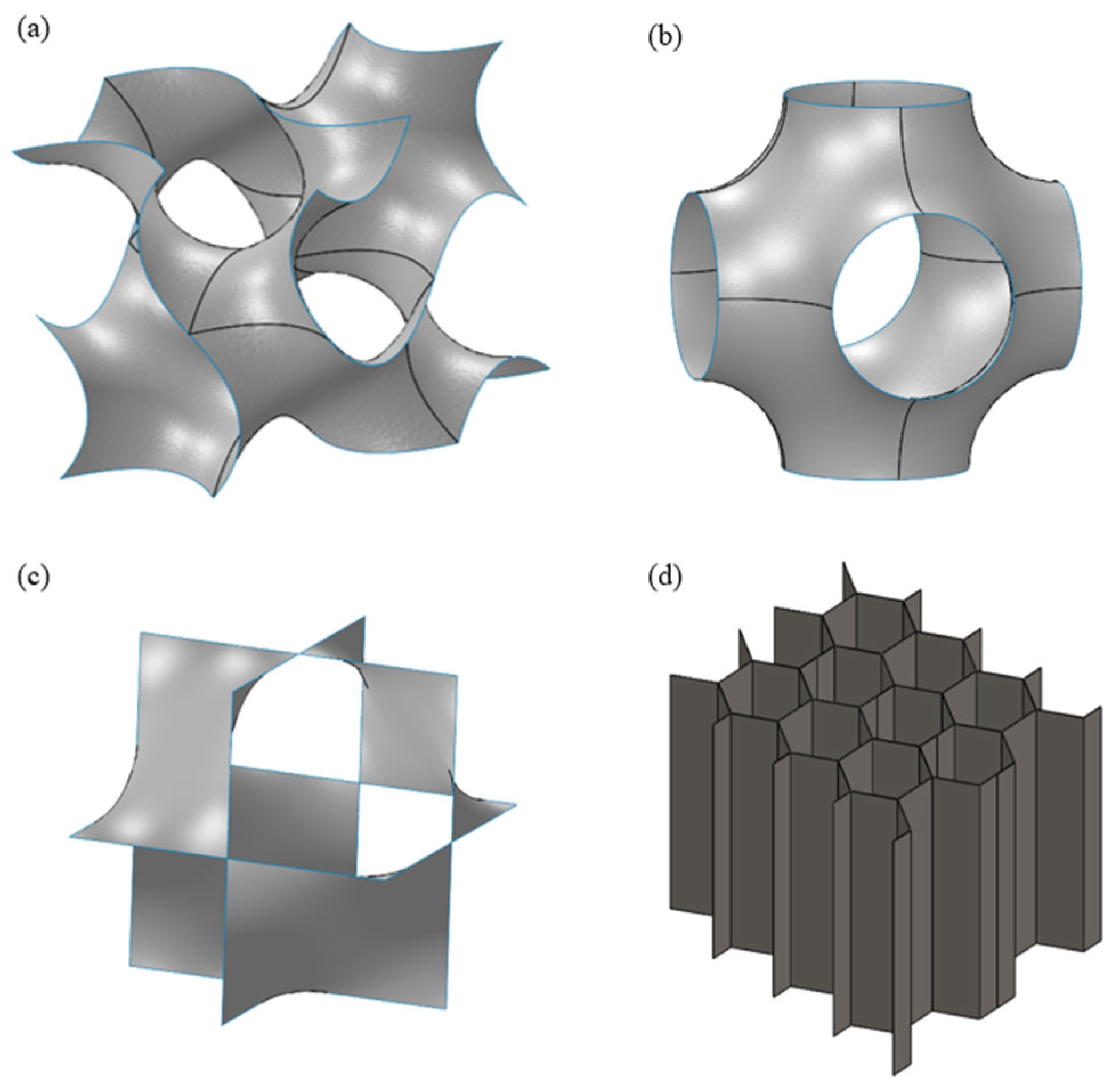
SolidWorks 2024 was used to design the lattice structures. The design was parameterized so that the dimensions and thickness could be easily changed. Each surface was designed in a similar manner, with different curves. To start the TPMS designs, a cube was made with parameterized side lengths. On each face of a cube, lines were drawn. Each line on one face intersects one corresponding line on another face. When finished, this makes one line connected through the faces of the cube. The body of the cube was deleted, and the remaining curves were merged to make a continuous surface. This process is used to make the Gyroid, Primitive, and Diamond structures, as shown in Figure 1. The only difference between the structures is the lines on the faces of the initial cube. Both the Gyroid and the Primitive had a sketch on each side of the parameterized cube. These sketches were merged to make a surface, as mentioned above. The Diamond cell was made in a 3D sketch by tracing the edges of the parameterized cube so that they were constantly connected, and the following curves were merged into a surface. This process allowed for fast modeling changes. Each cube corresponds to an eighth of the cell. The surfaces are simply moved, rotated, and merged to make the final cell designs. The parametrization of the design allowed for fast changes between cell sizes, heights, and thickness of the lattice structures. Designing the Honeycomb structures was simple. SolidWorks has a hexagon shape function. A sketch was drawn using this hexagonal function and extruded to make the Honeycomb surface. The Honeycomb was trimmed in such a way that the hexagonal structure was symmetrical.

2.3. Simulation Configuration

The Engineering Data in Ansys Workbench was calculated to be as accurate as possible so that there were reasonable evaluations of the TPMS and Honeycomb prior to testing. The material properties of the resin were given to make a custom material in Ansys that accurately reflects the properties of the standard ANYCUBIC resin. The density ρ , elastic modulus E, and Poisson’s ratio υ are needed to make the custom material, summarized in Table 1.
The tensile stress and related elongation were used to calculate the strain ε   and elastic modulus E of the material. Due to the isotropic nature of the material, Equation (1) was used. Finally, Poisson’s ratio υ was estimated to be 0.33 based on other polymer resins [33]. To insert the custom material into Ansys Workbench, an Isotropic Elasticity material was added.
E = σ ε
The compression simulation configuration was modeled to match the testing configuration. For the Gyroid, Primitive, and Honeycomb Axial samples, the edge of the sample that was placed on the machine was modeled as a fixed support, and the top of the sample touching the machine was modeled as a force. The Honeycomb Transverse simulation and test configuration were slightly different. The orientation of the Honeycomb was chosen so that the machine would touch an entire cell of the sample. This meant that the Honeycomb Transverse sample needed an additional boundary condition to prohibit movement in the Z direction because honeycomb sandwich structures typically prevent this movement. A brace was designed for testing to restrict the honeycomb in the Z direction, and a fixed displacement was used during the Ansys simulation to model the effect.

3. Experiments

3.1. SLA Printing Process

The ANYCUBIC D2 SLA (Anycubic Technology Co., Ltd, Shenzhen, China) printer was used to manufacture samples. Due to the abundance of High Clear Standard resin available, Standard ANYCUBIC resin was used. Furthermore, the isotropic material had given material properties from the website to assist with evaluation. The samples were inserted into a slicer software called CHITUBOX basic v2 for the slicing process.
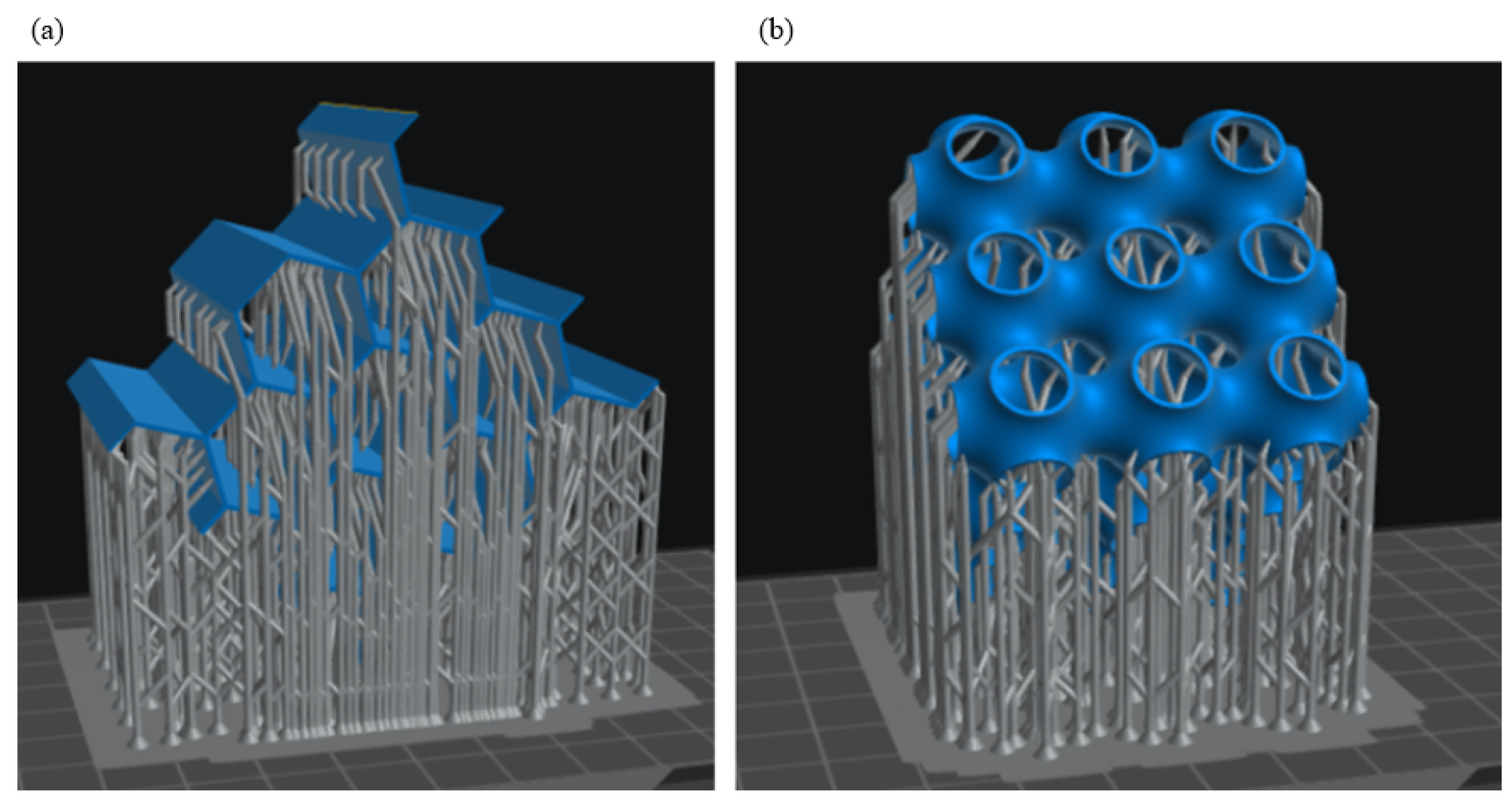
Each of the lattice structures needed to be evaluated to see if support was necessary. Due to the SLA printing process, any shape that has a closed loop on the starting surface of the print needs to be rotated to help prevent it from sticking to the resin bed. Due to this, both the Primitive and Honeycomb shapes needed to be angled as they were printed, because the Primitive has closed circles as its bottom slice and the Honeycomb has closed hexagons as its bottom slice. The final supports are shown in Figure 2.
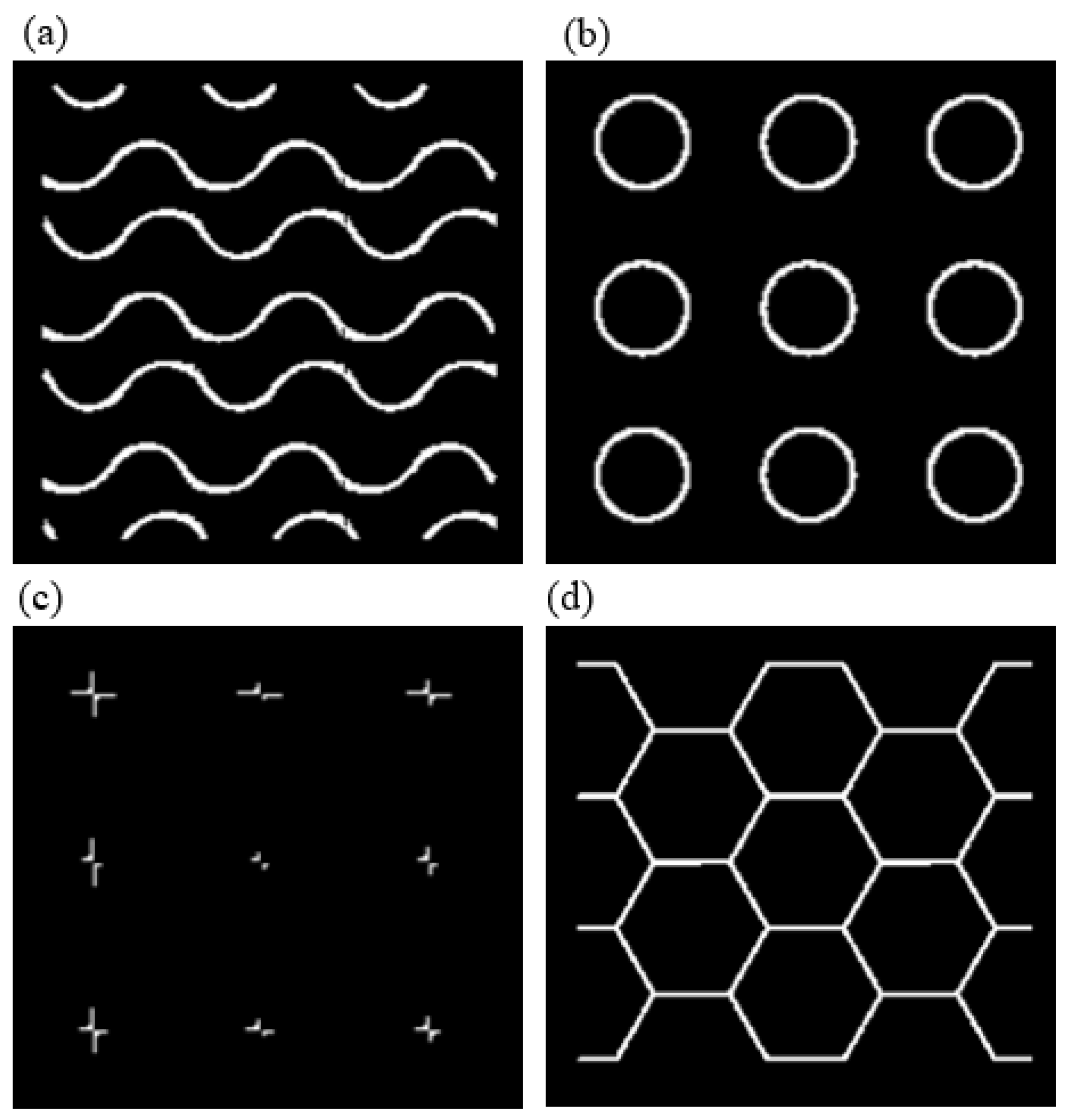
The Gyroid and Diamond shapes, however, have sine waves and lines as their bottom surfaces, shown in Figure 3. This meant that they could be printed without supports. This makes the manufacturing process quick, easy, and highly successful. This was a major reason why the Gyroid was tested. The closed surfaces of the printing initial layers of the Primitive and Honeycomb are also shown in Figure 3. The Gyroid and Diamond have no closed loops, while the Primitive and Honeycomb shapes both have closed shapes that would cause the model to stick to the bottom of the resin reservoir.
Before the start of each print, the printer was thoroughly cleaned with isopropyl alcohol to ensure that there was no resin between the vat of resin and the glass surface that emits UV light. This ensured that the UV light did not have any problems curing the model on the build plate.
After the prints were finished, there were several steps that were taken to prepare the sample for compression testing. First, the excess resin was removed. This was achieved by soaking the sample in isopropyl alcohol. This substance absorbs the excess resin that may remain on the sample after it is finished printing. After this, the supports were removed. This was achieved by using a small pair of tweezers to avoid as many defects in the material as possible. Finally, after the sample was fully dried, it was cured in a curing case provided by ANYCUBIC. The manufacturer recommends samples to be cured for 3–5 min. The sample was cured for 2 min on one side and 2 min on the other, following these guidelines. Care was taken not to overcure the samples, as that can degrade mechanical properties.

3.2. Resolution Testing

The resolution of the ANYCUBIC printer was tested using the information from Table 1 as a basis. The minimum thickness of the ANYCUBIC D2 SLA printer was 0.05 mm, the same as the aluminum sheets mentioned above. As such, the material was tested to see the minimum thickness that was able to print these structures. Due to the ease of printing of the Gyroid lattice structures without the need for support, they were chosen for the resolution comparison.
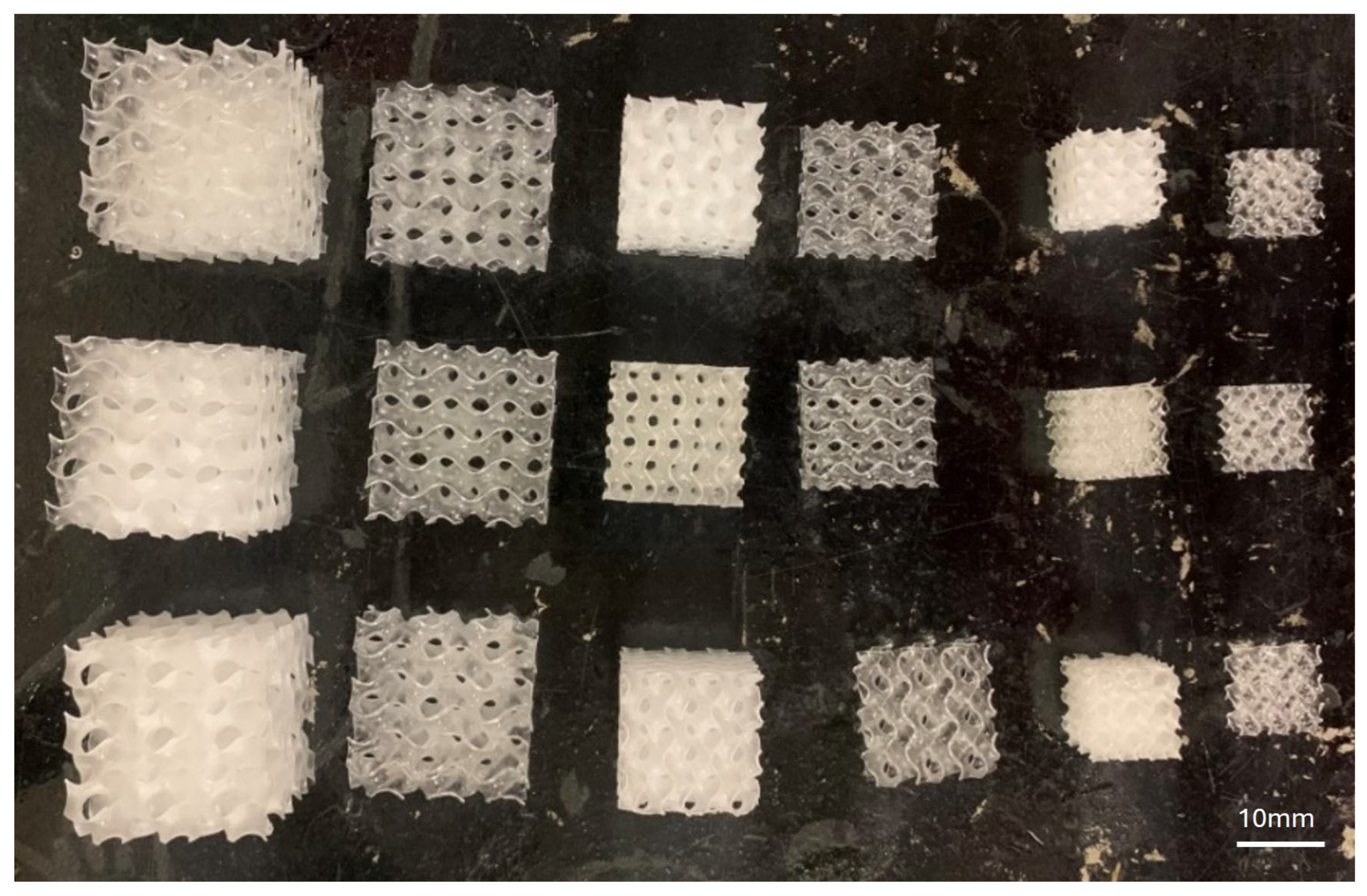
Figure 4 shows the successful prints from the resolution testing. A total of 18 different cell sizes were successfully printed, with three different cell sizes, three different thicknesses, and two different heights. Thicknesses of 0.1 mm to 0.5 mm were tested, and it was found that 0.25 mm to 0.5 mm of thickness was a suitable range. For the cell sizes, 3.175 to 12.7 mm per cell was tested, and 6.35 to 12.7 mm was found to be the suitable range. For height, it was found that a height three times the cell size was common in Honeycomb, leading to the 3 × 3 × 1 cell size and 3 × 3 × 3 cell size test specimen samples. The 3 × 3 × 1 unit cell size sample is meant to replicate the Honeycomb typically used in aerospace applications, and the 3 × 3 × 3 unit cell size sample is intended to test the abilities of the TPMS replication properties compared to the honeycomb. The parameterized design made it easy to adjust and test these sizes for printing.
The 3 × 3 × 3 cell size samples with the highest thickness were chosen. These were chosen for three reasons. First, the 3 × 3 × 3 was chosen for ease of compression testing. There are previous studies of lattices tested in a cube setting, making this size easier to use with the machine. Second, while the 0.1 mm thickness was a suitable range for the Gyroid shapes, it was not suitable for the Primitive and Honeycomb samples, because the removal of the supports would damage the final product. Finally, the 12.7 mm cell size was chosen for ease of use with the Digital Image Correlation System. Because of this, the 0.5 mm-thickness cube with 12.7 mm cell size samples were chosen for comparison.
The Diamond structure was eliminated as a comparison candidate due to manufacturability and the simulation results. The shape of the diamond is only connected by a small surface between each unit cell. Because of the low thickness in each of the samples, the diamond shape could not be manufactured successfully. The simulation results also showed it to be the weakest shape.

3.3. Compression Testing

The 5960 Series Instron and DIC were used to measure load, displacement, and strain through the duration of the compression tests. The load and displacement were used to find stress and strain. To calculate strain, the data were first normalized to ensure that the displacement started at zero once it started compressing the material. After this, Equation (2) was used to calculate strain. This equation shows the original specimen length l measured in millimeters, and the change in specimen length Δ l . The change is length is simply the normalized displacement measured by the Instron.
ε = Δ l l
For an isotropic material, the equation for stress is given in Equation (3), where P is the applied load and A is the lattice cross-sectional area.
σ = P A  
To find the maximum stress, once again, the data must first be normalized to ensure that the measured load starts at zero until it starts compressing the material. The maximum load was used for P. The lattice cross-sectional area is the cross-sectional area in space that the lattice occupies. In this case, for rectangular lattice samples, the cross-sectional area is simply the total length l multiplied by the total width w of the lattice sample perpendicular to the application of load P, given in Equation (3).
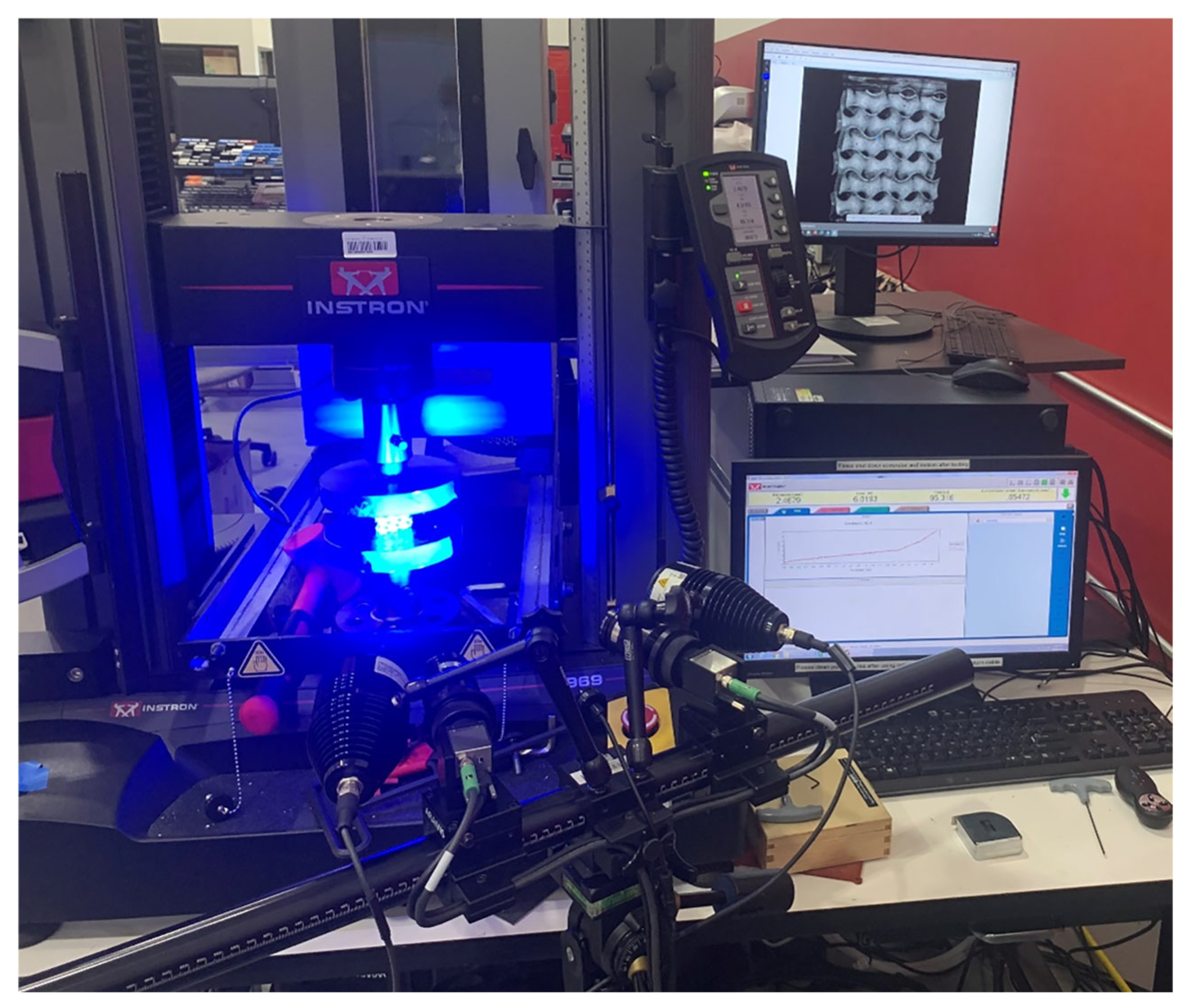
The 5960 Series Dual Column Table Frame Instron was used to measure load and displacement from the compression tests. The load frame consists of two t-slots parted by a top plate and base beam to hold the slots in place, along with a moving crosshead to hold the testing adapters. The column has a guide and a ball screw to move the crosshead up or down. The load string consists of the load cell, grips, adapters, and anything else that is needed between the moving crosshead and the base. There is also a control panel to move the crosshead for testing.
A fifty kN load cell was attached to the crosshead. To secure the compression plates to the base plate, the load cell adapters were fastened to both the bottom plate and the load cell. The final test configuration is shown in Figure 5.
The 5960 Instron used the Instron Bluehill 3 software to control the testing systems, collect data, and produce results [34]. To do this, a test method file was made within the software itself. Within this file, the test specimen size, speed of the test instrument, and selected exportation of results were some of the key definitions to update. Once a test method was created, it was used multiple times for each test with the same type of specimen.
Digital Image Correlation (DIC) was used to measure the strain field from the compression tests. The DIC camera was placed so that the model was in clear view. The samples had to be prepared using white spray paint and a thin layer of black spray paint to make them appear spotted with an ideal ratio of 60/40. This allowed the DIC to calibrate the distance between the black dots to give an image of the strain field in post-processing. The DIC setup is also shown in Figure 5.
The DIC used the 2022 GOM software. This software was connected to the camera to calibrate, evaluate, and determine results. The GOM had a calibration assist feature to help calibrate the camera, angling the calibration tool at various angles to ensure the results were as accurate as possible. After the calibration was complete, the measurement was set to a 5 M camera size. Next, the camera used the distance between the white and black spots to find the surface of the structure. The number of pixels can be adjusted to ensure the camera captures the surfaces of the test specimen accurately. After the surfaces were created and the measuring sequence was specified, the camera was ready to start recording.
The samples were crushed in accordance with ASTM D695-23 at a speed of 1.3 mm/min [35]. The samples themselves were sized as a 3 × 3 × 3 12.7 mm unit cell size and 0.5 mm of thickness. Five samples of each lattice shape were tested for statistical significance. The Gyroid, Primitive, and Honeycomb samples were tested as cube samples. Each was crushed using the same speed and placement on the compression plates.
The test specimen was placed on the bottom compression plate. Before the top compression plate was lowered, it was calibrated so that the weight of the plate was not recorded in the results. After this, the top compression plate on the crossbeam was lowered until just before the Instron recorded load. The extension of the plate was zeroed, and the Instron and DIC were started simultaneously. A note of where the maximum load was taken, so a photo of the corresponding strain field could be captured with the DIC.
When the test was finished, the DIC camera was stopped, and the load and extension data were saved to the local computer. These values were exported for post-processing. As mentioned in the previous paragraph, the timing of the recording was noted at the point in the DIC model where the maximum load occurred. This allowed for both a photo and a video of the samples using the DIC.

4. Results and Discussion

4.1. Simulation Results

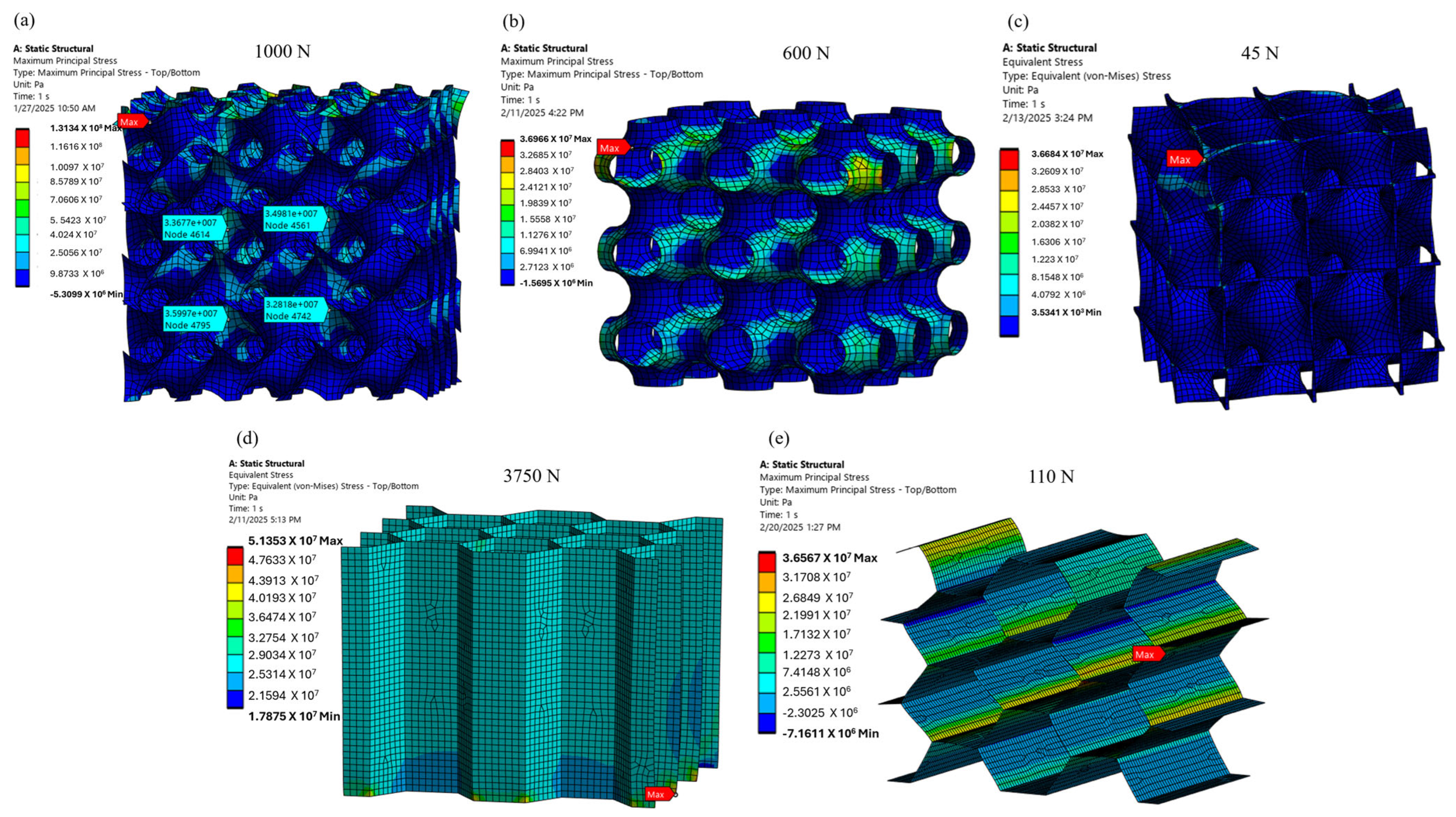
Simulations were performed on the Gyroid, Primitive, Diamond, and the Honeycomb in both the axial and transverse directions. The simulation was conducted to match the loading conditions present at the compression test. Each model was evaluated until it reached an internal maximum stress of 36 MPa, the tensile strength of the resin as specified by the resin manufacturer. The corresponding load was taken as the strength. The von Mises stress, maximum principal stress, and maximum stress were evaluated until one of these reached the material’s stress capacity. The failure mode in the simulation is linked to how each lattice geometry’s structure bears the load. The results show that failure in the Gyroid and Honeycomb Axial structures was governed by the equivalent von Mises stress, while failure in the Primitive and Honeycomb Transverse structures was governed by the maximum principal stress. This distinction can be explained by the dominant deformation mode of each structure. Stretch-dominated structures, like the Honeycomb Axial, experience uniform compression along their vertical members, leading to ductile-like yielding best captured by the von Mises criterion. However, bending-dominated structures, like the Honeycomb Transverse, develop high localized tensile stresses on the outer surfaces of the bending cell walls, causing failure to be initiated by this tension, which is appropriately captured by the maximum principal stress criterion. The TPMS structures exhibit a mix of these behaviors; the Gyroid’s smooth curvature distributes stress effectively and favors a von Mises failure, whereas the Primitive’s geometry creates higher stress concentrations at surface intersections, leading to a failure governed by localized tensile stress. The comprehensive result for compressive strength is shown in Figure 6.
The strength used in simulation, the lattice density, and the strength-to-density ratio are used to summarize the results from the simulations in Table 2. The simulation results indicate that the Honeycomb Axial is the strongest per lattice density, followed by the Gyroid, Primitive, Diamond, and Honeycomb Transverse simulations, respectively. The results of the simulations indicate that for uniaxial load cases, Honeycomb Axial would be the best choice. However, for load paths in the transverse directions, the Gyroid would be the best option. The Gyroid strength-to-density ratio is significantly smaller than that of the Honeycomb Axial. Therefore, further evaluation of the load cases in all directions would be necessary to determine the optimal core structure for sandwich composites. Furthermore, the diamond structure is extremely weak in samples with thicknesses of 0.05 mm. The simulation results lead to the removal of the Diamond lattice structure for testing.

4.2. Compression Testing Results

The Gyroid, Primitive, and Honeycomb compression testing results were evaluated by normalizing the maximum strength calculated from the Instron during testing with the lattice density. The strength-to-density ratios are summarized in Table 3. These results confirmed the same conclusion drawn from the simulations: For uniaxial load cases, Honeycomb Axial would be the best choice. For transverse load paths, the Gyroid could be a better option. Furthermore, as seen in the simulations, the Gyroid strength-to-density ratio is significantly smaller than that of the Honeycomb Axial, and further evaluation of all load paths would be needed to decide the core structure for sandwich composites.
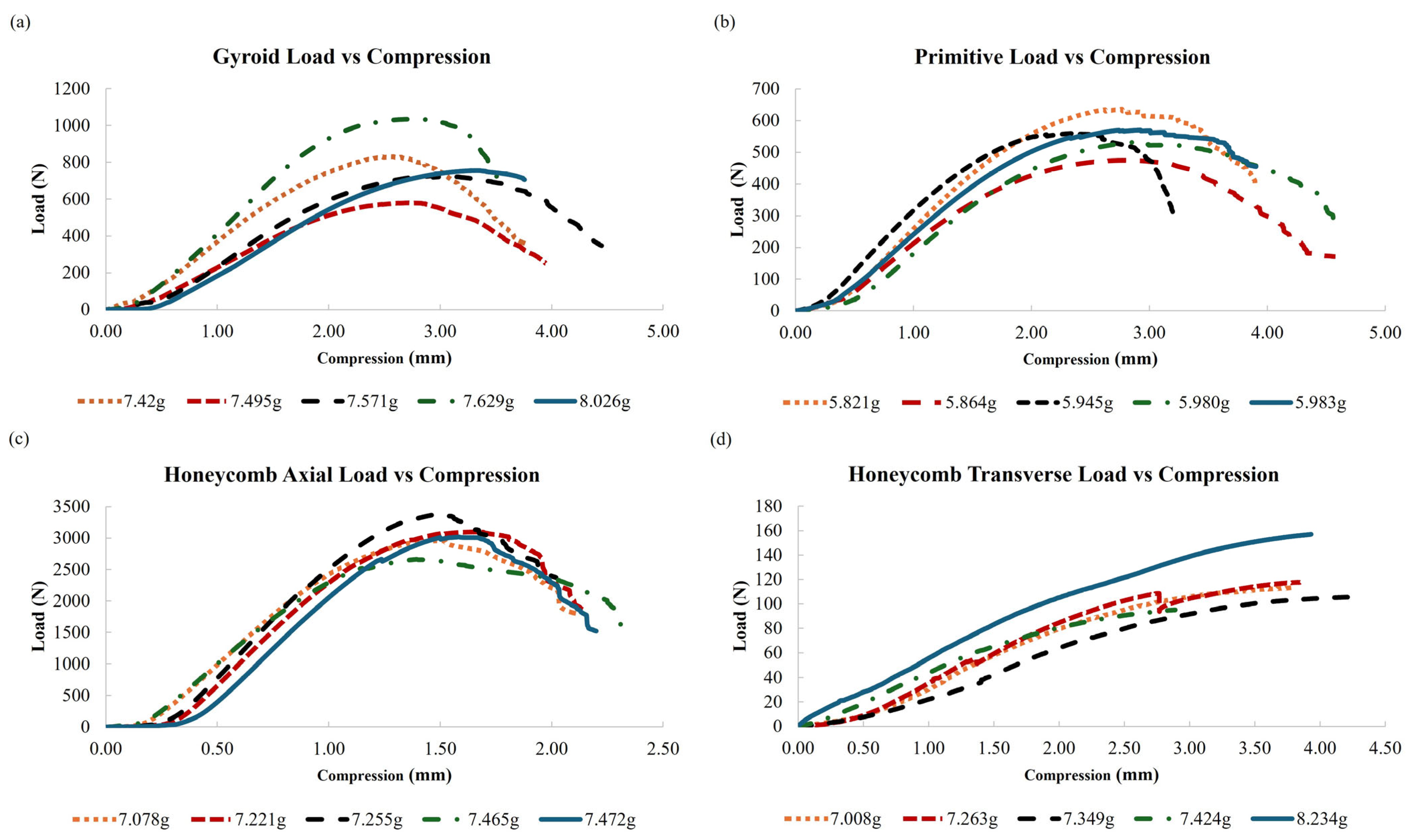
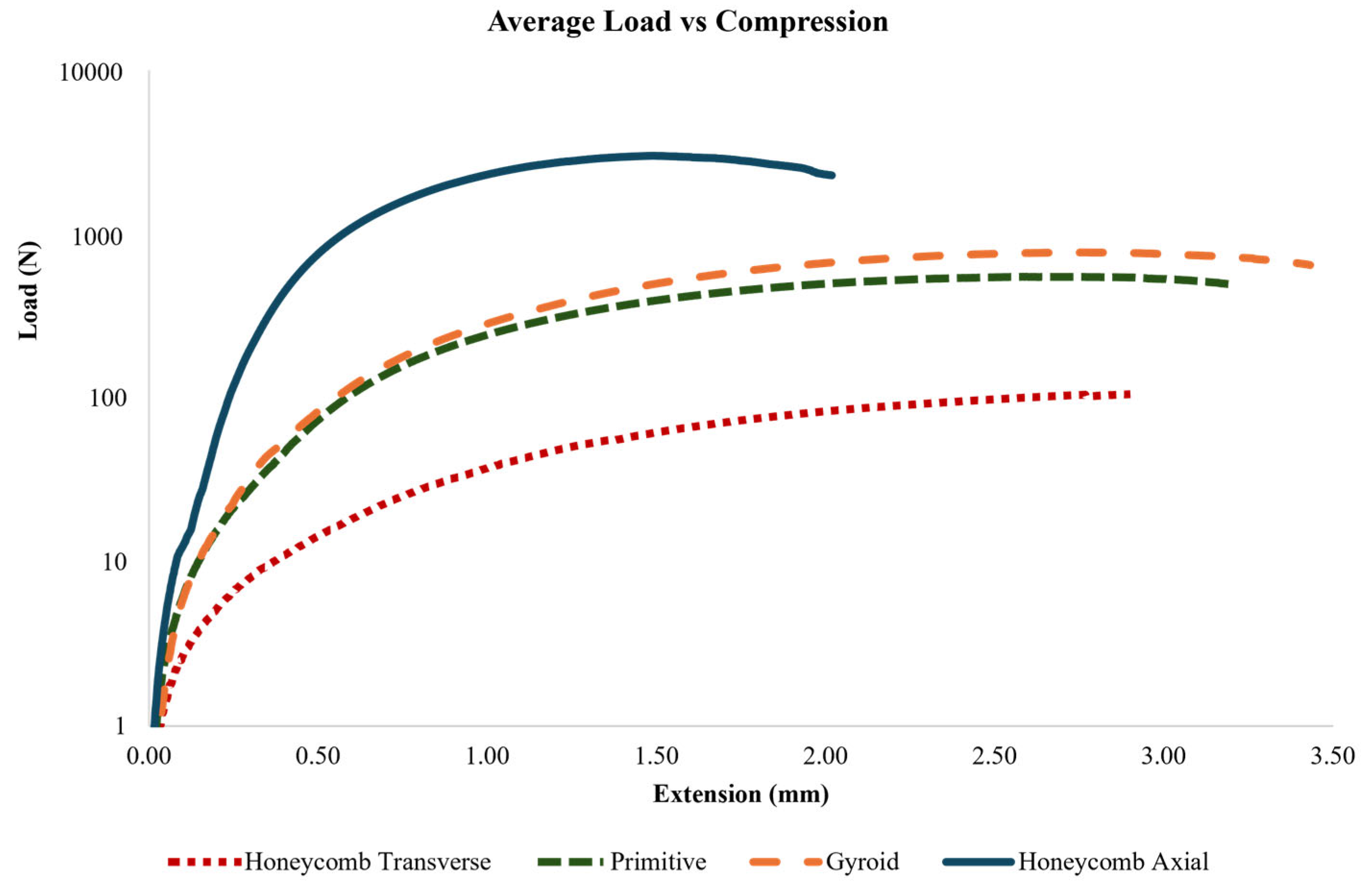
The load versus extension graph was created from the data provided by the mechanical testing system. Figure 7 and Figure 8 show that the Honeycomb Axial was clearly the strongest choice, with the Honeycomb Transverse being the weakest. It is noted that Honeycomb Transverse had a single point of failure, which could be seen when the load dropped. In the 7.263 g sample, the load reached a higher point after the first crack, as shown by the increasing graph after a short drop. The other samples had a complete failure after the initial failure of the material, shown by the graph ending after reaching its highest point.
The consistency of the results can be seen in both Figure 7 and Figure 8. The results of the Honeycomb Axial were the most consistent, followed by the Primitive and Honeycomb Transverse. The Gyroid had the least consistent results. These results, specifically with the Gyroid, are not consistent with the order of strength-to-density ratios seen in Table 4. This might be because during post-processing, the samples were rinsed with isopropyl alcohol, then set to dry before curing in the curing oven. Due to the geometry of the Gyroid, it was harder to tell when it was dry. There may have been some isopropyl alcohol left in the sample when they cured it, which could account for the lack of consistency. Despite this, the results were consistent enough to be used in the average calculations.
Looking specifically at Figure 8, the relative slope of the shapes can be compared. The slope of the load vs. extension graph is proportional to the elastic modulus due to the same-sized cross-sectional area used in Equation (3). Due to this, the slope of load vs. displacement is used to compare the relative elastic modulus between the lattice structures. The Honeycomb Axial has the highest elastic modulus, as seen by the slope of the curve. Following that is the Gyroid, then the Primitive, then the Honeycomb Transverse. These results are as expected based on the strength-to-density calculations in Table 4. Furthermore, the Gyroid and Primitive both have similar Elastic modules, with the Gyroid being slightly higher. This means that when loaded in the transverse direction, either option would be better than the Honeycomb. Finally, as expected from the strength results, a higher load corresponds with a higher stress for the same cross-sectional area.

4.3. Digital Image Correlation Comparisons

The simulation results were compared to the testing results to validate the simulation methods. If the results were the same, that meant simulation could be used to evaluate further shapes without the need to test every sample. This would save time and materials from printing and testing. The results from the simulation and the compression tests are compared in Table 4. These results show that the simulation results were very similar to the testing results and followed the same trend, meaning simulations are a cost-effective to validate future designs.
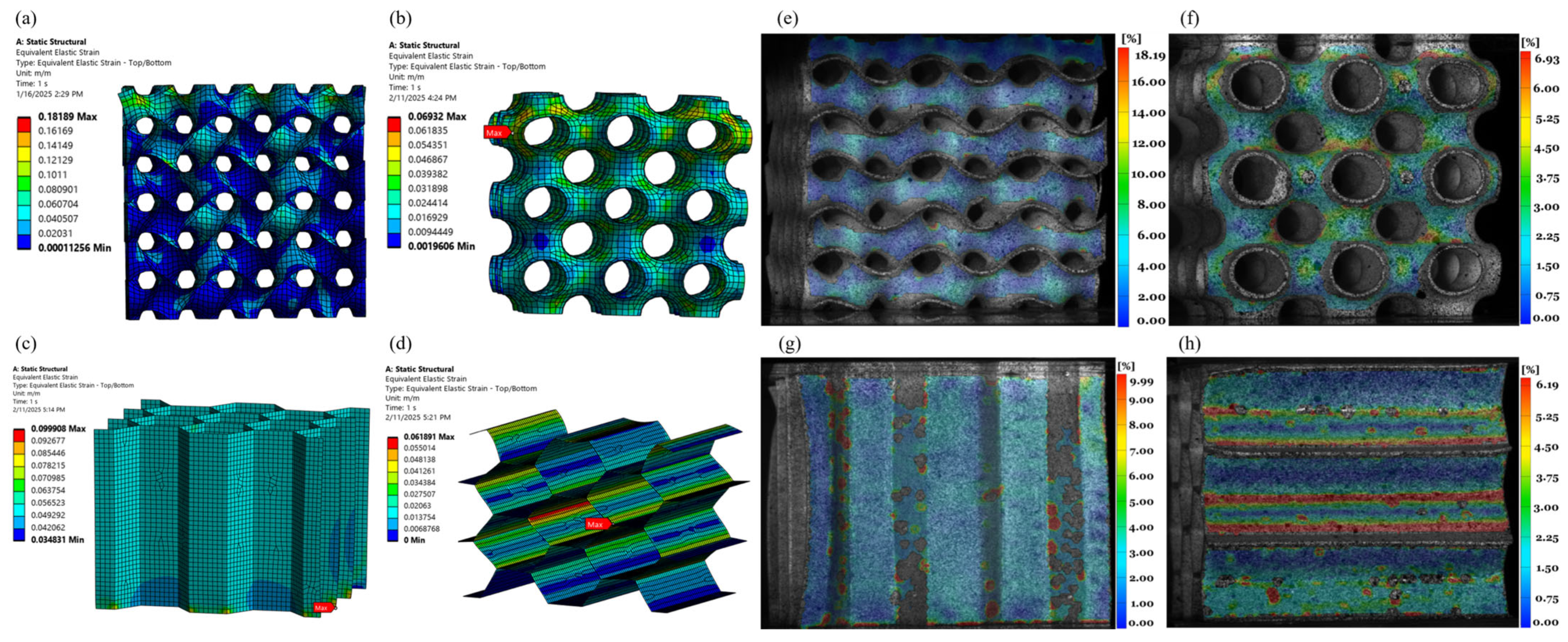
Next, the results from the DIC strain field were compared to the simulations. The same simulation to find strength was used to find the strain field. The von Mises strain can be found directly from Ansys. The results from the simulations are compared to the DIC results in the following figure. The scales of the DIC results were adjusted to match the scale of the simulation, allowing for a direct comparison with the results. The photos in the figure were taken at the time of the maximum load. This study confirmed that the computational models accurately captured the mechanical behavior and failure mechanisms of the lattice structures. The key focus for this comparison was whether the simulation correctly predicted the physical locations of high strain concentration observed in the DIC measurements. To facilitate a direct visual comparison of these strain patterns, the color scale of the DIC strain map shown in Figure 9 was normalized to the maximum strain value obtained from the corresponding simulation.
Figure 9a,e show that the strain field is 18.19% for the Gyroid. This strain is significantly higher than the strain rate of the resin (7–14%), indicating that the Gyroid shape has the ability to increase localized strain before failure. The general areas of high strain, located near the middle of the sample, are consistent between the simulation and the tests. The scale from the test has been normalized to make an accurate comparison. Figure 9b,f show that the strain field is close to 6.93% for the Primitive. This strain is comparable to the strain given by the resin manufacturer (7–14%). The highest strain areas correlate with the high stress areas from the simulation. The higher strain spreads outwards perpendicularly from the applied load in both the simulation and the test. Figure 9c,g show that the strain field is 9.99% for the Honeycomb Axial. This strain matches the strain given by the resin manufacturer (7–14%). The strain is uniform throughout the structure. The highest strain throughout the part occurs at the location where the applied load is applied. This can be seen in the results from the test, and Honeycomb fails extremely fast in the axial direction. Figure 9d,h show that the strain field is 6.19% for the Honeycomb Transverse. This strain is comparable to the strain given by the resin manufacturer (7–14%). The strain is at its highest along the joints of the hexagonal structure. This can be seen in both the simulation and the DIC. This is also the location of failure during both the test and the simulations.
In conclusion, the Gyroid can withstand higher localized deformation compared to the other structures. The Primitive, Honeycomb Axial, and Honeycomb Transverse deform in accordance with 7–14% elongation at break; the material properties given by the resin manufacturer are presented in Table 2, while the Gyroid can withstand up to 18% elongation before break. This means that if something needed to be designed to withstand a high localized strain, the Gyroid would be the best option. Overall, the simulations once again match the testing. The locations of higher and lower localized strains match those of the simulations. This further validates that simulations can be used to evaluate potential designs.

5. Conclusions

AM has allowed TPMSs to be built in a relatively quick and easy manner. With the ability to print these theoretical designs in 3D applications, the use of TPMS structures in industry was evaluated. Honeycomb is a well-accepted weight reduction structure used in the aerospace industry. As such, the compressive strength of three TPMSs, the Gyroid, Primitive, and Diamond, was compared to that of the Honeycomb for aerospace applications. The samples were sized according to ordering specifications from several Honeycomb manufacturers. The material was printed at a thickness of 0.5 mm. All the designs were parameterized to ensure fast and easy adjustments. Simulations were performed on each sample to predict the test outcomes. The Diamond TPMS was eliminated due to the low contact area between each cell and the thin walls chosen based on the Honeycomb ordering websites.
The ANYCUBIC D2 SLA printer was used to print samples using standard resin. The Primitive and Honeycomb were printed using supports. The use of supports was necessary because the bottom layer of each printer included a closed area, which would cause the print to adhere to the bottom of the resin reservoir instead of the build plate. The Gyroid and Diamond samples did not have this problem because the bottom layer of the print was not a closed geometry. We attempted to print the Diamond samples, but like the simulations, the wall thickness and small contact area between each cell did not allow for effective printing.
Five of the Gyroid and Primitive samples were printed for testing, and ten of the Honeycomb samples were printed for testing due to the need to test them in both directions. The samples were tested using an Instron 5969 Series and the Zeiss Aramis Adjustable Digital Image Correlation System. These machines collected load, extension, and localized strain field as their sources of measurement. The results showed that the Honeycomb was the strongest in the axial direction with a strength-to-density ratio of 26.144, followed by the Gyroid with a ratio of 5.692. Next, the Primitive had a ratio of 5.182, and the Honeycomb Transverse had a ratio of 1.008. All ratio units were in N · k g 1 m 3 .
Further consideration of the entire load paths of models would be necessary to make a definitive statement on the ideal core structure in sandwich composites. However, as a generalization, the results show that the Gyroid is the strongest in a transverse or multi-directional load path, and Honeycomb Axial is the strongest in the uniaxial direction for load paths such as control surfaces. For applications where there is a load in multiple planes, such as a truss-braced wing, the Gyroid can be a more effective option.

Author Contributions

Conceptualization, Y.L. and J.W.; methodology, Y.L. and J.W.; formal analysis, J.W.; data curation, J.W. and J.H.; writing—original draft preparation, J.W.; writing—review and editing, C.B. and Y.L. All authors have read and agreed to the published version of the manuscript.

Funding

This research received no external funding.

Data Availability Statement

Data are available upon request to the corresponding author.

Conflicts of Interest

The authors declare no conflicts of interest.

References

  1. Pan, C.; Han, Y.; Lu, J. Design and optimization of lattice structures: A review. Appl. Sci. 2020, 10, 6374. [Google Scholar] [CrossRef]
  2. Helou, M.; Kara, S. Design, analysis and manufacturing of lattice structures: An overview. Int. J. Comput. Integr. Manuf. 2018, 31, 243–261. [Google Scholar] [CrossRef]
  3. Alhembar, A.; Alagha, A.N.; Naji, M.M.; Sheikh-Ahmad, J.; Jarrar, F. Recent advancements in design optimization of lattice–structured materials. Adv. Eng. Mater. 2023, 25, 2201780. [Google Scholar] [CrossRef]
  4. Nagesha, B.; Dhinakaran, V.; Shree, M.V.; Kumar, K.M.; Chalawadi, D.; Sathish, T. Review on characterization and impacts of the lattice structure in additive manufacturing. Mater. Today Proc. 2020, 21, 916–919. [Google Scholar] [CrossRef]
  5. Tao, W.; Leu, M.C. Design of lattice structure for additive manufacturing. In Proceedings of the 2016 International Symposium on Flexible Automation (ISFA), Cleveland, OH, USA, 1–3 August 2016; IEEE: New York, NY, USA, 2016. [Google Scholar]
  6. Tamburrino, F.; Graziosi, S.; Bordegoni, M. The design process of additively manufactured mesoscale lattice structures: A review. J. Comput. Inf. Sci. Eng. 2018, 18, 040801. [Google Scholar] [CrossRef]
  7. Liu, R.; Chen, W.; Zhao, J. A review on factors affecting the mechanical properties of additively-manufactured lattice structures. J. Mater. Eng. Perform. 2024, 33, 4685–4711. [Google Scholar] [CrossRef]
  8. Marin, F.; de Souza, A.F.; Mikowski, A.; Fontanella, L.H.G.; Soares, P.; de Lacalle, L.N.L. Energy density effect on the interface zone in parts manufactured by laser powder bed fusion on machined bases. Int. J. Precis. Eng. Manuf. Green Technol. 2023, 10, 905–923. [Google Scholar] [CrossRef]
  9. González-Barrio, H.; Calleja-Ochoa, A.; de Lacalle, L.N.L.; Lamikiz, A. Hybrid manufacturing of complex components: Full methodology including laser metal deposition (LMD) module development, cladding geometry estimation and case study validation. Mech. Syst. Signal Process. 2022, 179, 109337. [Google Scholar] [CrossRef]
  10. Bai, Y.; Yu, K.; Zhao, J.; Zhao, R. Experimental and simulation investigation of temperature effects on modal characteristics of composite honeycomb structure. Compos. Struct. 2018, 201, 816–827. [Google Scholar] [CrossRef]
  11. Wei, X.; Xiong, J.; Wang, J.; Xu, W. New advances in fiber-reinforced composite honeycomb materials. Sci. China Technol. Sci. 2020, 63, 1348–1370. [Google Scholar] [CrossRef]
  12. Rupani, S.V.; Jani, S.S.; Acharya, G. Design, modelling and manufacturing aspects of honeycomb sandwich structures: A review. IJSDR 2017, 2. [Google Scholar]
  13. Hassan, H.Z.; Saeed, N.M. Advancements and applications of lightweight structures: A comprehensive review. Discov. Civ. Eng. 2024, 1, 47. [Google Scholar] [CrossRef]
  14. Herrmann, C.; Dewulf, W.; Hauschild, M.; Kaluza, A.; Kara, S.; Skerlos, S. Life cycle engineering of lightweight structures. CIRP Ann. 2018, 67, 651–672. [Google Scholar] [CrossRef]
  15. Ahmad, A. Study on the Benefits of Lattice Structures Within the Framework of High-Performance Structural Design: A Case Study; Università degli Studi di Roma La Sapienza: Roma, Italy, 2024. [Google Scholar]
  16. Nazzi, F. The hexagonal shape of the honeycomb cells depends on the construction behavior of bees. Sci. Rep. 2016, 6, 28341. [Google Scholar] [CrossRef]
  17. Chandrasekaran, N.K.; Arunachalam, V. State-of-the-art review on honeycomb sandwich composite structures with an emphasis on filler materials. Polym. Compos. 2021, 42, 5011–5020. [Google Scholar] [CrossRef]
  18. Guo, X.; Ding, J.; Li, X.; Qu, S.; Fuh, J.Y.H.; Lu, W.F.; Song, X.; Zhai, W. Interpenetrating phase composites with 3D printed triply periodic minimal surface (TPMS) lattice structures. Compos. Part B Eng. 2023, 248, 110351. [Google Scholar] [CrossRef]
  19. Al-Ketan, O.; Al-Rub, R.K.A. Multifunctional mechanical metamaterials based on triply periodic minimal surface lattices. Adv. Eng. Mater. 2019, 21, 1900524. [Google Scholar] [CrossRef]
  20. Calleja-Ochoa, A.; Gonzalez-Barrio, H.; de Lacalle, N.L.; Martínez, S.; Albizuri, J.; Lamikiz, A. A new approach in the design of microstructured ultralight components to achieve maximum functional performance. Materials 2021, 14, 1588. [Google Scholar] [CrossRef]
  21. Pérez-Ruiz, J.D.; de Lacalle, L.N.L.; Velilla-Díaz, W.; Mesa, J.A.; Gómez, G.; Maury, H.; Urbikain, G.; Gonzalez, H. Evaluating the feasibility of using crystalline patterns induced by PBF-LB to predict strength enhancing orientations. Mater. Des. 2025, 254, 114006. [Google Scholar] [CrossRef]
  22. Han, L.; Che, S. An Overview of Materials with Triply Periodic Minimal Surfaces and Related Geometry: From Biological Structures to Self–Assembled Systems. Adv. Mater. 2018, 30, e1705708. [Google Scholar] [CrossRef]
  23. Singh, G. Exploring the Evolution, Applications, Materials, and Sustainability of 3D Printing Technology in the Manufacturing Sector. Int. J. Innov. Res. Sci. Eng. 2024, 10, 8. [Google Scholar]
  24. Billings, C.; Siddique, R.; Liu, Y. Photocurable polymer-based 3D printing: Advanced flexible strain sensors for human kinematics monitoring. Polymers 2023, 15, 4170. [Google Scholar] [CrossRef] [PubMed]
  25. Billings, C.; Siddique, R.; Sherwood, B.; Hall, J.; Liu, Y. Additive manufacturing and characterization of sustainable wood fiber-reinforced green composites. J. Compos. Sci. 2023, 7, 489. [Google Scholar] [CrossRef]
  26. Ahsan, M.M.; Liu, Y.; Raman, S.; Siddique, Z. Digital Twins in Additive Manufacturing: A Systematic Review. arXiv 2024, arXiv:2409.00877. [Google Scholar] [CrossRef]
  27. Villa, R.; Billings, C.; Siddique, Z.; Liu, Y. A Look at Two Nuisance Process Hurdles Encountered by New Laser Powder Bed Fusion Operators Printing Ti6Al4V. J. Mater. Eng. Perform. 2025, 34, 21941–21948. [Google Scholar] [CrossRef]
  28. Villa, R.; Billings, C.; Siddique, Z.; Liu, Y. Microstructural Characterization of Stitched Zones in Ti6Al4V Printed via Multi-laser Powder Bed Fusion and Using Three Stress Relief Temperatures. Metallogr. Microstruct. Anal. 2025, 14, 135–150. [Google Scholar] [CrossRef]
  29. Pérez-Ruiz, J.; González-Barrio, H.; Sanz-Calle, M.; Gómez-Escudero, G.; Munoa, J.; de Lacalle, L. Machining stability improvement in LPBF printed components through stiffening by crystallographic texture control. CIRP Ann. 2023, 72, 141–144. [Google Scholar] [CrossRef]
  30. Ahn, S.H.; Montero, M.; Odell, D.; Roundy, S.; Wright, P.K. Anisotropic material properties of fused deposition modeling ABS. Rapid Prototyp. J. 2002, 8, 248–257. [Google Scholar] [CrossRef]
  31. Villa, R.; Liu, Y.; Siddique, Z. Review of defects and their sources in as-built Ti6Al4V manufactured via powder bed fusion. Int. J. Adv. Manuf. Technol. 2024, 132, 4105–4134. [Google Scholar] [CrossRef]
  32. De Leon, E.; Riensche, A.; Bevans, B.D.; Billings, C.; Siddique, Z.; Liu, Y. A Review of Modeling, Simulation, and Process Qualification of Additively Manufactured Metal Components via the Laser Powder Bed Fusion Method. J. Manuf. Mater. Process. 2025, 9, 22. [Google Scholar] [CrossRef]
  33. Saseendran, S.; Wysocki, M.; Varna, J. Cure-state dependent viscoelastic Poisson’s ratio of LY5052 epoxy resin. Adv. Manuf. Polym. Compos. Sci. 2017, 3, 92–100. [Google Scholar] [CrossRef]
  34. Sherwood, B.; Billings, C.; Liu, Y. Parametric Modeling of Lattice Structures for Manufacturing via Masked Stereolithography Apparatus. In Proceedings of the ASME International Mechanical Engineering Congress and Exposition, Portland, OR, USA, 17–21 November 2024. [Google Scholar]
  35. ASTM D695-23; Standard Test Method for Compressive Properties of Rigid Plastics. ASTM International: West Conshohocken, PA, USA, 2023.
Figure 1. (a) Gyroid, (b) Primitive, (c) Diamond, and (d) Honeycomb Lattice Designs.
Jcs 09 00586 g001
Figure 2. Supports for (a) Honeycomb and (b) Primitive.
Jcs 09 00586 g002
Figure 3. Slice Samples of (a) Gyroid, (b) Primitive, (c) Diamond, and (d) Honeycomb.
Jcs 09 00586 g003
Figure 4. Gyroid Resolution Testing.
Jcs 09 00586 g004
Figure 5. Compression Test Configuration.
Jcs 09 00586 g005
Figure 6. Failure Stress of (a) Gyroid, (b) Primitive, (c) Diamond, (d) Honeycomb Axial, and (e) Honeycomb Transverse.
Jcs 09 00586 g006
Figure 7. Load vs. Compression of (a) Gyroid, (b) Primitive, (c) Honeycomb Axial, and (d) Honeycomb Transverse.
Jcs 09 00586 g007
Figure 8. Average Load vs. Extension.
Jcs 09 00586 g008
Figure 9. Localized von Mises Strain of (a) Gyroid, (b) Primitive, (c) Honeycomb Axial, and (d) Honeycomb Transverse Simulations and Localized von Mises Strain of (e) Gyroid, (f) Primitive, (g) Honeycomb Axial, and (h) Honeycomb Transverse DIC Testing.
Jcs 09 00586 g009
Table 1. Resin Properties.
Resin Density1.13 [ g · c m 3 ]
Tensile Strength36–50 MPa
Elongation at Break7–14%
Table 2. Lattice Simulation Comparison.
LatticeStrength
(N)
Lattice Density
[ k g 1 m 3 ]
Strength-to-Density Density [ N · k g 1 m 3 ]
Primitive600107.0155.607
Gyroid1000137.9267.250
Diamond4587.7400.513
Honeycomb Axial3750115.65132.425
Honeycomb Transverse110116.8830.941
Table 3. Lattice Strength-to-Density Comparison.
LatticeLattice Strength
(N)
Lattice Density
[ k g 1 m 3 ]
Strength-to-Density Density [ N · k g 1 m 3 ]
Gyroid785.025137.9265.692
Primitive554.566107.0155.182
Honeycomb Axial3023.588115.65126.144
Honeycomb Transverse117.815116.8831.008
Table 4. Simulation vs. Testing Results.
LatticeSimulation Ratio [ N · k g 1 m 3 ]Testing Ratio [ N · k g 1 m 3 ]
Primitive5.6075.182
Gyroid7.2505.692
Honeycomb Axial32.42526.144
Honeycomb Transverse0.9411.008
Disclaimer/Publisher’s Note: The statements, opinions and data contained in all publications are solely those of the individual author(s) and contributor(s) and not of MDPI and/or the editor(s). MDPI and/or the editor(s) disclaim responsibility for any injury to people or property resulting from any ideas, methods, instructions or products referred to in the content.