

Sustainable and Recyclable Composites for Electric Aviation and UAVs: Component-Specific Evidence, Qualification Pathways, and Circular Design



Abstract
1. Introduction
2. Review Approach and Evidence Assessment
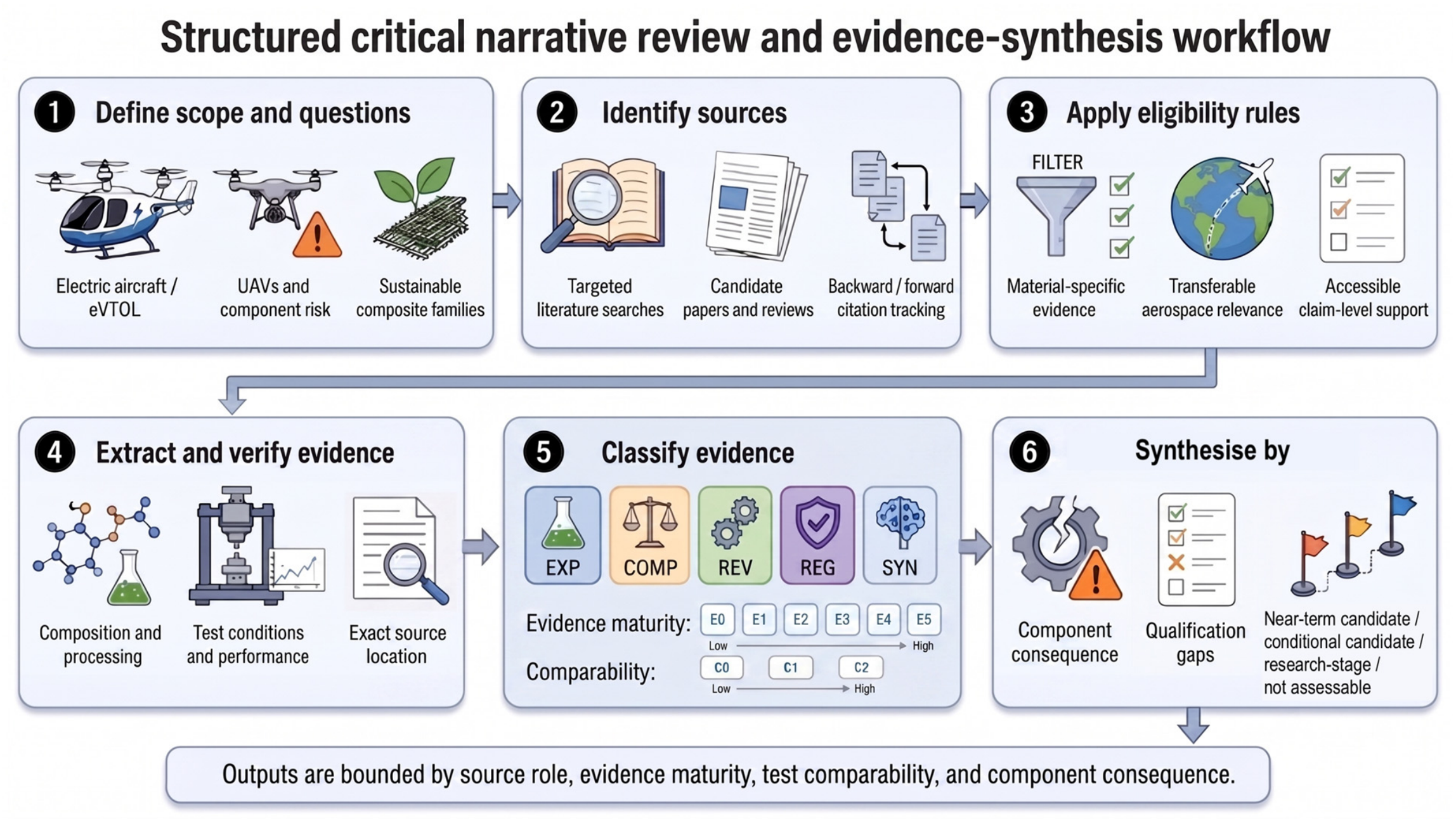
2.1. Review Design and Questions
2.2. Source Identification
2.3. Eligibility and Source Roles
2.4. Data Extraction and Evidence Classification
2.5. Comparative Synthesis and Scope of Inference
3. Coupled Material Requirements and Component Risk
3.1. Structural Efficiency, Fatigue, and Impact
3.2. Battery, Fire, Thermal, and Electrical Functions
3.3. Durability, Manufacturability, Repair, and Circularity
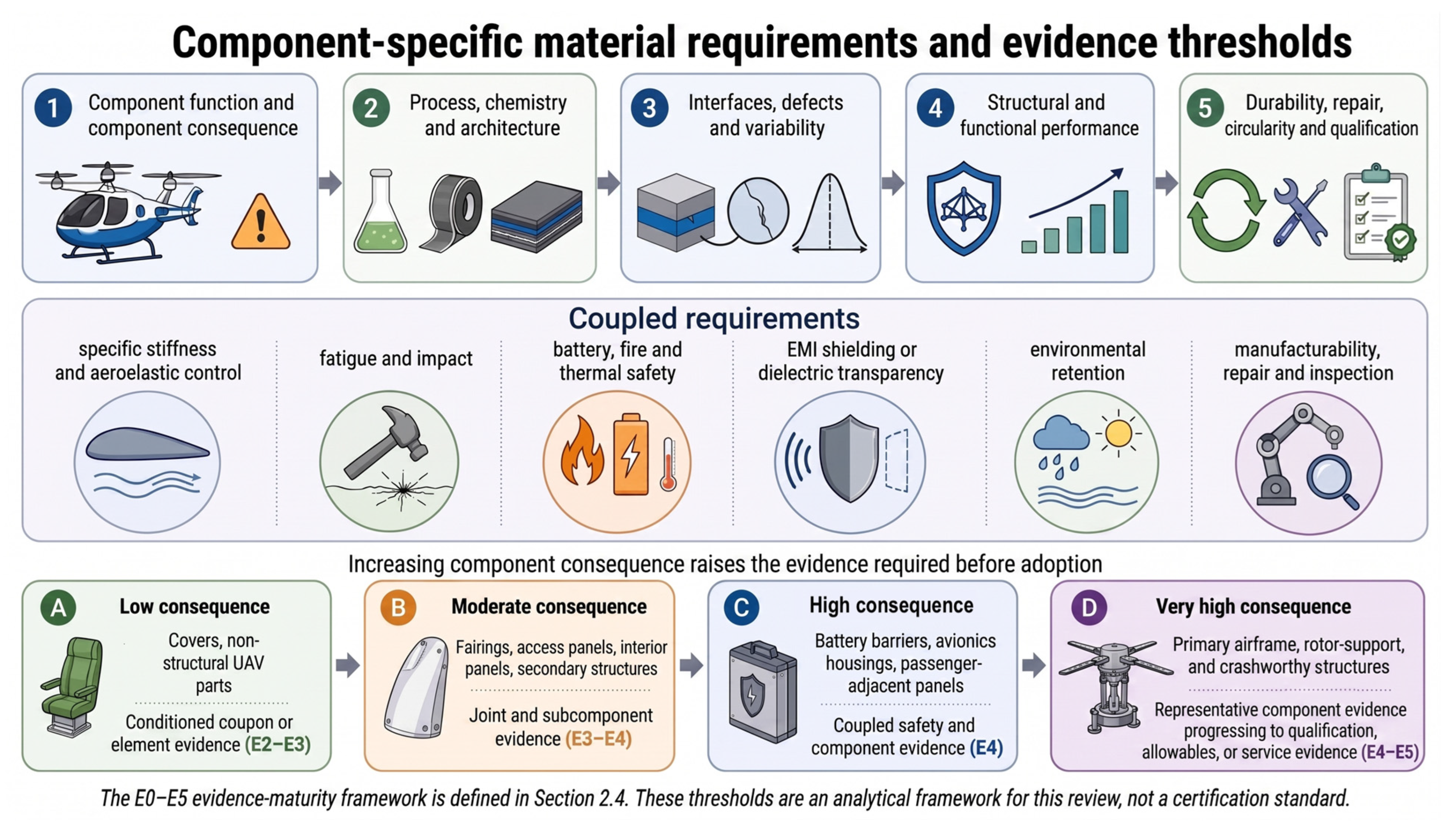
3.4. Component Consequence and Evidence Threshold
4. Sustainable Composite Families: Processing, Structure, Properties, and Limitations
4.1. Thermoplastic Carbon-Fibre Composites
4.2. Recycled-Carbon-Fibre Composites
4.3. Natural-Fibre Composites
4.4. Bio-Based Matrices and Recyclable Thermosets
4.5. Hybrid and Multifunctional Systems

| Candidate Family | Specific Stiffness, Strength, and Impact | Fire and Moisture Sensitivity | Recyclability and Manufacturing Cost | Evidence Maturity and Component Implication |
|---|---|---|---|---|
| Thermoplastic CFRP [42,43,44,45,46,47] | High structural efficiency is feasible, but E/ρ and σu/ρ are not pooled because matrix, architecture, voids, thermal history, and tests differ. Impact tolerance and weld fatigue remain system specific. | Fire, smoke, toxicity, and post-fire integrity are matrix and laminate specific. Moisture retention must be verified for each matrix, interface, and weld. | Remelting, forming, welding, and reprocessing routes are available. High resin and processing costs can be offset by rapid forming, integrated joining, lower scrap, and production volume; no common cost value is transferable. | EXP/REV; E2 to E4; C0 to C1. Strongest near-term evidence, but component use remains conditional on process conformity, impact, ageing, inspection, and repair durability. |
| Recycled-carbon-fibre systems [39,40,41,48,49,50] | Performance depends on recovered fibre length, alignment, surface state, and matrix. For one aligned prepreg fragment and PA11 system, E = 80 ± 14 GPa and σu = 460 ± 60 MPa [49]. Laminate density was not reported, so specific values were not calculated. Impact evidence is limited. | Fire and moisture responses depend on the new matrix, contamination, and recovered architecture. Transferable conditioned and post-fire datasets are unavailable. | Mechanical, thermal, chemical, and thermoplastic recovery preserve different fibre forms and values. Sorting, recovery yield, alignment, traceability, and quality control determine cost; no common economic basis is reported. | EXP/REV; E1 to E3; C0 to C1. Defensible for bounded lower consequence components when feedstock classes, batch variation, durability, and component repeatability are controlled. |
| Natural-fibre and hybrid biocomposites [27,28,29,30,51,52] | Low density can benefit structural efficiency, but cross-study E/ρ and σu/ρ values are unavailable. Woven flax laminates gave E ≈ 8.5 GPa; the recyclable acrylic system had about 8% lower tensile strength and 50% greater perforation energy absorption than the conventional epoxy system within one study [52]. | Combustible fibres require a defined fire protection strategy. Reference [52] measured about 6.1 wt.% moisture in flax fabric and rapid moisture regain, showing the need for controlled storage, drying, conditioning, and retained property tests. | Renewable fibres and lower raw material cost are possible advantages, but circularity depends on the matrix and assembly. Biological variability, drying, storage, fire treatment, process yield, and inspection add manufacturing cost. | EXP/REV; E1 to E2; C0 to C2 within matched studies. Use remains conditional for UAV covers, interiors, and other lower consequence parts; occupied aircraft use needs fire, ageing, and production evidence. |
| Bio-based matrices and recyclable thermosets [13,36,37,38,53,54,55,56,57] | Neat resin tests report modulus and strength ranges, while several CFRP studies show promising laminate performance. Cross-formulation-specific properties are not pooled. Impact, fatigue, creep, and repeated repair data remain sparse. | Several laboratory systems combine recycling or repair with improved small-scale fire response [55,56,57]. Results are protocol specific, and comparative smoke, toxicity, post-fire strength, and hot-wet retention are unavailable. | Repair, reprocessing, matrix degradation, and fibre recovery have been demonstrated for selected chemistries. Activation conditions, solvents, recovery yield, repeated cycle retention, scale, and quality control prevent a transferable cost comparison. | EXP/REV; E1 to E2; C0 to C2 within matched studies. Evidence supports material screening, not a general component readiness claim. |
| Hybrid and multifunctional systems [35,51,55,56,57,58,61,62,63,64,65] | Structural benefit depends on constituent placement and the mass and defects introduced by added layers, fillers, barriers, or conductors. Impact and residual strength metrics are not comparable across architectures. | Fire, thermal, shielding, or dielectric functions can improve for a defined architecture, but metrics differ in heat flux, frequency, thickness, and geometry. Moisture and ageing can alter interfaces and functional retention. | Mixed constituents and permanent interfaces can hinder separation and recovery. Added processing, inspection, repair, and functional testing increase cost; benefit must be evaluated at component level. | EXP/REV; E0 to E2; C0 to C1. Component adoption remains research stage until structural and functional requirements are demonstrated together after ageing, impact, and repair. |
5. Manufacturing, Joining, Repair, Inspection, and Circular Routes
5.1. Process Repeatability, Defects, and Traceability
5.2. Joining, Repair, Inspection, and Return-to-Service Evidence
5.3. Circular Routes and Component-Level Life Cycle Assessment
| Route/System | Critical Process Variables and Defects | Verification and Inspection | Repair or Circular Route | Evidence Interpretation and Qualification Gap |
|---|---|---|---|---|
| AFP/in situ thermoplastic consolidation [66,67,68] | Heat distribution, nip temperature, speed, pressure, intimate contact, crystallinity, void content; gaps, overlaps, wrinkles, bridging, twisted, missing, or loose tows, position errors, and foreign-object inclusions. | Thermography, laser profilometry, machine vision, and force and temperature records; ultrasonic inspection or computed tomography for selected internal defects. | Local reconsolidation; production-scrap reuse where matrix identity, contamination, and retained properties permit. | REV; E1–E3. Acceptance limits require a measured relation between defect geometry and its effect on fatigue, impact, joint behaviour, or assigned function at element scale. |
| Thermoplastic welding [71,72] | Matrix chemistry, interface temperature, pressure, time, cooling, heating-element or energy-director geometry, current leakage, non-uniform heating, residual stress, and resin squeeze-out or depletion. | Thermal monitoring, microscopy, ultrasonic or thermographic inspection; lap-shear, fracture, fatigue, and environmental testing. | Rewelding or local patching may be possible; disassembly depends on the joint and retained heating-element design. | REV; E1–E4. Demonstrator evidence supports process maturity. Qualification remains specific to material, joint geometry, defect population, environment, inspection, and repair route. |
| Bonded thermoset repair [75] | Damage removal, taper or scarf geometry, surface preparation, adhesive thickness, cure cycle, moisture, and contamination. | Ultrasonic C-scan, thermography, shearography, or radiography; residual-strength and environmental-durability tests. | Scarf or stepped bonded patch; limited material recovery after cure. | REV; E2–E4. Hot-wet durability, workmanship, repeatability, and inspectability remain controlling. |
| Liquid-thermoplastic scarf repair [73] | Scarf angle, repair temperature, resin infiltration, and interfacial consolidation. | Four-point bending and fractography in the cited study. | Liquid-thermoplastic scarf repair; the cited study assessed one repair cycle. | EXP; E1; C2 within study. Residual flexural strength was 45% and 57% at 25 °C, increasing to 70% and 97% at 210 °C for 1.43° and 5.71° scarfs, respectively. Repaired failure remained delamination dominated; fatigue and environmental durability were not assessed. |
| Induction repair of impacted CF/PEEK and CF/PEKK [74] | Initial impact damage, patch geometry, heating frequency and power, surface temperature, and applied pressure. | ASTM impact and compression-after-impact-and-repair tests plus ultrasonic C-scan. | Welded patch or local matrix reconsolidation. | EXP; E2; C2 within study. CAI-R strength was 7–17% above unrepaired CAI, while C-scan damage area decreased by approximately 3–5%, depending on material and route; fibre fracture persisted. |
| Recycled-carbon-fibre manufacture [39,40,41,48,49,50,69,70,76,77,78] | Feedstock origin and prior matrix, recovered fibre form and length, sizing and surface condition, oxidation, contamination, orientation or alignment, and batch composition. | Feedstock records, microscopy and surface analysis, fibre-length and orientation distributions, contamination assessment, and batch mechanical data. | Mechanical, thermal, chemical, or thermoplastic recovery; second-life product matched to the recovered material class and retained properties. | EXP/REV; E1–E3. Design allowables require traceable feedstock, defined recovered-material classes, controlled processing, and quantified batch variability. |
| Natural-fibre and bio-based processing [27,28,29,38,51,52] | Species and cultivation or harvest conditions, extraction and treatment, moisture content and regain, thermal degradation, resin flow, porosity, and fire additives. | Material-provenance, moisture and storage records, porosity, microscopy, and mechanical and fire testing after environmental conditioning. | Repair or replacement for lower-consequence parts; recovery determined by matrix, coatings, and additives. | EXP/REV; E1–E2. Controlled coupon evidence does not establish service durability, batch repeatability, or compostability or recyclability of an assembled component. |
| Component-level circularity and LCA [79,80,81,82] | Functional unit, production yield, scrap, electricity and heat source, component mass, service life, inspection, repair, replacement, recovery yield, recovered material class, and actual virgin-material displacement. | Auditable inventory and sensitivity analysis tied to the specified component and production route, with verification of secondary-use properties where claimed. | Design for disassembly, reuse, remanufacture, fibre or matrix recovery, matrix-derived chemical recovery, or defined downcycling. | REV/SYN; C0–C2. Environmental preference depends on functional unit, boundaries, allocation, energy mix, service life, and substitution assumptions. Material labels and recovery yield do not establish circularity. |
6. Coupled Thermal, Fire, Electrical, and Environmental Performance
6.1. Fire, Smoke, Toxicity, and Post-Fire Residual Integrity
6.2. Battery-Adjacent Thermal Management, Containment, and Crash Functions
6.3. EMI Shielding, Dielectric Transmission, and Electrical Protection
6.4. Environmental Conditioning and Coupled-Function Retention
| Component/Material System | Required Functional Evidence | Conditioning and Coupled Tests | Evidence Interpretation | Unresolved Qualification Gap |
|---|---|---|---|---|
| Natural-fibre or bio-based interior or secondary panel [51,52] | Time to ignition, flame spread, heat-release rate, smoke and gas toxicity, burn-through where applicable, and post-fire residual strength. | Hot-wet ageing and moisture cycling; impact or fastener damage before fire; coatings, joints, and exposed-edge conditions. | EXP/REV; E1–E2; C1. The reported static, impact, moisture, and fire results apply to their tested material and configuration. | Aircraft fire, smoke, and toxicity tests after ageing; batch variability; representative joints; repair followed by structural and fire retesting. |
| Recyclable or bio-based CFRP with fire-modified matrix [55,56,57] | Fire, smoke, and gas-toxicity response; glass-transition temperature; toughness; repair or reprocessing; and retained laminate properties. | Thermal cycling and hot-wet ageing; repeated repair or reprocessing; impact before fire. | EXP; mainly E1–E2. The sources demonstrate laboratory-scale fire response, repair, or recycling; aircraft-configuration evidence remains unavailable. | Laminate-, joint-, and component-scale smoke and toxicity, fatigue, repeated-cycle property retention, and post-fire residual-strength data. |
| Composite battery enclosure with passive thermal-management features [61,63] | Impact/crush resistance, normal heat rejection, abnormal heat isolation and propagation resistance, vent-gas management, electrical isolation, flame response, and attachment integrity. | Mechanical abuse followed by cell- or module-level heating; vibration and ageing; representative seams, fasteners, ports, access panels, and attachments included. | EXP/COMP/REV; E1–E3. Reference [63] quantifies passive heat spreading for one EV battery-module configuration. The other listed functions lie outside that experiment. | Representative enclosure- or pack-level abuse tests with controlled venting, post-event structural and functional inspection, repeated builds, and process repeatability. |
| Low-conductivity flame-retardant barrier or phase-change composite [62] | Heat-flux delay, thermal-runaway propagation resistance, flame response, dimensional stability, and compatibility with enclosure loads and interfaces. | Repeated heating, compression, vibration, impact, vent-gas exposure, and realistic contact with cells or modules. | EXP; E1–E2. Propagation delay was demonstrated for one material and configuration. Transfer depends on geometry, thermal boundary conditions, and heat-sink capacity. | Module- or pack-level validation, ageing, barrier attachment, repeatability, and post-event structural integrity. |
| Conductive CFRP avionics or power-electronics enclosure [35,65] | Shielding effectiveness versus frequency and direction; continuity across joints, seams, and apertures; electrical bonding and grounding; and residual structural performance. | Moisture, thermal cycling, fatigue, impact, repair, and galvanic-corrosion exposure where metallic additions are present, followed by EMI retesting. | REV; E1–E2; C0–C2. Reported shielding depends on method, thickness, lay-up, frequency, and specimen configuration. | Enclosure-level broadband testing with seams, connectors, apertures, grounding paths, repaired regions, damage, and production variability. |
| Natural-fibre biocomposite radome candidate [64] | Permittivity, dielectric loss, insertion loss, antenna-pattern retention, moisture sensitivity, rain-erosion resistance, and structural integrity. | Rain and moisture, temperature cycling, erosion, impact, coatings, bonded joints, lightning-protection integration, and repair. | REV; E0–E1. Evidence is limited to a preliminary material-screening review; fabricated-radome, insertion-loss, radiation-pattern, and environmental-qualification data remain unavailable. | Frequency- and geometry-specific radome and antenna tests after environmental ageing, impact, coatings, lightning-protection integration, and repair. |
| Hybrid lightning/EMI/fire multifunctional laminate [58,65,99] | Lightning-current distribution, shielding, thermal-barrier and fire response, interlaminar strength, and electrical isolation between functional layers. | Representative lightning-current or high-current exposure combined with fatigue, moisture, impact, and a galvanic environment. | REV/SYN; E0–E2. The combined assessment is author synthesis. Added functions introduce new interfaces and coupled failure modes. | Coupled structural–electrical–fire validation, inspectability, restoration of each function after repair, and end-of-life separation. |
| Aged or repaired multifunctional component [52,71,72,73,74] | Restored structural, thermal, fire, shielding, or dielectric function, with strength recovery reported separately. | Representative ageing and damage; repair; repeated inspection; then structural and assigned-function retesting. | EXP/REV; E1–E3. Current repair evidence is mainly structural and specific to the tested material, geometry, and process. | Return-to-service limits, repeated-repair capability, functional-layer restoration, and validated non-destructive inspection. |
7. Qualification Evidence and Component-Specific Adoption
7.1. Building-Block Substantiation and Design Allowables
7.2. Process Conformity, Inspection, Repair, and Continued Airworthiness
7.3. Evidence-to-Adoption Framework
7.4. Component-Specific Adoption Assessment
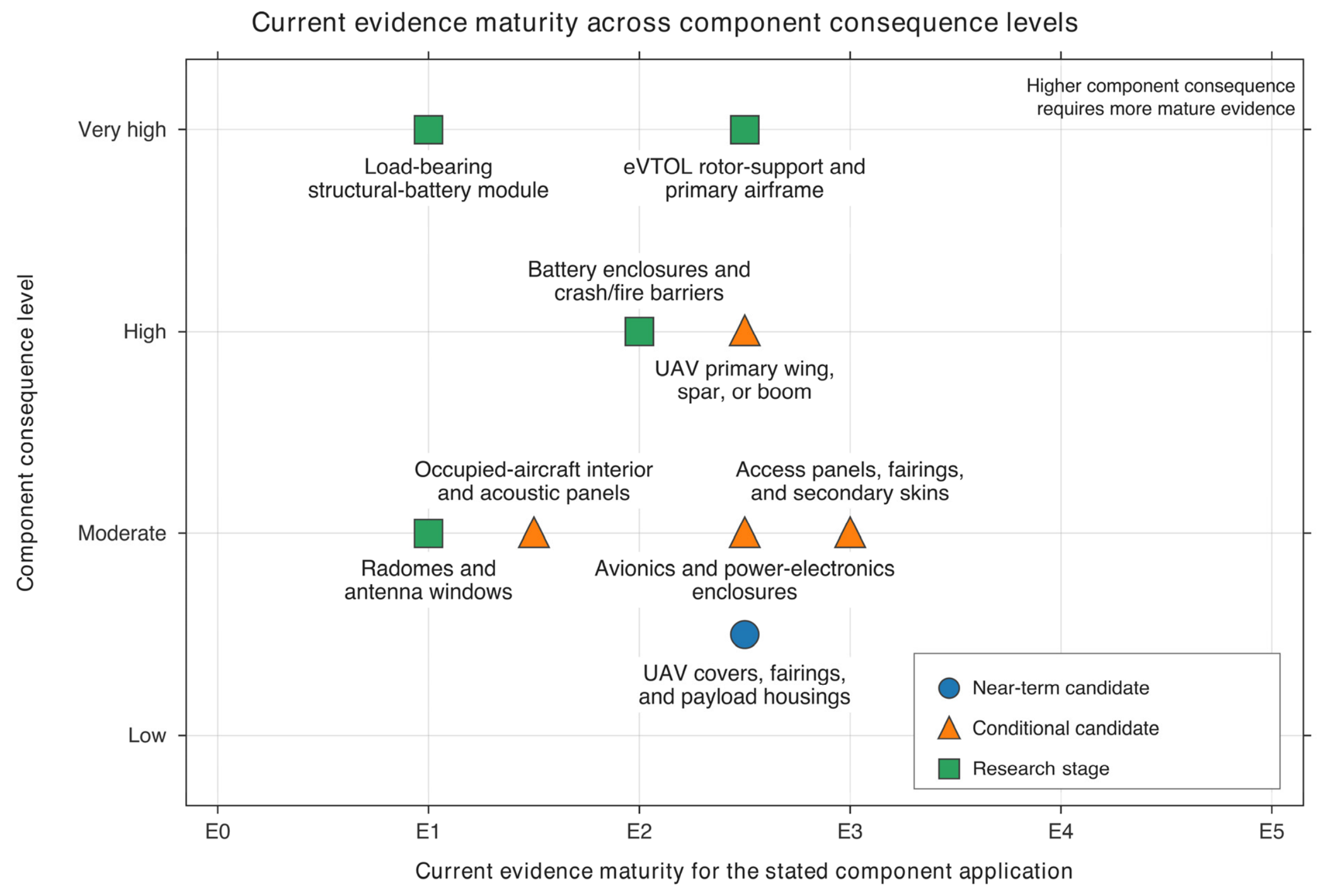
| Component Class and Consequence | Candidate Material Systems and Present Evidence | Current Evidence Range | Adoption Classification | Required Next Evidence |
|---|---|---|---|---|
| UAV covers, fairings, and payload housings; low to moderate consequence [14,30,49,51,52] | Thermoplastic composites, aligned or long-fragment recycled-CF systems, and natural-fibre hybrids have coupon and limited panel or element evidence. | E2–E3 | Near-term candidate for a defined unoccupied mission; conditional when fire, EMI, or loss-of-control consequences are assigned. | Hot-wet and impact retention; fasteners and joints; process repeatability; field inspection and repair; mission-specific failure assessment. |
| Occupied-aircraft interior and acoustic panels; moderate consequence [12,13,14,51,52,58,91,92,93] | Natural-fibre, bio-based, recycled-CF, and fire-modified thermoplastic systems have material and small-panel evidence. | E1–E2 | Conditional candidate. | Full-panel fire, smoke, and toxicity testing after ageing; joints and edges; batch variability; cleaning-agent and aircraft-fluid exposure; repair; production conformity. |
| Access panels, fairings, and secondary skins; moderate consequence [42,43,44,45,46,47,66,67,68,69,70,71,72,73,74,75] | Thermoplastic CFRP has the broadest joining and repair evidence among the emerging systems reviewed; selected recycled-CF systems remain geometry- and feedstock-specific. | E2–E4 | Conditional; a near-term candidate only for a defined material–process system with component evidence. | Weld and joint fatigue; impact; environmental ageing; defect limits; non-destructive inspection; repair durability; allowables; repeated-build validation. |
| Avionics and power-electronics enclosures; moderate consequence [35,65,99] | Conductive CFRP, thermoplastic CFRP, and hybrid conductive layers have review-level synthesis of experimental shielding studies. | E2–E3 | Conditional candidate. | Broadband shielding across seams and apertures; electrical bonding and grounding; thermal management; fire; vibration; moisture; impact and repaired-region performance; and enclosure-level repeatability. |
| Radomes and antenna windows; moderate consequence [35,64,65] | Natural-fibre biocomposites have preliminary screening evidence. Conductive CFRP and filler-modified polymers need direct dielectric and transmission data for radio-frequency-transparent applications. | E0–E2 | Research stage. | Permittivity, dielectric loss, insertion loss, and antenna-pattern retention over the operating band after moisture, thermal cycling, impact, rain erosion, coatings, joints, lightning-protection integration, and repair. |
| Battery enclosures and crash/fire barriers; high consequence [5,61,62,63,95,96,97,98] | Cited fire-resistant glass-fibre and thermoplastic systems, ceramic or mineral barriers, and multifunctional laminates are demonstrated mainly at coupon or element level. | E1–E3 | Research stage to conditional, depending on enclosure-scale evidence. | Impact/crush followed by module- or pack-level thermal-runaway testing; vent-gas management; electrical isolation; flame, smoke, and toxicity; attachment integrity; post-event structural and functional inspection; and repeated builds. |
| UAV primary wing, spar, or boom; high and mission-dependent consequence [42,43,44,47,84,85,89,101,102,103,104] | Among the emerging systems reviewed, thermoplastic CFRPs and selected hybrid CFRPs have the broadest structural evidence. Recycled- and natural-fibre evidence remains below representative component level. | E2–E3 | Conditional for bounded unoccupied missions; research stage where failure threatens people or critical operations. | Spectrum fatigue; vibration; impact; joints; manufacturing defects; environmental ageing; non-destructive inspection; repair; statistically defensible allowables. |
| eVTOL rotor-support structures and occupied-aircraft primary airframe; very high consequence [42,43,44,47,84,85,89,101,102,103,104] | Qualified incumbent CFRP provides the reference baseline. A specific thermoplastic-CFRP system may progress conditionally; recycled, natural-fibre, and most reversible-matrix systems remain immature. | E1–E4 for emerging systems | Research stage for emerging sustainable systems. | E4–E5 representative component- or full-scale evidence, production conformity, A- and B-basis allowables, damage tolerance, applicable crash/fire interaction, repair, and continued-airworthiness substantiation. |
| Load-bearing structural-battery module; very high consequence [15,98] | Multifunctional structural-battery concepts couple electrochemical storage with the primary load path. | E0–E2 | Research stage. | Coupled electrochemical and structural performance under fatigue, crash, thermal runaway, electrical isolation, damage detection, repair, safe degradation, and full aircraft-level safety integration. |
8. Research Priorities and Staged Adoption Roadmap
8.1. Near-Term Priority: Reproducible Material and Process Evidence
8.2. Intermediate Priority: Coupled-Function Component Validation
8.3. Longer-Term Priority: Qualification and High-Consequence Adoption
| Evidence Stage | Primary Airframes and Rotor Supports | Battery Enclosures and Thermal Barriers | Structural Battery Modules | Required Gate |
|---|---|---|---|---|
| 1. Material and process definition; E0 to E1 | Fix constituents, architecture, processing route, critical defects, traceability, and the initial analysis basis. Define load cases and failure consequences [84,85]. | Define enclosure geometry, attachments, barriers, vents, electrical isolation, and credible normal and abnormal thermal conditions [5,61,91,92,93,94,95,96,97]. | Define load path, cell and matrix architecture, electrical isolation, sensing, thermal management, and safe degradation functions [15,98]. | Controlled material, process, component functions, hazards, and acceptance metrics. |
| 2. Conditioned coupons and process baselines; E2 | Generate statistically based strength and stiffness data, fatigue and impact response, environmental knockdowns, defect sensitivity, and process variability. | Measure laminate and barrier response for impact, heat flux, ignition, heat release, smoke, gas toxicity, electrical isolation, and thermal ageing. | Measure structural, electrochemical, thermal, and electrical response under fatigue, damage, temperature, state of charge, and ageing. | Repeatable coupon evidence and bounded process windows sufficient to design elements. |
| 3. Joints, elements, and coupled functions; E3 | Test joints, load introduction, representative defects, bonded or welded interfaces, local buckling, damage growth, inspection capability, and repair [71,72,73,74,75,88,89,90]. | Test seams, attachments, vents, seals, barriers, grounding paths, and post-impact thermal and fire response, including inspection after an event. | Test current paths, interfaces, sensing, damage detection, fault initiation, containment, and retained structural and electrochemical capability. | Validated failure modes and analysis methods for a representative element configuration. |
| 4. Representative subcomponents; E4 | Use manufacturing-representative panels, beams, wing boxes, frames, or rotor support details with realistic boundaries, load paths, defects, conditioning, inspection, and repair. | Use an enclosure section or pack-level article for sequential impact or crush, thermal runaway, vent routing, fire containment, isolation, and attachment integrity. | Use a load-bearing module for combined fatigue, impact, thermal runaway, isolation, sensing, damage detection, and residual capability. | Repeatable subcomponent evidence that closes the dominant coupled failure modes. |
| 5. Full component and system integration; E4 to E5 | Test the complete primary structural or rotor support article under critical static, fatigue, damage tolerance, environmental, crash, and repair cases applicable to its function. | Test the complete enclosure and installed interfaces under representative module or pack loads, thermal runaway, venting, fire, electrical isolation, and post-event inspection. | Test the complete structural battery module within the aircraft load, electrical, thermal, control, and containment architecture. | Correlated full component evidence and verified interface requirements for the defined aircraft system. |
| 6. Qualification, production, and service; E5 | Establish the applicable qualification basis, production conformity, validated analysis domain, inspection intervals, repair limits, and continued airworthiness controls [84,85]. | Control enclosure manufacture, barrier and vent configuration, event detection, inspection, replacement criteria, maintenance, and post-event disposition. | Control module manufacture, health monitoring, allowable degradation, fault response, replacement, repair restrictions, and aircraft-level safety integration. | Approved configuration with controlled production and service evidence. Progression remains subject to the applicable certification programme. |
9. Conclusions
Author Contributions
Funding
Data Availability Statement
Acknowledgments
Conflicts of Interest
References
- Schäfer, A.W.; Barrett, S.R.H.; Doyme, K.; Dray, L.M.; Gnadt, A.R.; Self, R.; O’Sullivan, A.; Synodinos, A.P.; Torija, A.J. Technological, economic and environmental prospects of all-electric aircraft. Nat. Energy 2019, 4, 160–166. [Google Scholar] [CrossRef] [Scilit]
- Brelje, B.J.; Martins, J.R.R.A. Electric, hybrid, and turboelectric fixed-wing aircraft: A review of concepts, models, and design approaches. Prog. Aerosp. Sci. 2019, 104, 1–19. [Google Scholar] [CrossRef] [Scilit]
- Gnadt, A.R.; Speth, R.L.; Sabnis, J.S.; Barrett, S.R.H. Technical and environmental assessment of all-electric 180-passenger commercial aircraft. Prog. Aerosp. Sci. 2019, 105, 1–30. [Google Scholar] [CrossRef] [Scilit]
- Viswanathan, V.; Epstein, A.H.; Chiang, Y.-M.; Takeuchi, E.; Bradley, M.; Langford, J.; Winter, M. The challenges and opportunities of battery-powered flight. Nature 2022, 601, 519–525. [Google Scholar] [CrossRef] [Scilit] [PubMed]
- Sripad, S.; Bills, A.; Viswanathan, V. A review of safety considerations for batteries in aircraft with electric propulsion. MRS Bull. 2021, 46, 435–442. [Google Scholar] [CrossRef] [Scilit]
- Yang, X.-G.; Liu, T.; Ge, S.; Rountree, E.; Wang, C.-Y. Challenges and key requirements of batteries for electric vertical takeoff and landing aircraft. Joule 2021, 5, 1644–1659. [Google Scholar] [CrossRef] [Scilit]
- Kiesewetter, L.; Shakib, K.H.; Singh, P.; Rahman, M.; Khandelwal, B.; Kumar, S.; Shah, K. A holistic review of the current state of research on aircraft design concepts and consideration for advanced air mobility applications. Prog. Aerosp. Sci. 2023, 142, 100949. [Google Scholar] [CrossRef] [Scilit]
- Zhang, J.; Liu, Y.; Zheng, Y. Overall eVTOL aircraft design for urban air mobility. Green Energy Intell. Transp. 2024, 3, 100150. [Google Scholar] [CrossRef] [Scilit]
- Bauranov, A.; Rakas, J. Designing airspace for urban air mobility: A review of concepts and approaches. Prog. Aerosp. Sci. 2021, 125, 100726. [Google Scholar] [CrossRef] [Scilit]
- Parveez, B.; Kittur, M.I.; Badruddin, I.A.; Kamangar, S.; Hussien, M.; Umarfarooq, M.A. Scientific advancements in composite materials for aircraft applications: A review. Polymers 2022, 14, 5007. [Google Scholar] [CrossRef] [Scilit] [PubMed]
- Castanié, B.; Bouvet, C.; Ginot, M. Review of composite sandwich structure in aeronautic applications. Compos. Part C Open Access 2020, 1, 100004. [Google Scholar] [CrossRef] [Scilit]
- Maiti, S.; Islam, M.R.; Uddin, M.A.; Afroj, S.; Eichhorn, S.J.; Karim, N. Sustainable fiber-reinforced composites: A review. Adv. Sustain. Syst. 2022, 6, 2200258. [Google Scholar] [CrossRef] [Scilit]
- Ramon, E.; Sguazzo, C.; Moreira, P.M.G.P. A review of recent research on bio-based epoxy systems for engineering applications and potentialities in the aviation sector. Aerospace 2018, 5, 110. [Google Scholar] [CrossRef] [Scilit]
- Vedrtnam, A.; Negi, H.; Kalauni, K. Materials and energy-centric life cycle assessment for drones: A review. J. Compos. Sci. 2025, 9, 169. [Google Scholar] [CrossRef] [Scilit]
- Kühnelt, H.; Beutl, A.; Mastropierro, F.; Laurin, F.; Willrodt, S.; Bismarck, A.; Guida, M.; Romano, F. Structural batteries for aeronautic applications—State of the art, research gaps and technology development needs. Aerospace 2022, 9, 7. [Google Scholar] [CrossRef] [Scilit]
- Carvalho, P.; Aguiar-Branco, J.; Guedes, R.M. Emerging materials for durable and sustainable design of aeronautic structures. Materials 2025, 18, 4922. [Google Scholar] [CrossRef] [Scilit] [PubMed]
- Shen, C.; Guo, Y.; Shen, Z.; Yan, F.; Zhong, N. Additive manufacturing of aerospace composites: A critical review of the material–process–design interplay and prospects for application. Materials 2025, 18, 4280. [Google Scholar] [CrossRef] [Scilit] [PubMed]
- Zhang, J.; Roumeliotis, I.; Zolotas, A. Sustainable aviation electrification: A comprehensive review of electric propulsion system architectures, energy management, and control. Sustainability 2022, 14, 5880. [Google Scholar] [CrossRef] [Scilit]
- Akter, M.F.; Al Momen, A.; Islam, M.A.; Khan, F.; Khan, S.; Rumi, G.A.; Hossain, N. Recent advances, material selection strategies, and future directions in composite materials for aerospace applications: A review. Results Surf. Interfaces 2026, 24, 100891. [Google Scholar] [CrossRef] [Scilit]
- Hamzat, A.K.; Murad, M.S.; Adediran, I.A.; Asmatulu, E.; Asmatulu, R. Fiber-reinforced composites for aerospace, energy, and marine applications: An insight into failure mechanisms under chemical, thermal, oxidative, and mechanical load conditions. Adv. Compos. Hybrid Mater. 2025, 8, 152. [Google Scholar] [CrossRef] [Scilit]
- Zabihi, O.; Zamani, P.; Yadav, R.; Wei, Y.; Laghaei, M.; Pakdel, E.; Ahmadi, M.; Li, Q.; Hadigheh, S.A.; Naebe, M. The sustainability spectrum of carbon fibre: Balancing high performance CFRP composites with environmental responsibility. Adv. Compos. Hybrid Mater. 2025, 8, 415. [Google Scholar] [CrossRef] [Scilit]
- Green, B.N.; Johnson, C.D.; Adams, A. Writing narrative literature reviews for peer-reviewed journals: Secrets of the trade. J. Chiropr. Med. 2006, 5, 101–117. [Google Scholar] [CrossRef] [Scilit] [PubMed]
- Antcliff, K.R.; Guynn, M.D.; Marien, T.V.; Wells, D.P.; Schneider, S.J.; Tong, M.J. Mission analysis and aircraft sizing of a hybrid-electric regional aircraft. In Proceedings of the 54th AIAA Aerospace Sciences Meeting, San Diego, CA, USA, 4–8 January 2016. AIAA 2016-1028. [Google Scholar] [CrossRef] [Scilit]
- Zhang, J.; Roumeliotis, I.; Zolotas, A. Model-based fully coupled propulsion-aerodynamics optimization for hybrid electric aircraft energy management strategy. Energy 2022, 245, 123239. [Google Scholar] [CrossRef] [Scilit]
- Figueroa, R.Q.; Cavallaro, R.; Cini, A. Feasibility studies on regional aircraft retrofitted with hybrid-electric powertrains. Aerosp. Sci. Technol. 2024, 151, 109246. [Google Scholar] [CrossRef] [Scilit]
- Nasoulis, C.P.; Gkoutzamanis, V.G.; Kalfas, A.I. Multidisciplinary conceptual design for a hybrid-electric commuter aircraft. Aeronaut. J. 2022, 126, 1242–1264. [Google Scholar] [CrossRef] [Scilit]
- Peças, P.; Carvalho, H.; Salman, H.; Leite, M. Natural fibre composites and their applications: A review. J. Compos. Sci. 2018, 2, 66. [Google Scholar] [CrossRef] [Scilit]
- Elfaleh, I.; Abbassi, F.; Habibi, M.; Ahmad, F.; Guedri, M.; Nasri, M.; Garnier, C. A comprehensive review of natural fibers and their composites: An eco-friendly alternative to conventional materials. Results Eng. 2023, 19, 101271. [Google Scholar] [CrossRef] [Scilit]
- Islam, T.; Chaion, M.H.; Jalil, M.A.; Rafi, A.S.; Mushtari, F.; Dhar, A.K.; Hossain, S. Advancements and challenges in natural fiber-reinforced hybrid composites: A comprehensive review. SPE Polym. 2024, 5, 481–506. [Google Scholar] [CrossRef] [Scilit]
- Bourchak, M.; Ajaj, R.; Khalid, M.; Juhany, K.A.; Arun Prakash, V.R.; Alshahrani, H. Development of light weight sustainable pineapple/kevlar hybridized fiber and peanut husk cellulose toughened vinyl ester biocomposite for unmanned aerial vehicle applications. J. Vinyl Addit. Technol. 2023, 29, 448–457. [Google Scholar] [CrossRef] [Scilit]
- Cho, J.; Lee, E.S.; Kim, J.H.; Lee, C.-Y.; Cho, J.Y. Design of lattice-based energy-absorbing structure for enhancing the crashworthiness of advanced air mobility. Aerospace 2025, 12, 332. [Google Scholar] [CrossRef] [Scilit]
- Chen, Y.; Kang, Y.; Zhao, Y.; Wang, L.; Liu, J.; Li, Y.; Liang, Z.; He, X.; Li, X.; Tavajohi, N.; et al. A review of lithium-ion battery safety concerns: The issues, strategies, and testing standards. J. Energy Chem. 2021, 59, 83–99. [Google Scholar] [CrossRef] [Scilit]
- Li, H.; Wang, H.; Xu, Z.; Wang, K.; Ge, M.; Gan, L.; Zhang, Y.; Tang, Y.; Chen, S. Thermal-responsive and fire-resistant materials for high-safety lithium-ion batteries. Small 2021, 17, 2103679. [Google Scholar] [CrossRef] [Scilit] [PubMed]
- Ghiji, M.; Novozhilov, V.; Moinuddin, K.; Joseph, P.; Burch, I.; Suendermann, B.; Gamble, G. A review of lithium-ion battery fire suppression. Energies 2020, 13, 5117. [Google Scholar] [CrossRef] [Scilit]
- Mikinka, E.; Siwak, M. Recent advances in electromagnetic interference shielding properties of carbon-fibre-reinforced polymer composites—A topical review. J. Mater. Sci. Mater. Electron. 2021, 32, 24585–24643. [Google Scholar] [CrossRef] [Scilit]
- Qi, Y.; Weng, Z.; Kou, Y.; Li, J.; Cao, Q.; Wang, J.; Zhang, S.; Jian, X. Facile synthesis of bio-based tetra-functional epoxy resin and its potential application as high-performance composite resin matrix. Compos. Part B Eng. 2021, 214, 108749. [Google Scholar] [CrossRef] [Scilit]
- Capretti, M.; Giammaria, V.; Santulli, C.; Boria, S.; Del Bianco, G. Use of bio-epoxies and their effect on the performance of polymer composites: A critical review. Polymers 2023, 15, 4733. [Google Scholar] [CrossRef] [Scilit] [PubMed]
- Mezeix, L.; Gupta, P.; Bouvet, C.; Wongtimnoi, K. Mechanical characterization of recyclable and non-recyclable bio-epoxy resins for aerospace applications. J. Compos. Sci. 2024, 8, 191. [Google Scholar] [CrossRef] [Scilit]
- Meng, F.; Cui, Y.; Pickering, S.; McKechnie, J. From aviation to aviation: Environmental and financial viability of closed-loop recycling of carbon fibre composite. Compos. Part B Eng. 2020, 200, 108362. [Google Scholar] [CrossRef] [Scilit]
- Thamizh Selvan, R.; Vishakh Raja, P.C.; Mangal, P.; Mohan, N.; Bhowmik, S. Recycling technology of epoxy glass fiber and epoxy carbon fiber composites used in aerospace vehicles. J. Compos. Mater. 2021, 55, 3281–3292. [Google Scholar] [CrossRef] [Scilit]
- Chen, P.-Y.; Feng, R.; Xu, Y.; Zhu, J.-H. Recycling and reutilization of waste carbon fiber reinforced plastics: Current status and prospects. Polymers 2023, 15, 3508. [Google Scholar] [CrossRef] [Scilit] [PubMed]
- Wang, H.; Huo, S.; Chevali, V.; Hall, W.; Offringa, A.; Song, P.; Wang, H. Carbon fiber reinforced thermoplastics: From materials to manufacturing and applications. Adv. Mater. 2025, 37, 2418709. [Google Scholar] [CrossRef] [Scilit] [PubMed]
- Ozturk, F.; Cobanoglu, M.; Ece, R.E. Recent advancements in thermoplastic composite materials in aerospace industry. J. Thermoplast. Compos. Mater. 2024, 37, 3084–3116. [Google Scholar] [CrossRef] [Scilit]
- Larsen, L.; Endrass, M.; Jarka, S.; Bauer, S.; Janek, M. Exploring ultrasonic and resistance welding for thermoplastic composite structures: Process development and application potential. Compos. Part B Eng. 2025, 289, 111927. [Google Scholar] [CrossRef] [Scilit]
- Türker, Y.S.; Öztürk, F.; Öz, Y. Review of recycling methods of thermoplastic composite materials. Polym.-Plast. Technol. Mater. 2024, 63, 1693–1713. [Google Scholar] [CrossRef] [Scilit]
- Alshammari, B.A.; Alsuhybani, M.S.; Almushaikeh, A.M.; Alotaibi, B.M.; Alenad, A.M.; Alqahtani, N.B.; Alharbi, A.G. Comprehensive review of the properties and modifications of carbon fiber-reinforced thermoplastic composites. Polymers 2021, 13, 2474. [Google Scholar] [CrossRef] [Scilit] [PubMed]
- Hu, S.; Li, F. Laser joining of CFRTP to metal: A review on welding parameters, joint enhancement, and numerical simulation. Polym. Compos. 2024, 45, 1931–1955. [Google Scholar] [CrossRef] [Scilit]
- Montagna, L.S.; Morgado, G.F.M.; Lemes, A.P.; Passador, F.R.; Rezende, M.C. Recycling of carbon fiber-reinforced thermoplastic and thermoset composites: A review. J. Thermoplast. Compos. Mater. 2023, 36, 3455–3480. [Google Scholar] [CrossRef] [Scilit]
- Butenegro, J.A.; Bahrami, M.; Swolfs, Y.; Ivens, J.; Martínez, M.Á.; Abenojar, J. Novel sustainable composites incorporating a biobased thermoplastic matrix and recycled aerospace prepreg waste: Development and characterization. Polymers 2023, 15, 3447. [Google Scholar] [CrossRef] [Scilit] [PubMed]
- Elango, I.; Henderson, L.C.; Arumugam, V. Recycled milled fibres in sustainable composite materials: A comprehensive review and future prospects. J. Reinf. Plast. Compos. 2025, 44, 1391–1411. [Google Scholar] [CrossRef] [Scilit]
- Ao, X.; Vázquez-López, A.; Mocerino, D.; González, C.; Wang, D.-Y. Flame retardancy and fire mechanical properties for natural fiber/polymer composite: A review. Compos. Part B Eng. 2024, 268, 111069. [Google Scholar] [CrossRef] [Scilit]
- Ciardiello, R.; Benelli, A.; Paolino, D.S. Static and impact properties of flax-reinforced polymers prepared with conventional epoxy and sustainable resins. Polymers 2024, 16, 190. [Google Scholar] [CrossRef] [Scilit] [PubMed]
- Tran, H.T.T.; Nisha, S.S.; Radjef, R.; Nikzad, M.; Bjekovic, R.; Fox, B. Recyclable and biobased vitrimers for carbon fibre-reinforced composites—A review. Polymers 2024, 16, 1025. [Google Scholar] [CrossRef] [Scilit] [PubMed]
- Liu, Y.; Wang, B.; Ma, S.; Yu, T.; Xu, X.; Li, Q.; Wang, S.; Han, Y.; Yu, Z.; Zhu, J. Catalyst-free malleable, degradable, bio-based epoxy thermosets and its application in recyclable carbon fiber composites. Compos. Part B Eng. 2021, 211, 108654. [Google Scholar] [CrossRef] [Scilit]
- Dinu, R.; Lafont, U.; Damiano, O.; Orange, F.; Mija, A. Recyclable, repairable, and fire-resistant high-performance carbon fiber biobased epoxy. ACS Appl. Polym. Mater. 2023, 5, 2542–2552. [Google Scholar] [CrossRef] [Scilit]
- Gu, S.; Xu, S.-D.; Lu, J.-H.; Pu, X.-L.; Ren, Q.-R.; Xiao, Y.-F.; Wang, Y.-Z.; Chen, L. Phosphonate-influenced Diels–Alder chemistry toward multi-path recyclable, fire safe thermoset and its carbon fiber composites. EcoMat 2023, 5, e12388. [Google Scholar] [CrossRef] [Scilit]
- Tian, P.-X.; Li, Y.-D.; Hu, Z.; Zeng, J.-B. Fire-resistant and high-performance epoxy vitrimers for fully recyclable carbon fiber-reinforced composites. Mater. Today Chem. 2024, 36, 101965. [Google Scholar] [CrossRef] [Scilit]
- Dalfi, H.K.; Jan, K.; Al-Badri, A.; Peerzada, M.; Yousaf, Z.; Parnell, W.; Morrison, N.; Bari, K. Enhancing the fire-resistance performance of composite laminates via multi-scale hybridisation: A review. J. Ind. Text. 2024, 54, 15280837241226988. [Google Scholar] [CrossRef] [Scilit]
- Mangalgiri, P.D. Composite materials for aerospace applications. Bull. Mater. Sci. 1999, 22, 657–664. [Google Scholar] [CrossRef] [Scilit]
- Hairi, S.M.F.B.S.; Saleh, S.J.M.B.M.; Ariffin, A.H.; Omar, Z.B. A review on composite aerostructure development for UAV application. Khan, T., Jawaid, M., Eds.; In Green Hybrid Composite in Engineering and Non-Engineering Applications; Springer Nature: Singapore, 2023; pp. 137–157. [Google Scholar] [CrossRef] [Scilit]
- Kaleg, S.; Sumarsono, D.A.; Whulanza, Y.; Budiman, A.C. Addressing fire safety, ground impact resistance, and thermal management in composite EV battery enclosures: A review. Automot. Exp. 2024, 7, 460–485. [Google Scholar] [CrossRef] [Scilit]
- Niu, J.; Deng, S.; Gao, X.; Niu, H.; Fang, Y.; Zhang, Z. Experimental study on low thermal conductive and flame retardant phase change composite material for mitigating battery thermal runaway propagation. J. Energy Storage 2022, 47, 103557. [Google Scholar] [CrossRef] [Scilit]
- Samarasinghe, T.; Kazilas, M.; Lewis, S. Advanced thermal management in Li-ion batteries using composite enclosures with embedded thermal bridges. J. Compos. Mater. 2026, 60, 1465–1475. [Google Scholar] [CrossRef] [Scilit]
- Haris, M.Y.; Laila, D.; Zainudin, E.S.; Mustapha, F.; Zahari, R.; Halim, Z. Preliminary review of biocomposites materials for aircraft radome application. Key Eng. Mater. 2011, 471–472, 563–567. [Google Scholar] [CrossRef] [Scilit]
- Sankaran, S.; Deshmukh, K.; Ahamed, M.B.; Khadheer Pasha, S.K. Recent advances in electromagnetic interference shielding properties of metal and carbon filler reinforced flexible polymer composites: A review. Compos. Part A Appl. Sci. Manuf. 2018, 114, 49–71. [Google Scholar] [CrossRef] [Scilit]
- Brasington, A.; Sacco, C.; Halbritter, J.; Wehbe, R.; Harik, R. Automated fiber placement: A review of history, current technologies, and future paths forward. Compos. Part C Open Access 2021, 6, 100182. [Google Scholar] [CrossRef] [Scilit]
- Rousseau, G.; Wehbe, R.; Halbritter, J.; Harik, R. Automated fiber placement path planning: A state-of-the-art review. Comput.-Aided Des. Appl. 2019, 16, 172–203. [Google Scholar] [CrossRef] [Scilit]
- Boon, Y.D.; Joshi, S.C.; Bhudolia, S.K. Review: Filament winding and automated fiber placement with in situ consolidation for fiber reinforced thermoplastic polymer composites. Polymers 2021, 13, 1951. [Google Scholar] [CrossRef] [Scilit] [PubMed]
- Aldosari, S.M.; AlOtaibi, B.M.; Alblalaihid, K.S.; Aldoihi, S.A.; AlOgab, K.A.; Alsaleh, S.S.; Alshamary, D.O.; Alanazi, T.H.; Aldrees, S.D.; Alshammari, B.A. Mechanical recycling of carbon fiber-reinforced polymer in a circular economy. Polymers 2024, 16, 1363. [Google Scholar] [CrossRef] [Scilit] [PubMed]
- Yuan, M.; Li, Z.; Teng, Z. Progress and prospects of recycling technology for carbon fiber reinforced polymer. Front. Mater. 2024, 11, 1484544. [Google Scholar] [CrossRef] [Scilit]
- Stankiewicz, K.; Lipkowski, A.; Kowalczyk, P.; Giżyński, M.; Waśniewski, B. Resistance welding of thermoplastic composites, including welding to thermosets and metals: A review. Materials 2024, 17, 4797. [Google Scholar] [CrossRef] [Scilit] [PubMed]
- Reis, J.P.; de Moura, M.; Samborski, S. Thermoplastic composites and their promising applications in joining and repair composites structures: A review. Materials 2020, 13, 5832. [Google Scholar] [CrossRef] [Scilit] [PubMed]
- Khan, T.; Hafeez, F.; Umer, R. Repair of aerospace composite structures using liquid thermoplastic resin. Polymers 2023, 15, 1377. [Google Scholar] [CrossRef] [Scilit] [PubMed]
- Modi, V.; Bandaru, A.K.; Ramaswamy, K.; Kelly, C.; McCarthy, C.; Flanagan, T.; O’Higgins, R. Repair of impacted thermoplastic composite laminates using induction welding. Polymers 2023, 15, 3238. [Google Scholar] [CrossRef] [Scilit] [PubMed]
- Budhe, S.; Banea, M.D.; de Barros, S. Bonded repair of composite structures in aerospace application: A review on environmental issues. Appl. Adhes. Sci. 2018, 6, 3. [Google Scholar] [CrossRef] [Scilit]
- Pinto, P.; Almeida, J.; Ferreira, J.; Guedes, R.M. Recyclability of composites in commercial aviation: Industrial specificities, readiness and challenges. J. Compos. Sci. 2025, 9, 471. [Google Scholar] [CrossRef] [Scilit]
- Naqvi, S.R.; Mysore Prabhakara, H.; Bramer, E.A.; Dierkes, W.; Akkerman, R.; Brem, G. A critical review on recycling of end-of-life carbon fibre/glass fibre reinforced composites waste using pyrolysis towards a circular economy. Resour. Conserv. Recycl. 2018, 136, 118–129. [Google Scholar] [CrossRef] [Scilit]
- Giorgini, L.; Benelli, T.; Brancolini, G.; Mazzocchetti, L. Recycling of carbon fiber reinforced composite waste to close their life cycle in a cradle-to-cradle approach. Curr. Opin. Green Sustain. Chem. 2020, 26, 100368. [Google Scholar] [CrossRef] [Scilit]
- Stergiou, V.; Konstantopoulos, G.; Charitidis, C.A. Carbon fiber reinforced plastics in space: Life cycle assessment towards improved sustainability of space vehicles. J. Compos. Sci. 2022, 6, 144. [Google Scholar] [CrossRef] [Scilit]
- Tapper, R.J.; Longana, M.L.; Norton, A.; Potter, K.D.; Hamerton, I. An evaluation of life cycle assessment and its application to the closed-loop recycling of carbon fibre reinforced polymers. Compos. Part B Eng. 2020, 184, 107665. [Google Scholar] [CrossRef] [Scilit]
- Ciacci, L.; Zattini, G.; Tosi, C.; Berti, B.; Passarini, F.; Giorgini, L. Carbon fibers waste recovery via pyro-gasification: Semi-industrial pilot plant testing and LCA. Sustainability 2022, 14, 3744. [Google Scholar] [CrossRef] [Scilit]
- van Grootel, A.; Chang, J.; Wardle, B.L.; Olivetti, E. Manufacturing variability drives significant environmental and economic impact: The case of carbon fiber reinforced polymer composites in the aerospace industry. J. Clean. Prod. 2020, 261, 121087. [Google Scholar] [CrossRef] [Scilit]
- Ilcewicz, L.; Ashforth, C. Certifying innovative composite applications. In Proceedings of the AIAA SciTech 2020 Forum, Orlando, FL, USA, 6–10 January 2020. AIAA 2020-1385. [Google Scholar] [CrossRef] [Scilit]
- Federal Aviation Administration. Composite Aircraft Structure; Advisory Circular AC 20-107B, Change 1; U.S. Department of Transportation: Washington, DC, USA, 2010. [Google Scholar]
- U.S. Department of Defense. Composite Materials Handbook, Volume 3: Polymer Matrix Composites—Materials Usage, Design, and Analysis; MIL-HDBK-17-3F; Department of Defense: Washington, DC, USA, 2002. [Google Scholar]
- Tomblin, J.; Lacy, T.; Smith, B.; Hooper, S.; Vizzini, A.; Lee, S. Review of Damage Tolerance for Composite Sandwich Airframe Structures; Final Report DOT/FAA/AR-99/49; U.S. Department of Transportation, Federal Aviation Administration, Office of Aviation Research: Washington, DC, USA, 1999. [Google Scholar]
- Harris, C.E.; Starnes, J.H., Jr.; Shuart, M.J. Advanced Durability and Damage Tolerance Design and Analysis Methods for Composite Structures: Lessons Learned from NASA Technology Development Programs; NASA/TM-2003-212420; National Aeronautics and Space Administration, Langley Research Center: Hampton, VA, USA, 2003. [Google Scholar]
- Johnson, A.F.; Toso-Pentecôte, N.; Schueler, D. Numerical modelling of impact and damage tolerance in aerospace composite structures. In Numerical Modelling of Failure in Advanced Composite Materials; Camanho, P.P., Hallett, S.R., Eds.; Woodhead Publishing: Cambridge, UK, 2015; pp. 479–506. [Google Scholar] [CrossRef] [Scilit]
- Feraboli, P. Composite materials strength determination within the current certification methodology for aircraft structures. J. Aircr. 2009, 46, 1365–1374. [Google Scholar] [CrossRef] [Scilit]
- Roberts, E.M.; Justusson, B.P.; Schaefer, J.D.; Wanthal, S.P. Improved benchmarking of cohesive elements in Abaqus Standard for predicting disbond and delamination in composite structures. In Proceedings of the AIAA SciTech 2021 Forum, Virtual Event, 11–21 January 2021. AIAA 2021-0444. [Google Scholar] [CrossRef] [Scilit]
- Bartlett, J.; Stratford, C. Fire resistance certification of aircraft composite materials. Pract. Fail. Anal. 2001, 1, 37–43. [Google Scholar] [CrossRef]
- Mouritz, A.P. Fire Safety of Advanced Composites for Aircraft; ATSB Research and Analysis Report, Aviation Safety Research Grant B2004/0046; Australian Transport Safety Bureau: Canberra, Australia, 2006. [Google Scholar]
- Tranchard, P.; Samyn, F.; Duquesne, S.; Thomas, M.; Estèbe, B.; Montès, J.-L.; Bourbigot, S. Fire behaviour of carbon fibre epoxy composite for aircraft: Novel test bench and experimental study. J. Fire Sci. 2015, 33, 247–266. [Google Scholar] [CrossRef] [Scilit]
- Ma, X.; Ding, S. Overview and research on airworthiness and safety of electrical propulsion and battery technologies in eVTOL. In Proceedings of the SAE 2023 Intelligent Urban Air Mobility Symposium, Hangzhou, China, 20–21 October 2023. SAE Technical Paper 2023-01-7116. [Google Scholar] [CrossRef] [Scilit]
- Lobitz, L.; Hahn, A.; Vogt, D.; Luplow, T.; Michalowski, P.; Heimbs, S.; Garnweitner, G. Conceptual challenges for crashworthy battery-electric commercial aircraft: Review. J. Aircr. 2025, 62, 1479–1489. [Google Scholar] [CrossRef] [Scilit]
- Harrison, J.; Charles, D.; Zenker, J.; Frank, E. Using multi-physics system simulation to predict battery pack thermal performance and risk of thermal runaway during eVTOL aircraft operations. In Proceedings of the AIAA Propulsion and Energy 2019 Forum, Indianapolis, IN, USA, 19–22 August 2019. AIAA 2019-4406. [Google Scholar] [CrossRef] [Scilit]
- Liu, W.; Deng, Z.; Li, J.; Hu, X. Investigating the electrothermal behavior of eVTOL batteries in urban air mobility applications. In Proceedings of the 2022 IEEE 25th International Conference on Intelligent Transportation Systems (ITSC), Macau, China, 8–12 October 2022; pp. 40–45. [Google Scholar] [CrossRef] [Scilit]
- Di Mauro, G.; Guida, M.; Olivares, G.; Gomez, L.M. Paving the way for the electrified future of flight: Safety criteria development for integrating structural batteries in aircraft. Aerotec. Missili Spaz. 2025, 104, 59–65. [Google Scholar] [CrossRef] [Scilit]
- Malburg, L.C.; Moonen, N.; Leferink, F. The changing electromagnetic environment onboard all-electric aircraft, an EMC perspective. In Proceedings of the 2021 IEEE International Joint EMC/SI/PI and EMC Europe Symposium, Raleigh, NC, USA, 26 July–13 August 2021; pp. 845–850. [Google Scholar] [CrossRef] [Scilit]
- Le Bris, G.; Nguyen, L.-G. Safety considerations on the operation of electric vertical and takeoff landing (VTOL) aircraft at airports and vertiports. In Proceedings of the Vertical Flight Society 78th Annual Forum and Technology Display, Fort Worth, TX, USA, 10–12 May 2022; Paper F-0078-2022-0104. pp. 1–13. [Google Scholar] [CrossRef] [Scilit]
- Kennedy, G.J.; Kenway, G.W.; Martins, J.R.R.A. High aspect ratio wing design: Optimal aerostructural tradeoffs for the next generation of materials. In Proceedings of the 52nd AIAA Aerospace Sciences Meeting, National Harbor, MD, USA, 13–17 January 2014. AIAA 2014-0596. [Google Scholar] [CrossRef] [Scilit]
- Brooks, T.R.; Kennedy, G.J.; Martins, J.R.R.A. High-fidelity multipoint aerostructural optimization of a high aspect ratio tow-steered composite wing. In Proceedings of the 58th AIAA/ASCE/AHS/ASC Structures, Structural Dynamics, and Materials Conference, Grapevine, TX, USA, 9–13 January 2017. AIAA 2017-1350. [Google Scholar] [CrossRef] [Scilit]
- Ahmadi, M.; Farsadi, T. Multidisciplinary optimization of high aspect ratio composite wings with geometrical nonlinearity and aeroelastic tailoring. Aerosp. Sci. Technol. 2024, 145, 108849. [Google Scholar] [CrossRef] [Scilit]
- Farsadi, T.; Ahmadi, M.; Sahin, M.; Haddad Khodaparast, H.; Kayran, A.; Friswell, M.I. High aspect ratio composite wings: Geometrically nonlinear aeroelasticity, Multi-Disciplinary design optimization, manufacturing, and experimental testing. Aerospace 2024, 11, 193. [Google Scholar] [CrossRef] [Scilit]
- Vidal, R.; Moliner, E.; Martin, P.P.; Fita, S.; Wonneberger, M.; Verdejo, E.; Vanfleteren, F.; Lapeña, N.; González, A. Life cycle assessment of novel aircraft interior panels made from renewable or recyclable polymers with natural fiber reinforcements and non-halogenated flame retardants. J. Ind. Ecol. 2018, 22, 132–144. [Google Scholar] [CrossRef] [Scilit]

| Review | Primary Scope | Materials and Processing | Electric Aviation/UAV Relevance | Coupled Safety and Qualification Coverage | Component Adoption Assessment | Analytical Emphasis and Scope Boundary |
|---|---|---|---|---|---|---|
| Parveez et al. [10] | Broad aerospace composites | Broad material classes and manufacturing routes | Partial | Partial treatment of safety and qualification | Partial component examples | No integrated sustainability, evidence-maturity, or component-adoption framework for electric aviation |
| Maiti et al. [12] | Sustainable fibre-reinforced composites | Central coverage of sustainable fibres, matrices, processing, and life cycle considerations | Not central | Partial fire and environmental discussion; qualification not central | Not central | No aerospace qualification pathway or component-consequence assessment |
| Ramon et al. [13] | Bio-based epoxies for engineering and aviation | One matrix family; chemistry, processing, and properties | Partial | Partial thermal and durability coverage; qualification not central | Not central | Restricted to bio-based epoxy chemistry; no cross-family or component-specific evidence assessment |
| Vedrtnam et al. [14] | UAV materials and energy-centred life cycle assessment | Partial sustainable-material coverage | Central UAV focus | Safety and qualification not central | Central UAV component categories | No occupied-aircraft qualification, coupled-hazard, or evidence-maturity assessment |
| Kühnelt et al. [15] | Structural batteries for aeronautics | Multifunctional structural-battery systems | Central electric-aircraft focus | Central battery integration and certification-gap analysis | Central for structural batteries | Restricted to structural batteries rather than multiple sustainable composite families |
| Carvalho et al. [16] | Durable and sustainable aeronautic materials | Central coverage of thermoplastics, biocomposites, recycled materials, and vitrimers | Partial | Partial fire, durability, and certification coverage | Partial | No integrated eVTOL battery/EMI, comparability, or evidence-maturity framework |
| Shen et al. [17] | Additive manufacturing of aerospace composites | Central material–process–design integration and quality control | Not central | Central manufacturing-quality and certification discussion | Central for additively manufactured components | Restricted to additive manufacturing; no cross-process component-adoption framework |
| Zhang et al. [18] | Aviation electrification architectures and control | Materials and processing not central | Central electric-aviation focus | Partial system-safety coverage | Not central for materials | System-level electrification review rather than a material–process–component assessment |
| Akter et al. [19] | Broad aerospace composite selection | Central coverage of material classes, processing, sustainability, repair, and recycling | Partial | Partial fire and certification coverage | Partial component examples | No sustained electric-aircraft coupled-function, comparability, or evidence-maturity analysis |
| Hamzat et al. [20] | Fibre-composite failure and environmental degradation | Central treatment of thermal, mechanical, chemical, and oxidative degradation | Partial aircraft/UAV context | Partial durability and safety implications; qualification not central | Not central | Focuses on degradation and failure rather than sustainability, circularity, and component adoption |
| Zabihi et al. [21] | CFRP sustainability and circularity | Central coverage of the CFRP life cycle, recyclable matrices, and recycled-fibre routes | Partial aerospace context | Coupled safety and qualification not central | Not central | Restricted to CFRP circularity; no coupled electric-aircraft safety or qualification assessment |
| Present review | Sustainable and recyclable composites for electric aviation and UAVs | Central coverage of thermoplastic CFRP, recycled carbon-fibre composites, natural-fibre systems, bio-based and recyclable matrices, hybrid systems, and multifunctional composites | Central electric aviation and UAV focus | Central assessment of structural, fire, thermal, electrical, durability, and qualification requirements | Central assessment of adoption for defined component classes | Integrates source role, evidence maturity, test comparability, operating conditions, failure consequence, and circular recovery |
| Thematic Category | EXP | COMP | REV | REG | Total |
|---|---|---|---|---|---|
| Electric aircraft, eVTOL, and AAM system context | 0 | 12 | 9 | 2 | 23 |
| UAV material, component, and life cycle assessment context | 1 | 0 | 2 | 0 | 3 |
| Structural performance, fatigue, impact, and crashworthiness | 9 | 9 | 17 | 6 | 41 |
| Thermoplastic CFRP materials, processing, welding, and repair | 3 | 0 | 15 | 0 | 18 |
| Recycled-carbon-fibre and composite recycling | 2 | 2 | 12 | 0 | 16 |
| Natural-fibre and hybrid biocomposites | 2 | 1 | 9 | 0 | 12 |
| Bio-based matrices and recyclable thermosets | 8 | 1 | 5 | 0 | 14 |
| Fire behaviour, smoke, toxicity, and residual integrity | 5 | 1 | 9 | 3 | 18 |
| Battery thermal management and enclosure containment | 2 | 3 | 8 | 1 | 14 |
| EMI shielding and aircraft EMC | 0 | 1 | 2 | 0 | 3 |
| Radomes and dielectric transmission | 0 | 0 | 1 | 0 | 1 |
| Structural batteries | 0 | 1 | 1 | 0 | 2 |
| Manufacturing variability and process control | 9 | 2 | 29 | 3 | 43 |
| Joining, repair, inspection, and continued airworthiness | 3 | 0 | 11 | 6 | 20 |
| Life cycle assessment and circularity | 8 | 4 | 18 | 0 | 30 |
| Qualification, certification, and staged validation | 4 | 5 | 24 | 10 | 43 |
Disclaimer/Publisher’s Note: The statements, opinions and data contained in all publications are solely those of the individual author(s) and contributor(s) and not of MDPI and/or the editor(s). MDPI and/or the editor(s) disclaim responsibility for any injury to people or property resulting from any ideas, methods, instructions or products referred to in the content. |
© 2026 by the authors. Licensee MDPI, Basel, Switzerland. This article is an open access article distributed under the terms and conditions of the Creative Commons Attribution (CC BY) license.
Share and Cite
Almomani, A.M.; Almomani, M.A.; Bani-Hani, M.A.; Hayajnh, M.A. Sustainable and Recyclable Composites for Electric Aviation and UAVs: Component-Specific Evidence, Qualification Pathways, and Circular Design. J. Compos. Sci. 2026, 10, 442. https://doi.org/10.3390/jcs10090442
Almomani AM, Almomani MA, Bani-Hani MA, Hayajnh MA. Sustainable and Recyclable Composites for Electric Aviation and UAVs: Component-Specific Evidence, Qualification Pathways, and Circular Design. Journal of Composites Science. 2026; 10(9):442. https://doi.org/10.3390/jcs10090442
Chicago/Turabian StyleAlmomani, Abdallah M., Mohammed A. Almomani, Muath A. Bani-Hani, and Mahmoud A. Hayajnh. 2026. "Sustainable and Recyclable Composites for Electric Aviation and UAVs: Component-Specific Evidence, Qualification Pathways, and Circular Design" Journal of Composites Science 10, no. 9: 442. https://doi.org/10.3390/jcs10090442
APA StyleAlmomani, A. M., Almomani, M. A., Bani-Hani, M. A., & Hayajnh, M. A. (2026). Sustainable and Recyclable Composites for Electric Aviation and UAVs: Component-Specific Evidence, Qualification Pathways, and Circular Design. Journal of Composites Science, 10(9), 442. https://doi.org/10.3390/jcs10090442