
Article

Computational Insights into Polymer Binder–Graphene Interfaces: Chitosan-Functionalized Graphene Oxide as a Sustainable Platform for Lithium-Ion Batteries


by
Joaquín Alejandro Hernández Fernández
1,2,3,*,
Rodrigo Ortega-Toro
4 and
Jose Alfonso Prieto Palomo
1,*
1
Chemistry Program, Department of Natural and Exact Sciences, San Pablo Campus, Universidad de Cartagena, Cartagena de Indias D.T. y C., Cartagena 130015, Colombia
2
Department of Natural and Exact Sciences, Universidad de la Costa, Barranquilla 080002, Colombia
3
Grupo de Investigación GIA, Fundación Universitaria Tecnológico Comfenalco, Carrera 44D No. 30A-91, Cartagena 130015, Colombia
4
Food Packaging and Shelf-Life Research Group (FP&SL), Food Engineering Program, Universidad de Cartagena, Cartagena 130015, Colombia
*
Authors to whom correspondence should be addressed.
J. Compos. Sci. 2026, 10(8), 391; https://doi.org/10.3390/jcs10080391 (registering DOI)
Submission received: 28 April 2026 / Revised: 15 July 2026 / Accepted: 24 July 2026 / Published: 27 July 2026
(This article belongs to the Section Polymer Composites)

Abstract

Developing sustainable lithium-ion batteries (LIBs) requires binder–carbon interfaces that combine mechanical compatibility, interfacial cohesion, and reduced environmental impact. In this work, density functional theory calculations were used to evaluate the interactions of representative binder monomers acrylonitrile (AN), pyrrole (PY), vinylidene fluoride (VDF), and tetrafluoroethylene (TFE) with pristine graphene and chitosan-functionalized graphene oxide (GO/chitosan). Structural, energetic, electronic, and topological features were analyzed using counterpoise-corrected interaction energies, frontier-orbital descriptors, molecular electrostatic potential maps, projected density of states, noncovalent interaction analysis, and quantum theory of atoms in molecules topology. Final interaction energies were obtained at the M06-2X/def2-TZVP level with Boys–Bernardi counterpoise correction to provide a more robust description of weak noncovalent adsorption. Most binder–surface interactions fall within a weak, near-thermoneutral adsorption regime. On pristine graphene, AN and PY exhibit weakly favorable adsorption, with minimum counterpoise-corrected interaction energies of −3.13 and −2.10 kcal mol−1, respectively, whereas TFE and VDF show orientation-dependent, near-neutral behavior. GO/chitosan introduces oxygen-containing and amino functionalities that modify the adsorption balance, particularly for selected perpendicular configurations of fluorinated monomers, although the net stabilization remains modest. NCI, QTAIM, MEP, and PDOS analyses indicate that surface functionalization increases the chemical heterogeneity and directionality of local contacts; however, these local descriptors do not necessarily translate into strong global adsorption energies. Overall, the results identify GO/chitosan as a chemically tunable interface for binder–carbon compatibility in LIB electrodes and demonstrate the importance of triple-ζ, counterpoise-corrected calculations for evaluating weak binder–surface interactions.

1. Introduction

Binders are indispensable components of lithium-ion battery (LIB) electrodes because they maintain mechanical cohesion among the active material, conductive additive, and current collector during repeated charge–discharge cycling [1,2,3]. Although binders do not directly store charge, they influence electrode integrity, processing, energy consumption, and long-term capacity retention. Commercial and emerging binder systems include polymers derived from vinylidene fluoride (VDF), pyrrole (PY), acrylonitrile (AN), and tetrafluoroethylene (TFE), which form poly(vinylidene fluoride) (PVDF), polypyrrole (PPy), polyacrylonitrile (PAN), and polytetrafluoroethylene (PTFE), respectively. These polymers are valued for their chemical stability, thermal resistance, adhesion, and processability [4,5,6]. However, conventional fluorinated-binder processing commonly relies on N-methyl-2-pyrrolidone (NMP), whose toxicity and solvent-recovery requirements create environmental and economic challenges. In parallel, two-dimensional carbon materials, particularly graphene and graphene oxide (GO), have emerged as versatile electrode platforms because of their high surface area, electrical conductivity, and tunable surface chemistry [7,8,9].
Graphene oxide contains hydroxyl, epoxide, carbonyl, and carboxyl functionalities that can promote hydrogen bonding, electrostatic contacts, and dispersion interactions with polymeric binders. Chitosan is a particularly relevant bio-based modifier because it is accessible, biodegradable, and rich in amino and hydroxyl groups that can interact with oxygenated carbon surfaces [10,11,12]. Density functional theory (DFT) provides a molecular-level framework for examining these interfaces through adsorption energetics, electron-density redistribution, frontier-orbital properties, and noncovalent-interaction descriptors [13,14,15]. Previous computational studies have addressed synthetic polymer segments on graphene-based surfaces [16,17], whereas other investigations have examined chitosan–GO materials for electronic, environmental, and electrochemical applications [8,9,10,11,12]. Nevertheless, direct comparisons of synthetic binder monomers on pristine graphene and chitosan-functionalized GO under equivalent computational conditions remain limited.
To address this gap, the present study compares the adsorption of VDF, PY, AN, and TFE on pristine graphene and a GO/chitosan model using a consistent DFT workflow. Structural, energetic, electronic, and topological descriptors are integrated to determine how surface functionalization and molecular orientation modulate weak binder–carbon interactions. The objective is to establish molecular-level design criteria for more sustainable and mechanically compatible electrode interfaces, without extrapolating the calculated monomer-scale interactions directly to complete-cell performance.

2. Computational Details

All the calculations were performed in the gas phase within the DFT framework using Gaussian 16 [18]. Initial geometry optimizations and thermodynamic screening employed the CAM-B3LYP, M06-2X, and ωB97X-D functionals in combination with the LANL2DZ basis set, following its use as a computationally economical level for extended molecular models [19,20,21,22]. Grimme’s D3 dispersion correction was applied to CAM-B3LYP and M06-2X [23], whereas ωB97X-D includes long-range dispersion by construction. For the light elements present in the models (H, C, N, O, and F), LANL2DZ was used as an all-electron double-ζ basis for geometry screening rather than as the final quantitative description of adsorption. Final single-point interaction energies were recalculated at the M06-2X/def2-TZVP level and corrected for basis-set superposition error using the Boys–Bernardi counterpoise procedure. Because electron-density-based descriptors and dispersion-dominated aromatic interfaces are sensitive to basis-set quality, the electron densities used for QTAIM analysis were obtained from M06-2X/def2-TZVPP single-point calculations on the optimized geometries, thereby improving density fidelity without requiring full triple-ζ optimizations [24,25].
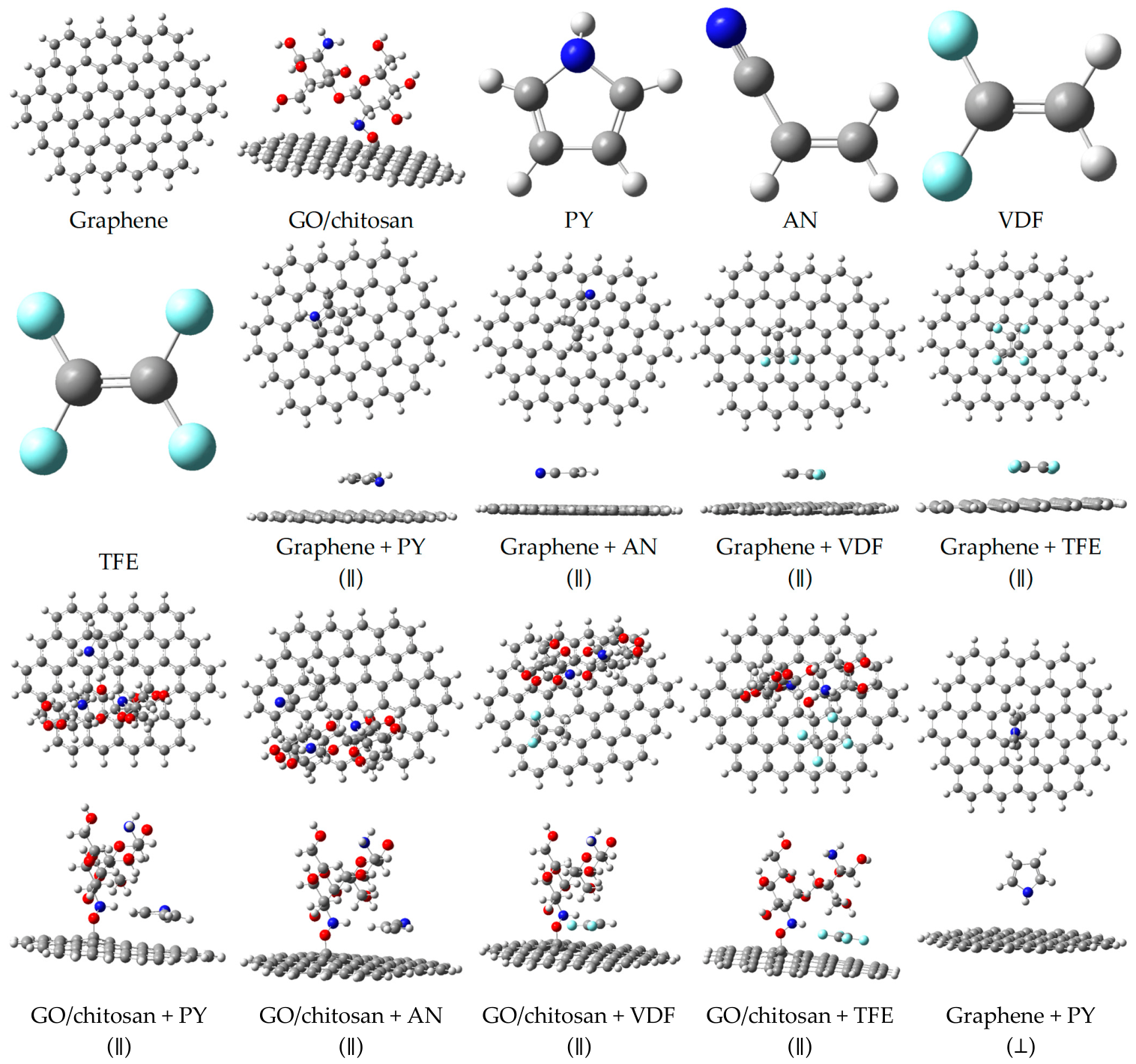
Tight numerical criteria were used throughout. Self-consistent-field iterations employed SCF = Tight, and geometry optimizations used Opt = Tight, corresponding to maximum and root-mean-square forces of 1.5 × 10⁻⁵ and 1.0 × 10⁻⁵ a.u., respectively, and maximum and root-mean-square displacements of 6.0 × 10⁻⁵ and 4.0 × 10⁻⁵ a.u., respectively. An ultrafine integration grid was used to reduce numerical noise in energies and density-derived properties. For each adsorption model, the binder was initially positioned 3.0 Å from the graphene or GO/chitosan surface. Two starting orientations were systematically considered: parallel to the basal plane, favoring extended surface contact and π-type interactions where applicable, and perpendicular to the basal plane, favoring localized contacts. All the configurations were fully relaxed before the final counterpoise-corrected energy evaluation.

2.1. Model Building

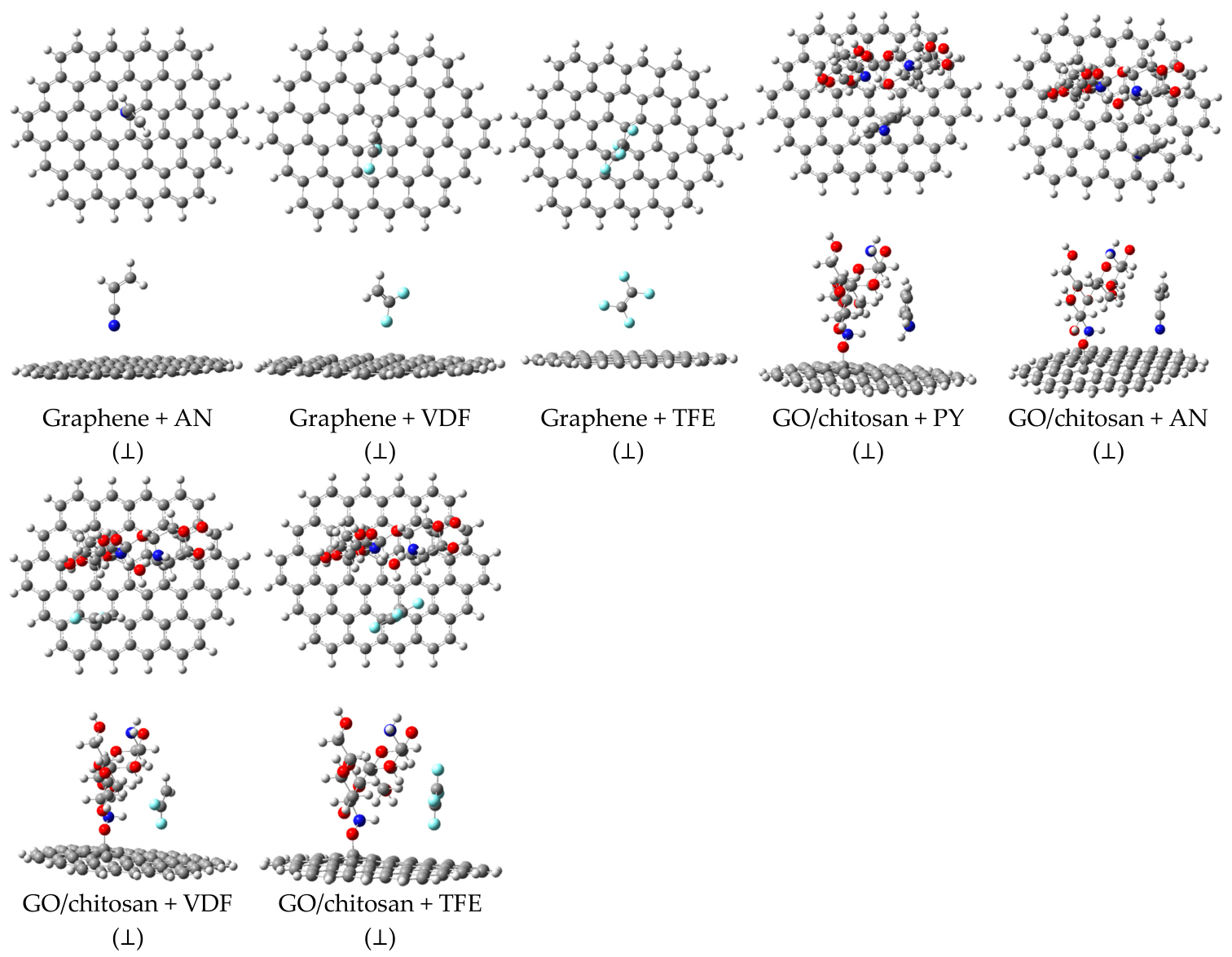
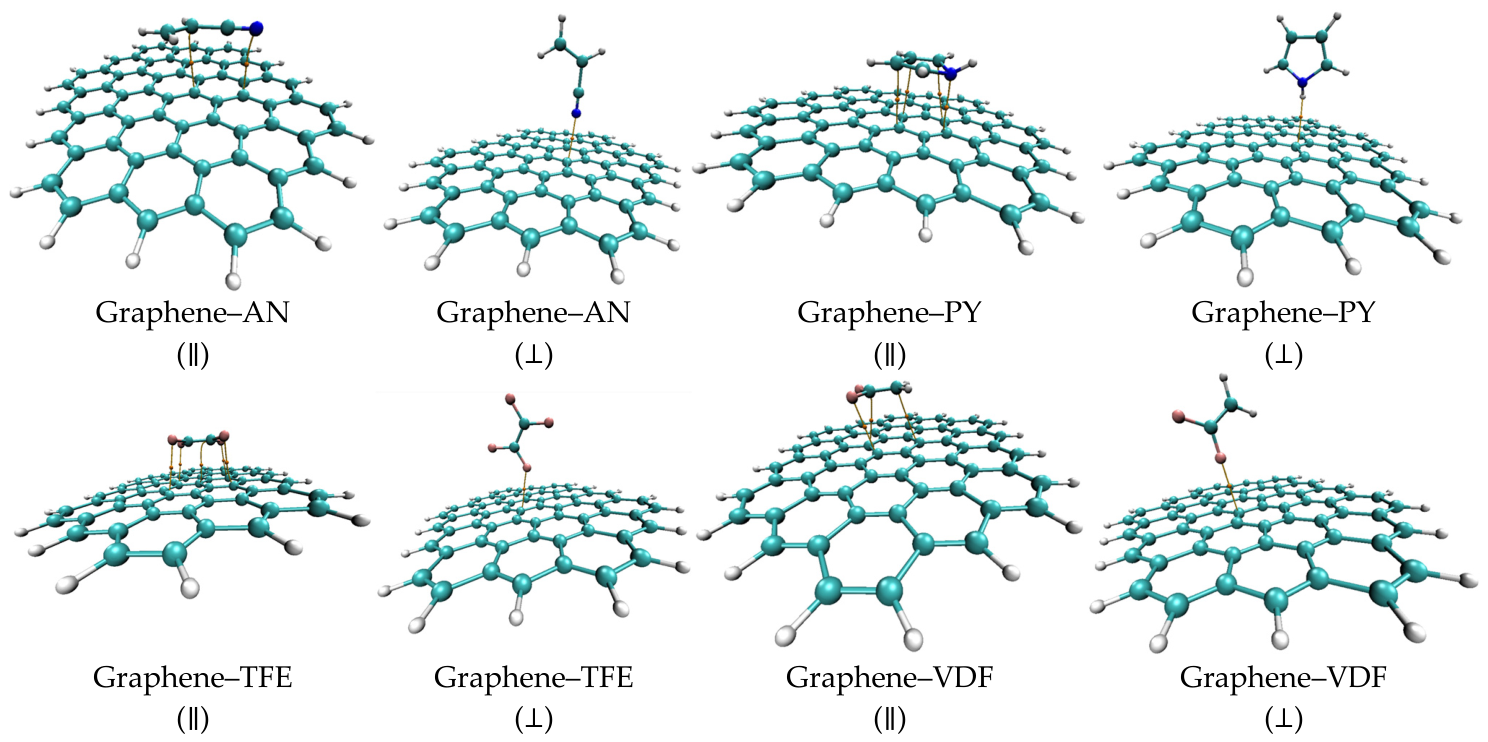
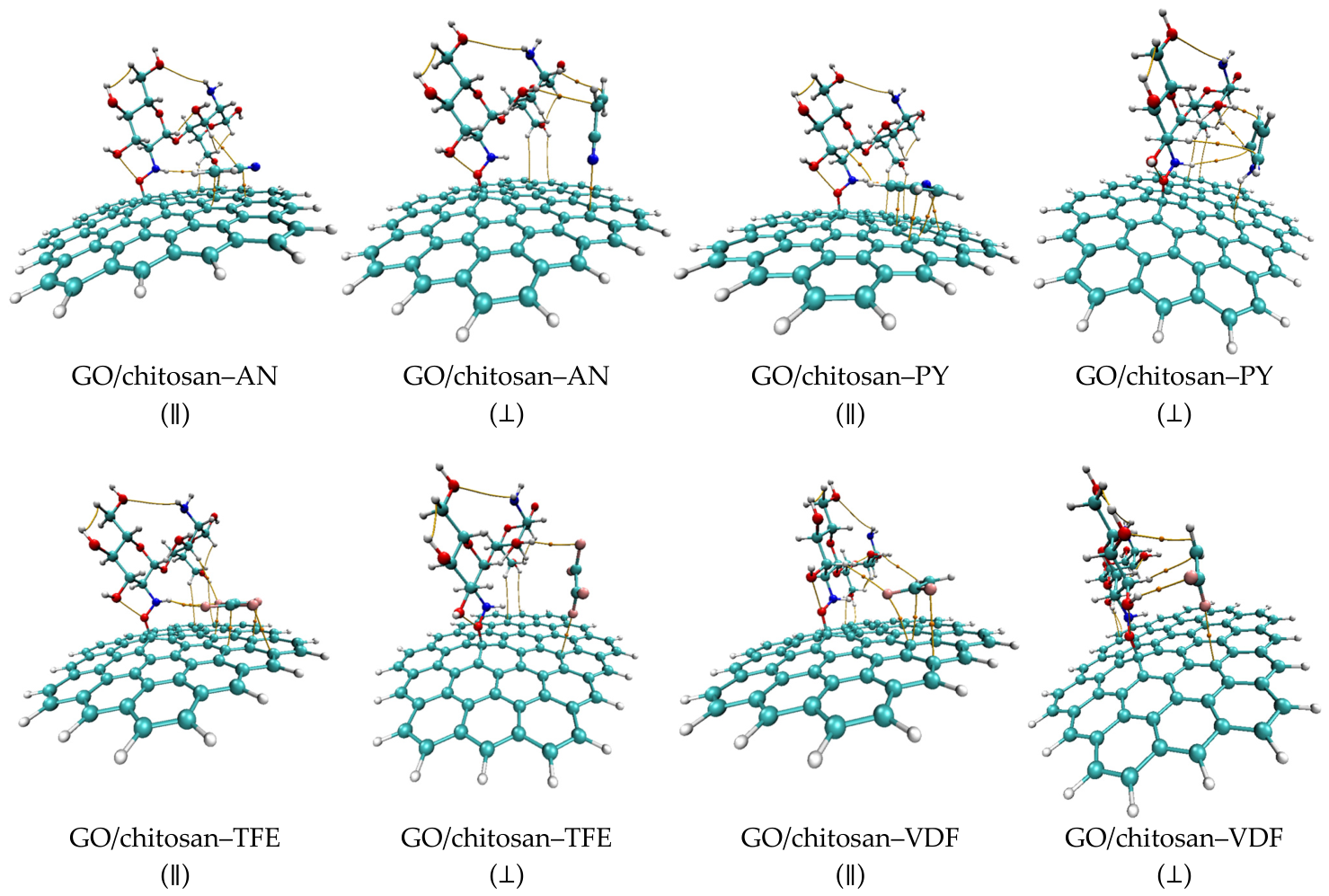
The selected binder monomers, vinylidene fluoride (VDF), pyrrole (PY), acrylonitrile (AN), and tetrafluoroethylene (TFE), and the chitosan fragment were optimized individually before the adsorption calculations. The carbonaceous supports were represented by finite hydrogen-terminated graphene (C66H20) and GO/chitosan clusters. The GO/chitosan model contained representative oxygenated functionalities and a chitosan segment anchored through oxygen-containing moieties. Edge carbon atoms were saturated with hydrogen atoms to preserve the valence structure of the finite clusters. The isolated components and the parallel and perpendicular starting configurations are shown in Figure 1.

2.2. Interaction Energy Calculations

The interaction energies between each binder and the graphene or GO/chitosan surface were evaluated using the supermolecular approach. The uncorrected interaction energy was calculated as:
Δ E i n t =   E c o m p l e x ( E s u r f a c e +   E b i n d e r )
where E c o m p l e x is the total electronic energy of the optimized binder–surface complex, and E s u r f a c e and E b i n d e r are the electronic energies of the isolated surface and binder fragments, respectively.
To correct for basis-set superposition error (BSSE), the Boys–Bernardi counterpoise procedure was applied. The positive BSSE correction was calculated as
Δ E B S S E = E s u r f a c e A E s u r f a c e A B + ( E b i n d e r B E b i n d e r A B )
where the superscript AB denotes fragment energies evaluated in the full complex basis using ghost functions, whereas the superscripts A and B denote the corresponding isolated-fragment energies in their own basis sets. The counterpoise-corrected interaction energy was then obtained as
E i n t C P = E i n t + E B S S E
Because each binder was evaluated in parallel and perpendicular orientations, the most favorable corrected interaction energy for each binder–surface pair was defined as
E i n t , m i n C P = m i n ( E i n t ,   C P ,   E i n t ,   C P )
where the two terms inside the minimum operator are the counterpoise-corrected interaction energies for the parallel and perpendicular configurations, respectively [26,27,28].

2.3. Noncovalent Interaction Analysis

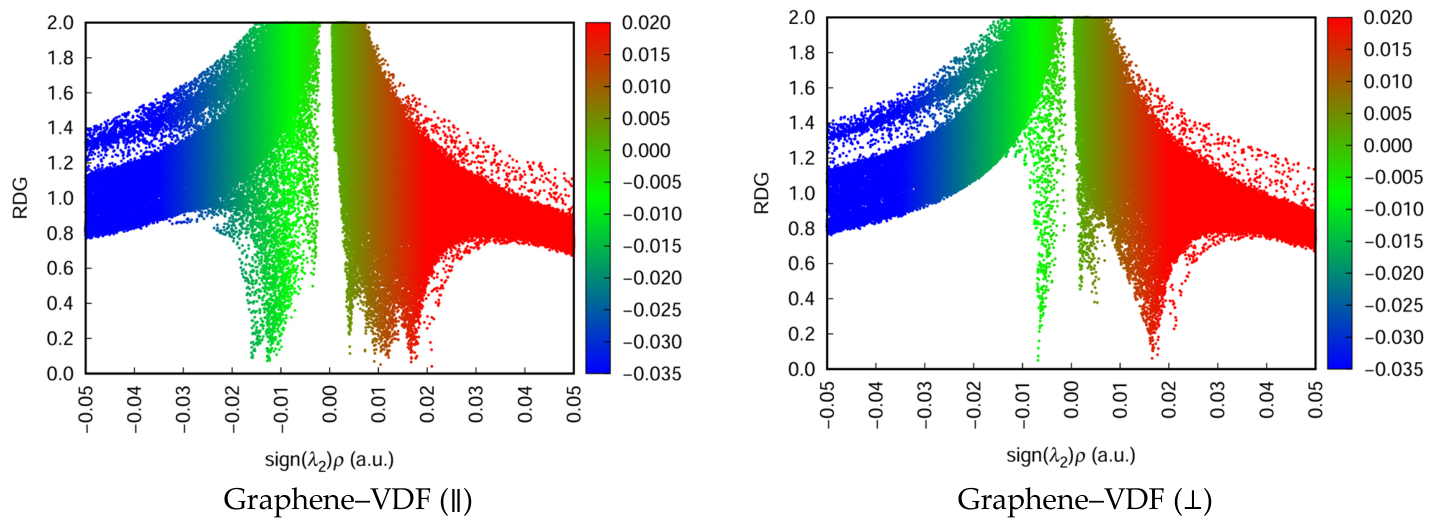
Noncovalent interactions were examined using the reduced density gradient (RDG) within the noncovalent interaction (NCI) framework [29]. The resulting plots distinguish attractive regions, including hydrogen-bonding and other favorable electrostatic contacts, from dispersion-dominated regions and steric repulsion. Formatted checkpoint (.fchk) files were processed with Multiwfn 3.9 [30,31].
Within the quantum theory of atoms in molecules (QTAIM), bond critical points (BCPs) were identified and characterized through the electron density, ρ(BCP); its Laplacian, ∇2ρ(BCP); and the potential, kinetic, and total energy densities, V, G, and H, respectively. The |V|/G ratio was used as a qualitative criterion to distinguish closed-shell interactions from contacts with increasing shared-interaction character [32,33]. Contour maps of ∇2ρ were also generated to visualize regions of electron-density concentration and depletion.

2.4. Electronic-Structure Descriptors, MEP, and PDOS Analyses

The electronic properties were evaluated from HOMO and LUMO energies, molecular electrostatic potential (MEP) maps, and the conceptual-DFT descriptors chemical potential (μ), hardness (η), electronegativity (χ), electron affinity (A), ionization potential (I), and electrophilicity (ω) for graphene, GO/chitosan, AN, PY, TFE, and VDF [34,35]. These quantities were used to compare the intrinsic donor–acceptor tendencies of the isolated species. Projected densities of states (PDOS) were additionally calculated for the binder–surface complexes to assess adsorption-induced changes in the electronic contributions of the surface and adsorbate [36,37].

3. Results and Discussion

3.1. Choosing the Best Level of Theory

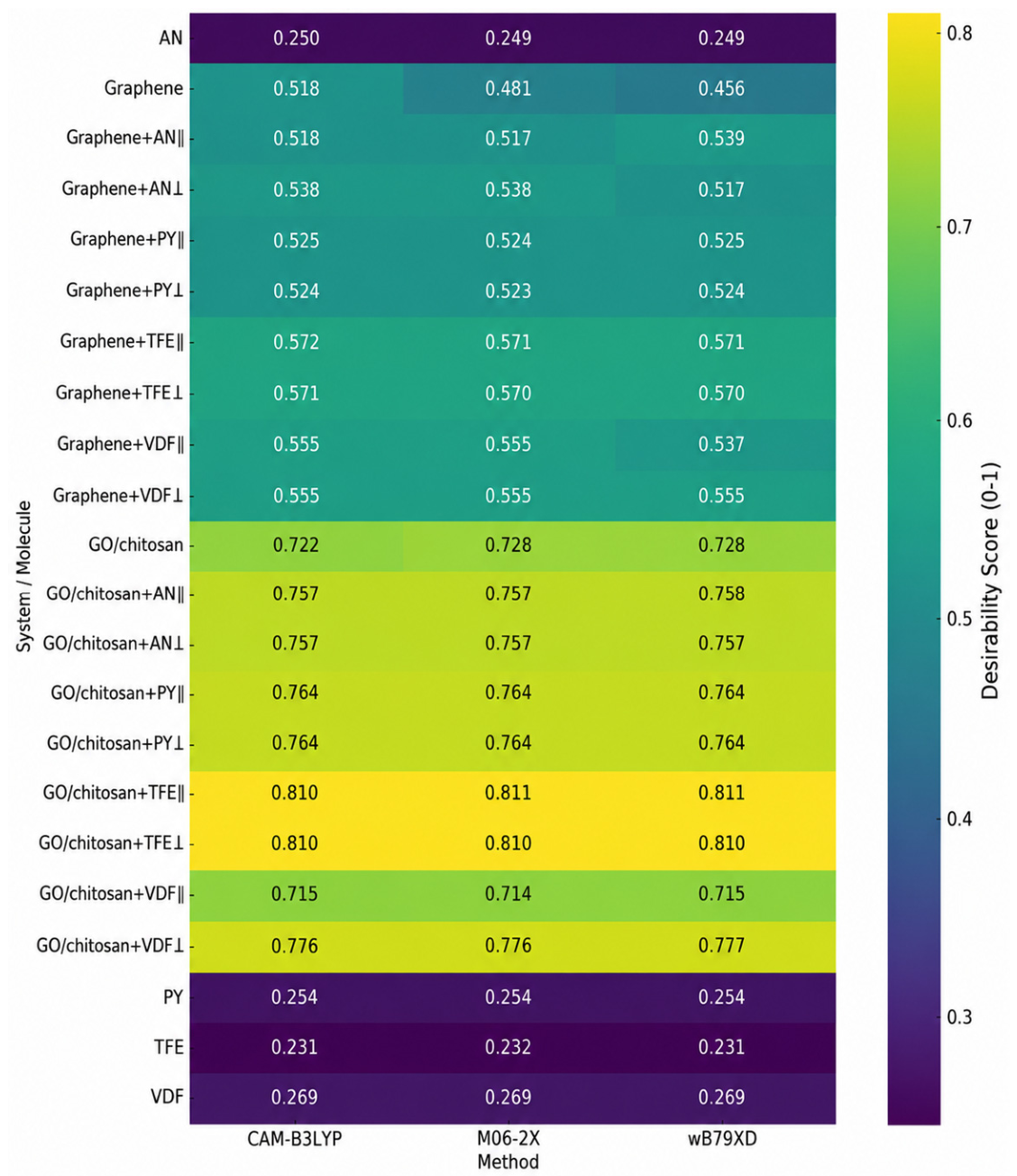
To compare the three screened theoretical levels, a composite desirability index was calculated from the normalized electronic energy, enthalpy, Gibbs free energy, and entropy values on a 0–1 scale, with higher values indicating a larger aggregate score. The overall desirability indices were 0.390 for CAM-B3LYP, 0.383 for M06-2X, and 0.378 for ωB97X-D. The differences were small: CAM-B3LYP exceeded M06-2X and ωB97X-D by 1.8% and 3.2%, respectively, whereas M06-2X exceeded ωB97X-D by 1.3%. Thus, the three approaches produced broadly comparable screening results, with CAM-B3LYP yielding the highest aggregate thermodynamic-consistency score (Figure 2).
System-specific desirability analysis shows that the relative ranking of CAM-B3LYP, M06-2X, and ωB97X-D depends on the chemical environment and model size. For the isolated species, CAM-B3LYP provides the highest score for AN (0.250) and graphene (0.518), whereas M06-2X performs best for PY (0.255), TFE (0.232), and VDF (0.269). ωB97X-D gives the highest score for GO/chitosan (0.786). For the adsorption complexes, the ranking becomes orientation- and surface-dependent. Among the graphene-based complexes, CAM-B3LYP most frequently gives the highest score, for example, 0.538 for graphene–AN (⊥), whereas ωB97X-D is marginally higher for graphene–AN (∥), with a score of 0.539. For the GO/chitosan complexes, the three functionals converge closely, generally differing only in the third decimal place. For GO/chitosan–TFE (⊥), the values are effectively identical (0.810–0.811; <0.2% spread), indicating that the ranking of this configuration is insensitive to the functional used in the screening step.
Across the complete screening dataset, the desirability indices of 0.390, 0.383, and 0.378 for CAM-B3LYP, M06-2X, and ωB97X-D, respectively, indicate that none of the functionals is uniformly superior for every model. CAM-B3LYP provides the highest aggregate score, but the method-to-method differences remain below approximately 3%, consistent with the reported performance of these functionals for noncovalent interactions [38,39,40,41,42]. Consequently, the desirability analysis was used only as a screening comparison. The final interaction energies discussed below were evaluated independently at the M06-2X/def2-TZVP level with counterpoise correction, which provides a more appropriate quantitative basis for comparing weak adsorption energies.

3.2. Noncovalent Interaction Analysis

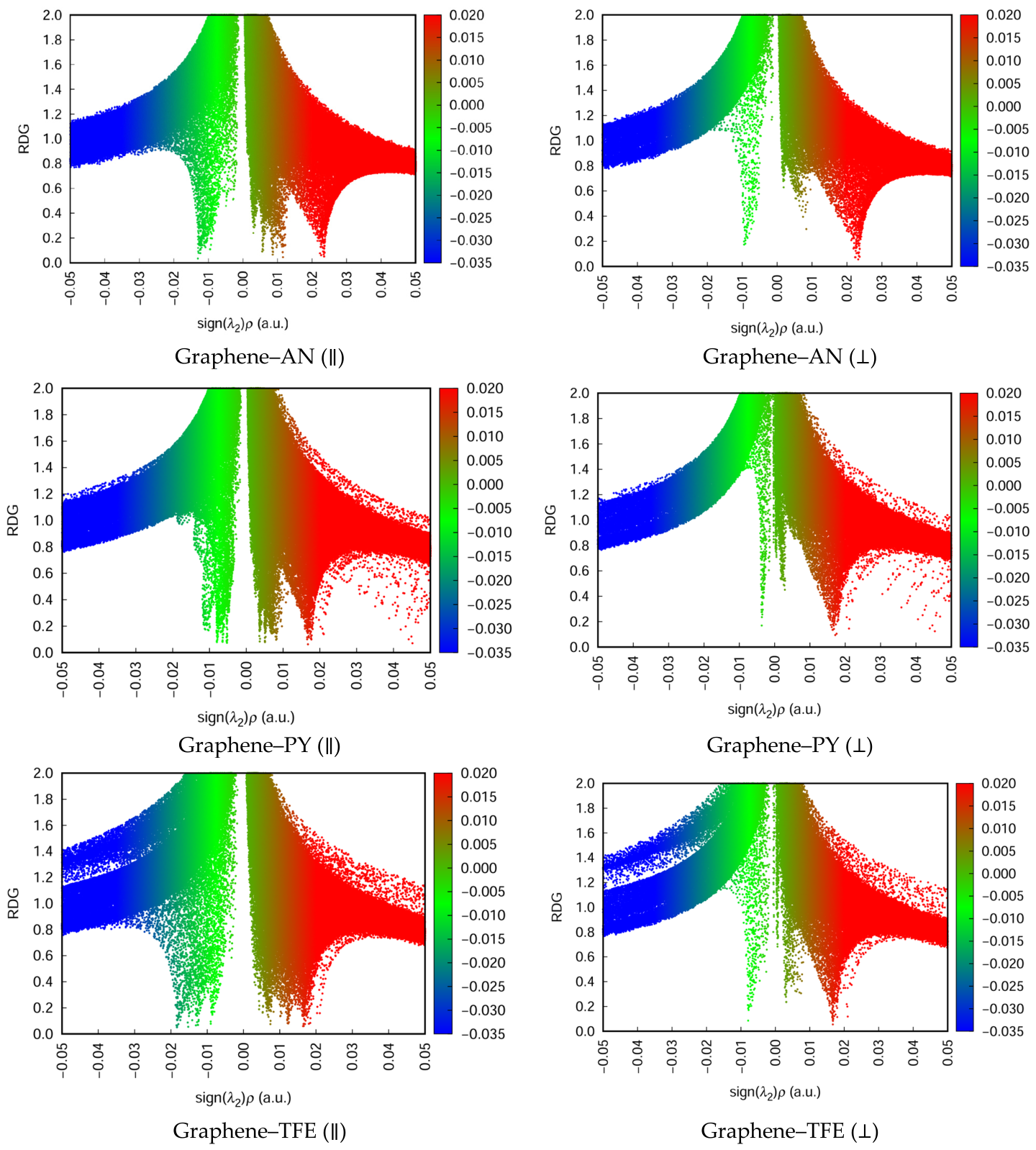
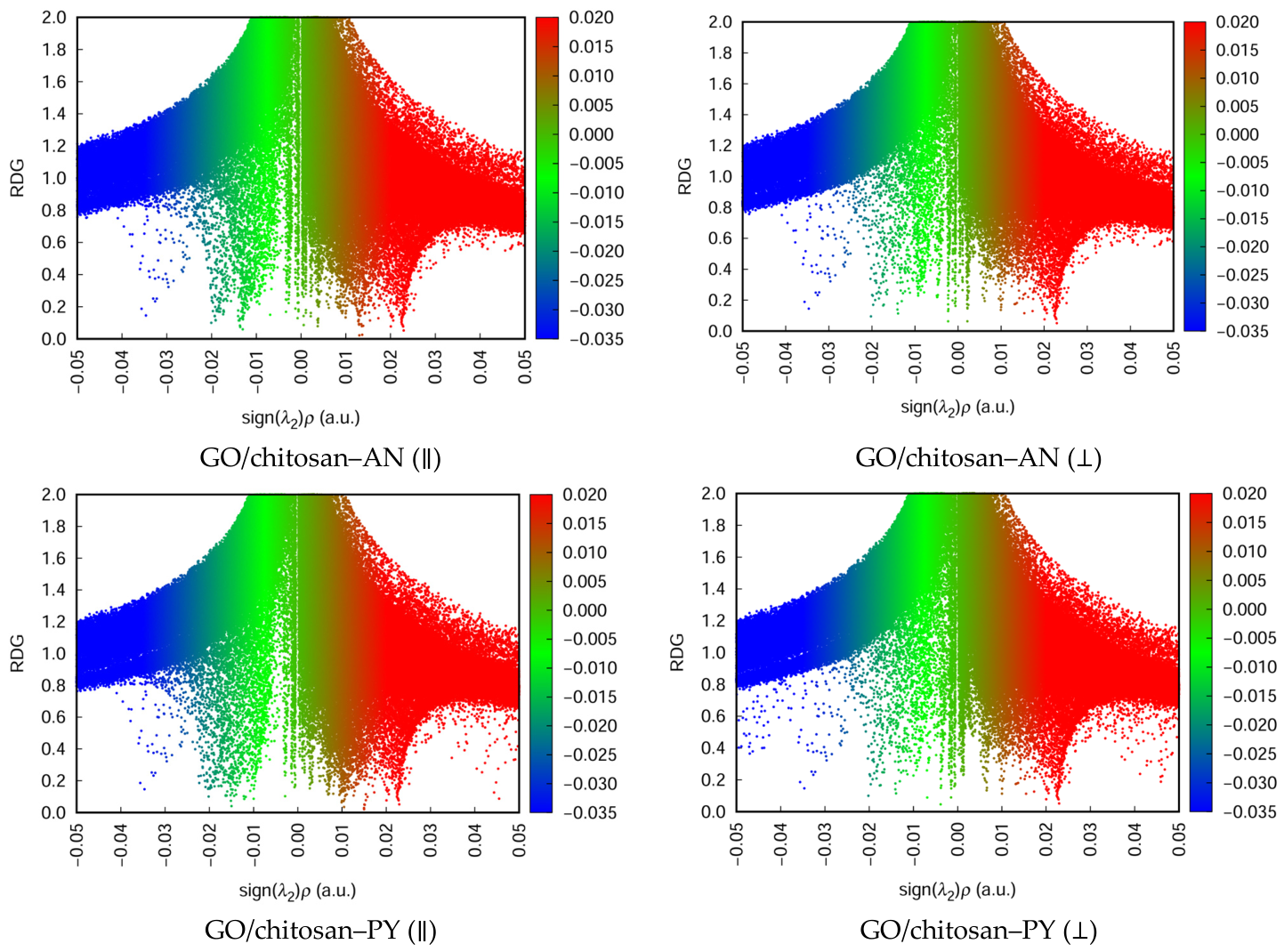
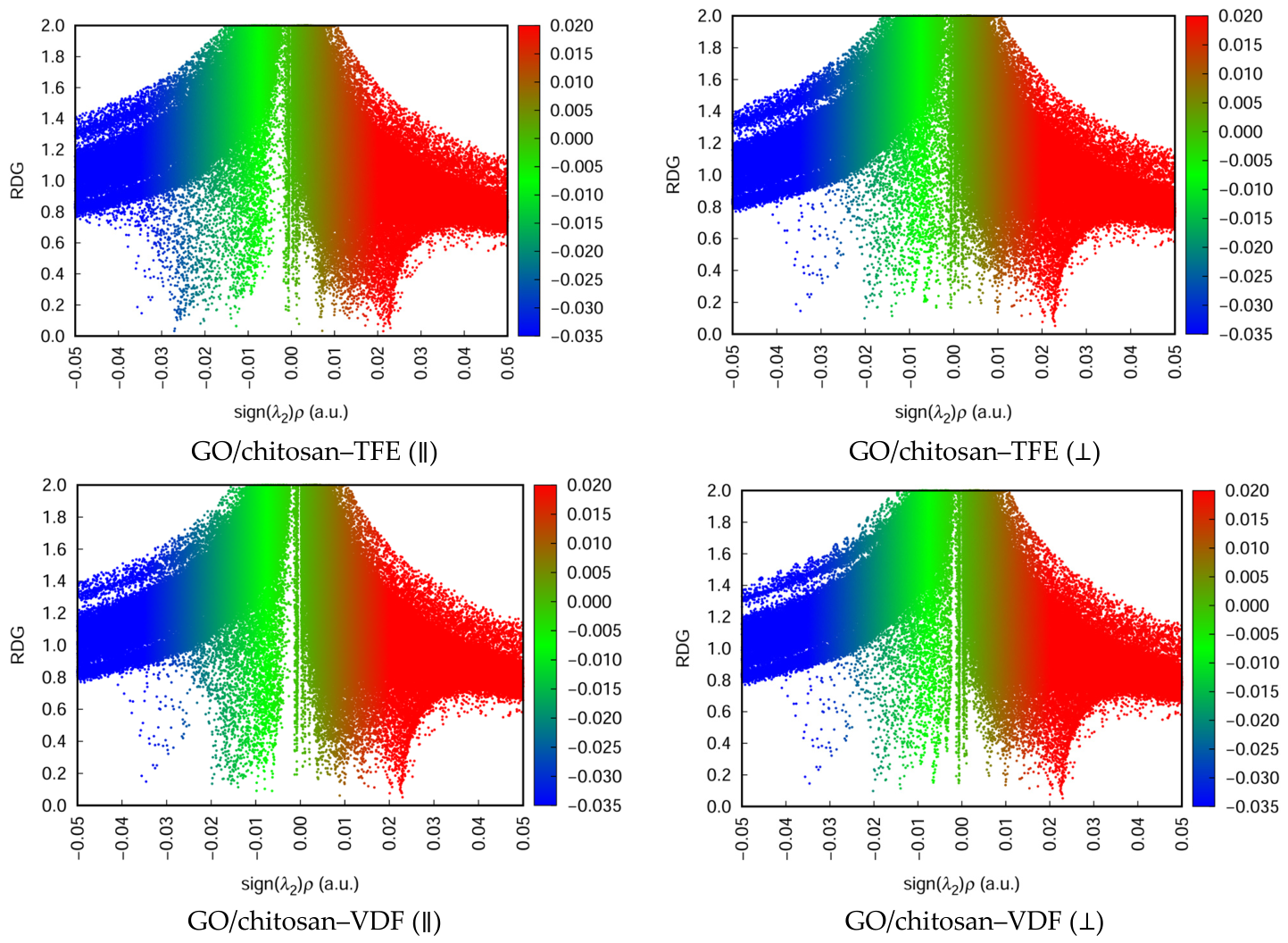
NCI–RDG plots were used to compare the relative distributions of attractive, dispersive, and repulsive regions at the interfaces formed by AN, PY, TFE, and VDF with graphene and GO/chitosan (Figure 3 and Figure 4).
For the graphene complexes, the parallel configurations are dominated by dispersive contacts, which account for 62–68% of the integrated green-region contribution, compared with 15–18% in the attractive region and 17–20% in the repulsive region. The perpendicular geometries increase the attractive fraction to 22–25% for AN and PY, corresponding to an increase of approximately 35% relative to the parallel arrangements. These trends are consistent with a geometry-dependent balance in which parallel adsorption favors extended π and dispersion contacts, whereas perpendicular arrangements promote more localized electrostatic and C–H···π contacts. For GO/chitosan, the attractive component increases. In the parallel AN and TFE systems, the attractive fraction reaches 28–30%, compared with 15–18% on pristine graphene, while the dispersive contribution remains high at 55–60%. The modest increase in the repulsive contribution, to 20–23%, is consistent with the greater steric and electronic heterogeneity introduced by oxygenated GO groups and chitosan amino and hydroxyl functionalities.
Among the monomers, AN and PY display the most balanced local contributions, with dispersion accounting for approximately 55–65% and attractive interactions for approximately 20–25%. For TFE and VDF on pristine graphene, the NCI response is predominantly dispersive (>65%); on GO/chitosan, the attractive fraction increases to approximately 28%. These plots therefore indicate that functionalization increases the local attractive component for both polar and fluorinated monomers by providing chemically differentiated surface sites. Importantly, this local increase does not by itself demonstrate stronger net adsorption. The interaction energies in Section 3.3 show that favorable local regions can coexist with near-neutral or positive total interaction energies when steric repulsion and unfavorable geometry offset the attractive contributions.

3.3. Interaction Energies

The counterpoise-corrected interaction energies calculated at the M06-2X/def2-TZVP level show that the binder–surface interactions are predominantly weak and strongly dependent on molecular orientation (Table 1). Most values lie within a near-thermoneutral adsorption regime, indicating that the interfaces are governed by a subtle balance among dispersion, electrostatic interactions, polarization, and short-range repulsion rather than by strong chemisorption.
On pristine graphene, AN exhibits the most favorable interaction among the evaluated monomers. In the parallel orientation, its counterpoise-corrected interaction energy is −3.13 kcal mol−1, which is the minimum energy for the graphene–AN pair. The perpendicular configuration is only weakly stabilizing, with an interaction energy of −0.55 kcal mol−1. This orientation dependence indicates that AN interacts more favorably when its geometry permits broader contact with the π-conjugated graphene surface. PY also shows weakly favorable adsorption, with corrected interaction energies of −2.10 and −1.61 kcal mol−1 for the parallel and perpendicular orientations, respectively. These values are consistent with weak π-type and dispersion-assisted contacts rather than strong directional binding [42].
The fluorinated monomers show more borderline behavior on pristine graphene. For TFE, the parallel geometry is unfavorable, with a corrected interaction energy of 5.11 kcal mol−1, whereas the perpendicular configuration is slightly favorable at −0.71 kcal mol−1. VDF follows a similar near-neutral trend: the parallel orientation is slightly unfavorable at 1.07 kcal mol−1, while the perpendicular orientation is weakly favorable at −0.61 kcal mol−1. These results indicate that the fluorinated monomers do not establish strong stabilizing interactions with pristine graphene in the evaluated geometries. Their adsorption is instead controlled by competition among weak dispersion, local polarization, and short-range repulsion.
For GO/chitosan, the interaction energies likewise describe weak and orientation-dependent adsorption. AN is slightly unfavorable in the parallel orientation, with a corrected interaction energy of 0.88 kcal mol−1, but becomes weakly favorable in the perpendicular arrangement at −0.70 kcal mol−1. PY remains unfavorable in both orientations, with corrected energies of 3.93 and 11.46 kcal mol−1 for the parallel and perpendicular configurations, respectively. Thus, the presence of polar surface sites does not automatically produce stronger adsorption; the local geometry must also minimize steric and electrostatic penalties. Nevertheless, GO/chitosan provides a more chemically heterogeneous interface because its oxygenated, amino, and hydroxyl groups can generate hydrogen-bonding and electrostatic contacts [43,44,45].
Among the fluorinated monomers on GO/chitosan, TFE exhibits pronounced orientation dependence. The parallel geometry is clearly unfavorable, with a corrected interaction energy of 23.73 kcal mol−1, whereas the perpendicular configuration is weakly stabilizing at −1.03 kcal mol−1. VDF follows the same qualitative trend, changing from 2.70 kcal mol−1 in the parallel orientation to −1.20 kcal mol−1 in the perpendicular orientation. These results suggest that selected perpendicular configurations are stabilized when the fluorinated groups approach polar domains of the GO/chitosan interface. However, the functionalized surface does not provide uniform stabilization for all binder monomers.
Overall, the M06-2X/def2-TZVP counterpoise-corrected results show that pristine graphene supports weak π- and dispersion-driven adsorption, whereas GO/chitosan introduces polar and chemically heterogeneous sites that redistribute the local attractive and repulsive contributions. The net stabilization nevertheless remains modest and strongly dependent on adsorption geometry. GO/chitosan should therefore be regarded as a chemically tunable interface that modulates binder–surface compatibility rather than as a universally stronger adsorbent.
From an electrode-design perspective, even modest differences in binder–surface compatibility may influence mechanical cohesion. Experimental studies have shown that electrode formulation, binder adhesion, polymer entanglement and crystallinity, and interfacial stability affect electrode robustness and cycling behavior [46,47,48,49,50,51,52,53,54,55]. Peel tests, SAICAS measurements, and atomic force microscopy could therefore be used to evaluate whether the calculated trends are reflected in measurable interfacial strength [47,48]. Although the present monomer-scale models do not directly predict cell performance, improved interfacial cohesion may help limit delamination, maintain electronic percolation, and reduce mechanical degradation. The broader importance of mechanically robust interfaces is also recognized in flexible electrochemical electrodes [56].

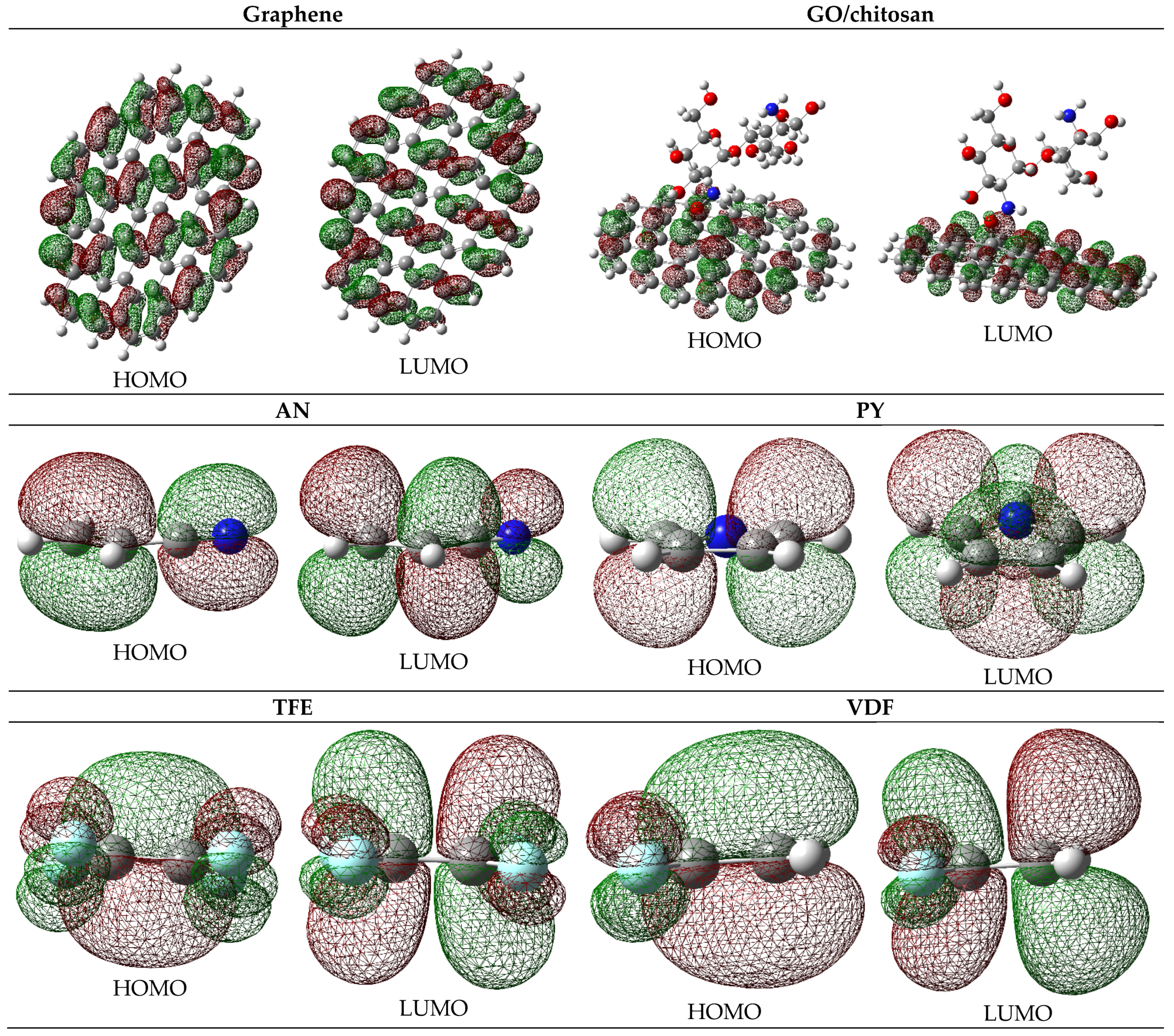
3.4. Frontier Molecular Orbitals and Global Reactivity Descriptors

Frontier-orbital analysis and global reactivity descriptors (Figure 5 and Table 2) enable comparison of the electronic behavior of the binder monomers and carbonaceous surfaces. The descriptors were calculated within conceptual DFT using μ = [E(HOMO) + E(LUMO)]/2, χ = −μ, η = [E(LUMO) − E(HOMO)]/2, and ω = μ2/(2η). Graphene has HOMO and LUMO energies of −0.200 and −0.0837 Hartree, respectively, corresponding to a HOMO–LUMO gap of 0.116 Hartree and a hardness of 0.0581 Hartree. GO/chitosan exhibits closely related values, with E(HOMO) = −0.195 Hartree and E(LUMO) = −0.0750 Hartree, giving a slightly larger gap of 0.120 Hartree and η = 0.0598 Hartree. Relative to pristine graphene, GO/chitosan has a slightly less negative chemical potential (−0.135 vs. −0.142 Hartree), lower electronegativity (0.135 vs. 0.142 Hartree), lower electron affinity (0.0750 vs. 0.0837 Hartree), and lower electrophilicity (0.152 vs. 0.173 Hartree). These differences indicate that oxygenation and chitosan functionalization moderately alter the global acceptor character of the carbonaceous surface while preserving a relatively soft and polarizable electronic structure.
For the isolated monomers, the electronic differences are more pronounced. AN has a deep HOMO energy of −0.353 Hartree and a negative LUMO energy of −0.0266 Hartree, resulting in the highest electronegativity among the monomers (χ = 0.190 Hartree) and a positive electron affinity (A = 0.0266 Hartree). This behavior is consistent with the electron-withdrawing nitrile group and supports the comparatively strong electron-acceptor character of AN. PY, in contrast, has the lowest electronegativity (χ = 0.0954 Hartree), the lowest electrophilicity (ω = 0.0270 Hartree), and a negative electron affinity (A = −0.0730 Hartree), consistent with a more electron-donating profile associated with its π-conjugated heteroaromatic structure.
TFE and VDF display the largest hardness values in the series, η = 0.195 and 0.193 Hartree, respectively, indicating lower global softness and reduced susceptibility to electronic deformation than AN and PY. Their LUMO energies are slightly positive, and their electron affinities are negative, indicating limited intrinsic electron-accepting ability in the isolated state. Nevertheless, their relatively high electronegativities, particularly that of TFE (χ = 0.179 Hartree), reflect the strong inductive effect of fluorine. Overall, AN is the most electron-accepting monomer, PY has the most electron-donating character, and TFE and VDF are electronically harder units whose interfacial behavior depends strongly on local polarization, surface functionality, and orientation-specific contacts.

3.5. Molecular Electrostatic Potential Analysis

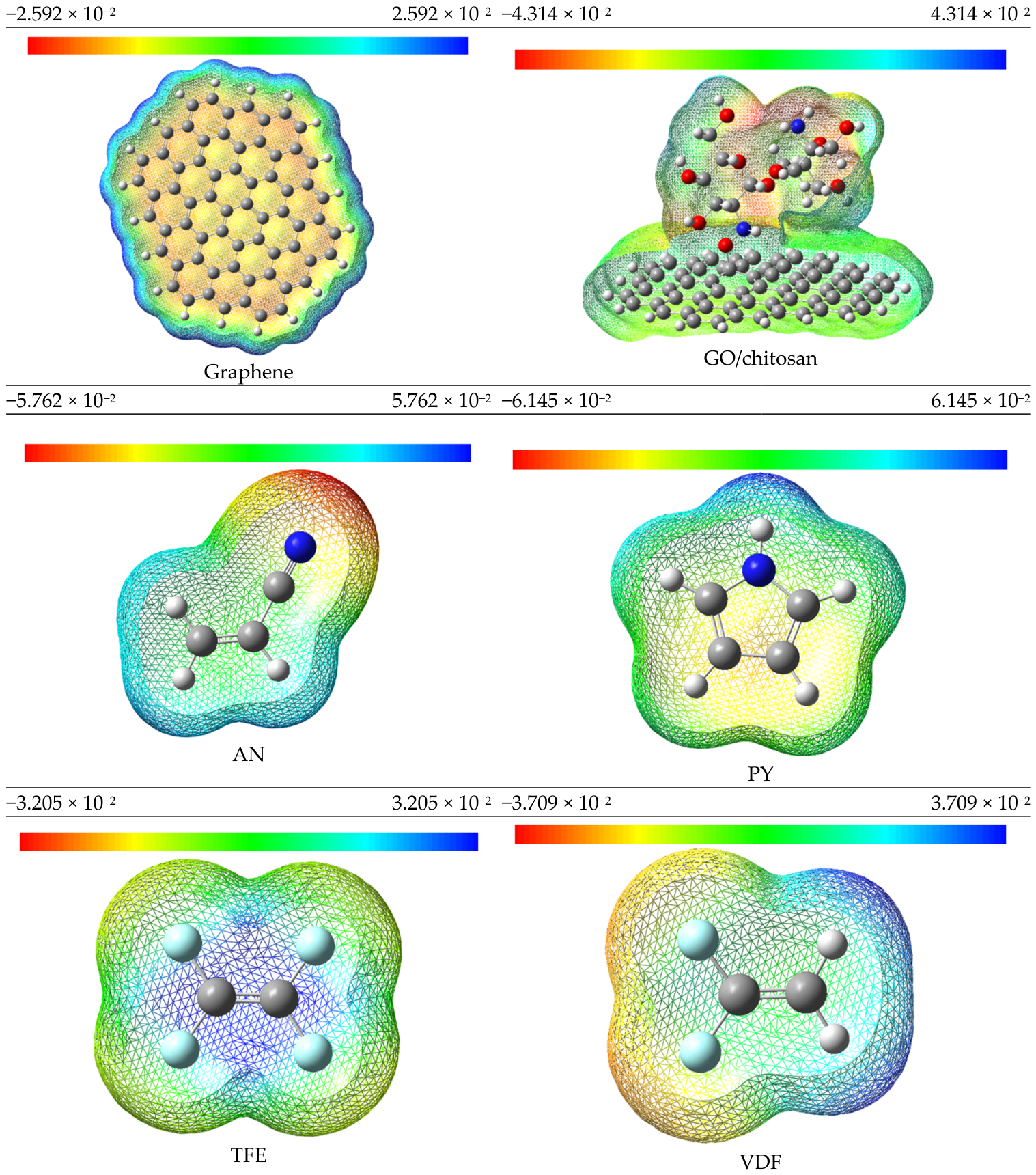
Molecular electrostatic potential (MEP) maps visualize the spatial distribution of electrostatic potential and thereby identify regions that may participate in complementary intermolecular contacts (Figure 6). This analysis complements the frontier-orbital results by distinguishing electron-rich and electron-deficient regions in the isolated surfaces and monomers.
Graphene displays a comparatively uniform MEP, dominated by near-neutral green–yellow regions over the basal plane. This limited electrostatic differentiation is consistent with adsorption governed mainly by dispersion and π-type contacts rather than strongly directional electrostatic interactions.
GO/chitosan exhibits a substantially more heterogeneous potential. Negative regions are localized around oxygen-containing functionalities, whereas positive regions occur near hydrogen-bearing amino and hydroxyl groups. The coexistence of electron-rich and electron-deficient domains creates a polarized interface capable of supporting hydrogen bonding, dipole–dipole interactions, and complementary electrostatic contacts in addition to dispersion.
The monomer maps reflect their molecular functionalities. In AN, the most negative region is localized around the nitrile nitrogen, consistent with its ability to interact with electropositive or hydrogen-donor regions of GO/chitosan. The carbon backbone is comparatively less polarized. PY exhibits an electron-rich aromatic π surface together with a positive region near the N–H hydrogen. Because the pyrrolic nitrogen lone pair participates in aromatic conjugation, PY is better described as a π donor and hydrogen-bond donor than as a conventional nitrogen-centered hydrogen-bond acceptor.
TFE and VDF show pronounced electrostatic gradients associated with the strongly electron-withdrawing fluorine substituents. Their interfacial interactions therefore reflect a balance among dispersion, local polarization, and orientation-dependent contacts involving the C–F groups. On pristine graphene, the limited surface polarity constrains these interactions mainly to weak dispersion and induced polarization. On GO/chitosan, polar surface domains can increase the directionality of selected configurations, although the interaction-energy results show that such local complementarity does not guarantee favorable net adsorption.

3.6. Projected Density of States Analysis

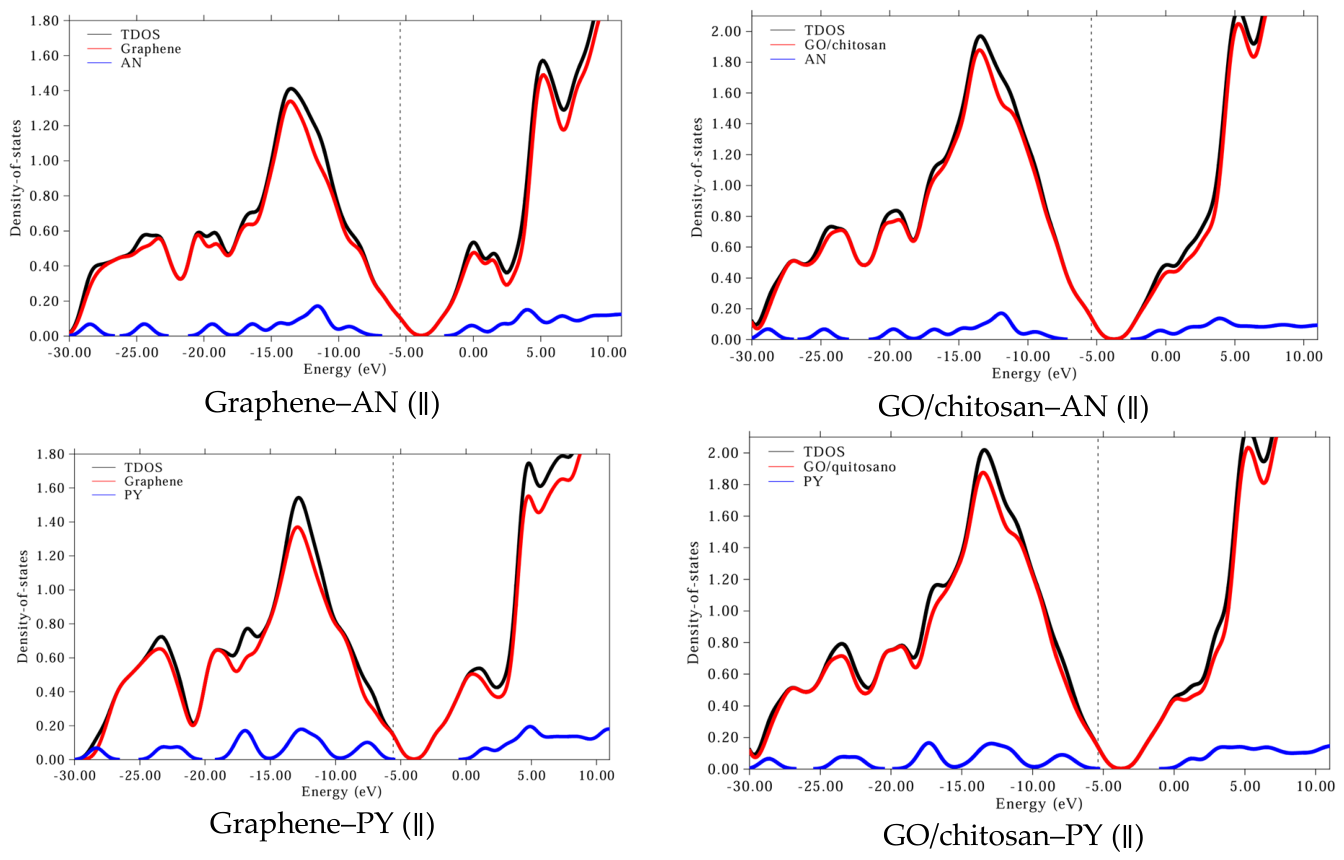
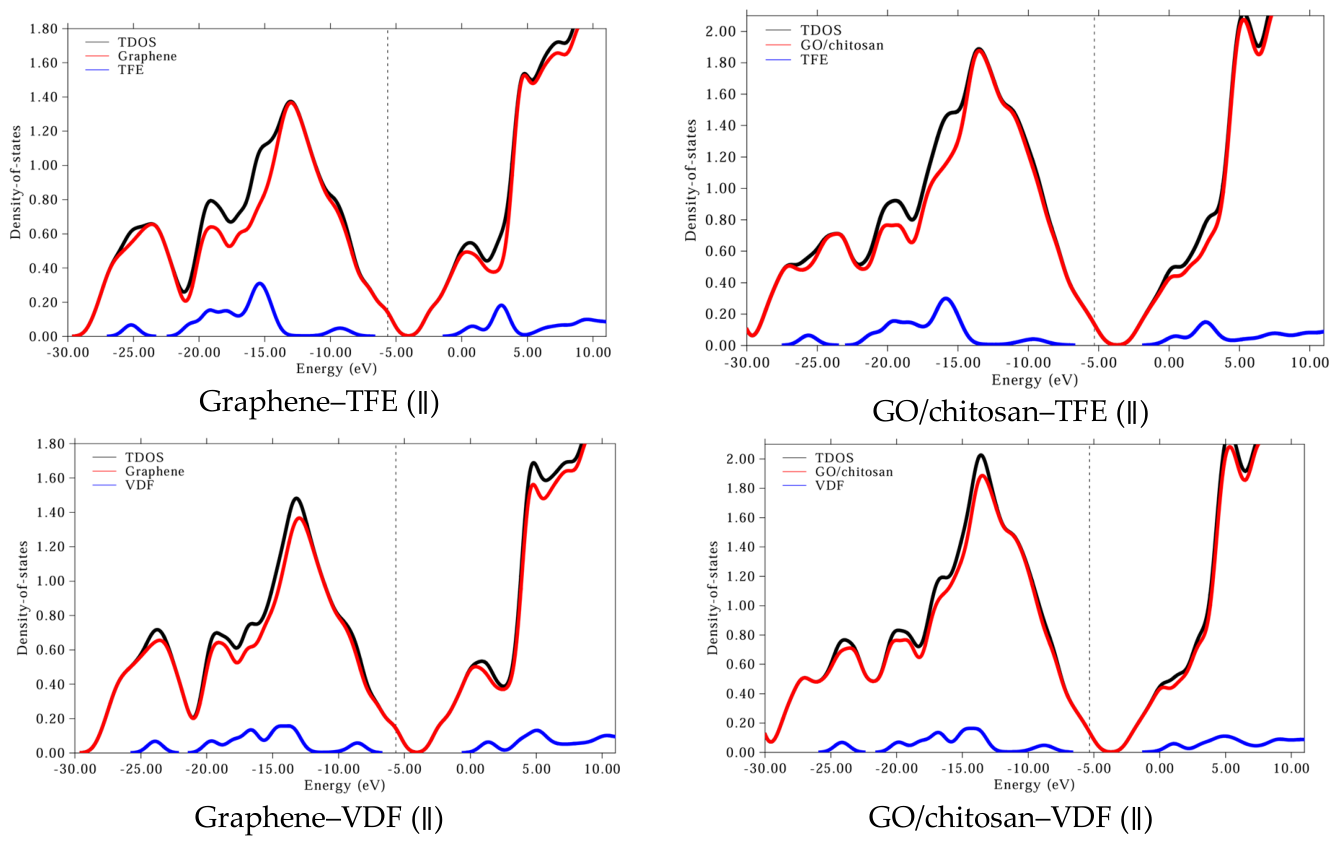
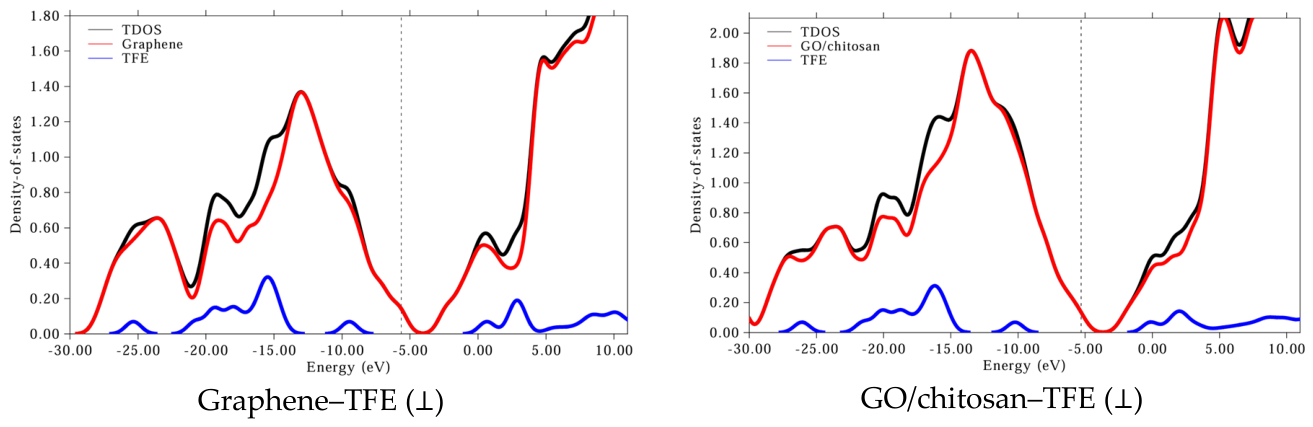
Projected density of states (PDOS) analysis was used to assess how surface functionalization modifies the electronic contributions of the carbonaceous support and binder monomers (Figure 7 and Figure 8). In the parallel configurations shown in Figure 7, pristine graphene exhibits limited overlap between the surface and monomer contributions, particularly for the fluorinated systems. This weak adsorbate–surface coupling is consistent with the M06-2X/def2-TZVP counterpoise-corrected interaction energies in Table 1, where most graphene–binder complexes fall within a weak or near-thermoneutral regime. AN and PY show weakly favorable interactions of −3.13 and −2.10 kcal mol−1, respectively, consistent with limited π-type and dispersion-assisted coupling rather than strong electronic hybridization.
For AN on pristine graphene, the parallel orientation is more favorable than the perpendicular orientation, with the corrected interaction energy changing from −0.55 to −3.13 kcal mol−1. This trend indicates that the nitrile-containing monomer benefits from a geometry that provides broader contact with the π-conjugated surface. PY likewise displays weakly favorable adsorption, consistent with its aromatic character and possible π-type interaction with the basal plane. By contrast, TFE and VDF show near-neutral or slightly unfavorable behavior depending on orientation, confirming that the fluorinated monomers do not produce strong electronic coupling with pristine graphene in the evaluated configurations.
Functionalization introduces additional PDOS contributions associated with the oxygenated groups of GO and the hydroxyl and amino groups of chitosan. These functionalities increase the chemical heterogeneity of the interface and provide local regions capable of polar, electrostatic, and hydrogen-bond-assisted contacts. The resulting PDOS profiles are more differentiated than those of pristine graphene; however, the interaction energies demonstrate that greater local electronic differentiation does not necessarily produce strong global stabilization. Adsorption remains weak and strongly orientation-dependent.
This orientation dependence is particularly evident for the fluorinated monomers. For GO/chitosan–TFE, the parallel configuration is clearly unfavorable, with a corrected interaction energy of 23.73 kcal mol−1, whereas the perpendicular configuration is weakly favorable at −1.03 kcal mol−1. GO/chitosan–VDF follows the same trend, changing from 2.70 kcal mol−1 in the parallel arrangement to −1.20 kcal mol−1 in the perpendicular arrangement. Thus, polar domains can favor selected perpendicular motifs when the fluorinated groups approach oxygenated or amino/hydroxyl sites, although the resulting stabilization remains modest.
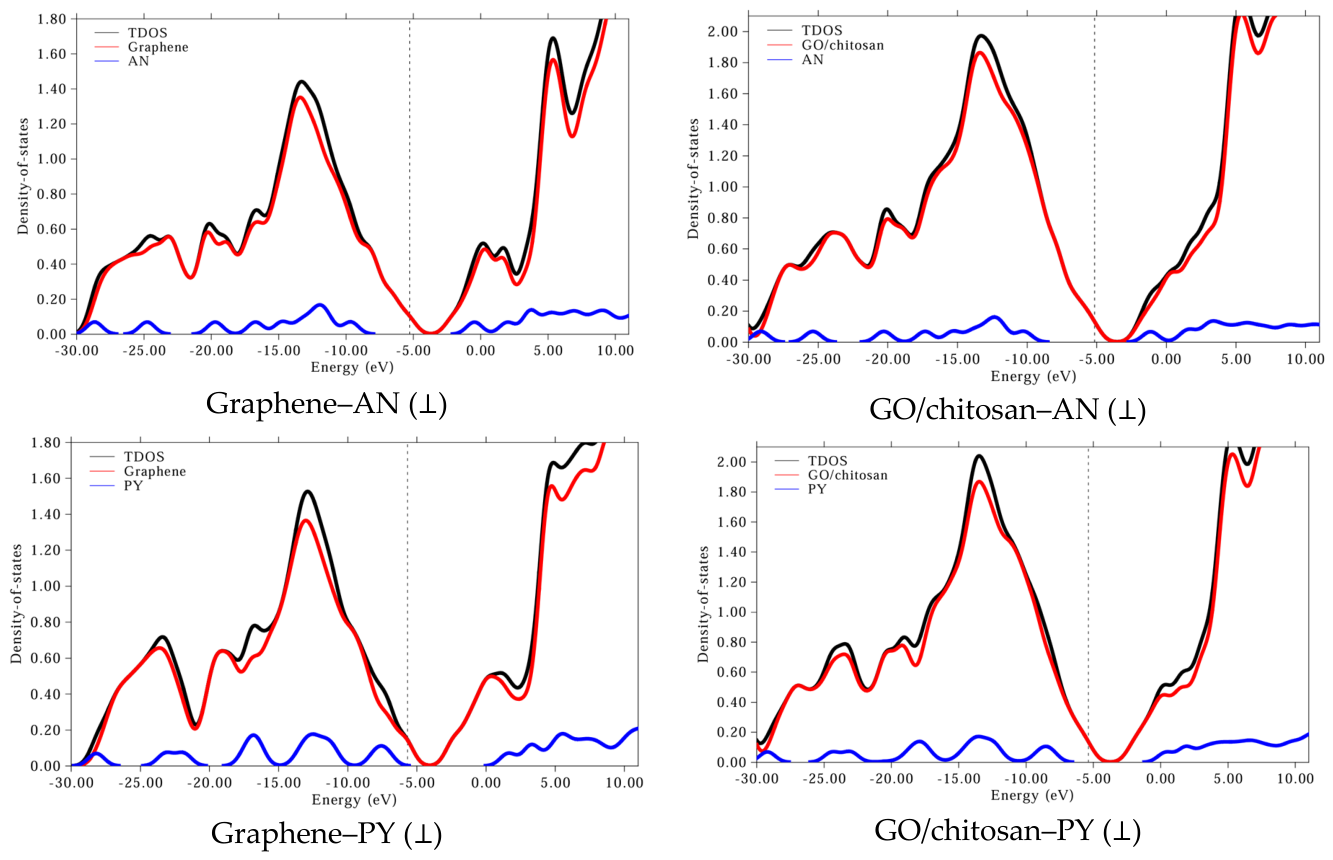
The perpendicular PDOS profiles in Figure 8 include AN, PY, and TFE. These systems illustrate that the functionalized surface produces a more differentiated local electronic response when the molecular orientation permits close contact with polar GO/chitosan domains. Although the perpendicular VDF panel is not included, Table 1 shows that GO/chitosan–VDF (⊥) is the most favorable GO/chitosan complex in the evaluated set, with a corrected interaction energy of −1.20 kcal mol−1. This result further supports the strong orientation dependence of VDF adsorption.
The PDOS interpretation is consistent with the global descriptors in Table 2. AN has the highest electronegativity among the monomers (χ = 0.190 Hartree) and a positive electron affinity (A = 0.0266 Hartree), supporting its stronger electron-acceptor character. PY has the lowest electronegativity (χ = 0.0954 Hartree) and electrophilicity (ω = 0.0270 Hartree), consistent with a more electron-donating profile. TFE and VDF have the highest hardness values (η = 0.195 and 0.193 Hartree), indicating lower global softness and reduced intrinsic electronic deformability. Their stabilization therefore depends more strongly on local polarization, surface functionality, and orientation-specific contacts than on global electron-acceptor character.
Together, the PDOS, NCI, MEP, and QTAIM analyses provide a coherent interfacial picture. Pristine graphene offers a weakly differentiated π-conjugated surface, whereas GO/chitosan introduces polar and hydrogen-bonding sites that increase local chemical heterogeneity. The counterpoise-corrected energies nevertheless show that this enhanced local differentiation does not necessarily yield strong net adsorption. These electronic and topological analyses should therefore be interpreted as complementary descriptors of local contact rather than as independent evidence of strong binding. This cautious interpretation is consistent with the use of GO/chitosan materials in electrochemical systems, where performance arises from the combined effects of surface chemistry, morphology, transport, and mechanical cohesion rather than from a single molecular interaction [43,44].

3.7. Quantum Theory of Atoms in Molecules Analysis

QTAIM analysis was used to characterize the local electron-density topology of the contacts formed by AN, PY, TFE, and VDF with graphene and GO/chitosan in parallel and perpendicular orientations. The electron density and its Laplacian at the bond critical point, together with the local energy densities H, V, and G and the |V|/G ratio, provide qualitative information on the strength and character of individual contacts (Table 3 and Figure 9 and Figure 10).
For the parallel graphene complexes, ρ(BCP) ranges from 0.025 to 0.067 a.u. and the Laplacian remains positive (0.09–0.28 a.u.), consistent with closed-shell noncovalent contacts. The |V|/G ratios of 0.75–0.87 indicate interactions dominated by electrostatic and dispersion contributions with limited shared character. TFE and VDF have higher local ρ(BCP) values than AN at the selected critical points; however, a larger value at one local contact is not a direct measure of the total adsorption energy. Consequently, locally concentrated electron density can coexist with an unfavorable net interaction when short-range repulsion dominates the global energy balance. In the perpendicular graphene complexes, ρ(BCP) decreases to 0.003–0.009 a.u., consistent with reduced overlap and fewer extended surface contacts. The corresponding |V|/G values of 0.59–0.75 characterize weaker closed-shell interactions associated with localized electrostatic or C–H···π-type contacts.
GO/chitosan produces a more heterogeneous local topology. In the parallel arrangements, ρ(BCP) reaches 0.113 a.u. for AN and 0.097 a.u. for TFE, while |V|/G approaches or slightly exceeds unity for selected contacts. These values indicate increased local polarization and, in some cases, greater shared-interaction character relative to the graphene contacts. In the perpendicular GO/chitosan complexes, ρ(BCP) is generally lower (0.010–0.030 a.u.), although PY exhibits |V|/G = 1.12 at the selected critical point, indicating a highly directional local contact. These QTAIM features describe individual interaction regions and should not be interpreted as evidence of uniformly strong adsorption, because several corresponding total interaction energies remain weak or positive.

4. Conclusions

This work evaluated the interactions of the representative binder monomers AN, PY, TFE, and VDF with pristine graphene and chitosan-functionalized graphene oxide using DFT-based energetic, electronic, and topological descriptors. The M06-2X/def2-TZVP counterpoise-corrected energies show that most binder–surface interactions fall within a weak or near-thermoneutral adsorption regime. The studied interfaces are therefore governed by a subtle balance among dispersion, electrostatic contributions, polarization, and short-range repulsion rather than by strong chemisorption.
On pristine graphene, AN exhibits the most favorable interaction, particularly in the parallel orientation, with a counterpoise-corrected interaction energy of −3.13 kcal mol−1. PY also shows weakly favorable adsorption, with a corrected interaction energy of −2.10 kcal mol−1. In contrast, TFE and VDF display orientation-dependent near-neutral behavior, with some configurations being slightly unfavorable and others weakly stabilizing. These results indicate that pristine graphene provides a weakly differentiated π-conjugated surface on which adsorption is governed primarily by dispersion and contact geometry rather than by strong directional binding.
Functionalization with GO/chitosan modifies the interaction landscape by introducing oxygen-containing, hydroxyl, and amino groups capable of polar and hydrogen-bond-assisted contacts. The calculated energies nevertheless show that functionalization does not yield uniformly stronger adsorption. Instead, GO/chitosan produces weak orientation-dependent stabilization in selected cases, particularly for perpendicular fluorinated-monomer configurations. GO/chitosan–TFE and GO/chitosan–VDF have corrected energies of −1.03 and −1.20 kcal mol−1, respectively, in the perpendicular orientation. The functionalized surface should therefore be interpreted as a chemically tunable interface rather than as a universally stronger adsorbent.
The MEP, PDOS, NCI, and QTAIM analyses support this interpretation by showing that GO/chitosan increases the chemical heterogeneity and directionality of local contacts. These local descriptors must, however, be interpreted together with the global interaction energies because attractive NCI regions or bond critical points do not necessarily imply strong net adsorption. The results also demonstrate the importance of larger all-electron basis sets and counterpoise correction when modeling weak binder–carbon interfaces. Future work should extend the analysis to periodic and higher-molecular-weight binder models and compare the predicted trends with experimental adhesion measurements.

Supplementary Materials

The following supporting information can be downloaded at: https://www.mdpi.com/article/10.3390/jcs10080391/s1, Table S1: Calculated system energies, enthalpies, Gibbs free energies, and entropies (in Hartree and cal mol−1 K−1, respectively) for the isolated molecules and hybrid systems (graphene and GO/chitosan with the different binders), obtained using the CAM-B3LYP, M06-2X, and ωB97XD functionals; Table S2: Composite desirability scores (0-1) for each combination of Molecule and Method, obtained from normalized values of system energy, enthalpy, Gibbs free energy, and entropy; Table S3: Adsorbed complex energies (Ecomplex), uncorrected interaction energies (ΔEint), and base overlap corrections (EBSSE) for the systems studied.

Author Contributions

Conceptualization, J.A.H.F. and J.A.P.P.; methodology, J.A.H.F. and J.A.P.P.; software, J.A.H.F. and J.A.P.P.; validation, J.A.H.F., R.O.-T., and J.A.P.P.; formal analysis, J.A.H.F., R.O.-T., and J.A.P.P.; investigation, J.A.H.F. and R.O.-T.; resources, J.A.H.F. and R.O.-T.; data curation, J.A.H.F., R.O.-T., and J.A.P.P.; writing—original draft preparation, J.A.H.F. and J.A.P.P.; writing—review and editing, J.A.H.F., R.O.-T., and J.A.P.P.; visualization, J.A.H.F. and R.O.-T.; supervision, J.A.P.P.; project administration, J.A.H.F. and J.A.P.P.; funding acquisition, J.A.H.F. All authors have read and agreed to the published version of the manuscript.

Funding

This research received no external funding.

Data Availability Statement

The original contributions presented in this study are included in the article/Supplementary Materials. Further inquiries can be directed to the corresponding authors.

Conflicts of Interest

The authors declare no conflicts of interest.

References

  1. Srivastava, M.; Anil Kumar, M.R.; Zaghib, K. Binders for Li-ion battery technologies and beyond: A comprehensive review. Batteries 2024, 10, 268. [Google Scholar] [CrossRef]
  2. Chen, B.; Zhang, Z.; Xiao, M.; Wang, S.; Huang, S.; Han, D.; Meng, Y. Polymeric binders used in lithium-ion batteries: Actualities, strategies, and trends. ChemElectroChem 2024, 11, e202300651. [Google Scholar] [CrossRef]
  3. Bai, G.-Y.; Sun, W.-J.; Zhou, Y.; Li, J.-T. Beyond binding: A review on binders in high-voltage transition metal oxide cathodes of lithium-ion batteries. J. Energy Storage 2024, 97, 112816. [Google Scholar] [CrossRef]
  4. He, Q.; Ning, J.; Chen, H.; Jiang, Z.; Wang, J.; Chen, D.; Zhao, C.; Liu, Z.; Perepichka, I.F.; Meng, H.; et al. Achievements, challenges, and perspectives in the design of polymer binders for advanced lithium-ion batteries. Chem. Soc. Rev. 2024, 53, 7091–7157. [Google Scholar] [CrossRef] [PubMed]
  5. Zhang, L.; Wu, X.; Qian, W.; Pan, K.; Zhang, X.; Li, L.; Jia, M.; Zhang, S. Exploring more functions in binders for lithium batteries. Electrochem. Energy Rev. 2023, 6, 36. [Google Scholar] [CrossRef]
  6. Yoon, J.; Lee, J.; Kim, H.; Kim, J.; Jin, H.-J. Polymeric binder design for sustainable lithium-ion battery chemistry. Polymers 2024, 16, 254. [Google Scholar] [CrossRef] [PubMed]
  7. Lavagna, L.; Meligrana, G.; Gerbaldi, C.; Tagliaferro, A.; Bartoli, M. Graphene and lithium-based battery electrodes: A review of recent literature. Energies 2020, 13, 4867. [Google Scholar] [CrossRef]
  8. Elhaes, H.; Ezzat, H.A.; Ibrahim, A.; Samir, M.; Refaat, A.; Ibrahim, M.A. Spectroscopic, Hartree–Fock and DFT study of the molecular structure and electronic properties of functionalized chitosan and chitosan–graphene oxide for electronic applications. Opt. Quantum Electron. 2024, 56, 458. [Google Scholar] [CrossRef]
  9. Figueroa, T.; Aguayo, C.; Fernandez, K. Design and characterization of chitosan–graphene oxide nanocomposites for the delivery of proanthocyanidins. Int. J. Nanomed. 2020, 15, 1229–1238. [Google Scholar] [CrossRef] [PubMed]
  10. Politaeva, N.; Yakovlev, A.; Yakovleva, E.; Chelysheva, V.; Tarantseva, K.; Efremova, S.; Mukhametova, L.; Ilyashenko, S. Graphene oxide–chitosan composites for water treatment from copper cations. Water 2022, 14, 1430. [Google Scholar] [CrossRef]
  11. Chai, L.; Qu, Q.; Zhang, L.; Shen, M.; Zhang, L.; Zheng, H. Chitosan, a new and environmentally benign electrode binder for use with graphite anodes in lithium-ion batteries. Electrochimica Acta 2013, 105, 378–383. [Google Scholar] [CrossRef]
  12. El-Sheikh, A.S.; Abdelaziz, N.S.; Amin, K.S.; Elhaes, H.; Ibrahim, M.A. Application of chitosan/graphene and chitosan/graphene oxide composites for removal of Cu and Pb. Sci. Rep. 2025, 15, 28905. [Google Scholar] [CrossRef] [PubMed]
  13. Patil, U.; Caffrey, N.M. Adsorption of common solvent molecules on graphene and MoS2 from first principles. J. Chem. Phys. 2018, 149, 094702. [Google Scholar] [CrossRef] [PubMed]
  14. Boukhvalov, D.W.; Katsnelson, M.I. Modeling of graphite oxide. J. Am. Chem. Soc. 2008, 130, 10697–10701. [Google Scholar] [CrossRef] [PubMed]
  15. Orasugh, J.T.; Ray, S.S. Prospect of DFT utilization in polymer–graphene composites for electromagnetic interference shielding applications: A review. Polymers 2022, 14, 704. [Google Scholar] [CrossRef] [PubMed]
  16. Lee, J.; Choi, J.I.; Cho, A.E.; Kumar, S.; Jang, S.S.; Kim, Y. Origin and control of polyacrylonitrile alignments on carbon nanotubes and graphene nanoribbons. Adv. Funct. Mater. 2018, 28, 1706970. [Google Scholar] [CrossRef]
  17. Gutiérrez, A.; Gutiérrez, A.; Alomari, N.; Aparicio, S.; Fleming, P.D.; Pekarovicova, A.; Wu, Q.; Atilhan, M. Understanding three different polyvinylpyrrolidone-based battery binder blends on graphene surfaces from first principles via DFT simulations. Mater. Chem. Phys. 2023, 301, 127548. [Google Scholar] [CrossRef]
  18. Frisch, M.J.; Frisch, M.J.; Trucks, G.W.; Schlegel, H.B.; Scuseria, G.E.; Robb, M.A.; Cheeseman, J.R.; Scalmani, G.; Barone, V.; Petersson, G.A.; et al. Gaussian 16, Revision B.01; Gaussian, Inc.: Wallingford, CT, USA, 2016. [Google Scholar]
  19. Li, M.; Reimers, J.R.; Ford, M.J.; Kobayashi, R.; Amos, R.D. Accurate prediction of the properties of materials using the CAM-B3LYP density functional. J. Comput. Chem. 2021, 42, 1486–1497. [Google Scholar] [CrossRef] [PubMed]
  20. Josa, D.; Rodríguez-Otero, J.; Cabaleiro-Lago, E.M.; Rellán-Piñeiro, M. Analysis of the performance of DFT-D, M05-2X, and M06-2X functionals for studying π···π interactions. Chem. Phys. Lett. 2013, 557, 170–175. [Google Scholar] [CrossRef]
  21. Lin, Y.-S.; Li, G.-D.; Mao, S.-P.; Chai, J.-D. Long-range corrected hybrid density functionals with improved dispersion corrections. J. Chem. Theory Comput. 2013, 9, 263–272. [Google Scholar] [CrossRef] [PubMed]
  22. Chiodo, S.; Russo, N.; Sicilia, E. LANL2DZ basis sets recontracted in the framework of density functional theory. J. Chem. Phys. 2006, 125, 104107. [Google Scholar] [CrossRef] [PubMed]
  23. Caldeweyher, E.; Bannwarth, C.; Grimme, S. Extension of the D3 dispersion coefficient model. J. Chem. Phys. 2017, 147, 034112. [Google Scholar] [CrossRef] [PubMed]
  24. Colherinhas, G.; Fileti, E.E.; Chaban, V.V. The band gap of graphene is efficiently tuned by monovalent ions. J. Phys. Chem. Lett. 2015, 6, 302–307. [Google Scholar] [CrossRef] [PubMed]
  25. Mawwa, J.; Shamim, S.U.D.; Khanom, S.; Hossain, M.K.; Ahmed, F. In-plane graphene/boron nitride heterostructures and their potential application as toxic gas sensors. RSC Adv. 2021, 11, 32810–32823. [Google Scholar] [CrossRef] [PubMed]
  26. Huwaimel, B.; Alqarni, S. A DFT investigation of the adsorption mechanism of paclitaxel on functionalized graphene oxide for enhanced drug delivery. Sci. Rep. 2025, 15, 13889. [Google Scholar] [CrossRef] [PubMed]
  27. Shanmugam, S.; Nachimuthu, S.; Subramaniam, V. Enhanced Li+ ion adsorption on pristine and defected graphene via organic radical interaction: A DFT study. Phys. B Condens. Matter 2021, 611, 412700. [Google Scholar] [CrossRef]
  28. Granatier, J.; Lazar, P.; Otyepka, M.; Hobza, P. The nature of the binding of Au, Ag, and Pd to benzene, coronene, and graphene: From benchmark CCSD(T) calculations to plane-wave DFT calculations. J. Chem. Theory Comput. 2011, 7, 3743–3755. [Google Scholar] [CrossRef] [PubMed]
  29. Johnson, E.R.; Keinan, S.; Mori-Sánchez, P.; Contreras-García, J.; Cohen, A.J.; Yang, W. Revealing noncovalent interactions. J. Am. Chem. Soc. 2010, 132, 6498–6506. [Google Scholar] [CrossRef] [PubMed]
  30. Lu, T. A comprehensive electron wavefunction analysis toolbox for chemists, Multiwfn. J. Chem. Phys. 2024, 161, 082503. [Google Scholar] [CrossRef] [PubMed]
  31. Lu, T.; Chen, F. Multiwfn: A multifunctional wavefunction analyzer. J. Comput. Chem. 2012, 33, 580–592. [Google Scholar] [CrossRef] [PubMed]
  32. Bader, R.F.W. Atoms in Molecules: A Quantum Theory; Clarendon Press: Oxford, UK, 1990. [Google Scholar] [CrossRef]
  33. Parr, R.G.; Pearson, R.G. Absolute hardness: Companion parameter to absolute electronegativity. J. Am. Chem. Soc. 1983, 105, 7512–7516. [Google Scholar] [CrossRef]
  34. Parr, R.G.; Donnelly, R.A.; Levy, M.; Palke, W.E. Electronegativity: The density functional viewpoint. J. Chem. Phys. 1978, 68, 3801–3807. [Google Scholar] [CrossRef]
  35. Morris, A.J.; Nicholls, R.J.; Pickard, C.J.; Yates, J.R. OptaDOS: A tool for obtaining density of states, core-level, and optical spectra from electronic structure codes. Comput. Phys. Commun. 2014, 185, 1477–1485. [Google Scholar] [CrossRef]
  36. Gao, J.; Nandi, D.; Gupta, M. Density functional theory–projected local density of states-based estimation of the Schottky barrier for monolayer MoS2. J. Appl. Phys. 2018, 124, 014502. [Google Scholar] [CrossRef]
  37. Karton, A. Benchmark accuracy in thermochemistry, kinetics, and noncovalent interactions. In Comprehensive Computational Chemistry; Elsevier: Amsterdam, The Netherlands, 2023; pp. 47–68. [Google Scholar] [CrossRef]
  38. Lehtola, S.; Steigemann, C.; Oliveira, M.J.T.; Marques, M.A.L. Recent developments in libxc A comprehensive library of functionals for density functional theory. SoftwareX 2018, 7, 1–5. [Google Scholar] [CrossRef]
  39. Wu, D.; Truhlar, D.G. How accurate are approximate density functionals for noncovalent interactions of very large molecular systems? J. Chem. Theory Comput. 2021, 17, 3967–3973. [Google Scholar] [CrossRef] [PubMed]
  40. Brauer, B.; Kesharwani, M.K.; Kozuch, S.; Martin, J.M.L. The S66×8 benchmark for noncovalent interactions revisited: Explicitly correlated ab initio methods and density functional theory. Phys. Chem. Chem. Phys. 2016, 18, 20905–20925. [Google Scholar] [CrossRef] [PubMed]
  41. Li, A.; Muddana, H.S.; Gilson, M.K. Quantum mechanical calculation of noncovalent interactions: A large-scale evaluation of PMx, DFT, and SAPT approaches. J. Chem. Theory Comput. 2014, 10, 1563–1575. [Google Scholar] [CrossRef] [PubMed]
  42. dos Santos, R.B.; Mota, F.d.B.; Rivelino, R.; Kakanakova-Georgieva, A.; Gueorguiev, G.K. Van der Waals stacks of few-layer h-AlN with graphene: An ab initio study of structural, interaction, and electronic properties. Nanotechnology 2016, 27, 145601. [Google Scholar] [CrossRef] [PubMed]
  43. Hu, Y.; Ma, L.; Shi, Q.; Li, J.; Lv, Y.; Song, C. Research progress on graphene oxide/chitosan multifunctional nanocomposites for drug delivery. Inorganics 2025, 13, 98. [Google Scholar] [CrossRef]
  44. Selvam, S.; Balamuralitharan, B.; Jegatheeswaran, S.; Kim, M.-Y.; Karthick, S.N.; Raj, J.A.; Boomi, P.; Sundrarajan, M.; Prabakar, K.; Kim, H.-J. Electrolyte-imprinted graphene oxide–chitosan chelate with copper-crosslinked composite electrodes for intense cyclic-stable, flexible supercapacitors. J. Mater. Chem. A 2017, 5, 1380–1386. [Google Scholar] [CrossRef]
  45. Dobryden, I.; Montanari, C.; Bhattacharjya, D.; Aydin, J.; Ahniyaz, A. Bio-based binder development for lithium-ion batteries. Materials 2023, 16, 5553. [Google Scholar] [CrossRef] [PubMed]
  46. Gaikwad, A.M.; Arias, A.C. Understanding the effects of electrode formulation on the mechanical strength of composite electrodes for flexible batteries. ACS Appl. Mater. Interfaces 2017, 9, 6390–6400. [Google Scholar] [CrossRef] [PubMed]
  47. Son, B.; Ryou, M.-H.; Choi, J.; Lee, T.; Yu, H.K.; Kim, J.H.; Lee, Y.M. Measurement and analysis of adhesion properties of lithium-ion battery electrodes with SAICAS. ACS Appl. Mater. Interfaces 2014, 6, 526–531. [Google Scholar] [CrossRef] [PubMed]
  48. Srivastava, I.; Bolintineanu, D.S.; Lechman, J.B.; Roberts, S.A. Controlling binder adhesion to impact electrode mesostructures and transport. ACS Appl. Mater. Interfaces 2020, 12, 34919–34930. [Google Scholar] [CrossRef] [PubMed]
  49. Lee, J.-H.; Paik, U.; Hackley, V.A.; Choi, Y.-M. Effect of poly(acrylic acid) on adhesion strength and electrochemical performance of natural graphite negative electrodes for lithium-ion batteries. J. Power Sources 2006, 161, 612–616. [Google Scholar] [CrossRef]
  50. Byun, S.; Choi, J.; Roh, Y.; Song, D.; Ryou, M.-H.; Lee, Y.M. Mechanical robustness of composite electrodes for lithium-ion batteries: Insight into entanglement and crystallinity of polymeric binders. Electrochimica Acta 2020, 332, 135471. [Google Scholar] [CrossRef]
  51. Vuong, T.H.L.; Mastoi, N.R.; Nam, J.S.; A Ran, W.T.; Ha, C.; Park, M.-S.; Kim, Y.-J. Accelerating ionic–electronic percolation pathways via catecholate coordination of bioinspired polymer dopamine in all-solid-state composite cathodes. Chem. Eng. J. 2024, 497, 154534. [Google Scholar] [CrossRef]
  52. Tian, Y.; Xie, J.; Tian, M.; Luo, X.; Wang, L.; Zhou, S.; Feng, Y.; Hu, L. Advanced cathode binders for lithium-ion batteries: Molecular design and performance enhancement. Chem. Eng. J. Adv. 2025, 24, 100838. [Google Scholar] [CrossRef]
  53. Drakopoulos, S.X.; Cowell, T.; Kendrick, E. Graphite–SiOx electrodes with a biopolymeric binder for Li-ion batteries: Predicting cycle-life performance from physical properties. ACS Appl. Energy Mater. 2023, 6, 6543–6553. [Google Scholar] [CrossRef]
  54. Byun, S.; Roh, Y.; Kim, K.M.; Ryou, M.-H.; Lee, Y.M. Toward understanding the real mechanical robustness of composite electrodes impregnated with a liquid electrolyte. Appl. Mater. Today 2020, 21, 100809. [Google Scholar] [CrossRef]
  55. Maji, R.; Salvador, M.A.; Ruini, A.; Magri, R.; Taskin, O.S.; Yuca, N.; Degoli, E. Insights into the stability and reactivity of lithiated Si–binder interfaces for next-generation lithium-ion batteries. J. Power Sources 2024, 610, 234705. [Google Scholar] [CrossRef]
  56. Sharma, M.; Adalati, R.; Kumar, A.; Chawla, V.; Chandra, R. Single-step fabrication of nanostructured Cr2O3–MoO2 composite flexible electrodes for top-notch asymmetric supercapacitors. Appl. Surf. Sci. 2021, 555, 149721. [Google Scholar] [CrossRef]
Figure 1. Optimized structures of graphene, GO/chitosan, and the binder monomers in parallel (∥) and perpendicular (⊥) configurations.
Jcs 10 00391 g001aJcs 10 00391 g001b
Figure 2. Heat map of the desirability indices (0–1) obtained for the studied systems using the CAM-B3LYP, M06-2X, and ωB97X-D functionals.
Jcs 10 00391 g002
Figure 3. NCI–RDG plots for binder adsorption on graphene in parallel (∥, left) and perpendicular (⊥, right) orientations.
Jcs 10 00391 g003aJcs 10 00391 g003b
Figure 4. NCI–RDG plots for binder adsorption on GO/chitosan in parallel (∥, left) and perpendicular (⊥, right) orientations.
Jcs 10 00391 g004aJcs 10 00391 g004b
Figure 5. Frontier orbitals (HOMO and LUMO) of graphene, GO/chitosan, AN, PY, TFE, and VDF, plotted at |ψ(r)| = 0.02 a.u. Green and red denote opposite orbital phases.
Jcs 10 00391 g005
Figure 6. Molecular electrostatic potential maps of graphene, GO/chitosan, AN, PY, TFE, and VDF.
Jcs 10 00391 g006
Figure 7. Projected density of states for the parallel (∥) adsorption of AN, PY, TFE, and VDF on graphene and GO/chitosan.
Jcs 10 00391 g007aJcs 10 00391 g007b
Figure 8. Projected density of states for the perpendicular (⊥) adsorption of AN, PY, and TFE on graphene and GO/chitosan.
Jcs 10 00391 g008aJcs 10 00391 g008b
Figure 9. QTAIM analysis of binder adsorption on graphene in parallel (∥) and perpendicular (⊥) orientations.
Jcs 10 00391 g009
Figure 10. QTAIM analysis of binder adsorption on GO/chitosan in parallel (∥) and perpendicular (⊥) orientations.
Jcs 10 00391 g010
Table 1. Interaction energies calculated at the M06-2X/def2-TZVP level for binder adsorption on graphene and GO/chitosan in parallel (∥) and perpendicular (⊥) orientations. The uncorrected interaction energy, BSSE correction, counterpoise-corrected interaction energy, and minimum corrected energy for each binder–surface pair are reported in kcal mol−1.
SystemUncorrected Interaction Energy (kcal mol−1)BSSE Correction (kcal mol−1)Corrected Interaction
Energy (kcal mol−1)
Minimum Corrected
Energy (kcal mol−1)
Graphene–AN (∥)−3.490.36−3.13−3.13
Graphene–AN (⊥)−0.770.22−0.55−3.13
Graphene–PY (∥)−2.850.75−2.10−2.10
Graphene–PY (⊥)−1.820.21−1.61−2.10
Graphene–TFE (∥)3.881.245.11−0.71
Graphene–TFE (⊥)−1.110.40−0.71−0.71
Graphene–VDF (∥)0.380.701.07−0.61
Graphene–VDF (⊥)−0.910.31−0.61−0.61
GO/chitosan–AN (∥)0.330.540.88−0.70
GO/chitosan–AN (⊥)−1.400.70−0.70−0.70
GO/chitosan–PY (∥)2.970.963.933.93
GO/chitosan–PY (⊥)10.710.7511.463.93
GO/chitosan–TFE (∥)22.221.5123.73−1.03
GO/chitosan–TFE (⊥)−1.800.77−1.03−1.03
GO/chitosan–VDF (∥)1.601.102.70−1.20
GO/chitosan–VDF (⊥)−2.000.80−1.20−1.20
Table 2. Global electronic descriptors calculated for the surfaces and binder monomers. All the values are reported in Hartree.
MoleculeHOMOLUMOChemical
Potential (μ)
Ionization
Potential (I)
Electronegativity (χ)Electron
Affinity (A)
Electrophilicity (ω)Hardness (η)
AN−0.353−0.0266−0.1900.3530.1900.02660.1100.163
PY−0.2640.0730−0.09540.2640.0954−0.07300.02700.168
TFE−0.3740.0156−0.1790.3740.179−0.01560.08240.195
VDF−0.3560.0310−0.1620.3560.162−0.03100.06820.193
Graphene−0.200−0.0837−0.1420.2000.1420.08370.1730.0581
GO/chitosan−0.195−0.0750−0.1350.1950.1350.07500.1520.0598
Table 3. QTAIM descriptors at the selected bond critical points: electron density, ρ(BCP); Laplacian, ∇2ρ(BCP); total energy density, H; potential energy density, V; kinetic energy density, G; and the |V|/G ratio. All the quantities are reported in atomic units.
Surface/OrientationBinderρ(BCP)2ρ(BCP)HVG|V|/G
Graphene (∥)AN2.52 × 10−29.34 × 10−23.63 × 10−3−1.61 × 10−21.97 × 10−28.16 × 10⁻¹
PY3.02 × 10−21.07 × 10−15.33 × 10−3−1.61 × 10−22.14 × 10−27.51 × 10⁻¹
TFE6.73 × 10−22.77 × 10−19.74 × 10−3−4.98 × 10−25.95 × 10−28.36 × 10⁻¹
VDF4.08 × 10−21.51 × 10−14.37 × 10−3−2.90 × 10−23.34 × 10−28.69 × 10⁻¹
Graphene (⊥)AN9.28 × 10−33.94 × 10−22.22 × 10−3−5.41 × 10−37.63 × 10−37.10 × 10⁻¹
PY3.59 × 10−31.39 × 10−21.01 × 10−3−1.46 × 10−32.47 × 10−35.90 × 10⁻¹
TFE7.73 × 10−33.51 × 10−21.78 × 10−3−5.21 × 10−36.99 × 10−37.45 × 10⁻¹
VDF6.52 × 10−33.13 × 10−21.80 × 10−3−4.23 × 10−36.03 × 10−37.01 × 10⁻¹
GO/chitosan (∥)AN1.13 × 10−14.00 × 10⁻¹−8.23 × 10⁻³−1.16 × 10−11.08 × 10−11.08 × 1000
PY8.81 × 10−23.02 × 10−14.49 × 10−3−6.64 × 10−27.09 × 10−29.37 × 10⁻¹
TFE9.69 × 10−24.26 × 10−19.80 × 10−3−8.68 × 10−29.66 × 10−28.99 × 10⁻¹
VDF2.95 × 10−21.19 × 10−15.17 × 10−3−1.95 × 10−22.47 × 10−27.91 × 10⁻¹
GO/chitosan (⊥)AN1.62 × 10−26.37 × 10−23.91 × 10−3−8.11 × 10−31.20 × 10−26.75 × 10⁻¹
PY7.85 × 10−22.24 × 10⁻¹−7.45 × 10⁻³−7.09 × 10−26.35 × 10−21.12 × 1000
TFE1.04 × 10−24.92 × 10−22.76 × 10−3−6.76 × 10−39.53 × 10−37.10 × 10⁻¹
VDF3.00 × 10−21.24 × 10−16.27 × 10−3−1.85 × 10−22.48 × 10−27.47 × 10⁻¹
Disclaimer/Publisher’s Note: The statements, opinions and data contained in all publications are solely those of the individual author(s) and contributor(s) and not of MDPI and/or the editor(s). MDPI and/or the editor(s) disclaim responsibility for any injury to people or property resulting from any ideas, methods, instructions or products referred to in the content.