Article

Comparative Study of Hostile Environments on the Impact Behavior of Laminated Composites

by
Ana Martins Amaro
* and
Maria Augusta Neto
University of Coimbra, Centre of Mechanical Engineering, Materials and Processes (CEMMPRE-ARISE), Department of Mechanical Engineering, 3030-788 Coimbra, Portugal
*
Author to whom correspondence should be addressed.
J. Compos. Sci. 2026, 10(6), 322; https://doi.org/10.3390/jcs10060322
Submission received: 28 April 2026 / Revised: 5 June 2026 / Accepted: 15 June 2026 / Published: 17 June 2026
(This article belongs to the Special Issue Feature Papers in Journal of Composites Science in 2026)

Abstract

Glass fiber reinforced epoxy laminates (GFRP) are increasingly used in structural applications where combined mechanical and environmental loading is unavoidable, such as in the aerospace, naval, automotive, and petrochemical industries. This study investigates the influence of aggressive environments on the impact response and damage mechanisms of GFRP laminates. Specimens were immersed in acidic (hydrochloric and sulphuric) and alkaline solutions (sodium hydroxide), oil (automotive engine and automotive brake fluid), and cementitious solutions (cement and metakaolin mortars) for a determined period to simulate severe service conditions. Low-velocity impact tests were subsequently performed to evaluate the residual impact performance in terms of absorbed energy, maximum force, and damage extent. The results demonstrate that environmental exposure significantly alters impact behavior, mainly through matrix plasticization, fiber-matrix interface degradation, and microcrack development. For shorter immersion times (12–30 days), the solutions are not highly aggressive, as the decrease in elastic energy remains below 15%, with cementitious solutions showing the lowest reductions even for longer exposure periods. In contrast, longer immersion times in alkaline solution, DOT4 oil, and metakaolin mortar lead to more severe deterioration, with elastic energy reductions between 30% and 40%, the most aggressive condition being immersion in NaOH for 36 days, which caused a 37.4% decrease. Alkaline and automotive brake fluid oil environments induced the most severe degradation, leading to reduced impact resistance and increased damage propagation.

1. Introduction

Fiber-reinforced polymer (FRP) composites are widely used in structural applications subjected to quasi-static loading due to their high specific strength and stiffness. However, in many engineering scenarios, these materials are exposed to high-strain-rate loading conditions associated with impact events, particularly in marine, aerospace and military applications [1,2]. For example, composite structures in aircraft fuselages are frequently subjected to multiple low-velocity impacts resulting from collisions with birds, debris, or hail. Under impact loading, composites may experience a reduction in structural integrity and exhibit more brittle behavior compared to ductile materials such as metals [3]. Repeated impacts lead to damage accumulation, which progressively degrades the mechanical properties of composite structures as the damaged area increases with the number of impacts. This degradation tends to be less pronounced at the top interface than at the other interfaces [4]. Impact events are commonly classified as low-velocity or high-velocity [5,6]. Low-velocity impacts are particularly critical because the induced damage is often barely visible, while still significantly affecting structural performance. Typical damage mechanisms in composite materials include matrix cracking, fiber-matrix debonding, fiber fracture, and interlaminar delamination in laminated systems [7,8,9,10]. In contrast, high-velocity impacts generally produce severe but readily detectable damage, facilitating inspection and repair [11]. Consequently, affected components can be removed from service and repaired, when feasible, before catastrophic failure occurs [11,12]. Amouzou et al. [12] investigated the damage tolerance of carbon fiber-reinforced polymer structures subjected to repeated low-velocity impacts and reported an increase in contact time accompanied by a reduction in the maximum impact load.
Structures and components made of composite materials are frequently subjected to a wide variety of aggressive environments, such as corrosive solutions (acidic and alkaline), oils, and cementitious solutions. These environments cause the degradation of composite materials, which can be caused by chemical, physical, or mechanical agents acting alone or simultaneously. As a result, an irreversible change in the mechanical behavior of composite materials is observed, with a consequent decrease in their structural integrity [13,14]. Several authors have evaluated the impact on the structural integrity of composite materials submitted to acidic and alkaline solutions [15,16,17,18,19,20,21,22]. For example, Thushanthan and Gamage [22] evaluated the structural response of specimens in unidirectional Carbon Fiber Reinforced Polymer (CFRP), observing that the alkaline solution caused the most severe deterioration. The same conclusions were obtained by Amaro et al. [23], but for fiber-reinforced epoxy matrix composites and glass. Similarly, there are other authors who evaluate the influence of oil immersion on the properties of some composite materials. These authors conclude that oil immersion affects the properties of the composite, with the type of oil and immersion time being relevant factors [24,25,26,27]. More and more studies are being conducted to determine if composite materials can be used in civil construction as substitutes for so-called traditional materials [28,29]. Over the years, studies have been developed to evaluate the possibility of incorporating composite materials into constructions, such as buildings [30,31,32]. However, the degradation of the properties of these composite materials in contact with external agents has not yet received sufficient study to be completely understood. Geopolymers have been extensively discussed in the context of civil engineering applications by several authors [33,34,35], with particular emphasis on their environmental benefits. These materials exhibit favorable mechanical performance, high thermal stability with non-combustible behavior at elevated temperatures, strong chemical resistance, long-term durability, and low permeability. In addition, geopolymers offer significant ecological advantages, as their production typically requires lower processing temperatures compared to conventional materials, resulting in reduced CO2 emissions [36].
The aim of this work is to compare the low-speed impact response of a glass fiber/epoxy composite after immersion in hydrochloric acid (HCl) and sodium hydroxide (NaOH), automotive engine oil and automotive brake fluid, and in two types of mortars (cement mortar and metakaolin mortar). The intention is to expand knowledge about the degradation of the composite in terms of its impact response. Impact damage is considered the main cause of in-service delamination in composites, which is very dangerous, as it has severe effects on the performance of these materials [37,38], with low-speed impact being the most serious problem, given the difficulty of its visual detection [39].
The investigation of the impact response of composite materials under diverse hostile environmental conditions is of critical importance, particularly given their widespread application across multiple industries; however, a systematic comparative assessment of the same material across different aggressive environments remains largely unexplored, representing a significant knowledge gap with strong potential to inform and optimize component design.
This study advances the current state of the art by providing, for the first time, a comprehensive comparative evaluation of the influence of different solutions on the impact response of glass/epoxy composites. In contrast to previous studies, which generally address isolated solutions or specific configurations, the present work offers a broader understanding of the relative effectiveness, limitations, and performance of multiple solutions under impact loading, thereby contributing valuable insights for the design and optimization of high-performance composite structures.

2. Materials and Methods

Different laminated composites were obtained from Prepreg Texipreg® ET443 fiberglass (EE190 ET443 Prepeg Glass Fabric, supplied by SEAL, Legnano, Italy), using an autoclave molding process according to the supplier’s recommendations. For the curing cycle, the heating rate was 3 °C/min from room temperature to 130 °C, maintaining this isothermal plateau for 1 h at a constant pressure of 0.2 MPa. After this period, the temperature decrease rate was equivalent to the heating rate, with the limit remaining at room temperature (approximately 230 °C). The fiber volume is 45% and the laminates have 16 layers, with a thickness of 2.1 mm, and two distinct orientations [452, 902, −452, 02]s and [02, 902]2s [23,40,41,42].
Low-velocity impact tests were conducted at room temperature in accordance with the ASTM D 7136 standard. Using a CEAST 9340 drop weight testing machine, a 3.4 kg impactor with a 10 mm diameter was employed. The 100 × 100 (mm) specimens were centrally supported to provide a circular test area of 70 mm in diameter, ensuring the impact occurred at the precise center of the sample. The impact energy levels, which depend on the testing equipment configuration, range from 1 J to 30 J according to the impactor drop height. The system is integrated with Ceast Das 8000 data acquisition software, which records time, force, displacement, energy, and velocity throughout the event. Furthermore, the equipment features an anti-rebound system to prevent secondary impacts during a single test. Transverse impact testing was carried out via the Charpy method on an Instron-Ceast 9050 impact tester. According to ISO 179 protocols [43], a 5 J hammer (Ref. 7601.005.1, M2129) was used to strike the specimens. Impact energy of 4 J was used, corresponding to an impact velocity of 1.53 ms−1. For each condition, at least five valid specimens were considered.
To observe the damage sustained by the fiber-reinforced composites post-loading, the affected zones were photographed using a Stemi 2000-C trinocular stereomicroscope (Carl Zeiss, Jena, Germany), equipped with a 5× magnification capacity and dual focusing (macrometric and micrometric). The microscope was coupled to a Canon PowerShot G5 digital camera with 16× magnification. The Scanning Electron Microscopy (SEM) using a Philips XL30 system was also used. Prior to analysis, all specimens were sputter-coated with an approximately 10 nm thick gold layer using Edwards EXC equipment with a Huttinger PFG 1500 DC power source (TRUMPF Hüttinger, Freiburg, Germany).

Hostile Environments

The selected hostile environments (acids, alkalis, oils, and mortars) were chosen because they represent some of the most common and critical service conditions encountered by glass/epoxy composites in civil, automotive, marine, and industrial applications. Acidic and alkaline solutions were included to evaluate chemical degradation effects on the polymer matrix and fiber/matrix interface, while oils were selected due to their relevance in mechanical and automotive environments where prolonged contact with lubricants and hydraulic fluids may occur. Cement and metakaolin mortars were considered because of their importance in construction and repair applications involving composite reinforcement systems.
Several hostile environments were considered, namely acidic and alkaline solutions, oils, and mortar solutions. The temperature of exposure was 25 °C (room temperature). The solutions used were hydrochloric acid (HCl) and sulfuric acid (H2SO4) as acidic solutions, and sodium hydroxide (NaOH) as an alkaline solution. The solutions had a concentration of 10% in weight (%wt.), resulting in pH values of 1.5 and 13, respectively, for the acidic and alkaline solutions, and the exposure durations were 12, 24 and 36 days [23,40]. Two oils with distinct characteristics were used: an internal combustion engine oil, type 15W40 (universal oil), and a brake, clutch, and hydraulic fluid, type DOT4 (high-performance hydraulic brake fluid), which has corrosive properties when in contact with metals and plastics. In this case, the exposure time was 15 and 45 days [41]. The composites were equally subjected to immersion in cement mortar and metakaolin mortar. The cement mortar was produced with sand (62.72%), cement (25.02%), water (12.01%) and a plasticizer (0.24%), and the mixture was formed using an electric mixer. The metakaolin mortar is a geopolymer with mechanical properties similar to those of cement mortar, but it also contains, in addition to sand (54.34%), sodium hydroxide (8.70%), metakaolin powder (19.57%) and sodium silicate (17.39%), and immersion times of 30, 60, and 90 days were used [42].

3. Results and Discussion

Before subjecting the samples to external impacts, after immersion in various solutions, they were all observed using scanning electron microscopy (SEM) to understand the type of degradation that the hostile environments induced in the composite constituents.
Surface morphology was examined via scanning electron microscopy (SEM). Representative images of oil-immersed samples are presented in Figure 1. While the unexposed control samples exhibit a characteristically smooth surface (Figure 1a), exposure to the solutions induced surface degradation, marked by increased roughness and the formation of microcracks. Similar degradation was observed in the samples subjected to the other solutions, indicating that the type of solution and immersion time have a significant effect on the structural degradation of the composite, even before testing [23,40,41,42].
To observe the damage caused by drop test low velocity impact after immersion in alkaline and acidic solutions and in mortars, laminated glass/epoxy composites were used with the same stacking sequence, in this case [452, 902, −452, 02]s. For immersion in oils, the stacking sequence used was [02, 902]2s. In the case of specimens immersed in mortar solutions, which were then submitted to Charpy impact, the stacking sequence used was [452, 902, −452, 02]s. Figure 2 shows the damage that occurred in the test specimens immersed in mortar solutions after Charpy impact.
Typical failure modes are illustrated in Figure 2, highlighting that the primary damage mechanisms consist of fiber fracture on the tensile surface, followed by interlaminar delamination, which are in accordance with [44,45]. Consequently, the subsequent drop in load capacity results from the propagation of delaminations originating at these fiber breakage sites. Figure 2 identifies metakaolin mortar as a more aggressive medium, where fiber breakage is accompanied by more extensive delamination.
To compare which solution promotes a more adverse effect on the composite, Figure 3 presents the results in terms of a decrease in elastic energy when compared with the respective control specimens for the various degradation situations under analysis, with greater elastic energy corresponding to larger damage.
For shorter immersion times, between 12 and 30 days, the solutions are not very aggressive, given that the decrease in elastic energy is less than 15%, as is the case for cement immersed for 60 days. Cementitious solutions, even with longer immersion times, show the lowest values of decrease in elastic energy. With increasing immersion time, more deteriorating action is observed from the alkaline solution, DOT4 oil, and metakaolin mortar, and the decrease in elastic energy varies between 30% and 40%. The most aggressive solution is the alkaline solution (NaOH) with immersion for 36 days, for which the decrease in elastic energy is 37.4%, which is in agreement with [22]. Chemical aging causes the chains to break, the fibers to swell, and the fibrous matrix to detach [19], which reduces their ability to withstand impact. Oil primarily degrades the polymer matrix, resulting in increased fragility [26]. It can be observed that elastic energy decreases with exposure to oil immersion and is highly dependent on the exposure time.
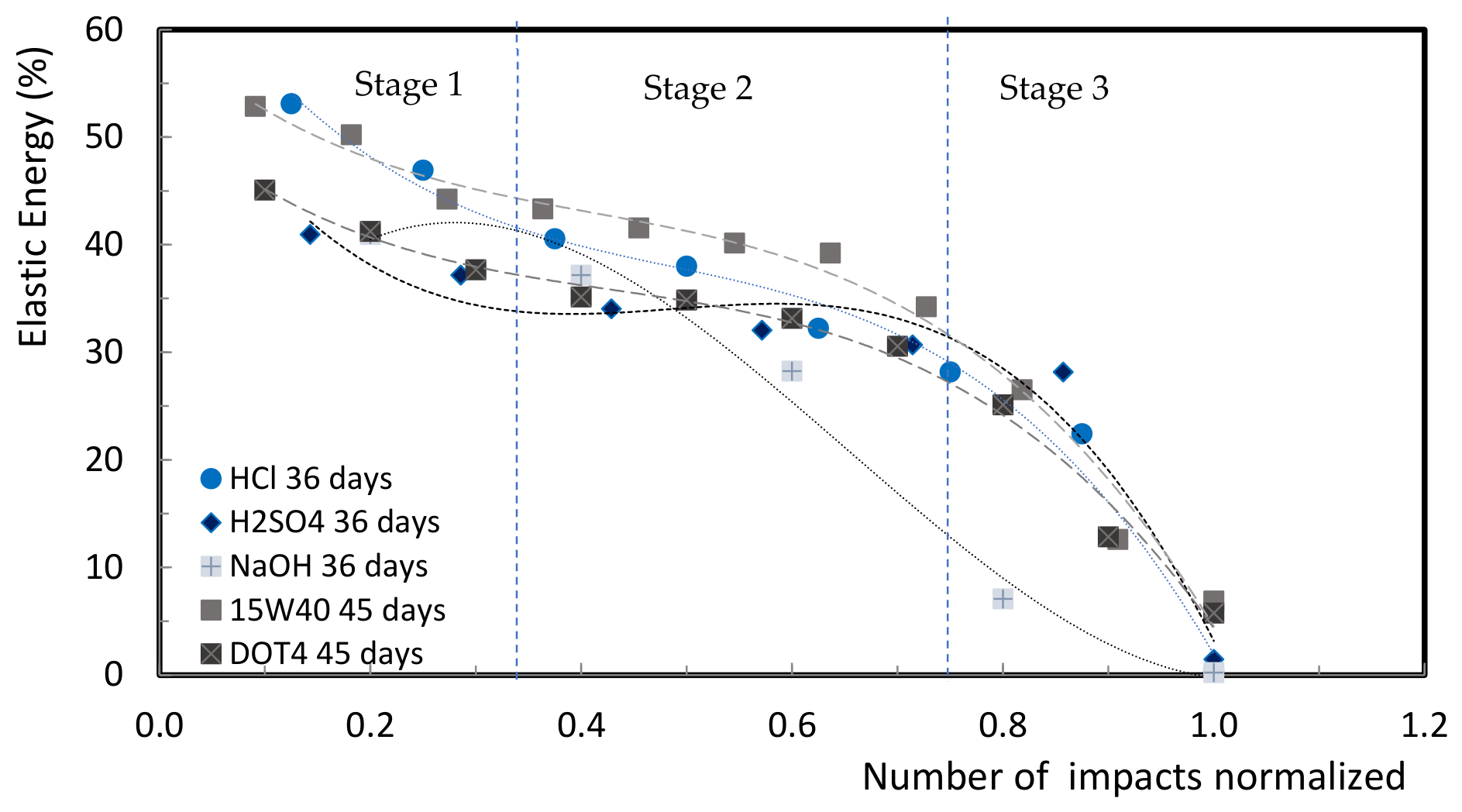
Since acidic and alkaline solutions, as well as oils, proved to be the most aggressive, we performed multiple impacts until rupture to assess the composite’s ability to respond to that when immersed in these solutions. The effects of multiple impacts were investigated to show the impact resistance across various corrosive solutions and exposure periods. Figure 4 shows the elastic energy as a function of the number of impacts normalized until total rupture, where the last impact is not represented since it causes complete penetration (elastic energy = 0). The normalized number of impacts represents the ratio between the impact number at any given point during the test and the maximum number of impacts (i.e., the number of impacts until the total failure of the specimen). Figure 4 illustrates the three stages of elastic energy evolution resulting from damage accumulation [46]. The elastic energy decreases during the first 40% of the total fatigue life (Stage 1), followed by a slight decline until approximately 75% (Stage 2). Finally, a sharp drop occurs toward the end of the total life, representing Stage 3. In this final stage, the elastic energy falls abruptly due to observed fiber breakage, which reduces local stiffness at the impact point [47]. From Figure 4, it can be concluded that, regardless of the solution type, the material behavior consistently follows the same trend, with the exception of the specimens immersed in the alkaline solution for 36 days. These specimens undergo total failure at the fifth impact and exhibit a sharp drop in elastic energy values starting from the third impact. The results demonstrate that the resistance of the laminates to repeated low-velocity impacts is highly dependent on the corrosive environment and the duration of exposure.

4. Conclusions

This work delivers a rigorous comparative evaluation of the low-velocity impact behavior of laminated glass/epoxy composites after exposure to distinct environments. The findings conclusively identify alkaline solutions as the most aggressive degradation agents, causing substantial deterioration even at short immersion times. This is clearly reflected in the significant loss of elastic energy, indicating a pronounced reduction in the material’s capacity to absorb impact loads. The results demonstrate that alkaline solutions induce significantly greater degradation than acidic solutions, oils, and mortars, even after relatively short exposure periods.
Short immersion periods (12–30 days) produced limited degradation, with reductions in elastic energy below 15%, while cementitious solutions exhibited the lowest deterioration even for longer exposure times. In contrast, prolonged exposure to alkaline solution, DOT4 oil, and metakaolin mortar significantly increased the degradation level, leading to elastic energy reductions between 30% and 40%, with the most severe condition corresponding to NaOH immersion for 36 days, which resulted in a 37.4% decrease.
Given the widespread application of these composites in the chemical industry, these findings underscore a critical limitation: exposure to alkaline environments must be carefully controlled or avoided. Even short-term immersion leads to a marked decline in impact resistance and can precipitate complete structural failure after a small number of repeated impacts. In contrast, the composite exhibits stable and reliable impact performance in environments representative of civil construction applications. This supports its suitability as a viable and competitive alternative to conventional construction materials, particularly where impact resistance is a governing design criterion.
This study fills a critical gap in the literature by providing a comprehensive comparative assessment of multiple environmental conditions in relation to the low-velocity impact response of laminated glass/epoxy composites, going beyond the fragmented approach of previous studies that considered each condition separately.

Author Contributions

Conceptualization, A.M.A.; methodology, A.M.A.; validation, A.M.A. and M.A.N.; formal analysis, A.M.A. and M.A.N.; investigation, A.M.A. and M.A.N.; writing—original draft preparation, A.M.A. and M.A.N.; writing—review and editing, A.M.A. and M.A.N. All authors have read and agreed to the published version of the manuscript.

Funding

This research received no external funding.

Data Availability Statement

Data are contained within the article.

Acknowledgments

This research is sponsored by national funds through FCT—Fundação para a Ciência e a Tecnologia, under projects UID/00285/2025 (DOI: 10.54499/UID/00285/2025) and LA/P/0112/2020 (DOI: 10.54499/LA/P/0112/2020).

Conflicts of Interest

The authors declare no conflicts of interest.

References

  1. Xu, G.; Sun, G.; He, W.; Deng, X.; Liu, X.; Zhou, W.; Liu, J. A review on advanced composite materials in marine structures. Thin-Walled Struct. 2026, 221, 114490. [Google Scholar] [CrossRef]
  2. Mohammed, A.I.; Raghupathy, K.; De Victoria Garcia Baltazar, O.; Onokpasah, L.; Carvalho, R.; Mogensen, A.; Hassani, F.; Njuguna, J. Quasi-static compression tests of overwrapped composite pressure vessels under low velocity impact. Compos. Struct. 2024, 327, 117662. [Google Scholar] [CrossRef]
  3. Soliman, E.M.; Sheyka, M.P.; Taha, R.H. Low-velocity impact of thin woven carbon fabric composites incorporating multi-walled carbon nanotubes. Int. J. Impact Eng. 2012, 47, 39–47. [Google Scholar]
  4. Zhou, J.; Wen, P.; Wang, S. Numerical investigation on the repeated low-velocity impact behavior of composite laminates. Compos. Part B Eng. 2020, 185, 107771. [Google Scholar] [CrossRef]
  5. Chung, D.D.L. Carbon Fiber Composites; Butterworth-Heinemann: Boston, MA, USA, 1994. [Google Scholar]
  6. Abrate, S. Impact on Composite Structures; Cambridge University Press: Cambridge, UK, 1998. [Google Scholar]
  7. Amaro, A.M.; Reis, P.N.B.; Neto, M.A. Experimental study of temperature effects on composite laminates subjected to multi-impacts. Compos. Part B Eng. 2016, 98, 23–29. [Google Scholar] [CrossRef]
  8. Amaro, A.M.; Reis, P.N.B.; de Moura, M.F.S.F.; Neto, M.A. Influence of multi-impacts on GFRP composite laminates. Compos. Part B Eng. 2013, 52, 93–99. [Google Scholar] [CrossRef]
  9. Sánchez-Sáez, S.; Barbero, E.; García-Castillo, S.K.; Ivañez, I.; Cirne, J. Experimental response of agglomerated cork under multi-impact loads. Mater. Lett. 2015, 160, 327–330. [Google Scholar] [CrossRef]
  10. Amaro, A.M.; Loureiro, A.J.R.; Reis, P.N.B.; Neto, M.A. Residual impact strength of glass/epoxy composite laminates after solid particle erosion. Compos. Struct. 2020, 238, 112026. [Google Scholar] [CrossRef]
  11. Atas, C.; Liu, D. Impact response of woven composites with small weaving angles. Int. J. Impact Eng. 2008, 35, 80–97. [Google Scholar] [CrossRef]
  12. Amouzou, A.S.E.; Sicot, O.; Chettah, A.; Aivazzadeh, S. Experimental characterization of composite laminates under low-velocity multi-impact loading. J. Compos. Mater. 2019, 53, 2391–2405. [Google Scholar] [CrossRef]
  13. Özer, M.; Kaybal, H. Low-Velocity Impact Response of Halloysite Nanotube Reinforced Glass/Epoxy Multi-Scale Composite Part 2: Effect of Acidic Aging Environment. Polym. Compos. 2026, 47, S345–S358. [Google Scholar]
  14. Stamenović, M.; Putić, S.; Rakin, M.; Medjo, B.; Čikara, D. Effect of Alkaline and Acidic Solutions on the Tensile Properties of Glass–Polyester Pipes. Mater. Des. 2011, 32, 2456–2461. [Google Scholar] [CrossRef]
  15. Uthaman, A.; Xian, G.; Thomas, S.; Wang, Y.; Zheng, Q.; Liu, X. Durability of an epoxy resin and its carbon fiber-reinforced polymer composite upon immersion in water, acidic, and alkaline solutions. Polymers 2020, 12, 614. [Google Scholar] [CrossRef] [PubMed]
  16. Iqbal, M.; Zhao, Q.; Zhang, D.; Jalal, F.E.; Jamal, A. Evaluation of tensile strength degradation of GFRP rebars in harsh alkaline conditions using non-linear genetic-based models. Mater. Struct. 2021, 54, 190. [Google Scholar] [CrossRef]
  17. Wang, B.; Li, D.; Xian, G.; Li, C. Effect of immersion in water or alkali solution on the structures and properties of epoxy resin. Polymers 2021, 13, 1902. [Google Scholar] [CrossRef] [PubMed]
  18. Sawpan, M.A.; Beg, M.D.H. Long-term residual properties and durability of glass fiber reinforced polymer composite exposed to alkaline solution and natural weather for a decade. Polym. Compos. 2024, 45, 1096–1106. [Google Scholar] [CrossRef]
  19. Falkenreck, C.K.; Zarges, J.C.; Heim, H.P. Degradation pathways and chemical stability of regenerated cellulose fiber-reinforced bio-polyamide 5.10 composites under acidic and alkaline conditions. Sci. Rep. 2025, 15, 35242. [Google Scholar] [CrossRef] [PubMed]
  20. Li, P.; Xu, J.; Cao, Z.; Zhang, Z.; Wang, P.; Yu, J.; Li, S. Degradation mechanism of the interface between polymer and aggregate in polymer-based mixture under acidic, alkaline, salt and pure water erosion solutions. Polym. Degrad. Stab. 2026, 247, 112018. [Google Scholar] [CrossRef]
  21. Thushanthan, K.; Gamage, K. Durability assessment and reliability modelling of CFRP composites under simulated long-term exposure to acidic, alkaline, and aqueous environments. Eng. Fail. Anal. 2026, 183, 110275. [Google Scholar] [CrossRef]
  22. Mahmoud, M.K.; Tantawi, S.H. Effect of Strong Acids on Mechanical Properties of Glass/Polyester GRP Pipe at Normal and High Temperatures. Polym.-Plast. Technol. Eng. 2003, 42, 677–688. [Google Scholar] [CrossRef]
  23. Amaro, A.M.; Reis, P.N.B.; Neto, M.A.; Louro, C. Effects of alkaline and acid solutions on glass/epoxy composites. Polym. Degrad. Stab. 2013, 98, 853–862. [Google Scholar] [CrossRef]
  24. Kim, G.; He, Y.; Kulkarni, S.; Sterkenburg, R. The influence of aircraft fluid ingression on tensile properties of aramid fiber composites. Adv. Compos. Mater. 2021, 30, 365–379. [Google Scholar] [CrossRef]
  25. Sunardi Saefuloh, I.; Ula, S.; Ariawan, D.; Surojo, E.; Prabowo, A.; Purnomo, D. Engine oil exposure and performance degradation of composite brake pad based on natural materials. Tribol. Mater. 2025, 4, 201–212. [Google Scholar] [CrossRef]
  26. Bouhafara, D.; Menail, Y.; Marques, A.T.; Mesrafet, F. Effects of engine oil and diesel fuel in the impact strength and morphology of unsaturated polyester matrix reinforced with glass fibers. Polym. Compos. 2026, 47, 10394–10403. [Google Scholar] [CrossRef]
  27. de Souza, L.R.; Marques, A.T.; d’Almeida, J.R.M. Effects of aging on water and lubricating oil on the creep behavior of a GFRP matrix composite. Compos. Struct. 2017, 168, 285–291. [Google Scholar] [CrossRef]
  28. Abbood, I.S.; Odaa, S.A.; Hasan, K.F.; Jasim, M.A. Properties evaluation of fiber reinforced polymers and their constituent materials used in structures—A review. Mater. Today Proc. 2021, 43, 1003–1008. [Google Scholar] [CrossRef]
  29. Qureshi, J.A. Review of Fibre Reinforced Polymer Structures. Fibers 2022, 10, 27. [Google Scholar] [CrossRef]
  30. He, X.J.; Dai, L.; Yang, W.R. Durability and degradation mechanism of GFRP bars embedded in concrete beams with cracks. Plast. Rubber Compos. 2017, 46, 17–24. [Google Scholar] [CrossRef]
  31. Monfared, V.; Ramakrishna, S.; Alizadeh, A.; Hekmatifar, M. A systematic study on composite materials in civil engineering. Ain Shams Eng. J. 2023, 14, 102251. [Google Scholar] [CrossRef]
  32. Amaechi, C.V.; Beddu, S.B.; Ja’e, I.A.; Oyetunji, A.K.; Abu Salia, R.; Oyewole, O.M.; Ojedokun, O.O.; Huang, B. An overview of composites as construction materials for the development of sustainable structures. Mater. Today Sustain. 2026, 33, 101298. [Google Scholar] [CrossRef]
  33. Pacheco-Torgal, F.; Abdollahnejad, Z.; Miraldo, S.; Baklouti, S.; Ding, Y. An overview on the potential of geopolymers for concrete infrastructure rehabilitation. Constr. Build. Mater. 2012, 36, 1053–1058. [Google Scholar] [CrossRef]
  34. Provis, J.L.; Bernal, S.A. Geopolymers and related alkali-activated materials. Annu. Rev. Mater. Res. 2014, 44, 299–327. [Google Scholar] [CrossRef]
  35. Wang, J.; Zheng, C.; Mo, L.; GangaRao, H.; Liang, R. Assessment of recycling use of GFRP powder as replacement of fly ash in geopolymer paste and concrete at ambient and high temperatures. Ceram. Int. 2022, 48, 14076–14090. [Google Scholar] [CrossRef]
  36. Pernica, D.; Reis, P.N.B.; Ferreira, J.A.M.; Louda, P. Effect of test conditions on the bending strength of a geopolymer-reinforced composite. J. Mater. Sci. 2010, 45, 744–749. [Google Scholar] [CrossRef]
  37. Amaro, A.M.; de Moura, M.F.S.F.; Reis, P.N.B. Residual strength after low velocity impact in carbon-epoxy laminates. Mater. Sci. Forum 2006, 514–516, 624–628. [Google Scholar] [CrossRef]
  38. Amaro, A.M.; Reis, P.N.B.; de Moura, M.F.S.F. Delamination effect on bending behaviour in carbon epoxy composites. Strain 2011, 47, 203–208. [Google Scholar] [CrossRef]
  39. Reis, P.N.B.; Ferreira, J.A.M.; Antunes, F.V.; Richardson, M.O.W. Effect of interlayer delamination on mechanical behavior of carbon/epoxy laminates. J. Compos. Mater. 2009, 43, 2609–2621. [Google Scholar] [CrossRef]
  40. Amaro, A.M.; Reis, P.N.B.; Neto, M.A.; Louro, C. Effect of different acid solutions on glass/epoxy composites. J. Reinf. Plast. Compos. 2013, 32, 1018–1029. [Google Scholar] [CrossRef]
  41. Amaro, A.M.; Reis, P.N.B.; Neto, M.A.; Louro, C. Effect of different commercial oils on mechanical properties of composite materials. Compos. Struct. 2014, 118, 1–8. [Google Scholar] [CrossRef]
  42. Amaro, A.M.; Pinto, M.I.M.; Reis, P.N.B.; Neto, M.A.; Lopes, S.M.R. Structural integrity of glass/epoxy composites embedded in cement or geopolymer mortars. Compos. Struct. 2018, 206, 509–516. [Google Scholar] [CrossRef]
  43. ISO 179 1: 2010; Plastics—Determination of Charpy Impact Properties. ISO: Vernier (Geneva) Switzerland, 2010.
  44. Kaybal, H.B. Assessment of Damage Tolerance of Bolted Composite Structures via ‘Bearing-After-Impact’ Tests. Polym. Compos. 2022, 43, 3574–3584. [Google Scholar]
  45. Tatar, A.C.; Kaybal, H.B.; Ulus, H.; Demir, O.; Avcı, A. Evaluation of Low-Velocity Impact Behavior of Epoxy Nanocomposite Laminates Modified With SiO2 Nanoparticles at Cryogenic Temperatures. Res. Eng. Struct. Mater. 2019, 5, 115–125. [Google Scholar]
  46. Azouaoui, K.; Rechak, S.; Azari, Z.; Benmedakhene, S.; Laksimi, A.; Pluvinage, G. Modelling of damage and failure of glass/epoxy composite plates subject to impact fatigue. Int. J. Fatigue 2001, 23, 877–885. [Google Scholar] [CrossRef]
  47. Schrauwen, B.; Peijs, T. Influence of matrix ductility and fibre architecture on the repeated impact response of glass-fibre-reinforced laminated composites. Appl. Compos. Mater. 2002, 9, 331–352. [Google Scholar] [CrossRef]
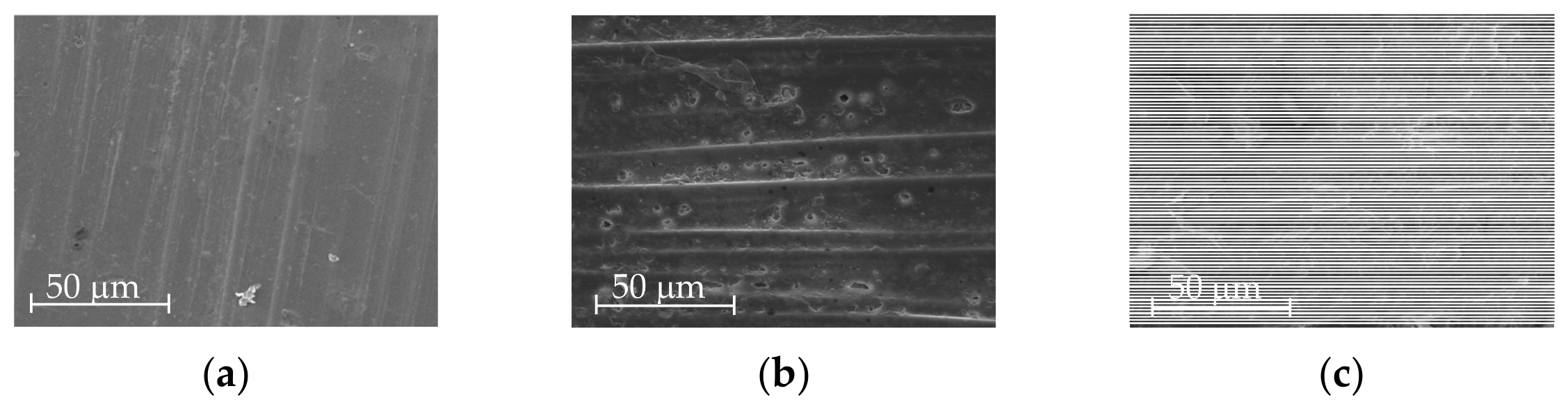
Figure 1. SEM pictures for: (a) control samples; (b) samples exposed to 15W40 for 45 days; (c) samples exposed to DOT4 for 45 days.
Jcs 10 00322 g001
Figure 2. Damage to specimens immersed for 90 days after the Charpy impact test: (a) cement mortar, (b) metakaolin mortar.
Jcs 10 00322 g002
Figure 3. Relationship between the decrease in elastic energy and immersion time for various degradation conditions.
Jcs 10 00322 g003
Figure 4. Elastic energy versus number of impacts until rupture.
Jcs 10 00322 g004
Disclaimer/Publisher’s Note: The statements, opinions and data contained in all publications are solely those of the individual author(s) and contributor(s) and not of MDPI and/or the editor(s). MDPI and/or the editor(s) disclaim responsibility for any injury to people or property resulting from any ideas, methods, instructions or products referred to in the content.