
Review

Research Status and Development Trends of Ambient-Temperature Reactive High-Performance Asphalt Binders

1
Shandong High-Speed Infrastructure Construction Co., Ltd., Jinan 250101, China
2
Shandong High-Speed Dongliang Shenxin Expressway Co., Ltd., Jinan 250101, China
3
Shandong Transportation Institute, Jinan 250031, China
*
Authors to whom correspondence should be addressed.
J. Compos. Sci. 2026, 10(6), 319; https://doi.org/10.3390/jcs10060319 (registering DOI)
Submission received: 2 April 2026 / Revised: 16 May 2026 / Accepted: 9 June 2026 / Published: 15 June 2026
(This article belongs to the Section Composites Applications)

Abstract

Ambient-temperature asphalt binders have emerged as a sustainable alternative to traditional hot-mix asphalt, offering significant advantages in energy conservation and emission reduction. This review systematically examines the research progress and development trends of high-performance reactive asphalt binders designed for ambient-temperature application, which achieve enhanced performance through chemical cross-linking reactions. The study focuses on three core material systems: epoxy resin, waterborne epoxy emulsified asphalt, and polyurethane. For each system, we comprehensively summarize the material composition, strength formation mechanisms, and mix design methodologies. Key evaluation methods for critical pavement performance—including strength characteristics, water stability, and high-temperature performance—are critically reviewed. Furthermore, microscopic characterization techniques including scanning electron microscopy (SEM), Fourier-transform infrared spectroscopy (FTIR), and differential scanning calorimetry (DSC) are discussed to elucidate the underlying mechanisms governing performance evolution. Analysis reveals that epoxy-based binders exhibit superior strength and stiffness, rendering them suitable for heavy-traffic pavements; waterborne epoxy emulsified asphalt binders combine environmental compatibility with construction convenience for thin-layer rehabilitation, while polyurethane-based binders demonstrate exceptional elasticity and rapid curing characteristics for quick-traffic-opening scenarios. Although current research has established a preliminary performance evaluation framework, the absence of unified technical standards constrains widespread engineering implementation. Future research priorities should focus on developing water-triggered curing systems, intelligent responsive materials, and comprehensive standardization systems to fully harness the engineering potential of these sustainable binders.

1. Introduction

The escalating demands of road construction and maintenance, driven by the continuous expansion of transportation infrastructure, present significant challenges. Traditional hot-mix asphalt (HMA) mixtures are characterized by high energy consumption during production and construction, often accompanied by hazardous gas emissions, which are detrimental to sustainable development. In this context, ambient-temperature asphalt mixtures have garnered significant attention as an energy-efficient and environmentally friendly pavement material. According to the Chinese national standard “Terminology for Asphalt Mixture” (GB/T 37383-2019), ambient-temperature asphalt mixture is defined as a mixture prepared at ambient temperature by combining mineral aggregates, asphalt binder, and necessary additives [1]. Compared to HMA, ambient-temperature asphalt mixtures offer distinct advantages, including construction convenience, lower energy consumption, enhanced environmental compatibility, and suitability for construction in low-temperature conditions. In recent years, these materials have been the subject of extensive research focused on performance optimization and engineering application, with scholars worldwide systematically investigating their material composition, processing characteristics, and pavement performance, achieving notable progress.
The technology for ambient-temperature construction was pioneered and developed by the former Soviet Union and the United States between the 1950s and 1990s, followed by exploratory research in Japan and several European countries [2]. During the 20th century, certain European nations initially applied ambient-temperature asphalt in waterproofing works, subsequently expanding its use to road construction [3,4,5,6]. International research efforts have included systematic studies on pavement performance. For instance, El-Hawary et al. [7] investigated the effect of temperature on the mechanical properties of resin-based concrete mixtures. Furthermore, Heriot-Watt University in the UK [8] and Emcol Company [9] developed a permanent cold-lay pavement material (PCSM) and a solvent-based cold patching material suitable for temperatures ranging from −40 to 60 °C, respectively. These materials exhibit favorable characteristics such as good storage stability and relatively low cost, achieving strengths comparable to those of conventional HMA mixtures.
Research on ambient-temperature asphalt mixtures in China commenced relatively later. In the 1960s, the “Highway Transportation Express” first introduced relevant foreign technologies; however, systematic research by scientific institutions in provinces like Heilongjiang, Liaoning, and Shanghai did not begin until the 1990s. In the severely cold northeastern regions, research teams advanced the practical application of this technology through a series of laboratory experiments and field validation. In December 1996, the Jilin Provincial Highway Administration successfully repaired damaged pavement on National Highway 102 using this technology at an ambient temperature of −25 °C. Subsequent monitoring over more than one year confirmed its suitability for winter asphalt pavement maintenance. Since 1997, this technology has been promoted as a key highway maintenance project throughout Jilin Province. To date, over 5000 m3 of asphalt pavement have been repaired, significantly improving road conditions and yielding substantial economic and social benefits [10]. In recent years, scholars including Lü Weimin [11], Xu Shifa [12], and Mao Weiyun [13] have elucidated the strength formation mechanisms of ambient-temperature asphalt mixtures through systematic laboratory experiments. Based on engineering validation, they established optimal material proportioning ranges: asphalt content of 4.5–6.5%, cement content of 1.0–1.5%, and mineral filler content of 10–15%. Currently, various related products have been developed domestically, and the research level in this field is progressively approaching international standards.
This review systematically examines and evaluates the current research status and development prospects of high-performance reactive asphalt binders designed for ambient-temperature application, aiming to provide a reference for further research and application of these materials.
This review focuses primarily on research and applications reported in China, where ambient-temperature reactive asphalt binders have seen substantial development and field implementation. A literature search was conducted using databases such as CNKI, Web of Science, and Scopus, with keywords including ‘ambient-temperature asphalt’, ‘cold-mix reactive asphalt’, ‘epoxy asphalt’, ‘waterborne epoxy emulsified asphalt’, and ‘polyurethane-modified asphalt’. The search covered the period from 2000 to 2024. Only peer-reviewed journal articles, conference proceedings, and Chinese standards were included. The final reference list reflects a critical selection of studies that represent the key advances in material composition, mix design, performance evaluation, and microscopic characterization of the three binder systems.

2. Types and Characteristics of Ambient-Temperature Reactive Asphalt Binders

Ambient-temperature reactive asphalt binders are binder systems that possess the characteristics of mixing and construction at ambient temperature while undergoing chemical reactions among their components. Based on material composition and strength formation mechanisms, the primary types include epoxy resin-based and polyurethane-based systems. Epoxy resin-based binders can be further categorized into ambient-temperature epoxy asphalt binders and waterborne epoxy emulsified asphalt binders. The mix design of these binders directly determines material performance; however, no unified international design standard currently exists. The design process primarily involves asphalt selection, aggregate gradation design, and determination of the optimum asphalt-aggregate ratio. The performance test results of the selected asphalt must comply with the technical requirements of the “Technical Specifications for Construction of Highway Asphalt Pavements” (JTG F40–2004), and the indicators for both coarse and fine aggregates must also meet relevant specifications [14].

2.1. Ambient-Temperature Epoxy Resin Asphalt Binders

2.1.1. Composition and Strength Formation Mechanism of Epoxy Resin Asphalt Binders

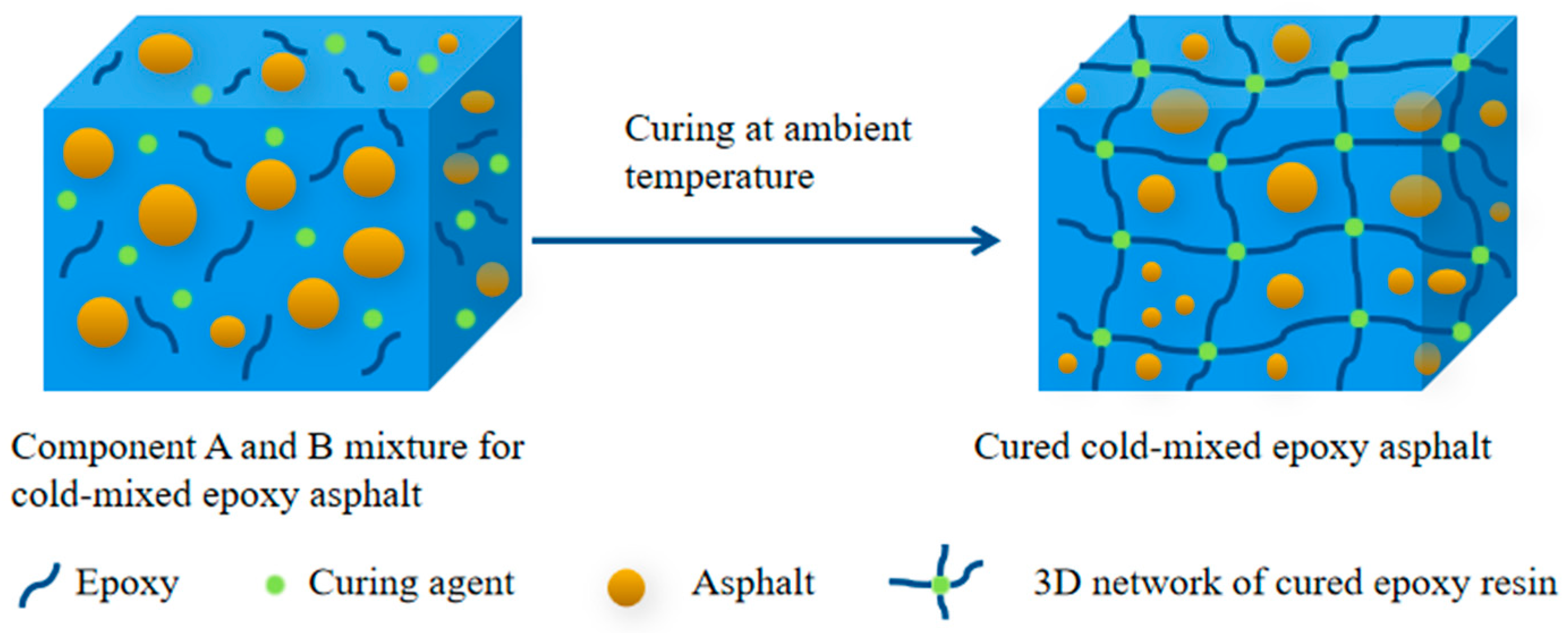
Ambient-temperature epoxy asphalt binder is a high-performance, multi-component composite material composed of epoxy resin, asphalt, ambient-temperature curing agent, and other functional additives. It exhibits characteristics such as high strength, high penetration, excellent cost-effectiveness, and construction convenience, positioning it as a novel pavement material. The strength of this material primarily originates from the cross-linking and curing reaction between the epoxy resin and curing agent at ambient temperature. As illustrated in Figure 1 [15], the epoxy groups within the epoxy resin molecule possess high reactivity and can cross-link with various curing agents to form a stable three-dimensional polymer network [16]. The exothermic heat released during this process facilitates the volatilization of solvents within the mixture, thereby promoting material consolidation [17]. The curing reaction mechanism can be summarized as follows: carbonyl groups first react with epoxy groups to generate hydroxyl groups; these newly formed hydroxyl groups subsequently react with another epoxy group to form ether linkages. Through these two sequential reactions, epoxy molecules and carbonyl-containing molecules become cross-linked, establishing a three-dimensional network that effectively constrains the asphalt molecules. As a thermosetting material, epoxy asphalt exhibits superior physical and mechanical properties compared to conventional thermoplastic asphalt, specifically manifested in enhanced high-temperature deformation resistance and stiffness, stronger adhesive properties, and improved corrosion resistance [18,19].

2.1.2. Mix Design of Ambient-Temperature Epoxy Asphalt Binders

Table 1 presents the gradation types, material selection, and optimum asphalt content for ambient-temperature epoxy asphalt binders. Table 2 presents the corresponding aggregate gradations.
In summary, ambient-temperature epoxy asphalt binders leverage the high-strength three-dimensional network formed by the cross-linking of epoxy resin and curing agent, exhibiting excellent high-temperature stability, mechanical strength, and durability. They have become important materials for high-performance pavement and rapid repair. However, challenges remain, including the need for organic solvents during preparation and construction, and suboptimal curing efficiency and adaptability in low-temperature and humid environments. As a significant development and extension of this material system, ambient-temperature waterborne epoxy emulsified asphalt binders, centered on waterborne epoxy resin and emulsified asphalt, retain the high adhesion and durability of epoxy resin while offering construction convenience and environmental friendliness. They further enhance environmental performance, adapt to a wider range of construction conditions, and are suitable for applications such as preventive pavement maintenance and thin-layer repairs.

2.2. Ambient-Temperature Waterborne Epoxy Emulsified Asphalt Binders

2.2.1. Composition and Strength Formation Mechanism of Ambient-Temperature Waterborne Epoxy Asphalt Binders

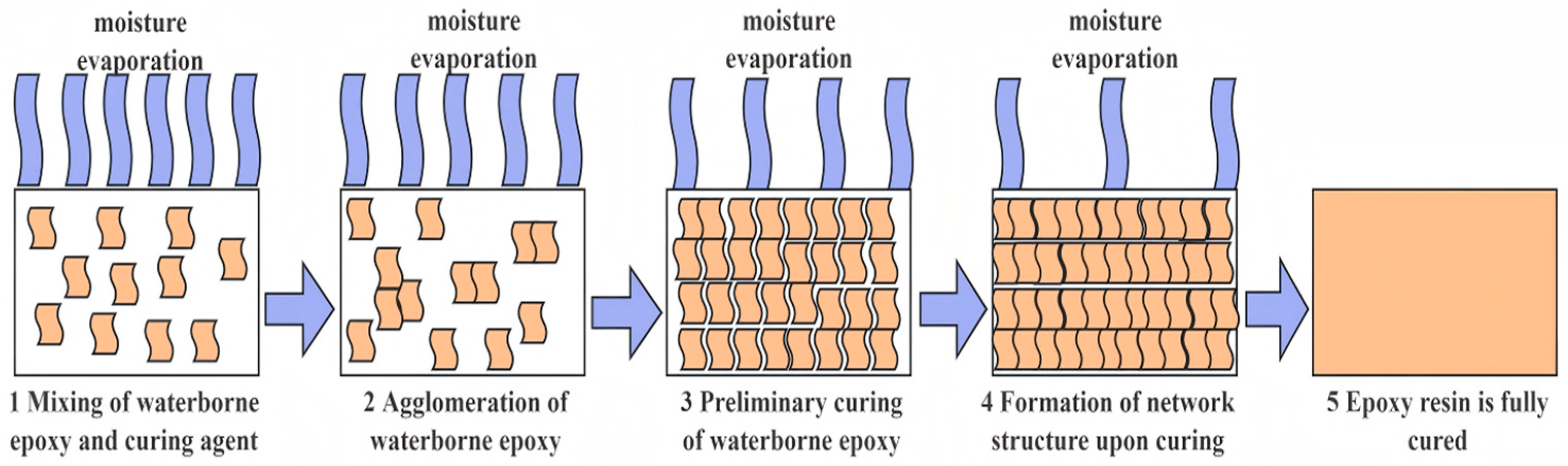
Waterborne epoxy resin is a material produced by uniformly and stably dispersing epoxy resin particles in an aqueous phase through a waterborne process. Its characteristics are similar to those of emulsified asphalt. This material retains the advantages of epoxy resin, including high adhesion, excellent mechanical properties, and low curing shrinkage, while also offering benefits such as being volatile organic compound (VOC)-free and convenient for construction, demonstrating broad application prospects. The highly reactive epoxy groups in waterborne epoxy resin molecules undergo cross-linking reactions with curing agents. As cross-linking density increases, the material transitions from a liquid to a solid state, ultimately forming a stable three-dimensional network structure that imparts high strength and durability to the mixture [22]. Concurrently, as water evaporates from the emulsified asphalt, asphalt droplets coalesce to form a continuous phase that coats and fills the aggregates. Following demulsification, the asphalt bonds tightly with the aggregates, creating a stable skeletal structure [23]. As shown in Figure 2, the three-dimensional network structure of the epoxy resin combines with the adhesive action of the asphalt, forming a synergistically reinforced composite structure that significantly enhances the overall strength and durability of the mixture [24].

2.2.2. Mix Design of Ambient-Temperature Waterborne Epoxy Asphalt Binders

Waterborne epoxy emulsified asphalt mixtures are primarily used for pavement repair. The particle size of the coarse aggregate should be selected based on the repair layer thickness. Excessively large particles can lead to insufficient compaction, while overly small particles may hinder the formation of a stable aggregate skeleton, increasing the risk of rutting distress. Table 3 presents the gradation types, material selection, and optimum asphalt content for ambient-temperature waterborne epoxy emulsified asphalt binders. Table 4 presents the corresponding aggregate gradations.
In summary, ambient-temperature waterborne epoxy emulsified asphalt binders integrate the high adhesion of waterborne epoxy resin with the construction convenience of emulsified asphalt through physical blending, providing an effective solution for environmentally friendly pavement repair. However, the performance enhancement of this system relies heavily on epoxy resin curing and its physical synergy with asphalt. Under heavy traffic loads and harsh service conditions, its toughness, fatigue resistance, and coordination of high- and low-temperature performance may still fall short of higher requirements. Consequently, polyurethane-modified asphalt binders, a class of reactive material systems achieving asphalt molecular restructuring through strong chemical bonding, have garnered significant attention. These systems utilize highly reactive -NCO groups in polyurethane prepolymers to react chemically with asphalt components, forming a three-dimensional elastomeric network centered around urethane linkages. This chemically cross-linked structure not only significantly enhances the stiffness, toughness, and fatigue resistance of the asphalt but also imparts excellent high-temperature deformation resistance and low-temperature crack resistance to the mixture, leveraging its superior elastic recovery and energy dissipation capabilities. These binders are suitable for heavy-traffic sections, regions with significant temperature fluctuations, and pavement construction or rapid repair demanding high durability.

2.3. Ambient-Temperature Waterborne Polyurethane-Based Asphalt Binders

2.3.1. Composition and Strength Formation Mechanism of Ambient-Temperature Waterborne Polyurethane-Based Asphalt Binders

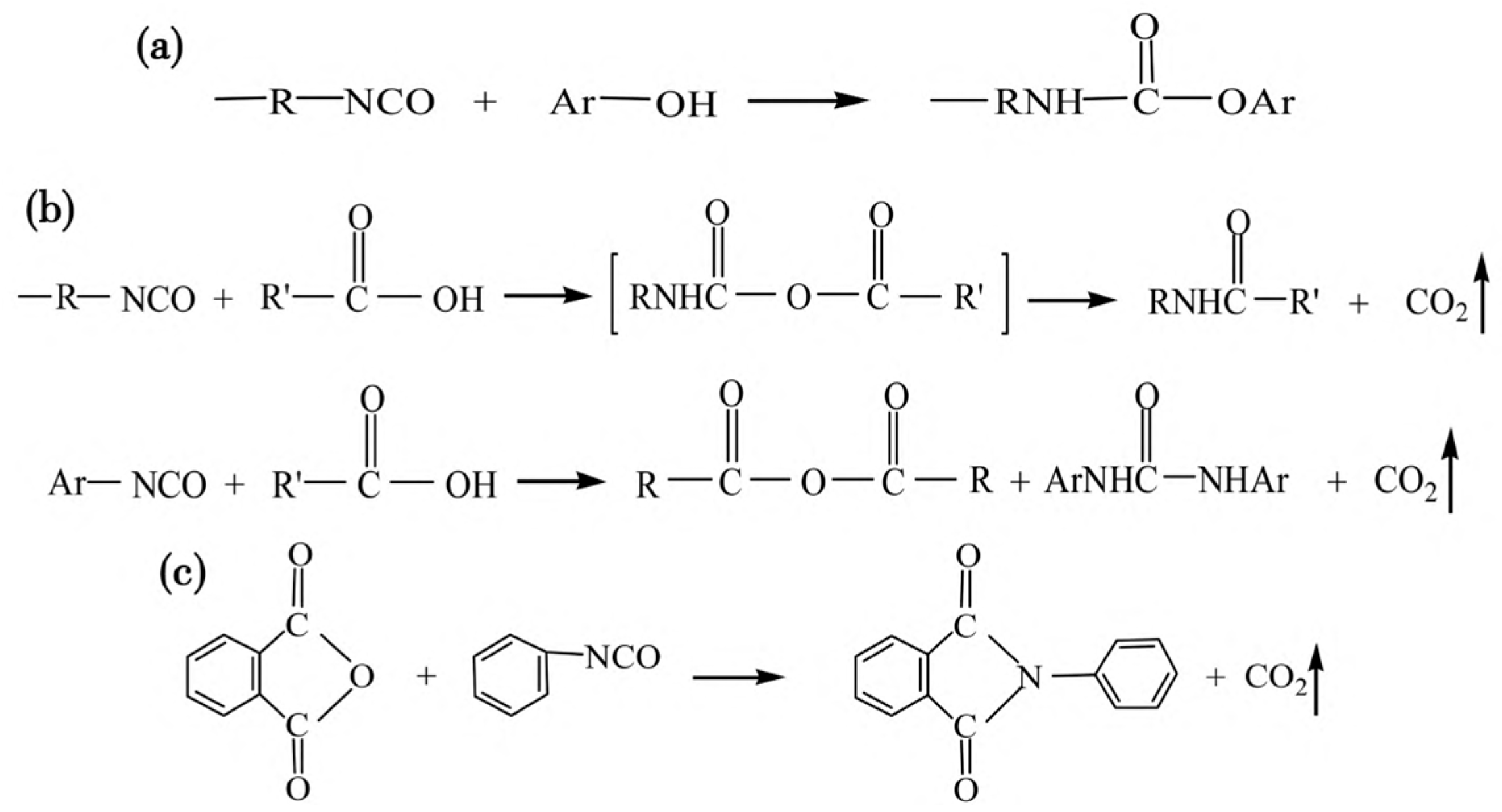
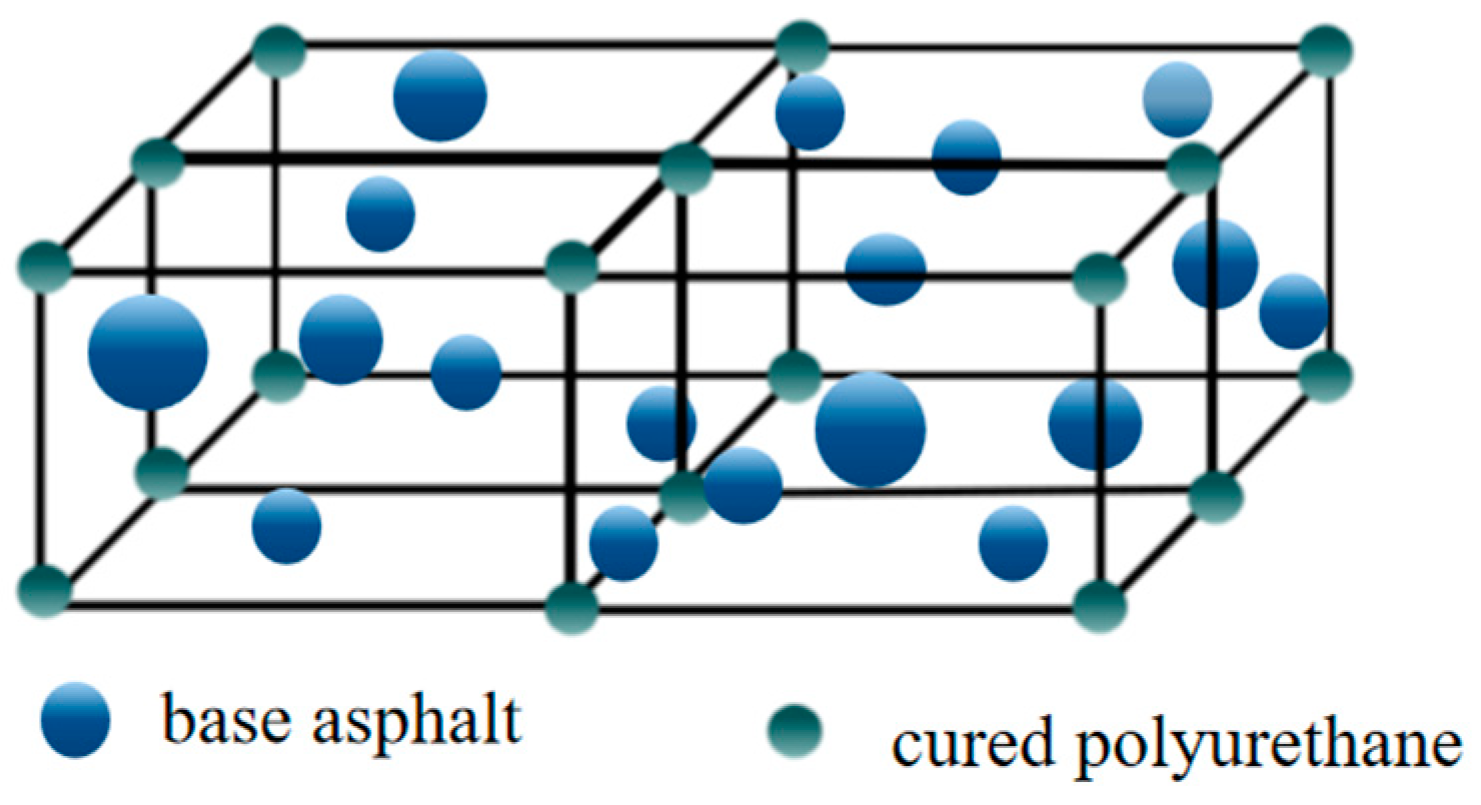
Polyurethane (PU) is a class of synthetic materials produced by reacting polyfunctional organic isocyanates with polyols, exhibiting excellent heat resistance and mechanical properties. When used for asphalt modification, PU is typically incorporated into asphalt to enhance its overall performance. PU prepolymer acts as a reactive chemical modifier. The -NCO groups and urethane structures within its molecules possess high reactivity and can undergo cross-linking reactions with active components in asphalt, as illustrated in Figure 3 [29]. During the high-temperature mixing process, PU molecular chains disperse within the asphalt system, forming a three-dimensional interpenetrating network structure. Simultaneously, moisture present in the asphalt can react with free isocyanates to form urea and release carbon dioxide. The modification effect of PU on asphalt primarily depends on the reactivity and microstructure of the isocyanates and additives used; as a dispersed phase within the asphalt, it enhances the cohesion and toughness of the binder [30]. Furthermore, reactive groups like isocyanate groups can chemically react with components in asphalt containing hydroxyl or carboxyl groups, forming chemical bonds that link the molecules together. This chemical cross-linking contributes to the stability of the asphalt molecular structure, thereby improving its high-temperature stability and aging resistance [31]. The three-dimensional network structure formed by PU within the asphalt is shown in Figure 4. This structure can restrict the movement of asphalt molecules, enhancing the material’s stiffness and strength. Additionally, the structure can absorb and dissipate energy, thereby improving fatigue resistance. Moreover, PU can improve the interfacial adhesion between asphalt and aggregates, promoting the coating of aggregates by asphalt and enhancing adhesion, ultimately improving the overall performance of the asphalt mixture [29,32].

2.3.2. Mix Design of Ambient-Temperature Polyurethane-Based Asphalt Binders

Table 5 presents the gradation types, material selection, and optimum asphalt content for ambient-temperature polyurethane-based asphalt binders. Table 6 presents the corresponding aggregate gradations.
In summary, the three types of ambient-temperature reactive asphalt binders exhibit distinct differences in material characteristics and engineering applicability. Ambient-temperature epoxy asphalt binders, with their high strength and rigidity, are primarily suitable for high-load-bearing applications such as steel deck pavements and heavy-duty roads. Waterborne epoxy emulsified asphalt binders, based on their environmental friendliness and construction convenience, are more appropriate for applications sensitive to environmental impact and process adaptability, such as preventive pavement maintenance and thin-layer repairs. Polyurethane-based asphalt binders, leveraging their superior elasticity, toughness, and rapid curing capability, demonstrate unique advantages in regions or sections requiring quick traffic opening or experiencing significant thermal stress. Although the range of material systems is expanding, their engineering application relies on systematic and scientific performance evaluation frameworks. Therefore, the evaluation methods for the pavement performance of ambient-temperature reactive asphalt binders require detailed discussion to provide a basis for material selection, process optimization, and engineering promotion.

3. Pavement Performance—Evaluation Methods for Ambient-Temperature Reactive Asphalt

3.1. Strength Evaluation

Ambient-temperature asphalt mixtures exhibit low initial strength upon placement but may be subjected to significant loads shortly thereafter. Under the combined influence of time and environmental factors, solvents within the mixture continuously volatilize, and the material undergoes further compaction under repeated traffic loading, resulting in a dynamic evolution of its performance. Consequently, in-depth research on evaluation methods for the initial stability and ultimate stability of these mixtures is crucial. Such research not only systematically reveals the performance evolution laws but also provides a theoretical basis and technical support for improving construction quality and ensuring long-term pavement stability and durability.
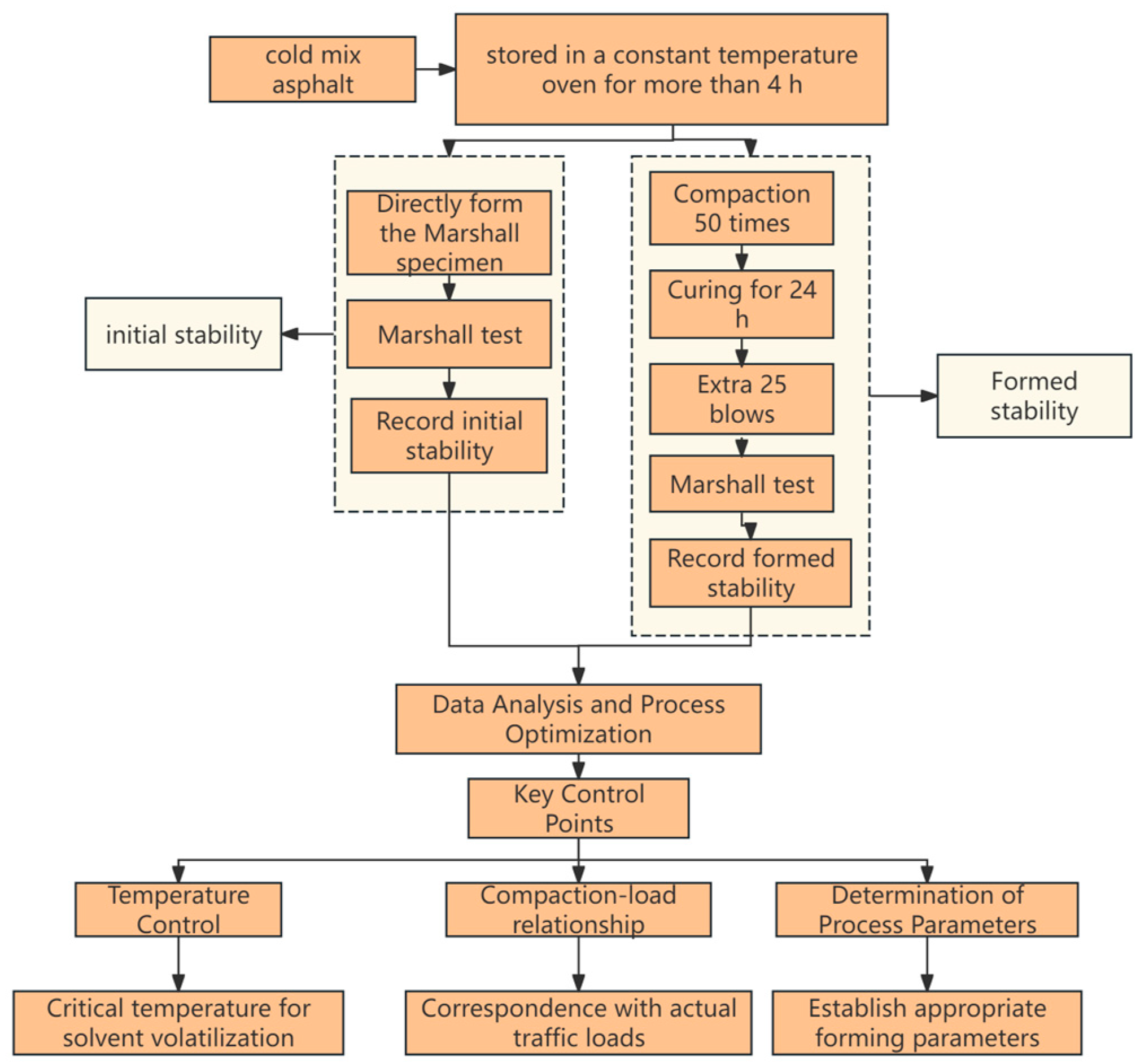
Considering the strength development characteristics of ambient-temperature asphalt mixtures, compaction testing methods are recommended for evaluation. The Marshall stability testing procedure for ambient-temperature asphalt mixtures is illustrated in Figure 5.
The mixture is placed in a constant-temperature chamber set to a specified temperature for conditioning for at least 4 h. After achieving a uniform temperature, specimens are directly compacted and subjected to the Marshall stability test; the resulting value is defined as the initial stability. To simulate the influence of traffic loading on strength formation, the mixture can be initially compacted with 50 blows, cured for 24 h, and then subjected to an additional 25 blows before testing for ultimate stability. Based on this, further investigation into the correlation between the number of compactive blows and the effect of post-repair traffic loading can be conducted to determine appropriate compaction process parameters. During testing, the curing temperature should be set considering the critical volatilization temperature of the solvent to ensure scientific validity of the results. Regarding strength criteria, existing research proposes varying recommendations: Huang Jie [34] suggests initial stability should exceed 2.50 kN and ultimate stability should exceed 4.0 kN; Li Mouyu et al. [35] recommend initial strength not less than 3.5 kN and ultimate strength not less than 7.0 kN; Yang Wei, Chan Qigang, Liu Guoqiang et al. [36] propose initial strength exceeding 2.4 kN.
Ambient-temperature epoxy asphalt binders are characterized by rapid strength development and high ultimate strength, meeting the strength requirements for ambient-temperature pavement construction and significantly reducing traffic opening time compared to ordinary ambient-temperature asphalt mixtures [24]. The strength development of waterborne epoxy emulsified asphalt binders occurs in two stages: water evaporation promoting emulsified asphalt demulsification to enhance adhesion, and epoxy resin curing to increase material cohesion. Their strength is significantly influenced by curing time and epoxy resin content, with ultimate strength surpassing that of HMA and meeting specification requirements [37]. The strength of ambient-temperature polyurethane asphalt binders primarily relies on the chemical curing of the polyurethane adhesive (e.g., cross-linking of isocyanate and polyol) and the mechanical interlocking among aggregates. At ambient temperature, polyurethane mixed with aggregates undergoes cross-linking reactions, gradually forming a three-dimensional network that binds the aggregates into a monolithic structure, achieving strength development [38].

3.2. Water Stability Evaluation

Water damage refers to the phenomenon where water entering the pavement interior generates dynamic water pressure or vacuum suction under the combined action of moisture or freeze–thaw cycles and traffic loading. This repeated action leads to water intrusion into the asphalt-aggregate interface, reducing asphalt adhesion and weakening bond strength, ultimately causing asphalt film stripping, aggregate loss, and the development of distress such as potholes and shoving. This type of distress significantly impacts the service life and safety of asphalt pavements and is a critical issue in pavement engineering. Therefore, water stability testing is essential for ensuring long-term pavement performance. Currently, common evaluation methods include the boiling water test and water immersion test for loose mixtures, and the immersed Marshall test and freeze–thaw splitting test for compacted specimens [39].

3.2.1. Boiling Water Test and Water Immersion Test

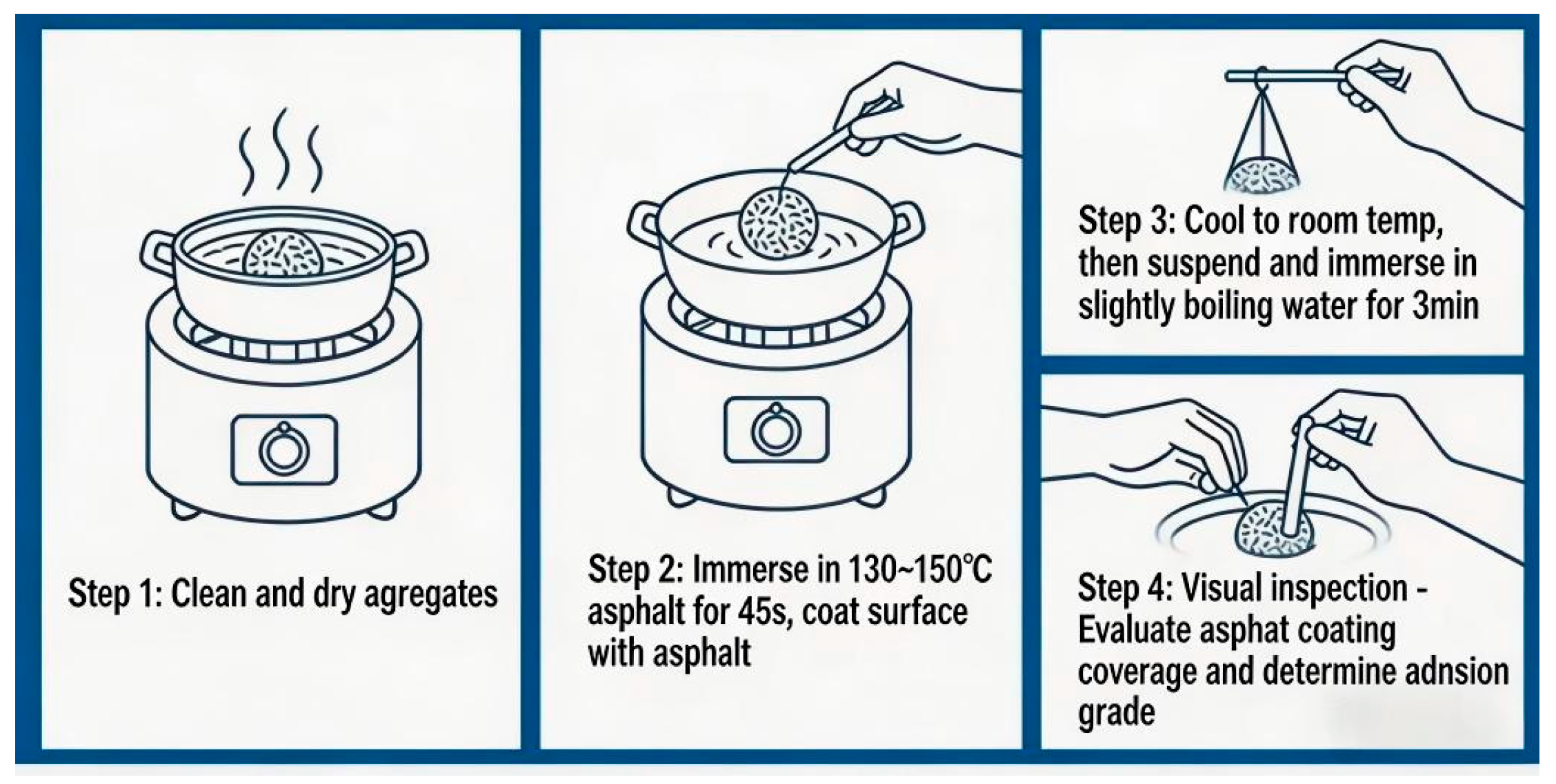
As illustrated in Figure 6 and according to China’s “Standard Test Methods of Bitumen and Bituminous Mixtures for Highway Engineering,” the boiling water test is primarily used to evaluate the adhesion between coarse aggregates (particle size 13.2–19 mm) and asphalt. During the test, clean aggregates are first dried, then immersed in asphalt at 130–150 °C for 45 s to ensure uniform coating. After cooling to room temperature, the coated aggregates are suspended in gently boiling water for 3 min. Subsequently, the extent of asphalt film coverage and stripping is visually assessed to determine the adhesion grade. This method is simple to operate and effectively reflects the adhesive performance between asphalt and aggregate. It should be noted that the boiling water and water immersion tests described in this section were originally developed for hot-mix asphalt. For ambient-temperature reactive binders (especially waterborne or solvent-based systems), the high temperature (130–150 °C) required for coating aggregates may alter the curing state or evaporate volatile components before the test. Therefore, these methods are only suitable for binders that have already been fully cured or are not thermally sensitive. For waterborne epoxy emulsified or solvent-based systems, alternative adhesion tests (e.g., pull-off test on cured specimens) or modification of the coating temperature to ambient conditions are recommended to avoid misleading results, but such adaptations are not yet standardized in the literature reviewed.
The water immersion test is applicable to coarse aggregates with a maximum particle size of less than 13.2 mm and includes static and dynamic methods. The static method involves immersing asphalt-coated aggregates in an 80 °C constant-temperature water bath for 30 min, followed by observation of asphalt film stripping. However, due to the limited destructive force under static conditions and insufficient discriminatory power, it is not recommended as a definitive evaluation criterion. The dynamic method involves continuous agitation of the specimens for 5–30 min during immersion. After the test, stripped particles are washed away, and a mass loss of less than 5% is considered indicative of good performance.
Ambient-temperature epoxy asphalt binders exhibit excellent adhesion properties. In both boiling water and water immersion tests, the asphalt film remains intact with minimal stripping, demonstrating a high adhesion grade. This indicates strong resistance to water damage, effectively inhibiting asphalt-aggregate stripping caused by water intrusion, thereby enhancing pavement durability [40]. Ambient-temperature waterborne epoxy emulsified asphalt binders also demonstrate good adhesion. When the waterborne epoxy resin content is 15–30% (by mass), the mixture exhibits optimal comprehensive performance, showing strong resistance to stripping in both boiling water and water immersion tests. As epoxy resin content increases, the pavement performance of the mixture further improves, bonding with aggregates becomes stronger, and resistance to water damage correspondingly increases [41]. Ambient-temperature polyurethane-based asphalt binders tested by boiling water and water immersion methods show good water stability. Their performance remains stable under high-temperature and high-humidity conditions, with key indicators such as dynamic stability showing only minor decreases. This indicates that the material maintains high strength and structural stability under prolonged immersion, possessing excellent resistance to water damage.

3.2.2. Immersion Marshall Test

The test is conducted using two sets of standard Marshall specimens. The first set is immersed in a 60 °C water bath for 0.5 h, after which the Marshall stability is determined and recorded as S1. The second set is immersed under the same conditions for 48 h, and the stability is determined and recorded as S2. The retained Marshall stability, S0, is calculated as the ratio of the stabilities of the two sets using the following formula:
S 0 = S 2 S 1 × 100 0 0
Retained Marshall stability (S0) is a key indicator for evaluating the water stability of asphalt mixtures, reflecting their ability to maintain performance under prolonged immersion. A higher S0 value indicates stronger resistance to water damage. This method is simple, provides intuitive results, and is widely used in water stability evaluation and construction quality control for asphalt mixtures [34].
Immersion Marshall retained stability for ambient-temperature epoxy asphalt mixtures typically exceeds 85%, indicating good water stability. However, this performance is contingent upon complete curing of the epoxy resin [21]. For ambient-temperature waterborne epoxy emulsified asphalt mixtures, the retained stability after complete curing also exceeds 85%, demonstrating excellent stripping resistance and water stability. However, the emulsifier is susceptible to dissolution in water before curing, and the curing process is significantly influenced by temperature and humidity, requiring strict process control [15,37]. Ambient-temperature polyurethane-based asphalt mixtures exhibit high retained stability and good elastic recovery, enabling them to resist water-induced deformation. However, they may foam upon contact with water before complete curing, have relatively high cost, and are sensitive to curing conditions. Compared to epoxy-based materials, their advantage lies in better low-temperature toughness, while their disadvantage is greater sensitivity to moisture in the uncured state [42].

3.2.3. Immersion Wheel Tracking Test

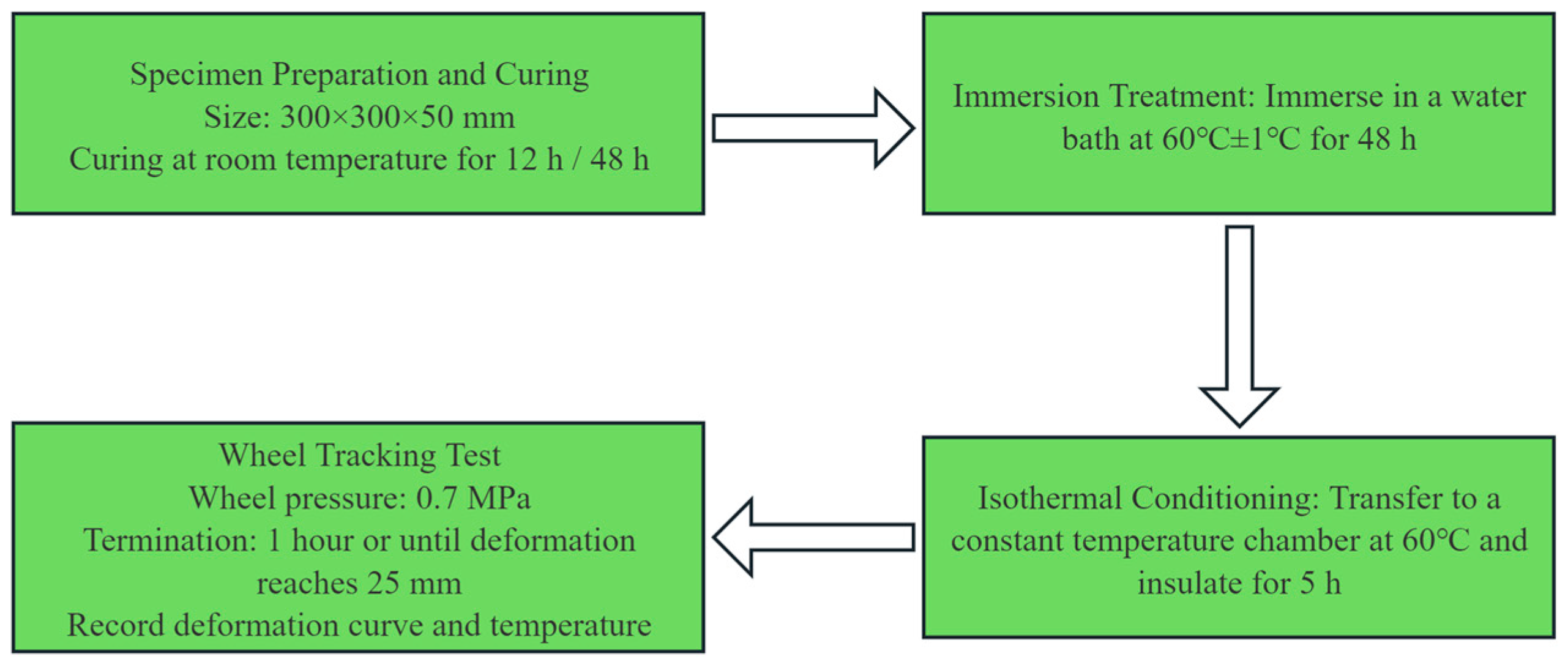
As shown in Figure 7, specimens are prepared according to standard specifications. The asphalt mixture is compacted into specimens of standard dimensions (typically 300 mm × 300 mm × 50 mm) and cured at ambient temperature for 12 h (48 h for polymer-modified asphalt mixtures). Subsequently, the specimens undergo immersion treatment: they are immersed in a 60 °C water bath for 48 h to simulate a water erosion environment. After immersion, the specimens, along with the molds, are transferred to a temperature-controlled chamber at 60 ± 1 °C for conditioning for at least 5 h to ensure the internal temperature stabilizes at 60 ± 0.5 °C. The wheel tracking test employs a solid rubber tire with a contact pressure of 0.7 MPa. The wheel travels back and forth along the rolling direction on the specimen surface. The test lasts for 1 h or until a deformation of 25 mm is reached, during which the deformation curve and specimen temperature are automatically recorded.
The immersion wheel tracking test is sensitive to water damage and can comprehensively reflect the influence of both rutting development and dynamic water action. However, no unified evaluation index currently exists; assessment is typically based on the degree of mixture stripping observed [43]. Epoxy asphalt mixtures exhibit high-temperature stability (dynamic stability >10,000 cycles/mm) in the immersion wheel tracking test, with excellent resistance to water erosion after curing, but are susceptible to water damage if insufficiently cured. Waterborne epoxy emulsified asphalt mixtures show dynamic stability ranging from 5000 to 8000 cycles/mm after curing, offering construction convenience and stability, although residual emulsifier and uncured immersion can affect rutting resistance. Polyurethane-based mixtures demonstrate good high-temperature toughness under immersion (deformation <2 mm), but moisture interference during curing can cause fluctuations in dynamic stability (3000–6000 cycles/mm). Overall, the water stability of all three material types surpasses that of traditional asphalt mixtures. However, their full performance potential relies on complete curing, necessitating strict control of temperature and humidity during construction to prevent adverse effects of moisture on the curing process.

3.2.4. Freeze–Thaw Splitting Test

The freeze–thaw splitting test evaluates water stability by determining the ratio of splitting tensile strengths of mixtures before and after freeze–thaw cycling. The test procedure involves preparing eight Marshall specimens, divided into two groups. The first group is kept at room temperature as a control. The second group is subjected to vacuum saturation, then placed in plastic bags containing 10 mL of water, sealed, and frozen at −18 °C for 16 h. Subsequently, they are immersed in a 60 °C water bath for 24 h. Finally, both groups of specimens are conditioned in a 25 °C water bath for at least 2 h before undergoing the splitting test according to the “Standard Test Methods of Bitumen and Bituminous Mixtures for Highway Engineering” (JTJ 052–2000) [44]. Ambient-temperature reactive asphalt mixtures exhibit excellent water stability, low-temperature crack resistance, and durability in this test, making them particularly suitable for road engineering in cold regions.

3.3. High-Temperature Performance Evaluation

The asphalt mixture rutting resistance test aims to evaluate its ability to resist permanent deformation induced by repeated traffic loading at high temperatures. The test simulates the rolling action of traffic on the pavement surface, measuring the deformation behavior of specimens under specific temperature and loading conditions. This allows for the analysis of rutting resistance, providing a basis for pavement material design, selection, and construction quality control. It ensures that the asphalt pavement can effectively resist rutting distress and maintain good surface evenness and functionality throughout its long-term service life.
For the high-temperature rutting resistance test, specimen preparation for ambient-temperature reactive asphalt mixtures should follow standard methods used for HMA. To simulate the influence of traffic loading on initial strength formation, specimens are cured for 3 days and then subjected to 7 passes of a rolling wheel compactor. Subsequently, to investigate the effect of curing time, the rolled specimens are placed in a well-ventilated indoor area for continued curing for 7 days, and their density is measured. If the density meets the specified criteria for ultimate compaction, the dynamic stability test can be conducted; otherwise, adjustments to the number of rolling passes and curing time are required until the requirements are met. Through systematic testing, key parameters such as the number of rolling passes, curing temperature, humidity, and time can be optimized [45].
In the high-temperature rutting resistance test, the three types of ambient-temperature reactive asphalt mixtures exhibit distinct characteristics and challenges. Epoxy asphalt mixtures leverage the rigid three-dimensional cross-linked network formed after curing, demonstrating excellent resistance to permanent deformation; however, their performance is significantly compromised if curing is insufficient [46]. Waterborne epoxy emulsified asphalt mixtures combine the rigidity of epoxy resin with the construction convenience of emulsified asphalt, showing markedly improved high-temperature stability after curing; however, residual emulsifier may affect early strength, and performance is sensitive to curing humidity [47]. Polyurethane-based mixtures, with their high elasticity and rapid reaction characteristics, exhibit good elastic recovery and deformation (coordination ability) at high temperatures; however, moisture or high-temperature environments can interfere with their curing process, leading to fluctuations in rutting resistance [48]. The rutting resistance of these materials is highly dependent on complete curing; therefore, strict control of reaction conditions such as temperature, humidity, and time during construction is essential to ensure their performance is fully realized.

3.4. Comparative Analysis of Reactive Asphalt Binder Characteristics

Given the current insufficient systematic understanding of ambient-temperature mixture systems in China, a comparative analysis of the characteristics and performance of ambient-temperature reactive asphalt binders is presented in Table 7 and Table 8 for clarity.
Based on the comparative analysis of the characteristics of the three types of ambient-temperature reactive asphalt binders (Table 7), the following observations can be made: Ambient-temperature epoxy asphalt binders, with their excellent mechanical properties and adhesive strength, are suitable for special pavement applications demanding high load-bearing capacity. Waterborne epoxy emulsified asphalt binders, leveraging their environmental friendliness and construction convenience, are more appropriate for repair and overlay projects sensitive to environmental impact. Polyurethane-based asphalt binders, with their rapid curing, aging resistance, and water damage resistance, excel in scenarios requiring environmental adaptability and rapid repair. Although these macroscopic performances have been systematically evaluated, the underlying reasons for performance differences and directions for further optimization require elucidation at the microstructural level.

4. Microscopic Performance Evaluation

The macroscopic performance of asphalt mixtures is governed by their chemical composition and microstructure. Microscopic characterization techniques enable in-depth analysis of the intrinsic mechanisms underlying macroscopic behavior and reveal how component proportions influence micro-morphology and corresponding mechanical responses. Currently, domestic research on the microstructure of ambient-temperature reactive asphalt binders commonly employs techniques such as scanning electron microscopy (SEM), Fourier-transform infrared spectroscopy (FTIR), nuclear magnetic resonance, fluorescence microscopy, and atomic force microscopy. Due to space limitations, this review focuses on three commonly used methods.

4.1. Scanning Electron Microscopy (SEM)

The microstructural characteristics of ambient-temperature reactive asphalt binders critically determine their mechanical and durability performance. Scanning electron microscopy (SEM) is a key technique for characterizing interfacial adhesion properties, cured phase distribution, and micro-morphology. This section reviews SEM research findings related to ambient-temperature epoxy asphalt, waterborne epoxy asphalt, and polyurethane-based ambient-temperature asphalt binders.
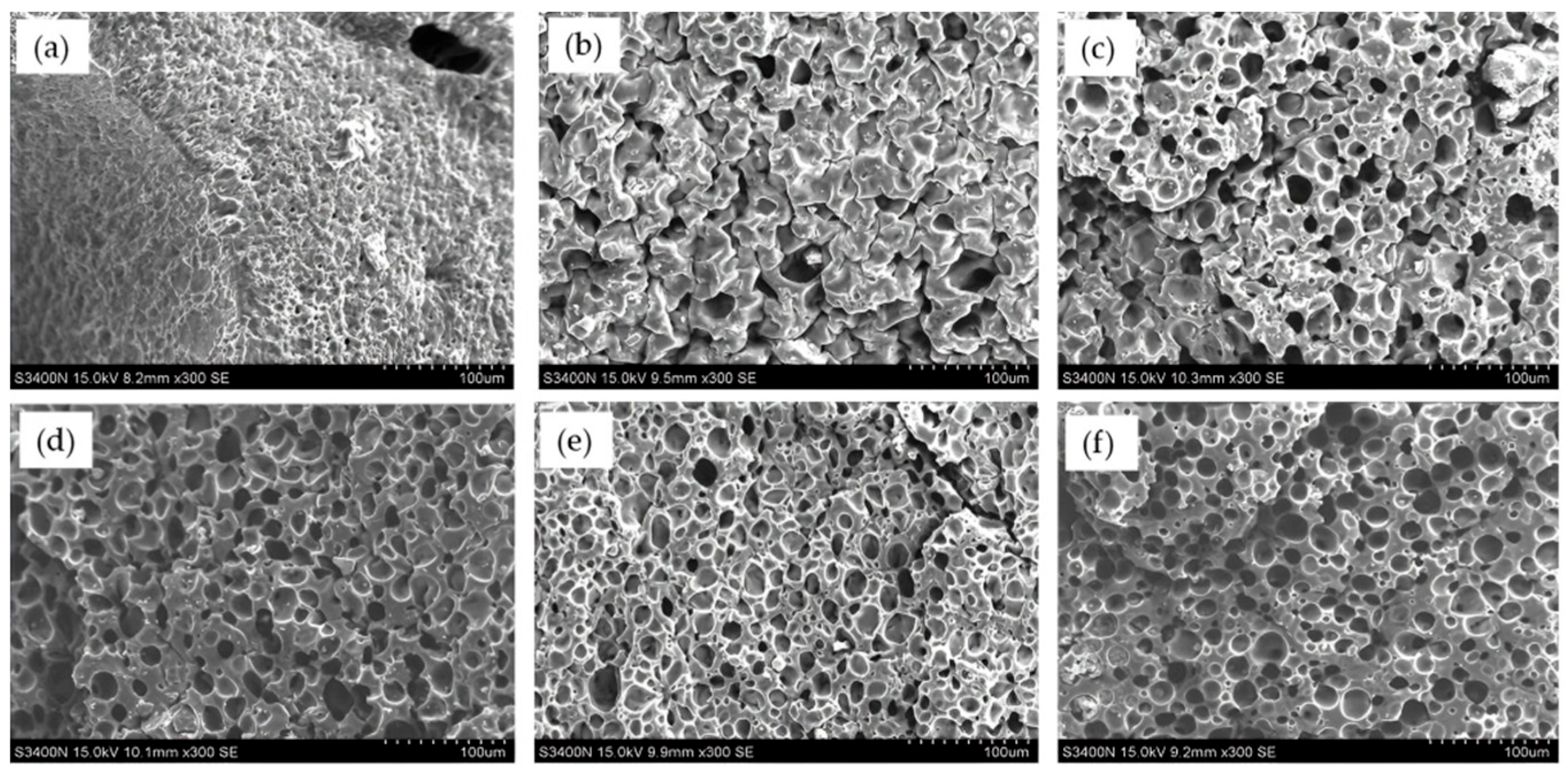
Ambient-temperature epoxy asphalt binders form a three-dimensional network structure through the cross-linking reaction of epoxy resin and curing agent. Figure 8 presents SEM images (300× magnification) of epoxy asphalt at curing times of 12 h, 24 h, 36 h, 48 h, 72 h, and 96 h. As curing progresses, pores of varying sizes become visible in the etched samples, visually presenting the structural feature where the epoxy resin network encapsulates the asphalt, with asphalt filling the interstices within the network. At the initial curing stage, the epoxy resin network is relatively loose and deformable. As the reaction continues, cross-linking density increases, the three-dimensional structure gradually strengthens, and material ductility decreases. This microstructural evolution aligns with the macroscopic trends of increasing tensile strength and decreasing elongation at break for epoxy asphalt with prolonged curing time [48]. High-resolution SEM observations reveal that the thickness of the interfacial transition zone between cured epoxy resin and aggregates (e.g., limestone, basalt) is less than 5 μm, exhibiting a dense structure without significant pores or microcracks, indicating excellent interfacial adhesion. Under load, fracture paths predominantly propagate through the resin matrix rather than along the interface, with fracture surfaces exhibiting ductile characteristics, showing numerous tear ridges and microfibrils. This indicates that the epoxy curing product possesses high strength and toughness, effectively inhibiting crack propagation. Furthermore, the stable three-dimensional network structure enhances the thermal stability of the material, aiding in maintaining shape and performance at high temperatures and reducing thermally induced deformation and damage.
The mechanism of action of waterborne epoxy resin emulsified asphalt can be explained from two perspectives: microstructural evolution and cured product characteristics. As water gradually evaporates, the epoxy resin and curing agent undergo a cross-linking reaction while simultaneously interacting with asphalt components, ultimately forming a three-dimensional interpenetrating epoxy polymer network structure [49].
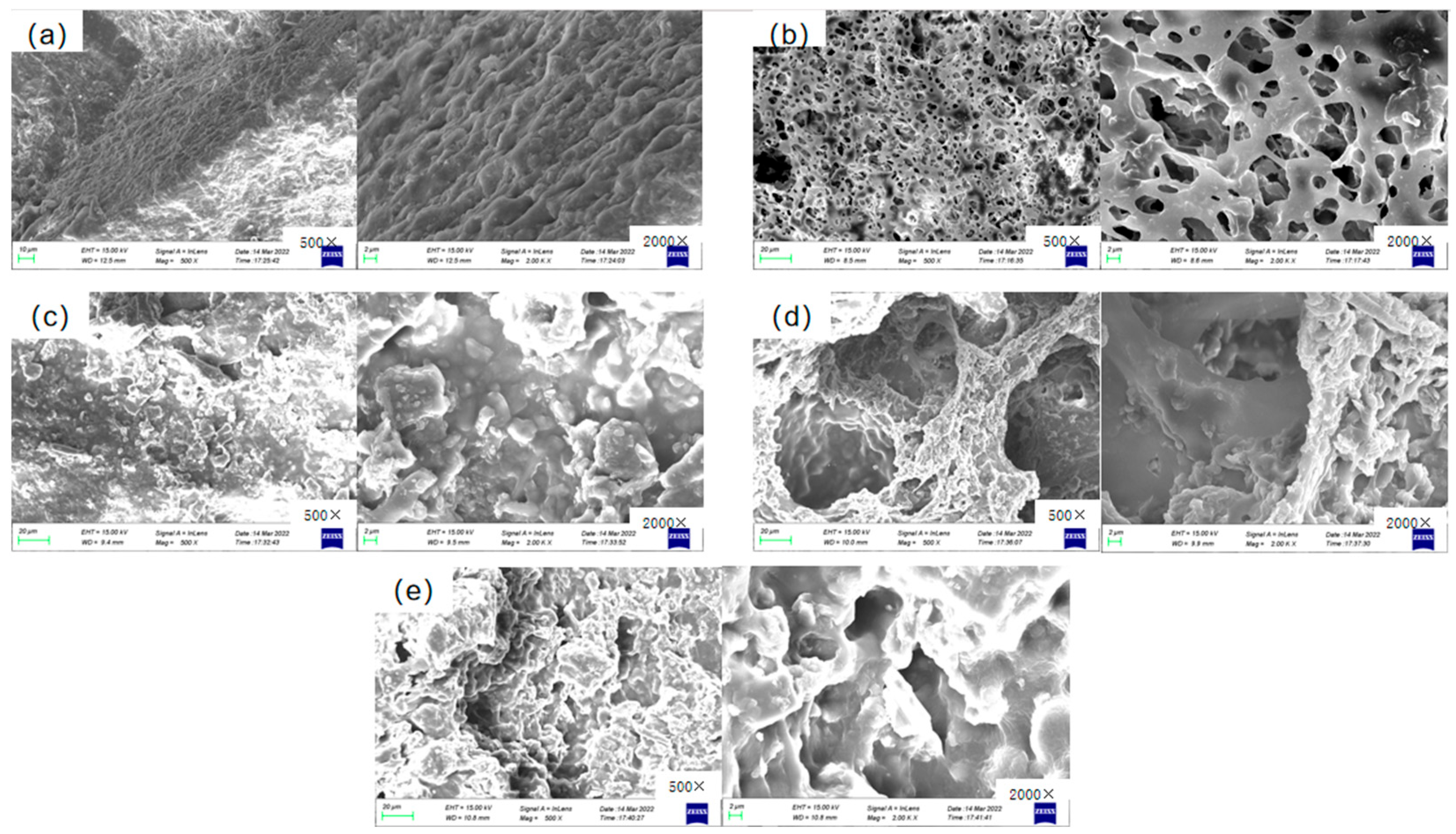
The mechanism of action of waterborne epoxy resin emulsified asphalt can be explained from two perspectives: microstructural evolution and cured product characteristics. As water gradually evaporates, the epoxy resin and curing agent undergo a cross-linking reaction while simultaneously interacting with asphalt components, ultimately forming a three-dimensional interpenetrating epoxy polymer network structure [49]. Figure 9a shows that after washing away the asphalt with trichloroethylene, the surface of the micro-surfacing slurry without WER exhibits a clear original texture morphology. As shown in Figure 9b, at a WER content of 5%, after removing the asphalt foam, the residual WER film forms a honeycomb-like structure on the aggregate surface. This indicates that at this WER content, the cured WER products are abundantly enriched on the aggregate surface, thereby effectively improving the interfacial properties between the aggregate and asphalt. Consequently, even without a significant increase in the tensile strength of the binder, the adhesion between asphalt and aggregate in the micro-surfacing material is effectively enhanced. Figure 9c reveals that when the WER content increases to 10%, the aggregate surface can be completely encapsulated by WER. Figure 9d,e further demonstrate that as the coverage of WER on the aggregate surface increases, its micromorphology does not change noticeably. Fluorescence microscopy observations confirm that WER exists as a film-like structure. Meanwhile, due to the thermodynamically unstable state of the asphalt foam system, the polarity of the aggregate surface affects the charge balance after mixing WER with the emulsified asphalt, leading to the preferential deposition of cured WER products onto the aggregate surface. Once the aggregate surface is covered by WER, the WER within the asphalt can form a three-dimensional spatial network structure. When the dosage of WER curing agent used to enhance the asphalt-aggregate interfacial bonding is low, the curing agent mainly concentrates on the aggregate surface, increasing the surface roughness. This fills the micro-voids between the aggregate and asphalt, strengthens the adhesion between the aggregate and the binder, and improves the transitional interface. When the WER content exceeds 10%, the free epoxy curing agents located outside the aggregate-asphalt interface react with each other to form a continuous spatial network structure, which effectively enhances the overall strength of the modified emulsified asphalt binder in the micro-surfacing mixture [50].
Polyurethane-based ambient-temperature asphalt binders rely on the cross-linking reaction of isocyanates and polyols to form an elastomeric network. SEM images reveal a multilayer composite structure characterized as a “flexible polyurethane film–asphalt–aggregate” configuration. Polyurethane exists as a continuous or semi-continuous phase within the asphalt matrix, forming an elastic film approximately 1–3 μm thick that uniformly coats the aggregates. Nanoscale protrusions (height ~50–100 nm) distributed on the film surface enhance mechanical interlocking with the aggregates. Under low-temperature loading, the ductility of the polyurethane phase enables effective stress absorption. SEM observations show fracture surfaces exhibiting “ductile tearing” features, accompanied by extensive microcrack bifurcation and blunting. In contrast, fracture surfaces of ordinary ambient-temperature asphalt mixtures are predominantly characterized by brittle fracture [51]. Furthermore, the prepolymer type (e.g., TDI, MDI) significantly influences the microstructure. TDI-based polyurethane films exhibit a denser structure, resulting in higher interfacial bond strength (pull-off strength 8–10 MPa) compared to MDI-based types (6–8 MPa). MDI-based types, however, due to their higher soft segment content, maintain better film continuity at −20 °C, presenting a lower risk of low-temperature cracking. Notably, the compatibility between polyurethane and asphalt is significantly affected by the shear mixing process. Mixtures prepared with high-speed shear exhibit more uniform dispersion of the polyurethane phase (average particle size < 2 μm), whereas low-speed shear tends to form aggregates of 5–10 μm, leading to increased interfacial defects [52,53].

4.2. Fourier-Transform Infrared Spectroscopy (FTIR)

Infrared spectroscopy is a crucial technique for characterizing the structure of organic compounds and plays a key role in identifying components and analyzing their evolution in complex multi-component systems like asphalt. When a sample is excited by infrared light of specific wavelengths, molecules undergo selective vibrational energy level transitions, and a Fourier-transform infrared spectrometer (FTIR) can detect the characteristic absorption bands [54]. Qualitative identification of components is achieved by analyzing characteristic peak positions (e.g., aromatic ring skeleton vibration, methylene stretching vibration). For quantitative analysis, according to the Lambert-Beer law, the integrated area or height of characteristic peaks is linearly related to the concentration of the corresponding component. In asphalt systems, stable and sensitive characteristic bands such as the carbonyl C = O stretching vibration are often selected as quantitative indicators. Accurate quantification can be achieved by establishing standard curves. Combined with chemometric methods, this technique effectively reveals the evolution patterns of functional groups during asphalt aging, providing a molecular-level scientific basis for material performance evaluation [55,56,57,58].
Fourier-transform infrared spectroscopy (FTIR) was employed to dynamically monitor the cross-linking process of the epoxy asphalt system under the action of an ambient-temperature amine curing agent [59]. This technique, based on identifying vibrational absorption peaks of molecular functional groups, effectively tracks changes in the material’s chemical structure. The curing of ambient-temperature epoxy asphalt is fundamentally a cross-linking reaction between epoxy groups and the curing agent. Changes in the intensity of infrared peaks corresponding to characteristic functional groups (e.g., epoxy groups, amine groups) directly reflect the curing degree. As curing proceeds, the intensity of the epoxy group peak gradually decreases until it disappears, indicating ring-opening consumption. The characteristic double peak of primary amine gradually transforms into a broad peak of secondary amine, reflecting the reaction progress of the curing agent. Simultaneously, the intensity of the secondary hydroxyl peak generated by epoxy ring-opening increases with the curing degree, and the intensity of the newly formed ether bond (C-O-C) peak significantly increases, confirming the establishment of a three-dimensional cross-linked network [60,61]. The spectral evolution reveals the chemical mechanism of the curing reaction: epoxy groups undergo ring-opening reactions with active hydrogens from the curing agent, while esterification and etherification reactions proceed synergistically within the system, ultimately forming a three-dimensional cross-linked structure dominated by ester and ether bonds. This network intertwines with asphalt molecular chains, fundamentally altering the thermoplastic rheological behavior of the asphalt. It endows the material with excellent high-temperature deformation resistance and stability and significantly enhances its adhesion properties, tensile strength, elongation at break, and low-temperature crack resistance [62,63].
FTIR analysis indicates that the infrared characteristic peaks of waterborne epoxy emulsified asphalt are essentially superpositions of the spectra of the raw waterborne epoxy resin and emulsified asphalt components. No new characteristic absorption peaks corresponding to new chemical bonds are observed, demonstrating that no chemical cross-linking occurs between them and that their combination is a physical blend [64]. In this mode, the waterborne epoxy resin, with its inherent high strength and toughness, enhances the deformation resistance of the emulsified asphalt, thereby improving compressive and tensile properties and reducing cracking risk. Further research revealed a relatively high content of unreacted curing agent in this system, indicating a weak degree of chemical reaction and difficulty in forming an effective three-dimensional cross-linked network, which limits strength development. Even when using curing agents of different ionic types (cationic/non-ionic), no significant differences in characteristic peak intensities were observed (e.g., no shift in absorption peaks in the aromatic ring skeleton vibration region), suggesting that the ionic nature of the curing agent has minimal impact on the curing process of this system [65]. The key influencing factor is the type of emulsified asphalt. Due to the presence of significant ammonium salt components in the waterborne curing agent and emulsifier, prominent N-H and C-H stretching vibration absorption peaks appear around 2922 cm−1. The aromatic ring skeleton vibration regions (1600–1585 cm−1 and 1500–1400 cm−1) show no peak shifts or new peaks before and after the reaction, confirming that no new chemical bonds involving aromatic rings were formed. Therefore, the improvements in curing stability, chemical structure stability, and comprehensive mechanical properties of waterborne epoxy emulsified asphalt binders primarily result from the physical synergistic effect between the emulsified asphalt and epoxy resin, rather than chemical cross-linking [66,67].
FTIR analysis demonstrates that the modification process of asphalt by polyurethane (PU) is predominantly governed by chemical reactions. Differences in the reactivity of functional groups directly influence the reaction extent, manifested as significant increases in the intensity of characteristic absorption peaks [29]. PU reacts with active components in asphalt, forming PU-asphalt graft copolymers. This not only enhances the compatibility between the two phases but also causes changes in the relative content of related groups such as CH3 [68]. In aging tests, high temperatures promote an increase in absorption peaks in the carbonyl region, confirming the formation of more carbonyl-containing polymer structures. Simultaneously, the synchronous enhancement of hydroxyl and carboxyl characteristic peaks indicates that high-temperature oxidation produced oxygen-containing polar compounds, leading to phenomena such as asphalt agglomeration, coalescence, and surface skinning [69]. Infrared spectra of different modified asphalts reveal newly formed -NHCOO- characteristic absorption peaks, confirming that the PU prepolymer undergoes chemical bonding with active functional groups, e.g., -OH and -COOH, in the asphalt, forming urethane linkages. This chemical modification mechanism allows PU to gradually dissolve in the asphalt, fundamentally differing from the physical blending mode of SBS, thereby endowing the system with superior storage stability. During modification, excess reactants consume alkyl components in the asphalt, accompanied by condensation and dehydrogenation reactions, leading to an increase in asphaltene content. The introduction of PU effectively reduces asphalt viscosity, improving its fluidity and plasticity. The chemical bond network formed enhances internal cohesion, suppressing flow deformation at high temperatures, thus significantly improving rutting resistance. In summary, PU achieves asphalt structural reorganization through -NHCOO- chemical bonds, comprehensively improving the material’s rheological properties and durability [70,71,72].

4.3. Differential Scanning Calorimetry (DSC)

Differential scanning calorimetry (DSC) is a widely used thermal analysis technique that measures the heat flow difference between a sample and a reference as a function of temperature under a controlled program, characterizing the thermodynamic behavior of materials. This technique provides information such as the glass transition temperature (Tg), phase transition temperatures, and enthalpy changes associated with endothermic or exothermic processes. A larger total heat absorption in the DSC curve generally reflects poorer internal compatibility within the material, a greater number of components undergoing phase transitions, and macroscopically manifests as lower thermal stability [73].
DSC is a key technique for studying the curing kinetics and micro-phase separation behavior of epoxy asphalt mixtures, accurately characterizing their curing process and microstructural evolution [74]. Epoxy asphalt, as a composite of thermosetting resin and thermoplastic asphalt, has properties dependent on the cross-linking degree of the epoxy resin and the dispersion state of the asphalt phase within the cured network. Through non-isothermal DSC scanning, characteristic curing parameters of the epoxy asphalt system can be obtained: the curing onset temperature is approximately 80–100 °C, the exothermic peak temperature ranges from 110 to 130 °C, and the reaction enthalpy change is about 200–300 J/g. These parameters are important for evaluating its curing kinetics [75]. Combined with microstructural observations, DSC analysis further reveals the phase separation mechanism. Initially, the system is homogeneous. As the cross-linking reaction proceeds, the asphalt phase gradually separates, forming dispersed phase particles approximately 1–5 μm in size uniformly distributed within the epoxy resin matrix. This phase separation behavior significantly influences the glass transition temperature (Tg) of the system. When the asphalt volume fraction falls within the range of 0.400–0.455, a “phase inversion” phenomenon can occur, where the continuous phase transitions from the resin phase to the asphalt phase, leading to increased material brittleness and decreased fracture toughness. The Tg and related thermodynamic parameters determined by DSC provide explanations for the microscopic performance at the molecular motion level. Research indicates that systems with low cross-linking density are predominantly in glassy and transitional states, exhibiting good low-temperature flexibility. Conversely, systems with high cross-linking density form dense three-dimensional networks with superior high-temperature stability, but their low-temperature crack resistance may be somewhat reduced [76]. By precisely controlling the curing degree within the range of 70–85% using DSC, epoxy asphalt mixtures can simultaneously exhibit good high-temperature stability and low-temperature performance, with low-temperature bending strain reaching up to 6.5 × 10⁻³, meeting the application requirements of complex engineering environments.
Differential scanning calorimetry (DSC) analysis of waterborne epoxy emulsified asphalt mixtures can reveal key information such as epoxy curing kinetics, the role of water, glass transition temperature, and asphalt phase behavior, which is significant for understanding material mechanisms and optimizing performance. However, this method has notable limitations in practical application. The endothermic peak from residual water evaporation in the system can easily overlap with the epoxy curing exothermic peak and asphalt phase transition peaks. The complex phase transition behavior of asphalt and the multi-phase nature of the material also make it difficult to accurately resolve the contributions of individual components and interfacial interaction mechanisms from the DSC signals. Optimizing the heating program, employing experimental designs such as secondary scanning, and combining multiple analytical techniques can enhance the accuracy and effectiveness of DSC analysis. Studies show that waterborne epoxy resin (WER)-modified emulsified asphalt exhibits thermal behavior characteristics different from traditional systems. DSC analysis indicates that WER uses water as a plasticizing medium, and its content significantly affects the Tg of the binder: Tg decreases with increasing WER content. When the content is below 20%, the decrease in Tg is relatively gradual; when the content exceeds 20%, the decrease in Tg becomes more pronounced, indicating a corresponding decline in low-temperature performance. Furthermore, DSC analysis of asphalt evaporation residues shows that the heat absorption decreases significantly after WER incorporation, and the temperature range of the endothermic peak narrows. This indicates that the phase transition behavior of the modified asphalt during heating is less sensitive to temperature, and its thermal stability is effectively improved [77,78,79].
DSC characterization of thermoplastic polyurethane elastomer (TPU) structure clearly reflects its soft and hard segment micro-phase separation structure and allows accurate determination of Tg. Research indicates that the order, symmetry, and crystallinity of TPU molecular chains are positively correlated with their crystallization rate [80,81]. The Tg of polyester-based TPU increases slightly with increasing hard segment content (Ch), mainly attributed to the glass transition process and the plasticizing effect of the hard segment phase. The DSC curve of polyether-based TPU shows a distinct peak shift in the hard segment dissociation region, with the dissociation peak shifting towards higher temperatures. As Ch increases, the structure of polyester-based TPU becomes more regular and prone to crystallization, but the change in crystallinity has a minor effect on Tg. Under the same test conditions, the relative crystallinity and Tg of the hard segments of polyester-based TPU are significantly higher than those of polyether-based TPU, indicating that polyester-based TPU possesses better thermal stability, while polyether-based TPU exhibits superior low-temperature performance [82].

4.4. Comparative Synthesis of Microscopic Evidence

The reviewed SEM, FTIR and DSC data reveal consistent microstructural features across the three binder systems. For epoxy-based binders, FTIR confirms cross-linking through epoxy ring-opening and ether bond formation, while SEM shows a dense three-dimensional network encapsulating the asphalt phase with an interfacial transition zone less than 5 μm thick. For waterborne epoxy emulsified binders, FTIR demonstrates no chemical bonds between epoxy and asphalt (only physical superposition of spectra), and SEM reveals a homogeneous network after water evaporation but without chemical interaction. For polyurethane-based binders, FTIR detects new –NHCOO– peaks confirming urethane linkages, and SEM shows a flexible film (1–3 μm) with nanoscale protrusions that enhance mechanical interlocking. DSC further provides curing parameters (80–100 °C onset) for epoxy and reveals that water acts as a plasticiser in waterborne systems. Overall, the microscopic evidence strongly supports the macroscopic performance: the covalent network of epoxy and PU explains their high stiffness and water stability, while the absence of chemical cross-linking in waterborne systems accounts for their moderate strength and humidity sensitivity. Contradictions remain regarding the dominant curing pathway of epoxy (esterification vs. etherification) and the influence of prepolymer type in PU on low-temperature flexibility, indicating directions for future research.

5. Conclusions and Future Perspectives

5.1. Conclusions

This review has systematically examined the current state of knowledge on ambient-temperature reactive high-performance asphalt binders, focusing on epoxy resin, waterborne epoxy emulsified asphalt, and polyurethane systems. Based on the reviewed literature, we distinguish among well-established findings, preliminary observations, and unresolved issues.
  • Well-established findings (supported by multiple independent studies with consistent results):
    (1)
    Epoxy-based ambient-temperature binders form a three-dimensional cross-linked network through curing reactions, which endows them with high stiffness, excellent high-temperature stability (dynamic stability often >10,000 cycles/mm), and strong adhesion. These binders are reliably applicable to steel deck pavements and heavy-load roads.
    (2)
    Waterborne epoxy emulsified asphalt binders undergo no chemical cross-linking between the epoxy and the asphalt; performance improvements arise from physical synergy and the intrinsic strength of the cured epoxy phase. This has been consistently shown by FTIR (no new peaks) and SEM (physical coating).
    (3)
    Polyurethane (PU) prepolymers react with active groups in aged asphalt (>OH, >COOH) to form urethane linkages, creating a three-dimensional elastomeric network that enhances fatigue resistance and low-temperature flexibility.
  • Preliminary findings (supported by limited studies or with some contradictions):
    (1)
    The fatigue life of ambient-temperature reactive binders generally decreases with increasing stress ratio and temperature, and increases with loading frequency. However, quantitative models that incorporate all three factors (stress ratio, frequency, temperature) are still lacking for 100% RAP mixtures.
    (2)
    The addition of rejuvenators can partially restore the ductility of aged asphalt in 100% RAP, but the long-term stability of rejuvenated binders under field conditions has only been examined in a few short-term studies.
  • Unresolved issues and knowledge gaps (requiring further research):
    (1)
    The long-term durability (≥5 years) of ambient-temperature reactive binders, especially under coupled thermal-mechanical-moisture loading, has not been systematically evaluated.
    (2)
    Standardized mix design methods and performance criteria (e.g., required curing time before trafficking, allowable air void content, moisture sensitivity thresholds) are absent. Most existing studies use arbitrary curing protocols, making direct comparison difficult.
    (3)
    Environmental lifecycle assessment (LCA) data are scarce; the lower production temperature does not automatically guarantee lower overall emissions when the upstream production of epoxy resins and PU prepolymers is considered.
Therefore, while the three material systems offer clear advantages for specific applications (epoxy for high strength, waterborne epoxy for convenience, PU for rapid curing and flexibility), substantial research is still needed before they can be confidently specified for routine highway construction.

5.2. Future Perspectives

To realize the large-scale industrial application of ambient-temperature reactive high-performance asphalt binders and to spearhead a green revolution in road materials, future research must transcend current performance limitations and advance towards smarter, adaptive, and more energy-efficient systems. Within this context, “water-activated” ambient-temperature patching technology, distinguished by its unique curing mechanism and substantial application potential, emerges as a particularly promising developmental trajectory.
Future research priorities should focus on the following directions:
  • Innovation and mechanistic understanding of water-triggered curing systems: This entails developing highly moisture-sensitive prepolymers (e.g., modified polyurethanes, specialty epoxies) capable of rapid and controlled cross-linking upon exposure to ambient humidity, achieving “lay-and-strong” functionality. Systematic investigation is required to elucidate the dual role of water—both as a reactant and a plasticizer—in the curing process, clarifying its impact on reaction kinetics and the characteristics of the resultant polymer network to inform rational molecular design.
  • Adaptive curing and internal humidity regulation technologies: Research should focus on developing intelligent materials with moisture-controlled-release or absorption functionalities (e.g., mineral-based water carriers, humidity-responsive microcapsules). The objective is to engineer an internally regulated humidity environment within the material matrix, mitigating the influence of fluctuating external conditions and ensuring uniform and stable strength development across diverse climatic zones.
  • Functionally integrated water-activated smart materials. Future efforts should aim to synergistically integrate water-activated curing with other advanced functionalities, such as self-healing, anti-aging, and de-icing capabilities. This involves developing pavement materials with “sense–respond–repair” capabilities, for instance, through moisture-triggered microcapsule-based healing systems or the simultaneous activation of anti-ultraviolet components upon moisture exposure, thereby significantly extending pavement service life.
  • Standardization system development and life-cycle assessment. A concerted effort is urgently needed to establish comprehensive technical standards for ambient-temperature reactive asphalt binders, including water-activated variants, encompassing specifications for design, construction, acceptance, and maintenance. Concurrently, integrated environmental and economic life-cycle assessments, spanning from material production to end-of-life recycling, must be conducted to provide a robust scientific basis for informed and sustainable application decisions.
Collectively, ambient-temperature reactive high-performance asphalt binders, particularly those evolving towards water-activated, adaptive, and functionalized systems, represent a pivotal direction for future environmentally sustainable pavement technologies. Through interdisciplinary molecular design, process innovation, and the establishment of robust standardization frameworks, this class of materials holds the potential to fundamentally transform traditional paradigms of pavement construction and maintenance, providing core technological support for building safer, more durable, and lower-carbon transportation infrastructure.

Funding

This research received no external funding.

Data Availability Statement

The raw data supporting the conclusions of this article will be made available by the authors on request.

Acknowledgments

This Research was performed at Shandong Transportation Institute.

Conflicts of Interest

Authors Dingfeng Zhang, Yongfeng Zhao, Zhiwen Wang were employed by Shandong High-Speed Infrastructure Construction Co., Ltd. and Shandong High-Speed Dongliang Shenxin Expressway Co., Ltd. The authors declare that the research was conducted in the absence of any commercial or financial relationships that could be construed as a potential conflict of interest.

References

  1. GB/T 37383-2019; Terminology for Asphalt Mixture. Standardization Administration of China. Standards Press of China: Beijing, China, 2019.
  2. Xing, X. Preparation and Performance Study of Cold Patch Asphalt Mixture. Master’s Thesis, Southeast University, Nanjing, China, 2016. [Google Scholar]
  3. Guo, M.; Tan, Y.; Zhou, S. Multiscale test research on interfacial adhesion property of cold mix asphalt. Constr. Build. Mater. 2014, 68, 769–776. [Google Scholar] [CrossRef]
  4. Doyle, T.A.; McNally, C.; Gibney, A.; Tabaković, A. Developing a maturity method for the assessment of cold-mix bituminous materials. Constr. Build. Mater. 2013, 38, 524–529. [Google Scholar] [CrossRef]
  5. Diaz, L.G. Creep performance evaluation of Cold Mix Asphalt patching mixes. Int. J. Pavement Res. Technol. 2016, 9, 149–158. [Google Scholar] [CrossRef]
  6. Zhang, T. Research on Cold-Mix and Cold-Lay Asphalt Mixture. Ph.D. Dissertation, Chongqing University, Chongqing, China, 2007. [Google Scholar]
  7. El-Hawary, M.M.; Abdel-Fattah, H. Temperature effect on the mechanical behavior of resin concrete. Constr. Build. Mater. 2000, 14, 317–323. [Google Scholar] [CrossRef]
  8. Yang, Y.; Zhu, G.; Yang, Y. A review of material composition and performance evaluation of cold patch asphalt mixture. J. China Foreign Highw. 2023, 43, 221–229. [Google Scholar]
  9. Testa, S.M. Chemical aspects of cold-mix asphalt incorporating contaminated soil. J. Soil Contam. 1995, 4, 191–207. [Google Scholar] [CrossRef]
  10. Budziński, B.; Mieczkowski, P.; Słowik, M.; Mielczarek, M.; Bilski, M.; Fornalczyk, S. Assessment of the low-temperature performance of asphalt mixtures for bridge pavement. Road Mater. Pavement Des. 2023, 24, 409–423. [Google Scholar] [CrossRef]
  11. Lü, W. Key technologies and application prospects of emulsified asphalt cold recycling. Pet. Asph. 2009, 23, 29–34. [Google Scholar]
  12. Xu, S.; Huang, Y.; Cai, S.; Li, S.; Li, J. Technological progress of cold-mix and cold-lay asphalt mixture. Road Mach. Constr. Mech. 2018, 35, 34–36. [Google Scholar]
  13. Mao, W. Study on Pavement Performance of Cold Patch Material for Asphalt Pavement in Permafrost Regions. Master’s Thesis, Chang’an University, Xi’an, China, 2005. [Google Scholar]
  14. Zhao, D.B.; Li, P.H.; Luan, S.F. Quality control of epoxy asphalt concrete pavement construction on steel deck of rail-cum-road bridge. China Railw. 2020, 123–127. [Google Scholar]
  15. Si, J.; Jia, Z.; Wang, J.; Yu, X.; Li, Y.; Dong, F.; Jiang, R. Comparative analysis of cold-mixed epoxy and epoxy SBS-modified asphalts: Curing rheology, thermal, and mechanical properties. Constr. Build. Mater. 2018, 176, 165–171. [Google Scholar] [CrossRef]
  16. Liu, X.; Zhou, C.; Feng, D.; Tang, H.; Xu, Y.; Fan, X. Influence of moisture in aggregates on properties of cold-mixed resin asphalt mixture. Constr. Build. Mater. 2016, 120, 232–240. [Google Scholar] [CrossRef]
  17. Zhu, Y. Research on the Performance of Domestic Epoxy Asphalt Mixture. Master’s Thesis, Southeast University, Nanjing, China, 2006. [Google Scholar]
  18. Lü, W. Research and application of epoxy asphalt concrete materials at home and abroad. Pet. Asph. 1994, 11–15. [Google Scholar]
  19. Chen, D.; Wu, H.; Chen, X.; Zhan, Y.; Wada, S.A. Fabrication of high-performance asphalt mixture using waterborne epoxy-acrylate resin modified emulsified asphalt (WEREA). Polymers 2024, 16, 2743. [Google Scholar] [CrossRef] [PubMed]
  20. Sun, W.; Lü, X.; Zhang, L. Effect of construction factors on the performance of cold mix epoxy asphalt mixture. For. Eng. 2022, 38, 115–121. [Google Scholar]
  21. Chen, F.; Ma, R.; Sheng, J.X. Study and Application on Cold Blended Epoxy Asphalt Mixture for Steel Bridge Deck Pavement. Key Eng. Mater. 2017, 744, 190–195. [Google Scholar] [CrossRef]
  22. Bi, Y.; Li, R.; Han, S.; Pei, J.; Zhang, J. Development and performance evaluation of cold-patching materials using waterborne epoxy-emulsified asphalt mixtures. Materials 2020, 13, 1224. [Google Scholar] [CrossRef]
  23. Liu, H. Research on Waterborne Epoxy Resin Emulsified Asphalt Binder and Its Micro-Surfacing Performance. Master’s Thesis, Chang’an University, Xi’an, China, 2022. [Google Scholar]
  24. Hu, P.; Qu, X. Study on pavement performance of cold-mix epoxy asphalt mixture. Constr. Technol. 2018, 47, 1151–1154. [Google Scholar]
  25. Zhang, P. Performance Research and Analysis of Cold Recycled Waterborne Epoxy Emulsified Asphalt Mixture. Master’s Thesis, Chongqing Jiaotong University, Chongqing, China, 2020. [Google Scholar]
  26. Lai, C.X. Preparation and Performance of Wood Tar Modified Waterborne Epoxy Emulsified Asphalt Mixture. Master’s Thesis, Fujian Agriculture and Forestry University, Fuzhou, China, 2022. [Google Scholar]
  27. Kong, X.Y.; Wang, C.; Liu, X.; Yao, H.; Wang, D.; Zhang, Q. Study on mix design method of waterborne epoxy emulsified asphalt mixture. Thermosetting Resin. 2024, 39, 30–35. [Google Scholar]
  28. Tan, Y.; Sun, Z.; Gong, X.; Xu, H.; Zhang, L.; Bi, Y. Design parameter of low-temperature performance for asphalt mixtures in cold regions. Constr. Build. Mater. 2017, 155, 1179–1187. [Google Scholar] [CrossRef]
  29. Jin, X.; Li, D.; Fu, H.; Yang, Y.; Wang, F.; Yang, Y.; Zhang, J.; Guo, N. Research status and development trend of thermoplastic polyurethane (TPU) modified asphalt. Mater. Rep. 2024, 38, 621–632. [Google Scholar]
  30. Jing, S. Research on Properties of Polyurethane Modified Asphalt and Its Mixture. Master’s Thesis, Shandong Jianzhu University, Jinan, China, 2024. [Google Scholar]
  31. Li, C. Preparation of polyurethane modified asphalt and performance evaluation of its mixture. J. Wuhan Univ. Technol. 2017, 41, 958–963. [Google Scholar]
  32. Shu, R. Study on Performance of Polyurethane Modified Asphalt and Its Mixture. Master’s Thesis, Beijing University of Civil Engineering and Architecture, Beijing, China, 2016. [Google Scholar]
  33. Wang, G. Experimental study on properties of polyurethane modified asphalt and its mixture. J. Wuhan Univ. Technol. 2022, 44, 26–30. [Google Scholar]
  34. Huang, J. Research on performance evaluation indicators of cold-mix and cold-lay asphalt mixture. Sichuan Archit. 2015, 35, 266–267. [Google Scholar]
  35. Ma, R.; Li, Y.; Cheng, P.; Chen, X.; Cheng, A. Low-temperature cracking and improvement methods for asphalt pavement in cold regions: A review. Buildings 2024, 14, 3802. [Google Scholar] [CrossRef]
  36. Yang, W.; Jin, J.; Chan, Q.; Zheng, M.; Liu, G.; Yan, C. Quantitative evaluation method for low-temperature construction workability of solvent-based cold patch asphalt mixture. Sci. Technol. Eng. 2022, 22, 1226–1232. [Google Scholar]
  37. Zhao, X.; Shen, A.; Ma, B. Temperature response of asphalt pavement to low temperatures and large temperature differences. Int. J. Pavement Eng. 2020, 21, 49–62. [Google Scholar] [CrossRef]
  38. Fan, Z.; Xu, O.; Han, S.; Hu, C.; Wan, S.; Chen, C. Research progress on properties of polyurethane modified asphalt and its mixture. Thermosetting Resin 2025, 40, 64–68. [Google Scholar]
  39. Wang, H.P.; Guo, Y.X.; Wu, M.Y.; Xiang, K.; Sun, S.R. Review on structural damage rehabilitation and performance assessment of asphalt pavements. Rev. Adv. Mater. Sci. 2021, 60, 438–449. [Google Scholar] [CrossRef]
  40. Yi, J.; Cheng, P.; Wang, Z.; Abdukadir, A.; Pei, Z.; Yu, W.; Feng, D. Laboratory and field performance evaluation of cold-mix asphalt mixture with solvent-based liquid asphalt in winter pavement maintenance. J. Mater. Civ. Eng. 2025, 37, 04024531. [Google Scholar] [CrossRef]
  41. Liang, J. Study on Pavement Performance of Waterborne Epoxy Emulsified Asphalt Mixture Thin Overlay. Master’s Thesis, Guangzhou University, Guangzhou, China, 2019. [Google Scholar]
  42. Zhuang, W.; Yan, Z.; Sun, M. Study on performance of cold-mix and cold-lay polyurethane mixture. Shandong Chem. Ind. 2024, 53, 9–12. [Google Scholar]
  43. Xiang, H.; Zhu, H.; Zhong, W. A review of evaluation methods for water stability of asphalt mixtures. J. China Foreign Highw. 2016, 36, 278–283. [Google Scholar]
  44. JTG E20-2011; Standard Test Methods of Bitumen and Bituminous Mixtures for Highway Engineering. Ministry of Transport of the People’s Republic of China; China Communications Press: Beijing, China, 2011.
  45. Huang, X.; Xu, Z.; Dong, B. Current situation and development of premixed cold-lay asphalt mixture. Road. Mach. Constr. Mech. 2013, 30, 61–64. (In Chinese) [Google Scholar]
  46. Wang, J.; Li, Y.; Gu, F.; Yang, M.; Chen, D.; Gu, W. Laboratory test on pavement performance of cold-mix epoxy asphalt mixture. J. Mater. Sci. Eng. 2019, 37, 296–299, 338. [Google Scholar]
  47. Fang, M.; Tang, G.; Wang, H.; Gao, G.; Zhu, X. Preparation of polyurethane modified asphalt and study on pavement performance of its mixture. Polyurethane Ind. 2022, 37, 18–21. [Google Scholar]
  48. Xu, W.; Zhuang, G.; Chen, Z.; Wei, J. Experimental study on the micromorphology and strength formation mechanism of epoxy asphalt during the curing reaction. Appl. Sci. 2020, 10, 2610. [Google Scholar] [CrossRef]
  49. Kong, L.; Li, J.; Luo, Q.; Shen, Z.; He, Z. Preparation and performance study of waterborne epoxy resin emulsified asphalt. Appl. Chem. Ind. 2021, 50, 2076–2081. [Google Scholar]
  50. Shaolong, H.; Fan, J.; Dongdong, C.; Qiang, X.; Qingjun, D. Study on Modification Mechanism and Performance of Waterborne Epoxy Resin Micro-Surfacing. Coatings 2023, 13, 504. [Google Scholar] [CrossRef]
  51. Behnood, A.; Gharehveran, M.M. Morphology, rheology, and physical properties of polymer-modified asphalt binders. Eur. Polym. J. 2018, 112, 766–791. [Google Scholar] [CrossRef]
  52. Qiu, C.; Qin, R.; Qiu, D.; Wang, M. Study on pavement performance of polyurethane compounded SBS modified asphalt. J. Traffic Sci. Eng. 2023, 39, 74–83. [Google Scholar]
  53. Liu, H. Preparation and Performance Study of Polyurethane/Organic Montmorillonite Composite Modified Asphalt. Master’s Thesis, Chang’an University, Xi’an, China, 2018. [Google Scholar]
  54. Fan, Z. Fundamental Theoretical Study on Microscopic Characteristics of Asphalt Based on Asphalt Aging. Ph.D. Dissertation, South China University of Technology, Guangzhou, China, 2016. [Google Scholar]
  55. Xiao, P.; Kang, A.H.; Li, X.F. Blending mechanism of SBS modified asphalt based on infrared spectroscopy. J. Jiangsu Uni. Nat. Sci. 2005, 26, 529–532. [Google Scholar]
  56. Chen, Y.; Tu, J.; Zhang, B.; Ding, H. Discussion on influencing factors of SBS modified asphalt analysis by infrared spectroscopy. Pet. Asph. 2014, 28, 67–72. [Google Scholar]
  57. Luo, S.; Li, X.; Tian, J.; Yin, J. Rapid determination technology of SBS content in modified asphalt based on infrared spectroscopy analysis. J. Chang. Univ. 2019, 39, 10–18. [Google Scholar]
  58. Liu, W.; Zhang, J. Application research on SBS content detection technology in modified asphalt. Pet. Asph. 2017, 31, 68–72. [Google Scholar]
  59. Wei, J.; Zhang, Y. Study on the curing process of epoxy asphalt. In Abstracts of ISAP 2012 International Symposium on Heavy Duty Asphalt Pavements and Bridge Deck Pavements; International Society for Asphalt Pavements: Lino Lakes, MN, USA, 2012; pp. 56–57. [Google Scholar]
  60. Yu, J.; Cong, P.; Wu, S.; Cheng, S. Curing behavior of epoxy asphalt. J. Wuhan Univ. Technol.-Mater. Sci. Ed. 2009, 24, 462–465. [Google Scholar] [CrossRef]
  61. Chen, F.; Zhou, Y.; Xi, G.; Liang, X.; Zheng, S. Research on rapid analysis method and reliability of asphalt based on infrared spectroscopy. Technol. Highw. Transp. 2022, 38, 7–12. [Google Scholar]
  62. Fu, S.; Ji, Z.; Yu, H.; Wang, J.; Zhan, H. Study on the influence of preparation process on the compatibility of cold-mix epoxy asphalt. Highw. Eng. 2021, 46, 112–116, 163. [Google Scholar]
  63. Yao, K.; Zhang, Y.; Li, H.; Zang, W. Research progress on properties of cold-mix epoxy asphalt and its mixture. New Chem. Mater. 2024, 52, 51–57. [Google Scholar]
  64. Wang, X.; He, W.; Liu, Z.; Shi, L. Study on properties of waterborne epoxy emulsified asphalt residue. Appl. Chem. Ind. 2025, 54, 143–146. [Google Scholar]
  65. Hui, B.; Li, Y.; Zhang, Y.; Yang, X. Study on compatibility and curing mechanism analysis of waterborne epoxy emulsified asphalt. New Chem. Mater. 2022, 50, 281–285. [Google Scholar]
  66. Shi, J. Study on Properties and Mechanism of Waterborne Epoxy Emulsified Asphalt and Its Mixture. Master’s Thesis, Hunan University, Changsha, China, 2023. [Google Scholar]
  67. Tan, J.; Cheng, J.; Guo, J.; Zhang, J. Effect of several amine curing agents on curing behavior and properties of epoxy resin. CIESC J. 2011, 62, 1723–1729. [Google Scholar]
  68. Wang, L.; Zhang, Z.; Zhu, Y.; Liu, H.; Chen, L.; Ban, X. Properties and micro-mechanism of PAPI polyurethane modified asphalt. Bull. Chin. Ceram. Soc. 2021, 40, 4158–4166. [Google Scholar]
  69. Xia, L. Study on Properties of Polyurethane Modified Asphalt. Master’s Thesis, China University of Petroleum (East China), Qingdao, China, 2016. [Google Scholar]
  70. Sun, J.; Zhang, S.; Liu, Y.; Zhang, Z.; Liu, X.; Zhang, Z.; Ban, X. Construction technology and pavement performance of dry-mix polyurethane modified asphalt mixtures: A case study. Sustainability 2023, 15, 13675. [Google Scholar] [CrossRef]
  71. Zhou, L. Microscopic Characteristics of Polyurethane Modified Asphalt and Its Influence on Porous Mixture Performance. Master’s Thesis, Northeast Forestry University, Harbin, China, 2023. [Google Scholar]
  72. Jin, X.; Guo, N.; Yan, S.; Liu, T.; You, Z. Preparation and performance study of polyurethane composite modified asphalt. China J. Highw. Transp. 2021, 34, 80–94. [Google Scholar]
  73. Shen, Z. Study on Properties and Mechanism of Waterborne Epoxy Composite Modified Emulsified Asphalt. Master’s Thesis, Chongqing Jiaotong University, Chongqing, China, 2023. [Google Scholar]
  74. Yang, F. Research on Waterborne Epoxy Emulsified Asphalt Cold Patch Material and Its Pavement Performance. Master’s Thesis, Chongqing Jiaotong University, Chongqing, China, 2018. [Google Scholar]
  75. Liu, X.; Zheng, M.; Cao, M.; Liu, F.; Liu, C.; Fan, X. Toughness properties of waterborne epoxy resin (WER)-styrene butadiene rubber (SBR) composite modified emulsified asphalt. China Sci. 2023, 18, 630–636. [Google Scholar]
  76. Wang, K.; Liu, F.; Sun, T.; Zheng, M.; Dong, C.; Fan, X. High-temperature performance of waterborne epoxy resin-styrene butadiene rubber composite modified emulsified asphalt. Sci. Technol. Eng. 2022, 22, 359–366. [Google Scholar]
  77. Fernandez, C.E.; Bermudez, M.; Versteegen, R.M.; Meijer, E.W.; Muller, A.J.; Munoz-Guerra, S. Crystallization studies on linear aliphatic n-polyurethanes. J. Polym. Sci. Part B Polym. Phys. 2009, 47, 1368–1380. [Google Scholar] [CrossRef]
  78. Begenir, A.; Michielsen, S.; Pourdeyhimi, B. Crystallization behavior of elastomeric block copolymers: Thermoplastic polyurethane and polyether-block-amide. J. Appl. Polym. Sci. 2009, 111, 1246–1256. [Google Scholar] [CrossRef]
  79. Xu, G.; Shi, W.; Hu, P.; Mo, S. Crystallization kinetics of polypropylene with hyperbranched polyurethane acrylate being used as a toughening agent. Eur. Polym. J. 2005, 41, 1828–1837. [Google Scholar] [CrossRef]
  80. Jin, X. Rheological Properties and Internal Mechanism of TPU Modified Asphalt and Mastic. Ph.D. Dissertation, Dalian Maritime University, Dalian, China, 2021. [Google Scholar]
  81. Dong, L. Research on Cold-Mix and Cold-Lay Waterborne Epoxy Emulsified Asphalt Mixture. Master’s Thesis, Hebei University of Technology, Tianjin, China, 2018. [Google Scholar]
  82. Wu, F. Study on Preparation and Properties of Epoxy Asphalt. Master’s Thesis, Chang’an University, Xi’an, China, 2015. [Google Scholar]
Figure 1. Schematic diagram of the spatial structure model for ambient-temperature curing of cold-mix epoxy asphalt.
Jcs 10 00319 g001
Figure 2. Curing process of the waterborne epoxy resin system.
Jcs 10 00319 g002
Figure 3. Main chemical reactions occurring during polyurethane modification of asphalt: (a) The reaction between isocyanate and phenolic compounds. (b) The reaction between isocyanate and carboxylic acid. (c) The reaction between isocyanate and anhydride.
Jcs 10 00319 g003
Figure 4. Schematic diagram of the spatial structure model for cured polyurethane-modified asphalt.
Jcs 10 00319 g004
Figure 5. Flowchart of the Marshall stability test procedure for ambient-temperature asphalt mixtures.
Jcs 10 00319 g005
Figure 6. Flowchart of the boiling water test procedure for evaluating aggregate-asphalt adhesion.
Jcs 10 00319 g006
Figure 7. Flowchart of the immersion wheel tracking test procedure.
Jcs 10 00319 g007
Figure 8. Scanning electron microscopy images of epoxy resin at different curing times [48] (a) 12 h, (b) 24 h, (c) 36 h, (d) 48 h, (e) 72 h, and (f) 96 h.
Jcs 10 00319 g008
Figure 9. Microstructure of aggregates in asphalt mixtures with different WER contents [50]. Note: Quality fraction of water-based epoxy resin: (a) 0%; (b) 5%; (c) 10%; (d) 15%; (e) 20%.
Jcs 10 00319 g009
Table 1. Gradation types and optimal asphalt content for ambient-temperature epoxy asphalt mixtures.
Gradation TypeMaterial CompositionOptimal Asphalt Content
(%)
Reference
EA-10Epoxy resin, curing agent, asphalt, medium6.10[14]
CMEA-10Bisphenol A epoxy resin, aliphatic amine curing agent, base asphalt7.83[20]
RAO5E-44 epoxy resin, curing agent, toughening agent, viscosity modifier, etc.8.26[21]
Table 2. Percentage passing for three gradations (Unit: %).
Gradation TypePercentage Passing by Sieve Size (mm)
191613.29.54.752.361.180.60.30.150.075
EA-10 10097.575.060.047.034.026.518.510.5
CMEA-10 10010095.065.059.647.83625.419.811.5
RAO5 10097.060.446.134.024.519.913.6
Table 3. Gradation types and optimum asphalt content for waterborne epoxy emulsified asphalt mixtures. (AC stands for Asphalt Concrete, and the number indicates the nominal maximum aggregate size (NMAS).)
Gradation TypeMaterial CompositionOptimal Emulsified Asphalt Content
(%)
Reference
AC-20Waterborne epoxy emulsified asphalt, reclaimed asphalt pavement (RAP), virgin aggregate, cement15.8[25]
AC-10Wood tar, F0704 waterborne epoxy resin, triethylenetetramine curing agent, cationic, slow-setting emulsified asphalt, aggregate, mineral filler, cement 8.5[26]
AC-16Self-emulsifying rigid epoxy resin,
modified triethylenetetramine, cationic slow-setting emulsified asphalt
8.6[27]
AC-13Cationic emulsified asphalt, waterborne epoxy resin, curing agent, aggregate8.5[28]
Table 4. Percentage passing for four gradations (Unit: %).
Gradation TypePercentage Passing by Sieve Size (mm)
191613.29.54.752.361.180.60.30.150.075
AC-2096.384.171.859.637.926.921.915.810.47.75.8
AC-10 10099.459.140.933.828.819.513.38.0
AC-1610093.584.765.250.337.536.116.711.010.47.9
AC-13 10095.679.050.032.524.015.610.08.06.0
Table 5. Gradation types and optimum asphalt content for polyurethane-based asphalt mixtures.
Gradation TypeMaterial CompositionOptimal Emulsified Asphalt Content
(%)
Reference
AC-1370# base asphalt, polyurethane4.9[31]
AC-13Qinhuangdao 70# base asphalt, one-component polyurethane5.4[32]
AC-13Donghai 70# Grade A paving asphalt, SBS-modified asphalt, polyurethane prepolymer5.4[33]
Note: Gradation type is essentially a framework for particle size distribution, rather than a fixed material recipe.
Table 6. Percentage passing for three gradations (Unit: %).
Gradation TypePercentage Passing by Sieve Size (mm)
191613.29.54.752.361.180.60.30.150.075
AC-13 10095.078.560.044.526.521.015.58.06.0
AC-13 10098.080.561.042.028.521.014.59.56.0
AC-13 10093.675.553.532.824.918.311.87.25.1
Table 7. Comparison of characteristics of reactive asphalt binders.
TypeCompositionStrength FormationAdvantagesDisadvantagesPerformance Influencing FactorsApplications
Cold-Mix EpoxyEpoxy resin, diluted asphalt, curing agent, additives, aggregateSolvent volatilization, reaction between epoxy resin and curing agentExcellent mechanical properties, superior adhesion, low temperature sensitivityHigh cost, complex preparation procedure, relatively poor flexibilityEpoxy resin type, curing agent type, modifier and filler typesPothole repair, steel deck paving, low-grade highway pavement construction
Waterborne Epoxy EmulsifiedWaterborne epoxy resin, emulsified asphalt, curing agent, additives, aggregateWater evaporation and demulsification, reaction between waterborne epoxy resin and curing agentExcellent environmental performance, high construction convenience, good adhesion, balanced mechanical propertiesRelatively high cost, curing rate substantially influenced by environmental conditions, poor low-temperature crack resistance, stringent process requirementsWaterborne epoxy resin type, curing agent type, toughening agent and stabilizer types, construction temperature and humidityPothole repair, light-traffic pavements, thin overlays
Polyurethane-BasedPolyurethane prepolymer, diluted asphalt, additives, aggregateSolvent volatilization, reaction between polyurethane and curing agentHigh strength, excellent mechanical properties, rapid curing, strong aging and moisture damage resistance, minimal environmental sensitivityHigh cost, slightly inferior low-temperature toughness, greater difficulty in later-stage repairsRaw material types and proportions, mixing time, compaction timingLarge void pavements, low-temperature and high-humidity regions, pavement rehabilitation
Table 8. Quantitative and semi-quantitative comparison of ambient-temperature reactive asphalt binders.
Property/IndicatorCold-Mix EpoxyWaterborne Epoxy EmulsifiedPolyurethane-Based
Strength development rateFast (curing time 1–3 days to reach >80% of final strength) Moderate (depends on water evaporation + epoxy curing; typically 3–7 daysFast (rapid cross-linking; >70% of final strength within 1–2 days)
Early strength (typical range)Marshall stability >3.5 kN within 24 hInitial stability >2.5 kN (24 h)Not reported in the reviewed studies; early strength qualitatively described as high
Ultimate stability (Marshall)>7.0 kN (after complete curing) >7.0 kN (after complete curing) ~5–6 kN (estimated from similar studies; no exact value given)
Stiffness (indirect tensile modulus)High (estimated >3000 MPa at 20 °C based on interface bond strength 8–10 MPa)Moderate (estimated 1500–2500 MPa)High but flexible (elastic modulus 2000–3000 MPa, data from similar PU-modified asphalts)
Fatigue resistanceGood under low strain; decreases at high strain (brittle failure)Moderate; improves with epoxy contentExcellent (ductile tearing with energy dissipation)
Rutting resistance (dynamic stability)>10,000 cycles/mm (dry)5000–8000 cycles/mm (after curing)3000–6000 cycles/mm (moisture-sensitive)
Water sensitivity (retained Marshall stability)>85% (after full curing)>85% (after full curing)>85% but foams when uncured
Low-temperature behavior (bending strain)2500–6500 με (depends on cross-linking degree)Poor (strain <2000 με at –10 °C)Good for MDI-type (strain >4000 με at –20 °C)
Curing sensitivityLow (cures at ambient, but slower below 10 °C)High (strongly affected by humidity and temperature)High (moisture interferes with –NCO reaction, causing foaming)
Environmental aspectsUses organic solvents; VOC emissionsWater-based, low VOC; lower production temperature (100–130 °C) Solvent-free systems possible; lower CO2 emissions
Cost (relative)High (epoxy + curing agent + solvent)High (waterborne epoxy + additives) Very high (PU prepolymer)
Construction complexityComplex (requires organic solvent, precise mixing)Demanding (strict control of temperature and humidity)Moderate (sensitive to moisture, but simple mixing)
Typical applicationsSteel deck paving, heavy-duty road repairs, pothole repairThin overlays, preventive maintenance, light-traffic roads Porous pavements, cold/wet regions, rapid-opening repairs
Disclaimer/Publisher’s Note: The statements, opinions and data contained in all publications are solely those of the individual author(s) and contributor(s) and not of MDPI and/or the editor(s). MDPI and/or the editor(s) disclaim responsibility for any injury to people or property resulting from any ideas, methods, instructions or products referred to in the content.