Article

Analysis of Vibration Response in Graphene-Reinforced Aluminum-Based Truncated Conical Shells Under 1:2 Internal Resonance Conditions


1
School of Advanced Manufacturing Technology, Guangdong Mechanical and Electrical Polytechnic, Guangzhou 510515, China
2
Department of Mechanics, Inner Mongolia University of Technology, Hohhot 010051, China
3
College of Energy and Power Engineering, Inner Mongolia University of Technology, Hohhot 010051, China
*
Author to whom correspondence should be addressed.
J. Compos. Sci. 2026, 10(6), 313; https://doi.org/10.3390/jcs10060313
Submission received: 7 May 2026 / Revised: 1 June 2026 / Accepted: 6 June 2026 / Published: 10 June 2026
(This article belongs to the Section Composites Modelling and Characterization)

Abstract

Graphene-reinforced aluminum-based materials perfectly combine the excellent properties of graphene and aluminum, achieving superior lightweight structural characteristics. This study focuses on 1:2 internal resonance, analyzing the amplitude–frequency and force–amplitude responses of a graphene-platelet-reinforced aluminum-based truncated conical shell under multiple external excitations. Considering three different graphene distributions, an improved Halpin–Tsai mechanical model is used to predict the effective Young’s modulus of the GPL-enhanced aluminum-based truncated conical shell. Under temperature effects, based on the Reissner–Mindlin theory and von-Karman geometric nonlinear strain–displacement relationships, Hamilton’s principle and the Galerkin method are employed to derive the motion equations of the GPL-enhanced aluminum-based truncated conical shell. Through multiscale perturbation analysis, the averaged equations in polar coordinates are further derived. Based on the combined averaged equations, the amplitude–frequency and force–amplitude response curves of the system are plotted, investigating the influence of graphene distribution, graphene content, external excitation amplitude, tuning parameters, and graphene plate geometrical dimensions on its vibration characteristics. The analysis results indicate that graphene content is one of the primary factors affecting the vibration characteristics of graphene-reinforced aluminum-based truncated cones.

1. Introduction

Truncated conical shells, as thin-walled structures with unique geometric shapes and mechanical properties, have been widely applied in aerospace, civil engineering, mechanical manufacturing, and other fields. By deeply investigating their vibration characteristics, stability, and material performance, their design can be optimized to enhance performance in various engineering applications. Due to the complex loading and vibration issues encountered in practical applications, particularly under resonance conditions, the vibrational responses of these structures often exhibit significant nonlinearity and high sensitivity. Therefore, precise analysis of their vibrational characteristics is crucial to ensure structural stability and reliability. Li et al. [1] employed the generalized differential quadrature method to study the natural frequencies of truncated conical shells made of porous metal foams with elastic constraint boundaries. Mirjavadi et al. [2] derived exact values for the nonlinear vibration frequencies of epoxy/carbon nanotube/glass fiber-reinforced truncated conical shell segments by combining randomly distributed carbon nanotubes and parallel-aligned glass fibers. Within the framework of three-dimensional elasticity theory, Wu and Chiu [3] analyzed the free vibration of rotating sandwich functionally graded truncated conical shells. Considering different rotational speeds, Aris and Ahmadi [4] investigated the superharmonic and subharmonic resonance responses of rotating stiffened functionally graded truncated conical shells under thermal environments. Banijamali and Jafari [5] explored the frequency characteristics of rotating functionally graded truncated conical shells reinforced by anisotropic grids. Shadmani et al. [6] were the first to analyze the nonlinear vibration responses of bidirectional functionally graded truncated conical shells. Through numerical integration, Hao et al. [7] examined the amplitude–frequency responses and bifurcation behaviors of porous metal truncated conical shells under mechanical loading. Sun et al. [8] utilized the differential quadrature method to study the traveling wave vibrations of rotating porous metal truncated conical shells with elastic boundaries. Yang et al. [9] analyzed the nonlinear dynamic responses of variable-thickness porous sandwich truncated conical shells under 1:1 internal resonance conditions. Wang et al. [10] pioneered the use of nonlinear energy sinks to suppress high-dimensional nonlinear flutter in variable-thickness porous sandwich truncated conical shells.
As a new type of two-dimensional material, graphene has attracted widespread attention in various fields due to its exceptional mechanical properties. In addition to its outstanding mechanical performance, graphene also possesses a very high specific surface area and excellent electrical and thermal conductivity, making it an ideal reinforcing material. Incorporating graphene into the design of topped cone shells can significantly enhance their stiffness and vibration resistance while also improving energy efficiency and optimizing overall performance. Therefore, researchers have gradually shifted their focus to studying the vibration characteristics of graphene-reinforced topped cone shells. Yang et al. [11] utilized the harmonic balance method to solve the frequency parameters of functionally graded graphene-platelet-reinforced composite topped cone shells. Amirabadi et al. [12] proposed a semi-analytical solution to analyze the frequency response of rotating bi-directional functionally graded GPL-reinforced topped cone shells. Khayat et al. [13] solved the natural frequencies of GPL-reinforced functionally graded porous topped cone shells and studied the effects of various influencing factors on their frequency variations. Amirabadi et al. [14] investigated the forward and reverse frequencies of rotating functionally graded GPL-reinforced topped cone shells under different boundary conditions. Based on the modified coupled stress theory, Adab et al. [15] conducted a study on the frequency parameters of rotating topped cone shells with a porous core and GPL-reinforced panels. Considering different boundary conditions, Sobhani and Safaei [16] analyzed the frequency response of functionally graded graphene oxide powder-reinforced coupled topped cone-cylinder shells. With a focus on different modes, Adab and Arefi [17] investigated the dynamic characteristics of GPL-reinforced porous sandwich topped cone shells. Gao et al. [18] employed the spectral geometry method to study the random vibration characteristics of functionally graded graphene-platelet-reinforced topped cone shells under base acceleration excitation. Saboori and Ghadiri [19] considered 1:1 internal resonance and analyzed the amplitude–frequency and force–amplitude responses of FG-GPLR porous topped cone shells under parametric excitation. Huang et al. [20], integrating the Winkler–Pasternak elastic foundation, studied the frequencies and frequency ratios of functionally graded graphene nanosheet-reinforced porous topped cone shells. Li et al. [21] combined the differential quadrature finite element method and the pseudo-excitation method to analyze the random vibration response of multilayer FG-GPLR topped cone shells subjected to arbitrary motion loads. Huang et al. [22] developed an improved model to perform frequency response analysis on porous topped cone shells enhanced by graphene nanosheets under axial motion. Based on 1:1 internal resonance, Ma et al. [23] studied the vibration response of FG-GPLR aluminum-based topped cone shells and identified the unstable regions of their zero solutions.
In addition, significant progress has also been made in the study of the vibrations of graphene-reinforced cylindrical shells. Ye and Wang [24] analyzed the nonlinear vibration response of FG-GPLR metal foam cylindrical shells considering 1:1:1:2 internal resonance. Zhang et al. [25] conducted a frequency analysis of FG porous sandwich cylindrical shells reinforced with graphene nanosheets. Khayat et al. [26] studied the geometric nonlinear dynamic behavior of partially filled liquid FG-GPLR porous cylindrical shells under exponential loading. Salehi et al. [27] examined the nonlinear resonance response of FG-GPLR porous cylindrical shells with geometric defects under harmonic transverse excitation. Liu et al. [28] developed a novel FG three-phase composite cylindrical shell reinforced with graphene platelets and carbon fibers and studied its natural frequency and mode shapes under arbitrary boundary conditions. Based on two-dimensional mesh-free modeling, Rad and Hosseini [29] used an improved CUF-EFG method to investigate FG multilayer cylindrical shells reinforced with graphene sheets and carbon nanotubes. Sobhani and Safaei [30] applied harmonic differential quadrature techniques to calculate the natural frequencies of reduced graphene oxide reinforced nanocomposite cylindrical shells. Fang et al. [31] considered the effects of mechanical and thermal loads and analyzed the free vibration response of graphene origami-reinforced nanocylindrical shells. Zhao et al. [32] employed substructural modal synthesis to perform theoretical modeling and frequency analysis of rotating cylindrical shells enhanced with graphene nanosheets and built-in beams. Based on a magnetorheological core, Monajemi et al. [33] analyzed the dynamic response of rotating viscoelastic FG-GPLR nanocomposite cylindrical shells. Chen et al. [34] revisited the linear and nonlinear free vibration responses of porous sandwich cylindrical shells reinforced with graphene platelets under temperature conditions. Hasan and Ali [35] established a mechanical model for FG graphene-reinforced composite cylindrical shells with viscous damping and temperature effects, analyzing their frequency response under multiple boundary conditions. Jahanbazi et al. [36] employed numerical methods to study the effects of various influencing parameters on the frequency characteristics of GPL-enhanced inclined cylindrical shells. Escobard et al. [37] conducted a natural frequency analysis of FG cylindrical shells reinforced with graphene nanosheets based on a shear deformation model. Thang et al. [38] investigated the effects of various parameter changes on the natural frequency of honeycomb sandwich cylindrical shells jointly reinforced with graphene nanosheets and polymer coatings. Considering initial geometric defects, Li and She [39] studied the nonlinear transient response of GPL-enhanced cylindrical shells under axial motion loads. Esmaeili et al. [40,41] investigated the thermally induced vibration responses of functionally graded graphene-platelet-reinforced composite (FG-GPLRC) laminated plates and doubly curved shallow shells subjected to thermal shock or rapid surface heating. Wang et al. [42] analyzed the nonlinear random vibration behavior of metal foam cylindrical shells reinforced with graphene sheets under harmonic random excitation.
Based on the aforementioned research, this paper focuses on a lightweight aluminum matrix material with graphene as the reinforcing material, aiming to study the vibration characteristics of graphene plate-enhanced aluminum-based topped cone shells under 1:2 internal resonance conditions. First, the effective Young’s modulus of GPL-enhanced aluminum-based topped cone shells with three different distributions of graphene is predicted using an improved Halpin–Tsai mechanical model. Next, based on first-order shear deformation theory and the von-Karman geometric nonlinear strain–displacement relationship, combined with Hamilton’s principle and the Galerkin method, the equations of motion for the system under temperature effects are derived. Subsequently, a four-dimensional averaged equation of the system in polar coordinates is obtained using the multiple scales method. Finally, based on the merged frequency response equations, amplitude–frequency and force–amplitude response curves of the system are plotted, and the effects of various varying parameters on its vibration characteristics are investigated.

2. Dynamic Modeling

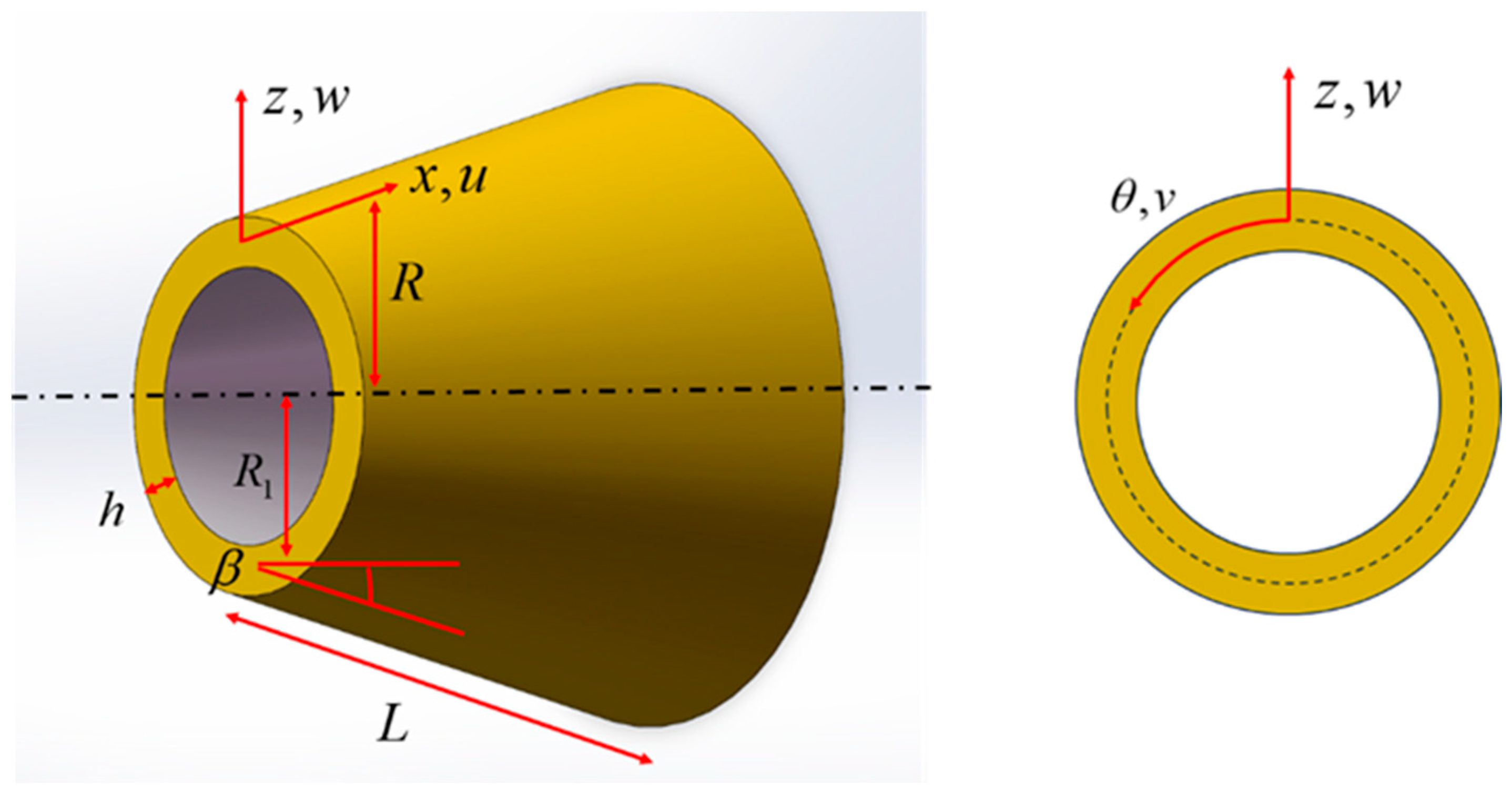
The graphene-reinforced aluminum-based topped cone shell model studied in this paper is shown in Figure 1. A Cartesian curve coordinate system x , θ , z is established on the mid-surface of the topped cone shell, as illustrated in Figure 1, where x , θ , z represent the coordinates in the generatrix, circumferential, and thickness directions, respectively. It is assumed that the length of the generatrix, thickness, half apex angle, and small end radius of the topped cone shell are denoted as L , h , β and R 1 , respectively. On the mid-surface of the topped cone shell, the radius at any point along the generatrix direction can be assumed to be R = R 1 + x   sin   β .

2.1. Effective Material Properties

Aluminum is widely used in the aerospace field due to its high strength and low density; however, the extreme operating conditions in aerospace applications impose even more stringent requirements on materials. Graphene, characterized by its high specific stiffness, high specific strength, and exceptionally large specific surface area, serves as an outstanding reinforcing material. Therefore, we select the graphene-reinforced aluminum matrix composite as the constituent material for the truncated conical shell. The graphene-reinforced aluminum-based topped cone shell is divided into N layers along the thickness direction, with each layer having the same thickness of Δ h = h / N . By adjusting the content of graphene in each layer of the topped cone shell, different graphene distributions can be achieved. This paper considers three types of graphene distributions, as shown in Figure 2, where the volume fraction of graphene increases progressively with the deepening color. Figure 2a illustrates the GPL-U distribution, in which the graphene content remains consistent across each layer; Figure 2b displays the GPL-O distribution, where the volume fraction of graphene gradually decreases from the central layer to the inner and outer layers; and Figure 2c presents the GPL-X distribution, where the volume fraction of graphene gradually increases from the central layer to the inner and outer layers. These three specific symmetric patterns are selected as they represent the three distribution scenarios of uniform reinforcement, surface-rich reinforcement, and core-rich reinforcement, respectively, allowing for a comprehensive comparison of spatial distribution effects. Furthermore, for these symmetric distributions, the physical neutral surface inherently coincides with the geometric midplane. Therefore, locating the reference plane at the geometric center sets the integration limits to [−h/2, h/2], which provides great mathematical convenience and simplifies the complex dynamic equations.
Under different graphene distributions, the volume fraction of graphene in the S -th layer of the graphene-reinforced aluminum-based topped cone shell is given by [43].
GPL-U distribution:
V G P L S = V G P L
GPL-O distribution:
V G P L S = 2 V G P L 1 2 S N 1 / N
GPL-X distribution:
V G P L S = 2 V G P L 2 S N 1 / N
where S = 1 , 2 , , N , V G P L is the total volume fraction of graphene, specifically expressed as
V G P L = W G P L W G P L + 1 W G P L ρ G P L / ρ M
In the equation, W G P L is the weight fraction of graphene, and ρ G P L and ρ M are the densities of graphene and aluminum, respectively.
Based on the improved Halpin–Tsai mechanical model, the effective Young’s modulus of each layer of the graphene-reinforced aluminum-based topped cone shell is predicted to be:
E e f f S = 3 8 × 1 + ξ L η L V G P L S 1 η L V G P L S E M + 5 8 × 1 + ξ W η W V G P L S 1 η W V G P L S E M
where
η L = E G P L / E M 1 E G P L / E M + ξ L ,   η W = E G P L / E M 1 E G P L / E M + ξ W
ξ L = 2 l G P L / h G P L ,   ξ W = 2 w G P L / h G P L
In the equation, E G P L and E M represent the Young’s moduli of graphene and aluminum, respectively, while l G P L , w G P L , and h G P L denote the length, width, and thickness of the graphene sheets, respectively.
The effective density, Poisson’s ratio, and coefficient of thermal expansion for each layer of the graphene-reinforced aluminum-based topped cone shell can be expressed as
ρ e f f S = ρ G P L V G P L S + ρ M V M S
ν e f f S = ν G P L V G P L S + ν M V M S
α e f f S = α G P L V G P L S + α M V M S
In the equation, ρ G P L , ρ M , ν G P L , ν M and α G P L , α M represent the density, Poisson’s ratio, and coefficient of thermal expansion of graphene and aluminum, respectively, while V M S denotes the volume fraction of the matrix material in each layer.
Assuming a linear temperature variation, the temperature at any point along the thickness direction of the graphene-reinforced aluminum-based topped cone shell can be expressed as
T z = z h T m T n + 1 2 T m + T n
where T n and T m represent the temperatures at the inner and outer surfaces of the topped cone shell, respectively.

2.2. Displacement Field

Based on the Reissner–Mindlin theory [44], the displacement field of the graphene-reinforced aluminum matrix truncated conical shell is postulated as follows:
u x , θ , z , t = u 0 x , θ , t + z φ x x , θ , t
v x , θ , z , t = v 0 x , θ , t + z φ θ x , θ , t
w x , θ , z , t = w 0 x , θ , t
where u 0 , v 0 and w 0 denote the displacements of an arbitrary point on the mid-surface of the truncated conical shell along the x , θ and z directions, respectively, while φ x and φ θ represent the rotations of this point about the θ and x -axes.
Based on the von-Karman geometric nonlinear strain–displacement relations and the postulated displacement field above, the strain components of the graphene-reinforced aluminum matrix truncated conical shell can be derived as follows:
ε x x ε θ θ γ x θ = ε x x 0 ε θ θ 0 γ x θ 0 + z ε x x 1 ε θ θ 1 γ x θ 1 ,   γ θ z γ x z = φ θ + 1 R w 0 θ 1 R v 0   cos   β w 0 x + φ x
where
ε x x 0 ε θ θ 0 γ x θ 0 = u 0 x + 1 2 w 0 x 2 1 R v 0 θ + 1 R w 0   cos   β + 1 R u 0   sin   β + 1 2 1 R 2 w 0 θ 2 1 R u 0 θ 1 R v 0   sin   β + v 0 x + 1 R w 0 x w 0 θ
ε x x 1 ε θ θ 1 γ x θ 1 = φ x x 1 R φ θ θ + 1 R φ x   sin   β 1 R φ x θ 1 R φ θ   sin   β + φ θ x
Assuming that the graphene-reinforced aluminum matrix truncated conical shell exhibits isotropic material properties, its constitutive equation under thermal effects can be formulated as follows [45]:
σ x x σ θ θ σ θ z σ x z σ x θ S = Q 11 Q 12 0 0 0 Q 12 Q 22 0 0 0 0 0 k 0 Q 44 0 0 0 0 0 k 0 Q 55 0 0 0 0 0 Q 66 S ε x x ε θ θ γ θ z γ x z γ x θ α e f f α e f f 0 0 0 Δ T ( S )
In the equation, Δ T = T z T denotes the temperature difference, T represents the reference temperature, k 0 = 5 / 6 is the shear correction factor, and all stiffness coefficients are defined as follows:
Q 11 S = Q 22 S = E e f f S 1 v e f f S 2 ,   Q 12 S = v e f f S E e f f S 1 v e f f S 2
Q 44 S = Q 55 S = Q 66 S = E e f f S 2 1 + v e f f S

2.3. Motion Equations

Using Hamilton’s principle, establish the nonlinear dynamic partial differential equations for the graphene-reinforced aluminum-based truncated conical shell under the coupled effects of lateral excitation f = F   cos   Ω 1 t and in-plane excitation p = p 0 + p 1   cos   Ω 2 t . The mathematical expression of Hamilton’s principle is as follows [44]:
t 1 t 2 δ U δ K δ W d t = 0
In the equation, the strain potential energy δ U , kinetic energy δ K , and the virtual work δ W done by external excitation are respectively
δ U = 0 2 π 0 L h / 2 h / 2 σ x x δ ε x x + σ θ θ δ ε θ θ + σ x θ δ γ x θ + σ θ z δ γ θ z + σ x z δ γ x z R d z d x d θ
δ K = 0 2 π 0 L h / 2 h / 2 ρ e f f u ˙ δ u ˙ + v ˙ δ v ˙ + w ˙ δ w ˙ R d z d x d θ
δ W = 0 2 π 0 L f δ w R d x d θ 0 2 π 0 L p w x δ w x R d x d θ 0 2 π 0 L μ w ˙ δ w R d x d θ
where μ is the structural damping coefficient, and “ ” denotes the first derivative of the variable with respect to time.
The expressions for the resultant stress, resultant moment, and mass moment of inertia are respectively
N x x , N θ θ , N x θ = h / 2 h / 2 σ x x , σ θ θ , σ x θ d z
M x x , M θ θ , M x θ = h / 2 h / 2 σ x x , σ θ θ , σ x θ z d z
Q θ , Q x = h / 2 h / 2 σ θ z , σ x z d z
I 0 , I 1 , I 2 = h / 2 h / 2 1 , z , z 2 ρ e f f d z
By substituting Equations (13) and (14) into Equation (12), we can obtain the five nonlinear dynamic equations for the graphene-reinforced aluminum-based truncated conical shell, which are as follows:
δ u 0 :   N x x , x + 1 R N x θ , θ   + 1 R N x x   sin   β 1 R N θ θ   sin   β = I 0 u ¨ 0 + I 1 φ ¨ x
δ v 0 :   N x θ , x + 1 R N θ θ , θ + 2 R N x θ   sin   β + 1 R Q θ   cos   β = I 0 v ¨ 0 + I 1 φ ¨ θ
δ w 0 :   N x x , x w 0 x + 1 R N x θ , x w 0 θ + 1 R N x θ , θ w 0 x + 1 R 2 N θ θ , θ w 0 θ + N x x 2 w 0 x 2 + 1 R N x x   sin   β w 0 x + 2 R N x θ 2 w 0 x θ + 1 R 2 N θ θ 2 w 0 θ 2 1 R N θ θ   cos   β + Q x , x + 1 R Q θ , θ + 1 R Q x   sin   β + p 2 w 0 x 2 + 1 R p   sin   β w 0 x f + μ w ˙ 0 = I 0 w ¨ 0
δ φ x :   M x x , x + 1 R M x θ , θ + 1 R M x x   sin   β 1 R M θ θ   sin   β Q x = I 1 u ¨ 0 + I 2 φ ¨ x
δ φ θ :   M x θ , x + 1 R M θ θ , θ + 2 R M x θ   sin   β Q θ = I 1 v ¨ 0 + I 2 φ ¨ θ
The resultant stress and resultant moment can be expressed in the following matrix form:
N M = A B B D ε 0 ε 1 N T M T ,   Q = k 0 A γ
where
N = N x x N θ θ N x θ ,   M = M x x M θ θ M x θ ,   Q = Q θ Q x
ε 0 = ε x x 0 ε θ θ 0 γ x θ 0 ,   ε 1 = ε x x 1 ε θ θ 1 γ x θ 1 ,   γ = γ θ z γ x z
The resultant force N T and resultant moment M T due to thermal stress are respectively
N T = N x x T N θ θ T 0 = h / 2 h / 2 Q 11 Q 12 0 Q 12 Q 22 0 0 0 Q 66 α e f f α e f f 0 Δ T d z
M T = M x x T M θ θ T 0 = h / 2 h / 2 Q 11 Q 12 0 Q 12 Q 22 0 0 0 Q 66 α e f f α e f f 0 Δ T z d z
The respective stiffness matrices are
A i j , B i j , D i j = h / 2 h / 2 Q i j 1 , z , z 2 d z i , j = 1,2 , 6
A i j = h / 2 h / 2 Q i j d z   i , j = 4,5
By substituting Equations (16)–(19) into Equation (15), the nonlinear governing equations of the graphene-reinforced aluminum matrix truncated conical shell can be expanded into generalized displacement form, as follows:
A 11 2 u 0 x 2 + 1 R 2 A 66 2 u 0 θ 2 + 1 R A 11 u 0 x   sin   β 1 R 2 A 22 u 0   sin   2 β + 1 R A 12 2 v 0 x θ   + 1 R A 66 2 v 0 x θ + A 11 w 0 x 2 w 0 x 2 + 1 R 2 A 66 w 0 x 2 w 0 θ 2 1 R 2 A 22 w 0   sin   β   cos   β + 1 R 2 A 12 + A 66 w 0 θ 2 w 0 x θ + 1 R A 12 w 0 x   cos   β + 1 2 R A 11 A 12 w 0 x 2   sin   β 1 2 R 3 A 12 + A 22 w 0 θ 2   sin   β + B 11 2 φ x x 2 + 1 R 2 B 66 2 φ x θ 2 + 1 R B 11 φ x x   sin   β 1 R 2 B 22 φ x   sin   2 β + 1 R B 12 + B 66 2 φ θ x θ 1 R 2 B 22 + B 66 φ θ θ   sin   β 1 R 2 A 22 + A 66 v 0 θ   sin   β N x x T x + 1 R N θ θ T N x x T   sin   β = I 0 u ¨ 0 + I 1 φ ¨ x
1 R A 12 + A 66 2 u 0 x θ + 1 R 2 A 22 + A 66 u 0 θ   sin   β + A 66 R v 0 x   sin   β k 0 A 44 v 0   cos   2 β R 2 1 R 2 A 66 v 0   sin   2 β + A 66 2 v 0 x 2 + 1 R 2 A 22 2 v 0 θ 2 + 1 R A 66 w 0 θ 2 w 0 x 2 + 1 R 3 A 22 w 0 θ 2 w 0 θ 2 + 1 R A 12 + A 66 w 0 x 2 w 0 x θ + 1 R 2 A 66 w 0 θ w 0 x   sin   β + 1 R 2 A 22 + k 0 A 44 w 0 θ   cos   β + 1 R B 12 + B 66 2 φ x x θ + 1 R 2 B 22 + B 66 φ x θ   sin   β + 1 R B 66 φ θ x   sin   β + B 66 2 φ θ x 2 + 1 R 2 B 22 2 φ θ θ 2 + 1 R k 0 A 44 φ θ   cos   β 1 R 2 B 66 φ θ   sin   2 β 1 R N θ θ T θ = I 0 v ¨ 0 + I 1 φ ¨ θ
+ A 66 R 2 w 0 x 2 u 0 θ 2 + A 12 + A 66 R 2 w 0 θ 2 u 0 x θ + A 11 + A 12 R w 0 x u 0 x   sin   β A 12 R u 0 x   cos   β + A 11 2 w 0 x 2 u 0 x + A 12 R 2 2 w 0 θ 2 u 0 x + 1 R 3 A 22 A 66 w 0 θ u 0 θ   sin   β + 2 R 2 A 66 2 w 0 x θ u 0 θ + A 12 R 2 w 0 x 2 u 0   sin   β + 1 R 3 A 22 2 w 0 θ 2 u 0   sin   β + 1 R A 66 w 0 θ 2 v 0 x 2 A 22 u 0 R 2   sin   β   cos   β + 1 R 3 A 22 w 0 θ 2 v 0 θ 2 + 2 R A 66 2 w 0 x θ v 0 x 1 R 2 A 66 w 0 θ v 0 x   sin   β + 1 R A 12 + A 66 w 0 x 2 v 0 x θ 1 R 2 A 66 w 0 x v 0 θ   sin   β 1 R 2 A 22 + k 0 A 44 v 0 θ   cos   β + A 12 R 2 w 0 x 2 v 0 θ + 1 R 3 A 22 2 w 0 θ 2 v 0 θ 2 R 2 A 66 2 w 0 x θ v 0   sin   β + 1 R 3 A 66 w 0 θ v 0   sin   2 β + 3 2 A 11 w 0 x 2 2 w 0 x 2 + 1 R A 12 w 0 2 w 0 x 2   cos   β + B 11 φ x x 2 w 0 x 2 + 1 R B 12 φ x 2 w 0 x 2   sin   β + 1 2 R 2 A 12 + 2 A 66 w 0 θ 2 2 w 0 x 2 + 1 R 3 A 22 w 0 2 w 0 θ 2   cos   β + 3 2 R 4 A 22 w 0 θ 2 2 w 0 θ 2 + 1 R B 12 φ θ θ 2 w 0 x 2 + k 0 A 55 + p N x x T 2 w 0 x 2 + 1 2 R 2 A 12 + 2 A 66 w 0 x 2 2 w 0 θ 2 + 1 R 2 k 0 A 44 N θ θ T 2 w 0 θ 2 + B 12 R 2 φ x x 2 w 0 θ 2 + 1 R 3 B 22 φ θ θ 2 w 0 θ 2 + 2 R 2 B 66 φ x θ 2 w 0 x θ + 1 R 3 B 22 φ x 2 w 0 θ 2   sin   β + 2 R 2 A 12 + 2 A 66 w 0 x w 0 θ 2 w 0 x θ 2 R 2 B 66 φ θ 2 w 0 x θ   sin   β + 2 R B 66 φ θ x 2 w 0 x θ A 12 + 2 A 66 2 R 3 w 0 θ 2 w 0 x   sin   β + 1 R B 12 + B 66 2 φ θ x θ w 0 x + B 11 + B 12 R φ x x w 0 x   sin   β + B 11 2 φ x x 2 w 0 x N x x T x w 0 x 1 R 2 B 66 φ θ θ w 0 x   sin   β + 1 R 2 B 66 2 φ x θ 2 w 0 x 1 R N x x T p k 0 A 55 w 0 x   sin   β + 1 R 2 B 12 + B 66 2 φ x x θ w 0 θ + 1 R 3 B 22 B 66 φ x θ w 0 θ   sin   β 1 R 2 B 66 φ θ x w 0 θ   sin   β + 1 R 3 B 66 φ θ w 0 θ   sin   2 β + 1 R 3 B 22 2 φ θ θ 2 w 0 θ + 1 R B 66 2 φ θ x 2 w 0 θ 1 R 2 N θ θ T θ w 0 θ 1 R 2 A 22 w 0   cos   2 β + k 0 A 55 φ x x 1 R B 12 φ x x cos β 1 R 2 B 22 φ x sin β cos β + 1 R k 0 A 55 φ x sin β + A 12 2 R w 0 x 2   cos   β + A 22 2 R 3 w 0 θ 2   cos   β + A 11 2 R w 0 x 3   sin   β + A 11 w 0 x 2 u 0 x 2 + 1 R k 0 A 44 φ θ θ 1 R 2 B 22 φ θ θ   cos   β + 1 R N θ θ T   cos   β + f μ w ˙ 0 = I 0 w ¨ 0
B 11 2 u 0 x 2 + 1 R 2 B 66 2 u 0 θ 2 + B 11 R u 0 x   sin   β B 22 u 0 R 2   sin   2 β B 22 + B 66 R 2 v 0 θ   sin   β + 1 R B 12 + B 66 2 v 0 x θ + B 11 w 0 x 2 w 0 x 2 + 1 R 2 B 66 w 0 x 2 w 0 θ 2 1 R 2 B 22 w 0   sin   β   cos   β + 1 R 2 B 12 + B 66 w 0 θ 2 w 0 x θ + 1 R B 12 w 0 x   cos   β + 1 2 R B 11 B 12 w 0 x 2   sin   β k 0 A 55 w 0 x 1 2 R 3 B 12 + B 22 w 0 θ 2   sin   β M x x T x + 1 R D 12 + D 66 2 φ θ x θ + D 11 2 φ x x 2 + 1 R 2 D 66 2 φ x θ 2 + 1 R D 11 φ x x   sin   β 1 R 2 D 22 φ x   sin   2 β k 0 A 55 φ x 1 R 2 D 22 + D 66 φ θ θ   sin   β + 1 R M θ θ T M x x T   sin   β = I 1 u ¨ 0 + I 2 φ ¨ x
B 12 + B 66 R 2 u 0 x θ + B 22 + B 66 R 2 u 0 θ   sin   β + B 66 2 v 0 x 2 + B 22 R 2 2 v 0 θ 2 + B 66 R v 0 x   sin   β + 1 R k 0 A 44 v 0   cos   β 1 R 2 B 66 v 0   sin   2 β + 1 R B 66 w 0 θ 2 w 0 x 2 + 1 R 2 B 66 w 0 θ w 0 x   sin   β + 1 R B 12 + B 66 w 0 x 2 w 0 x θ + 1 R 3 B 22 w 0 θ 2 w 0 θ 2 + 1 R 2 B 22 w 0 θ   cos   β 1 R k 0 A 44 w 0 θ + 1 R D 12 + D 66 2 φ x x θ + 1 R 2 D 22 + D 66 φ x θ   sin   β + D 66 2 φ θ x 2 + 1 R 2 D 22 2 φ θ θ 2 + 1 R D 66 φ θ x   sin   β 1 R 2 D 66 φ θ   sin   2 β k 0 A 44 φ θ 1 R M θ θ T θ = I 1 v ¨ 0 + I 2 φ ¨ θ

2.4. Galerkin Truncation

Considering the simply supported boundary conditions at both ends, the specific boundary conditions for the corresponding displacements are given as follows:
x = 0 ,   x = L :   v 0 = w 0 = φ θ = 0
For the graphene-reinforced aluminum matrix truncated conical shell simply supported at both ends studied in this paper, the displacement functions u 0 , v 0 , w 0 , φ x , φ θ can be expressed in the form of the following double Fourier series [46] under the premise of satisfying boundary conditions:
u 0 = u 1 t   cos   m 1 π x L   cosn 1   θ + u 2 t   cos   m 2 π x L   cosn 2   θ
v 0 = v 1 t   sin   m 1 π x L   sinn 1   θ + v 2 t   sin   m 2 π x L   sinn 2   θ
w 0 = w 1 t   sin   m 1 π x L   cosn 1   θ + w 2 t   sin   m 2 π x L   cosn 2   θ
φ x = φ x 1 t   cos   m 1 π x L   cosn 1   θ + φ x 2 t   cos   m 2 π x L   cosn 2   θ
φ θ = φ θ 1 t   sin   m 1 π x L   sinn 1   θ + φ θ 2 t   sin   m 2 π x L   sinn 2   θ
The transverse excitation amplitude F can be expressed as
F = F 1   sin   m 1 π x L   cosn 1   θ + F 2   sin   m 2 π x L   cosn 2   θ
where u 1 , v 1 , w 1 , φ x 1 , φ θ 1 , F 1 are the first-order modal amplitudes, u 2 , v 2 , w 2 , φ x 2 , φ θ 2 , F 2 are the second-order modal amplitudes, m 1 , m 2 is the axial half-wavelength number, and n 1 , n 2 is the circumferential wave number. It can be verified that the assumed double Fourier series solutions (Equation (22)) inherently satisfy these boundary conditions due to the presence of the   sin   m π x / L terms. It should be noted that while Equation (22) is a two-degree-of-freedom truncated approximation rather than a mathematically complete infinite series, it effectively captures the dominant dynamic responses of the system [47].
In practical engineering applications, the transverse excitation defined in Equation (23) can mathematically model complex external dynamic environments. Typical examples include acoustic excitations acting on aerospace structures during high-speed flight and harmonic vibrational forces transmitted from rotating machinery.
This chapter studies the coupled vibrations of graphene-reinforced aluminum-based truncated conical shells under two modes, m 1 = 1 , n 1 = 3 and m 2 = 3 , n 2 = 1 . Since the vibrational energy of the thin-walled shell is predominantly dissipated through transverse bending motions, to simplify the mathematical model without losing the dominant energy dissipation mechanisms, only the transverse structural damping coefficient μ is considered, neglecting the relatively minor in-plane viscous damping effects.
By substituting Equations (22) and (23) into Equation (20), and using the Galerkin method for truncation, since the effects of in-plane inertia and rotary inertia on the nonlinear vibration are far smaller than that of transverse inertia [48], these terms can be neglected in Equations (20a), (20b), (20d) and (20e). The five nonlinear dynamic partial differential equations are multiplied by their corresponding weight functions and integrated with respect to x and θ , yielding eight algebraic equations and two differential equations. We can express the in-plane and rotational displacements as functions of the radial displacement w 1 and w 2 , leading to the nonlinear ordinary differential equations of motion for the graphene-reinforced aluminum-based truncated conical shell, as follows:
w ¨ 1 + μ 1 w ˙ 1 + ω 1 2 w 1 + m 11 w 1 3 + m 12 w 1 2 w 2 + m 13 w 1 w 2 2 + m 14 w 2 3 + m 15 w 1 p 1   cos   Ω 2 t = m 16 F 1   cos   Ω 1 t
w ¨ 2 + μ 2 w ˙ 2 + ω 2 2 w 2 + m 21 w 1 3 + m 22 w 1 2 w 2 + m 23 w 1 w 2 2 + m 24 w 2 3 + m 25 w 2 p 1   cos   Ω 2 t = m 26 F 2   cos   Ω 1 t
where ω 1 and ω 2 are the first-order and second-order natural frequencies of the system, respectively:
ω 1 2 = m 10 + m 15 p 0 ,   ω 2 2 = m 20 + m 25 p 0
In the equation, p 0 represents the in-plane pre-tension force.
Dimensional analysis of Equation (24) is performed, introducing the following scale transformation:
μ ̄ r = μ r ω 1 ,   w ̄ r = w r h ,   t ̄ = ω 1 t ,   Ω ̄ r = Ω r / ω 1 ,   m ̄ r s = m r s h 2 ω 1 2 ,   m ̄ r 5 = m r 5 ω 1 2 ,   m ̄ r 6 = m r 6 h ω 1 2 r = 1,2 ,   s = 1,2 , 3,4
By substituting the scale transformation (26) into Equation (24), we can obtain the dimensionless nonlinear ordinary differential equations, as shown below (for convenience, the notation “ ” of dimensionless quantities has been omitted):
w ¨ 1 + μ 1 w ˙ 1 + ω 1 2 w 1 + m 11 w 1 3 + m 12 w 1 2 w 2 + m 13 w 1 w 2 2 + m 14 w 2 3 + m 15 w 1 p 1   cos   Ω 2 t = m 16 F 1   cos   Ω 1 t
w ¨ 2 + μ 2 w ˙ 2 + ω 2 2 w 2 + m 21 w 1 3 + m 22 w 1 2 w 2 + m 23 w 1 w 2 2 + m 24 w 2 3 + m 25 w 2 p 1   cos   Ω 2 t = m 26 F 2   cos   Ω 1 t
where “ ” and “ ” represent the first and second derivatives with respect to time, respectively.

3. Perturbation Analysis

Using the method of multiple scales for perturbation analysis, the averaged equations for the graphene-reinforced aluminum-based truncated conical shell under the 1:2 internal resonance condition are derived. Assuming that the damping term, external excitation term, and all nonlinear terms to be small quantities, a small parameter ε is introduced, as shown below:
w i = ε 1 2 w ~ i ,   μ i = ε μ ~ i ,   p 1 = ε p ~ 1 ,   F i = ε 3 2 F ~ i ,   ( i = 1,2 )
For notational convenience, substituting Equation (28) into Equation (27) and omitting the curved bars over the terms, Equation (27) can be rewritten as
w ¨ 1 + ε μ 1 w ˙ 1 + ω 1 2 w 1 + ε m 11 w 1 3 + ε m 12 w 1 2 w 2 + ε m 13 w 1 w 2 2 + ε m 14 w 2 3 + ε m 15 w 1 p 1   cos   Ω 2 t = ε m 16 F 1   cos   Ω 1 t
w ¨ 2 + ε μ 2 w ˙ 2 + ω 2 2 w 2 + ε m 21 w 1 3 + ε m 22 w 1 2 w 2 + ε m 23 w 1 w 2 2 + ε m 24 w 2 3 ε m 25 w 2 p 1   cos   Ω 2 t = ε m 26 F 2   cos   Ω 1 t
Assuming the approximate solution of Equation (29) is given by
w 1 = w 10 T 0 , T 1 + ε w 11 T 0 , T 1 +
w 2 = w 20 T 0 , T 1 + ε w 21 T 0 , T 1 +
where T 0 = t , T 1 = ε t .
The differential operator is represented as
d d t = T 0 T 0 t + T 1 T 1 t + = D 0 + ε D 1 +
d 2 d t 2 = D 0 + ε D 1 + 2 = D 0 2 + 2 ε D 0 D 1 +
where D n = T n , n = 0,1 .
By substituting Equations (30) and (31) into Equation (29) and ensuring that the coefficients of the same power of the small parameter ε in the expanded equation are equal, we obtain the following two sets of equations:
ε 0 :   D 0 2 w 10 + ω 1 2 w 10 = 0
D 0 2 w 20 + ω 2 2 w 20 = 0
ε 1 :   D 0 2 w 11 + ω 1 2 w 11 = 2 D 0 D 1 w 10 μ 1 D 0 w 10 m 11 w 10 3 m 12 w 10 2 w 20 m 13 w 10 w 20 2 m 14 w 20 3 m 15 w 10 p 1   cos   Ω 2 t + m 16 F 1   cos   Ω 1 t
D 0 2 w 21 + ω 2 2 w 21 = 2 D 0 D 1 w 20 μ 2 D 0 w 20 m 21 w 10 3 m 22 w 10 2 w 20 m 23 w 10 w 20 2 m 24 w 20 3 m 25 w 20 p 1   cos   Ω 2 t + m 26 F 2   cos   Ω 1 t
By solving Equation (33), we can obtain the following solution in complex form:
w 10 = A 1 T 1 e i ω 1 T 0 + A ̄ 1 T 1 e i ω 1 T 0
w 20 = A 2 T 1 e i ω 2 T 0 + A ̄ 2 T 1 e i ω 2 T 0
where A ̄ 1 and A ̄ 2 are the complex conjugates of A 1 and A 2 , respectively.
Under 1:2 internal resonance, 1:2 subharmonic resonance, and primary parameter resonance, the second-order natural frequency is roughly comparable to twice the first-order natural frequency of the graphene-reinforced aluminum-based truncated conical shell, establishing an internal energy transfer channel. The frequency of the transverse load is roughly comparable to that of the second-order mode, whereas the frequency of the in-plane load is equal to the frequency of the transverse load since they physically originate from a unified vibration source. Consequently, the system’s resonant relationships are established by introducing the tuning parameters σ 1 and σ 2 , as follows:
ω 2 = 2 ω 1 + ε σ 1 ,   Ω 1 = 2 ω 1 + ε σ 2 ,   Ω 2 = Ω 1
where σ 1 and σ 2 are tuning parameters, and ε is a small parameter.
By substituting solution (34) and resonance relation (35) into Equation (33), we can obtain the following two equations:
D 0 2 w 11 + ω 1 2 w 11 = 2 i ω 1 D 1 A 1 i ω 1 μ 1 A 1 3 m 11 A 1 2 A ̄ 1 2 m 13 A 1 A 2 A ̄ 2 1 2 m 15 A ̄ 1 p 1 e i σ 2 T 1 e i ω 1 T 0 + c c + N S T
D 0 2 w 21 + ω 2 2 w 21 = 2 i ω 2 D 1 A 2 i ω 2 μ 2 A 2 2 m 22 A 1 A ̄ 1 A 2 3 m 24 A 2 2 A ̄ 2 + 1 2 m 26 F 2 e i σ 2 σ 1 T 1 e i ω 2 T 0 + c c + N S T
where c c and N S T are the complex conjugate term and the non-durable term, respectively.
To avoid the occurrence of durable terms, Equation (36) should satisfy the following condition:
D 1 A 1 = 1 2 μ 1 A 1 + 1 ω 1 3 2 i m 11 A 1 2 A ̄ 1 + i m 13 A 1 A 2 A ̄ 2 + 1 4 i m 15 A ̄ 1 p 1 e i σ 2 T 1
D 1 A 2 = 1 2 μ 2 A 2 + 1 ω 2 i m 22 A 1 A ̄ 1 A 2 + 3 2 i m 24 A 2 2 A ̄ 2 1 4 i m 26 F 2 e i σ 2 σ 1 T 1
A 1 and A 2 can be expressed in the following polar coordinate form:
A 1 = 1 2 a 1 e i φ 1 ,   A 2 = 1 2 a 2 e i φ 2
where a n and φ n are both functions of T 1 , n = 1,2 .
By substituting Equation (38) into Equation (37) and separating the real and imaginary parts, we can obtain the averaged equations for the graphene-reinforced aluminum-based truncated conical shell in polar coordinates.
a ˙ 1 = 1 2 μ 1 a 1 1 4 ω 1 m 15 a 1 p 1 s i n γ 1
a 1 γ ˙ 1 = a 1 σ 2 1 ω 1 3 4 m 11 a 1 3 + 1 2 m 13 a 1 a 2 2 + 1 2 m 15 a 1 p 1 c o s γ 1
a ˙ 2 = 1 2 μ 2 a 2 1 2 ω 2 m 26 F 2 s i n γ 2
a 2 γ ˙ 2 = a 2 σ 1 a 2 σ 2 + 1 ω 2 1 4 m 22 a 1 2 a 2 + 3 8 m 24 a 2 3 1 2 m 26 F 2 c o s γ 2
where γ 1 = σ 2 T 1 2 φ 1 , γ 2 = σ 1 T 1 σ 2 T 1 + φ 2 .

4. Numerical Analysis

The structural dimensions of the graphene-reinforced aluminum-based truncated conical shell are selected as follows: generatrix length L = 0.8   m , thickness h = 0.002   m , small end radius R 1 = 0.5   m , half apex angle β = π 6   rad , and number of layers N = 10 . The geometric dimensions of the graphene sheets are: length l G P L = 2.5   μ m , width w G P L = 1.5   μ m , and thickness h G P L = 1.5   nm . The elastic modulus, Poisson’s ratio, density, and thermal expansion coefficient of graphene and aluminum are: E G P L = 1.01   TPa , v G P L = 0.186 , ρ G P L = 1060   kg / m 3 , α G P L = 8 × 1 0 6 / K , E M = 68   GPa , v M = 0.34 , ρ M = 2700   kg / m 3 , α M = 23.2 × 1 0 6 / K . The temperatures of the inner and outer surfaces and the reference temperature are chosen as: T n = 400   K , T m = 600   K , T = 300   K . The structural damping coefficient is μ = 95.2   N s / m and the weight fraction of graphene is W G P L = 1 % .
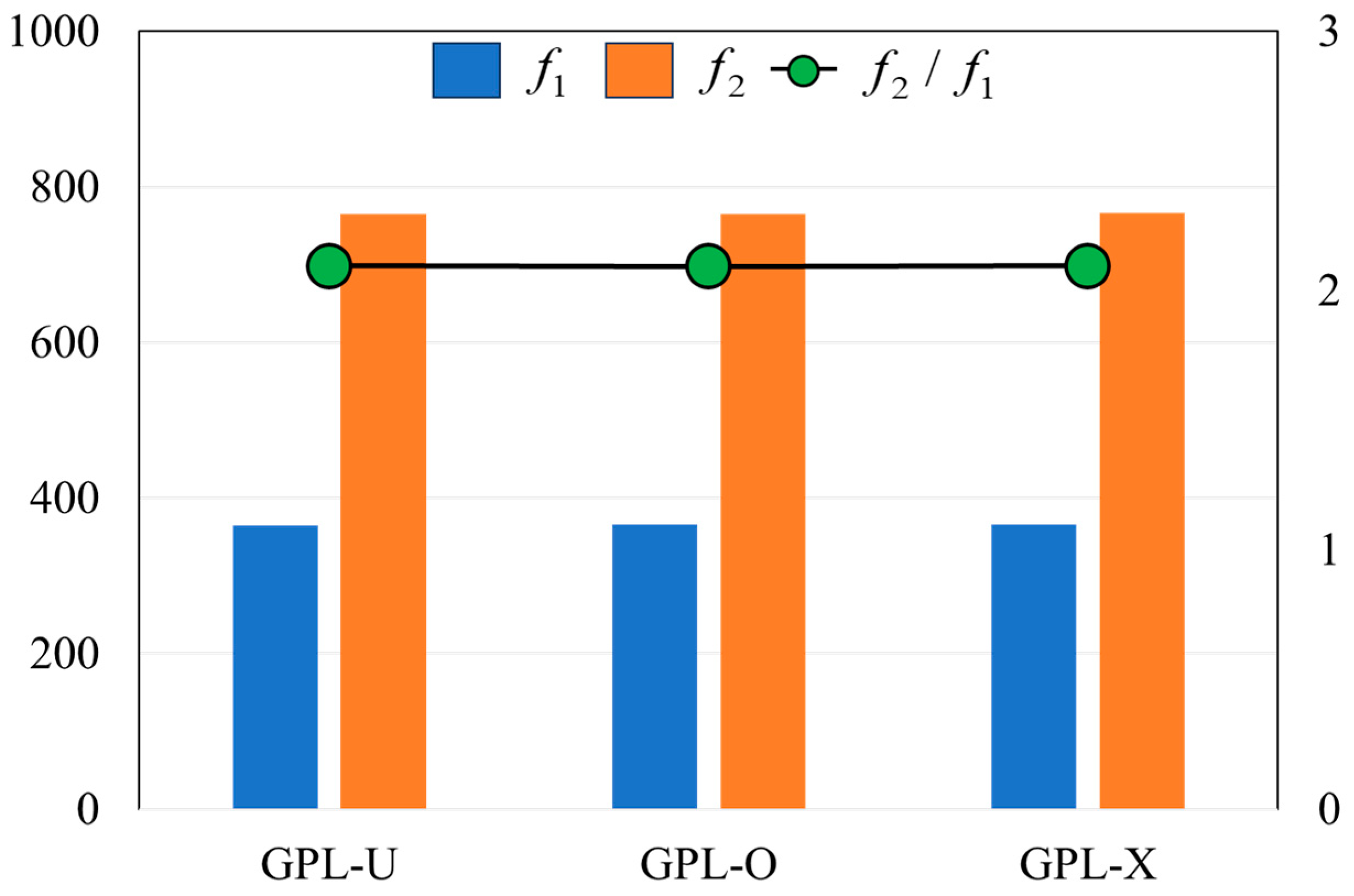
Based on the expressions for ω 1 and ω 2 , and neglecting the in-plane pre-tension force, the second-order natural frequencies of the graphene-reinforced aluminum-based truncated conical shells are calculated for three different distributions of graphene, as shown in Figure 3, where f m = ω m 2 π Hz m = 1,2 is specified. For the three distributions of graphene, the frequency ratio of the second-order modes of the graphene-reinforced aluminum-based truncated conical shell is close to 2, indicating the presence of a 1:2 internal resonance condition in the system. Therefore, this study investigates the vibrational response of the graphene-reinforced aluminum-based truncated conical shell under the 1:2 internal resonance condition.

4.1. Method Validation

To verify the accuracy of the current method, the results obtained in this study are compared with existing results from the literature. The axial half-wave number m was set to 1, and the circumferential wave number n is varied to calculate the dimensionless natural frequency f = ω R 2 ρ 1 ν 2 / E , with the calculation results shown in Table 1, where R 2 = R 1 + L   sin   β represents the larger end radius of the truncated conical shell. The material parameters for the truncated conical shell are: E = 70   GPa , ρ = 2710   kg / m 3 , ν = 0.3 , and the structural dimensions are: h = 0.004   m , R 1 = 0.3   m , L   sin   β = 0.1 . The comparison results indicate that the dimensionless natural frequencies calculated in this study are highly consistent with the results from references [49,50], with the maximum error controlled within 5%, thus demonstrating the accuracy of the current method.

4.2. Vibration Response Analysis

The condition for the existence of a steady-state solution to the averaged Equation (39) is a ˙ 1 = γ ˙ 1 = a ˙ 2 = γ ˙ 2 = 0 . Substituting this condition into the averaged Equation (39), after calculation and rearrangement, we can obtain the frequency response equation for the graphene-enhanced aluminum-based truncated conical shell under the 1:2 internal resonance condition.
μ 1 2 a 1 2 + 1 16 ω 1 2 a 1 2 3 m 11 a 1 2 + 2 m 13 a 2 2 4 σ 2 ω 1 2 1 4 ω 1 2 m 15 2 p 1 2 a 1 2 = 0
1 4 μ 2 2 a 2 2 + 1 16 ω 2 2 a 2 2 m 22 a 1 2 + 3 2 m 24 a 2 2 + 4 ω 2 σ 1 σ 2 2 1 4 ω 2 2 m 26 2 F 2 2 = 0
To facilitate graphical visualization during the numerical solution, we set a 2 = 1 in Equation (40a) and a 1 = 1 in Equation (40b).
To obtain the steady-state amplitude–frequency and force–amplitude response curves, the nonlinear algebraic Equations (40a) and (40b) are rearranged into an implicit functional form and solved numerically using customized MATLAB 2024 scripts.
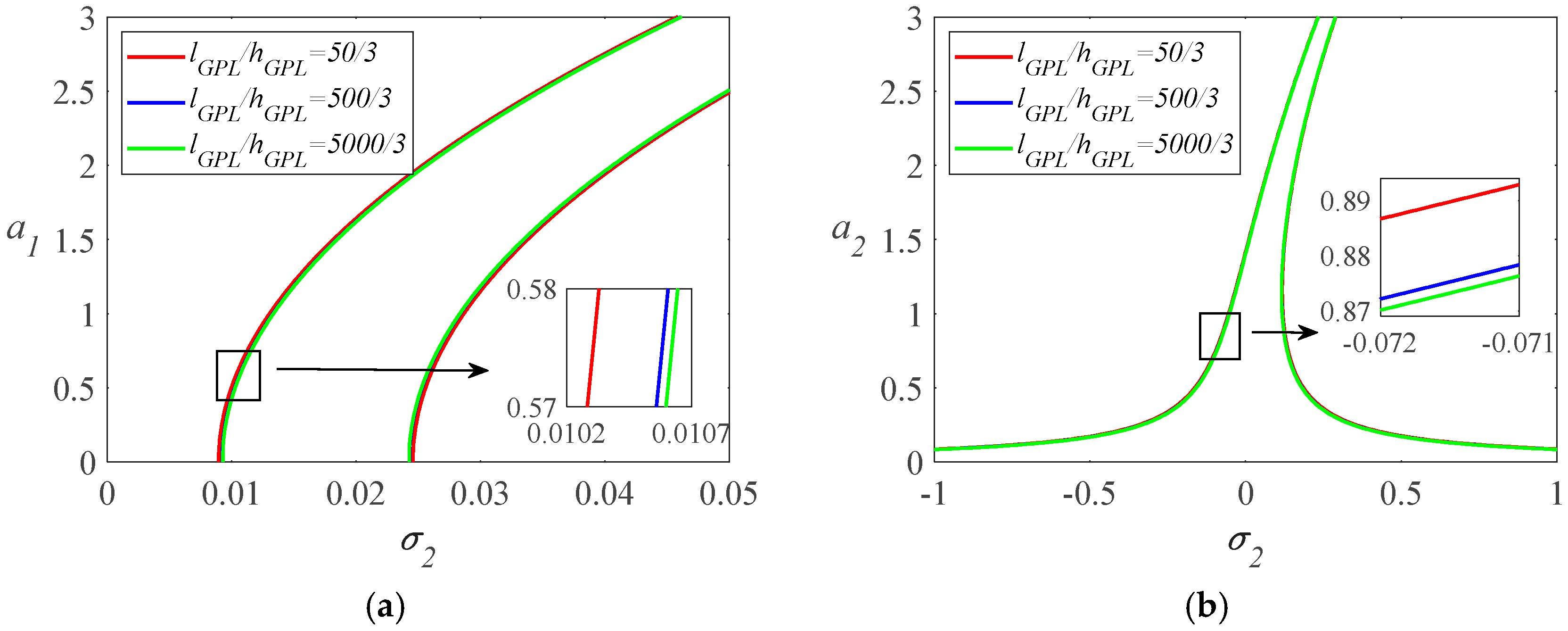
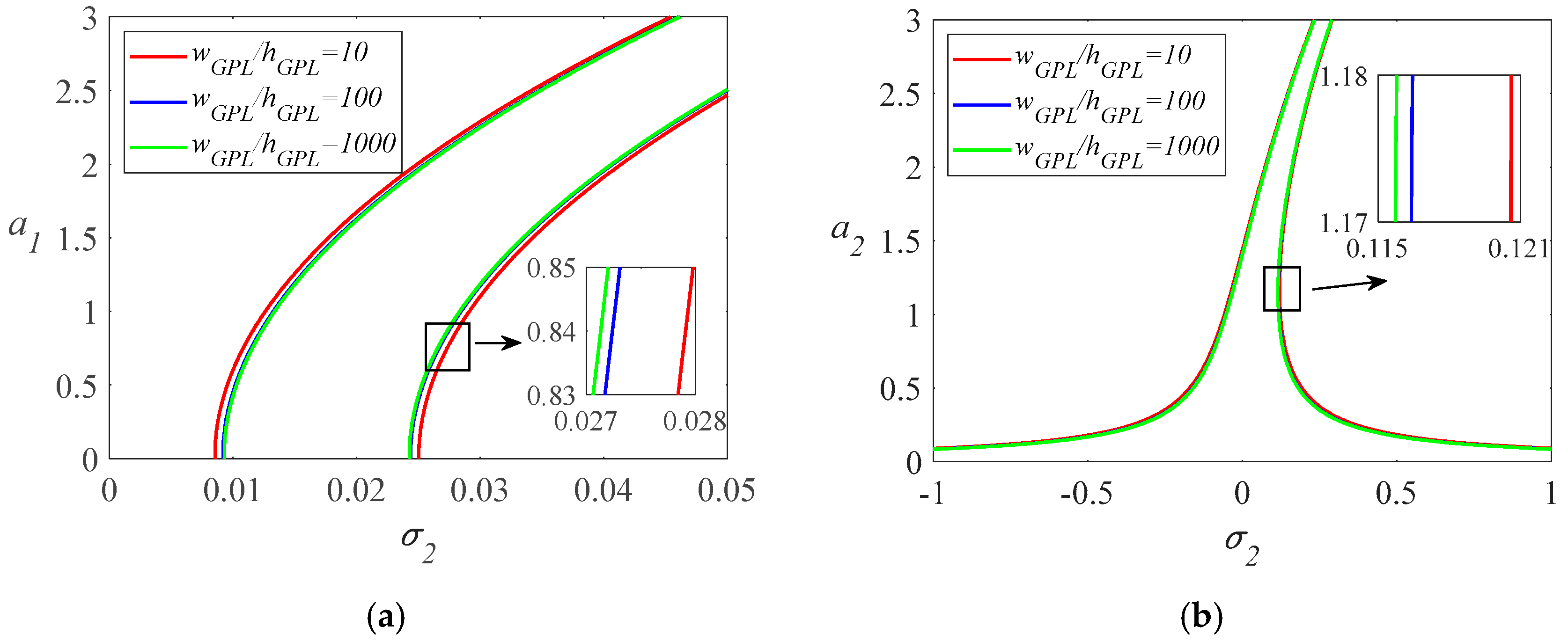
Figure 4, Figure 5, Figure 6 and Figure 7 investigate the amplitude–frequency response of the graphene-enhanced aluminum-based truncated conical shell under different graphene distributions, varying graphene contents, and different geometric dimensions of the graphene sheets when p 1 = 40,000   N / m 2 , F 2 = 20,000   N / m 2 and σ 1 = 0 .
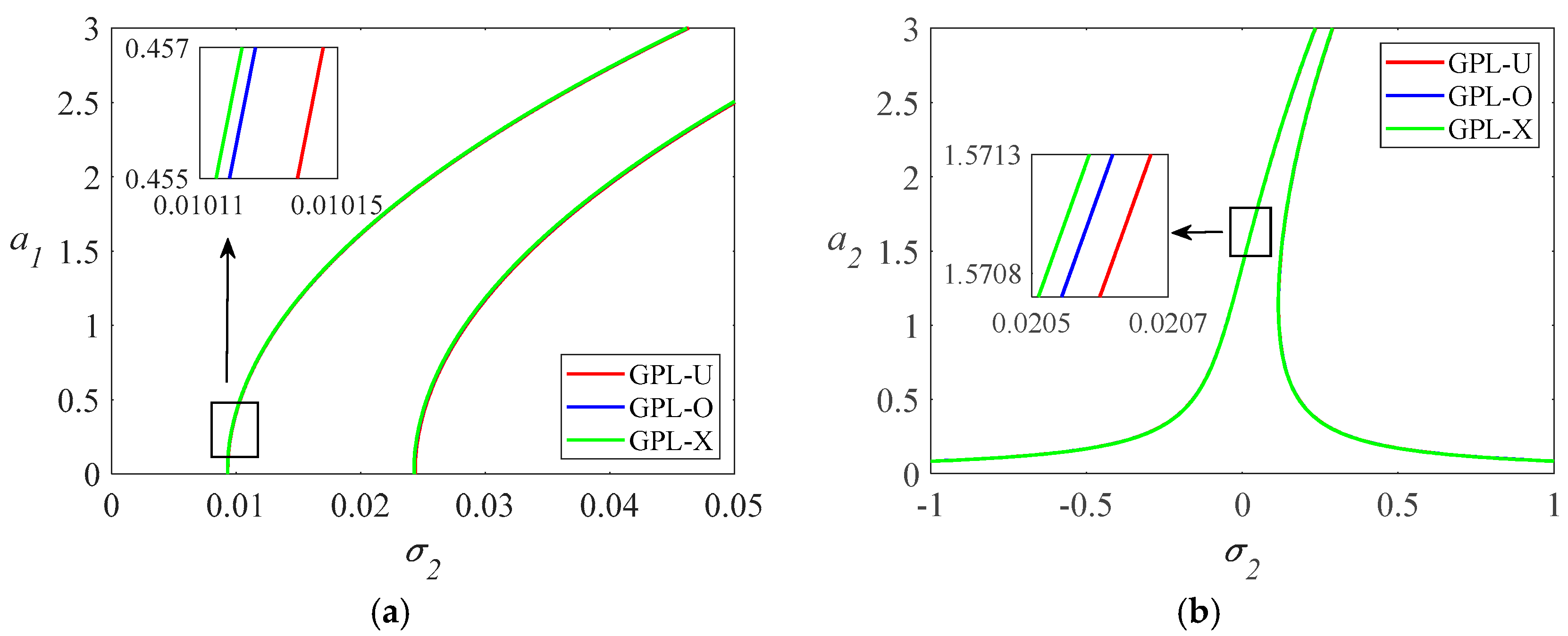
Figure 4 shows the amplitude–frequency response curves of the second-order mode of the graphene-enhanced aluminum-based truncated conical shell under different graphene distributions. In this figure, Figure 4a,b display the amplitude–frequency response curves for the first-order mode and second-order mode, respectively, with red, blue, and green representing the three types of graphene distributions: GPL-U, GPL-O, and GPL-X. As shown in Figure 4a, under the GPL-X distribution, the graphene-enhanced aluminum-based truncated conical shell has the highest amplitude, exhibiting the strongest nonlinear resonance characteristics. In contrast, under the GPL-U distribution, the system shows the lowest amplitude and the weakest nonlinear resonance characteristics. Additionally, the amplitude–frequency response curves exhibit a tendency to bend to the right, indicating that the system possesses hardening spring characteristics. Figure 4b indicates that, compared to the first-order mode, the shape of the second-order mode’s amplitude–frequency response curve is different, but it follows the same trend.
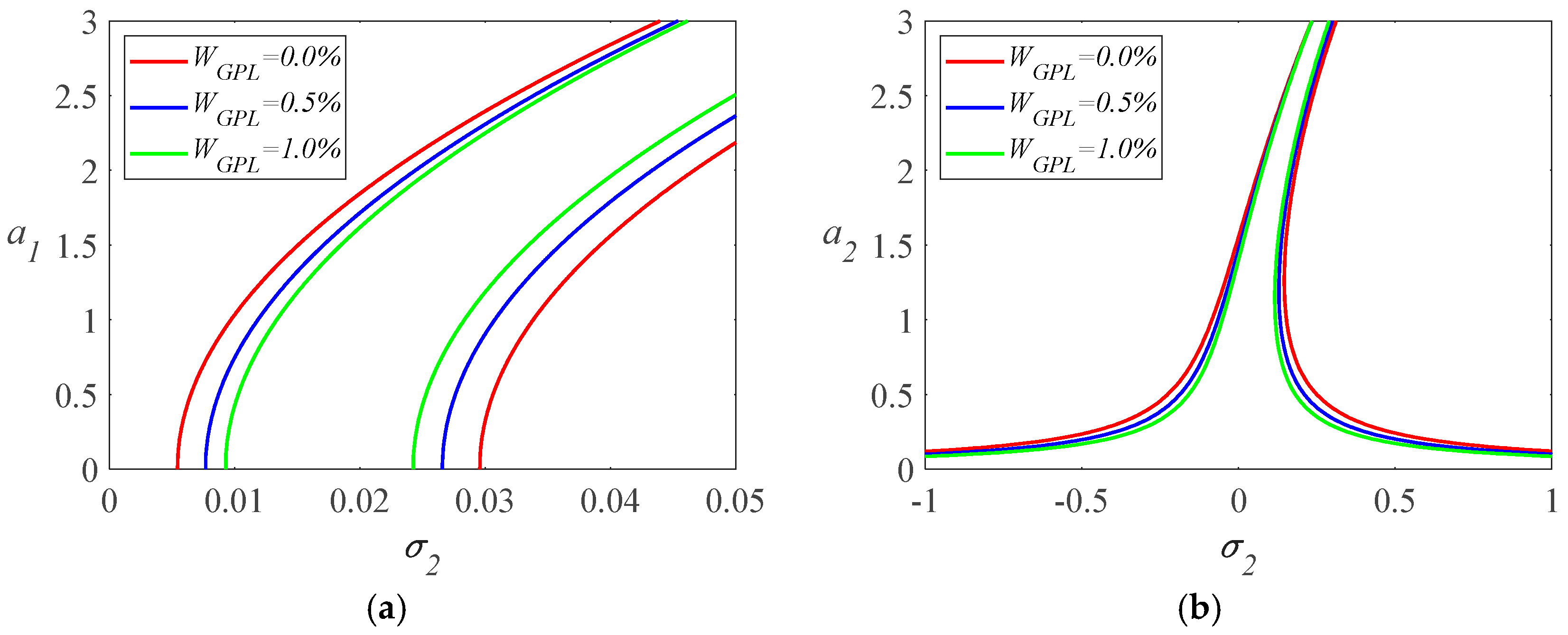
The amplitude–frequency response curves of the second-order mode of the graphene-enhanced aluminum-based truncated conical shell under different graphene content levels are shown in Figure 5. In the figure, the red, blue, and green lines correspond to graphene contents of 0.0%, 0.5%, and 1.0%, respectively. For all three graphene content levels, the amplitude–frequency response curves of the system’s second-order mode bend to the right, indicating that the system exhibits typical hardening spring characteristics. A comparison of the data in Figure 5 reveals that as the graphene content increases, the resonance region of the system’s second-order mode gradually narrows, suggesting that its nonlinear resonance characteristics gradually weaken.
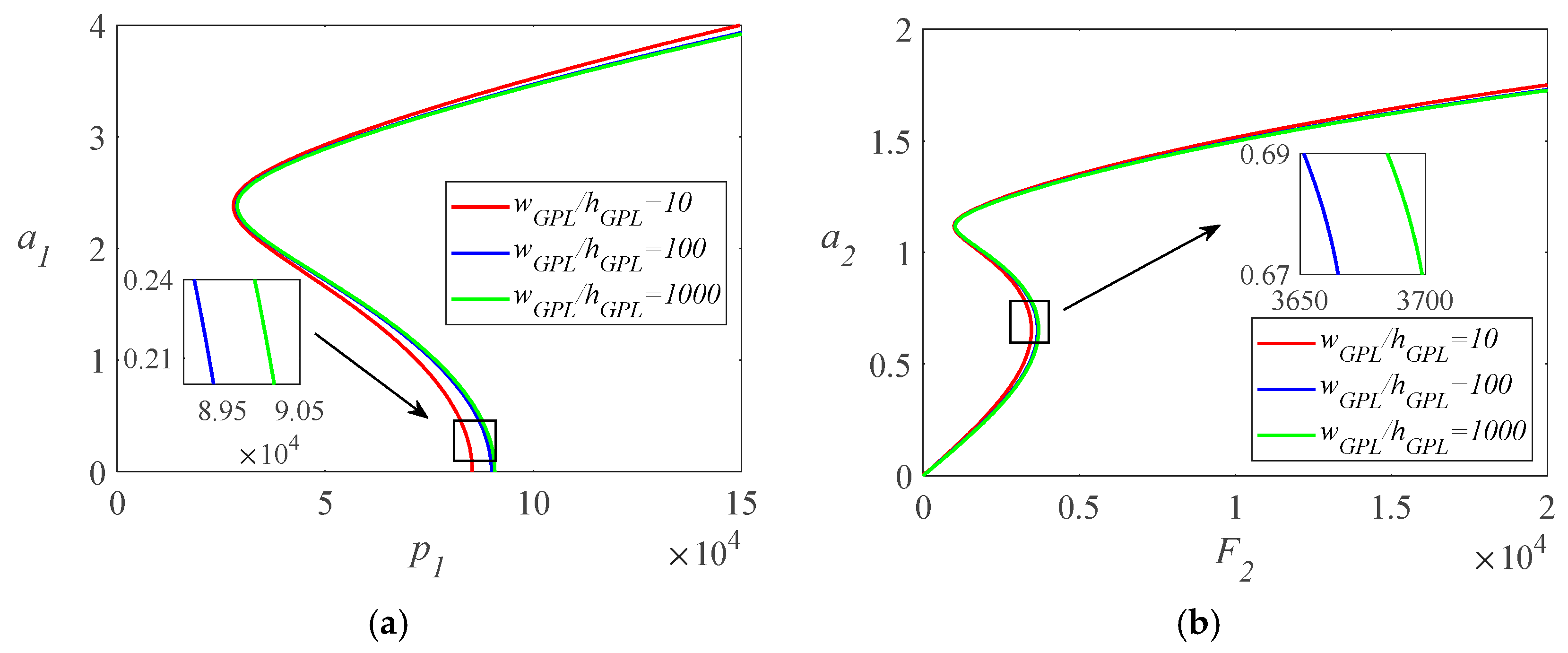
Figure 6 shows the amplitude–frequency response curves of the second-order mode of the graphene-enhanced aluminum-based truncated conical shell under different graphene sheet length-to-thickness ratios, with different colors corresponding to the graphene sheet length-to-thickness ratios of 50/3, 500/3, and 5000/3, respectively. Figure 7 displays the amplitude–frequency response curves under different graphene sheet width-to-thickness ratios, where the red, blue, and green lines correspond to width-to-thickness ratios of 10, 100, and 1000, respectively. Based on Figure 6 and Figure 7, it can be seen that as the graphene sheet length-to-thickness ratio or width-to-thickness ratio increases, the resonance region of the second-order mode of the graphene-enhanced aluminum-based truncated conical shell gradually narrows. Additionally, the amplitude–frequency response curves of the second-order mode bend to the right, indicating that the system exhibits hardening spring characteristics.
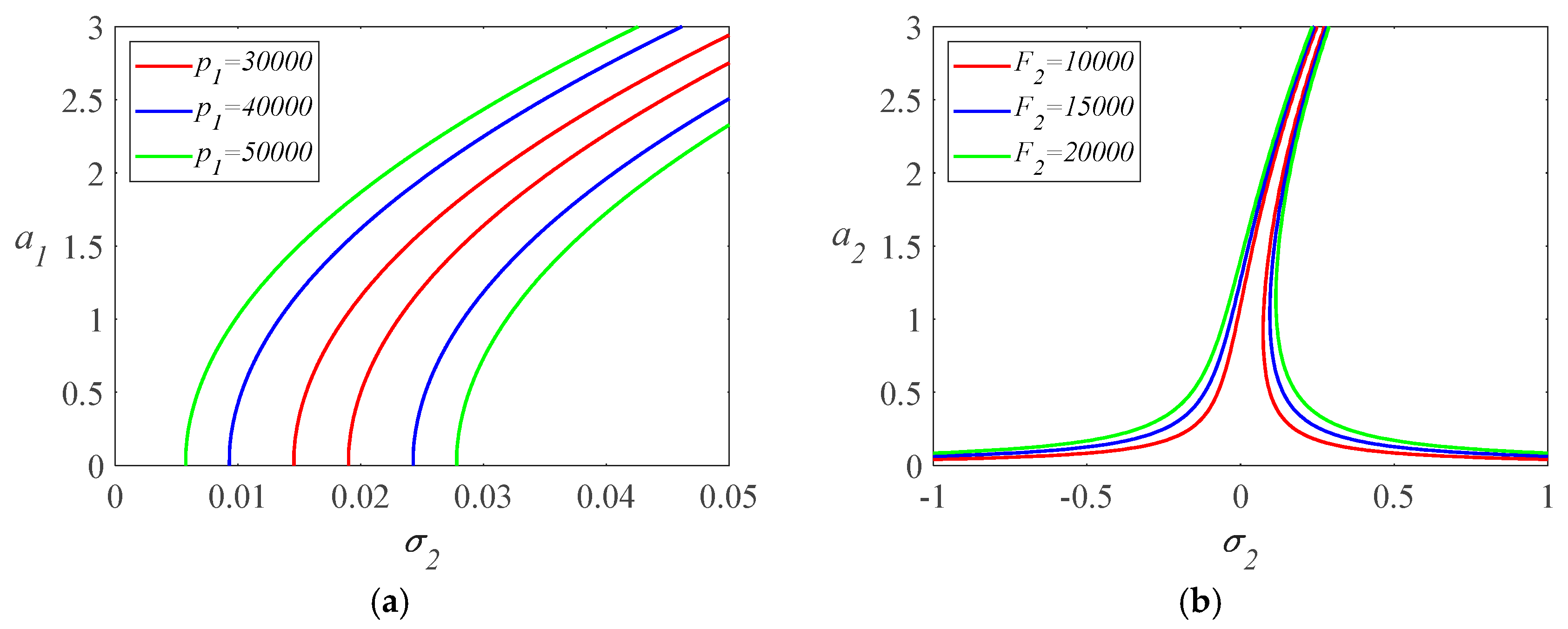
Figure 8a presents the first-order mode amplitude–frequency response curves of the graphene-enhanced aluminum-based truncated conical shell under different in-plane excitation amplitudes p 1 . The red, blue, and green lines correspond to in-plane excitation amplitudes of 30,000   N / m 2 , 40,000   N / m 2 , and 50,000   N / m 2 , respectively. As the in-plane excitation amplitude increases, the resonance region of the graphene-enhanced aluminum-based truncated conical shell gradually widens, and the nonlinear resonance characteristics become more pronounced, while the system still maintains hardening spring characteristics. Figure 8b shows the second-order mode amplitude–frequency response curves of the system under different transverse excitation amplitudes F 2 , with different colors corresponding to different transverse excitation amplitudes of 10,000   N / m 2 , 15,000   N / m 2 and 20,000   N / m 2 . Similar to the first-order mode, the second-order mode of the system also exhibits hardening spring characteristics. As seen in Figure 8b, as the transverse excitation amplitude increases, the amplitude of the system’s second-order mode gradually increases, and the resonance region widens, indicating that its nonlinear resonance characteristics are progressively strengthened.
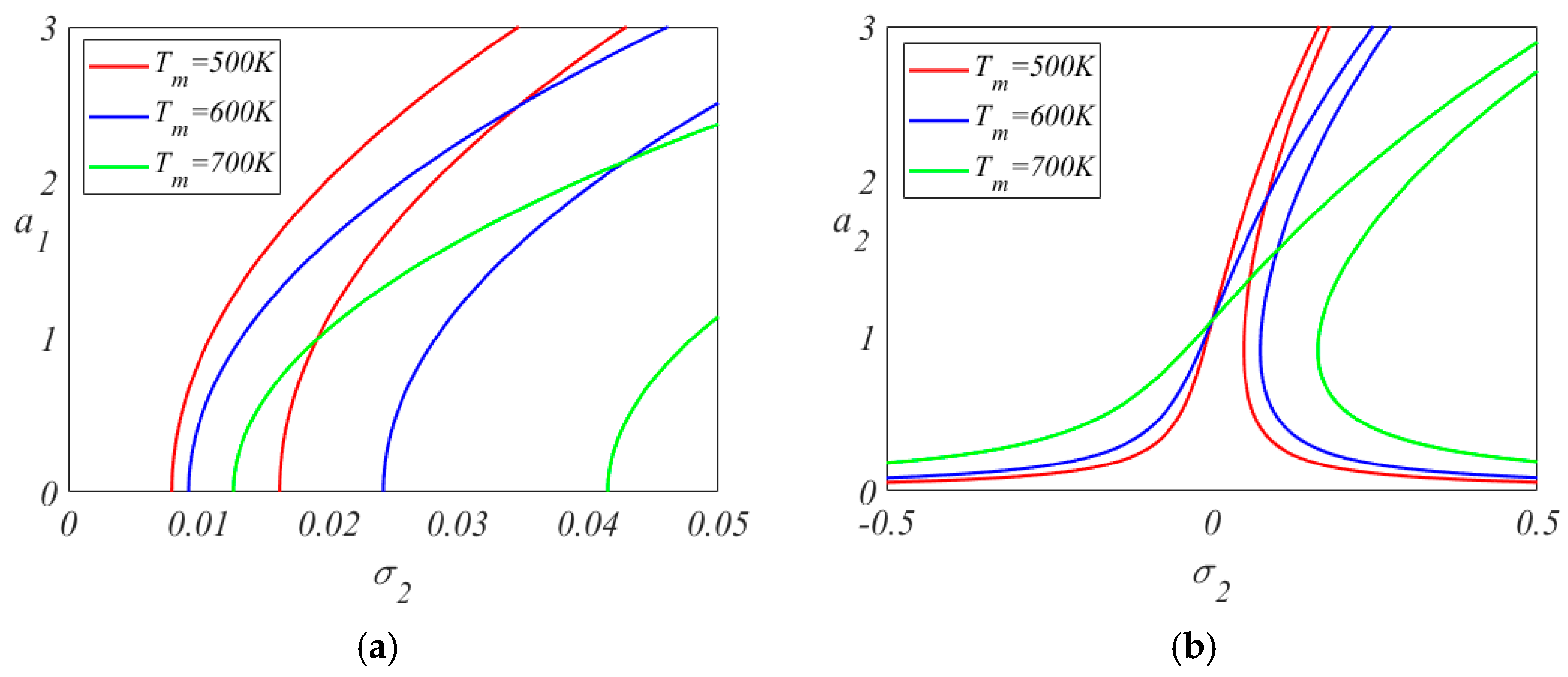
Figure 9 and Figure 10 investigate the amplitude–frequency and force–amplitude responses of the graphene-enhanced aluminum-based truncated conical shell under different external temperatures and varying structural damping coefficients when p 1 = 150,000   N / m 2 , F 2 = 30,000   N / m 2 and σ 1 = 0 .
To investigate the impact of thermal environments on the nonlinear vibration characteristics, the amplitude–frequency response curves of the graphene-reinforced aluminum-based truncated conical shell under different thermal loads are plotted in Figure 9. The outer surface temperature is set to 500 K, 600 K, and 700 K, respectively. As observed from the figures, the temperature variations significantly alter the system’s dynamic behavior. Specifically, as the temperature increases, the resonance regions of both the first and second-order modes widen and shift further to the right. This indicates that elevated temperatures enhance the nonlinear hardening spring characteristics of the system, demonstrating the high sensitivity of the shell’s nonlinear resonance behavior to thermal gradients.
Furthermore, to evaluate the effect of energy dissipation, the amplitude–frequency response curves of the shell under different structural damping coefficients are plotted in Figure 10. As expected, an increase in the damping coefficient significantly suppresses the peak amplitudes and narrows the nonlinear resonance zones, thereby reducing the multi-valued regions of the system.
Figure 11, Figure 12, Figure 13, Figure 14 and Figure 15 systematically investigate the force–amplitude characteristics of the graphene-enhanced aluminum-based truncated conical shell under variations of different parameters by plotting force–amplitude response curves.
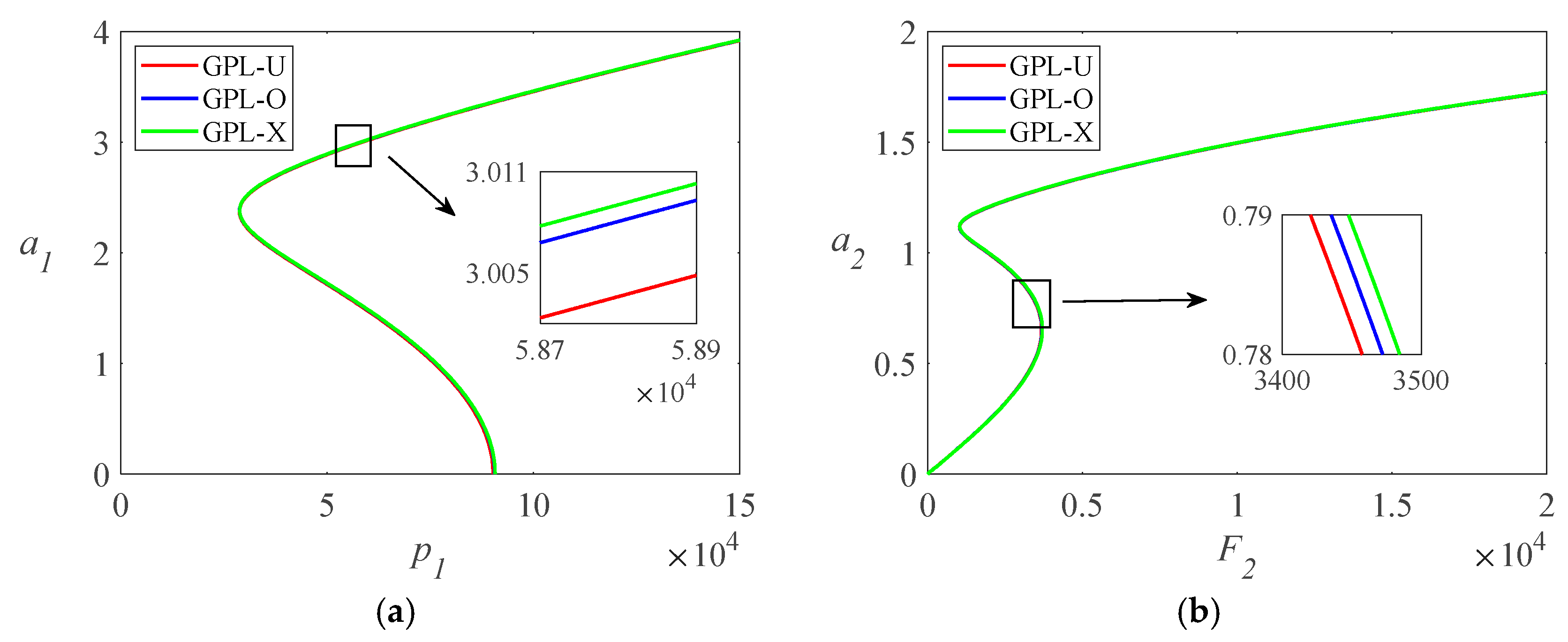
When considering different graphene distributions at σ 1 = 0 , σ 2 = 0.04 , Figure 11a presents the first-order mode force–amplitude response curve of the graphene-enhanced aluminum-based truncated conical shell under varying in-plane excitation amplitudes, while Figure 11b shows the second-order mode force–amplitude response curve of the system under varying transverse excitation amplitudes. It can be observed that there are shape differences in the force–amplitude response curves of the two modes, but both exhibit multiple amplitudes. From the figures, it is evident that the second-order mode amplitude is highest under the GPL-X distribution, while it is lowest under the GPL-U distribution.
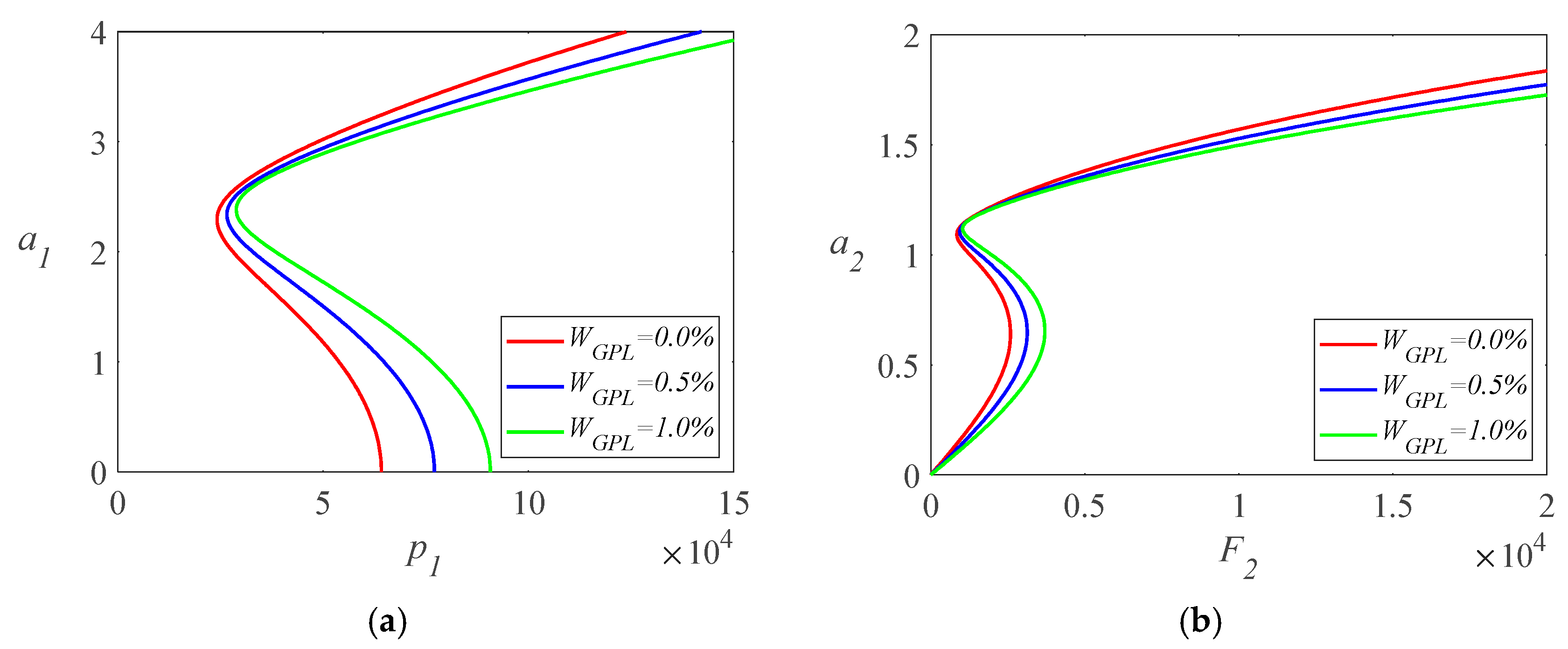
In Figure 12, with the settings of σ 1 and σ 2 from Figure 11 unchanged, the second-order mode force–amplitude response curves of the graphene-enhanced aluminum-based truncated conical shell at different graphene content levels are presented, where different colors correspond to different graphene contents of 0.0%, 0.5%, and 1.0%. From the figure, it can be observed that for a given in-plane excitation or transverse excitation amplitude, the graphene-enhanced aluminum-based truncated conical shell exhibits multiple corresponding vibration amplitudes. Furthermore, as the graphene content increases, the overall stiffness of the graphene-enhanced aluminum-based truncated conical shell improves, leading to a narrowing of its response region.
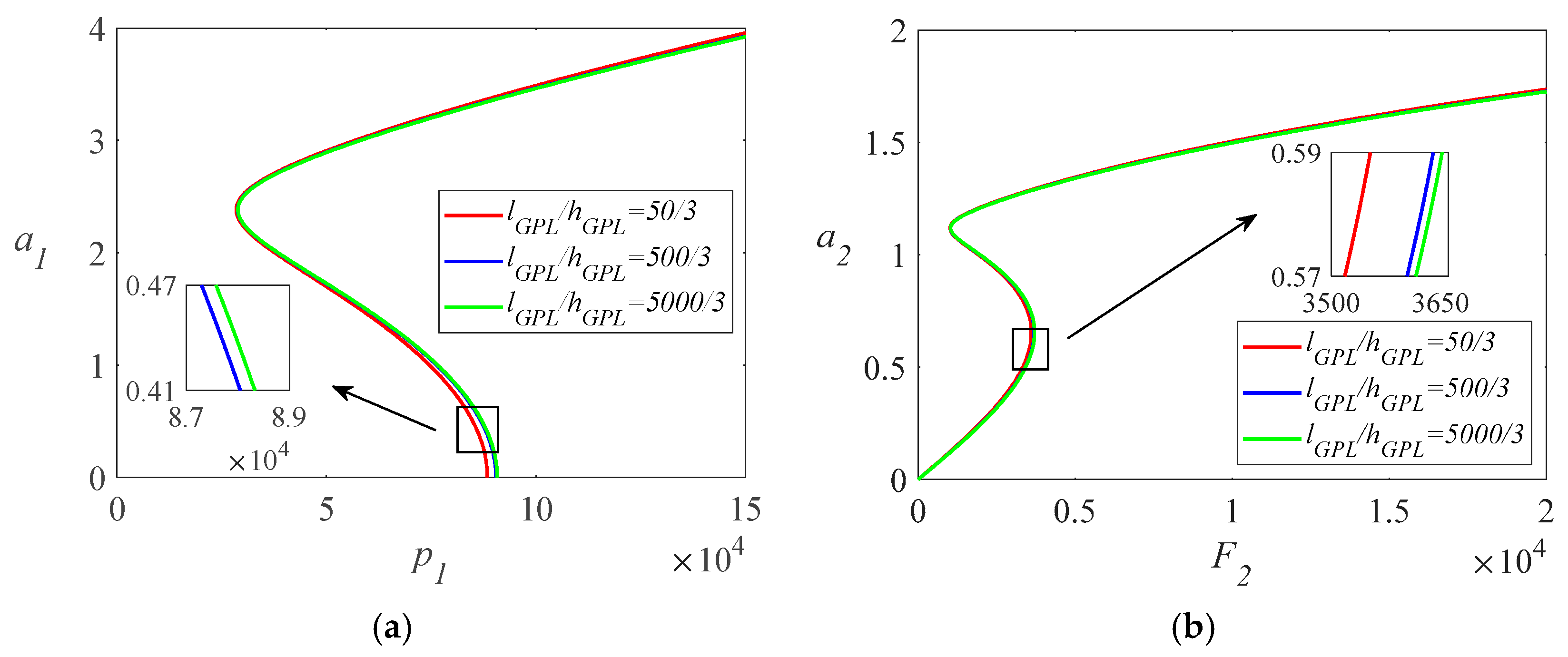
The force–amplitude response curves of the graphene-enhanced aluminum-based truncated conical shell under different graphene sheet length-to-thickness ratios and width-to-thickness ratios are shown in Figure 13 and Figure 14, respectively. In the figures, different colors correspond to different graphene sheet length-to-thickness ratios (50/3, 500/3, 5000/3) and width-to-thickness ratios (10, 100, 1000). It can be observed that as the graphene sheet length-to-thickness ratio or width-to-thickness ratio increases, the response region of the graphene-enhanced aluminum-based truncated conical shell gradually narrows, while still exhibiting multiple amplitudes.
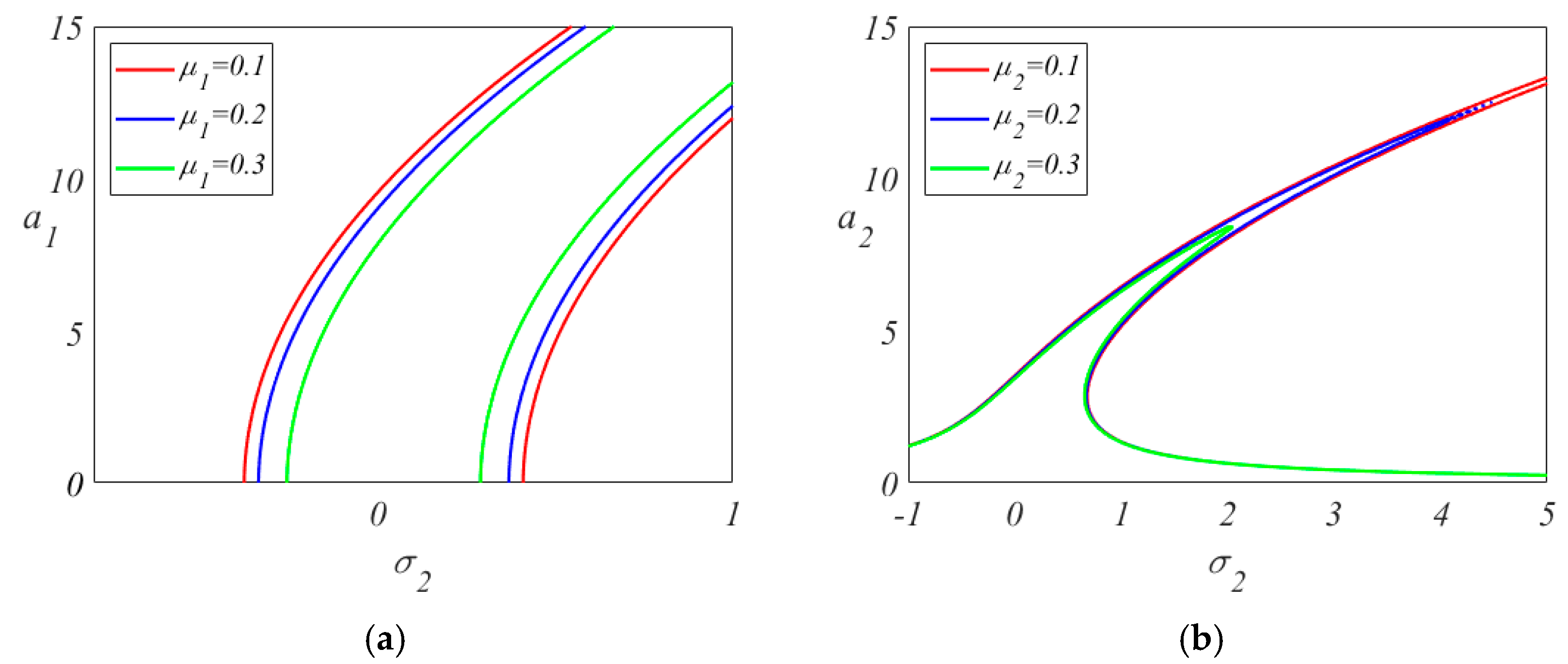
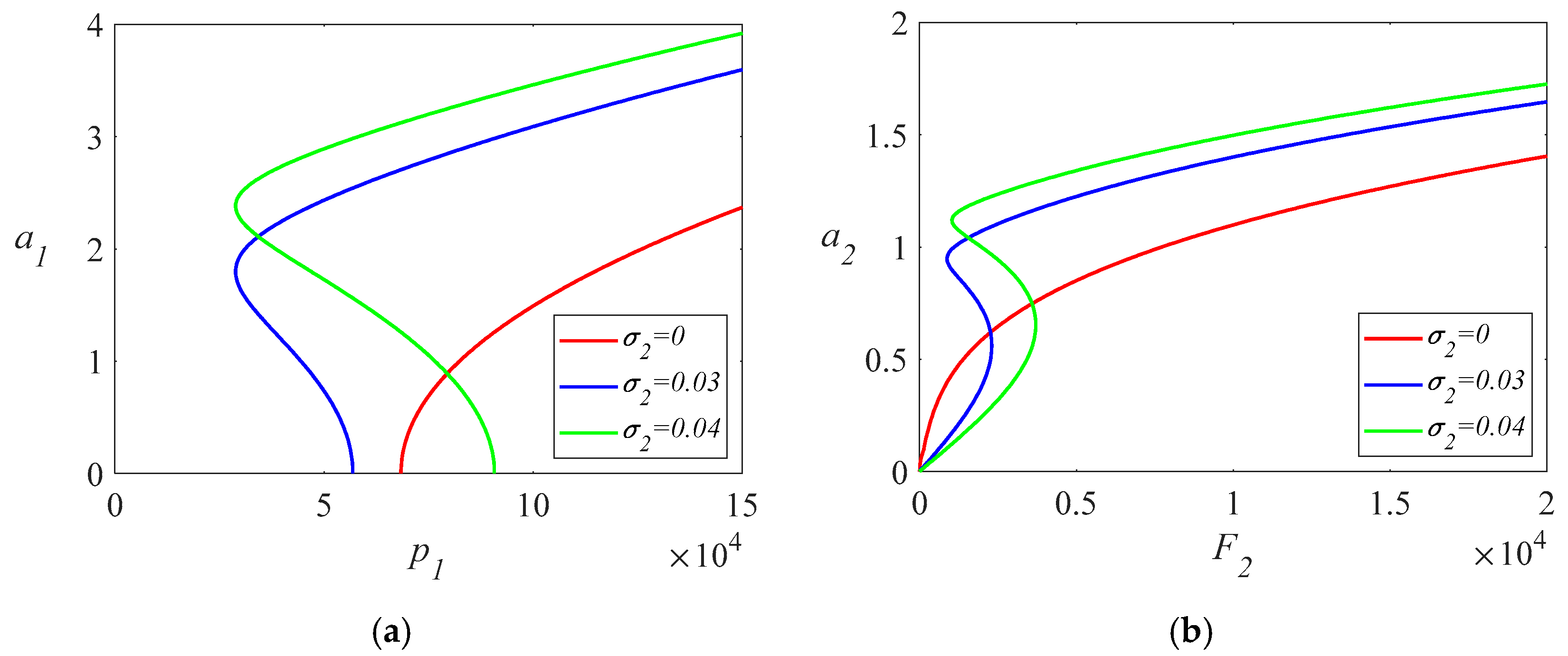
Taking the GPL-X distribution as an example, Figure 15 shows the second-order modal force–amplitude response curves of the graphene-enhanced aluminum-based truncated conical shell under different tuning parameters σ 2 . In the figure, the red, blue, and green curves correspond to σ 2 = 0 , σ 2 = 0.03 , and σ 2 = 0.04 , respectively. When the tuning parameter σ 2 is equal to 0, each in-plane excitation amplitude or lateral excitation amplitude corresponds to only one vibration amplitude. However, as the tuning parameter σ 2 increases, the system gradually exhibits multiple amplitudes. From Figure 15, it can be observed that as the tuning parameter σ 2 increases, the vibration amplitude of the graphene-enhanced aluminum-based truncated conical shell gradually increases, and the multi-amplitude range expands progressively.

5. Conclusions

This paper analyzes the vibrational response of graphene-enhanced aluminum-based truncated conical shells under 1:2 internal resonance and 1:2 subharmonic resonance conditions, considering the coupling effects of lateral and in-plane excitations. Taking temperature effects into account, based on the Reissner–Mindlin theory and von Karman’s geometric nonlinear strain–displacement relationships, the equations of motion for the GPL-enhanced aluminum-based truncated conical shell are derived using Hamilton’s principle and the Galerkin method. Subsequently, a perturbation analysis with the multiple scales method is applied to further derive the system’s polar coordinate averaged equations. Finally, based on the obtained frequency response equations, amplitude–frequency and force–amplitude response curves are plotted to study the effects of graphene distribution, graphene content, external excitation amplitude, tuning parameters, and the geometric dimensions of graphene sheets on the system’s vibrational characteristics. Furthermore, compared to existing models, the proposed approach demonstrates significant advantages. It not only maintains high computational accuracy in linear predictions but also provides a comprehensive framework to capture complex nonlinear dynamic behaviors, such as multi-valued responses and jump phenomena. The specific conclusions are as follows:
(1) The shapes of the second-order modal amplitude–frequency response curves of the graphene-enhanced aluminum-based truncated conical shell are different but all curve to the right, indicating that the second-order modes of the system exhibit hardening spring characteristics.
(2) Graphene content is one of the main factors affecting the vibrational characteristics of the graphene-enhanced aluminum-based truncated conical shell. With an increase in graphene content and a decrease in external excitation amplitude, the system’s nonlinear resonance characteristics gradually weaken, showing that the resonance region of the second-order mode becomes narrower.
(3) The distribution of graphene and the geometric dimensions of graphene sheets do not significantly change the amplitude–frequency and force–amplitude responses of the graphene-enhanced aluminum-based truncated conical shell.
(4) As the tuning parameter σ 2 increases, the vibration amplitude of the second-order mode of the graphene-enhanced aluminum-based truncated conical shell gradually increases, and the multi-amplitude range expands progressively.
(5) Elevated temperatures enhance the hardening spring characteristics and widen the resonance regions, whereas increased damping effectively suppresses peak amplitudes and narrows the nonlinear multi-valued zones.

Author Contributions

Conceptualization, W.M.; methodology, G.L.; software, D.L.; validation, B.L.; formal analysis, D.L.; investigation, G.L.; resources, B.L., H.L.; data curation, X.J.; writing—original draft preparation, G.L.; writing—review and editing, R.S.; visualization, X.J.; supervision, W.M.; project administration, W.M. All authors have read and agreed to the published version of the manuscript.

Funding

The authors sincerely acknowledge financial support from the National Natural Science Foundation of China (Nos. 12102207, 12272189), Natural Science Foundation of Inner Mongolia (Grant No. 2026QB031 and 2023MS01014), High-level talent recruitment project (Gccrcxm-202507), Basic Scientific Research Expenses Program of Universities Directly under Inner Mongolia Autonomous Region (No. JY20250055).

Data Availability Statement

The data that support the findings of this study are available from the corresponding authors upon reasonable request.

Conflicts of Interest

The funders had no role in the design of the study; in the collection, analyses, or interpretation of data; in the writing of the manuscript; or in the decision to publish the results.

References

  1. Li, H.; Hao, Y.X.; Zhang, W.; Liu, L.; Yang, S.; Wang, D. Vibration analysis of porous metal foam truncated conical shells with general boundary conditions using GDQ. Compos. Struct. 2021, 269, 114036. [Google Scholar] [CrossRef]
  2. Mirjavadi, S.S.; Forsat, M.; Barati, M.R.; Hamouda, A.M.S. Analysis of nonlinear vibrations of CNT-/fiberglass-reinforced multi-scale truncated conical shell segments. Mech. Based Des. Struct. Mach. 2022, 50, 2067–2083. [Google Scholar] [CrossRef]
  3. Wu, C.P.; Chiu, L.Y. Three-dimensional free vibration analysis of rotating sandwich functionally graded truncated conical shells under various boundary conditions. Mech. Based Des. Struct. Mach. 2023, 51, 1247–1271. [Google Scholar] [CrossRef]
  4. Arisa, H.; Ahmadi, H. Superharmonic and subharmonic vibration resonances of rotating stiffened FGM truncated conical shells. Struct. Eng. Mech. 2023, 85, 545–562. [Google Scholar]
  5. Banijamali, S.M.; Jafari, A.A. Vibration analysis and critical speeds of a rotating functionally graded conical shell stiffened with Anisogrid lattice structure based on FSDT. Thin-Walled Struct. 2023, 188, 110841. [Google Scholar] [CrossRef]
  6. Shadmani, M.; Afsari, A.; Jahedi, R.; Kazemzadeh-Parsi, M.J. Nonlinear free vibrations analysis of truncated conical shells made of bidirectional functionally graded materials. J. Vib. Control 2024, 30, 2842–2856. [Google Scholar] [CrossRef]
  7. Hao, Y.X.; Li, H.; Zhang, W.; Gu, X.; Yang, S. Nonlinear vibration of porous truncated conical shell under unified boundary condition and mechanical load. Thin-Walled Struct. 2024, 195, 111355. [Google Scholar] [CrossRef]
  8. Sun, L.; Hao, Y.X.; Zhang, W.; Li, H. Traveling wave vibration and critical rotating speed of rotating porous metal conical shell with elastic boundary conditions. Aerosp. Sci. Technol. 2024, 148, 109091. [Google Scholar] [CrossRef]
  9. Yang, S.W.; Wang, Z.Q.; Hao, Y.X.; Zhang, W.; Ma, W.S.; Niu, Y. Nonlinear dynamic response and bifurcation of variable thickness sandwich conical shell with internal resonance. Nonlinear Dyn. 2024, 112, 8931–8965. [Google Scholar] [CrossRef]
  10. Wang, Z.Q.; Yang, S.W.; Hao, Y.X.; Zhang, W.; Ma, W.; Niu, Y. High-dimensional nonlinear flutter suppression of variable thickness porous sandwich conical shells based on nonlinear energy sink. J. Sound. Vib. 2025, 595, 118731. [Google Scholar] [CrossRef]
  11. Yang, S.W.; Hao, Y.X.; Zhang, W.; Yang, L.; Liu, L. Nonlinear vibration of functionally graded graphene platelet-reinforced composite truncated conical shell using first-order shear deformation theory. Appl. Math. Mech. (Engl. Ed.) 2021, 42, 981–998. [Google Scholar] [CrossRef]
  12. Amirabadi, H.; Farhatnia, F.; Civalek, Ӧ. Frequency response of rotating two-directional functionally graded GPL-reinforced conical shells on elastic foundation. J. Braz. Soc. Mech. Sci. Eng. 2021, 43, 349. [Google Scholar] [CrossRef]
  13. Khayat, M.; Baghlani, A.; Dehghan, S.M.; Najafgholipour, M.A. The influence of graphene platelet with different dispersions on the vibrational behavior of nanocomposite truncated conical shells. Steel Compos. Struct. 2021, 38, 47–66. [Google Scholar]
  14. Amirabadi, H.; Farhatnia, F.; Eftekhari, S.A.; Hosseini-Ara, R. Free vibration analysis of rotating functionally graded GPL-reinforced truncated thick conical shells under different boundary conditions. Mech. Based Des. Struct. Mach. 2022, 50, 3821–3852. [Google Scholar] [CrossRef]
  15. Adab, N.; Arefi, M.; Amabili, M. A comprehensive vibration analysis of rotating truncated sandwich conical microshells including porous core and GPL-reinforced face-sheets. Compos. Struct. 2022, 279, 114761. [Google Scholar] [CrossRef]
  16. Sobhani, E.; Safaei, B. Vibrational features of graphene oxide powder nanocomposite coupled conical-cylindrical shells applicable for aerospace structures under various boundary conditions. Eng. Anal. Bound. Elem. 2023, 151, 423–438. [Google Scholar] [CrossRef]
  17. Adab, N.; Arefi, M. Vibrational behavior of truncated conical porous GPL-reinforced sandwich micro/nano-shells. Eng. Comput. 2023, 39, 419–443. [Google Scholar] [CrossRef]
  18. Gao, Z.Y.; Shi, X.J.; Huang, Z.; Zhong, R.; Wang, Q. Spectro-geometric solutions for random vibration of functionally graded graphene platelet reinforced conical shells. Thin-Walled Struct. 2024, 195, 111410. [Google Scholar] [CrossRef]
  19. Saboori, R.; Ghadiri, M. Nonlinear forced vibration analysis of PFG-GPLRC conical shells under parametric excitation considering internal and external resonances. Thin-Walled Struct. 2024, 196, 111474. [Google Scholar] [CrossRef]
  20. Huang, X.L.; Wei, N.G.; Wang, C.Z.; Zhang, X. Nonlinear free vibration analysis of functionally graded porous conical shells reinforced with graphene nanoplatelets. Stroj. Vestn.-J. Mech. Eng. 2024, 70, 181–193. [Google Scholar] [CrossRef]
  21. Li, Z.; Wang, Q.S.; Yang, Q.; Qin, B. Stochastic vibration response of multilayer FG-GPLRC truncated conical shell subjected to moving random loads. J. Vib. Eng. Technol. 2025, 13, 179. [Google Scholar] [CrossRef]
  22. Huang, X.L.; Wei, Y.H.; Mo, W.J.; Zhang, Y. Nonlinear vibration analysis of axially moving truncated porous composite conical shells reinforced with graphene nanoplatelets. J. Vib. Eng. Technol. 2025, 13, 121. [Google Scholar] [CrossRef]
  23. Ma, W.S.; Li, D.X.; Yang, S.W.; Lu, S.; Song, X.; Huang, S.; Zhang, W. Vibration characteristics and unstable regions of a functionally graded GPL-reinforced aluminum-based truncated conical shell with 1:1 internal resonance. Int. J. Struct. Stab. Dyn. 2026, 26, 2650122. [Google Scholar] [CrossRef]
  24. Ye, C.; Wang, Y.Q. Nonlinear forced vibration of functionally graded graphene platelet-reinforced metal foam cylindrical shells: Internal resonances. Nonlinear Dyn. 2021, 104, 2051–2069. [Google Scholar] [CrossRef]
  25. Zhang, C.W.; Jin, Q.; Song, Y.S.; Wang, J.; Sun, L.; Liu, H.; Dun, L.; Tai, H.; Yuan, X.; Xiao, H.; et al. Vibration analysis of a sandwich cylindrical shell in hygrothermal environment. Nanotechnol. Rev. 2021, 10, 414–430. [Google Scholar] [CrossRef]
  26. Khayat, M.; Baghlani, A.; Dehghan, S.M.; Najafgholipour, M.A. Geometrically nonlinear dynamic analysis of functionally graded porous partially fluid-filled cylindrical shells subjected to exponential loads. J. Vib. Control 2022, 28, 758–772. [Google Scholar] [CrossRef]
  27. Salehi, M.; Gholami, R.; Ansari, R. Nonlinear resonance of functionally graded porous circular cylindrical shells reinforced by graphene platelet with initial imperfections using higher-order shear deformation theory. Int. J. Struct. Stab. Dyn. 2022, 22, 2250075. [Google Scholar] [CrossRef]
  28. Liu, T.; Duan, J.Q.; Zheng, Y.; Qian, Y. Free vibrations of a new three-phase composite cylindrical shell. Aerospace 2023, 10, 1007. [Google Scholar] [CrossRef]
  29. Rad, M.H.G.; Hosseini, S.M. The modified CUF-EFG method for the dynamic analysis of GPLs-CNTs-reinforced FG multilayer thick cylindrical shells under shock loadings: A modified meshless implementation. Eng. Anal. Bound. Elem. 2023, 156, 499–518. [Google Scholar] [CrossRef]
  30. Sobhani, E.; Safaei, B. Vibrational development of nanocomposite cylindrical shells by employing reduced graphene oxide (rGO) as a nanoscale strengthener. Eng. Anal. Bound. Elem. 2023, 155, 920–934. [Google Scholar] [CrossRef]
  31. Fang, K.; Huang, G.K.; Yu, G.R.; Xu, W.; Yuan, W. Free vibration analysis of graphene origami-reinforced nano cylindrical shell. Mech. Adv. Mater. Struct. 2024, 31, 12099–12111. [Google Scholar] [CrossRef]
  32. Zhao, T.Y.; Yan, K.; Jiang, Z.Y.; Chi, W. Theoretical modeling and vibration prediction of a spinning graphene nanoplatelet reinforced cylindrical shell internal attached with a beam. Mech. Based Des. Struct. Mach. 2024, 52, 2297–2315. [Google Scholar] [CrossRef]
  33. Monajemi, A.A.; Mohammadimehr, M.; Bargozini, F. Dynamic analysis of a spinning visco-elastic FG graphene platelets reinforced nanocomposite sandwich cylindrical shell with MRE core. Acta Mech. 2024, 235, 7497–7530. [Google Scholar] [CrossRef]
  34. Chen, X.H.; Shen, H.S.; Li, C. Reexamination for linear and nonlinear free vibration of porous sandwich cylindrical shells reinforced by graphene platelets. Mech. Adv. Mater. Struct. 2024, 31, 4781–4794. [Google Scholar] [CrossRef]
  35. Hasan, H.M.; Ali, A.Y. Nonlinear forced vibration of functionally graded graphene-reinforced composite (FG-GRC) laminated cylindrical shells under different boundary conditions with thermal repercussions. Int. J. Struct. Stab. Dyn. 2024, 24, 2450207. [Google Scholar] [CrossRef]
  36. Jahanbazi, R.; Kiani, Y.; Beni, Y.T. Free vibration behaviour of composite laminated skew cylindrical shells reinforced with graphene platelets. Structures 2024, 61, 106074. [Google Scholar] [CrossRef]
  37. Escobar, M.; Shadhar, M.H.; Kadhim, Y.M.; Morocho, W.M.B.; Kaur, H.; Escobar, J.O.C.; Verma, R.; Al-Musawi, T.J.; Elmasry, Y. A comprehensive investigation on the effect of graphene nanoplatelets characteristics on the natural frequency responses of shear deformable cylindrical shell. J. Vib. Eng. Technol. 2025, 13, 165. [Google Scholar] [CrossRef]
  38. Thang, P.T.; Kim, C.; Jang, H.; Kim, T.; Kim, J. Free vibration characteristics of honeycomb sandwich cylindrical shells reinforced with graphene nanoplatelets/polymer coatings. Aerosp. Sci. Technol. 2025, 156, 109744. [Google Scholar] [CrossRef]
  39. Li, Y.P.; She, G.L. Nonlinear dynamic response of graphene platelets reinforced cylindrical shells under moving loads considering initial geometric imperfection. Eng. Struct. 2025, 323, 119241. [Google Scholar] [CrossRef]
  40. Esmaeili, H.R.; Kiani, Y. Vibrations of graphene platelet reinforced composite doubly curved shells subjected to thermal shock. Mech. Based Des. Struct. Mach. 2024, 52, 650–679. [Google Scholar] [CrossRef]
  41. Esmaeili, H.R.; Kiani, Y. On the response of graphene platelet reinforced composite laminated plates subjected to instantaneous thermal shock. Eng. Anal. Bound. Elem. 2022, 141, 167–180. [Google Scholar] [CrossRef]
  42. Wang, L.Y.; Cao, D.X.; Gu, J.Y. Nonlinear stochastic vibration of GPRMF cylindrical shell with harmonic and white noise excitations. Commun. Nonlinear Sci. Numer. Simul. 2025, 142, 108592. [Google Scholar] [CrossRef]
  43. Wu, H.L.; Yang, J.; Kitipornchai, S. Dynamic instability of functionally graded multilayer graphene nanocomposite beams in thermal environment. Compos. Struct. 2017, 162, 244–254. [Google Scholar] [CrossRef]
  44. Reddy, J.N. Mechanics of Laminated Composite Plates and Shells: Theory and Analysis, 2nd ed.; CRC Press: Boca Raton, FL, USA, 2004. [Google Scholar]
  45. Ninh, D.G.; Bich, D.H. Nonlinear thermal vibration of eccentrically stiffened ceramic-FGM-metal layer toroidal shell segments surrounded by elastic foundation. Thin-Walled Struct. 2016, 104, 198–210. [Google Scholar] [CrossRef]
  46. Fares, M.E.; Youssif, Y.G.; Alamir, A.E. Design and control optimization of composite laminated truncated conical shells for minimum dynamic response including transverse shear deformation. Compos. Struct. 2004, 64, 139–150. [Google Scholar] [CrossRef]
  47. Yang, S.W.; Wang, Z.Q.; Hao, Y.X.; Zhang, W.; Niu, Y.; Ma, W. Nonlinear dynamic characteristics of smart FG-GPLRC sandwich varying thickness truncated conical shell with internal resonance for first three order modes. Aerosp. Sci. Technol. 2024, 155, 109672. [Google Scholar] [CrossRef]
  48. Nosier, A.; Reddy, J.N. A study of non-linear dynamic equations of higher-order shear deformation plate theories. Int. J. Non-Linear Mech. 1991, 26, 233–249. [Google Scholar] [CrossRef]
  49. Lam, K.Y.; Hua, L. Influence of boundary conditions on the frequency characteristics of a rotating truncated circular conical shell. J. Sound. Vib. 1999, 223, 171–195. [Google Scholar] [CrossRef]
  50. Li, F.M.; Kishimoto, K.; Huang, W.H. The calculations of natural frequencies and forced vibration responses of conical shell using the Rayleigh-Ritz method. Mech. Res. Commun. 2009, 36, 595–602. [Google Scholar] [CrossRef]
Figure 1. Theoretical model of a graphene-reinforced aluminum-based truncated conical shell.
Jcs 10 00313 g001
Figure 2. Three graphene distributions (a) GPL-U distribution (b) GPL-O distribution (c) GPL-X distribution.
Jcs 10 00313 g002
Figure 3. Two-order natural frequencies of the graphene-platelet-reinforced aluminum-based truncated conical shell under three graphene distributions.
Jcs 10 00313 g003
Figure 4. Amplitude–frequency response curves under different graphene distributions (a) first-order mode; (b) second-order mode.
Jcs 10 00313 g004
Figure 5. Amplitude–frequency response curves under different graphene contents (a) first-order mode; (b) second-order mode.
Jcs 10 00313 g005
Figure 6. Amplitude–frequency response curves under different length-to-thickness ratios of GPLs (a) first-order mode; (b) second-order mode.
Jcs 10 00313 g006
Figure 7. Amplitude–frequency response curves under different width-to-thickness ratios of GPLs (a) first-order mode; (b) second-order mode.
Jcs 10 00313 g007
Figure 8. Amplitude–frequency response curves under different excitation amplitudes (a) first-order mode; (b) second-order mode.
Jcs 10 00313 g008
Figure 9. Amplitude–frequency response curves under different external temperatures (a) first-order mode; (b) second-order mode.
Jcs 10 00313 g009
Figure 10. Amplitude–frequency response curves under different temperatures (a) first-order mode; (b) second-order mode.
Jcs 10 00313 g010
Figure 11. Force–amplitude response curves under different graphene distributions (a) first-order mode; (b) second-order mode.
Jcs 10 00313 g011
Figure 12. Force–amplitude response curves under different graphene contents (a) first-order mode; (b) second-order mode.
Jcs 10 00313 g012
Figure 13. Force–amplitude response curves under different length-to-thickness ratios of GPLs (a) first-order mode; (b) second-order mode.
Jcs 10 00313 g013
Figure 14. Force–amplitude response curves under different width-to-thickness ratios of GPLs (a) first-order mode; (b) second-order mode.
Jcs 10 00313 g014
Figure 15. Force–amplitude response curves under different tuning parameter values (a) first-order mode; (b) second-order mode.
Jcs 10 00313 g015
Table 1. Dimensionless natural frequencies of a truncated conical shell at different semi-vertical angles.
n 2345
β = π / 6 Present0.84970.75020.65460.5796
Lam and Hua [49]0.84200.73760.63620.5528
Error/%0.911.712.894.85
Li et al. [50]0.84310.74160.64190.5590
Error/%0.781.161.983.69
β = π / 4 Present0.76940.72930.68780.6539
Lam and Hua [49]0.76550.72120.67390.6323
Error/%0.511.122.063.42
Li et al. [50]0.76420.72110.67470.6336
Error/%0.681.141.943.20
β = π / 3 Present0.63870.63180.62830.6321
Lam and Hua [49]0.63480.62380.61450.6111
Error/%0.611.282.253.44
Li et al. [50]0.63420.62360.61460.6113
Error/%0.711.322.233.40
Disclaimer/Publisher’s Note: The statements, opinions and data contained in all publications are solely those of the individual author(s) and contributor(s) and not of MDPI and/or the editor(s). MDPI and/or the editor(s) disclaim responsibility for any injury to people or property resulting from any ideas, methods, instructions or products referred to in the content.