Article

Optimized Sol–Gel Synthesis of Li3V2(PO4)3/C Composite Cathode Material: The Role of Pyrolysis Temperature and Carbon Content on Structural and Electrochemical Performance


by
Alina I. Seroshtan
1,2,
Zlata E. Priimak
1,2,
Polina A. Marmaza
1,2,
Dana E. Lembikova
1,2,
Nikita P. Ivanov
1,2,
Vladimir L. Rastorguev
2,3,
Alena R. Zaikova
2,3,
Alexander V. Syuy
4,5,6,
Yang Chengkai
2,
Anton V. Shurygin
2,
Vasilii I. Nemtinov
2,
Kirill A. Pervakov
2,
Ivan G. Tananaev
2,7,
Eugeniy K. Papynov
2,
Alexy V. Ognev
1,2 and
Oleg O. Shichalin
1,2,7,*
1
Electrochemical Sources for Renewable Energy Research Laboratory, Institute of Natural Sciences and Technosphere Safety, Sakhalin State University, Communist Ave. 33, Yuzhno-Sakhalinsk 693008, Russia
2
Far Eastern Federal University, 10 Ajax Bay, Russky Island, Vladivostok 690922, Russia
3
Far-Eastern Geological Institute, Far-Eastern Branch of the Russian Academy of Sciences, 159, Prospekt 100-letiya, Vladivostok 690022, Russia
4
Moscow Center for Advanced Studies, Kulakova str. 20, Moscow 123592, Russia
5
Department of General Physics, Perm National Research Polytechnic University, Perm 614990, Russia
6
Emerging Technologies Research Center, XPANCEO, Dubai, United Arab Emirates
7
Kola Science Center, Tananaev Institute of Chemistry and Technology of Rare Elements and Mineral Ra Materials, Russian Academy of Sciences, Akademgorodok, 26a, Apatity 184209, Russia
*
Author to whom correspondence should be addressed.
J. Compos. Sci. 2026, 10(6), 303; https://doi.org/10.3390/jcs10060303
Submission received: 6 May 2026 / Revised: 23 May 2026 / Accepted: 28 May 2026 / Published: 31 May 2026
(This article belongs to the Special Issue Composite Materials for Energy Management, Storage or Transportation)

Abstract

Lithium-ion batteries require cathode materials with high capacity and cycling stability. Li3V2(PO4)3 (LVP) offers a theoretical capacity of 197 mAh/g but suffers from poor electronic conductivity. In this study, a Li3V2(PO4)3/carbon (LVP/C) composite was synthesized via a citric acid-assisted sol–gel method. The effects of pyrolysis temperature (700–1000 °C) and citric acid-to-salt ratio (1:1, 0.5:1, 0.25:1) were systematically investigated. The optimal composite was obtained at 900 °C with a 1:1 ratio. This material exhibited a well-crystallized monoclinic structure (space group P21/c) with unit cell volume of 890.61 Å3. The amorphous carbon coating provided a specific surface area of 33.03 m2/g. Electrochemically, the optimal LVP/C_1:1 composite delivered an initial specific capacity of 114 mAh/g at C/10 rate—twice that of samples with lower carbon content. It also demonstrated 100% capacity retention after 25 cycles with favorable coulombic efficiency (67%) and reduced charge-transfer resistance. These results show that pyrolysis at 900 °C with a 1:1 citric acid-to-salt ratio provides an optimal balance between crystallinity, carbon coating uniformity, and electrochemical performance for high-performance LVP/C composite cathodes.

1. Introduction

Lithium-ion batteries (LIBs) have become the dominant energy storage technology for portable electronics, electric vehicles, and stationary energy systems due to their high energy density, long cycle life, and relatively low self-discharge rate [1,2]. The ongoing global transition toward electric mobility and large-scale energy storage systems necessitates the development of advanced cathode materials with improved electrochemical performance. In particular, such materials must exhibit high specific capacity and long-term cycling stability [3,4]. However, the cathode remains the most challenging component to optimize, and this limitation becomes increasingly pronounced as battery systems are pushed toward higher performance limits [5,6]. Consequently, the search for novel electrode materials continues to be an active area of research [7].
Among various cathode materials, phosphate-based compounds have demonstrated promising performance. These materials, typically composed of lithium and transition metals, often adopt olivine or NASICON-type crystal structures [8]. Such frameworks are characterized by high structural stability, intrinsic safety, and relatively low environmental impact [9,10]. One representative material is Li3V2(PO4)3, which crystallizes in a monoclinic NASICON-type framework. Its three-dimensional structure contains interconnected channels that facilitate lithium-ion transport, contributing to favorable ionic conductivity [11]. Furthermore, this material exhibits a high theoretical capacity of up to 197 mAh/g within a voltage window of 3.0–4.8 V, corresponding to the extraction of three lithium ions per formula unit [12]. The reversible redox transitions between V3+ and V5+ occur at suitable potentials, enabling relatively high energy density [13,14]. These characteristics make Li3V2(PO4)3 a promising candidate for next-generation lithium-ion batteries.
Despite these advantages, Li3V2(PO4)3 still faces several inherent limitations that constrain its practical application. In particular, its relatively low electronic conductivity can impede efficient charge transfer, thereby affecting performance at elevated rates [15]. In addition, lithium-ion transport within the bulk structure may become a limiting factor under demanding operating conditions, potentially contributing to capacity fading at higher current densities [16].
In addition to these well-known limitations, interfacial instability associated with electrolyte–cathode interactions represents a significant challenge. At elevated potentials, undesirable side reactions may occur at the interface, leading to transition metal dissolution and the formation of resistive surface layers. In the case of Li3V2(PO4)3, vanadium dissolution becomes particularly pronounced above 4.5 V. Dissolved vanadium species can migrate to the lithium anode, where they are reduced and contribute to further parasitic reactions, a phenomenon commonly referred to as “cross-talk” [15,16,17]. Similar degradation mechanisms have been reported for other cathode materials, where dissolved transition metal ions such as manganese or cobalt adversely affect anode stability and cycling performance [18,19]. Although vanadium is less toxic than cobalt, its dissolution still significantly compromises long-term battery stability [18]. Therefore, it is essential to simultaneously address both electronic conductivity enhancement and suppression of transition metal dissolution.
Various strategies have been proposed to overcome these limitations. Reducing particle size shortens lithium-ion diffusion pathways, while surface coating with conductive materials enhances electronic transport [20]. In addition, heteroatom doping can modify the electronic structure and improve conductivity [21]. Among these approaches, carbon coating is particularly attractive due to its simplicity and effectiveness. A conductive carbon layer not only facilitates electron transport but also accommodates volume changes during cycling, thereby improving structural stability [22].
The sol–gel method has been widely employed for the synthesis of Li3V2(PO4)3/C composites. This approach enables homogeneous mixing of precursors at the molecular level, ensuring precise stoichiometric control. Moreover, relatively low processing temperatures help suppress the formation of undesirable secondary phases. Citric acid is commonly used as a chelating agent, coordinating metal ions and forming a polymeric network. Upon thermal treatment, it decomposes to generate an in situ carbon coating that uniformly surrounds the active material particles [23]. Two key parameters govern the final properties of the composite: the pyrolysis temperature and the amount of carbon precursor. These factors strongly influence crystal structure, particle morphology, and coating uniformity, ultimately determining electrochemical performance [24].
Although previous studies have investigated the influence of these parameters on LVP/C materials [21,25], limited attention has been paid to their combined effects. The interaction between pyrolysis temperature and carbon content is critical for optimizing material performance and warrants systematic investigation.
Pyrolysis temperature is a particularly important parameter. Insufficient temperatures (below 700 °C) result in poor crystallinity and predominantly amorphous carbon with low conductivity. Conversely, excessively high temperatures (above 1000 °C) can lead to particle agglomeration, undesirable changes in vanadium oxidation states, and even structural degradation of the phosphate framework [8,26]. A previous study reported that a pyrolysis temperature of 900 °C provides an optimal balance, yielding improved carbon graphitization without affecting vanadium valence states [27]. Similarly, hydrothermal synthesis followed by calcination at 850 °C was shown to optimize the trade-off between surface area and conductivity, whereas higher temperatures (e.g., 950 °C) resulted in the formation of impurity phases such as V2O5 [23].
The carbon content and its precursor also play a crucial role in determining electrochemical performance. Excessive carbon increases the fraction of electrochemically inactive material, thereby reducing overall energy density. In contrast, insufficient carbon leads to incomplete surface coverage and poor electronic connectivity. Additionally, exposed regions of the active material may directly interact with the electrolyte, resulting in reduced interfacial stability. For instance, porous Li3V2(PO4)3/C composites synthesized using glucose as a carbon source demonstrated optimal performance at a precursor content of 15%, retaining 89% of initial capacity after 200 cycles at high rates [28]. In another study, nitrogen-doped carbon derived from paper industry waste enabled capacity retention of 88.9% after 1000 cycles [29].
The synthesis route also influences the oxidation state of vanadium, which is critical for electrochemical stability. Polymer-assisted sol–gel methods have been shown to produce well-dispersed carbon frameworks that inhibit particle agglomeration and enhance both ionic and electronic transport [30]. Furthermore, it has been reported that exposure of Li3V2(PO4)3 powders to ambient air can increase the fraction of V4+ species, negatively affecting battery performance. Therefore, careful control of synthesis and storage conditions is required [31].
In this work, we report a systematic optimization of Li3V2(PO4)3/C synthesized via a citric acid-assisted sol–gel route. We first varied the pyrolysis temperature from 700 to 1000 °C and identified 900 °C as the optimal value. Then, at that fixed temperature, we adjusted the citric acid-to-salt molar ratio to 1:1, 0.5:1, and 0.25:1—ratios that control the carbon content in the final composite. The materials were characterized using XRD, XPS, FTIR, Raman, BET, SEM with EDS, CV, galvanostatic cycling, and EIS, a suite of techniques that provided complementary structural and electrochemical information. The sample pyrolyzed at 900 °C with a 1:1 carbon ratio showed the best electrochemical performance. This was attributed to better crystallinity, uniform carbon coating, and improved ionic and electronic conductivity—factors that collectively enhance rate capability and cycling stability. The results demonstrate a practical approach to fine-tune Li3V2(PO4)3/C synthesis for demanding lithium-ion battery applications.

2. Materials and Methods

2.1. Materials Synthesis

The Li3V2(PO4)3 sample was synthesized through a precisely controlled sol–gel process using lithium carbonate (Li2CO3), ammonium dihydrogen phosphate (NH4H2PO4), ammonium vanadate (NH4VO3) and citric acid (C6H8O7) as organic complexing agent.
To determine the optimal pyrolysis temperature of the cathode material, the following preparation method was developed. The dissolved salts in the corresponding molar ratios were mixed under continuous stirring, followed by addition of citric acid in a 1:1 salt-to-acid molar ratio, during which the solution color changed from orange to deep blue, indicating the reduction of V5+ to V4+ by citric acid. The pH was 2.5–3.0; then, the mixture was heated at 80 °C for 2 h until a viscous gel formed. The gel was subsequently heated at 200 °C for 30 min to obtain a black porous precursor. The first stage of calcination was carried out in a muffle furnace at 400 °C for 1 h in static air to remove organic components and form an amorphous structure. This precursor was named LVP/C-400. The pyrolysis as a second stage was carried out in a tubular furnace (SAFTherm STG-50-12, SAFTherm, Luoyang, China) under argon atmosphere. The samples were obtained in the temperature range from 700 to 1000 °C in increments of 100 °C for 1 h for each sample. Heating rate was 10 °C min−1 for each temperature. Upon completion of pyrolysis, each sample was cooled to room temperature under argon flow. The samples obtained by each temperature are designated as LVP/C-700, LVP/C-800, LVP/C-900, and LVP/C-1000, respectively.
After finding the optimal synthesis temperature of the material using the research methods described above, the ratio of the active material to the carbon component was changed. We used the developed synthesis method as a basis and reduced the molar ratio of citric acid to a mixture of salts, obtaining a number of samples in ratios of 1:1, 0.5:1 and 0.25:1. The obtained precursors were calcined as described above; pyrolysis was carried out for 1 h for each sample. These samples obtained at different molar ratios are designated as LVP/C_1:1, LVP/C_1:0.5, and LVP/C_1:0.25, respectively.

2.2. Physico-Chemical Methods

The structural characterization of materials was performed using a Shimadzu XRD-7000 laboratory diffractometer (Shimadzu, Kyoto, Japan) with CuKα1-Kα2 radiation (40 kV, 30 mA, average wavelength λ = 1.5418 Å), Ni Kβ filter, scanning range of 5–60°, step size of 0.02°, and counting time of 0.6 s per point. Phase identification was carried out by X-ray phase analysis using the PDF-2.0 powder diffraction database in CSM software V9.10.0, while lattice parameter refinement was performed using the Rietveld method in GSAS (General Structure Analysis) software 3.0 [32]. Also, for qualitative analysis of X-ray diffraction data, PDF-2 database was used along with COD database.
The samples were characterized by transmission electron microscopy (TEM) using a JEOL JEM 2100 microscope (JEOL, Tokyo, Japan) with an accelerating voltage of 200 kV and a resolution of 0.19 nm. The microscope is equipped with the analytical console Aztech X-Max 100 for energy dispersion analysis.
Morphological characterization was conducted using a Carl Zeiss ULTRA 55 Plus scanning electron microscope (Carl Zeiss, Oberkochen, Germany), with elemental composition determined by Electron Probe Microanalysis (EPMA) using an Oxford X-Max 80 detector (Oxford Instruments, Abingdon, UK) and energy-dispersive X-ray spectroscopy (EDS) on a Shimadzu EDX-7000P spectrometer (Shimadzu, Kyoto, Japan). Particle size analysis was performed using ImageJ software (1.52u) by measuring 200 particles in four directions per particle, with data processed into frequency histograms and fitted with Gaussian functions to determine average particle sizes.
Infrared spectra of samples were recorded using a Spectrum BX spectrometer (Perkin Elmex, Waltham, MA, USA) in KBr tablets.
Textural properties were evaluated through low-temperature nitrogen adsorption measurements on an Autosorb-iQ analyzer (Quantachrome, Boynton Beach, FL, USA), with specific surface area calculated by the BET method and pore size distribution modeled using DFT.
The Raman spectra were recorded on a Confotec Duo confocal Raman microscope (Sol instruments, Minsk, Republic of Belarus) using a 100× objective and a CCD detector. Spectra were acquired with a 532 nm laser using a 10 s integration time. To improve the signal-to-noise ratio, 60 accumulations were summed. The laser was focused on a freshly fractured internal surface of the consolidated MoSi2-based ceramic samples.
Differential thermal analysis and thermogravimetric analysis (DTA–TGA) were carried out using a Shimadzu DTG-60H thermogravimetric analyzer (Shimadzu, Tokyo, Japan) in air, with a heating rate of 10 °C/min over the temperature range of 20–1000 °C in a platinum crucible.
X-ray photoelectron spectroscopy (XPS) measurements were performed using a Specs spectrometer equipped with a Phoibos hemispherical analyzer (150 mm radius). Monochromatic Al Kα radiation (hν = 1486.6 eV) was used as the excitation source. All spectra were recorded in the fixed analyzer transmission mode with a pass energy of 100 eV. Survey spectra were collected with a step size of 1.0 eV, while high-resolution core-level spectra were acquired with a step size of 0.1 eV. The binding energy scale was calibrated using the C1s peak of aliphatic and aromatic carbon set at 285.0 eV as an internal reference. Spectral processing and peak fitting were carried out using the CASA XPS software package.

2.3. Electrochemical Measurements

For electrochemical characterization, two-electrode cells were assembled using metallic lithium as the counter electrode. The Li3V2(PO4)3/C samples were mixed with polyvinylidene fluoride (PVDF) as a binder and acetylene black as the conductive additive in a weight ratio of 85:10:5 and dispersed in N-methylpyrrolidone (NMP) to form a homogeneous slurry. This slurry was cast onto aluminum foil, which was subsequently calendared at 60 °C and punched into 16 mm-diameter electrodes. Each electrode was weighed and then dried under vacuum at 100 °C for 12 h prior to transfer into an argon-filled glovebox.
Inside the glovebox, coin cells were assembled using 1 M LiPF6 dissolved in a 1:1 mixture of ethylene carbonate (EC) and diethyl carbonate (DEC) as the electrolyte and a polyethelene separator. Galvanostatic charge–discharge cycling and electrochemical impedance spectroscopy was performed on a potentiostat–galvanostat (Electrochemical Instruments P-45X, Chernogolovka, Moscow, Russia) at a current density of 19.7 mA/g (corresponding to C/10 based on a theoretical capacity of 197 mAh/g) over the voltage window of 2.5–4.2 V versus Li/Li+.

3. Results

3.1. Characterization of Obtained Materials

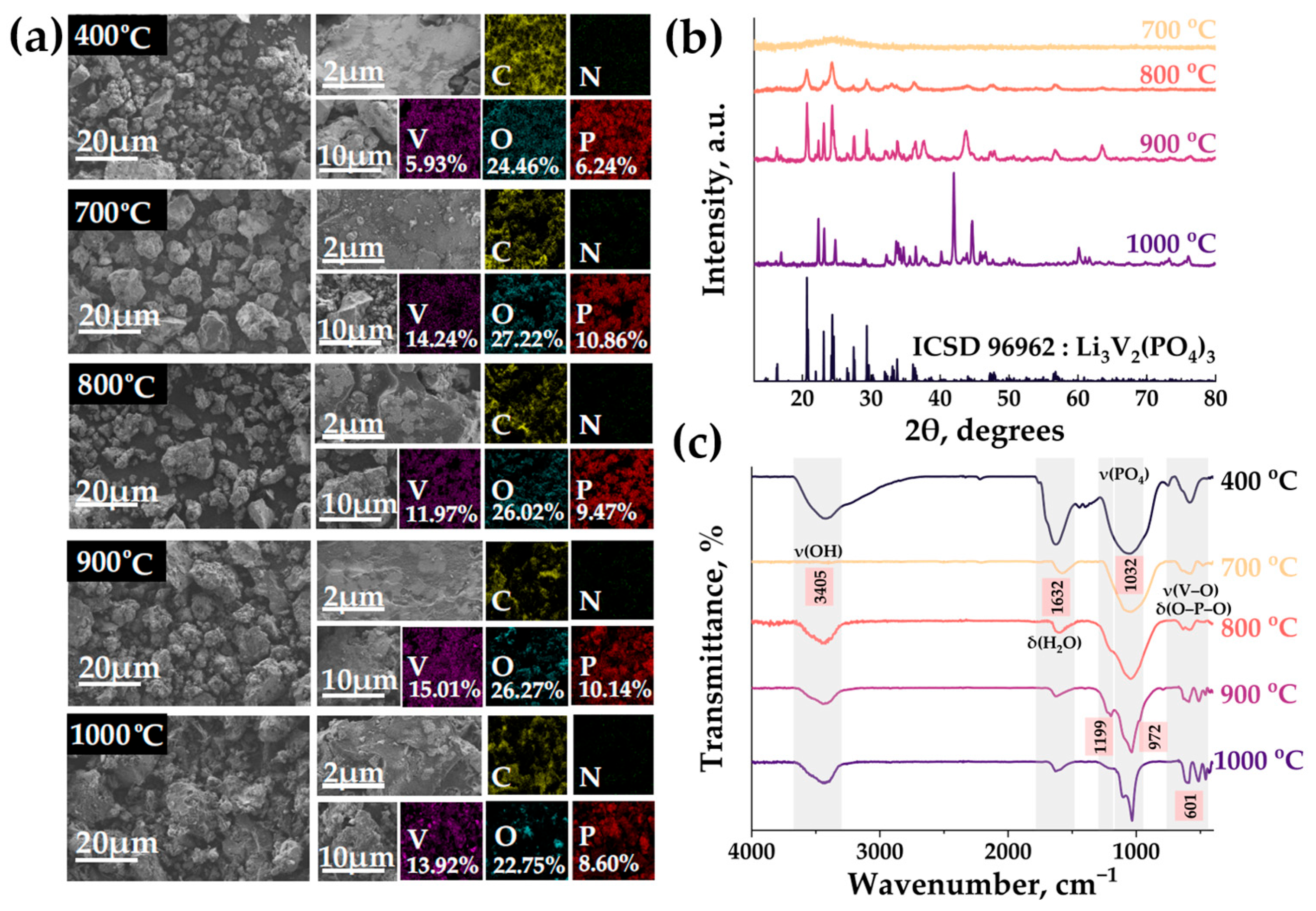
Scanning electron microscopy (SEM) was employed to investigate the morphology of the synthesized Li3V2(PO4)3/C samples annealed at temperatures ranging from 400 to 1000 °C in an inert atmosphere, with a citric acid-to-salt ratio of 1:1 (Figure 1a). The microstructural analysis reveals a pronounced dependence of particle morphology on the annealing temperature. The precursor obtained after combustion in a muffle furnace at 400 °C exhibits a disordered agglomerated structure composed of particles with a broad size distribution (5–20 nm). A porous carbon coating is observed on the surface of the particles.
In samples treated at 700 °C, particle growth (~10 nm), shape homogenization, and surface development were observed. Increasing the temperature to 800 °C led to fragmentation of the previously formed grains, resulting in a more pronounced variation in particle size and morphology compared to the precursor sample. Notably, at the initial pyrolysis temperatures, the porosity associated with the carbon coating disappears, and well-defined grain boundaries become clearly visible.
Further temperature increase to 900 °C resulted in the formation of dense, well-faceted crystallites (10–15 nm) with reduced interparticle porosity, whereas at 1000 °C, pronounced sintering occurred, accompanied by grain growth beyond 20 nm and a complete loss of mesoporosity. These morphological transformations are in good agreement with X-ray diffraction data, collectively demonstrating how thermal treatment governs both the crystallographic and microstructural properties of the Li3V2(PO4)3 phase. An optimal balance between crystallinity and particle morphology was achieved at 900 °C.
The initial material (Figure 1a) exhibits a loose, finely dispersed morphology with a porous structure and weak particle agglomeration, indicating incomplete crystallization and a significant amorphous phase fraction. Upon increasing the temperature to 700 °C, a reduction in carbon content is observed, accompanied by structural densification and particle growth. At the same time, particle boundaries become more distinct, while partial porosity is still retained.
Annealing at 800 °C results in an unexpected increase in carbon content (44.10%) and suppression of grain growth. The surface becomes heterogeneous, and the variation in crystallite size promotes more effective carbon coating, leading to increased porosity and enhanced crystallinity, which is reflected in a smoother morphology.
At 900 °C, significant particle growth occurs, forming aggregated, faceted conglomerates with minimal intercrystallite voids, indicating well-developed crystallinity. The carbon content in this sample is 40.93%.
The most pronounced changes are observed at 1000 °C, where the material forms dense agglomerates of large, well-faceted crystallites with nearly zero porosity, confirming a high degree of crystallization associated with reduced specific surface area. The carbon content also increases to 47.94%.
Energy-dispersive X-ray spectroscopy (EDX) confirms a uniform distribution of V, P, O, and C across all samples, demonstrating that gradual annealing from 400 °C to 1000 °C transforms the material from an amorphous porous phase into a dense, highly crystalline Li3V2(PO4)3 structure while preserving its stoichiometric composition.
Based on the X-ray diffraction (XRD) analysis (Figure 1b), it was determined that a pyrolysis temperature of 900 °C is optimal for obtaining phase-pure and well-crystallized Li3V2(PO4)3 (ICSD No. 96962). Therefore, this temperature was selected for subsequent experiments in which the organic content was varied to optimize the structural characteristics of the material.
The molecular structures of Li3V2(PO4)3/C obtained at different pyrolysis temperatures were investigated by FTIR spectroscopy (Figure 1c). As shown, the spectra of the samples treated at 400–1000 °C are generally similar, although certain differences are observed. An increase in calcination temperature leads to a narrowing of the absorption bands, indicating the formation of a more well-defined crystalline structure.
A broad characteristic band at 3405 cm−1 observed for the samples treated at 400, 800, 900, and 1000 °C is attributed to O–H stretching vibrations of adsorbed water molecules. This suggests that, upon exposure to air, these materials retain surface-adsorbed water, in contrast to the sample treated at 700 °C, which is consistent with the BET results.
The intense singlet at 1032 cm−1 and the bands at 1199 and 573 cm−1 are assigned to the PO4 group, whereas the signals at 653 and 503 cm−1 correspond to V–O vibrations in VO6 octahedra. The characteristic peaks observed at approximately 760 and 972 cm−1, associated with V5+ species, are present only in the sample treated at 900 °C. With increasing temperature, these signals disappear, indicating that all vanadium ions are in the reduced V3+ state in the sample annealed at 1000 °C. This behavior can be attributed to the complete reduction of vanadium by carbon derived from citric acid added during the synthesis process.
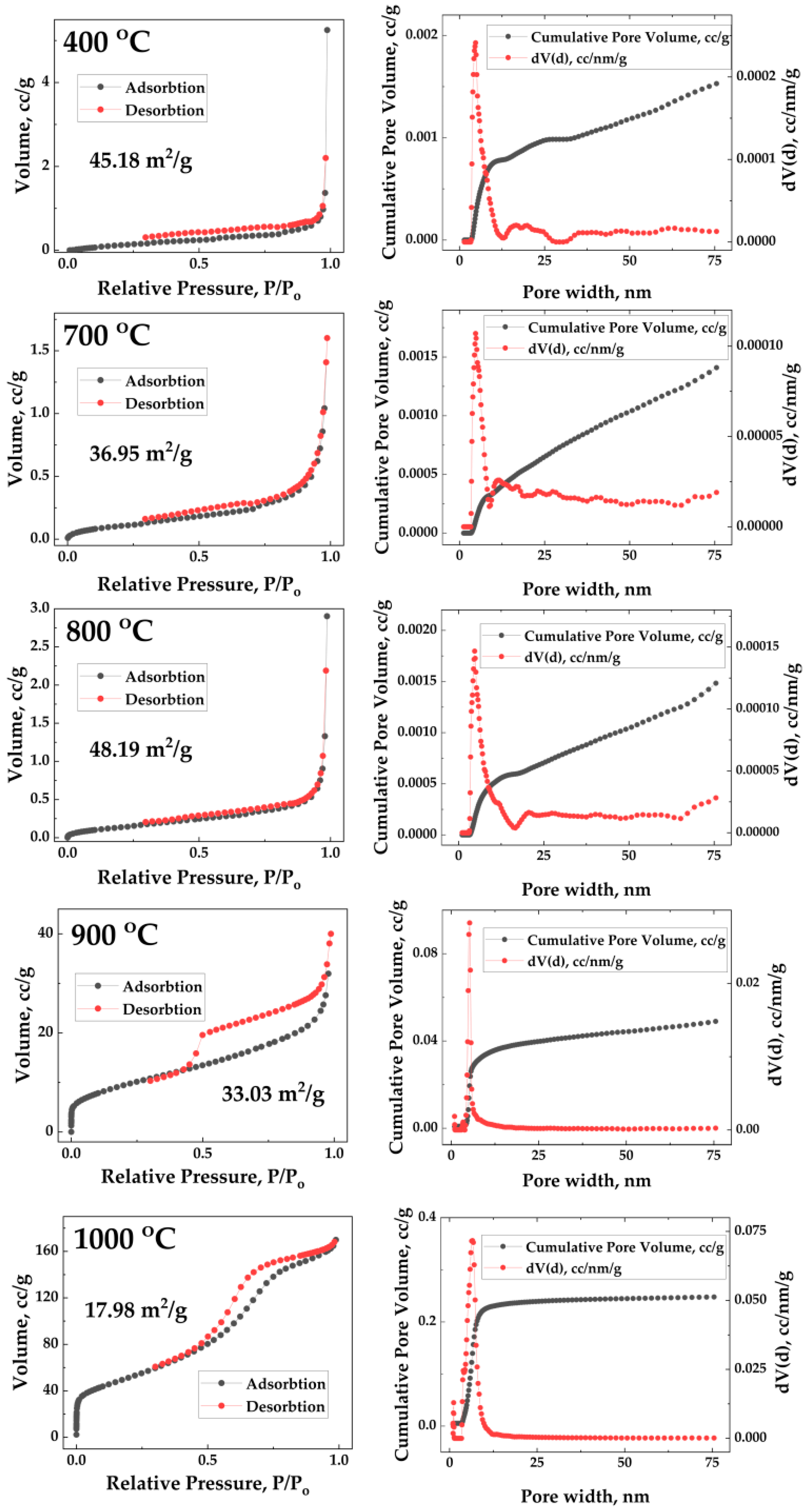
Nitrogen adsorption–desorption isotherms and pore size distributions of samples annealed at 400–1000 °C (Figure 2) indicate systematic structural transformations during thermal treatment. According to the IUPAC classification, the isotherms of samples treated at 400–900 °C exhibit type H3 hysteresis, characteristic of slit-shaped mesopores in partially crystalline materials, whereas the sample annealed at 1000 °C shows a transition to type H4(a) hysteresis, indicating the formation of microporous crystalline structures [33].
BET analysis reveals a complex temperature-dependent behavior. At 400 °C, the material exhibits a high specific surface area (45.18 m2/g) and predominantly mesoporous characteristics, reflecting its amorphous nature and the early stage of structural formation. A decrease in surface area to 36.95 m2/g is observed at 700 °C, which is attributed to particle agglomeration and an increase in total pore volume, as confirmed by pore size distribution analysis.
This disordered structure begins to deteriorate at 800 °C, where partial sintering leads to an increase in surface area to 48.19 m2/g. Subsequent annealing at 900 °C results in a reduction in surface area (33.03 m2/g) and the formation of a monomodal distribution of ~5 nm micropores due to intensified thermal sintering. In contrast, the sample treated at 1000 °C exhibits a complete collapse of the porous structure, with a significantly reduced surface area of 17.98 m2/g.
These textural changes are in strong agreement with structural evolution observed by XRD (transition from amorphous to crystalline phase), SEM (particle growth and coalescence), and FTIR (ordering of phosphate groups). The maximum mesoporosity at 700 °C corresponds to the onset of phase crystallization, whereas 900 °C represents an optimal balance between crystallinity and porosity. The full transition to a microporous structure at 1000 °C confirms enhanced sintering while maintaining crystallinity, albeit with a significant reduction in accessible surface area, which is crucial for electrochemical applications.
The evolution of pore size distribution from polydisperse (400–800 °C) to monomodal (900–1000 °C) directly reflects the progressive crystallization and particle growth of the material, consistent with observations from complementary characterization techniques.
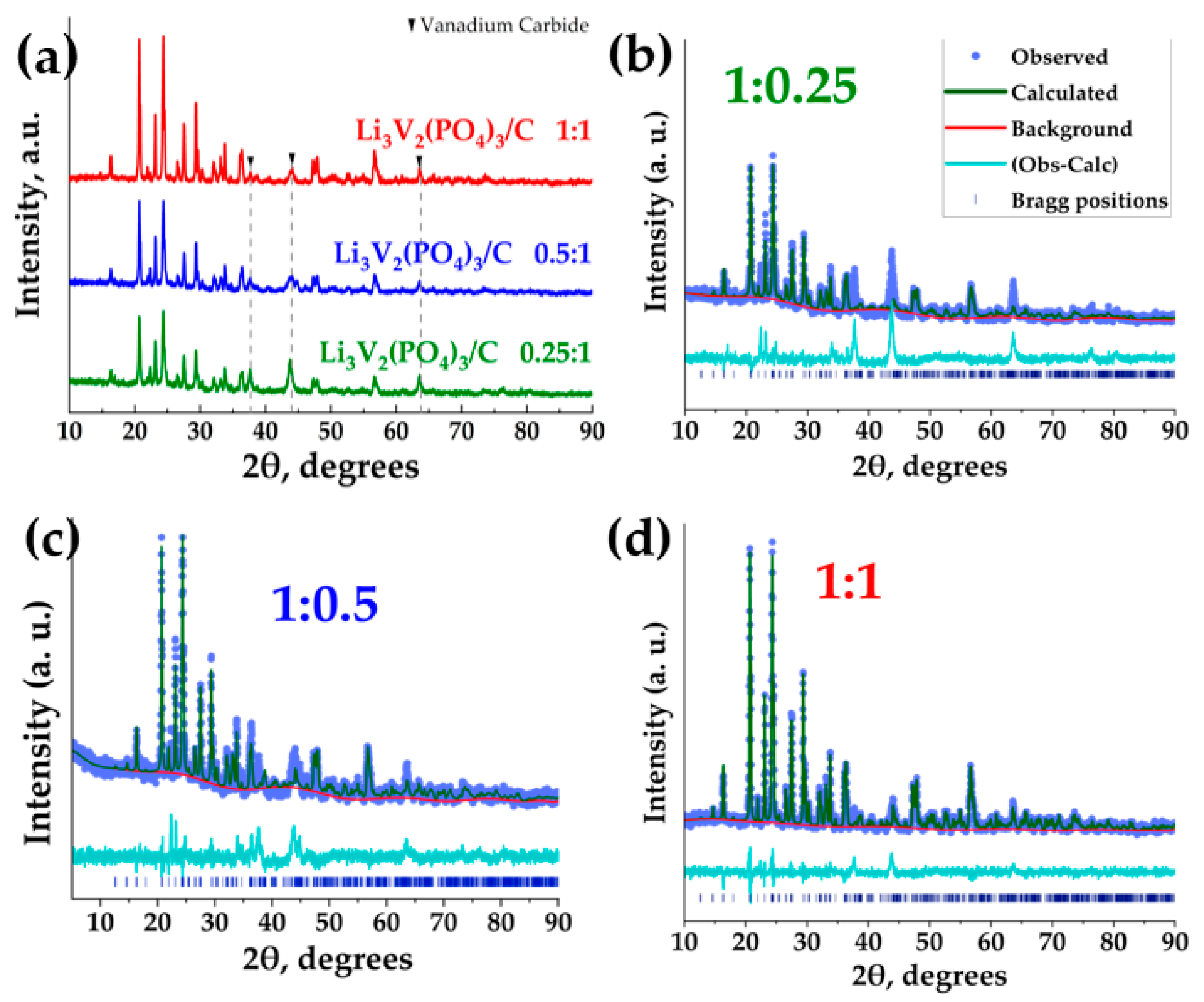
According to the X-ray diffraction patterns of samples synthesized at 900 °C with different citric acid-to-salt ratios (0.25:1, 0.5:1, and 1:1) (Figure 3a), all Li3V2(PO4)3/C samples crystallize in a monoclinic structure with space group P21/n (No. 14).
Rietveld refinement was performed using structural models in both crystallographically equivalent settings: P21/c [34], the standard space group, and P21/n [35], a non-standard setting of the same space group, for comparison. The refined lattice parameters are presented in (Table 1).
For all samples, the lattice parameters remain nearly constant, while the unit cell volumes are in the range of 889–891 Å3, indicating that variation in citric acid content does not significantly affect the crystal structure of Li3V2(PO4)3. Among the investigated samples, the material synthesized with a citric acid ratio of 1:1 exhibits the lowest Rwp value (5.845%) and the lowest GOF (1.38), reflecting the best agreement between experimental and calculated diffraction profiles. Slightly better Rwp values were obtained using the standard P21/c setting; therefore, this setting was used for structural discussion (Figure 3b–d).
The improved refinement indicators for the 1:1 composition suggest higher structural homogeneity and crystallinity compared to the other samples. The sharper peak shapes and reduced residual intensity in the difference curves further indicate that the 1:1 ratio provides the most optimal structural configuration among the investigated compositions.
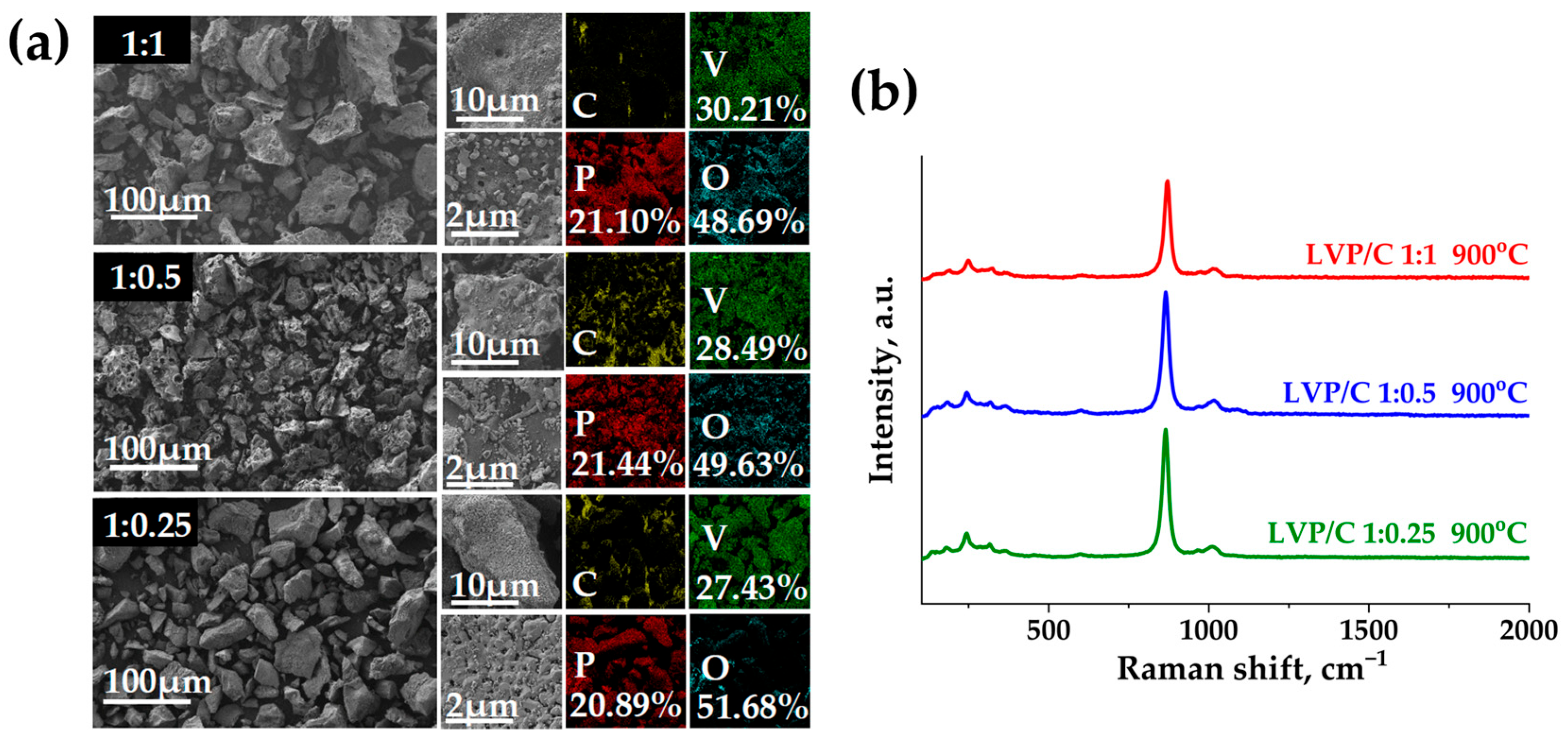
The selection of the optimal annealing temperature enabled further investigation of the influence of the carbon component on the physicochemical, structural, and electrochemical properties of the material. Figure 4 presents the microstructural SEM images of samples with 1:1, 0.5:1, and 0.25:1 ratios, as well as the elemental distribution on the material surface. It can be clearly observed that decreasing the molar carbon-to-active material ratio visually increases porosity due to the carbon coating on the grains, while the particle morphology remains unchanged.
In the 1:0.25 sample, a thin carbon coating layer is observed, and the crystallinity of the material is pronounced. Increasing the carbon content to 0.5 is characterized by an increase in the number of mesopores, while the specific surface area remains nearly unchanged, which is consistent with BET results. A further increase in the Li3V2(PO4)3/C-to-carbon ratio leads to a twofold increase in surface area, and notably, carbon is no longer present as an external coating layer but rather forms a matrix, which is in agreement with elemental analysis data.
The elemental distribution across the samples with varying carbon content remains largely uniform, except for vanadium, which may be attributed to incomplete incorporation into the structure at lower amounts of organic precursor. In contrast, a higher content of organic components promotes better homogenization and stabilization of vanadium within a polymeric network formed with organic chelates.
The Raman spectra of Li3V2(PO4)3/C composites synthesized at an annealing temperature of 900 °C with different carbon ratios (1:1 and 1:0.5) exhibit an almost identical profile, as shown in Figure 4b. In all spectra, a strong central band is observed, corresponding to the symmetric stretching vibration of the tetrahedral PO43− groups in the monoclinic structure.
On both sides of this main peak, weak but distinguishable bands are present. In the low-frequency region, these are attributed to lattice modes, deformation vibrations of PO43− groups, and V–O stretching vibrations within VO6 octahedra. In the high-frequency region, they correspond to antisymmetric stretching vibrations of the phosphate tetrahedra.
The position, width, and relative intensity of all Raman bands remain unchanged when comparing samples with ratios ranging from 1:0.25 to 1:1. This indicates complete preservation of the crystal structure of the active material and the absence of secondary phases or structural distortions induced by the introduction of the carbon coating.
The characteristic carbon D and G bands (typically at ~1350 and ~1580 cm−1) are not observed with significant intensity in the presented spectra, which is typical for thin amorphous or weakly graphitized carbon coatings, where the signal from the phosphate framework predominates. The absence of shifts or broadening of the main vibrational band associated with the PO43− tetrahedral groups confirms that carbon is present exclusively as a surface coating and does not incorporate into the crystal lattice.
Thus, Raman spectroscopy results demonstrate the phase purity and structural stability of the Li3V2(PO4)3/C cathode composites regardless of the carbon ratio under the selected synthesis conditions (900 °C). These findings are fully consistent with X-ray diffraction analysis and explain the high reproducibility of the electrochemical performance of the material [25].
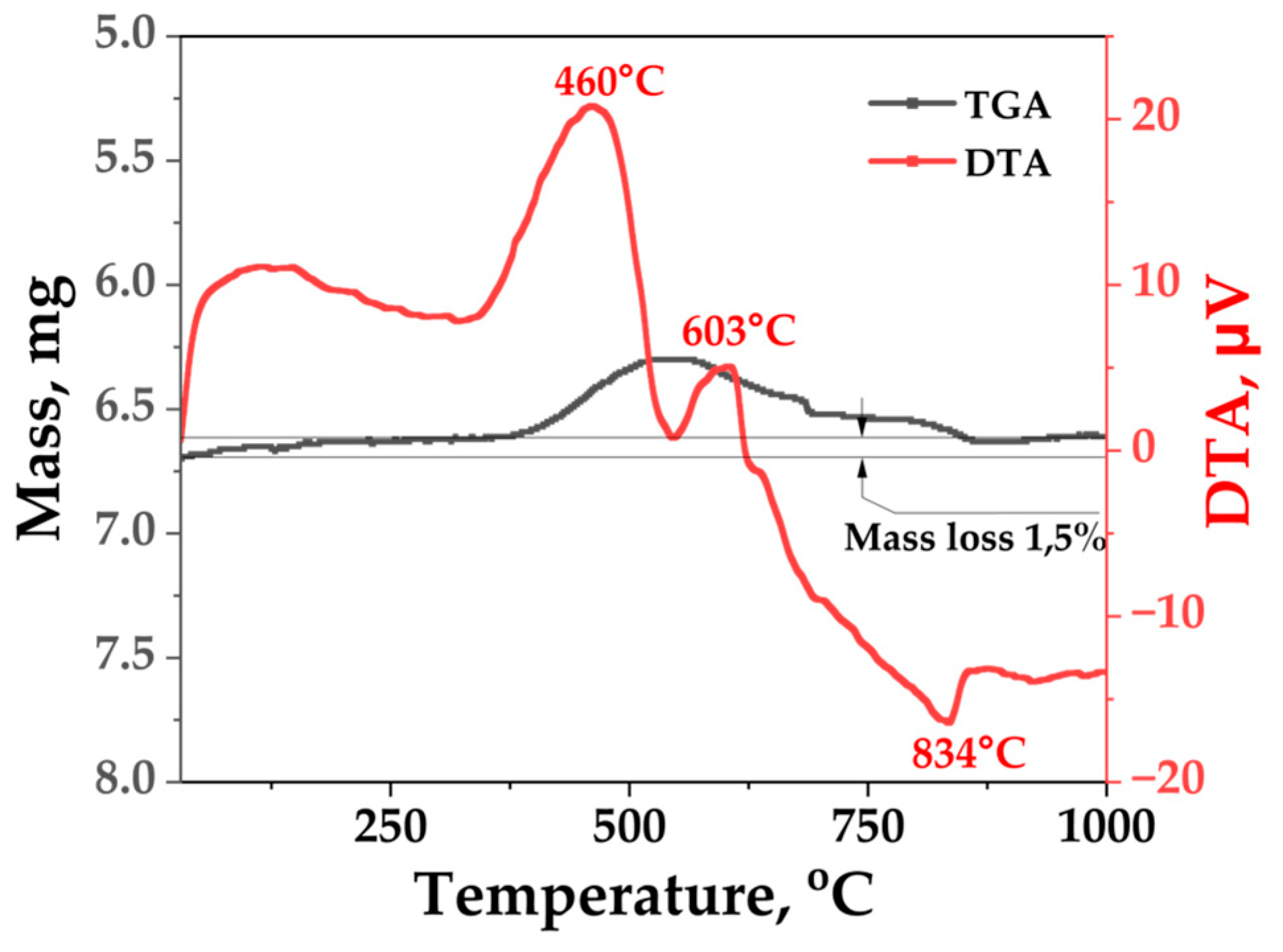
Figure 5 shows the thermogravimetric analysis (TGA) and differential thermal analysis (DTA) data for the Li3V2(PO4)3/C 1:1 cathode material. The thermogram shows a weak endothermic peak at 60 °C, associated with the removal of adsorbed moisture from the sample. No significant thermal effects were recorded at temperatures of 460 °C and 834 °C, specified in the original data. This indicates that no phase transitions or structural degradation of Li3V2(PO4)3 occur after the completion of the carbonization process up to 1000 °C. This confirms the high thermal stability of the synthesized material in the studied temperature range. The thermogram shows a decrease in weight at 375 °C, caused by the burnout of the carbon coating. The subsequent increase in mass at ~800 °C is likely due to partial oxidation of vanadium, which leads to the addition of oxygen to the structure and an increase in the mass of the sample.
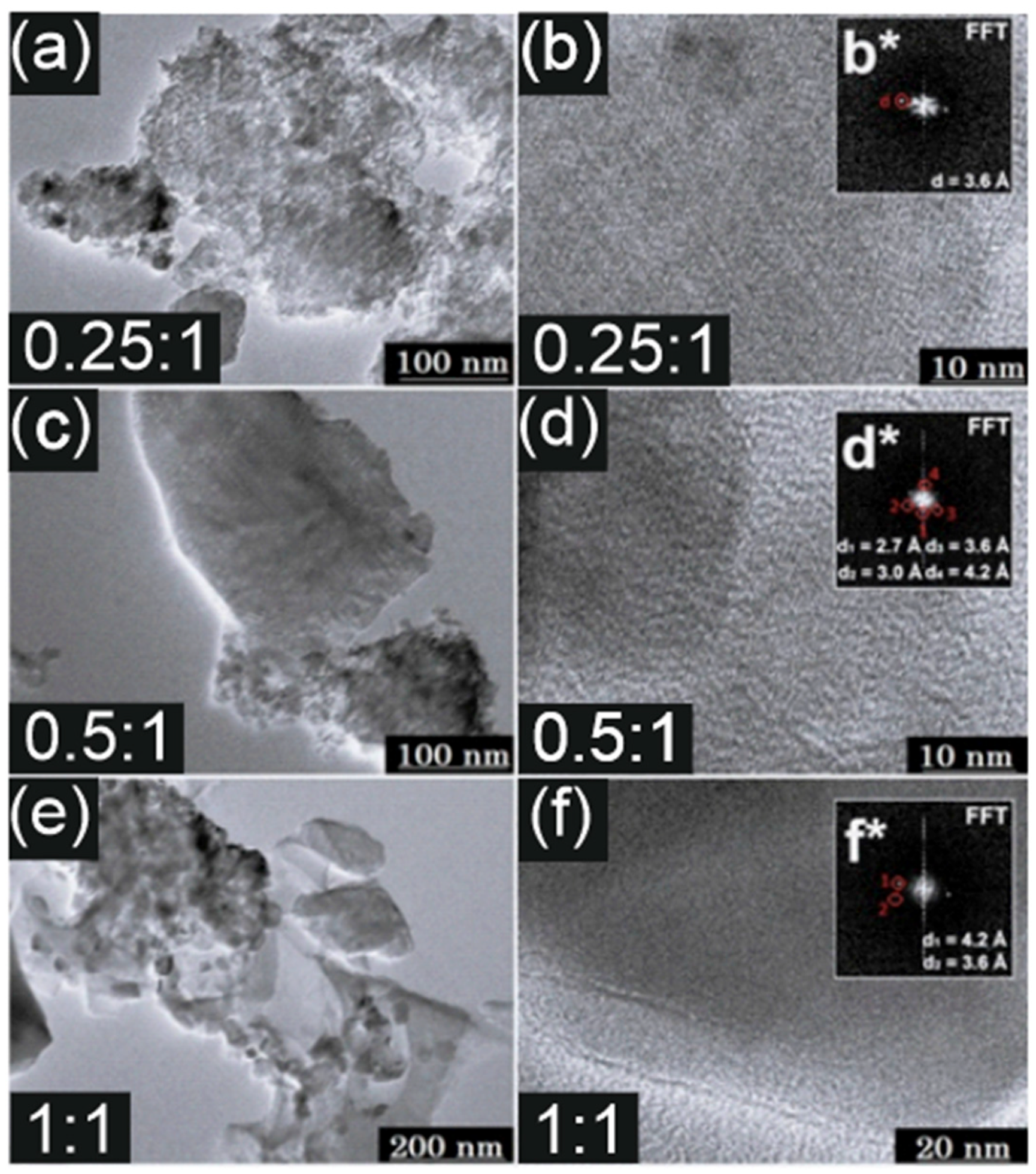
High-resolution transmission electron microscopy (HR-TEM) was used to investigate the microstructure of Li3V2(PO4)3/C samples with compositions 0.25:1 (a, b), 0.5:1 (c, d), and 1:1 (e, f) (Figure 6). The material morphology consists of agglomerates of irregular plate-like particles with an average size exceeding 100 nm.
High-magnification images (b, d, f) clearly reveal lattice fringes, confirming the crystalline nature of the material. To determine interplanar spacings, fast Fourier transform (FFT) analysis was performed, yielding the corresponding Fourier patterns (b*, d*, f*). The diffraction spots observed in the FFT patterns indicate well-defined periodicities in the real-space images, corresponding to ordered arrangements of crystal lattice planes.
The measured interplanar distances are approximately d ≈ 4.2, 3.6, 3.0, and 2.7 Å. For indexing these reflections, theoretical structure factors were calculated based on the monoclinic structure of Li3V2(PO4)3 (space group P21/c, with lattice parameters a = 8.6201(4) Å, b = 8.6013(4) Å, c = 14.7465(7) Å, β = 125.204(3)°) [34].
The analysis shows that all periodicities observed in the HR-TEM images correspond to the most intense Bragg reflections of the Li3V2(PO4)3 phase. In particular, the interplanar spacing of d ≈ 4.2 Å can be assigned to the {111} family of planes, with calculated values of d = 4.30 Å for (1 1 1) and 4.27 Å for (1 1 3), both exhibiting high calculated intensities in this range (I = 98 and 80 a.u., respectively).
The reflection at d ≈ 3.6 Å can be confidently indexed as {1 2 2} or {2 1 3}, with a theoretical spacing of d = 3.661 Å (I ≈ 42). The most intense reflection in the microdiffraction patterns, observed at d ≈ 3.0 Å, corresponds to the (2 2 2) plane (calculated d = 3.044 Å), which, according to simulations, exhibits the maximum relative intensity (I = 100).
Finally, the observed distance d ≈ 2.7 Å is in good agreement with the reflection groups {1 1 5} and {2 2 4} (calculated d = 2.693 and 2.710 Å, I ≈ 15).
Thus, the high-resolution transmission electron microscopy data are in full agreement with the X-ray diffraction results and unambiguously confirm the formation of a well-crystallized, single-phase Li3V2(PO4)3 structure in all synthesized samples.
The observed differences in the sets of visible lattice planes in Figure 6b,d,f are solely attributed to variations in crystallite orientation relative to the incident electron beam and are not related to any changes in the phase composition [34].
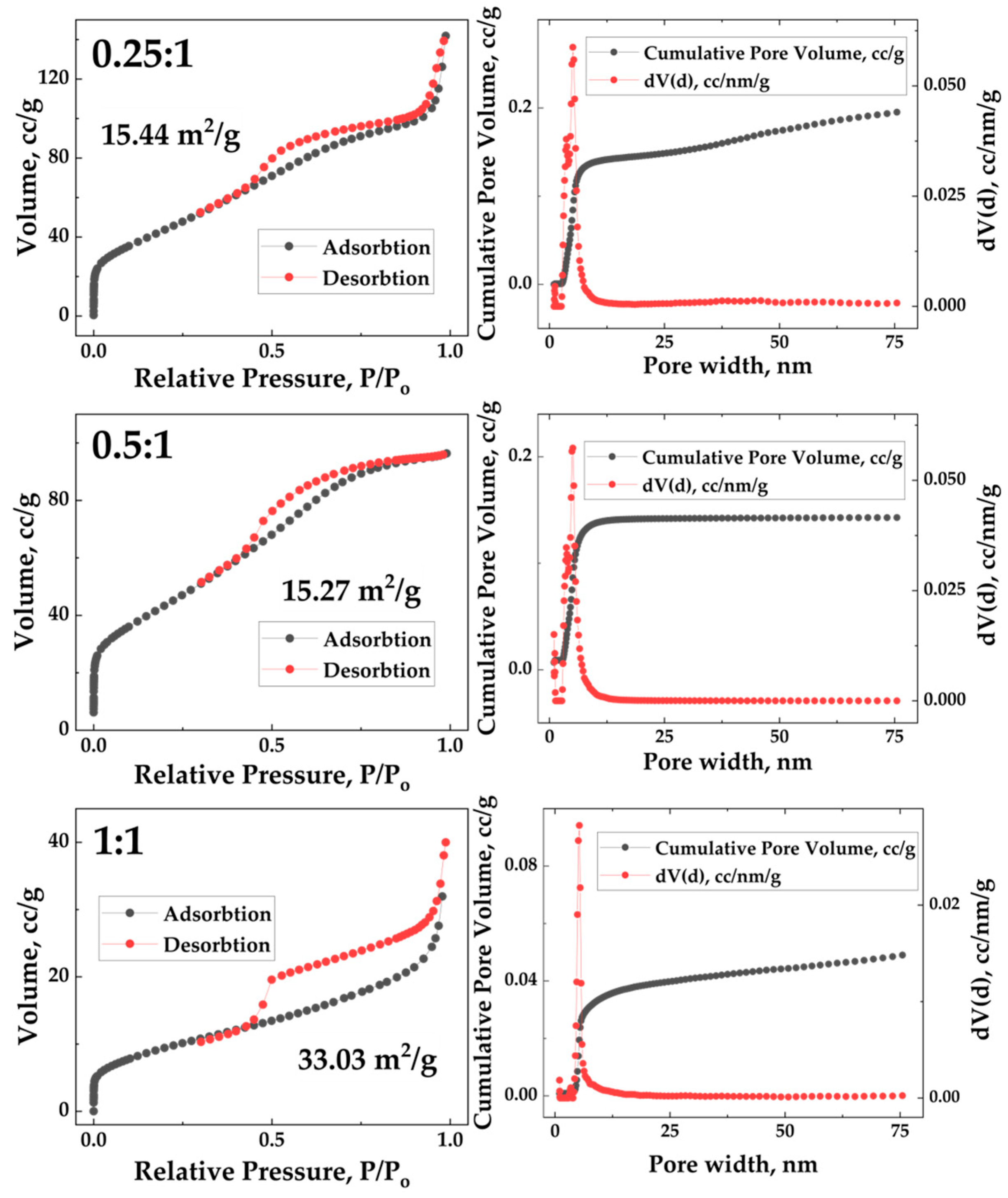
Nitrogen adsorption–desorption isotherms obtained by the BET method are shown in Figure 7. It can be seen that variation in the carbon content during synthesis leads to changes in the type of adsorption isotherm. According to the IUPAC classification, samples with 1:0.25 and 1:0.5 ratios exhibit type H3 hysteresis, whereas the sample with a 1:1 ratio shows a transition to type H4(a) hysteresis. This behavior is consistent with the analysis of the temperature series (900 and 1000 °C samples).
A reduction in the carbon content by half leads to a significant decrease in the specific surface area of the material, which in turn affects the electrochemical performance of the samples. This effect is related not only to the electronic conductivity provided by carbon but also to the ability of lithium ions to intercalate into the porous structure of the material.
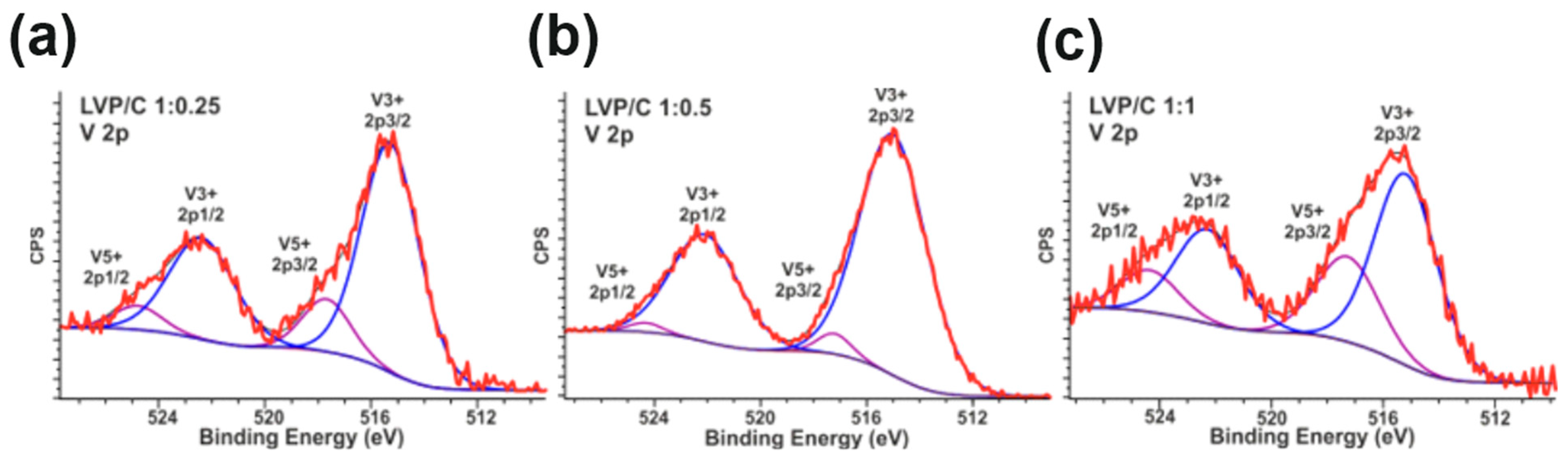
To clarify the origin of capacity differences, XPS analysis of V2p core levels was performed on samples with different citric acid ratios (Figure 8, Table 2). The V2p3/2 spectra were deconvoluted into V3+ (≈515 eV) and V5+ (≈517.3 eV) components with a spin–orbit splitting of 7.1 eV. For Li3V2(PO4)3/C_1:0.25, V5+ content is 16.14%, indicating partial surface oxidation due to insufficient carbon protection. Li3V2(PO4)3/C_1:0.5 shows the highest V3+ fraction (95.89%), while Li3V2(PO4)3/C_1:1 contains 69.22% V3+ and 30.78% V5+. The higher V5+ in the optimal 1:1 sample arises from the thicker carbon matrix but does not degrade performance; instead, the mixed-valence state combined with uniform carbon coating enhances electronic conductivity via polaron hopping. Thus, the specific capacity of 114 mAh/g is not limited by vanadium oxidation state but by intrinsic kinetic constraints of the NASICON structure and the selected voltage window (2.5–4.2 V), as extending to 4.8 V would activate the third Li+ extraction at the cost of cycling stability.

3.2. Electrochemical Performance of the Investigated Materials

To investigate the electrochemical properties of the samples, galvanostatic cycling was performed in a two-electrode half-cell configuration using metallic lithium as the counter electrode. The main electrochemical parameter evaluated during the first cycle was the specific capacity of the series as a function of the ratio between the active material and the conductive carbon coating. Cycling profiles were used to determine the cycle life of the cathode material as well as the coulombic efficiency.
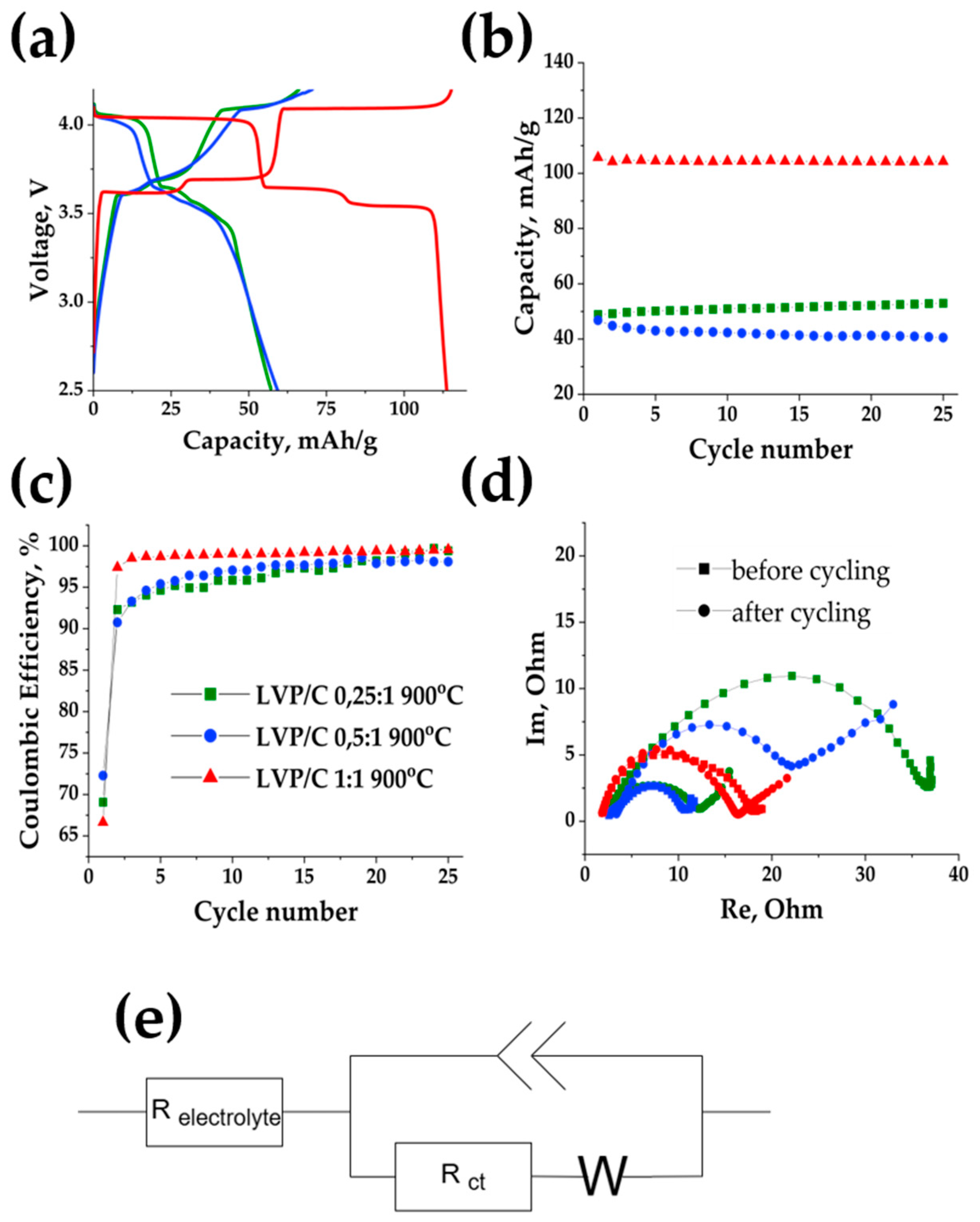
In addition, the materials were studied by electrochemical impedance spectroscopy (EIS) before and after cycling. A common equivalent circuit model was used to analyze changes in electrochemical behavior. All results are summarized in (Figure 7).
The charge–discharge profiles show characteristic curves for the three composites. The Li3V2(PO4)3 material exhibits a stepwise lithium intercalation/deintercalation process, manifested as multiple voltage plateaus.
From (Figure 9a), it can be seen that the initial specific capacities of the LVP/C_1:0.5 and LVP/C_1:0.25 samples are approximately 58 mA·h/g, whereas the LVP/C_1:1 sample delivers a significantly higher specific capacity of 114 mA·h/g. The obtained charge–discharge data for the half-cells correlate well with the BET results, where the twofold increase in surface area for the 1:1 sample corresponds proportionally to the increase in its capacity.
The three voltage plateaus reflect the typical charge–discharge mechanism of Li3V2(PO4)3, in which the crystal lattice contains three crystallographically non-equivalent lithium sites (Li1, Li2, and Li3). These sites differ in binding energy and interact differently with the VO6 octahedral and PO43− tetrahedral framework, leading to the observed multi-step electrochemical behavior.
Lithium intercalation proceeds through a series of successive two-phase transitions with the formation of ordered intermediate phases:
Li3V2(PO4)3 − ē → Li2.5V2(PO4)3             (V+3.5);
Li2.5V2(PO4)3 − ē → Li2V2(PO4)3             (V+3.75);
Li2V2(PO4)3 − ē → LiV2(PO4)3             (V+4).
Thus, a single V3+/V4+ redox transition consists of three discrete processes due to the structural ordering of the material.
The cycling stability (Figure 9b) shows that among the investigated samples with different compositions, the LVP/C_1:1 material exhibits the best performance, retaining 100% of its capacity after 25 cycles. For the LVP/C_1:0.5 sample, a gradual capacity fading of approximately 9.6% is observed after 25 cycles relative to the second cycle. Despite these significant losses, this sample demonstrates the highest coulombic efficiency of 72.3%.
However, the decrease in capacity and the oscillatory shape of the cycling curve indicate instability in lithium intercalation within the cathode structure. This behavior suggests possible formation of a solid electrolyte interphase (SEI) layer and growth of lithium dendrites.
The coulombic efficiency of the samples is presented in (Figure 9c). The lowest value is observed for the 1:1 ratio (67%), whereas samples with lower carbon content show higher efficiencies of 69% and 72% for LVP/C_1:0.25 and LVP/C_1:0.5, respectively. A detailed analysis indicates the highest overall stability for the 1:1 composition, which is consistent with the cycling stability results (Figure 9b).
The LVP/C_1:0.25 sample exhibits a gradual increase in specific capacity up to the 25th cycle. This behavior can be attributed to improved electrode wetting by the electrolyte during cycling and a progressive activation of the structure due to the slow opening of the composite cathode architecture.
However, electrochemical impedance spectroscopy (EIS) data collected before and after cycling (Figure 9d) show that the LVP/C_1:0.25 sample exhibits a reduction in charge-transfer resistance and improved cathode–electrolyte interfacial conductivity. The preservation of the Nyquist plot shape after cycling for the LVP/C_1:1 sample indicates the lowest overall resistance and a well-balanced combination of electronic conductivity and interfacial contact. The high carbon content likely forms a continuous conductive network, facilitating charge transport between the electrodes.
The Warburg impedance in the impedance spectra shows different behavior after cycling depending on the sample composition: for the green and red curves, a decrease is observed, indicating enhanced lithium-ion diffusion and improved solid-state transport kinetics. In contrast, the blue curve exhibits an increase in Warburg impedance, suggesting deteriorated diffusion characteristics. The electrolyte resistance remains relatively stable for all investigated systems. After cycling, an increase in charge-transfer resistance is observed in all cases, reflecting typical interfacial degradation; however, the LVP/C_1:1 material demonstrates overall the most favorable electrochemical performance. Thus, analysis of the impedance spectroscopy data shows that all samples exhibit certain advantages, while the best balance between specific capacity, cycling stability, and the number of active surface sites is achieved for the Li3V2(PO4)3/C 1:1 sample.
In this study, a limited number of galvanostatic charge–discharge cycles were performed on the material, which nevertheless allowed for an assessment of the cyclic stability and initial electrochemical characteristics. Complex long-term cycling at various scan rates is the subject of further research.

4. Conclusions

This study was devoted to the systematic optimization of the synthesis of Li3V2(PO4)3/C cathode material prepared via a sol–gel method using citric acid as a carbon source. The influence of pyrolysis temperature and carbon content on the structural and electrochemical properties of the material was thoroughly investigated. The results demonstrate that a pyrolysis temperature of 900 °C is optimal for obtaining a well-crystallized Li3V2(PO4)3 phase. Further optimization of the citric acid-to-salt ratio (1:1, 0.5:1, and 0.25:1) revealed that this parameter plays a crucial role in controlling the carbon content and, consequently, the electrochemical performance of the composite. XPS analysis revealed that the optimal LVP/C_1:1 sample contains 69.22% V3+ and 30.78% V5+, while lower carbon content (1:0.25) leads to 16.14% V5+ due to insufficient protection. The mixed-valence state in the 1:1 composite does not limit capacity but rather contributes to enhanced electronic conductivity via polaron hopping. The achieved specific capacity (114 mAh/g, ≈58% of theoretical) is primarily governed by kinetic constraints of the NASICON framework within the 2.5–4.2 V window, not by vanadium oxidation state. In addition, it showed a favorable combination of cycling stability and coulombic efficiency (67%), which can be attributed to improved crystallinity, uniform carbon coating, and enhanced ionic and electronic conductivity. Overall, the obtained results demonstrate an effective strategy for fine-tuning the synthesis of Li3V2(PO4)3/C materials. This approach provides a solid basis for further development of high-performance cathode materials for lithium-ion batteries and their potential application in energy storage technologies.

Author Contributions

Conceptualization, E.K.P. and O.O.S.; data curation, N.P.I., A.V.S. (Anton V. Shurygin), K.A.P. and V.I.N.; formal analysis, Z.E.P., P.A.M. and V.L.R.; investigation, A.I.S., Z.E.P., P.A.M., D.E.L., V.L.R., K.A.P., A.R.Z., A.V.S. (Alexander V. Syuy), Y.C., A.V.S. (Anton V. Shurygin), V.I.N. and O.O.S.; methodology, A.I.S.; project administration, I.G.T., E.K.P., A.V.O. and O.O.S.; resources, Z.E.P., N.P.I. and O.O.S.; software, N.P.I. and A.V.S. (Alexander V. Syuy); supervision, I.G.T., E.K.P., A.V.O. and O.O.S.; validation, P.A.M., D.E.L., A.R.Z., K.A.P., Y.C., A.V.S. (Anton V. Shurygin) and V.I.N.; visualization, A.I.S.; writing—original draft, A.I.S. and O.O.S.; writing—review and editing, A.I.S. and O.O.S. All authors have read and agreed to the published version of the manuscript.

Funding

Synthesis of materials and study of their electrochemical properties was carried out within the framework of the State assignment of Sakhalin State University No. FEFF-2024-0001. Measurement of TEM was supported by the Ministry of Science and Higher Education of the Russian Federation (FSMG-2024-0014). The research was also conducted using the infrastructure of the Engineering Center “Materials and Technologies for the World Ocean and the Arctic” at the Far Eastern Federal University (agreement No. 075-15-2025-566). This work was supported by the state assignment of the Ministry of Science and Higher Education of the Russian Federation (Project No. FZNS-2024-0013), under which the X-ray photoelectron spectroscopy (XPS) analysis was also performed.

Data Availability Statement

The experimental data that supports the findings of this study are available from the corresponding author upon reasonable request.

Conflicts of Interest

The authors declare no conflicts of interest.

References

  1. Liu, J.; Wang, J.; Ni, Y.; Zhang, K.; Cheng, F.; Chen, J. Recent breakthroughs and perspectives of high-energy layered oxide cathode materials for lithium ion batteries. Mater. Today 2021, 43, 132–165. [Google Scholar] [CrossRef]
  2. Yang, Y.; Okonkwo, E.G.; Huang, G.; Xu, S.; Sun, W.; He, Y. On the sustainability of lithium ion battery industry—A review and perspective. Energy Storage Mater. 2021, 36, 186–212. [Google Scholar] [CrossRef]
  3. Fang, Y.; Zhao, J.; Su, Y.; Dong, J.; Lu, Y.; Li, N.; Wang, H.; Wu, F.; Chen, L. Understanding of Spinel Phases in Lithium-Rich Cathode for High-Energy-Density Lithium-Ion Batteries: A Review. Energy Mater. Adv. 2024, 5, 0115. [Google Scholar] [CrossRef]
  4. Koech, A.K.; Mwandila, G.; Mulolani, F.; Mwaanga, P. Lithium-ion battery fundamentals and exploration of cathode materials: A review. S. Afr. J. Chem. Eng. 2024, 50, 321–339. [Google Scholar] [CrossRef]
  5. Li, X.; Wang, N.; Su, T.; Chai, Y. Three dimensional carbon network supported Li3V2(PO4)3/C and Na3V2(PO4)3/C composites for lithium/sodium storage. Appl. Surf. Sci. 2022, 601, 154285. [Google Scholar] [CrossRef]
  6. Jiang, Y.; Zou, Q.; Liu, S.; Zeng, H.; Chen, L.; Xiang, Y.; Li, J.; Wu, X.; Wu, J.; Xiong, L. The Li3V2(PO4)3@C materials prepared by freeze-drying assisted sol-gel method for an aqueous zinc ion hybrid battery. J. Electroanal. Chem. 2021, 900, 115685. [Google Scholar] [CrossRef]
  7. Park, H.; Lee, W.; Thangavel, R.; Oh, W.; Jin, B.S.; Yoon, W.S. Correction: Enhancing electrochemical performance by triggering a local structure distortion in lithium vanadium phosphate cathode for Li ion batteries. J. Mater. Chem. A 2022, 10, 25364. [Google Scholar] [CrossRef]
  8. Xu, R.; Yan, Y.; Wang, X.; Yu, Z.; Liu, Z.; Wang, J.; Yu, W.; Zhong, L.; Xu, Y.; Yang, R. High specific capacity of Li3V2(PO4)3/C glass-ceramic with ultralow carbon content. Ceram. Int. 2024, 50, 22905–22913. [Google Scholar] [CrossRef]
  9. Sharmila, V.; Joshua, J.R.; Parthibavarman, M.; Maruthamuthu, S.; El-Marghany, A.; Mussa, M.M.; Vijayakumar, E.; Sangaraju, S. Boosting the electrochemical performance of lithium-ion batteries with a Li3V2(PO4)3 electrode designed as a desert cactus shaped and layered with MWCNT for energy storage applications. Ceram. Int. 2025, 51, 43861–43869. [Google Scholar] [CrossRef]
  10. Awasthi, S.; Moharana, S.; Kumar, V.; Wang, N.; Chmanehpour, E.; Sharma, A.D.; Tiwari, S.K.; Kumar, V.; Mishra, Y.K. Progress in doping and crystal deformation for polyanions cathode based lithium-ion batteries. Nano Mater. Sci. 2024, 6, 504–535. [Google Scholar] [CrossRef]
  11. Semykina, D.O.; Podgornova, O.A.; Moodakare, S.B.; Vedarajan, R.; Kosova, N.V. Crystal Chemistry and Ionic Conductivity of the NASICON-Related Phases in the Li3–xNaxV2(PO4)3 System. Inorg. Chem. 2023, 62, 5939–5950. [Google Scholar] [CrossRef]
  12. Ruan, T.; Lu, S.; Lu, J.; Niu, J.; Li, R. Unraveling the intercalation chemistry of multi-electron reaction for polyanionic cathode Li3V2(PO4)3. Energy Storage Mater. 2022, 55, 546–555. [Google Scholar] [CrossRef]
  13. Liang, M.; Wang, Y.; Dong, H.; Wang, L.; Peng, Q.; Yang, C.; Xiao, Y.; Wang, Y.; Chou, S.; Sun, B.; et al. Surface engineering of Li3V2(PO4)3-based cathode materials with enhanced performance for lithium-ion batteries working in a wide temperature range. Microstructures 2024, 4, 2024034. [Google Scholar] [CrossRef]
  14. Meng, F.; Xiong, X.; Tan, L.; Yuan, B.; Hu, R. Strategies for improving electrochemical reaction kinetics of cathode materials for subzero-temperature Li-ion batteries: A review. Energy Storage Mater. 2021, 44, 390–407. [Google Scholar] [CrossRef]
  15. Mohanty, D.; Lu, Z.L.; Hung, I.M. Effect of carbon coating on electrochemical properties of Li3V2(PO4)3 cathode synthesized by citric-acid gel method for lithium-ion batteries. J. Appl. Electrochem. 2023, 53, 1003–1013. [Google Scholar] [CrossRef]
  16. Ding, M.; Cheng, C.; Wei, Q.; Hu, Y.; Yan, Y.; Dai, K.; Mao, J.; Guo, J.; Zhang, L.; Mai, L. Carbon decorated Li3V2(PO4)3 for high-rate lithium-ion batteries: Electrochemical performance and charge compensation mechanism. J. Energy Chem. 2020, 53, 124–131. [Google Scholar] [CrossRef]
  17. Ahsan, Z.; Wang, S.; Cai, Z.; Ma, Y.; Song, G.; Zhang, S.; Yang, W.; Wen, C. Influence of synthesis approach on the electrochemical properties of (Li3V2(PO4)3-LiVOPO4)/graphite composite material for Li-ion batteries. Mater. Today Commun. 2021, 29, 102955. [Google Scholar] [CrossRef]
  18. Sim, R.; Su, L.; Dolocan, A.; Manthiram, A. Delineating the Impact of Transition-Metal Crossover on Solid-Electrolyte Interphase Formation with Ion Mass Spectrometry. Adv. Mater. 2024, 36, e2311573. [Google Scholar] [CrossRef]
  19. Huang, T.; Guo, X.; Wang, F.; Zhang, L.; Zhou, X.; Xu, Y.; Wu, C.; Zeng, W. Carbon coated Li3V2(PO4)3 derived from phytic acid with ultra-high rate performance for rechargeable Li ion batteries. Surf. Interfaces 2024, 52, 104900. [Google Scholar] [CrossRef]
  20. Lu, J.; Wang, Y.; Song, F.; Zhang, Z.; Lu, Q.; Cheng, Y.; Tao, Y.; Du, J.; Wang, H. Carbon armor-layer decorated Li3V2(PO4)3 core-shell cathode materials derived from nitrogen doped lignin waste liquor for robust lithium ion batteries. J. Power Sources 2022, 531, 231318. [Google Scholar] [CrossRef]
  21. Li, X.; Du, X.; Xu, Y.; Li, J.; Wang, Y.; Meng, Y.; Xiao, D. Three-Dimensional Holey Graphene Enwrapped Li3V2(PO4)3/N-Doped Carbon Cathode for High-Rate and Long-Life Li-Ion Batteries. ChemSusChem 2022, 15, e202201459. [Google Scholar] [CrossRef]
  22. Huanga, T.; Guan, L.; Jin, S.; Zhang, D.; Liao, W.; Zhou, X.; Liu, X.; Wu, C.; Zeng, W. Nitrogen-doped carbon nanoframes modified Li3V2(PO4)3 derived from phytic acid with ultra-high rate performance for rechargeable Li ion batteries. Appl. Surf. Sci. 2025, 680, 2025. [Google Scholar] [CrossRef]
  23. Liu, J.; Hong, W.; Chen, Q.; Wan, W.; Zhong, S. Facile synthesis of spherical Li3V2(PO4)3/C and 2LiVPO4F⋅Li3V2(PO4)3/C cathode materials by spray drying for lithium-ion battries. Funct. Mater. Lett. 2023, 16, 2350018. [Google Scholar] [CrossRef]
  24. Yan, H.; Li, M.; Fu, Y.; Chen, S.; Wang, Y.; Zhang, B. Conductive polypyrrole-promoted Li3V2(PO4)3 nanocomposite for rechargeable lithium energy storage. J. Phys. Chem. Solids 2022, 167, 110787. [Google Scholar] [CrossRef]
  25. Choi, D.; Shim, J.-Y.; Choi, S.; Park, S.; Jeong, H.; Kim, M.-S.; Kim, J.; Yang, J. Formation of effective carbon composite structure for improving electrochemical performances of rhombohedral Li3V2(PO4)3 as both cathode and anode materials for lithium ion batteries. J. Electroanal. Chem. 2022, 928, 117076. [Google Scholar] [CrossRef]
  26. Yagfarova, A.R.; Yatsyk, I.V.; Mamedov, D.V.; Deeva, Y.A.; Uporova, A.M.; Chupakhina, T.I.; Khantimerov, S.M.; Gavrilova, T.P. Li3V2(PO4)3-Based Cathode Materials for Li-Ion Batteries: Time Evolution of the Vanadium Valence State. Bull. Russ. Acad. Sci. Phys. 2024, 88, 1115–1121. [Google Scholar] [CrossRef]
  27. Luo, J.; Peng, S.; Guo, J.; Xie, F.; Zhang, Z.; Liu, W. Characterization and Electrochemical Properties of Carbon Decorated Li3V2(PO4)3 Prepared by Citric Acid Assisted Gel and Heat Treating. Russ. J. Phys. Chem. A 2024, 98, 2363–2370. [Google Scholar] [CrossRef]
  28. Wang, C.; Li, Y.; Wang, J.; Bai, G.; Zhou, X.; Zhang, T. Dual strategy with sodium-doped and electrostatic spinning for long life lithium vanadium phosphate nanofibers cathode materials of lithium ion secondary batteries. Electrochim. Acta 2025, 535, 146596. [Google Scholar] [CrossRef]
  29. Wang, B.; He, J.; Zhu, C.; Huang, B.; Chen, H.; Guo, S.; Wu, F.; Liu, G.; Deng, Y.; Dai, X. Rationally designed In3+ doping in Li3V2(PO4)3/C cathodes for enhanced kinetics and cycling stability. Electrochim. Acta 2025, 531, 146451. [Google Scholar] [CrossRef]
  30. Gavali, D.S.; Abhijitha, V.G.; Nanda, B.R.K.; Thapa, R. Origin of high stability, enhanced specific capacity, and low Li diffusion energy in boron doped Li3V2(PO4)3. J. Energy Storage 2023, 69, 107899. [Google Scholar] [CrossRef]
  31. Lokeswararao, Y.; Dakshinamurthy, A.C.; Budumuru, A.K.; Sudakar, C. Influence of nano-fibrous and nano-particulate morphology on the rate capability of Li3V2(PO4)3/C Li-ion battery cathode. Mater. Res. Bull. 2023, 166, 112331. [Google Scholar] [CrossRef]
  32. Toby, B.H.; Von Dreele, R.B. GSAS-II: The genesis of a modern open-source all purpose crystallography software package. J. Appl. Crystallogr. 2013, 46, 544–549. [Google Scholar] [CrossRef]
  33. Thommes, M.; Kaneko, K.; Neimark, A.V.; Olivier, J.P.; Rodriguez-Reinoso, F.; Rouquerol, J.; Sing, K.S.W. Physisorption of gases, with special reference to the evaluation of surface area and pore size distribution (IUPAC Technical Report). Pure Appl. Chem. 2015, 87, 1051–1069. [Google Scholar] [CrossRef]
  34. Kee, Y.; Yun, H. Reinvestigation of trilithium divanadium(III) tris(orthophosphate), Li3V2(PO4)3, based on single-crystal X-ray data. Acta Crystallogr. Sect. E Struct. Rep. Online 2013, 69, i11–i12. [Google Scholar] [CrossRef]
  35. Yin, S.-C.; Grondey, H.; Strobel, P.; Anne, M.; Nazar, L.F. Electrochemical Property:  Structure Relationships in Monoclinic Li3-yV2(PO4)3. J. Am. Chem. Soc. 2003, 125, 10402–10411. [Google Scholar] [CrossRef] [PubMed]
Figure 1. (a) SEM images of Li3V2(PO4)3/C samples annealed at different temperatures (400–1000 °C) with a citric acid-to-salt ratio of 1:1; (b) X-ray diffraction (XRD) patterns of Li3V2(PO4)3/C samples (700–1000 °C) with a citric acid-to-salt ratio of 1:1; (c) FTIR spectra of Li3V2(PO4)3/C samples (400–1000 °C).
Jcs 10 00303 g001
Figure 2. Low-temperature nitrogen adsorption–desorption isotherms and pore size distribution of Li3V2(PO4)3/C samples annealed at different temperatures (400–1000 °C) with a citric acid-to-salt ratio of 1:1.
Jcs 10 00303 g002
Figure 3. (a) X-ray diffraction patterns of Li3V2(PO4)3/C samples with different citric acid contents; (b) Rietveld refinement of lattice parameters for Li3V2(PO4)3/C with a 1:0.25 ratio; (c) 1:0.5; (d) 1:1.
Jcs 10 00303 g003
Figure 4. (a) SEM images; (b) Raman spectra of Li3V2(PO4)3/C samples annealed at 900 °C with citric acid-to-salt ratios of 1:1, 1:0.5, and 1:0.25.
Jcs 10 00303 g004
Figure 5. Thermogram of Li3V2(PO4)3/C 1:1 sample.
Jcs 10 00303 g005
Figure 6. HR-TEM images of Li3V2(PO4)3/C with ratios 0.25:1 (a,b), 0.5:1 (c,d), and 1:1 (e,f), and the corresponding FFT patterns (b*,d*,f*).
Jcs 10 00303 g006
Figure 7. Low-temperature nitrogen adsorption isotherms and pore size distributions of Li3V2(PO4)3/CC materials obtained by pyrolysis at 900 °C with different molar ratios.
Jcs 10 00303 g007
Figure 8. High-resolution V2p XPS spectra of Li3V2(PO4)3/C composites synthesized at 900 °C with different citric acid-to-salt ratios: (a) 1:0.25, (b) 1:0.5, and (c) 1:1.
Jcs 10 00303 g008
Figure 9. (a) Galvanostatic charge–discharge curves; (b) cycling performance of the cell with the investigated cathode material; (c) coulombic efficiency at a current density of 19.7 mA g−1 (C/10); (d) electrochemical impedance spectra measured before and after cycling in a half-cell versus metallic lithium; (e) equivalent circuit model for the Li3V2(PO4)3/C material at all molar ratios.
Jcs 10 00303 g009
Table 1. Structural parameters of the investigated materials.
SamplePhaseCrystal Structure Parametersρ, g/cm3V, Å3Rw, %GOF
a, Åb, Åc, Åβ, °
0.25:1Li3V2(PO4)3
P 21/c
(14-1)
8.606278.5964214.73235125.163.038891.0849.2532.23
0.5:18.600628.5910114.72184125.1643.045889.2627.1441.7
1:18.608578.5943514.72773125.1793.040890.6145.8451.38
0.25:1Li3V2(PO4)3
P 21/n
(14-2)
8.606228.5962312.0434890.5723.039890.9459.4902.29
0.5:18.600848.5908412.0343590.5683.045889.1567.2121.72
1:18.608798.5941712.0376390.583.040890.5646.1131.44
Table 2. Vanadium oxidation states from XPS V2p3/2.
BandStateBE, eVRel., %StateBE, eVRel., %StateBE, eVRel., %
Li3V2(PO4)3/C 1:1Li3V2(PO4)3/C 1:0.25Li3V2(PO4)3/C 1:0.5
V 2p3/25+517.2630.785+517.6816.145+517.214.11
3+515.1869.223+515.2783.863+514.9995.89
Disclaimer/Publisher’s Note: The statements, opinions and data contained in all publications are solely those of the individual author(s) and contributor(s) and not of MDPI and/or the editor(s). MDPI and/or the editor(s) disclaim responsibility for any injury to people or property resulting from any ideas, methods, instructions or products referred to in the content.