
Review

Polymer-Derived Silicon Oxycarbide (SiOC) and Silicon Carbonitride (SiCN) Ceramics for Advanced Electrochemical Energy Storage Applications

by
Saja Al Ajrash
1,* and
Erick S. Vasquez-Guardado
2,*
1
Department of Chemical Engineering, School of Engineering, University of Kufa, Najaf 54001, Kufa, Iraq
2
Department of Chemical and Materials Engineering, University of Dayton, Dayton, OH 45469-0256, USA
*
Authors to whom correspondence should be addressed.
J. Compos. Sci. 2026, 10(6), 280; https://doi.org/10.3390/jcs10060280
Submission received: 4 April 2026 / Revised: 27 April 2026 / Accepted: 15 May 2026 / Published: 22 May 2026
(This article belongs to the Section Composites Applications)

Abstract

Preceramic polymers, especially silicon oxycarbide (SiOC) and silicon carbonitride (SiCN) ceramics, have gained significant attention due to their wide range of applications in many fields, particularly in energy storage devices beyond conventional lithium-ion batteries (LIBs). This review focuses on the synthesis, structural characteristics, and properties of SiOC and SiCN ceramics as electrodes for battery applications. Furthermore, their promising applications as electrode materials for energy storage systems are explored, along with the most recent advances in the development of such materials and their use in lithium-ion batteries (LIBs), lithium-sulfur batteries (LSBs), potassium-ion batteries (PIBs), sodium-ion batteries (SIBs), and supercapacitors. This review addresses the distinct advantages of SiOC and SiCN ceramics, including high thermal stability, mechanical robustness, and adaptable microstructures. It also examines the challenges associated with the commercialization of these ceramics, including issues related to electronic conductivity and ion transport pathways.

1. Introduction

Global energy demand is surging due to growing populations and technological advancements, which have increased the need for high-performance, sustainable, and affordable energy storage systems. The market has been dominated by lithium-ion batteries (LIBs) owing to their superior energy density and extended cycle life. However, the research and development of more abundant alternative materials and technologies are crucial to addressing LIB limitations, particularly the scarcity of lithium resources and safety challenges. Replacing the currently used anode materials has attracted considerable attention over the past two decades. Preceramic polymers are an emerging class of materials with distinctive properties that make them well-suited for advanced energy storage systems. Preceramic polymers undergo thermal conversion, resulting in materials with tunable morphology, microstructure, and chemical composition. For instance, tailored SiOC and SiCN ceramic structures exhibit high mechanical robustness, electrical conductivity, and thermal stability, highlighting their significant promise as electrode materials.
Despite this promise, a comprehensive assessment of preceramic polymer-derived ceramics across diverse energy storage platforms has been lacking. This review provides an in-depth overview of SiOC and SiCN ceramics, emphasizing their synthesis, structural characteristics, and properties. Their potential applications in lithium-ion batteries (LIBs), potassium-ion batteries (PIBs), lithium-sulfur batteries (LSBs), sodium-ion batteries (SIBs), supercapacitors, and other energy storage systems are analyzed. Additionally, this article addresses the challenges associated with commercializing these materials and identifies promising research directions for further investigation.

2. Polymer-Derived Ceramics

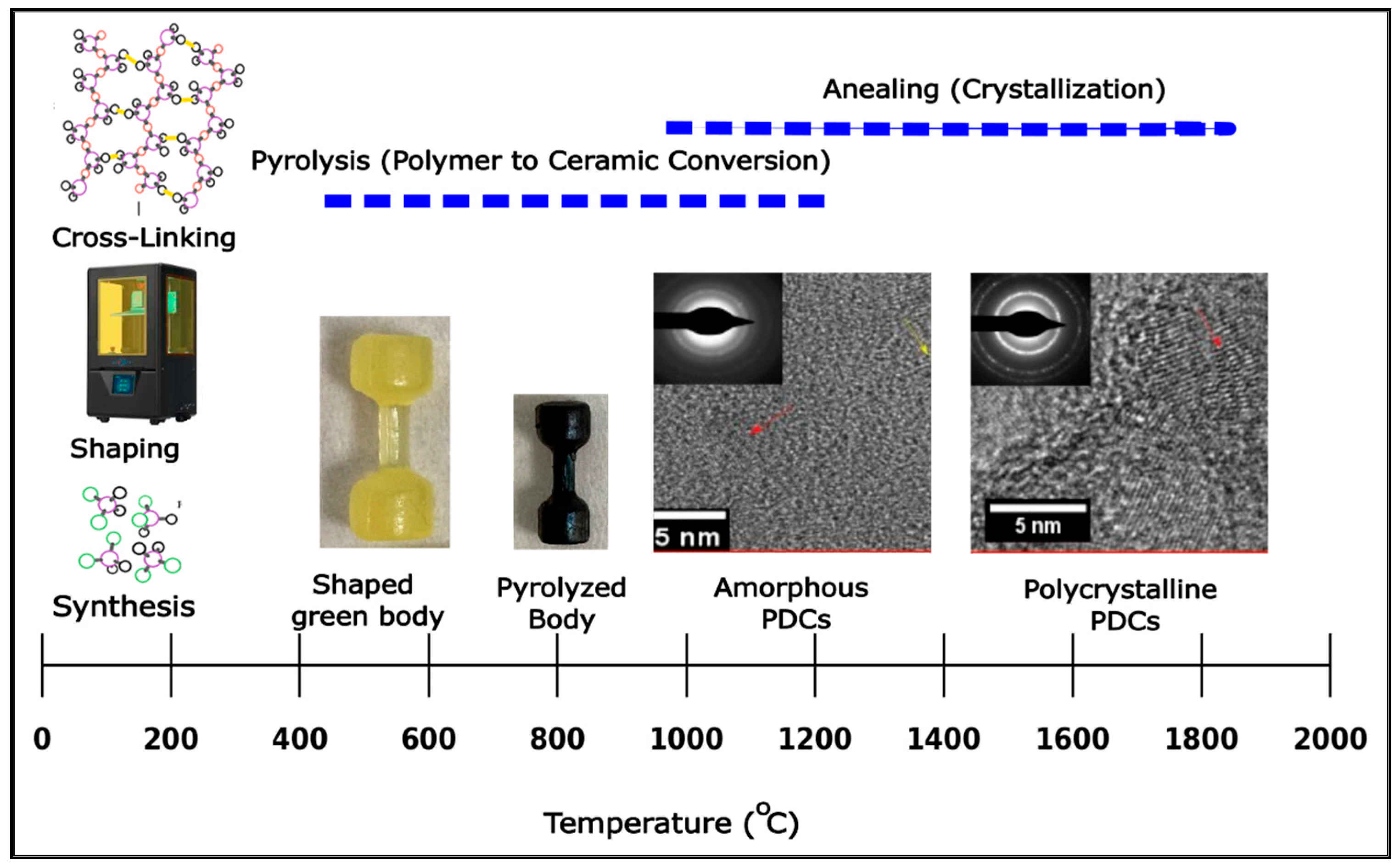
Polymer-derived ceramics (PDCs) are produced from organosilicon preceramic polymers that convert to ceramic-based hybrid materials via thermal treatment under controlled pyrolysis conditions. In the 1960s, Ainger and Herbert [1] described, for the first time, a non-oxide ceramic preparation technique from molecular precursors. The versatile capabilities of PDCs in the production of various products, such as ceramic fibers [2,3], films and coatings [4,5,6,7], foams [8], nanocomposites [9,10,11], ceramic matrix composites (CMCs) [12,13,14], and their suitability for additive manufacturing [15,16] have resulted in extensive investigation of these materials over the past 50 years [17]. The general procedure for the preparation of PDCs begins with Si-based precursor synthesis, followed by shaping, crosslinking at temperatures between 100 and 400 °C, and finally, organic-to-inorganic transformation through pyrolysis at 400 to 1400 °C [18]. The degree of crystallinity of the resulting ceramic depends on the pyrolysis temperature; annealing at temperatures exceeding 1400 °C predominantly produces polycrystalline ceramics. The temperature ranges used for polymer-to-ceramic conversion are shown in Figure 1.
The precursor undergoes a complex set of transformation reactions during pyrolysis; its molecular structure is controlled during precursor synthesis, whereas the processing parameters during pyrolysis influence the resulting ceramic microstructure, structural integrity, defect formation, and overall properties [19,20,21]. In addition, the tailored morphological features of the resulting ceramics, such as pore size and volumetric porosity, make them viable candidates for electrochemical energy storage devices. Owing to their unique thermal and thermodynamic stability, controlled porosity, remarkable electronic conductivity, and robust mechanical properties, PDCs have proven advantageous for electrochemical energy storage [22]. In terms of battery applications, the resulting exceptional electrical conductivity, stability in harsh environments, and the ability to cycle alkali ions at room temperature enable PDCs to serve as high-energy density anodes in lithium-ion batteries (LIBs) [22,23]. Beyond their use as electrodes, PDCs have also been employed as catalyst supports [24], semiconductors [25], sensing elements [26], and drug delivery systems [27], as well as in high-temperature and electromagnetic applications.
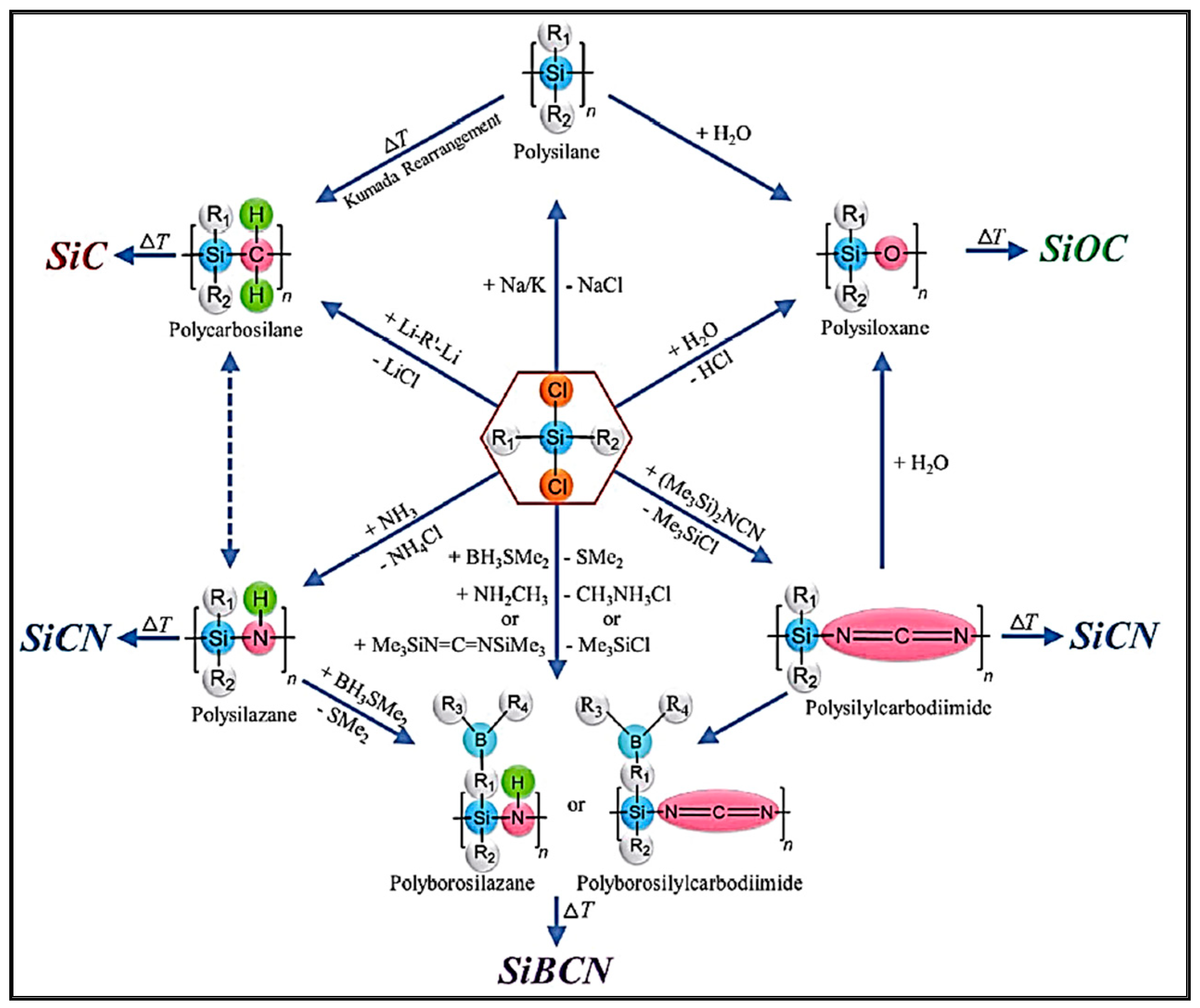
Regarding PDC materials, the precursor composition incorporates various elements, depending on the preceramic polymer’s chemical structure, such as silicon-, aluminum-, and boron-containing polymers [28]. Structurally, most preceramic polymers consist of Si atoms in the main chain along with C, O, N, B, and H atoms in the side groups (Figure 2), thereby giving rise to a variety of preceramic polymers such as polysiloxanes, polysilazanes, and polycarbosilanes [18]. Such silicon-based precursors can be converted into a range of ceramics, including silicon carbide (SiC), silicon dioxide (SiO2), silicon oxycarbide (SiOC), and silicon carbonitride (SiCN), after pyrolysis [29,30,31]. Unlike traditional ceramics, the processing of preceramic polymers offers numerous advantages due to the close relationship between the microstructure and chemical composition of PDCs and those of the starting polymer. Accordingly, ceramic products and properties can be systematically tailored to specific applications by selecting suitable polymers without requiring additives or sintering agents [32].
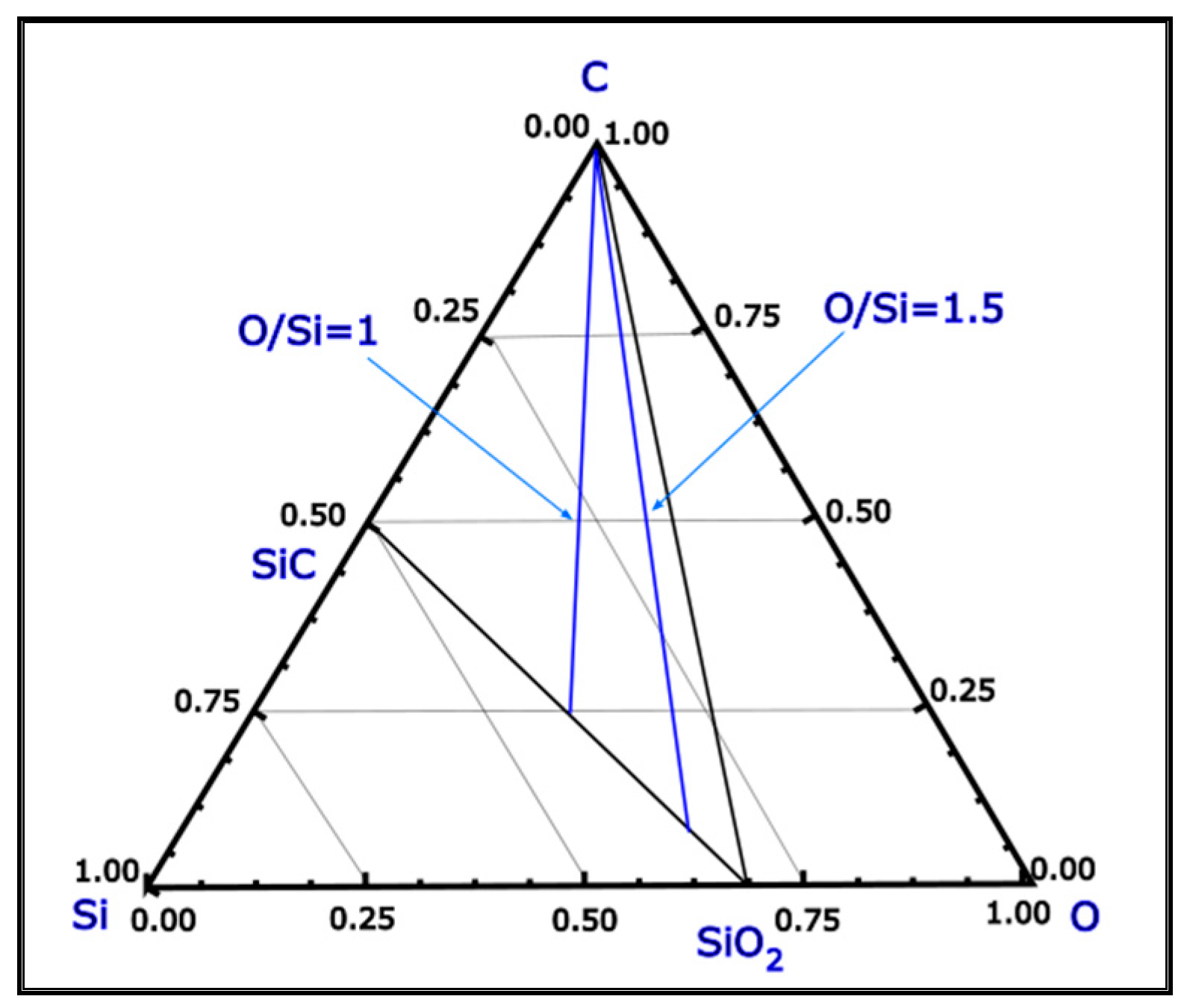
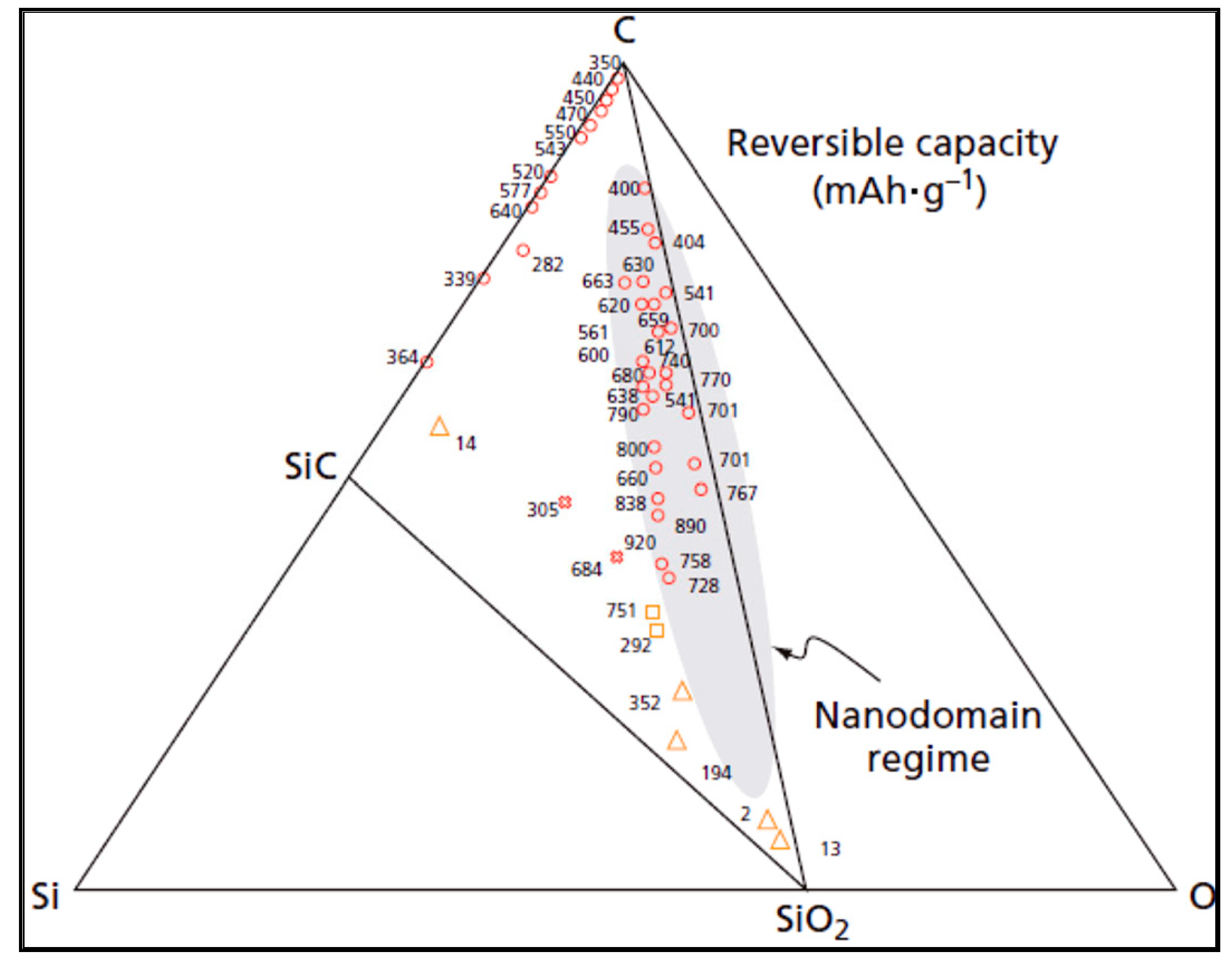
One of the most widely studied preceramic polymers is SiOC, commonly referred to as oxycarbide glass, an amorphous ceramic derived from PDCs with various stoichiometries. The atomic structure of SiOC contains short-range-ordered SiO4−xCx tetrahedra and free carbon [34]. The term silicon oxycarbide is associated with a chemical structure where silicon is bonded to C and O, forming tetrahedral structural units of SiO4−xCx (x = 1–4) mixed bonds [35,36]. These structural units consists of amorphous and heterogeneous Si-O-C phases, while the free carbon and SiO2-enriched regions might be dispersed randomly. The enhancement of mechanical strength and thermal integrity is achieved by replacing the two-valent oxygen atoms with four-fold carbon atoms [37,38]. The percentage of carbon in the SiOC structure further classifies the SiOC ceramic; for example, the prefix “carbon-rich” refers to SiOC with carbon content exceeding 20 wt% [39]. The carbon-rich SiOC structure consists of two interpenetrating domains, which are the amorphous SiO4−xCx (x = 1–4) phase and/or silica network, and the amorphous free carbon structure [19,40,41,42,43]. The percentage of isolated carbon leads to either the formation of a carbon nanodomain for lower carbon content or a percolated carbon network for higher carbon content, which has been confirmed by Transmission Electron Microscopy (TEM) and electrical conductivity measurements [44,45,46]. Carbon-rich silicon oxycarbides exhibit additional advantageous properties compared with stoichiometric or near-stoichiometric compositions, specifically enhanced thermal resistance and high-temperature crystallization integrity [46,47]. As shown in the ternary representation in Figure 3 [48], the stoichiometric SiOC phase is represented by a tie line connecting SiC-SiO2 compositions. The compositions falling above or below this tie line have excess free amorphous carbon. Each composition on the SiC-SiO2 tie line corresponds to a specific domain size.
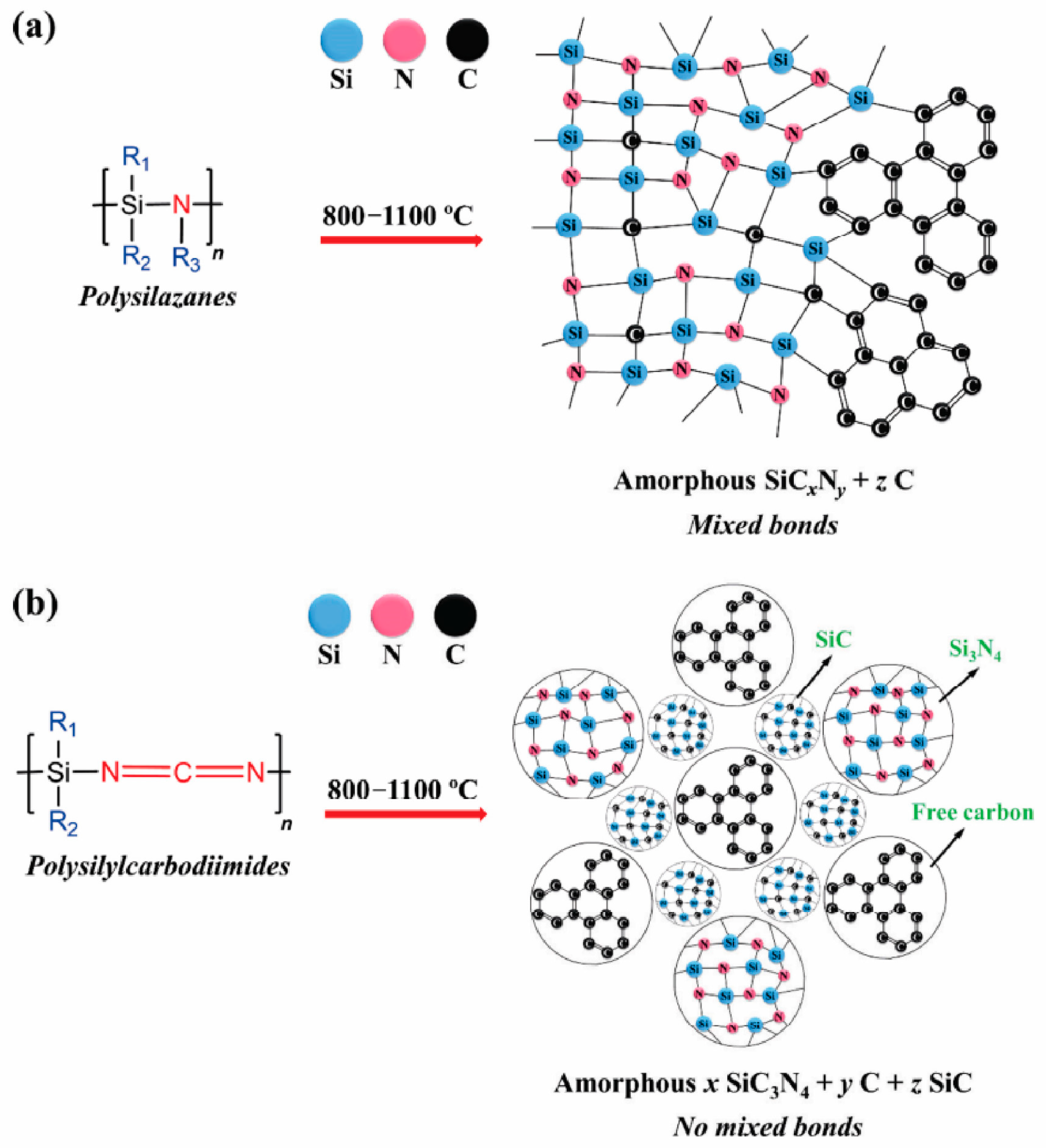
In the case of SiCN, the polymer-to-ceramic transformation at temperatures 800–1100 °C generates two distinct microstructural classes based on the initial molecular preceramic polymer structure, as shown in Figure 4 [49]. The first category is polysilazane-derived SiCN materials which contain a separate amorphous SiCN phase with tetrahedrally coordinated Si atoms attached to N or C or a combination of both (i.e., SiCxNy) via sp3 hybridization [50,51]. In contrast, the C atoms are linked to each other through sp2 hybridization in the free carbon nanodomains, a structure that can be identified by Nuclear Magnetic Resonance (NMR) spectroscopy (Figure 4a). The other category is polysilylcarbodiimide-derived SiCN ceramics, which contain an isolated amorphous Si3N4 phase and a free-carbon domain. A negligible percentage of SiCxN4−x mixed bonds can be found in the polysilylcarbodiimide-derived SiCN ceramics [52,53,54]. As shown in Figure 4b, the carbon-rich polysilylcarbodiimides have three potential amorphous domains, including Si3N4, free carbon, and dispersed SiC networks, all of which may be detected in the resultant SiCN ceramics (Figure 4b). This microstructural arrangement has been identified using elemental phase mapping, calorimetry [54], electrical conductivity test, and X-ray diffraction (XRD) analysis [32]. The two distinct poorly crystalline structures in SiCN ceramics produce different levels of thermal resistance to crystallization. However, the amorphous SiCN ceramics derived from polysilazane precursors crystallize at temperatures that are 50–100 °C lower than those obtained from polysilylcarbodiimides [18]. Analogous to SiOC ceramics, the amorphous SiCN phases are not amorphous because they contain short-range ordered structural features called nanodomains.
While SiOC and SiCN are both silicon-based polymer-derived ceramics, their electrochemical behaviors diverge due to distinct bonding environments and ceramic architectures. SiOC primarily comprises amorphous Si–O–C units and free-carbon domains; here, the oxygen-rich network offers active sites for alkali-ion storage, though it may limit electronic conductivity if the free-carbon phase lacks percolation. Conversely, SiCN consists of Si–C–N or Si3N4-rich domains alongside free carbon, dictated by precursor chemistry. Although the nitrogenous network enhances thermal and chemical stability, the free-carbon phase remains the primary driver of electronic transport and ion-accessible sites. Consequently, SiOC typically exhibits higher capacity for Li+/Na+ storage via its mixed-bond units, whereas SiCN provides superior structural stability, necessitating precise control over porosity and carbon distribution to optimize ionic diffusion [21,32,55,56].

2.1. Polymer-Derived Ceramics for Electrochemical Energy Storage

The progressively expanding demand for energy to meet the needs of a steadily growing population has led to substantial global fossil fuel consumption [57]. The primary negative consequence of such ever-growing consumption is the significant emission of greenhouse gases, such as CO2, which continuously enter the atmosphere, contributing to environmental issues, including climate change and global warming [58,59]. At the same time, there are challenges related to the gradual depletion of fossil fuel reserves, for example, coal is projected to last only another 100 years, while gas and oil are projected to last for shorter periods. Such fuel reserves raise a crucial concern regarding the potential energy security [60,61]. This depletion has initiated considerable efforts to replace fossil fuels with renewable energy systems, such as solar, wind, hydroelectricity, and geothermal energy [62]. These energy systems are almost inexhaustible, affordable, and environmentally friendly, and produce no greenhouse gases [62]. Various types of energy storage currently exist; for instance, pumped hydro (which accounts for about 98% of U.S. energy storage), thermal energy storage, and compressed air [63,64]. In contrast, electrochemical energy storage systems, due to their longevity, low installation, capital expenditure, and ease of setup, are considered the most viable options for renewable energy storage candidates [65].
Science and technological innovation drive the development of electrochemical energy storage devices, which, in turn, facilitate modern lifestyles and provide an eco-friendly alternative [66,67,68,69]. Emerging electrochemical energy storage technologies, including batteries and supercapacitors, offer a vital solution to the inherent limitations of other clean energy systems, such as unsustainability and instability. However, electrochemical energy storage devices are limited by their restricted power density and inferior energy density compared to supercapacitors. Therefore, developing high-performance electrode materials is essential for improving the manufacturing processes of energy storage systems [70].
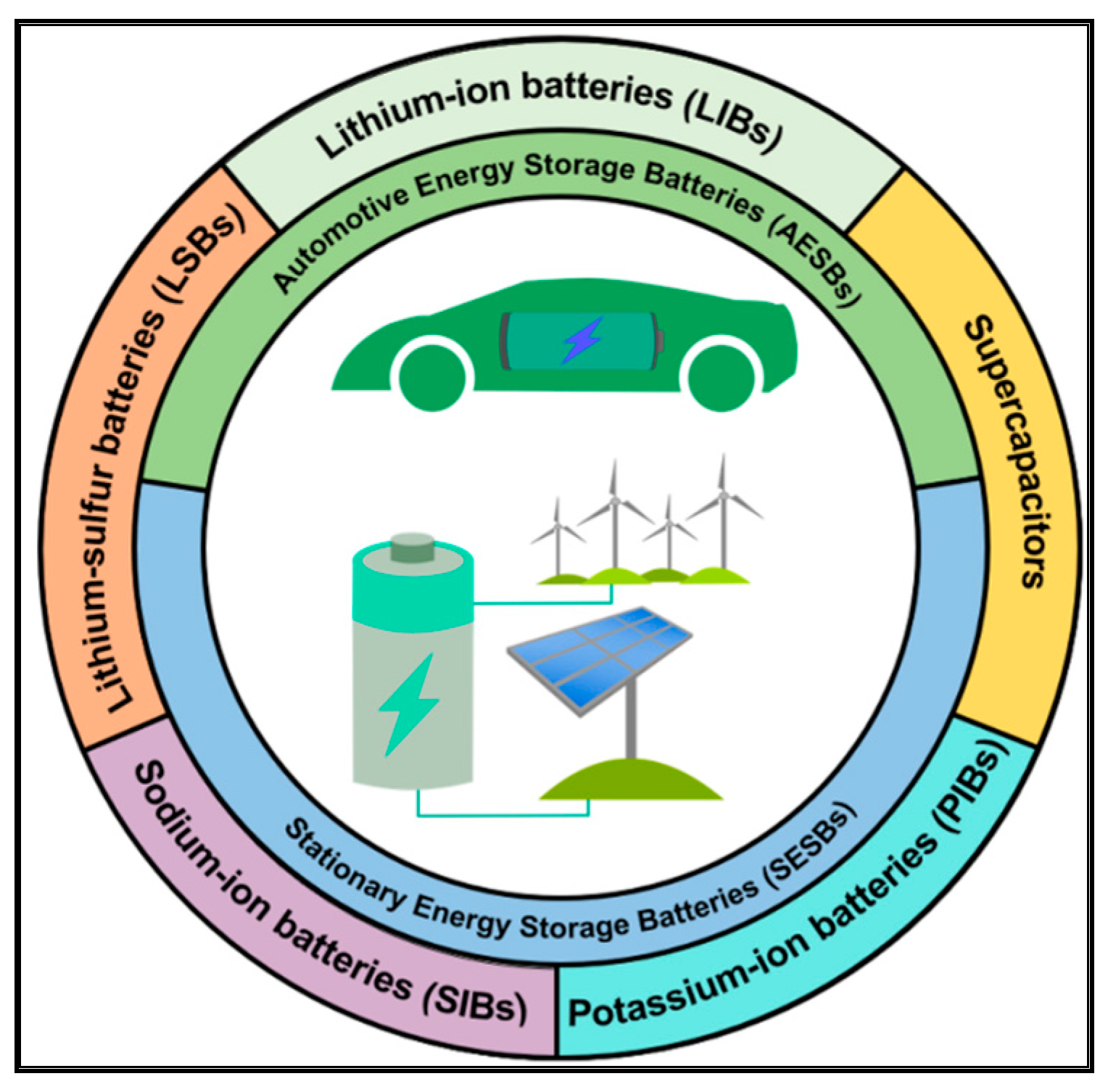
Among these rechargeable electrochemical storage devices, LIBs have been playing an essential role in recent years [71]. Along with LIBs, other distinct electrochemical energy storage and generation concepts such as sodium-ion batteries [72], lithium-sulfur batteries [73], supercapacitors [74], as well as metal-air batteries [75] and fuel cells [76] have lately attained momentum for potential applications, driven by increasing demand and the diversification of the application environment. Figure 5 summarizes the exploitation of several battery and supercapacitor technologies.
Generally, the main components of an electrochemical storage system are electrodes, separators, and electrolyte solutions. The electrode assembly consists of positive and negative electrodes, each composed of current collectors and active material layers [77]. The controlled ion transport between the electrodes is facilitated by the separator, while the electrolyte solutions contain a solvent, primarily carbonate-based, and an electrolyte [78].

2.2. Application of Silicon-Based PDCs as Electrodes of Energy Storage Devices

2.2.1. Silicon-Based Ceramics as Negative Electrodes of LIBs

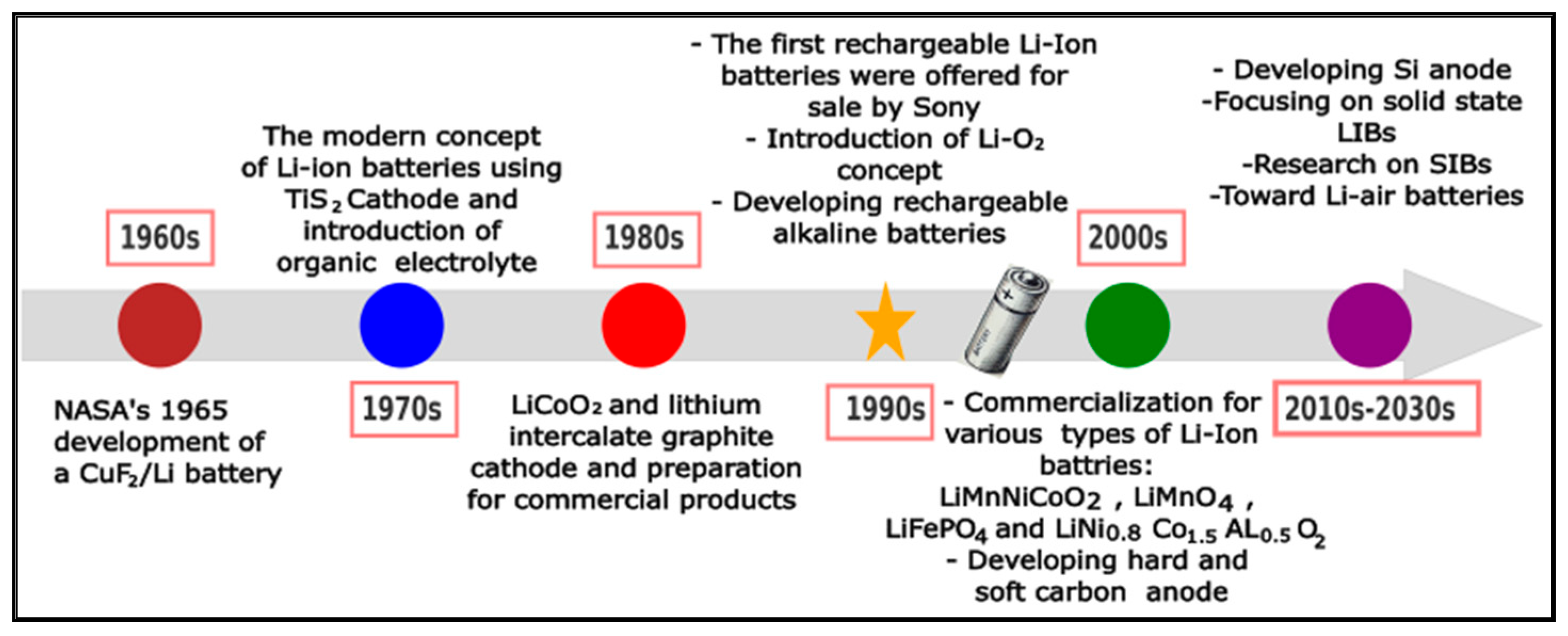
According to the LIBs innovation timeline (Figure 6), in the 1970s, M. Stanley Whittingham fabricated TiS2 material and considered it a high-performance electrode for which the cost and toxicity of H2S were the main barriers to commercialization [79,80]. The golden era in the history of such batteries was the period between the 1980s and 1990s when novel electrode materials such as LiCoO2 and graphite for small electronic devices were announced and altered the development history of energy storage components [81,82]. In the 2000s, LIBs were massively commercialized with various categories including LiFePO4, LiMnO2, and LiMnCoO2. In 2019, the Nobel Prize in Chemistry was awarded to Michael Stanley Whittingham, John Bannister Goodenough, and Akira Yoshino for their pioneering achievement in lithium-ion battery research. From the invention of the first lithium-based secondary battery until its commercialization, lithium-ion batteries have drawn great attention and have recently been massively utilized in mobile phones, laptops, electric vehicles, and other electric devices, and have revolutionized human life [83,84,85].
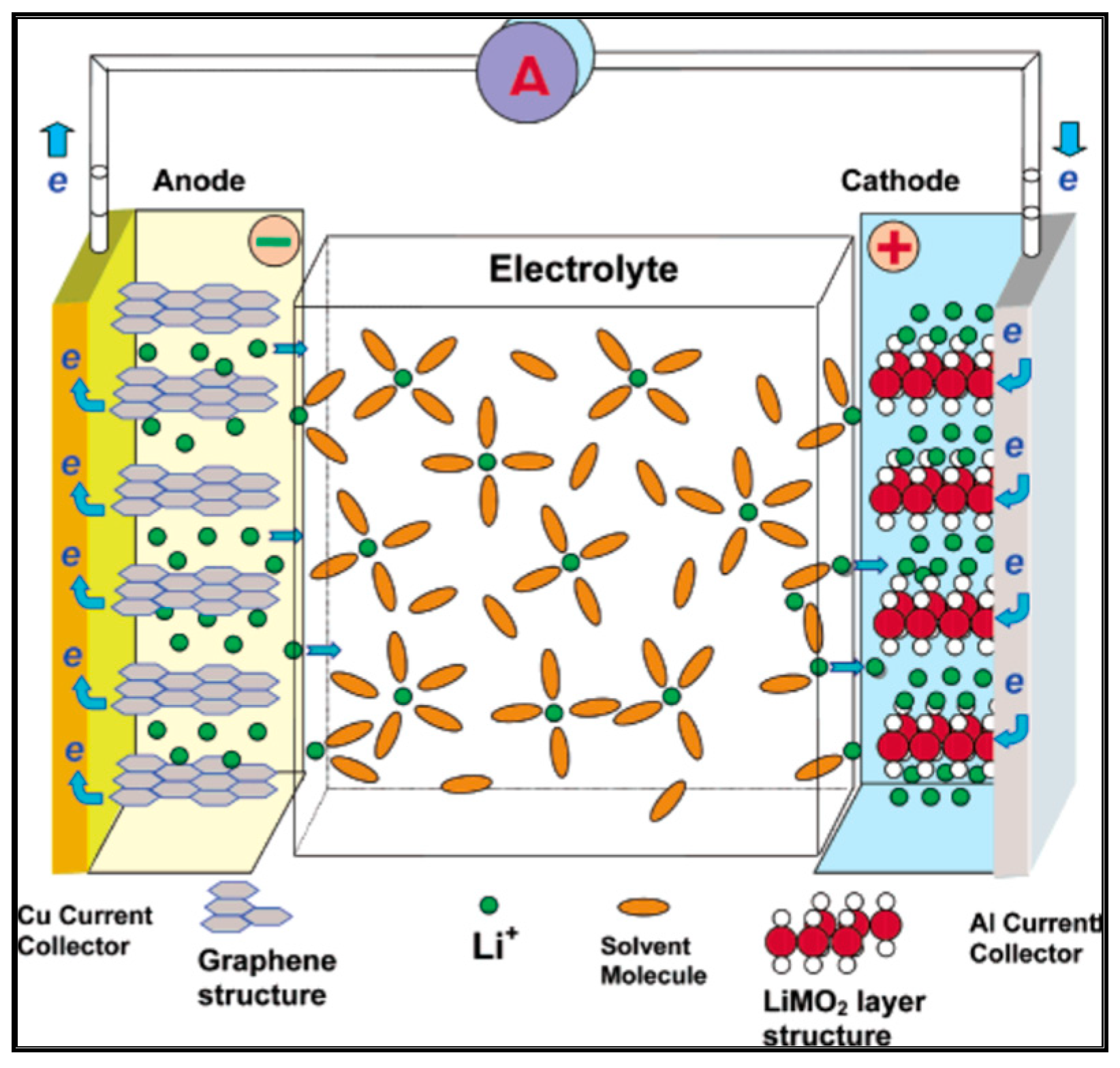
In the last 30 years, LIBs have been one of the dominant technologies in electrochemical energy storage systems among other competing systems. LIBs have been massively applied as a main energy storage and power system in electric devices due to their inherent superior energy and power density, efficiency, and life cycle [87,88]. The typical LIB cell consists of five main components, which are an anode, a cathode, a separator, an electrolyte, and a pair of current collectors (positive and negative) as shown in Figure 7. While the positive and negative electrodes store Li ions, the separator forms an isolation layer between the anode and cathode and assists the migration of Li+ during charging and discharging. In this process, the mobility of Li+ in the anode produces free electrons, causing a charge on the positive current collector. Later, the electrons pass from the current collector to the negative current collector through a powered device. Meanwhile, redox reactions occur at the electrodes, where active substances undergo oxidation and reduction as lithium ions intercalate and deintercalate into host materials. Within the battery, the separator prevents electrons from moving [84].
The utilized anode materials in LIBs are mainly graphite, graphene, and carbon nanotubes [22]. Recently, for most commercially available LIBs, graphite with a theoretical capacity of 372 mAh g−1 is used as the anode material [90,91]. However, during the charging cycle, lithium dendrites are formed, which are considered the major cause of battery decay and poor electrochemical performance [92]. Replacing graphite with silicon is one of the possible solutions to improve performance due to its extraordinary theoretical capacity of around 3600 mAh g−1, about 10 times higher than the graphite anode, and abundance [93,94]. Nonetheless, silicon undergoes a volume expansion of about 300% during lithiation and the associated phase transformation causes material pulverization and electrode separation. This significant volume change generates mechanical stress that can crack electrodes and degrade performance. This causes a sudden capacity fading and low Coulombic efficiency [95]. To address such challenges, a nanostructured anode material must be synthesized to restrict or accommodate volume expansion. Volume expansion refers to the physical swelling of electrode materials during ion insertion, causing mechanical stress and capacity fade in batteries. Several nanostructured materials have been investigated, such as Si nanowires [94,95,96,97,98], Si nanotubes [99,100,101], Si nanoparticles [99], and Si-based composites [102,103]. In addition, carbon nanofibers can be utilized to carry Si nanoparticles (Si NPs). The resulting silicon-loaded carbon fibers have a large surface area, high thermal stability, and remarkable electrochemical performance in supercapacitor and battery applications [104]. The loaded Si NPs increase the surface roughness and surface area of the carbon nanofibers. However, achieving uniform particle distribution and strong adhesion is challenging due to the tendency of Si NPs to agglomerate, which adversely impacts battery capacity and lifetime [105]. Another successful anode material for Li-ion batteries is polymer-derived ceramic precursors. Current investigations have demonstrated that PDCs can effectively store Li+, exhibiting higher usable capacity and improved rate performance as compared with graphite materials [106,107].
In comparison to silica-derived SiOx and biomass-sourced Si/SiOx materials—such as rice-husk-derived silicon—polymer-derived SiOC and SiCN ceramics afford superior control over elemental composition, free-carbon content, porosity, and microstructure. While biomass-derived Si/SiOx is economically attractive due to its low cost and sustainable origin, PDC-based ceramics provide enhanced structure–property tunability, superior strain accommodation during lithiation/delithiation cycles, and greater flexibility in electrode design. Consequently, the primary advantage of PDCs lies not in cost-efficiency, but in their high controllable electrochemical stability and architectural versatility for LIB anodes [108,109].
Polymer-derived SiOC glass-ceramics have attracted much more attention during the past two decades as anode materials in LIBs, even though more effort should be devoted to the full commercialization of such materials. SiOC anodes have shown a noticeably high reversible capacity and outstanding rate capability without microstructural or volumetric changes compared to conventional graphite anodes [110,111].
However, the significant obstacles to the use of PDCs, including SiOC, are the limited intrinsic electronic conductivity mediated by a heterogeneous nanosized unbonded carbon agglomerate, which hinders Li-ion insertion/deinsertion reactions [22,112] and the compacted microstructures that result from absence of ion transport pathways in most processes, and which generally yield low utilization of the active phase. To manage such drawbacks, a customized composition and structure of the preceramic polymer can be designed by controlling the precursor at different levels to deliver enhanced electronic and ionic transport behavior in electrodes.
Notably, SiOC ceramic is the most common preceramic polymer used in LIBs since it demonstrates high reversible capacities, stability, and slight volume changes during charging/discharging cycles. The SiOC stoichiometry and chemical composition have been illustrated in previous studies [111,113,114] which consider the mixed bond arrangement. Tetrahedrally coordinated silicon structures, ranging from SiC4 via SiC3O, SiC2O2, and SiCO3 to SiO4, are considered the main lithiation sites. The resulting reversible capacity of such bonds of C, SiO2, and SiC in the SiOC compositional triangle is presented in Figure 8.
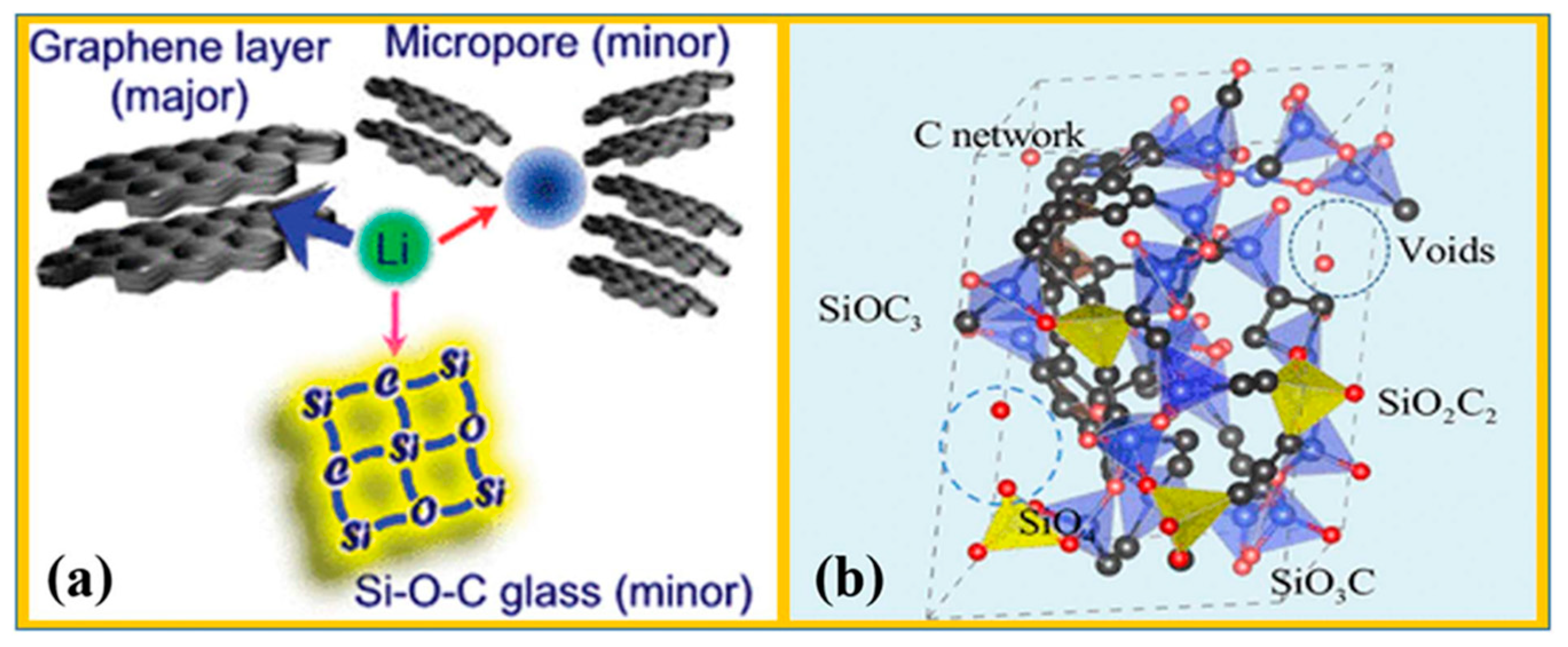
Figure 9 illustrates how lithium insertion into the anode material causes considerable swelling due to intercalation reactions, resulting in mechanical stress, electrode cracking, and subsequent capacity degradation. This figure highlights the importance of engineering nanostructured materials that can effectively accommodate or mitigate these significant volume variations, thereby enhancing battery longevity and stability [33].
To demonstrate the effect of carbon, Table 1 lists different carbon-rich SiOC chemical formulations whose electrochemical performance have been investigated. For the sake of comparison, the chemical composition, free carbon percentage, first-cycle reversible (Crev) and irreversible capacity (Cirr), Coulombic efficiency (ƞ), applied cycling current, and, if available, capacity retention upon continuous cycling are itemized. For consistency, all prepared samples were fabricated via polymer-to-ceramic conversion at pyrolysis temperature of 1000 °C. They all fulfilled the requirement of containing at least 20 wt% free carbon within their microstructure.
The results summarized in Table 1 demonstrate that free-carbon content fundamentally dictates the electrochemical performance of SiOC anodes. Generally, moderate-to-high free-carbon levels correlate with enhanced Coulombic efficiency and cycling stability; however, the reversible capacity does not scale linearly with carbon concentration. This non-linear relationship suggests that peak performance hinges on a synergistic balance between the amorphous Si–O–C network and the free-carbon phase. In this configuration, the carbon domains facilitate electronic transport and offer auxiliary lithium-storage sites, while the ceramic matrix ensures structural integrity.
The Li-ion storage in SiOC is believed to exhibit a dual mechanism involving intercalation and alloying processes (Figure 9a,b). The existence of silica tetrahedral units enables alloying, whereas the free carbon assists with intercalation. Liu et al. [122] investigated the Li-ion storage mechanism of SiOC ceramics using several characterization techniques, including nuclear magnetic resonance (NMR), Si X-ray photoelectron spectroscopy, and cyclic voltammetry [123]. In their investigation, they hypothesized the existence of four resonances in the SiOC sample, including SiO4, SiO3C, SiO2C2 and SiOC3, and among them, SiO3C and SiO2C2 are electrochemically active toward Li ions and contribute to reversible capacity, while SiOC3 is irreversibly transformed into SiC4 after the first cycle. During the intercalation cycle, the SiO4 glass formed Li2SiO3, while the inactive part resulted in Li4SiO4. Investigations by Xue et al. [124] revealed that irreversible capacity accompanying the first cycle SiOC charge/discharge cycle surges with the existence of silicon and oxygen in addition to carbon. On the other hand, studies by Liu et al. have demonstrated the major role of the carbon phase as a host for Li ions [123]. It has been confirmed that lithium occupies the interstitial and defect lattice sites, as well as the edges of graphene sheets, and is adsorbed at the interface of graphite nanodomains in carbon-rich SiOC [125,126]. In addition, Li MAS NMR characterization performed by Fukui et al. proved the existence of at least two electrochemically active sites associated with carbon within the SiOC structure for Li-ion storage, in which the carbon phase serves as the principal host site for lithium storage [117]. Earlier reports [106,127] have shown that the percentage of free carbon plays a crucial role in enhancing capacity, cyclic stability, and controlling irreversible capacity. However, the initial cycle efficiency of PDCs anodes did not exceed 63%. To boost electrochemical performance, including the first cycle stability, mixing SiOC with carbon-based materials has been implemented as an efficient strategy [34,35,128,129,130]. For example, Konno et al. [131] reduced the oxygen content in SiOC ceramic by fabricating a SiOC-exfoliated graphite composite, which raised the first cycle Coulombic efficiency to ~70% even though the overall material capability severely declined after several tens of cycles. Kuksenko [129] created a highly loaded SiOC ceramic with amorphous carbon to raise the first cycle Coulombic efficiency to about 80%. However, this enhancement was only recorded for thin films (0.3 μm), while the thicker electrodes revealed a lower efficiency of approximately 50%. Tahir et al. [132] boosted the first cycle efficiency from 48 to 86% by pre-lithiation process of SiOC using a spray coating of stabilized lithium metal powder. This process does not apply to all binders, and it is applicable only to an inert environment. To date, the most efficient method to improve first-cycle efficiency was reported for SiOC ceramic composites that contain graphene, carbon nanotubes (CNTs), or carbon nanofibers [128,130,133,134,135]. Bhandavat et al. [136] fabricated SiOC/CNTs shell/core composites to effectively decrease the oxygen content and to create a feasible path for lithium diffusion. This structure enhanced first-cycle efficiency by more than 16% (from 50.1% for pure SiOC to 67% for the SiOC/CNTs). Sang et al. [128] introduced a SiOC/3D graphene scaffold structure that exhibited an improved conductivity and a Coulombic efficiency of 65.7%. However, such implementations are expensive due to the utilization of expensive materials in multi-step synthesis methods. Knozowski et al. [36] investigated the influence of the preceramic precursor, vinyltriethoxysilane (VTES), on the electrochemical performance of SiOC/graphite composites. An ultra-high power sonicator was utilized to ensure a homogenous distribution of small carbon-based flakes. The SiOC/graphite composites exhibited steady capacities of up to 520 mAh g−1 for 270 cycles which were greater than the value expected from the ratio of the components. Additionally, the composite revealed a 15% enhancement in first-cycle Coulombic efficiency as compared with the pristine VTES-based SiOC ceramic due to the synergistic influence of graphite incorporation into VTES-based SiOCs. Furthermore, intensive microstructural and electrochemical studies demonstrate that SiOC micropores can function as active sites for storing lithium, improving reversibility in the 0.005–0.4 V range.
Figure 9. Mechanism of lithium-ion storage in SiOC for (a) Carbon-enriched and (b) Silicon-enriched material systems. Reproduced from [137] with permission from the Royal Society of Chemistry.
Jcs 10 00280 g009
Another important PDC system is SiCN. In 1997, Dahn et al. registered a U.S. patent to utilize silazane to fabricate SiCN as an electrode for LIB, which demonstrated a capacity of up to 560 mAh g−1 [138]. However, SiCN gained limited attention in battery applications compared to SiOC. The trend has shifted since 2006 after Kolb et al. [139] investigated the use of polysilazane for LIBs. They found that blending the preceramic polymer with graphite enhanced the first-cycle discharge capacity from about 40 mAh g−1 to 470 mAh g−1. Such preliminary and promising results led to a closer examination of its utilization, the enhancement of electrochemical efficiency, the role of chemical composition, and the Li ions storage mechanism in such ceramic materials [140,141,142]. Unlike SiOC, the free carbon content within the SiCN matrix boosts the capacity up to the saturation threshold (50 wt%) [56,142].
Su et al. [143] and Feng [144] fabricated SiCN ceramic electrode utilizing a polysilylethylendiamine precursor, revealing an initial discharge capacity of about 460 mAh g−1. However, significant capacity fading was observed over successive cycles. Feng recommended that raising the pyrolysis temperature of the polymeric precursor could address this capacity fading. His approach successfully mitigated the issue even though it revealed a relatively low capacity of 300 mAh g−1. Subsequently, Kaspar et al. [140] and Graczyk-Zajac et al. [141] further investigated techniques to enhance the electrochemical performance of SiCN ceramic electrodes derived from carbon-rich precursors such as polysilylcarbodiimides. Carbon in SiCN ceramic proved its effectiveness as a host for lithium ions [142] which is consistent with the findings of Qian et al. about carbon-rich SiOC materials [145]. Similarly, other ceramic composite electrodes composed of SiCN/graphite [146,147] and SiCN/Si [148] exhibited enhanced electrochemical properties as compared with their components.
Various preceramic materials precursors can be utilized in the fabrication of potential anode materials for lithium-ion batteries. For example, polycarbosilane (PCS) precursor has been investigated for possible utilization in LIBs. After polymer-to-ceramic conversion, the resulting materials could be Si NPs [149]. In addition, SiCNO nanoparticles can be achieved after the pyrolysis of a polysilazane precursor, forming a Li-ion anode of outstanding capacity and high stability [150].
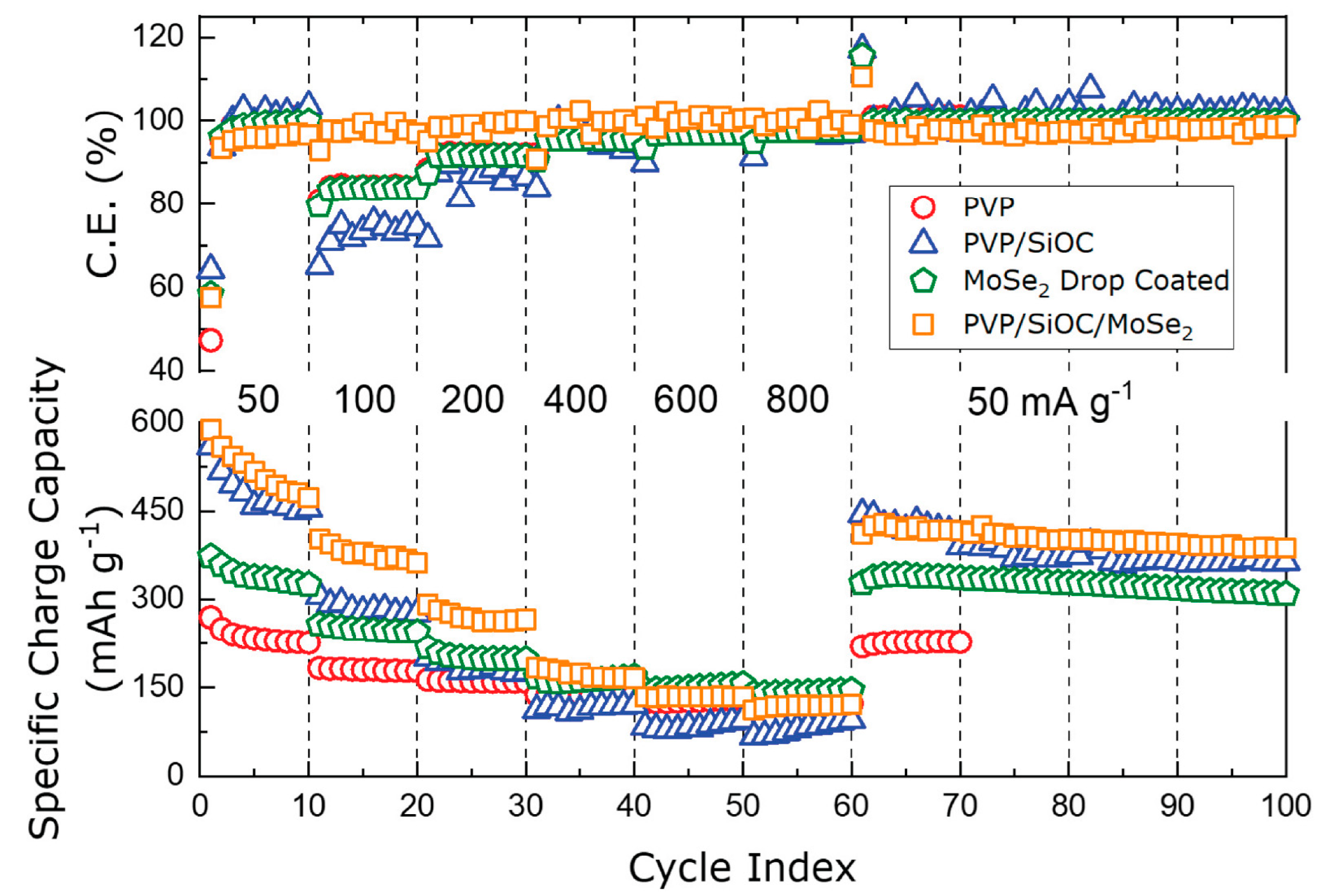
To further enhance the anode material’s electrochemical properties, PDC composites are being investigated extensively, as the fabrication procedure is feasible and typically involves mixing polymeric preceramic precursors with metallic or ceramic nanomaterials. Dey et al. [151] combined MoSe2 nanosheets with polymer-derived polyvinylpyrrolidone/SiOC fiber mats to produce a free-standing electrode that enables stable cycling at higher current densities in a LIB half-cell arrangement. To fabricate such fibers, the chemically exfoliated MoSe2 was dispersed in a preceramic polymer precursor and polyvinylpyrrolidone (used to improve the nanofibers’ spinnability), which was later spun into nanofibers via electrospinning. Furthermore, the Fourier-transform infrared spectroscopy (FTIR) verified the progression of the fibers from their initial spun state to their cross-linked and ultimately pyrolyzed state. Studies using Raman and X-ray photoelectron spectroscopy (XPS) demonstrated the presence of a free-carbon phase in the fibers and the presence of Si-O-C bonds, respectively. After cycling at gradually increasing current densities, the electrochemical performance of the Polyvinylpyrrolidone (PVP)/SiOC/MoSe2 electrode exhibited stable Coulombic efficiency and larger capacity than the pristine fiber mats without the MoSe2 material. Therefore, the functionalization of a self-supporting SiOC electrode with MoSe2 resulted in more stable performance under severe cycling conditions, broadening its application in energy storage. Figure 10 represents the investigated LIB half-cell electrodes’ Coulombic efficiency, which showed poor Coulombic efficiency in the first cycle due to the formation of an irreversible Solid Electrolyte Interphase (SEI) layer, while the more stable PVP/SiOC/MoSe2 electrode was maintained even at high current densities of charging and discharging. This shows the durability of fiber mat composites toward fast reversible Li-ion in the fiber mat. When the current density was elevated to 100 and 200 mA g−1, the carbonized PVP and pyrolyzed PVP/SiOC electrodes displayed poor reversibility, while the pyrolyzed PVP/SiOC/MoSe2 electrode showed a steady response with a Coulombic efficiency of about 100% for approximately 100 cycles. This further indicates how the SiOC-functionalized MoSe2 fiber mat maintained its structural integrity under severe testing, which distinguishes it from the other examined electrodes.
Naveenkumar et al. [152] used silicone oil and melamine as precursors to fabricate a nitrogen-doped graphene/SiOC nanosphere composite following thermal polymerization. The advantage of nitrogen’s presence in the composite is associated with this element’s ability to release extra electrons and attract lithium ions during the charge/discharge cycles. Cyclic voltammetry results indicated excellent reversibility and capacity retention for the composites. With an approximate current density of 100 mA g−1, the nanosphere composite provided an initial discharge capacity of 1324 mAh g−1, exceeding the 850 mAh g−1 of SiOC and the 219.8 mAh g−1 of graphitic carbon nitride anode materials in LIB applications. For the N-Graphene/SiOC anode, a specific retained capacity of 415.8 mAh g−1 was achieved after 1000 cycles and a current density of 1000 mA g−1. After the 1000th cycle, capacity retention was 67% while the Coulombic efficiency was about 99%, which demonstrates outstanding lithium-ion storage capability.
To commercialize LIBs with exceptional rate performance and energy density, innovative advanced anode materials are essential. For example, novel anodes with tin nanoparticles replacing carbon materials are promising candidates for LIB anodes since tin has an extraordinary theoretical Li-ion storage capacity (994 mAh g−1) compared with graphite (372 mAh g−1). However, the challenges associated with the poor cycling stability of tin arise from its large volume expansion and contraction. To address this issue, Wang et al. [153] synthesized Sn-containing silicon oxycarbonitride (Sn/SiOCN) ceramic nanocomposites through a chemical reaction between tin acetate and poly(vinyl) silazane (Durazane 1800, Merck KGaA, Darmstadt, Germany) in an ice bath under an argon atmosphere, followed by pyrolysis of the precursor at 1000 °C, resulting in the uniform dispersion of metallic Sn nanoparticles within an amorphous SiOCN matrix. This structure effectively buffered volume changes, significantly improving the electrochemical performance and cycling stability of the anode. As anodes for lithium-ion batteries, the nanocomposites with various Sn loadings were tested; they provided a high discharge capacity of around 320 mAh g−1 at a current density of 2220 mA g−1 and remarkably long cycling stability, even at high charging rates (after 1000 cycles, about 90% of the capacity is maintained). According to electrochemical impedance spectroscopy, the enhanced charge-transfer mechanism enabled by the insertion of metallic Sn nanoparticles into the amorphous SiOCN ceramic matrix contributes to the exceptional electrochemical performance of Sn/SiOCN nanocomposites. During the lithiation process, the creation of the lithium-rich alloy phase Li7Sn2 has been confirmed by in situ XRD results.
Although the tin nanoparticle composites effectively address volume expansion-related issues, they often exhibit low capacity owing to insufficient cycling stability, leading to abrupt capacity decline due to their weak rate capability or limited lithium diffusion [154,155]. Compared with pristine carbon fibers, the electrochemical performance of hollow carbon fibers or CNTs filled or loaded with tin nanoparticles is remarkably high; yet, the cost of these composites is an essential obstacle. Furthermore, a multistage synthesis procedure is too complicated for industrial use, as it requires specialized machinery [154]. So far, for the attainment of high capacities and cycling stability, encapsulating tin nanoparticles within a silicon oxycarbide (SiOC) ceramic matrix is an attractive and economical solution. Among PDCs, SiOC was selected as a suitable alternative for stabilizing Sn NPs, and such nanocomposite anodes have been reported in [156,157,158,159,160]. Kaspar et al. [156] used polysilsesquioxane/polysiloxane and tin acetate to synthesize Sn/SiOC anodes through pyrolysis at 1000 °C. The fabricated anodes exhibited inadequate rate performance, mostly because of inhomogeneous distribution of Sn NPs within the SiOC matrix. Dubey et al. [160] synthesized a silicon oxycarbide–tin (SiOC/Sn) nanocomposite for lithium-ion battery anodes by combining poly(methylhydrosiloxane) (PMHS) and tin 2-ethyl-hexanoate (Sn(Oct)2), which were thermally converted into ceramic material through pyrolysis at 1000 °C. This method produced homogeneously dispersed tin nanoparticles (NPs) within the SiOC ceramic matrix. The resulting Sn nanoparticles ranged in size from 5 to 30 nm, offering a beneficial balance of mechanical stability and electronic connectivity. Although the synthesis aimed for a uniform dispersion of metallic Sn, some SnOx impurities emerged from the incomplete decomposition of Sn(Oct)2. Such impurities could significantly influence the electrochemical performance by affecting lithium-ion storage capacity and cycling stability. However, the study did not explicitly clarify the individual roles of metallic Sn versus SnOx in the overall anode performance. The optimized SiOC/Sn composite demonstrated superior electrochemical characteristics, such as enhanced capacity (up to 756 mAh g−1 at moderate rates) and impressive rate capability, suggesting potential advantages for high-power-density lithium-ion battery applications.
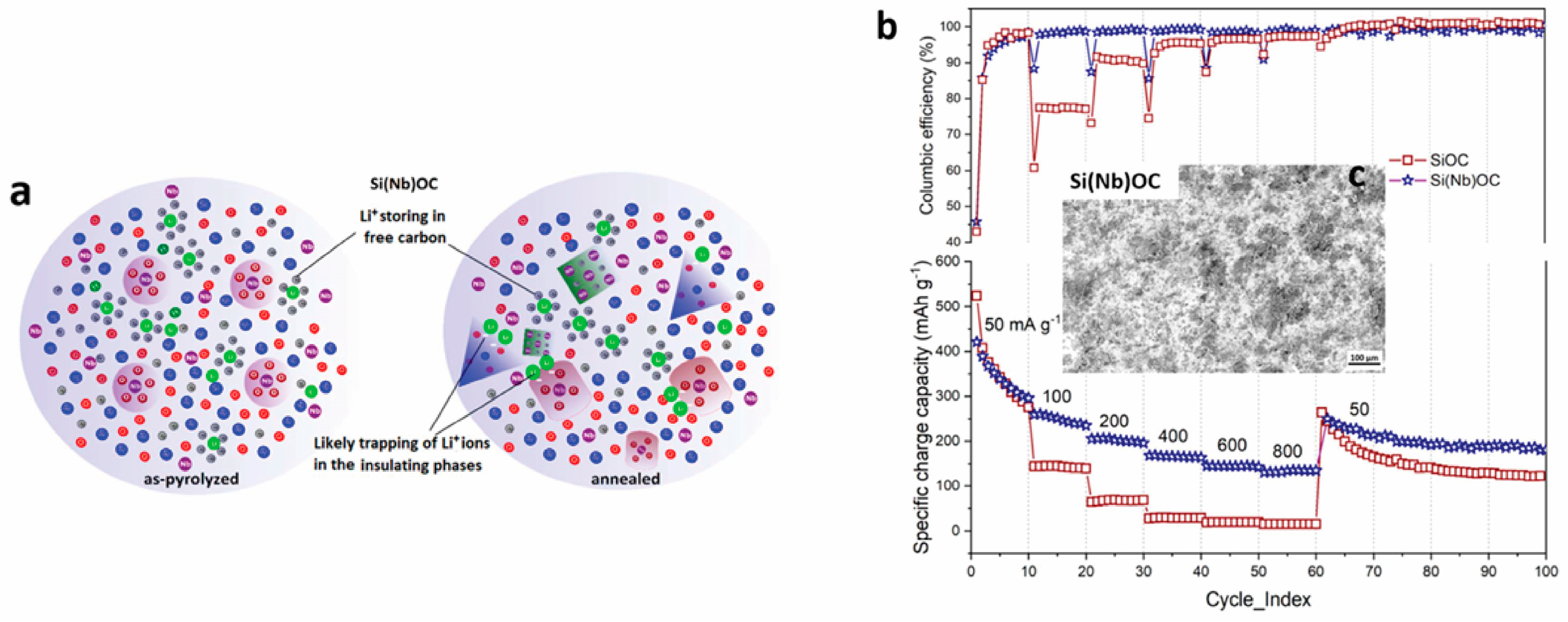
Lokesh Vendra et al. [161] adopted a preceramic pyrolysis approach to develop Si(Nb)OC ceramic composites as a hybrid anode material for LIBs. After polymer-to-ceramic conversion, in situ free carbon, crystallized t-NbO2, and NbC phases were observed in the amorphous Si(Nb)OC matrix. For as-pyrolyzed and annealed Si(Nb)OC electrodes, the first-cycle reversible capacities were 431 mAh g−1 and 256 mAh g−1, respectively, surpassing the expected Li capacity of m-Nb2O5 or niobium pentoxide (at approximately 220 mAh g−1); with a mean reversible capacity of 200 mAh g−1 and about 100% cycling efficiency. Figure 11a compares the Li storage mechanism, while Figure 11b compares the rate capabilities of pure SiOC and pyrolyzed Si(Nb)OC composites [162] at different current densities (50 mA g−1, 100 mA g−1, 200 mA g−1, 400 mA g−1, 600 mA g−1, 800 mA g−1, and 50 mA g−1). A stable SEI layer was achieved and confirmed by the microstructure of the after-cycling pyrolyzed Si(Nb)OC composites. These materials showed an average reversible capacity of 200 mAh g−1 and 99% cycle efficiency (after 100 cycles), wheras the as-pyrolyzed Si(Nb)OC electrodes indicated enhanced rate capability. This could be attributed to the distinct structure of the well-distributed non-crystalline SiOC/graphitic carbon/ordered Nb2O5 phases in the as-pyrolyzed Si(Nb)OC composites, which retained the structure stability during cycling and promoted stable SEI formation, resulting in high efficiency.
Reported SiOC-based composite strategies can be categorized into three primary approaches: integration of conductive carbon phases, addition of active alloying particles (e.g., Sn or Sb), and development of fiber-based or hierarchical porous architectures. Carbon additives—such as graphene, CNTs, graphite, and carbon nanofibers—primarily enhance electronic conductivity and rate capability, while metallic or ceramic fillers augment capacity and buffer volumetric expansion during cycling. Furthermore, fiber-based and free-standing architectures reduce ion-diffusion distances and preserve electrode integrity. However, these advancements introduce trade-offs, including increased processing complexity, filler agglomeration, higher costs, and challenges in interfacial control. Consequently, the field is shifting from simple capacity maximization toward integrated designs that harmonize conductivity, ion transport, mechanical resilience, and scalability.
Parallel to SiOC, SiCN-based ceramics merit attention due to their nitrogen-containing networks and distinct free-carbon phases. For instance, Ramlow et al. [163] fabricated carbon-loaded SiCN (SiCN–C) nanofiber mats via electrospinning polysilazane/polyacrylonitrile blends. For SiCN–C mats processed in air, a high charge capacity of 773 mAh g−1 at 50 mA g−1 was reported; the incorporation of oxygen increased Li+ affinity and capacity, albeit at the cost of significant voltage hysteresis. Conversely, spinning under nitrogen established superior cycling stability and a 98% capacity recovery rate, attributed to the increased concentration and connectivity of the free-carbon phase.

2.2.2. Silicon-Based Ceramics as Sulfur Hosts for Lithium–Sulfur Batteries (LSBs)

LSBs are an alternative to LIBs because of their high energy density (2.6 Wh g−1) and substantial theoretical specific capacity (1675 mAh g−1). The high capacity of LSBs is associated with sulfur’s superior theoretical capacity compared with that of traditional cathodes such as LiCoO2. In a typical LSB cell, elemental sulfur (solid at room temperature) and lithium metal serve as the cathode and anode, respectively [164,165,166]. The cell operates via a multi-electron conversion reaction at the sulfur cathode, which distinguishes it from intercalation-type cathode materials [167].
Despite their advantages, the commercialization of LSBs poses various challenges. This includes the dissolution and migration of structured polysulfides of intermediate lithium polysulfides (Li2Sn, 4 ≤ n < 8) during cycling and a substantial volume change (~80%) triggered by sulfur, which expedites capacity deterioration [168,169]. In addition, sulfur is an inherently insulating material, causing a shuttle effect through the formation of soluble polysulfides that significantly reduces the cathode capacity during cycling [170]. Therefore, the lower energy density of the battery occurs due to the irreversible loss of sulfur from the positive electrode, thus lowering the battery’s energy density and drastically decreasing the cyclability of LSB systems [171].
Similarly, to enhance the electrochemical reaction, conductive materials must be incorporated to overcome the limited electrical conductivity of sulfur [172]. Consequently, most LSBs have an active material proportion of only 70%, which is substantially lower than the 90% active material fraction seen in commercial LIBs, thereby contributing to an inferior energy density [173]. Enclosing sulfur in conductive carbon-based materials, such as carbon nanotubes, graphene, porous carbon, carbon nanofibers, and conductive polymers, is one of the best strategies for promoting electrochemical performance [174,175,176,177,178,179,180]. Among these materials, porous carbon has garnered particular attention due to its unique surface area and tailored pore structure, which can accommodate high sulfur loading [181]. In particular, hierarchical meso-microporous carbon demonstrates significant potential because the micropores’ ability to hold a substantial quantity of sulfur hinders the movement of dissolved lithium polysulfides, facilitates electrolyte penetration, and ensures favorable lithium-ion transport [182,183]. PDCs precursors can be employed as a basis for LSBs barriers to develop extremely porous frameworks. Among PDCs materials, SiCN and SiOCN showed a significant potential to chemically and physically accommodate Li2S as the cathodes in LSBs [184]. For example, Lu et al. [184] utilized SiOCN ceramics with internal meso/macrospores which can absorb lithium polysulfides. Amaral et al. [185] studied the electrochemical performance of an S-SiOC composite as a sulfur host for LSBs. The SiOC was obtained after the pyrolysis of a 1,3,5-trivinyl-1,1,3,5,5-pentamethyltrisiloxane precursor at 800 °C, which was followed by a melt diffusion process at 150 °C to load S into the SiOC porous structure. The S-SiOC composite revealed outstanding electrochemical performance, having reversible capacity of 711 mAh g−1, which was around half of the initial capacity after 50 cycles at 0.05 C. Such performance is relatively higher than that of reported preceramic materials systems as host for sulfur in LSBs.
Recently, Amaral et al. [186] employed background-subtracted in situ FTIR spectroscopy to investigate the formation and evolution of the cathode–electrolyte interphase (CEI) in S@SiOC lithium–sulfur batteries. The SiOC host was synthesized via the pyrolysis of 1,3,5-trivinyl-1,1,3,5,5-pentamethyltrisiloxane (TPTS) at 800 °C under an argon atmosphere, followed by sulfur loading through melt diffusion at a 70:30 mass ratio of sulfur to SiOC. Their study demonstrated that CEI stability is critical for mitigating the polysulfide shuttle effect and enhancing electrochemical reversibility. In situ FTIR analysis revealed the consumption of electrolyte species and the emergence of reduced products during CEI formation and regeneration, while EIS corroborated interfacial fluctuations across various states of charge. Furthermore, sulfur K-edge XAS confirmed the entrapment of sulfur species within the CEI post-cycling. These findings offer vital mechanistic insights for engineering more robust SiOC-based sulfur hosts and compatible electrolyte systems for long-term LSB performance.
Wang et al. [187] used a preceramic polymer to fabricate a composite material containing CNTs and silicon carbide (SiC), which acted as the sulfur host. Density functional theory confirmed the chemical adsorption of lithium polysulfides by the electrode, and S-CNT/SiC showed higher efficiency than the S-SiC electrode in the adsorption of polysulfides. Further research on the application of PDCs as the host material for LSBs cathodes can enable the design of systems with higher electrochemical stability, and long cycling life, by overcoming the shuttle effect. Qu et al. [188] utilized an innovative porous SiCN-BN hybrid material, which was derived from polysilazane polymers, as a cathode for LSBs. In this method, in-situ development of boron nitride (BN) within carbon-rich SiCN was initiated. Among the prepared composites, the SiCN-BN-S anode, pyrolyzed at 950 °C and loaded with 66% sulfur, exhibited a reversible capacity of 445 mAh g−1 and a capacity retention of 62% after 60 cycles.
Wang et al. [189] fabricated LSBs which demonstrate excellent electrochemical performance at large S-loading. These batteries are composed of hierarchically permeable carbon nanoparticles (hPCNs), which are produced using a spray pyrolysis technique that can be scaled up. Preceramic polymers, namely organosilanol precursors, comprising hydroxyl and phenyl groups attached to silicon, which encourage the development of SiOxCy, SiO4, and carbon nanonetworks, are used to generate hybrid polymeric nanonetworks (hPCNs). By implementing a template strategy, SiOxCy and SiO4 phases may generate an immense amount of micro- and mesopores, respectively. As a result, hPCNs exhibit a high surface area (2789 m2 g−1) and pore volume (2.31 cm3 g−1). Consequently, the morphological features of hPCNs permit the effective uptake of considerable quantities of sulfur. Micropores can inhibit the dissolution of lithium polysulfides when hPCN is employed as a multifunctional sulfur host, though mesopores may retain large amounts of sulfur and enhance the LSBs energy density. Zambotti et al. [170] investigated three carbon-containing polymer-derived ceramic aerogels belonging to the Si-C-O and Si-C-N systems which were impregnated with sulfur to serve as cathodes for LSBs batteries. The employed precursors were polyhydromethylsiloxane (PHMS) and polysilazane (Durazane 1800), while Divinylbenzene (DVB) or tetramethylcyclotetrasiloxane 95% (TVTMS) were applied as crosslinkers, as presented in Table 2. The electrochemical performance was characterized in relation to the microstructural and chemical attributes of the materials. Specifically, the influence of the ceramic frameworks’ pore size on the transport dynamics of polysulfides was analyzed. Despite the initially elevated specific capacities (exceeding hundreds of mAh g−1), all cathodes exhibited stable capacities in the range of 60–120 mAh g−1 range after 100 cycles.
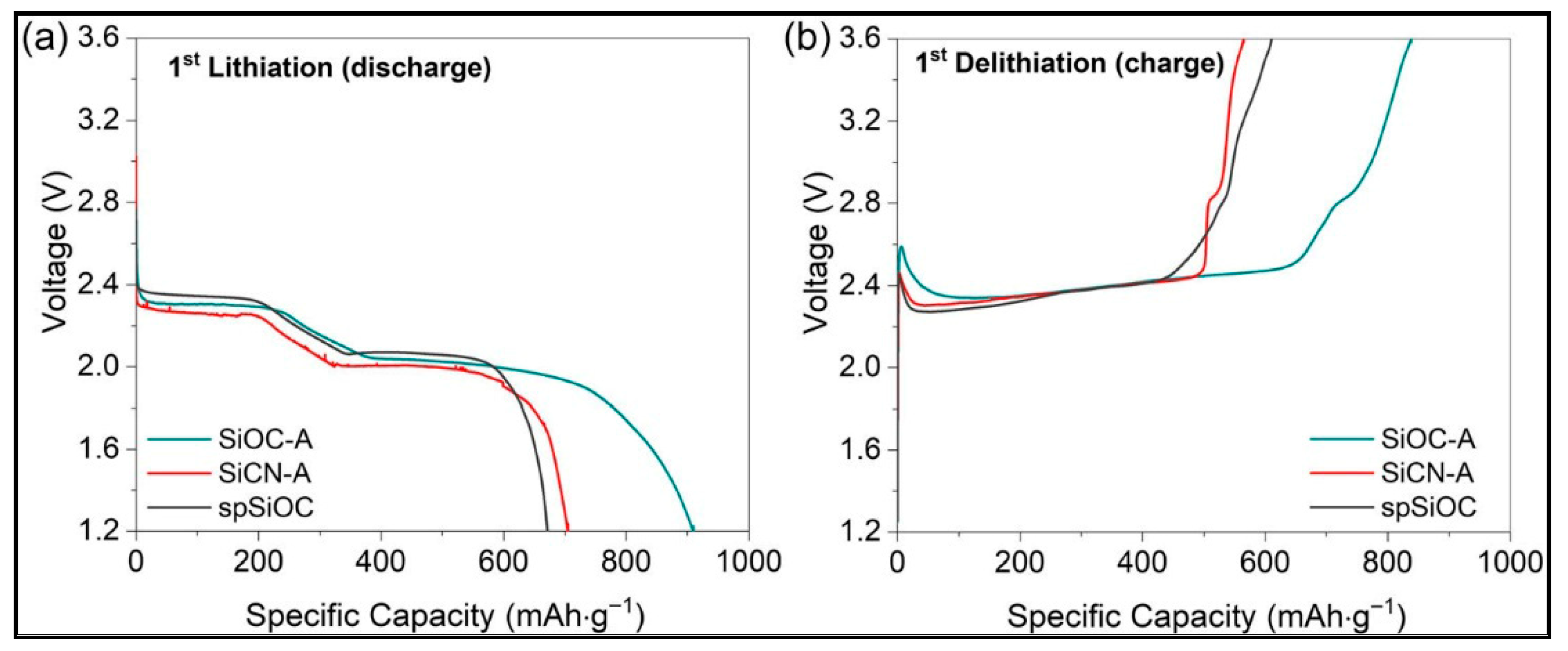
Galvanostatic cycling with potential limitation (GCPL) tests were initially conducted in the discharge mode, using as-prepared cathodes pre-loaded with non-lithiated sulfur. Initial lithiation and delithiation profiles are illustrated in Figure 12, confirming that SiOC-A-derived cathodes perform better than SiCN and spSiOC in terms of initial specific capacity. The first discharge of the SiOC-A cathode delivered capacity of 909 mAh g−1, while those of the SiCN-A and spSiOC cathodes exhibit values of 704 and 671 mAh g−1, respectively. Distinct lithiation plateaus are observed in all types of cathodes at around 2.3 and 2.0 V, which result from the formation of high-order soluble polysulfides (e.g., Li2S8, Li2S4) and low-order solid polysulfides (e.g., Li2S2) [35]. The final noticeable potential decline is attributed to the conversion into solid Li2S, where the cathode is considered fully discharged. The following charge results in specific capacities of 837, 565, and 610 mAh g−1, for SiOC-A, SiCN-A, and spSiOC, respectively. A consistent reduction in specific capacity is nevertheless evident in all cases, suggesting the dissolution of polysulfides in the electrolyte during the first lithiation.

2.2.3. Silicon-Based Ceramics as Negative Electrodes of Alkali Metal Batteries

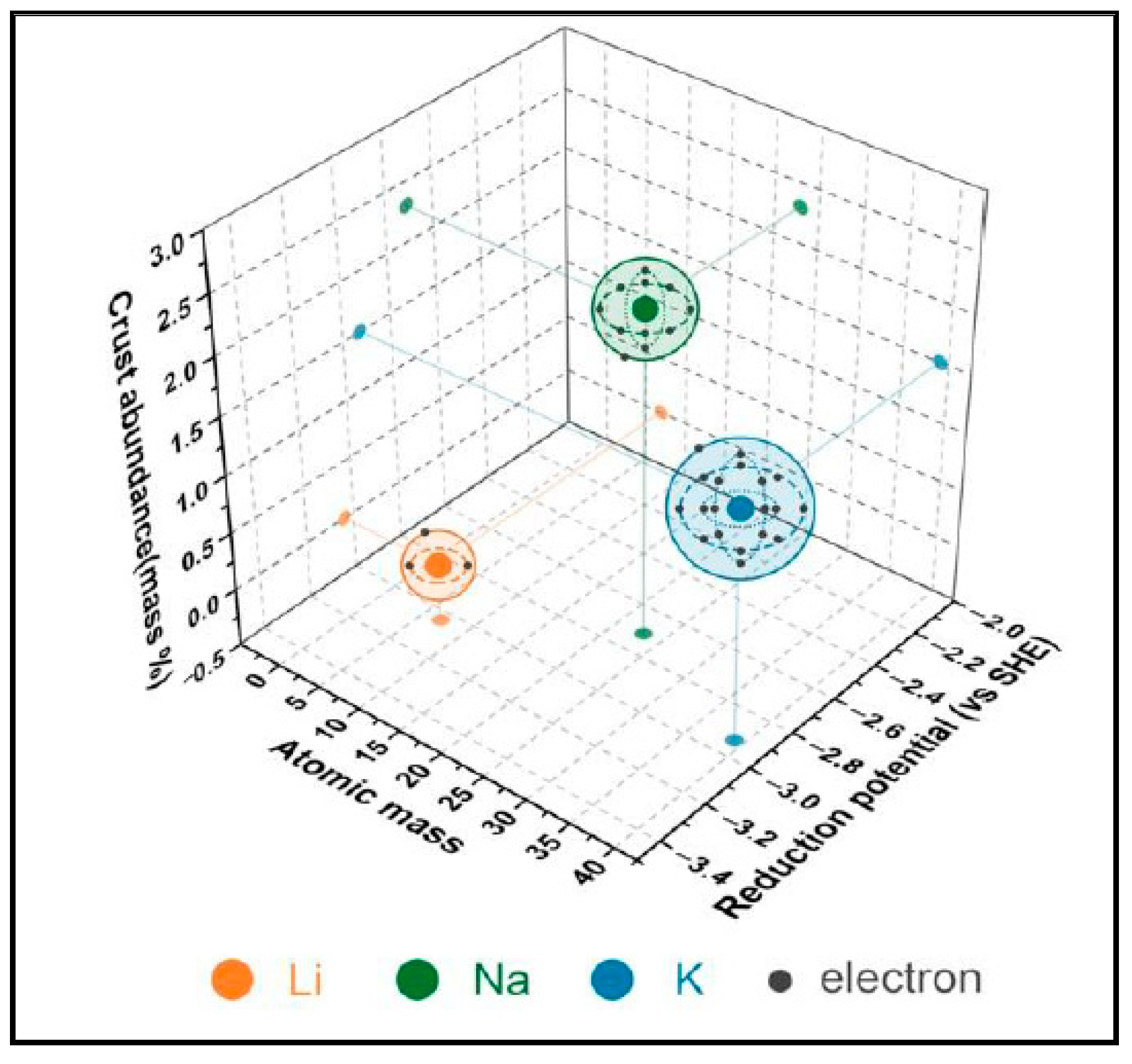
The abundance of sodium and potassium, as compared with lithium, in the Earth’s crust is much higher, as shown in Figure 13, and the world’s potassium reserves are approximately 250 billion tons. Compared to similar lithium compounds, the costs of metals, carbonates, or layered oxides of potassium and sodium are considerably lower. Consequently, potassium-ion batteries (PIBs) and sodium-ion batteries (SIBs) are considered potential alternatives for LIBs [190,191,192,193]. Similar to LIBs, the working principles of PIBs and SIBs are based on the “rocking chair model,” in which the insertion of K and Na ions into the cathode and anode materials occurs simultaneously. Alternatively, Na+ and K+ have more negative standard electrode potentials versus the standard hydrogen electrode (SHE 2.93 V for K+/K and 2.71 V for Na+/Na), which ensures that the batteries can run at a higher voltage while retaining a higher energy density [194,195,196]. In addition, the standard voltage of the K+/K redox couple in propylene carbonate is smaller than that of the Li+/Li and Na+/Na redox pairs [192].
Silicon-Based Ceramics for Potassium Ion Batteries (PIBs)
Owing to the cost-effectiveness of potassium and the low standard redox potential of the K+/K couple, PIBs have drawn great interest [199,200]. The abundance of potassium in the Earth’s crust, 2.09 wt%, and the similarity of its working principle to that of LIBs introduce potassium as an outstanding candidate in battery applications [201,202]. However, the weak Lewis acidity of K+ ions results in less solvated ions as compared to Li+ and Na+ ions which causes low desolvation energy that enables faster diffusion via the electrolyte/electrode interface. In addition, due to the substantial volume alteration in the host materials and the large radius of K+, the development of PIBs is hindered by rapid capacity decline, limited rate capability, and gradual diffusion kinetics during the charging and discharging process [203]. Therefore, developing cathode materials with enhanced diffusion kinetics and high structural stability is essential. At present, the dominant PIBs cathode materials are limited to polyanionic materials, organic compounds, layered oxides, and hexacyanometallates [204,205,206,207,208,209]. To achieve outstanding efficiency and performance for PIBs cathode materials, innovative precursors must be explored to keep pace with the emerging PIB cathode structures [210]. One of the outstanding recent materials innovations is PDCs, which can be produced with tailored chemical composition and porosity to host the large volume of potassium ions.
Chandra et al.’s [211] recent work utilizing SiOC electrodes revealed that the general procedure for the electrochemical insertion–extraction of alkali metal ions, such as Li+, Na+, and K+, in SiOC is the same. Initially, the ions remain trapped in the microvoids of the SiOC structure. More sites for ion insertion become available by the breakage of Si–C and Si–O bonds caused by increased ion insertion, which also yields a large free volume. Due to a repulsive interaction contact between the potassium ions, the inserted material produced fewer ions into the system, causing a low capacity. Furthermore, the SiOC material demonstrated a substantial volume increase during potassic modification, indicating that employing it as the PIB anode could be more challenging. PDCs can also be used as precursors for producing porous carbon materials which can withstand significant potassium ions. Carbon-rich SiOC was employed as the precursor for bi-continuous nanoporous carbon spheres in the study by Sang et al. [212] which were used as the anode for PIBs. The anode exhibited considerable power retention for potassium storage with a reversible capacity of 191 mA g−1 after 2000 cycles. The study revealed a distinctive replacement for ceramics in the anode material precursor for polymer-isolated batteries.
Silicon-Based Ceramics for Sodium-Ion Batteries
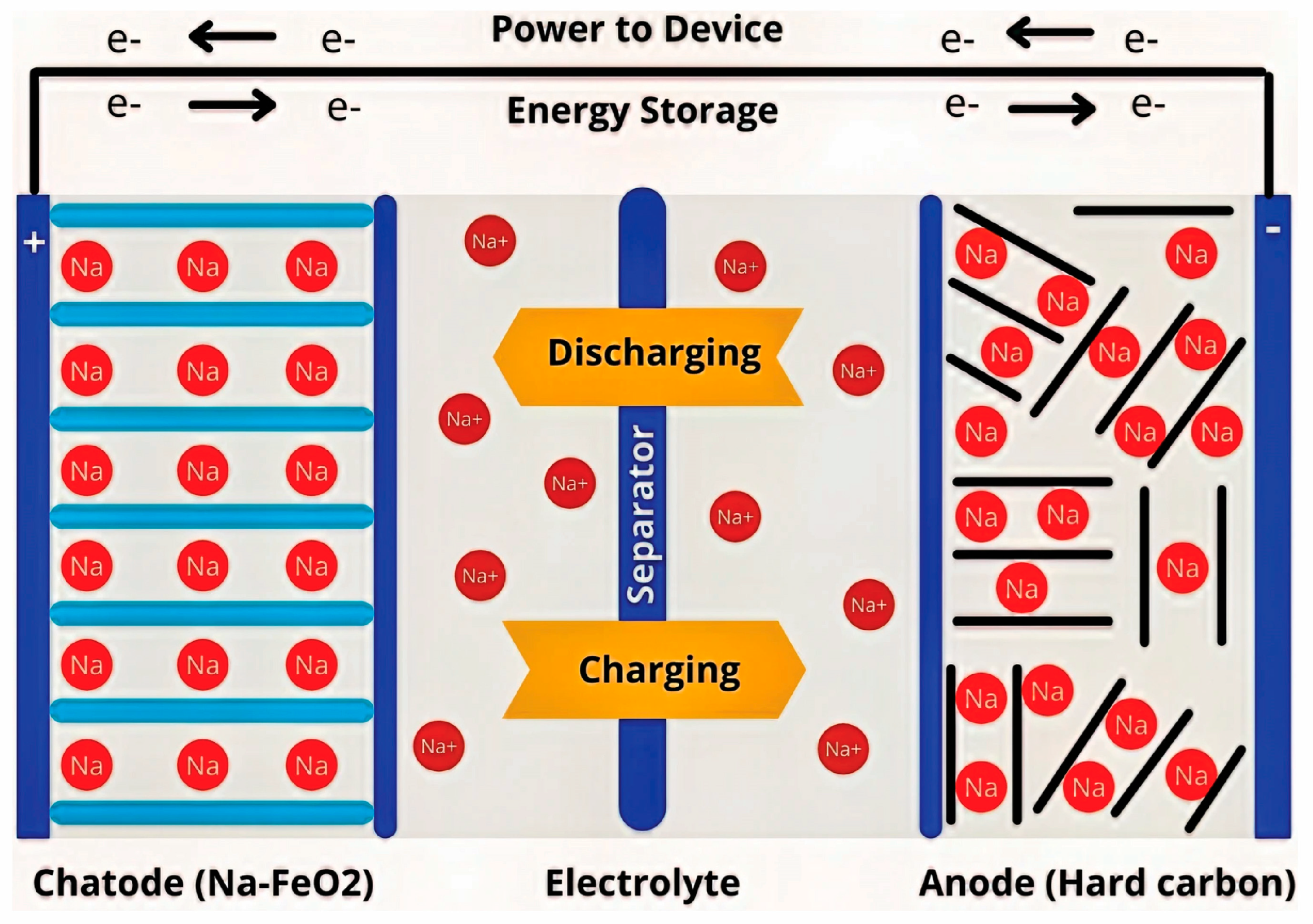
Since there are abundant sodium resources available, sodium-ion batteries (SIBs) are considered a low-cost complementary alternative to lithium-ion batteries (LIBs) [213]. To cycle Na+ and have a high reversible capacity, novel materials should be investigated for the cathode of SIBs. Given its suitable microcrystalline structure for Na+ ion intercalation and gravimetric capacity exceeding 300 mAh g−1, hard carbon (HC) is considered a good anode for SIBs [214]. SIBs are preferred to LIBs owing to their lower manufacturing costs, lower need for hazardous electrolytes, and capacity to store energy on a grid scale [215]. Another advantage is that SIB devices replicate LIB systems in many aspects of their electrochemical operation, which is advantageous for theoretical modeling because a significant amount of literature related to LIBs currently exists [216]. Given all of these features, SIBs are highly recommended for grid-scale storage and have the potential to be utilized in systems that require massive quantities of sodium [217]. Despite these advantages, several significant obstacles remain that hinder SIB systems from being fully commercialized. Notably, the kinetics are significantly slow because of the large size of the Na+ ion (1.02 A°) [218,219]. Furthermore, due to the large ionic size, there are significant constraints on facile intercalation into the host electrode interstices. Such restrictions commonly create significant and unnecessary volume fluctuations, which affect the life cycle, duration, and performance. Scientists and researchers have been employing a variety of methods to tackle these challenges, among which one of the primary routes for SIB systems to consider is materials engineering, which involves developing newer, better electrodes with distinctive morphologies that enhance longevity and performance [22,220]. The working principle of SIBs is described in Figure 14.
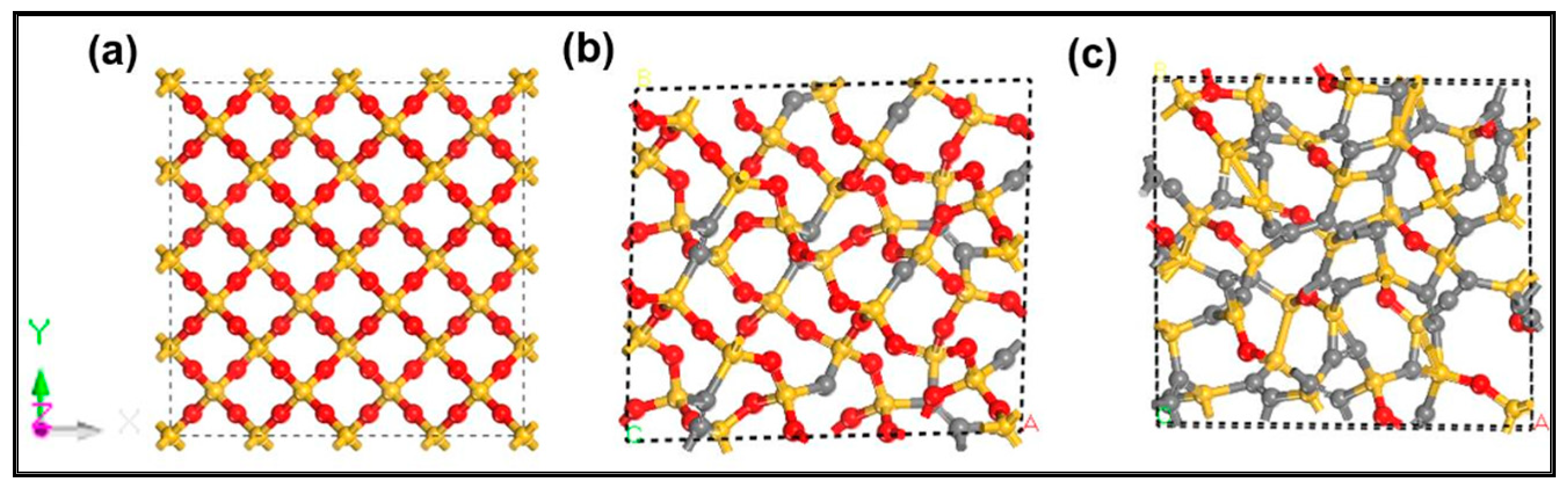
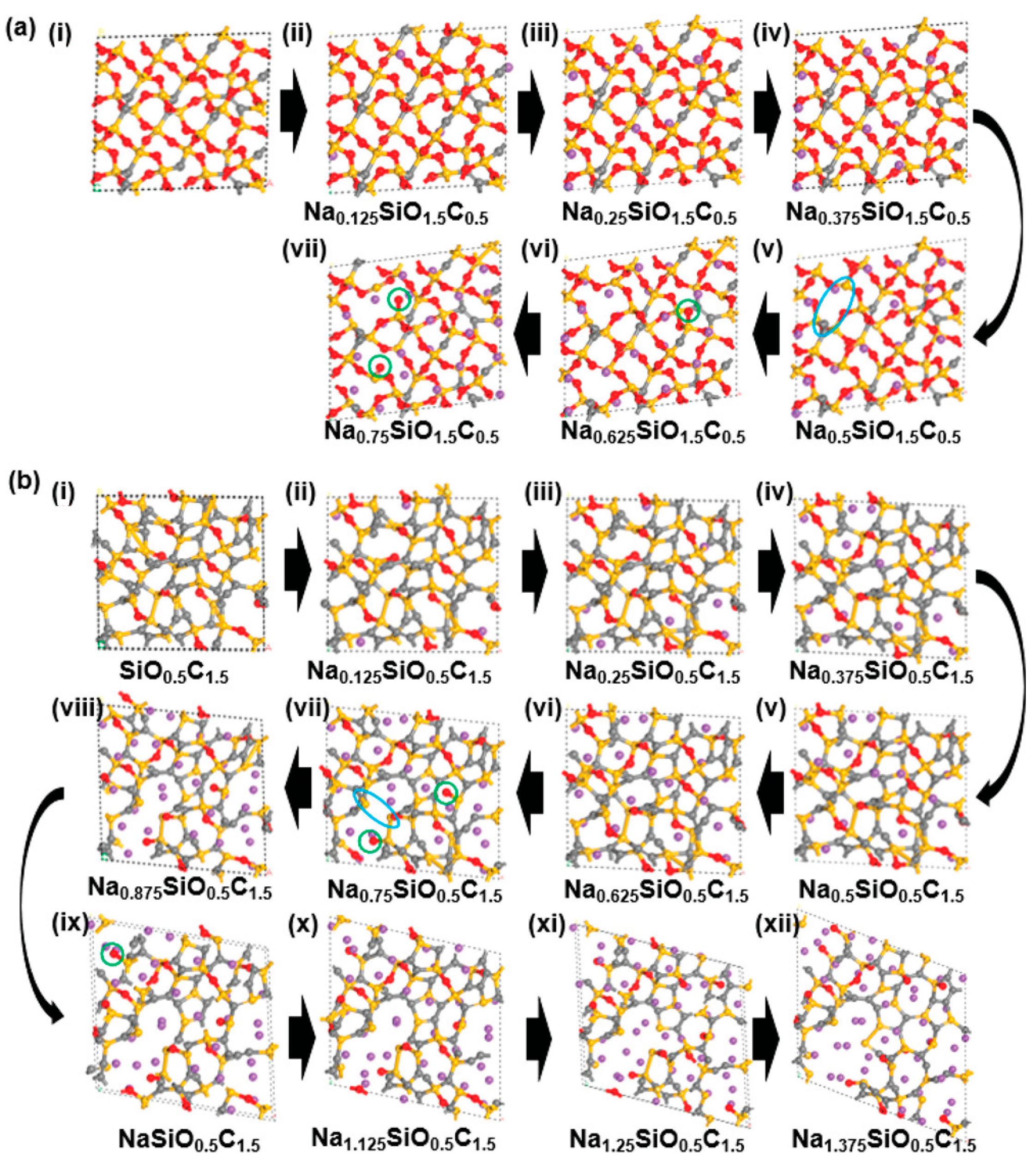
Alternatives to the negative electrodes of SIBs include Si-based PDCs or HC generated from PDCs, as well as composites of HC and PDCs. One of the most attractive ceramics that has been used for SIB electrodes is SiOC, which is usually fabricated from PDCs to control oxygen and carbon content, as they play a vital role in SIBs’ efficiency. To further understand the sodium ions’ insertion in SiOC ceramic, Chandra et al. [222] studied the formation mechanism of Na-rich Si compound using density functional theory. In the model, two distinct electrodes were established, namely O-rich SiOC and C-rich SiOC, as illustrated in Figure 15.
For O-rich SiOC, SiO1.5C0.5, no structural changes have been noticed for the first four Na atoms inserted into the ceramic structure, Figure 16a(i,ii). Adding eight to twelve sodium atoms, as shown in Figure 16a(iii,iv), induced structural changes in the O-rich ceramic electrode, which weakened and expanded the Si-O bond. For the same ceramic, Si-C bond breakage occurred after the insertion of 16 Na atoms insertion (Figure 16a(v)) as shown by the blue circle. The addition of more than 20 Na atoms induced Si-O bond breakage, as seen in Figure 16a(vi,vii) (indicated by the green circle). For the C-rich ceramic, SiO0.5C1.5, the addition of significant amount of Na atoms does not initiate Si-O or Si-C bond separation (Figure 16b(vii)), and only one Si-C bond and two Si-O bonds are separated. Therefore, the high structural stability gives this ceramic the advantage of large Na atom uptake, with a maximum of 44 Na atoms per unit cell, as shown in Figure 16b(xii).
Other researchers have studied the effect of additives on the performance of ceramic electrodes in SIBs. For example, Kaspar et al. [219] investigated an innovative SiOC(N)/HC hybrid material as a cathode for SIBs, in which enhanced capacity was achieved compared with pure HC. Furthermore, nanofillers-functionalized Si-based materials can be employed as the anodes in SIBs, as examined by Lim et al. [223]. They examined N-MoS2/C@SiOC, which highlights the reversible capacity of PDCs-based materials for SIBs, revealing that this Si-based ceramic material delivered reversible storage of sodium ions, achieving a capacity of 540.7 mAh g−1 a exhibiting exceptional capacity retention after 500 cycles. Various studies have investigated SiOC and their composites; for instance, SiOC composites (e.g., with Sb, Sn, etc.) have shown higher reversible capacity [224,225,226] than that of SiO [122,227,228] in which SiOC works as a buffer material for the volume expansion of alloy materials and prevents capacity fading. SiOC composites (e.g., incorporating Sb, Sn, etc.) exhibit better reversible capacity than SiOC [122,227,228], whereas SiOC serves as a buffer material to prevent capacity fading and volume expansion.
Weinberg et al. [228] utilized a carbide-derived carbon (CDC) derived from preceramic polymers as an anode for SIBs. After 100 cycles, the SIBs reached a capacity of around 89 mAh g−1 with a slight enhancement of CDC in SIBs compared to SiOC, indicating that the capacity does not rely entirely on the free carbon domains.
Melzi d’Eril et al. [229] investigated the sodium insertion in the free carbon domain, which is enclosed within a SiCN(O) matrix. To fabricate ceramic matrix electrodes, a preceramic precursor was pyrolyzed at 1000 °C and 1400 °C, producing SiCN(O) with different crystallinity and morphological features. Raising the heat treatment temperature from 1000 °C to 1400 °C resulted in a significant increase in surface area from 56.7 m2 g−1 to 331 m2 g−1 and pores volume from 0.02 cm3 g−1 to 0.12 cm3 g−1. Accordingly, the initial de-sodiation capacity declined from 112.4 mAh g−1 for 1000 °C to 52.3 mAh g−1 for 1400 °C, while hard carbon exhibited an initial desodiation capacity of 70.5 mAh g−1.
Güneren et al. [230] investigated amorphous SiOC anodes for sodium-ion batteries (SIBs), synthesized via crosslinking and stepwise pyrolysis of polysiloxane-based Polyramic resin at temperatures up to 1200 °C. The study contrasted low-energy and high-energy ball-milled SiOC powders; despite their near-identical chemical compositions, the high-energy-milled variants exhibited significantly lower charge-transfer resistance and accelerated Na+ diffusion kinetics. Furthermore, the refined particles displayed an enhanced sloping capacity region, likely associated with increased surface-mediated storage. These findings underscore that particle-size refinement and surface-area optimization are pivotal parameters for enhancing Na+ storage kinetics and achieving high-energy-density SiOC anodes for SIB applications.
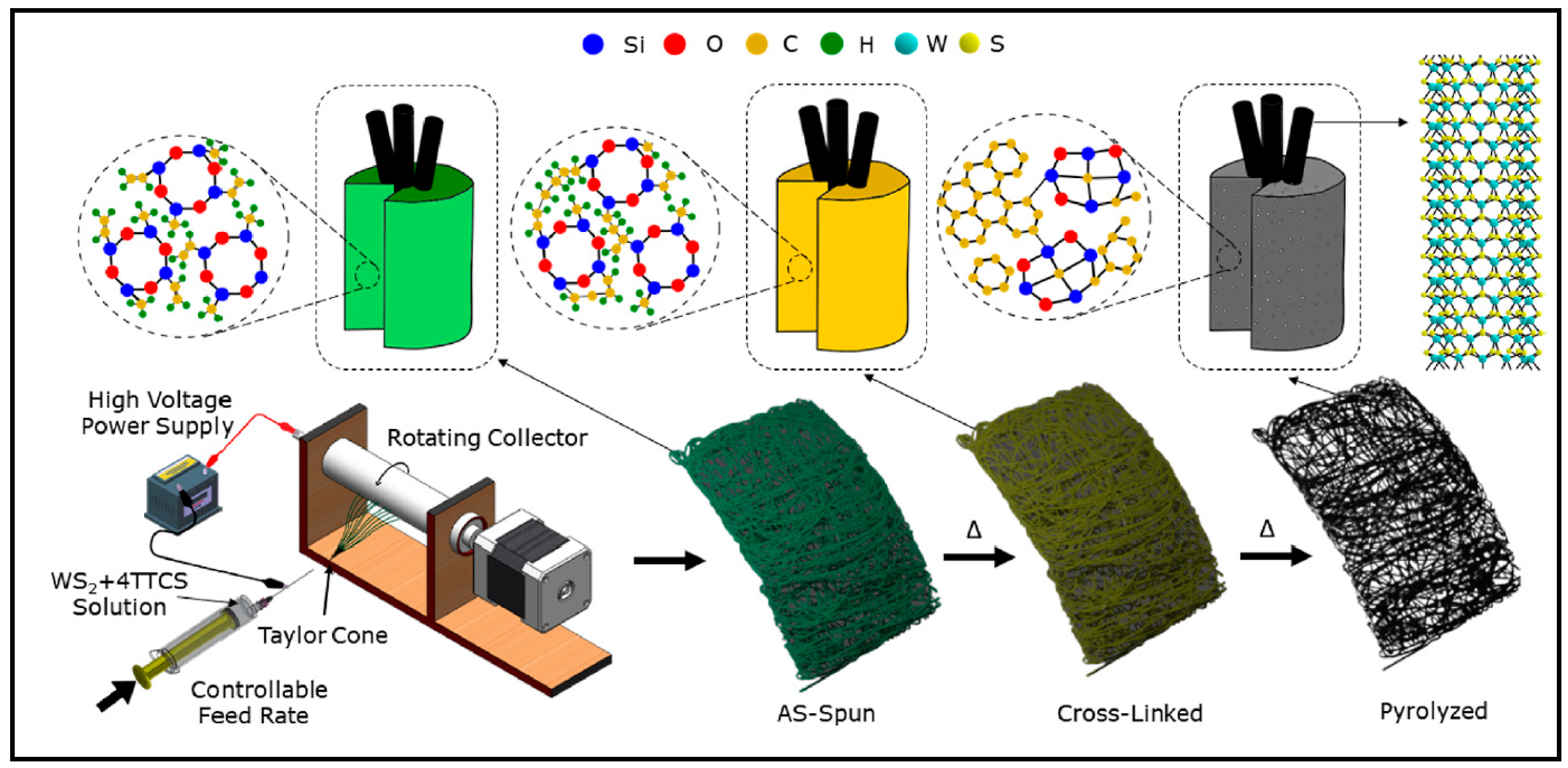
Dey et al. [231] fabricated tungsten sulfide nanotubes (WS2NT)-loaded SiOC nanfibers (Figure 17), providing a heterogeneous structure that delivers steady cycling performance at high current densities and an outstanding initial capacity of 454 mAh g−1, and capacity retention (about two to three times the capacity of the pristine WS2NTs) in successive cycles. In addition to assisting in the development of enhanced electrodes for room-temperature SIB, the SiOC fibers might protect the WS2NTs from certain adverse events such as capacity fade, volumetric change, irreversible conversion reactions, and polysulfide leakage.
Weinberger et al. [232] employed a two-step acid/base catalyzed sol-gel process using triethoxyphenylsilane (PhTES) to fabricate submicron-sized SiCO spheres. A slight amount of tetraethoxysilane (TEOS) was combined with the carbosilane to prevent the organosilica microspheres from sintering following heating. Upon heating, the resulting SiCO material retained the spherical shape of the organosilica material (average particle diameter around 200–300 nm), in contrast to SiCO derived from raw PhTES or from condensation of PhTES with methyltriethoxysilane (MTES). The SiCO spheres revealed an absolute carbon content, as determined by X-ray photoelectron spectroscopy (XPS), of 41%. It is slightly lower than the SiCO carbon content (46%) derived from pure PhTES. In conjunction with the O/Si ratio, they ascertained the SiCO spheres’ composition to be SiC0.3O1.4 + 2.89Cfree. Compared to bulk SiCO, the SiCO nanostructure substantially improved the sodium insertion properties. With a first cycle efficiency of 47%, they were able to acquire potentially high reversible capacities for the SiCO spheres, measuring 200 mAh g−1 at a lower current of 25 mA g−1. The material continued to deliver 111 mAh g−1 even when the current was increased to 200 mA g−1.
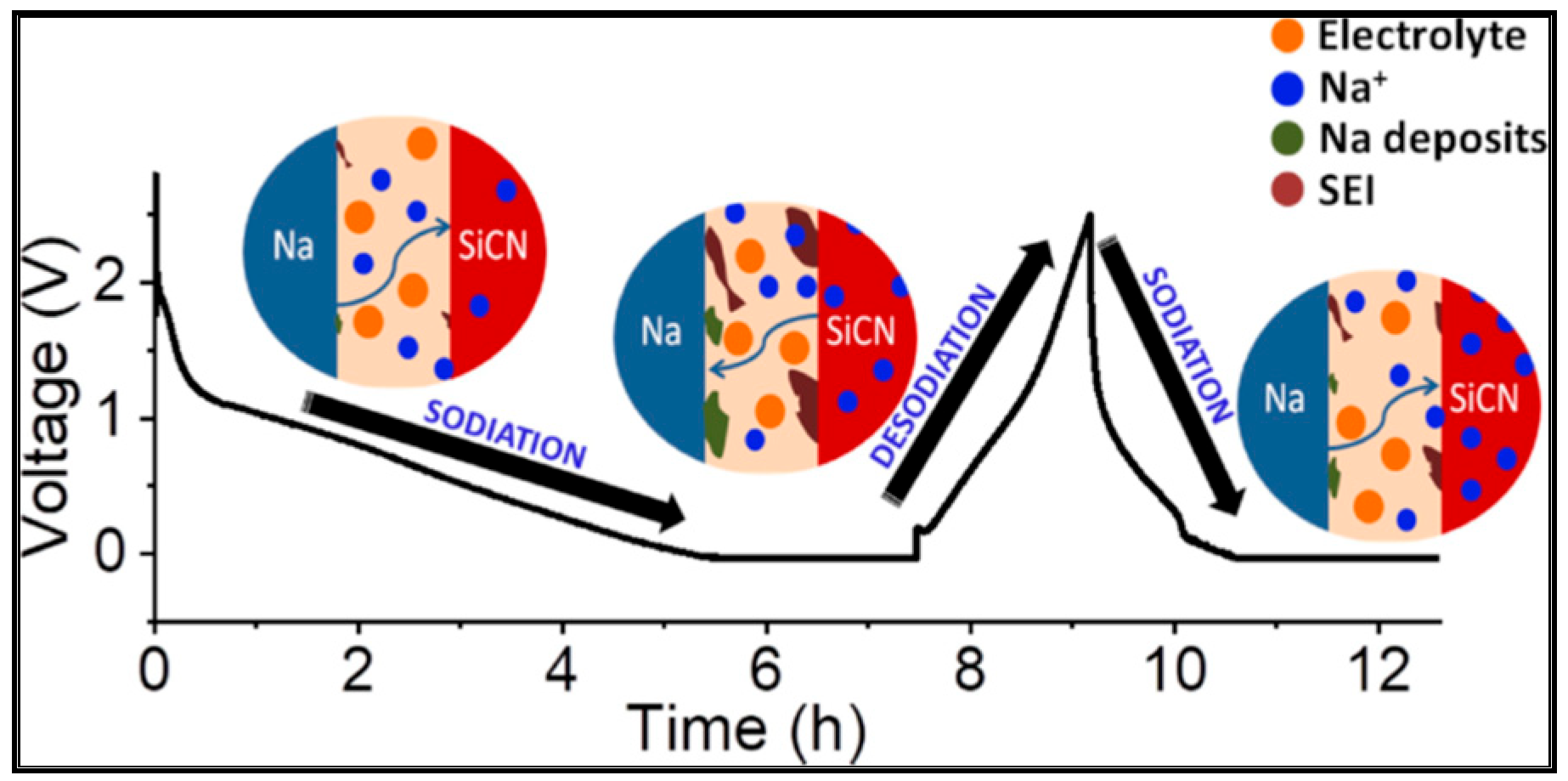
Edina et al. [233] utilized carbon-rich SiCN composites as electrodes in sodium/sodium ion cells which have been examined by a combination of 23Na in-situ and ex-situ NMR from Na. After collecting the in-situ NMR results, microstructural changes within the SiCN during galvanostatic cycling, which is related to the signal fluctuations at −13 and 1120 ppm for sodium metal, were noticed. Furthermore, a shoulder signal was noticed at 1128 ppm after raising the voltage to around 2.5 V. This is associated with dendritic sodium deposition on the sodium metal counter electrode. They concluded that this process was significantly reversible since it appeared/disappeared, during sodiation/desodiation as illustrated in Figure 18. During the initial sodiation cycle, Na+ moves toward the SiCN electrode which is accompanied by SEI formation and the sodium electrodeposition which they start to convert to dendrites and “dead sodium” after desodiation, and they usually diminish during the second sodiation cycle.

2.2.4. Magnesium-Ion Batteries (MIBs) Anode

When compared with lithium, which has restricted geological sources, magnesium is an abundant element (≈2 wt%) in the Earth’s crust [234]. Magnesium has several advantages as an electrode when it comes to battery performance. These include a higher theoretical volumetric energy density of 3832 mAh mL−1 (compared to 2046 mAh mL−1 for the Li-metal anode) and a higher gravimetric capacity of 2205 mAh g−1. Additionally, there is less likelihood of anodic dendrite growth, mitigating one of the critical safety hazards associated with Li-ion batteries [235]. Furthermore, compared to a standard hydrogen electrode, magnesium electrodes have a negative reduction potential of −2.3 V [236]. So far, only a few studies have been done on the potential utilization of PDCs in MIBs.
Guo et al. [237] utilized tin-loaded silicon oxycarbide (SiOC/Sn) to fabricate MIB nanobeads with various carbon/tin contents, which were tested as electrodes for magnesium-ion batteries. The elemental analysis of SiOC/Sn samples with various compositions is shown in Table 3.
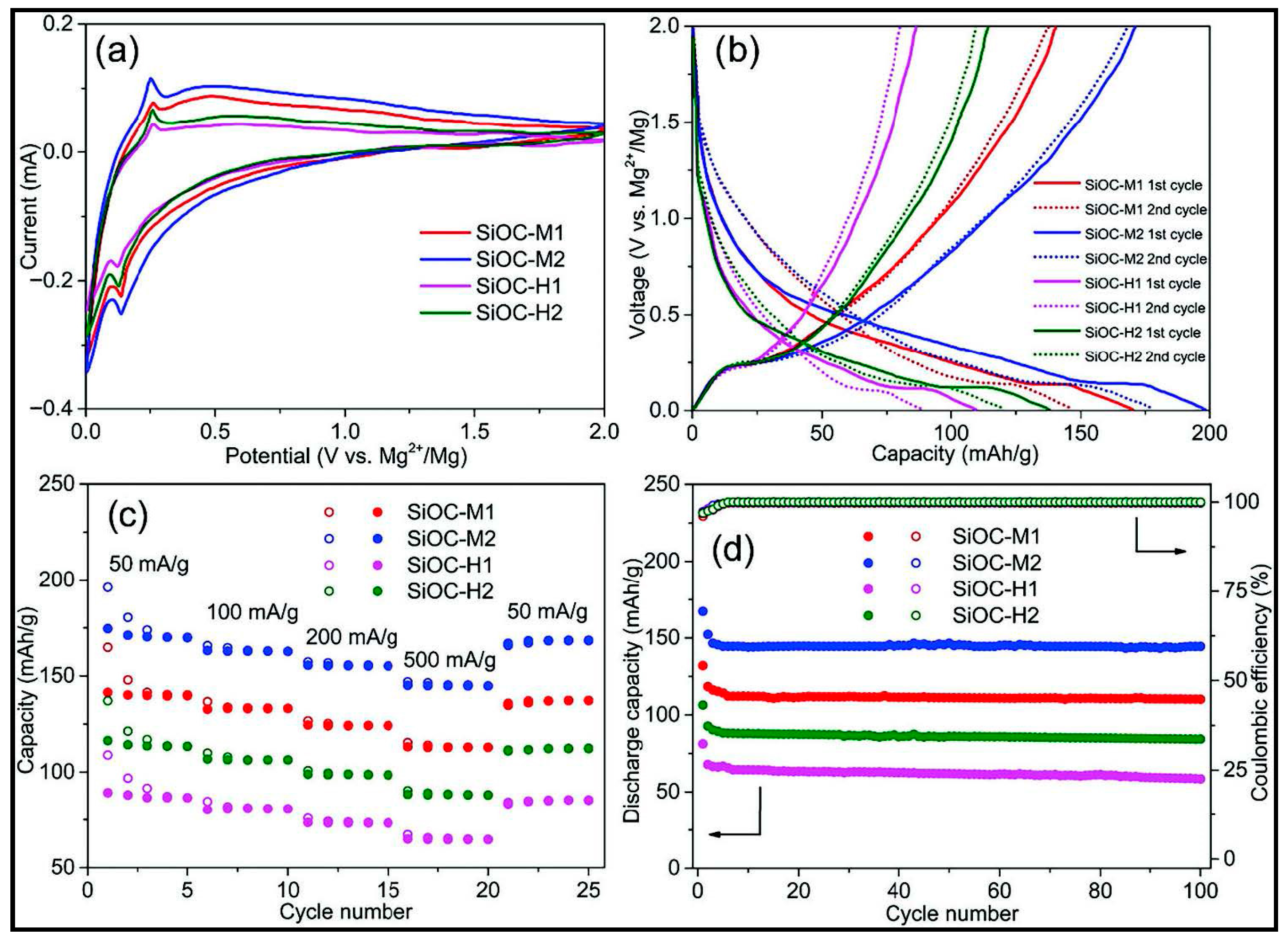
The battery performance was controlled by the sample chemical composition and surface area. Figure 19 reveals the electrochemical results of SiOC/Sn composites. From Figure 19a, the SiOC-M2 electrode demonstrated the highest specific current response, and the same electrode showed the most significant initial cycle magnesiation capacity of 198.2 mAh g−1 as illustrated in Figure 19b: SiOC-M2.
The characterization and performance results of the SiOC/Sn electrodes with various compositions and morphological characteristics revealed that significant capacity improvement is associated with a higher surface area, as it enables more Mg2+ storage sites and improved diffusion. Furthermore, increasing the Sn content boosts capacity through the reversible Mg-Mg2Sn-Mg alloying/dealloying process, enhances rate performance by increasing electrical conductivity, and increases the rate of capacity fade. Along with the Sn contribution, SiOC has a vital role in advancing cycling stability by inhibiting electrode collapse and increasing capacity due to higher surface capacitive effects.
Gue et al. [238] fabricated a Sn/SiOCN nanocomposite as an electrode for MIBs in which the chemical composition, morphology, and surface area were examined carefully. The electrode revealed a first discharge capacity of around 490 mAh g−1 for Sn42.4 SiOCN and 420 mAh g−1 for Sn33.9 SiOCN at a current rate of 0.5 mA g−1. On the other hand, Sn33.9 SiOCN demonstrated the highest first-cycle capacity retention rate of ≈76% which is slightly higher that of Sn42.4 SiOCN due to the higher surface area and carbon content of Sn33.9 SiOCN along with less agglomeration of tin nanoparticles. The same nanocomposite showed structural stability after 100 cycles which was confirmed by Energy-Dispersive X-Ray Spectroscopy EDS and RXD measurements before and after cycling.

2.2.5. Silicon-Based Ceramics as Electrodes of Supercapacitors

One of the other energy storage devices that exhibits outstanding cyclability and high-power density is a supercapacitor. Unique features should be present in supercapacitor electrodes; for example, high conductivity, corrosion resistance, and high specific surface area [239]. Because they possess most of the characteristics above, Si-based preceramic polymers, such as SiCN and SiOC, can be considered an option for supercapacitor electrodes [240]. Chemical hybridization of PDCs with carbon-based materials is advantageous in supercapacitor electrode development. Chemical interfacing of PDCs with carbon materials can also be used for supercapacitor electrodes. David et al. [241] fabricated an electrode for aqueous supercapacitors made of CNT, reduced graphene oxide (rGO), and boron-doped SiCN composite with carbon nanotubes (CNT) and reduced graphene oxide (rGO). The creation of an interconnected conductive network and the resulting reduction in internal electrode resistance were reflected in the improved capacitance of ∼269.52 F g−1. Mujib et al. [242] fabricated an SiOC fiber mat as an aqueous supercapacitor electrode prepared from three siloxane oligomer precursors, namely: 1,5-divinyl-3,3-diphenyl-1,1,5,5-tetramethyltrisiloxane, 1,3-divinyltetramethyldisiloxane, and 1,3,5-trivinyl-1,1,3,5,5-pentamethyltrisiloxane. After 5000 cycles at a current density of 3 A g−1, the electrode retained 100% capacitance.

2.3. Challenges of Electronic Conductivity and Ion Transport in SiOC/SiCN Ceramics

A primary challenge in utilizing SiOC and SiCN ceramics for electrochemical energy storage is their inherently limited electronic conductivity and restricted ionic transport [243]. These transport limitations are fundamentally linked to the nature of the amorphous Si–O–C or Si–C–N networks and the concentration, distribution, and percolation of the free-carbon phase. This carbon serves a dual role: it acts as a conductive framework for charge transport and provides the majority of active sites for ion storage [242]. Consequently, achieving a well-dispersed and interconnected carbon network is essential for optimizing both rate capability and cycling stability in PDC-based electrodes [137].
To address these constraints, conductive carbon additives have been extensively integrated into SiOC/SiCN systems. For instance, SiOC/graphite composites have demonstrated capacity enhancements of up to 63% at high current densities, provided that the graphite flakes are homogeneously distributed within the preceramic precursor [244]. Similarly, the engineering of SiOC/CNT core/shell architectures significantly improved the first-cycle Coulombic efficiency—increasing it from 50.1% to 67%—by establishing a robust conductive backbone. Beyond electronic transport, ionic kinetics are heavily influenced by particle morphology, porosity, and diffusion path lengths. Research indicates that high-energy-milled SiOC powders exhibit lower charge-transfer resistance and accelerated Na+ diffusion coefficients, resulting in enhanced sloping capacity in sodium-ion batteries [230]. Collectively, these findings confirm that the advancement of SiOC/SiCN electrodes needs the simultaneous optimization of carbon connectivity, particle size, hierarchical porosity, and stable interfacial ion-diffusion pathways.

3. Conclusions

The development of polymer-derived ceramics (PDCs), specifically silicon oxycarbide (SiOC) and (SiCN), has demonstrated significant potential as electrode materials for energy storage applications beyond traditional lithium-ion batteries (LIBs). Their unique thermal stability, tailored microstructures, and mechanical robustness make them ideal candidates for next-generation electrodes in sodium-ion batteries (SIBs), potassium-ion batteries (PIBs), lithium-sulfur batteries (LSBs), and supercapacitors.
This review analyzed the synthesis, structural characteristics, and electrochemical performance of SiOC and SiCN in advanced energy storage systems, highlighting key challenges for commercialization. While promising, current progress is often hindered by limited electrical conductivity and slow ion transport pathways. To overcome these hurdles, recent innovations have focused on adapting the material formulation and microstructure to pave the way for scalable PDC electrodes.
The introduction of free carbon within the ceramic structure plays a key role in modifying electrochemical performance. Carbon-rich structures (exceeding 20 wt% carbon) enhance electrical conductivity by creating percolated networks that facilitate electron transport and provide additional sites for Li+ storage. In SiOC and SiCN, these carbon domains enhance reversible capacity and help alleviate the volumetric expansion typically observed in conventional battery materials. Furthermore, structural features such as porosity, surface area, and nanophase crystallinity directly dictate the final electrochemical properties.
To further enhance ion diffusion and electron transport, future investigations should focus on the following:
(1)
Scalable Synthesis: Developing cost-effective and scalable manufacturing methods is essential for commercial feasibility.
(2)
Hybridization: Integrating PDCs with conductive nanomaterials like graphene or carbon nanotubes can significantly boost conductivity and first-cycle efficiency.
(3)
Structure Optimization: Future studies must optimize carbon content and structural characteristics to achieve higher reversible capacities and stable long-term cycling performance across diverse battery chemistries.

Author Contributions

Writing—original draft preparation, S.A.A. and E.S.V.-G.; writing—review and editing, S.A.A. and E.S.V.-G. All authors have read and agreed to the published version of the manuscript.

Funding

This research received no external funding.

Data Availability Statement

The original contributions presented in this study are included in the article. Further inquiries can be directed to the corresponding author.

Acknowledgments

AI tools, including ChatGPT v.5.2 and Grammarly (https://www.grammarly.com/), were used for editing and revising the manuscript in English.

Conflicts of Interest

The authors declare no conflict of interest.

References

  1. Sarraf, F.; Churakov, S.V.; Clemens, F. Preceramic polymers for additive manufacturing of silicate ceramics. Polymers 2023, 15, 4360. [Google Scholar] [CrossRef] [PubMed]
  2. Yajima, S.; Hayashi, J.; Omori, M. Continuous silicon carbide fiber of high tensile strength. Chem. Lett. 1975, 4, 931–934. [Google Scholar] [CrossRef]
  3. Yajima, S.; Hasegawa, Y.; Okamura, K.; Matsuzawa, T. Development of high tensile strength silicon carbide fibre using an organosilicon polymer precursor. Nature 1978, 273, 525–527. [Google Scholar] [CrossRef]
  4. Blum, Y.D.; Platz, R.M.; Crawford, E.J. Glass Strengthening by Polymer-Derived Ceramic Coatings. J. Am. Ceram. Soc. 1990, 73, 170–172. [Google Scholar] [CrossRef]
  5. Günthner, M.; Schütz, A.; Glatzel, U.; Wang, K.; Bordia, R.K.; Greißl, O.; Krenkel, W.; Motz, G. High performance environmental barrier coatings, Part I: Passive filler loaded SiCN system for steel. J. Eur. Ceram. Soc. 2011, 31, 3003–3010. [Google Scholar] [CrossRef]
  6. Torrey, J.D.; Bordia, R.K. Processing of polymer-derived ceramic composite coatings on steel. J. Am. Ceram. Soc. 2008, 91, 41–45. [Google Scholar] [CrossRef]
  7. Park, C.H.; Joo, Y.J.; Chung, J.K.; Han, Y.H.; Kim, C.J. Morphology control of a silicon nitride thick film derived from polysilazane precursor using UV curing and IR heat treatment. Adv. Appl. Ceram. 2017, 116, 376–382. [Google Scholar] [CrossRef]
  8. Colombo, P.; Gambaryan-Roisman, T.; Scheffler, M.; Buhler, P.; Greil, P. Conductive Ceramic Foams from Preceramic Polymers. J. Am. Ceram. Soc. 2001, 84, 2265–2268. [Google Scholar] [CrossRef]
  9. Wen, Q.; Xu, Y.; Xu, B.; Fasel, C.; Guillon, O.; Buntkowsky, G.; Yu, Z.; Riedel, R.; Ionescu, E. Single-source-precursor synthesis of dense SiC/HfCxN1−x-based ultrahigh-temperature ceramic nanocomposites. Nanoscale 2014, 6, 13678–13689. [Google Scholar] [CrossRef] [PubMed]
  10. Wen, Q.; Xu, Y.; Xu, B.; Fasel, C.; Guillon, O.; Buntkowsky, G.; Yu, Z.; Riedel, R.; Ionescu, E. Mechanical properties and electromagnetic shielding performance of single-source-precursor synthesized dense monolithic SiC/HfCXN1−x/C ceramic nanocomposites. J. Mater. Chem. C Mater. 2019, 7, 10683–10693. [Google Scholar] [CrossRef]
  11. Wen, Q.; Yu, Z.; Riedel, R.; Ionescu, E. Significant improvement of high-temperature oxidation resistance of HfC/SiC ceramic nanocomposites with the incorporation of a small amount of boron. J. Eur. Ceram. Soc. 2020, 40, 3499–3508. [Google Scholar] [CrossRef]
  12. Klatt, E.; Frass, A.; Frieß, M.; Koch, D.; Voggenreiter, H. Mechanical and microstructural characterisation of SiC- and SiBNC-fibre reinforced CMCs manufactured via PIP method before and after exposure to air. J. Eur. Ceram. Soc. 2012, 32, 3861–3874. [Google Scholar] [CrossRef]
  13. Poerschke, D.L.; Braithwaite, A.; Park, D.; Lauten, F. Crystallization behavior of polymer-derived Si-O-C for ceramic matrix composite processing. Acta Mater. 2018, 147, 329–341. [Google Scholar] [CrossRef]
  14. Chawla, N.; Tur, Y.K.; Holmes, J.W.; Barber, J.R.; Szweda, A. High-frequency fatigue behavior of woven-fiber-fabric-reinforced polymer-derived ceramic-matrix composites. J. Am. Ceram. Soc. 1998, 81, 1221–1230. [Google Scholar] [CrossRef]
  15. Eckel, Z.C.; Zhou, C.; Martin, J.H.; Jacobsen, A.J.; Carter, W.B.; Schaedler, T.A. Additive manufacturing of polymer-derived ceramics. Science 2016, 351, 58–62. [Google Scholar] [CrossRef]
  16. Colombo, P.; Schmidt, J.; Franchin, G.; Zocca, A.; Günster, J. Additive manufacturing techniques for fabricating complex ceramic components from preceramic polymers. Am. Ceram. Soc. Bull 2017, 96, 16–23. [Google Scholar]
  17. Kousaalya, A.B.; Kumar, R.; Packirisamy, S. Characterization of free carbon in the as-thermolyzed Si-B-C-N ceramic from a polyorganoborosilazane precursor. J. Adv. Ceram. 2013, 2, 325–332. [Google Scholar] [CrossRef]
  18. Colombo, P.; Mera, G.; Riedel, R.; Sorarù, G.D. Polymer-Derived Ceramics: 40 Years of Research and Innovation in Advanced Ceramics. J. Am. Ceram. Soc. 2010, 93, 1805–1837. [Google Scholar] [CrossRef]
  19. Mera, G.; Navrotsky, A.; Sen, S.; Kleebe, H.J.; Riedel, R. Polymer-derived SiCN and SiOC ceramics-structure and energetics at the nanoscale. J. Mater. Chem. A Mater. 2013, 1, 3826–3836. [Google Scholar] [CrossRef]
  20. Francis, A. Progress in polymer-derived functional silicon-based ceramic composites for biomedical and engineering applications. Mater. Res. Express 2018, 5, 062003. [Google Scholar] [CrossRef]
  21. Riedel, R.; Mera, G.; Hauser, R.; Klonczynski, A. Silicon-based polymer-derived ceramics: Synthesis properties and applications—A review. J. Ceram. Soc. Jpn. 2006, 114, 425–444. [Google Scholar] [CrossRef]
  22. Mukherjee, S.; Ren, Z.; Singh, G. Molecular polymer-derived ceramics for applications in electrochemical energy storage devices. J. Phys. D Appl. Phys. 2018, 51, 463001. [Google Scholar] [CrossRef]
  23. Amaral, M.M.; Mujib, S.B.; Zanin, H.; Singh, G. A perspective on silicon-based polymer-derived ceramics materials for beyond lithium-ion batteries. J. Phys. Mater. 2023, 6, 021001. [Google Scholar] [CrossRef]
  24. Barrios, E.; Zhai, L. A review of the evolution of the nanostructure of SiCN and SiOC polymer derived ceramics and the impact on mechanical properties. Mol. Syst. Des. Eng. 2020, 5, 1606–1641. [Google Scholar] [CrossRef]
  25. Karakuscu, A.; Guider, R.; Pavesi, L.; Sorarù, G.D. White luminescence from sol-gel-derived SiOC thin films. J. Am. Ceram. Soc. 2009, 92, 2969–2974. [Google Scholar] [CrossRef]
  26. Roth, F.; Schmerbauch, C.; Ionescu, E.; Nicoloso, N.; Guillon, O.; Riedel, R. High-temperature piezoresistive C/SiOC sensors. J. Sens. Sens. Syst. 2015, 4, 133–136. [Google Scholar] [CrossRef]
  27. Vakifahmetoglu, C.; Zeydanli, D.; Ozalp, V.C.; Borsa, B.A.; Soraru, G.D. Hierarchically porous polymer derived ceramics: A promising platform for multidrug delivery systems. Mater. Des. 2018, 140, 37–44. [Google Scholar] [CrossRef]
  28. Fu, S.; Zhu, M.; Zhu, Y. Organosilicon polymer-derived ceramics: An overview. J. Adv. Ceram. 2019, 8, 457–478. [Google Scholar] [CrossRef]
  29. Xiong, H.; Chen, H.; Zhao, L.; Huang, Y.; Zhou, K.; Zhang, D. SiCw/SiCp reinforced 3D-SiC ceramics using direct ink writing of polycarbosilane-based solution: Microstructure, composition and mechanical properties. J. Eur. Ceram. Soc. 2019, 39, 2648–2657. [Google Scholar] [CrossRef]
  30. Jana, P.; Santoliquido, O.; Ortona, A.; Colombo, P.; Sorarù, G.D. Polymer-derived SiCN cellular structures from replica of 3D printed lattices. J. Am. Ceram. Soc. 2018, 101, 2732–2738. [Google Scholar] [CrossRef]
  31. He, C.; Liu, X.; Ma, C.; Cao, Y.; Hou, F.; Yan, L.; Guo, A.; Liu, J. Digital light processing of Si-based composite ceramics and bulk silica ceramics from a high solid loading polysiloxane/SiO2 slurry. J. Eur. Ceram. Soc. 2021, 41, 7189–7198. [Google Scholar] [CrossRef]
  32. Mera, G.; Tamayo, A.; Nguyen, H.; Sen, S.; Riedel, R. Nanodomain structure of carbon-rich silicon carbonitride polymer-derived ceramics. J. Am. Ceram. Soc. 2010, 93, 1169–1175. [Google Scholar] [CrossRef]
  33. Wen, Q.; Qu, F.; Yu, Z.; Graczyk-Zajac, M.; Xiong, X.; Riedel, R. Si-based polymer-derived ceramics for energy conversion and storage. J. Adv. Ceram. 2022, 11, 197–246. [Google Scholar] [CrossRef]
  34. Shao, G.; Hanaor, D.A.; Wang, J.; Kober, D.; Li, S.; Wang, X.; Shen, X.; Bekheet, M.F.; Gurlo, A. Polymer-Derived SiOC Integrated with a Graphene Aerogel as a Highly Stable Li-Ion Battery Anode. ACS Appl. Mater. Interfaces 2020, 12, 46045–46056. [Google Scholar] [CrossRef]
  35. Fukui, H.; Ohsuka, H.; Hino, T.; Kanamura, K. A Si-O-C composite anode: High capability and proposed mechanism of lithium storage associated with microstructural characteristics. ACS Appl. Mater. Interfaces 2010, 2, 998–1008. [Google Scholar] [CrossRef]
  36. Knozowski, D.; Graczyk-Zając, M.; Vrankovic, D.; Trykowski, G.; Sawczak, M.; De Carolis, D.M.; Wilamowska-Zawłocka, M. New insights on lithium storage in silicon oxycarbide/carbon composites: Impact of microstructure on electrochemical properties. Compos. B Eng. 2021, 225, 109302. [Google Scholar] [CrossRef]
  37. Pantano, C.G.; Singh, A.K.; Zhang, H. Silicon Oxycarbide Glasses. J. Sol-Gel Sci. Technol. 1999, 14, 7–25. [Google Scholar] [CrossRef]
  38. Zhang, H.; Pantano, C.G. Synthesis and Characterization of Silicon Oxycarbide Glasses. J. Am. Ceram. Soc. 1990, 73, 958–963. [Google Scholar] [CrossRef]
  39. Ionescu, E.; Kleebe, H.-J.; Riedel, R. Silicon-containing polymer-derived ceramic nanocomposites (PDC-NCs): Preparative approaches and properties. Chem. Soc. Rev. 2012, 41, 5032–5052. [Google Scholar] [CrossRef]
  40. Blum, Y.D.; MacQueen, D.B.; Kleebe, H.-J. Synthesis and characterization of carbon-enriched silicon oxycarbides. J. Eur. Ceram. Soc. 2005, 25, 143–149. [Google Scholar] [CrossRef]
  41. Kleebe, H.J.; Gregori, G.; Babonneau, F.; Blum, Y.D.; MacQueen, D.B.; Masse, S. Evolution of C-rich SiOC ceramics Part I. Characterization by integral spectroscopic techniques: Solid-state NMR and Raman spectroscopy. Int. J. Mater. Res. 2006, 97, 699–709. Available online: https://www.degruyterbrill.com/document/doi/10.3139/ijmr-2006-0115/html (accessed on 26 April 2026). [CrossRef]
  42. Gregori, G.; Kleebe, H.J.; Blum, Y.D.; Babonneau, F. Evolution of C-rich SiOC ceramics Part II. Characterization by high lateral resolution techniques: Electron energy-loss spectroscopy, high-resolution TEM and energy-filtered TEM. Int. J. Mater. Res. 2006, 97, 710–720. [Google Scholar] [CrossRef]
  43. Widgeon, S.J.; Sen, S.; Mera, G.; Ionescu, E.; Riedel, R.; Navrotsky, A. 29Si and 13C Solid-state NMR spectroscopic study of nanometer-scale structure and mass fractal characteristics of amorphous polymer derived silicon oxycarbide ceramics. Chem. Mater. 2010, 22, 6221–6228. [Google Scholar] [CrossRef]
  44. Cordelair, J.; Greil, P. Electrical conductivity measurements as a microprobe for structure transitions in polysiloxane derived Si-O-C ceramics. J. Eur. Ceram. Soc. 2000, 20, 1947–1957. [Google Scholar] [CrossRef]
  45. Kleebe, H.-J.; Blum, Y.D. SiOC ceramic with high excess free carbon. J. Eur. Ceram. Soc. 2008, 28, 1037–1042. [Google Scholar] [CrossRef]
  46. Martínez-Crespiera, S.; Ionescu, E.; Kleebe, H.J.; Riedel, R. Pressureless synthesis of fully dense and crack-free SiOC bulk ceramics via photo-crosslinking and pyrolysis of a polysiloxane. J. Eur. Ceram. Soc. 2011, 31, 913–919. [Google Scholar] [CrossRef]
  47. Morcos, R.M.; Navrotsky, A.; Varga, T.; Blum, Y.; Ahn, D.; Poli, F.; Mueller, K.; Raj, R. Energetics of SixOyCz polymer-derived ceramics prepared under varying conditions. J. Am. Ceram. Soc. 2008, 91, 2969–2974. [Google Scholar] [CrossRef]
  48. Vallachira Warriam Sasikumar, P. Study of Silicon Oxycarbide (SiOC) as Anode Materials for Li-Ion Batteries. Ph.D. Thesis, University of Trento, Trento, Italy, 2013. Available online: https://tesidottorato.depositolegale.it/handle/20.500.14242/176471 (accessed on 26 April 2026).
  49. Wen, Q.; Yu, Z.; Riedel, R. The fate and role of in situ formed carbon in polymer-derived ceramics. Prog. Mater. Sci. 2020, 109, 100623. [Google Scholar] [CrossRef]
  50. He, W.; Chen, L.; Peng, F. Coating formed by SiBCN single source precursor via UV-photopolymerization. Mater. Lett. 2017, 206, 121–123. [Google Scholar] [CrossRef]
  51. Pham, T.A.; Kim, P.; Kwak, M.; Suh, K.Y.; Kim, D.P. Inorganic polymer photoresist for direct ceramic patterning by photolithography. Chem. Commun. 2007, 4021–4023. [Google Scholar] [CrossRef][Green Version]
  52. Mera, G.; Riedel, R.; Poli, F.; Müller, K. Carbon-rich SiCN ceramics derived from phenyl-containing poly(silylcarbodiimides). J. Eur. Ceram. Soc. 2009, 29, 2873–2883. [Google Scholar] [CrossRef]
  53. Müller, K. Solid-state NMR studies of the preparation of Si-C-N ceramics from polysilylcarbodiimide polymers. Chem. Mater. 1998, 10, 3913–3922. [Google Scholar] [CrossRef]
  54. Iwamoto, Y.; Völger, W.; Kroke, E.; Riedel, R.; Saitou, T.; Matsunaga, K. Crystallization Behavior of Amorphous Silicon Carbonitride Ceramics Derived from Organometallic Precursors. J. Am. Ceram. Soc. 2001, 84, 2170–2178. [Google Scholar] [CrossRef]
  55. Zhang, L.; Fei, H.; Wang, C.; Ma, H.; Li, X.; Gao, P.; Wen, Q.; Tao, S.; Xiong, X. Silicon-Based Polymer-Derived Ceramics as Anode Materials in Lithium-Ion Batteries. Materials 2025, 18, 3648. [Google Scholar] [CrossRef]
  56. Graczyk-Zajac, M.; Reinold, L.M.; Kaspar, J.; Sasikumar, P.V.W.; Soraru, G.-D.; Riedel, R. New insights into understanding irreversible and reversible lithium storage within SiOC and SiCN ceramics. Nanomaterials 2015, 5, 233–245. [Google Scholar] [CrossRef]
  57. Kim, H.; Kim, H.; Ding, Z.; Lee, M.H.; Lim, K.; Yoon, G.; Kang, K. Recent Progress in Electrode Materials for Sodium-Ion Batteries. Adv. Energy Mater. 2016, 6, 1600943. [Google Scholar] [CrossRef]
  58. Höök, M.; Tang, X. Depletion of fossil fuels and anthropogenic climate change—A review. Energy Policy 2013, 52, 797–809. [Google Scholar] [CrossRef]
  59. Haines, A.; Kovats, R.S.; Campbell-Lendrum, D.; Corvalan, C. Climate change and human health: Impacts, vulnerability and public health. Public Health 2006, 120, 585–596. [Google Scholar] [CrossRef]
  60. Shafiee, S.; Topal, E. When will fossil fuel reserves be diminished? Energy Policy 2009, 37, 181–189. [Google Scholar] [CrossRef]
  61. Kruyt, B.; van Vuuren, D.P.; de Vries, H.J.M.; Groenenberg, H. Indicators for energy security. Energy Policy 2009, 37, 2166–2181. [Google Scholar] [CrossRef]
  62. Erdinc, O.; Uzunoglu, M. Optimum design of hybrid renewable energy systems: Overview of different approaches. Renew. Sustain. Energy Rev. 2012, 16, 1412–1425. [Google Scholar] [CrossRef]
  63. Cavallo, A.J. Energy storage technologies for utility scale intermittent renewable energy systems. J. Sol. Energy Eng. 2001, 123, 387–389. [Google Scholar] [CrossRef]
  64. Hall, P.J.; Bain, E.J. Energy-storage technologies and electricity generation. Energy Policy 2008, 36, 4352–4355. [Google Scholar] [CrossRef]
  65. Yang, Z.; Zhang, J.; Kintner-Meyer, M.C.; Lu, X.; Choi, D.; Lemmon, J.P.; Liu, J. Electrochemical energy storage for green grid. Chem. Rev. 2011, 111, 3577–3613. [Google Scholar] [CrossRef]
  66. Chen, S.; Qiu, L.; Cheng, H.M. Carbon-Based Fibers for Advanced Electrochemical Energy Storage Devices. Chem. Rev. 2020, 120, 2811–2878. [Google Scholar] [CrossRef]
  67. Mackanic, D.G.; Chang, T.H.; Huang, Z.; Cui, Y.; Bao, Z. Stretchable electrochemical energy storage devices. Chem. Soc. Rev. 2020, 49, 4466–4495. [Google Scholar] [CrossRef]
  68. Wen, L.; Li, F.; Cheng, H.M. Carbon Nanotubes and Graphene for Flexible Electrochemical Energy Storage: From Materials to Devices. Adv. Mater. 2016, 28, 4306–4337. [Google Scholar] [CrossRef]
  69. Zahir, N.; Magri, P.; Luo, W.; Gaumet, J.J.; Pierrat, P. Recent Advances on Graphene Quantum Dots for Electrochemical Energy Storage Devices. Energy Environ. Mater. 2022, 5, 201–214. [Google Scholar] [CrossRef]
  70. Liu, J.; Song, X.; Zhang, T.; Liu, S.; Wen, H.; Chen, L. 2D Conductive Metal–Organic Frameworks: An Emerging Platform for Electrochemical Energy Storage. Chem. Int. Ed. Engl. 2021, 60, 5612–5624. [Google Scholar] [CrossRef]
  71. Goodenough, J.B.; Park, K.-S. The Li-Ion Rechargeable Battery: A Perspective. J. Am. Chem. Soc. 2013, 135, 1167–1176. [Google Scholar] [CrossRef]
  72. Sun, J.; Lee, H.W.; Pasta, M.; Yuan, H.; Zheng, G.; Sun, Y.; Li, Y.; Cui, Y. A phosphorene-graphene hybrid material as a high-capacity anode for sodium-ion batteries. Nat. Nanotechnol. 2015, 10, 980–985. [Google Scholar] [CrossRef]
  73. Yin, Y.X.; Xin, S.; Guo, Y.G.; Wan, L.J. Lithium-sulfur batteries: Electrochemistry, materials, and prospects. Angew. Chem. Int. Ed. Engl. 2013, 52, 13186–13200. [Google Scholar] [CrossRef]
  74. Raza, W.; Ali, F.; Raza, N.; Luo, Y.; Kim, K.H.; Yang, J.; Kumar, S.; Mehmood, A.; Kwon, E.E. Recent advancements in supercapacitor technology. Nano Energy 2018, 52, 441–473. [Google Scholar] [CrossRef]
  75. Kim, J.; Gwon, O.; Kwon, O.; Mahmood, J.; Kim, C.; Yang, Y.; Lee, H.; Lee, J.H.; Jeong, H.Y.; Baek, J.B.; et al. Synergistic Coupling Derived Cobalt Oxide with Nitrogenated Holey Two-Dimensional Matrix as an Efficient Bifunctional Catalyst for Metal-Air Batteries. ACS Nano 2019, 13, 5502–5512. [Google Scholar] [CrossRef]
  76. Cano, Z.P.; Banham, D.; Ye, S.; Hintennach, A.; Lu, J.; Fowler, M.; Chen, Z. Batteries and fuel cells for emerging electric vehicle markets. Nat. Energy 2018, 3, 279–289. [Google Scholar] [CrossRef]
  77. Peng, H.; Hu, F.; Yao, L.; Liu, S.; Jiang, J.; Yi, P.; Sun, L.; Zou, Y.; Zhang, H.; Zhu, G.; et al. Efficient electrochemical energy storage designed by second alcoholic fermentation of rice. J. Energy Storage 2023, 70, 108060. [Google Scholar] [CrossRef]
  78. Di Noto, V.; Pagot, G.; Vezzu, K.; Lorandi, F.; Negro, E.; Pace, G. Interplay between Composition, Physicochemical Properties and Conductivity Mechanisms of Ionic Liquid-Based Electrolytes. In Electrochemical Society Meeting Abstracts 242; The Electrochemical Society, Inc.: Philadelphia, PA, USA, 2022; Volume MA2022-02, p. 2125. [Google Scholar] [CrossRef]
  79. Whittingham, M.S. Electrical energy storage and intercalation chemistry. Science 1976, 192, 1126–1127. [Google Scholar] [CrossRef]
  80. Whittingham, M.S. Chalcogenide Based Battery. Belgian Patent No. 819,672, 9 September 1974. [Google Scholar]
  81. Yazami, R.; Touzain, P. A reversible graphite-lithium negative electrode for electrochemical generators. J. Power Sources 1983, 9, 365–371. [Google Scholar] [CrossRef]
  82. Mizushima, K.; Jones, P.C.; Wiseman, P.J.; Goodenough, J.B. LixCoO2 (0<x≤1): A new cathode material for batteries of high energy density. Solid State Ion. 1981, 3–4, 171–174. [Google Scholar] [CrossRef]
  83. Li, M.; Lu, J.; Chen, Z.; Amine, K. 30 Years of Lithium-Ion Batteries. Adv. Mater. 2018, 30, 1800561. [Google Scholar] [CrossRef]
  84. Ji, L.; Lin, Z.; Alcoutlabi, M.; Zhang, X. Recent developments in nanostructured anode materials for rechargeable lithium-ion batteries. Energy Environ. Sci. 2011, 4, 2682–2699. [Google Scholar] [CrossRef]
  85. Zhang, W.J. A review of the electrochemical performance of alloy anodes for lithium-ion batteries. J. Power Sources 2011, 196, 13–24. [Google Scholar] [CrossRef]
  86. Le, P.A. A general introduction to lithium-ion batteries: From the first concept to the top six commercials and beyond. J. Electrochem. Sci. Eng. 2023, 13, 591–604. [Google Scholar] [CrossRef]
  87. Schmuch, R.; Wagner, R.; Hörpel, G.; Placke, T.; Winter, M. Performance and cost of materials for lithium-based rechargeable automotive batteries. Nat. Energy 2018, 3, 267–278. [Google Scholar] [CrossRef]
  88. Zheng, Y.; Che, Y.; Hu, X.; Sui, X.; Stroe, D.I.; Teodorescu, R. Thermal state monitoring of lithium-ion batteries: Progress, challenges, and opportunities. Prog. Energy Combust. Sci. 2024, 100, 101120. [Google Scholar] [CrossRef]
  89. Xu, K. Nonaqueous liquid electrolytes for lithium-based rechargeable batteries. Chem. Rev. 2004, 104, 4303–4418. [Google Scholar] [CrossRef]
  90. Johnson, R.; Baji, D.S.; Nair, S.; Santhanagopalan, D. Spent-graphite anode from failed batteries: Regeneration and chemical prelithiation for sustainable fresh Li-ion batteries. J. Ind. Eng. Chem. 2023, 133, 473–481. [Google Scholar] [CrossRef]
  91. Hossain, M.H.; Chowdhury, M.A.; Hossain, N.; Islam, M.A.; Mobarak, H.M. Advances of lithium-ion batteries anode materials—A review. Chem. Eng. J. Adv. 2023, 16, 100569. [Google Scholar] [CrossRef]
  92. Yan, S.; Chen, X.; Zhou, P.; Wang, P.; Zhou, H.; Zhang, W.; Xia, Y.; Liu, K. Regulating the growth of lithium dendrite by coating an ultra-thin layer of gold on separator for improving the fast-charging ability of graphite anode. J. Energy Chem. 2022, 67, 467–473. [Google Scholar] [CrossRef]
  93. Sahoo, P.P.; Guneren, A.; Hudec, B.; Mikolasek, M.; Nada, A.; Precnerová, M.; Micusik, M.; Lences, Z.; Nadazdy, P.; Frohlich, K. Stabilization of the Solid-Electrolyte-Interphase Layer and Improvement of the Performance of Silicon–Graphite Anodes by Nanometer-Thick Atomic-Layer-Deposited ZnO Films. ACS Appl. Nano Mater. 2024, 7, 18486–18498. [Google Scholar] [CrossRef]
  94. Thapa, A.; Gao, H. Silicon-Based Anode and Its Full-Cell Performance Test Using a High-Capacity Pouch Cell. J. Electrochem. Soc. 2024, 171, 010504. [Google Scholar] [CrossRef]
  95. Kong, X.; Xi, Z.; Wang, L.; Zhou, Y.; Liu, Y.; Wang, L.; Li, S.; Chen, X.; Wan, Z. Recent Progress in Silicon−Based Materials for Performance−Enhanced Lithium−Ion Batteries. Molecules 2023, 28, 2079. [Google Scholar] [CrossRef]
  96. Cui, L.F.; Ruffo, R.; Chan, C.K.; Peng, H.; Cui, Y. Crystalline-amorphous core-shell silicon nanowires for high capacity and high current battery electrodes. Nano Lett. 2009, 9, 491–495. [Google Scholar] [CrossRef] [PubMed]
  97. Refino, A.D.; Yulianto, N.; Syamsu, I.; Nugroho, A.P.; Hawari, N.H.; Syring, A.; Kartini, E.; Iskandar, F.; Voss, T.; Sumboja, A.; et al. Versatilely tuned vertical silicon nanowire arrays by cryogenic reactive ion etching as a lithium-ion battery anode. Sci. Rep. 2021, 11, 19779. [Google Scholar] [CrossRef] [PubMed]
  98. Chan, C.K.; Ruffo, R.; Hong, S.S.; Huggins, R.A.; Cui, Y. Structural and electrochemical study of the reaction of lithium with silicon nanowires. J. Power Sources 2009, 189, 34–39. [Google Scholar] [CrossRef]
  99. Park, M.H.; Kim, M.G.; Joo, J.; Kim, K.; Kim, J.; Ahn, S.; Cui, Y.; Cho, J. Silicon nanotube battery anodes. Nano Lett. 2009, 9, 3844–3847. [Google Scholar] [CrossRef]
  100. Song, T.; Xia, J.; Lee, J.H.; Lee, D.H.; Kwon, M.S.; Choi, J.M.; Wu, J.; Doo, S.K.; Chang, H.; Park, W.I.; et al. Arrays of sealed silicon nanotubes as anodes for lithium ion batteries. Nano Lett. 2010, 10, 1710–1716. [Google Scholar] [CrossRef] [PubMed]
  101. Kim, H.; Han, B.; Choo, J.; Cho, J. Three-dimensional porous silicon particles for use in high-performance lithium secondary batteries. Angew. Chem. Int. Ed. 2008, 47, 10151–10154. [Google Scholar] [CrossRef]
  102. Wang, W.; Kumta, P.N. Nanostructured Hybrid Silicon/Carbon Nanotube Heterostructures: Reversible High-Capacity Lithium-Ion Anodes. ACS Nano 2010, 4, 2233–2241. [Google Scholar] [CrossRef]
  103. Nazir, A.; Le, H.T.; Min, C.W.; Kasbe, A.; Kim, J.; Jin, C.S.; Park, C.J. Coupling of a conductive Ni3(2,3,6,7,10,11-hexaiminotriphenylene)2 metal-organic framework with silicon nanoparticles for use in high-capacity lithium-ion batteries. Nanoscale 2020, 12, 1629–1642. [Google Scholar] [CrossRef]
  104. Li, C.; Yuan, C.; Zhu, J.; Ni, X.; Li, K.; Wang, L.; Qi, Y.; Ju, A. Fabrication of silicon nanoparticles/porous carbon@porous carbon nanofibers core-shell structured composites as high-performance anodes for lithium-ion batteries. Colloids Surf. A Physicochem. Eng. Asp. 2022, 655, 1629–1642. [Google Scholar] [CrossRef]
  105. Pandey, K.; Jeong, H.K. Silicon-Carbon nanofiber composite film for supercapacitor applications. Chem. Phys. Lett. 2024, 834, 140972. [Google Scholar] [CrossRef]
  106. Wilamowska-Zawlocka, M.; Puczkarski, P.; Grabowska, Z.; Kaspar, J.; Graczyk-Zajac, M.; Riedel, R.; Sorarù, G.D. Silicon oxycarbide ceramics as anodes for lithium ion batteries: Influence of carbon content on lithium storage capacity. RSC Adv. 2016, 6, 104597–104607. [Google Scholar] [CrossRef]
  107. Stabler, C.; Ionescu, E.; Graczyk-Zajac, M.; Gonzalo-Juan, I.; Riedel, R. Silicon oxycarbide glasses and glass-ceramics: ‘All-Rounder’ materials for advanced structural and functional applications. J. Am. Ceram. Soc. 2018, 101, 4817–4856. [Google Scholar] [CrossRef]
  108. Fafure, A.V.; Bem, D.B.; Kahuthu, S.W.; Adediran, A.A.; Bodunrin, M.O.; Fabuyide, A.A.; Ajanaku, C. Advances in silicon–carbon composites anodes derived from agro wastes for applications in lithium-ion battery: A review. Heliyon 2024, 10, e31482. [Google Scholar] [CrossRef]
  109. Abe, Y.; Tomioka, M.; Kabir, M.; Kumagai, S. Role of SiOx in rice-husk-derived anodes for Li-ion batteries. Sci. Rep. 2022, 12, 975. [Google Scholar] [CrossRef]
  110. Chan, C.K.; Peng, H.; Liu, G.; McIlwrath, K.; Zhang, X.F.; Huggins, R.A.; Cui, Y. High-performance lithium battery anodes using silicon nanowires. Nat. Nanotechnol. 2008, 3, 31–35. [Google Scholar] [CrossRef]
  111. Ahn, D.; Raj, R. Cyclic stability and C-rate performance of amorphous silicon and carbon based anodes for electrochemical storage of lithium. J. Power Sources 2011, 196, 2179–2186. [Google Scholar] [CrossRef]
  112. Kaspar, J.; Graczyk-Zajac, M.; Choudhury, S.; Riedel, R. Impact of the electrical conductivity on the lithium capacity of polymer-derived silicon oxycarbide (SiOC) ceramics. Electrochim. Acta 2016, 216, 196–202. [Google Scholar] [CrossRef]
  113. Sanchez-Jimenez, P.E.; Raj, R. Lithium insertion in polymer-derived silicon oxycarbide ceramics. J. Am. Ceram. Soc. 2010, 93, 1127–1135. [Google Scholar] [CrossRef]
  114. Saha, A.; Raj, R.; Williamson, D.L. A model for the nanodomains in polymer-derived SiCO. J. Am. Ceram. Soc. 2006, 89, 2188–2195. [Google Scholar] [CrossRef]
  115. Kaspar, J. Carbon-Rich Silicon Oxycarbide (SiOC) and Silicon Oxycarbide/Element (SiOC/X, X = Si, Sn) Nano-Composites as New Anode Materials for Li-Ion Battery Application. Ph.D. Dissertsation, Technische Universität Darmstadt, Darmstadt, Germany, 2014. [Google Scholar]
  116. Wilson, A.M.; Reimers, J.N.; Fuller, E.W.; Dahn, J.R. Lithium insertion in pyrolyzed siloxane polymers. Solid State Ion. 1994, 74, 249–254. [Google Scholar] [CrossRef]
  117. Fukui, H.; Ohsuka, H.; Hino, T.; Kanamura, K. Influence of polystyrene/phenyl substituents in precursors on microstructures of Si-O-C composite anodes for lithium-ion batteries. J. Power Sources 2011, 196, 371–378. [Google Scholar] [CrossRef]
  118. Fukui, H.; Ohsuka, H.; Hino, T.; Kanamura, K. Polysilane/Acenaphthylene Blends Toward Si–O–C Composite Anodes for Rechargeable Lithium-Ion Batteries. J. Electrochem. Soc. 2011, 158, A550–A555. [Google Scholar] [CrossRef]
  119. Fukui, H.; Ohsuka, H.; Hino, T.; Kanamura, K. Silicon Oxycarbides in Hard-Carbon Microstructures and Their Electrochemical Lithium Storage. J. Electrochem. Soc. 2013, 160, A1276–A1281. [Google Scholar] [CrossRef]
  120. Ahn, D.; Raj, R. Thermodynamic measurements pertaining to the hysteretic intercalation of lithium in polymer-derived silicon oxycarbide. J. Power Sources 2010, 195, 3900–3906. [Google Scholar] [CrossRef]
  121. Liu, X.; Zheng, M.C.; Xie, K.; Liu, J. The relationship between the electrochemical performance and the composition of Si-O-C materials prepared from a phenyl-substituted polysiloxane utilizing various processing methods. Electrochim. Acta 2012, 59, 304–309. [Google Scholar] [CrossRef]
  122. Weinberger, M.; Su, P.H.; Peterlik, H.; Lindén, M.; Wohlfahrt-Mehrens, M. Biphenyl-bridged organosilica as a precursor for mesoporous silicon oxycarbide and its application in lithium and sodium ion batteries. Nanomaterials 2019, 9, 754. [Google Scholar] [CrossRef]
  123. Liu, X.; Zheng, M.C.; Xie, K. Mechanism of lithium storage in Si-O-C composite anodes. J. Power Sources 2011, 196, 10667–10672. [Google Scholar] [CrossRef]
  124. Xue, J.S.; Myrtle, K.; Dahn, J.R. An Epoxy-Silane Approach to Prepare Anode Materials for Rechargeable Lithium Ion Batteries. J. Electrochem. Soc. 1995, 142, 2927–2935. [Google Scholar] [CrossRef]
  125. Kaspar, J.; Graczyk-Zajac, M.; Riedel, R. Carbon-rich SiOC anodes for lithium-ion batteries: Part II. Role of thermal cross-linking. Solid State Ion. 2012, 225, 527–531. [Google Scholar] [CrossRef]
  126. Dibandjo, P.; Graczyk-Zajac, M.; Riedel, R.; Pradeep, V.S.; Soraru, G.D. Lithium insertion into dense and porous carbon-rich polymer-derived SiOC ceramics. J. Eur. Ceram. Soc. 2012, 32, 2495–2503. [Google Scholar] [CrossRef]
  127. Wilamowska, M.; Pradeep, V.S.; Graczyk-Zajac, M.; Riedel, R.; Sorarù, G.D. Tailoring of SiOC composition as a way to better performing anodes for Li-ion batteries. Solid State Ion. 2014, 260, 94–100. [Google Scholar] [CrossRef]
  128. Sang, Z.; Zhao, Z.; Su, D.; Miao, P.; Zhang, F.; Ji, H.; Yan, X. SiOC nanolayer wrapped 3D interconnected graphene sponge as a high-performance anode for lithium ion batteries. J. Mater. Chem. A Mater. 2018, 6, 9064–9073. [Google Scholar] [CrossRef]
  129. Kuksenko, S.P. Highly disordered silicon-containing carbon from polymethylphenylsiloxane as anode material for lithium-ion batteries: Anomalous behavior in thin layer. Russ. J. Appl. Chem. 2016, 89, 1237–1244. [Google Scholar] [CrossRef]
  130. Sang, Z.; Yan, X.; Wen, L.; Su, D.; Zhao, Z.; Liu, Y.; Ji, H.; Liang, J.; Dou, S.X. A graphene-modified flexible SiOC ceramic cloth for high-performance lithium storage. Energy Storage Mater. 2020, 25, 876–884. [Google Scholar] [CrossRef]
  131. Konno, H.; Morishita, T.; Sato, S.; Habazaki, H.; Inagaki, M. High-capacity negative electrode materials composed of Si-CO glass-like compounds and exfoliated graphite for lithium ion battery. Carbon 2005, 43, 1111–1114. [Google Scholar] [CrossRef]
  132. Tahir, M.S.; Weinberger, M.; Balasubramanian, P.; Diemant, T.; Behm, R.J.; Lindén, M.; Wohlfahrt-Mehrens, M. Silicon carboxylate derived silicon oxycarbides as anodes for lithium ion batteries. J. Mater. Chem. A Mater. 2017, 5, 10190–10199. [Google Scholar] [CrossRef]
  133. David, L.; Bhandavat, R.; Barrera, U.; Singh, G. Silicon oxycarbide glass-graphene composite paper electrode for long-cycle lithium-ion batteries. Nat. Commun. 2016, 7, 10998. [Google Scholar] [CrossRef] [PubMed]
  134. Ma, M.; Wang, H.; Li, X.; Peng, K.; Xiong, L.; Du, X. Free-standing SiOC/nitrogen-doped carbon fibers with highly capacitive Li storage. J. Eur. Ceram. Soc. 2020, 40, 5238–5246. [Google Scholar] [CrossRef]
  135. Li, Y.; Hu, Y.; Lu, Y.; Zhang, S.; Xu, G.; Fu, K.; Li, S.; Chen, C.; Zhou, L.; Xia, X.; et al. One-dimensional SiOC/C composite nanofibers as binder-free anodes for lithium-ion batteries. J. Power Sources 2014, 254, 33–38. [Google Scholar] [CrossRef]
  136. Bhandavat, R.; Singh, G. Stable and efficient li-ion battery anodes prepared from polymer-derived silicon oxycarbide-carbon nanotube shell/core composites. J. Phys. Chem. C 2013, 117, 11899–11905. [Google Scholar] [CrossRef]
  137. Sujith, R.; Gangadhar, J.; Greenough, M.; Bordia, R.K.; Panda, D.K. A review of silicon oxycarbide ceramics as next generation anode materials for lithium-ion batteries and other electrochemical applications. J. Mater. Chem. A 2023, 11, 20324–20348. [Google Scholar] [CrossRef]
  138. Dahn, J.R.; Wilson, A.M.; Xing, W.; Zank, G.A. Electrodes for Lithium Ion Batteries Using Polysilazanes Ceramic with Lithium. U.S. Patent 5,631,106A, 20 May 1997. [Google Scholar]
  139. Kolb, R.; Fasel, C.; Liebau-Kunzmann, V.; Riedel, R. SiCN/C-ceramic composite as anode material for lithium ion batteries. J. Eur. Ceram. Soc. 2006, 26, 3903–3908. [Google Scholar] [CrossRef]
  140. Kaspar, J.; Mera, G.; Nowak, A.P.; Graczyk-Zajac, M.; Riedel, R. Electrochemical study of lithium insertion into carbon-rich polymer-derived silicon carbonitride ceramics. Electrochim. Acta 2010, 56, 174–182. [Google Scholar] [CrossRef]
  141. Graczyk-Zajac, M.; Mera, G.; Kaspar, J.; Riedel, R. Electrochemical studies of carbon-rich polymer-derived SiCN ceramics as anode materials for lithium-ion batteries. J. Eur. Ceram. Soc. 2010, 30, 3235–3243. [Google Scholar] [CrossRef]
  142. Baek, S.H.; Reinold, L.M.; Graczyk-Zajac, M.; Riedel, R.; Hammerath, F.; Büchner, B.; Grafe, H.J. Lithium dynamics in carbon-rich polymer-derived SiCN ceramics probed by nuclear magnetic resonance. J. Power Sources 2014, 253, 342–348. [Google Scholar] [CrossRef]
  143. Su, D.; Li, Y.; Feng, Y.; Jin, J. Electrochemical properties of polymer-derived SiCN materials as the anode in lithium ion batteries. J. Am. Ceram. Soc. 2009, 92, 2962–2968. [Google Scholar] [CrossRef]
  144. Feng, Y. Electrochemical properties of heat-treated polymer-derived SiCN anode for lithium ion batteries. Electrochim. Acta 2010, 55, 5860–5866. [Google Scholar] [CrossRef]
  145. Qian, C.; Liu, Y.; Chai, F.; Guo, Z.; Liu, J.; Liu, F.; Zhang, R.; Wang, Z.; Huo, F.; Zhang, S. Critical Roles of Si-O-C and Free-Carbon Units in High-Performance SiOC Anodes: Regulating Composition via Precursor Functional Groups. Small 2026, 22, e12740. [Google Scholar] [CrossRef]
  146. Graczyk-Zajac, M.; Fasel, C.; Riedel, R. Polymer-derived-SiCN ceramic/graphite composite as anode material with enhanced rate capability for lithium ion batteries. J. Power Sources 2011, 196, 6412–6418. [Google Scholar] [CrossRef]
  147. Wilamowska, M.; Graczyk-Zajac, M.; Riedel, R. Composite materials based on polymer-derived SiCN ceramic and disordered hard carbons as anodes for lithium-ion batteries. J. Power Sources 2013, 244, 80–86. [Google Scholar] [CrossRef]
  148. Reinold, L.M.; Graczyk-Zajac, M.; Fasel, C.; Riedel, R. Prevention of solid electrolyte interphase damaging on silicon by using polymer derived SiCN ceramics. ECS Trans. 2011, 35, 37. [Google Scholar] [CrossRef]
  149. Lee, J.H.; Choi, W.S.; Woo, H.Y.; Nersisyan, H.H.; Jin, E.M.; Jeong, S.M. Polysiloxane-derived silicon nanoparticles for Li-ion battery. J. Energy Storage 2020, 27, 101141. [Google Scholar] [CrossRef]
  150. Zhang, Z.; Calderon, J.E.; Fahad, S.; Ju, L.; Antony, D.X.; Yang, Y.; Kushima, A.; Zhai, L. Polymer-Derived Ceramic Nanoparticle/Edge-Functionalized Graphene Oxide Composites for Lithium-Ion Storage. ACS Appl. Mater. Interfaces 2021, 13, 9794–9803. [Google Scholar] [CrossRef]
  151. Dey, S.; Mujib, S.B.; Singh, G. Enhanced Li-Ion Rate Capability and Stable Efficiency Enabled by MoSe2 Nanosheets in Polymer-Derived Silicon Oxycarbide Fiber Electrodes. Nanomaterials 2022, 12, 553. [Google Scholar] [CrossRef] [PubMed]
  152. Naveenkumar, P.; Maniyazagan, M.; Yang, H.W.; Kang, W.S.; Kim, S.J. Nitrogen-doped graphene/silicon-oxycarbide nanosphere as composite anode for high-performance lithium-ion batteries. J. Energy Storage 2023, 59, 106572. [Google Scholar] [CrossRef]
  153. Wang, J.; Kober, D.; Shao, G.; Epping, J.D.; Görke, O.; Li, S.; Gurlo, A.; Bekheet, M.F. Stable anodes for lithium-ion batteries based on tin-containing silicon oxycarbonitride ceramic nanocomposites. Mater. Today Energy 2022, 26, 100989. [Google Scholar] [CrossRef]
  154. Kamali, A.R.; Fray, D.J. Tin-based materials as advanced anode materials for lithium ion batteries: A review. Rev. Adv. Mater. Sci. 2011, 27, 14–24. [Google Scholar]
  155. Xu, Y.; Zhu, Y.; Liu, Y.; Wang, C. Electrochemical performance of porous carbon/tin composite anodes for sodium-ion and lithium-ion batteries. Adv. Energy Mater. 2013, 3, 128–133. [Google Scholar] [CrossRef]
  156. Kaspar, J.; Terzioglu, C.; Ionescu, E.; Graczyk-Zajac, M.; Hapis, S.; Kleebe, H.J.; Riedel, R. Stable SiOC/Sn nanocomposite anodes for lithium-ion batteries with outstanding cycling stability. Adv. Funct. Mater. 2014, 24, 4097–4104. [Google Scholar] [CrossRef]
  157. Wang, S.E.; Park, J.S.; Kim, M.J.; Kang, Y.C.; Jung, D.S. One-pot spray pyrolysis for core–shell structured Sn@SiOC anode nanocomposites that yield stable cycling in lithium-ion batteries. Appl. Surf. Sci. 2022, 589, 152952. [Google Scholar] [CrossRef]
  158. Rohrer, J.; Vrankovic, D.; Cupid, D.; Riedel, R.; Seifert, H.J.; Albe, K.; Graczyk-Zajac, M. Si-and Sn-containing SiOCN-based nanocomposites as anode materials for lithium ion batteries: Synthesis, thermodynamic characterization and modeling. Int. J. Mater. Res. 2017, 108, 920–932. [Google Scholar] [CrossRef]
  159. Knozowski, D.; Sasikumar, P.V.W.; Dubey, R.; Aebli, M.; Kravchyk, K.V.; Trykowski, G.; Kovalenko, M.V.; Graule, T.; Wilamowska-Zawłocka, M.; Blugan, G. Silicon oxycarbide-tin nanocomposite derived from a UV crosslinked single source preceramic precursor as high-performance anode materials for Li-ion batteries. Appl. Mater. Today 2022, 27, 101424. [Google Scholar] [CrossRef]
  160. Dubey, R.J.C.; Sasikumar, P.V.W.; Krumeich, F.; Blugan, G.; Kuebler, J.; Kravchyk, K.V.; Graule, T.; Kovalenko, M.V. Silicon Oxycarbide—Tin Nanocomposite as a High-Power-Density Anode for Li-Ion Batteries. Adv. Sci. 2019, 6, 1901220. [Google Scholar] [CrossRef] [PubMed]
  161. Vendra, S.S.L.; Singh, G.; Kumar, R. New insights into the electrochemical performance of precursor derived Si(Nb)OC composites as anode materials for batteries. RSC Adv. 2023, 13, 27887–27897. [Google Scholar] [CrossRef]
  162. Vendra, S.L.; Singh, G.; Kumar, R. Single source precursor-derived SiOC/TiOxCy as an anode component for Li-ion batteries. Int. J. Appl. Ceram. Technol. 2023, 20, 70–83. [Google Scholar] [CrossRef]
  163. Ramlow, H.; Marangoni, C.; Motz, G.; Singh, G.; Machado, R.A.F. Electrochemical performance of SiCN embedded carbon (SiCN–C) fiber mat electrodes for lithium-ion battery: Electrospinning polysilazane in air or protective atmosphere. Open Ceram. 2023, 14, 100351. [Google Scholar] [CrossRef]
  164. Bruce, P.G.; Freunberger, S.A.; Hardwick, L.J.; Tarascon, J.-M. Erratum: Li–O2 and Li–S batteries with high energy storage. Nat. Mater. 2012, 11, 172. [Google Scholar] [CrossRef]
  165. Yeon, J.S.; Park, S.H.; Suk, J.; Lee, H.; Park, H.S. Confinement of sulfur in the micropores of honeycomb-like carbon derived from lignin for lithium-sulfur battery cathode. Chem. Eng. J. 2020, 382, 122946. [Google Scholar] [CrossRef]
  166. Yun, S.; Park, S.H.; Yeon, J.S.; Park, J.; Jana, M.; Suk, J.; Park, H.S. Materials and Device Constructions for Aqueous Lithium–Sulfur Batteries. Adv. Funct. Mater. 2018, 28, 1707593. [Google Scholar] [CrossRef]
  167. Yu, X.; Manthiram, A. A Progress Report on Metal–Sulfur Batteries. Adv. Funct. Mater. 2020, 30, 2004084. [Google Scholar] [CrossRef]
  168. Chen, M.; Jiang, S.; Huang, C.; Wang, X.; Cai, S.; Xiang, K.; Zhang, Y.; Xue, J. Honeycomb-like nitrogen and sulfur dual-doped hierarchical porous biomass carbon bifunctional interlayer for advanced lithium-sulfur batteries. Chem. Eng. J. 2019, 355, 478–486. [Google Scholar] [CrossRef]
  169. Fang, R.; Zhao, S.; Sun, Z.; Wang, D.W.; Cheng, H.M.; Li, F. More Reliable Lithium-Sulfur Batteries: Status, Solutions and Prospects. Adv. Mater. 2017, 29, 1606823. [Google Scholar] [CrossRef]
  170. Zambotti, A.; Qu, F.; Costa, G.; Graczyk-Zajac, M.; Sorarù, G.D. Polymer-Derived Ceramic Aerogels to Immobilize Sulfur for Li-S Batteries. Energy Technol. 2023, 11, 2300488. [Google Scholar] [CrossRef]
  171. Robinson, J.B.; Xi, K.; Kumar, R.V.; Ferrari, A.C.; Au, H.; Titirici, M.M.; Parra-Puerto, A.; Kucernak, A.; Fitch, S.D.; Garcia-Araez, N.; et al. 2021 roadmap on lithium sulfur batteries. J. Phys. Energy 2021, 3, 031501. [Google Scholar] [CrossRef]
  172. Chung, S.H.; Manthiram, A. Current Status and Future Prospects of Metal–Sulfur Batteries. Adv. Mater. 2019, 31, e1901125. [Google Scholar] [CrossRef]
  173. Zhang, Z.; Kong, L.L.; Liu, S.; Li, G.R.; Gao, X.P. A High-Efficiency Sulfur/Carbon Composite Based on 3D Graphene Nanosheet@Carbon Nanotube Matrix as Cathode for Lithium–Sulfur Battery. Adv. Energy Mater. 2017, 7, 1602543. [Google Scholar] [CrossRef]
  174. Qin, X.; Wu, J.; Xu, Z.L.; Chong, W.G.; Huang, J.Q.; Liang, G.; Li, B.; Kang, F.; Kim, J.K. Electrosprayed multiscale porous carbon microspheres as sulfur hosts for long-life lithium-sulfur batteries. Carbon 2019, 141, 16–24. [Google Scholar] [CrossRef]
  175. Liu, S.; Li, J.; Yan, X.; Su, Q.; Lu, Y.; Qiu, J.; Wang, Z.; Lin, X.; Huang, J.; Liu, R.; et al. Superhierarchical Cobalt-Embedded Nitrogen-Doped Porous Carbon Nanosheets as Two-in-One Hosts for High-Performance Lithium–Sulfur Batteries. Adv. Mater. 2018, 30, e1706895. [Google Scholar] [CrossRef]
  176. Fang, R.; Zhao, S.; Pei, S.; Qian, X.; Hou, P.X.; Cheng, H.M.; Liu, C.; Li, F. Toward More Reliable Lithium-Sulfur Batteries: An All-Graphene Cathode Structure. ACS Nano 2016, 10, 8676–8682. [Google Scholar] [CrossRef]
  177. Ma, G.; Wen, Z.; Jin, J.; Lu, Y.; Wu, X.; Wu, M.; Chen, C. Hollow polyaniline sphere@sulfur composites for prolonged cycling stability of lithium-sulfur batteries. J. Mater. Chem. A Mater. 2014, 2, 10350–10354. [Google Scholar] [CrossRef]
  178. Li, W.; Zhang, Q.; Zheng, G.; Seh, Z.W.; Yao, H.; Cui, Y. Understanding the role of different conductive polymers in improving the nanostructured sulfur cathode performance. Nano Lett. 2013, 13, 5534–5540. [Google Scholar] [CrossRef]
  179. Yang, X.; Yu, Y.; Yan, N.; Zhang, H.; Li, X.; Zhang, H. 1-D oriented cross-linking hierarchical porous carbon fibers as a sulfur immobilizer for high performance lithium-sulfur batteries. J. Mater. Chem. A Mater. 2016, 4, 5965–5972. [Google Scholar] [CrossRef]
  180. Chung, S.H.; Han, P.; Singhal, R.; Kalra, V.; Manthiram, A. Electrochemically Stable Rechargeable Lithium-Sulfur Batteries with a Microporous Carbon Nanofiber Filter for Polysulfide. Adv. Energy Mater. 2015, 5, 1500738. [Google Scholar] [CrossRef]
  181. Rana, M.; Ahad, S.A.; Li, M.; Luo, B.; Wang, L.; Gentle, I.; Knibbe, R. Review on areal capacities and long-term cycling performances of lithium sulfur battery at high sulfur loading. Energy Storage Mater. 2019, 18, 289–310. [Google Scholar] [CrossRef]
  182. Xu, H.; Liu, Y.; Bai, Q.; Wu, R. Discarded cigarette filter-derived hierarchically porous carbon@graphene composites for lithium-sulfur batteries. J. Mater. Chem. A Mater. 2019, 7, 3558–3562. [Google Scholar] [CrossRef]
  183. Kim, J.K.; Yoo, Y.; Kang, Y.C. Scalable green synthesis of hierarchically porous carbon microspheres by spray pyrolysis for high-performance supercapacitors. Chem. Eng. J. 2020, 382, 122805. [Google Scholar] [CrossRef]
  184. Lu, J.; Hu, J.; Zhong, H.; Ren, Y.; Zhang, L. Synthesis of silicon oxycarbonitride nanosphere as cathode host for lithium–sulfur batteries. J. Alloys Compd. 2021, 860, 157903. [Google Scholar] [CrossRef]
  185. Amaral, M.M.; Mujib, S.B.; Santos, E.A.; Ribeiro, J.; Zanin, H.; Singh, G. A sulfur host based on silicon oxycarbide for advanced lithium-sulfur batteries. J. Energy Storage 2023, 72, 108388. [Google Scholar] [CrossRef]
  186. Machado Amaral, M.; Jovino Marques, O.; de Navarro de Miranda, A.; Oliveira, A.C.; Doubek, G.; Singh, G.; Zanin, H.; Garcia Freitas, R.; Nelson Weker, J.; Fernandez, P.S. Unveiling the Formation and Evolution of the Cathode–Electrolyte Interphase in Lithium–Sulfur Batteries. Adv. Sci. 2026, 13, e18282. [Google Scholar] [CrossRef]
  187. Wang, J.; Wang, W.; Li, H.; Tan, T.; Wang, X.; Zhao, Y. Carbon nanotubes/SiC prepared by catalytic chemical vapor deposition as scaffold for improved lithium-sulfur batteries. J. Nanoparticle Res. 2019, 21, 113. [Google Scholar] [CrossRef]
  188. Qu, F.; Yu, Z.; Widenmeyer, M.; Tian, C.; Yan, R.; Tian, H.; Kempf, A.; De Carolis, D.M.; Hofmann, J.P.; Weidenkaff, A.; et al. In-situ formed porous silicon carbonitride/boron nitride composites to boost cathode performance in lithium sulfur batteries. J. Alloys Compd. 2024, 984, 174021. [Google Scholar] [CrossRef]
  189. Wang, S.E.; Kim, M.J.; Park, J.S.; Lee, J.W.; Yoon, D.W.; Kim, Y.; Kim, J.H.; Kang, Y.C.; Jung, D.S. Silicon oxycarbide-derived hierarchical porous carbon nanoparticles with tunable pore structure for lithium-sulfur batteries. Chem. Eng. J. 2023, 465, 143035. [Google Scholar] [CrossRef]
  190. Li, M.; Lu, J.; Ji, X.; Li, Y.; Shao, Y.; Chen, Z.; Zhong, C.; Amine, K. Design strategies for nonaqueous multivalent-ion and monovalent-ion battery anodes. Nat. Rev. Mater. 2020, 5, 276–294. [Google Scholar] [CrossRef]
  191. Zhang, W.; Liu, Y.; Guo, Z. Approaching high-performance potassium-ion batteries via advanced design strategies and engineering. Sci. Adv. 2019, 5, eaav7412. [Google Scholar] [CrossRef]
  192. Yabuuchi, N.; Kubota, K.; Dahbi, M.; Komaba, S. Research development on sodium-ion batteries. Chem. Rev. 2014, 114, 11636–11682. [Google Scholar] [CrossRef]
  193. Palomares, V.; Serras, P.; Villaluenga, I.; Hueso, K.B.; Carretero-González, J.; Rojo, T. Na-ion batteries, recent advances and present challenges to become low cost energy storage systems. Energy Environ. Sci. 2012, 5, 5884–5901. [Google Scholar] [CrossRef]
  194. Marcus, Y. Thermodynamic functions of transfer of single ions from water to nonaqueous and mixed solventsl: Part 1-gibbs free energies of transfer to nonaqueous solvents. Pure Appl. Chem. 1983, 55, 977–1021. [Google Scholar] [CrossRef]
  195. Hwang, J.Y.; Myung, S.T.; Sun, Y.K. Recent Progress in Rechargeable Potassium Batteries. Adv. Funct. Mater. 2018, 28, 1802938. [Google Scholar] [CrossRef]
  196. Matsuura, N.; Umemoto, K.; Takeuchi, Z. Standard Potentials of Alkali Metals, Silver, and Thallium Metal/Ion Couples in N, N′-Dimethylformamide, Dimethyl Sulfoxide, and Propylene Carbonate. Bull. Chem. Soc. Jpn. 1974, 47, 813–817. [Google Scholar] [CrossRef]
  197. Liu, Z.; Zhu, X.; Song, M.; Ali, R.N.; Tang, Y. Research Progress of Constructing Anode Materials for Potassium Ion Batteries Based on Electrospinning Technology. Acad. J. Sci. Technol. 2023, 4, 8–14. [Google Scholar] [CrossRef]
  198. Min, X.; Xiao, J.; Fang, M.; Wang, W.A.; Zhao, Y.; Liu, Y.; Abdelkader, A.M.; Xi, K.; Kumar, R.V.; Huang, Z. Potassium-ion batteries: Outlook on present and future technologies. Energy Environ. Sci. 2021, 14, 2186–2243. [Google Scholar] [CrossRef]
  199. Li, X.; Fu, J.; Sun, Y.; Sun, M.; Cheng, S.; Chen, K.; Yang, X.; Lou, Q.; Xu, T.; Shang, Y.; et al. Design and understanding of core/branch-structured VS2 nanosheets@CNTs as high-performance anode materials for lithium-ion batteries. Nanoscale 2019, 11, 13343–13353. [Google Scholar] [CrossRef]
  200. Wang, Y.; Von Lim, Y.; Huang, S.; Ding, M.; Kong, D.; Pei, Y.; Xu, T.; Shi, Y.; Li, X.; Yang, H.Y. Enhanced sodium storage kinetics by volume regulation and surface engineering: Via rationally designed hierarchical porous FeP@C/rGO. Nanoscale 2020, 12, 4341–4351. [Google Scholar] [CrossRef]
  201. Zhong, L.; Zhang, W.; Sun, S.; Zhao, L.; Jian, W.; He, X.; Xing, Z.; Shi, Z.; Chen, Y.; Alshareef, H.N.; et al. Engineering of the crystalline lattice of hard carbon anodes toward practical potassium-ion batteries. Adv. Funct. Mater. 2023, 33, 2211872. [Google Scholar] [CrossRef]
  202. Peng, Y.; Zhou, W.; Wang, Z.; Liu, H.; Fu, Q.; Xiao, K.; Wu, J.; Wang, Z.; Tu, J.; Gao, P.; et al. Regulating anion chemistry with F-containing bonds enable superior potassium ions storage in hard carbon. Energy Storage Mater. 2023, 62, 102942. [Google Scholar] [CrossRef]
  203. Ye, M.; Guan, Y.; Xu, R.; Wang, P.; Zhang, Y.; Yu, J.; Li, D.; Li, L.; Zhao, Q.; Wang, Z.; et al. Aqueous potassium-ion battery cathodes: Current status and prospects. J. Energy Chem. 2025, 106, 650–670. [Google Scholar] [CrossRef]
  204. Zhao, J.; Yang, J.; Sun, P.; Xu, Y. Sodium sulfonate groups substituted anthraquinone as an organic cathode for potassium batteries. Electrochem. Commun. 2018, 86, 34–37. [Google Scholar] [CrossRef]
  205. Chen, Y.; Luo, W.; Carter, M.; Zhou, L.; Dai, J.; Fu, K.; Lacey, S.; Li, T.; Wan, J.; Han, X.; et al. Organic electrode for non-aqueous potassium-ion batteries. Nano Energy 2015, 18, 205–211. [Google Scholar] [CrossRef]
  206. Ye, F.; Lu, D.; Gui, X.; Wang, T.; Zhuang, X.; Luo, W.; Huang, Y. Atomic layer deposition of core-shell structured V2O5@CNT sponge as cathode for potassium ion batteries. J. Mater. 2019, 5, 344–349. [Google Scholar] [CrossRef]
  207. Nikitina, V.A.; Kuzovchikov, S.M.; Fedotov, S.S.; Khasanova, N.R.; Abakumov, A.M.; Antipov, E.V. Effect of the electrode/electrolyte interface structure on the potassium-ion diffusional and charge transfer rates: Towards a high voltage potassium-ion battery. Electrochim. Acta 2017, 258, 814–824. [Google Scholar] [CrossRef]
  208. Chong, S.; Wu, Y.; Liu, C.; Chen, Y.; Guo, S.; Liu, Y.; Cao, G. Cryptomelane-type MnO2/carbon nanotube hybrids as bifunctional electrode material for high capacity potassium-ion full batteries. Nano Energy 2018, 54, 106–115. [Google Scholar] [CrossRef]
  209. Pal, D.; Abdi, S.H.; Shukla, M. Structural and EPR studies of Lithium inserted layered Potassium tetra titanate K2Ti4O9 as material for K ions battery. J. Mater. Sci. Mater. Electron. 2015, 26, 6647–6652. [Google Scholar] [CrossRef]
  210. Zhu, X.; Ali, R.N.; Song, M.; Tang, Y.; Fan, Z. Recent Advances in Polymers for Potassium Ion Batteries. Polymers 2022, 14, 5538. [Google Scholar] [CrossRef] [PubMed]
  211. Chandra, C.; Devina, W.; Cahyadi, H.S.; Kwak, S.K.; Kim, J. Understanding lithium, sodium, and potassium storage mechanisms in silicon oxycarbide. Chem. Eng. J. 2022, 428, 131072. [Google Scholar] [CrossRef]
  212. Sang, Z.; Su, D.; Wang, J.; Liu, Y.; Ji, H. Bi-continuous nanoporous carbon sphere derived from SiOC as high-performance anodes for PIBs. Chem. Eng. J. 2020, 381, 122677. [Google Scholar] [CrossRef]
  213. Vaalma, C.; Buchholz, D.; Weil, M.; Passerini, S. A cost and resource analysis of sodium-ion batteries. Nat. Rev. Mater. 2018, 3, 18013. [Google Scholar] [CrossRef]
  214. Mukherjee, S.; Mujib, S.B.; Soares, D.; Singh, G. Electrode materials for high-performance sodium-ion batteries. Materials 2019, 12, 1952. [Google Scholar] [CrossRef]
  215. Tedla, T.S.; Hlongwa, N.W.; Nkambule, T.T.I.; Kebede, M.A. Advancements in sodium-ion batteries technology: A comprehensive review of recent development on materials, mecha-nisms, applications, and prospects for energy storage. Energy Rep. 2025, 14, 3175–3203. [Google Scholar] [CrossRef]
  216. Kim, S.W.; Seo, D.H.; Ma, X.; Ceder, G.; Kang, K. Electrode materials for rechargeable sodium-ion batteries: Potential alternatives to current lithium-ion batteries. Adv. Energy Mater. 2012, 2, 710–721. [Google Scholar] [CrossRef]
  217. Kim, H.; Hong, J.; Park, K.Y.; Kim, H.; Kim, S.W.; Kang, K. Aqueous rechargeable Li and Na ion batteries. Chem. Rev. 2014, 114, 11788–11827. [Google Scholar] [CrossRef]
  218. Cao, Y.; Xiao, L.; Sushko, M.L.; Wang, W.; Schwenzer, B.; Xiao, J.; Nie, Z.; Saraf, L.V.; Yang, Z.; Liu, J. Sodium ion insertion in hollow carbon nanowires for battery applications. Nano Lett. 2012, 12, 3783–3787. [Google Scholar] [CrossRef]
  219. Cao, Y.; Xiao, L.; Wang, W.; Choi, D.; Nie, Z.; Yu, J.; Saraf, L.V.; Yang, Z.; Liu, J. Reversible sodium ion insertion in single crystalline manganese oxide nanowires with long cycle life. Adv. Mater. 2011, 23, 3155–3160. [Google Scholar] [CrossRef]
  220. Wang, S.; Wang, L.; Zhu, Z.; Hu, Z.; Zhao, Q.; Chen, J. All organic sodium-ion batteries with Na4C8H2O6. Angew. Chem. Int. Ed. 2014, 53, 5892–5896. [Google Scholar] [CrossRef]
  221. Nurohmah, A.R.; Nisa, S.S.; Stulasti, K.N.R.; Yudha, C.S.; Suci, W.G.; Aliwarga, K.; Widiyandari, H.; Purwanto, A. Sodium-ion battery from sea salt: A review. Mater. Renew. Sustain. Energy 2022, 11, 71–89. [Google Scholar] [CrossRef]
  222. Chandra, C.; Cahyadi, H.S.; Alvin, S.; Devina, W.; Park, J.H.; Chang, W.; Chung, K.Y.; Kwak, S.K.; Kim, J. Revealing the Sodium Storage Mechanism in High-Temperature-Synthesized Silicon Oxycarbides. Chem. Mater. 2020, 32, 410–423. [Google Scholar] [CrossRef]
  223. Lim, H.; Yu, S.; Choi, W.; Kim, S.O. Hierarchically Designed Nitrogen-Doped MoS2/Silicon Oxycarbide Nanoscale Heterostructure as High-Performance Sodium-Ion Battery Anode. ACS Nano 2021, 15, 7409–7420. [Google Scholar] [CrossRef]
  224. Kim, D.; Kim, H.; Lim, H.; Kim, K.J.; Jung, H.G.; Byun, D.; Kim, C.; Choi, W. A facile control in free-carbon domain with divinylbenzene for the high-rate-performing Sb/SiOC composite anode material in sodium-ion batteries. Int. J. Energy Res. 2020, 44, 11473–11486. [Google Scholar] [CrossRef]
  225. Putra, R.N.; Halim, M.; Ali, G.; Shaikh, S.F.; Al-Enizi, A.M.; Fazal, T.; Iftikhar, F.J.; Saqib, A.N.S. High-rate sodium insertion/extraction into silicon oxycarbide-reduced graphene oxide. New J. Chem. 2020, 44, 14035–14040. [Google Scholar] [CrossRef]
  226. Feng, L.; Xie, N.; Zhong, J. Carbon Nanofibers and Their Composites: A Review of Synthesizing, Properties and Applications. Mater. 2014, 7, 3919–3945. [Google Scholar] [CrossRef]
  227. Chandra, C.; Kim, J. Silicon oxycarbide produced from silicone oil for high-performance anode material in sodium ion batteries. Chem. Eng. J. 2018, 338, 126–136. [Google Scholar] [CrossRef]
  228. Weinberger, M.; Munding, J.; Lindén, M.; Wohlfahrt-Mehrens, M. Template-Derived Submicrometric Carbon Spheres for Lithium–Sulfur and Sodium-Ion Battery Electrodes. Energy Technol. 2018, 6, 1797–1804. [Google Scholar] [CrossRef]
  229. Melzi d’Eril, M.; Kempf, A.; De Carolis, D.M.; Graczyk-Zajac, M.J.; Mera, G.; Riedel, R. Unraveling Na-Ion Insertion Mechanisms in Polymer-Derived SiCN(O) Ceramic via Operando Raman Spectroscopy. Batter. Supercaps 2024, 7, e202400029. [Google Scholar] [CrossRef]
  230. Güneren, A.; Mičušík, M.; Precnerová, M.; Lenčéš, Z. Insight into the slope-plateau capacity behaviour of polymer-derived silicon oxycarbide anodes in Na-ion batteries. J. Eur. Ceram. Soc. 2024, 44, 5460–5470. [Google Scholar] [CrossRef]
  231. Dey, S.; Manjunath, K.; Zak, A.; Singh, G. WS2 Nanotube-Embedded SiOC Fibermat Electrodes for Sodium-Ion Batteries. ACS Omega 2023, 8, 10126–10138. [Google Scholar] [CrossRef]
  232. Weinberger, M.; Pfeifer, C.; Schindler, S.; Diemant, T.; Behm, R.J.; Wohlfahrt-Mehrens, M. Submicron-sized silicon oxycarbide spheres as anodes for alkali ion batteries. J. Mater. Chem. A Mater. 2015, 3, 23707–23715. [Google Scholar] [CrossRef]
  233. Šić, E.; Melzi d’Eril, M.; Schutjajew, K.; Graczyk-Zajac, M.J.; Breitzke, H.; Riedel, R.; Oschatz, M.; Gutmann, T.; Buntkowsky, G. SiCN Ceramics as Electrode Materials for Sodium/Sodium Ion Cells–Insights from 23Na In-Situ Solid-State NMR. Batter. Supercaps 2022, 5, e202200066. [Google Scholar] [CrossRef]
  234. Muldoon, J.; Bucur, C.B.; Gregory, T. Quest for nonaqueous multivalent secondary batteries: Magnesium and beyond. Chem. Rev. 2014, 114, 11683–11720. [Google Scholar] [CrossRef]
  235. Ponrouch, A.; Bitenc, J.; Dominko, R.; Lindahl, N.; Johansson, P.; Palacin, M.R. Multivalent rechargeable batteries. Energy Storage Mater. 2019, 20, 253–262. [Google Scholar] [CrossRef]
  236. Bucur, C.B.; Gregory, T.; Oliver, A.G.; Muldoon, J. Confession of a Magnesium Battery. J. Phys. Chem. Lett. 2015, 6, 3578–3591. [Google Scholar] [CrossRef]
  237. Guo, W.; Icin, O.; Vakifahmetoglu, C.; Kober, D.; Gurlo, A.; Bekheet, M.F. Magnesium-Ion Battery Anode from Polymer-Derived SiOC Nanobeads. Adv. Funct. Mater. 2023, 33, 2304933. [Google Scholar] [CrossRef]
  238. Guo, W.; Wang, J.; Gurlo, A.; Bekheet, M.F. Tin–containing Silicon Oxycarbonitride Ceramic Nanocomposites as Stable Anode for Magnesium Ion Batteries. Batter. Supercaps 2024, 7, e202400032. [Google Scholar] [CrossRef]
  239. Pandolfo, T.; Ruiz, V.; Sivakkumar, S.; Nerkar, J. General Properties of Electrochemical Capacitors. In Supercapacitors: Materials, Systems, and Applications; Wiley: Hoboken, NJ, USA, 2013. [Google Scholar] [CrossRef]
  240. Bin Mujib, S.; Singh, G. Polymer derived SiOC and SiCN ceramics for electrochemical energy storage: A perspective. Int. J. Ceram. Eng. Sci. 2022, 4, 4–9. [Google Scholar] [CrossRef]
  241. David, L.; Shareef, K.M.; Abass, M.A.; Singh, G. Three-dimensional polymer-derived ceramic/graphene paper as a Li-ion battery and supercapacitor electrode. RSC Adv. 2016, 6, 53894–53902. [Google Scholar] [CrossRef]
  242. Mujib, S.B.; Ribot, F.; Gervais, C.; Singh, G. Self-supporting carbon-rich SiOC ceramic electrodes for lithium-ion batteries and aqueous supercapacitors. RSC Adv. 2021, 11, 35440–35454. [Google Scholar] [CrossRef]
  243. Singh, S.K.D.; Lu, K. Structural evolution and electrical conductivity of Ti3C2-SiOC ceramics. Mater. Sci. Eng. B 2022, 285, 115954. [Google Scholar] [CrossRef]
  244. Knozowski, D.; Graczyk-Zajac, M.; Trykowski, G.; Wilamowska-Zawłocka, M. Silicon Oxycarbide-Graphite Electrodes for High-Power Energy Storage Devices. Materials 2020, 13, 4302. [Google Scholar] [CrossRef]
Figure 1. General processes involved in the production of polymer-derived ceramics (PDCs).
Jcs 10 00280 g001
Figure 2. Conversion routes for typical preceramic polymers and associated ceramics from organochlorosilanes. R1–R4 represent organic groups or hydrogen bonded to the polymer backbone’s silicon [33].
Jcs 10 00280 g002
Figure 3. Various SiOC compositions are represented in Si-O-C ternary diagram [48].
Jcs 10 00280 g003
Figure 4. Schematic illustration of the microstructure of amorphous SiCN ceramics derived from polysilazanes (a) and polysilylcarbodiimides (b) [33].
Jcs 10 00280 g004
Figure 5. Promising applications of various battery and supercapacitor technologies [23].
Jcs 10 00280 g005
Figure 6. A general manufacturing timeline of lithium-ion batteries from the 1960s to the 2030s [86].
Jcs 10 00280 g006
Figure 7. Schematic description of a “(lithium-ion) rocking-chair” cell that utilizes graphitic carbon as an anode and transition metal oxide as a cathode. The underlying electrochemical process is lithium-ion deintercalation from the graphene structure of the anode and simultaneous insertion into the lamellar structure of the metal oxide cathode. For the cell, this process is discharge, since the reaction is spontaneous. Reprinted with permission from [89]. Copyright © 2004, American Chemical Society.
Jcs 10 00280 g007
Figure 8. SiOC compositional triangle. The numbers indicate the reversible capacity of the SiOC anode material, which depends on its composition.
Jcs 10 00280 g008
Figure 10. Cycle performance comparison for PVP, PVP/SiOC, PVP/SiOC/MoSe2 electrodes at different current densities [151].
Jcs 10 00280 g010
Figure 11. (a): A schematic representation of the Li-ion storage mechanism in Si(Nb)OC composites that have been pyrolyzed and annealed. (b): The cyclic stability of pure SiOC [162] and as-pyrolyzed Si(Nb)OC composite anodes when cycled symmetrically at increasing current densities and their respective Coulombic efficiency and (c) post-cycling SEM microstructure of as-pyrolyzed Si(Nb)OC composite revealing stable SEI layer [161].
Jcs 10 00280 g011
Figure 12. Galvanostatic discharge/charge curves of SiOC-A, SiCN-A, and spSiOC-based cathodes during (a) lithiation corresponding to the first discharge of the LSBs cell and (b) first delithiation (first charge of the LIS cell) [189].
Jcs 10 00280 g012
Figure 13. Comparison among the lithium, sodium, and potassium ions [197,198].
Jcs 10 00280 g013
Figure 14. Working mechanism of sodium-ion batteries [221].
Jcs 10 00280 g014
Figure 15. Structure of (a) β-cristobalite SiO2, (b) SiO1.5C0.5, and (c) SiO0.5C1.5 (yellow: silicon, red: oxygen, and gray: carbon). The well-ordered configuration of the Si and O atoms in the β-cristobalite-SiO2structure was converted to randomized Si, O, and C atoms in the amorphous SiOC structures. Reprinted with permission from [222]. Copyright © 2020, American Chemical Society.
Jcs 10 00280 g015
Figure 16. (a) Structures of SiO1.5C0.5 during Na+ insertion: (i) SiO1.5C0.5, (ii) 4 Na atoms, (iii) 8 Na atoms, (iv) 12 Na atoms, (v) 16 Na atoms, (vi) 20 Na atoms, and (vii) 24 Na atoms. (b) Structures of SiO0.5C1.5 during Na+ insertion: (i) SiO0.5C1.5, (ii) 4 Na atoms, (iii) 8 Na atoms, (iv) 12 Na atoms, (v) 16 Na atoms, (vi) 20 Na atoms, (vii) 24 Na atoms, (viii) 28 Na atoms, (ix) 32 Na atoms, (x) 36 Na atoms, (xi) 40 Na atoms, and (xii) 44 Na atoms; (yellow: silicon atom; red: oxygen atom; grey: carbon atom; and purple: sodium atom) [222]. Reprinted with permission from [222]. Copyright © 2020, American Chemical Society.
Jcs 10 00280 g016
Figure 17. Schematic illustration of the synthesis procedure for WS2NT/SiOC fiber mat from electrospinning, detailing the cross-linking and pyrolysis sequence through controlled annealing. The top panel gives the predicted molecular configuration of 4TTCS, cross-linked 4TTCS, and the resulting pyrolyzed SiOC structure, along with the WS2NT structure embedded within the SiOC fibers [231].
Jcs 10 00280 g017
Figure 18. Structural changes of Na|NaPF6|SiCN cell which concluded from the 23Na NMR spectra associated with sodiation/desodation process, in the voltage range of −0.03 to 2.5 V vs. Na/Na+. Reproduced with permission of Permission [233], John Wiley and Sons.
Jcs 10 00280 g018
Figure 19. (a) Electrochemical voltammetry graphs of SiOC-M1, SiOC-M2, SiOC-H1, and SiOC-H2 (second cycle); (b) the charge–discharge profiles in the 0–2 V window (vsMg/Mg+) for the first and second cycle of SiOC-M1, SiOC-M2, SiOC-H1, and SiOC-H2 as magnesium battery anodes in THF/PhMgCl/AlCl3 electrolyte at a current density of 50 mA g−1; (c) rate capabilities of SiOC-M1, SiOC-M2, SiOC-H1, and SiOC-H2 as magnesium battery anodes at various current rates in THF/PhMgCl/AlCl3 electrolyte; (d) cycling durability tests of SiOC-M1, SiOC-M2, SiOC-H1, and SiOC-H2 as magnesium battery anodes at distinct current rates in THF/PhMgCl/AlCl3 electrolyte at a current density of 500 mA g−1.
Jcs 10 00280 g019
Table 1. Different carbon-rich SiOC chemical formulations [115].
Chemical
Formula
Free C [wt%]CRev
[mA g−1]
Cirr
[mA g−1]
Ƞ [%]Current [mA g−1]Capacity RetentionReference
SiOC2.936.65603006514.8n/a[116]
SiO1.5C3.944.36403406514.8n/a[116]
SiO0.61C6.2259.05732906532.7n/a[35]
SiO0.51C7.7865.26082597032.795% after
40 cycles
[35]
SiO0.61C2.7434.75232706632.7n/a[117]
SiO0.29C5.0754.15202727232.7n/a[117]
SiO1.63C11.4970.74982506732.793% after
40 cycles
[118]
SiO1.56C7.3664.35802676832.786% after
40 cycles
[119]
SiO2.78C13.170.54692666432.7Not stable[119]
SiO0.85C1.9925.979437068100n/a[120]
SiO1.39C0.6821.83224004518.6n/a[121]
Table 2. Reagents concentration utilized in the synthesis of the preceramic samples.
SamplePDCsCrosslinkerDVB/Preceramic Polymer
wt wt−1
TVTMS/PHMS [wt wt−1]Vinyl-PDMS/PHMS
wt wt−1
Pt Catalyst [μL g−1 of Preceramic Polymer]Cyclohexane [vol%]
SiOC-APHMSDVB2 -20090
SiCN-ADurazane 1800DVB2 -10090
spSiOCPHMSTVTMS-0.041.520 *
* Pt 2% (not diluted).
Table 3. Chemical composition analysis results for all achieved SiOC/Sn nanobeads.
Sample IDElement [wt%]Chemical FormulaWeight Percentage [wt%]
SiOCSnSiCzO2(1−z)CfreeSiO2SiCCfreeSn
SiOC-M144.7239.1313.332.82SiO1.53C0.230.4673.4714.838.882.82
SiOC-M249.0633.8611.165.92SiO1.21C0.390.1463.5827.622.895.92
SiOC-H133.1329.5934.642.64SiO1.57C0.222.2355.5810.2331.562.64
SiOC-H238.1830.0225.536.27SiO1.37C0.311.2556.3716.9020.466.27
Disclaimer/Publisher’s Note: The statements, opinions and data contained in all publications are solely those of the individual author(s) and contributor(s) and not of MDPI and/or the editor(s). MDPI and/or the editor(s) disclaim responsibility for any injury to people or property resulting from any ideas, methods, instructions or products referred to in the content.