1. Introduction
Over the past two decades, the concept of jets, narrowly focused beams of waves with a focal size smaller than the classical diffraction limit, has attracted considerable attention from researchers in the fields of optics, acoustics, and sensor technologies. Among these phenomena, photonic nanojets—high-intensity, narrow beams of light generated in the near field by the scattering of electromagnetic waves by dielectric microparticles—occupy a central place. These structures are capable of maintaining a subwavelength width (≲λ/3) over distances exceeding the wavelength λ, making them a powerful tool for super-resolution techniques and nanofocusing of light in nano-optics and microscopy [
1].
The first experimental evidence for the formation of photonic nanojets was obtained by scattering visible light off dielectric microcylinders and microspheres, where narrow light beams smaller than the classical diffraction limit of Abbe were formed behind the “shadow” side of the dielectric particle. This phenomenon was described as a photonic nanojet and demonstrated a significant enhancement of backscattering behind subwavelength objects [
2]. Our understanding of the physics of photonic nanojets is based on the wave theory of scattering and the close relationship between the focusing properties of a dielectric particle and its geometric and optical parameters.
Similar to photonic nanojets, the concept of an acoustic jet (acoustojet) was formulated in acoustics—a narrowly focused beam of a sound wave localized in the near field behind the scatterer’s shadow. Early theoretical studies demonstrated that scattering an acoustic wave by a penetrating 3D particle can focus a sound field smaller than the wavelength [
3]. The mathematical analogy between the wave equations for electromagnetic and acoustic fields allows jet-like effects to be considered in both fields on a unified basis: a high-intensity focus in the near field is formed due to interference and diffraction by a penetrating particle, whose parameters (size, wave propagation velocity, and medium density) determine the conditions for the formation of a narrow beam.
The development of the jet concept also led to the discovery of curved energy carriers such as photonic hooks and acoustic hooks—curved, self-assembled beams that bend in space with a radius of curvature smaller than the wavelength. These structures differ from traditional Airy beams and offer potential advantages for targeted energy delivery, micropositioning, and particle manipulation [
4].
Photonic and acoustic jets are versatile wave phenomena that arise from mesoscale scattering and have attracted significant interest across diverse scientific fields, from fundamental studies of wave–matter interactions to applied technologies. They play an important role in nano-optics and high-resolution microscopy, where subwavelength near-field focusing enables focal spots smaller than the illumination wavelength. They are also promising for sensor technologies, including signal amplification for the detection of nanoparticles or biomolecules [
5,
6,
7,
8], as well as for acousto-optics [
9] and ultrasonic applications, where acoustic jets can improve the contrast and resolution of acoustic imaging or serve as tools for microparticle manipulation and biomedical ultrasound applications [
10].
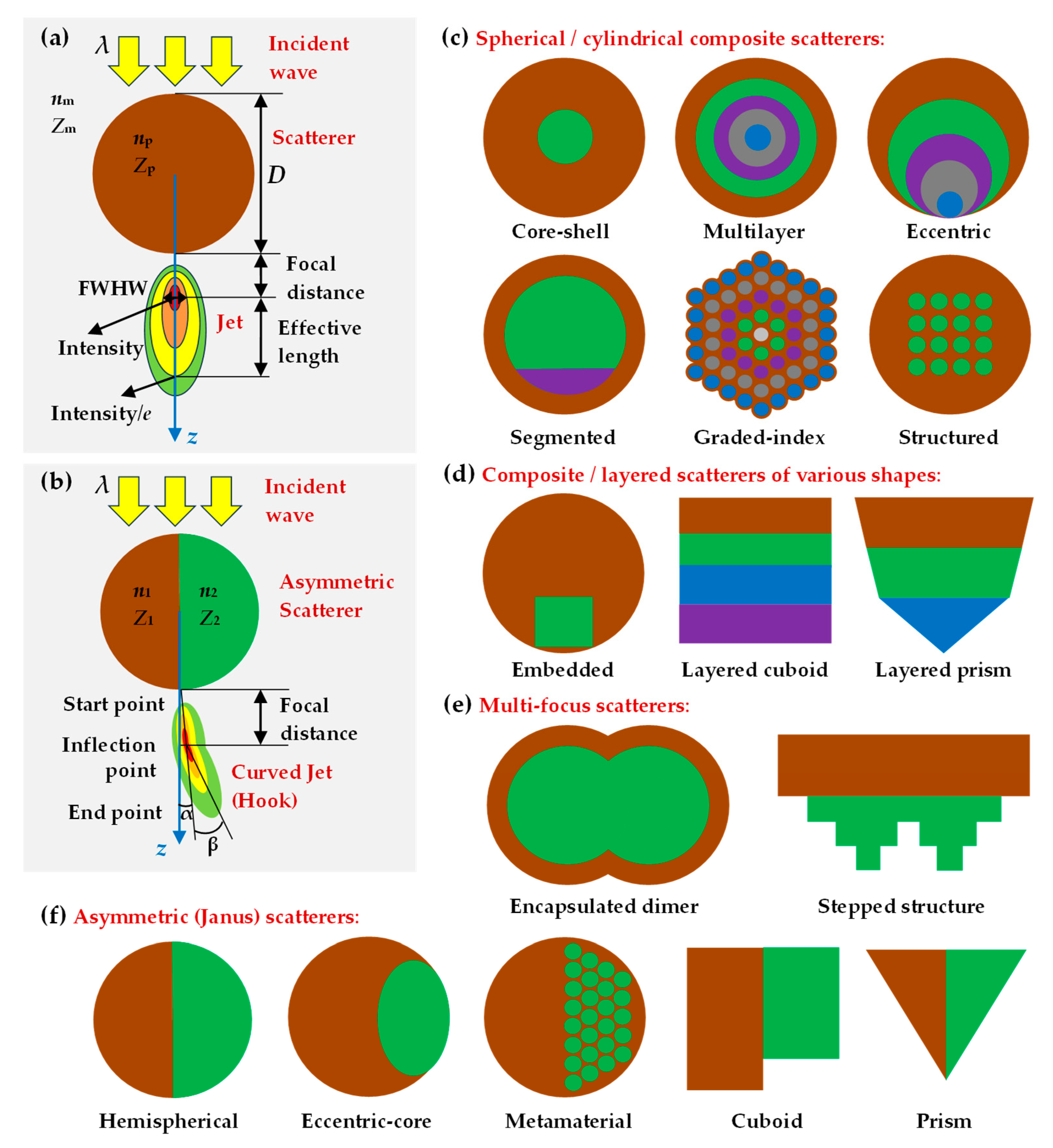
Figure 1a schematically illustrates the formation of a photonic or acoustic jet generated when an incident electromagnetic or acoustic wave interacts with a scattering particle. As a result of constructive interference of transmitted and scattered waves in the near field, often assisted by internal resonances, a narrow, high-intensity beam is formed in the shadow region of the particle. The key nanojet characteristics include the focal position (relative to the particle surface), maximum normalized intensity, jet length, and the full width at half maximum (FWHM) in the plane perpendicular to the jet axis at the intensity maximum. For comparison,
Figure 1b shows wave transmission through an asymmetric particle. The broken symmetry alters the internal phase distribution and energy flow, leading to the formation of a curved jet rather than a straight one. Curved jets, in addition to conventional straight nanojets, are characterized by a curved trajectory of the intensity maximum and a corresponding bending of the energy flow direction. A broad variety of scatterer designs (
Figure 1c–f) can be used to tailor jet properties.
Figure 1c presents typical composite scatterers with spherical or cylindrical symmetry, including core–shell, multilayer, eccentric, segmented, graded-index, and structured configurations. Regions composed of different materials are indicated by distinct colors. In photonic systems, these differences primarily correspond to variations in refractive index, whereas in acoustics, they are governed by contrasts in acoustic impedance. Scatterers with non-spherical geometries are shown in
Figure 1d, where shape anisotropy provides additional control over focusing behavior and jet formation. Under certain conditions, some structures can produce multiple jets; for example, coupled particles such as dimers (
Figure 1e) may generate two spatially separated jets due to mode coupling and interference effects. Finally, particles with broken symmetry, often referred to as Janus or asymmetric scatterers (
Figure 1f), are particularly effective for generating curved photonic and acoustic jets.
Research on photonic nanojets is significantly more extensive than that on acoustic jets. This difference primarily arises from the earlier development and broader experimental accessibility of photonic systems, as well as the long-standing interest in subwavelength light manipulation in optics and photonics. In contrast, studies of acoustojets have emerged more recently and are still an actively developing research area, partly due to more limited experimental platforms and detection techniques in acoustics.
This review is organized as follows.
Section 2 discusses the fundamental principles of wave localization beyond the diffraction limit that underpin photonic and acoustic jet formation.
Section 3 examines the physical analogy between optical and acoustic jet phenomena, while
Section 4 outlines the main analytical and numerical approaches used to study jet generation.
Section 5 reviews key experimental realizations and characterization techniques.
Section 6,
Section 7 and
Section 8 focus on homogeneous, layered, and composite scatterers, highlighting design strategies and tunability of both photonic and acoustic jets.
Section 9 surveys emerging and prospective applications in sensing, imaging, particle manipulation, and related technologies. Finally,
Section 10 presents concluding remarks and future perspectives.
2. Fundamental Principles of Wave Localization Beyond the Diffraction Limit
The classical diffraction limit of Abbe constrains the spatial resolution of optical systems to a value of the order of half the wavelength of the incident radiation [
11,
12,
13], which gives a characteristic scale on the order of λ/2
n, where λ is the wavelength in a vacuum, and
n is the refractive index of the medium. This fundamental limitation was long considered insurmountable by traditional optics [
14,
15,
16]. However, the discovery and subsequent development of the photonic nanojet concept [
1,
2] showed that subwavelength light localization is possible without the use of aperture-based optical elements, due to a special near-field focusing mechanism. The photonic nanojet phenomenon has demonstrated the feasibility of creating a narrow, high-intensity light beam formed in the near field on the shadow side of a dielectric microparticle scatterer with dimensions comparable to several wavelengths. The beam width can be smaller than λ/2, allowing the diffraction limit to be overcome and the microparticles to be considered effective “nanolens”.
The formation of photonic nanojets is caused by the complex interference of scattered waves in the near field of a microparticle. When an electromagnetic wave strikes a mesoscale-sized dielectric object, multiple reflections and refractions occur within the particle, leading to the formation of a set of waves with different phases and propagation directions. On the shadow side of the particle, these waves interfere constructively, forming a localized intensity maximum—a nanojet. Unlike classical geometric focusing, near-field components, including evanescent ones, play a key role here. Their phase correlation ensures a sharp transition from a propagating wavefront to a spatially localized beam with subwavelength dimensions. Thus, photonic nanojets can be viewed as an intermediate regime between diffractive propagation and resonant localization, not reducible to either classical lens optics or localized plasmonic effects.
The key characteristics of photonic nanojets are intensity, wavelength, focal position, and beam width, which are determined by a number of fundamental parameters of the scatterer and the surrounding medium. One key factor is the refractive index. The contrast between the refractive index of the particle (
np) and the surrounding medium (
nm) should be within a moderate range. Typical values for photonic nanojets are
np/
nm ≈ 1.5–2.0. If the contrast is too high, internal reflections and resonance effects are enhanced, leading to the destruction of the near-field interference pattern and suppression of the nanojet [
17,
18].
The size and shape of the scatterer also play a decisive role. The ratio of the characteristic particle size (
D) to the wavelength determines the scattering regime, transitioning from the Rayleigh to the Mie regime. The parameter
D/λ can be considered as a useful scaling criterion that determines the conditions of subwavelength localization [
1,
19,
20]. Typically, photonic nanojets are most tightly localized for homogeneous particles with diameters around 2–4 wavelengths, while larger particles (
D/λ ≈ 5–20) produce longer jets with reduced lateral confinement. However, composite or layered particles allow additional tuning of jet width and length beyond this simple scaling. Spheres and cylinders are the most extensively studied geometries; however, asymmetric structures such as cubes, prisms, and micropillars can produce curved nanojets, referred to as photonic hooks [
21,
22,
23].
An analogous phenomenon has been identified in acoustics, where mesoscale particles can generate highly localized high-intensity beams known as acoustic jets [
3]. In this case, the governing physics is described by the acoustic wave equation rather than Maxwell’s equations, yet the underlying localization mechanism is conceptually similar. When a plane acoustic wave interacts with a penetrable mesoscale particle, multiple internal reflections, refractions, and modal excitations occur within the particle. The scattered pressure field components interfere constructively in the forward direction, forming a narrow, high-intensity acoustic beam on the shadow side of the particle. As in the optical case, the transverse width of an acoustic jet can be smaller than the classical diffraction-limited spot size predicted for conventional focusing systems operating at the same frequency. This subwavelength confinement occurs in the near-field region and results from wave interference and modal coupling rather than from geometric focusing alone. Importantly, the phenomenon does not violate fundamental diffraction constraints in the far field; instead, it represents a near-field redistribution of acoustic energy enabled by mesoscale scattering. The formation of acoustic jets depends on the contrast in acoustic impedance between the particle and the surrounding medium, as well as on the ratio between the particle diameter and the acoustic wavelength [
10].
3. Analogy Between Photonic and Acoustic Jet Phenomena
The conceptual similarity between photonic and acoustic jets originates from a more fundamental analogy between electromagnetism and acoustics [
3,
24]. In the harmonic regime (time dependence
e−jωt, where ω is the angular frequency of the wave;
t is time), both the acoustic pressure (p) and the out-of-plane magnetic field component (
Hz) satisfy the Helmholtz equation [
24]:
where Δ is the Laplace operator,
k is the wave number, and
u is a scalar field depending on spatial coordinates. In acoustics, by setting
u =
p and
k2 = ω
2ρ
e(ω)/
K(ω), where ρ
e(ω) is the effective (dynamic) density and
K(ω) is the dynamic volume modulus of elasticity, Equation (1) reduces to the Helmholtz equation for acoustic pressure. In electromagnetism, for transverse magnetic polarization in a two-dimensional configuration, the out-of-plane magnetic field component
Hz also satisfies Equation (1), by assuming
u =
Hz and
k2 = ω
2µ(ω)
ε(ω), where µ(ω) is magnetic permeability and
ε(ω) is dielectric permittivity. Thus, we obtain two equations, demonstrating the acoustics–electromagnetism analogy:
where the symbol “↔” is used here as a symbol of analogy. In this correspondence, the acoustic pressure plays the role of the equivalent of the magnetic field component in transverse magnetic polarization. Consequently, Equation (2) allows for obtaining a mapping between acoustic and electromagnetic parameters and material characteristics, which forms the basis for the analogy summarized in
Table 1.
Both photonic and acoustic jets for a homogeneous particle surrounded by a homogeneous medium in the harmonic case can be described by solutions of the Helmholtz equation [
3], with differences arising primarily from the relevant material parameters: in optics, the refractive index is the primary control parameter, while in acoustics, the acoustic impedance performs a similar function.
This formal analogy enables theoretical frameworks developed in photonics to be adapted for acoustics, while also highlighting important distinctions in wave–material interactions that must be accounted for in the design and interpretation of experiments. In both cases, the effect of photonic/acoustic jets is driven by the wave nature of the field and near-field interference, and the mathematical description relies on wave equations [
25]. However, in the photonic case, medium losses are typically neglected, whereas in acoustics, viscosity and dissipation can play a significant role [
26].
In general, the dependence on the parameter
D/λ is also preserved in the case of acoustic jets, since both photonic and acoustic jets are governed by wave diffraction and interference phenomena, where the ratio between the characteristic size of the scatterer and the wavelength determines the focusing regime. However, in acoustics, the situation is more complex due to additional physical factors. In particular, acoustic waves may propagate in different types of media (fluids or solids), where the nature of wave propagation differs significantly: fluids support only longitudinal waves, whereas solids support both longitudinal and shear waves [
27]. This can influence the interference conditions and thus the formation of acoustic jets. In addition, material properties such as density, compressibility, and losses, as well as boundary conditions, can further affect the jet characteristics. As a result, quantitative details of acoustic jet formation may exhibit stronger sensitivity to the specific physical environment compared to the optical case.
The acoustics–electromagnetism analogy discussed above is most rigorous for homogeneous, isotropic, and linear media under harmonic excitation, where both systems reduce to scalar Helmholtz-type equations. For layered structures, the acoustics–electromagnetism analogy can generally be extended in a piecewise manner by applying the corresponding field continuity conditions at each interface, as established in classical treatments of acoustic–electromagnetic reflection and refraction problems [
28]. However, multiple reflections, impedance mismatch, and resonant effects may lead to more complex behavior. For composite or metamaterial structures, the analogy may become approximate because the effective parameters can be anisotropic, dispersive, or lossy. In inhomogeneous media, electromagnetic wave propagation can still be described by generalized vector Helmholtz equations, although the effective material response becomes more complex [
29]. In elastic solids, additional complications arise due to the coexistence of longitudinal and shear acoustic waves. Therefore, the validity of the analogy should be assessed depending on the material architecture and wave regime considered.
4. Analytical and Numerical Approaches to Jet Formation Study
The theoretical description of photonic and acoustic jets relies on a combination of analytical and numerical methods. In both cases, the governing equations can be reduced to Helmholtz-type formulations derived from Maxwell’s equations (electromagnetics) or from the linear acoustic wave equation (acoustic pressure fields in fluids and elastic wave motion in solids).
For idealized geometries, such as homogeneous spheres or infinitely long cylinders, analytical solutions play a fundamental role. In electromagnetics, Mie theory provides exact solutions to Maxwell’s equations for scattering by spherical particles, enabling rigorous evaluation of near-field distributions, internal resonances, and nanojet formation conditions. The acoustic analog is obtained from the exact solution of the scalar Helmholtz equation for acoustically penetrable spheres, where boundary conditions enforce continuity of pressure and normal particle velocity. These analytical approaches allow analysis of size parameters, material contrast (refractive index or acoustic impedance), and modal contributions to jet formation.
However, practical systems often involve complex geometries, multilayered particles, anisotropic media, or materials exhibiting dispersion and losses. In such cases, analytical methods become intractable, and numerical modeling becomes indispensable. Among the most widely used approaches are the finite-difference time-domain (FDTD) method and the finite element method (FEM). These techniques enable full-wave simulations of electromagnetic or acoustic wave propagation in arbitrarily shaped domains while rigorously incorporating boundary conditions and material properties.
A key numerical requirement in both photonic and acoustic simulations is the implementation of perfectly matched layers (PMLs) or other absorbing boundary conditions to suppress artificial reflections from computational domain boundaries. High spatial resolution is essential to accurately capture subwavelength field gradients in the nanojet region, particularly when evaluating beam full width at half maximum (FWHM), peak intensity, and axial jet length.
Modern multiphysics platforms such as COMSOL Multiphysics, as well as specialized electromagnetic solvers, are widely employed for modeling, parameter sweeps, and optimization of nanojet structures. For acoustics, FEM-based solvers are particularly advantageous due to their flexibility in handling heterogeneous elastic and fluid domains.
Numerical methods also open the possibility of geometric optimization. Parametric calculations and multidimensional optimization algorithms (genetic algorithms, Bayesian optimization) make it possible to find shapes and materials that provide the minimum beam width, maximum nanojet length, or maximum peak intensity.
4.1. Mie Theory
Classical Mie theory is an analytical solution to Maxwell’s equations for the case of an electromagnetic plane-wave incident on a spherical particle. This approach can be adapted to multilayer spheres (or cylinders) by solving the equations separately for each layer. Mie theory enables calculation of absorption, scattering, and extinction cross-sections [
30], but it is necessary to take into account the continuity conditions at interfaces, limited by boundary conditions, to avoid incorrect results.
In Mie theory, fields are described through electric and magnetic multipole coefficients. The solution is primarily influenced by the scattering cross-section, defined as an infinite series, the convergence of which is ensured by correctly setting the boundary conditions. Typically, the series describes the incident and scattered fields.
A modified Mie theory for multilayer microspheres is presented in [
31,
32,
33,
34,
35]. For example, solving Maxwell’s equations allowed us to establish the dependence of the intensity and size of a photonic nanojet on the thickness of the second layer near the quartz core of the particle [
35]. It was shown that an optically dense layer enhances the nanojet, bringing the system closer to a homogeneous sphere, and an optically dense layer also increases the spatial dimensions. The results, verified using the FDTD method, confirmed the high accuracy of the Mie theory. Mie theory provides accurate modeling of photonic nanojets, but its application is limited by the increasing complexity of calculations as the number of layers increases. Despite the advent of faster numerical methods, Mie theory remains fundamental and universal, often used in combination with other approaches [
34,
36].
In [
37], the effect of radial changes in optical contrast (exponential, linear, and constant) on photonic nanojet parameters was investigated. The authors demonstrated the feasibility of nanojet control by varying the contrast between layers. The paper [
38] examined nanojet elongation in bilayer microspheres: an increase in the outer shell thickness was accompanied by an increase in backscattering and a change in intensity. In [
39], Mie theory was applied to a five-layer microcylinder, where optimization of the magnetic component enabled a significantly reduced FWHM. The studies [
40,
41] confirmed the potential of the method for nanojet modeling, demonstrating its important role as a bridge between the Rayleigh regime and large-scale structures.
Mie theory provides accurate simulations of photonic nanojets, but its application is limited by the increasing computational complexity with increasing number of layers or when the geometry of the simulated region becomes more complex [
42]. Despite the advent of faster numerical methods, Mie theory remains fundamental and universal, often used in combination with other approaches.
4.2. Finite-Difference Time-Domain (FDTD) Method
The FDTD method proposed by K. S. Yee [
43] is one of the most versatile numerical approaches for solving Maxwell’s equations. The FDTD method allows us to solve Maxwell’s equations in both bounded and open systems, which distinguishes it from analytical approaches such as Mie theory. Unlike integral methods, FDTD is entirely numerical and provides high accuracy when taking into account the effects of scattering, diffraction, absorption, and nonlinearity [
36,
44,
45]. Due to its high flexibility and accuracy, this method has become widely used in nano-optics and photonics, where modeling complex interactions between electromagnetic fields and nanostructures is required.
The FDTD method is based on the discretization of space and time using the so-called Yee grid, within which the electric and magnetic components of the field are calculated at alternating grid points. Thus, the system of Maxwell’s equations is transformed into a discrete form suitable for numerical integration over time [
43]. Despite the versatility of the method, it has a number of limitations associated with the finiteness of the represented region. The modeled structure is determined by a finite elementary volume, which formally excludes infinite space, but at the same time ensures high calculation accuracy for nanometer-scale objects. For the correct modeling of open systems, FDTD uses the concept of a perfectly matched absorbing layer (PML), developed by P.J. Bernerger [
46]. The use of PML allows one to effectively simulate the absence of reflections from the boundaries of the computational domain, which ensures system isolation [
47]. A key element of FDTD is the stability criterion, which defines the relationship between the spatial grid size and the integration time step. This criterion guarantees the correct solution of Maxwell’s equations and prevents numerical instability. The minimum grid step is selected based on the range of modes being studied, ensuring a balance between accuracy and computational cost [
48].
The FDTD method offers several important advantages, including flexibility in describing materials, allowing for consideration of a wide range of optical properties: from dielectrics to metals and polymers; the ability to model various excitation sources, accurately reproducing interactions with both plane and Gaussian beams; analysis in the time and frequency domains—modeling results can be interpreted in both time and spectral representations, which is convenient for analyzing resonance phenomena; and versatility, as the method requires no special approximations and can be adapted by the user for problems of varying complexity [
49].
In [
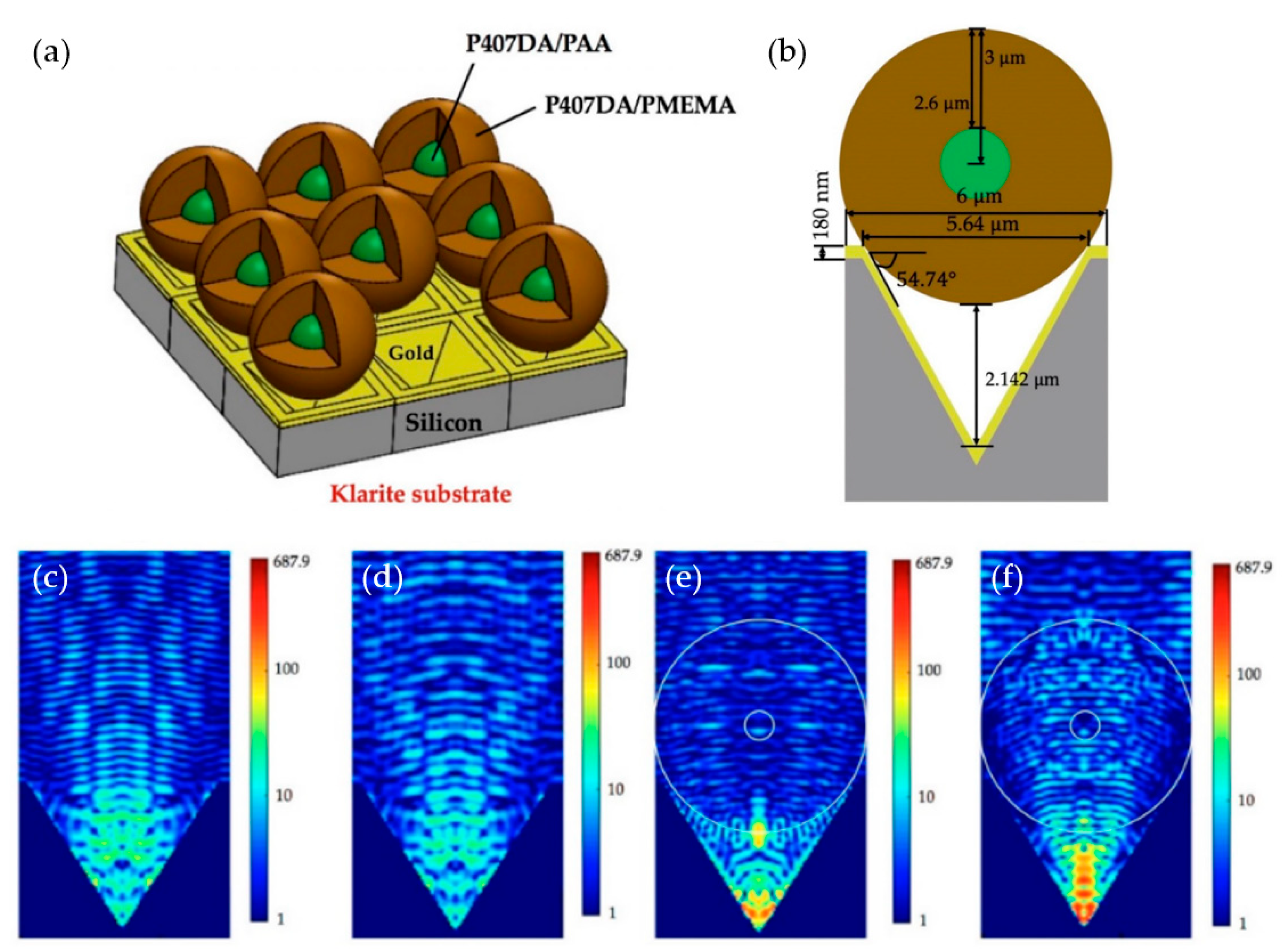
38], Wang et al. numerically investigated photonic nanojets produced by biocompatible hydrogel core–shell microspheres using FDTD simulations (Lumerical FDTD Solutions). The study systematically analyzed the influence of shell thickness, particle radius, refractive-index contrast (core–shell), and the surrounding medium on key nanojet characteristics, including focal distance, maximum intensity, effective length, and FWHM. The microspheres were composed of two interpenetrating hydrogel networks: P407DA/PAA (
n ≈ 1.36) and P407DA/PHEMA (
n ≈ 1.42), where
n is given for λ = 589 nm. These materials were selected due to their biocompatibility, high water content, and optical transparency, enabling refractive-index tunability via composition control. P407DA serves as a crosslinkable triblock copolymer forming the hydrogel network. Simulations were performed for transverse electric polarized plane-wave illumination at λ = 589 nm within a domain of 8 μm × 8 μm × 107 μm, using uniform meshes (~30 nm) and perfectly matched layer (PML) boundary conditions to ensure numerical convergence and minimal reflection artifacts. The modeled geometry is shown in
Figure 2a,b, while the corresponding FDTD-simulated intensity distributions are shown in
Figure 2c–f. The results demonstrate that both geometrical parameters (radius, shell thickness) and refractive index of the surrounding medium strongly modulate nanojet confinement and intensity. When integrated with the surface-enhanced Raman scattering (SERS) signals on a Klarite substrate, the hydrogel core–shell microspheres significantly enhanced the local electric field compared to the substrate alone, particularly in air, indicating their potential as tunable dielectric microlenses for SERS amplification.
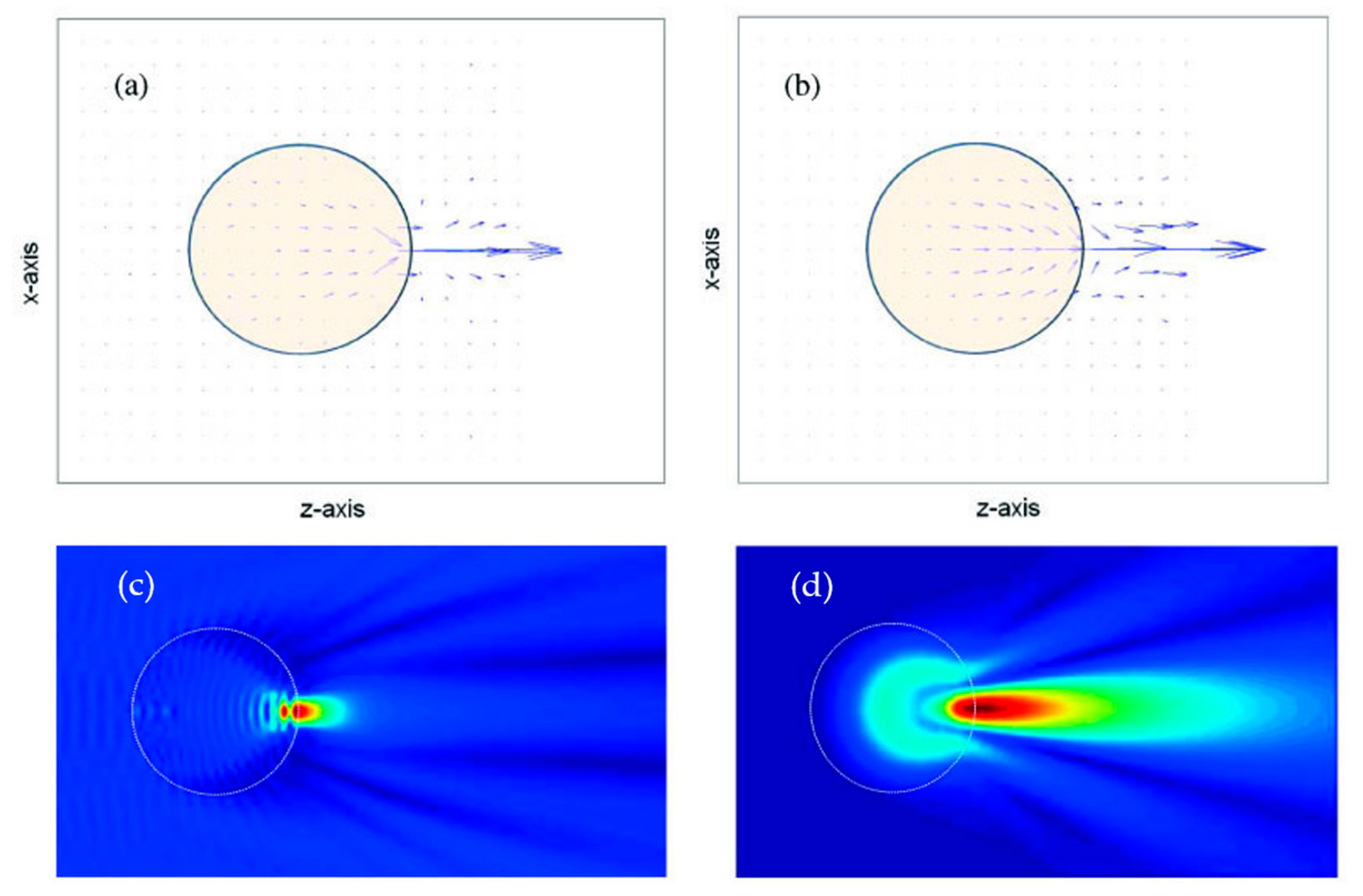
In [
50], the authors demonstrated that the characteristics of photonic nanojets can be significantly modified by employing a graded-index microsphere instead of a homogeneous dielectric particle. Using three-dimensional FDTD simulations, the authors approximated a continuous refractive index gradient via multiple concentric dielectric shells of varying thickness. This composite configuration enabled the generation of a quasi-one-dimensional light beam with enhanced longitudinal confinement and extended propagation length compared to a uniform polystyrene sphere (
n = 1.59). Arrow-plot visualizations of the Poynting vector in the x–z plane revealed substantial redistribution of electromagnetic energy and improved directionality of the nanojet (
Figure 3). The study provided one of the first clear numerical demonstrations that internal refractive index engineering in layered mesoscale particles offers a powerful mechanism for tuning nanojet length, waist, and intensity, thereby establishing an important design paradigm for composite jet-forming elements.
In [
36], FDTD was employed to investigate clusters of closely packed dielectric nanospheres. The simulations revealed that collective scattering from the cluster can produce enhanced and spatially tailored photonic nanojets, with controllable beam width and intensity distribution in the near field. The work demonstrated that FDTD enables accurate modeling of multi-particle interactions and interference effects, which are challenging to capture with conventional analytical or simpler numerical approaches.
Several studies [
51,
52,
53,
54,
55] aimed to increase the photonic nanojet length using various microstructures. However, the relatively small number of studies devoted to multilayer microspheres indicates a lack of understanding of this topic or a preference for alternative modeling methods. Nevertheless, the high spatial resolution of FDTD makes it particularly effective for analyzing nanojets.
In the study [
56], three-dimensional FDTD simulations were used to investigate the propagation of a plane wave through a dielectric cylinder with a gold shell. It was shown that the thickness of the gold layer has a significant effect on the intensity and spectral position of the nanojet under both resonant and non-resonant conditions.
In this study [
57], the FDTD method was used to simulate nanojets generated by microaxicons. Varying the axicon tip angle allowed the nanojets to be extended to about 20λ while maintaining a virtually constant width. While this study was limited to homogeneous structures, it highlights the accuracy and versatility of the approach. The paper [
21] also examined the deflection of a photonic nanojet (or photonic hook) caused by an aluminum obstacle embedded within the microsphere, demonstrating the potential of FDTD for analyzing complex optical systems.
4.3. Finite Element Method (FEM)
FEM is a widely used numerical method for studying photonic nanojets. It is designed to solve integral and differential equations, in particular Maxwell’s equations, used in nanoscale research. FEM provides numerical solutions and is considered one of the most accurate methods in terms of reproducing boundary conditions and achieving high computational accuracy.
A key advantage of FEM is its ability to handle large-scale systems by discretizing the computational domain, thereby enabling highly accurate field solutions. However, the method also has some limitations, including the need to account for multiscale geometries, possible geometric or mesh distortion arising from material properties, the replacement of unknown or inhomogeneous regions with standard approximations, and computational constraints for three-dimensional structures whose size scales approximately with the cube of the wavelength [
58,
59].
In [
60], photonic nanojets were explored in dielectric microspheres under immersion and complex boundary conditions, showing that FEM can accurately predict field intensity distributions and near-field confinement in realistic environments relevant for imaging and sensing.
In [
61], the authors reported detailed FEM simulations of multilayer dielectric microcylinders, showing that the addition of shells with tuned refractive indices can significantly enhance photonic nanojet intensity and influence focal spot characteristics; their results, validated against independent solvers, highlight the flexibility of FEM for multilayer optimization.
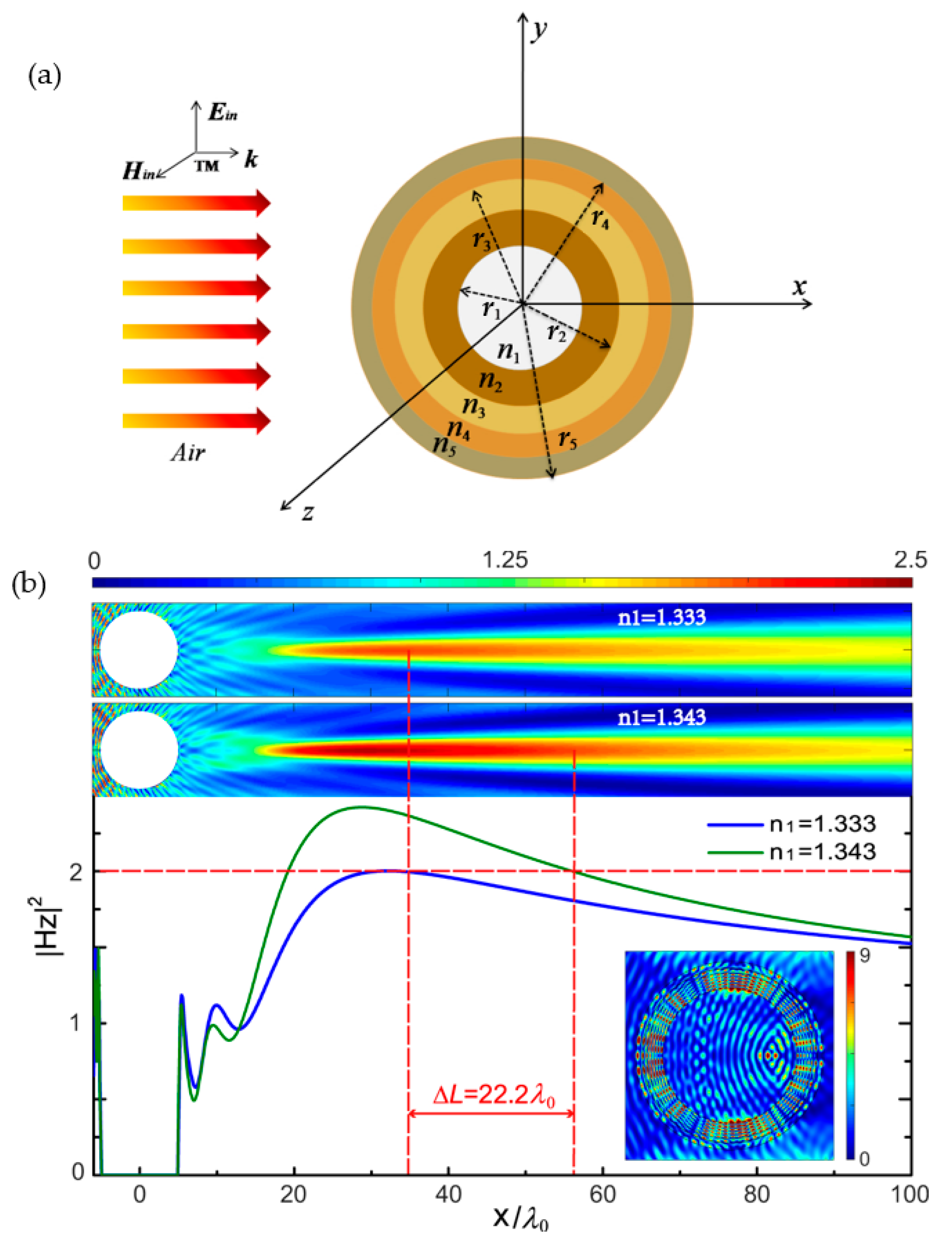
Among the analyzed studies, work [
39] is of particular interest, in which a five-layer microcylinder was considered (
Figure 4a). The authors identified the convergence and divergence points of the wavefront passing through a structure with a specific geometry. Optimized five-layer microcylinders can generate ultra-long photonic nanojets with lengths up to ~107.5 λ and subwavelength waists down to ~0.22 λ. Full-wave FEM simulations confirm these results (
Figure 4b).
In [
62], a simulation of a microsphere with a crescent-shaped refractive index profile was performed, which made it possible to achieve a nanojet width of about λ/4.5. The illumination wavelength was fixed at 500 nm. The authors emphasized that FEM is particularly suitable for comparison with experiments because of its high accuracy. Specifically, microspheres with 2–5 layers were developed, each with a sharpened crescent-shaped end in a two-dimensional representation. In [
62], the formation of an ultra-sharpened nanojet was recorded, albeit with some loss of intensity.
Full-wave finite-element modeling has become an indispensable tool for studying photonic nanojets in structures where analytical solutions are impractical due to complex geometry, composite layers, or non-spherical shapes.
Thus, the finite element method is a robust and versatile numerical modeling tool that enables the design of complex multilayer structures with high accuracy. Furthermore, results from other studies confirm that the scope of FEM application extends beyond optical fields to plasmonic and acoustic fields [
25].
For example, in [
63], the authors used FEM to study Janus cylinders, demonstrating that breaking the symmetry of the material composition enables the formation of tunable acoustic hooks. By adjusting the refractive index contrast between the two halves or rotating the cylinder, FEM simulations captured precise variations in hook curvature and focal properties, with FWHM approaching the diffraction limit. This work illustrates how FEM allows for the detailed investigation of near-field acoustic phenomena in asymmetric and composite structures that are difficult to analyze analytically.
FEM simulations were used to study the formation and tunability of acoustic jets generated by a spherical ABS core–shell container filled with two incompatible liquids (water and phenixin) [
26]. A 2D axisymmetric model in COMSOL v5.5. Multiphysics coupled pressure acoustics (liquids) with solid mechanics (ABS shell). A 40 kHz plane acoustic wave propagated through the surrounding water medium. The relative proportions of the two liquids controlled the internal acoustic behavior. Simulations of acoustic pressure and normalized intensity were used to extract key jet characteristics. The FEM results showed that adjusting the liquid distribution enables tuning of the acoustojet, including subwavelength focusing and the emergence of acoustic resonance. Structural losses in the ABS shell were also considered, showing reduced intensity and broader beams with increasing damping. The suitability of FEM for practical jet engineering has been demonstrated in layered core–shell acoustic lenses, where coupled fluid–structure COMSOL simulations reproduced experimentally observed sub-λ/2 acoustic jets with good quantitative agreement [
64].
FEM is particularly effective for acoustic jet simulations involving structured lenses and complex scatterers. For example, in studies of 3D-printed cylindrical ultrasonic lenses for subwavelength focusing [
65], FEM enables accurate representation of curved boundaries, heterogeneous material domains, and near-field pressure localization, while also facilitating direct comparison with experimentally fabricated geometries. In [
65], FEM has been applied to a periodic acoustic structure (sonic crystal), where accurate treatment of multiple scattering and lattice geometry is required for reliable jet prediction. Such capabilities make FEM especially suitable for the design and optimization of practical acoustic jet devices. In addition, FEM has been successfully applied to gradient-index acoustic metamaterials, including generalized Luneburg lenses designed for ultra-long acoustic jet formation, where simulations showed good agreement with experimentally measured pressure-field distributions and focal characteristics [
10]. Such examples demonstrate the suitability of FEM for the design, optimization, and experimental validation of practical jet-generating devices based on structured media.
In addition, FEM plays a key role in addressing modeling challenges in acoustic composite structures, such as acoustic–structure coupling, heterogeneous material interfaces, and viscoelastic losses, which strongly influence wave attenuation and energy localization [
26,
64]. This makes FEM particularly suitable for reliable modeling of realistic composite acoustic media, including layered, core–shell, periodic, and gradient-index structures, where dissipative and coupling effects cannot be neglected.
Among the numerical methods used for the analysis of photonic and acoustic jets, the FDTD method is widely employed for broadband full-wave simulations, transient processes, and broad parametric studies in moderately sized systems. However, fine spatial discretization is often required near curved interfaces and in resonant regimes. In contrast, the FEM offers higher geometric flexibility and local mesh adaptivity, making it particularly suitable for layered particles, inhomogeneous materials, and multiphysics problems. FEM is also particularly convenient for architected and periodic structures, such as sonic-crystal-type ultrasonic lenses, where accurate representation of multiple scatterers, lattice geometry, and near-field interference is essential for predicting subwavelength focusing behavior. Higher-order element-based approaches, such as the spectral element method, have also demonstrated high accuracy in jet simulations involving strong field localization and resonance effects. Compared with conventional FEM, spectral elements may achieve a given error level with lower computational cost due to their higher-order convergence properties [
66], in smooth problems and regular discretizations, which is advantageous for scattering and focusing problems. Thus, the choice of numerical method depends on the specific objective: FDTD is efficient for broadband exploratory studies, while FEM-type approaches are generally preferred for accurate simulation and optimization of structured jet-forming devices, particularly in complex geometries and frequency-domain analyses.
5. Experimental Realizations and Characterization Techniques
Experimental studies of photonic nanojets and related effects demonstrate a common near-field interference-based mechanism—the concentration of the electromagnetic field in the vicinity of dielectric microstructures—across a wide range of geometrical, spectral, and application-specific implementations. Despite differences in scale (from microwave and terahertz ranges to visible light), materials, and measurement methods, all experiments confirm the key role of geometry, symmetry, and illumination conditions in the formation of subwavelength beams [
17,
67,
68].
Early foundational experiments with dielectric microspheres and cylindrical particles demonstrated the formation of short, intense nanojets with subwavelength width. Review and experimental studies have demonstrated that such particles can provide effective imaging resolution significantly beyond the classical diffraction limit, approaching λ/8–λ/14, when placed in close contact with the object under investigation [
67,
69]. However, experimental data also indicate the limitations of such structures in terms of beam shape control: the nanojets are short, and their divergence is relatively large.
The transition to non-spherical microstructures leads to qualitatively new experimental results. In studies with truncated and elliptical microcylinders, it was experimentally demonstrated that changing the cross-section allows for a significant increase in the focal length and length of the photonic nanojet, while simultaneously reducing its divergence [
70]. For elliptical microcylinders, the nanojet length can reach several wavelengths, while the divergence angle is substantially reduced compared to that of round particles. Similar conclusions are confirmed by experiments with square and triangular particles, where the shape and orientation of the particle relative to the incident light alter the intensity distribution in the Fresnel near field [
71]. These results demonstrate that geometric asymmetry is an effective tool for controlling the near field without increasing material complexity.
The idea of symmetry control was further developed in experiments with asymmetric illumination. It was shown that partial obstruction of the incident beam with a metal mask leads to the formation of a photonic hook. It has been experimentally established that the curvature, width, and direction of such a beam can be smoothly adjusted by varying the degree of light obstruction [
72,
73]. Unlike a classical photonic nanojet, a photonic hook allows for control of the beam propagation trajectory, opening up possibilities for targeted manipulation of objects in the near field.
Experimental studies in the terahertz and microwave ranges play a special role, as they allow direct visualization of the electromagnetic field distribution. Microwave experiments utilize anechoic chambers and antenna probes, which directly record the field amplitude and phase in the near and far fields. Such setups provide visual verification of numerical models and demonstrate the possibility of shifting and deflecting a photonic jet by changing the geometry or dielectric properties of the structure [
74]. Although the spatial resolution here is limited to millimeter scales, direct access to the field makes these experiments fundamentally important. High-frequency dielectric interactions are increasingly being translated into compact and autonomous sensing platforms [
75], which, although not directly relying on photonic jet formation, demonstrate how controlled electromagnetic field–matter interactions can be harnessed in practical miniaturized devices for continuous monitoring.
Terahertz experimental setups occupy an intermediate spectral region between the microwave and optical ranges. They employ horn antennas, collimating lenses, and electro-optic detectors, allowing the field distribution to be reconstructed with submillimeter resolution. Experiments show that even a simple dielectric cube placed at the focus of a THz system can form a jet with a subwavelength width and significantly enhance the spatial resolution of the imaging system [
76]. These results experimentally confirm the scalability of the photonic nanojet effect from microwave to higher frequencies.
The most complex experimental setups are used in the optical range. In this spectral range, direct measurement of the full vector electromagnetic field is not feasible using conventional far-field techniques, and experiments are therefore based primarily on recording the intensity distribution with high-numerical-aperture microscopes and stepwise near-field scanning. To reconstruct the three-dimensional structure of photonic nanojets, piezoelectric actuators with nanometer pitch are used, enabling the study of subwavelength effects such as narrow constrictions, elongated focal regions, and curved photonic hook trajectories [
70,
71,
72,
73].
Experiments have shown that multilayer designs and the use of total internal reflection effects can significantly increase the intensity and axial extension of photonic nanojets—reaching several to more than ten wavelengths in optimized configurations—while preserving a subwavelength beam width [
69,
73]. Such structures are particularly promising for nanolithography, surface-enhanced Raman scattering, and fluorescence enhancement.
The practical significance of these experimental results is most clearly demonstrated in studies on the optical trapping and manipulation of micro-objects. Using a photonic hook formed by an asymmetric fiber probe, the selective capture and transport of individual red blood cells was experimentally demonstrated [
23]. This result underscores that controlled photonic nanojets are not only an object of fundamental research but also an effective tool for biophotonics and micro- and nanomanipulation.
Thus, a combined analysis of the experimental results and setups used demonstrates a consistent evolution in photonic nanojet research: from simple spherical particles and straight beams to complex, asymmetric, and multilayer structures that enable control of the width, length, intensity, and trajectory of light propagation. Despite differences in spectral ranges and measurement techniques, all experiments confirm the versatility and scalability of the photonic nanojet effect, making it a promising basis for the further development of nanophotonics, super-resolution optics, and applied biomedical technologies.
Experimental realizations of acoustic jets typically employ spherical or cylindrical scatterers immersed in liquids or embedded in solid matrices, operating in the ultrasonic frequency range where the particle size is comparable to the wavelength. Core–shell and multilayer structures have also been fabricated to tailor acoustic impedance contrast and internal interference effects [
77]. For example, a cylindrical acoustic jet generated by a mesoscale 3D-printed object was studied experimentally with hydrophone mapping of intensity and focus parameters [
65]. Direct measurements of acoustic jet fields were performed in [
64].
The spatial structure of the acoustic jet can be characterized using needle or membrane hydrophones for pressure amplitude measurements, laser Doppler vibrometry for surface displacement mapping, and schlieren or shadowgraph imaging for qualitative visualization of acoustic fields in transparent media. For high-resolution studies, scanning acoustic microscopy enables subwavelength mapping of near-field intensity distributions. More details on experimental approaches for visualizing and characterizing focused acoustic fields can be found in [
78,
79,
80,
81]. Quartz crystal microbalance can also be employed to study the localized impact of acoustic focusing on a surface, as well as to investigate the associated hydrodynamic and mechanical effects [
82].
Acoustic excitation is most commonly provided by piezoelectric ultrasound transducers based on lead zirconate titanate, lithium niobate, or composite piezoceramics, which offer high electromechanical coupling and broad frequency tunability. For high-frequency and microscale jet formation (tens to hundreds of MHz), thin-film transducers and focused single-element probes are frequently used. Capacitive micromachined ultrasonic transducers [
83] and piezoelectric micromachined ultrasonic transducers [
84] are increasingly employed in miniaturized and on-chip configurations, enabling integration with microfluidic platforms and precise near-field control. Focused transducers or acoustic lenses are often incorporated to approximate plane-wave or weakly converging illumination conditions, depending on the desired excitation geometry.
The analysis of signals received from piezoelectric transducers can be carried out through the S-parameters [
85]. Frequency-domain characterization of the excitation and scattering properties is commonly performed via S-parameter measurements using a vector network analyzer (VNA) [
86]. In such configurations, the transducer is electrically connected to the VNA to measure reflection (S
11) and transmission (S
21) coefficients, providing information about impedance matching, resonance behavior, and insertion loss. When two transducers are used in a through-transmission arrangement, S
21 measurements quantify the forward transmission through the scatterer, while S
11 reflects backscattering and coupling efficiency. Accurate interpretation of S-parameters requires proper calibration and de-embedding procedures to remove systematic errors and to isolate the intrinsic response of the scatterer from parasitic contributions [
87]. Dedicated VNA measurement setups [
86,
88], approaches for separation of the electrical and acoustic domains [
85], advanced calibration techniques [
89], and parameter extraction procedures [
90,
91] have been developed to ensure high-precision characterization via VNA.
Materials suitable for the generation of photonic and acoustic jets typically combine low energy losses with sufficiently high refractive index (for optics) or strong acoustic impedance contrast (for acoustics). In optics, mesoscale dielectric particles made of silica [
18], polymers [
38], and high-index oxides such as TiO
2 [
92,
93] or BaTiO
3 [
42,
94] are widely employed because they enable the formation of highly localized subwavelength light beams in the near field. Other dielectrics with a high refractive index and strong polarization response are also considered promising for advanced photonic and microwave applications [
95,
96]. In particular, functional oxide materials and coatings, especially those based on titanium oxides, have been extensively studied due to their structural stability and tunable physical properties, which are advantageous for the engineering of optical and acoustic components [
97,
98]. In acoustics, various materials have been explored for passive structures, including polymers and plastics with acoustic impedance close to that of water, which helps reduce reflection losses and improve energy localization. For example, polymer lenses made of PMMA or Rexolite have demonstrated subwavelength acoustic focusing in the ultrasound range [
99]. Experimental demonstrations have also shown that properly designed acoustic lenses can generate acoustic jets with focal widths smaller than half the wavelength [
64], where the scattering element was implemented as a cylindrical core–shell lens consisting of a polyethylene tube filled with perfluorinated oil and immersed in liquids such as ethanol or olive oil, where the contrast in acoustic properties enabled the formation of a subwavelength acoustic jet.
6. Composite and Layered Scatterers: Design Rationale
The use of homogeneous single-material scatterers, such as spheres and cylinders, has played a key role in elucidating the fundamental mechanisms underlying photonic and acoustic jet formation. However, the ability to control jet characteristics (directivity, intensity, spatial extent, and intensity-maximum location) in such systems is significantly limited by the fixed material properties and geometry. This limitation has motivated the development of composite and layered scatterers, in which the internal structure of the particle provides an additional degree of freedom for tailoring the near-field distribution.
Composite and layered elements include core–shell structures [
26,
38], multilayer spherical [
35,
62] and cylindrical particles [
39], composite particles of various shapes [
74], and materials with spatially graded constitutive parameters [
10,
50,
100,
101]. In such systems, the wave-field distribution is governed not only by the external dimensions of the particle but also by the spatial profile of the relevant material parameters, which substantially broadens the range of achievable jet characteristics in both photonic and acoustic realizations.
In its simplest form, a core–shell structure consists of a core and a shell with different material parameters [
26,
38,
64]. This contrast introduces additional internal interfaces at which partial reflections and phase shifts occur. As a result, the near-field interference pattern becomes more tunable than in a homogeneous scatterer. A similar mechanism governs multilayer spheres [
35,
62] and cylinders [
39], where each layer contributes to the formation of the total field, effectively acting as a phase-control element. Graded-parameter materials represent the limiting case of multilayer structures, in which the relevant material properties vary continuously or quasi-continuously in space [
50,
100]. Such spatial distributions enable smooth control of wave propagation and phase accumulation within the scatterer, reducing parasitic reflections and enhancing directional focusing in the near field.
The primary motivation for using composite and layered scatterers is the ability to precisely tailor the characteristics of photonic nanojets through the particle’s internal architecture. First, varying the refractive indices and layer thicknesses allows for control of the effective phase front of the emerging field, which directly influences the direction and position of the jet relative to the scatterer surface. Second, properly selected material combinations can enhance constructive interference in the near field, leading to an increase in peak intensity and a decrease in the transverse width of the jet. An additional advantage is the tunability of photonic nanojet length. In homogeneous particles, the jet length is tightly coupled to the D/λ parameter and the refractive index contrast. In composite systems, this coupling is weakened: the multilayer structure allows for both high localization in the transverse direction and an increase in the longitudinal extent of the region of increased intensity. From a physical perspective, composite and layered scatterers act as mesoscopic phase elements. Each boundary between layers introduces an additional phase shift and redistributes the field amplitude, leading to more complex but controllable wave interference on the shadow side of the particle. In core–shell structures, this compensates for unwanted aberrations characteristic of high-contrast homogeneous particles and maintains nanojet formation even over a wide range of optical parameters. In the case of gradient materials, a smooth change in refractive index ensures adiabatic wavefront transformation, minimizing scattering at internal boundaries and promoting the formation of a cleaner and more stable jet. This approach conceptually brings photonic nanojets closer to the principles of transformation optics, but is implemented on significantly simpler and more compact structures.
Similar considerations apply to acoustic jets, owing to the wave-physics analogy between photonic and acoustic jets discussed earlier in
Section 3. In this case, multilayer or composite scatterers are composed of materials with contrasting acoustic impedances, including contrasts relative to the surrounding medium. When designing such systems, the effects of viscosity and acoustic dissipation must be taken into account.
Composite and layered scatterers represent a logical evolution of the photonic and acoustic jet concept from a fundamental wave phenomenon to an engineering-controlled tool. The introduction of internal structuring, whether in the form of core–shell geometries, multilayer architectures, or spatially graded material parameters, enables substantially enhanced control over jet directionality, intensity, transverse confinement, and longitudinal extent. Such systems therefore hold significant promise for applications in subwavelength imaging, high-resolution sensing, and localized wave–matter interaction across optical [
36,
38,
102] and acoustic [
10,
25,
64] platforms.
7. Photonic Jet Control in Engineered Structures
Microspheres and microcylinders serve as reference models for photonic nanojet studies [
34,
103,
104]. Their key parameters include refractive index, refractive index contrast, FWHM, focal length, and propagation length. Positive spherical aberration appears as the sphere radius increases beyond the wavelength [
105]. Despite high focusing accuracy, microspheres exhibit photonic nanojet broadening and a decrease in intensity with increasing beam length. Multilayer microspheres and microcylinders (see
Figure 4) enable precise tuning of photonic nanojets by controlling layer refractive indices and geometry [
35,
39]. Adjusting the number, thickness, and eccentricity of layers allows modification of nanojet length, FWHM, position, and curvature, including the formation of photonic hooks. Multilayer eccentric microspheres enable precise tuning of photonic nanojets through refractive index engineering and controlled symmetry breaking [
62]. Core displacement and layer optimization allow reduction in the FWHM to deeply subwavelength values while modifying jet length and position. Although intensity may decrease, this approach provides flexible control over near-field localization without changing the overall particle size.
Non-spherical microparticle shapes (pyramid, cone, ellipsoid, cuboid, etc.) are considered significantly less frequently because their efficiency in generating nanojets is limited [
17]. Studies [
17,
71,
106,
107,
108] have shown that prism, pyramid, and cone shapes have limited efficiency for photonic nanojet formation, although pointed geometries potentially reduce the FWHM. In particular, it was shown in [
109] that combinations of a truncated cone and a hemisphere are capable of forming more intense and elongated photonic nanojets compared to single shapes, and in [
107], for example, pyramidal near-field probe structures were used, which increase the nanojet intensity, although they do not function as lenses. In the study [
106], it was shown that a hexagonal prism provides the best spatial resolution among the tested shapes (in comparison with a rectangular pyramid and a microcylinder). In [
108], diffraction gratings with different profiles (hemisphere, rectangle, and jagged shape) were analyzed. It was shown that a triangular (jagged) grating generates a more intense nanojet, but has worse beam quality parameters. In three-dimensional systems [
44], axicons were used, which are conical lenses forming an elongated focal region with minimal diffraction. However, a decrease in nanojet efficiency was observed compared to isolated microspheres. Combining a truncated cone and a hemisphere [
109] yielded the highest photonic nanojet intensity and the most elongated nanojet, demonstrating the potential of hybrid geometries. In [
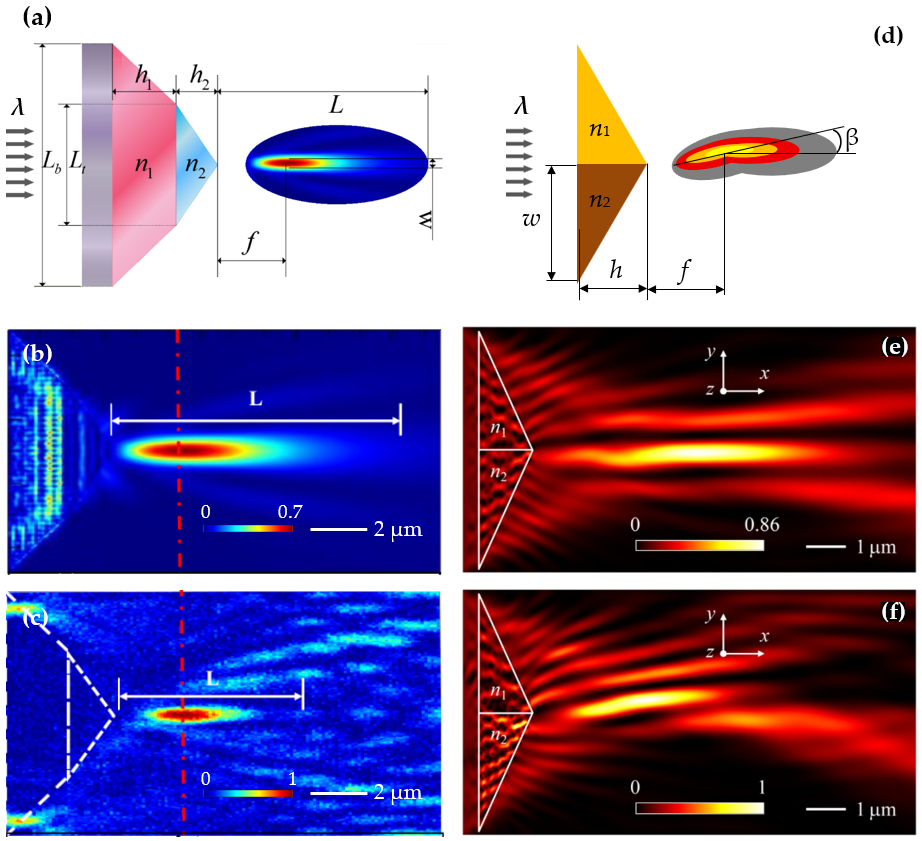
69], the authors report a bilayer micropyramid structure for enhancing photonic nanojet formation and improving subwavelength optical field confinement (
Figure 5a). The proposed design employs two dielectric layers with different refractive indices, enabling improved control over light propagation and focusing behavior. FDTD simulations demonstrate that the bilayer configuration enhances nanojet intensity, reduces beam width, and allows tunable focal positioning compared to conventional single-layer structures (
Figure 5b). This additional design flexibility provides an effective route to tailor nanojet characteristics and optimize light–matter interactions at the nanoscale. The study [
55] demonstrates the formation of photonic hooks using triangular Janus prisms composed of two adjoining materials with different refractive indices (
Figure 5d). FDTD simulations reveal that the refractive index contrast within the prism induces asymmetric energy flow, leading to a curved subwavelength beam (
Figure 5e,f). The bending angle and length of the photonic hook are primarily governed by the refractive index difference. Higher contrast enhances beam curvature while maintaining strong spatial confinement beyond the diffraction limit, highlighting potential for precise near-field light manipulation.
The cuboid has proven itself as one of the most promising shapes for generating terajets [
76,
110]. FDTD simulations have shown that the cuboid provides a higher field intensity and better spatial resolution than a microsphere [
111]. In the terahertz range, the cuboid forms a symmetric focal region (hotspot) with a numerical aperture of about 0.55 at a frequency of 125 THz [
76]. Moreover, the authors managed to achieve a resolution exceeding the diffraction limit by a factor of 2.2 without increasing the frequency, which is important for reducing losses in the material [
112]. Structured silicon cuboid geometries enable improved photonic nanojet confinement and subwavelength resolution. In particular, a hybrid design combining a microcuboid with a nanocuboid layer has been shown to generate ultra-narrow nanojets with widths of ~λ/7.4–λ/7.8 in both water and air [
113]. Further enhancement to ~λ/8.3 was achieved in [
113] by introducing a near-wavelength periodic grating, exceeding the classical solid immersion limit for silicon-based lenses. In [
114], a glass cuboid embedded in a cylindrical host medium further demonstrates enhanced control of photonic nanojet formation in complex composite geometries, enabling ultra-narrow nanojets (~0.25λ) with tunable width, length, and position governed by geometry, refractive-index contrast, and excitation conditions. In [
115], the effect of polarization on the formation of a terajet and a photonic hook was studied, and in [
116], chains of cuboids with different spacings were considered, where the maximum intensity was observed at an interparticle distance of ~3.5 λ. Similar studies of chains of microspheres [
117] showed increased losses, which emphasizes the advantage of cuboids. In [
118], matrix arrays of cuboids (1 × 1, 3 × 3, 5 × 5, and 7 × 7) were studied. With increasing matrix size, a decrease in intensity along the x- and y-axes was observed while the distribution along the
z-axis remained unchanged. The FWHM values were 0.7 λ, 0.5 λ, 0.5 λ, and 0.48 λ, respectively. Recent studies of multilayer cuboids [
100] have shown that the refractive index gradient (RIG) significantly affects the refractive index contrast (RIC) and, consequently, the nanojet quality. The best results are achieved at RIG = 0.2–1, whereas for a homogeneous structure (RIG = 0), the photonic nanojet quality drops sharply.
Interest in asymmetric shapes increased after the discovery of the photonic hook [
119]. This phenomenon occurs when illuminating particles with broken symmetry, such as Janus particles. In [
120], it was shown that such particles can effectively redirect the beam shadow (photonic nanojet or photonic hook). I. Minin and O. Minin made a significant contribution to the study of asymmetric nanojets, first describing the photon hook as a type of nanojet. Their work demonstrated that a photonic hook is easier to form than an Airy beam, while maintaining high intensity and spatial localization [
121]. In [
23], a photonic hook was used to manipulate red blood cells using a fiber optic tip, where varying the cutting angle (0–40°) allowed control of the hook deflection angle and the trajectory of the optical trap.
An interesting direction is the generation of a photonic hook without geometric asymmetry. For example, in [
122], a double elliptical microcylinder was proposed, allowing the formation of a photonic hook due to the internal distribution of the refractive index. In a study [
123], a Janus cylinder with a refractive index of 1.40 and 1.46 (RIC = 0.96) demonstrated the formation of a photonic hook with an FWHM ≈ 0.29–0.72 λ and an intensity of 10.2–10.9, which is below the diffraction limit. Similar results were obtained for two-material cuboids [
74], where the difference in refractive indices at terahertz frequencies led to the formation of a tilted beam with a reduced FWHM.
Thus, this review shows that microparticle geometry plays a key role in the formation and control of nanojets and photonic hooks. Despite the high efficiency of traditional microspheres, alternative shapes—cuboids, ellipsoids, truncated cones, and Janus particles—offer new possibilities for subwavelength focusing, beam direction control, and the creation of terahertz nanojets.
8. Acoustic Jets of Homogeneous, Layered, and Composite Scatterers
The foundational work on acoustic jets was presented by O. Minin and I. Minin [
3], who introduced the concept of the acoustojet as the acoustic analog of the photonic nanojet. In their study, they numerically demonstrated that a penetrable three-dimensional mesoscale particle can produce a highly localized acoustic beam in its shadow region with subwavelength confinement. This acoustojet effect was shown to arise from a complex interplay of near-field diffraction and constructive interference of scattered and transmitted acoustic waves, leading to a region of enhanced acoustic intensity with a width smaller than the wavelength. Their results extend the jet concept from electromagnetic to acoustic waves and provide a basis for subsequent investigations into acoustic super-focusing and localized acoustic field control using specially selected scatterers. The subsequent article [
99] examines the possibility of generating an acoustic analog of a photonic jet using a flat, cuboid-shaped particle.
Numerical investigations using the spectral element method show that the characteristics of the acoustic jet can be tuned by adjusting structural parameters, such as the size and material properties of the scatterer, and that resonant propagation modes may coexist with the jet in certain configurations [
25]. Beyond single homogeneous scatterers, layered and composite acoustic structures, including metamaterial lenses and engineered multi-component bodies, provide additional degrees of freedom for controlling jet directionality, focal intensity, and near-field confinement, drawing qualitative analogy to composite photonic jet scatterers in optics. Such engineered acoustic jets hold promise for applications in subwavelength acoustic imaging, ultrasonic sensing, and localized wave–matter interactions in biomedical and materials systems. The studies [
64] have demonstrated that core–shell cylindrical lenses made of a polyethylene tube (shell) and perfluorinated oil (core) can generate a sub-λ/2 acoustic jet under appropriate material contrast and geometric conditions, verified both with FEM simulations and experiments. Further development of the core–shell idea was used not only for the formation, but also for the control of the acoustojet (although so far only at the simulation level) [
26]. This FEM study investigated a tunable acoustojet generated by a spherical ABS core–shell container filled with two incompatible liquids (water and phenixin), exploring how the internal liquid configuration of the container influences the intensity, position, and width of the generated acoustic beam. The study [
26] indicates a transition from static acoustic jet generators toward dynamically reconfigurable composite scatterers, where internal multiphase media enable real-time control of jet characteristics.
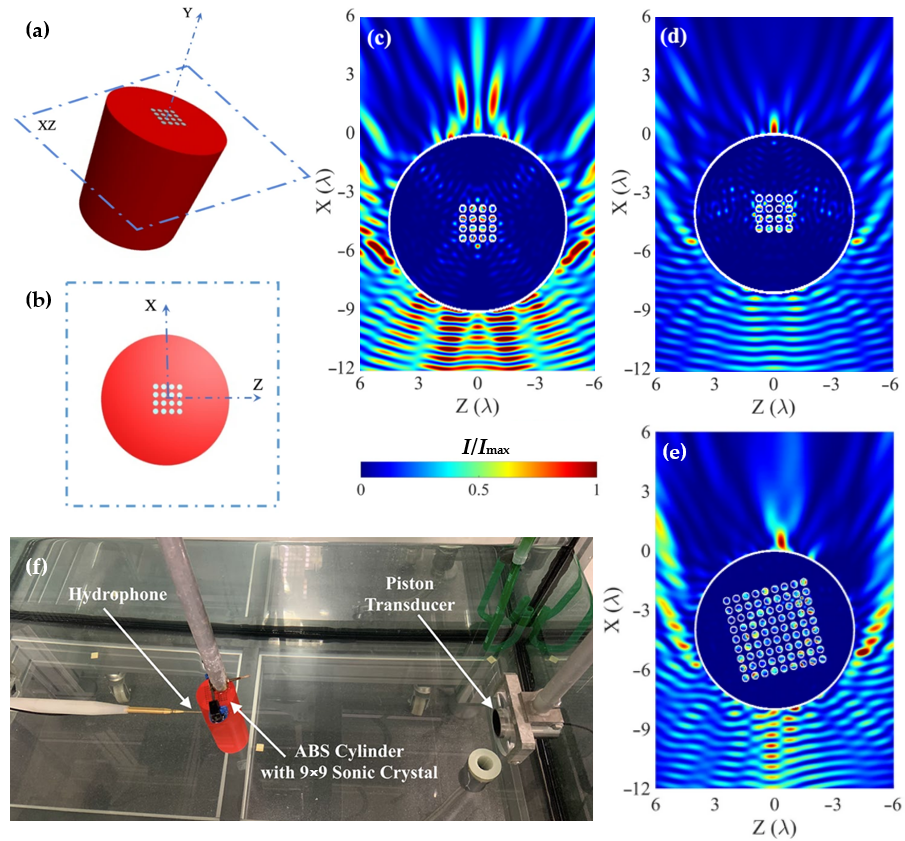
The work [
65] demonstrates a configurable platform for subwavelength acoustic jet engineering using a 3D-printed cylindrical lens with an embedded sonic crystal (
Figure 6a,b). Rather than behaving as a passive focusing element, the composite cylinder acts as a tunable mesostructured medium in which internal periodicity and rotational misalignment of the embedded lattice relative to the cylindrical axis jointly govern wave redistribution and near-field localization. The results shown in
Figure 6c–e highlight that acoustic jet formation is highly sensitive not only to the macroscopic curvature of the cylinder but also to the internal lattice geometry (4 × 4 vs. 9 × 9 arrays) and its rotational orientation. In particular, introducing a periodic internal structure enhances the spatial confinement of acoustic energy through engineered scattering and multiple internal interference pathways, while rotational misalignment of the embedded crystal (e.g., a 15° rotation) breaks the azimuthal symmetry of the effective scattering landscape, inducing controlled distortion and lateral displacement of the focal region. The acoustojet formation results from the combined effect of boundary curvature and anisotropic scattering introduced by the embedded sonic crystal. The jet can thus be reconfigured via internal structural design (without altering excitation conditions), enabling controlled modulation of focal morphology and directionality. The experiment was carried out in water using a 250 kHz ultrasonic piston transducer to generate the incident acoustic field, which was transmitted through a 3D-printed ABS cylindrical lens incorporating an embedded periodic sonic crystal, while the resulting acoustic field and jet formation were mapped in water using a scanning hydrophone (
Figure 6f).
Recently, in both numerical and experimental studies, gradient-index metamaterial designs, such as generalized Luneburg lenses [
10], have been shown to produce ultra-long acoustic jets with highly directional energy flow and extended propagation lengths, far surpassing the capabilities of homogeneous or simple layered scatterers. Complementary work [
124] demonstrates that acoustic metamaterial double-foci Luneburg lenses can maintain ultra-long, confined jets over a wide frequency range, enhancing both longitudinal extent and operational bandwidth for practical applications. This approach moves beyond conventional homogeneous jet-forming particles toward functionally engineered scatterers capable of tailoring multiple jet parameters simultaneously, including focal distance, axial extent, and bandwidth.
The study [
125] demonstrates a different approach in which reflective acoustojets can be generated and steered using a metagrating-based stepwise structure, where the reflection angle is controlled via geometry. This approach enables subwavelength focusing with strong robustness to frequency variations and can be scaled to operate in both air and water environments. In contrast to conventional homogeneous particles operating in transmission mode, such systems enable compact one-sided excitation and controllable near-surface localization, thereby broadening the practical applicability of acoustic jets.
In [
63], the authors introduced a method to generate tunable acoustic hooks using Janus cylinders. By breaking the symmetry of the refractive index distribution and employing sonic crystals, the authors demonstrated numerically that the curvature, direction, and focal properties of the acoustic hook can be precisely controlled. The bending angle of the hook was tunable from 1° to 21°, and the FWHM of the focused beam approached the diffraction limit. These results show that material asymmetry in composite scatterers enables adjustable near-field acoustic structures, providing a flexible platform for targeted manipulation, high-resolution sensing, and subwavelength acoustic focusing.
These approaches leverage spatially varying acoustic parameters to finely tune near-field jet characteristics, demonstrating the versatility of engineered scatterers in applications ranging from subwavelength ultrasonic imaging and high-resolution sensing to localized wave–matter interactions in biomedical and materials systems.
9. Emerging and Prospective Applications of Photonic and Acoustic Jets
Although photonic and acoustic jets arise in distinct physical domains, they share a common underlying mechanism based on wave interference, diffraction, and near-field energy localization in the subwavelength regime. In both cases, jet formation is governed by solutions of the Helmholtz equation in structured scattering environments, where the characteristic size of the particle relative to the wavelength (D/λ) plays a key role in determining the focusing behavior. This leads to similar features such as subwavelength confinement and elongated high-intensity regions in the near-field region, suggesting a unified framework for jet-based phenomena across optical and acoustic platforms. At the same time, important differences arise from the governing material parameters and wave–matter interaction mechanisms. In photonics, jet formation is primarily controlled by refractive index contrast and electromagnetic boundary conditions, typically with relatively low material losses. In acoustics, it is governed by acoustic impedance mismatch, compressibility, and often significant viscous and thermal dissipation, while in elastic solids, the coexistence of longitudinal and shear waves introduces additional complexity that is absent in electromagnetic systems. These factors lead to quantitative differences in efficiency, spatial confinement, and robustness of jet formation. Therefore, while the underlying wave physics is shared, the design constraints and optimization strategies are inherently domain-specific.
Layered and composite particles provide an additional degree of freedom for tailoring photonic and acoustic jet formation, enabling enhanced control over scattering, phase accumulation, and energy localization. Such structured media are particularly relevant for practical implementations, where engineered scatterer architectures can be used to optimize jet characteristics for specific functional requirements. This leads to a wide range of emerging applications, where jet-based phenomena are exploited for subwavelength imaging, sensing, energy delivery, and wave manipulation across photonic and acoustic platforms.
The demand for high-performance biomedical sensors stems from the need for rapid, accurate, and minimally invasive diagnostics. Applications ranging from cancer detection to functional monitoring require sensors operating in lossy biological media while maintaining high spatial resolution, sensitivity, and compatibility with lab-on-chip or microfluidic platforms. Conventional approaches are limited by wavelength-constrained resolution, attenuation, multiple scattering, and low signal-to-noise ratio [
126,
127], and to overcome some of these constraints, ultra-wideband microwave systems operating at tens of gigahertz have been developed, offering higher resolution at the cost of penetration depth and increased tissue attenuation [
128]. Similar trade-offs occur in photonic and acoustic jet engineering, where wavelength, refractive or acoustic impedance contrast, and material absorption control focal confinement, jet length, and peak intensity. The use of composite and layered scatterers adds extra degrees of freedom for tailoring jet properties beyond homogeneous particles [
39,
65]. By engineering refractive index [
50] or acoustic impedance [
10] profiles, they enable controlled phase accumulation and reduced internal reflections, resulting in improved confinement, longer jets, and higher peak intensity, while simultaneously minimizing dissipative losses, an advantage particularly relevant in lossy biological media.
Modern sensing also demands miniaturization and in situ operation in confined environments [
129]. Microfluidic structures [
130,
131,
132] and sensors [
133,
134] demonstrate the importance of local field control for manipulation, sensitivity, and selectivity, while integrating functional elements on flexible substrates highlights challenges in mechanical compliance, material interfaces, and signal transduction [
135]. Lab-on-chip in situ physiological sensors further emphasize the need for compact, biocompatible, and geometrically constrained designs [
136,
137]. In this field, photonic nanojets have emerged as a promising strategy to locally concentrate electromagnetic fields, enhancing detection sensitivity in microfluidic and biomedical platforms [
6,
138,
139,
140,
141], while acoustojets are still lagging behind in real-world applications, but they also have potential [
10]. Here, composite scatterers are particularly attractive for microfluidic integration due to their ability to combine optical or acoustic functionality with mechanical compliance and biocompatibility [
38]. For microfluidic applications, particle manipulation relies on breaking symmetry in particle–field interactions, which can be effectively achieved using Janus (anisotropic composite) particles with spatially heterogeneous material properties [
63].
In practical implementation, additional problems can arise related to energy dissipation mechanisms, in particular during the miniaturization of devices and their design on a chip, which is relevant for photonic, acoustic, and electronic devices [
142,
143,
144]. For photonic and acoustic jets, the overall losses in the system determine how efficiently wave energy can be concentrated in the near-field region where the jet forms. For photonic jets, material absorption, surface scattering, and other losses determine how efficiently wave energy can be concentrated in the near-field region, directly affecting the achievable field enhancement and spatial confinement [
17,
145]. Acoustic jets are sensitive to viscous and thermal losses in fluids and interfaces, which can reduce the effective energy localization [
146]. Composite and layered scatterers can provide a practical route to reduce effective losses by tailoring the spatial distribution of electromagnetic [
38] or acoustic [
64] fields within the particle.
Photonic and acoustic jets provide passive near-field focusing, generating subwavelength, high-intensity regions without large arrays or complex optics. Integrating these jets with microwave, optical, or ultrasonic platforms offers a route to compact, high-resolution biomedical sensors that mitigate the trade-offs between penetration depth, resolution, and system complexity in microfluidic and in situ biomedical diagnostics [
5,
10,
138,
147]. The incorporation of composite scatterers and particle arrays can further enhance this approach by enabling tunable control over jet formation parameters within a compact lab-on-chip-compatible geometry [
148].
Beyond sensing and imaging, the strong subwavelength field localization and intensity enhancement make photonic jets attractive for laser-assisted material treatment [
149,
150,
151]; this may offer particularly attractive opportunities for the localized processing of complex oxide thin films, especially in multiphase systems where phase formation is highly sensitive to local thermodynamic conditions [
152,
153,
154]. The ability to generate strongly confined temperature and field gradients at the subwavelength scale could enable spatially selective crystallization and phase engineering, which are difficult to achieve using conventional diffraction-limited laser processing [
149]. In acoustics, high-intensity applications of acoustojets could potentially be exploited for localized ultrasonic material processing and mechanical stimulation of soft and hard materials [
155,
156]. Composite scatterers may enable tunable control over jet geometry and internal field distribution, allowing tailored spatial localization of dissipated power and thus more selective thermal or mechanical excitation in heterogeneous or multiphase materials.
10. Conclusions
The evolution from homogeneous scatterers to layered, composite, gradient-index, and metagrating-based structures reflects a shift from passive photonic and acoustic jet formation toward controllable (or tunable) electromagnetic and acoustic field engineering via phase, effective material parameters (e.g., refractive index or acoustic impedance), and symmetry design.
Composite and layered scatterers, including core–shell, multilayer spheres and cylinders, Janus particles, and gradient-index metamaterial lenses, represent a versatile platform for engineering photonic and acoustic jets with controlled near-field properties. Numerical simulations, primarily using FEM and FDTD methods, have proven essential for designing and predicting jet characteristics in complex and asymmetric structures where analytical solutions are impractical. These studies demonstrate that internal structuring and material asymmetry enable precise tuning of jet directionality, focal length, transverse confinement, and longitudinal extent, as well as the formation of curved beams (photonic/acoustic hooks).
In photonics, multilayer and core–shell microspheres enable ultra-narrow, high-aspect-ratio nanojets with subwavelength widths while maintaining high intensity and low divergence, making them suitable for super-resolution imaging, enhanced sensing, and localized light–matter interactions. In acoustics, layered and composite scatterers, including gradient-index Luneburg lenses and double-foci configurations, can generate ultra-long and relatively broadband acoustic jets. These advances highlight the scalability and cross-domain applicability of jet phenomena across different wave systems.
The integration of composite and engineered scatterers transforms photonic and acoustic jets from a fundamental wave phenomenon into a controllable engineering tool, opening new opportunities in nanometrology, high-resolution imaging, biomedical sensing, particle manipulation, and acoustic wave control. The combination of advanced numerical methods and material design continues to push the boundaries of near-field wave manipulation, offering a roadmap for future experimental and applied developments in both optical and acoustic fields.