
Article

Synthesis, Characterization and Dielectric Properties of Cordierite-Based Ceramic Materials Mg2Al4Si5O18 for Hi-Tech Applications

1
LCM2E, Laboratory of Molecular Chemistry, Materials and Environment, Multidisciplinary Faculty of Nador (FPN), Mohammed Premier University, B.P. 300, Selouane, Nador 62700, Morocco
2
Innovative Materials, Energy and Sustainable Development Laboratory, Faculty of Sciences and Techniques, Cadi Ayyad University, B.P. 618, Marrakech 40000, Morocco
3
Molecular Electrochemistry and Inorganic Materials, Faculty of Sciences and Techniques, Sultan Moulay Slimane University, Campus Mghilla, B.P. 523, Béni Mellal 23000, Morocco
4
Public Laboratory for Tests and Studies (LPEE), Center for Studies and Research on the Environment and Pollution (CEREP), Croisement des Routes Nationales 106 et 107, B.P. 61, Tit Mellil, Casablanca 20110, Morocco
5
Public Laboratory for Tests and Studies (LPEE), Scientific and Technical Directorate (DTS), 25 Rue d’Azilal, B.P. 13389, Casablanca 20110, Morocco
6
Laboratory Physics of Condensed Matter (LPMC), Faculty of Sciences, Chouaib Doukkali University, Route de Ben Maachou, B.P. 20, El Jadida 24000, Morocco
7
LCME, Faculty of Sciences and Techniques, Cadi Ayyad University, Av. Abdelkrim El Khattabi, B.P. 549, Marrakech 40000, Morocco
8
Faculty of Chemistry and Chemical Technology, University of Ljubljana, Večna pot 113, 1000 Ljubljana, Slovenia
9
Faculty of Mathematics and Natural Sciences, South-West University “Neofit Rilski”, 66 Ivan Mihailov Str., 2700 Blagoevgrad, Bulgaria
10
Molecular Modeling and Spectroscopy Research Team, Faculty of Sciences, Chouaib Doukkali University, Route de Ben Maachou, B.P. 20, El Jadida 24000, Morocco
11
Department of Chemistry, College of Science, Imam Mohammad Ibn Saud Islamic University (IMSIU), Riyadh 11623, Saudi Arabia
*
Author to whom correspondence should be addressed.
J. Compos. Sci. 2026, 10(4), 205; https://doi.org/10.3390/jcs10040205
Submission received: 26 February 2026 / Revised: 25 March 2026 / Accepted: 26 March 2026 / Published: 10 April 2026
(This article belongs to the Section Composites Manufacturing and Processing)

Abstract

Cordierite-based ceramics (Mg2Al4Si5O18) were successfully synthesized and comprehensively characterized to evaluate their structural and dielectric behavior for high-temperature electronic applications. Morphological, microstructural and vibrational analyses confirm the high phase purity and structural integrity of the synthesized material. Dielectric measurements reveal high real permittivity (ε′) values at low frequencies and elevated temperatures, mainly attributed to interfacial polarization arising from Schottky-type barriers at grain–grain and surface–volume interfaces, underscoring the crucial influence of heterogeneous interfaces on the dielectric response. The electrical conductivity follows a thermally activated hopping mechanism involving both intra-grain and grain-boundary charge transport. Analysis of the electric modulus formalism provides further insight into relaxation dynamics: the real (M′) and imaginary (M″) components highlight pronounced space-charge effects, with M″ exhibiting a distinct relaxation peak (M″) associated with grain contributions. The systematic shift of this peak toward higher frequencies with increasing temperature indicates enhanced charge-carrier mobility and a strongly thermally activated relaxation process. The frequency-dependent conductivity displays two regimes: a low-frequency plateau corresponding to dc conductivity and a high-frequency dispersive region following a power-law behavior characteristic of hopping conduction, with power-law exponents (α1 and α2) markedly lower than unity, confirming the non-Debye character of the relaxation processes. The hopping frequency (ω) increases with temperature, further supporting the thermally activated nature of charge transport. Activation energies extracted from Arrhenius plots of dc conductivity are 0.88 eV for grain boundaries and 0.83 eV for grains, demonstrating that both microstructural regions significantly contribute to the overall conduction process.

1. Introduction

Cordierite is a silicate mineral affiliated to the cordierite family, a group of magnesium aluminosilicate framework materials [1,2,3]. It has unique physical and chemical properties that make it very useful for many technical tasks [4,5,6] such as high-capacity ceramic capacitors, hybrid supercapacitors, and electrostatic energy storage. It can stop electricity from flowing through, it resists heat. So, it is very useful for industrial furnaces, boilers, and other things that need to be able to handle high temperatures [7,8]. Due to their low thermal expansion coefficient, it can be used to make refractory material for stoves, by minimizing cracking under thermal shocks, withstands rapid heating and cooling cycles.
Dielectric properties play a crucial role in the performance of terminal devices. With the continuous expansion of wireless communication systems from microwave to millimeter-wave frequencies, materials exhibiting low dielectric constant (εr) and high quality factors (Q·f) are increasingly required in order to reduce signal transmission delay and energy losses [9,10]. It is well known that an increase in the dielectric constant generally leads to higher dielectric losses, which may result in undesirable heating of electronic devices.
Moreover, the dielectric behavior of materials is strongly influenced by several factors, including the processing route, particle size, nature of starting materials, stoichiometric composition, and phase assemblage. Various synthesis methods have been employed for the preparation of Mg2Al4Si5O18 (cordierite) ceramics, such as conventional glass–ceramic processing, solid-state reaction, precipitation methods, sol–gel, and combustion synthesis techniques [11,12,13,14].
It isalso stable as dielectric, so, it isa good choice for applications that need reliable electrical performance [15,16] such as thermal sensors, dielectric sensors and embedded devices in harsh environments (industry, aeronautics). To characterize our material, we have used pertinent experimental techniques, as XRD, IR, and SEM. All of these analyses are essential for optimizing the physical and chemical properties of this material. Impedance spectroscopy often called electrochemical spectroscopy is an experimental technique that probes how a material or system responds to small alternating electrical signal over a wide frequency range. Instead of measuring only resistance (DC), is measures the complex impedance. This frequency-dependent response reveals multiple physical processes occurring at different time scales. For our material it allows the analysis of bulk resistance, grain boundary effects, interfacial resistance, capacitance, relaxation times, and diffusion.
Most researchers limit themselves to techniques such as X-ray diffraction, scanning electron microscopy, and infrared spectroscopy. Our contribution in this work is the use of these various analytical techniques, along with electrical and dielectric analysis via impedance spectroscopy, to determine the different processes of conduction and relaxation, and the nature of the moving charges when subjected to a very weak electric field. This is achieved using several electrical representations, such as Nyquist plots and Bode plots, and dielectric representations, such as the variation in imaginary permittivity as a function of the real part of the permittivity, and both parts as a function of frequency. Electrochemical impedance spectroscopy (EIS) is one of the most important electrochemical techniques for measuring the impedance of a circuit in ohms (the unit of resistance). Compared to other electrochemical techniques, EIS offers several advantages: it operates in steady state, utilizes the analysis of low-amplitude signals, and allows the study of signal relaxation over a very wide range of applied frequencies, from 1 MHz to 10 MHz.
A study using the equivalent electrical circuit allowed us to describe the alternating electrical conductivity by where the first term, σdc, is the DC electrical conductivity related to the translational jump in a long-distance electrical path, which is temperature-dependent and frequency-independent. The purpose of the present work was to examine the effect of temperature and frequencyon the dielectric and electric behavior of cordierite-based ceramic materials.

2. Crystal of Cordierites

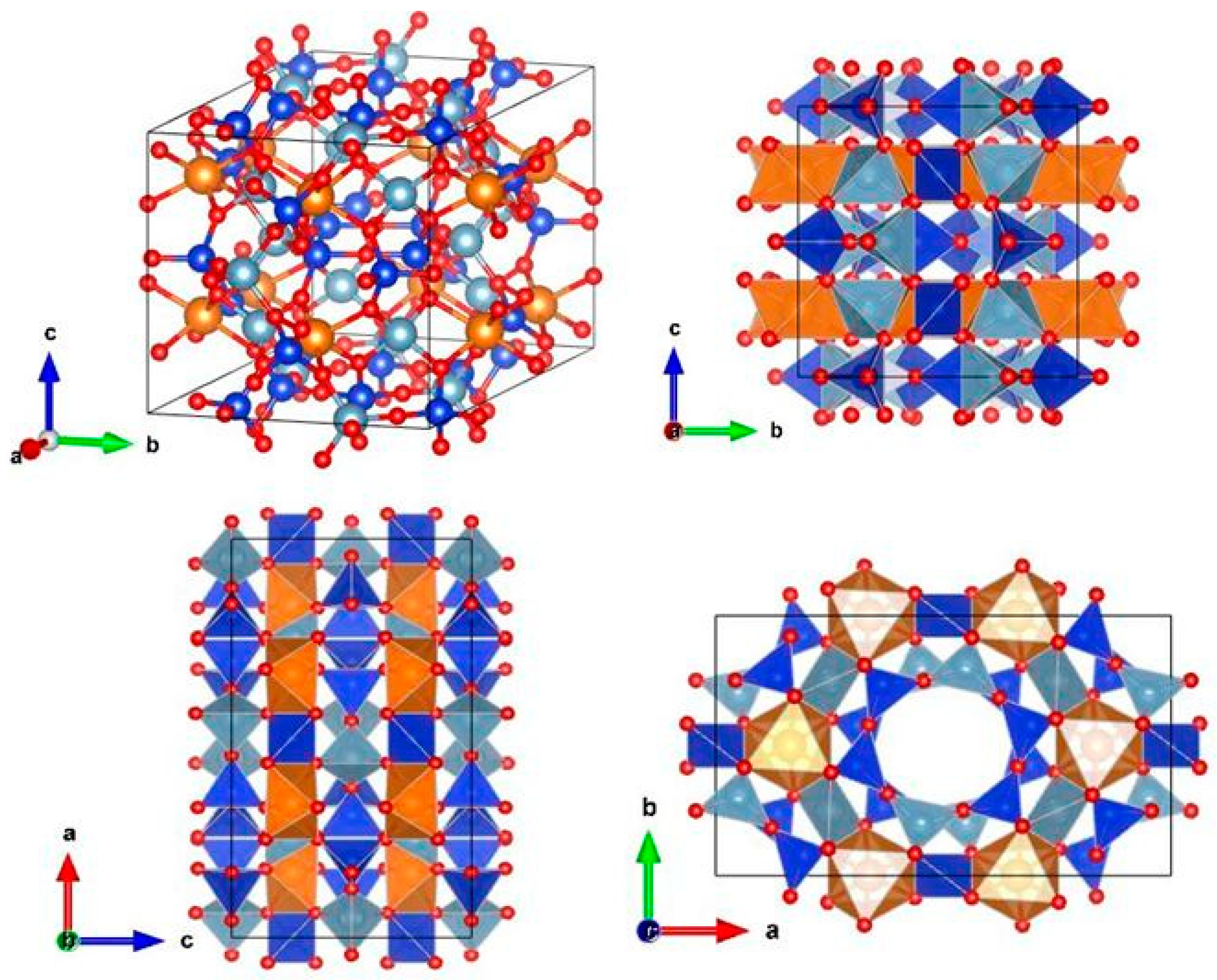
Cordierite crystallizes in an orthorhombic crystal, belonging to the space group ccm (Z = 4 formula units per cell). The cell parameters are a = 17.50 Å, b = 9.713 Å, and c = 9.332 Å, for a cell volume of 1544 Å3 and a calculated density of 2.51 g/cm3. The Mg2+ cations are octahedrally coordinated (coordination number 6) by O2− anions, forming MgO6 octahedra with an average Mg-O bond length of 2.106 Å [17]. The Al3+ cations occupy two non-equivalent crystallographic sites, Al1 and Al2, are tetrahedrally coordinated by oxygen. The six-membered rings of the AlSi5O18 type are composed of Al2O4 tetrahedra, while additional Al2O4 tetrahedra link these rings by sharing vertices with SiO4 tetrahedra. The Al–O bond lengths are 1.735 Å for Al1 and 1.729 Å for Al2.
There are three non-equivalent sites for Si4+ cations (Si1, Si2, and Si3), each tetrahedrally coordinated with four oxygen atoms. The six-membered AlSi5O18 rings incorporate the SiO4 tetrahedra from the Si2 and Si3 sites, while the SiO4 tetrahedra connect these rings by sharing vertices with the Al2O4 units. The measured Si-O bond lengths are 1.641 Å for Si1, 1.618 Å for Si2, and 1.606 Å for Si3. As illustrated in Figure 1, magnesium atoms occupy interstitial sites within the three-dimensional network formed by [AlO4] and [SiO4] tetrahedra [18].

3. Cordierite Composition

The raw materials used are Al2O3 (34.8% by mass), MgO (13.8% by mass), and SiO2 (51.4% by mass), which constitute the main components of cordierite. These oxides were selected for their high chemical quality and mixed in stoichiometric proportions corresponding to the theoretical composition of cordierite, in order to ensure good control of phase formation and to limit the influence of impurities on the final properties of the material [18,19,20].

4. Material and Methods

4.1. Material

Silicon dioxide (SiO2) nanoparticles, with a purity of 98% and particle sizes ranging from 20 to 30 nm, were used. Magnesium oxide (MgO) nanopowder, characterized by a high purity of 99.95% and an average particle size of approximately 60 nm, was also employed. Both materials were supplied by US Research Nanomaterials, Inc. (Houston, TX, USA). In addition, α-alumina (α-Al2O3) powder, with a purity of 99.85% and an average particle size of about 150 nm, obtained from ChemPUR (Karlsruhe, Germany), was utilized. All starting materials were used as received, without any further treatment, and served as precursors for the synthesis of the ceramic samples.

4.2. Methods

The cordierite studied was synthesized by solid-state sintering from raw materials with a high chemical percentage of oxides. The starting oxides were magnesium oxide (MgO), silicon dioxide (SiO2), and aluminum oxide (Al2O3), such that the total oxide composition was 99%, according to stoichiometric calculations. The proportions of the three oxides (xMgO, xAl2O3, xSiO2) were determined from the theoretical composition, and the corresponding powders were then accurately weighed before processing. The formation of cordierite (Mg2Al4Si5O18) typically occurs in the temperature range of 1300–1400 °C, as widely reported in the literature. However, higher sintering temperatures (around 1500 °C) are often employed to enhance densification, improve crystallinity, and reduce secondary phases, particularly in systems derived from natural or modified raw materials [21]. The mixture was then ground for 30 min using a hand mortar to ensure optimal homogeneity. The resulting powder was then sintered at 1500 °C for 4 h, with a heating rate of 5 °C/min, and subsequently cooled in the furnace. The identification of crystalline phases after sintering was performed by X-ray diffraction (XRD) using a Bruker D8 diffractometer (Bruker, Billerica, MA, USA). The material morphology was studied by field-emission scanning electron microscopy (FE-SEM) using a FEI Quanta 250 microscope (FEI, Hillsboro, OR, USA). Spectroscopic analyses were carried out by Fourier-transform infrared (FT-IR) spectroscopy with KBr pellets, using a Bruker FT-IR spectrometer (Bruker, Billerica, MA, USA). Impedance spectroscopy was used to characterize the electrical and dielectric properties of the samples, which were prepared as metallized pellets to ensure good electrical contact with the measurement electrodes.

4.3. Physical Characterization of Material

X-ray diffraction (XRD) analyses were performed on the raw powders and sintered specimens using a D8 diffractometer (Bruker, Billerica, MA, USA), operated at 40 kV and 40 mA with Cu Kα radiation (λ = 1.5406 Å). Diffraction patterns were recorded over a 2θ range of 10–80° at a scan rate of 2.4° min−1. Phase identification was carried out using the JCPDS database. The diffractograms were processed and plotted using OriginPro software (version 2024; OriginLab Corporation, Northampton, MA, USA). The corrected Debye-Scherrer equation was applied to estimate the crystallite size (D_hkl) of the identified crystalline phases. The density of the sintered samples was determined by the Archimedes method using an analytical balance (Model ML204, Mettler Toledo, Columbus, OH, USA). Hardness and fracture toughness were evaluated by indentation testing, and the reported values correspond to the average of ten independent measurements. Indentation was performed using a hardness tester (Model ZHU250, ZwickRoell, Ulm, Germany) with a loading time of 10 s. Microstructural analyses were carried out by field-emission scanning electron microscopy (FE-SEM) using a Quanta 250 microscope (FEI Company, Hillsboro, OR, USA) equipped with an EDS detector (Oxford Instruments, Abingdon, UK; active area: 150 mm2). This technique was used to examine the raw nanopowders, the mixed powders, and the fracture surfaces of the sintered bodies. Prior to observation, the samples were coated with a thin platinum layer using a Q150R sputter coater (Quorum Technologies, Laughton, UK). Particle-size distributions were determined from SEM images using ImageJ software (version 1.48e).
Fourier-transform infrared spectroscopy (FT-IR) was performed in the 4000–400 cm−1 range using high-purity KBr (99%) as the dispersant and a Bruker spectrometer (Billerica, MA, USA), in order to analyze the vibrational modes of the studied materials at room temperature.
Impedance spectroscopy measurements were conducted to evaluate the electrical response of the samples. Before performing dielectric measurements, the samples were prepared as disc-shaped pellets with a diameter of 13 mm and a thickness of about 1 mm, forming a parallel-plate capacitor configuration. Their flat faces were then metallized using silver lacquer to ensure good electrical contact with the measurement electrodes and connected to the impedance analyzer.
The sample was excited by a sinusoidal voltage signal with an amplitude of 100 mV, applied across the capacitor formed by the sample and the measuring electrodes. This relatively small amplitude was chosen in order to remain within the linear response regime of the material. The impedance spectra were recorded over a wide frequency range with ten measurement points per decade, ensuring a sufficiently detailed characterization of the electrical processes.
Prior to the measurements, the impedance analyzer was calibrated using a reference calibration box composed of a block containing a resistor and a capacitor with well-known values. The calibration curves were systematically checked before starting the measurements to ensure the reliability and accuracy of the experimental data.
Furthermore, the data were analyzed using ZView software (version 4.2b, Scribner Associates, Inc., Southern Pines, NC, USA).
The experimental results were validated using the Kramers–Kronig consistency test. This test evaluates the consistency between the real and imaginary components of the impedance by calculating the residual error between the experimental data and the theoretical Kramers–Kronig transform. Experimental data with a residual error exceeding 10% were considered unreliable and excluded from the analysis.

5. Results and Discussion

5.1. Morphological Study

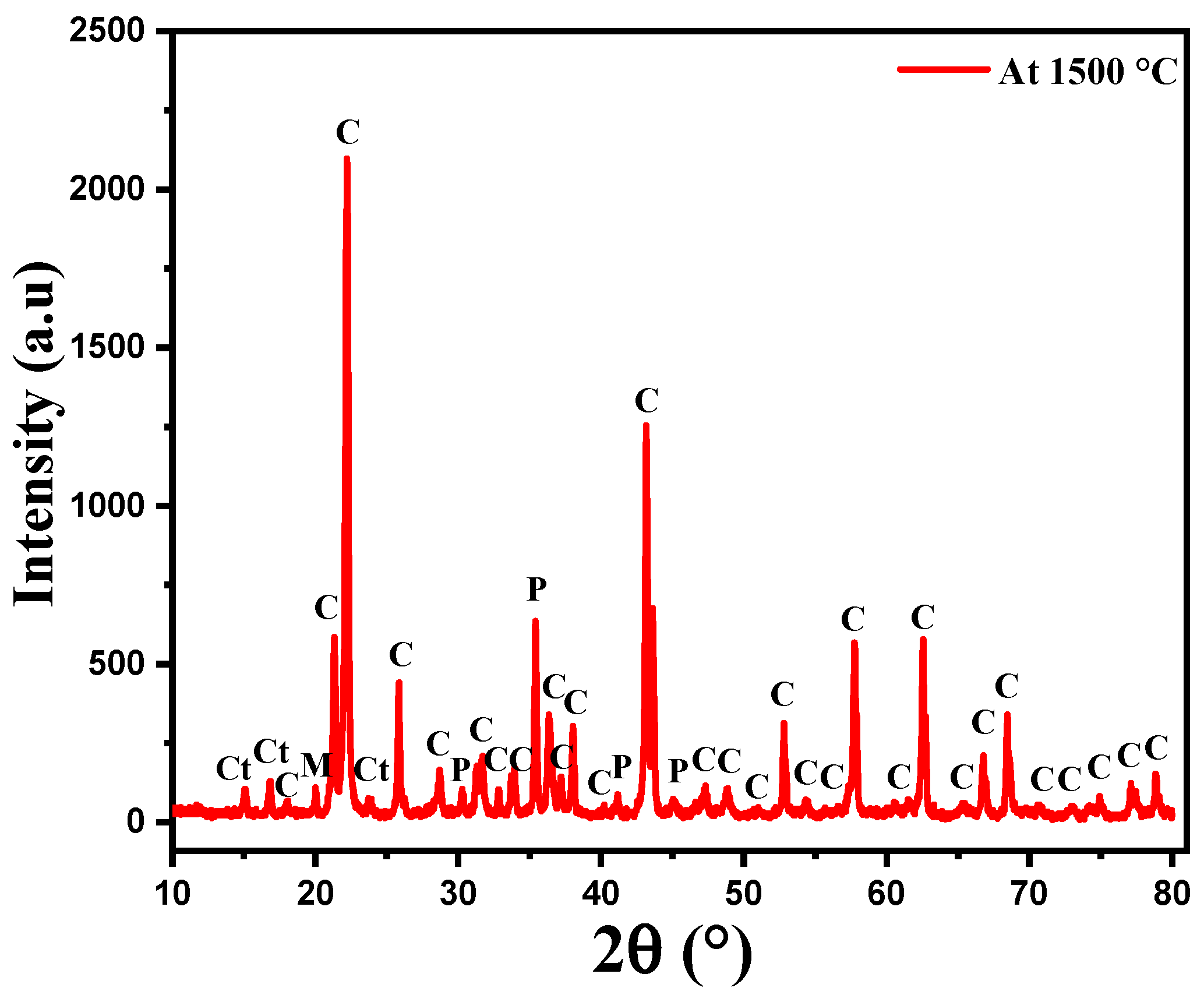
Figure 2 represents an X-ray diffraction (XRD) pattern of cordierite sintered at 1500 °C for 4 h. The x-axis corresponds to the diffraction angle 2θ (in degrees), ranging from 10° to 80°, while the y-axis indicates the intensity of the peaks in arbitrary units. The diffractogram shows numerous well-defined diffraction peaks, indicating good crystallinity of the material after heat treatment. The most intense and numerous peaks are attributed to the cordierite phase (Mg2Al4Si5O18), indicated by the letter C. The main peak, located around 2θ ≈ 21–22°, is characteristic of crystallized cordierite and confirms that this phase is dominant in the sample. The presence of several other sharp peaks associated with cordierite indicates that high-temperature sintering promoted the transformation of the initial phases into a well-developed crystalline structure, with an increase in crystallite size and a reduction in structural defects. In addition, a few low-intensity peaks marked with the letter P are observed, indicating the presence of small amounts of secondary phases. These residual phases may be related to an incomplete reaction, a slight stoichiometric imbalance, or the persistence of stable intermediate phases at high temperature. However, their low intensity suggests that they do not significantly affect the overall composition of the material. Furthermore, the absence of a large diffuse halo in the diffractogram indicates that the amorphous fraction is very small, confirming that the sample is predominantly crystalline. Overall, XRD analysis shows that sintering at 1500 °C for 4 h is effective in obtaining well-crystallized cordierite, which constitutes the main phase, with only slight traces of secondary phases. These results confirm that the chosen heat treatment conditions are suitable for the synthesis of highly crystalline cordierite [22,23,24,25].
Table 1 presents the principal X-ray diffraction peaks, together with their angular positions (2θ), relative intensities, and Miller indices (hkl), which correspond to the crystallographic planes responsible for the diffraction. The most intense peak appears around 21–22° and is indexed to the (110) plane, indicating that this crystal orientation is dominant in the main phase. The peaks around 26° (111), 29–30° (200), and 36–37° (211) show moderate intensity, reflecting a significant but secondary structural contribution. The reflections around 39–40° (220) and 45–46° (221) show high intensity, confirming good crystallinity and a well-defined structural organization. At higher angular values, the peak around 60° (400) exhibits medium intensity, whereas that around 68–70° (331) is weak, which is typical of higher-order planes that are generally less intense. Overall, this table indicates that the material has a well-formed crystalline structure, with a preferred orientation associated with the (110) plane and a consistent distribution of reflections corresponding to the identified principal phase.

5.2. FT-IR Analysis

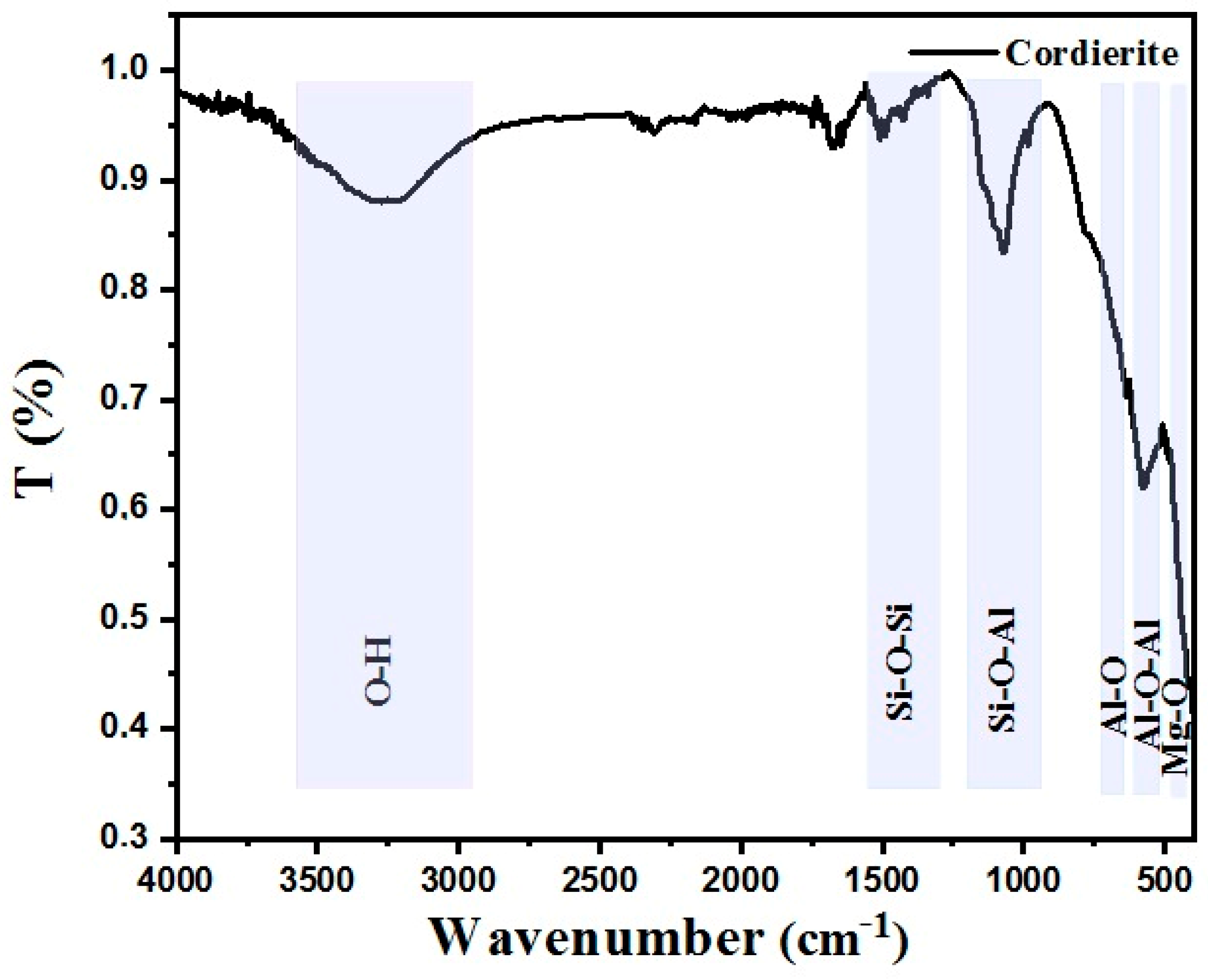
Figure 3 shows the FT-IR diffraction pattern of sintered cordierite at 1500 °C. This pattern highlights the absorption bands characteristic of the alumino-silicate lattice. A broad band between 3600 and 3000 cm−1 is attributed to O–H stretching vibrations, corresponding to surface water adsorption, a phenomenon frequently observed in aluminosilicate ceramics exposed to air after sintering [26]. The weaker band observed around 1634 cm−1 is associated with the H–O–H strain vibration of structural water. The bands between 1100 and 900 cm−1 correspond to Si–O–Si and Si–O–Al stretching vibrations, characteristic of the tetrahedral lattice of cordierite [27,28,29]. The band around 1064 cm−1 is associated with the Si–O–Al vibration. The slight shift of this band towards lower wavenumbers is linked to the transformation of AlO6 units into AlO4 tetrahedra under the influence of temperature, favoring the incorporation of aluminum into SiO4 units and the formation of a Si–O–Al type structural network [27]. The absorptions observed between 700 and 400 cm−1, and more specifically around 573 and 618 cm−1, are attributed to the vibrational modes of the Al–O and Mg–O bonds [30]. These bands confirm the presence of the MgO6, AlO4, and SiO4 structural units that constitute the structure of cordierite. The set of bands observed is consistent with the literature for well-crystallized cordierite [26,30], thus validating the formation of the α-cordierite phase after sintering at 1500 °C.

5.3. Microstructural Characterization

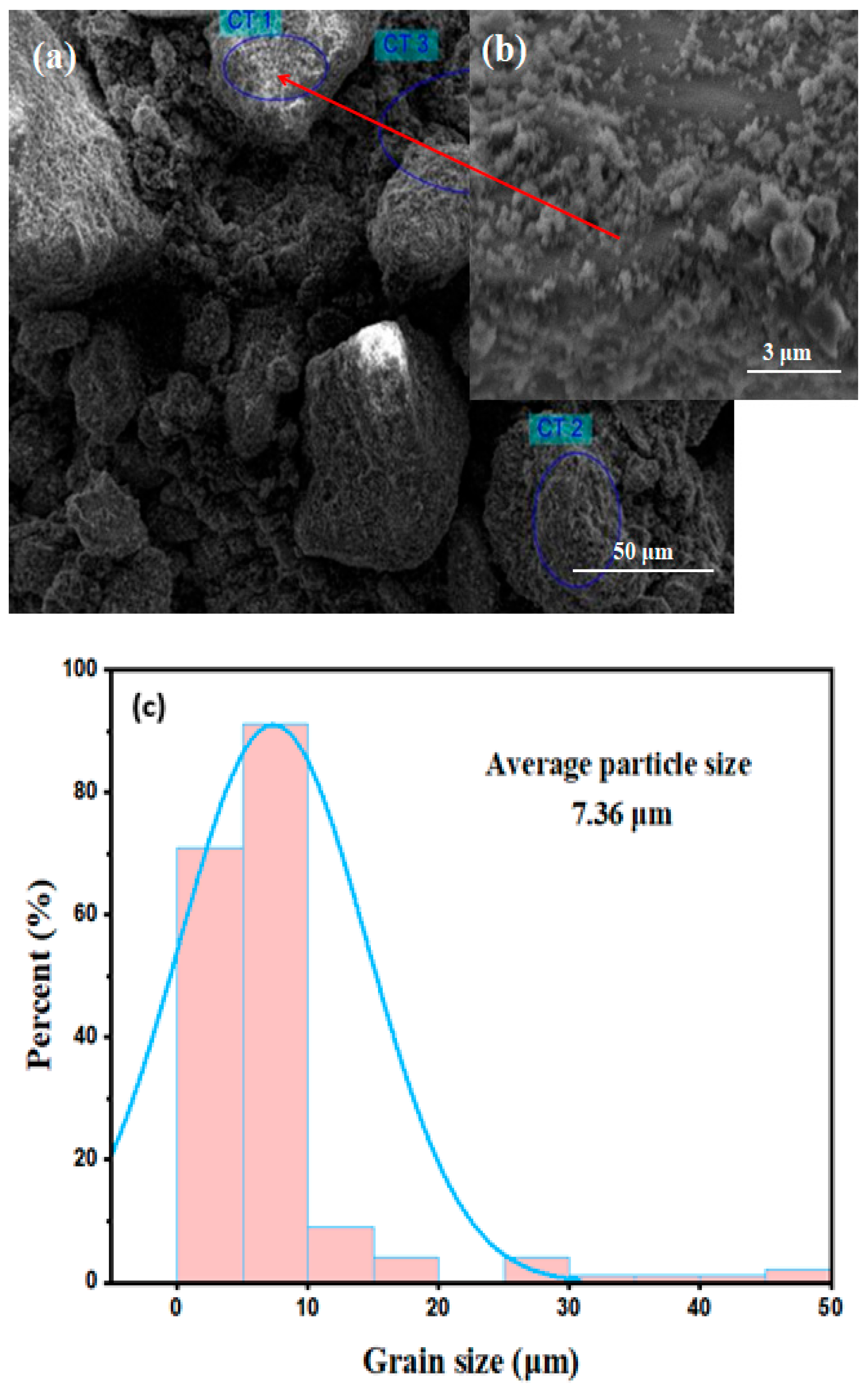
Figure 4a,b shows SEM micrographs of cordierite-based ceramics. These reveal a microstructure consisting of grains of varying sizes, with irregular morphology and rough surfaces. This microstructural organization is typical of incomplete grain growth and/or partial densification during the sintering process. Grain size analysis, performed using ImageJ software, reveals an average grain size of approximately 7.36 µm. At low magnification (image a), the grains appear agglomerated and sometimes partially coalesced, suggesting that the grain fusion process is not fully complete. The marked areas (CT1, CT2, and CT3) correspond to regions selected for closer observation of the local morphology. At higher magnification (image b), the grain surface shows a fine texture accompanied by microporosities and cavities, which can be attributed to local recrystallization or the possible formation of secondary phases. Nevertheless, these observations mainly reflect imperfect densification, characteristic of suboptimal sintering. Figure 4c shows the particle size distribution of cordierite, expressed as a percentage based on grain size (µm). The average particle size is 7.36 µm, indicating that the powder is generally fine. The majority of grains are concentrated in the range between approximately 2 and 12 µm, with a maximum frequency around 6–8 µm, in line with the average value indicated. The distribution is not perfectly symmetrical and shows an asymmetry towards larger sizes, characterized by a tail extending up to approximately 50 µm, suggesting the presence of a small proportion of coarse particles or agglomerates. This relatively narrow particle size distribution, dominated by fine particles, is favorable for good homogeneity and better densification during cordierite sintering. However, the presence of large grains could locally influence the final microstructure, which could be limited by additional grinding or sieving depending on the intended application.

6. Dielectric Study

6.1. Formulas and Details

The relationship between the study of permittivity and cordierite lies in the fact that permittivity is a key parameter for understanding, optimizing and validating the use of cordierite as a dielectric ceramic material in electronic and thermally stable applications. The measurements recorded include four essential parameters: the real and imaginary parts of the impedance, the phase angle, and the dielectric losses. The complex permittivity ε* consists of two components: the real part ε’, which represents the energy storage capacity, and the imaginary part ε”, associated with energy losses in the material.
ε * ( ω ) = ε ( ω ) j ε ( ω )
ε * = ε 2 + ε 2
The relative dielectric regular (εr) and the dielectric loss aspect (tanδ) were calculated from the facts from the complex impedance Z* with the aid of applying the corresponding formulation [31].
Equations (3)–(5) represent respectively the real part of the conductivity, the imaginary part of the conductivity and the loss tangent angle.
  ε = t ω A ε 0 × Z Z 2 + Z 2
ε = t ω A ε 0 × Z Z 2 + Z 2
tan δ = ε ε
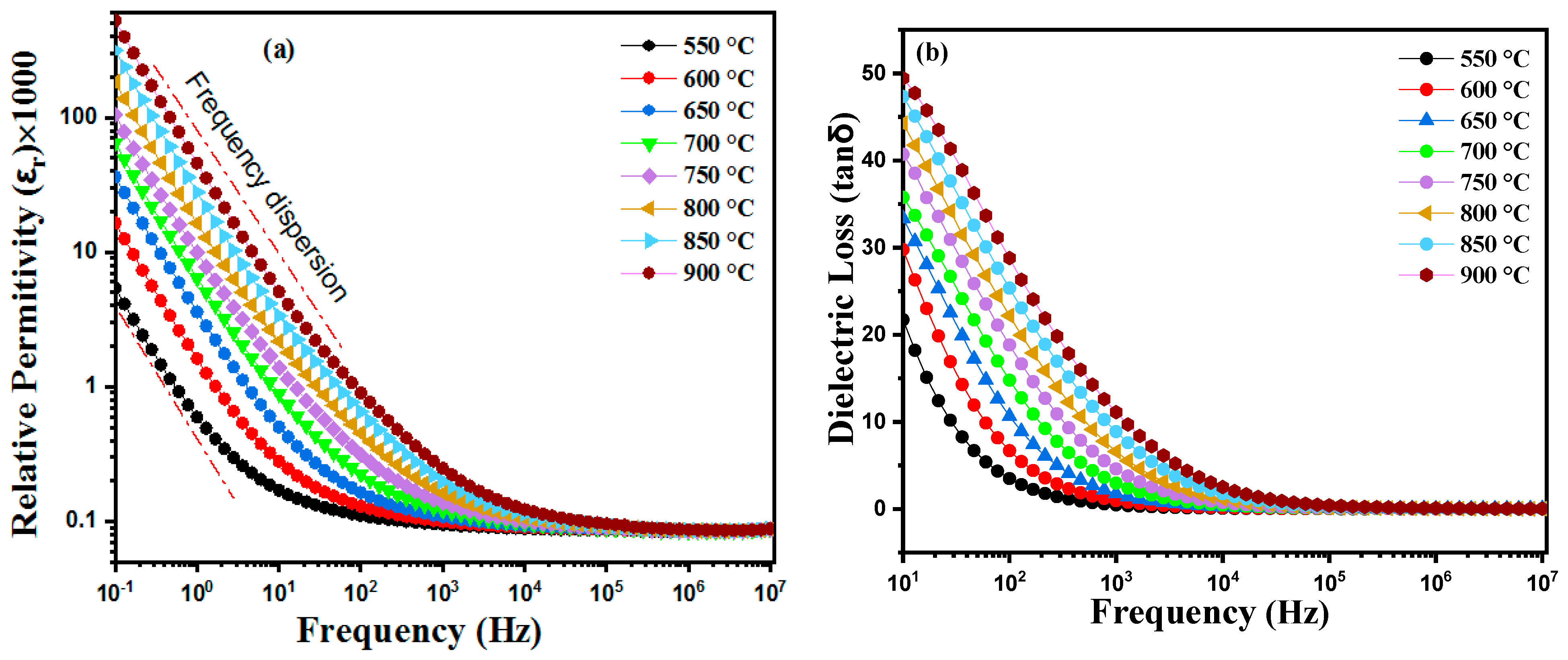
Figure 5a,b illustrates the evolution of the real part of the permittivity and the loss tangent tan(δ) of cordierite over the same frequency and temperature range, from 550 °C to 900 °C. The contribution of dipolar and ionic polarization then becomes negligible, and the permittivity tends to stabilize at a nearly constant value [32]. At high frequencies, the effect of temperature remains limited because charged species have difficulty keeping up with the rapid fluctuations of the applied electric field. The loss tangent (tan δ) curve as a function of frequency shows dynamic dielectric behavior that shifts under the influence of temperature at low frequencies. Furthermore, tan(δ) exhibits high values, indicating significant dielectric losses due primarily to electrical conduction, Maxwell-Wagner interfacial polarization, and the presence of defects, impurities, and grain boundaries. At low frequencies, the dipoles have sufficient time to track the applied electric field. As the frequency increases, tan(δ) decreases sharply, reflecting the progressive inability of the dipoles and charges to orient themselves rapidly with the alternating field, corresponding to a dielectric relaxation phenomenon. At high frequencies, tan(δ) becomes very small and almost constant, indicating that slow polarization mechanisms no longer contribute and that the material exhibits low dielectric losses, which is favorable for high-frequency applications. Furthermore, the increase in tan(δ) with sintering temperature, particularly at low frequencies, suggests an increase in charge mobility and changes in the microstructure, such as grain size and material density. Overall, this behavior confirms that the material is dielectrically stable at high frequencies, while the losses observed at low frequencies are dominated by DC conduction and interfacial polarization effects. In the frequency range of 0.1 to 100 Hz, the real part of the permittivity of cordierite shows a quasi-linear decrease with increasing frequency, characterized by a slope of −0.92. This value, very close to −1, indicates that the dielectric behavior of the material at low frequencies is dominated by a Maxwell–Wagner–Sillars type interfacial polarization mechanism. At these frequencies, electric charges have sufficient time to accumulate at interfaces such as grain boundaries, residual porosity, or possible secondary phases, leading to a high apparent permittivity. As the frequency increases, these charges can no longer follow the alternating electric field, resulting in a marked decrease in permittivity [33]. This behavior demonstrates that, although cordierite is intrinsically an insulating material, its dielectric response at low frequencies is influenced by its microstructural heterogeneity. On the other hand, at higher frequencies, the interfacial contribution becomes negligible and the permittivity tends towards a more stable and intrinsic value, which confirms the interest of cordierite for dielectric applications, particularly in the high frequency and microwave domains.
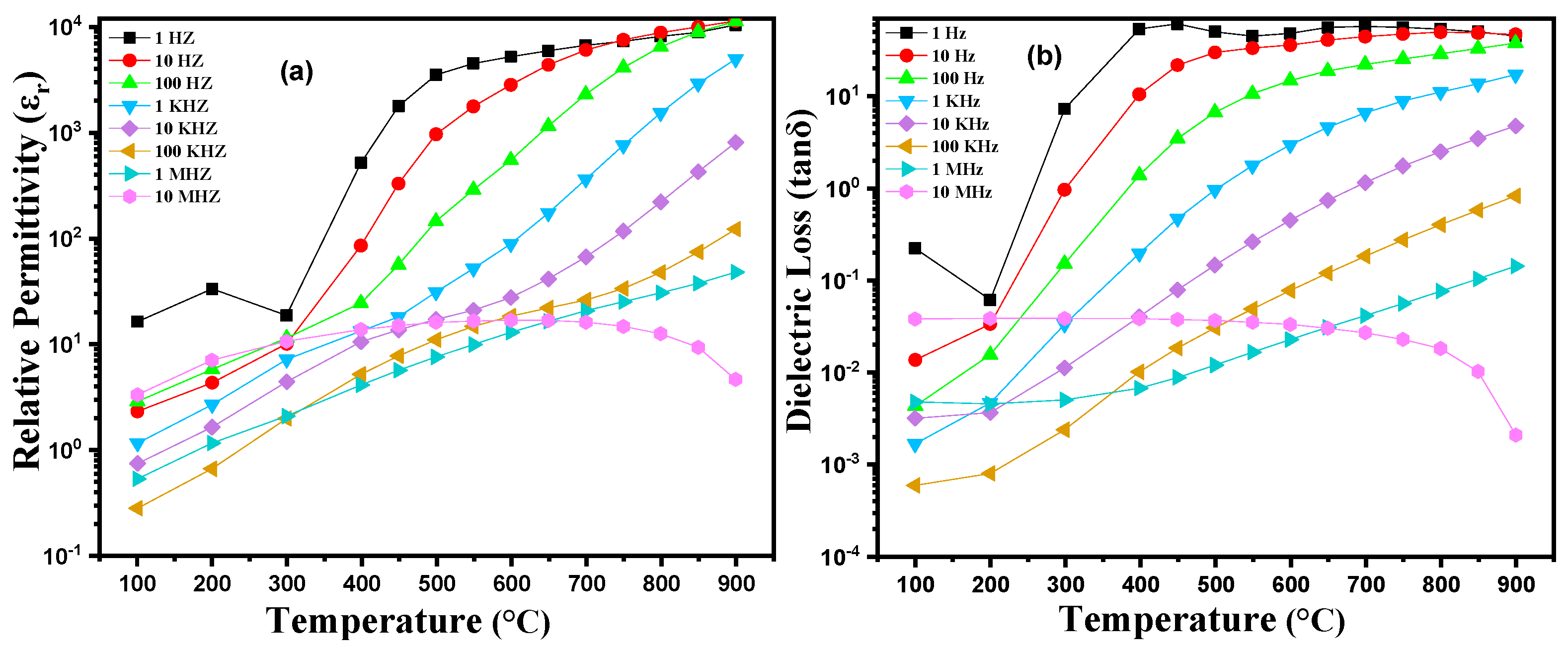
Figure 6 shows the evolution of dielectric losses and relative permittivity (εr) as a function of temperature, between 500 °C and 900 °C, for different frequencies (1 Hz, 10 Hz, 100 Hz, 1 kHz, 10 kHz, 100 kHz, 1 MHz, and 10 MHz). Between 500 °C and 650 °C, the variations in permittivity (εr) and dielectric losses (tan δ) remain small and relatively stable. This indicates that the polarization mechanisms remain practically constant and are little influenced by frequency within this temperature range. At these temperatures, the dipoles are partially disoriented and struggle to align with the electric field due to insufficient thermal energy. Therefore, the dielectric properties decrease slightly before increasing moderately when the temperature favors more efficient polarization. Beyond 500 °C, a notable increase in permittivity and dielectric losses is observed. This behavior is related to the intensification of temperature-dependent dipolar polarization: the increase in thermal energy facilitates the orientation of dipoles in the electric field. At the same time, electrical conduction increases, leading to a simultaneous rise in εr and tan δ. At these temperatures, the ceramic can also undergo significant structural transitions, such as dehydration or transformations of crystalline phases, which contribute to the increase in losses and permittivity. This phenomenon continues up to about 900 °C, where the dielectric properties tend to stabilize or slightly decrease due to profound structural changes in the material [34]. A temperature of 800 °C appears to represent a critical threshold for the thermal and structural stability of cordierite. This material is known for its low thermal expansion coefficient and excellent stability at high temperatures. Below this temperature, its crystalline structure remains intact and its dielectric properties are maintained at satisfactory levels. In addition, the loss factor (tan δ) remains low, indicating minimal energy loss due to polarization effects. Beyond 800 °C, a decrease in tan (δ) is observed, which can be explained by several phenomena. At very high temperatures, cordierite may experience crystalline reorganization or partial amorphization, resulting in phase transitions or localized structural disorder that alter polarization mechanisms and reduce dielectric losses. Simultaneously, the evaporation or diffusion of volatile elements such as magnesium can lead to local compositional changes. Higher temperatures also enhance the mobility of charge carriers, making conduction processes more efficient and thereby reducing resistive losses and lowering the dielectric loss tangent. Moreover, secondary reactions occurring at elevated temperatures can generate new, stable phases with intrinsically low dielectric losses, further improving the overall dielectric behavior of the material.
According to Figure 6b, the constancy of the loss tangent (tan δ) of cordierite at 10 MHz indicates stable dielectric behavior in the high-frequency range. This means that at this frequency, slow polarization mechanisms, such as interfacial polarization or space charges at grain boundaries, no longer contribute significantly to the material’s electrical response. The response then becomes dominated by fast polarization mechanisms, primarily electronic and ionic, characteristic of the crystal lattice. This stability reflects low energy loss variation and suggests good microstructural quality, making cordierite suitable for high-frequency electronics applications where stable and low dielectric losses are required.

6.2. Complex Impedance Analysis and Equivalent Circuit Modeling

Impedance spectroscopy is an important tool for studying the electrical properties of materials and helps to understand the relaxation mechanism. The role of the microstructure and composition of materials can be explained in terms of grains and contributions to grain boundaries [35]. Impedance measurement provides information on the resistive (real part) and reactive (imaginary part) components of a material [36,37,38].

6.3. Proposed Electrical Circuit

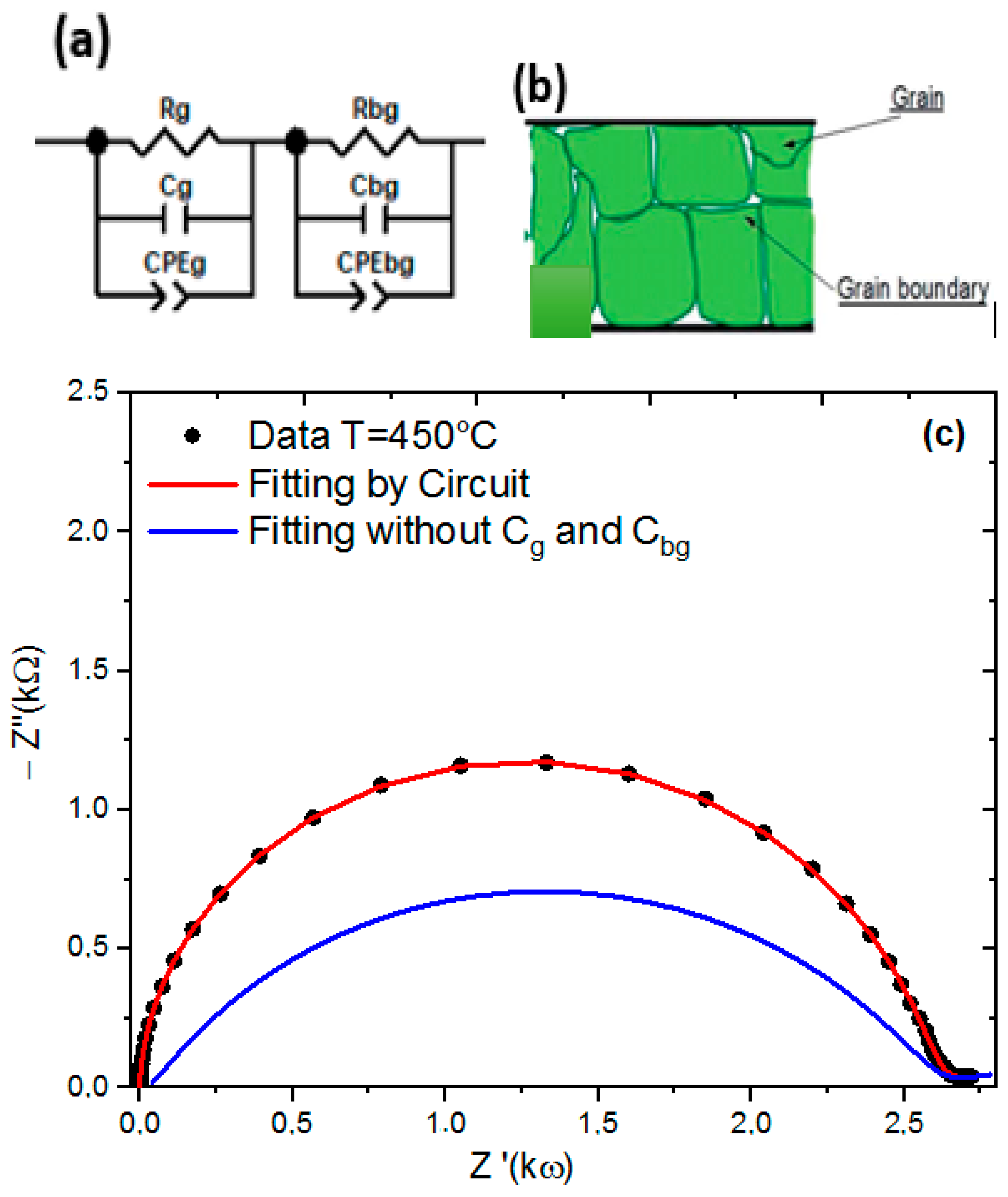
Based on a thorough analysis of the dielectric and electrical functions, the equivalent electrical circuit, whose response overlaps with the spectra of the experimental data, consists of two parallel branches Rg//Cg//CPEg and Rbg//Cbg//CPEbg connected in series.
Dielectric dispersion, as well as the formation of an inter-barrier layer due to the contribution of grains and grain boundaries within the material, can be understood through complex impedance spectroscopy, which provides insight into the occurrence of the multipolarization process and the conditions of its relaxation. The effective contribution from the grain, grain boundary, and electrode interface can be determined by impedance plane plots. These plots differentiate the grain, grain boundary, and electrode contributions using semicircular arcs.
Figure 7 shows the correct circuit that matches the impedance spectrum data, and Figure 7b is a schematic structure of the sample to show the grains and grain boundaries [39].
The Nyquist plot in Figure 7c shows that the fit performed with the full equivalent circuit reproduces the simulation data very accurately, indicating that this model faithfully describes the electrical behavior of the cell. The presence of the capacitances Cg and Cbg allows for the consideration of charge storage phenomena and interface effects, particularly at the grain, grain boundaries, and electrode/active layer interfaces. These capacitive contributions are essential to explain the size and shape of the arc observed on the graph. Conversely, when the circuit is simplified by removing Cg and Cbg, the fit deviates significantly from the data: the arc is smaller and no longer accurately represents the device’s impedance response, reflecting an underestimation of capacitive and interfacial effects. Thus, the comparison clearly shows that Cg and Cbg play a crucial role in the impedance response and that the full circuit is necessary for a realistic and reliable model of the solar cell.
In Figure 7, part (a) represents a circuit composed of two main contributions: a first branch (Rg, Cg, CPEg) corresponding to the grains, and a second (Rbg, Cbg, CPEbg) associated with the grain boundaries. Part (b) schematically illustrates the microstructure, where the grains are separated by more resistive grain boundaries.
Depending on the influence of frequency, at low frequencies, the electrical response is dominated by the grain boundaries (Rbg), because space charges accumulate at the interfaces, resulting in high resistance and a significant capacitive contribution. At high frequencies, the charges can no longer follow the alternating field at the interfaces; the contribution of the grain boundaries decreases, and the response is then mainly controlled by the grains (Rg), which are generally less resistive.
Regarding the effect of temperature, as the temperature increases, the resistances Rg and especially Rbg decrease due to the thermal activation of charge carriers (semiconductor behavior). Relaxation times shift towards higher frequencies, indicating increased charge mobility. Thus, at high temperatures, conduction is facilitated both within grains and at grain boundaries, resulting in an overall reduction in the material’s impedance.
The figure highlights conduction that is dependent on both frequency (grain boundary → grain transition) and temperature (thermal activation of charge carriers), a characteristic of polycrystalline ceramics such as cordierite.
The Nyquist diagram allowed us to interpret the changes as follows:
The electrical behavior of this material is described by an equivalent electrical circuit composed of two contributions connected in series, corresponding to the grains and the grain boundaries. The parallel branch Rg//Cg//CPEg represents the intrinsic response of the grains, where resistance reflects charge transport, capacitance is associated with dielectric polarization, and the constant phase element accounts for the non-ideal capacitive character linked to heterogeneities and structural defects.
The second parallel branch Rbg//Cbg//CPEbg, associated with the grain boundaries, generally exhibits higher resistance due to potential barriers, while capacitance and CPE reflect intergranular polarization and non-ideality due to microstructural inhomogeneity [40]. This equivalent circuit thus allows for a clear distinction between the contributions of the grains and grain boundaries to the overall electrical behavior of the material. Nyquist curves, which represent the imaginary part of the impedance (Z″) as a function of its real part (Z′), highlight arcs or semi-circles associated with relaxation, conduction, and polarization mechanisms. This technique provides essential information on charge transport processes, relaxation times, and interactions at the material interfaces. The complex impedance (Z*) is described by a specific mathematical relationship that allows for the isolation and interpretation of these different contributions.
Z*(ω) = Z′(ω) + jZ′′(ω)
Z t o t a l = ( R 1 1 + Q 1 j ω n 1 + j ω C 1 ) 1 + ( R 2 1 + Q 2 j ω n 2 + j ω C 2 ) 1
Z t o t a l = R 1 1 + Q 1 ω n 1 c o s ( n 1 π 2 ) ( R 1 1 + Q 1 ω n 1 c o s ( n 1 π 2 ) ) 2 + ( Q 1 ω n 1 s i n n 1 π 2 + ω C 1 ) 2 + R 2 1 + Q 2 ω n 2 c o s ( n 2 π 2 ) ( R 2 1 + Q 2 ω n 2 c o s ( n 2 π 2 ) ) 2 + ( Q 2 ω n 2 s i n n 2 π 2 + ω C 2 ) 2 j Q 1 ω n 1 s i n n 1 π 2 + ω C 1 R 1 1 + Q 1 ω n 1 cos n 1 π 2 2 + Q 1 ω n 1 s i n n 1 π 2 + ω C 1 2 + Q 2 ω n 2 s i n n 2 π 2 + ω C 2 R 2 1 + Q 2 ω n 2 cos n 2 π 2 2 + Q 2 ω n 2 s i n n 2 π 2 + ω C 2 2
Z′ corresponds to the real part of the impedance, representing the ohmic resistance of the material. Z″ denotes the imaginary part of the impedance, related to reactive effects of capacitive or inductive origin. The symbol j corresponds to the imaginary unit, defined by the relation (j2 = −1). The expressions for calculating Z′ and Z″ are as follows:
Z = R 1 1 + Q 1 ω n 1 c o s ( n 1 π 2 ) R 1 1 + Q 1 ω n 1   c o s ( n 1 π 2 ) 2 + Q 1 ω n 1   s i n n 1 π 2 + ω C 1 2 + R 2 1 + Q 2 ω n 2   c o s ( n 2 π 2 ) R 2 1 + Q 2 ω n 2   c o s ( n 2 π 2 ) 2 + Q 2 ω n 2   s i n n 2 π 2 + ω C 2 2
Z = Q 1 ω n 1 s i n n 1 π 2 + ω C 1 R 1 1 + Q 1 ω n 1 cos n 1 π 2 2 + Q 1 ω n 1 s i n n 1 π 2 + ω C 1 2 + Q 2 ω n 2 s i n n 2 π 2 + ω C 2 R 2 1 + Q 2 ω n 2 cos n 2 π 2 2 + Q 2 ω n 2 s i n n 2 π 2 + ω C 2 2
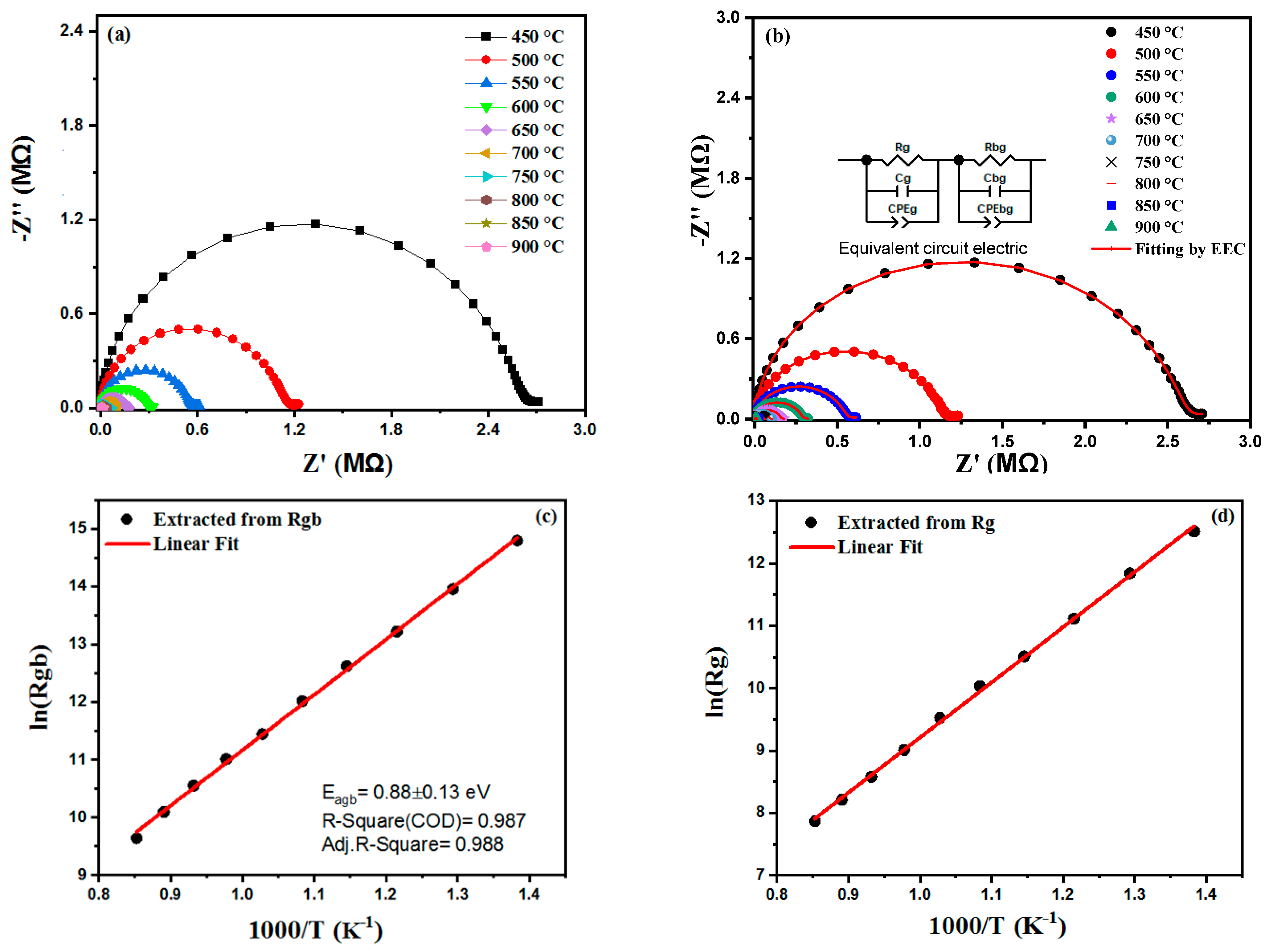
where R1, R2 and ω (with ω = 2πf) correspond to the grain resistance, grain boundary resistance and the angular frequency of the material, respectively. When the imaginary part of the impedance (Z′′) is plotted against the real part (Z′) of the cordierite ceramic at temperatures between 450 °C and 900 °C, several phenomena can be observed which are illustrated in Figure 8a.
As the temperature increases, the radius of the semi-circles present in the Nyquist diagram decreases, which indicates a reduction in the material’s resistance and an improvement in its electrical conductivity [41]. This improvement results from the thermal activation of charge carriers: the increase in temperature provides the necessary energy to excite electrons and ions, thereby increasing their mobility and facilitating the transport of electrical charges. The interfaces and grain boundaries, which play an important role at low temperatures, become less influential as the temperature increases, because the mobility of charge carriers increases. The arcs observed in the diagram reflect the relaxation mechanisms of the grains and grain boundaries, which become more pronounced with increasing temperature.
In the field of materials, an equivalent circuit model is commonly used to represent the complex electrical properties of grains and grain boundaries. This model is organized into two branches, CPEg//Rg//Cg and CPEbg//Rbg//Cbg, allowing for the decomposition of the overall electrical response into different specific contributions. The Z-View software version 2.2 is generally used to adjust the parameters of each circuit component and optimize the match between the experimental data and the model, as illustrated in Figure 8b.
The equivalent capacity for grain and grain seals is calculated from the expression Equation (11).
A specific relationship allows the capacitance C to be linked to the CPE, providing an accurate interpretation of the electrical phenomena observed concerning grains and grain boundaries [42].
Cbg = (RbgxQbgαbg)1/αbg
and for the capacity of the grains.
Cg = (RgxQgαg)1/αg
Figure 8b presents the Nyquist plot of the experimental data and the equivalent circuit regression modeling the experimentally extracted impedance spectra, established using Zview version 2.2 software. The agreement of the equivalent circuit regression clearly demonstrates that modeling via impedance spectroscopy is very important for electrical and dielectric characteristics.
Table 1 shows that the resistances of the grains (Rg) and grain boundaries (Rgb) decrease with increasing T due to thermal activation and the release of trapped charges, confirming the semiconducting nature of the material [43]. For all temperatures studied, Rg remains lower than Rgb, and their activation energies were determined using the Arrhenius equation [44].
R = R 0 exp E a k B T
Ea represents the activation energy of conduction, Kb the Boltzmann constant, R0 the pre-exponential factor, and T the temperature in kelvins. Figure 8c,d compares the energy associated with grains and grain boundaries. Indeed, the resistance of grain boundaries is generally higher than that of grains due to their disordered structure, which disrupts the conduction of charges. Grain boundaries constitute additional barriers, creating potential obstacles and trapping impurities as well as defects, which reduces the mobility of charge carriers. Moreover, the transport mechanisms in these regions are slower, which explains the higher energy observed at grain boundaries compared to grains.
The activation energy determined from the plot of ln(1/R) as a function of 1000/T is approximately 0.83–0.88 eV, which indicates that the conduction mechanism in the material is thermally activated and probably governed by the jumping of charges mobile charging (polarons, ions or defects) across potential barriers at grain boundaries or the crystal lattice.
Table 2 summarizes the electrical parameters extracted from the equivalent circuit model fitted to the complex impedance spectra of the cordierite ceramic in the temperature range 450–900 °C, distinguishing between grain boundary and grain contributions.
Cgb and Cg represent the capacitances of the grain boundaries and grains, respectively. The lower values of Cgb compared to Cg reflect the more resistive and less polarizable nature of the grain boundaries. These capacitances decrease slightly with increasing temperature due to changes in interfacial polarization.
The parameters Qgb and Qg, associated with constant phase elements (CPEs), increase with temperature, indicating a non-ideal capacitive contribution and greater charge carrier mobility. The exponents α1 and α2, less than unity across the entire studied range (450–900 °C), confirm the deviation from ideal capacitive behavior, linked to microstructural heterogeneity and the distribution of relaxation times.
A marked decrease in the resistances Rgb and Rg is observed as the temperature increases, reflecting an improvement in electrical conductivity typical of a thermally activated semiconductor. The resistance of grain boundaries, however, remains greater than that of the grains themselves, demonstrating that they constitute the main barrier to charge transport.
Overall, these results highlight the significant influence of temperature on conduction and polarization mechanisms, with grain boundaries playing a dominant role, particularly at low temperatures.

6.4. Study of Electrical Conductivity

The electrical conductivity of a material reflects its ability to transmit an electric current. It depends on the availability and mobility of charge carriers (electrons or ions) within the material. Electrical conductivity can be determined from dielectric parameters according to the following relationship [45,46].
σAC(ω) = ωε0εrtan(δ)
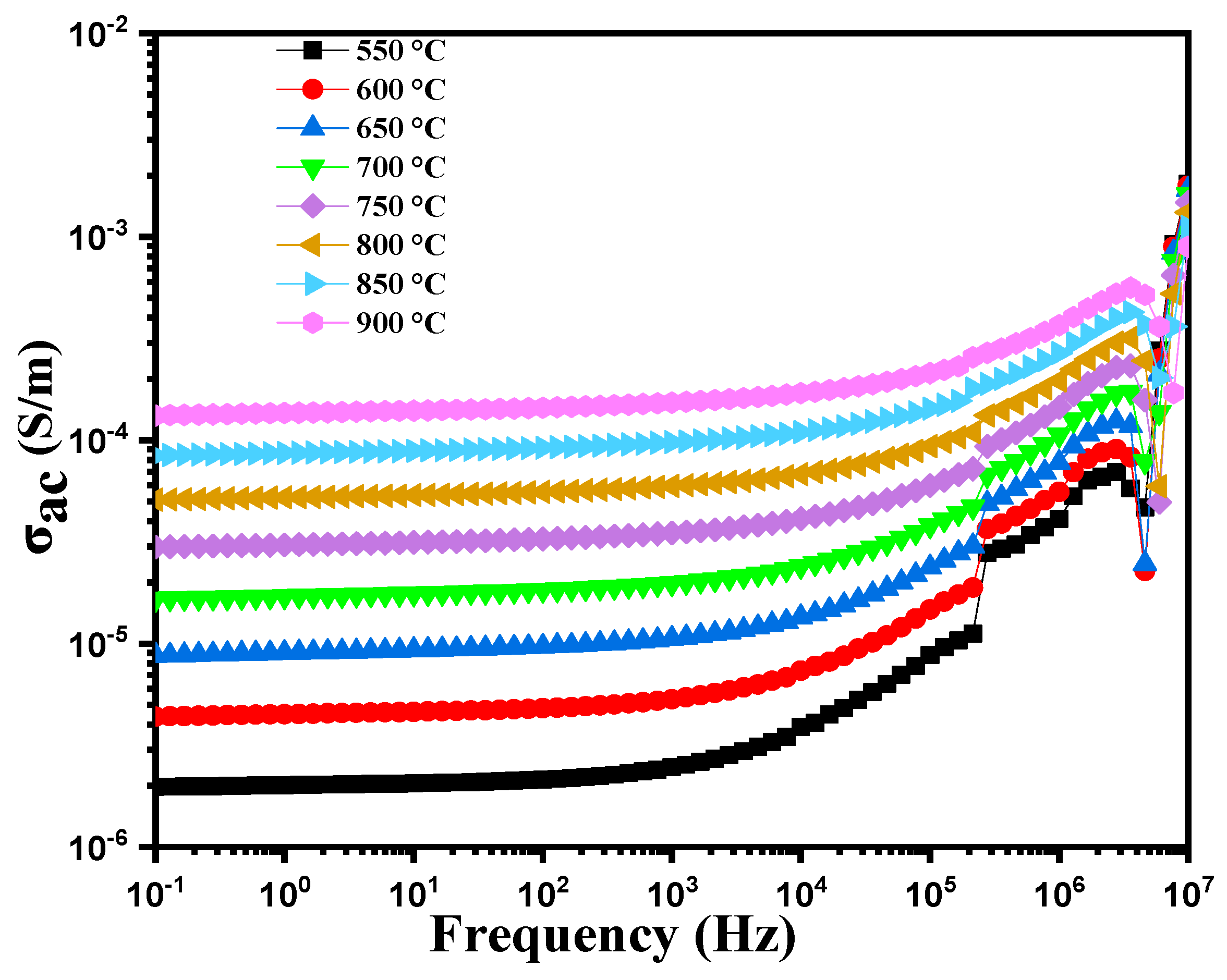
The parameters ε0, εᵣ, tan(δ), ω, and σac correspond respectively to the permittivity of free space, the relative permittivity of the material, the dielectric loss tangent, the angular frequency, and the alternating current (AC) electrical conductivity. Figure 9 illustrates the evolution of AC conductivity as a function of frequency, for the temperature range from 550 °C to 900 °C. At low frequencies, the conductivity remains relatively stable on a plateau; this is direct current conduction dominated by the mobility of free charge carriers, such as ions or electrons.
As the temperature increases, the conductivity in this region grows, reflecting greater charge mobility due to the available thermal energy. In the intermediate zone, corresponding to mid-frequencies, a slight frequency dispersion with a slope less than 1 is observed. In the last ten points of the frequency range, there is step conduction due to grain boundaries with a slope much less than 1. The total conductivity of the material under study follows Joncher’s [47] double power law. Finally, at high frequencies, the conductivity increases rapidly with frequency. This evolution is generally associated with ionic relaxation processes or dipole reorientation mechanisms. Increasing the temperature also increases the conductivity in this region, probably by facilitating localized step conduction and the charge relaxation process.
Equations (15) and (16) represent the conductivity of grains and grain boundaries, respectively, using the equivalent electrical circuit model shown in Figure 8.
σ 1 ( ω ) = R 1 1 + Q 1 ω n 1 cos n 1 π 2 + j ( Q 1 ω n 1   s i n n 1 π 2 + ω C 1 )
σ 2 ( ω ) = R 2 1 + Q 2 ω n 2 cos n 2 π 2 + j Q 2 ω n 2   s i n n 2 π 2 + ω C 2
The real part of the total conductivity is obtained from the following two expressions, so that the real component of each is taken into account.
σac(ω) = σdc + n1 + n2
With ,   A = Q 1 ω n 1 cos n 1 π 2
And B = Q2ωn2 cos(n2π/2)

6.5. Imaginary and Real Analysis of Impedance Spectroscopy

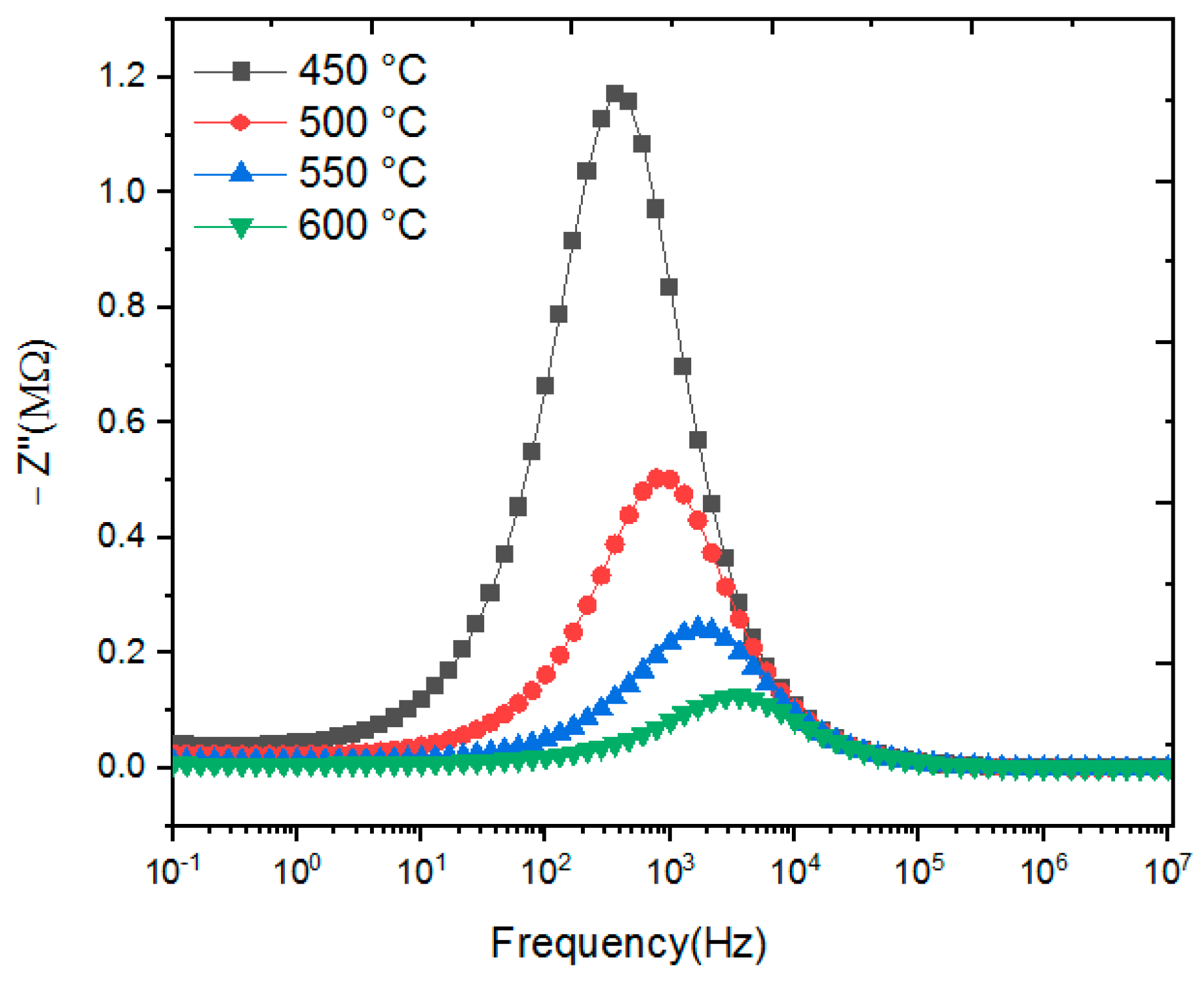
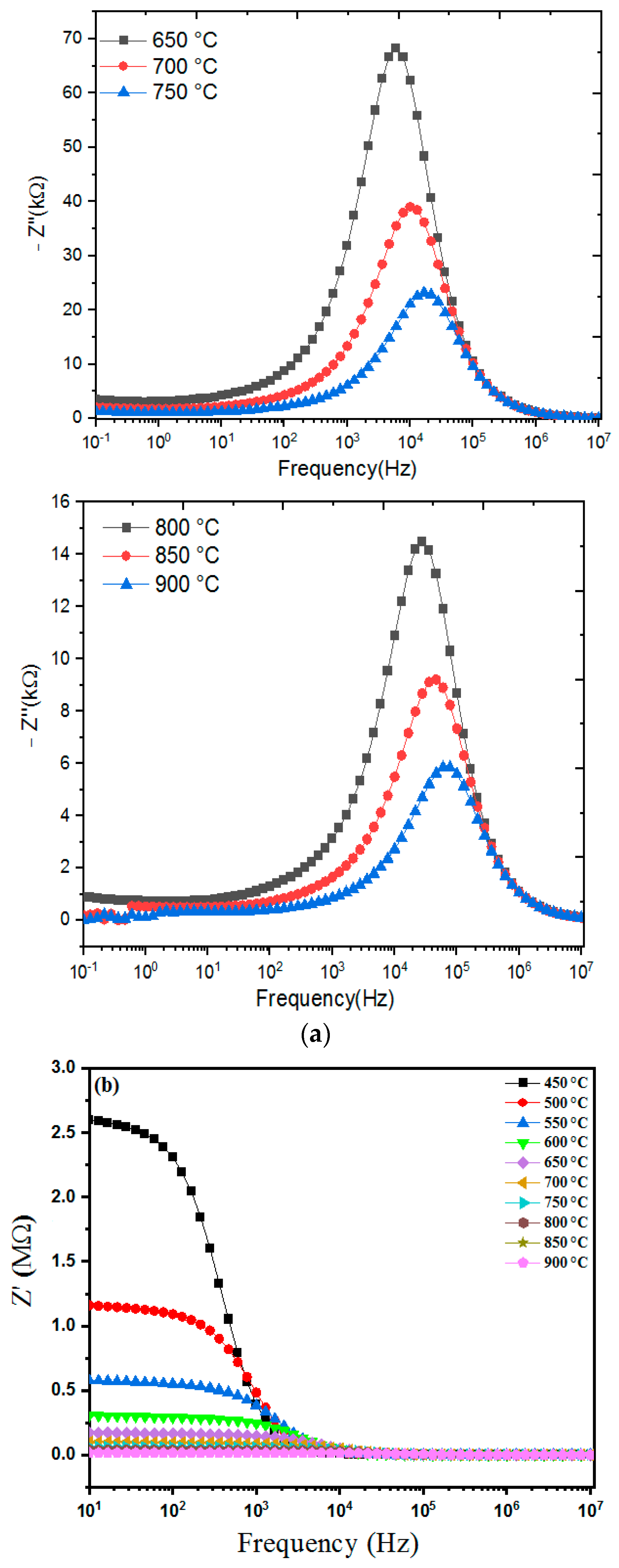
When plotting the imaginary part of the impedance Z” as a function of frequency (from 1 Hz to 1 MHz) for different temperatures ranging from 450 °C to 900 °C, several important phenomena can be observed for cordierite ceramics. Figure 10a shows that at low temperatures, the relaxation frequency (Fmax) is low, indicating reduced mobility of charge carriers, such as ions or electrons. This is explained by insufficient thermal energy to facilitate their movement. When the temperature increases, the relaxation frequency shifts to higher values. This behavior reflects an increase in the mobility of charge carriers and a decrease in the relaxation time τ. As a result, the peak of Z″ shifts towards higher frequencies and its maximum amplitude tends to decrease.
The complex impedance of the material decreases with increasing temperature, leading to thermal activation that facilitates charge carrier movement [48]. This results in improved electrical conductivity and a reduction in the overall resistance of the material. The relaxation observed in the imaginary part of the impedance in the frequency range [1 kHz–10 kHz] for all samples is due to dipole polarizations.
Figure 10b illustrates the real part of the impedance Z’ as a function of frequency, within the same frequency range and for the same temperatures. As the frequency increases, Z’ gradually decreases and tends towards values close to zero at high frequencies. This decrease is explained by the gradual attenuation of polarization mechanisms, electronic, ionic, orientated, and interfacial, which dominate at low frequencies [49]. At these low frequencies, the high values of Z” result from the cumulative effect of these different polarization mechanisms. The obtained Cole-Cole plots are all arcs or semicircles for all the samples. Thus, the centre of the semicircles is below the real axis, which shows that the relaxation of the materials is not the Debye-type
On the other hand, at high frequencies, the dipolar and interfacial contributions become negligible, which leads to a stabilization of Z” at low values [50]. Moreover, the decrease in Z” with increasing frequency and temperature reflects an improvement in alternating current AC conductivity. At low frequency, the sharp decrease in Z” with temperature highlights a characteristic behavior of a negative temperature coefficient of resistance (NTCR), indicating that the material’s resistance decreases as the temperature increases, which promotes better overall conductivity [51].
The Bode plot of the imaginary part of the impedance shows that electrical relaxation shifts towards higher frequencies as the temperature increases. However, the amplitude of the relaxation peak decreases. This indicates that the charge carriers, or dipoles, of the material become more mobile at high temperatures, thus accelerating the relaxation processes, but that the collective orientation of the dipoles, or the contribution of the interfaces to dielectric losses, decreases, leading to a reduction in the peak intensity.

6.6. Electrical Modulus Analysis M*

The study of the complex modulus M*, which can be represented as two parts the real part M’ and the imaginary part M” of the cordierite ceramic (2MgO 2Al2O3 5SiO2), allows for the precise characterization of its dielectric and electrochemical behavior [51,52] and the manifestations of space charges. The complex modulus, defined as the inverse of the complex permittivity ε*, separates the contributions of conduction and local polarization, thus providing a better understanding of relaxation mechanisms at the grain and grain boundary levels.
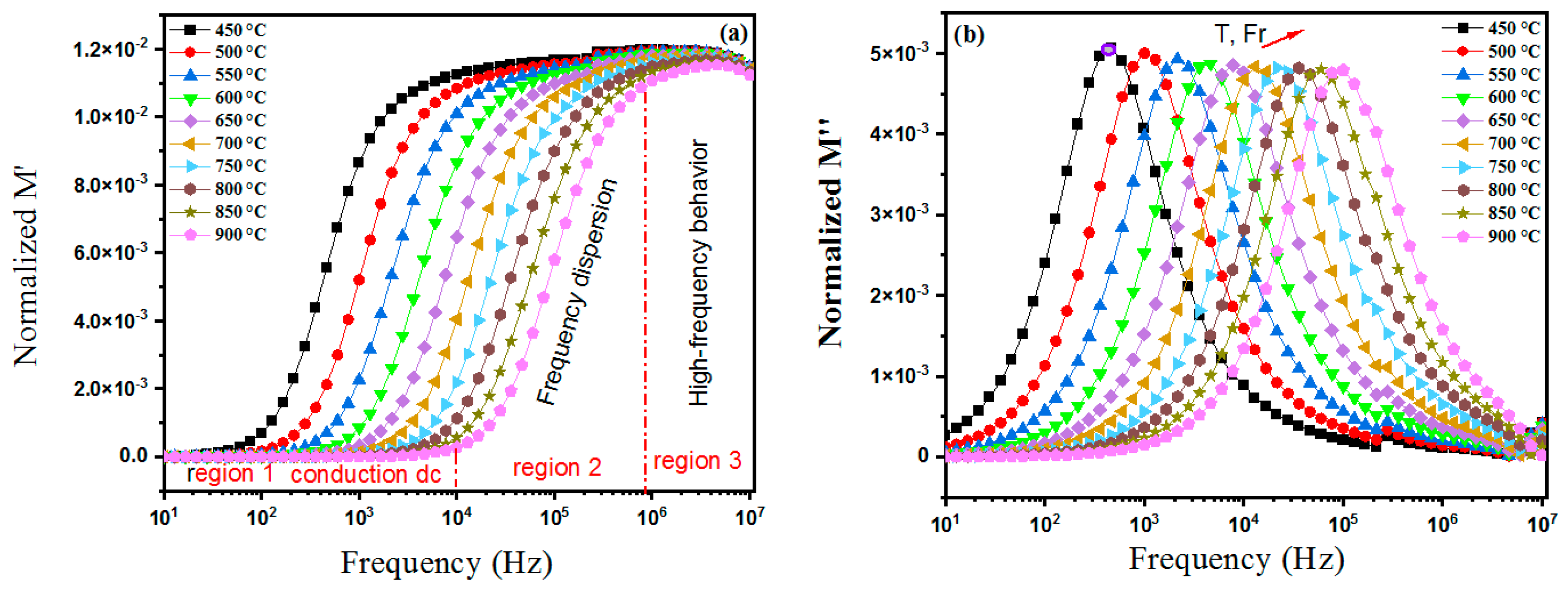
Analysis of the real part M’ and the imaginary part M” provides information on the dielectric strength, ionic mobility, and relaxation processes, which are directly influenced by the microstructure, density, and defects of the ceramic. Figure 11b shows that the curves exhibit a relaxation peak (M”max) linked to the grain effect, which shifts towards higher frequencies as the temperature increases. These characteristics are confirmed by the Bode plot in Figure 11a. This demonstrates a strong dependence of M” on temperature and frequency, correlating the movement of mobile charges within the material [52], which also represents the degree of complex interactions between the mobile species [53]. The evolution of the real part of the modulus, M′, passes through three well-defined regions: Region 1 corresponds to the low-frequency range and is associated with the DC electrical behavior. In Region 2, at intermediate frequencies, frequency dispersion is observed.
The complex electrical modulus was calculated from the dielectric permittivity ε*(ω) according to the following relationship [53,54].
M* = 1/ε* = j C0Z* = M′+ j M′′
Bode diagrams, representing M’ and M” as a function of frequency, enable analysis of conduction and polarization mechanisms, distinguishing between the contributions of grains and grain boundaries, and provide essential information on the dielectric response of materials as a function of temperature and frequency [55].
M = ε ε 2 + ε 2 ;   M = ε ε 2 + ε 2
where ε’ and ε” represent the real and imaginary parts of the dielectric permittivity, respectively. The imaginary part of the complex modulus M” reflects the dielectric relaxation processes of the material. It represents the delayed response of dipoles or charge carriers when an alternating electric field is applied and allows us to distinguish the contributions of grains and grain boundaries to the conduction and polarization mechanisms.
M = M m a x g 1 β g + β g 1 + β g β g f m a x g f + f f m a x g β g + M m a x g b 1 β g b + β g b 1 + β g b β g b f m a x g f + f f m a x g β g b
Figure 11a shows that the evolution of the real part of the modulus function passes through three distinct regions. Region 1 exhibits the behavior due to low-frequency DC current. Region 2 shows a frequency dispersion at medium frequencies. Region 3 exhibits the high-frequency regime linked to grain-to-grain behavior.

7. Determination of Activation Energy via the M* and Z* Functions

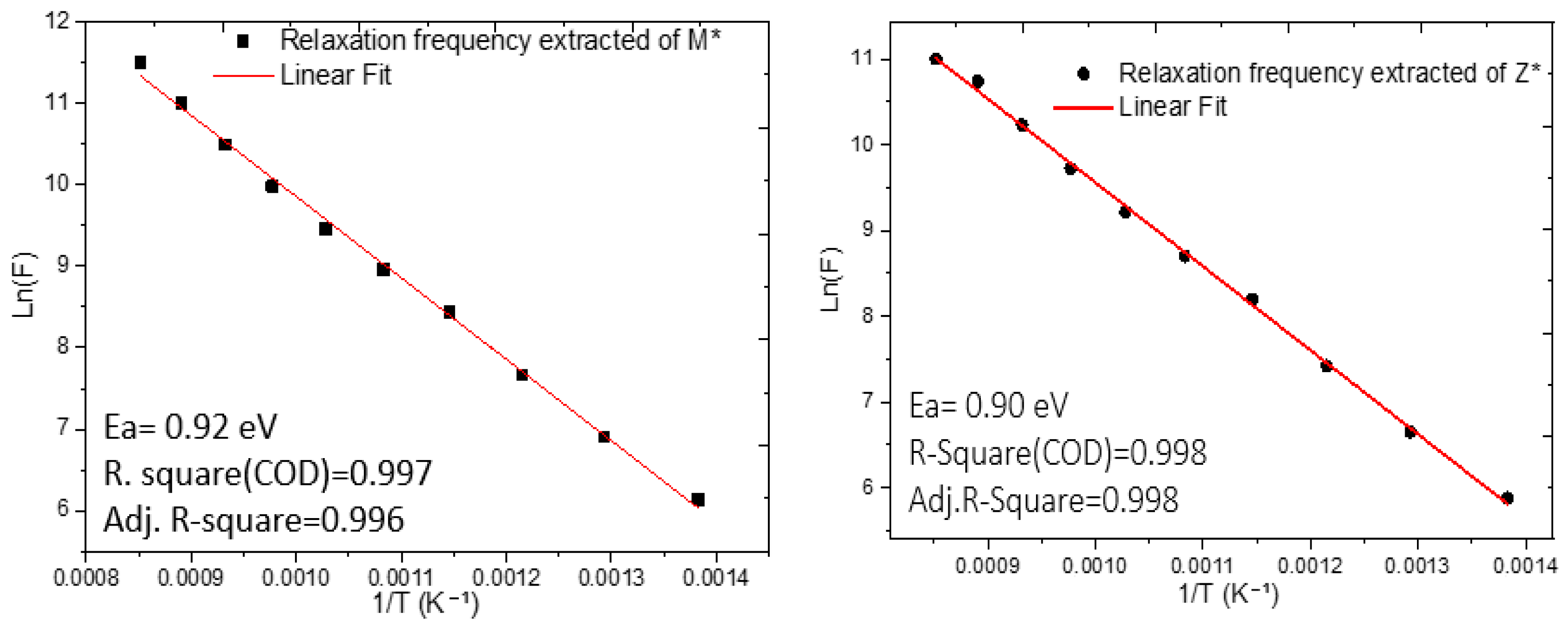
We determined the activation energy Ea from data obtained via the equivalent electrical circuit, using the Arrhenius law. Figure 12 illustrates the variation in the relaxation frequency (F) as a function of the inverse temperature (1/T) of the cordierite. From this, we calculated the activation energy of the sample within the temperature range used.
The activation energies extracted from the complex impedance, electrical modulus, and resistances of the grains and grain boundaries are 0.9 eV, 0.92 eV, 0.83 eV, and 0.9 eV, respectively. The close proximity of these values, all within a narrow range, highlights the good consistency between the different analytical methods and suggests the existence of a single dominant conduction mechanism in the material studied. The slightly lower value associated with grain resistance (0.83 eV) indicates that charge carrier transport is facilitated within the grains, where structural disorder and potential barriers are reduced. Conversely, the higher activation energy obtained for grain boundaries (0.9 eV) reflects the presence of additional potential barriers related to structural defects and disorder, making these regions more resistive to carrier passage. The activation energy derived from the complex impedance reflects an overall contribution from the grains and grain boundaries, while the slightly higher value obtained using the electrical modulus formalism (0.92 eV) is primarily associated with volume relaxation processes and carrier movement within the crystal lattice. Overall, these results indicate thermally activated conduction, governed by carriers requiring an activation energy of approximately 0.9 eV, characteristic of a thermal conduction mechanism.

8. Conclusions

In this work, the complex impedance Z*, the electrical modulus ε*, the complex permittivity and the conductivity were studied in order to analyze in detail the dielectric and electrical behavior of the ceramic material. The combined use of these different representations provided a comprehensive view of the transport and polarization mechanisms. Modeling using an equivalent electrical circuit proved essential for describing the electrical and dielectric aspects of the material and for correctly interpreting the experimental results. In addition, the deconvolution and separation of the different processes made it possible to clearly identify the contributions of the grains, grain boundaries, and interfaces, highlighting their respective roles in the overall response of the material. This comprehensive approach confirms the effectiveness of impedance spectroscopy for in-depth understanding and optimization of the electrical properties of ceramics.
The activation energy was determined by four different techniques, based on the relaxation frequency extracted from the complex impedance, the complex modulus, and the resistances of the grains and grain boundaries. The values obtained by these different approaches converge to the same value, around 0.90 eV, confirming the consistency of the results and the existence of a dominant conduction mechanism in the material studied. These characteristics reinforce its potential for next-generation electronic devices, particularly for 5G technologies and the Internet of Things, thus opening up new avenues for innovation and industrial applications.
We used complex impedance, complex electrical Cole-Cole diagram and AC conductivity analysis as a function of frequency to examine the relaxation and conduction mechanism in these samples, which exhibit non-Debye behavior.
The variation in the dielectric constant with temperature and frequency confirmed the contributions of different polarization mechanisms. In particular, the high values of ε’ at low frequencies and high temperatures are mainly related to the presence of different Schottky barriers, while the low values of the dielectric constant ε’ at high frequencies are mainly related to induced effects.

Author Contributions

Conceptualization: N.R., M.A.-S. and M.L.; Methodology: N.R., A.E., M.A.-S. and M.L.; Software: N.R., A.E., R.Z., N.E.M. and O.R.; Validation: M.A.-S., A.E., M.S. and P.P.; Formal Analysis: N.R., M.M., B.G., M.S. and S.E.B.; Investigation: N.R., M.A.-S., A.E. and M.L.; Resources: B.G.; Data Curation: N.R., M.A.-S., E.M.E., M.S. and A.E.; Writing—Original Draft Preparation: N.R. and A.E.; Writing—Review and Editing: N.R., and A.E.; Visualization: M.A.-S., M.L., A.E., P.P., S.E.B. and O.R.; Supervision: M.A.-S. and M.L.; Project Administration: Multidisciplinary Faculty of Nador (FPN), Mohammed Premier University; Funding Acquisition: P.P. All authors have read and agreed to the published version of the manuscript.

Funding

This study was carried out independently, without any external funding or financial assistance from institutions, organizations, or funding bodies.

Data Availability Statement

All data produced or analyzed in this study are presented within the article, ensuring transparency and enabling readers to confirm the reported findings.

Acknowledgments

We would like to thank the University of Ljubljana, Faculty of Chemistry and Technology, for their help and support during the sample testing that was done as part of this work. The authors also express their sincere gratitude to the South-West University, Faculty of Mathematics and Natural Sciences in Blagoevgrad Bulgaria, for their valuable scientific contributions and for covering the publication fees of this study. The authors are likewise grateful to the Faculty of Sciences, University Chouaib Doukkali, El Jadida, Morocco; Faculty of Sciences and Technics, University Cadi Ayyad, Marrakech, Morocco; and Multidisciplinary Faculty, Mohammed Premier University, Nador, Morocco, for their valuable support.

Conflicts of Interest

The authors declare no conflict of interest.

References

  1. Avcıoğlu, C.; Artır, R. Utilization of investment casting shell waste in the production of cordierite–mullite–zircon composites for radiation shielding: The influence of La2O3 additive. Ceram. Int. 2024, 50, 4581–4588. [Google Scholar] [CrossRef]
  2. Poussardin, V. Calcined Clays and Marlstones as Supplementary Cementitious Materials. Ph.D. Thesis, École Centrale de Nantes & Université de Sherbrooke, Sherbrooke, QC, Canada, 2022. [Google Scholar]
  3. Gregory, A.G.; Veasey, T.J. Review: The crystallization of cordierite glass. J. Mater. Sci. 1972, 7, 1327–1341. [Google Scholar] [CrossRef]
  4. Chen, Y.; Wang, N.; Ola, O.; Xia, Y.; Zhu, Y. Porous ceramics: Light in weight but heavy in energy and environment technologies. Mater. Sci. Eng. R Rep. 2021, 143, 100589. [Google Scholar] [CrossRef]
  5. Boulvain, F. Géologie Générale: Du Minéral Aux Géosphères; Éditions Ellipses: Paris, France, 2023. [Google Scholar]
  6. Zhang, L.; Olhero, S.; Ferreira, J.M. Thermomechanical and dielectric properties at high temperature of cordierite–mullite–alumina ceramics. Ceram. Int. 2016, 42, 16897–16905. [Google Scholar] [CrossRef]
  7. Fuji, M.; Shiroki, Y.; Menchavez, R.L.; Takegami, H.; Takahashi, M.; Suzuki, H.; Izuhara, S.; Yokoyama, T. Fabrication of cordierite filter by in-situ solidification for high temperature dust collection. Powder Technol. 2007, 172, 57–62. [Google Scholar] [CrossRef]
  8. Pizongo, O.O. Valorisation des Aluminosilicates dans la Fabrication de Vitrocéramique du Système MAS. Ph.D. Thesis, Institut National de la Recherche Scientifique, Quebec, QC, Canada, 2022. [Google Scholar]
  9. Tareda, M.; Kawamura, K.; Kagomiya, I.; Kakimoto, K.-I.; Ohsato, H. Effect of Ni substitution on the microwave dielectric properties of cordierite. J. Eur. Ceram. Soc. 2007, 27, 3045–3048. [Google Scholar] [CrossRef]
  10. Wu, J.; Li, Z.; Huang, Y.; Li, F.; Yang, Q. Fabrication and characterization of low temperature co-fired cordierite glass–ceramics from potassium feldspar. J. Alloys Compd. 2014, 583, 248–253. [Google Scholar] [CrossRef]
  11. Kirat, G.; Aksan, M.A. Observation of magnetic behavior at low temperature in the Mg2Al4Si5O18 system. J. Alloys Compd. 2013, 577, 556–559. [Google Scholar] [CrossRef]
  12. Ohsato, H.; Terada, M.; Kagomiya, I.; Kawamura, K.; Kakimoto, K.-I.; Kim, E.S. Sintering conditions of cordierite for microwave/millimeterwave dielectrics. IEEE Trans. Ultrason. Ferroelectr. Freq. Control. 2008, 55, 1081–1085. [Google Scholar] [CrossRef]
  13. Naskar, M.K.; Chatterjee, M. A novel process for the synthesis of cordierite (Mg2Al4Si5O18) powders from rice husk ash and other sources of silica and their comparative study. J. Eur. Ceram. Soc. 2004, 24, 3499–3508. [Google Scholar] [CrossRef]
  14. Thim, G.P.; Brito, H.F.; Silva, S.A.; Oliveira, M.A.S.; Felinto, M.C.F.C. Preparation and optical properties of trivalent europium doped into cordierite using the sol–gel process. J. Solid State Chem. 2003, 171, 375–381. [Google Scholar] [CrossRef]
  15. Takahashi, J.; Natsuisaka, M.; Shimada, S. Fabrication of Cordierite–Mullite Ceramic Composites with Differently Shaped Mullite Grains. J. Eur. Ceram. Soc. 2002, 22, 479–485. [Google Scholar] [CrossRef]
  16. De Castro, B. Caractérisation Minéralogique Quantitative Automatisée en Microscopie Optique et Applications à L’étude de Minerais dans le Cadre D’une Approche Géométallurgique; École Polytechnique: Montréal, QC, Canada, 2023. [Google Scholar]
  17. Rao, V.M. Molecular dynamic simulation study on 3MO–Al2O3–3SiO2 [M = Ba, Sr, Ca, Mg, Zn and Mn] glasses. Comput. Mater. Sci. 2026, 264, 114486. [Google Scholar] [CrossRef]
  18. Li, Y.; Wang, J.; Wang, J. Approaching extremely low thermal conductivity by crystal structure engineering in Mg2Al4Si5O18. J. Mater. Res. 2015, 30, 3729–3739. [Google Scholar] [CrossRef]
  19. Basheet, M.H.; Farhan, F.K.; Abed, A.N.; Alobaidi, O.; Alhayali, A.R.I. The fabrication and characterization behavior of cordierite ceramic materials with different molar fraction. NeuroQuantology 2022, 20, 271–279. [Google Scholar] [CrossRef]
  20. Levin, E.M.; McMurdie, H.F.; Robbins, C.R. Phase Diagrams for Ceramists; American Ceramic Society: Columbus, OH, USA, 1964; Volume 1. [Google Scholar]
  21. Laziri, K.; Lamara, I.; Mezahi, F.Z.; Sahnoune, F.; Dhahri, E.; Hassan, S.F.; Saheb, N. Synthesis, microstructure, hardness, thermal expansion, and dielectric properties of cordierite. Int. J. Appl. Ceram. Technol. 2025, 22, e15173. [Google Scholar] [CrossRef]
  22. Ogiwara, T.; Noda, Y.; Shoji, K.; Kimura, O. Solid state synthesis and its characterization of high-density cordierite ceramics using fine oxide powders. J. Ceram. Soc. Jpn. 2010, 118, 246–249. [Google Scholar] [CrossRef]
  23. Goren, R.; Ozgur, C.; Gocmez, H. The preparation of cordierite from talc, fly ash, fused silica and alumina mixtures. Ceram. Int. 2006, 32, 53–56. [Google Scholar] [CrossRef]
  24. Yürüyen, S.; Toplan, N.; Yildiz, K.; Toplan, H.Ö. The non-isothermal kinetics of cordierite formation in mechanically activated talc–kaolinite–alumina ceramics system. J. Therm. Anal. Calorim. 2016, 125, 803–808. [Google Scholar] [CrossRef]
  25. Yamuna, A.; Johnson, R.; Mahajan, Y.R.; Lalithambika, M. Kaolin-based cordierite for pollution control. J. Eur. Ceram. Soc. 2004, 24, 65–73. [Google Scholar] [CrossRef]
  26. Bellucci, L.; Cassetta, M.; Skogby, H.; Nazzareni, S. Vibrational spectra of pure and Sc-doped diopside (CaMgSi2O6): Modeling and experiments. Phys. Chem. Chem. Phys. 2024, 26, 4029–4038. [Google Scholar] [CrossRef]
  27. Goswami, B.; Rani, N.; Ahlawat, R. Structural and optical studies of Nd3+-doped Y2O3–SiO2 nanopowder. J. Alloys Compd. 2018, 730, 450–457. [Google Scholar] [CrossRef]
  28. Ahlawat, R. Influence of multi-step annealing on the nanostructure and surface morphology of Y2O3:SiO2 powder. Ceram. Int. 2015, 41, 7345–7351. [Google Scholar] [CrossRef]
  29. Ahlawat, R. Preparation and effect of heat treatment on the Gd2O3:SiO2 nanocomposite. Mod. Phys. Lett. B 2015, 29, 1550046. [Google Scholar] [CrossRef]
  30. Paramarta, V.; Taufik, A.; Salah, R.J. Better adsorption capacity of SnO2 nanoparticles with different graphene addition. J. Phys. Conf. Ser. 2016, 776, 012039. [Google Scholar] [CrossRef]
  31. Saha, S.; Chanda, S.; Dutta, A.; Sinha, T.P. Relaxation diélectrique des nanoparticules de PrFeO3. Solid State Sci. 2016, 58, 55–63. [Google Scholar] [CrossRef]
  32. Mhamdi, A.; Mimouni, R.; Amlouk, A.; Amlouk, M.; Belgacem, S. Study of the effects of copper doping on the structural, optical and electrical properties of sputtered ZnO thin films. J. Alloys Compd. 2014, 610, 250–257. [Google Scholar] [CrossRef]
  33. Zhang, H.; Ye, X.; Xu, J.; Li, S.; Ma, X.; Xu, W.; Zhang, J. Effects of heat treatment on the electromagnetic wave absorption characteristics of ceramic particles resorcinol formaldehyde silicon dioxide. Materials 2024, 17, 2376. [Google Scholar] [CrossRef]
  34. Kashif, I.; Rahman, S.A.; Abdelghany, A.; El-Said, R. Dielectric behavior and PTCR effect in nanocrystallite PMN ferroelectric ceramics. Philos. Mag. A 2010, 90, 2115–2123. [Google Scholar] [CrossRef]
  35. Zhao, Y.; Gao, H.; Luan, X.; Cheng, G.; Wang, X.; Dong, C. The influence of potential models on the structure and diffusion behavior of Al2O3–Na2O–K2O amorphous systems. J. Am. Ceram. Soc. 2026, 109, e70518. [Google Scholar] [CrossRef]
  36. Das, A.; Patil, A.S.; Goswami, M.; Srihari, V. Structural analysis of Holmium Alumino Silicate (HAS: Ho2O3–Al2O3–SiO2) glasses using Ab initio molecular dynamics simulation. Mater. Chem. Phys. 2026, 358, 132424. [Google Scholar] [CrossRef]
  37. Pattanayak, R.; Panigrahi, S.; Dash, T.; Muduli, R.; Behera, D. Electric transport properties study of bulk BaFe12O19 by complex impedance spectroscopy. Phys. B Condens. Matter 2015, 474, 57–63. [Google Scholar] [CrossRef]
  38. Hawari, N.H. Electrochemical impedance spectroscopy for full-cell battery characterization. Nat. Rev. Clean Technol. 2026. [Google Scholar] [CrossRef]
  39. Rayssi, C.; El Kossi, S.; Dhahri, J.; Khirouni, K. Frequency and temperature dependence of dielectric permittivity and electric modulus studies of the solid solution Ca0.85Er0.1Ti1−xCo4x/3O3 (0 < x < 0.1). RSC Adv. 2018, 8, 17139–17150. [Google Scholar] [CrossRef] [PubMed]
  40. Elmelouky, A.; Mortadi, A.; Chahid, E.; Elmoznine, R. Impedance spectroscopy as a tool to monitor the adsorption and removal of nitrate ions from aqueous solution using zinc aluminum chloride anionic clay. Heliyon 2018, 4, e00536. [Google Scholar] [CrossRef]
  41. Javed, M.; Khan, A.A.; Khisro, S.N.; Majeed, A.; Kazmi, J.; Bilkees, R.; Hussain, M.; Mohamed, M.A. Charge conduction mechanism and non-Debye type relaxation in the perovskite orthochromite LaCrO3. Mater. Chem. Phys. 2022, 290, 126522. [Google Scholar] [CrossRef]
  42. Jebli, M.; Rayssi, C.; Dhahri, J.; Henda, M.B.; Belmabrouk, H.; Bajahzar, A. Structural and morphological studies and temperature/frequency dependence of the electrical conductivity of Ba0.97La0.02Ti1−xNb4x/5O3 perovskite ceramics. RSC Adv. 2021, 11, 23664–23678. [Google Scholar] [CrossRef]
  43. Halizan, M.Z.; Mohamed, Z. Dielectric, AC conductivity, and DC conductivity behaviours of Sr2CaTeO6 double perovskite. Materials 2022, 15, 4363. [Google Scholar] [CrossRef]
  44. Roy, D.; Bagchi, B.; Das, S.; Nandy, P. Electrical and dielectric properties of sol–gel derived mullite doped with transition metals. Mater. Chem. Phys. 2013, 138, 375–383. [Google Scholar] [CrossRef]
  45. Khorchani, I.; Hafef, O.; Reinosa, J.J.; Matoussi, A.; Fernandez, J.F. AC electrical conduction mechanisms and dielectric studies of DD3 kaolin sintered at high temperature. Mater. Chem. Phys. 2018, 212, 187–195. [Google Scholar] [CrossRef]
  46. Ali, H.; Karim, S.; Rafiq, M.; Maaz, K.; Rahman, A.U.; Nisar, A.; Ahmad, M. Electrical conduction mechanism in ZnS nanoparticles. J. Alloys Compd. 2014, 612, 64–68. [Google Scholar] [CrossRef]
  47. Chaari, M.; Belgacem, R.B.; Matoussi, A. Impedance analysis, dielectric relaxation, and modulus behavior of ZnO–Sn2O3 ceramics. J. Alloys Compd. 2017, 726, 49–56. [Google Scholar] [CrossRef]
  48. Nassar, K.I.; Benamara, M.; Kechiche, L.; Teixeira, S.S.; Graça, M.P.F. Structural and electrical properties of bismuth and niobium doped LaNiO3 perovskite obtained by sol-gel route for future applications in electronic devices. Indian J. Phys. 2024, 98, 2745–2753. [Google Scholar] [CrossRef]
  49. Okazaki, Y. Oxide film characterization of implantable metals by electrochemical impedance spectroscopy. Materials 2019, 12, 3466. [Google Scholar] [CrossRef]
  50. Hosseini, S.; Ranjbar, K.; Dehmolaei, R.; Amirani, A. Fabrication of Al5083 surface composites reinforced with carbon nanotubes and cerium oxide nanoparticles by friction stir processing. J. Alloys Compd. 2015, 622, 725–733. [Google Scholar] [CrossRef]
  51. Badapanda, T.; Senthil, V.; Rout, S.K.; Cavalcante, L.S.; Simões, A.Z.; Sinha, T.P.; Panigrahi, S. Rietveld refinement, micro-structure, conductivity and impedance properties of Ba[Zr0.25Ti0.75]O3 ceramic. Curr. Appl. Phys. 2011, 11, 1282–1293. [Google Scholar] [CrossRef]
  52. Benamara, M.; Zahmouli, N.; Teixeira, S.S.; Graça, M.P.F.; Mir, L.E.; Valente, M.A. Electrical and magnetic studies of maghemite (γ-Fe2O3) prepared by sol-gel method. J. Electron. Mater. 2022, 51, 2698–2707. [Google Scholar] [CrossRef]
  53. Nofal, M.M.; Aziz, S.B.; Ghareeb, H.O.; Hadi, J.M.; Dannoun, E.M.A.; Al-Saeedi, S.I. Impedance and dielectric properties of PVC:NH4I solid polymer electrolytes (SPEs): Steps toward the fabrication of SPEs with high resistivity. Materials 2022, 15, 2143. [Google Scholar] [CrossRef]
  54. Darwish, A.G.; Farouk, M.I.; Abdelglil, M.I.; Abo-Mosallam, H.A. Effect of Bi3+ on the physical, mechanical, and dielectric properties of cadmium silicate glasses for energy storage devices. RSC Adv. 2026, 16, 18242–18256. [Google Scholar] [CrossRef]
  55. Onodera, Y.; Takimoto, Y.; Hijiya, H.; Kayaba, N.; Tanida, M.; Ikeda, K.; Kohara, S. Lithium coordination disorder controlling ionic conductivity in mixed-halide borate glasses. J. Mater. Chem. A 2026. [Google Scholar] [CrossRef]
Figure 1. Crystal structures of cordierite and their projections along the a, b and c axes (Mg in orange, Al in gray, Si in blue and O in red).
Jcs 10 00205 g001
Figure 2. X-ray diffraction analysis of cordierite sample calcined at 1500 °C.
Jcs 10 00205 g002
Figure 3. IR spectra of cordierite samples subjected to thermal treatment at 1500 °C.
Jcs 10 00205 g003
Figure 4. SEM micrographs of cordierite synthesized by solid-state sintering: (a) general morphology showing agglomerated grains and particles of different sizes; (b) higher magnification image highlighting the fine microstructure and surface texture of the grains; (c) Cordierite grain size distribution determined from SEM micrographs, showing the frequency histogram and statistical fit curve.
Jcs 10 00205 g004
Figure 5. Variation in (a) relative permittivity and (b) dielectric loss with temperature between 550 °C and 900 °C for cordierite ceramic.
Jcs 10 00205 g005
Figure 6. (a) Diagram of the variation in relative permittivity and (b) dielectric loss as a function of temperature from 100 °C to 900 °C and frequency variation.
Jcs 10 00205 g006
Figure 7. (a) The proposed circuit modeling the impedance spectra, (b) is a schematic structure of the samples (c) Nyquist plot.
Jcs 10 00205 g007
Figure 8. (a) Cole–Cole curves of ceramics heat-treated between 450 and 900 °C; (b) superposition of experimental data with the fitting by equivalent electrical circuit (EEC) model; (c,d) Arrhenius diagrams of grain boundaries and grains.
Jcs 10 00205 g008
Figure 9. Variation in AC conductivity as a function of frequency at different temperatures from 450 °C to 900 °C for the ceramic.
Jcs 10 00205 g009
Figure 10. (a) Diagram of the variation in the imaginary part of impedance (Z”) and the real part of impedance (b) (Z’) as a function of frequency at different temperatures between 450 °C and 900 °C for cordierite ceramic.
Jcs 10 00205 g010aJcs 10 00205 g010b
Figure 11. (a) Behavior of the real part of the electric modulus M′ as a function of frequency, (b) behavior of the imaginary part M″ as a function of frequency at different temperatures.
Jcs 10 00205 g011
Figure 12. Variation in the relaxation frequency (Hz) as a function of the inverse of the temperature (1/T) via the complex impedance and the complex modulus.
Jcs 10 00205 g012
Table 1. Main observed peaks.
2θ (°)Intensityhkl
~21–22°Very strong(110)
~26°Medium(111)
~29–30°Medium(200)
~36–37°Medium(211)
~39–40°Strong(220)
~45–46°Strong(221)
~60°Medium(400)
~68–70°Weak(331)
Table 2. Electrical parameters extracted from the equivalent circuit model based on the complex impedance spectra of cordierite ceramic.
T (°C)Rgb (Ω)Cgb (nF)Qgb (nF.sα1)α1Rg (Ω)Cg (nF)Qg (nF.sα1)α2
450 °C2.687 × 1060.19742.2080.3789270,9993.2271.0420.4626
500 °C164,3680.18233.4890.3593138,6822.9161.3370.5184
550 °C553,6560.16234.0250.569366,8762.8311.5660.4220
600 °C305,7270.15475.3120.468436,7282.7751.7630.4080
650 °C166,1460.14065.9820.506222,8162.5332.0950.4364
700 °C93,7080.13986.0480.350913,7172.0732.6420.4339
750 °C60,5910.13887.4770.400482091.8734.5530.5018
800 °C38,3630.13758.8180.389752801.6034.6280.5472
850 °C24,2890.13679.4770.171136891.4355.3930.3747
900 °C15,3840.13559.626 × 10−60.201329181.2535.7130.3159
Disclaimer/Publisher’s Note: The statements, opinions and data contained in all publications are solely those of the individual author(s) and contributor(s) and not of MDPI and/or the editor(s). MDPI and/or the editor(s) disclaim responsibility for any injury to people or property resulting from any ideas, methods, instructions or products referred to in the content.