Article

Bitumen Modification with Microcoke: Mechanochemical Activation, Structure, and High-Temperature Rheological Performance


by
Yerdos Ongarbayev
1,2,*,
Muhammad Hashami
3,
Yerbol Tileuberdi
2,4,
Yerzhan Imanbayev
2,
Ainur Zhambolova
2,
Yernar Kanzharkan
2,4,
Aliya Kenzhegaliyeva
2,
Aksaule Kydyrali
1,2 and
Dinmukhamed Abdikhan
1,2
1
Faculty of Chemistry and Chemical Technology, Al-Farabi Kazakh National University, 71, Al-Farabi Ave., Almaty 050040, Kazakhstan
2
Institute of Combustion Problems, 172, Bogenbai Batyr Str., Almaty 050012, Kazakhstan
3
Department of Chemistry, Faculty of Education, Mirwais Khan Nika Zabul University, Qalat 4001, Afghanistan
4
Faculty of Natural Science and Geography, Abay Kazakh National Pedagogical University, 13, Dostyk Ave., Almaty 050010, Kazakhstan
*
Author to whom correspondence should be addressed.
J. Compos. Sci. 2026, 10(3), 167; https://doi.org/10.3390/jcs10030167
Submission received: 17 February 2026 / Revised: 7 March 2026 / Accepted: 16 March 2026 / Published: 19 March 2026
(This article belongs to the Section Composites Applications)

Abstract

The modification of road bitumen using micro-sized carbonaceous materials offers a promising route to enhance pavement performance; however, the influence of microdispersed coke derived from coal and petroleum sources has not been sufficiently clarified. In this study, coal and petroleum coke from Pavlodar Petrochemical Plant LLC (Pavlodar, Kazakhstan) were mechanochemically activated and used as the modifiers for BND 100/130 bitumen, produced by Asphaltbeton 1 LLC (Almaty, Kazakhstan). X-ray diffraction and scanning electron microscopy were used to determine the structure and morphology of the resulting coke powders. Standard tests and the Superpave Multiple Stress Creep and Recovery (MSCR) methodology were used to determine the physico-mechanical and rheological properties of the modified binders. Microdispersed granular coke powders produced after mechanochemical activation had a minimum average particle diameter of 8.28 µm (petroleum coke) and 16.64 µm (coal coke), and were mainly an amorphous carbon phase with traces of graphite. Addition of 1 wt.% microdispersed coke resulted in better performance of binder and an enhancement in grades of BND 100/130 to BND 70/100, in line with ST RK 1373-2013. MSCR testing showed that Jnr3.2 is between 2.0–3.0 kPa−1, which is in the S category of AASHTO M 332-20. This study showed how micro-sized coal and petroleum coke can be effectively used as a high-carbon modifier in bitumen, which reflects the possibility of their practical use in asphalt pavements that are subjected to normal traffic conditions.

1. Introduction

Bitumen is a viscoelastic material whose mechanical characteristics are highly sensitive to temperature and loading conditions. At elevated service temperatures, a pronounced reduction in stiffness and elastic recovery leads to permanent deformation and rutting in asphalt pavements. Rutting is a critical pavement distress mechanism that directly affects service life, safety, and maintenance costs, particularly under increasing traffic loads and extreme temperature conditions. Mechanistic analyses and field observations indicate that rutting primarily results from insufficient high-temperature rheological resistance of the binder, leading to the accumulation of non-recoverable strain during repeated loading [1]. Studies demonstrate that increasing pavement temperature significantly accelerates the rate of irreversible deformation, even under moderate stress levels [2]. Traditional penetration-graded binders often fail to provide adequate rutting resistance at temperatures above 50–60 °C, which represents a significant limitation in hot and arid regions [3].
Several strategies of bitumen modification have been devised to address these deficiencies, including polymeric modifiers, mineral fillers, fibers, and carbon-based substances. Among them, polymer-modified bitumen (PMB), especially styrene-butadiene-styrene (SBS), has been very widely used because it allows increasing the elasticity, raising the softening temperature, and improving rutting and fatigue resistance [4,5]. SBS modification can reduce non-recoverable creep compliance (Jnr3.2) by approximately 40–70% relative to unmodified binders, depending on polymer content and dispersion quality [6]. Despite these advantages, SBS-modified binders suffer from notable drawbacks, including high cost, susceptibility to thermal degradation and aging, phase separation, and demanding production and handling requirements, which limit their applicability in regions with constrained infrastructure [4,7]. In addition, stone mastic asphalt needs large amounts of bitumen (6.4 to 8 wt.%), thereby enhancing binder draindown, and the use of stabilizing additives is necessary, petroleum coke being a potentially viable choice.
Carbon-based modifiers such as carbon black, graphite, graphene derivatives, carbon nanotubes, and coke have demonstrated improvements in high-temperature stiffness, resistance to permanent deformation, and stress distribution within the binder matrix [8]. Petroleum or coal residue coke is a large and underused industrial source of carbon. The petroleum coke is usually defined by a higher carbon purity, lower ash content, and a mostly amorphous structure with graphitic domains, whereas coal coke has a high mineral content, structural heterogeneity, and higher mechanical strength, which affect grindability, surface area development, and reaction mechanisms with bitumen [8].
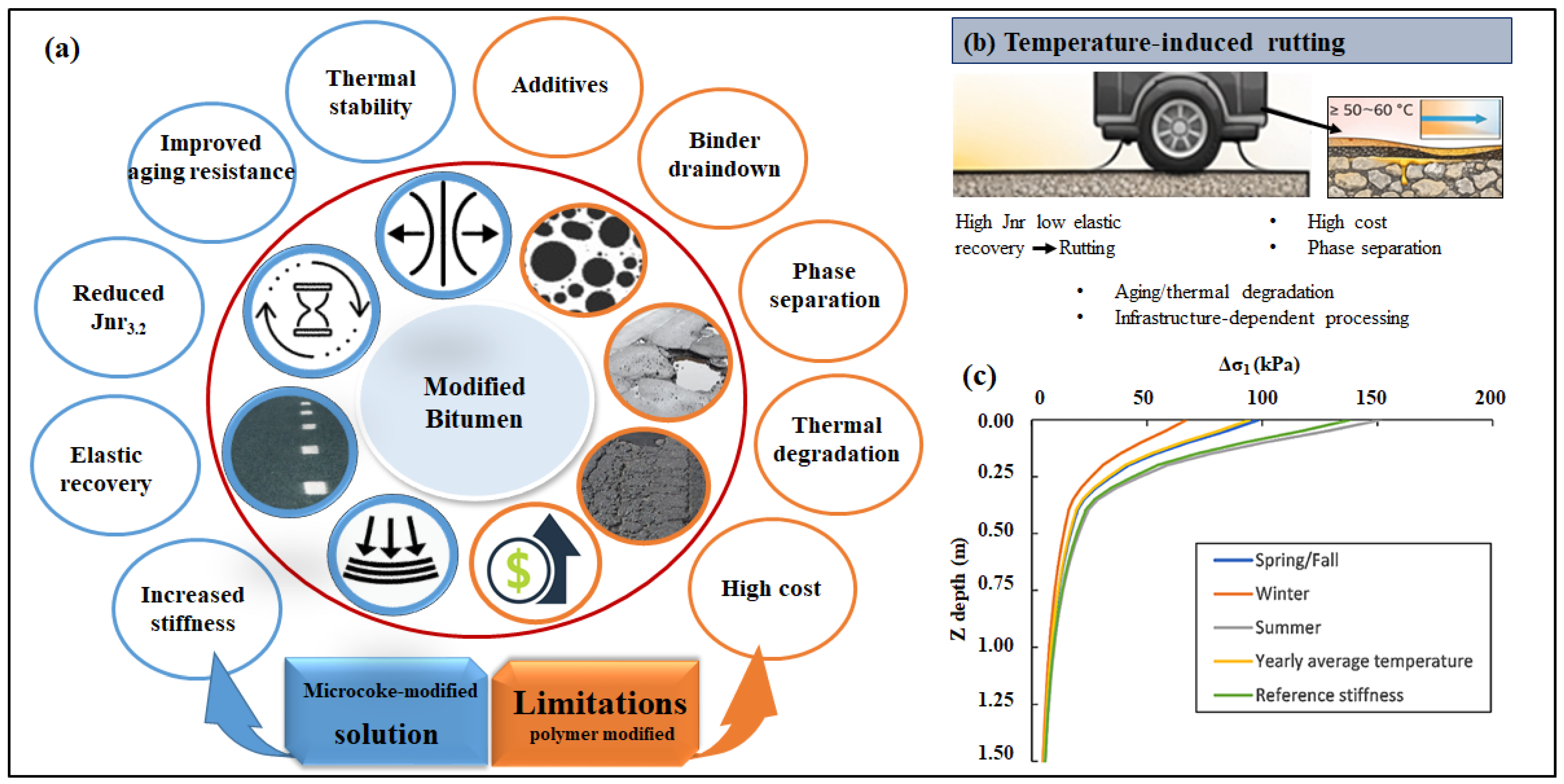
It has also been reported that the addition of carbon powder to asphalt binders has increased complex shear modulus and softening temperature and reduced temperature susceptibility, leading to improved rutting resistance of the asphalt in high service temperature [9]. Rheological and chemical tests further reveal that amorphous carbon-modified binders have a higher aging resistance, with the changes in carbonyl and sulfoxide indices of amorphous binders decreasing up to 25% compared to conventional binders, highlighting the stabilizing role of disordered carbon structures within the binder matrix [10]. The use of amorphous carbon at the mixture level as filler and binder modifier has been found to decrease rut depth by about 30–40% and enhance fatigue performance in repeated loading conditions [11]. Figure 1 conceptually illustrates the mechanism of temperature-induced rutting in conventional binders and highlights the potential role of microcoke particles in enhancing stiffness and elastic recovery.
Particle morphology, surface properties, and dispersion quality in the binder have a great effect on the reinforcing efficiency of carbonaceous materials. Dispersion quality critically governs the efficiency of particulate modifiers in asphalt binders. Homogeneous distribution enhances stress transfer and elastic recovery, whereas agglomeration promotes localized deformation. Amorphous carbon modification reduced rut depth by 30–40% when adequate dispersion was achieved [11]. Improved particle fineness and compatibility have also been shown to increase complex shear modulus and reduce non-recoverable creep compliance by approximately 20–35% [13]. Smaller particles such as nano-ZnO exhibited superior rheological enhancement due to more uniform dispersion within the binder matrix [14], while refined mineral fillers demonstrated improved deformation resistance linked directly to dispersion quality [15]. These findings confirm that particle size control and interfacial compatibility are decisive factors in optimizing high-temperature rheological performance. Empirical reports on carbon-rich and mining-derived filler substitute replacements confirm that smaller particles with greater specific surface area facilitate greater filler–binder interactions, which result in a stronger elastic response and better stress distribution in asphalt mastics [16]. Similar increments in shear rheology have been noted when the binder microstructure is tailored by processing pathways emphasizing the sensitivity of viscoelastic behavior to microstructural development [17]. Recent studies of coke-based systems also show that the coke structure and morphology can be specifically targeted, increasing surface reactivities and suitability for organic matrices [18]. Morphological studies of coke generated during the upgrading of the bitumen also indicate that particle texture and porosity are important factors in interfacial relations with the binder phase [19]. The smaller size (micro and submicron) enhances specific surface area, which facilitates better dispersion, higher interfacial adhesion, and more effective stress transfer of the binder. Decreasing particle size to the millimeter to micrometer scale could increase surface area up to several orders of magnitude and result in quantitatively higher rheological parameters, including complex shear modulus and creep recovery [8].
In addition, amorphous carbon phases also promote elastic response and dissipation, whereas graphitic domains also improve stiffness and load-bearing capacity, highlighting the need to have structural modification that is controlled. Mechanochemical activation has proved to be a scalable and more environmentally friendly way of making micro- and nanostructured materials. It is a solvent-free method that is based on mechanical energy to cause particle size reduction, defect formation, and surface activation without high temperatures [20]. Mechanochemical processing has the capability to decrease particle sizes to less than 10 µm in a short processing time, increasing surface energy and reactivity [21]. In carbon materials, this process promotes amorphization, disrupts graphitic stacking, and generates fresh reactive surfaces, which are advantageous for interaction with viscoelastic binders such as bitumen [20]. Recent improvements also indicate the energy efficiency and industrial scalability of mechanochemical pathways to functional powders with tunable structure [22].
Bitumen exhibits a colloidal viscoelastic structure in which asphaltene aggregates are dispersed within a maltene phase composed of saturates, aromatics, and resins. The stability of this structure dictates rheological behavior of the binder, and interferences in asphaltene-maltene setup are directly correlated to rutting and aging effects [23,24,25]. When service temperature is high, the molecular mobility in the maltene phase rises, resulting in lower elastic recovery and non-recoverable strain accumulation, which hastens permanent deformation under traffic loading conditions [26].
Bitumen modification aims to alter this internal structure through the incorporation of external modifiers that enhance stiffness and viscoelastic stability (Table 1). The processes of modification are not necessarily chemical, but mainly physicochemical, encompassing adsorption, physical entangling, π–π interactions between aromatic fractions, and interfacial interactions between modifier surfaces and polar bitumen components [27,28,29]. Effective modifiers can increase the complex shear modulus by over one order of magnitude at high temperatures, and non-recoverable creep compliance (Jnr.3.2) can be decreased by (30–70%), depending on the type of modifier and its dispersion quality [26,30].
Carbonaceous substances like petroleum coke and coal coke provide a structurally strong and thermally stable substitute to conventional polymer modifiers. Their strong carbon content, inflexible microstructure, and surface heterogeneity allow mechanical reinforcement of the binder matrix, limiting the mobility of the molecules and facilitating stress transfer during the load. With a reduced ash content and greater amorphous graphitic regions, petroleum coke is generally more compatible with bitumen, and coal coke provides increased mechanical rigidity through its mineral-rich and heterogeneous structure [31]. Mechanochemical activation additionally amplifies these effects by decreasing the size of the particles, improving the surface area, and facilitating more interfacial interactions, which results in quantifiable advances in high-temperature rheological performance and rutting resistance [32,33].
Reports in the existing literature largely dwell on generic carbon fillers or nanomaterial with little systematic association among microcoke particle size, structural evolution, and high-temperature rheological performance [8]. Specifically, the Multiple Stress Creep and Recovery (MSCR) framework outlined in [34] is a relatively uncommon method of Superpave-based performance assessment when applied in the context of coke-modified binders, which limits the applicability and comparability of engineering. Therefore, this research seeks to fill these gaps by investigating bitumen modification using microcoke produced via mechanochemical activation. It is hypothesized that mechanochemically activated microcoke improves the high-temperature rheological performance of bitumen by increasing stiffness and reducing Jnr3.2.
The main objectives of this work are to synthesize microdispersed petroleum and coal coke through controlled mechanochemical treatment, to characterize its particle size and morphology and carbon structure, and to evaluate the high-temperature rheological performance of microcoke-modified bitumen through dynamic shear rheometry and MSCR under Superpave requirements. By establishing clear structure–property relationships, this work provides new insight into the potential of microcoke as a cost-effective and thermally stable modifier for high-performance bituminous binders.

2. Materials and Methods

2.1. Materials

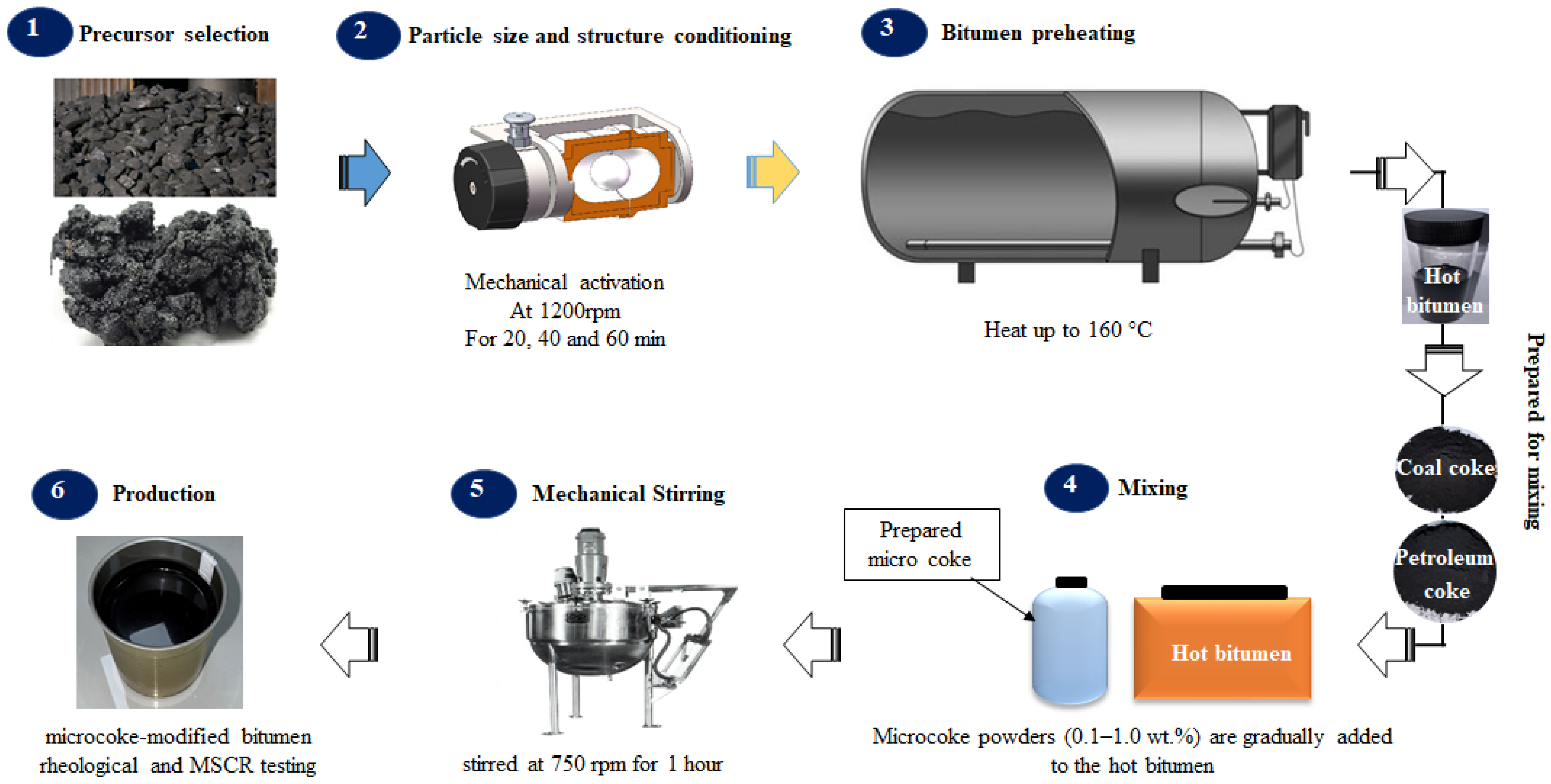
Coal coke and petroleum coke used in this study were supplied by Pavlodar Petrochemical Plant LLC (Pavlodar, Kazakhstan). A penetration-grade bitumen, BND 100/130, obtained from “Asphaltbeton 1” LLC (Almaty, Kazakhstan), was employed as the base binder. Microdispersed coke powders were produced via mechanochemical activation using a GT 300 planetary mill (Powteq, Beijing Grinder Instrument Co., Ltd., Beijing, China). Grinding was conducted at coke-to-steel ball mass ratios of 1:1 and 1:2, with a rotational speed of 1200 rpm and milling durations of 20, 40, and 60 min. This approach enabled controlled particle size reduction and structural activation of the coke materials. Bitumen modification was performed by incorporating microdispersed petroleum and coal coke powders into BND 100/130 binder at doses of 0.5 and 1.0 wt.%. The mixing process was carried out using a propeller mixer at a rotational speed of 750 rpm and a temperature of 160 °C for 1 h to ensure homogeneous dispersion of the coke particles within the bitumen matrix while minimizing thermal degradation. The preparation route adopted in this study is summarized schematically in Figure 2.

2.2. Characterization Methods

The particle size distributions of coke samples before and after mechanochemical activation were determined using a Winner 2000E laser particle size analyzer (Jinan Winner Particle Instruments Stock Co., Ltd., Jinan, China). Measurements were performed under standardized dispersion conditions to ensure reproducibility. The obtained data were used to quantify the degree of particle refinement achieved through milling and to correlate particle size characteristics with rheological performance of the modified binders.
X-ray diffraction (XRD) analysis was employed to investigate changes in the carbon structure induced by mechanochemical activation. Measurements were conducted using a DW-XRD-27mini diffractometer (Chongqing Drawell Instrument Co., Ltd., Chongqing, China) with Cu Kα radiation (λ = 1.5406 Å), operating at 40 kV and 15 mA. Diffraction patterns were collected in θ–2θ geometry over a 2θ range of 5–50°. The analysis focused on identifying the degree of structural order, graphitic stacking, and amorphization in the coke samples. The full width at half maximum (FWHM) was calculated based on the intensity and shape of the diffraction peaks characteristic of amorphous carbon. The crystallite size was calculated with the Scherrer formula using a wavelength of 0.15406 Å, and the degree of disorder was estimated through the deviation of the interplanar distance from ideal graphite d = 3.354 Å.
Morphological features and surface textures of the coke powders were examined using a JSM-6490LA scanning electron microscope (SEM) (JEOL Ltd., Tokyo, Japan). SEM analysis provided qualitative insight into particle shape, agglomeration behavior, surface roughness, and the effect of mechanochemical activation on coke morphology, all of which are relevant to dispersion and interaction within the bituminous binder.
High-temperature performance of the modified binders was evaluated using the Multiple Stress Creep and Recovery (MSCR) test, which assesses resistance to permanent deformation under repeated loading. The test was performed in accordance with American Association of State Highway and Transportation Officials [35] and the traffic classification criteria defined in [34]. MSCR measurements were conducted using a Smartpave 102e dynamic shear rheometer equipped with parallel plates of 25 mm diameter and a 1 mm gap. The testing temperature for all specimens was 58 °C, which corresponds to the high-temperature class of the original grade asphalt binder, as determined by the PG system. Each test consisted of 10 creep–recovery cycles at a shear stress of 0.1 kPa, followed by 10 cycles at 3.2 kPa. Each cycle comprised 1 s of loading and 9 s of recovery. The non-recoverable creep compliance (Jnr) and percent recovery (R) were calculated for both stress levels. The parameter Jnr3.2 was used as a key indicator of rutting resistance, with lower values corresponding to improved high-temperature performance. The recovery parameter R3.2 was employed to assess the effectiveness of binder modification.
Stress sensitivity was quantified using the percentage difference in non-recoverable compliance (Jnr,diff), calculated as follows:
J n r , d i f f = ( J n r 3.2 J n r 0.1 ) J n r 0.1 · 100 %
where Jnr,diff values greater than 75% indicate excessive stress sensitivity according to [34]. Similarly, the change in recovery with increasing stress (Rdiff) was calculated as
R d i f f = ( R 0.1 R 3.2 ) R 0.1 · 100 %
These parameters provide a comprehensive assessment of binder performance under traffic-relevant loading conditions.
Prior to rheological testing, the binders were subjected to short-term aging using the Rolling Thin Film Oven Test (RTFO) following [36] to simulate the aging conditions occurring during asphalt mixing and placement. Aging was conducted at a temperature of 163 °C for 75 min, which allows for the reproduction of short-term aging conditions of bitumen binders occurring during the production and placement of asphalt concrete mixtures and is widely used in laboratory practice to prepare samples for rheological testing.
For each binder, three replicate tests were performed, and the average values were reported. Specimens were trimmed to the plate diameter prior to testing, and potential plate slippage was monitored through torque and strain stability to ensure compliance with [35] testing requirements.

3. Results and Discussion

The effectiveness of carbonaceous modifiers in bitumen systems is strongly governed by their particle size, surface characteristics, and the activation route employed prior to blending [37]. Mechanochemical grinding not only reduces particle size but also alters surface reactivity and interfacial compatibility, which are critical for achieving structural reinforcement and high-temperature rheological enhancement in modified binders. The results presented herein elucidate the particle size evolution of petroleum coke and coal coke under controlled mechanochemical activation and discuss their implications for bitumen modification performance. Mechanochemical activation led to a substantial reduction in particle size for both coke types, though with markedly different grinding efficiencies. Petroleum coke exhibited significantly higher grindability than coal coke, consistent with its lower mechanical strength and more disordered carbon structure [38]. After 40 min of milling at a 1:1 coke-to-ball mass ratio, petroleum coke reached a minimum average particle diameter of 8.28 μm (by volume) and 2.4 μm (by surface area), with a maximum surface area per unit volume of 25,052.88 cm2/cm3. In contrast, coal coke, ground at a 1:2 ratio, achieved its minimum particle size at the same grinding time, with average diameters of 16.64 μm (by volume) and 7.74 μm (by surface area), and a lower surface area to volume ratio of 7749.10 cm2/cm3. Table 2 summarizes the particle size distributions, average diameters, and surface area to volume ratios of petroleum coke and coal coke after controlled grinding.
The non-monotonic evolution of particle size with increasing grinding time reflects the competition between fracture and agglomeration mechanisms. While initial milling promotes particle breakage, prolonged grinding enhances surface energy and interparticle attraction, leading to partial re-agglomeration and reduced effective surface area [37,38]. This behavior was evident for both coke types after 60 min of grinding.
From a modification standpoint, the particle size regime obtained at 40 min is optimal for bitumen reinforcement. Increased surface area enhances physical adsorption and mechanical interlocking with asphaltene-rich domains, restricting molecular mobility and improving high-temperature stiffness and rutting resistance [39]. The finer dispersion and higher surface activity of petroleum coke indicate superior reinforcing efficiency compared to coal coke, highlighting its suitability for high-temperature performance enhancement in microcoke-modified bitumen systems [40].
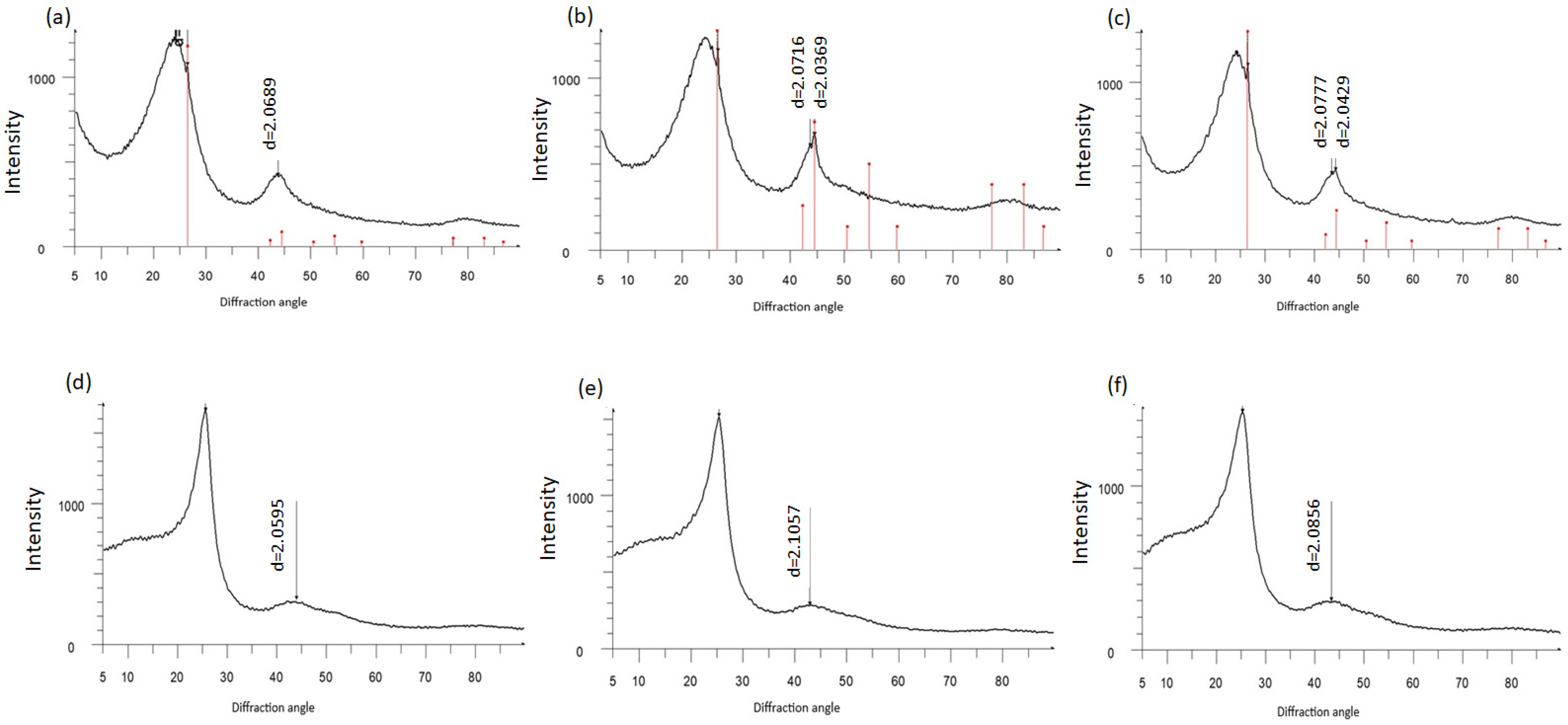
Structural evolution of mechanochemically activated coke powders was investigated by X-ray diffraction to elucidate the effects of grinding time and coke origin on carbon ordering and amorphization. Figure 3 presents the XRD patterns of petroleum and coal coke powders subjected to different milling durations. For petroleum coke milled for 20 min, the diffraction pattern was dominated by two broad diffuse halos centered at interplanar distances of approximately 3.7068 Å and 2.0689 Å, which are characteristic of turbostratic and amorphous carbon structures. The presence of weak graphite-related reflections indicated incomplete structural disordering at this stage. Such diffuse features are typical of partially disordered carbon materials produced via mechanical activation, where short-range ordering persists despite lattice disruption [41]. As shown in Figure 3a and Table 3, the broadening of these reflections reflected a reduction in coherent scattering domains and increased defect density.
After 40 min of grinding, petroleum coke exhibited a further evolution toward structural disorder, evidenced by the shift of amorphous carbon maxima to 3.6523 Å and 2.0716 Å and the appearance of a weak graphite-related reflection at 3.3576 Å. The emergence of a subtle peak at 2.0369 Å suggested the onset of localized crystallization within an otherwise amorphous matrix, which is commonly attributed to mechanically induced rearrangement of π-conjugated carbon layers under high-energy milling conditions [42]. This coexistence of amorphous and nanocrystalline domains indicates an optimal balance between structural activation and excessive ordering.
Prolonged milling to 60 min did not enhance amorphization further. As observed in Figure 3c, the intensity of graphite-related reflections slightly decreased, and the peak at 2.0429 Å became less pronounced, indicating partial relaxation or reorganization of the carbon structure. This behavior suggests a dynamic equilibrium between defect generation and structural relaxation, consistent with mechanochemical studies reporting re-agglomeration and local structural healing at extended milling times [43]. These findings align with the non-monotonic particle size trends discussed earlier, confirming that excessive grinding does not necessarily improve functional surface characteristics.
Coal coke powders display distinct structural behavior due to their higher mineral content and intrinsic structural heterogeneity. As shown in Figure 3d–f, coal coke exhibited broader amorphous halos with interplanar spacings ranging from 3.4849 to 3.5202 Å, but with narrower half-widths compared to petroleum coke, indicating a lower degree of amorphization. The persistent diffuse features in the low-angle region (5–20°) suggest the presence of an additional amorphous carbon phase, potentially associated with residual inorganic–carbon complexes [41]. This structural rigidity limits defect formation and suppresses extensive lattice disruption during milling.
With increasing grinding time, the half-width increased, indicating defect accumulation. The crystallite size for all samples ranged from 0.9 to 1.7 Å. This indicates that the “crystallites” consisted of only a few carbon layers. Peaks around 26° (d ≤ 3.37 Å) correspond to more ordered fragments (similar to graphite). Peaks around 43° and a broad halo around 24° correspond to amorphous phases and small, misoriented stacks of layers.
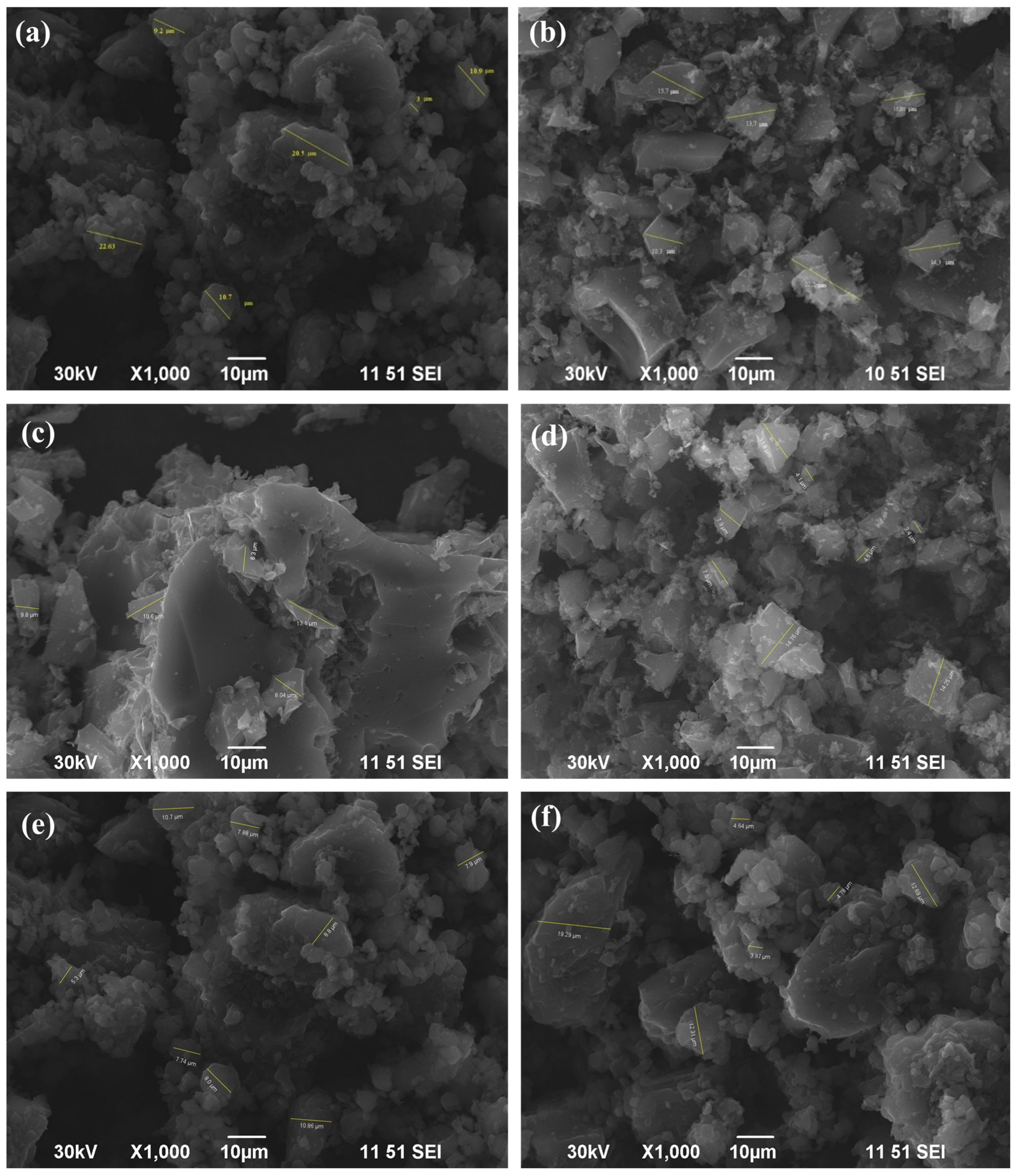
SEM observations were conducted on samples ground for 40 min at 1200 rpm using coke-to-ball mass ratios of 1:1 for petroleum coke and 1:2 for coal coke, corresponding to the minimum average particle diameters identified in Table 2. The resulting micrographs are presented in Figure 4. As shown in Figure 4a, petroleum coke powders consist of relatively uniform, flake-like particles forming weakly bonded agglomerates, with individual particle sizes measured at approximately 3.0, 9.2, 10.7, and 10.9 μm. These values are in good agreement with the volume-average particle diameter of 8.28 μm reported in Table 2, confirming the high efficiency of mechanochemical grinding for petroleum coke.
In contrast, the coal coke powders shown in Figure 4b exhibit a broader particle size distribution and more angular fragments, with particle sizes ranging from approximately 10.3 to 22.2 μm. Figure 4c shows a noticeably different morphology compared with Figure 4a,b. The particles appear as larger plate-like fragments with partially fractured edges, suggesting that the grinding process caused delamination of the layered carbon structure. Several particles remain attached to larger sheets, forming compact clusters. The measured particle dimensions in this micrograph are generally larger than those observed for petroleum coke alone, indicating the presence of partially broken agglomerates rather than fully liberated fine particles. This morphology suggests incomplete fragmentation and the tendency of the material to retain larger structural units during milling.
In Figure 4d, the particle morphology becomes more heterogeneous, consisting of irregular flakes mixed with smaller fragmented particles. The particles appear more densely packed, forming clusters with reduced visible void spaces. The measured particle sizes are more uniformly distributed compared with Figure 4b, suggesting that additional grinding or mixing promotes a more consistent particle breakdown. The surfaces of the particles appear rough and angular, indicating mechanical fracture as the dominant size reduction mechanism.
Figure 4e shows particles that are relatively finer and more compactly agglomerated compared with the previous samples. The particles appear as small flakes attached to larger aggregates, forming a porous structure. The measured particle sizes are generally smaller than those observed in Figure 4c, suggesting that further mechanochemical processing promotes particle refinement and increased surface exposure. The presence of numerous small fragments surrounding larger particles indicates progressive fragmentation and secondary agglomeration.
Finally, Figure 4f reveals a morphology characterized by relatively larger flakes surrounded by clusters of smaller particles. The particle edges appear more defined and angular, indicating continued mechanical fracture. Compared with Figure 4e, the particles appear slightly larger but more structurally distinct, suggesting that the material may have undergone partial agglomeration after grinding. This morphology corresponds well with the larger average particle diameter of 16.64 μm by volume reported in Table 2. The observed differences in grindability and morphology are consistent with the higher mechanical strength of coal coke compared to petroleum coke, as previously reported for carbonaceous materials subjected to ball milling [38,39]. The flake-like morphology and microdispersed nature of both coke powders increase their effective surface area and promote physical interaction with the bitumen matrix. Such microstructural features are particularly important for reinforcing bitumen through particle binder interlocking and restriction of molecular mobility, as supported by studies on carbon-based modifiers in asphalt systems [40].
The influence of microdispersed coke powders on the conventional physico-mechanical properties of bitumen is summarized in Table 4. Increasing the modifier content from 0.5 to 1 wt.% results in a decrease in needle penetration depth and increase in softening point temperature for petroleum and coal coke-modified binders. This change in properties indicates enhanced thermal resistance while maintaining sufficient ductility, reflecting a reinforced but not excessively stiff binder structure.
At equivalent doses, coal coke-modified bitumen exhibited higher penetration and softening point values than petroleum coke-modified bitumen. In particular, bitumen modified with 1 wt.% coal microcoke showed the penetration value of 71.7 × 0.1 mm and the highest softening temperature (52.7 °C), as reported in Table 4. This behavior can be attributed to the coarser particle size and more rigid carbon framework of coal coke, which enhances mechanical anchoring within the bitumen matrix and improves resistance to thermal flow [41]. According to the requirements of [44], bitumen samples modified with 0.5 wt.% petroleum coke, 1 wt.% coal coke, and 0.5 wt.% coal coke comply with the BND 70/100 grade. However, bitumen containing 1.0 wt.% petroleum microcoke fails to meet the penetration requirement, emphasizing that petroleum coke particles require lower doses to achieve sufficient structural reinforcement.
While penetration and softening point provide initial insights, the Superpave system evaluates binder performance based on resistance to permanent deformation under realistic loading conditions. This method classifies bitumen according to a Performance Grade (PG) temperature range. Since 2010, the system has been supplemented with a Multiple Stress Creep Recovery (MSCR) test, which determines the traffic performance of a bitumen binder. Table 5 lists [34] bitumen performance requirements by category and traffic intensity. Bitumen compliance with a given traffic category is determined by the Jnr3.2 value.
All coke-modified binders exhibited lower non-recoverable creep compliance (Jnr) values at both 0.1 and 3.2 kPa compared to the original BND 100/130 bitumen, indicating improved rutting resistance. The most pronounced reduction in Jnr was observed for bitumen modified with 1 wt.% petroleum microcoke, which exhibited Jnr3.2 = 2.08 kPa−1 and the lowest Jnr,diff value (18.54%). This indicates reduced sensitivity to stress level and superior resistance to permanent deformation under repeated loading [45].
A direct comparison of the results presented in Table 4 and Table 6 highlights distinct reinforcement mechanisms for petroleum and coal microcoke modifiers. Petroleum microcoke, characterized by finer particle size and higher specific surface area (Table 2), primarily enhances resistance to permanent deformation by limiting viscous flow and reducing stress sensitivity. Coal microcoke, with its larger particle size and greater rigidity, contributes more effectively to elastic recovery and thermal stability. These complementary behaviors are consistent with the microstructural observations in Figure 4 and align with previous findings on carbon-based particulate reinforcement in composite and asphalt systems [39,46].
The values for non-recoverable creep compliance at low (0.1 kPa) and high (3.2 kPa) load levels, Jnr, characterize the magnitude of permanent deformation that remains after the load is removed. The lower the value, the better the bitumen’s rutting resistance. Comparing Jnr at different loads allows us to assess the bitumen’s sensitivity to stress changes. The percentage change in Jnr between two load levels reflects the bitumen’s sensitivity to the load; a higher percentage indicates greater sensitivity.
The percentage of deformation recovery at low (0.1 kPa) and high (3.2 kPa) load levels, R, reflects the elastic component of bitumen behavior. In contrast, bitumen modified with 1 wt.% petroleum microcoke demonstrated the highest recovery percentages at both stress levels (Table 6), reflecting enhanced elastic behavior. The lower Rdiff value (78.30%) for this binder indicates a smaller loss of recovery capacity with increasing stress, which is advantageous for pavements subjected to variable traffic loads and elevated service temperatures. A comparison of the Jnr values for bitumen modified with microdispersed coke samples indicates that bitumen modified with 1 wt.% petroleum coke micropowder exhibits better resistance to permanent deformation (rutting) at both load levels than other samples. The Jnr,diff percentage of this sample (18.54%) was significantly lower than that of the original bitumen (21.65%) and was less sensitive to increasing load in terms of permanent deformation. This is a significant advantage of bitumen modified with 1 wt.% petroleum coke micropowder, as its properties change less with increasing traffic loads, and it is less susceptible to loss of elastic properties under high loads.
Based on the Jnr3.2 values reported in Table 6 and the Superpave requirements summarized in Table 5, all coke-modified binders fall within the “S” traffic category according to [34], making them suitable for pavements subjected to standard traffic conditions. Importantly, none of the modified binders exceeded the allowable Jnr,diff limit, confirming stable performance under varying stress levels. From a practical standpoint, microdispersed coke modifiers offer several industrial advantages. They are compatible with existing asphalt mixing plants, widely available as low-cost industrial by-products, and amenable to scalable mechanochemical processing. These factors, combined with demonstrated improvements in high-temperature rheological performance, position microdispersed petroleum and coal coke as technically and economically viable alternatives to conventional polymer modifiers [47,48].
The above findings confirm that mechanochemically activated microdispersed coke powders are effective physical modifiers of bitumen, and the performance is controlled by particle size, morphology, and structural disorder instead of chemical modification of the binder. The combined explanation of XRD, SEM, physico-mechanical and MSCR parameters proves that petroleum microcoke increases rutting resistance by a higher degree of fine dispersion and lower non-recoverable creep, and coal microcoke increases elastic recovery and thermal stability by a higher degree of relatively coarse but mechanically strong microstructure. These effects were consistently reflected in the compliance of the modified binders with Superpave criteria for standard traffic conditions, confirming both technical effectiveness and practical applicability within existing asphalt production systems.

4. Conclusions

This work has illustrated that mechanochemical activation is an efficient and scalable technique of making microdispersed coke powders that can be used in asphalt concrete. Through controlled milling, coke powders with microphase particle sizes were successfully obtained, achieving minimum average volume-based particle diameters of 8.28 μm for petroleum coke and 16.64 μm for coal coke. Structural characterization confirmed that the powders obtained are mostly amorphous carbon with some traces of graphite, formed as a result of mechanochemical treatment rather than full graphitization. The XRD and SEM results showed similar particle sizes and morphological characteristics, which confirms the validity of the synthesis and characterization method. Optimal processing parameters for mechanochemical activation were systematically established, with a grinding time of 40 min and a ball rotational speed of 1200 rpm giving the best balance between a reduction in the particle size and the structural stability. The best coke-to-ball mass ratios were found to be 1:1 between petroleum coke and 1:2 between coal coke, which indicates inherent variations in hardness and grindability of the two carbon sources. These conditions permit reproducible production of fine and microdispersed powders with the controlled structural disorder that is required of them to ensure functionality as bitumen modifiers.
Synthesized microdispersed coke powders were incorporated into BND 100/130 bitumen at a low loading rate of 1 wt.%, which led to a progressive enhancement of physico-mechanical characteristics. The modified binders met the requirements of the BND 70/100 grade, in accordance with ST RK 1373-2013, confirming a meaningful enhancement in stiffness and performance without compromising processability. Additionally, rheological analysis according to AASHTO M 332-20 revealed that all modified binders were within the Jnr3.2 range of 2.0–3.0 kPa−1, which corresponds to S traffic classification.
These findings highlight the practicality of microdispersed coke powders as cost-effective and carbon-based modifiers in road binders that are currently utilized in normal traffic situations, and provide a viable route to the valorization of coke-based materials in pavement engineering.

Author Contributions

Conceptualization, Y.O. and M.H.; methodology, Y.T. and Y.I.; software, A.K. (Aliya Kenzhegaliyeva); validation, A.Z. and A.K. (Aliya Kenzhegaliyeva); investigation, Y.K., A.K. (Aliya Kenzhegaliyeva), A.K. (Aksaule Kydyrali) and D.A.; resources, Y.O.; data curation, Y.O.; writing—original draft preparation, Y.O.; writing—review and editing, M.H.; visualization, M.H.; supervision, Y.O.; project administration, Y.O.; funding acquisition, Y.O. All authors have read and agreed to the published version of the manuscript.

Funding

This research was funded by the Science Committee of the Ministry of Science and Higher Education of the Republic of Kazakhstan, grant No. BR24992915, “Development of technologies for producing high-strength asphalt concrete based on elastomeric, polymer-bitumen binders and plasma-chemical processing of liquid carbon-containing waste”.

Data Availability Statement

The data that support the findings of this study are included within this manuscript.

Conflicts of Interest

The authors declare no conflicts of interest.

References

  1. Deng, Y.; Shi, X. Modeling the rutting performance of asphalt pavements: A review. J. Infrastruct. Preserv. Resil. 2023, 4, 17. [Google Scholar] [CrossRef]
  2. Rochlani, M.; Falla, G.C.; Caro, S.; Leischner, S.; Wellner, F. Understanding the influence of temperature and frequency on the fatigue resistance of bitumen. Constr. Build. Mater. 2021, 296, 123754. [Google Scholar] [CrossRef]
  3. Penki, R.; Rout, S.K. Next-generation bitumen: A review on challenges and recent developments in bio-bitumen preparation and usage. Biomass Convers. Biorefin. 2023, 13, 9583–9600. [Google Scholar] [CrossRef]
  4. Alnadish, A.M.; Katman, H.Y.B.; Ibrahim, M.R.; Gamil, Y.; Mashaan, N.S. A bibliometric analysis and review on the performance of polymer-modified bitumen. Front. Mater. 2023, 10, 1225830. [Google Scholar] [CrossRef]
  5. Porto, M.; Caputo, P.; Loise, V.; Eskandarsefat, S.; Teltayev, B.; Oliviero Rossi, C. Bitumen and bitumen modification: A review on latest advances. Appl. Sci. 2019, 9, 742. [Google Scholar] [CrossRef]
  6. Yan, X.; Wu, D.; Hu, K.; Zhang, W.; Xing, J.; Cui, L.; Yang, C. The modification mechanism, evaluation method, and construction technology of direct-to-plant SBS modifiers in asphalt mixture: A review. Polymers 2023, 15, 2768. [Google Scholar] [CrossRef]
  7. Shambilova, G.K.; Iskakov, R.M.; Shazhdekeyeva, N.K.; Kuanbayeva, B.U.; Kuzin, M.S.; Skvortsov, I.Y.; Makarov, I.S. Environmentally sustainable and climate-adapted bitumen–composite materials for road construction in Central Asia. Infrastructures 2025, 10, 345. [Google Scholar] [CrossRef]
  8. Hashami, M.; Ongarbayev, Y.; Tileuberdi, Y.; Imanbayev, Y.; Zhambolova, A.; Kenzhegaliyeva, A.; Mansurov, Z. Integration of coke and CNMs with bitumen: Synthesis, methods, and characterization. Nanomaterials 2025, 15, 842. [Google Scholar] [CrossRef]
  9. Amirbayev, Y.; Yelshibayev, A.; Nugmanova, A. Characterization of asphalt bitumens and asphalt concretes modified with carbon powder. Case Stud. Constr. Mater. 2022, 17, e01554. [Google Scholar] [CrossRef]
  10. Nakhaei, M.; Ziari, H.; Korayem, A.H.; Hajiloo, M. Aging evaluation of amorphous carbon-modified asphalt binders using rheological and chemical approach. J. Mater. Civil Eng. 2020, 32, 04019321. [Google Scholar] [CrossRef]
  11. Korayem, A.H.; Ziari, H.; Hajiloo, M.; Moniri, A. Rutting and fatigue performance of asphalt mixtures containing amorphous carbon as filler and binder modifier. Constr. Build. Mater. 2018, 188, 905–914. [Google Scholar] [CrossRef]
  12. Vámos, M.J.; Szendefy, J. Temperature effects on traffic load-induced accumulating strains in flexible pavement structures. Int. J. Pav. Res. Technol. 2024, 19, 509–520. [Google Scholar] [CrossRef]
  13. Zhao, S.; Huang, B.; Ye, X.P.; Shu, X.; Jia, X. Utilizing bio-char as a bio-modifier for asphalt cement: A sustainable application of bio-fuel by-product. Fuel 2014, 133, 52–62. [Google Scholar] [CrossRef]
  14. Zhang, H.; Gao, Y.; Guo, G.; Zhao, B.; Yu, J. Effects of ZnO particle size on properties of asphalt and asphalt mixture. Constr. Build. Mater. 2018, 159, 578–586. [Google Scholar] [CrossRef]
  15. Yu, H.; Zhu, X.; Qian, G.; Gong, X.; Nie, X. Evaluation of phosphorus slag (PS) content and particle size on the performance modification effect of asphalt. Constr. Build. Mater. 2020, 256, 119334. [Google Scholar] [CrossRef]
  16. Giustozzi, F.; Mansour, K.; Patti, F.; Pannirselvam, M.; Fiori, F. Shear rheology and microstructure of mining material-bitumen composites as filler replacement in asphalt mastics. Constr. Build. Mater. 2018, 171, 726–735. [Google Scholar] [CrossRef]
  17. Ganter, D.; Mielke, T.; Maier, M.; Lupascu, D.C. Bitumen rheology and the impact of rejuvenators. Constr. Build. Mater. 2019, 222, 414–423. [Google Scholar] [CrossRef]
  18. Wang, L.; Yang, Y.; Ou, Y.; Tang, P.; Liu, C.; Zhang, X.; Jiang, T. Preparation of formed coke product as a coke substitute using a solid waste fuel: Trimethylbenzene improvement on coal tar pitch. Fuel 2023, 346, 128275. [Google Scholar] [CrossRef]
  19. Bagherzadeh, H.; Nath, D.; Dahbag, M.B.; Hassanzadeh, H. Partial upgrading of bitumen with supercritical water liquid products characteristics, gas composition and coke morphology. J. Supercrit. Fluids 2024, 211, 106319. [Google Scholar] [CrossRef]
  20. Liu, X.; Li, Y.; Zeng, L.; Li, X.; Chen, N.; Bai, S.; Zhang, C. A review on mechanochemistry: Approaching advanced energy materials with greener force. Adv. Mater. 2022, 34, 2108327. [Google Scholar] [CrossRef]
  21. Colacino, E.; Carta, M.; Pia, G.; Porcheddu, A.; Ricci, P.C.; Delogu, F. Processing and investigation methods in mechanochemical kinetics. ACS Omega 2018, 3, 9196–9209. [Google Scholar] [CrossRef]
  22. Templ, J.; Borchardt, L. Mechanochemical strategies applied to the late-stage modifications of pharmaceutically active compounds. Angew. Chem. Int. Ed. 2025, 64, e202503061. [Google Scholar] [CrossRef]
  23. Mangiafico, S.; Di Benedetto, H.; Sauzéat, C.; Olard, F.; Pouget, S.; Planque, L. Effect of colloidal structure of bituminous binder blends on linear viscoelastic behaviour of mixtures containing reclaimed asphalt pavement. Mater. Des. 2016, 111, 126–139. [Google Scholar] [CrossRef]
  24. Porto, M.; Angelico, R.; Caputo, P.; Abe, A.A.; Teltayev, B.; Rossi, C.O. The structure of bitumen: Conceptual models and experimental evidences. Materials 2022, 15, 905. [Google Scholar] [CrossRef]
  25. Tileuberdi, Y.; Kuoshiken, U.; Ongarbayev, Y.; Tulepov, M.; Shadin, N.; Sadirbekova, D.; Zhussupova, L.; Imanbayev, Y.; Zhambolova, A. A review of asphaltenes: Composition, structure, properties, behavior, and applications. Eng. Sci. 2025, 35, 1547. [Google Scholar] [CrossRef]
  26. Ongarbayev, Y.; Zhambolova, A.; Kenzhegaliyeva, A. Rheological characteristics of petroleum bitumen using the Superpave system. Combust. Plasma Chem. 2025, 23, 173–184. [Google Scholar] [CrossRef]
  27. Loise, V.; Caputo, P.; Porto, M.; Calandra, P.; Angelico, R.; Oliviero Rossi, C. A review on bitumen rejuvenation: Mechanisms, materials, methods and perspectives. Appl. Sci. 2019, 9, 4316. [Google Scholar] [CrossRef]
  28. Hashami, M.; Ongarbayev, Y.; Abdikhan, D.; Akkazin, E.; Nessipbayeva, N. Ozonation of bitumen: Characteristics, characterization, and applications. Processes 2025, 13, 708. [Google Scholar] [CrossRef]
  29. Li, T.; Wang, D.; Yan, S.; Fan, Z.; Liu, J.; Jiao, X.; Wang, D. Effects of bitumen chemical composition on the mechanical properties of isocyanate-based chemically modified bitumen. Constr. Build. Mater. 2025, 490, 142383. [Google Scholar] [CrossRef]
  30. Shi, K.; Ma, F.; Fu, Z.; Song, R.; Yuan, D.; Ogbon, A.W. Enhancing aged SBS-modified bitumen performance with unaged bitumen additives. Constr. Build. Mater. 2024, 412, 134768. [Google Scholar] [CrossRef]
  31. Tileuberdi, Y.; Ongarbayev, Y.; Mukatayeva, Z.; Zhanbekov, K.; Mukhambetkaliyev, K.; Akkazin, Y.; Shadin, N.; Imanbayev, Y. Studying characteristics of hot fine-grained asphalt concrete with the addition of coked sands from the pyrolysis of oil sands. Processes 2024, 12, 2540. [Google Scholar] [CrossRef]
  32. Hu, T.; Luo, Y.; Zhu, Y.; Chu, Y.; Hu, G.; Xu, X. Mechanochemical preparation and performance evaluations of bitumen-used waste polypropylene modifiers. Case Stud. Constr. Mater. 2024, 21, e03471. [Google Scholar] [CrossRef]
  33. Naseem, Z.; Shamsaei, E.; Sagoe-Crentsil, K.; Duan, W. Rheological enhancement of fresh polymer-modified cement composites via surface-modified graphene oxide. Cem. Concr. Compos. 2024, 147, 105413. [Google Scholar] [CrossRef]
  34. AASHTO M332; Standard Specification for Performance-Graded Asphalt Binder Using Multiple Stress Creep Recovery (MSCR) Test. American Association of State Highway and Transportation Officials (AASHTO): Washington, DC, USA, 2023.
  35. AASHTO T350; Standard Method of Test for Multiple Stress Creep Recovery (MSCR) Test of Asphalt Binder Using a Dynamic Shear Rheometer (DSR). American Association of State Highway and Transportation Officials (AASHTO): Washington, DC, USA, 2019.
  36. AASHTO M240; Standard Method of Test for Effect of Heat and Air on a Moving Film of Asphalt Binder (Rolling Thin-Film Oven Test). American Association of State Highway and Transportation Officials (AASHTO): Washington, DC, USA, 2023.
  37. Jiang, Y.; Liu, Y.Q.; Yan, Z.Y.; Zhao, Z.M.; Wang, Y.F.; Zhou, W.G. Mechanism of ball milling effect on carbothermic reduction of industrial magnesia by coke. Metall. Mater. Trans. B 2019, 50, 1617–1626. [Google Scholar] [CrossRef]
  38. Colorado-Arango, L.; Menéndez-Aguado, J.M.; Osorio-Correa, A. Particle size distribution models for metallurgical coke grinding products. Metals 2021, 11, 1288. [Google Scholar] [CrossRef]
  39. Yang, Q.; Liu, Q.; Zhong, J.; Hong, B.; Wang, D.; Oeser, M. Rheological and micro-structural characterization of bitumen modified with carbon nanomaterials. Constr. Build. Mater. 2019, 201, 580–589. [Google Scholar] [CrossRef]
  40. Jeffry, S.N.A.; Putra Jaya, R.; Abdul Hassan, N.; Yaacob, H.; Mahmud, M.Z.H.; Al-Saffar, Z.H. The influence of nano-carbon from coconut shell ash as modifier on the properties of bitumen. Road Mater. Pav. Des. 2022, 23, 770–786. [Google Scholar] [CrossRef]
  41. Chen, X.; Guo, Y.; Cui, J.; Zhang, H.; Cheng, F.; Zou, Y. Activated carbon preparation with the addition of coke-making by-product coke powder: Texture evolution and mechanism. J. Clean. Prod. 2019, 237, 117812. [Google Scholar] [CrossRef]
  42. Xuan, M.; Schumacher, C.; Bolm, C.; Göstl, R.; Herrmann, A. The mechanochemical synthesis and activation of carbon-rich π-conjugated materials. Adv. Sci. 2022, 9, 2105497. [Google Scholar]
  43. Ahmad, R.; Kaushal, S.; Abdelnaby, M.M.; Abdelbary, A.I.; Essalhi, M.; Kumar, A.M.; Hussein, M.A. Synergistic mechanochemical and thermal treatment for enhancing the structure and textural properties of petroleum coke-derived carbon materials. Diam. Rel. Mater. 2026, 162, 113318. [Google Scholar]
  44. ST RK 1373-2013; Bitumen and Bitumen Binders. Viscous Petroleum Road Bitumen. Specifications. Committee for Technical Regulation and Metrology of the Ministry of Industry and New Technologies of the Republic of Kazakhstan (Gosstandart): Astana, Kazakhstan, 2013.
  45. Fares, M.Y.; Marini, S.; Lanotte, M. Multiple stress creep recovery of high-polymer modified binders: Consideration of temperature and stress sensitivity for quality assurance/quality control policy development. Trans. Res. Rec. 2024, 2678, 312–328. [Google Scholar] [CrossRef]
  46. Imanbayev, Y.; Ongarbayev, Y.; Zhambolova, A.; Tileuberdi, Y.; Kanzharkan, Y.; Kenzhegaliyeva, A.; Kydyrali, A.; Muktaly, D. Preparation of the composition of composite materials based on polymers and solid carbon materials. Combust. Plasma Chem. 2025, 23, 273–286. [Google Scholar] [CrossRef]
  47. Lesovik, V.S.; Zagorodniuk, L.K.; Madaminov, D.K.; Yunusov, M.Y.; Ruzmetova, A.S.; Djumaniyazov, Z.B. Dune sands from the Kushkupyr deposit (Uzbekistan) for the production of sodium silicate based on a microsilica–dune sand–caustic soda system. Glass Ceram. 2026, 82, 377–382. [Google Scholar] [CrossRef]
  48. Chang, S.; Guo, R.; Geng, J.; Yin, X.; Yang, Y.; Tan, F. From performance enhancement to mechanism elucidation: A comprehensive review of straw fiber-modified asphalt mixtures. Res. Eng. 2026, 29, 109290. [Google Scholar] [CrossRef]
Figure 1. Conceptual schematic illustrating: (a) the mechanism of temperature-induced rutting in conventional binders; (b) limitations of polymer-modified systems; (c) the proposed role of microcoke particles in improving stiffness and elastic recovery (panel c adapted from Vámos and Szendefy, 2024, [12] under CC BY 4.0 licenses).
Jcs 10 00167 g001
Figure 2. Schematic of the preparation of microcoke-modified bitumen, showing precursor selection, mechanochemical activation, bitumen preheating, microcoke addition, mechanical stirring, and final binder production for testing.
Jcs 10 00167 g002
Figure 3. X-ray diffraction patterns of microdispersed granulated powders obtained by grinding petroleum coke for (a) 20 min; (b) 40 min; (c) 60 min and coal coke for (d) 20 min; (e) 40 min; (f) 60 min.
Jcs 10 00167 g003
Figure 4. SEM images of microdispersed powders obtained by grinding petroleum coke for 40 (a), 20 (c), 60 (e) min and coal coke for 40 (b), 20 (d), 60 (f) min at a speed of 1200 rpm.
Jcs 10 00167 g004
Table 1. Fundamental mechanisms of bitumen reinforcement by polymeric and carbonaceous modifiers.
Modifier TypeMechanismPhysicochemical InteractionEffect on Rheological PerformanceLimitationRef.
SBS copolymerElastomeric network formationSelective swelling in maltene phases and physical interaction with asphaltenesReduced Jnr3.2; enhanced elastic recovery and fatigue resistancePhase separation and storage instability at high temperatures[24,30]
Reactive polymer modifiersChemical graftingChemical bonding with polar and functional groups of bitumenIncreased stiffness and rutting resistance under high-temperature loadingReduced low-temperature flexibility if overdosed[27,29]
Petroleum coke/microcokeParticle reinforcement and structural stiffeningPhysical adsorption on asphaltene domains and mechanical interlockingIncreased complex modulus (G*); improved high-temperature rutting resistanceLimited elastic recovery compared with elastomeric systems[26,31]
Carbonaceous fillers (general)Filler–binder interactionSurface compatibility with the binder and restriction of molecular mobilityEnhanced thermal stability and load-bearing capacityAgglomeration and dispersion sensitivity[23,25]
Mechanochemically activated modifiersInterface activationIncreased surface defects and enhanced interfacial bondingImproved stiffness/ductility balance and durabilityProcess-dependent reproducibility[8,32]
Table 2. Results of particle size measurements of microdispersed granulated coke powders.
CokeRatio of Masses of Coke Sample and BallsGrinding Time, minD10,
μm
D50,
μm
D90,
μm
Dav by Volume, μmDav by Surface, μmS/V, cm2/cm3
Petroleum1:1203.9520.3053.8725.504.5413,217.57
401.736.5617.318.282.4025,052.88
602.268.1219.669.675.1311,693.61
Coal1:22043.66110.99167.51108.5059.341011.19
404.1010.2640.8816.647.747749.10
601.6939.4959.1733.928.187336.76
Table 3. X-ray diffraction data of microdispersed granulated coke powders.
CokeRatio of Masses of Coke Sample and BallsGrinding Time, minDiffraction Angle 2θ, °Interplanar Distance, ÅIntensity, Rel. UnitsFWHM, °Crystallite Size, ÅMeasure of Disorder
Petroleum1:12023.988
26.371
43.717
3.7068
3.3769
2.0689
1220
1071
414
5.4
4.8
7.3
1.49
1.69
1.19
High
Low
High
4024.351
26.525
43.658
44.441
3.6523
3.3576
2.0716
2.0369
1235
1155
600
665
6.1
5.2
7.5
7.4
1.32
1.56
1.15
1.17
Average
Low
High
High
6024.324
26.496
43.523
44.305
3.6563
3.3613
2.0777
2.0429
1167
1099
447
471
6.5
5.8
8.2
8.0
1.24
1.40
1.05
1.08
Average
Low
Very high
High
Coal1:22025.540
43.927
3.4849
2.0595
1657
314
7.2
9.1
1.13
0.95
Average
Very high
4025.367
42.915
3.5083
2.1057
1521
280
7.8
9.5
1.04
0.95
High
Very high
6025.280
43.349
3.5202
2.0856
1451
295
8.1
9.3
1.00
0.93
High
Very high
Table 4. Physico-mechanical characteristics of bitumen modified with microdispersed coke samples.
Modifier and Its Content, wt. %Requirements of [44]
IndicatorPetroleum CokeCoal Coke
0.51.00.51.0BND 70/100
Penetration at 25 °C, 0.1 mm 75.067.387.771.771–100
Softening point, °C46.948.747.952.7not lower than 45
Bitumen grade according to [44]BND 70/100Not in rangeBND 70/100BND 70/100-
Table 5. Requirements for bitumen performance by category and traffic intensity according to [34] (ESAL—Equivalent Single Axle Load).
Traffic LevelTraffic ConditionsMax Jnr3.2 (kPa−1)Max Jnr,diff, %
S (standard)<10 million ESAL≤4.5≤75
H (heavy)10–30 million ESAL≤2.0
V (very heavy)>30 million ESAL≤1.0
E (extremely heavy)>30 million ESAL + parking≤0.5
Table 6. Results of tests of bituminous binders for creep and recovery under repeated loads.
SampleR0.1, %R3.2, %Rdiff, %Jnr0.1, kPa−1Jnr3.2, kPa−1Jnr,diff, %Movement
Bitumen BND 100/1306.530.0099.983.34874.073521.65S
Bitumen with 0.5% petroleum microcoke8.261.0986.752.36162.810519.01S
Bitumen with 1.0% petroleum microcoke10.562.2978.301.75552.080918.54S
Bitumen with 0.5% coal microcoke10.331.6983.602.00072.432221.56S
Bitumen with 1.0% coal microcoke8.531.1586.562.32172.789520.15S
Disclaimer/Publisher’s Note: The statements, opinions and data contained in all publications are solely those of the individual author(s) and contributor(s) and not of MDPI and/or the editor(s). MDPI and/or the editor(s) disclaim responsibility for any injury to people or property resulting from any ideas, methods, instructions or products referred to in the content.