
Article

Reduced Nickel Cobalt Tungstate as an Efficient Electrocatalyst for Urea-Assisted Hydrogen Production

by
Nitul Kakati
1,†,
Ayon Karmakar
1,†,
Marc Francis Labata
2 and
Po-Ya Abel Chuang
1,2,*
1
Department of Mechanical and Aerospace Engineering, University of California, Merced, 5200 N Lake Road, Merced, CA 95343, USA
2
Environmental Systems Graduate Program, University of California, Merced, 5200 N Lake Road, Merced, CA 94343, USA
*
Author to whom correspondence should be addressed.
These authors contributed equally to this work.
J. Compos. Sci. 2026, 10(3), 157; https://doi.org/10.3390/jcs10030157
Submission received: 6 January 2026 / Revised: 1 March 2026 / Accepted: 9 March 2026 / Published: 13 March 2026
(This article belongs to the Section Composites Applications)

Abstract

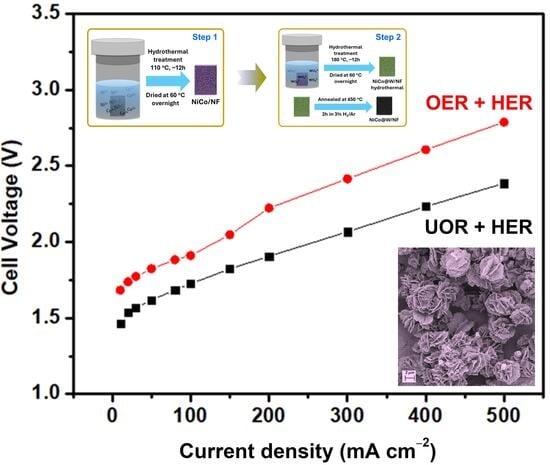
Urea electrolysis has emerged as a promising alternative to conventional water electrolysis for hydrogen production, owing to low electrical energy consumption as well as organic wastewater. However, the practical implementation of this approach is primarily constrained by the lack of cost-effective and efficient electrocatalysts. Thus, the development of earth-abundant, non-precious metal-based bifunctional electrocatalysts toward both the hydrogen evolution reaction (HER) and the urea oxidation reaction (UOR) is of critical importance. In this context, nanostructured, reduced nickel-cobalt tungstate supported on Ni foam is fabricated as a binder-free, freestanding electrode via a two-step hydrothermal process followed by partial thermal reduction. By systematically tuning the precursor concentrations of Ni, Co, and W, the morphology and electronic structure of the material are effectively modulated. The introduction of oxygen vacancies through partial thermal reduction plays a key role in enhancing charge transport properties. The optimized NiCo@W0.5/NF electrode exhibits a porous, flower-like architecture and demonstrates excellent bifunctional electrocatalytic activity toward both UOR and HER, accompanied by improved mass transport behavior. When employed as both the anode and cathode for overall urea electrolysis, NiCo@W0.5/NF requires a low cell voltage of only 1.68 V to achieve a current density of 100 mA cm−2 and delivers impressive operational stability in an optimized electrolyte composed of 3 M KOH and 0.33 M urea. These results indicate that NiCo@W0.5/NF is a highly promising and efficient bifunctional electrode material for urea assisted hydrogen production.

Graphical Abstract

1. Introduction

Perhaps two of the key concerns to be addressed by society today are the identification and construction of a sustainable energy system. One of the most important pieces in this system is to replace our existing energy carrier with a sustainable fuel [1]. Hydrogen, as a renewable energy source, has zero carbon emissions and a high energy density, allowing it to partially replace the excessive use of fossil fuels and therefore reduce pollution [2,3]. Hydrogen production via water electrolysis is regarded as a green technology, which is constrained by the oxygen evolution reaction (OER) at the anode and the hydrogen evolution reaction (HER) at the cathode [4,5]. More specifically, there is a large kinetic overpotential for water splitting at the anode due to the sluggish OER kinetics [6,7]. Even though water splitting only requires a theoretical minimum voltage of 1.23 V, practical electrolyzers generally run at a cell voltage of 1.8–2.0 V due to the uphill nature of the process [8]. Substituting the OER with the oxidation of more easily oxidized molecules offers a viable strategy to overcome this limitation. Among these alternatives, urea oxidation has been investigated to lower the anode overpotential in electrolysis cells. Overall, urea electrolysis consists of two half-reactions: the urea oxidation reaction (UOR) at the anode and the hydrogen evolution reaction (HER) at the cathode. This process enables the simultaneous production of hydrogen and the remediation of nitrogen-containing effluents. Furthermore, the theoretical cell voltage is significantly reduced from 1.23 V for conventional water splitting to 0.37 V for urea electrolysis. As a result, the energy usage for H2 generation may be efficiently reduced. Unfortunately, due to a six-electron transfer mechanism of UOR, it still has slow kinetics, necessitating the development of extremely efficient catalytic materials for overall urea oxidation. In addition, owing to their high cost and acute scarcity of materials, the most advanced Pt-, Ru-, and Ir-based composite catalysts cannot be widely used for HER, OER and UOR. Therefore, numerous studies have been conducted on non-noble metal-based bifunctional catalysts for overall urea electrolysis, such as transition-metal carbides [9,10,11,12], nitrides [13,14,15], phosphides [16,17,18,19], sulfides [20,21,22], oxides [23,24], and others. Furthermore, the use of bifunctional catalysts for both reactions simplifies the system architecture while decreasing overall cost. As a result, urea-assisted water electrolysis has emerged as a promising route for the large-scale production of high-purity hydrogen. Accordingly, the development of efficient bifunctional catalysts is critically important for overall urea electrolysis, and significant progress has been made in this area in recent years.
Nickel- (Ni)-based catalysts are among the most studied UOR electrocatalysts, owing to the crucial role of dynamic Ni3+ species in driving the reaction [25]. In view of this, Ni-based transitional metal oxides are promising non-noble metal catalysts but remain a great challenge due to their poor electronic conductivity [26]. Tungstate materials possess many advantages, such as simple synthesis processes, low cost, low toxicity and stable multifunctional properties [27]. Most importantly, tungstate materials have higher electronic conductivity than most binary and some ternary metal oxides [28,29]. In addition, the partial reduction of transition metal oxides increases the number of catalytic active sites due to oxygen vacancies within its crystal structure [23,30].
Motivated by these considerations, we hydrothermally grew nickel-cobalt tungstate (NiCoWOx) directly on Ni-foam (NF) to form a binder-free, self-supported, and freestanding electrode. The dissolution–recrystallization process used to incorporate tungstate promotes well-defined morphologies with an optimized Ni:Co:W stoichiometric ratio, while subsequent thermal reduction introduces oxygen vacancies that enhance electrocatalytic activity. We systematically investigated the role of tungstate in promoting UOR and evaluated the fabricated catalyst as a bifunctional catalyst for urea-assisted hydrogen evolution. Furthermore, full-cell urea electrolysis performance was maximized by optimizing the concentrations of KOH and urea in the electrolyte. The optimized NF-supported NiCo tungstate exhibits stable operation for 140 h at a current density of 50 mA cm−2 during overall urea-assisted water splitting. This binder-free bifunctional electrode demonstrates strong potential for cost-effective and energy-efficient hydrogen production while simultaneously enabling the valorization of organic waste streams.

2. Materials and Methods

2.1. Materials

In this study, all chemicals were obtained commercially and used as received without further purification. Nickel nitrate hexahydrate (Ni(NO3)2∙6H2O), cobalt nitrate hexahydrate (Co(NO3)2∙6H2O), sodium tungstate dihydrate (Na2WO4∙2H2O), ammonium fluoride (NH4F), urea (CO(NH2)2), and potassium hydroxide (KOH) were purchased from Sigma-Aldrich (Milwaukee, WI, USA). Nickel foam was procured from MTI Corporation (Richmond, CA, USA).

2.2. Materials Synthesis

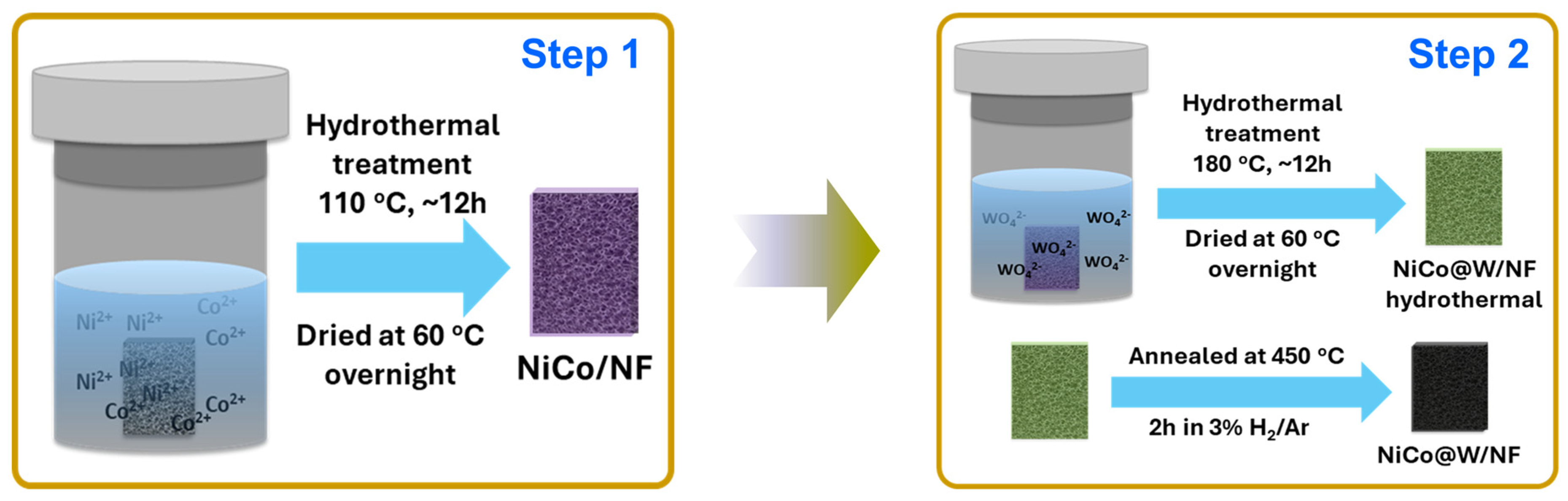
The reduced NiCoWOx materials were prepared by a two-step hydrothermal method. Typically, 1.5 mM of Ni(NO3)2.6H2O and 1.5 mM Co(NO3)2.6H2O were dissolved into a beaker containing 80 mL of deionized water. The mixture solution was stirred for about 10 min before adding 1.75 mM NH4F and 5.25 mM urea under continuous stirring condition at room temperature. Pre-cleaned nickel foam with a 1 cm2 active area were prepared and placed inside a 200 mL capacitive Teflon-lined stainless-steel autoclave. Subsequently, the reaction mixture was placed inside the autoclave and treated at 110 °C for 12 h. After the autoclave was cooled down to room temperature, the Ni foams (NFs) were collected and rinsed with deionized water and ethanol several times and dried overnight at 60 °C inside an oven. In the second step, dried NFs from the first-step hydrothermal experiment were placed inside the autoclave and a solution containing 3.0 mM Na2WO4 in 40 mL H2O was poured inside the autoclave and reacted for 12 h at 180 °C. The overall Ni:Co:W molar ratio was ~1:1:2. After the autoclave was cooled down to room temperature, coated NFs were collected and rinsed with deionized water and ethanol several times and dried overnight. The dried sample (NiCo@W/NF-hydrothermal) was further annealed in 3% H2/Ar at 450 °C for 2 h in a tube furnace and referred as NiCo@W/NF. A schematic illustration of the synthetic procedure is shown in Figure 1. Controlled samples, NiCo@W0.5/NF, NiCo0.5@W0.5/NF, and Ni0.5Co@W0.5/NF, were fabricated in the same manner with varying Ni:Co:W molar ratios of 2:2:1, 2:1:1, and 1:2:1, respectively.

2.3. Characterization Techniques

The materials were characterized with X-ray diffraction by a PANalytical X’Pert PRO Theta/Theta Powder X-ray Diffraction System with Cu Kα radiation (λ = 0.15406 nm) at a scan rate of 10° min−1. The morphologies of the prepared samples were observed by a Field Emission Scanning Electron Microscopy (FE-SEM, Zeiss Gemini SEM 500(Zeiss, Oberkochen, Germany)). The high-resolution transmission electron microscopy (HRTEM) images and energy dispersive spectra were collected using aTalos F200C G2 Transmission Electron Microscope(Thermo Fisher Scientific (formerly FEI), Brno, Czech Republic) operating at 200 kV. X-ray photoelectron spectroscopy (XPS) is carried out using monochromated, micro-focused, low power Al Ka X-ray on a Nexus X-Ray Photoelectron Spectrometer (Thermo Fisher Scientific, Hillsboro, OR, USA).

2.4. Electrochemical Characterizations

Electrochemical tests were conducted with Autolab Metrohm PGSTAT128N potentiostat/galvanostat at room temperature and ambient pressure. Catalysts supported NF (1.0 × 1.0 cm2) as a working electrode and Pt mesh as a counter electrode, and a Hg/HgO in 1 M KOH electrode was used as the reference electrode. To minimize the possibility of Pt contamination, several precautions and control experiments were implemented. First, all electrochemical measurements were conducted under carefully controlled conditions, and the electrolyte was freshly prepared for each experiment. The Pt mesh counter electrode was thoroughly cleaned prior to use, following standard electrochemical cleaning protocols to reduce surface impurities and loose Pt species. Cyclic voltammetry (CV), linear sweep voltammetry (LSV), electrochemical impedance spectroscopy (EIS) and chronoamperometric measurements were performed. The electrocatalytic HER was studied by linear sweep voltammetry in N2-saturated 1 M KOH solutions. The scan rate for LSV was kept at 5 mV s−1. LSV was also used to analyze the catalytic performance of the catalysts in an aqueous solution of 1 M or 3 M KOH with a desired concentration of urea (0.33 M or 0.5 M) at a scan rate of 10 mV s−1. The Nernst equation was used to convert the potentials to the RHE scale: E(RHE) = E(Hg/HgO) + 0.059 pH + 0.098 V. Electrochemical impedance spectroscopy (EIS) measurements were carried out at 0.5 V vs. Ag/AgCl with an amplitude of 5 mV from 105 to 0.01 Hz. The overall urea-assisted water electrolysis experiment was done in two electrode configurations, with the synthesized electrodes serving as both the UOR and HER electrodes, and linear sweep voltammetry was employed to measure from 1 to 2 V at 10 mV s−1. The catalysts were evaluated in 0.33 M urea with 1.0 M or 3 M KOH electrolyte at a current density of 50 mA cm−2 for catalytic durability.

3. Results and Discussion

3.1. Physicochemical Characterization

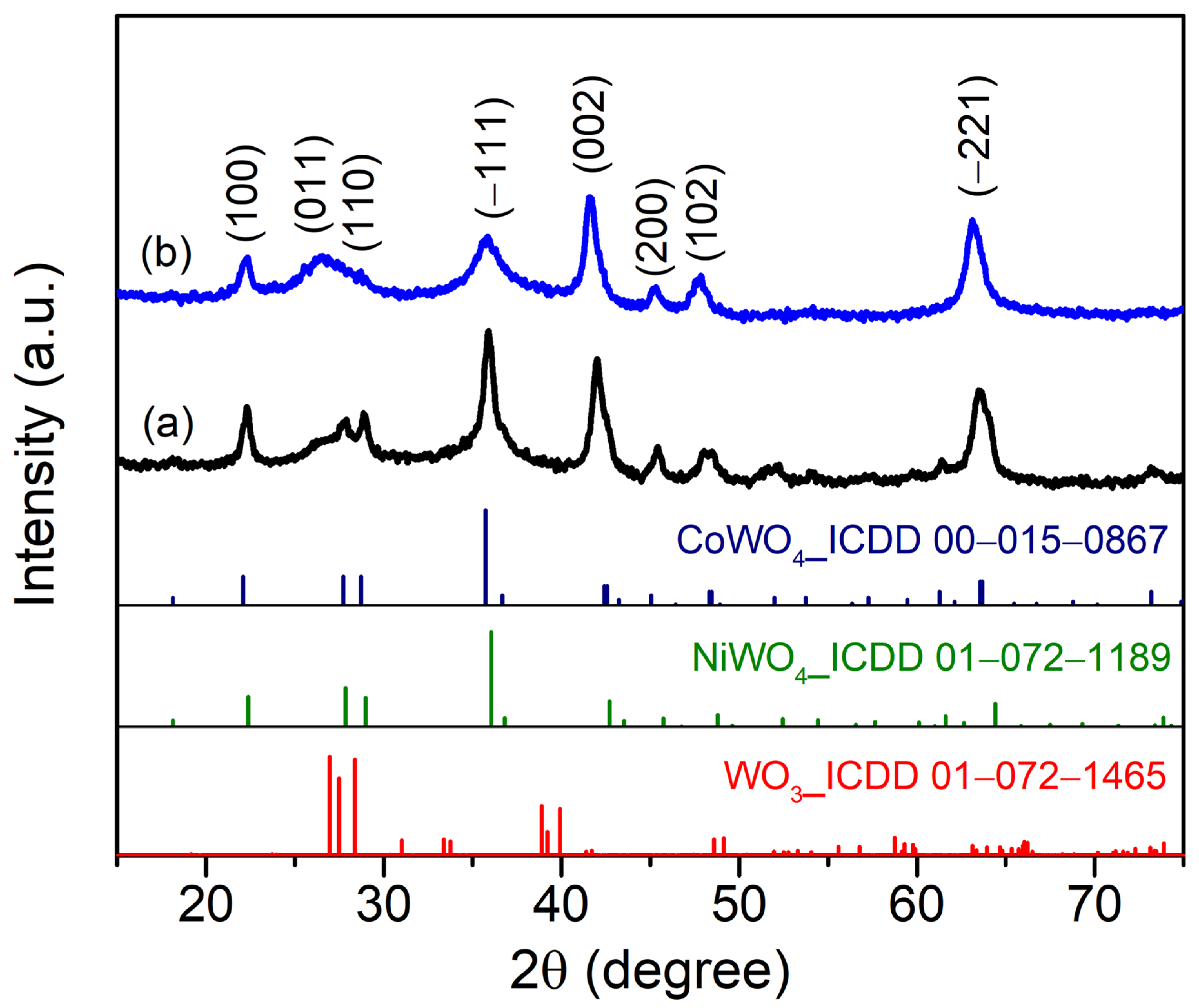
To analyze the crystal structure of the prepared NiCo@W/NF samples, the coated NF samples were gently scratched to collect the corresponding powder, which was subsequently characterized by X-ray diffraction (XRD). Figure 2 shows the XRD patterns of the NiCo@W after hydrothermal (Figure 2a) and after reductive thermal treatment in 3% H2/Ar at 450 °C for 2 h (Figure 2b). The XRD patterns of hydrothermally synthesized and thermally reduced NiCo@W reveal the formation of monoclinic crystal structures, in good agreement with the standard diffraction patterns of NiWO4 (ICDD No. 01-072-1189) and CoWO4 (ICDD No. 00-015-0867), suggesting the successful formation of bimetallic NiCo tungstate [31]. Due to the close proximity of the characteristic diffraction peaks of NiWO4 and CoWO4 in their respective ICDD references, unambiguous phase identification between the two components is challenging. Therefore, the observed diffraction peaks were indexed accordingly. Comparable results have been reported by Kumar et al. [32] for hydrothermally synthesized NiCoWO4. In particular, the XRD pattern of the NiCo@W/NF-hydrothermal sample is in good agreement with the diffraction pattern of NiCoWO4 reported in their study. The standard diffraction pattern of monoclinic WO3 (ICDD 01-072-1465) was used as a reference to examine the possible presence of WOx phases, as shown in Figure 2. The diffraction patterns of the fabricated NiCo@W samples do not match this reference pattern, and the absence of any additional peaks indicates the phase purity of the prepared samples. Further, the intensity of diffraction peaks of the reduced NiCo@W are lower than those of the NiCo@W-hydrothermal, which can be attributed to the increased defect density induced by thermal reduction in 3% H2/Ar atmosphere [33]. It is well known that defects/vacancies play a crucial role in enhancing electrocatalytic activities by modulating the electronic structure and increasing the number of active sites [34]. Consequently, the reduced NiCo@W/NF samples are expected to exhibit improved electrochemical performance. In addition, thermal reduction promotes a preferred crystallographic orientation along the (002) plane, which is evident from its higher intensity compared to the (−111) plane.
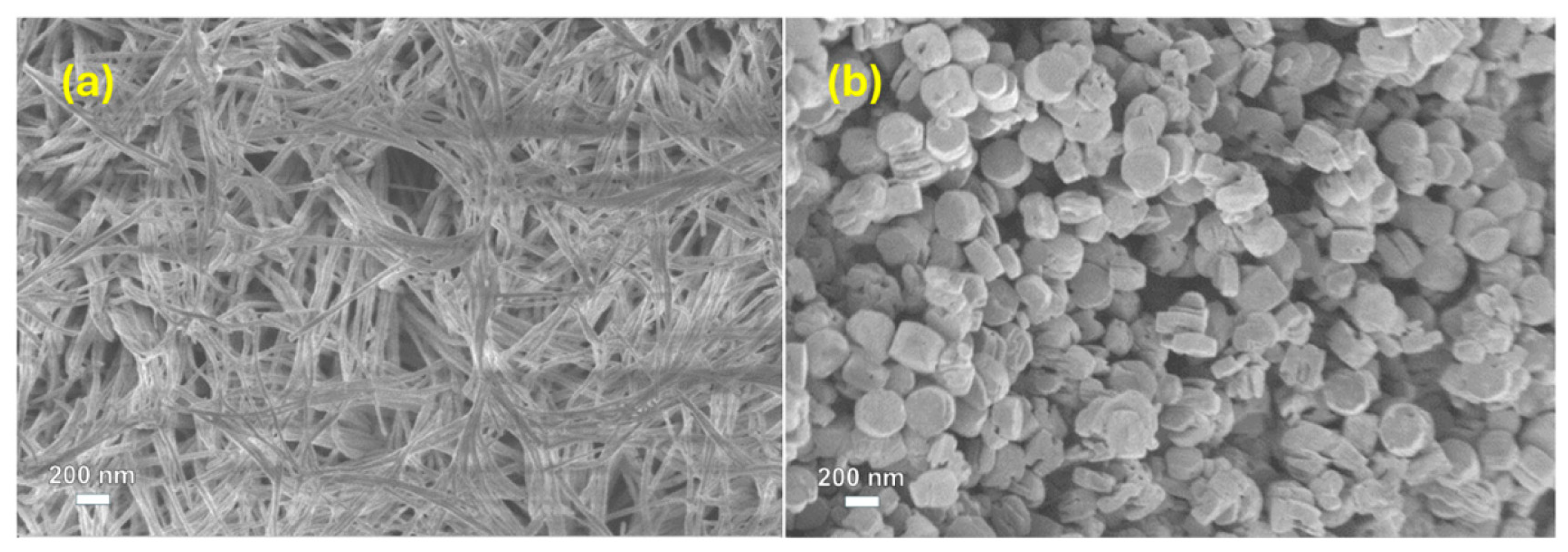
The preparation process of NiCo@W/NF samples involved two steps of hydrothermal followed by annealing in H2/Ar atmosphere to introduce defects or vacancies in the self-supported catalysts. The first hydrothermal step in all probability led to the formation of NiCo hydroxy carbonate nanowires on the NF surface (NiCo/NF), as displayed in Figure 3a [35,36]. In the second step hydrothermal, this NiCo hydroxy-carbonate-coated NF was treated with aqueous tungstate solution for an anion exchange reaction. The resultant product was characterized as NiCo tungstate, supported on NF. The formation of NiCo tungstate in the second hydrothermal step was assumed to have undergone a dissolution and recrystallization process. This speculation is supported by analyzing the surface morphology, as the nanowire morphology of NiCo/NF in first hydrothermal was changed completely to button-shaped nanostructured morphologies after the second step (Figure 3b).
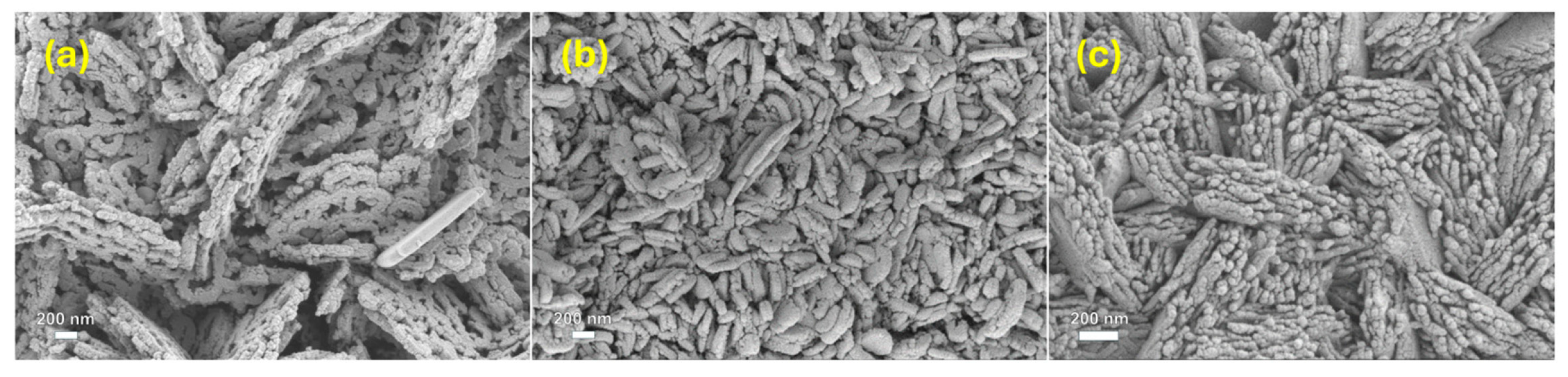
Furthermore, the effect of composition on the surface morphology was also investigated and the corresponding images are shown in Figure 4. NiCo@W0.5/NF showed a nanostructured, porous, petal-like morphology. On the other hand, two other compositions, NiCo0.5@W0.5/NF and Ni0.5Co@W0.5/NF, exhibited dense/close packed structures, which seemed to have limited porosity. The porous flowerlike morphology of NiCo@W0.5/NF (Figure S1) would be beneficial in electrolyte penetration, leading to an increase in the electroactive surface area and improved electrocatalytic performance. Thus, composition has a significant effect on the morphology of the samples.
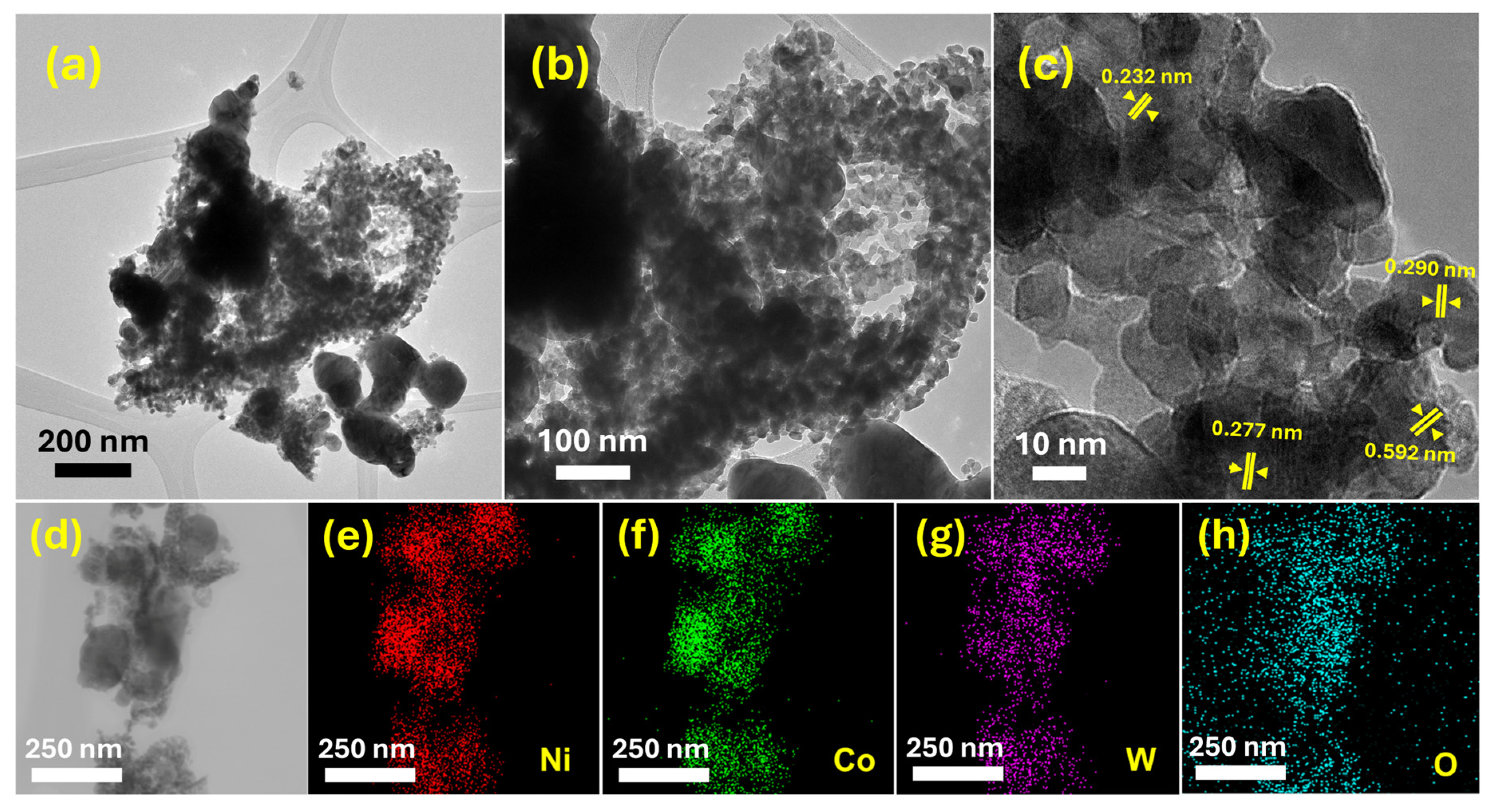
NiCo@W0.5/NF was further selected to analyze by transmission electron microscopy (TEM), owing to its distinctive morphology compared to the other compositions. Figure 5a,b show the low and high magnification images of NiCo@W0.5/NF, which further affirmed the porous petal-like shape. The microstructure was analyzed by high-resolution TEM (HRTEM), as shown Figure 5c. The findings indicated the formation of (200), (020), (010), and (−111), corresponding to the lattice fringe spacings of 0.232, 0.277, 0.592, and 0.290 nm, respectively. Furthermore, the scanning transmission electron microscopy (STEM)-energy dispersive X-ray (EDX) mapping showed the presence of Ni, Co, W, and O in Figure 5d–h, suggesting the successful formation of NiCoWOx.
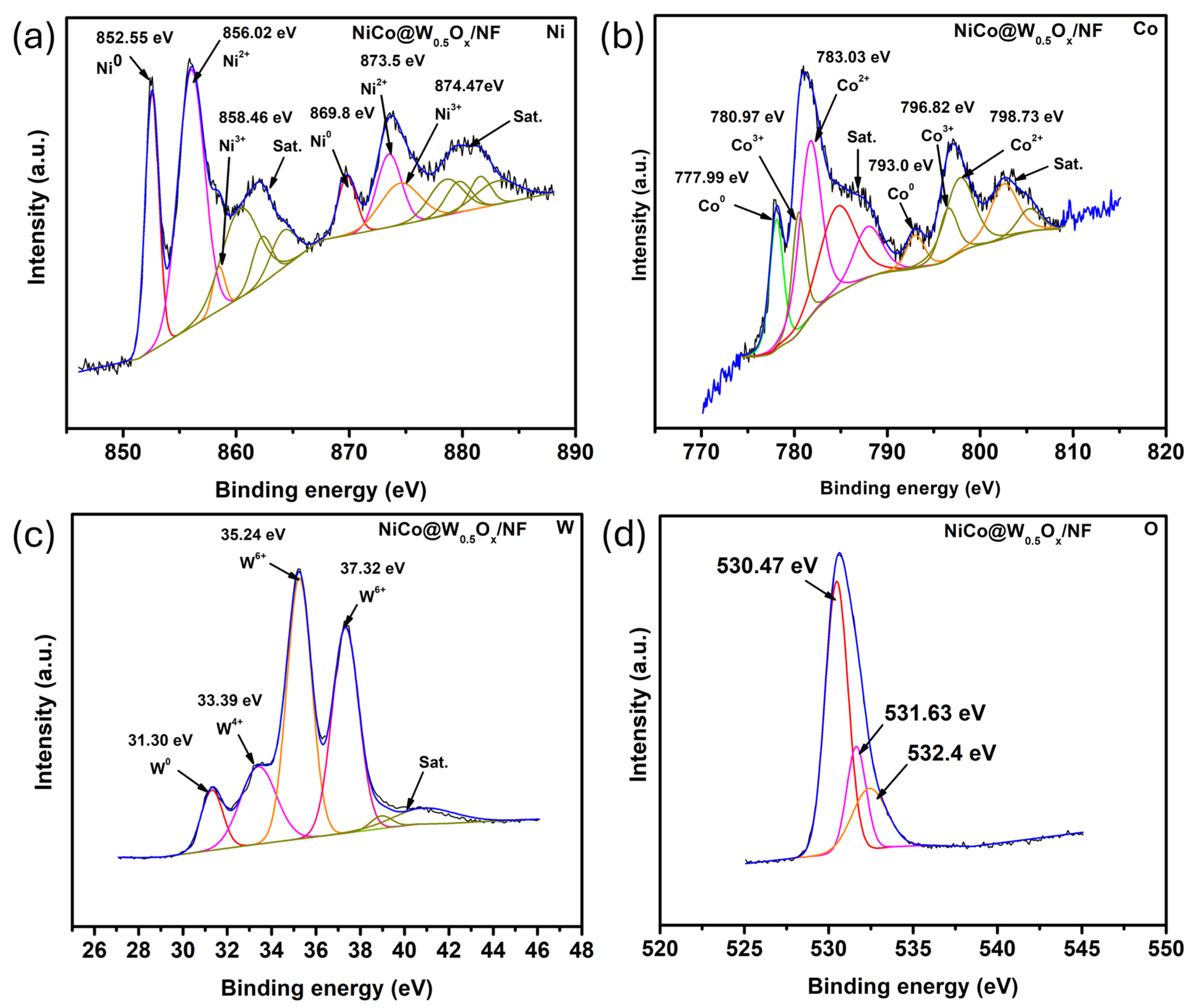
The surface chemical states of NiCo@W0.5/NF were analyzed by X-ray photoelectron spectroscopy (XPS), and Figure 6 indicates the presence of Ni, Co, W, and O as constituent elements. The high-resolution Ni 2p (Figure 6a) showed the appearance of strong peaks at 852.5 and 869.8 eV, corresponding to Ni0, which could have originated from the reductive thermal treatment as well as NF support [37]. The Ni 2 p 3 / 2 and 2 p 1 / 2 peaks were separated by a spin-orbit splitting of ~17.5 eV, which is a characteristic of Ni2+ [38]. In addition, the deconvoluted Ni 2 p 1 / 2 and 2 p 3 / 2 peaks indicated the co-existence of Ni2+ and Ni3+ [39], although relatively higher intensity suggested Ni2+ as the major oxidation state. The Co 2p spectrum also indicated the presence of Co0 (778.0 and 793.0 eV) and co-existence of Co3+ (781.0 and 796.8 eV) and Co2+ (783.0 and 798.7 eV) in Figure 6b [40,41,42]. The spin-orbit splitting of ~16 eV suggested Co2+ as the major oxidation state [43]. The deconvoluted W 4f spectrum showed two peaks at 31.3 and 33.4 eV owing to the metallic W and W4+ states, respectively [44]. In addition, two spin-orbit doublets appeared at 35.2 and 37.3 eV, which could be assigned to the W6+ states [45]. The deconvoluted O 1s peaks at 530.5, 531.6, and 532.4 eV could be attributed to the lattice oxygen or M–O bond (M is Ni or Co), oxygen defect sites, and physiosorbed water molecules [46]. Further, the relative oxygen vacancy concentration was estimated from the ratio of the fitted peak areas corresponding to deconvoluted lattice oxygen (Alattice-O) and oxygen vacancies (Avacancy-O), following the method reported by Zhang et al. [47]:
r e l a t i v e   C O v = A v a c a n c y O A l a t t i c e O + A v a c a n c y O
It should be noted that this peak area ratio does not represent the absolute oxygen vacancy content; rather, it provides a qualitative measure of the oxygen vacancy concentration in the near-surface region of NiCo@W0.5/NF. Based on the deconvolution of the O 1s XPS spectrum, the relative oxygen vacancy fraction was calculated to be approximately ~29.6%.

3.2. Electrocatalytic Properties

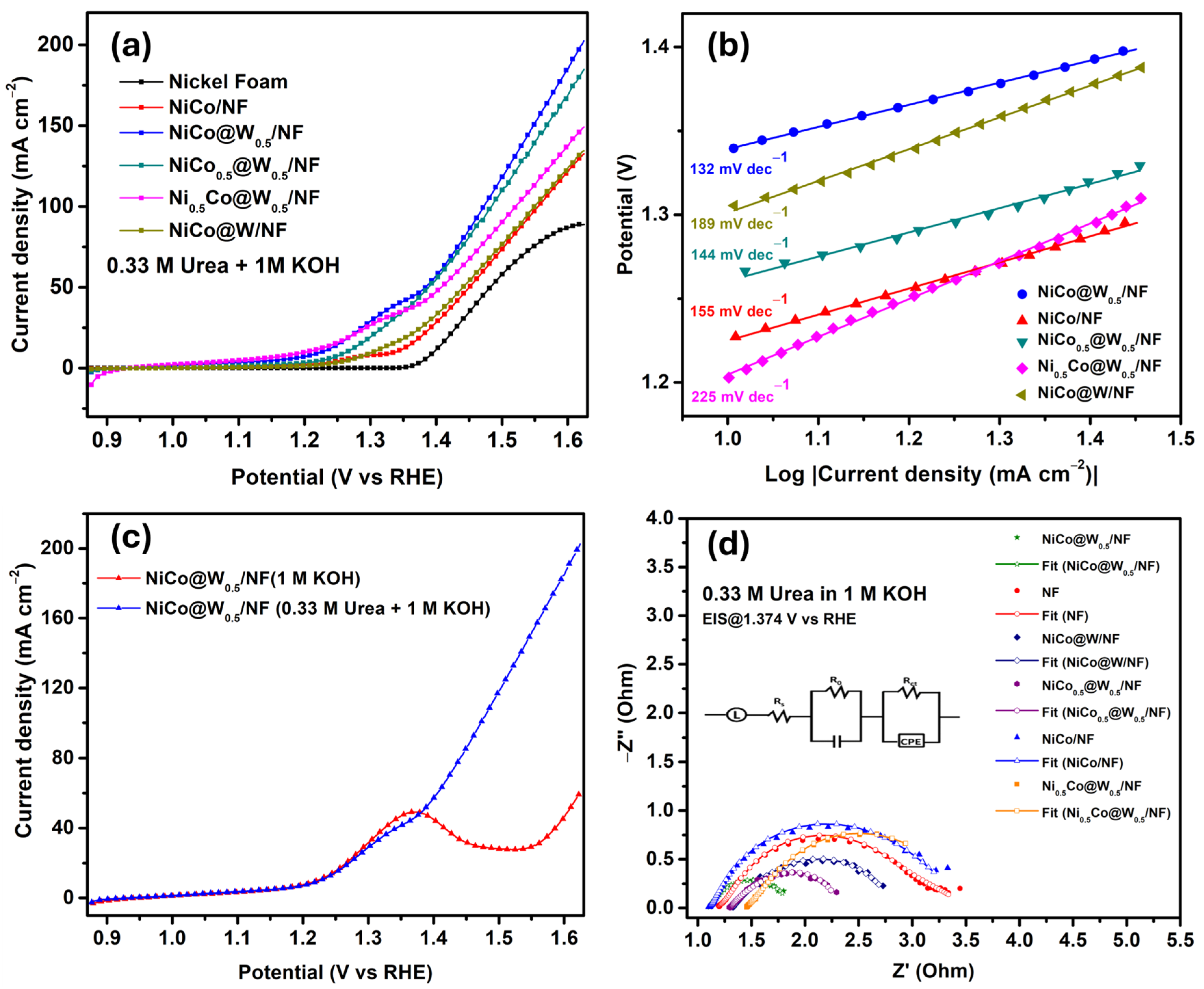
The electrocatalytic urea oxidation performance of the prepared NF-supported NiCoWOx samples were investigated in 1 M KOH in the presence of 0.33 M urea, and the corresponding findings are displayed in Figure 7. The polarization curves (Figure 7a) indicated that NiCo@W0.5/NF delivered the highest current density of ~202.54 mA cm−2 for UOR at 1.625 V vs. RHE compared to the other prepared samples. The required potentials to reach 100 mA cm−2 current density were found to be ~1.556, 1.550, 1.473, 1.522, and 1.484 V vs. RHE for NiCo/NF, NiCo@W/NF, NiCo@W0.5/NF, Ni0.5Co@W0.5/NF, and NiCo0.5@W0.5/NF, respectively. This clearly indicates the superior UOR activity of NiCo@W0.5/NF among the compositionally different NiCoWOx samples grown on NF by two-step hydrothermal. In addition, this sample showed significant improvement in the UOR activity in comparison to the NiCo/NF, which suggested the beneficial role of W incorporation. Notably, the optimal composition and dissolution–recrystallization synthetic approach were advantageous to enhance the electrocatalytic performance of NiCoWOx. The bare NF support was unable to reach 100 mA cm−2 current density for UOR, which suggested NiCo tungstate as an effective electrode material for electrocatalytic urea oxidation. These findings inferred NiCo@W0.5/NF as the best sample for UOR among the prepared samples. The kinetic aspects of UOR for the prepared samples were also analyzed from the Tafel plot, derived from the LSV curves of the corresponding samples, as shown in Figure 7b. The Tafel slope values of NiCo/NF (155 mV dec−1), NiCo@W/NF (189 mV dec−1), NiCo@W0.5/NF (132 mV dec−1), Ni0.5Co@W0.5/NF (225 mV dec−1), and NiCo0.5@W0.5/NF (144 mV dec−1) indicated the lowest Tafel slope for NiCo@W0.5/NF, suggesting a relatively faster reaction rate of urea oxidation. To further confirm the high UOR activity of NiCo@W0.5/NF, the polarization curves were recorded in 1 M KOH with and without 0.33 M urea in Figure 7c. It was observed that the current density at 1.625 V was increased by ~3.34 times in the presence of urea, which reaffirms the efficient UOR performance of NiCo@W0.5/NF.
Furthermore, the charge transfer characteristics of the prepared samples were evaluated by Electrochemical Impedance analysis at 1.374 V vs. RHE in 1 M KOH with 0.33 M urea. Figure 7d shows the corresponding Nyquist plots, which were fitted to the equivalent circuit, LRs (R0 C) (Rct CPE), shown at the inset. In this model, L, Rs, R0, and Rct correspond to the inductance, ohmic resistance, intrinsic resistance of the oxide catalyst, and the charge-transfer resistance, respectively [47]. C and constant phase element (CPE) represent the capacitive contributions associated with the catalyst layer and the electrode-electrolyte interface [36]. CPE is commonly introduced to account for depressed semicircles in Nyquist plots arising from surface heterogeneity and electrode porosity [48]. The impedance of CPE is generally defined as follows [49]:
Z C P E = 1 [ Q ( i w ) α ]
where Q, w, i, and α or n is a frequency-independent constant, angular frequency of the AC signal, imaginary unit, and factor varies between 0 to 1. For n = 1, the CPE corresponds to an ideal capacitive element, whereas, for n ≠ 1, Q has units other than those of capacitance [50].
The EIS fitted parameters were listed in Table S1 and the Rct values followed the order NiCo@W0.5/NF (0.504 Ω) < NiCo0.5@W0.5/NF (0.581 Ω) < NiCo@W/NF (1.151 Ω) < Ni0.5Co@W0.5/NF (1.073 Ω) < NiCo/NF (1.385 Ω). The lowest Rct and total resistance (Ro + Rct) indicated faster reaction kinetics and enhanced charge transfer for UOR, when catalyzed by NiCo@W0.5/NF compared to the other reduced NiCoWOx samples. In addition, electrical double layer capacitance (Cdl) was calculated from the CPE associated with the Rct using the EIS fitted parameters from Table S1 following the Brug relation [51]:
C d l = C P E 1 / α 1 R s + 1 R c t ( α 1 ) / α
The total electrochemically accessible surface area (electrode level) of the catalyst-coated Ni foam electrode was estimated from the double-layer capacitance (Cdl) measurements. It should be noted that the calculated total electrochemically accessible surface area (electrode level) values represent the total electrochemically accessible electrode surface (catalyst deposited on Ni foam), rather than the intrinsic catalyst-only surface area, due to the capacitive contribution and possible surface transformations of the Ni substrate. Cdl values were used to determine the total electrochemically accessible surface area (electrode level) using the following relation [52]:
T o t a l   e l e c t r o c h e m i c a l l y   a c c e s s i b l e   s u r f a c e   a r e a ( e l e c t r o d e   l e v e l ) = C d l C s
Ni foam was used as the substrate to fabricate the free-standing electrode materials. Owing to its highly porous architecture, the use of conventional Cs value, such as 0.04 mF cm−2 for an atomically smooth flat surface, would lead to a significant overestimation of the total electrochemically accessible surface area (electrode level). Therefore, the experimentally determined Cdl value of bare Ni foam (~17.18 mF for a geometric area of 1 cm2) was used as the Cs in this work. Accordingly, the relative total electrochemically accessible surface area (electrode level) was calculated as follows:
T o t a l   e l e c t r o c h e m i c a l l y   a c c e s s i b l e   s u r f a c e   a r e a ( e l e c t r o d e   l e v e l ) = C d l C d l ,   N i   f o a m
The estimated total electrochemically accessible surface area (electrode level) values were ~8.07, 6.09, 30.50, 10.58, and 5.86 cm2 for NiCo/NF, NiCo@W/NF, NiCo@W0.5/NF, NiCo0.5@W0.5/NF, and Ni0.5Co@W0.5/NF, respectively. NiCo@W0.5/NF exhibited the highest total electrochemically accessible surface area (electrode level), suggesting a porous nature and enhanced electrolyte penetration. Thus, incorporation of W in optimized concentration was crucial to achieve remarkably low Rct and high total electrochemically accessible surface area (electrode level)
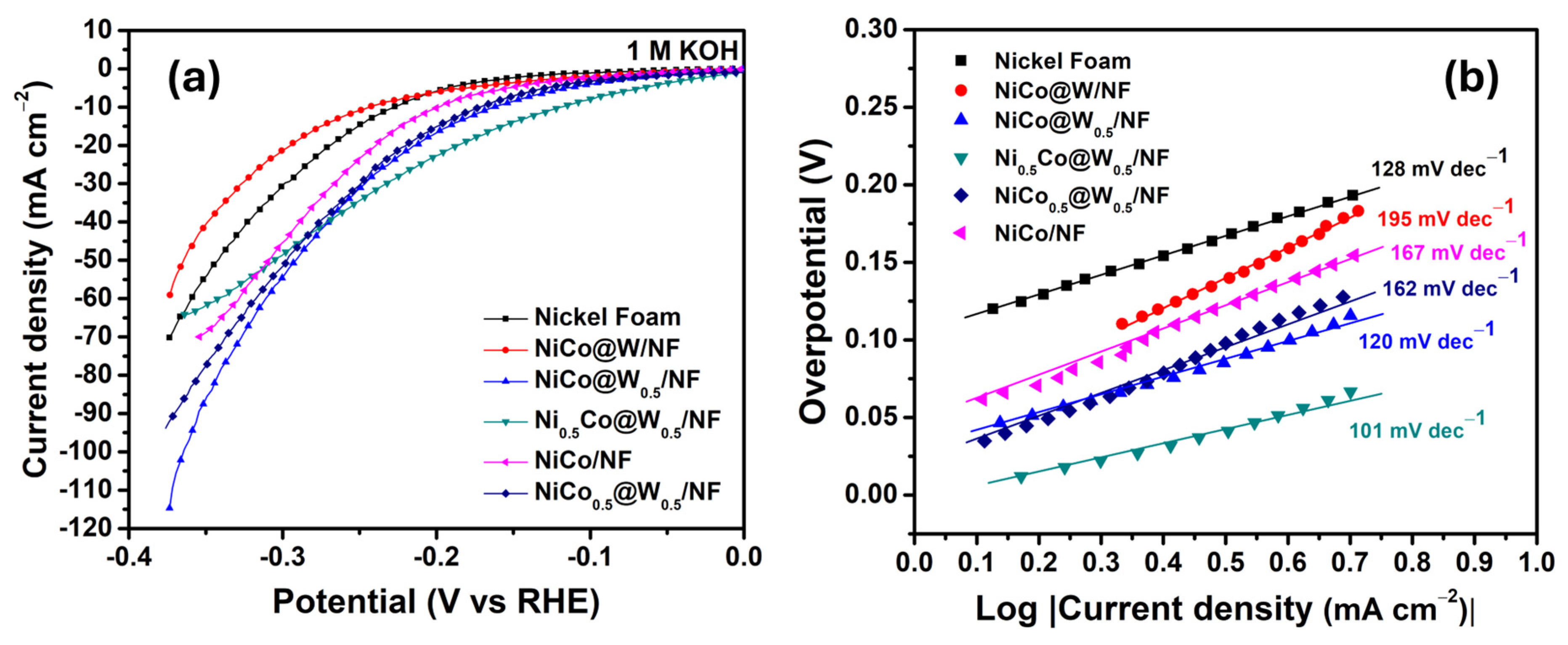
To investigate the bifunctional behavior of the reduced NiCoWOx/NF samples, activity for hydrogen evolution reaction (HER) was evaluated in 1 M KOH. The LSV curves (Figure 8a) exhibited that Ni0.5Co@W0.5/NF showed better alkaline HER initially compared to other samples; however, at a higher potential region, it failed to retain its activity. The maximum current density obtained for alkaline HER with Ni0.5Co@W0.5/NF was only ~64.12 mA cm−2 at 0.36 V vs. RHE, whereas NiCo@W0.5/NF delivered ~114.68 mA cm−2 at 0.37 V vs. RHE. Thus, it is evident that NiCo@W0.5/NF showed improved mass transport properties compared to the other reduced NiCoWOx/NF samples and NiCo/NF. Further, the Tafel slopes derived from the polarization curves, displayed in Figure 8b, exhibited the lowest value for Ni0.5Co@W0.5/NF, suggesting better reaction kinetics than that catalyzed by other samples. However, Ni0.5Co@W0.5/NF exhibited superior performance in the kinetic region. As observed from the Tafel plot, it showed very poor mass transfer characteristics and failed to deliver high current densities of HER compared to NiCo@W0.5/NF, as observed from the polarization curves. This could be ascribed to its dense morphology, which limited the electrolyte penetration and accessibility of the active metal centers, resulting in a very low total electrochemically accessible surface area (electrode level) (~5.86 cm2). Therefore, NiCo@W0.5/NF could be considered as the preferred electrode material for the HER among the prepared samples, demonstrating bifunctional electrocatalytic activity for both UOR and HER in alkaline media.

3.2.1. Role of Oxygen Vacancy

The superior UOR and HER activities of NiCo@W0.5/NF can be rationalized by the synergistic effects of oxygen vacancy, electronic structure modulation, and electrode architecture. Oxygen vacancies create under-coordinated Ni/Co sites and redistribute local charge, which promotes the adsorption and activation of urea molecules and O H ions, thereby facilitating the first dehydrogenation step of UOR [30,53]. This effect is reflected in the significantly lower potential required to reach 100 mA cm−2 and the smallest Tafel slope (132 mV dec−1) observed for NiCo@W0.5/NF, indicating accelerated UOR kinetics.
In parallel, the presence of oxygen vacancies is accompanied by the partial reduction of neighboring Ni/Co centers, which modifies their oxidation states and makes them more readily oxidizable to catalytically active high valent species (Ni3+/Co3+) under anodic polarization. Such electronic tuning promotes C–N bond activation during UOR [54,55] and contributes to the remarkably lower Rct (~0.504 Ω) measured for NiCo@W0.5/NF, demonstrating more efficient interfacial electron transport. Although oxygen vacancies also introduce donor states that improve electrical conductivity, the strong correlation between vacancy-rich composition, reduced Tafel slope, and lower Rct suggests that their dominant role is to enhance reaction kinetics through adsorption and electronic structure modulation rather than conductivity alone.
For HER, oxygen vacancies similarly influence activity by adjusting the electron density of adjacent Ni/Co sites and optimizing metal–hydrogen binding strength [56]. While Ni0.5Co@W0.5/NF exhibits a lower Tafel slope, its dense morphology and low total electrochemically accessible surface area (electrode level) (~5.86 cm2) limit electrolyte diffusion and mass transport, preventing it from sustaining high HER current densities. In contrast, NiCo@W0.5/NF combines an appropriate oxygen vacancy concentration with a highly porous structure and the highest total electrochemically accessible surface area (electrode level) (~30.50 cm2), enabling sufficient exposure of vacancy-adjacent active sites and efficient transport of reactants and products. This balance explains why NiCo@W0.5/NF delivers high HER current density, outperforming the other reduced NiCoWOx/NF samples.
Overall, these results demonstrate that oxygen vacancies play a key role in enhancing both UOR and HER by (i) creating adsorption-active metal sites, (ii) modulating Ni/Co oxidation states and redox accessibility, and (iii) facilitating charge transfer. However, optimal catalytic performance is achieved only when the vacancy concentration is balanced with favorable morphology and high total electrochemically accessible surface area (electrode level), as excessive densification or poor mass transport can offset the intrinsic kinetic advantages provided by oxygen vacancies.

3.2.2. Urea Electrolysis Performance in Full Cell

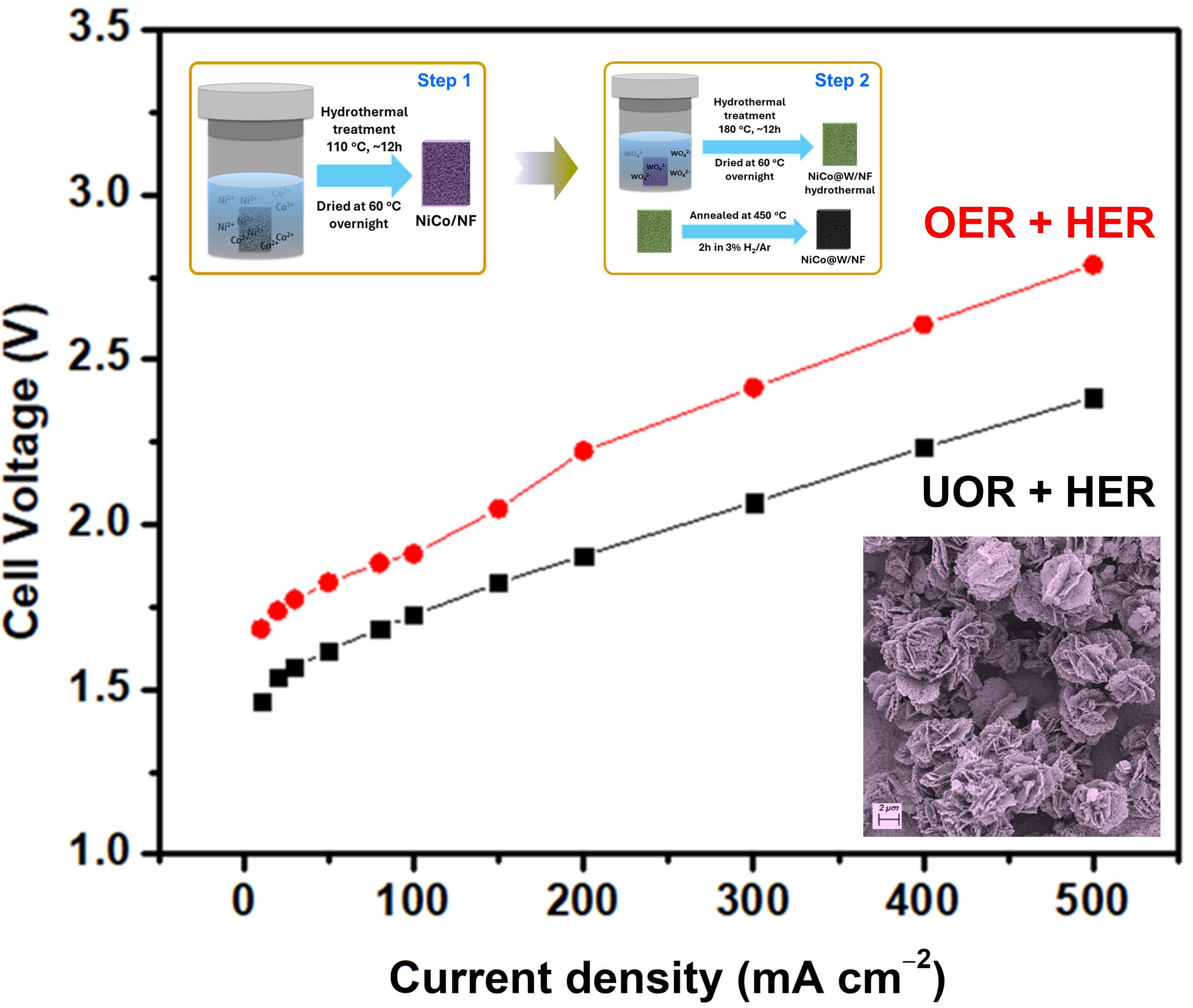
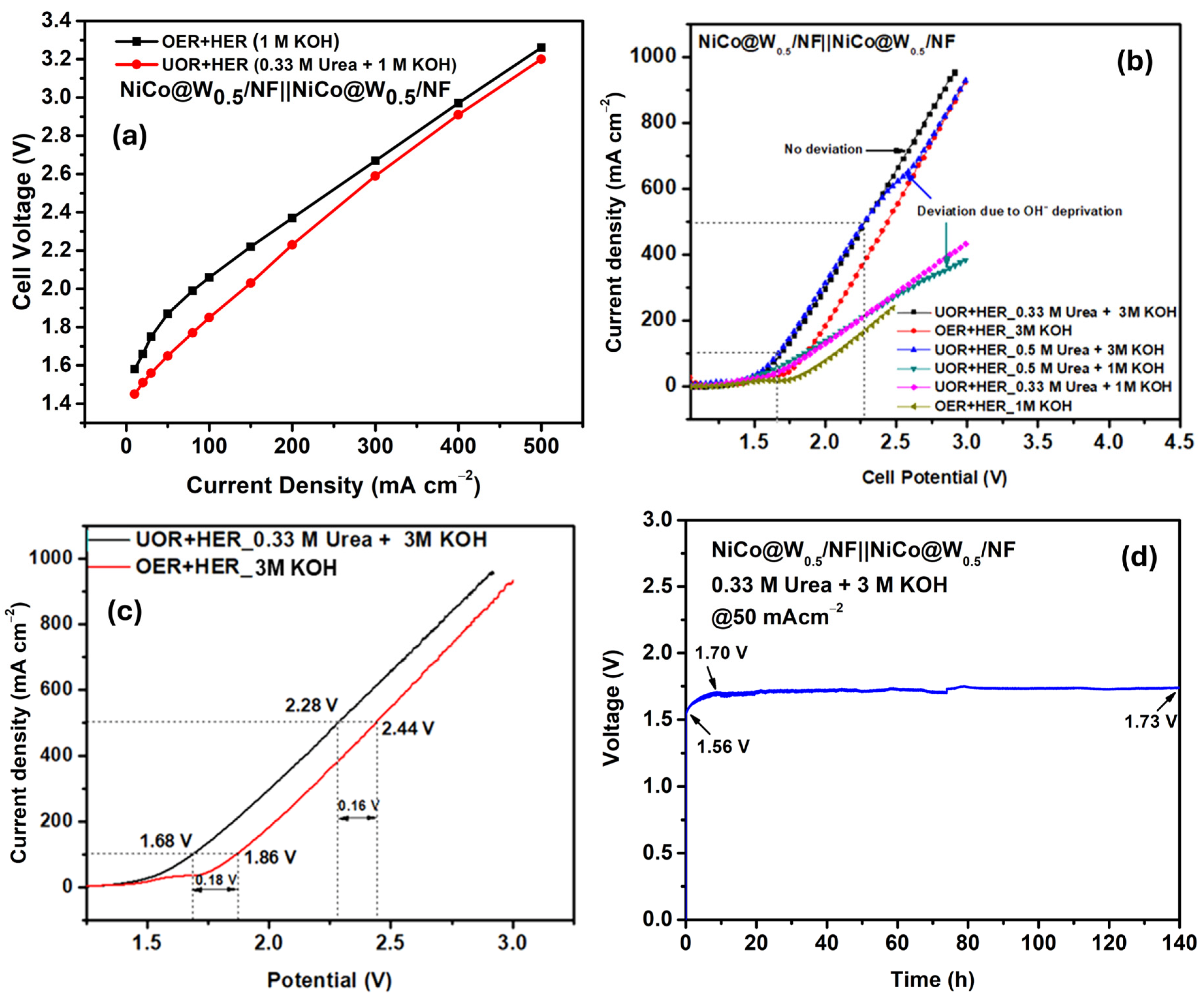
To check the performance of urea electrolysis in a full cell, the NiCo@W0.5/NF was taken as both anode and cathode in a H-cell configuration. The NiCo@W0.5/NF‖NiCo@W0.5/NF cell was tested in 1 M KOH with and without 0.33 M urea, combining the UOR and HER. The corresponding performances of NiCo@W0.5/NF‖NiCo@W0.5/NF cell are also compared with that of conventional water electrolysis (OER and HER) in the absence of urea in the electrolyte. The polarization curves (Figure 9a) showed that NiCo@W0.5/NF‖NiCo@W0.5/NF cell required ~130, 220, and 210 mV less potentials to deliver 10, 50, and 100 mA cm−2 current densities for urea electrolysis compared to water electrolysis, respectively. This suggested that replacing OER with UOR to couple with HER for hydrogen production is effective and energy efficient.
Furthermore, at lower concentrations of KOH in urea electrolysis, deviation due to O H deprivation could be a reason for competitive OER to become more dominant than UOR, which could alter the reaction pathway and affect overall hydrogen generation efficiency [57,58]. To alleviate this, the concentration of the electrolyte should be optimized. In this regard, the effect of electrolyte concentration was also studied in the NiCo@W0.5/NF‖NiCo@W0.5/NF cell by using varied combinations of KOH and urea concentrations, as shown in Figure 9b,c. The choice of KOH and urea concentrations was guided by a balance between O H ion availability, which governs UOR kinetics through catalyst activation, and urea concentration, which influences reactant availability and mass transport. As discussed in our previous work [59], increasing KOH concentration reduces UOR transport resistance in both the kinetic and mass transport regions. The presence of hydroxide ions promotes the deprotonation of Ni-based catalysts, facilitating the formation of catalytically active Ni3+ species, which are responsible for urea oxidation reactions as follows [60]:
6 N i 2 + ( O H ) 2 ( s ) + 6 O H 6 N i 3 + O O H ( s ) + 6 H 2 O + 6 e
6 N i 3 + O O H ( s ) + C O ( N H 2 ) 2 + 6 O H 6 N i 2 + O H 2 s + N 2 ( g ) + 5 H 2 O + C O 2 ( g )
Higher  O H concentration enables faster and more efficient generation of Ni3+, thereby enhancing UOR kinetics and shifting the onset potential to lower values, consistent with prior reports on Ni-based catalysts in alkaline media [61,62,63,64].
At lower KOH concentrations (0.5–1 M), the UOR transport resistance in the kinetic region is significantly higher than that in the mass transport region, indicating that insufficient O H availability limits catalyst activation and charge-transfer kinetics. In contrast, at higher KOH concentration (3 M), the transport resistances in the kinetic and mass transport regions become comparable, suggesting that O H availability is no longer the rate-limiting factor and that the reaction proceeds under more balanced kinetic and transport conditions. Additionally, the variation in UOR transport resistance with catalyst loading is minimized at 3 M KOH, further indicating a stable and optimal reaction environment. With respect to urea concentration, increasing urea content enhances reactant availability but can also introduce diffusion limitations and competitive adsorption effects at excessively high concentrations. The selected urea concentration (0.33 M) represents an optimal compromise, providing sufficient urea flux to sustain high UOR rates without inducing mass transport penalties or suppressing O H accessibility at the catalyst surface.
Thus, deviation in the polarization curves were observed with KOH and urea concentrations of 1 M and 0.5 M, respectively. This suggested that lower KOH and higher urea concentrations are unfavorable for urea electrolysis with the NiCo@W0.5/NF‖NiCo@W0.5/NF cell. Based on these, the 3 M KOH with a 0.33 M urea electrolyte composition offered an optimal balance between catalyst activation (via O H driven Ni3+ formation) and favorable mass transport, leading to the best urea electrolysis performance, requiring much lower potentials of only 1.68 and 2.28 V to reach 100 and 500 mA cm−2 current densities than that for water electrolysis (Figure 9c).
To evaluate the practical applicability of the NiCo@W0.5/NF‖NiCo@W0.5/NF cell for urea electrolysis, its durability was tested galvanostatically at 50 mA cm−2 current density for 140 h in 3 M KOH with 0.33 M urea. The Voltage vs. Time plot (Figure 9d) showed that the potential increased initially to 1.70 V in ~8.8 h and, after, that it was almost stable with a slight change until 140 h, indicating the promising stability of the NiCo@W0.5/NF‖NiCo@W0.5/NF cell. Therefore, NiCo@W0.5/NF can be considered as an effective and stable bifunctional electrode material for urea-assisted hydrogen production.
Post-mortem characterization of the NiCo@W0.5/NF anode was carried out using SEM–EDX elemental mapping and XPS to evaluate compositional and structural changes after 140 h of urea electrolysis in 3 M KOH containing 0.33 M urea. Figure S2 presents the SEM image and corresponding EDX elemental maps of the NiCo@W0.5/NF anode, confirming the presence of the constituent elements Ni, Co, W, and O, thereby indicating the good compositional stability of the electrode. The surface chemical states of the post-UOR NiCo@W0.5/NF anode were further examined by XPS, and the results are shown in Figure S3. Deconvolution of the Ni 2p spectrum revealed a pronounced increase in the proportion of Ni3+ species, as reflected by a change in the Ni2+/Ni3+ atomic ratio (based on the 2p3/2 peak) from 5.71 in the pristine sample to 0.39 after UOR. Similarly, analysis of the high-resolution Co 2p3/2 spectrum showed that the Co2+/Co3+ atomic ratio decreased from 2.42 to 1.02. In addition, the Ni0 peak completely disappeared after UOR, whereas a residual Co0 signal was still observed. These findings suggest that Ni sites act as the primary active centers and undergo oxidation to Ni3+ species, which are known to be highly active toward the UOR. The diminished intensity of the W 4f signal implies partial dissolution of tungstate species ( W O 4 2 ) in the strongly alkaline electrolyte (3 M KOH), accompanied by electrooxidation of the metal ions [39,65]. Despite the partial leaching of tungsten, the NiCo@W0.5/NF electrode maintained stable urea electrolysis performance, as demonstrated in Figure 9d.

3.2.3. Commercial Feasibility of Urea-Assisted HER

In the context of urea-assisted HER, the sustainability of the process does not rely on synthetically produced, fertilizer-grade urea, but, rather, on the utilization of urea-rich waste streams that are already generated in large quantities. Notably, urea is abundantly present in human urine, animal urine, and agricultural and livestock wastewater, as well as in effluents from urea and fertilizer manufacturing plants. These waste streams typically contain urea concentrations ranging from tens to several hundred millimolar, making them directly relevant to the concentration range explored in this study. Accordingly, wastewater electrolysis herein refers to urea-assisted electrolysis conducted in a well-defined electrolyte under controlled laboratory conditions, serving as a representative system for urea-rich wastewater streams.
From an industrial and environmental perspective, the integration of urea-assisted HER with wastewater treatment offers a dual benefit: (i) valorization of urea-containing waste as a feedstock for hydrogen production, and (ii) simultaneous mitigation of nitrogen-rich effluents, which are otherwise energy-intensive, to be treated using conventional biological or chemical processes. This coupling has been widely proposed as a sustainable pathway for decentralized hydrogen production while addressing water pollution challenges. Therefore, the commercial feasibility of urea-assisted HER is envisioned primarily in applications linked to wastewater treatment facilities, agricultural operations, and industrial effluent streams, rather than relying on purpose-made urea.

4. Conclusions

In summary, a partially reduced NiCoWOx/NF electrode was developed via a two-step hydrothermal synthesis followed by thermal reduction, yielding a binder-free, self-supported, non-precious electrocatalyst for urea-assisted hydrogen production. The dissolution–recrystallization strategy employed during the second hydrothermal step for tungstate formation proved effective in generating a porous electrode morphology with an optimized elemental composition. Subsequent reductive thermal treatment under a controlled atmosphere further enhanced charge-transport properties by introducing oxygen vacancies. The optimized NiCo@W0.5/NF electrode, with an optimal Ni:Co:W molar ratio of 2:2:1, demonstrated pronounced bifunctional activity, delivering high catalytic performance for both UOR as well as HER, along with improved mass-transport characteristics in alkaline media. Importantly, as a bifunctional electrode, NiCo@W0.5/NF demonstrated promising performance in a full-cell urea electrolysis configuration. By optimizing the electrolyte composition, the electrolyzer delivered a current density of 100 mA cm−2 at a low cell voltage of 1.68 V and maintained stable operation for over 140 h at 50 mA cm−2. These results establish NiCo@W0.5/NF as an efficient and durable electrode material for urea electrolysis. This study provides valuable insights for the design of low-cost, energy-efficient electrolyzers with freestanding bifunctional electrodes, enabling sustainable hydrogen production while simultaneously valorizing low-grade and agricultural wastewater streams.

Supplementary Materials

The following supporting information can be downloaded at: https://www.mdpi.com/article/10.3390/jcs10030157/s1, Figure S1: Low-magnification FESEM image of NiCo@W0.5/NF; Table S1: EIS fitted parameters, Cdl, and ECSA for Ni foam, NiCo/NF, NiCo@W/NF, NiCo@W0.5/NF, Ni0.5Co@W0.5/NF, and NiCo0.5@W0.5/NF in 1 M KOH with 0.33 M urea; Figure S2: Post-mortem (a) SEM image and (b-g) EDX elemental mappings of Ni, Co, W, O for NiCo@W0.5/NF-anode after 140 h urea electrolysis; Figure S3: High-resolution XPS spectra of (a) Ni 2p, (b) Co 2p, (c) W 4f, and (d) O 1s regions of NiCo@W0.5/NF-anode after durability test for urea electrolysis.

Author Contributions

Conceptualization, methodology, investigation, formal analysis, validation, and writing—original draft, N.K. and A.K.; data collection and analysis, M.F.L.; conceptualization, visualization, methodology, supervision, project administration, funding acquisition, and writing—review and editing, P.-Y.A.C. All authors have read and agreed to the published version of the manuscript.

Funding

This research was funded by the CIPHER Program (IID 2018–008) from the Commission on Higher Education, Philippine California Advanced Research Institutes (CHED-PCARI) of the Republic of the Philippines.

Data Availability Statement

The raw data supporting the conclusions of this article will be made available by the authors on request.

Acknowledgments

The authors gratefully acknowledge Kennedy Nguyen and the Imaging and Microscopy Facility (IMF) at the University of California, Merced, for providing materials characterization support. The authors used ChatGPT-5, OpenAI, https://openai.com (accessed on 26 December 2025) to assist with grammar and language review during the drafting of this manuscript. The authors have reviewed and edited the output and take full responsibility for the content of this publication.

Conflicts of Interest

The authors declare no conflicts of interest.

References

  1. Turner, J.A. Sustainable Hydrogen Production. Science 2004, 305, 972–974. [Google Scholar] [CrossRef]
  2. Hosseini, S.E.; Wahid, M.A. Hydrogen Production from Renewable and Sustainable Energy Resources: Promising Green Energy Carrier for Clean Development. Renew. Sustain. Energy Rev. 2016, 57, 850–866. [Google Scholar] [CrossRef]
  3. Raab, S.; Karmakar, A.; Chuang, P.Y.A.; Weber, A. Effect of Ionomer-to-Carbon Ratio on PEMFC Carbon Corrosion: An Electrochemical Study. J. Electrochem. Soc. 2025, 172, 114508. [Google Scholar] [CrossRef]
  4. Zou, X.; Zhang, Y. Noble Metal-Free Hydrogen Evolution Catalysts for Water Splitting. Chem. Soc. Rev. 2015, 44, 5148–5180. [Google Scholar] [CrossRef]
  5. Labata, M.F.; Kakati, N.; Li, G.; Altoe, V.; Chuang, P.Y.A. Exploring the Structure-Function Relationship in Iridium-Cobalt Oxide Catalyst for Oxygen Evolution Reaction across Different Electrolyte Media. ACS Catal. 2025, 15, 1715–1726. [Google Scholar] [CrossRef]
  6. Mora, J.M.; Li, G.; Ocon, J.; Chuang, P.Y.A. Unraveling Alkaline Oxygen Evolution Reaction: From Ionomer Binder Materials to Electrode Engineering. ACS Appl. Mater. Interfaces 2025, 17, 48160–48172. [Google Scholar] [CrossRef]
  7. Labata, M.F.; Mora, J.M.; Li, G.; Ciston, J.; Chuang, P.Y.A. Iridium-Cobalt Oxide Synthesized via Surfactant-Assisted Adams Fusion for Efficient Oxygen Evolution in Acidic and Alkaline Media. Chem. Eng. J. 2025, 524, 168970. [Google Scholar] [CrossRef]
  8. Jingshan, L.; Jeong-Hyeok, I.; Mayer, M.T.; Marcel, S.; Mohammad Khaja, N.; Nam-Gyu, P.; David, T.S.; Jin, F.H.; Michael, G. Water Photolysis at 12.3% Efficiency via Perovskite Photovoltaics and Earth-Abundant Catalysts. Science 2014, 345, 1593–1596. [Google Scholar] [CrossRef]
  9. Wang, L.; Du, T.; Cheng, J.; Xie, X.; Yang, B.; Li, M. Enhanced Activity of Urea Electrooxidation on Nickel Catalysts Supported on Tungsten Carbides/Carbon Nanotubes. J. Power Sources 2015, 280, 550–554. [Google Scholar] [CrossRef]
  10. Wang, L.; Zhu, S.; Marinkovic, N.; Kattel, S.; Shao, M.; Yang, B.; Chen, J.G. Insight into the Synergistic Effect between Nickel and Tungsten Carbide for Catalyzing Urea Electrooxidation in Alkaline Electrolyte. Appl. Catal. B Environ. 2018, 232, 365–370. [Google Scholar] [CrossRef]
  11. Wang, L.; Li, M.; Huang, Z.; Li, Y.; Qi, S.; Yi, C.; Yang, B. Ni-WC/C Nanocluster Catalysts for Urea Electrooxidation. J. Power Sources 2014, 264, 282–289. [Google Scholar] [CrossRef]
  12. Wang, L.; Liu, Z.; Zhu, S.; Shao, M.; Yang, B.; Chen, J.G. Tungsten Carbide and Cobalt Modified Nickel Nanoparticles Supported on Multiwall Carbon Nanotubes as Highly Efficient Electrocatalysts for Urea Oxidation in Alkaline Electrolyte. ACS Appl. Mater. Interfaces 2018, 10, 41338–41343. [Google Scholar] [CrossRef]
  13. Hu, S.; Feng, C.; Wang, S.; Liu, J.; Wu, H.; Zhang, L.; Zhang, J. Ni 3 N/NF as Bifunctional Catalysts for Both Hydrogen Generation and Urea Decomposition. ACS Appl. Mater. Interfaces 2019, 11, 13168–13175. [Google Scholar] [CrossRef] [PubMed]
  14. Li, J.; Kong, X.; Jiang, M.; Lei, X. Hierarchically Structured CoN/Cu3N Nanotube Array Supported on Copper Foam as an Efficient Bifunctional Electrocatalyst for Overall Water Splitting. Inorg. Chem. Front. 2018, 5, 2906–2913. [Google Scholar] [CrossRef]
  15. Li, J.; Yao, C.; Kong, X.; Li, Z.; Jiang, M.; Zhang, F.; Lei, X. Boosting Hydrogen Production by Electrooxidation of Urea over 3D Hierarchical Ni4N/Cu3N Nanotube Arrays. ACS Sustain. Chem. Eng. 2019, 7, 13278–13285. [Google Scholar] [CrossRef]
  16. Yang, D.; Gu, Y.; Yu, X.; Lin, Z.; Xue, H.; Feng, L. Nanostructured Ni2P-C as an Efficient Catalyst for Urea Electrooxidation. ChemElectroChem 2018, 5, 659–664. [Google Scholar] [CrossRef]
  17. Zheng, J.; Wu, K.; Lyu, C.; Pan, X.; Zhang, X.; Zhu, Y.; Wang, A.; Lau, W.M.; Wang, N. Electrocatalyst of Two-Dimensional CoP Nanosheets Embedded by Carbon Nanoparticles for Hydrogen Generation and Urea Oxidation in Alkaline Solution. Appl. Surf. Sci. 2020, 506, 144977. [Google Scholar] [CrossRef]
  18. Li, G.; Wang, J.; Yu, J.; Liu, H.; Cao, Q.; Du, J.; Zhao, L.; Jia, J.; Liu, H.; Zhou, W. Ni-Ni3P Nanoparticles Embedded into N, P-Doped Carbon on 3D Graphene Frameworks via in Situ Phosphatization of Saccharomycetes with Multifunctional Electrodes for Electrocatalytic Hydrogen Production and Anodic Degradation. Appl. Catal. B Environ. 2020, 261, 118147. [Google Scholar] [CrossRef]
  19. Zhu, Y.P.; Liu, Y.P.; Ren, T.Z.; Yuan, Z.Y. Self-Supported Cobalt Phosphide Mesoporous Nanorod Arrays: A Flexible and Bifunctional Electrode for Highly Active Electrocatalytic Water Reduction and Oxidation. Adv. Funct. Mater. 2015, 25, 7337–7347. [Google Scholar] [CrossRef]
  20. Zhang, W.; Liu, M.; Liang, H.; Cui, L.; Yang, W.; Razal, J.M.; Liu, J. Flower-like Nanosheets Directly Grown on Co Foil as Efficient Bifunctional Catalysts for Overall Water Splitting. J. Colloid Interface Sci. 2021, 587, 650–660. [Google Scholar] [CrossRef]
  21. Lu, J.; Tang, Z.; Luo, L.; Yin, S.; Kang Shen, P.; Tsiakaras, P. Worm-like S-Doped RhNi Alloys as Highly Efficient Electrocatalysts for Hydrogen Evolution Reaction. Appl. Catal. B Environ. 2019, 255, 117737. [Google Scholar] [CrossRef]
  22. Hao, P.; Zhu, W.; Li, L.; Tian, J.; Xie, J.; Lei, F.; Cui, G.; Zhang, Y.; Tang, B. Nickel Incorporated Co9S8 Nanosheet Arrays on Carbon Cloth Boosting Overall Urea Electrolysis. Electrochim. Acta 2020, 338, 135883. [Google Scholar] [CrossRef]
  23. Balasubramanian, P.; Jansirani, A.; He, S.B.; Deng, H.H.; Peng, H.P.; Xia, X.H.; Chen, W. Rational Construction of N,S-Doped Carbon Wrapped MnFe2O4 Nanospheres with Copious Oxygen Deficiency as Extremely Efficient and Robust Electrocatalyst for Urea Electrocatalysis. J. Power Sources 2021, 494, 229757. [Google Scholar] [CrossRef]
  24. Deng, S.; Liu, X.; Huang, T.; Zhao, T.; Lu, Y.; Cheng, J.; Shen, T.; Liang, J.; Wang, D. MoO2 Modulated Electrocatalytic Properties of Ni: Investigate from Hydrogen Oxidation Reaction to Hydrogen Evolution Reaction. Electrochim. Acta 2019, 324, 134892. [Google Scholar] [CrossRef]
  25. Zhang, J.; Feng, J.; Zhu, J.; Kang, L.; Liu, L.; Guo, F.; Li, J.; Li, K.; Chen, J.; Zong, W.; et al. Regulating Reconstruction-Engineered Active Sites for Accelerated Electrocatalytic Conversion of Urea. Angew. Chem.-Int. Ed. 2024, 63, e202407038. [Google Scholar] [CrossRef]
  26. Rhakho, N.; Patil, S.A.; Austeria, P.M.; Nagaraj, M.; Saxena, M.; Jadhav, A.H.; Samal, A.K. Structural Transformations in Nickel-Doped Lanthanum-Based Electrocatalyst for Enhanced Oxygen Evolution Reaction. ACS Appl. Mater. Interfaces 2025, 17, 35505–35521. [Google Scholar] [CrossRef] [PubMed]
  27. He, G.; Li, J.; Li, W.; Li, B.; Noor, N.; Xu, K.; Hu, J.; Parkin, I.P. One Pot Synthesis of Nickel Foam Supported Self-Assembly of NiWO4 and CoWO4 Nanostructures That Act as High Performance Electrochemical Capacitor Electrodes. J. Mater. Chem. A 2015, 3, 14272–14278. [Google Scholar] [CrossRef]
  28. Niu, L.; Li, Z.; Xu, Y.; Sun, J.; Hong, W.; Liu, X.; Wang, J.; Yang, S. Simple Synthesis of Amorphous NiWO4 Nanostructure and Its Application as a Novel Cathode Material for Asymmetric Supercapacitors. ACS Appl. Mater. Interfaces 2013, 5, 8044–8052. [Google Scholar] [CrossRef]
  29. Moreno, B.; Chinarro, E.; Colomer, M.T.; Jurado, J.R. Combustion Synthesis and Electrical Behavior of Nanometric β-NiMoO4. J. Phys. Chem. C 2010, 114, 4251–4257. [Google Scholar] [CrossRef]
  30. Tong, Y.; Chen, P.; Zhang, M.; Zhou, T.; Zhang, L.; Chu, W.; Wu, C.; Xie, Y. Oxygen Vacancies Confined in Nickel Molybdenum Oxide Porous Nanosheets for Promoted Electrocatalytic Urea Oxidation. ACS Catal. 2018, 8, 1–7. [Google Scholar] [CrossRef]
  31. Jha, S.; Mehta, S.; Chen, E.; Sankar, S.S.; Kundu, S.; Liang, H. Bimetallic Tungstate Nanoparticle-Decorated-Lignin Electrodes for Flexible Supercapacitors. Mater. Adv. 2020, 1, 2124–2135. [Google Scholar] [CrossRef]
  32. Kumar, A.S.; Nallapureddy, R.R.; Pallavolu, M.R.; Nallapureddy, J.; Sathya Sai, K.N.; Kim, J.S.; Joo, S.W. Facile Synthesis and Characterization of Novel Carbon Nanofiber-Doped MWO4 (M–Mn, Co, Ni, Mn–Co, Mn–Ni, Ni–Co)-Based Nanostructured Electrode Materials for Application in Electrochemical Supercapacitors and Photoelectrochemical Water Splitting. Energy Fuels 2022, 36, 15244–15257. [Google Scholar] [CrossRef]
  33. Roh, H.; Lim, C.; Kim, D.; Park, T.; Yong, K. Hierarchically Nanostructured Ni(Mo,Co)-WOx Electrocatalysts for Highly Efficient Urea Electrolysis. Appl. Surf. Sci. 2023, 610, 155520. [Google Scholar] [CrossRef]
  34. Wu, Z.; Zhao, Y.; Jin, W.; Jia, B.; Wang, J.; Ma, T.; Wu, Z.X.; Zhao, Y.; Jin, W.; Jia, B.H.; et al. Recent Progress of Vacancy Engineering for Electrochemical Energy Conversion Related Applications. Adv. Funct. Mater. 2021, 31, 2009070. [Google Scholar] [CrossRef]
  35. Karmakar, A.; Chavan, H.S.; Jeong, S.M.; Cho, J.S. Mixed Transition Metal Carbonate Hydroxide-Based Nanostructured Electrocatalysts for Alkaline Oxygen Evolution: Status and Perspectives. Adv. Energy Sustain. Res. 2022, 3, 2200071. [Google Scholar] [CrossRef]
  36. Karmakar, A.; Srivastava, S.K. Transition-Metal-Substituted Cobalt Carbonate Hydroxide Nanostructures as Electrocatalysts in Alkaline Oxygen Evolution Reaction. ACS Appl. Energy Mater. 2020, 3, 7335–7344. [Google Scholar] [CrossRef]
  37. Zhao, N.; Luo, W.; Li, S.; Wang, H.; Mao, Y.; Jiang, Y.; Wang, W.; Li, M.; Su, W.; He, R. Strong Bonding of Lattice N Activates Metal Ni to Achieve Efficient Water Splitting. Adv. Sci. 2025, 12, 2411526. [Google Scholar] [CrossRef]
  38. Jabeen, M.; Ishaq, M.; Song, W.; Xu, L.; Deng, Q. Synthesis of Ni/Co/Al-Layered Triple Hydroxide@brominated Graphene Hybrid on Nickel Foam as Electrode Material for High-Performance Supercapacitors. RSC Adv. 2017, 7, 46553–46565. [Google Scholar] [CrossRef]
  39. Karmakar, A.; Chuang, P.-Y.A. Semicrystalline Nickel Cobalt Tungstate Solid-Solution for Enhanced Electrocatalytic Oxygen Evolution Activity in Alkaline Media. ACS Appl. Energy Mater. 2025, 8, 17322–17333. [Google Scholar] [CrossRef]
  40. Liang, Z.; Yao, L.; Zhang, Y.; Li, S.; Xiao, X. 3D NiCoW Metallic Compound Nano-Network Structure Catalytic Material for Urea Oxidation. Nanomaterials 2024, 14, 1793. [Google Scholar] [CrossRef]
  41. Singh, B.; Indra, A. Tuning the Properties of CoFe-Layered Double Hydroxide by Vanadium Substitution for Improved Water Splitting Activity. Dalt. Trans. 2021, 50, 2359–2363. [Google Scholar] [CrossRef] [PubMed]
  42. Gao, X.; Gao, M.; Yu, X.; Jin, X.; Ni, G.; Peng, J. Bifunctional Al-Doped Cobalt Ferrocyanide Nanocube Array for Energy-Saving Hydrogen Production via Urea Electrolysis. Molecules 2023, 28, 7147. [Google Scholar] [CrossRef]
  43. Indra, A.; Menezes, P.W.; Zaharieva, I.; Dau, H.; Driess, M. Detecting Structural Transformation of Cobalt Phosphonate to Active Bifunctional Catalysts for Electrochemical Water-Splitting. J. Mater. Chem. A 2020, 8, 2637–2643. [Google Scholar] [CrossRef]
  44. Tungsten|XPS Periodic Table|Thermo Fisher Scientific—US. Available online: https://www.thermofisher.com/us/en/home/materials-science/learning-center/periodic-table/transition-metal/tungsten.html (accessed on 28 November 2025).
  45. Ji, Y.; Yang, L.; Ren, X.; Cui, G.; Xiong, X.; Sun, X. Full Water Splitting Electrocatalyzed by NiWO4 Nanowire Array. ACS Sustain. Chem. Eng. 2018, 6, 9555–9559. [Google Scholar] [CrossRef]
  46. Yang, Y.J.; Bandyopadhyay, P.; Karmakar, A.; Jeong, S.M. Interconnected Nickel Cobalt Vanadate Quasi-Spheres as an Efficient and Stable Oxygen Evolution Electrocatalyst in Alkaline Media. J. Ind. Eng. Chem. 2024, 131, 441–448. [Google Scholar] [CrossRef]
  47. Karmakar, A.; Srivastava, S.K. Interconnected Copper Cobaltite Nanochains as Efficient Electrocatalysts for Water Oxidation in Alkaline Medium. ACS Appl. Mater. Interfaces 2017, 9, 22378–22387. [Google Scholar] [CrossRef]
  48. Orazem, M.E.; Frateur, I.; Tribollet, B.; Vivier, V.; Marcelin, S.; Pébère, N.; Bunge, A.L.; White, E.A.; Riemer, D.P.; Musiani, M. Dielectric Properties of Materials Showing Constant-Phase-Element (CPE) Impedance Response. J. Electrochem. Soc. 2013, 160, C215–C225. [Google Scholar] [CrossRef]
  49. Miszczyk, A. Direct Measurement of Effective Electrical Capacitance in Systems with a Constant-Phase Element Behavior Using the Example of Barrier Coatings. Coatings 2025, 15, 1429. [Google Scholar] [CrossRef]
  50. Li, G.; Anderson, L.; Chen, Y.; Pan, M.; Abel Chuang, P.Y. New Insights into Evaluating Catalyst Activity and Stability for Oxygen Evolution Reactions in Alkaline Media. Sustain. Energy Fuels 2018, 2, 237–251. [Google Scholar] [CrossRef]
  51. Brug, G.J.; van den Eeden, A.L.G.; Sluyters-Rehbach, M.; Sluyters, J.H. The Analysis of Electrode Impedances Complicated by the Presence of a Constant Phase Element. J. Electroanal. Chem. Interfacial Electrochem. 1984, 176, 275–295. [Google Scholar] [CrossRef]
  52. McCrory, C.C.L.; Jung, S.; Peters, J.C.; Jaramillo, T.F. Benchmarking Heterogeneous Electrocatalysts for the Oxygen Evolution Reaction. J. Am. Chem. Soc. 2013, 135, 16977–16987. [Google Scholar] [CrossRef]
  53. Mannu, P.; Dharman, R.K.; Nga, T.T.T.; Mariappan, A.; Shao, Y.C.; Ishii, H.; Huang, Y.C.; Kandasami, A.; Oh, T.H.; Chou, W.C.; et al. Tuning of Oxygen Vacancies in Co3O4 Electrocatalyst for Effectiveness in Urea Oxidation and Water Splitting. Small 2025, 21, 2403744. [Google Scholar] [CrossRef] [PubMed]
  54. Ge, J.; Liu, Z.; Guan, M.; Kuang, J.; Xiao, Y.; Yang, Y.; Tsang, C.H.; Lu, X.; Yang, C. Investigation of the Electrocatalytic Mechanisms of Urea Oxidation Reaction on the Surface of Transition Metal Oxides. J. Colloid Interface Sci. 2022, 620, 442–453. [Google Scholar] [CrossRef] [PubMed]
  55. Gao, X.; Bai, X.; Wang, P.; Jiao, Y.; Davey, K.; Zheng, Y.; Qiao, S.Z. Boosting Urea Electrooxidation on Oxyanion-Engineered Nickel Sites via Inhibited Water Oxidation. Nat. Commun. 2023, 14, 5842. [Google Scholar] [CrossRef]
  56. Zhan, G.; Hu, L.; Li, H.; Dai, J.; Zhao, L.; Zheng, Q.; Zou, X.; Shi, Y.; Wang, J.; Hou, W.; et al. Highly Selective Urea Electrooxidation Coupled with Efficient Hydrogen Evolution. Nat. Commun. 2024, 15, 5918. [Google Scholar] [CrossRef] [PubMed]
  57. Wang, H.; Zheng, X.; Fang, L.; Lu, S. Urea Electrooxidation in Alkaline Environment: Fundamentals and Applications. ChemElectroChem 2023, 10, e202300138. [Google Scholar] [CrossRef]
  58. Vedharathinam, V.; Botte, G.G. Direct Evidence of the Mechanism for the Electro-Oxidation of Urea on Ni(OH)2 Catalyst in Alkaline Medium. Electrochim. Acta 2013, 108, 660–665. [Google Scholar] [CrossRef]
  59. Kakati, N.; Li, G.; Chuang, P.Y.A. Insights into the Ni/C-Based Thin-Film Catalyst Layer Design for Urea Oxidation Reaction in a Three-Electrode System. ACS Appl. Energy Mater. 2021, 4, 4224–4233. [Google Scholar] [CrossRef]
  60. Forslund, R.P.; Alexander, C.T.; Abakumov, A.M.; Johnston, K.P.; Stevenson, K.J. Enhanced Electrocatalytic Activities by Substitutional Tuning of Nickel-Based Ruddlesden–Popper Catalysts for the Oxidation of Urea and Small Alcohols. ACS Catal. 2019, 9, 2664–2673. [Google Scholar] [CrossRef]
  61. Vedharathinam, V.; Botte, G.G. Understanding the Electro-Catalytic Oxidation Mechanism of Urea on Nickel Electrodes in Alkaline Medium. Electrochim. Acta 2012, 81, 292–300. [Google Scholar] [CrossRef]
  62. Shi, W.; Ding, R.; Li, X.; Xu, Q.; Liu, E. Enhanced Performance and Electrocatalytic Kinetics of Ni-Mo/Graphene Nanocatalysts towards Alkaline Urea Oxidation Reaction. Electrochim. Acta 2017, 242, 247–259. [Google Scholar] [CrossRef]
  63. Hardin, W.G.; Mefford, J.T.; Slanac, D.A.; Patel, B.B.; Wang, X.; Dai, S.; Zhao, X.; Ruoff, R.S.; Johnston, K.P.; Stevenson, K.J. Tuning the Electrocatalytic Activity of Perovskites through Active Site Variation and Support Interactions. Chem. Mater. 2014, 26, 3368–3376. [Google Scholar] [CrossRef]
  64. Forslund, R.P.; Mefford, J.T.; Hardin, W.G.; Alexander, C.T.; Johnston, K.P.; Stevenson, K.J. Nanostructured LaNiO3 Perovskite Electrocatalyst for Enhanced Urea Oxidation. ACS Catal. 2016, 6, 5044–5051. [Google Scholar] [CrossRef]
  65. Rajput, A.; Nayak, P.K.; Ghosh, D.; Chakraborty, B. Structural and Electronic Factors behind the Electrochemical Stability of 3D-Metal Tungstates under Oxygen Evolution Reaction Conditions. ACS Appl. Mater. Interfaces 2024, 16, 28756–28770. [Google Scholar] [CrossRef] [PubMed]
Figure 1. Schematic of synthesis procedure of NiCoWOx materials on Ni Foam.
Jcs 10 00157 g001
Figure 2. XRD patterns of the powders scratched from NiCo@W/NF (a) after hydrothermal and (b) after annealing in 3% H2/Ar at 450 °C for 2 h.
Jcs 10 00157 g002
Figure 3. FESEM images of the (a) NiCo/NF after first hydrothermal step and (b) NiCo@W/NF obtained in two step hydrothermal process.
Jcs 10 00157 g003
Figure 4. FESEM images of (a) NiCo@W0.5/NF, (b) NiCo0.5@W0.5/NF, and (c) Ni0.5Co@W0.5/NF.
Jcs 10 00157 g004
Figure 5. (a) Low- and (b) high-magnification TEM images of NiCo@W0.5/NF. (c) HRTEM image, (d) STEM image, and (eh) EDX mappings of Ni, Co, W, and O in NiCo@W0.5/NF.
Jcs 10 00157 g005
Figure 6. High-resolution XPS spectrum of (a) Ni 2p, (b) Co 2p, (c) W 4f, and (d) O 1s regions of NiCo@W0.5/NF.
Jcs 10 00157 g006
Figure 7. (a) LSV curves of bare Ni foam, NiCo/NF, NiCo@W/NF, NiCo@W0.5/NF, Ni0.5Co@W0.5/NF, and NiCo0.5@W0.5/NF for UOR and (b) Tafel plots derived from the corresponding LSV curves. (c) comparative LSV of NiCo@W0.5/NF in 1 M KOH with and without 0.33 M urea. (d) Nyquist plot at 1.374 V of Ni foam, NiCo/NF, NiCo@W/NF, NiCo@W0.5/NF, Ni0.5Co@W0.5/NF, and NiCo0.5@W0.5/NF in 1 M KOH with 0.33 M urea.
Jcs 10 00157 g007
Figure 8. (a) LSV curves for HER of bare Ni foam, NiCo/NF, NiCo@W/NF, NiCo@W0.5/NF, Ni0.5Co@W0.5/NF, and NiCo0.5@W0.5/NF, and (b) corresponding Tafel plots in 1 M KOH.
Jcs 10 00157 g008
Figure 9. Polarization curves of NiCo@W0.5/NF‖NiCo@W0.5/NF cell in (a) 1 M KOH with 0.33 M urea, (b) electrolyte with varied concentration of KOH and urea, and (c) 3 M KOH with and without urea. (d) Long-term stability of NiCo@W0.5/NF‖NiCo@W0.5/NF cell for 140 h at 50 mA cm−2 in 3 M KOH with 0.33 M urea.
Jcs 10 00157 g009
Disclaimer/Publisher’s Note: The statements, opinions and data contained in all publications are solely those of the individual author(s) and contributor(s) and not of MDPI and/or the editor(s). MDPI and/or the editor(s) disclaim responsibility for any injury to people or property resulting from any ideas, methods, instructions or products referred to in the content.