Article

Bond–Slip Performance of GFRP Rebars in Concrete Under Alkaline and Thermal Conditioning

by
Francesca Nerilli
1,*,
Hadi Monsef Ahmadi
1,
Stefania Imperatore
1 and
Giuseppe Vairo
2,3
1
Engineering Department, University Niccolò Cusano, via Don Carlo Gnocchi, 3, 00166 Rome, Italy
2
Department of Civil and Computer Engineering, University of Rome Tor Vergata, via del Politecnico, 1, 00133 Rome, Italy
3
Department of Mechanical Engineering, Campus Darcy Ribeiro, University of Brasília, Asa Norte, Brasília 70910-900, DF, Brazil
*
Author to whom correspondence should be addressed.
J. Compos. Sci. 2026, 10(3), 131; https://doi.org/10.3390/jcs10030131
Submission received: 9 January 2026 / Revised: 13 February 2026 / Accepted: 26 February 2026 / Published: 28 February 2026

Abstract

This study investigates the bond–slip behavior of glass fiber-reinforced polymer (GFRP) bars embedded in concrete and exposed to alkaline environments at different temperatures. Although GFRP reinforcement is increasingly adopted for its corrosion resistance, the long-term bond performance of the bar–concrete interface in high-pH conditions is still not fully understood. To help close this gap, a comprehensive database of 84 pull-out tests from the literature was assembled, focusing on three key parameters: bar surface configuration, exposure duration, and conditioning temperature. The comparative analysis highlights the dominant role of surface treatment in bond degradation and reveals substantial variability across existing results. To complement the literature review, additional pull-out tests were carried out on sand-coated GFRP bars conditioned in an alkaline solution (pH = 12) for 1.5 months at ambient temperature and at 60 °C. These tests showed average reductions in bond strength of approximately 28% and 32%, respectively, compared with unconditioned specimens, together with marked changes in the post-peak portion of the bond–slip response. An analytical formulation was also applied, not as a novel bond–slip law but as a consistent mechanical framework to interpret durability-induced degradation effects, to describe the local interface shear stress–slip law, and to assess the resulting stress and slip distributions along the bonded length. Overall, the combined experimental and analytical findings emphasize the need to account for environmentally induced degradation when evaluating durability and defining design criteria for GFRP-reinforced concrete structures.

1. Introduction

In recent decades, the durability of construction materials has become a central concern in civil engineering, particularly regarding the long-term performance of reinforced concrete structures [1]. Among the various degradation mechanisms, corrosion of steel reinforcement is widely recognized as the most critical issue [2]. To mitigate this issue, fiber-reinforced polymer (FRP) bars—highly resistant to corrosion—have emerged as a promising alternative, especially in structures exposed to saline water or chemically aggressive agents.
The interaction between FRP bars and concrete is governed by chemical and mechanical mechanisms whose contributions evolve during loading. At early stages, chemical adhesion dominates the bond response. With increasing load, microcracks form in the surrounding concrete and local debonding occurs, leading to the progressive loss of adhesion. Beyond this point, mechanical interlock becomes the predominant mechanism, and its effectiveness depends strongly on the bar’s surface treatment.
Surface configuration is therefore a key parameter in defining both interaction mechanisms and failure modes. FRP bars are commonly produced with smooth (SM), sand-coated (SC), or helically wrapped (HW) surfaces, each providing different levels of mechanical interlock. These configurations affect the achievable bond strength, as well as the possible transition mechanisms between pull-out failure and splitting failure, the latter being controlled by the cover-to-diameter ratio and the concrete compressive strength. The resulting bond–slip response generally exhibits an ascending branch up to the peak bond stress, followed by a softening phase associated with progressive slip and degradation of interfacial mechanisms. Although this qualitative trend resembles that of steel bars embedded in concrete, the distinct geometry, surface morphology and mechanical properties of FRP reinforcements lead to significantly different bond behaviors and failure characteristics.
Despite their advantages, FRP bars are not entirely immune to degradation, particularly under alkaline conditions typical of concrete matrices. Such a phenomenon can be further exacerbated by elevated temperatures [3]. A broad experimental review presented in [4] shows that both tensile strength and elastic modulus of glass-based (GFRP) and basalt-based (BFRP) bars tend to degrade in alkaline environments, with GFRP generally exhibiting greater resistance due to the stabilizing role of the matrix resin and fiber–matrix interface. Recent studies have also investigated the mechanical response of pultruded GFRP structural components, as well as the influence of matrix modification strategies aimed at improving damage tolerance and thermal-related integrity of GFRP composites, highlighting the role of resin-dominated failure mechanisms and microstructural damage evolution [5,6].
Since structural performance depends not only on the intrinsic mechanical properties of FRP bars but also on their interaction with concrete, understanding durability-related changes in bond behavior becomes essential. Under service conditions, the reinforcement–concrete interaction contributes to tension stiffening, affecting deformability, crack distribution, and crack width. At the ultimate limit state, bond strength becomes a key determinant of anchorage and lap splice performance, playing a pivotal role in maintaining overall structural ductility. This interaction is sensitive to parameters such as bar surface configuration, bar and cover geometry, concrete strength, FRP material type, and exposure to aggressive environments [7,8,9].
A comprehensive review of the durability of FRP–concrete bond, carried out in [10], confirmed that surface treatment is the dominant factor governing bond performance in aggressive environments. Similar conclusions were drawn in [11], where the observed deterioration of the resin—responsible for fiber protection and interfacial interaction—was identified as a primary driver of bond degradation.
Despite the increasing amount of research on FRP-reinforced concrete systems, the bond behavior of GFRP bars under combined alkaline and thermal exposure remains insufficiently characterized. In particular, limited information is available on long-term degradation mechanisms at the bar–concrete interface and on their influence on local bond performance. This knowledge gap hinders the reliable prediction of structural behavior and the development of effective durability-oriented design criteria.
To contribute to filling this gap, the present study combines a critical review of existing experimental evidence with new laboratory investigations specifically designed to evaluate the effects of alkaline exposure at controlled temperatures on the bond between GFRP bars and concrete. First, a reference database is assembled by collecting available test results and organizing them within a consistent classification framework. Then, a new series of pull-out tests is conducted on GFRP–concrete specimens reinforced with sand-coated bars, subjected to alkaline conditioning at 24 °C and 60 °C for 45 days. While helically wrapped bars exhibit the most scattered evidence in the literature, the sand-coated configuration remains almost underrepresented and has so far been investigated mainly under long-term exposure conditions. The present study, therefore, aims to extend the available evidence by addressing short-term conditioning (1.5 months), contributing to a focused assessment of exposure-duration effects on bond performance. The obtained experimental results are interpreted through integrated mechanical and microstructural analyses, providing a detailed understanding of the degradation mechanisms developing at the concrete–GFRP interface. Based on these findings, an analytical model is used to describe the influence of alkaline exposure on the local bond response of GFRP bars embedded in concrete, providing a consistent mechanical interpretation of the experimental evidence, as well as an effective description of local stress and slip distributions along the bonded length.
The proposed framework—based on the systematic integration of multiple literature databases, new experimental evidence (although restricted to a limited number of controlled tests), and the corresponding analytical interpretation—allows for the formulation of new research questions and provides novel insights into data correlations. Moreover, it represents a useful step toward the development of predictive tools supporting engineering decision-making and durability-oriented modeling efforts, potentially contributing to the definition of more robust design approaches, assessment criteria, and performance-based guidelines for GFRP-reinforced concrete structures exposed to aggressive environments.

2. Available Experimental Evidence

Drawing on the experimental evidence reported in the literature regarding the bond performance of GFRP reinforcement bars in concrete and subjected to alkaline exposure, a reference dataset was constructed by identifying coherent data classes. The analysis of this dataset reveals meaningful trends and insights.

2.1. Database Definition

The reference database was constructed by gathering experimental results related to pull-out tests performed on GFRP bars embedded in concrete specimens exposed to alkaline environments [12,13,14,15,16,17,18,19]. The dataset includes only those results satisfying specific selection criteria, ensuring consistency, reliability, and adequate homogeneity in terms of testing setup. Specifically, data referring to specimens with bars pre-conditioned independently of the concrete, specimens with a bond length lower than five times the bar diameter, and specimens tested under coupled thermal–mechanical loading were excluded. As a result, a dataset comprising 84 experimental tests was established. The selected samples were exposed to alkaline solutions with pH values ranging from 12.5 to 13.6, representative of typical aggressive alkaline conditions. Exposure parameters varied in temperature and duration, with the collected data referring to three temperature levels (ambient temperature—AT, 40 °C, and 60 °C) and exposure durations ranging from 0.5 to 8 months.
The collected dataset is presented in Table 1, Table 2, Table 3 and Table 4, distinguishing the different classes of specimens according to the surface configuration of the GFRP bars: smooth (SM), sand-coated (SC), helically wrapped (HW), and helically wrapped combined with sand coating (HW + SC). It is worth noting that the number of available data referring to the HW configuration is greater than that associated with the SM and SC bars.
The geometrical properties of the specimens are reported in terms of the ratios c/ϕ and Lb/ϕ, where c denotes the concrete cover, ϕ the nominal bar diameter, and Lb the bond length between the bar and the surrounding concrete. It is important to emphasize that all collected data satisfy the condition Lb/ϕ ≥ 5. The elastic modulus (Ef) and tensile strength (ftb) of the bars are also provided, together with the mean compressive strength of the concrete. When available, the mean cylindrical compressive strength fcm is reported; otherwise, the corresponding value (marked with an asterisk) refers to the mean cubic compressive strength Rcm. In the latter case, fcm (required for the analyses presented in the following) is estimated using the conversion fcm = 0.83 Rcm, in accordance with the recommendations of Eurocode 2 [20]. Finally, the exposure conditions are summarized in terms of the conditioning temperature (T) and duration (Δt).

2.2. Insights from the Dataset Analysis

The analysis of the collected dataset provides indications of possible trends associated with the influence of exposure conditions (in terms of duration and temperature) on the bond strength of GFRP bars embedded in concrete when subjected to degradation in alkaline environments at ambient temperature.
It should be emphasized that the present database was assembled from independent experimental campaigns and is therefore intrinsically heterogeneous, as it includes different specimen geometries, concrete properties, bar manufacturing details, and testing procedures. For this reason, the analysis is not intended to establish strict causal relationships between exposure conditions and bond degradation but rather to identify statistically supported trends.
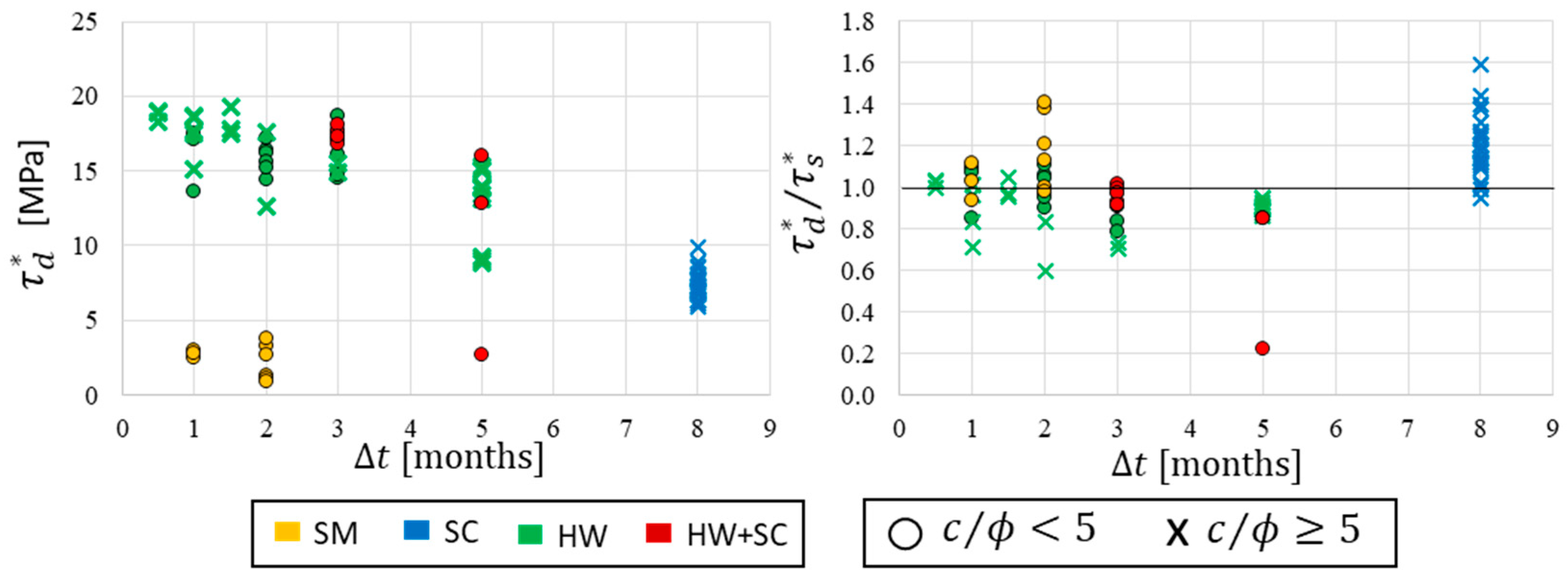
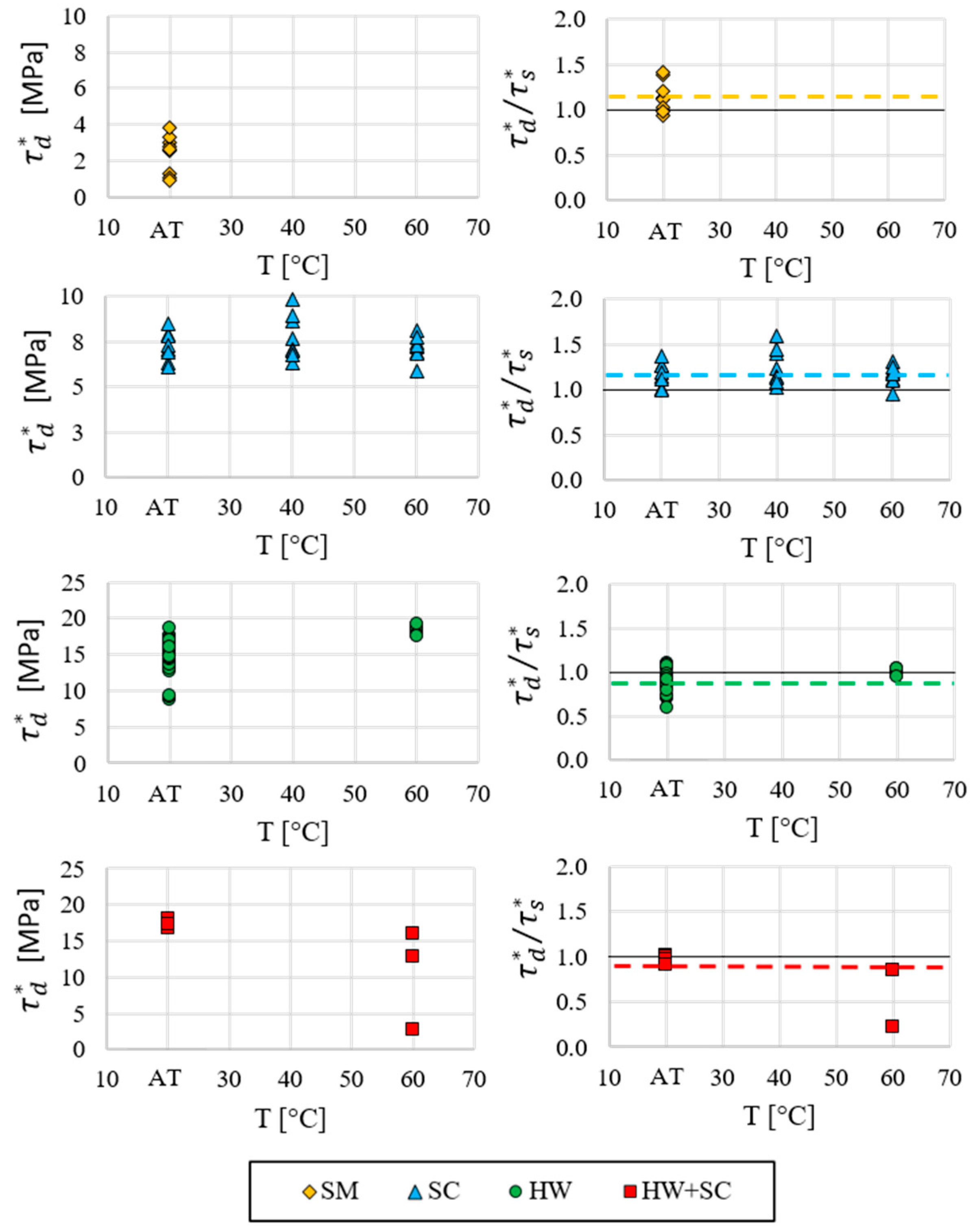
Considering the different data clusters defined according to the bar surface configuration, Figure 1 and Figure 2 show the measured bond strength τ d * of the degraded specimens for various exposure durations (Figure 1) and temperatures (Figure 2). It should be noted that, for smooth (SM) bars, the available data refer only to alkaline conditioning at ambient temperature (AT); therefore, Figure 2 does not allow a direct assessment of temperature effects for this class. To provide a quantitative measure of the degradation effect, as well as to mitigate cross-study variability, the experimental results were also examined through the ratio τ d * / τ s * , where τ s * denotes the bond strength of sound specimens having equivalent geometrical and mechanical characteristics. Although this normalization reduces the influence of different baseline bond capacities, part of the scatter within each cluster may still reflect the combined effect of conditioning parameters and geometry- or material-related confounding factors.
It is worth noting that τ * (for both degraded, τ d * , and sound, τ s * , specimens) denotes the peak value of the recorded pull-out force divided by the bond interface area π ϕ L b , thus representing an average measure of the interfacial shear stress at bond failure.
Regarding geometric characteristics, the main parameters potentially influencing the bond response are the bonded length L b and the cover-to-diameter ratio c / ϕ . Concerning L b , most of the collected specimens adopt L b / ϕ = 5 , whereas only a limited number of tests refer to larger bond lengths, thus preventing a statistically consistent assessment of the influence of L b . To better account for confinement effects, the database was further stratified by distinguishing specimens with c / ϕ < 5 and c / ϕ 5 (see Figure 1).
Although the limited number of available data does not allow for conclusive evidence, the following conclusions can be clearly drawn:
  • The surface configuration of the bars strongly affects bond strength, indicating that different surface treatments activate different bond mechanisms governing the GFRP bar–concrete interaction. Specifically, the highest bond strength values are observed for the HW configuration, both with and without the sand-coated treatment.
  • The available dataset does not provide evidence regarding the influence of exposure duration for sand-coated GFRP bars (and, conversely, the influence of exposure temperature for smooth GFRP bars), since in these cases, data are limited to a single exposure period (or to ambient temperature only). For the remaining clusters, the analyzed results show that increasing the exposure period generally leads to a proportional reduction in the average bond strength within each class of data. For instance, in the HW case (and similarly for HW + SC), the bond strength τ d * ranges from about 18–19 MPa at Δt = 0.5 months (and 17–19 MPa at Δt = 3 months) to about 9–15 MPa at Δt = 5 months (and 3–16 MPa at Δt = 5 months), corresponding to a reduction of approximately 17–52% (and 1–84%, respectively). It is worth noting that the HW + SC data point showing a bond strength of about 3 MPa at 5 months corresponds to a specimen cast with fiber-reinforced concrete.
  • The analysis of the ratio τ d * / τ s * suggests that exposure to alkaline solution tends to increase the mean bond strength relative to non-conditioned samples by up to 40% (under ambient temperature and two months of exposure, with an average increase of 13%) for SM bars and by up to 60% (under temperatures from ambient to 60 °C and eight months of exposure, with an average increase of 19%) for SC bars. Conversely, an opposite trend is observed for helically wrapped bars: the longer the conditioning period, the more pronounced the mean bond strength degradation compared with non-conditioned specimens (average reductions of approximately 8% and 6% for HW and HW + SC bars, respectively). These opposite trends between smooth/sand-coated and helically wrapped bars could be justified by the different mechanisms through which the bond is mobilized. For smooth and sand-coated GFRP bars, alkaline conditioning might induce slight surface etching or micro-roughening of the outer resin layer, thereby enhancing frictional resistance and mechanical interlock with concrete. This effect could be enhanced in sand-coated bars, where the chemical interactions promoted by alkaline exposure could improve friction-based load-transfer mechanisms, leading to more pronounced increases in bond efficiency compared with smooth bars. In contrast, helically wrapped bars rely primarily on the mechanical contribution of their external ribs for stress transfer. Alkaline exposure may deteriorate the polymeric matrix at rib surfaces or weaken the interface between the helical wrap and the bar core, compromising rib integrity and thus reducing the efficiency of mechanical interlock. As a result, conditioned specimens with helically wrapped bars generally exhibit lower bond strength than their unconditioned counterparts.
  • As demonstrated in Figure 1, the differentiation of the data with respect to the c / ϕ ratio indicates a certain correlation between the bond strength of the degraded samples and the magnitude of this ratio. However, it should be noted that this statement can only be made for the HW class, for which a comparison between data with different c / ϕ ratios is available. In particular, such a trend can be reasonably interpreted by considering that the c / ϕ ratio is a proxy measure of the confinement level provided by the surrounding concrete, which affects the competition between pull-out and splitting mechanisms and, in turn, the residual bond capacity. Nevertheless, since the present dataset is assembled from independent experimental campaigns, this evidence should be considered as a qualitative indication rather than a strict cause–effect relationship, as other parameters (e.g., concrete strength and testing setup) may contribute to the observed dispersion.
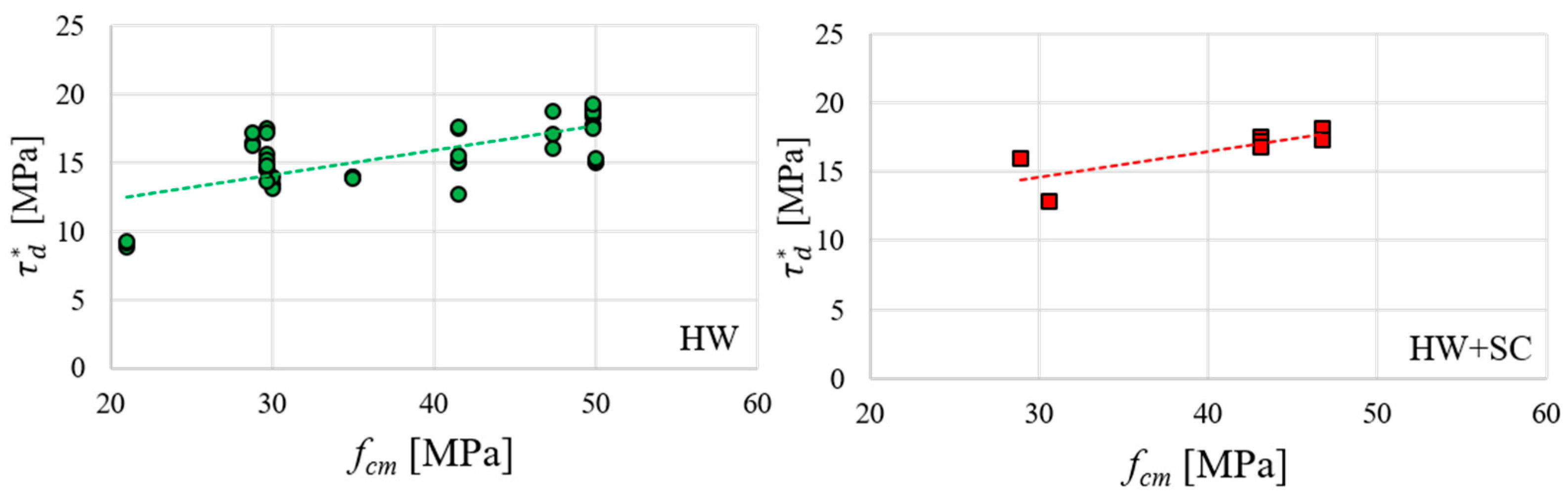
  • Considering the HW and HW + SC clusters (those for which data variability is more pronounced), Figure 3 reports the relationship between the bond strength of degraded specimens and the mean concrete compressive strength. The graphs show a clear correlation between concrete mechanical performance and the resulting bond strength: higher concrete strength generally translates into higher bond strength. Specifically, for HW bars (and, respectively, for HW + SC bars), an increase of approximately 67% (respectively, 50%) in the mean concrete compressive strength results in an increase of about 25% (respectively, 17%) in the mean bond strength τ d * . It is worth noting that variations in fcm across different experimental campaigns may partly contribute to the scatter observed within each cluster, thus acting as a potential confounding factor in the interpretation of temperature- and duration-related trends.
The analysis of the compiled database confirms that the bond behavior of GFRP bar–concrete systems is influenced by exposure to alkaline environments under different temperature conditions and exposure durations. Consequently, specimens reinforced with helically wrapped bars (with or without sand coating) tend to exhibit lower bond strength when conditioned in alkaline solutions, with the degree of degradation also affected by the concrete strength. However, for the SM and SC clusters, the available data remain too limited to derive conclusive quantitative trends or to formulate robust analytical design recommendations. To address this knowledge gap, a new experimental campaign was conceived and initiated, and some preliminary results are presented in the following section.

3. Experimental Bond Tests

An experimental campaign was initiated at the Civil Engineering Laboratory of Niccolò Cusano University of Rome (Italy) to investigate potential variations in the interaction between sand-coated GFRP rebars and concrete after exposure to an aggressive environment. To date, nine specimens have been cast, conditioned in an alkaline solution under controlled temperature and exposure duration, and subsequently tested through pull-out experiments. The following sections present and discuss the main results obtained from this campaign.

3.1. Materials, Specimens and Testing Conditions

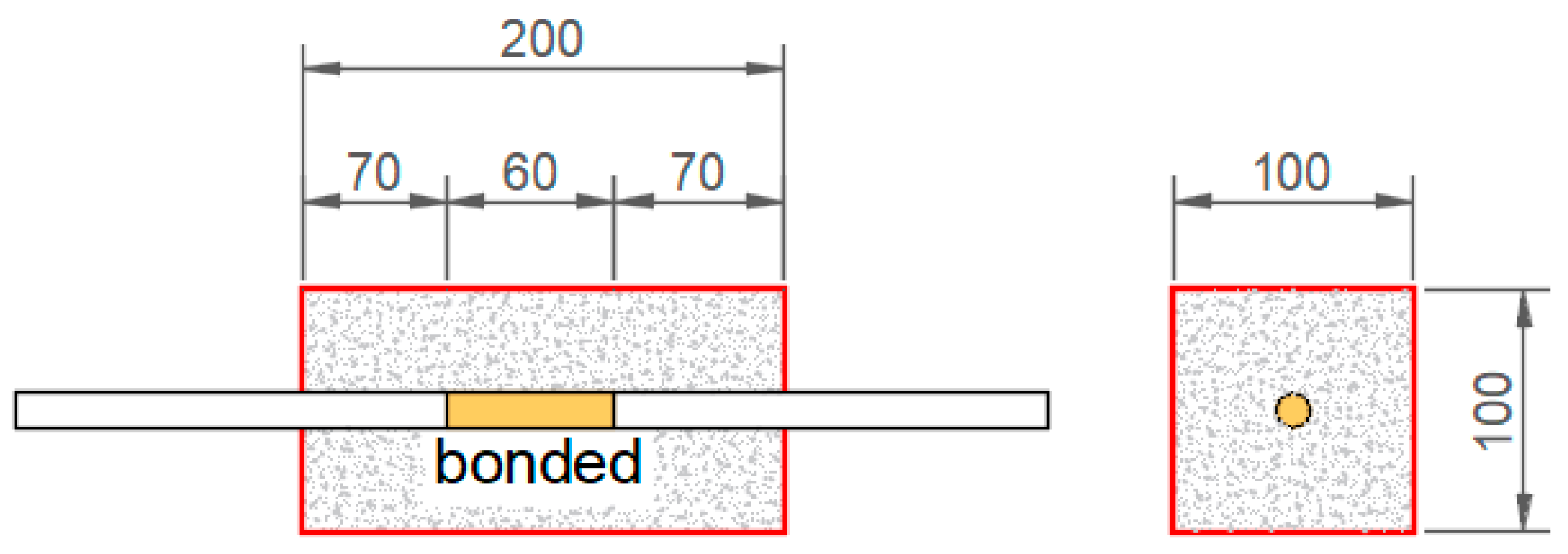
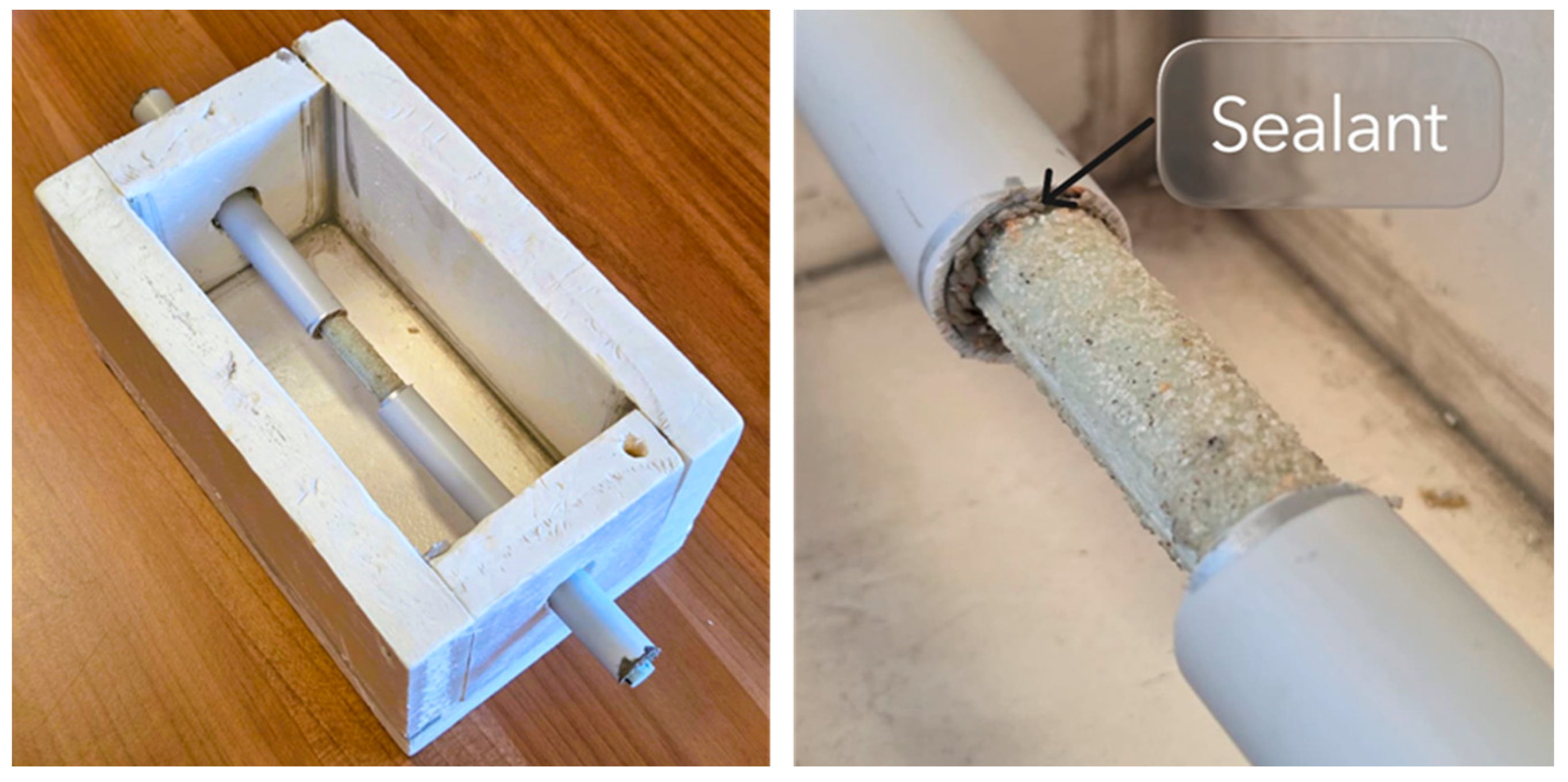
Pull-out specimens were cast according to the geometry shown in Figure 4, adopting a ratio of concrete cover to bar diameter of c/ϕ = 3.67. To avoid boundary effects associated with the coupled shear–compressive stress state typically observed in conventional pull-out tests, the bond between concrete and reinforcement was developed only beyond a distance of 5ϕ from the loaded end. In addition, to capture the local bond response, a bonded length of 5ϕ was adopted, in accordance with RILEM recommendations [21]. To satisfy both requirements, the reinforcement bars were isolated using PVC tubes (Figure 5, left side). Furthermore, to prevent concrete from penetrating into the tubes during casting—and to avoid direct contact between the conditioning alkaline solution and the unbonded portion of the GFRP bar, which could otherwise degrade or embrittle the reinforcement—a small amount of sealant was applied at the tube ends (Figure 5, right side).
The concrete mix used for specimen fabrication corresponded to consistency class S4 and was designed for exposure class XC3, in accordance with current standards [20]. The mixture contained coarse aggregates with a maximum nominal size of 25 mm and was produced using CEM II/A-LL 42.5R cement. Compressive strength was evaluated on 150 × 150 × 150 mm3 cubic specimens, tested according to EN 12390-3 [22] and conditioned under the same conditions as the pull-out specimens. The measured mean cubic compressive strength was 42.8 MPa—corresponding to an estimated mean cylindrical compressive strength of approximately 35.6 MPa —with a coefficient of variation of 18.4%, i.e., a standard deviation of about 7.9 MPa.
The GFRP reinforcements used in this study were manufactured by Fibre Net S.p.A. (Pavia di Udine, Italy) and were characterized by a nominal diameter ϕ = 12 mm (corresponding to a nominal cross-sectional area of 113 mm2) and a sand-coated surface. The bars contained 70% fiber by weight and had a unit weight of 214 g/m. Tensile strength and axial elastic modulus were determined according to CNR DT 203/2006 [23], yielding values of approximately 560 MPa and 35 GPa, respectively. The matrix resin was a thermosetting vinyl ester epoxy with a glass transition temperature of 115 °C and a thermal expansion coefficient in the range of 6–77 × 10−6/°C. According to the manufacturer’s technical datasheet, the recommended service temperature range for these bars is between –15 °C and 80 °C.
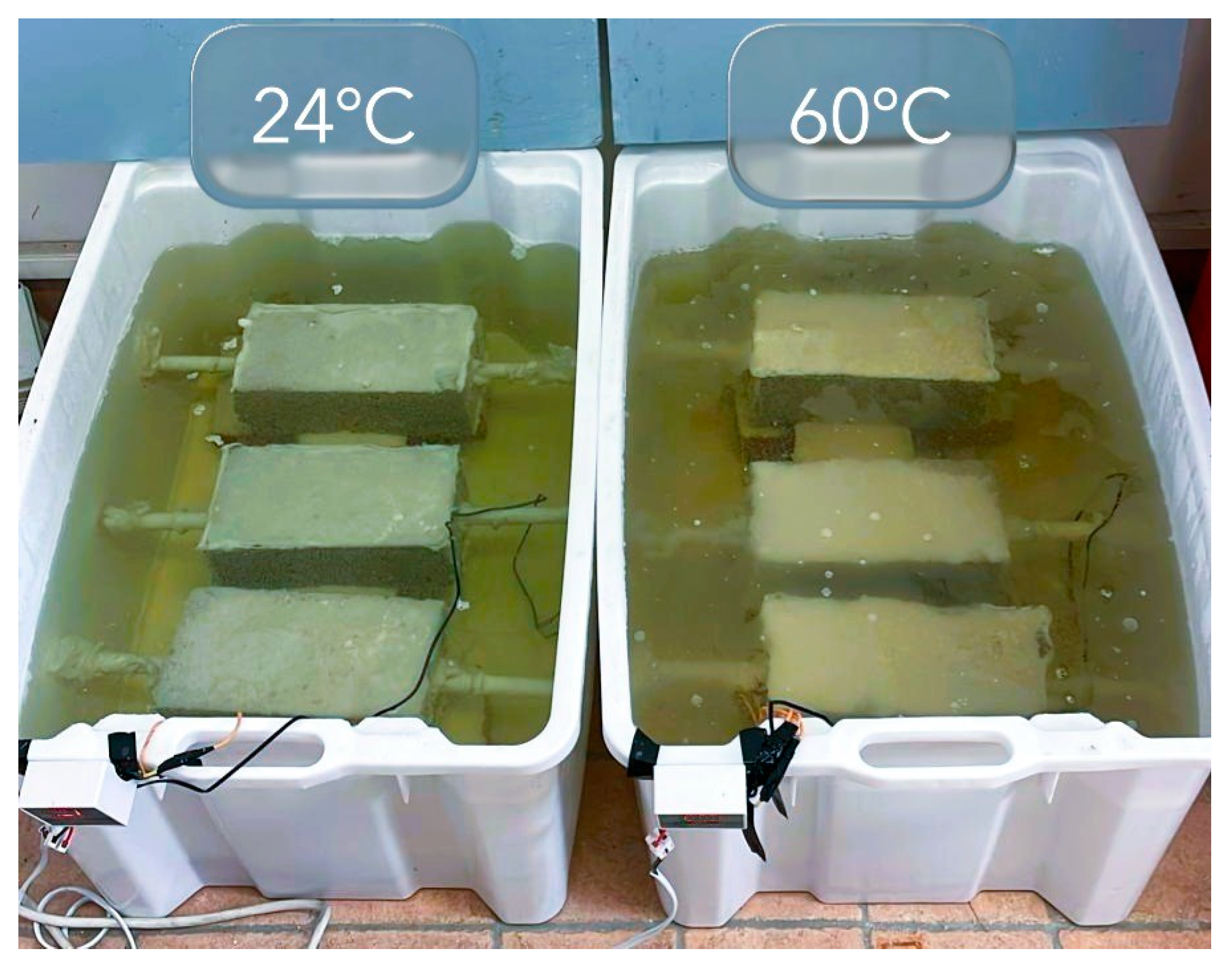
To contribute to the assessment of the influence of alkaline exposure on concrete systems reinforced with GFRP bars, and in line with the findings of the literature review presented in Section 2, an alkaline solution with a pH of approximately 12.0 was prepared using 0.16% by weight Ca(OH)2. Specimens were immersed in this solution for a conditioning period of 45 days under controlled temperatures of either 24 °C (samples denoted as AK_45_24) or 60 °C (AK_45_60). To ensure uniform exposure, specimens were kept fully submerged, and the target temperature was maintained using a flat silicone rubber heating element continuously regulated by a thermostat (Figure 6). The conditioning bath was isolated from the external environment with a transparent plastic film to prevent CO2 ingress, which could otherwise promote calcium carbonate precipitation and lower the pH. The solution pH was periodically monitored and adjusted as required to maintain the target value.

3.2. Pull-Out Bond Tests

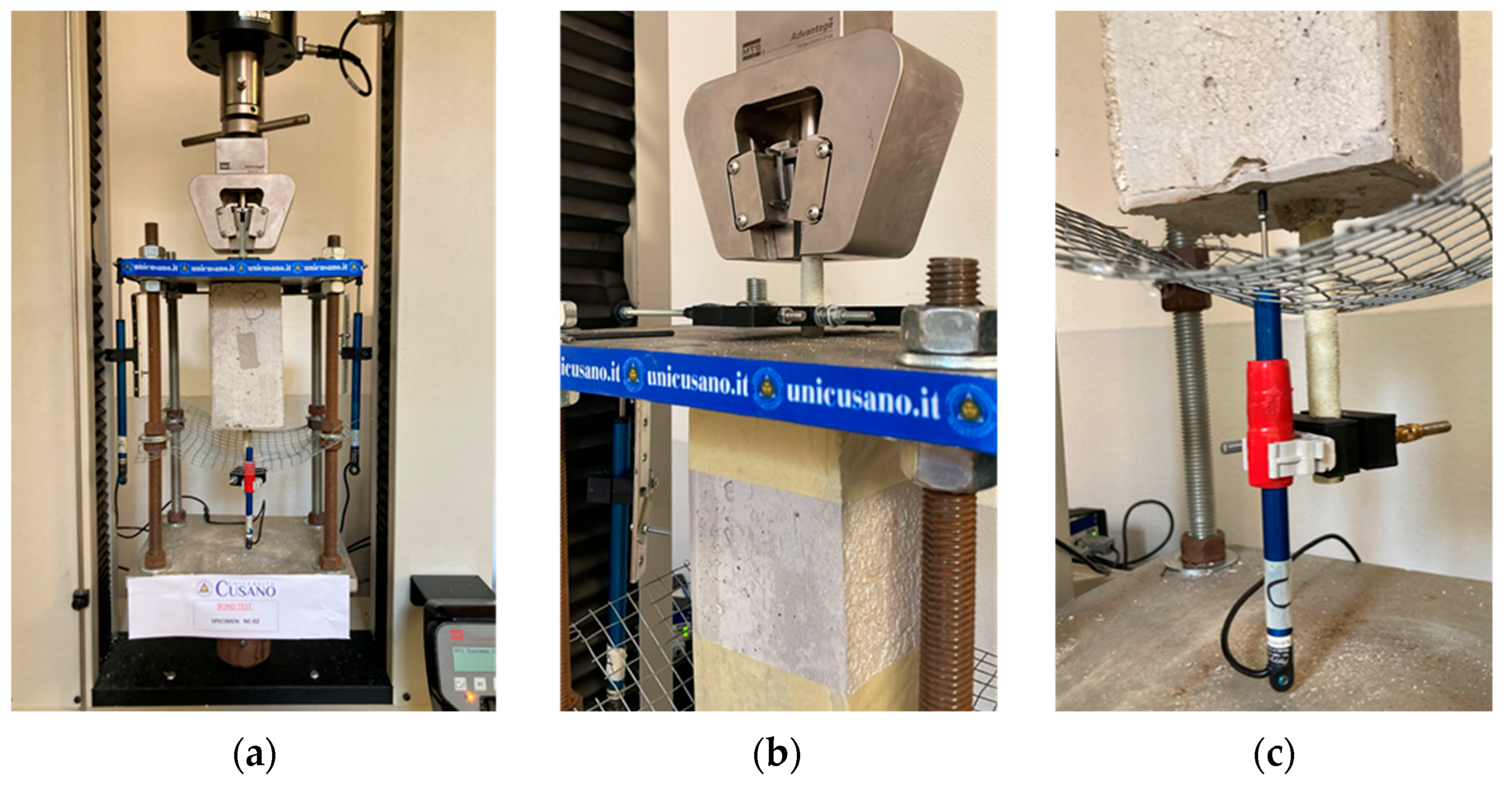
The bond between SC-GFRP bars and concrete was evaluated through conventional pull-out tests (Figure 7). The tests were performed under displacement control by applying a constant displacement rate of 0.5 mm/min at one end of the GFRP bar (loaded end, Figure 7b), while the opposite end was left free (Figure 7c). A custom-designed steel frame, connected to the testing machine (MTS 50 kN) through a hinged joint, was used to prevent any vertical movement of the concrete block and to ensure proper extraction of the GFRP bar.
It is important to note that displacements measured at the loaded end include the elastic elongation of the reinforcement, whereas those recorded at the free end represent the pure slip contribution. Measurements were obtained using linear potentiometric sensors, which provide virtually infinite resolution, low electrical noise, and high stability.
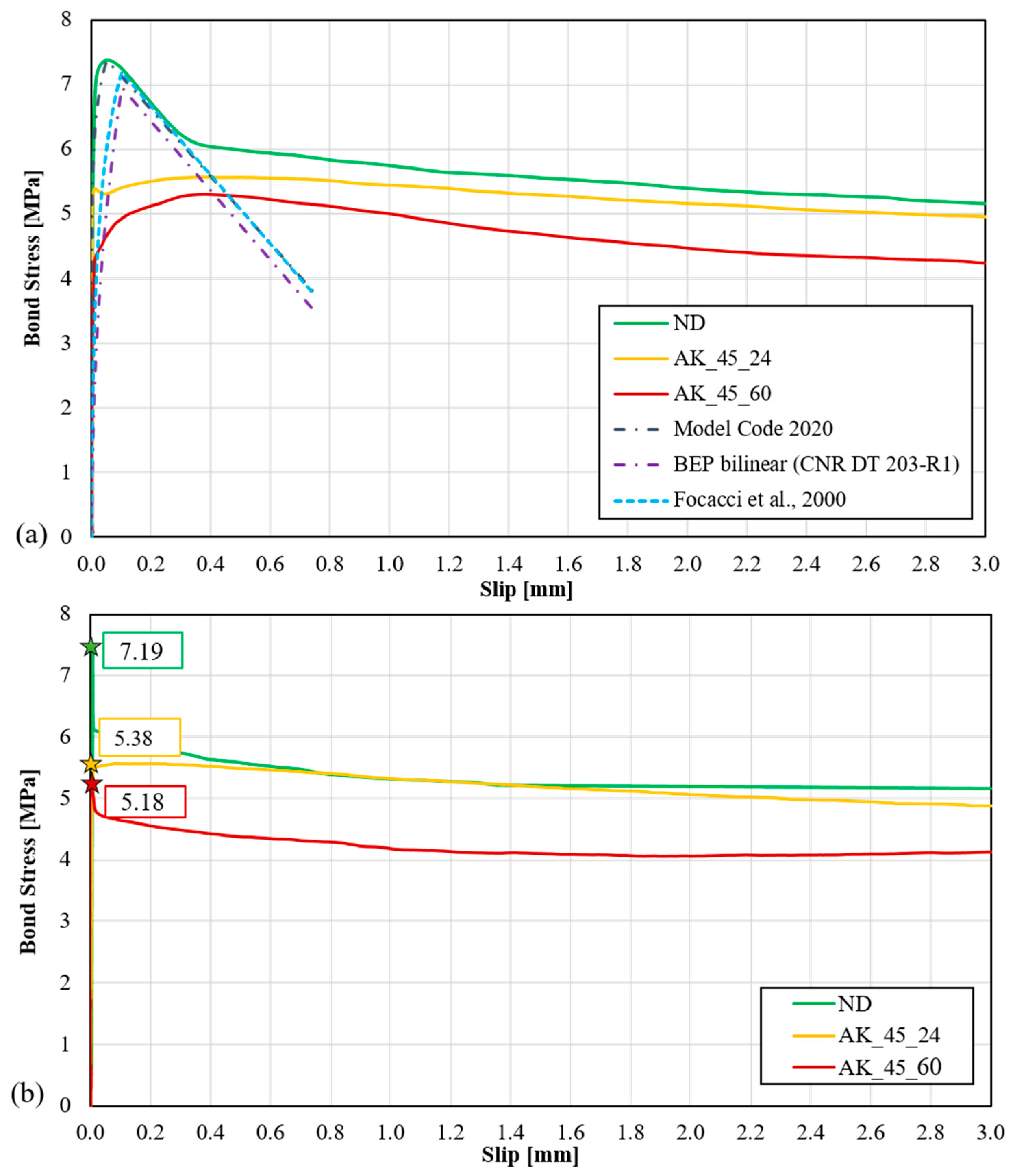
Figure 8 shows the resulting bond–slip responses, expressed in terms of displacements measured at the free end (Figure 8a) and at the loaded end (Figure 8b), with the latter calculated as the average of the two external potentiometer readings. The experimental slip curves associated with measurements at the free end were compared with theoretical predictions derived from available formulations and technical guidelines (CNR DT 203-R1 [23], Model Code 2020 [24], Focacci et al. [25]), which, however, do not account for conditioning or deterioration effects. For brevity, only three representative specimens are presented here, as the remaining ones exhibited comparable behavior in terms of reinforcement slip, peak load, and overall curve shape. All specimens failed by pull-out, as expected, given the adopted cover-to-diameter ratio and the sand-coated surface of the bars.
The experimental results indicate a clear reduction in bond strength, relative to the unconditioned reference specimen (denoted as ND, whose bond–slip response is shown by the green curves in Figure 8), when the combined temperature–alkaline exposure is considered. In addition, the shape of the bond–slip curves changes markedly under aggressive environmental conditions, with the magnitude of such changes increasing as the conditioning temperature rises.
For the ND specimen, the bond–slip behavior exhibits an initial peak bond stress (i.e., the bond strength), followed by a descending branch that progressively stabilizes as friction becomes the dominant load-transfer mechanism. The post-peak stress drop is almost abrupt when considering the loaded-end measurements, whereas it appears smoother (and well described by a power-law trend) when slip at the free end is examined. In the latter case, the fib Model Code 2020 formulation [24] recovers an accurate description, provided that its calibration coefficient is adjusted to the experimental data. Conversely, the Italian guideline CNR DT 203-R1 [23] and the formulation proposed in [25] tend to overestimate the initial slip. Under alkaline conditioning, the mechanical response is characterized by lower peak stresses and a more gradual and regular post-peak branch, particularly evident in the free-end measurements, and such a response is significantly far from the considered theoretical predictions.
However, although the bond strength values observed in this study are consistent with those reported in [14] (see Figure 1 and Figure 2), the corresponding effects of conditioning appear to be in contrast with the trends highlighted in Section 2 and those resulting from the analysis of the reference dataset. Specifically, the dataset analysis suggests that, for SC-GFRP bars, alkaline conditioning tends to increase the average bond strength relative to unconditioned specimens. This apparent discrepancy indicates that no definitive conclusions can yet be drawn and confirms the need for further experimental evidence. In this context, the following considerations, supported by additional experimental data, may provide insights into the present results and clarify the potentially governing mechanisms:
  • The specimens tested in [14] (see Table 2) differ substantially from those examined here in terms of geometry (Lb/ϕ approximately 20% larger; c/ϕ about 58% larger; ϕ = 12.7 mm) and mechanical properties. In particular, the GFRP bars used in the present study exhibit an axial elastic modulus Ef about 31% lower than those in [14], while the mean cylindrical concrete compressive strength fcm is about 21% higher. These differences imply distinct load-transfer and slip mechanisms. In particular, the higher compliance of the reinforcement (due to the lower Ef), the greater concrete strength (higher fcm), the smaller bonded area (reduced by about 26% due to lower Lb/ϕ and ϕ), and the higher expected stress gradient at the interface (associated with the smaller c/ϕ) can synergistically affect the bond strength performance, leading to a more abrupt slip behavior and promoting the reduction in peak stress and frictional resistance when alkaline conditioning is present.
  • The study in [14] refers to a conditioning duration far longer than that adopted here (8 months versus 1.5 months). Such a discrepancy may result in significantly different chemical interactions at the bond interface, influencing adhesion mechanisms and altering the friction-driven bond–slip response of sand-coated bars. To clarify these effects, a microscopic analysis of the post-test interfacial region is presented in the following section.

3.3. Microscopic Bond Interface Analysis and Degradation Mechanisms

To further elucidate the mechanisms responsible for the observed degradation of bond performance, a detailed investigation of the concrete–GFRP interface was carried out on the specimens after testing. The objective was to identify possible alterations in the interfacial morphology and correlate them with the bond–slip mechanical response previously discussed. Each specimen was sectioned to expose the bonded region, enabling both visual examination and optical microscopy analysis. The visual inspection focused on macroscopic features—such as interfacial discontinuities and color variations—indicative of potential degradation phenomena, whereas optical microscopy was used to assess the microstructural characteristics of the interface.
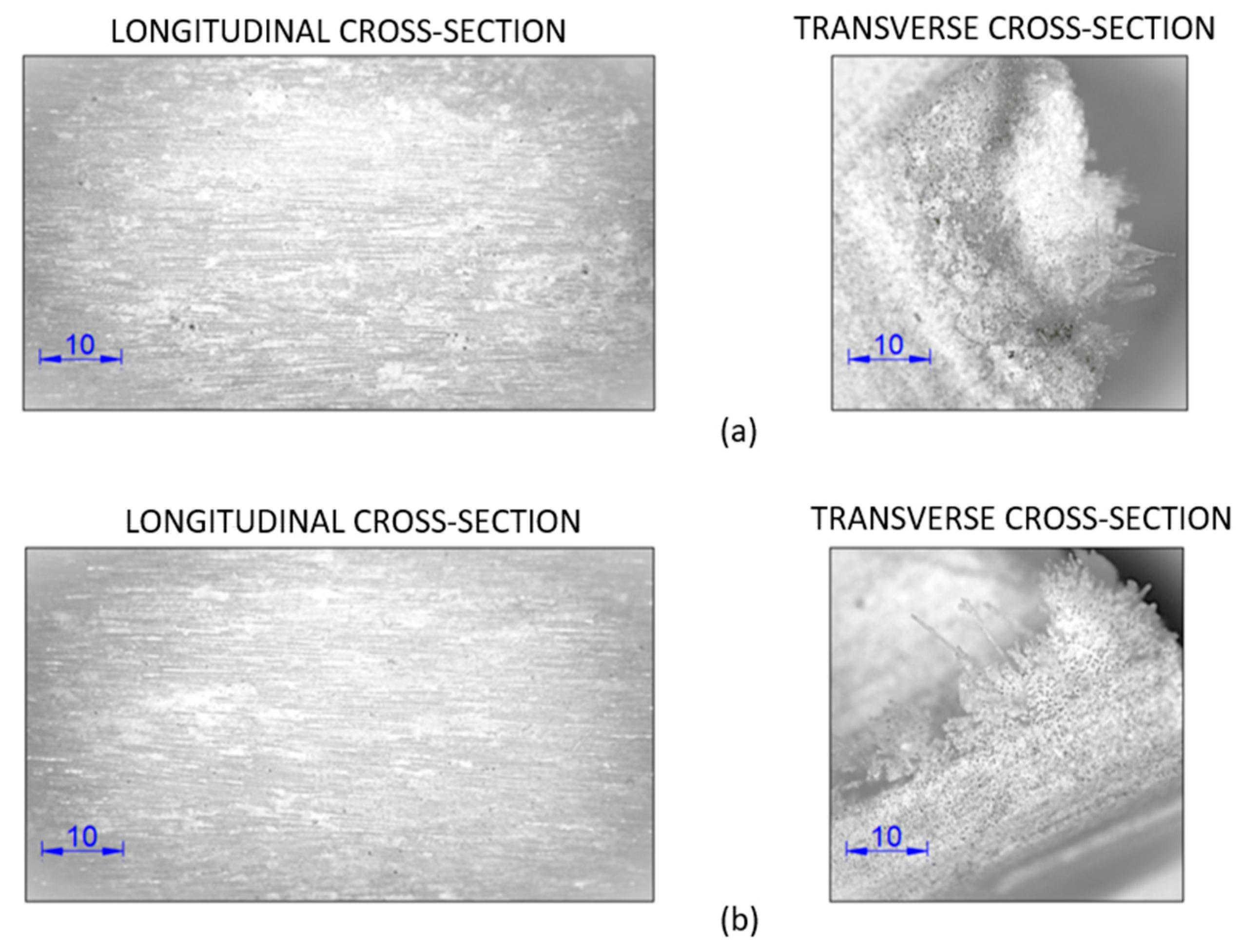
The analysis of both unconditioned specimens (ND) and those conditioned at ambient temperature (AK_45_24) revealed no substantial morphological differences (Figure 9). Therefore, the higher bond strength observed in the unconditioned samples can be attributed primarily to the preserved state of the sand coating. This coating is the first component affected by the aggressive alkaline exposure and plays a key role in the initial stage of the bond–slip response (up to the bond-stress peak) by enhancing mechanical interlocking and frictional effects that couple with chemical adhesion between the GFRP bar and the surrounding concrete.
Additional insights on FRP–concrete interface mechanisms in advanced cementitious materials can be found in [25,26], where pull-out tests were performed on GFRP/FRP bars embedded in special concretes such as fiber-reinforced ultra-high-strength seawater sea-sand concrete [25] and 3D-printed high-performance concrete [26]. These studies highlight that, besides bar surface configuration, bond performance is strongly influenced by the microstructural features of the surrounding matrix. In particular, the results in [25] show that bar diameter and anchorage length significantly affect bond strength, while the addition of fibers may improve bond performance only within an optimal content range. Moreover, evidence proposed in [27] demonstrates that the layer-by-layer printing process may reduce bond strength due to interlayer defects and anisotropic microstructural integrity, yielding a marked dependence on the printing direction.
Interestingly, detailed post-pull-out observations, including SEM microscopy, have also been reported for HW-SC bars [26]. The analyses revealed complete abrasion of the sand coating and localized loosening of surface fiber bundles, while internal fibers remained mostly intact. Failure was observed to initiate at the sand-coated surface and progressively propagate outward, with surface damage severity increasing with bond effectiveness. These findings further support the interpretation that interface degradation mechanisms are highly sensitive to both environmental conditioning and concrete microstructure and therefore should be considered in durability-informed bond models.
These observations are fully consistent with the present alkaline–thermal framework, as they confirm that the degradation process primarily initiates at the external coating layer and progressively reduces mechanical interlocking and frictional resistance at the bar–concrete interface.
As a matter of fact, when alkaline–thermal conditioning was considered, progressive erosion of the sand coating layer was observed. Microscopic analyses showed that after conditioning exposure, the sand coating was partially detached or completely removed in several regions, thereby reducing surface roughness and frictional resistance and ultimately impairing bond performance. Nevertheless, the alkaline exposure at ambient temperature did not significantly alter the microstructure—and thus the mechanical properties—of the GFRP reinforcement (see Figure 9b). Once chemical adhesion is lost at the peak bond stress, the bar undergoes slip through a predominantly friction-driven mechanism. The asymptotic convergence of the residual responses observed for the ND and AK_45_24 specimens (see Figure 8) further supports this interpretation.
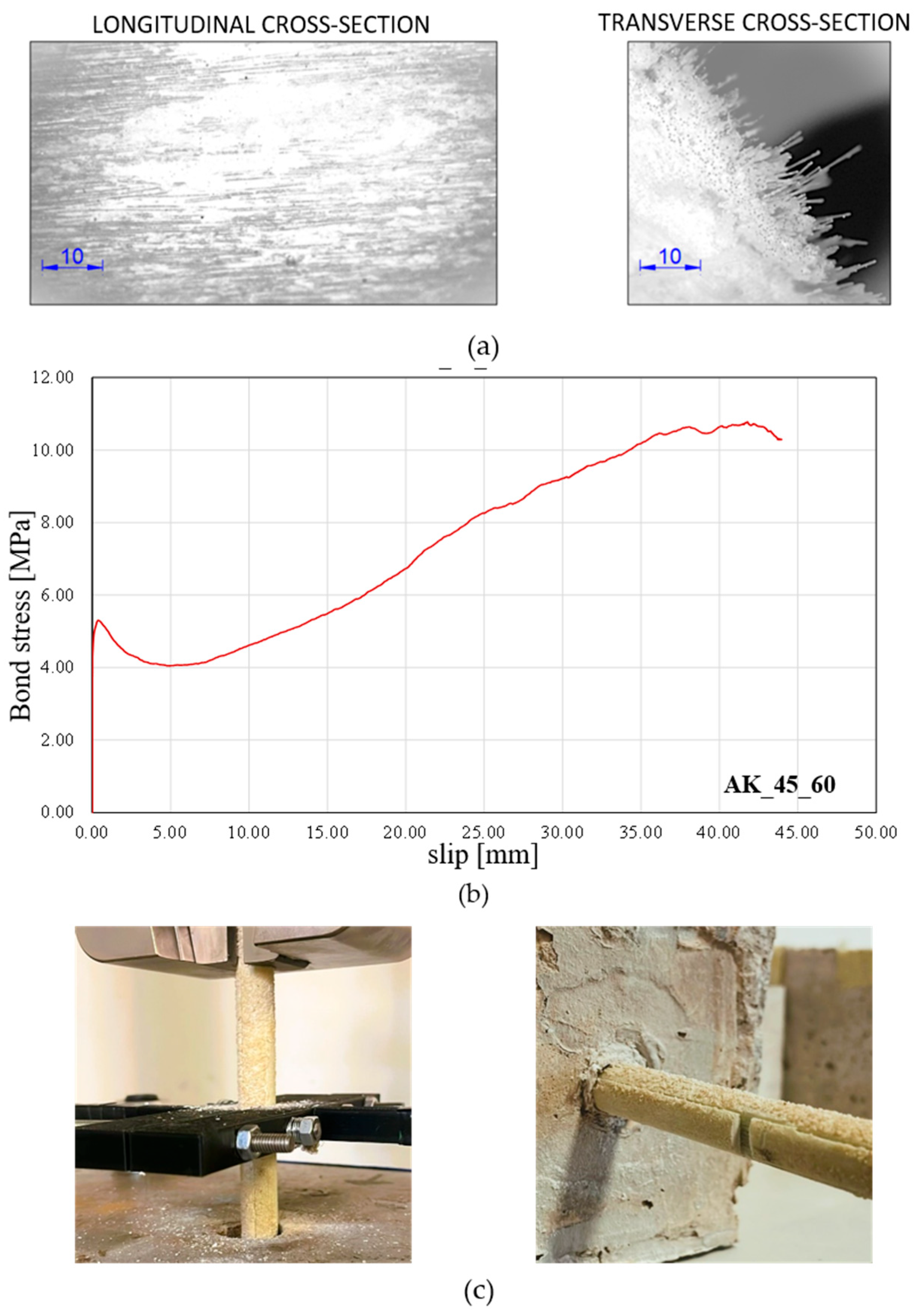
A markedly different behavior was observed for specimens conditioned at elevated temperatures. The combined action of the alkaline environment and high temperature promotes degradation processes affecting the microstructure of the GFRP bar itself. In this case, the integrity of the resin matrix tends to be compromised, leading to localized debonding and partial exposure of the glass microfibers. Similar sensitivity of epoxy-based GFRP matrices to temperature-driven damage mechanisms has also been discussed in other composite applications [6]. Specifically, high temperatures accelerate resin softening and enhance the diffusion of hydroxyl ions into the polymer network, promoting hydrolysis of the silicate structure of the glass microfibers as well as microcracking of the resin phase. These combined effects progressively weaken the chemical adhesion among the GFRP rebar phases, and, as a result, stress localization at the level of the glass microfibers becomes more significant. This mechanism is confirmed by post-test microscopic analyses of the AK_45_60 specimens (Figure 10a), showing localized microfiber breakage and detachment at the bond interface. Such a microscale degradation pattern results in two distinct response regimes experienced at the macroscale. At small slip values, a pronounced reduction in bond performance is observed compared with ND and AK_45_24 specimens (Figure 8). At larger slips, a strain-hardening response emerges (Figure 10b), attributed to the residual adhesion preserved between the softened resin matrix and the surrounding cementitious composite, and persists up to the attainment of the tensile failure of the GFRP bar (Figure 10c).
In summary, the visual and microscopic analyses confirm that the degradation of the bond mechanism is primarily driven by coupled chemical and thermal effects at the interface. The proposed results clearly show that the long-term durability of GFRP-reinforced concrete elements under aggressive environments is strongly dependent on the stability of both the resin matrix and the protective surface coating. Enhancing the chemical resistance of the polymer matrix and improving sand-coating adhesion appear to be key strategies for mitigating bond degradation and preserving the structural performance of GFRP-reinforced concrete systems.
It is worth remarking that the above microstructural interpretation is mainly based on qualitative SEM evidence. Although a quantitative comparison in terms of microscopy-based indicators (e.g., sand-coating loss fraction, crack density, or exposed fiber bundle density) is beyond the scope of the present study, the reported observations are in line with a transition from coating-dominated degradation at moderate temperatures to resin-driven damage mechanisms at higher conditioning temperatures.

4. Modeling the Local GFRP Bar–Concrete Interface Law

A one-dimensional analytical model, inspired by the formulation in [28], is herein adopted to describe the local bond–slip law at the FRP bar–concrete interface. The analytical model assumes that the main nonlinearities governing the bond response are localized at the GFRP–concrete interface and can be effectively captured through a constitutive relationship between the interfacial shear stress and the concrete–bar slip. This modeling choice is supported by the experimental evidence indicating that degradation and damage mechanisms primarily develop within a near-interface region, while the surrounding concrete bulk can be reasonably idealized as linear elastic for the purposes of the present analytical framework. Accordingly, pull-out failure is assumed to govern the response, rather than splitting-type mechanisms.

4.1. Analytical Local Bond–Slip Model

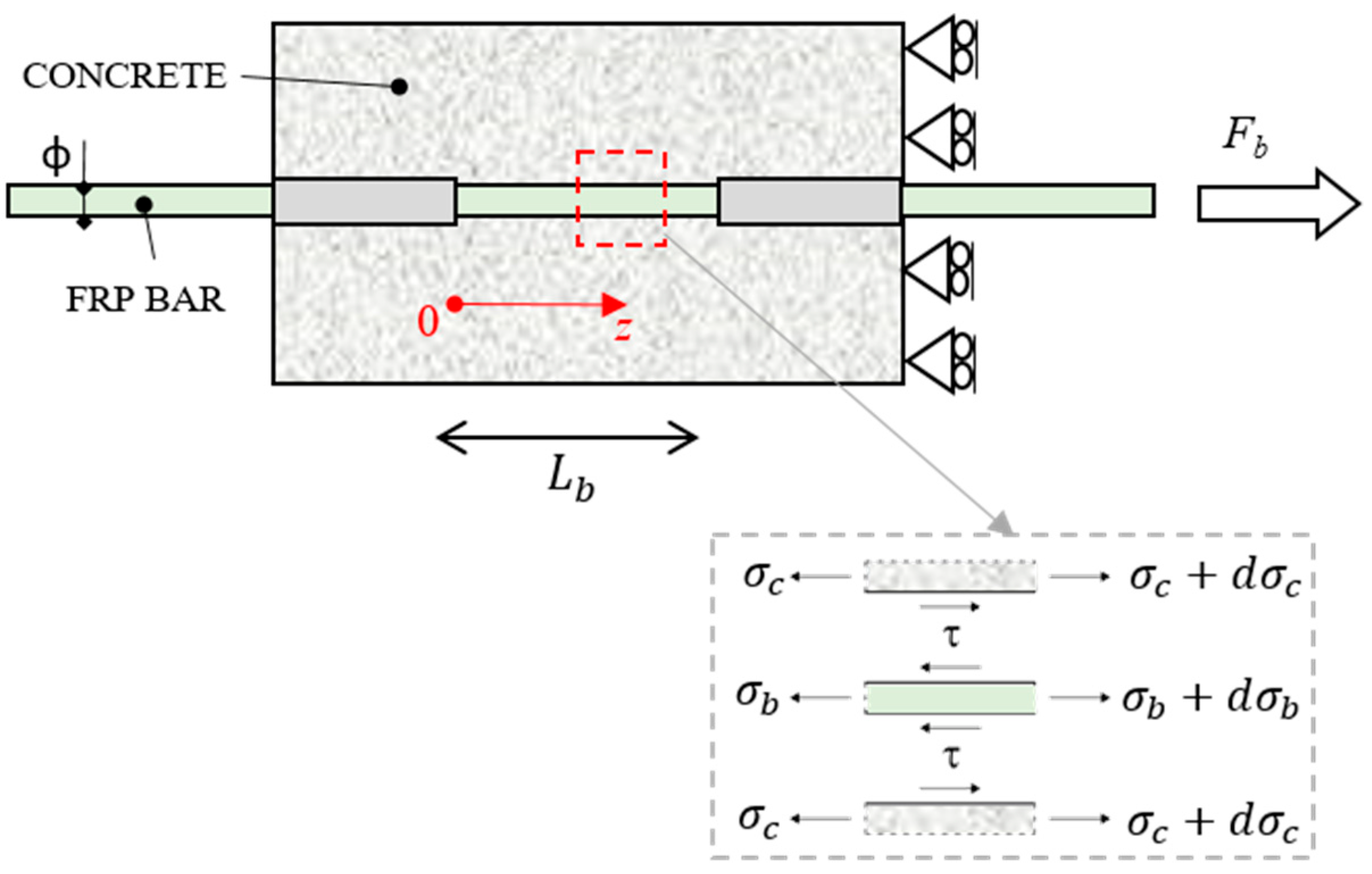
The pull-out configuration is illustrated in Figure 11. Specifically, the analysis refers to a one-dimensional domain defined along the z-axis (i.e., the bar axis), with 0 z L b , where quantities associated with the concrete and the FRP bar are discriminated by the subscripts c and b, respectively. The failure is assumed to be governed by a dominant pull-out mechanism; consequently, a pure shear sliding mode (Mode II) is considered the prevailing damage mechanism at the interface.
Let an infinitesimal segment dz long of the bar–concrete system be considered. The local axial equilibrium for the bar and concrete, consistent with the notation introduced in Figure 11, is expressed as
A b σ b ( z ) π ϕ τ ( z ) = 0 A c σ c ( z ) + π ϕ τ ( z ) = 0
where · = d · / d z , σ b ( z ) and σ c ( z ) denote the axial stresses in the bar and concrete, A b and A c the corresponding cross-sectional areas, and τ ( z ) the local interfacial shear stress. Assuming that load transfer occurs only within the bonded zone (thereby, σ b 0 = σ c 0 = 0 ), Equation (1) directly yields
A b σ b ( z ) + A c σ c ( z ) = 0
Both the FRP bar and concrete are modeled as homogeneous, linearly elastic, isotropic materials with Young’s moduli E b and E c . From compatibility, axial stresses read
σ b = E b u b ( z ) σ c = E c u c ( z )
where u b ( z ) and u c ( z ) denote the axial displacements. Introducing the local slip function ( z ) = u b ( z ) u c ( z ) , Equations (1) and (3) lead to the second-order differential equation:
s ( z ) ρ τ z = 0
where ρ = π ϕ ( E A ¯ ) 1 and ( E A ¯ ) 1 = E b A b 1 + ( E c A c ) 1 . Furthermore, from Equations (2) and (3), the first derivative of the slip function can be expressed as
s z = A b E A ¯ σ b z = A c E A ¯ σ c z
To integrate Equation (4), the constitutive relationship τ = τ ( s ) has to be specified. To this aim, the overall bond–slip response is partitioned into N slip regimes, each assumed to be associated with a τ s linear response. Accordingly, the following continuous piecewise-linear description is adopted for τ ( s ) :
τ s = k 1 s 0 s s ¯ 1 τ ¯ 1 + k 2 s s ¯ 1 s ¯ 1 s s ¯ 2 τ ¯ i 1 + k i s s ¯ i 1 s ¯ i 1 s s ¯ i τ ¯ N 1 + k N s s ¯ N 1 s ¯ N 1 s s ¯ N
where s ¯ i 1 and s ¯ i (with i = 1 , , N and s ¯ 0 = 0 ) are assigned characteristic slip values delimiting the i-th slip regime, the latter being defined by the slip interval [ s ¯ i 1 , s ¯ i ] and the constant stiffness parameter k i ; where τ ¯ i = τ ¯ i 1 + k i s ¯ i s ¯ i 1 with i = 1 , , N and τ ¯ 0 = 0 .
Integrating Equation (4) within the i-th slip regime, when τ s = τ ¯ i 1 + k i [ s ( z ) s ¯ i 1 ] , yields
s i z = C i ( 1 ) e α i z + C i ( 2 ) e α i z + s ¯ i 1 τ ¯ i 1 k i i f       k i > 0 C i ( 1 ) cos α i z + C i ( 2 ) sin α i z + s ¯ i 1 τ ¯ i 1 k i i f       k i < 0 ρ τ ¯ i 1 z 2 2 + C i ( 1 ) z + C i ( 2 ) i f       k i = 0
where C i ( 1 ) and C i ( 2 ) are integration constants, α i 2 = ρ | k i | , and s i z denotes the restriction of s z over the interval [ z ¯ i 1 , z ¯ i ] , where s i [ s ¯ i 1 , s ¯ i ] , with z ¯ i being the (a priori unknown) transition coordinate between the slip regimes i and ( i + 1 ) , such that s ( z ¯ i ) = s ¯ i .
Because s z is a non-decreasing function (see Equations (3) and (5)), if the applied slip s ^ at z = L b is such that s ¯ q 1 s ^ s ¯ q for a certain value of q 1 ,   2 , , N , then q slip regimes are active along the bond length, delimited by q axial intervals [ z ¯ i 1 , z ¯ i ] , with i = 1 , , q and z ¯ 0 = 0 , z ¯ q = L b . Accordingly, the slip function s ( z ) and the interface shear stress τ ( z ) result from Equations (6) and (7) by determining 2 q integration constants (namely, C i ( 1 ) ,   C i ( 2 ) with i = 1 , , q ) and ( q 1 ) transition coordinates ( z ¯ i with i = 1 , , q 1 ). To this aim, compatibility and equilibrium requirements lead to the following boundary conditions:
  s i ( z ¯ i ) = s ¯ i   s i + 1 ( z ¯ i ) = s ¯ i i = 1 ,   , ( q 1 ) s q ( z ¯ q = L b ) = s ^  
s i ( z ¯ i ) = s i + 1 ( z ¯ i ) i = 1 ,   , ( q 1 ) s 1 ( z ¯ 0 = 0 ) = 0  
Since Equation (7) involves transcendental functions, solving the system defined by Equations (8) and (9) for the ( 3 q 1 ) unknowns requires an iterative procedure. A Newton–Raphson scheme is adopted. For s ^ at z = L b activating q > 1 slip regimes, the following initial guesses z ¯ i ( 0 ) are used for the transition coordinates:
z ¯ i ( 0 ) = z ¯ i 1 ( 0 ) + z ¯ q 1 ( 0 ) ( q 1 ) i = 1 ,   , ( q 2 ) z ¯ q 1 ( 0 ) = L b L b 2 ( s ^ s ¯ q 1 ) ( s ¯ q s ¯ q 1 )  
However, determining the functions s ( z ) and τ ( z ) , which characterize the local bond–slip law at the interface, requires specifying the constitutive relationship introduced in Equation (6). This, in turn, demands assigning the characteristic slip values s ¯ i that define the boundaries of the different slip regimes, as well as the corresponding local stiffness parameters k i . These parameters must be derived from experimental results obtained through pull-out tests, which provide curves of the type F b S , where F b is the tensile force applied to the bar and S is the measured slip at the free end. Therefore, from the macroscopic response F b ( S ) , it is possible to identify:
  • N slip regimes, and thus the N characteristic slip values s ¯ i , for i = 1 , , N (with s ¯ 0 = 0 );
  • A set of attempt stiffness parameter K i for each slip regime [ s ¯ i 1 , s ¯ i ] , such that at the macroscopic level F b ( S ) K i S for S [ s ¯ i 1 , s ¯ i ] .
It is important to note that, in general, the stiffness parameters K i do not coincide with the local interface stiffnesses k i introduced in Equation (6). Nonetheless, the latter can be evaluated through an additional iterative procedure, which adopts the stiffness values identified by the macroscopic response as initial guesses for the local ones (i.e., k i ( 0 ) = K i ). At the ( n + 1 ) -th iteration step, the correction of the parameters k i ( n ) from the previous step is obtained by minimizing the Root Mean Square Error ( R M S E F b ( n ) ) between the experimental ( F b , e x p ) and the analytically predicted ( F b n ) pull-out force:
R M S E F b n = 1 s ¯ N 0 s ¯ N F b , e x p s ^ F b n s ^ , k i n 2 d s ^
where
F b n s ^ , k i n = π ϕ 0 L b τ n z , s ^ , k i n d z
It is worth remarking that the adopted piecewise-linear bond–slip representation in Equation (6) is not intended to provide an over-parameterized fitting of a single experimental curve, but rather a flexible mechanical discretization of the interface response, consistent with the presence of multiple physical regimes (adhesion, mechanical interlock, progressive damage, and residual friction). Accordingly, the number of active slip regimes is selected based on the observed macroscopic response, and only a limited set of characteristic points is introduced to reproduce the main transitions of the experimental F b S curve. In this framework, the calibration procedure is performed by minimizing the global error metric in Equation (11) over the whole slip domain, thus reducing sensitivity to local fluctuations and limiting the risk of overfitting. Moreover, the model is used herein (see the following Section 4.2) as an interpretative tool aimed at identifying consistent trends in the evolution of the local bond law under alkaline conditioning, rather than as a predictive formulation intended for general design purposes.

4.2. Assessment of the Local GFRP Bar–Concrete Interface Law

The analytical model presented in the previous section was applied to the experimental pull-out tests carried out on sand-coated GFRP bars and discussed in Section 3. Specifically, reference is made to the experimental responses in Figure 8a (i.e., corresponding to displacement measurements at the bar free end), expressed in terms of F b S relationship. For all three macroscopic experimental curves, four slip regimes were identified ( N = 4 ) by introducing the set of characteristic slip values s ¯ i . Table 5 summarizes the adopted values of s ¯ i (with s ¯ 0 = 0 ) and the corresponding experienced force levels F b , i = F b , e x p ( s ¯ i ) . In particular,
  • s ¯ 1 marks the end of the elastic regime and is identified by assuming the same stiffness for all specimens ( K 1 620 kN/mm);
  • s ¯ 2 corresponds to the measured peak force, that is F b , m a x = F b , e x p ( s ¯ 2 ) ;
  • s ¯ 3 identifies the knee point in the post-peak softening branch;
  • s ¯ 4 is the largest reference slip value.
The iterative procedures described above were implemented in a custom computational code developed in the MATLAB environment (R2024b, MathWorks, Natick, MA, USA).
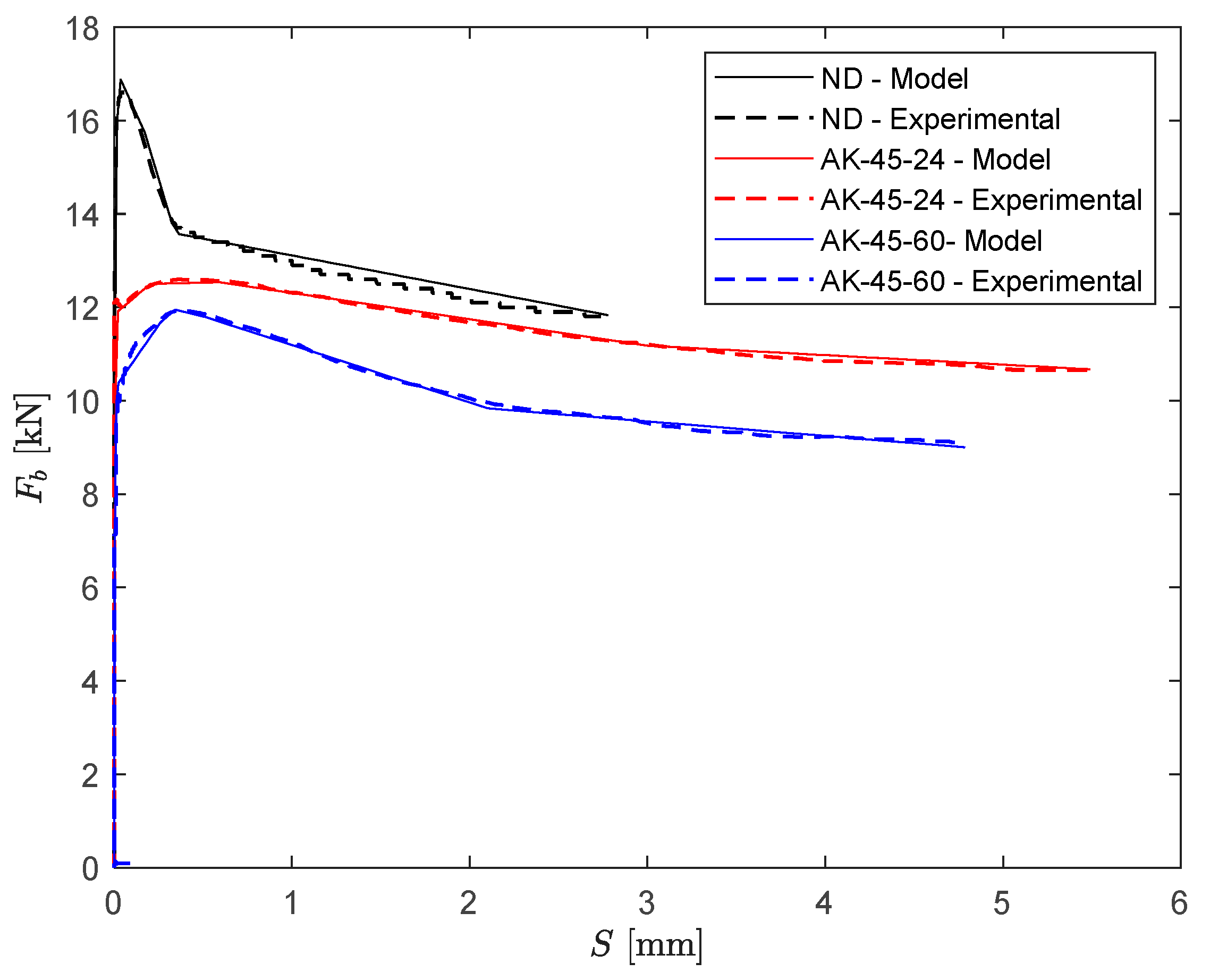
Figure 12 shows the comparison between experimental (dotted lines) and model-based (continuous lines) results in terms of F b S curves. The overall response described by the proposed modeling strategy consistently and accurately reflects the experimental behavior. The computed values of the local stiffness k i and the characteristic shear stresses τ ¯ i characterizing the four branches of the piecewise-linear law τ s introduced in Equation (6) are reported in Table 6.
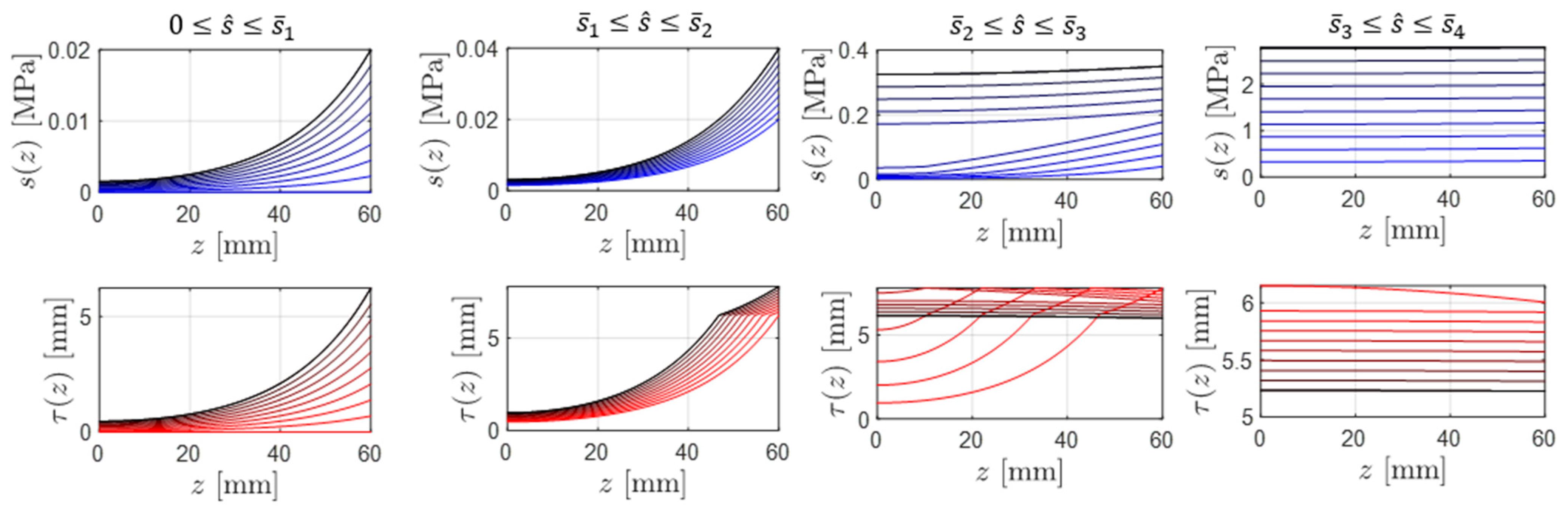
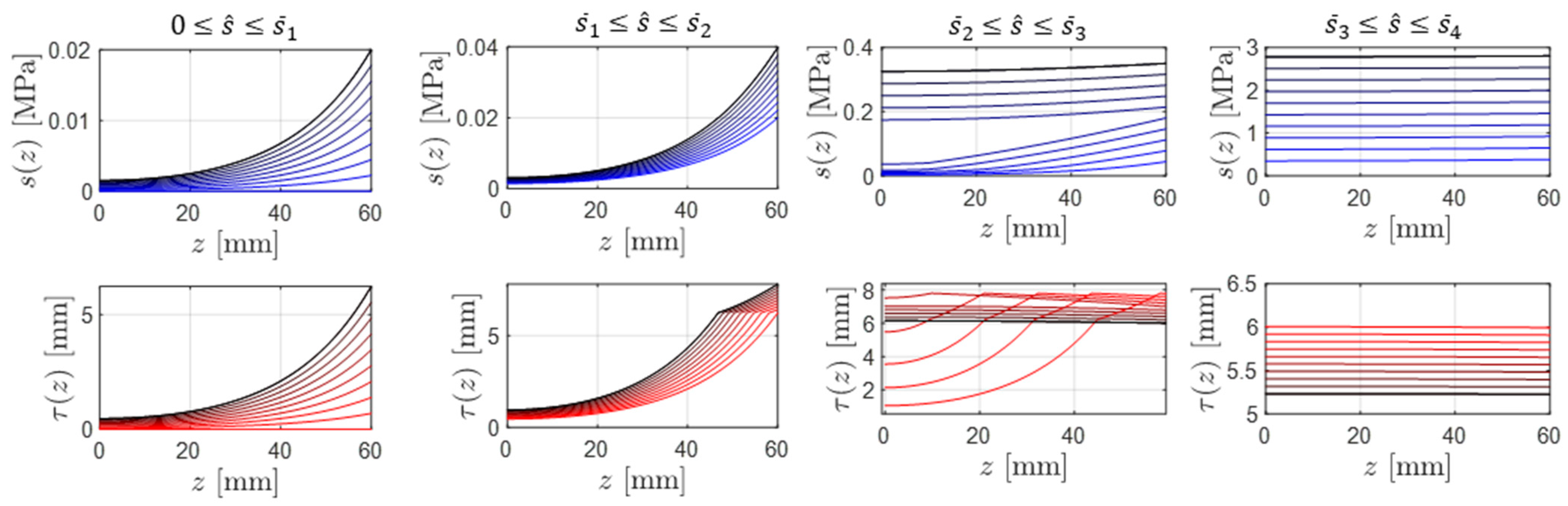
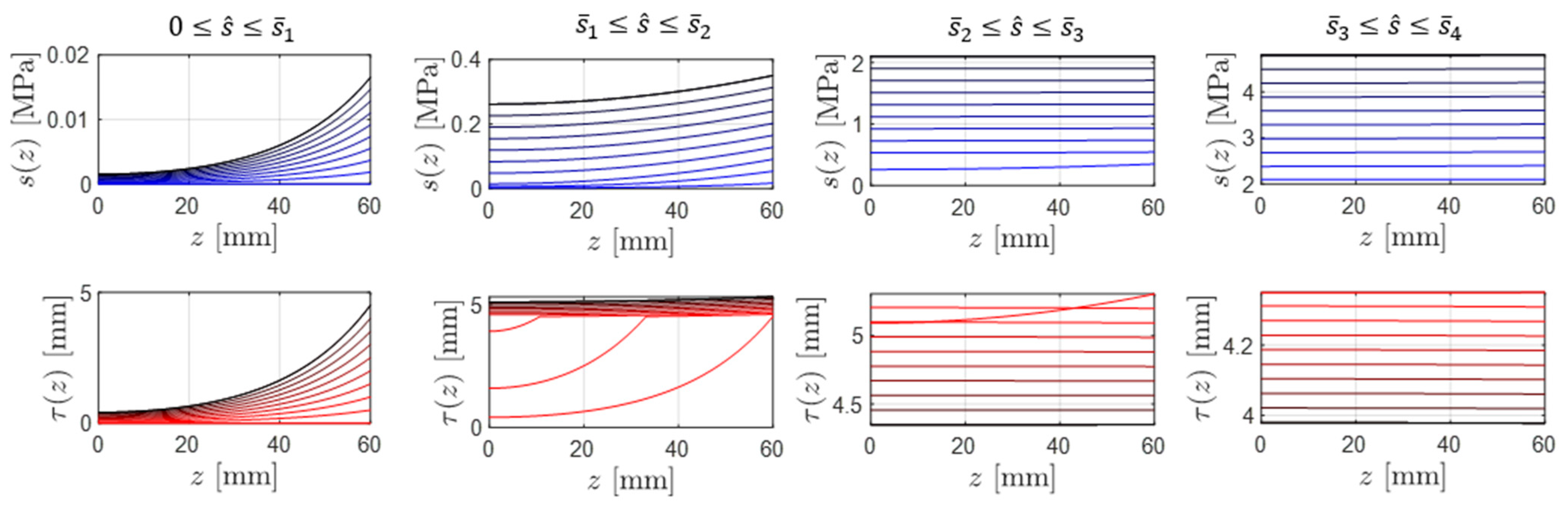
In addition, the proposed methodology enables a local description of the τ s interface law. Specifically, Figure 13, Figure 14 and Figure 15 show, for the three tested specimens (ND, AK_45_24, and AK_45_60), the local slip s ( z ) and the corresponding local shear stress τ ( z ) as functions of the imposed slip level s ^ (i.e., depending on the number of slip regimes activated along the bonded length). Each slip interval [ s ¯ i 1 , s ¯ i ] , to which the imposed slip s ^ may belong, is uniformly discretized so that ten different values of s ^ are considered for the numerical analyses. Accordingly, for each slip interval, ten curves are plotted, with color shades ranging from light to dark as s ^ increases, and with the black curve corresponding to s ^ = s ¯ i .
The analysis of proposed results, and the comparison between the local shear-stress distributions and the average bond-stress values reported in Figure 8, clearly indicates that, especially for slip regimes prior to the peak force, the average bond-stress measure F b / ( π ϕ L b ) is generally not representative of the effective interface shear stress distribution and of its peak levels. Moreover, the proposed approach makes it possible to clarify the influence of alkaline exposure conditions on the stress redistribution mechanisms at the bar–concrete interface. For instance, the results allow one to assess and quantify the local transition from chemically driven to friction-driven mechanisms in the bond–slip response. The former is characterized by a marked spatial variability of s ( z ) and τ ( z ) , whereas the latter is associated with quasi-uniform distributions of both local slip and shear stress.

5. Concluding Remarks

This study presented an integrated experimental–analytical investigation on the durability of the bond between glass fiber-reinforced polymer (GFRP) bars and concrete under alkaline exposure at controlled temperatures. By combining a systematic review of existing experimental evidence with newly conducted pull-out tests on sand-coated GFRP bars, the research provided new insights into both the macroscopic bond response and the underlying local interface mechanisms.
The analysis of an extended database, compiled through a consistent classification of available experimental results, confirmed that surface treatment is the primary factor governing the bond performance of GFRP bars. In particular, sand-coated bars, while offering effective mechanical interlock in unconditioned conditions, exhibited a measurable reduction in bond strength when exposed to alkaline solutions at elevated temperatures. Smooth bars showed limited degradation at room temperature, whereas bars characterized by a helically wrapped surface configuration (both sand-coated and not) displayed markedly scattered responses, preventing robust generalizations.
Both the literature review and the newly proposed experiments consistently indicated that alkaline exposure induces bond deterioration, intensified by higher temperatures. It is worth noting that the identified trends are derived from a multi-source literature database and should therefore be interpreted as statistically supported evidence rather than as strict cause–effect relationships obtained from fully controlled experimental conditions.
For sand-coated bars, reductions in peak bond stress of approximately 28% and 32% were observed in proposed experimental tests after 45 days of conditioning at 24 °C and 60 °C, respectively. As confirmed by optical microscopy analyses on post-tested specimens, these reductions reflect not only fiber–matrix degradation but also adverse effects on the interfacial resin layer, which mediates the mechanical interaction with concrete.
Beyond the reduction in peak stress, the tests conducted on sand-coated GFRP bars also revealed that the exposure to alkaline environments induces significant modifications in the post-peak softening response. Conditioned specimens exhibited a more gradual and smoother post-peak branch with respect to the unconditioned case, with an altered softening behavior significantly far from the theoretical bond–slip predictions commonly adopted in the available technical guidelines. Such an occurrence emphasizes that durability-related degradation influences not only the maximum load but also the deformation capacity and stress redistribution mechanisms, highlighting also the need for refined interface laws capable of reproducing degradation-induced mechanisms at the GFRP bar–concrete interface.
A one-dimensional analytical model was applied to reconstruct the local bond–slip law starting from the experienced macroscopic pull-out responses. The model—based on piecewise-linear slip regimes and calibrated through an iterative RMSE minimization—successfully captured the experimental force–slip curves and enabled detailed reconstruction of the local slip and shear-stress fields along the bonded length. The resulting local shear stress and slip distributions allowed distinguishing between chemically governed adhesion-driven regimes (characterized by highly non-uniform shear transfer) and friction-driven regimes (associated with nearly constant shear stress). The model thus revealed an effective physically grounded framework for providing a consistent mechanical interpretation of the experimental evidence and for supporting a comparative durability-oriented assessment of alkaline–thermal conditioning effects on local transfer mechanisms and interface degradation pathways.
It should be emphasized that the experimental campaign presented in this study is intentionally limited in size and refers to a short-term conditioning period (45 days). Therefore, the obtained results are not intended to directly support definitive long-term design recommendations. Rather, they provide a controlled experimental benchmark, combined with a literature-based comparative database and a consistent analytical interpretation, aimed at highlighting the potential relevance of alkaline–thermal exposure on bond degradation mechanisms. The marked variability observed across the literature, together with the limited number of controlled tests currently available, clearly indicates that broader experimental programs (including different exposure durations and systematically varied geometric and material parameters) are still required before robust durability-based design criteria can be reliably established, as well as to support the development of effective predictive tools. In particular, well-established experimental evidence and coherent analytical and numerical frameworks—incorporating, for instance, homogenization and multiscale techniques [29,30,31], advanced computational strategies [32,33], accurate damage descriptions at different scales [34,35], and specific interface descriptions and evidence [36,37]—should be further pursued. Such models will ultimately foster the definition of clear and effective guidelines, supporting both the formulation of standard design rules and practical engineering applications.

Author Contributions

Conceptualization, F.N., S.I. and G.V.; methodology, F.N., H.M.A., S.I. and G.V.; validation, F.N., H.M.A., S.I. and G.V.; formal analysis, F.N., H.M.A., S.I. and G.V.; investigation, F.N., H.M.A., S.I. and G.V.; data curation, F.N., H.M.A. and S.I.; writing and editing, F.N., H.M.A., S.I. and G.V.; supervision, F.N. and G.V.; funding acquisition, G.V. All authors have read and agreed to the published version of the manuscript.

Funding

This work was partially supported by the Italian Civil Protection Department [ReLUIS-DPC 2024–2026, CUP: E53C24001020005].

Data Availability Statement

The raw data supporting the conclusions of this article will be made available by the authors upon request.

Acknowledgments

The authors would like to express their gratitude to Fibre Net S.p.A. for providing the GFRP bars and to Massarella Costruzioni srl for supplying the concrete used in the experimental tests. The authors thank the Italian National Group for Mathematical Physics, GNFM-INdAM, for the scientific context offered for developing this research.

Conflicts of Interest

The authors declare that they have no known competing financial interests or personal relationships that could have appeared to influence the work reported in this paper.

References

  1. Aiello, M.A.; Leone, M.; Pecce, M. Bond Performances of FRP Rebars-Reinforced Concrete. J. Mater. Civ. Eng. 2007, 19, 205–213. [Google Scholar] [CrossRef]
  2. Imperatore, S. Mechanical properties decay of corroded reinforcement in concrete—An overview. Corros. Mater. Degrad. 2022, 3, 210–220. [Google Scholar] [CrossRef]
  3. Spagnuolo, S.; Rinaldi, Z.; Donnini, J.; Nanni, A. Physical, Mechanical and Durability Properties of GFRP Bars with Modified Acrylic Resin (Modar) Matrix. Compos. Struct. 2021, 262, 113557. [Google Scholar] [CrossRef]
  4. Duo, Y.; Liu, X.; Liu, Y.; Tafsirojjaman, T.; Sabbrojjaman, M. Environmental Impact on the Durability of FRP Reinforcing Bars. J. Build. Eng. 2021, 43, 102909. [Google Scholar] [CrossRef]
  5. Lakhiar, M.T.; Kong, S.Y.; Bai, Y.; Miah, M.J.; Syamsir, A. Web crippling performance of pultruded GFRP C sections strengthened by fibre-reinforced epoxy composite. Compos. Struct. 2023, 316, 117047. [Google Scholar] [CrossRef]
  6. Yıldız, M.; Yapıcı, A. Dual-Modified GFRP Composites: Synergistic Self-Healing and Toughening via HDPE Powder and Electrospun PAN Nanofiber Interleaves. Appl. Sci. 2025, 15, 8795. [Google Scholar] [CrossRef]
  7. Li, J.; Gravina, R.J.; Smith, S.T.; Visintin, P. Bond Strength and Bond Stress-Slip Analysis of FRP Bar to Concrete Incorporating Environmental Durability. Constr. Build. Mater. 2020, 261, 119860. [Google Scholar] [CrossRef]
  8. Gravina, R.J.; Li, J.; Smith, S.T.; Visintin, P. Environmental Durability of FRP Bar-to-Concrete Bond: Critical Review. J. Compos. Constr. 2020, 24, 03120001. [Google Scholar] [CrossRef]
  9. Hadigheh, S.A.; Gravina, R.J.; Setunge, S.; Kim, S.J. Experimental Study on the Bondline Behavior between Concrete and FRP Materials. In Proceedings of the Australian Conference on the Mechanics of Structures and Materials (ACMSM 22), Sydney, Australia, 11–14 December 2012; Samali, B., Attard, M.M., Song, C., Eds.; Taylor & Francis Group: Sydney, Australia, 2012; pp. 505–511. [Google Scholar]
  10. Nepomuceno, E.; Sena-Cruz, J.; Correia, L.; D’Antino, T. Review on the Bond Behavior and Durability of FRP Bars to Concrete. Constr. Build. Mater. 2021, 287, 123042. [Google Scholar] [CrossRef]
  11. Ceroni, F.; Cosenza, E.; Gaetano, M.; Pecce, M. Durability Issues of FRP Rebars in Reinforced Concrete Members. Cem. Concr. Compos. 2006, 28, 857–868. [Google Scholar] [CrossRef]
  12. Nerilli, F.; Ahmadi, H.M.; Imperatore, S.; Vairo, G. Experimental Investigation of Bond-Slip Response of GFRP Bars in Concrete Exposed to High Temperature in Alkaline Solution. Lect. Notes Civ. Eng. 2025, 746, 54–67. [Google Scholar]
  13. Wu, L.; Wang, H.; Xu, X.; Lin, Z. Investigation on Bond Durability of GFRP Bar/Engineered Cementitious Composite under Alkaline-Saline Environments. J. Build. Eng. 2023, 77, 107343. [Google Scholar] [CrossRef]
  14. Rolland, A.; Benzarti, K.; Quiertant, M.; Chataigner, S. Accelerated aging behavior in alkaline environments of GFRP reinforcing bars and their bond with concrete. Materials 2021, 14, 5700. [Google Scholar] [CrossRef] [PubMed]
  15. Abedi, S. Evaluation of the Bond and Tensile Strength of GFRP Bars Exposed to Harsh Environment. Ph.D. Thesis, American University of Sharjah, Sharjah, United Arab Emirates, 2014. [Google Scholar]
  16. Altalmas, A.; El Refai, A.; Abed, F. Bond Degradation of Basalt Fiber-Reinforced Polymer (BFRP) Bars Exposed to Accelerated Aging Conditions. Constr. Build. Mater. 2015, 81, 162–171. [Google Scholar] [CrossRef]
  17. Bazli, M.; Ashrafi, H.; Oskouei, A.V. Experiments and Probabilistic Models of Bond Strength between GFRP Bar and Different Types of Concrete under Aggressive Environments. Constr. Build. Mater. 2017, 148, 429–443. [Google Scholar] [CrossRef]
  18. Yan, F.; Lin, Z.; Zhang, D.; Gao, Z.; Li, M. Experimental Study on Bond Durability of Glass Fiber Reinforced Polymer Bars in Concrete Exposed to Harsh Environmental Agents: Freeze-Thaw Cycles and Alkaline-Saline Solution. Compos. Part B: Eng. 2017, 116, 406–421. [Google Scholar] [CrossRef]
  19. Shakiba, M.; Bazli, M.; Karamloo, M.; Doostmohamadi, A. Bond between Sand-Coated GFRP Bars and Normal-Strength, Self-Compacting, and Fiber-Reinforced Concrete under Seawater and Alkaline Solution. J. Compos. Constr. 2023, 27, 04022098. [Google Scholar] [CrossRef]
  20. EN 1992-1-1:2004; Eurocode 2: Design of Concrete Structures—Part 1-1: General rules and Rules for Buildings. European Committee for Standardization: Brussels, Belgium, 2004.
  21. Comité Euro-International Du Beton–RILEM/CEB/FIB. RC 6: Bond Test Reinforcement Steel—Pull Out Test; Georgi Publishing Company: London, UK, 1983. [Google Scholar]
  22. EN 12390-3; Testing Hardened Concrete-Part 3: Compressive Strength of Test Specimens. European Committee for Standardization: Brussels, Belgium, 2009.
  23. CNR-DT 203/2006; Guide for the Design and Construction of Concrete Structures Reinforced with Fiber-Reinforced Polymer Bars. National Research Council: Rome, Italy, 2006.
  24. International Federation for Structural Concrete. Fib Model Code For Concrete Structures; FIB: Lausanne, Switzerland, 2020. [Google Scholar]
  25. Focacci, F.; Nanni, A.; Bakis, C.E. Local bond-slip relationship for FRP reinforcement in concrete. J. Compos. Constr. 2020, 4, 24–31. [Google Scholar] [CrossRef]
  26. Zeng, J.J.; Liao, J.; Zhuge, Y.; Guo, Y.C.; Zhou, J.K.; Huang, Z.H.; Zhang, L. Bond behavior between GFRP bars and seawater sea-sand fiber-reinforced ultra-high strength concrete. Eng. Struct. 2022, 254, 113787. [Google Scholar] [CrossRef]
  27. Zeng, J.J.; Sun, H.Q.; Deng, R.B.; Yan, Z.T.; Zhuge, Y. Bond performance between FRP bars and 3D-printed high-performance concrete. Structures 2025, 73, 108377. [Google Scholar] [CrossRef]
  28. Roscini, F.; Nerilli, F.; Ferracuti, B.; Guadagnini, M. Experimental and numerical investigation of the bond interface between basalt fibre and mortar in TRM system. Constr. Build. Mater. 2025, 487, 142064. [Google Scholar] [CrossRef]
  29. Gaziano, P.; Zoboli, L.; Monaldo, E.; Vairo, G. Effective mechanical response of biomimetic staggered composites: Closed-form estimates via a micromechanical variational formulation. J. Mech. Phys. Solids 2025, 200, 106137. [Google Scholar] [CrossRef]
  30. Monaldo, E.; Brach, S.; Kondo, D.; Vairo, G. Effective mechanical response of non-linear heterogeneous materials comprising bimodular phases. Eur. J. Mech. A/Solids 2020, 81, 103962. [Google Scholar] [CrossRef]
  31. Brach, S.; Dormieux, L.; Kondo, D.; Vairo, G. Strength properties of nanoporous materials: A 3-layered based non-linear homogenization approach with interface effects. Int. J. Eng. Sci. 2017, 115, 28–42. [Google Scholar] [CrossRef]
  32. Gaziano, P.; Marino, M.; Vairo, G.; Wriggers, P. A novel virtual element formulation for geometrically exact three-dimensional beams. Comput. Methods Appl. Mech. Eng. 2026, 449, 118553. [Google Scholar] [CrossRef]
  33. Gaziano, P.; Zoboli, L.; Marino, M.; Gizzi, A.; Vairo, G. Modeling the Degradation of Bio-absorbable Bone Implants: A Computational Approach. Adv. Struct. Mater. 2025, 231, 153–165. [Google Scholar]
  34. Gaziano, P.; Monaldo, E.; Falcinelli, C.; Vairo, G. Elasto-damage mechanics of osteons: A bottom-up multiscale approach. J. Mech. Phys. Solids 2022, 167, 104962. [Google Scholar] [CrossRef]
  35. Nerilli, F.; Vairo, G. Progressive damage in composite bolted joints via a computational micromechanical approach. Compos. Part B: Eng. 2017, 111, 357–371. [Google Scholar] [CrossRef]
  36. Raffa, M.L.; Lebon, F.; Vairo, G. Normal and tangential stiffnesses of rough surfaces in contact via an imperfect interface model. Int. J. Solids Struct. 2016, 87, 245–253. [Google Scholar] [CrossRef]
  37. Monaldo, E.; Nerilli, F.; Vairo, G. Effectiveness of some technical standards for debonding analysis in FRP-concrete systems. Compos. Part B Eng. 2019, 160, 254–267. [Google Scholar] [CrossRef]
Figure 1. Dataset analysis. Bond strength τ d * of degraded specimens versus exposure period Δt in alkaline solution (left); ratio τ d * / τ s * ( τ s * : bond strength of equivalent sound specimens) versus Δt (right).
Jcs 10 00131 g001
Figure 2. Dataset analysis. Bond strength τ d * of degraded specimens versus exposure temperature T in alkaline solution (left); ratio τ d * / τ s * ( τ s * : bond strength of equivalent sound specimens) versus T (right). The dotted line indicates the average value experienced for the corresponding cluster of data. SM data are only available at ambient temperature (AT).
Jcs 10 00131 g002
Figure 3. Influence of the mean concrete compressive strength fcm on the bond strength τ d * of the degraded specimens: HW (left) and HW + SC (right).
Jcs 10 00131 g003
Figure 4. Sketch of the specimen geometry adopted for pull-out experimental tests: longitudinal cross-section (parallel to the bar axis, (left)); transverse cross-section (orthogonal to the bar axis, (right)). Dimensions in mm.
Jcs 10 00131 g004
Figure 5. Specimen preparation: sand-coated GFRP bar partially covered by PVC tubes and positioned in the formwork (left); detail of PVC tubes and sealing system used to delimit the bonded length of the bar (right).
Jcs 10 00131 g005
Figure 6. Conditioning of the specimens in alkaline solution.
Jcs 10 00131 g006
Figure 7. Experimental setup adopted for pull-out bond tests on concrete specimens reinforced with sand-coated GFRP bars: (a) specimen in testing configuration; (b) detail of the loaded-end displacement measurement; (c) detail of the free-end displacement measurement.
Jcs 10 00131 g007
Figure 8. Bond–slip response experienced via pull-out bond tests on concrete specimens reinforced with sand-coated GFRP bars. (a) Displacement measurements at the reinforcement-free end. Dotted lines: results obtained from CNR DT 203-R1 [23], Model Code 2020 [24], Focacci et al. [25]; (b) Displacement measurements at the reinforcement-loaded end. Bond stress: applied force divided by the bonded surface area πϕLb; ND: reference unconditioned specimen; AK_45_T: conditioned specimen in alkaline solution, by considering an exposure duration of 45 days and the temperature T (24 °C or 60 °C). The stars indicate the peak stress value.
Jcs 10 00131 g008
Figure 9. Microscopic post-test morphology observed at the bond interface: (a) reference unconditioned specimen (ND); (b) conditioned specimen in alkaline solution at 24 °C (AK_45_24). Scale bar: 10 µm.
Jcs 10 00131 g009
Figure 10. Insights into the conditioned specimen in alkaline solution at 60 °C (AK_45_60): (a) microscopic post-test morphology observed at the bond interface (scale bar: 10 µm); (b) bond–slip response in large slip regime (bond stress: applied force divided by the bonded surface area πϕLb); (c) tensile failure experienced for the GFRP bar.
Jcs 10 00131 g010
Figure 11. Analytical description of the local interface law: problem domain and notation.
Jcs 10 00131 g011
Figure 12. Force–slip curves: comparisons between the experimental (dotted lines) and model-based (continuous lines) results.
Jcs 10 00131 g012
Figure 13. ND specimen. Distributions of the local slip s ( z ) (top row) and local shear stress τ ( z ) (bottom row) along the GFRP bar–concrete bonded interface, for different levels of the imposed slip s ^ and the corresponding activated slip regimes.
Jcs 10 00131 g013
Figure 14. AK_45_24 specimen. Distributions of the local slip s ( z ) (top row) and local shear stress τ ( z ) (bottom row) along the GFRP bar–concrete bonded interface, for different levels of the imposed slip s ^ and the corresponding activated slip regimes.
Jcs 10 00131 g014
Figure 15. AK_45_60 specimen. Distributions of the local slip s ( z ) (top row) and local shear stress τ ( z ) (bottom row) along the GFRP bar–concrete bonded interface, for different levels of the imposed slip s ^ and the corresponding activated slip regimes.
Jcs 10 00131 g015
Table 1. Smooth (SM) GFRP bars. Collected data: geometrical features, mechanical properties of the GFRP bars and concrete, and exposure conditions. * for concrete cubic (not cylindrical) compressive strength.
Ref.Specimenc/ϕLb/ϕEf
[GPa]
ftb
[MPa]
fcm (* Rcm)
[MPa]
T
[°C]
Δt
[Months]
Wu et al. [13]N30-A60-G-13.67548.541105.034.7 *AT2
N30-A60-G-23.67548.541105.034.7 *AT2
N30-A60-G-33.67548.541105.034.7 *AT2
E30-A30-G-13.67548.541105.035.72 *AT1
E30-A30-G-23.67548.541105.035.72 *AT1
E30-A30-G-33.67548.541105.035.72 *AT1
E30-A60-G-13.67548.541105.035.72 *AT2
E30-A60-G-23.67548.541105.035.72 *AT2
E30-A60-G-33.67548.541105.035.72 *AT2
Table 2. Sand-coated (SC) GFRP bars. Collected data: geometrical features, mechanical properties of the GFRP bars and concrete, and exposure conditions. * for concrete cubic (not cylindrical) compressive strength.
Ref.Specimenc/ϕLb/ϕEf
[GPa]
ftb
[MPa]
fcm (* Rcm)
[MPa]
T
[°C]
Δt
[Months]
Rolland et al. [14]20-AK-120-15.80651.01240.029.4AT8
20-AK-120-25.80651.01240.029.4AT8
20-AK-120-35.80651.01240.029.4AT8
20-AK-120-45.80651.01240.029.4AT8
20-AK-240-15.80651.01240.029.4AT8
20-AK-240-25.80651.01240.029.4AT8
20-AK-240-35.80651.01240.029.4AT8
20-AK-240-45.80651.01240.029.4AT8
40-AK-120-15.80651.01240.029.4408
40-AK-120-25.80651.01240.029.4408
40-AK-120-35.80651.01240.029.4408
40-AK-120-45.80651.01240.029.4408
40-AK-240-15.80651.01240.029.4408
40-AK-240-25.80651.01240.029.4408
40-AK-240-35.80651.01240.029.4408
40-AK-240-45.80651.01240.029.4408
60-AK-120-15.80651.01240.029.4608
60-AK-120-25.80651.01240.029.4608
60-AK-120-35.80651.01240.029.4608
60-AK-120-45.80651.01240.029.4608
60-AK-240-15.80651.01240.029.4608
60-AK-240-25.80651.01240.029.4608
60-AK-240-35.80651.01240.029.4608
60-AK-240-45.80651.01240.029.4608
Table 3. Helically wrapped (HW) GFRP bars. Collected data: geometrical features, mechanical properties of the GFRP bars and concrete, and exposure conditions. * for concrete cubic (not cylindrical) compressive strength.
Ref.Specimenc/ϕLb/ϕEf
[GPa]
ftb
[MPa]
fcm (* Rcm)
[MPa]
T
[°C]
Δt
[Months]
Abedi, [15]Alkaline 30-15.75554.51000.050.0 *AT1
Alkaline 30-25.75554.51000.050.0 *AT2
Alkaline 60-15.75554.51000.050.0 *AT3
Alkaline 60-25.75554.51000.050.0 *AT1
Alkaline 90-15.75554.51000.050.0 *AT2
Alkaline 90-25.75554.51000.050.0 *AT3
Altalmas et al. [16]GK30-18.12546.0964.060.0 *600.5
GK30-28.12546.0964.060.0 *600.5
GK30-38.12546.0964.060.0 *600.5
GK60-18.12546.0964.060.0 *601
GK60-28.12546.0964.060.0 *601
GK60-38.12546.0964.060.0 *601
GK90-18.12546.0964.060.0 *601.5
GK90-28.12546.0964.060.0 *601.5
GK90-38.12546.0964.060.0 *601.5
Bazli et al. [17]L-ALK15.751055.0950.021.0AT5
L-ALK25.751055.0950.021.0AT5
L-ALK35.751055.0950.021.0AT5
N-ALK15.751055.0950.030.0AT5
N-ALK25.751055.0950.030.0AT5
N-ALK35.751055.0950.030.0AT5
H-ALK15.751055.0950.050.0AT5
H-ALK25.751055.0950.050.0AT5
H-ALK35.751055.0950.050.0AT5
S-ALK15.751055.0950.035.0AT5
S-ALK25.751055.0950.035.0AT5
S-ALK35.751055.0950.035.0AT5
Wu et al. [13]N30-A60-L-13.67548.541105.034.7 *AT2
N30-A60-L-23.67548.541105.034.7 *AT2
N30-A60-L-33.67548.541105.034.7 *AT2
E30-A30-L-13.67548.541105.035.72 *AT1
E30-A30-L-23.67548.541105.035.72 *AT1
E30-A30-L-33.67548.541105.035.72 *AT1
E30-A60-L-13.67548.541105.035.72 *AT2
E30-A60-L-23.67548.541105.035.72 *AT2
E30-A60-L-33.67548.541105.035.72 *AT2
E30-A90-L-13.67548.541105.035.72 *AT3
E30-A90-L-23.67548.541105.035.72 *AT3
E30-A90-L-33.67548.541105.035.72 *AT3
E50-A90-L-13.67548.541105.057.03 *AT3
E50-A90-L-23.67548.541105.057.03 *AT3
E50-A90-L-33.67548.541105.057.03 *AT3
Table 4. Helically wrapped and sand-coated (HW + SC) GFRP bars. Collected data: geometrical features, mechanical properties of the GFRP bars and concrete, and exposure conditions. * for concrete cubic (not cylindrical) compressive strength.
Ref.Specimenc/ϕLb/ϕEf
[GPa]
ftb
[MPa]
fcm (* Rcm)
[MPa]
T
[°C]
Δt
[Months]
Yan et al. [18]M2-C-3.0-14.50546.0758.043.09AT3
M2-C-3.0-24.50546.0758.043.09AT3
M2-C-3.0-34.50546.0758.043.09AT3
M3-C-4.5-14.50546.0758.046.73AT3
M3-C-4.5-24.50546.0758.046.73AT3
M3-C-4.5-34.50546.0758.046.73AT3
Shakiba et al. [19]A-NC-G4.501060.01050.028.9605
A-SCC-G4.501060.01050.030.6605
A-FRC-G4.501060.01050.031.6605
Table 5. Adopted characteristic slip values s ¯ i and corresponding experienced forces F b , i = F b , e x p ( s ¯ i ) delimiting the four slip regimes assumed to describe the experimental results presented in Figure 8.
Specimen s ¯ 1
[mm]
F b , 1
[kN]
s ¯ 2
[mm]
F b , 2
[kN]
s ¯ 3
[mm]
F b , 3
[kN]
s ¯ 4
[mm]
F b , 4
[kN]
ND2.0 × 10−212.44.0 × 10−217.63.5 × 10−113.62.811.8
AK_45_241.9 × 10−211.83.0 × 10−112.73.0 × 10−111.25.510.6
AK_45_601.6 × 10−310.23.5 × 10−112.03.5 × 10−19.84.89.0
Table 6. Local interface τ-slip law. Values of the local stiffness k i and the characteristic shear stresses τ ¯ i characterizing the four branches of the piece-wise linear law τ s introduced in Equation (6). τ m a x = 7.8 MPa.
Specimen k 1
[MPa/mm]
τ ¯ 1
[MPa]
k 2
[MPa/mm]
τ ¯ 2
[MPa]
k 3
[MPa/mm]
τ ¯ 3
[MPa]
k 4
[MPa/mm]
τ ¯ 4
[MPa]
ND312.0 6.24 78.00 τ m a x −5.786.00−0.325.22
AK_45_24274.75.221.40 0.72   τ m a x −0.254.94−0.094.71
AK_45_60273.64.502.38 0.68   τ m a x −0.544.34−0.143.98
Disclaimer/Publisher’s Note: The statements, opinions and data contained in all publications are solely those of the individual author(s) and contributor(s) and not of MDPI and/or the editor(s). MDPI and/or the editor(s) disclaim responsibility for any injury to people or property resulting from any ideas, methods, instructions or products referred to in the content.