
Article

Strength and Failure Behavior of Carbon Fiber Composite Laminates Under Biaxial Compression for Deep-Sea Application

1
Institute of Mechanics, Chinese Academy of Sciences, Beijing 100190, China
2
School of Engineering Science, University of Chinese Academy of Sciences, Beijing 100049, China
3
Tianjin Istar-Space Technology Co., Ltd., Tianjin 300300, China
4
Department of Mechanics and Engineering Science, School of Physics, Nanjing University of Science and Technology, Nanjing 210094, China
*
Authors to whom correspondence should be addressed.
J. Compos. Sci. 2026, 10(3), 130; https://doi.org/10.3390/jcs10030130
Submission received: 16 January 2026 / Revised: 9 February 2026 / Accepted: 18 February 2026 / Published: 28 February 2026
(This article belongs to the Topic Numerical Simulation of Composite Material Performance)

Abstract

The increasing use of carbon fiber-reinforced polymer (CFRP) shells in deep-sea environments calls for a clearer understanding of their mechanical response and failure under complex stress states, particularly biaxial compression. To address this need, laminate and cylindrical-shell specimens with a stacking sequence of [90°/90°/90°/20°/−20°]ns were designed and tested under uniaxial compression, biaxial compression, and hydrostatic pressure. Three-dimensional user material subroutines based on Fortran were developed for the maximum stress/strain, Tsai–Wu, Rationalized Tsai–Wu (R-Tsai–Wu), Hashin, and Shokrieh failure criteria to simulate the failure behavior of CFRP laminates under biaxial compression. The experimental and numerical results show that the biaxial compressive ultimate strength of CFRP is significantly lower than the corresponding uniaxial compressive strength in each loading direction. The Hashin criterion exhibited the highest predictive accuracy, with an error of only 2.6% for the strength in the 90° direction and 15.1% for the 0° direction under equal-displacement biaxial compression. The simulated failure pressure for the cylindrical shell was 20.75 MPa, differing by only 5.7% from the experimentally measured value of 22 MPa. This work provides an important experimental basis and reference for the selection of failure criteria in the strength design and evaluation of CFRP composite shells in deep-sea environments.

1. Introduction

Carbon fiber composites possess excellent mechanical properties such as high specific stiffness, high specific strength, good fatigue resistance, light weight, and design flexibility. These advantages make them widely used in aerospace, automotive manufacturing, and other engineering fields [1,2]. Components made from such materials are often subjected to complex multiaxial stress states during service. For example, aircraft engine blades must withstand multiaxial stresses caused by centrifugal forces and aerodynamic loads, while deep-sea submersible shells must resist circumferential and axial stresses generated by high hydrostatic pressure. Therefore, the accurate assessment of material strength under multiaxial loading is crucial for the structural design of carbon fiber composites [3,4].
Although the theory and experiments for the uniaxial loading of composites are well established, uniaxial loading tests cannot accurately predict failure behavior under multiaxial loading. Research on the mechanical behavior of fiber-reinforced composites under multiaxial loading remains insufficient, primarily due to the anisotropy of composites, the variety of laminate structures, manufacturing instability, and the complexity of multiaxial loading. Multiaxial mechanical experiments are commonly conducted using tubular or cruciform specimens. Thin-walled CFRP tubes have been investigated experimentally and through finite element analysis under combined loading such as tension–torsion [5,6], while cruciform specimens have been used to elucidate the biaxial response and damage evolution of woven and short-fiber-reinforced composites [7,8]. In addition, Deland et al. and Liu et al. also studied the biaxial bending behavior of carbon fiber composites [9,10]. Despite these advances, the existing multiaxial studies remain largely focused on tension-dominated combinations (tension–torsion [11,12] and biaxial tension [13,14,15,16]); the compression-dominated multiaxial stress field relevant to deep-sea composite pressure shells has received comparatively limited attention.
The current numerical simulations of fiber-reinforced composites often fail to meet engineering design and usage requirements. One major reason is the limited accuracy of the existing failure criteria and stiffness degradation rules used to describe material failure in composites [17]. Failure criteria are generally divided into two categories: those that do not distinguish between failure modes and those that do.
The criteria that do not distinguish failure modes have a simple form and are derived from the yield criteria of isotropic materials. These include most polynomial and tensor criteria that describe the failure surface as a mathematical expression of material strength. The most widely used example is the ultimate strength criterion (maximum stress criterion [18]/maximum strain criterion [19]). It is simple to implement and computationally efficient but does not account for the interaction between different stress components. The Tsai–Hill criterion accounts for stress interactions but assumes the same tensile and compressive strengths in orthotropic materials [20]. Furthermore, to improve the agreement between actual results and predictive theory, Tsai and Wu proposed the unified Tsai–Wu criterion in tensor form [21]. The linear stress terms in the Tsai–Wu criterion reflect the various effects caused by the varying tensile/compressive properties of the material, compensating for the shortcomings of the Tsai–Hill criterion.
Criteria that distinguish failure modes take into account different failure modes and damage mechanisms caused by the heterogeneous characteristics of composite materials and use material strength to establish expressions for distinguishing different failure modes. The Chang–Chang failure criterion was first applied by Chang et al. to analyze the progressive damage of laminated structures with stress concentrations and to assess the tensile and shear failure of composite joints [22]. It was later widely used in the failure prediction of laminated composite structures. However, it does not consider out-of-plane stresses and is therefore limited for medium-thickness laminates. Hashin and Rotem proposed the Rotem–Hashin criterion [23], which separates fiber failure and matrix failure. In their model, fiber failure is evaluated using the maximum stress rule, while matrix failure is described by interactions between transverse and shear stresses. Hashin later refined this model based on the Rotem–Hashin criterion, improving the clarity and its ease of implementation [24]. As a result, the Hashin criterion has been widely used in later studies. Subsequent studies extended the Hashin criterion to a wide range of structural configurations and loading conditions [25,26]. Moreover, coupling the Hashin criterion with degradation models such as Puck’s improves its capability for simulating damage evolution in manufacturing and machining processes [27], and experimental–numerical studies using three-dimensional Hashin formulations together with cohesive elements further highlight the influence of geometric parameters on failure modes [28]. Data-driven approaches, such as artificial neural networks, have also been introduced to predict the biaxial failure envelopes of short-fiber-reinforced composites, offering an alternative to traditional analytical forms [29].
Notably, although the aforementioned classical and enhanced failure criteria have been widely adopted for damage prediction in composite materials, their predictive accuracy under the complex stress states representative of high-hydrostatic-pressure environments still lacks sufficient critical experimental evidence. This work focuses on CFRP for deep-sea applications. Its main innovation lies in the systematic evaluation of multiple failure criteria under the critical biaxial compressive stress state prevalent in such environments, employing a dual-verification strategy that combines biaxial compression tests on laminate specimens with hydrostatic pressure tests on composite shells.
In this work, we first conducted in-plane biaxial compression tests on composite laminates to reproduce the circumferential–axial biaxial compressive stress state of composite pressure shells under hydrostatic loading, and obtained the biaxial compressive strength and failure strains. Based on the biaxial test results, finite element simulations were performed to assess the predictive accuracy of six failure criteria, namely the maximum stress, maximum strain, Tsai–Wu, R–Tsai–Wu, Hashin, and Shokrieh criteria. Finally, high-hydrostatic-pressure tests on a composite pressure shell were conducted to further examine the numerical predictions at the structural level. The findings provide important references for selecting failure limits and criteria for the strength design and evaluation of CFRP structures for deep-sea environments.

2. Experiments and Numerical Simulations

2.1. Overview of the Experimental Design and Methodology

For an isotropic shell under high hydrostatic pressure, the circumferential (hoop) stress is generally about twice the axial stress. To fully exploit the anisotropy of carbon fiber-reinforced composites, a composite structure can be designed with a circumferential stiffness approximately twice its axial stiffness, such that the shell exhibits broadly comparable circumferential and axial strains and thereby achieves a near-maximal utilization of the material performance. Because deep-sea pressure shells often employ both a skin and circumferential ribs to enhance buckling resistance, and the ribs contribute to the overall circumferential stiffness, the circumferential-to-axial stiffness ratio required of the skin can be reduced when designing the skin layup. Accordingly, the carbon fiber composite shell adopts the stacking sequence [90°/90°/90°/20°/−20°]ns, where 90° corresponds to the circumferential direction, n is the number of repetitions of the subsequence, and the subscript s denotes that the laminate is symmetric about its midplane. With this stacking sequence, the shell’s effective circumferential modulus is approximately 1.78 times its effective axial modulus.
Laminate specimens and the composite shells with this stacking sequence are both manufactured using a T700 carbon fiber/epoxy resin system, with a fiber volume fraction of 60% ± 3% and a nominal ply thickness of approximately 0.2 mm. The laminate specimens are fabricated through the prepreg compression molding (PCM) process, and the composite shell is wet wrapped with carbon fiber and epoxy resin. Uniaxial compression, biaxial compression, and high-hydrostatic-pressure shell failure tests are then performed. The uniaxial compression tests are used to determine the uniaxial compressive strength along the x (axial) and y (circumferential) directions. The biaxial compression program includes two loading cases: (i) equal-displacement control, intended to achieve comparable strains in the two in-plane directions and thereby determine the ultimate strength and failure strain of the structure; (ii) proportional-force loading with an x:y ratio of 1:2 to emulate deep-sea high-hydrostatic-pressure conditions and obtain an ultimate strength and failure strain that are more representative of the service scenario. Table 1 summarizes the specimen types and identifiers. In the uniaxial tests, X1 denotes compression along the laminate 0° direction, and Y1 denotes compression along the 90° direction. In the biaxial tests, X2 and Y2 correspond to the 0° and 90° responses under equal-displacement loading, respectively; X3 and Y3 are defined analogously for the x:y = 1:2 force-controlled loading.

2.2. Uniaxial Compression Test and Analysis of Results

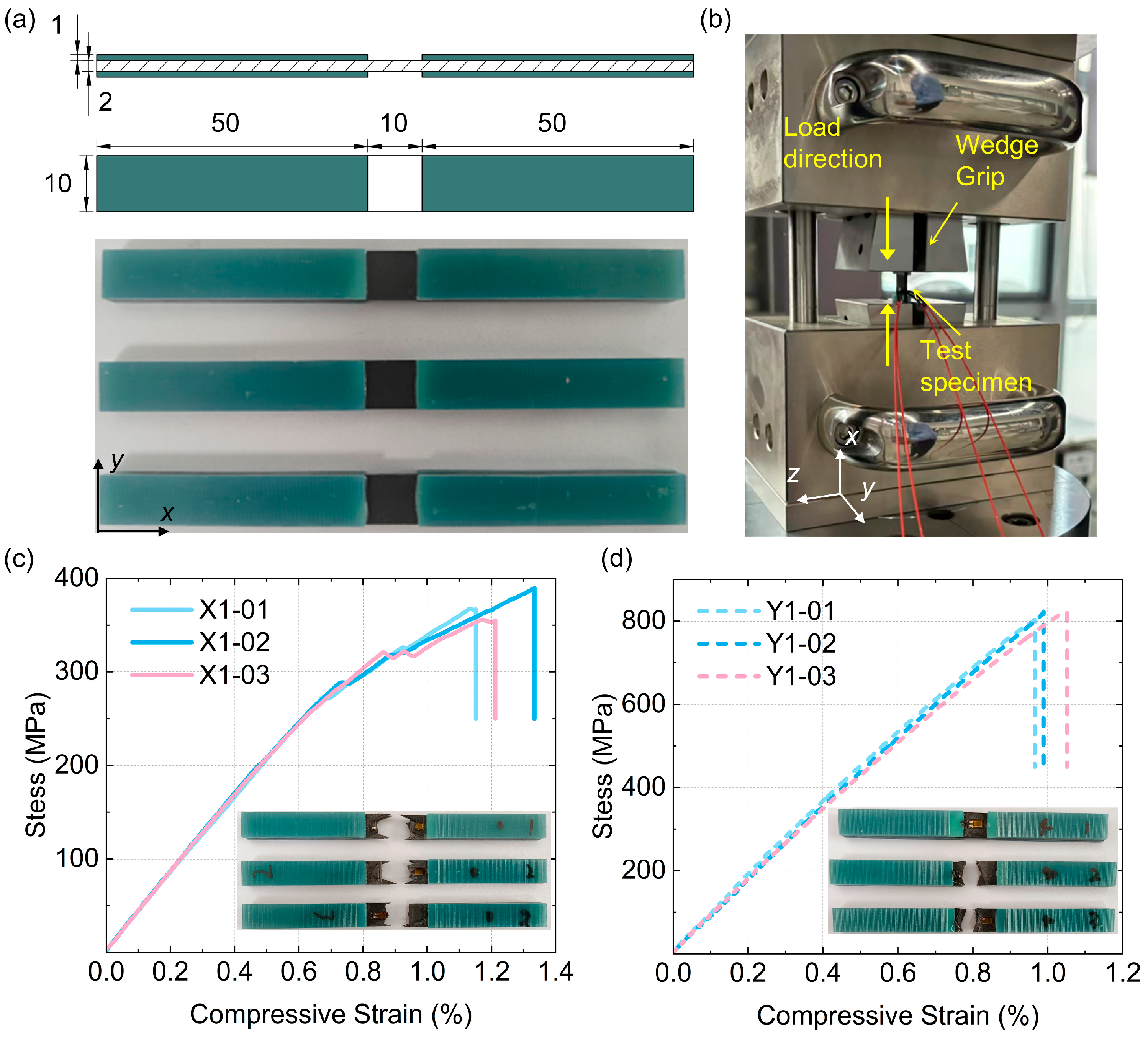
Uniaxial compression tests are first conducted in accordance with GB/T 5258-2008 [30] using specimens measuring 110 mm × 10 mm × 2 mm (Figure 1a). The stacking sequence is [90°/90°/90°/20°/−20°]s, and the end tabs are glass fiber/epoxy, 1 mm thick on each side. The uniaxial compression specimens and the test setup are shown in Figure 1b. The displacement rate is set to 0.5 mm/min. Figure 1c,d present the laminate stress–strain curves obtained from the uniaxial compression tests. The strain was measured using electrical resistance strain gauges bonded to the specimen surface along the loading direction, and the stress was calculated by dividing the applied load by the initial cross-sectional area of the specimen. In the x-direction, the stress–strain response is initially linear, indicating stable elastic deformation. With increasing load, the curve begins to fluctuate and the specimen ultimately fails, reaching an average peak stress of 371 MPa. In the y-direction, the stress–strain curve remains essentially linear without pronounced fluctuations, and the average peak stress reaches 817 MPa, approximately 2.2 times that in the x-direction. The higher strength in the y-direction compared with the x-direction is attributed to the larger proportion of 90° plies in the laminate, which makes the y-direction more favorable for sustaining compressive loads. In contrast, in the x-direction, the compressive load is mainly carried by the matrix, and the 20°/−20° plies are prone to shear yielding or interlaminar sliding during compression, leading to premature failure. These tests yielded the uniaxial compressive strength and failure strain of the laminate, providing baseline data for comparison with the subsequent biaxial compression experiments; further discussion is given in Section 4.1.

2.3. Compression Test Under Biaxial Stress State

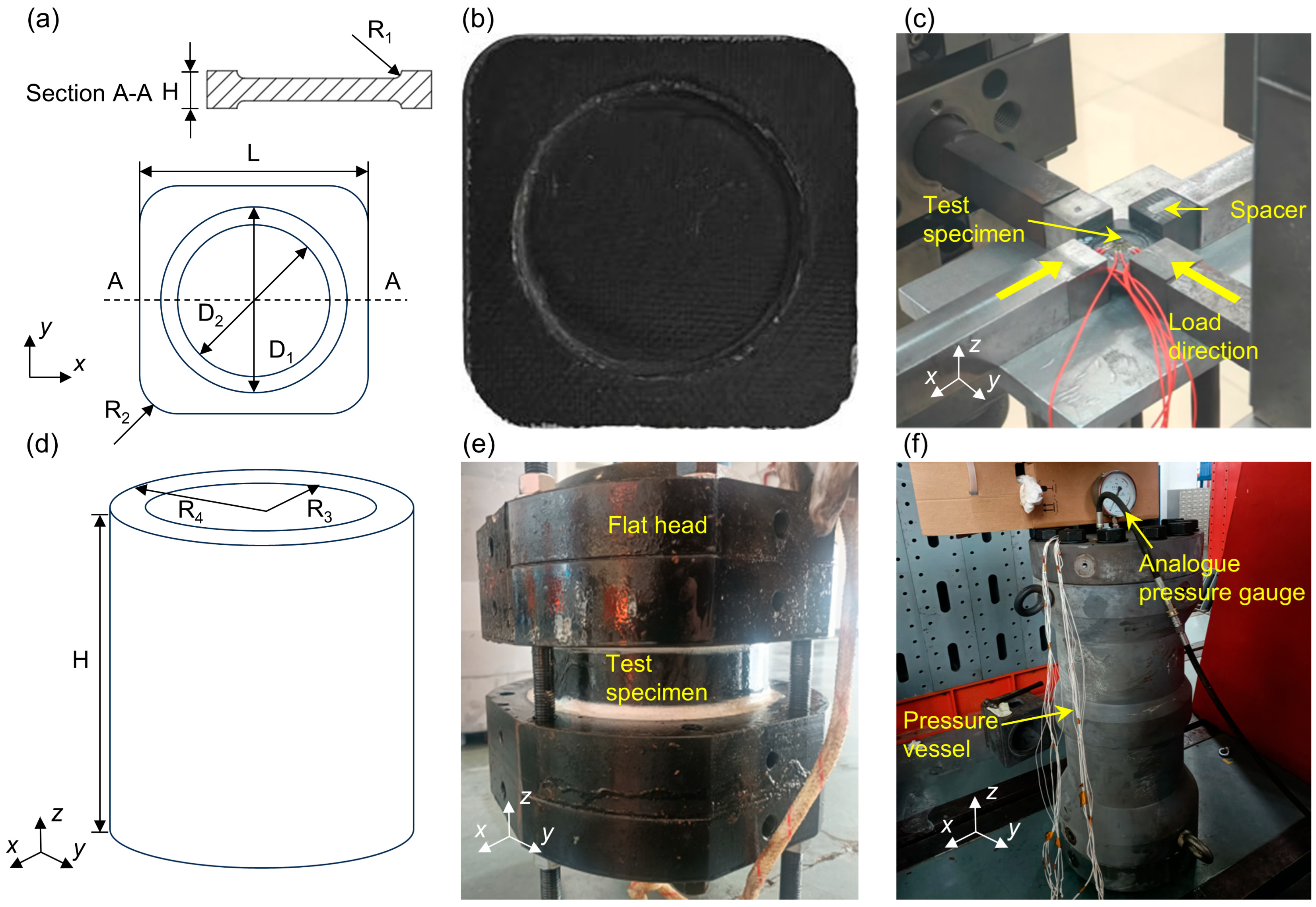
Currently, there is no established testing standard for composite biaxial compression tests. Following relevant studies [31], two sets of biaxial compression specimens with different dimensions are designed to conduct equal-displacement loading and proportional-force loading, respectively; the dimensional parameters are provided in Figure 2a, and photographs of the fabricated specimens are shown in Figure 2b. The biaxial compression tests are conducted on the Zwick Z050 cruciform testing facility (Figure 2c). The system supports quasi-static biaxial loading under various loading modes, load ratios, and loading paths, with an accuracy class of 0.5. The x loading axis is aligned with the specimen 0° fiber direction, and the y loading axis is aligned with the 90° fiber direction. Under equal-displacement control, both the x and y displacement rates are 0.25 mm/min. Under force control with an x:y ratio of 1:2, the loading rates are 100 N/s and 200 N/s. For each loading condition, three valid tests are performed, and the reported results are the mean of the three specimens. Strain is measured using resistance strain gauges with a nominal resistance value of (119.8 ± 0.1) Ω and a sensitivity coefficient of (2.13 ± 1%).
Figure 2. Biaxial compression test and hydrostatic pressure test; (a) schematic diagram of the dimensions of the biaxial compression specimen; the geometric parameters are given in Table 2; (b) photograph of the biaxial compression specimen; (c) photograph of the biaxial compression testbed; (d) schematic diagram of the carbon fiber laminated shell for hydrostatic pressure test; the geometric parameters are given in Table 2; (e) tooling for composite shells; (f) photograph of the pressurization testbed.
Jcs 10 00130 g002
In addition to the above specimens that can generate a typical biaxial stress state, a composite shell subjected to hydrostatic pressure experiences relatively low radial stress but is subjected to substantial biaxial stresses in the axial and circumferential directions. Accordingly, a high-hydrostatic-pressure failure test is designed for the composite shells. A carbon fiber composite shell with a stacking sequence of [90°/90°/90°/20°/−20°]4s is fabricated by wet wrapping, as schematically illustrated in Figure 2d. Steel end caps are attached at both ends of the composite shell and are fastened using four threaded bolts uniformly distributed around the circumference (Figure 2e). A mating groove is machined on the inner face of each end cap, and the shell ends are inserted into the groove by 38 mm. The composite shell and steel end caps are sealed using O-ring rubber seals. External pressure is applied using a steel cylinder driven by a hydraulic loading system (Figure 2f). During testing, pressure is increased stepwise in 2 MPa increments by controlling the hydraulic oil pressure in the fixture. Each pressure level is held for 10 s. After 10 pressure steps, loading continues with the same increment until failure.
Table 2. Biaxial loading specimen and composite shell dimensional parameters (unit: mm).
SchemeLHR1R2R3R4D1D2
Biaxial equal-displacement loading265.20.64--1917.8
Biaxial x:y = 1:2 proportional-force loading30515--2220
Hydrostatic pressure-196--100108--

3. Numerical Simulations

3.1. Failure Criteria

For laminate structures, the failure mechanism of a single layer is usually studied first, followed by a failure assessment based on the stress and strain states of each layer combined with strength theories. This work primarily uses failure criteria such as maximum stress [18]/maximum strain [19], Tsai–Wu [21], Rationalized Tsai–Wu (R-Tsai–Wu) [32], Hashin [24] and Shokrieh [33,34] to study the biaxial compression failure of carbon fiber composites. Specifically, the maximum stress criterion and the maximum strain criterion postulate that failure occurs when the stress or strain component in any principal material direction reaches its corresponding ultimate value, with no interaction considered among the components; their mathematical expressions are given in Equations (1) and (2):
σ 11 X T 2 = 1 ,     σ 11 X C 2 = 1 , σ 22 Y T 2 = 1 ,     σ 22 Y C 2 = 1     , σ 33 Z T 2 = 1 ,     σ 33 Z C 2 = 1 , σ 12 S 12 2 = 1 ,   σ 13 S 13 2 = 1 ,   σ 23 S 23 2 = 1 .
Here, 1, 2, and 3 represent the fiber direction, in-plane direction perpendicular to the fibers, and out-of-plane direction perpendicular to the fibers, respectively; XT, YT, and ZT represent the tensile strengths in the longitudinal, transverse, and thickness directions, respectively; XC, YC, and ZC denote the compressive strengths in the longitudinal, transverse, and thickness directions, respectively; S12, S13, and S23 are the shear strengths of the unidirectional laminate in different planes.
ε i j ε i j T 2 = 1 ,   ( σ i j 0 , ε i j 0 , i = j ) , ε i j ε i j C 2 = 1 ,   ( σ i j < 0 , ε i j < 0 , i = j ) , ε i j ε i j S 2 = 1 ,   ( i j ) .
Here, ε11T, ε22T, and ε33T denote the tensile failure strains in the longitudinal, transverse, and thickness directions, respectively; ε11C, ε22C, and ε33C represent the compressive failure strains in the longitudinal, transverse, and thickness directions, respectively; ε12S, ε13S, and ε23S are the shear failure strains of the unidirectional laminate in different planes.
As defined in Equation (3), the Tsai–Wu criterion is a phenomenological tensor-polynomial criterion. It uses a quadratic failure envelope that incorporates stress interaction terms to comprehensively assess material failure.
σ 11 1 X T 1 X C + σ 22 1 Y T 1 Y C + σ 33 1 Z T 1 Z C + σ 11 2 X T X C + σ 22 2 Y T Y C + σ 33 2 Z T Z C + τ 23 2 S 23 2 + τ 13 2 S 13 2 + τ 12 2 S 12 2 σ 11 σ 22 X T X C Y T Y C σ 11 σ 33 X T X C Z T Z C σ 22 σ 33 Y T Y C Z T Z C = 1 .
The R-Tsai–Wu criterion reduces the number of interaction term coefficients requiring experimental determination in the original Tsai–Wu criterion through theoretical derivation. Its specific expression reads
1 X T 1 X C σ 11 + 1 Y T 1 Y C σ 22 + σ 33 + 1 X T X C σ 11 2 + 1 Y T Y C σ 22 2 + σ 33 2 σ 22 σ 33 + 3 τ 23 2 1 X T X C Y T Y C σ 11 σ 33 + σ 22 + 1 S 12 2 τ 13 2 + τ 12 2 = 1 .
The Hashin criterion establishes independent quadratic failure criteria for various failure modes, specifically addressing fiber tension/compression and matrix tension/compression. The criterion takes the form
f ft = ( ε 11 ε 11 T ) 2 + ( ε 12 ε 12 S ) 2 + ( ε 13 ε 13 S ) 2 = 1 , ε 11 0 , f f c = ( ε 11 ε 11 C ) 2 = 1 , ε 11 < 0 , f mt = ( ε 22 + ε 33 ε 22 T ) 2 + ( ε 12 ε 12 S ) 2 + ( ε 13 ε 13 S ) 2 + ε 23 2 ε 22 ε 33 ε 23 S = 1 , ε 22 + ε 33 0 , f mc = ( ε 22 + ε 33 ε 22 C ) 2 = 1 , ε 22 + ε 33 < 0 , f ip = ( ε 12 ε 12 S ) 2 = 1 , f op = ( ε 13 ε 13 S + ε 23 ε 23 S ) 2 = 1 ,
where fft, ffc, fmt, fmc, fip, and fop denote fiber tension, fiber compression, matrix tension, matrix compression, in-plane shear, and out-of-plane shear damage coefficients, respectively. Composite laminates can exhibit multiple damage modes simultaneously. Similarly, distinguishing multiple failure modes, the Shokrieh criterion additionally considers delamination damage through the thickness, and its mathematical expression is presented as
f ft = σ 11 X T 2 + σ 12 S 12 2 + σ 13 S 13 2 = 1 , σ 11 0 , f fc = σ 11 X C 2 = 1 , σ 11 < 0 , f mt = σ 22 Y T 2 + σ 12 S 12 2 + σ 23 S 23 2 = 1 , σ 22 0 f mc = σ 22 Y C 2 + σ 12 S 12 2 + σ 23 S 23 2 = 1 , σ 22 < 0 , f dt = σ 33 Z T 2 + σ 13 S 13 2 + σ 23 S 23 2 = 1 , σ 33 0 , f dc = σ 33 Z C 2 + σ 13 S 13 2 + σ 23 S 23 2 = 1 , σ 33 < 0 , f s = σ 11 X C 2 + σ 12 S 12 2 + σ 13 S 13 2 = 1 ,
where fdt, fdc and fs denote delamination tensile damage, delamination compressive damage and matrix–fiber shear damage. The material strength parameters used in the above equations are summarized in Table 3. The elastic moduli and strength values reported in Table 3 are experimentally measured, whereas the failure strains in each material direction are computed as the corresponding strength divided by the corresponding modulus.

3.2. Stiffness Degradation Scheme

The failure criteria used in this study include only the maximum strain criterion and the Hashin criterion in a strain-based form, while all other criteria are stress-based. The corresponding stiffness degradation schemes for each failure criterion are as follows.
For the Shokrieh criterion, the stiffness degradation scheme listed in Table 4 is adopted, and stiffness undergoes an instantaneous reduction when the damage initiation condition of the corresponding failure mode is met. This scheme, proposed by Tserpes et al. [35] based on the Chang–Chang model, can account for fiber/matrix tension/compression, delamination, and matrix–fiber shear failure. To avoid the singularity of the stiffness matrix in numerical computations, any reduction coefficient that is zero is replaced with a small value of 0.01. When fiber, matrix, and delamination damage occur simultaneously or shear damage occurs, the element is deleted.
For the Hashin criterion, stiffness also undergoes an instantaneous reduction when the damage initiation condition of the corresponding failure mode is satisfied. The stiffness reduction coefficients for the fiber direction and the matrix direction follow the values given in Table 4. When in-plane or out-of-plane shear damage occurs, the corresponding shear modulus will be reduced to 0.01 times its initial value. When fiber and matrix damage occur simultaneously or shear damage occurs, the element is deleted.
For the maximum stress and maximum strain criteria, the stiffness degradation coefficients associated with the fiber direction and the matrix direction are respectively applied when damage initiates in the 1-direction and 2-direction, and damage in the 3-direction is treated as delamination, as defined in Table 4. The shear stiffness reduction coefficient is set to 0.01. When damage occurs simultaneously in the 1, 2, and 3 directions or when shear damage occurs, the element is deleted.
For the Tsai–Wu and R–Tsai–Wu criteria, since they do not distinguish failure modes, once an element has undergone damage, all elastic moduli are reduced to 0.01 of their initial value. Since these two criteria employ only a single coefficient to govern element damage, when the damage initiation criterion is met, only stiffness degradation is applied to the element, without deleting it.

3.3. Simulation Setup

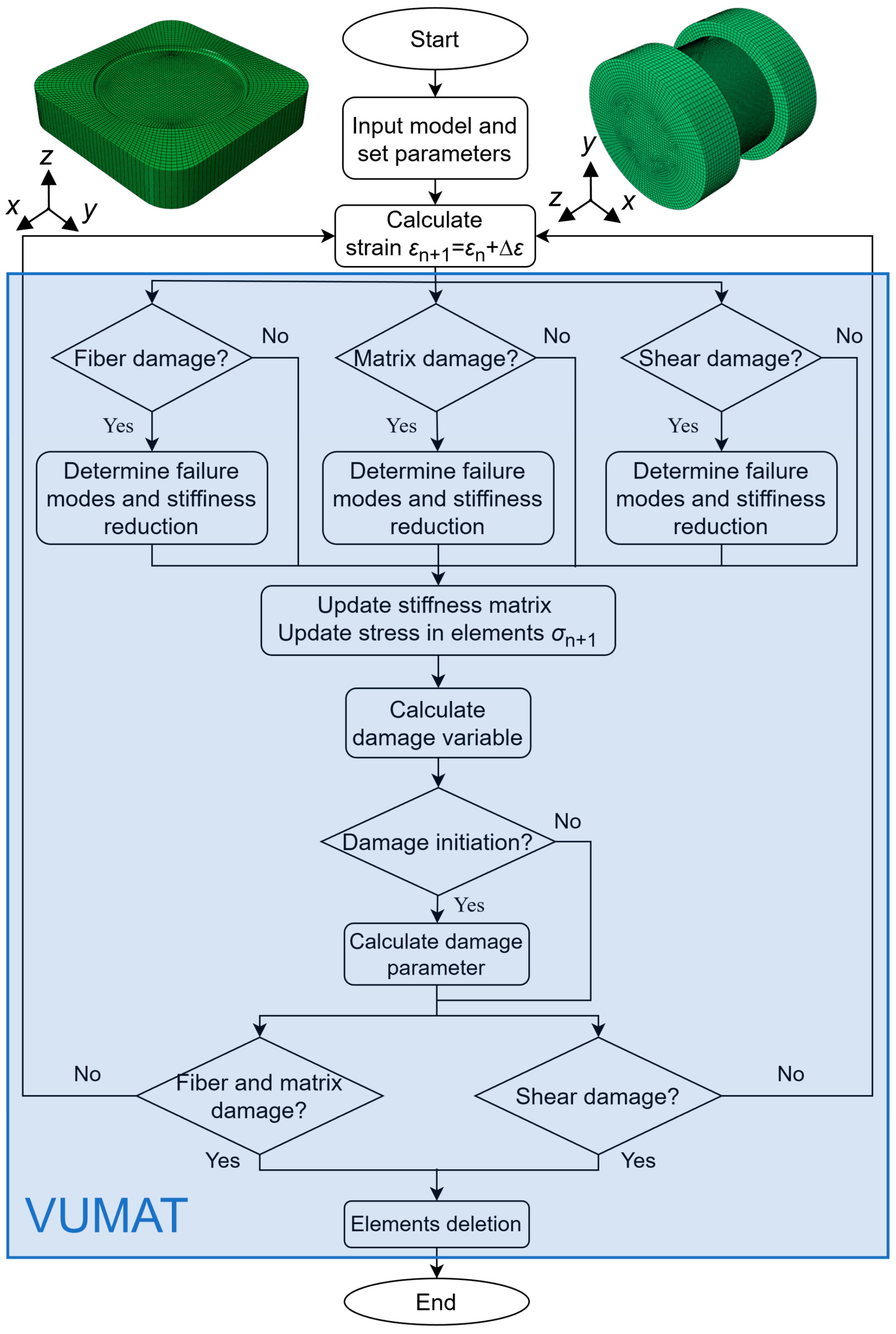
Three-dimensional finite element simulations are performed using Abaqus 2023/Explicit. Multiple composite damage models are implemented in Fortran and integrated into the user material subroutine to capture the biaxial compression responses of laminate structures. The predictive capability of each damage model is assessed by comparing numerical results with experiments. For large, mesh-intensive and geometrically complex models, explicit time integration is often more computationally efficient than implicit schemes, and the explicit formulation with geometric nonlinearity helps avoid convergence difficulties associated with strong material and geometric nonlinearities. The laminate is discretized using C3D8R (an 8-node linear brick, reduced-integration solid element in Abaqus) elements with enhanced hourglass control, with each ply modeled through the thickness. Ply orientations are assigned according to the layup angles. The material properties of the unidirectional lamina are listed in Table 3. Using the Hashin-based user material subroutine as an example, the damage simulation workflow is graphically summarized in Figure 3.
For the laminate model subjected to biaxial compression, the in-plane biaxial loading is applied by coupling the four lateral outer surfaces of the specimen to reference points. Depending on the loading protocol, either prescribed displacements are imposed at the reference points for equal-displacement loading or concentrated forces are applied for proportional-force loading. A mesh convergence study is conducted to reduce sensitivity to mesh quality and element distribution: the mesh is progressively refined from an initially coarse discretization until the predicted responses stabilize. The final element size is approximately 0.6 mm, and the mesh is enforced to be strictly symmetric about the X–Y, X–Z, and Y–Z planes, as shown in Figure 3.
For the shell model subjected to hydrostatic pressure, the endcaps are connected to the shell using a tie constraint. To maintain a symmetric constraint setup, the outer surfaces of both endcaps are constrained in the x- and y-directions. In addition, to suppress rigid-body motion, the axial displacement in the z-direction is fixed at a single point at the model center. A uniform pressure is applied to the structure’s outer surface. A mesh convergence analysis is likewise performed for the shell model: starting from a relatively coarse mesh, the discretization is progressively refined until the results converge. The final mesh size for the shell model is approximately 3 mm, which offers a reasonable compromise between computational efficiency and numerical convergence.
Because explicit integration is conditionally stable, the time increment must remain below the critical stable time step, which is governed by the smallest element dimension; consequently, both the runtime and the stable time increment are strongly affected by the minimum element size. We keep the solver’s linear and quadratic bulk viscosity parameters at their default values of 0.06 and 1, respectively.

4. Results and Discussion

4.1. Comparison of Ultimate Strength and Strain of Different Failure Criteria Under Biaxial Loading

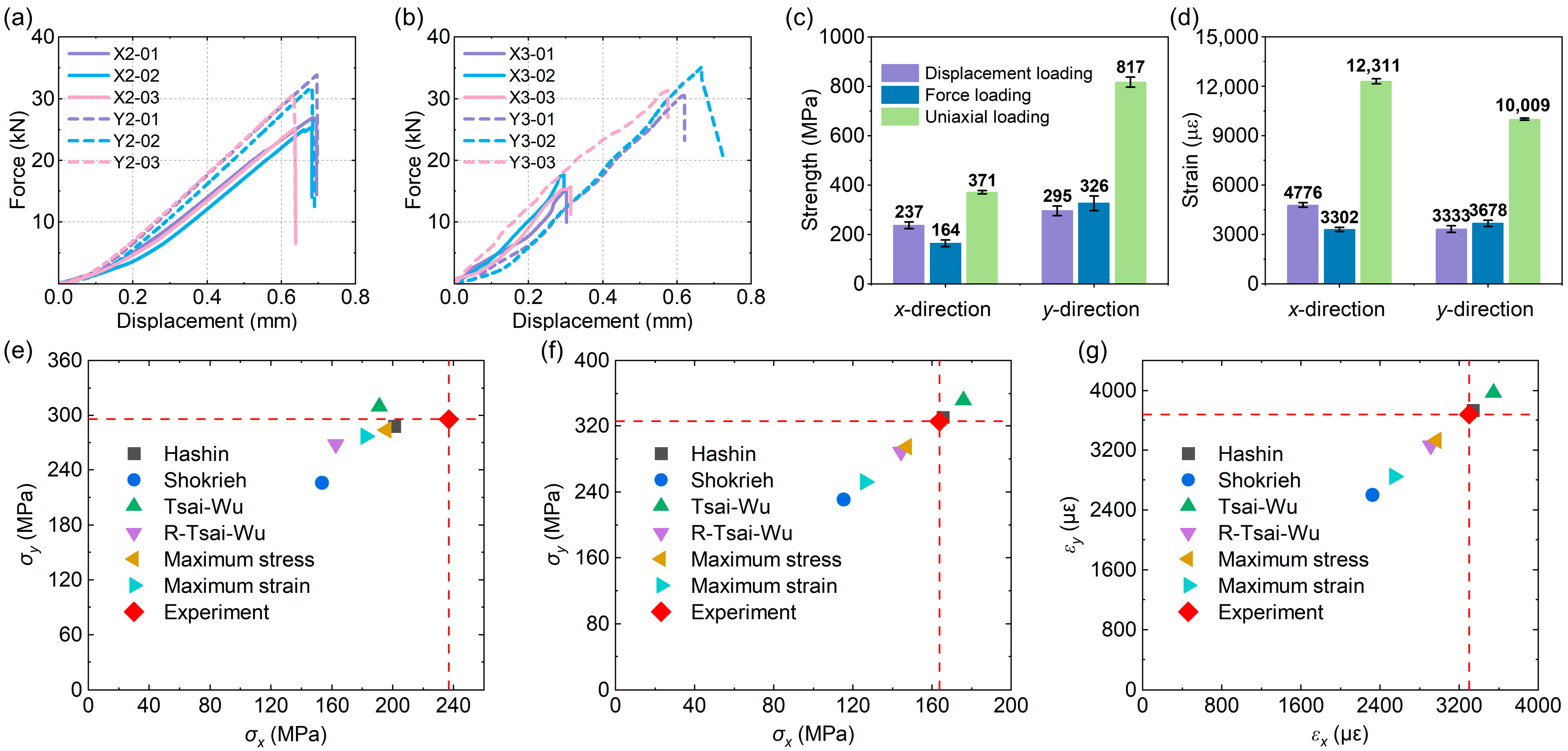
Figure 4a presents the specimen’s biaxial force–displacement response under equal-displacement loading. During the initial stage (displacement < 0.1 mm), the stiffness increases and then stabilizes, after which the response becomes approximately linear. Once the load reaches its peak, the specimen experiences instantaneous failure, where the stress reaches the matrix or fiber limit, causing brittle failure, and the load-bearing capacity rapidly decreases. The peak load scatter across three repeated tests is below 10%, indicating good repeatability. The average peak load in the x-direction is 26.5 kN, and in the y-direction it is 33.1 kN, approximately 1.25 times that in the x-direction. Figure 4b shows the biaxial force–displacement response for a force ratio of x:y = 1:2. From Figure 4a,b, it can be observed that the stability of the force loading curve is lower than that of the displacement loading. Nevertheless, Figure 4b still shows a relatively small deviation in the peak load, with the average peak load in the x-direction being 17.1 kN and in the y-direction being 33.5 kN. Due to the difficulty in achieving complete symmetry in groove depth during the slotting process, there are some differences between the simulation and experimental results in the corresponding areas. To avoid measurement errors caused by warping of the specimen during biaxial compression, the nominal failure strength is calculated by dividing the total force by the cross-sectional area and then dividing by the equivalent elastic modulus to obtain the failure compressive strain. The compressive strength and failure strain values for the uniaxial and biaxial loading conditions are shown in Figure 4c,d. Notably, for both equal-displacement and proportional-force loading, the biaxial compressive strengths are markedly lower than the corresponding uniaxial strengths in the same direction; the same trend is observed for the failure strain.
To assess the applicability of the considered failure criteria, Figure 4e,f compare the simulated biaxial strengths with the experimental results. The [90°/90°/90°/20°/−20°]ns laminate is stiffer in the y-direction; thus, σy is significantly higher than σx for both the equal-displacement loading and proportional-force loading cases. Under equal-displacement loading, all x-direction predictions are lower than the experimental value. Among them, the prediction from the Shokrieh criterion (153.45 MPa) has the largest deviation, approximately 35.2%. The R-Tsai–Wu criterion (162.51 MPa) follows, with an error of about 31.4%. The maximum strain (182.01 MPa), Tsai–Wu (191.27 MPa), maximum stress (195.76 MPa), and Hashin (201.06 MPa) predictions are relatively close to the experimental value (236.78 MPa), with errors of 23.1%, 19.2%, 17.3% and 15.1%, respectively. In the y-direction under the equal-displacement loading, only the Tsai–Wu criterion (309.58 MPa) slightly overpredicts the experimental value, by 4.8%; the R-Tsai–Wu (268.09 MPa), maximum strain (276.63 MPa), and maximum stress (283.64 MPa) criteria slightly underpredict the experimental value (295.38 MPa), with errors of 9.2%, 6.3%, and 4.0%, respectively; the Hashin criterion prediction (287.61 MPa) is closest to the experimental value, with an error of 2.6%; the Shokrieh criterion prediction (225.89 MPa) is markedly lower, with an error of 23.5%. The integrated results are summarized in Table 5. Under x:y = 1:2 proportional-force loading, the Tsai–Wu and Hashin criteria slightly overpredict the experiments, whereas the other criteria generally underpredict; the Hashin prediction is nearly identical to the measured value.
In terms of the failure strain, since the strain is obtained by dividing the strength value by the elastic modulus, the comparison trends of the failure strain results for each failure criterion, as shown in Figure 4g, are consistent with those of strength prediction results. Using the x:y = 1:2 case as an example, the biaxial failure strains of the carbon fiber composite are analyzed below. Under this load ratio, the x-direction strain is 0.89 times the y-direction strain, indicating comparable axial and circumferential strain and an efficient utilization of the laminate at this layup. In the predicted values for the x-direction (values in micro-strain, με), the Shokrieh criterion (2325.67), maximum strain criterion (2543.61), R-Tsai–Wu criterion (2911.58), and maximum stress criterion (2972.31) all have predicted values lower than the test value (3302.49), with errors of 29.6%, 23.0%, 11.8%, and 10.0%, respectively. By contrast, the Hashin criterion (3337.67) and Tsai–Wu criterion (3546.81) overpredict the test value, with errors of 1.1% and 7.4%, respectively. In the predicted values for the y-direction, the Shokrieh criterion (2602.19), maximum strain criterion (2846.04), R-Tsai–Wu criterion (3257.75), and maximum stress criterion (3325.71) all have predicted values lower than the test value (3678.41), with errors of 29.3%, 22.6%, 11.4%, and 9.6%, respectively. The predicted values of the Hashin criterion (3734.51) and Tsai–Wu criterion (3968.52) are higher than the test value, with errors of 1.5% and 7.9%, respectively. The integrated results are summarized in Table 6. Overall, the Hashin criterion provides the most accurate failure strain predictions in both directions.

4.2. Damage Evolution of Laminate Under Biaxial Compression

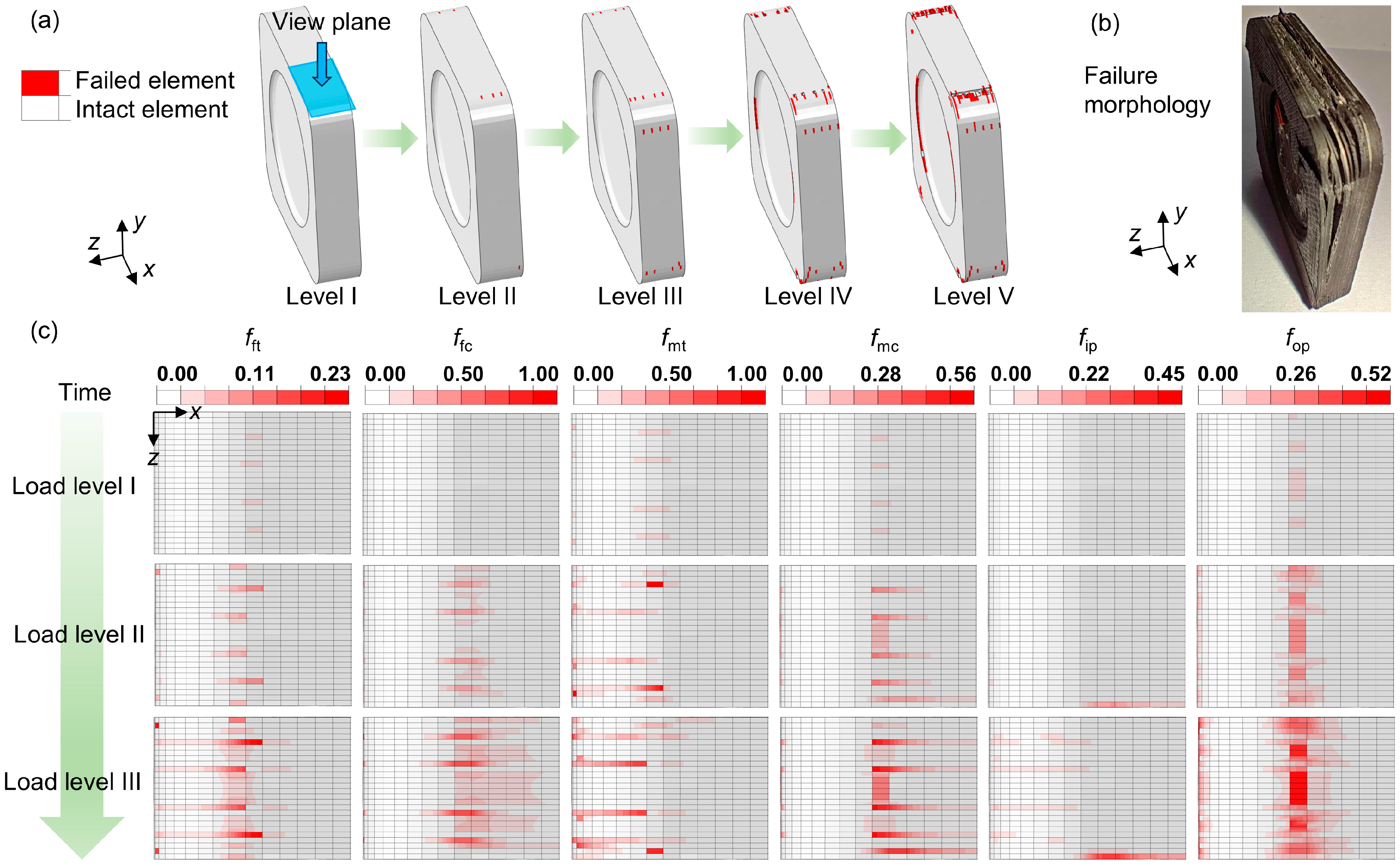
The comparisons of biaxial strength and failure strain indicate that, for the [90°/90°/90°/20°/−20°]ns carbon fiber laminate, the Hashin criterion provides the best overall prediction. Therefore, the Hashin-based results are used for the damage evolution analysis. Figure 5a summarizes the overall damage evolution under equal-displacement loading, with red areas representing damaged regions associated with fiber, matrix, and shear mechanisms. An element is deleted once fiber and matrix damage coexist or when shear damage reaches the deletion criterion. The damage contour at loading level III corresponds to the onset of element deletion, loading levels I and II cover the intermediate loading stages from the initiation of loading to just before element deletion, and loading level V represents the final failure state. As can be observed, the damaged region initially appears on the y-direction loading surface, followed by partial element damage at the corresponding location in the x-direction. With further loading, the damaged regions in both directions expand and merge, ultimately forming a through-thickness damage band. The crack locations observed at the specimen edges and loading surfaces (Figure 5b) agree well with the predicted distribution of deleted/damaged elements. Both the experiments and simulations indicate a similar failure mode, characterized by damage initiating near the edges and propagating toward the specimen center.
Figure 5c illustrates the damage evolution of six failure modes in the selected region under equal-displacement loading conditions. Fiber tensile damage is primarily localized near the junction between the ply-5/ply-22 chamfer region and the coupled loading region. However, when the first element is deleted, the fiber tensile damage coefficient reaches only 0.23, indicating that fiber tensile damage is not the dominant driver of failure. In contrast, fiber compressive damage is more severe and occurs in ply-4, ply-9, and their symmetric counterparts (with a 20° layup angle), and it approaches 1 in the third-row contours. Similar to fiber compression, matrix tensile damage also develops in ply-4 and its corresponding symmetric plies. In the second-row contours, the matrix tensile damage coefficient for some elements in ply-4 and its symmetric plies approaches 1. As the displacement increases further, the matrix tensile initiation criterion is met, and matrix tensile failure occurs. At this stage, fiber-direction failure has not yet occurred; therefore, the specimen does not fail catastrophically, and the load continues to increase. When the first element is deleted, the maximum matrix compressive damage coefficient is 0.56, which remains well below the critical value. Likewise, the damage coefficients associated with in-plane and out-of-plane shear remain low and are far from satisfying the damage initiation criterion.

4.3. Failure Limit of Carbon Fiber Composite Shell Under Hydrostatic Pressure

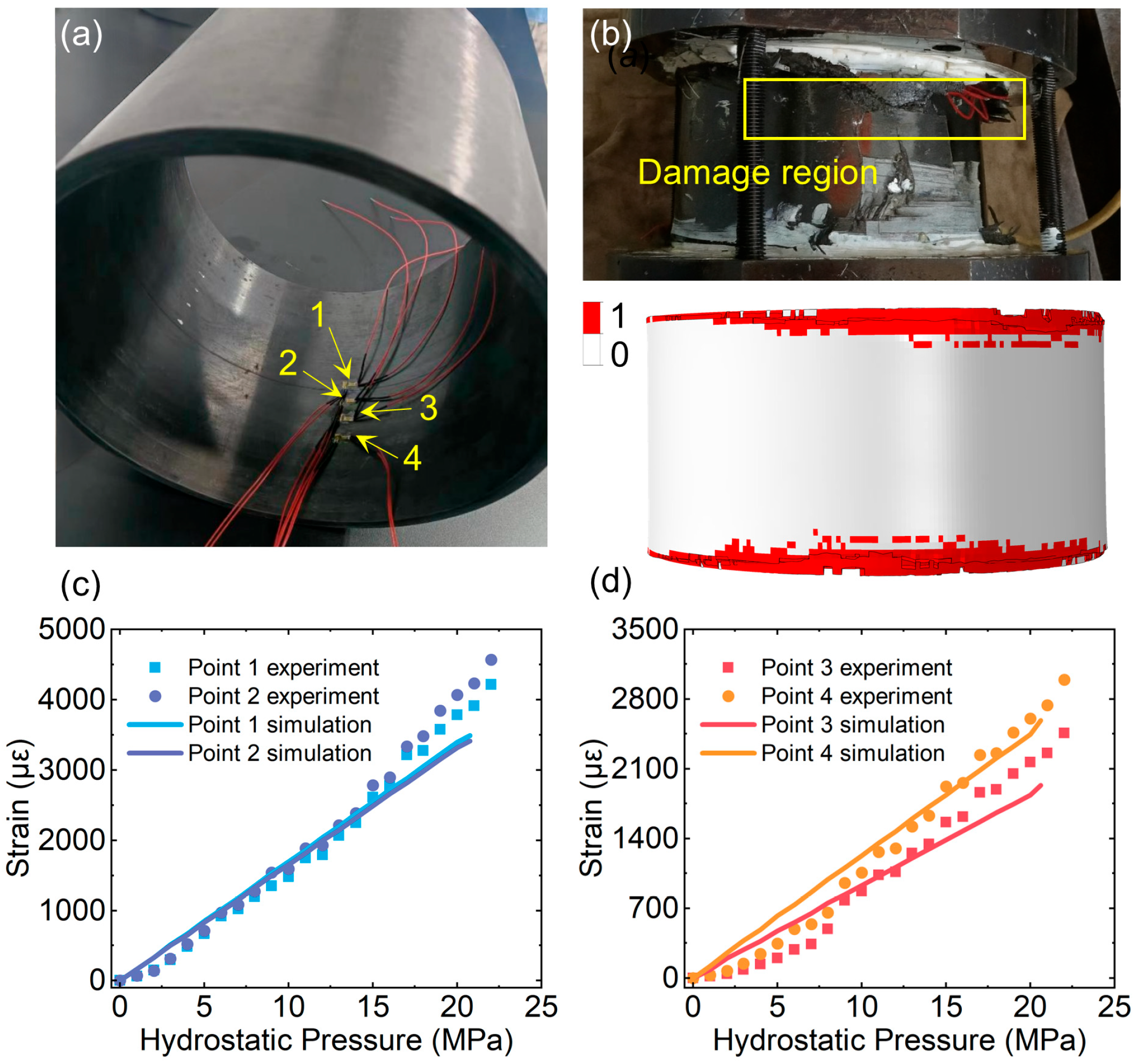
Because the shell specimen was tested inside a sealed hyperbaric vessel, the deformation of the composite shell under hydrostatic pressure could not be directly observed. Therefore, shell failure was inferred primarily from the recorded pressure history and strain-gauge signals. Four strain measurement points are arranged inside the shell, with each point bonded with both circumferential and axial strain gauges. As shown in Figure 6a, point 1 is at the shell center, whereas points 2–4 are located 15, 30, and 45 mm away from the center, respectively. When the pressure reached 22 MPa, a sudden loud explosive sound occurred inside the sealed hyperbaric cabin. The pressure then stopped increasing and began to drop, indicating that the shell was damaged. To further evaluate the failure of the composite shell under biaxial stress states, the composite shell was also analyzed numerically using the Hashin model. The simulation results indicate that the composite shell undergoes collapse at a pressure of 20.75 MPa, differing from the experimental value of 22 MPa by only 5.7%.
Because several strain gauges malfunctioned during testing, only valid datasets were used for analysis. Strains at the corresponding locations were extracted from the finite element model to obtain the simulated strain–pressure curves. The circumferential strain responses are discussed first. Figure 6c compares the measured and simulated circumferential strains at measurement points 1 and 2. The measured circumferential strain exhibits a clear linear relationship with pressure up to 15 MPa. Beyond 15 MPa, the strain growth rate increases slightly at both points, whereas the overall response remains approximately linear until failure at 22 MPa. Overall, the simulations show good agreement with the experiments. At 20 MPa, the simulated circumferential strain is 3392 με at point 1, which deviates by 10.3% from the measured value of 3782 με. At point 2, the simulated value is 3320 με, with an 18.4% deviation from the measured value of 4071 με. The axial strain responses are shown in Figure 6d. At measurement points 3 and 4, the axial strain growth rate increases with pressure up to 10 MPa, after which the response becomes nearly linear and stable. At 20 MPa, the simulated axial strain at point 3 is 1837 με, deviating by 15.1% from the experimental value of 2163 με, while at point 4 it is 2444 με, deviating by 6.1% from the measured value of 2602 με.
The post-test observations in Figure 6b indicate that failure initiated on the outer surface near measurement point 3. Consistently, the simulated damage contours show that damage first develops on the outer surface near measurement points 3 and 4, close to the end cap, and then propagates to cause global structural collapse. The circumferential and axial strains on the outer surface at this location were extracted as the final failure strains. The axial and circumferential failure strains are 3938 με and 3039 με, respectively. Compared with the average failure strains of the laminate specimen under x:y = 1:2 proportional-force loading (3302 με axial and 3678 με circumferential; Section 4.1), the corresponding relative errors are 19.2% and 17.3%, respectively.
While the present study has yielded meaningful results, it still has two main limitations. First, the numerical simulations are conducted within a macroscale modeling framework and do not explicitly account for manufacturing and microstructural defects at the constituent level, such as voids, fiber misalignment, non-uniform impregnation, and local variations in curing degree. Though the material properties are obtained from an experimental characterization of the manufactured specimens and the influence of these defects is implicitly embedded in the effective material properties used as inputs, the impacts of defects at the constituent level still deserve further exploration. Second, the failure criteria adopted in this work are based on existing formulations, and future work will further refine and validate them to improve the agreement between numerical predictions and experimental results.

5. Conclusions

This study addresses the design needs of lightweight, high-strength carbon fiber composite pressure shells for deep-sea, high-pressure environments. We systematically investigated the strength failure behavior, damage evolution, and the predictive accuracy of several failure criteria for the [90°/90°/90°/20°/−20°]ns laminate under biaxial compression and further validated the findings through hydrostatic pressure tests on a composite shell. The experiments show that, under both equal-displacement loading and proportional-force loading, the ultimate strength measured in biaxial compression is significantly lower than the corresponding uniaxial compressive strength in each principal direction. This reduction is attributed to the more complex multiaxial stress state under biaxial loading, which promotes earlier damage initiation and growth, particularly in the comparatively weaker matrix, thereby limiting the ability of the high-strength fibers to fully carry the load.
To evaluate failure model suitability, six criteria (maximum stress, maximum strain, Tsai–Wu, Rationalized Tsai–Wu, Hashin, and Shokrieh) were implemented to simulate damage and failure under biaxial compression. Then, their predictions were benchmarked against biaxial test results. Among the examined criteria, the Hashin criterion provides the best overall agreement and the most consistent predictions. The Tsai–Wu criterion tends to slightly overpredict strength. The R-Tsai–Wu, Shokrieh, maximum strain, and maximum stress criteria show varying levels of accuracy and generally yield conservative strength predictions. Finally, the Hashin criterion was used to simulate the failure of the composite pressure shell and was validated experimentally. The predicted failure pressure is 20.75 MPa, differing by only 5.7% from the measured value of 22 MPa, and the predicted damage region agrees well with the experimental observation. The shell’s axial and circumferential failure strains were determined to be 3938 με and 3039 με, respectively, which are substantially lower than the uniaxial failure strains (12,311 με in the x-direction and 10,009 με in the y-direction).
Overall, this work clarifies biaxial failure limits and provides practical guidance for selecting failure criteria. The demonstrated reduction in failure capacity under biaxial loading supports a safer and more reliable basis for the strength design of carbon fiber composite pressure shells in deep-sea high-pressure environments.

Author Contributions

Conceptualization, C.Z., Z.T. and Y.G.; software, C.Z. and X.D.; validation, C.Z. and Z.T.; formal analysis, C.Z. and X.D.; investigation, C.Z.; resources, Z.T.; writing—original draft preparation, C.Z.; writing—review and editing, Y.G. and H.J.; supervision, Y.G. and H.J.; funding acquisition, Y.G. and H.J. All authors have read and agreed to the published version of the manuscript.

Funding

This research was funded by the National Key R&D Program of China (grant number 2024YFC2814600) and the National Natural Science Foundation of China (grant number 12372144).

Data Availability Statement

The data supporting the conclusions of this article will be made available by the authors upon request.

Conflicts of Interest

Author Zhanwen Tang was employed by the Tianjin Istar-Space Technology Co., Ltd. The authors declare that the research was conducted in the absence of any commercial or financial relationships that could be construed as a potential conflict of interest.

References

  1. Galos, J. Thin-Ply Composite Laminates: A Review. Compos. Struct. 2020, 236, 111920. [Google Scholar] [CrossRef]
  2. Arteiro, A.; Furtado, C.; Catalanotti, G.; Linde, P.; Camanho, P.P. Thin-Ply Polymer Composite Materials: A Review. Compos. Part A Appl. Sci. Manuf. 2020, 132, 105777. [Google Scholar] [CrossRef]
  3. Zuo, H.; Li, D.; Jiang, L. Transverse Bending Fatigue Behaviors and Failure Mechanisms of 3D Five-Directional Braided Composites at Different Temperatures. Mater. Lett. 2022, 316, 132030. [Google Scholar] [CrossRef]
  4. Li, D.; Han, W.; Jiang, L.; Fang, D. Fatigue Behavior and Failure of Three-Dimensional Six-Directional Braided Composites under Tension. Mater. Lett. 2023, 332, 133471. [Google Scholar] [CrossRef]
  5. Duda, S.; Smolnicki, M.; Stabla, P.; Zielonka, P.; Osiecki, T.; Gao, C.; Lesiuk, G. Experimental Characterization and Modeling of Cylindrical CFRP Structures under Quasi-Static Multiaxial Loading Conditions. Thin-Walled Struct. 2024, 195, 111364. [Google Scholar] [CrossRef]
  6. Tableau, N.; Aboura, Z.; Khellil, K.; Laurin, F.; Schneider, J. Multiaxial Loading on a 3D Woven Carbon Fiber Reinforced Plastic Composite Using Tensile-Torsion Tests: Identification of the First Damage Envelope and Associated Damage Mechanisms. Compos. Struct. 2019, 227, 111305. [Google Scholar] [CrossRef]
  7. Zheng, T.; Huang, J.; Guo, L.; Sun, R.; Huang, T.; Zhou, J.; Jia, F.; Hong, C. A Combined Experimental and Numerical Approach to Investigate the Failure Behaviors of 3D Woven Composites under Biaxial Tensile Loading. Compos. Sci. Technol. 2023, 236, 109974. [Google Scholar] [CrossRef]
  8. Serna Moreno, M.C.; Curiel-Sosa, J.L.; Navarro-Zafra, J.; Martínez Vicente, J.L.; López Cela, J.J. Crack Propagation in a Chopped Glass-Reinforced Composite under Biaxial Testing by Means of XFEM. Compos. Struct. 2015, 119, 264–271. [Google Scholar] [CrossRef]
  9. Deland, D.; Zhang, Z.; Kirane, K. Biaxial Flexural Failure of Woven Composite Plates Investigated by the Ring on Ring Bending Test. Thin-Walled Struct. 2020, 148, 106585. [Google Scholar] [CrossRef]
  10. Liu, F.; Kirane, K. Type I Size Effect and Failure Behavior of Woven Composites under Biaxial Flexure. Compos. Part B 2023, 254, 110580. [Google Scholar] [CrossRef]
  11. Xun, L.; Huang, S.; Sun, B.; Gu, B. Torsional Cracks Development in Carbon-Fiber 3-D Braided Composite Tubes. Thin-Walled Struct. 2023, 184, 110477. [Google Scholar] [CrossRef]
  12. Li, J.; Liu, Z.; Liu, Y.; Zhang, Z.; Chen, X. Effects of Axial Load on Torsional Fatigue of 3D Braided Carbon Fiber Composites: Mechanisms and Life Prediction. Compos. Part B Eng. 2025, 305, 112732. [Google Scholar] [CrossRef]
  13. Sanai, K.; Nakasaki, S.; Hashimoto, M.; Macadre, A.; Goda, K. Fracture Behavior of a Unidirectional Carbon Fiber-Reinforced Plastic under Biaxial Tensile Loads. Materials 2024, 17, 1387. [Google Scholar] [CrossRef]
  14. Liu, Y.; Ren, Z.; Han, Y.; Ren, M. Study on Biaxial Tensile Failure Behavior of Ultra-Thin-Ply Carbon Fiber Reinforced Composites. Compos. Sci. Technol. 2024, 251, 110544. [Google Scholar] [CrossRef]
  15. Zha, Z.; Zhang, C.; Tao, C.; Wu, F.; Qiu, J.; Yao, W. Damage Characterization and Fatigue Life Prediction for CFRP Laminates under Biaxial Fatigue Loading. Int. J. Fatigue 2026, 203, 109316. [Google Scholar] [CrossRef]
  16. Weng, J.; Wen, W.; Xu, Y. Strength Prediction of Cruciform Specimen Under Biaxial Loading. Trans. Nanjing Univ. Aeronaut. Astronaut. 2017, 34, 286–295. [Google Scholar] [CrossRef]
  17. Szymczyk, E.; Puchała, K.; Jachimowicz, J. About Numerical Analysis of Pin Loaded Joints in Laminate Structure. In Computational Technologies in Engineering (TKI’2018), Proceedings, of the 15th Conference on Computational Technologies in Engineering, Jora Wielka, Poland, 16–19 October 2018; AIP Publishing: Jora Wielka, Poland, 2019; Volume 2078, p. 020107. [Google Scholar]
  18. Jenkin, C.F. Report on Materials Used in the Construction of Aircraft and Aircraft Engines; HM Stationery Office: London, UK, 1920; pp. 95–131. [Google Scholar]
  19. Jones, R.M. Mechanics of Composite Materials; Taylor & Francis: London, UK, 1975. [Google Scholar]
  20. Azzi, V.D.; Tsai, S.W. Anisotropic Strength of Composites. Exp. Mech. 1965, 5, 283–288. [Google Scholar] [CrossRef]
  21. Tsai, S.W.; Wu, E.M. A General Theory of Strength for Anisotropic Materials. J. Compos. Mater. 1971, 5, 58–80. [Google Scholar] [CrossRef]
  22. Chang, F.-K.; Chang, K.-Y. A Progressive Damage Model for Laminated Composites Containing Stress Concentrations. J. Compos. Mater. 1987, 21, 834–855. [Google Scholar] [CrossRef]
  23. Hashin, Z.; Rotem, A. A Fatigue Failure Criterion for Fiber Reinforced Materials. J. Compos. Mater. 1973, 7, 448–464. [Google Scholar] [CrossRef]
  24. Hashin, Z. Failure Criteria for Unidirectional Fiber Composites. ASME J. Appl. Mech. 1980, 47, 329–334. [Google Scholar] [CrossRef]
  25. Ambur, D.R.; Jaunky, N.; Hilburger, M.W. Progressive Failure Studies of Stiffened Panels Subjected to Shear Loading. Compos. Struct. 2004, 65, 129–142. [Google Scholar] [CrossRef]
  26. Larbi Chaht, F.; Mokhtari, M.; Benzaama, H. Using a Hashin Criteria to Predict the Damage of Composite Notched Plate under Traction and Torsion Behavior. Frat. Integr. Strutt. 2019, 13, 331–341. [Google Scholar] [CrossRef]
  27. Cepero-Mejias, F.; Phadnis, V.A.; Curiel-Sosa, J.L. Machining Induced Damage in Orthogonal Cutting of UD Composites: FEA Based Assessment of Hashin and Puck Criteria. Procedia CIRP 2019, 82, 332–337. [Google Scholar] [CrossRef]
  28. Liu, Y.; Wang, H.; Zhang, F.; Cheng, L.; Qu, W.; Wang, Q. Experimental and Simulation Study on Compressive Failure Evolution of Multidirectional Laminates with Different Dimensions. Eng. Fail. Anal. 2023, 154, 107633. [Google Scholar] [CrossRef]
  29. Mitra, M.; Maharana, S.K.; Soni, G. A Machine Learning-Based Prediction of Biaxial Failure Envelope of a Short Fiber-Reinforced Polymer Composite. Compos. Sci. Technol. 2025, 267, 111176. [Google Scholar] [CrossRef]
  30. GB/T 5258-2008; Fiber-Reinforced Plastic Composites—Determination of Compressive Properties in the in-Plane Direction. Standardization Administration of the People’s Republic of China: Beijing, China, 2008.
  31. Xu, C.; Song, L.; Zhu, H.; Meng, S.; Xie, W.; Jin, H. Experimental Investigation on the Mechanical Behaviour of 3D Carbon/Carbon Composites under Biaxial Compression. Compos. Struct. 2018, 188, 7–14. [Google Scholar] [CrossRef]
  32. Li, S.; Xu, M.; Sitnikova, E. The Formulation of the Quadratic Failure Criterion for Transversely Isotropic Materials: Mathematical and Logical Considerations. J. Compos. Sci. 2022, 6, 82. [Google Scholar] [CrossRef]
  33. Tserpes, K.I.; Papanikos, P.; Labeas, G.; Pantelakis, S. Fatigue Damage Accumulation and Residual Strength Assessment of CFRP Laminates. Compos. Struct. 2004, 63, 219–230. [Google Scholar] [CrossRef]
  34. Papanikos, P.; Tserpes, K.I.; Pantelakis, S.P. Modelling of Fatigue Damage Progression and Life of CFRP Laminates. Fatigue Fract. Eng. Mat. Struct. 2003, 26, 37–47. [Google Scholar] [CrossRef]
  35. Tserpes, K.I.; Labeas, G.; Papanikos, P.; Kermanidis, T. Strength Prediction of Bolted Joints in Graphite/Epoxy Composite Laminates. Compos. Part B Eng. 2002, 33, 521–529. [Google Scholar] [CrossRef]
Figure 1. Uniaxial compression test; (a) dimensions and photograph of uniaxial compression specimens (unit: mm); (b) photograph of the uniaxial compression testbed; measured stress–strain curves and failure mode of carbon fiber laminate specimen under uniaxial compression. X1 denotes compression along the laminate 0° direction (c), and Y1 denotes compression along the 90° direction (d), where 01, 02, and 03 represent three repeated tests.
Jcs 10 00130 g001
Figure 3. Damage simulation flowchart of Hashin criterion and finite element modeling of the test specimen.
Jcs 10 00130 g003
Figure 4. Experimental biaxial load–displacement curves under equal-displacement loading (a) and proportional-force loading (b); experimental comparison of uniaxial and biaxial compressive strength (c) and failure strain (d); bars represent mean values (n = 3), and error bars indicate ±1 standard deviation (SD); comparison of compressive strength under different failure criteria with equal-displacement loading (e) and x:y = 1:2 proportional-force loading (f); (g) comparison of failure compressive strain under different failure criteria with proportional-force loading.
Jcs 10 00130 g004
Figure 5. (a) View plane for observing the failure modes of specimens and evolution process of overall damage contour; (b) experimental failure morphology; (c) damage evolution of laminate under biaxial compression based on the Hashin criterion; fft, ffc, fmt, fmc, fip, and fop denote fiber tension, fiber compression, matrix tension, matrix compression, in-plane shear, and out-of-plane shear damage coefficients.
Jcs 10 00130 g005
Figure 6. (a) Four strain measurement points are arranged inside the shell, with each point bonded with both circumferential and axial strain gauges. Point 1 is located at the center of the shell, while points 2, 3, and 4 are 15 mm, 30 mm, and 45 mm away from the center, respectively. (b) Comparison of damage locations between experimental and simulation results. In the simulation contour plots, a binary damage variable is adopted, where 1 denotes a failed element and 0 denotes an intact element; (c) comparison of circumferential strain between experimental and simulation results at measurement points 1 and 2; (d) comparison of axial strain between experimental and simulation results at measurement points 3 and 4.
Jcs 10 00130 g006
Table 1. Classification and numbering of test specimens for uniaxial and biaxial compression tests.
Test TypeLoading MethodNumbering
Uniaxial compressionDisplacement loadingX1, Y1
Biaxial compressionEqual-displacement loadingX2, Y2
Biaxial compressionx:y = 1:2 proportional-force loadingX3, Y3
Table 3. Material parameters of T700-epoxy unidirectional laminate.
Mechanical PropertiesValueUnits
Density1609kg/m3
Longitudinal modulus, E1138GPa
Transverse modulus, E2 = E38.55GPa
In-plane shear modulus, G124.46GPa
Major Poisson’s ratio, ν120.31
Longitudinal tensile strength, XT2110MPa
Longitudinal compressive strength, XC1337MPa
Transverse tensile strength, YT = ZT24.5MPa
Transverse compressive strength, YC = ZC140MPa
In-plane shear strength, S1274.1MPa
Longitudinal tensile failure strain, ε11T1.529%
Longitudinal compressive failure strain, ε11C1.061%
Transverse tensile failure strain, ε22T = ε33T0.2865%
Transverse compressive failure strain, ε22C = ε33C1.591%
In-plane shear failure strain, ε12S1.661%
Table 4. Reduction in elastic parameters in the Tserpes stiffness degradation criterion.
Failure ModesDegradation of Elastic Parameters
Fiber tension failure E 1 d = 0.07 E 1
Fiber compression failure E 1 d = 0.14 E 1
Matrix tension failure E 2 d = 0.2 E 2 ,   G 12 d = 0.2 G 12 ,   G 23 d = 0.2 G 23
Matrix compression failure E 2 d = 0.4 E 2 ,   G 12 d = 0.4 G 12 ,   G 23 d = 0.4 G 23
Matrix–fiber shear failure G 12 d = 0
Delamination failure E 3 d = G 23 d = G 13 d = 0
Table 5. Comparison of predicted and experimental biaxial strengths under equal-displacement loading (unit: MPa).
Biaxial Equal-Displacement LoadingHashinShokriehTsai–WuR-Tsai–WuMaximum StressMaximum StrainExperiment
x-direction 201.06153.45191.27162.51195.76182.01236.78
Absolute percentage error15.1%35.2%19.2%31.4%17.3%23.1%-
y-direction 287.61225.89309.58268.09283.64276.63295.38
Absolute percentage error2.6%23.5%4.8%9.2%4.0%6.3%-
Table 6. Comparison of predicted and experimental failure strains under biaxial proportional-force loading (unit: με).
Biaxial x:y = 1:2 Proportional-Force LoadingHashinShokriehTsai–WuR-Tsai–WuMaximum StressMaximum StrainExperiment
x-direction 3337.672325.673546.812911.582972.312543.613302.49
Absolute percentage error1.1%29.6%7.4%11.8%10.0%23.0%-
y-direction 3734.512602.193968.523257.753325.712846.043678.41
Absolute percentage error1.5%29.3%7.9%11.4%9.6%22.6%-
Disclaimer/Publisher’s Note: The statements, opinions and data contained in all publications are solely those of the individual author(s) and contributor(s) and not of MDPI and/or the editor(s). MDPI and/or the editor(s) disclaim responsibility for any injury to people or property resulting from any ideas, methods, instructions or products referred to in the content.