Article

Tuning Magnetic Anisotropy and Spin Relaxation in CoFe2O4–MWCNT Nanocomposites via Interfacial Exchange Coupling


1
CSIR-National Physical Laboratory, Dr. K.S. Krishnan Marg, New Delhi 110012, India
2
Academy of Scientific and Innovative Research (AcSIR), Ghaziabad 201002, India
3
School of Science, Royal Melbourne Institute of Technology, Melbourne, VIC 3000, Australia
4
Next-Generation Magnet Development Collaboration Unit, RIKEN Center for Integrative Medical Sciences, Yokohama 230-0045, Japan
5
Department of Chemistry, University Centre for Research and Development, Chandigarh University, Mohali 140413, India
6
Department of Physics, Indian Institute of Technology, Jammu 181221, India
7
Department of Physics, Gurugram University, Gurugram 122003, India
8
National Creative Research Center for Spin Dynamics and SW Devices, Department of Material Sciences and Engineering, Seoul National University, Seoul 151-744, Republic of Korea
*
Authors to whom correspondence should be addressed.
J. Compos. Sci. 2026, 10(2), 90; https://doi.org/10.3390/jcs10020090
Submission received: 25 December 2025 / Revised: 1 February 2026 / Accepted: 5 February 2026 / Published: 9 February 2026

Abstract

Interfacial coupling between CoFe2O4 (CFO) nanoparticles and oxidatively functionalized multi-walled carbon nanotubes (MWCNTs) enables controlled modulation of structural, optical, and spin dynamic properties in CFO–MWCNT nanocomposites. The solvothermal synthesis promotes nucleation of CFO on –COOH/–OH functional groups, ensuring uniform anchoring along the nanotube surface. X-ray diffraction confirms a cubic spinel phase with lattice expansion from 8.385 Å to 8.410 Å and crystallite growth from 18 nm to 25 nm, reflecting strain transfer and partial nanoparticle coalescence at the carbon interface. The observed bandgap narrowing from 2.72 eV to 2.50 eV, confirmed via Tauc plot analysis, is attributed to localized defect states induced by charge delocalization and orbital hybridization at the interface of the CFO–MWCNT boundary. DC magnetometry reveals a reduction in saturation magnetization from 46 emu/g to 35 emu/g due to diamagnetic dilution and interfacial spin canting, while coercivity decreases from 852 Oe to 841 Oe, indicating modified pinning and domain-wall dynamics associated with exchange-coupled interfaces. Ferromagnetic resonance measurements show a resonance field shift from 3495 G to 3500 G and an increase in the Landé g-factor from 1.97 to 2.00, signifying altered spin–orbit coupling and enhanced local magnetic perturbations. The spin–lattice relaxation time increases from 1.41 ns to 1.59 ns, demonstrating suppressed phonon-mediated relaxation and improved spin coherence across the hybrid network. Spin density rises from 3.72 × 10²² to 4.58 × 10²² spins/g, confirming an increase in unpaired electrons generated by orbital asymmetry at the interface. The anisotropy field and effective magnetocrystalline anisotropy constant exhibit pronounced modulation, evidencing strengthened exchange stiffness and altered Co2+/Fe3+ superexchange pathways. These results establish CFO-MWCNT nanocomposites as tuneable platforms for spintronic logic elements, high-frequency microwave attenuation, and magneto-optical device architectures.

1. Introduction

The intricate interplay between magnetic anisotropy and spin relaxation dictates the fundamental behavior of nanostructured magnetic materials, underpinning their functionality across transformative technologies, including spintronics, ultra-high-density magnetic data storage, high-frequency microwave devices, and magneto-optic systems [1,2]. Hybrid nanocomposites that integrate magnetic nanoparticles with carbon-based nanostructures have garnered significant attention, primarily due to the unique opportunities they offer for engineering magnetic dynamics through precisely tailored interfacial coupling mechanisms. CFO, a hard magnetic spinel ferrite characterized by its substantial magnetocrystalline anisotropy (K1 ~ 106 erg/cm3), when interfaced with MWCNTs, provides an ideal model system for investigating fundamental spin–lattice interactions, exchange stiffness phenomena, and interfacial spin modulation within nanoscale confinement regimes. CFO crystallizes in an inverse spinel structure (space group Fd-3m, wherein Co2+ preferentially occupies octahedral (B) sites while Fe3+ distributes between tetrahedral (A) and B-sites [3,4]. This cation arrangement mediates superexchange interactions of the form A–O–B and B–O–B, leading to net ferrimagnetic ordering. The fundamental magnetic exchange integral JAB, which dominates in CFO, is highly sensitive to structural perturbations induced by interfacial strain, lattice mismatch, and spin frustration at nanoscale boundaries. When CFO nanoparticles are integrated with high-aspect-ratio MWCNTs, the interface-induced stress fields and chemical bonding alter the intersite exchange energetics and orbital overlap, giving rise to spin canting and reorientation of local anisotropy axes. These structural rearrangements modify the spin Hamiltonian, encompassing Zeeman energy, dipolar interactions, and anisotropy terms, thereby tailoring the composite’s magnetic energy landscape [5,6].
Interfacial exchange coupling is a defining feature of such nanohybrids, arising from the magnetic interaction between the localized spins of CFO and the delocalized π–electrons or defect-induced localized states in MWCNTs [7,8]. Although nominally non-magnetic, MWCNTs exhibit localized spin polarization under chemical functionalization or lattice defects, such as vacancies, Stone–Wales transformations, or edge irregularities [9]. These local magnetic moments, coupled via indirect exchange (e.g., RKKY-like or superexchange analogues), mediate spin-dependent hybridization with adjacent CFO nanoparticles. The consequence is the emergence of a non-collinear spin configuration at the interface, characterized by spin canting, exchange anisotropy, and enhanced damping due to increased spin scattering. Exchange bias phenomena manifested through a unidirectional shift in the hysteresis loop when cooling a ferromagnetic/antiferromagnetic (FM/AFM) system in an external field, can arise in CFO–MWCNT hybrids under certain conditions [10,11]. Even though MWCNTs are not classically antiferromagnetic, their surface-functionalized states mimic AFM-like behaviour via localized spin ordering and antiparallel alignment of defect-induced moments. The resulting exchange field Hex effectively pins the ferromagnetic CFO spins at the interface, increasing coercivity and anisotropy fields. This exchange field is intricately linked to interface roughness, spin transparency, and interfacial coupling strength, and becomes increasingly dominant as particle size decreases, owing to the larger surface-to-volume ratio and enhanced surface anisotropy in the nanoscale regime [12,13].
Synthesis methods critically influence CFO-MWCNT properties. Solvothermal, hydrothermal, co-precipitation, and sol–gel techniques control nanoparticle size, dispersion, and interfacial bonding. Uniform functionalization enhances magnetic and dielectric properties, while uncontrolled nucleation reduces coupling. Scalable methods like microemulsion ensure homogeneous composites, optimizing spin dynamics and functional performance, which is evident from the recent studies [14,15,16,17]. Lamastra et al. synthesized and probed CFO/MWCNT composite nanofibers, demonstrating that the incorporation of MWCNTs does not disrupt the formation of the spinel phase. This finding confirms that MWCNTs can be effectively integrated into ferrite-based composites while maintaining their inherent crystallographic structure [18]. Likewise, Khan et al. developed CFO/MWCNT nanohybrids with varying MWCNT loadings (0–5% by weight) and observed a substantial enhancement in dielectric properties with increasing MWCNT concentration. This improvement is attributed to the distinctive electrical and interfacial polarization effects introduced by MWCNTs. Alghamdi et al. employed the microemulsion technique to fabricate CFO/MWCNT nanocomposites and confirmed the uniform distribution of CFO nanoparticles around MWCNTs, ensuring homogeneous functionalization [19]. Similarly, Unal et al. adopted a co-precipitation method to synthesize MWCNT/CFO hybrids and examined their electrical conductivity across different temperatures, offering valuable insights into charge transport mechanisms and activation energy [20]. Additionally, Jiang et al. utilized a solvothermal approach to fabricate CFO/CNT nanocomposites, where characterization studies revealed superparamagnetic behavior with CFO nanoparticles effectively immobilized on the external surfaces of CNTs, making them highly suitable for applications in magnetic separation and targeted drug delivery. Further investigations have highlighted the electrochemical and functional capabilities of these hybrid materials [21]. Li et al. synthesized CFO@MWCNT core–shell nanocomposites via a hydrothermal process, demonstrating significant enhancements in the electrochemical performance of MWCNTs due to the integration of CFO. Meanwhile, Li et al. produced CFO nanocrystals using the sol–gel auto-ignition method and reported that the resulting nanocomposites exhibit remarkable microwave absorption properties, making them promising candidates for electromagnetic interference (EMI) shielding and stealth applications [22]. Wu et al. synthesized MWCNT/CFO hybrids using a solvothermal technique, where their superparamagnetic nature and high hydrophilicity rendered them highly effective for biomedical applications, including targeted drug delivery and bioseparation [23]. Xia et al. investigated the application of CFO/MWCNT composites in energy storage, where their high electrochemical capacitance and superior cycling stability suggest significant potential in supercapacitor technologies [24]. Varghese D et al. evaluated the photocatalytic performance of CuO/CFO@MWCNT under visible light, reporting exceptional efficiency in the degradation of organic pollutants, which makes them ideal candidates for wastewater treatment and environmental remediation [25]. These studies highlight the diverse synthesis approaches, enhanced functional properties, and wide-ranging applications of CFO@MWCNT nanocomposites. Their exceptional magnetic, electrical, dielectric, optical, and electrochemical characteristics position them as promising candidates for biomedical applications, environmental sustainability, electronic devices, and energy storage technologies. However, the existing literature does not comprehensively investigate their structural stability, optical behavior, and spin dynamics [26]. Addressing these gaps is crucial, as this research holds significant potential for advancing spintronic applications.
The technological implications of understanding and controlling interfacial exchange coupling and anisotropy in CFO–MWCNT nanocomposites are profound. In spintronics, where efficient spin injection, transport, and manipulation are required, such systems offer engineered spin textures and tuneable damping, essential for high-performance logic gates, non-volatile memory, and spin torque oscillators [27,28,29]. The ability to tune the resonance condition via compositional or morphological control enables the design of frequency-selective microwave absorbers and magnetically tuneable filters. Additionally, in biomedical applications such as targeted drug delivery and magnetic hyperthermia, the controlled magnetic response and spin relaxation behaviour dictate heating efficiency and field-guided actuation [30,31]. Despite considerable progress, several challenges remain in exploiting these effects fully. Achieving atomically sharp and chemically homogeneous interfaces remains difficult in solvothermal or hydrothermal syntheses, where uncontrolled nucleation and aggregation can dilute interfacial interactions. Quantitative decomposition of anisotropy contributions necessitates advanced modelling frameworks, including micromagnetic simulations and first-principles calculations incorporating spin–orbit interactions. Further, temperature-dependent spin dynamics and long-term thermal stability are critical for device reliability, particularly in high-power or biomedical settings [30,32]. As synthesis techniques evolve toward interface-controlled architectures—such as epitaxial growth, atomic layer deposition, or template-directed self-assembly—the prospects for realizing designer magnetic nanocomposites grow increasingly tangible. In parallel, developments in in situ FMR, X-ray magnetic circular dichroism (XMCD), and neutron scattering offer unprecedented access to spin dynamics and interfacial spin alignment at the atomic scale. This synergistic progress across synthesis, characterization, and modelling sets the stage for transformative applications in next-generation nanoelectronics and quantum magnetic systems. Despite significant progress, challenges remain in fully harnessing the potential of these phenomena in magnetic nanocomposites. Precise control of interface quality at the nanoscale continues to present synthetic challenges, as even minor defects or interdiffusion can dramatically alter exchange coupling characteristics [33]. The quantitative disentanglement of various anisotropy contributions in complex nanocomposite systems requires advanced characterization techniques and sophisticated modeling approaches. Furthermore, maintaining desired magnetic properties under operational conditions, particularly at elevated temperatures or in harsh environments, demands innovative approaches to material stabilization. Future research directions will likely focus on in situ characterization methods that can probe interface formation and evolution during synthesis, coupled with advanced computational modeling to predict structure-property relationships in these complex material systems. Further, the continued development of magnetic nanocomposites with tailored interfacial exchange coupling and magnetic anisotropy properties promises to enable new generations of magnetic materials for diverse applications. From ultrahigh-density data storage media to sophisticated biomedical applications like magnetically targeted drug delivery and hyperthermia cancer treatment, the ability to precisely control these fundamental magnetic phenomena at the nanoscale opens exciting technological possibilities. As synthesis techniques advance to provide ever-greater control over interface quality and composite morphology, and as characterization methods improve to reveal the subtle details of nanoscale magnetic behavior, we can anticipate a new era of designer magnetic materials where exchange coupling, and anisotropy are precisely engineered to meet specific application requirements. This progress will rely heavily on interdisciplinary collaboration spanning materials synthesis, advanced characterization, theoretical modeling, and device engineering, highlighting the fundamentally cross-cutting nature of research in magnetic nanocomposites [34,35].
This study presents a comprehensive analysis of CFO and CFO@MWCNT nanocomposites synthesized via a cost-effective, modified solvothermal method. The research systematically investigates the structural, morphological, elastic, optical, magnetic, and spin dynamics properties of these nanocomposites to elucidate the fundamental mechanisms governing their behaviour, to advance high-performance materials for spintronic applications. A diverse array of characterization techniques was employed to explore the interplay between the structural, magnetic, and ferromagnetic resonance (FMR) properties of CFO and CFO@MWCNT nanocomposites. Specifically, the influence of varying MWCNT content on the FMR parameters was rigorously examined at a frequency of 9.8 GHz. The results demonstrate that the synthesized nanocomposites exhibit exceptional electromagnetic shielding and absorption properties, rendering them highly suitable for suppressing environmental electromagnetic radiation. Moreover, the CFO@MWCNT nanocomposites showcase remarkable potential for a wide range of advanced applications, including magnetically guided drug delivery, high-density magnetic data storage, magnetic resonance imaging (MRI), and electrochemical biosensing, owing to their tailored structural, magnetic, and spin dynamics characteristics. These findings contribute significantly to the field of nanomaterial synthesis and characterization, providing a robust foundation for the design of next-generation materials with enhanced functionalities for spintronic and related technologies.

2. Experimental Procedure

2.1. Materials

MWCNTs with a purity exceeding 99.99 wt% were procured from Techinstro Private Limited (Nagpur, Maharashtra, India). The MWCNTs exhibited outer diameters ranging from 15 to 20 nm and lengths of approximately 40 to 50 µm. All other chemicals, including sulfuric acid (H2SO4, 95–98%, analytical reagent grade), nitric acid (HNO3, 95–98%, analytical reagent grade), hydrochloric acid (HCl, 38%, analytical reagent grade), potassium permanganate (KMnO4, 98%, analytical reagent grade), anhydrous sodium acetate, N,N-dimethylformamide (DMF), polyethylene glycol (PEG-400), absolute ethanol (C2H5OH, 99.9%, analytical reagent grade), iron(III) nitrate nonahydrate (Fe(NO3)3·9H2O, 99.999%), and cobalt(II) nitrate hexahydrate (Co(NO3)2·6H2O, 99.999%), were of analytical grade and sourced from Sigma-Aldrich (St. Louis, MO, USA). These reagents were used as received without further purification. Deionized water (resistivity 18 MΩ·cm) was utilized throughout the synthesis process.

2.2. Purification and Functionalization of MWCNTs

MWCNTs were subjected to a chemical wet oxidation process to achieve purification and surface functionalization. A mixture of 10 M nitric acid (HNO3) and 30% sulfuric acid (H2SO4) in a 3:1 volume ratio was employed as a robust oxidizing agent to eliminate amorphous carbon lamellae and introduce functional groups onto the MWCNT surface. Specifically, 0.6 g of pristine MWCNTs were dispersed in the HNO3:H2SO4 mixture and maintained at 80 °C under continuous stirring for 24 h. Subsequently, the treated MWCNTs were separated from the reaction mixture via filtration using a 0.25 µm filter membrane. The filtered MWCNTs were repeatedly washed with deionized (DI) water until the pH of the filtrate reached neutrality. The purified and functionalized MWCNTs were then dried in an oven (Jain scientific biotech, New Delhi, India) at 100 °C for 12 h to remove residual moisture and impurities. The successful functionalization of the MWCNTs was verified through Fourier Transform Infrared (FTIR) Thermo Electron Corporation, Madison, WI, USA, and Raman spectroscopic analyses, Renishaw inVia, Wotton-under-Edge, Gloucestershire, UK, confirming the introduction of surface functional groups and the removal of impurities for subsequent applications.

2.3. Synthesis of CFO MNPs and CoFe2O4/MWCNT Nanocomposites

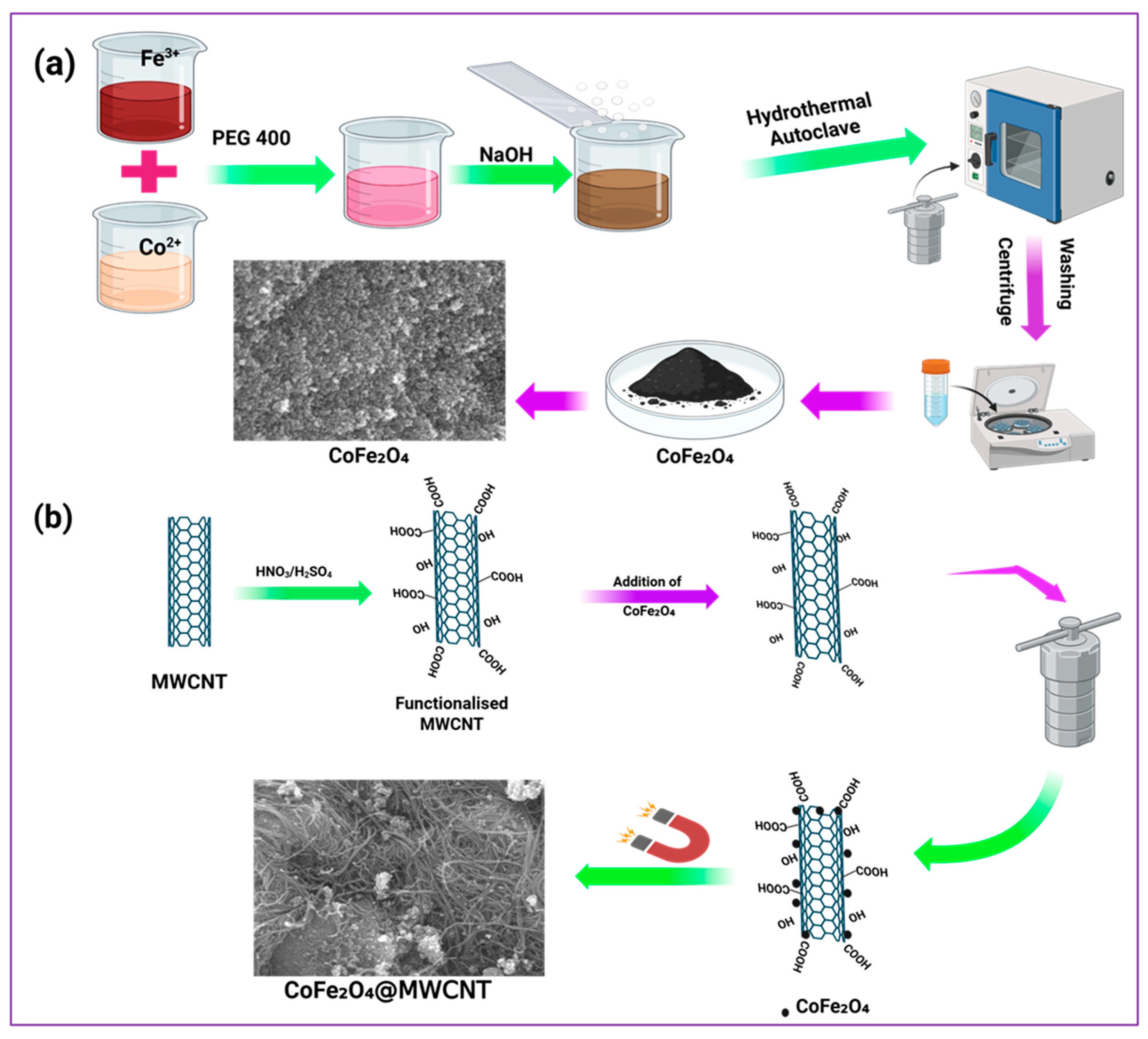
The synthesis of CFO magnetic nanoparticles (MNPs) was conducted following the methodology outlined in our previous study, as illustrated in Figure 1a [36]. The solvothermal method, a versatile technique for fabricating hybrid nanocomposites, was employed due to its efficacy in controlling particle morphology and phase purity. Unlike the hydrothermal process, which utilizes water as the solvent, the solvothermal approach employs organic solvents such as ethanol or ethylene glycol to facilitate controlled nucleation and growth. In this study, CFO@MWCNT hybrid magnetic nanocomposites were synthesized via a facile one-pot solvothermal method. Initially, CFO MNPs were prepared through a conventional hydrothermal process using Fe3+ and Co2+ salts in a 2:1 molar ratio, as detailed in our prior work [12]. For the synthesis of CFO@MWCNT nanocomposites, functionalized MWCNTs were dispersed in a solvent mixture comprising 40 mL of dimethylformamide (DMF) and 20 mL of ethylene glycol. The dispersion was subjected to ultrasonication for 2 h to ensure the uniform distribution of MWCNTs. Subsequently, pre-synthesized CFO MNPs were introduced into the MWCNT dispersion. To enhance dispersion stability and regulate particle growth, 4.2 g of sodium acetate (NaAc) was added as a stabilizing agent, and 5 mL of polyethylene glycol (PEG-400) was incorporated as a dispersant. The resulting mixture was vigorously stirred at ambient temperature for 1 h to achieve homogeneity. The mixture was then transferred to a 100 mL Teflon-lined stainless-steel autoclave, which was sealed and maintained at 200 °C for 12 h in a hot air oven. After the reaction, the autoclave was allowed to cool naturally to room temperature. The resulting black precipitate was collected via magnetic separation and thoroughly washed 4–5 times with deionized water and absolute ethanol to eliminate residual impurities and organic by-products. The purified CFO@MWCNT nanocomposites were dried under vacuum at 80 °C for 20 h. The synthesized CFO@MWCNT nanocomposites, with CFO loading levels of 0% and 10% by weight, are depicted in Figure 1b. These samples were subjected to comprehensive characterization to evaluate their structural, morphological, magnetic, and spin resonance properties using advanced analytical techniques.

3. Characterizations

The phase composition and crystallinity of the composite samples were characterized using an X-ray diffractometer (RIGAKU Ultima-IV, RIGAKU, Tokyo, Japan) equipped with a Cu Kα radiation source (λ = 0.15462 nm). Data were collected with a step size of 0.02° in the 2θ range of 20° to 80°, operating at 40 kV and 30 mA, with a divergent slit of 0.5 mm. Surface morphology and elemental composition of the MNPs samples were analyzed using a scanning electron microscope (SEM, EVO MA 10, variable pressure) with an energy-dispersive X-ray spectroscopy (EDS) attachment, operating at an accelerating voltage of 10 keV. FTIR spectroscopy was performed at room temperature using a NICOLET 5700 (Thermo Electron Corporation Madison, WI, USA) spectrometer in the wavenumber range of 4000–400 cm−1 to verify the formation of MWCNT-MNP phases and identify other functional groups. FTIR spectra were acquired in transmission mode, with sample pellets prepared by mixing a small quantity of MWCNT-MNP with a KBr matrix using a pelletizer. Ultraviolet-visible (UV-Vis) absorption spectra were recorded at room temperature using a Lambda 950 spectrophotometer (Perkin Elmer, Waltham, MA, USA) over a wavelength range of 200–900 nm with a scanning step of 0.1 nm. Raman scattering measurements were carried out using a Renishaw inVia (Wotton-under-Edge, Gloucestershire, UK) micro-Raman spectrometer equipped with a 514 nm excitation source, enabling the identification of phase-specific vibrational modes and the analysis of disorder-induced features in the nanocomposites. Static magnetic properties of the as-synthesized magnetic fluids were investigated at 300 K using a VSM (Lakeshore 7410, Lake Shore Cryotronics, Westerville, OH, USA) to obtain magnetization hysteresis (M-H) loops within a magnetic field range of ±2 T. Additionally, room-temperature microwave spin resonance properties of the MNP samples were examined using an FMR spectrometer (Bruker Biospin-A300),Bruker Corporation, Rheinstetten, Germany), operating at a microwave frequency of 9.8 GHz (X-band) with a modulation frequency of 100 kHz.

4. Result and Discussion

4.1. Structural Analysis (XRD Study)

CFO@MWCNT nano-composite heterostructures were successfully synthesized via a facile and cost-effective solvothermal method, utilizing acid-functionalized MWCNTs as precursors. The synthesis strategy is illustrated schematically in Figure 1. Initially, the acid treatment of MWCNTs introduced negatively charged oxygen-containing functional groups (e.g., carboxyl and hydroxyl) on their surfaces, serving as active sites for the nucleation of CFO MNPs. These functional groups facilitated robust interfacial bonding between the MWCNTs and CFO grains, enabling the formation of a nanocomposite architecture. The solvothermal process involved dispersing acid-functionalized MWCNTs in a mixture of DMF and ethylene glycol (EG) solution, where Co2+ and Fe3+ ions were electrostatically adsorbed onto the negatively charged functional groups on the MWCNT surfaces. During the solvothermal reaction, conducted in a sealed autoclave under elevated temperature and pressure, EG underwent dehydration to produce water, creating a localized aqueous environment. Concurrently, ammonium acetate (NH4Ac) hydrolysis generated an alkaline medium by releasing OH ions. This facilitated the precipitation of cobalt and iron ions, forming CFO nanoparticles via the reaction: Co2+ + 2Fe3+ + 8OH → CFO + 4H2O. The resulting CFO nanoparticles were anchored and uniformly distributed along the MWCNT surfaces, yielding the CFO/MWCNT composite structure.
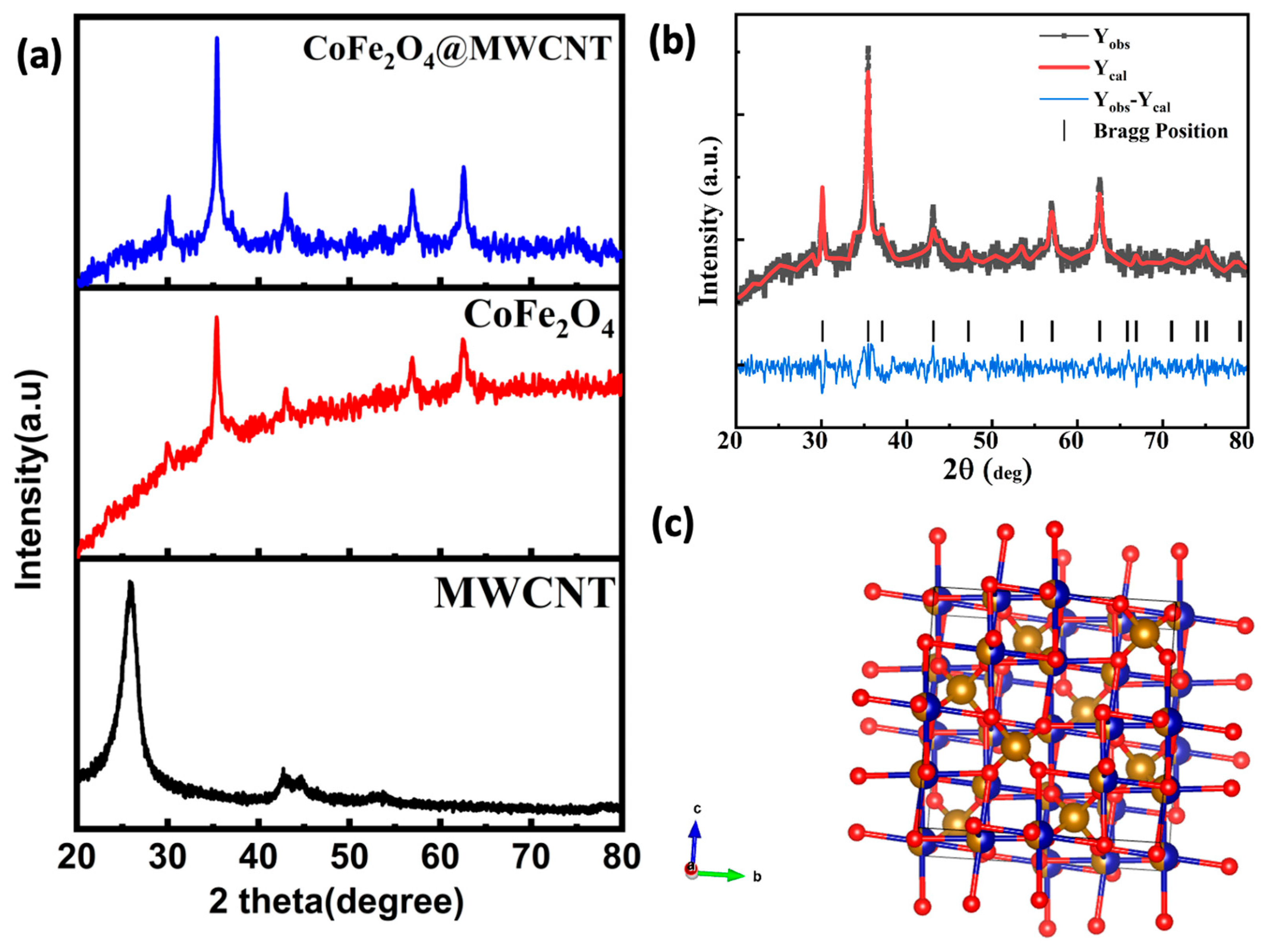
The crystallinity and phase evolution of the samples were investigated using an XRD with Cu Kα radiation (λ = 0.15462 nm) over a 2θ range of 20–80°, as depicted in Figure 2a. The XRD patterns revealed sharp, intense peaks, indicative of the highly crystalline nature of the CFO samples. Diffraction peaks observed at 2θ values of 18.2°, 30.0°, 35.4°, 37.0°, 43.0°, 53.4°, 56.9°, 62.5°, 70.9°, 74.0°, 75.0°, and 78.9° correspond to the (111), (220), (311), (222), (400), (422), (511), (440), (620), (533), (622), and (444) crystallographic planes, respectively, of the cubic spinel structure of CFO [37]. These peaks align closely with the standard pattern of cubic CFO (JCPDS card no. 22–1086), confirming the successful synthesis of cobalt ferrite. No impurity phases were detected in any of the samples. In the XRD patterns of MWCNT-incorporated samples, additional peaks at 2θ = 44° and 53° were identified, corresponding to the (011) and (004) planes of MWCNTs [38]. A weak peak at 2θ = 26°, attributed to the (002) plane of the CNT phase, which exhibits a graphite-like structure with a distinct configuration, was also observed in the CFO@MWCNT composites. Notably, the crystalline structure of CFO remained stable upon integration with MWCNTs, although the peak intensities in the composite samples were reduced compared to pure CFO, suggesting a slight influence of MWCNTs on the crystallinity. The mean crystallite size was calculated using the Scherrer equation: D = Kλ/βcosθ D, where D is the mean crystallite size, K is the shape factor (typically 0.9), λ is the X-ray wavelength (0.15462 nm), β is the full width at half maximum (FWHM) in radians, and θ is the diffraction angle [39,40]. The average crystallite sizes for CFO and CFO@MWCNT samples were determined to be 15 nm and 25 nm, respectively. The smaller crystallite size in the composite samples is attributed to the MWCNT surface acting as nucleation sites, facilitating the growth of CFO crystallites within the tubular structure of CNTs. The lattice constant (a a a) was calculated using the relation: a = d / h 2 + k 2 + l 2 , where d is the interplanar spacing and (h k l) are the Miller indices. The lattice constants for CFO and CFO@MWCNT samples were found to be 8.3966 Å and 8.4103 Å, respectively. The X-ray density was calculated as 5.52 g/cm3 for CFO and 5.66 g/cm3 for CFO@MWCNT samples.
The hopping lengths of magnetic ions at tetrahedral (A) and octahedral (B) sites in CFO and CFO@MWCNT nanocomposites were determined using the following equations: dA = 0.25a√3 Å, dB = 0.25a√2 Å, where (dA) and (dB) denote the hopping lengths at the tetrahedral and octahedral sites, respectively, and a) represents the lattice constant. For CFO, the calculated values are (dA = 3.636 Å and dB = 2.968 Å, while for CFO@MWCNT nanocomposites, the values are dA = 3.641 Å and dB = 2.973 Å. These results indicate that the incorporation of MWCNTs into CFO magnetic nanoparticles (MNPs) leads to a slight increase in the hopping lengths of magnetic ions at both tetrahedral and octahedral sites. This increase suggests an enhanced separation between magnetic ions, which can be attributed to the structural modifications induced by the differences in ionic radii between Fe3+ and Co2+ ions [41]. These variations influence the lattice parameters and interionic distances, thereby affecting the magnetic and electronic properties of the nanocomposites. The specific surface area (SSA) is a pivotal parameter governing adsorption and surface-mediated reactions, significantly influencing the performance of nanomaterials in applications such as photocatalysis. The SSA of synthesized CFO and CFO@MWCNT nanocomposites was calculated using Sauter’s formula: SSA = 6000/D, where SSA is the specific surface area (m2/g), and (D) is the crystallite size (nm). The computed SSA values were 72.46 m2/g for CFO and 42.40 m2/g for CFO@MWCNT nanocomposites. These results indicate that CFO magnetic nanoparticles exhibit a higher SSA compared to CFO@MWCNT, primarily due to the large surface area contribution of MWCNTs, which enhances the availability of active sites for photoexcitation of electron-hole pairs. However, a clear trend of decreasing SSA with increasing MWCNT content was observed, correlating with an increase in crystallite size as MWCNT concentration rises in the CFO matrix. This inverse relationship between SSA and crystallite size highlights the significant influence of MWCNT incorporation on the microstructural properties of the nanocomposites, thereby impacting their suitability for photocatalytic applications [42].
Rietveld refinement of the CFO XRD pattern was performed using the FullProf software (FullProf 2k version), employing the Fd-3m space group and the least-squares method. Structural parameters, including lattice constants, profile shape, width parameters, preferred orientation, asymmetry, isotropic thermal parameters, atomic coordinates, and site occupancies, as well as global parameters such as background and scale factors, were refined sequentially. The refined XRD pattern, shown in Figure 2b, displays the observed and calculated intensities, with the difference plotted as the bottom line. Vertical lines mark the allowed Bragg positions for the Fd3m space group. The background was modelled using a pseudo-Voigt function. The refinement yielded a chi-square (χ2) value of 0.360, indicating an excellent fit between the structural model and experimental data. The refined lattice constant was 8.3951 Å, with a cell density of 5.268 g/cm3 and an R-factor close to 1, further confirming the reliability of the structural model [43]. Further, all Rietveld refinement parameters are listed in Table 1.

4.2. Surface Morphology and Elemental Compositions

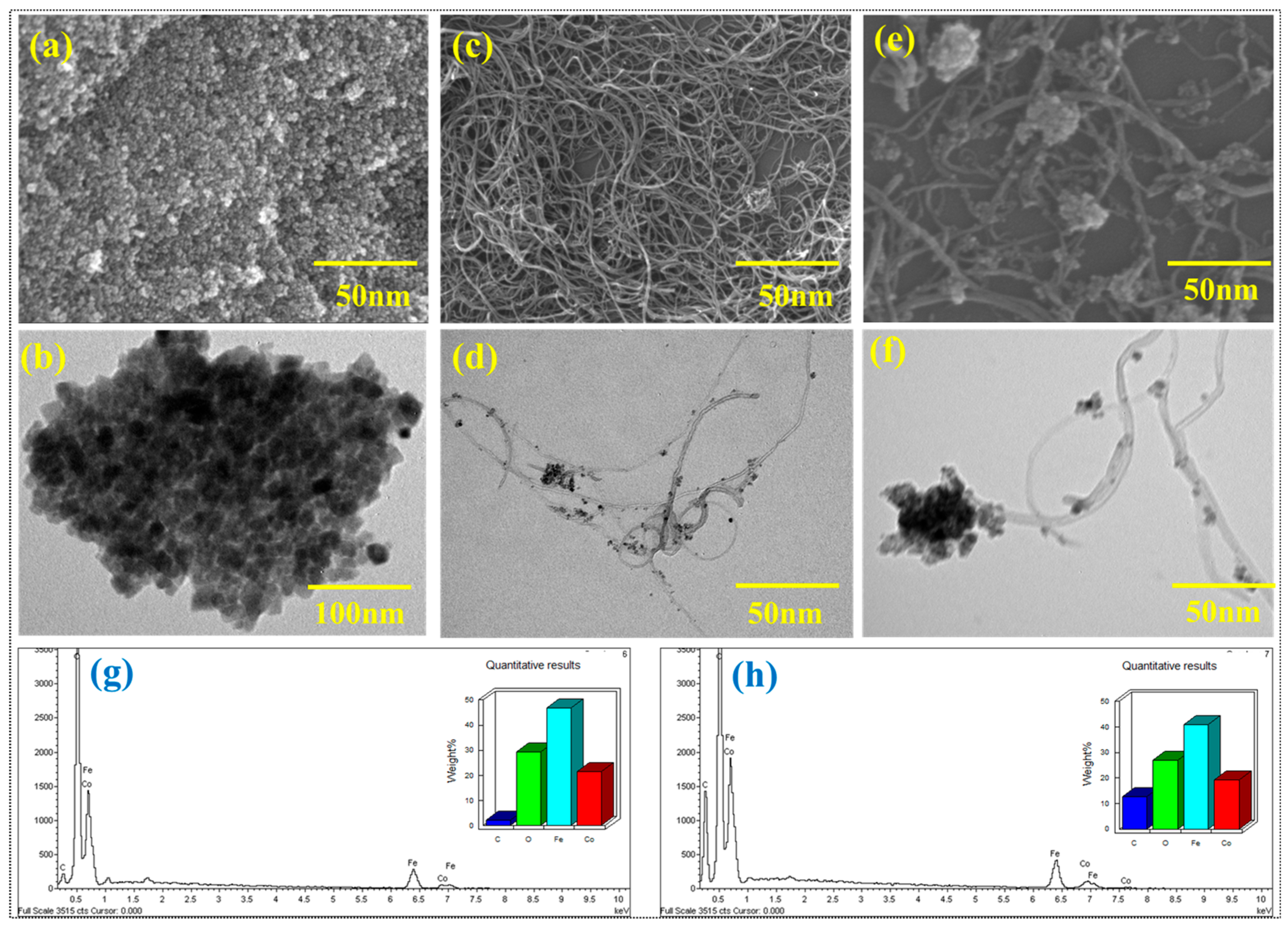
FESEM was employed to examine the surface morphology and microstructural characteristics of pristine CFO, MWCNTs, and their nanocomposite. The FESEM micrographs revealed notable differences in particle size distribution, shape, and surface topography between pure CFO and the composite system. While pristine CFO exhibited a relatively uniform morphology, the nanocomposite demonstrated a more intricate architecture with increased surface roughness and porosity. These morphological modifications are expected to significantly influence the physicochemical properties of the material, particularly its catalytic behaviour and surface reactivity. The FESEM and TEM images of CFO nanoparticles (Figure 3a,b) displayed a particle size range of approximately 10–20 nm with some variations in size and shape. A degree of agglomeration was observed, primarily attributed to strong van der Waals forces, high surface energy, and magnetic dipole–dipole interactions between the nanoparticles. Such clustering is characteristic of magnetic nanomaterials and, although it may reduce effective surface area and dispersion, it simultaneously reflects the intrinsic magnetic nature of CFO [44,45]. Optimized synthesis protocols or surface modification strategies could further mitigate this agglomeration, thereby enhancing particle distribution. Figure 3c shows the FESEM image of pristine MWCNTs exhibiting smooth, defect-free tubular surfaces. In the case of the nanocomposite (Figure 3d–f), CFO nanoparticles were uniformly dispersed over the MWCNT surfaces, indicating successful functionalization of the nanotubes, which provided numerous active sites for CFO nucleation. Importantly, the tubular structure of the MWCNTs remained intact following nanocomposite formation, suggesting excellent structural compatibility between the two components. The homogeneous decoration of MWCNTs with CFO nanoparticles highlights the reliability and efficiency of the adopted synthesis route, while the strong interfacial interactions within the hybrid structure are likely to enhance its functional performance. Energy-Dispersive X-ray Spectroscopy (EDX) analysis further confirmed the elemental composition of the samples. The spectra of pure CFO nanoparticles (Figure 3g) exhibited characteristic peaks of cobalt (Co), iron (Fe), and oxygen (O), consistent with the stoichiometric composition of cobalt ferrite. In contrast, the spectrum of the CFO@MWCNT nanocomposite (Figure 3h) additionally revealed the presence of carbon (C), thereby verifying the successful incorporation of MWCNTs. The quantitative EDX data, expressed in both mass and atomic percentages, confirmed the coexistence of CFO and MWCNT constituents without deviation from the ferrite stoichiometry, thereby affirming the chemical integrity and purity of the nanocomposite [46,47].

4.3. FTIR and Raman Spectroscopy

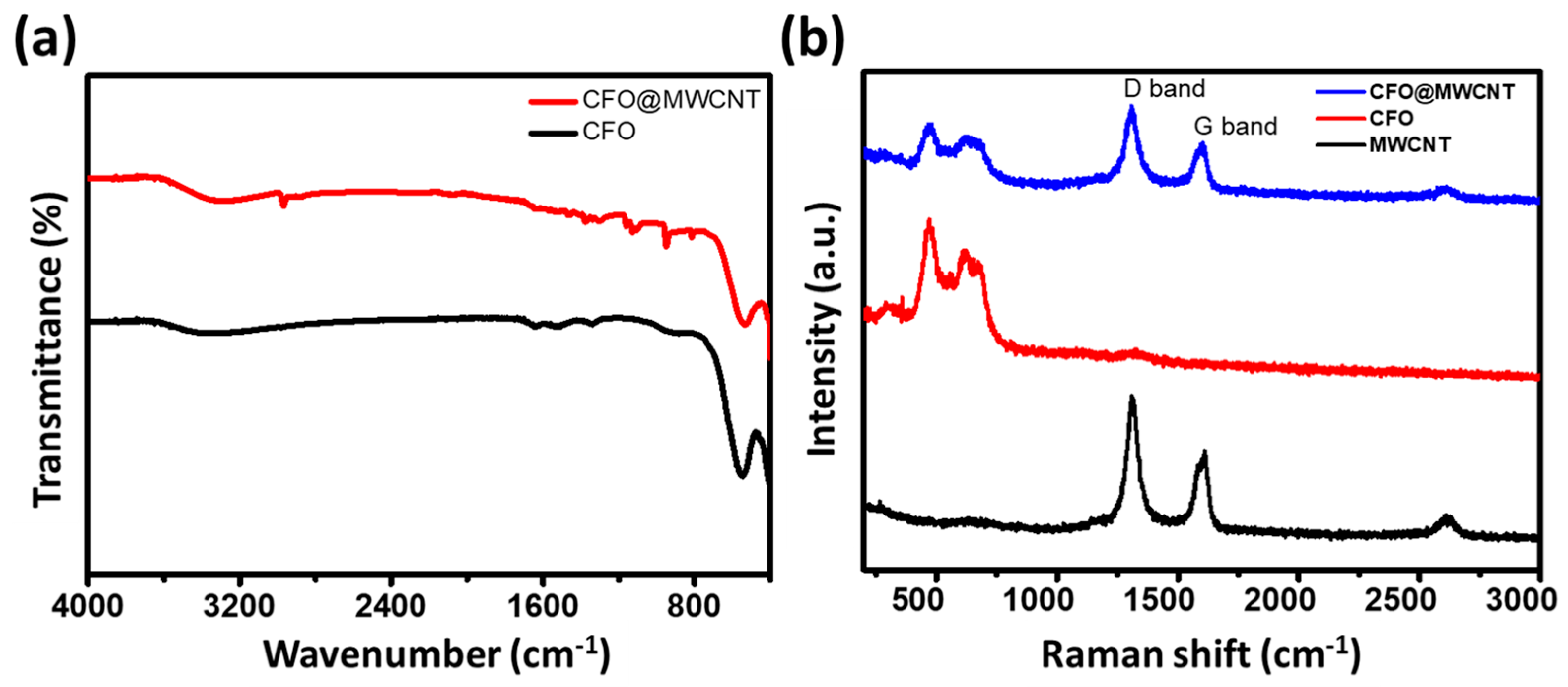
The structural characteristics of the synthesized CFO nanoparticles and their corresponding ferrite/multi-walled carbon nanotube CFO@MWCNT nanocomposites were examined via FTIR spectroscopy at ambient temperature. The FTIR spectra of CFO MNPs and CFO@MWCNT nanocomposites, as shown in Figure 4a, display characteristic absorption bands indicative of the spinel ferrite structure within the wavenumber range of 400–600 cm−1. Two prominent bands are observed: the higher-frequency band (υ1) at 580–585 cm−1, attributed to metal–oxygen stretching vibrations at tetrahedral A-sites primarily involving Fe3+–O2− bonds, and the lower-frequency band (υ2) at 390–400 cm−1, corresponding to analogous vibrations at octahedral B-sites dominated by Co2+–O2− interactions [12,35]. These vibrational signatures, also depicted in Figure 5a, confirm the successful formation of the cubic spinel structure in both pristine CFO MNPs and CFO@MWCNT nanocomposites. The distinct positions of υ1 and υ2 reflect variations in bond lengths between Fe3+–O2− at tetrahedral sites and Co2+–O2− at octahedral sites, consistent with the structural characteristics of spinel ferrites. In the CFO@MWCNT nanocomposites, these characteristic bands remain well-preserved, indicating that the spinel structure of CFO is maintained despite the incorporation of MWCNTs [48]. However, an increase in MWCNT content results in a slight reduction in the υ1 band frequency, suggesting a preferential occupancy of Co2+ ions at octahedral B-sites. This observation is consistent with the larger ionic radius of Co2+ (0.74 Å) compared to Fe3+ (0.64 Å), which influences cation distribution and induces lattice strain. The increased lattice parameter of 8.4103 Å in CFO@MWCNT, as reported in Section 4.1, further corroborates this structural modification. Additionally, the heavier atomic mass of Co2+ contributes to a redshift in the υ2 band, lowering its vibrational frequency due to altered lattice dynamics. Beyond the spinel-specific bands, the FTIR spectra of CFO@MWCNT nanocomposites reveal additional absorption peaks at 1706 cm−1, 1552 cm−1, and 1153 cm−1, corresponding to carboxyl, carbonyl, and other functional groups present on the MWCNT surface [49]. These peaks confirm the successful functionalization of MWCNTs, which enhances the interfacial interaction between CFO MNPs and the carbon framework. The observed spectral features underscore the interplay between cation distribution, lattice dynamics, and surface chemistry in the CFO@MWCNT nanocomposites, providing critical insights into the structural and chemical modifications that govern their electromagnetic wave absorption properties.
Raman spectroscopy was employed as a non-destructive technique to rigorously evaluate the phase composition, structural integrity, and graphitization degree of MWCNTs, CFO MNPs, and CFO@MWCNT nanocomposites. Conducted at ambient temperature, this method provided critical insights into the structural characteristics, defect density, and phase purity of both pristine and composite samples. The Raman spectra, presented in Figure 4b, highlight the vibrational signatures of MWCNTs, CFO MNPs, and their hybrid nanocomposites. For MWCNTs, two prominent Raman bands were observed: the D band at 1444 cm−1, corresponding to the A1g mode, and the G band at 1680 cm−1, associated with the E2g mode. The D band reflects structural disorder, arising from defects, amorphous carbon, or lattice imperfections in the carbon framework, while the G band signifies the ordered sp2-hybridized carbon structure, originating from in-plane tangential vibrations of the graphitic walls [50,51]. The intensity ratio of these bands (ID/IG) serves as a quantitative measure of defect density and graphitic crystallinity. An increased ID/IG ratio in CFO@MWCNT nanocomposites compared to pristine MWCNTs indicates a higher degree of disorder, likely due to the integration of CFO MNPs, which introduces lattice strain and surface interactions. The electrical conductivity of MWCNTs is attributed to their unique bonding configuration, where robust in-plane σ-bonds ensure structural stability, and delocalized π-bonds formed by unhybridized p-orbitals facilitate electron mobility. In the CFO MNPs, Raman spectra revealed characteristic vibrational modes within the 200–700 cm−1 range, consistent with the inverse spinel structure of ferrites (space group Fd-3m). This structure exhibits 39 vibrational modes, of which six are Raman-active: 2A1g, 1Eg, and 3T2g [52]. These modes, sensitive to cation distribution, local symmetry, and defect states, arise from specific atomic vibrations within the crystal lattice. The A1g mode corresponds to symmetric metal–oxygen stretching at tetrahedral and octahedral sites, the Eg mode involves symmetric oxygen bending, and the T2g modes reflect asymmetric lattice distortions. The observed Raman peaks at 246 cm−1 (T2g), 319 cm−1 (T2g), 469 cm−1 (Eg), 583 cm−1 (T2g), and 680 cm−1 (A1g) confirm the presence of the inverse spinel structure in CFO MNPs. Specifically, the A1g mode at 680 cm−1 arises from symmetric stretching vibrations of oxygen anions with tetrahedrally coordinated metal cations (A-site), while the Eg mode at 469 cm−1 results from symmetric oxygen bending [53]. The T2g modes (246, 319, and 583 cm−1) correspond to asymmetric stretching interactions involving both tetrahedral (A-site) and octahedral (B-site) cations with oxygen anions. The lower-frequency modes (<600 cm−1) indicate the structural stability of the inverse spinel configuration, while the higher-frequency A1g mode reflects stronger metal–oxygen bonding at tetrahedral sites. The distinct separation of these vibrational modes in both CFO and CFO@MWCNT samples confirms the well-ordered crystalline nature of the materials. The preservation of CFO-specific Raman modes in the nanocomposites indicates that the inverse spinel structure remains intact despite MWCNT incorporation. These findings provide detailed insights into the cation distribution, spin–phonon coupling, and structural order, underscoring the utility of Raman spectroscopy in characterizing the structural and functional properties of CFO@MWCNT nanocomposites.

4.4. Optical Properties

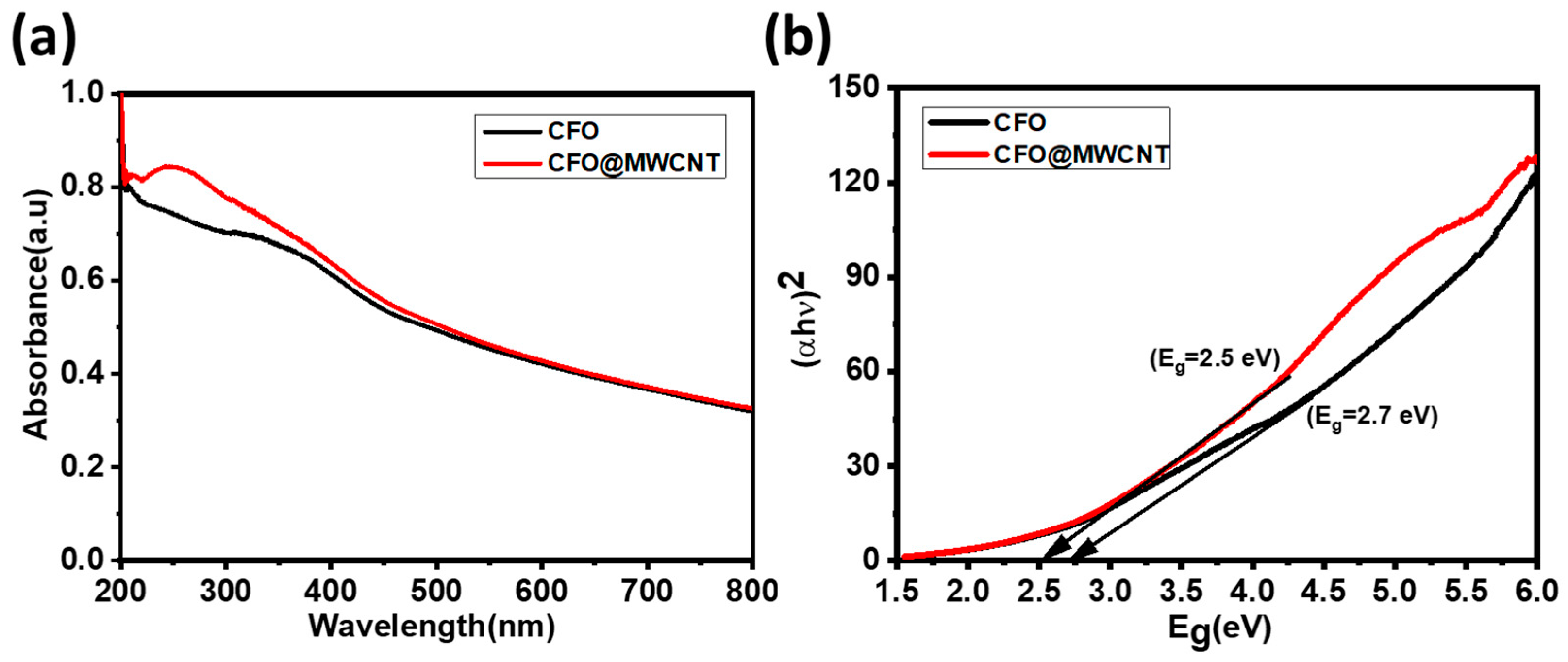
UV–Visible absorption spectroscopy was employed to investigate the electronic and optical properties of CFO MNPs and CFO@MWCNT nanocomposites, as presented in Figure 5a. The room-temperature absorbance spectra and corresponding band gap analyses for both pristine CFO MNPs and CFO@MWCNT nanocomposites are shown in Figure 5b. The optical band gap (Eg) was determined using the Tauc relation for direct band gap materials, expressed as: αhν = A(hν − Eg)1/2. where (α) is the absorption coefficient, (h) is Planck’s constant, (υ) is the photon frequency, (Eg) is the band gap energy, and (A) is a proportionality constant. The band gap was calculated by plotting (αhυ2) versus photon energy (hυ) and extrapolating the linear portion of the curve to intersect the energy axis (αhυ2 = 0) [13,32]. The analysis revealed a band gap of 2.72 eV for pristine CFO MNPs and a reduced band gap of 2.50 eV for CFO@MWCNT nanocomposites. The observed reduction in the band gap of the nanocomposites can be attributed to two primary factors: (1) structural modifications in crystallinity induced by MWCNT incorporation, and (2) the formation of oxygen vacancies. These vacancies introduce intermediate defect states within the band structure, effectively narrowing the energy gap [54]. Additionally, the increased disorder and localized energy states resulting from crystallinity changes further contribute to band gap reduction. This phenomenon has significant implications for the optoelectronic properties of CFO@MWCNT nanocomposites, enhancing their potential for applications in optoelectronic devices. The integration of CFO MNPs onto the surface of MWCNTs, which exhibit a smaller band gap of approximately 1.1 eV, is hypothesized to drive the observed band gap narrowing. The interaction between the smaller band gap of MWCNTs and the CFO MNPs results in a synergistic effect, mediated by sub-band-gap energy levels. This interaction lowers the overall band gap of the nanocomposite compared to pristine CFO MNPs, as supported by prior studies [20]. These findings highlight the role of MWCNT incorporation in modulating the electronic structure and optical properties of CFO-based nanocomposites.

4.5. Electrical Conductivity (I–V) Measurements

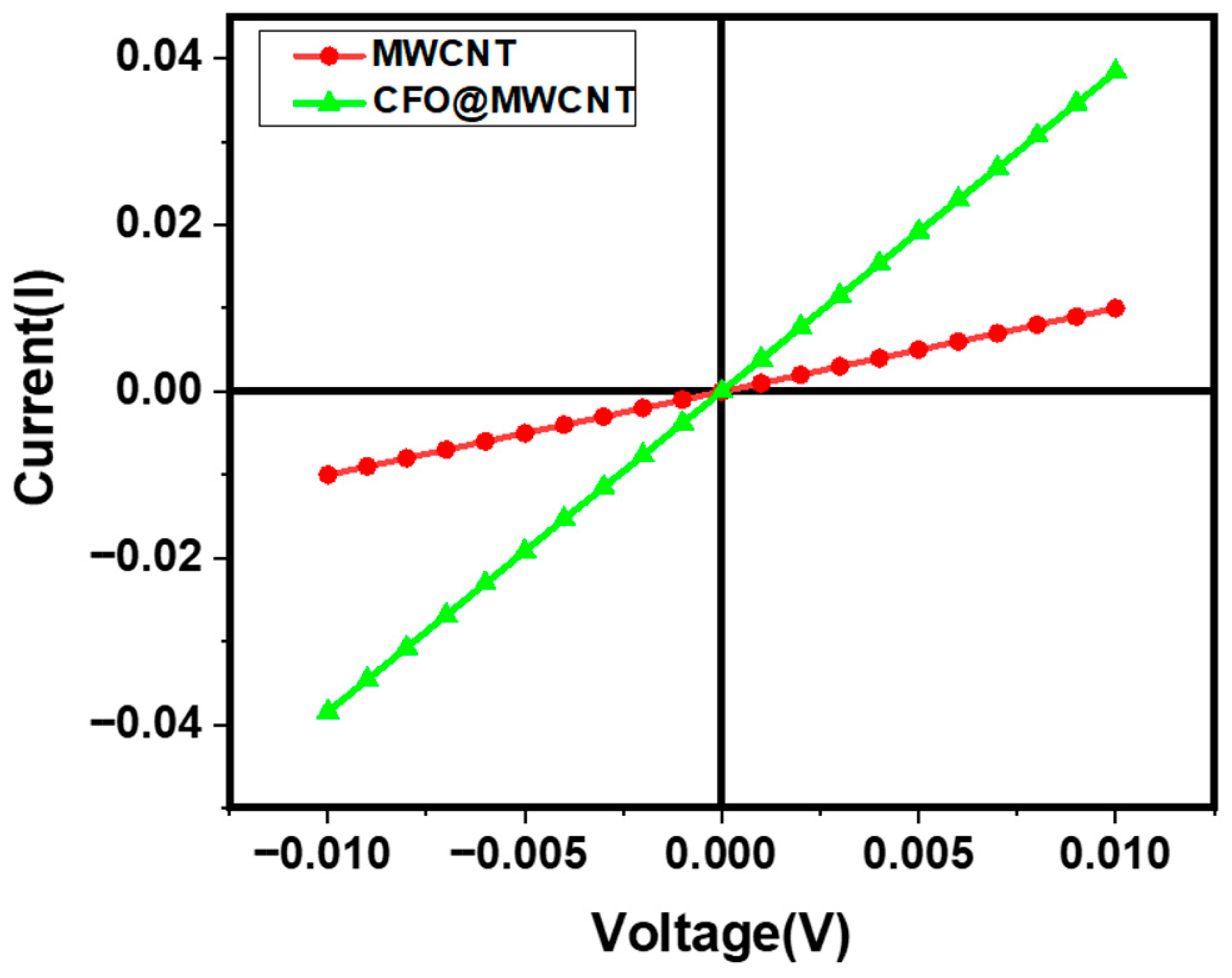
The direct current (DC) electrical conductivity of pristine MWCNT and CFO-doped MWCNT nanocomposites was investigated using the four-probe technique, a robust method for precise measurement of charge transport properties. This technique mitigates contact resistance errors by passing a constant current through the outer probes and measuring the resultant voltage drop across two inner probes, as illustrated in Figure 6. Rectangular pellets of the samples were prepared, and measurements were conducted using a Keithley 224 programmable current source (Keithley Instruments, Cleveland, OH, USA) to supply a steady current and a Keithley 197A digital multimeter (Keithley Instruments) to record the voltage drop. The inner probes were positioned at a fixed distance on the pellet surface, and 40–50 data points were collected per sample to ensure statistical reliability. The electrical conductivity of samples was measured using the following equation [52].
ρ = 1 σ = 1 R · A = I · l V · A
where σ is the electrical conductivity (S/cm), ρ is the resistivity (ohm metre), R is the resistance of the measured sample (Ω), I is the current (ampere), V is the voltage (volt), L is the distance between two pin-point voltage probes, and A is the cross-sectional area of the sample (cm2). The current–voltage (I–V) characteristics, presented in Figure 6, were recorded over a voltage range of −0.010 V to +0.010 V, with the current response measured in amperes (A) for pristine MWCNTs (red data points) and CFO@MWCNT nanocomposites (green data points). Both samples exhibited linear I–V behaviour, indicative of ohmic conduction within the applied voltage range. For pristine MWCNTs, the current ranged from −0.020 A at −0.010 V to +0.020 A at +0.010 V, demonstrating a symmetric response. In contrast, the CFO@MWCNT nanocomposite displayed a steeper I–V curve, with the current ranging from −0.040 A at −0.010 V to +0.040 A at +0.010 V, reflecting significantly higher conductance. The electrical conductivity of the CFO@MWCNT nanocomposite was determined to be 40 S/cm, twice that of pristine MWCNTs (20 S/cm), confirming a substantial enhancement upon CFO incorporation. This increase is attributed to the synergistic interaction between the conductive MWCNT matrix and CFO nanoparticles, which likely promotes additional charge carrier pathways and reduces interfacial resistance through enhanced electron transport at the CFO@MWCNT interface. The improved conductivity is further supported by interfacial charge transfer mechanisms and the formation of an efficient percolation network within the hybrid structure. These findings highlight the potential of CFO@MWCNT nanocomposites for applications in conductive coatings, flexible electronics, and energy storage systems, where high electrical conductivity is a critical requirement [55].

4.6. DC Magnetization Measurement

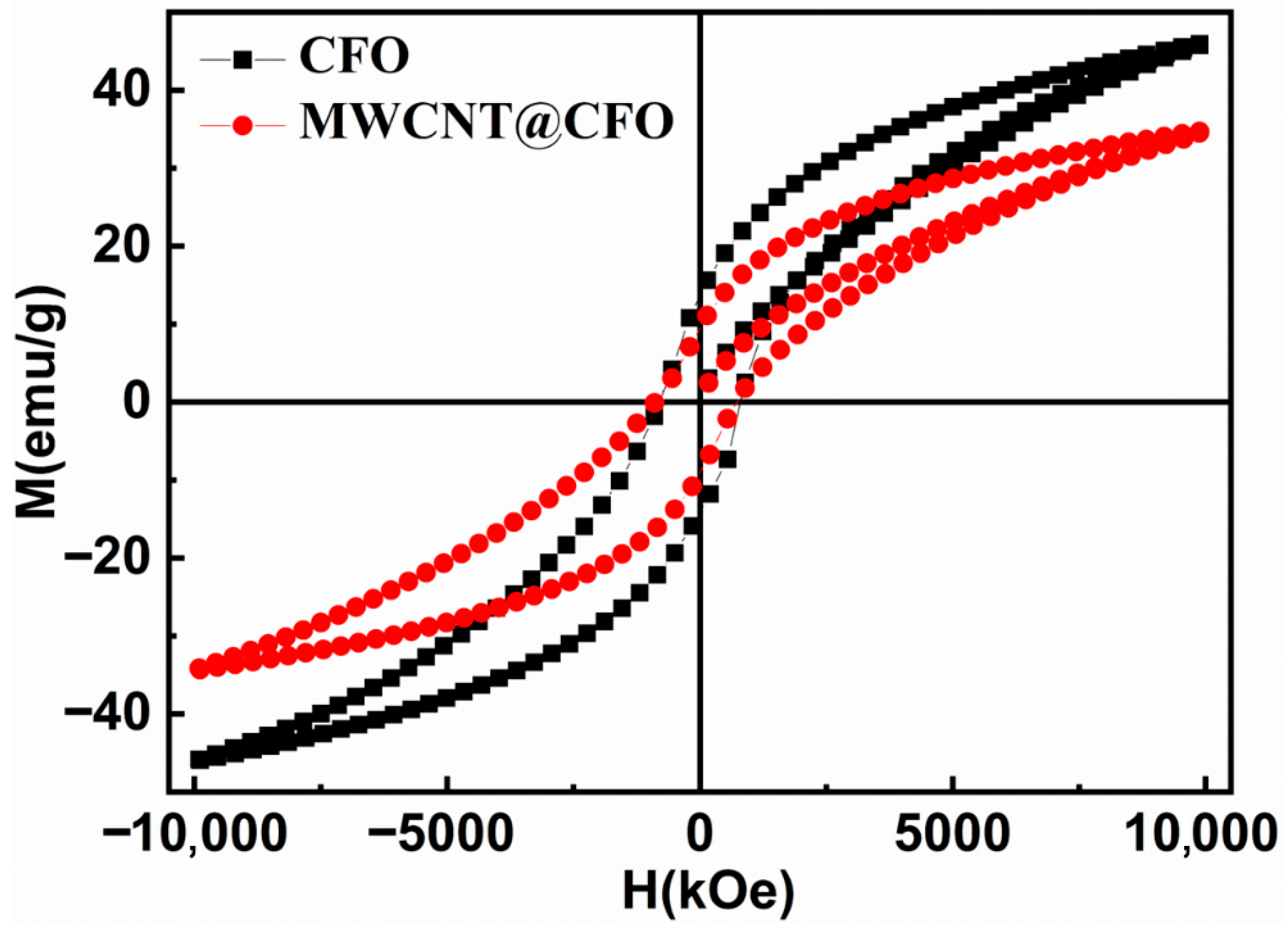
The room DC magnetization and interfacial magnetic properties of CFO@MWCNT nanocomposites were investigated using room-temperature VSM, revealing notable changes in magnetic behavior compared to pristine CFO nanoparticles. As shown in Figure 7, the hysteresis loops indicate a decrease in saturation magnetization from 46 emu/g for CFO to 35 emu/g for CFO@MWCNT, along with a slight reduction in coercivity from 852 Oe to 841 Oe. These modifications can be attributed to three interrelated factors: the diamagnetic dilution effect of MWCNTs, interfacial spin disorder at the CFO–MWCNT junctions, and strain-mediated alterations in the superexchange interactions (Fe3+–O2−–Co2+) within the spinel lattice structure [47,56]. The altered magnetic properties arise from interfacial exchange coupling between CFO nanoparticles and the MWCNT matrix, which influences both the static and dynamic magnetic responses. The MWCNTs introduce magnetic anisotropy through several mechanisms: shape anisotropy due to their high aspect ratio, favoring magnetization alignment along the nanotube axis, interface-induced perpendicular magnetic anisotropy caused by broken symmetry at the CFO–MWCNT boundaries, and strain anisotropy resulting from lattice mismatch at the heterointerfaces [57,58]. Furthermore, the spin relaxation dynamics are significantly modified due to enhanced surface spin canting at the CFO–MWCNT interfaces, altered spin–orbit coupling as a result of charge transfer between the two phases, and the presence of additional spin-scattering centers introduced by defects and functional groups on the nanotubes. The observed reduction in coercivity suggests that the MWCNT matrix facilitates magnetization reversal by mediating interparticle interactions and reducing the energy barrier, consistent with Davis’ model of surface spin immobilization. Despite these interfacial effects, the ferrimagnetic ordering is largely preserved, as indicated by the near-constant squareness ratio (Mr/Ms). These findings highlight the ability of MWCNTs to modulate key magnetic parameters, including anisotropy energy through interface engineering, spin relaxation rates via defect-controlled mechanisms, and interparticle coupling through nanoscale spacing [59,60]. The presence of distinct magnetic hard (CFO core) and soft (interface) regions suggested by the modified switching field distribution points to a core–shell magnetic structure. Such tunable interfacial exchange coupling endows the nanocomposites with enhanced functionality, making them promising candidates for advanced applications requiring adjustable magnetic hardness and optimized high-frequency performance. Lastly, the observed decrease in magnetization (Ms) in the MWCNT composite can be attributed to the existence of carbon nanotubes with inherently low magnetic properties, as reported in previous studies [8,23]. Also, the reduction in saturation magnetization seen in the samples is likely caused by the presence of CNTs and structural changes on the surface of the ferrites. These changes occur due to the interaction between transition metal ions and oxygen atoms in the spinel lattice. This interaction can diminish the magnetic moment, particularly in ultrafine particles, because of their high surface-to-volume ratio. The presence of defects and stresses in the conjunction area between CFO crystallites and the surface of MWCNTs may contribute to this phenomenon [38,46]. It is worth noting that the incorporation of MWCNTs into the system results in an increased interparticle distance, leading to a reduction in particle aggregation and the associated particle–particle magnetic interaction. As per the theory proposed by Davis, the interaction between carbon nanotubes (CNTs) and nanoparticles results in the immobilization of surface spins and an enhancement of the non-spin structure [10,33]. This phenomenon is believed to be one of the contributing factors to the observed decrease in magnetic moments of the nanoparticles. The behavior of MWCNT can be observed as a hindrance to the rotation of domains when an external magnetic field is applied. Additionally, the coercive force, which is the resistance to demagnetization, is found to increase with the presence of nonmagnetic particles [25]. All calculated magnetic parameters, i.e., saturation magnetization, coercivity, remanent magnetization, sequence ratio and anisotropy constant are listed in Table 2.

4.7. Spin Dynamics

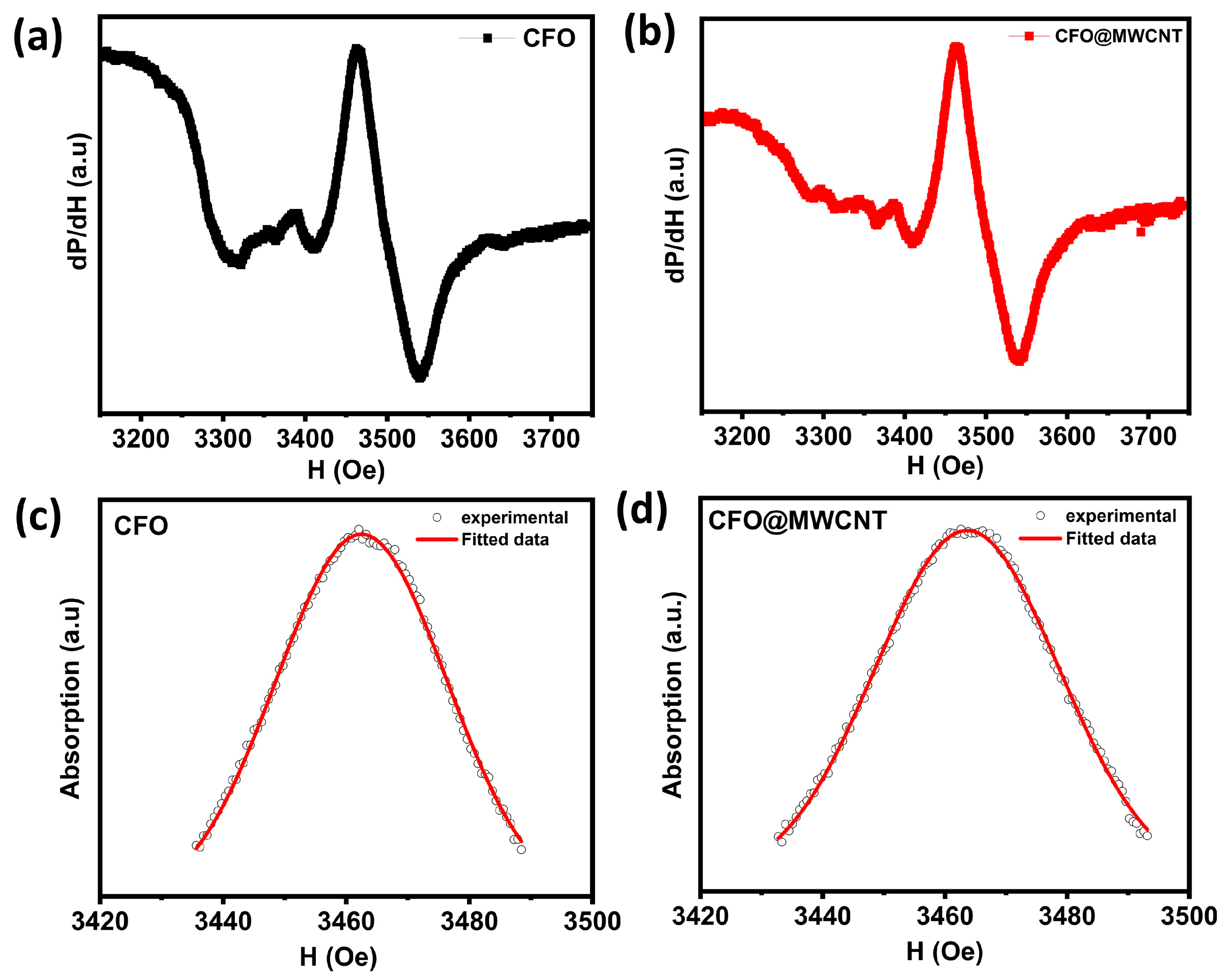
The spin dynamics of the synthesized magnetic nanocomposites were systematically investigated using FMR spectroscopy to elucidate the underlying spin relaxation mechanisms, magnetic anisotropy, and interfacial exchange coupling phenomena. FMR measures the absorption of microwave radiation by unpaired electron spins when subjected to an external static magnetic field. This technique is highly sensitive to the local magnetic environment, magnetic anisotropy, and spin–lattice or spin–spin interactions [34,35]. The fundamental resonance condition, defined by the Landé g-factor, provides a quantitative framework for probing variations in the internal magnetic field. The spin–spin relaxation time (T2), peak-to-peak linewidth (ΔHpp), and spin density (Ns) were extracted through derivative line-shape analysis, wherein the spectra were modeled by a convolution of Gaussian and Lorentzian functions (as shown in Figure 8c,d. This formalism captures the relative contributions of homogeneous and inhomogeneous broadening mechanisms, thereby enabling precise deconvolution of intrinsic relaxation dynamics from extrinsic field fluctuations. The FMR spectra for pure CFO nanoparticles and CFO@MWCNT nanocomposites were acquired at room temperature using an X-band frequency of 9.8 GHz under a static magnetic field ranging from 3000–4000 G (Figure 8). The resonance field Hr for pure CFO was observed at 3495 G, while the CFO@MWCNT composite exhibited a slightly shifted value of 3500 G. This marginal upshift in Hr implies the influence of interfacial exchange coupling between the magnetic CFO nanoparticles and the conductive MWCNTs, which subtly modifies the internal magnetic field without significantly disrupting the spinel framework. The Lande g-factor of the sample is calculated using the relation: g = h ν μ B H r where h is Planck’s constant, ν is the microwave frequency, and Hr is the resonance field [31]. The g-factor of the CFO and CFO@MWCNT-based magnetic nanocomposite sample calculated from the above relation is found to be 1.97 and 2.00, respectively, more minuscule than the g-value of the free radical (2.006). The smaller value of the g-factor suggests that the superexchange interactions among the cations (A-O-B) and oxygen dominate over the dipolar-dipolar interaction between the MNPs. Magnetic anisotropy plays a crucial role in spin dynamics, affecting the line broadening and spin relaxation mechanisms. The observed line width broadening in CFO@MWCNTs suggests enhanced magnetic anisotropy, which can be attributed to interfacial strain and spin pinning at the CFO–MWCNT interface. The effective anisotropy field may increase due to spin canting or the anisotropic distribution of surface spins mediated by π–electron interactions from MWCNT walls [3,59]. The rate at which microwave energy of X-Band is absorbed or released is primarily through spin–lattice interaction, T1 (longitudinal relaxation time), or by spin-spin relaxation time T2 (transverse relaxation time). The transverse relaxation time is calculated by considering the homogeneous broadening of FMR spectra. The relaxation time T2 is estimated by measuring the full width at half maximum H 1 / 2 =   3   H P P ; by fitting the FMR spectra with the statistical Lorentzian distribution function as T 2 =   2 γ H 1 / 2 where H 1 / 2 —line width at half height of the absorption peak, γ =   ω H r , magnetogyric ratio [12,36]. The value of spin relaxation time of CFO and CFO@MWCNT-based nanocomposite are 1.41 ns and 1.59 ns, respectively, showing that the composite has improved spin dynamics. The number of unpaired spins (Ns) is calculated in a similar way using the statistical Lorentzian distribution function as N s = 9 H 1 / 2 4 π 2 g μ B . The value of spin concentration of CFO and CFO@MWCNT-based nanocomposite sample obtained above equation is 3.72 × 10²² spin/g and 4.58 × 10²² spin/g, suggesting an enhanced density of unpaired spins in the composite due to MWCNT incorporation. The FMR analysis of CFO@MWCNT-based nanocomposites reveals a subtle shift in resonance field, improved spin relaxation time, and enhanced spin concentration, indicating modified magnetic interactions upon MWCNTs integration. The interface between CFO and MWCNTs establishes a distinctive exchange coupling mechanism, wherein the localized magnetic moments of CFO interact with the delocalized π–electron system of MWCNTs [60]. This interfacial exchange coupling significantly influences the magnetic properties by modifying spin wave damping, enhancing magnetocrystalline anisotropy, and tailoring magnetic relaxation behavior, all of which are pivotal for advanced technological applications. FMR analysis of CFO@MWCNT nanocomposites further elucidates these effects, revealing a subtle shift in the resonance field (ΔHr) an enhanced transverse relaxation time (T2), and an increased spin concentration (Ns). Additionally, the results indicate heightened magnetic anisotropy and pronounced interfacial exchange coupling effects. These findings highlight the potential of CFO@MWCNT composites in advanced applications such as magnetic data storage, spintronic devices, and high-frequency microwave absorbers, where optimized spin dynamics and controlled magnetic properties are essential [12,59].

5. Conclusions

The present study provides a detailed mechanistic framework describing how interfacial exchange coupling between CFO nanoparticles and oxidatively functionalized MWCNTs governs the structural, electronic, magnetic, and spin dynamic responses of CFO@MWCNT nanocomposites synthesized via a modified solvothermal route. The formation of chemically coherent CFO–MWCNT interfaces, enabled by –COOH/–OH anchoring sites, induces measurable lattice perturbations manifested as an expansion of the cubic spinel parameter and an increase in crystallite size. These structural modifications reflect strain transfer across the hybrid boundary and partial coalescence of CFO domains, which in turn alter cation distribution and local coordination symmetry. The resulting perturbation of Fe3+–O–Co2+ superexchange pathways directly influences the electronic structure, as evidenced by a quantifiable reduction in optical bandgap. This narrowing arises from interface-induced defect states and enhanced orbital hybridization between CFO d-states and MWCNT π-states, promoting charge delocalization across the heterointerface. Magnetically, the incorporation of MWCNTs produces a systematic decrease in saturation magnetization and coercivity, attributable to diamagnetic dilution, interfacial spin canting, and modified domain-wall pinning energies. These effects originate from non-collinear spin arrangements at the CFO–MWCNT boundary, where exchange frustration and reduced spin coordination suppress long-range ferrimagnetic ordering. Ferromagnetic resonance measurements further reveal a shift in resonance field, an increase in the Landé g-factor, and a significant enhancement in spin–lattice relaxation time. These changes indicate strengthened spin–orbit coupling, increased local magnetic anisotropy fluctuations, and reduced phonon-mediated relaxation rates. The observed increase in spin density confirms the generation of additional unpaired electrons due to orbital asymmetry and defect-mediated electronic reconstruction at the interface. Collectively, the results demonstrate that CFO@MWCNT nanocomposites exhibit tunable anisotropy fields, modified exchange stiffness, and engineered spin relaxation dynamics arising from interfacial structural distortions and electronic redistribution. The mechanistic insights obtained here establish a direct correlation between interface chemistry, magnetic anisotropy modulation, and high-frequency spin dynamics, providing a rational basis for designing carbon-based magnetic heterostructures for spin-logic architectures, microwave attenuation systems, and magnetically responsive nanoscale devices.

Author Contributions

Conceptualization, P.K.; methodology, P.K.; formal analysis, P.K., J.Y., S.K. and R.V.; investigation, P.K. and S.P.; data curation, P.K., J.Y. and A.S.; writing—original draft preparation, P.K.; writing—review and editing, S.P.; visualization, S.P.; supervision, P.K. and S.P. All authors have read and agreed to the published version of the manuscript.

Funding

This research received no external funding.

Data Availability Statement

The data supporting this article is included in the present manuscript, available on request.

Acknowledgments

The authors are thankful to the Director, CSIR-NPL for his encouragement to carry out this research work. Prashant Kumar is grateful to the University Grant Commission (UGC), India, for the Senior Research Fellowship (SRF), Ref No. (19/06/2016(i) EU-V) and RMIT University RRITFS Scholarship to carry out this research.

Conflicts of Interest

The authors declare that they have no known competing financial interests or personal relationships that could have appeared to influence the work reported in this paper.

References

  1. Jauhar, S.; Kaur, J.; Goyal, A.; Singhal, S. Tuning the properties of cobalt ferrite: A road towards diverse applications. RSC Adv. 2016, 6, 97694–97719. [Google Scholar] [CrossRef]
  2. Muscas, G.; Cobianchi, M.; Lascialfari, A.; Cannas, C.; Musinu, A.; Omelyanchik, A.; Rodionova, V.; Fiorani, D.; Mameli, V.; Peddis, D. Magnetic interactions versus magnetic anisotropy in spinel ferrite nanoparticles. IEEE Magn. Lett. 2019, 10, 6110305. [Google Scholar] [CrossRef]
  3. Chandekar, K.V.; Kant, K.M. Estimation of the spin-spin relaxation time of surfactant coated CoFe2O4 nanoparticles by electron paramagnetic resonance spectroscopy. Phys. E Low Dimens. Syst. Nanostruct. 2018, 104, 192–205. [Google Scholar] [CrossRef]
  4. Fatimah, I.; Fadillah, G.; Yudha, S.P. Synthesis of iron-based magnetic nanocomposites: A review. Arab. J. Chem. 2021, 14, 103301. [Google Scholar] [CrossRef]
  5. Mubasher; Mumtaz, M. Nanocomposites of multi-walled carbon nanotubes/cobalt ferrite Nanoparticles: Synthesis; structural, dielectric and impedance spectroscopy. J. Alloys Compd. 2021, 866, 158750. [Google Scholar] [CrossRef]
  6. Kamkar, M.; Ghaffarkhah, A.; Hosseini, E.; Amini, M.; Ghaderi, S.; Arjmand, M. Multilayer polymeric nanocomposites for electromagnetic interference shielding: Fabrication, mechanisms, and prospects. New J. Chem. 2021, 45, 21488–21507. [Google Scholar] [CrossRef]
  7. Mourdikoudis, S.; Kostopoulou, A.; LaGrow, A.P. Magnetic Nanoparticle Composites: Synergistic Effects and Applications. Adv. Sci. 2021, 8, 2004951. [Google Scholar] [CrossRef] [PubMed]
  8. Bajorek, A.; Liszka, B.; Szostak, B.; Pawlyta, M. Microstructure and magnetism of Ni0.5Zn0.5Fe2O4/MWCNTs nanocomposites. J. Magn. Magn. Mater. 2020, 503, 166634. [Google Scholar] [CrossRef]
  9. Xiang, B.; Cheng, R.; Zhu, J.; Zhou, Y.; Peng, X.; Song, J.; Wu, J. MWCNTs dispersion adopting GA and its application towards copper tailings-based cementitious materials. Sci. Rep. 2023, 13, 16081. [Google Scholar] [CrossRef]
  10. Saidani, M.; Belkacem, W.; Bezergheanu, A.; Cizmas, C.B.; Mliki, N. Surface and interparticle interactions effects on nano-cobalt ferrites. J. Alloys Compd. 2015, 653, 513–522. [Google Scholar] [CrossRef]
  11. Sharifianjazi, F.; Moradi, M.; Parvin, N.; Nemati, A.; Rad, A.J.; Sheysi, N.; Abouchenari, A.; Mohammadi, A.; Karbasi, S.; Ahmadi, Z.; et al. Magnetic CoFe2O4 nanoparticles doped with metal ions: A review. Ceram. Int. 2020, 46, 18391–18412. [Google Scholar] [CrossRef]
  12. Kumar, P.; Pathak, S.; Singh, A.; Khanduri, H.; Basheed, G.A.; Wang, L.; Pant, R.P. Microwave spin resonance investigation on the effect of the post-processing annealing of CoFe2O4 nanoparticles. Nanoscale Adv. 2020, 2, 1939–1948. [Google Scholar] [CrossRef]
  13. Kumar, P.; Singh, R.; Singh, A.; Verma, R.; Yadav, J.; Luhar, S.; Pathak, S.; Pant, R.P. Site-Selective Zn2+ Substitution Induced Magnetic Phase Transition from Ferrimagnetism to Superparamagnetism in N, N, N-Trimethylhexadecan-1-aminium bromide Stabilized Co–Zn Ferrite Nanoparticles. J. Alloys Compd. 2025, 1050, 185745. [Google Scholar] [CrossRef]
  14. Singh, C.; Bansal, S.; Singhal, S. Synthesis of Zn1-xCoxFe2O4/MWCNTs nanocomposites using reverse micelle method: Investigation of their structural, magnetic, electrical, optical and photocatalytic properties. Phys. B Condens. Matter 2014, 444, 70–76. [Google Scholar] [CrossRef]
  15. Xiong, P.; Fu, Y.; Wang, L.; Wang, X. Multi-walled carbon nanotubes supported nickel ferrite: A magnetically recyclable photocatalyst with high photocatalytic activity on degradation of phenols. Chem. Eng. J. 2012, 195–196, 149–157. [Google Scholar] [CrossRef]
  16. Zhu, H.Y.; Jiang, R.; Huang, S.H.; Yao, J.; Fu, F.Q.; Li, J.B. Novel magnetic NiFe2O4/multi-walled carbon nanotubes hybrids: Facile synthesis, characterization, and application to the treatment of dyeing wastewater. Ceram. Int. 2015, 41, 11625–11631. [Google Scholar] [CrossRef]
  17. Jia, B.; Gao, L.; Sun, J. Self-assembly of magnetite beads along multiwalled carbon nanotubes via a simple hydrothermal process. Carbon 2007, 45, 1476–1481. [Google Scholar] [CrossRef]
  18. Lamastra, F.R.; Nanni, F.; Camilli, L.; Matassa, R.; Carbone, M.; Gusmano, G. Morphology and structure of electrospun CoFe2O4/multi-wall carbon nanotubes composite nanofibers. Chem. Eng. J. 2010, 162, 430–435. [Google Scholar] [CrossRef]
  19. Khan, L.U.; Younas, M.; Khan, S.U.; Rehman, M.Z.U. Synthesis and Characterization of CoFe2O4/MWCNTs Nanocomposites and High-Frequency Analysis of Their Dielectric Properties. J. Mater. Eng. Perform. 2020, 29, 251–258. [Google Scholar] [CrossRef]
  20. Unal, B.; Senel, M.; Baykal, A.; Sözeri, H. Multiwall-carbon nanotube/cobalt ferrite hybrid: Synthesis, magnetic and conductivity characterization. Curr. Appl. Phys. 2013, 13, 1404–1412. [Google Scholar] [CrossRef]
  21. Jiang, W.; Liu, Y.; Li, F.; Chu, J.; Chen, K. Superparamagnetic cobalt-ferrite-modified carbon nanotubes using a facile method. Mater. Sci. Eng. B 2010, 166, 132–134. [Google Scholar] [CrossRef]
  22. Liu, Y.; Jiang, W.; Xu, L.; Yang, X.; Li, F. Decoration of carbon nanotubes with nearly monodisperse MIIFe2O4 (MFe2O4, M = Fe, Co, Ni) nanoparticles. Mater. Lett. 2009, 63, 2526–2528. [Google Scholar] [CrossRef]
  23. Wu, H.; Liu, G.; Wang, X.; Zhang, J.; Chen, Y.; Shi, J.; Yang, H.; Hu, H.; Yang, S. Solvothermal synthesis of cobalt ferrite nanoparticles loaded on multiwalled carbon nanotubes for magnetic resonance imaging and drug delivery. Acta Biomater. 2011, 7, 3496–3504. [Google Scholar] [CrossRef]
  24. Liu, Z.; Xing, H.; Liu, Y.; Wang, H.; Jia, H.; Ji, X. Hydrothermally synthesized Zn ferrite/multi-walled carbon nanotubes composite with enhanced electromagnetic-wave absorption performance. J. Alloys Compd. 2018, 731, 745–752. [Google Scholar] [CrossRef]
  25. Varghese, D.; Nirabjana, S.R.; Jennifer, S.J.P.; Muthupandi, S.; Madhavan, J.; Victor, A.R.M. Synergistic design of CuO/CFO/MWCNTs ternary nanocomposite for enhanced photocatalytic degradation of tetracycline under visible light. Sci. Rep. 2025, 15, 320. [Google Scholar] [CrossRef]
  26. Rostami, M.; Ara, M.H.M. The dielectric, magnetic and microwave absorption properties of Cu-substituted Mg-Ni spinel ferrite-MWCNT nanocomposites. Ceram. Int. 2019, 45, 7606–7613. [Google Scholar] [CrossRef]
  27. Zhou, X.; Fang, C.; Li, Y.; An, N.; Lei, W. Preparation and characterization of Fe3O4-CNTs magnetic nanocomposites for potential application in functional magnetic printing ink. Compos. B Eng. 2016, 89, 295–302. [Google Scholar] [CrossRef]
  28. Zhang, Q.; Zhu, M.; Zhang, Q.; Li, Y.; Wang, H. The formation of magnetite nanoparticles on the sidewalls of multi-walled carbon nanotubes. Compos. Sci. Technol. 2009, 69, 633–638. [Google Scholar] [CrossRef]
  29. Nandan, B.; Bhatnagar, M.C.; Kashyap, S.C. Cation distribution in nanocrystalline cobalt substituted nickel ferrites: X-ray diffraction and Raman spectroscopic investigations. J. Phys. Chem. Solids 2019, 129, 298–306. [Google Scholar] [CrossRef]
  30. Naik, M.M.; Naik, H.S.B.; Nagaraju, G.; Vinuth, M.; Vinu, K.; Viswanath, R. Green synthesis of zinc doped cobalt ferrite nanoparticles: Structural, optical, photocatalytic and antibacterial studies. NanoStruct. NanoObjects 2019, 19, 100322. [Google Scholar] [CrossRef]
  31. Mameli, V.; Musinu, A.; Ardu, A.; Ennas, G.; Peddis, D.; Niznansky, D.; Sangregorio, C.; Innocenti, C.; Thanh, N.T.K.; Cannas, C. Studying the effect of Zn-substitution on the magnetic and hyperthermic properties of cobalt ferrite nanoparticles. Nanoscale 2016, 8, 10124–10137. [Google Scholar] [CrossRef] [PubMed]
  32. Taylor, R.H. Electron spin resonance of magnetic ions in metals an experimental review. Adv. Phys. 1975, 24, 681–791. [Google Scholar] [CrossRef]
  33. Kumar, P.; Khanduri, H.; Pathak, S.; Singh, A.; Basheed, G.A.; Pant, R.P. Temperature selectivity for single phase hydrothermal synthesis of PEG-400 coated magnetite nanoparticles. Dalton Trans. 2020, 49, 8672–8683. [Google Scholar] [CrossRef]
  34. Layadi, A. Exchange anisotropy: A ferromagnetic resonance study. Phys. Rev. B 2002, 66, 184423. [Google Scholar] [CrossRef]
  35. Singh, A.; Pathak, S.; Kumar, P.; Sharma, P.; Rathi, A.; Basheed, G.A.; Maurya, K.K.; Pant, R.P. Tuning the magnetocrystalline anisotropy and spin dynamics in CoxZn1-xFe2O4 (0 ≤ x ≤ 1) nanoferrites. J. Magn. Magn. Mater. 2020, 493, 165737. [Google Scholar] [CrossRef]
  36. Singh, C.; Jauhar, S.; Kumar, V.; Singh, J.; Singhal, S. Synthesis of zinc substituted cobalt ferrites via reverse micelle technique involving in situ template formation: A study on their structural, magnetic, optical and catalytic properties. Mater. Chem. Phys. 2015, 156, 188–197. [Google Scholar] [CrossRef]
  37. Chen, Y.; Wang, X.; Zhang, Q.; Li, Y.; Wang, H. Synthesis and characterization of MWCNTs/Co1-xZn xFe2O4 magnetic nanocomposites and their use in hydrogels. J. Alloys Compd. 2011, 509, 4053–4059. [Google Scholar] [CrossRef]
  38. Mmelesi, O.K.; Patala, R.; Nkambule, T.T.I.; Mamba, B.B.; Kefeni, K.K.; Kuvarega, A.T. Effect of Zn doping on physico-chemical properties of cobalt ferrite for the photodegradation of amoxicillin and deactivation of E. coli. Colloids Surf. A Physicochem. Eng. Asp. 2022, 649, 129462. [Google Scholar] [CrossRef]
  39. Muscas, G.; Jovanovi, S.; Vukomanovi, M.; Spreitzer, M.; Peddis, D. Zn-doped cobalt ferrite: Tuning the interactions by chemical composition. J. Alloys Compd. 2019, 796, 203–209. [Google Scholar] [CrossRef]
  40. Chen, C.H.; Liang, Y.H.; De Zhang, W. ZnFe2O4/MWCNTs composite with enhanced photocatalytic activity under visible-light irradiation. J. Alloys Compd. 2010, 501, 168–172. [Google Scholar] [CrossRef]
  41. Acharya, J.; Raj, B.G.S.; Ko, T.H.; Khil, M.S.; Kim, H.Y.; Kim, B.S. Facile one pot sonochemical synthesis of CoFe2O4/MWCNTs hybrids with well-dispersed MWCNTs for asymmetric hybrid supercapacitor applications. Int. J. Hydrogen Energy 2020, 45, 3073–3085. [Google Scholar] [CrossRef]
  42. Seal, P.; Borgohain, C.; Paul, N.; Babu, P.D.; Borah, J.P. Effect of annealing in tuning magnetic hyperthermic efficiency of MWCNT/CoFe2O4 nanocomposites. J. Phys. D Appl. Phys. 2020, 53, 375002. [Google Scholar] [CrossRef]
  43. Zhang, Q.; Zhu, M.; Zhang, Q.; Li, Y.; Wang, H. Synthesis and characterization of carbon nanotubes decorated with manganese-zinc ferrite nanospheres. Mater. Chem. Phys. 2009, 116, 658–662. [Google Scholar] [CrossRef]
  44. Suwattanamala, A.; Bandis, N.; Tedsree, K.; Issro, C. Synthesis, Characterization and Adsorption Properties of Fe3O4/MWCNT Magnetic Nanocomposites. Mater. Today Proc. 2017, 4, 6567–6575. [Google Scholar] [CrossRef]
  45. Gabal, M.A.; Al-Zahrani, N.G.; Al Angari, Y.M.; Al-Juaid, A.A.; Abdel-Fadeel, M.A.; Alharbi, S.R.; El-Shishtawy, R.M. CoFe2O4/MWCNTs nano-composites structural, thermal; magnetic, electrical properties and dye removal capability. Mater. Res. Express 2019, 6, 105059. [Google Scholar] [CrossRef]
  46. Chahar, M.; Sharma, V.; Thakur, O.P. Conductive network structure of MWCNTs-incorporated cobalt-zinc ferrite nanocomposite for enhanced electromagnetic shielding applications. J. NanoPart. Res. 2022, 24, 195. [Google Scholar] [CrossRef]
  47. Gabal, M.A.; Al-Zahrani, N.G.; Al Angari, Y.M.; Co, B.O. Beading of Co1-xZnxFe2O4 nanoparticles on MWCNTs. synthesis characterization, effect of Zn-substitution and dye removal capability. Mater. Chem. Phys. 2018, 213, 220–230. [Google Scholar] [CrossRef]
  48. Hazarika, M.; Chinnamuthu, P.; Borah, J.P. MWCNT decorated MnFe2O4 nanoparticles as an efficient photo-catalyst for phenol degradation. J. Mater. Sci. Mater. Electron. 2018, 29, 12231–12240. [Google Scholar] [CrossRef]
  49. Akhtar, M.N.; Yahya, N.; Koziol, K.; Nasir, N. Synthesis and characterizations of Ni0.8Zn0.2Fe 2O4-MWCNTs composites for their application in sea bed logging. Ceram. Int. 2011, 37, 3237–3245. [Google Scholar] [CrossRef]
  50. Kumar, P.; Pathak, S.; Singh, A.; Verma, R.; Khanduri, H.; Jain, K.; Tawale, J.; Wang, L.; Pant, R.P. Augmented magnetic nanoparticle assimilation in rGO sheets for tailored static and dynamic magnetic properties in surface functionalized Co0.8Zn0.2Fe2O4 nanoferrite–rGO hybrid structures. J. Mater. Chem. C Mater. 2024, 12, 18036–18047. [Google Scholar] [CrossRef]
  51. Kudelski, A. Analytical Applications of Raman Spectroscopy. Talanta 2008, 76, 1. [Google Scholar] [CrossRef]
  52. Elouafi, A.; Moubah, R.; Tizliouine, A.; Derkaoui, S.; Omari, L.H.; Lassri, H. Effects of Ru doping and of oxygen vacancies on the optical properties in α-Fe2O3 powders. Appl. Phys. A 2020, 126, 228. [Google Scholar] [CrossRef]
  53. Heydari, F.; Afghahi, S.S.S.; Valmoozi, A.A.E. A study on the structural, magnetic, and electromagnetic wave absorption properties of CoFe2O4@MWCNT nanocomposites. J. Magn. Magn. Mater. 2024, 604, 172273. [Google Scholar] [CrossRef]
  54. Ramadan, R.; Ahmed, M.K.; Uskoković, V. Magnetic, microstructural and photoactivated antibacterial features of nanostructured Co–Zn ferrites of different chemical and phase compositions. J. Alloys Compd. 2021, 856, 157013. [Google Scholar] [CrossRef]
  55. Rahimi, Z.; Sarafraz, H.; Alahyarizadeh, G.; Shirani, A.S. Hydrothermal synthesis of magnetic CoFe2O4 nanoparticles and CoFe2O4/MWCNTs nanocomposites for U and Pb removal from aqueous solutions. J. Radioanal. Nucl. Chem. 2018, 317, 431–442. [Google Scholar] [CrossRef]
  56. Swatsitang, E.; Phokha, S.; Hunpratub, S.; Usher, B.; Bootchanont, A.; Maensiri, S.; Chindaprasirt, P. Characterization and magnetic properties of cobalt ferrite nanoparticles. J. Alloys Compd. 2016, 664, 792–797. [Google Scholar] [CrossRef]
  57. Hezam, F.A.; Nur, O.; Mustafa, M.A. Synthesis, structural, optical and magnetic properties of NiFe2O4/MWCNTs/ZnO hybrid nanocomposite for solar radiation driven photocatalytic degradation and magnetic separation. Colloids Surf. A Physicochem. Eng. Asp. 2020, 592, 124586. [Google Scholar] [CrossRef]
  58. Monisha, P.; Priyadharshini, P.; Gomathi, S.S.; Pushpanathan, K. Ferro to superparamagnetic transition: Outcome of Ni doping in polyethylene glycol capped CoFe2O4 nanoparticles. J. Alloys Compd. 2021, 856, 157447. [Google Scholar] [CrossRef]
  59. Kumar, P.; Singh, A.; Verma, R.; Khanduri, H.; Yadav, J.; Luhar, S.; Tawale, J.; Pathak, S.; Pant, R.P. Interfacial spin modulation in MWCNT/Co-Zn ferrite nanocomposites and coupled magnetic and microwave spin resonance phenomena. Surf. Interfaces 2025, 77, 107997. [Google Scholar] [CrossRef]
  60. Rabiee, N.; Bagherzadeh, M.; Ghadiri, A.M.; Kiani, M.; Fatahi, Y.; Tavakolizadeh, M.; Pourjavadi, A.; Jouyandeh, M.; Saeb, M.R.; Mozafari, M.; et al. Multifunctional 3D Hierarchical Bioactive Green Carbon-Based Nanocomposites. ACS Sustain. Chem. Eng. 2021, 9, 8706–8720. [Google Scholar] [CrossRef]
Figure 1. (a) Schematic representation of the solvothermal synthesis process for CFO nanoparticles. (b) Stepwise illustration of the functionalization of MWCNTs via acid treatment, followed by the in situ anchoring of CFO nanoparticles onto the MWCNT surface to form CFO@MWCNT magnetic nanocomposites. The process involves surface activation of MWCNTs to introduce carboxyl and hydroxyl groups, enabling enhanced interfacial bonding and uniform nanoparticle dispersion.
Jcs 10 00090 g001
Figure 2. (a) XRD patterns of pristine MWCNTs, CFO nanoparticles, and CFO@MWCNT nanocomposites, highlighting phase purity and structural evolution upon composite formation. (b) Rietveld refinement profile of the CFO@MWCNT nanocomposites confirming the cubic spinel structure (space group Fd-3m) and providing refined lattice parameters with high goodness-of-fit values. (c) Three-dimensional schematic representation of the inverse spinel crystal structure of CFO, illustrating the tetrahedral (A) and octahedral (B) cation distribution within the oxygen framework.
Jcs 10 00090 g002
Figure 3. (a) FESEM and (b) TEM micrographs of pure CFO nanoparticles, illustrating their characteristic morphology. (c) FESEM image of pristine MWCNTs exhibiting smooth, defect-free tubular surfaces. (df) Representative FESEM and TEM images of CFO@MWCNT nanocomposites, confirming uniform anchoring of CFO nanoparticles onto the MWCNT framework and successful formation of the hybrid architecture. (g) EDX spectrum of pure CFO validating the expected stoichiometric Co–Fe–O elemental composition, whereas (h) the EDX profile of the CFO@MWCNT nanocomposite displays additional carbon signals, corroborating the preservation of the ferrite phase within the carbon nanotube matrix.
Jcs 10 00090 g003
Figure 4. It presents the spectroscopic analysis of the nanocomposites: (a) depicts the FTIR spectra of pristine CFO and CFO@MWCNT, revealing characteristic metal–oxygen vibrational modes of the spinel structure and functional groups on MWCNTs, confirming successful hybridization; (b) illustrates the Raman spectra of pure MWCNT, CFO, and CFO@MWCNT, highlighting the D and G bands of MWCNTs alongside CFO’s Raman-active vibrational modes (A1g, Eg, T2g) serve as key indicators of structural integrity, graphitic crystallinity, and cation distribution within the inverse spinel lattice.
Jcs 10 00090 g004
Figure 5. (a) displays the room-temperature UV-Vis absorption spectra of pure CFO and CFO@MWCNT nanocomposites, showing enhanced visible light absorption and red-shifted absorption edges for the hybrid material. The corresponding Tauc plots in (b) reveal a reduced optical bandgap (Eg) for the nanocomposite compared to pristine CFO, indicating improved charge carrier generation and potential photocatalytic activity.
Jcs 10 00090 g005
Figure 6. Display the Current–voltage (I–V) profiles of MWCNTs and CFO-doped MWCNT nanocomposites measured using the four-probe method to ensure accurate assessment of electrical transport properties by minimizing contact resistance, with a constant current applied and the resulting voltage drop recorded across the samples.
Jcs 10 00090 g006
Figure 7. Room-temperature magnetic hysteresis (M–H) loops for pristine CFO nanoparticles and CFO@MWCNT nanocomposites, measured using VSM. The curves exhibit characteristic ferromagnetic behavior, with notable variations in saturation magnetization, remanent magnetization, and coercivity, indicating the influence of MWCNT incorporation on the static magnetic properties and interfacial exchange coupling within the nanocomposite system.
Jcs 10 00090 g007
Figure 8. (a,b) presents the room-temperature FMR spectra of CFO and CFO@MWCNT nanocomposites, acquired at 9.8 GHz (X-band). (c,d) shows the fitting of both CFO@MWCNT nanocomposites by Lorentzian functions. The spectra exhibit resonance field shifts, linewidth variations, and spin dynamics parameters, elucidating the influence of interfacial exchange coupling on the effective anisotropy field, spin relaxation time, and spin concentration in the hybrid system.
Jcs 10 00090 g008
Table 1. Show the Rietveld refinement parameters of CFO@MWCNT nanocomposites confirming the cubic spinel structure (space group Fd-3m) and providing refined lattice parameters with high goodness-of-fit values.
Sample Name2)RwpRexpRpBragg R-FactorRf Factor
CFO@MWCNT0.36050.340.7211310.0511.43
Table 2. Shows the room temperature magnetic parameters of CFO and CFO@MWCNT nanocomposites.
Sample NameMsHcMrMr/MsAnisotropy Constant (k) (erg cm3 × 104)
CFO468521.800.0394.0
CFO@MWCNT358411.230.0353.0
Disclaimer/Publisher’s Note: The statements, opinions and data contained in all publications are solely those of the individual author(s) and contributor(s) and not of MDPI and/or the editor(s). MDPI and/or the editor(s) disclaim responsibility for any injury to people or property resulting from any ideas, methods, instructions or products referred to in the content.