
Article

Improvement of Cyclic Stability of High-Capacity Lithium-Ion Battery Si/C Composite Anode Through Cu Current Collector Perforation


by
Shakhboz Sh. Isokjanov
1,*,
Ainur B. Gilmanov
1,
Yulia S. Vlasova
1,2,
Alena I. Komayko
1,
Olesia M. Karakulina
1 and
Valeriy V. Krivetskiy
1,2,*
1
Moscow Center for Advanced Studies, Moscow 123592, Russia
2
Chemistry Department, Lomonosov Moscow State University, Moscow 119991, Russia
*
Authors to whom correspondence should be addressed.
J. Compos. Sci. 2026, 10(1), 11; https://doi.org/10.3390/jcs10010011 (registering DOI)
Submission received: 25 November 2025 / Revised: 17 December 2025 / Accepted: 27 December 2025 / Published: 1 January 2026
(This article belongs to the Section Composites Applications)

Abstract

The adoption of silicon-graphite composites as anode materials for the next generation of lithium-ion batteries with enhanced specific capacity requires complex technological efforts in order to mitigate the problem of the quick performance fading of electrodes due to the mechanical degradation of materials. The matter is currently being addressed in terms of electrolyte components, polymer binders, materials structure and morphology itself, as well as current collector design, which differ greatly in cost and scalability. The present work describes the efficacy of Cu foil perforation—a simple, low-cost, and easily scalable approach—as a means of Si/C composite anode performance stabilization during extensive charge-discharge cycling. The NMC||Si/C pouch-type full cells demonstrated over 90% of initial capacity retention after 100 charge-discharge cycles in the case of a 250 µm perforated Cu foil used as a current collector, compared to only 60% capacity left in the same conditions for plain Cu foil as an anode. The obtained result is related to the prevention of anode material delamination off the foil surface as a result of silicon expansion and contraction, which is achieved through the formation inter-penetrating metal-composite structure and the presence of “stitches”, connecting and holding both sides of the electrode tightly attached to the current collector.

1. Introduction

Silicon is a promising anode active material for the new generation of Li-ion batteries (LIB), because it possesses high theoretical specific capacity (~4200 mAh g−1), which can enable high energy density batteries required for electric vehicles and portable devices [1,2]. The major drawback of silicon-based anode materials is severe volume expansion (~300%) and contraction, which occur upon lithiation and delithiation, respectively [3]. It results in the mechanical degradation of the electrode, such as crack formation and the delamination of active material from the Cu current collector [4]. Therefore, the cycle life of Si or Si/C composite anode materials is not sufficient for widespread application.
To resolve this issue, different approaches are being developed, which are based on the modification of silicon active material, binder, electrolyte composition, or current collector. In the first case, the secondary particles of silicon materials are designed in a particular manner, which facilitate formation of pores or a hollow core. This creates a space for primary particle expansion, which diminishes overall anode expansion. Moreover, the secondary particles are coated with a carbon layer to constrain the particle shape from the outer surface [5,6,7]. Concerning binder, recently developed cross-linking binders create a flexible polymer framework around the Si particles, which prevents crack formation and the separation of particles from each other [2,4]. Concerning electrolytes, the use of polymerizing components, which tend to form a thin, robust, and elastic SEI, is considered to be an effective approach to Si-containing anode stabilization [7,8,9].
The current collector plays an important role in battery lifetime, because it significantly impacts the adhesion of the anode material. In the recent decade, various methods of current collector modification have been developed. For instance, different three-dimensional (3D) current collectors were demonstrated, having voids for Si particles, which can not only improve adhesion by an increase in surface area, but also form 3D frameworks, which physically constrain particle expansion. One way to form such a framework is to etch a Si wafer with HF to form a porous surface. Subsequently, Cu is deposited, and it occupies the pores, creating a film on the surface. The obtained Cu foil is detached from the Si substrate, forming an anode with Si particles surrounded by Cu [10,11]. The opposite approach is to form a 3D current collector first and to deposit Si or to cast with Si slurry. For instance, Cu current collectors were prepared by galvanostatic anodic oxidation of a foil or by annealing a foil with Cu nanoparticles. Furthermore, Ni foams were used to fabricate anodes after Si deposition [12,13,14]. However, all the above-mentioned approaches are difficult to scale up and apply in manufacturing due to their high cost. The more affordable way is to modify the Cu current collector by etching, laser ablation, or simple roughening by pressing. These approaches allow to significantly improve cycle retention and prevent delamination from the current collector [15,16,17]. While chemical etching and electrodeposition are well-established technological routes, their use is associated with the formation of waste and costly utilization procedures. In contrast to etching, the formation of 3D structures by laser ablation is more promising in light of ease of production and less environmental impact. It can form periodical micrometer-sized grooves and blind holes [18]. The latter was demonstrated for Si/C material, showing significant cycle retention and less crack formation, when Cu foil with 50 and 100 µm blind holes was used [19]. However, such an approach requires thick and massive Cu foil as a current collector, which is hard to deem as a practical solution. Recently, it was demonstrated that the perforation of standard to the industry 9 µm thick Cu foil with 125 µm holes significantly improves adhesion due to the formation of “bridges” between both sides of graphite anode layers [20]. As a result, cycle life and rate performance are significantly improved. A similar effect was observed for 6 µm Cu foils with 2–10 µm through pores obtained by electrolytic etching [21]. The application of perforated foils for Si-based materials has not been reported yet.
The present work shows the effectiveness of Cu foil perforation as a means of anode current collector modification in order to improve the cyclic stability and performance stabilization of Li-ion batteries with Si-containing anode. The clear interrelation between the hole size, spacing, and the stability of battery performance during numerous charge-discharge cycles is presented. The observed effect is related to the improvement of the electrical and mechanical contact between the current collector and the active material due to the formation of an interpenetrating structure of the anode.

2. Materials and Methods

The anode active material, Si/C composite powder (DBX8), was supplied by BTR New Material Group Co. (Shenzhen, China). The cathode active material, LiNi0.8Mn0.1Co0.1O2 (NMC811), was provided by Ningbo Ronbay Lithium Battery Materials Co. (Ningbo, China). Copper foil (8 µm thick), aluminum foil (15 µm thick), and lithium metal foil (100 µm thick) used as the counter and reference electrode were purchased from Gelon Lib Group Co., (Dongguan, China). Carbon conductive additives, including Super C65, Super C45, and multi-walled carbon nanotubes (GLNA-H4), as well as binders—sodium carboxymethyl cellulose (CMC 3000), styrene-butadiene rubber (SBR 2919S) used for anode, and polyvinylidene fluoride (PVDF) used for cathode formulation—were also obtained from Gelon Lib Group Co (Dongguan, China).
Electrolyte components, including fluoroethylene carbonate (FEC), ethylene carbonate (EC), dimethyl carbonate (DMC), and ethyl methyl carbonate (EMC), were purchased from Guangzhou Tinci Materials Technology Co. (Guangzhou, China), while LiPF6 salt was obtained from Shanshan Technology (Shanghai, China). The ceramic-coated polyethylene separator (16 µm thick) was supplied by Hebei Gellec New Energy Science & Technology Joint Stock Co. (Handan, China).

2.1. Preparation of Electrode Materials

Aluminum foil with a thickness of 15 µm was used as the cathode current collector without any additional treatment or modifications.
Copper foil (99.9% Cu, 8 µm thick) was employed as the anode current collector. Prior to laser processing, a ~20 µm thick graphite layer was coated onto the foil surface to enhance laser energy absorption, since smooth copper exhibits high reflectivity in the visible and infrared regions, reducing ablation efficiency.
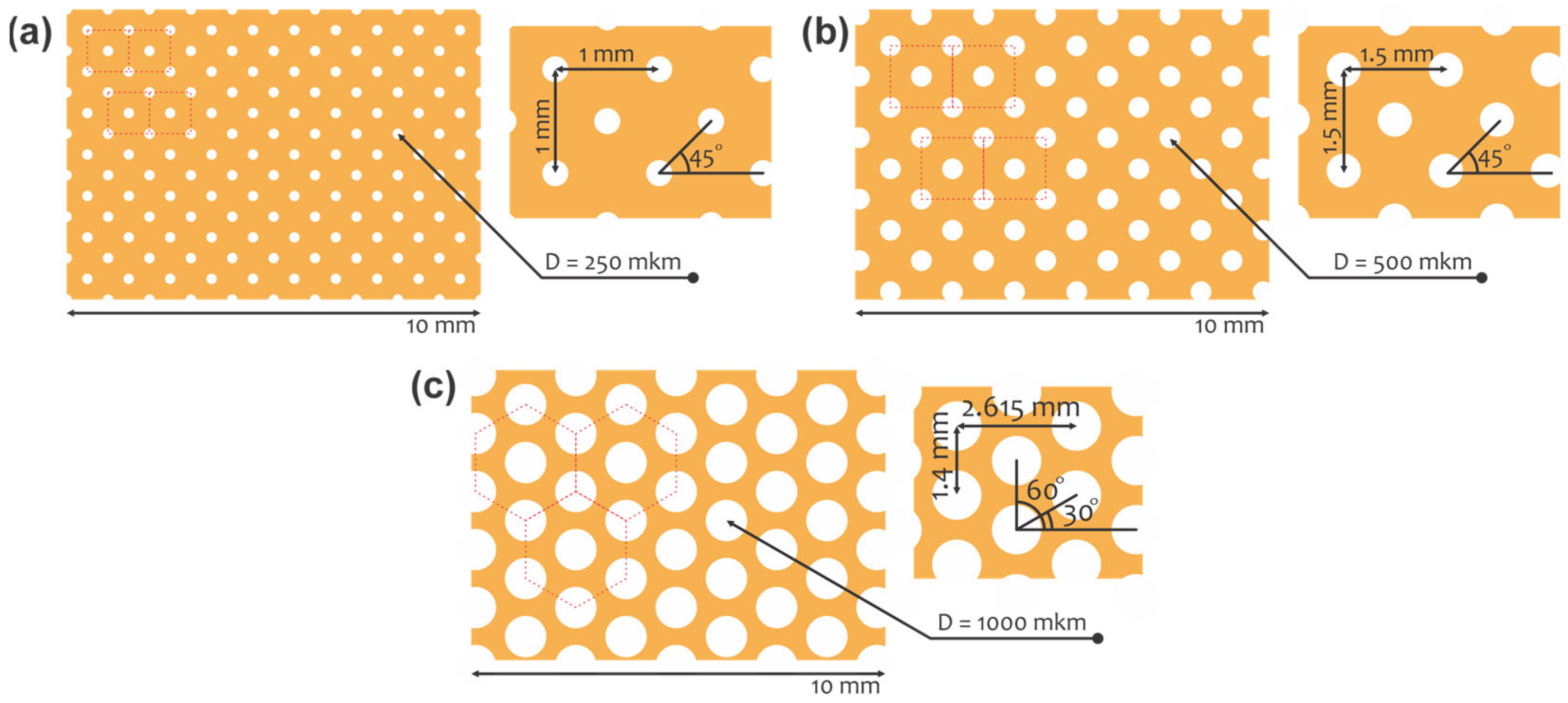
Perforation was carried out using a fiber laser (λ = 1064 nm), Minimaker2 (Laser Center, Saint Petersburg, Russia) operating in pulsed mode (τ = 100 ns) with a pulse frequency of 80 kHz, 80% of nominal power (~50 W), and a scanning speed of 5000 mm s−1. Two types of perforated copper foils were fabricated. Both designs employed square-grid arrays with hole diameters of 250 and 500 µm and spacings of 1000 and 1500 µm, respectively, with adjacent rows offset by 45° to promote uniform stress distribution. The third design, a commercially available punched foil (Global Nanotech, Ahmedabad, India), featured a hexagonal lattice with 1000 µm holes arranged at 60° and a spacing of 1400 µm, providing a directionally isotropic geometry (Figure 1).
After laser cutting, the residual graphite layer was removed in two steps. First, laser cleaning was carried out using the same scanning parameters (power 80%), followed by mechanical scraping and double rinsing with deionized water. The resulting foils were dried in an oven at 75 °C for 1 h to remove residual moisture.
The electrical conductivity of plain and perforated copper foils was evaluated by registering electrochemical impedance with the use of a P-45X potentiostat (Electrochemical Instruments, Moscow, Russia) in the frequency range of 0.1–0.5 Hz with a perturbation amplitude of 5–10 mV. The electrical conductivity was then calculated based on the measured resistance and the geometric dimensions of the samples (see Table 1 and Supporting Information for electrical conductivity).

2.2. Preparation of Slurries

The anode slurry was prepared using a Si/C composite active material, carbon black (Super C65), and multi-walled carbon nanotubes as conductive additives. Sodium carboxymethyl cellulose and styrene-butadiene rubber were used as binders. The dry weight ratio of Si/C: Super C65: CNTs: CMC: SBR was 94:1:1:1:3.
The dry mixture was dispersed in deionized water at a ratio of 120 g of water per 100 g of solids. First, CMC was fully dissolved in deionized water under continuous stirring. Subsequently, Super C65 and CNTs were added stepwise, followed by gradual incorporation of the Si/C active material. After achieving a uniform dispersion, the SBR latex was introduced as the final component. Mixing was carried out using a rotary tool dissolver (LDU-3 MPR, Labotex LLC, Moscow, Russia) at 3000 rpm for 1.5 h until a homogeneous suspension was obtained. The slurry was then rested for 30 min to allow air bubbles to escape and ensure uniform binder distribution, preventing coating defects and improving the wettability of the foil surface.
The cathode slurry was prepared using commercial NMC811, carbon black (Super C45), and polyvinylidene fluoride in a weight ratio of 94:3:3, respectively. The components were dispersed in N-methyl-2-pyrrolidone (NMP) solvent at a ratio of 83 g per 100 g of solids to form a viscous mixture with the use of the same apparatus.

2.3. Coating of Cathodes and Anodes

The prepared cathode slurry was uniformly coated onto an aluminum current collector using the doctor-blade technique. An adjustable gap between the applicator and the substrate surface was employed to achieve a uniform distribution of the active material. The gap thickness was optimized experimentally according to the slurry viscosity, the desired coating thickness, and to balance the cathode mass with that of the anode.
Prior to coating, the aluminum foil was cleaned with isopropyl alcohol to remove possible surface contaminants. The coating process was conducted on a vacuum table (Zehntner testing instruments, Zurich, Switzerland) at a blade movement speed of 5 mm s−1, ensuring the formation of a homogeneous layer without visible streaks or thickness gradients. After coating, the electrodes were dried on the same table at 80–100 °C for 20–30 min to remove the majority of the solvent. Subsequently, after applying the viscous cathode slurry onto the opposite side of the foil, an additional vacuum drying step was performed at 75 °C for 12 h to completely eliminate residual solvent and to ensure stable adhesion of the active layer to the current collector.
For the anodes, the coating was performed on perforated Cu foils using a doctor-blade coater. Due to the presence of holes, the foils could not be fixed directly to a vacuum plate; therefore, an aluminum foil substrate was used instead. The substrate surface was pre-wetted with isopropanol, allowing temporary adhesion of the perforated Cu foil via surface tension and solvent volatility.
After evaporation of isopropanol, the 20 × 10 cm foil remained flat and uniformly stretched. The anode slurry was then applied to the first side, with the blade gap set to 180 µm to achieve a uniform layer. The coating was air-dried at room temperature under a fume hood. The sample was then flipped, lightly fixed with adhesive tape, and the second side was coated.
Double-sided electrodes were vacuum-dried (Binder, Tuttlingen, Germany) at 75 °C for 12 h to remove residual moisture and improve binder adhesion. After drying, the total coating thickness was ~156 µm. The electrodes were then calendared at room temperature to a final thickness of 123 µm, enhancing electrode density, electrical contact, and mechanical robustness.

2.4. Electrode Cutting

The prepared electrodes were cut using a laser cutter at a scanning speed of 80 mm s−1, frequency of 40 kHz, and power of 70%. The dimensions of the anode and cathode electrodes were 3.0 × 3.0 cm and 2.8 × 2.8 cm, respectively. All samples were stored in a vacuum desiccator prior to cell assembly. easily scalable

2.5. Electrolyte Preparation

The electrolyte consisted of 1.2 M LiPF6 dissolved in a solvent mixture of EC, DMC, and EMC (1:1:1 v/v/v) with 5 wt% FEC additive. All solvents were pre-dried on molecular sieves for at least 48 h. The residual water content, determined by Karl Fischer titration (Mettler-Toledo, Switzerland), did not exceed 20 ppm. Electrolyte preparation was conducted in an argon atmosphere (O2, H2O < 0.1 ppm).

2.6. Cell Assembly

Half-cells (Si/C||Li) and full pouch-type cells (Si/C||NMC811) were assembled in a dry room (MTI KJ Group, Richmond, CA, USA) under controlled atmosphere (dew point < −40 °C). The half-cells were fabricated to determine the specific capacity of the Si/C anode material, which was subsequently used to calculate the optimal anode-to-cathode capacity ratio for assembling the full cells. A microporous polyethylene separator with a ceramic coating was employed in all cells. The full pouch-type cells consisted of two anodes and three cathodes, symmetrically stacked with separators. After vacuum sealing, a slightly excessive volume of 1.5 mL of electrolyte was injected into each cell, followed by resting at room temperature for 12 h to ensure complete wetting of the electrodes.

2.7. Peeling Test

The adhesion of the electrode coating to the copper current collector and its cohesion for all prepared electrode samples were evaluated using a tape test method. The electrodes were fixed onto a rigid substrate using a double-sided adhesive tape (Profitto, Moscow, Russia, 38 mm × 10 m, thickness 100 µm). An adhesive tape (ErichKrause Highlighter, Moscow, Russia, 12 mm × 20 m, thickness 50 µm) was then applied to the electrode surface, followed by the application of a controlled external load to ensure reproducible contact.
A polished metal weight with a mass of 3.0 kg was placed on the tape-covered electrode for 10 s. Given the contact area of 4 × 7 cm (28 cm2), this corresponded to an applied pressure of approximately 10.5 kPa (equivalent to a normal force of ~29.4 N). After the loading step, the adhesive tape was peeled off at a 180° angle with a constant peeling speed of 2.5 mm s−1. The results were used for a visual comparative assessment of the adhesion and cohesion strength of electrode coatings deposited on plain and perforated copper foils.

2.8. Morphological and Structural Characterization

The morphology and element distribution of Si/C composite material and the structure of foils and pristine electrodes were studied using JSM-7001F (JEOL, Tokyo, Japan) field-emission scanning electron microscope (SEM) operating at 30 kV and equipped with XLash 6/30 (Bruker, Billerica, MA, USA) energy-dispersive X-ray spectroscopy (EDS) detector and using a SEM-69-LV (BiOptic, Moscow, Russia) tungsten filament scanning electron microscope operating at 30 kV equipped with an Xplore30 (Oxford instruments, Abingdon, UK) EDS detector. In order to investigate perforated foils and pristine electrodes coated with the Si/C composite, the foils and the electrodes were cut by scissors to prepare a 1 × 1 cm specimen.
The XRD pattern of Si/C anode material was acquired using Smartlab SE (Rigaku, Tokyo, Japan) diffractometer operating at 40 kV and 50 mA and equipped with D/teX Ultra 250 detector and operating in Bragg–Brentano geometry with Cu Kα1,2 radiation source (λ1 = 1.54059 Å, λ2 = 1.54441 Å, Kα1/ Kα2 = 0.497). The pattern was collected within a 2θ range of 3–80° (0.01° step, 10°/min scan speed). In order to estimate the instrumental resolution function, a diffraction pattern of highly crystalline silicon (Sigma-Aldrich, St. Louis, MO, USA) was acquired with the settings described above. To estimate the coherent domain size of the anode active material, LeBail fitting of the XRD pattern was performed using Jana2006 software (ver. 20.02.2023) [22]. The obtained FWHM was used to calculate the coherent domain size using the Scherer equation after instrumental broadening subtraction [23].
BET surface area analysis was performed to evaluate the textural properties of the commercial Si/C composite, particularly its accessible surface area, which affects electrolyte wetting, SEI formation, and the overall interfacial kinetics of silicon-based anodes. Nitrogen adsorption–desorption measurements were conducted using a BET Sorptometer (Katakon, Novosibirsk, Russia) employing high-purity N2 (6.0) and He (6.0) gases. Prior to the analysis, samples were heat-treated (200 °C) to remove adsorbed moisture and volatile species.

2.9. Electrochemical Characterization

The electrochemical performance of the electrodes was evaluated using both half-cells (Si/C||Li) and full pouch-type cells (Si/C||NMC811).
For the half-cells, galvanostatic charge–discharge tests were conducted on a P-45X potentiostat (Electro-chemical Instruments, Moscow, Russia) within a voltage window of 0.005–1.5 V vs. Li/Li+ at a constant current of 0.1 C.
Galvanostatic cycling tests were performed using a BTS-4008 battery test system (Neware, Shenzhen, China). All formation and cycling procedures were carried out within a voltage window of 2.5–4.25 V at 25 ± 2 °C, employing constant current-constant voltage (CCCV) mode during charge and constant-current (CC) mode during discharge.
For cycling-stability tests, full cells underwent a dedicated formation protocol consisting of one formation cycle at 0.1 C, after which the cells were degassed using a vacuum sealer (MTI KJ Group, Richmond, CA, USA). The degassed cells were then subjected to long-term cycling at 0.1 C to evaluate the specific capacity, coulombic efficiency, and capacity-retention behavior.
For rate-capability tests, a two-step formation procedure was applied: the first cycle at 0.05 C, followed by a second cycle at 0.1 C. After completion of these two formation cycles, the cells were degassed, and the rate-performance evaluation was performed. During the rate test, the cells were cycled sequentially at 0.1, 0.2, 0.5, and 0.1 C to analyze kinetic behavior and current-density dependence. After cycling, the surface and cross-section morphologies of the anodes were re-examined by SEM to assess structural degradation and mechanical integrity of the perforated current collectors.

3. Results

3.1. Morphology and Structure of the Si/C Composite

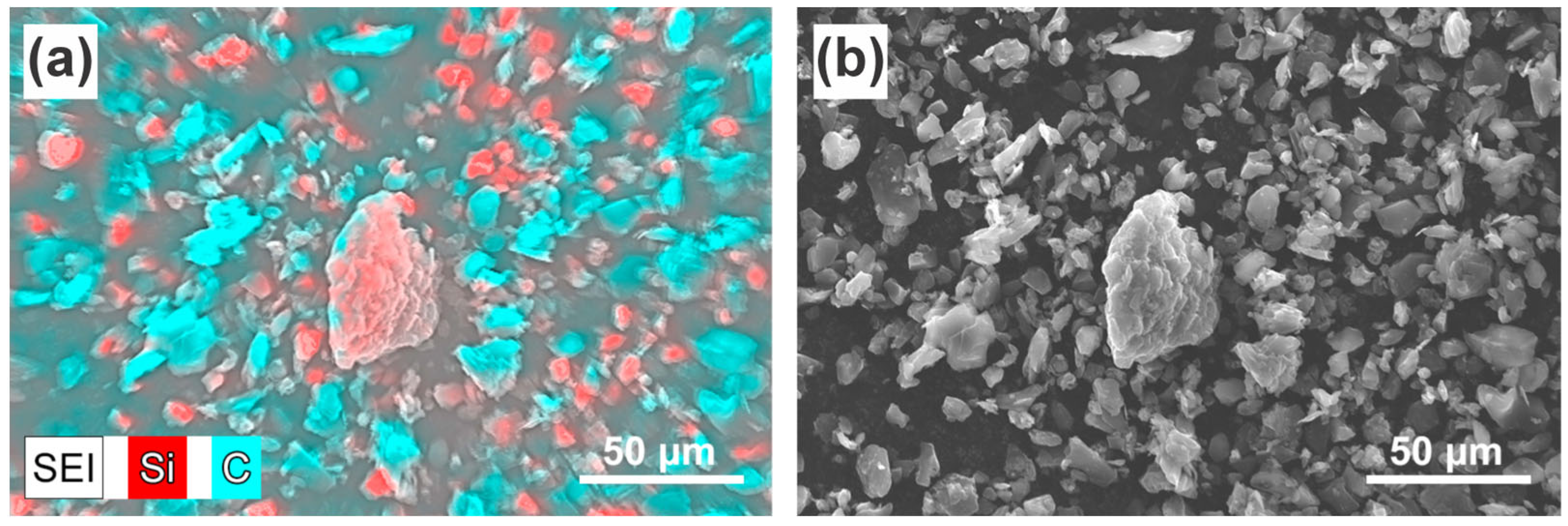
The Si/C composite mainly consists of a mixture of irregularly-shaped micron-sized crystals of graphite and silicon. The latter are also present in the form of agglomerates having ~50 µm size (Figure 2). SEM-EDS elemental mapping confirms a uniform distribution of Si and C phases throughout the composite, which is crucial for electronic conductivity and mechanical buffering during lithiation/delithiation.
BET nitrogen physisorption revealed that the Si/C composite possesses a specific surface area of 2.3 m2 g−1, characteristic of low-surface-area silicon–carbon blends typically produced via high-temperature milling or spray-drying routes. Such a modest surface area indicates a relatively low fraction of micropores and limited external surface exposure, which generally helps suppress excessive SEI formation during initial cycling, thereby improving the initial Coulombic efficiency (ICE) [24,25]. A lower surface area reduces the number of reactive sites for electrolyte decomposition, mitigating irreversible lithium consumption during the first cycles and promoting the formation of a more stable and uniform SEI layer. Consequently, the measured BET value supports the observed electrochemical behavior of the DXB8 anode, where high ICE and stable cycling are achieved despite the inclusion of silicon.
According to XRD (see Supporting Information Figure S1), the composite material contains crystalline graphite (ICSD-2016 #47941, P63/mmc) and silicon phases (ICSD-2016 #28512, Fd-3m). The graphite crystallographic domains are anisotropic, having 121 nm along the [001] direction and 35 nm along the [100] direction. In the case of silicon, there are 49 nm isotropic domains. This crystalline size is within a range of 30–90 nm, which is beneficial for cycle retention improvement, as demonstrated by Domi et al. [26]. Otherwise, bigger micron-sized crystallites accumulate more strain upon lithiation, causing rapid decay of the battery due to Si pulverization [27].

3.2. Morphology of Perforated Cu Foils

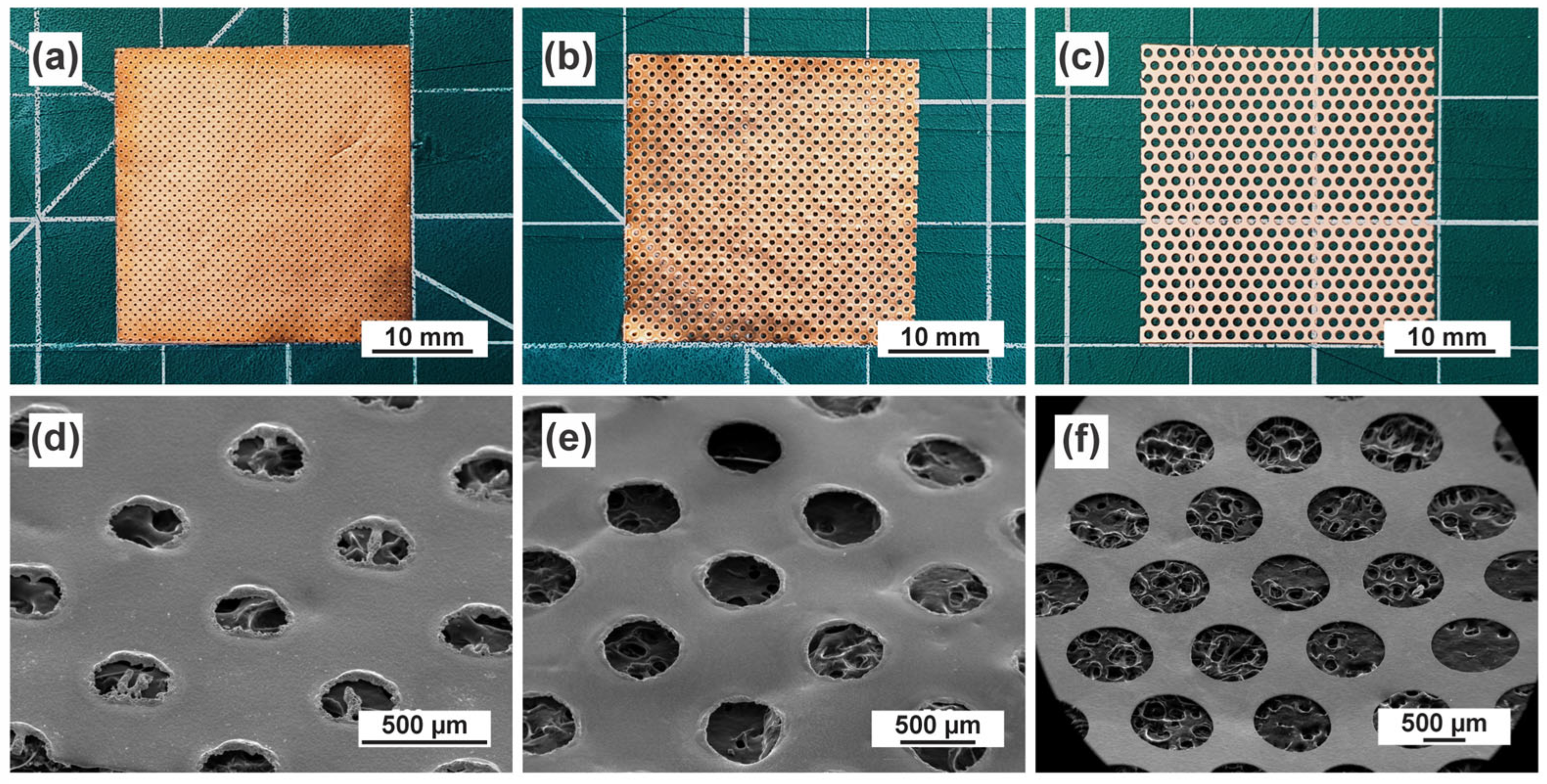
Three perforation geometries were investigated, having holes with diameters of 250, 500, and 1000 µm, denoted as Perf-250, Perf-500, and Perf-1000, respectively (see Figure 3, Table 1 for geometric parameters and perforation densities). All foils have round periodic holes without sharp edges, which may cause undesired damage to the separator, causing a short-circuit. In contrast to the Perf-1000 foil with punched holes, the thickness at the edges of the holes slightly increased due to thermal dissipation caused by laser ablation in the foils prepared in-house (see Supporting Information Figure S2), which was also demonstrated by Li et al. [28].

3.3. Morphology of Si/C Anodes

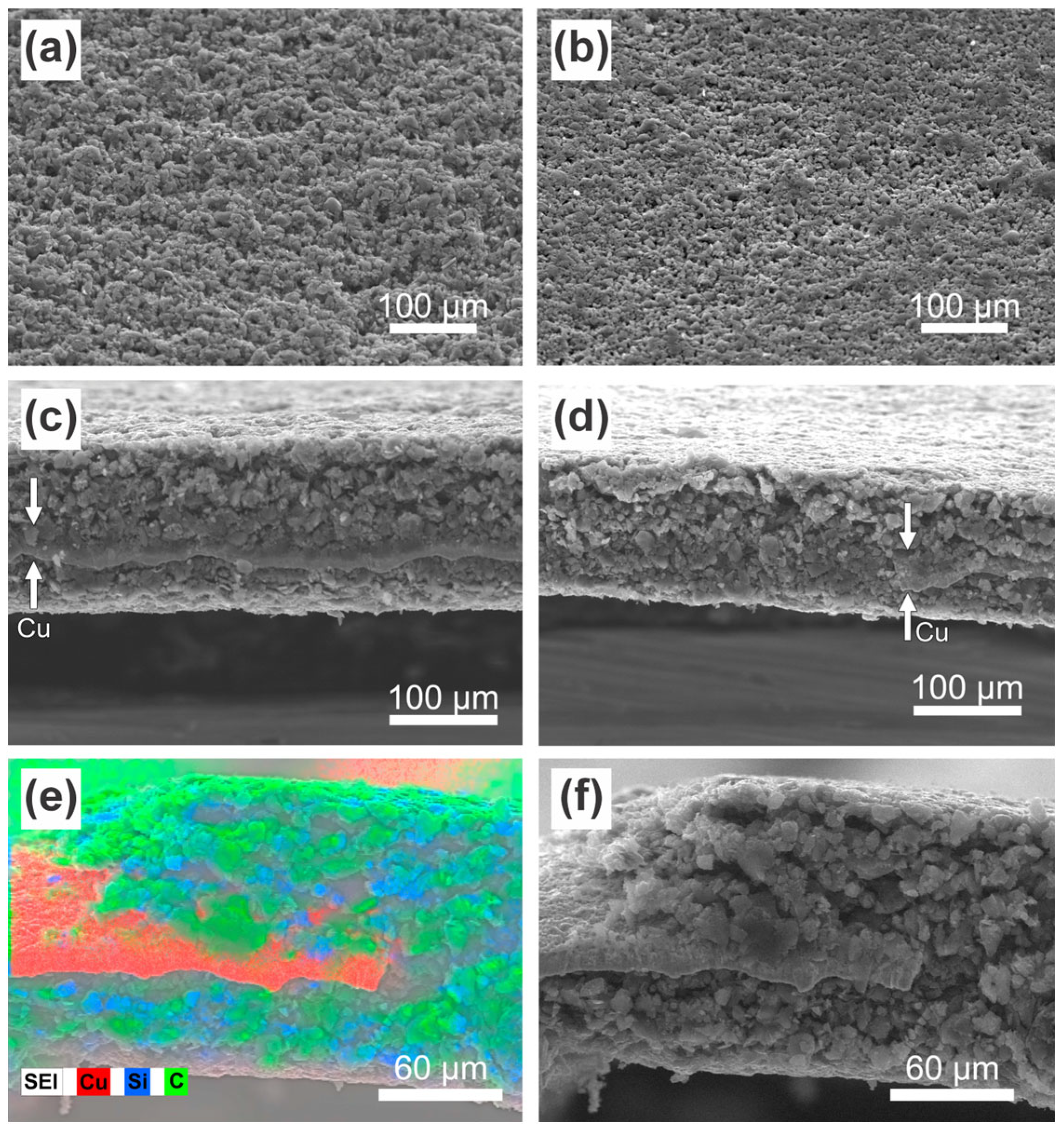
The developed approach to coat perforated foils with anode slurry allowed the formation of an anode active material layer with a smooth surface regardless of current collector type (Figure 4a,b). As can be seen from cross-sectional images (Figure 4d), the Si/C slurry effectively penetrated and filled the holes entirely. As a result, the dense columns are formed, which can be considered as strong mechanical “stitches” that interconnect the active layers on both sides of the Cu foil (see Supporting Information Figure S3). Furthermore, the thickness of the anode layer was maintained identical within the electrode, despite the presence of holes. According to EDS elemental mapping, the distribution of Si and C particles is homogeneous within casted anode material layers and in the holes (Figure 4e and see Supporting Information Figure S4).
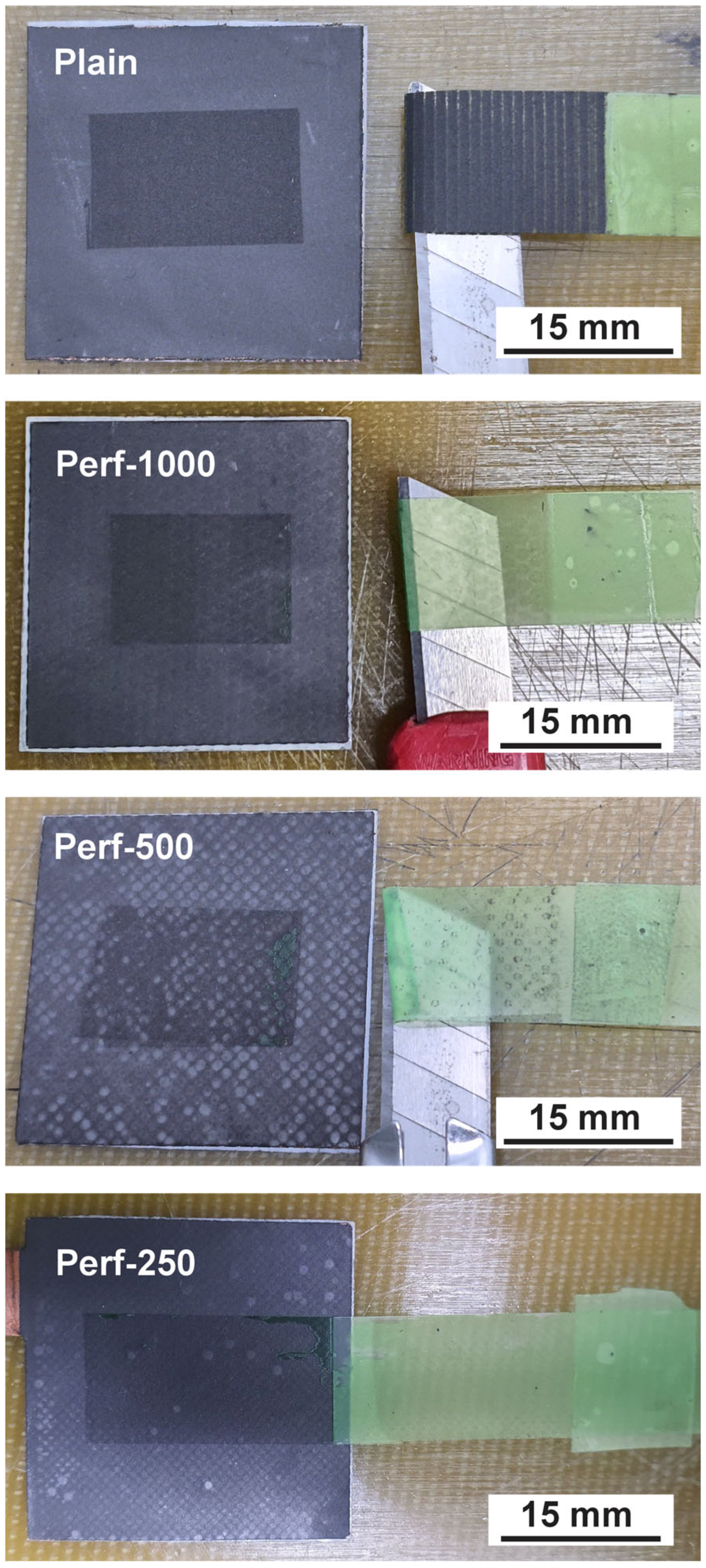
The peeling test results are given in Figure 5. It can be seen that a significant portion of the electrode material was peeled off in the case of the electrode, formed on a plain current collector, resulting in the adhesive surface of the peeling tape being fully covered with the composite layer. Introduction of 1 mm perforation significantly reduces the amount of material remaining on the adhesive side of the tape with visible perforation pattern—darker regions over the holes and lighter over the metallic surface. Similar behavior is observed in the case of 500 µm holes, while for 250 µm perforation, the tape surface is seen almost intact, with a barely noticeable perforation pattern.

3.4. Electrochemical Performance

To assess the practical capacity of the active material Si/C, galvanostatic charge-discharge curves were first recorded in a half-cell with metallic lithium as counter and reference electrode, using a non-perforated (plain) copper foil as the anode current collector (see Supporting Information Figure S5). The observed capacity reached 650 mAh g−1, which is the value specified by the manufacturer.
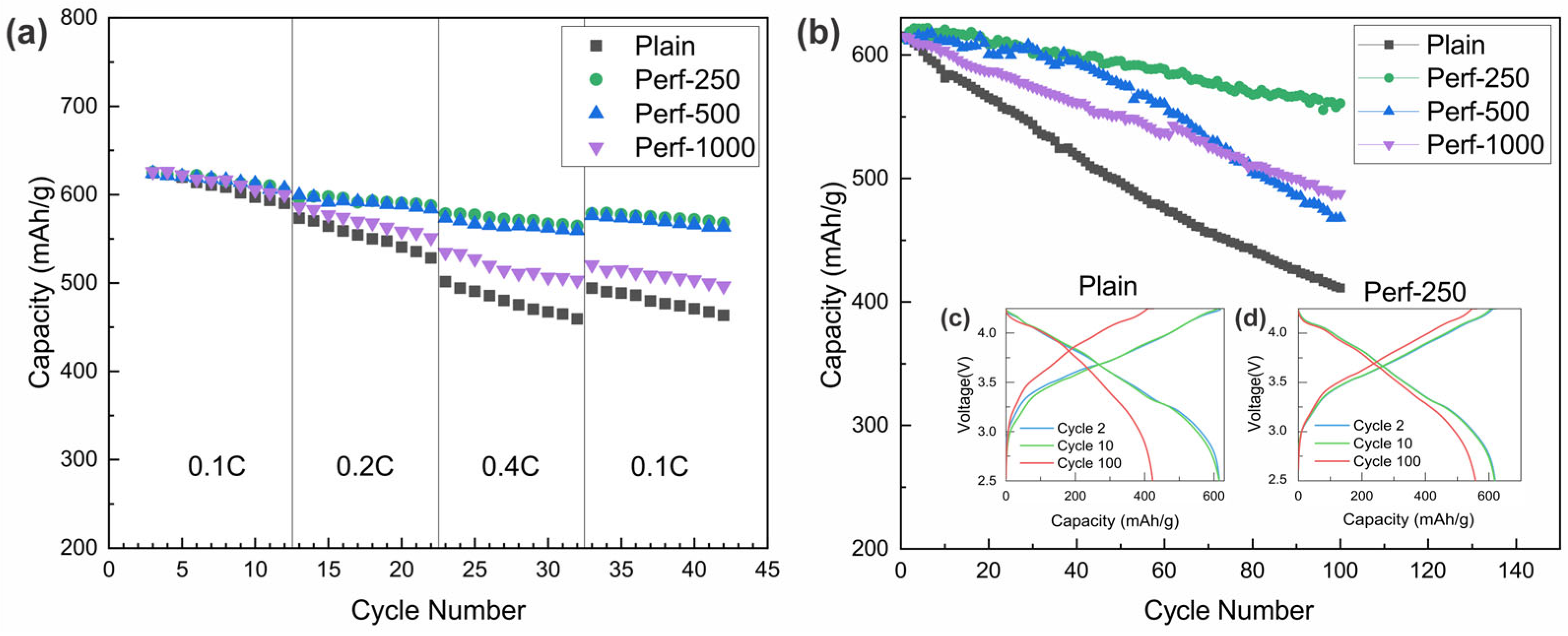
Subsequently, the studying electrodes with perforated and non-perforated foil were tested in full-cells, being paired with the NMC811 cathode (see Supporting Information Figure S6). The initial discharge capacity of all the studied electrodes at a low rate of 0.1 C was 625 mAh/g. The discrepancy between the practical capacity obtained in full-cells and half-cells originates from the deliberate 5% excess of the anode active material used in the full-cell balancing. Distinct trends in capacity retention of the studying materials were observed upon an increase in C-rate (see Supporting Information Figure S6a). When the discharge rate was raised to 0.4 C, the capacity of Plain and Perf-1000 electrodes decreased by ca. 20%, whereas Perf-250 and Perf-500 electrodes retained more than 95% of their initial capacity.
Further, the long-term cycling stability of the studied materials was examined (Figure 6b). The highest cycling stability was demonstrated by the Perf-250 electrode, which preserved 90% of its initial capacity after 100 cycles. The Perf-500 and Perf-1000 electrodes showed lower stability during extended cycling, exhibiting a capacity loss of ca. 30%. Despite this, all the electrodes with perforated Cu foil showed significantly enhanced capacity retention compared to the reference Plain electrode with 40% capacity fade. Such a severe capacity decrease for the electrode with non-perforated Cu foil is assumed to occur primarily due to progressive delamination of the Si/C composite layer caused by Si volume expansion.
These results indicate that smaller and more densely distributed perforations ensure superior mechanical integrity and electrochemical stability, most likely due to more effective anchoring of the Si/C layer through the perforation network.

4. Discussion

4.1. Morphology and Structure of the Si/C Composite

We intentionally selected a cost-driven commercial grade of Si/C composite material to demonstrate the practical applicability of our current collector modification approach. It is common to prepare such materials by high-energy mechanical milling of silicon powder followed by mixing with graphite [29]. Apart from complex Si-containing nanomaterials with porous and core-shell structure, the composites, obtained by milling, suffer more from expansion and contraction during extensive cycling, because the structure of the silicon particle is not intentionally designed to accommodate volume changes [30]. Furthermore, we used a commercial widely spread binder, containing SBR and CMC, which are typically used for Si/Gr composite materials [2]. Binder has an important impact on cycling performance and the prevention of delamination of silicon-containing anode materials [29]. SBR-CMC binder significantly improves cycle retention in comparison with PVDF; however, it is less efficient than cross-linked binders [2].
According to characterization results, the used Si/C composite mostly contains several micron-sized crystallites of silicon and graphite of similar size (Figure 2), which are homogeneously distributed within the electrode layer (Figure 4e). The coherent size domain obtained from powder X-ray diffraction is several orders smaller than the size of observed particles by SEM. It demonstrates that silicon particles are the agglomerates of nanocrystallites, whose average size is ~40 nm. This relatively small size of crystallites is beneficial for Li transport, because the diffusion of lithium within silicon is modest, and it is important to minimize the length of the lithium pathway within the Si crystal [7].

4.2. Morphology of Perforated Cu Foils

Although the square arrangement of holes, exhibited by the perforated foils in our study, does not allow as dense hole positioning as in the case of commercial punched foils with a hexagonal arrangement, it helps to maintain the integrity, flatness, and strength of the metal sheet, which is crucial during doctor-blade electrode slurry application. The square arrangement of holes was also demonstrated by Li et al. [28].

4.3. Electrochemical Performance and Cycling Behavior

We observed that the cycle life of perforated foils increases with a decrease in hole size. In contrast to foils with improved surface by electropolishing and etching, the foil perforation does not significantly increase surface area or create a 3D framework, which can accommodate the major portion of the anode material. Since foil thickness is several orders smaller than the diameter of the holes, the foil perforation decreases the surface, which can be calculated as normalized surface per 1 cm2 of current collector, shown in Table 1. Indeed, investigated perforated foils have a lower specific surface area than ordinary foil, and the higher the hole diameter, the lower the specific surface area is. Therefore, the mechanism of cycle retention improvement, observed in our study, differs from the studies of Si/C composites with etched Cu foil or foils with blind holes [19], where surface areas are increased after foil treatment. Furthermore, the volume of voids is negligibly small in the 8 µm foil in comparison with the ~60 µm layer of anode material located on each side of the current collector. The portion of Si/C composite in voids is about 0.8–3.2% (see Supporting Information Table S2), so the main fraction of material is not physically constrained by Cu collector and thus should behave in the same manner as in an ordinary cell with plain anode current collector.
The demonstrated improvement of cycle retention for perforated foils is in line with the study, showing that 125 µm perforated Cu foil improved cycle retention and rate performance of graphite anodes [20]. The Si/C composite material located in the holes acts as “stitches”, which bind both sides of the active material of the electrode. The concentration of holes per square mm decreases in the row Perf-250, Perf-500 and Perf-1000 (Table 1), while their diameter grows. Since the capacity retention also consistently decreases in this row, it can be assumed that the hole density and size are the major factors that impact capacity retention during extensive cycling of fabricated full cells. The insight into the observed “stitching” effect may be gained from the performed peeling test, which demonstrated ever-increasing electrode integrity and cohesion with the decrease of the perforation hole size, and should be connected with the binder structure. The increased integrity of the anode, formed upon a perforated current collector, indicates a higher degree of the cross-linked network of binder scaffold, firmly attached to the particles of active material. This improved cross-linking may be a result of improved homogeneity of binder components—SBR and CMC—evenly distributed over the electrode matrix. Such even distribution of binder components is hard to achieve in the case of anodes, formed on plain copper current collectors, as SBR, functioning as an adhesive and cohesive component, tends to accumulate closer to the metallic surface (Figure 5). Conversely, CMC, serving as a dispersant, usually migrates toward the electrode surface during the solvent evaporation process [31]. Formation of the free-standing electrode fragments inside the holes of the perforated current collector seems to mitigate this migration effect and facilitate the homogeneous impregnation of drying anode slurry with both components of binder—SBR and CMC. The observed effect of perforation hole size on the electrode integrity and binder cross-linked structure requires a separate study.
The rate performance is significantly lower for plain foil at both 0.2 and 0.4C, than for perforated ones. Since the main origin of severe silicon expansion during lithiation is inhomogeneous Li distribution [32], this effect becomes more pronounced at higher rates, when the lithium intercalation process becomes more kinetically driven than thermodynamically [33]. As a result, delamination may be more significant at higher rates, which have a negative impact on rate performance. Our findings are in agreement with the study of Wang. et al., who demonstrated that laser-textured Cu foil improved rate capability for the Si-anode [18]. Furthermore, a similar effect was observed for full cells with a graphite anode, coated on perforated foils [20,21]. In the case of the Perf-1000 foil sample, the lower rate performance can be attributed not only to delamination, but also to hindered charge transfer from material located in the holes of the Cu collector. On the other hand, the hole size is comparable with the active layer thickness in Perf-250 and Perf-500 current collectors, hence the charge transfer problem is not severe.

5. Conclusions

This study investigates an easily scalable and environmentally friendly approach of Cu foil-based anode current collector modification, which can significantly improve the electrochemical performance of a Li-ion battery with commercial cost-efficient Si/C anode composite material. Perforated foils effectively enhance the capacity retention of batteries. The enhancement is in inverse relation to the hole diameter and in straight relation with hole concentration per square unit. We have demonstrated that perforated foil with 250 µm—diameter holes can enable the use of Si/C anodes as a reliable, long-lasting, and high-energy-density anode material with high 92% capacity retention rate after 100 cycles at the 0.1 C current rate. It is considered that electrochemical performance is improved due to the formation of “stitches” of Si/C material through the holes, which binds material located on both sides of the anode as a result of a more even and homogeneous distribution of binder components over the porous structure of the anode. This partially prevents the disintegration and delamination of the anode material from the current collector upon cycling.

Supplementary Materials

The following supporting information can be downloaded at: https://www.mdpi.com/article/10.3390/jcs10010011/s1, Figure S1: XRPD pattern of silicon graphite composite active anode material: observed (black crosses), calculated (red line), and difference (black line) patterns. The vertical lines represent reflection positions of graphite and silicon phases; Table S1: The results of LeBail full pattern decomposition of XRPD data of silicon graphite composite anode material (c2 = 1.65, Rp = 5.81%; Rwp = 7.98%); Figure S2: The cross-section SEM micrographs of perforated Cu foils: (a) Perf-250, (b) Perf-500 and (c) Perf-1000; Figure S3: The cross-sectional SEM micrograph of Si/C ordinary electrode (a) and perforated electrodes (b–d): Perf-250, Perf-500 and Perf-1000, showing hole areas, which are filled with the Si/C composite; Figure S4. The cross-sectional SEM micrograph of Perf-250 Si/C composite electrode, (a) SEM-EDS combined map, and (a–d) the maps of Si and C; Table S2. The volume fraction of Si/C composite material located in the holes of perforated current collectors for 123 µm thick electrodes; Figure S5: Galvanostatic charge–discharge curves of the Si/C anode measured in half-cells (Si/C||Li) using a plain (non-perforated) copper foil current collector; Figure S6: Charge–discharge curves of NMC811||Si/C full cells employing (a) plain copper foil and perforated copper foils with (b) 250 µm, (c) 500 µm, and (d) 1000 µm hole sizes as anode current collectors; Figure S7: Optical images of the electrodes after the 180° peeling test for anodes fabricated on Plain, Perf-1000, Perf-500, and Perf-250 copper foils.

Author Contributions

Conceptualization, V.V.K. and S.S.I.; methodology, S.S.I.; software, S.S.I.; validation, V.V.K., O.M.K., Y.S.V., and S.S.I.; investigation, S.S.I.; resources, V.V.K.; data curation, O.M.K.; writing—original draft preparation, S.S.I., A.B.G., Y.S.V., A.I.K., O.M.K., and V.V.K.; writing—review and editing, S.S.I., A.B.G., A.I.K., Y.S.V., O.M.K., and V.V.K.; visualization, S.S.I., A.B.G., and A.B.G.; supervision, V.V.K.; project administration, V.V.K.; funding acquisition, V.V.K. All authors have read and agreed to the published version of the manuscript.

Funding

This research was funded by the Ministry of Science and Higher Education of the Russian Federation (Goszadaniye) 075-03-2025-662, project No. FSMG-2024-0046.

Data Availability Statement

The original contributions presented in this study are included in the article and in the supporting information. Further inquiries can be directed to the corresponding authors.

Acknowledgments

The authors acknowledge the MCAS Shared Facilities Center for access to SEM equipment and the Experimental LIB production unit. The authors also acknowledge the shared research facilities of FRCCP RAS (no. 1440743) for X-ray diffraction acquisition. The authors further express their gratitude to Evgenii S. Afonkin for his valuable technical advice on battery fabrication.

Conflicts of Interest

The authors declare no conflicts of interest.

Abbreviations

The following abbreviations are used in this manuscript:
LIBLithium-ion batteries
SEISolid electrolyte interface
3DThree-dimensional
CMCCarboxymethyl cellulose
CNTCarbon nanotubes
SBRStyrene-butadiene rubber
PVDFPolyvinylidene fluoride
FECFluoroethylene carbonate
ECEthylene carbonate
DMCDimethyl carbonate
EMCethyl methyl carbonate
NMPN-methyl-2-pyrrolidone
SEMScanning electron microscope
EDSEnergy-dispersive X-ray spectroscopy
XRDX-ray diffraction
BETBrunauer-Emmett-Teller method
CCCVConstant current-constant voltage
CCConstant-current
ICEInitial Coulombic efficiency

References

  1. Zhang, Z.; Wu, Y.; Mo, Z.; Lei, X.; Xie, X.; Xue, X.; Qin, H.; Jiang, H. Research Progress of Silicon-Based Anode Materials for Lithium-Ion Batteries. RSC Adv. 2025, 15, 10731–10753. [Google Scholar] [CrossRef]
  2. Ramdhiny, M.N.; Jeon, J. Design of Multifunctional Polymeric Binders in Silicon Anodes for Lithium-ion Batteries. Carbon Energy 2024, 6, e356. [Google Scholar] [CrossRef]
  3. Liu, X.H.; Wang, J.W.; Huang, S.; Fan, F.; Huang, X.; Liu, Y.; Krylyuk, S.; Yoo, J.; Dayeh, S.A.; Davydov, A.V.; et al. In Situ Atomic-Scale Imaging of Electrochemical Lithiation in Silicon. Nat. Nanotechnol. 2012, 7, 749–756. [Google Scholar] [CrossRef]
  4. Yu, Y.; Yang, C.; Zhu, J.; Xue, B.; Zhang, J.; Jiang, M. An Advanced 3D Crosslinked Conductive Binder for Silicon Anodes: Leveraging Glycerol Chemistry for Superior Lithium-Ion Battery Performance. Angew. Chem. Int. Ed. 2025, 64, e202418794. [Google Scholar] [CrossRef]
  5. Su, H.; Barragan, A.A.; Geng, L.; Long, D.; Ling, L.; Bozhilov, K.N.; Mangolini, L.; Guo, J. Colloidal Synthesis of Silicon–Carbon Composite Material for Lithium-Ion Batteries. Angew. Chem. Int. Ed. 2017, 56, 10780–10785. [Google Scholar] [CrossRef]
  6. Su, H.; Li, X.; Liu, C.; Shang, Y.; Liu, H. Scalable Synthesis of Micrometer-Sized Porous Silicon/Carbon Composites for High-Stability Lithium-Ion Battery Anodes. Chem. Eng. J. 2023, 451, 138394. [Google Scholar] [CrossRef]
  7. Toki, G.F.I.; Hossain, M.K.; Rehman, W.U.; Manj, R.Z.A.; Wang, L.; Yang, J. Recent Progress and Challenges in Silicon-Based Anode Materials for Lithium-Ion Batteries. Ind. Chem. Mater. 2024, 2, 226–269. [Google Scholar] [CrossRef]
  8. Yang, Y.; Yang, Z.; Li, Z.; Wang, J.; He, X.; Zhao, H. Rational Electrolyte Design for Interfacial Chemistry Modulation to Enable Long-Term Cycling Si Anode. Adv. Energy Mater. 2023, 13, 2302068. [Google Scholar] [CrossRef]
  9. Sun, L.; Liu, Y.; Shao, R.; Wu, J.; Jiang, R.; Jin, Z. Recent Progress and Future Perspective on Practical Silicon Anode-Based Lithium Ion Batteries. Energy Storage Mater. 2022, 46, 482–502. [Google Scholar] [CrossRef]
  10. Hansen, S.; Schütt, A.; Carstensen, J.; Adelung, R. Local Transmittance Measurements as Large Area Diagnostic Tool for the Optimization of Porous Si Foils for Li-Ion Battery Anodes. J. Electrochem. Soc. 2016, 163, A3036–A3045. [Google Scholar] [CrossRef]
  11. Luais, E.; Sakai, J.; Desplobain, S.; Gautier, G.; Tran-Van, F.; Ghamouss, F. Thin and Flexible Silicon Anode Based on Integrated Macroporous Silicon Film onto Electrodeposited Copper Current Collector. J. Power Sources 2013, 242, 166–170. [Google Scholar] [CrossRef]
  12. Jiang, T.; Zhang, S.; Qiu, X.; Zhu, W.; Chen, L. Preparation and Characterization of Silicon-Based Three-Dimensional Cellular Anode for Lithium Ion Battery. Electrochem. Commun. 2007, 9, 930–934. [Google Scholar] [CrossRef]
  13. Zhang, H.; Braun, P.V. Three-Dimensional Metal Scaffold Supported Bicontinuous Silicon Battery Anodes. Nano Lett. 2012, 12, 2778–2783. [Google Scholar] [CrossRef]
  14. Tzeng, Y.; Jhan, C.-Y.; Chiu, K.-M.; Wu, Y.-C.; Chen, G.-Y.; Wang, P.-S. Si–Ni-Alloy-Assisted Very High-Areal-Capacity Silicon-Based Anode on Ni Foam for Lithium Ion Battery. Mater. Today Chem. 2023, 30, 101570. [Google Scholar] [CrossRef]
  15. Xue, W.; Tian, X.; Xue, Y.; Peng, T.; Li, Y.; Li, Y.; Sun, J. Effect of Collector Roughness on Properties of Amorphous Silicon Thin-Film Anodes. ChemElectroChem 2019, 6, 3039–3042. [Google Scholar] [CrossRef]
  16. Wu, J.; Zhu, Z.; Zhang, H.; Fu, H.; Li, H.; Wang, A.; Zhang, H.; Hu, Z. Improved Electrochemical Performance of the Silicon/Graphite-Tin Composite Anode Material by Modifying the Surface Morphology of the Cu Current Collector. Electrochim. Acta 2014, 146, 322–327. [Google Scholar] [CrossRef]
  17. Wang, C.; Wu, L.; Hong, Y.; Zhang, Y.; Wang, S.; Zhou, G.; Wen, Z.; He, W.; Han, H.; Xu, Y. Preventing Anode Degradation through Copper Foil Surface Modification Techniques for Lithium-Ion Batteries. Surf. Interfaces 2025, 72, 107240. [Google Scholar] [CrossRef]
  18. Wang, J.; Cao, L.; Li, S.; Xu, J.; Xiao, R.; Huang, T. Effect of Laser-Textured Cu Foil with Deep Ablation on Si Anode Performance in Li-Ion Batteries. Nanomaterials 2023, 13, 2534. [Google Scholar] [CrossRef] [PubMed]
  19. Tang, X.; Liu, W.; Ye, B.; Tang, Y. Preparation of Current Collector with Blind Holes and Enhanced Cycle Performance of Silicon-Based Anode. Trans. Nonferrous Met. Soc. China 2013, 23, 1723–1727. [Google Scholar] [CrossRef]
  20. Zou, Q.; Nie, J.; Lu, B.; Bao, Y.; Song, Y.; Zhang, J. Enhancing the Capacity and Cycling Performance of Lithium Ion Batteries Through Perforated Current Collectors. Acta Mech. Solida Sin. 2025, 38, 539–548. [Google Scholar] [CrossRef]
  21. Fu, D.; Zhao, Y.; Wang, Z.; Li, M.; Huang, L.; Long, L.; Wang, S.; Tan, B. Investigation on the Application of Microporous Current Collector in Ultra-Fast Lithium-Ion Full Battery. Ind. Eng. Chem. Res. 2024, 63, 7103–7113. [Google Scholar] [CrossRef]
  22. Petříček, V.; Dušek, M.; Palatinus, L. Crystallographic Computing System JANA2006: General Features. Z. Krist.-Cryst. Mater. 2014, 229, 345–352. [Google Scholar] [CrossRef]
  23. Zhou, C.G.; Yu, Q.H. Nanostructured Thermal Barrier Coatings. In Thermal Barrier Coatings; Woodhead Publishing Limited: Cambridge, UK, 2011; pp. 75–96. ISBN 978-1-84569-658-0. [Google Scholar]
  24. Obrovac, M.N.; Chevrier, V.L. Alloy Negative Electrodes for Li-Ion Batteries. Chem. Rev. 2014, 114, 11444–11502. [Google Scholar] [CrossRef]
  25. Xu, K. Electrolytes and Interphases in Li-Ion Batteries and Beyond. Chem. Rev. 2014, 114, 11503–11618. [Google Scholar] [CrossRef]
  26. Domi, Y.; Usui, H.; Sugimoto, K.; Sakaguchi, H. Effect of Silicon Crystallite Size on Its Electrochemical Performance for Lithium-Ion Batteries. Energy Technol. 2019, 7, 1800946. [Google Scholar] [CrossRef]
  27. Wu, F.; Dong, Y.; Su, Y.; Wei, C.; Chen, T.; Yan, W.; Ma, S.; Ma, L.; Wang, B.; Chen, L.; et al. Benchmarking the Effect of Particle Size on Silicon Anode Materials for Lithium-Ion Batteries. Small 2023, 19, 2301301. [Google Scholar] [CrossRef]
  28. Li, Q.; Sun, X.; Zhao, W.; Hou, X.; Zhang, Y.; Zhao, F.; Li, X.; Mei, X. Processing of a Large-Scale Microporous Group on Copper Foil Current Collectors for Lithium Batteries Using Femtosecond Laser. Adv. Eng. Mater. 2020, 22, 2000710. [Google Scholar] [CrossRef]
  29. Feyzi, E.; M R, A.K.; Li, X.; Deng, S.; Nanda, J.; Zaghib, K. A Comprehensive Review of Silicon Anodes for High-Energy Lithium-Ion Batteries: Challenges, Latest Developments, and Perspectives. Next Energy 2024, 5, 100176. [Google Scholar] [CrossRef]
  30. Xie, J.; Tong, L.; Su, L.; Xu, Y.; Wang, L.; Wang, Y. Core-Shell Yolk-Shell Si@C@Void@C Nanohybrids as Advanced Lithium Ion Battery Anodes with Good Electronic Conductivity and Corrosion Resistance. J. Power Sources 2017, 342, 529–536. [Google Scholar] [CrossRef]
  31. Chang, W.J.; Lee, G.H.; Cheon, Y.J.; Kim, J.T.; Lee, S.I.; Kim, J.; Kim, M.; Park, W.I.; Lee, Y.J. Direct Observation of Carboxymethyl Cellulose and Styrene–Butadiene Rubber Binder Distribution in Practical Graphite Anodes for Li-Ion Batteries. ACS Appl. Mater. Interfaces 2019, 11, 41330–41337. [Google Scholar] [CrossRef]
  32. Liu, X.H.; Zheng, H.; Zhong, L.; Huang, S.; Karki, K.; Zhang, L.Q.; Liu, Y.; Kushima, A.; Liang, W.T.; Wang, J.W.; et al. Anisotropic Swelling and Fracture of Silicon Nanowires during Lithiation. Nano Lett. 2011, 11, 3312–3318. [Google Scholar] [CrossRef] [PubMed]
  33. Liu, B.; Xu, J. Cracks of Silicon Nanoparticles in Anodes: Mechanics–Electrochemical-Coupled Modeling Framework Based on the Phase-Field Method. ACS Appl. Energy Mater. 2020, 3, 10931–10939. [Google Scholar] [CrossRef]
Figure 1. The schematic diagram of the perforated Cu current collectors: (a) perforation with a diameter of 250 microns (Perf-250), (b) perforation with a diameter of 500 microns (Perf-500), and (c) perforation with a diameter of 1000 microns (Perf-1000). The repeating units of cubic (a,b) and hexagonal (c) designs of the foils are presented by red dotted lines.
Jcs 10 00011 g001
Figure 2. SEM-EDS combined elemental map (a) and SEM micrograph of the Si/C composite powder (b). The SEM-EDS combined elemental map represents an overlap of the secondary electron image (SEI) and the elemental maps of Si and C.
Jcs 10 00011 g002
Figure 3. Optical (ac) and SEM (df) images of the perforated copper current collectors: (a,d) Perf-250, (b,e) Perf-500, and (c,f) Perf-1000.
Jcs 10 00011 g003
Figure 4. SEM micrographs of Si/C electrodes demonstrating surface (a,b) and cross-section (c,d) of plain and Perf-1000 pristine electrodes, respectively. SEM-EDS combined elemental map (e) and corresponding SEM micrograph (f) of Perf-1000 electrode. The SEM-EDS combined elemental map represents an overlap of the secondary electron image (SEI) and the elemental maps of Si and C.
Jcs 10 00011 g004
Figure 5. Optical images of the electrodes after the 180° peeling test for anodes fabricated on Plain, Perf-1000, Perf-500, and Perf-250 copper foils.
Jcs 10 00011 g005
Figure 6. Electrochemical performance of pouch-type Li-ion cells: (a) rate capability and (b) cycling stability at 0.1 C (charge-discharge curves (c,d) are shown as insets).
Jcs 10 00011 g006
Table 1. Geometric and physical parameters of perforated copper current collectors.
Foil IDHole Size, µmHole
Arrangement
Normalized Weight, g cm−1Normalized
Surface, mm2 cm−2
N of Holes per cm2Normalized Conductivity
Plain0.0072(2)200001.00
Perf-250250square0.0068(8)1.8182000.87
Perf-500500square0.0062(2)1.67988.80.81
Perf-10001000triangular0.0048(8)1.21053.90.8
Disclaimer/Publisher’s Note: The statements, opinions and data contained in all publications are solely those of the individual author(s) and contributor(s) and not of MDPI and/or the editor(s). MDPI and/or the editor(s) disclaim responsibility for any injury to people or property resulting from any ideas, methods, instructions or products referred to in the content.