Since the 1980s, carbon fiber-reinforced thermoplastic composites have been widely used in aerospace, automotive, wind energy, and other industries because of their low density, high strength, corrosion resistance, and recyclability [
1]. In addition, their ability to be repeatedly processed and recycled makes them an environmentally friendly class of advanced lightweight materials [
2]. Continuous carbon fiber-reinforced thermoplastic composites also perform well in bearing and transmitting loads [
3]. Moreover, their compatibility with metal joining technologies enables an overall weight reduction of 30–40%, making them a strategically important material [
4].
Visco-hyperelastic constitutive model describes the mechanical behavior of materials under large deformation and time dependence. It can be used to describe the mechanical behavior and damage evolution of materials at different strain rates, and can also be used to observe the influence of humidity on their mechanical properties [
5,
6]. Although it is difficult to form complex shapes with continuous fiber reinforced braids, their high mechanical strength makes them suitable for manufacturing components that require good mechanical properties. To achieve a wider range of material geometries, composite materials with improved fiber wettability, anisotropy, and design flexibility are used, enabling lighter structural designs [
7]. Thermoplastic composites are widely used in industry to meet these requirements. Although thermoplastic materials exhibit greater damage resistance than thermosetting counterparts [
8], their high melt viscosity—unlike the low viscosity of thermosetting resins used in resin transfer molding—results in strong temperature and strain-rate dependence. Consequently, the mechanical response of thermoplastic prepregs is more complex and more difficult to characterize. Therefore, establishing a constitutive model that can accurately characterize its nonlinear, anisotropic and temperature-dependent properties at different strain rates is of great significance both in theory and engineering applications.
Since the constitutive model can intuitively express the mechanical behavior of materials through mathematical equations, the visco-hyperelastic constitutive model is used to reveal the mechanical properties of carbon fiber composites. Many researchers have done a lot of work in this regard. The continuum mechanics-based model proposed by Peng Xiong qi considers fiber tensile energy and inter-fiber shear strain energy but neglects the correlation between matrix deformation energy and tensile strain rate [
9]. Meng Lingkai proposed a new type of hyperelastic-cyclic plastic constitutive model, which makes it suitable for multi-configuration analysis in hyperelastic constitutive theory, but makes the model more complicated [
10]. Ahmed et al. investigated the differences in mechanical properties among prepregs with various ply configurations, but their study did not consider the effects of temperature or pressure [
11]. Suryasentana et al. proposed a thermodynamically consistent constitutive model, which proved the properties of the relevant yield function through the constitutive model framework, but there are certain application limitations [
12]. Wei Wu et al. developed a hypoplastic constitutive model capable of accurately predicting stress–strain behavior and volumetric strain under various stress paths, although its predictive accuracy still requires further improvement [
13]. Bowman et al. examined the influence of sizing agents on the performance of carbon-fiber thermoplastic towpregs and their composites, and reported improved mechanical properties; however, the underlying mechanisms were not investigated in depth [
14]. Bai Jiantao et al. derived the fitting method of eight commonly used macroscopic hyperelastic constitutive models of hyperelastic materials under uniaxial tension, biaxial tension and other test conditions, and achieved high-precision fitting [
15], which provided a fitting method for this experiment. Xiu Liu et al. identified the Mullins effect and viscoelastic behavior of the material through uniaxial and biaxial tension tests and subsequently proposed a corresponding constitutive model [
16]. Pogrebnjak et al. reported a more than fivefold increase in the impact strength of polycarbonate-based composites modified with SWCNTs at only 0.01 wt.% nanotube content, which shows that introducing ultralow contents of carbon nanotubes can significantly enhance the mechanical performance of thermoplastic composites [
17]. However, because the above models cannot capture the temperature-dependent mechanical behavior of thermoplastic fiber-reinforced composites and polypropylene prepregs, this study aims to establish a new constitutive model capable of describing the temperature-dependent response of carbon-fiber/polypropylene prepregs.
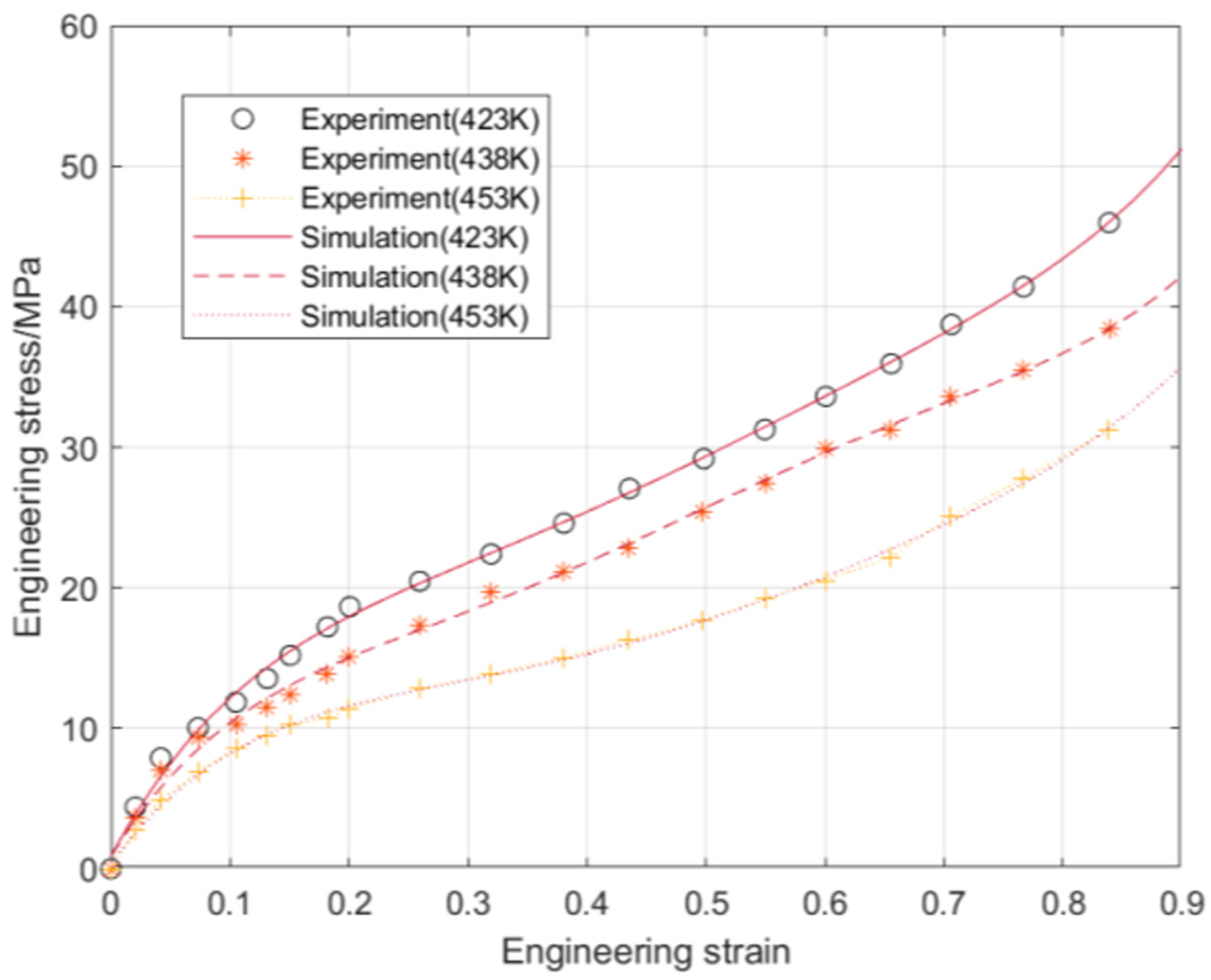
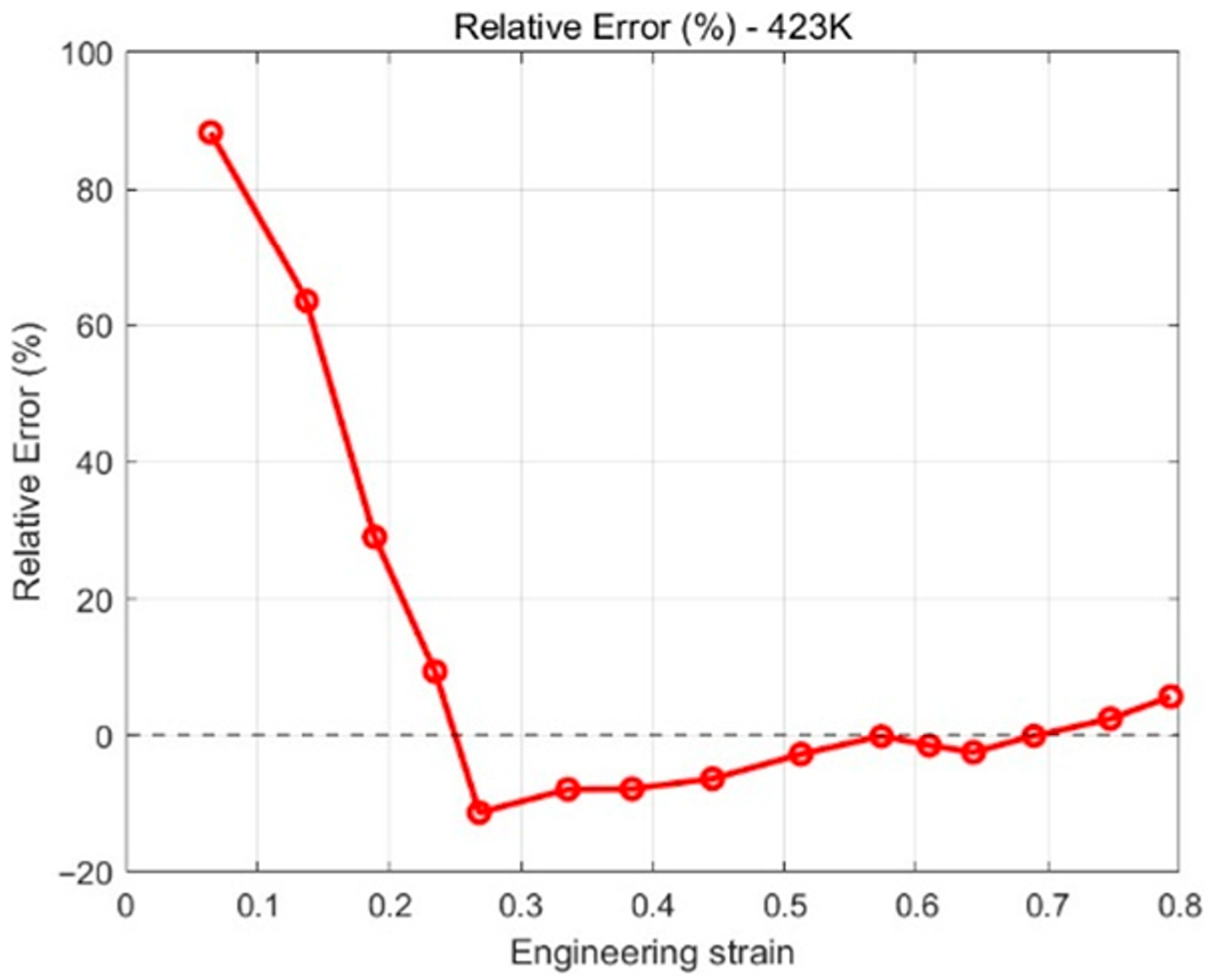
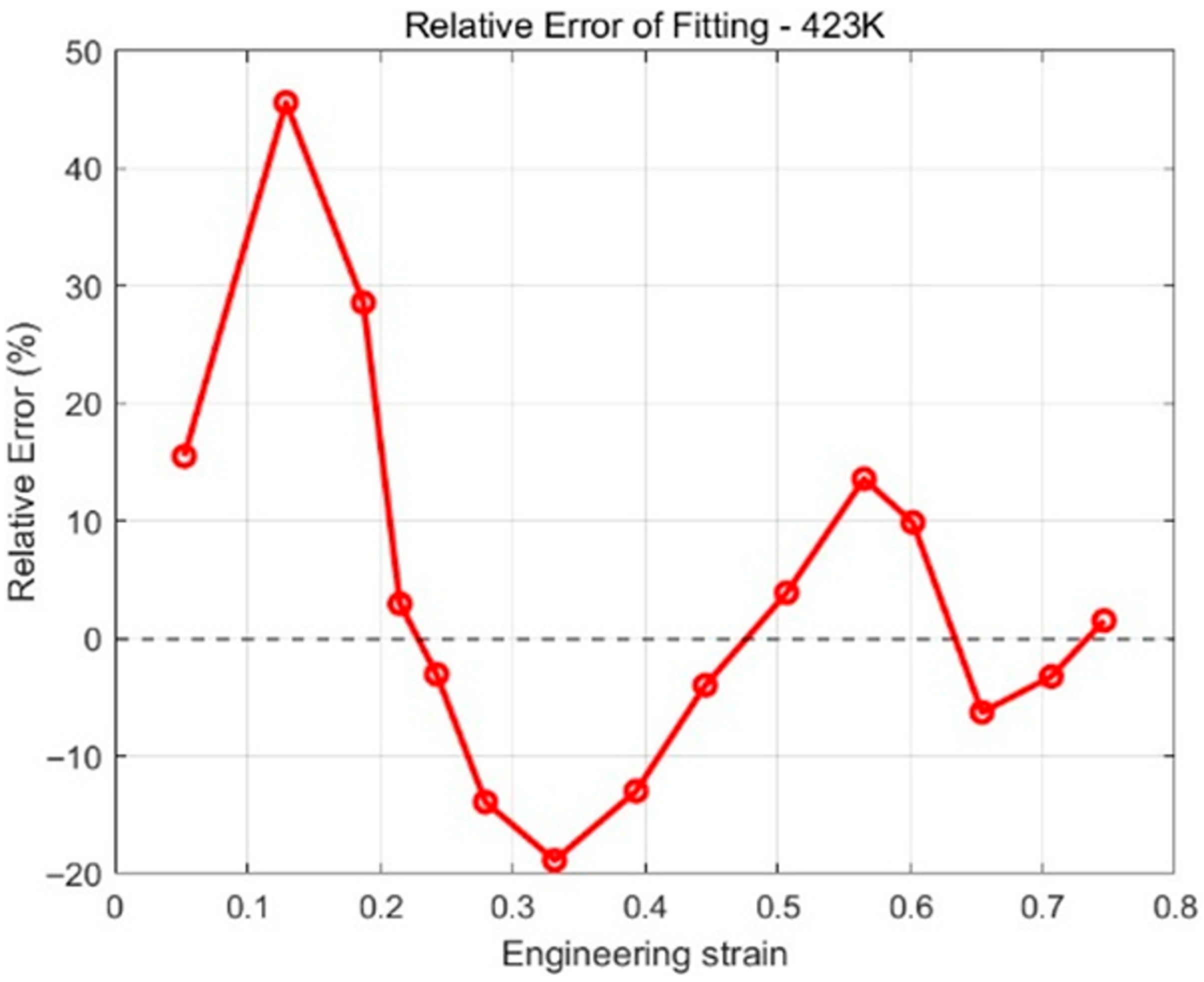
Based on continuum mechanics and the energy decomposition method, combined with the mechanical theories of matrix viscoelasticity and fiber-reinforced hyperelasticity, this paper proposes a constitutive model for carbon fiber-reinforced thermoplastic composites that reflects the relationship between different strain rates and temperatures. The model parameters are identified using MATLAB, and its validity and accuracy are evaluated through off-axis tensile tests conducted at various temperatures and fiber orientations. The proposed model provides guidance for composite molding-process design by revealing temperature- and strain-rate-dependent behavior that is critical for optimizing thermoforming conditions. This study achieves accurate characterization of the visco-hyperelastic behavior of prepregs at different temperatures through the four-component energy decomposition of ‘matrix isochoric deformation energy—fiber tensile energy—inter-fiber shear energy—fiber-matrix shear energy’ and the introduction of a temperature scalar function.