Article

The Effects of Melting Methods and In-House Recycled Content on Climate Effects

by
Anders E. W. Jarfors
School of Engineering, Materials and Manufacturing, Jönköping University, Box 1016, 551 11 Jönköping, Sweden
J. Manuf. Mater. Process. 2025, 9(12), 398; https://doi.org/10.3390/jmmp9120398 (registering DOI)
Submission received: 8 October 2025 / Revised: 20 November 2025 / Accepted: 26 November 2025 / Published: 1 December 2025

Abstract

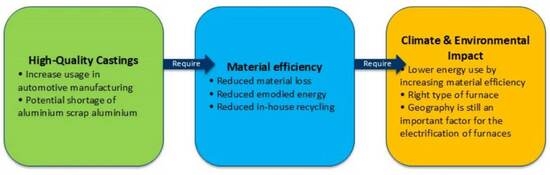
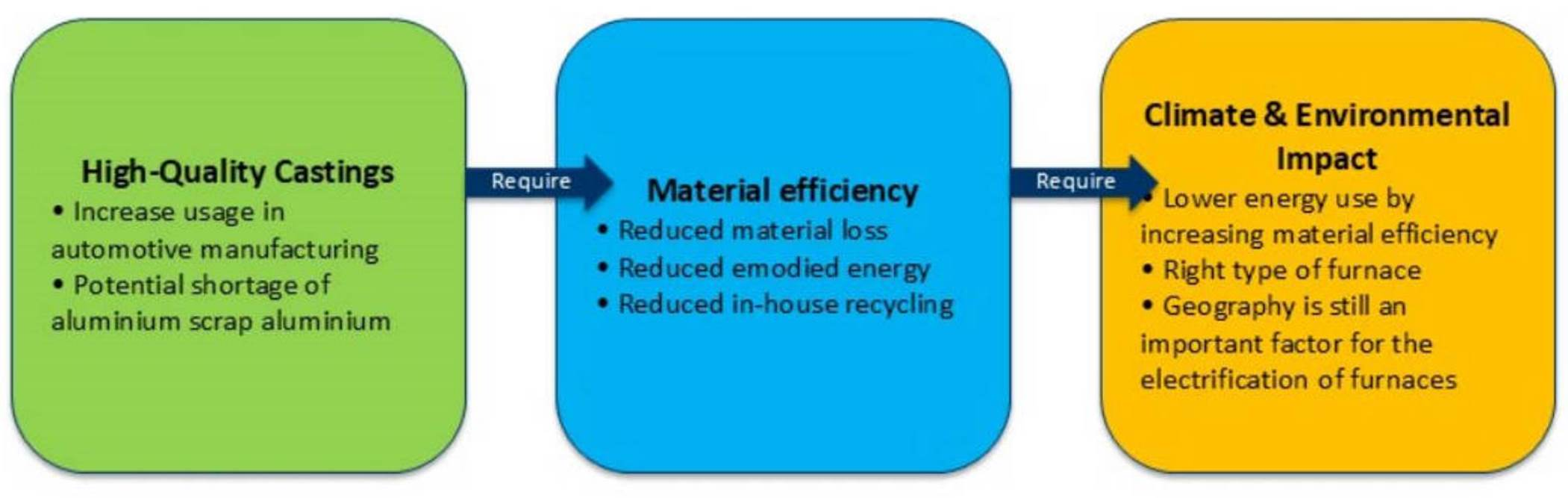
Large functionally integrated casting and electrification are rapidly changing the high-pressure die-casting industry. The requirements for these new castings differ from those of the previous ones. Load-bearing capability, fatigue, ductility, and crashworthiness all increase, and the foundry’s readiness for this varies and is challenging. At the same time, the carbon footprint needs to be reduced, meaning that recycled, secondary aluminium usage is required, making the challenge of attaining the required component performance significantly more difficult. The current paper examined the conditions and requirements to manage and reach the required targets, both from a material standpoint as well as from a climate impact and resource-efficiency perspective.

1. Introduction

The climate emergency has been well known since the Charney report in 1979 [1] and is a significant problem, with its consequences highly evident in world data [2]. The production of oil, gas, and coal is the source of 90% of human-caused CO2 emissions and is uniquely driving the climate crisis [3]. Metals and alloys are responsible for 10–17% of greenhouse gas emissions. To minimise future impacts, drastic measures along the entire life cycle are needed, addressing both supply and demand. This requires change not only for the metal industry but also for related sectors, such as the energy system, and actors, such as policy-makers [4]. There is a significant understanding of the difficulties in adaptation to climate change, and methods to manage these from a societal standpoint have been well studied [5].
There is a strong drive towards cost-effective manufacturing. The automotive industry has adopted large functionally integrated casting methods: Mega-, Giga-, and Hyper-casting [6]. Typical for these techniques is significant cost reduction due to a dramatically reduced need for assembly. This reduces the need for automation, reduces the number of tooling, and reduces maintenance and procurement processes [7]. One matter often less discussed is the effects on the climate. One clear matter is that large-format casting processes reduce the number of materials used in cars, with many parts used in a rear floor made from different materials being replaced by one part and one material [8]. A material number reduction means fewer materials are separated, and the material streams become more concentrated and of larger volumes. This has significant potential to increase the quality of the incoming scrap, especially from iron cross-contamination in the scrap and sorting stages [9].
The effect on process yield is also a matter that is significantly discussed in the foundries. Mega-casting will have lower yields due to the increased complexity of the casting. This will change the amount of material being re-melted, and the amount of return material will decrease the material quality [10]. It is important to understand if there is a threshold where one process outweighs the other and where the in-house returns outweigh the gains. This is naturally also strongly affected by the part-to-runner-and-gating ratio, as this material is also being returned, where the runner returns have a more significant impact than the part rejection returns [11].
All material quality issues affect product performance, one of the more critical elements for the automotive industry [12,13]. To have a resource-efficient process means that the amount of material for a given function needs to be minimised, and this will make the casting thinner, increasing the surface-to-area ratio and thereby also affecting the material quality changes in the foundry [14,15].
Material quality degeneration in a foundry is an important element, as this decides whether a secondary material can be used or if a primary material needs to be used. The use of secondary materials will allow for both primary and secondary materials, wider material selection, and a more resilient manufacturing environment [16,17].
The current study will start from the changes invoked on aluminium usage and analyse the effects of Mega-casting and where the potential obstacles are in material supply and material quality.

2. Materials and Methods

The current work starts with analysing the availability of aluminium with a projection of primary and secondary aluminium volumes connected to an analysis of the market expansion based on logistic regression principles. Together with the literature data on material usage in the automotive industry, the worst-case scenario is developed. This is set to understand the timeframes and the criticality of the aluminium supply.
A material balance for a foundry is developed for different performance scenarios to assess material losses vs. climate impact, and a gauge to understand melt quality and component performance.

3. Results and Discussion

3.1. Aluminium Supply-And-Demand Balance

Applying logistic regression to both primary and secondary aluminium metal supply under the assumption that the available resources and the will to develop new resources before 2060 are bounded and affect the availability or tentative capability to deliver [18,19]. It is possible to develop a simplistic model for both primary M A l ,   P and secondary material supply M A l , S , as seen in Figure 1a,b, respectively.
M A l ,   P = M A l ,   P , m a x 1 e a A l .   P t y b A l , P
M A l , S = M A l ,   S , m a x 1 e a A l , S t y b A l , S
where a A l . P and b A l , P are fitting constants for the evolution over time for primary aluminium, and a A l . S and b A l , S are fitting constants for the evolution over time for primary aluminium. t y is time in years. In the current study, the maximum production capacities, M A l , P , m a x and M A l , S , m a x , were also used to fit the data and assumed constant. This was made from the perspective that developing new mines is a reasonably long process and slow changing.
Using logistic regression for each type of vehicle driveline as market share F i and re-normalising this to 100 percent gives an image of what types of cars and what technologies would be dominant. The first step was to estimate the growth of each vehicle type based on historical performance using a three-parameter logistic fitting as above with the rate constant a i , the half time constant b i , and the maximum value attainable F i , m a x in a similar manner as made for the production capacity for the primary and secondary aluminium, but here, the data is the market share as a percentage, instead of tons.
F P e t r o l = F P e t r o l , m a x 1 e a P e t r o l t y b P e t r o l
F D i e s e l = F D i e s e l ,   m a x 1 e a D i e s e l t y b D i e s e l
F H y b r i d = F H y b r i d , m a x 1 e a H y b r i d t y b H y b r i d
F B E V = F B E V , m a x 1 e a B E V t y b B E V
F A l t e r n a t i v e = F A l t e r n a t i v e , m a x 1 e a A l t e r n a t i v e t y b A l t e r n a t i v e
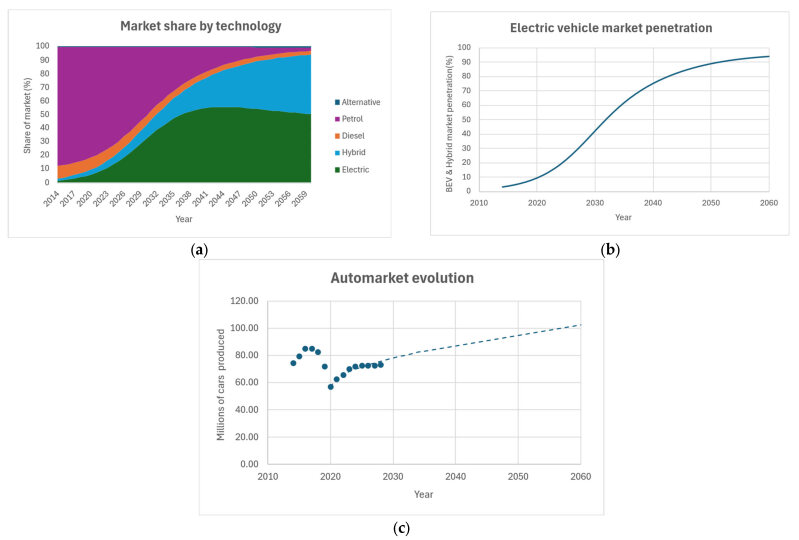
The sum of the projection does not add up to 100% exactly and tends to exaggerate the percentage at longer times, and therefore, the values were subjected to a re-normalising this as F i N , as seen in Figure 2a
F i N = F i j N F j
A previous study based on battery electric vehicles (BEVs) by Jarfors et al. [20] identified that the market penetration should be 50% by 2037. In the current study, all types of vehicles are included, using data from Statista [21] for this estimate, yielding the outcome in Figure 2b, the general market penetration of BEVs and hybrids, defined as
F E l e c t r i c N = F B E V N + F H y b r i d N
was used for the current study, as they are more similar in their technological build than the others. Also, in this study, the BEV market will pass 50% in 2037, and the combined effects from BEVs and hybrids will pass 50% even earlier, and the model suggests that this would be in 2032. These projections are naturally highly uncertain and have significant geopolitical uncertainty. It is, however, interesting to note that under these conditions, the BEV market is not completely dominant, but hybrid vehicles will revive and play a significant role in the future transport sector. This is a significant difference from the previous model by Jarfors et al. [20]. The key features of the model developed by Jarfors et al. [20] are found in Appendix A for reference and convenience to the reader as support to understand its implementation and use in the current study.
To gauge the demand for aluminium, the nature of the overall automotive market needs to be understood. The automotive production displayed a significant slump during COVID-19, and the post-COVID-19 market evolved differently [22]. To gauge the market evolution, only data after COVID-19 was used, as seen in Figure 2c. The same approach as that by Jarfors et al. [20] was made, but a refitting was made, a N and b N , only including the post-COVID data as
N A = a N t y + b N
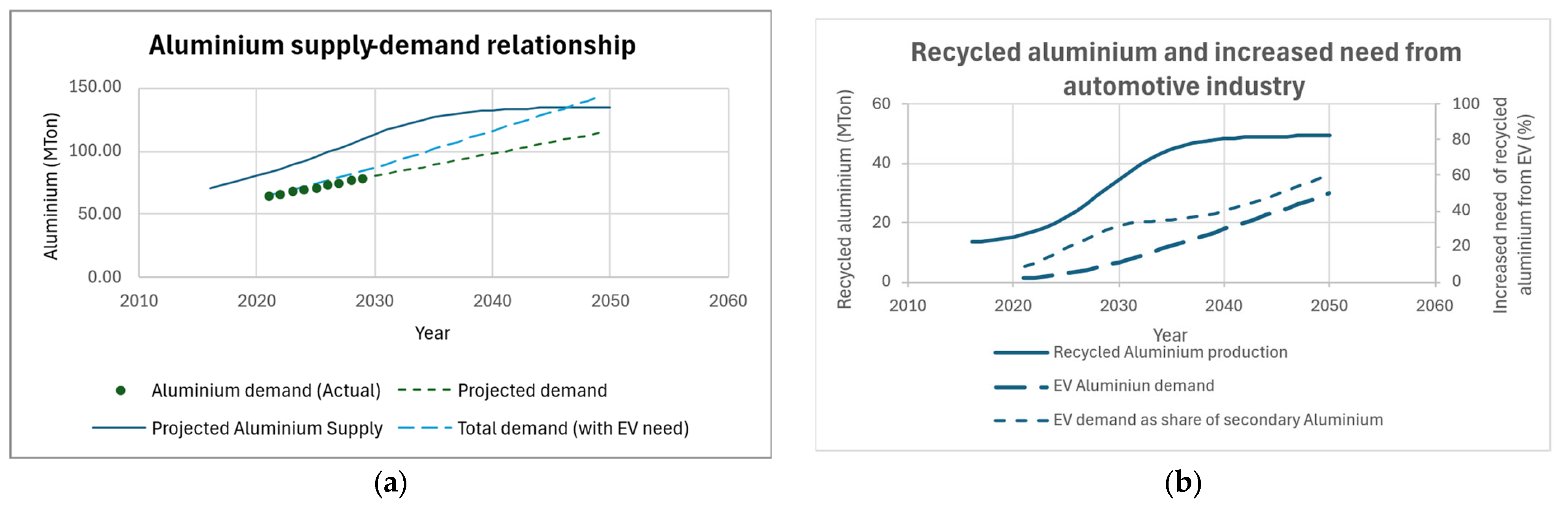
Using the data from Jarfors et al. [20] shown in Appendix A for the evolution of the mass of cars, M A , and the fraction of aluminium in cars worldwide, F A l , it is possible to estimate the use of aluminium alloys in cars together with an estimate of the total number of cars. The use of aluminium is significantly increasing in electric vehicles, as argued by Rolseth et al. [8]. With the relatively small market penetration, it may be assumed that this has not significantly permeated aluminium use, and it is, as such, possible to extrapolate the current aluminium use evolution and add on the needs from automotive aluminium usage as an upper bound estimate for aluminium usage to create a worst-case scenario, as seen in Figure 3a. The best fit for the current market data [23] on aluminium usage is a linear increase over time, and with the estimated availability of aluminium in general, there will be a shortage of both primary and secondary aluminium after 2045. Taking a comparison of the increased demand from electric vehicles and comparing this to the amounts of secondary aluminium. Interestingly, as the electric vehicle industry has a climate-friendly profile, the additional need for aluminium in the electric vehicle sector is estimated to be up to 60% of the projected available volume, as seen in Figure 3b. This implies that there will be significant competition for secondary aluminium. This competition over secondary aluminium would require the development of high material efficiency in the manufacturing processes.
Figure 2. A projection for [21,22] (a) market shares of all types of drivelines with data from [21], (b) electric vehicle market penetration as hybrids and battery electric vehicles, and (c) automotive sales [21,22].
Jmmp 09 00398 g002
Figure 3. The aluminium supply–demand balance for (a) the total estimated aluminium production capacity with linear growth estimation of aluminium usage [23] together with the worst-case scenario with an increased need for aluminium due to the electrification of transports, and (b) a comparison between the need for additional aluminium for electric vehicles and the supply of secondary aluminium, showing that 60% of the secondary aluminium would be needed to fulfil the automotive industry needs by 2050.
Jmmp 09 00398 g003

3.2. Foundry Climate Impact and Material Efficiency Effects

3.2.1. Material Efficiency Effects

As secondary aluminium will be scarce, it is important for there to be minimal loss, and for the highly material and energy-efficient aluminium casting industry to be maintained and improved wherever possible. Table 1 shows the estimated values for aluminium material properties in foundries.
Jolly et al. [26] studied the road to a sustainable foundry, and in that study, the effect of furnace performance in terms of energy efficiency and material loss was identified. Data from their study will be used in the current analysis. A summary of this data is seen in Table 2.
The material efficiency can be seen as the effect of melting losses during melting. The total amount of material being used is embedded in the equation and can be expressed as
m F , N = m 0 + i = 1 N 1 f R m 0 + f R m i 1 1 f L
were m 0 is the mass of the melt in the furnace to start, and the summation of the effects f L is the amount of melt loss in each melt cycle. m 0 is also the charge weight of the furnace, and it is assumed that the furnace is fully emptied. The mass fraction returned is f R in each charge cycle. The total effective mass after N recharging of the furnace is m F , N .
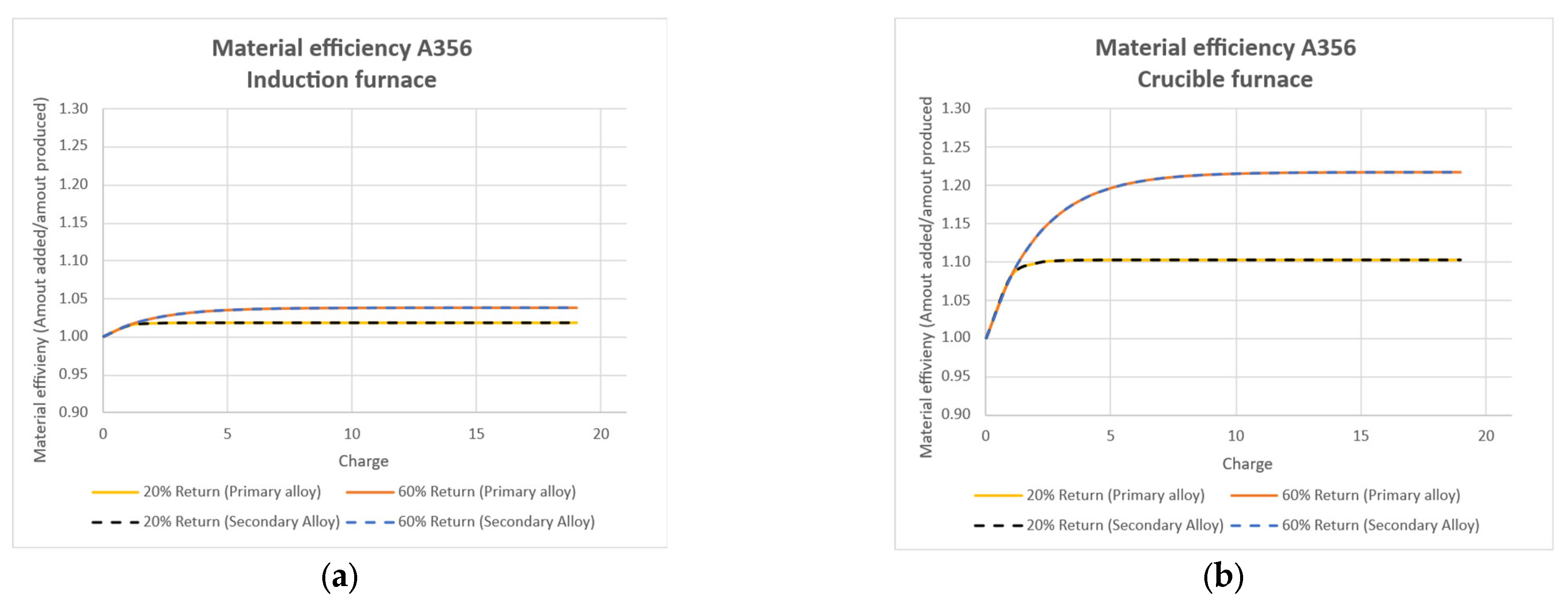
Setting the initial material usage to 1 shows the evolution of the material losses until a steady-state condition between additions and losses has been reached, indicating the number of recharging it takes from starting fresh to reaching a constant quality situation. This is shown in Figure 4a,b for the best and worst in-class conditions. Interestingly, a steady state is reached after approximately three charges for 20% returns, while a steady state is reached after eight to nine charges for a 60% return situation. The material efficiency is the inverse of this calculated number and is collated in Table 3. It should be noted that it has been assumed that there is no difference in the melting losses for primary ingots and foundry returns, which may not be the case due to the shape and form of the returns. The lack of data for this necessitated this assumption.
Timelli and Bonollo [10] studied the effects of foundry returns in high-pressure die-casting (HPDC) processing and concluded that scrap in the form of refused castings, gating and runner systems, and overflows increased the amounts of oxides, reducing the fluidity of the melt. A contaminated melt also results in reduced fluidity and, as such, a greater risk for the generation of casting defects due to greater issues with filling and feeding. This means that the risk of defects is lower with a reduced return, and the process stabilises in a shorter time. These findings are in line with the ideas of Campbell [27], and for fluidity tests, they are aligned with the modelling and argumentation by Zhang et al. [28] for inline quality assurance of melts.

3.2.2. Embodied Energy Effects

A total embodied energy balance for the raw material and changes during melting and use of returns, including energy efficiency and material loss, can be made. The embodied energy after recharging the furnace N times is Q F , N . Here, Q 0 is the embodied energy of the incoming raw material (primary aluminium or secondary recycled material). Q m is the energy used to heat up to 750 °C, including melting energy without energy loss. f R is, as above, the amount of returns in each cycle. The same is true for f L , that is, as above, the amount of melt loss in each melt cycle.
The amount of energy required to ideally melt the material with no energy or material losses is
Q m = 1 f R Q m + f R Q m
This is added to the embodied energy in each melting cycle. However, the embodied energy of the returned material has already been re-melted once and will, therefore, contain a higher energy amount that needs to be added to the expression.
Q F , i = 1 f R Q 0 + Q m + f R Q i 1 + Q m
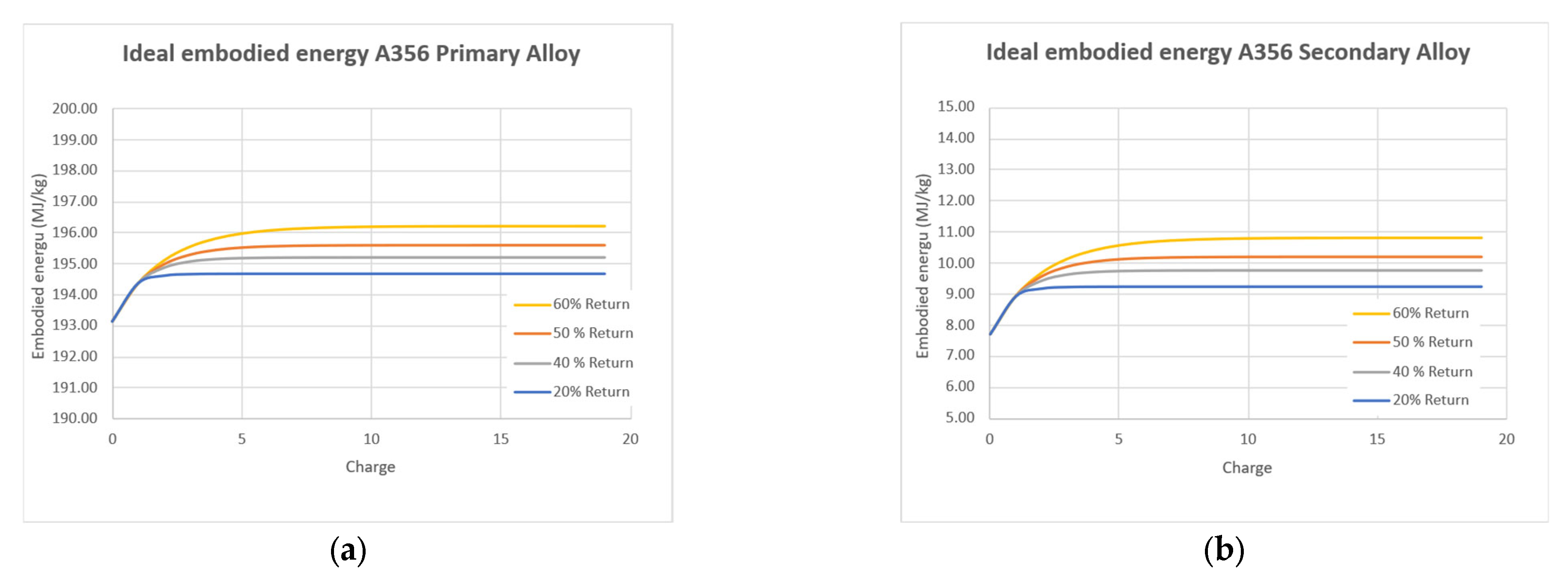
This is the ideal reference for the embodied energy shown in Figure 5. First, it is evident that the main influence on embodied energy under ideal conditions is the selection of primary material or secondary recycled materials. Second, an increase in the amount of returns increases the theoretical heat content because the material is recycled. This also reflects the amount of heat embodied in the material becoming products. Reducing the return amount will also reduce the embodied energy in the component. How close this limit can be approached depends on the choice of a furnace, as each type of furnace will have a characteristic energy efficiency and a characteristic melt loss. This will affect both the embodied energy and the relative efficiency of the solution. It will also affect the material addition needed to compensate for the metal loss on re-melting.
Adding the furnace selection and its consequences for the melting of the new material and returned material results in
Q F , i = 1 f R η Q 0 + Q m + f R η Q i 1 + Q m η
The incoming new material embodied energy is unaffected by furnace efficiency, and only the melting effect needs to be affected by furnace efficiency. Similarly, for the returns, the returned material’s incoming embodied energy is unaffected by the furnace efficiency, and only the added energy from reheating and re-melting is required to be affected by the furnace efficiency.
In addition, there is a material loss in each melting cycle. Under a worst-case scenario, this is lost after being melted and will, as such, increase the complete energy content of the material with its loss. The loss in each cycle needs to be compensated for as the material leaves the material circulation, but its embodied energy is maintained in the remaining material. Furthermore, the lost material needs replacement with new material in a closed-loop scenario, adding a term to Equation (14), becoming Equation (15).
Q F , i = 1 f R η Q 0 + Q m + f R η Q i 1 + Q m η 1 f L + f L Q 0
This is the added energy of each cycle and needs to be summed up for each recharging of the furnace.
The material added to the melt in terms of raw material and to compensate for the material loss will be the new raw material that will be either primary aluminium or secondary recycled material holding some initial footprint, meaning that after N cycles, that footprint would be as shown by Equation (16).
Q F , N = Q 0 + i = 1 N 1 f R η Q 0 + Q m + f R η Q i 1 + Q m η 1 f L + f L Q 0
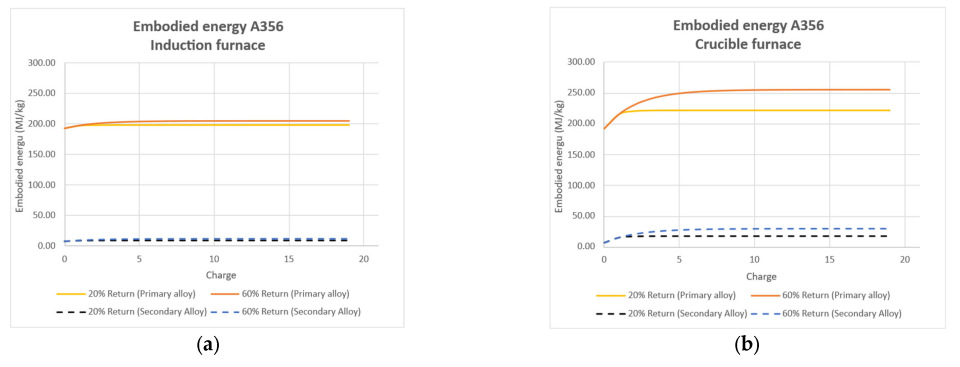
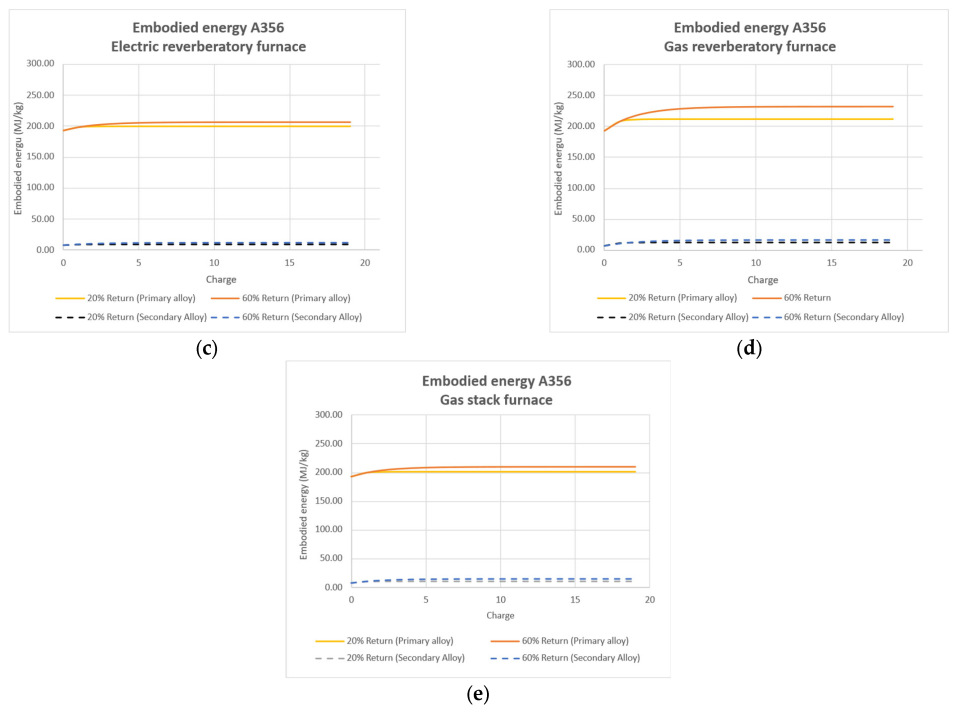
This is shown in Figure 6, which shows the different furnace solutions for primary and secondary materials and different return fractions.
The evolution to a steady state is dominated by material efficiency, which is also well reflected in the evolution of the embodied energy, and the amount of recharging follows the same pattern as that of the effective mass. The second obvious observation is the considerable difference between primary and secondary or recycled material solid and dashed lines in Figure 6a–e for the different types of furnaces. The effect on the total embodied energy of using 100% primary material and its initial embodied energy is accelerated by the melt losses as this acts as leverage on the material being lost. This is why there is a larger difference between the return amounts for primary materials compared to secondary materials. This difference is amplified by the deficiencies in energy efficiency in the furnaces. Gas-heated furnaces generally do not perform as well as electrically heated furnaces. It should be noted that the stack furnaces are best in class among the gas-heated solutions.
An embodied energy efficiency can be calculated by using Equation (2), being the ideal embodied energy and dividing it by Equation (6) after recharging N times, where N is sufficiently large to allow the assumption of steady state (here, N was chosen to be 19, meaning 20 melts, as numbering starts at 0. These results are collated in Table 3.
The highest efficiency was for induction furnaces, which reached 98% embodied energy efficiency. This is a combined effect of material loss and energy need. In general, there was a higher embodied energy for the higher amounts of returns, as this increases the re-melting amounts and the overall mass loss and need for new material.
It is important to note that the embodied energy efficiency was generally lower for the secondary material due to the re-melting energy becoming a more significant factor than for the primary material, where the incoming embodied material dominated. This will become an important factor for low climate impact materials, as the difference between best and worst in class is 10 compared to 17 MJ/kg for 20% returns and 12 to 27 for 60% returns. The relationship between furnace solutions has a significant influence compared to that of primary material, where the numbers are 200 to 221 MJ/kg, compared to 2004 to 252 MJ/kg for 60% returns. Part of this is due to the material efficiency, and the material has to be replaced. Part of this is also due to the furnace’s efficiency.

3.2.3. Climate Impact Effects

The climate impact is related to two different matters. One part of the footprint is related to the incoming raw material, and another is related to the melting part, which significantly depends on the nature of the heating source, meaning gas or electricity. The incoming material carbon footprint will be significant for primary materials, but for secondary materials, the actual energy of re-melting comes into the equation more significantly, as the incoming material footprint is lower. This is a matter of furnace choice and energy source selection with fossil- or electricity-based solutions.
The carbon footprint of electricity is also a matter of geography, as this affects the nature of the source of electricity, which is the amount of fossil fuel used to produce electricity. In electricity generation using fossil-based energy, there are inefficiencies, which means not only the selection of the sources matters but also the efficiency of the furnace.
Table 4 illustrates the numbers for electricity generation in different areas of the world for benchmarking per kWh of energy made available and compared to the direct energies using fossil-based sources. This reflects the different energy types used for electricity generation in different regions.
Generally, a gas-heated crucible furnace is inferior to all other solutions from a climate perspective and will not be considered in the analysis. In a country like Sweden, which has a low-emission electricity supply, the choice should be to heat and melt by electrical means as shown in Table 5, indicated as green. This is valid for all solutions from a climate impact point of view. In the EU(27), this is also true for electrical heating furnace solutions. Under EU(27) conditions, all the combustion-based solutions are inferior from a climate standpoint. Under electrical supply conditions, such as for the USA, the conditions are on par for all furnace solutions, neglecting the gas-heated crucible furnace. This stresses the need for a reduction in fossil-based electricity to meet climate targets, as the deficiencies, compared to the conditions in Sweden, are significant. For the world and China, there is more work to be performed when it comes to decarbonising the electrical supply, and these decisions cannot be made on a country level and will be based on an even more granular level where the local electricity supply and its carbon footprint will be the decisive element. On a national-level scale, direct fossil-based heating is still more efficient. The best solutions should be natural gas, followed by LPG for gas reverberatory and stack furnaces.

3.2.4. Component Quality and Performance Perspectives

The types of defects and their classification were revised by Fiorese et al. [32]. The foundation of this work was that the classification had several levels where (1) the first level distinguishes defects based on their location (internal, external, or geometrical); (2) the second level distinguishes based on their metallurgical origin; and (3) the third level refers to the specific type of defect. This classification is driven by the observation that the same metallurgical phenomenon may generate various defects. Most porosity is driven by the melt surface interaction with the surrounding media, causing entrapment, entrainment, and generation of gas-filled defects assisted by shrinkage, almost exclusively associated with oxides [29]. Measurement of melt quality is heavily associated with the presence of oxides and gas [27]. The work by Hellberg [16] shows that almost any operation or treatment of the melt results in a reduction in quality measured as the Bifilm index [29], elongation and the Campbell-Tiryakioglu index based on elongation [33]. It is not difficult to deduce that the melt should be handled a minimum number of times to promote the best quality possible. Bogdanoff et al. [17] reaffirmed this, which clearly showed that degassing deteriorated the quality. Tiryakioğlu [34,35,36] investigated the solubility, nucleation, and pore formation and concluded that hydrogen would not form porosity without oxides. Seifeddine et al. [37] concluded that the amount of hydrogen dissolved in aluminium is insignificant compared to the entrainment effects in HPDC. The conclusion is that oxides are responsible for most deficiencies in an HPDC component. Bonollo and Timelli [10] stated and concluded that the scrap addition came from HPDC foundry returns in the form of refused castings, gating and runner systems, and overflows of the same alloy. The addition of scrap increased the amounts of oxides, reducing the fluidity of the melt.
The easiest and most straightforward way to understand the material quality is through the tensile test and by elongation using the yield point compensated quality index developed by Campbell and Tiryakioğlu [33]. This is the most sensitive measurement. This is directly connected to properties such as fatigue [6] and crashworthiness [7]; for instance, the deterioration by increased oxidation in the furnace, re-melting, and increased oxide content can be traced. These effects were also confirmed by Bruska et al. [38], who investigated an Al-Cu alloy and the effect of re-melting. They re-melted their material up to four times. Re-melting returns caused the following microstructural changes.
  • Coarser grains and irregularly sized dendritic cells due to a loss of inoculation effects;
  • Increased porosity;
  • Coarser intermetallics;
  • Burn-off of both alloying and tramp elements.
After re-melting four times, the initial strength of the material for temperatures below 100 °C was reduced by 14%. This was not the case for the first three melts, where strength was retained at lower temperatures. Interestingly, the material hardness was the highest for the fourth re-melting despite the lowest yield point. Coarser intermetallics and oxide formation explained this.

4. Conclusions

The first conclusion is that without significant new developments in primary aluminium capacity, aluminium resources will be in short supply. There is also no doubt that secondary aluminium will have a significant climate advantage without changing the embodied energy and the associated carbon footprint. The expansion of the automotive industry and the introduction of functionally integrated castings open up a significant cost reduction in manufacturing and a significant opportunity for using recycled material. In the worst-case scenario, more than 60% of the recycled aluminium would be needed to cover the increased use of aluminium in the automotive industry. This fact warrants material-efficient manufacturing to keep secondary aluminium in the circular manufacturing loop and avoid melting losses.
The first step into high material efficiency manufacturing is using the best type of furnaces, meaning electrical or stack furnaces, as seen in Table 3. Gas-fired reverberatory furnaces are better than gas-fired crucible furnaces. The main drive from a material efficiency standpoint should be toward electrification.
The embodied energy of the material and, thus, indirectly, the carbon footprint will drive the use of aluminium towards secondary aluminium, putting significant pressure on the secondary aluminium market and the drive to have a high material utilisation. This is supported by using electrified low-material loss furnace solutions and secondary materials. Here, it is also important to reduce the amount of in-house returns.
The effect on in-house returns is also confirmed in the literature to have a negative effect on yield point, porosity, and material performance in general. The only property that increases is hardness, mainly due to oxides increasing tool wear and machining costs. The drive should, therefore, be to reduce the in-house returns that consist of rejected casting and the runner and gating systems. Most returned materials in a foundry are the runner and gating systems, which increase the need to rethink the design of just the runner and gating systems.
The first important conclusions were to use electrified furnaces and to reduce the amounts of in-house returns, where reduced runner and gating systems would be preferred to maintain high-quality manufacturing with a low environmental impact. The transition to an electrified melting solution and its associated climate impact in terms of the carbon footprint is highly dependent on the energy source for electricity. The high-efficiency gas-fired furnace solutions, with stack furnaces being preferred and gas-fired being second from an efficiency standpoint, may be the best solution from a melting carbon footprint standpoint. In countries and regions with a low carbon footprint, such as Sweden and the EU(27), the electrification of metallurgical processes should be prioritised. In the USA, the difference is not so significant between an electrified solution and a gas-fired solution, but with an increase in renewable sources, electrification will soon become the preferred choice. In the rest of the world and China, there is still some work to be performed to reach an electrical supply situation so that nationwide recommendations can be made for the selection of furnaces. Material efficiency and change in the electrical system should be prioritised.

Funding

This paper was funded by the Knowledge Foundation through the research school SmartIndustrySweden and by the Swedish Energy Authority under project Hållbart och Energieffektivt Gjutgods (HEeGg), contract 51228-1 and by Impact Innovation, Net Zero Industry under the EFFECT project contract 2024-03778.

Data Availability Statement

The original contributions presented in this study are included in the article. Further inquiries can be directed to the corresponding author.

Acknowledgments

The author wish to thank T. Bogdanoff, and L. Lattanzi for discussion leading to this paper. Ansys is gratefully acknowledged for providing Granta Selector (2024) software through the Research Partnership with Tekniska Högskolan i Jönköping AB.

Conflicts of Interest

The author declares no conflicts of interest.

Appendix A

Appendix A.1

This appendix is an explanatory summary of the model developed in “Jarfors, A.E.W.; Bogdanoff, T.; Lattanzi, L. Functionally integrated castings (Giga-castings) for body in white applications: consequences for materials use and mix in automotive manufacturing. Matériaux Tech. 2025, 605” [20] for ease of interpretation of the current discussion.

Appendix A.1.1. Automotive Market Evolution
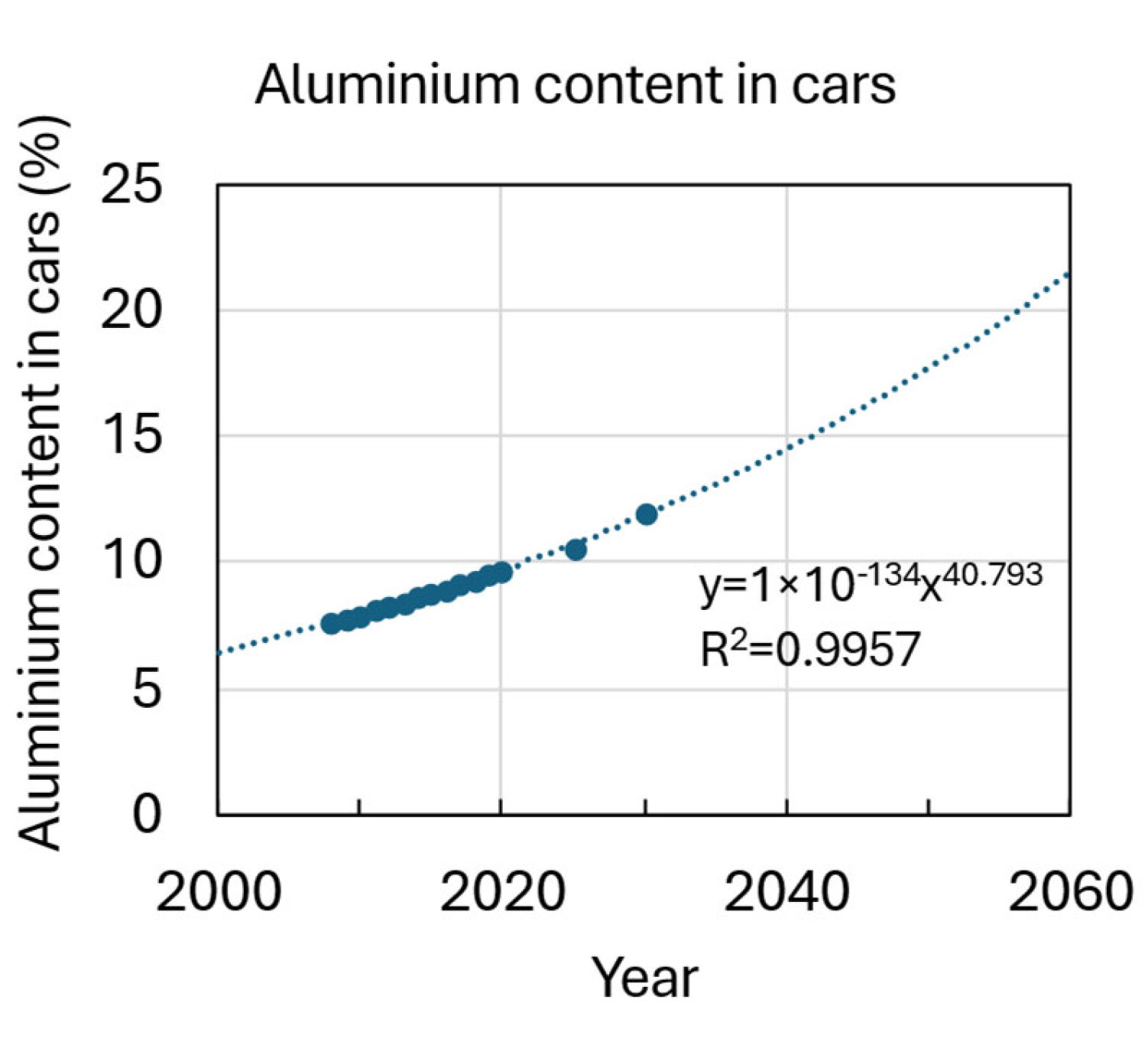
The model starts with the market evolution for cars where the best fit was a linear model with the number of cars, N A , as expressed in Equation (A1):
N A = a N t y + b N
where a N and b N are constants and t y is the year.
The life span of a car, L A , is expressed in Equation (A2):
L A = a L t y + b L
where a L and b L are constants and t y is the year.
The evolution of cars to be returned as scrap must be estimated based on their lifespan using a normalisation procedure at the starting point for Equation (A3).
N A C = N A t y 2022 N A C = L A 2022 L A t y N A t y > 2022
The amount of aluminium in a car against a linear regression; first, the evolution of the car weight, M A , was estimated as Equation (A4):
M A = a M t y + b M
where a M and b M are constants and t y is the year.
The average amount of aluminium in a car as weight percent, F A l , followed a power law Equation (A5):
F A l = a F e b F t y
where a F and b F are constants and t y is the year. The fitting was made using data from Statista [25], is shown in Figure A1.
Figure A1. Cars’ aluminium content (wt.%) as a share of curb weight [39].
Jmmp 09 00398 g0a1

Appendix A.1.2. Automotive Market, Electrification, and Giga/Mega-Casting

The effect of electrification on the automotive market comes in different types. Penetration, F E , is modelled as an S-shaped logistic function as in Equation (A6):
F E = 100 1 e a e t y b E
where a e and b E are constants and t y is the year.
Electrification changes the amounts of aluminium alloys used and the type of aluminium alloys, and three scenarios were developed, as seen in Table A1.
Table A1. Compositions of aluminium separated from shredded cars [20].
Scenario, S x i S
SiFeCuMnMgZnAl
ICE5.160.520.720.350.750.41Bal.
EV1.380.240.090.221.460.13Bal.
EV + Mega-casting3.540.200.240.311.020.05Bal.
The mass of each element, i, for the different scenarios S can be calculated starting with the total amount of aluminium alloys used for cars, M A l , Equation (A7).
M A l = N A M A F A l
For the scenario with a straight extrapolation of the car life span and the life span compensated scenario, this becomes Equation (A8).
M A l = N A C M A F A l
Consequently, it is possible to calculate the mass of the different alloying elements used in the cars for the various scenarios in Equation (A9).
M i S = x i S M A l
The demand for recycled alloying elements in scrap on a worldwide basis in an automotive closed recycling loop, M i S D e , for the year, t y , would then be the same as that of Equation (A9). This can be expressed as Equation (A10).
M i S D e t y = x i S M A l t y
The supply, M i S S u , on the other hand, would be the mass demand. L A years before, as in Equation (A11).
M i S S u t y = M i S D e t y L A
The alloying element discrepancy or supply-and-demand gap for element i, M i S in the year t y is then expressed in Equation (A12).
M i S = M i S D e t y M i S S u t y
The impact of the BEV market penetration, F E , in Equation (A13), for the three scenarios was established as it is difficult to judge as the amount or mass of aluminium is increased in the BEV, but there is
M i I C E = M i I C E D e t y M i I C E S u t y S = I C E M i S = M i I C E 1 F E + F E M i S D e t y M i S S u t y S E V ,   E V M

References

  1. Jule, G. Charney Carbon Dioxide and Climate: A Scientific Assessment; National Academy of Sciences: Washington, DC, USA, 1979. [Google Scholar]
  2. Ripple, W.J.; Wolf, C.; Gregg, J.W.; Levin, K.; Rockström, J.; Newsome, T.M.; Betts, M.G.; Huq, S.; Law, B.E.; Kemp, L.; et al. World Scientists’ Warning of a Climate Emergency 2022. Bioscience 2022, 72, 1149–1155. [Google Scholar] [CrossRef]
  3. Wolf, S.; Bullard, R.; Buonocore, J.J.; Donley, N.; Farrelly, T.; Fleming, J.; González, D.J.X.; Oreskes, N.; Ripple, W.; Saha, R.; et al. Scientists’ Warning on Fossil Fuels. Oxf. Open Clim. Change 2025, 5, kgaf011. [Google Scholar] [CrossRef]
  4. Harpprecht, C.; Miranda Xicotencatl, B.; van Nielen, S.; van der Meide, M.; Li, C.; Li, Z.; Tukker, A.; Steubing, B. Future Environmental Impacts of Metals: A Systematic Review of Impact Trends, Modelling Approaches, and Challenges. Resour. Conserv. Recycl. 2024, 205, 107572. [Google Scholar] [CrossRef]
  5. Tomlinson, B.; Torrance, A.W.; Ripple, W.J. Scientists’ Warning on Technology. J. Clean. Prod. 2024, 434, 140074. [Google Scholar] [CrossRef]
  6. Burggräf, P.; Bergweiler, G.; Kehrer, S.; Krawczyk, T.; Fiedler, F. Mega-Casting in the Automotive Production System: Expert Interview-Based Impact Analysis of Large-Format Aluminium High-Pressure Die-Casting (HPDC) on the Vehicle Production. J. Manuf. Process 2024, 124, 918–935. [Google Scholar] [CrossRef]
  7. Hartlieb, A.; Hartlieb, M. Light Metal Age June 2023, pp 18. Available online: https://www.lightmetalage.com/news/industry-news/automotive/the-impact-of-giga-castings-on-car-manufacturing-and-aluminum-content/ (accessed on 6 November 2025).
  8. Rolseth, A.; Carlsson, M.; Ghassemali, E.; Lluís, P.; Jarfors, A.E.W. Impact of Functional Integration and Electrification on Aluminium Scrap in the Automotive Sector: A Review. Resour. Conserv. Recycl. 2024, 205, 107532. [Google Scholar] [CrossRef]
  9. Cischino, E.; Di Paolo, F.; Mangino, E.; Pullini, D.; Elizetxea, C.; Maestro, C.; Alcalde, E.; Christiansen, J.D. An Advanced Technological Lightweighted Solution for a Body in White. Transp. Res. Procedia 2016, 14, 1021–1030. [Google Scholar] [CrossRef]
  10. Timelli, G.; Bonollo, F. Fluidity of Aluminium Die Castings Alloy. Int. J. Cast Met. Res. 2007, 20, 304–311. [Google Scholar] [CrossRef]
  11. Jarfors, A.E.W.; Du, A.; Yu, G.; Zheng, J.; Wang, K.; Wannasin, J. Semisolid Materials Processing: A Sustainability Perspective. Solid State Phenom. 2022, 327, 287–292. [Google Scholar] [CrossRef]
  12. Özdeş, H.; Tiryakiŏglu, M. On the Relationship between Structural Quality Index and Fatigue Life Distributions in Aluminum Aerospace Castings. Metals 2016, 6, 81. [Google Scholar] [CrossRef]
  13. Uludag, M.; Dis, D.; Tiryakioglu, M. On the Interpretation of Melt Quality Assessment of A356 Aluminum Alloy by the Reduced Pressure Test: The Bifilm Index and Its Physical Meaning. Int. J. Met. 2018, 12, 853–860. [Google Scholar] [CrossRef]
  14. Allwood, J.M.; Ashby, M.F.; Gutowski, T.G.; Worrell, E. Material Efficiency: A White Paper. Resour. Conserv. Recycl. 2011, 55, 362–381. [Google Scholar] [CrossRef]
  15. Shahbazi, S. Sustainable Manufacturing Through Material Efficiency Management; Akademin foör Innovation, Design Och Teknik: Eskilstuna, Sweden, 2018; Mälardalen University Press Dissertations No. 253; ISBN 978-91-7485-373-5. Available online: https://www.diva-portal.org/smash/get/diva2:1179801/FULLTEXT02.pdf (accessed on 8 October 2025).
  16. Hellberg, G. Materials and Manufacturing, Materials Cleanliness Assessment in Rheocasting. Master Thesis, Jönköping University, Jönköping, Sweden, 2022. ISRN: JU-JTH-PRU-2-20220315. [Google Scholar]
  17. Bogdanoff, T.; Tiryakioğlu, M.; Liljenfors, T.; Jarfors, A.E.W.; Seifeddine, S.; Ghassemali, E. On the Effectiveness of Rotary Degassing of Recycled Al-Si Alloy Melts: The Effect on Melt Quality and Energy Consumption for Melt Preparation. Sustainability 2023, 15, 5189. [Google Scholar] [CrossRef]
  18. Precision Business Insights. Production Volume of Recycled Aluminum Worldwide from 2016 to 2020, with a Forecast from 2022 to 2027, by Region (in 1000 Metric Tons). Available online: https://www.statista.com/statistics/1113774/recycled-aluminum-production-worldwide-by-region/ (accessed on 7 April 2024).
  19. International Aluminium Primary Aluminium Production. Available online: https://international-aluminium.org/statistics/primary-aluminium-production/?publication=primary-aluminium-production&filter=%7B%22row%22%3A85%2C%22group%22%3Anull%2C%22multiGroup%22%3A%5B%5D%2C%22dateRange%22%3A%22monthly%22%2C%22monthFrom%22%3A2%2C%22mo (accessed on 7 April 2025).
  20. Jarfors, A.E.W.; Bogdanoff, T.; Lattanzi, L. Functionally Integrated Castings (Giga-Castings) for Body in White Applications: Consequences for Materials Use and Mix in Automotive Manufacturing. Matériaux Tech. 2025, 605. [Google Scholar] [CrossRef]
  21. Statista Passenger Cars—Worldwide. Available online: https://www.statista.com/outlook/mmo/passenger-cars/worldwide?currency=USD (accessed on 7 April 2024).
  22. Carlier, M. Impact of COVID-19 on the Automotive Industry Worldwide—Statistics & Facts. Available online: https://www.statista.com/topics/8749/impact-of-covid-19-on-the-automotive-industry-worldwide/#topicOverview (accessed on 7 April 2024).
  23. Statista Research Department Projected Aluminum Consumption Worldwide 2021–2029. Available online: https://www.statista.com/statistics/863681/global-aluminum-consumption/ (accessed on 7 April 2024).
  24. Ansys® GRANTA Research Selector, 2024; ANSYS, Inc.: Canonsburg, PA, USA, 2024.
  25. Thermo-Calc TACAL8.2. Available online: https://thermocalc.com/products/databases/steel-and-fe-alloys/ (accessed on 6 November 2025).
  26. Mehrabi, H.; Jolly, M.; Salonitis, K. Road-Mapping Towards a Sustainable Lower Energy Foundry; Setchi, R., Howlett, R.J., Liu, Y., Theobald, P., Eds.; Smart Innovation, Systems and Technologies; Springer International Publishing: Cham, Switzerland, 2016; Volume 52, ISBN 978-3-319-32096-0. [Google Scholar]
  27. Campbell, J. Complete Casting Handbook Metal Casting Processes, Metallurgy, Techniques and Design, 2nd ed.; Butterworth-Heinemann: Oxford, UK, 2015; ISBN 978-0-444-63509-9. [Google Scholar]
  28. Zhang, Q.; Liljenfors, T.; Jansson, S.; Jonsson, S.; Jarfors, A.E.W. Effect of Na-Based Flux on Melt Quality Assessment of 46,000 Alloys. J. Mater. Res. Technol. 2023, 27, 1830–1842. [Google Scholar] [CrossRef]
  29. Department for Energy Security 6 Net-Zero Greenhouse Gas Reporting: Conversion Factors. 2024. Available online: https://www.gov.uk/government/publications/greenhouse-gas-reporting-conversion-factors-2024 (accessed on 7 July 2025).
  30. Elsayed, M.; Matthews, R.; Mortimer, N. Carbon and Energy Balances for a Range of Biofuels Options. Project no. B/B6/00784/REP URN 03/836. DTI Sustain. Energy Programs, UK 2003, 341. [Google Scholar]
  31. Grahem, E.; Fulghum, N.; Altieri, K. Global Electricity Review 2025; IEA: Paris, France, 2025. [Google Scholar]
  32. Fiorese, E.; Bonollo, F.; Timelli, G.; Arnberg, L.; Gariboldi, E. New Classification of Defects and Imperfections for Aluminum Alloy Castings. Int. J. Met. 2015, 9, 55–66. [Google Scholar] [CrossRef]
  33. Tiryakioglu, M.; Campbell, J. Quality Index for Aluminum Alloy Castings. Int. J. Met. 2014, 8, 39–42. [Google Scholar] [CrossRef]
  34. Tiryakioğlu, M. Solubility of Hydrogen in Liquid Aluminium: Reanalysis of Available Data. Int. J. Cast Met. Res. 2019, 32, 315–318. [Google Scholar] [CrossRef]
  35. Tiryakioğlu, M. The Effect of Hydrogen on Pore Formation in Aluminum Alloy Castings: Myth versus Reality. Metals 2020, 10, 368. [Google Scholar] [CrossRef]
  36. Tiryakioğlu, M. On the Heterogeneous Nucleation Pressure for Hydrogen Pores in Liquid Aluminium. Int. J. Cast Met. Res. 2020, 33, 153–156. [Google Scholar] [CrossRef]
  37. Seifeddine, S.; Poletaeva, D.; Ghorbani, M.; Jarfors, A.E.W. Heat Treating of High Pressure Die Cast Components: Challenges and Possibilities; Wiley: Hoboken, NJ, USA, 2014; pp. 183–188. [Google Scholar] [CrossRef]
  38. Břuska, M.; Lichý, P.; Cagala, M.; Beňo, J. Influence of Repeated Remelting of the Alloy RR.350 on Structure and Thermo-Mechanical Properties. Manuf. Technol. 2013, 13, 31–35. [Google Scholar] [CrossRef]
  39. Statista Research Department Share of Curb Weight of Medium Sized Cars Produced in Western Europe Attributable to Aluminum from 2008 to 2030. Available online: https://www.statista.com/statistics/897794/western-europe-aluminum-as-share-of-car-curb-weight/ (accessed on 7 April 2024).
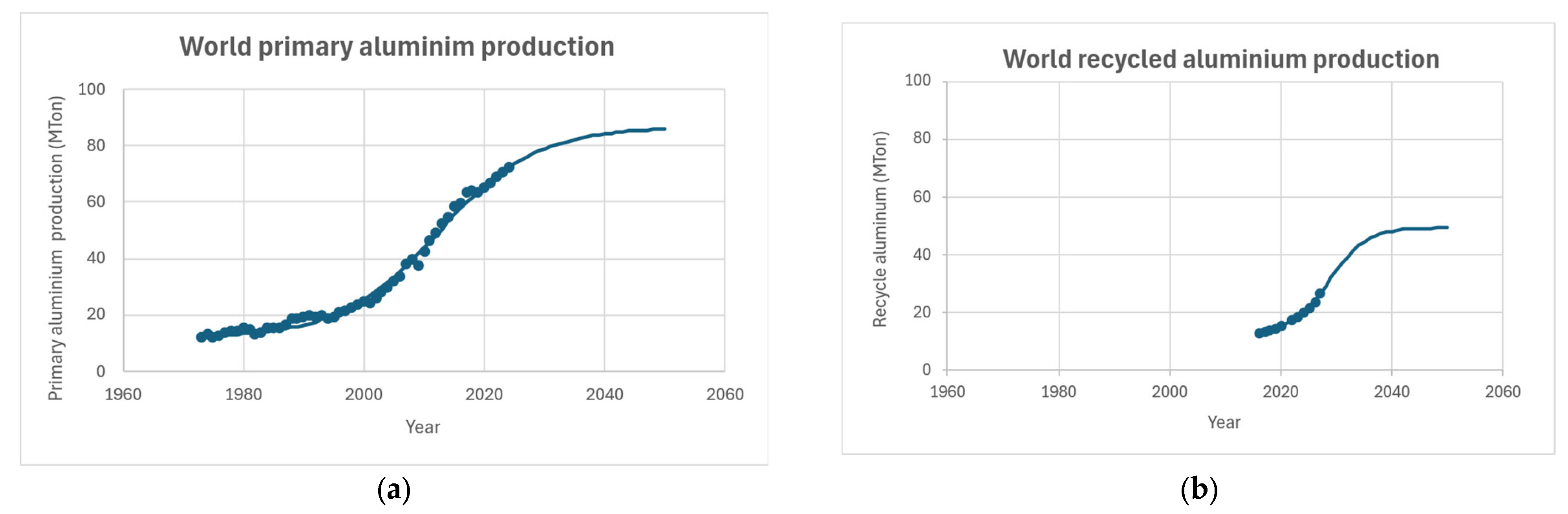
Figure 1. A projection of aluminium supply for (a) primary aluminium production [19] and (b) secondary recycled aluminium production [18].
Jmmp 09 00398 g001
Figure 4. The effective mass evolution, Equation (11), to the steady-state mix for A356 with primary and secondary alloys and different amounts of returns for (a) induction melting, best in-class performance, and (b) crucible furnace, worst in-class performance.
Jmmp 09 00398 g004
Figure 5. The ideal embodied energy for A356 with (a) primary material and (b) secondary recycled material with no material loss, as seen in Equation (14).
Jmmp 09 00398 g005
Figure 6. The evolution of embodied energy of primary and secondary recycled A356 with the number of recharging of the furnace to reach a steady state with 20% and 60% of foundry returns for (a) induction furnaces, (b) crucible furnaces, (c) electric reverberatory furnaces, (d) gas-heated reverberatory furnaces, and (e) stack furnaces, as seen in Equation (6).
Jmmp 09 00398 g006aJmmp 09 00398 g006b
Table 1. Model alloy for the current analysis with data from Granta selector [24] and the re-melting heats are from Thermo-Calc Software TCAL Aluminium/Al alloys database version 8.2 [25].
ElementAlSiFeMgTiAlloy Total
Amount91.258.000.150.450.15(MJ/kg)kWh
Primary embodied energy (MJ/kg), Q 0 199.00116.0023.20310.00559.00193.1453.4
Secondary embodied energy (MJ/kg), Q 0 7.964.640.9312.4022.367.732.15
Re-melting and heating to 750 °C, Q m 1.2300.342
Table 2. Furnace data from Jolly et al. [26]. Metal loss f L is defined as the net metal loss for one melting cycle. The energy efficiency is defined as the energy used for heating and melting in relation to the theoretical energy required.
Type of FurnaceFuelCapacity/kg Metal   Loss ,   f L (kgLost/kgAdded) Efficiency ,   η (JEffective/JTotal)
CrucibleGas10–15000.04–0.060.07–0.19
InductionElectrical1–50,0000.0075–0.01250.59–0.76
ReverberatoryElectrical500–125,0000.01–0.020.59–0.76
ReverberatoryGas500–125,0000.03–0.050.30–0.45
Stack melterGas1000–10,0000.01–0.020.40–0.45
Table 3. Steady-state embodied efficiencies compared to ideal melting, Equation (12) compared to Equation (16), and material efficiencies, Equation (11).
FurnaceMaterial TypeAmounts of ReturnsEmbodied Energy EfficiencyEmbodied Energy Material Efficiency
(MJ/kg)(kWh/kg)
Electric reverberatory furnacePrimary20% 97%20055.699%
60%95%20757.598%
Secondary20%93%102.899%
60%89%123.398%
Gas reverberatory furnacePrimary20%92%21158.696%
60%85%23063.993%
Secondary20%80%113.196%
60%68%154.293%
Induction furnacePrimary20%98%19955.399%
60%96%20456.798%
Secondary20%94%102.899%
60%90%123.398%
Crucible furnacePrimary20%88%22161.495%
60%78%25270.090%
Secondary20%83%174.795%
60%73%277.590%
Stack furnacePrimary20%97%20155.899%
60%94%20958.198%
Secondary20%83%113.199%
60%73%143.998%
Table 4. Carbon equivalents per kWh for different energy sources by region [29,30,31].
Country/RegionCO2ekg/kWh
ElectricityOilNatural GasLPG
China0.5280.2600.2020.230
World0.481
USA0.369
EU(27)0.291
Sweden0.041
Table 5. Carbon equivalents per kWh for different furnace solutions in different parts of the world are expressed as efficiency-compensated values for the energy available for the material to be heated and melted. Green colour indicates beneficial conditions for electrification while, orange indicates borderline beneficial conditions for electrification. Red colour indicated that fossil fuels for heating are preferred until energy source for electricity has changed from fossil base.
Country/RegionCO2ekg/kWh
Electric
Reverberatory
Furnace
Induction FurnaceFossil BaseGas Reverberatory FurnaceStack FurnaceCrucible Furnace
China0.690.69Oil0.570.581.53
World0.630.63
USA0.490.49Natural gas0.440.451.19
EU(27)0.380.38
Sweden0.050.05LPG0.500.511.35
Disclaimer/Publisher’s Note: The statements, opinions and data contained in all publications are solely those of the individual author(s) and contributor(s) and not of MDPI and/or the editor(s). MDPI and/or the editor(s) disclaim responsibility for any injury to people or property resulting from any ideas, methods, instructions or products referred to in the content.