
Article

Microstructural Diversity in Dispersed Composites Governed by Inclusion Distribution

by
Vladimir Mityushev
1,2,*,
Pawel Kurtyka
1,3,
Zhanat Zhunussova
2,4,5,* and
Akylkerey Sarvarov
2,6
1
Faculty of Computer Science and Mathematics, Krakow University of Technology, Warszawska St., 24, 31-155 Krakow, Poland
2
Institute of Mathematics and Mathematical Modeling, Pushkina St., 125, Almaty 050010, Kazakhstan
3
Innerco Sp. z o.o., Siwka St. 17, 31-588 Krakow, Poland
4
School of Applied Mathematics, Kazakh-British Technical University, Tole Bi Street 59, Almaty 050000, Kazakhstan
5
Faculty of Computer Technology and Cybersecurity, International Information Technology University, Manasa St., 34/1, Almaty 050040, Kazakhstan
6
Faculty of Physics and Technology, Farabi University, Al-Farabi Av., 71, Almaty 050040, Kazakhstan
*
Authors to whom correspondence should be addressed.
J. Manuf. Mater. Process. 2026, 10(6), 202; https://doi.org/10.3390/jmmp10060202
Submission received: 13 May 2026 / Revised: 1 June 2026 / Accepted: 8 June 2026 / Published: 10 June 2026

Abstract

The microstructure of metal matrix composites is inherently governed by fabrication routes and processing parameters, yet technological and physical constraints often prevent the realization of intended structural designs. In particle-reinforced composites produced via casting, interactions between the solidification front and inclusions frequently lead to agglomeration, segregation, and hence, a non-uniform distribution of the inclusions concentration. To mitigate these effects, post-processing techniques such as Friction Stir Processing offering particular promise for cast materials by refining microstructures and enhancing phase homogeneity. This study addresses these challenges by application of Fourier transform analysis to characterize stochastic inclusion distributions. Building on the Windows Washing method, we extend its application to heterogeneous media with varying inclusion concentrations. Through computer simulations and experimental analysis of real composites, we demonstrate that discrete Fourier transform can reveal hidden stochastic periodicity. The proposed framework provides a pathway toward improved predictive models and optimization strategies for metal matrix composites processing and performance.

1. Introduction

Irrespective of the fabrication route used for composite materials, whether ex situ or in situ, and regardless of the selected processing techniques, such as powder metallurgy or casting methods, the resulting microstructure remains closely linked to the processing parameters. Consequently, the properties of metal matrix composites are directly governed by the conditions under which they are manufactured.
In many cases, technological and physical constraints prevent the achievement of the intended microstructure. A typical example is provided by particle-reinforced composites fabricated via casting. In such materials, the spatial distribution of the reinforcing phase is largely governed by interactions between the solidification front and the particles [1,2,3,4]. Depending on the processing conditions, particles may be pushed by the advancing front or engulfed by it. They may also undergo agglomeration or segregate into interdendritic regions. As a result, the obtained microstructures often deviate from the expected ones [5,6,7,8].
To overcome these limitations, additional post-processing approaches are increasingly employed to further tailor the microstructure and its properties. In this context, Severe Plastic Deformation (SPD) methods offer significant potential, as they enable controlled modification of the material in the solid state [9,10]. Among them, Friction Stir Processing (FSP) [11,12,13,14,15] has gained particular attention, especially for cast materials, due to its ability to induce intense plastic deformation and promote microstructural refinement [9,16]. As a result, FSP can enhance the homogeneity of the reinforcing phase, improve particle distribution, and modify particle size, leading to improved functional properties. However, despite these advantages, the underlying microstructural changes, particularly at the microregional scale, remain insufficiently understood and are often described in a simplified manner [16,17].
Although such an approach is often sufficient and justified, it does not enable precise optimization aimed at maximizing the fraction of regions exhibiting a high degree of structural uniformity and enhanced mechanical and/or tribological properties [15,17]. This limitation applies both to primary casting processes and to subsequent modification routes, including SPD-based techniques. In both cases, a precise quantitative description of microstructural evolution is essential, yet it remains insufficiently developed.
Furthermore, this limitation hinders the development of reliable predictive process models and restricts the accurate assessment of parameter-dependent effects. This is primarily due to the lack of sufficiently advanced and dedicated analytical methods capable of providing a rigorous, parametric description of the obtained results and their direct correlation with processing parameters.
Image analysis of engineering micrographs containing dispersed composites is a crucial first step in estimating the effective properties of the material, as well as assessing its hardness and identifying regions where fractures are likely to occur [17]. A 2D image is treated as a representation of a 3D composite. If the actual 3D material is statistically isotropic, then any 2D cross-section can be considered representative of the full medium, allowing the 2D image to serve as a basis for reconstructing or characterizing the 3D microstructure [18].
One of the key geometric parameters of dispersed composites is the volume fraction of inclusions f which will be considered here as a locally changing spatial parameter f ( x ) . Fast Fourier transform (FFT) [19,20] is employed to efficiently compute discrete Fourier transform (DFT) [21,22], which is essential for determining spectral characteristics. In this setting, the Fourier transform of f ( x ) captures the spatial frequency content of a 2D image, enabling the analysis of texture features, such as whether the heterogeneous microstructure is directionally uniform or exhibits preferred orientations, and which distances between the inclusions dominate.
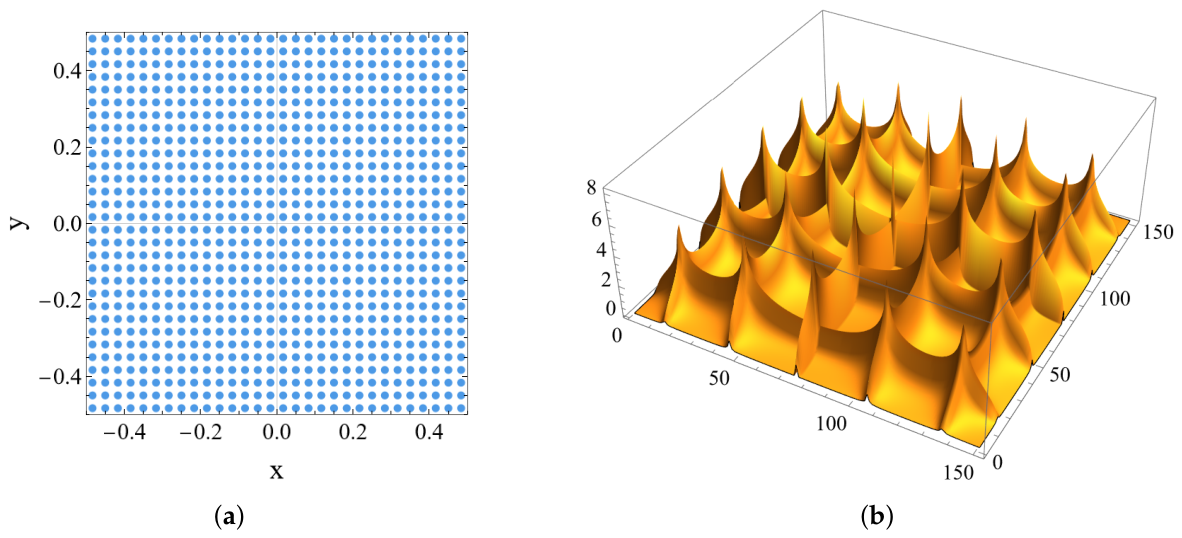
The reciprocal lattice method is well established for the analysis of periodic structures [23]. The Fourier transform of a Bravais lattice clearly illustrates the inherent periodicity of such systems [24]; for example, Figure 1 demonstrates a regular square array and its corresponding DFT.
In contrast, the situation becomes significantly more complex when inclusions are distributed stochastically [25], as shown in Figure 2. The primary objective of this paper is to interpret the DFT of stochastic structures and to explore how numerical results can reveal underlying regularities. For instance, in Figure 1a, the arrangement of inclusions is evident, while their periodicity is clearly reflected in Figure 1b. However, in Figure 2, such regularities are not immediately apparent, and even simple observations of its Fourier transform prove challenging.
To address this, we apply and further develop the Windows Washing method introduced in the seminal work [26], extending its application to stochastic heterogeneous media [27,28] characterized by locally varying concentration of inclusions f ( x ) . This is the main general goal of the present paper.
The 1D and 2D versions of Fourier analyses address different but complementary aspects of the concentration distribution. The 1D approach examines concentration variations along selected directions, allowing the identification of characteristic spatial periods. Because anisotropy in composites is typically defined with respect to a fixed direction, this method is naturally suited for detecting directional differences. The 1D spectra also provide a compact, easily comparable set of characteristic length scales, which is particularly useful when contrasting the as-cast and processed states. In contrast, the 2D Fourier transform operates on the full binary concentration field and preserves directional information, though in a less immediately interpretable form as shown in Section 3.2.2 below. While it does not yield characteristic distances as directly as the 1D method, it reveals how these distances are distributed across all orientations. Together, the two analyses offer a comprehensive picture: 1D spectra provide interpretable characteristic distances, whereas 2D spectra show how these distances vary with direction to produce anisotropy. In the data of the present paper, however, no anisotropy is observed.
The first theoretical part, Section 2, concerns computer simulations of uniformly distributed and clustered non-overlapping disks within a sample. Here, we establish the stochastic simulation protocol and interpret its DFT, demonstrating that the Fourier transform can uncover hidden stochastic periodicity [29,30,31,32], e.g., the dominated distances between inclusions and clusters of inclusions.
The following preliminary observations support the idea that a random, non-overlapping distribution of inclusions exhibits stochastically arranged periods. Consider first a Poisson point process in a square with vanishing inclusion concentration. Such a configuration corresponds to white noise, where all frequencies appear with equal weight, making it impossible to assign any characteristic period to the structure. At the opposite extreme, a densely packed hexagonal array of disks with concentration approaching f = π 12 [33] produces a pattern similar to Figure 1, where well-defined geometric periods are clearly visible. A random distribution of non-overlapping disks at intermediate concentrations, including also densely packed composites [34,35], lies between these two limiting cases and should therefore exhibit emergent stochastic periodicity.
The second part, Section 3, shifts to real engineering structures. Building on the theoretical framework, we apply the same Fourier transform approach to scaled composites and provide a detailed description of their structural properties. The technological analysis relies on two images representing a composite material. Such an approach, based on the concept of a representative volume element (RVE) [36,37], is widely used in theory of composites due to ergodicity [29,38], i.e., the assumption that a spatially random composite is statistically uniform. It equates the volume average of properties in a single, sufficiently large sample to the ensemble average across all possible realizations of the composite [39,40]. It is a core statistical property when a spatial average over one large image equals its ensemble average over many smaller images.

2. Computer Simulations Based on Concentration

2.1. Simulation of Non-Overlapping Uniformly Distributed Disks

We simulate a two-dimensional representative volume element (RVE) defined by the init square Q [39]. The inclusions are modeled as identical disks, and the task is to generate a statistically homogeneous configuration corresponding to the uniform distribution of equal disks while preventing overlaps.
To do this, we first generate the disk centers x i = ( x i , y i ) using Random Sequential Adsorption (RSA or hard-core random sampling rejection algorithm) [41,42,43]. Candidate points (also referred to as trial centers) are drawn uniformly at random from Q. Each trial center is accepted only if its distance to every previously accepted center satisfies the minimum spacing condition. If the condition is violated, the trial center is rejected and discarded.
To ensure statistical homogeneity and compatibility with the subsequent Fourier analysis, distances between disk centers are computed using doubly-periodic (toroidal) topology [44]. The computational domain Q is treated as a fundamental domain of torus, meaning that opposite boundaries of Q are identified [45].
For two disk centers x i = ( x i , y i ) and x j = ( x j , y j ) , the periodic distance is defined as
x i x j = d x 2 + d y 2 ,
where the periodic coordinate differences are
d x = min | x i x j | , 2 L | x i x j | , d y = min | y i y j | , 2 L | y i y j | .
This definition accounts for the fact that two points located near opposite edges of the domain may be close in the periodic sense.
The hard-core (non-overlap) condition is therefore imposed in periodic form as
x i x j   2 r 0 , i j ,
where r 0 is the maximally possible disk radius. A candidate center is accepted only if this inequality (3) is satisfied for all previously accepted centers. Otherwise, the candidate is rejected and a new trial point is generated. In the numerical simulations, we take r 0 = 0.01 . The procedure continues until N = 900 centers are accepted. After the centers are generated, we assign an identical disk of radius r to each center choosing r r 0 .
Therefore, the resulting configuration represents a uniform non-overlapping disk microstructure: uniformity follows from uniform sampling in Q, while non-overlap is ensured by the hard-core constraint.
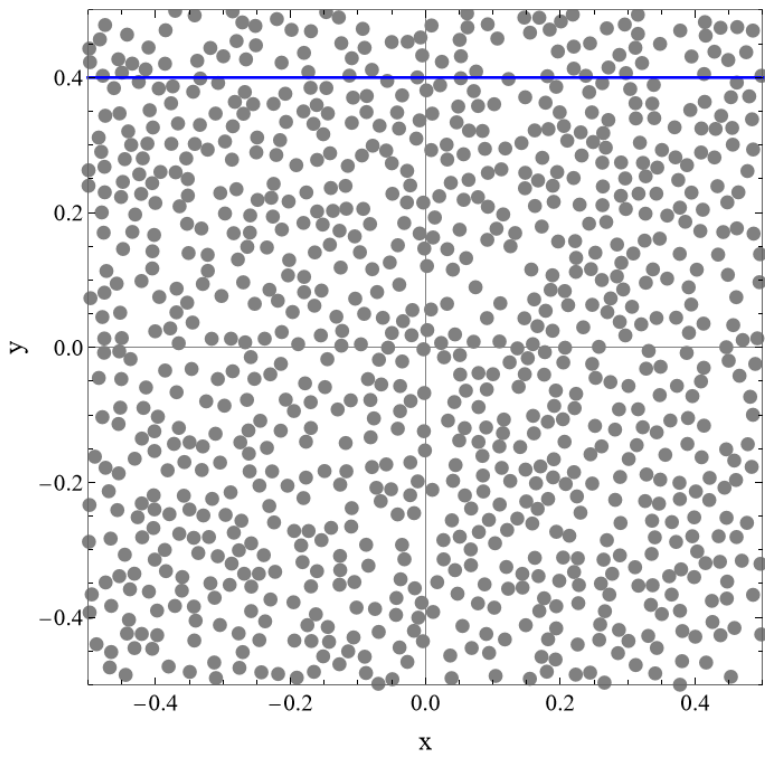
Figure 2 illustrates a statistically homogeneous arrangement of randomly distributed non-overlapping circular inclusions inside a square RVE. The highlighted blue horizontal line represents one of the sampling levels used for subsequent one-dimensional spectral analysis.

2.2. Fourier Analysis of Non-Overlapping Uniformly Distributed Disks

To characterize the spatial periodicity of the uniformly distributed non-overlapping disk configuration, spectral analysis is performed using one-dimensional discrete Fourier transforms (DFTs) applied to binary phase profiles extracted from the simulated microstructure.
Let
Z ( x , y ) { 0 , 1 }
denote the binary phase indicator function defined as
  • Z ( x , y ) = 1 inside a disk;
  • Z ( x , y ) = 0 outside the disks.
For a fixed value of y beginning from y = 0.4 up to y = 0.4 with the step Δ y = 0.05 , horizontal sampling lines are constructed inside the RVE. The total number of sampling levels is given by
N y = 0.4 ( 0.4 ) 0.05 + 1 = 17 .
Thus, seventeen horizontal sampling lines are used for signal extraction. An example corresponding to the sampling level y = 0.4 is shown in Figure 2 by the blue line.
Along each horizontal sampling line, the binary indicator function Z ( x , y ) is evaluated over the interval
0.5 x 0.5
using the uniform spatial discretization step Δ x = 0.005 . Since the total horizontal length equals
L x = 1 ,
the number of discrete sampling points along each horizontal line becomes
N x = L x Δ x + 1 = 1 0.005 + 1 = 201 .
Thus, the microstructure is represented by seventeen one-dimensional binary datasets, each consisting of 201 discrete values.
To suppress high-frequency numerical oscillations and improve the stability of spectral peak detection, each binary dataset is processed using a moving-average smoothing procedure with window size d e . For a discrete signal z j , the smoothed signal is defined as
z j = 1 d e m = 0 d e 1 z j + m ,
where d e denotes the moving-average window length. In the present work, the typical value d e = 7 is used.
Because the averaging window moves sequentially along the discrete dataset, the total number of smoothed values becomes
N MA = N x d e + 1 .
In the considered case, N MA = 201 7 + 1 = 195 . Therefore, each of the seventeen sampled datasets generates 195 smoothed data values used in the subsequent Fourier spectral analysis.

2.2.1. Discrete Fourier Transform

For each smoothed signal (4), the discrete Fourier transform is computed by the following way. Let c k denote the complex Fourier coefficients
c k = n = 0 N 1 z n exp 2 π i k n N ,
where N is the number of points in the analyzed profile. The coefficient c 0 represents the mean level of the signal, while coefficients for k 1 describe oscillatory behavior at different spatial frequencies.
The magnitude spectrum is proportional to | c k | , and the one-sided amplitude spectrum is normalized to
A k = 2 | c k | N .

2.2.2. Extraction of Dominant Periodicities

To identify characteristic spatial scales, the five largest spectral magnitudes | c k | are selected for each dataset. For each dominant frequency index k, the corresponding spatial period is found:
T k = 1 k .
Thus, each dataset is represented by five characteristic pairs ( T k , A k ) corresponding to its strongest spectral components.
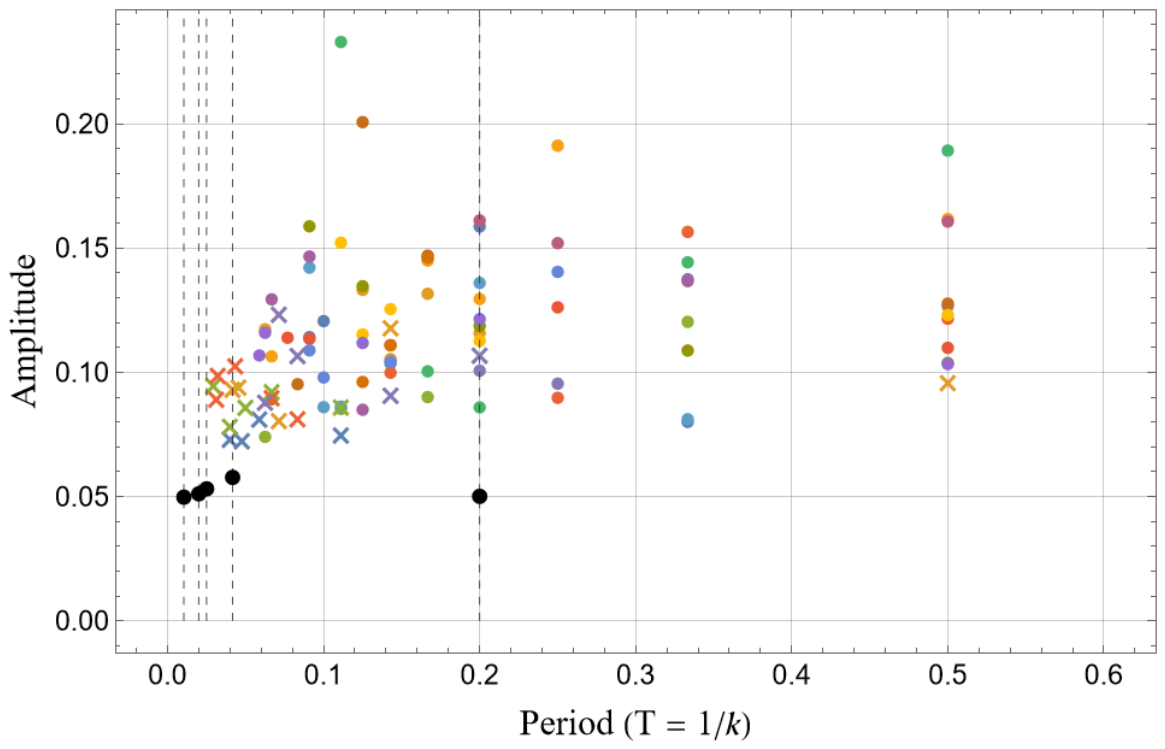
This procedure is applied independently to all horizontal 17 line-scan datasets. The five dominant peaks from each dataset are displayed in Figure 3 by colored circular markers.

2.2.3. Global Combined Dataset

To analyze ensemble-level behavior, all 17 datasets are concatenated into a single extended signal. DFT is computed again for this combined dataset, and the five strongest spectral peaks are extracted.
These ensemble-dominant peaks are shown in Figure 3 as black circular markers. Vertical dashed lines indicate the spatial periods corresponding to these global dominant frequencies.

2.2.4. Aggregated Group Analysis

To investigate intermediate structural scales, the seventeen datasets are grouped into five consecutive sets consisting of three datasets each. The grouping is performed according to the corresponding sampling levels
y takes values { 0.40 , 0.35 , 0.30 } , { 0.25 , 0.20 , 0.15 } , { 0.10 , 0.05 , 0 } , { 0.05 , 0.10 , 0.15 } , { 0.20 , 0.25 , 0.30 } .
The datasets corresponding to y = 0.35 and y = 0.40 are not included in this aggregation stage in order to keep all aggregated groups equal in size. These two datasets are, however, retain in the individual line-scan analysis.
For each grouped set (8), the corresponding datasets are combined and analyzed using the same discrete Fourier transform (DFT) procedure. The five strongest spectral peaks are then identified for each grouped signal. These grouped peaks are displayed in Figure 3 using cross markers.
The horizontal axis of Figure 3 represents spatial period (7), and the vertical axis represents spectral amplitude. Colored circular markers correspond to dominant periodicities of individual line scans, black circular markers represent dominant periodicities of the full combined dataset, and cross markers indicate dominant periodicities of grouped datasets.
For the uniformly distributed non-overlapping configuration, the spectral peaks are distributed across intermediate frequencies without strong concentration at very low frequencies. This behavior confirms statistical homogeneity and the absence of large-scale clustering, consistent with a hard-core random spatial arrangement of disks.
Additional explanations regarding the choice of the parameters d e , N y , Δ y , and γ are included below. These values were selected empirically, based on visual comparison of the simulated configurations and on additional parameter tests. The value d e = 7 was chosen to demonstrate the smoothing effect while preserving the main spectral features, and γ = 0.15 was chosen to demonstrate visible clustering without excessive local contraction.
The moving-average window was varied over d e = 3 , 5 , 7 , 9 , 11 , and the contraction parameter γ was tested over the interval 0.05 0.30 . Values of γ below 0.10 produced weak clustering, whereas values above 0.25 led to excessive local contraction. The value γ = 0.15 produced visible clustering while maintaining approximate non-overlap and was therefore used for the representative simulations.
The dominant spectral intervals remained stable under these variations. Smaller moving-average windows retained high-frequency fluctuations and produced many closely spaced peaks, whereas larger windows reduced peak sharpness. The value d e = 7 was therefore selected as a compromise between noise suppression and preservation of characteristic spatial scales.
Similarly, the number of sampling lines N y was varied to confirm that the main spectral intervals were not controlled by the choice of N y . The value Δ y = 0.05 , corresponding to N y = 17 , was chosen empirically. Additional simulations with larger N y and smaller Δ y increased the number of sampling points but did not change the principal spectral intervals.
Thus, changes in d e , except for excessively small or excessively large values, did not change the principal quantitative results displayed in Figure 3. For example, d e = 3 produces many closely spaced peaks in Figure 3, which would require additional grouping or summarization. The resulting clustered configuration and its magnified fragment are shown in Figure 4 and Figure 5, respectively.

2.3. Simulation of Non-Overlapping Clustering Disks

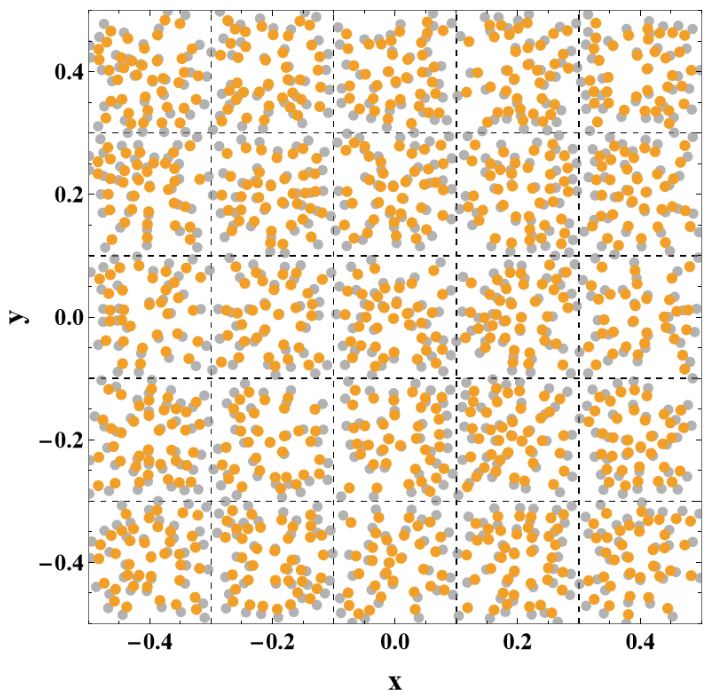
To generate a clustered configuration, we begin with the disk locations shown in Figure 1 as the initial arrangement. It is shown in Figure 4 by gray disks. This configuration will then be transformed into a clustered one shown in Figure 4 by orange disks. First, partition the unit square into a 5 × 5 grid of square cells. Denote these small squares by S i ( i = 1 , 2 , , 25 ) shown in Figure 4 by dashed lines. Let the points within S i be represented by x i and let c i denote the center of S i .
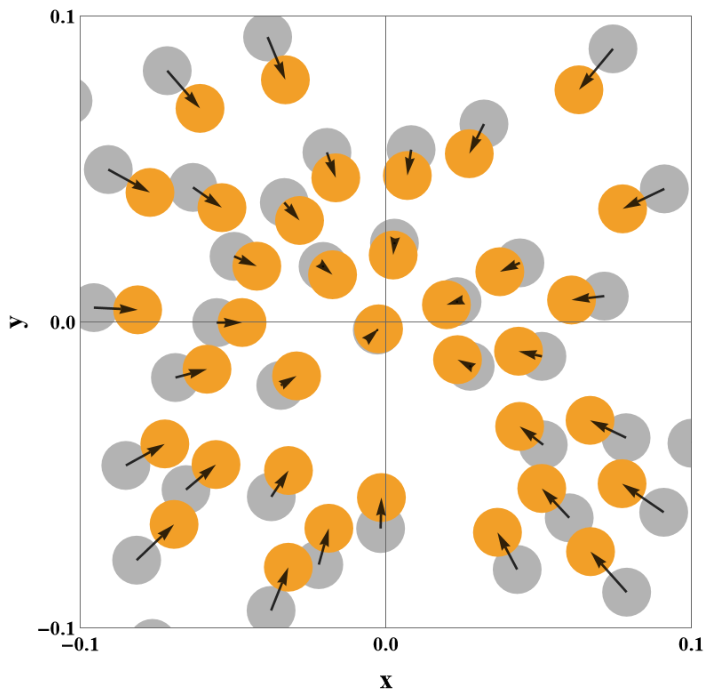
Each point is then displaced toward the center of its corresponding cell, which leads to the formation of locally concentrated groups as shown in Figure 5 for a small square and in Figure 4 for the resulting configuration.
It can be defined by the local linear contractions for every i = 1 , 2 , , 25
x i new = ( 1 γ ) x i + γ c i , 0 < γ < 1 .
The mapping (9) defines a local contraction inside each cell S i . The parameter γ controls the clustering intensity. When γ = 0 , the original uniform configuration is recovered. When γ = 1 , all points collapse to the corresponding cell centers. Intermediate values of γ produce controlled clustering.
Several values in the interval γ [ 0.05 , 0.3 ] were tested numerically. For γ < 0.1 , clustering was weak, whereas for γ > 0.25 , local distortions increased and the hard-core structure could be partially degraded. The value γ = 0.15 was therefore selected as an optimal compromise, producing visible clustering while preserving approximate non-overlap and structural stability.
The geometric effect of this transformation is illustrated by the displacement vectors shown in Figure 4 and Figure 5. For clarity, a magnified fragment of the configuration in the region [ 0.1 , 0.1 ] 2 is presented in Figure 5, representing a 25 times smaller portion of the full domain, where the displacement vectors illustrate the local contraction of disks toward the corresponding cell centers. Gray disks represent the initial positions, while orange disks denote the transformed positions after applying the clustering transformation. Arrows indicate the displacement vectors pointing toward the corresponding cell centers. Hence, the displacement field is radial at the small-square level: points located far away from the cell center undergo larger shifts, whereas points already close to the center are only slightly displaced. As a result, the points accumulate around the cell centers, forming visible local clusters.

2.4. Fourier Analysis of Non-Overlapping Clustering Disks

The clustered configuration is analyzed using the same Fourier framework. Clustering enhances long-range density fluctuations, which manifests in the Fourier domain as increased spectral intensity at low wave numbers. This indicates modification of second-order spatial correlations without changing the total inclusion concentration.
In the present section, we demonstrate how the Fourier transform can reveal hidden stochastic periodicity in two theoretically simulated structures. Establishing this theoretical foundation is crucial, as it validates the conceptual soundness of the Windows Washing method [26] within the simulated framework. By grounding the method in rigorous theoretical analysis, we ensure that its subsequent application to real engineering structures, investigated in the next section, is both justified and scientifically robust.
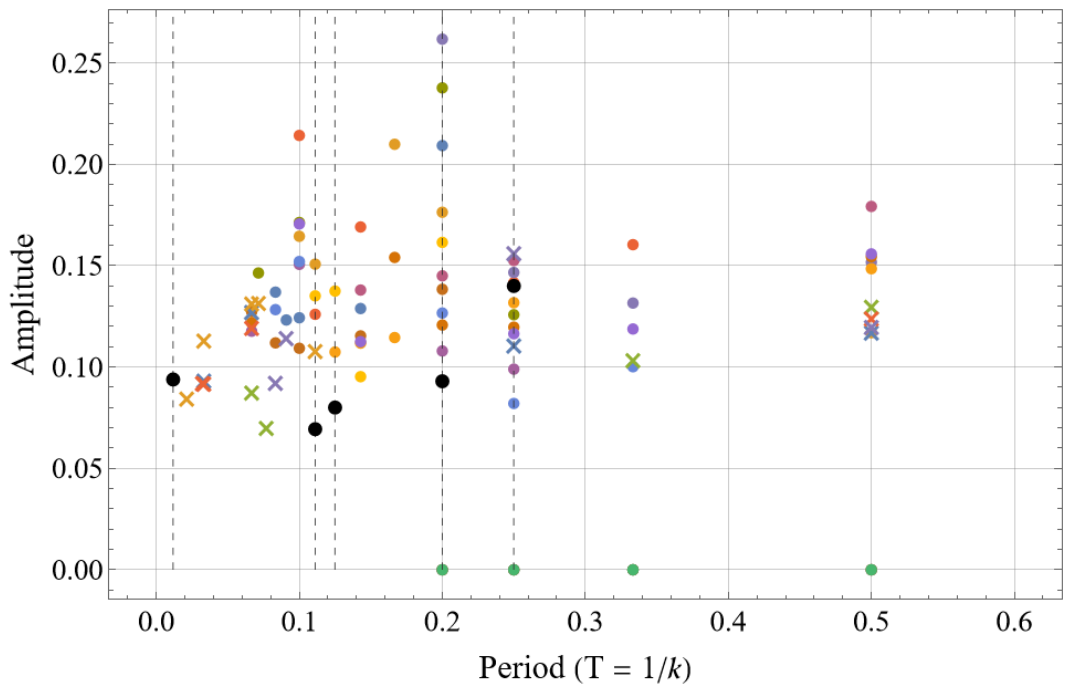
The corresponding Fourier response of the clustered configuration is shown in Figure 6.

3. Application of Fourier Analysis to Engineering Pictures

3.1. Sample Materials and Methods

A cast aluminum matrix composite (A339 alloy) reinforced with SiC particles (average size: 15 µm, volume fraction: 10%) was used as a model material for the analysis. The matrix alloy composition and detailed material characteristics are reported elsewhere [17] The material was prepared as 4 mm thick plates sectioned from an ingot. Friction Stir Processing (FSP) was performed along the casting direction using standard processing conditions (rotational speed: 900 rpm, traverse speed: 355 mm × min 1 ) and a conventional threaded tool. All processing was conducted at room temperature. Further details of the FSW/FSP methodology can be found in the literature [10,11,14].
Microstructural analysis was performed on cross-sections perpendicular to the processed surface. Scanning electron microscopy (SEM) was carried out using a JEOL JSM-6610LV microscope (JEOL Ltd., Tokyo, Japan) equipped with an energy-dispersive X-ray spectroscopy (EDS) system operated using AZtec software, version 6.3 (Oxford Instruments NanoAnalysis, High Wycombe, UK). The analyzed surfaces were prepared using standard metallographic procedures, including mechanical grinding with SiC papers of progressively finer grit, followed by polishing with diamond suspensions. Observations were carried out on unetched specimens to preserve the contrast between the matrix and reinforcing particles https://nano.oxinst.com/products/aztec/aztec-6-3 (accessed on 7 June 2026).
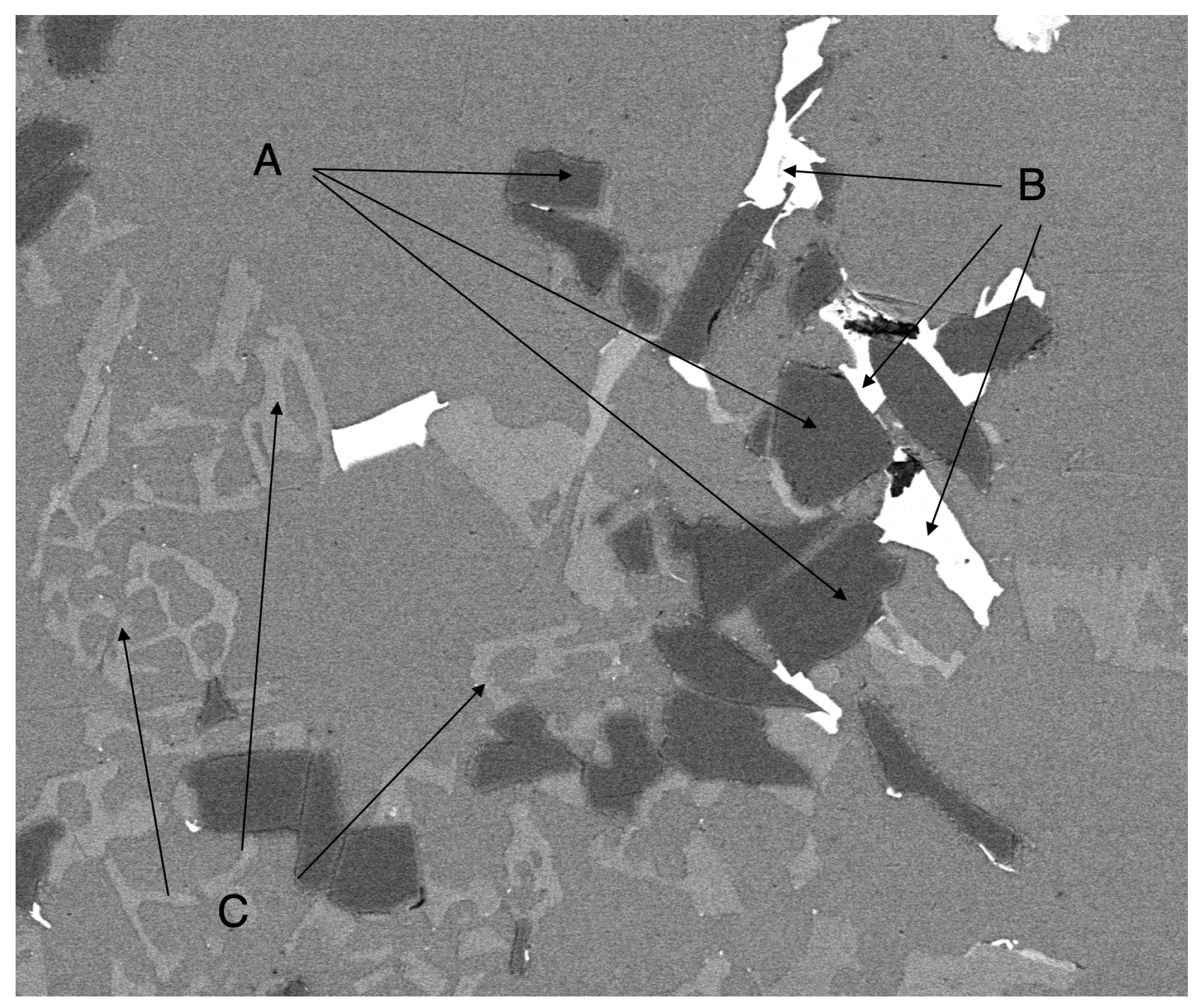
Three primary phases are identified in the model composite using microscopy: the SiC reinforcing phase (dark gray), the Al4Cu8.5Ni0.5 phase (bright), and a Chinese-script-type intermetallic phase (light gray) [46], as indicated in Figure 7.
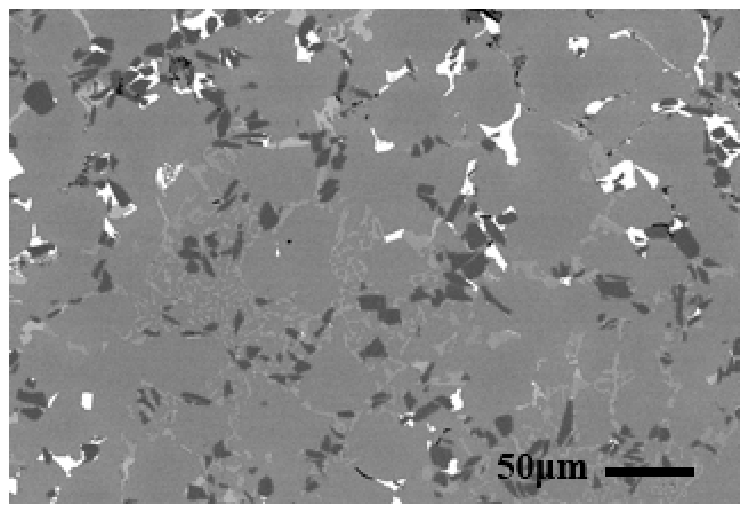
Microstructures of selected regions of the composite in the as-cast is shown in Figure 8.

3.2. Initial Configuration

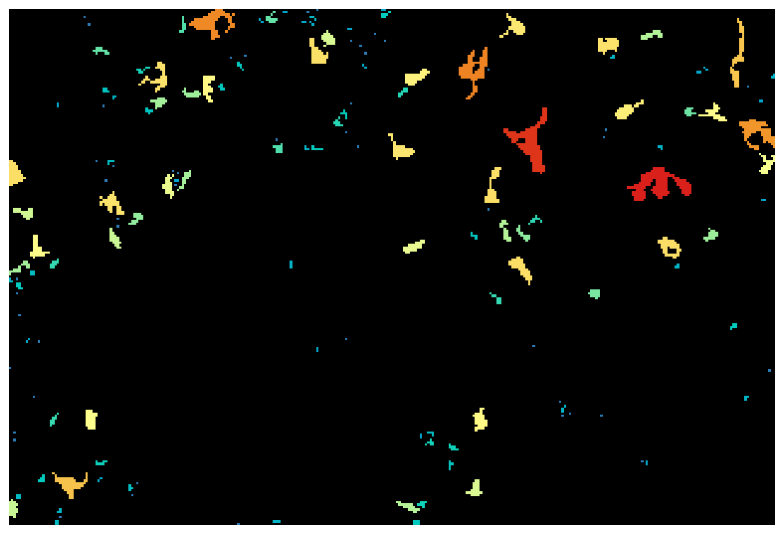
For further analysis, the phase denoted in Figure 7 as phase (B) Al4Cu8.5Ni0.5 is selected due to its good distinguishability in the SEM micrographs and its suitability for reliable image segmentation and quantitative characterization. In comparison with the remaining phases, phase B provided the most consistent contrast and morphology for tracking the microstructural changes induced by the Friction Stir Processing (FSP) operation, including particle fragmentation and spatial redistribution within the processed zone. Consequently, all subsequent quantitative analyses presented in this work were performed exclusively for phase B. The remaining phases, denoted as A and C, were not included in the present study to maintain methodological consistency and ensure reproducibility of the image-analysis procedure. The color-labeled segmented image of the selected as-cast region is shown in Figure 9.
The statistical characteristics of the detected fragments are summarized in Table 1. The analyzed image has dimensions of 5120 × 3840 px to give the beginning data for pixels 19.6 × 10 6 on the pictures. corresponding to approximately 421 × 284 μ m in physical units. The area fraction occupied by fragments is relatively low (≈0.032), indicating a sparse distribution of inclusions.
A total of 72 fragments were identified after applying the minimum-area threshold. The SEM image of the as-cast structure was segmented using color-based binarization with a selected threshold value. After thresholding, isolated objects smaller than five pixels, corresponding to ∼8.6 μ m 2 , were removed from the binary mask. This minimum-area threshold was selected to suppress isolated noise pixels and polishing/contrast artifacts while retaining physically meaningful fragments. The same thresholding and filtering protocol was applied after calibration to physical units. The mean fragment area was 51.5 μ m 2 , while the median area was 32.9 μ m 2 . This difference indicates a right-skewed distribution, where many small fragments coexist with a smaller number of larger inclusions. The high coefficient of variation, C V 1.1 , confirms strong dispersion in fragment size and the heterogeneous character of the as-cast microstructure.
The interquartile range (IQR) further highlights variability, with values ranging from Q1 = 13.4 μ m2 to Q3 = 67.7 μ m2. The presence of large fragments is evidenced by the maximum area (304.1 μ m2), which is significantly higher than the mean.
The fragmentation index (≈2.42) indicates a moderate degree of fragmentation, reflecting the presence of both small particles and several larger inclusions contributing to the overall structure.
The segmented area fraction reported here should not be interpreted as a direct stereological measurement of the nominal 10 vol.% SiC content. The nominal value refers to the bulk composite composition, whereas the image-analysis value corresponds only to fragments detected in the selected SEM field of view after thresholding and minimum-area filtering. Fine particles below the detection threshold, particles with insufficient contrast, overlap with other phases, and local field-of-view heterogeneity may all reduce the measured segmented fraction. Therefore, the reported area fractions are used as local comparative descriptors of the analyzed regions rather than as absolute measurements of the total reinforcement volume fraction.
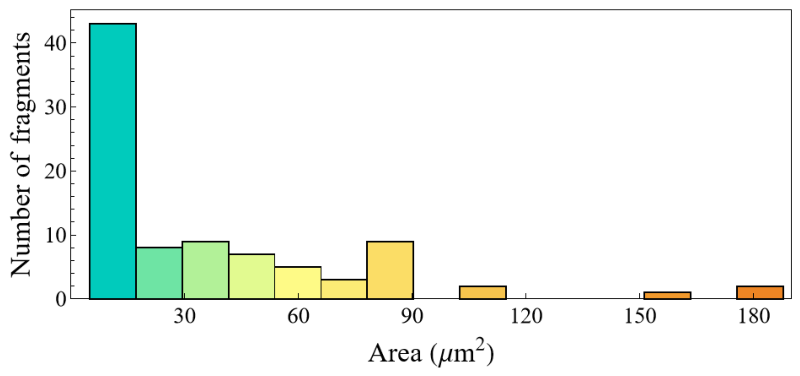
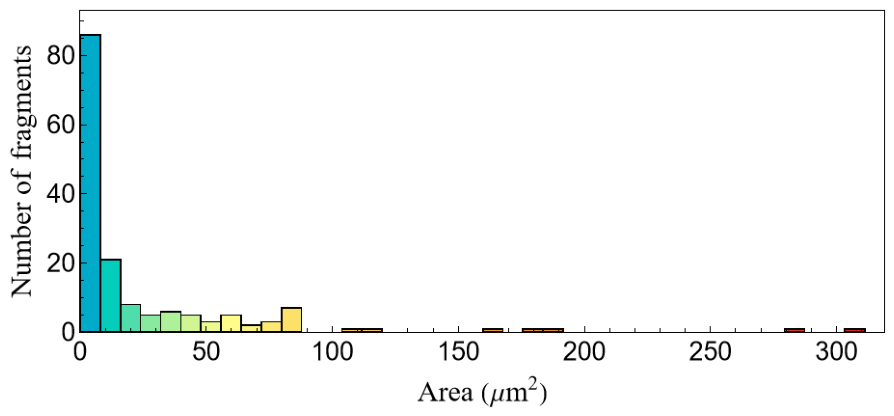
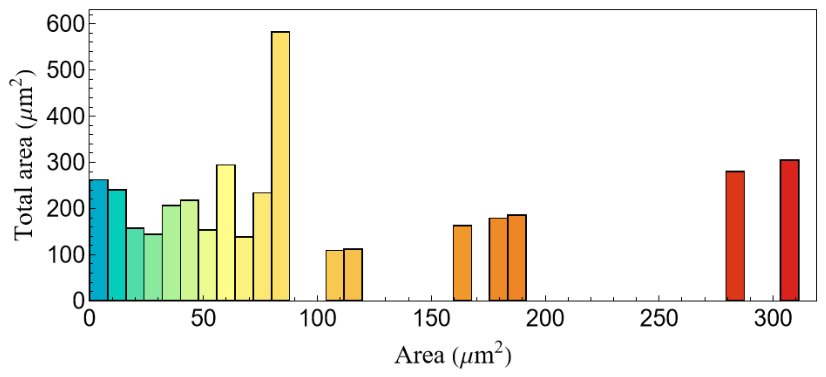
The area distribution presented in Figure 10 reveals a pronounced right-skewed behavior, indicating a heterogeneous microstructure. Most fragments are small, while a limited number of larger inclusions form a long tail in the distribution. This asymmetry is consistent with the statistical descriptors reported in Table 1. Such a distribution is characteristic of fragmented or clustered systems, where particle formation is governed by non-uniform growth or aggregation processes. The fragment-size distributions for the sample are shown in Figure 10 and Figure 11. The count-based histogram (Figure 10) exhibits a strongly right-skewed distribution, indicating a highly heterogeneous microstructure. The majority of fragments are small, primarily below 40 μ m2, while a limited number of larger inclusions extend the distribution tail up to approximately 300 μ m2.
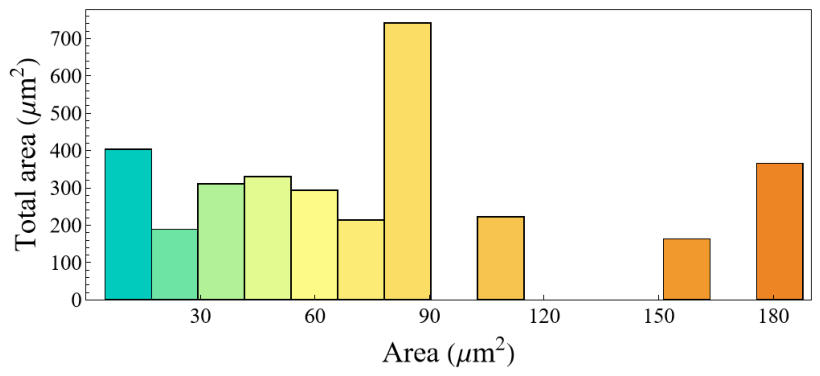
In contrast, the area-weighted histogram in Figure 11 reveals that larger fragments, although less frequent, contribute significantly to the total area. This is clearly observed in the higher area intervals, where the total area increases despite the low number of fragments.
These results highlight a key structural feature of the system: small fragments dominate the number distribution, whereas larger inclusions play a major role in determining the overall area contribution. This behavior further supports the broad, right-skewed fragment-size distribution described above. The fragment-size distributions over the full range are presented in Figure 12 and Figure 13. The count-based histogram (Figure 12) demonstrates a strongly right-skewed distribution, where the vast majority of fragments are concentrated at small sizes (below approximately 40 μ m2), while only a few large fragments extend the distribution to values exceeding 300 μ m2.
In contrast, the area-weighted histogram in Figure 13 reveals that large fragments, despite their low frequency, contribute disproportionately to the total area of the system. This is clearly observed in the high-area region (above approximately 90 μ m2), where a small number of fragments accounts for a significant portion of the total area.
These observations confirm that the as-cast structure contains many small fragments together with a small number of large inclusions.

3.2.1. One-Dimensional Fourier Analysis

The one-dimensional Fourier analysis is performed to identify the dominant spatial periodicities of the binary microstructure. For this purpose, an averaged one-dimensional signal is constructed from the processed image, which reduces local noise and enhances the principal structural features.
Table 2 presents the dominant peaks of the one-dimensional Fourier magnitude spectrum. Each row corresponds to a dominant spectral component after removing the zero-frequency (DC) component. Only the positive-frequency part of the discrete Fourier spectrum is considered, in order to avoid duplicate mirror peaks associated with negative frequencies.
The column k denotes the Fourier index, while | F | represents the magnitude of the corresponding spectral component. The associated spatial periods are given in μ m, obtained using the image calibration.
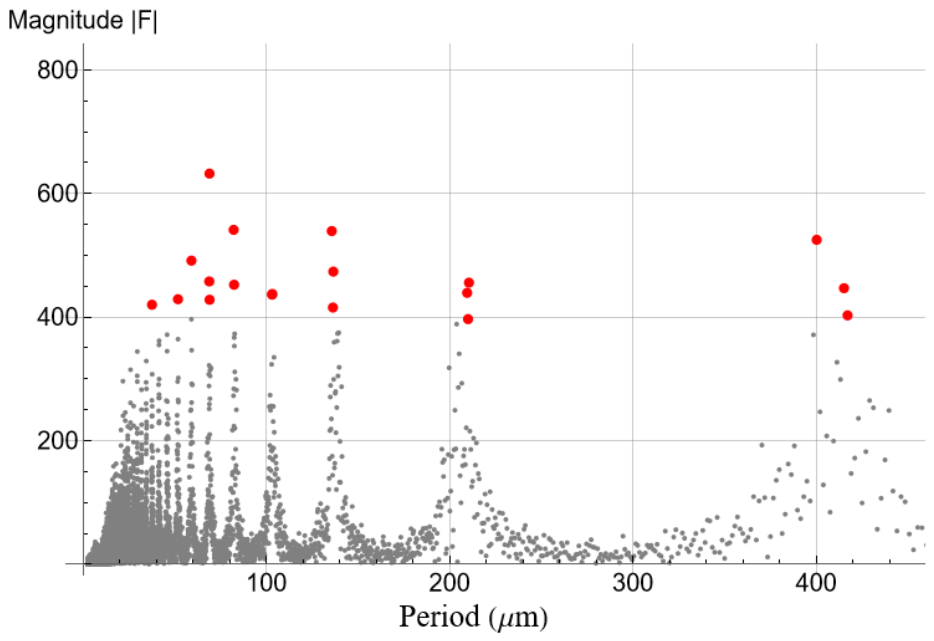
The results show that several dominant periodic components are present in the structure. The characteristic spatial periods are mainly grouped around approximately 37– 52 μ m, 59– 69 μ m, 82 μ m, 103 μ m, 136 μ m, 210 μ m, and 400– 417 μ m. These peaks indicate that the microstructure does not contain a single dominant spacing, but rather exhibits a multi-scale spatial organization.
The presence of several significant peaks confirms the multi-scale nature of the microstructure, consistent with the observations obtained from both the histogram analysis and the two-dimensional Fourier spectrum.
Figure 14 shows the Fourier magnitude spectrum | F | as a function of the spatial period (in μ m), obtained by converting pixel units into physical units using the image calibration. The dominant peaks in the spectrum are highlighted by red markers and correspond to characteristic length scales of the structure.
The results reveal several pronounced periodic components, indicating a multi-scale organization of the material. In particular, significant peaks are observed at smaller and intermediate periods around 40– 70 μ m, 80– 140 μ m, and 200– 210 μ m. Additional dominant components appear at larger scales around 400– 420 μ m, suggesting the presence of larger-scale clustering effects within the composite.

3.2.2. Two-Dimensional Fourier Analysis

The two-dimensional Fourier analysis is performed to investigate the spatial organization and anisotropy of the binary microstructure. In contrast to the one-dimensional approach, the 2D Fourier transform provides information about periodicities in all directions of the image.
Table 3 summarizes the dominant peaks of the two-dimensional Fourier spectrum. Each peak corresponds to a local maximum of the Fourier magnitude | F | , identified in the frequency domain after centering the spectrum.
The columns ( k x , k y ) represent the Fourier indices, which indicate the direction and orientation of the corresponding spatial periodicity. The associated spatial periods are provided in physical units ( μ m), obtained using the image calibration.
The results reveal several dominant periodic components with different orientations, confirming that the microstructure exhibits anisotropic and multi-directional spatial organization. In particular, the presence of peaks at comparable magnitudes but different ( k x , k y ) values indicates that similar characteristic length scales occur along multiple directions.
The identified spatial periods range from fine-scale structures (approximately 25– 60 μ m) to larger features on the order of 100– 400 μ m. This confirms the multi-scale nature of the microstructure, consistent with the observations from the one-dimensional Fourier analysis and the statistical characterization of fragment sizes.
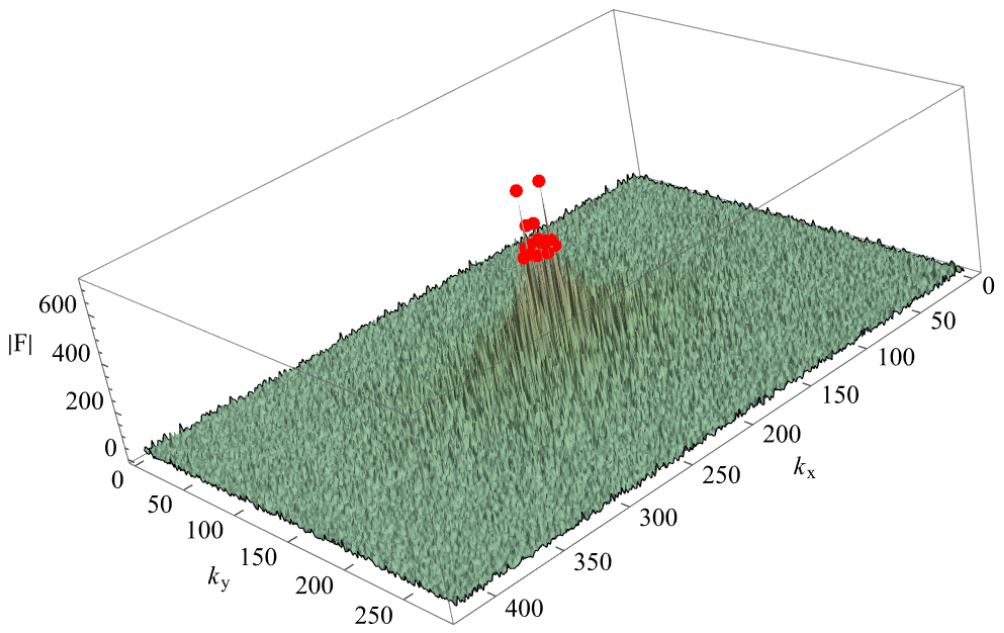
Figure 15 presents the three-dimensional Fourier magnitude spectrum | F | of the processed image. The horizontal axes correspond to the Fourier coordinates k x and k y , while the vertical axis represents the magnitude of the transform. The dominant spectral peaks are highlighted by red markers.
The distribution of these peaks reveals the presence of characteristic spatial frequencies associated with the microstructure. Peaks located near the center correspond to low-frequency components, which describe large-scale structural features. Peaks further from the center indicate higher-frequency components related to finer spatial details.
The symmetry of the spectrum reflects the real-valued nature of the original image, while the arrangement of the peaks provides insight into the anisotropy and directional ordering of the composite. The identified dominant frequencies can be directly related to the characteristic spatial periods discussed in the one-dimensional analysis.

3.3. The Configuration After Processing

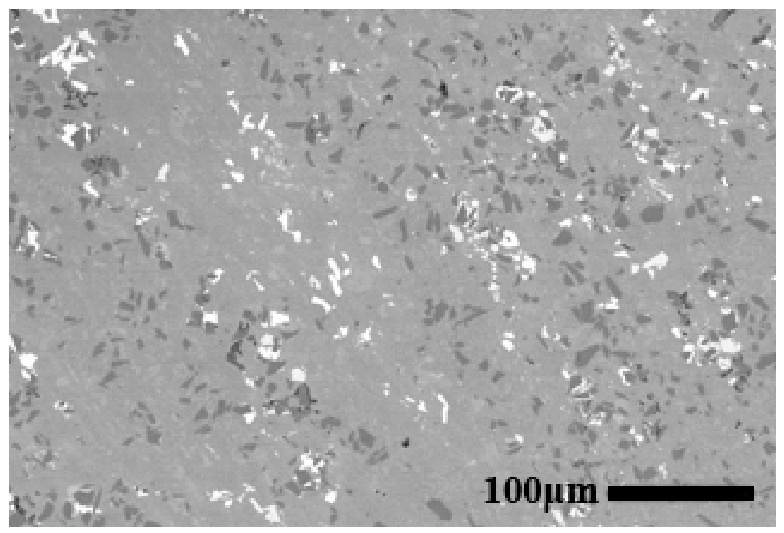
The representative microstructure of the FSP-modified composite selected for subsequent image segmentation, statistical characterization, and Fourier analysis is shown in Figure 16.
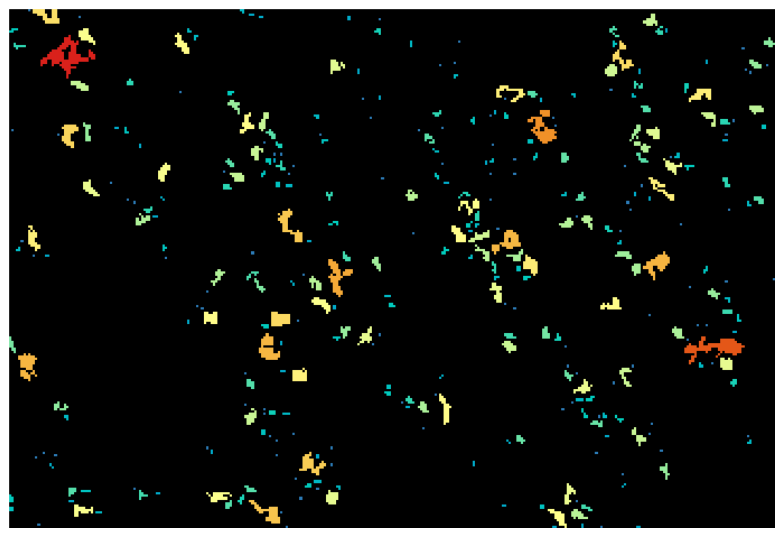
The corresponding segmented image obtained from the FSP-modified microstructure in Figure 16 is shown in Figure 17. This segmented image was used for fragment identification and subsequent quantitative analysis.
The statistical characteristics of the detected fragments are summarized in Table 4. The analyzed image has dimensions of 5120 × 3840 px to give the beginning data for pixels 19.6 × 10 6 on the pictures corresponding to approximately 550 × 372   μ m 2 . The area fraction occupied by fragments is relatively low (≈0.044), indicating a sparse distribution of inclusions.
A total of 147 fragments were identified after applying the minimum-area threshold. The SEM image of the FSP-modified structure was segmented using color-based binarization with a selected threshold value. After thresholding, isolated objects smaller than five pixels, corresponding to ∼14.9 μ m 2 , were removed from the binary mask. This minimum-area threshold was selected to suppress isolated noise pixels and polishing/contrast artefacts while retaining physically meaningful fragments. The same thresholding and filtering protocol was applied after calibration to physical units. The mean fragment area was 56.1 μ m 2 , while the median area was 41.3 μ m 2 . The higher mean value reflects the influence of a small number of large fragments and confirms the right-skewed nature of the distribution. The relatively high coefficient of variation, C V 0.96 , indicates substantial dispersion in fragment size and shows that the FSP-modified structure remains heterogeneous.
The interquartile range (IQR) further highlights variability, with values ranging from Q1 = 22.3 μ m2 to Q3 = 68.7 μ m2. The presence of large fragments is evidenced by the maximum area (406.1 μ m2), which is significantly higher than the mean.
The fragmentation index (≈7.78) indicates a relatively high degree of fragmentation, reflecting the presence of many small particles rather than a few large clusters.
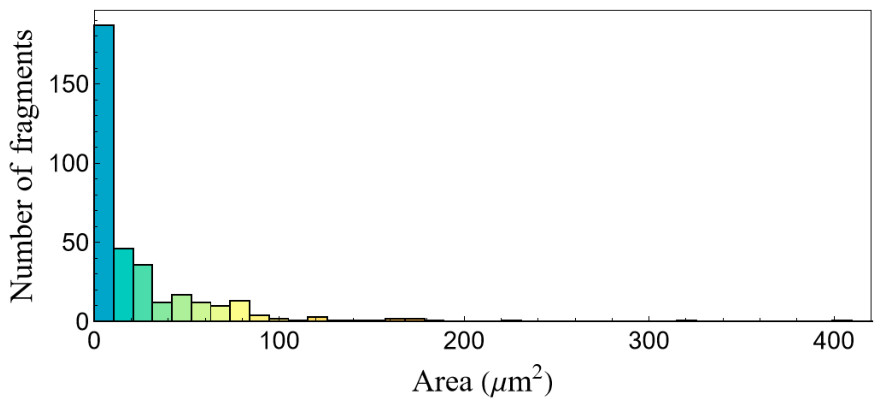
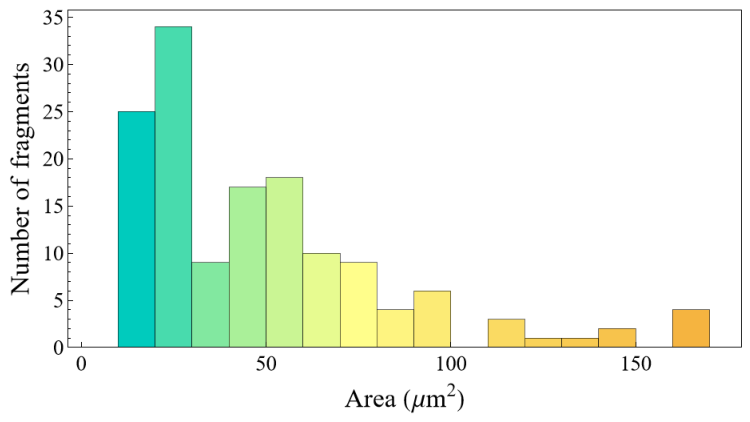
The area distribution presented in Figure 18 exhibits a pronounced right-skewed behavior, indicating a heterogeneous microstructure. The majority of fragments are small, while a limited number of larger inclusions form a long tail in the distribution. This asymmetry is consistent with the broad size distribution summarized in Table 4. Such a distribution is characteristic of fragmented or clustered systems, where particle formation is governed by non-uniform growth or aggregation processes.
The distribution of fragment areas over the analyzed range is further illustrated in Figure 19, based on the segmented structure shown in Figure 17. The histogram reveals a strongly right-skewed distribution, where the majority of fragments are concentrated in the low-area range below approximately 60 μ m 2 , while only a small number of larger fragments extend toward higher values. Colors correspond to fragment-size intervals and are used only for visual distinction.
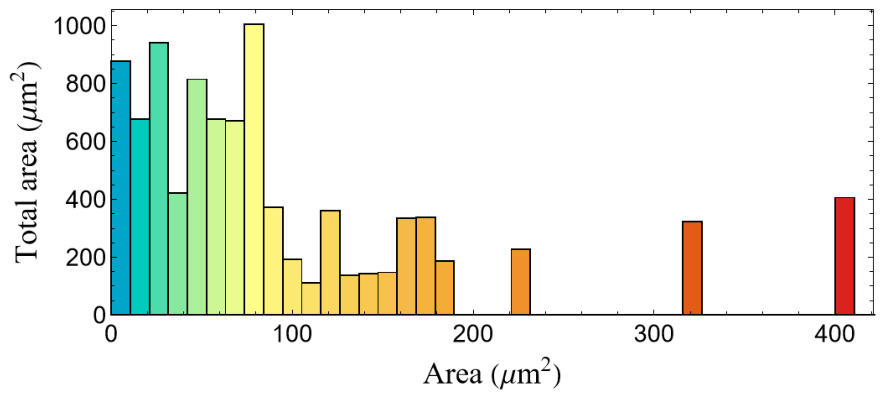
To further analyze the contribution of fragments to the overall structure, an area-weighted distribution is shown in Figure 20. In this histogram, the vertical axis represents the total area of fragments within each size interval, rather than their number.
This representation provides a complementary perspective. While small fragments dominate in number, their contribution to the total area is limited. In contrast, fragments of intermediate and large sizes, although less frequent, contribute significantly to the overall area and form noticeable peaks in the area-weighted distribution.
These observations confirm a broad, right-skewed fragment-size distribution. The large maximum area relative to the mean further indicates the presence of rare large fragments.
The same segmentation and filtering parameters are applied to both the as-cast and FSP conditions. Therefore, the observed increase in particle count and segmented area fraction after FSP should not be interpreted as an increase in the total amount of the analyzed phase. Instead, the increase reflects fragmentation and redistribution of the phase within the analyzed fields of view, leading to a larger number of distinguishable objects detected during image analysis.
Overall, the visual analysis in Figure 17, Figure 18, Figure 19 and Figure 20, together with the quantitative results reported in Table 4, confirms that the structure is dominated by numerous small fragments, while larger inclusions are rare but play an important role in determining the overall heterogeneity of the system. This distinction between number-based and area-based representations is particularly important for composite materials, where larger inclusions may have a dominant influence on effective properties despite their low number density.
Thus, the system is characterized by a large population of small fragments that dominate the number distribution, while a relatively small number of large fragments plays a key role in determining the overall area distribution.
Table 5 presents the dominant peaks of the one-dimensional Fourier spectrum for the processed configuration. Each row corresponds to a dominant component of the Fourier magnitude | F | , identified after removing the zero-frequency (DC) component. Only the positive-frequency part of the discrete Fourier spectrum is considered, in order to avoid duplicate mirror peaks associated with negative frequencies.
The column k denotes the Fourier index, while | F | represents the magnitude of the corresponding spectral component.
Overall, the presence of multiple significant peaks confirms the multi-scale nature of the microstructure, consistent with the statistical and spatial analyses.
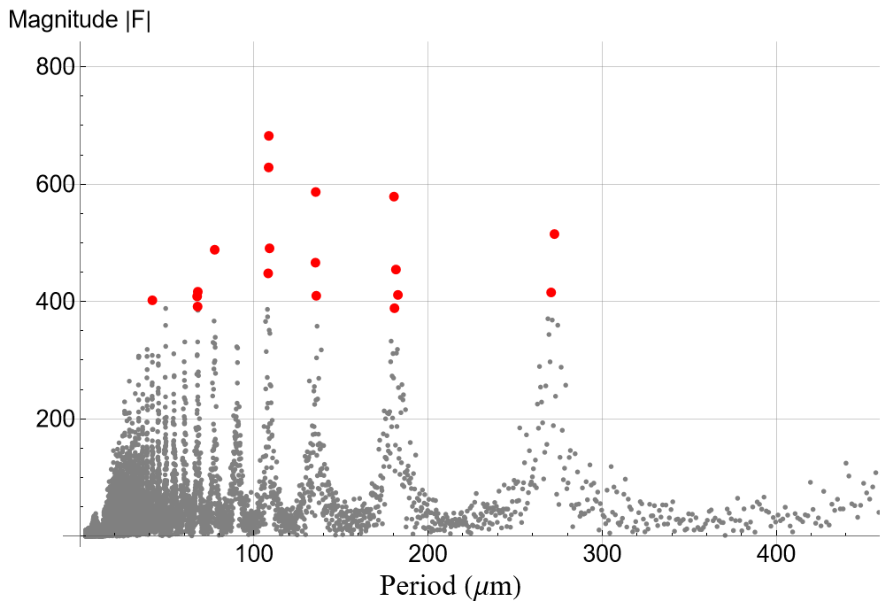
Figure 21 shows the one-dimensional Fourier magnitude spectrum | F | of the processed configuration as a function of the spatial period (in μ m). The dominant peaks, highlighted by red markers, correspond to the characteristic spatial scales present in the microstructure.
Several pronounced periodic components are observed. In particular, the strongest peaks are concentrated around periods of approximately 108 μ m, 135 μ m, and 180–183 μ m. Additional significant components are observed near 67–78 μ m, 270–273 μ m, and 534–539 μ m. These peaks indicate the presence of several characteristic spatial scales and confirm the multi-scale organization of the processed microstructure.
Overall, the spectrum confirms the presence of a multi-scale organization, with characteristic length scales ranging from approximately 67– 78 μ m to larger-scale components around 534– 539 μ m. This behavior is consistent with the statistical results and the two-dimensional Fourier analysis.
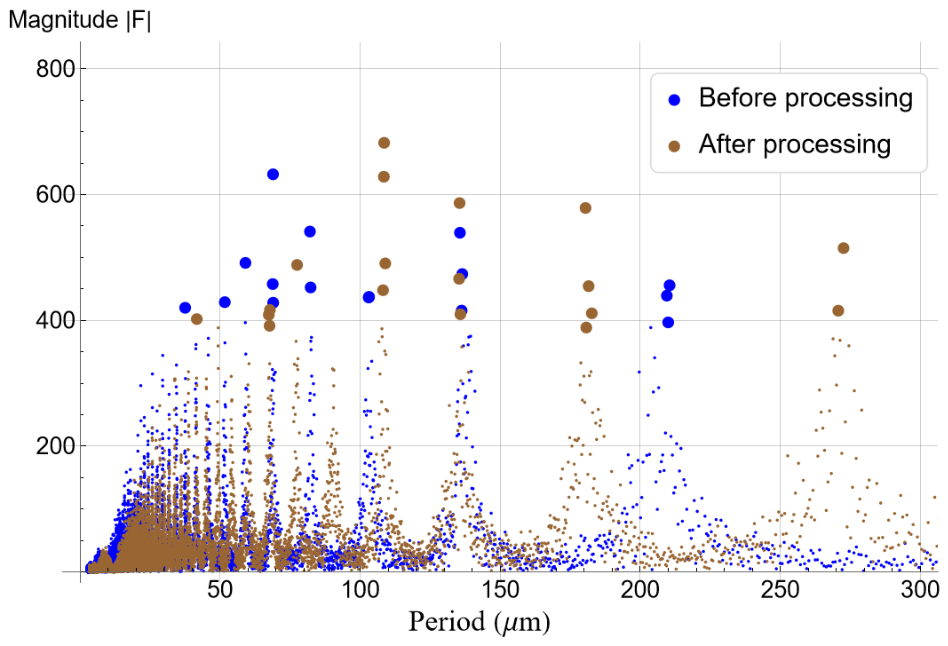
The comparison of the Fourier periods before and after processing is shown in Figure 22.

4. Discussion

The observed phenomena of agglomeration, segregation, and non-uniform inclusion distributions are consistent with prior reports, underscoring the limitations imposed by solidification dynamics [47,48]. While post-processing techniques such as Friction Stir Processing have demonstrated significant potential in refining microstructures and improving phase homogeneity, their effectiveness remains constrained by the absence of robust quantitative descriptors capable of capturing stochastic features of inclusion distributions.
The simulations and experimental validation confirm that Fourier-based approaches can reveal subtle ordering tendencies otherwise obscured in conventional statistical analyses. This capability is particularly relevant for bridging the gap between empirical observations and predictive modeling, as it enables the formulation of parametric relationships that link processing parameters to microstructural outcomes.
In the present paper, we demonstrate that the Fourier transform is capable of uncovering hidden stochastic periodicities within two theoretically simulated structural models of composites. The establishment of this theoretical basis is of fundamental importance, as it provides a rigorous justification for the Windows Washing method [26] in the context of simulated systems. By first validating the method through controlled theoretical analysis, we demonstrate that its subsequent application to real engineering structures rests on a sound and scientifically substantiated foundation.
Nevertheless, certain limitations must be acknowledged. The Fourier transform framework is applied to the concentration distribution, not to the distribution of structural sums [49,50]. Furthermore, the stochastic nature of particle distributions implies that deterministic predictions remain challenging, necessitating probabilistic approaches for comprehensive modeling.
The computation of effective constants relies primarily on the underlying concentration distribution. However, truly accurate formulations must incorporate multi-point correlation functions, which capture higher-order structural interactions. Such formulations have been derived using an alternative, significantly more efficient analytical–numerical approach based on structural sums [39], thereby avoiding the otherwise enormous, and practically infeasible, task of evaluating high-order multiple integrals of correlation functions.
Future research should therefore focus on integrating Fourier-based descriptors with advanced computational models and machine learning techniques [51,52] to further enhance predictive accuracy and support the optimization of processing strategies [41].

5. Conclusions

This study demonstrates that discrete Fourier transform analysis of concentration distribution f ( x ) offers a rigorous and versatile tool for characterizing stochastic inclusion distributions in cast metal matrix composites. By uncovering hidden periodicity and extending the Windows Washing method to heterogeneous systems, the proposed framework advances the quantitative description of microstructural evolution. The findings provide a foundation for improved predictive models, facilitating the optimization of fabrication routes and post-processing techniques such as Friction Stir Processing. Ultimately, this approach contributes to the broader goal of tailoring microstructures to achieve desired performance in composite materials, bridging the gap between experimental practice and theoretical modeling.
The role of the simulations is not to reproduce the experimental microstructure exactly, but to establish how different types of spatial organization appear in Fourier space. The uniform hard-core model represents a statistically homogeneous reference state, whereas the clustered model represents a structure with controlled local density fluctuations. The experimental spectra are then interpreted using these reference patterns. Peaks at larger spatial periods indicate mesoscopic heterogeneity or clustering, while peaks at shorter periods reflect local fragment spacing. In this way, the simulation section provides the interpretive basis for the experimental Fourier analysis.
The main benefit and contribution of the present work is the development and validation of a methodology for the quantitative characterization of complex and heterogeneous microstructures in composite materials modified by Friction Stir Processing. The proposed approach enables the analysis not only of conventional stereological parameters, but also of phase spatial organization, local heterogeneity, particle fragmentation, and morphology changes induced by the FSP process.

Author Contributions

Conceptualization, V.M. and P.K.; methodology, Z.Z.; software, A.S.; validation, A.S.; formal analysis, Z.Z.; investigation, P.K. and Z.Z.; data curation, P.K. and A.S.; writing—original draft, P.K.; writing—review and editing, Z.Z. and V.M.; visualization, A.S.; supervision, V.M.; project administration, Z.Z. and V.M. All authors have read and agreed to the published version of the manuscript.

Funding

This research is funded by the Science Committee of the Ministry of Science and Higher Education of the Republic of Kazakhstan (Grant No. AP23486576).

Data Availability Statement

Data are contained within the article.

Acknowledgments

Pawel Kurtyka carried out this research within the framework of a research fellowship at Cracow University of Technology, Faculty of Computer Science and Mathematics.

Conflicts of Interest

Author Pawel Kurtyka was employed by the company Innerco Sp. z o.o. The remaining authors declare that the research was conducted in the absence of any commercial or financial relationships that could be construed as a potential conflict of interest.

Abbreviations

The following abbreviations are used in this manuscript:
FSPFriction Stir Processing
SPDSevere Plastic Deformation
FFTFast Fourier Transform
DFTDiscrete Fourier Transform
SEMScanning Ewlectron microscopy

References

  1. Shangguan, D.; Ahuja, S.; Stefanescu, D.M. An Analytical Model for the Interaction between an Insoluble Particle and an Advancing Solid/Liquid Interface. Metall. Trans. A 1992, 23, 669–680. [Google Scholar] [CrossRef]
  2. Zhao, K.; Li, X.; Liu, X.; Guo, E.; Kang, H.; Hao, Z.; Li, J.; Zhang, Y.; Chen, Z.; Wang, T. Cavitation-Induced Particle Engulfment via Enhancing Particle-Interface Interaction in Solidification. Ultrason. Sonochem. 2024, 103, 106801. [Google Scholar] [CrossRef] [PubMed]
  3. Burbelko, A.; Kurtyka, P.; Olejnik, E.; Chulist, R.; Maziarz, W. Cellular Automaton–Active Brownian Motion based Modeling of Nanoparticles Interaction with Solidification Front. SSRN Electron. J. 2026; under review. [CrossRef]
  4. Fras, E.; Olejnik, E. Interaction between solidification front and aliens phase particles. Arch. Metall. Mater. 2008, 53, 695–702. [Google Scholar]
  5. Long, W.; Zhou, J.; Hu, X.; Liu, S.; Jiang, W. Effect of In Situ Synthesized Al2O3 and TiC on the Microstructure and Properties of 6061 Aluminum Matrix Composites. Materials 2026, 19, 308. [Google Scholar] [CrossRef]
  6. Xie, H.; Cao, Y. Effect of Nano- and Submicron SiC on the Al Dendrite Size and Mechanical Strength of SiC/A356 Composites. J. Mater. Eng. Perform. 2025, 34, 13990–14004. [Google Scholar] [CrossRef]
  7. Monteiro, B.; Moreira, A.B.; Simões, S. Structure–Property Relationships of CNT–Al2O3 Nano-Reinforced Al 6061 Matrix. Metals 2026, 16, 287. [Google Scholar] [CrossRef]
  8. Shanti, N.O.; Araki, K.; Halloran, J.W. Particle Redistribution During Dendritic Solidification of Particle Suspensions. J. Am. Ceram. Soc. 2006, 89, 2444–2447. [Google Scholar] [CrossRef]
  9. Maziarz, W.; Greger, M.; Długosz, P.; Dutkiewicz, J.; Wójcik, A.; Rogal, Ł.; Stan-Głowińska, K.; Hilser, O.; Pastrnak, M.; Cizek, L.; et al. Effect of severe plastic deformation process on microstructure and mechanical properties of AlSi/SiC composite. J. Mater. Res. Technol. 2022, 17, 948–960. [Google Scholar] [CrossRef]
  10. Mishra, R.S.; Ma, Z.Y. Friction stir welding and processing. Mater. Sci. Eng. R-Rep. 2005, 50, 1–78. [Google Scholar] [CrossRef]
  11. Thomas, W.M.; Nicholas, E.D.; Needham, J.C.; Murch, M.G.; Templesmith, P.; Dawes, C.J. International Patent Application No. PCT/GB92/02203 and GB Patent Application No. 9125978.8. Great Britain Patent Application, UK, 1991. Available online: https://patents.google.com/patent/US5460317A/en (accessed on 7 June 2026).
  12. Iwaszko, J.; Sajed, M. Technological aspects of producing surface composites by friction stir processing—A review. J. Compos. Sci. 2021, 5, 323. [Google Scholar] [CrossRef]
  13. Boopathiraja, K.; Ramamoorthi, R.; Vadivel Vivek, V.; Vickram, K.; Vinodh Kumar, S.; Yuvaraj, K. Characterization and surface modification on composites by friction stir processing—A review. Mater. Today Proc. 2021, 45, 1156–1160. [Google Scholar] [CrossRef]
  14. Mroczka, K.; Dymek, S.; Pietras, A.; Węglowska, A.; Hamilton, C.; Kopyściański, M. Joining Cast Mg AZ91 and Wrought Al 6082 Through Friction Stir Welding. In Proceedings of the Friction Stir Welding and Processing XII; Hovanski, Y., Sato, Y., Upadhyay, P., Naumov, A.A., Kumar, N., Eds.; Springer: Cham, Switzerland, 2023; pp. 217–225. [Google Scholar]
  15. Ghetiya, N.D.; Bharti, S.; Patel, K.M.; Kumar, S.; Koloor, S.S.R. An insight on optimization of FSP process parameters for the preparation of AA5083/(SiC-Gr) hybrid surface composites using the response surface methodology. Compos. Adv. Mater. 2023, 32, 26349833231186162. [Google Scholar] [CrossRef]
  16. Feng, A.; Xiao, B.; Ma, Z. Effect of microstructural evolution on mechanical properties of friction stir welded AA2009/SiCp composite. Compos. Sci. Technol. 2008, 68, 2141–2148. [Google Scholar] [CrossRef]
  17. Kurtyka, P.; Rylko, N.; Tokarski, T.; Wojcicka, A.; Pietras, A. Cast aluminium matrix composites modified with using FSP process - Changing of the structure and mechanical properties. Compos. Struct. 2015, 133, 959–967. [Google Scholar] [CrossRef]
  18. Rylko, N. Representative volume element in 2D for disks and in 3D for balls. J. Mech. Mater. Struct. 2014, 9, 427–439. [Google Scholar] [CrossRef]
  19. Duhamel, P.; Vetterli, M. Fast Fourier transforms: A tutorial review and a state of the art. Signal Process. 1990, 19, 259–299. [Google Scholar] [CrossRef]
  20. Bergland, G.D. A guided tour of the fast Fourier transform. IEEE Spectr. 1969, 6, 41–52. [Google Scholar] [CrossRef]
  21. Sundararajan, D. The Discrete Fourier Transform: Theory, Algorithms and Applications; World Scientific: Singapore, 2001. [Google Scholar]
  22. Osgood, B.G. Lectures on Fourier Transform and Its Applications; SIAM: Philadelphia, PA, USA, 2019. [Google Scholar]
  23. Kittel, C.; McEuen, P. Introduction to Solid State Physics; John Wiley & Sons: Hoboken, NJ, USA, 2018. [Google Scholar]
  24. Thompson, D. The reciprocal lattice as the Fourier transform of the direct lattice. Am. J. Phys. 1996, 64, 333–334. [Google Scholar] [CrossRef]
  25. Gluzman, S.; Zhunussova, Z.; Sarvarov, A.; Mityushev, V. Protocol-Dependent Critical Exponents in Random Composites: Beyond Universality. Symmetry 2026, 18, 700. [Google Scholar] [CrossRef]
  26. Rylko, N.; Kurtyka, P.; Afanasieva, O.; Gluzman, S.; Olejnik, E.; Wojcik, A.; Maziarz, W. Windows Washing method of multiscale analysis of the in-situ nano-composites. Int. J. Eng. Sci. 2022, 176, 103699. [Google Scholar] [CrossRef]
  27. Andrianov, I.V.; Manevitch, L.I. Asymptotology: Ideas, Methods, and Applications; Springer Science & Business Media: Berlin/Heidelberg, Germany, 2002; Volume 551. [Google Scholar]
  28. Andrianov, I.; Awrejcewicz, J.; Starushenko, G. Asymptotic models and transport properties of densely packed, high-contrast fibre composites. Part I: Square lattice of circular inclusions. Compos. Struct. 2017, 179, 617–627. [Google Scholar] [CrossRef]
  29. Jikov, V.; Kozlov, S.; Oleinik, O. Homogenization of Differential Operators and Integral Functionals; Springer Science & Business Media: Berlin/Heidelberg, Germany, 2012. [Google Scholar]
  30. Gambin, B. Influence of the microstructure on the properties of elastic, piezoelectric and thermoelastic composites. IFTR Rep. 2006, 12, 2006. [Google Scholar]
  31. Telega, J. Stochastic homogenization: Convexity and nonconvexity. In Nonlinear Homogenization and Its Applications to Composites, Polycrystals and Smart Materials; Springer: Berlin/Heidelberg, Germany, 2004; pp. 305–347. [Google Scholar]
  32. Wojnar, R. Random Walk, Rayleigh-Kac’Scheme and Diffusion Equation. Rep. Math. Phys. 2013, 72, 321–332. [Google Scholar] [CrossRef]
  33. Tóth, L.F. Lagerungen in der Ebene auf der Kugel und im Raum; Springer: Berlin/Heidelberg, Germany, 2013. [Google Scholar]
  34. Kolpakov, A.; Kolpakov, A.G. Capacity and Transport in Contrast Composite Structures: Asymptotic Analysis and Applications; CRC Press: Boca Raton, FL, USA, 2009. [Google Scholar]
  35. Berlyand, L.; Kolpakov, A.G.; Novikov, A. Introduction to the Network Approximation Method for Materials Modeling; Cambridge University Press: Cambridge, UK, 2013. [Google Scholar]
  36. Andrianov, I.V.; Awrejcewicz, J.; Danishevskyy, V.V.; Markert, B. Influence of geometric and physical nonlinearities on the internal resonances of a finite continuous rod with a microstructure. J. Sound Vib. 2017, 386, 359–371. [Google Scholar] [CrossRef]
  37. Kolpakov, A.G.; Andrianov, I.V.; Rakin, S.I.; Rogerson, G.A. An asymptotic strategy to couple homogenized elastic structures. Int. J. Eng. Sci. 2018, 131, 26–39. [Google Scholar] [CrossRef]
  38. Beran, M. Statistical Continuum Theories. Trans. Soc. Rheol. 1965, 9, 339–355. [Google Scholar] [CrossRef]
  39. Gluzman, S.; Mityushev, V.; Nawalaniec, W. Computational Analysis of Structured Media; Academic Press: Cambridge, MA, USA; Elsevier: Amsterdam, The Netherland, 2018. [Google Scholar]
  40. Manevitch, L.I.; Andrianov, I.V.; Oshmyan, V.G. Mechanics of Periodically Heterogeneous Structures; Springer Science & Business Media: Berlin/Heidelberg, Germany, 2013. [Google Scholar]
  41. Czapla, R.; Drygas, P.; Gluzman, S.; Ligocki, T.; Mityushev, V. Computational Strategy for Analyzing Effective Properties of Random Composites. Part II: Elasticity. Materials 2025, 18, 5041. [Google Scholar] [CrossRef] [PubMed]
  42. Kubala, P.; Batys, P.; Barbasz, J.; Weroński, P.; Cieśla, M. Random sequential adsorption: An efficient tool for investigating the deposition of macromolecules and colloidal particles. Adv. Colloid Interface Sci. 2022, 306, 102692. [Google Scholar] [CrossRef]
  43. Cieśla, M.; Paja, G.; Ziff, R.M. Shapes for maximal coverage for two-dimensional random sequential adsorption. Phys. Chem. Chem. Phys. 2015, 17, 24376–24381. [Google Scholar] [CrossRef] [PubMed]
  44. Grafakos, L. Fourier Analysis on the Torus. In Classical Fourier Analysis; Springer: Berlin/Heidelberg, Germany, 2008; pp. 1–88. [Google Scholar]
  45. Freitag, E. Complex Analysis 2: Riemann Surfaces, Several Complex Variables, Abelian Functions, Higher Modular Functions; Springer Science & Business Media: Berlin/Heidelberg, Germany, 2011. [Google Scholar]
  46. Rylko, N.; Stawiarz, M.; Kurtyka, P.; Mityushev, V. Study of anisotropy in polydispersed 2D micro and nano-composites by Elbow and K-Means clustering methods. Acta Mater. 2024, 276, 120116. [Google Scholar] [CrossRef]
  47. Shibuta, Y. Molecular dynamics of solidification. ISIJ Int. 2024, 64, 1107–1124. [Google Scholar] [CrossRef]
  48. Mahata, A.; Zaeem, M.A.; Baskes, M.I. Understanding homogeneous nucleation in solidification of aluminum by molecular dynamics simulations. Model. Simul. Mater. Sci. Eng. 2018, 26, 025007. [Google Scholar] [CrossRef]
  49. Mityushev, V.; Drygaś, P.; Walusiak, Ł. Computational Strategy for Analyzing Effective Properties of Random Composites–Part III: Machine Learning. Materials 2025, 18, 5531. [Google Scholar] [CrossRef] [PubMed]
  50. Nawalaniec, W. Classifying and analysis of random composites using structural sums feature vector. Proc. R. Soc. A 2019, 475, 20180698. [Google Scholar] [CrossRef]
  51. Szymanska, K.; Rylko, N. Structural Investigation of Clouds. In Proceedings of the 38th ECMS International Conference on Modelling and Simulation; Grzonka, D., Rylko, N., Suchacka, G., Mityushev, V., Eds.; European Council for Modeling and Simulation: Cracow, Poland, 2024; pp. 316–320. [Google Scholar] [CrossRef]
  52. Ligocki, T. Application of Structural Sums to Study Collective Behavior of Bacteria. In Proceedings of the 38th ECMS International Conference on Modelling and Simulation; Grzonka, D., Rylko, N., Suchacka, G., Mityushev, V., Eds.; European Council for Modeling and Simulation: Cracow, Poland, 2024; pp. 304–309. [Google Scholar] [CrossRef]
Figure 1. Periodic structure and its Fourier representation: (a) regular square array of identical inclusions in the representative domain; (b) corresponding discrete Fourier magnitude spectrum showing the periodic order of the structure.
Jmmp 10 00202 g001
Figure 2. Simulation of non-overlapping uniformly distributed disks in a square RVE. The blue horizontal line corresponds to the sampling level y = 0.4 used for one-dimensional spatial signal extraction.
Jmmp 10 00202 g002
Figure 3. Fourier analysis of non-overlapping uniformly distributed disks. Dominant spectral peaks extracted from 17 individual datasets (colored circles), the combined dataset (black circles), and aggregated groups of three datasets (cross markers).
Jmmp 10 00202 g003
Figure 4. Resulting clustered configuration of non-overlapping disks in the unit square [ 0.5 , 0.5 ] 2 . Gray disks indicate the initial disk positions, orange disks indicate the transformed positions after applying the clustering transformation, dashed lines show the 5 × 5 cell partition.
Jmmp 10 00202 g004
Figure 5. Magnified fragment of the clustered configuration in the small square [ 0.1 , 0.1 ] 2 for γ = 0.15 . Gray disks indicate the initial positions, orange disks indicate the transformed positions, and black arrows show the displacement vectors directed toward the corresponding cell center.
Jmmp 10 00202 g005
Figure 6. 2D power spectrum of clustered non-overlapping disks ( γ = 0.15 ). Colored circles show the five strongest spectral peaks extracted from each of the 17 individual line-scan datasets. Black circles indicate the five dominant peaks obtained from the combined dataset, and vertical dashed lines mark their corresponding spatial periods. Cross markers indicate the dominant peaks obtained from aggregated groups of line-scan datasets.
Jmmp 10 00202 g006
Figure 7. Representative high-magnification microstructure of the model composite used for phase identification. Arrows indicate the (A) SiC reinforcement, (B) Al4Cu8.5Ni0.5 phase, and the (C) Chinese-script-type intermetallic phase.
Jmmp 10 00202 g007
Figure 8. Representative SEM BSE micrograph of the as-cast A339/SiC/10p composite used for subsequent microstructural analysis.
Jmmp 10 00202 g008
Figure 9. Color-labeled segmented image of the as-cast A339/SiC composite. The image was obtained from a binary fragment/background mask, and the displayed colors are assigned to detected fragments according to their projected area for visualization. The black background corresponds to the matrix/background phase. This segmented image is used for fragment identification and subsequent statistical and Fourier analyses.
Jmmp 10 00202 g009
Figure 10. Distribution of fragment areas in micrometer units. The histogram shows the number of fragments as a function of their area. The distribution is right-skewed, with the majority of fragments concentrated in the lower area range (approximately 10–40 μ m2), while larger fragments occur less frequently. Bar colors are used only to distinguish adjacent area intervals and do not represent different phases or additional fragment categories.
Jmmp 10 00202 g010
Figure 11. Area-weighted distribution of fragment sizes. The histogram represents the total area contributed by fragments within each size interval. Unlike the count-based histogram, larger fragments dominate the total area despite their lower frequency, highlighting their significant contribution to the overall structure. Bar colors are used only to distinguish adjacent area intervals and do not represent different phases or additional fragment categories.
Jmmp 10 00202 g011
Figure 12. Distribution of fragment areas in micrometer units (full range). The histogram shows the number of fragments as a function of their area. The distribution is strongly right-skewed, with the majority of fragments concentrated at small sizes (below ∼40 μ m2), while a small number of large fragments extend the distribution up to ∼300 μ m2. Bar colors are used only to distinguish adjacent area intervals and do not represent different phases or additional fragment categories.
Jmmp 10 00202 g012
Figure 13. Area-weighted distribution of fragment sizes over the full range. The histogram represents the total area contributed by fragments within each size interval. While small fragments dominate in number, larger fragments significantly contribute to the total area, especially in the high-size range (above ∼90 μ m2), where their influence becomes dominant. Bar colors are used only to distinguish adjacent area intervals and do not represent different phases or additional fragment categories.
Jmmp 10 00202 g013
Figure 14. One-dimensional Fourier magnitude spectrum of the processed configuration as a function of the spatial period ( μ m). The red markers indicate the dominant positive-frequency peaks. The spectrum shows characteristic periods mainly around 40– 70 μ m, 80– 140 μ m, 200– 210 μ m, and 400– 420 μ m, confirming the multi-scale organization of the microstructure.
Jmmp 10 00202 g014
Figure 15. Three-dimensional Fourier magnitude spectrum | F | of the binary microstructure. The horizontal axes correspond to the Fourier coordinates k x and k y , and the vertical axis represents the magnitude of the transform. Red markers indicate dominant spectral peaks.
Jmmp 10 00202 g015
Figure 16. Representative BSE micrograph of the FSP modified A339/SiC/10p composite used for subsequent microstructural analysis.
Jmmp 10 00202 g016
Figure 17. Color-labeled segmented image of the FSP-modified A339/SiC composite. The image is obtained from a binary fragment/background mask, and the displayed colors are assigned to detected fragments according to their projected area for visualization. The black background corresponds to the matrix/background phase. This segmented image is used for fragment identification and subsequent statistical and Fourier analyses.
Jmmp 10 00202 g017
Figure 18. Distribution of fragment areas for the FSP-modified composite in μ m 2 . The histogram shows the number of fragments as a function of fragment area.
Jmmp 10 00202 g018
Figure 19. Distribution of fragment areas for the FSP-modified composite in μ m 2 . The histogram shows the number of fragments as a function of fragment area. Colors correspond to fragment-size intervals.
Jmmp 10 00202 g019
Figure 20. Area-weighted distribution of fragment sizes for the FSP-modified composite. The histogram represents the total area of fragments within each size interval, rather than their number. Colors correspond to fragment-size intervals, consistent with the count-based distribution.
Jmmp 10 00202 g020
Figure 21. One-dimensional Fourier magnitude spectrum of the processed configuration as a function of the spatial period ( μ m). The red markers indicate the dominant positive-frequency peaks. The spectrum shows characteristic periods mainly around 67– 78 μ m, 108 μ m, 135 μ m, 180– 183 μ m, and 270– 273 μ m, confirming the multi-scale organization of the microstructure.
Jmmp 10 00202 g021
Figure 22. Comparison of periods before (blue) and after (brown) processing.
Jmmp 10 00202 g022
Table 1. Statistical characteristics of fragments in micrometer units.
QuantityValue
Image width ( μ m)421.1
Image height ( μ m)284.2
Area fraction0.032
Fragments count72
Mean area ( μ m2)51.5
Median area ( μ m2)32.9
Std area ( μ m2)56.5
CV (Std/Mean)1.1
Q1 ( μ m2)13.4
Q3 ( μ m2)67.7
IQR ( μ m2)54.3
Min area ( μ m2)8.9
Max area ( μ m2)304.1
Fragmentation index2.42
Table 2. Dominant peaks of the one-dimensional Fourier spectrum.
kMagnitude | F | Period (μm)
1295632.368.9
1087541.382.1
658539.4135.6
223525.1400.2
1511491.459.1
654473.6136.5
1297457.768.8
424455.8210.5
1084452.482.3
215446.8415.1
426439.3209.5
865437.4103.2
866436.7103.1
172642151.7
1294428.169
237742037.5
655415.6136.2
214402.9417
425396.8210
Table 3. Dominant peaks of the 2D Fourier spectrum.
Period (μm)Magnitude | F | ( k x , k y )
134.61041.1(1, 2)
421.11041.1(1, 0)
60.2729.8(7, 0)
72.5729.8(−5, 2)
43.2549(−4, −6)
31.7549(6, 8)
Table 4. Statistical characteristics of fragments obtained from the binary image in micrometer units.
Quantity Value
Image width ( μ m)550
Image height ( μ m)372
Area fraction0.044
Fragments count147
Mean area ( μ m2)56.1
Median area ( μ m2)41.3
Std area ( μ m2)54
CV (Std/Mean)0.96
Q1 ( μ m2)22.3
Q3 ( μ m2)68.7
IQR ( μ m2)46.4
Min area ( μ m2)15.2
Max area ( μ m2)406.1
Fragmentation index7.78
Table 5. Dominant peaks of the one-dimensional Fourier spectrum for the processed configuration. Only the positive-frequency part of the spectrum is considered. The table lists the Fourier index k, spectral magnitude | F | , and the corresponding spatial periods in micrometer units.
kMagnitude | F | Period (μm)
1083628.4108.5
867586.6135.5
651578.8180.5
218534.8538.9
431514.9272.6
220493.5534
1078490.6109
1516488.277.5
868466.2135.3
647454.4181.6
1086447.9108.2
1733416.667.8
434415.4270.7
643411.2182.7
865409.8135.8
1743408.767.4
281840241.7
1736391.467.7
650388.6180.7
Disclaimer/Publisher’s Note: The statements, opinions and data contained in all publications are solely those of the individual author(s) and contributor(s) and not of MDPI and/or the editor(s). MDPI and/or the editor(s) disclaim responsibility for any injury to people or property resulting from any ideas, methods, instructions or products referred to in the content.