1. Introduction
Lightweight composite materials provide high specific strength, stiffness, corrosion resistance, and tailored anisotropic properties, making them suitable for weight-critical applications [
1,
2,
3,
4,
5]. At the same time, material cost remains an important factor in structural design and material selection. Consequently, these advanced materials are widely applied in optimally designed structures across sectors such as space [
6], aerospace [
7,
8], automotive [
9,
10,
11], civil engineering [
12], and renewable energy [
13,
14,
15]. Composite sandwich structures typically consist of thin and stiff facesheets, often made from Fiber Reinforced Polymer (FRP) materials, bonded to a lightweight cellular core such as honeycomb or foam [
16].
The sandwich structure configuration separates the top and bottom facesheets with a low-density core, which significantly increases the bending rigidity while adding minimal weight and material cost [
17,
18,
19]. The core stabilizes the facesheets against local bending, transfers transverse shear loads, and maintains the geometric separation between the load-carrying facesheets. As a result, this efficient design of the sandwich construction provides high specific strength; however, it may also exhibit characteristic local failure modes, such as core shear failure, facesheet wrinkling [
20], and intra-cell or local instability [
21].
Optimization studies of FRP laminated composite sandwich structures involve maximizing the bending stiffness by the selection of facesheets and core materials, the facesheet laminate stacking sequence and the fiber angles and core thickness, while satisfying the structure failure limits. Cost is also an important design driver; for example, Carbon Fiber Reinforced Polymers (CFRPs) provide superior stiffness and strength but increase the cost, whereas Glass Fiber Reinforced Polymers (GFRPs) reduce the cost but may require a greater thickness or heavier cores to meet stiffness requirements. Similarly, honeycomb or foam cores introduce trade-offs among density, thickness, structural support, and manufacturing cost. As introduced in recent studies, the optimization of composite sandwich structures typically involves multiple conflicting objectives, mixed discrete–continuous design variables and various structural constraints related to deflection, strength, buckling, impact, vibration, and manufacturability [
22,
23,
24].
A direct exhaustive search is impractical for large FRP laminated sandwich constructions, where the design space is large. Although analytical models are computationally efficient, repeated evaluations across extensive design domains become costly when thousands of candidate designs must be assessed. The challenge becomes even greater when computations are based on high-fidelity Finite Element (FE) models. Consequently, increasing attention has been given to hybrid approaches that combine physics-based analysis with data-driven surrogate models and evolutionary optimization algorithms [
25].
In composite sandwich structure optimization, a common strategy that has evolved is to generate datasets using analytical or numerical simulations to train machine learning (ML) models [
26] to approximate the structural responses and to apply metaheuristic algorithms to identify non-dominated solutions. This approach separates expensive data generation from the exhaustive optimization loop. Recent studies have applied Genetic Algorithms (GAs) and gradient-based methods to optimize composite sandwich structures with mixed discrete–continuous variables [
27,
28,
29]. In addition, surrogate modeling techniques such as Artificial Neural Networks (ANNs) and response surface methods have been used to reduce computational cost and enable efficient exploration of high-dimensional design spaces. Among these approaches, Particle Swarm Optimization (PSO) has shown strong potential for optimizing FRP laminated sandwich structures due to its simplicity, computational efficiency, and ability to handle mixed variables and multi-objective optimization problems [
30,
31]. To enhance the search capability, a Niching Memetic Particle Swarm Optimization (NMPSO) algorithm is used. In this algorithm, multiple swarms are used to explore the design space simultaneously, and a repulsion-based niching mechanism prevents the swarm leaders from converging to the same region; meanwhile, periodic information exchange among the swarms allows leading designs to emerge [
32,
33,
34].
In this research article, a newly elaborated optimization framework is developed that integrates an ANN-based surrogated model with a Multi-Objective Niching Memetic Particle Swarm Optimization (MO-NMPSO) algorithm for designing a composite FRP laminated sandwich structure used for an aerospace application. The laminate facesheets are evaluated by Classical Laminate Plate Theory (CLPT), whereas the global structural response is computed with an orthotropic plate-based sandwich formulation that combines the equivalent bending stiffness with transverse-shear contribution [
35]. This analytical formulation is used to evaluate the structural responses for dataset generation to train the ANN surrogate. The ANN model is coupled with the MO-NMPSO algorithm to identify Pareto-optimal solutions that minimize the conflicting objectives of structural weight and material cost. The optimization model is implemented in MATLAB software (R2020a).
This research article is organized as follows:
Section 2 presents the problem definition; the investigated sandwich structure’s geometry, loading, and boundary conditions; and the investigated materials. Furthermore, the optimization problem is introduced including the design variables, design constraints and objective functions.
Section 3 introduces the analytical model formulation for the investigated sandwich structure.
Section 4 details the dataset generation using the analytical model for ANN surrogate training.
Section 5 presents the MO-NMPSO algorithm configuration and parameter selection for the investigated sandwich structure.
Section 6 discusses the results of the elaborated optimization model, including the dataset characteristics, ANN surrogate performance measures, results of the optimization and non-dominated solutions in terms of Pareto front.
Section 7 details the ANSYS Finite Element (FE) simulation model and its results, to make a comparison with the elaborated optimization model key Pareto-optimal designs. Finally,
Section 8 concludes the study by summarizing the main research findings and outlines the directions for future research.
In this research, the main contributions of the newly elaborated optimization framework are the following:
Development of an analytical formulation-based ANN surrogate for the investigated FRP sandwich panel with mixed discrete–continuous variables;
Integration of the ANN surrogate with a Multi-Objective Niching Memetic Particle Swarm Optimization algorithm for efficient exploration of the design space;
Application of this optimization procedure in the case of a composite FRP laminated sandwich panel of an aerospace application, for multi-objective optimization (weight and cost) under strength, deflection and thickness constraints;
Validation of the key optimized designs against the detailed FE simulations.
2. Model Description and Optimization Problem Formulation of the Investigated Composite Sandwich Structure
In this study, an investigation is performed into a composite sandwich structure comprising FRP laminated facesheets, specifically Carbon Fiber Reinforced Polymer (CFRP) and Glass Fiber Reinforced Polymer (GFRP) laminates, bonded to an aluminum (Al) honeycomb core. The proposed sandwich construction offers a practical balance between structural performance, weight and cost.
2.1. Geometry, Loading and Boundary Conditions of the Investigated Sandwich Structure
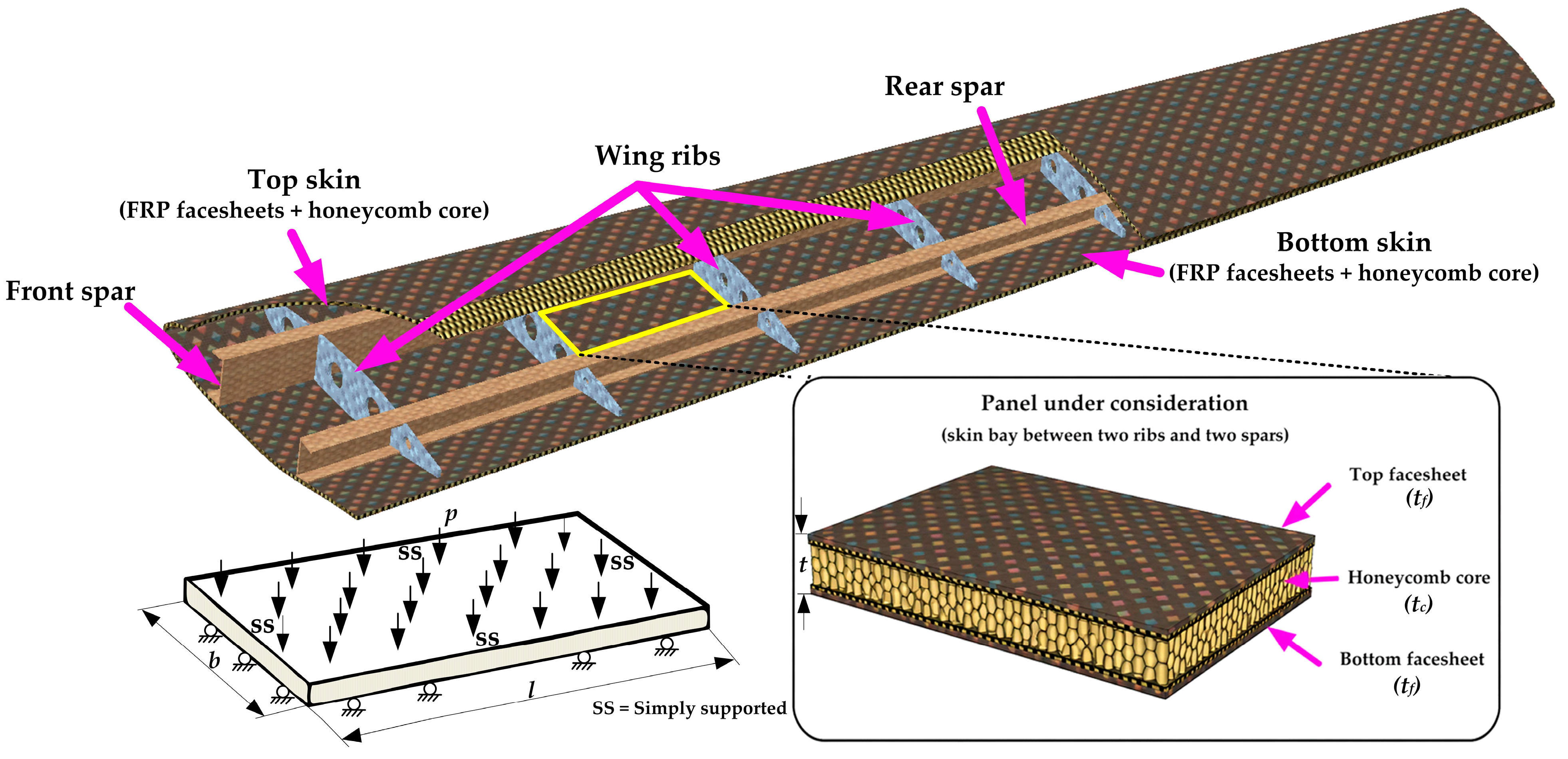
Figure 1 shows the structure of a typical two-spar composite wing for a flight vehicle. The structure of the wing consists of front and rear spares to bear the bending load, and ribs are used to carry the torsional loading of the wing. The wing top and bottom skins are made of a composite FRP laminated sandwich structure, composed of an aluminum (Al) honeycomb core and Carbon Fiber Reinforced Polymer (CFRP) facesheets.
Figure 1 also illustrates the geometry, loading and boundary conditions of the investigated sandwich construction. The wing skin of a flight vehicle is subjected to normal pressure loading under various flight conditions.
The structure under consideration is a skin bay between two wing spars and two ribs. The investigated panel length (
l) is 700 mm, and the panel width (
b) is 400 mm. For simplicity, the investigated sandwich skin panel is considered as flat due to the large radius of curvature for the wing profile and is simply supported at four edges along the length and width of the wing skin panel. The skin panel is under the application of a uniformly distributed pressure load (
p = 0.05 MPa).
Figure 1 shows that the total thickness of the sandwich panel is
t, the facesheet thickness is
tf, the core thickness is
tc, and the distance between the facesheets centers is
d; furthermore, the cell size of the honeycomb core is
c.
The total equivalent applied load (
P) is given by Equation (1).
2.2. Facesheet Material Properties and Configuration
Carbon Fiber Reinforced Polymer (CFRP) and Glass Fiber Reinforced Polymer (GFRP) materials are used for the investigated sandwich structure. The mechanical properties of the investigated materials are summarized in
Table 1.
CFRP is used due to its superior strength and stiffness characteristics, whereas a cheap and less stiff GFRP laminate is selected to reduce the material cost. The facesheets of the investigated sandwich structure consist of symmetric six-ply laminates, represented as
. The facesheet plies are aligned with the longitudinal direction (0° orientation), and the other orientation is along the width of the panel (90° orientation). The mechanical properties of the laminated FRP facesheets were calculated using Classical Laminate Plate Theory (CLPT) as discussed in
Section 3.
2.3. Honeycomb Core Material Properties
An aluminum hexagonal honeycomb is selected as a core material for the investigated sandwich structure. The selection of the Al honeycomb core is due to its relatively low cost and favorable strength-to-weight ratio. The mechanical properties of the considered Al honeycomb against six different densities are summarized in
Table 2.
For the sandwich structures, the mechanical properties of the cellular cores play a significant role and are strongly influenced by their density. An appropriate core selection helps to achieve the desired structural performance while maintaining the mechanical integrity.
2.4. Optimization Problem Formulation
The optimization problem considered in this study involves the optimal structural design of a composite sandwich panel composed of the previously mentioned composite FRP laminated facesheets and a hexagonal Al honeycomb core. The objectives of the optimization are to simultaneously minimize the total weight and the material cost of the sandwich construction while satisfying the constraints associated with the allowable stresses and maximum middle deflection.
2.4.1. Objective Functions
The main aim of the optimization problem is to minimize the total structural weight and total material cost of the investigated sandwich structure. The total structural weight comprises the combined weight of the two facesheets and the inner core. Likewise, the total cost of the sandwich structure is defined as the sum of the material costs of the two facesheets and the core. Accordingly, two objective functions for total structural weight and total cost are expressed in Equation (2).
where
denotes the total weight of the sandwich structure,
represents the total cost, and
x is the vector of the design variables. The optimization procedure minimizes both objectives simultaneously and generates a set of Pareto-optimal solutions.
A comprehensive survey was carried out to define the material cost assumptions used in this study. The cost coefficients were derived from available commercial sources and the technical literature reporting representative market prices for aerospace-grade CFRP, GFRP, and aluminum honeycomb materials [
30]. The cost of the GFRP is defined as a specific unit cost (per unit weight in kg). Accordingly, the unit costs of the CFRP and the honeycomb core are taken as 1.5 and 0.5 times the cost of GFRP, respectively.
2.4.2. Design Variables of the Optimization
In the present study, the design of the investigated sandwich structure is governed by the material parameters of the facesheets and the core. The core is characterized by its density and thickness. Six discrete core density values are considered, as detailed in
Table 2, while the core thickness is treated as a continuous variable within the range of 5–30 mm during the optimization. The facesheets are selected as symmetric 6 ply laminates, where each ply is defined by its constituent material and fiber orientation. For the facesheet laminates, a combination of the CFRP and GFRP materials is considered along with the allowable fiber orientations of
and
. Consequently, the final structural response depends on the combination of core density, core thickness, ply material and fiber orientation.
2.4.3. Design Constraints
The design feasibility of the investigated sandwich structure is governed by structural integrity and geometric compatibility requirements. The structural constraints set is defined in
Table 3. The detailed relationships for the six applied constraints are described in
Section 3.
The design constraints include four safety factors associated with the dominant failure modes of the sandwich structure. Each safety factor is defined as the ratio of allowable stress to actual stress (see
Section 3.2.6 for analytical expressions). In the present study, the design constraints are imposed to ensure that all candidate solutions satisfy the minimum strength, stiffness and thickness requirements of the structure. Specifically, the optimization is subject to limitations on the core shear strength, facesheet strength, intra-cell buckling resistance, wrinkling resistance, maximum middle deflection and total sandwich thickness.
3. Analytical Model of the Investigated Sandwich Structure
The ANN-assisted machine learning model is employed to capture the complex nonlinear response of the investigated composite sandwich structure and to provide an accurate and computationally efficient surrogate for subsequent structural optimization. To construct the database used for training the ANN surrogate, the analytical formulation of the investigated sandwich structure is developed on the basis of Classical Laminated Plate Theory (CLPT) and an orthotropic plate-based sandwich formulation [
36]. A perfect bond is assumed between the FRP laminated facesheets and the aluminum honeycomb core. Accordingly, no interfacial slip or de-bonding is considered; furthermore, full strain compatibility is maintained between the core and the facesheets.
3.1. Macro-Mechanical Analysis of the Composite Sandwich Structure
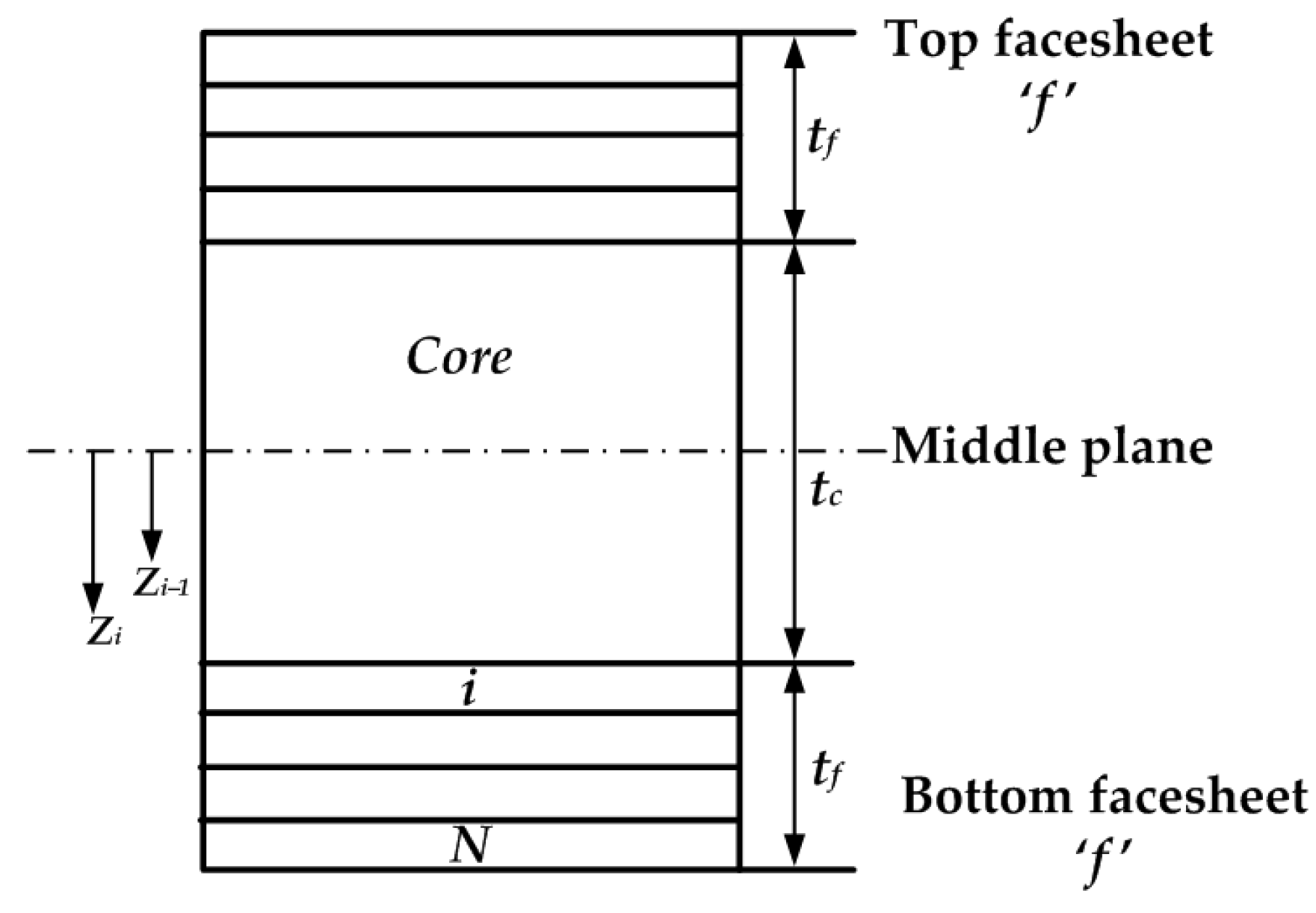
The geometry of a symmetric sandwich construction consisting of
N ply top and bottom facesheets of thickness
tf and a soft orthotropic core of thickness
tc is shown in
Figure 2. The global
z-coordinate is measured from the mid-plane of the sandwich structure, which coincides with the centerline of the core. The laminate stiffness of the facesheets is evaluated using Classical Laminated Plate Theory. Accordingly, the constitutive relations of the facesheets are expressed in terms of the
A,
B and
D stiffness matrices, which represent the in-plane, coupling and bending stiffnesses, respectively, as given in Equation (3).
where
Q is the transformed reduced stiffness matrix and is defined in terms of the material properties and orientation angles; and
is the
kth ply distance from the core centerline. By assuming thin and symmetric facesheets of the sandwich panel, the coupling matrix
B will vanish (i.e.,
B = 0). Therefore, the in-plane and bending stiffness matrices (i.e.,
A and
D matrices) of the sandwich structure are represented by Equation (4).
The effective global extensional moduli (
), shear modulus (
) and equivalent bending moduli (
,
) of the facesheets are derived from the lamination parameters by Equations (5)–(7), respectively.
where
and
.
3.2. Constitutive Analytical Relationships of the Investigated Sandwich Structure
To explore the utilization of Artificial Neural Networks for the optimization model, it was necessary to include a diverse dataset that covered the various configurations of the investigated FRP laminated sandwich structure. The mathematical expressions describing the behavior of sandwich structures subjected to the out-of-plane loading conditions are provided by the relationships in the following subsections [
37].
3.2.1. Bending Behavior of the Simply Supported Orthotropic Sandwich Plate Structure
The global response of the investigated sandwich panel is modeled by a Navier-type double-sine expansion for a rectangular orthotropic plate simply supported on all four edges and subjected to a uniformly distributed transverse pressure (
p) [
36]. This representation is appropriate because the sine-series basis satisfies the simply supported plate boundary conditions, i.e.,
At and ;
At and y ;
where
is the out-of-plane deflection, and
and
are the sandwich panel bending moments in the
x- and
y-axis, respectively. The out-of-plane deflection
can be represented by a double Fourier sine series as presented by Equation (8).
where
l is the length and
b is the width of the investigated sandwich panel. Meanwhile,
m and
n are the sine wave numbers along the
x- and
y-axis, respectively. The out-of-plane deflection is decomposed into bending and transverse shear components to reflect the characteristic response of sandwich plates, in which the facesheets primarily resist bending, while the core mainly carries the transverse shear load. The out-of-plane deflection can be expressed as the sum of the bending deflection component (
) and the transverse shear deflection component
), as given in Equation (9).
where
is the equivalent transverse shear stiffness (
is the shear deflection coefficient, and
is the core thickness);
is the structure pressure coefficient; and
,
are the model wave numbers.
For a simply supported plate subjected to uniform loading, the Navier expansion contains only odd sine terms. In the present study, the structural response is evaluated by retaining seven odd terms in each direction (
m,
n = 1, 3, …, 13), which provides a practical compromise between prediction accuracy and computational effort. Accordingly, the maximum middle deflection (δ) of the investigated structure is determined at the panel center,
, and is given by Equation (10).
The bending moment resultants at the center of the sandwich panel,
and
, are determined from the bending component of the displacement field and are given by Equation (11).
Similarly, the transverse shear resultants,
and
, are evaluated at the plate edges as given by Equation (12).
3.2.2. Core Shear Stress
The shear stress in the honeycomb core
is estimated from the larger of the two transverse shear resultants, as expressed in Equation (13).
where
is the thickness of the core.
3.2.3. Facesheet Stress
The facesheet stress (
) is estimated from the larger of the two bending moment components at the panel center and is given by Equation (14).
where
is the facesheet thickness and
d is the distance between the center of the top and bottom facesheets of the sandwich construction.
3.2.4. Facesheet Intra-Cell Buckling
This failure mode refers to local buckling of the facesheet in regions unsupported by the honeycomb cell walls. The corresponding critical stress (
is given by Equation (15).
where
,
are the effective modulus of elasticity and the Poisson’s ratio of the facesheets, respectively, calculated by CLPT [
35].
3.2.5. Facesheet Wrinkling Stress
Facesheet wrinkling stress is a local instability mode in sandwich panels, characterized by the formation of short-wavelength buckling waves in the facesheet under compression. The corresponding wrinkling stress (
) is given by Equation (16).
This phenomenon occurs on the upper facesheet, which is in compression under the given loading conditions of the investigated sandwich structure.
3.2.6. Safety Factors of Sandwich Structure
The safety factors are dimensionless indicators of the available structural margin before failure. For the investigated sandwich structure, the commonly used safety factors to assess the different failure mechanisms are the safety factor of the facesheet (
), core (
), facesheet wrinkling (
) and intra-cell buckling (
), which are represented by Equations (17)–(20), respectively.
where
is the effective yield strength of the laminated facesheet, which was determined using the Tsai–Wu failure criterion [
35] (see
Section 3.3).
3.3. Tsai–Wu Failure Criterion for Facesheet Allowable Stress
To compute a directional allowable stress for the facesheet laminate under global loading (
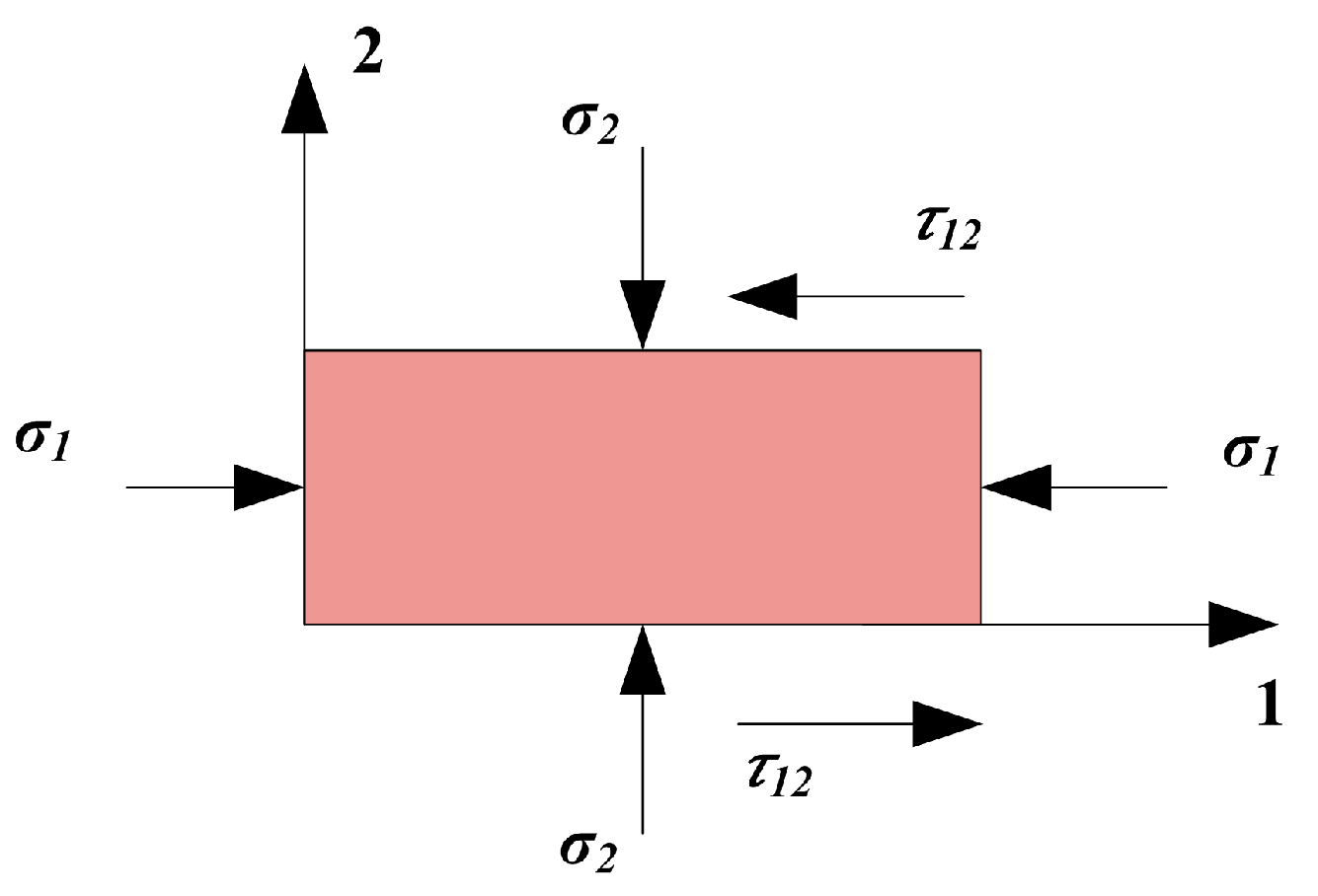
), the Tsai–Wu failure criterion was used at the ply level. The geometrical representation of a unidirectional lamina under a plane stress state is presented in
Figure 3.
The Tsai–Wu polynomial for the plane stress state is expressed in Equation (21).
where
;
;
;
;
;
.
The global unit stress applied on the structure is transformed into the local ply stress components (, , ). For each ply, the allowable stress is defined as the smaller of the two corresponding solutions of the quadratic formula. The laminate-level allowable facesheet stress, , is finally taken conservatively as the minimum allowable value among all plies.
4. ANN Surrogate Modeling of the Investigated Sandwich Structure Used for the Optimization
A random dataset of design variables was generated using Monte Carlo simulation and was subsequently utilized to compute the structural responses (objectives and constraints) using the analytical model of the investigated sandwich structure. An Artificial Neural Network-based surrogate model was trained using the generated dataset, which enables fast function evaluations during the optimization.
4.1. Dataset Generation for ANN Surrogate Using the Analytical Model
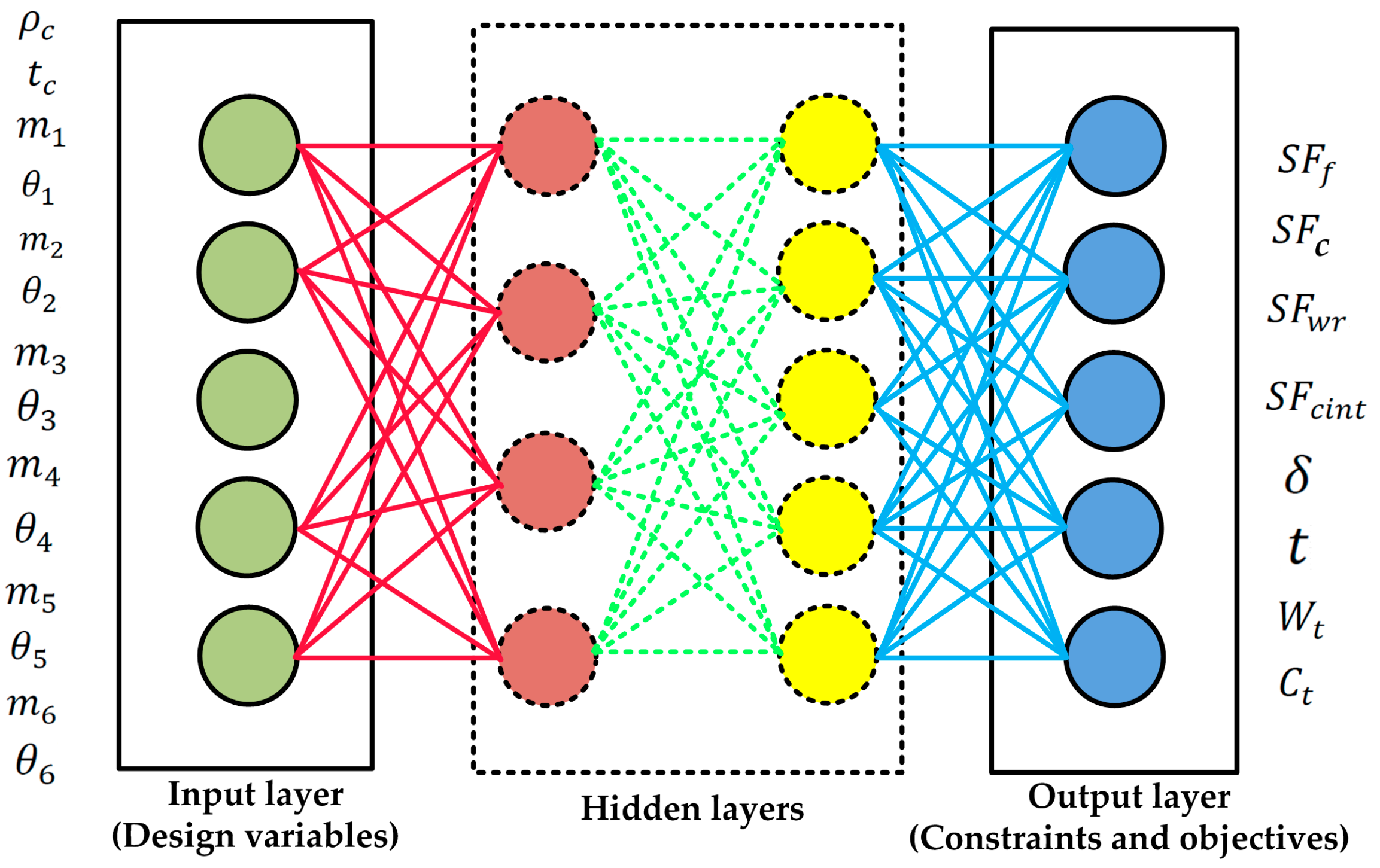
The ANN model was used to establish the relationship between the input variables representing the design parameters and the output responses, including the objective functions and design constraints. The predictive capability of machine learning models depends strongly on the availability of sufficiently large and representative training datasets. The structure of the ANN model of the investigated sandwich structure is shown in
Figure 4.
In the present study, the dataset used for training the Artificial Neural Network surrogate model was generated using the analytical structural model described in
Section 3. The resulting design vector (
x) used as the input to the ANN model is defined in Equation (22).
where
denotes the material type (CFRP or GFRP) of the
ith ply, and
represents the fiber orientation (0° or 90°) of the corresponding ply. The top and bottom facesheets have identical symmetric laminate stacking sequences. Meanwhile, six ply angles were included for implementation convenience, where only three independent plies were optimized due to the symmetry of the laminate. The Al honeycomb core density (
range is given in
Table 2, and the core thickness (
) is taken as a continuous variable within the range of 5–50 mm for the ANN model training purpose. A wider range of the Al honeycomb core thickness is used to ensure robust interpolation and to avoid edge effects near the boundaries of the design space. The applied pressure (
p) on the investigated sandwich structure is prescribed as a fixed input parameter during the generation of the ANN surrogate dataset. Each sampled configuration is then evaluated using the analytical model to obtain the corresponding structural responses, i.e., the output vector (
y), as represented by Equation (23).
The output response of the ANN model includes the safety factors (SFs) associated with the failure modes, maximum middle deflection (), total thickness (t), total weight () and total material cost () of the investigated sandwich construction.
To ensure the quality of the training dataset, design configurations producing non-physical or numerically unstable responses were excluded. These datasets include non-finite values, negative safety factors, unrealistic deflections or total thickness exceeding the prescribed design limits. This filtering procedure ensured that the ANN surrogate was trained only on structurally meaningful and physically admissible regions of the design space.
4.2. Normalization of Input and Output Data for ANN Surrogate Model
The input vector used for ANN training consists of 14 design variables, while the output vector contains 8 structural responses (constraints and objectives). Since these variables differ considerably in magnitude, it is necessary to improve the numerical stability during ANN training. The input and output variables used for training the ANN surrogate model are normalized within the interval of [0, 1]. The normalized variables are computed using Equation (24) [
38].
Here, denotes the normalized value of a given parameter, whereas represents its original value. The quantities and correspond to the minimum and maximum values of respectively, and and define the lower and upper bounds of the normalized range. The normalized dataset prevents variables with larger magnitudes from dominating the learning process and improves the convergence behavior of the ANN model.
4.3. ANN Model Development for the Investigated Sandwich Structure
The Monte Carlo sampling strategy [
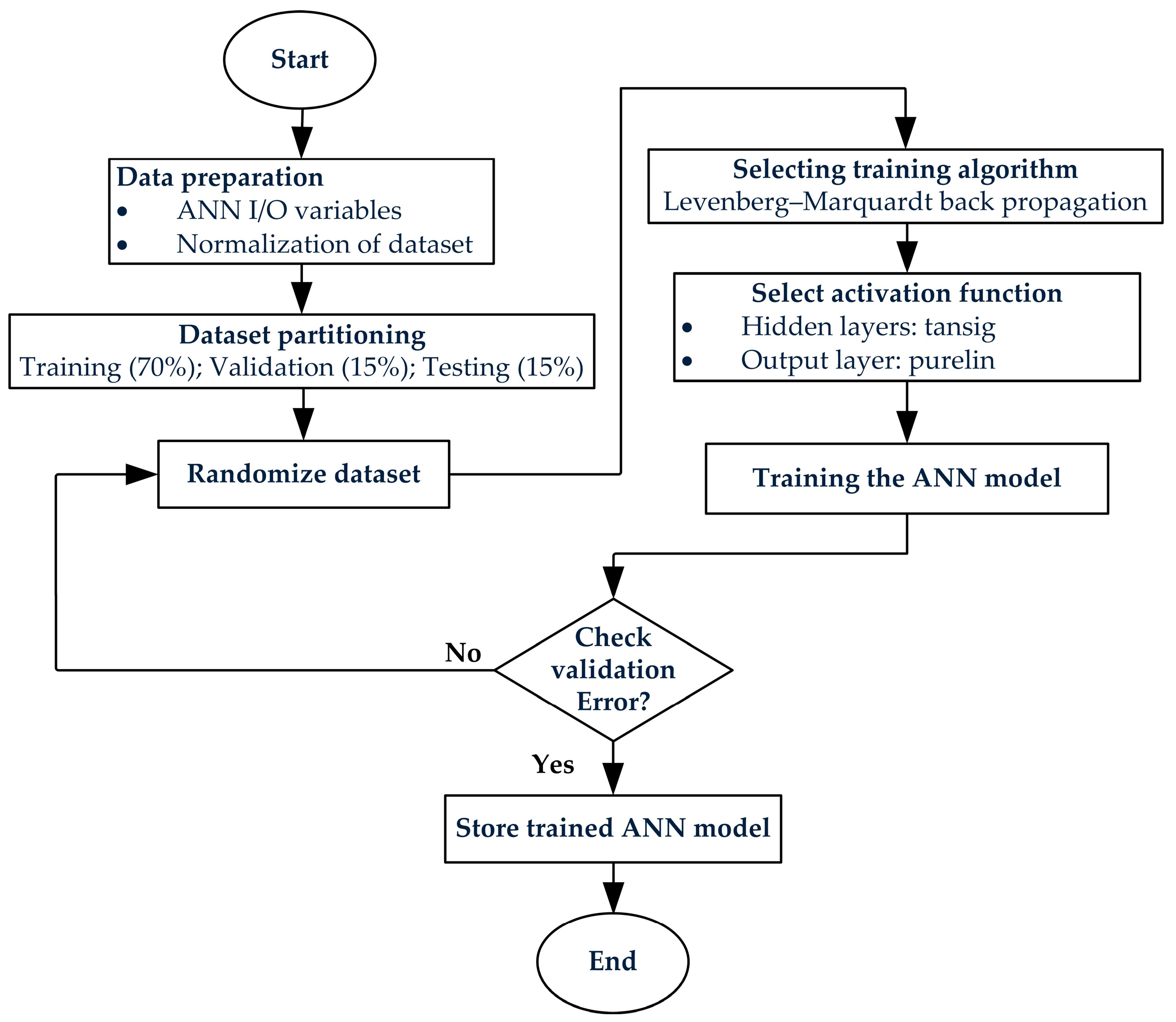
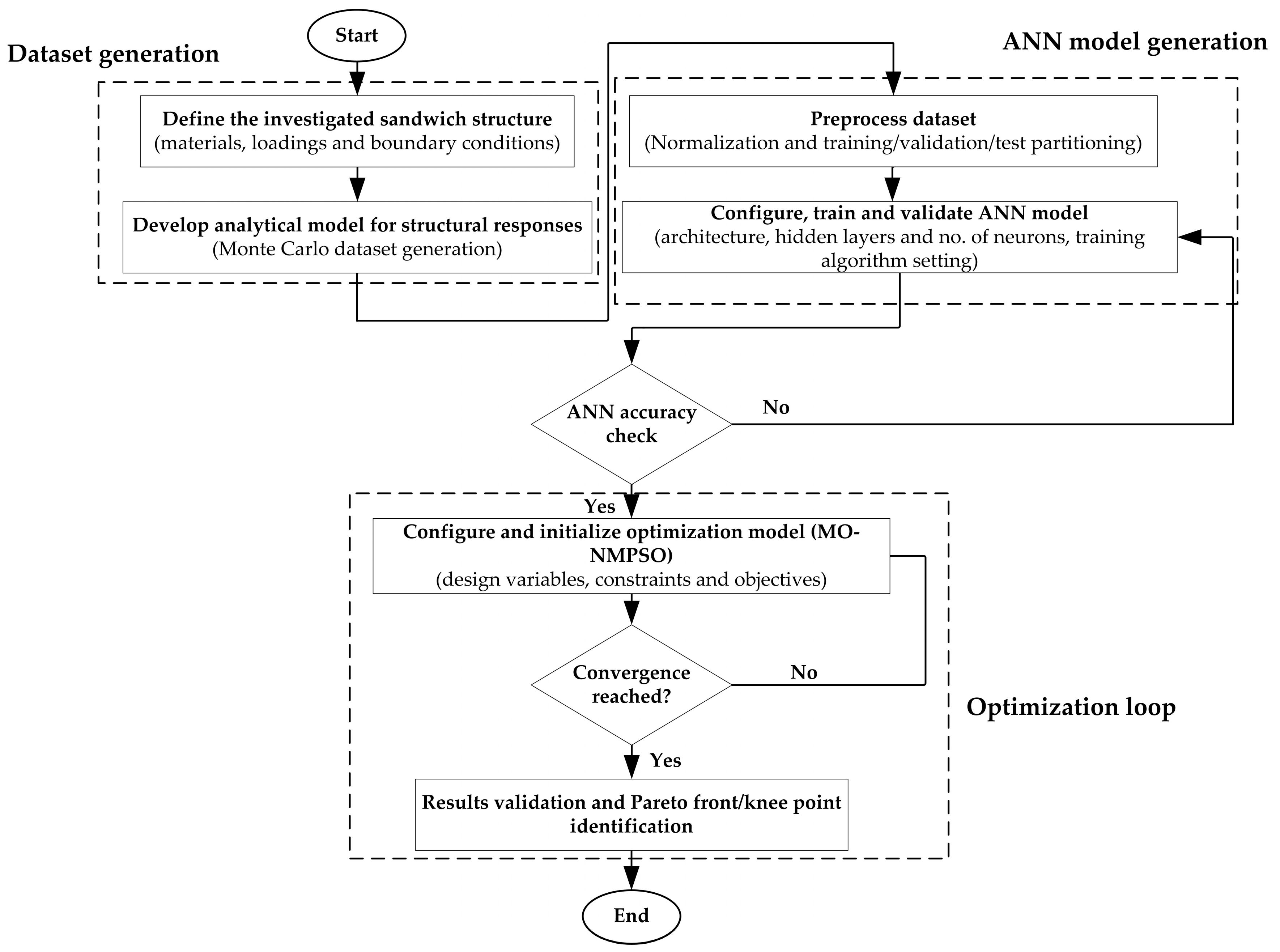
39] was implemented in MATLAB to systematically explore the design space and account for variability in the design space. The NN surrogate model development workflow is illustrated in
Figure 5.
Using the analytical model described in
Section 3, a total of
N = 8000 valid design samples were generated using Monte Carlo simulation for training the Artificial Neural Network surrogate model. The core density was randomly selected from six candidate values, the core thickness
was uniformly sampled within the continuous range of 5–50 mm, the material type of each of the six laminate plies was randomly assigned as CFRP or GFRP, and the ply orientation was selected from the allowable angles, i.e., 0° and 90°. The generated dataset was subsequently normalized to the range of [0, 1] to improve numerical stability during the network training.
The network was trained using the Levenberg–Marquardt (LM) algorithm, which is well known for its fast convergence in nonlinear regression problems [
40]. A Backpropagation Feed Forward Neural Network (BFFNN) was used to model the relationship between the design variables and the structural responses of the sandwich structure. The dataset was randomly divided into three subsets, comprising 70% for training, 15% for validation and 15% for testing.
Figure 6 illustrates the architecture of the ANN model available within MATLAB software (R2020a).
The adopted network architecture consists of 14 input neurons; two hidden layers with 26 and 27 neurons, respectively; and 8 output neurons. The hidden layers used the tangent-sigmoid activation function (tansig), while the output layer uses a linear activation function (purelin) available within the MATLAB software [
41].
4.4. Performance Measures of the Developed ANN Surrogate Model for the Investigated Sandwich Structure
The predictive capability of the developed Artificial Neural Network model was evaluated using statistical performance indicators. The Mean Squared Error (
MSE) and the coefficient of determination (
R2) were used to assess the accuracy of the network predictions. These relations quantify the deviation between the outputs predicted by the ANN model and the corresponding responses obtained from the analytical model. The Mean Squared Error is defined by Equation (25).
where
n denotes the number of data samples, and
represents the actual response values obtained from the analytical model; furthermore,
denotes the corresponding predicted values by the trained ANN model. The coefficient of determination
is used to evaluate the goodness-of-fit between the predicted and actual responses of the ANN model and is expressed in Equation (26).
where
represents the mean of the actual response values. When the
value is close to unity, it indicates a better predictive capability of the model, while a lower
MSE signifies a higher prediction accuracy.
5. Optimization Model for the Investigated Sandwich Structure
The optimization problem considered in this study involves mixed discrete–continuous design variables and a highly nonlinear constrained search space. Under such conditions, gradient-based methods are not well suited to explore the feasible design domain efficiently. The classical Particle Swarm Optimization (PSO) method is inspired by the collective social behavior observed in bird flocks. The positions of points (particles) in the population (swarm) define the possible solution space. PSO algorithms are normally used for large optimization problems, due to their high computational efficiency, simplicity and ease of implementation [
42].
In classical PSO, particles update their positions according to their current velocity, their own best previous position, and the best solution identified by the swarm, which provides strong global search capability but may be insufficient for fine local refinement. To improve diversity and reduce premature convergence, the classical PSO is extended through a niching strategy. The population is divided into several sub-swarms to explore the different promising regions of the search space simultaneously, instead of forcing all particles to converge toward a single global best solution. Within each sub-swarm, the particles share information locally and are guided by the best solution found in that niche, which helps to preserve diversity and reduce the risk of premature convergence. The memetic component introduces a local refinement stage around selected elite particles, allowing a more detailed search in the neighborhood of promising candidate solutions [
43]. Therefore, the Niching Memetic Particle Swarm Optimization (NMPSO) algorithm combines the global search capability of PSO with two additional mechanisms designed to improve performance in multimodal and highly constrained design spaces.
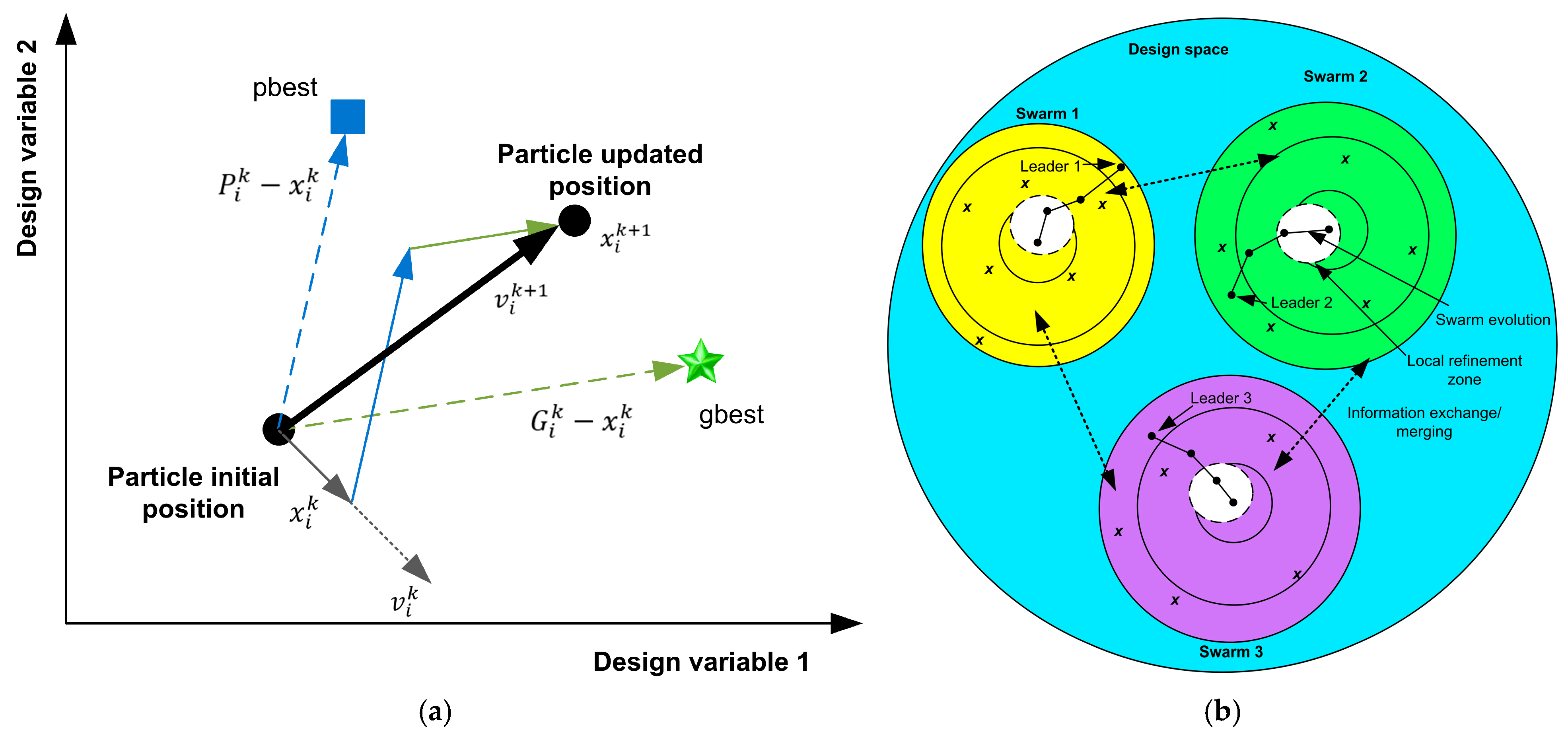
A schematic of the particle update mechanism in a typical PSO algorithm and the multi-swarm search methodology, i.e., NMPSO model strategy, is illustrated in
Figure 7.
Figure 7a presents a typical PSO model, where each particle moves according to its current velocity, its personal best position and the global best position of the swarm. Therefore, each particle represents a candidate design solution and is characterized by its position
and velocity
at iteration
k. The particle position is updated according to Equations (27) and (28) [
44,
45].
The parameter is the inertia weight, represents the best position visited by the ith particle, and denotes the global best position of the swarm, in the kth generation, along with and as learning factors. Here, and are the random numbers uniformly distributed in the interval [0, 1]. In the present work, the inertia weight is reduced with the iterations to balance the global exploration and local exploitation during the search process.
A schematic representation of the NMPSO model is shown in
Figure 7b. The integration of the two mechanisms (i.e., niching and memetic) makes NMPSO particularly suitable for the optimization of composite sandwich structures, where the design space is mixed discrete–continuous and contains multiple competing feasible regions. During the search process, each sub-swarm evolves independently around its local leader, while periodic interaction between neighboring sub-swarms allows information exchange and prevents redundant exploration. When two sub-swarms become sufficiently close, a merging procedure is applied, and overlapping particles are eliminated. In this way, the algorithm maintains a balance between global exploration, local exploitation, and diversity preservation.
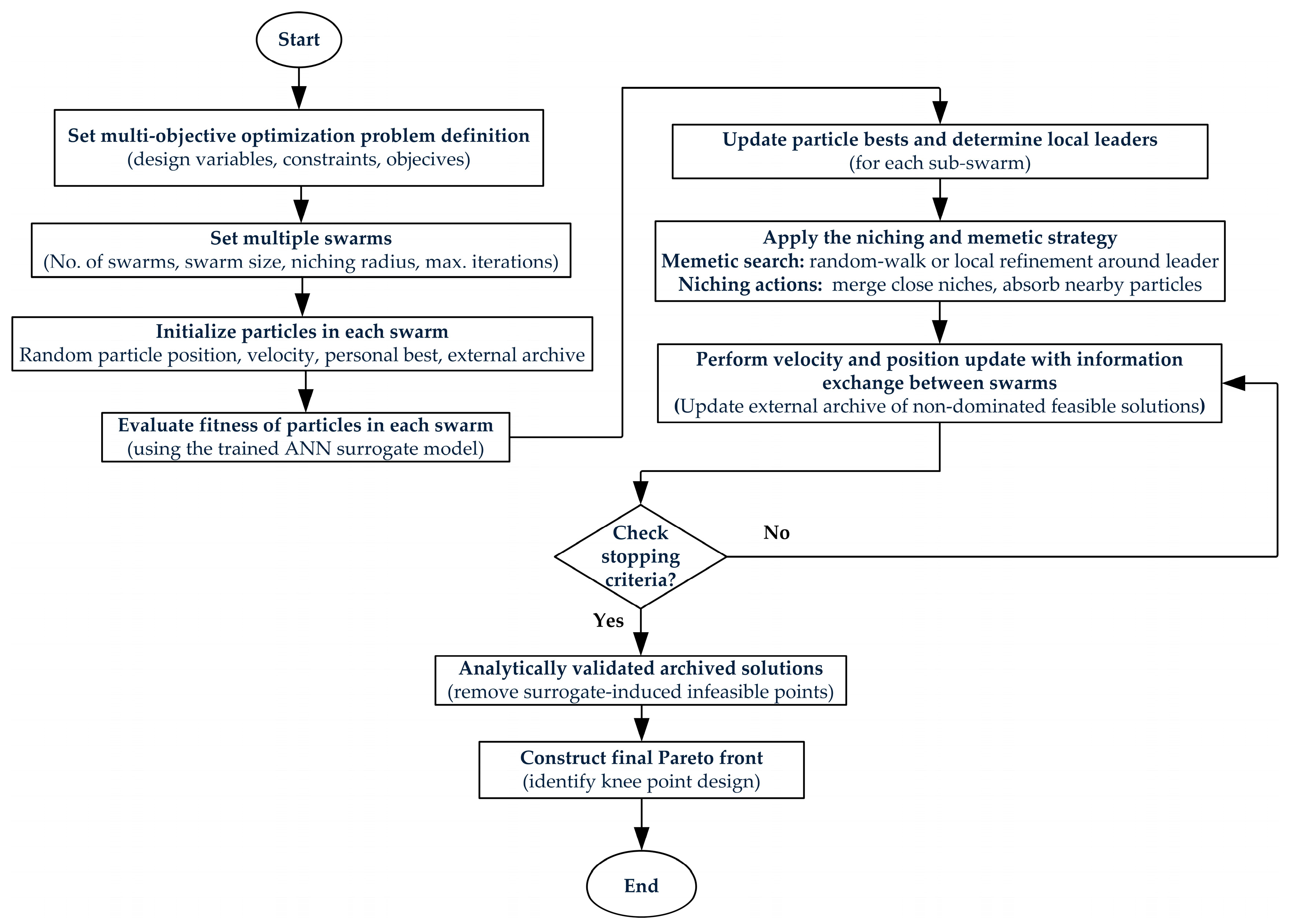
In this study, a Multi-Objective Niching Memetic Particle Swarm Optimization (MO-NMPSO) algorithm is employed to identify the non-dominating solutions in terms of Pareto front, with the objective of simultaneously minimizing the structural weight and material cost. The overall architecture of the proposed optimization framework, integrating the analytical model, ANN surrogate model and MO-NMPSO algorithm, is illustrated schematically in
Figure 8.
The optimization loop was started after training an ANN surrogate model. This study used the MO-NMPSO algorithm, which utilized the ANN for the evaluations of structural parameters to explore the design space and to identify the Pareto-optimal solutions.
Configuration of MO-NMPSO Algorithm for the Investigated Sandwich Structure
Figure 9 shows the workflow of the MO-NMPSO algorithm configuration adopted for the investigated sandwich construction.
Due to the inability of PSO to handle constraints in itself, a scalar penalty function
is used to guide the multi-objective function
search towards structurally feasible solutions, as shown by Equation (29).
where
is the penalty function;
are the penalty coefficients corresponding to the safety factor, total thickness, and deflection constraint violations, respectively; furthermore,
is the penalized objective function. The penalty coefficients used in the optimization were set as
,
and
. It shows that, as one or more constraints are violated, the penalty becomes positive and shifts the solution upward in both objectives, thereby making it less attractive during the Pareto-optimal design selection.
The selected swarm size, number of iterations and niching radius were chosen to provide a balance between exploration of the design space and convergence toward a stable PF.
Table 4 summarizes the optimization model settings adopted in the MATLAB code. The MO-NMPSO model used 5 swarms with 25 particles each, for a total of 125 particles, and over 150 iterations. Information exchange between swarms was performed after every 20th iteration, and a niching radius of 0.1 was used in normalized design to repel nearby swarm leaders.
For comparison, the NSGA-II algorithm was configured using the same population size and number of generations as the number of swarms and iterations adopted in the MO-NMPSO algorithm.
6. Optimization Results of the Investigated Sandwich Structure
The elaborated optimization framework implemented in MATLAB software provides a complete set of results including dataset characteristics, ANN model performance parameters, optimization model convergence behavior and the analytically validated Pareto-optimal solution set. The two conflicting objectives were the minimization of structural weight and material cost, subject to constraints on safety factors, maximum middle deflection and overall thickness of the investigated sandwich construction.
6.1. Dataset Characteristics
A total of 8000 valid samples were generated from 12,000 attempts, which shows that 33.33% of the sampled designs were rejected by the validation checks.
Table 5 shows the ranges of the analytical dataset covered for training the ANN model.
The resulting response ranges of the design constraints are sufficiently broad to train the ANN surrogate model of the investigated sandwich structure. It also indicates the random sampling procedure’s ability to train the ANN model with feasible and near boundary regions of the design space. The dataset generation time using the Monte Carlo simulation takes 7.53 s.
6.2. Performance of the Developed ANN Model
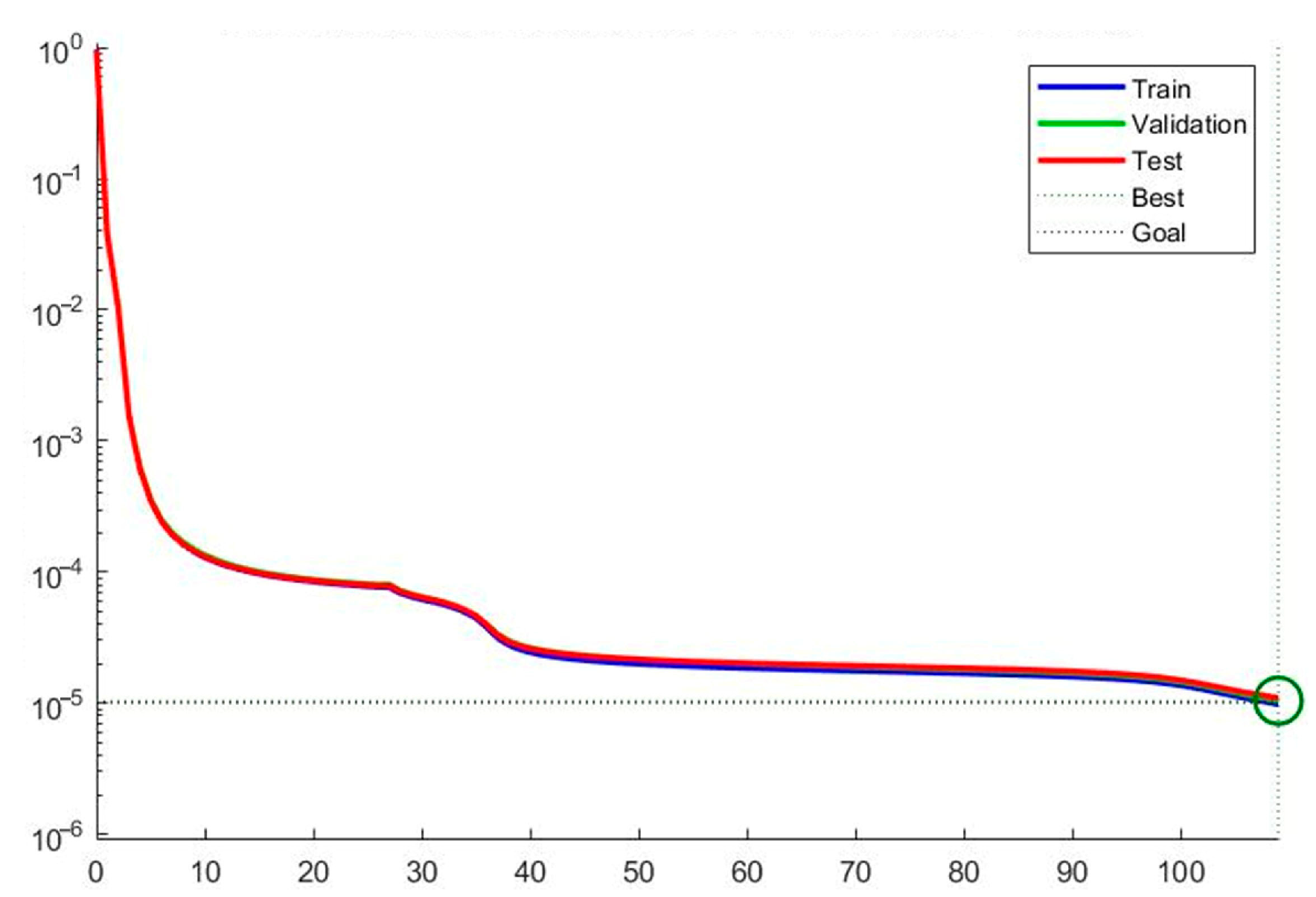
The ANN model of the investigated sandwich structure used 5600 samples for training, 1200 for validation and 1200 for testing. The model was trained by the Levenberg–Marquardt (LM) algorithm using parallel MEX workers in MATLAB. The training performance history of the ANN model measured in terms of Mean Square Error (
MSE) against the number of epochs (i.e., one complete pass of the training dataset through the network) is illustrated in
Figure 10.
The ANN model training was terminated after 109 epochs due to validation stopping, and the total model training time was 1137.27 s. The best validation performance equals . A rapid decrease in the Mean Squared Error is observed during the initial training stage, followed by a smoother reduction as the solution approaches convergence. The absence of unstable fluctuations indicates that the Levenberg–Marquardt algorithm provided a numerically stable training process for the selected architecture. The network achieved the prescribed performance target within the allowed number of epochs, demonstrating that the surrogate model was able to capture the nonlinear relationship between the laminate/core design variables and the structural response quantities with high fidelity.
The ANN model achieved an overall test MSE of and an RMSE of 0.1899, indicating strong agreement between the predicted responses and the analytical model outputs. The ANN surrogate therefore reproduced the analytical model with excellent accuracy for all the outputs.
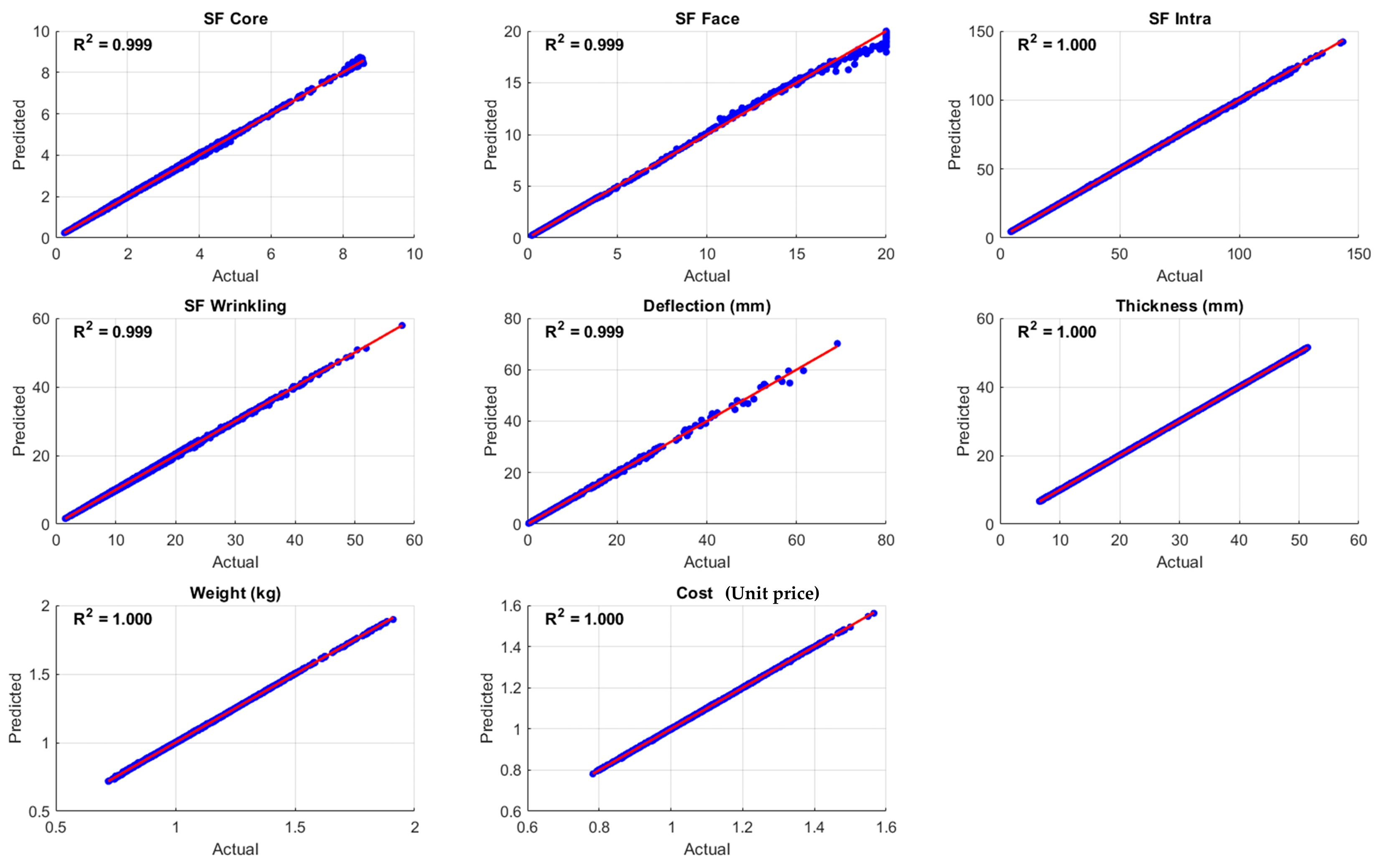
Figure 11 illustrates the agreement between the ANN predictions and the corresponding analytical target values for the eight output variables, in terms of the coefficient of determination
R2.
The individual test R2 values for eight outputs are [0.999, 0.999, 1.000, 0.999, 0.999, 1.000, 1.000, 1.000], which correspond to the four safety factors, maximum middle deflection, total thickness of the structure, structural weight and material cost, respectively. In all subplots, the predicted values remain closely distributed around the 45° reference line, indicating strong predictive consistency across the full output domain. The limited scatter and the small deviation confirm that the trained ANN model reproduced the analytical database with high accuracy. These results validate the use of the ANN as an efficient surrogate computational model for subsequent utilization in the MO-NMPSO algorithm.
6.3. Optimization Model Convergence Behavior
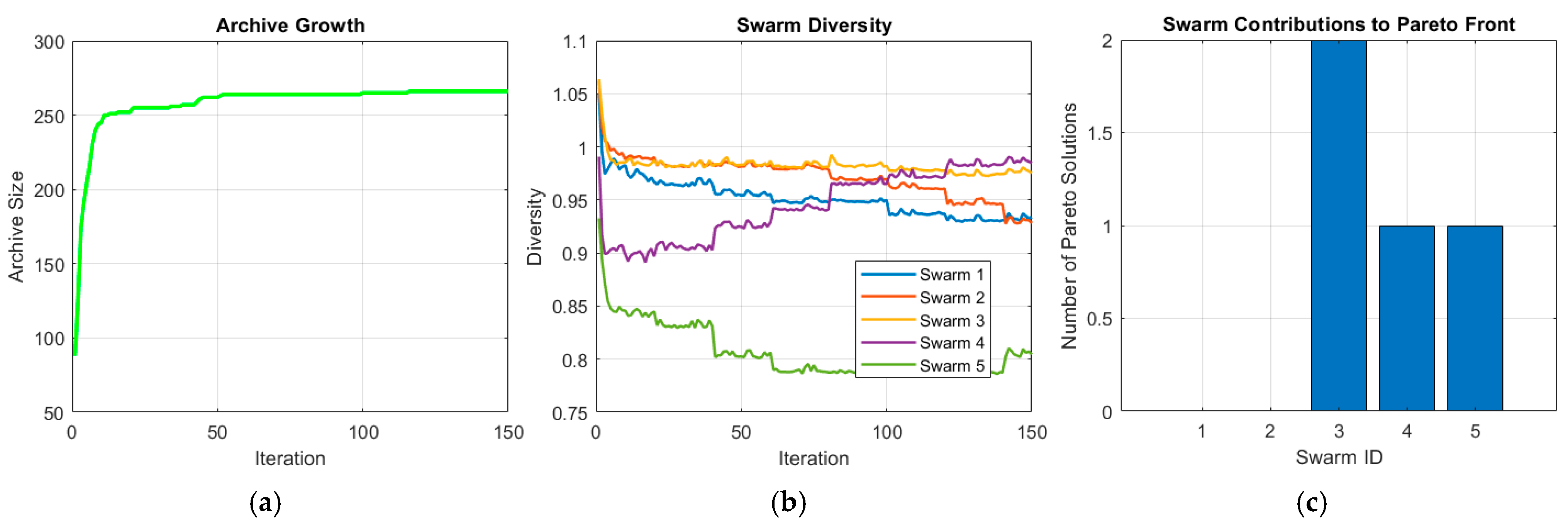
Figure 12 illustrates the MO-NMPSO model convergence behavior in terms of feasible solutions (archives), swarm diversity (the average distance of the swarm particles from the swarm centroid in normalized design space) and swarm contribution to PF.
Figure 12a shows that the archive grew from 252 feasible points at iteration 20 to 265 at iteration 100, after which it increased only marginally to 266 by iteration 150. The archive growth curve rises quickly at first and then slows, indicating that the optimizer first maps the feasible designs and then spends the later iterations refining the PF.
Figure 12b shows the swarm diversity plot, which indicates that all five swarms retained distinct search trajectories throughout the optimization loop. This supports the use of a multi-swarm niching mechanism instead of a single-swarm PSO.
Finally,
Figure 12c shows the swarm contribution plot, which confirms that the Pareto-optimal solutions are assembled from multiple swarms rather than being dominated by a single search group. Therefore, the optimization convergence analysis shows a healthy multi-swarm search strategy with early exploration, later stabilization and diversity preservation.
6.4. Pareto-Optimal Solution Set of the Optimization
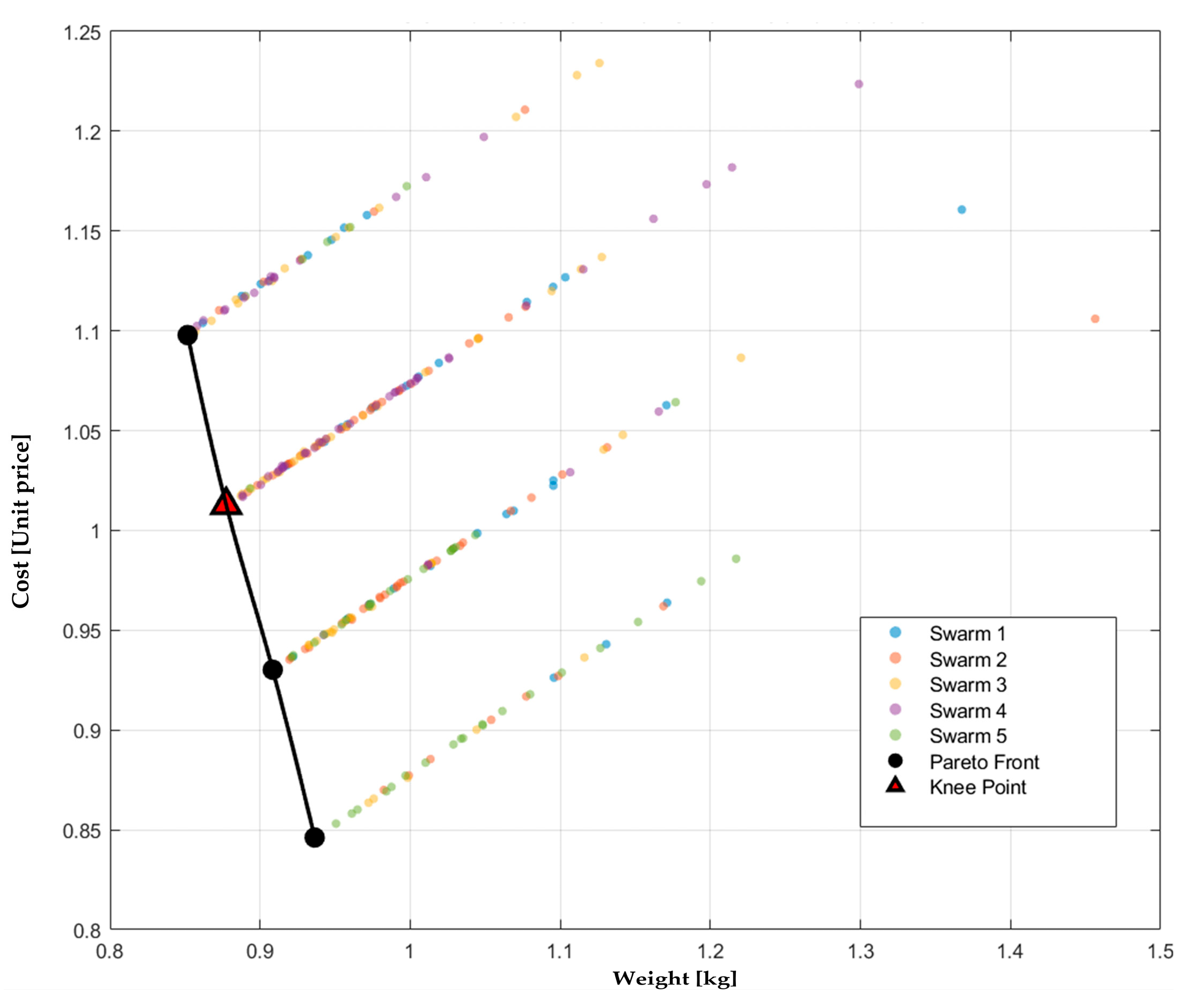
The ANN surrogate-assisted MO-NMPSO model was implemented in MATLAB software, which produced a set of non-dominating solutions in terms of a smooth PF, representing the trade-off between lightweight design and low cost. All archived designs were re-evaluated by the analytical model after the optimization loop. The Pareto set (points near the origin) consists of four feasible designs on the Pareto curve, which include the minimal weight, the minimal cost and the knee point design.
Figure 13 demonstrates a Pareto curve of feasible design points, including the knee point solution.
The smooth cloud view shows that the final Pareto curve is the lower boundary of the feasible design points. The small number of final Pareto points reflects the mixed discrete–continuous design space, where many archived feasible solutions become mutually dominated after analytical re-checking. The Pareto front shows the contribution of each swarm to the final design and how the Pareto points align near the origin. To identify the most balanced design among the Pareto-optimal solutions, the Improved Multiple Dominance Sorting Method (IMDSM) [
46] is used to determine the knee point as represented by Equation (30).
denotes the shortest distance between the ideal points (i.e., minimal weight and cost) and any other design points on the Pareto front. The weight objective on the Pareto front is represented by , whereas the corresponding cost objective is denoted by . The knee point solution provides the best compromise between the conflicting objectives of weight and cost.
The three most useful designs for engineering interpretation are the minimal weight, the minimal cost and the knee point designs. The knee point design is recognized as the optimal solution of multi-objective optimization. The Pareto front with four feasible design values is summarized in
Table 6.
Across the four-point Pareto front, the average weight is 0.893 kg, and the average relative unit cost is 0.97. The average core thickness is 22.1 mm, and the average core density is 29 kg/m3 of the investigated sandwich structure.
The Pareto designs consist of 0° and 90° plies for facesheets, which is fully consistent with the bending behavior of the considered simply supported sandwich structure under out-of-plane pressure loading. Furthermore, as expected, designs with a lower structural weight generally required a higher proportion of CFRP plies and therefore resulted in increased material cost, whereas lower cost designs tended to include more GFRP plies but had a higher weight. All Pareto-optimal solutions satisfied the imposed structural constraints and objectives and therefore represent feasible designs.
6.5. Interpretation of the Key Designs of the Pareto Front
The minimal weight design uses a CFRP layup and a core thickness of 22.13 mm. It achieves the lowest weight but at the highest cost. The minimal cost design is dominated by GFRP plies and uses a 22.21 mm thick core. The knee point design balances these two extremes by mixing CFRP and GFRP with a core thickness of 21.85 mm. Its cost is substantially below the minimal weight point, while its mass remains clearly below the minimal cost design. From the design perspective, the knee point is attractive because it reduces cost by about 7.74% while increasing weight by 2.93% relative to the minimal weight design. Alternatively, the knee point reduces weight by about 6.3% while increasing cost by about 19.74% relative to the minimal cost design. This makes the knee point design attractive when both weight and cost minimization are important design aims.
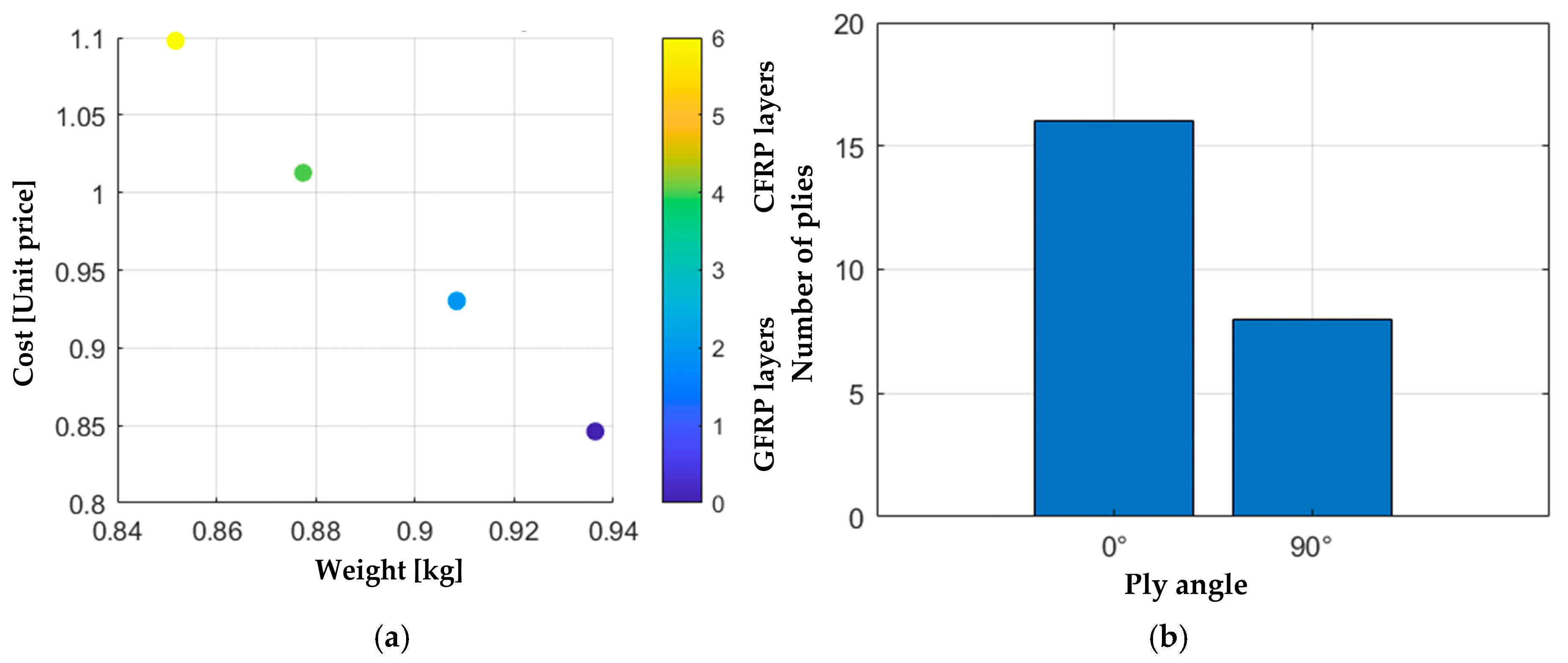
Figure 14 presents the design analysis of Pareto-optimal solutions in terms of the cost and weight trade-off by number of CFRP plies and the ply angle distribution. The cost and weight relations of the final Pareto-optimal solutions in terms of CFRP and GFRP ply count are shown in
Figure 14a. This confirms that a higher CFRP content is associated with a lower weight and higher cost. The ply-angle distribution shows that 0° plies dominate the Pareto design set, which is consistent with the global bending-dominated loading scenario of the investigated sandwich structure as shown in
Figure 14b.
The present results confirm that the analytical formulation-based trained ANN surrogate and MO-NMPSO framework is effective for identifying the feasible designs with a compromise on the conflicting objectives of weight and cost in a mixed continuous/integer design variable space. Furthermore, the ANN model was sufficiently accurate to support the large-scale optimization problem. The final design cloud and smooth Pareto front also show that the elaborated optimization model did not merely produce a set of isolated designs; instead, it identified a broad feasible region with clear boundary designs represented as the Pareto front. This is particularly valuable from an engineering viewpoint because it allows the designer to understand not only the non-dominated solutions but also the complete surrounding feasible design region.
6.6. Comparison of the Elaborated MO-NMPSO Algorithm with the NSGA-II Optimization Algorithm Applied for the Investigated Sandwich Structure
To further assess the performance and the efficiency of the proposed ANN-assisted MO-NMPSO algorithm, a benchmark comparison was conducted using the Non-dominated Sorting Genetic Algorithm (NSGA-II). The comparison was performed using the same ANN surrogate model, design variables and design constraints. For the comparison, 125 for the population size and 150 generations were selected, which are equivalent to the corresponding MO-NMPSO algorithm’s swarm size and number of iterations, respectively.
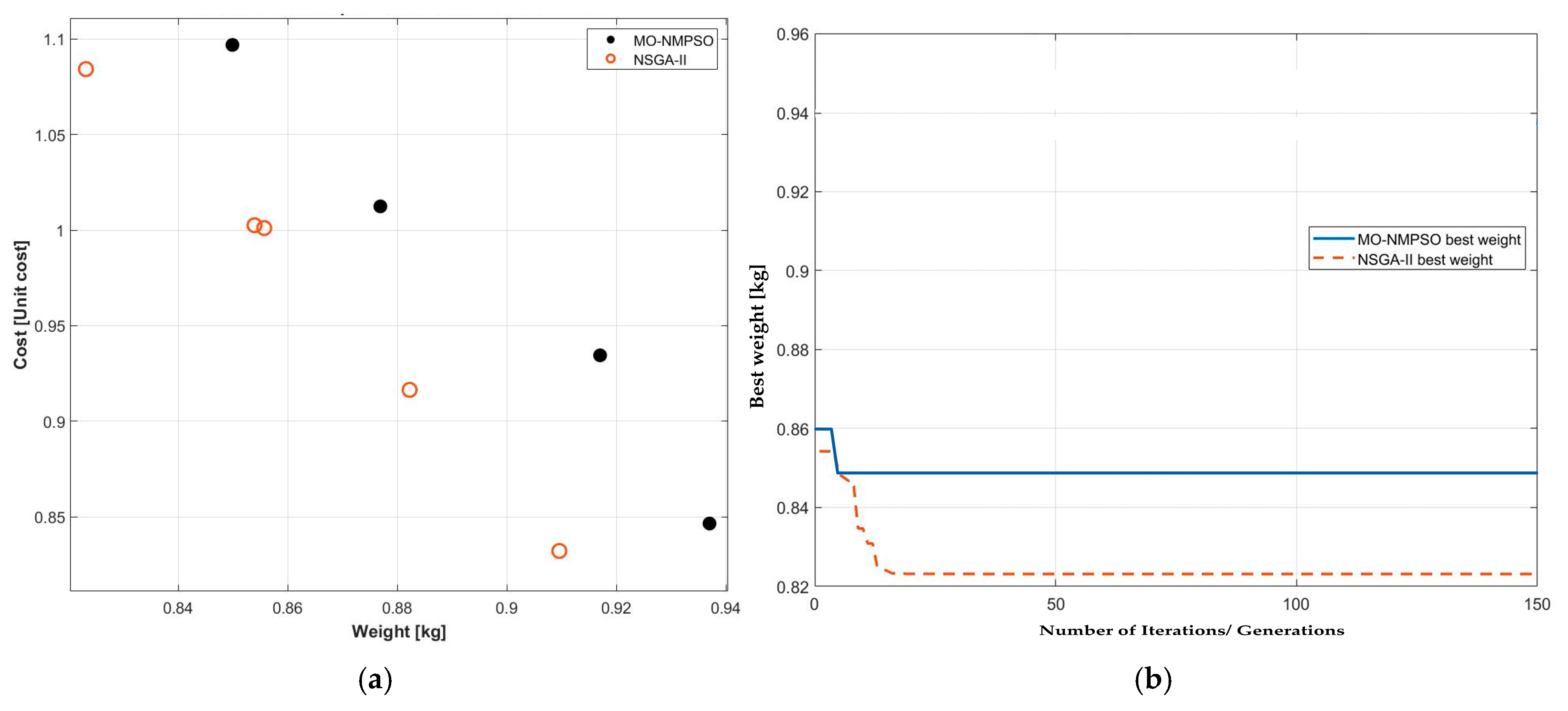
Figure 15 compares the Pareto fronts and convergence behavior in the case of the best structural weight of the elaborated MO-NMPSO and NSGA-II algorithms.
As shown in
Figure 15a, both algorithms successfully identified feasible trade-off solutions between structural weight and material cost for the investigated wing sandwich panel. The NSGA-II algorithm provided slightly lower extreme objective values, with a best weight of 0.823 kg and a best unit cost of 0.832, compared with 0.852 kg weight and 0.846 unit cost obtained by the MO-NMPSO algorithm. As shown in
Figure 15b, the convergence behavior of the two algorithms indicates that the MO-NMPSO algorithm reached a stable solution within the first few iterations, whereas the NSGA-II algorithm continued to improve during the early generations before reaching a stable region. This behavior is consistent with the MO-NMPSO algorithm, where multiple sub-swarms explore the design space simultaneously and preserve the favorable regions during the search. In contrast, the NSGA-II algorithm relies on genetic operators and non-dominated sorting, requiring higher computational time.
The proposed ANN-assisted MO-NMPSO optimization framework required 283.6 s to complete approximately 18,750 particle evaluations during the 150-iteration search process, corresponding to an average surrogate evaluation time of about 0.0151 s per design on a computer with an Intel(R) i3-4005U CPU at 1.70 GHz and 8.00 GB RAM. Under the same nominal optimization parameters, the NSGA-II algorithm required 499.37 s, corresponding to approximately 0.0266 s per design evaluation. Therefore, the MO-NMPSO algorithm was approximately 1.76 times faster than the NSGA-II algorithm, or about 43.2% lower in total computational time. This difference is mainly attributed to the additional non-dominated sorting, crowding-distance calculation, crossover and mutation operations required by the NSGA-II algorithm.
Furthermore, a single ANSYS Finite Element simulation required approximately 20 s. Based on this computational cost, 18,750 direct FE evaluations would require about 375,000 s, which is equivalent to 104.2 h, whereas the ANN surrogate required only 283.6 s, or 4.73 min, for the same number of evaluations. This indicates an improvement in computational efficiency of approximately 1323 times, demonstrating the effectiveness of the proposed surrogate-assisted optimization strategy for the design of sandwich structures.
Overall, the comparison confirms that both the MO-NMPSO and NSGA-II algorithms are capable of solving the optimization problem of the investigated sandwich structure. Although the NSGA-II algorithm provided slightly better extreme objective values, the MO-NMPSO algorithm requires a significantly lower computational time. Therefore, the proposed MO-NMPSO framework is considered computationally efficient and competitive for ANN-assisted multi-objective optimization of FRP laminated sandwich structures.
7. Finite Element Simulation of the Optimization Results
A Finite Element (FE) simulation was conducted to assess the reliability and accuracy of the elaborated optimization approach for three key designs, i.e., minimal weight, minimal cost and knee point on the Pareto front, using ANSYS 2021 R2 software (ANSYS Inc., New Castle, DE, USA).
7.1. Finite Element Modeling and Simulation Setup
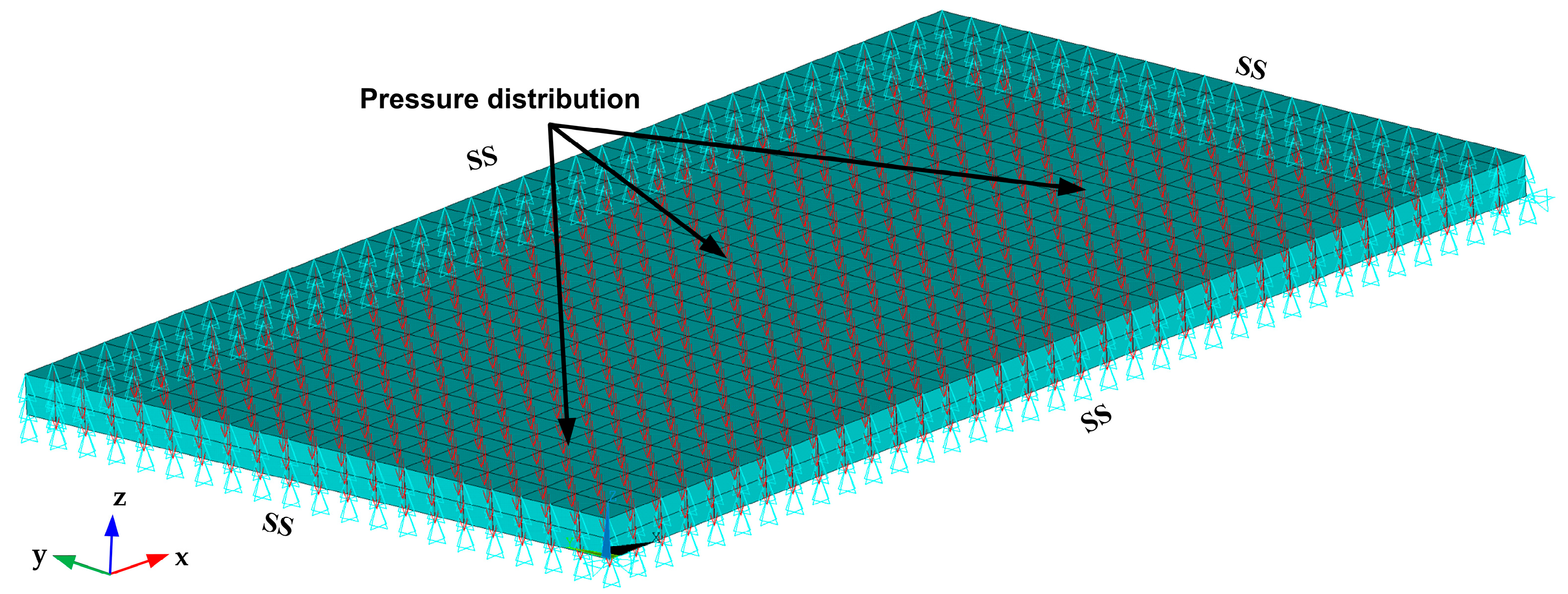
The investigated sandwich structure has the simply supported boundary conditions at the four edges, and a uniformly distributed pressure load is applied on the top surface of the panel as shown in the ANSYS FE model in
Figure 16.
For the FE simulation, minimal in-plane constraints were added to suppress the rigid-body motion of the structure. The Al honeycomb core was modeled using 3D SOLID185 elements, while the composite FRP laminated facesheets were modeled using SHELL181 elements with a tied connection between the core and facesheets. Based on the mesh convergence study and considering the efficiency of the simulation model, an element size of 20 mm was used for the FE model.
7.2. Structural Analysis and Simulation Results
The deformation contours for the minimal weight, knee point and minimal cost designs are shown in
Figure 17.
The FE deformation contours in
Figure 17 show the expected response of a rectangular plate simply supported on all four edges, with the maximum deflection occurring at the panel center and near-zero transverse displacement along the supported boundaries. Among the three representative Pareto designs, the minimal cost design exhibited the smallest central deflection, whereas the knee point design showed the largest value. The minimal weight design produced an intermediate response and remained less flexible than the knee point design because its all-CFRP layup provides higher effective laminate stiffness than the mixed CFRP/GFRP knee point configuration. These trends are consistent with the orthotropic plate formulation adopted in the analytical model. Furthermore,
Figure 18 show the FE von Mises stress contours of the three representative Pareto designs.
The highest equivalent stress was observed in the minimal weight design, followed by the knee point design, whereas the minimal cost design exhibited the lowest stress level. Since the FE model reports nodal equivalent von Mises stresses for the investigated sandwich structure, while the analytical model predicts the facesheet normal stress (
, the stress comparison is treated qualitatively rather than quantitatively, with emphasis on the location and severity of the critical regions.
Table 7 shows a comparison of the middle deflections by the analytical model and ANSYS FE model, and the ANSYS von Mises stresses of the three key designs of the investigated sandwich structure are provided.
All three key designs show very close agreement between the MATLAB analytical predictions and the ANSYS FE deflection results, with deviations below 4%. The stress contour comparison further indicates that the minimal weight design remains the most highly stressed among the three key Pareto-front designs, which is consistent with its larger deformation tendency. In contrast, the minimal cost design exhibits a comparatively lower maximum equivalent stress, in agreement with its lower central deflection and the use of fully GFRP facesheets with plies oriented along the transverse direction of the sandwich panel.
The results of the elaborated optimization framework demonstrate the reliability, accuracy and computational efficiency of the model that integrates an analytically trained ANN with an MO-NMPSO algorithm for sandwich structure optimization.
8. Conclusions
Fiber Reinforced Polymer (FRP) laminated composite sandwich structures are widely applied in engineering applications such as space, aerospace, civil, automotive and renewable energy. Achieving adequate structural performance while simultaneously minimizing weight and material cost makes their design a challenging multi-objective optimization problem. This study presents a newly elaborated optimization framework that integrates an Artificial Neural Network (ANN) surrogate model (trained by analytical data) with a Multi-Objective Niching Memetic Particle Swarm Optimization (MO-NMPSO) algorithm for the optimal design of an FRP laminated sandwich panel for an aerospace application. The complete optimization framework was implemented in MATLAB. The analytical data were generated by using Classical Laminate Plate Theory, and an orthotropic plate-based sandwich formulation was used for global bending and shear of the composite FRP laminated sandwich panels. The analytical model also computes the safety factors for core shear and facesheet strength, intracellular buckling and wrinkling. The design problem was formulated as a constrained multi-objective optimization, where the structural weight and material cost were minimized simultaneously while satisfying limits on the safety factors, maximum middle deflection and total panel thickness of the sandwich structure.
To reduce the computational cost associated with repeated structural evaluations during optimization, a Monte Carlo simulation-based analytical dataset was generated on the design variables, which includes the facesheet materials (CFRP and GFRP), plies layup sequence, core properties and thickness parameters. The generated dataset for the investigated sandwich construction is used to train a feedforward ANN model. The ANN model was then employed with the predicted structural responses, including four safety factors, maximum middle deflection, total thickness, total weight and total cost, during the optimization loop. The predictive accuracy of the ANN surrogate is measured by the Mean Square Error (MSE = ) and coefficient of determination (R ≈ 1). The ANN model embedded with the MO-NMPSO algorithm enables an efficient search for the mixed discrete–continuous design domain.
The elaborated optimization framework generated a Pareto-optimal solution set representing the trade-off between the total weight and total cost of the investigated sandwich structure. All the Pareto-optimal designs obtained from the optimization model were verified using the governing analytical model, and only feasible designs (fulfilling the design constraint limits) were retained in the final Pareto set. The Pareto set consists of four feasible non-dominated optimal designs solutions. Meanwhile, the knee point design (the optimal point on the Pareto curve) provides a compromised solution with reductions in both weight and cost compared to the minimal cost and minimal weight design configurations. The knee point design resulted in a cost reduction of about 7.74%, while there was an increase in weight by about 2.93% relative to the minimal weight design. Meanwhile, the knee point shows a weight reduction of 6.3%, while the cost increases by 19.74% relative to the minimal cost design on the Pareto front for the investigated sandwich panel.
The ANSYS Finite Element model was used for numerical simulation of three key Pareto-optimal designs (minimal weight, minimal cost and knee point). Comparison between the optimization results and the ANSYS FE model results for the maximum middle deflection of the minimal weight, minimal cost and knee point designs of the investigated sandwich structure showed a differences of 3.7%, 3.3% and 2.6%, respectively. The von Mises stress contours of the ANSYS FE simulations show qualitative evidence for the location and severity of the maximum stress regions of the investigated sandwich construction. These results confirm the reliability and accuracy of the elaborated optimization model in predicting the responses of a given sandwich structure used for an aerospace application.
Furthermore, a comparison of the MO-NMPSO algorithm with the NSGA-II algorithm was also performed using the same ANN surrogate model, design variables, constraints, population size and optimization model configuration. The NSGA-II algorithm provided slightly better objective values, whereas the MO-NMPSO algorithm required 43.2% lower computational time.
These results confirm that the elaborated optimization framework effectively combined the global search capability of the MO-NMPSO algorithm with the comparable predictive accuracy and computational efficiency of the Artificial Neural Network machine learning model.
Future work can extend the optimization model to broader laminate families, combined loading conditions and additional failure criteria for FRP laminated sandwich structures.