Article

Data-Driven Prediction of Tensile Strength and Hardness in Ultrasonic Vibration-Assisted Friction Stir Welding of AA6082-T6


1
Department of Production Engineering and Mechanical Design, Faculty of Engineering, Port Said University, Port Fuad 42526, Egypt
2
Department of Industrial Engineering, College of Engineering, Qassim University, Buraydah 52571, Saudi Arabia
3
Department of Materials, Design and Manufacturing Engineering, School of Engineering, University of Liverpool, Liverpool L69 3GH, UK
*
Author to whom correspondence should be addressed.
J. Manuf. Mater. Process. 2026, 10(4), 123; https://doi.org/10.3390/jmmp10040123
Submission received: 14 February 2026 / Revised: 27 March 2026 / Accepted: 29 March 2026 / Published: 31 March 2026

Abstract

This work investigates how ultrasonic vibration can enhance friction stir welding (FSW) of an AA6082-T6 aluminium alloy and develops a data-driven tool to predict joint performance from process settings. A custom ultrasonic transducer and horn were designed and tuned using finite element modal and harmonic analyses, confirming a strong longitudinal resonance near 27.9 kHz with a tip amplitude of about 46 µm. A 27-run factorial experiment varied tool rotation (600–900 rpm), welding speed (45–55 mm/min), and plunge depth (0.10–0.25 mm). Welded joints were assessed using tensile strength and Vickers hardness. Four predictive models, support vector regression (SVR), Gaussian process regression (GPR), artificial neural networks (ANNs), and multiple linear regression (MLR) were trained and compared under five-fold cross-validation. The best joint quality was obtained at 900 rpm, 55 mm/min, and a 0.25 mm plunge depth, yielding a tensile strength of 188.7 MPa and a hardness of 102 HV. Overall, MLR provided the strongest predictive performance while remaining interpretable (UTS R2 = 0.81, RMSE = 11.84 MPa; hardness R2 = 0.67, RMSE = 2.36 HV), matching the ANN for UTS prediction and outperforming the ANN, GPR, and SVR for hardness. A coupling physics-based ultrasonic design with an interpretable predictive model offers a practical route to reduce trial and error, improve parameter selection, and accelerate the process development for ultrasonic vibration-assisted FSW of aluminium alloys; however, modest models can outperform complex ones when the dataset is limited.

1. Introduction

Over recent decades, welding has become central to advanced industrial applications, particularly in aerospace, automotive, marine, and construction, where lighter, stronger, and more complex designs are increasingly demanded [1,2,3,4]. Conventional fusion welding, however, still suffers from porosity, solidification cracking, and high residual stresses when joining aluminium alloys [5,6,7]. To address these issues, friction stir welding (FSW) was introduced in 1991 as a solid-state joining method capable of producing high-quality welds in both similar and dissimilar materials [4,8].
Unlike fusion welding, FSW avoids melting by using a rotating non-consumable tool to generate frictional heat and plastic deformation at the joint interface. This reduces thermal gradients, distortion, and cracking while preserving the integrity of the base material [9,10]. Still, weld quality in FSW is susceptible to process parameters such as tool rotation, traverse speed, tilt angle, plunge depth, and axial force [11,12]. Non-uniform heat and material flow can lead to voids, weak bonding, or incomplete penetration [13,14].
To overcome such limitations, researchers have explored hybrid FSW techniques. Examples include induction-assisted FSW [15], electrically assisted FSW, arc-assisted FSW [16], and laser-assisted FSW [17]. Among these, ultrasonic vibration-assisted FSW (UVAFSW) has shown promise. High-frequency vibrations applied via the tool [18,19] or directly into the workpiece [18] improve plastic deformation, material flow, and local softening, which, in turn, reduce defects, lower tool load, and refine the weld microstructure [20].
Numerous studies confirm these benefits: ultrasonic vibration has been shown to enhance mixing and homogenisation in Al-Cu joints [21], promote grain refinement and acoustic softening [22], improve strength and integrity in magnesium and dissimilar joints [13,20,23], reduce welding pressure, and support parameter optimisation for tensile strength and hardness [24,25,26].
The efficiency of UVAFSW depends heavily on the ultrasonic transducer and horn design [27], where finite element analysis (FEA) is commonly applied for modal and harmonic tuning [28,29,30]. In parallel, artificial intelligence (AI) has emerged as a powerful tool for modelling nonlinear relationships between welding parameters and mechanical performance [31]. Approaches such as ANNs, fuzzy logic, and SVM have been applied to FSW with encouraging results [31,32], with studies reporting accurate predictions of tensile strength [33], residual stresses, and vertical forces [34]. Despite these positive results, a question arises: do complex models always perform best, regardless of the size and quality of the data provided?
To address this question, the present study builds on this foundation and combines UVAFSW, vibrational FEA, and predictive modelling into a single framework. A custom-designed ultrasonic transducer was tuned through modal and harmonic analysis to ensure efficient energy delivery during welding. Using a structured 27-run design of experiments on AA6082-T6 aluminium alloy, joints were produced and assessed for tensile strength and hardness. The resulting dataset was then modelled using a range of complex approaches spanning highly flexible “AI” methods, including artificial neural networks (ANNs), Gaussian process regression (GPR), and support vector regression (SVR), as well as simpler, more interpretable multiple linear regression (MLR). While complex models are often assumed to be inherently superior, their performance can be sensitive to dataset size, noise, and feature structure, raising an important practical question for UVAFSW: does added algorithmic complexity actually translate into more reliable predictions, or can transparent baseline models compete with, or even surpass, AI methods in this setting? By coupling numerical simulation, experimental validation, and comparative modelling, this study frames that question. It evaluates how different modelling choices influence prediction quality and parameter selection for stronger, more consistent aluminium joints.

2. Materials and Methods

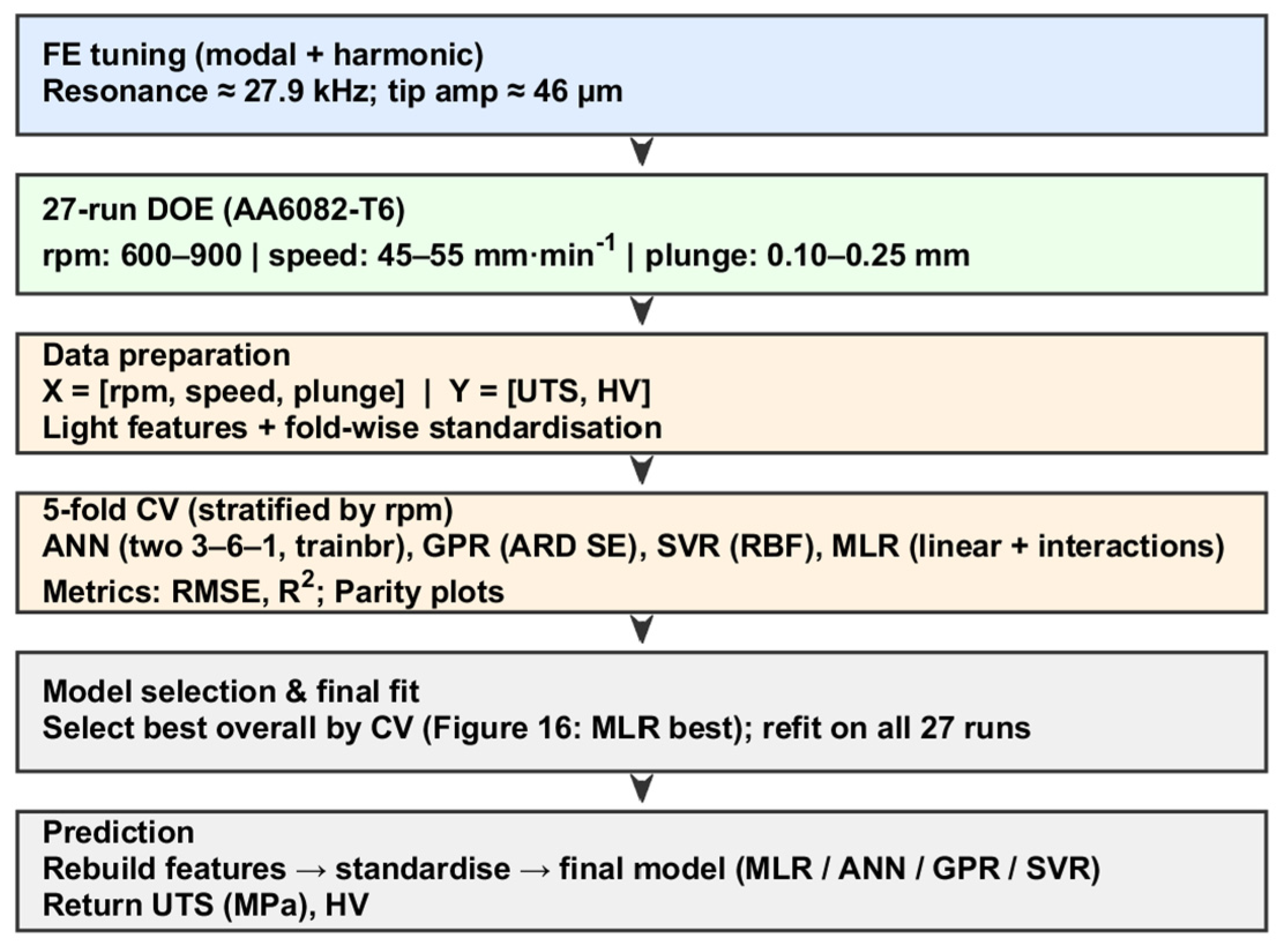
This work followed a simple, end-to-end workflow. The ultrasonic system was tuned using a FEA modal and harmonic analyses, followed by a 27-run programme on AA6082-T6 that varied rotational speed, welding speed, and plunge depth, measuring ultimate tensile strength (UTS) and Vickers hardness (HV). The data were modelled in MATLAB 2025b (MathWorks, Natick, MA, USA) with light feature engineering and fold-wise standardisation; four regression approaches, including two separate [3 + 4]-6-1 ANNs (UTS-ANN, HV-ANN) with Bayesian regularisation, GPR, with an automatic relevance determination (ARD) squared-exponential kernel, and radial basis function (RBF)-SVR, were benchmarked under stratified 5-fold cross-validation using RMSE and R2. The best model per output was retrained on all data and wrapped in a small predictor for new process settings.

2.1. Ultrasonic Horn Simulation and Design

2.1.1. Transducer and Horn Design

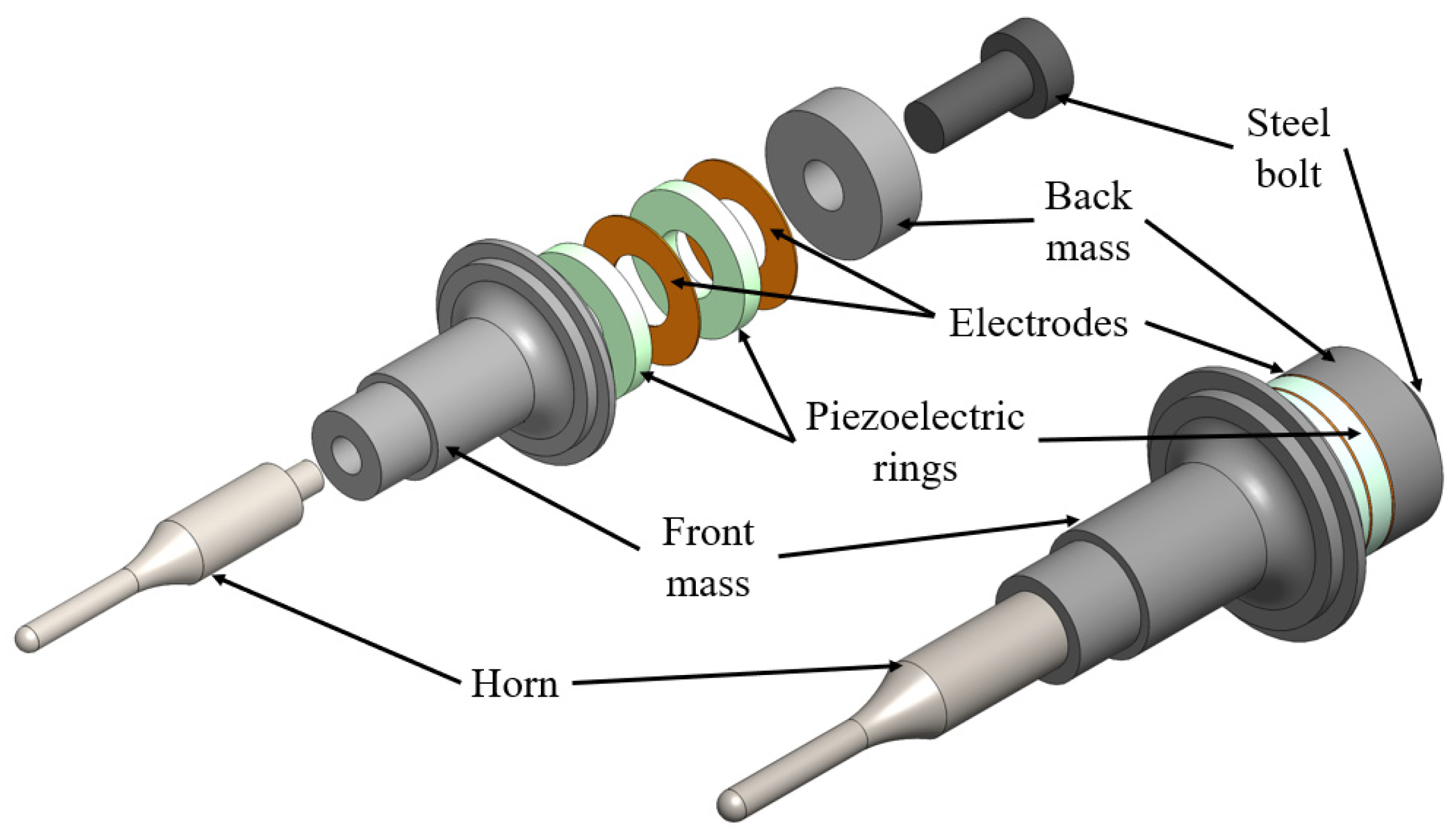
The ultrasonic transducer system was modelled using Abaqus/CAE to support the development of a practical UVAFSW process. The dimensional configuration of the transducer components was based on the methodology proposed in [28], ensuring reliable vibrational behaviour. As shown in Figure 1, the transducer assembly comprises piezoelectric ceramic rings sandwiched between aluminium front and back masses, with electrodes integrated to apply the electrical excitation.
These components are rigidly clamped using a pre-stressed central bolt, forming a compact, efficient ultrasonic stack that delivers high-frequency mechanical oscillations to the welding zone. A stepped cylindrical ultrasonic horn was designed and integrally connected to the front mass to amplify and transmit the vibrational energy generated by the transducer. This geometry was chosen for its high amplification efficiency, mechanical reliability, and ease of tuning to the required resonant frequency, as supported by prior studies [30,35]. The properties used to define the materials in the FEA model are listed in Table 1.
The horn design ensured sufficient amplitude and stable ultrasonic transmission throughout the welding process, meeting the performance requirements for vibration-assisted FSW [36] to ensure the efficient transmission of ultrasonic energy during the UVAFSW process. The simulation involved two primary steps: modal analysis and harmonic response analysis.

2.1.2. Modal Analysis

A modal analysis was conducted to determine the natural frequencies and corresponding mode shapes, ensuring the optimal performance of the ultrasonic transducer-horn system. This step was essential to verify that the assembly operates close to the target excitation frequency of 28 kHz and to avoid potential resonance-related failures.
A detailed finite element model was developed using 20-node quadratic brick elements (C3D20R) for the metallic components and coupled-field elements (C3D20RE) for the piezoelectric rings, enabling the precise simulation of the electromechanical interactions. The results of the modal analysis are summarised in Table 2, presenting the identified mode shapes along with their corresponding natural frequencies.
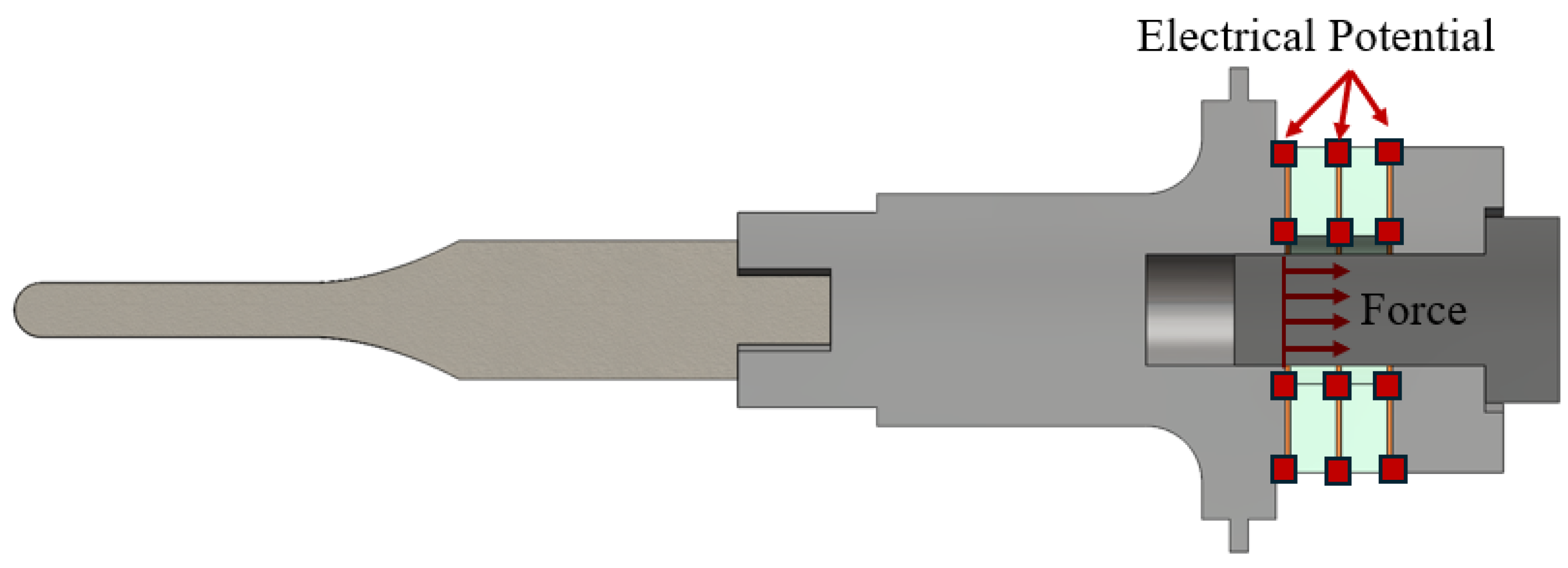
Appropriate mechanical and electrical boundary conditions were applied to simulate realistic operating conditions, as schematically illustrated in Figure 2. A compressive preload of 30 MPa was applied to the piezoelectric stack to replicate the effect of bolt tightening, consistent with values reported in previous studies [29]. For the electrical boundary condition, one face of each piezoelectric ring was grounded to represent a short-circuit configuration, in accordance with the second form of the piezoelectric constitutive formulation [37].
The eigenvalue problem was solved using the Block Lanczos method within Abaqus, with the sparse direct solver employed to enhance numerical stability and solution accuracy [38]. The extracted natural frequencies and mode shapes are the foundation for evaluating system resonance behaviour and guiding subsequent harmonic response analysis.
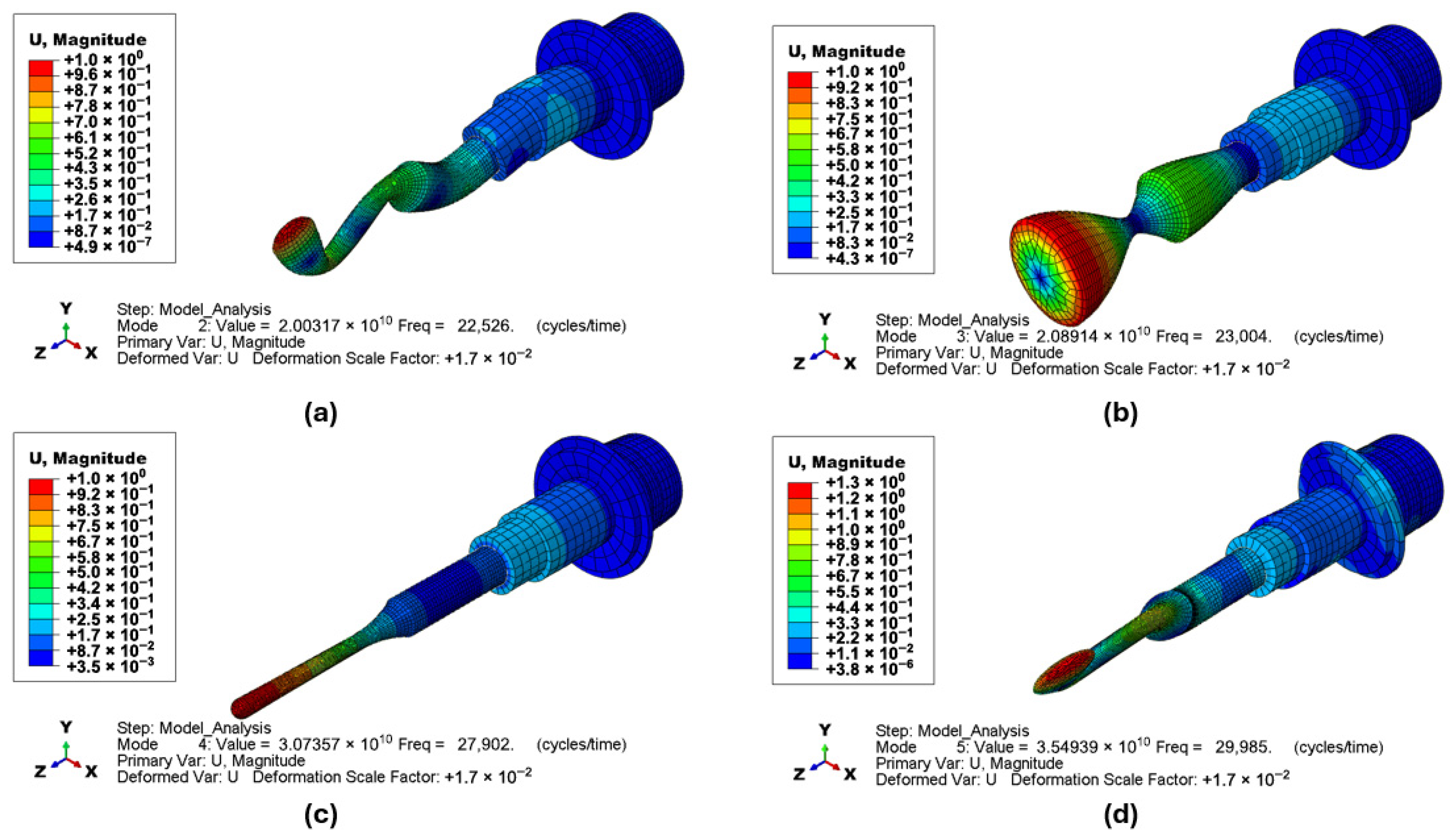
Following the modal analysis for the ultrasonic horn across the 20–35 kHz frequency range, eight distinct natural frequencies and their associated mode shapes were identified, as summarised in Table 2. Four representative vibration modes were selected from these to assess the horn’s dynamic performance, as depicted in Figure 3. Specifically, Mode 2 at 22,526 Hz reveals bending deformation, while Mode 3 at 23,004 Hz corresponds to a torsional vibration about the horn’s central axis. Mode 4 at 27,902 Hz exhibits a pronounced longitudinal vibration along the horn’s axis, which is particularly favourable for efficient transmission of ultrasonic energy in welding processes.
In contrast, Mode 5 at 29,985 Hz demonstrates bending behaviour once more. Among all examined modes, Mode 4 most effectively satisfies the operational criteria for ultrasonic-assisted welding and was thus selected for subsequent harmonic response and performance evaluations.
Although many studies emphasise horn design in isolation [28], achieving optimal ultrasonic functionality necessitates an integrated analysis of the entire system, including both the transducer and horn, to ensure proper alignment of resonant frequencies.
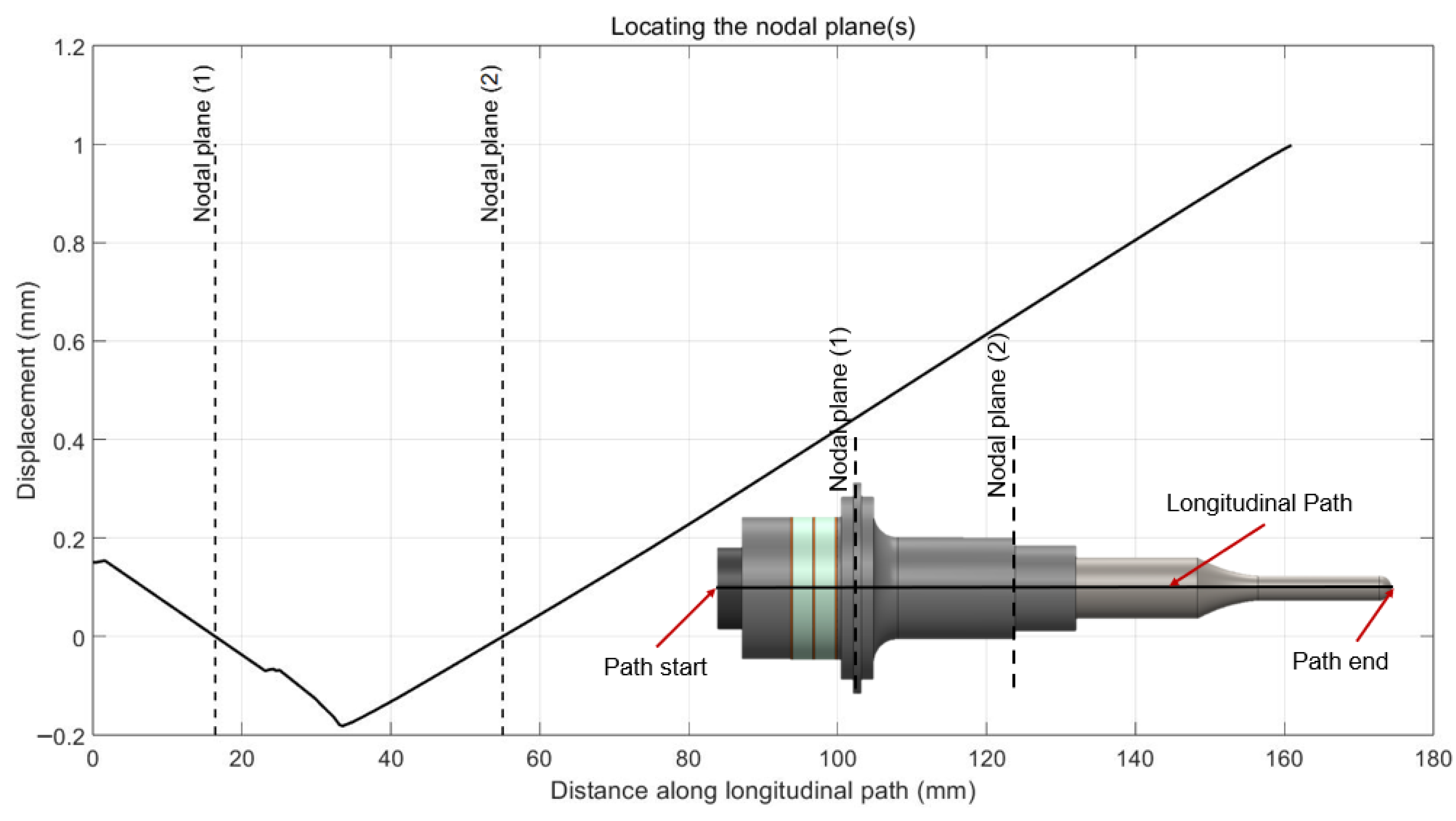
The current analysis confirms that this system-level approach enables the precise tuning of the entire ultrasonic assembly (i.e., the transducer coupled with the horn-tool configuration). Notably, the nodal plane, characterised by zero displacement, was identified and is shown in Figure 4. This region is deemed optimal for mechanical fixation, as it minimises vibrational energy loss and ensures reliable and stable system performance.

2.1.3. Harmonic Analysis

A steady-state harmonic response analysis was conducted to determine whether the ultrasonic vibration system resonates at its natural frequency. Under resonance conditions, this study evaluates whether the horn’s maximum amplitude meets practical processing demands. This evaluation was essential for verifying the effectiveness and suitability of the overall system design [39]. To replicate realistic operating conditions, a sinusoidal voltage excitation of 300 V peak to peak, matching the maximum output of the experimental signal generator, was applied to the electrode surfaces of the piezoelectric elements as a boundary condition. This excitation accurately predicted the system’s displacement amplitude and amplification behaviour under steady-state harmonic loading [37].
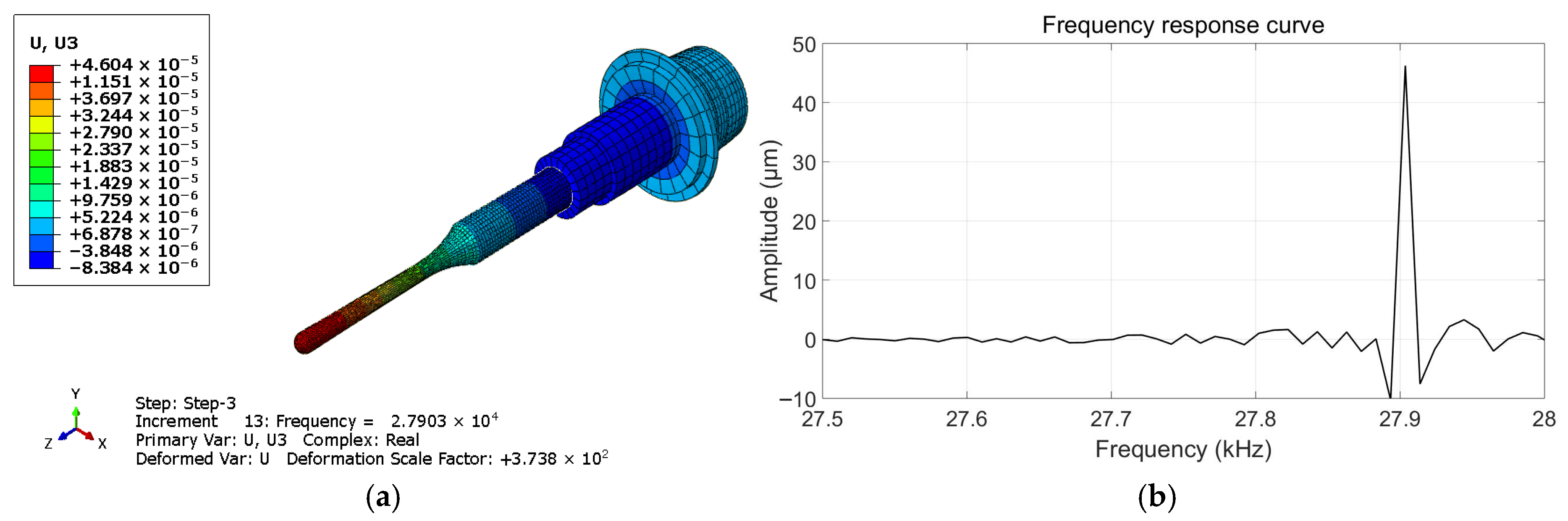
As shown in Figure 5a, the deformation shape at the resonant frequency clearly illustrates the displacement distribution along the horn, with maximum displacement occurring at the horn’s tip as characterised by a longitudinal vibration mode. Figure 5b presents the frequency response curve, which exhibits a distinct resonance peak at 27.9 kHz. The system reaches its maximum vibrational amplitude of approximately 46 µm at this frequency. This amplitude agrees with previous studies reporting values around 40 µm for similarly tuned ultrasonic horn systems [40,41], indicating that the simulation results fall within the expected operational range. The sharp amplitude peak and symmetric response confirm the model’s effectiveness and suggest efficient energy transfer with minimal damping, supporting the reliability of the design for ultrasonic-assisted applications.

2.2. Design of Experiments (DOE)

In order to systematically evaluate how key process parameters affect the mechanical performance of UVAFSW joints, a structured Design of Experiments (DOE) approach was adopted. Rather than relying on trial and error, DOE ensures that the influence of rotational speed, welding speed, and plunge depth, and their interactions can be assessed efficiently and with statistical confidence. This framework provided a balanced dataset for experimental analysis and subsequent AI modelling.

Experimental Matrix

A structured DOE approach was applied to evaluate the influence of key process parameters on the mechanical performance of UVAFSW joints. Based on engineering knowledge and prior studies [8,24,26], three primary parameters were selected: tool rotational speed (rpm), welding traverse speed (mm/min), and plunge depth (mm). These factors were each investigated at three levels (coded as −1, 0, and 1), as shown in Table 3. A Full Factorial Design (FFD) was initially used to establish process stability and identify trends. The Taguchi method was subsequently employed in MINITAB to generate a 3-level, 27-trial experimental layout to refine the analysis further and reduce experimental effort. This design methodology ensures a comprehensive exploration of the parameter space, enabling efficient, data-driven process optimisation in UVAFSW.

2.3. Hybrid Ultrasonic-Assisted Friction Stir Welding Setup

This section describes the materials, welding assembly, and ultrasonic system developed for the experiments. Outlining the workpiece preparation, tool design, and integration of the independently mounted ultrasonic horn provides the practical foundation for implementing UVAFSW under controlled conditions.

2.3.1. Materials and Welding Setup

In this study, 6082-T6 aluminium alloy (EMF, 2nd Industrial Zone, 6th October City, Egypt) was used as the base material for the welding experiments. The alloy was supplied as flat plates with a uniform thickness of 3 mm. Each plate was prepared with dimensions of 150 mm in length and 50 mm in width to ensure consistency across all trials. A square butt joint configuration was adopted by aligning two plates along their 150 mm edges during welding. The chemical composition and mechanical properties of the base material are presented in Table 4.
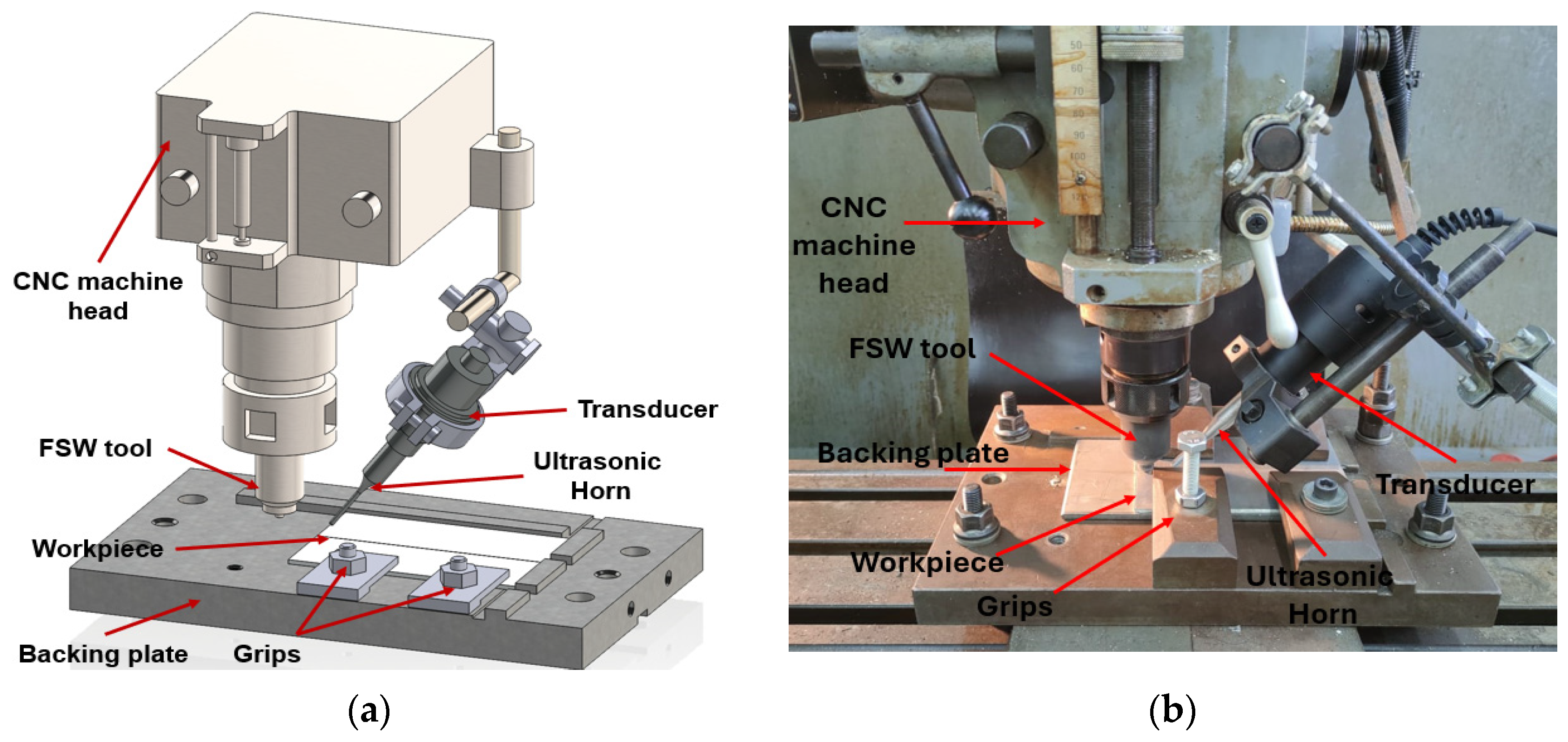
To implement UVAFSW, a custom hybrid assembly was developed to superimpose high-frequency longitudinal ultrasonic vibrations onto the conventional FSW process. Unlike traditional tool-integrated systems, the ultrasonic horn in this setup was mounted independently to the workpiece surface, enabling the direct transmission of ultrasonic energy into the weld zone without any mechanical coupling to the rotating tool. The complete experimental assembly, comprising the ultrasonic horn, FSW tool, workpiece, and support components, is illustrated in Figure 6, which shows the spatial arrangement and integration of all system elements. The UVAFSW process was conducted using an Extron Vertical Milling Centre machine (CENTROID, Howard, MI, USA). Ultrasonic vibrations were supplied by a generator unit operating at 28 kHz, delivering a maximum output power of 1 kW and a peak-to-peak voltage of 300 V.
In the present study, ultrasonic vibration was applied using fixed amplitude and power settings in order to evaluate its overall effect on the mechanical performance of friction stir-welded joints. A more detailed investigation into the influence of ultrasonic amplitude and power is beyond the scope of the current work and is reserved for future study.
The welding-speed range (45–55 mm/min) was selected based on preliminary trials conducted under ultrasonic vibration at a fixed amplitude of approximately 40 µm. Speeds above 55 mm/min led to inconsistent tool–workpiece interaction and occasional signs of insufficient material consolidation, indicating that the process window was approaching an unstable regime when ultrasonic assistance was applied. To ensure full penetration, defect-free welds, and reliable mechanical testing across all experiments, the parameter space was therefore restricted to a conservative, technically robust range.
In the present UVAFSW setup, ultrasonic assistance enabled stable welding within the selected range of 45–55 mm/min; however, preliminary trials indicated that speeds above 55 mm/min approached an unstable regime, as evidenced by inconsistent tool–workpiece interaction and insufficient material consolidation. In friction stir welding, the process window represents the range of parameter combinations that produce defect-free welds with acceptable mechanical properties. Ultrasonic vibration may influence this window by enhancing material plasticisation and reducing resistance to material flow around the rotating tool. In the present study, these effects are considered to have contributed to stable weld formation within the selected parameter range.
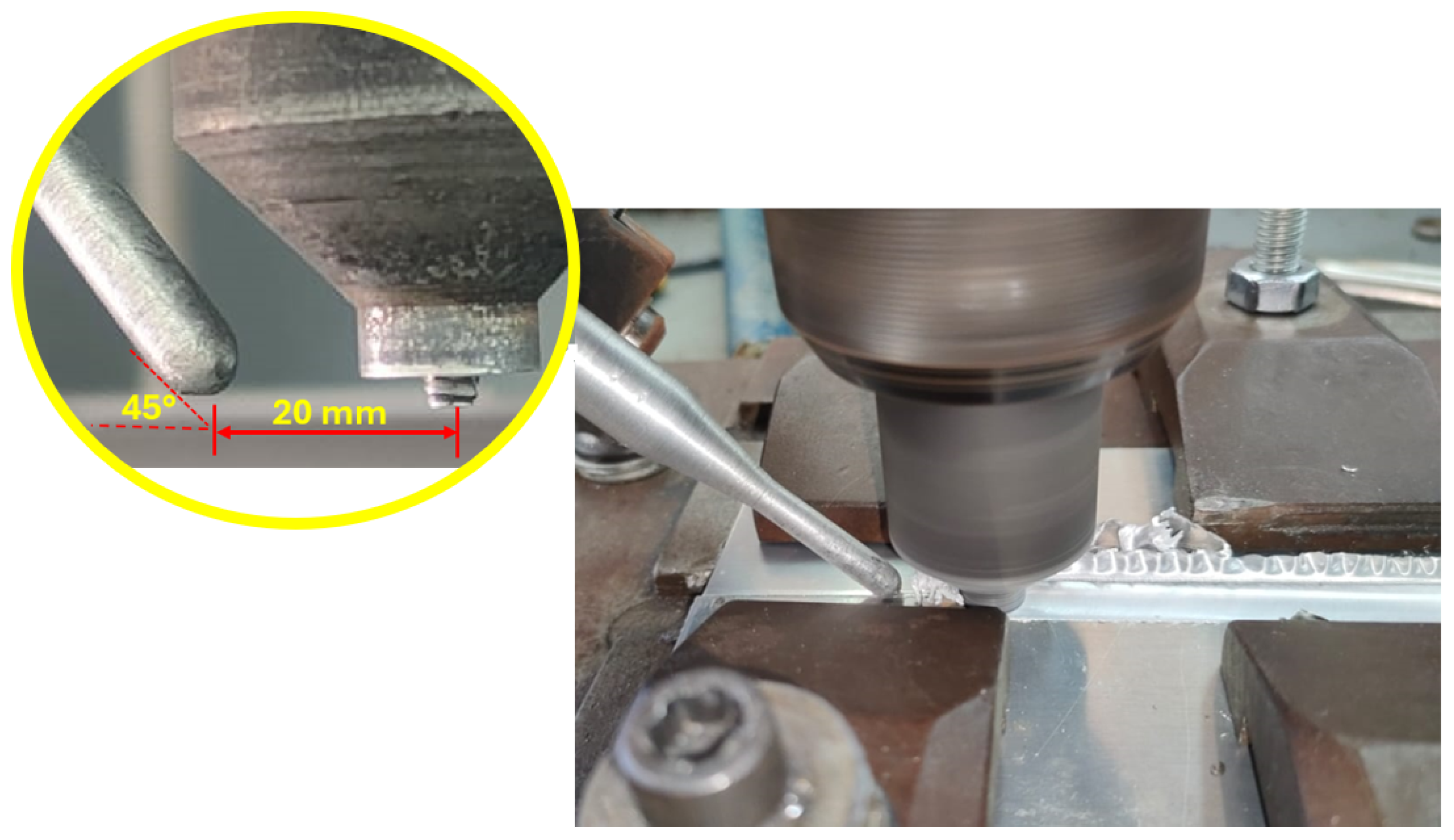
Further details of the ultrasonic horn and FSW tool configuration are illustrated in Figure 7, which highlights the horn’s mounting angle, tip geometry, and spatial relation to the welding tool. The horn was positioned at 45° to the workpiece surface and featured a spherical tip with a 2.5 mm radius, ensuring firm, continuous contact during welding. The horn tip was located approximately 20 mm from the FSW tool axis, enabling the effective delivery of ultrasonic energy into the weld zone. The FSW tools were fabricated from W302 hot-work tool steel due to its superior wear resistance and retention of mechanical strength at elevated temperatures. The tools underwent a heat treatment to improve their hardness and durability, as described in [22]. The tool design included a concave shoulder with a 12 mm diameter, intended to encourage material flow and reduce flash formation. Additionally, a cylindrical threaded pin with a 5 mm diameter and a 2.7 mm length was used, as shown in Figure 7.

2.3.2. Measurements and Mechanical Characterisation

Two primary mechanical tests were conducted to evaluate the influence of ultrasonic vibration on the joints’ mechanical integrity: tensile testing to assess global joint strength and microhardness testing to assess localised strength variation across the weld zones.
  • Tensile Testing
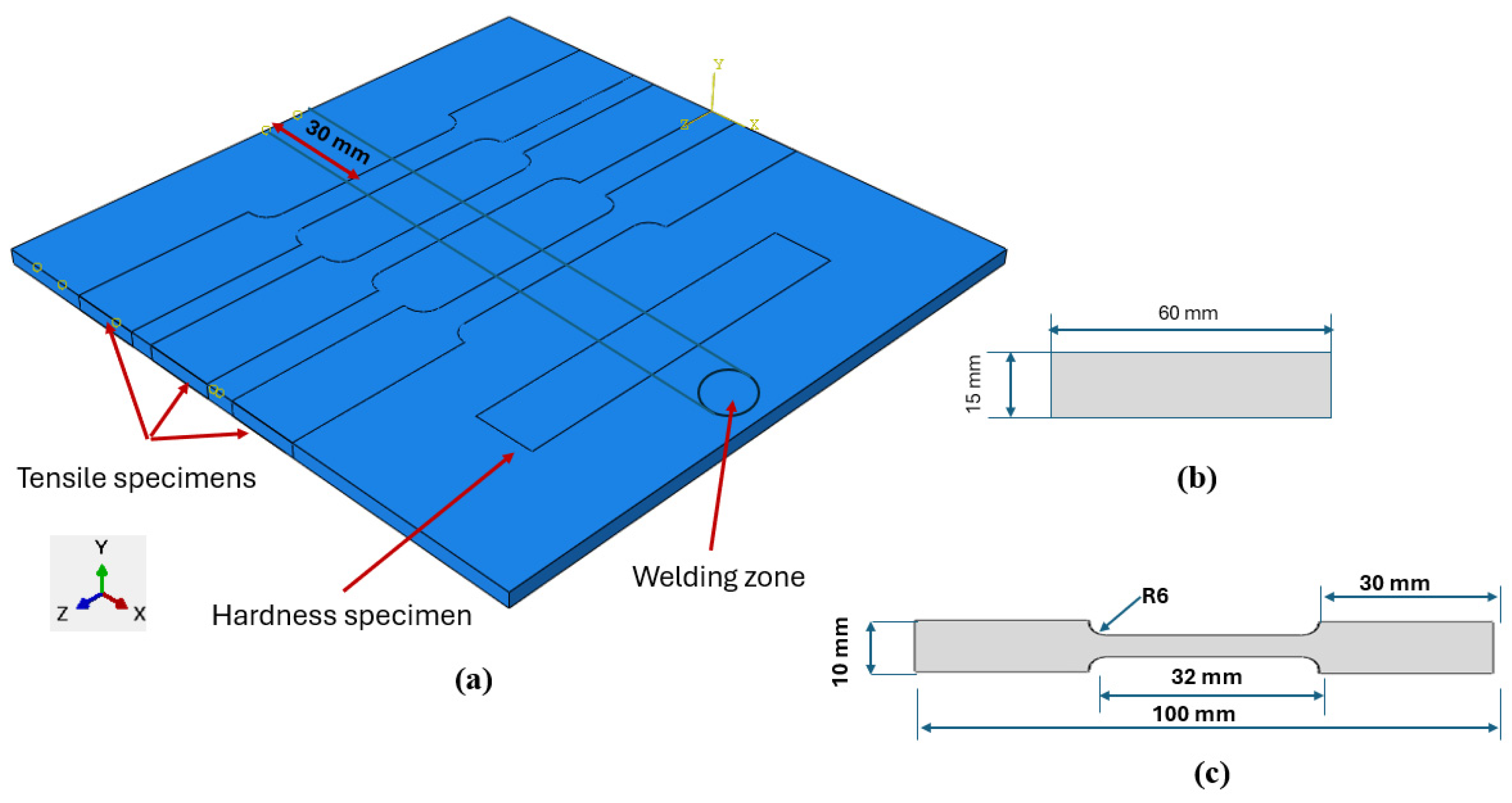
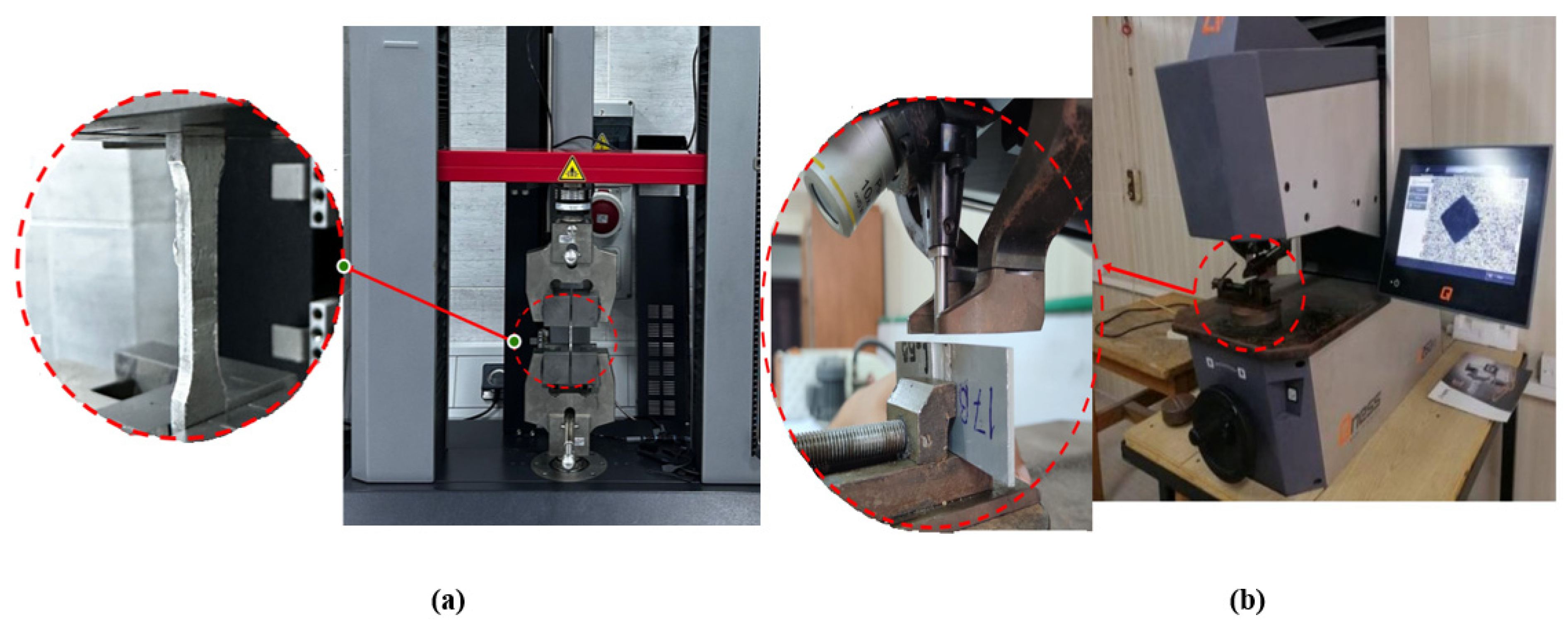
Tensile testing was conducted to evaluate the mechanical properties and overall strength of the welded joints. The specimens were prepared per the American Society for Testing and Materials (ASTM) E8/E8M standard [42], with the sampling direction oriented perpendicular to the weld line to ensure consistent mechanical evaluation, as illustrated in Figure 8a. Each tensile specimen featured a gauge length of 32 mm, an even width of 6 mm, and a uniform thickness of 3 mm, resulting in a cross-sectional area of 18 mm2, as shown in Figure 8c. Tensile tests were performed at a controlled room temperature of 20 °C using a Z010 Zwick/Roell universal testing machine (Zwick/Roell, Ulm, Germany), as depicted in Figure 9a. The machine was fitted with a cell of a maximum load capacity of 10 kN and operated at a constant crosshead speed of 1 mm/min.
Hardness Testing
Microhardness testing was conducted on the transverse cross-section of the weld using a Qness Vickers hardness testing machine (Remscheid, Germany), as shown in Figure 9b. A load of 200 g (HV0.2) was applied with a dwell time of 15 s, and indentations were made along a horizontal line at the mid-thickness of the specimen. The hardness measurements were performed along a transverse line across the welded joint to obtain an overall hardness distribution. A more detailed hardness mapping that distinguishes the stir zone (SZ), thermo-mechanically affected zone (TMAZ), and heat-affected zone (HAZ) could provide further insights into local mechanical properties associated with variations and may be considered in future investigations. Each measurement was repeated three times at the stir zone of the friction stir-welded joint to ensure the accuracy and reliability of the results. This test aimed to evaluate the influence of ultrasonic energy on plastic deformation within the stir zone and correlate the hardness profile with tensile performance.

2.4. AI/ML Predictive Modelling

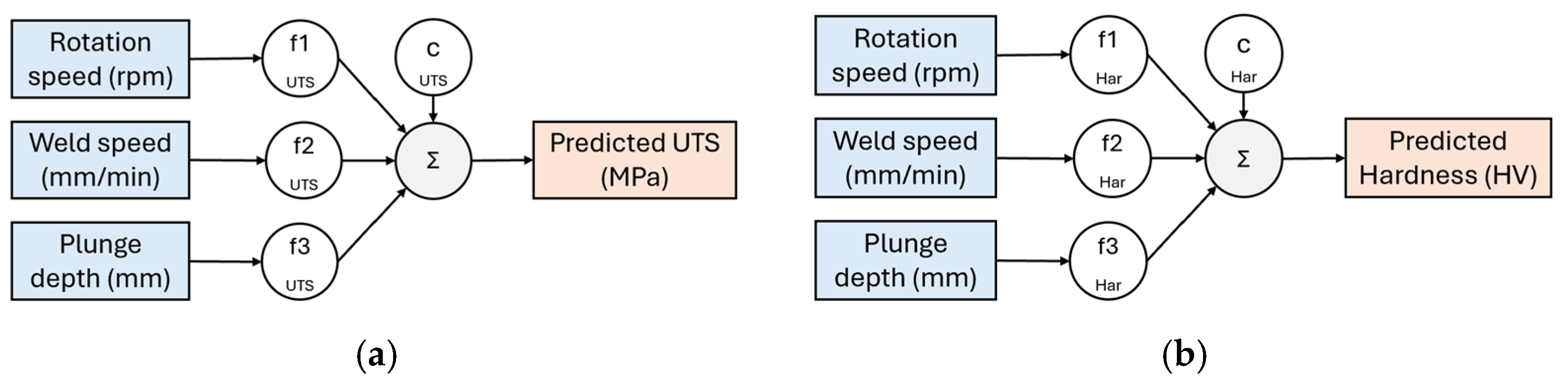
Predictive models were developed to map process parameters (tool rotational speed, welding speed, and plunge depth) to joint responses (UTS and Vickers hardness). The dataset comprised 27 experimental runs. Prior to modelling, predictors were standardised to a mean of zero and a variance of one, and the same pre-processing was applied across all models. Four regression models were evaluated: multiple linear regression (MLR), support vector regression (SVR), Gaussian process regression (GPR), and an artificial neural network (ANN). For MLR, main effects and two-factor interaction terms were included. Model performance was assessed using 5-fold cross-validation; folds were randomly shuffled with a fixed seed to ensure repeatability. Predictive accuracy was quantified using the mean cross-validated R2 and RMSE. Hyperparameters for SVR/GPR/ANN were selected using grid search within CV, and the final model was chosen based on overall cross-validated performance across both responses, with MLR providing the best overall trade-off.

3. Results and Discussion

The welded joints were evaluated through tensile and Vickers hardness testing across the 27 UVAFSW trials. The complete results are summarised in Table 5, which links the applied process parameters with the measured mechanical responses. This dataset provides the basis for analysing the influence of parameters on joint strength and hardness.
The following subsections present the effects of rotational speed, welding speed, and plunge depth on the ultimate tensile strength (UTS) and hardness distribution of the UVAFSW joints, followed by machine learning predictions for these mechanical properties.

3.1. Microstructural Characterisation of the UVAFSW Joint

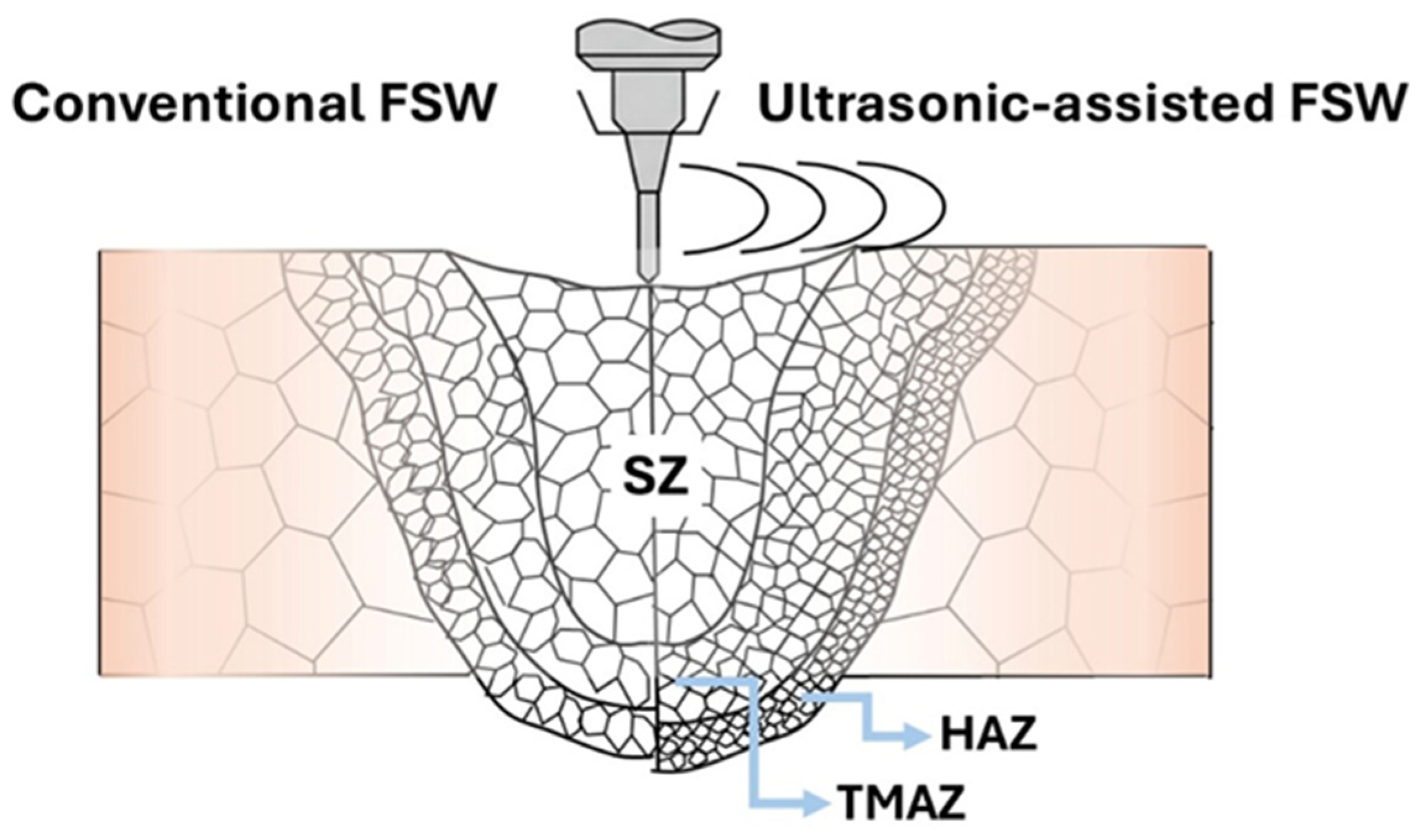
Although a microstructural examination was not conducted in the present work, previous investigations on friction stir welding of AA6082-T6 alloys reported that the process produces a characteristic microstructural distribution consisting of the stir zone (SZ), thermo-mechanically affected zone (TMAZ), and heat-affected zone (HAZ) [43,44], see Figure 10. The intense plastic deformation and frictional heating in the stir zone promote dynamic recrystallisation and significant grain refinement. In ultrasonic vibration-assisted FSW, the additional acoustic energy can further enhance material flow and plasticisation, potentially leading to finer grain structures and improved mechanical performance. These findings are consistent with the improvements in tensile strength and hardness observed in the present study.

3.2. Effect of UVAFSW Process Parameters on Tensile Strength

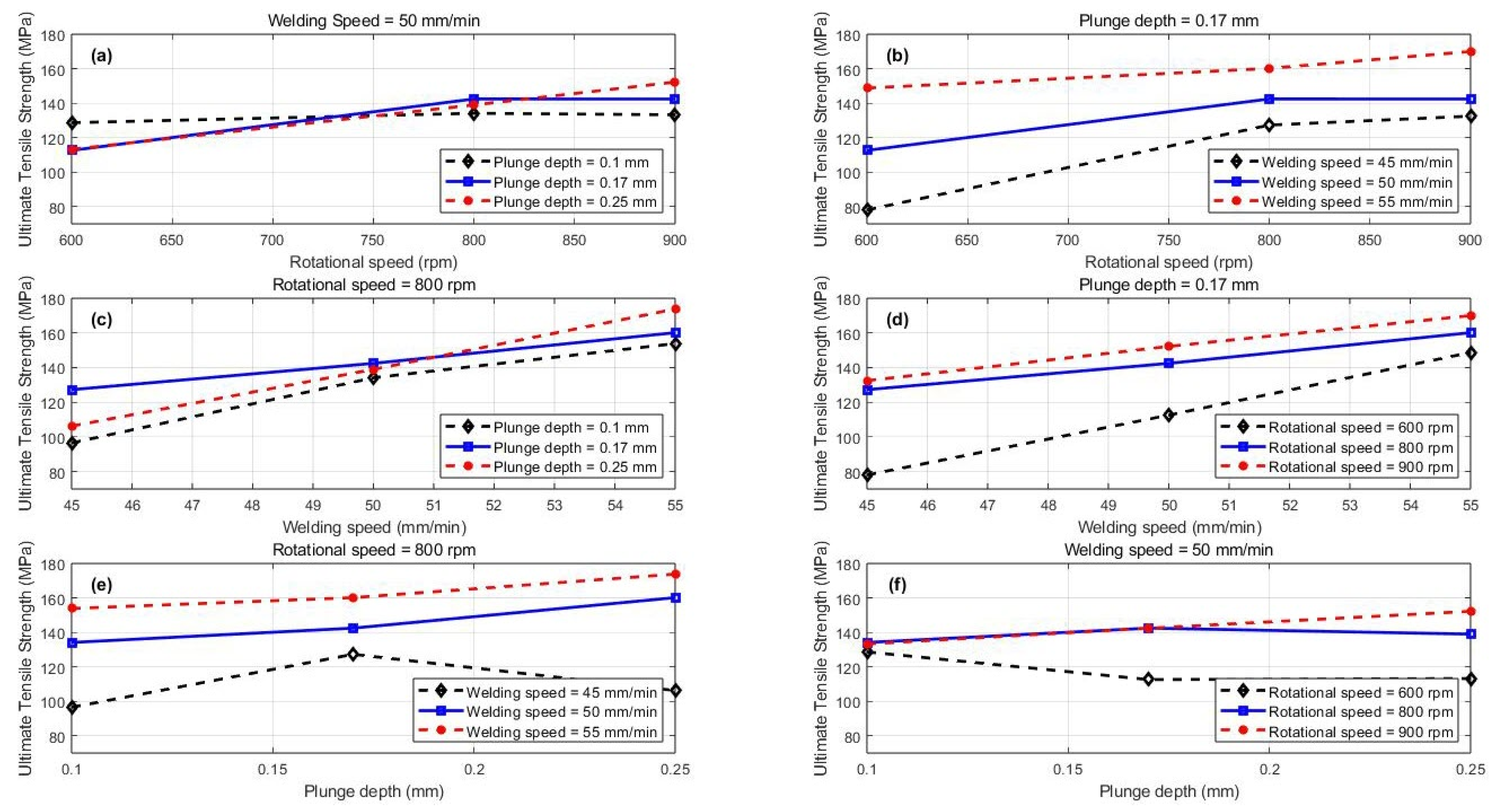
The effect of rotational speed on the ultimate tensile strength (UTS) is illustrated in Figure 11. Figure 11a depicts that UTS exhibits a consistent upward trend with increasing rotational speed across all evaluated plunge depths. The maximum UTS value of 152 MPa was recorded at 900 rpm and a plunge depth of 0.25 mm, representing an improvement of approximately 18.8% compared to the lowest value of ~128 MPa observed at 600 rpm with a shallow plunge of 0.10 mm. The improvement in tensile strength may be associated with grain refinement and dynamic recrystallisation, as commonly reported in friction stir welding of aluminium alloys.
Correspondingly, Figure 11b shows that, at a constant plunge depth of 0.17 mm, the UTS increased markedly with higher rotational and welding speeds. The highest UTS of ~170 MPa was achieved at 900 rpm with a welding speed of 55 mm/min, representing an improvement of over 26% compared to 45 mm/min. This suggests that faster tool rotation and travel speed generate optimal thermal and mechanical conditions conducive to effective stirring and bonding. Moreover, the results underscore the critical influence of plunge depth in modulating the effect of rotational speed on UTS. Deeper plunge depths, particularly 0.25 mm, appear to enhance tool–workpiece interaction, promote more intense stirring, and contribute to superior weld quality.
Figure 11c illustrates a steady increase in UTS with rising welding speed across all tested plunge depths, reflecting a trend like that shown in Figure 11a for rotational speed. The findings indicate that greater plunge depths lead to higher UTS values, with a maximum strength of 175 MPa achieved at a plunge depth of 0.25 mm and a welding speed of 55 mm/min. This represents an 80% improvement over the baseline condition (96 MPa at 0.10 mm and 45 mm/min), attributed to enhanced material consolidation and more uniform heat input at higher speeds.
As shown in Figure 11d, increasing the rotational speed also increases UTS, with the optimum strength observed at 900 rpm. These results emphasise the importance of the combined effects of plunge depth, rotational speed, and welding speed in achieving high-quality welds.
Figure 11e shows how plunge depth affects UTS when the tool rotates at 800 rpm. In general, deeper plunges produced stronger joints, with the best result, about 172 MPa, recorded at 0.25 mm depth and 55 mm/min welding speed. This improvement comes from better material mixing and extra heat, which helps the metals bond more effectively. At the lowest welding speed of 45 mm/min, strength improved up to 0.17 mm, but then dropped off. This decline is likely due to excessive tool pressure, which can cause over-stirring, grain coarsening, or even defects such as voids.
Figure 11f examines the same effect, this time at a fixed welding speed of 50 mm/min and varying rotational speeds. Again, UTS generally increased with plunge depth, with the strongest welds at 0.25 mm achieved at 900 rpm. The extra rotation generates more frictional heat and stirring, creating smooth material flow and defect-free joints, along with the deeper plunge. At 800 rpm, however, strength fell slightly at deeper plunges, suggesting that the heat input was insufficient to maintain weld quality.
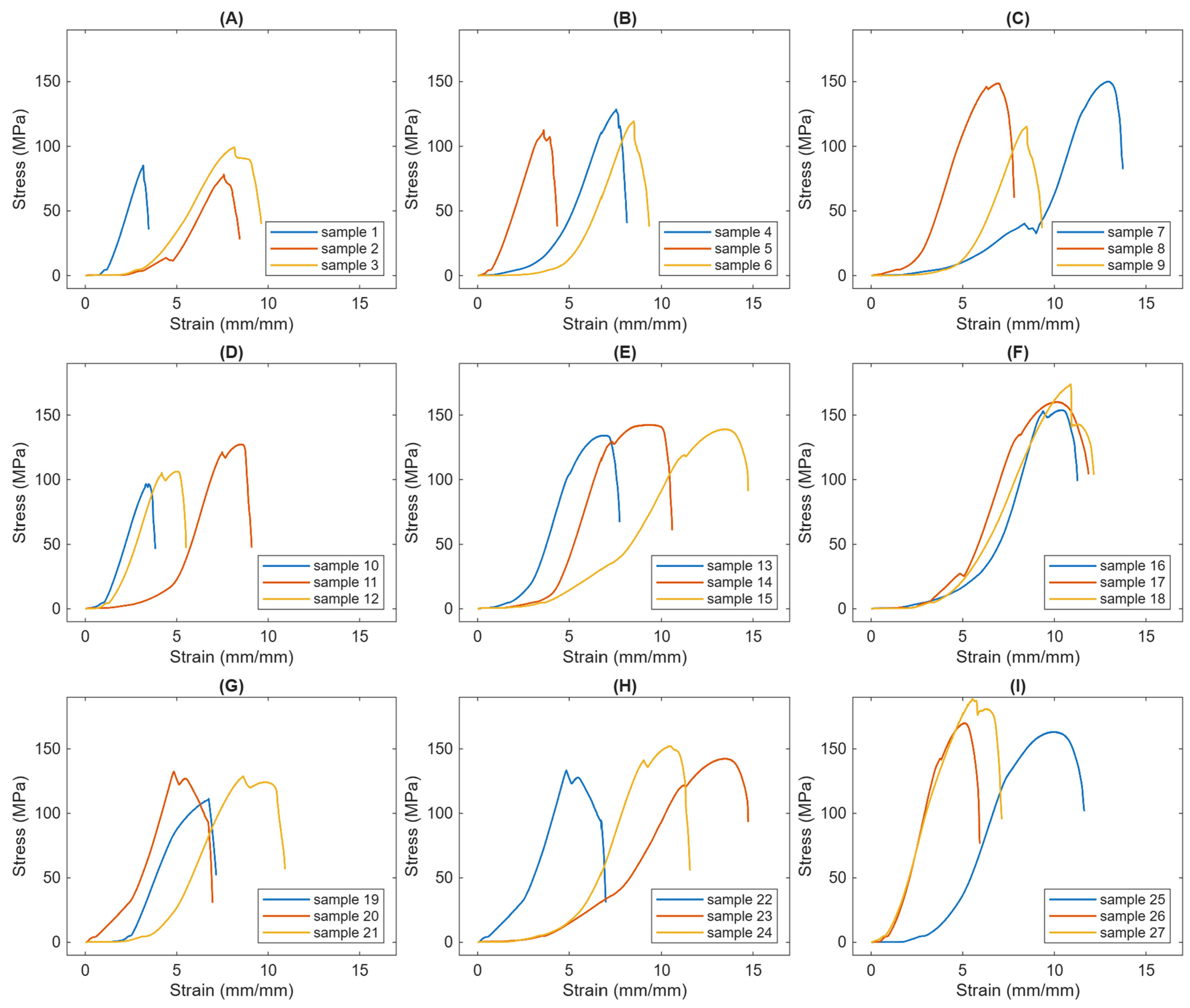
Figure 12 shows representative engineering stress–strain curves for welded joints produced under selected UVAFSW conditions. The results indicate that the welding conditions strongly influence the yield behaviour, ultimate tensile strength, and elongation of the joints. All curves exhibit an initial linear-elastic region with broadly similar slopes, suggesting that the elastic modulus is not markedly affected by the processing parameters. Beyond the proportional limit, the curves enter the plastic region and show strain hardening up to the ultimate tensile strength, followed by post-peak softening associated with localised necking prior to fracture. Under less favourable conditions, some curves show earlier yielding and lower peak stress at relatively small strain, which may reflect sub-optimal thermal–mechanical conditions or poorer material consolidation within the weld zone.

3.3. Effect of UVAFSW Process Parameters on Hardness Profile Interpretation

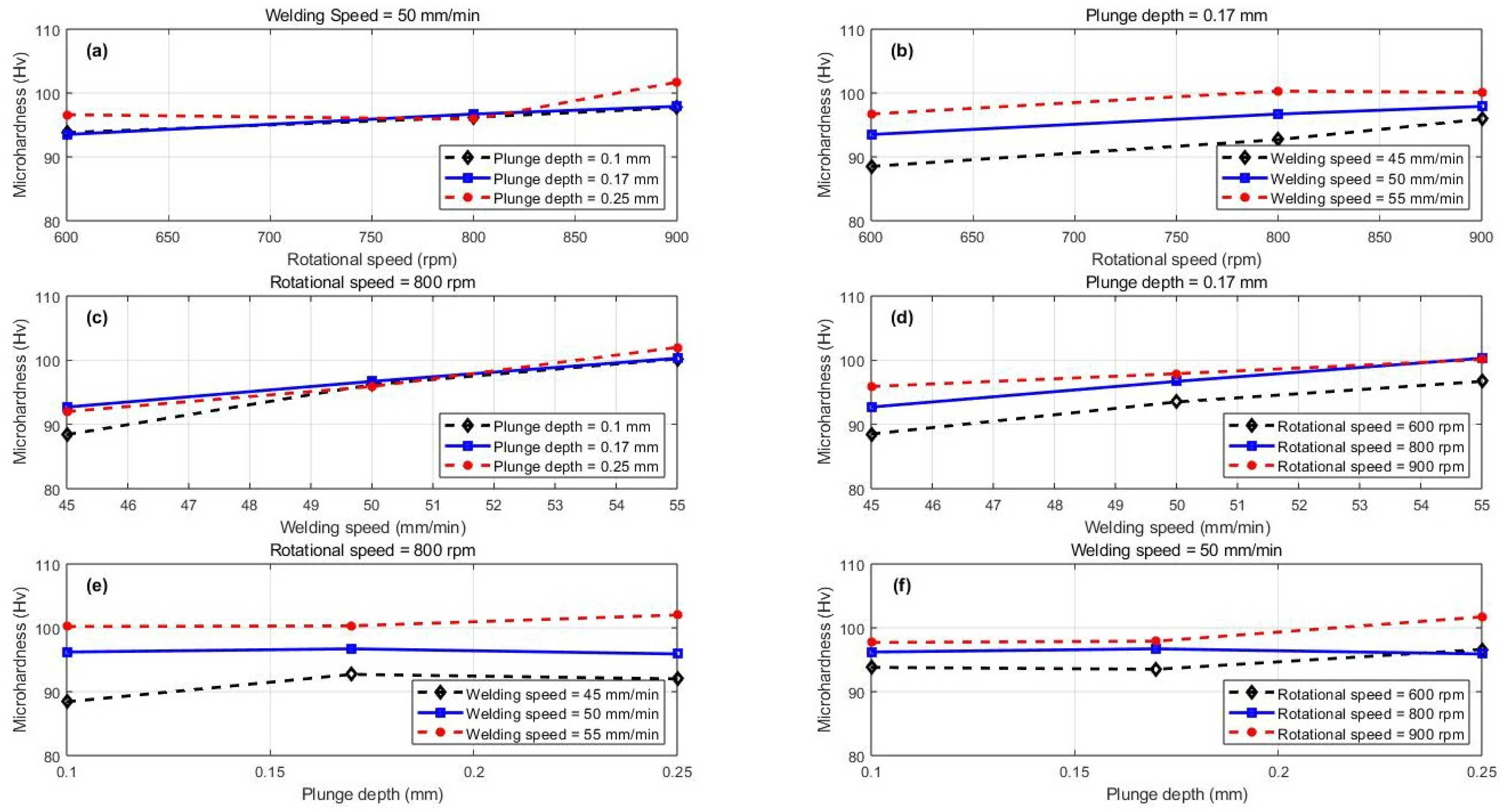
The microhardness analysis reveals a systematic dependence on rotational speed, welding speed, and plunge depth, as demonstrated in Figure 13. In Figure 13a, the fixed welding speed (50 mm/min), higher rotational speeds progressively enhance hardness, with peak values (102 HV) achieved at 900 rpm and 0.25 mm plunge depths due to intensified material flow and grain refinement. Shallower penetrations (0.1–0.17 mm) show diminished improvements, indicating insufficient thermo-mechanical processing.
When maintaining a constant plunge depth (0.17 mm), as shown in Figure 13b, the optimal hardness occurs at 800 rpm with a 55 mm/min welding speed, where balanced heat input and strain rates promote microstructural refinement. The subsequent hardness reduction at 900 rpm suggests thermal over-softening effects. The microhardness response in Figure 13 demonstrates strong dependencies on welding parameters, with the plunge depth as the primary controlling factor. Figure 13c shows that increasing the welding speed increases hardness across all penetration levels, and the 0.25 mm plunge depth consistently yields the highest values (102 HV at 55 mm/min) at the fixed rotational speed of 800 rpm.
This superior performance reflects the benefits of sufficient material deformation and controlled heat dissipation, where deeper penetration ensures comprehensive dynamic recrystallisation. At the same time, higher welding speeds limit grain growth through reduced thermal exposure. Complementary data in Figure 13d reinforce these trends, showing that peak hardness (>100 HV) requires synergistic parameter combinations—particularly the 900 rpm rotational speed with 55 mm/min welding speed at 0.17 mm plunge.
The consistent superiority of deeper penetrations in both figures underscores their critical role in achieving optimal thermomechanical processing conditions for hardness maximisation. These results collectively establish that while welding and rotational speeds modulate microstructural evolution, the plunge depth is the enabling parameter that determines the upper bounds of achievable microhardness in UVAFSW.
The microhardness evolution shown in Figure 13e reveals a pronounced dependence on the plunge depth and welding speed at a constant rotational speed of 800 rpm. Hardness consistently increases with plunge depth up to 0.17 mm across all tested welding speeds (45–55 mm/min), likely due to enhanced material consolidation and strain hardening mechanisms. However, beyond this critical depth, the trends diverge significantly. At 45 and 50 mm/min welding speeds, hardness decreases by approximately 0.8% between 0.17 mm and 0.25 mm plunge depth, indicating that excessive heat accumulation may induce thermal softening.
In contrast, at 55 mm/min, hardness increases by 2~3% over the same depth range, suggesting that the higher travel speed reduces the heat input per unit length, thereby limiting thermal degradation. Moreover, as shown in Figure 13f, at a fixed welding speed of 50 mm/min, hardness increases with plunge depth up to 0.17 mm across all rotational speeds. Beyond this depth, divergent behaviour emerges: hardness rises at 600 and 900 rpm, then declines at 800 rpm.
This anomaly implies a nonlinear interaction between rotational speed and thermal–mechanical conditions, particularly at intermediate rpm. The observed softening at 800 rpm may result from a suboptimal thermal input, high enough to cause grain coarsening yet insufficient to promote beneficial recrystallisation or effective stirring.

3.4. Machine Learning Prediction of Tensile Strength and Hardness in UVAFSW

3.4.1. Data and Targets

The predictive modelling used the experimental matrix of 27 UVAFSW trials on AA6082-T6. For each run, three process parameters were recorded as inputs: tool rotational speed (rpm), welding speed (mm/min), and plunge depth (mm), and two mechanical responses were measured as outputs: ultimate tensile strength (UTS, MPa) and Vickers hardness (HV). All modelling was performed in MATLAB (MathWorks), with a fixed random seed to ensure reproducibility. It should be noted that the dataset used in this study is relatively limited, which is common in experimental welding research due to the cost and complexity of conducting large numbers of welding trials. Therefore, the developed machine learning models are intended to provide predictive capability within the investigated parameter range rather than universal generalisation.

3.4.2. Feature Engineering and Pre-Processing

In addition to the three raw process parameters, four engineered features were constructed to capture simple interaction and ratio effects without substantially increasing model complexity (Table 6) (Figure 14).
Before training, predictors were standardised within each cross-validation (CV) training fold using the fold’s mean and standard deviation. This avoids information leakage into the test fold. For neural networks only, inputs and targets were further scaled to [−1, 1] using mapminmax during training, then returned to physical units for evaluation and plotting. GPR and SVR used the already standardised predictors and original-unit targets.

3.4.3. Model Families

The nature of the task guided the choice of models: a smooth but nonlinear mapping from three process parameters (rotational speed, welding speed, plunge depth) to two responses (UTS and HV), learned from a deliberately small design-of-experiments dataset to balance flexibility.
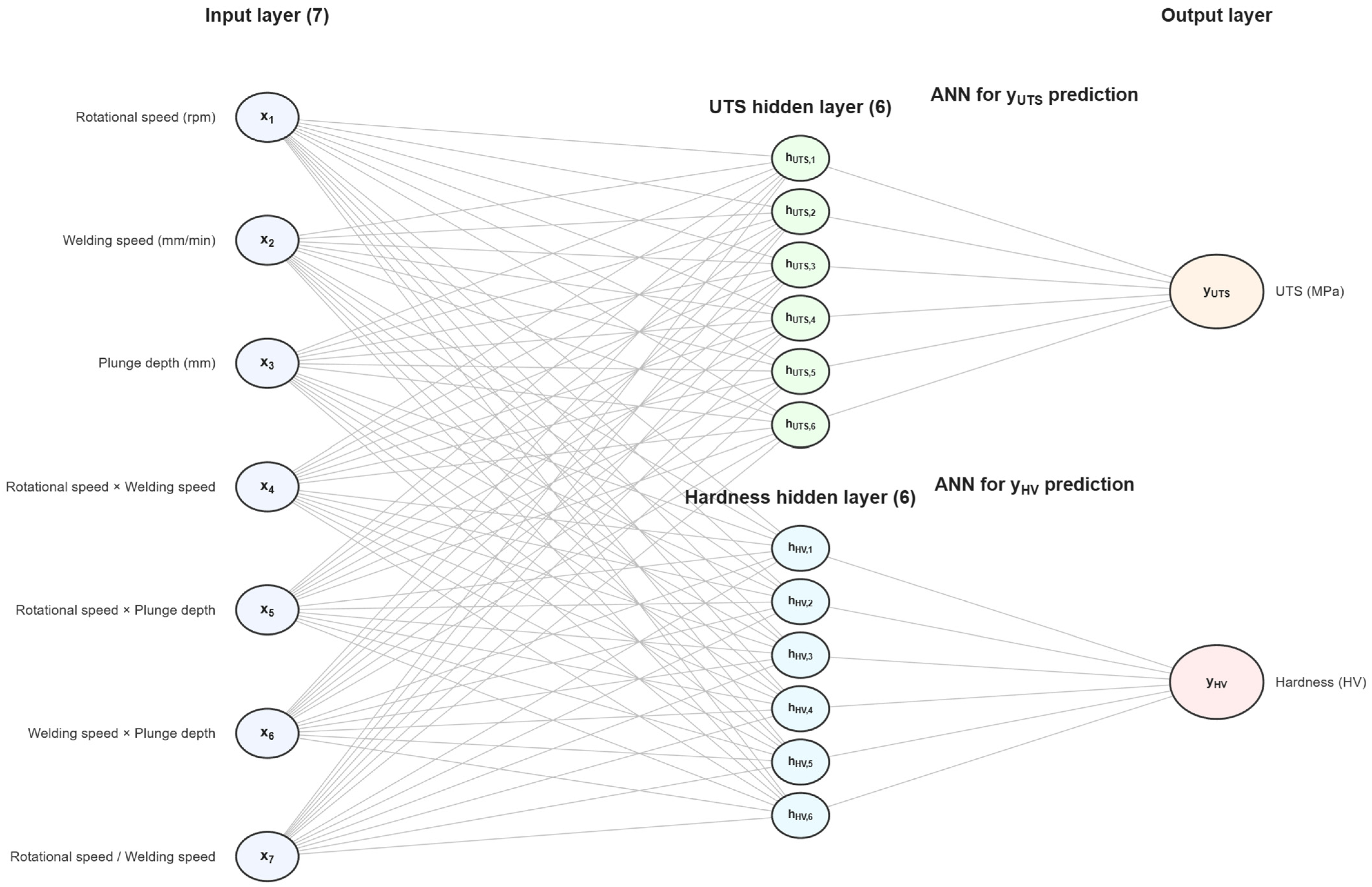
For the ANN, a separate one-hidden-layer network was trained for each output using seven input features in total, comprising the three original process parameters and four engineered interaction/ratio features (Figure 15). Each network used six hidden units with Bayesian regularisation (trainbr), which is well-suited to small samples because it penalises unnecessary weight growth during training and thereby controls capacity without requiring a validation set for early stopping. Inputs and targets were scaled to [−1, 1] for training and then mapped back to physical units, improving numerical stability. Training UTS and HV with separate networks also avoids negative transfer between targets with different scales and noise characteristics.
GPR models employed an automatic relevance determination (ARD) squared-exponential kernel, with a noise level initialised to 10% of the training-fold target standard deviation. This configuration is intentionally conservative: it fits smooth functions well with limited data, learns distinct length scales per feature so that weak predictors are naturally downweighted, and provides calibrated uncertainty. This Bayesian non-parametric approach provides a useful counterpoint to ANNs in a dataset with sparse coverage at the extremes.
SVR with an RBF kernel served as a strong convex baseline. The kernel scale was set to automatic selection, the epsilon-insensitive margin was 0.1 times the training-fold target standard deviation, and the box constraint was one. These settings reflect expected measurement noise, discourage overfitting on tiny folds, and yield a well-posed optimisation that is less prone to optimistic variance than more flexible models. While the ANN or GPR often outperforms SVR on small, smoothly nonlinear problems, it anchors the comparison with a disciplined, margin-based estimator.
MLR was fitted using standard least squares to relate the process inputs to each target (Figure 16 and Figure 17). While less flexible than the AI-based models, it offers transparent coefficients. It can be used to interpret the direction and relative importance of rotational speed, welding speed, and plunge depth.
All models were implemented with MATLAB’s built-in functions (fitnet, fitrgp, fitrsvm, fitlm) under the same pre-processing pipeline (feature construction and within-fold standardisation) and the same five-fold cross-validation splits. The approach was designed to keep the comparison fair and reproducible and to ensure that any performance differences arise from modelling capacity rather than data handling.

3.4.4. Cross-Validation and Fold Design

Model performance was estimated using 5-fold cross-validation (CV). To maintain representative coverage of the experimental space despite the limited sample size, the dataset was randomly shuffled and partitioned so that samples from the 600, 800, and 900 rpm conditions were represented across the folds. In each CV iteration, models were trained on four folds and evaluated on the held-out fold. This procedure produced out-of-fold predictions for all samples and all models.

3.4.5. Performance Metrics and Diagnostics

Two standard metrics were reported per output and model: Root Mean Squared Error (RMSE) in the original units, and the coefficient of determination R 2 = 1 − SSE/SST.
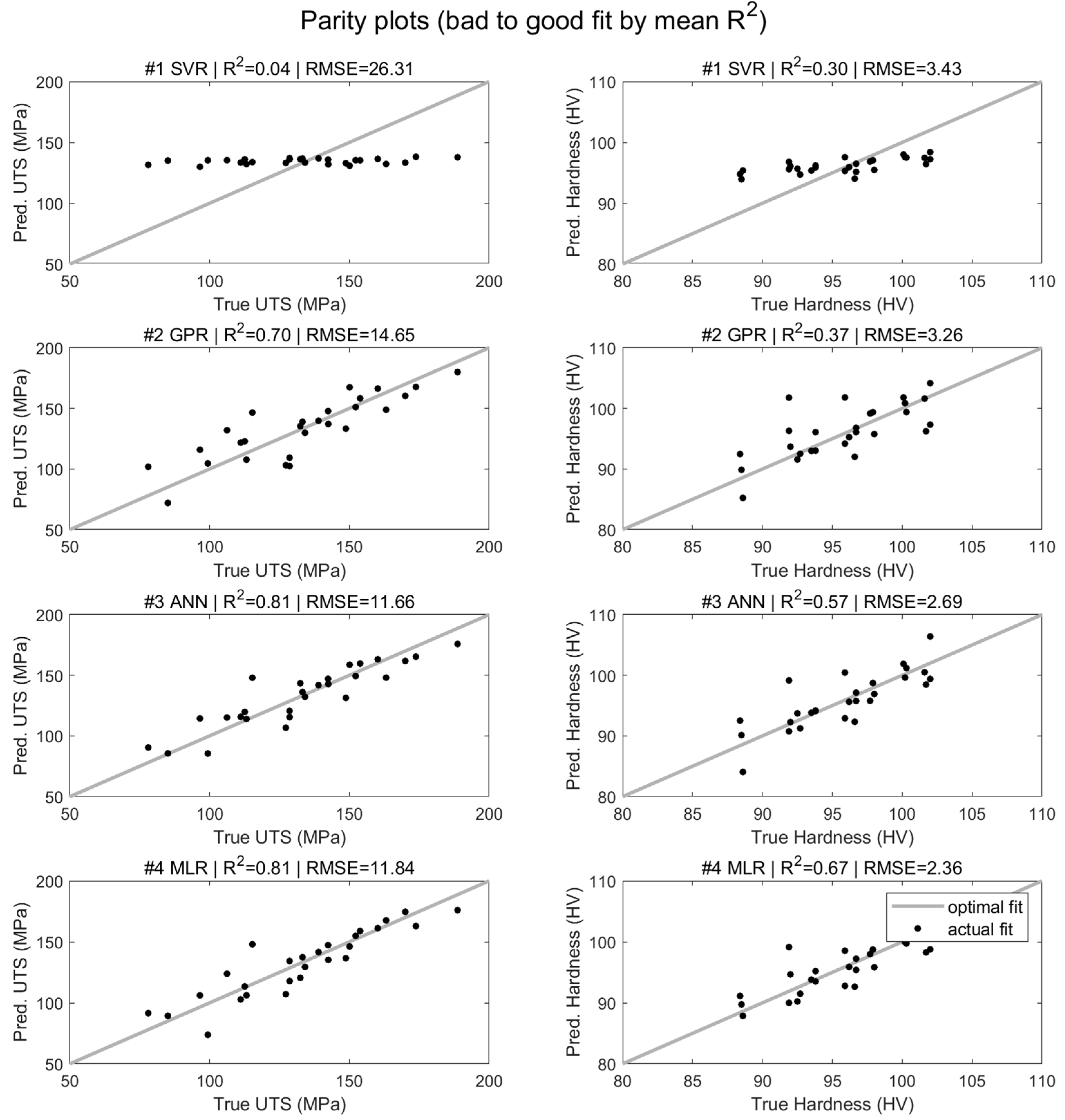
Diagnostics included parity plots (predicted vs. true) with a 45° reference line. For clarity when comparing models, grids of parity plots were also drawn with models ordered from worst to best according to the average CV performance by mean R 2 across outputs.

3.4.6. Model Selection and Final Training

For each output (UTS, Vickers hardness), the best-performing algorithm was selected by its CV R 2 . Using that selection, a final “production” model was retrained on all 27 samples with the same pre-processing pipeline (feature construction and standardisation). The fitted network and the map minmax settings were stored for ANN outputs, while the trained regression models were stored for GPR, SVR and MLR outputs. All models shared the same saved standardisation parameters (means and standard deviations) to ensure consistent pre-processing at inference time.
The procedure was constructed to ensure that model evaluation was fair on limited data, that model choice was evidence-based, and that deployment used the same data path as training.
The four modelling approaches (SVR, GPR, ANN, and MLR) were evaluated using five-fold cross-validation, and the parity plots are summarised in Figure 16. MLR was included as an interpretable baseline (Figure 17), and it also proved to be the most consistent performer overall on this dataset. SVR produced the weakest predictions, especially for hardness (R2 = 0.30, RMSE = 3.43 HV), which suggests that the SVR configuration used here was too restrictive for the response behaviour captured by the DOE. In other words, it appears to have smoothed the mapping too aggressively and missed part of the variation driven by the process inputs.
GPR provided a clear improvement over SVR. For UTS, it captured the main trend reasonably well (R2 = 0.70, RMSE = 14.65 MPa), and for hardness, it offered a modest gain (R2 = 0.37, RMSE = 3.26 HV). This is broadly in line with what would be expected from a smooth, data-efficient model trained on a small sample: it can represent the dominant relationships. Still, it may remain cautious when the data are sparse, particularly near the edges of the design space.
The ANN performed strongly for UTS (R2 = 0.81, RMSE = 11.66 MPa) and improved hardness prediction compared with SVR and GPR (R2 = 0.57, RMSE = 2.69 HV). This indicates that a lightly regularised nonlinear model can capture some curvature in the process–property relationships, even with only 27 experiments, provided overfitting is controlled. That said, the most notable outcome is that MLR matched the ANN for UTS (R2 = 0.81, RMSE = 11.84 MPa) and delivered the best hardness accuracy of all models tested (R2 = 0.67, RMSE = 2.36 HV). Beyond the numerical performance, MLR also offers the practical advantage of transparency: its coefficients and interaction terms provide a direct way to interpret how rotational speed, welding speed, and plunge depth combine to influence UTS and hardness.
Taken together, these results reinforce a practical point for UVAFSW modelling with compact DOE datasets: extra mathematical flexibility does not automatically improve prediction. In this study, the complex models were more affected by limited data coverage and experimental scatter; SVR struggled to capture trends, and GPR improved but remained cautious, whereas a simpler linear model with interaction terms generalised more consistently. As a result, MLR matched the best nonlinear model for tensile strength and gave the most reliable hardness predictions, making it the strongest overall option within this process window.

4. Conclusions

This study combined a physics-guided ultrasonic system design with a structured UVAFSW experimental programme and comparative modelling for AA6082-T6. FEA modal and harmonic analyses confirmed a dominant longitudinal resonance near 27.9 kHz and stable tip vibration, supporting effective ultrasonic energy delivery during welding. A 27-run design of experiments then varied rotational speed, welding speed, and plunge depth, and joint quality was assessed using ultimate tensile strength and Vickers hardness.
Four regression models (SVR, GPR, ANN, and MLR) were benchmarked using five-fold cross-validation under the same pre-processing steps. The main takeaway is practical: for this compact dataset, higher model complexity did not consistently improve prediction. A linear model with interaction terms matched the best nonlinear approach for tensile strength and gave the most dependable hardness predictions, while remaining easy to interpret. This makes it a sensible choice for screening parameters and reducing trial-and-error within the studied process window.
Future work will expand the dataset, add more coverage near the best-performing regions, and include physics-informed descriptors (e.g., heat-input proxies, torque/axial force, or temperature indicators) to strengthen generalisation and enable more robust multi-objective optimisation.

Author Contributions

Conceptualisation, E.E.S., O.O.F. and A.A.; methodology, E.E.S., O.O.F. and A.A.; software, M.B., M.S.E.-A. and A.A.; validation, O.O.F., M.S.E.-A. and A.A.; formal analysis, E.E.S., O.O.F., M.B. and A.A.; investigation, E.E.S., O.O.F. and A.A.; resources, M.B., M.S.E.-A. and A.A.; data curation, E.E.S., O.O.F. and M.B.; writing—original draft preparation, E.E.S., O.O.F., M.B., M.S.E.-A. and A.A.; writing—review and editing, E.E.S., O.O.F., M.B., M.S.E.-A. and A.A.; visualisation, E.E.S., M.B. and A.A.; supervision, E.E.S., O.O.F. and A.A.; project administration, M.B. and A.A. All authors have read and agreed to the published version of the manuscript.

Funding

This research received no external funding.

Data Availability Statement

The datasets generated and analysed during the current study are available from the corresponding authors on reasonable request. They are not publicly available due to potential future commercialisation.

Conflicts of Interest

The authors declare no conflicts of interest.

Abbreviations

The following abbreviations are used in this manuscript:
ANNArtificial Neural Network
ARDAutomatic Relevance Determination
ASTMAmerican Society for Testing and Materials
CVCross-Validation
DOEDesign of Experiments
GPRGaussian Process Regression
MLRMultiple Linear Regression
SVRSupport Vector Regression
UVAFSWUltrasonic Vibration-Assisted Friction Stir Welding

References

  1. Bharti, S.; Kumar, S.; Singh, I.; Kumar, D.; Bhurat, S.S.; Abdullah, M.R.; Rahimian Koloor, S.S. A review of recent developments in friction stir welding for various industrial applications. J. Mar. Sci. Eng. 2023, 12, 71. [Google Scholar] [CrossRef]
  2. Bintoro, S.R.; Surojo, E.; Muhayat, N. A Comprehensive Review on Fusion Arc Welding of Aluminum Matrix Composites: Challenges, Mechanisms, and Advancements. Results Eng. 2025, 27, 106257. [Google Scholar] [CrossRef]
  3. Sharma, A.; Miura, T.; Morisada, Y.; Ushioda, K.; Singh, S.; Fujii, H. Friction stir welding of Haynes 282 Ni superalloy by using a novel hemispherical tool. Sci. Rep. 2024, 14, 27826. [Google Scholar] [CrossRef] [PubMed]
  4. Ahmed, M.M.; El-Sayed Seleman, M.M.; Fydrych, D.; Çam, G. Friction stir welding of aluminum in the aerospace industry: The current progress and state-of-the-art review. Materials 2023, 16, 2971. [Google Scholar] [CrossRef]
  5. Dwibedi, S.; Kumar, B.; Bag, S. Phase transformation effect on residual stress development in fusion welding of dissimilar stainless steels with different thickness. Arch. Civ. Mech. Eng. 2024, 24, 148. [Google Scholar] [CrossRef]
  6. El Shrief, E.; El-Megharbel, A.; El Domiaty, A.; Abd El-Hafez, H. Residual stress effects on fatigue crack propagation in Butt–Welded joints for 304 stainless steel sheets. Manuf. Rev. 2021, 8, 19. [Google Scholar] [CrossRef]
  7. El-shrief, M.; Saber, M.; Nassef, A.; Shaker, M. Numerical Simulation to Study the Influence of Welding Sequence on Distortion and Residual Stresses of Butt-Welded Plates. Port-Said Eng. Res. J. 2016, 20, 118–126. [Google Scholar] [CrossRef]
  8. Mishra, A.; Morisetty, R. Determination of the Ultimate Tensile Strength (UTS) of friction stir welded similar AA6061 joints by using supervised machine learning based algorithms. Manuf. Lett. 2022, 32, 83–86. [Google Scholar] [CrossRef]
  9. Salhan, P.; Singh, R.; Jain, P.; Butola, R. Prediction of heat generation and microstructure of AA7075 friction stir welding using ANN: Effect of process parameters. Manuf. Lett. 2022, 32, 5–9. [Google Scholar] [CrossRef]
  10. Sambasivam, S.; Gupta, N.; Singh, D.P.; Kumar, S.; Giri, J.M.; Gupta, M. A review paper of FSW on dissimilar materials using aluminum. Mater. Today Proc. 2023, in press. [Google Scholar]
  11. Ghetiya, N.D.; Patel, K.M. Welding speed effect on joint properties in air and immersed friction stir welding of AA2014. Proc. Inst. Mech. Eng. Part B J. Eng. Manuf. 2017, 231, 897–909. [Google Scholar] [CrossRef]
  12. Heidarzadeh, A.; Testik, Ö.M.; Güleryüz, G.; Barenji, R.V. Development of a fuzzy logic based model to elucidate the effect of FSW parameters on the ultimate tensile strength and elongation of pure copper joints. J. Manuf. Process. 2020, 53, 250–259. [Google Scholar] [CrossRef]
  13. Muhammad, N.A.; Wu, C.; Su, H. Concurrent influences of tool offset and ultrasonic vibration on the joint quality and performance of dissimilar Al/Cu friction stir welds. J. Mater. Res. Technol. 2021, 14, 1035–1051. [Google Scholar] [CrossRef]
  14. Dialami, N.; Cervera, M.; Chiumenti, M. Defect formation and material flow in friction stir welding. Eur. J. Mech.-A/Solids 2020, 80, 103912. [Google Scholar] [CrossRef]
  15. Álvarez, A.I.; Cid, V.; Pena, G.; Sotelo, J.; Verdera, D. Assisted friction stir welding of carbon steel: Use of induction and laser as preheating techniques. Frict. Stir Weld. Process. VII 2013, 117–126. [Google Scholar]
  16. Bang, H.; Bang, H.; Song, H.; Joo, S. Joint properties of dissimilar Al6061-T6 aluminum alloy/Ti–6% Al–4% V titanium alloy by gas tungsten arc welding assisted hybrid friction stir welding. Mater. Des. 2013, 51, 544–551. [Google Scholar] [CrossRef]
  17. Campanelli, S.L.; Casalino, G.; Casavola, C.; Moramarco, V. Analysis and comparison of friction stir welding and laser assisted friction stir welding of aluminum alloy. Materials 2013, 6, 5923–5941. [Google Scholar] [CrossRef]
  18. Zhao, J.; Wu, C.; Shi, L. Effect of ultrasonic field on microstructure evolution in friction stir welding of dissimilar Al/Mg alloys. J. Mater. Res. Technol. 2022, 17, 1–21. [Google Scholar] [CrossRef]
  19. Muhammad, N.A.; Geng, P.; Wu, C.; Ma, N. Unravelling the ultrasonic effect on residual stress and microstructure in dissimilar ultrasonic-assisted friction stir welding of Al/Mg alloys. Int. J. Mach. Tools Manuf. 2023, 186, 104004. [Google Scholar] [CrossRef]
  20. Kumar, S.; Wu, C. Suppression of intermetallic reaction layer by ultrasonic assistance during friction stir welding of Al and Mg based alloys. J. Alloys Compd. 2020, 827, 154343. [Google Scholar] [CrossRef]
  21. Tian, W.; Su, H.; Wu, C. Effect of ultrasonic vibration on thermal and material flow behavior, microstructure and mechanical properties of friction stir welded Al/Cu joints. Int. J. Adv. Manuf. Technol. 2020, 107, 59–71. [Google Scholar] [CrossRef]
  22. Hu, Y.; Liu, H.; Fujii, H. Improving the mechanical properties of 2219-T6 aluminum alloy joints by ultrasonic vibrations during friction stir welding. J. Mater. Process. Technol. 2019, 271, 75–84. [Google Scholar] [CrossRef]
  23. Baradarani, F.; Mostafapour, A.; Shalvandi, M. Effect of ultrasonic assisted friction stir welding on microstructure and mechanical properties of AZ91−C magnesium alloy. Trans. Nonferrous Met. Soc. China 2019, 29, 2514–2522. [Google Scholar] [CrossRef]
  24. Haribalaji, V.; Boopathi, S.; Asif, M.M. Optimization of friction stir welding process to join dissimilar AA2014 and AA7075 aluminum alloys. Mater. Today Proc. 2022, 50, 2227–2234. [Google Scholar] [CrossRef]
  25. Patil, C.K.; Kumar, V.M.; Rasika, K.A.; Balasubramanian, M.; Saravanan, M.; Subbiah, R. Optimization of FSW parameters to improve the hardness of AA 6061/Boron nitrides and AA 6061/Boron carbide composite joints. Mater. Today Proc. 2022, 69, 1260–1267. [Google Scholar] [CrossRef]
  26. Suhin, S.; Divahar, S.R.; Dhas, J.E.R.; Lewise, K.A.S.; Gupta, M.S. Optimizing FSW process parameters using RSM and regression analysis for similar and dissimilar aluminium materials. Mater. Today Proc. 2022, 64, 368–373. [Google Scholar] [CrossRef]
  27. Yassin, M.; Hossam, M.; El-Hofy, H.J.K.E.M. Applications and designs of vibration-assisted machining devices. Key Eng. Mater. 2018, 775, 480–486. [Google Scholar]
  28. Baraya, M.Y.; Hossam, M. Design of an electromechanical system for measuring and monitoring micro-ultrasonic amplitude of Langevin transducer. Int. J. Adv. Manuf. Technol. 2020, 107, 2953–2965. [Google Scholar] [CrossRef]
  29. Baraya, M.; El-Asfoury, M.S.; Fadel, O.O.; Abass, A. Experimental Analyses and Predictive Modelling of Ultrasonic Welding Parameters for Enhancing Smart Textile Fabrication. Sensors 2024, 24, 1488. [Google Scholar] [CrossRef]
  30. Rezaei, M.; Farzin, M.; Ahmadi, F.; Niroomand, M.R. Design, analysis and manufacturing of a bone cutting ultrasonic horn-tool and verification with experimental tests. J. Appl. Comput. Mech. 2022, 8, 438–447. [Google Scholar]
  31. Yaknesh, S.; Rajamurugu, N.; Babu, P.K.; Subramaniyan, S.; Khan, S.A.; Saleel, C.A.; Nur-E-Alam, M.; Soudagar, M.E.M. A technical perspective on integrating artificial intelligence to solid-state welding. Int. J. Adv. Manuf. Technol. 2024, 132, 4223–4248. [Google Scholar] [CrossRef]
  32. Senthil, S.; Parameshwaran, R.; Ragu Nathan, S.; Bhuvanesh Kumar, M.; Deepandurai, K. A multi-objective optimization of the friction stir welding process using RSM-based-desirability function approach for joining aluminum alloy 6063-T6 pipes. Struct. Multidiscip. Optim. 2020, 62, 1117–1133. [Google Scholar] [CrossRef]
  33. Lakshminarayanan, A.; Balasubramanian, V. Comparison of RSM with ANN in predicting tensile strength of friction stir welded AA7039 aluminium alloy joints. Trans. Nonferrous Met. Soc. China 2009, 19, 9–18. [Google Scholar] [CrossRef]
  34. D’Orazio, A.; Forcellese, A.; Simoncini, M. Prediction of the vertical force during FSW of AZ31 magnesium alloy sheets using an artificial neural network-based model. Neural Comput. Appl. 2019, 31, 7211–7226. [Google Scholar] [CrossRef]
  35. Patel, L.K.; Singh, A.K.; Sharma, V.; Kala, P. Analysis of a hybrid ultrasonic horn profile using finite element analysis. Mater. Today Proc. 2021, 41, 772–779. [Google Scholar] [CrossRef]
  36. Kumar, S.; Ding, W.; Sun, Z.; Wu, C. Analysis of the dynamic performance of a complex ultrasonic horn for application in friction stir welding. Int. J. Adv. Manuf. Technol. 2018, 97, 1269–1284. [Google Scholar] [CrossRef]
  37. Xu, J.; Huanhuan, R. Design and finite element simulation of an ultrasonic transducer of two piezoelectric discs. J. Meas. Eng. 2017, 5, 266–272. [Google Scholar] [CrossRef]
  38. Li, X.; Zhang, D. Ultrasonic elliptical vibration transducer driven by single actuator and its application in precision cutting. J. Mater. Process. Technol. 2006, 180, 91–95. [Google Scholar] [CrossRef]
  39. Li, D.; Tian, H.; Tian, J.; Liu, R. The Analysis of Cymbal Transducer’s Harmonic Response Based on 1–3 Piezocomposite. In Proceedings of the 2010 International Conference on Measuring Technology and Mechatronics Automation, Changsha, China, 13–14 March 2010; pp. 746–749. [Google Scholar]
  40. Liu, X.; Wu, C. Material flow in ultrasonic vibration enhanced friction stir welding. J. Mater. Process. Technol. 2015, 225, 32–44. [Google Scholar] [CrossRef]
  41. Chen, Z.; Shi, L.; Su, H.; Wu, C. Numerical and experimental investigation on intermetallic compounds formation in ultrasonic vibration enhanced friction stir welding of dissimilar Al/Mg alloys. J. Alloys Compd. 2024, 977, 173426. [Google Scholar] [CrossRef]
  42. ASTM E8/E8M; Standard Test Methods for Tension Testing of Metallic Materials. ASTM International: West Conshohocken, PA, USA, 2021.
  43. Padhy, G.K.; Wu, C.; Gao, S.; Shi, L. Local microstructure evolution in Al 6061-T6 friction stir weld nugget enhanced by ultrasonic vibration. Mater. Des. 2016, 92, 710–723. [Google Scholar] [CrossRef]
  44. El-Zathry, N.E.; Akinlabi, S.; Woo, W.L.; Patel, V.; Mahamood, R.M. Friction Stir-Based Techniques: An Overview. Weld. World 2025, 69, 327–361. [Google Scholar] [CrossRef]
Figure 1. The ultrasonic transducer components and assembly with the stepped horn.
Jmmp 10 00123 g001
Figure 2. Mechanical and electrical boundary conditions are applied in the modal and harmonic analyses of the ultrasonic transducer.
Jmmp 10 00123 g002
Figure 3. Selected mode shapes from modal analysis (20–30 kHz), where colour bars show the magnitude in mm: (a) bending (22,526 Hz), (b) torsional (23,004 Hz), (c) longitudinal (27,902 Hz), and (d) bending (29,985 Hz).
Jmmp 10 00123 g003
Figure 4. Displacement distribution along the actual vibration path of the transducer–horn assembly at Mode 4 (27,900 Hz), illustrating the nodal planes characterised by zero displacement.
Jmmp 10 00123 g004
Figure 5. Harmonic response of the ultrasonic horn at different resonance frequencies. (a) Maximum longitudinal displacement at the horn tip at the resonant frequency of 27.92 kHz. (b) The corresponding frequency response curve has a peak amplitude of 46 µm.
Jmmp 10 00123 g005
Figure 6. Experimental setup for UVAFSW: (a) schematic representation and (b) experimental arrangement.
Jmmp 10 00123 g006
Figure 7. Detailed view of the FSW tool and the independently mounted ultrasonic horn, illustrating the 45° horn angle and the 20 mm distance from the horn tip to the axis of the FSW tool.
Jmmp 10 00123 g007
Figure 8. (a) Schematic diagram illustrating the selection positions of tensile and microhardness specimens within the weld zone; (b) dimensions of the microhardness specimens; (c) dimensions of the tensile specimens.
Jmmp 10 00123 g008
Figure 9. Experimental setups used for the mechanical characterisation of the welded specimens: (a) tensile testing arrangement to evaluate the joint strength; (b) microhardness testing procedure to assess the hardness distribution across the weld cross-section.
Jmmp 10 00123 g009
Figure 10. The expected microstructural characteristics of friction stir-welded AA6082-T6 joints based on.
Jmmp 10 00123 g010
Figure 11. Influence of rotational speed, welding speed, and plunge depth on UTS: (a) constant welding speed of 50 mm/min, (b) constant plunge depth of 0.17 mm, (c) constant rotational speed of 800 rpm, (d) constant plunge depth of 0.17 mm, (e) constant rotational speed of 800 rpm, and (f) constant welding speed of 50 mm/min.
Jmmp 10 00123 g011
Figure 12. Representative engineering stress–strain curves of welded joints produced under selected UVAFSW conditions.
Jmmp 10 00123 g012
Figure 13. Effect of rotational speed, welding speed, and plunge depth on microhardness: (a) constant welding speed of 50 mm/min, (b) constant plunge depth of 0.17 mm, (c) constant rotational speed of 800 rpm, (d) constant plunge depth of 0.17 mm, (e) constant rotational speed of 800 rpm, and (f) constant welding speed of 50 mm/min.
Jmmp 10 00123 g013
Figure 14. Workflow diagram of the strategy used in the current study.
Jmmp 10 00123 g014
Figure 15. Combined schematic of the separate ANN models used for UTS and hardness prediction. One-hidden-layer ANN ([3 + 4]-6-1) inputs: rotational speed, welding speed, plunge depth, and four engineered interaction/ratio features; hidden six neurons with Bayesian regularisation; output: UTS (MPa) and Vickers hardness (HV).
Jmmp 10 00123 g015
Figure 16. Multiple linear regression (MLR) structure for predicting (a) UTS and (b) hardness.
Jmmp 10 00123 g016
Figure 17. Parity plots (5-fold cross-validated, out of fold) of predicted vs. measured ultimate tensile strength (UTS, left) and Vickers hardness (HV, right) for four regression models, SVR, GPR, ANN, and MLR, ordered top to bottom from worst to best by mean R2.
Jmmp 10 00123 g017
Table 1. Material properties of the transducer components and horn.
PartMaterialDensity
(kg/m3)
Elastic Modulus
(GPa)
Poisson’s Ratio
Horn Al (5083)266070.30.33
Front massAl (5083)266070.30.33
ElectrodesPure copper89001150.31
Piezoelectric
rings
Piezoelectric
ceramics
770073-
Back massAl (5083)266070.30.33
Pre-loading bolt Carbon Steel78802010.29
Table 2. Mode shapes and their corresponding frequencies from modal analysis.
ModeFrequency (Hz)Mode ShapeSelected for Harmonic Analysis
122,524BendingNo
222,526TorsionalNo
323,004BendingNo
427,902LongitudinalYes (Axial energy transfer)
529,985BendingNo
629,995BendingNo
733,457BendingNo
833,474BendingNo
Table 3. Process parameters and their coded levels used in the Taguchi L27 orthogonal array for UVAFSW trials.
ParametersLevels
−101
Rotational speed (rpm)900800600
Welding speed (mm/min)555045
Plunge depth (mm)0.250.170.1
Table 4. Chemical composition and mechanical properties of 6082-T6 aluminium alloy.
Chemical Composition (wt.%)Mechanical Properties
SiFeCuMnMgCrZnTiAlTensile Strength (MPa)Yield Strength (MPa)Elongation
(%)
0.970.500.100.71.020.250.200.10Bal *31127213%
* “Bal” indicates that aluminium (Al) is the balance element, i.e., it constitutes the remainder of the alloy after accounting for the listed elements.
Table 5. L27 Taguchi orthogonal array showing process parameter values and measured responses (tensile strength and hardness) for each UVAFSW experiment.
RunInput: Welding Joint Parameters Output: Weld Joint Durability (UTS, Hardness)
Rotational Speed
(RPM)
Welding Speed
(mm/min)
Plunge Depth
(mm)
Tensile Strength
(MPa)
Hardness
(HV)
1600450.185.05388.6
2600450.1778.04588.5
3600450.2599.35591.9
4600500.1128.63493.8
5600500.17112.58393.5
6600500.25113.19896.6
7600550.1150.09098
8600550.17148.73896.7
9600550.25115.27891.9
10800450.196.54088.4
11800450.17127.26492.7
12800450.25106.22292
13800500.1134.12296.2
14800500.17142.43996.7
15800500.25138.96995.9
16800550.1153.838100.2
17800550.17160.138100.3
18800550.25173.784102
19900450.1111.12292.5
20900450.17132.44395.9
21900450.25128.61193.8
22900500.1133.23197.7
23900500.17142.37897.9
24900500.25152.221101.7
25900550.1163.131101.6
26900550.17169.986100.09
27900550.25188.693102
Table 6. Engineered interaction and ratio features used in the predictive modelling.
Interaction/Ratio FeatureDescription
1rpm × welding speed
2rpm × plunge
3welding speed × plunge
4welding speed/plunge
Disclaimer/Publisher’s Note: The statements, opinions and data contained in all publications are solely those of the individual author(s) and contributor(s) and not of MDPI and/or the editor(s). MDPI and/or the editor(s) disclaim responsibility for any injury to people or property resulting from any ideas, methods, instructions or products referred to in the content.