Article

Using Machine Learning Tools in Reverse-Engineering Processes to Identify Printing Parameters in FDM-Manufactured Parts


by
Brian Cruz
1,
Álvaro Rojas
1,
Antonio José Amell
1,
Carlos Alberto Narváez-Tovar
2,
Marco Antonio Velasco
3,
Everardo Barcenas
4,
John E. Bermeo
5,
Yamid Gonzalo Reyes
6,* and
Alejandro García-Rodríguez
1
1
Facultad de Ingeniería Mecánica, Universidad Santo Tomás, Carrera 9 No. 51-11, Bogota 110231, Colombia
2
Departamento de Ingeniería Mecánica y Mecatrónica, Universidad Nacional de Colombia, Carrera 45 No. 26-85, Bogota 111321, Colombia
3
Facultad Tecnológica, Universidad Distrital Francisco José de Caldas, Calle 13 No. 31-75, Bogota 110231, Colombia
4
Facultad de Ingeniería, Universidad Nacional Autónoma de México (UNAM), Ciudad Universitaria, Mexico City 04510, Mexico
5
Centro de Investigación en Ciencia Aplicada y Tecnología Avanzada Unidad Querétaro, Mecatrónica, Instituto Politécnico Nacional, Queretaro 76090, Mexico
6
Facultad de Mecatrónica, Escuela Tecnológica Instituto Técnico Central, Calle 13 No. 16-74, Bogota 110411, Colombia
*
Author to whom correspondence should be addressed.
J. Manuf. Mater. Process. 2026, 10(4), 122; https://doi.org/10.3390/jmmp10040122
Submission received: 9 February 2026 / Revised: 18 March 2026 / Accepted: 18 March 2026 / Published: 31 March 2026

Abstract

Fused Deposition Modeling (FDM) components require accurate identification of printing parameters to ensure reliable quality assessment and support scalable reverse-engineering workflows. The objective of this study is to evaluate whether mechanical response curves obtained from tensile tests can be used to infer key manufacturing parameters, specifically part orientation, layer thickness, and infill density. Force–displacement and stress–strain data were transformed into image-based representations and classified using several individual and ensemble machine learning models. In addition, the influence of applying a moving-average filter to smooth the curve-derived images was analyzed. Ensemble methods, particularly the AdaBoost classifier, achieved the best performance across the evaluated variables, with the highest accuracy obtained from unfiltered stress–strain images. Under limited-data conditions, ensemble models consistently outperformed individual classifiers, whereas Multilayer Perceptron and Support Vector Machine models exhibited more stable but lower predictive accuracy. These results demonstrate that mechanical response curves contain relevant information about manufacturing conditions and can be used to infer FDM printing parameters. The proposed approach offers a potential non-destructive framework for parameter identification in additively manufactured components, thereby improving traceability and quality control in additive manufacturing processes.

1. Introduction

The evolution of manufacturing technologies in the context of Industry 4.0 has driven the adoption of more versatile and sustainable processes capable of meeting growing demand for complex parts, with reduced production times and superior mechanical properties [1]. Faced with these requirements, conventional methods such as machining have technical and economic limitations, which have boosted interest in additive manufacturing (AM) as a viable alternative for demanding industrial sectors [2].
AM encompasses various techniques that share a common principle: the layer-by-layer fabrication of three-dimensional geometries, with significant use of the base material [3]. The most widely used methodologies are Fused Deposition Modeling (FDM), which uses a molten thermoplastic filament; stereolithography (SLA), which uses a photopolymerized liquid resin; and Selective Laser Sintering (SLS), which sinters polymer powders using a high-powered laser [3]. The FDM process enables the fabrication of complex geometries with significant design flexibility, making it suitable for applications ranging from biomedical implants to aerospace components [4,5].
Among additive manufacturing technologies, Fused Deposition Modeling (FDM) has become one of the most widely adopted processes due to its relatively low cost, material availability, and operational simplicity. The FDM process enables the fabrication of complex geometries with significant design flexibility, making it particularly attractive for rapid prototyping and the production of functional engineering components. Consequently, improving the understanding and monitoring of FDM printing parameters has become an important research topic to ensure the reliability and mechanical performance of printed parts.
A critical aspect of AM is the sensitivity of the final product to printing conditions. Various studies have shown that parameters such as part orientation, layer thickness, and infill density significantly influence the mechanical properties obtained [6]. User-controllable parameters are essential, since parameters such as laser power or energy supplied are usually preconfigured in the system and cannot be easily adjusted [2]. In this context, multiple experimental studies have been conducted to quantify the effects of geometric and process variables on the mechanical strength of additively manufactured parts.
The characterization of mechanical properties in components manufactured using additive techniques requires specific tests, including tensile, compression, and flexural tests [7]. Tensile tests allow force-displacement curves to be obtained from the continuous recording of the load applied to a test specimen and the corresponding displacement measured over a calibrated length [8]. These curves reveal critical information about the material’s behavior, including the plastic zone, maximum force, breaking force, and yield point [9]. In addition, by knowing the cross-sectional area of the test specimen, it is possible to transform the curve into a stress-strain diagram, which allows the determination of mechanical properties such as ultimate tensile stress and yield stress [10].
Despite their relevance for the design and validation of functional parts, conventional mechanical tests have operational limitations. First, they can take a long time, depending on loading speed and material type; second, they are inherently destructive, meaning the test specimen is lost after the test [11]. These conditions affect both the cost and efficiency of quality control processes, especially when working with large production volumes or high-cost materials. Given this scenario, it is necessary to use alternative methods to reduce the time and cost of these tests.
An emerging alternative to the limitations of conventional mechanical testing is the application of machine learning techniques to predict mechanical properties based on mathematical models [12]. Unlike finite element-based approaches, these models are highly computationally efficient, enabling implementation in remote environments, including cloud computing platforms [13]. Several studies have shown that specific algorithms can achieve highly accurate prediction metrics with significantly reduced resource consumption [14].
The integration of machine learning into the mechanical characterization stage has been shown to reduce the time and cost of physical testing while maintaining the reliability of the results [15]. Consequently, integrating 3D printing techniques with predictive algorithms provides a flexible, scalable framework for material evaluation, with significant potential in industrial and research applications. The following section presents relevant studies on machine learning techniques applied to numerical prediction and classification tasks.
Wang et al. [16] developed a long short-term memory (LSTM) model capable of predicting parameter configurations in engineering parts to meet specific stress-strain objectives. The model transforms the raw data into a format compatible with the LSTM, and it achieves a prediction accuracy of 0.8646 and a quadratic error of 0.1348 in inverse prediction tasks. These results suggest that further research in this area is warranted.
Similarly, Tiwari et al. [17] conducted research to implement machine learning models, such as Support Vector Machines (SVM), Artificial Neural Networks (ANN), and Random Forest (RF), among others, to provide support throughout the design process of the mechanical parts to be manufactured. It is noteworthy that Two-stream Convolutional Neural Networks (CNNs) are particularly adept at predicting part stress based on the specified parameters, whereas the SVM model is the optimal choice for recommendations concerning design characteristics and printing parameters.
On the other hand, Ulkir et al. [18] integrated artificial intelligence systems with additive manufacturing (AM) to reduce the manufacturing time and cost of 3D-printed mechanical parts using the raster angle parameter. The optimal value of this parameter depends on the product’s geometry, and changing it alters the stress distribution throughout the part. They used models such as SVM, Gaussian Process Regression (GPR), an ANN, Decision Tree Regression (DTR), and RF regression to estimate the optimal raster angle. Training data with different geometries and shapes was generated, and the models were trained in MATLAB. Ultimately, RFR produced the best results, with an R-squared value of 0.93, an explained variance score of 0.93, a root mean square error of 0.056, and a mean squared error of 0.0032. This model ensures optimal raster angle values for any geometry.
Rezasefat et al. [19] developed two deep learning architectures, MUDE-CNN and MTED-TL, to predict the evolution of the stress field in complex 3D structures fabricated via additive manufacturing (AM), particularly around defects such as isolated pores. The researchers trained their models using full-scale finite element simulations and designed them to capture temporal and spatial stress evolution. The MTED-TL architecture employed progressive transfer learning across encoder-decoder blocks and achieved higher prediction accuracy than the MUDE-CNN architecture. Additionally, they implemented an autoregressive training framework, which further enhanced temporal predictions. These approaches enable real-time monitoring and proactive defect mitigation during fabrication, improving the structural integrity and reliability of AM-produced components.
Wu et al. [20] conducted a critical review of residual stress prediction in laser additive manufacturing (LAM), focusing on its impact on industries such as aerospace, automotive, and biomedicine. Residual stresses, induced by thermal gradients during fabrication, can cause distortions or cracking in printed parts, so accurately predicting them is essential. The authors explored various approaches, including experimental techniques, computational simulations, and machine learning models. These approaches contribute to a deeper understanding of stress formation and mitigation. The review also identified current challenges and proposed strategies to enhance prediction accuracy and manufacturing reliability in LAM applications.
Zhang et al. [21] proposed a deep learning framework to predict tensile strength in FDM-manufactured parts. In their study, process monitoring data—such as temperature and vibration signals collected during printing—were used as sequential inputs to a Long Short-Term Memory (LSTM) model. This approach allowed capturing the layer-by-layer nature of the FDM process. The authors reported that the deep learning model outperformed traditional machine learning approaches, demonstrating improved prediction capability due to its ability to model temporal dependencies in the manufacturing process.
Similarly, in ref. [22] Tura et al. developed predictive models based on artificial neural networks (ANN) and fuzzy logic to estimate the tensile strength of PLA specimens fabricated using FDM. Their methodology involved training the models using key process parameters such as layer thickness, raster angle, and infill density. The results showed that the ANN model achieved the lowest prediction error compared to fuzzy logic and response surface methodology, highlighting the effectiveness of ML techniques in capturing nonlinear relationships between process parameters and mechanical properties.
Previous studies have widely applied machine learning (ML) techniques to predict numerical values associated with mechanical, thermal, and physical properties in additively manufactured components. These approaches typically rely on structured and balanced datasets, where the number of observations per variable remains constant across samples. However, when dealing with mechanical response curves such as stress–strain or force–displacement relationships, the number of recorded data points is inherently variable. This variability arises because each specimen exhibits different mechanical behavior up to fracture, including variations in both elastic and plastic deformation regions.
Several strategies have been proposed to address datasets with unequal domains, including interpolation and data equalization techniques. While these methods allow the construction of comparable datasets, they may also introduce distortions in the original signal. Previous studies, such as those reported by García et al. [23], have shown that the choice of equalization strategy may significantly affect the performance metrics of machine learning models. Consequently, alternative approaches are required to analyze mechanical curves without altering their intrinsic domain.
From the literature review, it was observed that only a limited number of studies have directly used full mechanical response curves as input features for machine learning models aimed at prediction or classification tasks. Most existing approaches rely instead on extracted scalar descriptors such as yield strength, ultimate tensile strength, or elastic modulus. While these parameters provide useful summaries of material behavior, they do not fully capture the morphological characteristics of the mechanical response.
One possible alternative is to transform mechanical curves into image representations. Under this framework, the data domain becomes defined by the image resolution rather than by the number of measured points in the signal. This transformation may mitigate the need for traditional equalization techniques while preserving the global morphology of the mechanical response.
In addition, previous studies have highlighted the importance of adequate preprocessing techniques before applying machine learning algorithms. However, the influence of filtering strategies and curve preprocessing on the classification performance of ML models remains poorly understood, particularly when the complete curve behavior up to fracture is considered.
Furthermore, machine learning has been primarily used to predict discrete mechanical properties rather than to infer manufacturing parameters. As a result, the potential of ML as a reverse engineering tool for identifying process parameters from mechanical response data remains largely unexplored. This limitation becomes even more relevant when relatively small experimental datasets are available, which is a common condition in experimental additive manufacturing research.
Therefore, the objective of this study is to evaluate the capability of machine learning models to classify manufacturing parameters of specimens produced using the FDM process with fiber-reinforced material. Specifically, the study investigates whether transforming mechanical response curves into image representations and applying filtering strategies based on data dispersion can improve the classification performance of ML models when identifying input parameters of the printing process. In this work, FDM printing parameters are inferred from the mechanical response observed in the force–displacement and stress–strain curves of the manufactured specimens. The data set and the experimental design and the ANOVA to evaluate the influence of the printing parameters on the mechanical properties, were already performed and described in [24].

2. Materials and Methods

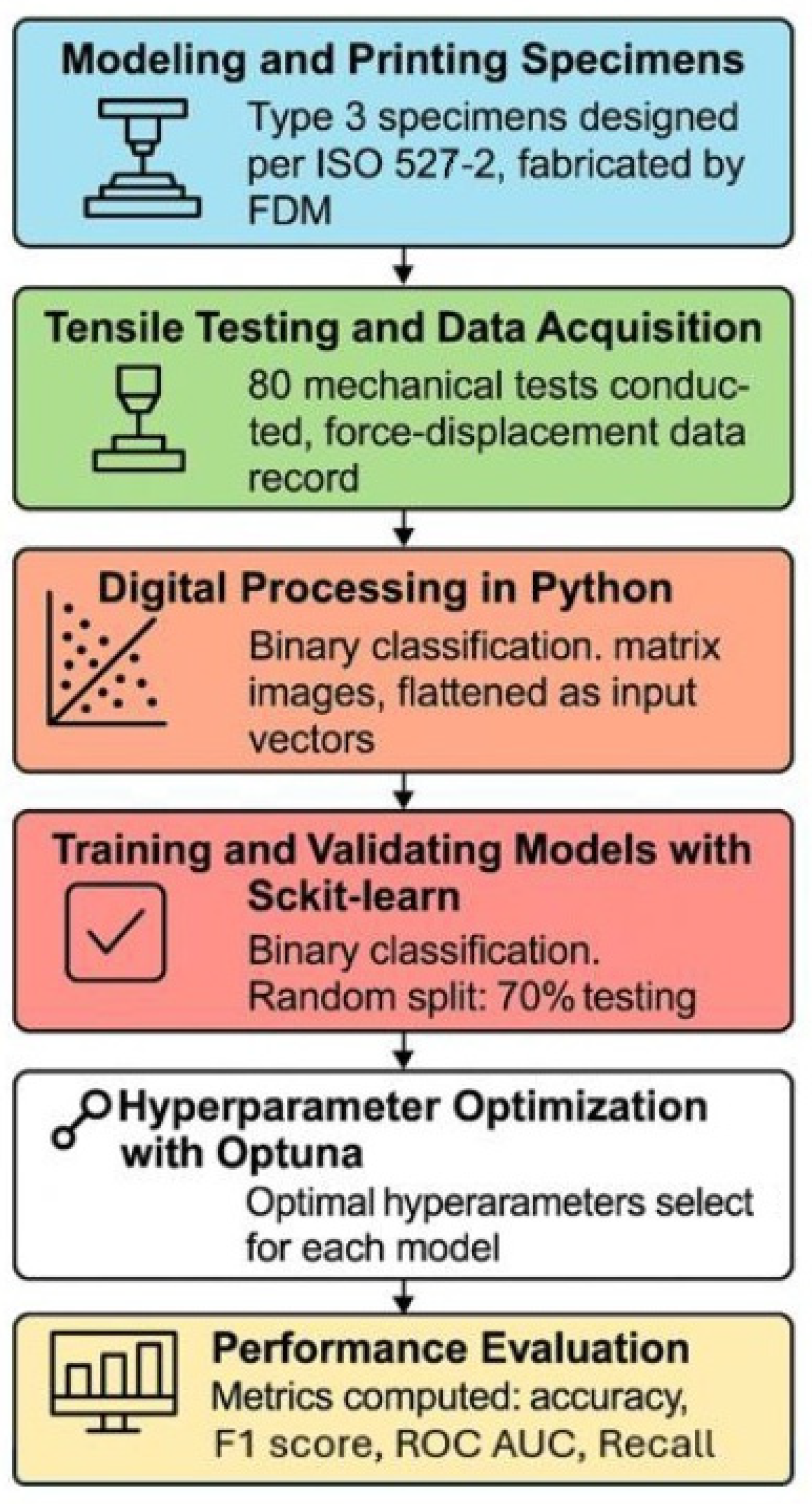
The methodological approach adopted in this study combines experimental mechanical testing with data-driven analysis to investigate the relationship between mechanical response and manufacturing parameters in FDM components. Instead of relying solely on conventional scalar mechanical properties, the complete force–displacement and stress–strain curves were used as the primary source of information. These signals were transformed into representations suitable for machine learning analysis, enabling the identification of patterns associated with different printing conditions. Figure 1 illustrates the overall workflow followed in this research, integrating specimen fabrication, mechanical testing, signal processing, and machine learning-based classification.

2.1. Test Specimen Printing and Data Collection

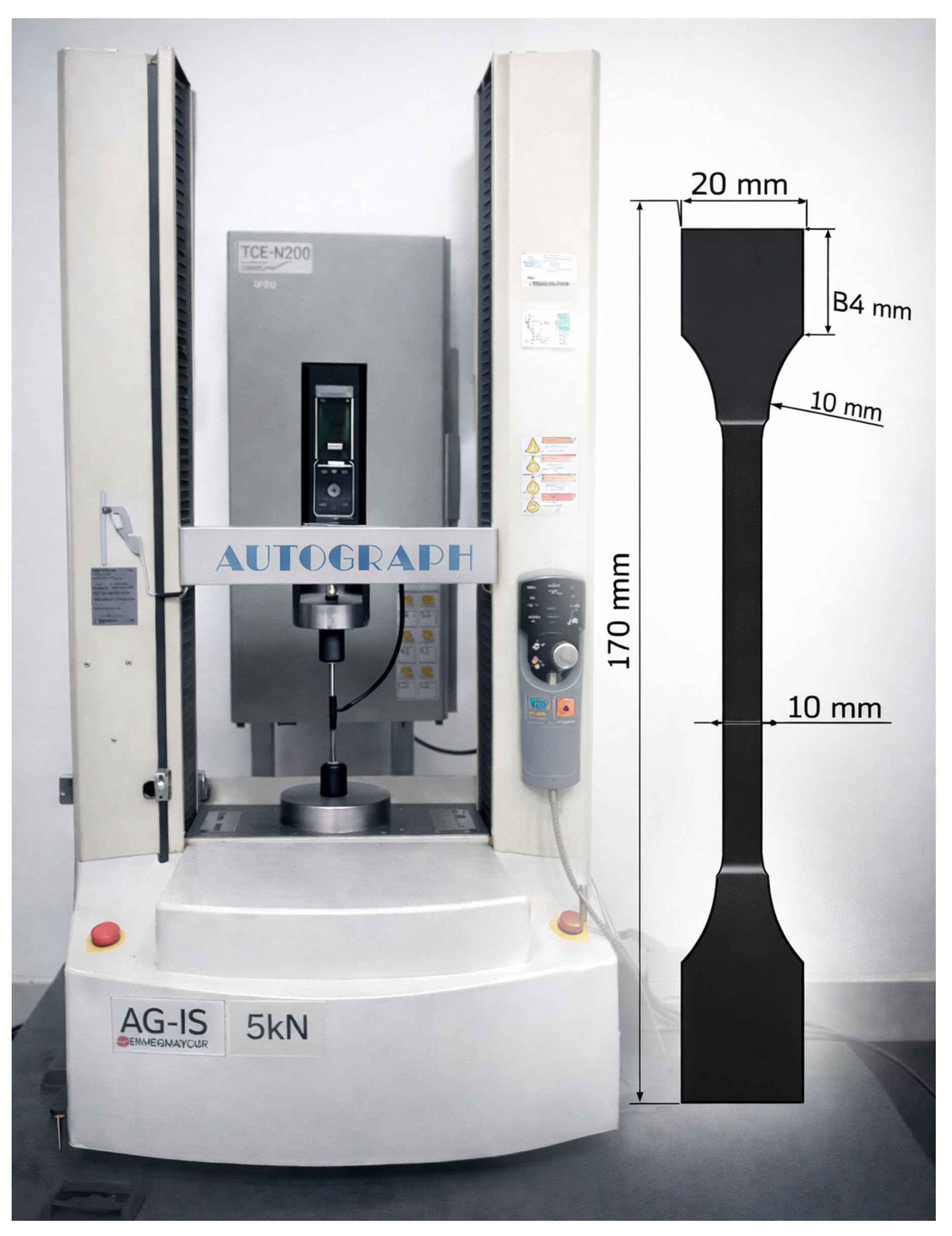
The test specimens were manufactured in accordance with ISO 527-2 type 1A [25] (Figure 2) using glass fiber-reinforced PLA material in a 3D printer Flashforge Adventurer 4 (Flashforge Corporation, Zhejiang, China), varying the layer thickness (0.1 or 0.2 mm), the part orientation—horizontal (part aligned with the machine X–Y plane) or vertical (part aligned with the machine Z-axis)—and infill density. The tensile tests were performed on a Shimadzu AG-IS 5 kN (Shimadzu Corporation, Kyoto, Japan) (Figure 2).

2.2. Material

The material used in this study was a carbon-fiber-reinforced polylactic acid (PLA-CF) filament manufactured by Creality Hyper PLA-CF (Creality, Shenzhen, China). The filament had a nominal diameter of 1.75 mm and was supplied on a commercial spool for fused deposition modeling (FDM) processing. The incorporation of short carbon fibers enhances the stiffness and dimensional stability of printed components compared with conventional PLA.
To ensure material consistency throughout the experimental campaign, all specimens were printed using filament from the same spool, thereby minimizing potential variability associated with batch-to-batch differences. Prior to printing, the filament was stored under controlled laboratory conditions to minimize the effects of environmental factors, such as moisture absorption.

2.3. Printing Equipment

All specimens were manufactured using a Flashforge Adventurer 4 fused deposition modeling (FDM) printer. The printer operates with a single extrusion system and a heated build platform. The main specifications of the printing system are: build volume: 220 × 200 × 250 mm; nozzle diameter: 0.4 mm; layer resolution: 0.1–0.4 mm; filament diameter compatibility: 1.75 mm. The printing process was performed using the slicing software Ultimaker Cura (version 5.10.0, Ultimaker B.V., Utrecht, Netherlands), which generated the G-code instructions for fabricating the specimens.

2.4. Printing Parameters and Experimental Design

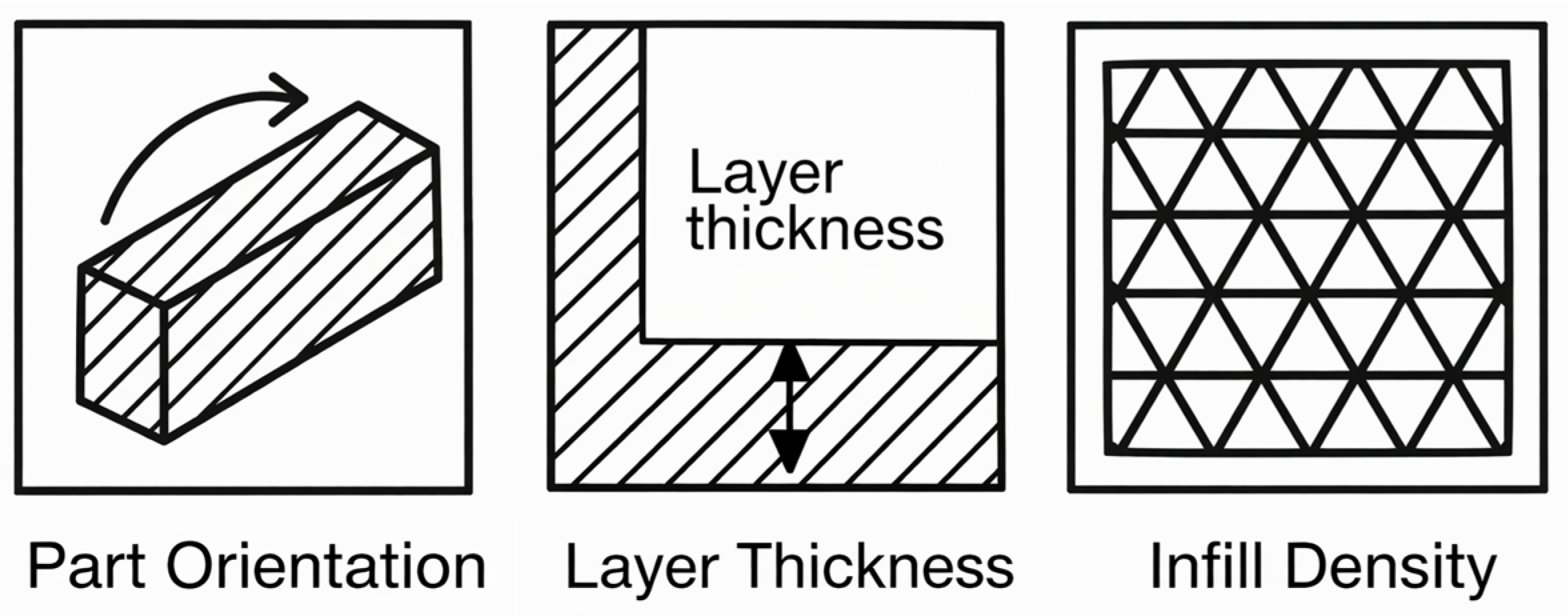
The experimental design included four printing parameters: layer thickness, raster angle, infill density, and part orientation. Although the experimental design included four parameters, the raster angle was kept constant during the machine learning stage. However, the machine learning analysis focused on three geometric parameters—part orientation, layer thickness, and infill density—selected as target variables for the classification models. (Figure 3).
Each parameter was evaluated at two experimental levels, representing the lower and upper limits of the selected processing window. In addition, a central point configuration was included to evaluate potential non-linear effects within the design space.
The experimental design, therefore, followed a 23 factorial design with one central point, yielding 17 distinct experimental configurations. For each experimental condition, five specimens were manufactured, resulting in a total of 85 printed specimens used in the study. The experimental factors and their corresponding levels are summarized in Table 1. The detailed statistical analysis of the experimental design, including the analysis of variance (ANOVA) used to evaluate the influence of the printing parameters on the mechanical properties, was previously reported in a separate study [24]. In the present work, the specimens and experimental dataset from that study are used as input data for the machine learning analysis.

2.5. Mechanical Testing

Tensile tests were performed using a Shimadzu universal testing machine equipped with an SLBL 5K load cell with a capacity of 5 kN. The strain measurements required to obtain the mechanical response were recorded using a Shimadzu (Shimadzu Corporation, Kyoto, Japan) contact extensometer (SES 1000) with a 25 mm gauge length adapted to the extensometer. The experimental work was carried out at the Materials and Process Laboratory of Universidad Nacional de Colombia.
During the tensile tests, the testing system continuously recorded the applied load and the corresponding displacement of the specimens, allowing the acquisition of force–displacement curves. Based on the specimen geometry and measured strain values, these data were subsequently transformed into stress–strain curves, which served as the experimental dataset for the present study.

2.6. Data Processing

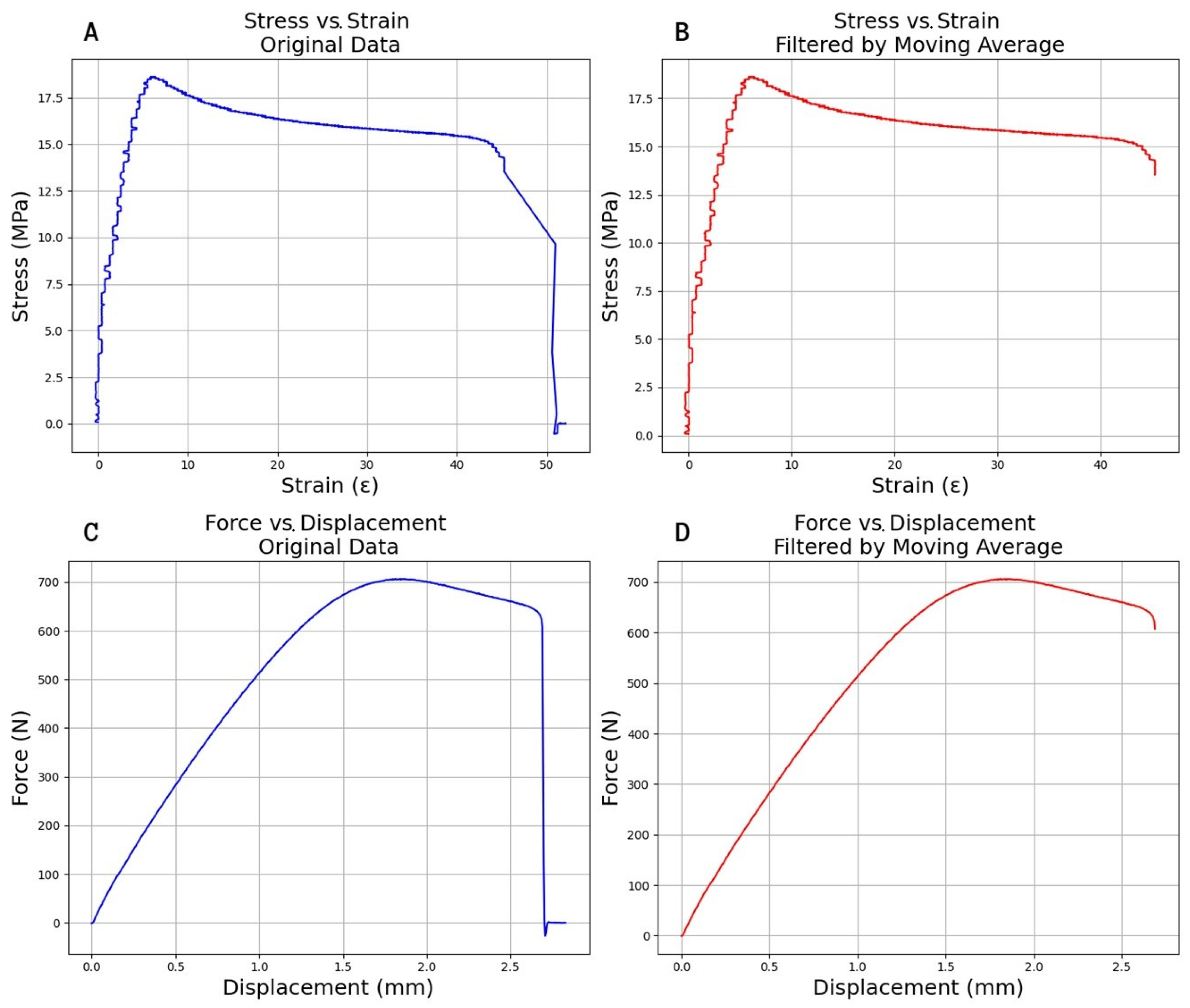
The data obtained from the mechanical tests were purified to remove unrepresentative information introduced by the fracture of the test specimens. The moving average method involved calculating the mean of a data window, which was then used as a reference point to identify outliers. It was determined that points that exceeded a standard deviation threshold from the mean should be truncated, along with the subsequent records. In this study, both the unrefined data and filtered versions were evaluated, using thresholds of 3 and 5 standard deviations as truncation criteria. Figure 4 shows the Force-Displacement and Stress-Strain graphs before and after treatment, with a 3-standard-deviation moving average.
For model training, visual representations were used instead of raw numerical data to mitigate biases arising from data-collection variability [26,27,28,29,30]. This variability originated in experimental conditions, as test specimens with different layer heights, densities, and part orientations were used, leading to variations in test duration and, consequently, in the amount of data obtained for each sample.

2.7. Learning Models and Hyperparameter Tuning

The present study employed eight widely used classification algorithms, which have been employed in numerous related studies. DecisionTreeClassifier (DTC), AdaBoostClassifier (ABC), Support Vector Machines (SVM), Multilayer Perceptron (MLP), RandomForestClassifier (RFC), GradientBoostingClassifier (GBC), LogisticRegression (LR), and ExtraTreesClassifier (ETC) [31,32,33]. The selection of these models was based on their proven effectiveness in supervised classification tasks and their ability to handle datasets with structural characteristics similar to those in the present study.
A StratifiedKFold cross-validation with 10 splits was applied, ensuring class balance in each partition. In every iteration, about 80% of the data was used for training and 20% for validation, so that each sample served once for testing and multiple times for training. Using this scheme, hyperparameters were optimized via Bayesian optimization with the Optuna library, which evaluated candidate configurations, computed performance metrics (accuracy, f1, recall, roc_auc) across folds, and selected the best configuration based on the mean roc_auc (Table 2).

3. Results

3.1. Part Orientation

Once the images corresponding to the force–displacement and stress–strain graphs in the selected training and testing models had been processed and loaded, and the hyperparameters had been adjusted using Bayesian optimization with the Optuna library, the performance evaluation metrics were applied. The accuracy, F1 score, recall, and ROC-AUC results obtained are presented in Table 3.
In the classification by part orientation, the Gradient Boosting Classifier (GBC) achieved the highest accuracy with the ESM filter (without moving-average smoothing), reaching 0.74. This result suggests that preserving the original signal without smoothing may improve classification performance, as excessive filtering can remove relevant information from the original curves. Similarly, the AdaBoost Classifier (ABC) and the Random Forest Classifier (RFC) achieved competitive performance under the EM5 and ESM configurations, respectively. Their ensemble-based architectures, which combine multiple base estimators, tend to reduce systematic errors and improve robustness compared with individual models.
The Multilayer Perceptron (MLP) exhibited lower standard deviations, indicating more consistent predictions across filtering strategies. However, its overall accuracy remained lower than that of ensemble models. Conversely, although the GBC and RFC models achieved relatively high accuracy, their greater dispersion suggests greater sensitivity to variations in the preprocessing strategy.
Collectively, the results indicate that both the type of curve representation—with better performance observed in stress–strain curves—and the image preprocessing strategy significantly influence classification performance. In particular, avoiding excessive filtering appears to improve model accuracy by preserving the spectral richness of the original signal.
The F1-score, which balances precision and recall, provides further insight into model performance. Under this metric, the AdaBoost classifier (ABC) achieved the best performance, reaching an average F1-score above 0.75 under the FM5 configuration (moving-average filtering with five standard deviations). This result was accompanied by a low standard deviation, indicating stable performance across the evaluated conditions.
The Gradient Boosting (GBC) and Random Forest (RFC) models also produced favorable F1-score values under configurations such as ESM and FM3, although their results displayed greater variability. In contrast, the Multilayer Perceptron (MLP) achieved the lowest F1-scores—falling below 0.40 in configurations such as FSM and FM3—which suggests a limited ability to extract relevant patterns from image-based representations. Additionally, the higher dispersion observed for this model indicates inconsistent predictive behavior.
The Decision Tree Classifier (DTC) achieved intermediate results, reaching an F1-score of 0.699 under the EM3 configuration. However, its performance dropped significantly under other preprocessing conditions, such as ESM, indicating strong sensitivity to the applied filtering strategy.
The recall metric, which measures a model’s ability to identify positive cases correctly, further underscores the strengths of ensemble methods. The AdaBoost (ABC) classifier again achieved the highest average recall values, reaching approximately 0.91 under the EM3 and FM5 configurations, while maintaining low variability across experimental conditions.
The Gradient Boosting (GBC) and Random Forest (RFC) models also demonstrated favorable recall values, generally ranging from 0.73 to 0.76, although moderate variability was observed across filtering strategies. Other models—including Support Vector Machine (SVM), Extra Trees Classifier (ETC), and Logistic Regression (LR)—achieved acceptable recall values under several configurations; however, their relatively large standard deviations suggest lower reliability in their predictions.
The Multilayer Perceptron (MLP) once again exhibited the weakest performance, with recall values as low as 0.26 under the EM5 configuration and considerable dispersion across most filters. These results indicate limited sensitivity in detecting positive cases. Meanwhile, the Decision Tree (DTC) displayed intermediate recall values, performing well under EM3 and FM5, although its results were highly dependent on the preprocessing strategy.
The ROC AUC metric, which evaluates models’ discrimination across different decision thresholds, provides a broader perspective on classification performance. The highest mean values were obtained by the AdaBoost (ABC) and Gradient Boosting (GBC) models, both reaching approximately 0.7417 under the ESM filter, indicating strong discriminative capability and robustness under this preprocessing configuration. Similarly, the Decision Tree (DTC) model under EM5 and the GBC model under FSM achieved values close to 0.7333, confirming their effectiveness in more complex classification scenarios.
In contrast, the MLP and SVM models showed more modest ROC AUC values, typically ranging between 0.55 and 0.63, reflecting difficulties in capturing discriminative patterns from the processed signals. Nevertheless, the MLP model under EM5 exhibited the lowest standard deviation in the dataset (0.196), suggesting relatively stable—though less accurate—behavior.
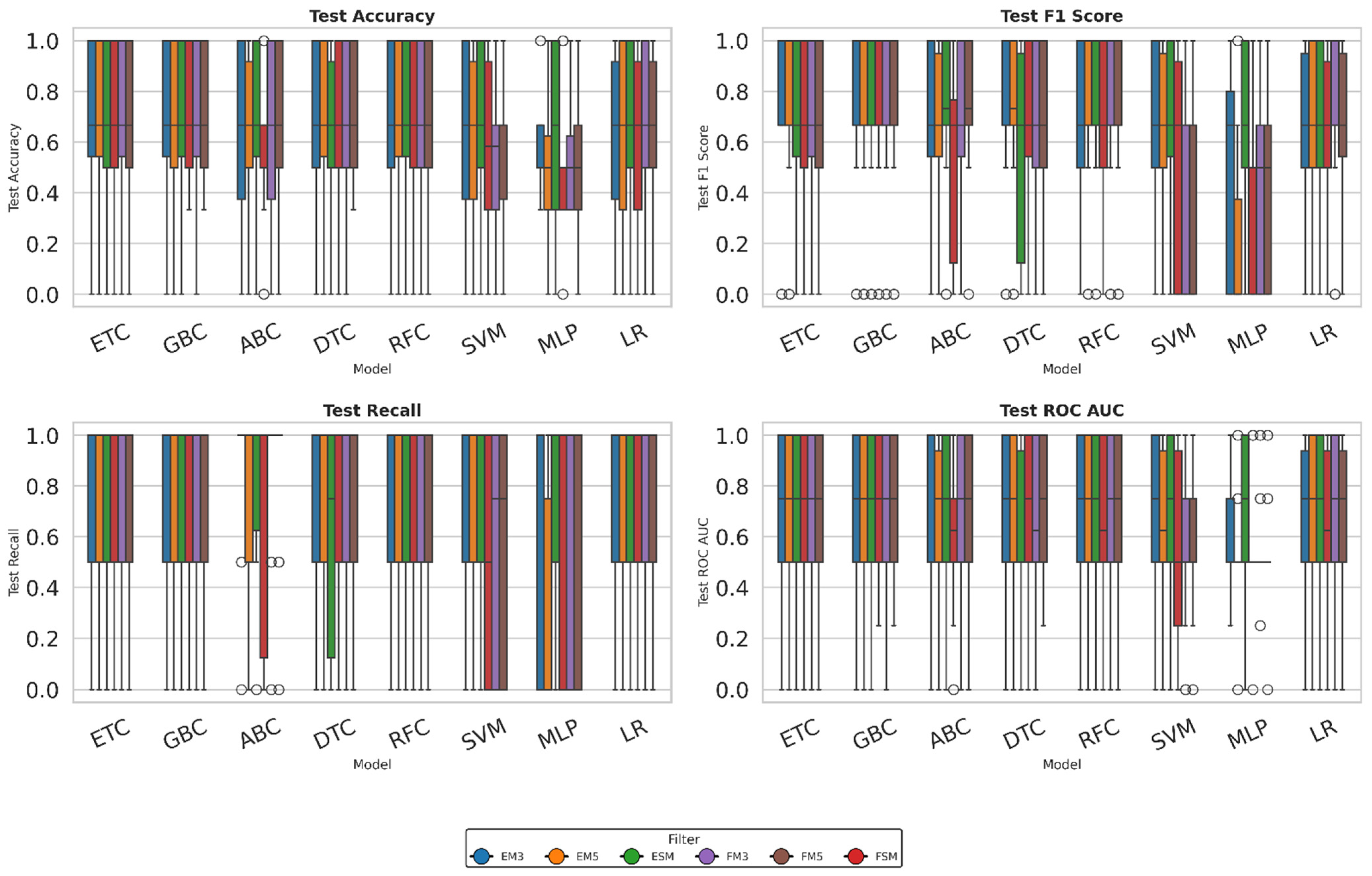
To complement the numerical results presented in Table 3, box plots for each metric and classifier are shown in Figure 5. These visualizations facilitate the identification of dispersion patterns, variability, and outliers across filtering strategies. In particular, the presence of outliers in specific configurations may indicate differences in model reliability, likely due to variations introduced during preprocessing. By highlighting deviations from the mean and the distribution of results, these plots provide additional insight into model stability and strengthen the interpretation of the findings.
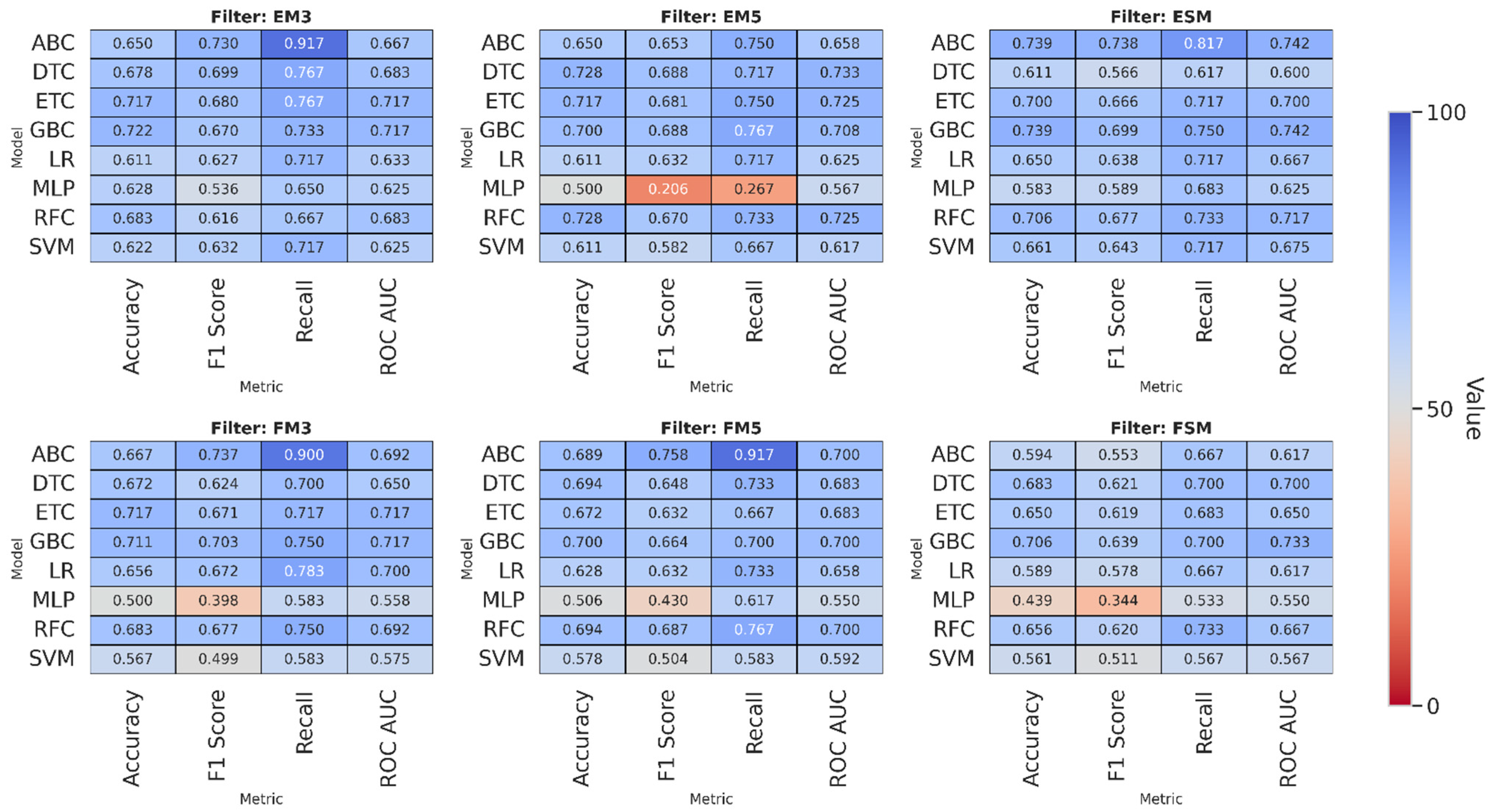
In addition to the statistical summaries, heatmaps were generated to provide a consolidated visual overview of model performance across all evaluation metrics and filter configurations (Figure 6). By encoding average values with a continuous color scale, this visualization enables rapid identification of high- and low-performing regions, revealing consistent trends and highlighting contrasts that may not be immediately apparent in numerical tables.
The side-by-side arrangement of the heatmaps further facilitates direct comparison of filtering strategies, making it easier to identify patterns in model behavior across experimental conditions. This visualization provides an intuitive understanding of how the classifiers respond to different preprocessing configurations.
These results were compared with those of Barrios et al. [38], who used decision tree-based models to predict the roughness of parts manufactured by fused deposition modeling (FDM) in two part orientations: Ra, 0°, and Ra, 90°. In their study, the Decision Tree model (J48/C4.5) achieved accuracies of 0.709 and 0.733, respectively, in each direction, while Random Forest reported accuracies of 0.807 and 0.743. In this study, Random Forest with the ESM filter achieved an accuracy of 0.70, an intermediate value between the two angles reported by Barrios et al. Meanwhile, DTC achieved an accuracy of 0.720 with EM5 preprocessing, but decreased to 0.610 with ESM configuration, demonstrating the significant sensitivity to image processing methods.
In the current study, the FM5 filter yielded an F1 score of 0.680 for Ra, 0°, compared with the 0.716 reported by Barrios et al. for the same orientation. Under EM3 preprocessing, the DecisionTree model achieved an F1 score of 0.690, surpassing the 0.650 documented by Barrios et al. With respect to ROC AUC, Barrios et al. [38]. obtained 0.692 and 0.481 for Random Forest in Ra, 0° and Ra, 90°, respectively; in contrast, the present work’s Random Forest ROC AUC ranged from 0.630 to 0.730 depending on the chosen filter. For the DecisionTree classifier, Barrios et al. [38] reported ROC AUC values of 0.154 and 0.385, whereas this investigation observed values ranging from 0.610 to 0.760 across different preprocessing methods.
The key difference between the two studies is the origin and volume of the data used. Barrios et al. based their work on five clean numerical variables. In contrast, this study analyzed force-displacement and stress-strain curves from images subjected to different moving-average filters. This study also optimized hyperparameters with Optuna. These factors were shown to have a decisive impact on the final metrics.
On the other hand, Patil et al. [39] classified the need for support in FDM parts as being implicitly related to the part orientation. In their study, Random Forest achieved an accuracy of 0.88, an F1 score of 0.87, a recall of 0.87, and an ROC AUC of 0.87. In contrast, this study’s results showed that the same model achieved 0.73 in accuracy (EM5), 0.68 in F1 score (FM5), 0.76 in recall (FM5), and 0.71 in AUC (ESM). Patil et al. reported an accuracy of 0.90, an F1 score of 0.90, a recall of 0.90, and an AUC of 0.90 for the decision tree model. In this study, the decision tree model yielded an accuracy of 0.69 (FM5), an F1 score of 0.69 (EM3), a recall of 0.76 (EM3), and an AUC of 0.73 (EM5). For SVM, Patil et al. obtained an accuracy of 0.69, an F1 score of 0.65, a recall of 0.69, and an AUC of 0.66. In our study, SVM achieved an accuracy of 0.62 (EM3), an F1 score of 0.64 (ESM), a recall of 0.71 (EM3 and ESM), and an AUC of 0.675 (ESM). For Gradient Boosting, Patil et al. achieved an accuracy of 0.89, an F1 score of 0.89, a recall of 0.89, and an AUC of 0.88. In this study, the model achieved an accuracy of 0.73 (ESM), an F1 score of 0.70 (EM3), a recall of 0.73 (EM5), and an AUC of 0.74 (ESM).
These discrepancies can be explained by the fact that Patil et al. used thirteen clean, wall-based numerical variables whose characteristics directly affect support prediction. In contrast, force-displacement and stress-strain curves were processed using filtering and conversion to image and matrix formats. During these stages, some information relevant to classification may be partially attenuated by filtering and data transformation.

3.2. Layer Thickness

Table 4 presents the classification accuracy per model and filter for the Layer thickness parameter. The AdaBoost Classifier (ABC) model achieves the highest average value (0.672) in the ESM configuration, with a low standard deviation. This behavior suggests that keeping the image unchanged by moving average could benefit the classification by preserving critical information that could be lost during filtering. Likewise, the ABC model shows acceptable performance in the FM3 and FM5 configurations, demonstrating good stability across different transformations.
The Decision Tree Classifier (DTC) also produced relatively favorable results, with average accuracy values close to 0.59 across most scenarios. However, its greater dispersion suggests greater sensitivity to the preprocessing strategy, potentially affecting the stability of the extracted patterns. Intermediate accuracy values were observed for the Gradient Boosting Classifier (GBC) and the Random Forest Classifier (RFC). Although their mean performance remained competitive, their higher standard deviations indicate a stronger dependence on the applied filtering strategy. In contrast, the Multilayer Perceptron (MLP) yielded lower accuracy values but reduced variability, suggesting more consistent—albeit less accurate—behavior across the evaluated conditions.
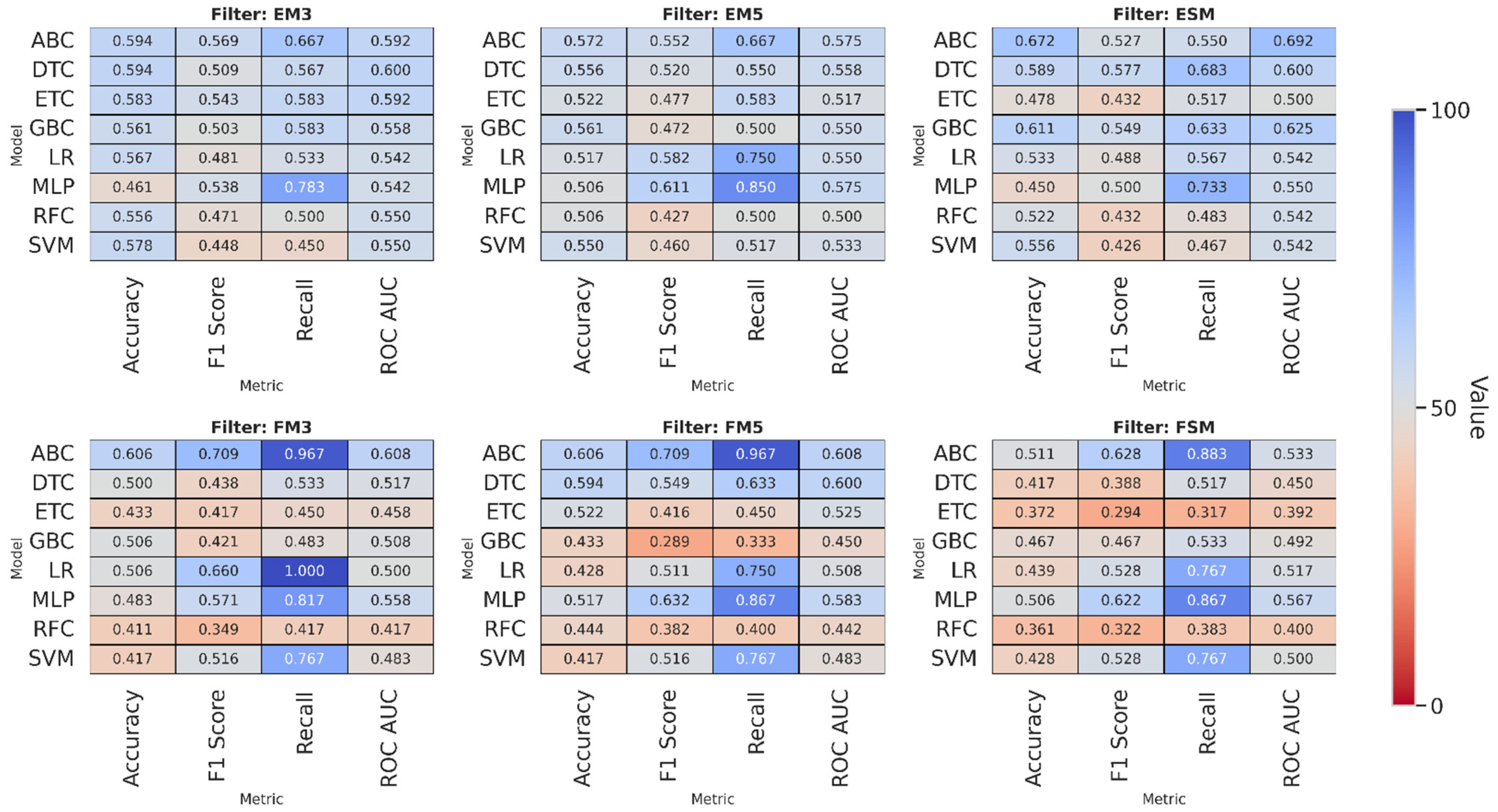
The Support Vector Machine (SVM) and Extra Trees Classifier (ETC) exhibited the lowest performance, with accuracy values generally remaining below 0.43 across all evaluated configurations. These results indicate that ensemble methods, particularly those based on boosting strategies, are generally more effective for the classification task considered in this study. The F1-score metric was used to assess the balance between precision and recall. Under this criterion, the AdaBoost classifier (ABC) again demonstrated the strongest performance, achieving the highest average scores. In particular, a mean F1-score of 0.7089 was obtained for both the FM3 and FM5 filters, with low standard deviations indicating stable performance across experimental conditions.
The Multilayer Perceptron (MLP) also achieved competitive results with these filters, with F1 scores exceeding 0.6. By contrast, the Extra Trees Classifier (ETC) and Random Forest Classifier (RFC) recorded the lowest scores, with average values below 0.45 and higher dispersion. The Logistic Regression (LR) and Support Vector Machine (SVM) models produced intermediate results, with their best performances observed under the EM5 and FSM filters, respectively. Meanwhile, the Decision Tree (DT) achieved its highest F1-score (0.576) under the ESM filter, although this result was associated with considerable variability. The recall results show that the MLP and AdaBoost (ABC) classifiers consistently achieved the highest sensitivity, particularly under the FM3, FM5, and FSM filters. In these configurations, the average recall of the ABC model ranged from 0.88 to 0.97, while the MLP model exceeded 0.86, highlighting their strong ability to detect positive cases.
Conversely, the Random Forest (RFC) and Extra Trees (ETC) models showed the lowest recall performance, with average values below 0.5 across most filtering strategies and relatively high variability. This combination suggests reduced reliability in their classification capability. An interesting case was observed with Logistic Regression (LR) under the FM3 filter, where a recall of 1.0 was achieved. However, the absence of variability (standard deviation = 0) may indicate overfitting or an imbalanced class distribution; therefore, this result should be interpreted cautiously. The FM3, FM5, and FSM filters tend to improve recall across most evaluated models, suggesting that these preprocessing strategies facilitate the identification of positive cases within the analyzed dataset.
Regarding the ROC AUC metric, the AdaBoost (ABC) classifier again achieved the highest average performance. In particular, under the ESM filter, the model achieved an average ROC AUC of 0.692, indicating strong discriminative ability and stable performance across the evaluated configurations. The Gradient Boosting Classifier (GBC) also demonstrated favorable performance under the ESM filter (0.625), although with higher variability. Meanwhile, the Logistic Regression (LR), Support Vector Machine (SVM), and Multilayer Perceptron (MLP) models achieved moderate ROC AUC values ranging from 0.50 to 0.58, without clearly dominating any specific filtering configuration.
The Decision Tree Classifier (DTC) occasionally produced ROC AUC values near 0.60, but its high variability undermines the reliability of these results. The AdaBoost classifier emerges as the most robust model, combining strong discriminative capacity with stable performance across filtering strategies.
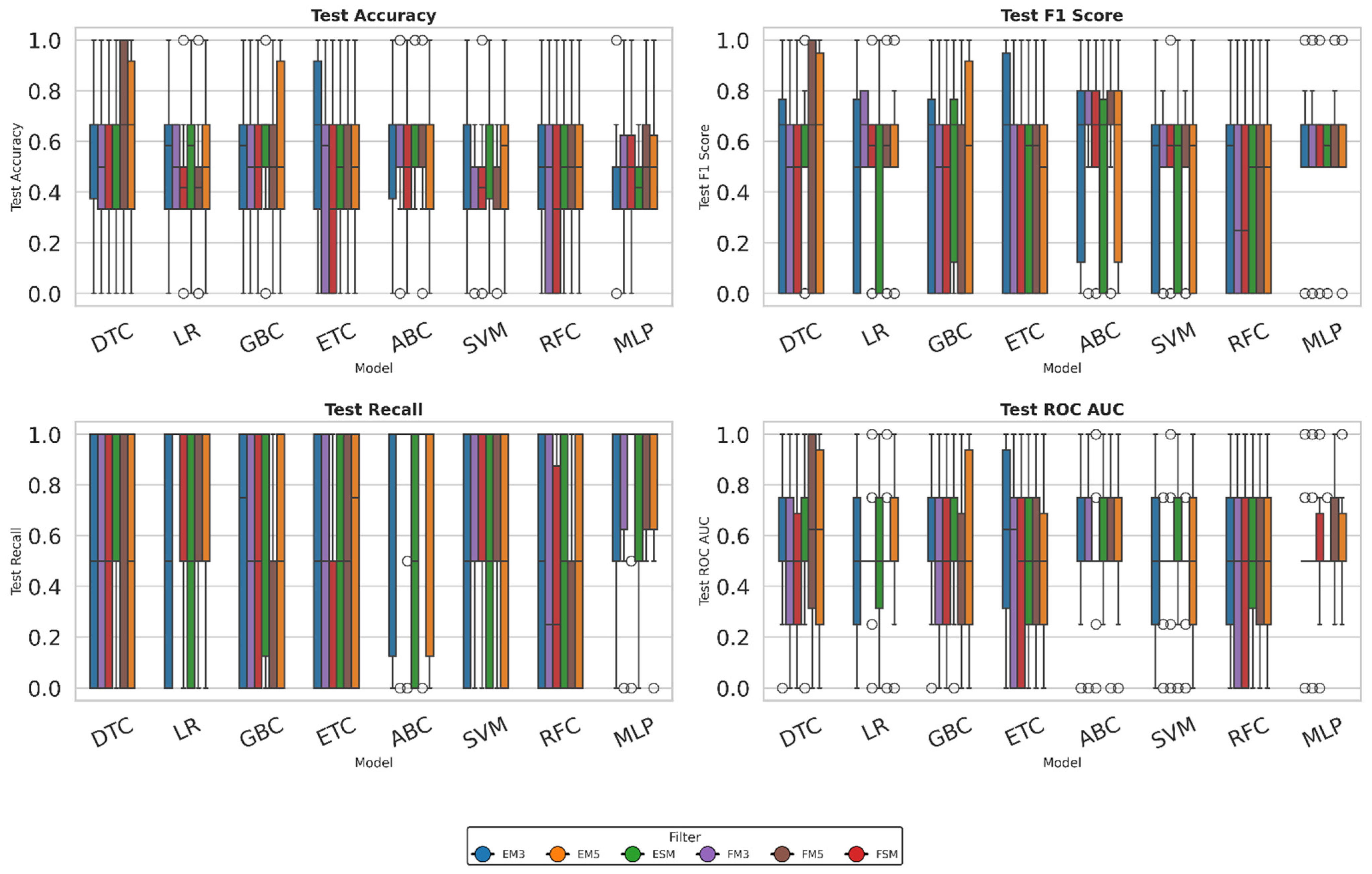
To complement the quantitative results, box plots for all models and metrics are presented in Figure 7. This visualization facilitates the identification of performance patterns by highlighting both dispersion and stability across filters. In particular, broader spreads and frequent outliers—especially in DTC—suggest increased sensitivity to data variability, whereas the more compact distributions observed in ABC reinforce its robustness and reliability.
As a complementary visualization of the results presented in Table 4, a second heatmap was generated to facilitate clearer comparison of model performance across all metrics and filter configurations (Figure 8). This visualization encodes average values using a continuous red–blue color scale, allowing rapid identification of both high- and low-performing model–filter combinations and of consistent trends across preprocessing strategies. The resulting gradients highlight clusters of strong performance, reveal subtle differences between classifiers, and uncover patterns that may not be immediately apparent in numerical tables, thereby enhancing the interpretation of the results.
In contrast, the work of Hien et al. [40] was examined, in which the researchers non-destructively classified eight thicknesses of dielectric materials using support vector machines (SVMs) and a deep neural network with six hidden layers. Utilizing an RBF kernel, the SVM attained an accuracy of 0.997 (Polynomial: 0.991; Sigmoid: 0.986), while the DNN attained 0.999 with a moderate amount of data, thereby demonstrating a strong correlation between well-based electromagnetic variables and thickness.
In this study, the same SVM achieved its lowest accuracy (0.41) with the FM3 and FM5 filters and its highest (0.57) with the EM3 filter. These findings suggest that classifying thicknesses from force–displacement and stress–strain curve images poses a greater challenge. The MLP classifier achieved an accuracy range of 0.45–0.51 across all configurations. It is noteworthy for its low standard deviation, though a concomitant reduction in overall precision accompanied it.
These discrepancies can be attributed to the inherent characteristics of the data itself. In contrast, Hien et al. employed five numerical variables that directly addressed layer thickness. In this study, however, the mechanical curve images underwent a series of processing stages, including filtration, matrix conversion, and flattening. These stages can potentially result in the loss of critical information necessary for effective classification.

3.3. Infill Density

Table 5 shows the accuracy values for the infill density variable by model and filter. The AdaBoost Classifier (ABC) model achieves the highest value in the FSM configuration (0.739), demonstrating its ability to classify data effectively even when processing images intensively. The Gradient Boosting Classifier (GBC) and Decision Tree Classifier (DTC) models also demonstrate outstanding performance in the FSM configuration, with values of 0.678 and 0.683, respectively, indicating that tree-based approaches and boosting techniques can extract relevant infill-related patterns regardless of the processing type applied.
The Support Vector Machine (SVM) model maintains values above 0.65 in FM3, FM5, and FSM, with moderate standard deviations, reflecting good stability across different image treatments. In contrast, the Multilayer Perceptron (MLP) model has the lowest values, below 0.49, with low deviations, suggesting consistent but inaccurate performance.
The Logistic Regression (LR) and Random Forest Classifier (RFC) models show intermediate performance, with values between 0.55 and 0.64 and standard deviations between 0.27 and 0.32, indicating a moderate but somewhat variable response.
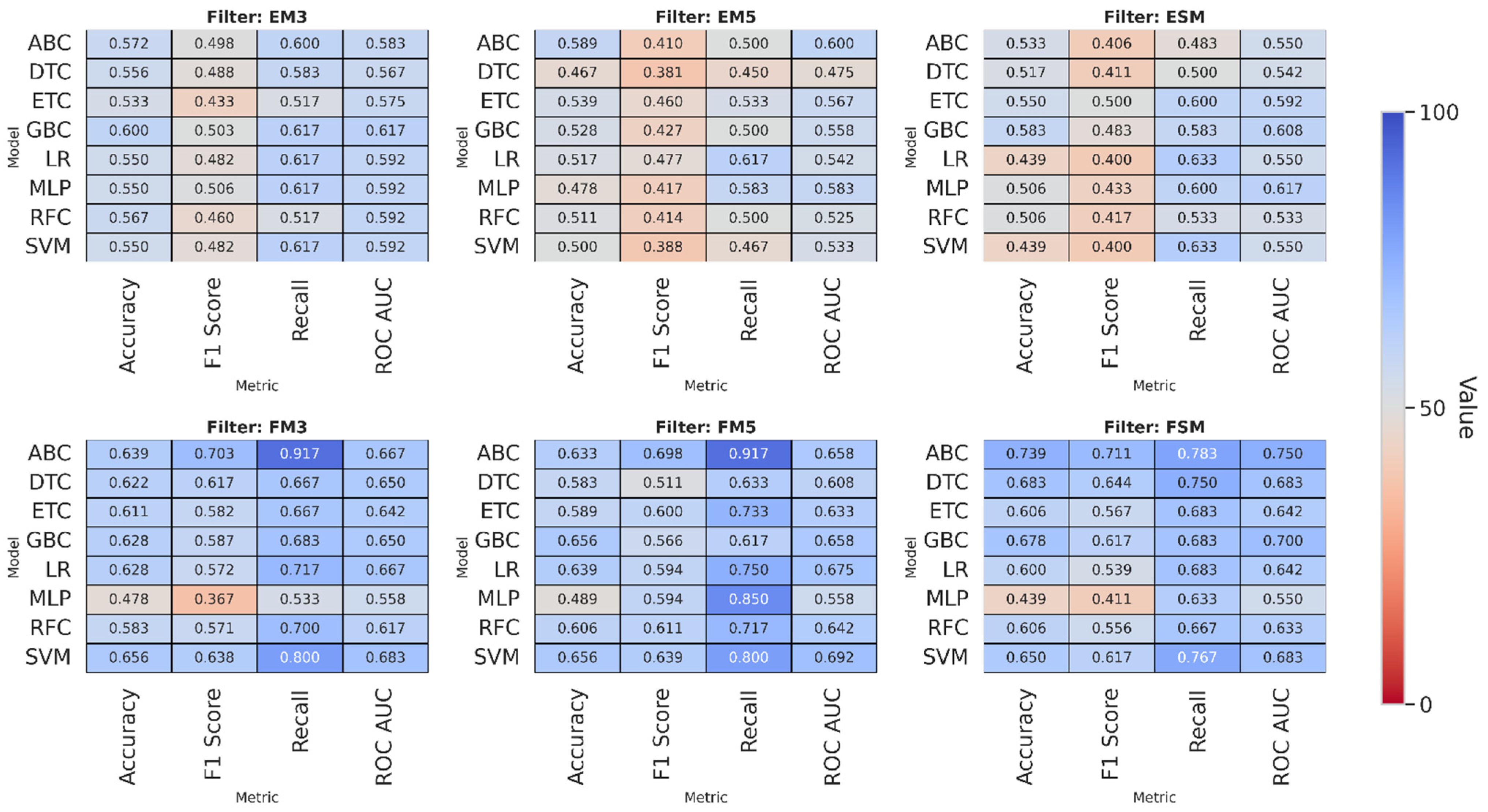
The F1-score results indicate that the AdaBoost classifier (ABC) consistently achieved the highest performance among the evaluated models, achieving 0.710, 0.703, and 0.698 under the FSM, FM3, and FM5 filters, respectively. These results indicate moderate variability while maintaining a stable balance between precision and recall. The Support Vector Machine (SVM) also demonstrated competitive performance, with values close to 0.63 across all three filters and a low standard deviation, reflecting strong stability under different filtering conditions. In contrast, the Decision Tree Classifier (DTC) produced lower scores (0.644, 0.610, and 0.610 for FSM, FM3, and FM5), suggesting moderate variability and reduced consistency in more complex scenarios.
Intermediate performance was observed for the Gradient Boosting Classifier (GBC), which achieved 0.617 under FSM with relatively low variability, indicating a reliable response when multiple variables are involved. Conversely, the Multilayer Perceptron (MLP) yielded the lowest values (0.367 in FM3 and 0.594 in FM5) and showed greater sensitivity to the preprocessing strategy, as reflected in its larger standard deviation. The Logistic Regression (LR) and Random Forest Classifier (RFC) models showed intermediate performance, with F1-scores ranging from 0.54 to 0.61, indicating acceptable yet less stable classification performance across filtering configurations.
Regarding recall performance, the AdaBoost (ABC) and Support Vector Machine (SVM) classifiers again exhibited the strongest results across the FM3, FM5, and FSM configurations, with average values ranging from 0.78 to 0.92 and relatively low variability. These results highlight their strong ability to identify positive cases while maintaining stability under different preprocessing conditions. The Logistic Regression (LR) model also performed reliably, achieving 0.71 and 0.75 under the FM3 and FM5 filters, respectively, with limited variability. In contrast, the Multilayer Perceptron (MLP) exhibited inconsistent behavior: although it achieved 0.85 under FM5, this value was associated with higher variability, suggesting greater sensitivity to the applied filtering strategy.
Other models—including Extra Trees (ETC), Gradient Boosting (GBC), and Decision Tree (DTC)—produced intermediate recall values ranging from 0.63 to 0.73, with moderate variability across filtering conditions. The Random Forest Classifier (RFC) achieved 0.70 and 0.72 under the FM3 and FM5 filters, respectively, but its higher variability across configurations limited its comparative robustness.
The ROC AUC results further highlight the discriminative capabilities of the evaluated models. The SVM and Logistic Regression (LR) classifiers achieved the most consistent performance, with average values between 0.66 and 0.69 across the evaluated filters and moderate variability. The AdaBoost (ABC) classifier achieved a higher average of 0.75 under the FSM filter, though its larger standard deviation suggests greater sensitivity to the filtering strategy. Similarly, the Gradient Boosting Classifier (GBC) maintained relatively strong performance with an FSM value of 0.70, but also displayed notable variability.
Lower ROC AUC values were observed for the Multilayer Perceptron (MLP), ranging from 0.55 to 0.61. Despite the lower predictive capability, its reduced variability suggests consistent—albeit limited—classification capacity. Meanwhile, Extra Trees (ETC), Random Forest (RFC), and Decision Tree (DTC) produced intermediate results (0.63–0.68), although their higher variability limits their reliability under changing filtering conditions.
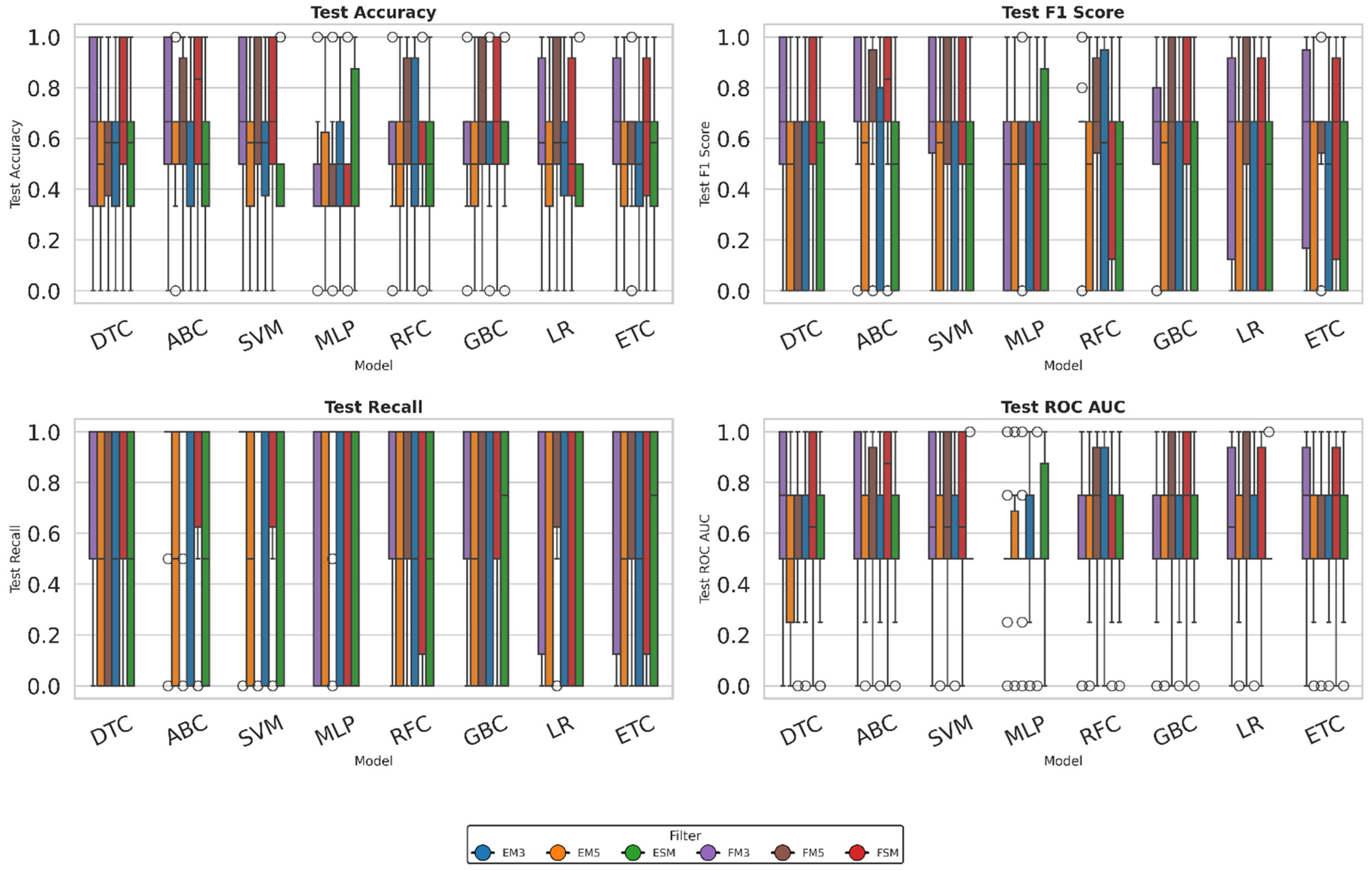
To complement the quantitative results, box plots for all metrics and models are presented in Figure 9. This visualization facilitates a comparative assessment of model performance across experimental conditions by highlighting both dispersion and stability. Models such as RF and SVM exhibit compact distributions, indicating consistent behavior across filters, whereas broader spreads and frequent outliers—particularly in DTC—suggest greater sensitivity to data variability and potential limitations in generalization.
To provide a clearer overview of the results summarized in Table 5, heatmaps were generated to visually represent model performance across all evaluation metrics and filter configurations (Figure 10). By encoding average values with a continuous red–blue color scale, this visualization facilitates rapid identification of high- and low-performing combinations and consistent trends across filters. The resulting visual gradients highlight clusters of strong performance, reveal subtle differences between models, and expose patterns that may not be immediately evident in numerical tables, thereby enhancing the interpretation of the results.

4. Discussion

The initial working hypothesis proposed that the morphological characteristics of these curves are influenced by geometric and process-dependent factors such as part orientation, layer thickness, and infill density, and that these differences can be captured and classified through machine learning models. The results obtained across multiple classifiers and preprocessing configurations largely support this hypothesis, although the predictive performance varies depending on the parameter analyzed.
Machine learning approaches have been widely used in additive manufacturing to predict mechanical properties based on process parameters. Several studies have demonstrated that predictive models such as artificial neural networks, ensemble learning algorithms, and gradient boosting techniques can accurately estimate tensile strength and other mechanical properties in FDM-manufactured parts [38,40]. These approaches generally rely on structured numerical descriptors derived from experimental measurements, such as ultimate tensile strength, modulus, or surface roughness. Similarly, artificial neural networks have achieved prediction errors below 1% in estimating t [40].
Although these studies demonstrate the effectiveness of machine learning models for predicting mechanical performance, they typically rely on scalar mechanical descriptors extracted from tensile tests. Consequently, a significant portion of the information contained in the complete mechanical response curves is not used during model training. In contrast, the present study explores whether the entire mechanical response, represented through image-based force–displacement and stress–strain curves, can be used as input data to infer printing parameters. This approach aims to capture morphological features of the mechanical response that may reflect the underlying manufacturing conditions.

4.1. Part Orientation

Among the analyzed parameters, part orientation produced the most consistent and accurate classification results across all models. Ensemble methods, particularly AdaBoost and Gradient Boosting, systematically achieved the highest performance across multiple metrics, including accuracy, F1-score, recall, and ROC-AUC. This behavior can be attributed to the strong mechanical anisotropy introduced by the layer-by-layer deposition process inherent to FDM.
Part orientation significantly affects interlayer adhesion, filament deposition paths, and stress transfer mechanisms, which directly influence the mechanical response of printed components. These structural differences produce distinctive signatures in the resulting stress–strain and force–displacement curves. Previous research has consistently reported that part orientation is one of the most influential parameters affecting mechanical performance in FDM-manufactured parts [41].
A key finding of this study is that unfiltered stress–strain curve images consistently outperformed their filtered counterparts. The application of moving-average filtering tends to suppress high-frequency variations in the curves that may correspond to localized deformation mechanisms such as interlayer shear, localized yielding, and fracture initiation. These subtle variations appear to contain discriminative information that allows machine learning models to differentiate between part orientations. Consequently, preserving the raw morphological characteristics of the curves enhances the predictive performance of the classifiers.
Compared with previous studies that rely on numerical descriptors, the results obtained here show slightly lower but still competitive classification performance. This difference is expected, as transforming mechanical curves into images may compress quantitative information that numerical descriptors retain more precisely. Nevertheless, the consistent performance of ensemble models demonstrates that image-based representations of mechanical curves remain a viable approach for identifying part orientation in reverse engineering.

4.2. Layer Thickness

Layer thickness emerged as the most challenging parameter to classify. Across all evaluated models and metrics, moderate accuracy levels and higher variability were observed, indicating partial separability between classes. This result is consistent with the physical role of layer thickness in FDM manufacturing.
Unlike part orientation, which directly influences load transfer across layers, layer thickness primarily affects mechanical behavior indirectly through variations in interlayer contact area, thermal gradients during solidification, and the distribution of internal defects. These effects alter the mechanical response in subtle ways, making them difficult to capture solely from the global morphology of the mechanical curves.
In several previous studies, near-perfect prediction accuracy for layer thickness has been achieved using machine learning models trained on numerical descriptors or direct process parameters. These results suggest that quantitative features extracted from experimental data may retain more precise information about layer thickness than image-based representations of mechanical curves.
In the present work, cases where recall was high but accuracy remained low suggest that some models identified positive instances of specific classes but struggled to distinguish between similar thickness levels reliably. This limitation may arise from noise introduced during preprocessing steps or from information loss during the flattening of image representations into feature vectors.
The results demonstrate that layer thickness can be partially inferred from mechanical response curves. Achieving reliable classification of this parameter may require more advanced feature extraction techniques or alternative representations that retain additional quantitative information from the curves.

4.3. Infill Density

Infill density exhibited intermediate classification performance between part orientation and layer thickness. Ensemble models again demonstrated the highest predictive capability, while simpler classifiers showed more variable results.
Infill density strongly influences the effective stiffness and deformation capacity of FDM-printed parts. As density increases, the internal load-bearing structure becomes more continuous, resulting in higher stiffness and reduced deformation before fracture. These changes are reflected in both the slope and curvature of the mechanical response curves.
Because these characteristics affect the overall shape of the mechanical curves, they remain detectable even after filtering or transformation into image representations. This explains why density produced higher separability than layer thickness in most of the evaluated models.
Interestingly, Support Vector Machine classifiers exhibited stable performance across several datasets, suggesting that differences in infill density produce patterns that are more linearly separable in the transformed feature space. Conversely, Multilayer Perceptron models showed inconsistent performance, suggesting that deeper non-linear representations may not yield significant benefits when the dataset is small, and the input data are flattened images.
These observations align with previous research demonstrating that infill density significantly influences mechanical performance metrics such as stiffness and tensile strength in FDM-manufactured parts [40].

4.4. Influence of Image Representation and Filtering

A consistent trend across all parameters was the superior performance of stress–strain curve images compared with force–displacement curve images. Stress and strain variables inherently normalize the mechanical response with respect to specimen geometry, reducing variability between samples and improving the clarity of the mechanical signal. This normalization enhances machine learning models’ ability to detect patterns associated with manufacturing parameters.
Additionally, the results indicate that unfiltered images generally outperform filtered ones. While filtering techniques are often applied to reduce noise in experimental data, excessive smoothing can remove localized features that encode important information about deformation mechanisms and process-induced microstructural effects.
These findings highlight the importance of maintaining a balance between noise reduction and information preservation during data preprocessing. Similar considerations have been reported in machine learning studies related to additive manufacturing, where excessive preprocessing may degrade model performance by removing relevant signal characteristics [42].

4.5. Implications and Limitations

The results of this study confirm the feasibility of using mechanical-response-derived images as input data for machine learning models to infer manufacturing parameters in FDM processes. This approach offers a potential pathway for reverse-engineering printing conditions solely from mechanical testing data, which could be particularly valuable for quality control and forensic analysis of additively manufactured components.
However, the predictive capability of the proposed methodology is parameter-dependent. Parameters that strongly influence mechanical anisotropy, such as part orientation, are more easily identifiable than parameters that indirectly influence mechanical response, such as layer thickness.
Several limitations must also be considered. The study was conducted using a single material system and a restricted set of process parameters. Furthermore, transforming mechanical curves into image representations may reduce the fidelity of the quantitative information contained in the original experimental data.
Future research should therefore explore hybrid approaches that combine image-based representations with numerical descriptors extracted from the curves. Additional studies incorporating larger datasets, multiple materials, and broader parameter ranges would also improve the robustness and generalizability of the proposed methodology.
In general, the results demonstrate that ensemble machine learning models applied to image representations of mechanical response curves provide a scalable and non-destructive method for inferring selected FDM parameters. The approach shows strong potential for identifying part orientation and moderate capability for detecting variations in infill density and layer thickness.

5. Conclusions

This study demonstrates that key FDM printing parameters, part orientation, layer thickness, and infill density can be inferred from mechanical response curves obtained during tensile testing. By transforming force–displacement and stress–strain curves into image representations and applying machine learning classifiers, it was possible to identify manufacturing conditions associated with printed components. This approach enables a potential reverse-engineering framework for batches of additively manufactured parts.
Ensemble models based on tree and boosting techniques provided the strongest performance across the evaluated configurations. In particular, the AdaBoost classifier consistently achieved the highest accuracy and F1-score values, especially when stress–strain curves were used without moving-average filtering. These results suggest that preserving the original signal may retain critical information required for accurate classification.
For the layer thickness and infill density variables, similar trends were observed, with ensemble models again outperforming alternative approaches. By contrast, individual models such as MLP and SVM generally produced lower accuracy values but exhibited smaller standard deviations, indicating more stable behavior across different preprocessing configurations. These characteristics suggest that such models could benefit from larger datasets, which may improve predictive performance.
Despite the relatively small dataset used in this study, the proposed methodology achieved a mean precision exceeding 72% for part orientation prediction, indicating that mechanical response curves contain relevant information about manufacturing parameters. These findings highlight the potential of combining mechanical testing data with machine learning techniques to extract manufacturing insights from printed components.
From an industrial perspective, this approach may represent an initial step toward the development of automated quality control and traceability systems for additively manufactured parts. Mechanical test data could therefore be used to verify or classify printing parameters, supporting process monitoring and manufacturing validation.
Finally, although several filtering strategies were evaluated to preprocess the mechanical curves, the results indicate that image filtering did not produce significant improvements in predictive performance. In several cases, unfiltered signals yielded results comparable to, or even superior to, those of filtered signals, suggesting that preserving the original signal characteristics may be advantageous for classification tasks based on mechanical response data.
Beyond its technical implications, the proposed methodology may also improve the reliability and transparency of additive manufacturing processes. The ability to infer printing parameters from mechanical response data could support traceability in distributed manufacturing environments, where parts are produced across multiple facilities or by different operators. In such contexts, identifying manufacturing conditions from mechanical performance may help ensure product consistency, reduce the risk of defective components, and enhance confidence in additively manufactured parts used in engineering applications.

6. Future Work

Future research should explore this strategy using larger datasets and incorporating additional manufacturing parameters. It would also be valuable to extend the methodology to other additive manufacturing processes with lower mechanical property anisotropy, such as Selective Laser Sintering (SLS).
Furthermore, the use of Functional Data Analysis (FDA) techniques could provide a more robust framework for analyzing mechanical response curves, enabling the direct treatment of stress–strain signals as functional data rather than transforming them into image representations. This approach may preserve more of the intrinsic information contained in the experimental curves and potentially improve the predictive capability of machine learning models.

Author Contributions

Conceptualization, B.C., Á.R. and A.J.A.; methodology, C.A.N.-T. and A.G.-R.; data curation, M.A.V.; validation, E.B. and J.E.B.; formal analysis, B.C.; investigation, B.C., Á.R. and A.J.A.; writing—original draft preparation, B.C., Á.R. and A.J.A.; writing—review and editing, all authors; visualization, B.C.; project administration, Y.G.R. All authors have read and agreed to the published version of the manuscript.

Funding

This work was supported by the Escuela Tecnológica Instituto Técnico Central (ETITC) through the internal research call Financiación interna de proyectos 16-2024, project code PIN78.

Data Availability Statement

The original contributions presented in this study are included in the article. Further inquiries can be directed to the corresponding author.

Conflicts of Interest

The authors declare no conflicts of interest.

Abbreviations

The following abbreviations are used in this manuscript:
ABCAdaBoost Classifier
ANNArtificial Neural Network
AMAdditive Manufacturing
AUCArea Under the Curve
CNNConvolutional Neural Network
DNNDeep Neural Network
DTCDecision Tree Classifier
DTRDecision Tree Regression
EM3Image processed using moving-average filter with 3 SD (force-displacement or stress-strain depending on context)
EM5Image processed using moving-average filter with 5 SD (force-displacement or stress-strain depending on context)
ESMUnfiltered (raw) stress–strain image
ETCExtra Trees Classifier
FDMFused Deposition Modeling
FM3Force–displacement image filtered with 3 SD
FM5Force–displacement image filtered with 5 SD
FSMUnfiltered (raw) force–displacement image
GBCGradient Boosting Classifier
GPRGaussian Process Regression
ISOInternational Organization for Standardization
LAMLaser Additive Manufacturing
LSTMLong Short-Term Memory (neural network)
LRLogistic Regression
MLPMultilayer Perceptron
MTED-TLMulti-Temporal Encoder–Decoder Transfer Learning architecture
PLAPolylactic Acid
RFRandom Forest
RFCRandom Forest Classifier
ROCReceiver Operating Characteristic
SDStandard Deviation
SLAStereolithography
SLSSelective Laser Sintering
SVMSupport Vector Machine

References

  1. Silva, C.M.A.; Gomes, V.C.; Ferreira, A.B.S.; Nascimento, L.D.; Leite, A.B.; Santos, V.S.; Acruz, C.S.; Marques, F.R.V.; Leão, A.P.d.S.; Tourem, R.V. Industry 4.0 and Sustainability: A Study on the Applicability of Additive Manufacturing as a Tool for Minimizing Environmental Impacts on Production Processes. Rev. Gestão Soc. E Ambient. 2024, 18, e05970. [Google Scholar] [CrossRef]
  2. Peron, M.; Agnusdei, L.; Miglietta, P.P.; Agnusdei, G.P.; Finco, S.; Del Prete, A. Additive vs conventional manufacturing for producing complex systems: A decision support system and the impact of electricity prices and raw materials availability. Comput. Ind. Eng. 2024, 194, 110406. [Google Scholar] [CrossRef]
  3. Kafle, A.; Luis, E.; Silwal, R.; Pan, H.M.; Shrestha, P.L.; Bastola, A.K. 3d/4d printing of polymers: Fused deposition modelling (fdm), selective laser sintering (sls), and stereolithography (sla). Polymers 2021, 13, 3101. [Google Scholar] [CrossRef]
  4. Karakašić, M.; Grgić, I.; Perak, V.; Marijić, J.; Glavaš, H. Influence of infill density and number of layers on mechanical properties of 3D printed pla and abs sandwich structures. Adv. Eng. Lett. 2024, 3, 154–163. [Google Scholar] [CrossRef]
  5. Bastin, A.; Huang, X. Progress of Additive Manufacturing Technology and Its Medical Applications. ASME Open J. Eng. 2022, 1, 010802. [Google Scholar] [CrossRef]
  6. Rodriguez, A.G.; Mora, E.; Velasco, M.; Narváez-Tovar, C. Mechanical properties of polyamide 12 manufactured by means of SLS: Influence of wall thickness and build direction. Mater. Res. Express 2023, 10, 105304. [Google Scholar] [CrossRef]
  7. Trindade, D.; Habiba, R.; Fernandes, C.; Costa, A.A.; Silva, R.; Alves, N.; Martins, R.; Malça, C.; Branco, R.; Moura, C. Material Performance Evaluation for Customized Orthoses: Compression, Flexural, and Tensile Tests Combined with Finite Element Analysis. Polymers 2024, 16, 2553. [Google Scholar] [CrossRef] [PubMed]
  8. AbouelNour, Y.; Rakauskas, N.; Naquila, G.; Gupta, N. Tensile testing data of additive manufactured ASTM D638 standard specimens with embedded internal geometrical features. Sci. Data 2024, 11, 506. [Google Scholar] [CrossRef]
  9. Banerjee, D.K.; Iadicola, M.A.; Creuziger, A. Understanding Deformation Behavior in Uniaxial Tensile Tests of Steel Specimens at Varying Strain Rates. J. Res. Natl. Inst. Stand. Technol. 2021, 126, 126050. [Google Scholar] [CrossRef] [PubMed]
  10. ISO 527-1:2019; Plastics—Determination of Tensile Properties—Part 1: General Principles. International Organization for Standardization: Geneva, Switzerland, 2019.
  11. Sendrowicz, A.; Myhre, A.O.; Wierdak, S.W.; Vinogradov, A. Challenges and accomplishments in mechanical testing instrumented by in situ techniques: Infrared thermographydigital image correlation, and acoustic emission. Appl. Sci. 2021, 11, 6718. [Google Scholar] [CrossRef]
  12. Parra, D.P.; Ferreira, G.R.B.; Díaz, J.G.; de Castro Ribeiro, M.G.; Braga, A.M.B. Supervised Machine Learning Models for Mechanical Properties Prediction in Additively Manufactured Composites. Appl. Sci. 2024, 14, 7009. [Google Scholar] [CrossRef]
  13. Ari, I.; Muhtaroglu, N. Design and implementation of a cloud computing service for finite element analysis. Adv. Eng. Softw. 2013, 60–61, 122–135. [Google Scholar] [CrossRef]
  14. Violos, J.; Diamanti, K.-C.; Kompatsiaris, I.; Papadopoulos, S. Frugal Machine Learning for Energy-efficient, and Resource-aware Artificial Intelligence. arXiv 2025, arXiv:2506.01869. [Google Scholar] [CrossRef]
  15. Rojek, I.; Mikołajewski, D.; Galas, K.; Kopowski, J. ML-Based Materials Evaluation in 3D Printing. Appl. Sci. 2025, 15, 5523. [Google Scholar] [CrossRef]
  16. Wang, L.; Jiang, J.; Dong, Y.; Ghita, O.; Zhu, Y.; Sucala, I. Machine learning enabled 3D printing parameter settings for desired mechanical properties. Virtual Phys. Prototyp. 2024, 19, e2425825. [Google Scholar] [CrossRef]
  17. Tiwari, A. 3D Printing and AI: Exploring the Impact of Machine Learning on Additive Manufacturing. J. Comput. Syst. Appl. 2025, 2, 33–46. [Google Scholar] [CrossRef]
  18. Ulkir, O.; Bayraklılar, M.; Kuncan, M. Raster Angle Prediction of Additive Manufacturing Process Using Machine Learning Algorithm. Appl. Sci. 2024, 14, 2046. [Google Scholar] [CrossRef]
  19. Rezasefat, M.; Hogan, J. Prediction of 4D stress field evolution around additive manufacturing-induced porosity through progressive deep-learning frameworks. Mach. Learn. Sci. Technol. 2024, 5, 015038. [Google Scholar] [CrossRef]
  20. Wu, S.-H.; Tariq, U.; Joy, R.; Sparks, T.; Flood, A.; Liou, F. Experimental, Computational, and Machine Learning Methods for Prediction of Residual Stresses in Laser Additive Manufacturing: A Critical Review. Materials 2024, 17, 1498. [Google Scholar] [CrossRef]
  21. Zhang, J.; Wang, P.; Gao, R.X. Deep learning-based tensile strength prediction in fused deposition modeling. Comput. Ind. 2019, 107, 11–21. [Google Scholar] [CrossRef]
  22. Tura, A.D.; Lemu, H.G.; Mamo, H.B.; Santhosh, A.J. Prediction of tensile strength in fused deposition modeling process using artificial neural network and fuzzy logic. Prog. Addit. Manuf. 2023, 8, 529–539. [Google Scholar] [CrossRef]
  23. Rodríguez, A.G.; Mora, E.E.; Tovar, C.A.N.; Velasco, M.A.; Bárcenas, E. Predicting ultimate tensile and break strength of SLS PA 12 parts using machine learning on tensile load–displacement data. Prog. Addit. Manuf. 2025, 10, 9133–9175. [Google Scholar] [CrossRef]
  24. Calderon, J.E.B.; Peña, M.A.V. Effect of the different printing variables on the modulus of elasticity for the PLA-CF in 3D printing. Braz. J. Dev. 2023, 9, 17345–17359. [Google Scholar] [CrossRef]
  25. ISO 527-2:2023; Plastics—Determination of Tensile Properties—Part 2: Test Conditions for Moulding and Extrusion Plastics. International Organization for Standardization: Geneva, Switzerland, 2023.
  26. Shokrollahi, Y.; Nikahd, M.M.; Gholami, K.; Azamirad, G. Deep Learning Techniques for Predicting Stress Fields in Composite Materials: A Superior Alternative to Finite Element Analysis. J. Compos. Sci. 2023, 7, 311. [Google Scholar] [CrossRef]
  27. Jiang, H.; Nie, Z.; Yeo, R.; Farimani, A.B.; Kara, L.B. StressGAN: A Generative Deep Learning Model for 2D Stress Distribution Prediction. J. Appl. Mech. 2020, 88, 051005. [Google Scholar] [CrossRef]
  28. Sun, Y.; Hanhan, I.; Sangid, M.D.; Lin, G. Predicting Mechanical Properties from Microstructure Images in Fiber-reinforced Polymers using Convolutional Neural Networks. J. Compos. Sci. 2024, 8, 387. [Google Scholar] [CrossRef]
  29. Yang, Z.; Yu, C.-H.; Buehler, M.J. Deep learning model to predict complex stress and strain fields in hierarchical composites. Sci. Adv. 2021, 7, eabd7416. [Google Scholar] [CrossRef] [PubMed]
  30. Feng, H.; Prabhakar, P. Parameterization-based Neural Network: Predicting Non-linear Stress-Strain Response of Composites. Eng. Comput. 2023, 40, 1621–1635. [Google Scholar] [CrossRef]
  31. Bulgarevich, D.S.; Watanabe, M. Stress–strain curve predictions by crystal plasticity simulations and machine learning. Sci. Rep. 2024, 14, 29492. [Google Scholar] [CrossRef]
  32. Era, I.Z.; Grandhi, M.; Liu, Z. Prediction of mechanical behaviors of L-DED fabricated SS 316L parts via machine learning. Int. J. Adv. Manuf. Technol. 2022, 121, 2445–2459. [Google Scholar] [CrossRef]
  33. Deshmankar, A.P.; Challa, J.S.; Singh, A.R.; Regalla, S.P. A Review of the Applications of Machine Learning for Prediction and Analysis of Mechanical Properties and Microstructures in Additive Manufacturing. J. Comput. Inf. Sci. Eng. 2024, 24, 120801. [Google Scholar] [CrossRef]
  34. Polenta, A.; Tomassini, S.; Falcionelli, N.; Contardo, P.; Dragoni, A.F.; Sernani, P. A Comparison of Machine Learning Techniques for the Quality Classification of Molded Products. Information 2022, 13, 272. [Google Scholar] [CrossRef]
  35. Yang, L.; Shami, A. On hyperparameter optimization of machine learning algorithms: Theory and practice. Neurocomputing 2020, 415, 295–316. [Google Scholar] [CrossRef]
  36. Bischl, B.; Binder, M.; Lang, M.; Pielok, T.; Richter, J.; Coors, S.; Thomas, J.; Ullmann, T.; Becker, M.; Boulesteix, A.-L.; et al. Hyperparameter Optimization: Foundations, Algorithms, Best Practices and Open Challenges. arXiv 2021, arXiv:2107.05847. [Google Scholar] [CrossRef]
  37. Szczupak, E.; Małysza, M.; Wilk-Kołodziejczyk, D.; Jaśkowiec, K.; Bitka, A.; Głowacki, M.; Marcjan, Ł. Decision Support Tool in the Selection of Powder for 3D Printing. Materials 2024, 17, 1873. [Google Scholar] [CrossRef] [PubMed]
  38. Barrios, J.M.; Romero, P.E. Decision tree methods for predicting surface roughness in fused deposition modeling parts. Materials 2019, 12, 2574. [Google Scholar] [CrossRef]
  39. Patil, S.; Deshpande, Y.S.; Parle, D. Comparative Analysis of 3D Printing Support Structure Prediction Using Feature Selection Methods for Classification Algorithms. Int. J. Intell. Syst. Appl. Eng. 2024, 12, 71–81. Available online: https://ijisae.org/index.php/IJISAE/article/view/5224/3948 (accessed on 20 December 2025).
  40. Hien, P.T.; Hong, I.P. Material thickness classification using scattering parameters, dielectric constants, and machine learning. Appl. Sci. 2021, 11, 10682. [Google Scholar] [CrossRef]
  41. Mo, Y.; Su, J.; Li, Q.; Jiang, F.; Sing, S.L. Machine learning-driven design of support structures and process parameters in additive manufacturing. Virtual Phys. Prototyp. 2025, 20, e2525988. [Google Scholar] [CrossRef]
  42. Nasiri, S.; Khosravani, M.R. Machine learning in predicting mechanical behavior of additively manufactured parts. J. Mater. Res. Technol. 2021, 14, 1137–1153. [Google Scholar] [CrossRef]
Figure 1. General outline of the methodology, including data acquisition, processing, and analysis. The specimen design follows ISO 527-2 [25].
Jmmp 10 00122 g001
Figure 2. A Tensile test specimen according to ISO 527-2 Type 1A and Universal Testing Machine Shimadzu.
Jmmp 10 00122 g002
Figure 3. Schematic illustration of part orientation, layer thickness, and infill density in 3D-printed models. The arrows indicate the rotation used to define part orientation and the direction associated with layer thickness.
Jmmp 10 00122 g003
Figure 4. (A) Stress–strain graph of the original data; (B) Stress–strain graph after treatment with moving average; (C) Force–displacement graph of the original data; (D) Force–displacement graph after treatment with moving average.
Jmmp 10 00122 g004
Figure 5. Box plots showing Accuracy, F1 score, Recall, and ROC AUC for part-orientation classification. Circles indicate outliers.
Jmmp 10 00122 g005
Figure 6. Heatmaps of Accuracy, F1 score, Recall, and ROC AUC for part-orientation classification across filter configurations.
Jmmp 10 00122 g006
Figure 7. Box plots showing Accuracy, F1 score, Recall, and ROC AUC for layer-thickness classification. Circles indicate outliers.
Jmmp 10 00122 g007
Figure 8. Heatmaps of Accuracy, F1 score, Recall, and ROC AUC for layer-thickness classification across filter configurations.
Jmmp 10 00122 g008
Figure 9. Box plots showing Accuracy, F1 score, Recall, and ROC AUC for infill-density classification. Circles indicate outliers.
Jmmp 10 00122 g009
Figure 10. Heatmaps of Accuracy, F1 score, Recall, and ROC AUC for infill-density classification across filter configurations.
Jmmp 10 00122 g010
Table 1. Experimental design printing parameters and experimental levels.
FactorParameterLevel 1Level 2
ALayer thickness0.10 mm0.20 mm
BInfill density20%50%
CPart orientationHorizontalVertical
Table 2. Hyperparameters and ranges or values for hyperparameter optimization.
ModelsHyperparametersRanges/ValuesReferences
DecisionTreeClassifierCriterionGini, entropy[34,35,36,37]
Max_depthNone, 5, 10, 20
Min_samples_split2, 5, 10
Min_samples_leaf1, 2, 4
AdaBoostClassifierN_estimators50, 100, 200
Learning_rate0.01, 0.1, 1.0
Support Vector MachinesC0.1, 1, 10
kernelLinear, rbf
gammaScale, auto
Multilayer PerceptronHidden_layer50–150
N_layers1–3
activationIdentity, logistic, tanh, relu
solverAdam, sgd
alpha1 × 10−5–1 × 10⁻¹
Learning_rateConstant, invscaling, adaptive
RandomForestClassifierN_estimators100, 200
Max_depthNone, 10, 20
Min_samples_split2, 5
Min_samples_leaf1, 2
bootstrapTrue, false
GradientBoostingClassifierN_estimators50–200
Learning_rate0.01–0.2
Max_depth3–10
Min_samples_split2–10
Min_samples_leaf1–5
LogisticRegressionpenaltyL1, l2, elasticnet, none
solverLiblinear, lbfgs, saga, newton-cg
C1 × 10−3–10
ExtraTreesClassifierN_estimators100, 200
Max_depthNone, 10, 20
Min_samples_split2, 5
Min_samples_leaf1, 2
bootstrapTrue, false
Table 3. Metrics Accuracy, F1-Score, Recall, and ROC AUC by model with mean and standard deviation values.
ModelFilterAccuracyF1-ScoreRecallROC AUC
MeanStd. Dev.MeanStd. Dev.MeanStd. Dev.MeanStd. Dev.
AdaBoostEM30.6500.2910.7300.2410.9170.2310.6670.281
EM50.6500.2640.6530.3110.7500.3660.6580.275
ESM0.7390.2860.7380.3140.8170.3340.7420.297
FM30.6670.2970.7370.2460.9000.2420.6920.284
FM50.6890.2960.7580.2460.9170.2310.7000.289
FSM0.5940.2890.5530.3680.6670.4420.6170.292
ExtraTreesEM30.7170.2400.6800.3410.7670.3880.7170.252
EM50.7170.2590.6810.3470.7500.3880.7250.265
ESM0.7000.2710.6660.3500.7170.3870.7000.282
FM30.7170.3040.6710.3800.7170.4090.7170.313
FM50.6720.3320.6320.3940.6670.4220.6830.334
FSM0.6500.3200.6190.3850.6830.4250.6500.326
GradientBoostingEM30.7220.2710.6700.3740.7330.4100.7170.284
EM50.7000.2750.6880.3260.7670.3650.7080.279
ESM0.7390.2690.6990.3560.7500.3880.7420.275
FM30.7110.2660.7030.3230.7500.3660.7170.284
FM50.7000.2450.6640.3440.7000.3850.7000.274
FSM0.7060.2380.6390.3610.7000.4070.7330.236
LogisticRegressionEM30.6110.3110.6270.3320.7170.3870.6330.320
EM50.6110.3230.6320.3400.7170.3870.6250.333
ESM0.6500.2910.6380.3390.7170.3870.6670.296
FM30.6560.3030.6720.3200.7830.3640.7000.289
FM50.6280.2890.6320.3310.7330.3880.6580.290
FSM0.5890.3180.5780.3650.6670.4220.6170.320
MLPEM30.6280.2420.5360.3910.6500.4580.6250.234
EM50.5000.2230.2060.3600.2670.4500.5670.196
ESM0.5830.3520.5890.3730.6830.4250.6250.346
FM30.5000.2100.3980.3600.5830.4930.5580.170
FM50.5060.2290.4300.3610.6170.4860.5500.190
FSM0.4390.2420.3440.3630.5330.5070.5500.201
RandomForestEM30.6830.2710.6160.3810.6670.4220.6830.286
EM50.7280.2640.6700.3740.7330.4100.7250.273
ESM0.7060.2830.6770.3470.7330.3880.7170.292
FM30.6830.2750.6770.3210.7500.3660.6920.291
FM50.6940.2940.6870.3540.7670.3880.7000.304
FSM0.6560.2770.6200.3600.7330.4100.6670.273
SVMEM30.6220.3180.6320.3400.7170.3870.6250.333
EM50.6110.3110.5820.3670.6670.4220.6170.320
ESM0.6610.2850.6430.3380.7170.3870.6750.295
FM30.5670.2960.4990.3880.5830.4560.5750.309
FM50.5780.2930.5040.3890.5830.4560.5920.304
FSM0.5610.3380.5110.4030.5670.4500.5670.347
DecisionTreeEM30.6780.3500.6990.3560.7670.3880.6830.359
EM50.7280.3080.6880.3830.7170.4090.7330.314
ESM0.6110.3070.5660.3820.6170.4290.6000.326
FM30.6720.2680.6240.3610.7000.4070.6500.291
FM50.6940.2520.6480.3470.7330.3880.6830.270
FSM0.6830.2710.6210.3810.7000.4280.7000.274
Table 4. Accuracy, F1 score, Recall, and ROC AUC for layer-thickness classification by model and filter, reported as mean and standard deviation.
ModelFilterAccuracyF1-ScoreRecallROC AUC
MeanStd. Dev.MeanStd. Dev.MeanStd. Dev.MeanStd. Dev.
AdaBoostEM30.5940.3020.5690.3790.6670.4420.5920.311
EM50.5720.2960.5520.3700.6670.4420.5750.302
ESM0.6720.2120.5270.4010.5500.4420.6920.215
FM30.6060.2530.7090.2160.9670.1830.6080.234
FM50.6060.2530.7090.2160.9670.1830.6080.234
FSM0.5110.2620.6280.2410.8830.2840.5330.243
ExtraTreesEM30.5830.3330.5430.3950.5830.4370.5920.344
EM50.5220.2890.4770.3820.5830.4560.5170.300
ESM0.4780.3300.4320.3820.5170.4640.5000.341
FM30.4330.3700.4170.3880.4500.4420.4580.394
FM50.5220.3060.4160.3900.4500.4420.5250.331
FSM0.3720.3150.2940.3570.3170.4040.3920.339
GradientBoostingEM30.5610.2980.5030.3910.5830.4560.5580.306
EM50.5610.3350.4720.4220.5000.4550.5500.356
ESM0.6110.2810.5490.3740.6330.4340.6250.277
FM30.5060.3170.4210.3990.4830.4640.5080.331
FM50.4330.2820.2890.3530.3330.4220.4500.297
FSM0.4670.3400.4670.3700.5330.4340.4920.356
LogisticRegressionEM30.5670.2860.4810.3850.5330.4340.5420.301
EM50.5170.2750.5820.2780.7500.3660.5500.282
ESM0.5330.2600.4880.3460.5670.4300.5420.287
FM30.5060.1420.6600.1281.0000.0000.5000.000
FM50.4280.2130.5110.2550.7500.3880.5080.213
FSM0.4390.1980.5280.2360.7670.3650.5170.196
MLPEM30.4610.1840.5380.2410.7830.3640.5420.162
EM50.5060.2080.6110.1870.8500.2670.5750.187
ESM0.4500.1320.5000.2400.7330.3880.5500.102
FM30.4830.2070.5710.2330.8170.3340.5580.182
FM50.5170.1870.6320.1330.8670.2250.5830.165
FSM0.5060.2420.6220.2000.8670.2600.5670.227
RandomForestEM30.5560.2880.4710.3960.5000.4350.5500.318
EM50.5060.2460.4270.3560.5000.4350.5000.271
ESM0.5220.3300.4320.4110.4830.4640.5420.335
FM30.4110.3180.3490.3680.4170.4560.4170.337
FM50.4440.3040.3820.3570.4000.4030.4420.333
FSM0.3610.3000.3220.3390.3830.4290.4000.332
SVMEM30.5780.2690.4480.3970.4500.4220.5500.297
EM50.5500.2880.4600.3850.5170.4450.5330.306
ESM0.5560.2410.4260.3730.4670.4340.5420.263
FM30.4170.1680.5160.2230.7670.3650.4830.173
FM50.4170.1680.5160.2230.7670.3650.4830.173
FSM0.4280.2130.5280.2360.7670.3650.5000.218
DecisionTreeEM30.5940.2760.5090.3920.5670.4500.6000.291
EM50.5560.3620.5200.4220.5500.4610.5580.375
ESM0.5890.2790.5770.3350.6830.4040.6000.291
FM30.5000.2940.4380.3690.5330.4540.5170.307
FM50.5940.3630.5490.4240.6330.4720.6000.369
FSM0.4170.2790.3880.3440.5170.4640.4500.297
Table 5. Accuracy, F1 score, Recall, and ROC AUC for infill-density classification by model and filter, reported as mean and standard deviation.
ModelFilterAccuracyF1-ScoreRecallROC AUC
MeanStd. Dev.MeanStd. Dev.MeanStd. Dev.MeanStd. Dev.
AdaBoostEM30.5720.3240.4980.4110.6000.4810.5830.324
EM50.5890.2390.4100.4090.5000.4910.6000.242
ESM0.5330.2880.4060.3910.4830.4640.5500.289
FM30.6390.2810.7030.2640.9170.2650.6670.265
FM50.6330.2680.6980.2560.9170.2650.6580.258
FSM0.7390.3090.7110.3660.7830.3870.7500.308
ExtraTreesEM30.5330.3140.4330.4170.5170.4820.5750.309
EM50.5390.3150.4600.4060.5330.4720.5670.321
ESM0.5500.2880.5000.3640.6000.4430.5920.290
FM30.6110.3340.5820.3830.6670.4420.6420.339
FM50.5890.3150.6000.3410.7330.4100.6330.313
FSM0.6060.3110.5670.3810.6830.4450.6420.313
GradientBoostingEM30.6000.2030.5030.3520.6170.4490.6170.215
EM50.5280.3130.4270.4020.5000.4730.5580.313
ESM0.5830.2620.4830.3750.5830.4560.6080.260
FM30.6280.2760.5870.3610.6830.4250.6500.283
FM50.6560.2900.5660.4040.6170.4490.6580.297
FSM0.6780.2900.6170.3870.6830.4250.7000.289
LogisticRegressionEM30.5500.2700.4820.3690.6170.4680.5920.267
EM50.5170.3010.4770.3670.6170.4680.5420.309
ESM0.4390.2030.4000.3410.6330.4900.5500.153
FM30.6280.2690.5720.3810.7170.4490.6670.257
FM50.6390.2770.5940.3730.7500.4310.6750.256
FSM0.6000.2960.5390.3930.6830.4640.6420.276
MLPEM30.5500.2840.5060.3650.6170.4490.5920.282
EM50.4780.2960.4170.3880.5830.4930.5830.257
ESM0.5060.3110.4330.4100.6000.4980.6170.252
FM30.4780.2430.3670.3780.5330.5070.5580.215
FM50.4890.2230.5940.2170.8500.2980.5580.204
FSM0.4390.2420.4110.3550.6330.4900.5500.201
RandomForestEM30.5670.3320.4600.4340.5170.4820.5920.331
EM50.5110.2870.4140.3910.5000.4730.5250.289
ESM0.5060.2750.4170.3730.5330.4720.5330.276
FM30.5830.2900.5710.3430.7000.4280.6170.299
FM50.6060.3230.6110.3480.7170.4090.6420.326
FSM0.6060.2980.5560.3720.6670.4420.6330.299
SVMEM30.5500.2700.4820.3690.6170.4680.5920.267
EM50.5000.3030.3880.3840.4670.4720.5330.313
ESM0.4390.2030.4000.3410.6330.4900.5500.153
FM30.6560.2830.6380.3630.8000.4070.6830.270
FM50.6560.2970.6390.3690.8000.4070.6920.276
FSM0.6500.2710.6170.3560.7670.4100.6830.254
DecisionTreeEM30.5560.2560.4880.3540.5830.4370.5670.270
EM50.4670.2600.3810.3500.4500.4420.4750.281
ESM0.5170.3040.4110.3860.5000.4730.5420.309
FM30.6220.3550.6170.3870.6670.4220.6500.357
FM50.5830.3020.5110.3960.6330.4720.6080.306
FSM0.6830.2950.6440.3760.7500.4100.6830.300
Disclaimer/Publisher’s Note: The statements, opinions and data contained in all publications are solely those of the individual author(s) and contributor(s) and not of MDPI and/or the editor(s). MDPI and/or the editor(s) disclaim responsibility for any injury to people or property resulting from any ideas, methods, instructions or products referred to in the content.