1. Introduction
Wire Arc Additive Manufacturing (WAAM), also referred to as Wire-Directed Energy Deposition (W-DED), is a directed-energy deposition process that uses arc-based welding heat sources such as gas metal arc welding (GMAW) or cold metal transfer (CMT) to melt a continuous wire feedstock and deposit material layer by layer. Compared with powder-based AM, W-DED offers high deposition rates, high material efficiency, and relatively low operating cost, making it attractive for large-scale metallic components [
1,
2,
3]. This capability supports near-net-shape fabrication for applications in aerospace, defense, shipbuilding, and heavy industry [
4,
5,
6,
7,
8]. However, the thermal nature of W-DED introduces significant complexity. Each new layer is deposited onto a thermally evolving structure, where prior layers retain varying degrees of heat [
9,
10,
11,
12,
13,
14]. As a result, spatial and temporal temperature gradients become difficult to predict and control, directly affecting residual stresses, part distortion, phase formation, and grain morphology. Maintaining a controlled temperature distribution during the deposition process is essential for ensuring part quality and mechanical reliability [
15,
16,
17,
18]. Controlling the thermal histories during deposition becomes complicated because it is influenced by a multitude of interacting process parameters: arc power, travel speed, dwell time between layers, path strategy, wire feed rate, and torch-to-workpiece distance. Each parameter alters the local heat input, melt-pool dynamics, and cooling rates, rendering manual tuning or trial-and-error approaches both time-consuming and unreliable [
19,
20].
Finite Element Method (FEM) simulations have traditionally been the tool of choice for modeling transient heat transfer in W-DED. FEM simulations can be calibrated against experimental data and can provide spatially resolved, time-dependent temperature fields [
21,
22,
23]. However, these simulations are computationally expensive, particularly for large or multi-layered builds. When exploring the process parameter space for calibration, optimization, or design, each new parameter set requires a full simulation run. This limitation hinders the ability to conduct fast, iterative design studies or real-time process adjustments. Even with model simplifications, parametric studies using FEM remain time and resource-intensive, making them unsuitable for adaptive manufacturing workflows [
24,
25,
26].
To address these limitations, machine learning (ML) approaches have been increasingly explored as surrogate models for accelerating thermal predictions and supporting process optimization in W-DED [
27,
28,
29,
30]. Supervised learning methods have been used to train regression models and neural-network-based surrogates on datasets obtained from experiments or high-fidelity simulations. Once trained, these models can rapidly predict thermal responses across a range of process parameters. While promising, such approaches remain fundamentally dependent on large labeled datasets, the generation of which requires the same expensive experimental or computational pipelines they seek to replace. Moreover, purely data-driven models often exhibit limited generalizability when applied to new geometries, materials, or process conditions outside the training domain. These challenges motivate physics-informed surrogates that incorporate the governing physics directly into the learning process.
In this context, physics-informed neural networks (PINNs) have emerged as an effective framework for modeling thermally driven additive manufacturing processes by embedding governing physical laws directly into the neural network training process. By enforcing the transient heat conduction equation within the loss function, PINNs enable physically consistent prediction of spatiotemporal temperature fields with reduced dependence on labeled data, making them attractive alternatives to purely data-driven models [
31,
32,
33,
34]. In the broader context of metal additive manufacturing, several studies have demonstrated the applicability of PINNs for forward thermal prediction [
35,
36,
37,
38]. For instance, studies by Hosseini et al. and Safari et al. present promising approaches for temperature prediction in both single-track and multi-track additive manufacturing scenarios [
39,
40]. Kumar et al. and Zamiela et al. highlighted the growing trend of integrating physics-based simulations with data-driven learning to enhance temperature prediction and deformation modeling in metal additive manufacturing [
41,
42].
Although PINNs have shown promise for thermal field prediction in metal additive manufacturing, their systematic use in W-DED for process parameter design is still emerging. Unlike prior PINN-based thermal models that either include data-assisted temperature losses or focus primarily on forward prediction at fixed process settings, the present work develops a physics-only parametric PINN surrogate trained from experimentally calibrated heat-loss physics and deploys it for inverse power-speed design. Thermocouple measurements are used to calibrate effective convective and radiative heat-loss parameters in an FE model. The resulting calibrated governing physics (partial differential equation with boundary/initial conditions) is then used to train a PINN that learns the mapping from space-time and process inputs to temperature without temperature supervision in the loss. The trained surrogate is subsequently embedded in an inverse optimization loop to efficiently identify operating conditions that achieve prescribed thermal targets at critical locations without repeated high-fidelity simulations.
This framework provides a physics-consistent surrogate that supports both forward thermal prediction and inverse identification of process parameters, which are key capabilities required for closed-loop, model-based process control and, ultimately, digital-twin implementations for W-DED. In practice, it eliminates the need to construct a separate FE-based reduced-order or response-surface surrogate from large FE design-of-experiments sweeps: the same physics-constrained model is calibrated once and then reused directly for inverse design without repeated high-fidelity FE runs. Although the present study is limited to a single-track, single-layer deposition case, the proposed formulation is readily extensible to multilayer builds by incorporating layer-wise dwell times, evolving boundary conditions, and additional process inputs. The workflow is also transferable to new materials or machines by updating temperature-dependent material properties and re-calibrating a small set of effective heat-loss and heat-input parameters (e.g., convection coefficients, emissivity) using thermocouple measurements, while reusing the same PINN architecture and physics-based loss construction. With appropriate modification of the heat-source representation and boundary conditions, the same framework can be extended beyond W-DED to other metal additive manufacturing processes governed by transient heat transfer (e.g., laser-DED and powder-fed DED). In this way, the work serves as a foundational step toward data-efficient, physics-guided modeling of metal additive manufacturing processes, enabling faster process planning and adaptive decision-making compared with repeated high-fidelity simulations.
The remainder of this paper is organized as follows.
Section 2 presents the methodology, including the W-DED thermal model, the PINN architecture and training procedure, and the formulation of the inverse parameter identification framework.
Section 3 reports the implementation and results, discussing PINN’s ability to predict transient temperature fields and to identify process parameters that achieve prescribed interlayer thermal targets. Comparisons with FEM simulations are included to quantify prediction accuracy and computational efficiency. Finally,
Section 4 summarizes the main conclusions and outlines future work.
2. Materials and Methods
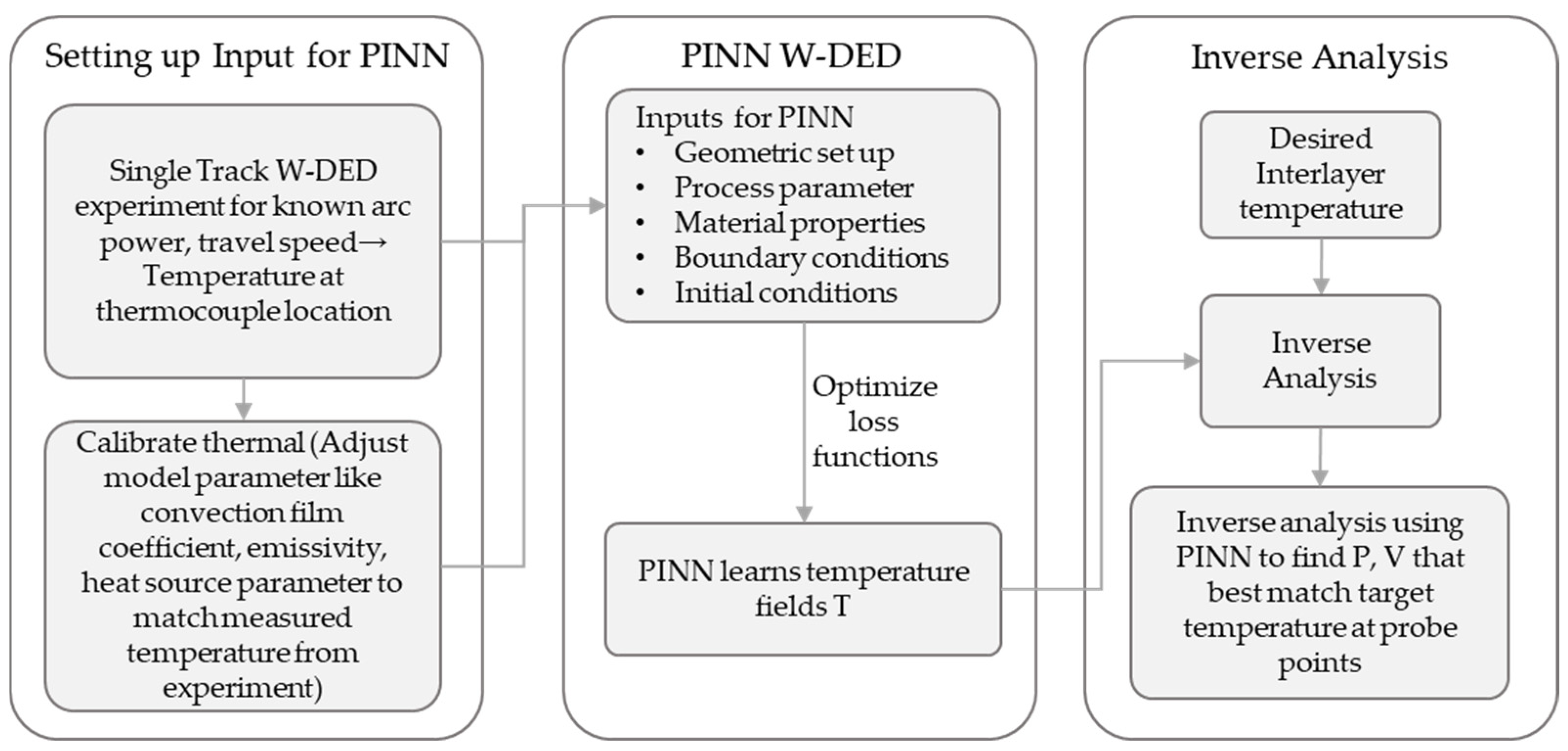
The primary objective of this work is to identify suitable process parameters, specifically arc power and travel speed, that produce a desired temperature distribution for single-track deposition in W-DED. In particular, the goal is to achieve a prescribed interlayer temperature evaluated at a fixed dwell time prior to depositing the subsequent layer. This objective leads to an inverse problem in which the process parameters must be determined such that the thermal history generated during deposition reproduces the target interlayer temperature at the specified time. To address this problem, a two-stage modeling framework is proposed that couples experimental measurements, finite element thermal simulation, and a physics-informed neural network, as illustrated schematically in
Figure 1.
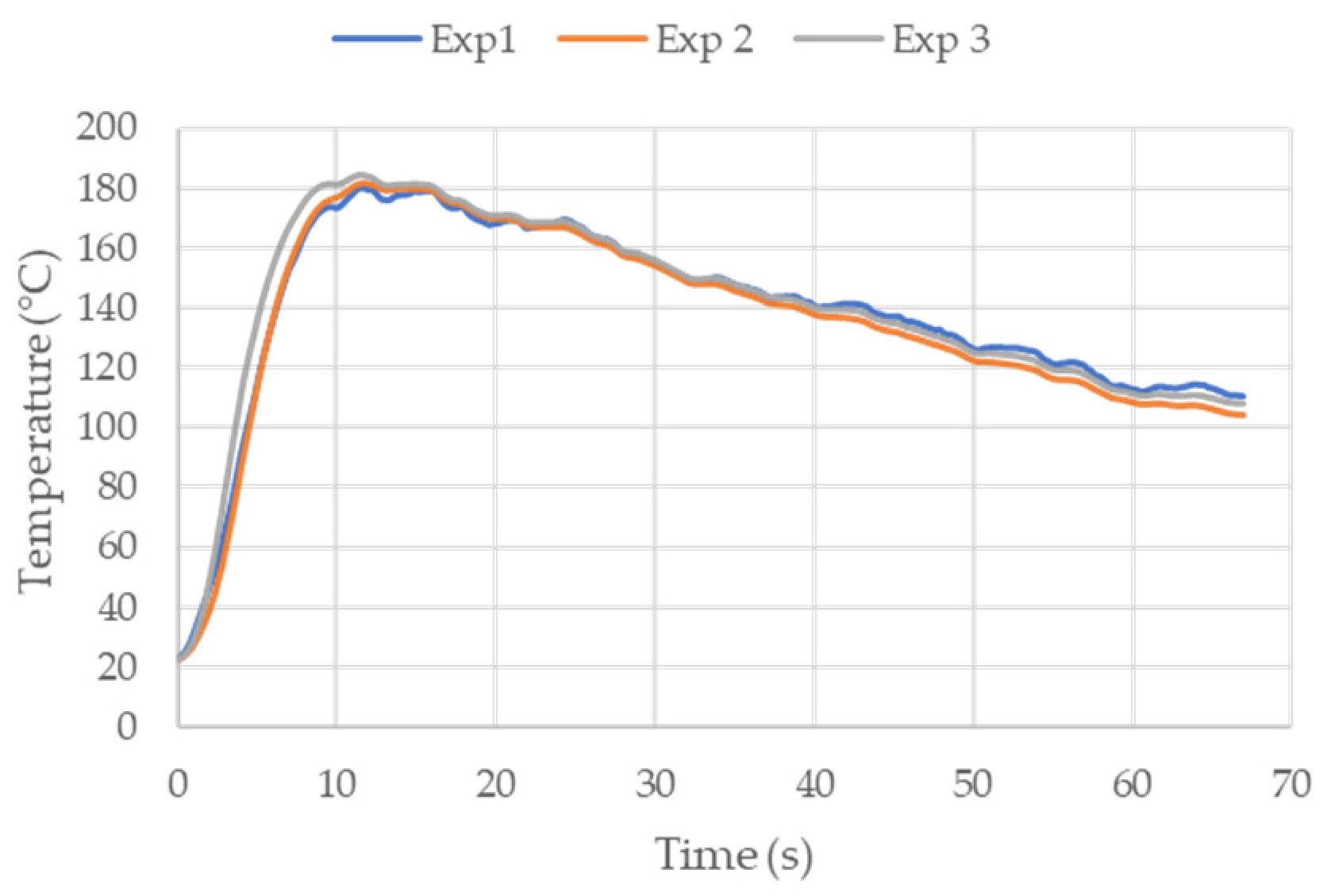
In the first stage, single-track W-DED experiments are conducted to provide reference thermal data. Thermocouple measurements are combined with a transient FE thermal model to calibrate uncertain heat-transfer parameters, including convection film coefficients and surface emissivity. Together, these experimental observations and simulations yield a calibrated thermal model that defines the governing heat-conduction equation, boundary conditions, material properties, and moving heat source used throughout the remainder of this study.
Then, a PINN is constructed to learn the spatiotemporal temperature field in the W-DED domain for a continuous range of process parameters. The governing equation and boundary conditions used in the PINN are consistent with those of the calibrated thermal model, and the network is trained so that its temperature predictions satisfy these physics. PINN predictions are then validated against the calibrated FE solution at selected probe locations and process conditions. Finally, the trained PINN is used as a fast surrogate model within an inverse optimization framework that searches for the arc power and travel speed that minimizes the deviation between the predicted and desired temperature profiles at the selected location. The following subsections describe the FE thermal model of the W-DED process, the PINN formulation and training procedure, and the integration of the PINN into the inverse framework.
2.1. Governing Physics of W-DED Thermal Model
A high-fidelity finite-element simulation model is used as ground truth to validate all PINN predictions. The thermal behavior of the single-track W-DED Deposition process is governed by the transient heat conduction equation with a volumetric heat source, and heat losses due to convection and radiation at the free surfaces. The temperature field
satisfies the transient heat conduction equation
where,
are the density, temperature-dependent specific heat and thermal conductivity of the material, and
represents the volumetric heat source.
The volumetric heat source is modeled using Goldak’s double-ellipsoidal formulation, which has been widely adopted for arc-based and laser-based deposition processes. In this model, the heat input is distributed between a front and a rear semi-ellipsoid characterized by semi-axes
and
in the travel direction, transverse semi-axis
, and depth
. The volumetric heat flux in the front and rear regions is given by
where
is the total heat input power, and
and
are the power fraction coefficients assigned to the front and rear semi-ellipsoids, respectively, with
.
Heat losses from the deposited track and substrate are modeled using mixed convective and radiative boundary conditions applied on all exposed surfaces. The corresponding heat fluxes are expressed as
where
h∞ is the convection coefficient,
T∞ is the ambient temperature.
ε is the emissivity, and
σ is the Stefan–Boltzmann constant. Separate convection coefficients are used for clamped and free surfaces to account for differing heat dissipation mechanisms. The effective values of
and
are calibrated by comparing FE-predicted temperature histories with thermocouple measurements obtained from single-track experiments, as described in
Section 3.1.
2.2. Physics-Informed Neural Networks
PINNs are a class of deep learning models designed to solve partial differential equations (PDEs) by incorporating the governing physical laws directly into the training process. Unlike conventional numerical solvers such as FEM, which rely on explicit discretization of the spatial and temporal domain, PINNs approximate the solution of a PDE using a continuous neural network and enforce the physics through the loss function. This mesh-free formulation allows PINNs to generalize across the continuous domain and to efficiently approximate solutions of high-dimensional or parameterized PDEs, even when labeled data are unavailable.
In the general PINN framework, the solution field
is approximated by a neural network
, where
denotes a vector of independent input variables relevant to the problem (e.g., spatial coordinates, time, material properties, or process parameters), and
represents the trainable weights and biases of the network. The governing PDE is expressed in operator form as
where
denotes a differential operator and
is a known source term.
During training, automatic differentiation is employed to compute the spatial and temporal derivatives of required to evaluate the operator . Physics is enforced by minimizing a loss function that penalizes violations of the governing equation, as well as deviations from the prescribed initial and boundary conditions. When available, measurement data can also be incorporated as an additional supervised loss term.
The total loss function can be written as
where
represents the residual of the governing equation evaluated at collocation points in the domain,
and
enforce the initial and boundary conditions, respectively, and
penalizes discrepancies with observed data, if included. The weighting coefficients
control the relative contributions of each loss component during training.
By encoding the governing equations directly into the learning process, PINNs provide a flexible and data-efficient framework for solving PDEs. Once trained, a PINN yields a differentiable surrogate model that can be queried at arbitrary points in space, time, or parameter space, making it particularly attractive for problems involving repeated evaluations, parametric studies, or inverse design.
2.3. PINN-W-DED: Physics-Informed Neural Network for Thermal Modeling in W-DED
W-DED is a thermo-physical process characterized by a highly localized moving heat source, steep spatial temperature gradients, and strong coupling between process parameters and thermal response. The resulting thermal history depends sensitively on arc power, travel speed, boundary conditions, and temperature-dependent material properties. To represent this behavior over a continuous range of process parameters, a physics-informed neural network is constructed to approximate the transient three-dimensional temperature field as a function of arc power and travel speed. In this work, the focus is restricted to single-track, single-layer deposition, which provides a controlled and well-defined setting for developing and validating the proposed approach. The PINN-WDED model uses the same governing heat conduction equation, Goldak heat source, and boundary conditions as the calibrated finite element model described in
Section 2.1. Instead of discretizing the domain on a mesh, the temperature field is represented by a neural network, and the residuals of the governing equations are minimized at collocation points distributed in space, time, and process parameter space.
2.3.1. PINN Formulation for W-DED
In the PINN-W-DED formulation, the temperature field is represented by a fully connected neural network. The network input vector is defined as
where
denotes time,
are the spatial coordinates, and
and
represent arc power and travel speed, respectively. The scalar network output
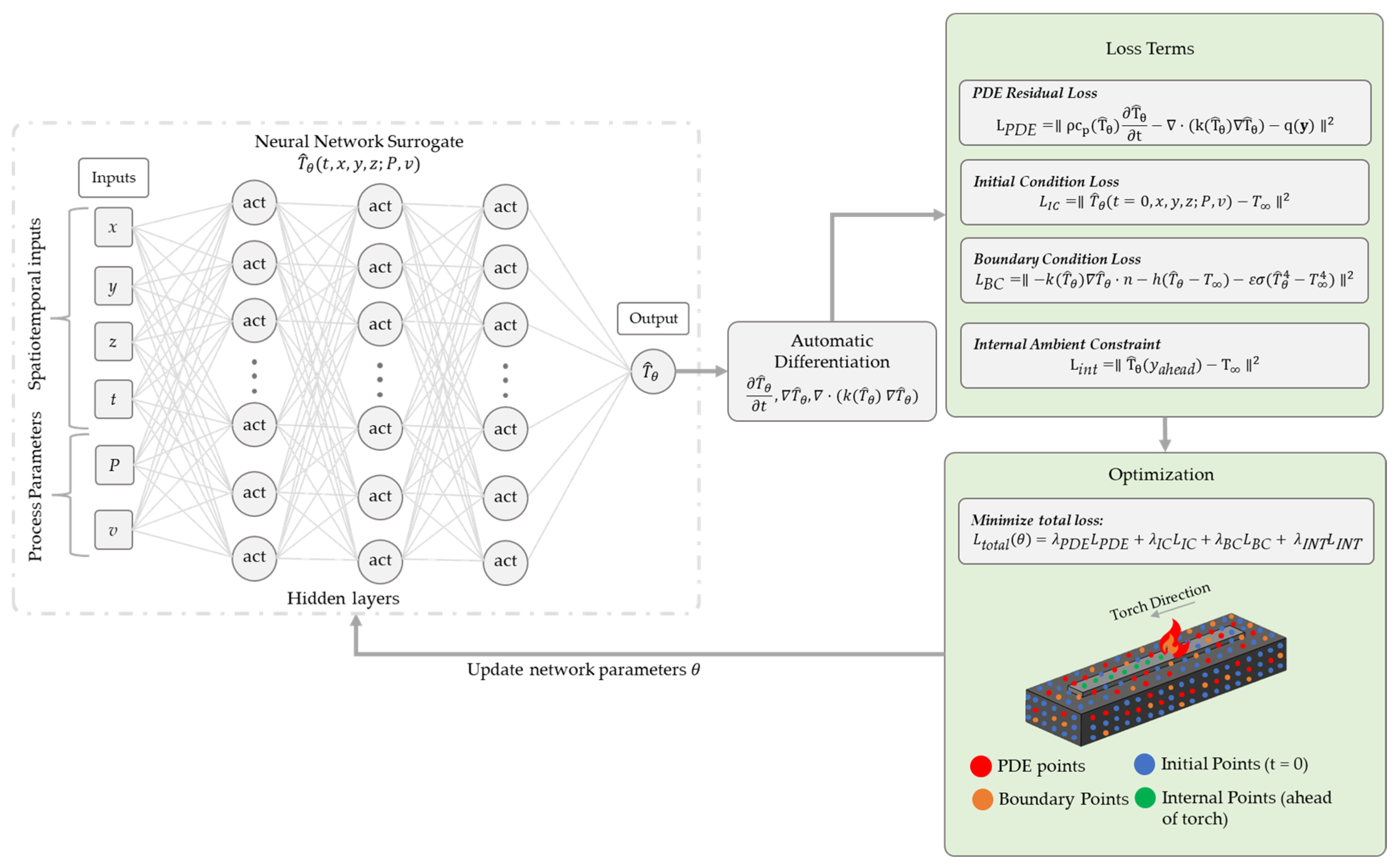
corresponds to the predicted temperature field. The overall architecture of the PINN-W-DED surrogate, including the parametric inputs, neural network structure, physics-based loss terms, and optimization loop, is illustrated schematically in
Figure 2.
The neural network consists of multiple hidden layers with a fixed number of neurons per layer and smooth activation functions. The trainable parameters
of the network are optimized so that
the governing heat conduction equation, the Goldak heat source formulation, and the associated initial and boundary conditions described in
Section 2.1. Spatial and temporal derivatives required to evaluate the PDE residual are computed using automatic differentiation. The total loss function follows the general structure introduced in
Section 2.2 and is specialized to the W-DED problem by augmenting the standard physics-based terms with an additional internal ambient constraint,
The additional internal term enforces an ambient-temperature constraint in interior regions that have not yet been deposited, thereby preventing non-physical preheating artifacts during training. The weight controls the relative strength of this constraint. After training, the PINN-W-DED model serves as a continuous parametric surrogate that can be queried at arbitrary combinations of within the prescribed ranges.
2.3.2. Collocation Point Sampling
The physics-based loss terms are evaluated at collocation points that sample the relevant space-time-parameter domain of the W-DED process. Four distinct sets of collocation points are employed:
- 1.
PDE collocation points distributed within the thermal domain and used in to enforce the transient heat conduction equation.
- 2.
Boundary collocation points located on free and contact surfaces and used in to enforce convective and radiative heat losses.
- 3.
Initial condition collocation points sampled at and used in to enforce a uniform ambient initial temperature.
- 4.
Internal ambient collocation points placed ahead of the moving heat source and used in to suppress non-physical preheating.
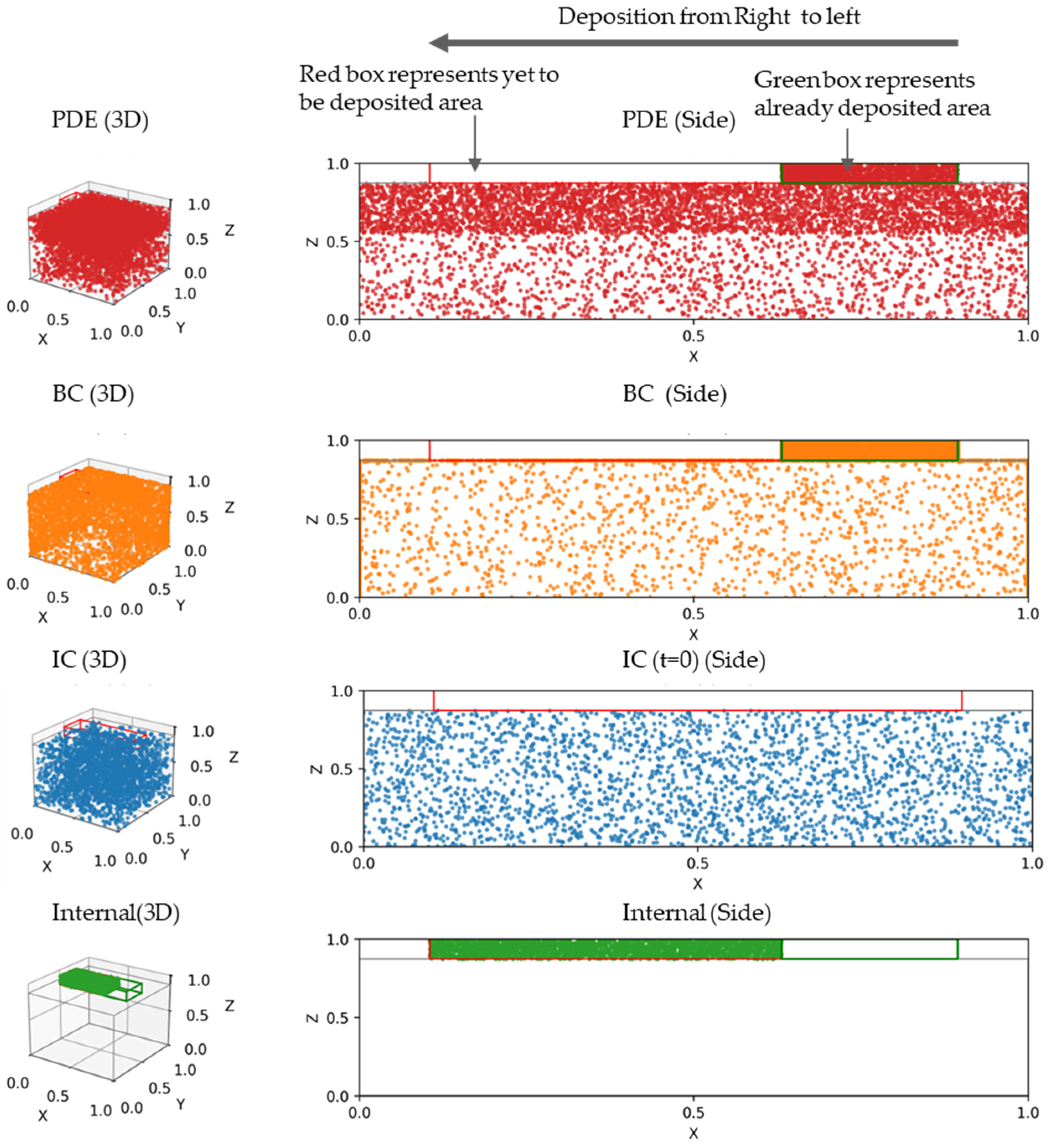
A schematic illustration of the four collocation point sets and their distribution relative to the moving torch is shown in
Figure 3.
PDE collocation points are generated using random or quasi-random sampling in space and time, combined with uniform sampling over the prescribed ranges of arc power and travel speed. To efficiently resolve the steep thermal gradients associated with the moving heat source, a non-uniform sampling strategy is adopted. Specifically, a higher density of PDE points is placed in a time-dependent region centered around the torch location, while a lower background density is used elsewhere in the domain. Within the substrate, the density of PDE points is increased near the top surface to better capture strong thermal gradients adjacent to the deposited material. In the deposited track, PDE points are introduced progressively as deposition proceeds, such that PDE points exist only in regions that have already been deposited and solidified. Regions of the deposit ahead of the torch trajectory do not contain PDE points and are treated as undeveloped material. Boundary collocation points are sampled on all exposed surfaces of the substrate and on the deposited track as it forms. As the torch advances, boundary points are added along the newly created surfaces of the deposited material, ensuring consistent enforcement of heat losses on the evolving geometry throughout the deposition process. Initial condition collocation points are sampled throughout the substrate volume at the initial time and enforce a uniform ambient temperature prior to the start of deposition. No initial condition points are assigned within the deposited material, which does not exist at . The internal ambient collocation points are sampled exclusively within the deposit footprint ahead of the torch and at times prior to heat source arrival. At these locations, the temperature is constrained to remain at the ambient value through the internal loss term . This constraint prevents spurious early heating in regions that have not yet been exposed to the heat source and improves the physical realism and stability of the PINN training without introducing experimental or finite element temperature data.
Together, this physics-aware collocation sampling strategy enables the PINN-W-DED model to accurately capture localized heating near the moving melt pool, transient cooling behavior, and the dependence of the temperature field on process parameters across the entire design space considered in this study.
2.4. Inverse Parameter Optimization
Once trained, PINN provides a fast surrogate for the temperature history at any spatial location for specified process parameters. This enables an inverse process-design problem in which the arc power
and travel speed
are selected to achieve a prescribed interlayer temperature at a fixed probe location beneath the deposited bead. Let
denote the selected probe point, and let
denote the temperature at
, and time
t for a given process parameters
. For a deposited track of length
, the deposition time associated with travel speed
is
where
and
are expressed in consistent units. A dwell time
is prescribed to represent the waiting period between the end of deposition and the start of the subsequent track. The interlayer temperature at the probe location is then defined as
Given a user-specified target interlayer temperature
, the inverse problem is formulated as a two-parameter minimization,
where
and
define the feasible process window used to train the PINN surrogate. Because the design space is two-dimensional and each surrogate evaluation is inexpensive, a sampling-based derivative-free search is adopted. Candidate pairs
are generated within the rectangular domain
. For each candidate,
is computed, and the surrogate is evaluated at
and
to obtain
, from which the objective
is evaluated. The pair yielding the minimum objective value is selected as the approximate optimum
. This procedure embeds the validated PINN-W-DED surrogate directly within the inverse-design loop, enabling identification of process settings that achieve a prescribed interlayer temperature for a chosen dwell time without additional high-fidelity thermal simulations. The full routine is summarized in Algorithm 1.
| Algorithm 1: PINN-based inverse optimization of process parameters |
Input:
|
| Output: Approximate optimal parameters |
| 1: | Set , . |
| 2: | for do |
| 3: | | Sample |
| 4: | | Compute deposition and interlayer times
|
| 5: | | Evaluate interlayer temperature via the PINN
|
| 6: | | Compute objective |
| 7: | | if then |
| 8: | | | Set , |
| 9: | | end if |
| 10: | end for |
| 11: | return |
3. Results and Discussion
In this section, we summarize the implementation of the proposed framework and present the main results. First, the calibrated finite element (FE) thermal model is assessed by comparing its predictions with the single-track W-DED experiments, which are used to identify effective convection and radiation parameters. Next, the performance of the PINN-W-DED surrogate is examined by comparing temperature histories at several probe points with those predicted by the calibrated FE model for different combinations of arc power and travel speed. The influence of the collocation sampling strategy and the choice of process parameter ranges on the accuracy of the surrogate is also discussed. Finally, the inverse design problem is solved using the trained PINN as a surrogate to search the (P, v) space for process parameters that achieve a specified interlayer temperature after a fixed dwell time. The resulting temperature histories and optimized parameters are analyzed in terms of accuracy and practical limitations for process planning.
3.1. FEM Thermal Modelling and Validation with Experimental Data
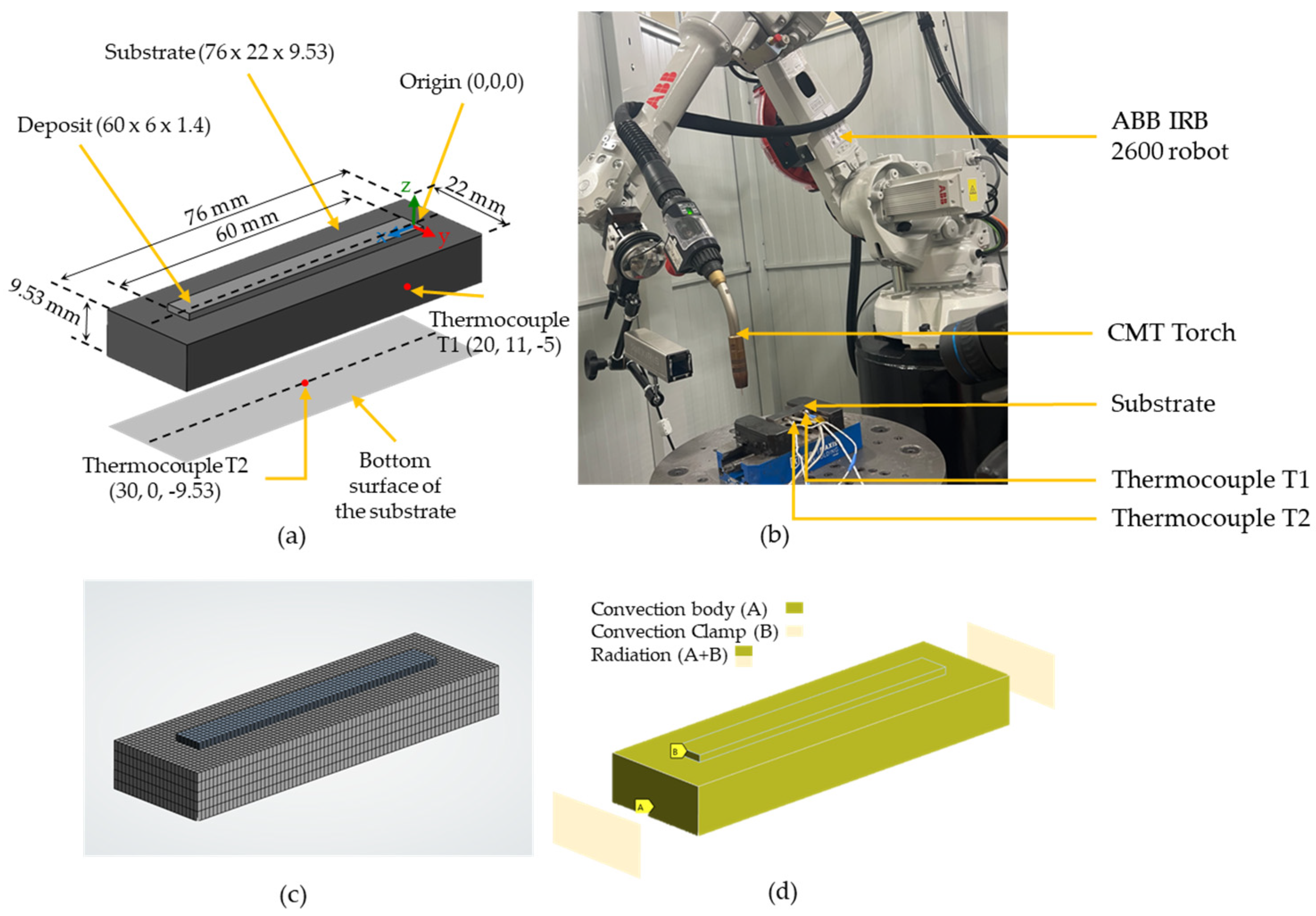
A single-track W-DED experiment was conducted to provide reference data for calibrating the FE model and for subsequent validation of the PINN-W-DED surrogate. The substrate was a rectangular steel block with dimensions
, on which a single deposition track of length 60 mm was deposited. The resulting bead had an approximate width of 6 mm, and a height of 1.4 mm.
Figure 4a shows the CAD model of the substrate and deposited track together with the coordinate system and thermocouple location, while
Figure 4b shows the experimental setup.
The same geometric configuration was adopted in the FE model, which was implemented in ANSYS (25.1). A three-dimensional transient thermal analysis was performed with a refined mesh (8-node solid element) in the deposited track and in the surrounding region of the substrate, as illustrated in
Figure 4c. Convective and radiative heat losses were applied on all exposed surfaces according to Equation (4), with separate convection coefficients assigned to the clamp faces and to the remaining free surfaces, as illustrated in
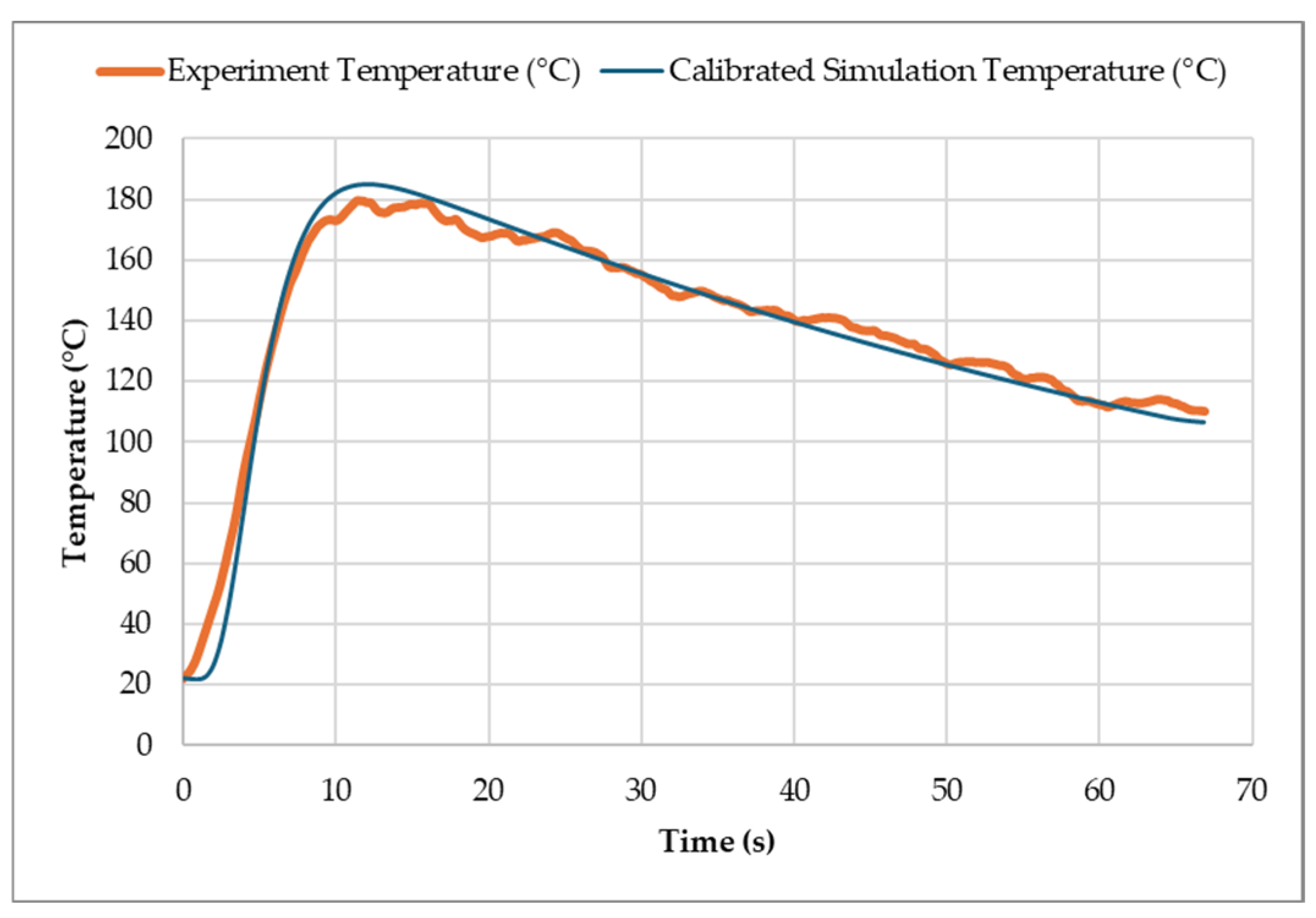
Figure 4d. The FE model was calibrated by adjusting the effective convection coefficients and emissivity to match the measured thermocouple temperature history. Full experimental details, thermocouple instrumentation, and the calibration workflow are provided in
Appendix A. The final calibrated parameters were
,
, and emissivity
(Note:
).
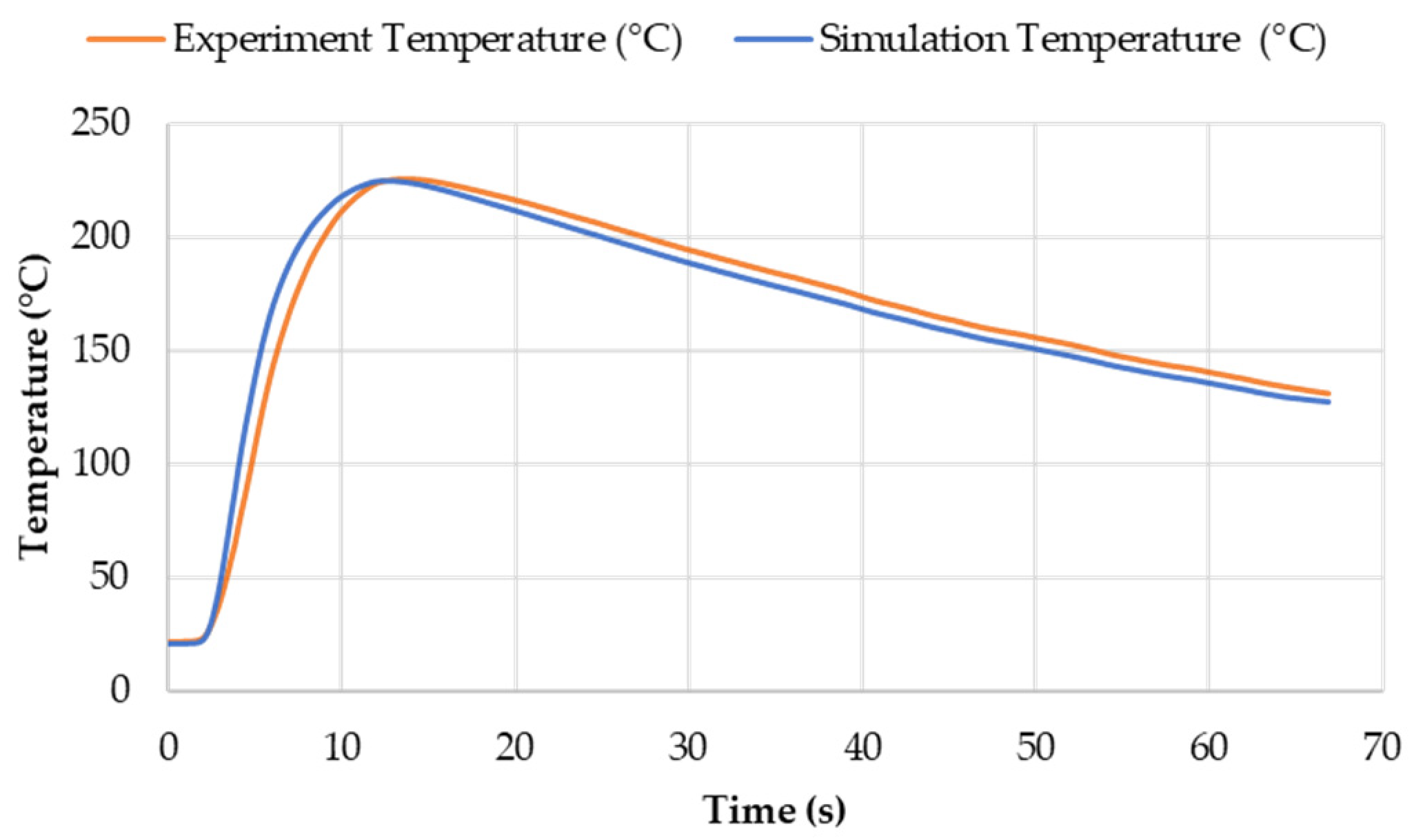
Figure 5 shows the comparison between the calibrated FE prediction and the experimentally measured temperature history at the thermocouple location, with a root mean square error (RMSE) of 9.82 °C and a mean absolute error (MAE) of 7.97 °C.
This calibrated FE model is used throughout the remainder of this work as the ground-truth reference for evaluating the PINN-W-DED surrogate and for defining the governing physics embedded in the PINN formulation.
3.2. PINN-W-DED Surrogate: Training and Validation
The physics-informed neural network described in
Section 2.3 was trained to represent the transient temperature field
for the single-track W-DED configuration. The same governing heat conduction equation, boundary conditions, and Goldak heat source formulation used in the calibrated FE model were embedded in the PINN loss function, and collocation points were sampled following the strategy described in
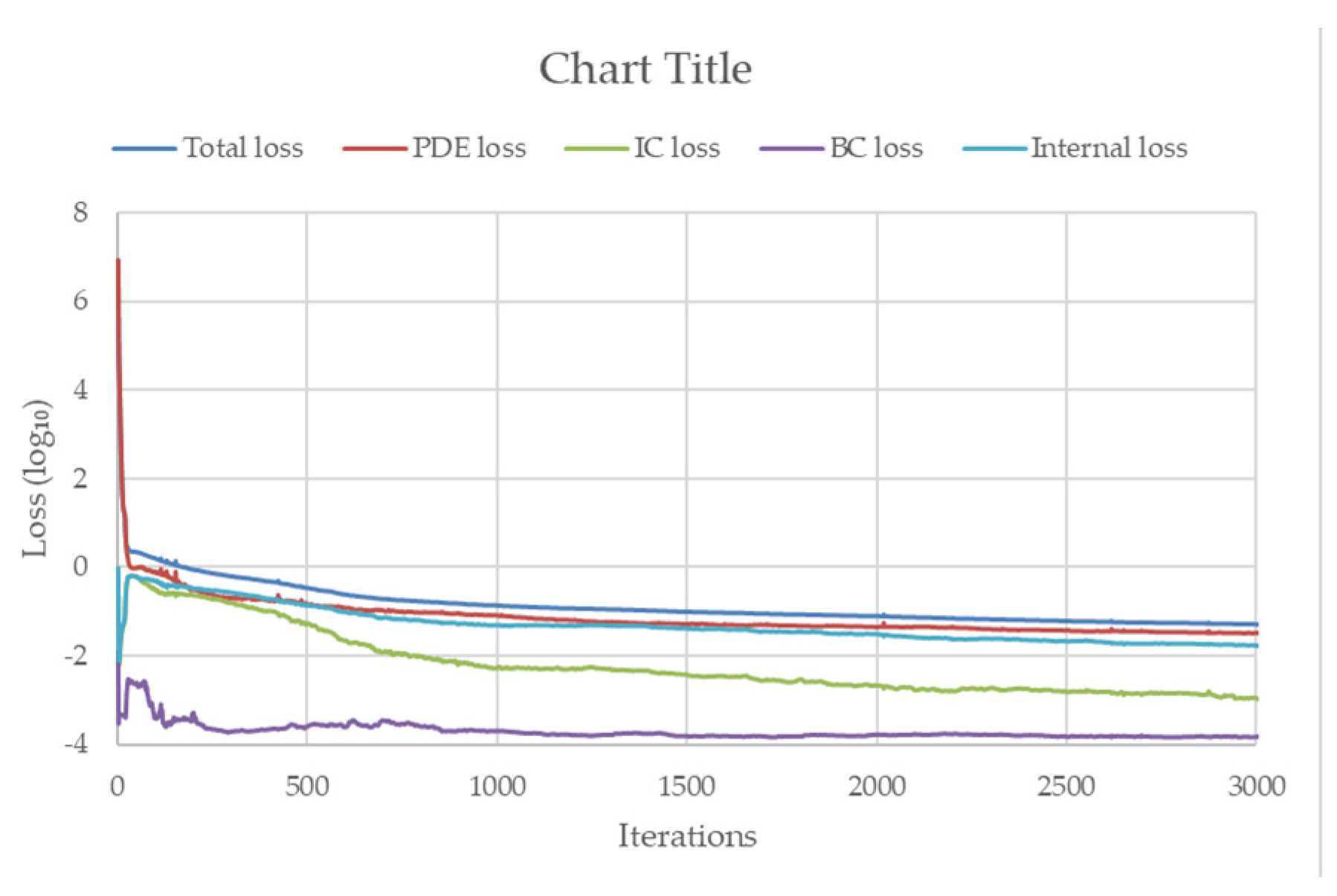
Section 2.3.2. No experimental or FE temperature data were included in the loss function; training relied exclusively on the physics residuals and the imposed initial and boundary conditions. The only experimental information incorporated into the PINN formulation was through the calibrated heat-loss parameters (convection film coefficients and emissivity) obtained in
Section 3.1.
The PINN was trained as a parametric surrogate over the operating window considered in this study, with arc power kW and travel speed m/s. All validation and results reported in this work are restricted to this in-range training domain. Out-of-range performance was not evaluated in this study as predictions outside these bounds constitute extrapolation and are expected to exhibit increased error.
Details of the network architecture, input/output normalization, loss-term weights, collocation-point counts, and the L-BFGS optimization settings are provided in
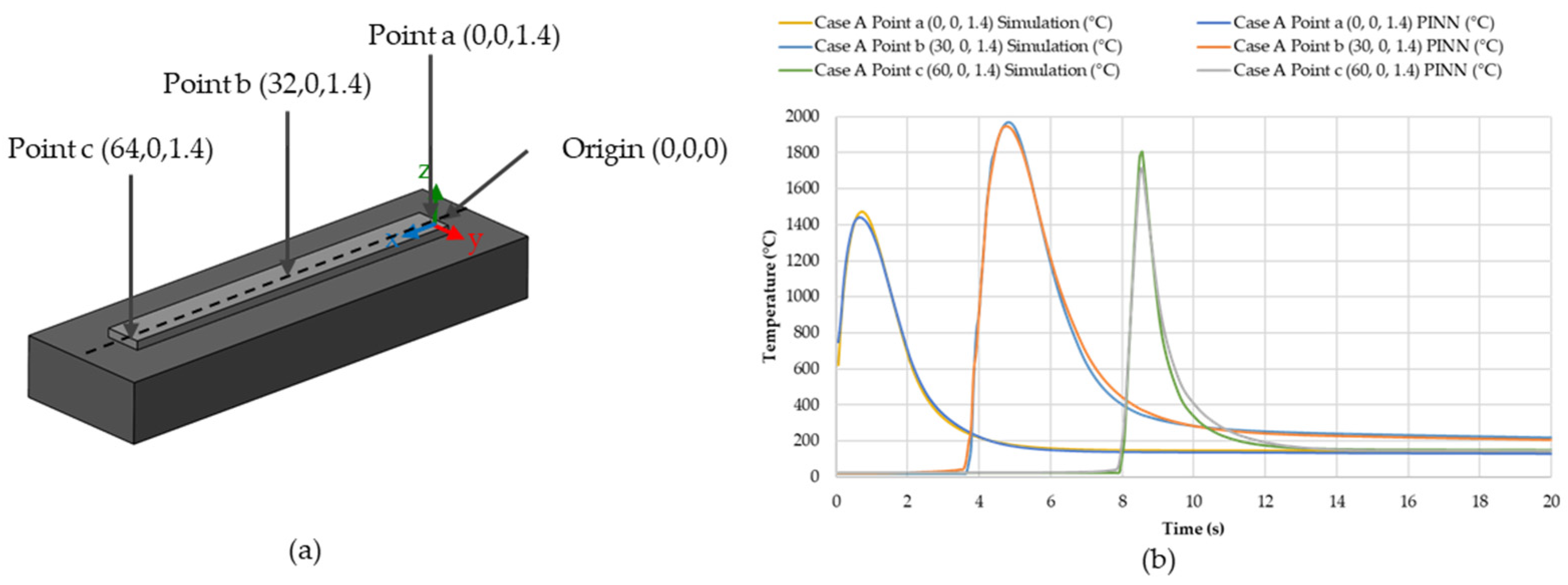
Appendix B. To assess predictive accuracy, the trained PINN-W-DED surrogate was evaluated at three probe locations on the top surface of the deposited layer for multiple
combinations within the training range (
Figure 6).
Three benchmark cases (A–C) were selected, and
Table 1 reports the error metrics between the PINN and FE temperature histories at each probe point.
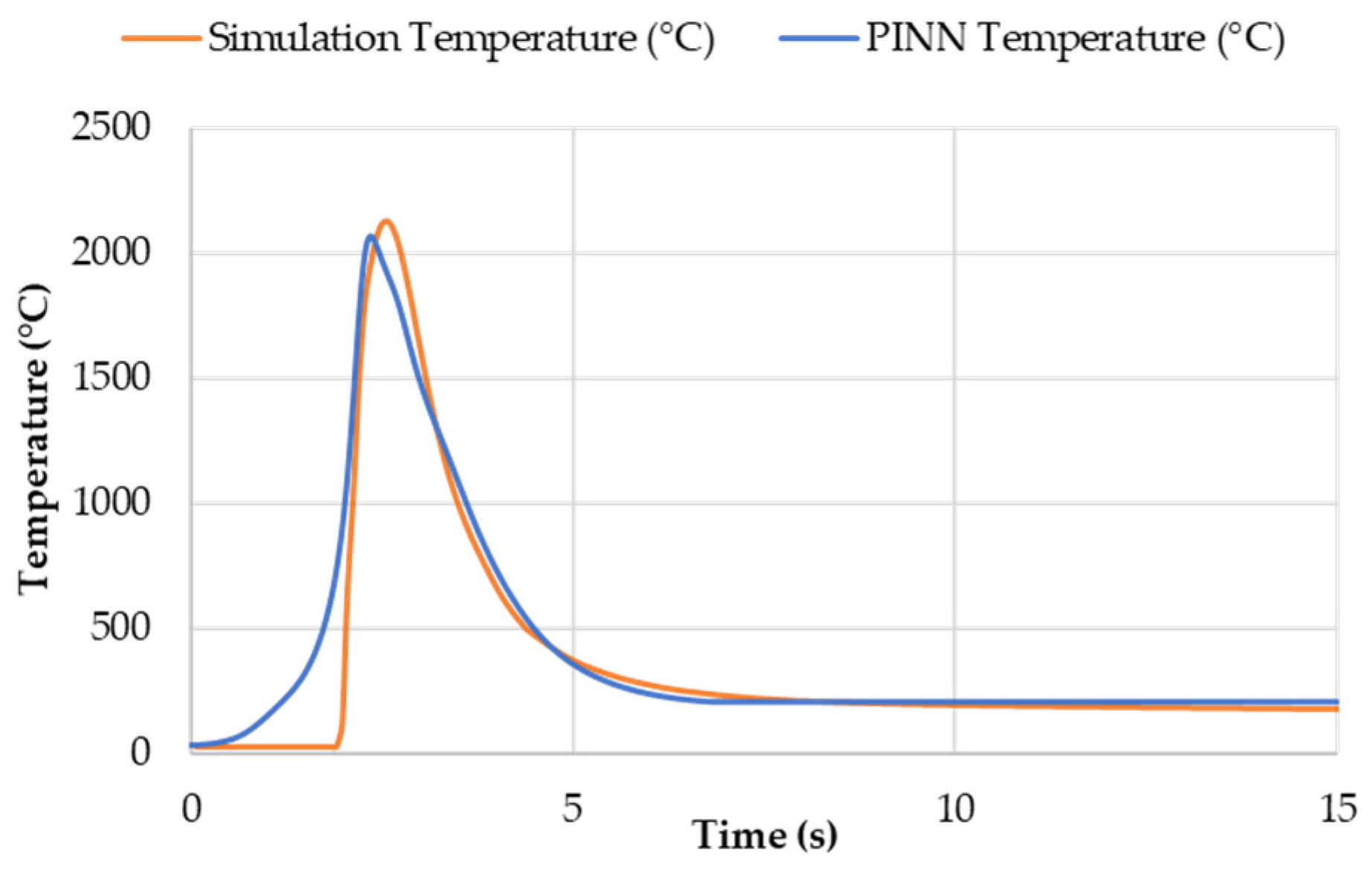
Across all validation cases, the MAE remains below 18 °C and the overall RMSE remains below 36 °C, indicating that the surrogate reproduces the calibrated FE thermal histories with good accuracy over the full transient response. The largest discrepancies occur near the peak temperature during the sharp heating transient directly under the moving heat source, where the maximum reaches approximately 123 °C in the most extreme case. This error is highly localized in time and reflects the strong sensitivity of the peak to small differences in heat-source representation and temporal resolution. Moreover, because the peak temperatures in these runs are on the order of approximately °C, a 100–123 °C deviation corresponds to roughly 5–6% of the peak magnitude. This constitutes a limitation of the surrogate for resolving the near-source peak. However, the inverse design objective in this work targets interlayer temperature in the post-deposition cooling regime, and the peak mismatch is short-lived and does not persist in the cooling tail that governs dwell-time and interlayer control. Accordingly, the cooling-tail RMSE (last 20% of the thermal history) remains below approximately 12.1 °C for all cases, demonstrating that the surrogate accurately captures the post-deposition cooling behavior that governs interlayer temperature and dwell-time effects.
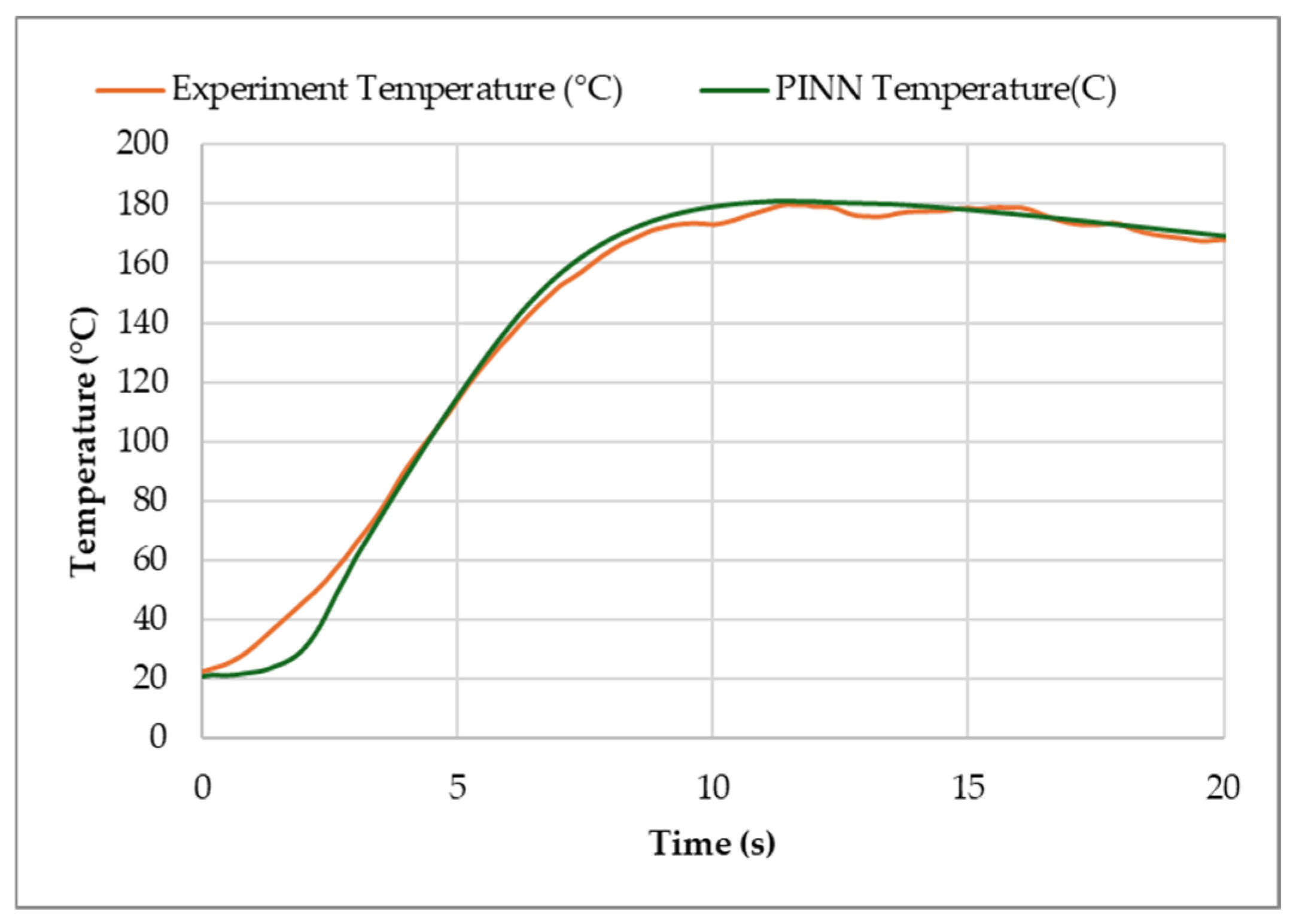
In addition to this FE-based validation, the trained PINN model was also evaluated directly against experimental temperature history of thermocouple T1.
Figure 7 shows the comparison between the experimental temperature and PINN prediction for a representative case (P = 2.42 kW, v = 0.0136 m/s). The PINN–experiment agreement yields RMSE = 4.6 °C and MAE = 3.4 °C (maximum absolute deviation 15.6 °C). The predicted peak is also captured well, with a peak deviation of approximately 1.19 °C at t = 11.41 s.
Overall, these results show that the PINN-W-DED surrogate provides a continuous parametric representation that can be queried at arbitrary without rerunning FE simulations while maintaining the accuracy needed for thermal process design. The validated surrogate is used in the next subsection to perform inverse process optimization in the space.
3.3. Inverse Process Optimization
Inverse process optimization was performed using the trained PINN-W-DED surrogate within the procedure described in
Section 2.4. The search was restricted to the training window
kW and
m/s, and the interlayer temperature was evaluated at the probe location
mm after a prescribed dwell time of
. This probe corresponds to the end-of-track point of the first-layer deposition, which is heated last and therefore tends to retain the highest residual temperature after the dwell time. As a result, enforcing the interlayer target at
mm provides a conservative constraint for interlayer control. Interlayer temperature can vary along the track; extending the objective to multiple probe points is straightforward and is left for future work. For each target interlayer temperature, the optimization returned a power-speed pair
that minimized the mismatch between the PINN-predicted interlayer temperature and the target.
Table 2 summarizes the optimized parameters for three representative targets and compares the resulting interlayer temperatures predicted by the PINN with those computed by the calibrated FE model using the same optimized parameters.
Across all cases, the PINN achieves interlayer temperatures within approximately 3–6 °C of the target, while the FE verification remains within approximately 4–7 °C. The FE deviations are consistently slightly larger in magnitude, which is expected because the optimization is driven by the PINN surrogate and the FE model is used only for posteriori verification. In real W-DED operation, measurement noise, heat-loss variability, and heat-input fluctuations can affect achieving a ±5 °C interlayer-temperature tolerance. In practice, the surrogate is well suited for closed-loop updates and can be paired with uncertainty-aware or robust optimization to maintain the tolerance under such disturbances.
These results demonstrate that the PINN-W-DED surrogate can be embedded in an inverse design loop to rapidly identify feasible combinations that achieve a desired interlayer temperature at a specified dwell time, without requiring repeated FE simulations during the search. The remaining discrepancies are primarily attributable to localized differences near the heating peak; however, the interlayer temperature is evaluated after deposition and dwell, where the PINN reproduces the diffusion-dominated cooling behavior more accurately, making it well suited for interlayer-temperature-driven process planning.
4. Conclusions and Future Work
This work developed a physics-informed surrogate framework for inverse thermal process design in W-DED. A single-track experiment was used to calibrate a transient FE thermal model by identifying effective heat-loss parameters (convection film coefficients and emissivity) and estimating Goldak heat-source shape parameters from the bead geometry. The calibrated FE model then provided the governing physics for PINN training and served as the reference for validation. A parametric PINN-W-DED surrogate was trained to approximate the spatiotemporal temperature field as a continuous function of using physics-only training (PDE, initial/boundary conditions, and an internal ambient constraint to prevent non-physical preheating). Validation against the calibrated FE model showed MAE below 18 °C across benchmark cases, with cooling-tail RMSE (last 20% of the thermal history) within 1.8–12.1 °C. The largest discrepancies occur during the sharp heating peak under the moving heat source; the worst-case peak deviation was about 123 °C, corresponding to roughly 5–6% of the peak temperature (about 2000 °C). This error is confined to a narrow time window and does not persist in the cooling regime that governs interlayer temperature. Accordingly, the surrogate in its current form is intended primarily for prediction and inverse design of thermal histories relevant to interlayer temperature control (e.g., cooling behavior and temperature at prescribed locations for a given dwell time). It is not intended to predict highly localized peak-temperature effects under the moving heat source (e.g., melt-pool size/penetration, near-source thermal gradients, or microstructure/residual stress) without additional refinement and validation. The trained surrogate was then embedded in a sampling-based inverse optimization loop to identify combinations that achieve prescribed interlayer temperatures at a fixed dwell time. For targets of 100, 130, and 160 °C with a 10 s dwell time, the optimized solutions were within 3–6 °C of the targets according to the PINN, and FE verification remained within 4–7 °C. These results demonstrate that the proposed surrogate enables interlayer-temperature-driven process planning without repeated high-fidelity FE simulations.
Future work will extend the approach to multi-line and multi-layer builds, incorporating layer-wise dwell times, path-dependent boundary conditions, and evolving geometry. The inverse design formulation will be expanded to jointly optimize dwell time alongside arc power and travel speed and to include additional decision variables (e.g., toolpath parameters or heat-input efficiency). Because peak errors may affect heat accumulation in longer builds, future work will improve peak capture through targeted near-source sampling, refined heat-source parameterization, and (if needed) limited peak-focused temperature data. Robustness will be improved by accounting for uncertainty in calibrated heat-loss parameters, material properties, and heat-source representations through uncertainty propagation and robust optimization.




 ,
,