Article

LiDAR-Based Unmanned Aerial Vehicle Offshore Wind Blade Inspection and Modeling

by
Alexandre Oliveira
1,2,*,
André Dias
1,2,
Tiago Santos
1,2,
Paulo Rodrigues
1,2,
Alfredo Martins
1,2 and
José Almeida
1,2
1
INESC TEC—Institute for Systems and Computer Engineering, Technology and Science, Rua Dr. Roberto Frias, 4200-465 Porto, Portugal
2
ISEP—School of Engineering, Polytechnic Institute of Porto, Rua Dr. António Bernardino de Almeida 431, 4200-072 Porto, Portugal
*
Author to whom correspondence should be addressed.
Drones 2024, 8(11), 617; https://doi.org/10.3390/drones8110617
Submission received: 24 September 2024 / Revised: 21 October 2024 / Accepted: 23 October 2024 / Published: 28 October 2024

Abstract

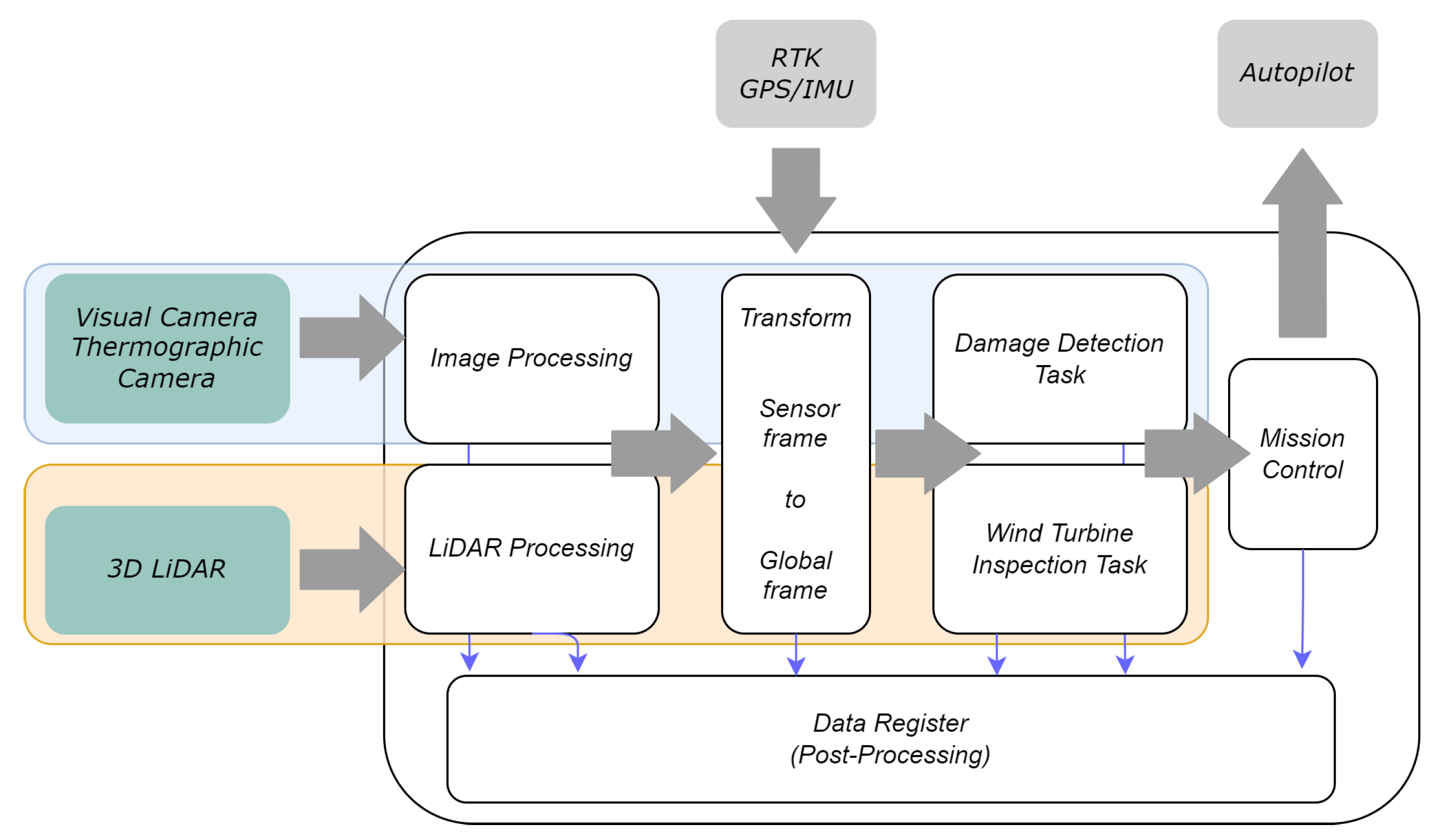
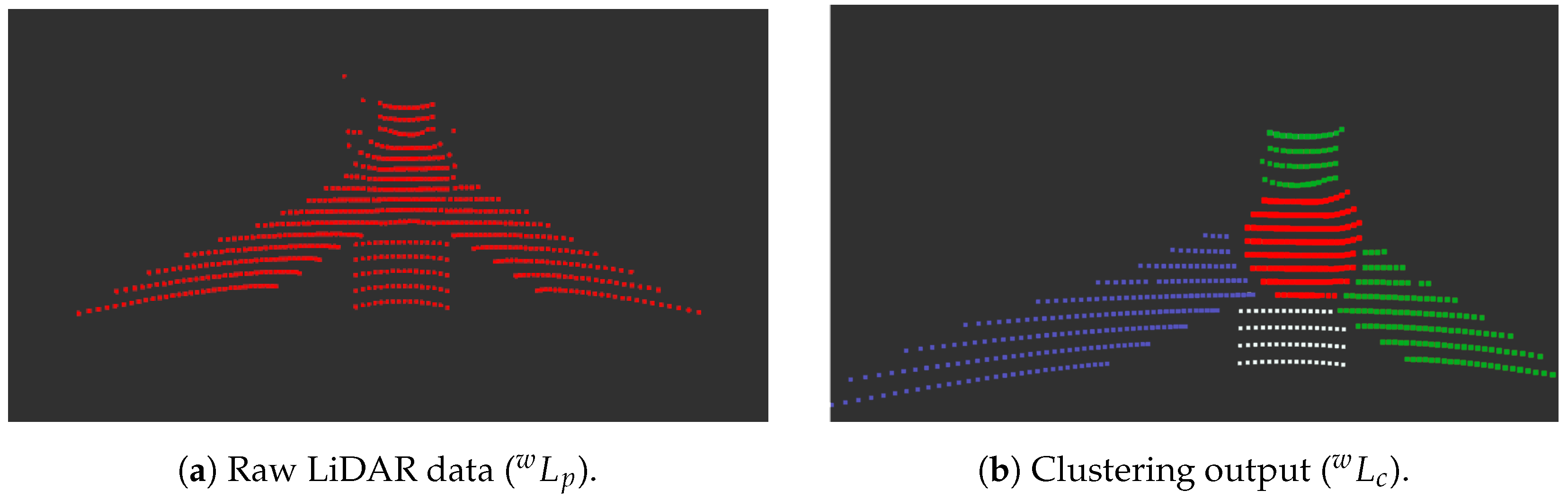
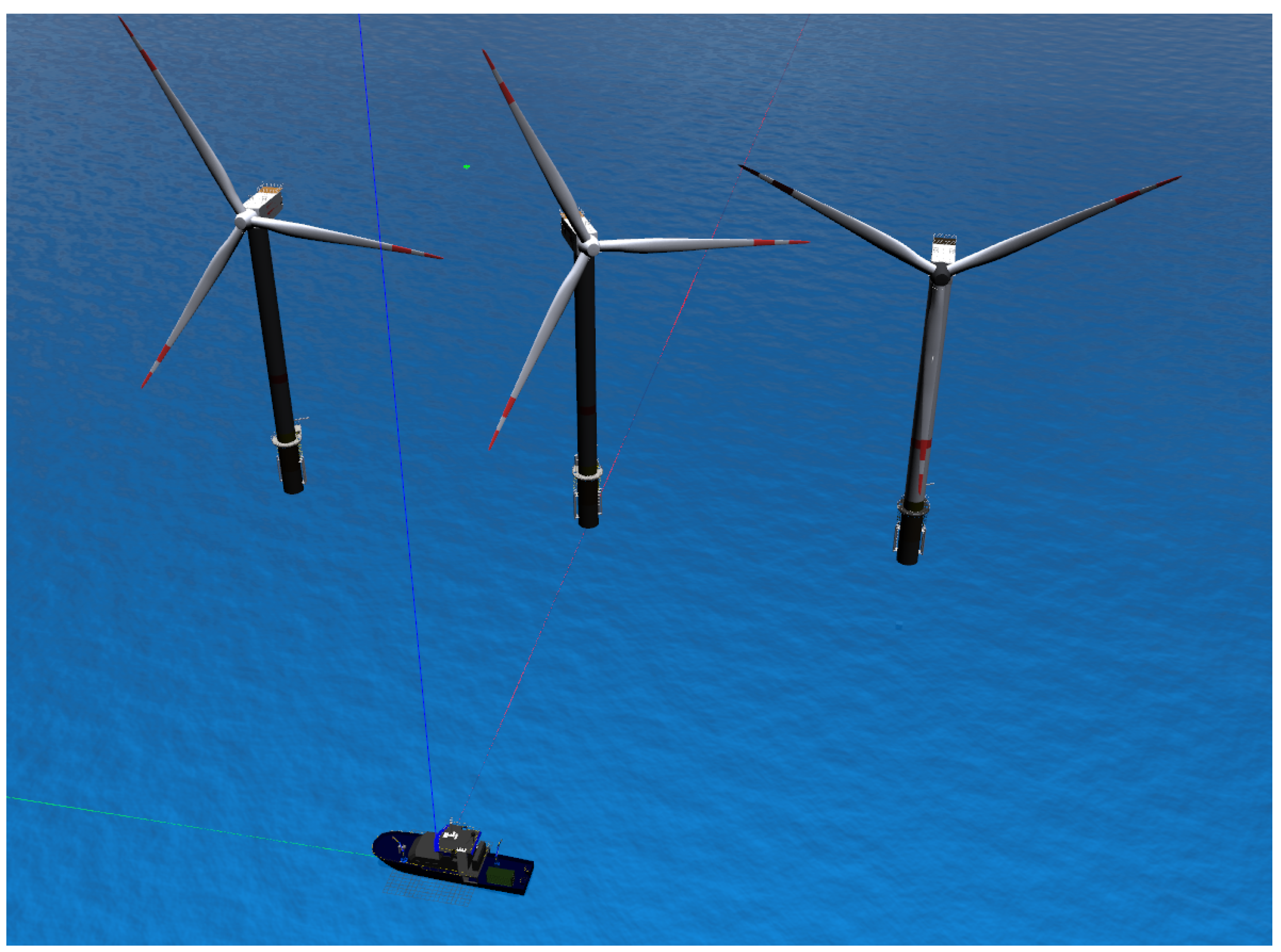
The deployment of offshore wind turbines (WTs) has emerged as a pivotal strategy in the transition to renewable energy, offering significant potential for clean electricity generation. However, these structures’ operation and maintenance (O&M) present unique challenges due to their remote locations and harsh marine environments. For these reasons, it is fundamental to promote the development of autonomous solutions to monitor the health condition of the construction parts, preventing structural damage and accidents. This paper explores the application of Unmanned Aerial Vehicles (UAVs) in the inspection and maintenance of offshore wind turbines, introducing a new strategy for autonomous wind turbine inspection and a simulation environment for testing and training autonomous inspection techniques under a more realistic offshore scenario. Instead of relying on visual information to detect the WT parts during the inspection, this method proposes a three-dimensional (3D) light detection and ranging (LiDAR) method that estimates the wind turbine pose (position, orientation, and blade configuration) and autonomously controls the UAV for a close inspection maneuver. The first tests were carried out mainly in a simulation framework, combining different WT poses, including different orientations, blade positions, and wind turbine movements, and finally, a mixed reality test, where a real vehicle performed a full inspection of a virtual wind turbine.
Keywords: simulation; offshore; UAV; wind turbine inspection; LiDAR; gazebo simulator; ROS; mixed-environment simulation; offshore; UAV; wind turbine inspection; LiDAR; gazebo simulator; ROS; mixed-environment