1. Introduction
Currently, UAVs are widely employed in various fields, including reconnaissance and surveillance, logistics transportation, emergency rescue, agricultural plant protection, and industrial inspection [
1,
2,
3], which has led to increasing attention to their stability and reliability. As the core power unit of UAVs, the engine is the primary factor influencing both stability and reliability. Operating continuously under complex conditions such as high temperature, high pressure, high rotational speed, and severe vibration, UAV engines are highly susceptible to cumulative wear and performance degradation, leading to potential failures [
4,
5]. Abnormalities in engine operation during mission execution not only reduce UAV operational efficiency but may also cause serious flight safety issues. Therefore, accurately assessing the health status of UAV engines and predicting their remaining useful life (RUL) is a crucial research direction for implementing predictive maintenance and enhancing equipment support capabilities [
6].
The core objective of RUL prediction is to estimate the remaining operational time before failure based on historical operating states and degradation trends, prior to actual engine failure. Unlike traditional fault diagnosis [
7], which merely identifies whether a device is faulty, RUL prediction focuses on the continuous degradation process from health to failure. For UAV engines, the degradation process is influenced by multiple factors. The state information captured by different sensors exhibits significant variations in temporal scale, trend, and noise level, posing challenges for high-precision life prediction.
Existing approaches primarily fall into three categories: physics-based methods, statistical model-based methods, and data-driven methods. Physics-based methods [
8] rely on precise modeling of internal engine thermodynamics, wear mechanisms, and failure evolution, offering good interpretability. However, they heavily depend on prior knowledge and struggle to establish a unified and accurate mathematical model under complex operating conditions, individual variability, and multi-factor coupled degradation scenarios. Statistical model-based methods [
9] can describe the stochastic nature of the degradation process to some extent, but their capability to capture high-dimensional nonlinear features and complex temporal dependencies is limited.
With the advancement of sensor technologies and deep learning, data-driven methods for RUL prediction have gradually become a key research direction, as they can directly learn degradation features and life-mapping relationships from monitoring data. In recent years, convolutional neural networks (CNNs), recurrent neural networks (RNNs), and their improved variants such as long short-term memory (LSTM) and gated recurrent units (GRU) have achieved notable success in life prediction tasks [
10,
11]. Zhang et al. [
12] proposed a cross-dimensional multi-scale convolutional network for aircraft engine RUL prediction, which achieves high-precision RUL estimation under complex operating conditions through multi-dimensional feature extraction and channel attention modeling. Wang Yu et al. [
13] introduced a method combining a multi-scale temporal convolutional network with a dual-attention mechanism, effectively capturing spatiotemporal key features from engine sensor data and significantly enhancing RUL prediction accuracy and robustness. Wang et al. [
14] presented a dual-attention-based multi-feature fusion model that extracts spatial features via CNN and channel attention, and temporal features through GRU combined with self-attention, enabling dynamic representation of degradation patterns. Han et al. [
15] developed the PCLD model, which integrates parallel CNN and LSTM networks with a dual-attention mechanism, leveraging CNN for feature extraction and LSTM for time-series processing, thereby deeply mining sensor data while reducing the loss of critical information. Gao et al. [
16] addressed the limitations of conventional RNN-based RUL prediction methods that neglect sensor spatial correlations and long-term dependencies, proposing a multi-scale spatiotemporal attention network. This method employs a multi-scale discrete wavelet transform to capture features at different scales, combined with adaptive spatiotemporal feature extraction and co-learning modules to jointly model long-term dependencies and sensor spatial characteristics. Duan et al. [
17] proposed a multi-scale CNN-Transformer approach, designing multi-scale feature extraction and feature concatenation modules to enhance degradation feature representation, while leveraging the Transformer’s self-attention mechanism for efficient long-sequence dependency learning.
However, for scenarios involving multi-sensor coupling, pronounced long-term dependencies, and complex degradation scales, existing methods still exhibit several limitations. First, single-scale convolutional structures struggle to simultaneously capture short-term fluctuations, medium-term decay, and long-term aging. Second, conventional recurrent architectures are prone to gradient vanishing and loss of long-term dependency information when modeling long sequences. Third, multi-sensor data often contain significant redundancy and noise, and different sensors contribute unequally to RUL prediction; treating all sensors equally can weaken the representation of critical degradation information. Finally, although standard Transformers excel at modeling global dependencies in long sequences, they remain insufficient in extracting fine-grained local degradation features and ensuring stable training of deep networks.
To address these challenges, this study focuses on the multi-sensor fusion-based RUL prediction task for UAV engines, with the main contributions summarized as follows:
(1) A multi-sensor data acquisition platform for UAV engines was established, enabling synchronized collection of multi-source sensor data under complex operating conditions and constructing full-life-cycle samples, providing a reliable data foundation for subsequent RUL prediction.
(2) A novel task-driven UAV engine RUL prediction model was proposed. Unlike standard multi-scale CNN-Transformer architectures that directly concatenate multi-scale features, we designed an Attention-guided Multi-scale Residual Convolutional (AMR) module. By integrating the CBAM mechanism into multi-scale depthwise separable convolutions, it adaptively suppresses sensor noise and emphasizes critical degradation signals across different scales. Furthermore, we introduced a block-level residual attention Transformer that performs a learned, weighted aggregation of historical blocks rather than simple additive residuals, effectively preventing the loss of fine-grained local degradation features in deep architectures.
(3) RUL prediction experiments were conducted on the constructed dataset. The advantages of the proposed method were validated through encoder layer analysis, ablation studies, and comparisons with multiple models using RMSE, R2, and Score metrics, demonstrating its effectiveness in improving the accuracy and robustness of UAV engine lifespan prediction.
2. Methodology
2.1. UAV Engine Operational Data Acquisition Platform
As the core power unit of UAVs, the engine’s operational reliability, stability, and remaining useful life are directly related to flight safety and mission performance, making it a critical component for the safe operation of UAV systems.
Existing UAV engine data acquisition and testing technologies often suffer from limited sensor coverage, resulting in significant data blind spots. Conventional data acquisition systems are typically equipped with only a few standard sensors, such as rotational speed and temperature sensors [
18,
19], and are unable to capture key operational parameters, including thrust, torque, fuel consumption, tri-axial vibration, and generator current and voltage. The single-dimensional nature of these measurements fails to fully reflect the engine’s actual operational state under complex conditions of high temperature, high pressure, high rotational speed, and severe vibration. Consequently, the foundational data for subsequent life prediction is incomplete, limiting the ability to perform accurate health assessments.
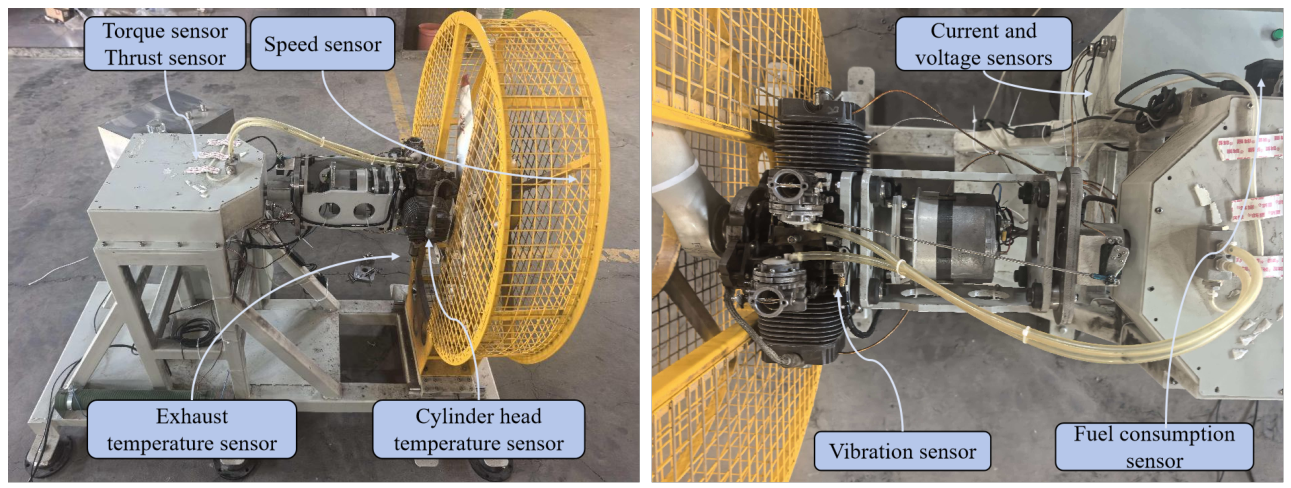
To achieve synchronized acquisition, processing, and life prediction of UAV engine operational parameters, this study developed a multi-sensor fusion-based UAV engine data acquisition platform, as illustrated in
Figure 1. The platform primarily consists of a UAV engine data acquisition test bench, a propeller safety cage, an independent fuel tank, a sensor array, a lower-level control box, and an upper-level host computer. The propeller safety cage, sensor array, and lower-level control box are all installed on the engine test bench, with the control box responsible for receiving and aggregating signals from all sensors and communicating with the host computer. The fuel tank adopts an independent modular design and connects to the engine’s fuel system under test, providing a stable fuel supply during engine experiments.
The engine data acquisition test bench primarily consists of the main bench frame, engine mounting structures, sensor measurement structures, throttle servo, and energy-dissipating resistor. The main bench adopts a welded frame structure, including a load-bearing platform and vibration-damping support legs, to enhance structural stability during experiments and reduce vibration interference. The engine mounting structures comprise an assembly plate, a generator mounting plate, and an engine mounting plate, which together enable secure installation of the engine under test and its auxiliary components. The throttle servo is mounted on the assembly plate and connected to the carburetor throttle lever via a linkage mechanism, enabling precise throttle control. The energy-dissipating resistor is installed on the load-bearing platform and connected to the generator output to create a controlled load condition.
The sensor measurement structures include thrust-torque measurement rods, rod bases, thrust sensor mounts, and a torque measurement conversion plate, which are used to capture engine thrust and torque parameters. The engine torque was measured from the reaction torque acting on the engine body. A thrust–torque measurement guide rod was mounted coaxially and rigidly to the engine, and a torque-conversion plate attached to the guide rod acted on the torque sensor through a calibrated lever arm. During operation, the resisting loads generated by the propeller and the generator produced an equal and opposite reaction torque on the engine body, which was transmitted through the guide rod and conversion plate to the torque sensor. To ensure experimental safety, a protective cage is installed around the propeller. The cage features a hollow mesh design and is mounted on adjustable rails to accommodate engines and propellers of varying sizes.
To characterize the externally observable operational response of the engine from multiple perspectives, the acquisition platform is equipped with sensors for thrust, torque, cylinder-head temperature, exhaust temperature, rotational speed, fuel consumption, current, voltage, and vibration. Temperature sensors are mounted on the cylinders and exhaust pipes, while the rotational speed is measured using an infrared sensor on the propeller. Fuel consumption sensors are installed in the fuel supply circuit, and current and voltage sensors are integrated into the data acquisition board within the lower-level control box. Vibration sensors are mounted on the engine mounting structures. All sensors are connected via signal cables to the lower-level control box, enabling synchronized acquisition of multi-dimensional UAV engine state data. The specific acquisition parameters are summarized in
Table 1.
It should be noted that the sensing configuration adopted in the present study primarily measures externally observable operating responses. Although vibration, temperature, thrust, torque, and electrical signals are affected by internal engine degradation, they do not directly measure internal tribological processes, such as piston ring–cylinder liner interaction, bearing contact, lubrication-film deterioration, and friction-induced acoustic emission. Therefore, the collected signals should be interpreted as indirect responses to internal degradation rather than direct measurements of the internal wear state. The present platform was designed to provide a non-intrusive and practically deployable data-acquisition solution for data-driven RUL prediction.
2.2. Remaining Useful Life Prediction Model for UAV Engines Based on Multi-Sensor Fusion
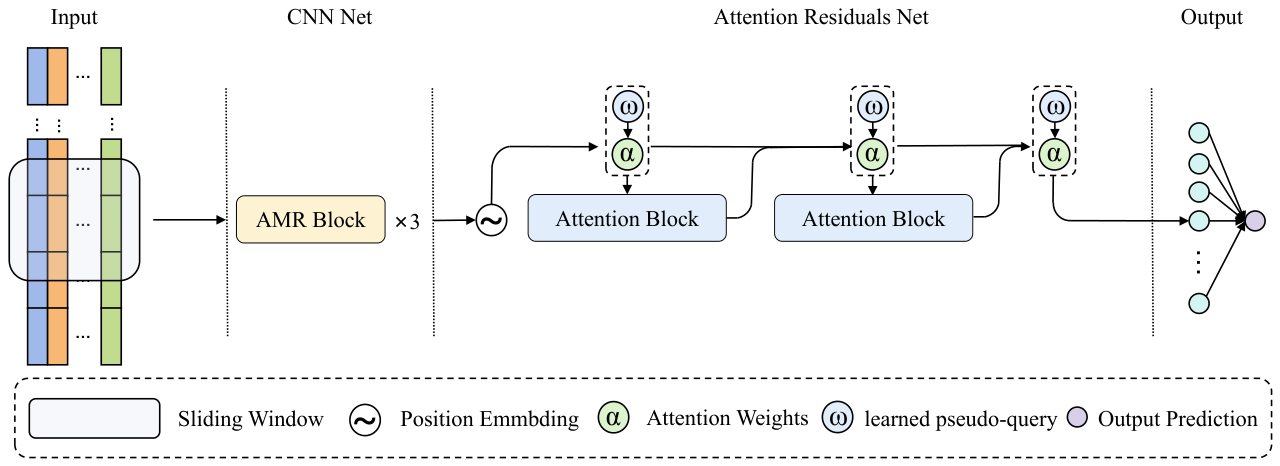
Conventional statistical analysis of single-sensor data is insufficient for capturing the degradation patterns of UAV engines. In this study, a multi-sensor fusion-based RUL prediction model for UAV engines is proposed, as illustrated in
Figure 2. The overall model consists of four components: the input module, a CNN network, a residual-attention network, and an output mapping network. The input module preprocesses long-sequence data. The CNN network extracts local degradation features of the engine. The residual-attention network processes temporal data via a Transformer for global dependency modeling. The output mapping network maps the high-dimensional features to predict engine RUL.
Initially, the input module applies a sliding window preprocessing to the long-sequence data acquired from multiple sensors, unifying the input length and avoiding performance degradation caused by excessively long sequences. The time window is defined as
where
L denotes the window length and
d represents the number of sensor dimensions.
The CNN network is composed of three stacked Attention-guided Multi-scale Residual Convolutional (AMR) blocks. Each AMR block employs parallel lightweight convolutions with different receptive fields to extract multi-scale local features. An attention mechanism is subsequently applied to select important features, suppress noise, and enhance model accuracy. Furthermore, the AMR block incorporates residual connections to prevent network degradation.
After extracting local features, the residual-attention network applies positional encoding to preserve temporal characteristics, as expressed by
where
denotes the output from the previous network layer. Here,
and
, where
B is the batch size. A Transformer is then used to model long-sequence dependencies. Additionally, the residual-attention network introduces residual-attention enhancement to improve feature representation, reduce training difficulty for deep networks, and achieve collaborative modeling of local features and global dependencies.
Finally, the output mapping network performs regression via fully connected layers, mapping the high-dimensional features to the predicted engine RUL. By combining local and global feature modeling with residual-attention structures, the proposed model achieves accurate engine lifespan prediction. The overall mapping process of the model can be expressed as
where
represents the ours model constructed in this study.
2.3. Attention-Guided Multi-Scale Residual Block
In the task of UAV engine RUL prediction, the engine degradation process contains information at multiple temporal scales. Short-term data reflect information such as vibration and instantaneous load fluctuations, medium-term data capture gradual performance degradation, and long-term data indicate structural aging trends. Conventional single-scale convolutional networks or recurrent neural networks can generally capture features only within a limited temporal range, making it difficult to model multi-scale degradation patterns simultaneously and thereby leading to the loss of critical information.
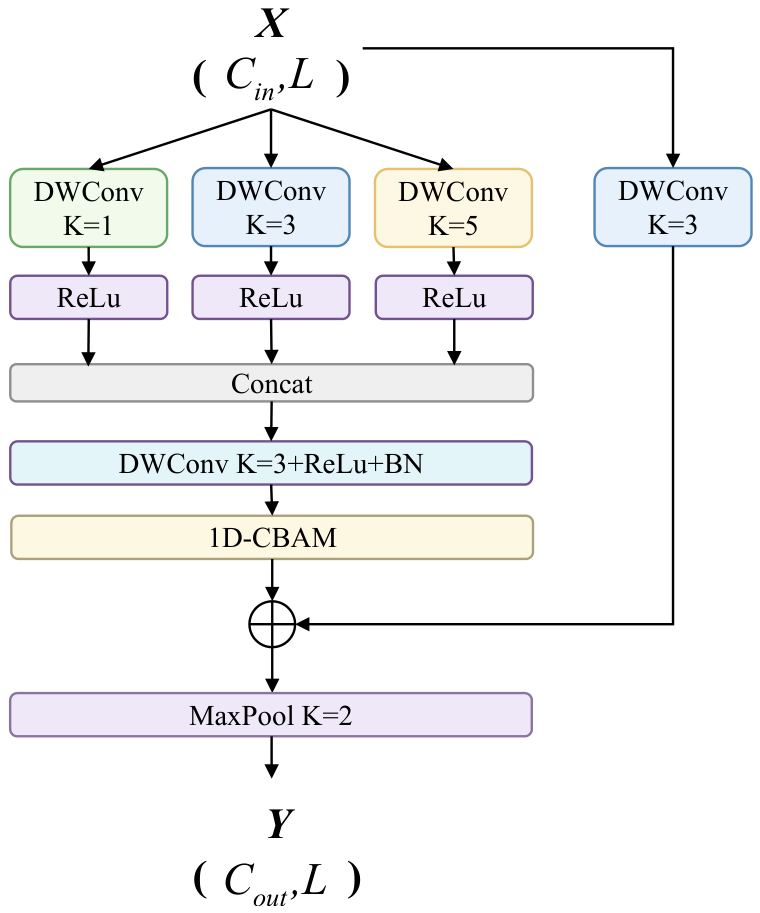
To address this issue, this study designs an Attention-Guided Multi-Scale Residual Convolutional Module, referred to as the AMR Block, to capture degradation features at different temporal scales and improve the completeness of feature representation. Its structure is illustrated in
Figure 3. The AMR Block first consists of three parallel multi-scale depthwise separable convolution branches, which capture local features at different scales. Specifically, small convolution kernels are used to capture short-term variations, whereas large convolution kernels are employed to capture long-term trends, as follows:
The above expression defines the multi-scale convolution branches, where denotes the input tensor, denotes the ReLU activation function, denotes depthwise separable convolution, and k represents the convolution kernel size.
Subsequently, the obtained multi-scale features are concatenated along the channel dimension, and a fusion convolution layer is further applied to extract spatial and channel correlations, as follows:
where Concat denotes concatenation along the channel dimension,
denotes the ReLU activation function,
denotes depthwise separable convolution, and BN denotes the normalization layer.
Although multi-sensor data provides rich information, the importance of different sensors is not uniform. Moreover, some signals contribute little to RUL prediction or may even act as noise. Treating all features with equal weights lacks the ability to selectively enhance key degradation-related features. Therefore, the CBAM attention mechanism [
20] is introduced into the module to adaptively assign feature weights, emphasize critical sensor information, and suppress noise interference. The CBAM attention mechanism is defined as follows:
where
denotes the channel attention weights,
denotes the temporal feature attention weights,
denotes the multilayer perceptron,
and
denote average pooling and max pooling, respectively,
denotes a convolution operation with a kernel size of 7, and
denotes the sigmoid activation function.
Meanwhile, an additional residual branch is incorporated into the module to prevent the degradation of feature representation capability and alleviate the vanishing-gradient problem. The residual branch contains a depthwise separable convolution with a kernel size of 3. The residual module is defined as follows:
Finally, the AMR Block includes a max-pooling layer to downsample long-sequence data, which enlarges the receptive field of the deep network while reducing model complexity.
Based on the above design, the AMR Block can capture multi-scale degradation patterns, adaptively highlight important sensor features, maintain stable gradient propagation in deep networks, and retain a lightweight structure.
Compared to standard multi-scale CNN structures that simply concatenate features from different convolutional kernels, our AMR Block explicitly addresses the severe redundancy and noise inherent in multi-sensor UAV engine data. The integration of the CBAM mechanism allows the model to adaptively evaluate the importance of different sensor channels (e.g., vibration vs. temperature) and temporal steps, selectively enhancing critical degradation-related features while suppressing noise interference, which is a crucial capability lacking in conventional multi-scale CNN-Transformer models.
2.4. Residual Attention
In the task of UAV engine RUL prediction, sensor data contain not only local degradation features but also significant long-term temporal dependencies. For example, slight performance variations during the early operating stage of an engine may influence subsequent degradation trends, while certain abnormal fluctuations may only manifest as evident life degradation after a long time interval. Therefore, an RUL prediction model should not only capture local variations within short time windows but also model global dependencies across different time steps.
The standard Transformer can directly compute correlations between arbitrary time steps through the self-attention mechanism, making it suitable for long-sequence dependency modeling. However, when applied to deep architectures, it still suffers from unstable training and insufficient utilization of local degradation features.
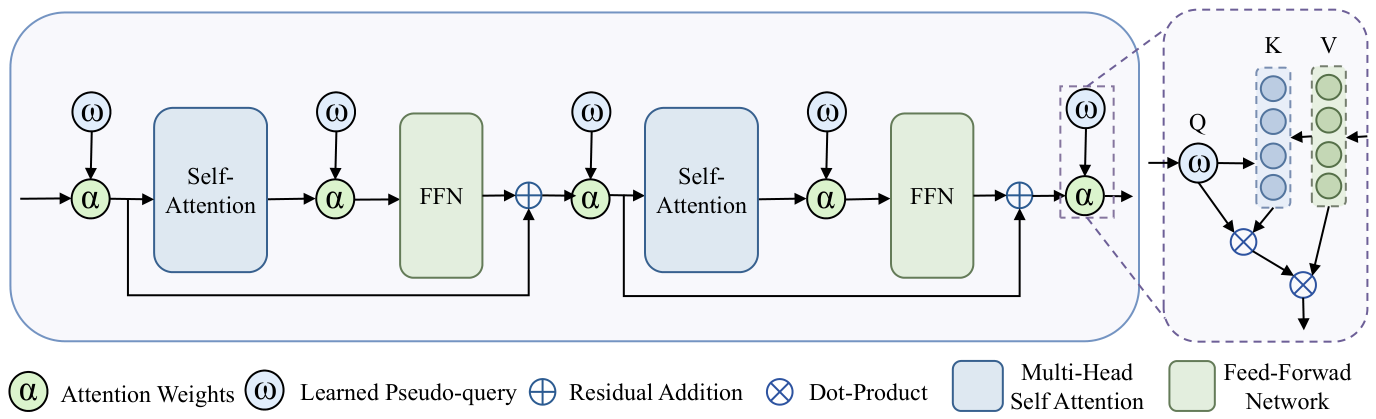
To address these limitations, this study introduces a residual attention mechanism [
21], as shown in
Figure 4. This module takes the multi-scale local features extracted by the AMR Block as input. Incorporating residual connections and layer normalization alleviates gradient degradation during training of deep networks and improves model convergence stability. In addition, the multi-head self-attention mechanism is employed to model global correlations among different time steps.
The residual attention module consists of a two-layer Transformer, in which information flow is propagated through standard residual connections. Between modules, an attention-based residual aggregation layer is used to perform weighted aggregation of historical blocks and the current state through weight projection. It is defined as follows:
where
denotes the final output feature of the
l layer, representing the current-layer feature after aggregating information from preceding layers through residual attention.
denotes the output feature vector of the
i layer, and
represents the attention weight assigned by the
l layer to the output of the
i layer.
The attention weight
is calculated using the softmax operation:
where
and
denote the query and key vectors, respectively. The key vector
is identical to the value vector
. For the
l layer, the parameters are defined as follows:
Root mean square normalization (RMSNorm) is applied inside the kernel function, as expressed below:
where
is a learnable scaling parameter, and
is a small constant used to prevent division by zero.
To further reduce the computational and memory overhead of the algorithm, block-level residual attention is introduced. Specifically, the network layers are divided into multiple blocks. Within each block, standard residual accumulation is retained, while attention-based aggregation is applied at the block level.
In conventional CNN-Transformer architectures, local features extracted by the CNN are passed through standard Transformer layers via simple additive residuals. In deep architectures, fine-grained local degradation features are often diluted as the network depth increases. To address this, our residual attention module performs a learned, weighted aggregation of all preceding layers’ outputs (as shown in Equations (11)–(13)) rather than a direct addition. This structural difference allows the network to dynamically determine how much attention the current layer should pay to historical features, effectively preserving critical local degradation information while modeling global dependencies, and significantly stabilizing deep network training compared to standard residual connections.
The residual attention structure enhances the representation of critical time steps and key degradation features. As a result, the model can capture long-term dependencies while preserving local degradation information, thereby improving the accuracy of UAV engine RUL prediction.
3. Experiment
3.1. Construction of the UAV Engine Life-Cycle Dataset
To verify the effectiveness of the proposed model in the task of RUL prediction for UAV engines, an experimental dataset was constructed based on the pre-collected full-life-cycle operational data of UAV engines. The raw data record the complete temporal evolution of the engine from the healthy operating stage to the degradation and failure stage, reflecting the relationships among performance deterioration, state fluctuations, and multi-source sensor responses during long-term engine operation.
The measured external signals were regarded as indirect indicators of engine health rather than direct measurements of internal tribological conditions. During the run-to-failure tests, abnormal operation was followed by inspection and, when necessary, replacement of serviceable peripheral components such as the fuel line and carburetor. Routine maintenance was also performed according to the manufacturer’s requirements. Therefore, peripheral component failures were not regarded as engine end-of-life. End-of-life was defined as the condition in which degradation of difficult-to-replace internal mechanical components prevented normal engine operation.
The tested engine was a Limbach DL275E engine (Xiamen Limbach Aircraft Engine Co., Ltd., Xiamen, China), and its specifications are listed in
Table 2.
Each record in the dataset contains the engine startup timestamp and 17-dimensional sensor features. The data were collected at a sampling interval of 1 s, resulting in a total of 294,107 records, corresponding to approximately 81.7 h of engine operation. Severe cylinder–piston wear was the primary end-of-life failure mode. Repairable peripheral failures were corrected during testing and were not regarded as end-of-life events. Compared with single-sensor data, multi-dimensional sensor data can characterize the engine operating state from multiple perspectives, thereby providing a more comprehensive data basis for the model to learn complex degradation patterns.
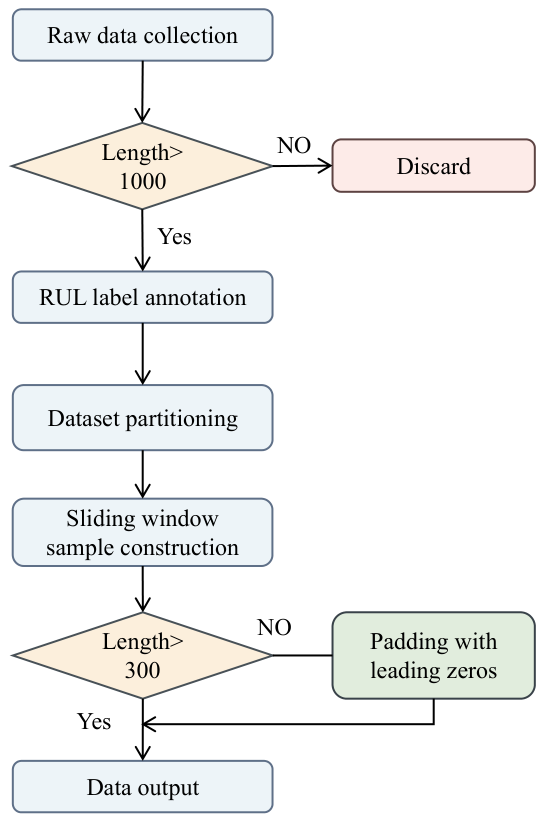
Before model training, the data need to be preprocessed, and the workflow is illustrated in
Figure 5. Considering that some operating sequences were too short to effectively reflect the complete degradation trend of the engine and may introduce unstable samples that interfere with model training, the raw data were preliminarily screened. Specifically, experimental data with startup durations shorter than 1000 s were removed.
During the data annotation process, each engine startup process was treated as an independent operating unit and assigned a unique RUL label according to the chronological order of startup time. The RUL label represents the percentage of remaining useful life. For the same engine operating sequence, earlier time steps correspond to larger RUL label values. As the operating time increases, the engine gradually undergoes performance degradation, and the corresponding RUL label decreases until the engine approaches the failure stage. In this way, the raw multi-sensor time-series data were transformed into input–label sample pairs suitable for supervised learning. The calculation formula for the labels recorded in the i-th engine-start cycles is:
Among them, N represents the total number of engine-start cycles records in the entire life cycle dataset, and i is the sequential index of the current engine-start cycles (i = 1, 2, …, N).
The full-life-cycle dataset was randomly divided into training and testing sets at a ratio of 5:5. Since different sensor parameters have distinct physical dimensions and numerical ranges, the sensor features were normalized to map features from different dimensions onto a unified numerical scale, thereby improving the convergence speed and training stability of the network.
To meet the requirement of deep learning models for fixed-length inputs, a sliding-window method was adopted to construct samples from continuous time-series data. To avoid data leakage, the sliding-window operation was applied after dataset partitioning, ensuring that the training and testing sets did not overlap. Let the sliding window length be
L. The
i-th sample window can be expressed as follows:
The sliding window length was set to , meaning that each input sample contains multi-sensor observations over 300 consecutive time steps. Through sliding-window processing, the temporal continuity of the data can be preserved while increasing the number of training samples, enabling the model to learn dynamic variation patterns of the engine at different degradation stages. For short sequences with fewer than 300 time steps, leading-zero padding was applied to meet the requirement of a unified input length.
After the above processing steps, the final input dimension of each sample was constructed as follows:
where 300 denotes the time window length, and 17 represents the dimensionality of the sensor features.
The constructed dataset covers the complete life-cycle evolution of the UAV engine from normal operation to performance degradation, providing a unified and reliable data foundation for the subsequent training, validation, and comparative experiments of the residual attention network.
3.2. Parameter Settings and Evaluation Metrics
The experimental environment used in this study was configured with an Intel Xeon Platinum 8474C CPU, an NVIDIA RTX 5090 24 GB GPU, and 80 GB of memory. The algorithm was implemented based on the PyTorch 2.11.0 deep learning framework. The input sequence length of the model was set to 300, with a batch size of 512, 50 training epochs, a learning rate of 1 × 10⁻⁴, and an L2 regularization coefficient of 1 × 10⁻⁴. A weight decay strategy was adopted to prevent overfitting. The learning rate decay step was set to 10, and the learning rate decay factor was set to 0.1. Dropout was added to the fully connected layer and set to 0.05. The hidden dimension of the fully connected layer was set to 50, and the number of Transformer heads was set to 2.
To further clarify the implementation procedure and improve the reproducibility of the proposed method, the complete training workflow is summarized in Algorithm 1. The procedure integrates multi-scale local feature extraction, attention-based feature refinement, residual feature propagation, and Transformer-based long-range dependency modeling within a unified training framework.
To comprehensively evaluate the performance of the proposed model in the UAV engine RUL prediction task, this study adopts three evaluation metrics: root mean square error (RMSE), coefficient of determination
, and Score. Among them, RMSE is used to measure the average deviation between the predicted values and the true RUL labels. A smaller RMSE value indicates a lower prediction error and higher prediction accuracy. RMSE is defined as follows:
The coefficient of determination
is used to measure how well the model predictions fit the variation trend of the true labels. The closer
is to 1, the stronger the model’s ability to explain the degradation trend of engine life.
is defined as follows:
| Algorithm 1 Training Procedure of the Proposed Network |
| Require: Multi-sensor time series data X, RUL labels Y, sliding window length L, epochs E, batch size B |
| Ensure: Optimized model parameters |
- 1:
Generate input samples by applying sliding window operation with length L on X. - 2:
Initialize network parameters and Adam optimizer. - 3:
for to E do - 4:
for each batch do AMR Block: Local Multi-Scale Feature Extraction - 5:
Extract multi-scale features: - 6:
, , . - 7:
Fuse multi-scale representations: - 8:
. - 9:
Apply CBAM attention mechanism: - 10:
. - 11:
Perform residual fusion: - 12:
. - 13:
Downsample feature representation: - 14:
. Residual Attention Transformer: Global Dependency Modeling - 15:
Add positional encoding: - 16:
. - 17:
for to do - 18:
Calculate multi-head self-attention: - 19:
. - 20:
Compute residual attention weights: - 21:
. - 22:
Aggregate previous representations: - 23:
. - 24:
end for Output Prediction and Optimization - 25:
Estimate RUL: - 26:
. - 27:
Compute training loss: - 28:
. - 29:
Update parameters using Adam optimizer: - 30:
. - 31:
end for - 32:
end for return
|
In addition, considering that early and delayed predictions have different impacts on practical maintenance decision-making in RUL prediction tasks, the Score metric is further adopted to evaluate prediction errors. Let the prediction error be defined as
Then, the Score metric is defined as
where
denotes the number of test samples,
represents the prediction error with respect to the true actual remaining operating life,
denotes the true actual remaining operating life of the engine, and
denotes the model-estimated remaining operating life.
3.3. Experiment on the Number of Transformer Layers
To investigate the effect of the number of Transformer layers on model performance, different hyperparameter settings were evaluated. In the proposed structure, every two Transformer layers constitute one attention block, while any remaining layer is treated as an independent Transformer layer. The experimental results are shown in
Table 3.
When the number of encoder layers is set to 1, the model exhibits relatively poor performance, indicating insufficient fitting capacity and an inability to effectively capture long-range dependencies in the training data. As the number of layers increases, model performance gradually improves. In particular, when the number of layers increases from 3 to 4, the RMSE decreases by 0.0384 and increases by 0.0008, suggesting that a deeper network can better learn complex degradation patterns. However, when the number of layers is further increased to 5, the performance slightly declines, with the RMSE increasing by 0.0554, indicating a potential tendency toward overfitting. Therefore, the four-layer Transformer achieves the best performance in this experiment, providing the optimal balance between representation capability and generalization performance.
3.4. Ablation Experiment
To further validate the contribution of each module to the final model performance, an ablation study was conducted. The following model variants were designed:
Model A: AMR Block
Model B: Standard Transformer
Model C: AMR Block + Standard Transformer
Model D: Residual Attention Transformer
Ours: AMR Block + Residual Attention Transformer
The ablation results are presented in
Table 4. As shown in the results, although the AMR Block can effectively extract local features, it lacks global dependency modeling capability; therefore, its performance in terms of
and RMSE is inferior to that of the fusion-based models. Model B successfully models long-sequence dependencies, but it neglects local feature extraction, resulting in insufficient performance, particularly in identifying short-term degradation patterns. Model C integrates local features and global dependencies, enabling the model to capture both types of information simultaneously and thus achieving a significant performance improvement. Model D introduces a residual structure to alleviate gradient-related problems during training; however, due to the absence of the multi-scale feature extraction capability provided by the AMR Block, its representation of local features remains relatively limited.
The proposed model combines the multi-scale feature extraction capability of the AMR Block, the gradient optimization effect of residual connections, and the global modeling capability of the Transformer, ultimately achieving the best prediction performance. The experimental results demonstrate that the combination of the AMR Block and residual Transformer significantly improves model performance, confirming the effectiveness of the proposed method.
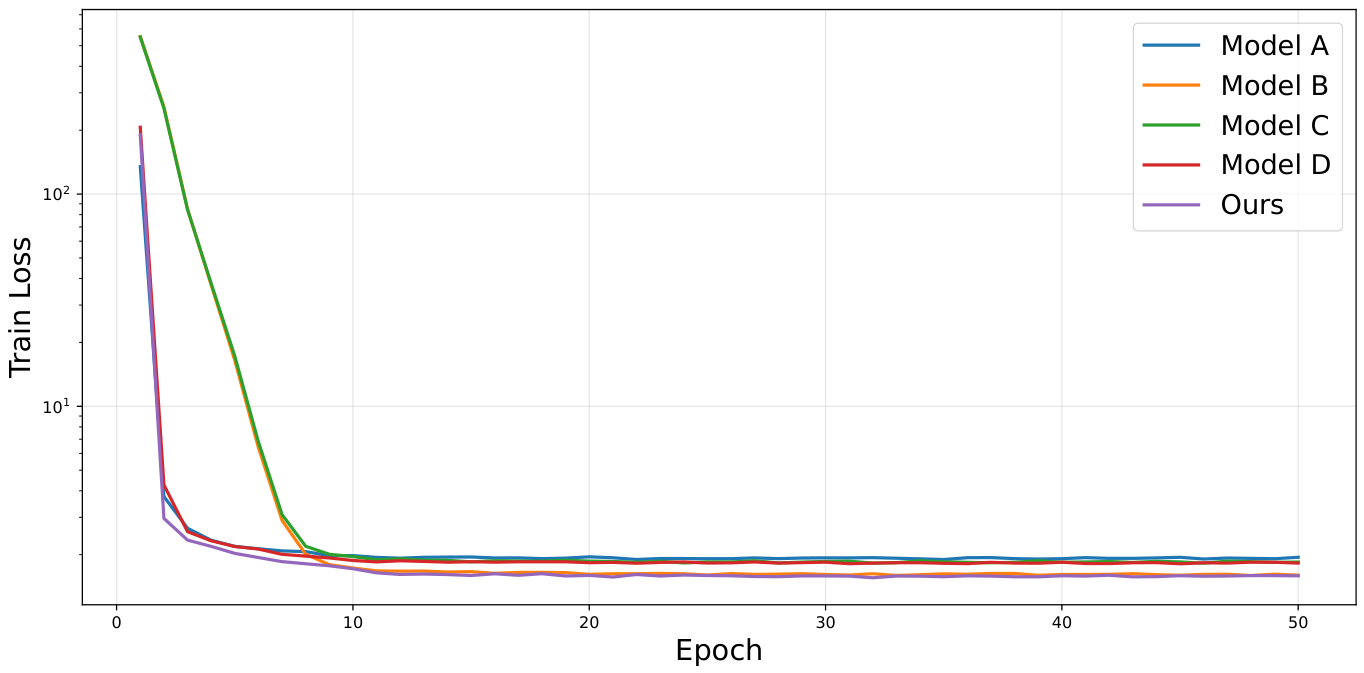
To further verify the effect of the residual attention mechanism on model training stability, the training loss curves of each model were visualized, as shown in
Figure 6. The Transformer-based Models B and D exhibit significantly slower convergence during training than the other models. After introducing the residual attention mechanism, the convergence speed of the model is markedly improved. The proposed model demonstrates the most favorable loss variation trend throughout the entire training process.
This indicates that the proposed model can not only fully exploit the multi-scale local feature extraction capability of the AMR Block, but also effectively model long-range dependencies through the residual attention Transformer. Consequently, it achieves better parameter optimization and stronger training stability, further verifying the rationality and effectiveness of the proposed model architecture.
3.5. Comparison with Other Algorithms
To further evaluate the effectiveness of the proposed model, it was compared with several commonly used RUL prediction methods. During the comparison, only the input and output layers of each network were modified to adapt to the input dimensionality of the dataset, while all other parameters were kept consistent with the original source-code settings. The experimental results are presented in
Table 5.
Due to its structural limitations, TCN [
24] cannot sufficiently model global dependencies in long time-series data; therefore, it shows relatively poor performance in terms of
and RMSE. Although GRU [
23] can capture temporal dependencies, it has certain limitations in modeling multi-sensor data, particularly in learning degradation patterns from long time sequences. CNN-GRU [
23] and CNN-LSTM [
22] combine the local feature extraction capability of convolutional networks with the temporal modeling ability of recurrent neural networks. However, they still cannot efficiently capture both long-range dependencies and short-term variations simultaneously, resulting in inferior performance compared with the proposed model. MSCNNformer [
17] introduces a Transformer structure based on multi-scale convolutions, which improves the extraction of global and local features compared to traditional CNN-RNN models. While it achieves better results than the aforementioned baseline models, it still falls short of the proposed model.
The proposed method employs the AMR Block to extract multi-scale features and integrates the residual attention Transformer to accurately model global dependencies. As a result, it achieves the best performance across all evaluation metrics, particularly showing significant advantages over the other methods in terms of RMSE and .
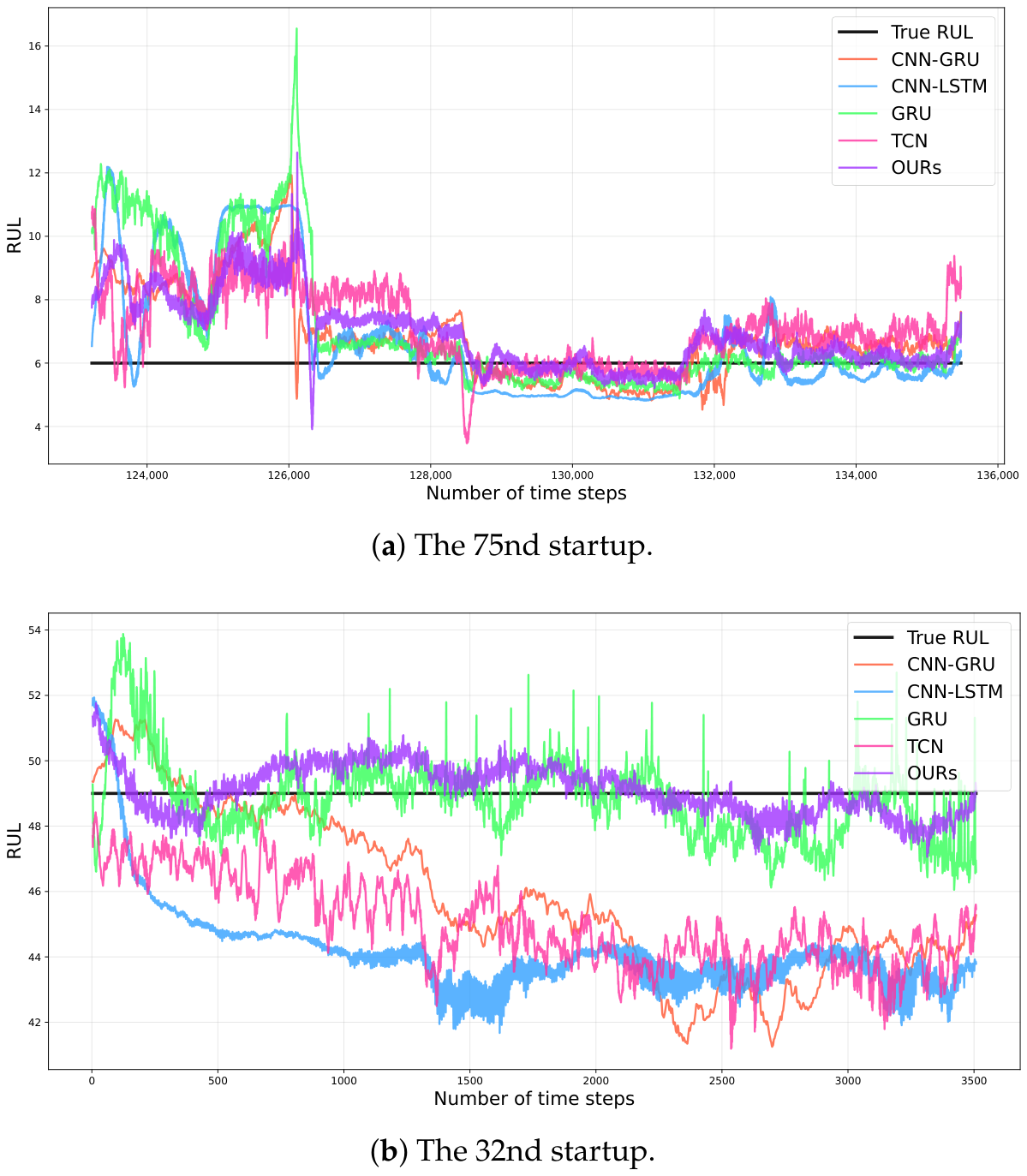
The prediction results of different algorithms on the test set were visualized and compared with the actual RUL values, as shown in
Figure 7. It can be observed that, particularly in the middle and late stages of life prediction, the predictions of the proposed model are closer to the true values than those of the other models. In contrast, the comparison models exhibit noticeable fluctuations and substantial deviations from the actual RUL values. Overall, the proposed model can predict RUL with relatively high accuracy in most cases.
4. Conclusions
In this paper, a novel Remaining Useful Life (RUL) prediction model is proposed to address the challenges of modeling complex temporal dependencies and multi-scale degradation patterns in time-series data. The proposed architecture integrates the AMR Block for multi-scale local feature extraction with a residual attention Transformer for effective global dependency modeling.
To comprehensively evaluate the effectiveness and superiority of the proposed method, a newly constructed comparative framework was utilized, encompassing traditional recurrent and convolutional baselines (TCN, GRU, CNN-GRU, CNN-LSTM) as well as the recently advanced multi-scale convolution-Transformer variant (MSCNNformer). The experimental results demonstrate that the proposed model achieves the best performance across all evaluation metrics, yielding the lowest RMSE (1.2891), the highest R2 (0.9858), and the lowest Score (10,808.3598).
Although models like MSCNNformer improve upon traditional CNN-RNN architectures by introducing Transformer structures and multi-scale convolutions, the proposed method still maintains a distinct advantage. This superiority stems from the seamless fusion of the AMR Block and the residual attention Transformer, which effectively mitigates prediction fluctuations and significantly reduces deviations from the actual RUL values.
Overall, ours study provides technical support for predictive maintenance and safe flight operation of UAV engines. It also offers a useful reference for life prediction and health management of similar complex equipment, providing a scientific basis for equipment support and maintenance decision-making. Nevertheless, the present study still has certain limitations. Although the model was evaluated using full-life-cycle engine data, prospective validation on additional independent engines was not performed. As the test platform only employs external non-intrusive sensors, direct information related to internal friction and wear cannot be obtained. In future work, internal acoustic or acoustic-emission sensors will be introduced to acquire more internal information on component interactions, and their signals will be synchronized with existing multi-source signals to construct an enhanced multi-modal life-cycle dataset.